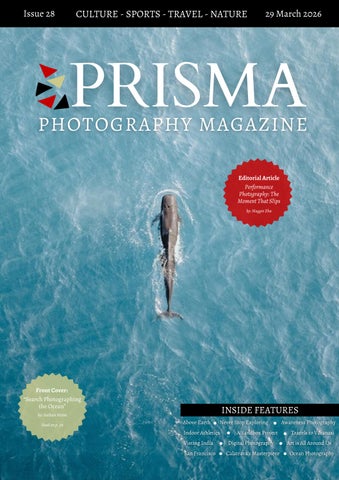
PRISMA Issue 28

Page 1


PHOTOGRAPHY MAGAZINE

INSIDE FEATURES

INSIDE THIS ISSUE OF PRISMA

EXCLUSIVE: Performance Photography - The Moment That Slips

Theatre photography is a form of interpretation that explores the tension between performance’s fleeting nature and photography’s permanence

Maggie Zhu shares how images reshape moments, extending their life while acknowledging the limits of capturing something inherently transient

EarthfromAbove

p.7

Rui Santos gives an insight into the process of capturing breathtaking drone photographs across the world, and sharing the steps he took to break into areal photography

Documenting Athletics

. . . p.13

Louise Anderbjörk shares her experience of photographing indoor athletics for the first time, at the Scottish Student Sports annual athletics championships in Glasgow.

NeverStopExploring

p.9

Jon Berdanier reflects on his growing connection to the natural world through photography and how the fleeting nature of life inspires his work

PhotographyforAwareness

. . . . p.11

Gabriele Daniel Babbino explores how photography gave him the opportunity to slow down and notice his surroundings in ways he has never been able to before

SeeMe:ASandboxProject . . . . . p.15

Christer Björkman’s shares his series of sandbox photos which represent society's 'unseeing' of homelessness: an idea that he realised came from his mother's lifelong charitable work.

TravelstoVaranasi . .

. . . . . . . p.17

Tara Phillips shares the result of bringing her camera on a visit to Varanasi, highlighting advice on compositions and frames to look out for in a new place as a photographer.

UnforgettableIndia p 19

Andrew Lait recounts highlights of an unforgettable trip to India, where he hoped to see tigers but was instead amazed by the stunning architecture and local culture.

SanFranciscoStreets

p.25

Ryan Burgess describes how street photography allowed him to slow down, let go of expectations, and appreciate the world around him with a new perspective

DigitalPhotographyatHome p 21

Change often arrives uninvited, but Martyna shows that it's also what dares us to grow. When the digital revolution arrived, her fear of the unknown became a patient teacher.

ArtisAllAroundUs p 23

Patrícia Sequeria explores the fantastic and extraordinary in her new photography project, in which the imaginary can become real, if only we can believe.

Calatrava’sMasterpiece

. p.27

Javier Núñez, a street photographer from Spain, shares his project of documenting the various angles and architectural stories of the Santiago Calatrava’s Auditorio de Tenerife

PhotographingtheOcean

p.29

Wildlife photographer Nathan Moine explores the world of underwater photography and shares the many tales of how he has befriended marine life from behind the lens

The Editorial Team

Editor-in-Chief Louise Anderbjörk

Editor-in-Chief Tristan Sharman

ContentManager Kailee Parsons

EditorialEditor ..............................Maggie Zhu

Researcher ................................Daniel Olivares

MediaManager .................. Amanda MacEachen

THE MOMENT THAT SLIPS

MAGGIE ZHU

Dear readers,

Having previously written about my work in music and festival photography, I wanted to take a moment to talk about a different part of my practice that I have not shared here before. Alongside concerts and live events, I also work as a theater photographer. It is where my journey with photography began, and theater always has a special place in my heart. It is a space that has shaped not only how I shoot, but how I think about photography itself Recently, after photographing a few theatre performances again, I found myself returning to questions I explored during my Master’s research on performance photography and its role in documentation. What follows is not a definitive answer, but a set of observations that continue to shape how I approach photographing performance Theatre can take many forms, quiet or chaotic, minimal, or overwhelming What connects these different experiences is not their tone, but their temporality. Each performance exists only as it unfolds and disappears the moment it passes. Going back to where my photography journey began, a production of Spring Awakening. During the show, I found myself waiting for a moment I thought I could anticipate On stage, a man (played by our editor-in-chief, Tristan Sharman actually) collapsed beside the tomb of his son, surrounded by figures who passed him one by one, dropping flowers as they sang. I framed the scene carefully, watching for the instant when one flower would fall into the space beside him, something small enough to carry the emotional weight of the scene But I missed it The flower dropped, the scene moved forward, and the moment disappeared before I could press the shutter That experience stayed with me because it revealed something fundamental about performance. Theatre

exists in a kind of time that resists being held onto. It unfolds in the present and disappears as soon as it appears. Even if the same scene is repeated the next night, it is never quite the same Something shifts, whether in the performer’s delivery, the audience’s response, or the atmosphere of the room This fleeting quality is often what makes performance so powerful, but also what makes it difficult to photograph. Photography, by contrast, is built on the idea of holding onto a moment. It isolates, preserves, and allows something to be revisited long after it has passed Placing these two mediums together creates a tension What does it mean to photograph something defined by its disappearance? In many cases, performance photography is understood as documentation. It produces a record of what happened on stage, often through wide, observational images that include the entire scene. These images allow viewers to see the set, lighting, and relationships between characters, almost as if they were sitting in the audience They serve an important purpose, especially in archival contexts However, while these images can show what a performance looked like, they often struggle to convey what it felt like. The immediacy of a scene, the subtle emotional shifts between performers, these are difficult to translate into a still image. A photograph taken for documentation becomes a fragment, removed from the flow of time that gives performance its meaning The “now” of the performance continues to resist being captured.

“Theatre can take many forms, from minimal to chaotic. What connects these different experiences is not their tone, but their temporality”

This is where performance photography begins to move beyond documentation In practice, photographing theater is never a neutral act The photographer is constantly making decisions about where to stand, what to frame, and when to press the shutter. Rather than presenting the entire stage, the camera often moves closer, isolating a single expression or gesture. Through this process, the performance is not simply recorded, but reinterpreted A close-up image can create a level of intimacy that is not available to the audience in the theater Details of a performer’s expression or posture are brought forward, while everything else falls away. These choices shape how the performance is seen and understood. The photograph does not replicate the live experience but offers a different version of it. This became particularly clear to me when I looked back at how I edited my images from Spring Awakening The production made strong use of color and dynamic lighting, yet I found myself moving in a different direction. I converted the images into black and white, lowered the exposure, and emphasized contrast. I was not trying to reproduce the

performance as it appeared on stage, but to translate the emotional tone I experienced while watching it. Through this process, certain moments were selected, and others left out The resulting images formed a narrative that did not exist in the performance in the same way For some viewers, especially those who were unable to see the performance live, these images became their primary way of engaging with the work. This raises an important question. If a performance is experienced only through photographs, what is being experienced? It is easy to assume that something essential is lost However, photography also creates a different kind of encounter It allows viewers to return to a moment, to study it, and to form interpretations over time. In this sense, performance photography does not simply preserve what has disappeared, but extends the life of the performance in another form Rather than acting as a passive record, performance photography becomes a process of selection and transformation It does not capture the performance as it was but creates something new from it. The performance provides the material, but the photograph reshapes it through framing, timing, and editing. Looking back at the shot I missed, I guess I cannot see it purely as a failure Instead, it sheds light on the limit of what photography can do There will always be moments that cannot be captured, moments that exist only in the live experience. At the same time, there are moments that come into being through photography itself, shaped by the way they are framed and shared. Performance and photography operate in different ways, one defined by disappearance, the other by persistence When they intersect, they create a space where the performance can continue as a new form of experience

EARTH FROM ABOVE

ContentManager:Kailee Parsons

RUI SANTOS

I began my photography journey in an u Before I ever held a camera at eye level, I looking down at the world from above My were made with a drone, not out of a desir but out of fascination while filming a music own music project. What immediately captiv the patterns and geometries that only reveal a distance, agricultural fields turning into becoming lines, shadows transforming elements This unfamiliar perspective pushe thinking and slowly reshaped my unde composition, long before I had the languag what I was intuitively responding to. With came an unexpected emotional shift. Place knew suddenly felt unfamiliar. The separa myself and the landscape created a sense of but also curiosity Flying a drone introduced responsibility of keeping a fragile device in navigating wind, obstacles, and changing adrenaline became part of the creative proc image was captured and the drone safely r tension dissolved into a feeling of liberation. Photographing from above felt both controlled and unpredictable at the same time Working with a drone also required a certain level of trust: in the equipment, in my preparation, and in my own decision-making Once airborne, there is a moment where control must be partially surrendered. That balance between intention and uncertainty became central to my process. I learned to accept that not every flight would result in an image, and that restraint sometimes meant choosing not to press the shutter at all Shooting aerially shaped how I position myself as a photographer from the very beginning Instead =

of moving closer, I learned to step back - to see landscapes as complete forms rather than fragments Composition gradually became an exercise in shaping angles into pleasing lines, balancing weight within the frame, and allowing negative space to breathe. The smallest shifts in position could radically change the image, teaching me patience and precision This way of working heightened my awareness of the environment, not only as a photographer but as a human being Weather and light were no longer background elements; they became central characters, grounding me in the moment. In places I may =

never return to, I learned to slow my breathing and simply be present. Clouds softened or disrupted compositions, low sunlight carved textures into the land, and wind dictated whether a flight was even possible. These conditions shaped not only the image, but the decisions behind it, reinforcing the idea of nature as an unpredictable yet essential collaborator Early on, I faced a technical limitation that shaped my approach even further. The drone I owned did not allow shooting in RAW format. Instead of seeing this as a setback, it became an unexpected lesson. I had to push my editing skills while remaining acutely aware of how easily an image could break Some adjustments were necessarily heavy, but they were approached with precision and restraint, always with the intention of preserving the integrity of the image rather than overpowering it. Working within narrow margins taught me to respect tonal limits, color depth, and detail, and to find satisfaction in subtle decisions as much as bold ones. Limitations, I learned, can sharpen creativity when embraced rather than resisted That discipline later became essential when I entered the world of astrophotography My curiosity naturally extended into exploring other forms of photography, from the intimacy of macro work to the patience required in wildlife, and the quiet observation of landscape photography. Each discipline demanded a different pace and sensitivity, yet all shared the same foundation: attention, restraint, and respect for the subject Over time, imaging became more than a visual experiment It changed the way I see the world. I began noticing patterns… in urban planning, in natural erosion, in the dialogue between human

intervention and untouched land The drone simply revealed what was already there, waiting to be seen from a different angle. Most importantly, this journey was never about owning the latest or most expensive equipment. It began purely for the joy of experimentation and the freedom to explore the vast possibilities of image-making Photography, for me, became a space of play, curiosity, and continuous learning Looking back, I realize that starting without expectations opened doors I could not have planned for. If there is anything I hope my work communicates, it is this: meaningful images come less from equipment and more from attention… from curiosity, presence, and the willingness to explore unfamiliar perspectives Sometimes, all it takes to begin is the courage to lift off for the sky is not the limit!

NEVER STOP

JON BERDANIER

Although photography has always interested me, I did not discover my true passion for it until hitting the road after my time at university From Florida I travelled northwest to the opposite side of the country, to join some college friends in Montana After spending two summers there, I couldn’t help but realise how much better my life was away from all the hustle and bustle of cities This feeling of solitude and peace kept me travelling out West for another four years, from Montana to California to Utah and everywhere in between. At the time, there was an idea that had a grip on me and my work: while the forest appears to be a jumbled mess, everything is exactly where it should be, whereas. a city full of straight lines and right angles appears to be in perfect order, but it is chaotic. Through minimalist compositions I aim to show the vastness of nature and the perfection that exists within it I want to encourage people to never stop exploring so that they might find their connection to the world we inhabit for a finite amount of time Some images capture the passing of time and others timeless compositions of the world as it is, has been, and how it will be for thousands of years to come, even after we are gone. A dilapidated barn, a bison grazing or the changing seasons through the years. We are nature and it is us. I want my work to be a representation of this idea, to encourage self-reflection through nature and a reverence for the fragility of our lives on earth.

PHOTOGRAPHY FOR AWARENESS

ContentManager:

GABRIELE BABBINO

Photography, for me, did not begin with the desire to create images. It began with the need to slow down. In a world that constantly urges us to move faster, to consume more, and to look without truly seeing, photography became my quiet way of resisting that rhythm Not through confrontation, but through attention. Through patience. Through remaining with a moment long enough for it to reveal itself. My name is Gabriele Daniel Babbino. I am 42 years old, a father of three children, and I live with my wife, whose support gives me both stability and freedom in my photographic work This balance between responsibility and space has shaped how I see the world Photography is not an escape from daily life for me, but a way of being more present within it. My Italian heritage has also influenced my relationship with time and perception. A sensitivity to pauses, gestures, and the unspoken continues to inform how I approach both life and photography Over time, my relationship with photography shifted I moved away from searching for spectacle and toward what is often overlooked: fragile structures, fleeting moments, and quiet details within nature. A dried leaf suspended in light, mist drifting along a forest path, the texture of bark warmed by the sun. These moments do not demand attention They require presence I do not approach nature as a backdrop or a subject to be captured I encounter it as something that exists independently of me, something that does not need my intervention to be meaningful. Photography, in this sense, is not an act of control, but one of listening. Working exclusively with natural light is an extension of this attitude I do not impose light; I respond to it Light changes constantly, just as nature does, and accepting this impermanence is central to my process Shadows are not

obstacles to be removed, but spaces where depth and ambiguity can exist. I am drawn to moments where clarity softens, where not everything is immediately visible. In these spaces, reflection can emerge. The preservation of nature is not an abstract concept for me; it begins with awareness We have grown accustomed to treating our surroundings as self-evident We move through landscapes without noticing them, sometimes even with disregard, as if they were merely a stage for our own lives. Through my photography, I want to counter this attitude not through accusation, but through attentiveness. For many, a leaf illuminated by sunlight is simply that: a leaf, a

“ This balance does not ask for interference, but for respect. ”

brief impression before moving on But when one slows down and looks closely, something changes The leaf reveals its strength and structure, its role in sustaining life. The presence of the sun becomes tangible not as a symbol, but as a necessity. Without light, there is no growth, no transformation, no life. The more attentively we observe nature, the clearer it becomes that nothing exists without purpose From the smallest seed and microorganism to the largest plant or animal, everything forms part of a delicate system of relationships. This balance does not ask for interference, but for respect. My work is an attempt to make this interconnectedness visible and to remind us that we are participants within this system, not its owners My focus on detail is therefore not merely aesthetic It is a way of assigning value What we learn to notice, we begin to care for Photography allows me to spend time with these moments without the need to explain or resolve them. I want the images to remain open spaces where viewers may slow their own gaze and encounter something they might otherwise overlook. There is also room for imperfection in my work Not every image needs to be sharp or complete Softness and uncertainty are part of how we experience the world when we stop rushing through it. These qualities often reflect presence more truthfully than precision ever could.

======

Photography has also taught me restraint. Not every moment needs to be photographed, and not every scene needs to become an image. Sometimes the most important part of the process is knowing when to lower the camera and simply stay present This awareness influences my work just as much as the moments I eventually choose to capture Ultimately, photography has become less about producing images and more about cultivating a way of seeing. It teaches patience, humility, and respect for what cannot be owned or fully understood. If my work leaves viewers with a sense of calm, or with renewed sensitivity toward the small and fragile aspects of the natural world, then it has fulfilled its purpose Not to persuade But to remind us that meaning often resides in what we take the time to notice.

DOCUMENTING ATHLETICS

ContentManager:

LOUISE ANDERBJÖRK

In February, Scottish Student Sport hosted its annual Indoor Athletics Championships at the Emirates Arena, and I was invited to document the day Built for the 2014 Commonwealth Games, it was an incredible venue to work in, and very fitting for the high-performance atmosphere brought by the top tier student athletes from across Scotland that day. It was my first time photographing athletics, let alone indoor athletics, and as exciting as it was, it was also a real adjustment from the open football and rugby pitches I am used to With indoor athletics, everything is compressed Up to five disciplines can take place simultaneously in and around a single 400m track This gives a whole new meaning to spatial awareness as a photographer, as the last thing you want is to accidentall step onto a track mid race while trying to capture anothe event. Therefore, finding positions that were safe an strong for framing took some time My favourite spo ended up being sat down at ground level just outside th track perimeter, directly facing the hurdles and 100m sprint race. Shooting front-on from a low angle is a goo way to give the images an extra bit of intensity an immersive feel, and it was also a great spot for capturin the post race celebrations up close. Working in such tight, busy space also meant having to be smart wit lenses I kept a 70-300mm and a 35mm on me all day switching constantly to capture action both metres awa

Highperformance Scottishatheletes

SEE ME: A SANDBOX PROJECT

CHRISTER BJÖRKMAN

Why do people photograph? There are many answers to this question. One simple answer is that it helps one remember things considered important For one and the same person there may be several reasons why they photograph My main motivation for being an active photographer is that it helps me feel good. Another more specific reason is that making images with my camera is some kind of therapy. After a long career as a university professor, I have reduced my working hours in recent years to be able to photograph more My passion for photography has really begun to flourish and I am looking forward to retiring soon and being able to photograph even more. Two photography projects that I have worked on recently have been clearly therapeutic. One, which I intend to talk about and show here, is about processing the grief when my mother quickly became ill and passed away after a short time Much earlier than we relatives had expected My mother was a very active person and for a time she devoted herself a lot to helping the homeless I tried to start photographing homeless persons as a kind of tribute to her but soon realized that I, at least not then, did not have the ability to portray these often broken people in a sufficiently respectful way. I started photographing sandboxes instead In Sweden, sandboxes are almost everywhere The sand they contain is spread on the ground in winter to reduce the risk of accidents and injuries Most of the boxes stand outside all year round. Most are made of plastic and come in different shapes, sizes and colours. Even if some are new, most look worn. The sandboxes seem to lack a home. Like some people. One could perhaps say that the project is about loneliness Not being seen ‘See Me!’ With time, I have started to realize that the reason behind me starting to photograph sandboxes was

county governor of Uppland and get to move into the Uppsala castle, she answered “I don’t think we need a new governor Let the homeless move into the castle instead ” Sandboxes resemble homeless people to me. And represent people we tend to not see. Even though they are

“ Even if some are new, most look worn. The sandboxes seem to lack a home. Like some people. One could perhaps say that the project is about loneliness. ”

relatively common Sandboxes are also very ordinary items and therefore fits into one of the broader themes in my photography, i.e. ‘photographing the ordinary’. I try to do projects that document ordinary things and people of today. One example is ‘Proud People’, which is a project where I made portraits of strangers I met. My approach was to ask them if they wanted to participate in a project about pride If they said “Yes”, I asked them to close their eyes and think of something they are proud of When they opened their eyes, I pressed the shutter. Then I asked if they wanted to share what they had been thinking about. Most people shared their thoughts. And they differed a lot. My thought behind the project was that you can see in a person's face when they think about something they feel proud of My mission, if any (I think), was to make people feel good at least for a short while We all too seldom think about things we are proud of and give ourselves a tap on the shoulder. Another driving force behind my

photography is that it helps (forces?) me to interact with other people. Not just the people I'm drawn to photograph but also in various forms of collaboration. A collaboration that has been going on for a few years is within the photography collective Three Cities Photography where I collaborate with Jane Dee from Glasgow and Kitty de Jong from Amsterdam We met at a workshop in Paris in 2021 and have made several trips together and have, among other things, produced a few books and a zine. We also work together on projects where we photograph locally and put images together. I feel very privileged to be part of such collaborations as it gives me so much stimulation. My ambition is to photograph as long as I find it rewarding and it makes me feel good The way it feels now, it will continue until I can no longer keep my eyes open

TRAVELS TO VARANASI

TARA PHILLIPS

A mustard seed is one of the smallest seeds a farmer plants. Although a tiny seed, it grows to a large plant, big enough for birds to rest on The Buddhist story of Kisa Gotami, draws on the tangled realities of "life and death in a mustard seed " When Kisa Gotami’s child died, she refused to accept his death. Instead, she carried his body from house to house, asking people to bring her child back to life. She arrived at the Buddha, who told her he could help, but first, she must bring him a mustard seed from a house that has never experienced death Kisa Gotami went searching, but she couldn’t find a home untouched by death Coming to the understanding that death and suffering are universal, she returned to the Buddha having learned the reality of impermanence. Varanasi is a city in India’s Uttar Pradesh state. It is considered the spiritual center for Hindus as they pilgrimage there to bathe in the sacred Ganges River, an embodiment of the goddess Ganga Mata, who offers cleansing from sins through her waters On the banks of this holy river lives the “crematorium king” who is responsible for burning bodies in order for spirits to reach nirvana. Although he performs a sacred duty essential to the cycle of reincarnation. The “king” is a Dalit, an untouchable, the lowest caste in India. These burning bodies float on wooden pyres, from the ghat to the river below Varanasi is a place of intense spiritual charge – every moment is fleeting Much like the birds that fill the sky above the rivers surface, Varanasi reminds us of life, much like birds, in constant motion – taking flight and unable to be held.

UNFORGETTABLE INDIA

ANDREW LAIT

It had never been on my bucket list to travel to India. My parents had been on numerous occasions, but it had never been somewhere that truly stood out to me One weekend, while visiting my parents, Mum and Dad asked if I wanted to watch a documentary on tigers in India As a keen wildlife photographer, I said, ‘Sure.’ Over the next hour, I was filled with amazement and awe at these incredible creatures. I had been on safari in Africa many times and seen lions and leopards in the wild, but this somehow felt different With everything going on in the world, I thought unless I went now, I might never have the chance to see these beautiful big cats in their natural environment. In the weeks that followed, I carefully planned what a perfect itinerary might look like, and before long my wife and I had booked a ten-day journey through India. As the planning continued, I realised there were so many different photographic opportunities awaiting us I wanted the trip to be about more than just seeing tigers; I wanted it to immerse us in the culture of India. It was an opportunity to photograph landscapes, people, wildlife, and architecture. Spoiler alert: it did not disappoint. In the lead-up to the trip, doubt lingered. What if we travelled all that way and didn’t see a tiger? Would that make the journey any less enjoyable? At the time, the honest answer felt like yes However, in hindsight, the experience offered far more than a single moment or subject. The richness of India, both visually and culturally, provided countless unforgettable scenes to capture through my lens.

India,culturallyand visuallyrich

DIGITAL PHOTOGR E

MARTYNA JANCZUREWICZ

We learn early that nothing stays still for long. Change arrives uninvited, rearranges the furniture, and dares us to grow It must be good otherwise we’d still be huddled in caves, choosing comfort over discovery and convincing ourselves that stillness is safety Our shifting curiosities keep nudging us forward: from toys and daydreams to tools that let us see differently. For me, that tool was a camera. One click and time paused. Awe, electricity, delight. A fleeting moment, captured. Let me tell you how the things you care about most can also scare you When I discovered this deep calling at nine, it felt like stepping into bright sunlight after a long shadow Suddenly everything was worth capturing. Odd angles became invitations, unnoticed details turned into treasures. Childlike playfulness walked hand in hand with intention, as if instinct and discipline had decided to become friends. Then the landscape changed Digital arrived My fear wasn’t of technology it was of disappearance What if this love faded? I held on tighter It hurt sometimes I held on anyway, afraid of losing the very thing that made the world feel vivid. That fear became a patient teacher. It revealed just how much this craft mattered to me. It urged me to experiment, to say yes to opportunities, and to release what dulled my vision It refined how I see beauty and how I belong within it as a participant I don’t need my camera with me every second I carry the vision within me. I can create frames that honor the uniqueness of the candid moment that inspired them a reminder that fear can illuminate what we value most.

ART IS ALL A

PATRÍCIA SEQUERIA

Art is all around us. It's more than what we see. It's about what it makes us feel when we contemplate it. At least, it has always been that way for me I've been a photographer since 2018, and my work has always been mainly focused on fantasy Between the end of 2024 and the beginning of 2025, I started reflecting on what I truly wanted to say with my photographs beyond "the imaginary can become real, we just have to believe" which was my stance regarding photos of the fantastic. It was during this time that the vivid image of what became a complex and complete project came to me "Pyros" was the photograph that made me realize that there is much more we can say with a photograph than I had realized until then. Images can truly speak to us if we let them. At least, this one spoke to me. "Pyros" was initially a representation of survival. Of power and resilience. The candles represent destruction, the way we are consumed by the problems and pains that surround us The melted wax represents how these problems are rooted within us, how the pain remains even if the flame doesn't destroy us all at once. And yet, the model is whole, calm, and at peace. Because she survives the chaos. This was the vision. This was the origin. And from this came "ÉTER," a project that was exhibited at HardClub in Portugal, and which serves as a testament of appreciation for women, nature, and all of creation "ÉTER" appeals to the heart, to reflection, and it was this first photograph that began a new journey in my career, where I express myself through my images.

SAN FRANCISCO STREETS

RYAN BURGESS

I recently decided to take a break from my career in tech as an engineering leader. I found myself needing a break, both from the pace of work and from the constant demand on my attention With more free time, I wanted to direct my focus to my own creative projects One of the first things I wanted to do was more photography. I have always enjoyed taking photos, but hadn’t made it a priority. What started as a simple way to get out of the house gradually turned into long walks through the streets of San Francisco with my camera in hand Without a schedule to follow or even a destination in mind, I enjoyed the freedom of moving at a pace different from what I was used to. Walking became a way to get outside, away from the computer, and photography gave those walks purpose without any external pressure. Street photography has become a great practice that helps me to explore a city and be in the moment, looking to capture details that stand out There is no setup, no plan, no guarantee that anything will happen Which is part of the fun, you don’t know what to expect. Over time, I learned to slow down enough to notice how light slips between buildings, how color appears unexpectedly in reflections, and how moments quietly reveal themselves. I was quickly teaching myself to pay more attention to detail Much of my career was built on optimization, efficiency, and problem-solving Photography offered the opposite On the streets, there is nothing to optimize. You can’t force a moment or stage a scene. Sometimes you walk for hours without taking a single photo. Other times, something unfolds in seconds and disappears just as quickly. That uncertainty became part of the appeal It removed expectations and replaced them with curiosity I’ve always been drawn to the streets of San Francisco It offers both dense urban spaces and === balance between technical focus and play. I spent time

“That combination of discipline and spontaneity brought back a sense of fun and creativity I hadn’t realized I was missing.”

refining fundamentals exposure, composition, timing but street photography demands flexibility There is no perfect setup when everything is in motion You react, adjust, and trust your instincts That combination of discipline and spontaneity brought back a sense of fun and creativity I hadn’t realized I was missing. It reinforced the idea that improvement doesn’t always come from doing more, but from paying closer attention to details. The more time I spent walking through San Francisco’s neighborhoods, the more drawn I became to color The city reveals vibrant moments in subtle, often unexpected ways, and color is a big part of San Francisco. I began paying closer attention to how color interacted with light, shadow, and composition, and worked to capture it with intention rather than exaggeration. Shooting daily allowed a body of work to take shape, and over time, it became clear that I needed to do something with the photos other than only posting them on Instagram That process led to the creation of SF in Color, a magazine showcasing candid moments, local culture, and the raw visual energy of San

Francisco. The first issue was published in December 2025 and is now available to purchase on my website, ryanburgess com I’m so grateful for the time I’ve spent focusing on street photography Not only is it a great way to explore, but it has also taught me to step back, take a breath, and reconnect with creative endeavors. In a city constantly in motion, walking taught me that sometimes the most meaningful work happens when you allow yourself to move more slowly I’m excited to continue my journey as a street photographer and hope to evolve my practice built through repetition, curiosity, and time spent in the streets. Each time I’m out taking photos, I continue to see my growth through making mistakes and learning from those mistakes. The goal isn’t perfection, but continued growth through attention and presence

CALATRAVA’S M

JAVIER NÚÑEZ

I am a lover of minimalism and abstraction, moving away from 'clinical' perfection. I believe a photograph should resonate through its composition and soul rather than technical sharpness Architecture is often seen as a functional necessity, but for a photographer, it is a playground of light and shadow. Living just fifteen minutes away from Santiago Calatrava’s Auditorio de Tenerife, I have the rare privilege of calling this avantgarde landmark my local "studio." Despite its fame, my goal is never to document the building, but to deconstruct it The Auditorio is an incredibly inspiring structure, defined by organic curves and sharp, concrete intersections. However, the challenge lies in avoiding the "postcard shot." I find myself constantly hunting for new perspectives and unconventional angles that strip the building of its context. To me, photography is at its best when it leans into abstraction I want the viewer to pause, decipher the shapes, and form their own emotional narrative Is that a bird in flight, or a concrete wing? Is that a reflection, or a gateway? My primary weapon in this pursuit is high contrast. By pushing the boundaries between pure white and deep, obsidian blacks, I can eliminate distracting details and focus purely on form and texture This binary language forces the architecture to reveal its soul The grit and grain in these frames add a tactile, timeless quality that polished digital photography often lacks. In the end, these photos are not about a building in Tenerife; they are about the silent conversation between light, concrete, and the observer's imagination.

PHOTOGRAPH

NATHAN MOINE

I started my journey in photography a long time ago, bu was only three or four years ago that I truly discove wildlife photography At the time, I could never h imagined that this passion would lead me to such rem places, or allow me to photograph animals I had only e seen in documentaries. Wildlife photography quic became more than just taking pictures; it became a way explore the world, to slow down, and to reconnect w nature in its rawest form. Everything truly began in 20 during a trip to Namibia This journey was a turning po for me It was there that I realized how powerful wild photography could be, both emotionally and visua Being surrounded by vast landscapes and wild anim pushed me to observe more carefully and to develop deeper respect for the environment. From that mom on, my approach to photography started to evolve, an became increasingly curious about exploring n perspectives and techniques This curiosity naturally me to underwater wildlife photography Underwa photography is fundamentally different from on-la wildlife photography. The tools, the lenses, and even way you interact with animals completely change. On la I usually rely on long focal length lenses to photogra animals from a distance, respecting their spa Underwater, proximity becomes essential You need lig clarity, and closeness, which creates a far more immersive experience. The relationship with the animal feels more direct, almost intimate. Another major difference lies in the use of drones. On land, drones can be disturbing to wildlife, as many animals are shy and sensitive to noise or movement Underwater, however, drones become powerful observation tools Flying above the water allows you to locate animals without disturbing = al al d

interactions that are invisible from the surface. Some encounters have left a lasting impression on me. One of the most memorable was with a pufferfish named Steve, a well-known resident near Koh Tao in Thailand Steve is famous among divers for his curiosity and friendliness He often approaches scuba divers, observing them as much as they observe him. This encounter perfectly represents what wildlife photography means to me: connection. It is ==

about sharing a moment, exchanging energy, and being fully present with an animal in its own environment Sharks have also played an important role in shaping my perspective Like many people, I grew up with a certain apprehension toward them, influenced by stories and stereotypes. Yet, diving with sharks completely changed that perception. Whether in Thailand or in the Maldives, even alongside tiger sharks, I discovered how calm and graceful they truly are With proper respect and precautions, these moments become deeply peaceful, allowing you to see sharks not as predators, but as essential and beautiful parts of the marine ecosystem. Among all marine animals, manta rays remain the most graceful to me. Watching them move feels like observing elephants or giraffes underwater, as if time itself slows down around them Their movements are fluid, almost hypnotic Being surrounded by manta rays as they circle above you feels like watching a real-life movie, where every gesture and turn can be admired in detail. To complement my underwater work, I often send my drone into the air. Sometimes it helps locate animals so I can later dive or free dive in the right spot Other times, it becomes a creative tool in itself Turtles, for example, are relatively common but surprisingly difficult to photograph cleanly because of waves and reflections. Occasionally, the drone allows for rare and unexpected encounters, like spotting a pilot whale. That moment was unforgettable: my first time seeing such an animal, under beautiful light, captured from a perspective that remains uncommon Uniqueness is something I constantly seek in my images, especially through editing Today, wildlife photography is everywhere. Lions, elephants, sharks, and leopards have ==

been photographed countless times. My goal is not to reproduce reality exactly as the camera sees it, but to translate the emotion I felt at the moment of capture Through editing, I aim to convey how magical, intense, or peaceful that encounter truly felt to me, hoping that viewers can feel a part of that moment themselves. I believe that by doing what I love and sharing these moments with animals through my photographs, I can help people discover the beauty of nature and the incredible biodiversity of our planet I truly hope that these images allow others to fall in love with nature, just as I did For me, protecting our planet doesn’t start with rules or obligations, but with understanding, emotion, and genuine love for the world that surrounds us. When we care deeply, protection becomes a natural response

Founded in 2022, PRISMA Photography Magazine is a photography publication based in Scotland.

Whether you are an amateur, professional, or somebody in between, we hope you are inspired to explore new perspectives and sustain your craft

Turn static files into dynamic content formats.

Create a flipbook