INVESTIGATOR Magazine of the Geelong Historical Society Inc.
Print Post Approved PP 100002190
Vol. 61, No. 2, 2026
Price $10.00
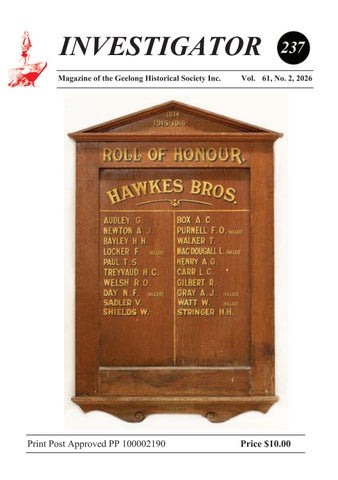
Cover photograph – Hawkes Bros Honour Board (held at Geelong Heritage Centre)
INVESTIGATOR Magazine of the Geelong Historical Society Inc. Vol. 61, No. 2, June 2026 Editorial
56
Chronology for 1866
57
Michael O’Donnell: Letters from Pioneers to Governor La Trobe, 1853: No 6
61
Harry Roberts: Geelong Athletics – A Short Sprint
71
Roger Southern: The Highton Tornado
88
Stephen Yewdall: All Saints Honour Board: Tom Hawkes
94
Daryl Wight: William Purdue’s Geelong Diary (Part 9)
98
Mark Thomas: One Moment in Time: 175 Years Ago
102
© Copyright, Geelong Historical Society Inc. Information provided and opinions given by contributors to this magazine are not necessarily those of the Editor and Editorial Committee of the Geelong Historical Society Inc. ~ The Editor. Magazine distribution: Mrs F. Craddock, C/- Box 67, Newcomb, VIC, 3219
June
56
Editorial David Fisher’s letters give us his authentic personal insight into the establishment and early days of Geelong. Michael O’Donnell’s annotations help us to understand the bias in Fisher’s letters and suggest we might not consider them as true primary evidence pertaining to that time. The story of Amateur Athletics in Geelong continues with Harry Roberts’ account of the shaky start for the amateur sport, with two unsuccessful attempts being made in 1892 and 1900. Despite the renewed interest and the formation of clubs, the sport again failed to establish a strong foothold in Geelong. Tornadoes, although not frequent in Geelong, are not uncommon. The Highton Tornado of 1926, in particular, wreaked considerable devastation, not just to the physical infrastructure but also to the lives of many citizens. Roger Southern’s story tells of the destruction, damage and casualties sustained from that extreme, natural weather event. Tom Bailey Hawkes grew up in a household deeply connected to All Saints and to the life of this city. His family’s hardware firm was a Geelong institution, his school years were spent at Geelong College, and his early adulthood unfolded against the backdrop of a world at war. Stephen Yewdall’s story is about that quiet name on our honour board, which belongs to a man whose life was anything but quiet. Daryl Wight’s Purdue’s Diary continues with a rain-soaked visit to the Bellarine Peninsula. We are taken back to a time when life’s pleasures were simple. Mark Thomas revisits life in Geelong 175 years ago, when Victoria gained independence, and the search and mining for gold changed the fabric of society. Our series continues with the Chronology for 1866, reliving those interesting days. Editorial Team The Investigator is published quarterly by the Geelong Historical Society Inc. Subscriptions are $40 for individual membership; $40 for two members in one household (receiving one magazine); and $45 for overseas individual membership.
Address for Investigator contributions: Email: web@geelonghistoricalsociety.org.au Post: PO Box 67, Newcomb VIC 3219
Present & Past issues may be purchased at $10.00 per set (4 issues) 1976–2021.
2026
57
CHRONOLOGY FOR 1866 (April to June) From the pages of the Geelong Register – 160 years ago 4 April 1866 ACCIDENT – A young man named Augustus Patrick Byrnes was admitted into the hospital yesterday with a fractured collar-bone, received on the Lethbridge race-course whilst riding a horse, the property of Mr Finn. The horse, it appears, placed its foot in a hole and stumbled, and threw the rider. He was progressing favourably last night. OLD JETTY – On the western side of Corio Bay, there is an old jetty known as Hutton’s wharf, which runs out into about fourteen feet of water. At this isolated spot may daily be seen some dozen youngsters fishing, sitting on the extreme edge of this jetty, their legs dangling over the side. A sudden push of one boy by the other would at once precipitate him into the water, and in all probability, he would be drowned before assistance could be obtained. This rotten old jetty should be closed to children of tender years, who are scarcely able to appreciate the danger they run by frequenting it. 13 April 1866 MUSSELS – Some fine, large mussels have been on sale in Geelong in the last few days. They are found somewhere on the northern side of Corio Bay, probably on or near the Bird Rock. The taste for mussels is not universal, but with many people, they are esteemed as not a bad substitute for oysters when the latter are scarce and dear. There are plenty of mussels at and about the Breakwater, but they are not so much prized as the sea mussel. 14 April 1866 DOG SHOW – For the first time in Geelong a dog show has been inaugurated. The exhibition at the Polytechnic Hall, Yarra Street, was a most creditable and successful one both as regards the number of exhibits, the breeds of dog, and the attendance of visitors. A rope railing is fixed round the room, in order to keep the visitors from too close a connection with the animals, who are chained to the floor
June
58
at a sufficient distance from each other to keep them from fighting. The exhibits are all of a first class description; and we are informed, on good authority, that the quality and breed of the dogs is far superior to those in the Metropolis. 15 April 1866 RAILWAY EXCURSIONS – More strangers were seen in town yesterday than has been recollected for some years past, and the Botanical Gardens, and other places of public resort, presented the most lively appearance. Several yachts were out on the Bay; and on the Barwon, boating and angling were indulged in by numerous parties, the banks as far away as the Point being dotted over with innumerable picnic groups, composed apparently of strangers to the district. The system of cheap railway fares has surpassed even the most sanguine of expectations.
The Railway Station 1866 by William Frith, courtesy GeelongGallery.org.au 1 May 1866 BOTANICAL GARDENS – The following donations were acknowledged by Mr Bunce at a meeting of the committee of the Botanical Gardens: Miss Lewers, Herne Hill, seeds and specimens of plants from the Rivers Murray and Edwards; Mr S.A. Bryant, petunias and pelargonium cuttings; Mr Thomas Cain, Belmont, collection of new pansies and other florists’ flowers; Mr Pearson, Portland Bay,
2026
59
collection of seeds of 40 varieties; and Mr George Allen, Kensington, bulbs of Guernsey and other lilies. 5 May 1866 ANGLING – A meeting was held at the British Hotel yesterday afternoon, for the purpose of forming a society, to be called the Geelong Anglers’ Protection Society, for the promotion of piscatorial sport and for the purpose of preventing the system of illegal netting in the rivers, at present carried out to an injurious extent. The following gentlemen were appointed to form a committee to draw up a code of rules to establish a society: Messrs Giblin, McKenzie, S. Brearley, Cathcart, Arthur, Mercer, Upston, Clarkson, Gosling and Pickin. 12 May 1866 RIFLE CLUB – The following is a list of entries for the rifle matches to take place today at the Rifle Butts: Captain Chas Rashleigh, S. Munday, G.G. Miles, Lieutenant Middlemiss, Colonel Anderson, Henry Meakin, Sergeant Dupe, C. Wilmott, Colonel Rede, G. Fraser, Sergeant Swift, J. Miller and Lieutenant Curle. 21 May 1866 FOOTBALL – At this time of year, football has now fairly taken the place of cricket and the Geelong Football Club has commenced their practice in earnest to prepare itself for the contest next week with the Ballarat Club. On Saturday last, there were some good scratch matches played on the ground near the Argyle Hotel, and the players, although they have been out of practice for so long, seem to have lost none of their prowess. 25 May 1866 FOR SALE – The commodious and beautifully situated residence, Laira Villa, with land facing Aberdeen Street. The buildings comprise twelve rooms, three pantries, kitchen with range, servants’ room, two coach houses, coachman’s room, large loft, stables, piggeries, 15,000 gallon tank etc. The Grounds, containing upwards of two acres are laid out in garden, with choice fruit trees, flowers and a convenient yard.
60
June
30 May 1866 RABBITS – Mr Austin, of Barwon Park, has kindly undertaken to place a number of rabbits on board the missionary ship, the John Williams, to be turned loose in the various South Sea Islands which that vessel will visit – thus increasing the supplies of food to the natives and promoting the work of acclimatisation. 4 June 1866 WINE – To show that the quality of our colonial wine is appreciated by the public, we may only mention that Mr Pettavel has received an order from one firm for 15,000 gallons. The vintage of the past season has been a most successful one, and the quality of the wine far exceeds that of any previous year. 11 June 1866 FUNERAL – The funeral of the late Mr George Dodd, yesterday, attracted a large concourse of people. Connected so long with the Geelong Fire Brigade, the members of the brigade turned out in full force to pay a last tribute of respect for their late brother. The procession was a long and most impressive one. The forebell tolled the funeral knell; the Artillery Band headed the procession, playing the Dead March. Then followed the members of the Loyal Ashby Lodge of Oddfellows; then the Newtown and Chilwell Fire Brigade in uniform, and, immediately preceding the hearse, the members of the Geelong Fire Brigade in uniform. A long line of mourners moved slowly to the New Cemetery at Herne Hill. 13 June 1866 SEAL – A lion seal, the largest ever exhibited in the colony, was yesterday brought into town from Queenscliff. It was found basking on the beach at Swan Island by a fisherman named Diamond, who killed it by a blow to the head with a batten. When measured, it was found to be eleven feet long. It is estimated that its weight cannot be much less the half a ton. It is now being exhibited in Moorabool Street by Messrs Aitken and Stephens, who express their intention to take it to Ballarat for exhibition, tomorrow, and then, to Melbourne, to have it stuffed for the Museum.
2026
61
Letters from Pioneers to Governor La Trobe, 1853: No. 6 By Michael O'Donnell David Fisher’s contribution to the establishment of Geelong is frequently mentioned but not in any great detail. He is usually mentioned as building the first house situated by the Barwon River. This account gives greater depth to the person and his reflections about the early Geelong where he settled. Although technically not an accurate ‘primary source’, his letters tell much about the people, places and events which characterised the European occupation of this country. Through David Fisher’s eyes, we travel back to the very beginning of Geelong’s establishment. David Fisher of Roslin, Geelong – 21 September 1853 David Fisher’s letter is a wide-ranging firsthand account of life in the Port Phillip District soon after the first European settlement. It is included in the Letters from Victorian Pioneers collection. Fisher, a Scottish-born settler, arrived from Van Diemen’s Land in the earliest days of Port Phillip’s European colonisation. He was both witness and participant in the transformation of the region from a scarcely known frontier into a thriving colonial settlement. Fisher built the first house where the city of Geelong is located today and he penned this letter from his new home in Ceres to Lt Governor La Trobe in 1853. Fisher recalls his involvement in early settlement efforts beginning in 1835. His narrative is rich in detail: the perils of sea voyages, tragic deaths of associates at Western Port and Indented Head, makeshift shelters in the bush, and memorable first impressions of what would become Melbourne and Geelong. He recounts the primitive conditions at “Johnny Fawkner’s” sod-built public house, the hospitality of John Batman, and exploratory journeys through Werribee, the Barwon and Leigh Rivers, Mount Moriac, and Station Peak. Some of his memories conflict with other records and this just highlights the need for the reader to understand that this is not a primary source, but rather a recollection written 17 years after the events. For example, Fisher records that his overseer, Mr Mudie, drowned whilst on a trip on the Norval in 1836 with J.T.
62
June
Gellibrand. However, in Gellibrand’s diary, Mr Mudie is mentioned, but there is no mention of his death. It is very likely that the drowning must have occurred on a subsequent trip. What other events have suffered the same fate? Fisher’s eye for landscape and opportunity is especially evident in his description of Corio Bay where he imagined—and later lived to witness—the emergence of a great mercantile city. He also records events of historical significance, such as the visit of Governor Sir Richard Bourke in 1837 and what may have been the district’s first documented earthquake. Equally important is Fisher’s insight into the economic structures that shaped early Victoria. He outlines the origins of the Derwent Company—a partnership of Van Diemen’s Land settlers who took over the interests of the earlier Port Phillip Association—and his role in establishing some of the colony’s first sheep stations. Fisher’s account also highlights that the Wadawurrung did not remain passive in the face of European appropriation of the land. He recounts the death of two of his men on “Murradock Hill”. His account reflects the mindset of the day, and the incident is portrayed as cowardly and motivated by greed. Clearly, there is another interpretation of these events, but one that showed the indigenous population as proud defenders of their land was not something the early settlers considered. Though his style is plain, it is his occasional digressions from the brief that provide the reader with a stronger feel for the realities of life lived in the district at that time. Fisher’s account captures the mixture of hardship, enterprise, and optimism that defined the settler experience in early colonial Victoria. His letter is a cornerstone of the collection, anchoring the story of Geelong’s beginnings in personal memory and practical detail. Letter No. 6 Roslin, Geelong, September 21st, 1853. MAY IT PLEASE YOUR EXCELLENCY, I have to apologise for my apparent delay in replying to Your Excellency’s circular of 29th July, requesting information on the subject of the first settlement of Port Phillip (now the colony of Victoria). In this, my reply, I have the honour to state that my remarks upon this subject will be confined to matters in which I was personally concerned or what came under my own observation.
2026
63
An image of Geelong sketched in 1856 by Joseph Masters: Source New South Wales available online State Library at https://archival.sl.nsw.gov.au/Details/archive/110339895 In the year 1835, I was a resident of Van Diemen’s Land when the rumour of this fertile land reached that place, and induced many of my fellow colonists to make a voyage to spy out the land. Their report being favourable to Port Phillip as a grazing land, a number of persons formed themselves into a company under the style of the “Van Diemen’s Land Association,” who, with some sheep, started for Port Phillip. With this party were the Messrs. J. and H. Batman and J. Fawkner. Mr. J. Batman and Mr. J. Fawkner settled at Doutta Galla (now Melbourne), while Mr. H. Batman returned, and by his flattering accounts, I was induced to forward to Port Phillip a flock of 750 sheep, with six freedmen as shepherds, under the charge of Robert Mudie, Esquire, in the ship Adelaide. Mr. Mudie, having settled the flock with the shepherds, returned and again sailed in the Norval, with 500 sheep and five shepherds; and on the next voyage of the same vessel, I sent 1,100 sheep and seven men.
64
June
On this voyage, they encountered a heavy gale and were compelled to run into what is now called Western Port, where it was deemed necessary to land the sheep, and in doing so, my good friend Mudie lost his life by the upsetting of the boat in a heavy surge between the ship and the shore. With the exception of 75 sheep, which were recovered, this large flock became prey to the natives and native dogs. On this voyage, Messrs. Gellibrand, W. Robertson, and one or two other gentlemen visited Port Phillip. On their return, I was made acquainted with the melancholy loss of my friend Mr. Mudie, and then set about making arrangements to come over myself, and took my passage in the ship Caledonia, having Messrs. Strachan, Austey, Gatenby, G. Russell, Dr. Thomson, and a few others for fellow passengers. We landed, after a pleasant voyage, at what is now called Williamstown, where Dr. Thomson pitched his tent, the others proceeding to Doutta Galla (Melbourne). Here we found a house of entertainment where we could not get entertained. This building was of turf or sods, with a portion of wood, and comprised six apartments of a very primitive order, occupied by “Johnny Fawkner,” as a public-house, and was, of course, “The Royal Hotel,” it being the first and then the only publichouse in the district of Port Phillip. Here we could get a glass of bad rum and plenty of water by paying a good price for the same, but we could get nothing to eat nor a place to sleep. This celebrated hotel stood on the site now occupied by the Custom House in Flinders Lane or Street. Mr. Batman having built himself a hut about the spot where the “Clarendon Hotel ” now stands, hospitably invited us to share his home, for which we were exceedingly grateful, and dined, supped, and next morning breakfasted on a schnapper fish and damper, our host being a bit of a fisherman as well as occupying the proud situation of High Constable, having been appointed by the Van Diemen’s Land Association, under whose auspices Mr. Batman was thus the first and then the only man who wielded the baton of authority. The Mansion House was a mud hut about 20 feet long and 12 feet broad, the one side of which was occupied by the family of our host, whilst our party, consisting of Dr. Cotter, Messrs. Anstey, Mager, Gatenby, G. Russell, my working overseer Fergusson, and myself, seven in number, pigged on the other side in the best manner we could, and were thankful for the shelter.
2026
65
On the following day, we got our luggage, provisions, &c., from the ship, and on the next day we started to find our way to Western Port, in hope of recovering the remains of my lamented friend Mr. Mudie. We took an Aboriginal for our guide, but he, being of a tribe near Sydney, was little acquainted with the Port Phillip district, and, consequently, no more use to us than to afford us a good deal of amusement by the antic manner in which he managed to roll himself over the soft mud creeks. On coming to a large creek or river, which we could not ford, and not being oversure of our course, we considered it prudent to retrace our steps; having spent two days and slept two nights in the bush, we were again grateful for the shade of friend Batman’s hut at Doutta Galla (Melbourne), where we were again hospitably received, and availed ourselves of our host’s kindness for two days, by way of resting. We then started for the Western District, some of my men having taken up a station on the River Werribee. Having found matters there to my satisfaction, we made our way downwards to the junction with the Barwon, which we followed to the station, which had just been taken up by Messrs. Cowie and Stead on the ground afterwards the racecourse, now a cultivated farm, the property of Joseph Griffin and known as the old racecourse. Here we were kindly received and passed the night. On the next morning, we started for Indented Head, which had also been taken up by my men as a station. Here I found two of my men were missing, and was informed that they had been killed by the natives. Having seen the stock, &c., all correct, we spent five days searching for the remains of the poor fellows, without success. About twelve months afterwards, their bones were pointed out to me by an old Aboriginal named “Woolmurgen” who described the manner in which they met their deaths as follows: — The men were on their way with a pack-bullock laden with provisions for the Werribee Station, and were met by a tribe of aborigines near the Murradock Hill. The men were both armed with fowling-pieces, which caused the wary tribe to entrap them by a stratagem, thus: By persuading one that he could shoot an emu, they got him to accompany a portion of their party to one side of the hill, whilst, under the pretence of having a shot at a kangaroo, they prevailed upon the other to go in a contrary direction.
June
66
Having thus managed to separate the men, the latter became an easy prey to these heartless savages, who also killed the bullock and made themselves masters of a plentiful supply of provisions and all the property in possession of their unfortunate victims. I had their bones gathered together and decently interred. After resting a day we took a tour into the bush, following the course of the Barwon River to the sea, and much enjoying the romantic and picturesque scenery, particularly the lake Connewarre; returning by an angle across the country, we made Corio (Geelong), where we were struck with the magnificent scene which burst upon our view as we reached the rise, now the centre of the town, known as Church Hill. The splendour and magnitude of Corio Bay, the gentle rise from the bay to where we stood, about three-quarters of a mile, and the like gentle fall to the River Barwon, the You Yangs, Station Peak, the Barrabool Hills, with all the varied scenery of hill and vale around clothed in the beautiful verdure of Nature, seemed to proclaim this spot as the site of a great mercantile city.
An image of Geelong sketched in 1856 by Joseph Masters, Source: New South Wales State Library online at https://archival.sl.nsw.gov.au/Details/archive/110339895
2026
67
Lost in contemplation, we were overtaken by night and had the satisfaction of finding the shelter of a gum-tree near the place now called “La Trobe Terrace”; here we camped for the night. Next morning, we made Messrs. Cowie and Stead’s, where we were entertained with a comfortable breakfast, and likewise got our provision bags replenished. We then crossed the Moorabool River, and afterwards the Barwon at the place now known as Pollock’s Ford; we tethered our horses in the valley and walked to the top of Mount Moriac, from which elevated spot we had a beautiful prospect of this delightful district, and with the assistance of a good telescope we were able to trace the various windings of the Rivers Leigh and Barwon; also from this mount we had another view of beautiful Corio and its lovely bay.
Gill, Samuel Thomas & J.S. Campbell & Co. (1853). Laying the foundation stone of the Geelong & Melbourne railway http://nla.gov.au/nla.obj-133109517
68
June
In imagination, we could picture a splendid city, with the bay covered with ships of all nations, which fancies I have lived to see in part realised. This year, 1853, whilst yet under our first Governor, a commencement has been made to remove the only impediment to the navigation of the bay. The town has been beautified by the erection of many elegant buildings, both public and private, and many more have been projected, some hastening to completion; whilst we have also had the pleasure of seeing the foundation stone of the first railway in the Colony of Victoria laid in Geelong. Having thus far digressed from my subject, I must return to Mount Moriac, where, having taken our bearings, we descended to where we left our horses, and there we encamped for the night, and next morning started across the country and made the River Leigh at its junction with the Barwon, where I afterwards formed my homestation; we then followed up the Leigh River for about six miles, to the place where Mr. Russell’s station now is; here we crossed the country in a direct line towards the Anakie Hills until we came to the Moorabool River, where we halted for the night. In the morning, we ascended the highest of these hills, from which we had a most magnificent view of nearly all the hills, valleys, creeks, and rivers comprised within that portion of the country, now the County of Grant. We then proceeded to Station Peak, where our view was extended over the waters of Port Phillip, to the mountains on the opposite shore. From thence we took our course to the Werribee Station, which we reached with much difficulty, and next morning we started for Doutta Galla (Melbourne), intending to return to Van Diemen’s Land; but finding that our ship had sailed, we had to content ourselves until her return. To fill up this time, we employed ourselves in building a house for Dr. Thomson, near the spot now occupied by St. Paul’s Church. In this, we were engaged about three weeks, and our vessel having returned, we took our passage to Van Diemen’s Land, with the full determination of returning to Port Phillip, having all been greatly delighted with this beautiful country. Being now satisfied that sheep farming would prove a profitable speculation in the New Land, as Port Phillip was then called in Van Diemen’s Land, we entered into a co-partnership to carry it out extensively. In this, we were joined by Messrs. Swanston, Mercer, and Learmonth, and purchased up the shares and interest of the Van Diemen’s Land Association. We took the style and title of the “Derwent Company.”
2026
69
In the latter end of the year 1836, I returned to Port Phillip for the purpose of forming the different stations, afterwards occupied by the Derwent Co., and pitched my tent at the south side of Geelong, on the north bank of the Barwon River, near where a bridge was afterwards built communicating with the Western District. Here I built the first house in Geelong worthy of the name; it is built of weatherboards of Van Diemen’s Land timber, which house yet stands, and is still rather an ornament to what is now called Barwon Terrace. In this house, I had the honour of receiving His Excellency Sir Richard Bourke, who had come hither to spy out the nakedness of the land, and with his suite encamped on the banks of the Barwon next to my house. It is worthy of remark that on the night of Sir Richard Bourke’s arrival, the district was visited by an earthquake, the shock of which was felt all over the district. Such a phenomenon has never occurred since that time, but I was informed by a very old native, King Murradock, that such had been felt before, but it was “long, long ago”. In the month of September (1837), having finished my house and got all things comfortable for the reception of my family, I proceeded to Van Diemen’s Land to bring them over, taking my passage by the James Watt, the first steam vessel that visited these shores. In the month of March following (1838) I returned with my family, and having got them settled at Barwon Terrace, I proceeded to inspect the stations already formed, and also formed new stations at Mount Mercer and the Woady Yalloak; and then, accompanied by Major Mercer, Mr. George Mercer, and our overseer named Anderson, started upon an exploring expedition to the interior, on which occasion we formed the station at Mount Shadwell, which was the farthest-out station from Geelong, on the eastward of Portland. During this tour, I undertook a new occupation. Major Mercer and myself being occupied in shaving, which operation being observed by some of the natives afforded them much amusement, and one of them signifying a desire to be trimmed, I undertook the task, which I accomplished amidst the yells, shouts, and laughter of some fifty savages with their lubras, who enjoyed the affair very much; and thus I believe myself to be the first that shaved an aboriginal of New Holland, and that aboriginal the first that was shaved. Nor do I think he ever was shaved again, for his beard was very hard and the razor none of the best, rendering the operation anything but pleasant, and I much doubt if he would ever again submit to the ordeal. This was nigh being my last joke, as soon after, Major Mercer’s
70
June
servant, in taking a loaded piece from the luggage, by some means caught the trigger upon something, which caused the piece to explode — the ball passing under the Major’s arm, striking a tin pannikin out of which I was drinking, and carrying it clean from my hand. The full details of this tour were kept by Mr. George Mercer, a copy of whose journal I beg to annex for Your Excellency’s information. From this time settlers were pouring into the district from Van Diemen’s Land and New South Wales with their flocks and herds, and the land began to get peopled by mechanics and tradesmen; stores sprang up in every quarter, and the whole country began to wear the aspect of prosperity. I here conclude this poor, but correct, account of what came within my own knowledge, and I feel assured that in most parts it will be corroborated by others (more able for the task than I am) in their returns to Your Excellency’s circular. But should there be any particular transaction upon which Your Excellency may think I can afford further information, I shall be most happy to furnish the same to the best of my ability. I have the honour to be Your Excellency’s Most obedient servant, DAVID FISHER. His Excellency C. J. La Trobe, Esq.
Source: Thomas Francis Bride (Ed), ‘Letters from Victorian Pioneers – being a series of papers on the early occupation of the colony, the aborigines etc’, Trustees of the Public Library, Melbourne, 1898, available online at https://archive.org/details/lettersfromvicto00publiala/page/11/mode/1up?view=the ater Further Reading on the topic: `Letters from Victorian Pioneers to Governor General La Trobe, 185, by Dr Dianne Reilly AM’. This 2018 article provides the interested reader with excellent background information, available online at https://www.latrobesociety.org.au/LaTrobeana/LaTrobeanaV17n1Reilly.pdf
2026
71
Geelong Athletics – A Short Sprint By Harry Roberts Amateur Athletics in 1892 showed considerable promise as a new sport in Geelong but it did not succeed. That ‘flirtation’ with a new sport lasted just a short time because of many factors linked to the 1890s depression and competition with well-established sports that enjoyed strong church support. In 1900, the urge to revisit the sport emerged but this time, one of the leading churches, Christ Church in Moorabool Street, gave its social support, and a vigorous local competition began.
The Race begins - 1900
Athletics in Geelong made a return in 1900 after a six-year hiatus. The previous “false start” by the Geelong Harriers might have had some influence in interest being generated in the sport at the start of a new century. Christ Church Harriers was the first club out of the ‘starting blocks’ but other clubs were soon to follow. Unlike the Geelong Harriers in 1892, which was a secular organisation initiated by former athletes from Ballarat, Christ Church Harriers was a local, religious-based organisation which had the assistance of a dominant Protestant church. Club members, the patron and the athletes were church members. Christ Church Moorabool Street Geelong c. 1900 Courtesy Geelong Heritage Centre GRS
The fifth of June. 1900, at the Christ Church Hall in Moorabool Street, was the day when a meeting decided to form an athletic club. Mr A.H. Wills was the driving force behind the rebirth of Geelong athletics. He was a well-known, respected, and popular athletics champion of Victoria and a
June
72
Victorian Amateur Athletic Association (V.A.A.A.) delegate for the Essendon Harriers. Mr Wills was transferred in his work in Geelong and arrived in early May, 1900. At the May V.A.A.A. council meeting in 1900, there was a special recognition of Mr Wills’ participation as a delegate and an athlete. Melbourne’s The Weekly Times newspaper reported on 19 May 1900: “At the conclusion of the V.A.A.A. council on Wednesday, the members bade farewell to Mr A.H. Wills, the Essendon representative, who leaves for Geelong next week. The chairman, in proposing the health and prosperity to Mr Wills in his new sphere of action, voiced the general sentiment in hoping that he may yet run in many more championships, and trusted that his residence there may give a fillip to athletics in Geelong. Mr Wills briefly replied and thanked the council for its good wishes.”1 In 1892, it was Mr J.S. Young’s move to Geelong from Ballarat that started the sport. In 1900, it was the arrival of Mr A.H. Wills from Melbourne. It didn’t take long for Mr Wills to commence the organisation of an athletic club once he arrived in Geelong. “A general meeting of the Christ Church Harriers was held on Tuesday. Mr A.H. Wills (late of Essendon Harriers) took the chair. It was decided to join the Victorian Amateur Athletic Association.” 2 So began the restart of athletics in Geelong. It was a start that had the blessing of Christ Church, with the Reverend Canon Goodman elected as the first President of the new club. Mr Wills (also a former Victorian half-mile champion with Essendon Harriers) was elected Team Captain. The vice-captain of the club was B. McKinnon, and the secretary R.H. Philips. The club’s uniform comprised white shorts and a dark blue guernsey decorated by a shield monogrammed with CCH in its centre. 1 The Weekly Times, THE ATHLETE, 19 May 1900, page 18.
2
Geelong Advertiser, 7 June 1900, page 3.
2026
73
Christ Church Harriers 1900 outside Christ Church in Moorabool Street
Formed in the winter months, cross-country running dominated. It is no surprise to see that Christ Church Harriers’ first run was a paper-chase. The runners completed 15 miles in 2 hours and 15 minutes. Geelong Advertiser on 14 June reported the Harriers’ first run. “Christ Church Harriers had a run yesterday through West Geelong to Ceres Bridge, where the pack sighted the hares, M.H. Bruce and S. Philips. The latter attempted to evade capture by swimming across the river but were apprehended before reaching the opposite bank.”3 Christ Church Harriers’ runs were conducted twice per week, with a competition on Wednesdays and Saturdays. This arrangement may have 3
Geelong Advertiser, 14 June 1900, page 3.
June
74
influenced the distances the Club offered in its runs. Runs commenced at their rooms on the corner of Moorabool and McKillop Streets. The Australasian of 7 July reported on the issue: “Christ Church Harriers (Geelong) have abandoned the long runs and seem to be settling down enthusiastically. Owing to some members having Wednesday and others Saturday as holidays, two runs are being held weekly, and both are well attended.”4 It was not until 1912 that legislation was passed requiring retail shops to have their half-day off from 12.30 pm on Saturday. Prior to that year, shops had their half-day on Wednesday or Saturday. Shops’ trading hours were also affected. Shops had to close at 5 pm from Monday to Thursday instead of 6 pm. Friday was also changed from 7 pm to 6 pm. Prior to these changes, athletes working in retail were not able to compete on Saturday afternoon in local competitions and championships. V.A.A.A. events in Melbourne were only conducted on Saturdays. Mr Wills was not shy to publicise the formation of the Christ Church Harriers. He wrote to Melbourne’s The Weekly Times to communicate the establishment of Christ Church Harriers. “By the courtesy of Mr A.H. Wills, I have been supplied with an account of the formation of the first Harrier club in Geelong, to be known as the Christ Church Harriers. A general meeting was held on the 5th inst., with Mr Wills in the chair, when the following officers were elected: President, Rev. Canon Goodman, M.A.; patrons, Messrs. G.F. Belcher, C. Stanesby, and C.N. Morrison; vice-presidents, Rev. T.W. Oak, Captain Parsons, Mrs A.H. Westley, G.F. Faulkner and J Belcher; captain, Mr A.H. Wills; vice-captain, Mr B. McKinnon; treasurer, Mr H. Birch; handicappers, Messrs Wills and H.M. Bruce. The hon. Secretary, Mr R.H. Phillips,
4
The Australasian, 7 July 1900, page 23.
2026
75
whose address is 48 Noble Street, Newtown, will be glad to hear from intending members.”5 The now familiar format of the paper-chase, introduced years earlier by the Geelong Harriers, was employed. “The club’s first run took place on the following day (Wednesday) with a fair muster. The hares, H. Bruce and S. Phillips, laid trails through the town, West Geelong and Newtown. The pack, under A. Spicer (pace) and A.H. Wills (whip) lined up for a quarter mile race home, which was won by A.H Wills, who was some 3 yards ahead of A.B. Spicer, H. Thorne filling third place.”6 The club had support from Geelong’s political, social and religious elite members that included one of the town’s strongest Anglican churches. Melbourne’s press also expressed positive views about the club’s formation. On 23 June, 1900, The Weekly Times, in its column THE ATHLETE by ‘All Rounder’, wrote about the Club’s membership and first run. He also added: “… departed from their clubrooms on the corner of McKillop Street and Moorabool Street.”7 Melbourne’s Leader newspaper had a similar article about the Club’s formation and quoted Mr A.H. Wills, stating that he spoke very highly of the Club’s prospects. The link with Melbourne teams and their support was important to the Club’s establishment. Wills said he didn’t want to “lose touch with Town” (Melbourne) and intended to go to Oakleigh to watch the novice race. While at the Oakleigh race, Wills was interviewed by The Australasian newspaper. 5
The Weekly Times, 23 June 1900, page 18 The Australasian, 7 July 1900, page 23. 7 Ibid. page 18 6
June
76
“A.H. Wills was at Oakleigh on Saturday and tells me there is some fair talent at the new club, and that there is reason to think that Geelong will yet equal Ballarat in athletics. The Ballarat boys have kindly offered to visit Geelong at any date that will suit the latter.”8 A notable addition to the organisation of athletics this time was the exposure of the sport and social gatherings in the town. It was a deliberate ploy to generate interest and encourage membership. The first of these social gatherings was the Geelong and Western District Agricultural Society Show on 12 September, 1900. Club members ran in the 'marked’ half mile. The winner of the event was the club captain, and former Victorian Half Mile Champion, A.H. Wills. The Harriers concluded their first season by competing in the Victorian 10 Mile Championship at Caulfield Racecourse. The team left for Melbourne by boat on Saturday morning. The Geelong Advertiser of 17 September, 1900, told its readers: “On no previous occasion since the institution of the race has a Geelong team competed. Amongst the junior clubs, the Christ Church Harriers finished second in the race, and this is a very creditable performance, considering that the club has only been in existence for about four months.”9 Eighteen-year-old H. Thorne was the star performer of the club, finishing 26th overall and fourth in the junior clubs’ competition. In addition to the cross-country events, T. Franks represented the Harriers in the 120-yard handicap race. He received a start of ten yards. After its first and very successful season, the Christ Church Harriers received an unexpected acknowledgement in the Victorian Amateur Athletic Association Annual Report of 1900. 8
The Australasian, 13 June, 1900, page 23.
9 Geelong Advertiser, 17 September, 1900, page 3.
2026
77
“During the past season, amateur running has held its own, and your Council is pleased to note that it appears to be extending to the country districts. In Geelong, a strong club has been formed and affiliated with the Association. The club was represented in the last Cross-Country Championship by a team which acquitted itself with distinction.”10
Why 1900? The year 1900 was the cusp of nationhood for Australia, with all colonies committing to a Federation, and with it came a positive view of life and the future of a fledgling country that still saw Britain as ‘home’. Political independence was not the same as social independence, as many of Australia’s 3.8 million people were either born in Britain or had relatives living there. Australia’s White Australia Policy, which was the Federal Parliament’s first Bill and Act of Parliament, prolonged and formalised the practice of keeping out coloured races. Unlike action in war, sport was a safe and easy way in which Australians could achieve national success. assert themselves and stamp a new national identity. This process began at the time of Federation and grew through the century in many international sporting competitions. In October, 1900, Australian athletes competed in the Paris Olympics but not under the flag of Australia. The Australian flag, as we know it, was first flown on 3 September, 1901. At the Olympics, athletes would be under the Union Jack that was used for official occasions. Australians were successful in the Games with Sprinter Stanley Rowley winning three bronze medals in the 60 metres, 100 metres and 200 metres. He was also a fifth member of a mixed team, joining with athletes from Britain and Ireland in the 5000 metres. Donald Mackintosh won gold in archery and, in swimming, Freddy Lane won the 200 metres freestyle and 200 metres obstacle race on the River Seine. 10
Victorian Amateur Athletic Association Annual Report, 1900.
June
78
Athletes would have to wait until 7 May, 1908, before they could attach the ‘first’ coat of arms emblem to their uniform, and that had to be approved by King Edward VII. The second ‘current’ version was accepted by another monarch, King George V, in September, 1912. The thrill of impending nationhood may have had an effect on the re-forming of athletics in 1900. The success and high profile of the Christ Church Harriers certainly stimulated great interest in athletics in Geelong. Whatever the reasons, the Club’s high profile and success generated interest in the formation of more athletic clubs in Geelong in 1901.
1901 – Two new Competitors Geelong Harriers Christ Church Harriers began the 1901 season on Wednesday, April 24th, with an opening run in inclement weather. H. Thorne continued his success from the previous season by winning the club's six-mile run. A second harriers club was formed in April 1901 when the Geelong Harriers was founded. Like the club of the same name in 1892, the Geelong Harriers was not a church-based club. Its exact date of formation in April is not known, but its uniform, membership and colours are known. The uniform was a white T-shirt or guernsey with blue facing. The shorts, or knickers, were blue with white stripes. The Geelong Harriers commenced their runs from their rooms in South Geelong. The Geelong Advertiser of 2 May, 1901, recorded one of the club's first runs. “HARRIERS A successful run was held on Monday evening by the members of the Geelong Harriers Club. The hares (M. Gemmel and W. McLeod) left their trail through Marshalltown and Breakwater. Twelve hounds gave chase after their opponents, but the hares, with seven minutes’ start, proved their superiority by evading capture and returning ten minutes before the pack.”11 11
Geelong Advertiser, 2 May, 1901, page 3.
2026
79
Mention was also made about the Christ Church Harriers. “The usual run of the Christ Church harriers was held yesterday afternoon. The run was to the Racecourse Hotel and back, the distance being about five miles. A.D.H. Dunt acted as pace and A. White as whip.”12 St Paul’ s Harriers The third harriers club to form in Geelong was St Paul's Church Harriers. A General Meeting in the Union Room on 1 May, 1901, (at St Paul's Church in Latrobe Terrace) attracted twenty members. The Reverend R.C. Nugent Kelly opened and chaired the meeting, and he wished the newly formed club much success. Patron for the club was the Honourable S. Austin, M.L.C., President was Reverend R.C. Nugent Kelly, and Secretary was Mr C. Milner. Christ Church Harriers' founder, Mr A.H. Wills, was also at this inaugural meeting to give the new club the benefit of his advice.
Moorabool Street Bridge c.1900, Source State Library Victoria
12
Ibid.
June
80
The three harrier clubs grew in strength and membership in 1901 and 1902. Many of the clubs' running activities were organised individually, but they did compete against each other at the Victorian Amateur Athletic Association events. One such event was the Five Mile Novice race at Oakleigh on 25 May, 1901. Captain of the Geelong Harriers, A. Spicer, (who had changed his allegiance to Geelong from Christ Church) finished third place in the event, and T. McManus (Geelong Harriers) and H. McKinnon (Christ Church Harriers) both finished within the first twelve places. Despite the early success of the 'newcomers', the Christ Church Harriers, as expected, was the strongest club. A special invitation from the Ballarat Centre of the V.A.A.A. was extended to Christ Church Harriers for them to participate in a carnival to aid the Ballarat Benevolent Asylum. The Christ Church Harriers sent three representatives to the Ballarat Carnival: J. Arthur, H. Bruce and L. Hosking. The Geelong Advertiser on 8 June, 1901 recorded the runners: “... set off in full hue and cry. There were about 50 in the pack in the run-in, and the Christ Church Harriers finished well in front.”13 Meanwhile, Saint Paul's Church Harriers continued to provide their members with a pack run. Commonly used places were the Ocean Child Hotel, Fyansford Bridge, and Bell Post Hill. Handicap road races for trophies were also contested. Rivalry between the clubs was commencing and a challenge event was arranged between A. Spicer, Captain of the Geelong Harriers, and H. Thorne, the strongest Christ Church Harriers' athlete. The event generated considerable public interest. The race took place on 26 June, 1901. It was a five-mile challenge race that commenced at the Barwon Bridge and headed to the four-mile post on the Barwon Heads Road. There, the two men returned to the Barwon Bridge. A large crowd was in attendance, and they saw H. Thorne win by 30 yards in a time of 27 minutes, 59 and 1/5th seconds.
13
Geelong Advertiser, 8 June, 1901, page 3.
2026
81
Christ Church Harriers continued to grow in confidence and strength. It organised a paper-chase event on 20 July, 1901, inviting athletes from Ballarat, Essendon and Ballarat East. This was the first major competition they had organised by themselves, inviting other clubs. The run, with 35 runners, commenced at Geelong Grammar in Maud Street and through Newtown to the Prince’s Bridge, through Highton to Montpellier reservoir, across the Falls near the Mill, over Fyansford Bridge and returning along the river and through Newtown. The quarter-mile ‘run-in’ was from Fenwick Street along Myers Street to a Moorabool Street finish. Overall, Essendon came first, with Christ Church second and Ballarat third. It was the first time that A.H. Wills had been beaten over a quarter mile. In the evening, the clubs were entertained with a special dinner and social evening at the Albert Coffee Palace. “… the chair was occupied by Rev M. Frewin. Amongst the toasts proposed were that of: ’The King’ by Mr C.L. Andrews, M.L.A.; ‘The Visitors’ by Mr A.H. Wills; and ‘The Press’ by Mr H. Thorne.” 14 Songs were contributed by eight people and recitations by four. The pianist was Mr Morton. On the same weekend, St Paul’s Harriers decided to join the V.A.A.A. and send a team to the Ten Mile Championships in September. Geelong Harriers conducted a club run in Moolap, returning along Portarlington Road. Cooperation between the Christ Church Harriers and the Ballarat Centre was beginning to flourish. In August, 1901, the Christ Church Harriers sent a team to the Five Mile Team's Race at the Miners' Racecourse in Ballarat, and they finished sixth out of ten teams. The three harrier clubs decided to enter teams in the tenth annual Victorian 10mile cross-country championship conducted in September. The Christ Church Harriers conducted 'test runs' to select their strongest team. Eventually, a team of twelve was chosen to train for the event. In the end, only Christ Church Harriers 14
Geelong Advertiser, 22 July, 1901, page 3.
June
82
and the Geelong Harriers competed. Christ Church Harriers finished sixth out of twelve teams, and the Geelong Harriers last. In October and November, there were midweek handicap races over shorter distances at the Corio Oval with trophies being presented. Enthusiasm for athletics in Geelong was exceptionally strong, and the harrier clubs continued to compete in the spring. Running over shorter distances, athletes were able to compete at the newly formed Geelong Amateur Sports Club programme. The Geelong Amateur Sports Club conducted a massive sports programme at the Agricultural Society's Showgrounds on 11 November, 1901 (the King's Birthday holiday). Unfortunately, on the same day, the North Shore Racing and Athletic Club also provided athletic events at the Geelong Oval. This club was not an 'athletic' club as we know the term today. The word 'athletic' should be considered as meaning 'sporting'. The three harrier clubs spread their participation to include both of these special sporting events.
Albert Coffee Palace Corner of Malop and Yarra Streets. Courtesy Geelong Heritage archives GRS1599/0001/028
2026
83
At the conclusion of 1901, Geelong, a town comprising 25,000 people, boasted three strong athletic clubs, and the future looked very bright for athletics The Quest for Centre Status Athletic competition was strong in 1901 and 1902, and the Victorian Amateur Athletic Association considered a request from Geelong clubs for status as a local centre, similar to that granted to the Ballarat clubs in the 1890s. The Ballarat success, as well as the close relation between Ballarat and Geelong clubs, probably strengthened Geelong's proposal. 1902 – Approaching the finishing tape A report to the V.A.A.A. Council meeting in 1902 stated: “The Geelong Clubs have maintained their enthusiasm, and sooner or later a local centre will be formed there.”15 Later in 1902, a V.A.A.A. delegate visited Geelong to discuss the centre status issue with local club officials. A V.A.A.A. Council meeting report stated: “Mr Wilmot reported; re: visit to Geelong; met Messrs Wilks and Milnes (CCH and St Paul's) Geelong's secretary absent from town. Unsatisfactory interview re - formation of the centre. Maybe something done this year now that E.V.B. White has gone to St Paul's: report received.”16 Despite the rejection of centre status, the three harrier clubs continued to develop and diversify. Christ Church and Geelong Harriers continued to participate in V.A.A.A. events, but St Paul's was content to continue their weekly runs over distances varying between five, seven and ten miles in the town.
15 Victorian Amateur Athletic Association Council Meeting Minutes, 1902.
16
Ibid.
84
Competing for the Anderson Trophy Five Mile Teams Race at Clifton Hill on 9 June, 1902, the Christ Church Harriers gained fourth place in the teams event. H. Thorne for Christ Church finished in fifth place and P.J. Wilks in seventh place in the individual competition. Success at the junior level came to Mr P.J. Wilks, who became the 10 Mile Junior Champion of Victoria after winning his section of the eleventh annual Ten Mile Cross Country Championship of Victoria in September, 1902. He finished seventh overall in the event, and he improved on his third placing In the Junior section from the previous year. The overall team result was very poor because a number of prominent athletes were unable to compete. The season concluded with shorter handicap events being conducted at the Geelong Oval for the second successive year In the summer competition, A.H. Wills gained success in winning the Victorian Half Mile championship, and he also ran second in the half mile in the Australasian Championships in New Zealand. Christ Church Harriers, in its second year of competition, had two Victorian State Champions, but despite individual successes, there were signs of general decline and diminished enthusiasm within the club. Only Christ Church Harriers had affiliated with the V.A.A.A., while Geelong Harriers and St Paul's Church Harriers held local events, and even they had reduced their level of activity.
1903 – the Finish Line The year 1903 signalled the end for all the harrier clubs. By the end of 1903, the finishing line was passed, and the race for athletic success and continuity was over. However, a new club was formed called the Yarra Street Young Men (Yarra Street Methodist Harriers). The Club was formed at a meeting on 3 March 1903, but it never became affiliated with the V.A.A.A. The Geelong Advertiser recorded the details of the meeting.
June
2026
85
“"At a meeting of the Yarra Street Young Men, presided over by Mr H. Hitchcock, it was decided to form a harrier club in connection with the school. Many names of scholars have been received and also trophies promised. Judging by the interest taken, there is every indication of a first-class club being formed.” 17 The club organised weekly runs on Wednesday evenings, but it did not develop as strongly as expected. Nothing more was heard about the club after 1903.
Yarra Street Methodist Church c. 1900 Courtesy Geelong Heritage Centre GRS 2009/1596
The Ballarat School of Mines invited the Christ Church Harriers to their third annual meeting. The meeting was held on 27 March, 1903, and A.H. Wills represented the club in the 100 yards. He was an exceptional athlete 17
Geelong Advertiser, 4 March, 1903, page 2.
June
86
with unusual turn speed and obvious stamina. The Geelong Advertiser recalled his race: “At the pistol, Wills gave one of the jumps for which he is famous and soon overhauled the limit men and won comfortably.”18 Melbourne teams came to Geelong on 13 June, but for some reason no Geelong Harrier club was involved. “Several of the metropolitan clubs were represented at Geelong on Saturday, where it was announced a joint paper-chase with the local club would be held. Sixteen Essendon, eight Malvern, and one Clifton and Northcote comprised the visitors. It is curious to note that Geelong was unrepresented in the race that followed.”19 The result was: 1st
A.H. Wills CCH 5.5 yards;
2nd J. Budenall, Ballarat 6 yards; and 3rd T.R. Treloar Ballarat 7 yards. The time was 10.35 seconds. On 25 July, 1903, a Saturday, the last recorded Christ Church Harriers event was published. The Yarra Street Methodist Harriers also competed at the Geelong Oval to aid the Unemployment Relief Fund. On this occasion, the events conducted were 100-yard and 440-yard handicap races. The results were: 100 yards winner – A. Newbury (0.5 yard) 11.35 sec and 440 yards winner – H. Dentry (scratch) 53 sec No more was heard from the Christ Church Harriers after this date. Champion young runner, H. Thorne had transferred to a Melbourne club and 18
Geelong Advertiser 30 March, 1903, page 3.
19 The Weekly Times, 20 June, 1903, page 18.
2026
87
the founder of the Christ Church Harriers, A.H. Wills, confirmed his retirement in November.20 No Geelong-based athletic club was represented at the annual Victorian Ten Mile Cross Country Championships at Caulfield in September 1903. The bright flame of athletics in Geelong was extinguished, and affiliation with the V.A.A.A. ceased. Perhaps the V.A.A.A. rejection of centre status stopped the impetus of the three clubs, and this caused the decline in athletics in 1903. Perhaps the V.A.A.A. saw a fatal flaw in the administrative structure and commitment to athletics in Geelong and their judgment was correct. In any event, formal participation in Geelong athletics ceased in 1903. No record of athletic competition can be found during the years up to 1907, when there was another resurgence. It was the birth of an athletic giant in Geelong athletics – Geelong Presbyterian Guild Harriers.
Investigator 50 Years Ago
20 The Australasian, 21 November, 1903, page 22.
June
88
The Highton Tornado By Roger Southern Geelong has been hit by several tornadoes1 or ‘twisters’, not least in 1853, 1909, 1926, 1984 (affecting Portarlington), 2001 (Leopold) and 2020 (Mount Duneed and Waurn Ponds).2 A century ago, at 5 p.m. on 22 July 1926: “…The force of the tornado apparently was greatest over Highton, where St. John's Church of England, the Methodist Church, the Recreation Hall, the Temperance Hall, the Kindergarten Hall, and four houses were destroyed. At Belmont and Marshalltown the destruction covered 16 houses. Electric light, telegraph and telephone poles were uprooted, and no current was available. This chaos added to the difficulty of rescue and salvage work. A remarkable feature of the disaster was the very defined path of the wind. Houses in the course of erection were left intact within a few yards of the dwellings razed to the ground...”3
The area most affected in 1926 was still largely farmland. (Note: this aerial image was taken in 1947.) “A tornado is a narrow, violently rotating column of air that extends from a thunderstorm to the ground”, https://www.nssl.noaa.gov/education/svrwx101/tornadoes/ accessed 16 June, 2025. 2 Trove List, Geelong: The 1926 Tornado in Highton & Belmont, https://trove.nla.gov.au/list/219930, accessed 16 June 2025 1
3 The Weekly Times, ‘Homes wrecked by Tornado’, 31 July,1926, page 5.
2026
89
An `ominous black bank’ of clouds rose over Highton, Belmont and parts of Marshalltown, reportedly with a roar that left devastation, injury, and the death of a child. Destruction, from a 250 kilometre per hour wind, was brought about to a number of Highton’s churches, including St John’s Church of England, the Methodist Church, and damage to the Anglican Church. Some homes were destroyed in Highton and Belmont, while others were damaged. And casualties were also a result of the tragedy. Fortunately, other areas affected most were still largely farmland, with only a few streets4 and much less populated than today, when the effects of such an event would surely be substantial.5 Amazingly, only one person was killed.6 In Francis Street, Belmont, James Munyard lost his six-year-old stepson7. Little Norman fell through the floor and was crushed when the family’s newly-built house moved on its foundations and was totally destroyed.8 Mr A. Danger, a carpenter of Colac Road, Belmont: …gazed on the complete wreck of his labours for several years. Mr Danger recently completed the construction of a six-roomed house, almost every board of which was attached by himself. The father of a family of 10, he had built everything to his own design in his spare time…The gabled roof collapsed like matchwood…The sheds at the rear of the building were razed to the ground, and the fences destroyed. Neither the house nor the furniture was insured against storms…9 4 Geelong Advertiser, 23 July 1926, page 1, ‘Disastrous Storm sweeps Highton and Belmont.’
5 Victoria, Department of Energy, Environment and Climate Action, Historical Photo Index, Geelong
857D1, Adastra Airways, https://spatialapps-prd-mapshare-platform-storage.s3-ap-southeast2.amazonaws.com/WebmapMedia/HistoricPhotomap/GEELONG/857D1.jpg, accessed 15 June, 2025 6 The photograph of Belmont in 1926 is from State Library of Victoria, ‘Approach to new Barwon Bridge which is under construction’, Belmont, Geelong, Author / Creator - Pratt, Charles Daniel, 1892-1968, photographer, 1926], Identifier - H91.160/1370 7 Public Records Office (PROV), Inquest Deposition files, 1926/798 Norman Pont, https://prov.vic.gov.au/archive/1, accessed 16 June, 2025 8 The Weekly Times, ‘Casualty List’, 31 July 1926, page 5. https://trove.nla.gov.au/newspaper/article/223339522 accessed 16 June 2025. 9 The Weekly Times, ‘Stories by Sufferers’, 31 July 1925, p.5
June
90
A five-roomed empty house in Roslyn Road was overturned. At Highton: … The roof of St. John's Church was lifted off in one piece and flung into the church yard. The walls, built of solid bluestone, collapsed halfway from the ground, and the nave of the church is completely buried. The altar lay amid the wreckage, some distance from the chancel. The organ was smashed beyond repair. Forty feet away from the church, the woodwork of the Temperance Hall lay in splintered rain. The floor was carried away some distance beyond, and the carpet was tangled among the limbs of a distant tree… 10 At Marshalltown, the top floor of Gardiner’s Tannery was badly damaged, and Frank Zelly was injured. Sadly, Frank later took his own life on October 22, 1926, seemingly due to the injuries he experienced.11 Some victims were, however, more or less unscathed. The Camerons, mother and daughter, were shaken when their horse and buggy keeled over at Connewarre and baker Leslie Wiles had minor injuries when his cart was overturned.
The Munyard House in Francis Street, Belmont, showing debris and damaged flooring under which Norman was found. Adelaide Observer, 31 July 1926, p 43.
Mr. D. Nelson, wholesale dairyman: …does not know how he and his two children escaped with their lives. "About five o'clock, I was milking a cow in the sheds," said Mr. Nelson, "when I noticed debris being swirled about in the yard. Soon after I had sheltered the children—two boys, aged four and seven, respectively—the storm broke. The roof came down upon the
10
The Herald, 23 July 1926, p.7
11 PROV, Inquest No. 1926/1182, Frank Zelly
2026
91
top of us. It was a miracle that we were not killed. I sheltered the kiddies underneath me…12
The indicative trajectory of the 1926 tornado, and the locations of some of its effects, over the affected area as it appears in 2025 on Google Earth. A contemporary estimate of the overall cost was £50,000 ($5 million or so today). Concerts and entertainments raised funds and collections were taken at churches. Over £8,000 was raised locally (worth $800, 000 today), volunteer carpenters helped rebuild houses, and the State Government contributed support.13 Details from Weekly Times, ‘Casualty List’, 31 July 1926, p 5, https://trove.nla.gov.au/newspaper/article/223339522 accessed 16 June 2025 DESTROYED: Recreation Hall, Highton Temperance Hall, Highton 12
PROV, Inquest No. 1926/1182, Frank Zelly
13 The Weekly Times, ‘Fund Started - Geelong Already Raised £1500’, 31 July 1926, page 5.
The amount raised in a week was equivalent to about $150, 000 in today’s dollars.
June
92
St. John's Church of England, Highton Methodist Church, Highton House at Highton, owned by N. Wall, occupied by H. Brown House owned and occupied by N. Wall at Highton House in Torquay Road, Belmont, occupied by H. Carroll House in Francis Street, Belmont, occupied by Mrs Sidney Smith House in Francis Street, Belmont, occupied by James Munyard House in Autumn Street, Belmont, occupied by Robert Coulson House in Colac Road, Belmont, occupied by J.B. Earl House in Colac Road, Belmont, occupied by W.A. Danger New house in Colac Road, Belmont, being erected by O Donnell and Sumpter
Charles Pratt’s photograph of damage to the Anglican Church at Highton, State Library of Victoria DAMAGED: Kindergarten Hall, at Highton House occupied by N. White, at Highton House in Colac Road, Belmont, occupied by A.J. Batty House in Torquay Road, Belmont, occupied by E.J. Buck House in Colac Road, Belmont, occupied by T. Hardy
2026
93
House off Colac Road, Belmont, occupied by E. Chenery House occupied by — Parker, off Torquay Road, Belmont House at Highton occupied by D. Nelson House occupied by A.B. Wallace, Colac Road, Belmont House occupied by — Jones, Torquay Road, Belmont House occupied by — Sandford, Belmont House occupied by Leslie Smith, Francis Street, Belmont CASUALTIES: Killed - Norman Pont Munyard, aged 6 years, Francis Street, Belmont Injured - Clarence Munyard, Belmont, injured head; Mrs Ruth Munyard, lacerated head and injured ankle Frank Zelly (Zelley), Marshalltown, fractured ribs and collarbone Mrs L. Smith, Belmont, cut face Mrs E.J. Buck, Belmont, injury to arm Leslie Wiles, Belmont, minor injuries Mrs W. Cameron, Connewarre, broken arm; Miss Cameron, shock and lacerations
*More photographs can be viewed on the website with the recorded program.
June
94
All Saints Honour Board: Tom Hawkes
By Stephen Yewdall
Among the many names carved into the All Saints World War I Honour Board, few carry a story as unexpected and far-reaching as that of T.B. Hawkes. At first glance, his entry looks like any other—just a pair of initials in gold leaf—but behind them lies a life that spanned two world wars, a family business woven into Geelong’s commercial history, and a chapter of extraordinary endurance that took him from Western Beach to the prisoner-of-war camps of Europe. Tom Hawkes The All Saints World War I Honour Board lists many interesting names but of particular interest, T.B. Hawkes has quite a story behind it. Thomas Bailey Hawkes was born in Geelong on 10 July, 1898, to Tom Southam Hawkes and Lelia Maud Hawkes, née Bailey. They lived at the property, Llanberis, 30 Western Beach (on the corner of Ginn Street), Geelong. The family operated a highly successful ironmonger /hardware / builders supply business initially located in Mercer Street, Geelong, established in 1854. On 6 April 1914, the Geelong Advertiser reported that the successful business hosted a Diamond (60 years) Anniversary Picnic at Barwon Heads, where its 88 employees from its business Hawkes Bros. Honour Board locations in Geelong, Melbourne, Courtesy Geelong Heritage Centre Beaufort and Launceston were invited. The business had earlier relocated to new premises at 1 Clare Street (corner of Corio Street), Geelong.
2026
95
Young Tom and his younger brother John (Jack Hawkes) both attended The Geelong College for their schooling (as did their father), and they also attended All Saints Anglican Church.
Tom Hawkes in The Geelong College Uniform
Tom Bailey Hawkes enlisted for World War I on 1 March, 1918 at the age of 19 years, with the written permission of his parents. He listed his occupation as a student, as he had only recently left school. After initial training in Broadmeadows, Tom embarked on the military transport ship, Barambah, on 31 August, 1918. During the journey, 23 fellow soldiers died of influenza (possibly the Spanish Flu). Though still ill from influenza himself, Tom arrived in Tilbury, England, on 11 November, 1918, the date of the Armistice and was allocated to the 14th Battalion. With the Armistice in place, Tom remained in England and never really saw a shot fired in anger! He was employed in the Records Office at Australian Imperial Force (AIF) headquarters in London for the next 11 months.
Tom returned to Australia in October, 1919, being finally discharged, again on the 2nd Armistice Day, 11 November, 1919. He received the British War Medal for his service. To acknowledge the WWI service of its employees, Hawkes Brothers commissioned its own Honour Board, which lists the names of 19 staff members, 6 of whom were killed in action. The Board now resides at the Geelong Heritage Centre. Interestingly, T.B. Hawkes is not listed. Meanwhile, Tom’s younger brother, Jack Bailey Hawkes, a promising school cricketer at The Geelong College, in 1921, took up tennis as a career, subsequently playing in all the grand slams around the world and representing Australia in the Davis Cup in many countries over several years. Jack Hawkes won the Australian Open in 1926, as well as winning the doubles and mixed doubles at the same tournament. He retired from tennis in 1932.
96
June
Whilst having a break from following many Davis Cup tournaments, their father, Tom senior, was in Yokohama, Japan in September, 1923, when he was tragically killed in an earthquake. Also killed was his long-term friend Russell Keayes, who was Jack’s earlier tennis coach, now a wool buyer and also a fellow former Geelong College student. They were staying in the Oriental Palace Hotel, Yokohama, when the earthquake struck. Lelia Hawkes, Tom Senior’s wife, was a survivor of the earthquake. Following the tragic death of his father, Tom Bailey Hawkes at the age of 25, took over the management of the business of Hawkes Brothers. Jack Hawkes, ready for a Tom jnr had married on 6 July, 1922, to Leslie game Jean Vincent, daughter of pastoralist Robert Vincent of Prospect House, Western Beach, Geelong, at St George’s Presbyterian Church, La Trobe Terrace, Geelong. They then moved into their family home at 195 Noble Street, cnr Shannon Avenue, Newtown. Hawkes Bros P/L, now located at the corner of Corio Street and Clare Street, Geelong (now Nireeda Apartments) continued to prosper and in 1928 they engaged architects Laird & Buchan to design extensions, including a third storey to the building. Come World War II, Tom enlisted in the army once again, at the age of 42, on 26 June, 1940. This time, he listed his occupation as a Merchant/Managing Director. After military training in Geelong and Werribee, and being promoted to Sergeant, Tom departed Melbourne on 29 December, 1940 for service in the Middle East, in Tobruk. He was a Gunner in the 3rd Anti-Aircraft Regiment. A little over three months later, on 7 April, 1941, whilst on a night patrol, Tom became separated from his unit and was subsequently surrounded by a German armoured unit and surrendered. This led to four years being a prisoner-of-war of the Nazis, initially interned in POW camps in Italy and later in Austria. Tom remained a POW till 29 May, 1945, three weeks after VE Day on 8 May, 1945.
2026
97
Tom was returned to London for recovery and subsequently returned to Australia on 24 July, finally being discharged from the AIF on 28 August, 1945. Back in Geelong, Tom resumed his role as Managing Director of Hawkes Bros P/L and, in 1947, was also elected President of Geelong Racing Club. Later in 1947, Tom travelled with his wife to America to study business operations as it applied to Hawkes Bros. Sadly, Tom took ill during the return journey to Australia and upon docking, was admitted to hospital in Lewisham, Sydney, where he sadly died on 12 April, 1948. Tom has a memorial tomb at Eastern Cemetery. Tom’s younger brother, tennis champion Jack Hawkes, then took over as Managing Director of Hawkes Brothers. The business survived till the 1970s and Jack Hawkes passed away on 31 March, 1990 in Geelong. His son, Tom Vincent Hawkes, born 27 May, 1923, also a Geelong Collegian, served in WWII in the Royal Australian Navy from 25 February, 1942, serving on 4 ships and seeing action in the Philippines before his discharge in 1946. He was also active with the business till its demise. Tom Bailey Hawkes is also listed on The Geelong College WWI Roll of Honour, the Ballarat Prisoners of War Memorial, and is one of the 137 names listed on the All Saints WWI honour board, and there is certainly quite a story behind those few gold letters that record his name. Lest We Forget. References: Wikipedia The Geelong College – Pegasus Magazine Australia Virtual War Memorial Geelong Heritage Centre Trove – Geelong Advertiser/Argus Hawkes Bros Honour Board (held at Geelong Heritage Centre) Grave at Eastern Cemetery
This article was first published in the March 2026 issue of Open Door Magazine, All Saints Parish magazine.
June
98
WILLIAM PURDUE’S GEELONG DIARY– Part Nine Transcribed and edited by Daryl Wight Further 1850s diary entries from William Purdue’s time in Geelong are published below. In this excerpt, the diarist appears in public for the first time as a solo amateur singer, makes several weekend visits to friends at Drysdale, and reflects upon a fall from his horse. For a brief biography of the diarist and information about the diary, see the March 2024 issue of this magazine. Note: the diary entries are intermittent – no entry has been omitted. 23 July 1857 – Sung alone in public for the first time to an audience of about 300 people in the large Lecture Hall of our Mechanics’ Institute.1 Took the Bass of the “Chough & Crow”2, Miss Fricker3 who has a sweet voice taking the Soprano & Mr Wm Howel4 the Tenor. Expected to break down but did not tho’ sure I did the composition injustice by not singing loud enough & distinctly. Mr Plumstead5 moreover played the piano about twice as loud as was necessary. Hope to do better next time & stand before the public to sing. 19 September 1857 – Saturday – Hired an American Buggy & first rate pony & drove Miss De la Haye & Mary & Wm Matthews6 down to Bellerine7 to see Revd Mr Richards & wife8 – a distance of 15 miles which, owing to the excellence of the horse, we got over (notwithstanding the bad state of the roads) in an hour & a half. Mr & Mrs Richards were overjoyed to see us as they so very seldom see friends from Town & their neighbours are not by any means good society. Whilst our horse filled his breadbasket, we attended to our bodily wants & did justice to a tempting repast placed before us by Mrs R. & then whiled away 2 hours in very pleasant & uninterrupted conversation. We were all sorry when ½ past 4 o’clock came, the hour for departure & our esteemed host & hostess pressed us earnestly to repeat the visit on first opportunity. On our homeward road we had to face a most violent westerly wind, accompanied for some six miles of our way by heavy rain in cutting torrents which almost defied
2026
99
further progress; however the clouds passed over, the sun shone upon us, & [we] arrived at home. All expressed themselves pleased with the afternoon’s ride. 10 October 1857 – Saturday – Having at the commencement of the week purchased a horse & being anxious to try his powers of endurance on a journey, I started from Geelong at about 10 minutes to 5 o’clock for Bellerine – intending to spend the Sunday with my good friends Mr & Mrs Richards. The evening was fine & my horse fresh so that by ½ past 6, I found myself at the house of my friends, having ridden 14 miles easily in an hour & a half.
Yarra Street Wesleyan Chapel by E. de Balk 1866, courtesy State Library Victoria. Miss De la Haye & Mary & Wm Matthews Friends, likely associated with the Yarra Street Wesleyan Chapel.
Having attended to the wants of my horse I went in & saw Mrs Richards. A cheerful fire blazed on the hearth, a tempting meal presented itself, & nothing that kind thoughtfulness could dictate, to make me comfortable, was wanting in my
100
June
excellent hostess. The evening passed pleasantly away beguiled by interesting conversation & at about 11 o’clock I found myself courting Morpheus9, wrapped in snow white sheets & with a delightful sensation of entire repose & forgetfulness of all that would tend to distract or trouble the mind. On the Sunday morning I rose at about 6 o’clock, watered my horse & enjoyed for a short time the fresh morning air, & the delightful sights & scenes of the Bush. Breakfast at 8 o’clock, then prayer conducted by Mr Richards in his usual earnest & thoughtful manner, then reading & conversation with Mrs R. till time to prepare for the morning service came. Mr Richards preached to a congregation of about 80 people from the third verse, 1st chapter of 1 Thessalonians.10 After the service Mr R. met a class whilst Mrs R. & I walked in the garden much amused by the remarks of a little girl who is stopping with Mr & Mrs R. & whom they are educating & providing for. She was cruelly left by her parents & has found kind, most kind, friends in her present guardians. Dined at ½ past 1, having three guests, members of the congregation, who had walked long distances to the chapel, two of them 5 miles & one, 2 miles. Their conversation was simple, somewhat odd, but Christian & intellectual. Sunday School from 3 to ½ past 4 which I superintended at Mr R.’s request, as his Sabbath duties are sufficiently arduous without this call upon his energies. An interval of half an hour & evening service at 5 o’clock till ½ past 6. Mr R. preached from verse 18 of Chapter IX [of] Ecclesiastes, an impressive & excellent sermon. The singing of the people was somewhat inharmonious & in one tune they fairly came to a stand still. Tea at 7 o’clock & then another most delightful evening. Up on Monday morning at 6 o’clock, fed & watered & groomed my horse. Sat down to breakfast at ½ past 7, made a hearty meal & at 8 o’clock mounted my steed & turned his head towards Geelong, wishing my dear & kind friends good bye, with feelings of regret & sorrow. It was raining fast & continued incessantly till I reached town at ¼ past 9. Of course, I was wet through & had to change everything. 24 October 1857 – Accident – This morning, as I was returning from a morning ride, my horse in his hurry to reach the stable, trotting over a wooden bridge, which crosses a wide gutter near the Livery Stables, fell & shot me from his back.
2026
101
I retained my hold of the bridle however & we simultaneously recovered our feet. I, escaping with a scratch or two on my hand; my poor horse having given himself a terrible gash under the off fore-arm of the fore- leg. He now stands in the stable, the wound open, discharging freely, & the leg swollen. Whether he will be lamed by [it] or no, I cannot tell, but he will be some days before he recovers. 11 This accident has deprived me of some two or three rides I was intending to take. I cannot however forget or pass over the kind providence of God, which when I was exposed to imminent danger, kept me safely. Had my horse fallen on me, a broken limb might have been the result – or even death; but here I am strong & sound in limb. Oh God help me to recognize Thee, ever to acknowledge Thee that Thou may’st direct my steps. This is the second time within the last month that I have been thrown from my horse, in both cases without serious injury. Footnotes The occasion was a soiree put on by the Geelong Philharmonic Society. (Geelong Advertiser, 23 July 1857). Tickets were available from the Honorary Secretary, Edward Towle, the diarist’s chum, with whom he had most recently explored the Moorabool and Lal Lal Falls. 2 Popular glee from the opera Guy Mannering, adapted from the novel by Walter Scott. 3 Miss Mary (Polly) Fricker was the diarist’s future wife. Mary had arrived in Geelong, as a 15-year-old, along with her mother, in April 1853, on board the immigrant ship Confiance. 4 Mr Wm Howell, an auctioneer, was also Treasurer of the Geelong Sacred Harmonic Society 5 Mr Henry Plumstead, self-styled Professor of Music, presided at the piano in concerts for the Geelong Sacred Harmonic Society, the Geelong Philharmonic Society and Geelong Recreative Society, as well as teaching singing and music and piano tuning. 6 Friends, likely associated with the Yarra Street Wesleyan Chapel. 7 Now known as Drysdale. 8 Revd G.B. Richards was minister at the Tuckfield Wesleyan Methodist Chapel from 1855-59. 9 A classical allusion. We would say ‘falling asleep’. 10 The Tuckfield Wesleyan Methodist Chapel was built in 1855. 11 The horse did, indeed, recover! 1
June
102
One Moment in Time: 175 Years Ago One Moment in Time: 175 Years Ago June to August 1851 By Mark Thomas June to August 1851 By Mark Thomas The year 1851 was very important for Victoria, formerly known as the Port Phillip District, before 30. Victoria gained formerly separate British status on The year 1851 was veryJune important for Victoria, known colony as the Port July 1. District, The economic controlseparate by NewBritish South colony Wales was Phillip before and Juneadministrative 30. Victoria gained status on severed. A ‘golden age’ for Victoria began immediately after that severance. July 1. The economic and administrative control by New South Wales was severed. A ‘golden age’ Victoria began immediately after thatRush severance. The period from June tofor August 1851 was exciting, as the Gold ended a period of economic depression, economic viability. The period from June to August ensuring 1851 wascolonial exciting, as the Gold Rush Victoria ended a must have felt like the ‘poor sister’ when gold was discovered in NewVictoria South period of economic depression, ensuring colonial economic viability. Wales in February 1851, but Victoria’s gold finds would far eclipse those of the must have felt like the ‘poor sister’ when gold was discovered in New South New Wales goldfields. WalesSouth in February 1851, but Victoria’s gold finds would far eclipse those of the NewJune South Walesthe goldfields. On 2, 1851, Geelong Advertiser reported on cabled news from a correspondent in Bathurst. On June 2, 1851, the Geelong Advertiser reported on cabled news from a correspondent in Bathurst. “I must tell you that gold is found in large quantities, but there been more than “I must tell you that has goldnot is found in large £1000 worth sold in Bathurst yet… I was quantities, but there has not been more than informed by asold gentleman, whoyet… returned £1000 worth in Bathurst I wasfrom the diggings yesterday, that there is £10,000 informed by a gentleman, who returned from 1 worth collected at the mines now.” the diggings yesterday, that there is £10,000
1 worth collected thekeen minestonow.” Geelong retailers at were ‘cash in’ on the gold fever of the day. Before the in’ on Geelong retailers were keen to ‘cash discovery of Gold in Victoria, the word the gold fever of the day. Before the GOLD wasofused readers’ attention. discovery Goldtoinattract Victoria, the word
Geelong Advertiser, 28 June 1851, page 1. Geelong Advertiser, 28 June 1851, page 1.
GOLD wasnot used to attract readers’celebration attention. for Victoria’s Independence as a July 1 was a time of immense British Colony, it was a declared public holiday when news arrived from July 1 was not abut time of immense celebration for Victoria’s Independence as a England on November 11, 1850, that colonial status was granted by Queen British Colony, but it was a declared public holiday when news arrived from Victoria. on It was then that took place overwas fourgranted days. by Queen England November 11,celebrations 1850, that colonial status Victoria. It was then that celebrations took place over four days.
1 Geelong Advertiser, 2 June 1851, page 2. 1 Geelong Advertiser, 2 June 1851, page 2.
Victoria’s economic future was guaranteed when James Esmond’s discovery of Gold in Victoria’s economic future was guaranteed when James Esmond’s discovery of Gold in Victoria’s economic future was guaranteed early July was reporteddiscovery to the Geelong when James Esmond’s of Gold in early July was reported to the Geelong when James Esmond’s discovery of Gold in Advertiser on July 5. Esmond arrived in town early July was reported to the Geelong Advertiser on July 5. Esmond arrived in town early July was reported to the Geelong to replenishonhisJuly supplies and toarrived obtain in more Advertiser 5. Esmond town to replenishonhisJuly supplies and toarrived obtain in more Advertiser 5. Esmond town mining equipment. That discovery earned to replenish his supplies and to obtain more mining equipment. That discovery earned to replenish his supplies and to obtain more Esmond the £200 reward issued byearned the mining equipment. That discovery Esmondequipment. the £200 reward issued byearned the mining That discovery government to find a payable goldfield. Esmond the £200 reward issued by the government to findreward a payable goldfield. Esmond the £200 issued by the government to find a payable goldfield. government find that a payable goldfield. Gold was thetotopic dominated the pages Gold was the topic that dominated the pages of thewas Geelong Advertiser in July and Gold the topic that dominated theAugust. pages of thewas Geelong Advertiser in July and Gold the topic that dominated theAugust. pages On Monday, July 7, the newspaper broke of Geelong Advertiser in July and August. Onthe Monday, July 7, the newspaper broke of the Geelong Advertiser in July and August. Esmond’s news gold-hungry On Monday, Julyto7,Geelong’s the newspaper broke Esmond’s news gold-hungry On Monday, Julyto7,Geelong’s the newspaper broke readership. Esmond’s news to Geelong’s gold-hungry readership.news to Geelong’s gold-hungry Esmond’s readership. readership.
2026 Victoria’s economic future was guaranteed
103
James Esmond. Source: James Esmond. Source: online, JamesVictorian Esmond.Goldfields Source: online, Goldfields JamesVictorian Esmond. Source: Heritage. online,World Victorian Goldfields Heritage. online,World Victorian Goldfields World Heritage. World Heritage.
“GOLD IN THE PYRENEES “GOLD IN THE PYRENEES “GOLD IN THE PYRENEES “GOLD IN THE PYRENEES The long-sought treasure is at length found, Victoria is a gold country, The long-sought treasure is at length found, Victoria is a gold country, and from Geelong goes forth first found, glad tidings of the Mr The long-sought is atthe length Victoria is adiscovery. gold country, and from Geelongtreasure goes forth first found, glad tidings of the Mr The long-sought treasure is atthe length Victoria is adiscovery. gold country, Edmonds arrived ingoes Geelong on Saturday some beautiful specimens and from Geelong forth the first gladwith tidings of the discovery. Mr Edmonds arrived in Geelong on Saturday with some beautiful specimens and from Geelong goes forth the first glad tidings of the discovery. Mr of gold, inarrived quartz,in and gold dust in a ‘debris’ ofsome the same species of Edmonds Geelong on Saturday with beautiful specimens of gold, inarrived quartz,in and gold dust a ‘debris’ the same species of Edmonds Geelong on in Saturday withofsome beautiful specimens 2 rock.” of gold, 2 in quartz, and gold dust in a ‘debris’ of the same species of rock.” of gold, in quartz, and gold dust in a ‘debris’ of the same species of rock.”22 rock.”
Watercolour painting `View of Geelong’ in 1853 during the gold rush, Watercolour painting `View of Geelong’ in 1853 during the gold rush, by Edward Snell, Engineer and Artist. Watercolour painting `View Snell, of Geelong’ in 1853 during the gold rush, by Edward Engineer and Artist. Watercolour painting `View of Geelong’ in 1853 during the gold rush, Availablebyonline at geelongheritagecollections.com.au Edward Snell, Engineer and Artist. Availablebyonline at geelongheritagecollections.com.au Edward Snell, Engineer and Artist. Available online at geelongheritagecollections.com.au Available online at geelongheritagecollections.com.au
2 Geelong Advertiser, 7 July 1851, page .1 2 Geelong Advertiser, 7 July 1851, page .1 2 Geelong Advertiser, 7 July 1851, page .1 2 Geelong Advertiser, 7 July 1851, page .1
104 June Geelong was the gateway to the ‘Eldorado’ on our doorstep. Travel from Geelong
wasgoldfields the gateway to miles, the ‘Eldorado’ on our to doorstep. Travel from Geelong toGeelong Buninyong is 46 and Melbourne Buninyong is 72 miles. to Buninyong goldfields is 46 miles, and Melbourne to Buninyong is 72 miles. Geelong Advertiser’s correspondent made the journey to the ‘Diggings' in midGeelong correspondent made the journey the ‘Diggings' August, andAdvertiser’s his report was published on August 19. Aftertoleaving Ritchie’sin midAugust, and his report was published on August 19. After leaving halfway house between Buninyong and Geelong, the correspondent Ritchie’s ‘pushed on house between and Geelong, the correspondent ‘pushed tillhalfway dark’ and came across Buninyong six encampments with campfires blazing. Each time,on he tillgreeted dark’ and across six encampments with campfires blazing. Each time, he was by came “Off to the diggings?” was greeted by “Off to the diggings?” “The diggings are situated about a mile from the town on Burn Bank “Thewhere diggings arebetween situated twenty about aand mile fromencampments, the town on Burn Bank road, I found thirty ranged road,alongside where I found between twenty encampments, ranged chiefly the highroad, which and skirtsthirty the base of the hill where alongside the highroad, which the base of the hill where thechiefly operations are going on… Gold has skirts been found at two inches from the operations are going on… Gold has been found at two inches from the surface, again at two feet six inches; and this day I saw a the surface, again at two feet six inches; and this day I saw a specimen picked from a mass of quartz which had been thrown from a 3 specimen a mass of to quartz whichofhad been thrown from a pit, or shaft,picked which from had been sunk the depth seven feet.” 3 pit, or shaft, which had been sunk to the depth of seven feet.” In the same edition, Geelong’s citizens’ reactions were reported: In the same edition, Geelong’s citizens’ reactions were reported: “THE GOLD MANIA – The gold mania expands. All heads and all “THEare GOLD MANIA – The mania andofallit. hearts possessed of it. Goldgold is the cry! expands. – gold forAll theheads ‘diggin’ heartseverybody are possessed Gold is the – goldchatter for theabout ‘diggin’ Hence, talksof ofit. gold. The littlecry! children it; of theit. 4 Hence, everybody of gold. Thechatter little children chatter about it; the women chatter abouttalks it; and the men about it.” women chatter about it; and the men chatter about it.”4 While Geelong people may have been ‘chattering’ about it, the Lieutenant While Geelong people may have been ‘chattering’ about‘action’ it, the Lieutenant Governor of Victoria, Charles Joseph Latrobe, was taking about it. On the Governor Victoria, Charles was taking ‘action’stating about that it. On same day, hisofProclamation was Joseph printed Latrobe, in the Geelong Advertiser, allthe same day, the his Colony Proclamation was printed in the Geelong Advertiser, gold within of Victoria belonged to the Crown. La Trobe stating assertedthat thatall within theMajesty, Colony of Victoria belonged ongold behalf of Her Queen Victoria, he ...to the Crown. La Trobe asserted that on behalf of Her Majesty, Queen Victoria, he ... “… publicly notify and declare, that all persons who shall take from “… publicly andcolony declare, that allmetal persons shall take from any lands withinnotify the said any gold or who ore containing any or lands thedig said any gold ore containing gold, whowithin … shall forcolony and disturb themetal soil inorsearch of such gold, or who … shall dig for and disturb the soil in search gold metal or ore, without having been duly authorised.. will of besuch 5will be gold metal or ore, without having been duly authorised.. prosecuted both criminally and civilly as the law allows.” prosecuted both criminally and civilly as the law allows.” 5 It was proclaimed on August 15, and it preceded the issuing of the Gold Licence, It was proclaimed August 15,per andday. it preceded the issuing Gold Licence, which was charged atonone shilling That compared withofa the man’s wage of which was charged three shillings per day.at one shilling per day. That compared with a man’s wage of three shillings per day. 3 Geelong Advertiser, 19 August 1851, page 2. 4 Ibid 3
Geelong Advertiser, 19 August 1851, page 2.
4 Ibid 5 Ibid
5 Ibid
June
106
Investigator: Don’t just read – see and hear
You can click on the QR links below to hear the stories and view photographs and videos. Where you see this icon in a story, you can listen to the story and look at extra photographs. Story / Code
Story / Code
Main Menu page (Preferred option)
Story / Code
Story / Code
William Purdue’s Geelong Diary (Part 9) Letters from Pioneers to Governor La Trobe, 1853: No 6
The Highton Tornado
All Saints Honour Board: Tom Hawkes
Geelong Athletics – A Short Sprint Chronology for 1866
All Investigator magazines will have a Flip Book link for you to access the magazine Click on this QR Code to access the link. Here is September’s Flipbook link
Moments in Time: Geelong 175 Years Ago
SUBSCRIPTIONS for 2026 to 2027 Subscriptions for the Society’s new financial year (March 2026 to February 2027) are approaching. Payments are accepted now. Subscription rates are as follows: Individual member
$40.00
Two members in one household
$40.00
(one magazine)
Payment can be made by internet banking to transfer money from your account to the Society’s Account at
Bendigo Bank BSB 633000,
Account No: 105389506.
Make sure you reference your name in the transfer of funds. You can pay by cash or cheque at any of the Society’s monthly meetings.
To join, go to our website www.geelonghistoricalsociety.org.au
Committee Members 2026 to 2027
Executive
President: Vice President: Secretary: Treasurer:
Harry Roberts Mark Thomas Michael O’Donnell Tony Cust
General Committee:
Freda Craddock Lana Capon Coral Turner
Pauline Fairfoot Peter Fogarty Julia Thompson
Printed in Geelong by Print Design Australia