
INVESTIGATOR


INVESTIGATOR
Editorial
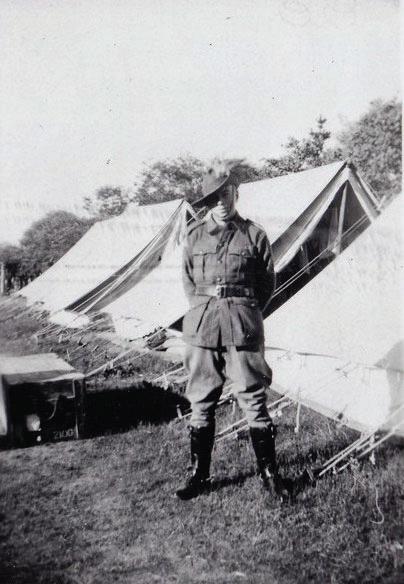
Following the onset of World War II, in late 1939 a significant Australian Light Horse Regiments training camp was established in Torquay, Victoria, to prepare mounted troops for potential service. Carollyn Williams takes us back in time in Calvary Under Canvas, whereby service men and horses trained in our region, with both playing an important part in Australia's history.
We are then provided with insight from Mary Lewis and Marilyn Carr into the Geelong Ladies Reading Circle (GLRC), established in 1891 and still operating today. The GLRC provided a wonderful opportunity for women in Geelong to explore novels, poetry, ideas, current events, and expand their like-minded social connections, and during a time when very few women entered into higher education opportunities. In recognition of GLRC's significance to Geelong, the Kim barne thaliyu/Geelong Heritage Centre holds their minute books and memorabilia, and continues to add to this expanding collection.
We continue with Michael O’Donnell’s Pioneers, Pastoralists, and the Price of Legacy: The Robertsons of Colac Part 3 , which explores the Robertson family’s pastoral ambition, success, and unforeseen tragedy and economic changes which would significantly impact on their estate holdings, although their legacy remains strong in the Western District.
In William Purdue’s Diary – Part 8, Daryl Wight shares insight from Purdue’s travels to Barwon Heads, Ballarat, and surrounds by horse, whereby he recounts the beauty of his natural surroundings and the people he encountered.
Harry Roberts’ article Geelong Athletics – A False Start, provides an interesting background on the establishment of athletics in Geelong from 1892, the Geelong Harriers, and athletic events held.
Lana Capon Editorial Team
The Investigator is published quarterly by the Geelong Historical Society Inc. Subscriptions are $40 for individual membership; $40 for two members in one household (receiving one magazine); and $45 for overseas individual membership.
Address for Investigator contributions: Email: web@geelonghistoricalsociety.org.au Post: PO Box 67, Newcomb VIC 3219
Present & Past issues may be purchased at $10.00 per set (4 issues) 1976–2021

CHRONOLOGY FOR 1866

By Daryl Wight
From the pages of the Geelong Register – 160 years ago (January to March 1866)
2 January 1866
SPORTS – The attendance at the Comunn na Feinne ground yesterday was evidence of the success of the meeting. There could not have been less than 3,000 persons at the ground. The sports were all well carried out. No accidents occurred, with the exception of one to Mr M.S. Levy, who had a caber pitched on to one of his feet, by which he sustained a severe bruise. The Volunteer Band, under Mr Walker’s able direction, contributed very largely to the entertainment of the large assemblage at South Geelong.
3 January 1866
FUNERAL – A numerous funeral cortege accompanied the remains of Dr Alexander Thomson, of Kardinia, one of the oldest, if not the oldest, resident in this district, to the Old Cemetery, yesterday. Many members of the Town Council, the town and suburban Fire Brigades, the Order of Foresters, and other public bodies, testified, by this last mark of respect, to the general esteem in which he was held. (Alexander Thomson, 1800 – 1 January 1866)
4 January 1866
PROCLAMATION – Friday, 5 January 1866, has been appointed as a day of HUMILIATION AND PRAYER to Almighty God, to avert the consequences of a protracted drought. Government and Council offices will be closed.
12 January 1866
MARKET GARDEN – The Chinese are getting on famously with their market garden at the side of the tanneries, near Prince Albert Bridge. Their ground runs along the river. There are eleven men employed as well as a lot of boys. They have got a number of vegetables, including cabbage, for sale already, and hawk them about the town.
16 January 1866
DIPTHERIA – This disease, unfortunately, is somewhat prevalent in Geelong at this time. A case of sudden death from the disease occurred yesterday to a boy about twelve years of age, the son of Mr Goulding, who resides in Bellerine Street. He was playing on the street the previous day, and yesterday was attacked and died from the disease.
22
January 1866
DROWNED – A boy named Nicholas Byrne, aged eight years, was found drowned near the Railway Jetty, in about six feet of water. He had been fishing there with other youngsters, all of whom had left him and gone home, and falling into the water with no one to witness the catastrophe, with no assistance near, and unable to swim, he of course miserably perished. His little fishing rod was found sticking in the mud where his body was recovered, and wound around his hand was the fishing line he had been using.
23 January 1866
FURNITURE AUCTION – John Davison has been instructed by P. Huddart Esq., (who is leaving for England), to sell by auction at his residence, Santon Villa, Retreat Road, the whole of his superior household furniture and other effects.
9 February 1866
BENEVOLENT ASSOCIATION – The committee of the Ladies’ Benevolent Association held their usual fortnightly meeting on Wednesday last. The number of cases on the Society’s books at present amount to 119. They may be classed as follows: widows with families, 56; women deserted by their husbands, 28; invalid husbands, 18; aged women, 9; temporary cases, 8.
10 February 1866
VINEYARD – Mr Seidel, with a view to the encouragement of the consumption of colonial wine has opened a retail establishment at his vineyard, where the best descriptions of colonial wine can be procured at the moderate sum of one shilling a bottle.
11 February 1866
PIANO-TUNING – Mr F. Litolft, Tuner and Regulator of the Pianoforte, (from Broadwood’s, London), attends Geelong in a few days. Charge 7s 6d, including extra call if required. All orders to be left with Mr George Mercer, bookseller, 31 Malop Street.
13 February 1866
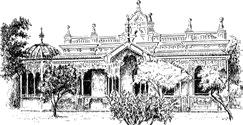
TENDERS – To Builders etc – Tenders are invited until Saturday, 17th instant, for flooring and plastering at the new building at St Augustine’s Orphanage, where the specifications may be seen.
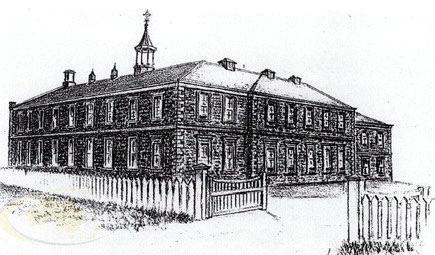
St Augustine’s Orphanage – Sketch by Mr W.J. Smith, Geelong Historical Society Note: The original building did not include the wing shown in the right half of this sketch.
20 February 1866
PICNIC – The anniversary of the Geelong Volunteer Fire Brigade was celebrated yesterday by a picnic to Point Lonsdale. At about ten o’clock the majority had arrived at the ground; but at mid-day there could not have been much less a number than 400 on the ground. Various games were indulged in, such as croquet, cricket, football, rounders, dancing, kiss in the ring, aunt sally etc, and these were kept up with spirit until the company sat down to dinner. After the usual loyal and patriotic toasts, the party returned home, well gratified with the day’s entertainment.
27 February 1866
ORATORIO – The “Messiah” will be given by the Geelong Choral Society tonight in the Mechanics’ Institute. This is the most ambitious effort the Society has yet attempted but we hear it is quite within the compass of their powers. Mr I’Erson is conductor, Mr Gabb leader, and Mr Goodall presides at the harmonium.
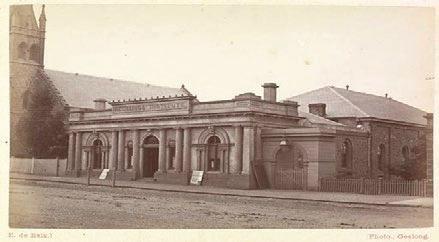
Mechanics Institute Geelong, GEELONG, De Balk, Eugen Wilhelm Ernst 1838-1870, date 1866. Source – State Library Victoria (Australia)
6 March 1866
PUBLIC NOTICE – The Partnership heretofore existing between George Anderson and Fortunatus Poschich, as Mail Contractors and Coach Proprietors, trading between Meredith and Stieglitz, has been dissolved by mutual consent. Witness – Joshua Vines
9 March 1866
INQUEST – An inquest was held yesterday at the Shearers’ Arms Hotel, Newtown, on the body of a female child found clandestinely buried in the Herne Hill Cemetery, the previous day. The medical testimony given before the coroner went to show that the child had never breathed. Of the parentage, and the circumstances attending the burial of the infant, there was no evidence before the jury.
10 March 1866
QUEENSCLIFF – At between 6 and 7am, a large ship was seen approaching the Heads for a pilot, but the atmosphere being thick, and raining at the time, and the pilot schooner being under storm sails, neither could see each other, and the ship made for the Heads herself; but she had a narrow escape from total destruction, having kept too far to the East. Had it not been for the ebb tide, and the vessel being under close reef topsails, she would inevitably have gone on the reef at Point
Nepean, and from the tremendous rip and surf on at the time, all hands must have perished. By good fortune she hauled up a little to the westward and came in safe.
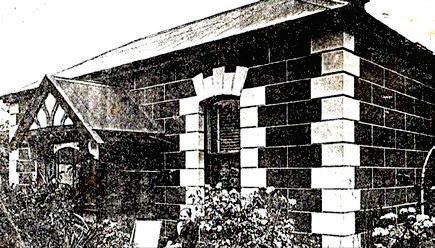
The former Shearers Arms Hotel Aberdeen Street, Geelong West, built c.1847 (now houses Geelong Art Society), Source: Geelong Advertiser
19 March 1866 SWIMMING –Patrons of the Eastern Baths were treated early yesterday morning to a sight not frequently witnessed here. Two of the finest swimmers in the colony, Steadman and Stephens, the former the champion swimmer of the colony, were in the water, and like a couple of dolphins at play they performed, with the most graceful ease, some almost miraculous evolutions, both above and below water.
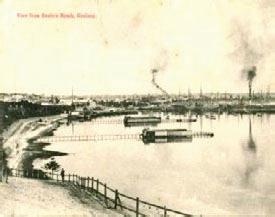
View from Eastern Beach, John Young Collection. Available online at View from Eastern Beach, Geelong/Victorian Places

26 March 1866
TREES – We notice with regret during the last week many of the blue gum and other species of young trees planted on the Railway Terrace, as well as on the Eastern and Western Beaches, have been sadly mutilated or destroyed. The mischief is generally perpetrated by an idle and disorderly class of boys. We consider it to be the duty of the public who witness such destructiveness to at once give information to the police.
28 March 1866
FISH – Yesterday, a splendid snapper, about two feet in length, and weighing about fifteen pounds, was caught off the end of the Railway Wharf, by one of the frequenters of that place. The trevalla are not so plentiful now as they have been, although there are good catches of them at times.
31 March 1866
VOLUNTEERS – Members of the 1st and 2nd Geelong Artillery Corps will muster at the Orderly Room on Saturday, at half-past 10a.m. sharp, to proceed to the Camp at Sunbury by the Excursion Train. There will be another opportunity at 10a.m. sharp on Sunday. Every member not on sick leave must parade at Sunbury on Monday, 2nd April.
Richard Heath Captain Commanding.
Cavalry Under Canvas
By Carollyn Williams
The 2nd Cavalry Division of the Australian Army Service Corps (AASC) contained Light Horse Regiments (LHR) and other divisional units that included engineers, signalers, medical corps and veterinary corps. At the outbreak of World War II, there were 25 LHR. Of these, 17 were still horsed, although they had been partially mechanised, while four had been converted to machine gun regiments and two had been converted into armoured car regiments. However armoured vehicles were not readily available, and a range of vehicles was used.
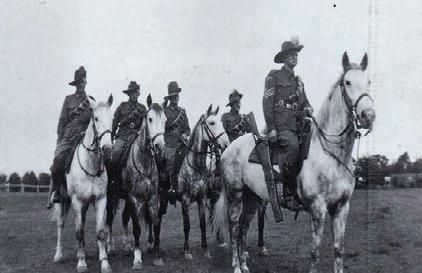
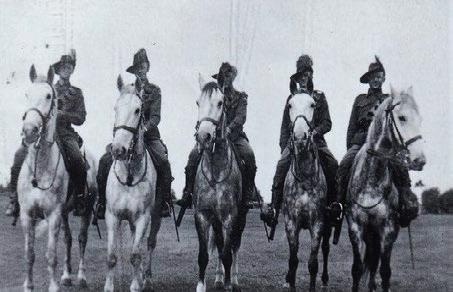
In 1939, as the clouds of war gathered the LHR were keen to serve and were put on a war footing with training camps set up and training exercises conducted. One such camp was established in Torquay in January 1940, where 2,200 Light Horsemen rode into the camp to join 1,200 motorised troops and 1,100 divisional troops of the 2nd Cavalry Division at the greatest cavalry training camp that had ever been held in Victoria. The Commanding Officer (CO) of the camp was Brigadier J. G. Rankine, Commanding Officer of the 2nd Cavalry Division.
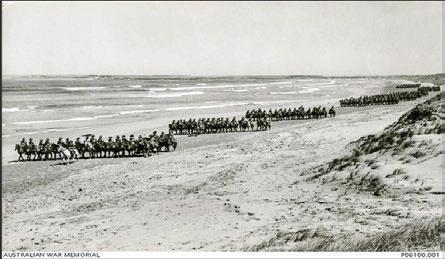
Light Horse cavalry advancing along the beach between Torquay and Barwon Heads. Source: Australian War Memorial
The men and horses came from all over Victoria by rail, a journey that took 24 hours, and some had ridden up to 40 miles to the railhead to board their train. The convoy was organised to arrive all on the same day and was unloaded at the Geelong racecourse. The horses were watered in the Barwon, the men had a meal, and all then set out for the 11-mile (18km) march to Torquay. To avoid congestion on the road, three different routes were taken.
The mounted troops consisted of the 4th Light Horse from Warrnambool, the 8th Light Horse from North-East Victoria, the 13th and 19th Light Horse from Gippsland, and the 20th Light Horse from the central districts, with headquarters at Seymour. Warrnambool troops who left by special trains picked up troops at Terang, Camperdown and Colac. The motorised units were from the North-West, and consisted of the 17th Machine Gun Regiment, Bendigo, the 20th Machine Gun Regiment, Warracknabeal, and the Armoured Car Regiment, Horsham. Divisional troops consisted of the 22nd Field Brigade, the 2nd Field Squadron and Signalers, Army Service Corps, Army Medical Corps, and Army Veterinary Corps.
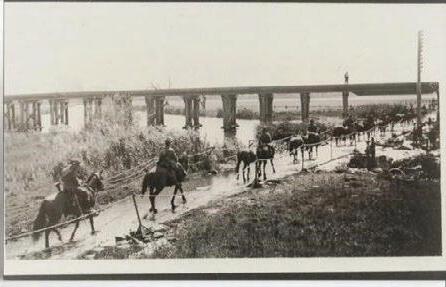
Light Horse travelling from Geelong to Torquay 1940
Source: Lara RSL on Victoria Collection.
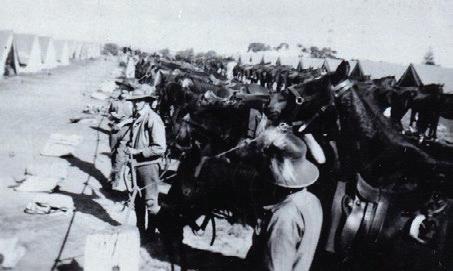
The camp was established south of Blackgate Road on land sloping to the sea at Point Impossible. This slope was bare of trees, and the tents, horse lines, and hutments of the troops extended over more than a square mile (2.5km). The troops had plenty of space, water, drainage, lighting and entertainment. Roads were made through the lines, and the camp was divided, for administrative purposes, into three parts: one for the cavalry brigade, one for the motorised troops, and one for the divisional troops. The whole terrain was regarded as suitable for training purposes, and between the camp and the sea, a range was established for artillery and small arms practice.
All the divisional troops numbering 1,600 attended 10 days at the Torquay Primary School for special training for officers and non-combat officers. Numerous manoeuvres were undertaken by the troops around the district that included a trek and bivouac between Torquay, Modewarre, Aireys Inlet and back, the Battle of Bannockburn and regular exercises on the beach.
Commencing on 12 March 1940, four days of manoeuvres were to be conducted at the You Yangs, and the exercise was called the Battle of You Yangs where the troops would engage an imaginary enemy. Troops numbering 4000 left Torquay for a parade through the streets of Geelong and past the city hall, where the salute was taken by Lieut. General J. D. Lavarack, chief of the Southern Command. Melbourne and Western District traffic was diverted around the central city to avoid congestion during the big parade.
Geelong traders closed their businesses for over an hour to enable employees to witness the march, and all district schools were granted a half-holiday. Buses and trams brought people in from the outer suburbs, and two hours before the head of the four-mile-long column was due to pass, vantage points were being taken. Verandahs and precarious lofty parapets became grandstands for many people. A large proportion of Greater Geelong's population thronged the route, and their numbers were swelled by hundreds from the Western District, from which many members of the division had been enlisted.
The newspaper reported that every pole in the city flew a flag, city centenary decorations had been resurrected, large businesses loaned colourful pennants and most of the business houses along the route had been decorated. The parade of mounted horsemen was described as having plumes sprouting jauntily from the
famous slouch hat, sabres sloped precisely, and chins protruded in soldierly fashion. The horses were described to be in good condition … and pranced excitedly at the crowds. Four-abreast, the parade made an impressive spectacle.
The 4-day exercise at the You Yangs was suspended on the following day because of the fires that swept through Torquay. Several houses in the town were occupied by families of officers, and it was feared that the cavalry camp would be endangered. Instructions were given that if the camp was threatened, the horses were to be cut free. Once the fire safely passed the camp area, the troops were
dispatched to assist at Torquay township. The troops were utilised to knock on doors and tell residents to evacuate to the beach and were actively involved in fighting the flames, particularly in saving the hotel.
The Battle of the You Yangs exercises were recommenced on Thursday in a modified way, and took the form of a rearguard action with the troops falling back toward Mt Duneed. These exercises were completed on Friday.
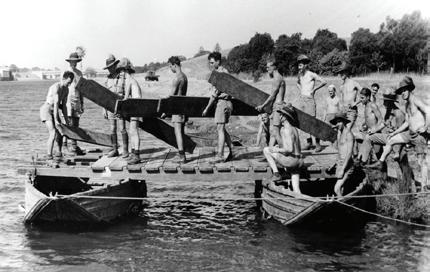
Source: State Library Victoria http:handle.slv.vic.gov.au/10381/199192
Light horse unit in camp at Torquay engaged in bridge building on Barwon River
After three months of training, the camp at Torquay was disbanded and regiments and other units returned to their respective districts. The camp was deemed unsuitable for training during winter, and the cost of a permanent camp could not be justified if it could not be used all year. The light horse regiments moved out of the camp to trek to the railway siding at the Geelong racecourse. There were eight special trains required of approximately 30 passenger cars and 172 horse trucks, and it was estimated that 2000 light horsemen and 1700 horses would be transported. Motorised forces made their journey home by road.
Late in 1941 the cavalry ceased to exist and was changed to a motorised division. No cavalry was to be sent to World War II and the men were redeployed to other units. Throughout the war, the various light horse units were converted to motorised infantry, armoured car or armoured regiments, serving mainly in the defence of Australia.
References
Age (Melbourne, Vic.: 1854 - 1954), Saturday 16 March 1940, page 32.
Age (Melbourne, Vic.: 1854 - 1954), Wednesday 13 March 1940, page 10.
Argus (Melbourne, Vic.: 1848 - 1957), Friday 15 March 1940, page 17.
Argus (Melbourne, Vic.: 1848 - 1957), Thursday 14 March 1940, page 1.
Argus (Melbourne, Vic.: 1848 - 1957), Wednesday 31 January 1940, page 9.
Camperdown Chronicle (Vic. 1875 - 1954) Tuesday 30 January 1940, page 2.
Finlayson, D. (2012), Green Fields Beyond: a biographical honour roll of the Australian Light Horse 1939-1947, Canberra: Department of Veterans' Affairs. Herald (Melbourne, Vic. 1861 - 1954), Monday 11 March 1940, page 4.
Siebrand, J. (1991), The Dirty Thirtee, Siebrand: Tatura. Smith, N. (2007), 2nd Cavalry Division: Australian Army Service Corps, Mostly Unsung Military History: Brighton.
The Horsham Times (Vic. 1882 - 1954) Tuesday 16 April 1940, page 2.
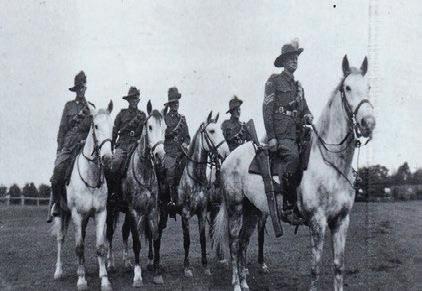
Editorial note: These additional photographs are from a collection of six photos from the 2nd Division Light Horse Camp near Geelong, January to April 1940, showing mounted horsemen, tents, and horse lines. Photo Source: The Victorian Collections available online at victoriancollections.net.au
"An informative and interesting meeting": The Geelong Ladies Reading Circle 1891 - 2025
By Mary Lewis and Marilyn Carr
One Geelong evening way back to 1891, ten women met together in the home of one of their number to read books. In doing so, they were keen to discuss literature, encounter plays, consider world events and places far from their town of Geelong on Corio Bay. Meeting monthly in each other's homes, they arrived for the gathering wearing evening dress. Now, circa 2025, the Geelong Ladies' Reading Circle (GLRC) meets in the afternoon. The dress code is much, much simpler! The books though, are still non-fiction.
The GLRC today is one of the longest-running reading groups in Australia, though the group claims it is most likely the oldest.
In 1969, an article in The Age commented that the Ivanhoe Melbourne Reading Group was celebrating 50 years of meeting. Not to be surpassed, the then secretary of the GLRC, wrote back to The Age's editor informing him that the Geelong
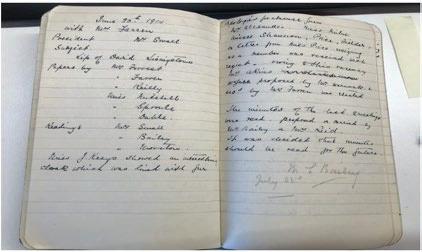
Reading Ladies' Circle had been in existence longer that the Ivanhoe Group. In response, an article that reported on the longevity of the GLRC was published in The Age on the 29 November 1969. (As noted by Dr Jacquelyn Baker, `An interesting and animated discussion': The Geelong Ladies Reading Circle, 18902022, (Kim barne thaliyu Geelong Heritage Centre, 2022.)
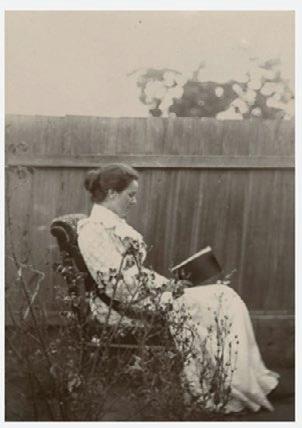
The collection of the GLRC's minute books, dating from 1907, is held in the Geelong Heritage Centre. Looking through them, one finds the lists of titles chosen and notes and comments made about them by the members at their monthly meeting. Browsing through these archives becomes a voyage into history - the reader is alerted to the impact of two world wars and its aftermath and on to travelling to the moon.
Woman reading an interesting book, c.1902. Source: Kim barne thaliyu/Geelong Heritage Centre, GRS4055/13
So, in 1904, the topic/text was "Early Victorian Statesmen" (gentlemen like Lord Melbourne, not the State of Victoria colonial fellows, one presumes). A little later the ladies tackled Robert Browning's epic poem in five sections, "Paracelsus" that would have been a hard slog. In 1909, they turned to the then young Winston Churchill's, My African Journey. In 1914, when "readers took part" it was the tragedy Hamlet", and what a tragedy that year was. In 1918, the topic of the book was "Early Flemish Painters" - and surely those women, in 1918, knew about Flanders and its fields where red poppies grew?
Post-war and the 'country' selected for discussion in 1920 was "Our New Possessions: German New Guinea", which had been assigned to Australia as a Protectorate, in 1919 by the Treaty of Versailles.
Over a hundred years ago, in 1924, the country spoken about was China: Life and Customs...with, then, the emphasis on gems and jade! Into the Thirties, in 1931, a topic was `Cape to Cairo by Road, Rail or Air' which the secretary had recorded as "an informative and interesting meeting."
Maybe a parallel aspect of that long-ago start-up of the GLRC, is that consistent with what was occurring politically in Australia at large, the Reading Circle too, wrote its own small Constitution on how the group should be managed. One might surmise that, with the then-current interest turning towards the forming of a constitution to unite the separate states into what became the 1901 Australian Federation, some local Geelong women followed suit when setting up their reading group.
This, the GLRC's Constitution, states that membership will be limited to 12; that chosen books be limited to non-fiction, except for one novel each year and, annually, a different country ought to be selected for review. For the final preChristmas meeting, members are invited to present a piece of their original writing.
This has led to the GLRC's archive, held at the Geelong Heritage Centre, containing some quite beautifully written pieces of prose and poetry composed by members. One such piece relates to her recently married mother's fraught war-time train journey from Victoria to Queensland, determined to catch up with her new husband if only for a day or so. The writer of the piece was the result! And another poignant piece told a of large Geelong entity's response to the loss of a loved employee killed in the Port Arthur massacre in 1996.
In 2022, part of the GLRC's archive at the Heritage Centre was presented in a display cabinet at the centre and the members themselves were privileged to be part of an Oral History Project. This formed part of the doctoral work for a team member at the Heritage Centre.
The GLRC is still viable after 134 years. It is entertaining, questioning, educational and collegial. Its future looks assured.
Editorial Note:

The minutes and memorabilia of the Geelong Ladies Reading Circle are held by the Kim barne thaliyu (Geelong Heritage Centre). It is noted this is an immense collection that is constantly growing.
Ms Jacquelyn Baker, PhD candidate with research interests in feminism, sexuality, gender and women’s groups, has researched artefacts and documentation about the GLRC; including who attended from 1907 to 1935, what they read, discussed, and presented, and how the group was influenced by local, national and international events.
A Deakin University sponsored `Contemporaries Histories' podcast is available of Jacqueline’s research on `An interesting and animated discussion: The Geelong Ladies Reading Circle Project', at https://adi.deakin.edu.au/2023/09/contemporaryhistories-podcast-series/ Jacqueline also has a twitter account at @jacquibtweets
Jacqueline has explored the GLRC's interest in novels, poetry, essays, travel, biographies, and history. She has noted that with the exception of Dr Mary Garis, the membership provided an opportunity for women who did not have the opportunity to attend university to expand their literary interests, education, and self-development.
Jacqueline has highlighted that the GLRC minutes in 1924 for example, confirm the group covered some of these books, plays, and areas of interest;
The Ordeal of Richard Feverel by George Meredith
Kim by Rudyard Kipling
Pocket Philosophies by Arnold Bennett
Becket by Alfred Tennyson
Henry Wadsworth Longfellow
The French Revolution
Napoleon
Lord Byron’s Life
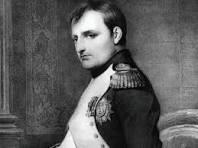
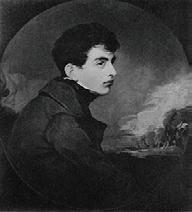
Of further interest, Jacqueline’s additional research has highlighted members of the GLRC;
“…were engaged with other local groups and charities, such as the Ladies Benevolent Society, the Geelong West Free Kindergarten and the Protestant Orphanage. Not all members had professions, but those who did were employed as teachers and school principals at prestigious schools, such as Geelong College. In addition, Dr Mary De Garis (1881–1963) — Geelong’s first woman doctor — joined the Reading Circle in 1920 after being introduced to the group by the wives of her colleagues”.
(Source: https://www.auswhn.com.au/blog/geelong-ladies-reading-circle/)
Napoleon
Lord Byron
Pioneers, Pastoralists, and the Price of Legacy: The Robertsons of Colac Part 3

By Michael O’Donnell
Now, in this final chapter, we see William Robertson complete the family’s pivot to Victoria, reaching the height of their pastoral ambition. At Colac, the Robertsons built grand homesteads, developed vast irrigation systems, and created a cattle empire that became the envy of the Western District — before time, tragedy, and economic change brought about the unexpected unwinding of everything they had built.
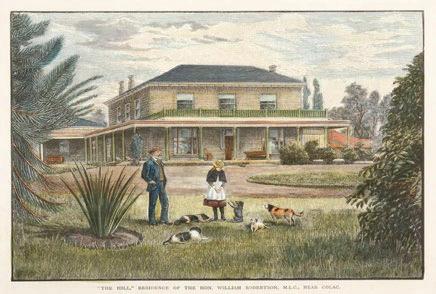
`The Hill', Residence of the Hon. William Robertson, M.L.C, near Colac.
Source: The Antique Print Map Room online.
Legacy and Loss:
The Robertson brothers at their peak — and the sudden decline of a Western District dynasty
In 1852, William closed his Hobart business and began the move that would see the family move to Victoria permanently. First, the family pivoted to England, where the four sons – John, William, James and George Pringle – completed their education. John, the eldest, was educated at the Royal Agricultural College in Cirencester, William junior and George Pringle studied at Oxford and James, the youngest, went to Rugby. On their return, William and his sons formed a formidable combination.
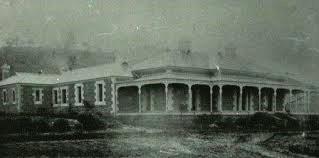
Coragulac House in 1872, available online at https://www.coragulachouse.com/history.html
Back in Victoria, William had built Coorangamoorah, though it was more well known as simply The Hill, a grand mansion overlooking Colac. It was there he settled with his wife, Margaret Whyte and family. In time, each son built his own mansion. Today, only two survive, Coragulac which sits beneath Red Rock and has recently been fully restored, and Glen Alvie, built by James Robertson, which lies as almost a ruin.
Once living full-time in Victoria, in the early 1860s, William Robertson’s focus was on expanding his pastoral activities, but he also had time to be influential in colonial affairs. To highlight his status, it was to William’s mansion that in 1868 Prince Alfred, Queen Victoria’s second son, chose to stay. This royal visit engendered much local enthusiasm — although the Duke famously dented it when his entourage skipped the welcoming party in Colac and rode straight through to The Hill, trailing dust and disappointment over the locals in one stride.
Four Sons and a Fortune
William Robertson died at 76 years of age in January 1874. The Colac Observer remarked that he had suffered greatly from Dropsy for five or six weeks before his death, but that he “bore it with great fortitude” . The same article recorded that William was “a man of great energy and force of character, and … as has often been remarked in Colac, ‘he was hard to beat.’”
After William’s death, the brothers, like their father and his siblings, formed a joint company – another Robertson Bros. – to exploit the legacy left to them. They had been gifted a considerable legacy; William left an estate of £289 067 – the equivalent of over $1.8 billion in the currency of 2001. This placed William at number 141 in William Rubinstein’s The All-time Australian 200 Rich List, published in 2004.
In this joint enterprise it was the younger son, James Robertson, who took on the role of Managing Director and continued overseeing the family business. The brothers continued to prosper even after the death of their father; they invested heavily in their Shorthorn stud, purchasing the best sires from England and developing their own bloodlines. In 1875, the brothers purchased Richard Morton’s Mt Derrimutt Shorthorn stud for £27,000. The following year, their January 7 cattle sale broke all records with £30,807/4/- received, with the cattle sold averaging over £100 per head.
The Robertson brothers spared no expense and made significant improvements to the land. These included the installation of an amazing irrigation network across the estate. In an account published in 2020 by the Colac Historical Society and written by Craig Pink, it was recorded that:
“… a large steam-powered pumping unit was installed to pump water from the fresh water springs known as Bullock Swamp, situated several miles north-east of the Glen Alvie mansion. Depending on the season, the Bullock Swamp area consisted of, on average, around 20 to 30 acres of drinkable water from the fresh running springs”.
The same article recorded that in 1875, the brothers employed William Parker as their chief engineer. Parker operated and maintained the boiler, steam engine and pumping installation at the Bullock Swamp springs. A large stone reservoir with the capacity of some 35,000 gallons was built approximately one mile to the west, and around 160 feet above the height of the Bullock Swamp pumping station. This reservoir was situated to the south of the Glen Alvie cattle sheds, on the Warrion Hills.
From this large stone reservoir, the water was distributed over the estate to some 9,000 acres. Over 20 miles of iron pipe were used mainly to supply the Glen Alvie mansion, its paddocks, and the Glen Alvie cattle sheds. A direct pipe ran to the south-west, also supplying water to the Coragulac House mansion of James’ brother, George Pringle Robertson.
Even after James’ death in 1891, the remaining brothers and then their executors continued to make improvements. In mid-1895, the largest windmill in the colony was erected at the Bullock Swamp springs, close to the existing steam engine.
Made by Mr J. Abraham of Ballarat East, this huge one-off windmill had a wheel diameter of 36 feet, a total height of around 82 feet, and a weight of some 13 tons. With a driving capacity equal to over 10 horsepower, the Abraham windmill’s pumping capacity was up to 100 gallons per minute.
The brothers had continued to hold annual sales at The Hill until 1887. By the mid-1880s, the cattle boom had slowed, and the Robertson Bros began scaling down their large-scale cattle stud. The article published by the Colac Historical Society noted the brothers had also previously invested quite heavily in stations in Queensland, but which failed around this time. Family history also suggests that, on the breakup of the Robertson Bros. venture, the dispersed cattle were used as the backbone of the cattle empire founded in Northern Australia by Sidney Kidman.
As well as selling most of the stock, the Robertsons also began to sell their land. The land was well-suited for smaller-scale farming ventures. Any unsold land was leased out at lucrative rates and terms. Also, after the April 1887 dispersal sale, the Robertsons still carried on the breeding of pure Shorthorn stud cattle and horses, but on a much smaller scale than previously.
The annual cattle sales at The Hill had been major events. Their breeding stock was renowned, and their estate became a model for modern pastoralism. However, contemporary accounts show that there was jealousy of the Robertson Bros. success, especially among the Western District elite.
In the book Men of Yesterday by Margaret Kiddle, which is often considered the definitive history of the Western District, the author referenced a less than flattering assessment of them from The Hamilton Spectator. Its assessment of the brothers, that they were “not necessarily great breeders, but great organisers and born salesmen” highlights this well. Perhaps the source of the antipathy towards them stemmed from William and his sons avoiding the hardship and privations of early settlement, whilst still reaping its rewards in full.
Sorrow and Slow Decline
But any success comes at a cost. The lives of William Robertson’s four sons were all cut short, all of them dying in their forties and fifties. James Robertson’s life was also marked by tragedy. He and his wife, Margaret Stodart, lost their daughter Ruby to tuberculosis at just 21. James himself died the next year in Bournemouth, aged only 42. His estate was worth over £112,000 — a vast sum — but his early death marked the beginning of the family’s decline.
Within five years all four sons of William had died. George Pringle Robertson’s death in 1895 marked the end of a remarkable period, as all his brothers had died in the years before him. With their deaths, the Robertson partnership was at an end. Two figures highlight the business acumen of the Robertson Brothers. When probate was assessed in November 1890, it was recorded that James left an estate valued at £112,580, and his brother George Pringle, who died in 1895, left an estate valued at £63,408.
James Robertson’s will highlights the dissolution. He divided the estate between his six children, but it also stipulated that his wife was to receive an annual income £2,000 from it. It also indicated that the daughters would only receive half of the share their brothers inherited, with the daughters receiving £10 000 whilst the sons would receive £20 000 each.
Just prior to Margaret’s death in 1903, the executors of the James Robertson estate announced a sale to subdivide the Glen Alvie estate. On 17 October 1902, 3182 acres of the Glen Alvie Estate were offered at auction, bringing in some £70,000. A further sub-division of the Glen Alvie estate in October 1910 included the Glen Alvie mansion and 550 acres of surrounding land, which netted a further £18,360.
By the early 20th century, the once-mighty Robertson estate had been largely broken up due to the pressure of the 1890s depression and the untimely deaths of the Robertson brothers. The story of the Robertsons is not a simple tale of pioneers triumphing over hardship. It’s a complex and layered history — one of ambition and conflict, privilege and compromise, vision and vulnerability.
For all its sweep — from the Scottish Highlands to the Western District — the Robertson story remains grounded in the soil, the seasons, and the struggles of a changing land. Inheritance, after all, is not just what is left behind, but what each generation chooses to carry forward.
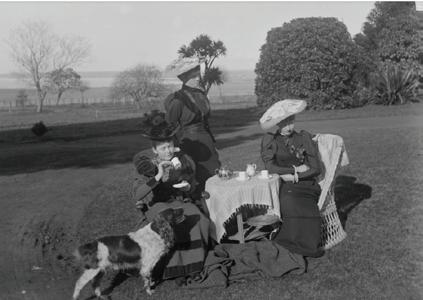
Enjoying afternoon tea on the lawn at "The Hill" at Cororooke, west of Colac, c.1893
This photo has been posted on the Western District Families - Facebook page, and has i dentified in the photo Connie Robertson, Bea Robertson, with a beautiful Cocker Spaniel. It is noted that Connie and Bea were the daughters of politician William Robertson and Martha Margaret Murphy, and the other girl in the picture may be their sister, Eliza. Also available online, as H83.47/86, with the State Library of Victoria, at https://handle.slv.vic.gov.au/10381/23619
Bibliography:
Alsop, P.F.B and Brown, P.L., (1989), The Todd Journal, Geelong Historical Society. Clark, Neville, (2010), Boz: Aviator, Framer, Schoolmaster, W.R. Parsons. Gellibrand, J.T., Memoranda of a Trip to Port Phillip, Internet Archive, https://ia601406.us.archive.org/16/items/biostor-257720/biostor-257720.pdf, accessed online 20 May 2025.
Gordon, Rev. John, (1794,) The New Statistical Account of Scotland – Alvie, County of Inverness, OSA, Vol. XIII, 1794, https://stataccscot.ed.ac.uk/static/statacc/dist/viewer/nsavol14-
Parish_record_for_Alvie_in_the_county_of_Inverness_in_volume_14_of_account_2/, accessed online 20 May 2025.
Hone, J.A. (1976) ‘Robertson, William (1798 –1874)‘, Australian Dictionary of Biography, National Centre of Biography, Australian National University, https://adb.anu.edu.au/biography/robertson -william-4491/text7339, accessed online 20 May 2025.
Kiddle, Margaret (1961), Men of Yesterday, Melbourne University Press. MacDonald, Rev. George (1845), The New Statistical Account of Scotland – Alvie, County of Inverness, NSA, Vol. XIV, 1845, https://stataccscot.ed.ac.uk/static/statacc/dist/viewer/nsa-vol14Parish_record_for_Alvie_in_the_county_of_Inverness_in_volume_14_of_account_2/, accessed online 20 May 2025.
Morgan, J. (1852), The Life and Adventures of William Buckley, Archibald MacDougall. National Portrait Gallery, (2011), William Robertson, https://www.portrait.gov.au/portraits/2011.4/william-robertson, accessed online 20 May 2025.
Pink, C., (2020), The Robertsons, Colac Historical Society, https://colachistoricalsociety.org.au/pdfs/CDHS_Newsletter_2020_02.pdf, accessed online 20 May 2025.
Robertson, M. (2011), Brothers on Farms, https://www.portrait.gov.au/magazines/41/brothers-on-farms, accessed online 20 May 2025.
Roe, M., (2005), ‘Eumarrah (1798–1832)‘, Australian Dictionary of Biography, National Centre of Biography, Australian National University, https://adb.anu.edu.au/biography/eumarrah -12905/text23313, accessed online 20 May 2025.
Rubinstein, W.D., (2004), The All Time 200 Australian Rich List, Allen & Unwin. Ryan, L., (2004), Massacre in Tasmania? How Can We Know?, `https://gsp.yale.edu/sites/default/files/files/Paper_6_Ryan.pdf, accessed online 20 May 2025.
WILLIAM PURDUE’S GEELONG
DIARY (Part 8)
Transcribed
and edited by
Daryl Wight
Further 1850s diary entries, from William Purdue’s time in Geelong, are published below. In this excerpt, the diarist makes a day trip to Barwon Heads and again visits Ballarat and surrounds. For a brief biography of the diarist and information about the diary, see the March 2024 issue of this magazine. Note: the diary entries are intermittent – no entry has been omitted.
25 December 1856 – Xmas Day – Picnic to “Barwon Heads” – Hearing that a number of friends were off to the Barwon Heads to spend the day, I procured a good horse & left Geelong at about 8 o’clock purposing to fall in with the excursionists. I went very leisurely along for some two or three miles, then having enquired what track I was to take, put my horse into a brisk trot.
The day was intensely hot. After proceeding pretty smartly for some miles, I got fogged by the tracks which converged & diverged & meet & cross each other in a perplexing manner. Seeing a house & farmland at some little distance, I struck into the Bush towards it. On my way I came across a man who appeared to be grubbing trees; he directed me to the right track.
I then put my horse into a gallop to make up for lost time and soon perceived not far ahead, water. I left the track to reach it but, on approaching, found it to be a swamp – the margin being covered with reeds & thick slime – into which it was dangerous to venture & the water itself very filthy & brackish.
I returned to the track & after proceeding some little distance I discovered, through the Bush on my right, three or four dog carts. I spurred up to them & found them to contain friends from Town who were bound for the same spot as I. I followed in their track & at about ¼ past 10 o’clock reached the Barwon Heads. Here a large party was assembled.
We made for Mount Colite1 the highest land in the district & on the sea coast, & having unharnessed our horses & tied them to the vehicles, prepared for lunch.
1 The Bluff at Barwon Heads
Having done justice to the viands placed before us, taken in proper picnic style, we had time to enjoy the view which was most extensive & really magnificent; before us stretched Bass’s Straits, the waves rolling in on the shore most beautifully. Here & there submerged rocks told of their presence by the foam of the billows which broke over them.
Far away were ships, some inward others outward bound. On our left Port Phillip Heads, to our right the Victorian shore stretching along down to Cape Otway. Behind us the Lakes, the Bush, Geelong & district & the Yow Yangs & Anakies, with the long range of hills of which they form the most prominent portions. After a good ramble along the sea beach beneath the cliffs & at about ½ past 3 o’clock, [after] another feed, we prepared for departure.
We got fairly under weigh at a little past 4 & reached Town by 7 o’clock, after a very pleasant day, indeed. On the homeward road one dog cart was completely upset & 3 ladies & 1 gentleman pitched out like oranges from a stall but no one was injured & even the dog cart was unhurt. How the thing could occur without damage we could not comprehend.
1 January 1857 – Thursday – Left Geelong at 6 o’clock by “Criterion” 4- horse Conveyance for Ballarat. Coach full & amongst the passengers some new chums, just landed from the “Donald McKay”.2 A nice cool day for travelling. Nothing remarkable occurred on the road; the horses did their work & we had 6 changes of teams between Geelong & Ballarat. Reached Bath’s Hotel 3 Ballarat at about 1 o’clock.
After waiting for about half an hour at the Hotel, Edward 4 came up (on Mr Towle’s horse, a beautiful creature) to meet me. I mounted & he walked by my side to the Miner’s Right Store, Mount Pleasant, where he is at present located in the employment of Messrs Bryan & Towle, 5 storekeepers. His situation is a pretty good one & if steady & persevering he may soon secure a good position.
2 The Royal Mail ship, `Donald McKay, 2560 tons, H. Warner, Commander, arrived in Melbourne, from Liverpool via Cork, on 28 December 1856 ( Age, 29 December 1856).
3 Bath's Hotel, Lydiard Street, Township, Ballarat.
4 The diarist’s brother Edward Purdue had arrived in 1853 on the `Tantivy'.
5 `Notice is hereby given, that the partnership hitherto existing between William Bryan, of Market Square, Geelong, and Edward Towle, formerly of Haydon's old store, Specimen Hill, Ballarat, and lately of the Miner's Right Store, Mount Pleasant, under the firm of Brayn and Towle, as General Storesman and Dealers, ceases from this date. William Bryan, Ballarat, April 13th, 1857.' (Star, 22 April 1857)
In the evening went with Edward and Mr Towle 6to the Montezuma Theatre to see the Pantomime7 which was spoken of as being exceedingly well worth seeing. I never saw a Pantomime before but with this display I was disgusted & wished myself away long before the performance was over, but this was impossible – the theatre was crammed. I never saw such tom-foolery, such balderdash, such humbug in my life.8
On Friday, Mr Towle & I took the mare & started for Little Bendigo. 9 We had occasion to pass thru Ballarat & tried to get a horse for the morrow, that we might have a ride together into the Bush. We were unsuccessful & had to ride & tie until we reached Little Bendigo. Here the diggers were very busy working over the old ground – many puddling machines were in operation. We called on some friends & returned to Ballarat.
Got a good dinner at Fassert’s 10 & again had a search for a saddle horse but in vain. We were baffled & returned to Mount Pleasant. Spent a quiet evening at home; had a game of chess with Towle.
Saturday – Walked into Ballarat with Towle & after many enquiries procured a horse at Bath’s Hotel. We then started off for Lal Lal where there are some beautiful falls. We took the road to Warraneep, passed the hotel at the foot of the Mount 11at about 11 o’clock & proceeded by the Melbourne Road to Fiskin’s
6 Edward Towle (1818?-1904) came out to Victoria on the `SS Great Britain' in 1852. After trying his luck on his diggings for several years, he was involved in a number of mercantile ventures in Ballarat and Geelong. He was a cousin of Thomas Towle, draper, and Frederic William Towle, surgeon – both of Geelong.
7 The pantomime was `The Enchanted Isle', sub-titled `The Sprite of the Diamond Star'.
8 The review of the performance stated that the `...pantomime, with local scenery and allusions, drew a house crowded to excess...it was well put on a stage, and acted with spirit throughout. Being the first pantomime ever produced on Ballarat, it was hailed with enthusiasm...' (Bell's Life in Victoria , 3 January 1857).
9 Little Bendigo (later Nerrina) was the site of the gold diggings about five kilometres north-east of Ballarat.
10 Charles Philippe Fassert was a restauranteur and hotelier. He ran Fassert's Hotel, in Main Road, Ballarat, at this time.
11 Warrenheip and the hotel of the same name were about five kilometres east of Ballarat diggings.
Station.12
Reached the Station at about 1 o’clock & on enquiring the track to the Falls, were directed to take a road which would bring us to some old Stock Yards, from which the Falls were only a quarter of a mile distant. We followed the direction given till we came to creek running through a deep gorge edged in by lofty & rocky hills. Before us, about four miles distant, was Mount Egerton!
Convinced of our mistake, we plunged into the Bush & my friend, knowing the “lay” of the country, took the lead. After going for a mile or two in an oblique direction, we came upon the old stock yards, near them was a hut to which we proceeded. A small boy, who appeared to be unoccupied, volunteered to direct us to the Falls. We gladly availed ourselves of his services & having disposed of our to the Falls. We gladly availed ourselves of his services & having disposed of our horses by placing mine in the old stock yard, where some good feed could be got, horses by placing mine in the old stock yard, where some good feed could be got, and Mr Towle having tethered his to a tree, we started down a steep declivity for the Moorabool Falls.13
Arrived at the base of the rocky descent. We had a full view of the falls which were exceedingly picturesque & pleasing, though on a somewhat small scale; the water as it rippled along gave out a soothing sound. We seated ourselves on the rocks which form a nice surface on the borders of the creek below the falls.
Having made a good fire, filled our pannikin with the clear sparkling water, we patiently waited the boiling point. This speedily arrived at, we put some sugar & tea with the pannikin &, with some biscuits, made a very refreshing meal; the more acceptable because of the fatigue of our bodies & the romantic style of the repast.
wandered along the falls & seen all their beauty, proceeded to the Lal Lal Falls. Passing for a quarter of a mile through thick, luxuriant grass, such pasture as I never saw exceeded in Australia, we reached our destination & here a beautiful
12 Archibald Fisken (1829-1907) held the Lal Lal squatting run of 18,000 acres, from 1850, after managing the run for his uncle from 1847 (Billis & Kenyon, Pastoral Pioneers of Port Phillip, 2nd edition, Stockland Press, Melbourne, 1974.
13 The first of three waterfalls in the area, the Moorabool Falls drops 27 metres.
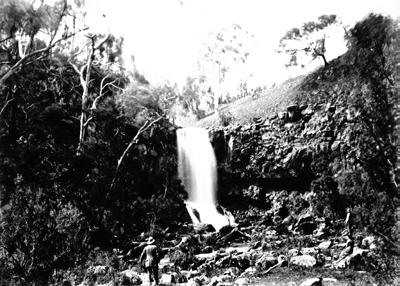
Moorabool Falls, near Lal Lal, photograph by Fred Kruger, c. 1866-188 (National Gallery of Victoria collection), online at Moorabool Falls, near Lal Lal, Ballarat district, Fred KRUGER | NGV scene greeted us. The waters of Lal Lal Creek come winding most picturesquely through some of the finest pasture land, till they reach a rocky, precipitous bed over which they rush headlong & then fall for a depth of about 100 feet into a deep basin surrounded by rocks. The basin is said to be of very great depth (even to exceed 100 feet) & the rocks above & around rugged & wild in the extreme. 14
The view from the top of the falls is romantic & beautiful in the extreme. Before you Mt Egerton & the tents of the diggers just perceptible in the thick forest; the intermediate country diversified by hills & valleys, forest & pasture land, creeks & ravines. On the one side in the distance rises Warraneep Mount, on the other Buninyong, between the two Ballarat, hidden however by the dense forest which intervenes.
14 Lal Lal Falls are on the Lal Lal Creek, a tributary of the Moorabool River, about 25 kilometres south-east of Ballarat. The falls drop about 30 metres into a deep pool below. They have been a tourist attraction since goldrush days.
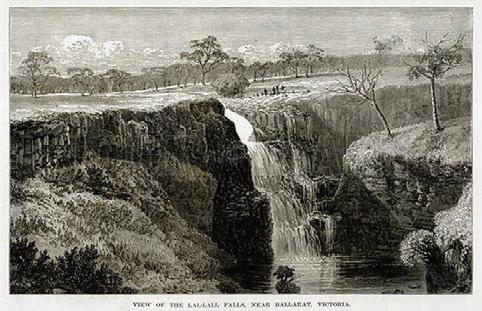
View of the Lal-Lall Falls, near Ballarat, Victoria.
Illustration from The Countries of the World by Robert Brown (Cassell, c 1890)
After enjoying the scene for some time, we retraced our steps but conceive of our astonishment & chagrin when, on reaching the tree where Mr Towle had tethered his mare, only the rope was to be found. She had broken away & gone (where?). I saddled my horse & bade Mr T. mount him & gallop along the creek in search of the missing animal. He searched for some time in vain & returned to me.
I then mounted & we resolved to ride to Fiskin’s station & apprized stock riders there of our loss. We could only proceed at a walk, as only one of us could ride & the load to carry the saddle & bridle of Mr T.’s horse. We reached the house at last & left full particulars of brands, color &c of the missing mare with one of the stock riders & left in charge of the groom of the stables the extra saddle & bridle. We then slowly pursued our homeward road. At every mob of cattle we met, we looked out eagerly for the mare. At length, when about 5 miles from Lal Lal, we saw before us a mob of horses. At our approach they galloped wildly away & amongst them we thought we recognized the mare. I dismounted & Mr Towle jumped on my horse, used his spurs freely & kept the herd in view. At length they stopped to graze.
Mr T. dismounted, gave me my horse as I had run after him. He then walked stealthily up to the mob and, there, sure enough, was the mare & to our surprise, directly she saw her master, she ran to him. Mr T. tied the thong of his whip to her headstall which she retained & left her with me then rode my horse back to the station that he might release his saddle and bridle & then return in company with station that he might release his saddle and bridle & then return in company with me to Ballarat. After an absence of ¾ of an hour, he return’d & we then put our horses at good speed & reached Ballarat at about ¼ to 8 o’clock, an hour at least before we had expected to get home.
On Sunday, I went in the morning with Mr T. to hear a Scotch minister, Mr Baird. 15 He gave us an excellent discourse. In the afternoon went with Edward to visit a friend at Magpie. Enjoyed the walk much, dined there, return’d to Mt Pleasant to tea. Went to bed early & rose on Monday morning at 4 o’clock, walked to Ballarat in time for the 6 o’clock coach & after a few trifling accidents from breakage of harness..., reached Geelong at about 10 o’clock.
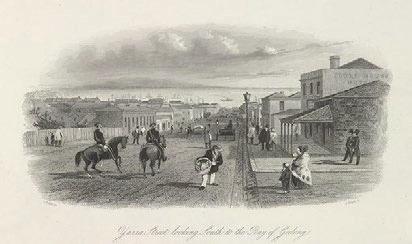
Geelong in 1857, Yarra Street looking south to the Bay of Geelong and You Yangs Engraver, ST Gill, 1818-1880, Date 1857, Sands and Kenny, ID. IE1331690, Source: State Library of Victoria.
15 Reverend James Baird called for applications from teachers wishing to be appointed to the Presbyterian School, Ballarat, (Argus, 16 March 1857).
Geelong Athletics – A False Start
By Harry Roberts
The Beginning
Athletics in Geelong, as an independent sport, with formal accreditation from a governing body, began in 1892, but its presence was brief and uninspiring. On March 6 the Geelong Harriers Club was founded and it was resolved to affiliate with the fledgling Victorian Amateur Athletic Association. There were ‘athletic events’ conducted in Geelong and in many places before 1892, but those events were conducted at shows and carnivals in small country towns and at communitybased celebrations such as the annual Commun Na Feine’s and Saint Patrick’s Day picnics.
No formal athletic organisation could have been formed in Victoria before October 8, 1891. That was the date when the Victorian Amateur Athletic Association (V.A.A.A) was formed. The Association’s founding members were Melbourne Harriers, Melbourne University, Hawthorn Harriers, Melbourne Grammar School and Wesley College.1
The V.A.A.A was established as the governing body for amateur athletics in the colony of Victoria. It regulated the sport, set rules for participation and competition, established Victoria colonial records, conducted events and championships, and fostered the growth of the sport based on amateur participation. Sportspeople, who had been paid to participate in sport as professionals, were forbidden to compete in V.A.A.A competitions.
Athletics in Geelong, as a recognised independent sport and not as an offshoot of community picnics, commenced as a result of Ballarat Harriers’ athlete, J. S. Young, moving to Geelong. Ballarat Harriers was formed just one year earlier, in June 1891 when a visit from Melbourne Harriers helped to establish the club. Melbourne’s Sportsman newspaper recorded that event in its article “WITH THE HARRIERS” on 2 June 1891.
“The Melbourne Harriers paid a visit to Ballarat on the Queen’s
1 Internet: athsvic.org.au/about
Birthday to encourage the formation of a cross-country club in the district. Eleven members of the Ballarat Gymnasium took part in the run (Paperchase) with twelve of the metropolitan club.” 1
After the inaugural run, in which Mr J. S. Young was one of the organisers and leading runners, Melbourne Harriers (at their expense) entertained the locals at Lester’s Hotel.
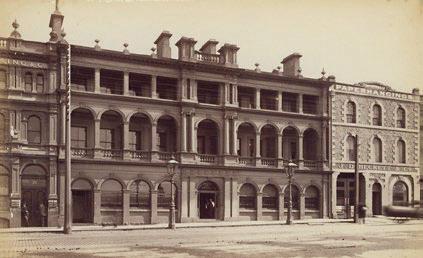
Phillip Club Hotel, Port Flinders Street, Melbourne, Photo c. 1876-1894
Source: State Library Victoria
“As a result of the visit a club is being formed on the lines of the Melbourne club, and there is every indication from the enthusiasm of those taking part, that it will have a successful career.”2
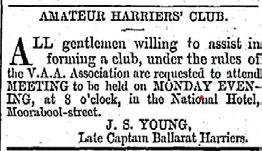
The following year, Mr J. S. Young moved from Ballarat to Geelong and his enthusiasm for athletics came with him. In March, he was keen to establish a Harriers Club in Geelong. He placed an advertisement in the Geelong Advertiser on Saturday 19 March 1892. It appeared on page 3 and advertised a meeting to take place on 21 March at the National Hotel. The Geelong Advertiser’s TOWN
1 Sportsman, `WITH THE HARRIERS', 2 June 1891, page 3.
2 Ibid.
Port
TALK column was confident of the formation of an athletic club. Of course, this meeting was only for gentlemen.
“Next Monday evening a meeting to arrange for the formation of an Amateur Harriers’ Club will be held at the National Hotel.”3
A detailed report of the meeting was published the following day. It reported there was a fair attendance and Mr J. Young, formerly Captain of the Ballarat Harriers, was elected to chair the meeting. Mr Young proposed that the new club would be called the Geelong Harriers, and it should be established under the rules of the Victorian Amateur Athletic Association. (V.A.A.A.). It was important that the Club’s members were ‘amateurs’, meaning they had not accepted prize money for competing in sport, nor had they competed with professional athletes. meaning they had not accepted prize money for competing in sport, nor had they competed with professional athletes.
Mr Young stated the benefits of joining the Harrier group:
“A club like the harriers would provide healthy recreation and encourage honest and straight running, the feature of amateur athletics.”4
Appealing to local footballers he mentioned:
“Anyone connected with athletics in which endurance was a consequence, footballers, for instance, would find the benefit derived from joining the expeditions, of the harriers, invaluable”5e motion to form the Geelong Harriers, under V.A.A.A. rules, was then moved by Mr J, Mills and seconded by Mr Walker. Mr Walker then explained the rules and procedures involved with the Paperchase to Members who were new to the sport.
3 Geelong Advertiser, TOWN TALK, 19 March 1892, page 3.
4 Geelong Advertiser, 22 March 1892, page 2.
5 The Victorian Amateur Athletic Association Handbook (V.A.A.A Handbook), Melbourne, JC Stephens Printer, 1901, page 11.
5
The motion to form the Geelong Harriers, under V.A.A.A. rules, was then moved by Mr J, Mills and seconded by Mr Walker. Mr Walker then explained the rules and procedures involved with the Paperchase to Members who were new to the sport.
Office bearers were appointed for the club;
President: Mr R. J. Hopkins, M.L.A.
Vice Presidents: P Russell, F. Hodges and W Abraham
Patrons: Messrs Henry Sargeant, Mr W. R. Wilson and J. Sommers
Treasurer Mr O’Dwyer
Secretary: Mr J.C. Warner
Captain: Mr C Young
Vice Captain: Mr H Young Committee: Messrs W. Warner, J Mills, W Morris, as well as the Captain and Vice-Captain.
Key decisions were made at the first Committee meeting on the evening of 4 April 1892, at Duckworth and Fox’s rooms at 260-262 Moorabool Street. Plans were also made to complete the clubs’ organisation. It was decided to adopt the Ballarat Harriers’ rules and to have them printed. Members were required to purchase their club uniform which consisted of ‘university knickers’ with two royal blue stripes, a white guernsey with Maltese cross on the breast and a royal blue cap. Mayor of Newtown and Chilwell, Mr J. H. Grey, was added to the club’s list of patrons, and the general committee was extended from three to five people with Mr R. H. Hennessy and Mr R. O’Dwyer being appointed. It was agreed to meet again on 28 April. Messrs Duckworth and Fox gave permission for the Geelong Harriers to meet in their rooms free of charge for that evening and for all future meetings.
During the 1890s, meetings were commonly held at Duckworth and Fox’s rooms. Mr Fox was a hairdresser with strong ties to cricket sponsoring the Junior Cricket Challenge Trophy and Mr Duckworth ran a sports deport, which catered for all sports, from the shop. It was a popular location at the top of Moorabool Street and the business sold sporting goods for all the major sports. The rooms became the focal point and starting point for all Club activities.
Geelong Harriers commenced their first run on 7 May 1892. The run followed the rules for a paperchase outlined by the V.A.A.A. Affiliation rules.
V.A.A.A. Affiliation Rules
To gain an accurate picture of the appearance of the athlete and the conditions they would experience during their races it is illuminating and instructive to understand the rules and regulations of the V.A.A.A.
Strict rules were applied by the V.A.A.A. for any club and member who wished to join their organisation. First of all, all members who wanted to compete in events had to be ‘amateurs’. Amateur was defined in Article 2 of their Constitution:
“An amateur is one who has never competed for a money prize, staked bet, or wager, or who has not knowingly and without protest competed with or against a professional for a prize of any description all for public exhibition, or who has never taught, pursued or assisted in the practice of any athletic exercises as a means of livelihood or for pecuniary gain,”6
Any person who did not qualify as an ‘amateur’ had to request being reinstated by the V.A.A.A., but that was not guaranteed. In 1892, this law was more flexible and professional athletes who had not competed since March 1 st could be reinstated. Teachers were exempt from the teaching criterion if receiving money related to their employment.
Clubs were informed that the V.A.A.A.’s object was to: ‘… promote cross country running and to foster amateur athletics generally.”7
In achieving this ‘object’ affiliated clubs had to meet certain rules.
Annual Affiliation fees of 5 shillings are to be paid annually.
Clubs should have a uniform which is to be worn by its members in competitions.
Designated office bearers must be elected at a General Meeting conducted every April
Two handicappers must be elected every year.
6 The Victorian Amateur Athletic Association Handbook (V.A.A.A Handbook), Op.Cit., page 11.
7 Ibid., page 51.
Club membership was only open to men over 16 years of age.8
A description of the Paperchase was published in the Geelong Advertiser, on 22 March 1892, to inform the general public and prospective club members.
“… the harriers, when out for a run, appointed two men to act as hares with a seven minute start. These were provided with large bags of paper, and laid a trail every ten yards and be followed by a pack pursuing them… The pack in the chase were preceded by a pace maker, and the rear was brought up by a runner to act as Whip. If the latter saw any of the runners becoming fatigued he had the power to bring the whole pack to a standstill.” 9
The Paperchase was not a casual run, but a highly structured event with meticulous rules to be followed. These events can only be held between May and September and notice of the forthcoming event published in the press. The V.A.A.A. was prescriptive regarding the running thereby ensuring uniformity within the sport. It also gave helpful advice to competitors regarding the running of ‘Paperchase’ events. The event was sometimes referred to as ‘Hare and Hounds’ race as the hounds were hunting the trail of the `hare’. Some clubs used Hare and Hounds in their name, such as the Melburnian Hare and Hounds,
“Each hare should have a long sausage-shaped canvas bag under his left arm depending nearly to the waist and with a strap or band carried over the right shoulder. The mouth of the bag is open, and the paper - which should be in long thin strips of 6 or 8 inches and not in small pieces - can be easily reached with the right hand. These paper shavings can be usually had for the asking at any bookbinder, and a good handful carefully shaken while running, so as to leave a trail every 10 yards or so, will last a considerable distance. One continuous trail must be laid but here and there, e.g., at cross roads and up creek beds, false trails may also be laid no more than 300 yards long. Should the pack lose the trail they should at once scatter out in fan shape, if necessary working backwards again until trail is re-found. The pacemaker sets the pace (and it should be an easy jog) at which the pack are to travel, and none allowed to go in front
8 Ibid., page 49.
9 Geelong Advertiser, 22 March 1892, page 2.
of him. The whip should be provided with a whistle, and if the pack are getting scattered must blow it as a signal to the pacemaker to stop until all gathered together again. The pack thus kept together until either the hares are sighted (which rarely occurs) or the last mile or half mile is reached, when they are all drawn up in a line and race in.”10
While this description is specific in detail, the V.A.A.A. went further into issues in Bye Laws relating to its conduct.
The hares must be given a six minute start during which they lay a trail every seven yards.
If the hare is out longer than 45 minutes they are considered ‘caught’. There can be a fast and slow pack and each must have a separate pace and whip
The pacemaker must wear a coloured sash to be visible to the pack. If the hare is sighted, the pack is lined up so there is an even start so the chase is even for all competitors.
The pacemaker makes all decisions on the day.
The pacemaker lines up runners between one mile and one quarter mile for the ‘run in’ home.
Club badges are presented to the runners and hares with the best scores over the season.
There were also very useful hints to club organiser members undertaking these runs. It was recommended the runs be eight miles (12.8 kilometres) or less. The pace of the ‘hares’ should not be too fast and at a ‘steady trot’ so stragglers can keep up. Runs can be organised for wet and dry weather, but the wet weather runs often feel the best. Early season runs should be shorter than the end of season runs. To competitors, the hints were more personal:
“Don’t race if you’re ‘feeling done’, you will only be a minute or two behind the others at most. Wear ordinary gymnastic rubber soled shoes, a pair of woollen socks (not stockings) loose knickers and woollen jersey – medium texture.”11
10 Op Cit, V.A.A.A Handbook, pages 50 and 51.
11 Ibid., page 51.
An additional comment, for a time when personal hygiene may not have been strong, was added:
“Don’t forget to have a bath (generally) and a good rub down (always) after your run.”12
Geelong Harriers’ First Run
Geelong Advertiser published an advertisement of the Harriers first run the next day at 8pm on Tuesday April 26, 1892. A description of the course and results were published the next day.
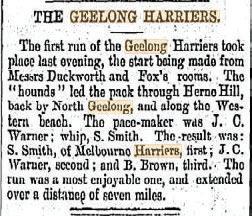
The seven mile run, that commenced and finished at Duckworth and Fox’s rooms, was the introduction to the Paperchase with J. C. Warner as Pacer and S Smith as Whip. Tuesday night runs and Saturday runs became the principal days for the Geelong Harriers during the season. Tuesday runs were conducted weekly, but Saturday runs were less frequent.
May was a huge month of activity for the Geelong Harriers. On May 3 their Tuesday evening run began in the autumnal moonlight along the road toward Queenscliffe. Past the Eastern Cemetery they cut back to the Drysdale Road and then headed home.13
12 Ibid.
13 Sportsman ‘Amateur’, 10 May 1892, page 2.
The Harriers’ second Saturday competition run on 14 May was well patronised and began at their rooms in Moorabool Street
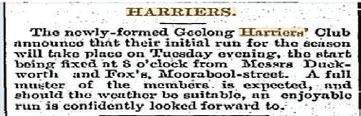
The Geelong Advertiser recorded:
“The course taken (which was a very picturesque one) was over the Barwon Bridge into Belmont thence to Highton and Montpellier, over Queen’s bridge home. In the race W.S. Smith of Melbourne Harriers was again first, followed by J. S. Young and J. Hodgson second and third respectively: the latter, who is a young runner, showed splendid style.” 14
Geelong Harriers extended an invitation to the Christ Church Union to join them on the forthcoming Queen’s Birthday special event. The Geelong Advertiser noted the invitation on May 12 and reported it under the headline CHRIST CHURCH UNION:
“A letter was received from the Geelong Harriers Club requesting the members to join in a run to take place on the 24 th inst., and it was resolved that the football members will take advantage of the invitation.” 15
Queen’s Birthday Event
On 24 May 1892, the Queen’s Birthday holiday, Melbourne clubs were invited to attend the special harriers event organised by Geelong Harriers. Representatives from Melbourne Harriers, Hawthorn Harriers, Melburnian Hare and Hounds and Ballarat Harriers attended. The route was advertised beforehand which meant the race could be viewed and followed by the general public from different locations.
14 Sportsman (Melbourne), Amateur Athletics, 24 May 1892, page 2 .
15 Geelong Advertiser, Christ Church Union, 12 May 1892, page 3.
The Geelong Advertiser reported,
“… a large number of drags, bicycles and tricycles followed along the roads and were able to keep the pack in sight most of the way.”16
Geelong Times newspaper, recorded the race and we can re-live it through their detailed account. On 27 May 1892, as part of the article did more than ‘re-live’ the race, it also published an explanation of this modern philosophy of ‘amateurism’, its application in competitive running with particular reference to school competition. The article helps us to understand the new concept to Geelong of amateurism in sport, its philosophy and its consequences for competitors who had not recognised its importance;
“It may be said that purely amateur athletic contests had, until about two months ago, been little known, or little thought of, in Geelong. Certainly, the Grammar School and Scotch College boys have practically shunned anything pertaining to professionalism in the conduct of their sports, but still the most proficient athletes connected with these schools have not hesitated to compete against professionals, and while honour has been their sole objective, they have thus innocently lost their amateur status. This could not be regarded in any sense as a degradation, for outside the school exclusive amateur competitions were unknown, and to this want may be ascribed the fact of many good and straight runners being found in the ranks of the professionals to-day. Following in the wake of the New Zealanders and new South Welshmen, the formation of amateur clubs and an Amateur Athletic Association in Melbourne will result in effecting such a change that amateurs and professionals will become distinctly classified. And genuine athletic sport considerably elevated in character.”17
Mention of the formation of the Geelong Harriers’ Club gave the general public of the background to the event.
“Nothing could be more conducive to the future success of the
16 The Argus, Athletics, 26 May 1892, page 10.
17 Geelong Times, ‘Amateur Athletics’, 27 May 1892, page 2.
Geelong harriers Club than the welcome visit of the representatives of the leading Metropolitan and Ballarat Harrier Clubs on the Queens’ Birthday. It was indeed a kind and thoughtful action, and while the Geelong harriers genuinely appreciated the assistance derived, the Melbourne and Ballarat men have made many personal friends. And done much to awaken the interest in amateur athletics in Geelong.”18
Founder of Amateur Athletics in Geelong was also mentioned.
“In the instance of Mr J. S. Young until lately captain of the Ballarat harriers, but now a resident of Geelong and some members of the Geelong Artillery, the establishment of an amateur organisation in Geelong was accomplished two months ago, when the Geelong Harriers Club was created.”19
Duckworth’s and Fox’s rooms became the central meeting location for the club and it conducted weekly Tuesday runs from that venue in 1892 and 1893. Some runs commenced as late as 8pm. One report suggested W. S. Smith, of Melbourne Harriers, and also of the Geelong Harriers, was a frequent competitor and dominant athlete. On winter Saturdays, members of the Harriers were able to compete in the V.A.A.A. distance running competitions. In summer, long distance racing was concluded and a track program was available in Melbourne. Ballarat Harriers competed frequently in Melbourne, but few Geelong Harrier members attended.
In a later newspaper article, one of the runners who ‘took to the water’ by attempting to swim across the Barwon River to catch the hare, was Ballarat Harrier athlete Mr. J. W. Thomas. It was reported that Mr Thompson saved Mr Thomas by pulling him out of the water, unconscious and after the ‘usual restoratives’ brought him round Mr Thomas was upset by the false description and claimed he was 10 yards from the river side and had a cramp in his left leg. He cried out for help, swam back and within two yards of the bank Mr Thompson pulled him out. After a jerk of the limb and a rub down, Mr Thomas continued the chase.20
18 Ibid.
19 Ibid.
20 Sportsman, 7 June 1892, page 2.
Cross Country Championships
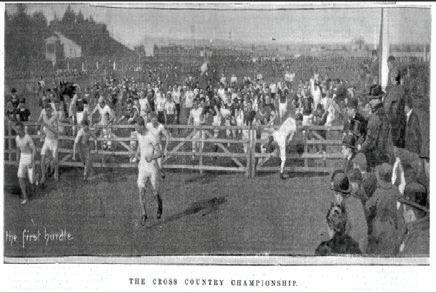
The main event on the athletic calendar for 1892 was the Victorian Amateur Cross Country over 10 miles. It was referred to as the ‘greatest athletic event of the season’ by the Sportsman newspaper. Conducted at the Oakleigh racecourse the event commenced in front of the Grandstand at 4pm on October 8 It was suggested people could follow the race on horseback.21 They finished at the grandstand, after a 3 mile detour through Caulfield. Geelong Harriers did not field a team in 1892, nor did they in 1893 or 1894.
In the following year the event’s venue was the same, but not the programme. There was criticism of the first event because spectators could see little of the race. If the programme was the same. then few spectators would attend.
In an endeavour to make the event more interesting and to encourage more spectator attendance, the V.A.A.A. added track events while the cross country runners were not in view. In 1894, the programme was further revised.
“The course is the same as last year, viz., a lap and a half of the racecourse, with six hurdles; then cross country to Oakleigh and back over the same trail, finishing with another lap and they have on the ‘course. During the absence of the runners a programme of short races, I sprint, a quarter mile, 220 yards schools’ race and stilt races will be run off, And the Bavarian Band will add to the pleasures of promenading.” 22
Approximately 5000 spectators attended. No list exists of the schools participating or of competitors in clubs such as the Harriers. It is highly probable that Geelong College and Geelong Grammar School did attend. It was recorded that Melbourne Grammar won the Schools’ 220 yards race.
Colonial Championships
On 9 and 11 November 1893, the Victoria Amateur Athletic Association conducted the first Australasian Athletic Championship meeting at the Melbourne Cricket ground. In all, 15 events were conducted Events started at 2.30pm and concluded
21 Sportsman (Melbourne), No Title, 4 October 1892, page 6.
22 The Australasian, Amateur Sports, 22 September 1894, page 19.
at 5pm. Competitors from the colonies of Victoria, New South Wales and New Zealand met to compete with an ‘intercolonial spirit’ for ‘championship honours’ . in front of a crowd of 2000 people. Australia and New Zealand were not individual countries, but British colonies.23 The programme was designed to be diverse and entertaining.
“Among the Victorian competitors are many well known and successful athletes: - A. H. Flack, who last Saturday lowered the Victorian record for two miles; T Blake, the cross country champion of Victoria; A. J. Thurgood, the champion goal kicker; C. Pearson, the old Essendon footballer; H. C. Davies the high jumper. There will be plenty of amusement for all classes of sportsmen, for included in the program are a bicycle race, a lacrosse obstacle race, which should prove very interesting, and a schools team race, for which all leading runners are entered.” 24
Competition standards were high and each colony selected teams that could win. Only the best athletes were selected from each colony. There was much pride gained by the winning colony. Overall, the colony of New South Wales won with Victoria placed second and New Zealand, third.
Mr J. C. Warner (Club Secretary) was the only athlete selected from the Geelong Harriers to represent Victoria in the 129 yard handicap. Competing in elite company Warner finished sixth in the fifth heat, which he ran 13 seconds. The winner’s time for the event was 12.25 seconds. 25
The Victorian Amateur Athletic Association also had schools affiliated competing at the Championships. Geelong Grammar School and Geelong College were members. In these championships there was a Schools’ Team Race, with each team ember running half a mile.
Competing in the Schools’ Half Mile Teams Race were: Wesley College, Geelong College, Brighton Grammar School, Geelong Grammar School and Kew high School.
23 The Age, Australasian Amateur Championship Sports’, 10 November1893, page 6 .
24 The Argus, Sporting Intelligence, 4 November 1893, page 11.
25 Ibid., page 6.
“The scoring was by points according to the team’s position in the race - first counts as one, second two, and so on – the lowest total to win.”26
Geelong College was the winner with 10 points and first to finish was M Wettenhall in 2 minutes and 8.2 seconds. Running in a dark blue and silver uniform the team members were R. Mc Farland, M. Wettenhall, E Sanders and J. McIntosh. 27
A False Start
By 1894, Geelong Harriers started to struggle and it was hoped that a special event in Geelong would renew interest in the club. One solution to boost interest in the Geelong Harriers was to conduct a ‘combined run in’. Local runners as well as those from Melbourne and Ballarat clubs attended a special run on Thursday, 24 May. It was promoted strongly by the V.A.A.A.
The Geelong Advertiser reported on 23 May1894 that: “The run has been
26 Sportsman, 14 November 1893, page 7.
27 The Argus, 13 November 1893, page 7.
specially arranged in order to encourage the local club and several prominent athletes will be present.”28 The three prominent athletes to compete were:
Edwin Flack (One Mile Champion of Australasia in 1894 – Flack went on to win gold in the 1500 metres and 800 metres and bronze in doubles tennis at the first Olympic Games in 1896)
Arthur Barrett who was the 3 mile Australasian Walk Champion. (Barrett later won the 1 and 3 Mile Walks in 1895 and 1896)
C. E. Herbert (He was the 3 mile champion of Australasia.)
The run was another paperchase that commenced at 11.30 am at the Eastern Baths. This was not the usual starting point because of the fire that destroyed Duckwork and Fox’s rooms. An eight mile run was planned, with Alf Barrett and B Parkinson acting as ‘pace’ and ‘whip’. Geelong Harriers, Belcher and Bailey ran parallel to the beach for one and a quarter miles to the Drysdale Road until they arrived at the Queenscliff Road. From that point they headed back to Geelong hares’, leaving the paper. Unfortunately, trail ran out of paper, but the event continued without much difficulty. At Maud and Swanston Streets the group lining up for a ‘run’. The finish was at the Eastern Baths where the event commenced.
“C.E. Herbert. The three mile champion, immediately placed twenty yards between himself and the pack, maintaining the lead till within 100 yards from home, where a great a great struggle ensued for first place between Herbert and Harold Barrett, who just squeezed home a winner by two yards.29”
There was great interest in the event by the general public who were gathered at the start, which was also the end of the race. Many followed the competitors on their horse or with horse and buggy. Despite the general public interest in the event, it didn’t spark sufficient interest in those who would join.
28 Geelong Advertiser, Amateur Athletics, 23 May 1894, page 3.
29 Geelong Advertiser, Amateur Athletics, 25 May 1894, page 3.
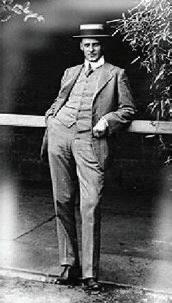
“It was a matter of regret that the Geelong Club did not turn out in better numbers, and much dissatisfaction was expressed by the visitors at their meagre attendance, as there is ample scope for a good club in Geelong if better handled.” 30
Attempts to keep the club going appeared to fail, because there is no record of Geelong Harriers after the 24 May meeting in 1894.
Why did the Geelong Harriers Fail?
A comment in Geelong Advertiser on 25 May 1904 suggested it might be a management issue for the club:
“.. there is ample scope for a good club in Geelong if better handled.” 31
Mismanagement would be a convenient reason to account for the Geelong Harriers’ demise in this first endeavour to enter the realm of athletics. Perhaps there were broader societal factors and social context that should be considered.
Competition with existing, well established local sports. Geelong’s population of 24,300 had the choice of many local sports, to lure the sportsman, that did not have the burden of amateurism, such as: tennis, cricket, football, rowing, bowling and golf (that was also founded in 1892).
Geelong Harriers were not linked to a well-established church based organisation and therefore lacked that organisational support, structure and patronage. Geelong Harriers was a secular organisation started by ‘outsiders from Ballarat’ who had no strong social support or local connections. Geelong’s Christ Church Union and Saint Paul’s Church Union had the social
30 Ibid., page 3.
31 Ibid.
structure, patronage and multiple social clubs and sports for the local population.
Local athletes could still compete in Melbourne’s V.A.A.A. competition under the banner of a Melbourne club.
The strict amateur code, enforced by the V.A.A.A., may have prevented aspiring and interested athletes joining, because they had previously received money for competing in sporting events.
Australia, and Victoria in particular in the 1890s experienced a Great Depression. There was a banking crash in 1893. A great social and economic upheaval was being experienced and there was no sign of recovery until 1895.
Men with superior athletic skills might have accepted prize money from sporting events in hard financial times, therefore ruling them ineligible to participate in amateur athletics.
Large unemployment numbers, property price collapses in Victoria, dominated the economy in the 1890s. Over 100 Limited Companies went into liquidation.
Athletics, as an international sport, was in its infancy. The first Olympic Games, under the auspices of the International Olympic Committee, were first held in Athens, Greece, in 1896. Australia’s first Olympic representative and medal winner, Edwin Flack, like many other competitors from British colonies like Victoria, competed under Britain’s Union Jack. Flack was born in London, but his long residence in Victoria meant he was considered an Australian. Australia’s Federation and a national flag was still years away.
Fire destroyed a large part of Duckworth and Fox’s weatherboard two storey building in April 1894 and all their stock was lost. So too was the home base and gathering point for Geelong Harriers. Duckworth and Fox’s business eventually rose from the flames. Geelong Harriers fate lay in the embers of that fire. Today, the building once owned by Duckwork and Fox is a two storey brick building.
Nothing was heard of the Geelong Harriers after 1894, and it appears it was disbanded without any fanfare. Geelong’s private schools, Geelong College and Geelong Grammar School, were affiliated with the V.A.A.A. in the 1890s and competed in School competitions, but not in the main adult competition. Neither school succeeded Geelong Harriers into the adult ranks, but on 9 June 1894 there was speculation of Geelong College forming a Club. It didn’t eventuate.
On 5 June 1900, a new Harriers club was formed. This time the club had a powerful religious organisation to back it – Christ Church in Moorabool Street, and the club was called Christ Church Harriers. Its patron was Canon Goodman.
After the ‘false start’ of the 1890s, Christ Church Harriers sprinted out of the starting blocks and new, local clubs also formed to support it.
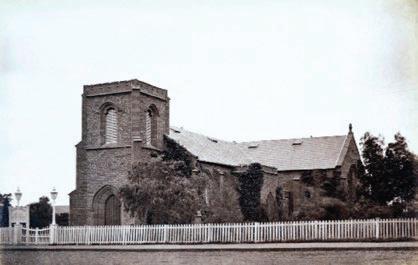
Christ Church, Moorabool Street, Geelong, E. de Balk, 1866.
Photographs
1. Edwin Flack in Athens 1896 public domain in Wikipedia Commons Flack - Edwin Flack - Wikipedia.
2. Geelong Progress Association, Plan of Geelong and Suburbs State Library Victoria, vc 001529-001.
3. Port Phillip Club Hotel 33 Flinders Street Melbourne, State Library Victoria.
4. V.A.A.A. First Cross Country Championship, October 1895 State library Victoria ID9917760523607636
5. Christ Church, Moorabool Street, Geelong, E. de Balk, 1866, Source: SL985553, Mitchell Library, State Library of NSW.
References
1. The Age, Amateur Championships, 10 November 1893, page 6.
2. The Argus, Athletics, 26 May 1892, page 10.
3. The Argus, Sporting Intelligence, 4 November 1893, page 11
4. The Australasian, Athletic Sports, 9 June 1895, page 19.
5. The Australasian, College Sports Weekly Jottings, by OLD BOY, 28 July 1894, page 12.
6. The Australasian Amateur Sports, 22 September 1894, page 19.
7. Geelong Advertiser, Sporting Intelligence – Harriers’ Club, 19 March 1892, page 2.
8. Geelong Advertiser, Amateur Harriers’ Club, 22 March 1892, page 3.
9. Geelong Advertiser, The Geelong Harriers’ Club, 5 April 1892, page 2.
10. Geelong Advertiser, Harriers, 25 April 1892, page 3.
11. Geelong Advertiser, The Geelong Harriers, 27 April 1892, page 3.
12. Geelong Advertiser, Athletics, 9 May 1892, page 2.
13. Geelong Advertiser, Amateur, 10 May 1892, page 3.
14. Geelong Advertiser, Christ Church Union, 12 May 1892, page 2.
15. Geelong Advertiser, Town Talk, 19 May 1892, page 3.
16. Geelong Advertiser, Sporting Intelligence, A Run with the Harriers, 26 May 1892, page 2.
17. Geelong Advertiser, Meeting Geelong Harriers, 23 January 1893
18. Geelong Advertiser, Athletics, 9 May 1894, page 2.
19. Geelong Advertiser, Amateur Athletics, 18 May 1894.
20. Geelong Advertiser, Amateur Athletics, 23 May 1894, page 3.
21. Geelong Advertiser, Amateur Athletics, 25 May 1894, page 3.
22. Geelong Advertiser, Sporting Intelligence, 7 June 1900, page 3.
23. Geelong Times, 27 May 1892, page 2.
24. Sportsman (Melbourne), Amateur Athletics, 10 May 1892, page 2.
25. Sportsman Amateur Athletics, 15 May 1894, page 2.
26. Sportsman (Melbourne), Amateur Athletics, 24 May 1892, page 2.
27. Sportsman (Melbourne), With the Harriers, 2 June 1891, page 3.
28. Sportsman (Melbourne), Amateur Athletics, 31 May 1892, page 7.
29. Sportsman (Melbourne), Amateur Athletics, 7 June 1892, page 2.
30. Sportsman (Melbourne), Amateur Athletics, 31 October 1892, page 6.
31. Sportsman (Melbourne), No Title, 4 October 1892, page 6.
Executive
Geelong Historical Society Committee Members 2025 to 2026
President: Harry Roberts
Vice President: Mark Thomas
Secretary: Michael O’Donnell
Treasurer: Tony Cust
General Committee:
Freda Craddock
Lana Capon
Pauline Fairfoot
Coral Turner
Peter Fogarty
100-year flashback – 1926. At the Geelong Drome, Kardinia Park
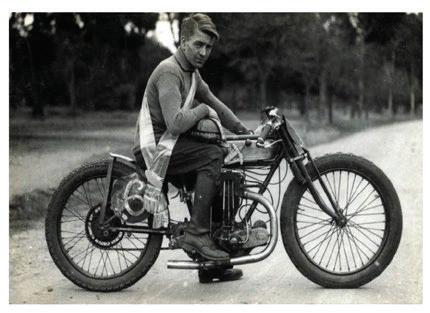
Billy Pilgrim on his motorcycle, Geelong Drome, Kardinia Park, 1926.
Source: GRS 2009/00408, Geelong Heritage Centre collection.
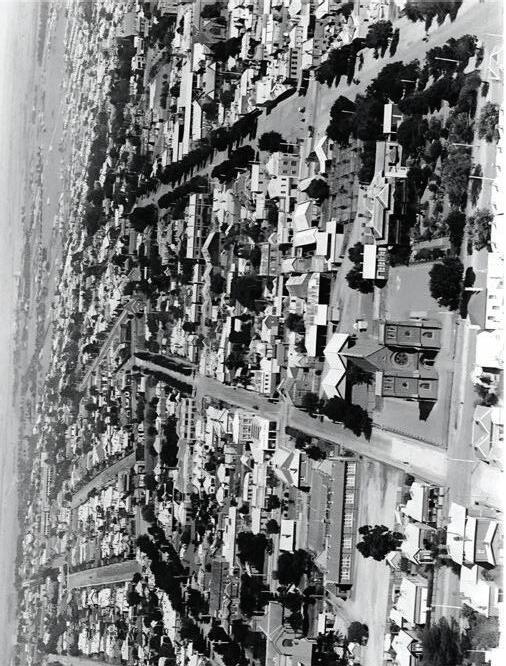
Geelong1926, Yarra Street looking west, St Mary of the Angels Basilica in foreground. PhotographerCharles Pratt
Investigator: More than a Magazine
You can click on the QR links below to hear the stories and view photographs and videos.

Where you see this icon in a story, you can listen to the story.
Story / Code Story / Code Story / Code Story / Code
Main Menu page (Preferred option)


Pioneers, Pastoralists, and the Price of Legacy: The Robertsons of Colac Part 3
William Purdue’s Geelong Diary (Part 8)
An informative and interesting meeting": The Geelong Lad ies Reading Circle 18912025


Cavalry Under Canvas


Geelong Athletics – A False Start
Chronology 1888: the Geelong Register

Flip Book link for you to access the magazine in an electronic format. Click on this QR Code to access the link.

Print Design Australia