Nature-Based Innovations for Disaster Resilience in Tampelas

Page 1


Nature-Based Innovations for Disaster Resilience in Tampelas

A Shift from Extractive Economy towards Regenerative Economy

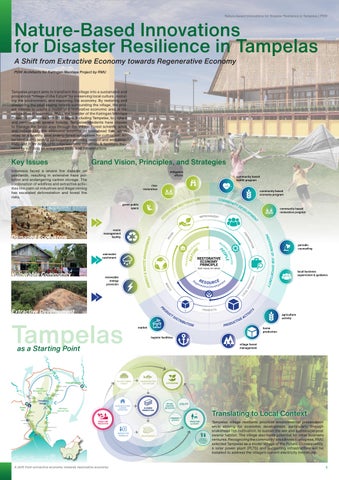
Tampelas project aims to transform the village into a sustainable and prosperous “Village of the Future” by preserving local culture, restoring the environment, and improving the economy. By restoring and preserving the peat swamp forests surrounding the village, the project intends to create a model of a restorative economic area at the village level in Indonesia. RMU, the founder of the Katingan Mentaya Project, collaborates with 35 villages, including Tampelas, to protect and restore peat swamp forests. Tampelas residents have chosen to manage the forest area through the Village Forest scheme, while also recognizing the economic potential of snakehead fish, which relies on a healthy peat swamp forest ecosystem for cultivation. After conducting several participatory planning session and workshop; RMU and PDW decided to empower local industries & facilitate their need by creating an integrated 2000 sqm infrastructure.

Indonesia faced a severe fire disaster on peatlands, resulting in extensive haze pollution and endangering carbon storage. The combination of wildfires and extractive activities like palm oil industries and illegal mining has escalated deforestation and forest fire risks.

Tampelas village residents prioritize environmental preservation while striving for economic development, particularly through snakehead fish cultivation, to sustain the wet and sustainable peat swamp habitat. The village also holds potential for other business ventures. Recognizing the community’s readiness to progress, RMU selected Tampelas as a model Village of the Future. Consequently, a solar power plant (PLTS) and supporting infrastructure will be installed to address the village’s current electricity limitations.

PDW Architects for Katingan Mentaya Project by RMU

Participatory Approach

Tampelas Participatory Planning and

Design Activity

Community engagement and participatory planning played a significant role in the development of the Tampelas Village rehabilitation project. Site visits were initially conducted to begin dialogue with the locals and to gain insights into the village’s current state and their insufficient basic infrastructure. Afterwards, execution of workshops and discussions allowed capacity building upon the local community into understanding the current pressing issue of climate change, and ways to mitigate them. The session also dig in the community’s needs and concern, ensuring that the project aligned with their priorities. These involvement have also empowered the community to be actively involved in decision-making process and take ownership of the project. Stakeholders and community members were connected through multiple focus group discussion. These iteration research and design process created a sense of ownership, responsibility, and active participation among community members, ensuring the project’s success and benefit to the community in the long run.

Participatory Planning Principles

Seek People at the Margin

for Enrichment

Private Sectors in Tampelas

Community Engagement

Prior to any collaboration with the local, it is important to gain their trust with regards to our intention at the start. Through dialogue, interview, and site visits, the project team actively engaged with the community to take note of their concerns and aspirations. This would tailor the development of the village to the community’s specific needs and priorities. Workshops and education with regards to regenerative development were also brought in the early discussion to align the perspective with the locals about the current climate issues. The community’s enthusiasm and awareness of the need for sustainable development played a crucial role in the project’s success.

Idea Manifestation

The translation of ideas into visions by each respective stakeholders is a vital and dynamic process that drives community development. It begins with inclusive dialogue and active listening to the concerns and aspiration of the people. These insights form the foundation for a shared understanding of community needs and priorities. Stakeholders collaborate to analyze and refine ideas, incorporating diverse perspectives into coherent visions.

Effective coordination and multiple-ways communication are constantly monitored to ensure fair collaboration and to optimize resources. Ideas are being drawn to image visualisation and thoughts are being written to realise the vision. It enables stakeholders to work towards common goals, driving development and fulfilling collective aspirations.

The Tampelas project aims to dig in the local wisdom and skills through participatory planning, and therefore tailor the development of the village to the community’s

These

Tampelas Project

Schematic MEP and Connectivity

Open Public Space for Local Activities & Events
Tampelas
Tampelas Homestay for Visiting

Tampelas Implementation Phase

(1) The proposed site is distantly located from the city center with 4-5 hours car drive and connecting small boats. Thus mobility is a challenge. The other obstacle is the scarce material for construction on site which needs to be delivered from nearby villages. (2) Currently, most people in Tampelas and nearby villages still strive to get instant money (some of them become illegal loggers or miners). This became our mission to share with them the knowledge, benefits and profits of regenerative business. (3) As the climate changes, the villages along the river are prone to flood and forest fire. This condition might affect our program implementation and the construction phase as during flood usually the site would be unreachable. Construction strategies must be designed to adjust with the site condition.

The challenging site requires relatively high cost and time for the private sector involvement during participatory planning agenda, hence collaboration with local people in Kalimantan are needed.

a

role on approaching the local community and introduce

to

economy instead of extractive approach. Prior to the implementation of the albumin industry, RMU invites PDW as a strategic planner to design the facilities together with the local community. Workshop and participatory planning have had been conducted back and forth to ensure the local needs and preferences regarding the design are meet.

Experts of local material, building construction, albumin industry, and renewable energy sector would continuously be present during the construction--hence, this would be the chance to share construction knowledge to the local community so they could conduct village rehabilitation on their own in the future. Aside from involvement during construction, the locals would start to learn how to manage the albumin industry themselves to run it under the village-owned enterprise.

The ‘pre-construction’ and ‘during construction’ stages are essential to ensure the post-construction agenda could run smoothly. The project would eventually be hand-overed to the community: the homestay would be utilized for local tourism, albumin industry would be operated by the villagers, and the evacuation hall would be use in times of seasonal flood. All of these activities shall profit and benefit the communities. Therefore, the ability to maintain these facilities would be crucial.

Turn static files into dynamic content formats.

Create a flipbook
Issuu converts static files into: digital portfolios, online yearbooks, online catalogs, digital photo albums and more. Sign up and create your flipbook.