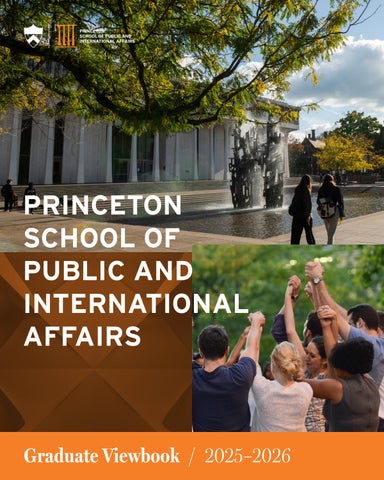
PRINCETON SCHOOL OF PUBLIC AND INTERNATIONAL AFFAIRS
Graduate Viewbook / 2025–2026
2
DEAN’S WELCOME
3
PROGRAM OVERVIEW
4
FINANCIAL AID
5
OVERVIEW OF GRADUATE DEGREE PROGRAMS
6
CERTIFICATES
7
CENTERS, PROGRAMS, AND SCHOOL INITIATIVES
9
FACULTY
10
FIELDS OF STUDY FOR MASTER’S CANDIDATES FIELD I / FIELD II / FIELD III / FIELD IV
14
DISTINGUISHED VISITORS & EVENTS
16
POLICY PRACTITIONERS
18
MPA ADMITTED STUDENT PROFILE
20
MPP ADMITTED STUDENT PROFILE
21
PH.D. ADMITTED STUDENT PROFILE
22
ALUMNI NETWORK
26
HOW TO APPLY
MPA1s group photo, Summer 2024.
Graduate students celebrate with Dean Amaney Jamal during 2025 hooding.
1
In the Nation’s Service and the Service of Humanity Princeton’s unofficial motto captures the essence of our School – and what a time to be at Princeton SPIA! In the face of historic elections, a global climate crisis, rising inequality, and other pressing policy challenges, what we offer here has perhaps never been more important. I am honored to serve as dean at such a critical moment, and I am proud of our students and alumni – who are addressing issues in public and international affairs here in the United States and all around the world. Our graduate programs are distinguished by the tight knit community of dedicated public servants, extraordinary faculty, and generous funding that includes 100% of tuition and required fees. Training the next generation of policy experts is the foundational goal of our School. I hope you will choose to apply.
Amaney Jamal Dean, Princeton School of Public and International Affairs Edwards S. Sanford Professor of Politics, and Professor of Politics and International Affairs
2
PROGRAM OVERVIEW MPA
MPP
2-year early-career degree
1-year mid-career degree
Master in Public Affairs 16 Courses
Ph.D.
5-year degree
Master in Public Policy 8 Courses
Doctor of Philosophy in Public Affairs 2 Clusters of Study Security Studies
Field I
Field II
Field III
Field IV
International Relations
International Development
Domestic Policy
Economics and Public Policy
OPTIONAL CERTIFICATE PROGRAMS Health and Health Policy (HHP)
Science, Technology, and Environmental Policy (STEP)
Urban Policy (UP)
This cluster prepares students for rigorous research on major threats to international and national security and the relevant forces that defend against those threats.
Science, Technology, and Environmental Policy (STEP) This cluster focuses on applications of natural and social science methodology in policy and the interactions between the natural and social sciences in policy analysis.
ADMISSIONS TIMELINE APPLICATION AVAILABLE:
APPLICATION DEADLINE*:
ADMISSIONS DECISIONS:
Mid-September
December 1
Mid-March
ADMITTED STUDENTS DECISION DEADLINE:
April 15
3
FINANCIAL AID If you are accepted into one of our programs, then you will receive full financial support for tuition and required fees plus a generous living stipend for the duration of your program. There is no extra essay or separate application process. Tuition and stipend will be covered by SPIA in combination with any outside fellowships or institutional sponsorships. Our generous financial support means graduates can pursue careers of public service without the worry of graduate school debt.
Princeton SPIA covers 100% of tuition and required fees for all students.
$65,910 ($62,400 tuition + $3,510 student health plan)
4
OVERVIEW OF GRADUATE DEGREE PROGRAMS MPA
16 COURSES
MASTER IN PUBLIC AFFAIRS 2-year early-career degree
Race, Power, and Inequality*
Politics of Public Policy
Microeconomics
Psychology for Policy Analysis
Macroeconomics
Applied Econometrics
Quantitative Analysis
Policymaking in Diverse Societies
*Half-term course
Core Courses
Successful completion of the MPA Summer Program. Students must also successfully complete a 10-week summer internship, and two end-of-year qualifying exams.
MPP
8 COURSES
MASTER IN PUBLIC POLICY 1-year mid-career degree
Values Based Leadership
Core Courses
Students must successfully complete the MPP Summer Program and participate in the MPP Forums.
MORE THAN 75 ELECTIVES WITHIN PRINCETON SPIA TO CHOOSE FROM, PLUS THE OPPORTUNITY TO TAKE COURSES IN PRINCETON’S OTHER 42 GRADUATE DEPARTMENTS AND PROGRAMS.
PH.D. DOCTOR OF PHILOSOPHY IN PUBLIC AFFAIRS 5-year degree
SECURITY STUDIES: 8 COURSES Areas of concentration include: grand strategies, great powers and stability, civil-military relations, humanitarian intervention, insurgency, arms control and proliferation, the threat and use of force, cyber warfare, biological and chemical weapons, terrorism and civil conflict.
SCIENCE, TECHNOLOGY, AND ENVIRONMENTAL POLICY (STEP): 6 COURSES Areas of concentration include: global climate change, air pollution, conservation biology, tropical disease transmission, information technology, nuclear power, renewable energy.
5
CERTIFICATES Students can choose to earn an optional certificate, allowing them to further specialize and deepen their expertise in a specific policy area.
HEALTH AND HEALTH POLICY (HHP) The HHP certificate trains graduate students for careers in health policy in the public and nonprofit sectors, giving them an understanding of the determinants of health and well being and the role that public policy plays in shaping the quality of people’s lives. The program provides broad training in core topics in health policy as well as more specialized courses. It is designed for students with domestic or international health interests.
SCIENCE, TECHNOLOGY, AND ENVIRONMENTAL POLICY (STEP) The goal of the STEP certificate is to develop a deeper understanding of current scientific, technological, and environmental issues and potential local, national, and international policy responses. Students receive interdisciplinary training that facilitates communication between technical experts and policymakers. Students may choose to focus their coursework on Energy and Environmental Policy or Information Technology Policy.
URBAN POLICY (UP) The policy focus of the UP certificate is global, and the coursework is grounded in the interdisciplinary and comparative study of cities and urban problems in both industrialized and developing countries. The UP certificate emphasizes the social, economic, and political dimensions of urban problems and is designed to prepare students for careers in urban policy analysis and economic development in national, state, and local governments, nonprofit organizations, think tanks, and international organizations.
6
CENTERS, PROGRAMS, AND SCHOOL INITIATIVES The School is home to over 20 centers and programs, which conduct research, host events, and bring distinguished scholars and practitioners to campus. Students can get involved to varying degrees, including in programming as varied as foreign policy crisis simulations, roundtables with key leaders in global peace keeping, collaboration with industry professionals to prevent financial crises, work with healthcare leaders to formulate sound access policy.
Afghanistan Policy Lab (APL)
Education Research Section (ERS)
Office of Population Research (OPR)
Bendheim-Thoman Center for Research on Child and Family Wellbeing (CRCFW)
Empirical Studies of Conflict (ESOC)
Princeton Survey Research Center (SRC) Program on Science and Global Security (SGS)
Center for Health and Wellbeing (CHW)
Innovations for Successful Societies (ISS)
Center for Information Technology Policy (CITP)
Julis-Rabinowitz Center for Public Policy & Finance (JRCPPF)
Center for International Security Studies (CISS)
Kahneman-Treisman Center for Behavioral Science & Public Policy
Research Program in Political Economy (RPPE)
Law@Princeton
Princeton SPIA in DC Center
Liechtenstein Institute on Self-Determination (LISD)
Princeton SPIA in New Jersey
Center for Policy and Research on Energy and the Environment (CPREE) Center for the Study of Democratic Politics (CSDP)
Research Program on Development Economics (RPDE)
Niehaus Center for Globalization and Governance (NCGG)
7
8
Andrew Moravcsik, Professor of Politics and International Affairs; Director, Liechtenstein Institute on Self-Determination, during a class lecture.
FACULTY The School’s faculty are leaders in their academic fields. They conduct innovative research; deliver expert, nonpartisan analysis to policymakers, nonprofit organizations, and research centers; and provide students with the analytical tools and in-depth knowledge needed to tackle the most important policy issues of today and tomorrow.
Frances Lee, Professor of Politics and Public Affairs; Co-Director, Center for the Study of Democratic Politics, during a class discussion.
EXPERT FACULTY ACROSS DISCIPLINES Many have direct policy experience and almost all have dual appointments with disciplinary departments at Princeton University, providing students with multi-faceted perspectives on policy issues.
94
full-time faculty
64
visiting professors, lecturers, and practitioners who teach in the graduate program
FACULTY DISCIPLINES Astrophysical sciences
Ecology and evolutionary biology
Civil and environmental engineering
Economics
Computer science Demography
Geosciences History Law
Mechanical and aerospace engineering Politics Psychology Sociology 9
FIELDS OF STUDY FOR MASTER’S CANDIDATES FIELD I: INTERNATIONAL RELATIONS
JACOB SHAPIRO Professor of Politics and International Affairs
Field I emphasizes the nature of the international system and ways in which states conduct their foreign policies, particularly in a global environment where non-state actors have increasing influence. Students tend to have previous professional experience in the field, coming from government, nonprofits, political organizations, policy think tanks, the armed services, Peace Corps, United Nations, or the World Bank. Since mastery of a foreign language is often needed for future careers, the School provides funding for MPA students who study a language concurrent with their summer internship. EXAMPLES OF FOCUS INCLUDE Rule of law Diplomacy Elections in fragile states International trade Human rights
“My research covers a broad range of topics in international relations and security, including civil war, insurgency, terrorism, and commercial competition for influence. In many ways social scientific thinking is more valuable for policy than the findings of social science itself; the best part of teaching at SPIA is helping future leaders learn to think precisely about the lessons the world is trying to teach them.”
“My research on public diplomacy and Chinese foreign policy is motivated by my earlier studies and work in government. It’s important to me to teach material that will prepare our students to be informed, engaged, and thoughtful contributors to policy solutions because I have seen firsthand how great a difference such individuals can make.”
National security Defense policy Climate change and global environmental governance International negotiation 10
Weapons of mass destruction
NAIMA GREEN-RILEY Assistant Professor of Politics and International Affairs
FIELD II: INTERNATIONAL DEVELOPMENT Field II is concerned with lowincome countries and transition economies as they pursue development strategies under a wide range of political regimes and economic conditions. Field II both overlaps and complements Field I. Students typically have worked for government and nonprofit organizations as researchers, analysts, economists, community organizers, human rights observers, election monitors, and Peace Corps volunteers. As with Field I, students may study a language while engaging in their MPA summer internship. On occasion, the internship can be extended to a full year of practical experience and language acquisition.
EXAMPLES OF FOCUS INCLUDE
“The cases we use bring the globe into the classroom. Peer learning is a hidden bonus; when we talk about a case study, there is usually a student who can say, ‘I was there and this is what happened.’ ”
JENNIFER WIDNER Professor of Politics and International Affairs; Director, Innovations for Successful Societies
PASCALINE DUPAS Professor of Economics and Public Affairs
Humanitarian relief Immigration policy Innovations for successful societies Economic development Democratization Conflict resolution Global health Poverty, inequality, and health
“Through my research, I strive to expand the evidence base available to LMIC governments as they put in place policies to improve the lives of their citizens. Teaching MPP and MPA students is a wonderful opportunity for me to both empower, and learn from, ongoing and future users of evidence.”
Social entrepreneurship and innovation 11
FIELD III: DOMESTIC POLICY Field III emphasizes U.S. domestic policy, with the American political system as the backdrop.
“I research, write, and teach about drugs and health policy in the U.S., focusing on issues of identity, race, ethnicity, and gender. I enjoy introducing students to the historical roots, complex forces, and methods for analyzing public policy.”
Typically students have worked in government, for nonprofit or community-based organizations, on political campaigns, in health policy, and in education as community organizers, program managers, teachers, labor activists, and research fellows.
KEITH A. WAILOO Henry Putnam University Professor of History and Public Affairs
EXAMPLES OF FOCUS INCLUDE Affordable housing
FRANCES LEE Professor of Politics and Public Affairs; Co-director, Center for the Study of Democratic Politics
Education Health policy Identity, power, and policy Immigration Energy and the environment Inequality and poverty Democracy or civic engagement Nonprofit management Philanthropy Federal, state, and local finance Social entrepreneurship Urban economic development 12
“My research focuses on national policymaking, especially on the capacity of political parties to achieve their policy agendas. I love teaching SPIA graduate students because of the diversity of their perspectives and their passion for the issues. My domestic politics course covers a broad range of topics, and yet there are always students in the room who can draw on personal experiences to enrich the discussion.”
FIELD IV: ECONOMICS AND PUBLIC POLICY Field IV stresses both the analysis of economic problems that prompt public policy decisions and the study of the economic effects of various policies. Students are expected to master the fundamental principles and tools of economic analysis and to develop the ability to assess and apply the results of professional economic studies.
EDUARDO MORALES Professor of Economics and Public Affairs
“In economics, public policy prescriptions arise as an interplay of data and assumptions. In my work, I aim to increase the credibility of policy prescriptions by relaxing the assumptions on which they rely. I love the atmosphere at SPIA: students are at the same time highly motivated, very insightful, and an absolute pleasure to interact with, both in the classroom and outside the classroom.”
Field IV overlaps the other three fields but goes beyond the traditional study of policy issues by providing more intensive training in the economic analysis of public policy. Some students choose between a domestic or international focus. Students have usually worked as analysts, program associates, economists, and researchers for global research centers and programs, government agencies and central banks, multilateral organizations, and development finance institutions. EXAMPLES OF FOCUS INCLUDE International trade policy Behavioral economics and applications Public economics and public finance Economic development Program and policy evaluation Macro and financial policy
“My research applies concepts and methods from economics to study a range of challenges in lowincome countries, including gender inequality and climate change. In this work, I design and evaluate policies aimed at addressing those challenges. Thus, SPIA students’ passion for policymaking as a way to create a better world is exciting to me and aligns with my own values and intellectual interests.” SEEMA JAYACHANDRAN Professor of Economics and International Affairs; Co-director, Research Program on Development Economics 13
DISTINGUISHED VISITORS & EVENTS We bring high-level policy leaders and practitioners to the School. Our size means that students have access to these visitors and can engage with them over a meal, in office hours, or in class.
SOME OF OUR RECENT SPEAKERS INCLUDE: H.E. Rafael Grossi, Director General, International Atomic Energy Agency (IAEA) H.E. Mohamed Muizzu, President of the Republic of Maldives H.E. Santiago Peña, President of Paraguay General (Ret.) Mark A. Milley ’80, Charles and Marie Robertson Visiting Professor and Visiting Lecturer Francesca Albanese, United Nations Special Rapporteur on the Occupied Palestinian Territories Robert Doar ’83, President, American Enterprise Institute Hon. Deborah Lipstadt, Former U.S. Special Envoy to Monitor and Combat Antisemitism Michael Froman ’85, President, Council on Foreign Relations Molly Jong-Fast, MSNBC political analyst U.S. Rep. Brendan Boyle Fmr. U.S. Rep. John Sarbanes ’84 U.S. Rep. Terri Sewell ’86 Volker Türk, UN High Commissioner for Human Rights Dr. Kyung-wha Kang, President and CEO, Asia Society Hon. Margaret “Meg” Whitman ’77, Fmr. U.S. Ambassador to Kenya
14
Robert Doar ’83 is interviewed by Lauren Wright, Associate Research Scholar, Princeton School of Public and International Affairs, for a Dean’s Leadership Series event, March 2025.
Dr. Kyung-wha Kang is interviewed by Rory Truex, Associate Professor of Politics and International Affairs, for a Dean’s Leadership Series event, April 2025.
15
POLICY PRACTITIONERS Practitioners are an important part of our training and bring real-world policy experience to the classroom as leaders in domestic policy and international affairs. They complement the work of our faculty and enrich the learning experience.
“Princeton is a very special place for me since I first entered the campus in 1976. It is a place of incredible talent with both faculty and students. SPIA in particular is a community of some of the best minds in the country working on complex and critical issues impacting the U.S. and the world. I particularly enjoy the opportunity to make a contribution and to help shape the next generation of global leaders that will make the world a better place.” GENERAL (RET.) MARK A. MILLEY ’80 Charles and Marie Robertson Visiting Professor and Visiting Lecturer
“My courses explore the significance of the Black-White ‘color line’ in the United States, from racially divided cities to politics shaped by prejudice. I love that SPIA allows me to bridge my academic and applied experience: I get to teach and learn from students who are as committed to deeply understanding problems as they are to solving them.” NINA YANCY Lecturer with the Princeton School of Public and International Affairs
“Watching, mentoring, and teaching a group of aspiring policymakers transform into global leaders and architects of bold policy—and the gritty language of its implementation—is one of the most powerful and inspiring experiences there is.” EDUARDO BHATIA John L Weinberg/Goldman Sachs & Co. Visiting Professor and Visiting Lecturer in Public and International Affairs
16
“In an era of rapid technological change and global uncertainty, tomorrow’s leaders must be equipped to navigate the intersection of science, national security, and public policy. At SPIA, we prepare students not just to understand the world—but to lead it, with clarity, purpose, and impact.” ALI NOURI Lecturer with the Princeton School of Public and International Affairs
“SPIA students bring a thirst for learning about how the world actually works, not just in text books but in the corridors of power, and what they can do to influence it. They display an impressive curiosity and drive that force me to reflect on how the lessons from my decades leading Human Rights Watch can help them become their generation’s public-policy leaders.” KENNETH ROTH Charles and Marie Robertson Visiting Professor and Visiting Lecturer
“In a world where sustainable and climate finance is rapidly evolving, I am committed to helping students make sense of this multifaceted landscape and its global shifts. My course combines theory with real-world insights from senior industry leaders, along with a hands-on assignment that connects students directly with the people shaping climate finance today. I love watching students deepen their understanding and build confidence as they prepare to tackle the real challenges they will face in their careers, navigating a world shaped by diverse perspectives and shifting policy environments.” EKATERINA (KATYA) GRATCHEVA Visiting Research Collaborator, Andlinger Center for Energy and the Environment 17
MPA ADMITTED STUDENT PROFILE* Master in Public Affairs We enroll approximately 70 new MPA students each year.
The MPA enrolls individuals who have demonstrated a deep commitment to public service through their professional experience, internships, and volunteer interests.
18
JOINT DEGREE LAW
JOINT DEGREE MBA
SINSI
A four-year MPA/Juris Doctor program allows students to combine the study of law and the study of public affairs. Prospective students must indicate their desire to pursue a joint degree at the time of application by completing an additional joint degree statement and must simultaneously apply to and be admitted at both programs. The law program must be approved by Princeton SPIA.
A three-year MPA/MBA program allows students to combine the study of management and the study of public and international affairs through a formal arrangement with the Stanford Graduate School of Business (GSB). Prospective students must submit an additional joint degree statement at the time of application and must simultaneously apply to and be admitted to both programs. GSB is the only MBA program SPIA will consider for a joint MPA/MBA.
Scholars in the Nation’s Service Initiative (SINSI) is a scholarship program designed to encourage, support, and prepare Princeton University seniors and admitted first-year MPA students to pursue careers in the U.S. government. The program fully funds an average of four students per year — covering two years of study as an MPA student and a two-year fellowship with the U.S. government. To apply for SINSI, you must be a U.S. citizen.
52% Female
70% U.S.
48% Male
30% International
PRIOR WORK EXPERIENCE 17%
38%
45%
<2 Years
3-4 Years
5+ Years
PRIOR WORK SECTOR 10%
40%
50%
Private
Nonprofit
Public
GRADE POINT AVERAGE 6%
15%
79%
<3.4
3.4-3.6
3.7-4.0
GRE AVERAGE 51% 35%
30% 19%
90-99
80-89
70-79
22%
18%
16%
9% <70
90-99
QUANTITATIVE
80-89
70-79
<70
VERBAL
*Range of admitted students between 2023–2025; numbers rounded to the nearest percent
19
MPP ADMITTED STUDENT PROFILE* Master in Public Policy We enroll 20 to 25 new MPP students each year.
The one-year MPP program is designed for mid-career professionals who are rising leaders in public policy. This residential program is a valuable opportunity for those embedded in public service to reflect on their experiences, expand their knowledge, and further refine their analytical skills in relation to their chosen professional path. Applicants must have seven years of professional policy experience though most have over ten years of full-time professional work experience.
46% Female
50% U.S.
54% Male
50% International
PRIOR WORK EXPERIENCE 12%
50%
38%
7-9 Years
10-14 Years
15+ Years
PRIOR WORK SECTOR 3%
24%
73%
Private
Nonprofit
Public
GRADE POINT AVERAGE 34%
26%
40%
<3.4
3.4-3.6
3.7-4.0
*Range of admitted students between 2023–2025; numbers rounded to the nearest percent
20
PH.D. ADMITTED STUDENT PROFILE* Ph.D. in Public Affairs We enroll approximately eight new Ph.D. students each year.
The Doctor of Philosophy in Public Affairs is a five-year program in which students concentrate in one of two research areas: Security Studies; or Science, Technology, and Environmental Policy (STEP). Students analyze serious policy challenges from a multidisciplinary perspective and emerge with high-quality research skills. Ph.D. recipients depart the School prepared for top analytical positions in government and nongovernmental organizations, as well as tenure-track positions in academic institutions.
46% Female
62% U.S.
54% Male
38% International
24%
22%
54%
<2 Years
3–4 Years
5+ Years
PRIOR WORK EXPERIENCE
PRIOR WORK SECTOR 5%
62%
33%
Private
Nonprofit
Public
GRADE POINT AVERAGE 19%
16%
65%
<3.4
3.4-3.6
3.7-4.0
*Range of admitted students between 2023–2025; numbers rounded to the nearest percent
21
ALUMNI NETWORK The 4,200-plus alumni of the School stay connected and engaged after leaving Princeton and are willing to talk with students about their experiences. The School hosts networking events in cities around the world for alumni and current students.
Jack Wenye Diao, MPA ’22 FINANCIAL MANAGEMENT EXPERT AT THE ASIAN DEVELOPMENT BANK
“When I stepped onto Princeton’s picturesque campus, I joined a streak of scholars committed to truth, service, and critical thinking for whom no challenge was impossible. Princeton gave me the rigorous analytical tools to navigate complex systems and solve problems under real-world constraints, the pathway to build my career in economics & international development, and the bold optimism to deploy my skills In Service of Humanity. The peerless experience at SPIA—its generous faculty, endless opportunities, loyal alumni, and unique friendships—is something I will treasure for life. Wherever I go, I now carry Nassau with me. Go Tigers!”
Christina Henderson, MPA ’12 AT-LARGE COUNCILMEMBER, COUNCIL OF THE DISTRICT OF COLUMBIA
“I participated in the PPIA Fellowship JSI program at Princeton the summer of 2007. It was clear to me then that Princeton was going to be a place that challenged me, but also invested in my long-term success. 18 years later, that is still true. One of the things I most enjoyed about my time at Princeton was the opportunity to engage in coursework across disciplines like history, psychology, and sociology. Having that additional context and tools of application have certainly made me a better policymaker. We’re not trained just on theory; we’re given a foundation to have meaningful impact. Beyond the classroom, the Princeton network is unmatched.”
22
Commander Arturo Trejo, U.S. Navy, MPP ’20 COMMANDING OFFICER, USS BULKELEY (DDG 84)* *USS BULKELEY IS AN ARLEIGH BURKE CLASS DESTROYER BASED OUT OF FORWARD DEPLOYED NAVAL FORCES EUROPE
“Princeton SPIA was one of the most rewarding experiences of my life. After being awarded a coveted Politico Military Masters nomination through the United States Navy, I made Princeton SPIA my school of choice because of its faculty and, more importantly, student body. Through my time at Princeton, I was able to gain some of my dearest friends and mentors. Additionally, it taught me how to strategically think about consequences. As a result, I was well postured to help change the culture of my warship for the better and gain much needed insight to the geopolitical environment in Europe and Africa.”
Jennifer Daum, MPA ’12 MERCY CORPS COUNTRY DIRECTOR, BOGOTA, COLOMBIA
“SPIA taught me how to think and to be curious about the world. This knowledge has allowed me to be a flexible, empathetic, and problem-solving leader in my career in international development. I absolutely loved my two years at SPIA!”
Nivedita Krishna, MPP ’22 FOUNDER AND DIRECTOR, PACTA
“Doing the MPP at Princeton SPIA was a major inflection point in my career, as a social sector ecosystem enabler in India. The MPP helped me to secure an excellent perspective of the philanthropic eco-system globally, and chart a unique and unconventional career thereafter. As a non-quantitative thinking lawyer, it gave me a refreshing approach to blend rights based work with data driven approaches to public policy. I often apply academic learnings from courses I took at SPIA, in my work everyday in India to ensure rigorous research methods, and contemporary narrative building. What I most treasure about the MPP, is the rich learnings and contemplative space it provided, to make a solid foundation that I now draw from.” 23
Aaron Charlop-Powers, MPP ’20 SENIOR ADVISOR, NEW YORK CITY OFFICE OF THE MAYOR
“My goal in pursuing a mid-career degree in public policy was to acquire relevant skills, build a network, and gain applicable knowledge for my career in public service. At SPIA, I was able to do all of these things and more and I am more effective in my work in local government because of my education and experience.”
Tanisha Hewanpola, MPP ’24 POLITICAL AFFAIRS OFFICER, DEPARTMENT OF POLITICAL AND PEACEBUILDING AFFAIRS UNITED NATIONS
“Uprooting my career and family to join Princeton SPIA was a leap of faith, but one that proved transformative. Exploring new and emerging fields, engaging leading experts, and forming diverse, life-long relationships expanded my worldview in ways that will inform my life, work, and public service for years to come.”
Jessica Colon, MPA ’07 DIRECTOR, POLICY AND PLANNING, BUREAU OF COASTAL RESILIENCE, NYC DEPARTMENT OF ENVIRONMENTAL PROTECTION
“Attending SPIA changed my life and the trajectory of my career. Navigating my education and career would have been incredibly difficult, if not impossible, without the support and guidance provided by SPIA. I have been able to seamlessly navigate a career in nonprofit, government, criminal justice, and now climate and environmental policy with the tools I gained at Princeton SPIA.” 24
Sebastián Leiva, MPA ’23 CONSULTANT FOR THE GLOBAL PRACTICE FOR URBAN, DISASTER RISK MANAGEMENT, RESILIENCE & LAND (GPURL) AT THE WORLD BANK
“I arrived at Princeton after several years of implementing impact evaluations in Colombia and Sub-Saharan Africa. My goal at SPIA was to pivot into a policy area at the intersection of urban policy and climate change. I was fortunate to join a cohort with expertise in both fields, engage in coursework focused on building resilient and inclusive cities, and co-lead a workshop on urban climate adaptation in Accra, Ghana. I now work at the World Bank’s Global Urban Practice conducting research on city climate finance and the impacts of extreme heat on Latin American cities - a role made possible by my time at Princeton.”
Simone Webster, MPA ’17 CHIEF PROGRAM OFFICER, BLACK WILDFLOWERS FUND
“I came to SPIA to deepen my quantitative and qualitative policy skills to make an impact on the U.S. public education system. I left SPIA with something more profound. Not only did I leave with the tools to make change, ask hard questions, and knowledge to evaluate programs, but I also left with strong connections to other aspiring changemakers who were mission-critical to my growth as a leader.”
Jordan Stockdale, MPA ’18 CHIEF OF STAFF, MANHATTAN DISTRICT ATTORNEY’S OFFICE
“Attending Princeton for graduate school to study public policy has been one of the most transformative experiences of my life. At Princeton, I gained a comprehensive education that allowed me to analyze policy and politics from various disciplines, including economics, statistics, psychology, and history. This interdisciplinary approach equipped me with the skills and knowledge necessary to understand complex policy issues and develop effective solutions. I credit Princeton with my current success and my ability to make meaningful changes in local government.” 25
HOW TO APPLY SUCCESSFUL APPLICATIONS INCLUDE A COMMITMENT TO PUBLIC SERVICE
A STRONG ACADEMIC BACKGROUND
Because our generous financial aid packages allow students to pursue their passions in public service upon graduation unencumbered by graduate school debt, we lean very heavily into our public service mission; indeed, it’s the ethos around which we revolve.
The School admits individuals who have successfully demonstrated preparation to learn what we teach. Strong test scores and GPAs are important parts of the application, but they are not all we consider as we holistically and individually review each file. Preparation for our curriculum can be demonstrated in a variety of ways; what in your background indicates you are prepared for it?
Demonstrating a sincere commitment to public service — whether through internships and volunteer service or in your full-time professional pursuits — is the single most important thing an applicant can do. The total volume of public service is less important than a clear commitment. The strongest candidates have worked in either the public or nonprofit sectors for two to five years prior to applying for the MPA program and for a minimum of seven years for the mid-career MPP program. For those applying to the Ph.D. program, please ensure that your area of research interest aligns with that of our faculty.
26
LEADERSHIP AND IMPACT Quantified differently for each applicant and each degree program, we’re looking for leaders — on campus, at work, in communities. Did you lead a project or others toward difficult goals? Have you led a team? What was your role in driving change? What impact did you personally have? These are some of the questions we think about as we work to understand your leadership trajectory and professional impact.
DIVERSITY OF PERSPECTIVES The variety of work experience, geographic location, ideological ascription, and numerous other dimensions enhances the quality of the educational experience for all of our students and supports our goal of creating a diverse cadre of policy professionals. Let us know your story and what sets you apart.
APPLICATION CHECKLIST MPA
MPP
PH.D.
Statement of Purpose
Statement of Purpose
Statement of Purpose
Supplemental essay
Supplemental essay
Personal essay
Short Answer Questions
Short Answer Questions
CV or résumé
Personal essay
Personal essay
Writing sample
CV or résumé
CV or résumé
Transcripts
Course list
Policy memo
Policy memo
Transcripts
English language test (if applicable)
Transcripts
English language test (if applicable)
GRE scores English language test (if applicable) Three letters of recommendation
Three letters of recommendation Application fee
Three letters of recommendation Application fee
Application fee
“We read each application individually and consider them holistically. We know that well-qualified applicants come from many different places, and we care about the composition of our community. It’s an exciting time to be at Princeton SPIA, and we hope you will consider applying. All are welcome here!” STEVEN F. PETRIC, MPP ’17
Assistant Dean for Global Outreach, Admissions & Alumni Engagement
ADMISSIONS TIMELINE APPLICATION AVAILABLE:
APPLICATION DEADLINE*:
ADMISSIONS DECISIONS:
Mid-September
December 1
Mid-March
ADMITTED STUDENTS DECISION DEADLINE:
April 15
27
Outside Robertson Hall at Princeton University during the start of fall term.
Exterior of Robertson Hall at Princeton University, winter. Photo by: Princeton University, Office of Communications, Nick Donnoli (2018)
SPIA.PRINCETON.EDU