

Marketing leaders are redefining the marketing industry through innovation, customer-centric strategies, and a focus on long-term impact in today’s business landscape. These marketers are not just selling products; they are also shaping experiences, creating value, and fostering genuine connections with audiences across the world.
One key way these leaders are revolutionizing marketing is by using advanced technology and data analytics. They are also leveraging current-day technologies like AI, ML, and predictive analytics to gain deeper insights into consumer behavior. This helps these leaders create personalized campaigns that eventually resonate with individual preferences, driving engagement and loyalty.
Additionally, these marketing leaders are embracing purpose-driven branding. They understand that modern consumers are more socially conscious and seek to align with brands that reflect their values. By championing sustainability, diversity, and social impact, they are building trust and positioning their brands as agents of positive change.
With the rise of storytelling, these marketing leaders are moving away from traditional advertising methods, instead opting for authentic, narrative-driven approaches. By telling compelling stories, they successfully humanize their brands, which helps them create emotional connections that stand out in a crowded marketplace.
In this special edition of “The Most Successful Marketing Leaders to Watch in 2024”, Prime View Magazine has shortlisted the most successful marketing leaders changing the market landscape by offering clients practical, innovative, and transformative solutions that make a real difference in people's lives.
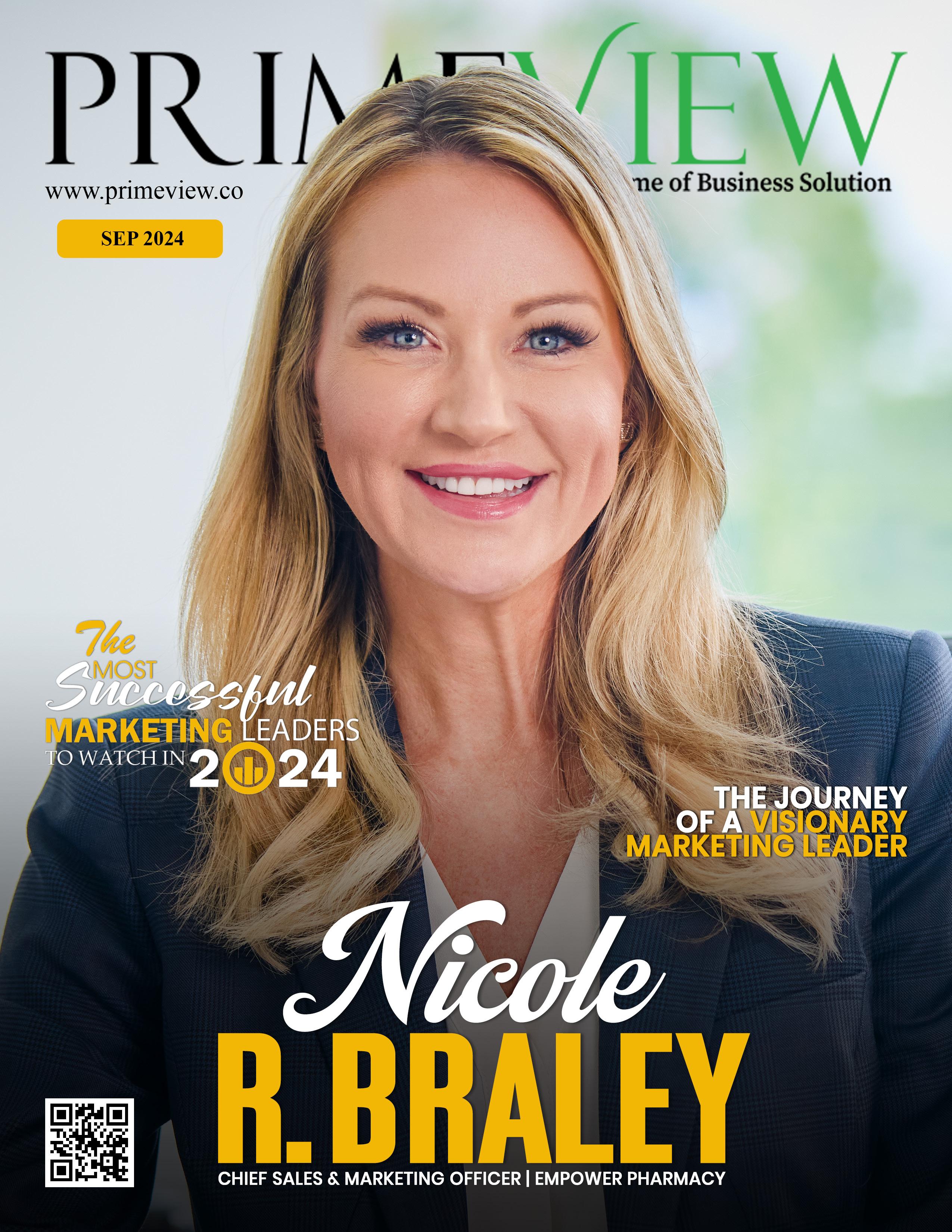
On Cover, we have Nicole Braley, the Chief Marketing Officer of Empower Pharmacy. With over two decades of expertise in diverse industries such as healthcare, oil and gas, consulting, and technology, Nicole has established expertise in driving growth and digital transformation. Currently, she serves as the Chief Marketing Officer at Empower Pharmacy, a leading provider of compounded medications dedicated to producing innovative medications to enhance people’s lives.
Empower Pharmacy specializes in crafting tailored medications to meet unique patient needs, offering alternatives not found in standard commercial offerings. This includes customizing medication strengths, formulating novel dosage forms, ensuring allergen-free compositions, and consolidating multiple medications into a single dosage for enhanced patient convenience and compliance.

NICOLE R. BRALEY Chief Sales & Marketing Officer | Empower Pharmacy




NICOLE R. BRALEY
Chief Sales & Marketing Officer | Empower Pharmacy
Nicole R. Braley is a remarkable leader in marketing, renowned for her forward-looking, strategic, and dynamic approach. With over two decades of expertise in diverse industries such as healthcare, oil and gas, consulting, and technology, Nicole has established expertise in driving growth and digital transformation. Currently, she serves as the Chief Marketing Officer at Empower Pharmacy, a leading provider of compounded medications dedicated to producing innovative medications to enhance people’s lives.
A Distinctive Leadership Style
“At the end of the day, my job is to work for my team. My question to them every day is, “What can I do for you?” or “What do you need from me?” quotes Nicole. This doesn’t mean she can’t be a tough manager. She truly believes in adopting a servant-leadership mentality that elevates the people she depends on to deliver on the goals and visions of the business.
This strategy is about leveraging AI to not only enhance the sales processes but also to significantly change how they interact with customers and support the sales teams. Nicole has focused on the two key strategies to encourage innovation and collaboration at Empower Pharmacy: practice introspection and lead with service.
This approach, emphasizes forward-thinking and identifying potential challenges before they arise, helping the team align their efforts and move forward together. By staying grounded in core values and embracing a servant-leadership perspective, Nicole ensures that the team navigates both the known and unknown with purpose.
Central to Nicole’s leadership is a commitment to diversity and inclusion, a principle that she believes should be embraced at every level of the organization. Through a bit of introspection, she has identified three key practices to promote an inclusive culture:
First, Nicole emphasizes the importance of staying committed to an inclusive culture. She firmly believes that small, thoughtful actions such as collecting information for virtual meetings in advance, creating opportunities for others to contribute, and elevating voices that might otherwise go unheard can make a big difference.
Secondly, she encourages employees to have the courage to hold themselves accountable. This also involves taking some time to learn how issues like gender bias may manifest in the workplace and show empathy for working parents by checking in with them and offering support.
Finally, Nicole suggests them to be curious. She also encourages them to get involved in the company’s D&I group or participate in its activities. With many great virtual events currently available, she sees this as the perfect opportunity for employees to engage and make a difference.
In Nicole’s opinion, reinventing customer experience and sales enablement with AI are the two ways AI impacts the company. “As we move into 2024, our focus on transforming customer experiences revolves around revolutionizing marketing and sales enablement using AI,“ says Nicole.
She firmly believes that the integration of AI will present an opportunity to make significant changes in 2024. For example, AI can be used to create dynamic content, experiences, and sales playbooks that adapt to different scenarios, ultimately leading to a better customer experience. The real innovation lies not in these elements but in the ease and precision with which AI can help the team scale this tool. By offering real-time suggestions and scripts, AI can assist customer-facing team members navigate customer conversations more effectively, resulting in better engagement, higher conversion rates, and improved retention.
Another key area where AI is revolutionizing sales is lead prioritization. By analyzing historical data and lead stage trends, AI can help sales teams identify which leads are more likely to convert, allowing them to prioritize their efforts more effectively. This prioritization not only enhances efficiency but also increases the likelihood of successful sales outcomes.
The last few years have seen unprecedented disruption in the CMO's role, with an increasing emphasis on inclusive marketing. This shift highlights the importance of crafting narratives that genuinely reflect the diversity of the audiences a company serves, ensuring that these stories resonate deeply and authentically. Internally, this focus on diversity and inclusion translates into a strong employee experience (EX) that aligns with the customer experience (CX) companies strive to provide.
Nicole underscores this connection, stating,-“A diverse and inclusive internal culture not only reflects our values as an organization but also drives creativity and innovation, providing a wellspring of unique perspectives that fuel our marketing strategies."
Being a CMO in 2024 is not just about managing marketing strategies-it's about being a daring innovator, a creative mastermind, and a key growth driver for the entire organization.
Nicole’s vision extends beyond that of a Chief Marketing Officer as she ventures further into this transformational era. It's a thrilling journey filled with opportunities to reshape the future of the business, and it all hinges on three fundamental shifts.
Nicole's managing style is based on trust and autonomy; her teams have always known that she believes in their ability to manage their workload and their time. But the irony is that in empowering her team to embrace their downtime, she has ignored her own advice. She steered the ship while forgetting to anchor herself. Nicole has endorsed the pursuit of work-life balance for others, all the while her own scales were tipping dangerously towards all work, no play.
She says, “I recognize that my role extends beyond guiding others; it includes setting an example. It's time for the shoemaker to pause, to craft his own pair of shoes, and to walk the path of well-being that I've so meticulously laid out for others.”
The Significant Role of Technology in Marketing Strategies
Nicole finds the tech stack, which includes Salesforce, Medallia, and Shopify, as well as virtual event platforms and web tools, plays a crucial role in driving marketing efforts and ultimately driving the customer experience. She sees the tech stack not just as a collection of software-it's a strategically assembled set of tools working together to drive growth and deliver customer value. In her role as a CMO, she leverages these tools to drive digital transformation, integrating data-driven decision-making into the strategies she uses to optimize her marketing efforts and propel growth.
Words of Wisdom
Advising aspiring marketing leaders looking to make a significant impact in their organizations, Nicole emphasizes the importance of constantly learning, exploring new ideas, and challenging conventional wisdom. According to her, as a CMO, staying current with marketing trends and new technologies and being willing to take risks with new, innovative approaches is the key to unlocking growth and driving success across the organization.”



Director of Digital Marketing
n the tech realm, women leaders are creating a massive impact because of their innovative approach and passion for technology. One such example of remarkable talent and excellence is Joya Scarlata. As the Director of Digital Marketing of Interra Information Technologies, Joya strives to bridge the gap between complex AI technologies and practical applications in the marketing field.
Joya embarked on her professional journey as a research assistant at the RAND Corporation in 2009. Later in 2011, she began working at ManTech as a junior intelligence analyst. In 2012, Joya joined Interra Information Technologies (InterraIT), where she worked her way up from the position of marketing associate to senior marketing manager. Throughout the journey, Joya Scarlata has proven to be a specialist in marketing, research, and analysis.
Joya pursued her academic studies by earning a Master of Arts (M.A.) in International Relations from Boston University and an MBA from the prestigious Jack Welch Management Institute. She also holds a Middle East History Certificate from the London School of Economics and Political Science (LSE) and a Professional Graduate Certificate in Marketing from Harvard University.
Inspiration Behind Joya’s Initiation
Joya Scarlata studied international relations and economics, so her early career was deeply rooted in these fields. However, she was fascinated with marketing and eventually took the lead in this industry, which dramatically changed her professional path.
Joya’s most rewarding aspect has been collaborating with the team to brainstorm creative solutions to complex challenges. She gets the opportunity every day to push the frontiers of marketing, and this ongoing change keeps her inspired and engaged.
Leveraging AI ‘not just as a tool, but as a strategic ally’
AI is rapidly taking center stage in B2B marketing, and InterraIT is actively embracing it. By utilizing AI technologies and procedures, the company may scale up the personalization of marketing activities and predict and address the individual demands of clients and prospects with unprecedented accuracy.
In this evolving space, InterraIT aspires to embrace AI as a strategic ally and a tool, enabling the team to provide exceptional value and top-notch services that will propel growth for InterraIT as well as its extensive clientele.
Standing at the Forefront of AI Advancements
“Making AI accessible and useful when it comes to marketing is indeed a passion of mine," said Joya Scarlata.
She always tries to foster a culture of ongoing education and agile adaptation to stay on top of what’s happening in the world of AI. Under her leadership, InterraIT schedules meetings where the entire team encourages brainstorming and experimentation. They also examine how emerging AI trends can be integrated into their marketing strategies.
Dispelling Common AI Misconceptions
One common misperception regarding AI is that it's a one-size-fits-all solution. For instance, someone may argue that a prompt that suits them would also suit you. AI requires careful implementation and continuous refinement to align with specific marketing objectives.
Many people believe that AI will result in a large loss of jobs in the marketing sector. Although AI may threaten
certain professions, it also gives marketers new opportunities to be more strategic and creative.
There are a lot of false beliefs out there, but Joya Scarlata makes sure that her team uses AI responsibly and knows what it is meant to do. Externally, she strives to educate the public through thought leadership. This includes sharing her thoughts on LinkedIn and other social media channels, speaking at conferences and podcasts, and participating in webinars.
The Latest Trends and Technologies : At a Glance
Joya believes marketers need to know a few current trends and insights. First, as voice search is growing in popularity, marketers should consider making their content voice-search-friendly. AI can help understand and leverage these new search patterns to ensure visibility in a voice-driven search landscape.
The use of conversational AI, such as chatbots and virtual assistants, will only increase. Marketers must understand how to integrate these tools in a way that complements the human element of customer service to maintain a personal touch.
Ethics and privacy are also becoming increasingly important. Marketers must use AI tools ethically, respect customer privacy, and maintain trust.
Looking at the AI landscape, one can easily understand that AI democratization is a game-changer. There is a rise in user-friendly AI tools, which means both larger and smaller corporations can have access to them. This also means that AI marketing strategies are not just for large organizations with bigger budgets but can be leveraged by businesses of all sizes.
But it's crucial to remember that marketers should always maintain the human touch, even when utilizing AI. After all, human ingenuity, compassion, and strategic thinking transform AI's insights into captivating marketing stories.
Keeping employees inspired and involved is essential for success in the tech sector. Joya assures every team member understands the broader business goals and how their efforts contribute to the company’s growth.
Further, Joya strives to cultivate a culture of innovation and creativity by encouraging and challenging her team to push themselves and think differently. She has regular brainstorming sessions where everyone is encouraged to share their ideas, and nothing is off the table! She also believes that acknowledging and appreciating small and large victories helps the team members feel valued by InterraIT and shows how hard they have worked.
Joya advises aspiring marketers to start with the basics, embrace a learning mindset, and apply their knowledge incrementally instead of all at once. They should also try to internalize that AI is not a magic wand or a one-size-fits-all solution to any problem they are trying to solve!
Many resources are available for learning about artificial intelligence (AI) in marketing and its practical applications, including webinars and online courses. It's advisable to grasp how to apply artificial intelligence (AI) to data analysis, predictive analysis, content production, and personalization.
Joya also believes it is essential to embrace a learning mindset. One can’t become an AI expert overnight, so aspiring marketers need to be patient with progress, be curious, and ask questions. In addition, they should try to apply what they learn in small, manageable steps. This hands-on experience is crucial as it allows them to build the confidence to see how AI can amplify their marketing efforts.


Founder | Avidity Marketing
During her 10 years as an in-house marketer in the finance sector, Louise Donadieu always found herself looking to partner with a marketing company that genuinely understood the sector’s needs. When she looked around, she saw hundreds- if not thousands- of marketing agencies offering design, digital marketing, analytics, etc. But she never found a company that could provide the big-picture guidance of an in-house CMO or Marketing Director, with the back-up of a specialised marketing team to implement
Louise knew there was a gap in the market that she could fill, and that’s when she founded Avidity Marketing.
Avidity Marketing works exclusively with service businesses to create targeted, powerful, and sustainable marketing strategies. From engaging prospects with targeted campaigns to designing a luxury onboarding experience, Avidity’s job isn’t done until its clients’ customer base is consistently growing and engaged. So much more than a marketing or design agency, it is a team of skilled specialists that provides clients with every bit of experience they need across marketing disciplines to deliver the results they want.
Louise founded Avidity Marketing 6 weeks before Covid-induced lockdown became a worldwide reality. She says, “I panicked at first, but I soon realised that our skillset was desperately needed.” Avidity Marketing predominantly works with firms in the financial sector, which have grown used to a traditional face-to-face marketing approach. With in-person meetings no longer an option, Avidity Marketing found organisations that wanted to update their marketing strategies to adopt a more modern, digital-first approach.
Avidity Marketing believes the pandemic has highlighted the need for an omnichannel marketing strategy and the importance of multiple sources of lead generation. Avidity has helped businesses revolutionise their approach to marketing at a time when their pipelines could have quickly grown stagnant.
Avidity Marketing is a results-driven organisation. Clients have unique needs and may require different paths, but the outcome is always the same: more engagement, better conversion, and greater brand awareness.
Avidity offers a flexible remote working environment, as long as the job gets done. Louise and her team work out deadlines for deliverables, and as long as those deadlines are met, she leaves them to it. Louise trusts her team of specialists to complete the work independently, calling on her as a resource if they need help.
Louise says, “I find this approach empowers my team. No one likes a micromanager. I have worked under pressure like that, and it’s a miserable feeling, like your voice isn’t heard. Everyone in my team has a seat at the table and a chance to put their ideas forward.”
She also finds that making the entire team client-facing is a great motivator. The organisation has no ‘relationship managers.’ If a client needs to speak to a content specialist, that’s who they will speak to. Avidity Marketing team members own their relationships and feel like a part of the client journey.
The only strategy that matters is your client experience. Every part of their journey with you is a chance to make or break your relationship. Don’t ruin it by not designing every facet.
Picture of the Future
Louise has big plans for Avidity Marketing. The organisation will keep doing what it is doing now, but on a much larger scale. As the organisation’s founder, Louise wants to be sure Avidity never becomes a typical marketing agency by trying to be everything to everyone. Its growth must have purpose, like adding new skill sets or meeting client demand. Louise and her team are strategists at their core and that is what they will continue to do.
Louise is focused on growing her team at the right pace so the organisation can support more clients in their journey to better marketing. Avidity Marketing already has 2 new roles for this year, as its demand is outreaching its capacity. But Louise refuses to hire people for the sake of it. She plans to bring on people who are good with their work, can bring a new perspective to the team, and can follow the company’s vision for changing the perception that marketing is ‘fluffy.’
To that end, Avidity Marketing’s biggest challenge is the public perception of what marketing isparticularly in the finance sector. Louise gets a lot of requests like, ‘Can you just write an article for us?’ or ‘Can you just post on our social media?’ These things are not marketing. They are just a tiny facet of it.
She says, “Good marketing is about expanding your network and generating quality leads. Good marketing is grabbing the attention of your target audience and getting them into your sales funnels. A good marketing strategy focuses on converting prospects, not on vanity metrics like followers and post likes.”
Avidity Marketing’s mission is to change the perception that marketing isn’t as valuable as client-facing teams, and Louise has a plan to make it happen. Based on the response from her current clients, she and her team are well on their way.



We live in a world where we are dependent on others whether its to get the milk delivered or garbage taken from our doorsteps. Whether it’s the delivery of wifi or electric or water connection or delivery of education it’s a product/service created and delivered to your doorstep. Every element of work has some one contributing to a long chain and if this chain breaks the delivery fails. Each person who is part of such a process and delivers to a common objective is a part of a team.
There are members of a team who are seen while in today’s context most are unseen and work in silos but still contribute to a larger objective. Whats a team has changed in this lock down whereas earlier most of the team use to sit together and deliver its now remote and each does what he or she is supposed to deliver. Team use to be defined as a group of people working together to achieve their goal.
The levels of team working are:
Team member works alone but contribute to the next
Team works together but do their own work
Team members have a shared responsibility
Team takes substantiative decision together
Work is interdependent between team members
Collaboration is this century’s skill set. One of the best examples of a team working together is the development of the many Covid vaccines and final delivery of the same to the public. This task would have taken years in the past but many processes were short circuited with the intervention of govt. compliance, researchers and manufacturers. They all worked as a team an interdependent team fighting for a common cause.
For a team leader its important to be able to steer his team to achieve the objective. This leader is an effort aggregator who is responsible for the last mile delivery of the objective. The leader need not be an expert but should be a person who understands people their abilities and has the ability to make things work by clearing roadblocks.
To have an effective delivery it’s important for a leader to understand each of his team members on:
Their technical abilities i.e. level of skills required to deliver
Have a basic understanding of his team members work styles and emotional make up
Understand strengths of each member and their capabilities in socialising, coordination, communication, execution, planning and strategizing.
There is no doubt that all delivery has to happen within a time frame and the best quality which is the responsibility of each team member. The leader’s job is to make them realise this and steer them to deliver.
We are more inclined to look at teams in our work space our office and various corporate functions but some of best delivery of team work happens in the Govt., the defence forces and in public utility services. What makes these services so difficult is the sheer size of number of people involved and the scale of activity. We often only see the misses and wonder why things don’t work but for every success or failure each step requires careful planning, creation of a roadmap, systems for delivery, capture of data/ information, quality control and finally the delivery.
Let’s take an example of the Rohtang Tunnel which has recently opened. Its not just a civil engineering feat but had geological, environmental and social challenges.
Once often need to go beyond the task and the role of the team expands.
Although in the past India has been seen as a country of compromises or jugaad. We had in the past cut corners to make things easier but that’s not a skill which is dominating today. If at all it does, its with the lesser aware and the non-professionals. With an increase in education and a being exposed to global competition as well as with the presence of global companies (read global best practices) we have become a lot more professional in our approach.
Some of the exceptional projects completed in India have been in the technology: space and telecommunication, military- missiles, roads, railways, aadhar, digitisation of passport, income tax, gst etc.
Some of the basics of team effectiveness identified by Richard Hackman a pioneer in organisational behaviour is enabling conditions (a stretched goal motivates), a compelling direction-, a strong structure with a balance of skills both social and technical, and a supportive context in terms of a reward. That’s what you would require to make a moon landing come true or deliver the wifi to your home.
A new element which has recently been added to above basics is a shared mindset. This is so due to cultural diversity, locational distance and language constrains. As teams get global and smaller and localised with digitisation we need to have a fair amount of information and resource flow between teams. Digitisation impedes nonverbal and contextual cues as we cannot gauge others response when one deals on emails or messages. You can experience this when you work across time zones with people having different backgrounds, culture and priorities including work life balance.
As long there is humanity there will be teams as humans communicate and collaborate to create a better world.