![]()


In this new digital era, a few job roles have attracted much attention in the C-suite, and the chief digital officer is a notable one. The job role is not new; the CDO title first emerged in the early 2010s when companies decided they required a dedicated company executive to lead their digital strategy. There was a time when CDOs were responsible for introducing digital capabilities and managing a handful of initiatives. Today, CDOs play a transformative role. They coordinate and manage significant changes in how a company works to create a new company. Additionally, as companies increasingly prioritize digital initiatives, understanding and mastering the crucial skills become crucial for CDOs to lead and foster a culture of growth efficiently.
The Inc Magazine has a history of recognizing and spotlighting innovative and inspiring corporate leaders and business endeavors who bring positive change to the business world. We are excited to announce the release of this special edition featuring the story of impactful Chief Digital Officers. These leaders have not only steered their companies on the digital trajectory but also played a crucial role in their fundamental evolution. They have truly earned their place in the already crowded C-suite.
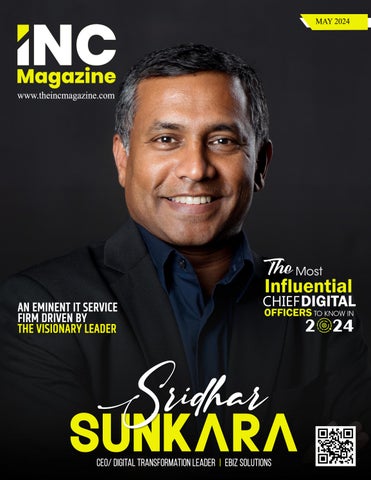
Sridhar Sunkara is one of such remarkable CDOs. He is empowering companies in their digital transformation journey and successfully leading Biz Solutions to new heights. Sridhar is a visionary leader and trailblazer, renowned for his dynamic leadership and digital excellence. His success story, featured on the cover of this issue, speaks of the value he has created in the digital landscape. Be sure to read the complete story and share your valuable feedback.
As a business magazine, we always provide a platform for business leaders and companies to share their journeys. If you have an exciting story to share that can inspire and motivate others, consider The Inc Magazine as an ideal platform.
I would end this read with the hope that this amazing edition proves its significance in highlighting the trailblazing digital officers in 2024.

Happy Reading!


O V E R S T O R

CEO & Digital Transformation Leader | eBiz Solutions
18 26 14 22 30
Alberto Cofino: Driving Remarkable Digital Transformation at Banco Promerica Guatemala
Karen Xie: The Epitome of Innovation, Transformation, and Growth
Digital Education: Transforming Learning in the Digital Age
Can You Decrease Your Reliance On Digital Marketing Agencies?
Digital Marketing Strategies: Unlocking Success in the Online Realm

Managing Editor
Publishing Control Team
Editor-in-Chief Visualizer
Art & Design Head
Business Development Manager Co-designer
Business Development Execu�ve Marke�ng Manager
Assistant Technical Head Technical Head
Digital Marke�ng Manager
Assistanr Digital Marke�ng Manager
Research Analyst
Circula�on Manager
Sonal K. Ehsan Jami Alex, Michael
Mary Chars Anushka Bhosle Shweta A. , Vaibhav M.
Shaun Oliver Chirs Philip Maria, Wilson, Mar�na, Alex, Kelvin
Jacob Smile Alina Sege
Jennifer Parker David King
Earl Lewis Scoot Taylor
sales@theincmagazine.com May, 2024
Phone - + 1 415 799 8483
Email: Info@theincmagazine.com
For Subscription: www.theincmagazine.com
Follow us on : www.facebook.com/theincmagazine/ www.twitter.com/theincmagazine www.instagram.com/theincmagazine/ www.linkedin.com/company/theincmagazine
Copyright © 2024 The Inc Magazine


In recent years, digital education has emerged as a transformative force in the field of learning and education. With advancements in technology, particularly the proliferation of internet access and the development of digital devices, traditional modes of education are evolving rapidly. Digital education encompasses a wide range of practices and tools aimed at enhancing learning experiences through digital means. From online courses and virtual classrooms to interactive multimedia resources and educational apps, the landscape of education has been fundamentally altered by the integration of digital technologies. This essay explores the concept of digital education, its benefits and challenges, and its implications for the future of learning.
The digital education market, characterized by the integration of technology into learning processes, has witnessed significant growth in recent years. With advancements in digital technologies, the education sector has transformed, offering innovative solutions to enhance teaching and learning experiences. The global digital education market is forecast to expand at a CAGR of 25.8% and thereby increase from a value of US$19.2 Billion in 2023 to US$95.7 Billion by the end of 2030, by Persistence Market Research.
Digital education, also known as e-learning or online learning, refers to the use of digital technologies to deliver educational content and facilitate learning experiences. It encompasses various formats, including web-based courses, virtual classrooms, educational apps, multimedia resources, and interactive simulations. Digital education can be synchronous, where learners participate in real-time interactions with instructors and peers, or asynchronous, allowing learners to access materials and engage in activities at their own pace.
One of the key characteristics of digital education is its accessibility. Unlike traditional classroom-based learning, which often requires physical presence, digital education can be accessed from anywhere with an internet connection. This flexibility enables learners to overcome barriers such as geographical distance, scheduling conflicts, and mobility limitations, making education more inclusive and equitable.
Furthermore, digital education offers personalized learning experiences tailored to individual needs and preferences. Adaptive learning technologies use algorithms to analyze learners’ performance and provide customized recommendations and feedback, allowing for targeted interventions and scaffolding of learning processes. This personalized approach enhances engagement and motivation, leading to improved learning outcomes.
The adoption of digital education brings forth numerous benefits for learners, educators, and educational institutions alike. Some of the key advantages include:
Accessibility: Digital education eliminates geographical barriers and enables access to learning resources for individuals residing in remote or underserved areas. It also accommodates diverse learning needs and preferences, including those with disabilities or special requirements.
Flexibility: With digital education, learners have the flexibility to study at their own pace and schedule, accommodating work, family, or other commitments. This flexibility empowers lifelong learning and promotes self-directed learning skills.
Interactivity: Digital education platforms often incorporate interactive multimedia elements, simulations, and gamified activities, enhancing engagement and promoting active learning.


Interactive features facilitate hands-on exploration and experimentation, fostering deeper understanding and retention of concepts.
Cost-effectiveness: Compared to traditional classroom-based education, digital education can be more cost-effective, reducing expenses associated with commuting, accommodation, and physical resources. Open educational resources (OERs) and Massive Open Online Courses (MOOCs) offer free or affordable alternatives to traditional textbooks and courses.
Scalability: Digital education enables the scalable delivery of educational content to a large number of learners simultaneously. This scalability is particularly advantageous for educational institutions seeking to reach broader audiences and expand their offerings without significant infrastructure investments.
Real-time feedback: Digital education platforms facilitate the timely assessment of learners’ progress and comprehension through quizzes, assignments, and interactive exercises. Instant feedback allows educators to identify areas of improvement and provide targeted support, promoting continuous learning and skill development.
Despite its numerous benefits, digital education also presents challenges and considerations that must be addressed to maximize its effectiveness and inclusivity:

Technological barriers: Access to digital education relies on reliable internet connectivity and access to digital devices, which may pose challenges for individuals in low-income or rural areas. Addressing the digital divide requires investment in infrastructure and initiatives to provide affordable access to technology for all learners.
Digital literacy: Effective participation in digital education requires basic digital literacy skills, including navigating online platforms, critically evaluating information, and protecting personal data. Educators play a crucial role in fostering digital literacy among learners and promoting responsible digital citizenship.
Social interaction: While digital education offers opportunities for virtual collaboration and communication, it may lack the social interactions and interpersonal connections inherent in traditional classroom settings. Strategies for fostering community and peer interaction in digital learning environments are essential for promoting social and emotional development.
Quality assurance: The proliferation of digital education resources and platforms raises concerns about the quality and credibility of content. Educational institutions and accreditation bodies must establish standards and guidelines for evaluating the rigor and effectiveness of digital learning materials and programs.
Equity and inclusion: Despite its potential for democratizing access to education, digital education may exacerbate existing inequalities if not implemented thoughtfully. Efforts to address barriers to access, promote diversity and inclusion, and accommodate diverse learning needs are essential for ensuring equitable participation in digital learning experiences.
As digital technologies continue to evolve, the future of education is likely to be increasingly shaped by digital innovations. Some emerging trends and developments in digital education include:
Personalized learning: Advances in artificial intelligence and learning analytics will enable more sophisticated personalized learning experiences tailored to individual learners’ needs, preferences, and learning styles.
Immersive technologies: Virtual reality (VR) and augmented reality (AR) have the potential to transform learning by creating immersive and interactive environments that simulate real-world scenarios and enhance experiential learning.
Lifelong learning ecosystems: Digital education platforms will play a central role in supporting lifelong learning initiatives, providing accessible and flexible opportunities for individuals to acquire new skills and knowledge throughout their lives.
Collaborative learning networks: Digital education platforms will facilitate collaboration and knowledge-sharing among learners, educators, and experts across geographic and disciplinary boundaries, fostering a culture of lifelong learning and innovation.
Digital education represents a paradigm shift in the way learning is conceptualized, delivered, and experienced. By leveraging the power of digital technologies, education can become more accessible, flexible, interactive, and personalized, empowering learners to pursue their educational goals and aspirations. However, addressing challenges such as the digital divide, promoting digital literacy, and ensuring equity and inclusion are essential for realizing the full potential of digital education. As we navigate the evolving landscape of digital education, it is crucial to harness the opportunities afforded by technology while upholding the values of quality, accessibility, and inclusivity in education for all.
Moreover, exploring the role of company to write a dissertation in this digital educational ecosystem could provide valuable insights into enhancing educational experiences.


Alberto Cofiño Chief Digital Officer
Banco Promerica Guatemala

In today's evolving business landscape, businesses must embrace digital transformation to remain competitive. Leaders play a significant role in guiding their organizations through this change. These executives possess the skills, vision, and ability to manage digital transformations successfully and steer businesses toward a digital-first future.
One such leader is Alberto Cofiño, the Chief Digital Officer of Banco Promerica Guatemala, a mid-sized universal bank. Driven by a passion for digitalization and understanding its potential, Alberto drives Banco Promerica Guatemala's digital transformation strategy and leads it toward innovative horizons.
Alberto has been in banking for nearly two decades; throughout this journey, he gained extensive expertise and insights that have shaped his approach to digital transformation. Among Alberto's most important takeaways are the significance of prioritizing customer-centricity and user experience, ensuring that technology enhances rather than complicates interactions, making data-driven decisions, and maintaining lean processes at all times.
He combines these insights with a commitment to continuous learning and adaptation to drive successful digital transformation initiatives in the banking industry.
As the CDO of Banco Promerica Guatemala, Alberto has many responsibilities. One of his top priorities is addressing client demand.
To gain insights into customer needs and preferences in every digital technology integration, he employs two key strategies: leveraging data analytics and feedback mechanisms. These strategies enable him to better understand customers and provide customized digital banking services that meet their expectations and enhance their overall banking experience. Additionally,
Alberto and his team prioritize continuous innovation and user experience design to ensure their digital platforms are intuitive, user-friendly, and constantly evolving to address changing customer demands.
"We aim to create a seamless and personalized digital banking environment that focuses on every choice we make around the needs of our clients," shared Alberto.
Digital transformation is integral to the banking industry, particularly in Guatemala. As financial institutions strive to enhance efficiency, accessibility, and customer experience, Alberto focuses on understanding each segment’s needs and helping unbanked people take advantage of Banco Promerica's services and become more efficient and secure. He believes AI will remarkably impact how banks serve customers, understand them, and simplify their transactions and requests.
In-depth market research and customer segmentation analysis are two methods Alberto and his team actively use to balance different customer segments' unique needs and expectations when driving digital initiatives. This strategy helps them to identify and understand the specific needs and preferences of diverse customer groups. Further, they tailor digital initiatives to meet the varying needs of different segments through customer feedback, data analytics, and targeted marketing strategies. The focal point is prioritizing personalization, flexibility, and continuous improvement to ensure that all customers receive a seamless and tailored digital banking experience.
When Alberto began the digital transformation journey at Banco Promerica Guatemala, the one major hurdle he and his team encountered was the ability or speed of change from certain stakeholders and ensuring a smooth transition of customers. To tackle these challenges, they focused on building a change plan that included clear communication and stakeholder engagement to encourage collaboration.
Being a business leader and the company's key executive, Alberto believes that making every stakeholder part of the vision and achievements of transformation is crucial to gaining their commitment and collaboration. When the objectives are aligned across the organization, side-by-side effort comes naturally. He works closely with the IT team to tackle technical issues promptly and implement phased rollout strategies to overcome obstacles and ensure a successful digital transformation.
Banco Promerica Guatemala has implemented robust data security measures, including encryption, access controls, and facial biometrics with validation from the RENAP (National Registry of Persons), which allows them to verify a client's identity and facial features. This functionality is integrated into critical app flows to ensure that the user performing the transaction is authenticated. Due to its innovative environment, Banco Promerica Guatemala recently received the Gold Award at the Fintech Americas 2024 event held in Miami.
Alberto, the visionary leader at Banco Promerica Guatemala, prioritizes lifelong learning, keeping up with market developments, and encouraging an innovative culture within the company to stay ahead of the curve and ensure Banco Promerica Guatemala remains at the forefront of digital banking.
He and his team regularly review objectives and evaluate the project portfolio, aligning efforts with all involved areas and prioritizing initiatives that offer their clients the best monetary and experiential returns. By continuously improving their digital channels using agile methodology, they enhance processes and deliver valuable products. Their primary focus is on disruptive projects that distinguish them from their competitors.
Sharing his experience, Alberto encourages aspiring executive leaders to take a customer-centric approach. He emphasizes that the key pillars of transformation are embracing a culture of agility and continuous learning and fostering collaboration across departments. He highlights the importance of meeting customer needs, leveraging data-driven insights, and quickly adapting to market changes to drive successful digital transformation initiatives. Alberto concludes his advice by reminding executives that encouraging experimentation, learning from failures, and empowering teams to innovate is essential to staying competitive in the digital era and delivering exceptional banking experiences.
Alberto envisions taking Banco Promerica Guatemala to a broader audience by leveraging advanced technologies such as AI and machine learning to tailor financial solutions, strengthen cybersecurity measures, and expand mobile banking capabilities. He and his team strive to meet their clients’ needs daily with a remarkable digital experience through hyper-personalization on their digital platforms based on their understanding of customers’ demands. The team will continue to work on these ever-evolving pillars to stay ahead of the curve.


Hopefully, at this point, there should be no one running a growing business who doesn’t understand the importance of good digital marketing. However, with the increased importance of good digital marketing comes an increased budget to go towards it, too. If you’ve been working with a digital marketing agency (or more than one) and you’re starting to see that budget balloon, one way to get it back under control is to start internalizing more of your approach. But how do you do that?
Make external knowledge internal
First of all, if you have any marketing materials that are relevant to your brand that you currently do not have full access and ownership to, you should change that. Logos, brand images, photography, anything that you share the rights to, you should own yourself. You can even turn it into a brand bible so that anything you collaborated with digital agencies on before can be reused and evolved so that you don’t have to start from scratch with your online branding.
Get to grips with it yourself
It’s not just the assets that you should start to internalize, you should start to build a good understanding of how digital marketing works, itself. You might not find that the agencies you work with are eager to share all of their secrets, so instead, finding a professional like Jason McDonald, who specializes in teaching things like SEO, social media marketing, and PPC advertising, can be a lot more worthwhile. The more you understand the core of the marketing techniques you rely on, the less that you’re going to need agency expertise in the first place.
Be supported by the right team
Of course, even if you have all of the knowledge required to carry off a quality digital marketing campaign, you might not have the man-hours to do it all yourself. You might still choose to outsource some processes, but you should start looking at the possibility of building your internal digital marketing team, especially if you are running changing campaigns throughout the whole year. At some point, it just becomes a lot more cost-effective to handle everything in-house, so long as you’re able to handle the initial costs of hiring and onboarding the people that you need.
Always keep an eye on the future of digital marketing
The realities of digital marketing change, as search engines and social media platforms grow and evolve, and new marketing landscapes and opportunities rise. The role of new technologies in marketing isn’t always easy to grasp, you want to make sure that you don’t buy in too early to new marketing technology that has yet to prove its worth, but you want to at least keep up with what’s going on. That way, if something does prove to offer real change to the marketing landscape, you’re ready to adopt it ASAP.
If you plan on taking your digital marketing internally, do it, but do it right. Ensure that you have the team and the knowledge to run it as effectively as you should.


In today’s fast-paced digital age, businesses must adapt and embrace the power of digital marketing to unlock success in the online realm. With a well-crafted digital marketing strategy, companies can reach a broader audience, engage with customers on a personal level, and ultimately boost their bottom line. This article will explore key digital marketing strategies that can help businesses thrive in the ever-evolving online landscape.
Search Engine Optimisation (SEO): Enhancing Online Visibility In a world where search engines reign supreme, it is imperative for businesses to optimise their online presence through effective search engine optimisation (SEO) techniques. For instance, you can elevate your brand’s digital footprint with Edge Marketing’s expertise on SEO. By understanding and implementing SEO best practices, companies can improve their website’s ranking on search engine results pages (SERPs), driving organic traffic and attracting potential customers. Optimising website content, incorporating relevant keywords, and building high-quality backlinks are integral to a successful SEO strategy.
Content Marketing: Captivating and Informative Content marketing has emerged as a powerful tool in the digital marketing arsenal. By creating valuable, engaging, and relevant content, businesses can establish themselves as industry leaders. Whether through blog posts, articles, videos, or social media content, compelling content captures attention, drives customer engagement, encourages social sharing, and increases brand awareness.
Social Media Marketing: By strategically utilising social media channels, businesses can amplify their brand reach and connect with their audience more personally and interactively. Sharing engaging content, running targeted ad campaigns, and leveraging influencer partnerships are effective tactics to increase brand visibility, foster customer loyalty, and drive website traffic.
Email Marketing: Nurturing Customer Relationships While some may argue that email marketing has lost its relevance, it remains a powerful tool for nurturing customer relationships and driving conversions. By building an email list and crafting personalised, valuable content, businesses can establish a direct line of communication with their customers. Email marketing allows companies to deliver tailored messages, provide exclusive offers, and inform customers about new products or services. Businesses can further optimise their email campaigns for maximum impact by segmenting the email list and analysing user behaviour.
Data Analytics: Driving Informed Decision-Making Digital marketing strategies are not set in stone but require continuous monitoring, analysis, and adaptation. Businesses can gain valuable insights into their customers’ behaviour, preferences, and purchasing patterns by leveraging data analytics tools and techniques. Companies can make informed decisions and refine their marketing efforts by analysing website traffic, social media engagement, and conversion rates. Data analytics enables businesses to identify trends, optimise campaigns, and maximise return on investment (ROI). For example, you can elevate your brand’s digital footprint with Edge Marketing’s expertise in data analytics.
Mobile Marketing: Capitalising on the Mobile Revolution With the proliferation of smartphones, mobile marketing has become an integral part of any comprehensive digital marketing strategy. Optimising websites for mobile devices, creating mobile-friendly content, and leveraging mobile advertising channels are essential steps to reach the ever-growing mobile audience. Mobile marketing allows businesses to engage with customers on the go, provide seamless user experiences, and leverage location-based targeting to deliver personalised offers.

Influencer Marketing: Harnessing Social Influence Influencer marketing has gained significant momentum in recent years, proving to be an effective strategy for businesses looking to expand their online presence. By partnering with influencers who have a loyal following in their niche, companies can tap into their social influence and leverage their credibility to promote products or services. Influencer collaborations can take various forms, including sponsored content, product reviews, or guest appearances on social media channels. This approach helps businesses reach a wider audience, build brand awareness, and establish trust through the endorsement of respected individuals.
Video Marketing: Engaging Visual Experiences Video marketing has become increasingly popular as internet users increasingly consume video content across various platforms. By creating compelling and visually captivating videos, businesses can effectively engage their audience and deliver their marketing messages in a memorable way. Whether through product demonstrations, brand storytelling, or educational content, videos can evoke emotions, entertain, and inspire action. Sharing videos on platforms like YouTube, social media, and embedding them on websites can significantly enhance brand visibility and user engagement.
User Experience Optimisation: Seamless Interaction User experience (UX) optimisation is a critical aspect of digital marketing that focuses on enhancing users’ overall experience when interacting with a website or digital platform. A seamless and user-friendly interface, intuitive navigation, fast loading times, and mobile responsiveness are vital elements that contribute to a positive user experience. By prioritising UX optimisation, businesses can reduce bounce rates, increase time spent on their website, and ultimately improve conversion rates. Conducting usability tests, gathering user feedback, and implementing iterative design improvements are key strategies in ensuring an exceptional user experience.
Remarketing: Reconnecting with Potential Customers Remarketing, also known as retargeting, is a powerful technique that allows businesses to reconnect with users who have previously interacted with their brand or website. By placing tracking pixels or cookies on their website, businesses can target ads specifically to those users as they browse other websites or social media platforms. Remarketing helps reinforce brand awareness, remind potential customers of products or services, and encourage them to take the desired action. By staying top-of-mind with potential customers, businesses can increase their conversion chances and effectively nurture leads.
In an increasingly competitive digital landscape, a comprehensive digital marketing strategy is essential for businesses to stand out and succeed online. By utilising search engine optimisation, content marketing, social media marketing, email marketing, data analytics, mobile marketing, influencer marketing, video marketing, user experience optimisation, and remarketing, businesses can unlock the full potential of the online realm.