
The 10 Best Dynamic CCOs to Know in 2024

Page 1


Editor’s NOTE

CORPORATE EXECUTIVES REMARKABLY EVOLVING INTO DYNAMIC TRAILBLAZERS

I

n recent years, the significance of the Chief Commercial Officer (CCO) has expanded to encompass more than just sales-related operations. CCOs now have oversight of various business operations, including customer relations management, strategy development, crisis management, and product development. Most importantly, CCOs often serve as a bridge between a company's daily activities and long-term vision, providing valued insights that affect its direction. These corporate leaders are having a lot of success with their extraordinary resilience and an innovative thought process. Hence, we are here to celebrate leadership that transformed over time. This time, we thoroughly searched for the beacon of corporate excellence. Eventually, this led us to the stories of various CCOs who hold a fine balance of strategic acumen and dynamic leadership. All the visionaries featured in the edition have not only flourished their companies to newer heights but have also set new standards in the industry.

In our brand-new edition, "The 10 Best Dynamic CCOs to Know in 2024," we are covering the stories of inspiring CCOs who are making significant contributions in the business realm and bringing remarkable changes.

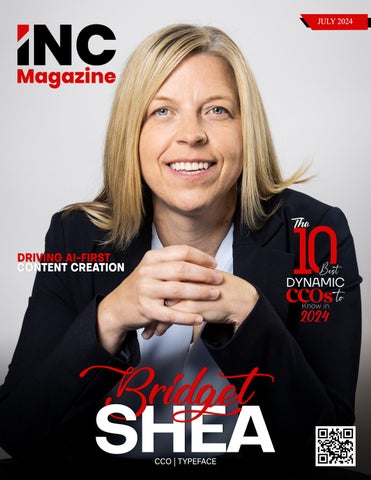
Topping the list of our dynamic CCOs, Bridget Shea has secured her name on the cover page. Bridget Shea is the CCO at Typeface, an amazing AI platform revolutionizing personalized content creation. Bridget is a dynamic corporate executive who efficiently leads the company and takes it to new heights. In this publication, we honor her exceptional leadership and also celebrate the collective efforts of her dedicated team and a shared goal for a better future for all. Explore her inspiring story and share your thoughts.

In addition to these amazing stories, we also have several in-house articles covering the most trending business topics. Be sure to check out all the stories featured in the edition. We will be soon back with excellent material in the next issue. Our focus has been to be your source of knowledge, and we will continue to strive to do so. Do not forget to share your valuable feedback.

Happy Reading!!

Managing Editor

Publishing Control Team

Editor-in-Chief Visualizer

Art & Design Head

Business Development Manager Co-designer

Business Development Execu�ve Marke�ng Manager

Assistant Technical Head Technical Head

Digital Marke�ng Manager

Assistanr Digital Marke�ng Manager

Research Analyst

Circula�on Manager

Sonal K. Ehsan Jami Alex, Michael

Mary Chars Anushka Bhosle Shweta Ambilwade

Jody Harris Chirs Philip Maria, Wilson, Mar�na, Alex, Kelvin

Jacob Smile Alina Sege

Jennifer Parker David King

Earl Lewis Scoot Taylor

sales@theincmagazine.com July, 2024

Phone - + 1 415 799 8483

Email: Info@theincmagazine.com

For Subscription: www.theincmagazine.com

Follow us on : www.facebook.com/theincmagazine/ www.twitter.com/theincmagazine www.instagram.com/theincmagazine/ www.linkedin.com/company/theincmagazine

Copyright © 2024 The Inc Magazine

BRIDGET SHEA

CCO | Typeface

DRIVING AI-FIRST CONTENT CREATION

Meet Bridget Shea, Chief Customer Officer of Typeface, a generative AI application that revolutionizes personalized content creation for businesses. At Typeface, Bridget partners with global enterprise customers to navigate and unlock meaningful Generative AI transformations. Bridget has been a driving force in scaling GTM teams while navigating numerous technology paradigm shifts at start-ups and top global tech companies. In her previous role as Dataiku’s Chief Customer Officer she led global customer success and professional services teams, ensuring the delivery of customer value to data science teams from AI infrastructure platforms. Bridget's reputation as a leading customer success expert is also backed by her track record of notable acquisitions and IPOs. Bridget served as Chief Customer Officer of Datorama (acquired by Salesforce), where she collaborated closely with Fortune 500 CMOs and marketing teams. She served as Chief Revenue Officer at TellApart (Twitter’s largest acquisition in history) to then go on to lead global sales teams at Twitter. Bridget was a catalyst for growth in helping build Yext’s (IPO) global enterprise division, leading customer success. Bridget's influence also extends to her roles as advisor to dbt Labs and Hex and as a Board Member of Xeneta and Aqdoq.

The Real Talk

Bridget’s leadership and mentorship style is best described as ‘real talk,’ a fearless blend of honesty and drive to help everyone around her optimize performance. Her contagious intellectual curiosity and commitment to providing immediate feedback and coaching to her team members have been instrumental in her success. This hands-on

leadership approach, rooted in authenticity and trust, has not only resonated with her teams but also with the broader community that she mentors as a board member and advisor. Bridget’s DNA and mindset fosters an environment of continuous and relentless pursuit via quick cycle improvement across her teams.

Top talent and those looking to be classically trained join Bridget’s teams for what she calls the "slope of the line" approach to talent development. This method helps team members, managers, and in turn the company accelerate progress. This unique approach and style enables Bridget’s team to unlock these results through an operating rhythm that keeps a fast beat.

Bridget has played an integral part in building early-stage companies and achieving four successful exits and a fifth in progress. However, the most satisfying part of Bridget's job is intentionally and thoughtfully investing in building the best alumni operators. She takes the most pride in seeing former team members move forward to build great companies themselves.

Tackling Challenges

Bridget's most common learning thread is that the inertia of large-scale global enterprise companies is not to be underestimated. In her role as the catalyst to unlock enterprise innovation potential, she partners closely with customers on this journey to break new ground to realize high-impact gains, as well as education and enablement best practices for leaders and their teams around operational change. And it is this diversity of use cases across work with enterprises and big brands that attracts her to lead customer success service teams. She believes service

teams can help customers unlock the value of new innovation inflection points like GenAI by drawing learnings and pattern matching from a variety of industries and customer profiles, while also going deep into specific needs. At Typeface, Bridget sees a big opportunity to build on and democratize these best practices to make the deep technical power of AI accessible and pervasive for many, fundamentally changing how they work. This mission energizes and motivates her daily to partner with Typeface's customers on their innovation journeys.

The Ever Evolving Generative AI and Content Creation Industry

Bridget believes this is the perfect time to reset expectations with customers divided into two camps. One is searching for the magic AI button, the other is jumping on the negative bandwagon predicting the downfall of AI. However, the truth, says Bridget, lies in the middle. Customers who will reap the rewards are those who don’t just follow trends but create their own, recognizing that the technology is still in its early days and needs to be molded with a test and learn approach where gains are made in small iterative steps.

Like any new technology, GenAI also demands organizational shifts and effective change management. The potential for productivity gains is so significant that delaying the first step while waiting for the perfect long-term plan often means missing out on compounded benefits. Which means clients who embrace this technology early and adapt their tech stack to work with emerging GenAI platforms will start to quickly differentiate themselves as reaping the benefits as early adopters.

Integrating AI into the Content Creation Process

Bridget believes that AI has the potential to unlock various new frontiers of how we work with tools that will make it easy for anyone to express their creativity. However, she feels the most important part to get right is the change management, which starts with upskilling and reskilling employees.

She also asserts that AI cannot be just a side project; it needs to be integrated into the company's fabric. It is also important to build trust early by setting a clear vision and sharing the benefits of early exploration with teams. Additionally, it's extremely important to designate internal advocates and champions to share key pilot learnings. When implemented correctly, AI has the potential to free teams from the constraints of the past and truly reimagine the workflow of campaigns and content experiences from idea to activation.

The Differentiating Factor

Typeface provides white-glove partner support from onboarding to production on this journey. It closely partners with its customers early in campaigns, going deep to innovate together, identifying quick wins and long-term productivity gains.

• Multimodal and multi-model: With Typeface, organizations don’t need to use multiple, disconnected tools to generate text and images. Typeface believes in leveraging the best-in-class capabilities of large-scale language models and techniques, seamlessly integrating multiple modalities into one content generation workflow for text and images, and getting better with continuous training.

• Personalization at speed and scale: Bridget and her team know that no one size fits all. Typeface empowers every employee to create high-quality, on-brand content at speed and scale and ensure brand consistency across all teams, business lines, and global regions.

• Safety and Trust: Typeface has always and will continue to prioritize many layers of safety and trust, including data protection, brand governance, responsible AI practices in all that it does, upholding ethical AI principles, and actively prohibiting content that could lead to bias or harm.

Reimagining Storytelling and Campaign Building

Bridget is particularly excited about Typeface Arc, which reimagines storytelling and campaign-building experiences for marketers with AI-first workflows. This has been a pivotal moment for Bridget and her team on their GenAI journey, as they have received strong positive feedback from early enterprise customers.

As Bridget and her team look ahead to the next frontier for content, they believe AI's true potential goes far beyond answering prompts with individual content moments and artifacts to curating interconnected stories across cross functional teams. They see it creating interconnected stories and reimagining the entire enterprise workflow, from idea to campaign activation.

Suggestions for Companies Looking to Leverage Generative AI

Bridget explains that crafting personalized stories has been limited to a privileged few with specialized tools and high costs for a long time. Now, for the first time, Typeface can teach AI to uniquely understand its client’s business, brand language, style, audiences, and data, unlocking and democratizing a new level of personalization at scale. This helps organizations reach more users with unique stories for each of their audiences on a global scale, making them more personal and connected. For example, a global financial services company or electronics brand can now reach exponentially more customers and tell its story in dozens of places instead of being limited to one market, website, or one-size-fits-all campaign.

OZGE TEKALP

Chief Customer & Project Officer | Invotect

Leading the Change

eet Özge Tekalp, Chief Customer and Project Officer at Invotect, specializing in smart cards and wearable technologies offering creative, modern, and reliable solutions that prioritize environmental sustainability and social responsibility.

Özge, as a dynamic CCO, brings over two decades of global experience in the financial industry. Her career has been marked by leadership roles focused on digital transformation and enhancing customer experience. Throughout her journey, Özge has consistently fostered customer-centric cultures that drive commercial success, leading successful digital transformation initiatives while reducing customer churn and increasing sales and profitability. Notably, as the Chief Customer Officer at VeriPark, a global provider of digital solutions for financial institutions, Özge implemented a Customer Health Score system and best practices to boost business value. Her innovative approach led to the introduction of state-of-the-art tools for improved customer engagement. Özge's expertise lies in bridging technology with customer needs, building a customer success mindset across entire organizations, and consistently delivering service excellence while driving digital innovation in the financial sector.

Özge's career prior to VeriPark includes leadership roles at prominent financial institutions. She served as Head of Customer Engagement Hub at BankDhofar in Oman and BNP Paribas TEB in Istanbul. In these positions, Özge spearheaded the strategic development and transformation of remote sales and service channels. Her innovative programs streamlined various aspects of banking operations, including, sales processes, digital onboarding, contact centers, customer retention, outsourcing and vendor management, self-service platforms, social media engagement, campaign management, credit collection and fraud control systems.

These initiatives, backed by board members and senior leadership, resulted in multiple international awards for Özge and her teams, highlighting her expertise in driving digital transformation in the banking sector.

Earlier in her career, Özge launched innovative digital initiatives, optimized customer-centric processes and boosted sales performance, as the head of Alternative Sales Channels. In a pivotal role, Özge led a workgroup overseeing the successful merger of two mid-sized banksFortisbank and TEB - for BNP Paribas and Fortis Bank. During her banking career she worked in QNB Finansbank, Sakura Bank, İş Bank and in the initial years of her career, Özge worked as a Senior Financial Analyst at Eastman Kodak in the USA and in international marketing of consultancy services at Suter and Suter in Switzerland.

Evolving Leadership Style

Özge’s leadership style has significantly evolved during her 25+ year career, adapting to the changing landscape of the financial industry and the needs of diverse teams across different cultures.

During the early stages of her career, Özge focused on being a hands-on, detail-oriented leader, which served her well where precision and thorough understanding were of utmost importance. As she moved into more senior positions, particularly during the bank merger she managed for BNP Paribas Group, Özge transitioned to a more collaborative and strategic leadership style. She learned the importance of bringing diverse teams together, aligning different corporate cultures, and focusing on shared goals.

In her roles as Head of Alternative Sales Channels and Customer Engagement Hubs, Özge further evolved, adopting a more visionary and innovative leadership

approach. She encouraged her teams to think creatively, embrace new technologies, and always put clients at the center of their strategies. While typically favoring a democratic leadership style that empowers team members, Özge demonstrated versatility by employing an autocratic approach when quick decision-making was crucial.

More recently, as the CCO of VeriPark, Özge embraced a transformational leadership style. She focuses on coaching and building a customer success mindset across the organization. This approach involves nurturing talent, promoting continuous learning, and creating an environment where team members feel empowered to take initiative and innovate.

Throughout her career, Özge has maintained a strong emphasis on accountability and results, balanced with a deep commitment to employee development and well-being. She believes in leading by example, fostering open communication, and creating a culture of continuous improvement.

Özge summarizes her current leadership philosophy:

"My leadership style today is a blend of strategic vision, commercial success based on strong customer-centricity, innovation, and people empowerment. I have worked with excellent leaders and leadership teams, and I strive to inspire my teams to embrace change, drive innovation, and always keep the end goal of exceptional customer experience. This approach leads to commercial success within a healthy and inspiring work environment."-she explains.

Throughout her career, Özge has cultivated a leadership style that harmonizes accountability and results with a genuine commitment to employee growth and well-being. This balanced approach is embodied in her core principles of leading by example, promoting open dialogue, and fostering a culture of continuous improvement.

By setting clear expectations while simultaneously nurturing talent, Özge creates an environment where high performance and personal development go hand in hand. Her leadership not only drives organizational success but also empowers team members to reach their full potential, resulting in a motivated workforce that consistently delivers exceptional outcomes. This synergy between corporate objectives and individual aspirations has become a hallmark of Özge's leadership, propelling both her teams and the organizations she serves to new heights of achievement and innovation.

Balancing Short-Term Performance with Long-Term Strategic Goals

Özge’s priority has been setting clear priorities, using balanced scorecards, and aligning initiatives. Her extensive experience underscores the importance of focusing on critical financial health KPIs in the short term while strategically deciding on long-term KPIs. By tracking performance across multiple dimensions-financial, customer, internal processes, growth, and employee learning and well-being-Özge has also successfully driven sustainable growth aligned with long-term strategic goals.

To maintain this balance, strategic communication, and change management are also important. Özge emphasizes the need to regularly conduct initiatives including regular strategy reviews, scenario planning, stakeholder management, resource allocation, and capability building to ensure the organizations she worked for stays on course to achieve its strategic objectives while adapting to changing market conditions.

Major Trends

The fintech industry is rapidly evolving due to several technological advancements like AI, Blockchain, and open banking APIs. These innovations are not only changing the world of technology, but they are also reshaping the traditional financial systems, and enabling

the rise of digital-only banks, embedded finance, and decentralized financial systems. These systems may promise digital and financial inclusion, personalization, and increased efficiency, but they also face significant regulatory threats. Regulators nowadays are increasingly focusing on AI governance, emphasizing ethical use, explainability, and consumer protection. So, the industry needs to navigate this complex landscape while balancing innovation with security and compliance.

Challenges and Opportunities for the Sector

Özge believes that the Fintech sector is at a critical inflection point. Organizations are grappling with a multifaceted landscape of challenges and opportunities needing strategic foresight and agile execution. She feels it's important to know about complex regulatory compliance strategies that span global jurisdictions while developing robust cybersecurity frameworks to safeguard client’s digital assets and trust.

“The competitive arena is intensifying, with traditional financial institutions, tech giants, and agile startups all vying for market share, necessitating innovative differentiation strategies. Simultaneously, it is time to harness transformative technologies like AI, blockchain, and open banking APIs to create compelling value

propositions. The push for financial inclusion presents vast untapped markets, while the acceleration of digital payments is reshaping transaction paradigms,”explains Özge.

Picture of the Future

In the future, Özge’s goals are centered on leveraging her extensive experience and leadership expertise to drive transformative change in organizations. She envisions herself in leadership positions or serving as an independent board member, where she can make a significant impact in key areas.

Özge's vision combines her passion for customer-centric approaches with her expertise in digital innovation. By focusing on these areas, she aims to guide organizations through the complexities of modern business landscapes, ensuring they remain competitive, innovative, and customer-focused. Her goal is to create lasting value by bridging the gap between traditional business models and the demands of the digital age, all while maintaining a strong emphasis on customer satisfaction and business growth. Her goal is to help organizations through evaluate current practices, create actionable digital strategies, and establish robust governance frameworks to support these initiatives.

A SEASONED GLOBAL VENTURE CAPITAL FIRM, STEERING THE TRAJECTORY OF HARD TECH COMPANIES

Over the past decade, hard tech has emerged as a new wave of technology within innovation and scientific advancement. Driven by the frontiers of science and bold entrepreneurs, this phenomenon has captured the attention of global venture capital investors who have recognized the incredible potential of hard-tech entities.

Introducing Cottonwood Technology Fund, an early-stage venture capital firm that makes impact investments in Key Enabling Technologies (Hard Science). Established in 2009, the firm aims to be just as fruitful as a cottonwood tree, the fastest-growing, most versatile, and prolific tree in the United States.

Dave Blivin, Founder and Managing Director of Cottonwood Technology Fund, has played a major role in elevating the firm to a higher latitude.

The Genesis of Cottonwood Technology Fund

Every large corporation today has a venture group that externally sources most of its innovation. By finding disruptive innovation early in regions not in the mainstream, Cottonwood Technology Fund has become a valued partner to top corporations in the key industries of photonics and optics, advanced materials and chemistry, energy, quantum, robotics, and health sciences. Dave Blivin recalls the early days and shares: “We began this journey in New Mexico, home to two national laboratories, numerous prestigious research universities, and other hubs for innovation, such as the Air Force Research Lab. So we knew IP-based innovation would be our strong suit. When you add the rest of the surrounding states and northwest Europe (where we expanded in 2014), there are billions in innovation investment annually, with virtually no

one else willing to discover these disruptive ideas and support them in their early stages.”

What Makes Cottonwood Stand Out in the Venture Capital Landscape?

Cottonwood Technology Fund looks for disruptive hard tech innovations that, if successfully developed for market entry and scale, have the potential to establish new industry standards in their respective industries because of their distinctive approaches and benefits.

What sets Cottonwood Technology Fund apart is its willingness to invest $2 million, even pre-prototype, in these companies to help prove that it can and will work.

Another distinctive factor of Cottonwood is that the team understands the need to bring in a business person from the beginning to position the company to attract potential customers and raise the next round. With $2M, that’s a realistic use of funds versus typical $250/500K seed/pre-seed rounds at the early stage.

Embracing Investment Opportunities in Different Regions

Cottonwood Technology Fund uniquely focuses on the Southwest United States and Northern Europe. Both regions have exceptional innovation centers, particularly in their focus areas. Investors in Europe are generally more patient and prefer to invest later. However, European governments have recognized that and provide more in grants and subsidies at the early stages than in the US, but these typically still take some matching dollars. So, the company often gets more non-dilutive capital in Europe to better leverage its capital and offset some of its ability to attract other investors early.

Prioritizing Opportunities among Diverse Landscapes

Mr. Blivin and his team are opportunistic in their regions but tend to focus on areas where they have strong corporate relationships. These corporations support Cottonwood’s diligence even though the companies are initially too young for them. The corporate venture groups then often invest at the next phase in these companies once they have a prototype or proof of concept that their engineers can test and validate.

Addressing Pressing Global Challenges

ROI is the Cottonwood Technology Fund's primary investment criterion across all industries. Given the disruptive potential they see in the companies, if they succeed in breaking into the market, their disruptive potential will ultimately have a major positive impact on those industries. The same holds for their investments in climate technology and the energy transition.

A Distinctive Approach to Support Portfolio Companies

Cottonwood Technology Fund is involved on the board of every company they invest; in fact, they are still on the boards of every company, even those past their C rounds who have raised over $200 million in total. According to Mr. Blivin, “It is because of the value-add and positive impact we have had along the way in mentorship, network access, and strategic guidance, including helping pull together later rounds in most cases.”

So management advocates for continued involvement of the Cottonwood partners, and new investors value their historical contributions and continued insights due to their long history with the companies. This is something of which the team at Cottonwood Technology Fund is proud.

Industry Evolution: Mr. Blivin’s Take On Emerging Technologies

The speed of light is needed more with the escalating volumes of data being driven by AI, video streaming, and others. On a broader scale, nanotechnology develops new materials with

properties distinct from those of the underlying materials. Understanding and applying these unique properties will continue evolving with significant impact. Cottonwood has also recently started investing in emerging quantum technologies and has an investment in fusion.

Moving Forward

There are compelling innovation hubs and compelling innovation in almost every city, state, and nation globally. Of course, that means there’s a world of great ideas outside of Silicon Valley and Boston’s Route 128. But they most often are licensed to big corporations, where they often disappear, or they are never found or supported in the early phases since there isn't enough funding or experienced management in close proximity to these ideas.

Cottonwood Technology Fund currently focuses on two regions, but there are many opportunities to share its distinct approach and expertise with other areas. The Netherlands was the first to seek to open an office there, and it has been quite successful in growing Cottonwood’s investor base, business network, and deal flow. The firm is now in similar discussions with other regions. That could be the next step toward expanding Cottonwood’s impact.

Words of Wisdom

The visionary leader shares his insight with all young minds aspiring to bring about a change in hard tech.

He says, “Entrepreneurs should understand that it’s not just about proving the technology works; it’s about building a real company over a long horizon that can become a global industry leader. Thus, their primary goal must be to triumph against the biggest corporations worldwide. That means they can’t be hung up on titles, control, dilution, etc. To win, all of these will evolve, and if they win, it will be because they were focused on winning, whatever it takes. We want to support them in doing that, but it won't work unless everyone believes from the outset that we share the same vision and knowledge of the goal and what it will take to succeed.”

don’t result in action. Moreover, you can set a maximum cost per click, which will help you control your online advertising costs.

Measurability and analytics

You can simply monitor the effectiveness of your advertising campaigns using Google Ads. With the help of the platform’s comprehensive data and analytics, you can know who viewed your advertisement, how many clicked on it, and what steps they did on your website. You may enhance the performance of your campaigns and optimize them with the use of this data.

Fast results

Unlike many other digital marketing strategies, such as SEO, which can take months to achieve visible results, Google advertising delivers results quickly. Your ads begin to appear almost immediately after the campaign is launched, allowing you to quickly attract new customers and increase sales.

Flexibility and scalability

Google Ads is suitable for businesses of any size and budget. You can start with a small investment and gradually increase your budget as your business grows and your advertising campaigns become more effective. Plus, you can pause or change your campaign at any time, giving you complete flexibility in managing your ads.

Variety of advertising formats

Google Ads offers a variety of ad formats, including:

Search advertising (text ads in search results)

Media advertising (banners on partner sites)

Video advertising (ads on YouTube)

Advertising in mobile applications

Advertising on Google Shopping

This allows you to choose the optimal format depending on the goals of the campaign and the preferences of the audience.

Summary

Advertising on Google is an effective way to get clients and boost revenue. It gives you access to a large audience, makes it possible to target people accurately, offers flexibility and quick results, as well as comprehensive analytics and a range of formats. You may accomplish your objectives and market your company successfully using Google AdWords.

7 POWERFUL REASONS TO USE GOOGLE ADS FOR BUSINESS

Google Ads is one of the most prominent advertising platforms in the current marketing industry. This platform is frequently used by companies of all sizes to draw clients and increase revenue. Over 90% of internet users globally may be reached by advertisers using Google Ads. Businesses also make an average of $2 in income for every dollar spent on Google Ads, demonstrating a strong return on investment.

Even these two small facts are a good reason to use Google Ads as a profitable platform for your business.

But still, let’s consider even more compelling ones, as well as how does Google Ads work and its cost.

How Does Google Ads Work?

Google Ads works on a pay-per-click (CPC) model. Simply put, the search engine client pays for the result – the transition of a potential client to the site. Let’s say you have ecommerce business that sells clothing in Colorado. The first thing a marketer does is collect a semantic core for search queries, for example, “buy clothes in Colorado,” “cheap clothes for women in Colorado,” and so on. When a potential customer enters these keywords into Google’s search bar, the search engine launches an auction that takes into account advertisers’ bids and ad quality. Winning ads appear in search results or on Google partner sites.

This model allows you to precisely target your audience, control costs within your marketing strategy, and gain analytics to optimize your advertising campaigns.

Google Ads Cost And Google Payment Methods

A number of variables, such as industry, target audience, ad quality, and keyword competitive ness, may greatly affect the typical cost of Google Ads advertising. For most sectors, the average cost per click is between $1 and $2. CPCs, however, can go up to $50 or higher in extremely competitive categories like insurance or legal services. Approximately $2.80 is the average cost per thousand impressions (CPM). The typical cost per conversion might range from $10 to $200 or more, depending on the particulars of the company.

Google Ads allows advertisers to set daily budgets and maximum bids for each campaign or ad group. This ensures cost control and the ability to adjust strategies in real time.

Another way to control advertising costs is a new trend that is gaining popularity among marketers – virtual card for Google Ads. With its help, you can stay within your budget when stopping advertising campaigns, and the best part is that you get a three percent cashback and secure payment by getting rid of annoying suspicious activity alerts.

So, having learned the base, we can now discuss why online businesses choose this particular platform for advertising and what benefits of Google Ads attract marketers.

The Main Reasons To Use Google Eds In Business Advertising

Huge audience

With a market share of more than 90%, Google is the most widely used search engine worldwide. This indicates that Google is used daily by billions of people to look up information, goods, and services. Google algorithms may reach a large audience, which raises the likelihood that you will draw in new clients.

Targeting and segmentation

One of the main advantages of Google Ads is the ability to target accurately. You can customize your ad to only show it to a specific audience, taking into account parameters such as:

Geographical position

Age and gender

Interests and behavioral characteristics

Language and device (mobile phone, tablet, computer)

This flexibility allows you to make the most of your advertising budget by showing ads only to those who are truly interested in your product or service.

Pay per click (CPC)

Again, Google Ads works on a pay-per-click (CPC) model, which means you only pay when a user clicks on your ad. This is beneficial because you don’t waste money on impressions that

Turn static files into dynamic content formats.
Create a flipbook