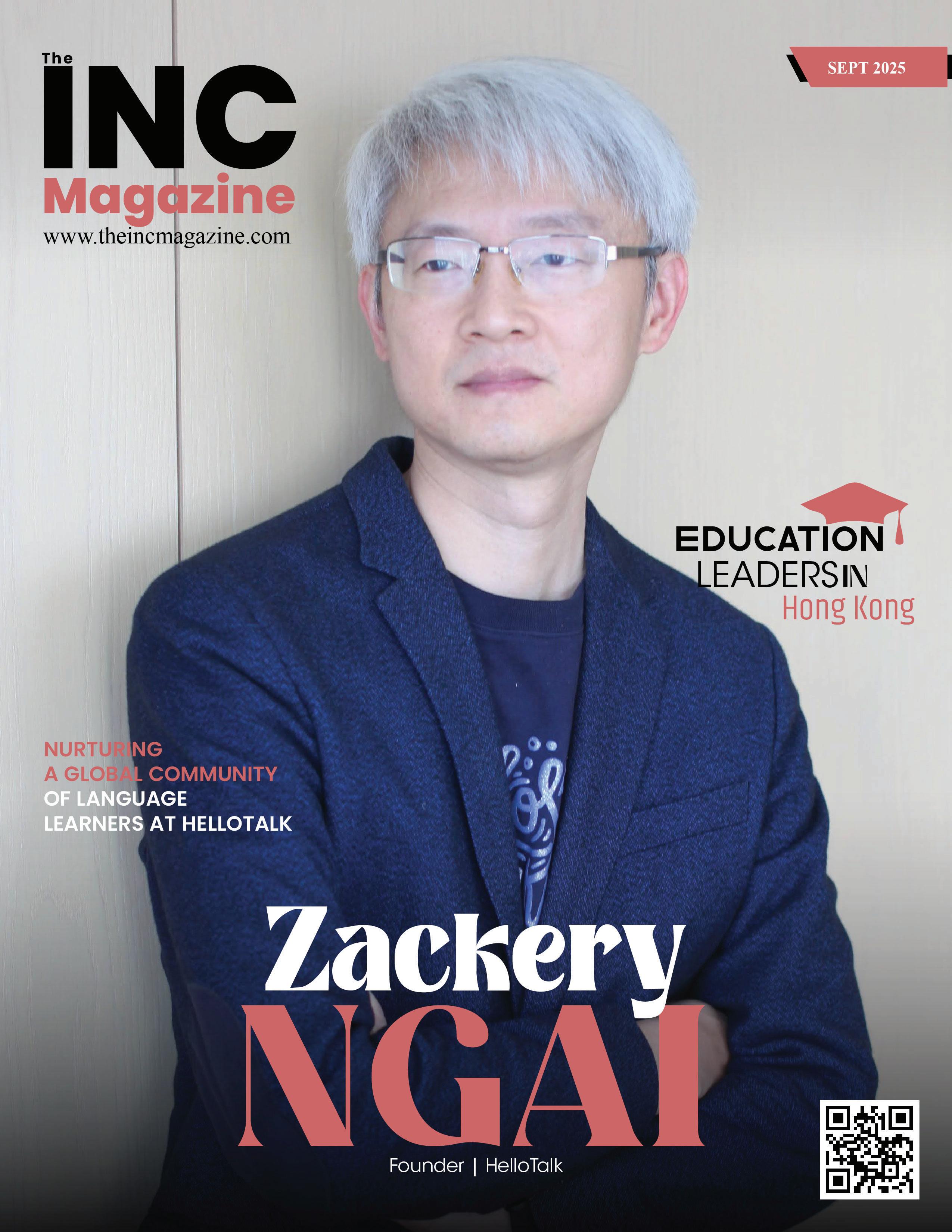


Hong Kong stands as one of Asia’s most dynamic centers for learning, innovation, and academic excellence. In a city where East meets West, education is more than a system; it is a catalyst for global thinking and cultural exchange. As the demands of the modern world evolve, so too does Hong Kong’s education landscape, thanks to visionary leaders who continue to elevate its standards and broaden its horizons.
This special feature, “Education Leaders in Hong Kong,” highlights changemakers shaping the city’s academic future. These individuals are redefining what world-class education looks like — integrating technology, fostering creativity, championing student well-being, and preparing young minds to thrive in a rapidly shifting global environment.
On Cover, we have Zackery Ngai, a visionary entrepreneur and business leader with extensive experience. As the founder of HelloTalk, a pioneering language learning community with a global footprint, Zackery has demonstrated exceptional proficiency and dedication to transforming the way people connect and learn languages. With a career spanning China’s e-commerce sector and a successful tenure as Commercial Manager, Asia Pacific at NDS, Zackery’s journey is a testament to the transformative power of expertise and innovation.
As you explore Zackery’s story, we invite you to also discover our other leadership features and expert articles, thoughtfully curated by our in-house editorial team to keep you informed, inspired, and connected to the world of education and beyond.

Happy Reading ....!

Sapna Ganeshan: Creating a Signicant Difference in Education with Red Comet
The Asian Pioneer in Business Management Education: Asian Institute of Management
How a Next.js Development Agency Can Accelerate Digital Transformation for Businesses
O N T E N T S
Editor-in-Chief
Managing Editor
Publishing Control Team
Visualizer
Art & Design Head
Business Development Manager Co-designer
Business Development Execu�ve Marke�ng Manager
Technical Head
Assistant Technical Head
Digital Marke�ng Manager
Assistanr Digital Marke�ng Manager
Research Analyst
Circula�on Manager
Sonal K. Ehsan Jami Alex, Michael
Mary Chars Anushka Bhosle Shweta Ambilwade
Karen Simons Chirs Philip Maria, Wilson, Mar�na, Alex, Kelvin
Jacob Smile Alina Sege
Jennifer Parker David King
Earl Lewis Scoot Taylor
sales@theincmagazine.com
Copyright © 2025 The Inc Magazine








Just a decade after the Second World War, the Philippine economy was flourishing, and the dream of making the Philippines a progressive nation was turning into reality. With the massive growth of industries, people soon realized the need to develop skilled workers and competent managers in accordance with the highest international standards. So, a group of leading Filipino businessmen, many of whom attended the Harvard Business School, got the idea of establishing a Philippine-based business school, patterned after the pedagogical approach of the Harvard Business School, with a standard of excellence unmatched in all of the Asian continent.
As the idea started to gain momentum, the country’s top three universities soon formed a consortium to create the highest quality graduate business school in all of Asia. Harvard also sent an advisory group to help with the technical expertise in curriculum development, case writing, teaching methodology, and other academic support required by the new business school. On the other hand, Filipino philanthropists and the Ford Foundation provided other resources. Finally, in 1968, the Asian Institute of Management’s Board of Trustees was constituted with Washington SyCip as the first chairman and Stephen H. Fuller, the then Harvard Business School’s Associate Dean for External Affairs, as the first president.
Meet Jikyeong Kang, the Dean, and President of the Asian Institute of Management in Manila, Philippines. Before joining the business school in 2015, she was a professor of Marketing at the Alliance Manchester Business School.
Currently, Jikyeong is the first Asian dean from any Asian business school to chair the international board of the Association to Advance Collegiate Schools of Business in its 106 years of history.
Jikyeong says, “I was born in 1961 and grew up in Seoul. When I was growing up in Korea, it was still very much the “old world” in Asia. Women’s roles were very clear, and there was a more or less perceived notion that certain universities were “prep schools” to find a good husband.”
However, she was independent and headstrong from the beginning, so the idea was very alien to her. At the age of 22, Jikyeong went to America and pursued a master’s degree from Colorado State University and a Ph.D. from the University of Minnesota. She graduated from the Hanyang University in Korea.
Jikyeong explains that it was a challenging journey for an Asian woman, who hails from a different culture, can’t speak the language fluently, and didn’t have a network in Midwestern America during the 1980s.
Having lived most of her adult life away from her home country as a minority has given her an entirely different perspective from what she grew up with.
Established in 1968 by prominent business leaders, Harvard Business School Advisory Group, and Asian academicians, AIM is the Asian pioneer in international management education. The Institute designs its master’s and executive programs to create and develop new managers and entrepreneurs who can lead various Asian businesses and societies. More than 46,000 alumni from almost 80 countries worldwide gained their knowledge from the institute and have made their mark in multiple industries.

When Jikyeong joined AIM in 2015, the Institute had only 2 full-time and 1 part-time degree programs, with less than 200 students. Today the Institute offers 4 full-time and 7 part-time post-graduate degree programs to more than 650 students every academic year.
The full-time program includes courses like: Master in Business Administration, Master in Development Management, Master of Science in Data Science, and PhD in Data Science. On the other hand, part-time programs include Executive MBA, Online MBA, Master in Innovation and Business, Master in Entrepreneurship, Master in Cybersecurity, Master in Financial Technology, and Executive Master in Disaster Risk and Crisis Management.
It is not the strongest of the species that survive, nor the most intelligent, but the one more responsive to change
“ “
Since 2015, AIM has improved its top and bottom line by increasing student admission, streamlining operations, and being reasonable with expenses. Recently, the Institute has renovated all the critical areas of its campus, including classrooms, student dormitory, and other high traffic areas.
The Institute has also upgraded its IT facility to deliver modern learning systems and platforms. Additionally, it has the fastest supercomputer in Philippines in its data science laboratory.
Jikyeong says, “I am most proud of AIM’s latest achievement of being ranked as the 16th top MBA school in Asia in the latest QS global rankings.” She emphasizes that this accomplishment validates all the hard work the entire team puts in every time. She adds, “I am also happy to inform you that our data science program has been ranked in the top 3 in Asia for 4 years running.”
As AIM is not attached to any big University or college, it suffers from an intrinsic disadvantage compared to other graduate schools. AIM is a relatively small autonomous business school that needs to provide world-class service to a much smaller student population.
In order to overcome this disadvantage, AIM will soon introduce its first undergraduate dual degree program, the first of its kind in the country. AIM hopes that the undergraduate program will not only increase its enrollment but will also function as a feeder to the institute’s post-graduate program.

Jikyeong advises young entrepreneurs to be mindful of any disruptions in their industry and strategize while keeping an open mind to learn from other sectors.
She added, “At all times, always keep in mind that your people are your most important assets. Never underestimate the importance of training and upskilling your people. They will largely determine whether your organization will thrive or perish when faced with the most difficult of situations.”


Digital transformation is a steady shift in how teams design, ship, and operate customer experiences. Leaders expect fast feedback, dependable performance, and room to scale without tearing up foundations every quarter. Next.js supports this approach by combining server-side rendering, static generation, and edge delivery in one practical toolkit. The outcome is faster pages, predictable SEO, and an architecture that adapts to product goals instead of forcing rewrites.
Progress depends on process and technology working together. Teams that align roadmaps with accessible design and observability move from ideas to measurable results more smoothly. Next.js makes that easier with features that favor repeatable delivery: predictable rendering paths, flexible data fetching, and deployment models that suit both content-heavy sites and interactive apps.
Deadlines, legacy code, and fragmented tools often slow momentum. An experienced partner unifies discovery, design, and engineering into one plan, then maintains pace through clear delivery rituals. That plan becomes more effective with a specialist involved, so collaborating with a trusted next js development agency helps convert strategy into shipped features while keeping roadmaps intact. The right team brings proven patterns for routing, data fetching, authentication, and deployment, which reduces rework and protects velocity. Effective agencies also translate business goals into technical choices that balance user experience with maintainability. Performance and accessibility are defined up front and wired into CI from the first commit, not treated as late fixes.
Speed is about learning quickly and delivering safely. Next.js supports preview environments for each pull request, so stakeholders review changes in context before release. Feature flags enable controlled rollouts, while incremental static regeneration updates content without full rebuilds. With short feedback loops, teams test hypotheses, measure outcomes, and adjust with confidence, keeping the release train moving without sacrificing stability.
HOW A NEXT.JS DEVELOPMENT AGENCY CAN ACCELERATE DIGITAL TRANSFORMATION FOR BUSINESSES
Rapid iteration essentials:
Use branch previews for stakeholder feedback, then gate risky features behind flags to validate with smaller cohorts.
Track user behavior with privacy-aware analytics, correlate changes with outcomes, and roll back quickly if metrics dip.
Treat accessibility checks, performance budgets, and error monitoring as part of CI, not as a late audit.
With this loop in place, teams avoid long, quiet phases and discover what actually resonates with customers.
User trust comes from clarity and speed. Server-side rendering delivers reliable first paint, while static generation ensures predictable performance for content-heavy pages. Edge rendering can personalize output based on location or preference without slowing the entire site. Together, these patterns improve perceived responsiveness and reduce abandonment.
A thoughtful design system strengthens the effect. Shared components enforce accessibility standards, maintain brand consistency, and expedite new page creation. When agencies set up these systems with clear documentation and storybook coverage, internal teams can build confidently without guessing at patterns. This translates to fewer surprises in QA, shorter review cycles, and a smoother handoff to operations.
Growth should not require a fresh platform every time traffic spikes or the catalog expands. Next.js offers practical answers. Incremental static regeneration updates sections as they change. Route-level ownership lets different squads deploy features independently. Image optimization and caching policies help maintain bandwidth control while preserving image quality. Edge networks add layer of resilience by serving content closer to users, thereby reducing latency during peak periods.
A seasoned partner plans for both steady growth and sudden surges. Capacity testing, queue management for background jobs, and cost-aware architecture reviews prevent late-night emergencies. Clear run books for incidents and failover drills help teams respond quickly when something unexpected occurs.
These scaling strategies align closely with emerging patterns in the industry, as highlighted in The Inc Magazine, where approaches like SSR and component-based architecture are identified as key drivers of performance and growth.
Every transformation initiative is subject to the same risks: unnoticed technical debt, unaddressed security vulnerabilities, and knowledge locked up in a single person’s head. Sustainability-conscious agencies find solutions by using upfront practices and regular maintenance.
Risk reduction checklist:
Define coding and dependency policies, update them on a calendar, and enforce them by automated checks. Adopt observability from day one, utilizing logs, metrics, and traces, and establish alert thresholds aligned with business impact.
Conduct security reviews to include authentication, authorization, and data flow analysis; test backups and restores periodically.
Document architecture decisions, runbooks, and onboarding information so that knowledge is not just retained with individuals, but with the organization as well.
These habits help maintain momentum after launch. Instead of pausing to fix hidden issues, teams focus on new capabilities and higher-value experiments.
Conclusion
Digital transformation succeeds when speed, stability, and user experience work in tandem. Next.js provides a practical foundation for that balance, and a capable partner turns the framework into outcomes by aligning process, architecture, and delivery. With preview-driven collaboration, measured rollouts, accessible design systems, and a focus on long-term maintainability, businesses deliver improvements that customers actually value. The payoff is a site or app that loads quickly, scales gracefully, and evolves without drama, supported by routines that keep progress measurable and continuous.