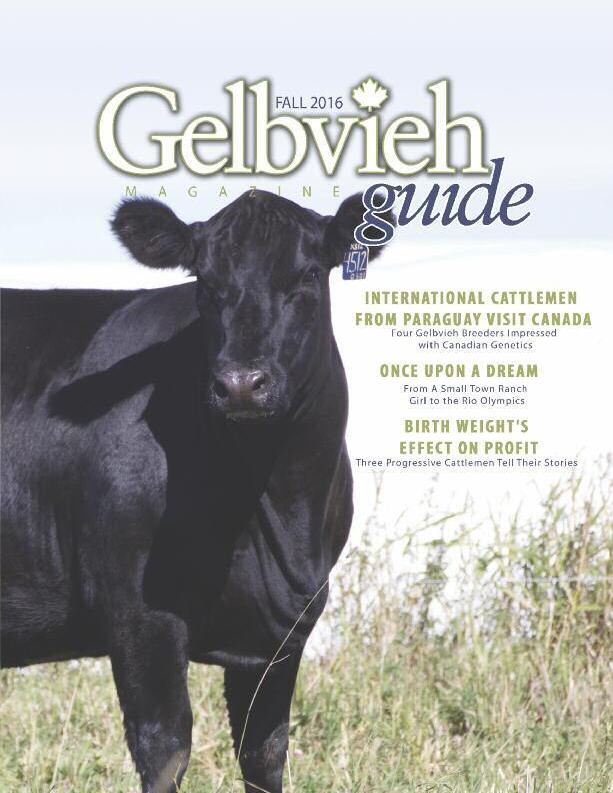
The Gelbvieh Guide magazine is mailed FREE OF CHARGE for five years to purchasers of registered Gelbvieh cattle when the registration certificate is transferred into the purchaser's name Ask the seller of the animal for a registration certificate when you purchase a Gelbvieh animal.
Note, according to the Animal Pedigree Act (Chapter 13, Section 64(j), no person shall sell a purebred animal without providing to the buyer, within six (6) months after the sale, the animal's duly transferred certificate of registration
If you are not a CGA member and wish to continue to receive the GELBVIEH GUIDE or know of someone who should be on our mailing list, please clip out and send in this coupon and remit $20 00 Canadian and send to the Canadian Gelbvieh Association office For out of country subscribers, please fill out the Subscription Form, remit $50 00 Canadian, and send to the Canadian Gelbvieh Association office
Name:
Address:
5160 Skyline Way NE T2E 6V1
(403)
(403)
CGA PRESIDENT’S REPORT Lee Wirgau
TThe CGA Constitution may be amended at any General meeting of the Association by af firmative vote of two-thirds of the members present, but no amendment shall be valid until approved by the Minister of Agriculture of Canada and filed at the Depar tment of Agriculture of Canada
Notice of all proposed amendments shall be signed by two members in good standing and submitted to the Association at least for ty five days in advance of a General Meeting and they shall be included in the Notice calling such meeting, other wise the meeting shall have no power to deal with the same
The Meeting has only power to deal with the Ar ticle and selection as stated in the Notice calling such Meeting
Members wishing to submit amendments to the Constitution ar e r equested to for ward some to the Association in accordance with the above
Please include addressed of mover and seconder
All amendments to the Constitution must reach the Association of fice by October 7, 2016 in order to be included in the Notice of Meeting Copies of the Constitution are available from the CGA of fice on request.
ime once again to present your report for the Guide, Gaylene suggests, and as usual that was ahead of deadline, but here it is.
Point here folks is I know this issue finds everyone busy doing everything to get ready for Fall and Winter Haying, harvesting, weaning and halter breaking show entries, hockey/skating registrations, practice, school activities, etc.etc. and reports that need to be submitted are all issues we deal with at this time of year. I hope the job list is moving forward for your operation and Fall looks rewarding in every way - may your bins bust and your calves pound down the scale
This late Summer and Fall is also busy for your Association and breeders We recently launched our new Gelbvieh branded RFID tags for purebred and commercial breeders to use. We urge commercial cattlemen who have a Gelbvieh bull(s) transferred to them to identify and market their Gelbvieh influenced calves with these "orange" colored back with a "G" icon on them They will be available through the CCIA web store and shipped directly to you. Thanks to the four CGA members who hosted a group of producers from Paraguay who were here looking for A.I. genetics for their operations. We are getting further along the road to a complete fresh new websitewhich if you have suggestions on content for or other information, please let the office know.
We will be having shows in Brandon, Edmonton and finish up the show season with a National Show and National Sale at Agribition in Regina. As usual we will have our Sweetheart Female Futurity, and also host the People’s Choice Gelbvieh Bull Futurity this year at Agribition along with our CGA annual meeting All of this while construction of new facilities happens at Regina I would like to ask those attending these events anywhere this fall that, there may be some plan adjustments needed as we move through all these activities, so do your best as fellow members and breeders to work with those involved to make these events successful We are better together!
Thanks in advance folks and we will see you down the road at some of these great Gelbvieh events!
CGA OFFICE MEMO
Gaylene Groeneveld CEO
The Gelbvieh breed is being recognized more and more throughout Canada and the US As breeders it's our job to keep it there! The greatest enemy to tomorrow ’ s success is today ’ s success. We have Gelbvieh breeders who have been part of the Gelbvieh revolution through the last couple of decades that will assure you that change and progress has certainly been achieved over the years. And we are fortunate to have so many younger breeders coming up; taking over the family farm or those who have come up the ranks through 4-H or the Junior Gelbvieh programs.
We have seen breed changes and pedigree changes that our forefathers never would have thought would exist in Gelbvieh cattle. In the early importation of Gelbvieh cattle to North America, a Gelbvieh animal would have been easily recognized by it's solid gold color Through the years we have, through cross breeding, produced animals that are gold, red, black, grey and some even have blaze faces. Sires and dams chosen by today's breeders are, and will continue to, effect what our industry looks like in the future The Gelbvieh breed has definitely evolved from a 100% Fullblood animal to a very diverse Purebred, Percentage or Balancer® animal; the end result is a tremendous animal that fits the needs of both the purebred and commercial producer. Personally, being involved with Gelbvieh for over a decade, I have witnessed many changes in this great cattle breed and the beef industry in general
It is said that a chain is only as strong as it's weakest link. The commercial producers depend on seed stock producers to use all the tools available to breed the type of cattle that will excel in their operation They expect the seed stock producer to produce cattle that will contribute to economic growth in their commercial herds. They expect to have the guess work taken out of that new herd sire they are going to purchase, and also
expect little to no risk in the traits that are important to them. They seldom worry about investigating the EPD or ratios of a commercial animal upon purchase. They trust the culling has already been done on traits like calf vigour, udder, feet structure and disposition A rancher is most concerned that the new calf be born unassisted, get up on his own and won't have udder problems delaying its first suck. Now is the time to cull the weakest links in the chain and use all the tools available to Gelbvieh breeders to produce the best genetics available for their customers.
In any industry, those who do not constantly improve will be left behind They will have the urge to resist change instead of being a leader in creating change for the breed and more importantly their own breeding program.
Technology in the beef industry is progressing quickly The science of genomics and EPD's are indicators of what the genetic potential of young animals should be to produce more accuracy for many different traits Some producers still doubt the science of DNA or the relevance of genomics and EPD's They are simply 'tools' that we have at our disposal if we choose to use them. We have two main laboratories in Canada that the CGA uses for DNA and genomics testing; Delta Genomics in Edmonton and Quantum Genetics in Saskatoon. We urge Gelbvieh breeders to collect DNA on major herd sires and predominant females in their herds All A I sires, donor females and Wish List, National Sale and People's Choice animals 'MUST BE PARENT VERIFIED' in order to maintain the clean genetic pool that the Gelbvieh breed is noted for
Why Gelbvieh? ...
Because a good bottom line starts with a great cow herd!
REMINDERS...
The CGA Annual Meeting will be held at Agribition in Regina this year. It is our National Show and Sale, combined with the Sweetheart Classic and the People's Choice Bull Futurity The meeting will be held at 3:30 pm on November 24 in the Queensbury Centre. If members have anything they want to be put on the agenda, please contact the CGA office.
On another note, the "Orange Gelbvieh" RFID tags are now available to order online. They are sold in bags of 25 tags and purchasing them is very simple. Just log on to the CCIA website, go to their tag order website, and follow the prompts, or phone 1-877-909-2333 to place your order to set up your web store account. Tag orders are payable by credit card only.
Association News
By Larry Fecho, President, GAA/BC
Quite a difference in just a few months My last update was during the Ft. McMurray fire disaster and the need for moisture for pastures. Today, harvest is put on hold due to wet weather and many are harvesting bits and pieces in between the frequent showers However, pastures certainly rebounded this summer and feed seems to be relatively available, although most has likely had a shower or two.
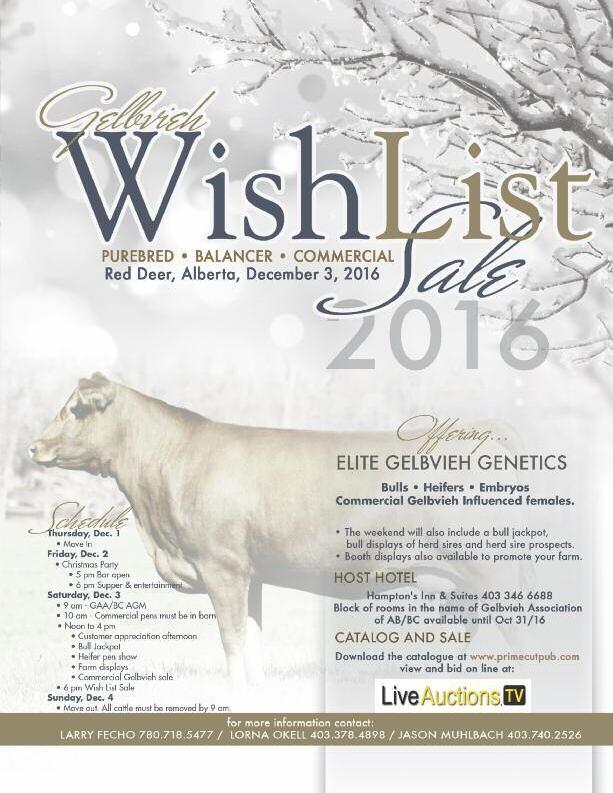
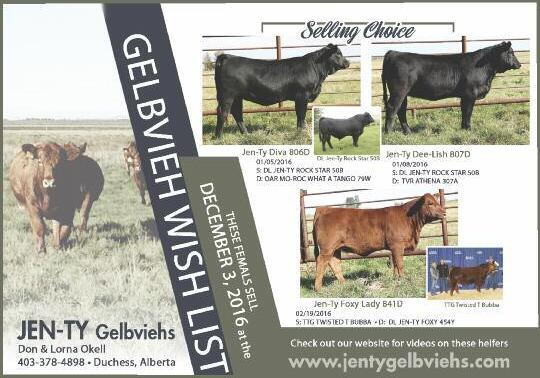
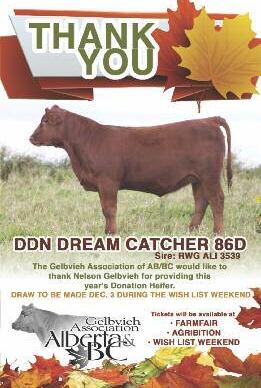
The AB/BC board has been focused on the 2016 Wish List Weekend. At this time, it looks like there will be approximately 40 lots of elite Gelbvieh genetics on offer Bulls, heifers and embryos will be on offer, as well as commercial Gelbvieh influenced females. The weekend will also include a bull jackpot, bull displays of herd sires and herd sire prospects. Spots are also offered if you would like to promote your farm or enterprise with a booth display The whole weekend will be a great Gelbvieh social weekend, with a Christmas Party to start off with on Friday night, including supper and entertainment Should you wish to sponsor or contribute to this weekend, please contact Lorna Okell (403-378-4898) for sponsorships and Joe Ness (403-852-7332) for fundraising auction items. As well, we would very much like to thank Duane and Darrell Nelson of Glenwood, for donating this year ’ s heifer to raise funds for the AB/BC Association. This is greatly appreciated! Further updates and times will be emailed to members as the event approaches, but be sure to block off Dec 2 & 3 for this great Gelbvieh weekend.
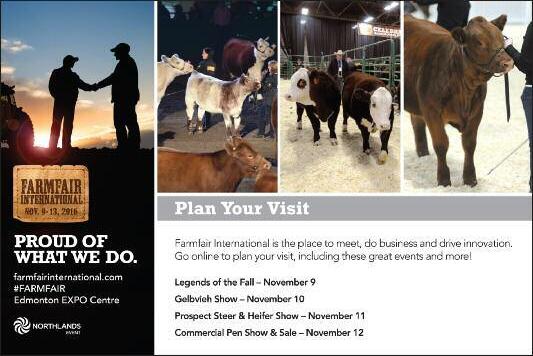
Many are looking forward to the 2016 show season The Farmfair Gelbvieh Show at Northlands will be held on Thursday, Nov 10th at noon. Jordan Buba of Lewis Farms will be the judge Gaylene Groeneveld and Kim Matthews will be the very capable ring matrons. Come
on out, hopefully we will catch many Gelbvieh enthusiasts at this event.
We will also be starting on the Gelbvieh Good News flyer This will be a newspaper format, likely only 2 pages at this time, produced of news print so as a great number of copies can be printed and distributed at a reasonable cost. These can then added along in other cattle publications, or distributed where ever gatherings of cattleman happen such as auction markets The stories and pictures will be of commercial herds who have used Gelbvieh in their bull battery or for their females The stories will highlight why some producers are sold on using Gelbvieh genetics and the benefits of using Gelbvieh genetics. We have some stories already, however, if you know of an operation that is excited about what the Gelbvieh influence does in their herd, please pass on the contact information to Gaylene at the Canadian Association office
For this year, the market on calves has started out softer, however, the whole world wide commodity trade seems to be off as well…it’s not just the cattle producers. I just wished my insurance companies, internet, utilities and phone companies, etc , would get on board as well However, we will continue on, doing our best and get through the down turn like l said to a friend the other day, “Well, prices are half of where we were a couple of years ago….but twice as much as they were 10 years ago. ” We’ll see how the fall run continues, how prices for commercial and purebred cattle are and keep hoping for the best
Should you have any questions, thoughts or ideas on how the AB/BC board can be more effective, please don’t hesitate to contact myself or any of the board members
Stay safe and enjoy the Fall!
2016 Gelbvieh Feeder Calf Sales
Wednesday, OcT. 26, 2016
Pre-sOrT Gelbvieh crOss calf sale
Medicine Hat Feeding Company, Medicine Hat, AB
To book calves or for further information on purchasing calves call 403-526-3129 OR 403-502-6417 Website: mhfc.ca
Thursday, OcTOber 27, 2016 9:30 am
Pre-sOrT Gelbvieh crOss saTelliTe calf sale
Heartland Livestock Yards, Swift Current, SK
To book calves or for further information on purchasing calves call Lee Crowley 306-773-3174
As I write this report, children are going back to school. Where did the summer go? As harvest comes to an end, we prepare for the fall show and sale season. It is great to reunite with one another, and see what fellow breeders have to offer.
We would like to thank Overby Stock Farms for hosting the Man/Sask Gelbvieh Association field day Cattle tours, guest speaker and supper was enjoyed by all that travelled from Saskatchewan and across Manitoba. If anyone is interested in hosting the field day next year, please get in touch with any board member.
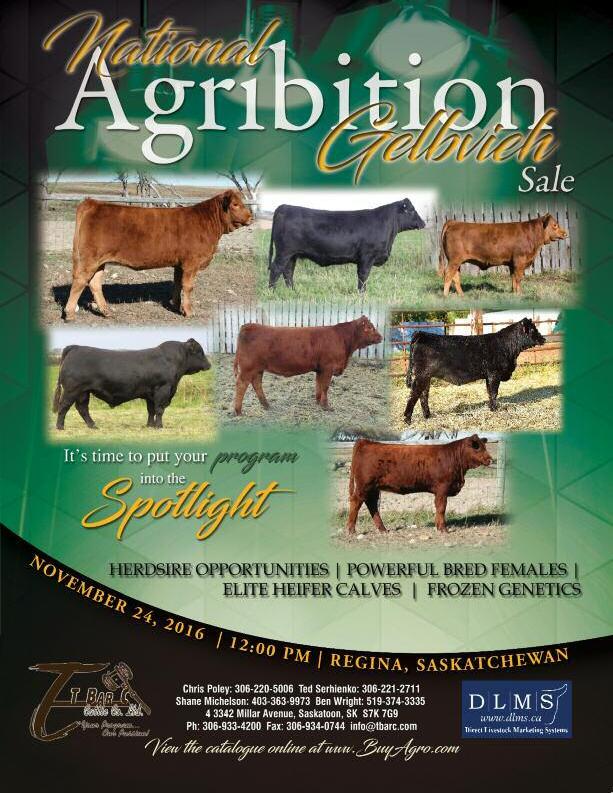
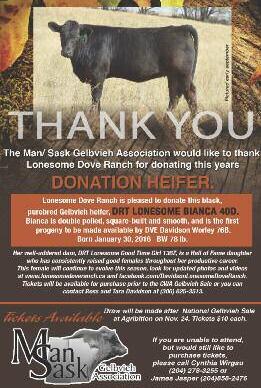
Agribition will be hosting the National Gelbvieh Show & Sale The Gelbvieh Sweetheart Classic will follow the Bull classes The National Junior show will also be held after the open show This year the Canadian Gelbvieh Bull Futurity and Canadian AGM will also be held at Agribition. The AGM will he held on November 24 at 3:30 pm in the Queensbury Centre. This years donation heifer will come from Lonesome
Association News
By Cynthia Wirgau
Dove Ranch Thank you Ross, Tara & Family Tickets will be auctioned off at the National Gelbvieh sale.
Ag-Ex will be held in Brandon on October 25-29. Gelbvieh will have an open & junior show. Over 600 head are expected for the cattle shows. Ag-Ex has added some new attractions this year. The Provincial Ex has teamed up with the Manitoba Rodeo Cowboy Association to host the Manitoba Rodeo Finals, Manitoba 50/50 Superhorse Futurity and Sale, NAERIC Barrels of Cash Sale & Futurity, Hagan Performance & Ranch Horse Sale and the Fall Classic Ranch Sorting. For more information go to http://manitobaagex.com.
If anyone is interested in sponsoring prizes or volunteering at Ag-Ex or Agribition, please contact (Sec/Treas) Cynthia Wirgau maplegrove@xplornet com (204) 278-3255 or (Pres) Ian Thackeray (306) 861-7687 or any board member
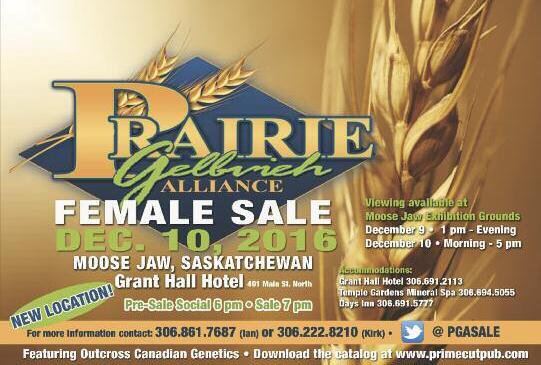
Our annual meeting and fun auction will be held in Moose Jaw, Saskatchewan on December 10, 2016.
Looking forward to seeing you all this fall!
canadian Western agribition
The Sweetheart Gelbvieh Classic is open to any age of Gelbvieh female entered in the regular Canadian Western Agribition Gelbvieh Show that is a minimum of 3/4 Gelbvieh There will be one class with the top 4 females final Futurity members may enter their females by contacting Cynthia or Trevor Entries must be made by noon Nov 20th Entry fee is $100 per head Each member will receive a token
Memberships to the futurity is $300 00 which entitles the member to judge (one ballot) the Sweetheart Classic No proxy judging Members will also be entered into a draw to win the proceeds from the sale of the Sweetheart Classic Champion or the Futurity, which ever is lesser 50% of this prize will be given as cash and the remaining 50% will be a sale credit The sale credit can be used at the 2016 Agribition Sale
The Peoples Choice judging the Sweetheart Gelbvieh Classic will take place immediately following the Gelbvieh bull show The Female Gelbvieh show will commence upon the completion of this portion of the Futurity At the end of the Gelbvieh show, the four finalists will be announced in random order The following day at the Gelbvieh Sale, the 4 finalists will be judged during the pre-sale reception The Sweetheart Gelbvieh Classic Champion will be announced and auctioned as the feature lot
The exhibiting member of the Sweetheart Gelbvieh Classic will receive 79% of the heifer sale proceeds or the futurity pot, which ever is greater The three runner-ups will each receive 7% The exhibitor of the Sweetheart Classic Champion retains the right to one flush or six No 1 eggs, which ever is greater, from the female at the new owners convenience and the exhibitors expense neW*** The 2nd place Sweetheart winner will receive a $500 Agribition 2016 Sale voucher neW*** can’t be at agribition? vOTe On line!!
For more info contact: Cynthia Wirgau (204)278-3255 or Trevor Burks (306) 715-7476 prior to November 10, 2016
Would like to be a part of The Sweetheart Gelbvieh Classic address
enclosed is my $300 00 membership fee as a member would like to nominate the following females at $100 00 per animal membership musT be paid prior to agribition as a member would like to nominate the following females at $100 per animal.
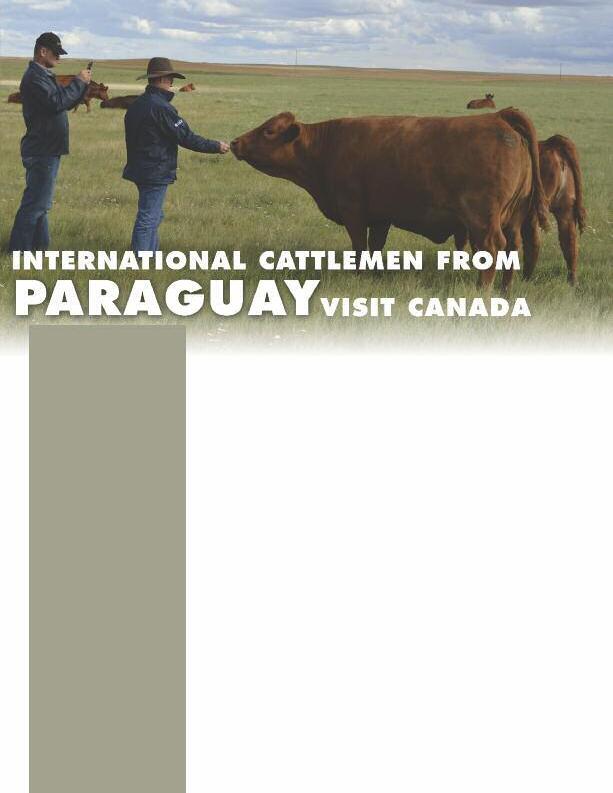
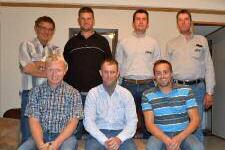
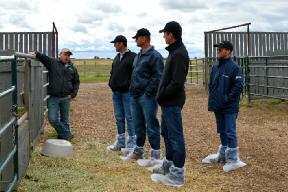
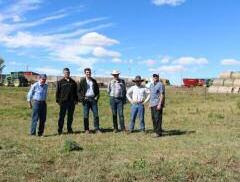
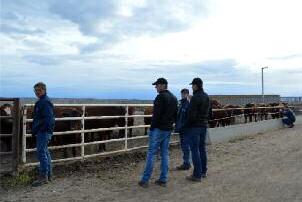
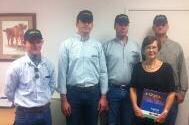
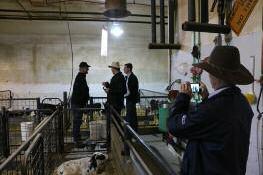
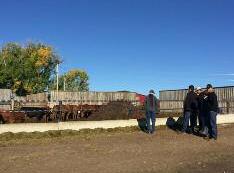
On September 8, four Gelbvieh breeders visited Gelbvieh operations for a week in southern Alberta They were interested in purchasing Canadian Gelbvieh genetics for their ranches in Paraguay. They are pictured presenting Gaylene Groeneveld, CEO of the Canadian Gelbvieh Association, with gifts from their country. During their visit they also toured Bow Valley Genetics, a Hutterite Colony, Western Feedlots and the town of Banff. Their mission was very successful and they were extremely impresses with the quality of Canadian Gelbvieh cattle A special thanks goes out to the ranchers who hosted them - Twin Bridge Farms, Carlson Cattle Company, Royal Western Gelbvieh and Severtson Land & Cattle
TWIN BRIDGE FARM
On September 8th we were fortunate enough to tour four members of the Estancia Potsma in Paraguay Their day began with a visit to the Canadian Gelbvieh Association office in Calgary We then accompanied them on a tour of the Bow Valley Genetics facility at Duchess, Alberta, to learn about the Canadian standards for semen and embryo collection. The tour included the lab area and bull stud, as well as conversations with staff around the protocols and procedures for semen collection. A big thanks to the staff at Bow Valley for sharing their time and expertise!
Bison burgers for lunch made for a new dining experience in Brooks before we began touring our herd It was clear the breeders had a very specific type of animal they admired most Bloodlines that were slicker haired were most sought after in order to meet the hot environment conditions in Paraguay. An animal with a moderate frame size with stout body design was most desirable. Interestingly, EPD's are not a considerable selection tool for the South American markets.
The dry conditions in Paraguay, like southern Alberta, require cattlemen to be resourceful in effectively utilizing water We showed them the irrigation canals and reservoirs in our area and also inspected pivots and wheel lines Following this we visited a local feedlot where they were both surprised and impressed to see cattle finished at weights required in Canadian markets. In Paraguay, beef is grass fed before slaughter at approximately 2 years of age. They were not familiar with cattle carrying the level of condition desired in Canadian beef
We finished the day with a me and a bit of socializing We tho oughly enjoyed touring Eval Willie, Rudy and Ronald aroun and getting to know them and a b about beef production in Paraguay
The Crew at Twin Bridge Far ms
Willie and Evald getting to know the Twin Bridge Donor cow FLAD Fladeland Lexxus 128X
Ron Birch, Willie, Ronald, Rudy, Aaron Birch, Evald, Joe Barnett
CARLSON CATTLE COMPANY
September 9 was a beautiful Friday morning when four gen men from Paraguay (Rudy, Willy, Avald and Ronald) arrived to at cattle. We (Lorraine, Albert, Lon and the group) started by ing at the freshly weaned calves in the corral and then moved the herd sires and a few cows we had here at the acreage.
During the walk we learned they work in a coop, which called a Colony, of more than a 1000 people They run over 25 head of cows on 800,000 acres of land Plus, they have a wid of other industries such as dairies, hog barns, slaughter plan and raise a variety of other crops. As it turns out they have a background to our Hutterite colonies here, both are of Germa and have a very similar history.
Once we learned this, we decided to take a tour to visit Hutterite colony on the way to the ranch This turned out to g idea as the group was able to converse in German with members of the colon while we toured the dairy and layer barns. Two of the Hutterites agreed to join us on the ride to the ranch. This proved to be beneficial, as colony member translated for us and we were able ask questions and converse with our Paraguay guests along the way.
We drove through the cow herd at the ranch discussing which type of cattle they were interested in and what type worked in their country After the tour we headed back to our place for a late lunch and a brief visit and an walk through of the herd sires. They seemed very interested in a c of sires and semen we have in storage. All in all we had a great da a good visit.
t Carlson
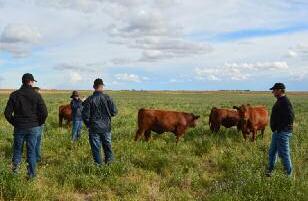
Checking out the Twin Bridge bull calf pasture
Carlson Ranch with guests
Visiting a Hutterite dairy calf barn
Daryl Leppa, Sire Manager at Bow Valley touring us through the bulls
Feedlot tour at Helland Land & Cattle
Congratulations canadian Gelbvieh Winners!!!
Kayley Paskell and erin Gavelin
Kayley Paskell
My involvement in the Gelbvieh Breed
For the past three years I have been a proud representative of the Gelbvieh breed In 2012 my parents purchased two Gelbvieh bulls in hopes of increasing the size of our Angus calves. It was clear to see that their plan had worked. In the spring of 2013 we had our first group of Angus/Gelbvieh crossed calves and amongst the group were some definite 4-H prospect steers.
The last three years of my 4-H career I have been able to represent the Gelbvieh breed with three Gelbvieh crossed steers. When I joined my 4-H club in Jordan River, SK, in 2013, I was the only member to have a Gelbvieh animal and I still am today Our Regional 4-H Show and Sale is in Melfort, SK, and for the past two summers I have been the only representative of the Gelbvieh breed The steers I have raised over the past few years have been some of the best I have had throughout my ten years as a 4-H member and I have the Gelbvieh breed to thank for that
I am a very proud Gelbvieh breed enthusiast. My parents have purchased four Gelbvieh herd sires and are very pleased with their offspring It is not hard to see that the Gelbvieh sires have brought a lot of success to our farm and my own personal 4-H career. I have enjoyed watching the transformation of calves over the years from increased birth weights to larger framed and heavier yearling calves I may only have a few years of the Gelbvieh breed experience under my belt but I am excited to see what the future will bring!
erin Gavelin
Since I was young, I have known about the cattle breed known as Gelbvieh. As a small town Saskatchewan girl, I was first introduced to the breed when I was brought home from the hospital. My parents ran a Purebred Gelbvieh operation of two hundred cattle and have since then slowly switched to running a Commercial Gelbvieh/Angus operation
From the time I was six years old, I have been involved in 4-H with a beef project with my local club in Mankota, Saskatchewan. Throughout my years in 4-H I have always shown cattle – ranging from steers, heifers, and cow-calf pairs – all were at least half Gelbvieh I have always been proud of walking into the ring on the halter of a Gelbvieh animal with the honor of showing off the breed I have come to love
While showing cattle, I had the privilege of exhibiting a purebred Gelbvieh cow that taught me not only about the breed but about life skills as well I first started showing this cow, whom I called Alice, when I was eight years old. Throughout the next four years I continued to show her and was lucky enough to win the Overall Futurity Project at Swift Current Frontier Days By winning this, I received a $250 scholarship that will be put towards my education this fall.
My family has been able to use the showing of our female cattle as a way to market our commercial and purebred female program By marketing females to repeat purebred and commercial customers we have been able to expand our herd genetics and make a name in the cattle world. Fortunately we have enjoyed much success in the Gelbvieh business throughout the years.
By showing cattle and living on a farm, I have learned what a strong work ethic is. I know this will help carry me throughout my future career My involvement in the breed has also allowed me to meet many
new people I think it has also taught me new tricks that I may not have had the chance to learn otherwise.
Through showing Alice and other Gelbvieh cattle I have learned valuable life skills such as patience, how to manage stress, compassion, responsibility and many other things. I have been able to take these skills out of the show ring and off the farm They have definitely helped me with my current job as a camp counsellor for people with physical and cognitive disabilities.
The Gelbvieh breed has taught me many things that I know I will proudly carry with me throughout the rest of my life even if I veer away from the cattle world
My career goal is to complete a degree in Social Work which I will use to enter Family Counselling. I hope to specialize in working with families that have people with disabilities The type of disability is not a limiting factor, as I do not mind if they were born with the disability or if they have acquired them sometime throughout their life. I hope to help families learn how to cope with not only having someone in their family with a disability, but helping the one with the disability to be able to help their family learn how to help them.
Though I do not live with someone who has a disability or have one myself, I did work alongside many people with varying types of disabilities throughout the summer during my job as a camp counsellor with Camp Easter Seal at Manitou Beach, Saskatchewan This job showed me having a disability is not life ending; you just do things differently and your family will need to learn to do things differently
By working with families that have people with disabilities, I hope to help them learn how to cope and see that it is not the end of the world A disabled person is still the same person, they just need time to adjust to a new way of living.
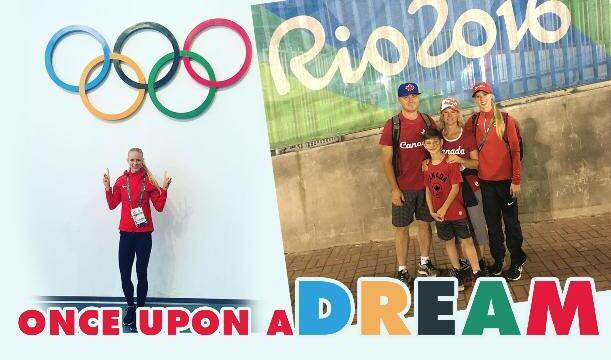
Growing up in Southern Alberta on a cattle ranch, Sage Watson dreamed of becoming an Olympic athlete. Like most kids growing up on a ranch your days are filled with animal husbandry, checking cattle, treating cattle, moving animals and growing feed for your cattle. Sage’s parents Jolene and Wade Watson both came from rural roots raised purebred Gelbvieh and Red Angus cattle Sage was an active member in 4H and the Junior Gelbvieh Association. She excelled in 4H both showing cattle and public speaking, but you could tell it was not her passion Once a year Sage’s parents would pack up the family and travel to the Alberta Summer Games for Sage to compete in Track and Field events Sage loved long jump, high jump and the 400m sprint events. She lit up like a Christmas tree when she got to attend those track meets and she would spend the rest of the year dreaming of what the next track meet would bring
Years passed and so did her dedication on the track and training. She once again excelled but this time is was different; this time it was her passion She started out not even winning a single ribbon at her first track meet and ended up becoming a 2016 Olympic Athlete in the 400m Hurdles and 4x400m Relay Team. She had many steps and challenges along the way She made her first Team Canada as a 17 year old and travelled to Paris where she competed in a small town, Lille, France, in the 2011 Youth Championships. That year she made the Podium with a bronze medal performance in the 4x400M Relay for Team Canada From that year on she made team Canada every year not an easy feat, ask any athlete.
2012 was World Juniors for 18 year-olds in Barcelona That year she also signed a full ride scholarship to attend Florida State University Sage returned the summer of 2013 and qualified for team Canada again. She was honored to be team captain and brought home three medals from Columbia; Gold in the 400m Hurdles, Bronze in the 400m Sprint and Silver in the 4x400m Relay.
Like many great athletes training can take a toll on the body and at the start of the 2014 season Sage’s MRI showed she had a stress fracture in her foot There is a fine line between training to be the best and injuries. Sage was forced to sit out the entire 2014 season I imagine a great amount of time and tears were put into “ once upon a dream” The Road to Rio was fast approaching She was sitting on the sidelines watching others getting faster and going to her track meets winning medals To top off a horrible athletic year her Florida State track and field coach was released Now she had to find a new University, a new coach and start all over a year before her biggest opportunity on the world stage in Brazil. Situations like this can either break or make an athlete and in Sage’s case it made her stronger.
She signed with the University of Arizona in Tucson with a world class hurdle coach and was accepted into the prestigious business school She grew stronger and faster than she had ever been In 2015 she made Team Canada for the Pan American games held in Toronto She medalling once again in the 4X400m Relay She made a second Team Canada that summer, and competed in the World Track and Field Championships in Beijing, China She compete in the 400m Hurdles and made the finals in the 4X400m Relay.
2016 was here! She stood on the largest stage of her life in Rio De Janeiro, Brazil, as a participant in the 2016 Summer Olympics. She represented Canada in the 400m Hurdles and ran anchor in the 4x400m Relay Team and finished in fourth place That little blonde ponytail girl who showed her Gelbvieh cattle in Medicine Hat, Alberta, was now Canada’s shining track and field star Her “ once upon a dream” became reality through her dedication and work both on and off the track
Sage still has a handful of Gelbvieh cattle at the home ranch in Medicine Hat and returns home every Christmas for the Medicine Hat Pen show to support the family business - Watson Cattle.
We have not heard the last of Sage Watson as I am sure she will not be satisfied until she brings home a medal from the Olympics in 2020 in Tokyo, Japan She has a long journey between now and then and I am sure she will fill it with travel adventures to different countries.
One of the most rewarding and perhaps the most frustrating things about breeding beef cattle is dealing with the legal code of inheritance There are some basic rules about how genes are passed on that complicate cattle breeding. We often deal with the impact of these laws, without really thinking through what the cause and effect is to our breeding operation.
The first “law ” as described by Mendel is the law of segregation This basically means that a parent only passes on ½ of it’s genes to an offspring This makes some obvious sense In rough terms, every cow contains 60 chromosomes arranged in 30 pairs. If a calf gets more of less than 60 chromosomes there are major problems.
The second law is the law of independent assortment. In essence this means that DNA is sorted uniquely each time an animal produces an egg or sperm and we don’t have any good way of knowing which ½ of each parent’s DNA is going to be passed on their offspring. This law really confounds cattle breeding and cattle breeders.
A good example of how the law of independent assortment can create issues are cases where an animal has EPD or exhibits traits that are beyond the average of limit of either parent For example, if we took a Sire with a BW EPD of +2 0 and a Dam with a BW EPD of +2.0 and mated them we would expect a calf with a BW EPD of +2.0, the average of its’ parents. If birthweight were controlled by a single gene then the following example could apply.
genes interacting in a variety of ways, but it does serve the purpose to illustrate that in cattle breeding we don’t always get the “ average ” of the parents and in many cases may fall short or exceed the parental average. We all know children who tower over their parents, but on average cattle are an average of their parent stock.
So how do we combat these laws to make progress in breeding beef cattle? The simple answer is that we have learned over time how to track pedigrees and measure and record phenotypes to help identify the genes that are present in our cattle. In addition we can now use DNA testing to directly identify portions of the genetic code that are contained by the animal to better determine which genes they may carry. All of these results can be incorporated into mathematical models that help to clarify the genes contained by a single animal in the form of an EPD for a specific trait These tools help us find the above average animals that can stack genes in our favour.
DAM
B (Big Birthweight)
b (light Birthweight)
B (Big Birthweight)
BB (Heavy)
Bb (Average)
SIRE
b (light Birthweight)
Bb (Average)
Bb (Light)
In this example the sire has an average birthweight, but has both light and heavy birthweight genes. The dam also has both light and heavy birthweight genes. Their potential offspring however has a chance of receiving 2 heavy birthweight genes, or 2 light birthweight genes; or receiving a combination of light and heavy genes resulting in an average birthweight This is an extremely oversimplified example, as we know that most traits (including birthweight) are controlled by multiple
As we measure more information, the accuracy increases on the EPD and we develop a refined picture of the genes the animal is carrying. In other words, we have reduced the incidence of random assortment by accurate identification of genetic merit For example, if we have a calf that greatly exceeds the parents performance for a specific trait, we then know that the parents must carry at least some favourable genes for the trait in question. Even with highly accurate EPD, this does not mean that there are no surprises. A living, breathing animal is influenced by thousands of genes interacting with the environment and each other Even with highly accurate EPD the mating of any two animals is still a bit of a roll of the dice. We can’t guarantee which genes will find their way into the offspring from each parent. The difference is that we can use information to stack the genes and make it more like rolling a loaded dice
These laws of inheritance are useful to remember the next time you have a calf that exceeds your expectations, or possibly falls short. Consistently measuring and recording data and now looking directly at an animal’s DNA can help us to load the genetic dice and make the laws of inheritance work in our favour
With the advent of the reliable pour-on and injectable endectocides , which are on the market, today scratching from lice or mange is a very rare occurrence unless a fall treatment was not done As a veterinarian we are sometimes called on to investigate apparent breaks in these products efficacy I know we have observed a lot about cattle’s scratching behavior, which we never knew before since lice or mange were always blamed in the past.
A visual observation over the fence is not enough for hair loss. We examine several affected animals and usually clip an area surrounding the worst affected areas Careful visualiza-
tion by the naked eye or with a magnifying glass can detect some external parasites if they are present. Deeper skin scrapings can be done as well because we don’t want to miss any mange mites if they are present Failures are rare but if they do occur usually either biting lice (Damalina Bovis spp ) or chorioptic mange are the culprits Why this occurs is both these external parasites are surface feeders and move around a lot so control may not be quite 100 percent. Also transmission is quicker so new introductions can easily spread it around. A common question asked is when and how long ago new introductions happened and whether or not they had
been previously treated. This together with proper dosage and administration based on accurate body weights are extremely important. Guns for applying endectocides now disperse the product more accurately over the back.
Other causes of scratching are varied in the herds we see during these investigations Ringworm commonly seen around the eyes and head if severe enough will cause irritation and scratching especially in young cattle. One has to look closely if in other locations to visualize the circular lesions. One treatment for ringworm will usually get them on the road to recovery.
Bale processors and other grinders do a great job chopping and dispersing feed but the only negative is a lot of dust and/or debris ends up in the hair. In warmer weather with sweating this scurf and debris can cause intense itchiness in certain locations. Once cattle start rubbing soreness and bleeding occur adding to the problem. A lot of these itching episodes will often follow unseasonably warm periods in the winter after cattle have haired up Free living mites in grain or on bedding also cause cattle to itch
Certain individual or genetic strains may be allergic to certain feeds or molds present. Allergic reactions will vary in severity but many will cause reddening of the skin and swelling associated with itchiness. Here the allergen must be removed before recovery can happen
Nutritionally the skin must be healthy otherwise itching, as a result of deficiencies may be a possibility Trace minerals
should always be fed as part of the overall nutritional package. Important ones in skin health are zinc, copper and vitamins especially vitamin A. Unhealthy skin also allows various bacteria to take hold. These infections can be intensely itchy and spread locally
Show cattle if washed must be thoroughly rinsed otherwise the residual soaps can cause irritation or allergic reactions
Some rubbing and licking is part of cattle’s natural grooming process. It is only when this occurs in excess where hair loss and damage occurs to the skin should we be concerned and investigate.
Constant irritation regardless of the cause can result in weight loss and a predisposition to other diseases Cattle will decrease feed consumption and anemia can result from the blood loss especially if sucking lice are involved. Hair loss removes cattle’s insulative coat. In deep freeze weather this is stressful and it then requires more energy to keep warm.
By routinely using an endectocide or other lice treatment most parasitic causes of scratching will be minimized If scratching continues have the problem fully diagnosed so preventative measures can be taken to eliminate the problem. This may involve close examination, a skin scraping, or even a skin biopsy. Health of your cattle is reflected in healthy skin and a shiny hair coat.
NEWS & NOTES
On June 10th at the Lundar 4-H Interclub show, Riley Wir gau with his Gelbvieh cross steer won the Interclub R eser ve Champion Steer Riley also won the Interclub Champion Female with MGF Cover girl 6C and Interclub Inter mediate Champion Showperson.
Keriness Cattle Company won the R eser ve Grand Champion All Breeds Bull award at the IPE in Ar mstrong, B C with KCC 105D. The calf is sired by Lonesome Stetson 60A and is out of a TVR Ultrasonic daughter Congratulations Ker t and Joe
NEWS & NOTES
The R enke kids had a great 4-H show this summer. At the Medicine Hat, Alber ta, 4-H show, Justina was Club Champion and Showmanship Champion. Her brother R ussell was Reserve Club Champion and R eser ve Showman. Their brother Clayton was
lined up right beside them finishing 3rd for quality. All 3 kids chose steers from their own herds and all were sired by a Gelbvieh bull.
Congratulations to Matthew King of King R anch Gelbvieh and his Grand Champion Heifer HDG 16C Hillsdown Cassandra! Cassandra won in the Delbur ne 4H beef show during A chievement Days in Red Deer and placed 3rd in the Inter Club Show. Matthew and Cassandra also par ticipated in numerous local beef shows this summer where they both had a lot of fun, learned a lot and came home with a few ribbons too.
MANAGEMENT
Birth Weight’s Effect on Profit –Part 1
Candace By
I have been asked by the Canadian Beef Breeds Council to develop this article focusing on birth weights.
I hope you find this panel discussion informative and thought provoking.
Kevin Woods, Westwood Land & Cattle, Moosomin, SK
We run around 1650 Black Angus and Black Angus Simmental cross cows bred Charolais for terminal cross and Black Simmental or Black Angus for replacements.
Adam Doenz, Doenz Farms, Warner, AB
The Doenz family operation runs 250 straight Hereford cows in a strictly commercial operation. They background their calves every year and either grass them or sell them in the spring, depending on the grass situation.
Andy Hofer, Spring Creek Colony, Walsh, AB
We run around 1000 commercial cows. They are predominantly Simmental and Angus cows. We use Red and Black Angus bulls and Red Simmental and Fullblood Simmental bulls and we raise our own replacements.
Why do you think some producers are selecting for smaller than average birth weights?
It must have to do with what they call calving ease, that could be the only reason people would be selecting for lighter birth weights. It isn’t really my idea, but that is what I hear. From the olden days people were scared of some breeds with bigger than average birth weights and maybe it still haunts them a bit.
How does continued selection for smaller birth weight effect performance? (short term and long term)
Calving ease is their concern. I don’t think people are having problems but labour is an issue and if you can ensure that calving will go well by selecting the right bulls, it is an important thing to do.
It negatively affects performance. Everybody starts chasing smaller birth weight and you breed lower performance into everything. It’s one thing in a heifer or where you are not retaining females, but if you are retaining the females as well, I think you are negatively affecting positive performance at the end of the day.
Smaller birth weight selection will give you smaller weaning weights in the fall and the size of your cowherd will get smaller over time unless you have a lot of growth from the lighter calf. A smaller calf in the fall is less profit. In the end your profit comes from the pounds of beef you have to market.
There are less producers out there raising more cows with less help and people are looking for calving ease.
I think a smaller calf at birth is going to be a smaller calf at weaning. I don’t think smaller cattle convert feed as well.
Birth Weight’s Effect on Profit –Part 1
What effect does continued selection for lower birth weight have on a cowherd?
If you continue to bring the numbers down, it is going to bring the performance of the cow herd down and have a negative effect on the herd.
How does the structure/shape of the calf/sire effect calving ease?
The size of the cowherd will shrink over time unless the calves have the ability to gain ground and match weaning weights of larger calves.
Structure still has a lot to do with calving ease. The smoother they are, the easier they calve. You can chase some pretty big birth weights if they are built right and not have problems. The longer and smoother they are, the bigger the birth weight you can chase and still get them out without problems. Bulls that are built wrong can have 80 lb. birth weights and at the end of the day, give you a lot of calving problems. They can’t have a huge square head and rough broad front shoulders.
As many cattlemen do not weigh their females, some seem to believe their cows are 1200-1400 pounds. Is this a misconception?
I think if you keep getting smaller, your cows are going to get smaller pelvic areas and soon you won’t be able to calve even a normal sized calf.
The structure is more important than the birth weight. The bull has to show a neat front end, as opposed to wide, blockier shoulders.
I don’t think most commercial men have the ability to weigh their females on an individual basis so other than their cull weights, they really don’t know. Our cows are predominantly Angus and Angus cross so they aren’t going to be as big as some more exotic crossed herds. We average around 1450-1500 lb.
Here is my analogy, a 50 lb. salt block or a 100 lb. snake, which one is going to come out easier? I have seen 100 lb. calves out of heifers and they have never been touched and I’ve had some 80 lb. calves with some real issues. Structure is very important.
It is definitely a misconception. Before doing this interview, I would have told you our cows were 1350 lb. But I went back and checked the weights on the cows we have culled over the past few years and our average cow is 1500 lb.
I think it is a huge misconception. I believe 1200 lb. cows will produce smaller framed calves. We weigh every cow and calf at weaning and 90% of our calves are weighed at birth, that is the only way you can know what percentage of body weight is weaned off. I like a 1400-1600 lb. cow that is built right. If they look like a piece of plywood, it doesn’t matter what they weigh, they shouldn’t be cows.
MANAGEMENT
Birth Weight’s Effect on Profit –Part 1
Birth Weight’s Effect on Profit –Part 1
What percentage of producers weigh their calves and accurately know their birth weights?
Candace By
I have been asked by the Canadian Beef Breeds Council to develop this article focusing on birth weights. I hope you find this panel discussion informative and thought provoking.
Other than purebred breeders, I don’t think anybody weighs their calves. When you calve out in the field, I just don’t think it happens. If you are a small producers or calve in winter months they may weigh.
Kevin Woods, Westwood Land & Cattle, Moosomin, SK
We run around 1650 Black Angus and Black Angus Simmental cross cows bred Charolais for terminal cross and Black Simmental or Black Angus for replacements.
I don’t think any commercial breeders weigh their calves, the purebred guys would be the only ones.
Adam Doenz, Doenz Farms, Warner, AB
The Doenz family operation runs 250 straight Hereford cows in a strictly commercial operation. They background their calves every year and either grass them or sell them in the spring, depending on the grass situation.
I would be surprised if 5% weigh their calves, I don’t think it would be very many.Until they start weighing their own calves, they have no idea what birth weight they should be looking for in a bull.
Andy Hofer, Spring Creek Colony, Walsh, AB
We run around 1000 commercial cows. They are predominantly Simmental and Angus cows. We use Red and Black Angus bulls and Red Simmental and Fullblood Simmental bulls and we raise our own replacements.
Why do you think some producers are selecting for smaller than average birth weights?
To be efficient, a cow should be able to calve 7% of her body weight.On a 1400 lb. cow, that is 98 lb., on a 1600 lb. cow, that is 112 lb. To what degree, do you feel producers are robbing themselves of profit by selecting too low of birth weight?
Probably I think everybody errs on the side of caution when it comes to birth weight, especially if you have a bad experience once. So many people in my area have gone to more cow numbers and less management and calve on grass. It is hard to manage your cows within a herd to accommodate the variance in cow size. To try to maximize the cows’ potential, they have to be sorted into frame score groups and bulls matched accordingly in pastures. You have to have the space and time to manage a herd that way.
It must have to do with what they call calving ease, that could be the only reason people would be selecting for lighter birth weights. It isn’t really my idea, but that is what I hear. From the olden days people were scared of some breeds with bigger than average birth weights and maybe it still haunts them a bit.
How many pounds are gained at weaning and at slaughter for every five pounds of birth weight?
How does continued selection for smaller birth weight effect performance? (short term and long term)
I can’t really answer that because we don’t weigh, but generally the bigger calves at birth are the bigger calves at weaning. I still think you have to start out with something to end up with something.
It negatively affects performance. Everybody starts chasing smaller birth weight and you breed lower performance into everything. It’s one thing in a heifer or where you are not retaining females, but if you are retaining the females as well, I think you are negatively affecting positive performance at the end of the day.
Calving ease is their concern. I don’t think people are having problems but labour is an issue and if you can ensure that calving will go well by selecting the right bulls, it is an important thing to do.
I do think there is definitely some truth to guys being cautious, but I think you are better off going for a little lighter weight and having more live calves to sell in the fall. A cow should be able to calve 7% of her weight, but it comes down to labour again. Guys just don’t want to deal with problems. There are breeding lines that will calve lighter birth weights and really perform to above average weaning weights. You just have to be selective about the bulls you buy.
I am not sure about that. I think you will notice more difference in weaning weights by spread out calving intervals. A month of age will show more dramatically than a few pounds of birth weight.
Smaller birth weight selection will give you smaller weaning weights in the fall and the size of your cowherd will get smaller over time unless you have a lot of growth from the lighter calf. A smaller calf in the fall is less profit. In the end your profit comes from the pounds of beef you have to market.
There are less producers out there raising more cows with less help and people are looking for calving ease.
I agree with that 100%. I think producers are robbing themselves of big time profits by not knowing what their cows and calves actually weigh. If you’re not maximizing your birth weights, as heavy as your cows can handle, instead of weaning 600-700 lb. calves, you are going to have to keep those calves and feed them an extra four months to get the same weight.
I would say 20 lb. at weaning and 50 lb. at harvest and I think I am being very conservative in my estimate.
I think a smaller calf at birth is going to be a smaller calf at weaning. I don’t think smaller cattle convert feed as well.
Birth Weight’s Effect on Profit –Part 1
How important is the integrity of the purebred breeder in assisting with bull selection? If he knows his cowherd and bull battery well, should he be able to assist commercial producers with purchases and ensure calving?
I think it is very important. At the end of the day if they want to sell bulls, they have to sell bulls that work. We have all heard stories about breeders in all breeds that maybe haven’t been as up front about things as they should have been, but it all catches up with them. From a commercial standpoint, you can sell a bull to us once that doesn’t work, but you won’t do it again, we just won’t go back. Things get around pretty quick in this industry. They want to sell you a good product because they want you to come back. It’s very important that they know their cow herd and they know their customers. It’s so important to deal with people that stand behind their cattle. We buy into a program, as opposed to just buying a bull, because it allows us peace of mind. If there is a problem, we pick up the phone and there is no problem. We pay more for a program, but it is worth it. They know their cattle and they work for their customers.
The purebred breeder knows what the bulls are going to do on certain types of cows. He knows their structure and how it should affect calving ease. It isn’t all about birth weight, there are a lot of other factors involved.
Larger than average birth weight bulls were definitely less expensive this spring. Is there an opportunity here for commercial producers?
I don’t worry about birth weight too much as long as they are structurally built right. I take into account the Calving Ease and Birth Weight EPD, what sire they are coming out of and what cow family. Guys just have to know what their cows can handle according to their management practises.
In summary, is there anything you would like to add to conclude your thoughts on this topic?
The integrity of the breeder is very important. It is up to the producer to develop a relationship with the purebred breeder. If the relationship is good, he should be able to lead you in the right direction. You will know after one or two bulls. If it isn’t a good relationship, you move on.
I don’t think you should be selecting for smaller birth weights for your main cowherd all the time. You should know what your cows can handle and what fits into your program and what you are selecting for. If it is something you desire in your herd and has a bit more birth weight to make other people back off, I wouldn’t be afraid of it. We personally bought a bull last fall for our heifers, he was put together really well for heifers and his CE EPD and performance to weaning was what we wanted and his birth weight was a little bigger, but we bought him with confidence. We actually paid more than we normally would, just because he was a good bull.
I think there is a big opportunity. Birth weight is a number and I think gestation is more useful.I also think knowing when the animal was born is important. A January or February calf will weigh 100 pounds, an April calf out of the same cow, same mating will weigh 90 lb. A lot of guys look at the birth weight, but I don’t really use it. Only if it is 150 lb. I probably wouldn’t look at the bull, but I would know the breeder actually weighs his calves. If I can ask the producer what the cow weighed and it goes within the 7% rule, that means more to me. I have bought bulls with a 120 lb. birth weight and never seen the cows calve. Birth weight also comes from how the cows are fed. If a guy feeds them until they grunt, as opposed to the guy that kind of starves them, there will be a difference in birth weight. Yes, it is an opportunity, but a lot of producers won’t go there.
I think a lot of the numbers come down to the management. Your system has to support your program.
A few years ago we were buying a silencer squeeze chute and considered buying it with the weigh bars underneath and the tag reader. It was kind of when that was all just starting and we just didn’t invest in it. I wish now we had and I priced out adding those features this spring. We only run our cows through a squeeze once a year to preg check, it would be easy to weigh them at the same time. We would be able to know what the cows are doing from year to year without one more labour intensive run through the chutes.
How can you manage something if you don’t measure it? Producers need to start weighing their cows and calves. I think the purebred breeders need to do a better job of selling their birth weights. I am not afraid of birth weight to a point. If a breeder can tell me the gestation and the cow size, that means more to me. Some breeders know the gestation but they don’t put it in print, you have to ask for it.
Maternal Excellence
2016 Dam of Merit & Dam of Distinction Awards
The Canadian Gelb vieh Association is proud to announce the 38 of Distinction and the 225 Canadian Gelb vieh Dams of Merit Award winners for 2016. These cows represent the very elite of the breed. The Canadian Gelb vieh Association appl auds the owners and breeders of these outstanding females.
The Canadian Gelbvieh Association
Honors
Superior Productive Cows
Each year the Canadian Gelbvieh Association recognizes those Gelbvieh females that have proven to have longevity and productivity Maternal efficiency is a key economical trait for profitability in the beef industry and cows that calve as two-year-olds and have a healthy calf every year for ten to twelve years, have a greater lifetime efficiency than cows that must be culled at a younger age for various reasons. Longevity is essential. Cows that get their job done, year after year, with no problems, simply make more money
The Dam of Merit recognizes cows that meet strict selection criteria including early puberty and conception, regular calving intervals, and above-average weaning weights on at least three calves. A Dam of Distinction honour recognizes cows that meet the same high standards for superior, long-term productivity with at least eight calves
In order for a cow to be recognized as a Dam of Merit she must:
• All data must be submitted to the CGA office by August 31, 2016
• A Dam of Merit must have produced at least three (3) calves and a Dam of Distinction must have produced a minimum of eight (8) calves
• Age at first calving must not exceed 25 months
• Produced a calf that was born between January 1, 2015 and March 1, 2016
• Possess a minimum average weaning weight ratio of 101 for all calves
• Maintained a regular calving interval Average calving interval must not exceed the value calculated using the following formula: (# of calving intervals x 365 days) + 30 days)/# of calving intervals
- ORthe female had her third calf before her fourth birthday and maintained a 365 day calving interval thereafter
The Canadian Gelbvieh Association recognizes the following members who rank in the top 20 for Owners of Gelbvieh Dams of Merit and Gelbvieh Dams of Distinction for 2016.
The Canadian Gelbvieh
NEWS & NOTES
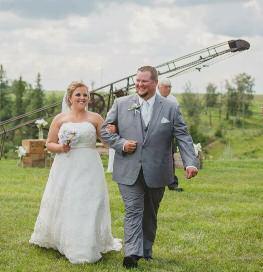
Jessica Anruchow, daughter of Ar t and Marie Andruchow, Limestone Stock Far ms, mar ried her best friend, Duncan Pearson on July 16, 2016. Jessica and Duncan reside on their far m at Calmar, Alber ta Congratulations!
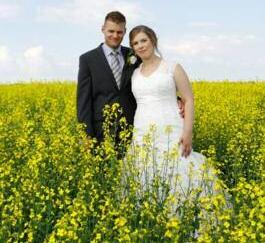
K atelyn Fecho and Coleton Pohl were mar ried on the far m at EYOT Valley R anch on July 16th. The weather tur ned out fantastic and a great time was had by all. Proud parents of the bride, L ar r y & Lynne Fecho were able to put the calving bar n back to use as a wedding venue since moving to later calving.
On Aug 6, 2016 Olivia Milne and Chad Koziak exchanged their vows and where joined in mar riage. Chad and Olivia will be joining the family far m in L amont, Alber ta. Already a successful grain and commercial cattle operation it now includes a purebred Gelbvieh enterprise under the name Koziak L and and Cattle.
and Amber
announce
Trevor
Burks are pleased to
the ar rival of their second little girl Ivy Christine Burks, bor n June 29, 2016 at 11:04am weighing 7lbs 1oz 19 25" long
CGA OFFICE DATES & DEADLINES
• Herd Assessment are available on online CGA registry system.
januar y april may june
• Paper copies will be mailed to those memberships that do not utilize the online registry system.
• CGA and CJGA memberships are due
• Advertising deadline for the Gelbvieh Guide Spring issue
• Final deadline for the annual herd assessments to be into the CGA. Cost is $30 per cow.
• Herd assessment after this date will be assessed $10 extra per cow.
• Advertising deadline for the Gelbvieh Guide Summer "Golden Pages" issue
• Deadline for Canadian Junior Gelbvieh Association scholarship award
september
• Advertising deadline for the Gelbvieh Guide Fall issue
october
• Deadline for amendments to the Constitution must reach the CGA office to be included in the Notice of Meeting
• Deadline to submit DNA samples for Wish List Sale, National Sale and People's Choice Bull Futurity animals
• Gelbvieh Show, Manitoba Ag-Ex
• Gelbvieh Show at noon at Farmfair International, Edmonton, AB
• National Gelbvieh Show, National Sale, People's Choice Bull Futurity at Agribition in Regina, SK
• Annual meeting of the Canadian Gelbvieh Association, Agribition, Regina, SK
• Wish List Sale and GAA/BC Annual Meeting, Red Deer, AB
NEWS & NOTES
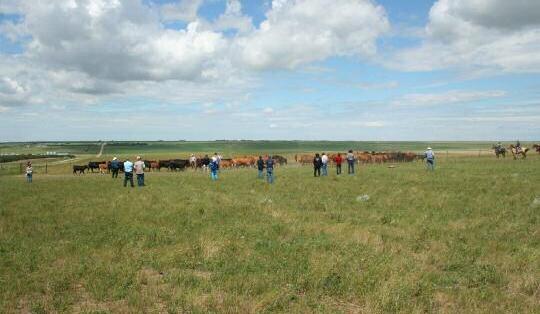
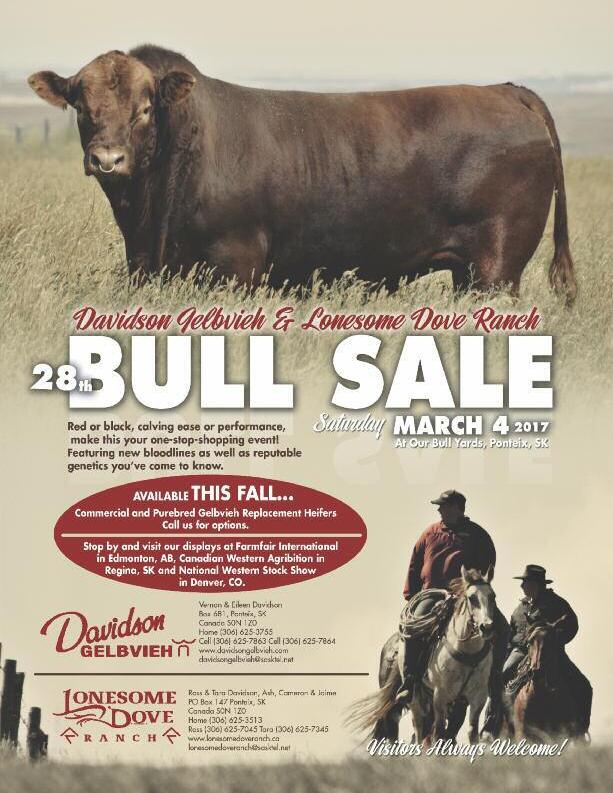
"On Saturday, July 23, 2016, Davidson Gelbvieh and Lonesome Dove R anch welcomed visitors from across Nor th America as they hosted their Annual Open House and Customer Appreciation Day at their Bull Yards south of Ponteix, SK. The after noon saw par ticipants view cow/calf pairs on pasture, the herd bull batteries, as well as the area. Beef supper and visiting rounded out the weekend event!"
This could be your spot! Call the CGA today to book your Business Card Listing!
This could be your spot! Call the CGA today to book your Business Card Listing!
HOGBERG RANCH
Commercial Cow/Calf ralph & ulla hogberg Ph: (250) 843-7230
Glenn, ann, Jason, & annette hogberg Ph: (250) 843-7653
E-mail: hogberg@pris bc ca
Barry & Robin Mader Tel: 250 577 3486
B. & R. Ranch
RR #1, 2108 Duck Range Rd Pritchard, BC V0E 2P0 (1/2 hour east of Kamloops) Email: b&r@telus net
Kelly & coleen brittain Gary & nicole
Phone: 780-352-0676
Cell: 780-387-6446
RR #1, Falun, AB T0C 1H0
Purebred & Percentage cattle
Gelbv ieh Cattl e
Darrell & Leila Hickman RR#2, Vermilion, AB T9X 1Y7
Ph/Fax: 780-581-0077
Fullblood • Purebred • Hybrid Bulls • Females
BUSINESS DIRECTORY
Duane & Darrell Nelson
Box 1144, Glenwood, Alber ta T0K 2R0
Duane (403) 626-3279 • Darrell (403) 626-3643 “Raising Gelbvieh Cattle Since 1972!” Home of 18 Dams of Merit and 5 Dams of Distinction
Black & Tan Purebred & Commercial Gelbvieh www.beamishlandandcattle.ca
Larry, Lynne, Kate & Sarah FECHO
& DONNA
Phone: (780) 954-2285
Fax: (780) 954-2671
Cell: (780) 307-4842
Box 53, Jarvie, AB T0G 1H0 farmer56@telus net
RR #2 Millet, AB T0C 1Z0
Phone: (780) 986-9705
Cell: (780) 718-5477 www evgelbvieh com
Don & Lorna Okell Box 627
Duchess, AB T0J 0Z0
403-378-4898
403-793-4549 jenty@eidnet org
LC RANCH
Purebred Gelbvieh
Ray & Anne Davisson
Box 764, Stettler, AB T0C 2L0 (403) 742-2524
lcranch@xplornet com rdavisson@cervusequipment com
BUSINESS DIRECTORY
Alberta G R
Bar GR Cattle
PUREBRED GELBVIEH FEMALES
rOn & Gail andersOn Phone (780) 523-2116 Fax: (780) 523-3920 gailanderson@hotmail.com
Saskatchewan
This could be your spot!
Call the CGA today to book your Business Card Listing!
maple Grove Gelbvieh (204) 278-3255 narcisse, mb
mccoy cattle co. (306) 436-2086 milestone, sK
Thackeray Gelbvieh farms (306) 456-2555 Weyburn, sK
hurlburt livestock (306) 931-2551 saskatoon, sK
selin's Gelbvieh (306) 793-4568 stockholm, sK
This could be your spot! Call the CGA today to book your Business Card Listing!
This could be your spot! Call the CGA today to book your Business Card Listing!
c/o James Knudson Ph/Fax:
Manitoba
Ontario
This could be your spot! Call the CGA today to book your Business Card Listing!
COMING EVENTS
Complimentar y Service Provided by the Canadian Gelbvieh Association
Oct. 26 - Pre-sort Gelbvieh Cross Calf Sale, Medicine Hat Feeding Company, Medicine Hat, AB
Oct. 27 - Pre-sort Gelbvieh Cross Satellite Calf Sale, 9:30 am, Heartland Livestock, Swift Current, SK
Oct. 26-29 - Manitoba Livestock Expo, Brandon, MB Gelbvieh show at 11 am, October 29
Nov. 10 - Gelbvieh Show at noon at Farmfair International, Edmonton, AB
Nov 24 - National Gelbvieh Sale, Agribition, Regina, SK
Nov. 24 - CGA Annual General Meeting at 3:30 pm, Agribition, Regina, SK
Dec. 1 - Photo contest deadline
Dec. 2-3 - GAA/BC Wish List Sale Weekend, the Westerner, Red Deer, AB
Dec. 2 - Christmas Party at 5 pm, the Westerner, Red Deer, AB
Dec. 3 - Customer Appreciation Day, Commercial Heifer Pen show, Bull Jackpot, Commercial Gelbvieh Sale and Farm displays
Dec. 3 - GAA/BC Annual Meeting at 9 am and Wish List Sale at 6 pm
2017
Jan. 5 - Deadline for Winter Gelbvieh Guide magazine
Mar. 4 - Davidson Gelbvieh & Lonesome Dove Annual Bull Sale, at the Ranch, Ponteix, SK
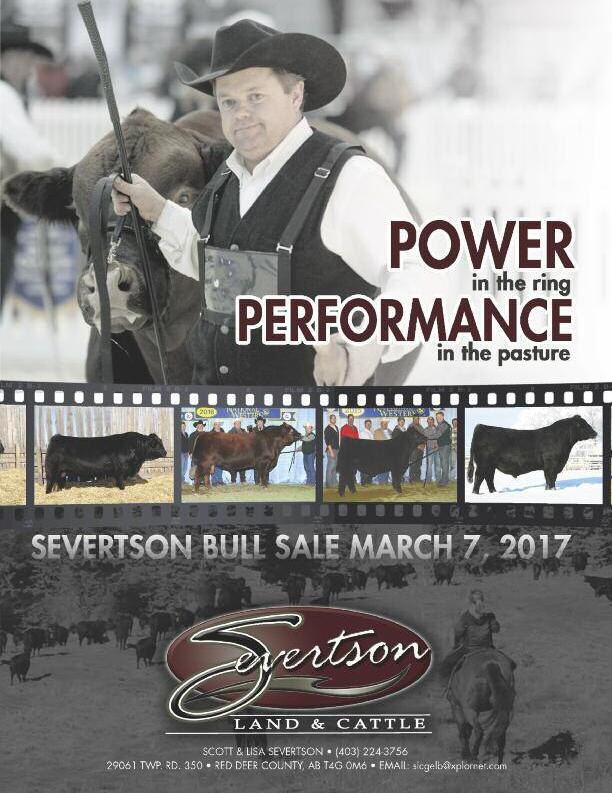
Mar. 6 - Severtson Land & Cattle Annual Bull Sale, at the Ranch, Red Deer County, AB
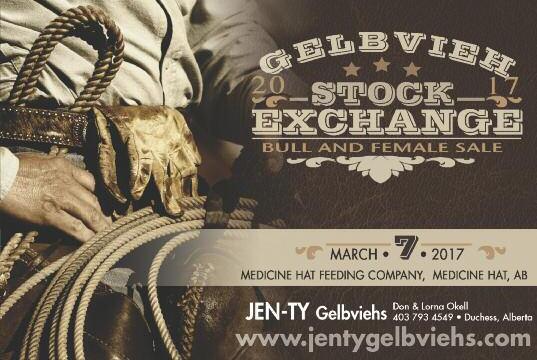
Mar. 7 - Gelbvieh Stock Exchange Sale, Medicine Hat Feeding Company, Medicine Hat, AB
Mar. 10 - Gelbvieh Advantage Bull Sale, Innisfail, AB
Mar. 11 - Foursquare Gelbvieh 10th Annual Sale, Olds, AB
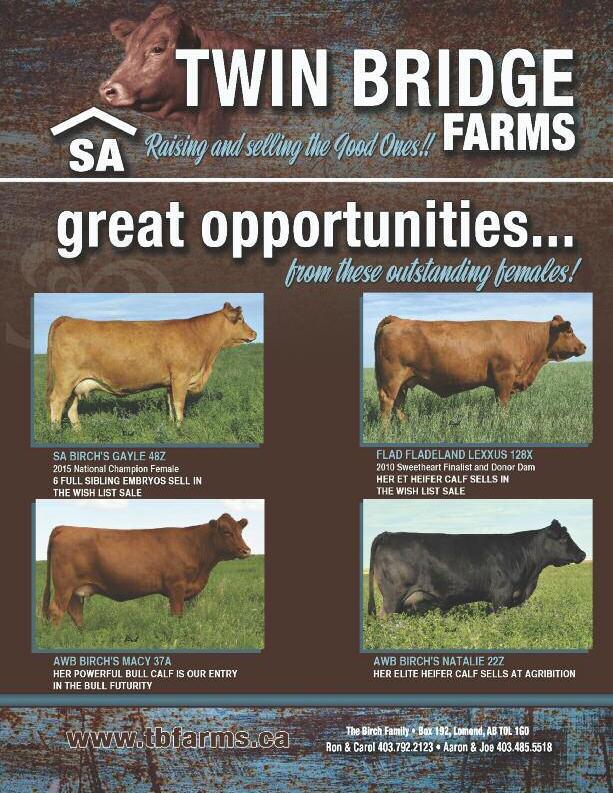
Mar. 13 - Twin Bridge Farms & Guests Bull Sale, Silver Sage Community Corral, Brooks, AB
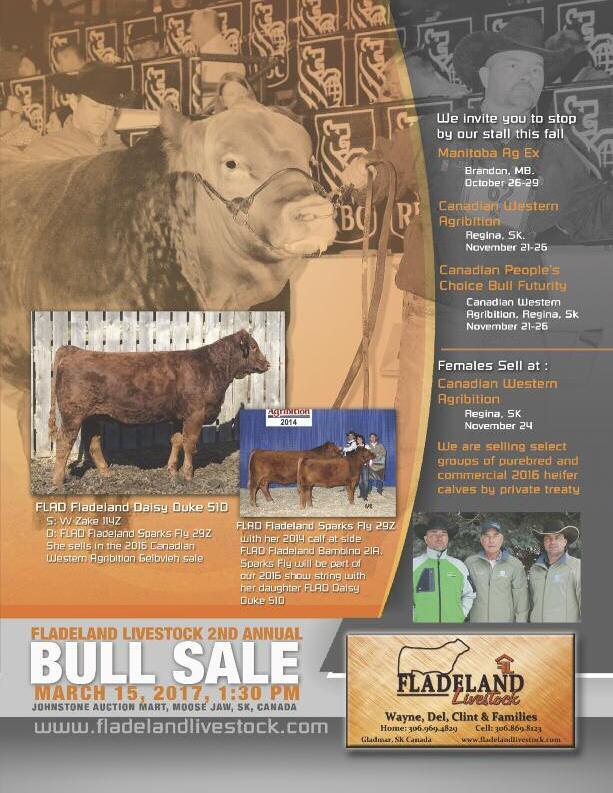
Mar. 15 - Fladeland Livestock 2nd Annual Bull Sale, Johnstone Auction Mart, Moose Jaw, SK
Mar. 18 - Saskatoon Gelbvieh Bull Sale, Saskatoon, SK
May 1 - Deadline for the Summer issue of the Gelbvieh Guide magazine
ADVERTISERS INDEX
BNH Livestock
Beamish Land & Cattle
Bow Valley Genetics Ltd.
Brittain Farms 24, 37
Carlson Cattle Company
Davidson, Wade 18
Davidson Gelbvieh OBC
Dayspring Cattle
Eyot Valley
Farmfair International 27
Fir River Livestock 39, IBC
Fladeland Livestock 4, 39
Advertising Content
The Gelbvieh Guide assumes no responsibility for the accuracy and truthfulness of submitted advertising copy, and has the right to refuse any ad copy or photos Advertisers shall indemnify and hold harmless the Guide containing pedigrees or statements regarding performance must conform to records kept by the Canadian Gelbvieh Association Copy deviating from official records may be changed as necessary without advertiser consent.
Editorial Policy
Opinions expressed are the writer’s and not necessarily those of Gelbvieh Guide or the Canadian Gelbvieh Association Photographs are welcome, but no responsibility is assumed during transit or while in the office
Publisher ’s Statement: All statements, including product claims, are those of the person or or ganization making the statement or claim The publisher does not adopt any such statement or claim as its own, and any such statement or claim does not necessarily reflect the opinion of the publisher.
Printed by: Westernlitho Printers
Regina, SK, Canada
Mailed under permit number 40012883
Postage paid at Calgary, AB
Canadian Publication Agreement
Return undeliverable Canadian addresses to: Canadian Gelbvieh Association 5160 Skyline Way NE, Calgary AB T2E 6V1
Publisher/Editor
Gaylene Groeneveld
Phone: (403) 250-8640
Fax: (403) 291-5624
Email: guide@gelbvieh ca (Gaylene)
Electronic Composition
Kim Matthews
Box 19, Site 5 RR#2, Olds, Alberta T4H 1P3 (403) 556-8836 (403) 556-8077 prime cut@telusplanet net (Kim)
T W O T I E R S Y S T E M
L E V E L # 1 - $ 4 0 0 M E M B E R S H I P L E V E L :
T h i s w o u l d p r o v i d e m e m b e r s 1 v o t i n g c a r d w i t h t h e c h a n c e t o w i n p o s s e s s i o n o f t h e Fu t u r i t y C h a m -
p i o n B u l l , a n d a l l d r a w d o w n p r i z e s .
N o t e : T h i s w o u l d p r o v i d e b r e e d e r s w h o d o n o t w a n t s e m e n t o b e p a r t o f t h e e v e n t a n d h a v e t h e
c h a n c e o f w i n n i n g t h e C a n a d i a n Pe o p l e s C h o i c e C h a m p i o n B u l l .
L E V E L # 2 - $ 6 0 0 M E M B E R S H I P L E V E L :
Pr o v i d e s 1 b u l l e n t r y, 1 0 u n i t s o f s e m e n f r o m t h e C a n a d i a n Pe o p l e ’ s C h o i c e C h a m p i o n B u l l , 1 v o t i n g c a r d , a c h a n c e t o w i n t h e b u l l a n d