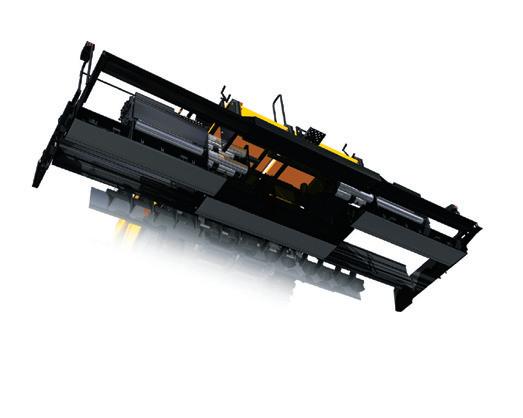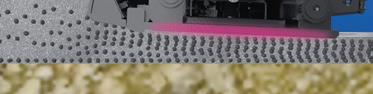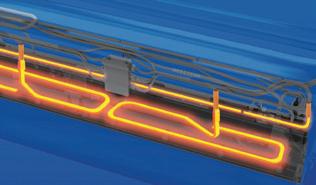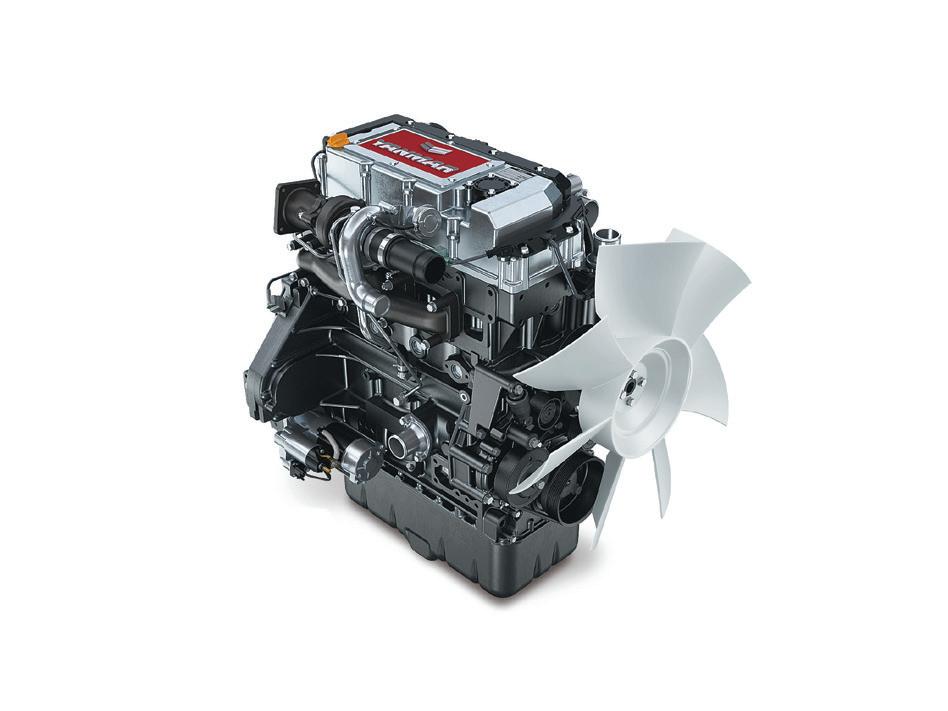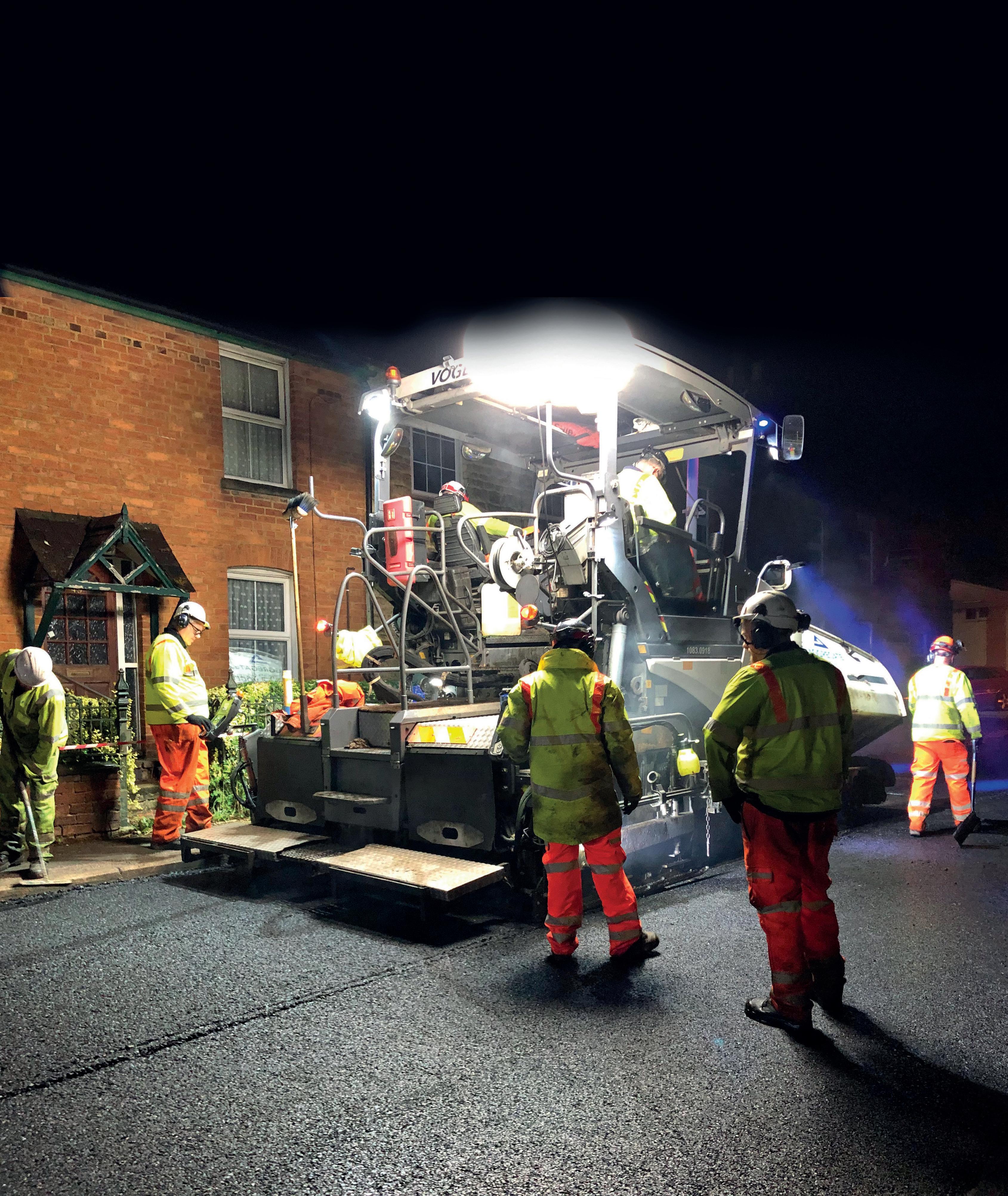






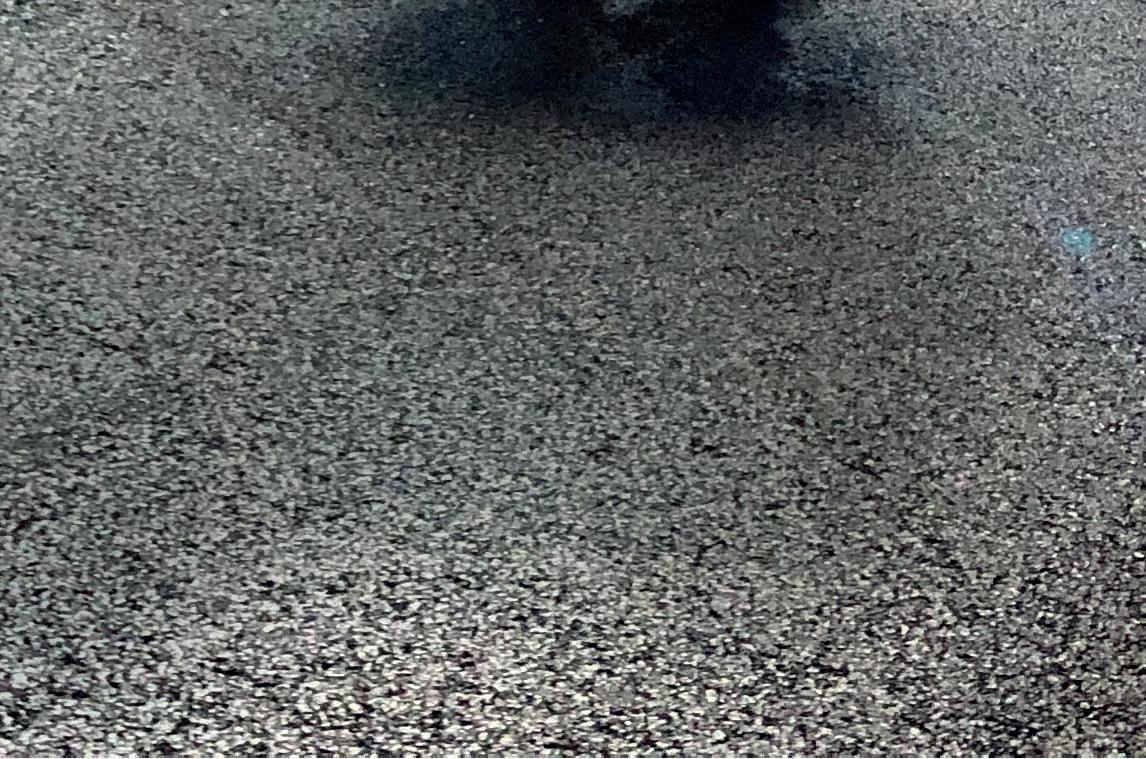
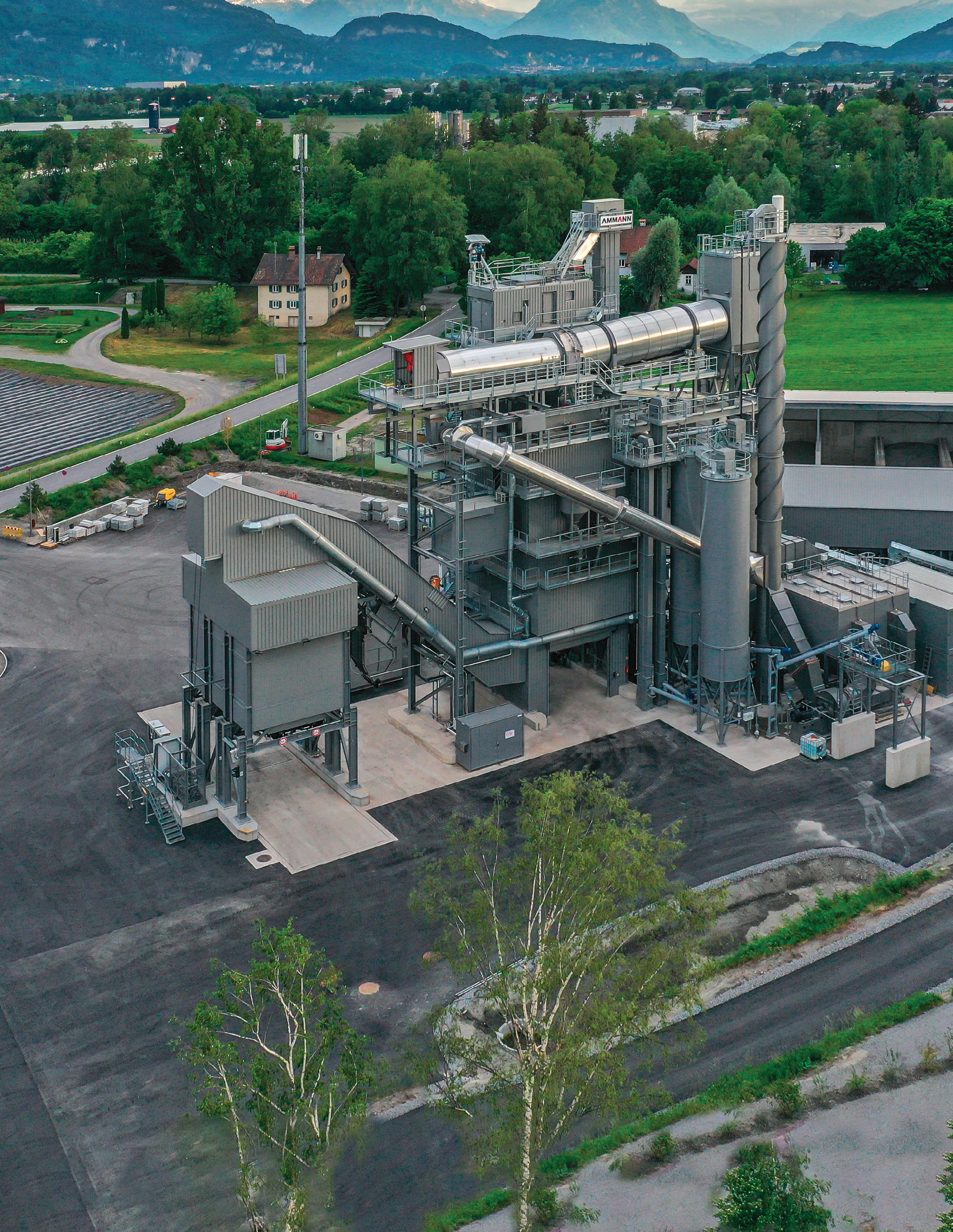
WARM-MIX ASPHALT WITH AMMANN FOAM TECHNOLOGY
HEATING PROCESS
• Highly efficient heat transfer
• No parasite air
• Optimised regulation burner / drum
BURNER
• Various fuels available
• Ideal combustion process
• Optimised energy consumption
USE OF RAP MATERIAL
• Full range of technical solutions
• Additions of RAP up to 100%
• Industry-leading partner in the use of RAP
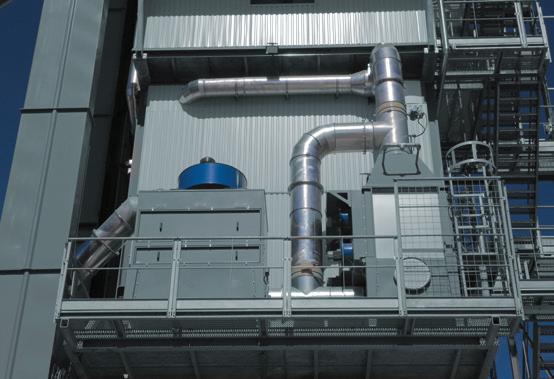
BST – BLUE SMOKE TREATMENT
• Captures vapours during loading
• Filters trapped fumes
• Removes oil particles
EMISSIONS
• Lowest VOC (TA-Luft)
• Complete dust suppression
• Odour management solutions
• Noise reduction kits
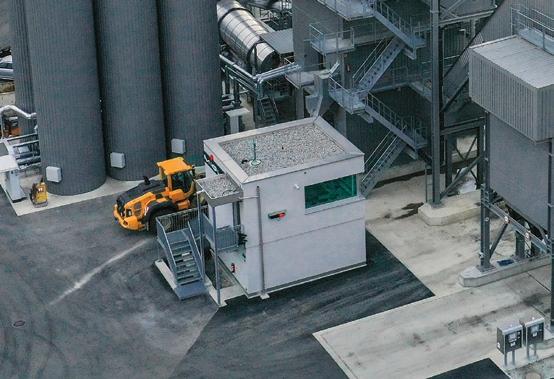
AVOIDING HEAT LOSS
• High insulation up to 200 mm
• No thermal bridges
• Flaps to close the storage silos
• Reduction of wasted material
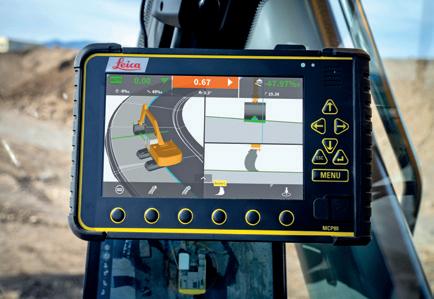
AS1 CONTROL SYSTEM
• Wide range of modules for software upgrading
• Expert use of inverter
• New professional and ergonomic user interface
• Energy management of photovoltaic systems
• Automatic burner control ADX
4. Contra ow
Japan is planning to build special highway lanes to handle autonomous vehicles
6. News
20. Demolition
German bridge demolition with Epiroc breakers; solid body breaker anniversary
21. Comexposium
36. Engines
Electric solutions from Atlas Copco; Cummins offering hydrogen option; John Deere’s battery facility; clean engines from Kohler










Intersections are dangerous for US drivers; JCB sees strong performance but is wary for the future; major highway works





StormTech addressing ooding; ACO’s high impact resistance drainage; Giatec and BCMI cooperate for for concrete mix


Comexposium interview: INTERMAT 2024 is scheduled for success
23. Asphalt paving
42. Asphalt plants
Lintec plants in Egypt and the Philippines; Ammann builds presence in China and Mexico
46. Bitumen technology


Digital roads of the future; IRF anniversary; crash investigation

16. Highway & Safety
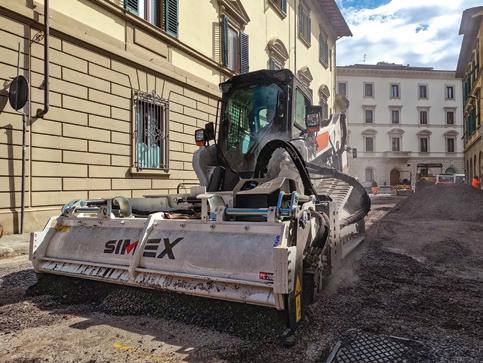
Wirtgen equipment for Zimbabwe project; Simex compact mill in Florence; Electric paving with Dynapac; bridge surface compaction with Ammann
28. Bridges & tunnels
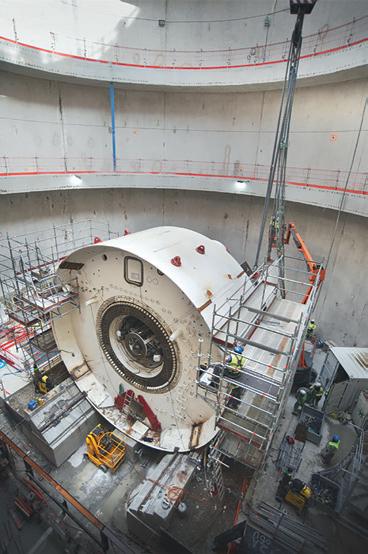
Fehmarnbelt formwork from Peri; Enerpac raises German bridge; cable inspection with Spencer; aluminium reinforcement
Graphene is providing an important advance for additive technology
49. Equipment
Develon’s versatile excavator; Power Pavers is widening its range with a new slipformer

50. Onsite




Lighting from Traf c Group; ACO offers drainage solution; weather monitoring with Vaisala; Vitronic in the Middle East; WJ in the US
32. Machine control
Trimble machine control assists Sydney airport project; Komatsu’s performance optimisation tool; Liebhher offers Leica Geosystems option
Coastal protection with Develon; Hyundai machine helps with roadbuilding
Between pages 10 and 11
em1-em5
Bangladesh toll road open; Thailand tunnel link; XCMG’s Africa support deal; Keestrack’s Saudi dealer; Bobcat backhoe for emergent markets
eu1-eu6
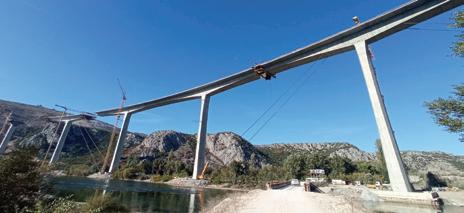
Bosnia bridge cracking; Norwegian bridge maintenance; Mecalac dumpers for Ireland; Hitachi excavators for quarry








DE1. Equipment
A powerful loader from Caterpillar; Allu’s versatile attachment
DE2. Key project report
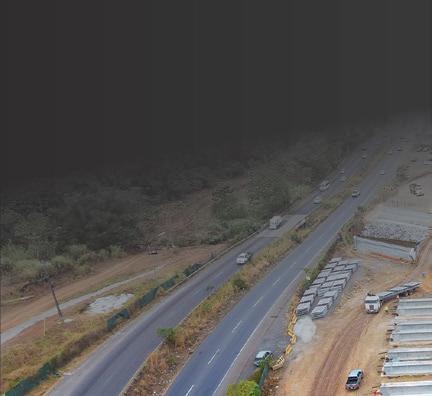
Upgrading the Panamericana highway in Panama will help boost the economy but faces challenges
DE7. Aggregate Production
New developments in crushing and screening will provide better quality materials
DE9. Skidmarks
Further humorous road-related stories from around the world






















Mike Woof, EDITOR mwoof@ropl.com
Japan is planning to build dedicated lanes that will solely be for the use of autonomous vehicles (AVs).
This radical programme will help speed transport and cut traf c congestion, while boosting safety. Special AV lanes are being planned by the Japanese Government as part of a wider plan to future-proof the country’s road network. The plan will involve the use of the latest traf c control systems as well as in-vehicle technology, in a bid to deliver improved safety for users as well as better traf c ow at peak periods.
Camera and sensor technology will be utilised on existing road stretches to identify vehicle movements as well as the presence of vulnerable road users. Safety will be a priority for this advanced vehicle programme.
The rst road sections to be adapted will be in Ibaraki and the plans for the preparatory work needing to be carried out will be released in late 2023. Once the monitoring technology has been installed and commissioned, the system will be managed by Michinori Holdings. The system should be commissioned by the second quarter of 2025 if the intended schedule is adhered to.
The plan is being handled by Japan’s Economy, Trade and Industry Ministry and will focus initially on a 2km road stretch between JR Omika Station and the Hitachi Cameras facility.
At the same time, a self-driving car is under development by the Japanese rm Turing, featuring technology that handles data received from onboard cameras and is able to control braking, acceleration and steering. This is likely to be one of several vehicles able to use the special AV lanes. It is not clear yet if other AVs being developed at present in China or the US for example will be permitted to use the Japanese AV lanes.
A section of road used at present as part of a Bus Rapid Transit (BRT) network will be one of the rst road sections to bene t from technology allowing the use of autonomous vehicles. Further plans will see the establishment of special lanes for autonomous vehicles on the new Tomei Expressway route in in Shizuoka Prefecture that connects Hamamatsu and Surugawan/Numazu. The technology allowing lanes to be used for autonomous vehicles will also be installed on the Tohoku Expressway and this may be ready for use as early as 2025. MW

Deputy
Sub-Editor:
Contributing
Editorial
Production
Internet,
Web Manager: Sarah Biswell
Social Media Manager: Tatyana Mechkarova
Managing Director: Andrew Barriball
Chairman: Roger Adshead
Publishing Director: Geo Hadwick
ADDRESS: Route One Publishing Limited, Second oor, West Hill House, West Hill, Dartford Kent DA1 2EU, UK Tel: +44 1322 612055 Fax: +44 1322 788063
Email: [initialsurname]@ropl.com (eg: radshead@ropl.com)
ADVERTISEMENT SALES
Head of Construction Sales: Graeme McQueen Tel: +44 1322 612069 Email: gmcqueen@ropl.com
Sales Director: Philip Woodgate Tel: +44 1322 612067 Email: pwoodgate@ropl.com
Sales Director: Dan Emmerson Tel: +44 1322 612068 Email: demmerson@ropl.com
UK / CLASSIFIED, NORTH AMERICA: Dan Emmerson Tel: +44 1322 612068 Email: demmerson@ropl.com
ITALY: Fulvio Bon glietti
Tel: +39 339 1010833 Fax: +39 02 700446321
Email: bon glietti@tiscali.it
JAPAN: Akiyoshi Ojima Tel: +81 3 3263 5065 Fax: +81 3 3234 2064 Email: ojima@echo-Japan.co.jp
ASIA / AUSTRALASIA: Roger Adshead Tel: +44 7768 178163 Email: radshead@ropl.com
































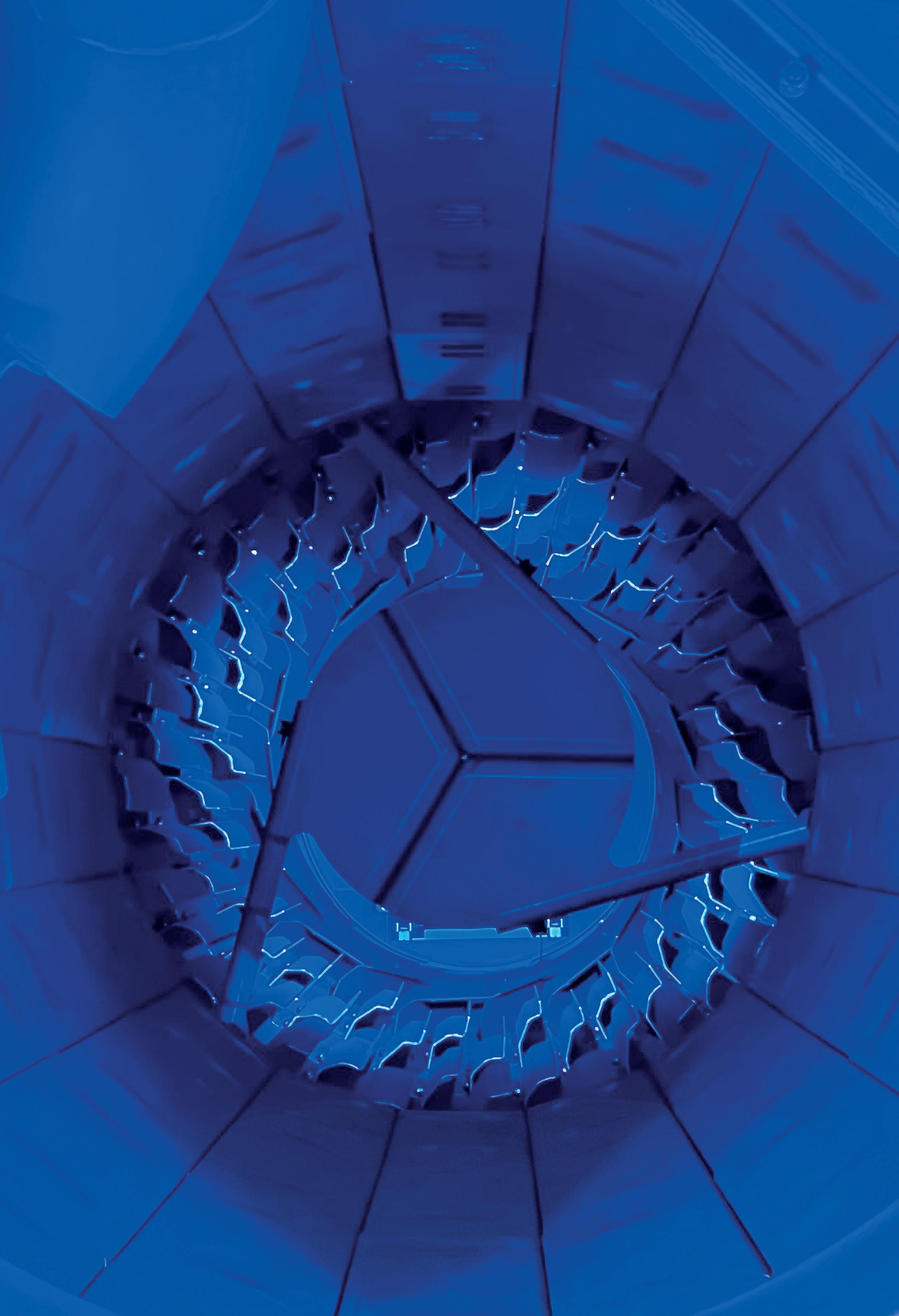
BENNINGHOVEN presents a new patented and pioneering technology: the REVOC system. This technology allows plant owners to implement higher recycling addition rates while complying with stricter emissions limits. REVOC supplements existing hot and cold recycling systems in asphalt mixing plants, reducing total carbon emissions (VOC) with up to 50 % recycling material added. Specified limits are not exceeded. In Germany, for example, the level remains below the maximum specified by the TA-Luft regulation. The system can be retrofitted and thus contributes to securing the site. With increased plant performance, high recycling content and reduced emissions, plant owners are perfectly prepared for the future.


Intersections are dangerous for drivers according to research in the US. The data comes from the Federal Highway Administration (FHWA) and shows that over 50% of crashes happen at intersections.
Data from the National Highway Traf c Safety Administration (NHTSA) shows over 96% of these crashes at intersections are caused by inattention or driver error. Phone use behind the wheel by drivers is a major cause of distraction. Only 3% of intersection crashes are caused by mechanical, hydraulic or electric failures with vehicles or by issues such as weather or road condition.

If drivers are more aware, crashes will be reduced according to the NHTSA (image © courtesy of Mike Woof)
or driving under the in uence.
Failing to look properly is a cause of 44.1% crashes at intersections, while incorrectly anticipating what other road users will do is a factor in 8.4% of crashes. Making a turn while the view of the road is not clear is a factor in 7.8% of intersection crashes while making an improper manoeuvre is a factor in 6.8% of crashes at intersections. Being distracted by something in the vehicle is a factor is 5.7% of intersection crashes while judging the speed of other vehicles inaccurately is a factor in 5.5% of intersection crashes.
The data also reveals that most road crashes could be avoided if greater care was taken by drivers. Speed is one major cause of intersections, as is
improvement works are planned
drivers who fail to look properly for potential hazards or for the presence of other road users. Anticipating what other road users may do can further help reduce the risk of crashes, as can the understanding that other road users may be speeding, distracted



Drivers need to show greater awareness and a greater understanding of the behaviour of all types of road users according to the NHTSA. And reducing speed can help reduce the risk of crashes as well as the severity of any incident that does occur.



Wacker Neuson is celebrating its 175th anniversary and recently invited customers and dealers from the EMEA region to its site in Reichertshofen. The fourday event allowed face-to-face meetings and focussed on the innovative solutions that have revolutionised construction work since Johann Christian Wacker founded his blacksmith’s shop in 1848. Alexander Greschner, CSO of the Wacker Neuson Group said that the event helped bring the rm closer to customers and sales partners, emphasising the importance of customer feedback when testing new products.


Five key road projects will be carried out in Ho Chi Minh City in Vietnam, with a total estimated cost of US$1.6 billion. The ve projects will be completed by 2030 and will be carried out under the build-operate-transfer (BOT) model. The works are being managed by the Ho Chi Minh City (HCMC) Department of Transport.
One project is for a 9.6km section of National Highway 1 between An Lac and Long An Province. An upgrade will be carried out to National Highway 22 between An Suong interchange and Beltway No. 3, a distance of 9km. National Highway 13 will be improved for the 4.6km between Binh Phuoc intersection and Binh Trieu bridge. Widening work will be carried out for a 7.5km stretch of the North-South axis route linking Nguyen Van Linh Street with Ba Chiem bridge intersection. A new bridge will be built at Binh Tien as well as a road linking Pham Van Chi with Nguyen Van Linh.
Meanwhile, work will start shortly on a 15km bridge that will span the Hau River. The $340.5 million project for the Dai Ngai Bridge will provide a new link between Nam Song Hau National Highway and National Highway 54.
Vietnam's Department of Planning and Investment has also set a budget of $315 million for a series of tra c infrastructure works.
And Vietnam plans to build eight new expressways in the Central Highlands by 2030. This programme of construction will add around 830km to Vietnam’s expressway network. Construction is expected to cost nearly US$6.5 billion.
Work on the Tan Phu-Bao Loc expressway is due to commence in 2023. Other expressways planned will include routes from Quy Nhon to Pleiku, Khanh Hoa to Buon Ma Thuot, Bao Loc to Lien Khuong, Gia Nghia to Chon Thanh and Bao Loc to Lien Khuong.
One of the innovations starring at Wacker Neuson Universe was the new DV45 Dual View dumper, the smallest model in its range. It features an innovative Dual View concept, where the operating console can be rotated through 180° so the operator always has a clear view in the direction of travel or work. The rm also highlighted its zero emissions range including the TH412e, Wacker Neuson’s rst fully electric telescopic loader. Its compact design means it can be used in con ned spaces without releasing any local emissions. Wacker Neuson’s production and development site has been located in Reichertshofen since 1964. In 2018, Wacker Neuson opened a European training centre at the site and in fall 2022, a new logistics centre was added to streamline distribution logistics and accelerate warehouse turnaround times.

Work is starting on the controversial 13km upgrade of the I-35 highway in Austin, Texas during 2024. The construction work is expected to cost US$4.5 billion. Approval for the project has been given by the Texas Department of Transportation (TxDOT).
The route will be improved between Ben White Boulevard and US 290 East. The project will have two new managed lanes, while decks will be removed.

Changes have been made by TxDOT to the highway plans, with a number of mitigation features that are intended to address public concern over the expansion of the highway through the city.
There will now be an elevated bicycle and pedestrian bridge at 15th Street, $100 million being spent for visual improvements,
additional funding for bus services during construction, an app providing information on construction closures and a noise barrier between I-35 and the community gardens near Festival Beach.
Meanwhile, AECOM will head the design team for the $700 million widening of I-35 in San Antonio, Texas. The construction
work is being handled by the Lone Star Constructors consortium, which comprises Fluor and Austin
The award of the design contract follows the award of the construction works to Lone Star Constructors by the Texas Department of Transportation (TxDOT). The Interstate 35 (I-35) Northeast Expansion (NEX) South Project is required as the highway currently experiences regular traffic delays for drivers.
The work will be carried out along a 6.4km stretch of the highway. The work will see the addition of three elevated express lanes in either direction. A number of other structures will also be built. The Interstate 35 Capital Express North project is expected to take five years to carry out, improving traffic flow and cutting congestion.
Melbourne and nine of its suburban and regional councils will each pave 900m-long stretches of road with asphalt containing recycled plastic developed by RMIT University.
According to RMIT - the Royal Melbourne Institute of Technology - the paving will take place in “the coming months” and the 10 project sites will use an estimated 21,000kg of recycled plastic. RMIT noted that Australians generate 2.6 million tonnes of plastic waste/year.
“If Australia’s 537 local governments each used a small amount of recycled plastic in the many roads they resurface each year, then nationally we’ll have created a large end-market for recycled plastic,” said Filippo Giustozzi, associate professor in RMIT’s School of Engineering and leader of the project.
The RMIT-led project is supported by the Australian Research Council, Austroads and 10 Victoria state councils - City of Melbourne, Banyule, Bayside, Moonee Valley, Hobsons Bay, Baw Baw, Latrobe, Casey, Mornington Peninsula and Wyndham. The recycled plastic will come from consumer and industrial waste, including notoriously stubborn soft plastics, and be incorporated into asphalt as a performance enhancer.
Giustozzi said the team will also produce bestpractice guidelines on the use of recycled plastics in asphalt roads. “These guidelines will enable local governments, which control 80% of the nation’s roads, to begin widescale adoption of this innovative recycling solution.”
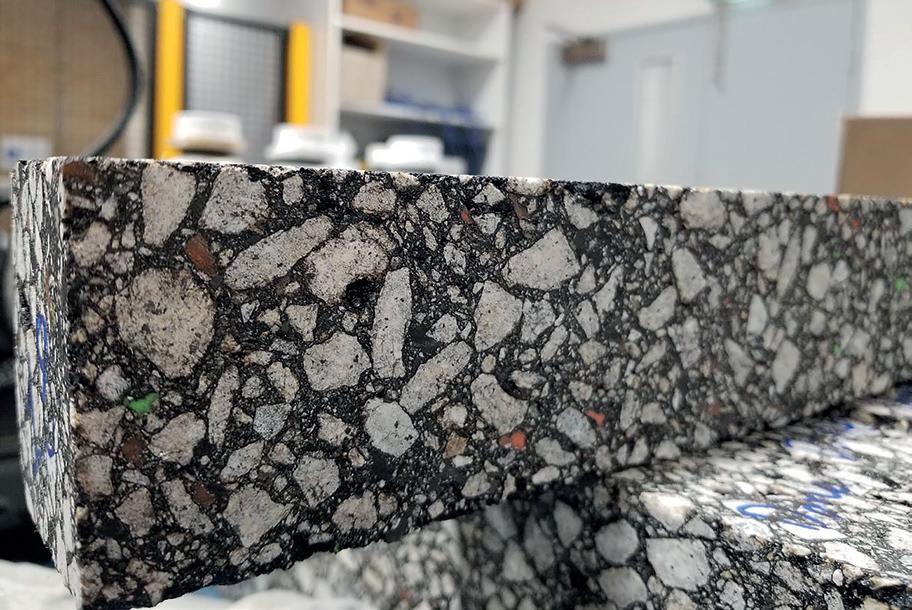
for Austroads – which combines Australia’s and New Zealand’s transport agencies – show the mixes developed by RMIT are mechanically, chemically and environmentally sound.
"The performance of roads can actually be improved with the additions of recycled material, such as plastic and rubber, to be more durable against traffic and resistant against ageing,” said Giustozzi.
RMIT said that its team’s latest study, funded by Austroads and published in the learned journal Science of the Total Environment*, found the recycled plastic asphalt mixtures had 150% less cracking and 85% less deformation under pressure testing than conventional asphalt.
The Rocester, Staffordshire, England-headquartered global construction and quarrying machinery giant's sales turnover in 2022 grew to £5.7 billion (2021: £4.4 billion), and profit before tax grew to £557.7 million (2021: £501.6 million). Machine sales increased to 105,148 (2021: 95,650). The Group maintained a strong balance sheet with no net borrowings throughout 2022.
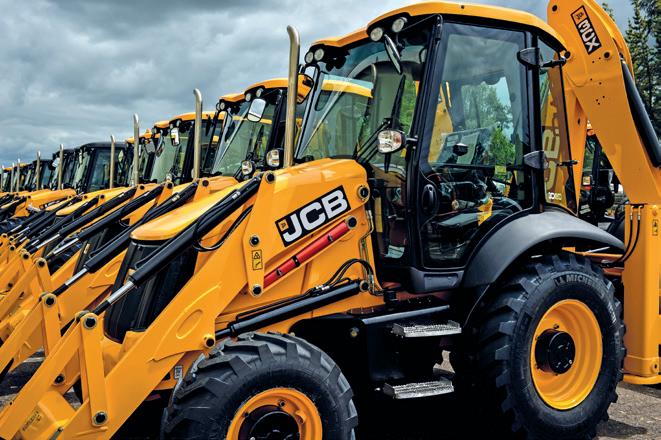
JCB CEO Graeme Macdonald said: "The Group delivered a strong set of results in 2022 against a backdrop of supply chain disruption, high energy prices and rising levels of inflation. The situation for the remainder of this year and into 2024 remains uncertain as some markets and certain sectors are showing early signs of softening."
Melbourne in Victoria has a regional population of just over five million. The port city has a temperate oceanic climate with warm summers and cool winters.
Extensive laboratory studies conducted by RMIT
“These studies tell us that adding specific types of plastic in the right way can generate greater rutting and fatigue resistance,” he said. “In some instances, the performance of the mix was similar to some of the more expensive polymers used in roads and substantially higher than conventional asphalt mixes.”
Funding is being made available to address defective bridges in the US. The Bridge Investment Programme will provide a total of US$10 billion in funding for bridge repairs, upgrades and replacement projects. This is being managed by the US Department of Transportation's (USDOT), which is handling the applications. Projects costing more than $100 million will be eligible to apply for funding. During 2022 $2.4 billion was directed towards bridge works in the US via the Bridge Investment Programme. This resulted in work being carried out to 37 bridges in 29 states. The largest project to benefit was the $1.38 billion work for the Brent Spence Bridge. Opened in 1963, the bridge was designed to carry 85,000 vehicles/ day but reached a peak traffic volume of 150,000 vehicles/day.
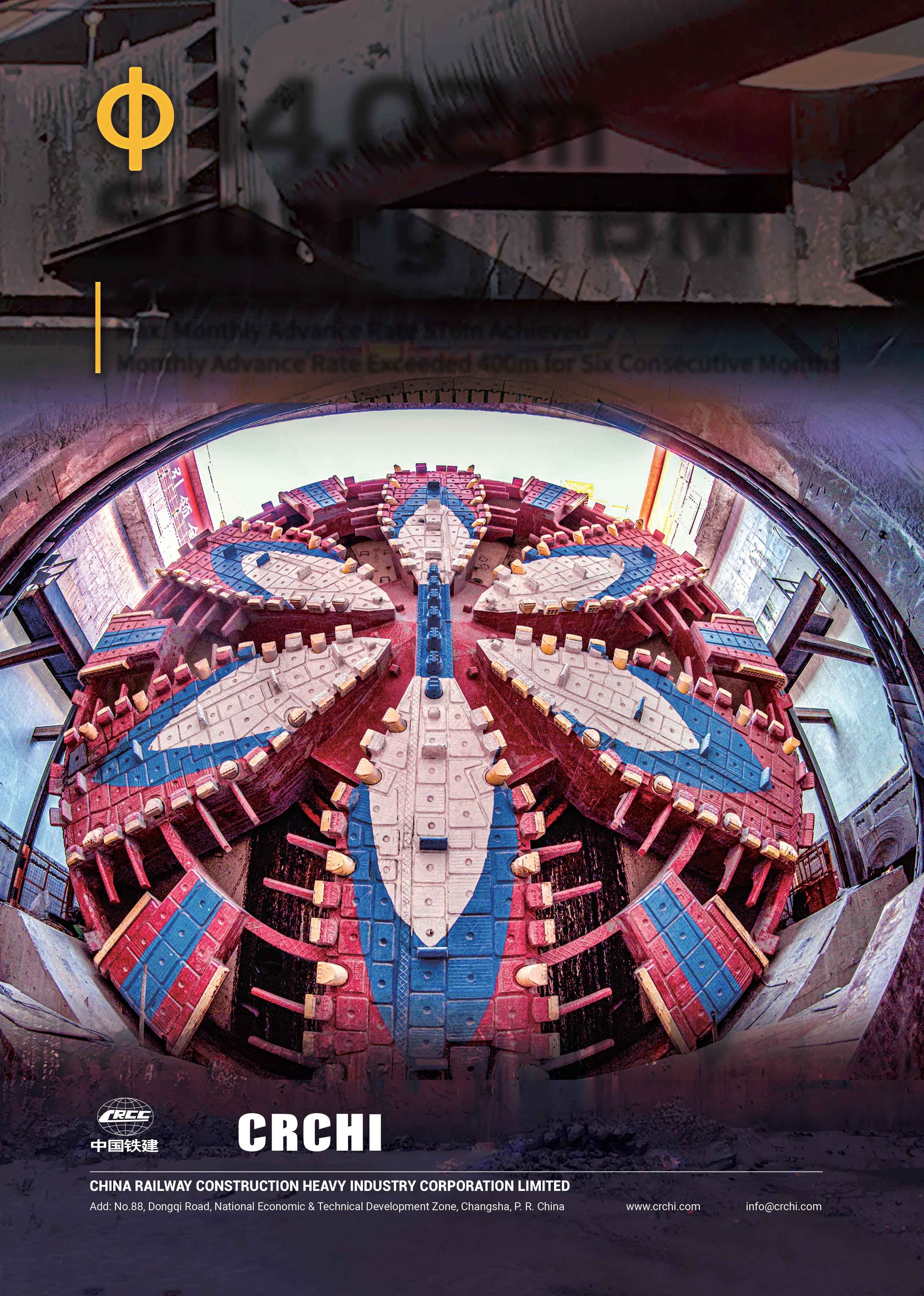
Max. Monthly Advance Rate 576m Achieved Monthly Advance Rate Exceeded 400m for Six Consecutive Months

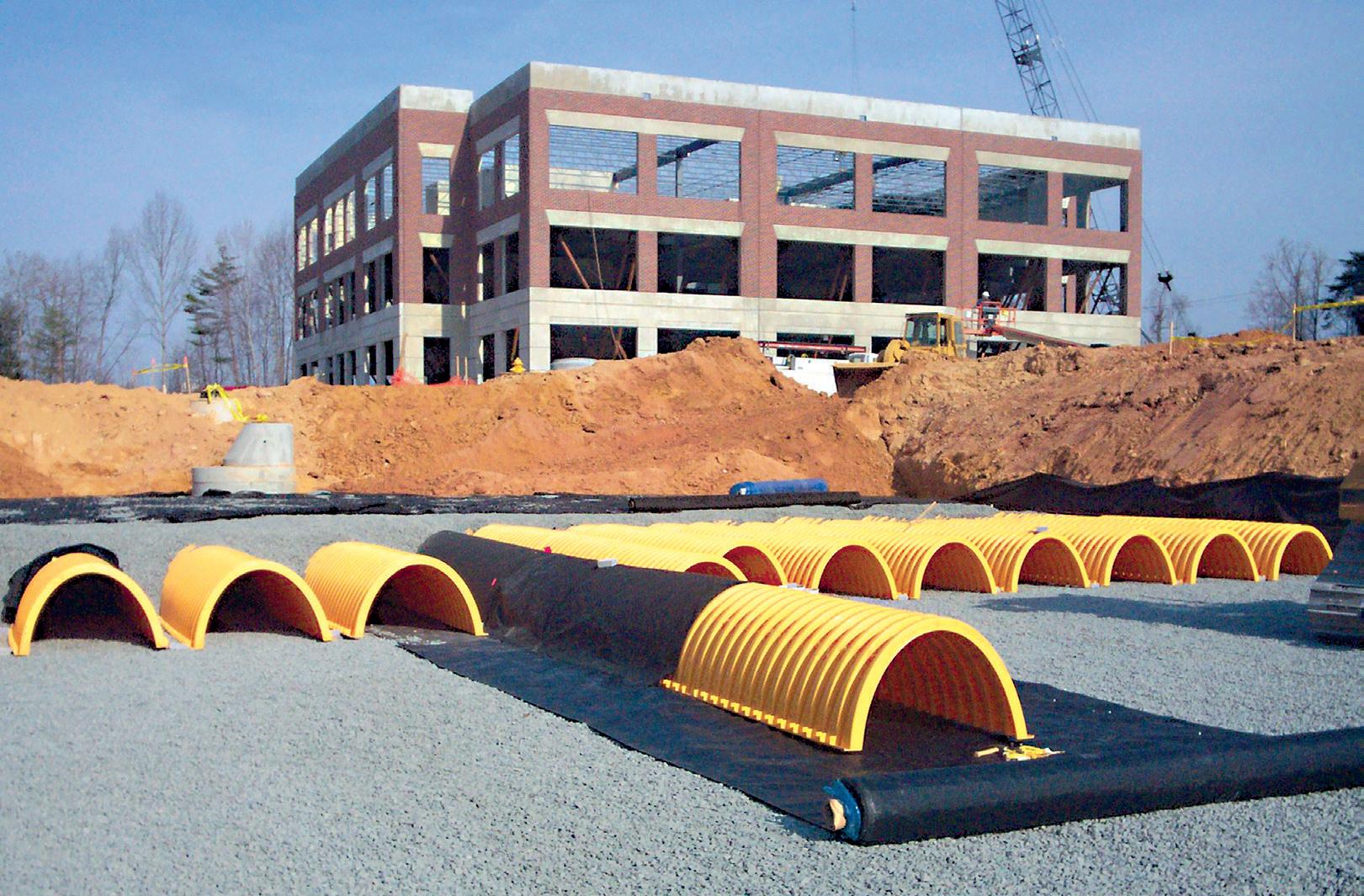
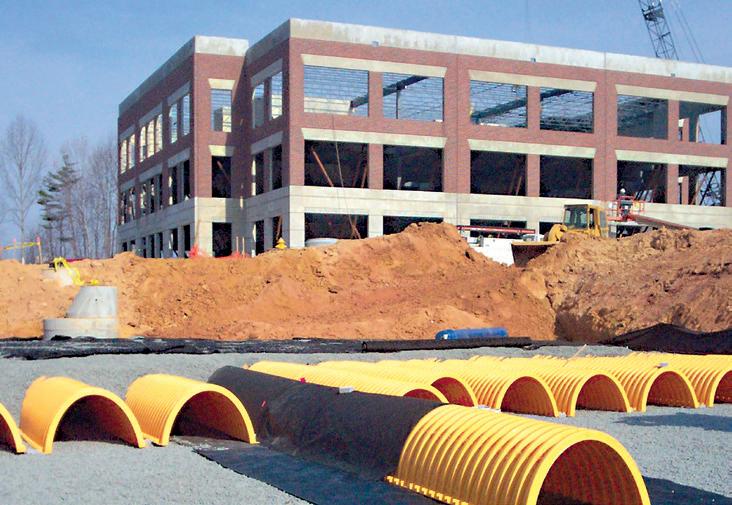
The novel StormTech stormwater management system from Advanced Drainage Systems (ADS) is now available in the UK. StormTech combines arch-shaped chambers with an innovative, integrated water quality treatment technology and has been proven worldwide. Featuring a range of chamber sizes and its novel Isolator Row, providing ‘ rst ush’ cleansing and treatment of storm water
run-o , StormTech is suited to applications requiring minimum cover, installation under roads and fast construction. As units are stackable, minimal space is required for storage and transport. StormTech complies with the recently updated Design and Construction Guidance for foul and surface water sewers (DCG), meaning that water companies in England can accept StormTech when o ered for adoption by developers under Section 104
Agreements in accordance with the Water Industry Act 1991. Additionally, structural modelling to Eurocodes has demonstrated that StormTech SuDS attenuation chambers can be installed to the minimum and maximum cover depths detailed within the standard ADS installation guidelines, originally based on US standards.
Advanced Drainage Systems www.adspipe.co.uk
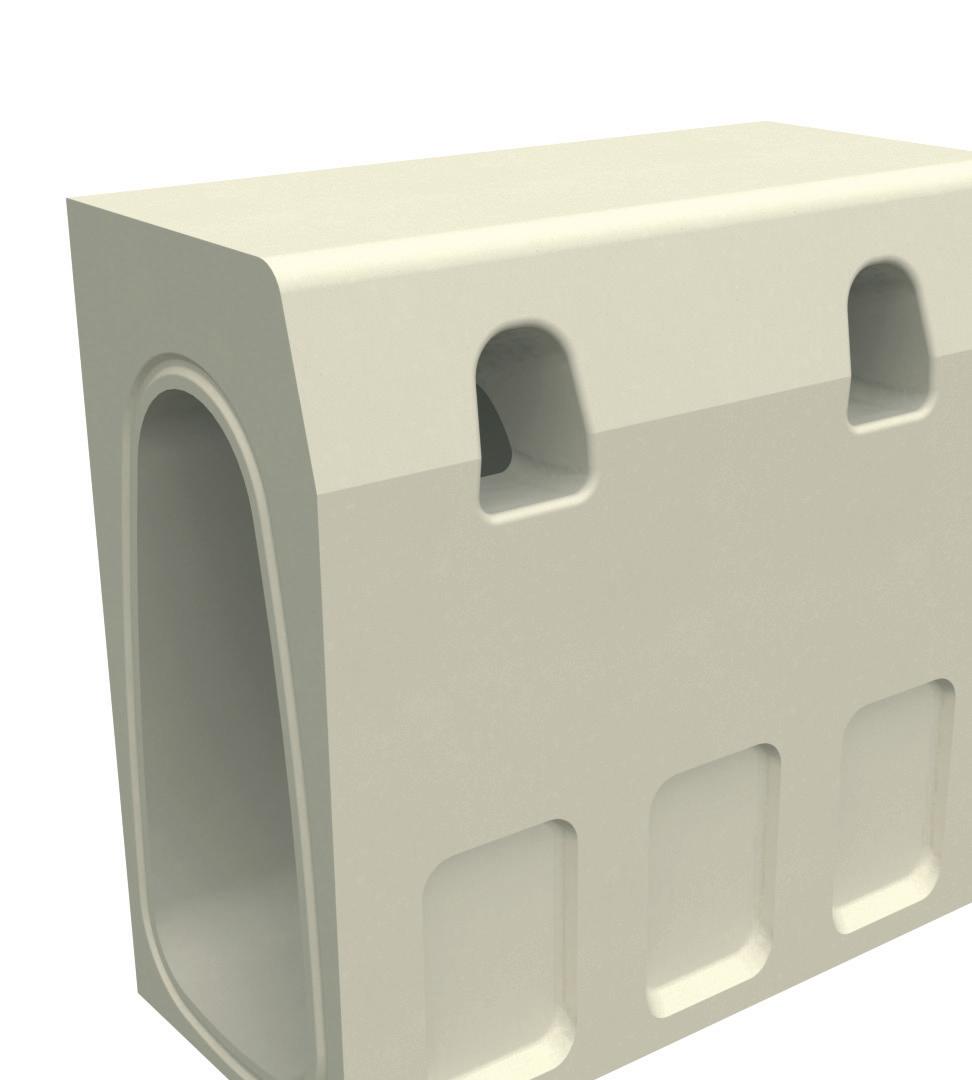
ACO Water Management has expanded its KerbDrain o ering with the launch of the E Class range.
Designed for surroundings where high impact is more likely, the new range includes the E and E+ units. Both channels serve as combined drainage and kerb systems for continuous interception of surface water ows, as well as rapid collection of contaminated liquids. A versatile solution, KerbDrain E Class can be implemented in both SuDS schemes and traditional drainage systems.


Cement (OPC) concrete kerbs. As such, KerbDrain E Class is suited to areas that are subject to large numbers of high-speed, heavy goods vehicles - in line with National Highways requirements.
ACO Technoligies says that its KerbDrain system can withstand the day-to-day knocks and impacts from HGVs that are typically seen on big roundabouts, dual carriageways and major A roads due to the high load

Giatec and BCMI are integrating the BCMI platform and Giatec’s SmartMix, a full-featured, arti cial intelligence (AI) assisted mix management and reporting software. This allows producers to optimise mixes and achieve high quality consistently. SmartMix covers a full range of mix-management capabilities augmented by AI technology and is the cornerstone of AI-assisted mix design optimisation for reducing cost and carbon footprint based on data from over 200,000 concrete mixes.
"SmartMix was built with the intention of strengthening the connection between concrete producers and jobsites through mix analytics and real-time data,” said Pouria Ghods, CEO and co-founder of Giatec. “With the BCMI partnership, we provide better visibility into mix design but also reduce mix costs and lower the carbon footprint of the construction industry."


KerbDrain E channels are available in unit depths of 305mm or 480mm, and are ideal for medium size catchment areas such as urban highways or parking areas. For particularly demanding projects, the E+ range is hydraulically bigger with 370mm or 480mm depth measurements. This provides a higher capacity for large catchment areas.



rating. also Additionally,


Fully certi ed to Load Class E 600, its one-piece design is proven to o er 50% higher impact resistance than traditional Ordinary Portland

Manufactured from ACO’s high strength and sustainable material, Vienite, KerbDrain E Class not only brings added sustainable credentials, but is also a lightweight system. Additionally, the one-piece design simpli es installation without reducing capacity. Various gully options are also available, and can be used to transition between E and E+ units, as well as the existing KerbDrain D solution for D 400 applications.


BARD Materials, an area leader known for innovation in the ready-mix concrete industry, climbed on board to implement the SmartMix Integration, bringing valuable insights to customers into the quality and performance of mix designs. Service providers like BCMI and Giatec are aligned in a mandate of bettering producer tools by creating open APIs and connected data for concrete producers. SmartMix incorporates data from BCMI and other modern dispatch systems onto its own interface to allow users to gain better insights into mix proportions, quality variations, and other important external factors. All producers using BCMI for their dispatch system are now able to use SmartMix, thanks to this new integration.
BARD Materials
www.bardmaterials.com
BCMI
www.bcmicorp.com

ACO KerbDrain www.aco.co.uk

Giatec
www.giatecscienti c.com
Bangladesh toll road open; Thailand tunnel link










XCMG’s Africa support deal















Keestrack’s Saudi dealer; Bobcat backhoe for emergent markets




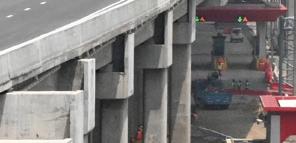

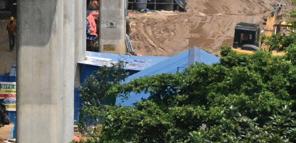










Bangladesh prime minister Sheikh Hasina of cially opened the 11.5km Airport- Farmgate segment of the 19.73km Dhaka Elevated Expressway.
According to the Bangladesh Infrastructure Finance Fund Limited (BIFFL, a governmentowned non-banking nancial institution) the project involves construction of a four-lane main carriageway and one elevated link road. The fourlane dual main carriageway is 19.7km while a fourlane dual Link-Road Carriageway is around 3km long. There are 32 on-off ramps, eight toll plazas and 43 toll collection booths.
Bangladesh media reports note that around 65% of the project is complete. Construction started in January 2020 and the remaining sections to be nished next year are the Farmgate-to-Moghbazar

and Moghbazar-to-Kutubkhali in the capital city Dhaka.
The Italian-Thai Development Corporation has entered into a US$1.062 billion contract with China Railway Construction Corporation (CRCC) for building the Dhaka Elevated Expressway, which is a public-private partnership.
Italian-Thai Development is the largest construction contractor in Thailand. Projects include Bangkok's international Suvarnabhumi Airport and the city's mass transit subway system. The company was established in 1958 by a Thai, Chaijudh Karnasuta, and an Italian, Giorgio Berlingieri. Currently the company is run by an all-Thai management team led by members of the Karnasuta family. The current president, Premchai Karnasuta, is the second son of co-founder Karnasuta.


A new highway link is planned for Morocco. The highway will connect Berrechid and Tit Mellil to the south of Casablanca. Building work has commenced on the route, which will reduce congestion on the existing link between Casablanca’s International Airport and the city itself.
The project is costing US$247 million. The majority of the funding required is being supplied via the Arab Fund for Economic and Social Development. Construction of the highway is being managed by Morocco’s state-owned highway rm, ADM, with the work being split into four lots being headed by four separate contractors.
Central America has bene ted from a series of road improvements in the last decade. Funding provided by the Central American Bank for Economic Integration (CABEI) has helped deliver key upgrades to the road network in Central America.
Some 10,646km of roads have been maintained, repaired or revamped due to the US$4.44 billion worth of funding delivered by CABEI.

The Malaysian Government is aiming to speed up the tender process for works to the Pan Borneo Highway. A new prequali cation system is being introduced by the Ministry of Finance and Ministry of Public Works. The Pan Borneo Highway is a key transport link for Malaysia and its construction is being prioritised. Completion of the route will help boost Malaysia’s economy and several sections are already in use. Work is either underway or planned for 35 sections of the route in Sabah.
Completion of the elevated road project in Lima, Peru is due in 2027. Completion of the major elevated road project for Peru’s capital, Lima, is due in 2027. Called the Via Expresa Santa Rosa (VESR) road, the 3.7km link runs the entire length of Santa Rosa Avenue and will connect the Costa Verde waterfront with the extension of the Jorge Chávez International Airport.
The US$218 million project is intended to reduce Lima’s chronic peak period tra c congestion. The project is being managed by Peru’s Ministry of Transport and Communications (MTC).






























EXAT, the Expressway Authority of Thailand, is considering replacing a section of the N1 Expressway with a 6.7km-long tunnel, the country’s rst such structure.
Reports suggest that a 17-month feasibility study has been completed. Bidding could start in 2026 and construction of the tunnel, which would run between 40m and 44m deep, could start as early as 2027 for opening in



2030. An environmental impact assessment would be completed in May and then be submitted to the government for approval.


The 6.7km double-deck tunnel, which will be the country's rst expressway tunnel, would bypass the heavily congested Kaset-Nawamin intersection in Bangkok’s Bueng Kum district. Traf c volume is estimated at 70,000 vehicles/day.
A land bridge mega project is being proposed that will improve transport connections for South East Asia. Financing for the proposed project is being sought by the Thailand Government.
The link could cost as much as US$29.35 billion to complete. The route would connect Ranong on the coast of the Andaman Sea with Chumphon on the Gulf of Thailand. Thailand’s Ministry of Transport has been holding a
series of roadshows in China, the UK and the US, hoping to attract rms willing to invest in the project. The plans for the project are being considered by the Of ce of Transport and Traf c Policy and Planning (OTP).

















The construction work for a major road tunnel project in Mumbai has been awarded. Worth over US$854 million, the work will be carried out by Larsen & Toubro (L&T) and is expected to take 54 months to complete.
The package of works was awarded by the Mumbai Metropolitan Region Development Authority (MMRDA). L&T will design and construct a new road tunnel link connecting Orange Gate with Marine Drive Coastal Road.










The work will be handled by the Heavy Civil Infrastructure business of L&T construction. The firm says that the major scope of work for the project comprises the design and construction of twin road tunnels, using TBMs, connecting to the existing elevated Eastern Freeway at Orange Gate near its southern terminal through transition ramps and to Marine drive at Mumbai. The project alignment will run primarily under the Sardar Vallabhbhai Patel Road.














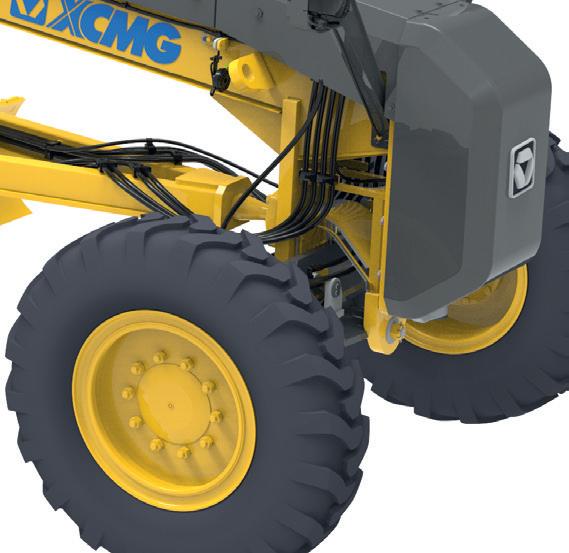
to support local technical talent in Africa. The rm has been assisting in the training of over 3,000 full-time students and 3,600 short-term students on a
yearly basis. The company has launched a training programme for dealers and operators in Africa to foster and up-skill the local construction professionals.
In Gabon, as a key strategic partner of AVIC International Holding Corporation, XCMG has supported local talent in gaining quali cations. The XCMG Technician College is engaged in setting up the curriculum, internship workstations, faculty development

and more to promote the skill and career development of local technical talent.
With comprehensive competencies in

XCMG Technician College have pioneered a
With comprehensive competencies in teaching, professional development and enterprise practice, the teachers from the XCMG Technician College have pioneered a model of construction machinery technician education and delivered training manuals based on practical applications and thorough study of the operation, maintenance, and repair technologies of 22 products and nine models. The training manuals have been translated into French and are in use at the training centres.
“In addition to teaching the theories with
practical cases, teachers from XCMG also taught us to simulate machinery equipment operation, and we learned China’s vocational skill training and evaluation standards during the assessments of both theories and
practical applications. We will pass on what we’ve learned from XCMG to our colleagues and students and help more Gabonese workers improve their skills and build a better hometown,” said Kassa, a teacher from Masuku University of Science and Technology who participated in the training.
XCMG www.xcmg.com

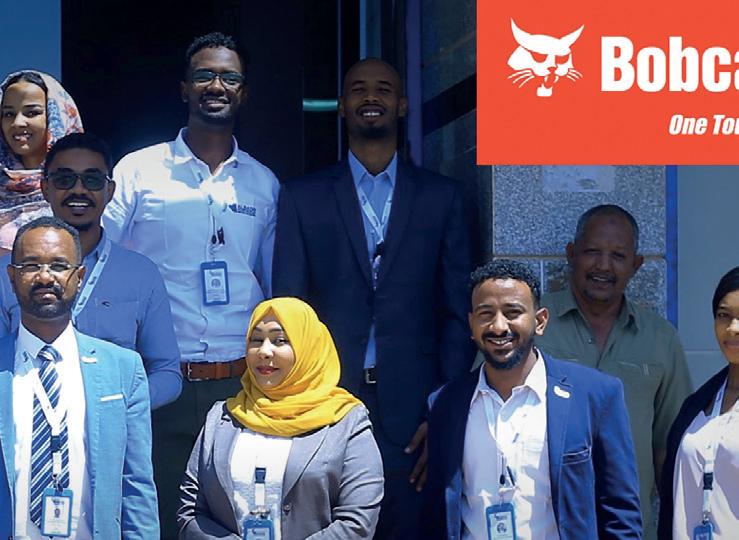
Bobcat reports strong demand for compact machines across Africa.
The rm has recently appointed several new dealers in the last two to three years following the upset to business caused by the recent pandemic.
Nicolas Dumont, District Sales Manager - Africa for Bobcat,

said: “The compact industry is still marginal compared to heavy construction equipment in Africa. This is because of the availability of cheap labour. But the potential growth is enormous as Africa will continue to develop.
“Growth is yet to come in many applications. Bobcat believes it is strategically important to

ensure the company is ready for growth. The rst step is to increase Bobcat's footprint with a network of strong dealers with increased presence across the continent and the second is to maximise our market share now to solidify our position as the market leader in the compact industry.”
Three of the newest dealers
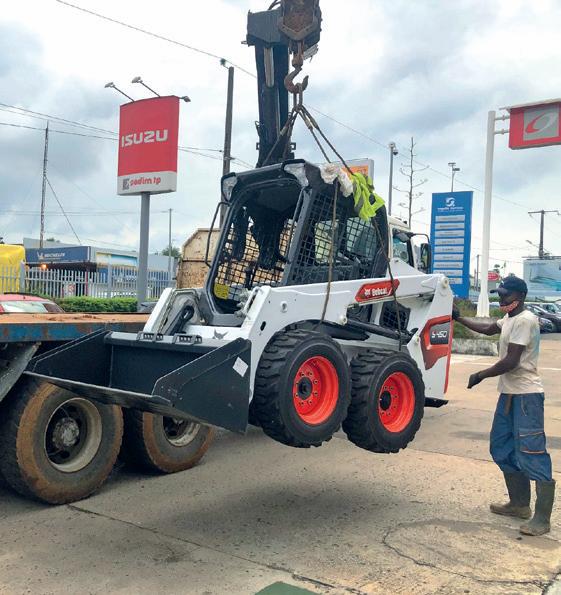
LEFT: Bobcat has appointed new dealerships in Africa to capitalise on growing demand for compact equipment
- Sodim TP in Gabon, Machinery Exchange in Zimbabwe and Albadri Power in Sudan - have echoed the other dealers in the Bobcat network, expressing increased optimism in their respective markets.
Bobcat www.bobcat.com
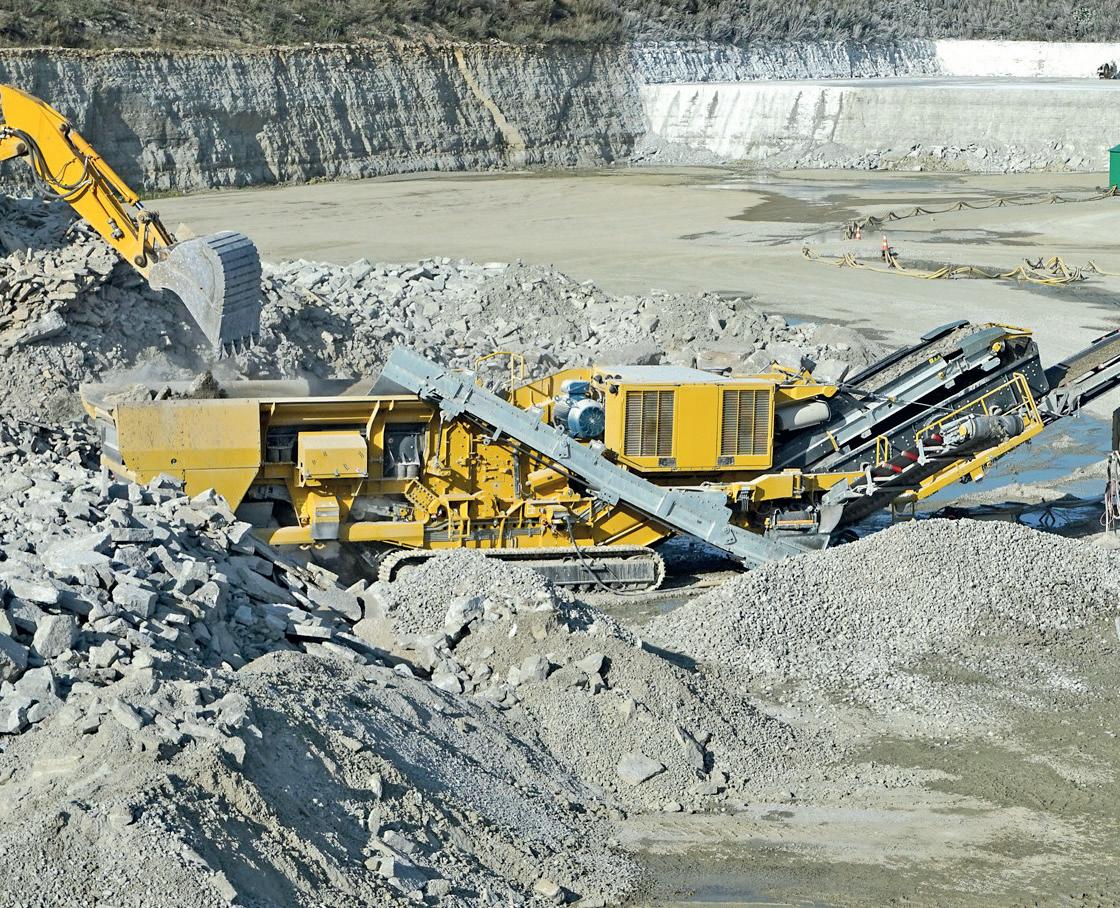
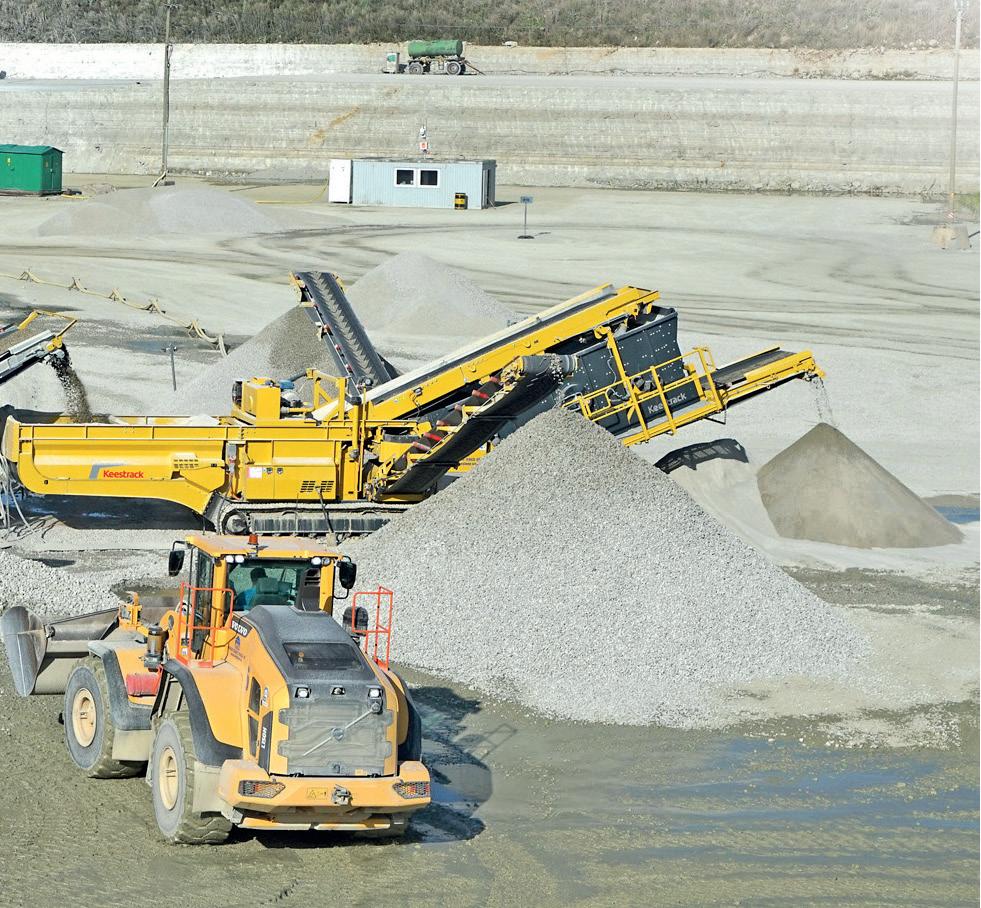
Keestrack is further developing its international distribution network with a new partnership in Saudi Arabia.
General Trading & Equipment CJSC (GTE) has been appointed as a Keestrack dealer for Saudi Arabia. The move is intended to help grow market share in the Middle East. GTE is now the o cial importer of Keestrack mobile crushing and screening equipment in Saudi Arabia.
GTE is a leading provider of construction machines with a strong reputation for sales service and support in the development of Saudi Arabia’s infrastructure and industries.
“The mission of GTE is to have strong relationships with its customers by providing best-in-class solutions, products and service and support,” said Dr Mohamed Shams Elramly, general manager at GTE.
Keestrack CEO, Frederik Hoogendoorn is looking forward working with GTE to expand the business in Saudi Arabia. “GTE is a professional and experienced company in the construction business with excellent sta and they have the
same customer focus as Keestrack has: solution oriented.”
GTE has its headquarters in Damman, having nine branches with their own sales and aftersales support, ve service centres with workshops, and the company consists of three divisions: Construction Equipment; Cleaning & Industrial Equipment; and Construction Systems.
For the Keestrack equipment, the focus in Saudi Arabia will be on the extraction industries as well as the potential recycling business.
One of the reasons GTE wanted to become a Keestrack dealer is the ability to deliver fully electric powered mobile crushing and screening equipment. The Keestrack machinery reduces the cost of ownership and gives a great exibility of drive systems and electric interconnectivity. The introduction of the mobile concept of crushing and screening will be a great opportunity for GTE in Saudia Arabia, as stationary applications are standard at present.
Keestrack started introducing electric drives in 2012 with its e-drive technology. The e-driven
Haver & Boecker Niagara recently opened a new service and support facility in Parauapebas, Brazil. The 4,000m2 facility now provides service and support for extraction operations throughout the region and o ers sophisticated diagnostics, equipment refurbishment and parts stocking support.
“Providing quality service and support is at the heart of what we do. At Haver & Boecker Niagara, we strive to be an extension of an operation’s service team,” said Clayton Carvalho, managing director of Haver & Boecker Niagara’s Brazil operation. “We o er an array of service and support options to increase customer savings and equipment longevity. With the addition of the Parauapebas facility, we can more provide unmatched service and support onsite for our customers to help maximise their screening performance.”
Haver & Boecker Niagara’s new facility o ers the capacity to manufacture 800 di erent part numbers and can refurbish 120 vibrating screens and 240 exciters. It features a paint booth, a rainwater collection system, water treatment, water and oil separation, 100% LED lighting with lower energy consumption and a natural lighting structure. Additionally, the new Parauapebas facility features a powerful overhead crane, a blasting booth and air conditioners.
Keestrack’s crushing and screening range will now be available in Saudi Arabia
machines evolved to equipment with a drop-o engine/gen-set unit which could be placed next to the equipment, in less dusty and vibrant circumstances, or on the frame of the machine.
Keestrack introduced its ZERO-drive machines in 2021, without any combustion engines. Electric motors drive most of the mobile crushing and screening equipment and power some necessary hydraulics systems. The following equipment is available in ZERO-drive: all cone crushers, impact crushers including the reversible vertical impact crusher l4e; scalper screens and the C6e classi er; all stackers; almost all jaw crushers; and the tracked Apron feeder A6.
As a backup for the ZERO-drive machines Keestrack developed a tracked engine/generator unit in 2022 that can supply connected Keestrack crushers, screens and stackers directly with electricity in case there is no plug-in connection from the grid available.
Keestrack
www.keestrack.com
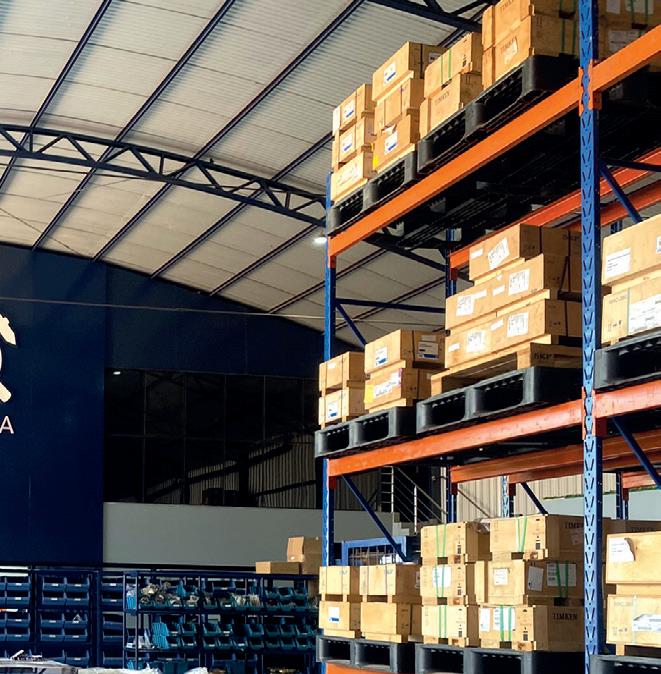
“It is a great honour and a source of pride for all of us at Haver & Boecker Niagara to launch this facility. It is a display of growth not only for the company but for the entire local population,” Carvalho said.
Haver & Boecker Niagara www.haverniagara.com



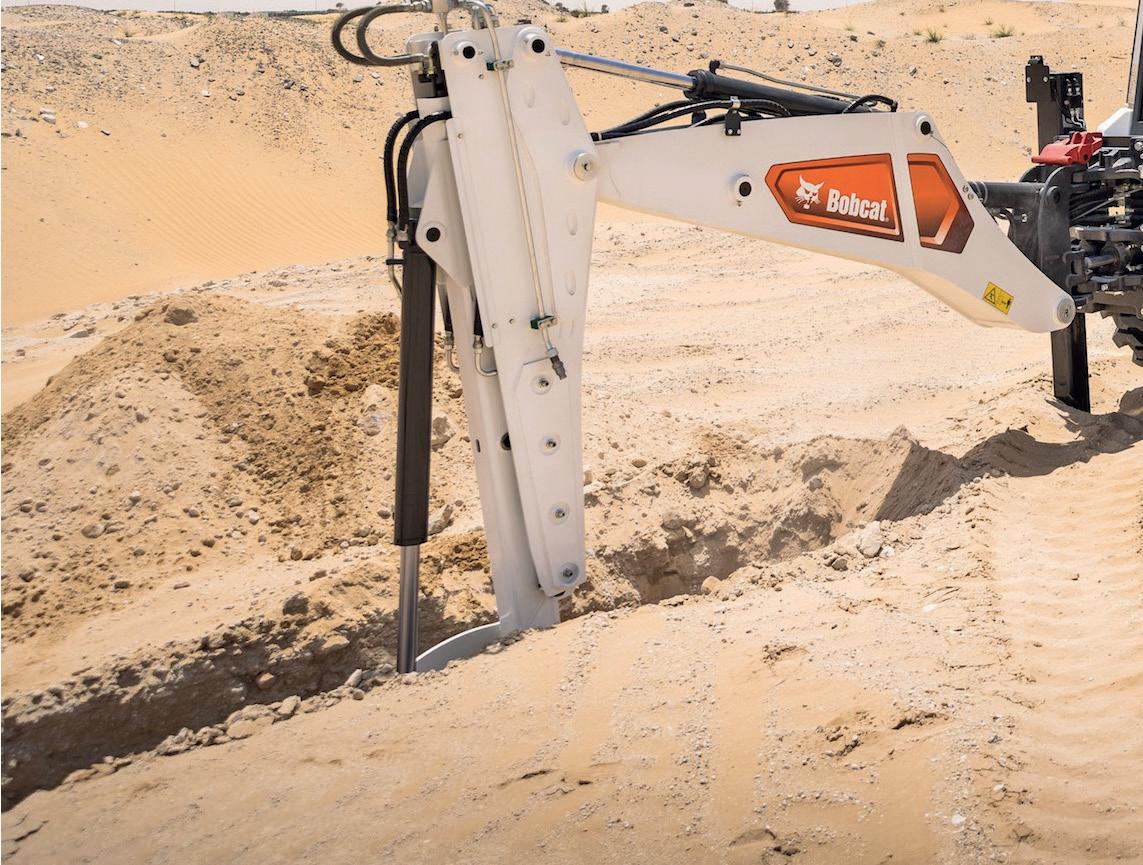
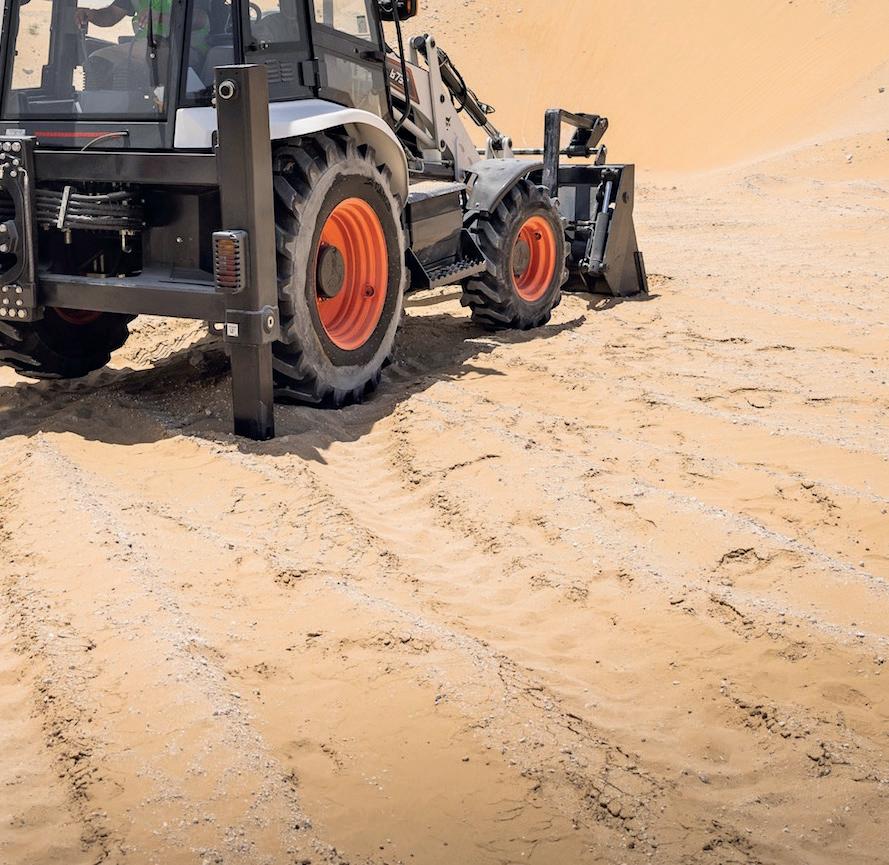
Bobcat says that its new B730 M-Series backhoe loader has been designed for markets in the Middle East and Africa (MEA) and CIS regions. The B730 M-Series is said to o er high performance, ease of operation and high comfort, in a machine built with proven, high-quality components and durability.
Conceived and built at the Doosan Bobcat manufacturing facility in Chennai in India, the B730 M-Series is a new addition to the Bobcat backhoe loader range, providing a model for the value market. Available in a choice of di erent con gurations and matched with attachments for diverse applications, the B730 M-Series is ideal for use in construction, rental, roadworks, demolition, excavation, landscaping and many other industries.
John Chattaway, loaders product manager at Bobcat, said: “Together with our customers and experienced dealer network we developed a machine that is ideal for mixed contractor and rental eets. The B730 M-Series is engineered with 100% Bobcat DNA and has all of the brand’s hallmarks: high-quality manufacturing; reliability; generous warranty and the support of the proven Bobcat service and parts network in the MEA and CIS for peace of mind. To ensure the highest level of quality, all structural items are designed and manufactured in-house to Bobcat’s thorough standards.”
Gaby Rhayem, regional director for the Middle East, Africa and CIS countries at Doosan Bobcat EMEA, claimed: “The B730 M-Series has class-leading breakout forces, reach and dig depth capabilities and multifunction backhoe operation. Combined with its powerful hydraulic system, robust build and intuitive operation, this provides excellent productivity for trenching, levelling and loading work.”
The B730 M-Series is designed with a focus
on durability in challenging conditions, with components known for reliability and ease of service and maintenance in the eld. These high-quality, proven components are sourced from well established brands, such as the Perkins 1104 engine, Carraro axles and transmission, and Parker pumps.
The proven 70kW Perkins engine powers the hydraulic Tandem Gear Pump and Synchro Shuttle (SPS) transmission to boost productivity and allow fuel consumption. The B730 M-Series hydraulics also provide class-leading backhoe breakout forces, along with the highest loader lift and push breakout in its class. This is coupled with backhoe digging depths of 4.63m.


The independent steering pump and hydraulics unloading system are standard, helping the machine to provide power when needed, and keeping the systems cool in harsh working conditions. The front loader’s return to dig feature is standard and assists productivity when dozing and loading materials.
The cab is said to o er a comfortable seat, plenty of room to operate the machine and 360° visibility. A large rear window provides visibility for backhoe work; if necessary, it swings up and over with ease and locks in the cab ceiling. There are also fully opening side windows and catches to hold the door open for added ventilation when the optional HVAC system is not needed.
Customers are able to have their machines factory-con gured with the control layout they are used to. Being able to select a familiar, customised control pattern (ISO, SAE or SAE-X) from the factory allows operators to step into the machine and start work.
As well as return to dig, the bucket oat is also a standard function, both helping to increase
productivity. The direct mechanical backhoe controls have been tuned for smoothness and multifunction use.
High-performance aluminium coolers and a durable cooling fan are said to provide an e ective cooling system, ensuring performance is not compromised by hot or harsh conditions. The large 160litre fuel tank and good fuel e ciency allow work to continue for longer without refuelling. The fuel tank is also made of corrosionresistant plastic and protected with metal guards to ensure a long working life.
The hood ips forward to service the engine, providing access to critical components, uids and lters and making sure that daily maintenance work and changing of consumable parts is a very easy process. Attention has been paid to hose routeing and protection in all locations, including the use of a distribution hose box for the backhoe side-shift. A kit of standard tools is included for daily maintenance.
The machine has a loader bucket capacity of 1.1m3, a breakout force at the shovel of 60kN, a breakout force at the arm of 56.74kN, a height to hinge pin of 3.5m and a dump height of 2728mm. It also has a backhoe bucket capacity of 0.18m3, a backhoe bucket tearout of 59.3kN, digging depth of 4633mm when retracted and 5623mm when extended. Maximum speed is 40km/h and power comes from a Perkins 1104D-44T, 70kW engine at 2200rpm, while the machine weighs in at 7.9tonnes.
Bobcat www.bobcat.com











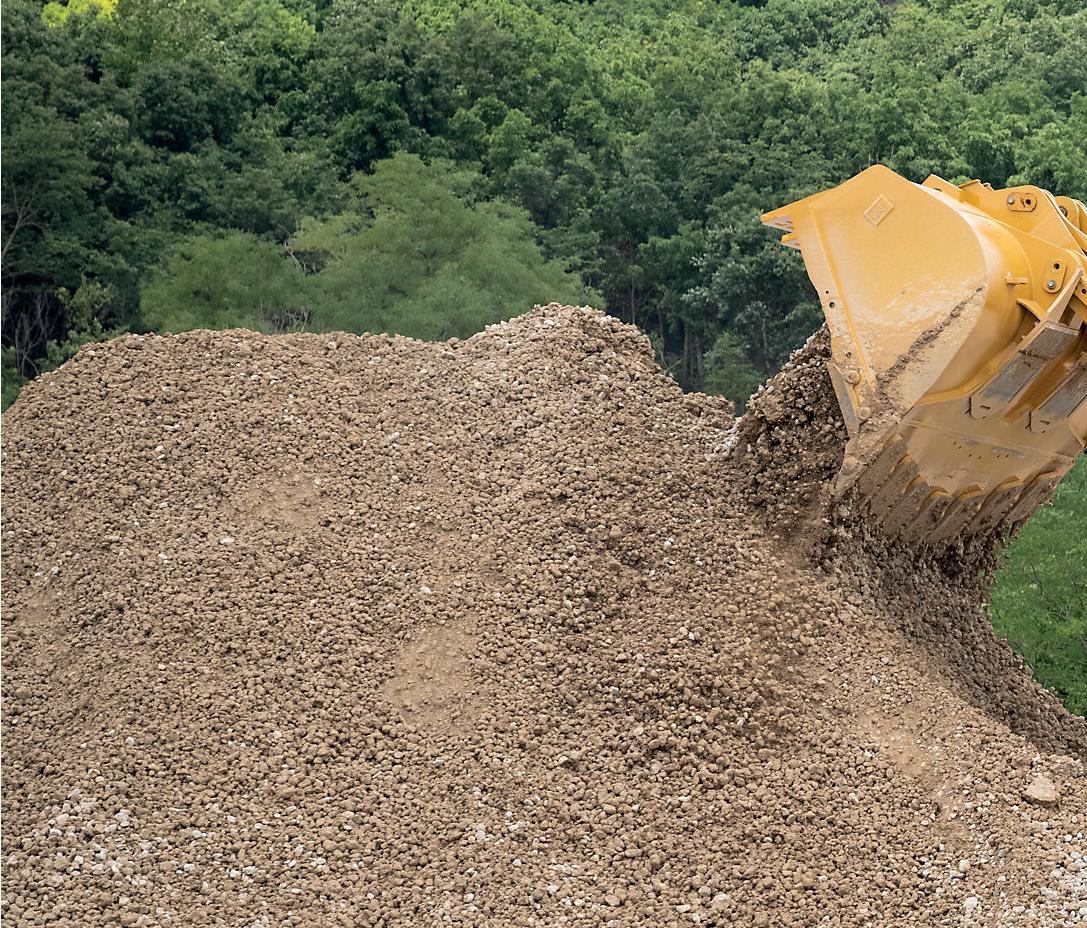
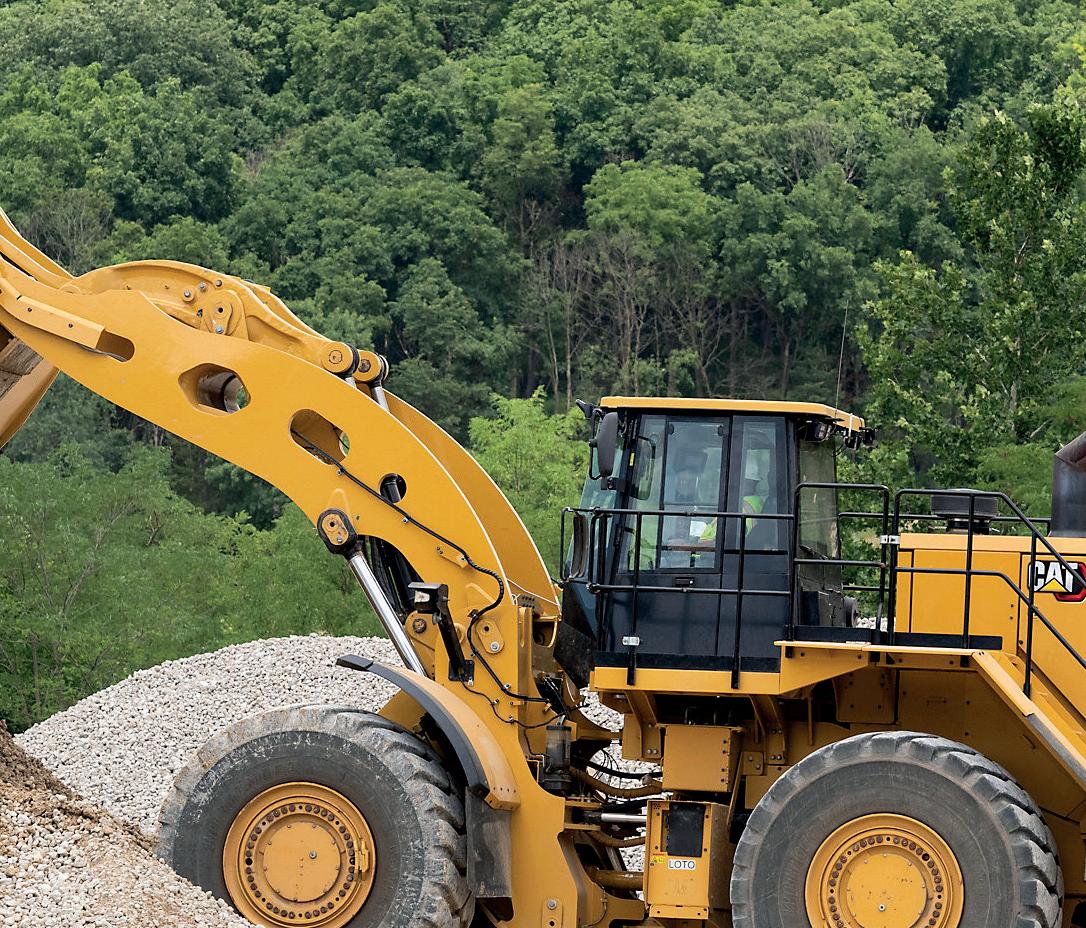
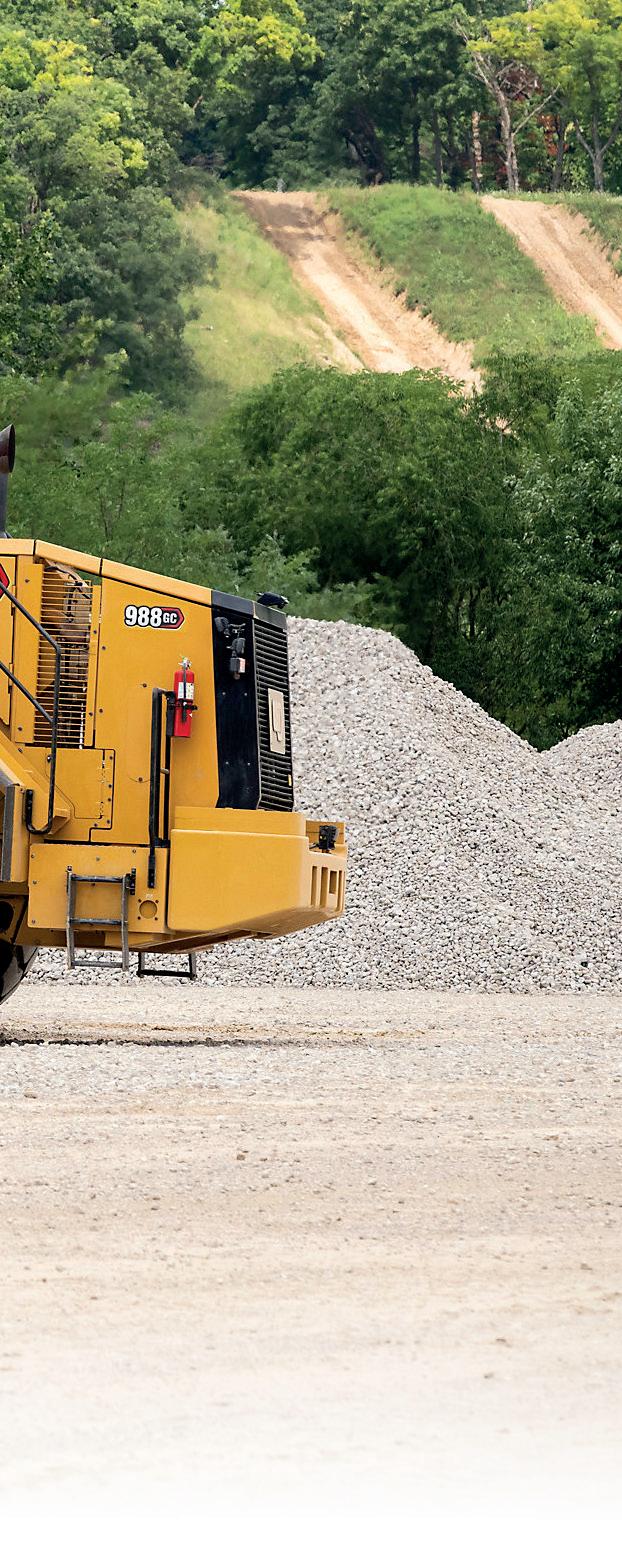
The new Cat 988 GC wheeled loader is said to deliver high production targets at a low operating cost/hour.
Low fuel and maintenance costs are claimed, allowing a fast return on investment. The new loader o ers up to 5% less fuel consumption and up to 15% lower maintenance costs than the Cat 988K. Designed to maximise life cycle value in moderate production applications up to 2,000hours/year, the 988 GC is capable of delivering production within 6% of the 988K in truck loading applications.
Easy to operate and maintain, the 51tonne 988 GC o ers optimal loading for 45tonne trucks. Its 3909mm dump clearance delivers e cient loading up to the Cat 775G truck. With bucket payload matched to the 988K, the new 988 GC o ers up to 670tonnes/hour productivity in shot rock truck loading applications and up to 527tonnes/hour for load-and-carry operations.
The durable structures of the new loader are built for multiple life cycles and to withstand the toughest loading conditions. Built on the common Cat Large Wheel Loader platform, its full box section rear frame is said to resist torsional shock and twisting forces. The front frame is redesigned to withstand larger loads and features a new lift arm design.
Power comes from the 335kW Cat 15 engine, which o ers con gurations to meet IIIA/ Tier 3 and Stage V/Tier 4 Final emissions requirements. The 988 GC’s cooling package o ers higher heat rejection with an on-demand fan strategy and two available fan speed settings for standard and high-ambient-temperature con gurations.
The Cat torque converter with standard lock-up clutch eliminates losses, lowers system heat, improves travel times and reduces cycle times in load-andcarry operations. Improving service
life and serviceability, Cat oil disc brakes provide superior heat dissipation and performance.
Designed for quarry applications, the Cat Advanced Power Electronic Control Strategy (APECS) transmission o ers consistent, smooth shifting, productivity and e ciency, and long life. Forward momentum and torque are maintained when shifting for greater momentum on grades. The transmission neutraliser pedal extends service brake life and allows full power during stationary loading.

reduce overloading, optional Cat Payload provides on-the-go weighing for materials hauled and loaded. An optional Advanced Productivity subscription provides comprehensive actionable information to help manage and improve operational productivity and pro tability.
Load sensing hydraulics direct hydraulic ow to implement and steering systems only when needed to optimise performance and e ciency of the new 988 GC. Bene cial for load-andcarry applications, the optional ride control adds an auxiliary accumulator to the lift circuit for a smoother ride.
Displaying data in real time to improve productivity and
Allu says that its new VD Drum enables users to quickly replace xed TS blades. There is no need to open the chain-box when blades are replaced. Enabling a variable drum setup means an individual drum or blades can be changed quicker. ALLU’s patented TS (top screen) construction and screening blades make
it possible to screen materials even when they are wet or moist without clogging. With the TS structure, it is also possible to get three di erent fragment sizes from the same ALLU unit by rearranging the screening combs with no additional costs ALLU Transformer D-series attachments are versatile and reliable tools for
The new loader’s design includes features to increase machine uptime and reduce maintenance costs by up to 15% compared to the 988K. Advanced ltration extends performance and reliability of the hydraulic system. Its onboard diagnostics alerts the operator of machine issues so that problems can be resolved before failure. Information captured by Product Link can be remotely monitored via my.cat.com, the Cat app or VisionLink to help preventative maintenance and servicing.
Caterpillar www.cat.com
industries enabling e cient screening and crushing of materials. The ALLU Transformer D-series screener buckets are designed for larger processing jobs.
ALLU www.allu.net


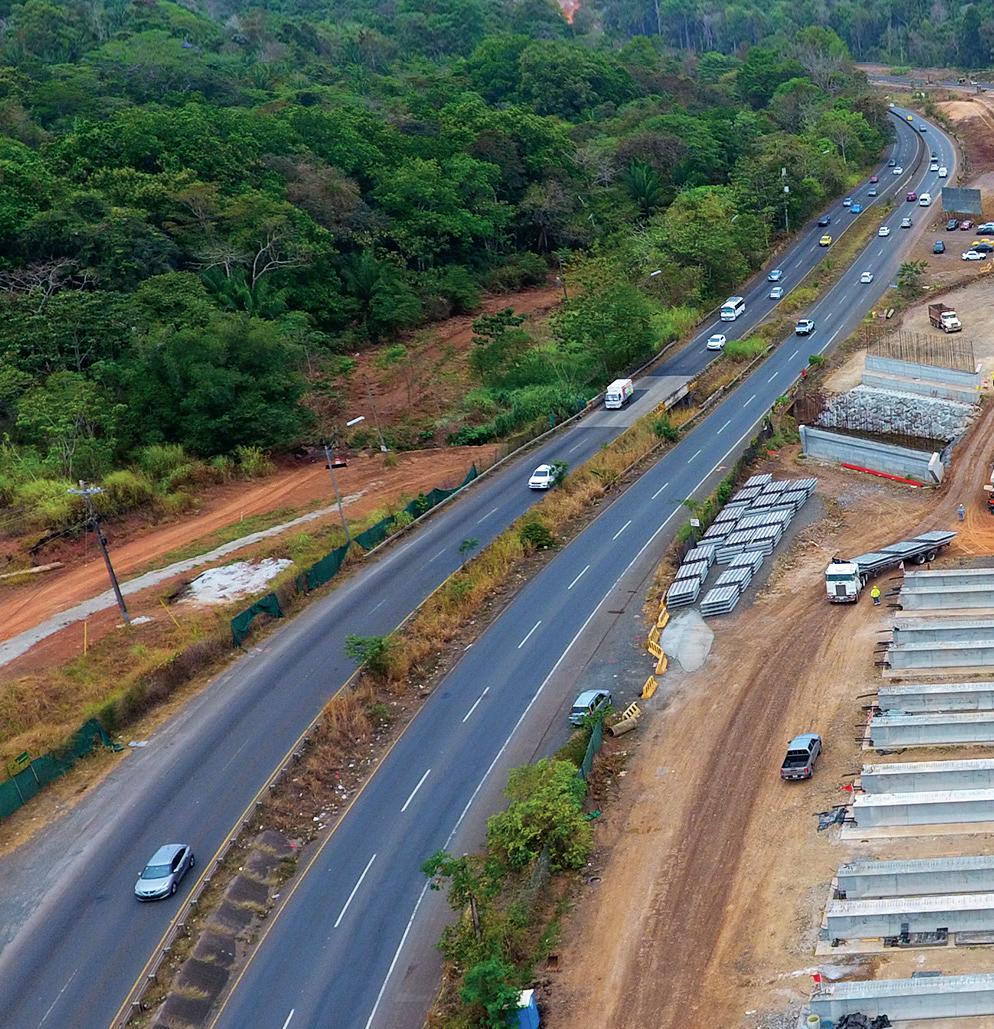



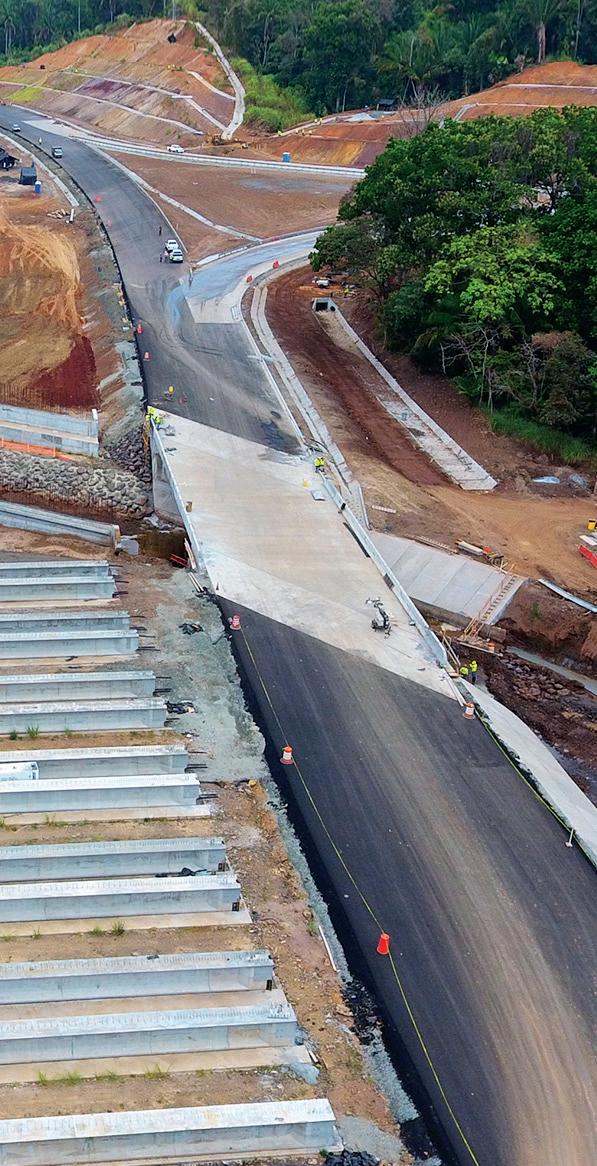
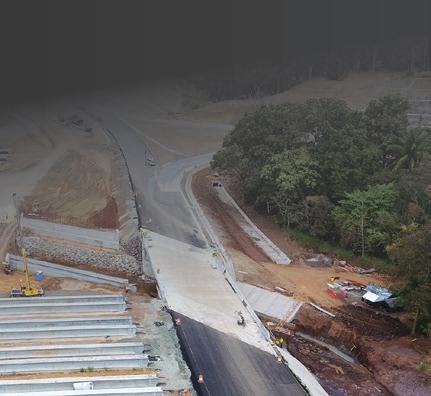
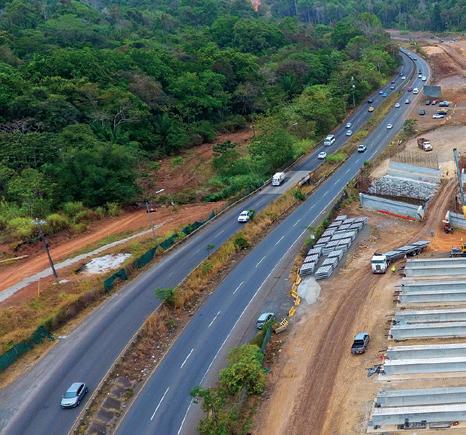
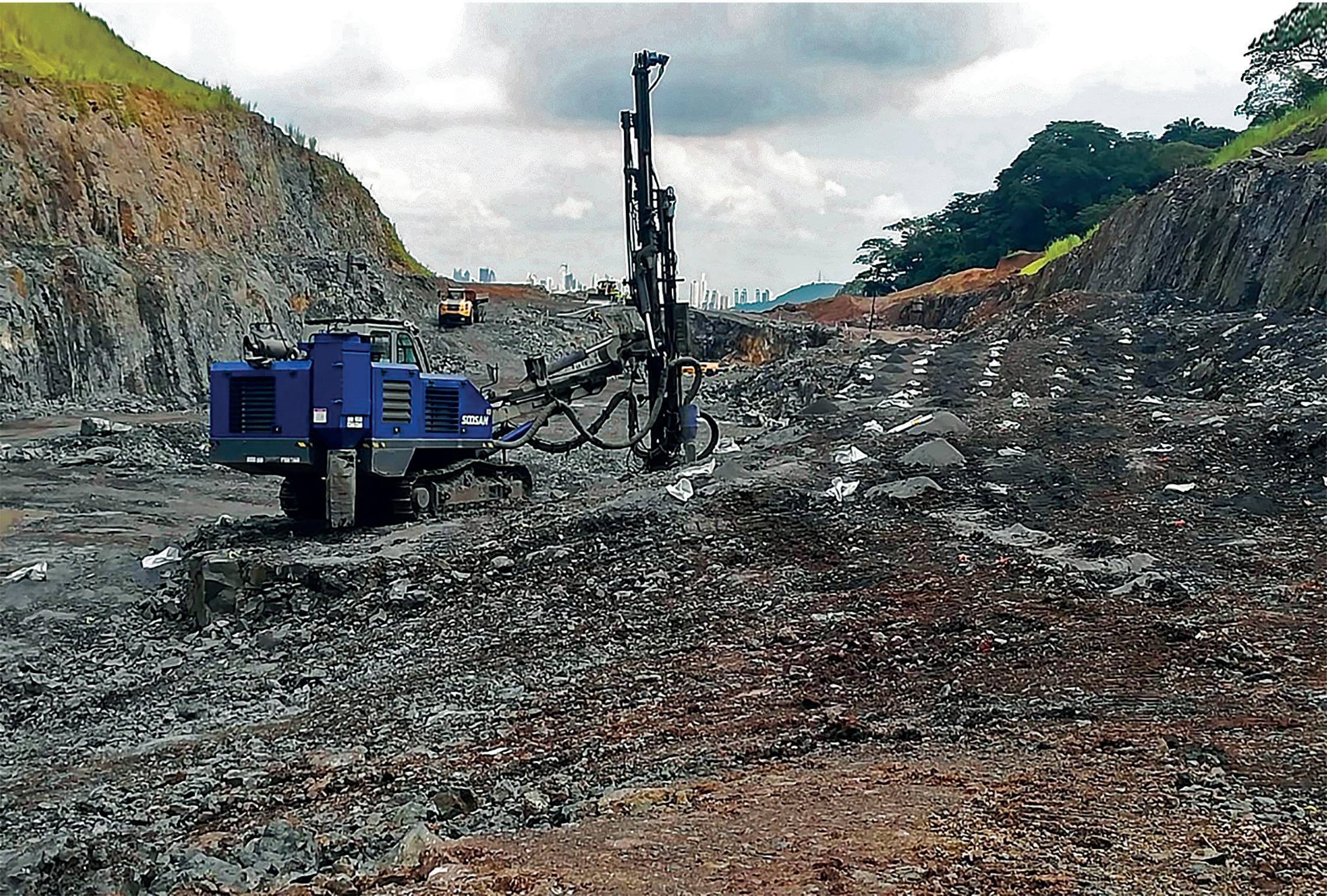
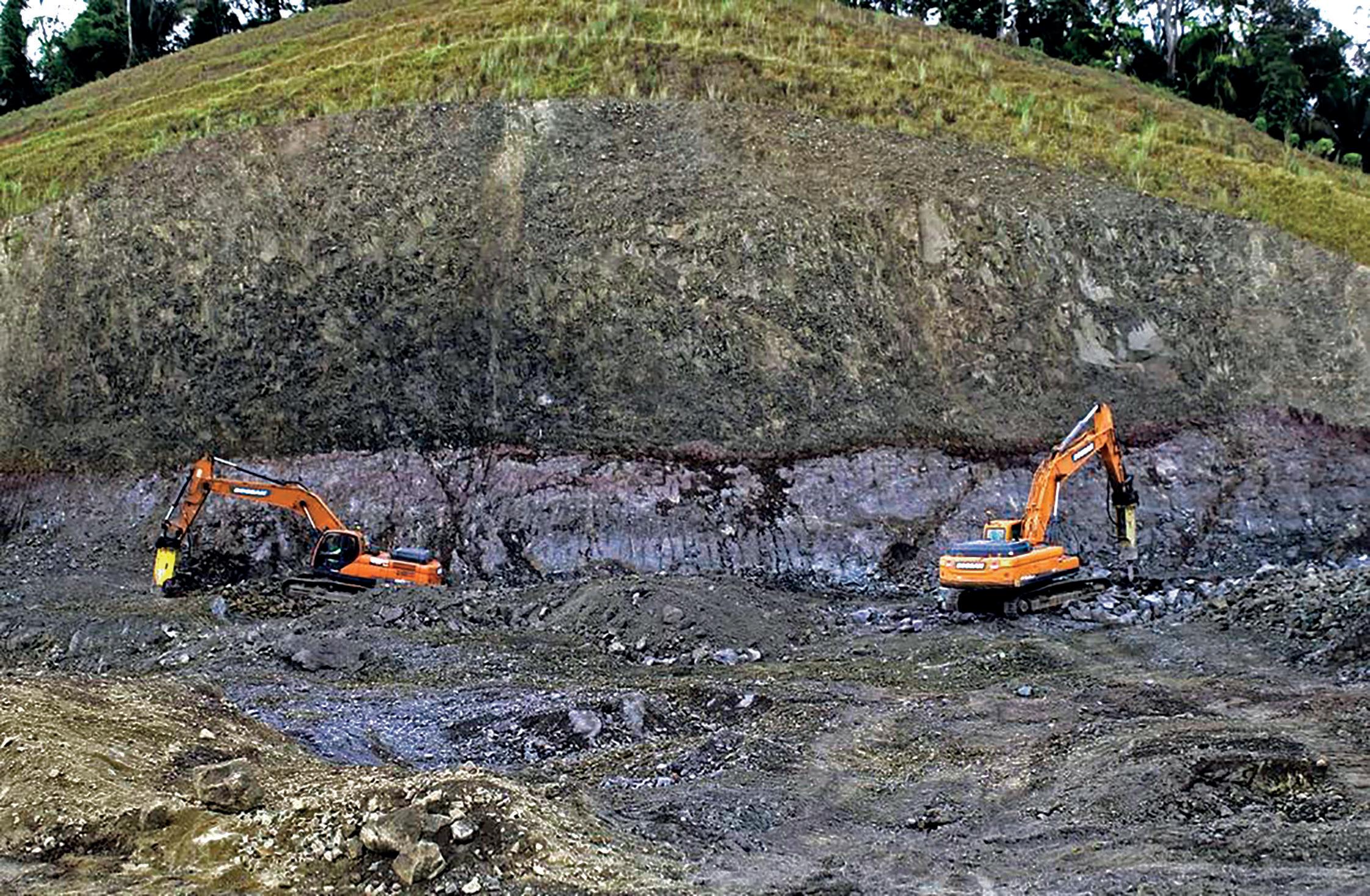
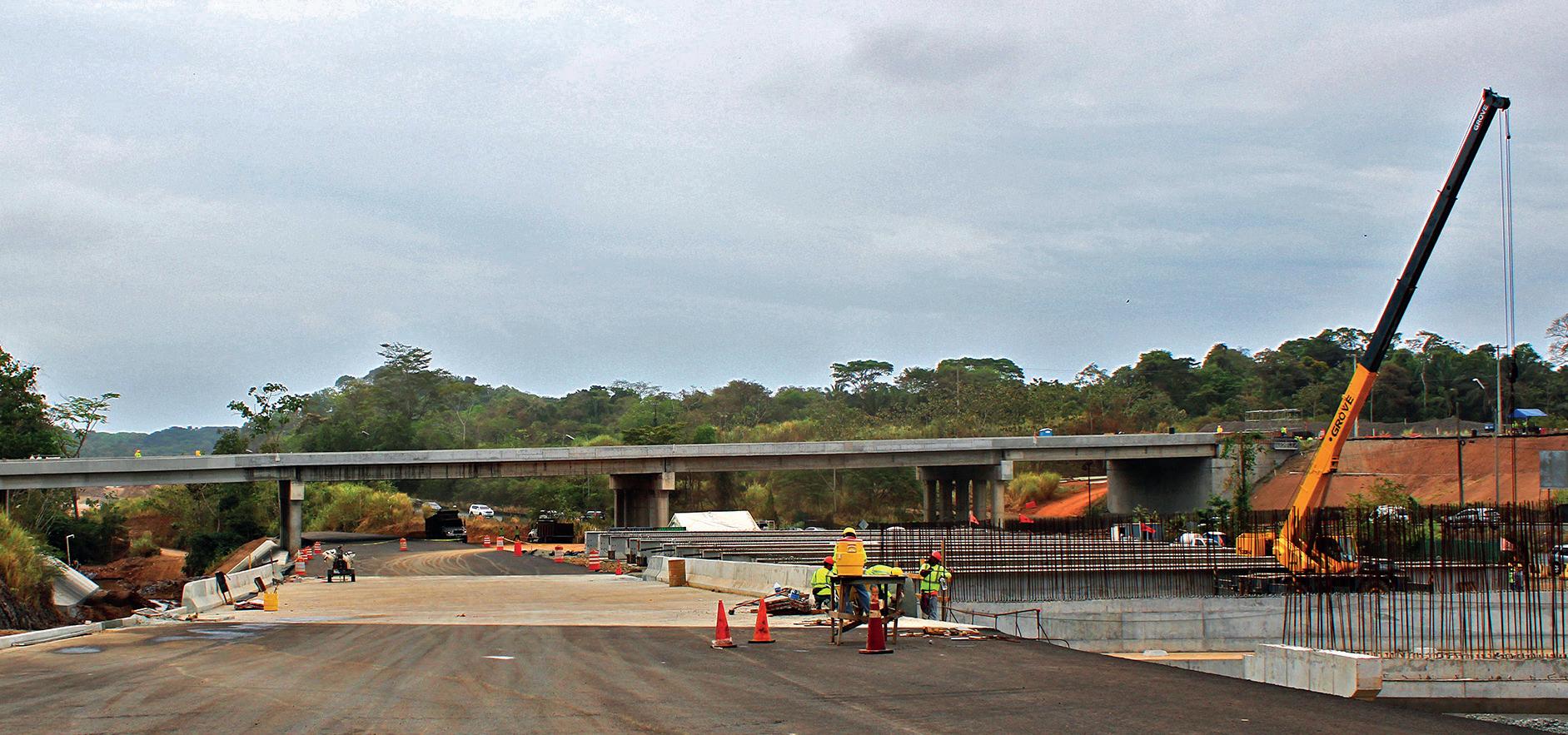
Expansion of the Panamericana Oeste highway is an infrastructure project that will help guarantee the future of Panama - Mauro Nogarin writes
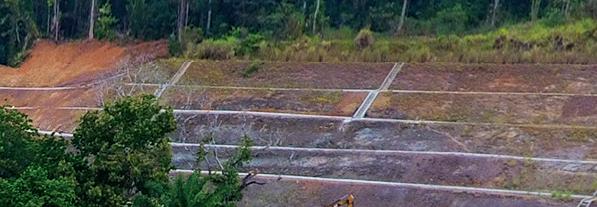
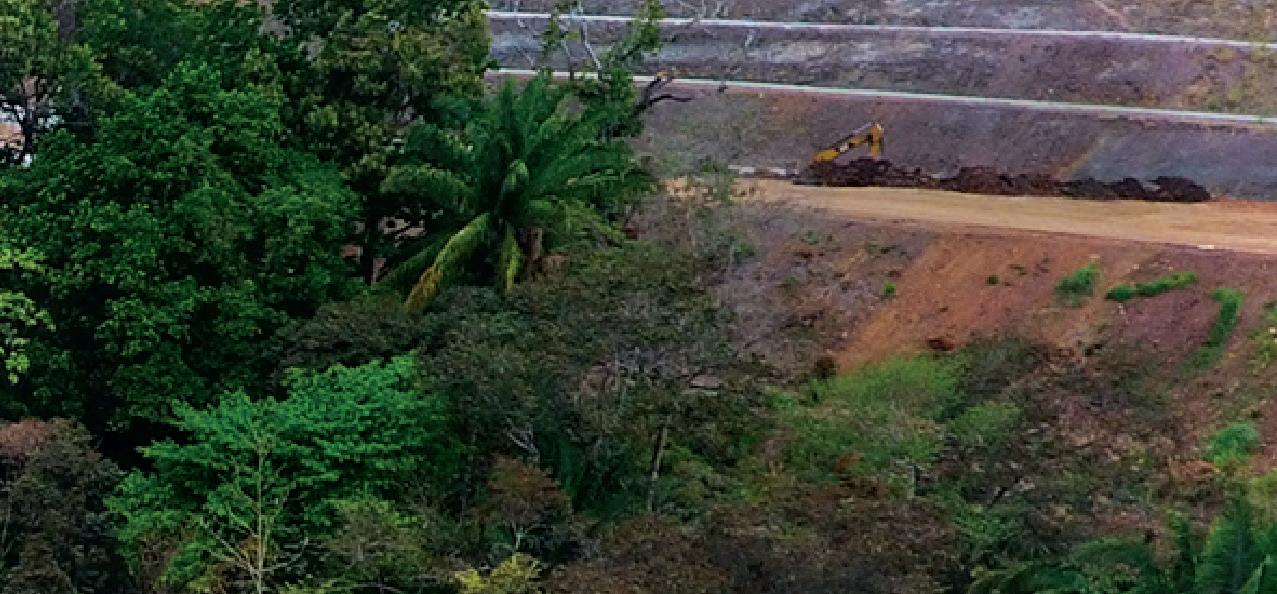
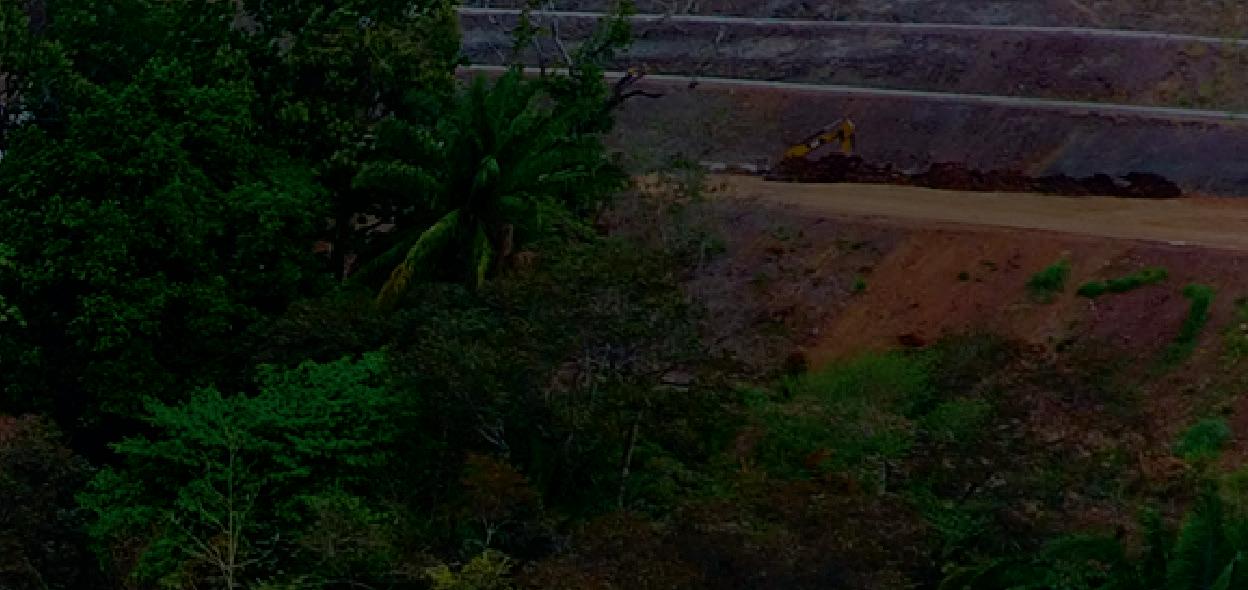
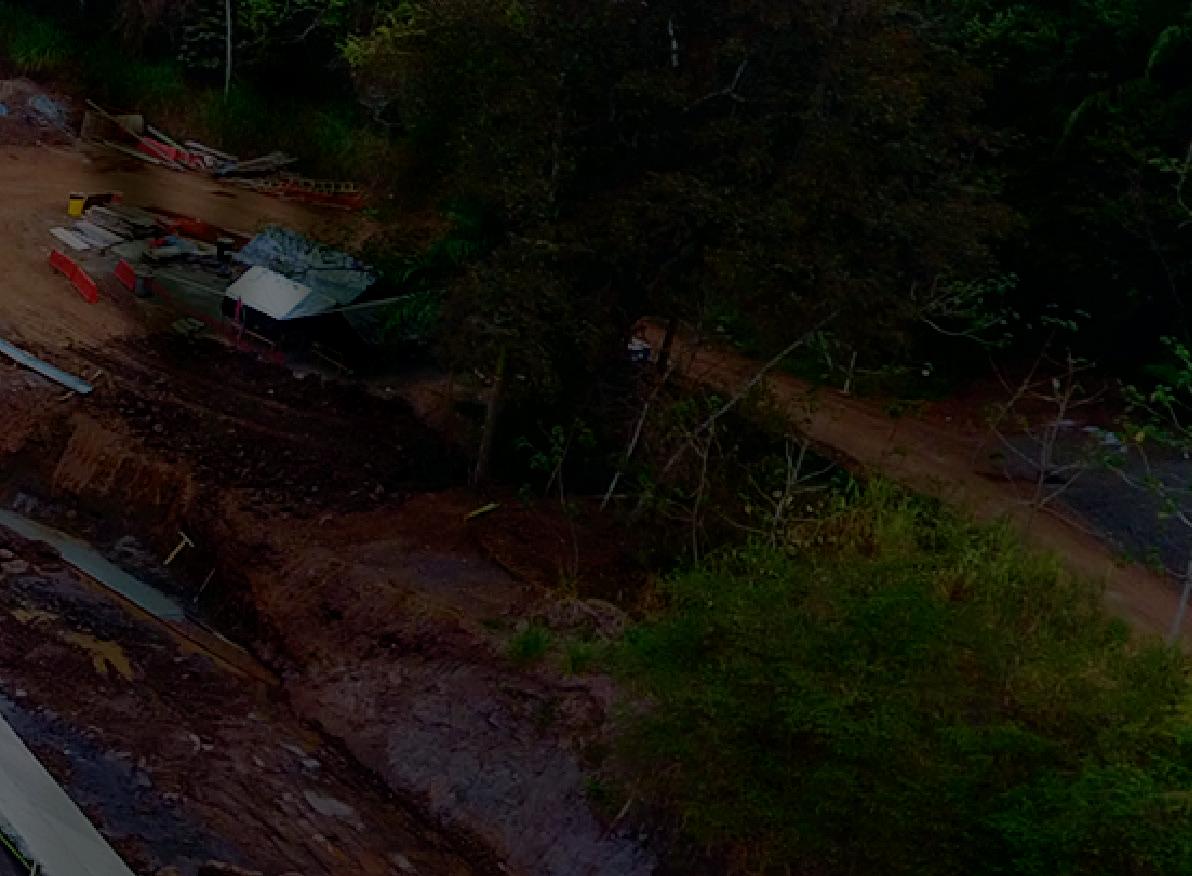
With the construction of the Panamericana Oeste highway, the Government of Panama intends to ensure the country’s economic development over the next 20 years. The project will bene t the inhabitants of Panama West by reducing journey times from two hours to 45 minutes. Furthermore, this extension will guarantee the connection to the fourth bridge over the Panama Canal and will complement the capacity of Line 3 of the Metro, bene ting 600,000 inhabitants. According to the latest data from the Ministry of Public Works (MOP), the project is around 75% complete at present.
Of the different proposals presented in the tender, the Loma-Cová consortium, comprising the Spanish company Acciona Infraestructura and the Costa Rican company Meco Constructora, was awarded the package of works.
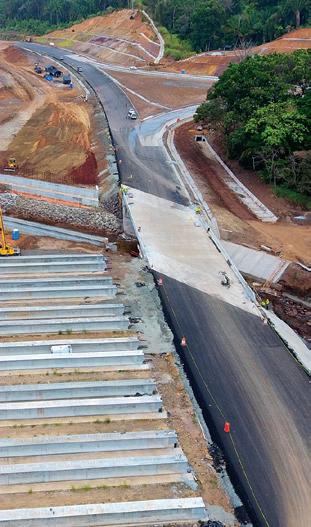
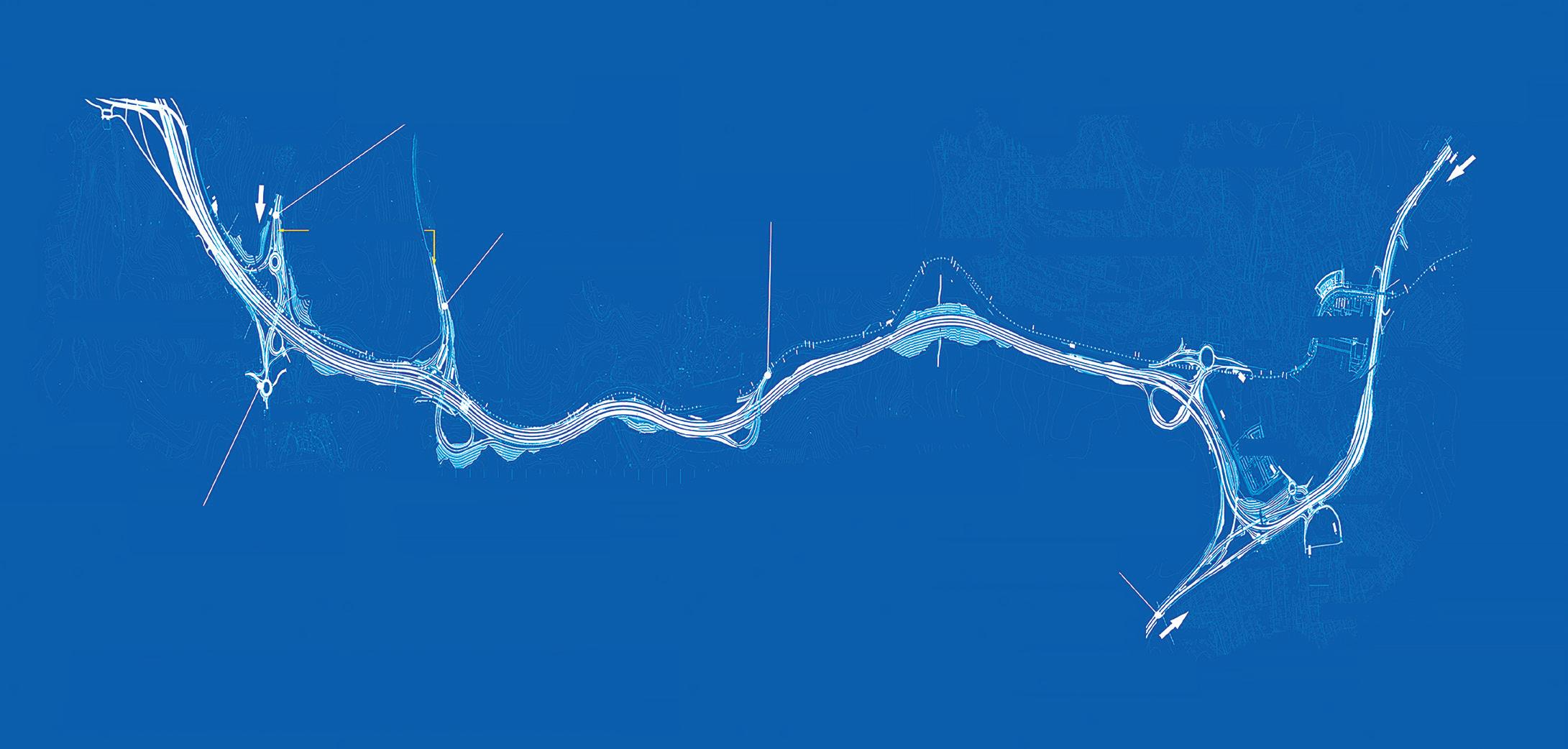
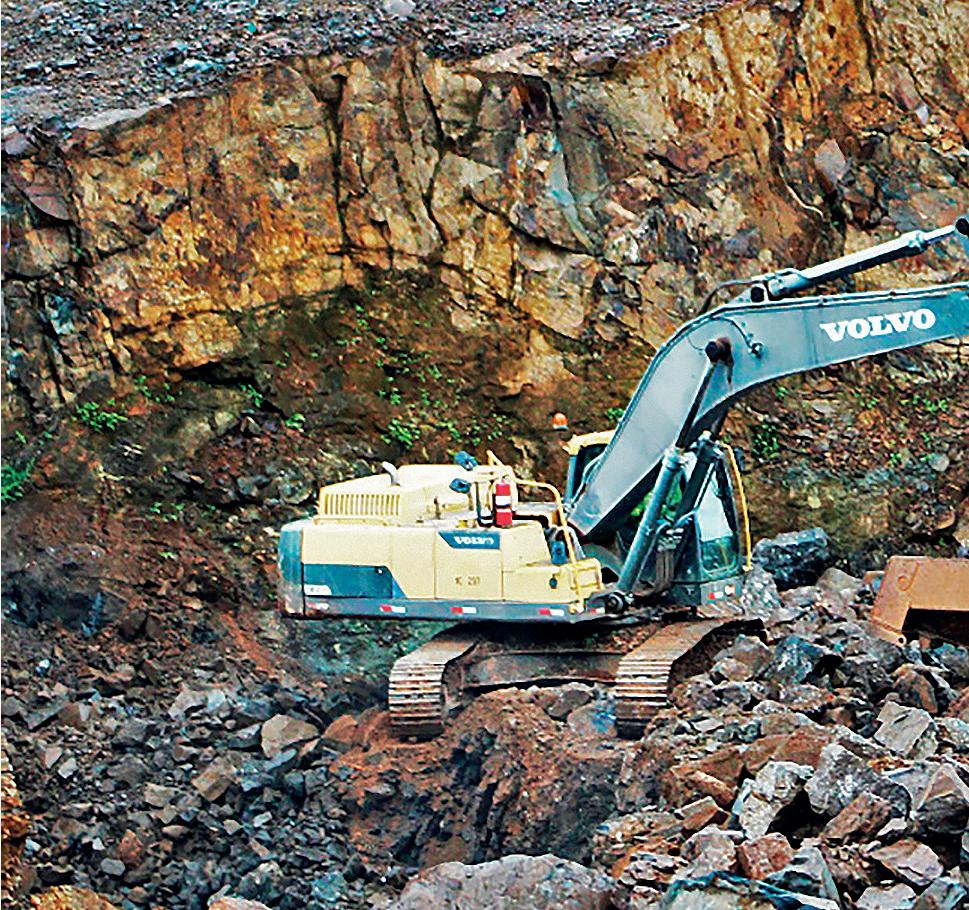
In general, the project consists of the rebuilding of 11km of the Pan-American Highway, widening the route from four to eight lanes. The rebuilt stretch will feature three permanent lanes in either direction as well as a central roadway with two lanes that will be reversible to cope with varying traf c needs in peak hours. In addition, the project will include the construction of ve new interchanges.
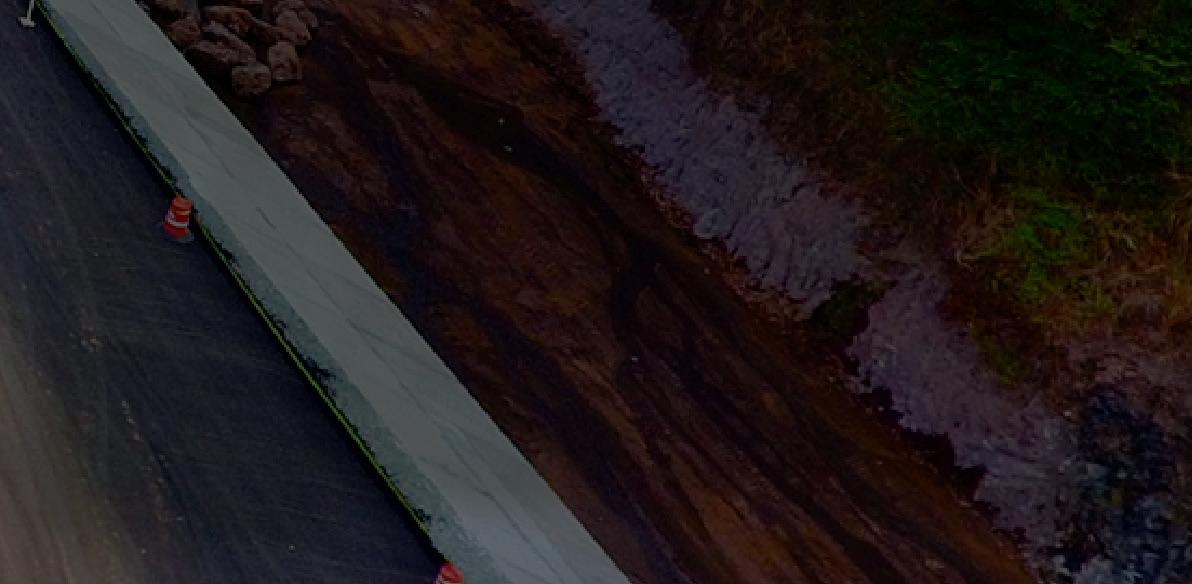
In the original speci cations prepared by the MOP, the reversible two-lane central roadway was intended to operate in the Arraiján - Panama direction during morning rush hours, and in the PanamaArraiján direction during evening rush hours. Depending on demand, the reversible lanes can also be adapted to the most convenient direction to suit traf c requirements. The stretch being widened runs from the connection with the project of the fourth Bridge over the Panama Canal (in the Cocolí area) to the connection with the Centenario road (in the Burunga area), where a new road interchange is also being built.
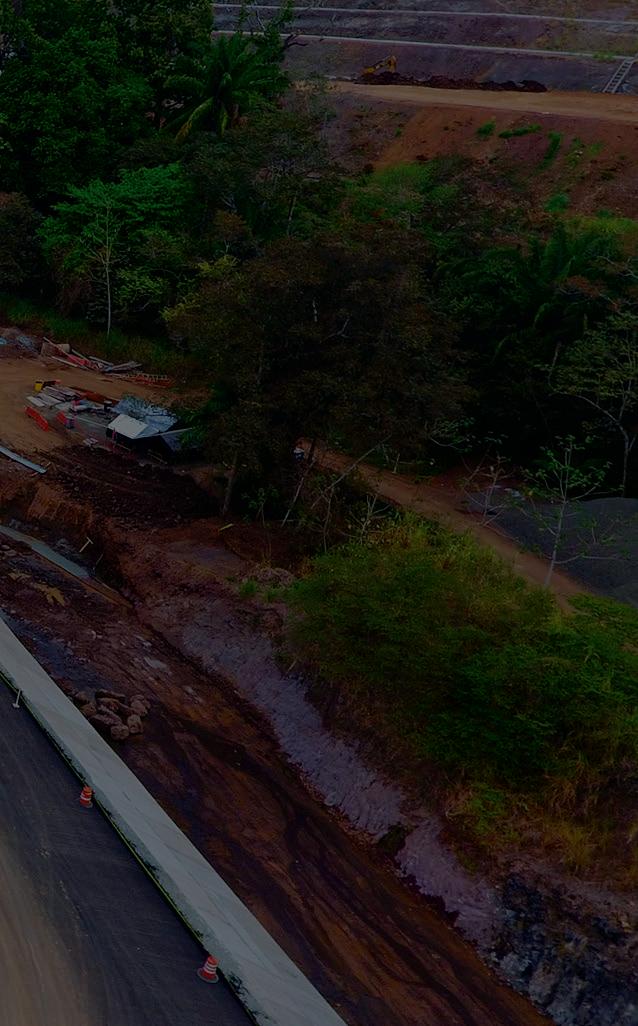
The extension of the highway to eight lanes from Loma Cobá will also allow an improvement in the gradient, limiting the slope to 6%. The new stretch will be independent from the current highway through a new layout until its nal connection with the Centenario highway.
The construction work for this highway expansion project commenced some 500m from the existing Howard/Cocolí interchange, and continued along the current corridor of the Pan-American Highway until it passed Loma Cobá, and from there was routed to the North in a new alignment (bypass section), nally connecting with the Centenario road in Burunga.
In addition to the widening work for the highway itself, the project also includes the construction of six road interchanges, four box-type road structures, 13 bridges
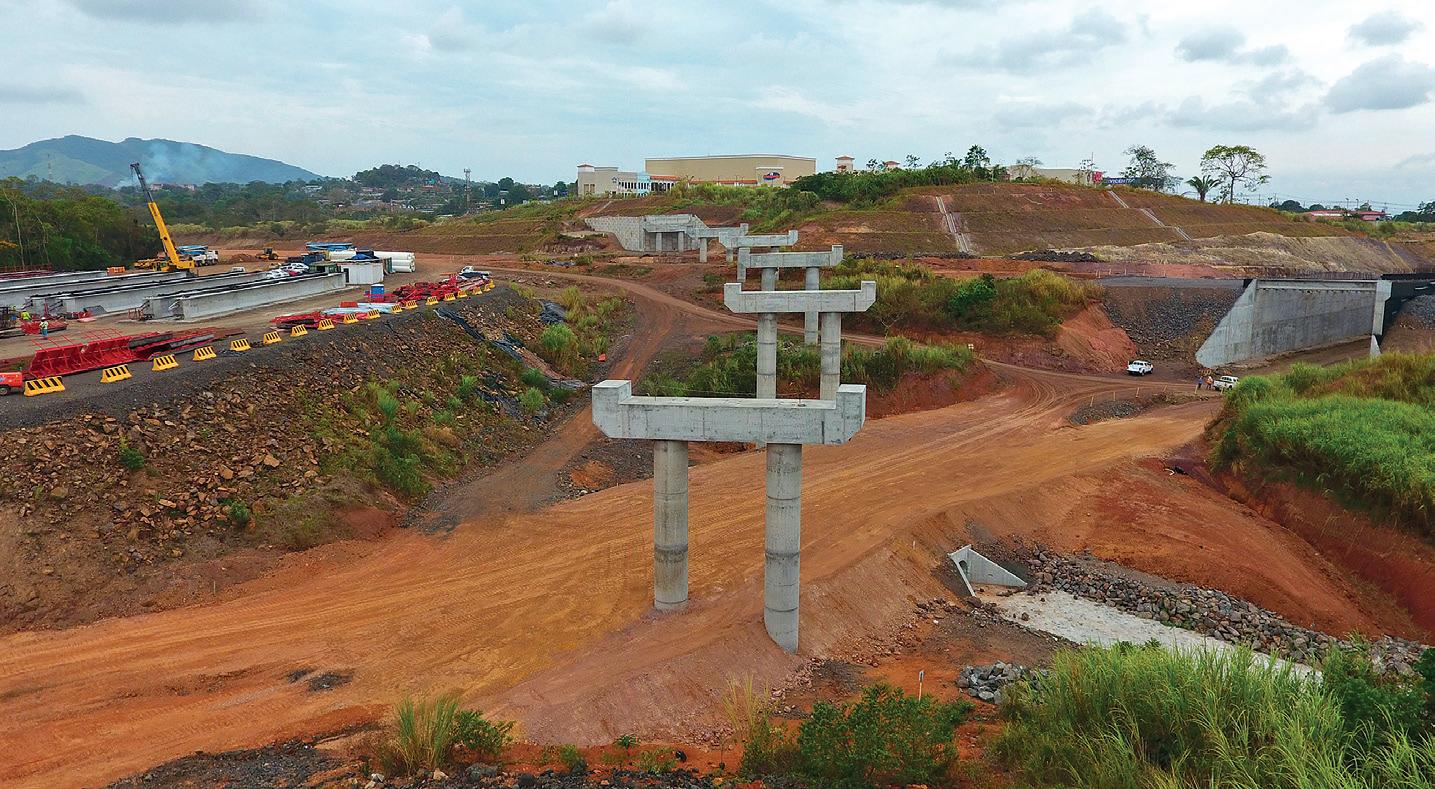

building 5km of aqueducts, installing 10km of telecommunications lines and 16km of power lines. Conditioning factors that both in the design phase and in the construction of the works were dif cult to execute.
The new alignment for the road runs parallel with the existing road from Loma Cová for approximately 2km until it reaches kilometre point 7. From this section, very close to Arraiján, the route runs for around 1km through a wooded area until it connects
Centenario road is extended to three lanes in each direction for a distance of around 2km. A necessary component of the project has been to replace the three existing road bridges that cross it. These are the bridges at Burunga (structure E-10), the bridge linking with the current highway and the Centenario road (structure E-11) and the bridge for the old PanAmerican Highway (structure E-12).
The new, widened road is designed to allow vehicle speeds of 100km/h. The project will relieve current traf c problems by providing suf cient capacity to cope with the expected increase in the number of vehicles using the route. The traf c projections for the road have been determined by Panama’s Transit and Land Transportation Authority, covering the next 20 years.
To cope with the heavy traf c volumes expected, the structure of the pavement has been specially selected. The asphalt mix design used will allow better performance and durability. The quality of the mix was assured during production and strict controls were applied in the construction phase to guarantee a longer working life and high load capacity.
The friction course has a thickness of 30mm and is designed to allow rapid and adequate drainage of the surface in order to avoid accumulations of water that could cause vehicles to aquaplane in heavy rain. The road pavement thus formed has a medium void


content, so that it provides the high permeability required and, additionally, a reduction in noise levels.
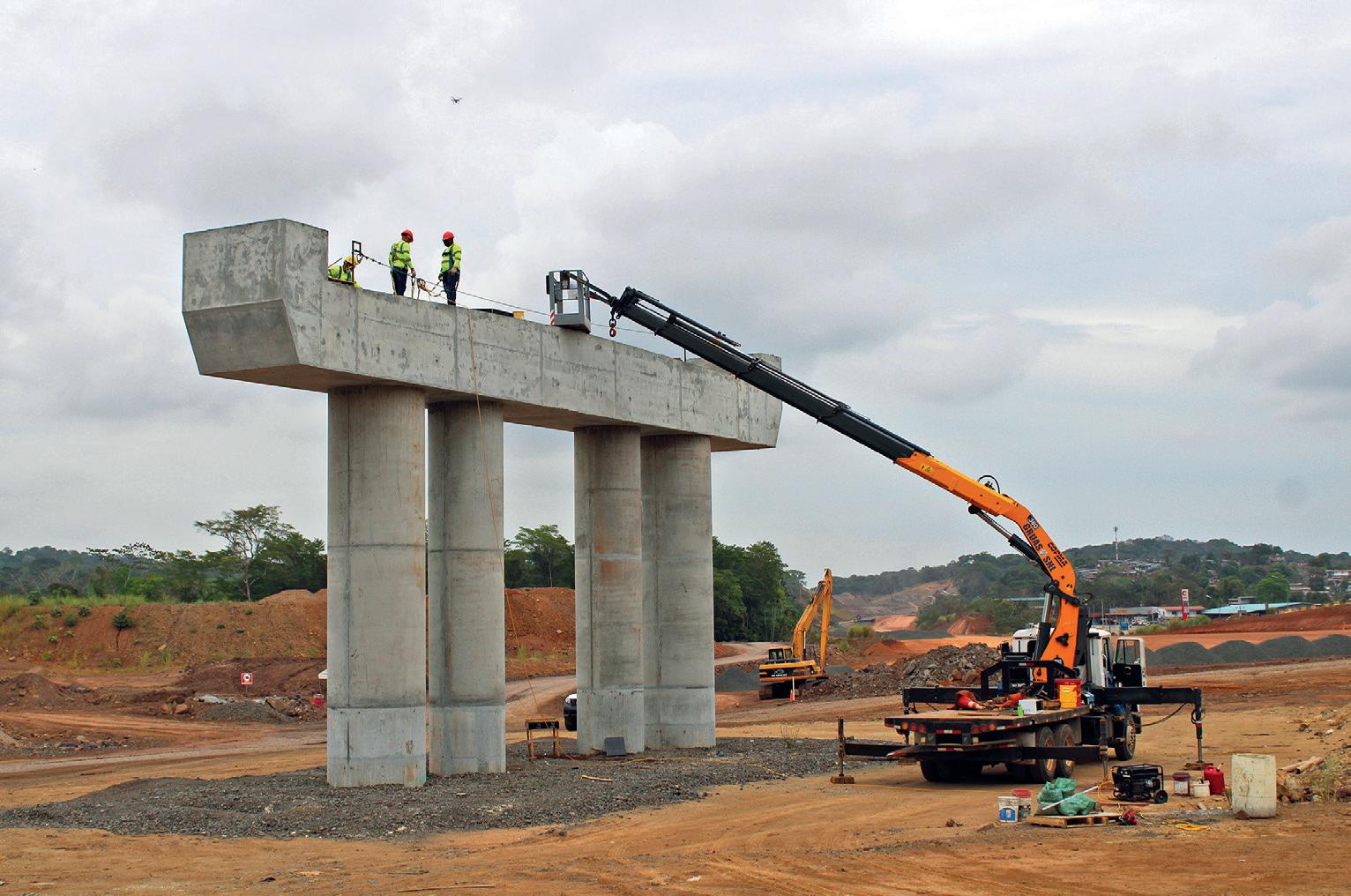
The 11 bridges and viaducts provide road crossings at different levels. For the most part, they are bridges with decks of post-tensioned precast beams, reaching spans of up to 41m.
Fromthe beginning of the design phase for this mega project, the engineering team from the Spanish construction company Acciona Infraestructura used different criteria to establish the types and sizes of bridges that would be required. The rm has strict criteria to work to so as to meet the requirements set by the MOP. One notable challenge was that the contractor could not impede traf c ow on the existing Pan-American Highway during the construction phase.


For the design of the bridges, the engineers had to avoid the use of falsework for the execution of the in situ decks. Instead, the rm opted to build structures made up of precast elements as this would be quicker to build and pose less of an impact on traf c ow along the route.
The high seismic risk was another important factor that was considered during the design phase. To meet this challenge, the design team ensured all structures met with Panama’s new REP-14 technical regulations. This ensured the various construction parameters were carried out in accordance with the seismic maps of the area.
Finally, the third determining factor that the engineers had to consider along the route of the highway was the low bearing capacity of the ground. This required the construction of deep foundations for almost all of the bridge structures.
An in-depth geotechnical study of the area had been carried out prior to the design and construction work, providing key information. To ensure that the foundation work would meet requirements, the Cross Hole Sonic Logging (CHSL) method was used during construction. This CHSL method was carried out to the ASTM D6760 “Standard Test Method for Integrity Testing of Concrete Deep Foundations by Ultrasonic Crosshole Testing”. This ensured control of concrete quality through the use of ultrasonic testing of the reinforced concrete piles. And with the use of prefabricated elements that were self-supporting, the use of falsework was not required.
For most of the bridges, the engineers used structures featuring precast isostatic decks and foundations based on pile caps. Neoprene was utilised under each beam to act as support elements for the decks.
The geophysical studies carried out by the contractor companies played a decisive role with respect to the design of the structures in relation to the seismic action of the place and to adapt the possible solutions according to

LANE WIDTH: 3.65m
44,000 m3 of concrete
6,600tonnes of steel
6 interchanges
the means and construction customs of the country.
According to the data collected, different alternatives were proposed, including a system using high damping neoprenes (HDRB) that allow the isolation of the structure due to its high deformation capacity. However, this option was ruled out due to the level of exibility of the ground and of the foundations that would prevent the neoprene from reaching its maximum range of deformation and therefore not being effective.
Instead a series of conventional neoprene supports with anchors were used on the viaduct. These provide vertical rigidity and longitudinal deformation capacity. And transversely, they were placed as seismic stops at the ends of the abutment and pier braces.
This methodology was applied to the E11 structure, where the best option was the use of energy dissipation, forcing the engineers to design deep foundations, which in the case of the E11 structure turned out to be very exible.
The solution based on the use of this method ensured a reduction of possible seismic forces and material savings. It is of note though that this solution results in a greater construction complexity with the execution of the heavy struts “in situ”.
The lanes are 3.65m wide and were designed according to AASTHO standards using a Superpave type asphalt pavement. This asphalt mix design is expected to allow better performance, durability and quality and was produced in accordance with strict technical controls. This will ensure a road with
a longer useful life and greater load support. Meanwhile the connecting links and the associated roads are being designed with rigid hydraulic concrete pavement with a thickness of 300mm on a granular sub-base of 1m thickness.
To help optimise safety for road users, rigid side barriers with the proven New Jersey pro le provide separation with the main roads.
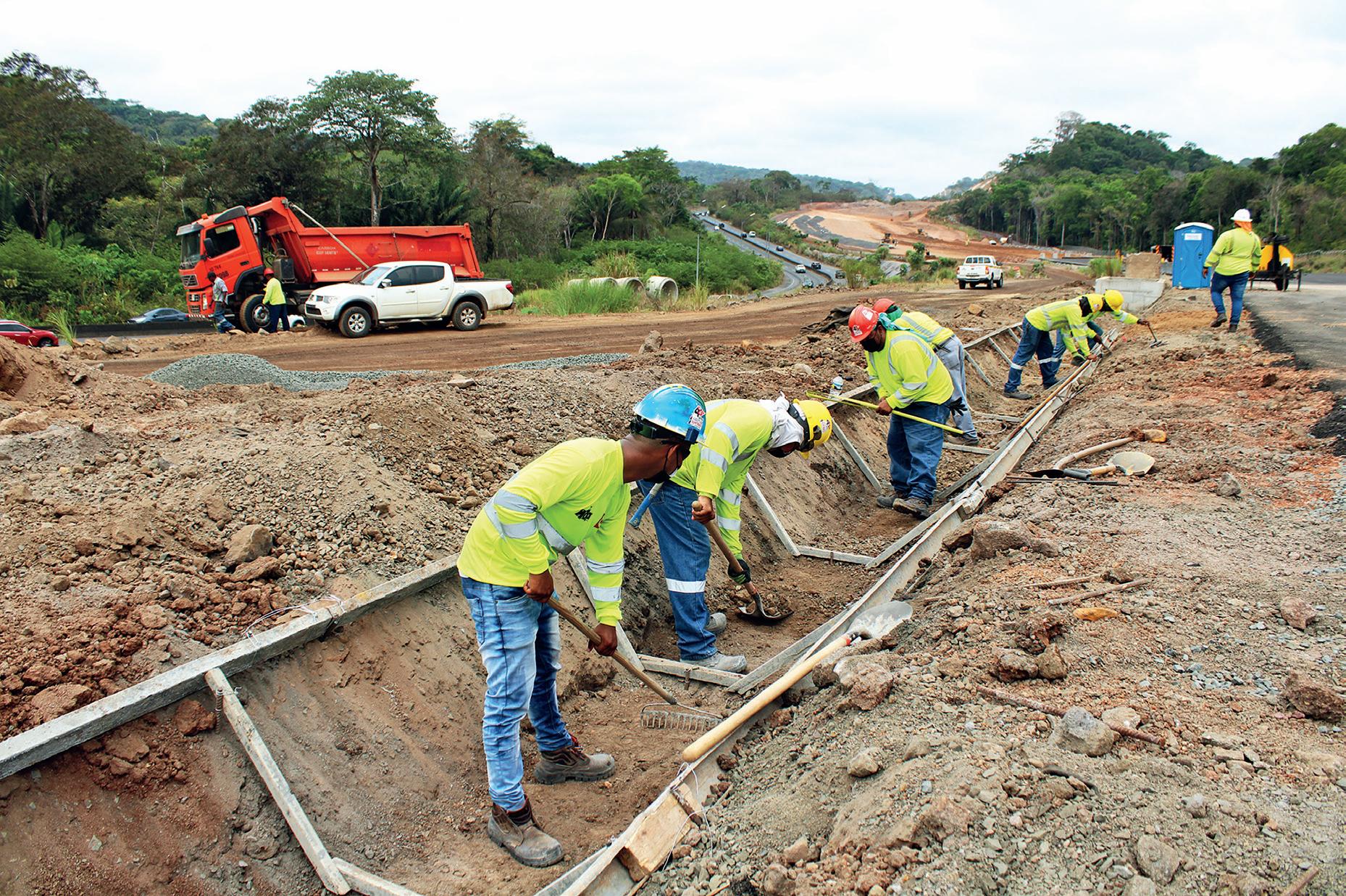
A longitudinal drainage system is installed to collect and channel rainwater from the road. Water that lters under the surface passes through a network of curbs-gutters with internal widths that vary from 30-150cm and are connected to cross tubes of 60-80cm in diameter. For the collector roads the water is channelled through trapezoidal ditches. For the transversal drainage system, a tubular sewer network has been installed that varies from 100-190mm in diameter and utilises box type sewers of different dimensions.
The interchanges play a key role for the new road connection as these will provide greater uidity and interconnection for the drivers.
Interchange 1, Howard/Cocolí, allows the
Arraijan-Panama direction change and vice versa. It also provides access to a future station for the planned Line 3 of the Panama Metro.
The lower part of the structure utilises a steel frame and the concrete slab rests on the transverse precast beams. To complete the structure a transversal drainage system was built, consisting of ve single and double rainwater caissons, as well as ve lines of reinforced concrete pipes of 1.8m in diameter.
Interchange 2 is the Panama Paci co access link and is made up of main roads and a reversible central road.
Interchange 3 is a link that will connect the current highway with the new highway in the Loma Cobá area and will also provide access to a future station for the planned Line 3 of the Panama Metro.
Interchange 4 will connect via Centenario with the new highway in the Burunga area.
Interchange 5 provides the access from the Centenario highway and the existing InterAmerican highway in the town of Burunga.
Finally, interchange 6 is the link located in sector 7 De Septiembre, located 1.2km west of Interchange 3.
Versatility is something that not all material handlers have in common. When they are versatile, however, their value to aggregates producers increases accordingly
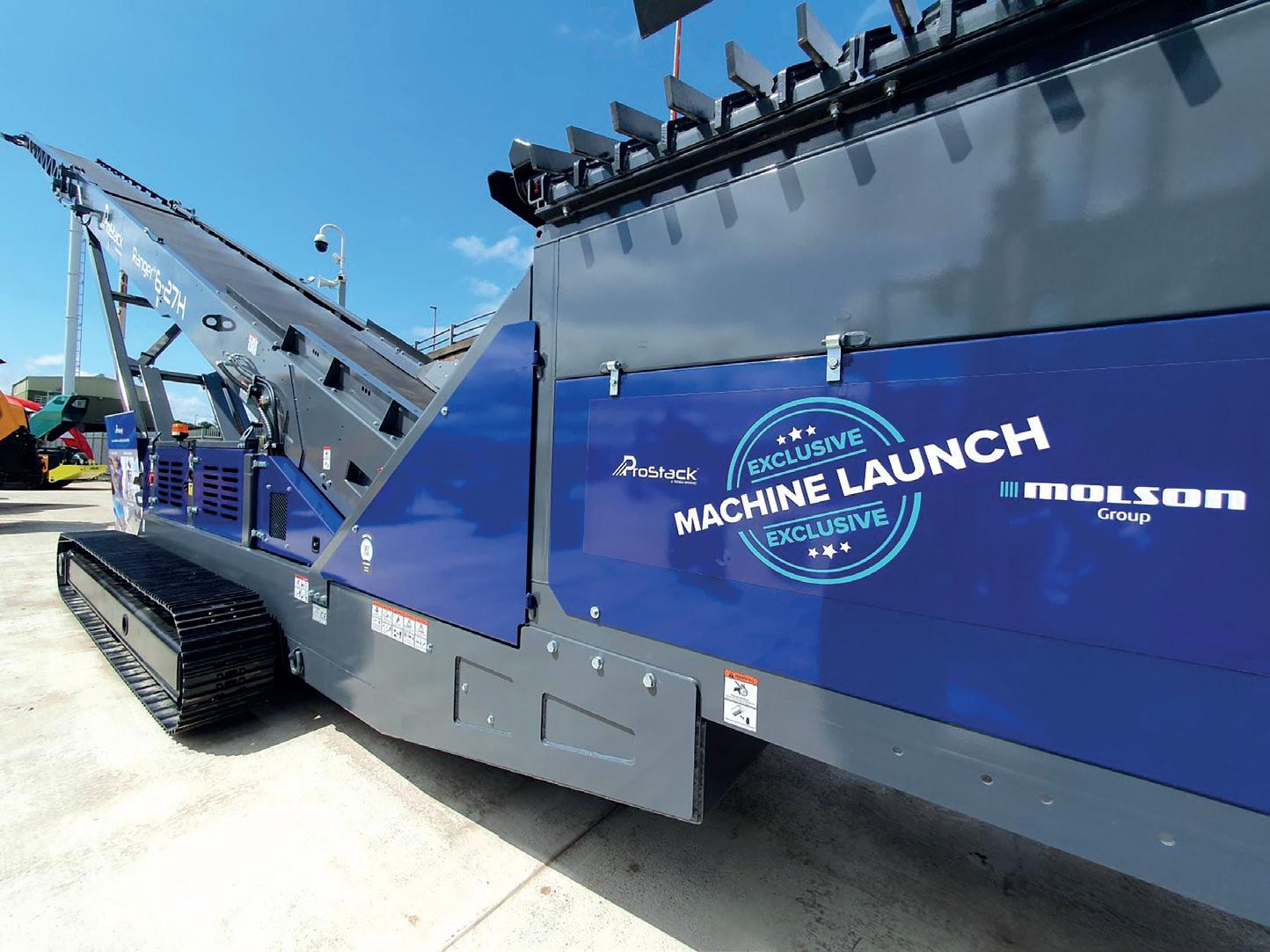
Some of the most versatile handlers to come onto the market in recent months include ProStack’s Ranger 6-27H tracked conveyor, Kleemann’s MOBIREX MR 100(i) NEO mobile impact crusher – that can switch to electric drive – and Screencore’s 380 stockpiler conveyor that also has an electric conversion.
Materials handling provider ProStack showcased its latest addition to the company’s conveyor lineup, the Ranger 6-27H Tracked Conveyor at the recent Molson 2023 Open Day. The event took place across three days in June at the Bristol headquarters of the Molson Group, a major independent new and used equipment dealer in the UK.
Positive feedback from the event highlighted the Ranger 6-27H's ease of transport, reliability and usability noted Lee Nesbitt, ProStack's global sales manager, part of the Terex Group. The Ranger 6-27H has been engineered with an extended conveyor for situations that require more reach than is available with other conveyors in the Ranger product line. With the Ranger 6-27H, a
27m-long rotatable conveyor allows operators to stockpile around 1,735m3
After the Molson Open Day, the model was transported to the north-western US state of Washington where it will be used in a barge loading application. The conveyor will load the barge before being lifted onto the vessel and travelling to Alaska. It will then be used to unload the barge – proof of the Ranger 6-27H’s versatility and manoeuvrability.

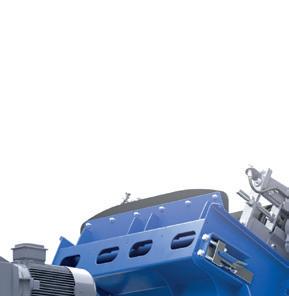
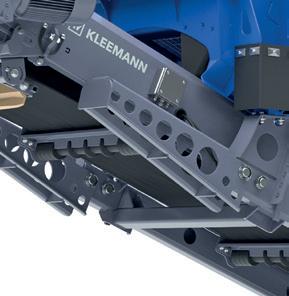
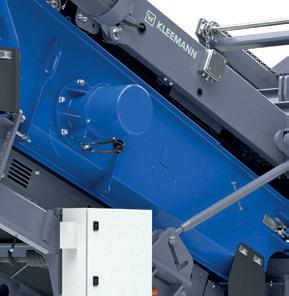
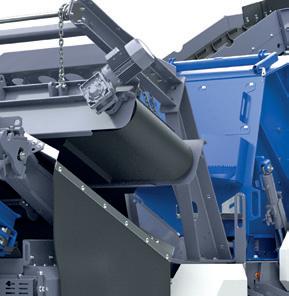
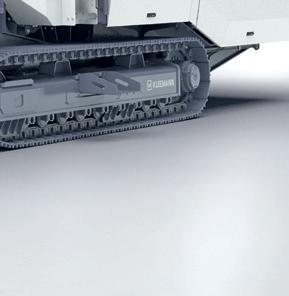
Kleeman’s addition to its compact mobile impact crusher lineup is the MOBIREX MR 100(i) NEO and its electric drive variant, the NEOe. The units are, in fact, the rst in Kleeman’s new NEO line. The two machines will be available in Europe and North America from next year.
The company, part of the Wirtgen Group, says that the machines are ef cient, powerful, extremely exible and, importantly, allelectric operation is possible with the NEOe variant. NEOe is run all-electrically with the drive E-DRIVE concept and thus free of CO2 emissions. Alternatively, the machine is available with the tried and tested direct-drive diesel D-DRIVE.
Thanks to their compact dimensions and a low transport weight, the MOBIREX MR 100(i) NEO and the NEOe variant can be used in tight spaces on work sites or in frequently changing places of work. Operation ranges from different recycling applications such as the processing of concrete, rubble and asphalt, to the processing of soft to medium-hard natural stone.
Very high nal product quality is guaranteed not only by the powerful crushing unit with its four-ledged rotor with a large impact range and versatile rotor ledge options, but also by the 4m2 large, optional, single-deck secondary screening unit. This makes it possible to produce a classi ed nal grain size. With an optional wind sifter, the nal product quality can be increased.
With the SPECTIVE CONNECT operating unit, operators have all relevant data on speed, consumption values and ll levels at their ngertips on a smartphone or tablet, prepared in a clearly arranged manner.
SPECTIVE CONNECT also offers detailed troubleshooting aids to assist with service and maintenance. Kleeman says that a unique feature in this machine class is the fully automatic crusher gap adjustment and zeropoint determination. Zero-point determination compensates for wear during crusher startup and a homogeneous crushing product is retained.



With electric operation in mind, a new addition to the stockpiling offering comes from Ireland-headquartered Screencore –the Screencore 380. The 24m Screencore 380 comes with the Screencore Dual Drive functionality that enables the stockpiler to operate with power provided by a crusher or








screen. As only one power source is used, the result is signi cantly less expensive and more environmentally friendly operation.
Screencore has produced a range of tracked and wheeled stockpiling conveyors designed to be highly transportable and offer features such as twin drives, check valves and heavy-duty hopper feeders. These have been speci cally developed to help construction, recycling, quarrying and surface mining operations, delivering a solution to handle bulk materials on any site.
Screencore has now added to its exible, cost-effective, environmentally friendly range with stockpilers that can run electrically or hydraulically. The key feature of the 380 Dual Drive is that its conveyor drive system can easily switch from an electric drive motor on one side of the conveyor to a hydraulic drive motor on the opposite side. The onboard 55kW Cat engine powers the hydraulic drive. This groundbreaking capability empowers operators to choose the most suitable and readily available power source, all while enjoying the convenience of a fully tracked mobile unit.
When connected to the electrical outlet of the Dual-Power Screencore XJ jaw crusher, for instance, the stockpiler can run ef ciently, a cost-effective solution for materials handling. Moreover, this integration can be extended to other crushers or screens with spare electrical capacity, eliminating the need for an extra engine and signi cantly contributing to carbon reduction.
Screencore intends to add to its range of Dual Drive stockpilers shortly and continue offering dual-power functionality to all its product offerings, explained Ciarán Ryan, Screencore's sales director.
Recent advances in lock-bolted deck frame technology have come from Canada where Haver & Boecker Niagara has introduced the Cap & Slide and Pin & Anchor deck frame systems. The new deck frames offer bolt-on convenience for pin and sleeve and groovestyle modular screen media. The narrow con guration of the new deck frames increases the open area for more throughput.
“The deck frames, whether Pin & Sleeve or Cap & Slide, provide the rst line of defence against wear and can be exchanged individually,” said Duncan High, Haver &






The key feature of the
Boecker Niagara’s division manager of processing and equipment technology. “Beyond that, the rails can be replaced in 4ft (1.2m) sections, allowing customers to target and replace only those areas with high wear. This saves not only time but expense.”
Lock bolts are used to provide a secure, weld-free connection that minimises cost and wear. The rails require no special tools to repair or replace and the company says that the rails can be installed 50% faster than traditional rail systems. Eliminating welding removes the need for a skilled welder, as well as the potential for accidents from cutting or grinding and the chance of re.
The Pin & Anchor deck frame incorporates laser-cut rails with polyurethane pins and anchors to secure the screen media to the deck rail. They hold the media rmly in place and can be individually removed and replaced as wear occurs, extending wear life and reducing downtime. The Pin & Anchor deck frame system accommodates any pin and sleeve style modular screen media.
Designed to work with any groove-style screen media panel, the Cap & Slide deck frame offers the same ease of installation and extended wear life as the Pin & Anchor design. The system features 8in-long (203mm) polyurethane sections that cover the top and sides of the rail providing a barrier against abrasion and corrosion. The sleeve locks into the rail, and is held in place with a polyurethane key. As individual sections show wear, they can be removed and replaced in



































small sections rather than changing the entire deck frame, minimising cost and repair time.
Meanwhile, on the acquisitions trail in North America, US bulk materials handling equipment company Superior Industries has bought CEMCO, a 60-year-old business based in the US state of New Mexico. The company, with a 13,000m² manufacturing facility, is said to be the originator of the modern Vertical Shaft Impact (VSI) Crusher.
The CEMCO VSI crusher has capacity rates of up to 1,500tonnes per hour and models ranging in power from 55kW to 745kW in single- or dual-drive packages. The company’s VSIs operate in the aggregates, recycling, mining and energy markets worldwide. CEMCO’s original VSI is still in service today in New Mexico.
Prostack www.terex.com/prostack
Kleeman www.wirtgen-group.com
Haver & Boecker Niagara https://haverniagara.com
Screencore www.screencore.ie
Superior Industries https://superior-ind.com
CEMCO www.cemcoturbo.com






















Our Skidmarks page is highly rated by readers. Your input could help make this page even more entertaining. If you come across any amusing road-related stories or pictures email me at mwoof@ropl.com
A UK couple jetted o on holiday to Rome, secure in the knowledge that they had left their Tesla car with a rm guaranteeing secure parking for their vehicle. However, they were then somewhat shocked to nd out that while they were on holiday, the car had been driven a distance of around 160km and at speeds of up to 170km/h, well in excess of the UK speed limit. The fact that the driver had also been playing music by Beyonce at high volume while doing so, as recorded by the car’s onboard computer, was somewhat less of an annoyance. The couple complained following their return and the driver suspended from duty.
A motorcycle rider in Australia used a novel technique to avoid paying road tolls while on his bike. As the man passed the cameras on the stretch of tolled highway, he used his boot-clad foot to cover up the licence plate. Some commentators have pointed out that as motorcycles cause minimal road wear and take up considerably less road space than private cars, they should be toll-free on highways in any case. However, the Australian road toll rms are less than impressed and will be keen to catch the rider before others start using similar tricks to dodge paying tolls.
There are some strange rules and regulations surrounding motoring around the world. In Australia, a law set up in 1946 banned motorists from transporting more than 50kg of potatoes in their vehicle unless they were part of the Potato Marketing Corporation. Swiss drivers are not allowed to wash their cars on their driveway or in front of their home and instead have to use a commercial carwash. The law is intended to prevent contaminants from entering the sewers. Thai drivers and powered two-wheeler riders are not allowed to be without a shirt, despite the
heat and humidity. Meanwhile in the US, the states of Michigan, Montana and North Dakota have no requirements on owners for regular vehicle safety and emissions inspections. Canada’s Prince Edward Island has a requirement that drivers must sound the horn when overtaking another vehicle. In Cyprus, drivers are required to keep both hands on the wheel and are not allowed to eat or drink even non-alcoholic beverages. And in Dubai, camels are allowed right of way.


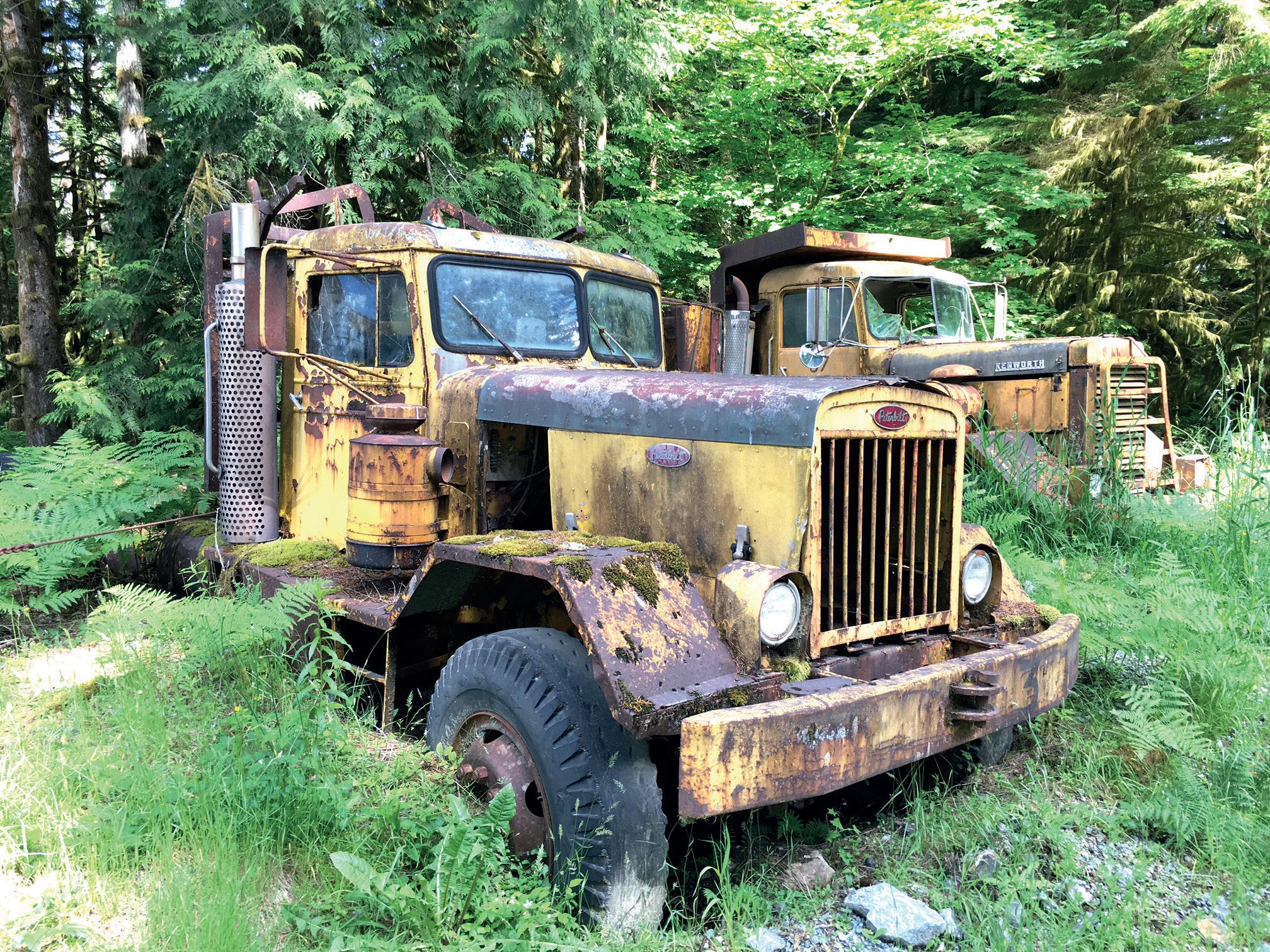
The rust never sleeps for this green machineimage © courtesy of David Arminas
A light aircraft recently had to make an emergency landing on the A40 route in Gloucester in the UK. The aircraft had engine problems and the pilot was forced to make a snap decision to land on the dual carriageway. Luckily, the pilot managed to crash land on the central reservation stretch without causing injury. Major delays for drivers followed however as police had to divert tra c. The aircraft was later removed from the road, allowing tra c to begin owing again.
A bus driver in West London had an unusual passenger board at a stop. A lost dog climbed aboard the bus in the middle of a rain storm. Both the driver and passengers were surprised but allowed the animal onboard. The dog was clearly scared at being lost but was familiar with travelling by bus. The driver stopped at a police station to report the animal but was told that they could not deal with strays. The owner was found subsequently and the dog returned. Meanwhile, another London bus driver reported
having to deal with a rude passenger who complained at having to wait in the rain. The passenger claimed the bus was late and that began using o ensive language when criticising the driver. However, the driver explained that rain can obscure mirrors, which then have to be cleared for safety. The driver continued that heavy rain makes the road more slippery so that greater care must be taken, especially when there are vulnerable road users in the proximity of the vehicle.
Police in the UK city of Manchester recently con scated not one, not two, but three Lamborghini hypercars due to bad behaviour by the owners in a short period of time. A green Lamborghini was rst to be seized, followed by white and orange Lamborghinis. The drivers had committed a series of driving o ences, including speeding and careless driving. Meanwhile, in UK capital London a Lamborghini was in collision with a city bus, resulting in extensive damage to the car. The bus was not seriously damaged however. The cause of the collision remains unclear.
A grandfather from the English county of Yorkshire has set a new world land speed record on a motorcycle he built in a shed over a period of 10 years. The motorcycle is fuelled by water and is claimed to be environmentally
friendly as a result. Nicknamed the Force of Nature, the rocket bike is driven by superheated water jetted out through nozzles. The water is superheated using Hydrogenated Vegetable Oil (HVO). On this motorcycle, the man reached a speed of 267km/h over a distance of 200m in just 3.87 seconds. This impressive record was set at the UK&ITA World Records Speed week. The man is no stranger to having speed records though. He previously set a UK record in 2015 for the fastest threewheeler, using a V8 engine to hit a speed of 288.5km/h over a distance of 400m.
In Australia, a man stopped his car from being stolen using a forklift truck. The man had been out with family and when they returned, they discovered someone inside their VW. The person inside the car refused to exit and the vehicle owner, fearing that it would then be stolen, decided to take drastic action. He drove a forklift truck alongside his car and then used the forks to raise the vehicle a height of 2m, eliminating the risk of it being stolen. The would-be thief had earlier broken into the family home, had a shower and stolen some clothing. The car owner only lowered the vehicle to the ground again once the police arrived to arrest the would-be thief, who received a number of charges.


















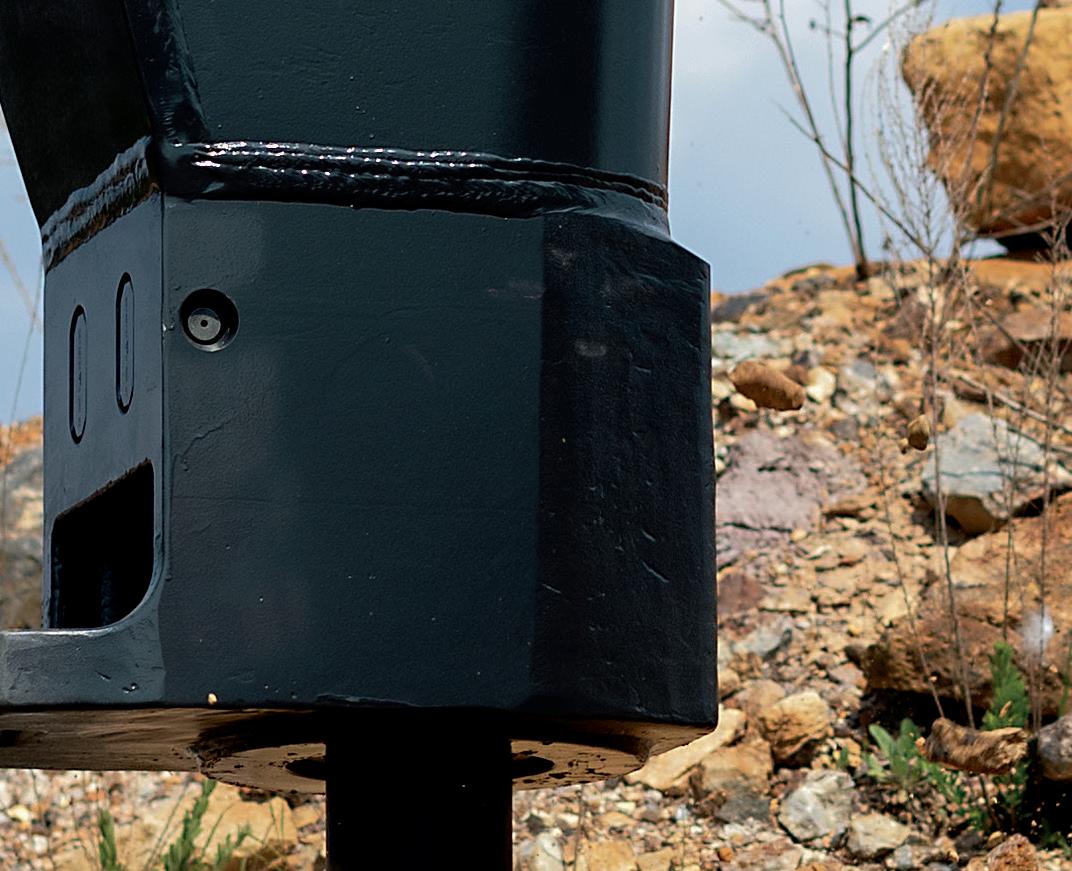






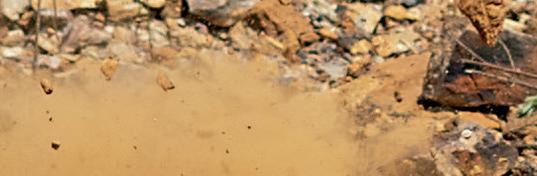

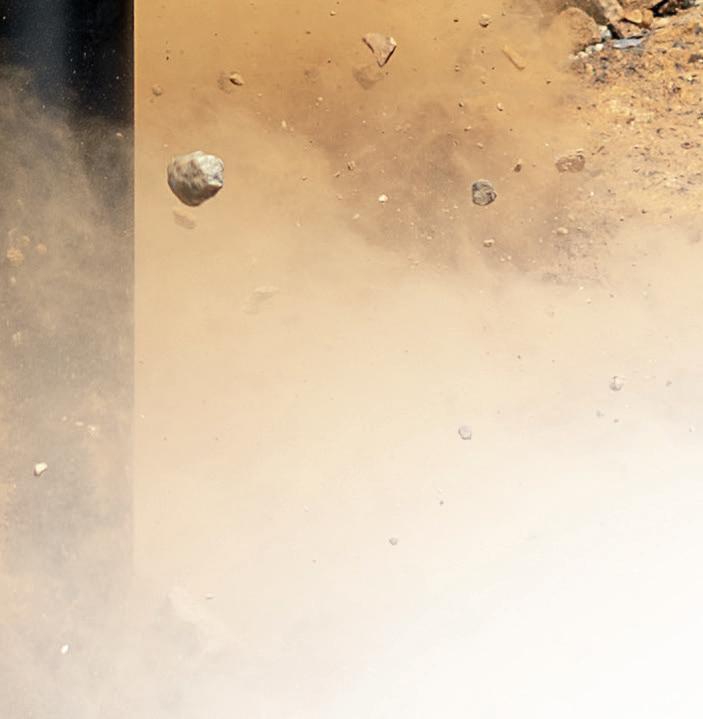
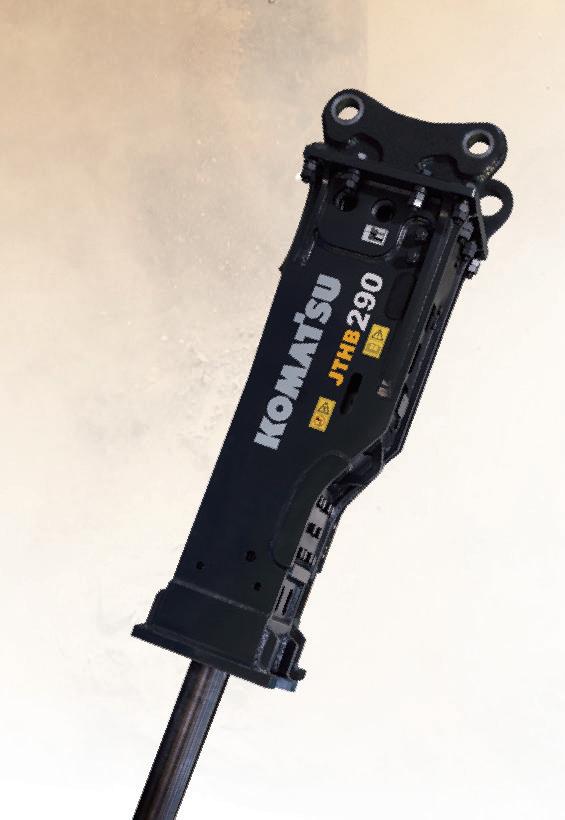
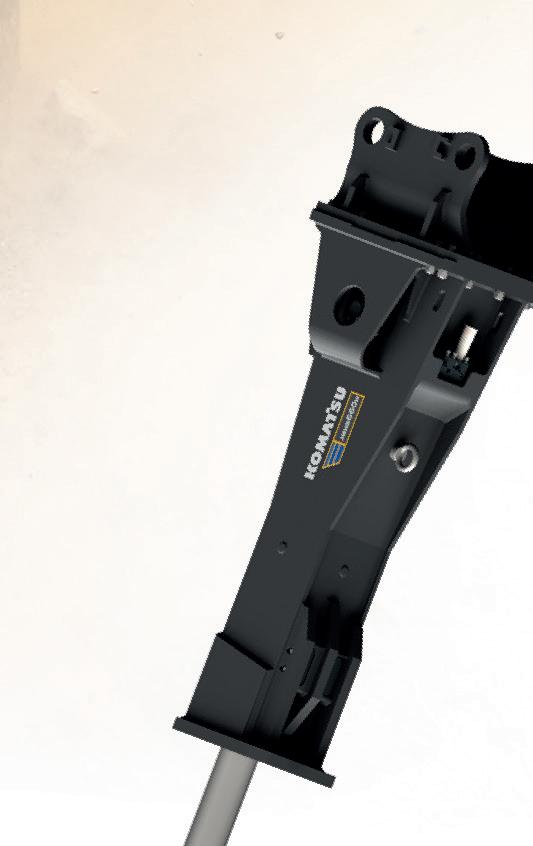
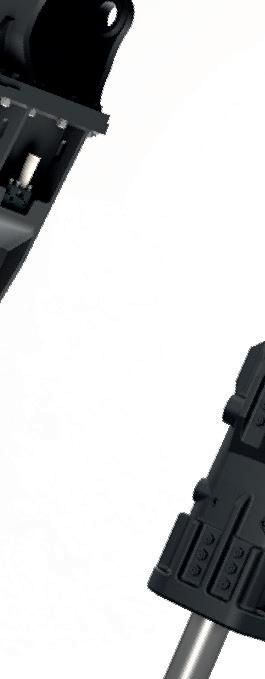
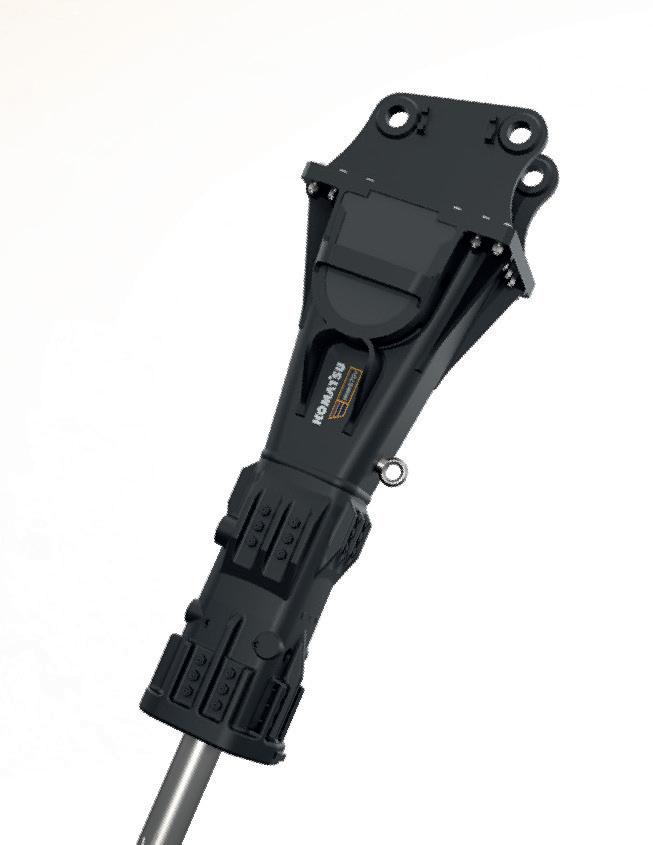
Komatsu hydraulic breakers provide superior impact energy in a variety of rock and concrete demolition applications: you can count on exceptional performance and efficiency whether you’re scaling a tunnel, running a pedestal-boom on a quarry, or tearing out reinforced concrete masonry.










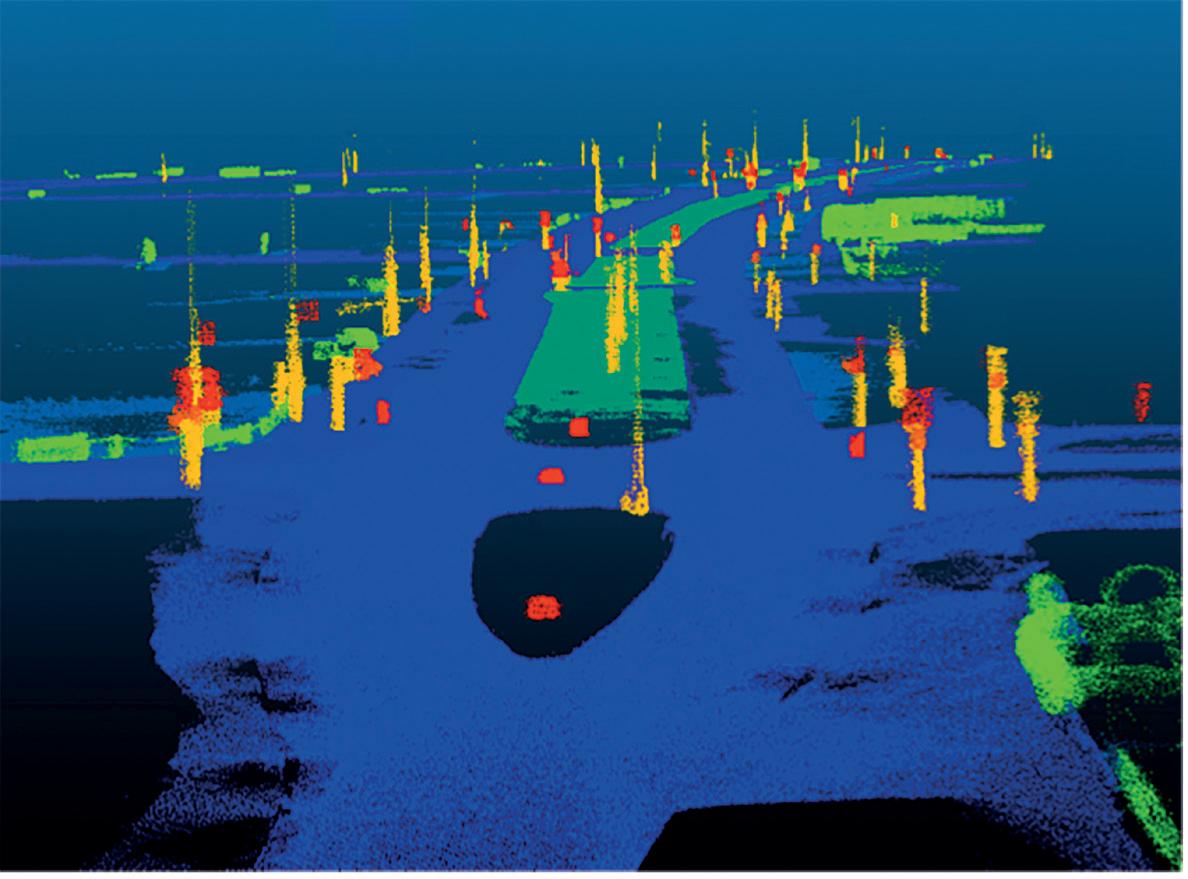

Digital Roads of the Future is an initiative gathering researchers at the University of Cambridge with one united goal – the digital transformation of the road sector in the UK – *Nevena Vajdic reports
Based at the University of Cambridge site in West Cambridge, UK, over 50 researchers are working collaboratively with businesses to address industry challenges in the adoption of innovative technologies and accelerating integration into everyday business. The initiative is currently made up of two project grants: Digital Roads and Future Roads.
The Digital Roads Prosperity Partnership is a research project, supported by the Engineering and Physical Sciences Research Council (EPSRC), part of UK Research and Innovation (UKRI). The programme is being delivered in partnership with National Highways and Costain Group. The research explores how digital twins, smart materials, data science and robotic monitoring can work together to develop a connected physical and digital road infrastructure system. The vision is to deliver resilient roads that can measure and monitor their own performance over time.
Future Roads is a Marie Skłodowska-Curie Action Fellowship Programme. Fellowships are offered to 27 early-stage researchers. Fellows have the freedom to develop their own ideas and propose their individual research projects for a duration of three years, targeting primarily five thematic areas: digital twins;
smart materials; data science; automation and robotics; and sustainability. The objective of the programme is to promote researchers by providing training and support in career development towards advanced research careers in the field of digital and sustainable transformation of road networks.
Digital Roads of the Future initiative involves 25 Industry partners acting as co-funders in the Future Roads Fellowship Programme extending the initiative to the number of involved practitioners. The concept of industry involvement is based on the partnership between world-class research and development on one side, and supportive deployment environment for innovative solutions on the other. Partners have an opportunity to initiate open discussions and engineering collaboration between industry representatives and researchers in tailoring the research and development towards industryspecific challenges. Companies have the possibility to take an active role during the research and development phase, identify the most valuable outcomes and shape the process targeting the road industry needs.
By 2030, the Digital Roads team aims to have produced a hybrid cyber-physical product to support our roads and the ambition to expand that same development journey for other road assets such as bridges and tunnels, and the entire strategic road network by 2040.
By the end of the Future Roads Fellowship Programme in 2026, the project will have delivered research publications, conference papers, discussion series and strategic documents to the research and professional community in the road industry. As respective projects are evolving over time and adjusting to industry-specific needs, the real value for the industry will unfold in the upcoming period. The digital future for the road industry in the UK is just within reach. n
l For more information, please contact us at drf-initiative@eng.cam.ac.uk.
*Nevena Vajdic (IRF Fellow 2009) is DRF Senior Project Manager, University of Cambridge




Featured Panels:
• Asset Management & Pavement Preservation
• Innovative Materials and Technology

• ITS & Smart Mobility Technologies
• Road User Charging
• Connected & Autonomous Vehicles (CAVs): Readying our Road Infrastructure
• Decarbonizing the Road Transport Sector
• Vison Zero - Towards Zero Deaths
• AI for Transportation Asset Management



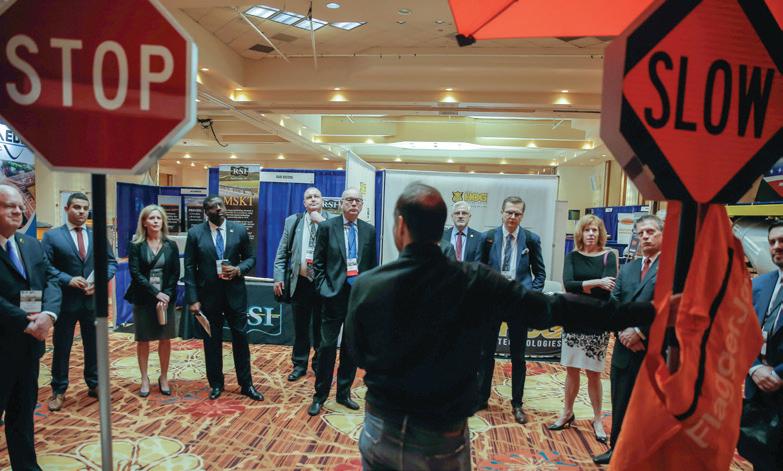
Share: R2T is the international meeting point where leading industry innovators, researchers, and stakeholders acquire essential engineering & business insights, and help build tomorrow’s transportation infrastructure today.
Engage: R2T will push the boundaries of 21st century roads & mobility. Meet global thought leaders and discover pioneering concepts through our program of live demonstrations and applied knowledge sessions.
Grow: Place your company’s brand, technologies and services at center stage during R2T and gain exposure in front of top decision makers, government officials and buyers worldwide.






The International Road Federation (IRF) has just unveiled the 60th Edition of the IRF World Road Statistics (WRS), the most complete and latest road and transport data
The release of the 60th Edition of the IRF World Road Statistics marks a significant milestone in the realm of global road transport. Since 1964, the WRS have been an invaluable reference tool empowering stakeholders with the knowledge needed to make informed decisions, shape policies, and steer the world towards more sustainable and efficient transportation systems.
This 2023 edition encompasses updated data, covering the years 2016 - 2021, for over 200 countries and territories, and over 200 indicators including Country Profiles, Road Networks, Road Traffic, Road Expenditures, CO2 emissions and Energy consumption, among many others.
Thanks to the generous support of the TotalEnergies Foundation and the Michelin Corporate Foundation, the WRS Data is available for free through the IRF Data Warehouse Online Platform.
This web-based platform is not just a repository; it is a dynamic tool that complements and supports national and regional data collection and management efforts. Accessing the platform is free and it just requires the creation of your own personal account with an email address. The platform has been designed in an interactive way to permit users to easily visualise the data. The platform allows users to, for example, compare data across multiple countries and time periods, compare several metrics for one country, access interactive road safety dashboards, visualise and download data in various formats, and many other possibilities.
During a launch event held on 28 September, IRF Director General, Susanna Zammataro, commented, "This data work is a testimony to our commitment to promoting sustainable and safe transport systems around the world. We believe that knowledge is the key to progress and,
thanks to the generous support of our partners, we are proud to offer this valuable resource to all."
“We are pleased to support the IRF World Road Statistics and the Data Warehouse as we believe in the power of data in informing the development and implementation of road safety policies and actions that are evidence-based. This compilation of data that hits a key milestone this year with the delivery of its 60th edition has largely proved its value over the decades” commented Jacques Emmanuel Saulnier, Senior Vice President Citizenship Engagement & General Delegate of the TotalEnergies Foundation.
Whether a researcher, policymaker, or simply curious about the state of global roads, this resource is a passport to a world of transport insights. n
• For more information on the IRF World Road Statistics and access to the IRF Data Warehouse Platform, visit www. worldroadstatistics.org or contact the IRF Statistics team at wrs@irfnet.ch.

Organised by the International Road Federation together with the Qatar Transportation and Traffic Safety Centre (University of Qatar), the course "Introduction to crash Investigation” was hosted on 10 – 12 September 2023 at Qatar University in Doha.
Welcoming participants from the region and beyond, the goal of the training was to present the principles and techniques of road crash investigation and to provide a comprehensive explanation of how on-scene investigations and reporting are conducted, serving as a practical guideline for reallife scenarios.
“The programme is specifically designed to familiarise investigators with the intricacies of crash investigation as a highly specialised field within forensics” said Benjamin Van Rooyen, lead trainer.
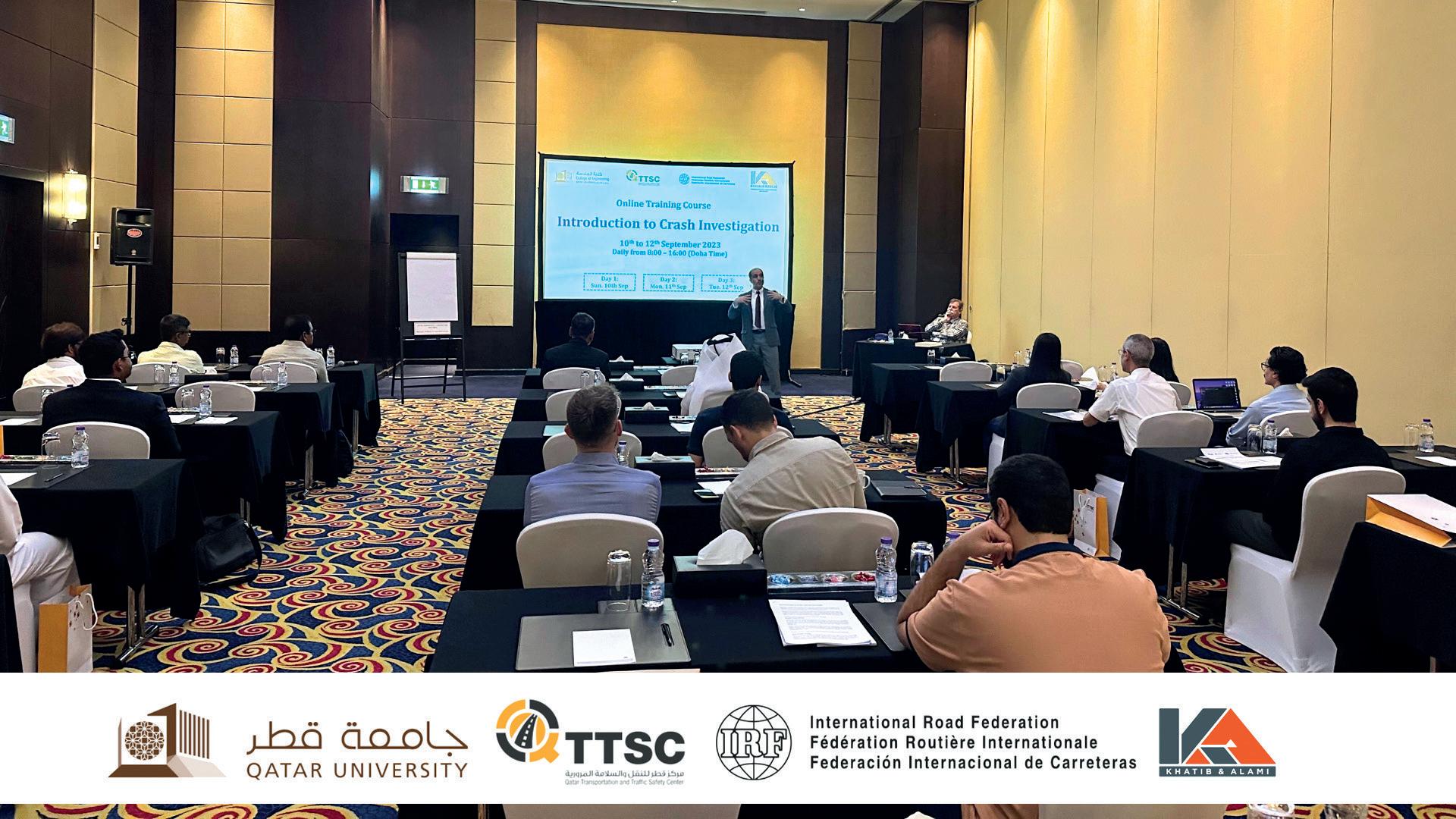
“This short learning programme will be followed by a more advanced applied crash investigation programme, which will concentrate on a wide range of issues to further enhance the skills of crash investigators” commented Dr Wael K. M. Alhajyaseen from the Qatar Transportation and Traffic Management Centre (QTTSC).
he added.
“Together with IRF we work at expanding our training offer”
“We are delighted to continue our fruitful collaboration with the University of Qatar and to work jointly to empower professionals with the knowledge and skills they need to proactively minimise
road crash risks and effectively reduce fatalities and injuries on our roads” said Susanna Zammataro, Director General of the International Road Federation in celebrating the successful conclusion of the course. n




Responding to the challenging radio environment at temporary traf c signal sites, Traf c Group Signals has improved the performance of its Active Channel Management (ACM) technology.
Traf c Group Signals is a major UK manufacturer of advanced portable and temporary traf c signal products. According to the company, with the rise in radio usage for onsite communications, telemetry and automation, the frequencies in which temporary traf c signals operate are more congested than ever.
Building on over four years of research and development, Traf c Group captured and analysed a wide range of data, observing various patterns in radio user behaviour, identifying peak and off-peak usage, and times where spikes are likely to occur. This congestion in the radio spectrum can result in the failure of traf c signal radio communications, cause signi cant disruption to road users and means regular call-outs for traf c management companies to restart the system.
Traf c Group performed a spectrum analysis at a challenging

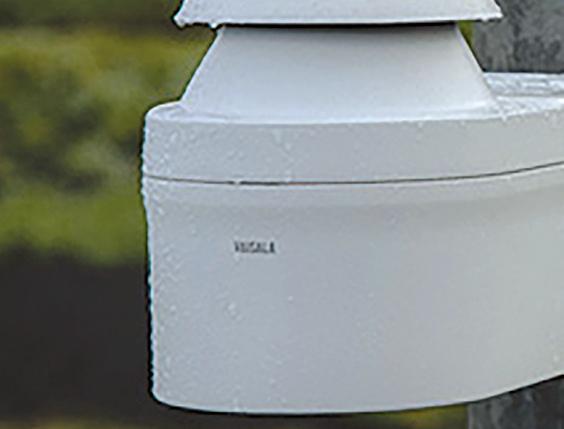

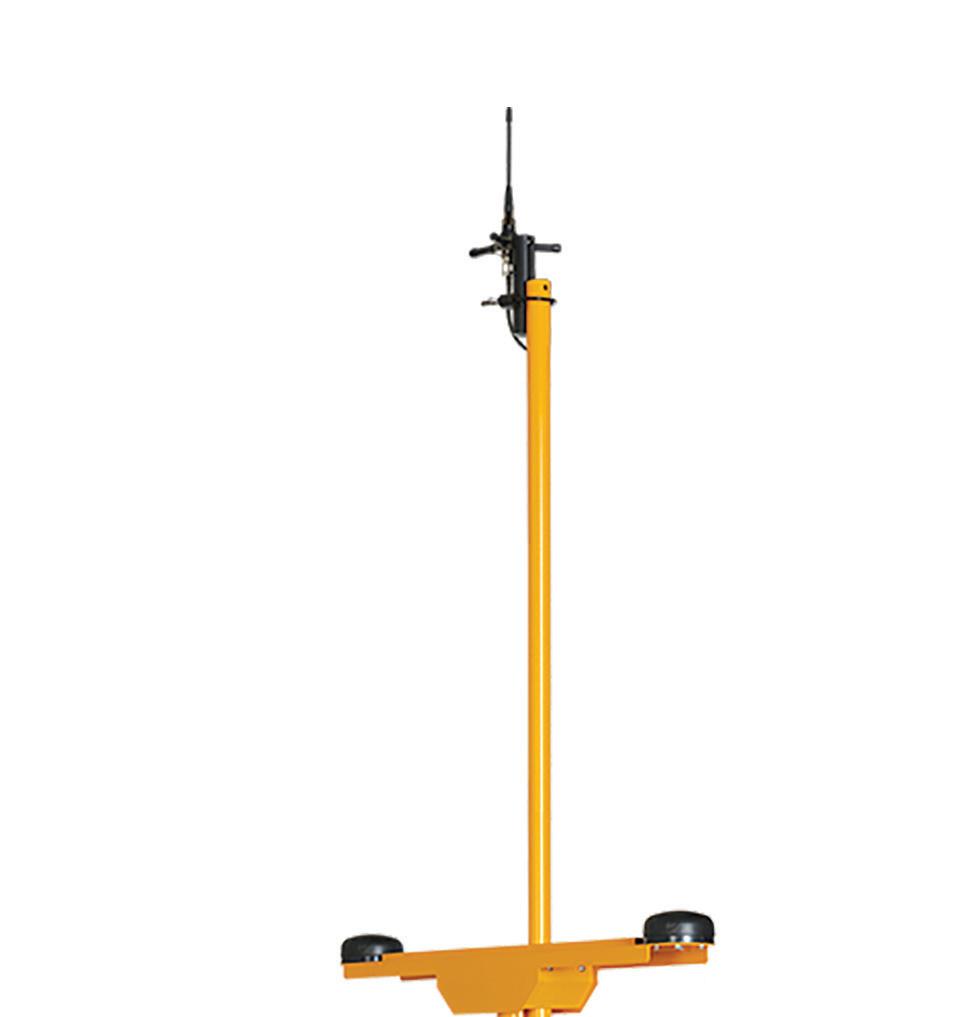


in use daily by other services. This equates to 11 unusable channels in a 15-channel radio system or 23 unusable channels in a 32-channel radio system.
This new data was used to expand the capabilities of the ACM system, allowing the technology to overcome channel con ict by self-monitoring patterns using the 458MHz band over an extended period and automatically remembering which channels to avoid.
Since upgrading the technology, Traf c Group says that is has experienced no instances of going to ‘lights out’. There has been awless communications

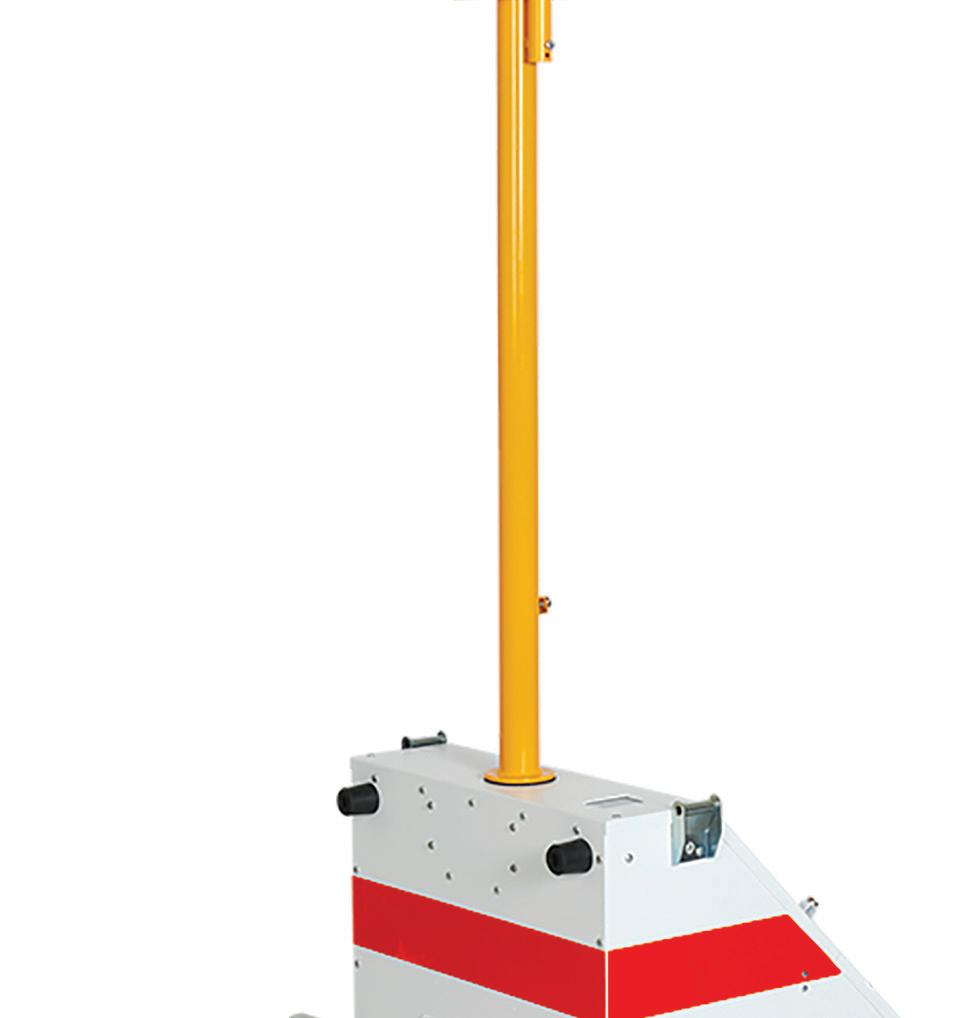
team’s most challenging sites



team’s most challenging sites in central London, notes Darren Hudson, senior projects manager at Traf c Group Signals.

“The radio environment is challenging for temporary signals, particularly those situated in urban environments or close to construction sites/critical infrastructure. With a focus on making enhancements to address these challenges, we began to gather data to inform the changes to our already market-leading ACM technology,” he said.


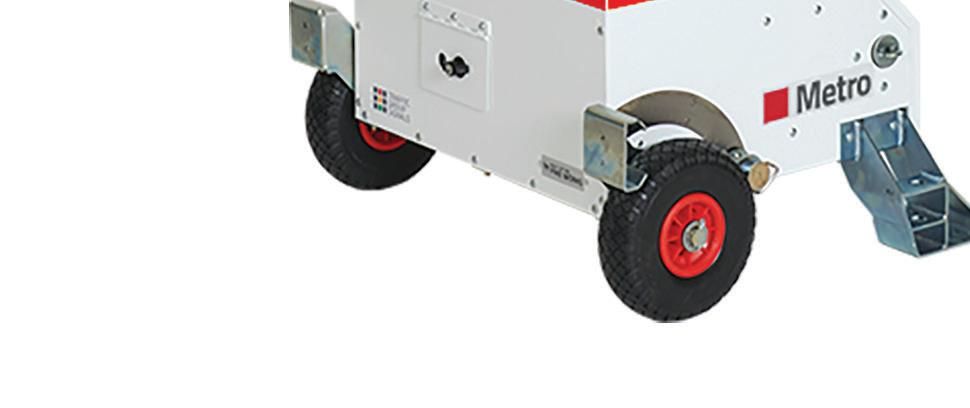
example, when walkie-talkies
“Conventional temporary signals are unable to automatically adapt to congestion in radio bands, which can occur at random or persistently, for
are used on construction sites. Instead, a laborious process of setting a new channel manually on each signal is required. This is time-consuming and typically leaves the junction unsignalled while the change is implemented. Even after such a change, there is no guarantee that the radio will operate reliably.”
Tra c Group Signals
www.tra cgroupsignals.com/endurance
The combination of Vaisala’s TempCast and Wx Horizon solutions is an easy and a ordable way to get accurate road weather measurements from challenging locations.


TempCast is a wireless, pole-mounted sensor that measures air temperature, humidity and pavement surface temperature without ever touching the pavement. With built-in connectivity and power, TempCast can be installed almost anywhere, turning an ordinary road into a smart road. It brings additional observational value from locations between existing road weather stations, that were previously hard to measure. It can also be used to build entirely new networks that were not feasible before.
and comes with a three-year battery lifetime. Meanwhile, Vaisala GroundCast, an in-ground IoT-based sensor that measures pavement temperature from di erent depths, as well as the road surface state, was introduced last year.
TempCast – a self-powered, wireless NB-IoT unit - is the latest IoT-based sensor in Vaisala’s o erings

Both TempCast and GroundCast connect to Wx Horizon, Vaisala’s subscription-based weather hazard impact portal that delivers visualisations, alerts and insights on current and future road conditions.
Vaisala says that its weather and environmental technologies are routinely used to develop new applications in the areas of tra c management, winter maintenance, advanced automotive applications and beyond.
Vaisala www.vaisala.com























































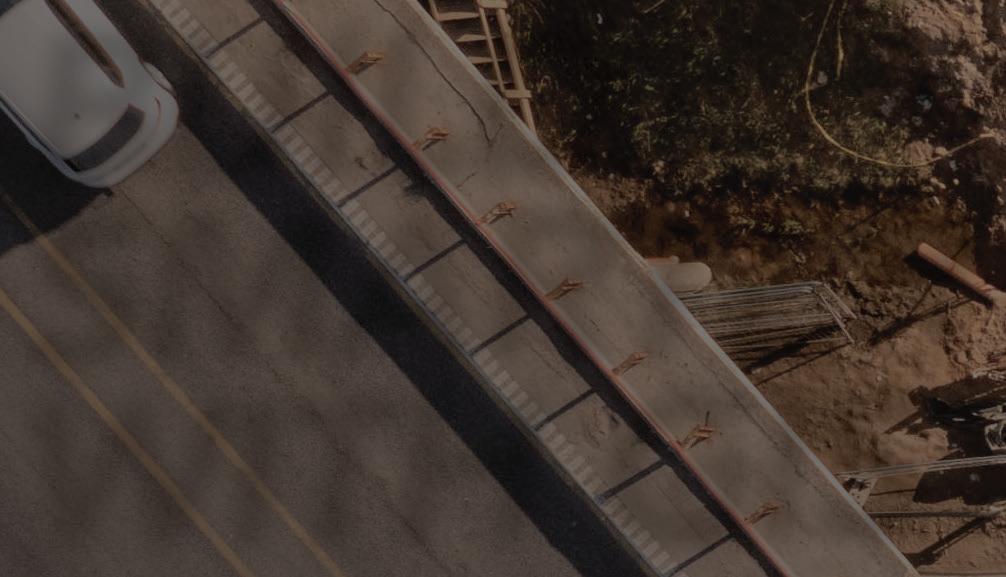






Transportation agencies worldwide are building the infrastructure of the future to achieve greater mobility and more seamless supply chains to increase economic development. Whether constructing new highways or the latest technologies for traffic management, agencies want to be assured they are making the most strategic investments.
By leveraging Esri’s geographic information system (GIS) technology, you can
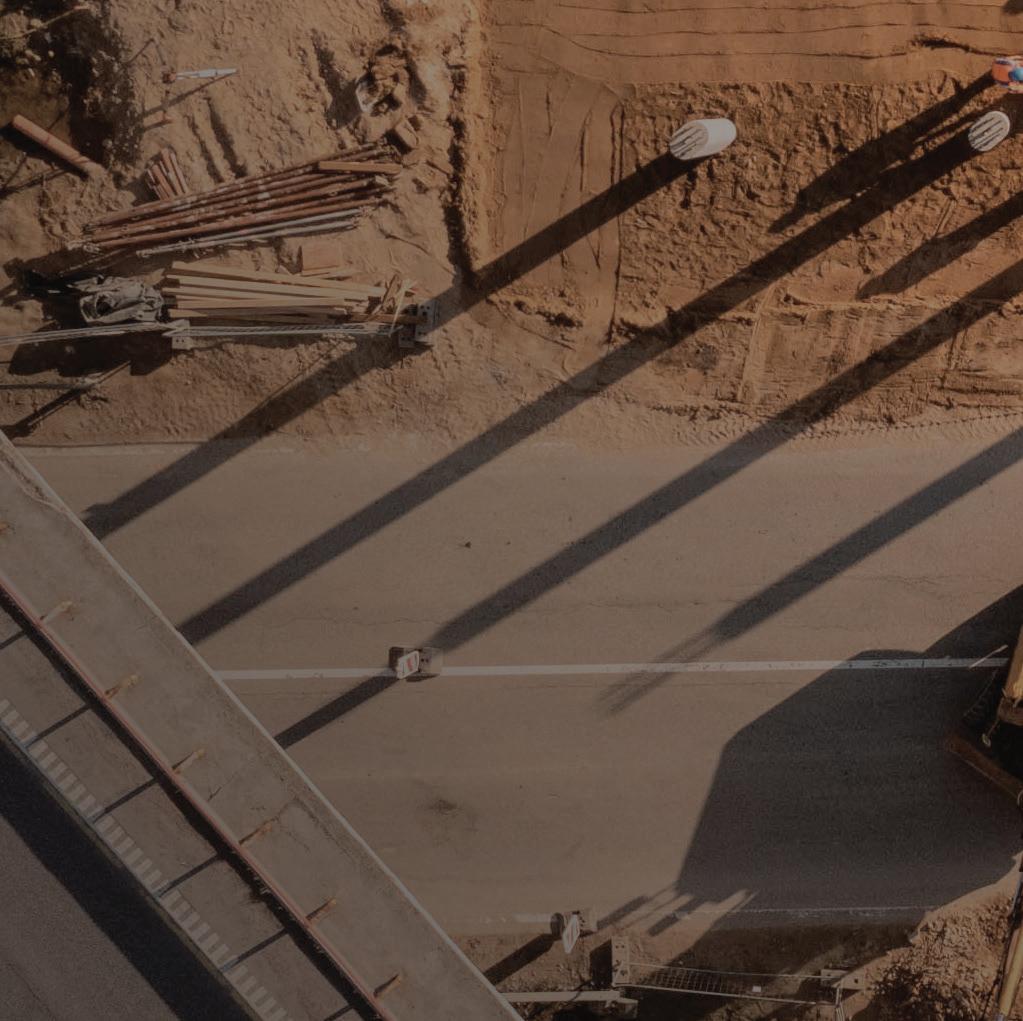
■ Design and plan resilient and sustainable infrastructure.
■ Analyze mobility patterns to reduce congestion and increase access.
■ Plan capital improvement projects based on data and analysis.
■ Integrate information from multiple real-time sources to control congestion.
Discover Esri, the key technology partner in building sustainable transportation.


go.esri.com/sustainable-transportation



Peoplesafe and SureCam have teamed up to ensure highway inspection workers with Ringways Jacobs in the UK are safer when they carry out their duties.
Ringway Jacobs, a highway services provider, supports more than 16,000km of highways, 13,500km of footway and almost 11,300km of Public Rights of Way. The company adopted the videoenabled lone worker protection service earlier this year for its inspection team responsible for walked, visual inspections of footways and carriageways.
All too often, these operatives are seen as the ‘face’ of the highway authority and in danger of violent and abusive behaviour from road users. Meanwhile, they are frequently working in remote locations, so face higher risk from slips, trips and falls, as well as traf c collisions both inside moving vehicles and at the roadside.
The service integrates the Peoplesafe Pro smartphone app with SureCam’s video telematics platform to provide drivers with a quick and easy way to request
Not completely alone with a video-enabled loneworker
solution from Peoplesafe and Surecam
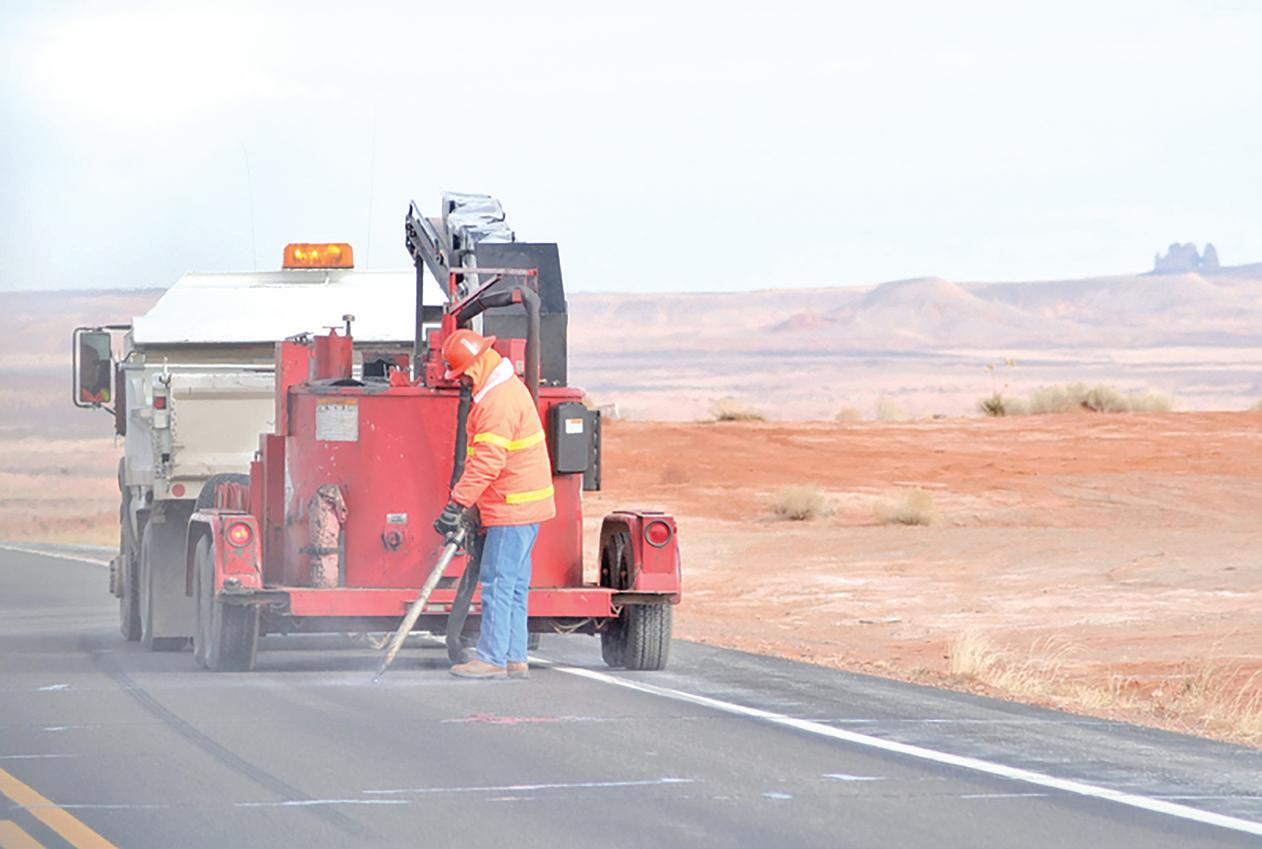
assistance. It supports the driver both in and outside the vehicle, something that Peoplesafe says is not possible with any standard in-cab SOS button function device. This means real-time data can be sent to a designated alarm receiving centre (ARC) to enable proactive management of emergency situations.
Ringways initially rolled out dual facing connected dash
cams in 2021, tted on 163 vans and specialist vehicles enabling footage to be viewed by Peoplesafe’s Alarm Controllers in the event of any alarm being raised on the Pro mobile App. Drivers simply scan a QR code using the Peoplesafe mobile app to register their unique user ID, which con rms who is driving the vehicle. This automatically enables controllers in the Peoplesafe ARC
to access audio communication along with supporting video footage captured from cameras tted on 163 Ringway Jacobs vans and specialist vehicles, as well as incident data, when an alarm is
The added audio and visual insight also ensures that the most appropriate action is taken quickly, ef ciently and safely, with immediate access to emergency services if required.
“We have taken our existing lone worker solution to the next level through this intelligent partnership with SureCam that places the end user rst,” said Naz Dossa, chief executive of Peoplesafe. “The most signi cant impact we have seen is the peace of mind it provides to both employers and employees, making it an attractive proposition to those eet operations, such as Ringway Jacobs, that prioritise people's safety and welfare.”
Peoplesafe
https://peoplesafe.co.uk
Surecam
https://surecam.com



Vitronic Middle East says it will install more than 2,000 "cutting-edge tra c enforcement systems in high-risk areas" over the next few months.
Although no details are given, the group said that this is part of the company signing contracts worth €200 million with its long-term customers in the region. "Tra c management and enforcement systems provide bene ts that extend beyond the daily lives of individuals," Vitronic said in a statement. "These systems have positive e ects on the country, ultimately enhancing the standard of living for its inhabitants. Road accidents have multiple implications for a country's GDP. By reducing the occurrence of accidents, signi cant savings can be achieved in terms of medical emergency care expenses and deployments of police and other professionals."

Youssef El Hansali, chief executive of Vitronic Machine Vision Middle East, based in Dubai, noted that “witnessing rst-hand how technology continually enhances our safety on our roads serves as the driving force behind our daily business operations”.

Earlier this year the group, based in Wiesbaden, Germany and employing around 1,300 people worldwide, reported that it expects to see growth of 12-15% in 2023 against a successful 2022 during which it saw a14% increase in revenue to €208 million. To increase market presence in Austria, Vitronic Austria was founded in Vienna in 2022. Presence onsite has also been strengthened at existing locations such as in North America, UAE and Malaysia.
Vitronic www.vitronic.com











ACO says its KerbDrain CycleKerb drainage solution for bike lanes in England meets LTN 1/20 standards while making travel safer for all cycle lane users.
Local Transport Note 1/20 (LTN 1/20) sets out minimum standards for English local authorities and highway engineers when implementing new cycle infrastructure. It includes, but is not limited to, cycle crossings and junctions, cycle lanes, cycle tracks, cycle networks and cycle parking.
The updated note, LTN 1/20, replaces an earlier note about shared lanes and comes as the increase in people cycling for pleasure and as a commuting method post-COVID looks like being here for good. On top of this, funding from the government has increased, with €233 million available for English councils to improve walking and cycle routes. Cycle lanes must meet LTH 1/20 standard if relevant councils intend to apply for government funding.
KerbDrain CycleKerb is a combined kerb and drainage unit to provide e ective drainage speci cally for cycle lanes, taking into account all lane users. ACO says it removes surface water without intruding on the horizontal surface of

the cycle lane allowing for a smoother ride, safer walk and a more aesthetically pleasing look.
ACO’s KerbDrain CycleKerb range features a bullnose pro le with 60mm upstand, making it ideal for keeping pedestrians safe from tripping or slipping in surface water.
Crucially, it meets the requirements of UCL’s Accessibility Research Group (ARG) for the Guide Dogs for the Blind Association study, which outlines safe kerb design for blind and partially sighted people.

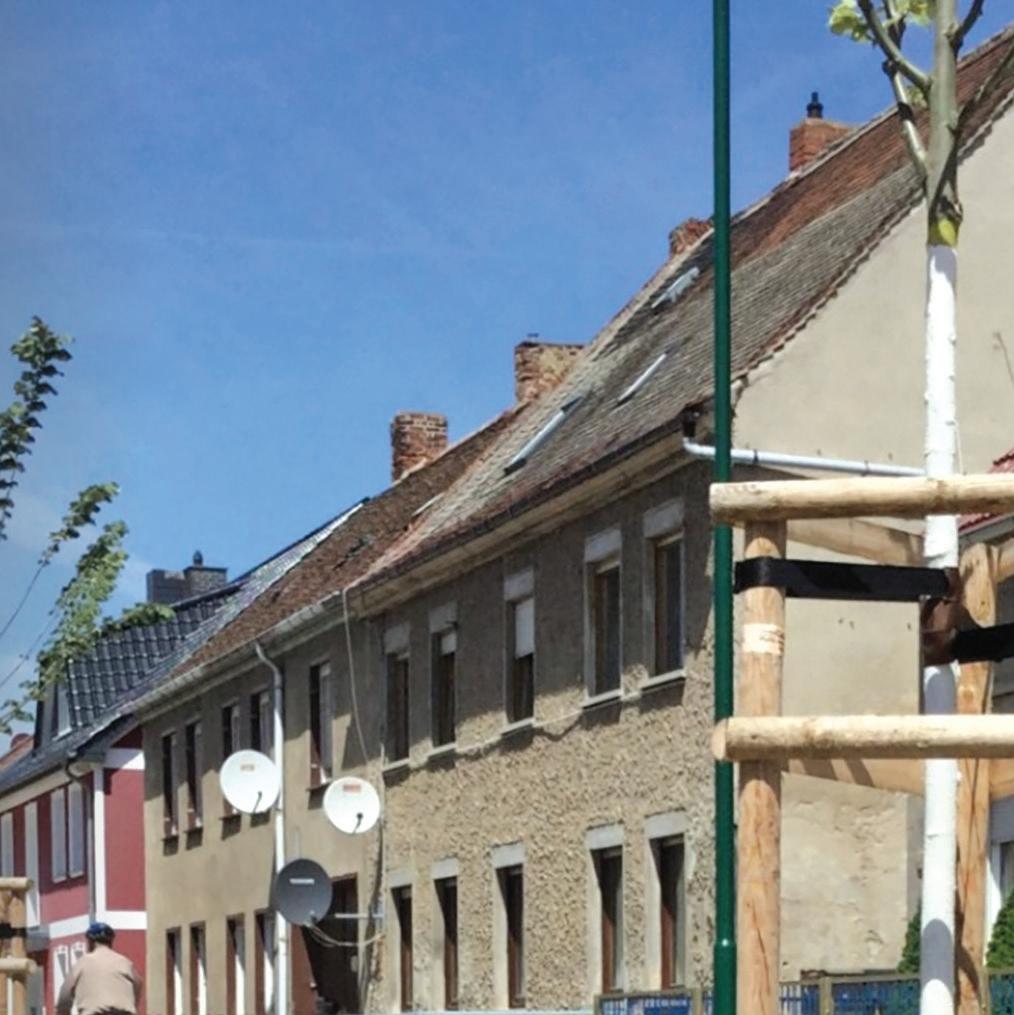
In addition, water inlets are situated on the vertical face, meaning the surface of the cycle lane is kept free from other drainage components such as gullies. The reduces potential trip and slip hazards and makes it easier for cyclists to have total use of the cycle lane.
The uninterrupted horizontal plane also minimises the risk of heels getting caught. Along with this, the low 60mm height means there is less chance of pedal strike, making the use of lanes a smoother and safer experience for cyclists.


ACO www.aco.co.uk

UK highway safety specialists WJ Group will expand into North America with an of ce in Atlanta in the US state of Georgia.
The US company will be called WJ Surface Treatments and, according to the company, “will service the growing demand for high quality yet environmentally friendly road improvement and maintenance options”. The business will be working initially with the departments of transportation across nine southeastern states, including Kentucky, Virginia and Florida as well as with general contractors.
“The move will see an expansion of innovative, highquality services, such as Captive Abrasive Friction Enhancement and High Friction Surface Treatments within the US,” said WJ in a press statement. Captive Abrasive Friction Enhancement

improves both the macro and micro texture of the surface by ring a large volume of small steel shot at the road. This increases skid resistance levels and extend the surface life of the highway asset. The process, also known as shot blasting, abrades and repro les the aggregate. Following
this, any excess bitumen plus other detritus is collected by the vehicle.
High Friction Surface Treatments, meanwhile, increases skid resistance through the application of a new surface layer that contains superior aggregates. It is used primarily in safety-

critical locations where braking distances and vehicle control are of increased importance to reduce skidding and related accidents. This can include sharp curves, freeway slip roads and pedestrian walking approaches or areas where stopping distances could be compromised due to severe weather conditions, high speeds or road surface wear over longterm use.
Alongside highway maintenance and improvement solutions, WJ Surface Treatments will offer bridge deck waterproo ng solutions. Using rapid-setting epoxy resin system, the structure is protected against freeze-thaw damage and any potential substances from entering cracks to maintain the integrity of the bridge.
WJ Group
www.wj.uk
A demolition rm in Germany has made good use of hydraulic breakers from Epiroc for an important project. The rm employed 10 breakers from Epiroc so as to demolish an Autobahn bridge speedily and ef ciently within a very tight time frame
Using the 10 breakers mounted on crawler excavators the contractor, Mexner, was able to dismantle the A60/A63 north bridge in a single night closure.
Using 10 Volvo excavators, Mexner dismantled the Mainz South motorway interchange. Critical to completing the demolition in the shortest possible time was the reliability and power of the equipment employed.
The high volume of traf c using the motorway interchange, approximately 180,000 vehicles/day, posed a challenge for the project. This meant that it was necessary to complete the demolition of the bridge as quickly as possible. To minimise traf c disturbance, the demolition work was restricted to overnight working and there were also stipulations that there could be no damage to other carriageways.
The north bridge of the interchange had been built around 60 years ago and was no longer able to meet transport needs. Local demolition company Mexner is based in Bischofsheim and was awarded the contract by the German road rm Autobahn. Mexner had experience of working in the area as the company had previously demolished the south bridge of the Mainz South interchange in 2017, which has now been rebuilt. As a result of this earlier work, the company knew that the north bridge would also contain a high quantity of prestressed steel reinforcement. As a result, the rm was aware that it would require a large number of machines to handle the work within the overnight closure period.
After the demolition company had lled a drop bed to protect the roadways under the bridge, 10 excavators equipped with hydraulic hammers set to work on Friday evening and successfully completed the demolition of the bridge within the tightly scheduled time window. Work on the new bridge is now underway.


Hydraulic breakers from Epiroc have been used to carry out a bridge demolition project within a tight time schedule in Germany
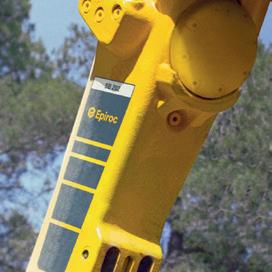
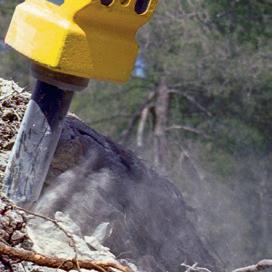
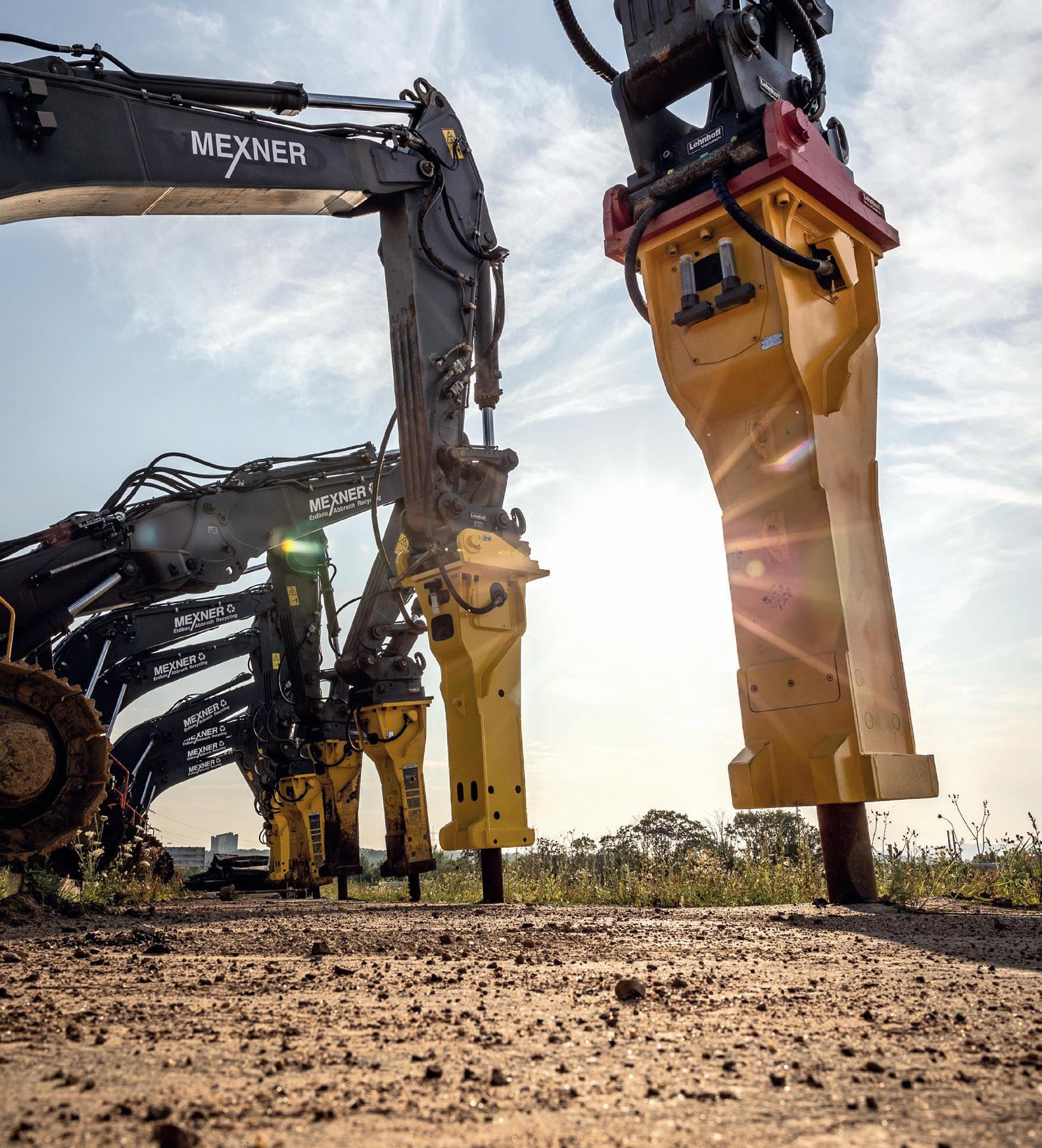


For the demolition of the north bridge, the demolition company relied exclusively on hydraulic breakers from premium supplier Epiroc, whose regional distributor is Bischoff in Frankfurt am Main. From the HB 3100 to the HB 5800, all hammer sizes were in use. Managing director Thomas Mexner commented,"We have deconstructed many highway bridges in the past. When faced with such high concrete grades with strong reinforcement, the hydraulic breakers from Epiroc are ideally suited," Mexner says, explaining his choice of the combination of high performance and low operating costs that characterise the Epiroc hydraulic breakers.
Epiroc's heavyweight hydraulic breakers, the HB series, are speci cally designed
Epiroc has now been using the Solid Body concept for its hydraulic breakers for 30 years.
The rm was a pioneer of the lightweight Solid Body design, which o ers various bene ts compared to conventional hydraulic breakers with impact mechanism and separate casing.

The Solid Body concept uses a patented internal component design that integrates the percussion mechanism and the guide system into a single piece. This eliminates the weakest


and engineered for primary demolition of massive reinforced concrete structures such as highways, primary rock excavation, and secondary crushing on construction sites and in quarries. The patented Intelligent Protection System (IPS) ensures accurate positioning and provides maximum idle protection by automatically adjusting the start-up and shutdown behaviour during operation. This allows ef ciency with minimum risk, even under dif cult conditions. Overall performance is optimised by the integrated AutoControl system by automatically adjusting and matching impact energy and impact rate during operation.
Epiroc www.epiroc.com
components of conventional breakers and ensures durability.
Due to maintenance-free high-pressure accumulators, the rm’s SB breakers are said to o er extraordinary blow frequencies from 5502,300bpm.
The Solid Body concept is slimmer compared to conventional hydraulic breakers of the same size, giving it a more compact design for better visibility and handling, allowing a smaller excavator, helping reduce
carrier fuel consumption. Fewer parts also reduces maintenance requirements and helps boost reliability.
Solid Body hydraulic breakers are a reliable choice for demolishing light concrete structures and asphalt pavements. They are suitable for performing earthworks, post driving or scaling in underground operations. There are nine models in the range weighing from 55kg up to 1.06tonnes and the units are designed for carriers in weight classes up to 24tonnes.



Global event organiser Comexposium, based near Paris, annually connects around 48,000 exhibitors with more than 3.5 million visitors in 22 countries. Taking place in April 2024, INTERMAT is one of Comexposium’s agship events and Christophe Lecarpentier is bringing his own passion and communication experience in the construction sector towards spreading the word that Paris is best in springtime
Countless divas, movie directors and writers have focussed on how Paris stimulates both passion and relationships. For example, April in Paris, the 1952 American movie starring Doris Day and Ray Bolger, is about how communication, albeit mistaken, led to a long-lasting love relationship. As well, Ella Fitzgerald sang I love Paris in springtime because “her love is near”. Passion, communication and relationships are things well understood by Christophe Lecarpentier, Compexposium’s new director of its AgroEquipement and Construction Business Unit. His career experience in the agricultural and construction sectors has been acquired across nearly 30 years and provides him with detailed knowledge of manufacturers, including JCB (see box). He has a clear understanding of the markets, in both in their industrial aspects and their distribution networks.
“In the past 28 years, I have learned that communication and relationships are key in any business,” he says. “You can learn a lot of things on the internet, read many things, watch videos. But you will always miss something if there is no interaction between people. Reading an email and discussing an issue with somebody are not the same thing. The way you communicate, the way you listen and watch reactions from people will probably change
the way you act and react. Personal interaction is key for moving relationships forward and exhibitions are places of interaction with all actors of the business sector.”
What sometimes can be missed is how an exhibition is an integral part of brand promotion. It enables the entire industry to meet and nd solutions to new challenges. “My mission is to help the industry make INTERMAT a success,” he says.
Next year’s INTERMAT will showcase how a global industry is united and mobilised to respond to the challenges of net-zero targets and strategies. The event will also highlight the dynamic innovation of manufacturers as they rise to these challenges.
Lecarpentier fully understands that the construction sector is passionate about meeting its sustainable commitments. His rst INTERMAT was in 1997. Since then, his experience in various positions with international manufacturers such as Milsco Manufacturing and JCB has given him a useful insight into the challenges facing the global construction equipment sector. This is helping him and his team at Comexposium ensure that the next INTERMAT is keeping up with the times. “Numerous meetings with various sector trade federations have led to a complete makeover in the way we approach this new edition,” he explains.
“The entire industry has adopted a CAP under the banner of low-carbon. INTERMAT
2024 aims to showcase the excellence of how the construction industry is developing and promoting low-carbon activities and innovation, as well as digitalisation.”
He says that the show's model has been radically revamped to re ect this and allows for a more comprehensive offering by exhibitors. Exhibition areas have been redesigned around the sector's major challenges. These are called INNOVATION and ENERGY and are new for 2024. Each of the NEW EQUATIONS and CSR (corporate social responsibility) areas will feature conferences and highlights (see INTERMAT’s Four Pillars on the next page).
“A number of conferences and debates will be organised around the subjects of adding value and transforming our businesses and restructuring supply chains to integrate new energies and technologies,” says Lecarpentier. “More than ever before, the show must provide answers to visitors wondering what alternative solutions they can adopt, how they can change their business model, what manufacturers can offer them and even how they can source electricity, gas, biofuel and hydrogen."
With carbon footprints in mind, he says, INTERMAT itself has been reduced from six days down to four. After all, he says, if the event is going to showcase how the sector is reducing its carbon footprint, INTERMAT, as a premier event globally for the sector, should prove it is just as capable of achieving targets.
Lecarpentier says that exhibitors are
reacting positively to the event’s new directions. At present, 65% of exhibitors are international companies based outside France, proof that global companies believe the event, from April 24-27 at Paris-Nord Villepinte exhibition complex is a must attend. Companies committed to being present include Ausa, CIFA, EPIROC, Faymonville, Groupe Fayat, Hitachi, Hydromek, Kobelco, Liebherr, Manitou, Magni, Volvo and Wirtgen.
“They join already announced registered exhibitors such as Alphi, Bobcat, Develon, Cummins, Imer, Komatsu, Groupe Monnoyeur, Putzmeister, Sany, Sateco, Schwing Stetter, Sunward, Takeuchi, Topcon and Wacker Neuson.”
His team at Comexposium has also been engaging - and will continue to engagepublic authorities to give INTERMAT 2024 as high a pro le as possible. There is a lot more media coverage, including promotion of the sector from an employment and training perspective.
As a last word, innovation is a key word and Lecarpentier has worked with brands which were very innovative. Listening to people, how to improve things, how to make things different to improve people’s life is an everyday challenge but also acts as a main driver for innovation.
“My new position at Comexposium is a superb challenge,” he says. “Having represented a single brand for many years, I now have the opportunity, as director of the Ag Equipment and Construction division, to support the entire industry in promoting all its innovation.”
INTERMAT 2024 will be based on four main pillars, each o ering highlights and developments in line with the four major challenges facing the construction industry.
An Industry Forum (new for 2024), will bring together the ve main French construction federations: DLR (La Fédération nationale des distributeurs, loueurs et réparateurs de matériels de construction et de manutention), EVOLIS (qui represente les acteurs de l’industrie en mouvement ), UMGO-FFB (La Fédération Française du Bâtiment), FNTP (La Fédération Nationale des Travaux Publics) and SEIMAT (Syndicat des Entreprises Internationales des Matériels et Services de Travaux Publics, Mines et Carrières, Bâtiment et Levage). The forum will feature a series of talks and roundtables with top-level speakers, construction professionals and o cial authorities as well as French and international special guests including perspectives from other sectors to address zero carbon issues.
A World Of Concrete Europe Forum will be a series of talks
dedicated to the concrete industry, the material and its various applications.
The INTERMAT Innovation Awards will re ect the sector’s new challenges with a dedicated display area.
INTERMAT Press Days will be two days of workshops and discussions between exhibitors and journalists on January 18 and 19.
The New Technologies and Energies Hub (new for 2024) will be an area dedicated to exhibitors and start-ups and a “speakers platform” will be set up.
A Demonstration Zone will be dedicated to what will power the equipment of the future; two exhibitors have already registered – material conveyor system maker Theam and
material supplier River.
A space dedicated to the promotion of the professions and the nancial and human resources jobs, as well as training within the sector; this pillar is a platform for promotional initiatives, workshops and talks, job dating sessions, etc.
INTERMAT Rental Day will be devoted to equipment rental with contributions from international experts.
Christophe Lecarpentier graduated in 1996 in international trade from a Paris Chamber of Commerce College, the CPSS Trudaine. He later followed the executive leadership course at HEC Management in Paris 2003 and a dual course in sales and marketing for the US and UK.

manager from 2005 to 2011, marketing and sales support director from 2011 to 2020 then director of the Africa zone from 2020 to 2023, overseeing the dealerships in north and west Africa.


Lecarpentier began his career in 1996 as a sales executive then sales director Europe from 1998 to 2005 at MILSCO Manufacturing., the American equipment manufacturer and the supplier of seats for machinery in the construction, agricultural, industrial and landscaping markets.
His career continued at JCB, the supplier of machines and solutions for the construction, agricultural, industrial and recycling sectors. He was product


Because of his French and international experiences, he has worked with many manufacturers, both upstream in product design and innovation as well as at the distribution level for product launch, promotion, network training and sales through dealership networks.



For more information about INTERMAT, visit: www.comexposium.com
To contact Christophe Lecarpentier: christophe. lecarpentier@comexposium.com





The revamped INTERMAT for 2024 will be a model event for showcasing innovation as the sector strives for net-zero performance in many of its aspects. INTERMAT will reduce its own carbon footprint – only four days instead of six. The event will o er to the widest audience within the construction equipment sector access to the latest thinking regarding the circular economy, highlighting responsible products and


services.








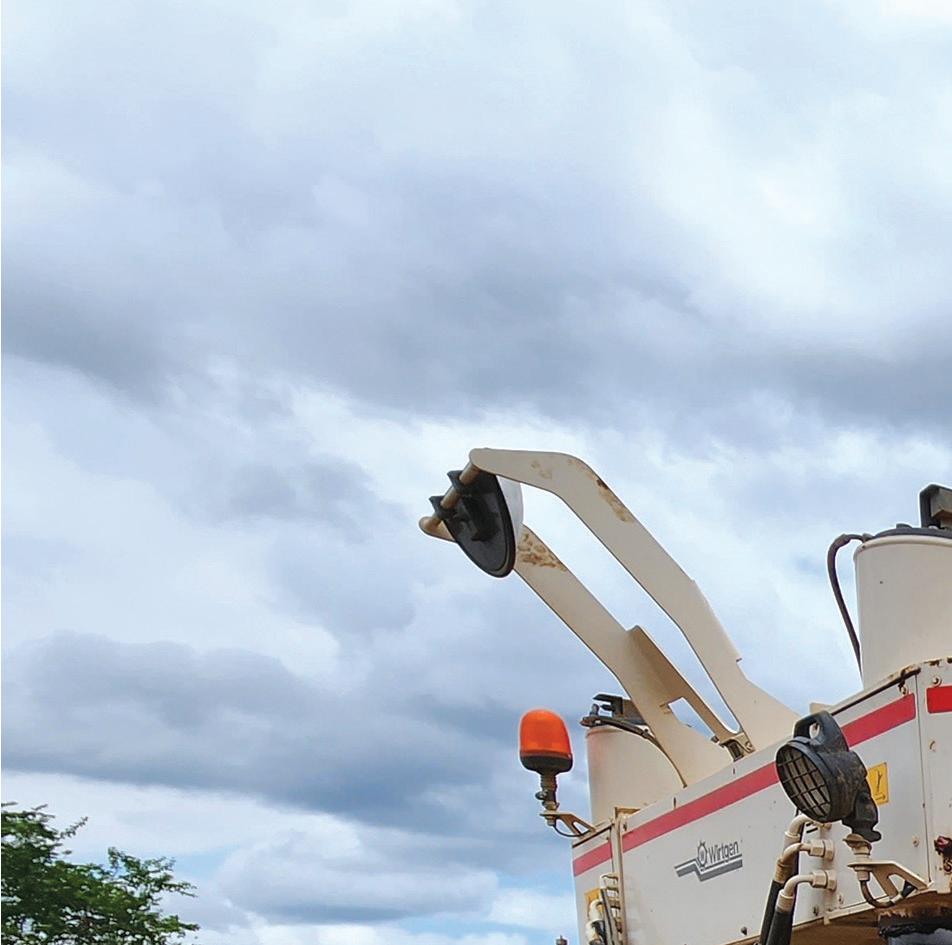
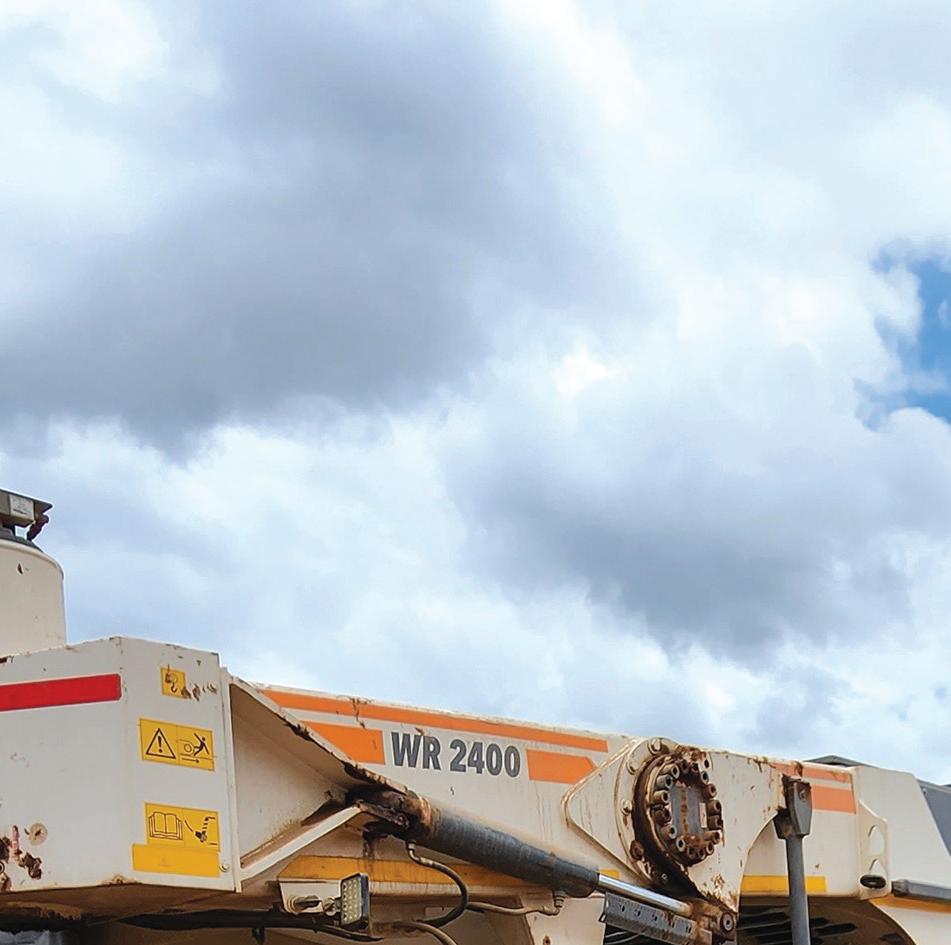
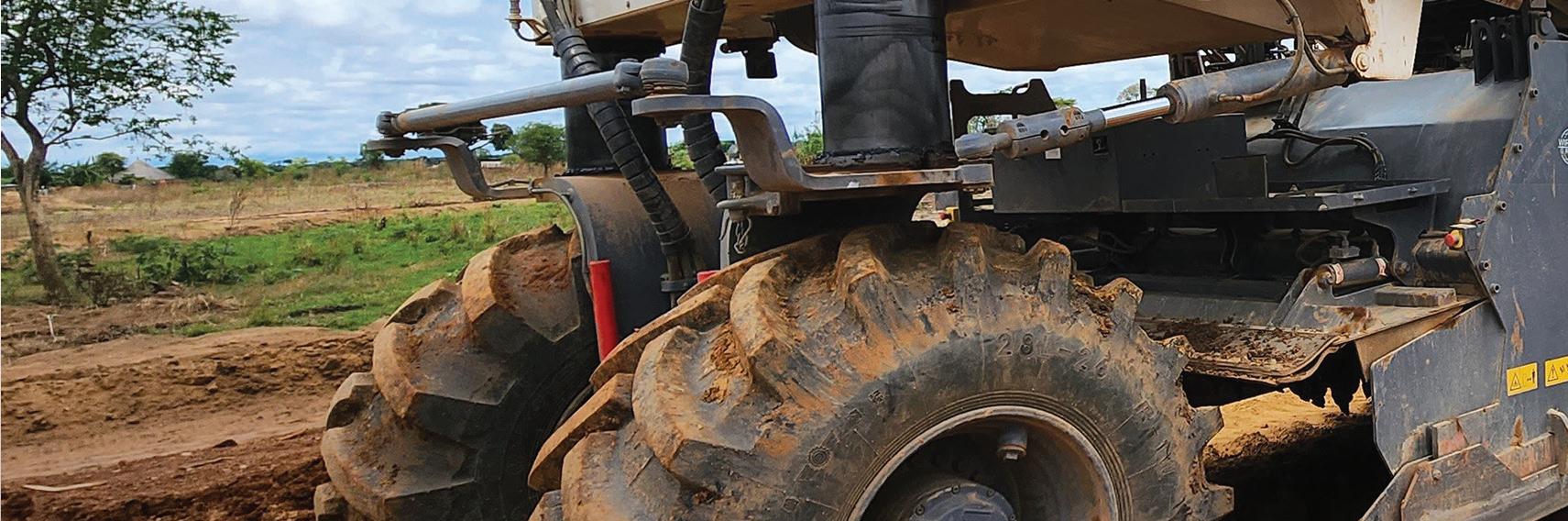


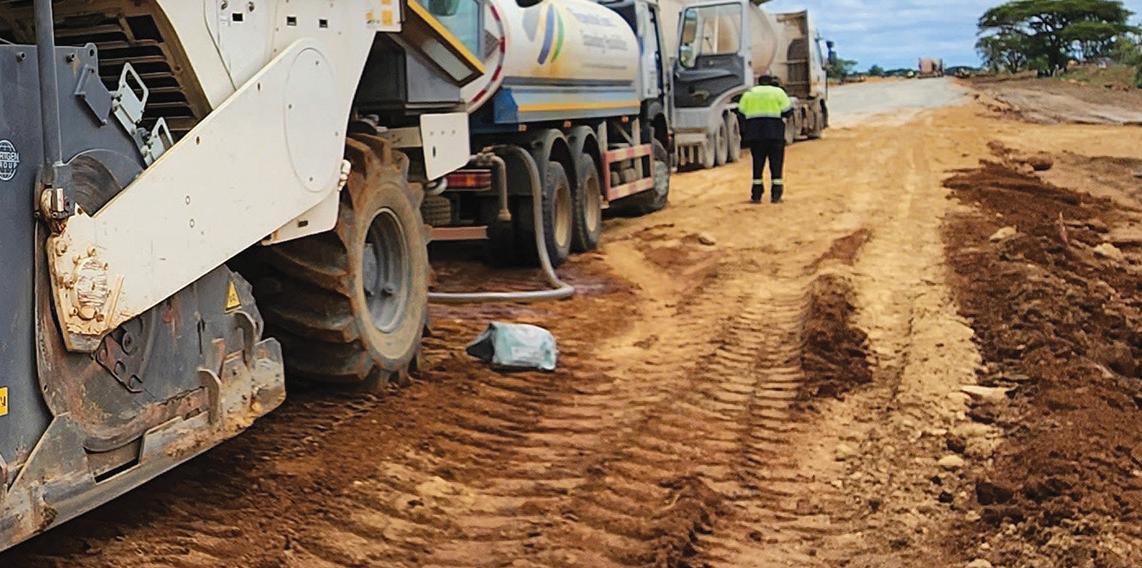

Construction work is nally underway for a major new highway link in Zimbabwe after many years of false starts
This impressive megaproject is seeing the construction of the Beitbridge-HarareChirundu Highway, which will provide a vital transport link for the country.
Running across the country from Chirundu in the north and on the border with Zambia, the route runs through the capital Harare and all the way to Beitbridge in the south, located on the border with South Africa. The route is nearly 900km long and the existing road has been notorious for fatal crashes, heavy congestion and its poor condition.

Upgrading the road to multi lane highway
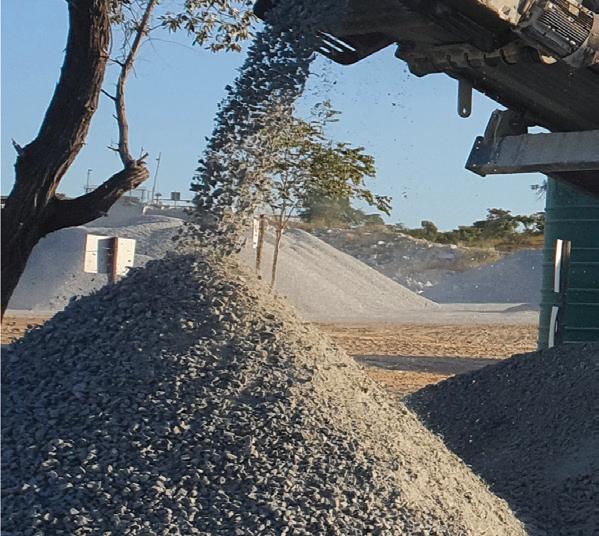


status will help to boost Zimbabwe’s struggling economy, cut crashes and reduce journey times. The highway is one of the most important links between the TransAfrica Highway and South Africa. The highway upgrade project has been planned for many years but has been hit by serious delays, with a shortage of funds being one of the key issues. Its bad condition, heavy traf c and poor road safety record had become a serious problem. In view of this situation, the Ministry of Transport and Infrastructural Development assigned highest priority to the project and awarded contracts for the rehabilitation of this particular section to ve local contractors. These include: Bitumen World, Fossil Contracting, Tensor Systems, Exodus and Masimba Construction.
The work is nally underway and a eet of Wirtgen machines is playing a vital role in the construction. The rehabilitation of the section between Beitbridge and Harare and the
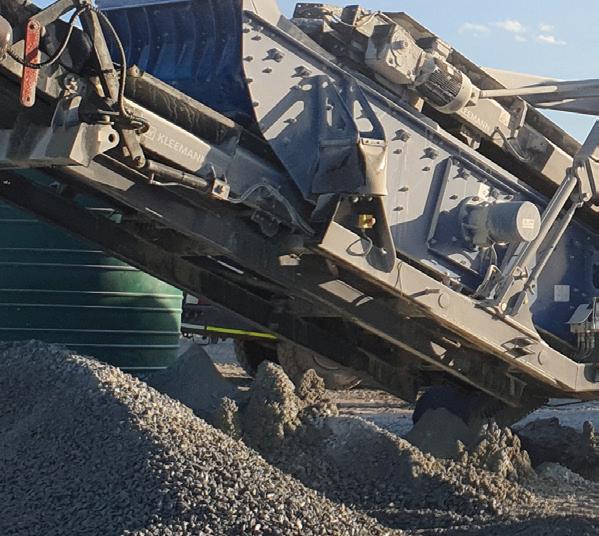

partial widening of the roadway from 7-12.5m began in 2019 and should be nished in 2023. The work is being carried out by a large and complex eet of machines, which includes Wirtgen recyclers, Vögele pavers, and Hamm compactors, Kleemann crushers and a Ciber asphalt mixing plant.
The existing two-lane road is being replaced by a 12.5m-wide dual carriageway and brought into line with international standards. The project also includes the construction of 17 toll stations, which will provide revenue for the maintenance of roads throughout the country.

The equipment eet is proving able to cope with both the high summer temperatures of up to 45° and high rainfall during the rainy season.
The local Wirtgen Group South Africa sales and service organisation arranged the deal. The machine quality and strong support convinced the contractors involved in the project and tipped the scales in favour of purchasing machines from the Wirtgen Group. The machines were provided by the Machinery
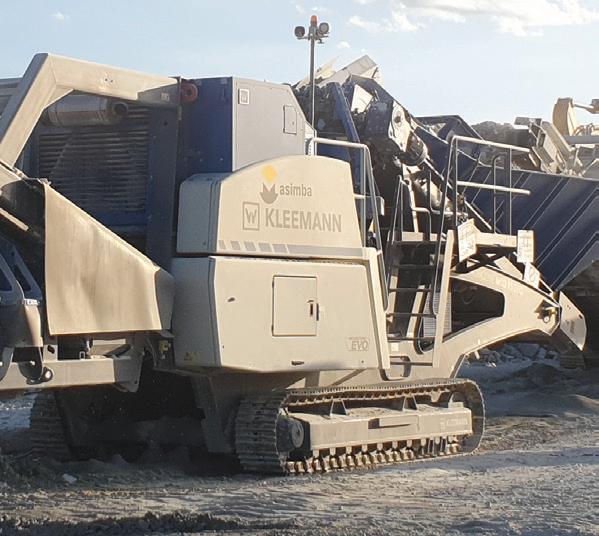

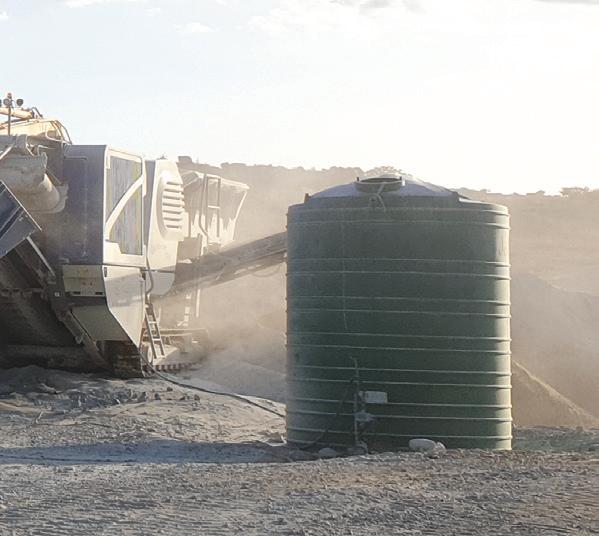

Exchange Group (MXG), the local dealer for Wirtgen Group machines and aftersales contact for maintenance and service.
The project was split into three sections: the 570km Beitbridge – Harare stretch with eight toll stations; the 342km Harare – Chirundu stretch with six toll stations; and the 59km Harare Ringroad.
Bitumen World was assigned project subsections: Masvingo – Beitbridge (km 164 to km 237); Beitbridge Urban (12km). The main tasks were the removal of the existing layer, paving of base layers and paving the new asphalt surface layer.
The rm used Vögele SUPER 1603-i pavers, Hamm 3411 and 3520 compactors, Hamm HD 090 V tandem rollers, Hamm pneumatic-tyre rollers and Wirtgen WR 240 cold recyclers.
The rm has carried out 312,000m3 of earthmoving, laid 228,000m3 of cement treated base layer, compacted an area of 130,000m³ and laid an asphalt base layer with a thickness of 40mm over a total of 520,000m³.
Masimba Holdings carried out 70km Masvingo Road stretch. Its main tasks have included the removal of existing layer, paving of the base layer and paving a new asphalt surface layer. The company has used Vögele SUPER 1603-i pavers, Hamm 3411 and 3520 compactors, HD 090 V tandem rollers, Hamm pneumatic-tyre rollers, Wirtgen WR 240 cold
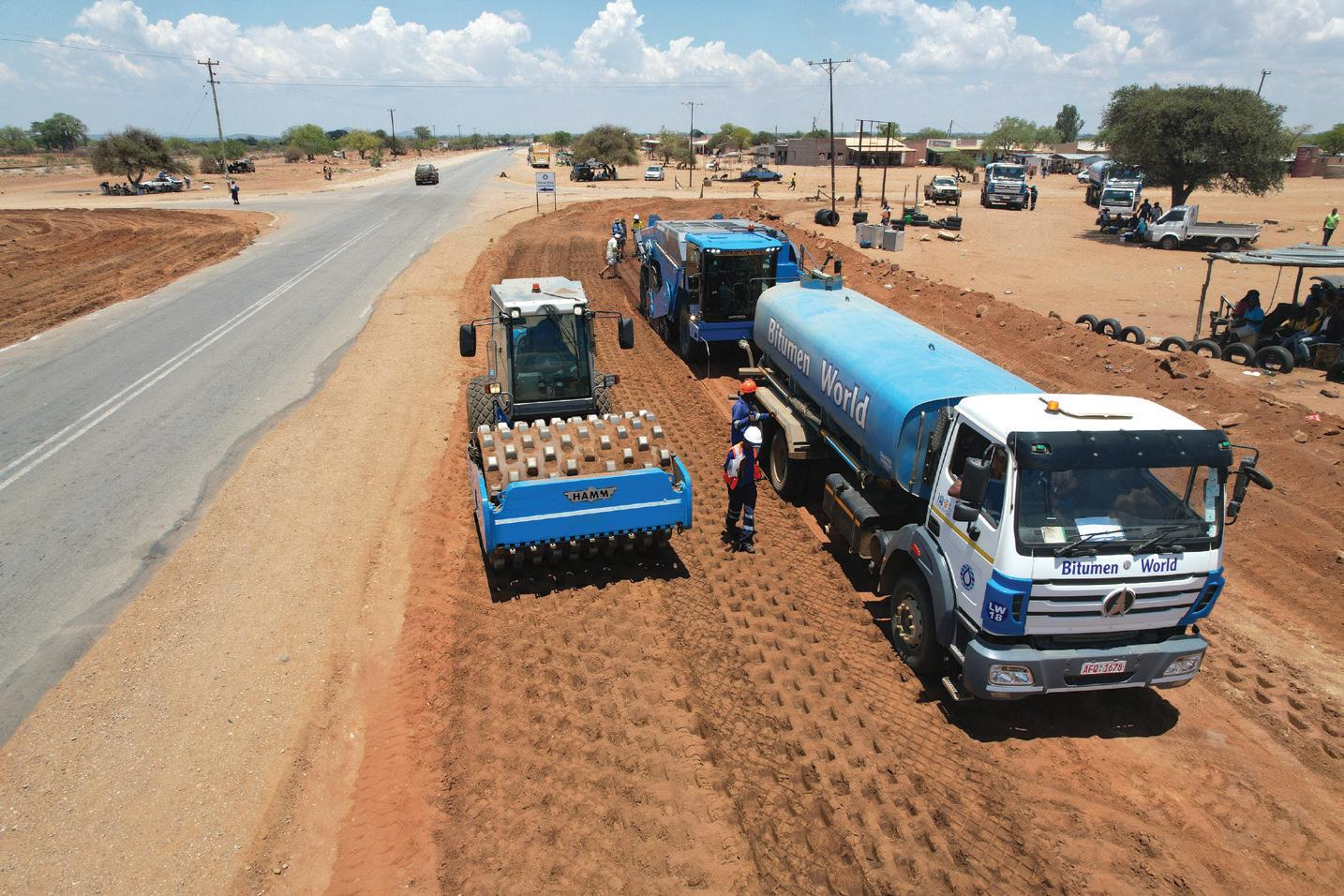
recyclers and a Kleemann crushing train. Masimba has carried out 320,941.60m³ of sub base works, paved 205,223.85m³ of the upper layer, built 208,613.25m³ of the lower layers and handled 231,912.00m³ of subgrade works.
Fossil Contracting was assigned the 80km Harare – Beitbridge Road sections. Its main tasks have been the removal of the existing layer, paving of the base layer and paving of
the new asphalt surface layer. The rm has been using Vögele pavers, Hamm rollers and Wirtgen WR 240i recyclers.
Tensor Systems was assigned a 100km section. The main task was for asphalt paving and civil engineering works, using Vögele pavers and Wirtgen recyclers over a surface area of 1,141,200m² and processing a total volume of 684,720m³.
Wirtgen says the latest generation of the Streumaster binding agent spreader sets the standard for lling, material conveying, spreading accuracy and ease of operation.
The new models - MC (mounted on a carrier vehicle) and TC (mounted on a trailer) - feature a high-speed lling device on both sides, self-cleaning dosing sluices and a new control panel.The two large lling connectors at the rear are standard and allow silo trucks to drive up close to the machine to ll the container, even when space is limited or in moving traf c. This enables lling to be carried out quickly and easily from either side of the new binding agent spreaders.
The new high-speed pneumatic lling device and new container design ensure that the lling process is quickly completed and that the binding agent is evenly distributed in the container. This enables the binding agent spreader to be lled with binding agent at a rate of up to 2tonnes/ minute for each connector. An
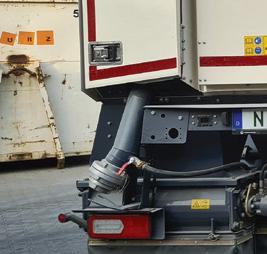
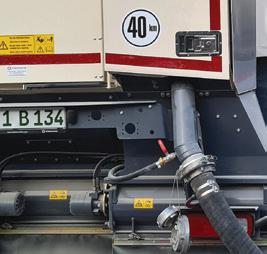
optional automatic lter system can also be tted to enable dust-free lling. The integrated OptiPower chain conveyor drive with automatic load control tted as a standard feature increases the tensile force on the conveyor chain whenever necessary. Fully automatic volumetric dosing of the spreading quantity independent of the travel speed enables consistently reliable discharge of the binding agent. At the same time, the optional WeighTronic weighing device guarantees correct and precise

discharge. The continuous monitoring of actual and target values during spreading ensures that the spreading quantity is readjusted in the event of deviations from the set value. This almost completely eliminates the risk of operating errors. The self-cleaning dosing sluices in the cellular wheel design are another highlight of the new binding agent spreaders.
A special housing with pressure and relief zones and exible chambers ensures that the dosing sluices are self-cleaning.
This guarantees high ef ciency and accuracy for the spreading process. The spreading quantity can also be individually adjusted for each of the three partial spreading widths.
With the new control panel, Streumaster has brought together all control elements in a single unit. Wirtgen says that this provides an ideal overview of all machine functions at all times, It also offers a customisable user interface with a split-screen function when using the camera/ monitor system. Operators can set up and save individualised operating parameters and function keys on the user interface of the 305mm display.
The new generation of binding agent spreaders can be equipped with Wirtgen Performance Tracker, WPT. The system registers all relevant location-speci c working parameters to provide a comprehensive database for the analysis and documentation of the construction site.
Wirtgen www.wirtgen.com


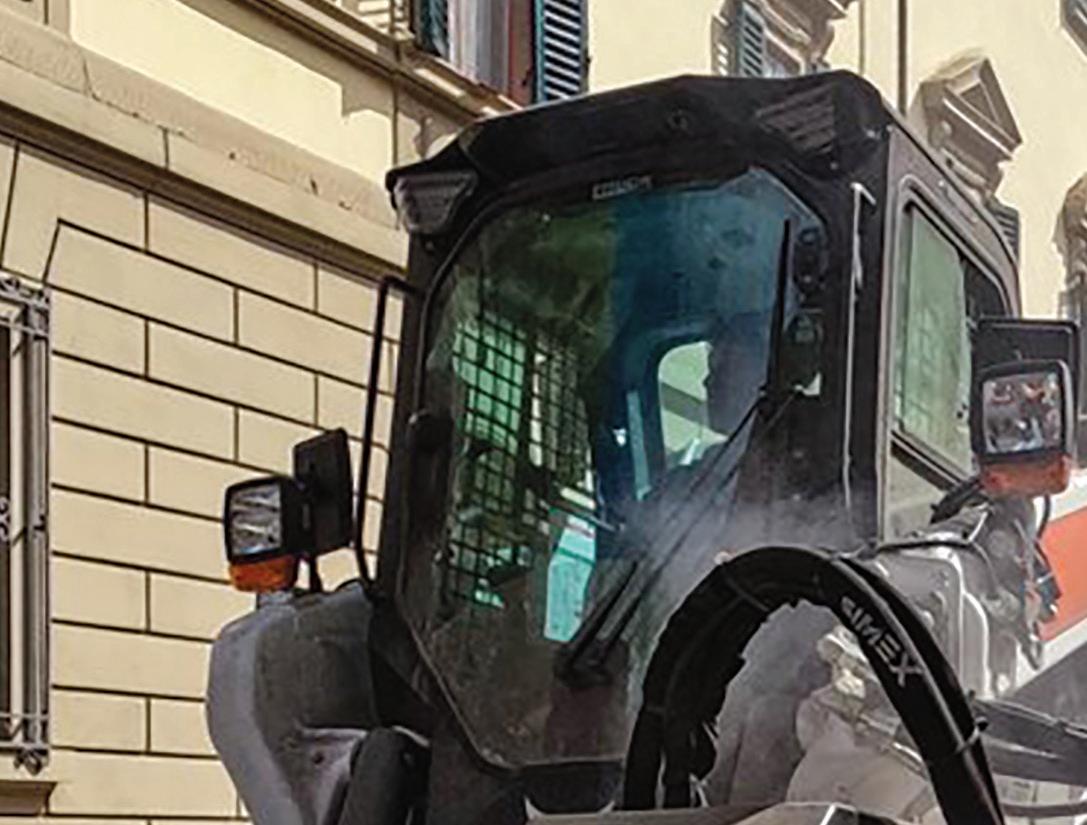
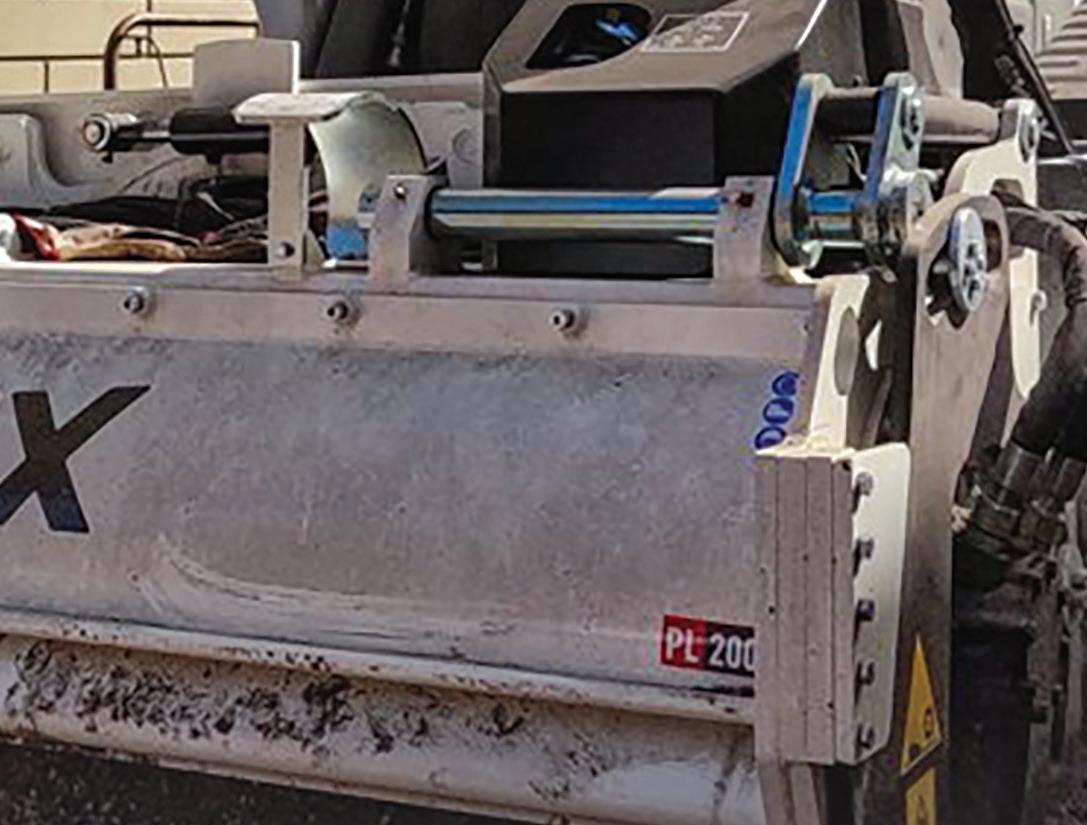

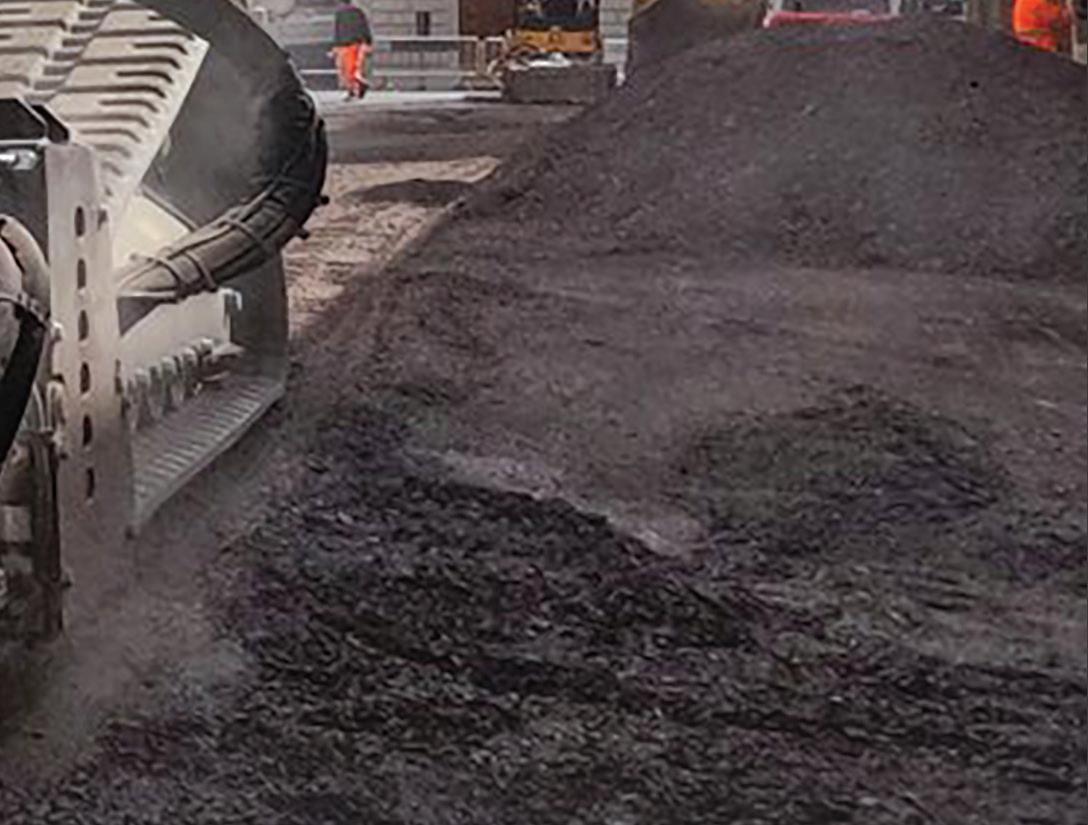

A Simex PL 2000 cold planer was utilised recently on the narrow streets of the Tuscan capital Florence in northern Italy. The project involved resurfacing the wearing course at a depth of 30mm, explained Andrea Palmerani, owner of contractor Bitumvie.
“We needed equipment that would guarantee us a large milling surface all the while remaining in the eld of compact machines suitable for a city context,” he said. “The 2m-wide drum immediately
attracted my attention.”
The PL 2000 can be considered the big sister among Simex’s asphalt planers of the 1000-1200-1500 series, specially designed for scarifying the road surface course. Importantly, speed and ef ciency are hallmarks of the series in order to reduce construction time, especially important for narrow, heavily traf cked inner European roads. This led to the development of a model equipped with a 2m-wide milling drum.
RODECO Group has developed a technology for the application of a light clear pavement with high friction and durability performance. This is capable of reducing energy consumption due to the lighting system in the road tunnel for more than 40%.
The pavement is made by applying a mixture of E-KRETE polymers, produced by the RODECO partner Polycon in the USA, and special cement-based products, with a thickness of a few millimetres.
The pavement skid resistance is particularly high, due to a grooving treatment performed during the application phase. The pavement is also resistant to the aggression of fuels and petroleum products.
RODECO has applied the new pavement
The PL 2000 is designed to be coupled to the latest generation SSL and bene ts from all the Simex features that make the difference onsite. Bitumvie coupled the PL 2000 to a Bobcat T86 skid steer loader, the agship of the Bobcat line of compact tracked loaders. The Super Flow function guarantees an oil ow of 155litres/min, ideal for equipment such as the PL 2000 which requires a very powerful base machine to obtain the productivity required onsite.
during July 2023 on tunnels forming part of the Olympia Odos Highway Network in Greece.
In Greece the surface area being applied with this treatment was over 31,000m2 but the company says that a future application is expected of over 145,000m2. It costs €15/m2 to install.
The rm is applying a double layer of 3-3.5mm total thickness using equipment that can also be used for slurry seal application, while a planetary mixer is employed for mixing the polymer with the aggregate-cement materials. A minimum of 12 hours curing is necessary and the rm is giving a ve-years guaranteed wear life.
Rodeco Group www.rodecogroup.com

The T86 is the ideal machine to push the PL 2000 because it combines high power with an improved lifting capacity. In addition, the electronic speed set-up allows a gradual and progressive advancement, which is a huge bene t for milling operations. Bitumvie recorded an average advancement speed of 10-15m/ min, with a milling depth set at 30mm.
Simex www.simex.it
During the rehabilitation of a 6.5km-long stretch of the A 480 motorway near Gießen, Germany, three powerful Vögele machines delivered impressive results. The powerhouse SUPER 3000-3i paver teamed up with two high-performance MT 3000-3i O set material feeders to lay 51,000tonnes of asphalt. In order to complete the task e ciently, the two feeders simultaneously supplied the paver with material to ensure non-stop paving. Using a SB 350 xed-width screed with high compaction technology the paving team guaranteed jointless, high-quality paving across the full 11.4m pavement width.
Vögele www.voegele.info
An electric Dynapac asphalt paver has carried out a successful paving project on a job site in the Netherlands. The new machine is meeting demand for reduced worksite noise, emissions, and environmental impact.
The electric city paver ensures zero emissions, reduced noise levels, and low running costs. This innovative machine can operate for up to four hours on a single charge due to its state-of-the-art Lithium-ion battery and a powerful 55kW 3-phase Permanent Magnet Synchronous Motor (PMSM).
The electric city paver can handle both AC and DC charging, with the capacity to charge at speeds of up to 80-100kW.
This fast-charging capability is a game-changer for construction sites with tight timelines, ensuring the machine can recharge during breaks or lulls in activity. The electric city paver's adaptability to various charging scenarios demonstrates its practicality and ef ciency on construction sites. A two-and-a-half-year development process culminated in successful tests where the machine's functionality and
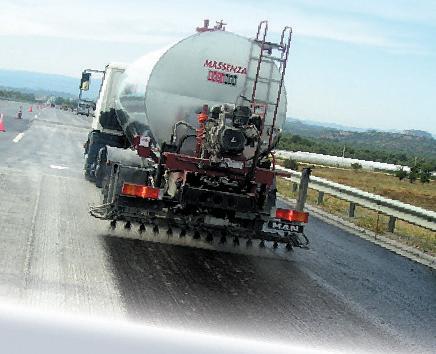




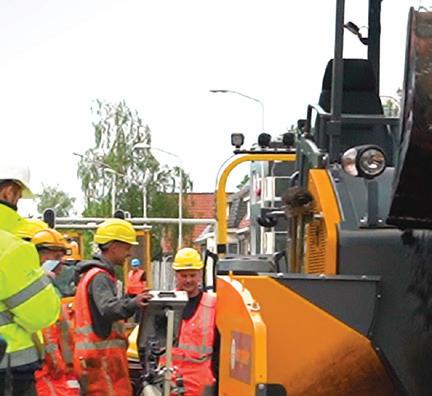
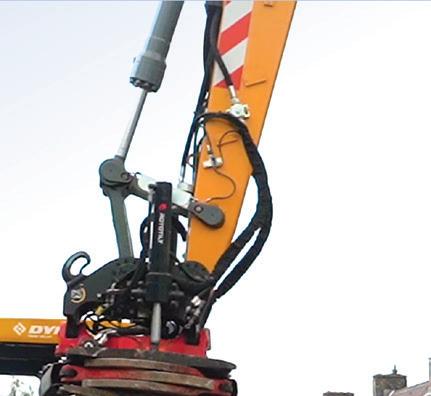
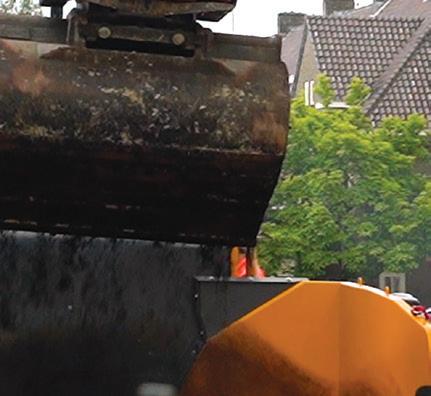
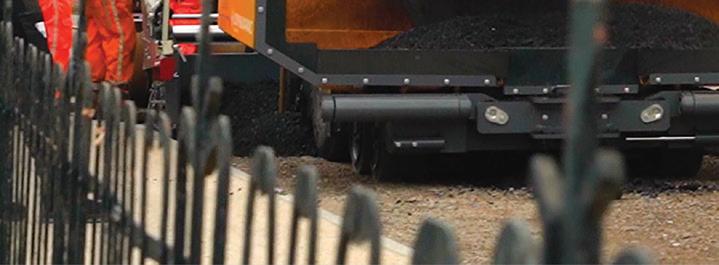
performance were put to the test.
The electric city paver's rst real-world trial took place on a construction site of customer Van Gelder, where its charging and performance capabilities were assessed. It demonstrated its ability to handle charging speeds of up to 80kW, highlighting its potential for rapid and Product Manager Joao Prado commented, “The electric city paver exceeded our

expectations, proving its performance capabilities and environmental bene ts,” Prado said. “It is the culmination of years of hard work and dedication. Not only for us but also for the construction industry, the electric city paver represents a signi cant milestone in the journey toward sustainability.”
Dynapac www.dynapac.com











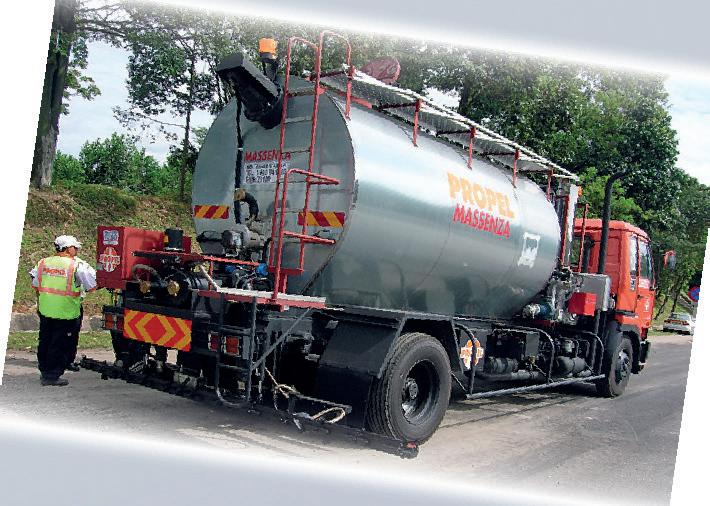

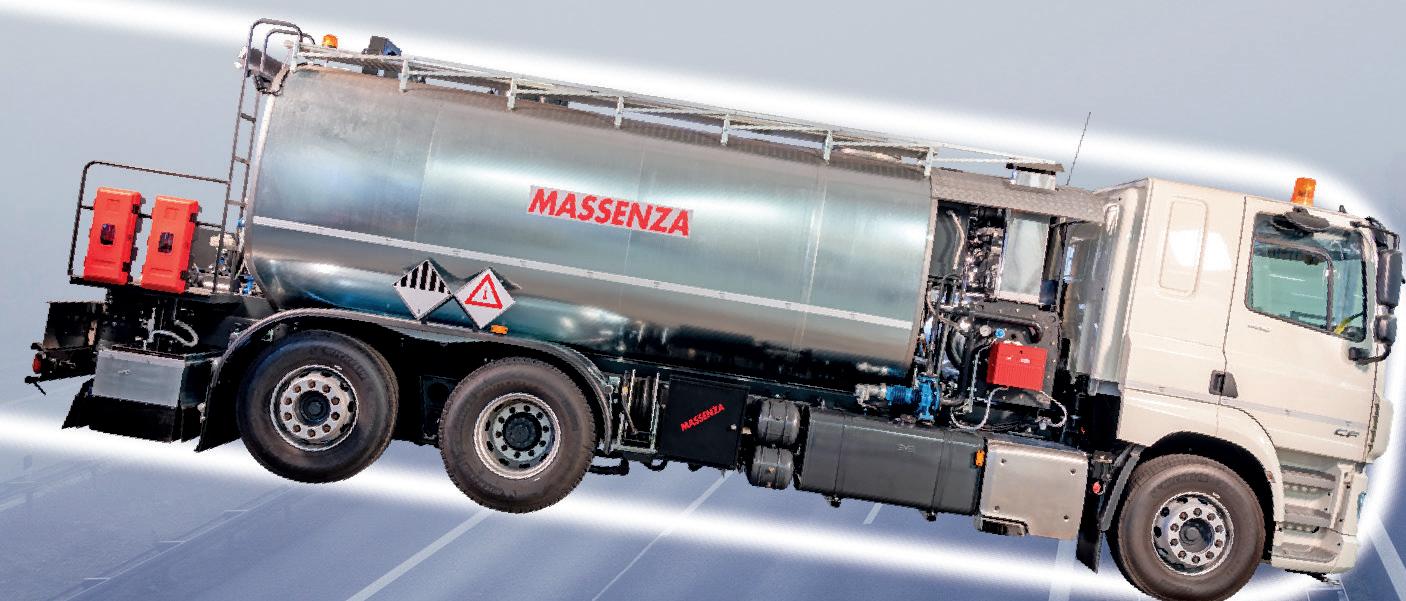
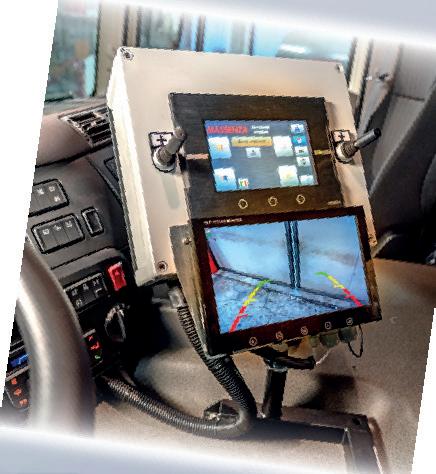







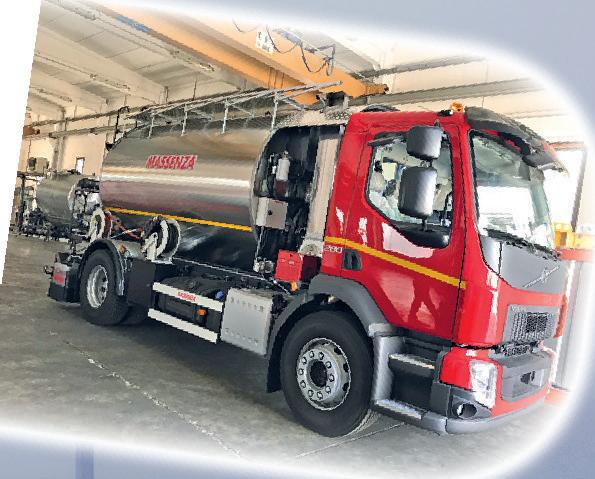






Compacting asphalt on a bridge is a difficult job as the roller operator needs to apply the right amount of vibration. Too little force and density targets will not be reached, while too much can damage the bridge.
Crews faced such a challenge during a recent bridge repair project on Road II/268 near Mnichovo Hradiště – Mimoň in the Czech Republic.
The bridge had undergone repairs, and a new top layer of asphalt needed to be placed. Supervising the project was Mr Hloušek, the asphalt site manager for USK Mladá Boleslav.
An Ammann EasyBatch Asphalt-Mixing Plant with a capacity of 120tonnes/hour provided the mix. The mobile plant utilises cold recycling technology and has equipment for introducing granular additives.
Haul trucks transported the materials to an Ammann AFT 700-3 Asphalt Paver, which placed a smooth 45mm-thick surface layer
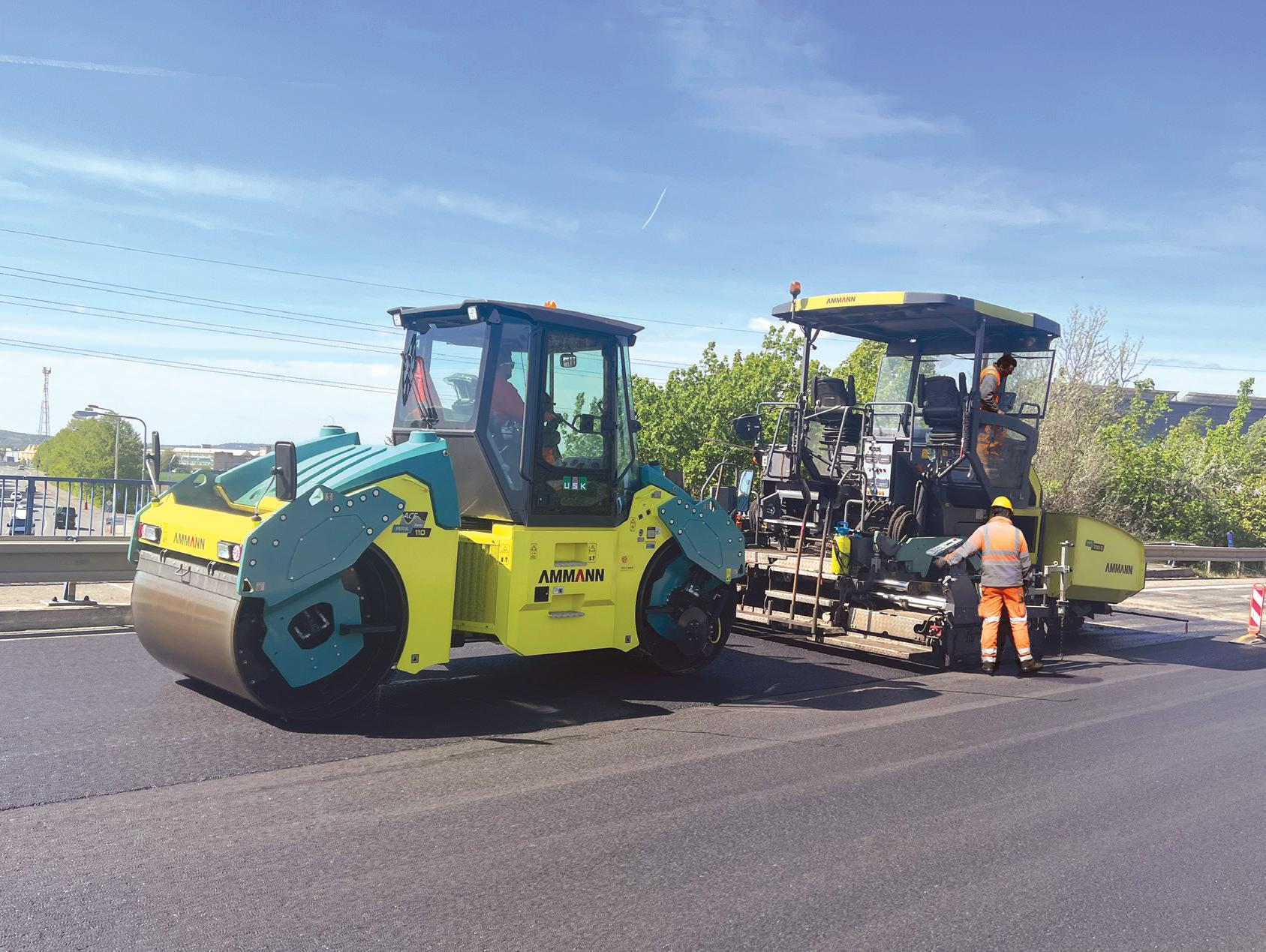
for a length of 150m and a width of 9m. About 170tonnes of mix was placed on the bridge.
For compaction an Ammann ARX 110 Tandem Roller was used behind the paver. The machine features a heavy-duty, two-stage vibrator and easy adjustment of amplitude and frequency.
The crew from USK Mladá

Boleslav took advantage of the optional ACEforce Intelligent Compaction system, which provides a host of benefits including measurement and documentation, evaluation of material stiffness and operator guidance.
This information proved crucial while compacting on the bridge.
The operator was able to work the surface, while ensuring that proper compaction had been achieved. The machine worked at the lowest vibratory setting, an approach the operator would not have been confident of without ACEforce. Ammann www.ammann.com
Patented anti-icing solution for long-lasting, safe and sustainable roads
Winterpave is an innovative and environmentally friendly technology developed to delay the adhesion of ice to the road surface. It lowers the freezing point of water and inhibits the formation of ice crystals. Winterpave gives more time to snow clearing vehicles to intervene and facilitates ice and snow removal. It helps diminish the amount of salt by up to 80%, reducing environmental impact and increasing road safety in cold, icy and snowy conditions.
Peri, based in Germany, is supplying formwork material for the 79 standard tunnel elements, each being 217m long and weighing around 73,000tonnes (image courtesy Peri)
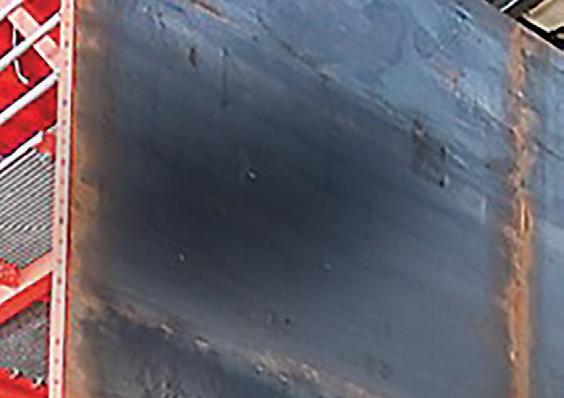

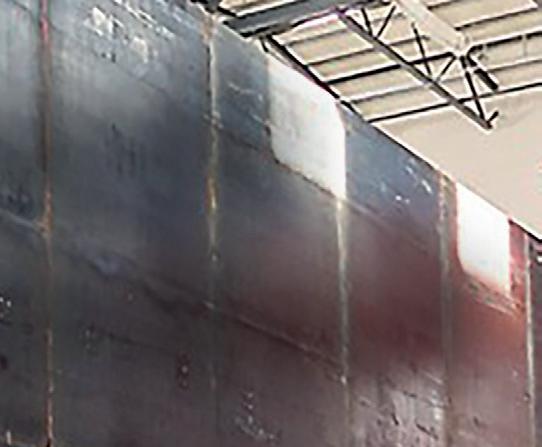
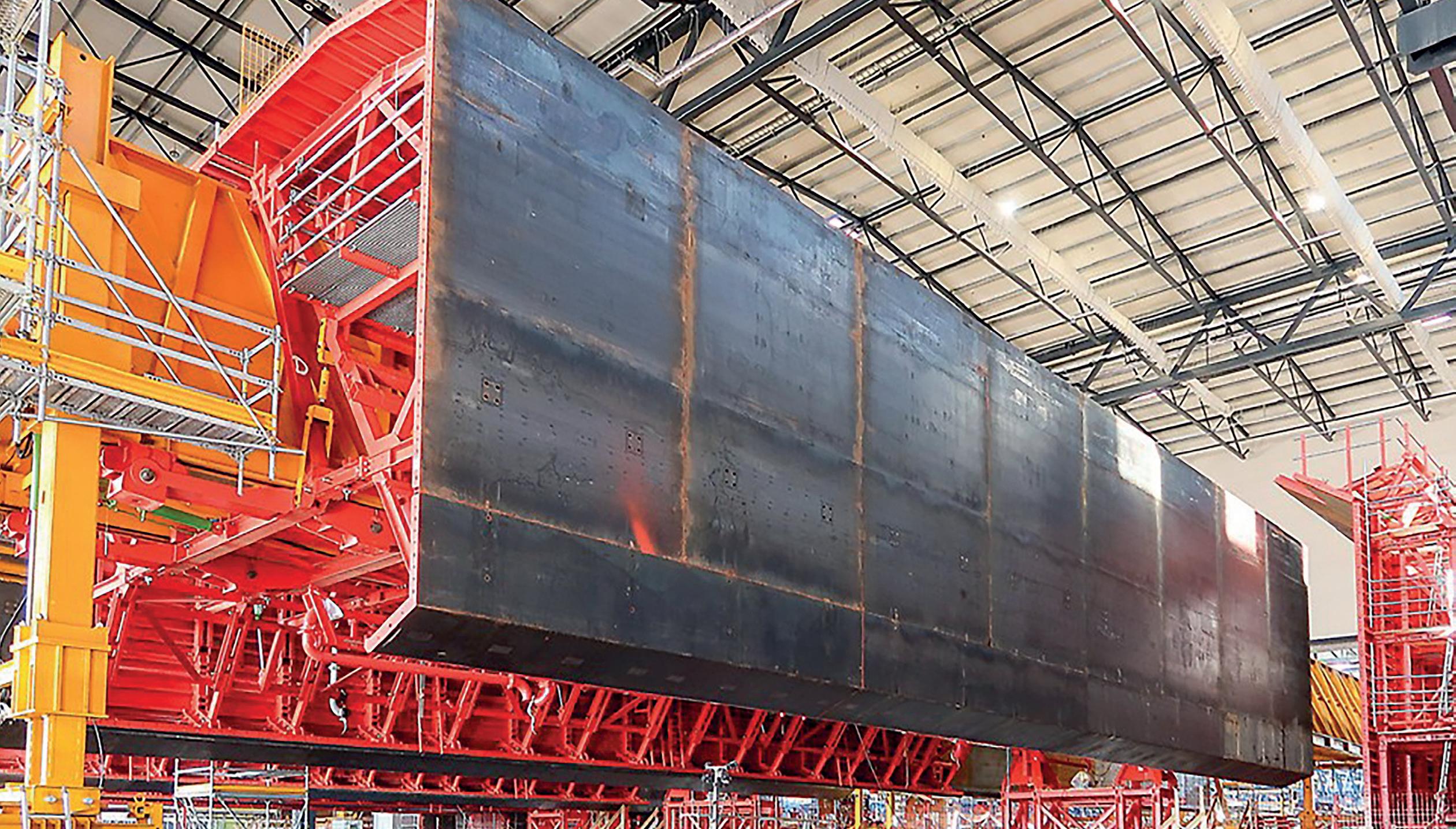
Formwork specialist Peri has completed delivery of the 10,000tonnes of formwork needed for construction of tunnel sections for the 18km-long Fehmarnbelt project
The road and rail Fehmarnbelt Tunnel will connect the Danish Island of Lolland and the German island of Fehmarn in the Baltic Sea and be the longest immersed tunnel in the world. Peri developed a formwork concept for the central production of the standard tunnel elements which make up the majority of the tunnel sections.
The last of the 12 ships delivering Peri’s formwork recently arrived at the tunnel element factory east of Rødbyhavn on Lolland island. When completed, each section will be oated out from the factory to be positioned and lowered into place on the seabed.
The 45m-wide immersed tunnel will consist of a total of ve tunnel tubes. Two will be two-lane tubes for motor vehicles, two are single-lane tubes for rail traf c and one is a service and escape tube. Peri, based in Germany, is supplying formwork material for the 79 standard tunnel elements, each being 217m long and weighing around 73,000tonnes.
Peri engineers decided on an incremental launching method with nine roughly 24m-long concreting sections. The solution forms the
foundation for monolithic concreting, which reduces the risk of water penetration during tunnel operation.
In addition, a tunnel section is concreted without ties in the outer walls. At the same time, the approach means considerable savings in material and labour costs which reduces the use of raw materials, among other things.
The steel components of the Peri formwork solution were produced in Poland, Italy and at the Peri plant in Weißenhorn, Germany. Planning and execution of the delivery of the entire material took 12 ships and involved more than 250 trucks.
Work is done both on land and at sea. The tunnel elements are produced in a large factory with an area equivalent to 140 football elds. The standard tunnel elements are produced onsite in a total of ve separate production lines, in production halls built especially for the project combined with a working port. Each of the total of 79 standard elements is composed of nine concreting sections 45m wide and 9m high. Around 3,000m3 of concrete are used per concreting section, resulting in a weight of more than 8,000tonnes each.
After the concreting process, the elements are tted with bulkheads at both ends and
sealed tightly. The basin containing the elements is then ooded with water in order to oat the elements. They can then be tugged out into the open sea – the Fehmarnbelt - and lowered into position into a trench on the seabed.
Peri said that the use of its Maximo formwork reduces the need for staff thanks to its fast and simple handling. Peri Up scaffolding solutions ensure safe access to work at the construction site and Prokit Mesh Barriers protect staff from falls.
The 19 million m3 of material excavated from the bottom of the Fehmarnbelt will be reused for land reclamation areas and for the construction of overpasses, ramps and embankments in the immediate vicinity of the nearby ferry terminal.
An environmental impact assessment of the tunnel element factory has been completed as a rst step to hopefully making the site a permanent manufacturing base for other projects. These include future tunnels and wind farm infrastructure where large concrete casting is needed and which can be moved by sea to a construction site.
Work on the Fehmarnbel project is being done by Femern Link Contractors. Companies involved in the consortium include VINCI Constructions Grands Projets (France), Aarsleff (Denmark), Max Bögl Stiftung (Germany), BAM Infra and BAM International (Holland), Wayss & Freytag Ingenieurbau (Germany), SolétancheBachy International (France), CFE (Belgium) and Dredging International (Belgium).
Peri
www.peri.com
UK bridge works specialist Spencer Group has created an access system for inspecting stay cables on the new Pattullo Bridge in Canada.
The new bridge is a replacement across the Fraser River near Vancouver, British Columbia connecting the municipalities of Surrey and New Westminster. It will take over from the existing bridge of the same name be used by drivers, cyclists and pedestrians when it opens in 2024. The existing bridge was opened in 1937 but now ceases to meet modern design standards.
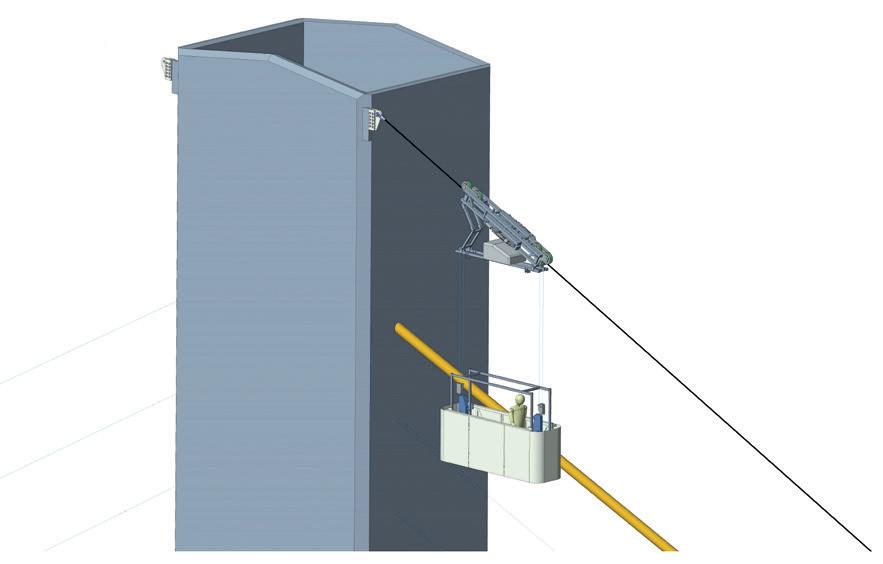
Working on behalf of Fraser Crossing Constructors GP - a 50/50 joint venture between Acciona and Aecon - Spencer Group is designing, manufacturing, testing and commissioning a semi-permanent access system to enable maintenance engineers to inspect all elements of the bridge’s stay cables.

The cradle element, which transports personnel to the desired inspection location, operates similarly to a cable car, moving up and down a track rope on what will be a four lane, toll-free bridge. The cradle will be electrically hoisted up and down the main track rope. It will also vertically move up and down to enable personnel to inspect the stay cable wires throughout the lifespan of the bridge.
Gordon Neilson, principal engineer at Spencer Group and an expert in bridge gantry design, is behind the design for what is being called “The Pattullo Bridge cable fan access system”. Design work is set to be complete by the end of the summer. Manufacturing and testing will take place in the UK before the entire access system is then shipped to Canada for installation.
Fraser Crossing Constructors GP will be designing the bridge to interface with the stay cable access system, before it is tested and commissioned by Spencer Group.
Steven Bunting, project director at Spencer Group, is leading the project and coordinating the various stages of the design and build.


LEFT & BELOW: The cradle element, which transports personnel to the desired inspection location, operates similarly to a cable car, moving up and down a track rope
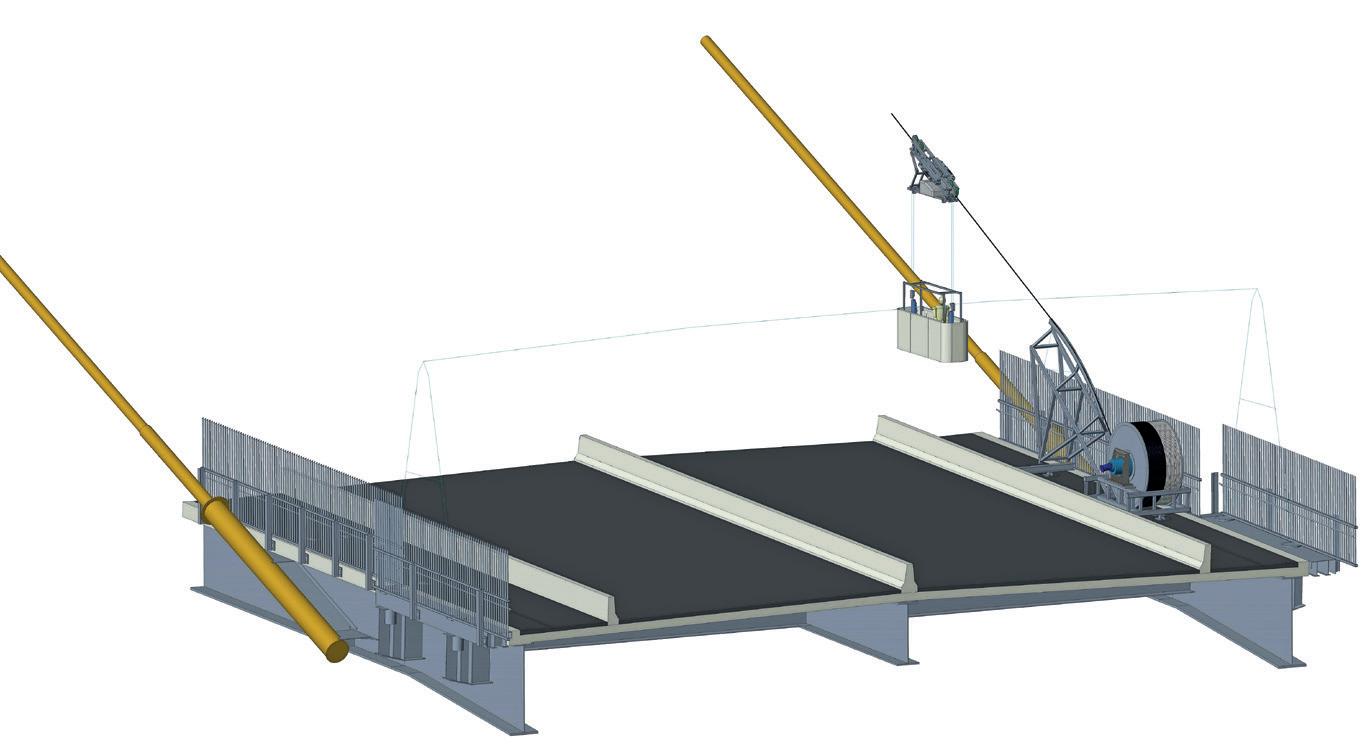
“Our unique design on this project will be transferable to other cable-stayed bridges all over the world. It addresses challenges faced with the need to carry out tactile inspections of cables from a dedicated work platform, at dif cult to reach locations at signi cant elevations,” said Bunting.
The new bridge will provide a safer crossing for bridge users with modern, wider lanes, separated by a centre barrier, dedicated walking and cycling lanes separated from traf c by a barrier on both sides of the bridge.

The bridge was originally to be opened in 2023, but the province decided to push back the opening to 2024 because of the Covid pandemic which disrupted supply lines and work schedules. The existing bridge will remain in use until the new bridge is open to traf c in 2024 but then will be removed.
Transportation Investment Corporation, a provincial Canadian Crown corporation, is delivering and overseeing the US$1.05 billion project. Fraser Crossing Partners is designing
and building the new bridge while the province of British Columbia will own and maintain the bridge when complete.
Spencer Group has carried out maintenance and repair work on some of the UK’s most iconic bridges. This includes major refurbishment on the Menai Suspension Bridge across the Menai Strait between the island of Anglesey and mainland north Wales - ahead of the structure’s 200th anniversary year in 2026.


Spencer Group’s specialist bridges team has global experience in high-level bridge works. It developed the Cable Crawler gantry system to enable vital dehumidi cation work to prevent corrosion of cables on the Severn, Forth Road and Humber suspension bridges in the UK, as well as the Alvsborg Bridge in Sweden. The company was founded by the now executive chairman Charlie Spencer in 1989 and is headquartered in Hull, northern England.
Spencer Group
https://thespencergroup.co.uk



For a bridge recently opened in the mountains of Sunndal, Norway,
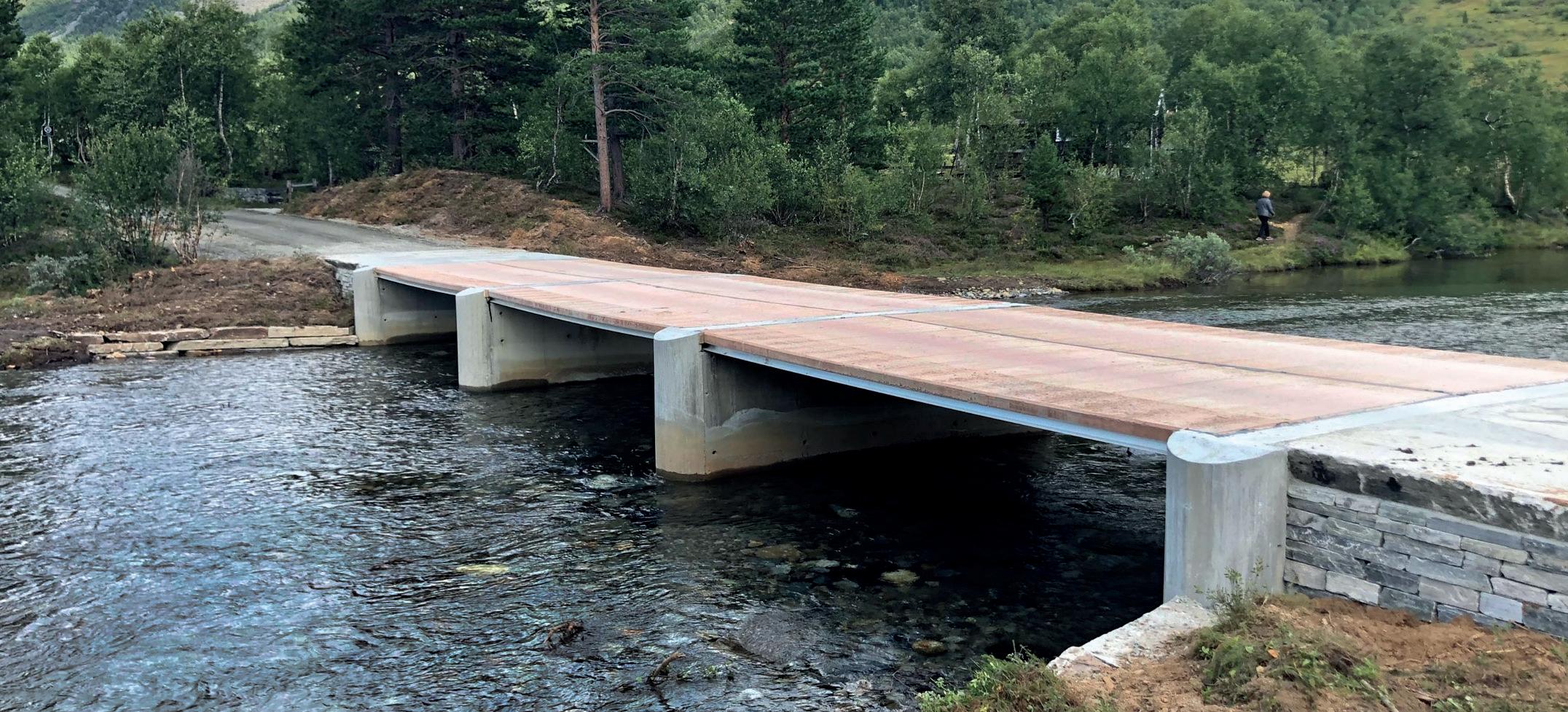


What is believed to be the rst bridge to combine clay-based concrete and aluminium in the main structure has opened in Norway.
The bridge, with a permissible eight-tonne axle load, is made with aluminium pro les extruded from low-carbon aluminium from a primary aluminium plant in Sunndal, Norway. The bridge deck pro les are connected by dowels to the newly developed, environmental friendly concrete with an extraordinarily low CO2 footprint compared with traditional concrete, according to Hydro.
The aluminium plant is operated by Hydro, a Norwegian global producer of aluminium. The bridge is part of a research project led by Hydro and called DARE2C – Durable Aluminium Reinforced Environmentally Friendly Concrete Construction.
“Aluminium corrodes in the highly alkaline environment in today’s concretes,” said Grete Hjetland, DARE2C project manager and chief engineer at Hydro. “On the other hand, in development of more environmentally friendly clay substituted cements, the steel
reinforcement is not protected due to the low pH. The idea behind the research project is to hit two birds with one stone by combining low-carbon aluminium reinforcement with an extraordinary low-carbon concrete.”
Hjetland said that together, they make a sustainable and durable material for the future, particularly suitable in corrosive environments. As aluminium is stable towards the environment, the concrete can then be designed with respect to strength class rather than environment classes.
Steel is three times as stiff as aluminium, but weighs about three times as much. Aluminium, on the other hand, is easy to shape and can be cast or extruded. It can also be processed into geometries that provide the same stiffness as steel, despite the lower E-modulus. Concrete cover can be reduced to just ensuring stress transfer or no coverage at all. Therefore, one can build with less concrete and with concrete composed of less cement, which provides great environmental bene ts.
“Aluminium reinforced concrete constitutes a more sustainable concrete,” said Hjetland.
Engineering consultancy SYSTRA UK and Ireland has acquired two specialist tunnelling companies, Bamser in Australia and Subterra in Spain.
Bamser was established in 2008 to provide advisory services on complex tunnelling and infrastructure globally, including the Sydney Metro, WestConnex, Western Harbour Tunnel, Suburban Rail Link, AirportLink, Legacy Way and Cross River Rail. Subterra focusses on the design of tunnels and underground structures and has around 100 sta in Spain, Peru, Chile and Colombia.
SYSTRA UK and Ireland, part of the Systra Group, based in Paris, France, is a member of the British Tunnelling Society. The UK division said the acquisitions "position SYSTRA as a leading global player in the eld of tunnel design and construction". The deals follow the acquisition in 2021 of Italy-based SWS Engineering.
Using aluminium as reinforcement in concrete enables the use of concrete mixes where more than 50% of the cement can be substituted with sustainable binders. The result is a concrete that requires far less energy and CO2 emissions to produce slimmer, lighter concrete structures with a long service life. It is also compatible with scrap-based aluminium.
Several possible aluminium alloys, including recycled scrap material, have been identi ed as suitable for concrete reinforcement. The participating partners involved in the project include representatives from the entire value chain in a building process.
Partners in the consortium are Hydro, Norwegian University of Science and Technology (NTNU), SINTEF, Dr.techn. Olav Olsen, Christie & Opsahl, Overhalla Betongbygg, Sika Norge, Heidelberg Materials, Oshaug Metall and Nordic – Of ce of Architecture.
Hydro
www.hydro.com
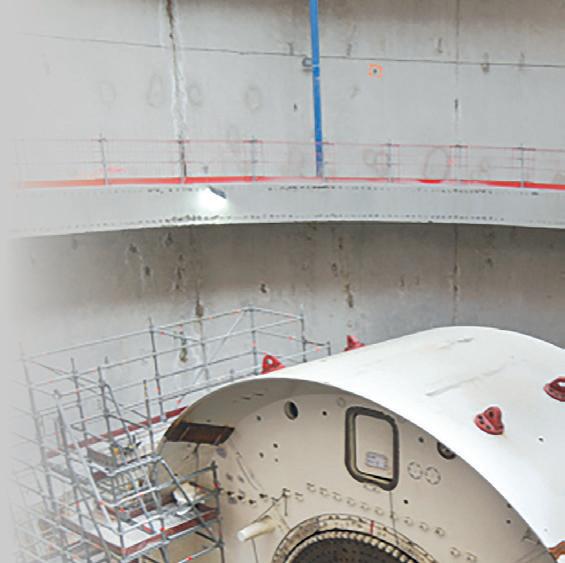
SYSTRA’s UK and Ireland business has grown over recent years to include geotechnical and ground engineering, BIM modelling, civil and structural design and assessment, planning consents and environmental biodiversity, noted Nick Salt, managing director of SYSTRA UK & Ireland.
SYSTRA Group www.systra.com
SYSTRA said it will be able to draw on over 600 global tunnelling and underground infrastructure specialists to support its UK-based team in the delivery of major infrastructure (image courtesy SYSTRA)
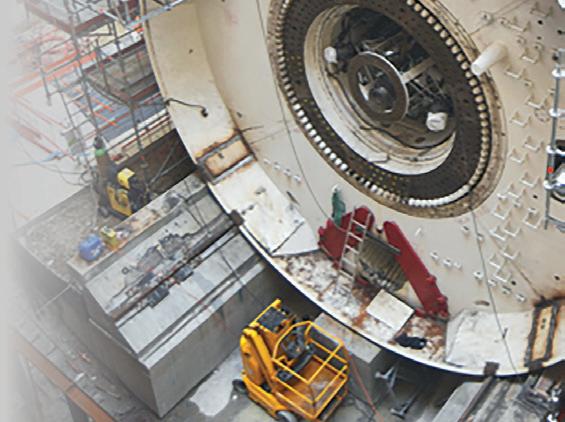
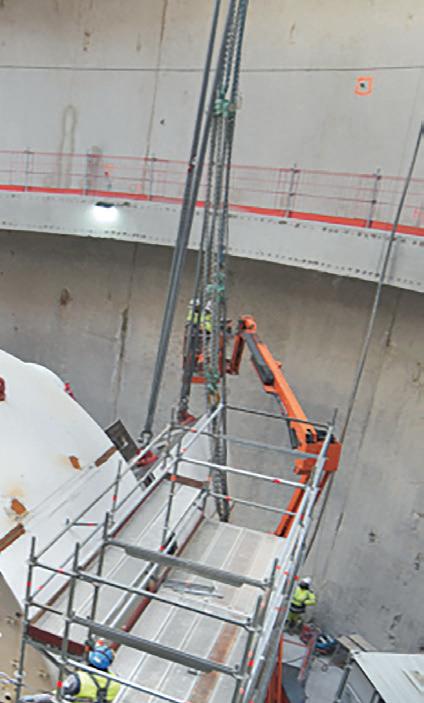
Enerpac jack-up technology has been used to lift and install railway and pedestrian bridges in Leverkusen, Germany. The operation was part of upgrade work along the Rhine-Ruhr Express rail route to reduce delays caused by long-distance, regional and freight transport sharing the same tracks.
The contractor Wagenborg Nedli t was tasked with installing two bridges next to the existing bridge: a main track bridge and a pedestrian/cycle bridge. Wagenborg employed Enerpac JS250 Jack-Up and SCJ-100 cube jack systems to complete bridge deck placements over a weekend.
Pre-assembly of both bridge decks at a height of 4.3m was undertaken parallel to the rail line. Wagenborg used a combination of Enerpac Jack-Ups and SPMTs to rst move the decks 10-15m and then lower them onto bridge bearings to complete the installations.

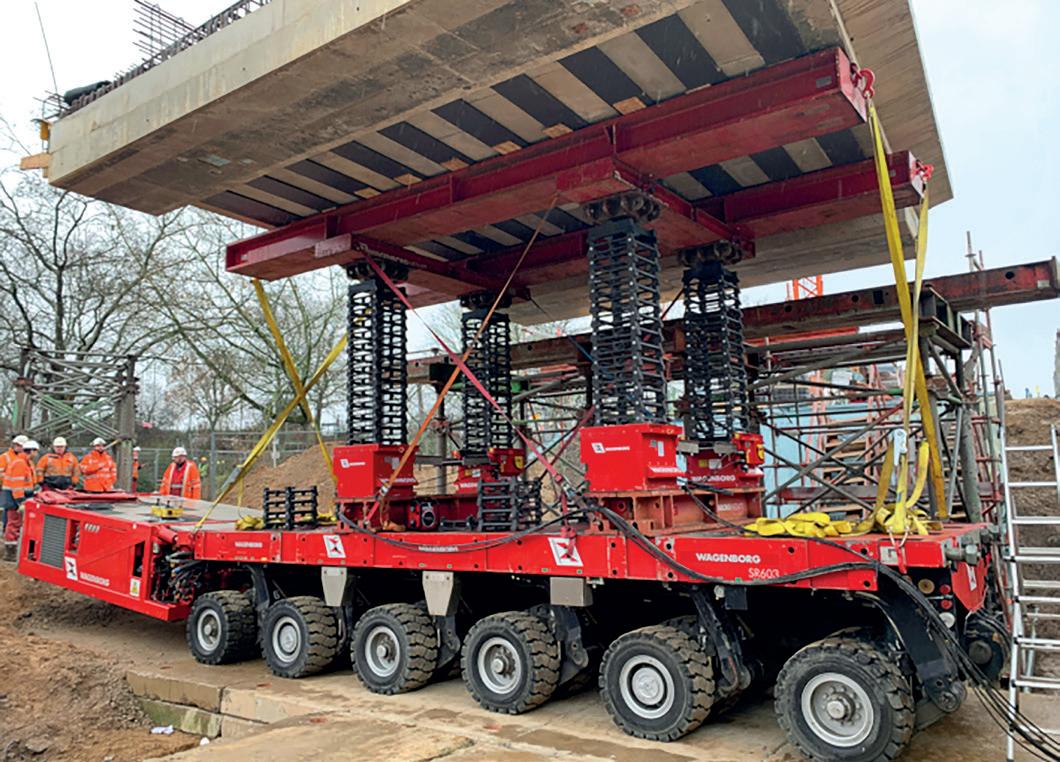
t the SPMT. Using the cube jacks to lower the bridge deck was far quicker than using traditional jack-and-pack; it took just 10 minutes compared with two hours.

The railway bridge - weighing 483tonnes and measuring 21m long and 7.7m wide - was installed rst using the JS-250 Jack-Up system: four lifting towers resting on four SPMTs. The deck was raised to 7m, lifting it above the bridge abutments and lowered into position using the jack-up system.
The 7.5m-long and 7.1m-wide pedestrian and cycle bridge weighing 90tonnes was moved into position using four SCJ-100 cube jacks on a single SPMT. As the bridge deck was being raised to 5.5m and the cube jacks raised to 2.7m, bracing was needed to reduce the effect of sideload. The narrow gap was just wide enough
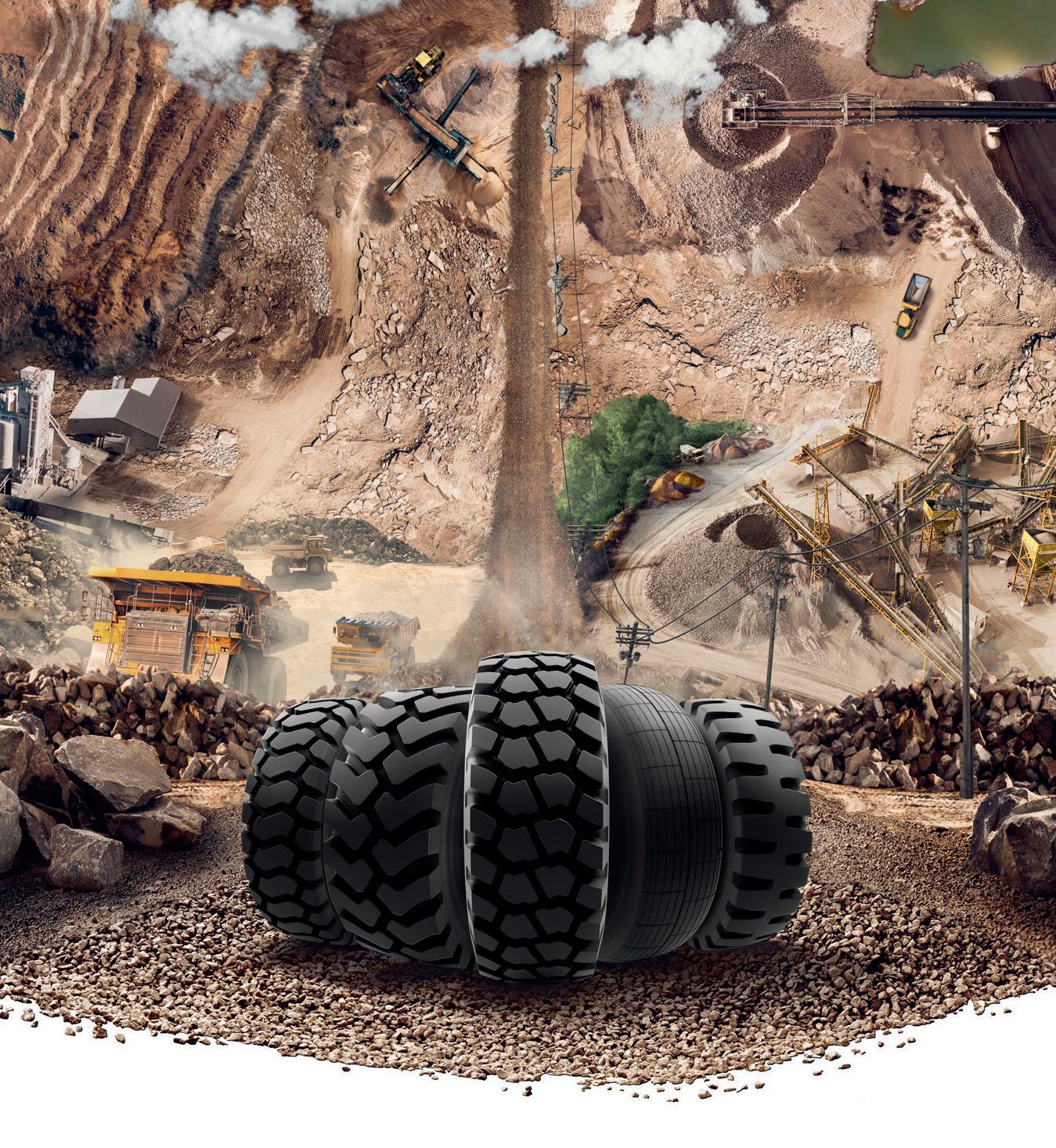

“We’ve used the JS-250 Jack-Up on many bridge projects, it is a well-proven technique which works well,” said Bart van der Belt, project manager for Wagenborg. “For the pedestrian bridge, we chose the SCJ-100 cube jack because of the proximity of the rail overhead power lines which ruled out using a crane,” he said. “It, too, worked very well and was considerably quicker than using jack and pack to lower the bridge deck.”
Apart from being a global provider of solutions for precise positioning of heavy loads, US-based Enerpac provides high-pressure hydraulic tools, controlled-force products, portable machining and onsite services.
Enerpac www.enerpac.com
No matter how challenging your needs, BKT is with you offering a wide range of OTR tyres specifically designed for the toughest operating conditions: from mining to construction sites. Sturdy and resistant, reliable and safe, able to combine comfort and high performance.
BKT is with you, even when work gets tough. For info: europe@bkt-tires.com

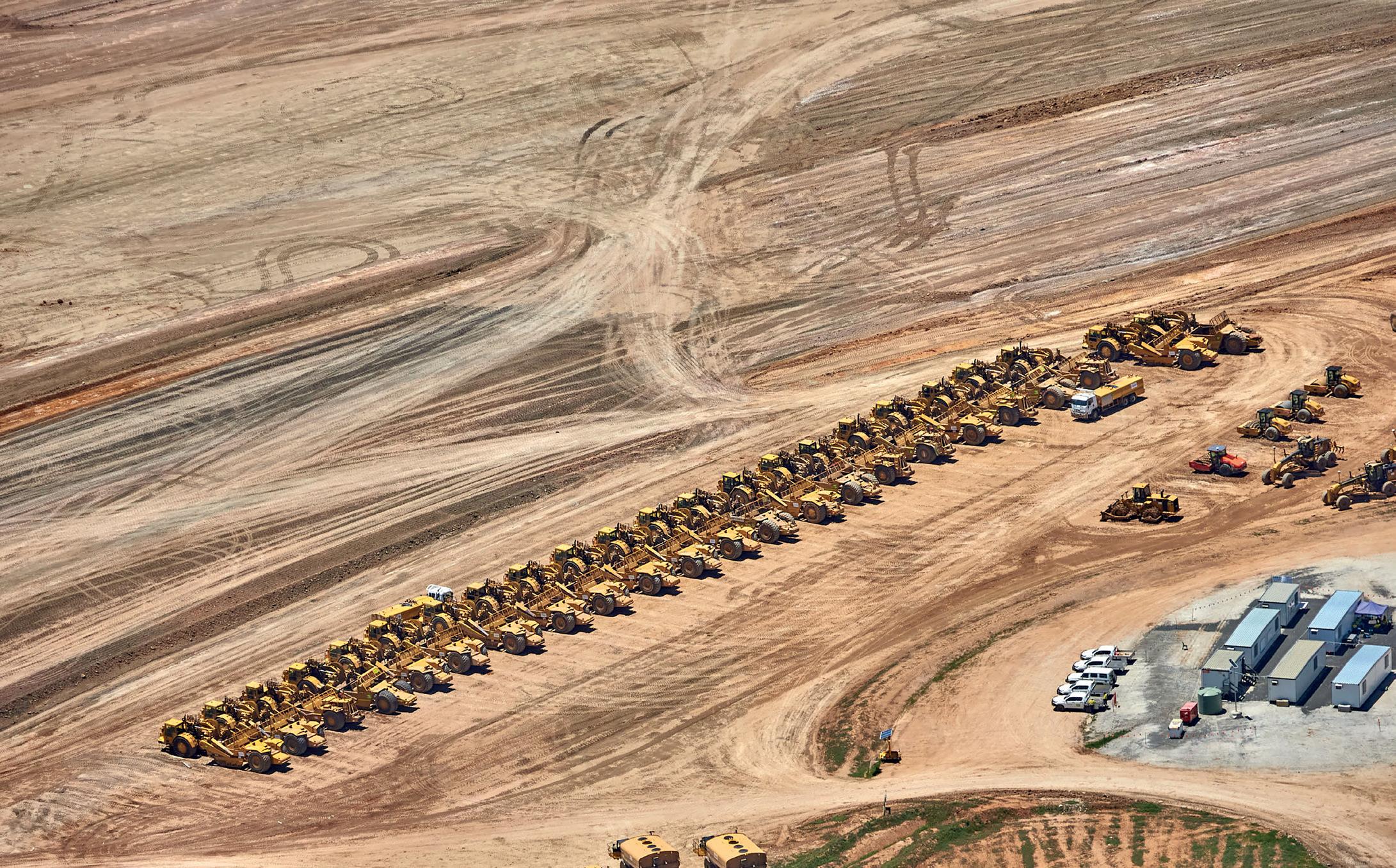



The massive Western Sydney Airport Bulk Earthworks project, under development by the federal government-owned Western Sydney Airport (WSA), entails the construction of a new international airport on the western side of Sydney, Australia
ACCIONA and CPB
Contractors have been working as joint venture partners to deliver the Western Sydney Airport Bulk Earthworks Project. The demands of the client required the partners to use sophisticated machine control technology, so as to maintain high earthwork production while meeting quality conformance targets.
To tackle the challenges of the project the joint venture partners opted to deploy one of the industry’s rst near-real-time, continuous loop of ce-to-machine data work ows.
The joint venture partners are having to move, ll and compact some 24 million m3 of earth to a set of tight speci cations in a short space of time. In addition, the site includes complex soil challenges as it sits on top of the Bringelly Formation, an ancient river delta system. Consequently, the material can be highly variable and reactive in some areas, and post-construction settlement is a risk.
For surveyors and equipment operators, the earthworks project presented a challenging data management task. This could easily have resulted in missed, misplaced or inaccurate data and delays for approvals. And at any given moment there might be over 270 construction
machines operating on the job.
Daniel Ripley, ACCIONA’s Australia’s Central Region survey manager for Construction in Australia, said, “We needed to be able to send updated models to the eld crews multiple times a day.”
“The joint venture team had a plan to place material more ef ciently and then report on that material placement,” said Nicholas Pryke, manager of sales mining, aggregates and land ll with SITECH Solutions Pty and technical advisor to the joint venture team. “Our job was to nd the technology-enabled, connected solution that could operate within the constraints of the plan and across a blended eet to meet stringent speci cations.”
Early on, the design team de ned clear speci cations for density, moisture content, layer thickness and material traceability, from source to placement, to meet the critical end product criteria.
Prior to work commencing, the airport site was broken up into lots that vary in size. The boundaries, thickness and volume of each lot had to be recorded and reported. The thickness of placed earthworks material was not to exceed 350mm and the speci cation further required the lot thickness to be validated every 800m2. The locations of eld density and moisture content tests also had to be recorded to an accuracy of +/- 1m.
These speci cations posed a challenge. In the past, the project team would have used conventional spreadsheets and USB sticks for tracking and sharing material movement. But that methodology was not suitable for a project of this size, given the need to share multiple design changes a day to ensure proper layer thickness and optimal material placement.
“The process allowed us to lter and interpret data, create a boundary, process, and nally send the exported information to a conformance program to verify compliance with design, all with machine control, removing staff from site and download data directly from machines,” Ripley said.
The team also needed to ensure personnel in the eld had the most up-to-date models and the ability to verify earthwork conformance to speci ed layer thicknesses. The surveyors needed to track material moved and rolled, and compare as-built surfaces to the base layer thickness in near real-time.
Another concern was safety. With hundreds of machines operating, the joint venture team did not want survey or geotechnical testing staff onsite taking measurements and samples. Working with SITECH Solutions and Trimble, the team developed a cloud-based survey, compaction, testing and conformance work ow.
As a rst step, the team equipped around
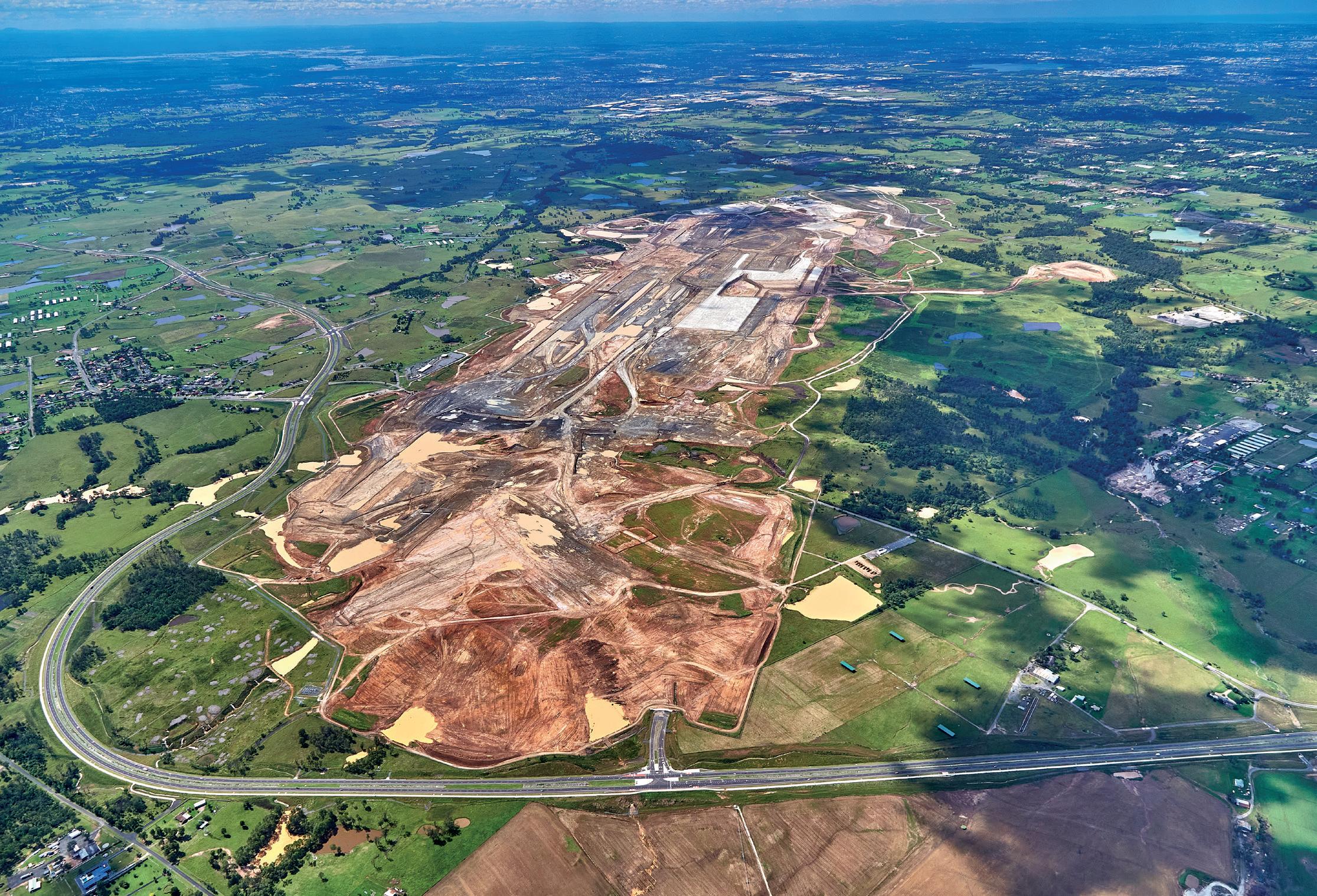
30 utility vehicles and pickup trucks as mobile offices for superintendents, foremen, leading hand and the GITA geotechnical personnel. The vehicles include Trimble SPS986 Rovers with dash-mounted tablets running Trimble Siteworks SE Software. They were also given full access to Microsoft 365 for emails, SharePoint drives, video conferencing and more, as well as 3D models, all while in the field and eliminating the need for a laptop. In addition, superintendents were equipped with Trimble positioning technology, allowing them to check grades and levels.
For material tracing, the site vehicles were equipped with onboard diagnostic devices (OBD) to report plant ID, GPS location and travel speed. Geofences can be established and defined as fills, cuts or break areas. User defined logic can be programmed so that the system uses data from the OBD to define a load, haul or dump event, and capture cycle times, haul/excavating plant productivity or similar data.
To minimise the need for surveyors to walk the site, the project team fitted compaction equipment with GNSS-enabled machine control systems. Trimble GCS900 cab-mounted systems were fitted to drum compactors and to all smooth drum rollers and most padfoot rollers to monitor layer thickness and elevation. Also, dual mast GNSS Trimble Earthworks systems were fitted to excavators, while graders and dozers were fitted with single and dual mast GNSS solutions to gather data about the correct level, grade and material thickness. Single mast Trimble GCS900 Universal Total Station (UTS) systems were fitted to CMI trimmers, while single mast GCS900 GNSS systems were put on surface miners. The information from the machines
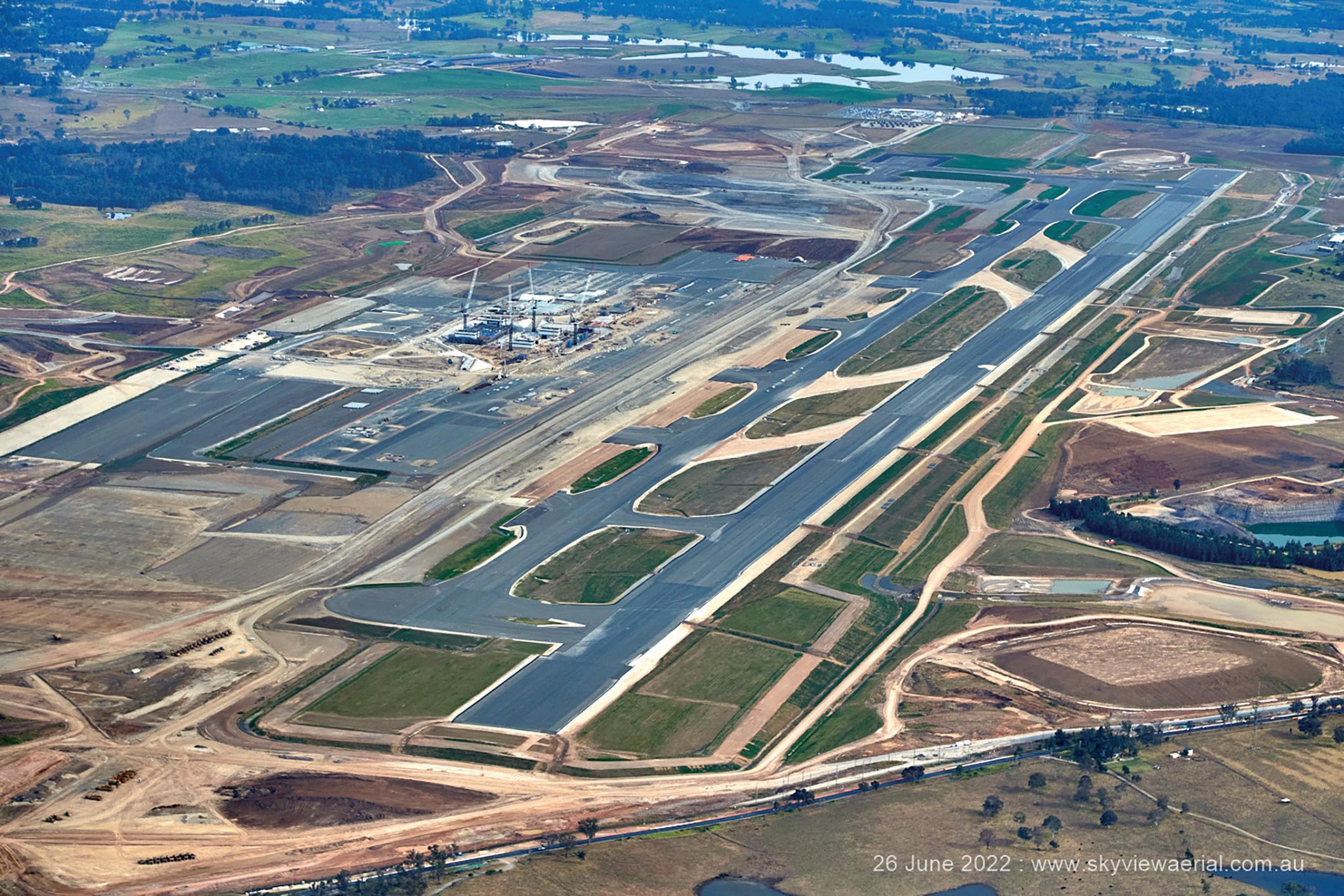
could be sent via the cloud to Trimble WorksOS Software and viewed in real time in the machines and on the field supervisor’s tablets in their vehicle.
As operators grade, excavate and compact material, the software logs as-built and quality assurance data, which is transferred to WorksOS in real time, where it is processed and displayed. From mobile offices, surveyors can view the data in map and/or dashboard form or filter the data to generate reports about jobsite activity and progress to ensure schedules are met, and to remotely plan future
operations. Once compacted, sealed and signed off, that conformed surface would be reinserted to the current model. Every time a lot is signed off, a new model is developed.
This dynamic workflow is designed to suit production and weather conditions. SITECH’s Pryke, said, “With WorksManager sending datasets on a regular basis, the entire field team, including the geotechnical testers, foreman, operators and surveyor, sees the same lot surface for a given day.”
The surveyor defines the boundary of the lot in WorksOS, and in the cab, the operators
see the current surface model as shared by WorksManager into the machine control system. As materials are moved and compacted, the machine measures the as-built data and then sends the data to WorksOS for processing and analysis. The data can be shared with surveyors to verify conformance to de ned elevation and thickness speci cations.
The geotechnical testers (ASCT), using WorksOS, are noti ed at the end of each day which lots are completed so that they can run the required soil tests for density and moisture. Once a lot meets conformance targets, it is closed by the engineers and then the survey team recreates the larger surface, starting the process again.
Using WorksOS, everyone is able to see the quality of the work on an interactive map. The data is then combined with geotechnical data, such as optimum moisture content and density, for nal conformance and quality assurance reporting.
“It sounds simple, but remember the data was shared many times a day between surveyors and operators,” Brett Hussey, project survey manager at ACCIONA, said. “At our peak, we had eight surveyors reporting as material was placed and graded, and we were doing up to 10 design updates a day. Every single bit of ll material was tracked. We knew every slice of ll down to the size of a tree stump hole. Even those holes had to be lled to a predetermined layer thickness.”
The advantage of the eld-to-of ce-to- eld work ow was that it allowed the foreman and machine operators to know where they could place ll without physical stakes and survey marks, enabling them to build the site with minimal surveying methods.
Hussey said, “Without this digital work ow, the process would have been very laborious and we would have lost the ability to keep surveyors off the site. We would have had to take a much more hands-on approach. Every material layout is accountable, so the quality of the job was the biggest improvement, as was our ability to maintain high production.”
WorksOS has also provided a logistical advantage while working on the massive airport site. “We used WorksOS to optimise machine routes, a capability we hadn’t even considered,” he added.
“With WorksOS, we were able to show operators the importance of their work on a daily basis. They’re not out there just moving dirt; they’re producing a product that is seen and reported on every day. They visually see the value of their work,” he explained. “We’ve empowered them and, as a result, the quality of the work has also risen. Our roller operators feel like they are the most important people on the project.”
Ripley added, “Surveyors were freed up to focus on the reporting side of the project, while foremen and operators were empowered to check on how they are progressing, meeting productivity, and in compliance to specs.”
Trimble www.trimble.com
Komatsu’s new operator guidance monitor (OGM) is a novel tool designed to optimise the e ciency of rigid dump trucks, and to reduce unit production costs. Said to be easy-to-use, the system allows a user to set key performance indicator (KPI) targets and adjust operating parameters to let a truck eet operate e ciently.
OGM is a tool that allows operators control and optimises work in real time, aiding and re ning skills and delivering fuel savings, productivity and increased safety.
Marek Skrzydel, quarry manager at Heidelberg Materials said: “This system allows us to analyse data in real time and we can analyse production and discuss the achieved goals by operators on an ongoing basis.”
Customers can set parameters such as payload, planned duration and fuel consumption for each work cycle, idle time, and production, target by loading and dumping location.
The OGM screen also shows real-time warnings for dangerous operating events, such as excessive speed and sudden braking. The login ID means that operator performance can be analysed individually.
Optimising haulage operations with Komatsu technology
Data from the machine is sent automatically and the user has access via a web-based dashboard. The data can be ltered by date, machine, shift, operator and loading and dumping locations.
In the back o ce, target KPIs and event thresholds such as speed limits are set up for each haul road from any remote location. The status of each target can be followed by date, time, shift, or operator. The automatic data acquisition from the machine allows remote reporting of production and event data via the dashboard.
Each operator has an OGM account. Before starting work, they log directly into the monitor installed inside the cabin. After logging in, the system automatically detects and displays the haul road speci c KPIs on the monitor, according to which the operator adjusts the pace and dynamics of the hauler's work. Real-time feedback of operation data allows an operator to follow up on individual KPI, as optimal values when loading, transporting, and unloading material.
Komatsu www.komatsu.com
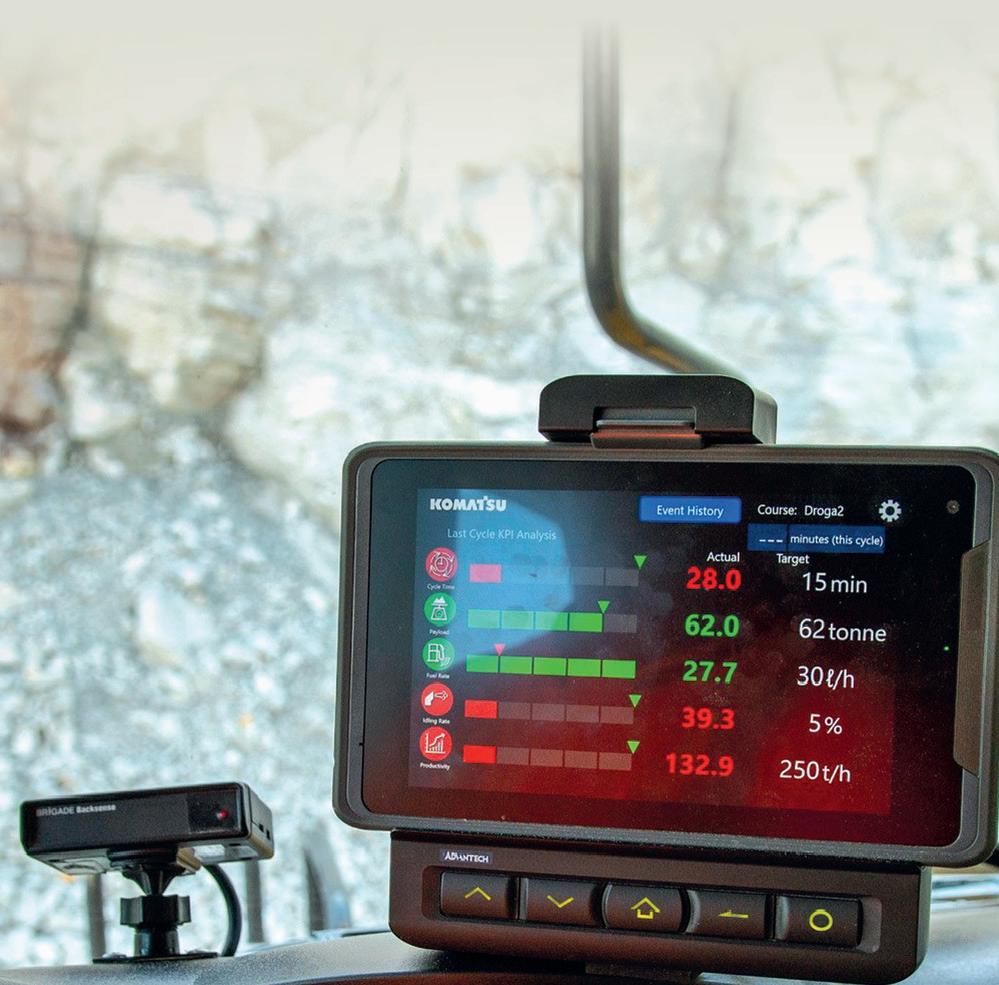
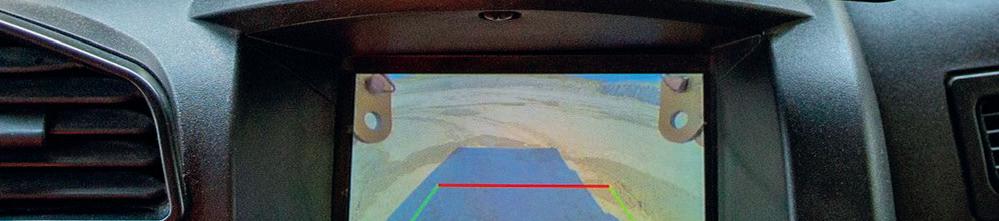

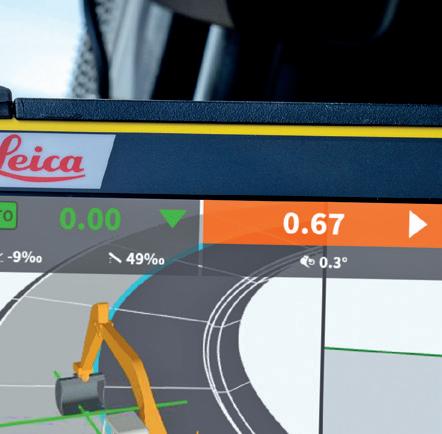
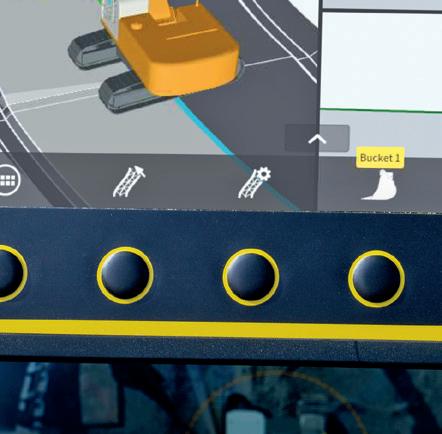

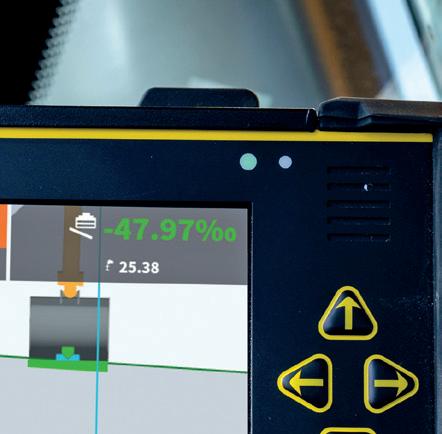
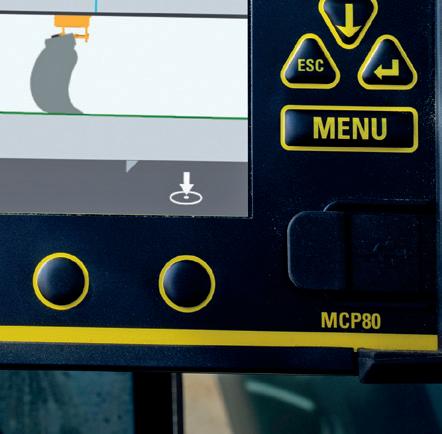
Liebherr is now offering semi-automatic machine control systems from Leica Geosystems for its Generation 8 crawler excavators. These systems are available in 2D, 3D and 2D "3D-ready" versions.
Driver assistance systems offer more productivity, ef ciency and precision. Antennas with GNSS technology determine the position of the machine on the construction site. The Leica MCP80 control unit shows the machine operator in the operator's cab both machine position and information on excavation and removal.
Driver assistance systems such as machine control systems are gaining in importance. They support the machine operators in carrying out their activities by means of the latest technologies and realtime information. The quality of the work results, the ef ciency of the work processes as well as safety can be signi cantly increased and the implementation times in planning and construction reduced at the same time.
Leica Geosystems' machine control systems are already available in different versions for Liebherr mobile and crawler excavators. They include the 2D passive and 3D passive machine control system for Generation 6 and 8, as well as the 2D "3D-ready" semi-automatic and the 3D semiautomatic for Generation 6.
The availability of semi-automatic machine control systems, both 2D "3D-ready" and 3D, has been extended to Generation 8 crawler excavators. They are now available for the R 922, R 924, R 926, R 928, R 930, R 934, R 938 and R 945 models. The 2D "3D-ready" passive machine control system is also offered for these models.
The respective equipment variants are available from Liebherr ex works. All machine control components from Leica Geosystems are installed during production and the customer receives a pre-calibrated machine, reducing downtime for installation.
Leica Geosystems www.leica-geosystems.com
Liebherr
www.liebherr.com





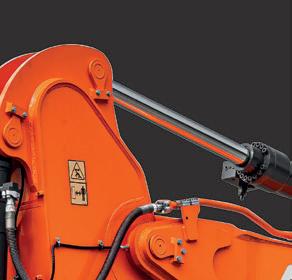

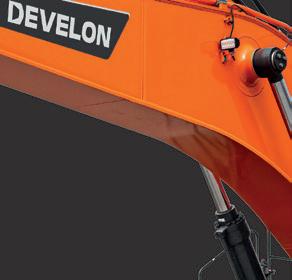
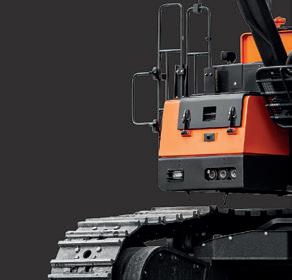
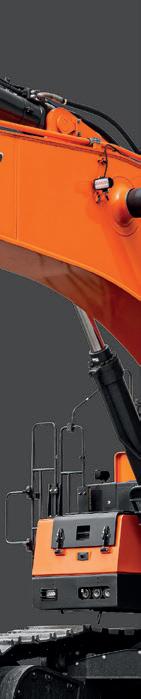




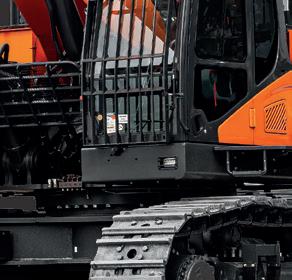

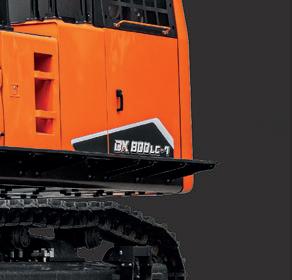




The new units widen the range of suitable applications, and provide customers with increased options for power. They have been designed with sustainability in mind, are suited to noisesensitive applications and enable operators to dramatically reduce their fuel consumption and CO2 emissions.
The additions to Atlas Copco's portfolio include a larger ZBC 300-300 unit and a smaller line of battery-based storage systems, the ZPB 45-60, ZBP 45-75, ZBP 15-60 models, and the ZBP 2000 with two exible solar panels.
“Our customers are increasingly seeking clean energy solutions to be more sustainable and ef cient in their operations,” explained Bárbara Gregorio, Marketing Manager Power & Energy at Atlas Copco’s Power and Flow Division.
These energy storage systems are ideal for applications with a high energy demand and variable load pro les. They can manage peaks in energy demand and for EV recharging stations.
The small ZBP units - the ZPB 45-60, ZBP 45-75 and ZBP 15-60 - present a new design, are modular, mobile, and up to 70% lighter in weight than other battery systems, and so can be moved around site to provide clean and
quiet energy where required. They can work alone in island mode, or can be coupled with a diesel generator to provide a hybrid solution.
The ZBP models are easy to use and install and have lower maintenance needs than a standalone diesel generator, which translates into a reduced total cost of ownership (TCO). Featuring advanced high-density lithium-ion

power from a single charge, and they can be
batteries, these energy storage systems provide excellent performance with over 12 hours of power from a single charge, and they can be fully charged in less than one hour (depending on the model).


ZBP 2000 is a fully sustainable portable
ZBP 2000 is a fully sustainable portable solution as it comes with two foldable solar panels which could be used to recharge the unit
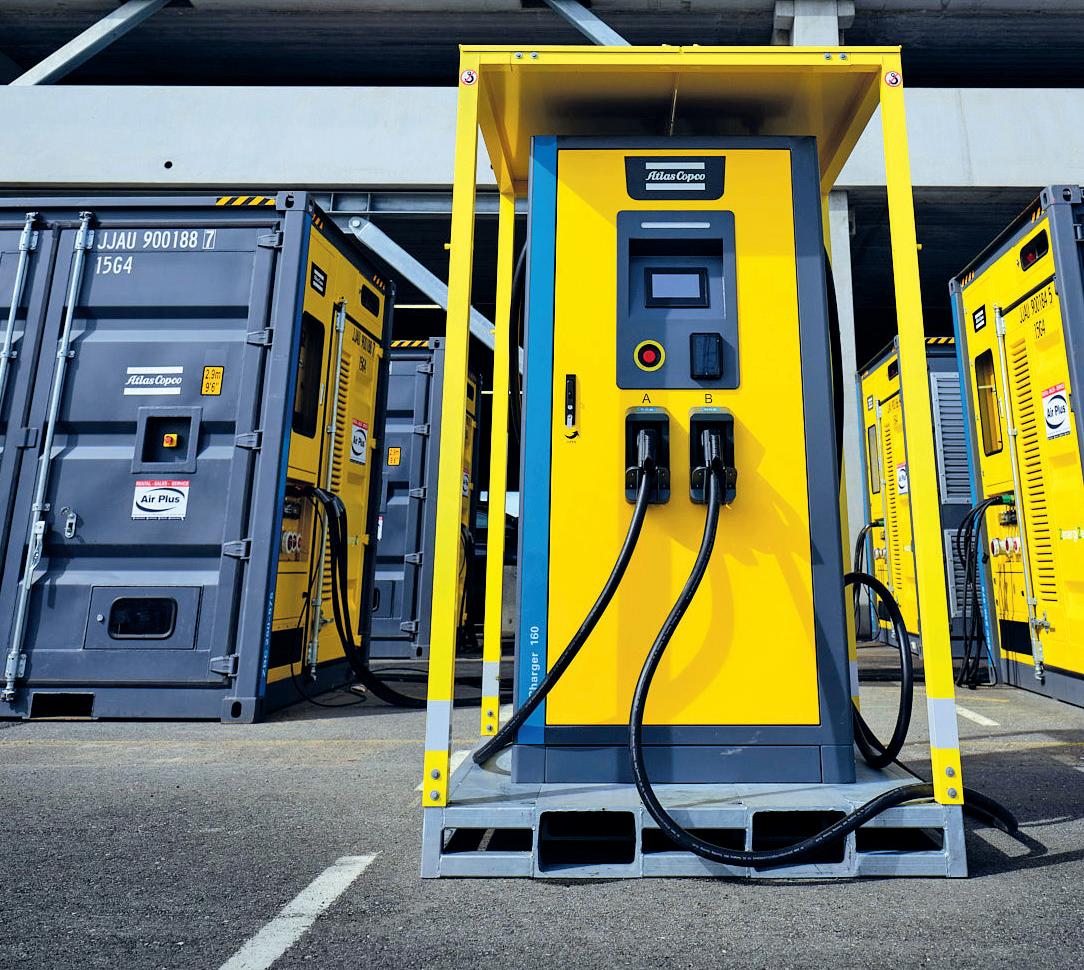

in great weather conditions or to maintain a proper battery level during less ef cient production days. It provides silent operation and zero emissions while working with solar energy. Up to ve units can be joined in parallel to provide users with power levels of up to 10kW.
Compact and lightweight, with a footprint of 1m3, this unit is robust enough to withstand conditions typically found on construction sites. The ZBP 2000 energy storage system has IK09 impact resistance classi cation and an Ingress Protection rating of IP65.
The ZBC 300-300 joins the ZBC 250500 and ZBC 500-250 models to complete the medium range of ESS and is a standard container designed to meet the requirements for off- and on-grid applications, and is ideal in combination with renewable stations,
providing up to 4.5MWh of storage capacity. It is a scalable solution, as up to 16 units can be connected in parallel. When operating in hybrid mode with a diesel generator, users can reduce fuel consumption by up to 90%.
During standalone operation, these energy storage systems offer no fuel consumption and no CO2 emissions, operating at less than 80 dB(A), while allowing users to increase the productivity of their core business by up to 50%.
All Atlas Copco’s energy storage systems come with their own intelligence, the ECO Controller, an in-house designed and developed Energy Management System (EMS). With the introduction of this human-machine interface (HMI), operators will optimise energy generation, distribution, and consumption. The controller
ensures consistent operations and optimal performance of the entire installation, therefore enabling operators to minimise downtime.
Atlas Copco’s ECO Controller provides performance data so customers can take any immediate corrective action, increasing the lifetime of components and generators and the ef ciency while reducing long-term costs.
Atlas Copco has launched its own fast charger for electric vehicles and heavy-duty machinery - the Z Charger. This solution increases the charging rate by boosting the voltage, decarbonises the recharging of battery-driven machinery and vehicles when working with an energy storage system.
Atlas Copco www.atlascopco.com
Cummins has agreed a deal to supply engines using hydrogen as fuel to an off-highway machinery manufacturer. The rm, Taylor Machine Works,

cost-effective equipment for high load factor, high utilisation applications. Key bene ts of using this technology include enabling a more-timely solution
carbon solutions will reduce the load required from stressed utility grids.
Antonio Leitao,
Cummins vice president Off-Highway

makes heavy industrial lift equipment.
Taylor will use the 6.7litre and 15litre hydrogen engines from Cummins for a number of its models. Switching to engines using hydrogen is intended to meet climate change goals. The rm is working on a series of new models that will meet low emissions and zero emissions targets, using electric battery power, hydrogen fuel cells and internal combustion (IC) engines running on hydrogen instead of carbon-based fuels.
Taylor has been a regular customer of Cummins for some years and has over 100 different models using engines from the rm. The hydrogen IC engines will be aimed at customers in the heavy industrial lifting segment.
Matt Hillyer, director of Engineering, stated, “This partnership signi es our commitment to a sustainable future, enabling us to offer reliable, cost-effective, zerocarbon solutions for heavy industrial lift equipment, reducing carbon emissions without compromising productivity."
Hydrogen combustion engines will deliver a zero-carbon fuelled solution that provides
without sacri cing productivity. Adding H2ICE to the mix of zero
for their equipment. We see hydrogen internal combustion engines as a solution to help drive sustainability improvements in our industry. Hydrogen power will help both OEMs and endusers looking to making carbon emissions reductions on their
to reduce carbon emissions Engine Business, said of the plans, “Cummins is pleased to be working with Taylor Machine Works on hydrogen solutions emissions reductions on their paths to zero.”













John Deere and its recently-acquired subsidiary Kreisel are to build batteries and chargers focused on the off-highway equipment sector at a new US facility in Kernersville, North Carolina.
Engines, drivetrain and heavy equipment provider John Deere says it has selected the location in Kernersville for the construction of a 10,700m2 manufacturing facility. The factory will expand production capacity of Kreisel Electric products.

than ever before — we are engineering the technological innovations they’ll rely on to do so,” said Jennifer Preston, global director of John Deere Electric Powertrain and CEO of Kreisel.
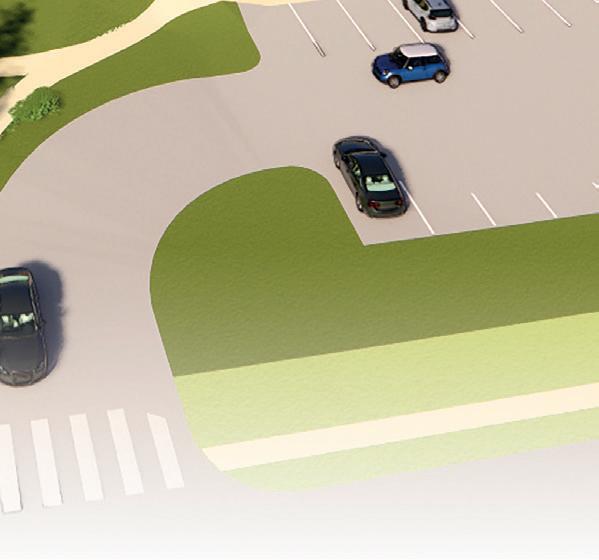



fossil-fuel-consuming design and is prioritising sustainable energy features in major systems like the facility’s HVAC, energy recovery system and state-of-the-art lighting.
Kreisel, which John Deere acquired majority ownership of in 2022, produces innovative battery technology for e-mobility and stationary systems as well as comprehensive Level 3 charging solutions. The planned production facility can support a production capacity of up to 2GWh.
John Deere says it plans to break ground on the new facility in fall 2023, and production is estimated to begin in 2025.
“Our customers are facing challenges that require their businesses to be more dynamic
“Together with Kreisel, John Deere is expanding its electri cation portfolio to include more scalable solutions to meet a wider range of our customers' application needs. This investment is a great step forward as we work toward our goal of demonstrating viable low- and near-zero-carbon power solutions by 2026.”
With the new battery manufacturing facility, John Deere says it will develop and manufacture Kreisel battery and CHIMERO charger technology.
It adds that the new facility will support a production capacity increase to serve the offhighway market in North America. John Deere will also enable battery production at its factory in Saran, France — the primary manufacturing location for John Deere engines in Europe. The Kernersville-based facility will have a non-
The new facility will produce Kreisel battery pack designs and CHIMERO chargers as John Deere and other original equipment manufacturers develop electric solutions.
Pierre Guyot, senior VP of John Deere Power Systems and chairman of Kreisel, commented: “As the demand for electric solutions continues to increase, this strategic investment in growing our production capacity will help strengthen our position as an international battery technology leader. Within the evolving off-highway equipment market, we are prioritising the development of a robust charging ecosystem and battery portfolio that can support and sustain the long-term adoption of electri cation across a wide variety of applications.".
JohnDeere www.deere.com
Volvo Penta has broadened its genset range and launched its most powerful engine with the introduction of the D17. The new power generation unit delivers a high power-to-weight ratio from the same footprint as the proven D16.
Said to be fuel-e cient, the 17litre Volvo Penta TWD1744GE industrial genset engine will allow customers to transition to lower emissions using alternative fuels.
The D17 o ers up to 5% less fuel consumption/kWh than its
lower-displacement D16 sibling. This is through new combustion technology such as the latest common-rail fuel-injection system. An important feature, which will be made available to D16 models, is the option of a viscous fan to further reduce fuel consumption and noise emissions.
Volvo Penta further used the D16’s cylinder block, ensuring the D17’s basic footprint would remain the same. The engineers developed a larger bore engine, which
boosted capacity. This allowed a 10% increase in maximum standby power over the TWD1645GE at 1800rpm.
Combining this with its dual-stage turbochargers allowed the D17 to provide higher power from a smaller envelope, according to Volvo Penta.
The dual-speed (1500/1800 rpm) D17 is suitable for a wide range of applications.
Volvo Penta www.volvopenta.com

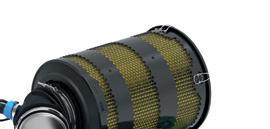



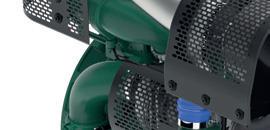


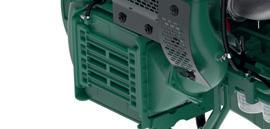













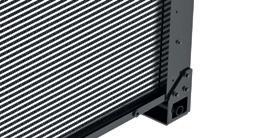



More power with less complexity and less weight. The Cummins B6.7 engine delivers the productivity you need to keep your equipment running. The power increases up to 326 hp / 243 kW and peak torque up to 1014 lb-ft / 1375 Nm, enabling replacement of engines with higher displacement with no impact on productivity.
cummins.com/engines/construction
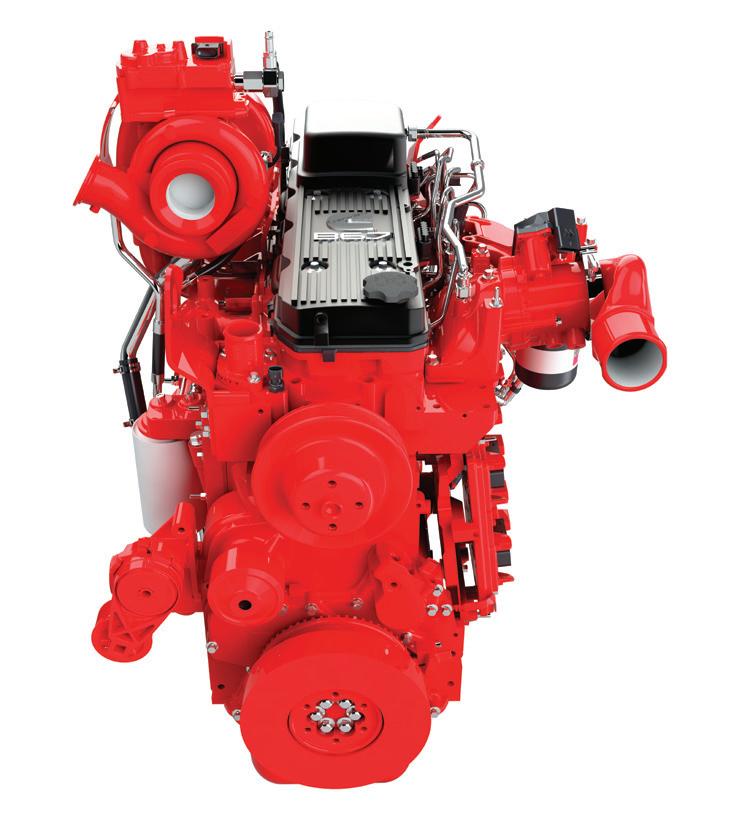
Engine manufacturer Kohler is making significant gains in technological innovation for the engine sector, with a particular focus on the compact machine segment. The company has an extensive history, having been founded in 1873 and it now has 50 manufacturing locations worldwide.
Innovation has been a key factor for the company with its speciality in smaller
engines. Nino De Giglio, director of marketing communications commented, “We not only produce engines but we work with customers to produce solutions.
De Giglio said, “The KDI is possibly the most important engine in our range.”
The most powerful variant of the KDI offers up to 12kW, with a high power density. And a high power density is also a feature of the compact KSD and KDW engine ranges,
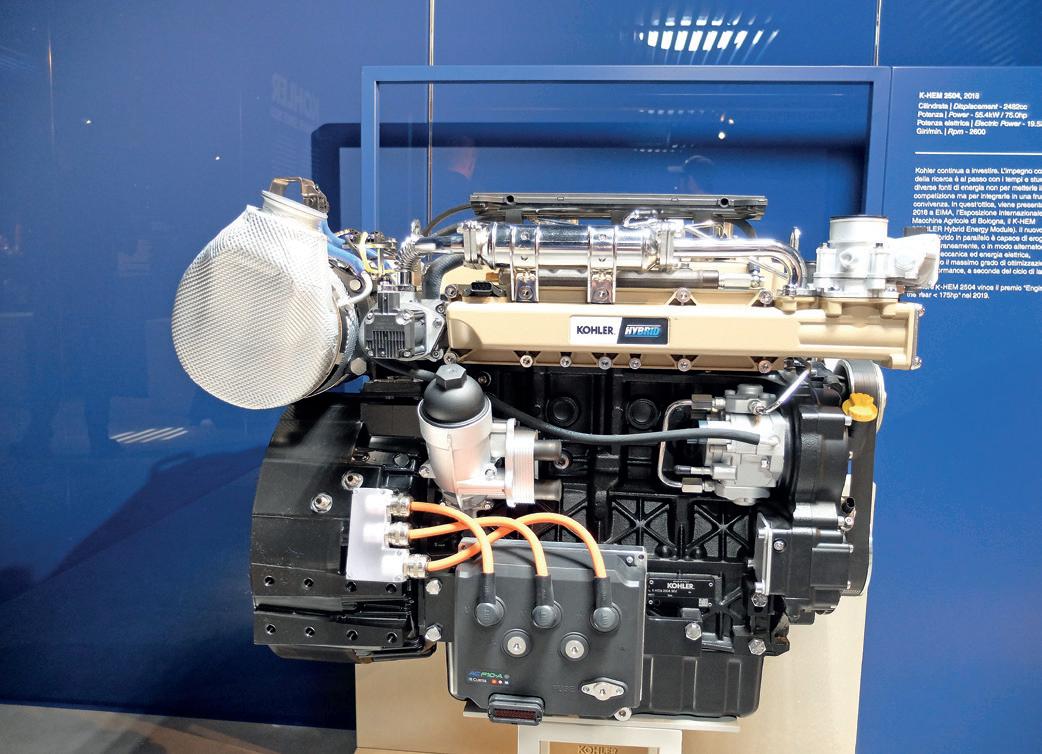
Kohler’s compact hybrid solution offers low maintenance needs and high performance
the latter available with two, three and four cylinders.
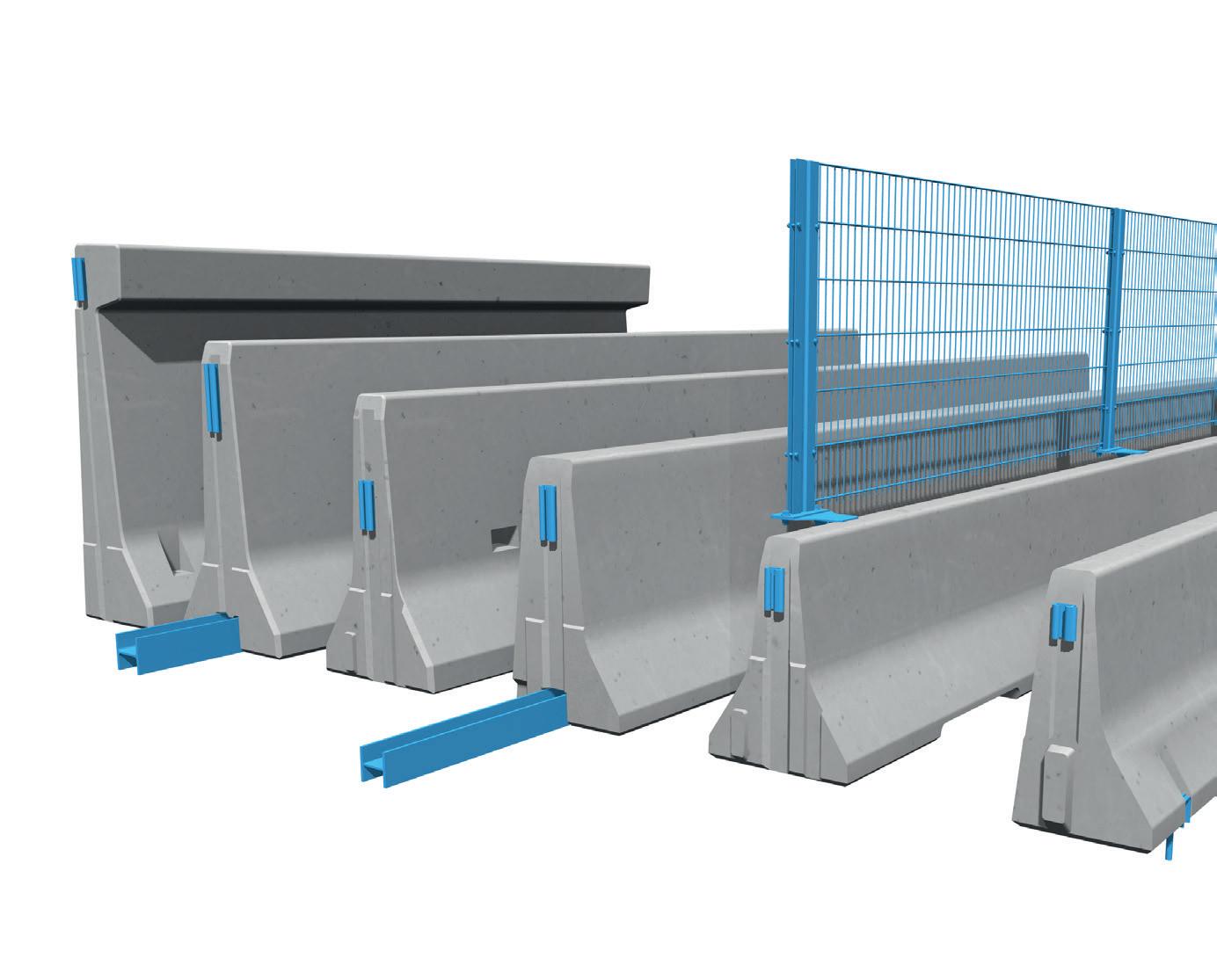
Machines such as the new Cormidi tracked dumpers also use Kohler engines with the firm’s C55 model offering a 500kg payload, with power from a 4.5kW unit. The larger C60 model offers a 600kg payload while the top-of-the range C85 has an 850kg payload. Marco Martella from the firm commented, “The engines are compact and offer more power than before.”
The Kohler Direct Injection (KDI) engines
Bonfiglioli is now offering advanced products designed for battery-powered mini excavators. The firm has developed a cutting-edge solution that incorporates the latest advancements in power transmission and control technologies.
The Bonfiglioli kit comprises three key components that boost energy efficiency in battery mini excavators. The 700T series electric swing drive provides high precision and power to the swing mechanism of a mini excavator. With rotation being the most frequently used movement, electrification boosts energy efficiency, allowing longer operation on a single charge.
The 700C series electric track drive optimises the track system, lowering energy consumption and increasing manoeuvrability. As it is integrated with the machine, it is reliable even in harsh working conditions.

offer outputs from 30-112kW and are said to offer high ef ciency and a high power output as well as low fuel consumption. David Rossi commented, “What we want to offer is a lead in performance.”
The KDI system ensures a high power density and torque at low engine speeds. Low emissions ensure the engines with KDI systems meet Tier 4 Final and Stage V emissions regulations as well as the latest emissions requirements for India, South Korea and China. “The KDI is a global product,” Rossi added.
The rm is developing a new three-cylinder unit with a capacity of 1.9litres that will offer up to 50kW and deliver high torque. Rossi added, “This is suitable for hybrid installations.”
The rm also offers four-cylinder units in this range with capacities of 2.5litres and 3.4litres. The KDI 1903 and 2504 units offer features such as maintenance-free hydraulic valves and ease of maintenance as all the service points are grouped on one side. JCB for example uses a KDI engine in its 90Z model due to its high torque and low noise. This last is an important point and Rossi commented, “Noise is becoming a parameter in city centres.”
Olli Kurki, sales manager at Avant Tecno says that the rm’s 760i compact telescopic boom loader is powered by a KDI unit due to the compact size of the engine as well as its high power density. He said that the unit delivers 35% more torque than the engine previously used in this machine, offering a considerable increase in performance, while also being economical on fuel, meeting
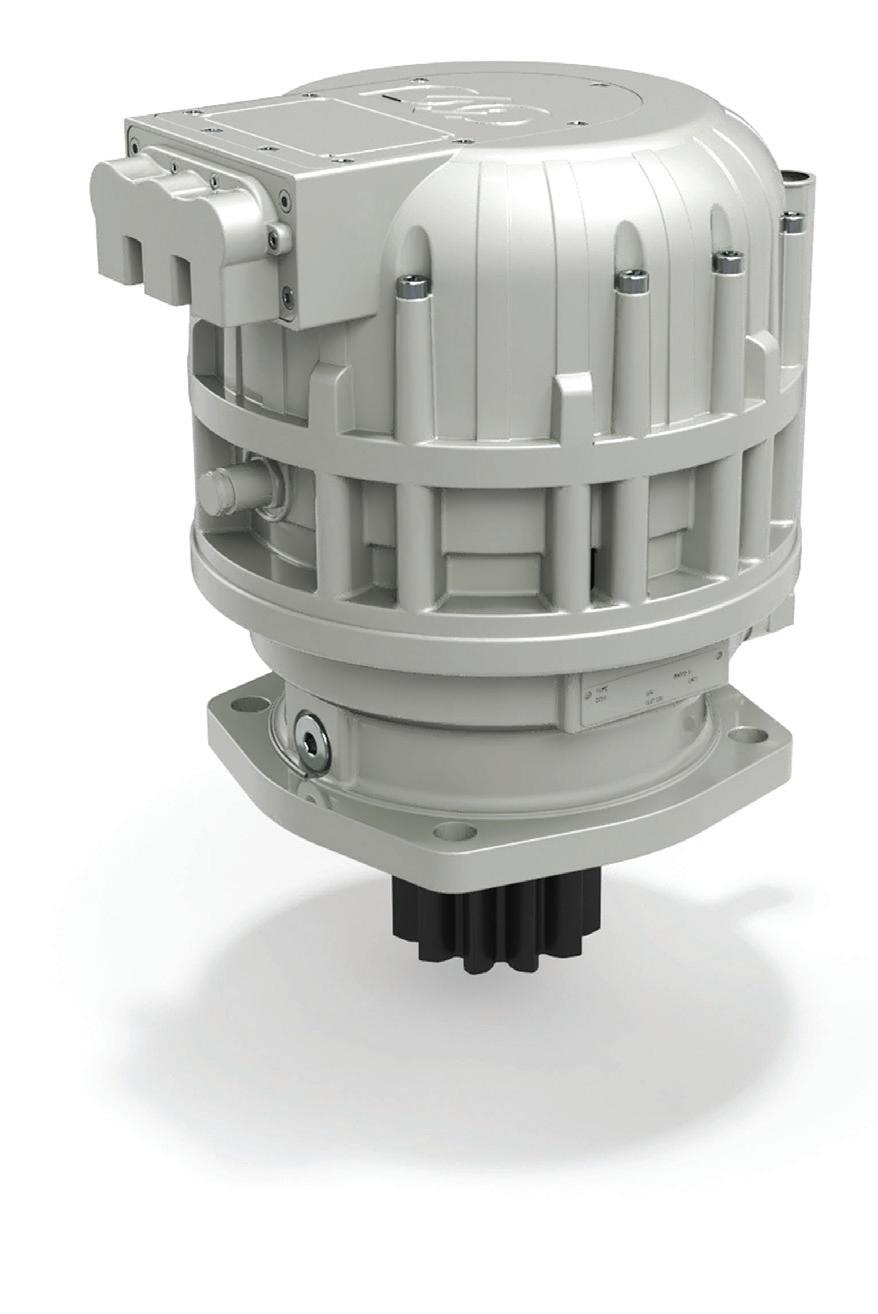
Bon glioli
www.bon glioli.com
emissions requirements and being compact and easy to maintain. He added, “It was a big thing for us that the KDI 1903 is compact, versatile, has a high power to weight ratio, low working noise and a low fuel consumption. The engine also works very well at high altitudes.”
The rm’s K-HEM engines have been an important innovation, offering hybrid power in a compact package and with a new larger unit in development. Paolo Zaccarelli is product manager for the hybrid range and commented, “It’s a parallel hybrid and we are already in production.”
The electric system provides power
assistance for peak demand while the diesel unit provides mechanical power. The package allows the users to downsize the diesel unit for engines. The K-HEM units deliver from 1420kW and meet Tier 4 Final/Stage V emissions requirements without the needed for catalysts. Pierpaulo Grassigli is in charge of this range for the rm and explained that the units are designed to ensure simple installations in a range of different machine types. “It’s easy to t the engines,” he added.
Kohler Engines
www.engines.kohlerenergy.com

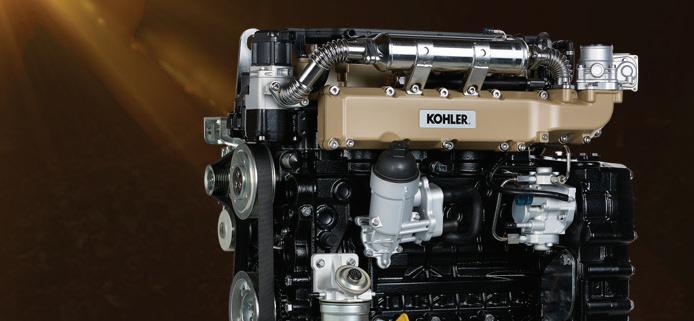
Engines |

When it comes to engines, we’ve been on the leading edge of technology and innovation since our foundation. But we don’t simply provide you with functional power: we redefine your energy resilience with industry-leading electrification, hybrid solutions, alternative fuels and innovative products, to create better lives and communities in a more sustainable future. This is the next chapter in our vision, and its name is Kohler Energy.


























Egyptian rm Rsquared Construction has been using a Lintec CSD2500B asphalt plant to assist with material supply for a road project in the south of the country.

The Lintec CSD2500B plant’s rst task was to supply material for a short but important road link. The rm, Rsquared Construction, selected the model for its ease of transport and low fuel consumption.


The batching plant has now completed its rst job successfully. Rsquared Construction is one of Egypt’s leading privately owned construction and infrastructure companies. The equipment played an important role in building the 3km-long Semad Highway connecting Aswan’s industrial estates to the Cairo–Cape Town Highway.




Installed in January 2023, the Lintec CSD2500B began production in February and mixed over 300,000tonnes of asphalt for the project, with an average output of 500tonnes/ day. This performance was well within the plant’s capacity, given its ability to deliver from 140-160tonnes/hour at its maximum output. The equipment also performed reliably, despite the high ambient temperatures and tough working conditions of the desert climate.
















The plant will now be moved to another project, supporting Rsquared’s ambitious business expansion plans. “We bought this plant with the aim of expanding our operations and opening a new branch in Upper Egypt,” explains Mohamed Abdel Raouf Hussein, CEO and founder of Rsquared Construction. “Having the plant there will be a major attraction for projects and will help secure more work in the area.”





After completing the 3km-long Semad Highway, the plant is being moved to support Rsquared's newest construction site in Upper Egypt.




A key feature for Rsquared’s purchase decision was the ease with which Lintec CSD models can be dismantled before being transported to the next project. The modular design, built within standard containers, allows ef cient transportation, and makes the plants ideal for short- and long-term projects.




In addition, the containerised design provides the internal components with a high level of protection against the elements, while reducing noise and dust emissions. On the Aswan project, one of Rsquared’s challenges was coping with the tough desert climate, with its harsh, sandy conditions that can damage unprotected equipment. But the design of the Lintec CSD2500B meant that there were no issues for the contractor, with the mixing plant maintaining high-quality production in temperatures that often pass 30°C.




The fuel savings provided by the double screen drum technology were another attraction for Rsquared. The combination of heating and screening of minerals in a single process unit, eliminates the need for a hot elevator and vibrating screen, reducing energy costs and maintenance requirements.


Meanwhile, Filipino contractor Vicente T Lao Construction is now using a customised Linnhoff CMX1500 plant modi ed to suit the company’s requirements. The CMX1500 is supplying hot mix asphalt for municipal road construction and rehabilitation work in the province of Davao Del Norte in Mindanao, the second-largest island in the Philippines.



This is the rst Linnhoff CMX plant customised to this con guration in the Philippines. Instead of directly discharging the hot mix, which is maintained at a temperature















between 150-190°C, from beneath the mixer into the dump truck, a skip bucket and runway track deliver the mix to a 100tonne capacity hot storage silo mounted to the side of the plant. This stores and discharges mix into dump trucks beneath it.
This con guration was requested because there is limited access for dump trucks on the site by the main tower. By shifting the loading of the trucks to the side, away from the main tower and beneath the hot storage silo, trucks can move freely into and away from the collection point.
“This design speeds up the production process for us, so projects can be done faster,” said Jovanie M Boncales, plant manager at Vicente T Lao Construction. “The fast work rate, high reliability and excellent performance of the CMX1500 are what impressed us most. The plant has very good fuel consumption and can save costs and manpower.”
The plant’s fuel ef ciency lies in the energy savings enabled by its dual-purpose

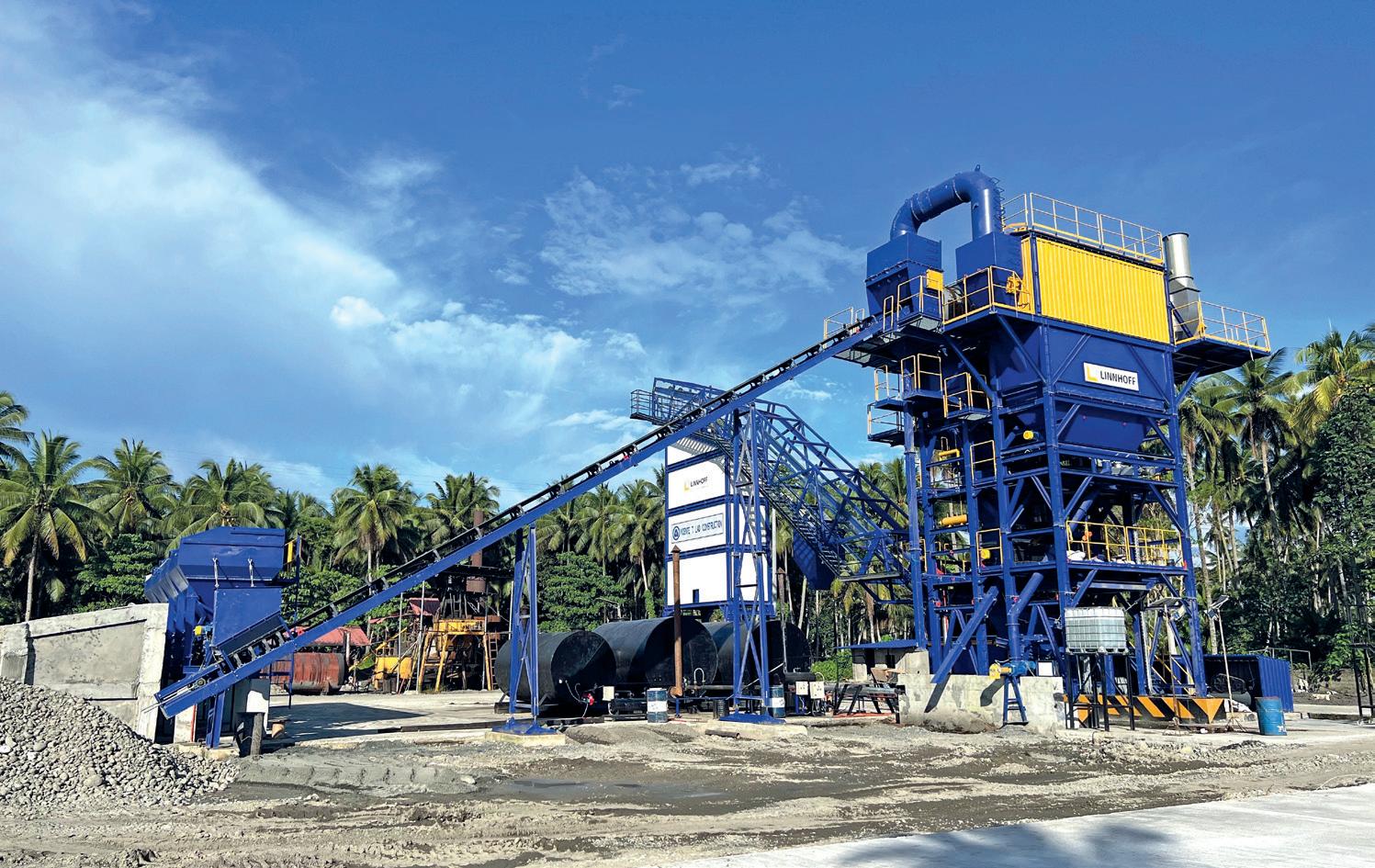
single drum that combines the drying and screening of aggregates, eliminating the need for hot elevator and vibrating screens while further reducing maintenance requirements. In addition, the hot mineral bins are located
directly below the drum to maximise conductive heat.
Lintec & Linnho www.lintec-linnho
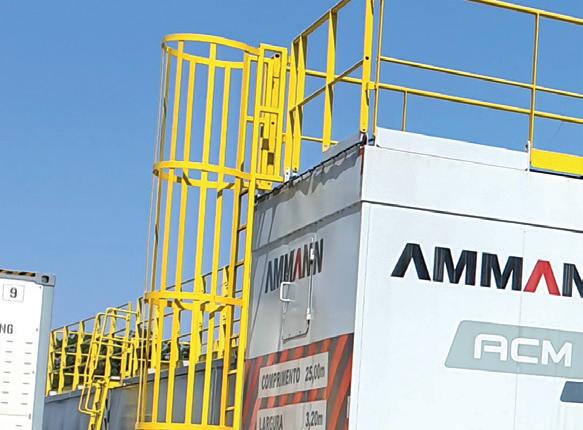
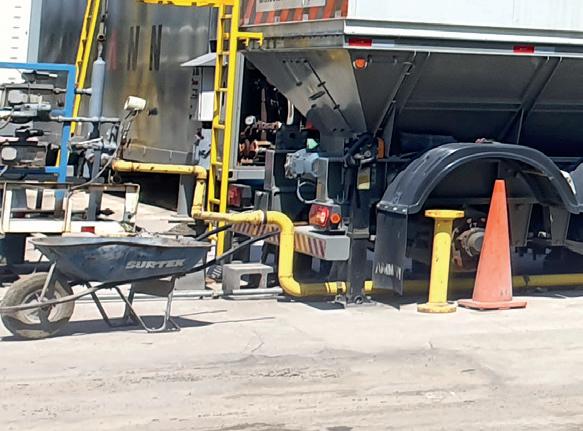

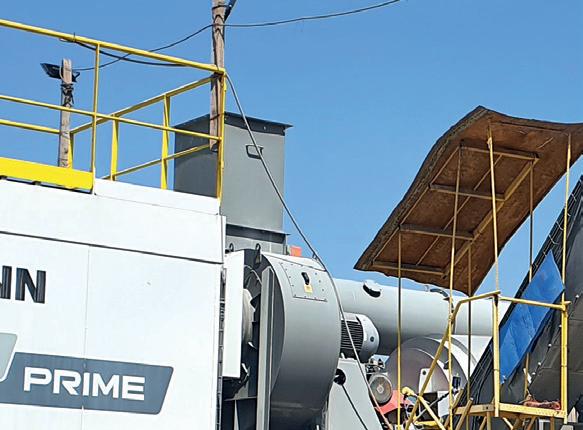
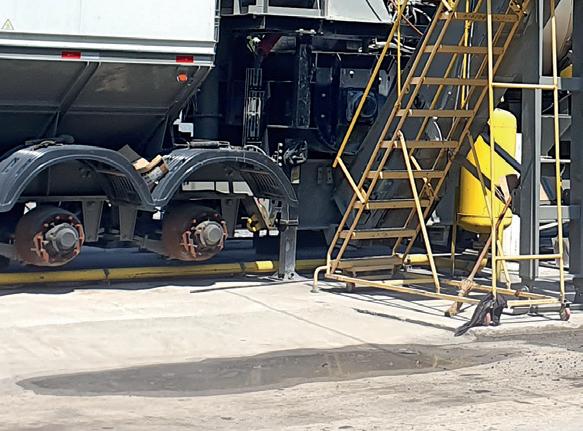
New asphalt plant technology from Ammann is playing an important role in supplying materials to meet demands from the construction sector in Mexico.

Local supplier Leyca Asfaltos is experiencing strong growth and sees further potential to expand its business further. The company’s growth plans have led Leyca Asfaltos to decide to acquire a second Ammann asphalt-mixing plant, an ACM 140 Prime model.
“The private market has experienced a 40% increase, and this second plant will make us competitive as we venture into the public works sector,” said Mario Levya, Director of the company, based in Apodaca, Nuevo Leon, Mexico.
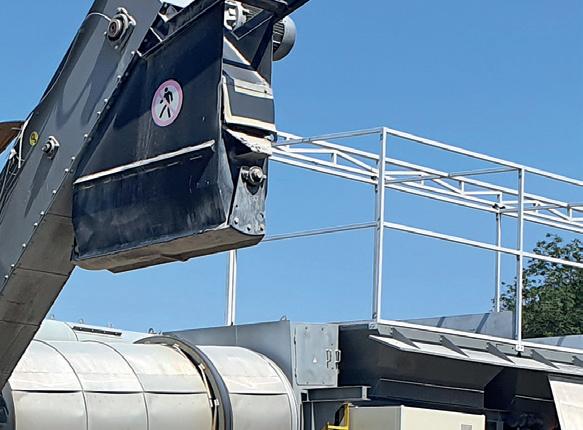
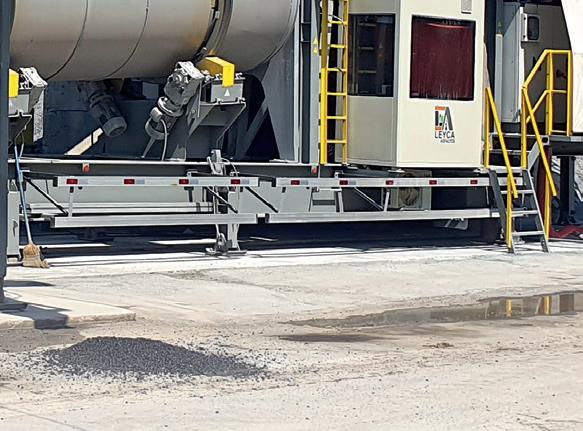
The growth is also impacting the company’s paving division. Leyca Asfaltos purchased a second Ammann AFT 600-3 paver, in addition to the Ammann plant.

The company’s rst plant purchase was an Ammann ACM 140 Prime. It has since added a number of Ammann products to its lineup, including the AFT 600-3 asphalt paver as well as an ARX 110 tandem roller and an AP 240 pneumatic-tyred roller.
Leyca Asfaltos is setting technical trends for the country also as it is the rst asphalt producer in the state of Nuevo Leon to use natural gas as a fuel. Leyva said, “We want to generate value by reducing our emissions in all processes. Using natural gas in our plant

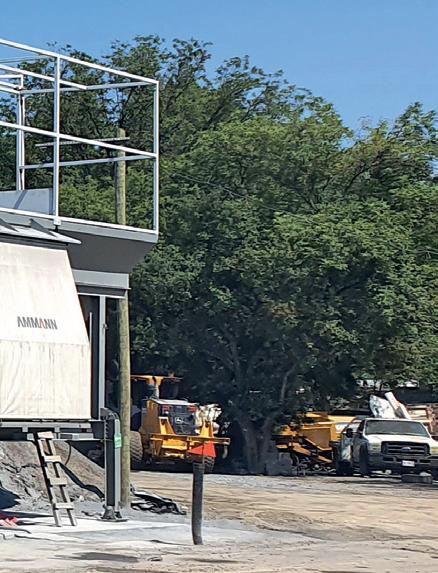
guarantees lower emissions.”
Choosing natural gas was a relatively easy decision and he added, “It has low cost, good availability and low emissions.”
Utilising the fuel has been effortless, he said. The next environmental effort might well be using recycled asphalt in Leyca Asfaltos mixes. The company already processes waste materials for reuse at a later time. That commitment is making projects greener and is also helping Leyca Asfaltos’ business. “End customers appreciate our commitment, and it has been the entry card to the government,” Leyva said. “In all government projects, we must disclose the environmental impact and mitigation activities.”
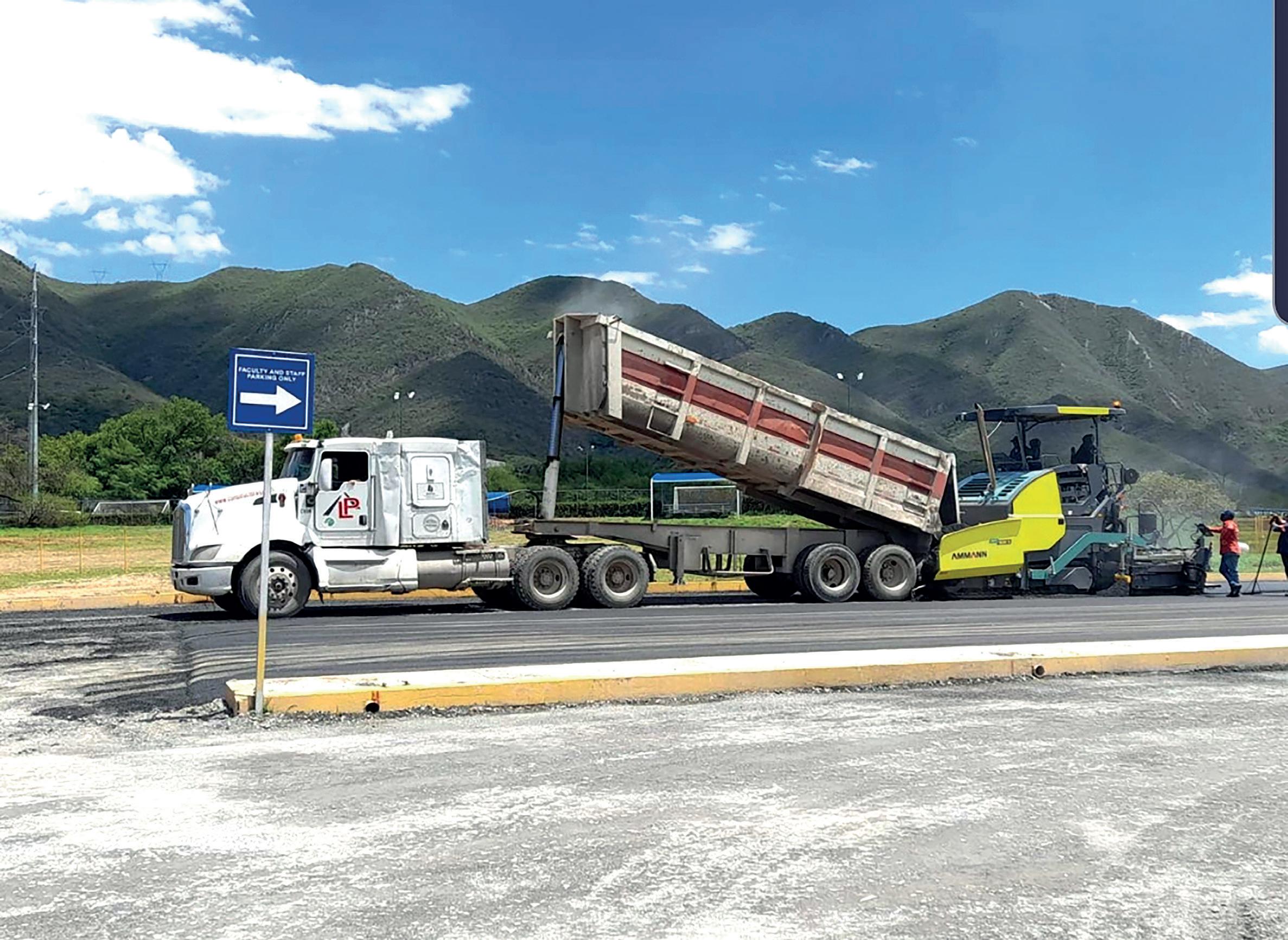
company and the equipment we have,” Leyva said.
starts and stops. Leyva sees the roller as a key component in the successful outcome of the
Ammann www.ammann.com
Ammann has opened its latest Asian asphalt plant manufacturing facility in the Chinese city of Zhangjiagang.

The 50,000m² plant, which includes 5,000m² dedicated to administration, has the capacity to produce 80-100 asphalt-mixing plants annually. Additionally, the factory will produce spare parts for the region.


Zhangjiagang is a port city which has a metropolitan population of almost four

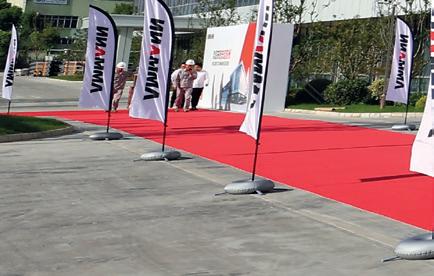
million. It is located on the Yangtze River where the river’s delta area is a key transport hub for China. Ammann says that this should reduce shipping costs, improve sustainability by shortening travel distances for importing raw materials and exporting nished plants and also speed up delivery times to strategic


markets throughout China and the Asia-Paci c region.
The factory’s asphalt plants will adhere to tight Swiss sustainability standards, according to the company. This includes Ammann’s global Green Plant initiative which promotes sustainable technologies, innovative

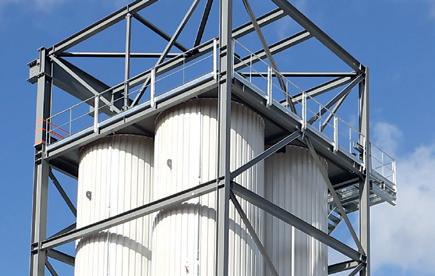
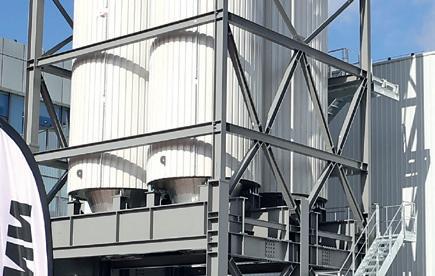

solutions and environmentally friendly asphalt-mixing practices, explained Zhang Liguang, general manager of Ammann China. “The design of the new plant adheres to the Swiss concept of environmental respect that includes reducing energy consumption, plant emissions and its impact on the environment.”


Ammann www.ammann.com


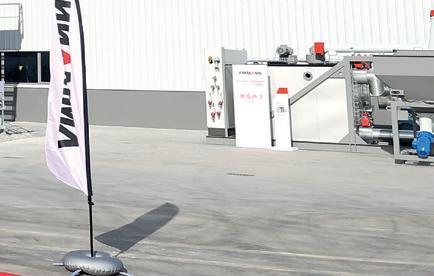

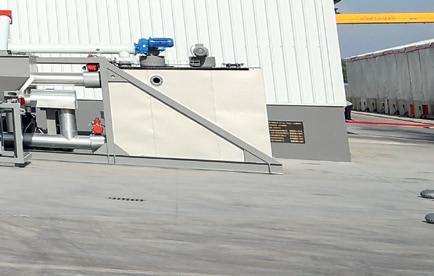
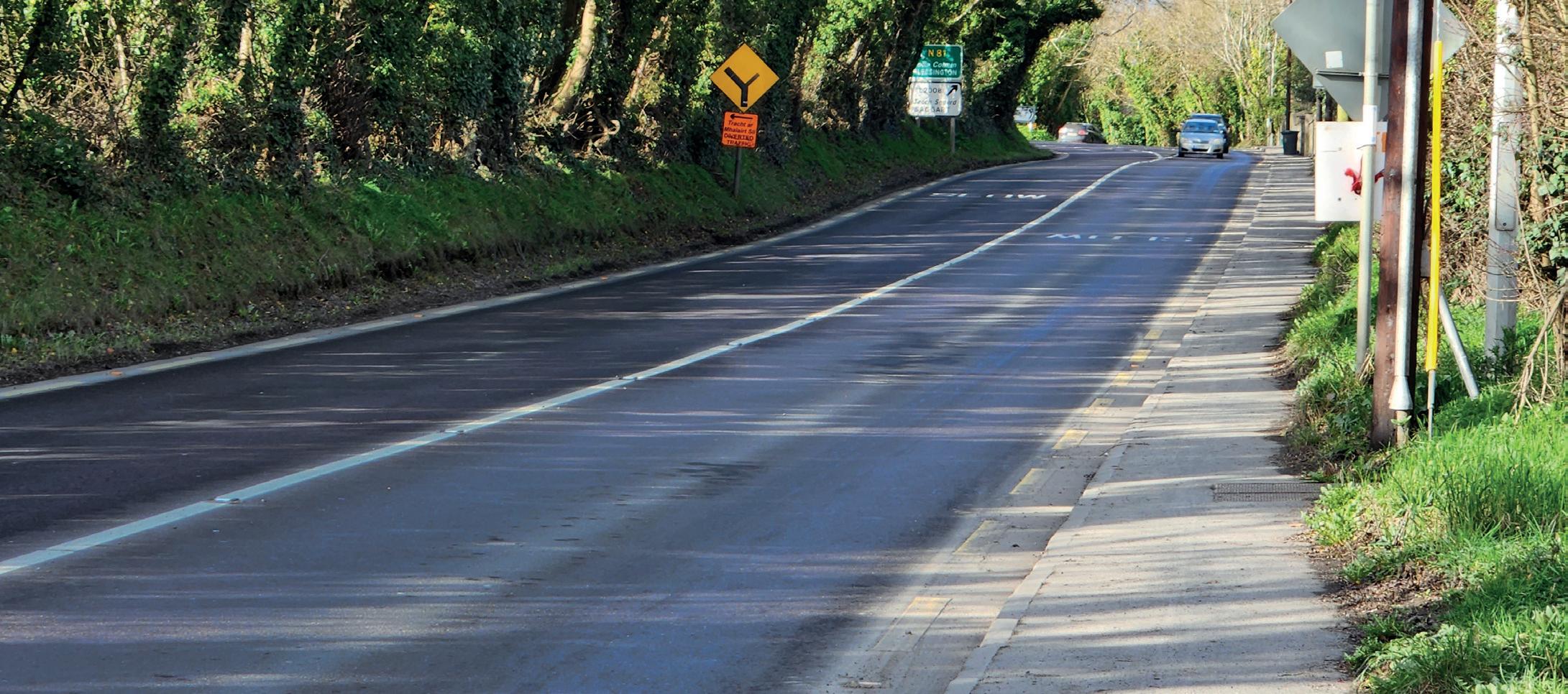


ReLIXER®, an asphalt rejuvenator or recycling agent, developed and marketed by Sripath Technologies®, was successfully used to pave a 60% high-RAP mix on a roadway in Dublin, Ireland. The demonstration trial was conducted by Roadstone Ltd, a CRH Company, in collaboration with Ireland Transportation Authorities.

The trial was extremely successful. Two dense base asphalt mixes, AC20 and AC32, using a 40/60 grade bitumen, were paved as control. Mixes with 60% RAP and ReLIXER were evaluated and shown to deliver performance comparable to the no-RAP control mixes.
In a presentation at a conference organised by the Institute of Asphalt Technology in March 2023, William Wilson of Roadstone shared that
the high-RAP mixes lowered the total kilogram of CO2 equivalent per tonne of mix by 12 to 16%.
ReLIXER, a blend of bio-based oils, helps to lower the carbon footprint, reduces the need for virgin bitumen, and lowers overall mix cost.
Sripath Technologies
https://sripath.com

Whether increases in heavy loaded traf c or extreme weather conditions because of climate change – today, road surfaces are subjected to ever-higher stresses and strains.
Additives for bitumen play a decisive role in the durability and performance of asphalt


pavements. At the same time, occupational health and safety, environmental protection and the reduction of CO2 emissions are of utmost importance.
With B2Last®, BASF has developed an innovative bitumen additive that combines both performance and sustainability. Temperature-reduced paving
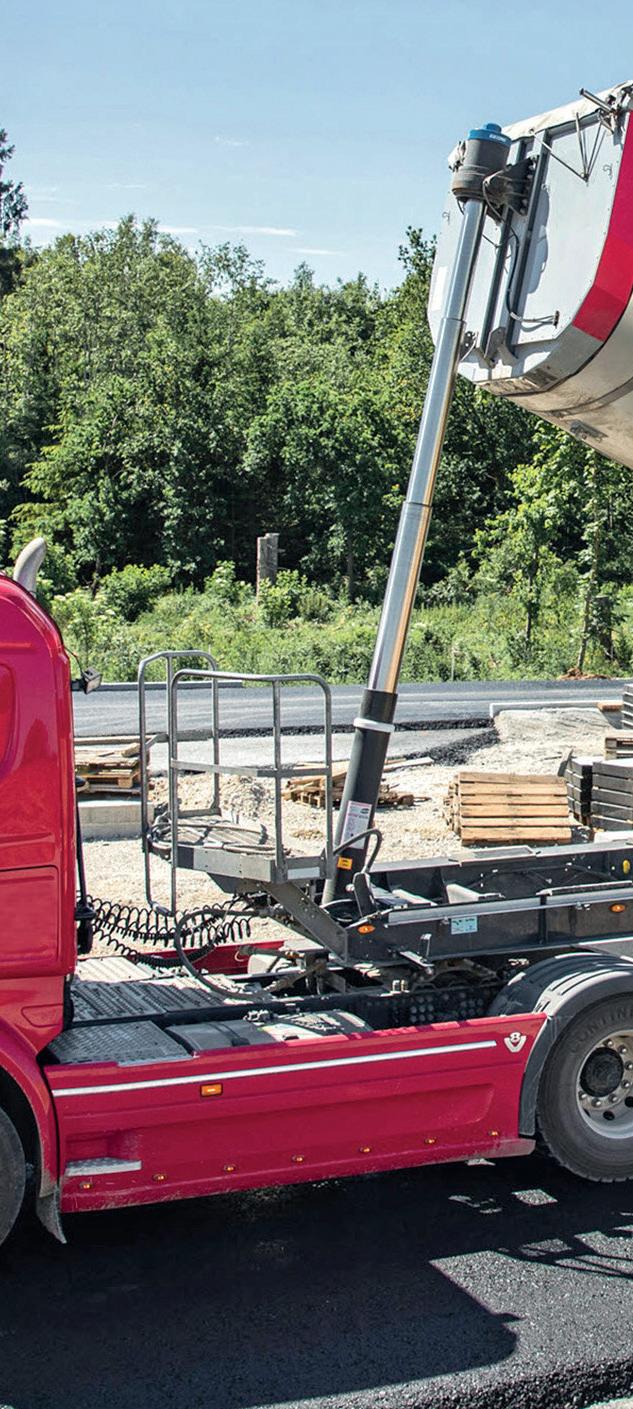

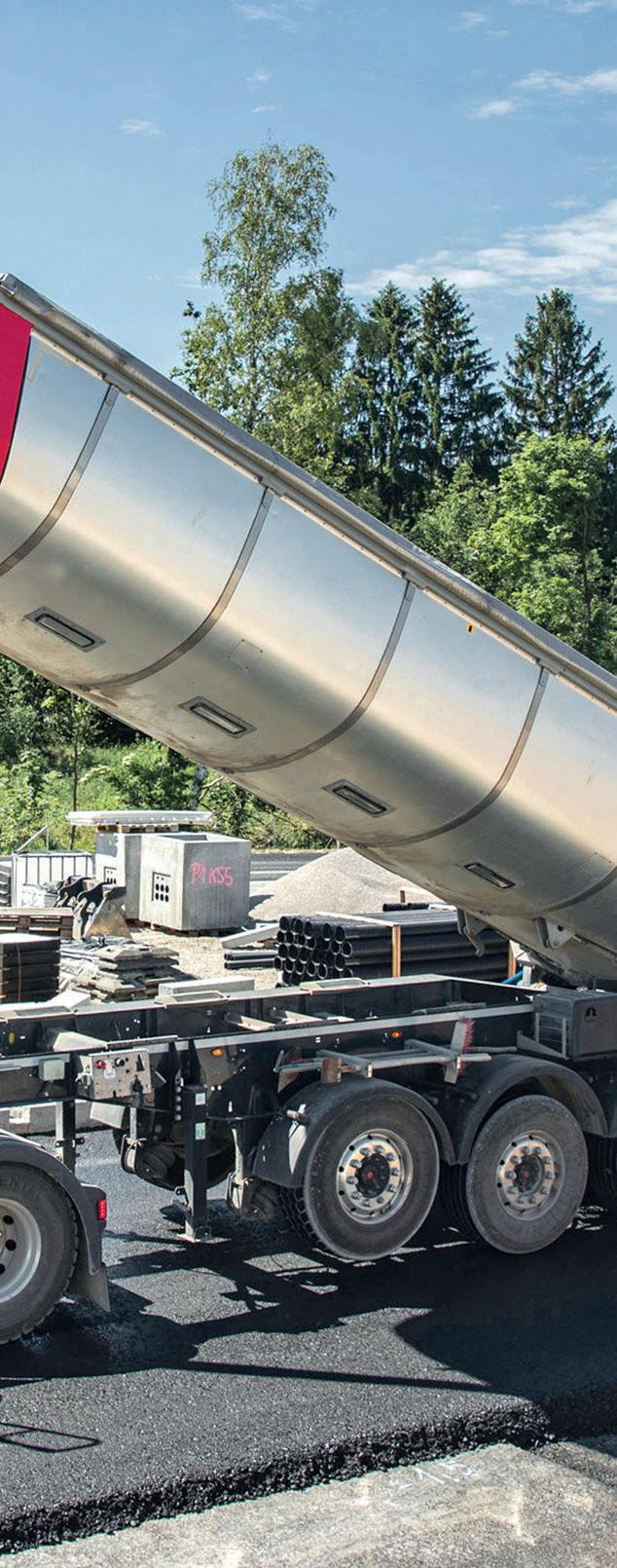
with highly reclaimed asphalt content is made possible with B2Last®, by guaranteeing consistent workability. This creates signi cantly lower bitumen and CO2 emissions, while the asphalt resistance is also increased, thereby


extending the lifespan of the road. Moreover, B2Last® can be used as an antistripping agent, in combination with typical elastometers to produce Polymer Modi ed Bitumen (PMB) or highly modi ed asphalt, and ful ll all requirements needed for these types of pavements.
BASF
https://chemicals.basf.com
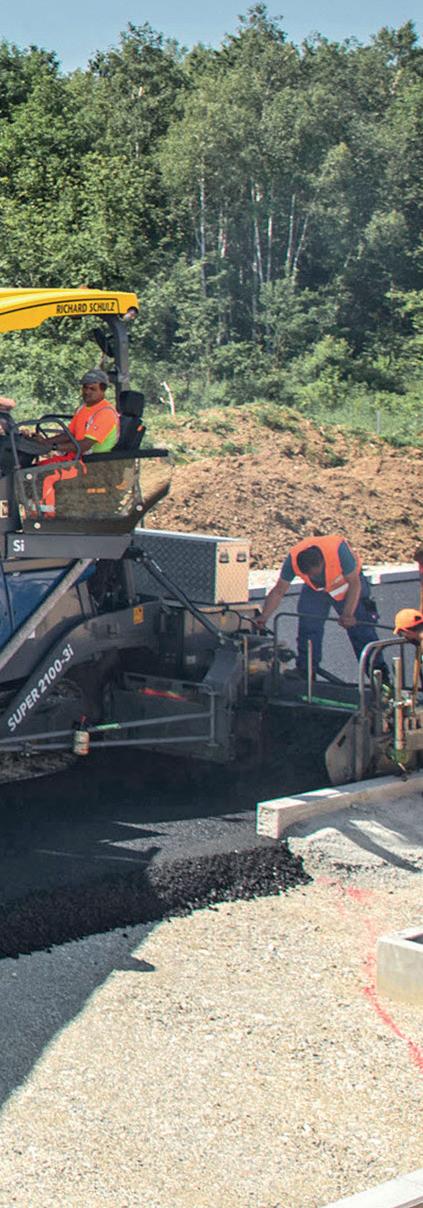
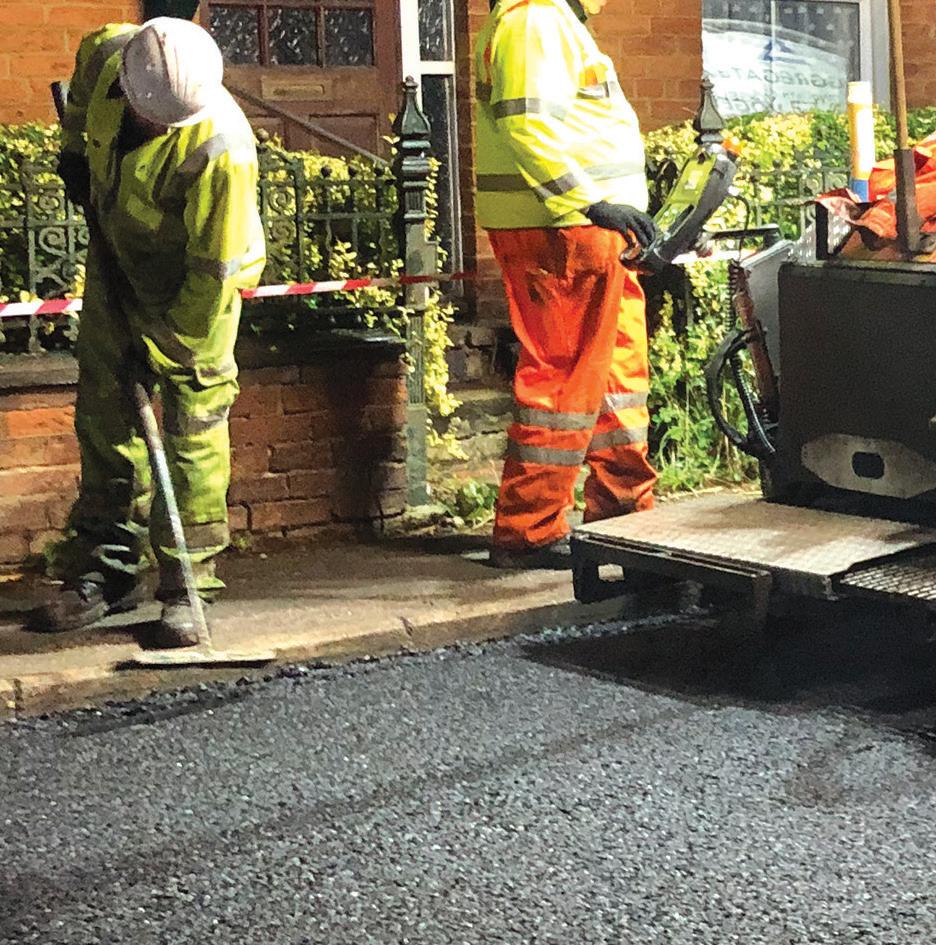
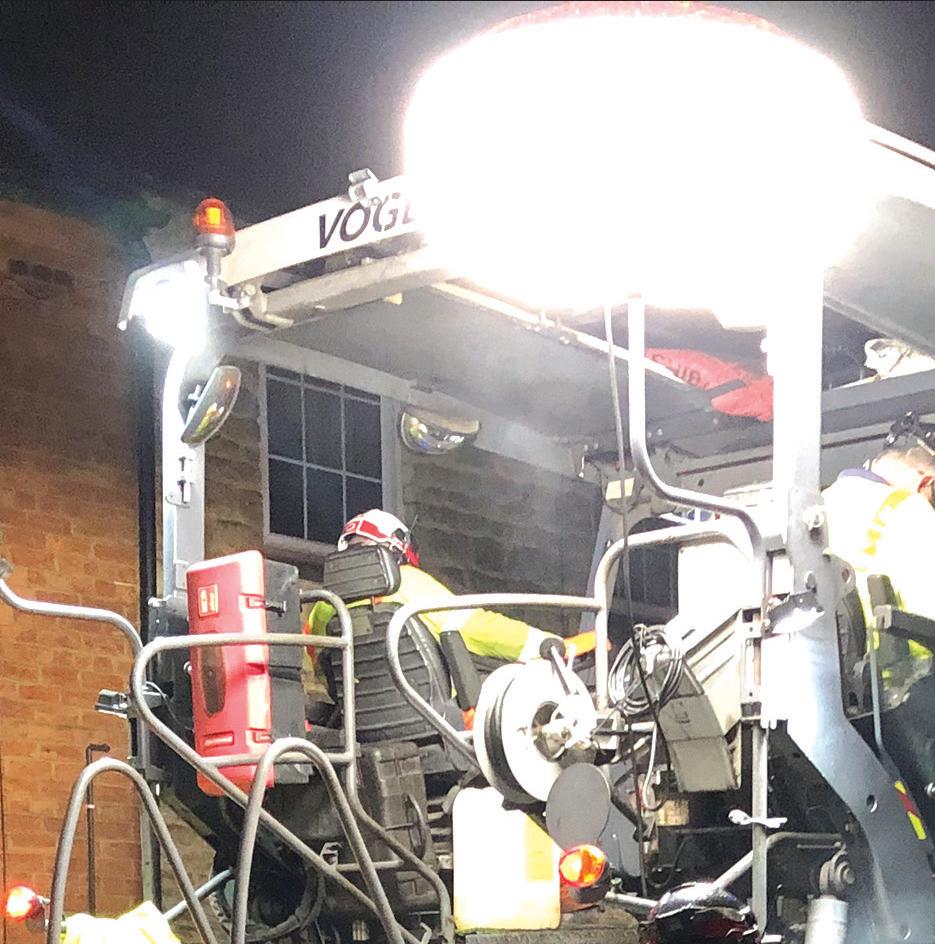
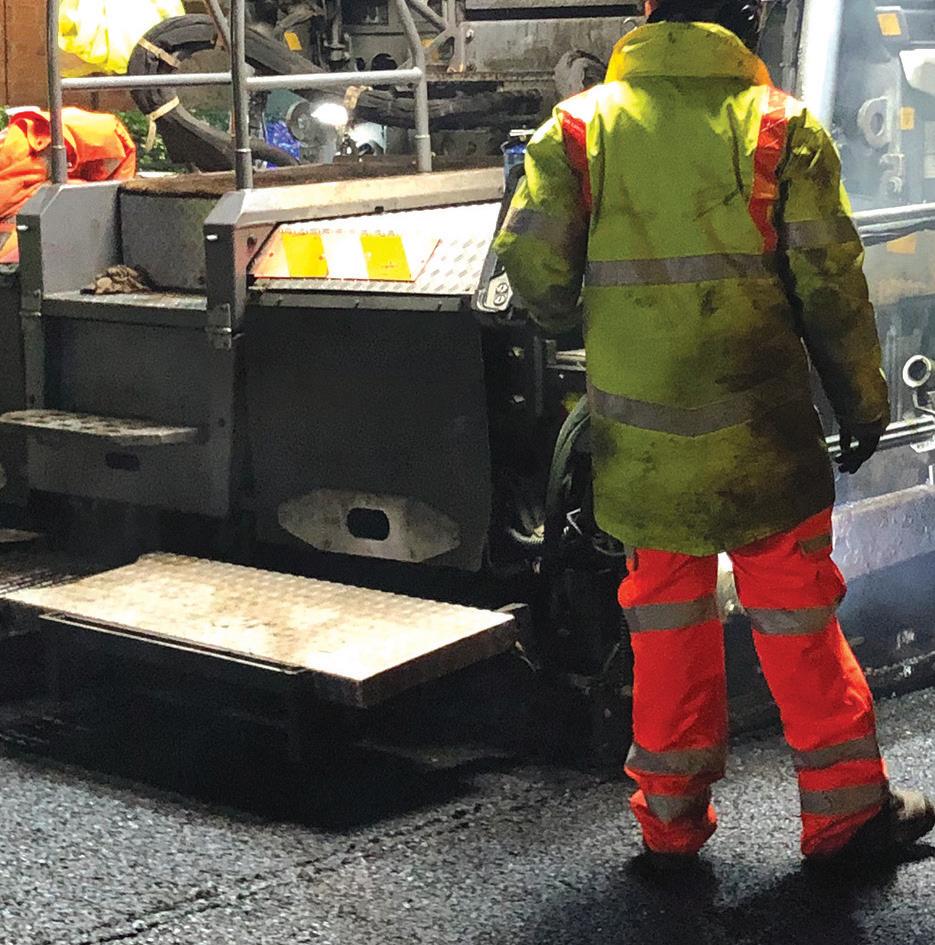

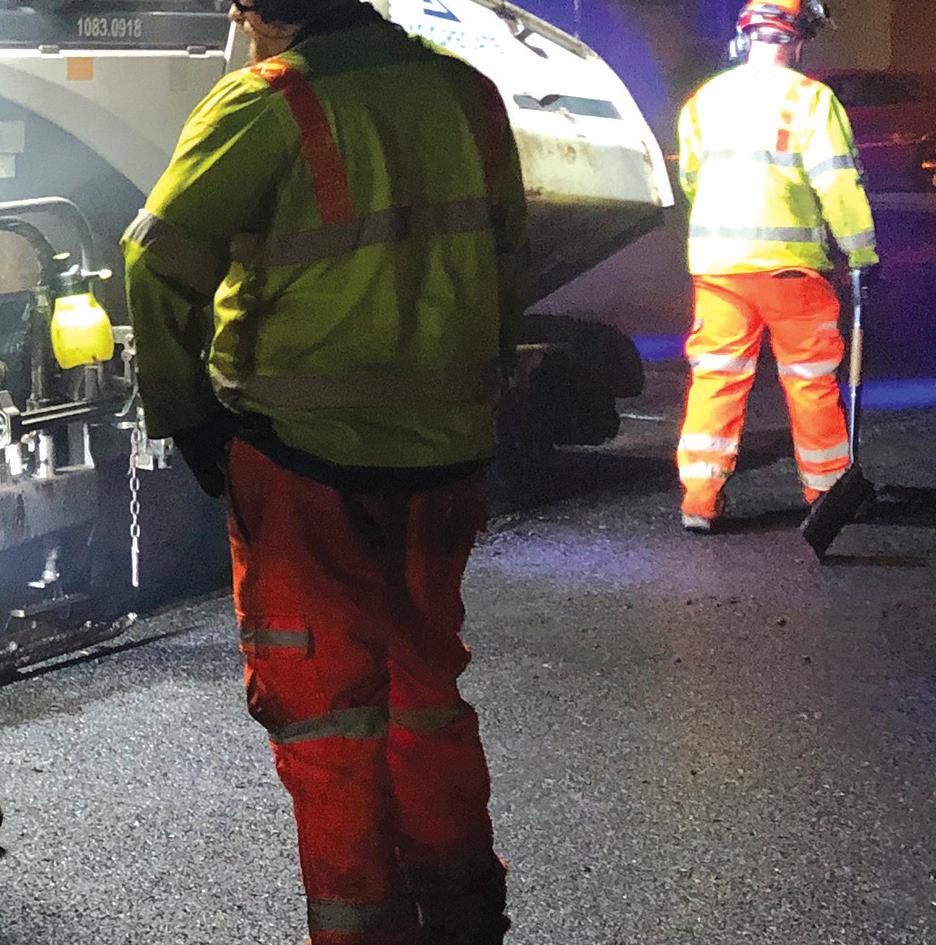
This month it is all about graphene, as another trial of graphene-enhanced Gipave gets underway in the UK and a research programme using graphene-coated microcapsules aims to banish freeze-thaw damage - Kristina Smith reports
Athird trial of Iterchimica’s graphene enhanced Gipave technology is underway in Oxfordshire UK.
Contractor Milestone Infrastructure laid a 725m stretch on North Street in Middle Barton, a busy B-road which runs through the village in West Oxfordshire.
“Our network is open to new things,” said Oxfordshire County Council’s head of highway network, Sean Rooney. “The things we are trialling today will lead to us doing things more ef ciently and effectively in the future. If we want to move forward, we have to do things differently.”
The rst trial of Gi Pave, which deploys an additive containing hard-to-recycle plastics and graphene, took place in 2019 in the village of Curbridge, comparing the performance of a mix containing Gipave with a mix made with standard bitumen. Falling Weight De ectometer (FWD) tests carried out on the road surface at the end of 2022, yielded some very positive results, according to Raven.


“It's early days, but when we did the analysis of the FWD testing, the test results were better than we had expected,” said Phillip Raven, technical director of the council’s maintenance contractor Milestone Infrastructure. The initial results suggest that the road surface will last 40 years compared to an expected 15 years for a standard mix, that’s a 165% improvement in lifetime.
The second trial, in March 2022, was on a busy B-road and aimed to compare Gipave’s performance with that of a polymer modi ed bitumen (PMB) from asphalt supplier Aggregate Industries’ high-performance range. Unfortunately, the second trial did not perform as expected, Raven said.
“We had some issues with the production of the material on that site and did not achieve the results we were hoping for from the lab testing,” he said. “We had problems with some of the bitumen grades.”
Although some would see this result as a failure, Rooney had a different take on it: “To fail with a trial is not a failure. The purpose is to learn. As an industry we can be far too risk averse.” So, the third trial
will also look to again compare Gipave with PMB, with the bitumen grade issues solved. As well as the bene ts of lower whole life costs, lower whole life carbon emissions, Gipave will lead to less disruption for the people of Oxfordshire, says Rooney: “Usually you have to treat a road between 8 and 10 years after it was laid and then do something more after ve years. With Gipave, it's not only the costs you will be saving, there's a bene t to the community and the network users.”
Although GiPave’s carbon footprint up to the point it is laid will not be lower than a warm mix asphalt, since the additive must be used with hot mix, the carbon savings over a 20-year life could come in at 40%, according to the council. As for the initial cost of a Gipave mix compared to a PMB mix, it is not clear yet what the cost in the UK will be. If demand grows suf ciently, Iterchimica could manufacture the additive in the UK, rather than shipping it from Italy.
Once this nal trial has been evaluated, Milestone and the council can start to work out what type of mixes should be deployed where around the network. “There’s no reason why we could not use Gipave
anywhere where there would be bene t from not closing the road every ve years,” he said. Budget, of course, is an important factor too. “With our client in Oxfordshire, and with all our clients, there has to be a balance of budget pressures versus durability,” said Raven.
Beauty parade for pothole patching Oxfordshire County Council and Milestone are also carrying out a comparison of seven different pothole repair methods. Methods on trial include cold patching materials, mastic asphalt, Milestone’s favoured Dragon Patcher spray injection patching, JCB’s Pothole Pro, a Bobcat mini planer and gang and Thermal Road
Repairs’ technology.
“The pothole trial was the rst of its kind in the UK,” said Rooney. “We took a typical road for Oxfordshire, running through the middle of a small town with heavy traf c. Every pothole repair method will experience the same traf c conditions and the same weather conditions.”
“We applied them all on the same stretch of road so that we could monitor the durability,” said Raven. “It also meant that we could showcase different techniques to local councillors.”
Milestone is also using the trial to compare productivity of the various methods. “We repair around 30,000 defects a year,” said Raven.
Rodeco is installing white Polycon E-Krete inside one of Olympia Odos’ tunnels on the motorway between Athens to Corinth and Patras. After the material is applied, a special machine is deployed to create grooves for friction. Research by the University of Athens suggests it could reduce lighting energy demand by 40%, according to Rodeco.

“That equates to a lot of cost and a lot of carbon. If repairs last longer, we can potentially reduce cost and carbon.”
Milestone will be checking in on the performance of the pothole repair methods after three months, six months and a year and will be reporting on progress to other authorities and their contractors through networks such as the Local Council Roads Innovation Group (LCRIG), of which Rooney is a founding council member. It will not be a case of picking a winner, said Raven, but rather having information about a toolbox of techniques so that the right one can be selected for the right circumstances.
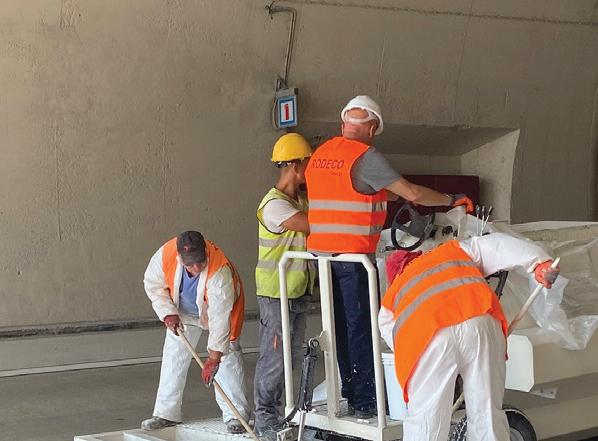

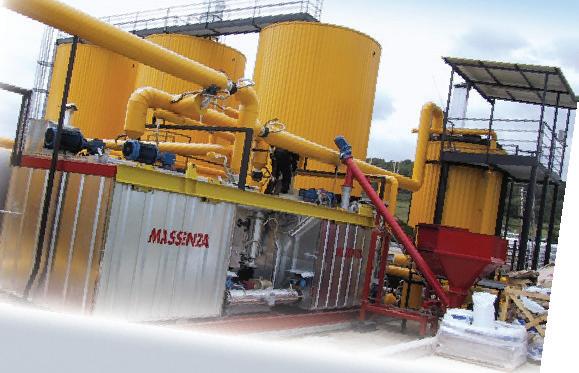







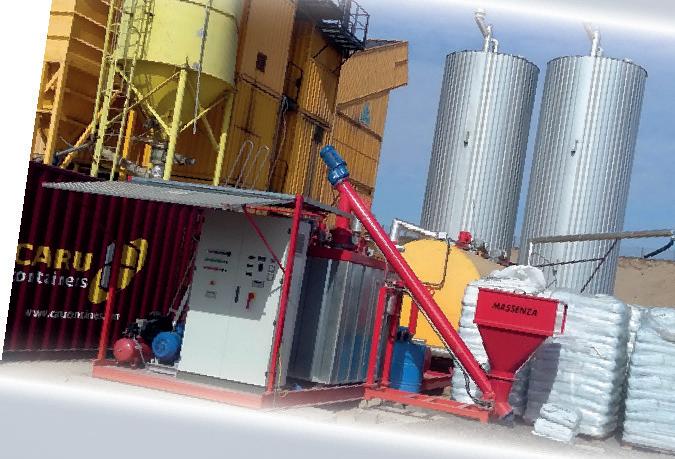


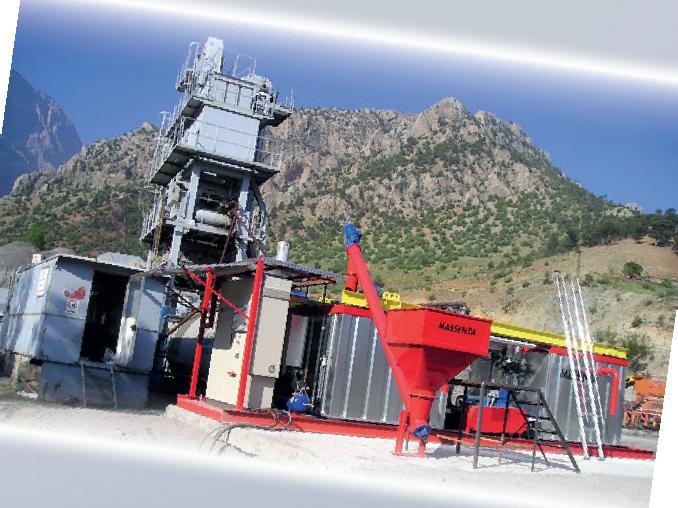





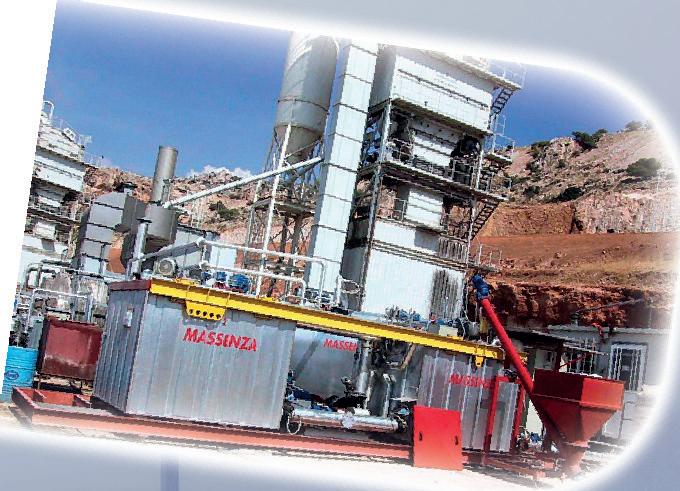






A lecturer in civil and environmental engineering at the University of Surrey aims to unlock a cost-effective way of using solar-to-ground heat exchange to prevent freeze-thaw damage of road pavements.
Freeze-thaw action is one of the main causes of potholes in the UK, said Dr Cao,
alongside traffic loads and water. By preventing the road temperature falling below zero, roads would last longer, reducing the cost and carbon emissions due to maintenance works and improving road safety.
“There were 5,000 pothole-related injuries over the last five years,” said Dr Cao.
The £80,000 project, 80% funded by the
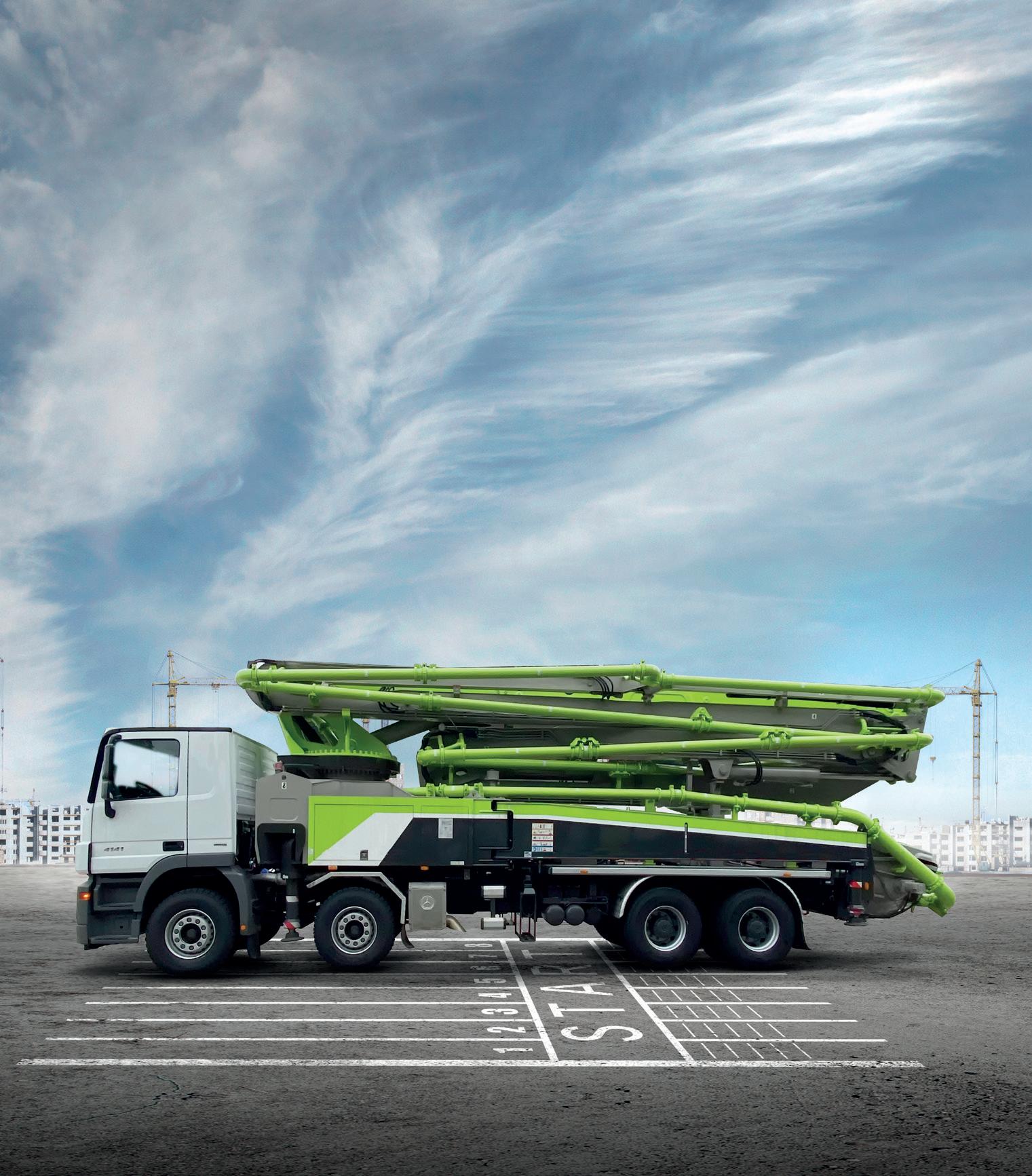

Royal Academy of Engineering and 20% by Surrey University, will boost the heat-storing potential of soil beneath or beside the roads using special microcapsules under development by advanced engineering materials company Versarien. “Soil does not naturally have enough heat storage capacity which is why we want to introduce the capsules to increase it,” explained Dr Cao.
The capsules will consist of an inner core of a phase change material (PCM), a substance, such as paraffin, which releases or stores a huge amount of energy as it changes phase between liquid and solid. This will be surrounded by a polymer and coated in graphene which has a high thermal conduction capacity. Versarien will be developing the capsules with Cambridge University, where Dr Cao previously worked extensively on microcapsule technology.
The system would see a network of pipes, with water running through them, installed in the road layer beneath the surface. These would be connected to a network of storage pipes in the subgrade of the road. In the summer, heat would be taken away from the road and stored in the ground, so that in the winter it could be reversed to prevent the road pavement from freezing.
Initially, the system could be used with a heat pump, to boost the temperature of the warmer water in the winter. Or it may even be possible to run the system without a heat pump, said Dr Cao, which would be a far more cost-effective solution.
The development of the microcapsules is already underway, together with the start of numerical modelling to simulate the mechanical performance of the road with heating. The next step will be to install a test system on the University of Surrey campus, with a location already earmarked. Then National Highways will trial it somewhere on the strategic road network.
Develon, formerly Doosan Construction Equipment, has launched the new DX140LC-7K excavator, replacing the company’s successful DX140LC-7 model. Whilst the performance and working range are the same as the DX140LC-7, the new machine incorporates many improvements that improve safety, e ciency and maintenance.
The main upgrades on the 14.6tonne DX140LC-7K include better maintenance access, safer access to the upper structure, better rear visibility, better right-side visibility and a new dashboard with tablet design, o ering faster response. The improved serviceability of the DX140LC-7K includes better access to the DEF tank and the fuel re lling hose. This is combined with a much easier approach for the operator to the engine compartment via new anti-slip steps and handrails positioned behind the cab.
The DX140LC-7K also has a new attened engine cover design that has reduced the
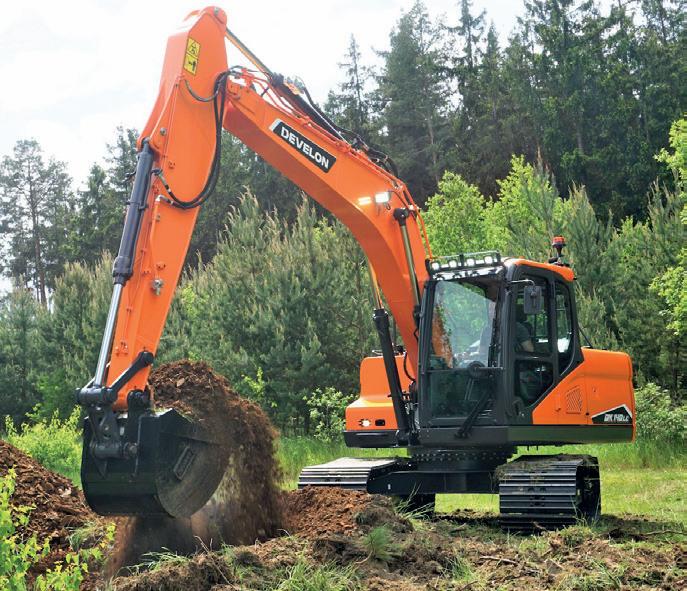
be lowered.

Elsewhere on the DX140LC-7K, Develon has removed holding valves from the main valve for better uidity. The air pre lter has also been moved for better performance and noise reduction.
Inside the operator’s cab, there is a new dashboard monitor with a state-of-the-art tablet. The former hydraulic two-way pedal has also been replaced by an electronic two-way pedal.
maximum height of cover components on the back of the machine for better visibility to the rear and to the right hand side of the machine.
Inside the engine compartment the PTO for the rotation pump has been repositioned from the main pump to the engine. This has also allowed the size of the aftertreatment system to
Other key features in and around the cab include: DAB audio; keyless start and remote door lock/unlock; fully adjustable air suspension seat; parallel wiper system and new design pedals; and improved air ow for defrosting and air conditioning. They also include nine LED work lights as standard, with two more LED lamps as an option; and AVM - Around View Monitor with 360° cameras.
www.eu.develon-ce.com/en/
Power Pavers is launching a new full-width, four-track concrete slipform paver, the SF-3404. The machine is said to o er an array of improvements in technology, providing smooth operation for contractors.
Good all-round visibility is claimed and the machine can pave a maximum of 12m and features telescoping endpans for 61cm of width versatility on each end. In addition, the SF-3404 bene ts from a heavy-duty plow, rigid paving pans and durable slew drives that help to ensure it is both reliable and e cient.
A new option for the SF-3404 is a compact, fully-controlled Dowel Bar Insertion (DBI) system. The machine is equipped with a hydraulic oating oor to maintain the integrity of the initial slab and improve reconsolidation around dowel bars after the insertion process. Each time the DBI runs, the carriage recalibrates with electronic sensors to ensure the oor is where it should be. In addition, the DBI is split to allow for accurate crowning and bar placement. Each bar is held and guided into the concrete to prevent skewing, even while crowning. When running DBI, the machine uses a collision avoidance system to prevent centre tie bars and DBI from inserting at the same location.
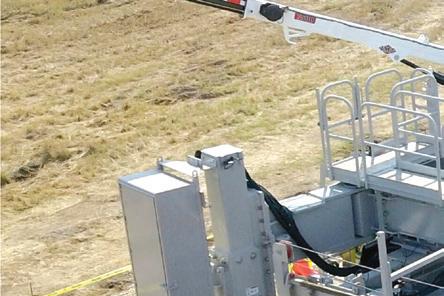
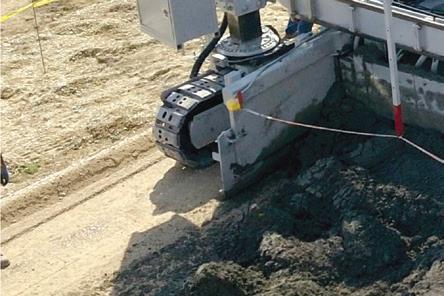
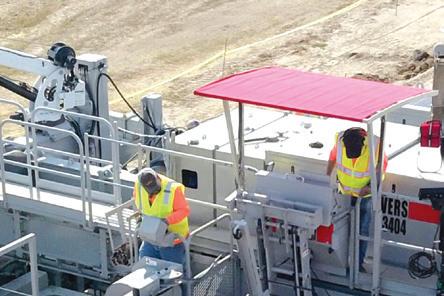
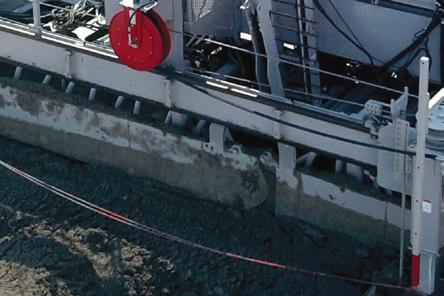

To ensure a smooth ride, the SF-3404 is equipped with what the rm claims is the longest Oscillating Correctional Beam (OCB) on the market. This ensures smoothing of the slab surface after dowel bar insertion. Power Pavers engineered a unique, heavy-duty OCB that is 76cm tall with a 61cm nishing length for full coverage over the dowel insertion void. The OCB corrects any surface imperfections with ease. For transportation, the DBI, OCB, OCB wiper and nal nisher are contained in a single assembly.
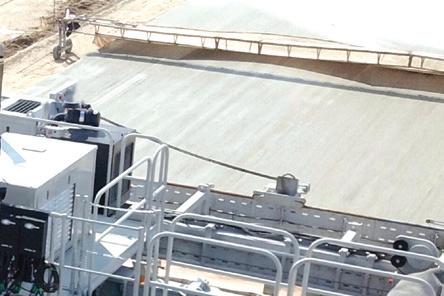
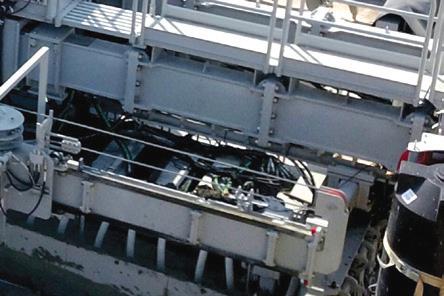
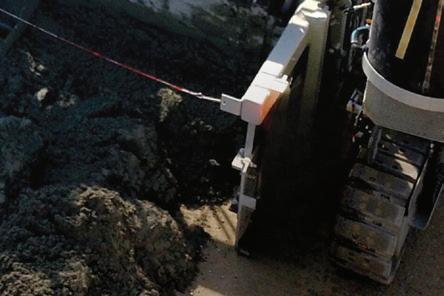
Other important features include a vibrator cruise control that adjusts the machine’s vibrators automatically to maintain consistent speed despite uctuations in oil viscosity or changes in concrete slump. For super-elevations and intersections, an exclusive crown-distance compensation feature provides automated crown transitions between the mold, DBI and OCB.
As with the company's other pavers, the SF-3404 is designed with simplicity in mind. The machine features numerous other details to
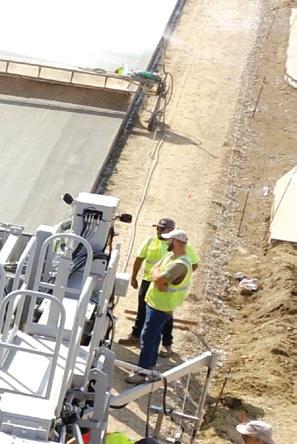
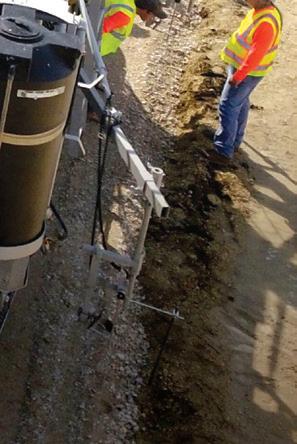
simplify operators, nishers, and mechanics' jobs. It is equipped with Power Pavers’ novel SlipSmart control system for simple, highly con gurable machine controls. All machine diagnostics are onboard, with no laptop required. The new system provides fault codes for everything on the machine, including the DBI. Common bolt sizes and colour-coded wiring throughout the machine keep maintenance simple.
Power Paver www.powercurbers.com


Tell Bau from Norden has been using a new Doosan/Develon DX255NLC excavator to complete a project to protect the island of Norderney on the German North Sea coast.
The project, which lasted about four months, was commissioned by the NLWKN (Lower Saxony Water Management, Coastal Defence and Nature Conservation agency). It called for the reinforcement of the revetment in the east of the island.
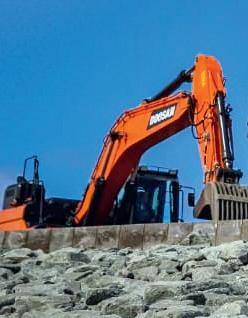
The project required the

old revetment to be dismantled and a new revetment made of hydraulic rubble stone in full grouting to be constructed. At the same time, the asphalt revetment had to be renewed. The DX255NLC was used exibly in various areas. Its tasks included both demolition and earthworks. The excavator was also used to drive sheet piles

into the ground along the full length of the construction section using a Movax SG50V pile driver. In addition, utilising the onboard TopCon 3D system, the excavator produced the dyke shapes required for installation and pro ling of the revetment.
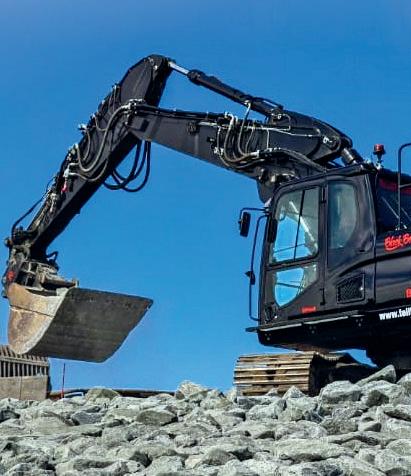
Dipl Ing Andrej Achrameev, Project Manager at Tell Bau, commented: "Due to the diversity of the project, the excavator

had to demonstrate a high degree of exibility in various applications."
The 25tonne class DX255NLC is equipped with the 192kW DL06 engine and o ers a maximum digging depth of 6.81m. The DX255NLC at Tell Bau is tted with a TopCon 3D control system and can be equipped with a Movax SG50P pile driver and a PowerTilt.
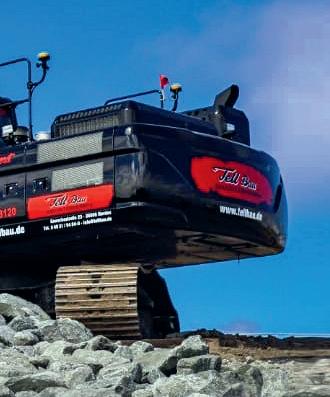
The special feature of this NLC (Narrow Long Crawler) excavator is its transport width of 3m, allowing the machine to be transported with a permanent excess width exemption in Germany. Tell Bau purchased the machine from dealer, Werner Seemann.
Doosan www.eu.doosanequipment.com

A road construction project in Italy is bene ting from the use of a Hyundai midi excavator. The HX145A LCR excavator is being used to construct a major road junction in Tuscany by site management and roadworks construction specialist Berti Sisto from Firenzuola.
Berti Sisto reviewed a series of machines available and opted buy the HX145A LCR excavator from Toscomeccanica, the o cial Hyundai distributor in Tuscany.
The contractor was keen to buy this unit as it already runs a number of other Hyundai machines, such as the HX210A NL, HW 140 excavators both with full optional two-piece booms. In addition to its new HX145A LCR model, currently in use at the Matassino Sr69 Deviation site, the rm is also buying a new HL970A wheeled loader.
He HX145A LCR features a new, short tail swing exterior design, additional safety features and simpli ed maintenance. The machine has been developed to
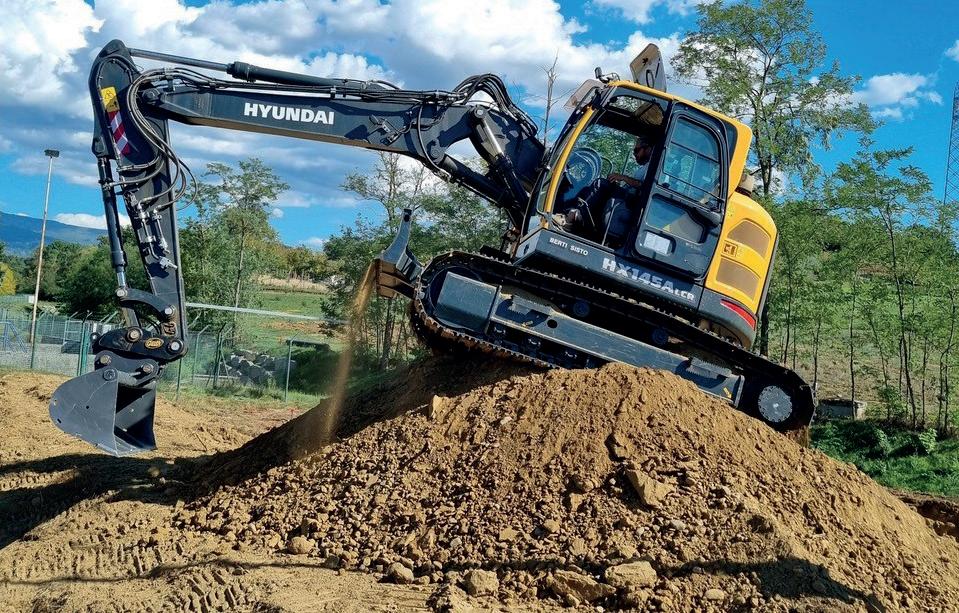
operate in constrained spaces, such as the laying of urban distribution networks and roadworks, o ering productivity and reliability.
The Hyundai excavator has been put to work on the road project of Deviation Sr69 in Matassino, in particular Lot 5, located between the Incisa Valdarno and Matassino motorway exits. The project involves expanding the current route,


including building a new bridge and a new junction. Construction started in 2020 but was temporarily suspended due to the pandemic, resuming in spring 2022. The Hyundai HX145A LCR has been used to dig foundations for the construction of a temporary Bailey bridge needed to bypass the current road network and allow the construction of the new permanent bridge.
The model supplied to Berti Sisto comes with a high speci cation, complete with all optional features. It is equipped with a stabiliser blade, twopiece boom and includes every additional system –the hammerplier system, rotation system and quick coupling. The sophisticated hydraulics are said to o er high precision and the ability to adjust machine movements according to the di ering work requirements of the operator. This model is able to manage more than one working standard in its automatic memory and, at the customer’s request, our support service can calibrate the speed, force and response of the joystick.
Having been put to work at the Matassino construction site, the HX145A LCR excavator has already had an opportunity to display its versatility and e ciency, delivering high productivity.
Hyundai www.hyundai-ce.eu

Enjoy a knowledge programme of over 120 sessions, from debates to demonstrations. 200+ speakers will cover the hottest topics touching on policy support, best practices, user cases, trends and more.
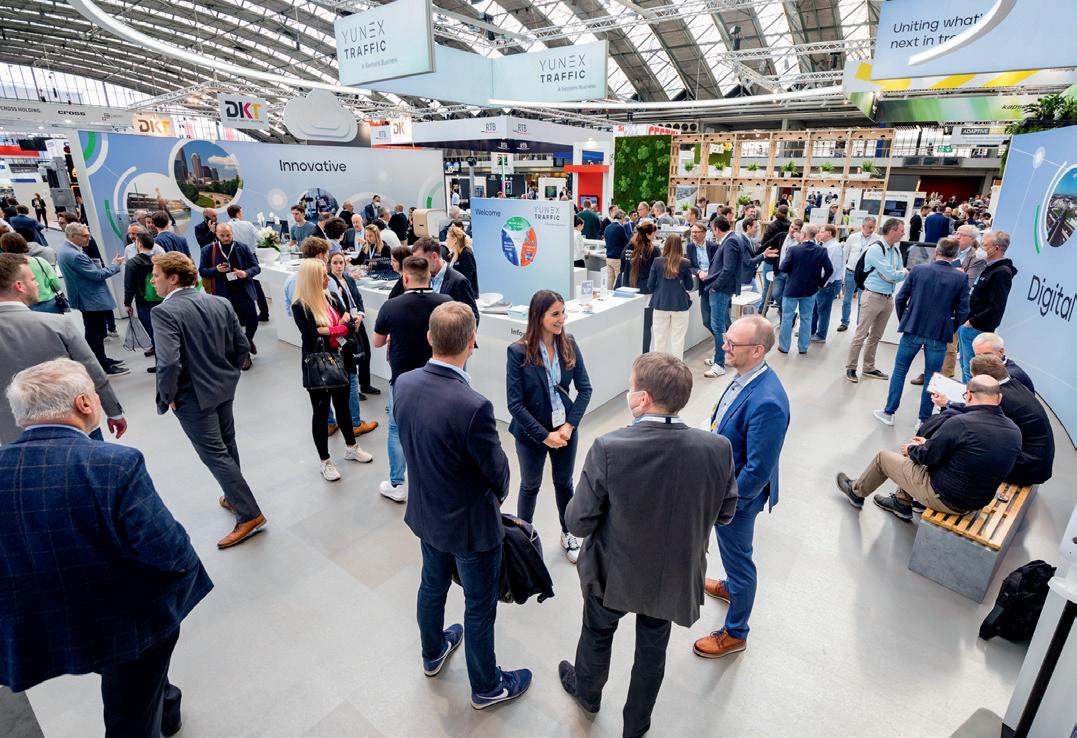

900+ public and private organisations spread over 12 halls will present the latest solutions and developments in mobility and traffic technology. From road safety to parking solutions, intelligent infrastructure, traffic management, smart mobility, and everything in between.