




4. Contraflow
Three controversial tunnel projects are planned for the UK
6. News
Caterpillar, Rolls-Royce Power Systems, Volvo CE and Wacker Neuson reports strong results
10. Technology
B2W boosts scheduling capabilities; pavement management with TRL Software
12. IRF
Abu Dhabi is IRF GRAA winner; IRF 75th anniversary celebrations; online training for autonomous mobility
22. Highway Management & Safety
16. Key project report
On time and on budget, the Preston Western Distributor project in the UK shows how construction partnerships can work

Swarco and Messagemaker in Wales; mobility from NoTraffic; PTV for Paris; DynaWeigh’s new WiM system; Kistler in Luxembourg

26. Connected construction
Technology to optimise construction operations
28. Airport paving
A new airport for Micronesia; Greek island to benefit from new airport
30. Asphalt plants
Ammann’s low emissions strategy; Benningoven’s low carbon systems; Lintec plant for Panama; new ADM technology
34. Concrete
Interview with Power Curbers’ president; Simem’s batching plant; low carbon direction; Wirtgen paves Indian highway; Rapid's latest plant
39. Road recycling
New innovations in road recycling from CAMS, Caterpillar, Simex and Wirtgen
42. Earthmoving
Reducing emissions and boosting efficiency and safety for excavators with Caterpillar, Develon, Komatsu, Link-Belt, Proterra and Volvo CE
45. Utility machines
Electric compact machines from Bobcat, Caterpillar, Hitachi, JCB, John Deere, VF Venieri, Volvo CE and Wacker Neuson; attachment innovations from Allu, Bay Shore Systems, FAE, MB Crusher and Simex
49. Equipment
Charging solutions from Volvo CE; Screencore offers innovative screening
50. Onsite
Resurfacing a UK racetrack; record tunnelling in China with CRCH
Between pages 10 and 11
Moroccan highway development; Lifting in Peru; Powerscreen in UAE; Asphalt plants in Pakistan
UK investment questioned; Hyundai’s lava-loving excavator; Hydrema launches electric dumper












Ringroad plannedfor PortHarcourtin Nigeria Anewringroadisplannedto boosttransportforthecityof PortHarcourtinNigeria’sSouth East.Theprojectisexpectedto costUS$424millionandisbeing managedbytheRiversState Government.Theconstructioncontract fortheprojectwillbehandled byJuliusBerger,Nigeria.The buildingworkisexpectedto takethreeyearstocomplete. Thecontractorhasalready beensuppliedwith75%ofthe











Mike Woof, EDITOR mwoof@ropl.com
Three controversial road tunnel links are in the news in the UK at present, with one already being built and two being planned.
The second TBM drive for the Silvertown Tunnel underneath the River Thames in London has now been completed, with fitting out work now to be carried out. Meanwhile, approval has been given for the A303 Stonehenge Bypass and progress is also being seen for the proposed Lower Thames Crossing to the east of London.
There are concerns over the environmental impact of all three projects. And for the Stonehenge Bypass, there is concern too over the potential for damage to archaeological sites in this historically important area.
But given the massive congestion that occurs at the Blackwall Tunnel, which the Silvertown Tunnel will address, or the Dartford Crossing, which the Lower Thames Crossing will address, will the new links not lower exhaust pollution? The new tunnels will put an end to the massive jams, long queues of stalled traffic and lengthy delays for drivers currently occurring at the Blackwall Tunnel and Dartford Crossing on a daily basis.
In addition, green measures such as the planting of trees will help offset the areas being affected by earthmoving works for the new link roads to be built to connect with the Silvertown Tunnel and Lower
Thames Crossing. Bear in mind that with the gradual switch to EVs, exhaust pollution from vehicles will lessen over time in any case.
Meanwhile, the main section of the Stonehenge Bypass will be a tunnel, running underneath the ground and at a distance from the historically important site.
This new tunnel route will eliminate the current traffic delays and boost safety for residents, while also allowing archaeologists to examine the area around the existing road in safety, with the potential of discovering new sites of interest. It is worth noting that the contractor heading up the Stonehenge Bypass contract, the Italian firm Webuild, has considerable experience of working on projects of archaeological sensitivity. The firm recently built a new highway in Southern Italy, taking extra care not to damage historically important sites dating back to the Roman Empire, as well as the even earlier Greek civilisation. The firm has also managed to construct a new metro station in Rome, directly underneath the famous Colosseum, without risking damage to the structure. While the environmental and archaeological concerns over these tunnel projects are understandable, modern construction works do not have to be as damaging as projects from earlier times. MW











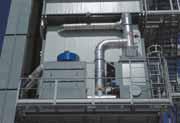

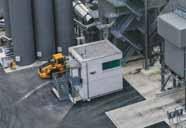

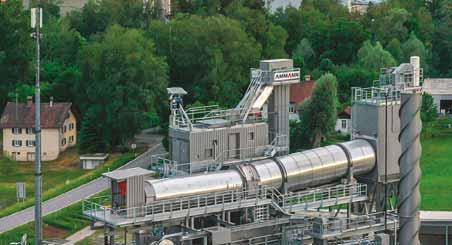
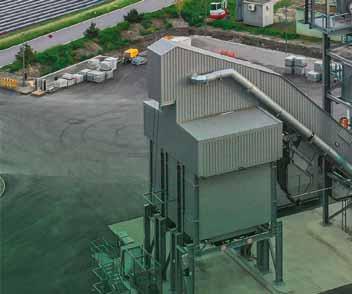

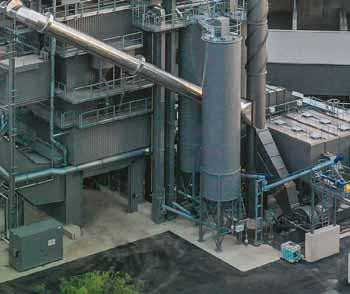


WARM-MIX ASPHALT WITH AMMANN FOAM TECHNOLOGY
HEATING PROCESS
• Highly efficient heat transfer
• No parasite air
• Optimised regulation burner / drum
BURNER
• Various fuels available
• Ideal combustion process
• Optimised energy consumption
USE OF RAP MATERIAL
• Full range of technical solutions
• Additions of RAP up to 100%
• Industry-leading partner in the use of RAP


BST – BLUE SMOKE TREATMENT
• Captures vapours during loading
• Filters trapped fumes
• Removes oil particles
EMISSIONS
• Lowest VOC (TA-Luft)
• Complete dust suppression
• Odour management solutions
• Noise reduction kits
AVOIDING HEAT LOSS
• High insulation up to 200 mm
• No thermal bridges
• Flaps to close the storage silos
• Reduction of wasted material

AS1 CONTROL SYSTEM
• Wide range of modules for software upgrading
• Expert use of inverter
• New professional and ergonomic user interface
• Energy management of photovoltaic systems
• Automatic burner control ADX
olvo CE president Melker







A new bridge will span the Ohio River, linking the US states of Kentucky and Ohio. The work will also include rebuilding stretches of I-71/I-75 in Kentucky and Ohio, with the design portion of the project being headed by Aecom.


Volvo Construction Equipment (Volvo CE) is celebrating quarterly earnings record quarterly earnings alongside its continued investment in sustainable change.
Sales of machines and services rose across all markets except South America and Asia, resulting in a 12% global increase for Q2 2023.
This is despite net order intake decreasing by 41% in global markets, reflecting a weaker market in China, restrictive order slotting in North America and cautiousness among customers and dealers in Europe. Deliveries

also decreased by 24%, primarily due to lower demand in China and a slowdown in Brazil.
Volvo CE is maintaining solid growth during challenging economic times while continuing to lead the industry with investment in a more sustainable future. The second quarter saw the company not only announce the creation of a new dedicated business unit to boost growth across the full value chain of its range of compact solutions, but also continue its global roll-out of electric compact machines, with launch events in Singapore and Tokyo.


Melker Jernberg, president of Volvo CE, said: “Our ability to push innovation across construction with solutions for today and tomorrow, while performing well with continued financial growth and improved profitability will ensure we lead the way for years to come.
“The economic development may be having an effect on the overall construction equipment market, but we are focused on leading a sustainable and profitable transformation for the benefit of our customers, our shareholders and society as a whole.”
Wacker Neuson Group remains on its growth track for the first half of 2023. The firm saw group revenue increase 27.4% in the first half of the year to €1.3659 billion.
The firm saw its EBIT more than double to €176.7 million and EBIT margin rise to 12.9%. The full-year forecast has already been raised with the publication of these preliminary figures for the first half of the year.
The company says that the increase in profitability over 2022 is attributable to the adjustment of selling prices to reflect increases in the cost of materials. However, some bottlenecks for components and the resulting need for rework on machines continue to impact productivity at the plants.
"We continued to develop positively in the second quarter despite the ongoing tense environment. This underlines the fact that we are increasingly succeeding in coping with the numerous challenges we face," explained Dr Karl Tragl, CEO of the Wacker Neuson Group. "Against the backdrop of this positive development, we
raised our full-year guidance in mid-July. Nevertheless, we remain cautious for the second half of the year in order to be able to respond to a potential economic slowdown at any time."
Continued strong demand, particularly in the core markets of Europe and North America, contributed to the significant revenue growth in the first half of the year. In the Europe (EMEA) region, revenue grew by 23.9% to €1.0235 million, compared with €826.3 million for the same period in 2022. In addition to the home market of Germany, revenue growth was also driven by the large European construction machinery market of France. In addition, many Eastern European and Northern European countries also recorded double-digit growth rates. After a weaker development in Southern Europe last year, there was a noticeable increase in demand here in the first half of 2023. By contrast, the market in the UK, which was still characterised by double-digit growth rates in 2022, showed restrained development. On the product side, demand remained high, particularly for wheeled loaders and telehandlers.
The centrepiece of the US$3.6 billion project will be the construction of a new bridge in parallel with the existing Brent Spence Bridge. The work includes upgrading the complex interchange geometry, boosting capacity, and improving the interstate link between Kentucky and Ohio. The construction work will be carried out by a joint venture team comprising Kokosing and Walsh Construction. Around 1.6km of the I-71/I-75 route in Ohio will be rebuilt along with 8km of the I-71/I-75 route in Kentucky. Financing worth $1.6 billion is being provided by a federal source, the Infrastructure Investment and Jobs Act.
The new bridge will improve traffic flow for both regional and national travellers. In addition, multiple projects along the 13km I-71/75 corridor on either end of the Brent Spence Bridge will be carried out to improve travel and safety.





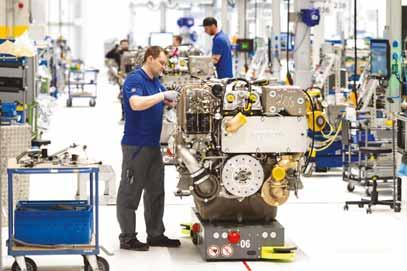
The Rolls-Royce Power Systems Business Unit reports strong financial performance for the first half of 2023. The firm saw revenue increase by 24% for the period compared with 2022, which was helped by a transformation of its operations.
Rolls-Royce Group says that this reflects end-market growth, with a robust order intake as demand for mtu products and solutions remains strong.
The underlying sales for the Power Systems business unit increased to £1.8 billion (€2 billion) in the first half of 2023. The order cover for 2023 and 2024 is at record levels.
"This significant sales growth in the often not so strong first half of the year is a success of our efforts to leverage existing
potential and improve the performance of our business," said Dr Jörg Stratmann, CEO of RollsRoyce Power Systems. Operating
Caterpillar is reporting strong results for the second quarter of 2023, with revenue increasing 22% to US$17.3 billion.
The 22% increase compared well with the $14.2 billion recorded in the second quarter of 2022. The firm explains that the increase was primarily due to higher sales volume and favourable price realisation.

For the first half of 2023, enterprise operating cash flow was $4.8 billion, and the company ended the second quarter with $7.4 billion of enterprise cash. In the quarter, the company repurchased
profit remained roughly the same at £125 million (€143 million). Services revenues were up 10% reflecting increased end
$1.4 billion of Caterpillar common stock and paid dividends of $0.6 billion.
“I’m proud of our global team’s strong operational performance in the second quarter. Our results reflect continued healthy demand as we achieved double-digit top-line growth and record adjusted profit per share while generating strong ME&T free cash flow,” said Jim Umpleby, chairman and CEO. “Our team remains committed to serving our customers, executing our strategy and continuing to invest for long-term profitable growth.”


market activity. OE revenue grew by 33%, driven by strong order execution for stationary power generating equipment and continued strong sales of mobile power solutions. Operating profit was £125 million (€143 million) with a 7.0% margin. For the remainder of the year as a whole, the Power Systems business anticipates a positive development with an improvement in the operating margin due to the impact of pricing actions, cost efficiencies and seasonally higher volumes.
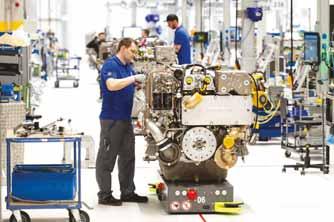
Rolls-Royce is opening its new €30 million facility in Germany making mtu engines. The new combustion engine assembly plant is a production facility for the mtu 2000 series engines. It is located in Kluftern on Lake Constance, Germany.
The project to expand Virginia’s Hampton Roads Bridge-Tunnel (HRBT) link is delayed by 12 months according to the Virginia Department of Transportation (VDOT). Around 110m of the tunnel has been driven so far while the bridge links are also being built at present.
VDOT says that the HRBT expansion is the largest highway construction project in Virginia’s history. This project involves widening the current four-lane segments along 16km of the I-64 corridor in Norfolk and Hampton, as well as building new twin tunnels underneath the harbour. The work will boost capacity, addressing the congestion problems that occur at peak travel times and will cut journey times for drivers. The project has a total budget of over US$3.9 billion, making it one of the largest infrastructure projects in the US.
The work involves widening the route from two lanes in either direction at present to four lanes in either direction.
Together, Dynapac and Skanska brought all their combined expertise and engineering passion to the table for the development of the Z.ERA CC900 e tandem vibratory roller. Two years and zero emissions later, we had a look at how it has been received by Skanska personnel.
Dynapac’s commitment to developing electrically powered machines already goes back over a decade. With the new Z.ERA CC900 e, the journey towards a zero-emission construction site has been taken one step further. Developed in cooperation with the global contractor Skanska, the Z.ERA CC900 e provides all the power and reliability of conventional tandem rollers while offering contractors and operators the numerous advantages of new mobility systems.
As the latest model in its zeroemission roller portfolio, the Z.ERA CC900 e offers optimal and reliable power combined with fast and convenient charging. This was put to the test during its deployment
City of Perry
with Skanska workers during their comprehensive use of the machine. Charging was effortless and quickly done in several public and easy-to-reach locations such as gas stations and local charging ports. Skanska workers were also impressed with its power which they reported was equal to that of its diesel cousin with no differences in compaction end results. This included the long operational time thanks to its powerful battery as well as the convenient loading and unloading of the machine.
“The battery lasts longer than expected. We didn't think it would perform that long before it ran out. And we really pushed it to its limits last winter. Then we compacted almost 100tonnes but only needed to charge it while having lunch basically. We think it's fantastic.” - Skanska operator.
The Z.ERA CC900 e weighs in at 1.7tonnes and has an operating width of 0.9m. Its double-drum vibratory roller has been designed to satisfy the specific demands of both utility contractors and rental fleet operators while delivering

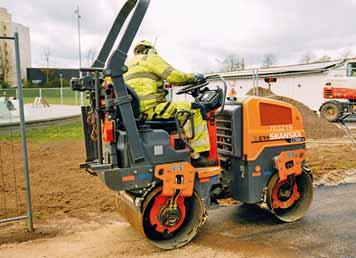
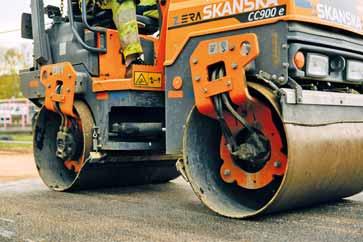
the same linear load, amplitude, frequency, and travel speed as the diesel-powered model it is based on. Aside from its zero-emission performance, the Z.ERA CC900 e offers greatly reduced noise levels and maintenance checks resulting from its battery-powered operation. Its user-friendliness and easy operations were especially appreciated. These aspects and
more made the Z.ERA CC900 e a popular choice at Skanska for a number of jobs. Dynapac and Skanska are happy to be setting new performance and sustainability standards with the Z.ERA CC900 e and look forward to a cleaner and more productive future.
with Foth, creating a digitally mapped city using digital twins
The City of Perry hired Foth to evaluate street and sidewalk conditions using mobile LiDAR scanning to improve access for citizens. The project quickly morphed into a citywide digital twin project to support the city’s capital improvement plan (CIP), presenting technical challenges for digitising over 60 miles of streets and 10 miles of alleyways.
Foth needed integrated technology to process voluminous geospatial data, aerial images, and point clouds, and provide digital accessibility to multiple stakeholders.

Leveraging Bentley’s open modeling applications, Foth developed an optimal plan to deliver the digital twin, saving significant time and potential rework. The digital twin provides potential investors with a portfolio of data about historical structures, making them more inclined to invest in Perry and helping increase private investor engagement by 50% over the next five years. Having a digital twin enables Perry to gain support and enact its CIP 60% faster, increasing its ability to secure city funding by 75%.










B2W Software has added extensive new alerts and notifications capabilities in the current release of its B2W Platform. The new features let contractors communicate automatically and in real time across the office, field and shop for further efficiency in resource scheduling, field performance tracking and equipment maintenance workflows.
The firm says that immediate alerts and notifications are emerging as important options for getting information into the hands of people that need it, when they need it. More than two dozen actions taken in the B2W Schedule, B2W Track and B2W Maintain applications can now trigger immediate messages delivered to selected recipients by text message or email. These actions range from creation of resource assignments and maintenance requests to submission, approval or rejection of field logs and mechanic timecards.
The B2W Track application for field performance tracking and analysis can now trigger alerts and notifications when field logs (for crews) or work logs (for individual employees) are created, submitted, approved, rejected or transferred. B2W Maintain users can now generate and manage messages indicating
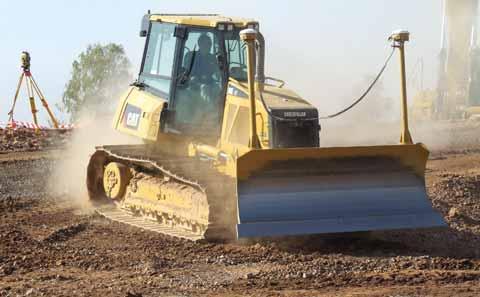

Notifications regarding new or changed personnel assignments, equipment moves or material deliveries can be sent to employees or external recipients with the B2W Schedule application for resource scheduling and dispatching. The May 2023 update includes enhancements for reviewing these notifications and for communicating acceptance, rejection or completion of the activities initiated by the alerts
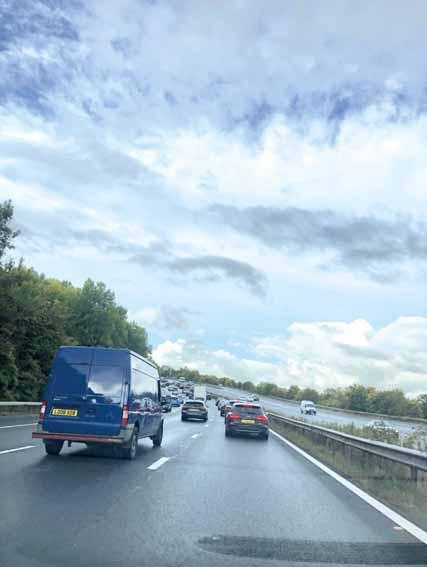
The B2W platform approach gives contractors advantages in extending realts of alerts and notifications across ows without overwhelming recipients with too much data or conflicting data.
The B2W Platform includes applications to manage estimating, resource scheduling and dispatching, performance tracking, equipment maintenance and electronic forms and reporting as well as clock in/out and geolocation capabilities for individual performance tracking within the B2W Employee App. They also include the ability to accept, reject or complete assignments for equipment moves and materials deliveries in B2W Schedule and enhanced purchase order and inventory management features within B2W Maintain. B 2
are has rolled out a new digital pavement asset management system for ays (NH) called P-AMS. The AMS system is customised for NH is a version of TRL Soft ware's cloud-based digital which is a commercially -shelf platform designed for various infrastructure assets.
And TRL Software’s Road Asset Management Software iROADS has been updated to include a groundbreaking Open Developer Portal. This state-of-the-art platform enables third-party developers and consumers to access client data through standard Open APIs, driving innovation, creating new data products and services, and unlocking data from silos.
Using iROADS as the new digital asset management system allows TRL to deliver a ective, user-friendly platform, with fully customised specifications. P-AMS forms part of NH’s Asset Management Transformation and will help to support the delivery of its Digital Roads Strategy, creating more efficient ways of
working through improved digital integration. The new system was developed to align with its emerging Asset Management System Strategy (AMSS). AMSS compliance will ensure the new system supports cross-asset data access and analysis, and the company’s new data model.
The road pavement is an essential part of the UK’s national network, over 7,250km in length and worth over £82 billion, the information stored in P-AMS is critical for informing decisions around future requirements.
Using P-AMS iROADS provides quicker and simpler access to insights about the road network, improving day-to-day decisionmaking and reducing time wasted trying to get hold of data. This leads to accelerated strategic decisions, allowing for improved operational efficiency, accurate forecasting, and quantifiable decisions for the National Highways team.
TRL
Moroccan highway development; Ring road for Port Harcourt; Nepal road repairs



Self-sufficiency; Open day; Lifting in Peru



Efficient lifting; Crane supply deal; Powerscreen in UAE



Asphalt plants in Pakistan; New facility in Indonesia; Training ground
A new ring road is planned to boost transport for the city of Port Harcourt in Nigeria’s South East. The project is expected to cost US$424 million and is being managed by the Rivers State Government.




A 10% drop in road deaths has been identified in the UAE for 2022 compared with 2021. There were 343 fatalities from road crashes in the UAE during 2022 according to the data from the UAE's Ministry of Interior (MoI). However, there was an increase in the number of serious road crashes which grew 13% to

3.945 compared with 2021. Young drivers aged under 30 represented 41% of those killed and 53% of those injured. Key factors involved in crashes in the UAE included distracted driving, driving too close to the vehicle in front, DUI, careless driving and sudden swerves.




Rural roads in Nepal will be maintained and upgraded following the provision of a loan worth US$100 million from the Asian Development Bank (ADB). This will be used for Nepal’s Rural Connectivity Improvement Project.
Road connections will be upgraded for 16 districts in five provinces via the Rural Connectivity Improvement Project. The financing will improve 324km of roads, with upgrades including better road safety features and new surfaces.



The construction contract for the project will be handled by Julius Berger, Nigeria. The building work is expected to take three years to complete. The contractor has already been supplied with 75% of the necessary funds to carry out the work so as to expedite its progress.
Also in the South East Nigeria road maintenance and improvement projects will be carried out in Abia State. A substantial portion of the funding for the work is being provided by the African Development Bank (AfDB) in the shape of a $115 million loan.


The work is costing $264 million in total and will see 58km of roads being improved in Umuahia and 190.5km of roads being improved in Aba. The work is due for completion in 2029.





The World Bank has secured funding worth US$330 million for road upgrade work in Cameroon. This will be used for improvements to the 205km road that connects Kousseri and Maroua in the north of the country.



The work will help improve the economy in this less developed area of Cameroon, as well as boosting trade with neighbouring Chad as Kousseri lies on the border with the country and is close to its capital, N’Djamena. Kousseri is also close to Cameroon’s border with Nigeria and that country’s busy northern city, Maidugri.
The finance package secured via the World Bank comprises a credit worth $280 million as well as a grant worth $50 million. This last has been provided by the International Development Association (IDA) Window for Host Communities and Refugees (WHR), the concessional window of the World Bank.
Improvement work is being carried out on a 40km road section in Gabon. The road being improved is the 163km link connecting Medouneu in the north of the country with Kououleu. The road maintenance and upgrade work is expected to take 6 months to complete and is being carried out by the local subsidiary of international contractor Colas.

A record breaking, innovative smart parking facility is being constructed in Shanghai with help from radical equipment developed by CRCHI. The firm says that it has provided the world's largest shaft boring machine (SBM) for the construction of the underground smart parking garage in Shanghai.
This impressive vertical tunnelling machine weighs in at 230tonnes and has a diameter of 23.02m, with a height of 10m. Called the Dream, the SBM was launched at the underground smart parking garage project in Jing'an District, Shanghai, where it recently descended to the bottom of the foundation pit.
The SBM integrates the excavation, slagging, support and guidance functions for the construction of super-large diameter shafts in soft soil and soft rock strata. The smart parking garage in Jing'an District of Shanghai covers an area of only 286m2.
Construction of underground smart parking garages is becoming more common around the world. The use of a massive SBM makes this sort of project quicker and more efficient. SBMs
with diameters of 13m and 14m have been used for various works in the past but this is the first time that an extra-large diameter SBM has been developed with a diameter of more than 15m.
To meet the needs of this large diameter excavation, the CRCHI team developed a complete package of mechanical shaft equipment.
The firm says that it has solved the control problems for conventional shafting methods. The firm’s massive Dream machine can now save construction costs by more than 50% and making construction operations safer according to CRCHI.
The underground smart parking garage in Shanghai Jing'an District covers an area of 286ms on the ground and a total of 1,408m2 underground as it features 19 floors. It is planned to build two deep foundation shafts with a diameter of 23m and a burial depth of 53m. Each shaft has 152 mechanical parking spaces, and the ground is for the garage access floor and equipment room. The parking garage will become the underground smart parking garage with the world's largest diameter vertical tunnelling once complete.

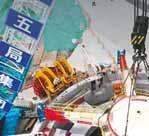




Morocco continues to invest in developing its highway network.
The highway connecting Casablanca with Berrechid will benefit from further development and there will be an improved link between the Nador-Al Aroui international airport and the Nador West Med port in the north of the country.
Also underway is work for the highway linking Nador with Guercif as well as widening work for the busy 60km link between the country’s capital, Rabat, and Casablanca, intended to cut congestion and reduce journey times.






Construction of a new road link is being planned for Burkina Faso.

The road will be built by the Chinese firm China Civil Engineering Construction Corporation (CCECC). The 332.5km road connection will be of major importance for Burkina Faso, which is landlocked. The road will connect capital Ouagadougou with the country’s second city, BoboDioulasso. This new road connection will also form part of the route linking with neighbouring Côte d'Ivoire. It will provide an improved connection between Yamoussoukro, the capital of Côte d'Ivoire, and Ouagadougou.


Burkina Faso’s economy will benefit from a muchneeded boost with the completion of this road link.






















Public protests are continuing at the project site for the construction of the new Manohar International Airport project at Mopa in Goa, India. The new facility will be the second international airport for the Indian state of Goa.
Local farmers have been protesting for some time about the loss of their land, with the complaints focussing on the inadequacy of compensation measures. One of the most recent protests by farmers has been for the loss of land to the project building the new road link to the airport. Farmers were arrested for blocking access to the site to those involved in building the new link road.
Meanwhile another dispute over poor safety at the site saw an all-terrain crane belonging to local firm Gandhi Cranes being burned out. Flights commenced from the airport in January 2023, later than originally planned as the project was delayed by the COVID-19 pandemic. However, development work at the site continues.




Road safety is improving in Ho Chi Minh City (HCMC) according to the latest official figures.

The HCMC police have revealed that there were 779 crashes in the city in the first six months of 2023. The incidence of serious crashes fell by 40% according to the HCMC police, with 294 fatalities, a reduction of 36 deaths from the same period in the previous year. Injuries dropped by 198 to 470 for



the same period. The fact that road safety has improved in HCMC is of note. Vietnam has introduced tougher penalties for driving infractions in recent years, as well as increasing enforcement. Vietnam has managed to improve road safety significantly, a major gain over its neighbours in Asia that are still seeing road crashes and road deaths increase.
The tender process is being planned in Brazil’s Minas Gerais State for the BR-381/ MG highway.
The tender is being handled by the Minas Gerais State Government. The winner for the 30-year concession will be announced towards the end of 2023. The work will see an
estimated US$1.98 billion being spent on the route. The concession package was approved by Brazil’s National Land Transport Agency (ANTT).
This stretch of the BR-381 connects the cities of Belo Horizonte and Governador Valadares. The project will involve widening the route and building



A US$428 million loan facility from the UK Export Finance (UKEF) will help pay for road improvement works as well as the upgrade of the Pemba Airport. The loan was agreed between UKEF and Tanzania's Finance and Planning Ministry. New roads will be built in Unguja and Pemba. Key works will be for the 48km road linking Tunguu and Makudunchi, the 12km road between Kisauni and Fumba and the 43.5km route connecting Mkoani with Chake Chake Pemba.

additional lanes along a 134km stretch as well as feeder roads, pedestrian crossings, bus stops, wildlife crossings and changes to the alignment.
The safety improvements the upgrade work will deliver should also help reduce the incidence of crashes and cut casualties on the route.










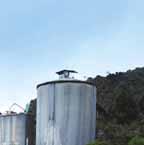


Colombia's Santa Rosa cement plant is now the first Cemex facility in its South, Central America and the Caribbean (SCAC) region to attain water self-sufficiency.
The plant independently meets its water requirements using a 9,000m3 reservoir, constantly replenished due to rainwater, runoff, and water circulation devices. The



move aligns with the company's Water Management Roadmap, a critical facet within the Future in Action programme. The achievement takes Cemex closer to its 2030 target of reducing freshwater consumption in cement operations by 20%.

A new Grove GMK3060L-1 all-terrain crane has been carrying out challenging jobs and delivering excellent performance at an extraction operation in the south of Peru for over a year. Because of its long reach, high capacity, and compact size, the crane has been performing difficult lifts in constrained spaces, handling jobs that previously had to be outsourced.
The new owner said that work with this crane can be done much faster when compared to the previous model the facility was using. This GMK3060L-1 belongs to the new generation of the Grove line and was one of the first of these models to be shipped from the factory.
HD Hyundai Infracore Chile (HDIC) recently held a successful open day event at its facilities in Santiago. DEVELON is the new name for Doosan Construction Equipment and the brand aims to continue to provide a higher level of technological development in the market while maintaining competitive prices.


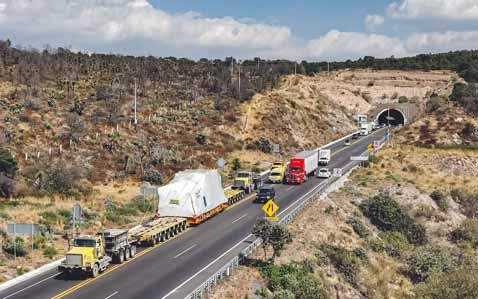
Trailers from Goldhofer have played an important role in transporting heavy item in Mexico. Using the trailers, PESADO Transport was able to deliver heavy components a distance of 430km.
PESADO Transport used a 16 axle Goldhofer THP/SL heavy-duty combination to deliver a 218tonne piece of equipment from the port in Veracruz to Tula. The route was challenging, passing six toll plazas, numerous bridges and tunnels to be negotiated with a rig with an overall traveling height of around 5.6m. The PESADO team decided to use a dropdeck to transport the 218tonne piece of equipment, which was 14.8m long, 5.3m wide and 5.17m high. The equipment selected was
a 16 axle heavy-duty module combination including a dropdeck with a payload of up to 300tonnes and deck extensions for a length of 15m.
The combination, which was around 65 m long and had an overall weight of 385tonnes, was operated as push-pull tractor trailer rig with two Western Star heavy-duty tractors. The convoy, with an overall width of 5.3m and a total height of 5.6m was able to find its way along the roads of Mexico without problems and the heavy load was delivered to the client successfully.
Customers from the mining and construction industries attended the event. Their fleets cover a wide range of equipment and attachments, including 25, 30 and 36tonne excavators, 2.7-3.5tonne mini excavators, and new DB100 backhoe loaders.
The firm explained that it wanted to explain to customers that DEVELON replaces Doosan with the same technology and quality, maintaining prices, closeness, fast service speed and availability of spare parts. The company said that HDIC's construction equipment sales department had experienced growth in this market in the last five years, and the service department had been providing increased support to meet high demand.








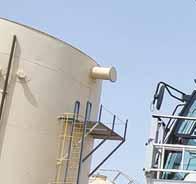
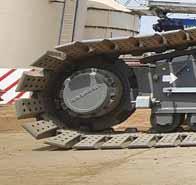
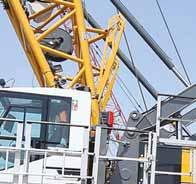
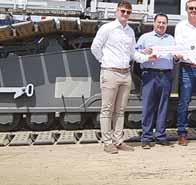
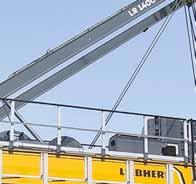
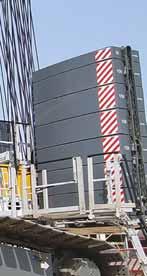


Al Jazeera Shipping Co WLL recently extended its fleet with Liebherr’s brand new LR 1400 SX crawler crane.
The company is one of the largest marine operators in the Gulf region with a fleet of over 150 units consisting of various sizes and types of tugs, barges and other equipment. The activities of the company
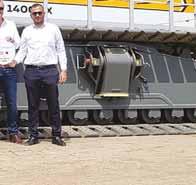

include chartering tugboats, supply boats, accommodation and work barges, as well as leasing offshore construction equipment. The company also has its own marine fabricating yard to carry out the associated repair and maintenance jobs. It covers an area of over 80,000 square metres with 300 metres water frontage and is adjacent to
Powerscreen has appointed Al Marwan as its authorised distributor for the United Arab Emirates (UAE). Al Marwan will provide full coverage in the territory including Powerscreen machine sales, genuine spare parts, and service support. Al Marwan recently expanded its operations in the Middle East by opening new branches in Saudi Arabia and Oman, as well as recently launching its new e-commerce website (almarwan.com) for the sale and rental of new and pre-owned machinery. The website acts as a comprehensive portal for customers looking to
Two Grove GMK4100L-2 all-terrain cranes have been added to Galfar Al Misnad’s fleet in Qatar. Both cranes were ordered through local dealer Mannai Trading and the first of the cranes has been delivered and will be deployed on a major project in Qatar.
Galfar Al Misnad is a leading construction company in Qatar and has been using Grove cranes for over 18 years, with its fleet already featuring an array of all-terrain and rough-
the Mina Salman Port area. Back in early 2022, the firm decided to renew one of its older generation crawler cranes. The company looked at various models and decided that the 400tonne LR 1400 SX from Liebherr best met its needs. The machine’s load curve and safety ratings were factors in the decision, as well as the machine’s short assembly time, its

buy or rent equipment, in addition to providing access to a range of machinery services, including maintenance and finance. With a large fleet of new and pre-owned machinery available for sale, Al Marwan is the authorised dealer for several global manufacturing brands. The company operates one of the largest rental operations in the Middle East, spanning excavators, dozers, trucks, and loaders in all sizes.

preselection feature of individually customised load charts and its capability to preselect barge inclinations, automatically applying the permitted load curve. The LR 1400 SX has now been commissioned and will be working on several projects for the firm.
Liebherr www.liebherr com


terrain cranes. After handover, the crane began its journey to Galfar Al Misnad’s newly-built plant and equipment workshop in Doha, Qatar, before deployment on its first job at Ras Laffan. The second GMK4100L-2 from the order will also be sent to the same project once it reaches Qatar.
The GMK4100L-2 all-terrain crane is a fouraxle, 100tonne capacity crane that delivers both compact size and power. It has a width of only 2.55m and MEGATRAK suspension, allowing it


to manoeuvre into position on jobsites. It is also capable of carrying 6.8tonnes of counterweight in its taxi configuration, with overall vehicle weight at 12tonnes/axle. The crane is designed for efficiency, with low fuel consumption and the capability to run entirely on HVO fuel. A 60m main boom offers a 16m swingaway jib for further reach.
Asphalt plant technology from Lintec has been playing an important role in road construction in Pakistan.
A contractor, Power China, has been using two CSM containerised asphalt mixing plants on a 1,152 km road project in Pakistan where temperatures frequently rose above 40°C.
The plants’ consistent output was beneficial for a project that is helping slash travel time from Sukkur to Multan by two-thirds. The new road connection is helping to improve local transport by opening up central Pakistan’s north-south traffic arteries.
Lintec & Linnhoff China sold two Lintec CSM4000 containerised asphalt mixing plants to established customer PowerChina Group to support the construction of the 392km M-5 section of the Peshawar-Karachi Motorway (PKM). This is the country’s longest motorway, which connects Sukkur, in Sindh Province, and Multan, in Punjab.
Both plants produced over 600,000 tonnes of hot mix asphalt by the time the project was completed in late 2019, 13 days ahead of the 36-month schedule.
During the construction of this project, there was a heavy demand on the rapid assembly and disassembly capabilities of the asphalt mixing plants, as well as their mobility. The mobility of Lintec’s CSM range was beneficial, with the shipping container design



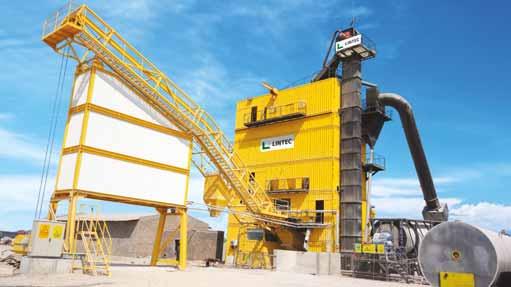
making transport easier and removing the need for concrete foundations. The two Lintec CSM4000 plants produced over 600,000tonnes of hot mix asphalt for the longest motorway project which connects Sukkur, in Sindh Province, and Multan, in Punjab.
The units performed reliably despite local temperatures passing 40°C. To adapt to the extreme environment and heavy workloads, the project adopted a new standard of rutting




resistance asphalt for the road surface, capable of withstanding high temperatures up to 80°C. Due to the batching accuracy of the CSM4000 AMPs, this mix was delivered with consistency, ensuring material quality for the surface and providing resistance against flooding.
Lintec & Linnhoff www.lintec-linnhoff.com
HD Hyundai Infracore has opened a new business entity (Hyundai Infracore Asia - HDIA) and Parts Distribution Center (PDC) in Indonesia to expand growth and increase presence in the Asian market with its new construction equipment brand, DEVELON.



HD Hyundai Infracore held an opening ceremony for Hyundai Infracore Asia and the PDC in Jakarta, Indonesia. The company is looking to provide financial products for purchasing DEVELON construction equipment. Through this agreement, customers will be able to use instalment finance products with low interest rates. This opening ceremony provides
an opportunity for HDI to widen its sales network and distribution supply in the region, including Indonesia and to expand the company’s business by creating different financial products that meet the needs of local customers through partnerships with related services. The newly opened PDC is 2304m2 in size and located in Marunda, in the northern part of Jakarta. It will act as a distribution hub which will secure and swiftly supply parts for excavators, wheel loaders and other machines.
HD Hyundai Infracore
www.hyundai-di com
Manitowoc has a new regional training facility for crane technicians across Asia based in Singapore. This facility is said to be delivering success and ensures attendees keep up with the latest models and technologies, delivering onsite efficiency in one of the world’s busiest crane markets.
Operators across Asia are busy, meaning that cranes require even more care and attention. Manitowoc says that the training facility at its regional headquarters in Singapore will provide greater support, helping owners take on more work and avoid delays or penalties.
The new centre provides both inperson and online training courses on a weekly basis. The courses generally last five days and are designed to offer in-depth immersion in procedures and techniques for the upkeep of Grove, Potain, or Manitowoc cranes.




UK investment questioned; Norway funding





Hyundai’s lava-loving excavator; Hydraulic trials on Volvo excavators
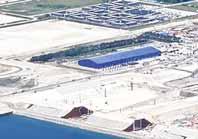
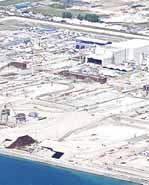
Sund & Bælt has completed the environmental impact assessment of the tunnel element factory east of Rødbyhavn on Denmark’s Lolland island in the Baltic Sea.
The assessment by the Danish infrastructure company will form the basis for a political decision on whether to preserve the tunnel element plant where tunnel sections will be fabricated for the 18km Fehmarnbelt immersed tunnel between Lolland and the German island of Fehmarn. The sections will be floated out from the factory to be positioned and lowered into place on the seabed.
Originally, the element plant at Rødbyhavn was to be temporary and dismantled after the elements had been made. However, Denmark’s Infrastructure Plan 2035 set out a proposal to consider the factory being made permanent as a base for future
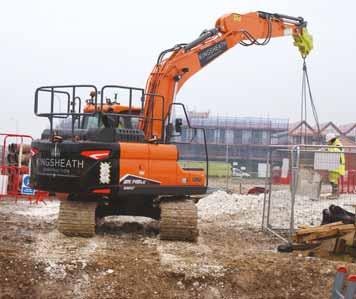
Hydrema launches electric dumper; A Develon 10 for Kingsheath

infrastructure work in the area and region in general.
The factory complex – still under construction – will include a protected seaport, access roads, supply chain facilities and office-administrative buildings.
Sund & Bælt noted that there are many economic and environmental advantages for making the site permanent, not least that it will preserve jobs.
The factory could manufacture other elements for future public mega-infrastructure projects requiring large scale production and shipping facilities. It could also help produce and ship elements for the large expansion of wind energy farms that is essential for Denmark’s ambition of climate neutrality by 2050.
Meanwhile, Femern – wholly owned by Sund & Bælt and responsible for the Fehmarnbelt project – has launched a website

that can assist the many cargo ships calling at the work harbours of the Fehmarnbelt project, one in Denmark and the other in Germany. The new harbour website include requirements for port calls, port layout and information about the tunnel construction and shipping traffic in the Fehmarnbelt.The website will later include weather information and a webcam, allowing commercial vessels to orient themselves before arrival. The Danish work harbour is in operation and receives on average one cargo ship every three days.
Femern is a subsidiary of Sund & Bælt Holdings, which is 100% owned by the Danish Ministry of Transport. Sund & Bælt Holding is also the parent company of Storebælt, which operates the Great Belt Fixed Link and Øresund, which operates the Øresund Fixed Link.
Italian consortium Storstrøm Bridge Joint Venture has proposed a 27-month extension and an additional €454 million (US$502 million) for completion of Denmark’s new Storstrøm Bridge.
The original estimated cost was around €280 million for the 4km-long 26m-wide singlesupport cable-stay structure when the contract was awarded by the Danish Road Directorate (Vejdirektoratet) in 2018. But delays to construction start caused by Covid and other cost increases has gradually pushed up the price of the new structure that run nearby to the exiting Storstrøm Bridge.
The main contractors in the Italian Storstrøm Bridge Joint Venture are Itinera, Grandi Lavori Fincosit and Condotte. The new double-track road and railway bridge includes a central cable-stayed bridge with two spans, 320m long and two access viaducts with 44 spans of 80m, for a total length of nearly 4km. It will have an electrified two-track railway for trains running at 200km/h and a two-lane road with a speed limit of 80km/h. The bridge will also have a foot and cycle paths.
Im










More money for pothole repairs and fewer expensive big road projects should be the priority of England’s National Highways agency, according to a just-published report.
That’s the main finding of report by a group of UK politicians, the House of Commons Transport Committee, which reviewed the strategy of National Highways, the arms-length agency responsible for the Strategic Road Network of England. The SRN covers motorways and other major mostly dual-carriageways in England; other agencies are responsible for similar networks in Scotland, Wales and Northern Ireland.
The committee report, called Strategic Road Investment, noted that the government has identified the SRN as a key driver of economic growth and productivity. “However, the extent to which further investment in the [road] network would help to boost growth, in comparison to investment in other modes of transport and connectivity, is contested.”
To that end, “there has been a consistent theme of overly ambitious portfolio planning, and National Highways has overspent and underdelivered”. The report recommended that
the government cancel some major new road construction projects and prioritise better maintenance of the existing network. Such projects that it said should be abandoned or scaled back are the planned Stonehenge Tunnel and the Lower Thames Crossing near London and the money earmarked for more resurfacing of existing local and national roads.
The focus of the rolling five-year plans called Road Investment Strategies should focus on maintenance and renewal. “The existing strategic road network is ageing and requires significant renewal work in places, while many users want to see better day-to-day maintenance and upkeep of the network,” the report said.
“Future investment should be focused on renewing older parts of the SRN and ensuring that resources are available to run the network in a way which better meets the needs of the drivers and industries that rely on it.” For this to happen, the report said future Road Investment Strategies “should prioritise investment in the maintenance, renewal and resilience of existing assets over brand new projects.”
The current Road Investment Strategy is RIS
In a revised national budget, the Nor wegian government and the Socialist Left Party have agreed on the government's proposal for investments in road maintenance.
Heikki Eidsvoll Holmås, chief executive of Norway’s construction and civil engineering association EBA, says the €103 million allocated means the level of road maintenance of
national roads is high enough to not increase the need for maintenance. EBA also hopes that in the next state budget similar funding will be allocated for the maintenance of railways and county roads.
According to a recent report by the Office of the Auditor General (Riksrevisjonen), despite more road maintenance,



2, where from 2020 to 2025 the government has earmarked around £27.4 billion – US$35.12 billion – to be spent on the SRN. According to the document, published in early 2020, the average number of vehicles passing a point on a typical stretch of SRN road within 24 hours is 57,500. For all other local roads combined it is around 2,750.
National Highways already is consulting road user groups and the construction sector for RIS 3 which has an emphasis on carbon reduction as well as on maintenance and delivery of existing projects.
Marie-Claude Hemming, director of operations for the UK’s Civil Engineering Contractors Association, CECA, is on record as welcoming the emphasis on carbon reduction. But she has also warned of the economic climate and inflation that could make bigger projects harder to complete efficiently.
Her comments come as National Highways has had to cancel some contracts over cost concerns.
RIS 3 will be published in late 2025 or early 2026 and soon after must be approved by the UK Parliament.
highways are no safer nor more environmentally friendly than before.
The report from the said maintenance of the country's roads has increased significantly in the past few years but improvements have been few and far between.
Meanwhile, a consortium of Metrostav Norway and Bertelsen
& Garpestad have won the main contract for a section of the E8 highway between Sørbotn and Laukslett.
The project includes 10km of new road, an 870m-long bridge across the Ram Fjord as well as several smaller bridges. Construction is expected to start at the beginning of next year and end in July 2026.
The new Braila Bridge over the Danube River in Romania bridge on continental Europe opened in July.
The bridge was built by Webuild in an international joint-venture with Japanese partner IHI Infrastructure Systems for Romania’s national highway agency CNAIR. It crosses the Danube in the Galati-Braila region and will drastically reduce crossing times for around 7,000 vehicles that have been using a ferry service daily.
The main deck span is 1,120m long, two side spans of nearly 490m and emergency lanes as well as cycling and pedestrian paths. The twin towers stand 192m for a clearance to the water of 38m.
The bridge is the same type of structure as the proposed bridge over the Strait of Messina - which would be longer by more than half – connecting Sicily with the southern Italian mainland.
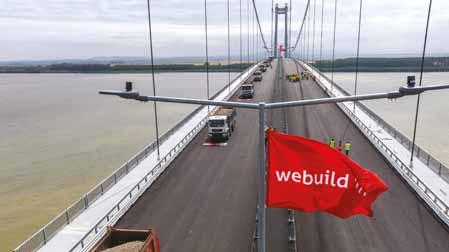
followed with two trucks crossing the entire bridge at 80kph to test it for vibrations.
created by the intertwining of more than 18,000 steel fibres (more than 9,000 for each cable). Their combined weight is 6,775 tonnes.
Last summer, saw the raising of the bridge’s steel deck, one of the most challenging phases of the construction of the bridge.
More than 250 workers and technicians were involved in installing 86 sections of the deck, each weighing 260 tonnes.
They developed a specific method to raise and set each one.
Webuild’s projects includes the new Genoa San Giorgio Bridge in Italy, which was completed in a little more than a year, as well as the Third Bridge over the Bosphorus River in Turkey.
The first series of load tests involved up to 60 trucks for a combined weight of 2,400 tonnes (equal to about 400 elephants) to check the structure’s soundness. Dynamic load testing
Webuild said that the past two years have seen complex – and at times visually spectacular – work. At the beginning of the first year, workers raised and set in place the bridge’s two supporting cables. These were
This past spring saw the publication by Italy's ministry of public works of a study for a proposed 3.7km-long suspension bridge across the Messina Strait – at a cost of around €10 billion. If constructed, it will feature the longest central span of any suspension bridge. The towers may have to be 300m high to support the structure and be located in the main channel, resulting in the need for the long central span.
National Highways has issued a tender for the supply and on-site storage and distribution of low-carbon hydrogen for the Lower Thames Crossing project near London.
The agency, responsible for the strategic road network in England, said it wants the road tunnel crossing to be the first major UK infrastructure project to use hydrogen to power the heavy machinery of a project’s main contractors. This would include excavators and dump trucks.

Thames River, downriver from London, is an economic zone connecting automaker Ford’s Dagenham engine plant to other ports further downriver and is part of the Port of London Authority’s 2040 net zero target. The Freeport will link sites along the Thames Estuary via operational wharves.

Low-carbon hydrogen includes both green hydrogen produced by renewable energy and non- renewable hydrogen produced by nonrenewable energy.
According to National Highways, the crossing is a “pathfinder project” for developing carbon-neutral construction. “Low-carbon hydrogen is a key element in [the crossing’s] strategy to deliver its carbon reduction targets and a key objective of this procurement is to enable a significant reduction in the use of diesel on the programme by enabling the use of hydrogen powered plant, machinery and generators.”

A possible initial supply site for the hydrogen is the Thames Freeport, which is next to the proposed crossing’s tunnelling compound, has been identified as a potential hydrogen supply site. The Thames Freeport, at Dagenham on the
Other smaller and also static on-site plant will be using a variety of ‘green’ energy, such as green electricity, battery systems and biofuels – even mains electricity if connections can be made. The hydrogen tender is for around 6,000tonnes of fuel that is expected to replace 20 million litres of diesel
The ambitious Lower Thames Crossing project is, however, still in the planning stage, with the UK’s Planning Inspectorate having started last month to examine in detail the plans. Even if given the green light, construction would not start until 2026.
National Highways said the tender is to kick starts the Construction Leadership Council’s government-backed plan to eliminate diesel from most construction sites by 2035, by giving major firms and suppliers the confidence to invest in hydrogen skills and technologies.


• https://www.worldhighways.com/news/ final-lower-thames-crossing-approval-awaited

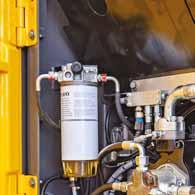
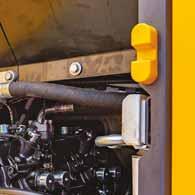
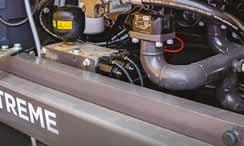



Danfoss Power Solutions, a supplier of mobile and industrial hydraulics, has partnered with Ashcourt Group to test the Danfoss Dextreme system in three Volvo excavators.
Ashcourt, a building materials supplier based in East Yorkshire, England, said it expects the Danfoss system to increase the productivity of its machines while reducing fuel consumption.
For the Ashcourt trials – which started in February - the three 20-tonne diesel-powered Volvo EC200 excavators have been fitted with the Dextreme Swap system in collaboration with UK
Volvo dealership SMT. The system replaces the excavator’s main hydraulic pump with a Digital Displacement Pump, custom software and controller.
Two of the Volvo machines are being used at the company’s Partridge Hall Quarry in East Yorkshire. The third operates at a nearby material washing facility. Each machine is forecast to complete 2,000 operating hours within the year. To compare operating data with Ashcourt’s existing fleet of standard Volvo EC200 machines, each excavator has been fitted with data logging equipment.
Dextreme Swap is the first level within the Dextreme system solution pathway. As the simplest configuration of the Dextreme system, it is predicted to lower fuel consumption by 15 percent. The pathway consists of three levels — Swap, Flex and Max — and is predicted to deliver fuel savings of up to 50 percent in excavators of all sizes. The Danfoss Digital Displacement pump is, according to the manufacturer, “the first and only truly digitally controlled hydraulic pump for off-highway machinery”. The pump's dedicated digital controller activates each piston individually, providing
A Hyundai HX520A NL excavator is demonstrating its power in a lava stone quarry in Sicily where it is on stone extraction and crushing duty.
Intramoviter, a family-owned business, is based in near Belpasso in the province of Catania - on the slopes of Mount Etna. The quarry specialises in extraction of inert lava aggregates –a strong and particularly durable material used in street furniture and architecture.
“In this quarry, formed entirely of lava stone, we crush the rocks with a hydraulic hammer, reducing it to pieces of roughly 80cm which are then collected in buckets and loaded onto lorries,” explained Natale Consoli, a veteran operator with the company. “They are then transported to the crushing plants for transformation into sand, cobbles and chippings",
The new Hyundai HX520A NL excavator with a Cummins Stage V engine has been in operation for several months. “Despite weighing 50 tonnes, this Hyundai is very agile,” said Consoli. Even the





undercarriage, which can be extended from 3m to 3.3m, enables the machine to be set up for different work stations. “In addition, it enables it to be more easily transported without having to resort to using an escort for exceptional

fast and accurate response to system demand, enabling superior machine controllability. The pump provides unmatched full and part load efficiency by using only the pistons needed to meet the load.
“So far, the feedback from our operators has been uniformly positive,” said John Hood, Ashcourt Group plant director. “The fuel savings I can’t speak to yet, but my team is telling me the new machines are very responsive and strong, with the EC200 performing more like an EC250.”
Danfoss Power Solutions www.danfoss.com
transport,” he said.
Purpose built for applications of this type, the new Hyundai HX520A NL excavator, equipped with the Epiroc HB4100 hammer is proving the perfect solution.
“We proposed this model because it is a reliable, high-performance and extremely durable machine: The chassis frameworks are reinforced to allow operation under the most severe conditions,” said Giuseppe Pappalardo, owner of Ct Macchine, the Hyundai dealer for Sicily that supplied the unit.
“In addition, the cabin’s new design ensures maximum visibility of the work area, aided by the AAVM camera system that offers a 360° view. Another aspect that our customer appreciated is the easier and simplified maintenance, with service intervals increased from 500 to 1000 hours.”
Hyundai


Develon

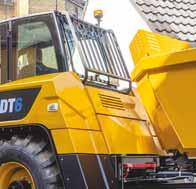
Hydrema has delivered the first DT6, what the Danish company says is the industry's first zero-emission 6tonne dumper. It also marks the company’s first step into the electric-powered construction vehicle market.
The DT6 continues the company’s quest for robust design and superior build quality, explained Jan Werner Jensen, chief executive of Hydrema.

Danish rental company GSV – alongtime customer - took delivery, explained Leif Søndergaard, Hydrema’s head of sales for Scandinavia. “Our partnership with GSV underscores the industry’s growing recognition of the need for zero-emission vehicles and the transformative capabilities that the DT6 has.”
Henrik Christensen, vice-president of fleet & purchasing at GSV, said the DT6 “perfectly suits the changing legislation in the construction sector” and helps GSV customers reduce their carbon footprint.
The lifetime of the liquid-cooled 63kWh lithium ion batteries is estimated to be between eight and 10 years, thanks to an integral Thermal Management System. The DT6 has an 18kW integrated onboard charger and it connects directly to standard Type 2 charging stations or CCE 32A outlets. Under a normal eight hour duty, Hydrema says the DT6 needs to charge only during work breaks to ensure maximum uptime for the shift.

torque and precise control, resulting in smooth and responsive performance. Power ratings are 29kW continuous and 6kW peak. Three different drive modes, Power, Normal and Eco, allows for different loads, accelerations and energy recovery.


Meanwhile, the dumper's advanced battery management system optimises energy consumption, enabling longer work cycles and reduces the need for frequent recharging.
The electric powertrain also significantly reduces noise levels compared to conventional diesel dumpers. This quieter operation benefits construction workers, nearby residents and the overall construction site environment.
The DT6 dumper features an advanced liquid-cooled 96V ZF eTrac electric powertrainmotor, transmission and axles. It delivers instant











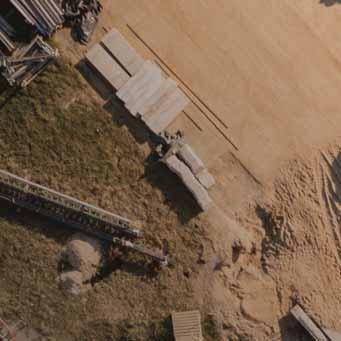



























































Transportation agencies worldwide are building the infrastructure of the future to achieve greater mobility and more seamless supply chains to increase economic development. Whether constructing new highways or the latest technologies for traffic management, agencies want to be assured they are making the most strategic investments.
By leveraging Esri’s geographic information system (GIS) technology, you can
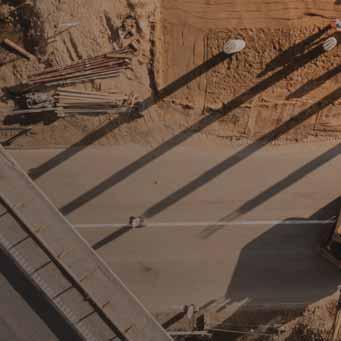
Design and plan resilient and sustainable infrastructure.
Analyze mobility patterns to reduce congestion and increase access.
Plan capital improvement projects based on data and analysis.
Integrate information from multiple real-time sources to control congestion.


go.esri.com/sustainable-transportation
















To commemorate its 75th anniversary, the International Road Federation (IRF) is supporting and organising a series of events around the world. The 4th International Symposium on Freeway and Tollway Operations held in Vienna on 26 – 30 June was high in the calendar of celebrations
The IRF convened members on 28 June to the IRF General Assembly and Board of Directors Meeting hosted in the margins of the event as an in-person and online event. The GA elected new members to the IRF Board of Directors – Valerio Molinari and Michela Nanni from Ecogest, Domenico Crocco and Maura Sabato from ANAS, and Elodie Woillez from ORIS. The GA welcomed to the Board the Lt. Gen. Harpal Singh as the new President of the IRF India Chapter. The IRF Board appointed two new IRF Advisors in the person of Neil Pedersen – former Executive Director of TRB – and Cesar Queiroz – former World Bank Highway Advisor.
The Federation welcomed new members, shared updates on recent activities and discussed preparations for the upcoming IRF

World Congress to be hosted in Istanbul in October 2024.
The highlight of the Vienna week was a special dinner jointly hosted with ASECAP, to honour and thank – with an IRF 75th Anniversary Award – members and partners who have supported IRF throughout this incredible seven-decade journey.
“It would be impossible to list the names of all the people who have contributed to the growth and success of the IRF. To those who have served the IRF at any time during these past 75 years – whether members, partners, sponsors, donors, volunteers – the International Road Federation extends all its gratitude and dedicates this celebration to them” said IRF President, Anouar Benazzouz, greeting everyone to the dinner.
“An anniversary is an important moment of lessons from the past, while also representing an open window on the
opportunities that the future offers. The destination remains the same: delivering better mobility systems for all, together,” he concluded.
Amongst the many IRF members present in Vienna, they were joined by two founding members of the Federation, Union Routière de France and Strasseschweiz / Routesuisse.
“As a founding member, we are deeply honoured of receiving this award. The URF
stands committed with the IRF in the cause of mobility. Together, we strive to ensure equitable access, sustainable infrastructure, seamless connectivity, for a better and more inclusive future,” commented Christophe Boutin, Board Member of the Union Routière de France.
“For us as a founding member, this award is a great honour and appreciation. We are convinced that today, as in the past, mobility is
the key to prosperity and health, and we remain committed – nationally and internationally together with the IRF – to ensuring that this continues to be the case,” commented Claudia Kohslschuetter, Head of International Relations and Communications at Strasseschweiz / Routesuisse.
• To know more about IRF 75-year Journey and Anniversary Celebrations, visit www.irfnet.ch.
After the success of the first two editions, the online training "Planning for Autonomous Mobility" returns for a third edition on 17 October 2023.
Organised by the International Road Federation (IRF) in collaboration with EIT Urban Mobility and FACTUAL, the training course is designed to address key aspects of autonomous mobility as a means to respond to new transport demands and to deliver value to society and businesses.
More specifically, it will equip the participants with knowledge of relevant features of the autonomous mobility ecosystem, including, urban landscape impact, long distance travel, logistics, economic aspects, etc., and provide the tools that will help them solve future challenges that autonomous vehicles will convey.
The training will begin on 17 October and end on 8 November. It will be structured in 5 sessions of two hours each per week, with two additional sessions of one hour: an introductory; and a wrap-up. In order to provide a fully online yet interactive experience, the high-level speakers will use different learning methods, such as keynotes, workshops, roundtables, and case studies.
The course will allow participants to:
• Gain a general overview of the autonomous mobility ecosystem (challenges, opportunities and actors).
• Understand the significant long-term impacts and how to be prepared to maximise the benefits.
• Get an update on the technological and regulatory state of the art of autonomous
mobility and identify its main deployment barriers.
• Understand how to manage the transition from a current to a mixed-traffic scenario, including autonomous and conventional mobility.
This training will appeal to a wide range of mobility professionals but will be of particular interest to mobility and infrastructure planners, transportation operators, automotive and mobility industry managers, mobility research centres, and other professionals interested in the AV ecosystem. Participants will not be required to have specific prior training in the field of AV.
• More information about the training and registrations that are available can be found at www.irfnet.ch.


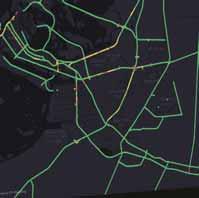










The IRF has run its Global Road Achievement Awards (GRAA) to highlight the very best developments for the road sector for several years.
Numerous organisations have benefited from this important awards programme and for the latest GRAA, in the category for Urban Mobility, the winner was Abu Dhabi’s Integrated Transport Centre.
Transport investments require a large amount of government funds. In order to make more informed, objective and data-driven decisions, the Integrated Transport Centre (ITC) built a tool, the Strategic Transportation Evaluation and Assessment Model (STEAM),
The DMT’s STEAM is a sophisticated multimodal travel demand tool that uses AI and Big Data analytics to support the decisionmaking process in the Emirate. The model uses demographic and economic information in addition to numerous sources of data from surveys, traffic systems and external stakeholders.
People’s behaviour and their travel patterns are captured to create a complex mathematical model that reflects the current conditions and forecasts future travel patterns.
STEAM is the official tool for Abu Dhabi Emirate to make informed decisions about land use development, the transportation

transportation system for any combination of scenarios in the forecast horizon years (2020, 2025, 2030 and 2040).
STEAM is used by many internal and external stakeholders to study infrastructure requirements. This tool has been successfully used to test over 60 Billion AED worth of schemes, policies and initiatives (e.g. whether and when to expand a road, build a tunnel, implement a toll, or build a metro).
The ITC’s vision is to deliver an Integrated and sustainable transport for a better quality of life for the Emirate of Abu Dhabi. STEAM is a sophisticated and dynamic tool to help achieve this vision.
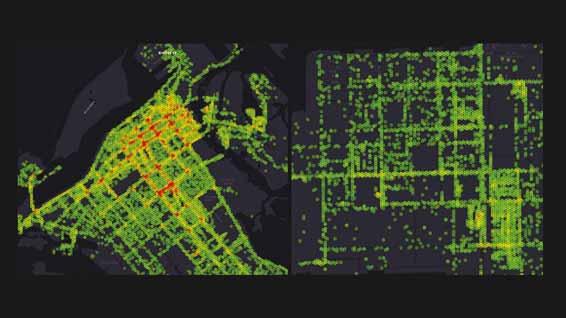
The Steam Model is a Statistical Inference tool that uses person behaviour properties to predict future transport usage, including:
• How many trips are generated from each type of land use.
• Destination choice, such as where do people travel from to visit a new shopping mall.
• Which mode of travel people choose: Car, Taxi, Bus, Rail, Walk, Bike etc.
• Time of day that people choose to travel to each destination type.
• Route choice for particular trip trails to get from point A to point B.
The model comprises of over 140,000 lines of code and is built using a variety of statistical models (Logit, Linear Regression, and constrained convex optimisation algorithms).





Featured Panels:
NOVEMBER 14-17, 2023
ARIZONA STATE UNIVERSITY
PHOENIX, ARIZONA w


•Asset Management & Pavement Preservation
•Innovative Materials and Technology
•ITS & Smart Mobility Technologies
•Road User Charging
•Connected & Autonomous Vehicles (CAVs): Readying our Road Infrastructure
•Decarbonizing the Road Transport Sector
•Vison Zero - Towards Zero Deaths
•AI for Transportation Asset Management



Share: R2T is the international meeting point where leading industry innovators, researchers, and stakeholders acquire essential engineering & business insights, and help build tomorrow’s transportation infrastructure today.
Engage: R2T will push the boundaries of 21st century roads & mobility. Meet global thought leaders and discover pioneering concepts through our program of live demonstrations and applied knowledge sessions.
Grow: Place your company’s brand, technologies and services at center stage during R2T and gain exposure in front of top







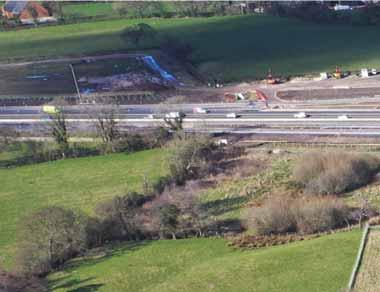
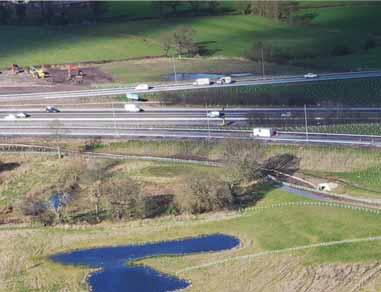

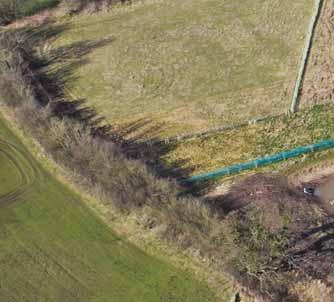

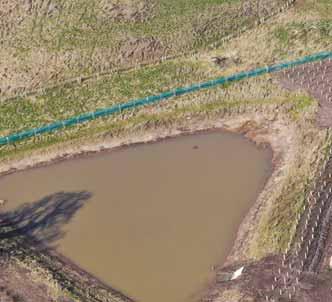
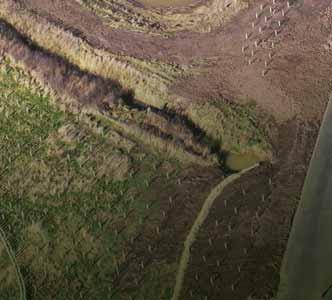



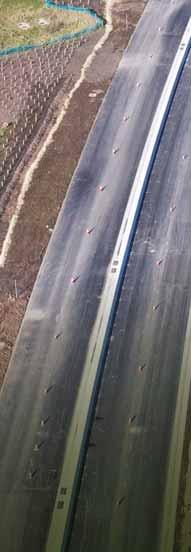

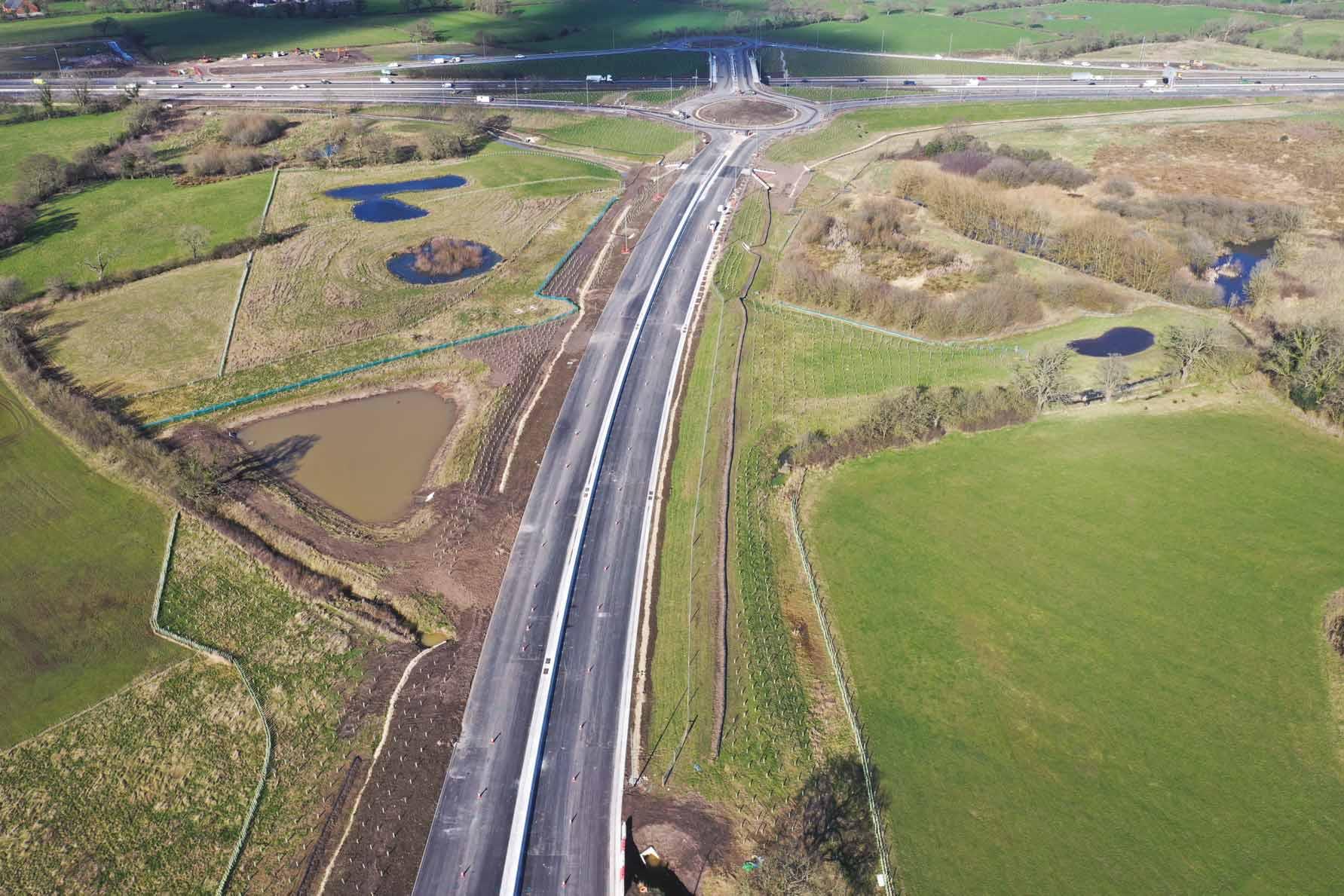
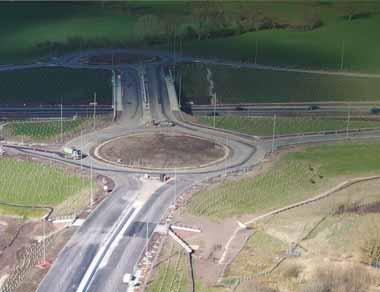


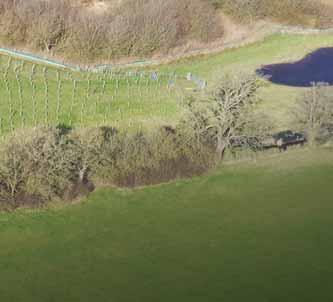
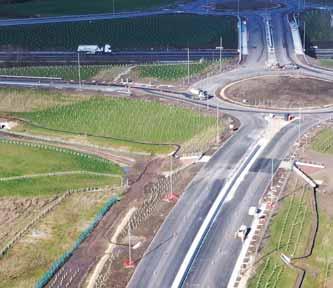
Costain, as main contractor for the Preston Western Distributor project, was involved from the earliest stages, thanks to the UK’s Early Contractor Involvement approach. The project was delivered on time and on budget to the benefit of the local environment, local businesses and the region’s workforce. David Arminas reports*
The €239.6 million Preston Western Distributor is the first major bypass to be constructed in the area since the Preston Bypass on the east side of Preston, a city in the northern English county of Lancashire. After seven years of planning and construction, from 2016 to earlier this year, the project is now open and stands as an example of best practice for setting up and running a partnership agreement - with much done against the recent backdrop of COVID-19 pandemic restrictions.
“Costain played a vital part in the development, design and construction process for the Preston Western Distributor project from the start of their involvement in 2016,”




said Phill Wilson, project manager with the client Lancashire County Council. “This project has been an excellent example of how finding the right partner though the Early Contractor Involvement process can produce the cooperative team necessary for such a complex and challenging project.”
In the traditional design–bid–build contract, the contractor is engaged only at the end of the design phase. But in the Early Contractor Involvement (ECI) contract model, the principal contractor is engaged at an early stage in a project to offer input into the design phase and suggest value engineering changes.
Studies have shown that savings of around 10% in construction time and 7% in cost are achievable. The ECI model has increasingly been used in the UK since the early 2000s and is

gaining support in Australia and New Zealand. Costain is, in fact, no stranger to the ECI phases of capital investment programmes in both natural resources and transportation sectors.



The contractor says that ECI engagement is critical to transforming the performance of new infrastructure, during both the construction phase and subsequent live operation. Key ECI benefits to the contractor and client on the Preston project include:
• The Early Contractor Involvement phase was delivered on time and under the forecast budget. Meanwhile, the construction phase concluded on time and on budget;
• Accolades for the contractor’s and overall project’s scorecard when it came to social and environmental benefits;

• Just over half - 55% - of employees, including from the supply chain - came from the local area, with 10 apprentices from local colleges employed on the programme;
• Costain innovated to save the equivalent of 6,134tonnes of CO2 emissions during construction, saving almost €8.2 million;
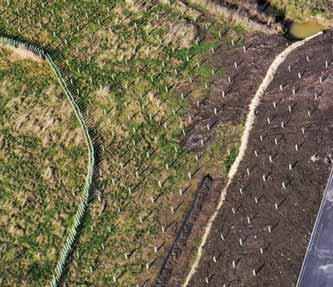
• The project delivered a 9.04% biodiversity net gain for habitats and a 10.81% net gain for hedgerows.
COVID-19 restrictions presented unforeseen challenges, not least high levels of anxiety as people feared for friends and family. Costain says it sought to create an environment onsite which provided support to all employees and safeguard their wellbeing, such as offering Mental Health First Aid Training. The company worked with various charities to counter the stigma of mental health issues affecting men and encouraging those who needed support to access counselling through Costain’s Employee Assistance Service.
As with many contractors during COVID-19, Costain put in place a range of new ways of working to ensure compliance with maskwearing, social distancing and one-way systems around site offices. It created an app which allowed members of the team to report any concerns they had so that they could be addressed immediately. A rota was implemented to ensure that only those needed onsite were there and rather than having one hub office location, employees were distributed across three project offices. The offices were fitted with physical barriers between individuals. Costain believes that the measures helped ensure that no cases of COVID-19 transmission were reported on the project.
The city of Preston, on the River Ribble, is the administrative centre of the county of Lancashire. It has a population of 114,300; Preston and its region have a population of round 315,000. The 13.3km-long original Preston Bypass was opened in 1958 as the UK’s first ever stretch of motorway – a year ahead of the official opening of the first of four sections of the north-south M1 motorway, which was to be the UK’s first full-length motorway at 311km. The early M1 had no speed limits, crash barriers and lighting; it also had soft rather than hard shoulders.
Today, the Preston Bypass forms part of the M6 motorway. Meanwhile, the new Western Distributor Bypass flows to the west of the city. It was funded through the Preston, South Ribble and Lancashire City Deal, which aims to improve people’s lives by providing much needed additional capacity on a heavily congested section of Preston’s local road network (see box, Preston: the big picture)
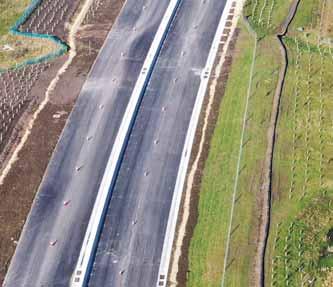
The new project’s flagship is the 4km Edith Rigby Way, a dual carriageway that links Preston and the southern Fylde area to the M55 motorway via the A583. The scheme also
SiteBatch Technologies, a specialist business of Aggregate Industries, had one of its mobile continuous mixing plants onsite supplying 80,000tonnes of hydraulically bound materials (HBM) to the project.
SiteBatch Technologies manufactures and supplies cementitious mixtures to large-scale infrastructure projects. Aggregate Industries was awarded the contract by Costain and Lancashire County Council as the sole supplier for all ready mix and aggregates. Aggregate Industries also provided and laid more than 90,000tonnes of asphalt.
includes construction of a motorway junction and two link roads giving residential areas in the northwest Preston area access to Edith Rigby Way (see box, Western Distributor details)
The Early Contractor Involvement phase began in 2016, three years before construction started. This gave the client, Lancashire County Council, cost and programme certainty by providing services such as commercial management, value engineering advice, planning and project controls and stakeholder engagement. It also ensured the scheme moved from concept to a buildable project that gained planning consent.
Costain proactively facilitated a collaborative programme of engagement between organisations and stakeholders to accelerate and assure delivery of the construction phase. The contractor involved
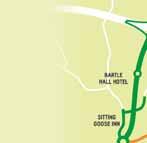
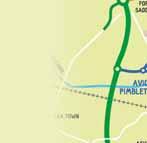
statutory undertakers in the planning process, including Network Rail, National Highways (then called Highways England), the Environment Agency and relevant third parties, such as the train operating companies serving the Preston-to-Blackpool line and utilities providers. During the planning process and application, the team engaged with the community and road users at public consultation, providing detailed information about the plans for the scheme and the opportunity for feedback.
Costain developed a dynamic programme plan based on engineering data about the structures, materials and environment, which allowed the company to forecast progress, identify interdependencies and expenditure on a monthly basis. It also allowed Costain to ensure the construction phase was delivered to budget by identifying potential challenges in delivery and enabling a planned, proactive response.
Costain’s approach to the environment encapsulates this way of working: the required licences from the government’s Natural England agency – responsible for ensuring improvements to England’s ecology - were put in place during the Early Contractor phase, enabling surveys to start ahead of the formal start of construction, without the need to wait for the next ecological season. This saved between three and six months on the programme and enabled highly critical thirdparty access to the site.
The contractor deployed innovative engineering techniques to ensure that it delivered on time and on budget, despite the complexities of the project. Construction of the 278m-long Savick Viaduct is a key example of this approach. The

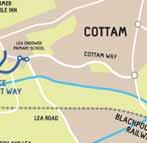


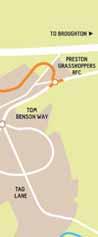
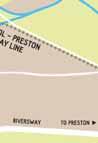



rest of the programme was dependent on the team delivering this significant milestone on schedule – despite it spanning a brook and a floodplain with power cables close by.
To ensure the milestone was met on time, Costain worked closely with a specialist supplier to devise the most efficient way of installing the steel beams used to build the Savick Viaduct. Costain carried out as much preparatory work as possible offsite, such as the permanent formwork and falsework, processes which strengthen the load-bearing capabilities of the beams. The beams were then moved into position using self-propelled modular transport and finally lifted into place. This saved €1.18 million and significantly reduced the amount of time which engineers spent in safety-critical environments.
The ground conditions across the project were technically challenging. At Savick Viaduct, Costain had to carry out extensive additional temporary works, such as installing working platforms and deploying vacuum drainage solutions to stabilise the ground before beginning the main works. This required extensive stakeholder engagement, including with the Environment Agency. This process allowed the contractor to stabilise the ground conditions sufficiently to drive the piling 40m beneath the surface.
Another prominent example of the project’s complexity is the Lea Viaduct which spans the electrified Preston-to-Blackpool railway line as well as a canal. In this case, Costain’s in-house survey team used 3D modelling techniques and geotechnical analysis to model the effect of the planned works on the railway and the overhead line equipment. The team successfully demonstrated that any forecast ground movement due to the planned works would remain within acceptable limits.
This complex engineering project also required integration with existing transport and utilities infrastructure. Costain’s solutions minimised disruption to the travelling public, while reducing time, cost and risk associated with the works. Over the two nighttime motorway closures in June 2021, the contractor installed the 130tonne, 48m-long Becconsall Bridge over the M55, enhancing local connectivity by creating a brand new junction.
More than 6,800m³ of Leca lightweight aggregate (LWA) fill (10-20mm), from materials supplier Saint-Gobain, was specified for both ends of the Becconsall Bridge’s abutment sections to provide a sustainable lightweight
solution with robust stability over delicate ground conditions. The delivery took place without the need for any road closures of the M55 (see box, Leca)
At Savick Viaduct, two large sewers servicing northwest Preston passed beneath the area identified for this new structure. Vibration monitoring surveys were conducted to ensure mitigation of any risk to these assets appropriately ahead of construction through the detailed design and enabling works. During construction, Costain used reinforced concrete slabs onsite.
Working closely with Network Rail, the concrete supplier and temporary works designers, Costain used a ‘production thinking’ approach to deliver all enabling works for the 233m-long Lea Viaduct offsite and lift the new structure into place once in situ. Agreed planned closures of the railway took place on Christmas Day and Boxing Day, 2020.
Biodiversity net gain
Operating in sympathy with the environment was a critical priority for Costain, working hard to improve biodiversity and reduce carbon emissions from the project. The landscape plans for the scheme were designed to restore farmland and to protect and enhance habitats


for species including great crested newts, bats, birds, brown hare, hedgehogs and common toads. Costain designed the landscape to create a 9.04% net gain for habitats and a 10.81% net gain for hedgerows.

Early Contractor Involvement allows input from construction contractors to feed developers information that will allow them meet their legal biodiversity net gain requirements. According to the consultancy Ecology by Design** - a member of the UK’s Chartered Institute of Ecology and Environmental Management - biodiversity net gain is a process of biodiversity offsetting, meaning habitat loss caused by a new development is mitigated to ensure an overall increase in biodiversity postdevelopment.
To establish the best way to protect the habitats onsite, a metric is used. A development must show evidence that a development will increase the biodiversity value of a site by at least 10%. This statistic is presented in the value of a biodiversity net gain metric called ‘biodiversity units’. If habitats and ecological value cannot be added to the site itself, then mitigation plans must be put into place to ensure habitats. This can be achieved either by enhancing the onsite biodiversity or creating new habitats elsewhere.
Leca LWA has been used extensively in structural and geotechnical projects for over 60 years. For road embankments, Leca LWA exerts much lower horizontal earth pressures compared with other backfill materials; it helps improve stability and reduces the need for counterfill. It has an installed bulk density of around 20% of that of general fill materials and will considerably reduce settlement of the road or rail carriageway, both immediately and in the long term.
Primary properties
include 75% reduction of horizontal earth pressure to retaining structures; superb insulating and free drainage properties; is resistant to extreme temperatures, moisture and chemical attack;and is 100% inertcontaining no harmful substances or gases. Compaction of Leca LWA requires substantially less compaction effort when compared to conventional fills including Type 1 Fill and GSB Type Fill. The company says that a value adding property “unique to Leca LWA”, is the
ability for vehicles to continue operations over the placed material without the risk of potential surface crushing. It can be placed in the same way as other conventional aggregates, either by tipping and spreading using a tracked dozer or tracked excavator. Compaction can be done using a vibrating plate compactor with a maximum ground bearing pressure of 50kN/m². Compaction is expected to provide a reduction in volume of 8-12% with the average being around 10%.
During the earthworks, 600,000m³ of subsoil and topsoil were removed. But rather than shifting this material from site and causing significant congestion to the local road network, 100% of the earth was kept onsite. Working with the client, Lancaster County Council, Costain remodelled the landscape with all earth relocated to the roadside where it has been replanted with trees and serves both as a visual point of interest and as a noise barrier. This approach removed 20,000 journeys of 96.5km each from the local road network.
The project used 100% renewable electricity to power onsite works. However, Costain also explored other sources of clean energy, such as hydrotreated vegetable oil (HVO) and the use of hydrogen. This included working with hydrogen start-up Hydrologiq to trial the use of a hydrogen-powered fuel cell generator at the M55 compound. Together, contractor and supplier demonstrated that green hydrogen would remove almost all carbon emissions associated with onsite operations (see box, Hydrologiq generator).
Meanwhile, telematics data from onsite machinery was analysed to identify opportunities for reducing plant idling. Working in close step with the supply chain, plant idling fell by around 20%. Diesel usage was eliminated across the project, replaced with HVO fuel manufactured from sustainable, renewable feedstocks.
Costain’s approach to social value was grounded in the desire to maximise the value of work placed with local businesses and for local people. The project team ensured that the local economy benefitted from the investment in the project in several ways. One way was the awarding of work to companies in the local supply chain wherever possible. In the end, 45% of the project spend was invested within a 40km radius of the site, with an additional 37% spent up to 160km. Importantly, recruitment took place extensively from the local area, with 58% of the workforce based in the community.
As part of Costain’s Lancashire Skills Pledge, the contractor supported Preston College’s T-Levels programme. A T-Level is a UK nationally-recognised qualification for 16 to 19-year-olds that takes two years to complete. A T-Level student will typically spend 80% of their time in the classroom and 20% on a minimum nine-week placement with an employer, in this case with Costain.
Costain also worked with local schools to engage students with the potential of a STEM – science, technology, engineering and mathematics - career. The company took on 10 apprentices throughout the project, creating early career opportunities in engineering and construction.
*The main material for this article was kindly supplied by Costain.
**Ecology by Design: www.ecologybydesign.co.uk
The Preston and Lancashire City Deal is an agreement between the UK government and four local partners; Lancashire County Council, Lancashire Enterprise Partnership, Preston City and South Ribble Borough Council. The aim is to transform the area, creating 20,000 jobs and 17,420 new homes – and create improved access to the areas where new
homes will be built. Around €510.27 million has been set aside to improve and expand the transport infrastructure in the region. The Western Distributor is one part of the programme.
A proposed South Ribble Western Distributor would double vehicle capacity between Preston city centre and the motorway network. A Broughton Congestion Relief
Road will provide critical relief to the A6, North East Preston and the M6. A planned Penwortham Bypass will complement the South Ribble Western Distributor and connect to local ring roads, helping relieve congestion in Preston city centre. The overall plan is to allow better access to areas where housing is planned for Preston’s expansion.
Costain and start-up company Hydrologiq used a hydrogen-powered fuel cell generator set up in Costain’s compound along the M55 motorway to power the compound’s services. The generator was a GEH2 electro-hydrogen unit made in France by French company EODev (Energy Observer Developments).
The EODev GEH2 fuel cell and battery integrated generator runs extremely quietly and emits water as the sole by-product from electricity. It powered the entire compound, comprising offices, a canteen, drying room, toilets and two battery electric vehicle charging stations.
Hydrologiq funded the trial through an innovation grant from the UK’s department of business, energy and industrial strategy which aims to encourage deployment of hydrogen generators on sites throughout the UK.

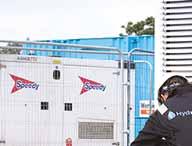
Costain’s ambition is to become a net-zero business by 2035. “By 2023, every solution delivered by Costain for our clients will propose low-carbon options,” said Tara McCracken, project environment manager at Costain. “We are looking forward to seeing more hydrogenpowered generators on our projects in the future.”
DIMENSIONS: 3300mm x 1100 mm x 2252mm
WEIGHT: 3.4tonnes
POWER: 100-110kVA / 80-88kW
OUTPUT VOLTAGE: 400-480V AC
FREQUENCY OUTPUT: 50-60Hz
PROTECTION INDEX: IP43



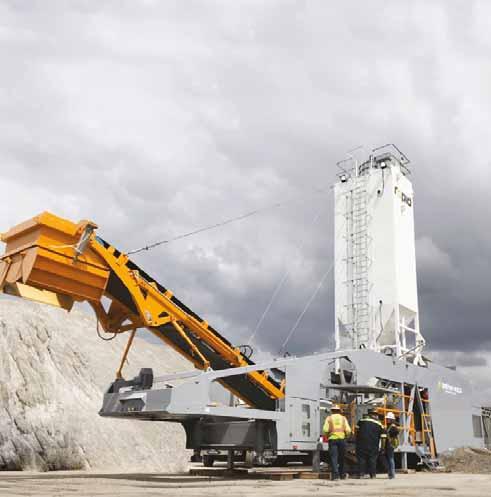





















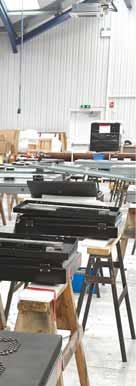

NoTraffic says that its mobility platform can be installed at signalised intersections to provide a critical digital foundation for advanced mobility applications.
It identifies, classifies and tracks all road users, including passenger and non-passenger vehicles, bikes, e-scooters, buses and pedestrians for seamless and safe mobility experiences.
Swarco has signed an agreement with the Welsh city of Swansea to design and install signage to support the new 32km/h (20mph) urban speed limit.
In March, the Welsh government passed a law which from September will see the default speed limit on restricted roads in Wales reduced from 30mph (50km/h) to 20mph. To support the upcoming changes to the speed limit, local authorities in Wales are working to make the necessary alterations to existing highway signage to ensure drivers are aware of the changes.
Following an open competitive tender process on Sell2Wales in late 2022, Swansea Council entered into a commercial contract with Swarco to replace its existing vehicle speed activated signs (VAS) with new electronic sign units that dynamically display the approaching vehicle’s actual speed.
These signs will display the vehicle speed in ‘GREEN’ if the vehicle is complying with the new default speed limit and in ‘RED’ if not. This new contract is designed to work in coordination with an existing service and maintenance contract which was already in place. The new

The system provides all-weather sensors as well as camera-based and radar-based sensors located at intersections to accurately predict arrival times. It coordinates the traffic light system's timing autonomously to maximise traffic flow – reducing congestion and emissions, prioritising different types of vehicles and other roadways users to reduce accidents.
The NoTraffic platform can be retrofitted to any intersection worldwide and transform it into a cloud-connected and fully autonomous system in less than two hours. Using an SaaS solution that runs on NoTraffic proprietary hardware, the company provides support, updates and upgrades - all over the air.

The platform from NoTraffic, based in Tel Aviv, Israel, is delivered as a managed service with monitoring and support 24/7 for 365 days a year.
agreement will see Swarco install 120 bespoke vehicle activated signs throughout Swansea. The signs, which are all manufactured and rigorously tested at Swarco’s factory in Melsonby in the English county of North Yorkshire, feature Swarco’s EPIX lens technology system to ensure the lowest power consumption.
The signs use a radar to detect vehicle speeds and use an energy efficient LED display to clearly show messages to oncoming drivers, as well as being equipped with highly intelligent internal data logging, which is stored within the signs, to provide statistical feedback and data on the number of activations, vehicle speeds and volumes. The council will be able to easily monitor changing driver behaviour.
“We are pleased to further extend our working relationship with Swansea Council,” said Derek Williamson, business development manager at Swarco UK & Ireland. “We have worked closely with them to fully understand their requirements and have designed a high-quality, reliable, durable and energy efficient solution that delivers a low lifetime cost.”
Swarco www.swarco.com












Messagemaker Displays recently supplied its low-power LED Lane Control signs to VVB Engineering for installation as part of the A470 Tidal Flow system in Cardiff, Wales.
Crucially, notes the company, the LED signs integrate with the existing urban traffic control (UTC) management software to provide a lowmaintenance fit-and-forget solution for what is the longest road in Wales. Messagemaker is the supply side of UK-based signmaker Stocksigns.
The A470 runs from the north to the south, with a busy dual carriageway stretch in the centre of the Welsh capital Cardiff. For many years, at the North Road section in Cardiff, there have been three separate gantries, each holding six signs - three primary and three secondary. Previously, for fail-safe operation, all 18 signs at the site needed to be functional at all times. If one or more unit failed, the entire system was
The Paris region highway authority has adopted PTV technology, including PTV Flows, to enhance traffic management such as live traffic updates.
The aim of the contract –following a public invitation to tender - is to supply real-time speed data derived from the GPS location of vehicles travelling on the road network managed by DiRIF - Direction des Routes d'Îlede-France - as well as on certain sections of the Île-de-France region's main road network. The provided data complements and enriches the traffic data available to DiRIF, based on their own detectors.
The Paris metropolitan area has 1,300km of highways that are used by more than four million travellers/day. To address numerous bottlenecks and traffic challenges and provide traffic information to road users, DiRIF is offering the online platform

forced into fail-safe mode, meaning that traffic restrictions were imposed on the road, which in turn created congestion.
As a result, the decision was made to replace the signs. However, it was crucial that the new signage should integrate with the existing UTC management software used by the controllers.


Following discussions with VVB, the Messagemaker team designed and built a set of LED signs that would work in conjunction with the UTC software. Each sign provides the ability to display a green arrow in the direction open to traffic, a red cross facing the direction closed to traffic and a white directional arrows, coupled with amber wig-wags as a ‘move over’ signal.









sytadin.fr. To further improve the quality of their traffic information and effectively monitor the main road network, DiRIF uses real-time data analytics powered by PTV technology.
DiRIF gathers floating car data (FCD) sourced from TomTom, a Dutch multinational developer of


location technology that released its first satellite navigation system in 2004. The data is used by PTV’s real-time software to generate highly accurate real-time information in a four-step process that seamlessly integrates with DiRIF's traffic platform, Sytadin.
PTV says that its comprehensive
solution significantly enhances the reliability of live traffic updates, allowing DiRIF to inform road users about current traffic conditions, congestion and road closures across the entire Paris metropolitan region.
This is especially important in light of upcoming major international events such as next month’s 2023 Rugby World Cup and the Olympic games next year.
PTV's solution equips DiRIF with the tools to handle the increased demands on the road network effectively, said Frédéric Reutenauer, vice president the Southern Europe region for PTV Group, which is part of Umovity. “Precise data not only reduces delays and enhances safety but also improves the overall efficiency of the transportation system."
PTV Group
www.ptvgroup com

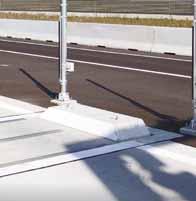


Batsch Dynaweigh says its truck scales HHB01 and HHB02 for dynamic detection of overloaded vehicles has a legal verifiable accuracy of +/- 1% (class 2D). This meets the requirements of the OIML R134 regulations for automatic instruments for weighing road vehicles in motion and measuring axle loads.
For Dynaweigh’s popular HHB01 and HHB02 scales – eight years in development – the total weight and axle loads are recorded automatically during crossing at up to 35km/h. Several years ago, the scales were installed at the traffic control station of Austria’s A5 northern highway where Austrian authorities use them for monitoring traffic safety and detecting overloaded vehicles.
Batsch Dynaweigh, based in Austria, recently added new components for a high-speed WiM system for normal traffic speeds, including classification. There is automatic selection and classification for all

cargo-carrying motor vehicles, including tractors with trailers, semi-trailer rigs and vehicles with liquid cargo.

Similar to a radar system, according to the manufacturer, the collected data (total mass, axle load, vehicle type and license plate number) can be forwarded with a photo of the vehicle automatically in real time by means of the Weight Flasher. It then goes into data processing systems or to the control authority.
Advantages over conventional systems include higher accuracy; an increase in test frequency; fully automatic 24-hour operation;can be used in all seasons; photo documentation of the vehicle; and transfer of approved weighing results to data processing systems.
Luxembourg has opted for Kistler’s KiTraffic Plus weigh-in-motion system as it implements new commercial vehicle enforcement to meet European Union requirements.
The WIM installation is located on the A6 motorway about 2km from the border with Belgium. Several hundred meters of the road surface were renewed ahead of time so there would be no need to replace the sensors after a few years because of scheduled maintenance. The complete KiTraffic Plus system weighs trucks and delivery vans without interrupting motorway traffic, providing the basis for efficient weight enforcement.
Operating since last summer, it has proven highly reliable, according to the manufacturer. It has been enabling efficient preselection, automated weight detection of overloaded vehicles at high speeds and supports handling of the entire process.
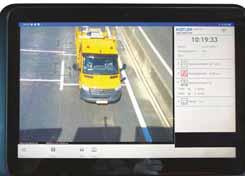
Weigh-in-motion by Kistler has automatic weight measurement during travel plus optical vehicle detection and recording ensure efficient preselection of trucks and vans.
These are then weighed statically again and checked for other violations- tyres, dimensions, validity of documentation and more.
Several reasons prompted the administration to opt for KiTraffic Plus. First and foremost, this system is certified to OIML-R134. It is capable of reliably measuring commercial vehicles moving at high speedstrucks at 90km/h and vans at 130km/h. The Luxembourg system achieves accuracy of 5% of the vehicle's total weight. It does this with the help of two rows of Kistler Lineas WiM sensors and induction loops installed in the road surface on each of two traffic lanes.
Last but not least, KiTraffic Plus features a flexible modular system: a complete measuring chain – from sensor through to software – that can be tailored to a customer’s requirements by adding components such as dimension scanners, numberplate recognition (ANPR) and tyre detection.
Kistler
www.kistler com
Experience the network effect of Trimble Dimensions.

Trimble Dimensions 2023 User Conference provides more opportunities to unleash the power of your Trimble technology than ever before.
With hands-on workshops and in-depth learning, you’ll discover new ways to get more value from the products you use.
While you’re at it, you’ll realize the network effect of connecting with the Trimble community, sharing knowledge and working together move your business forward.
NOVEMBER 6–8, 2023
THE VENETIAN RESORT, LAS VEGAS




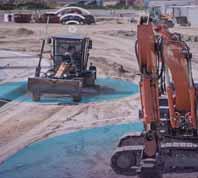

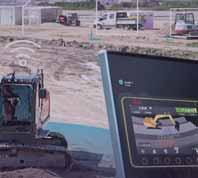





Don’t miss the third in our series of Roundtable discussions with industry leaders about the essential role that connectivity will increasingly play in the construction of roads…and indeed all infrastructure… moving forward to an optimised and sustainable future



























Vice President of Civil Solutions at Trimble

World Highways once again brings together experts from the three leading global technology providers, to both pick up on and develop some earlier discussion points, address new ones, and provide key insights into the next steps which face our industry

Vice President Heavy Construction at Hexagon Geosystems






1 Progress on, and projections for, the interoperability between the three major providers’ technologies.


2 The advantages, if any, of machine control technologies being integrated by machine OEMs.

Here are the topics that our experts will be discussing live, and you can watch the discussion on video, listen to it as a podcast on Apple or Spotify, or read/download the edited transcript from the World Highways website. Links for all three options are provided below...
3 To what extent can BIM be extended to smaller projects, over what timescale, and what are the potential bene ts?
4 Autonomy: What is the practical extent of current autonomous operation, and what are the barriers to further adoption?

5 Data: The widespread adoption of technology equates to a signi cant increase in data capture: How can this data be utilised in real time to reduce rework, resulting in lowered carbon outputs and reduced use of scarce resources?
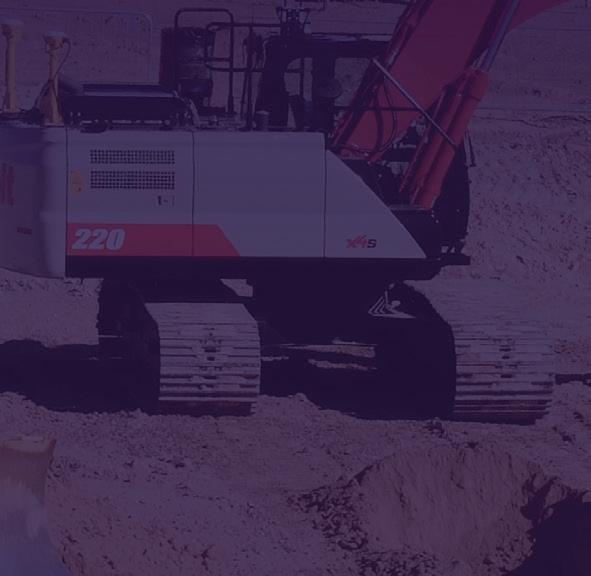


6 What potential for increased site safety does the adoption of connected construction technology deliver?
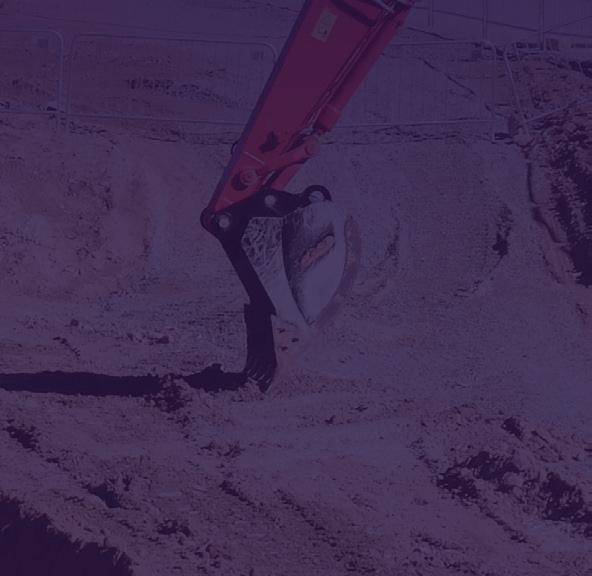
7 What do the leading providers see as the next steps for the industry?









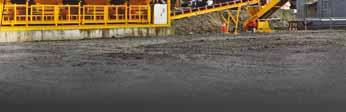
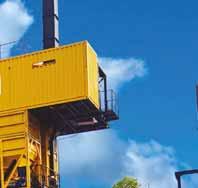
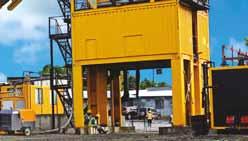
A Lintec CSD2500B containerised asphalt mixing plant is playing a

The 2km-long runway rehabilitation on Yap Island will require 26,000tonnes of hot mix asphalt and is set to be completed in 2024. The Lintec CSD2500B's containerised design is particularly suitable for working in such remote Pacific Islands due to its portability.
Contractor GPPC acquired a Lintec CSD2500B containerised asphalt mixing plant and has started work on the runway and taxiway rehabilitation project at Yap International Airport (YAP). The airport is located in the Yap Islands, also known as Wa’ab, in the Federated States of Micronesia. Located in the western Pacific Ocean almost 1,440km due east of the Philippines, the airport runway was due for improvement to support international connections to Guam and Palau.
The containerised design of the Lintec CSD range of asphalt mixing plants allows easy, low cost transportation making it suit project works, a feature that is valued amongst customers. The contractor has benefited from this features as the plant will eventually be moved and carry out other works across the remote Pacific Islands.
The airport rehabilitation project started in April 2022 and the plant was installed in January 2023, ready to begin repaving the 2kmlong by 61m-wide runway with approximately 26,000tonnes of hot mix asphalt. After the job is completed around April 2024, the CSD2500B’s portability advantages will be valuable when the plant moves to nearby islands for the next project.
“There are several unique, major challenges that are present when working on remote islands,” said Jefferson Gayas, project manager, GPPC. “Getting hold of quality materials can be difficult, and equipment is
often in short supply. It’s also rare for projects or consecutive jobs to take place on the same island so the ease with which the CSD2500B can be relocated makes that task much less of a headache.”
Island projects are typically smaller, which results in quicker completion schedules so the modular construction of the CSD asphalt mixing plant lends itself to rapid and convenient dismantling and installation. Built within ISO certified sea containers, this Lintec design can be efficiently and economically transported on land and sea. The internal components are also protected from salt ingress during sea transport, a vital consideration when the equipment is moved between Pacific Islands.
Once delivered to the new jobsite, the rigid nature of the containers reduces plant setup cost. It removes the need for concrete

foundations to be prepared due to their high stability on suitably compacted soil. Their enclosed structure also boosts security with a single, lockable main access door.
As an ideal choice for both small and big projects, the CSD2500B provides an output of up to 160tonnes/hour, in 2.5tone batches. Its double screen drum technology combines the heating and screening of aggregates in a single unit. This eliminates the need for a hot elevator and vibrating screens, greatly reducing fuel consumption and maintenance.
The Yap Islanders also have a long history as experienced sailors, aiding in the moving of the asphalt plant between the islands and over hundreds of kilometres, according to Lintec & Linnhoff.
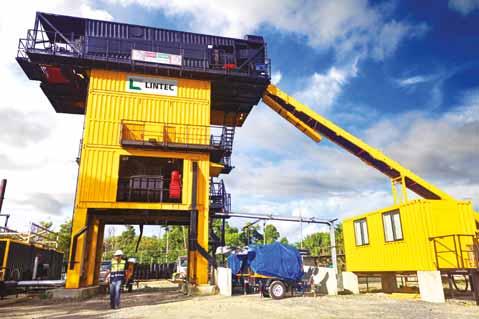


Machines from Dynapac, part of the Fayat Group, are being used to help with the construction of a new airport in Greece. The machines are working on the construction for the new Heraklion International Airport on the Greek island of Crete.
The airport project is being carried out by Greek contractor, the TERNA Group. The development of the new Heraklion International Airport in Crete is of importance for the island as the existing facility is now too small to meet demand. The airport cannot be expanded due to its proximity to urban areas, so the solution has been to construct a new airport at a distance from Heraklion.
The new Heraklion International Airport is around 39km to the south-east of the city in the Kasteli area. The new facility is due to open by 2026 and wil replace Crete’s existing Nikos Kazantzakis Airport.
The entire project is centred around providing the private and public sectors with the infrastructure and architecture to meet their current and future transportation needs throughout the concession period.
The ambitious project is comprised of multiple construction goals, including the creation of a 3.2km-long landing-take-o runway according to Aerodrome Reference Code ICAO 4E, and an equally long parallel taxiway route. Eight rapid exit taxiways, two cross eld taxiways, and an apron containing 27 remote parking positions for aircraft are also planned.
Construction will also include all necessary buildings and facilities, from a state-of-the-art terminal to parking, customer, and safety structures. The planned commercial use area comprises 400,000m2.Local connection projects will also take place, to ensure that all roads leading to and from the airport o er quick and convenient access.
TERNA took delivery of the Dynapac SD2500CS and the SD2550CS highway pavers in
week 17 of the project. The Dynapac team travelled to the site for the commissioning of the machines.
The contractor was already using three CA6000Ds, three CC4200VIs, and two CC2200s from Dynapac for the project. And TERNA is now a new key account for the Dynapac product eet.
Dynapac www.dynapac.com
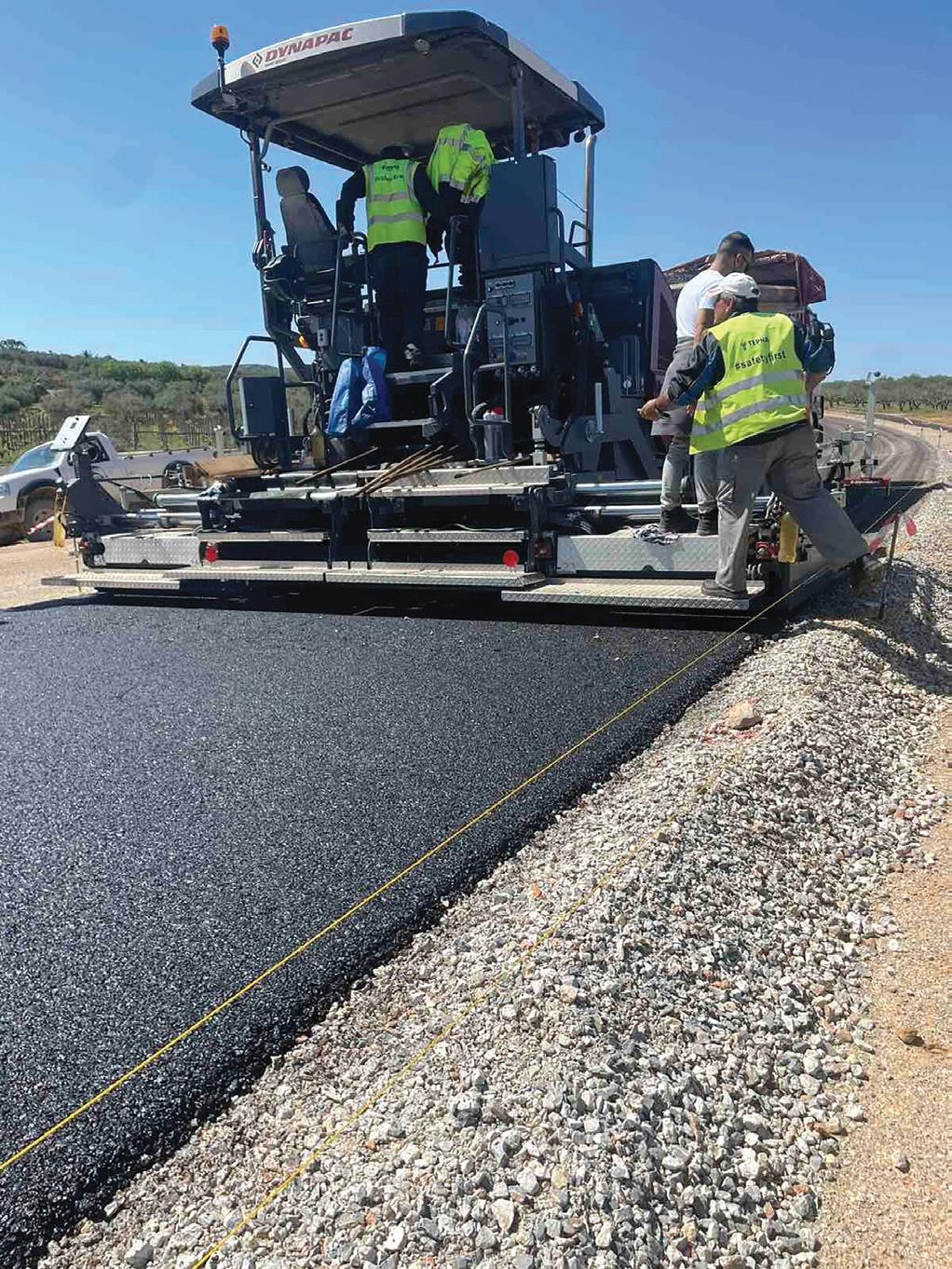



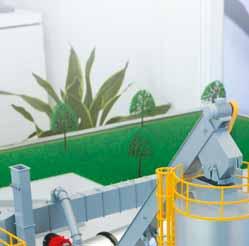
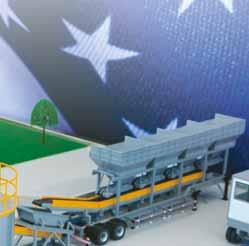

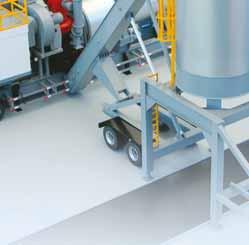

Among the improvements are advanced baghouse filters, improved combustion processes and alternative fuel sources. And now, emissions reductions are being fought on a new front: during the loading process. Ammann is a leader in the industry with its Ammann blue smoke treatment (BST) technology.
The BST system captures vapours that would previously have escaped during loading. With BST, the trapped fumes undergo a filtration process to remove oily particles with the remaining gas streams being sent to the burners.
“BST is a win for plant owners on all counts,” said Mathias Halter, Ammann’s director of Sales for Europe, the Middle East and Africa. “It’s the answer the industry has been looking for.”
Blue smoke emissions have been around since the advent of asphalt-mixing plants. The smoke released during loading resulted from the high temperatures required in the production process. The temperatures were a necessity so little could be done to stop the smoke.
New regulations require that steps be taken to mitigate blue smoke fumes. This is a challenge for those in the industry, but Ammann says it has found an answer with BST.
The BST system captures the fumes and redirects them to a multistage filtration system. The filters remove the oily particles during multiple filtration stages, ensuring high efficiency and allowing the remaining gases to be reused in the combustion process. The

condensed oil that accumulates in the filtration system can be recycled. The BST system also allows a steady flow rate at the chimney, a key factor in controlling NOx and CO2 emissions.
According to Ammann, BST is a costeffective solution. It does not require the use of complex and costly confinement methods, and the filtration system is efficient and inexpensive to operate. The BST system delivers environmental benefits right across the asphalt production operation. Diffuse emissions are removed, for the benefit of those working at the plant and anyone in the immediate vicinity of the facility.
This new innovative technology by Ammann is already in use with the expected results in several Ammann Plants.
“This is a significant development on the sustainability front,” said Marzio Ferrini, product marketing manager at Ammann. “Blue smoke is a challenge the industry has faced for years and Ammann has found an answer.”
In addition, Ammann has been developing an innovative continuous asphalt plant specifically to meet the needs of the North American market. The plant is designed to deliver capacities in the 270-360tonne/hour range, which forms the majority of US demand and the firm says that this new model will be ready for delivery to customers by the start of the 2024 paving season.
Ammann’s business development manager Carlo Machado said, “We decided to move asphalt plants to the US and will be manufacturing here. We are working on developing the supply chain.”
At the same time, the firm is also offering its versatile ACM Prime Asphalt-Mixing Plant





for the North American market. This plant is said to offer the benefits of a high-capacity machine but in a fully mobile package.
Ease of transport is achieved as the plant fits on two, two-axle trailers and remains on them upon arrival and during operation. To relocate the plant, the trailers can be hitched onto trucks and moved to a new site. This continuous plant is 100% mobile. Accessories such as tanks, RAP feeders, self-erecting storage silos and the control house are also on wheels. With previous models, some of these elements were stationary.
John Elliott has been hired as president, North American Asphalt Plants for Ammann and explained, “The US is a continuous asphalt plant market. Ammann has got a lot of sophisticated technology applicable and are building a team to capitalise on it.”
Elliott said that the new, large-capacity continuous plant will benefit from Ammann’s sophisticated technology and will feature a counterflow drum mixer with a 50% recycling capability.
Meanwhile, the cost of the compact ACM Prime Asphalt-Mixing Plant is less than a conventional stationary plant, making it easier for small businesses to enter the market. The firm says that the plant can be ready to work quickly as it arrives assembled, with plugin components to speed set-up. Production capacity is 161tonnes/hour and mixing times are adjustable, based on the recipe and desired output. The plant can utilise RAP, produce warm mix, and incorporate filler, fibres and other additives. Ammann www.ammann com

Reducing the carbon footprint in asphalt production is a priority for the sector to achieve sustainability. Working efficiently with sustainable and economical technologies presents challenges but solutions from Benninghoven will help lower emissions.
Benninghoven offers a range of solutions for increasing sustainability in asphalt production. Considering the entire road construction process from material acquisition and asphalt production to building roads, companies can save up to 54% CO2 using these technologies.*
The intelligent Benninghoven solutions include recycling asphalt, the correct storage of virgin and recycled materials, using lower temperature asphalt, electrifying bitumen tanks and renewable future fuels.
Sustainable operations are the current challenges for counteracting climate change. The 2015 Paris Climate Accords require greenhouse emissions to be halved by 2030 and eliminated completely by 2050. Despite being a small sector, the asphalt sector can contribute as asphalt production offers a potential for reducing emissions such as CO2 and Ctot (total carbon).
One control instrument asphalt plant
and emissions trading, the costs of which will increase in years to come. The fewer greenhouse gases emitted by asphalt plants, the greater the savings.
Benninghoven has decades of experience with recycling reclaimed asphalt. But recycling material is not only sustainable. The material removed by milling the asphalt during road resurfacing is also cheaper than virgin material from a quarry. In addition, reclaimed asphalt contains bitumen, the most expensive ingredient in asphalt production.
Benninghoven offers different cold and hot recycling feed systems, including the patented Benninghoven REVOC hot-gas generator. It allows up to 100% recycled material with low emissions. The system is a retrofit solution for existing asphalt mixing plants equipped with one or more recycling systems and reduces the total carbon concentrations in the exhaust gas.
Ensuring stored virgin and recycled materials are as dry as possible is important for energy-efficient mixing, helping to lower emissions such as CO2. Just 1% more moisture in the starting material corresponds to 1litre of additional heating oil (or an energy equivalent) for each tonne of asphaltic mixture. This is one reason why the German TA-Luft regulation requires covered storage of these materials.
recycled materials are energy-intensive in asphalt production. Fuel and emissions can be saved if authorities and owners use reducedtemperature asphalt: mixtures with a final temperature of around 120°C. This equates to a 30% reduction compared to conventional mixtures, which usually require a temperature of around 160°C. The potential for energy and CO2 reduction is greater: cutting 18,000kWh and 6,000kg CO2 during the production of 2,000tonnes of asphalt/day.
Benninghoven asphalt mixing plants can produce high-quality reduced-temperature asphalt in a reliable process. One important technology for this is a foam bitumen module, which Benninghoven also offers as a retrofit solution. Foam bitumen requires only water for producing reduced-temperature asphalt, which is already available at any asphalt plant. Mixing hot bitumen with water multiplies the volume many times. The released surface energy ensures that the binder moistens the mineral during the mixing process even at low temperatures, generating installation properties comparable to hot asphalt.
For storing hot bitumen Benninghoven offers bitumen tanks with different capacities. These come with one or multiple chambers and can also be equipped with an agitator or a
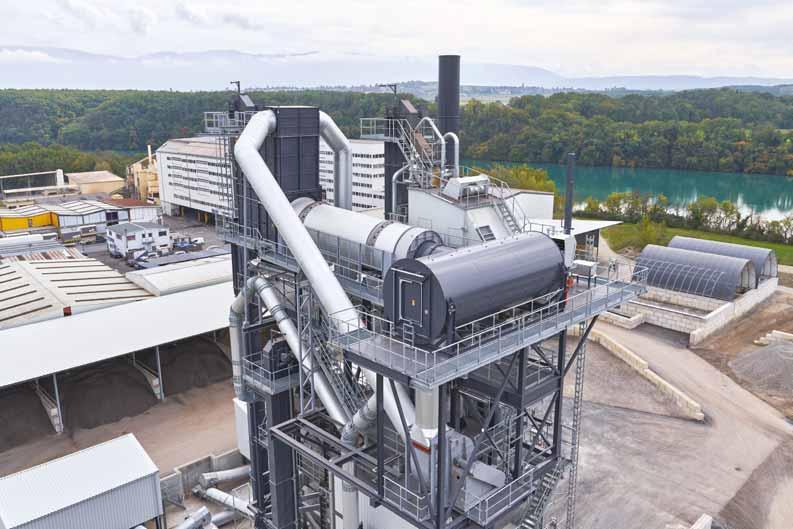
Electrification eliminates local emissions, in contrast to oil heating, ensuring CO2 -neutral bitumen storage in the overall balance. In addition, electrically heated tanks are not regulated by environmental authorities and there are no environmental restrictions.
More sustainability in asphalt production means moving away from fossil fuels such as coal and oil.
Benninghoven already offers the EVO JET burners which use the fuels of the future. These
fuels are made from renewable raw materials and have a neutral CO2 balance. They include biomass to liquid fuels (BtL) and wood dust. Even the complex process of burning wood dust results in a smooth flame pattern, allowing reliable plant operation.
The Benninghoven technology can also be used for modern fossil gaseous fuels such as liquid gas or natural gas. Changing from coal dust to natural gas or liquid gas halves CO2 emissions.
In addition to this, the Benninghoven engineers continue to work on the sustainable and economical use of other fuel types. Using hydrogen, for example, could be an option for overcoming the challenges of the future.
*(Annual production of 100,000tonnes asphalt, 60% added recycling material, carbon-neutral fuel)
Benninghoven
www.wirtgen-group.com
A contractor in Panama has expanded its operations to include supplying asphalt since it acquired a Lintec CDP14001M continuous asphalt mixing plant. Ingenieria PC has used the plant for over two years, supporting its road building and repair work around Panama City. The firm has branched out and is supplying hot-mix asphalt for other companies and projects. Requiring just two trailers and producing up to 140tonnes/hour of hot-mix asphalt, the CDP14001M is said to be mobile and easy to install and disassemble.
The Lintec CDP14001M plant’s combination of quality and value proved decisive when the contractor was looking for a continuous asphalt mixing plant. Against tough competition, the Lintec model proved suitable and the contractor acquired its first machine from Lintec & Linnhoff.
The CDP14001M was put to work in October 2020, supporting IPC’s own projects such as new road and rehabilitation works on the outskirts of Panama City, most notably in the Penonomé area where the company maintains several road contracts under the

MOP (Ministry of Public Works of Panama).
IPC is also active in a variety of infrastructure work. This includes bridge construction, stormwater works and general engineering. For these tasks it also produces many of the necessary raw materials. In addition to supplying sand, IPC operates crushing and screening equipment to provide aggregates for the production of a variety of concrete and asphalt mixtures.
Designed to sit on suitable compacted soil, the Lintec CDP14001M requires no concrete foundation, which suits use on short-term projects. Shortly afterwards, IPS also began using its Lintec CDP14001M plant to supply hot-mix asphalt to third parties. This service is facilitated by the CDP14001M’s built-in chassis that allows for fast remobilisation, alongside features designed to allow easy set-up and dismantling, suiting it to use on short-term projects. The base of the plant is stable on compacted soil, so there is no need for concrete foundations. The plant can also be adapted to include a cold recycling system that can use up to 15% of RAP in the mix.

The Lintec CDP14001M complies with local emissions regulations using a baghouse filter that reduces particulate emissions. As the second-largest model in the range, the CDP14001M boasts an impressive maximum output of 140tonnes/hour of asphalt. Its twin-shaft mixer, aided by sophisticated software, ensures precise control of the mix quality. It also has lower wear and tear due to its construction from durable alloys. Compliance with environmental regulations is achieved due to the baghouse filter that miminises particulates emissions.
The Lintec CDP continuous asphalt plant allows capacities from 20-40tonnes/hour. The main components are in-built within an ISO certified sea container for easy, economical shipping and land transport. After installation, the plant operates within the container. Due to its containerised feature, the operating noise and dust emissions from the plant remain inside.
Lintec & Linnhoff www.lintec-linnhoff.com

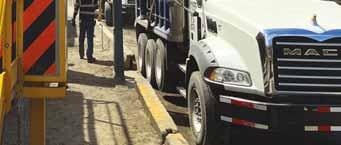

Asphalt Producers that use recycled asphalt pavement (RAP) can make more money for their businesses. Whether a client is looking to purchase a new plant for RAP utilisation, or plans to use an existing asphalt plant and want to start using RAP in the mix, ADM believes it has a suitable solution.
When it comes to buying a new plant, the EX Series 120 hot-mix asphalt offers key advantages according to the firm. Able to use up to 50% RAP to provide a higher return on material costs, the EX 120 has also been redesigned with a reverse air baghouse, making the plant more compact and portable than ever. In addition, a pulse jet is available as an option.
The new short frame of the EX 120 makes it easy to transport and it takes up less space on the jobsite. This plant suits use on remote and demanding locations worldwide and is suited to customers with a smaller production demand that are also looking to meet more stringent environmental regulations. Note
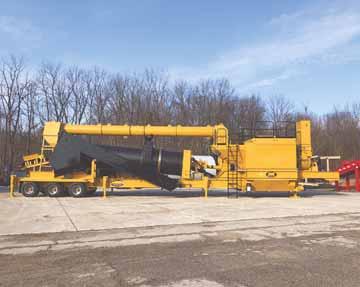
emissions standards now, it is likely to soon. The EX 120 features single-drum counterflow technology and is said to achieve the highest level of heat transfer and fuel efficiency using separate drying and mixing zones for quality asphalt production. The baghouse is up to 99.99% efficient when normal clean aggregate materials are used. Counterflow technology also virtually eliminates blue smoke and hydrocarbon emissions.
Ruggedly built, and affordable,
return on investment at a low cost/ tonne. ADM offers a wide range of components to customise the plant to meet additional customer specifications. The EX 120 is available as a portable, skidmounted or relocatable plant to further meet customer needs.
For firms that already have a hot-mix asphalt plant and are looking to add RAP to the mix, it is possible to retrofit the equipment. Adding an ADM recycle system and RAP collar to the existing plant will
allow the use of RAP in the feed. A number of components will help in the process and in addition to the RAP collar, the customer can select RAP feeder bins, a RAP processor and/or screen, a weigh conveyor and other intermediate or loop conveyors.
ADM is now offering three new systems, its improved EX 7636 Asphalt Plant, as well as a 3.66m x 8.5m asphalt-plant control room and a concrete sand heater. The firm’s latest EX Series plants produce up to 383tonnes/hour of mix and can handle up to 50% RAP in the feed. Using counterflow technology, these plants provide long aggregates drying and mixing times to ensure consistent, quality asphalt that meets all federal and state specifications. Meanwhile, the new ADM control rooms are made with an all-steel welded frame construction including wall studs, floor and ceiling joists.
Asphalt Drum Mixers
www.admasphaltplants.com

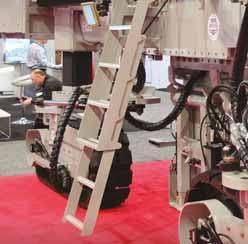

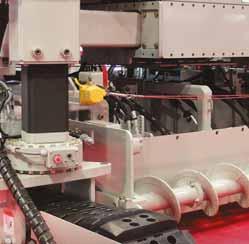

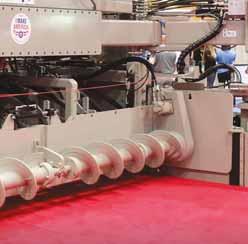

The market for concrete slipforming machines is highly specialised, a niche segment amongst construction equipment.
But despite its small size, business levels in this sector reflect strongly on the health of the construction market as a whole. First developed in the US, the concrete slipformer sells strongly in its home market as well as further afield.
The US administration has managed to find some funding for transport infrastructure works. But Federal spending on emergency road/bridge projects remains limited.
According to Stephen Bullock, president of Power Curbers, “In spite of the IIJA legislation nearly two years ago, little of the funding has reached jobsites. With construction costs up in the neighbourhood of 50% since it’s passage, we’re not sure how many of the intended construction projects will see funding.”
Bullock explained that demand for concrete slipformers remains consistent in the US however and said, “In spite of interest rate hikes, inflation, and talk of a recession the US market has been resilient. We continue to manage a nice backlog and see and hear a lot of optimism from our domestic customers.”
The export sector is a key business for the firm also and Bullock commented, “Many international markets are still recovering from the effects of the pandemic, war, energy prices and inflation and we have felt that. There is no

one region with great demand right now but we are getting orders from a mix of places – the Mideast, SE Asia, Latin America, and Europe.”
The firm has had considerable success with its 5700, which has been the mainstay of the Power Curbers range for many years. Adaptability is a key factor in its popularity. Bullock commented, “Much of the reason the 5700 series is the number one selling slipform machine in the world is due to its versatility. It began as a kerb and gutter machine and with our customers’ prompting, we’ve expanded it to sidewalk, ditches, barrier wall up to 8’ tall, and paving to 14’ wide. With each project we ask if we’ve hit its limits but the creativity of our customers keeps pushing us. I honestly don’t know what else we can add to its range.”
The larger end of the concrete slipforming segment has benefited from the widespread use of 3D technology and these systems are now being used by smaller firms on more compact units also. Bullock said, “Of machines sold in the past couple of years domestically nearly 50% are opting for stringless controls. The vast majority of machines are ordered stringless ready, even if the contractor isn’t ready to bite off stringless control yet. They see it around the corner and want to be ready.”
Technology is changing the face of construction and Bullock continued, “Without a doubt stringless control has been the story in the industry over the past decade. Telematics usage is slowly gaining traction and will continue to grow in the next few years. We’re

all in the early stages of alternative power but I expect we’ll see a gradual shift in that direction in the coming years as well.”
The use of technology will help address the shortage of labour for the construction sector. He said, “I’ve had more than one customer tell me that they don’t want to go to stringless controls but they don’t have any other choice as they can’t find labourers to ‘pound pins’ any longer. The industry’s offering of 3D/GPS controls is the biggest solution to date. Beyond that we are constantly making incremental improvements to the machine to not only save labour but to make it operator and crew friendly. Making the machine easy and comfortable to operate helps address the labour issue. The US has a labour shortage that is not going to get better. Immigration reform seems to me to be the opportunity to address it, not only for manufacturers, but for contractors as well.”
At present, the only credible slipformers on the market are either made in the US or Europe but Bullock commented that the firm continues to monitor developments, “Naturally we keep an eye on any potential threat to our business. Fortunately product support, troubleshooting and concrete expertise are critical elements in our industry, therefore startups are many years from having the knowledge to compete. The financial hit from just a few days’ lost production can wipe out the front-end savings of a “bargain” machine.”
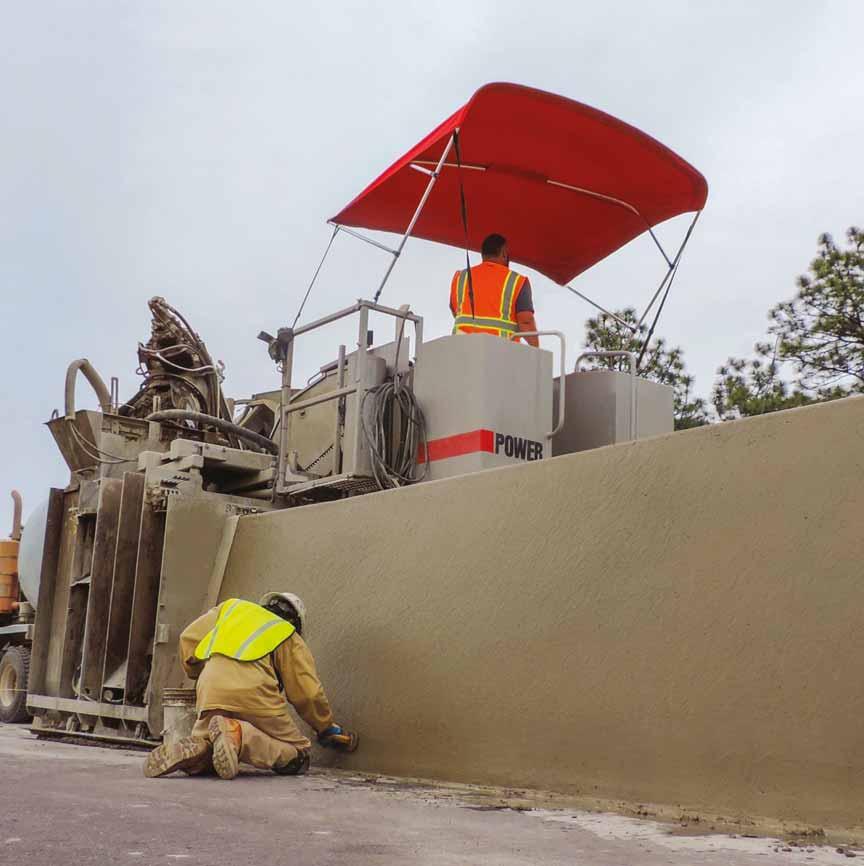
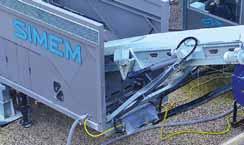


Concrete specialist Simem is expanding its business as well as its range and the firm’s most recent launch is the Bison mobile batching plant. Designed with road construction in mind, the Bison range benefits from a sophisticated weighing mechanism, created over a three-year research and development programme with input from the Politecnico di Milano’s mechatronic department.


Bison can be used to produce concrete of any class, asphalt mixes or even stabilised soil.

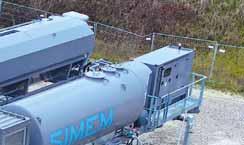

“Despite the fact that it is very mobile and batches continuously, we have been able to achieve a very high level of accuracy with the weighing system which means that it produces consistent concrete mixes and performance,” said Simem CEO Federico Furlani.
The Bison does not require foundations or a crane, elevating itself via four hydraulic legs. This means it can be set up within a couple of hours according to Furlani. Compact in design, so it can be transported on roads without any special permissions, the Bison comes in two models: Bison 250, which can produce from 100-250tonnes of material/hour and Bison 500 which can produce from 200-500tonnes/hour.
Simem has been expanding on several fronts: adding to its products and ranges; increasing its geographical spread and growing the scope of its offering through the purchase
of two new companies back in 2016. Simem Spil, based in Treviso, Italy, is a specialist in precast concrete equipment while Simem Underground, based in Vancouver, Canada, provides all forms of concrete equipment for underground construction. “We are a mini multinational now,” said Furlani.

Simem exports to over 120 countries with factories in Verona, Italy and in Vadodara, India, which it has recently expanded to serve the African and Middle East markets. It also has sales and services centres in Germany and the US.
S
www.simem.com
There are hard choices ahead for construction, but concrete must shake off its huge carbon footprint – Mark Gillespie, CEO of sustainable construction materials specialist RECYCL8, commented:
The importance of reducing the immense CO2 emissions of the concrete industry cannot be overstated. According to the Institution of Civil Engineers (ICE) Low Carbon Concrete Routemap, in the UK alone, concrete accounts for approximately 1.2% of greenhouse gas (GHG) emissions, although globally, the cement production GHG emissions associated with the use of concrete could be as high as 4-5%.
While cement accounts for 10-15% of the make-up of concrete, it is responsible for nearly 90% of the CO2 emissions from its production. In the UK alone the annual CO2 emissions of cement production is a staggering 9 million tonnes.*
It is important to note that there has been real progress in recent times, with overall CO2 emissions down by over a half from 1990 to 2018, so we



have certainly made strides in the right direction. Nonetheless it is clear that all stakeholders within the construction industry must work together to achieve NetZero in the UK by 2050.
The ICE Routemap recommends a number of key measures which all stakeholders within the construction industry should embrace in order to reduce the impact of their operations on climate change. One of these

carbon reduction measures is defined as improving how we make concrete: “Concretes that use other cements or constituents outside of current standards will be part of the overall solution to reducing the carbon intensity of the industry.”**
At Recycl8, a pioneering contribution to this solution is being brought to market. The team of industry experts has developed a breakthrough process that repurposes
Incinerator Bottom Ash (IBA) - the ash from waste incineration - into a low carbon, high performance solution for concrete manufacture. This solution reduces the quantity of cement required to make concrete, cutting the volume of CO2 generated in the process, but without any sacrifice in strength or quality. Close collaboration with the Energy-from-Waste and construction industries is crucial to the mission of reducing the carbon footprint of the concrete industry.
The firm is committed to working with industry partners to develop, adapt and scale a sustainable, emission-shrinking solution, making good on a commitment to reducing climate change today, without compromising on the infrastructure required for the successful economies and communities of tomorrow.
REC YCL8
www.r8iba.com
* Source: UK GHG Nat. statistics 2021
** Source: ICE Low Carbon Concrete Routemap 2022
A fleets of machines from the Wirtgen Group has been helping to deliver a major project in India, the Samruddhi Expressway
The new Samruddhi Expressway, also known as the Mumbai–Nagpur Expressway, is under construction at the moment and will connect the Indian cities of Mumbai and Nagpur for a total length of 701km. When completed, this expressway will link India’s largest container port, JNPT in Mumbai, to MIHAN in Nagpur, simplifying import and export activities throughout the country. Additionally, interconnecting highways and feeder roads are constructed to link all important cities and tourist places along this route.
The Samruddhi Expressway Mahamarg project consists of 16 packages and was awarded to 13 companies: Megha Engineering & Infrastructures (Pkg-1&9), Afcons Infrastructure (Pkg-2&14), NCC (Pkg-3), PNC Infratech (Pkg-4), Sadbhav Engineering (Pkg-5), Apco Infratech (Pkg-6), Reliance Infrastructure (Pkg-7), Iron Triangle (Pkg-8), Larsen & Toubro (Pkg-10), Gayatri Projects (Pkg-11), Dilip Buildcon (Pkg-12), GVPR Engineers (Pkg-13), and Navayuga Engineering Company (Pkg15&16).
The expressway is being designed with the highest travel speeds in India, reducing the journey time between Mumbai and Nagpur from 16 hours to 8 hours. The high speeds allowed have required high concrete paving performance both in terms of output and quality to ensure comfort and safety for drivers. Along the whole 701km, 16 Wirtgen SP 1600 slipform pavers have been used to lay the concrete surface. Over a working width of 15m, pavement quality concrete (PQC) to a depth of 310mm was used. The proper reinforcement could be managed by an automatic dowel bar inserter and three longitudinal tie bar inserters.
A large fleet of Wirtgen Group machines has worked on this project since its rollout: Wirtgen
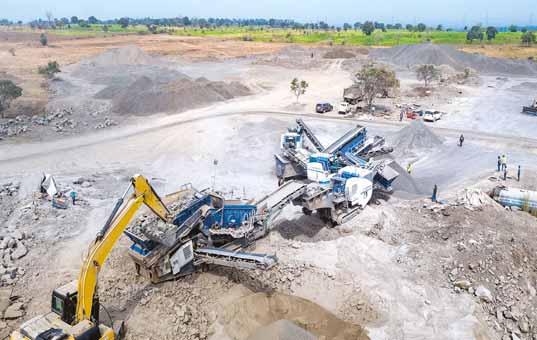
SP 64, SP 94, SP 15, SP 500, SP 1200 and SP 1600 slipform pavers, along with Hamm 311 soil compactors, Hamm HD 99 tandem rollers, Vögele SUPER 1400, SUPER 1800-3, SUPER 1900-3 and SUPER 2100-3 asphalt pavers as well as Kleeman screens and scalpers.
Vögele pavers were responsible for the DLC (dry lean concrete) pavement on various sections including approach roads and toll areas. They laid a surface with a thickness of 150mm.
Hamm tandem rollers ensured an even base. They also compacted the shoulders on both sides of the expressway’s lanes.
The Wirtgen equipment was the last in line. The slipform pavers SP 1600 and SP 94 laid the concrete surface followed by a TCM 180 that added the finishing touches to the brand new concrete lanes.
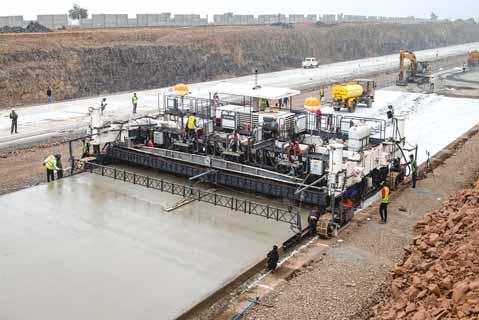

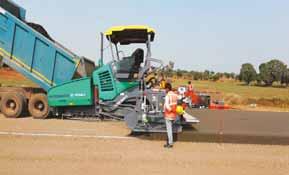
For package 9 on the Samruddhi Expressway, four lanes were paved to a length of 54km, with the Wirtgen concrete pavers laying PQC to depths of 310mm and widths up to 15m. An SP 1600 and an SP 94 were used on this section, along with two TCM 180 units. Meanwhile, the two SUPER 1800-3 Vögele pavers laid DLC to a depth of 150mm and widths of up to 4.75m. Compaction was carried out by three Hamm 311 tandem rollers. In addition, a Kleemann MS 703 EVO screen and a Kleemann MS 1800 scalper were also used for the work.
The NHAI expects an average traffic volume of 100,000 vehicles/day. Initially, the roadway will feature four lanes in each direction. However, sufficient space has been set aside in the middle of the road to allow four additional lanes to be added. It is the first e-way in the country, with electric charging stations at every 40-50km. And in total almost three million trees, plants and shrubs are planted alongside with geotagging on each tree and a drip irrigation facility turning the e-way into an advanced greenfield expressway.
Complete General Construction, an Ohio-based construction company, has added another Rapidmix mobile continuous mixing plant to its fl This has increased the firm’s capabilities in roller compacted concrete (RCC), cement treated base (CTB) and stabilised soils.
Research led to the Rapidmix mobile continuous mixing plant, recognised for its widespread use in RCC projects across the US. According to Jeff Thompson – VP of Paving Operations at Complete General, “… our research kept coming up with the Rapidmix plants being well-known and utilised in RCC projects throughout the US and around the world.”
Complete General Construction approached Gulf-Atlantic Industrial Equipment, a Florida-based sales supplier of Rapidmix plants, to observe the plants in operation during site visits. The firm then decided to purchase a Rapidmix plant for an upcoming project.
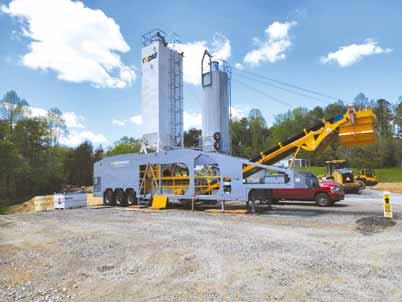
applications, including producing RCC, cement treated base (CTB) and stabilised soils.
Complete General identified several applications for the Rapidmix plant. Its adaptability and efficiency
The production process for RCC involves the Rapidmix receiving aggregates from the plant’s aggregate hopper via the weighed conveyor belt, along with a specified weighed amount of cement from the onboard silo. This is subsequently mixed in the onboard twin-shaft
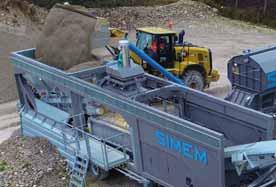



machine’s outloading conveyor. The cement treated aggregates are finally loaded into compaction pavers and laid at 94% compaction. Compacting rollers are finally used to further compact the material to 98%.
Shortly after it is laid, the RCC is sufficiently strong enough to support traffic and further operations all the way to the edge of the step. The Rapidmix 400/600 is a mobile
continuous mixing plant/ pugmill offering full weighing of all materials and is specifically designed for semi-dry mixing applications.
Fully mobile and self-contained, the Rapidmix is a complete plant powered by its own power source, with onboard compressor and generator.
Fitted with a self-erecting system, using hydraulics, the plant can change from travel mode to fully operational within a few hours. Available with outputs of up to 600tonnes/hour, the Rapidmix provides feed rates that are fully adjustable for the aggregate, cement and water systems.
The Rapidmix plant produces controlled mixtures for utilisation in a range of applications, including RCC, CTB, soil stabilisation and lime stabilisation. Rapidmix is said to provide a cost-effective solution for onsite projects where high specification compliance and high volume throughput are required.
Rapid International
www.rapidinternational.com







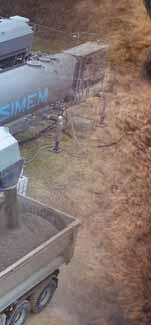


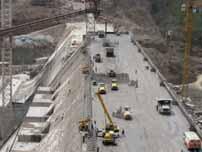

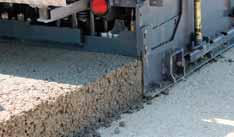

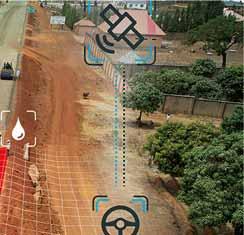
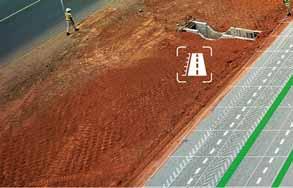

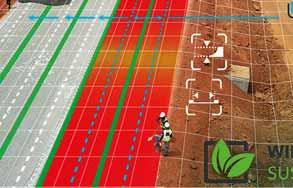
Easier to operate thanks to the increasing use of GPS, and greener to run because of biofuels, are two of the more innovative technologies being integrated into machine design by major road recycling equipment manufacturers. David Arminas writes
Road recycling traditionally covers a lot of areas and many different types of machinery, from soil stabilisers to pavement planers. Whether its road profiling, reclaiming, milling or planing, the machines are getting smarter every year and with every update.
Many updates focus on making the recycling machine much more accurate and easier in position than before, thanks to refinements to GNSS global navigation satellite systems. GNSS is a general term describing any satellite grouping that provides geolocation positioning, navigation and time information – PNT - services on a global or regional basis. While the US government-owned Global Positioning System (GPS), initially called Navstar GPS, remains the most prevalent GNSS, other countries are setting up similar systems that can complement GPS.
Improved positioning accuracy for road recyclers due to GNSS is saving road crews time and effort. Wirtgen - often at the forefront of new technology applications - continues to
take advantage of GNSS. The German global manufacturer is now offering an innovative satellite-based AutoTrac steering system for its wheeled WR-series recyclers and stabilisers. According to the firm, this allows the machines to deliver efficient working, providing precision steering to centimetre accuracy. The system works uses a previously determined reference strip and a specified overlap of adjacent strips, allowing consistent use of the optimum working width, boosting efficiency.
The WR-series machines are also available

with the Wirtgen Performance Tracker. The system registers location-specific working parameters to provide a database for site analysis and documentation. For soil stabilisers, data includes working width and depth, area and distance worked and fuel consumption.
The technology is available for the firm’s latest WR-series wheeled recycler/stabilisers. The WR-series recyclers have all-wheel drive and working widths of up to 2.4m, along with high milling and mixing performances.
Caterpillar is another cold planer manufacturer that has taken GPS into the heart of its machinery and upgraded its technology to take advantage of it. Cat GRADE technology for cold planers allows for better accuracy, less rework and lower costs in rough-, fineand finish-grade applications. Whether a 2D grade or 3D grade system, self-contained or using laser or GPS guidance, Cat GRADE control systems improve grading efficiency. Milling operators can achieve accurate and repeatable cutting results to create a smooth base for any project. The integrated system uses automated features to take the guesswork out of producing a consistent cut every time.
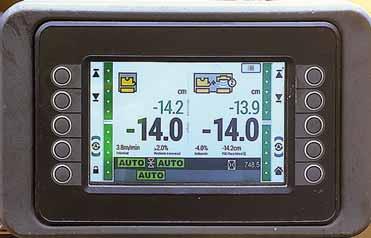
Operators can gain full control
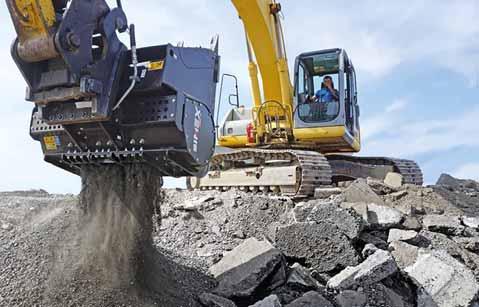
certifiable grain size thanks to the configurable rear grid. Simex says that the CBA bucket has the dual advantage of combining reduced construction site costs - less supply of new raw materials - while at the same time offering the possibility of reintroducing the milled material into the production cycle of new asphalt.

over grade and slope from any of the control boxes located on the operator platform or at ground level. Grade and Slope enhances other features on the machine such as automated transitions into or out of a cut, adjustable plunge velocity, obstacle jump and the standby-andresume function.
There are easily set and executed grade and slope transitions for tapered start or end cuts over a specified distance. Cat GRADE can adjust the speed at which the rotor drops into the cut for optimal machine control. Obstacles in the cutting path can be cleared easily by use of the obstacle jump feature. Switching between
multiple grade sensors is seamless, allowing uninterrupted accuracy when milling. For the operator, control boxes can be repositioned without the need to reconfigure settings.
As always, recycling is about reusing the road material just planed from the highway surface, meaning the material to be recycled must be in useable form.
The new CBA asphalt granulator bucket from Italian manufacturer Simex, is ideal for recovering milled asphalt material, classified in national regulations as bituminous conglomerate granulate (or RAP – recycled asphalt pavement). It reduces asphalt slabs to
Simex’s R&D department has combined the concept of milling drums with rotor crusher bucket technology, creating the three-model CBA asphalt granulator bucket range: CBA 20, CBA 30 and CBA 40 for 12-40tonne excavators. The equipment features a cylindrical drum of asymmetric teeth driven by large displacement radial piston hydraulic motors in direct drive. The rear grid determines the grain size of the material output. It is available in several configurations to meet the regulations covering milled material in varying countries.
Simex says the CBA asphalt granulator buckets aim to ensure broad autonomy for operators engaged daily in road maintenance works, crushing aggregates and filling excavations for laying underground utilities. Cutting down the time and costs related to transport and minimising the purchase of new raw materials means optimising the site's logistical and economic dynamics while reducing environmental impact by recovering materials considered a reusable resource rather than waste.
RAP has always been part of the sustainability agenda. Its increased use across










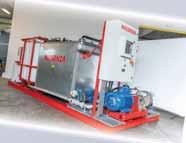





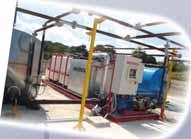









the globe means RAP machine manufacturers are continually having to improve the green credentials of their products. CAMS, another equipment manufacturer based in Italy, has risen to this challenge with the recent launch of the Centauro XL 150 APR series – APR standing for asphalt pavement recycler.
CAMS’ APR series combines one primary shredder supported by patented pre-crushing technology, one iron separator, a screening unit and a secondary shredder. All these elements are combined in a single mobile plant powered by a powerful diesel Cat C9.3 Stage V engine, ensuring the recovery of all removed slabs and milled asphalt while preserving the original bitumen content.
Importantly, for clients where sustainable worksite practices are paramount, the Centauro XL 150 APR series - as well as all the other mobile CAMS machines - can operate in hybrid or full electric mode without a diesel engine. This premium mobile recycling plant is equipped with biodegradable lubricants and, says CAMS, guarantees minimal noise and dust emissions. The technology is also said by CAMS to greatly reduce fuel consumption and can supply electricity to worksite equipment using its integrated genset, thus ensuring optimum sustainability.
The Centauro APR series’ secondary shredder characterises the APR version differently from those units designed for recycling materials other than asphalt. Other

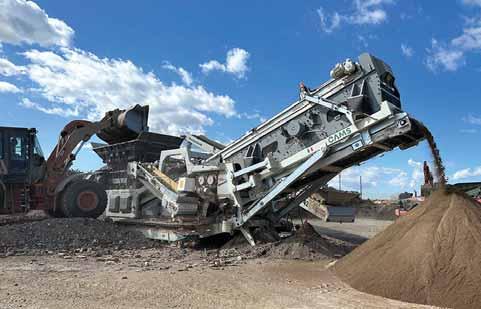
highlights include automatic programmes for shredding various material sizes, the ability to process wet materials, a single genset for supplying all components, high wear-resistance and compact transport dimensions.
The APR series is available in two models: Centauro XL 150.56 APR, which can process up to 250tonnes per hour. It is equipped with a primary shredder with a 1,500mm x 900mm surface and a two-deck screen (4,300mm x 1,300mm). The top-of-the-range Centauro XL 150.69 APR also offers up to 250tonnes per hour production and a 1,500mm x 900mm surface primary shredder. Its two-deck screen is larger than the
coming in at 5,300mm
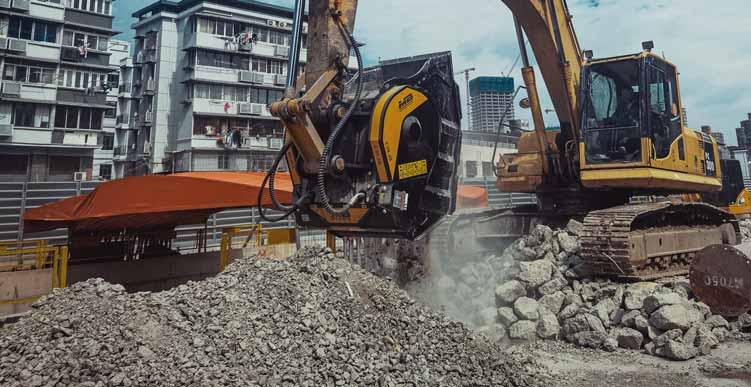

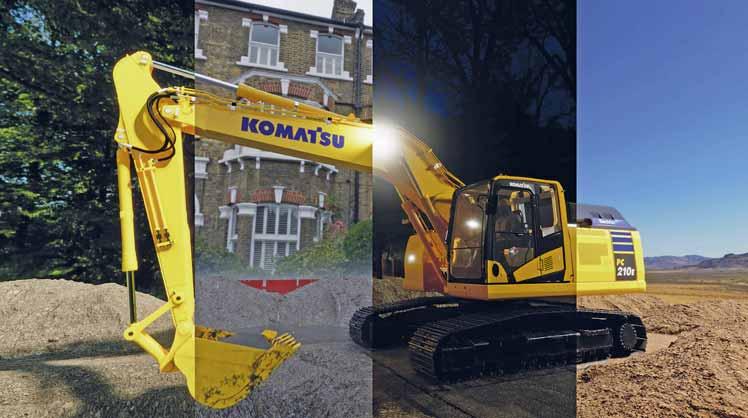
These days, even those beasts of the construction site –excavators – have a date with sustainability, despite the huge amount of electric power needed to operate a machine that pushes about high loads of dirt. David Arminas writes
Thankfully, as batteries get more powerful and last longer - and the hydrogen sector gets increasingly serious about supply and distribution - excavator manufacturers are finding a growing market for alternatively fuelled big machines.
Komatsu and Link-Belt are two manufacturers that have taken on board their clients’ needs for more sustainable earthmoving on a big scale.
Komatsu is now making available its innovative PC210E crawler excavator, developed in partnership with Proterra over a number of years. Proterra is already a major player in the design and manufacture of zero-emission electric transit vehicles and EV technology solutions for commercial applications, especially buses. Since 2004, Proterra – based in the US in Silicon Valley, near Los Angeles and in the state of South Carolina - says its technology has been proven through more than 65 million service kilometres in heavy-duty applications.
Komatsu’s PC210E integrates Proterra’s proven lithium-ion battery technology with Komatsu’s components such as the hydraulic pump, controller and electric motor. The machine benefits from robust protection for the battery pack to ensure that this will cope with the tough construction application.
Digging performance and machine durability is said to match the conventional diesel-driven PC210 model. The Proterra
battery system is said to allow operation for up eight hours when fully charged. Electric power means that the machine can be used in enclosed areas such as underground operations, as well as urban areas and nighttime construction work where noise abatement is key – even written into a contract.
This latter point is particularly important for urban-focussed contractors. While smaller electric machines are more common, their capacity to move earth is also smaller than the larger machines. A contractor under tight
Also, not to be underestimated when considering a larger electric machine, is that zero-engine vibration compared to diesel units helps reduce operator fatigue.
Link-Belt Excavators, based in the US state of Kentucky, is pushing hard towards sustainable and autonomous machine operation. “With sustainability, we have targeted emissions reductions of 30% by 2030 when compared to 2010,” said Adam Woods, general manager of innovation and product portfolio strategy. The reduction is just one
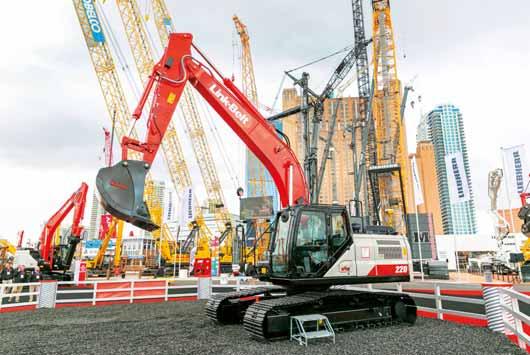
Electric machine models are already in Link-Belt’s product lineup and the company is exploring a variety of fuel options, including hydrogen and the conversion of waste materials into fuel. While you can make a machine that runs on alternative fuel, the greater challenge might be ensuring consistent supplies of that fuel. “Everything is focused on the implementation of the goal and not necessarily the support of it,” he said.
The Link-Belt 220 X4S is available with the company’s Precision Grade control system, developed in conjunction with Trimble. Precision Grade accuracy is now +/-2cm, according to Woods. Such accuracy is along the path to autonomous operation. “Autonomy fills a labour gap, improves efficiency and there is no learning curve,” he said.
While autonomous operation might be the long-term goal, there are some nice gains being made along the way – just like with sustainability. “Precision Grade can take a new operator and make them somewhat proficient in a day,” Woods said. “It used to be months.”
The increasing use of electric operation apart from electricity for main engine power is a feature of many new machines coming onto the market, such as the powerful new EC500 excavator from Volvo Construction Equipment. Replacing the EC480E, this new 50tonne class excavator – still a prototype - is well-suited to working alongside Volvo CE’s A25G or A35G ADTs in large earthmoving, roadbuilding or
quarrying applications.
In this instance, the new electric joysticks of the EC500 provide better control over the hydraulic system. The hydraulic pumps can be operated together as well as virtually disconnected, allowing the operator to control the boom without affecting track speed. This increases controllability, shortens cycle times and improves fuel efficiency.
Comfort Driver Control allows the operator to move forwards, backwards and steer with the joysticks. An operator can preset the hydraulics based upon preferences and applications and save these in Co-Pilot for access in the future.
The excavator is also fitted with Volvo Smart View with Obstacle Detection, providing a real-time view of the machine’s surroundings. It is a safety system that issues automatic alerts when obstacles are detected.
The Volvo Smart View with Obstacle Detection provides a 360° view due to an improved camera system and new radar detection system. This can identify obstacles as either an object or a person.
The prototype’s new cabin design also offers a new layout and features including highdefinition co-pilot screen, keyless engine start, wired and wireless smartphone charging and new work mode switches.
Volvo Dig Assist tools are designed to help deliver excavator accuracy by eliminating the need to manually mark out a site and check

depths and grades. Other tools include Volvo Lift Assist and the Volvo Active Control for automated grading. Increased cooling capacity means the EC500 can handle extreme weather conditions and the excavator also benefits from longer service intervals.
Production of the EC500, at Volvo CE’s crawler excavator plant in Changwon, Korea, will start by the end of this year for availability in Korea, North America and Europe.
Meanwhile, Caterpillar says it continues to drive down fuel consumption, all in the name of sustainability, according to Brian Abbott, Caterpillar’s global product manager for large hydraulic excavators. “Caterpillar is committed to reducing greenhouse gas emissions while helping our customers meet their climaterelated objectives,” he said.
The new Cat 350 excavator features powerful digging forces, a strong swing torque and can be equipped with large buckets up to 3.2m3. The 350 also consumes up to 13% less fuel than the Cat 349. Three power mode options – Smart, Power and Eco – can further reduce fuel consumption.
Caterpillar says the Cat C9.3B engine has more than 14 million hours of service to attest to its long-term reliability. Synchronised 1,000-hour oil and fuel filter service intervals reduce downtime. The hydraulic oil filter offers a 3,000-hour replacement interval – an increase of 50% over the previous design – and provides improved filtration performance.



No matter how challenging your needs, EARTHMAX SR 41 is your best ally when it comes to operations that require extraordinary traction. Thanks to its All Steel radial structure and the special block pattern, EARTHMAX SR 41 provides excellent resistance against punctures and an extended service life. In addition to long working hours without downtime, the tyre ensures extraordinary comfort.
EARTHMAX SR 41 is BKT’s response to withstand the toughest operating conditions in haulage, loading and dozing applications.
For info: europe@bkt-tires.com
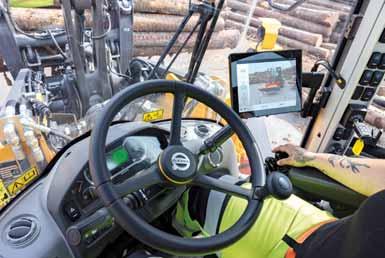
The 350 can work at up to 4,500m above sea level. It features standard high-ambient temperature capability of 52°C, cold-start capability at -18°C with optional cold-start capability at -32°C (-25˚ F). Automatic hydraulic warmup in cold temperatures gets the machine to work faster and prolongs the life of machine components. A double-element air intake filter with pre-cleaner features high dust capacity and the machine’s high-efficiency hydraulic fan offers an optional automatic reverse function to keep cores free from debris.
When cutting through tough material, standard auto dig boost delivers an automatic 8% power increase for better bucket penetration, shorter cycle times and greater payloads. Auto heavy lift offers an 8% increase in lifting power when needed for as long as needed. At the touch of a button, operators can switch to the optional Cat Stick Steer for simple one-hand operation of travel and turning. Preventing wear and tear on the excavator and attachment, standard auto hammer stop
warns operators after 15 seconds of continuous firing and then shuts off the hammer after 30 seconds.
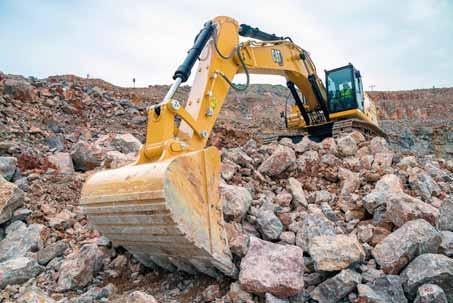
Develon, formerly Doosan Construction Equipment, has improved fuel savings in its excavator lineup with the launch of the 14.6tonne DX140LC-7K, replacing DX140LC-7 crawler model. While the performance and working range are the same as the DX140LC-7, the new machine incorporates many improvements that enhance safety and convenience both for the operator and for working onsite, together with a better operator experience, particularly from a maintenance point of view.
The DX140LC-7K is powered by the D34 4-cylinder Stage V diesel engine providing 86kw of power at 2,000RPM. Develon says that the performance of the engine in combination with the hydraulic main valve and the SPC3 Smart Power Controls, provide increased fuel saving. There are four power modes available on the DX140LC-7K and the operator is able to
set the power mode (P+, P, S or E) in both oneway and two-way working modes.
There is also a tiltrotator mode on the control panel to optimise hydraulic flow and help maximise the accuracy of tiltrotator work by eliminating back pressure.
Komatsu
www.komatsu eu
Link-Belt
https://en.lbxco.com
Volvo Construction Equipment
www.volvoce.com
Caterpillar
www.caterpillar.com
Develon
https://eu.develon-ce.com
Proterra
www.proterra.com
Replacing the previous DV+ series, is impressive thanks to intuitive operation with Easy Drive, high performance data, many comfort features and sustainable operation, as well as the "Smart Compact" digital compaction assistant.
The system decides compaction automatically and individually for each drum: Whether to compact with vibration and big or small amplitude, with oscillation, or statically. The driver then only has to enter whether a base, binder or asphalt surface course is to be compacted.
The assistant then evaluates data about the condition of the asphalt, optionally incorporating local weather data from an integrated weather station. This means that HAMM is the first manufacturer in the world to automate the separate setting of both
drums and is therefore raising process reliability and quality of the compaction and surface to a whole new level. Moreover and thanks to numerous interfaces and the corresponding hardware, the rollers in the HX series are prepared for future applications and challenges – be they quality, documentation or communication challenges. HAMM also offers the option of integrating systems for avoiding collisions with a PDS (proximity detection system) interface. Furthermore, HAMM has put many detail improvements, new options and interfaces into practice in the HX series. All models are available in countries with the EPA Tier 4/EU Stage V emissions regulation.


Utilising compact electric machines in construction offers major benefits for contractors –Mike Woof writes
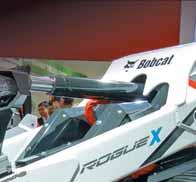
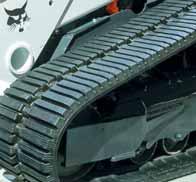
An increasing number of compact construction machine makers are now developing models featuring electric power. The firms have introduced electric versions for segments such as compact loaders and excavators as well as compressors.
Firms such as JCB, Volvo CE and Wacker Neuson have been offering all-electric compact machines aimed at the utility market for some time and other manufacturers have followed suit with their own offerings. The range of equipment available using battery power in the compact machinery segment continues to grow. It is rapidly reaching a situation where all compact machine makers will offer the option of electric models across their respective ranges. While electric machines tend to be more costly to purchase than diesel-powered variants, the long-term savings on maintenance costs and the reduction of risks arising from equipment misuse are key purchase factors for rental companies.
Bobcat recently unveiled its all-electric skid-steer loader, the Bobcat S7X, in addition to a new concept tracked loader, the all-electric and autonomous RogueX. The launch of the S7X follows the 2022 release of the Bobcat T7X all-electric compact tracked loader. Bobcat says
it plans to commercialise the prototype S7X.
However, the next-generation RogueX is purely a concept machine, with no plans currently for commercialising it. The machine is designed to explore the capabilities of electric power, autonomous operation and dual lift-arm geometry.
Like the T7X, the S7X is all-electric, and is powered by a 60.5kWh lithium-ion battery. It features electric drive motors and utilises ball screw actuators for lift and tilt functions.
Bobcat says that, together, the battery and electrical powertrain deliver instantaneous torque that is triple that of conventional loaders. The S7X skid-steer loader is designed to offer smooth operation with minimal vibration and nearly silent running. The S7X can operate for up to 8 hours on a single charge depending on the application. A full charge takes approximately 10 hours.
While resembling a tracked loader, the RogueX machine is a research and development project, developed to advance Bobcat innovation, evaluate customer perceptions and test the limits of machine functionality.
As jobsites change and operators turn to remote operation, Bobcat took its concept further by eliminating an operator station, allowing the machine to be used either remotely or autonomously, in locations that would be difficult to access or dangerous for an
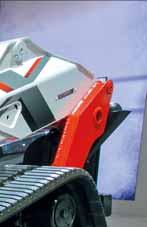
operator.
Hitachi Construction Machinery (Europe) is now offering 5tonne and 8tonne excavator models featuring battery power. Low working noise, low maintenance needs and high performance are features claimed for both models.
The ZX55U-6EB offers manoeuvrability
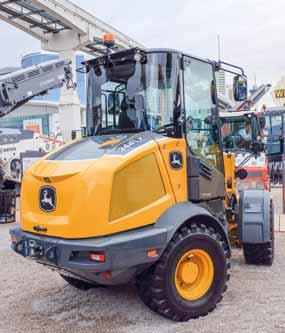


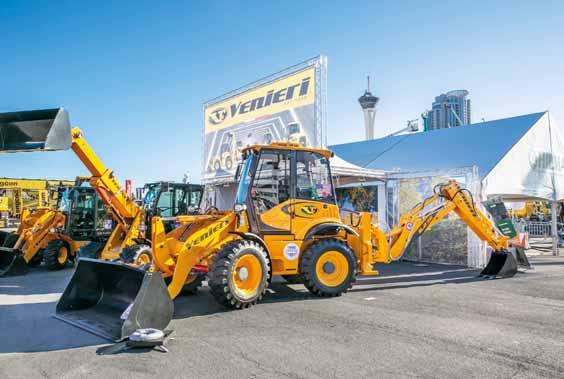
in confined spaces, as it features the short tail swing of the diesel ZX55U-6 model, while retaining the same high performance. Customers can choose between batterypowered operation, using 39kWh lithium-ion batteries, and wired operation, which allows the machine to work while charging from a CEE 400VAC 3-phase power source.
Reduced maintenance costs and downtime are claimed while the status of the electric drive system, including battery level and motor load factor, can be monitored remotely. Safety is enhanced by the rear camera to monitor the secure connection of the cable during wired operation. It has a rated power of 33kW, a battery capacity of 39kWh and an operating weight of 5.3tonnes, with an onboard charger rating of 22kW.
The ZX55U-6EB shares features with the 8tonne ZE85 electric excavator, which was developed by European Application Center (EAC), a joint venture between Hitachi Construction Machinery and Kiesel Technologie Entwicklung (KTEG).
The 8tonne ZX85-6EB has been designed to improve safety for operators, increase productivity and reduce lifecycle costs. It has an 800V operating voltage and provides the same powerful performance as the ZX85US-6 dieselpowered model. It shares the same hydraulic system, and is also suited to working safely and efficiently in small spaces with exceptional manoeuvrability.
Operators can work throughout the day with the ZX85-6EB, utilising the 100kWh lithium-ion batteries, and wired operation. This allows the machine to work while charging from a CEE 400VAC three-phase power source.
For faster charging, an optional CCS2 plug allows the battery to be fully recharged in 45 minutes. Depending on the application, the ZX85-6EB has an average running time of 5.5 hours. And operators could work for longer periods between charging with the optional increased 133kWh battery capacity. This also increases the machine weight so that an extra counterweight is not required.
To ensure an optimum and efficient performance, as well as high availability, a heat pump system keeps the battery module warm in cold weather. It also boosts durability
and battery life. The status of the electric drive system, including battery level and motor load factor, can be monitored remotely. Reduced external sound levels allow for greater flexibility for working times and options. Safety is enhanced by the rear camera, which provides visibility of the jobsite.
Weighing 8.75tonnes, the machine has a rated power of 40kW, a battery capacity of 100kWh (with an optional extra 33kWh), an operating voltage of 800V and an onboard charger rated at 44kW.
John Deere is working on an all-electric compact wheeled loader. The 244 X-tier model is powered by a 52kW electric motor and will be offered with bucket sizes from 0.8-1.1m3, depending on the application. The machine uses a proven Z-bar linkage. Both Level 2 onboard AC and Level 3 DC charging systems will be available for the machine, allowing fast charging.
This is one of a series of electric machines from John Deere, following on from the 310 X-tier backhoe loader, which has been in development for some time. The battery electric
the first prototype was unveiled two years ago, the battery size has been increased by 50% following testing in the field, and the machine utilises proven automotive charging technology.
Official launch dates for production versions of the electric 244 X-tier compact wheeled loader and electric 310 X-tier backhoe loader have yet to be revealed but the development process for both models is well in hand.
Other new compact wheeled loaders and excavators will be introduced soon. VF Venieri (Venieri) is launching an electric compact wheeled loader range to complement its existing diesel driven line. Based in Lugo, Emilia-Romagna, Venieri plans to keep growing in its small/middle-size equipment offering, supplying heavy-duty products powered by the best available components offered by the premium market.
And Wacker Neuson is launching a 1.7tonne battery-powered EZ17e excavator into the North American market. The zero-emission excavator has already been a success in the European market and will launch in North America in late 2023 or early 2024.
Bobcat
www.bobcat.com
Hitachi
www.hitachicm.eu
JCB
www.jcb.com
John Deere
www.deere.com
VF Venieri
www.vf-venieri.com
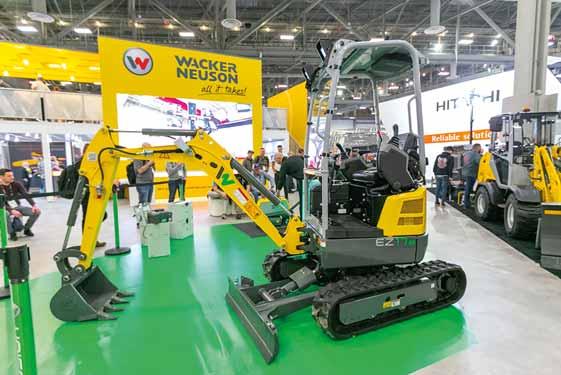
An array of new hydraulic attachment products are now on the market, aimed at a range of utilities works – Mike Woof writes
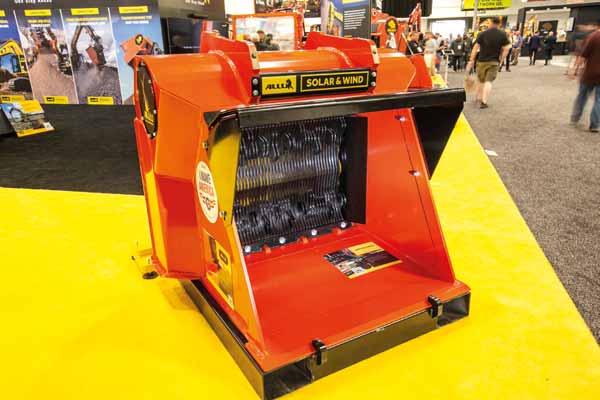
Awide array of new hydraulic attachments is now available, broadening the range of capabilities for users. The tools can be employed for many utilities works on various compact machines. Manufacturers of these attachment units are introducing new models that can offer additional features. Many are aimed at use on compact equipment and suit urban utilities works.
From screening bucket manufacturer ALLU come two new products for the North American market, the Veloci and the D Series variable drum.
The ALLU Veloci is designed for use on compact-size excavators, loaders, telehandlers, tractors, and skid steers. The bucket's screen system is made from polyurethane, which allows the material to fall through without crushing or shredding material. Large material and debris remains in the bucket. The Veloci unit generates a rotating motion inside the bucket, screening and mixing the material, producing a quality end-product for use.
The Veloci series is available in five size models for a variety of screening, mixing, and aerating applications. All models are equipped with hydraulic motors for maximum processing power. The drum amount dictates the amount of hydraulic motors used. The
Veloci has a double-skin floor, making it robust and durable even when coping with demanding environments and materials.
The ALLU D series variable drum meanwhile allows fixed TS blades to be quickly replaced, with no need to open the chain-box when blades are changed. Enabling a variable drum set-up means an individual drum or blades can be changed more quickly, saving time and money.
ALLU’s patented TS (top screen) construction and screening blades make it possible to screen materials, even when they are wet or moist, without fear of clogging. With the TS structure, it is also possible to get three different fragment sizes from the same ALLU unit by rearranging the screening combs with no additional costs.
From Bay Shore Systems comes a new Drill Sergeant X (DSX) excavator attachment designed to provide most of the benefits of the existing Drill Sergeant attachment with greater reach and swing. The DSX can be used in a range of applications from core drilling to signposts, pedestrian bridges, overpass bridges, light poles and street lighting.
FAE has developed its new RCU-75 tracked carrier, which is guided by a remote control unit. The RCU-75 can mulch vegetation up to 15cm in diameter using FAE’s BL2/RCU mulcher head. Importantly, the RCU-75 can work on inclines of up to 55° without fear of sideslipping. A dual hydrostatic transmission




provides better traction and optimal management of the attachments. This new FAE tracked carrier is powered by a 55kW Kohler engine that complies with Tier 4 Final/Stage V emissions standards.
MB Crusher says that its new MB-HDS220 padding bucket has been designed to work with compact loaders and skid steers. The load capacity is 0.61m3, which makes the bucket compact, versatile and manoeuvrable. The 1tonne MB-HDS220 padding bucket can reduce processing time, and save on operating costs. The size of the mouth opening is 2.2m, allowing easy loading and the inlet is designed to convey material quickly to the rotors.
The coupling system is designed to allow a maximum margin of movement of the operating machine. As with the other HDS models, the MB-HDS220 allows the operator to change the rotors quickly and directly onsite.
From Simex comes the D-BLADE 200 floor saw for use with skid steer loaders. This novel unit features a diamond blade and can cut depths up to 200mm deep. The Simex asphalt saw can make linear cuts on road surfaces. It can be used to make expansion joints on concrete surfaces, removing asphalt for new road manholes or in trenching.
Also new from Simex is the novel asphalt repair technology (ART) attachment, which can be used on skid steer loaders and mini excavators to improve damaged road surfaces. The unit features a patented cold bitumen
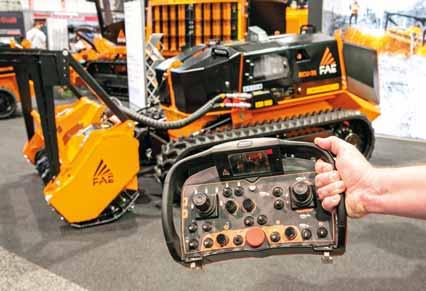
improvement system that can work to depths of 30-100mm. Long lasting repairs are claimed and as the unit refurbishes the existing surface, no additional materials are needed.

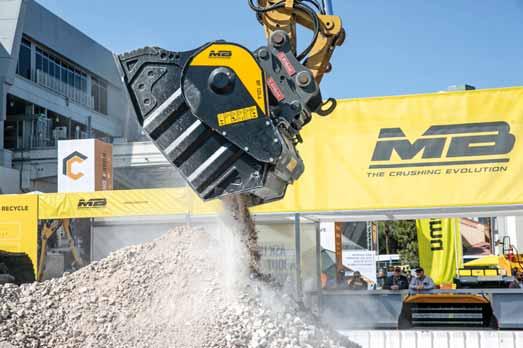
















To reduce congestion along the Great Eastern Highway Bypass, which serves as a critical connector between two major highways in Perth, new gradeseparated interchanges will replace the current signalized intersections used by more than 60,000 motorists daily. The project presented technical, environmental, coordination, and construction challenges, compounded by a fast-tracked schedule. Arcadis was awarded the design and construction contract and wanted to implement a digital engineering execution plan that previous legacy processes could not accommodate.
Leveraging OpenRoads, OpenBridge, and ProjectWise, Arcadis established a connected data environment, streamlining workflows to reduce multidiscipline design review time from two to three months to two to three weeks. The automated and digitized processes saved a total of AUD 1.1 million in costs and reduced environmental impact by 42 hectares. Bentley’s collaborative digital solution facilitates integration of asset maintenance data with the design models, enabling seamless data transfer throughout the project lifecycle.
www.bentley.com/arcadis_greateastern



Komatsu is working on the development of a medium-sized hydraulic excavator equipped with a hydrogen fuel cell system. The machine runs on hydrogen and features Komatsudeveloped key components.
The firm says it has accelerated its efforts to embark on the commercial production of medium-sized and large construction equipment powered by hydrogen fuel cells. This concept machine forms part
of the firm’s plan to minimise environmental impact throughout its business. Komatsu is targeting a 50% reduction in CO2 emissions from use of its products and production of its equipment by 2030 and a challenge target of achieving carbon neutrality by 2050.
For the new concept machine, Komatsu adopted a hydrogen fuel cell system and hydrogen tank, which were produced by Toyota Motor Corporation.
HD Hyundai Construction Equipment Europe is expanding its wheeled excavator range with the launch of the HW100A. This compact, versatile machine is said to offer a powerful driveline, multiple steering modes and a range of chassis layouts to suit all jobsites.
The Hyundai D34 engine is Stage V/Tier 4 Final compliant, with DOC/DPF/SCR and no EGR and delivers 75kW power output with 460Nm of torque. The machine has three working modes and three power modes, as well as two-wheel, four-wheel and crab steering for manoeuvrability.
With a slim counterweight and a tailswing radius of just 1,600mm, the HW100A can work within a single carriageway. As with Hyundai’s heavy excavators, operators can choose from three power modes - Power, Standard and Economy.
The machine has a rigid chassis, with low maintenance heavy-duty
axles. The transmission is directly connected to the rear axle for optimum ground clearance and the front axle has oscillation with a ram lock function for uneven ground. The driveline has a two-speed mechanical transmission and a two-speed hydrostatic travel motor, with a maximum of 40km/h in the highest gear.
Customers can choose between a front-mounted parallel dozer blade and independent stabilisers at the rear, a front grapple bar with rear-mounted dozer blade or front and rear outriggers. The options are interchangeable with the same bolt-on mounting system.
Hyundai’s Hi-Mate telematic monitoring system is available, making it easier for fleet managers to maintain control of service and maintenance work across the fleet.
Hyundai Construction Equipment Europe
In addition to Komatsu's comprehensive control technology, the combination of Toyota’s hydrogen fuel cell system and Komatsu key components, Komatsu is working towards zero exhaust emissions and a reduction in noise and vibration, while delivering the same digging performance and operability as engine-driven excavators.
Medium-sized and large construction equipment require a power source with higher

energy density than that of small construction equipment, which has led to the move to electrification with batteries. Because hydrogen has a higher energy density and can be refuelled in a shorter time than is required for recharging batteries, Komatsu has been advancing this technology as a choice for medium-sized and large models.
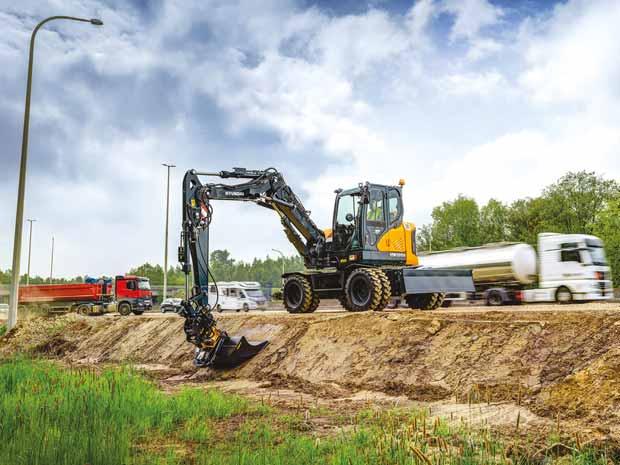
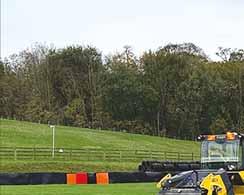
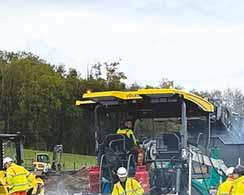


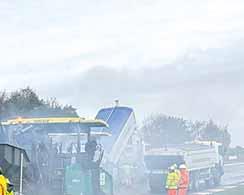


to complete major resurfacing works at Donington Park race circuit, ahead of the British Superbike Championship.
The essential and ex tensive track maintenance works, which included the removal and replacement of more than 6,500tonnes of asphalt, were completed over 22 days and represent the most significant improvement works at the venue in almost 20 years.
The collaborative project saw Aggregate Industries work together with track owners MotorSport Vision (MSV) and track designers Driven International, plus a complex
more than 5,000tonnes of its specially formulated high-grip SuperPrixmat Ultra asphalt, designed exclusively for demanding high-performance motor racing circuits. It also provided 846tonnes of binder course and 740tonnes of stress-absorbing membrane interlayer, SuperSAMI.
The time-intensive project required Aggregate Industries to use two plants to maximise time and minimise disruption onsite during the 22-day construction period. This allowed for a continuous supply of asphalt to the site, enabling the team to lay the product at a



consistent speed in echelon to achieve a jointless surface on the 4km track. Vögele pavers were used for the paving work.


Following the B ennetts British Superbike Championship (BSB), there was an overall improvement to performance levels and circuit grip, resulting in the fastest B ennetts (BSB) laps set to date.
Aggregate Industries commented that working with both MSV and an ex tensive supply chain required high technical capabilities and advanced innovative solutions. Meticulous planning and a collaborative approach was required for all involved, but
the resurfacing of Donington Park delivered a bespoke solution that meets the durability requirements of an iconic race track.
The high-performance motorcycles have small tyre contact patches placing enormous demands on the surface. But the riders were impressed with the increased grip, in both dry and wet conditions, and its smoothness. Aggregate Industries

Work is underway for the Beijing East Sixth Ring Road Reconstruction Project in China. The CRCHI mega slurry TBM Jinghua is working on the project and features a maximum excavation diameter of 16.07m, measures 150m in length and weighs in at 4,300tonnes


The machine is the largest shield TBM in China and benefits from systems such as fourth-generation accessible cutter exchange technology, telescopic main drive, high pressure auto-compensation, a large power slurry circulation system, and synchronous double-liquid grouting. The successful application of synchronous double-liquid grouting technology has delivered mm-level control of ground settlement, ensured zero disturbance to buildings on the surface and filled the gap of synchronous double-liquid grouting in mega slurry TBM construction in China.
The tunnel length is 7,338m. Its complex geology is mainly composed of sandy soil, water-rich and high-density sand, interactive layers of silt and cohesive soil. The project also face construction difficulties such as super-deep soil cover and super-sensitive environment.
The slurry TBM has successively overcome technical difficulties such as the initial excavation with shallow overburden and longdistance crossing high-density sand layers. The slurry TBM crossed the Beijing-Harbin Railway and Beijing sub-centre transportation hub with micro-settlement and non-disturbance. It also achieved a record 542m excavation in a single month.
The TBM aims to reach the receiving well in Wansheng South Street. At that time the tunnel excavation work will be completed.
16 – 19 APR 2024


THE WORLD’S LEADING PLATFORM FOR MOBILITY SOLUTIONS & KNOWLEDGE SHARING
ACCELERATING TOWARDS SMART, SAFE AND SUSTAINABLE MOBILITY FOR ALL















INTERTRAFFIC EVENTS & SUMMITS
MEXICO CITY / MX 14 - 16 NOV 2023
AMSTERDAM / NL 16 - 19 APR 2024
BEIJING / CN 29 - 31 MAY 2024
24/7 NEWS, VIEWS & INSIGHTS
INTERTRAFFIC

Get ready to experience the ultimate working environment with Hitachi’s newly redesigned ZW-7 cab, ultra-spacious and equipped with top-of-the-line features!
Say goodbye to noisy and uncomfortable workspaces, as the ZW160-7 offers some of the lowest noise and vibration levels in the market. With this machine, you’ll be able to work in style and comfort, making your job easier and more enjoyable than ever before.
Don’t settle for less - upgrade to the ZW160-7 and experience the best!