










STEER-BY-WIRE MACHINE CONTROL


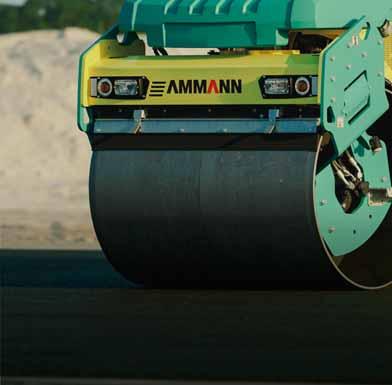
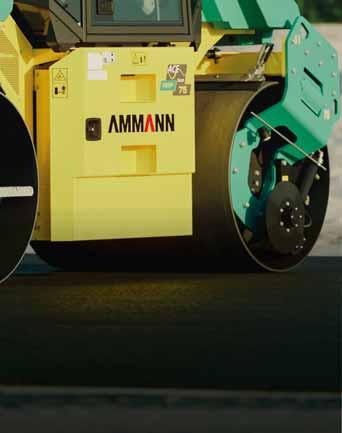
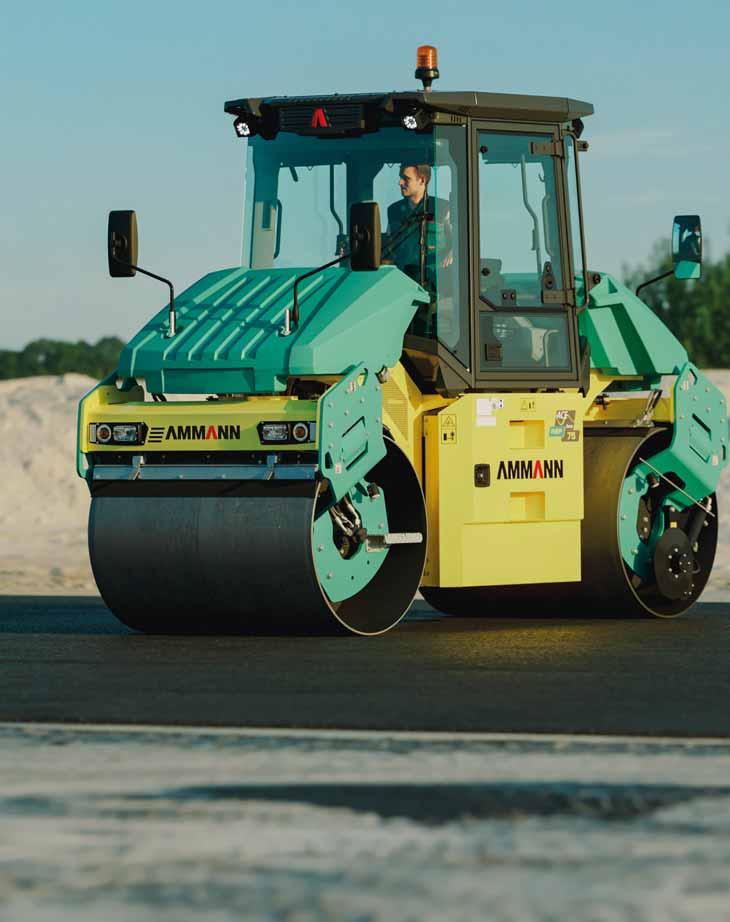
Question: How can an operator easily control a multi-tonne asphalt roller? The answer: With innovative steer-by-wire machine control. This highly advanced system makes machine operation smooth and comfortable.
Advanced steer-by-wire is the hallmark of the Ammann ARP 75 Pivot-Steer Roller. The machine also sets a new market standard with an advanced driver lever with intelligent functions and a 10-inch multifunctional touchable display.




04. Contraflow
A steady improvement in road safety is being seen in many nations, but not in the US
06. News
Volvo CE’s strong sales; US road deaths; new roads for Australia; strong performance for Caterpillar
12. Technology
Smart antenna from Leica Geosystems; infrastructure monitoring with Trimble; Parker Hannifin’s remote machine diagnostics
13. Diary
Key exhibitions and conferences around the world listed
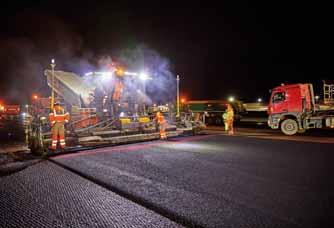
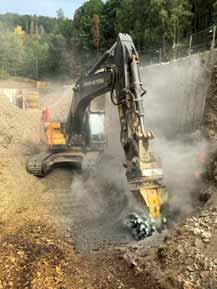
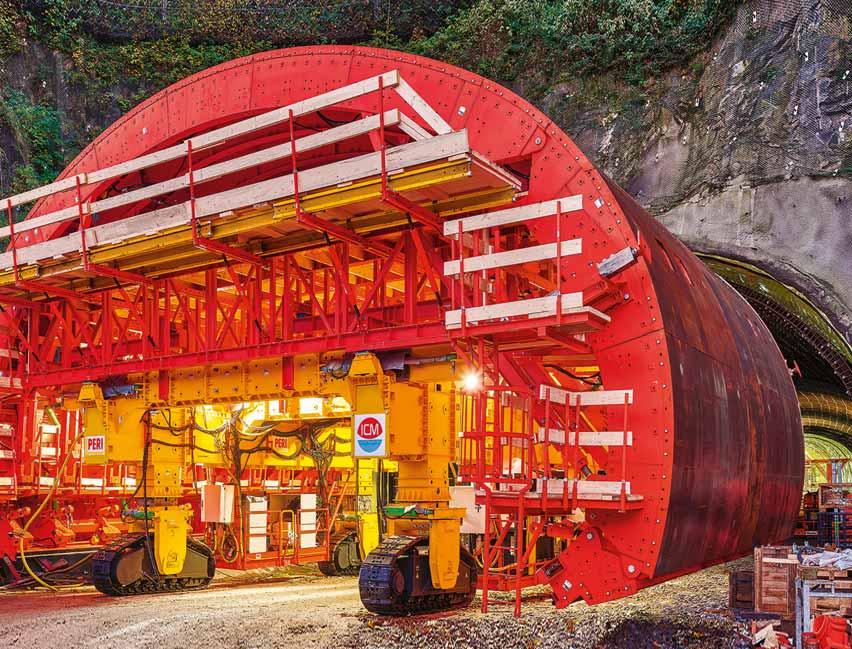
Major advances are being seen in tunnel and bridge construction projects, with innovative technologies and methods being employed



14. IRF
3rd IRF Africa Regional Congress; GRAA winner profile; 4th TRB International Symposium; CRISPS
18. Key project report
Construction work for a replacement bridge has been carried out in record time in Pittsburgh, Pennsylvania
Between pages 22 and 23


38. Asphalt paving


Customers now have a choice of spraypaving options
41. Compaction
Drum steer asphalt compactors offer versatility for contractors
43. Asphalt plants
Novel asphalt plant installations suit major clients
46. Bitumen technology
New bitumen technology can help lower road maintenance costs
49. Pothole repairs
Innovative pothole repair systems allow speedy improvements


54. Machine control
Sophisticated machine control technology was used in an airport project in Luxembourg
61. Engines & components
New developments in engine technology and in the components market
63. Onsite
Epiroc’s efficient rock cutter
64. Equipment
New technology for Caterpillar’s compact machines; Doosan’s improved mini excavator
66. Skidmarks
Further humorous road-related stories from around the world
em1-em6
Malaysian expressway; green concrete innovation; Volvo
CE’s new parts supply
eu1-eu6
LagoonHull project stalls; electric machines; intelligent construction equipment
32. Highway and safety
51. Bridge & tunnel technology
Novel bridge and tunnel construction projects are in hand
56-60
Future-proofing sustainability for equipment in the construction and quarrying sectors

Speed control with Acusensus; Xenomatix's road inspection technology; Vaisala’s weather monitor; automated markings technology; air quality sensor; improved markings from Swarco; traffic monitoring with Kapsch and InnoSent






















Mike Woof, EDITOR mwoof@ropl.com
Road safety improved in 2022 compared with the pre-pandemic years according to a new survey from the International Traffic Safety Data and Analysis Group (IRTAD). Although casualty rates were higher in 2022 than in 2020 and 2021, the reduced traffic volumes of the pandemic period due to lockdown measures explain the exceptionally low levels for these years.
Preliminary data for the first six months of 2022 shows that 14 of the 20 countries surveyed saw increased road deaths compared with the first six months of 2021. However, the majority of the 20 countries saw lower road deaths in 2022 than in 2019. According to the data, road fatality levels were 12% lower in the first six months of 2022 than in the first six months of 2017, 2018 or 2019.
The report shows that traffic volumes increased in 2021 compared to 2020 but were still lower than in 2019, in the pre-Covid period. For France and Germany, traffic volumes in 2021 were 9% lower than in 2019. It is worth noting that 2021 can still be regarded as an abnormal year as some countries still had lockdown measures imposed, as in 2020. This did have an effect on road crashes, reducing the number of incidents.
Of particular concern was that road deaths in the US increased by 16.3% in 2021 compared

to the average for 2017-2019. This had an effect on the overall data collated by IRTAD. For the rest of the 34 nations in the survey, road deaths decreased by 12.4% in 2021 compared to the average for 2017, 2018 and 2019.
This does represent a welcome reduction in road deaths in the rest of the nations surveyed (apart from the US). By comparison, for the years of 2010, 2011, 2012, 2013, 2014, 2015, 2016, 2017, 2018 and 2019, the average reduction in road deaths was a mere 2%. Some countries amongst the 34 nations in the IRTAD survey saw particularly favourable reductions in road deaths. These included Argentina with a drop of 27.14%, Japan with a drop of 23.2% and South Korea with a drop of 22.7%.
Given the drop in road deaths during and since the pandemic period in the majority of the 34 nations in the IRTAD survey, this does highlight a positive international trend. However, it is of key concern that a major industrialised nation like the US cannot reduce its road death rate. The US has so many problems with road safety it is difficult to know exactly where to start. But moves to address DUI and speeding in countries like France and Portugal have been highly effective in cutting the casualty rate. And the US needs to take action. MW








Editor: Mike Woof
Deputy Editor: David Arminas
Sub-Editor: Kevin O'Shea
Contributing Editor: Guy Woodford
Editorial Contributors: Shem Oirere, Kristina Smith, Mauro Nogarin, Eugene Gerden, Partha Basistha, Lucio Garofolo
Designers: Simon Ward, Andy Taylder
Production Manager: Nick Bond
Office Manager: Kelly Thompson
Internet, IT and Data Services Director: James Howard
Web Administrator: Sarah Biswell
Managing Director: Andrew Barriball
Chairman: Roger Adshead
Publishing Director: Geoff Hadwick
ADDRESS: Route One Publishing Limited, Second floor, West Hill House, West Hill, Dartford Kent DA1 2EU, UK Tel: +44 1322 612055 Fax: +44 1322 788063
Email: [initialsurname]@ropl.com
(eg: radshead@ropl.com)
ADVERTISEMENT SALES
Head of Construction Sales: Graeme McQueen
Tel: +44 1322 612069 Email: gmcqueen@ropl.com
Sales Director: Philip Woodgate Tel: +44 1322 612067 Email: pwoodgate@ropl.com
Sales Director: Dan Emmerson Tel: +44 1322 612068 Email: demmerson@ropl.com
UK / CLASSIFIED, NORTH AMERICA: Dan Emmerson Tel: +44 1322 612068 Email: demmerson@ropl.com
ITALY: Fulvio Bonfiglietti
Tel: +39 339 1010833 Fax: +39 02 700446321
Email: bonfiglietti@tiscali.it
JAPAN: Akiyoshi Ojima
Tel: +81 3 3263 5065 Fax: +81 3 3234 2064 Email: ojima@echo-Japan.co.jp
ASIA / AUSTRALASIA: Roger Adshead Tel: +44 7768 178163 Email: radshead@ropl.com
Fax:
1322 788063 Email:




Volvo CE reports that it has achieved a steady rise in sales across both the last quarter and the full year for 2022. The firm says that it secured good profitability while accelerating in the sustainable industry transformation.
All global markets have enjoyed an increase in machine sales over the last quarter 2022, with North America seeing the highest rise of 54%, due to strong activity in the infrastructure segment. Meanwhile China, which has continued to be impacted by low economic activity last year during the COVID-19 pandemic and ongoing lockdowns, saw an increase in sales and deliveries in Q4 due to the introduction of emissions regulations.
In Q4, 2022 net sales increased by 27% to SEK 27,596 million compared with SEK 21,812 million for the same period in 2021, with a contribution from both machine sales and the service market. Adjusted for currency movements net sales increased by 13%, of which net sales of machines were up by 15% and service sales remained on a similar level. For the full year 2022, net sales rose 9% amounting to SEK 100,261 million compared with SEK



92,031 million for 2021. Adjusted operating income for the full year totaling SEK 13,244 million compared with SEK 12,228 million for 2021, and corresponding to an adjusted operating margin of 13.2% against 13.3% in 2021.
Global net order intake has continued to remain low with a decline of 23% from Q4 2021, although still slightly more orders than Q4 2022. This was largely due to restrictive order slotting caused by large order books and long lead times in North America and Europe, as well as the halting of sales in Russia. However, deliveries have increased by 4%,
again due to emissions regulations coming into effect in China and the good demand in North America and Asia.
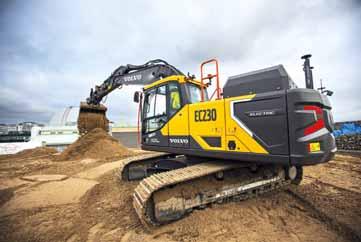
Volvo CE also announced a largescale investment into its facility in Braås, Sweden. Over the coming years the plant will be adapted to produce a larger range of articulated haulers with different types of powertrains, including electric. These products will join one of the largest ranges of electric machines on the market, including the Volvo electric compact wheeled loaders and excavators, and the larger mid-size EC230 Electric excavator.
Road safety improvements have effectively stalled in the US in 2022 at around 31,800. Yet even this poor performance can be seen as a gain considering the increases in road casualties in the US since 2019. The National Highway Traffic Safety Administration (NHTSA) data reveals that road deaths fell by 0.2% for the first nine months of 2022. Of concern is that speeding remains a serious issue. And for the first six months of 2022, US road deaths of pedestrians increased by 2% to 3,340 while fatalities for cyclists grew 8% to 448. Driving under the influence of drink or drugs is a massive problem for road safety in the US. This is the revelation following data released by the National Highway Traffic Safety Administration (NHTSA).






The Mobile Bridge and Bayway project in Alabama is "financially viable" after securing a US$125 million federal grant and around $250 million in state funding.
Construction is expected to start next year on the six-lane toll bridge over the Mobile River channel. It will be essentially a replacement of two two-lane bridges along with two three-lane bridges and the reconfiguration of seven interchanges.
The cable-stayed structure will have a 65.5m





clearance over the Mobile River navigation channel, according to project information to the Alabama Department of Transportation. All infrastructure will be owned and operated by the department, with no private concessionaire.

Meanwhile, toll revenue will be used only to pay down the project debt, with tolling to end once the debt is paid off. There will also be no-toll routes on the Causeway, Wallace Tunnel, Bankhead Tunnel and Africatown Bridge.
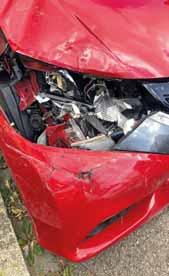

The NHTSA has published a study of road crashes in the US, which shows that over 50% of people killed or injured in road crashes were either under the influence of drink or drugs at the time of the incident. The study was carried out at trauma facilities in a range of major cities in the US states of California, Florida, Iowa, Maryland and North Carolina. Worryingly, 20% of the people tested had traces of at least two drugs in the system, with one of the most common being
as found in cannabis.








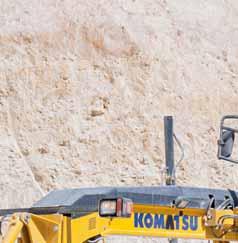
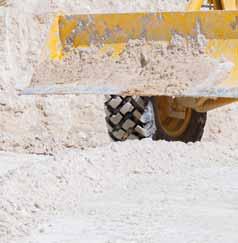

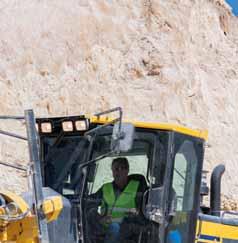
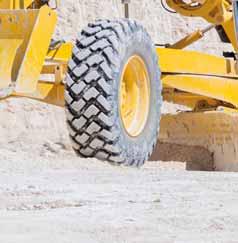
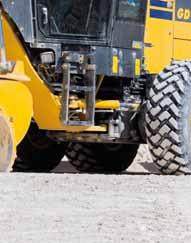
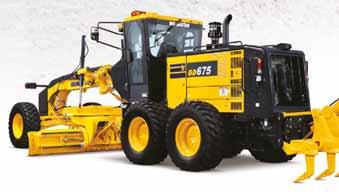
The latest Komatsu motor grader has a powerful EU Stage V engine, delivering 165 kW / 221 HP. your arm movements by up to 90%. Combined with unbeatable value.









Talks continue between contractors and client for a new opening date for the Gordie Howe International Bridge after the original date in 2024 recedes.
It was late last year that discussions were first reported between the joint venture of Bridging North America (BNA)comprising of ACS Infrastructure Canada, Fluor Canada and Aecon Concessions – and the WindsorDetroit Bridge Authority (WDBA), the international authority that is overseeing construction on behalf of the Canadian government.
Meanwhile, the authority says that 2023 will see major advancement of the bridge deck stretching over the Detroit River. By December, the deck had been constructed up to and slightly beyond both pylons which sit on the banks of the river.
“Work has begun on the pylon heads of both the Canadian and US bridge towers now the transition areas connecting the tower legs are complete,” said

Heather Grondin, vice-president of corporate affairs for the authority. “Over the next year, it is anticipated the towers will reach their full height [220m] and road deck construction over the Detroit River will begin.”
The tolled six-lane cablestayed bridge – costing around US$4.2 billion - will connect the city of Windsor in the Canadian province of Ontario with Detroit in the neighbouring

US state of Michigan. Currently, the privately owned and tolled Ambassador Bridge is the major transportation link for goods between the two countries – the busiest commercial link for both nations. The bridge will also have a dedicated pedestrian and cyclist path.
Work is progressing on the tolling plaza on the Canadian side, including 11 buildings and canopy structures, as well as
initial work to connect the bridge to the nearby Herb Gray Parkway and Highway 401 which will see vehicles bypass the centre of Windsor. Similar work is proceeding on the US side.
The bridge is not a US-Canada project but is being built solely by Canada, funded by the federal and provincial governments.
The joint venture of Bridging North America (BNA) is privatesector construction partner of the Windsor-Detroit Bridge Authority, the international authority that is overseeing construction on behalf of the Canadian government.
WDBA is responsible for the design, build, finance, operation and maintenance of the Canadian and US Ports of Entry and the bridge. WDBA is also is responsible for the design, build and finance of the Michigan Interchange under a publicprivate partnership agreement. The US state of Michigan will be responsible for the operation and maintenance of the Michigan Interchange.


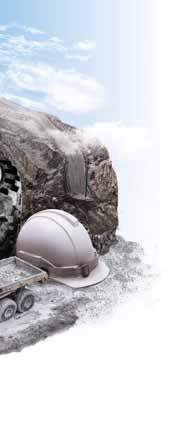
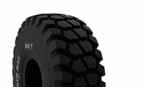
No matter how challenging your needs, EARTHMAX SR 41 is your best ally when it comes to operations that require extraordinary traction. Thanks to its All Steel radial structure and the special block pattern, EARTHMAX SR 41 provides excellent resistance against punctures and an extended service life. In addition to long working hours without downtime, the tyre ensures extraordinary comfort.
EARTHMAX SR 41 is BKT’s response to withstand the toughest operating conditions in haulage, loading and dozing applications.
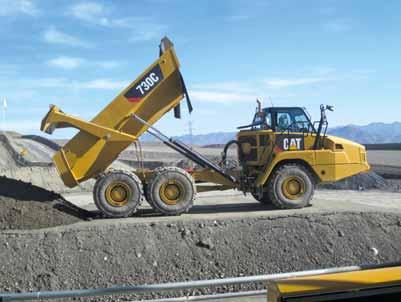
Caterpillar is reporting strong performance for the fourth quarter of 2022 as well as for the full year 2022. Fourthquarter 2022 sales and revenues were up 20%, while full-year sales and revenues were up 17%.
Sales and revenues for the fourth quarter of 2022 were US$16.6 billion, a 20% increase compared with $13.8 billion in the fourth quarter of 2021. Fourthquarter 2022 profit/share was $2.79, compared with $3.91 profit/ share in the fourth quarter of 2021. Adjusted profit/share in the fourth quarter of 2022 was $3.86, compared with the fourth quarter 2021 adjusted profit/share of $2.69. Profit/share in the fourth quarter of 2022 included an unfavourable ME&T foreign currency impact in other income (expense) of $0.41/ share mostly related to balance sheet translation, compared with a favourable impact of $0.01/share in the fourth quarter of 2021.
Full-year sales and revenues in 2022 were $59.4 billion, up
17% compared with $51.0 billion in 2021. The increase reflected favourable price realisation and higher sales volume, driven by the impact from changes in dealer inventories, increased services and higher sales of equipment to end users. Dealers increased their inventories $2.4 billion in 2022, while remaining about flat in
2021. Full-year profit was $12.64 per share in 2022, compared with profit of $11.83/share in 2021. Adjusted profit/share in 2022 was $13.84, compared with adjusted profit/share of $10.81 in 2021.
The firm saw a strong operating cash flow of $7.8 billion and ended the year with $7 billion of enterprise cash.

Major road projects are planned that will improve the network across Australia.
One of the biggest projects will be improvements to the Bruce Highway in Queensland. The contractor FKG Civil will carry out works to the route in Bowen. The contract was awarded by the Queensland State Government. Both the Queensland State Government and the Australian Federal Government are funding a wider programme of upgrades for the Bruce Highway (the BHUP) from Cairns to Brisbane, of which this contract forms part. A total of US$8.95 billion (A$13 billion) is being spent on the Bruce Highway revamp over a 15-year period.
A major package of works in NSW will be handled by a joint venture comprising John Holland and Gamuda and Seymour Whyte Construction. The firms will work on the M1 Pacific Motorway extension project, due for completion in 2028. The contract is worth $1.45 billion (A$2.1 billion). A 10km extension of the M1 will run between Black Hill and Tomago. SMEC Australia, Daracon Contractors and Georgiou Group will also undertake upgrade work for a 6km section of the Pacific Highway. And a further 5km section will bypass Heatherbrae, which will be built by Whyte Construction.
Nova Scotia will commit US$748 million over the next seven years for improvements to the eastern Canadian province’s highways, bridges and ferry infrastructure. The money is part of the recently announced Five-Year Highway Improvement Plan. This maps out the government’s approach to repair and maintain the province’s 23,000km of roads and highways and 4,100 bridges. Included is the replacement or rehabilitation of 31 bridges. In 2023/24, the province will spend $336 million on major highway projects already underway.

Road repairs and maintenance works are being prioritised in NSW. A budget of $341 million (A$500 million) has been set for the work. The work will be funded by the NSW State Government, tackling potholes and damaged road surfaces across the state that have resulted from heavy rains and floods.
But delays now seem the likely outcome for a major road project for Perth in Western Australia. The construction company working on the project, Clough, has hit financial problems. The company was working on new links with the Perth Mitchell Freeway.
Clough was working on the project in a joint venture with Acciona and WSP, with work having commenced in the second quarter of 2022.
The project is receiving a significant portion of its funding from Australia’s Urban Congestion Fund. The project now looks likely to be completed around 12 months behind schedule and should be ready at the end of 2024.
It will spend an additional $436 million on six new major infrastructure projects between 2025 and 2030. Major projects earmarked to start this year are the twinning of sections of Highways 101, 103 and 104 as well as the four-lane Highway 107 Sackville-BurnsideConnector. The province says it is also doubling its gravel road spending to $30 million and doubling bridge spending to $45 million. Nova Scotia has more than 8,400km of gravel roads and they make up 35 per cent of the provincial road network.


































The Webuild Group’s US subsidiary Lane Construction has been awarded the package of works to improve a key link in Florida. The project is to widen and upgrade more than 6km of highway in Orange County. This will improve traffic flow along the gateway to some of central Florida’s greatest tourist attractions.
The US$218 million contract will help to boost capacity and improve safety for an interchange at Interstate 4 (I-4) and Sand Lake Road (State Road 482) in Orange County, Florida. The interchange forms part of the county’s corridor connecting tourist attractions such as Universal Studios Orlando, International Drive, Sea World, and Walt Disney World. Upgrading the interchange will contribute to the local economy by easing traffic


flow and cutting journey times.
Commissioned by the Florida Department of Transportation (FDOT), the project entails roadway improvements and preparations to install a Diverging Diamond Interchange (DDI) with I-4. There will also be the replacement of two bridges, the construction of a new bridge for preferential lanes, three new access ramps, as well as the installation of a toll and signalling systems.
The firm already has a major presence in Florida. In Tampa, it is widening a downtown section of I-275. In the greater Orlando area in Osceola County, it is completing the Poinciana Parkway. Elsewhere in Orlando, Lane is working on a beltway at the intersection of I-4, SR 417, and the nearly completed Wekiva Parkway (SR 429).
In the US state of Louisiana, excessive settlement of the piles for the LA 1 replacement bridge in West Baton Rouge could delay the project.
The Louisiana Department of Transportation and Development said in a press release that the construction delay to the US$57.7 million project could be as much as 10 months, according to local media.
The department is working with a contractor on a geotechnical survey to see what might be the best solution. Low-mobility grouting, where grout is injected into the ground beneath the piles to compact loose soils, could be one option.
Work to replace the southbound bridge began in April 2022. The new bridge over the Intracoastal Waterway will be constructed on the west side of the existing bridge. This is part of a two-phased project with contractor Kiewit Louisiana.






Major repairs and maintenance works are required in Japan to address the issue of poor road conditions. A new national survey has highlighted the problem of dilapidated highway stretches in Japan. The survey focussed on safety and identified 500km of important routes that are in need of maintenance and repair works. Discussions are being held between the Japanese Government and the six highway tolling firms in the country to work out a suitable solution to the issue.

The new bridge over the Intracoastal Waterway will be constructed on the west side of the existing bridge (image courtesy Louisiana Department of Transportation and Development)








The second phase, which could be tendered this summer, will see removal of both existing bridges and construction of a northbound bridge, as well as connecting roads on the south side of the bridge. Both bridges will have lanes around 3.7m wide and 3m-wide shoulders.
The bridge replacement project is vital to the nation’s economy, according to a non-
political group supporting the project, the LA1 Coalition.
LA 1 Highway 1 (LA 1) is the only access to the vast energy resources in the US Gulf of Mexico, notes the coalition. This critical, two-lane highway is the only roadway supporting Port Fourchon – the US’s busiest intermodal energy port, the Louisiana Offshore Oil Port (LOOP) and Grand Isle.
Construction is underway in China for a major new highway project measuring 240km. The new highway will connect Nanchong with Chengdu, forming part of the route linking Shanghai with Chendu. Sichuan Expressway Construction and Development Group won the US$5.66 billion package for the project. Around 63km of new highway will be built. Another 177km of existing highway will be widened.
The tender process is underway for a 4km expressway project in Phuket, Thailand. The project is expected to be worth US$421 million and will link Kathu with Patong. The concession package will include design, construction and operation for a 35-year period. Construction should commence in 2024 and be complete by 2027 if the planned schedule is adhered to. The new road link will feature twin lanes for powered two wheelers in either direction as well as twin lanes for cars, vans and trucks in either direction.
The Japanese Government is pledging to improve the country’s road safety record.
Official police data shows that 2,610 people were killed in road crashes in Japan during 2022. This is a drop of just 26 from 2021 but is the lowest road death rate for Japan since these figures began to be compiled in 1948.
However, the Japanese Government intends to lower the country’s road crash fatalities
further and is aiming to reduce the casualty rate to less than 2,000/ year by 2025. The official figures for road crashes are compiled by Japan’s National Police Agency. Meanwhile, New Zealand saw road deaths climb to 378 for 2022, an increase of 60 from the figures for 2021. New Zealand performs poorly in terms of road safety, with the country’s government aiming to improve this and reduce annual casualty rates.

A number of major road projects are commencing in China. Construction of a 32km expressway connecting Wuxi with Taicang City is commencing. The project is worth US$2.56 billion and the new route


will feature three lanes in either direction. Widening work is being carried out along a 36km stretch of the expressway that connects Wuxi with Yixing and is costing $1.13 billion. This 36km route will feature
four lanes in either direction once the work is complete.
Meanwhile, improvements worth $219.4 million will be carried out on a 5.5km stretch of the expressway linking Shanghai and Wuhan.
The road will be widened so that it features four lanes in either direction. A new expressway is also being built from Jiangyin City that will link with the Shanghai to Wunah expressway.














































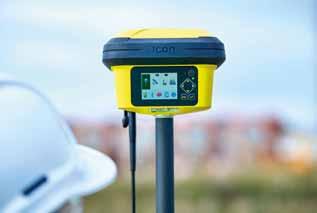
Leica Geosystems says that its next-generation Leica iCON gps 160 is a highly versatile construction Smart Antenna. The new system comes with features that are said to increase productivity in all stakeout and measurement applications on the jobsite.

The iCON gps 160 can be used as a base station, a rover or for machine guidance. It is a replacement for the successful Leica iCON gps 60, offering additional functionality. The result is a smaller, more compact GNSS antenna with more features and a larger display for ease of use.


The new system is suited to use in complex construction environments with different GNSS requirements. The user can switch between different applications easily. Besides checking grade, cut and fill, stakeout points and lines, users can also benefit from using this solution for basiclevel GNSS machine guidance.



The iCON gps 160 comes with an integrated colour display, a userfriendly interface, smart setup wizards and an intuitive construction-specific workflow. Size and weight reductions make the iCON gps 160 easy to handle while the latest GNSS and communication technologies improve data reception. The optional tilt feature allows users to measure and stakeout points with a tilted pole, which saves time and extends the measurement possibilities. The iCON gps 160 Smart Antenna sets new standards in construction GNSS antennas and enables precise measurement, avoiding mistakes and extra trips onsite.






Leica Geosys tems















Trimble is introducing a geotechnical portfolio to its geospatial automated monitoring portfolio.
This is being achieved through a collaboration with Worldsensing, a wireless connectivity technology provider and an industry-leading manufacturer of geotechnical IoT monitoring systems. The collaboration enables survey, geotechnical and structural engineers to expand their monitoring business opportunities with a comprehensive solution that incorporates geotechnical and geospatial data.
Data from a variety of geotechnical and geospatial sensors - from tiltmeters, piezometers and crack gauges to GNSS receivers and total stations - combined with wireless communication and robust software create powerful


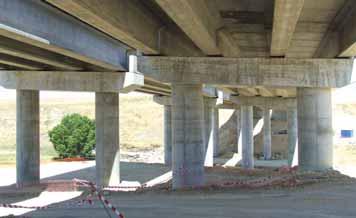
monitoring solutions. This provides movement analysis to monitor transportation infrastructure and structures as well as landslides and natural hazards.
The Trimble-branded geotechnical product line, powered by Worldsensing, provides a fully automated wireless monitoring solution that
helps minimise field visits and increases safety by reducing the need to obtain manual readouts. The automated measurements generate real-time notifications and reporting through the new Trimble 4D Control software (T4D) Geotechnical Edition software, which enables users to streamline monitoring system deployment as


well as simplify the connection to geotechnical sensors.
The Trimble geotechnical portfolio includes wireless geotechnical sensors, wireless data loggers, and rugged long range (LoRA) radio and 4G gateway technologies. They also include configuration software and an array of accessories for a variety of mounting and configuration environments
By expanding Trimble’s geospatial portfolio to include geotechnical IoT solutions, monitoring professionals can have access to both product lines from a single provider. This provides the flexibility to choose the optimal system to monitor construction projects and other critical assets with the T4D software.
The Electronic Motion & Controls Division (EMC) of Parker Hannifin is releasing IQAN-G12, a CAN gateway module that uses Bluetooth wireless technology for IQAN system diagnostics onsite or remotely.
The new IQAN-G12 is said to offer a faster download speed, increased connectivity range and greater security than its predecessor, the IQAN-G11. This makes it easier, quicker and more cost-effective to access machines in the field.
Parker’s IQAN-G12 gateway enables accessible communication with the IQAN master modules in
the control systems of construction machines. The benefits of the IQAN-G12 include faster diagnostics and troubleshooting, as well as increased security. In comparison with the predecessor model, the new IQAN-G12 offers more than four times faster download speed, an increased connectivity range of up to 30m and better security. The IQAN-G12 is prepared for CAN FD (CAN Flexible Data-Rate) communication, allowing further speed increases in the future.
Parker Hannifin www.ph.parker.com
06-16: Bridge Management & Inspection
O N LI N E
Organiser: Washington-based IRF Global
Tel: +1 703 535 1001
Email: melabyad@IRF.global https://www.irf.global/event/ brm23-online-training/
07-08: Road User Charging Conference
Belgium
Organiser: CiTTi
Tel: +020 8037 1775
Email: ross.sturley@ akabomedia.co.uk https://www.roadusercharging conference.co.uk/
10-12: B2W User Conference
Red Rock Resort, Las Vegas
Email: vgarofalo@b2wsoftware.com https://web.c vent.com/ event/058571d2-080f-4219-b78824d61bd776cb/summary
14-18: CONEXPO-CON/AGG
Las Vegas, NV
Organiser: AEM
Tel: +1 (800) 867 6060 https://www.conexpoconagg.com/
21-22: ASECAP Road Safety Conference Salzburg, Austria
Organiser: ASECAP
Tel: +32 2 289 26 20
https://www.asecap.com/ eventasecap.html?layout= edit&id=167
25-28: 3rd IRF Africa Regional Congress & Exhibition Accra, Ghana
Organiser: Washingtonbased IRF Global
Tel: +1 703 535 1001 Email: bhalleman@IRF.global https://www.irf.global/event/afrc3/
02-04: UK Construction Week
London
ExCeL, London
Organiser: Media 10 Ltd.
Tel: +44 (0)20 3225 5200
Email: info@ukconstructionweek. com https://www.ukconstructionweek. com/
03-07: SaMoTer 2023
Verona, Italy
Organiser: Veronafiere S.p.A.
Tel: +39 045 8298561
Email: customercare@samoter.com https://www.samoter.it/en
03-07: Asphaltica 2023
Verona, Italy
Organiser: Veronafiere S.p.A.
Tel: +39 045 9691220
Email: customercare@asphaltica.it https://www.samoter.it/en
17-18: IRF 2nd International
Traffic Safety Conference
Doha, Qatar
Organiser: IRF Geneva
Tel: +41 22 306 0260
Email: info@irfnet.ch https://irfnet.ch/event/2ndinternational-traffic-safetyconference-doha-qatar/
22-24: ITS European Congress
Lisbon, Portugal
Organiser: Ertico
Tel: +32 2320 2535
Email: registrationits@ mailcongress.ertico.com https://itseuropeancongress.com/
06-08: International Rental Exhibition 2023
Maastricht MECC, The Netherlands
Organiser: Industrial Promotions International
Tel: +44 (0)7821 655 244
max.hollick@khl com https://ireshow.com/
06-08: APEX 2023
The Netherlands
Organiser: Industrial Promotions
International
Tel: +44 (0)7821 655 244
Email: max.hollick@khl com https://apexshow.com/
26-30: 4th International Symposium on Freeway and Tollway Operations
Vienna, Austria
Organiser: IRF Geneva
Tel: +41 22 306 0260
Email: info@irfnet.ch https://irfnet.ch/event/4thinternational-symposium-onfreeway-and-tollway-operations/
10-13: 41st Annual
Southern African Transport Conference 2023
Pretoria, South Africa
Organiser: IRF Geneva and the South African Department of Transport
Tel: +41 22 306 0260
Email: info@irfnet.ch https://irfnet.ch/event/southernafrican-transport- conference-2023/
12-14: TRAFIC 2023
Madrid, Spain
Organiser: IFEMA Madrid
Tel: +34 91 722 30 00 customerservice@ifema.es https://www.ifema.es/en/trafic
Throughout the year World Highways travels the globe attending conferences, events and equipment shows, keeping you informed of the latest offerings. Come and join us for a chat at any of the events below...






The African Development Bank (AfDB) and the International Road Federation have jointly launched a new capacity strengthening program aimed at improving safe and sustainable urban transport planning and project preparation for African cities.
Africa is experiencing unprecedented growth in its urban population. The continent’s current total population of 1.3 billion is expected to nearly double by 2050. Meanwhile, the continent is undergoing a pronounced and accelerated urban transition with the expected arrival of approximately 230 million new inhabitants in African cities and towns over the next 10 years. Urbanisation is set to become


one of the critical factors underpinning Africa’s structural transformation.
Africa’s fast urbanisation brings a host of new challenges in the provision of safe and efficient mobility services, necessary for access to employment, education and healthcare. Poor urban planning, inadequate transport infrastructure and services, as well as weak capacity of municipal authorities have traditionally represented major roadblocks in the quest for sustainable urban development. Conversely, the arrival of new urban mobility services, combined with advances in traffic management systems have the potential to alter the status quo and durably transform Africa’s urban mobility landscape.

Building on previous work supported by the African Development Bank, as well as on the core knowledge areas of the IRF, a new



series of capacity building tools and mentorship services will be developed across four practice areas. These are: traffic impact analysis, urban congestion management, designing safe cities for non-motorised transport and establishing municipal road safety strategies. Combined, their main goal is to enable the formulation of city-specific and implementation-ready strategies that are aligned with international commitments, notably the Paris Climate Accord and the 2nd UN Decade of Action for Road Safety.
An initial program of e-learning webinars covering each of the four practice areas is organised for the participating cities in February and March 2023. The second phase of the program includes two interactive workshops held on 25 April 2023 as part of the 3rd IRF African Regional Congress in Accra, Ghana.




Across the African continent, the end of the pandemic has witnessed a surge in road construction projects. These are expected to boost regional integration by reducing transit times, facilitating trade and cross-border movement of people, opening up access to tourism, and stimulating the economy.
Against this backdrop, achieving Africa’s regional connectivity vision remains hinged on delivering climate-resilient transportation corridors, achieving efficiency gains through improved procurement, financing and contract management, and ensuring a higher level of service and safety to all road users.
Taking place in Accra, Ghana on April 25-28, 2023, the 3rd IRF Africa Regional Congress & Exhibition pursues the objective of exploring a range of policies and mechanisms. These will be aimed at offering policymakers practical options to ensure road and transportation programmes continue supporting

the region’s sustainable development goals and socioeconomic objectives.
Join road professionals from the entire continent on this occasion to help unleash Africa’s true transportation potential!
Find out more at www.irf.global



















Transport investments require a large amount of government funds. In order to make more informed, objective and datadriven decisions, the Integrated Transport Centre (ITC) built a tool (STEAM) that simulates and helps plan for the future of Transport in Abu Dhabi Emirate.
The DMT’s Strategic Transportation Evaluation and Assessment Model (STEAM) is a sophisticated multimodal travel demand tool that uses AI and Big Data analytics to support the decision-making process in the Emirate. The model uses demographic and economic information in addition to numerous sources of data from surveys, traffic systems and external stakeholders. People’s behaviour and their travel patterns are captured to create a complex mathematical model that reflects the current conditions and forecasts future travel patterns.
STEAM is the official tool for Abu Dhabi Emirate to make informed decisions about land use development, the transportation system and transport policy changes. It is able to model travel demand patterns across the transportation system for any combination of scenarios in the forecast horizon years (2020,2025,2030 and 2040).
STEAM is used by many internal and external stakeholders to study infrastructure requirements. This tool has been successfully used to test over 60 Billion Dirhams’ worth of schemes, policies and initiatives (such as whether and when to expand a road, build a tunnel, implement a toll, or build a metro).
The ITC’s vision is to deliver an integrated and sustainable transport for a better quality of life for the Emirate of Abu Dhabi. STEAM is a
this vision.
The Steam Model is a Statistical Inference tool that uses person behaviour properties to predict future transport usage, including how many trips are generated from each type of land use, destination choice, which mode of travel people choose, time of day and route choice for particular trips.
Receiving the IRF Award in the Urban Mobility category, engineer Abdulrahman Al Shizawi, executive director, Planning &





honour for the Integrated Transport Centre of Abu Dhabi to win the 2022 Global Road Achievement Award (GRAA) in the category of “Urban Planning & Mobility. We are glad that our STEAM+ Model has been recognised by the IRF, one of the industry’s most famous and effective organisations globally. This accomplishment has assured our goal to deliver an integrated and sustainable transport system for a better quality of life in the Emirate of Abu Dhabi."
The International Road Federation’s Global Road Achievement Awards (GRAA) is a one-of-a kind competition to recognise innovative road projects and exemplary people that place the road industry at the forefront of worldwide social and economic development.
Instituted in 2000, the Awards have distinguished more than 200 programmes, projects and products from around the world.
Today, the Awards are recognised as a prestigious industry accolade in their own right, but they also serve to remind a much wider audience that the mobility everyone takes for granted would not be possible without the talent and commitment of our industry.
2023 applications are currently being accepted across the 12 award categories through May 8, 2023 at www.irf.global/graa
IThe International Road Federation is pleased to support as a co-organiser the 4th TRB International Symposium on Freeway and Tollway Operations (ISFO) to be held on 26-30 June 2023 in Vienna under the theme “Innovation Advances Towards the Future of Managing Traffic”. The challenges lying before the road sector show the need to team up with other international platforms worldwide and to look beyond traditional traffic management to facilitate also multimodal mobility offers while tackling climate change. Innovative solutions and building blocks like digital transport infrastructure can open new paths for a sustainable, future-proofed traffic management. That is why ISFO 2023 will be an innovative event that will go beyond classic traffic management.
The Symposium will provide a platform for over 400 experts from the public and private sector: managers, traffic engineers, practitioners, and researchers to discuss and share their experiences with “The Future of Managing Traffic”. Industry leaders and specialists from around the globe will lead discussions on the challenges, research needs, and innovative approaches to collaboration with other agencies and service providers to improve the management and control of traffic on the surface transportation system.
The Symposium programme will include over 20 sessions such as plenary sessions, technical sessions with invited speakers, poster sessions, and workshops. Some of the key topics that will be addressed are:
• Innovative Financing to Build and Operate Motorways, including use of incentives and pricing in traffic operational strategies.

• Governance and Organisational Challenges covering multimodal aspects, integration of highway, cities and corridors, as well as public private collaboration.
• Managing and Analysing Operational Strategies and Performance, including innovative methods to proactively manage and control traffic and addressing data, methods and tools.
• Next Generation of Traffic Management Systems and Services, including the integration of traffic management centres and services towards a traffic management ecosystem, as well as incorporating mobility on-demand services into day-to-day traffic management.
This international event is one of the many through which the International Road Federation (IRF) will celebrate this year, its 75th anniversary. A series of dedicated sessions and activities will be organised during the Symposium to mark this important anniversary.

One or more simultaneous changes in climate, such as hotter seasons, more extreme precipitation events and sea level rise, could severely impinge on road performance in Low
Income Countries (LICs). Failure to account for such impacts in future road design, maintenance and operating planning and protocols could cause accelerated road deterioration and higher
road use costs, thereby severely constraining socio-economic development. The CRISPS project aims to achieve an affordable highvolume road resilient approach
to climate change and traffic demands. This will be achieved by assessing the suitability of three global best-practice types of road surfacing technologies for use in LICs, namely Modified Epoxy
Chip Seals (MECS), Modified Epoxy Asphalt Surfaces (MEAS) and Fibre Mastic Asphalt (FMA).
The CRISPS project is an 18-month scheme led by the University of Birmingham (UoB) in collaboration with the University of Auckland (UoA), the University of Putra Malaysia (UPM) and the International Road Federation (IRF).
On 8 December 2022, a workshop was held in Ethiopia (Addis Ababa) and facilitated by the Ethiopian Roads Administration to present findings from each of the CRISPS project work packages: the development of a deterioration model, the life cycle analysis, the implementation of an anti-fraud system, and the constructability trials of the surfacings in Ethiopia.
The findings presented during the workshop indicated that:
• Epoxy-modified surfaces are more resilient to climate impacts, lasting 4-6 times longer than traditional surfacing techniques;
• Such materials have a higher construction cost, but, during a life cycle of 30-50 years economic modelling shows that their life cycle costs are lower as they require less frequent maintenance and provide lower road use costs;

• Compared to conventional overlays, FMA is more resilient and less expensive to construct due to the incorporation of natural fibres;
• These types of surfacings could be developed in other LICs countries
with little modification to existing plant in existing practices.
However, the challenge will be to monitor over a longer period of time the in-situ performance of these roads to assess the effect of climate,
drainage, traffic growth on the resilience of the materials and thereby verify the findings of the modelling undertaken to date.
• More information on the CRISPS project can be found at www.irfnet.ch.
The International Road Federation (IRF) together with the Qatar Transportation and Traffic Safety
Centre (University of Qatar) and the support of Khatib & Alami is organising a professional training
course on "Introduction to Road Safety Audits”. The course will be held on 30 May – 01 June 2023, in

person, at Qatar University. This training course aims to introduce the procedures and requirements for developing Road Safety Audits, and the importance of conducting these audits and implementing their recommendations in improving the status of traffic safety. Furthermore, it will cover methodologies and cutting-edge technologies that have been field-tested to reduce traffic injury risk through auditing and inspections. Attendees will receive the necessary theoretical background and applied practices to ensure their risk identification programs are effective and impactful.
• More information on the course and registration can be found online at www.irfnet.ch.
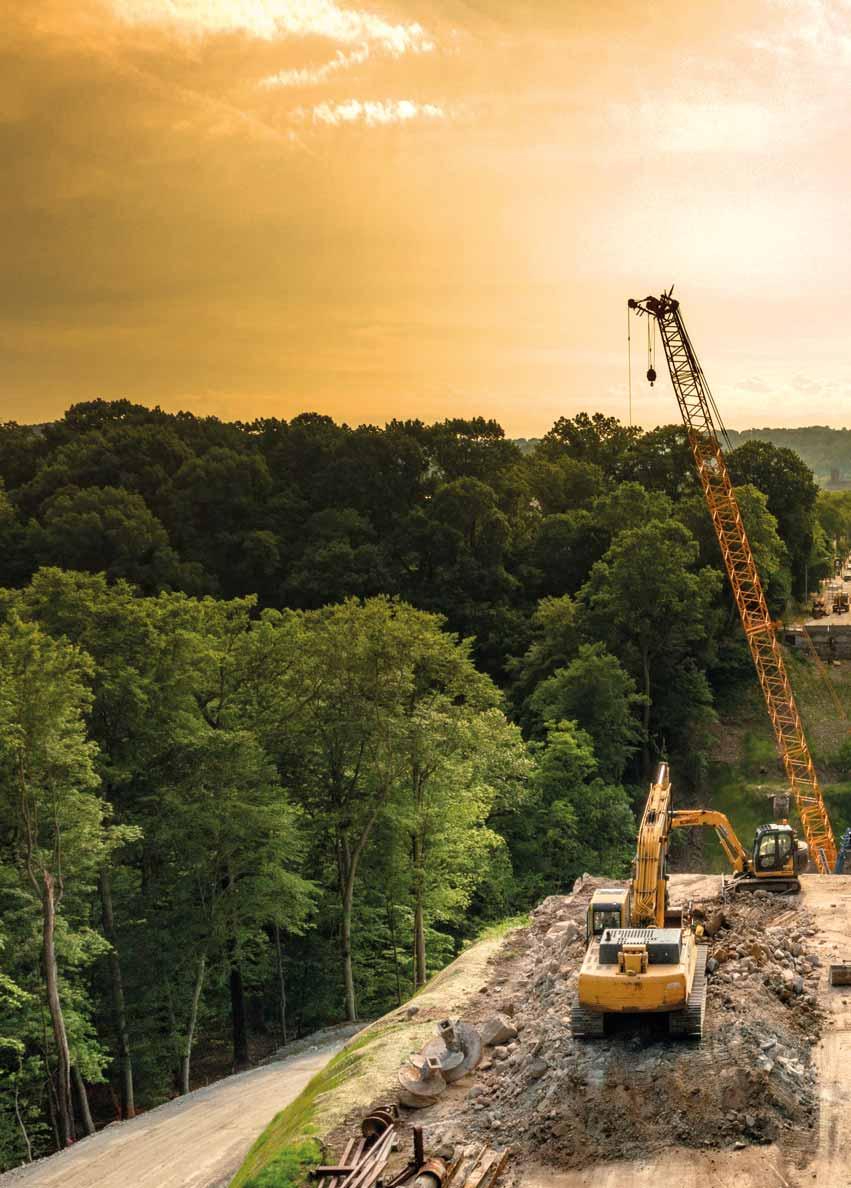







The construction of a new bridge in Pittsburgh, Pennsylvania to replace a collapsed structure has been carried out in record time – Mike Woof reports








Swork was carried out initially


peed of construction has been the key to a novel bridge replacement project in Pittsburgh, Pennsylvania in the US. Although the bridge itself and the contract to build it are comparatively small, what stands out about this work is how all the partners involved have come together to carry out the work quickly.
Timing, as they say, is everything. US president Joe Biden was visiting Pittsburgh and had planned to give a speech on the need for investment in US infrastructure. Just before he arrived, one of the city’s ageing road bridges collapsed.


It was extremely lucky that nobody was killed when the Fern Hollow Bridge carrying Forbes Avenue gave way on the morning of 28th January 2022 as six vehicles, including a bus, were crossing the bridge at the time. The bridge collapse resulted in 10 people being injured, three of whom required medical attention in hospital. Emergency responders had to use ropes to climb down 46m to reach the people trapped in the six vehicles amongst the wreckage.
But it is worth noting that the Fern Hollow Bridge failure could have been far worse as the collapse occurred at around 7am in the morning when traffic levels were still low. Had the failure happened at peak traffic levels just an hour or so later, the bridge would have been far busier and carrying many more vehicles while the risks would have been far higher.
Although the bridge is not on a major highway route, it does provide a key transport link. The I-376 highway lies to the south, while the Lincoln Highway is closer still and just to the north. These two other routes carry the major portion of the traffic in the area, but the Fern Hollow Bridge connects with South Braddock Avenue, which links with both the Lincoln Highway to the north and I-376 to the south and also regularly handles emergency vehicles.


Carrying Forbes Avenue over Fern Hollow Creek on the city’s east side, the failed steel bridge was designed in 1970 and opened to traffic in 1973, replacing an earlier structure dating from 1901. However, years of carrying heavy traffic had left its mark and its poor condition was recognised in 2019. Carrying around 21,000 vehicles/day, the 140m bridge featured a rigid K-frame and a 19.5m-wide deck that featured two lanes in either direction.
Although the inadequate condition of the bridge’s deck and superstructure was known prior to the collapse, it was not realised quite how serious the issues were.



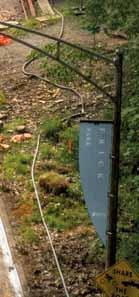
A comprehensive report into the cause(s) of the collapse has yet to be released although the NTSB has revealed that the western end of the bridge failed first. Whether or not corrosion or cracking of vital steel components were major factors in the collapse will only become clear once the NTSB’s report is made public.
Replacing the bridge quickly was a key focus for the City authorities but one major challenge to its replacement was bureaucratic. The bridge was the responsibility of the City of Pittsburgh, which did not have the capacity to move as quickly as required. A solution was needed.
Because US president Biden had already planned his trip to Pittsburgh on that day along with the governor of the state, and given the high profile of the collapse and the attention it received, the replacement project became a priority.
Talks between the city and the state authorities proved fruitful and Pennsylvania Department of Transportation (PennDOT) agreed to handle the replacement project as it had the required experience.

Cheryl Moon-Sirianni, PennDOT’s district executive for the Pittsburgh region, took responsibility for the project at PennDOT. She said that the need to replace the structure was apparent so there was agreement on how to move the work forward between the various authorities in the state. Moon-Sirianni said, “The bridge fell on Friday the 28th and the mayor was looking for assistance.”


There was rapid progress as PennDOT became involved. Assistance from the FHWA helped with the utilisation of emergency procedures as the state governor and city mayor had both enacted Emergency Proclamations.
Just one week after the initial collapse, HDR and Swank had already been brought in by PennDOT as designer and contractor respectively. The project team had worked together previously on other projects, a familiarity that further eased working. The first team meetings between the City, FHWA,HDR, Swank and PennDOT were carried out by the Wednesday, less than a week after the collapse of the bridge. At the same time, the National Transportation Safety Bureau (NTSB) started an investigation into what had caused the collapse of the bridge, with Swank providing assistance. As the demolition work to remove the collapsed structure started, Swank gathered pieces of the wreckage that the NTSB deemed vital to the investigation into the structural failure for further analysis.
Swank had been working on another project in the area and had some of the necessary equipment near at hand, as well as having experienced personnel. This was extremely fortuitous as it allowed the firm to start work very quickly. Moon-Sirianni commented, “It would’ve been months otherwise.”
Emergency funds, around $25 million, were secured very quickly. One early intention for the bridge replacement was to build a wider structure, although this faced a number of challenges.
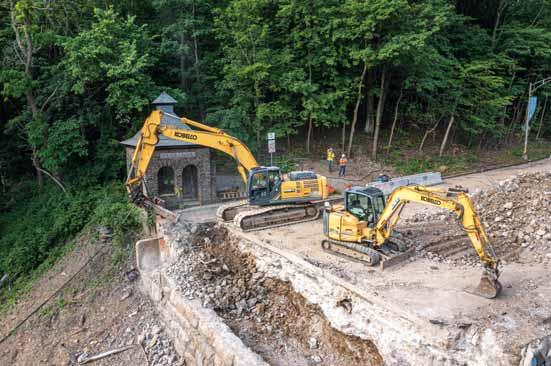
The presence of a historic structure, a gatehouse, on the west side of the bridge and a historic neighbourhood in the east meant that building the new bridge wider would be difficult. Jason Fuller is design and project manager at HDR for the project and said, “We didn’t know what the right of way would be. We determined that if we widened anything it

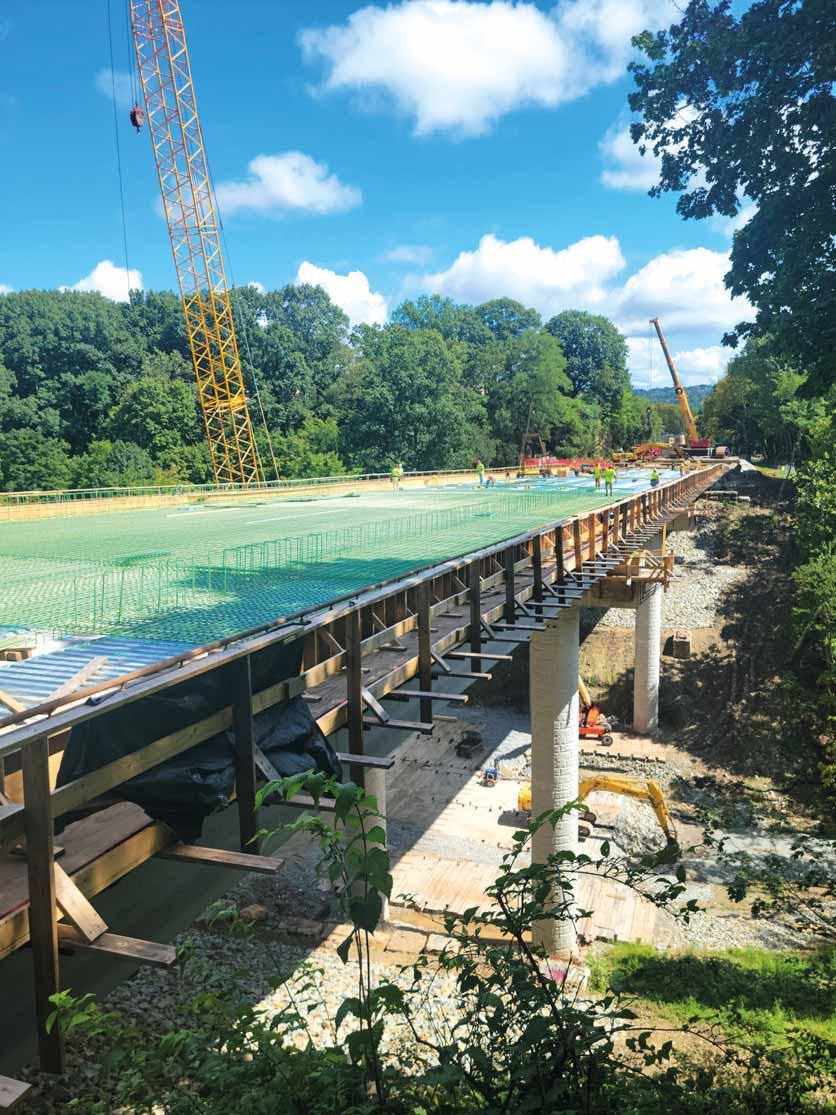
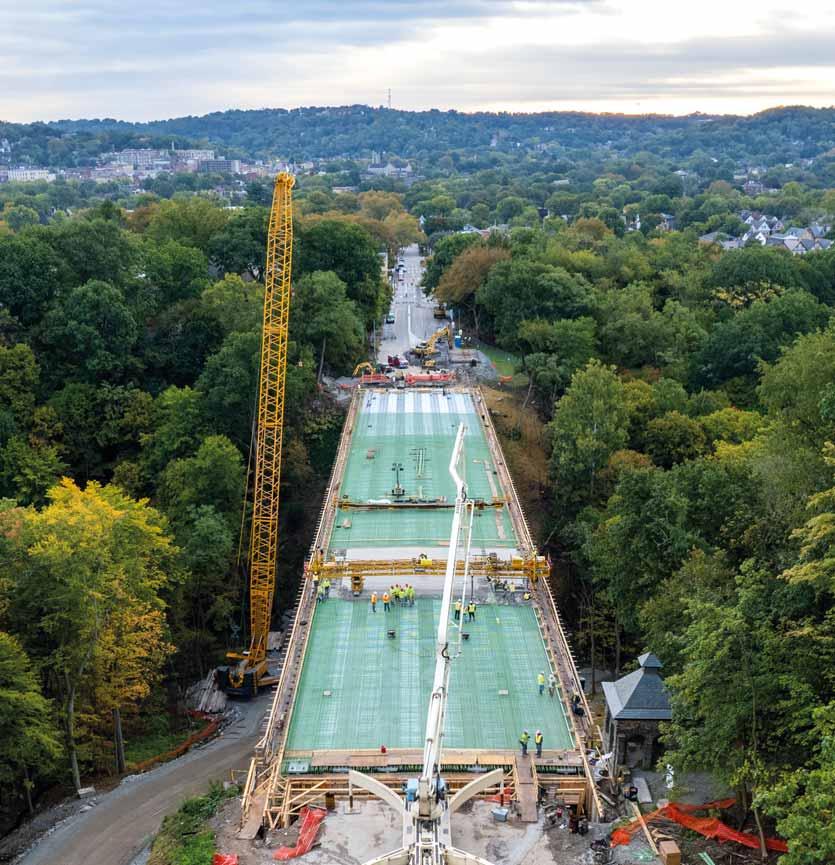
1: The team were very careful not to disturb the historic gatehouse 2: Beams were placed on the Fern Hollow bridge replacement project in early August 2022 3: Workers prepared the bridge deck in September 2022 ahead of the concrete pour 4: Construction workers walked on the bridge deck ’s rebar and Bid-Well set prior to first deck pour in September 2022 (1-4 images courtesy of HDR Inc) 5: The first concrete deck pour was carried out at Span 1 for the Fern Hollow bridge in late September 2022 6: Concrete deck work continued on the east side (Span 3) of the Fern Hollow bridge replacement project in October 2022 (5-6 images courtesy of Swank Construction Company)
would take longer.”
He continued, “Then we got into discussions of bridge types and we looked at options in steel and concrete. We zeroed in on a concrete superstructure as being the most expedient.”
But the construction process was not straightforward due to the location and he said, “Swank was looking at what we could build.”
He said it became clear to HDR and Swank that a four-span bridge would have interfered with the popular Tranquil Trail that runs for some distance along Fern Hollow Creek, ruling it out as an option.
Instead, the design team opted to use a three-span bridge, with 21 concretebeams (seven for each span) supporting a 19.5m-wide concrete deck. The design allows for two slightly narrower traffic lanes in either direction, as well as wider facilities for cyclists and pedestrians.
To support the bridge structure, Swank drilled 2.6m diameter shafts down to depths of 9.1m on one side and 12.2m on the other. Rock sockets were employed to secure the foundations. The rig used by Swank for the shafts and abutment deep foundations was Swank’s newly acquired Liebherr LB30.
The aesthetic appearance of the bridge also had to be determined. Time factors played an important role in the decision-making process and Moon-Sirianni said, “We had to look at stuff that would be aesthetic but available off-the-shelf.” She said that formwork for the bridge supports was selected that was
obtainable nearby and would provide an appearance similar to the abutments.
Meanwhile, the 42m-long steel beams came from a supplier around 160km away in central Pennsylvania and the transportation of these was a key focus in the discussions. Fuller said, “Getting bridge beams into the area was difficult.”
The beams had to be moved through rural and urban areas, with each weighing around 100tonnes and combined with the weight of the trucks, this meant a gross vehicle weight of 140tonnes. The supplier had to plan the delivery route meticulously as such long and heavy loads could only use certain roads.
The firm delivered 14 of the beams to one side of the project and seven to the other, which was no small task. Moon-Sirianni complimented the drivers of the trucks for showing exceptional skill, having carefully reversed these very long and heavy trailers distances of up to 1,200m. That the 100tonne, 42m-long beams had to be reversed into position did not go unnoticed either. MoonSirianni said that around 100 residents were lining the street and cheering as the beams were delivered, pleased that the bridge was being replaced as its absence caused long diversions.
To place the beams, an MLC650 Manitowoc crane was located at the top of the abutment on one side of the gorge. Using a Variable Position Counterweight (VPC), the crane was rigged for loads of 700tonnes. It was positioned on both of the abutments to lift the beams into place for Span 1 and Span 3 and also assisted with the lifting operation for Span 2. However, just getting the crane to the site was an effort in itself as the machine required around 40 trucks to carry all of its components to the first abutment. Once it had carried out the required lifting operation at the first location, it then had to be disassembled so it could be transported to the other side of the gorge from where it could lift in the remaining concrete beams.



out work for the middle span. This machine was also equipped with a VPC system, allowing it a load capacity of 315tonnes and along with the larger MLC650, assisted with positioning the beams for Span 2. Moon-Sirianni said, “It was quite a feat to get it down the access road. It was a 30% gradient!”
The access road had to be built specially for the project but will be removed and the park area underneath the bridge will be restored when the construction work has been completed. Two other smaller cranes, a Liebherr and a Manitowoc, were used to assist the larger machines.
Once the concrete beams were in place, the concrete deck structure could be built. The 1,119m3 of concrete used for the deck itself was supplied using three Schwing concrete pumps with boom lengths of 32, 36 and 58m. A Bid-Well 3600 bridge deck finisher was then used for the surface work. In addition, a further 176m3 of concrete was used for the bridge barriers.
The bridge features a 200mm-thick concrete deck as well as a 25mm-thick epoxy polymer concrete surface layer. This special polymer layer is a novel feature for bridge construction in Pennsylvania and is intended to provide protection for the steel reinforcement and concrete in the deck against the salt used for de-icing during winter weather. Fuller said, “It’s probably the first bridge in the city with this layer.”
The speed with which the bridge has been designed and built is phenomenal and MoonSirianni commented, “Normally a local bridge like this from conception to completion would take at a minimum five years.”
The city authorities (and residents) have been delighted with the progress on the project and Fuller said, “They were amazed at the
The failure of the bridge highlighted the poor state of many bridges in the US. A report by the American Road Transportation and Builders Association (ARTBA) shows just how desperate is the need for infrastructure improvements in the US. According to ARTBA chief economist Dr Alison Premo Black, 43,578 bridges in the US are classed as structurally deficient.
ARTBA’s analysis of data from the US Department of Transportation (DOT) 2021 National Bridge Inventory (NBI) database highlights that 224,000 US bridges either need repair or replacement. The report finds that 78,800 bridges in the US should be replaced, while just 48% of the 619,588 bridges in the US are rated in fair condition. The total cost of necessary repairs or bridge replacement works has an estimated cost of US$226 billion.
The US states with the largest number of bridges in poor condition are: Iowa (4,504), Pennsylvania (3,198), Illinois (2,405), Oklahoma (2,296), Missouri (2,218), New York (1,672), Louisiana (1,631), California (1,493), West Virginia (1,490), and Ohio (1,334).
The US states and territories with the most bridges in poor condition as a percentage of their total bridge inventory are: West Virginia (20%), Iowa (19%), Rhode Island (17.5%), South Dakota (17.3%), Pennsylvania (13.8%), Louisiana (12.7%), Maine (12.6%), Puerto Rico (12.1%), North Dakota (11.2%), and Michigan (11%).
speed of the contract.”
Fuller and Moon-Sirianni agreed that the way the various parties involved came together was a key factor in the success of the work. She said, “This design could not have happened had there not been trust between HDR, Swank, PennDOT and the City. That allowed us to expedite the project.”
It was not plain sailing and Moon-Sirianni said, “We were going through supply issues in the area.” But she added that by opting for a conventional design and using available materials and components, the project was able to move forward swiftly.
Another fortuitous development was that Swank had just bought its new Liebherr drilling rig shortly before the project started and the machine could be brought to site quickly to start work.
The design and construction personnel
from HDR and Swank have made massive progress with the project, managing to have the bridge with one lane open in either direction before the Christmas break. However, considerable work still has to be carried out, including installation of the lighting. By early summer, the bridge will be fully operational with two lanes in either direction.
Liebherr www.liebherr.com
Manitowoc www.manitowoc.com
Schwing-Stetter www.schwing-stetter.com
Terex Bid-Well www.terex.com/bid-well


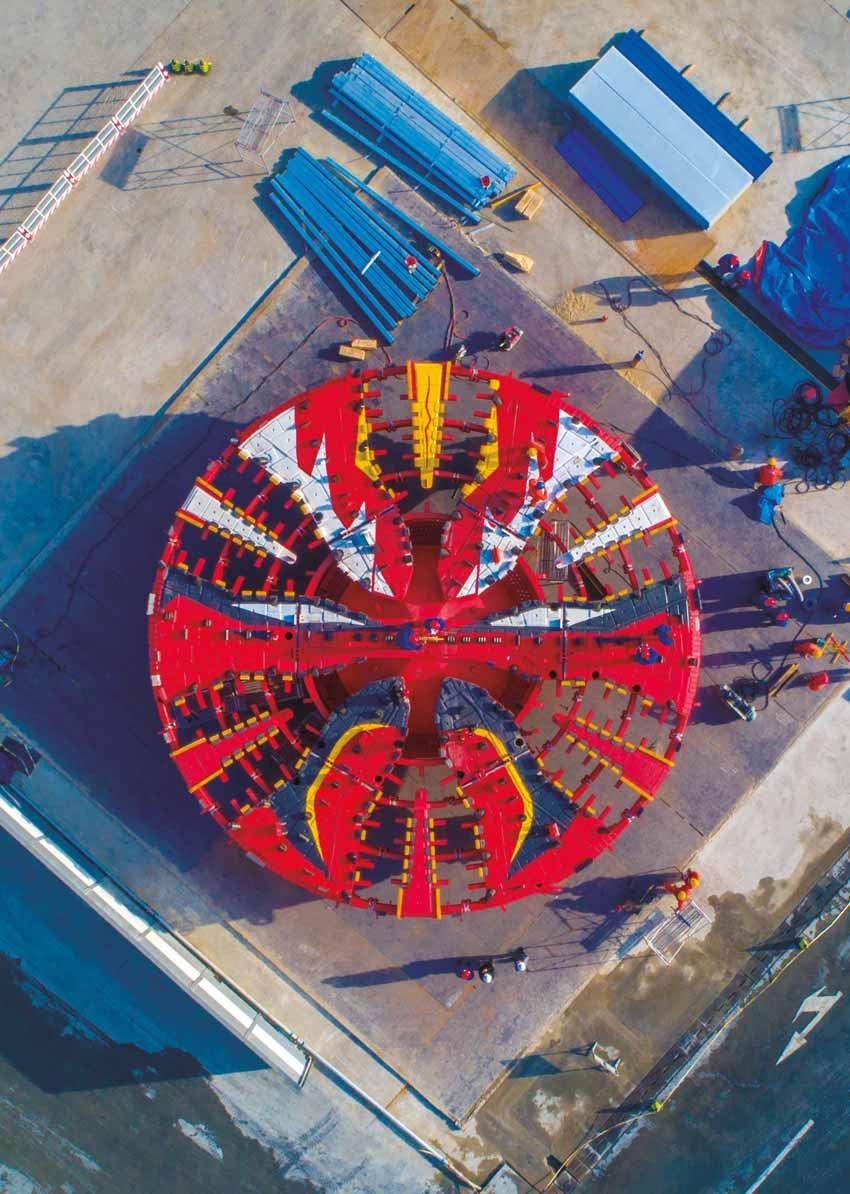
Welcome to the World Highways magazine preview of the CONEXPO-CON/AGG 2023 exhibition. Over the next 7 pages, we will highlight all the key product launches and North American debuts during what promises to be an action-packed, must-attend event
Ammann is introducing its compact and productive ARS 30 and ARS 50 soil compactors to the North American market. The firm says that the new ARS 30 and ARS 50 single drum rollers benefit from advanced technology, innovative engineering and robust engines to deliver high compaction output.
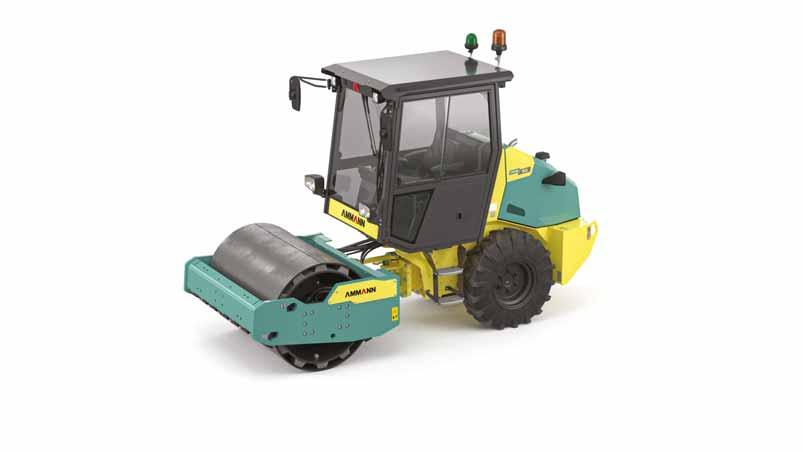
The ARS 30 and ARS 50 are aimed at road construction firms and rental fleets that need small, durable and powerful machines. The rollers can compact a wide range of materials and have the option of smooth or padfoot drums. The ARS 30 and ARS 50 are powered by Kubota V2403-CR-T diesel engines with EGR+DOC+DPF (without SCR) aftertreatment technology and


rated at 43.2kW, meeting the Tier 4 Final/Stage V emissions requirements.
A combination of an efficient engine, hydrostatic drive system and control deliver economical fuel consumption of 5litres/hour. That efficiency and a large fuel tank of 98litres mean that the rollers need only be fuelled once every three working shifts
The ARS 30 drum has a working width of 1200mm. The single-stage vibratory system and two different frequencies supply compaction power of 37kN and 68kN. The working width of the ARS 50 is 1400mm with a boosted single-stage vibratory system with two frequencies. It provides compaction power of 53kN and 85kN.
A smooth drum is standard

on both machines. The ARS 30 has a drum thickness of 15mm, while the ARS 50 drum is 18mm thick. To improve versatility and profitability, the rollers are available with a padfoot (PD) drum (with a smooth shell kit) and a dozer blade.
The drums are designed to be maintenance-free as part of Ammann’s ECOdrop philosophy. The innovative no-rear-axle concept makes the rollers compact and allows a low engine location that improves the centre of gravity for stability.
Also available is the ACEforce system, which enables operators to monitor compaction progress. The Intelligent Compaction system shows the actual kB value on the display, significantly reducing the time required to achieve maximum compaction. An optional telematics system can help monitor the machine’s position, assist with control and provide other important jobsite information. All the data can be monitored via the web.
Ammann
www.ammann.com

Powerscreen says that mobility is a key feature of its new Gladiator and Titan models.
The Gladiator MT1150SR wheeled crushing and screening plant and the Titan 2300 screener have been designed to be both productive and as easy to transport.

The Gladiator range consists of wheeled, electric-drive, closed-circuit cone crushing and screening plants that are easy to operate and move. The Titan screening plant range operates as a secondary scalper while providing a cost-effective solution in high-volume applications. Powerscreen www.powerscreen.com
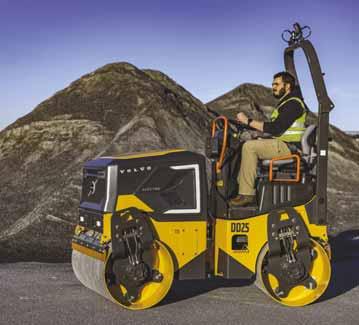
Volvo CE is introducing its 0025 Electric compactor, the first of the firm’s new electric machines designed specifically for the asphalt industry.
The electric driveline of the 0025 Electric is based upon the same proven architecture and components found on Volvo CE’s ECR25 Electric compact excavator and L25 Electric compact wheeled loader.
The zero emissions performance suits the machine for use in sensitive or urban environments with strict emissions regulations and for organisations looking to meet sustainability goals. Zero tailpipe emissions also mean a cleaner working environment for operators and site personnel.
Expected to operate for a full shift on a single charge depending upon the type of job and intensity of the work cycle, the 0025 Electric has the same charging solutions as its forerunners, the ECR25 Electric and L25 Electric. Customers can choose the right solution depending on operational requirements. The machine comes with an integrated onboard charger which enables charging from 0 to 100% in as little as three hours, depending on the

WIRTGEN GROUP www.wirtgengroup.com/conexpo
The WIRTGEN GROUP is an internationally operating group of companies in the construction equipment industry. We owe our strength to the five traditional product brands WIRTGEN, VÖGELE, HAMM, KLEEMANN and BENNINGHOVEN.
AC power level. With an optional off-board DC fast charger this can be achieved in little over an hour.
Combining the proven Volvo Asphalt Compactor platform with battery power, the 0025 Electric offers 24kW of available power, 30% more than the conventional Volvo 0025B. The result is a more responsive machine in terms of speed and vibrations, which performs better on grade. It also works better at high altitudes compared to a diesel machine which loses power.
Good visibility and high frequency compaction allow operators to achieve a smooth finish asphalt surface with speed. Frequency can be adjusted from 3500vpm/55Hz to 4000vpm/67Hz to cater for different applications.
And with no engine to service -and electric components, batteries and motors all maintenance-free, maintenance requirements are reduced too.
With the introduction of this latest electric machine, Volvo CE continues to lead the way with products and solutions to help its customers reduce their total cost of ownership and carbon footprint, while meeting its own sustainability goals.
Volvo CE www.volvoce.com

As technological leader, we can offer our customers mobile machine solutions for road construction and road rehabilitation, plants for mining and processing minerals or recycling material and for the production of asphalt.


The WIRTGEN GROUP, represented through Wirtgen America, is showcasing its latest developments in all three aspects of smart, safe, sustainable at the joint appearance with John Deere in Vegas. Come to Conexpo-Con/Agg, experience the fascination of our innovative solutions and join us in celebrating the roads we have built together to date. Discover our impressive new products and technologies at first hand.
With 68 machines for road construction, materials processing, earthmoving, and earthworks, we will be demonstrating the enormous expertise and experience you can benefit from when you join forces with one of the world’s leading manufacturers. The four production systems featured in the booth include Aggregates, Site Development, Roadbuilding, and Underground, highlighting core customer business areas. Each production system will showcase key components, equipment, and features, presented first-hand by John Deere and Wirtgen Group brand representatives.
For more information about WIRTGEN GROUP visit www.wirtgen-group.com/conexpo


Simex Srl
Via Newton, 31-33 - 40017
San Giovanni in Persiceto
BO - Italy
+39 051 6810609
simex@simex.it
sales@simex.it
simex.it
simex-na.com
simex-buckets.com
simex-drumcutters.com
Over 120 models to provide solutions to the most challenging application fields: road maintenance, utilities, trenching, construction and infrastructure, tunnelling, profiling works, demolition and recycling.
Simex attachments are designed and engineered to be exceptionally durable and highperforming. Our product range includes: cold planers, screening buckets, wheel saws, drum cutters, crusher buckets, granulator buckets, asphalt floats & compactors - for excavators, loaders and skid steers.
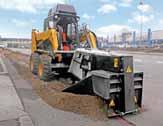
Since 1991, Simex has designed and manufactured hydraulic attachments for the earthmoving industry. With a range of 30 products and over 120 models providing solutions to the most challenging applications: road maintenance and underground utilities; construction and infrastructure; tunnelling and demolition; recycling and waste material recovery; and agriculture and forestry.
With continuous investment and a global vision proudly rooted in its history, today the company’s production plant in Italy covers a total area of 54,000m², ensuring increased stock capacity and shorter delivery times. A large amount of space is dedicated to testing equipment so as to ensure the highest quality standards. A vast demo area allows the R&D office to develop new products, simulating the various fields of application.
This is all complemented by a prompt customer and after-sales service and an extensive sales network covering over 80 countries, with a branch office in Russia and, from 2021, in the US.


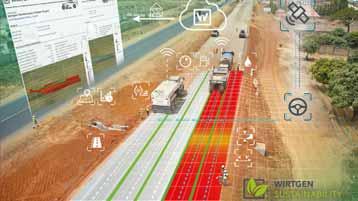
Wirtgen is now offering an innovative satellite-based AutoTrac steering system for its WR-series recyclers. According to the firm, this allows the machines to deliver efficient working, providing precision steering to centimetre accuracy. The system works by using a previously determined reference strip and a specified overlap of adjacent strips, allowing consistent use of the optimum working width, boosting efficiency.
The WR-series machines are also available with the Wirtgen Performance Tracker. The system registers location-specific working parameters to provide a database for site analysis and documentation. For soil stabilisers,
data includes working width and depth, area and distance worked and fuel consumption.
The technology is available for the firm’s latest W 380 CRi, WR 200 XLi, and WR 250i recycler/ stabilisers. The top-of-the-range W 380 Cri is a rear loader with a mixing capacity of up to 800tonnes/hour and can be used for both cold in-place recycling (CIR) and full-depth reclamation (FDR) for the rehabilitation of wide roadways. The WR-series recyclers have all-wheel drive and have working widths of up to 2.4m and high milling and mixing performances.
Wirtgen www.wirtgen-group.com

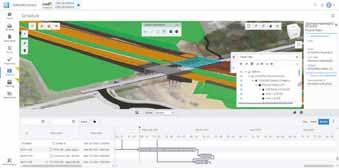
Bentley Systems is introducing upgrades for its successful SYNCHRO package for construction management. The software benefits from the new Bentley Infrastructure Cloud technology, allowing users to manage data from design to construction to handover to operations. The system ensures a single source of truth across the project life cycle, keeping the entire extended project team on the same page.
Bentley is able to deliver 4D/5D modelling services to help construction firms and owners generate digital twins for digital project delivery workflows.
SYNCHRO’s 4D/5D model capabilities offer advanced construction modelling tools that make it easier to turn design and reality models into 4D construction models. These models can simulate construction operations, deliver modelbased quantity take offs (QTO), and leverage the model as context for project
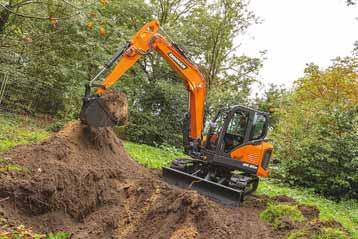
Hyundai Doosan Infracore (HDI) is replacing the Doosan brand on its construction equipment and introducing its new brand named Develon. The change takes place a year and a half since August 2021 when HDI became a subsidiary of HD Hyundai.
HDI says it will be changing the brand name on its construction equipment to Develon, confirming this as its new global brand identity from 18th January 2023.
Develon is a combination of the words ‘develop’ and ‘onwards’. HDI says the new brand name conveys the direction of its move onwards to the future through innovation
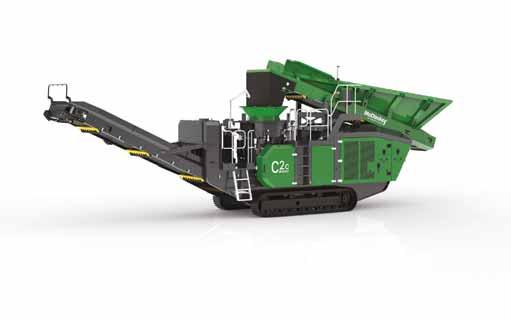
McCloskey is expanding its presence in the US with the introduction of the heavy-duty J4 jaw crusher; the efficient S190 dual-power portable vibratory screener; and the ST100TVR stacker. This last is said to reach new heights in sustainability, efficiency and fuel savings with its dual power option and lift axle option, allowing it to switch from track mode to radial mode in seconds.
Another new model is the I4C impact crusher, bringing the power and productivity of an 1125mm impactor to a compact footprint
for maximum manoeuvrability. The new I54Rv3 offers high quality and high production capacity for mobile impactor applications. The new ESS-300 tracked primary shredder capable of effectively and reliably shredding a wide range and type of material.
Sister firm MWS Equipment is partnering with Metso Outotec’s pump and cyclone division to bring new levels of efficiency to its washing equipment, offering units such as the MR200E
and its intention to relentlessly change the world with innovative products and solutions.
The company adds that it has planned the launch of the new brand since it became a subsidiary of HD Hyundai in August 2021. It says that it plans to take a leap forward to becoming a global top-tier player in the construction equipment industry with the launch of the new brand.
With the change of the brand name, the new Develon decal will be used on HDI’s construction equipment.
https://www.hyundai-di.com/en

Pump and the 650 Cyclone for the North American market.
The company is also introducing a new brand colour scheme that is said to offer a unified and more contemporary look across the product range.
McCloskey www.mccloskeyinternational.com
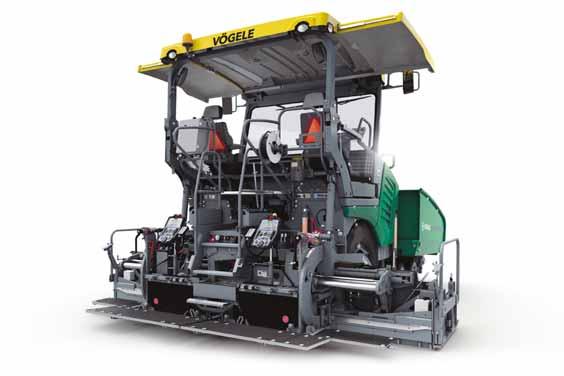
The SUPER 1703-3i Universal Class paver from Vögele is being offered with the VF 500 screed to meet the needs of the North American market. The VF 500 front-mounted screed offers paving widths from 2.44m up to 4.72m using hydraulic extension and a maximum 5.94m using bolt-on extensions.
The wheeled paver benefits from compact dimensions and Pivot Steer braking, allowing good manoeuvrability. High paving speeds can be achieved, along with laydown rates of up to 695tonnes/hour. The firm says that its Universal Class paver suits duties in large commercial applications.
The paver and screed are equipped
with the user-friendly ErgoPlus 3 operating system. It makes controlling the machine, including the Niveltronic Plus system for automated grade and slope control, easy and convenient. The Vögele EcoPlus low-emissions package cuts fuel consumption by up to 25%, depending on the application and workload, and reduces noise. When equipped with Vögele RoadScan, the non-contacting temperature measurement system, checking and documenting the paving temperature is easy. Temperature monitoring across the entire surface makes quality measurable.
Vögele www.wirtgen-group.com
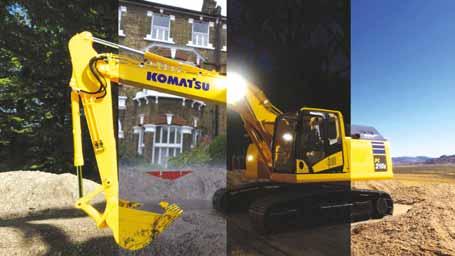
Komatsu is now making its innovative PC210E excavator available. The machine has been developed in partnership with Proterra over a number of years.
The PC210E model integrates Proterra’s proven lithiumion battery technology with Komatsu’s components such as the hydraulic pump, controller, and electric motor.
The machine benefits from robust protection for the battery pack to ensure that this will cope with the tough construction application.
Digging performance and
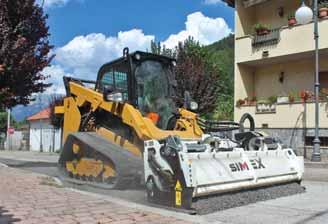
Simex is now offering its D-BLADE 200 floor saw for use with skid steer loaders. This novel unit features a diamond blade and can cut depths up to 200mm deep. The Simex asphalt saw is ideal for linear cuts on road surfaces, concrete and for creating expansion joints on continuous surfaces.
The unit suits use for the removal of predefined sections of asphalt for subsequent restoration or for the opening of new road manholes. It can also be used to make sharp cuts for laying fiber-optic cables. The clean and burr-free cut produces minimal quantities of waste material and avoids
machine durability is said to match the conventional dieseldriven PC210 model. The Proterra battery system is said to allow operation for up eight hours when fully charged.
Electric power means that the machine can be used in areas without noise or exhaust emissions such as underground operations, as well as urban areas and night-time construction work.
The zero-engine vibration also helps reduce operator fatigue.
Komatsu
www.komatsu.com

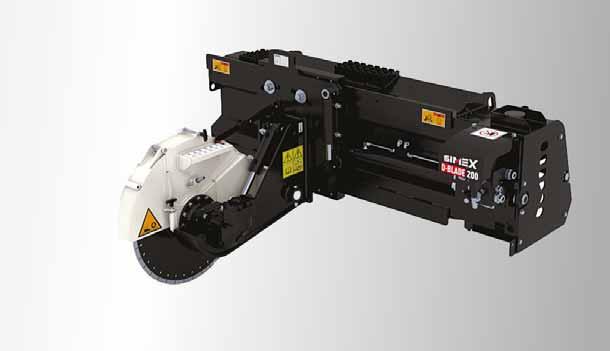
trench deformation, facilitating the filling phase and the quality of the restoration.
Simex now offers for the US market 15 models of wheel saws specifically
Versatility and productivity are claimed for Kleemann’s new MOBISCREEN MSS 802i EVO model. The powerful mobile screen has been designed to meet demand for use in challenging conditions in different application areas. The firm says that the model benefits from clever plant design and versatile conversion options. It can deliver optimum material flow in natural stone and recycling applications. The large range of screen surfaces and the simple setting of screening parameters make it possible to adapt the MSS 802i EVO to different application conditions. If a fine final product is to be screened from particularly coarse feed material, the plant can be converted speedily from three to two final grain sizes. Further plant advantages include its ease of operation due to its intuitive control and ease of access to machine components. The machine also benefits from the novel H-DRIVE system with the option of an external power supply for emissions-free working.
Kleemann
www.wirtgen-group.com
designed for reduced set-section trenches. The attachments are included into four product ranges: RW, T and D-BLADE for loaders and skid steers, RWE for excavator boom mounting.
Simex www.simex.it






Caterpillar is offering a range of service options that are both versatile and sustainable. The new Cat Central app is the latest tool for access to genuine Cat parts and support. Another new service-related solution is the new Cat SIS2GO app which helps with maintaining, troubleshooting and repairing Cat equipment. Both apps are available on Windows, iOS and Android platforms.
Customers can ensure equipment uptime by using these tools as well as extended
protection packages to help secure investments. In addition, the firm is unveiling a range of new and upgraded Cat technologies – VisionLink, Cat Command, VisionLink Productivity, Cat Detect, Cat Grade and Cat Payload. These are intended to offers scalable solutions designed to fit varying business needs and budgets. Significant gains in productivity and efficiency are claimed with the use of these tools.
Caterpillar www.cat.com
EvoQuip is introducing its versatile Cobra 230R impact crusher. The Cobra 230R is said by the Terex Materials Processing brand to have the ability to operate in the most demanding of applications, such as reinforced concrete, recycled asphalt, construction and demolition waste and natural rock.
Barry O’Hare, EvoQuip business line director, said: “More than 40% of our machines are used in a recycling application. The Cobra 230R impact crusher, for example, can be run in reverse. This is a really useful feature for recycling sticky materials like asphalt.” EvoQuip says this shows that the brand is well-positioned to meet the demands of a growing recycling industry in North America.
FPT Industrial S.p.A.
Via Puglia 15 - 10156 Torino
Italy
press@fptindustrial.com
www.fptindustrial.com
FPT Industrial is a brand of Iveco Group (IVG: MI) dedicated to the design, production and sale of powertrains and solutions for on- and off-road vehicles, as well as marine and power generation applications.
Over 8,000 people across eleven production sites and eleven R&D centres work for FPT Industrial worldwide.
A dedicated ePowertrain division is accelerating the path towards net zero-emissions mobility with electric drivelines, battery packs and battery management systems.
For more information, visit www.fptindustrial.com
FPT Industrial is exhibiting its full range of Tier 4 Final and Stage V solutions for construction and industrial applications at CONEXPO 2023. Ranging from 2.8 to 16-litres, FPT engines guarantee high levels of performance along with flexibility, reliability and maximised uptime. For compact and medium applications, the F28 is a modular, highly compact engine that offers the performance of a 3.4-litre engine in a 2-litre package. The F28 has a multifuel design that shares common base components for the diesel, natural gas and hybrid versions. At CONEXPO, FPT also introduces the PowerPack version of the F28, completing its portfolio of pre-assembled, ready-to-use solutions.
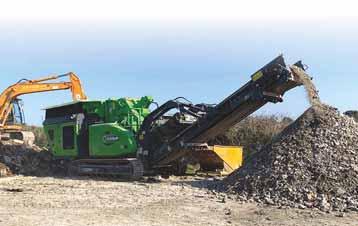

All FPT Industrial engines feature innovative and patented ATS technologies, delivering best-inclass efficiency and minimising downtime. The aftertreatment systems dedicated to North American Tier 4 Final standards are a non-DPF technology (the patented HI-eSCR system), while for global and cross-regional applications the integrated HI-eSCR2 system complies with the more stringent EU Stage V regulations and is dual-certified for Tier 4 Final.

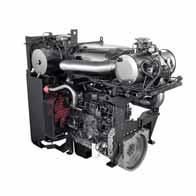


Ammann America
1125 SW 101st Road
Davie, FL 33324
USA
+1 954 493 0010
Ammann.com
Ammann America’s products include a full line of light and heavy compaction equipment as well as asphalt-mixing plants.
Ammann compaction equipment is engineered to provide both highquality results and low ownership costs. This is done through innovative compaction technology that extends product life and reduces maintenance needs.
Ammann asphalt-mixing plants are world renowned for their performance, efficiency, high-quality mix output and innovative recycling processes.
Ammann America is the North American subsidiary of Ammann, a global company based in Langenthal, Switzerland.



Ammann’s soil compaction product line welcomes its most compact single-drum roller yet.
The Ammann ARS 30 Single Drum Roller, at a weight of 3 tonnes and a drum width of 47.2 inches (1200mm), is the lightest and smallest roller in Ammann’s soil compaction product line.
The innovative no-rear-axle concept makes the roller compact and facilitates a lower engine location that improves the center of gravity – maximising maneuverability, stability and traction.
The machine is suitable for a wide range of materials and is extremely flexible – particularly given smooth or padfoot drum options. Its dimensions enable easy transport between jobsites.
Despite its size, the roller provides high compaction output through a strong single-stage vibratory system and two frequencies.
Other benefits:
•Intuitive control
•Maintenance-free drum, drive and articulation joint •Cab or open platforms







Cummins is introducing a fuel-agnostic engine platform able to run on hydrogen, biogas and diesel.
This innovative 15litre engine offers OEMs the opportunity to accelerate the decarbonisation of heavyduty off-highway applications.

The new platform is designed for the next level of emissions controls and offers a significant increase in power density with a more compact installation envelope. This allows OEMs to increase machine capability and productivity with no impact on running cost.
The fuel-agnostic architecture of the engine uses a common base engine with cylinder heads and fuel systems specifically tailored for hydrogen, natural gas, diesel and biofuels including HVO.
The 15litre hydrogen engine will be available with ratings from 300-400kW and a peak torque of 2,600Nm. For applications powered by renewable biogas, this engine will offer slightly lower power ratings with a peak torque of 2,500Nm available. The diesel version will offer a broad power range of 335-485kW, with a 3,200Nm peak torque. Cummins www.cummins.com
The innovative HP 100i articulated pneumatic-tyre roller is said to offerhigh performance and productivity. The base weight of the roller is 6tonnes and can be increased to up to 10tonnes using different ballast kits. With five wheels on the front axle and four wheels on the rear axle, the new pneumatic-tyre roller has a working width of 1725mm. The overlap of the tyre tracks is said to result in homogeneous compaction. At the same time, the three-point articulated joint is said to deliver high manoeuvrability. The roller can be used for applications such as chipseal and asphalt compaction on smaller construction sites. A water-sprinkling system and various
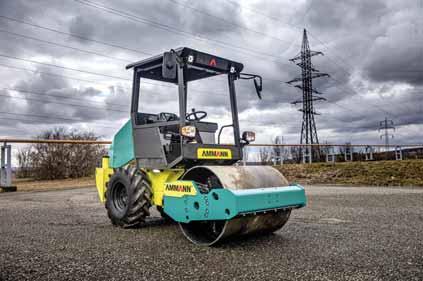
scrapers can be integrated on request. Working speed can be adjusted directly at the driving lever. A novel speed control system depending on the steering angle means that the roller can always be manoeuvred accurately through curves despite the high final speed.
Hamm
www.wirtgen-group.com
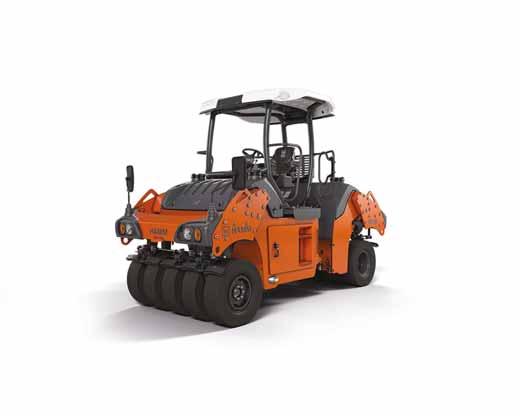
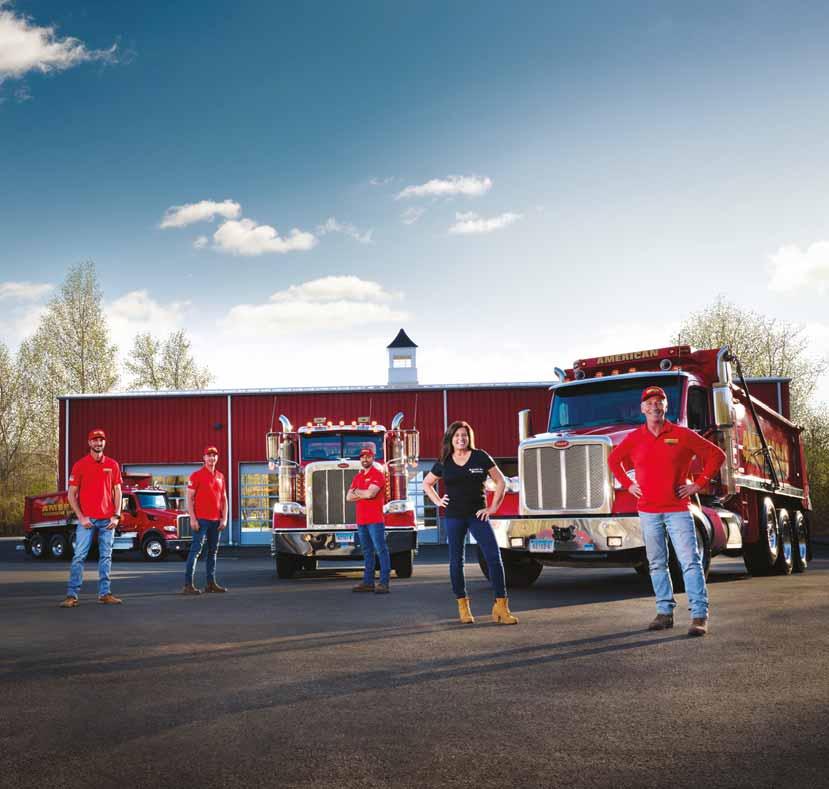
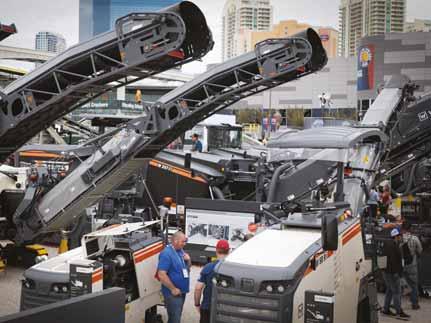



SWARCO Road Marking Systems says that its next generation SOLIDPLUS premium reflective glass beads combine greater road safety as well as being sustainably produced
Ongoing improvements in the production process allow for an efficient and responsible use of resources and reduces the environmental impact. New data analysis software now helps leverage additional potential to make production even more sustainable.
Thanks to their excellent retroreflection, these premium reflective glass beads enhance the visibility of road markings in difficult conditions and make roads safer. They are the result of many years of continuing research and development at SWARCO Road Marking Systems’ Center of Competence for Glass Technology and Marking Systems.

Modern driver assistance systems depend on clearly visible road markings. Dark and wet conditions, as well as headlight glare from oncoming traffic continue to represent challenging situations. They require clearly detectable marking systems that can be recognised by vehicle sensors even in adverse conditions.
This is of great importance for the development of advanced driver assistance systems and automated vehicles. The better road markings are detected by cameras and LiDAR sensors, the safer road transport is for humans and machines.
Meanwhile, SWARCO says that SOLIDPLUS has always been produced in the most environmentally responsible ways. Since last year, “the next generation of glass beads” has been made in one of the most state-of-the-art and efficient facilities for the production of reflective glass beads, explains Friedrich Wiesinger, head of SWARCO’s Center of Competence. 100% of the electricity needed comes from renewable energy sources and some of it from photovoltaic panels on the roof of the production plant.

More is to come, he says. “We have set ourselves very ambitious goals in order to make our products even more eco-friendly. With our research on new glass formulations based on natural raw materials, we aim to produce the most sustainable reflective glass beads in the world.”
New special data analysis software is now being used to help achieve these goals


by thoroughly examining the emissions in supply chains and all production processes as well as the product life cycle. This even makes it possible to precisely determine the ecological footprint of individual products such as SWARCO SOLIDPLUS.
The data collected helps the Center of Competence to carry out highly targeted research. For instance, the software identifies which raw materials leave a particularly high carbon footprint. Subsequently, they are replaced with more eco-friendly resources where possible.
“Our product development team conducts research on how to switch from environmentally harmful materials to alternatives with the smallest possible ecological footprint,” says Wiesinger. “This helps reduce emissions, waste and transport over large distances and achieve an effective circular economy. These are concrete plans to make the production of SWARCO SOLIDPLUS even more sustainable in the long term.”
www.swarco.com/rms













Charcon Hard Landscaping, a division of Aggregate Industries, is supplying sustainable Eco CSK Kerb and CSK cycle kerbs as part of the redevelopment of Derby city centre.
The redevelopment is part of the first phase of Derby's Mobility Programme to deliver better transport choices for the east midlands English city. Work includes improving access for cyclists and pedestrians, pavements widened and resurfaced and stepped cycleways created.
The council chose Charcon’s bespoke Black Basalt Kerb, Eco CSK Kerb and Eco CSK cycle kerbs. These will be used to form kerb lines, cycle tracks and channels alongside a vehicle lane and new disabled parking bays.
The product replicates the look of natural granite and contains up to 65% recycled or reclaimed materials. It replicates the look of natural granite but with a carbon footprint reduced by one-third, according to the manufacturer.


The products will be manufactured at the Aggregate Industries Hulland Ward site only 16km away from the project - meaning less transport costs and overall emissions, explained Jamie Baldwin, general manager of Charcon Hard Landscaping. “We have supplied similar schemes on a national basis, but the Black Basalt kerb is a first and very much bespoke to the project.”
The project is due to be completed by mid-June and is part of Nottingham and Derby’s Transforming Cities programme, funded by the UK’s Department of Transport. Both authorities secured €185 million from the Department for Transport to invest in local transport infrastructure that will improve sustainable transport and encourage more low-carbon journeys.
Charcon Hard Landscaping www.charcon.com




XenoTrack Dual Lane was officially launched at GeoWeek, a major event for the geospatial and 3D sector that took place in the US city of Denver.
XenomatiX, a solid state lidar company specialising in road asset management and digital twins of roads, launched the XenoTrack Single Lane system last year. Now, the company says that with the Dual Lane system, it “took a step in easing 3D pavement measurement”.
Traditional road assessment systems are limited to measuring the width of one or part of a road lane on each pass. But XenoTrack Dual Lane surveys two neighbouring lanes in a single pass. While the vehicle drives in one lane, the system simultaneously measures the road surface condition of that lane and the neighbouring lane.
All XenoTrack products including the Dual Lane system, use a highly accurate lidar as its main component, offering 3D and intensity maps of the road surface.
XenomatiX
www.xenomatix.com

Following trials on local UK roads, marking contractor WJ says it has plans to trial its ThermoPrint markings truck on the national strategic road network.
The ThermoPrint truck eliminates the need for applying thermoplastic road markings such as letters, numbers, arrows and other symbols by hand using handmoulds.

Importantly, WJ says that the ThermoPrint truck provides much-needed protection for its operatives, who often apply road markings next to live carriageways.

ThermoPrint has all road symbols used on the UK network programmed into its operating system, reducing the need for our operatives to lay the markings by hand. The technology also has the potential to scan existing road markings and automatically match them to programmed designs. Once the scanning is completed, the machine immediately relays thermoplastic to rejuvenate the markings and bring them up to standard.

ThermoPrint allows the operatives to run the machine safely from the cab. Additionally, the technology delivers efficiency benefits by increasing the speed of application and potentially reducing the required traffic management in appropriate situations.
WJ worked with Norwegian road marking machine manufacturer Trysil Maskin to deliver the ThermoPrint, a UK-first machine, based on Trysil’s trafficprinter.
Trysil Maskin
https://trysilrmm.com
WJ Group www.wj.uk








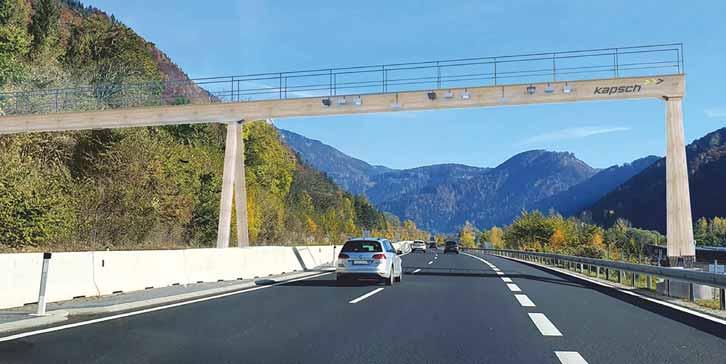


Kapsch TrafficCom has put a new spin on a familiar piece of steel and aluminium infrastructure: the motorway gantry.
The company's Green Gantry is made from wood but can still support signs, sensors and and other traffic management hardware thanks to its modular design. Kapsch says this "allows an installation comparable to standard steel bridges and also with the same service life and maintenance intensity".
Each steel gantry creates over 30tonnes of CO2 during its production, the company says. But the wood version "binds more than 20tonnes of CO2 and thus has a positive carbon footprint". It also "paves the way for sustainable road infrastructure".
Kapsch says the product is protected from water, ice and snow and, even after it is dismantled, "does not pollute the environment,
as no harmful chemical substances are used to treat the wood".
Katharina Rynesch, innovation manager at Kapsch TrafficCom, says the design complies with all relevant European standards. "Our road infrastructure is currently a blind spot in efforts to make the transport sector more sustainable. With our Green Gantry, we hope on the one hand to contribute to greater sustainability, but on the other hand also to demonstrate that even stablished concepts can be rethought and made sustainable."
Guaranteed for 20 years, the project is funded by the Waldfonds – The Forest Fund - an initiative set up in 2020 by Austria’s Federal Ministry of Agriculture, Forestry, Regions and Water Management. The €350 million forest fund is to financially help forest plantations and other sources of wood production. It is part of the Think.Wood programme of the Austrian Wood initiative.
Meanwhile, in September 2022, Kapsch was awarded another gantry contract. The
deal was awarded by French highway concessionaire SAPN for free-flow tolling gantries including hardware and related software. It will be installed along 250km of the A13 and A14 highways, a heavilyfrequented route between Paris and Caen. Kapsch says it will save 30,000tonnes of CO2 per year. The gantries are able to detect, identify and classify vehicles and calculate the corresponding toll fee automatically. The project is a major stepping stone in the migration from traditional plaza tolling towards free-flow systems for a cleaner mobility and a seamless driving experience for the people using the A13 and A14 highways.
The first parts of the new system are expected to become operational in the second half of 2023 to allow a free-flow live operation in the course of 2024.
Kapsch TrafficCom
www.kapsch.net/en
Airly says it secured US$5.5 million from a new funding round for its air quality platform, making the total $8.8 million since March 2021.
The Airly platform provides solutions for air quality monitoring to local governments, companies and local communities in over 40 countries. Airly says it will now be able to provide a complete dashboard, including a report generator, impact tracker and city ranking. It allows users to monitor the data and obtain actionable insights that will translate into effective actions to improve air quality and understand their impact on health and well-being.


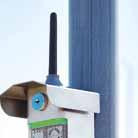
Airly, based in Krakow, Poland, said it recently launched the largest air quality monitoring network in any European city by installing 165 sensors in the Polish capital Warsaw. It also has deployments in the UKBirmingham and the London boroughs of Lambeth, Haringey and soon in Southwark – as well as in Jakarta, Indonesia.
Airly
https://airly.org/en




The Arizona Department of Transportation created an automated speed limit system based upon Vaisala’s PWD visibility sensors — a first in the US, says the manufacturer.
While the western US state is noted for being hot and dry, this depends entirely on elevation and time of year. Snow, rain, flooding, dust storms, high winds and microbursts can be common.
For the client, ADoT, Vaisala provided 13 of its PWD10 visibility sensors and its Road Weather Station RWS200 system to help make driving safer on a dangerously dusty, wind-blown highway between two major cities. ADoT now relies on an extensive road weather information system (RWIS) including 20 Vaisala Road Weather Station RWS200s for accurate conditions.
The client went about creating an innovative solution based upon these PWD10 sensors to provide visibility measurement for road weather applications. Calibrated with reference to a highly accurate transmissometer, Vaisala PWD series sensors use proven forward scatter technology









to measure meteorological optical range (MOR). The downwardfacing lenses protect against precipitation, spray and dust while the weather-proof design provides accurate measurements and reduces the need for maintenance.
The visibility sensors, along with variable speed limit signs were installed along the section of highway that is most prone to dust


storms. Next, they developed an automated, real-time system that integrates the PWD10 visibility measurements and adjusts speed limits accordingly, so drivers can change their speed before travelling through hazardous conditions.
Visibility measurements combined with an automated system that adjusts speed limits is a safety game-changer for the

ADoT — and the first solution of its kind in the nation, notes Vaisala.
The variable speed limit signs change depending on the current level of visibility, dropping in steps from 120kph to 55kph (from 75mph in 10mph steps to 35mph), while dynamic message signs alert travellers. Once visibility increases, the speed limits automatically rise again. Accurate visibility measurements are critical for this application and the PWD10 sensors provide the performance the department needs.
The solution has brought many positive results, the most important of which is safer roads, verified through data showing a reduced number of dust-related crashes.
"Even though there are operational benefits, the main benefit is safer roads for the travelling public,” said Kevin Duby, ADoT’s road weather manager. “We’re definitely embracing new technology, using weather data and automation even more in order to keep the roads safe."
Vaisala www.vaisala.com
Traffic technology from Acusensus has been used in a three-month trial in England to catch drivers using their mobile phones and not wearing seatbelts. In what the company, based in Melbourne, Australia, says is a UK first, the government agency National Highways is using its solution to monitor driver behaviour across England’s motorways and major A-roads in the northern county of Warwickshire.


Acusensus’s camera software has been successfully deployed in Australia’s New South Wales state.
A mobile road-side sensor van equipped with multiple cameras is parked by the roadside and can capture every passing vehicle at speeds of up to 300kph. The AI software can instantly determine if drivers are using a hand-held device or if the driver or passenger are wearing a seatbelt.

The van captured 37 mobile phone offences and 128 seatbelt offences in the first 18 hours of operation. In one 64-hour period it caught 152 drivers using their mobile phone and 512 occupants without a seatbelt. UK government figures show there were 420 collisions on British roads in 2019 in which the driver was using a mobile phone. Separate figures show failure to wear a seatbelt has been attributed to one in four road deaths in the UK.
It coincided with a 22% in fatalities based on previous trends since the mobile phone detection programme launched in 2019. The company launched the world’s first mobile phone and seatbelt detection programme in Queensland state in 2021, with a 10% drop in fatalities in the first six months.
“Since introducing our technology in New South Wales two years ago, 121 road deaths have been avoided compared to previous trends,” said Alexander Jannink, founder and chief executive of Acusensus. “Research indicates that mobile phone-related distraction is killing an estimated 100,000 people a year globally and injuring five million more.”
Acusensus recently forecast revenue of US$25.5 million for the full-year 2023 as it looks to expand its reach both domestically and internationally, with a focus on the US and Europe.
Acusensus
www.acusensus.com
InnoSenT has developed a new high-tech radar system for intersection management and traffic monitoring: the ITR-3800.
It has a built-in full HD camera for transmitting image information. "It offers high measurement accuracy and separation capability," said Eva Maria Buchkremer, head of product management.
"Even at the edges of the wide detection range, the sensor delivers outstanding performance. Thanks to the forward firing, large detection area, two systems are sufficient to see even large intersections.”
The FMCW radar uses 4D MIMO technology for highresolution and precise detection of moving and static objects the German manufacturer says.
It records the speed, distance, direction of movement and angular position of a wide variety of road users, such as people or cars, enabling precise positioning within the detection range and the reliable distinction of individual objects based on the three dimensions of distance, speed and angle.
The radar system provides real-time data on the current traffic situation and utilises radar



tracking and object classifi for applications such as detection of wrong-way drivers, brokendown vehicles, vehicles in the intersection area, length of backed-up traffi would like to cross the road.

The information obtained also serves as a basis for demandoriented traffic light control or to trigger other technical applications in road traffic. The device has a detection range of 300m and a wide field of view of 110° x 30° and can monitor up to 16 lanes and 128 objects simultaneously. Object classification is already possible at a distance of up to 183m.
The built-in camera provides full-HD live transmission and still images, with a range of vision of






around 5-80m and diagonal angle of vision of 143°.
doesn't require customers to perform any development work with regard to signal processing or integration, InnoSenT says.

The ITR-3800 can systematically transmit a signal to the traffic light control system when a specific event occurs. For example, when a certain number of vehicles are waiting, the intersection is blocked, or vehicles in the dilemma zone are driving too fast to come to a safe stop.
This means the radar system can also map the function of an induction loop without interfering with the existing infrastructure.

This simplified integration


and built-in camera reduce the sources of errors and work during commissioning, installation, and evaluation, the firm insists. The additional attachment of a traffic camera as usual is no longer necessary. The device weighs less than 1kg and measures only 270mm x 102mm x 37mm. The radar is equipped with an IP67 standard housing and operates reliably regardless of light and weather conditions.
The operating temperature of the radar component is between -40 and +80 °C. The radar system can be operated with 24V or 48V voltage supply.
InnoSenT www.innosent.de/en
VivaCity is collecting anonymised data by using AI-based video analytics sensors to discover how basic ‘zebra’ pedestrian crossings are used in the Welsh capital Cardiff



However, the simplified non-prescribed crossings in this trial use the black and white zebra markings and give way lines, without all the other features - making them quicker to install and easier to maintain.
The Welsh government commissioned the trial of 'non-prescribed' simple zebra crossings at three locations in Cardiff "to understand the impacts and user perceptions".
The three locations were chosen because they have high pedestrian footfall and already have infrastructure in place in terms of dropped kerbs, tactile paving, parking restrictions and 32kph (20mph) speed limits.
VivaCity says two sensors are installed at each crossing site. Wide-angle lenses are used to capture movement data on the crossing itself and motor vehicle and cyclist turning data from the main road onto the side road at the approach to the crossing.

A 'prescribed' zebra crossing must have a series of alternate black and white stripes with 'give way' lines on either side, a Belisha beacon at each end, a line of studs marking the crossing area and zigzag markings.
The area surrounding the crossing is divided into seven sections within the sensor’s field view: movement and speed data from these segments illustrate road user behaviours and patterns in response to the crossings and road safety consequences of their installation.
VivaCity Labs https://vivacitylabs.com





















Spray paving systems offer key benefits for road building purposes and customers now have a choice of two systems to choose from
Using a spray paver allows a contractor to apply emulsion and carry out asphalt paving in a single operation, boosting working efficiency. The systems are used for placing thin overlay as well as conventional binder and surface courses. According to the manufacturers, an optimal composite layer of the asphalt layers is achievable using spray paving and this helps to ensure the longevity of road surfaces.
Some firms, such as Spraypaver in the US, offer separate spray paver units that can be bolted onto an asphalt paver from most manufacturers. Until now, only Vögele has offered a spray paver unit as a complete package on one of its own asphalt pavers, the SUPER 1800-3i SprayJet.
According to Vögele, a key advantage of its machine is that operation of the spray module has been integrated into the firm’s familiar ErgoPlus 3 operating concept. As the system uses the same type of controls as on a standard paver (but with added functions), this simplifies the operating process, ensuring high-quality results.

However, that situation changed when rival firm Dynapac introduced its SD2500CS PROTAC spray paver in late 2022. As with the Vögele model, this features the standard




Dynapac control system but with added functions.
For all three of these options, the spraying system is fitted on a conventional paver. Spray bar units are located on the paver so as to ensure an even layer of emulsion is spread on the surface. As the paver moves forward, it then lays the asphalt layer directly on top using the conventional screed unit. Emulsion is stored in a separate tank mounted on the paver and which forms part of the additional spray paver package.
According to Dynapac, its SD2500CS PROTAC spray paver is designed for use in two application areas. The first is for the application of thin asphalt surface layers using a thin layer in hot paving on sealant. The second is for road repair, as well as for new road construction and everyday asphalt paving tasks.

The SD2500CS PROTAC sprays emulsion and applies asphalt in a single operation. This increases operational efficiency while saving resources. In addition, the road can also be opened faster to traffic, reducing construction costs as well as the disturbance caused by road works. The firm also says that studies have confirmed that DSH-V surfaces have a noise reduction potential of about 5dB(A). Moreover, the low thickness layer helps conserve resources, material use, time, and energy.

of the machine and reported no problems when operating the spray paver for the first time during a night-time operation.
Meanwhile in Germany, contractor JOHANN BUNTE Bauunternehmung was able to rehabilitate the surface and binder courses of a section of highway successfully in a short time. on the A3 near Duisburg, the paving team rehabilitated an area of 60,000m² in just 55 hours using four Wirtgen milling machines and six Vögele pavers.
Planning was important for rehabilitating a 3.6km section of the A3 motorway near Duisburg. As this busy route carries 120,000 vehicles/day during the week, the responsible highways authority, Straßen.NRW, decided to carry out the rehabilitation project by closing the road. “This means that in a weekend, we can complete work which would otherwise have held up traffic for several weeks,” said Thomas Oehler, head of department at Straßen.NRW.

Veidekke, one of the largest construction companies in Scandinavia, used the SD2500 CS PROTAC on a night jobsite in Norway near Oslo. The crew made successful use


The binder course on the A3 was paved by two Vögele SUPER 2100-3i pavers, each supported by an MT 3000-2i Offset material feeder.
The schedule was tight: the work started on a Friday at 10pm with a full road closure in both directions. After that, the right-hand carriageway, which is made of concrete and did not require rehabilitation, was separated from the adjacent asphalt lane using a side milling wheel. At 11pm, four Wirtgen milling machines started removing the surface and binder courses. Asphalt paving started before milling work was complete, at 7.15am on the Saturday morning. Paving had to be complete by 10.30am on the Sunday to allow time for tasks such as applying road markings.



To enable 3.6km of motorway to be rehabilitated in 55 hours, two spray pavers worked on the surface course simultaneously in each direction of travel, each supplied by a material feeder. Just 27 hours was available to pave the area of 60,000m². The contractor's team opted to use six Vögele pavers. Two SUPER 2100-3i machines
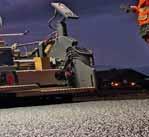




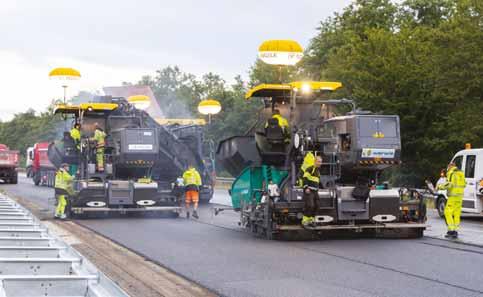
first paved the binder course. One of the two pavers worked in one direction of travel while the other paver started at the other end of the jobsite section. The surface course consisting of low-noise stone mastic asphalt (LOA) was paved by two SUPER 1800-3i SprayJet machines using the hot to hot method.
Three mixing plants were commissioned with production of the asphalt to guarantee material supply on this tight schedule, with another plant in reserve. A fleet of 130 trucks made 500 trips to transport the asphalt to the jobsite between the junctions at DuisburgKaiserberg and Breitscheid. In all, 16,000tonnes of asphalt was used: 12,000tonnes for the binder course and 4,000tonnes for the surface course.
Two Vögele MT 3000-2i feeders supplied the mix from the trucks to the pavers. The pivoting conveyor meant that the Vögele feeder could supply two pavers with mix, allowing the two
The Vögele SUPER 1800-3i SprayJet spray pavers sprayed on the bitumen emulsion and paved the asphalt surface course in one operation. In addition to saving time, the SprayJet technology had other benefits. As the emulsion film was paved over immediately following application, construction vehicles were unable to drive on top and damage it, improving interlocking and helping to optimise the road surface life.
At 5am on the Monday the A3 was reopened to traffic following successful completion of the job.
D ynapac www.dynapac.com
Spraypaver www.spraypaver.com
Vögele
Volvo CE is now offering new electric screed models aimed at use in large-scale paving operations. The electrically-heated, fixed screeds are designed to make large-scale paving more cost-effective and to boost productivity and efficiency for major road projects.
The MB122 and VTD121 Electro Thermo Controlled fixed screeds can be used on Volvo CE’s large tracked pavers, producing a high-quality finish. The screeds can deliver consistent and evenly spread heating and are powered by a 55kVA onboard generator. Being electric, there is no need for customers to refill gas bottles. The firm claims that screeds offer fast start-up times as well as maximum uptime.

www.wirtgen-group.com/en-gb/company/voegele/


These fixed screeds are now available on the Volvo P6820D ABG, P7820D ABG and P8820D ABG models and offer paving











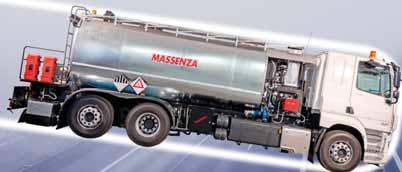
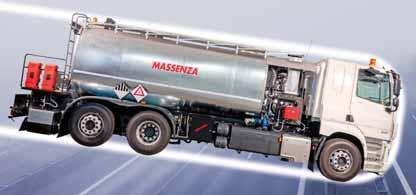

















widths of 2.5-13m. They have been designed to lay a wide range of materials ranging from hot asphalt to dry lean rollercompacted concrete and cementbound materials, as well as graded mineral mixes.
The new electric heating function allows start-up in 40 minutes. The package combines one heated tamper bar and two heating elements/screed section for optimised heat distribution. It also has accurate thermocontrolled heating with an automatic temperature adjustment and individual temperature sensors for each section.
Screed status and behaviour can be monitored by the paver operator from the Electronic Paver Management (EPM3) control panel. Maximised precompaction is paramount to achieving a greater density in the finished mat, resulting in a longer-lasting pavement and lower operating costs. The new vibratory and tamping fixed screeds are said to deliver a smooth finish. Featuring variable vibration speed and tamper stroke, the screeds can be specified with a single or double
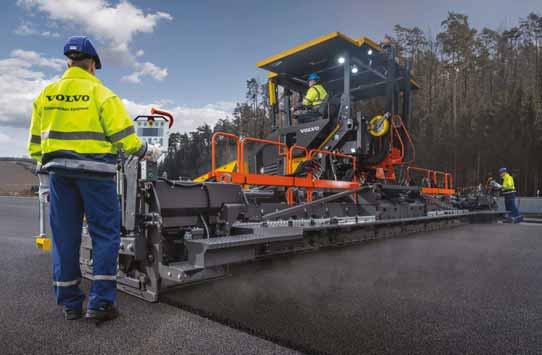
tamper bar configuration.
Volvo fixed vibratory screeds with double tampers suit use for paving thick layers. The double tamper technology delivers a 5-7% higher degree of compaction than with a single tamper and can achieve a 98% Marshall density, reducing rolling requirements and associated costs. It also provides an even surface due to the feeding effect of the first tamper.
With a crown adjustment of +4% to -2% and extension boxes to work across a variety of paving widths, the new screed solutions are said to offer versatility for any
job. Vario extensions, with an extension range of 0.75m on each side, allow the screed to extend or retract as needed in order to adapt to irregular edges, while manual or hydraulic end gates are an optional feature to control flow of material on either side.
The new onboard diagnostic function helps to check the condition of the heating bars and detect if and where a replacement is needed, reducing downtime. The design also ensures easy screed assembly and straightforward maintenance. The screed sections each have








two central lifting eyes, while an integrated hose and cable routing provides a clear path for assembly. In addition, hydraulic connecting points and easily accessed electric connections, as well as service points and tamper bars that are within easy reach, making assembly and maintenance quick and easy.
If versatility is required, the firm offers Variomatic screeds that can be extended to double their basic width.
Volvo CE www.volvoce.com


















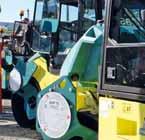
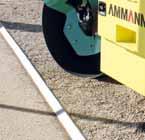


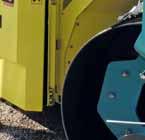




One notable development at bauma 2022 was the introduction of new drum steer compactors by several key manufacturers
These machines suit a range of compaction applications and tend to be shorter than comparable articulated machines, with tighter turning circles. This suits the machines to urban applications where space is at a premium while also being easier to transport.
The latest drum steer model from Ammann is a 7.5tonne class machine, the ARP75. This model is powered by a 55.4kW Kubota diesel that meets the Tier 4 Final/Stage V emissions requirements and is said to offer low noise and smoke emissions as well as high productivity and fuel efficiency.
The firm says that the machine delivers a combination of productivity and ease of
allows for a maximum compaction width of 2.72m. The compactor is also equipped with Ammann’s proven ACE force compaction control system, which helps to optimise working and can record key job data. In addition, the ACE force system stores data on location, so that it is possible to analyse what compaction work has been carried out where on a jobsite. The machine also has the Servicelink package that helps with predictive maintenance and ensures maximum uptime.
A key feature is the 900litre water tank, said to be the biggest in its class although the machine is compact in size given its performance. A range of options are offered for the machine and these include an edge cutter, chippings spreader and a combi version with tyres instead of a front drum.
From BOMAG meanwhile come the new BW 154 and BW 174 pivot-steered tandem rollers. According to BOMAG, ease of control is a key feature of the machines, which are both fitted with the latest myCockpit system. This novel control system offers a choice of three operating concepts. Operators have a choice of touchscreen, rotary pushbutton switch or classic joystick controls. The touchscreen allows full control over functions and meets the need for digitalisation, though the rollers can also be operated using the rotary pushbutton on the control lever.

The operator can configure default settings and operate and control the functions using the touchscreen. In addition, it is possible for different operators to set their own individual user profiles or switch to default settings. Another feature is a preset operating profile aimed at use by the truck driver when loading the machine for transport.
servicing, with low running costs. Meanwhile, a new cab is said to offer high all-round visibility as well as operator comfort and ergonomic controls. Touchscreen controls allow the operator to set key working parameters, while there are also controls on the joystick and a number of switches. The control layout has been optimised to make the machine simpler to operate.
The compactor is equipped with dual amplitudes and multiple frequencies as standard. This allows the operator to set the working parameters to suit duties on a range of surfaces. The precise controls ensure that the machine can be used to compact thin layer wearing courses without risk of crushing aggregates.
The machine is equipped with 1.5m-wide split drums and offers a wide offset that
The BW 154 and BW 174 tandem rollers are available in several variants and with a wide range of equipment. They offer working widths of 1.5m or 1.68m and operating weights of 7.1tonnes and 9.8tonnes. Three compaction systems are offered: Asphalt Manager 2, vibration or the split drum oscillation TanGO4. The Asphalt Manager system has been simplified and regulates amplitude as well as compaction direction. This allows it to achieve optimum compaction quality with minimal passes.
The Asphalt Manager system allows the operator to concentrate on the rolling pattern and other machines working alongside, as well as being suited to compacting low-temperature asphalt.
BOMAG offers optional extras including a second monitor at the rear of the cab for reversing, four additional mirrors on the cabin and rear frame, up to 16 LED lights, a chip spreader and a measuring technology interface for data transmission to the BOMAP app.
Dynapac’s model for the drum steer sector is the CG2300, which is said to feature a high comfort cab and good drum edge visibility due to the extended sideways sliding seat and steering assembly. Good ergonomics as well as smooth and precise steering are offered by the electronic mini steering wheel and four-piston

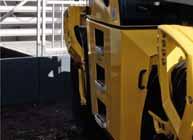
steering system.


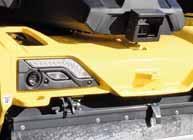
The clear control panel gives operators the information they need. Further information can be provided through the optional Dyn@Lyzer software, which gives the full documentation of temperature, compaction Evib value and number of passes on each section of the asphalt.
The Dynapac CG2300 is 3.99m long x 2.99m high, has an inner turning radius of only 2.65m and an offset of 1.2m, making it easy to transport and manoeuvre in confined spaces.
The Dynapac CG2300 is equipped with EcoMode as standard, which reduces fuel consumption by more than 15%. In addition, noise is also lowered through the use of a hydraulically-driven temperature-guided cooling fan, which only operates when necessary.
Use of a double pump vibration system eliminates the need for a vibration valve, making the system more efficient, aiding servicing and reducing fuel consumption. Both pumps, one for the front drum and one for the rear, can simply be shut off if required.
The efficient eccentric weights and the serial start-up of vibration makes the system even more efficient, keeping fuel consumption and CO2 emissions as low as possible.
Advanced options are also available, such as an edge presser/cutter (left and right) and a chip spreader. A sprinkler system with double sprinkler bars and pumps, and a capacity of more than 700litres of water, ensures uninterrupted operation.
The new HX series tandem rollers from Hamm feature pivot steer configuration, replacing the earlier DV+ variants. Improved performance is claimed with advantages such


as intuitive operation with Easy Drive, high performance data, high comfort and the Smart Compact digital compaction assistant.
Designed for asphalt compaction, the 7tonne class HX 70i model features a 55.4kW diesel while the 9tonne class HX 90i is powered by a 74.4kW diesel. Both engines meet Tier 4 Final Stage V emissions requirements and the machines are said to achieve high surface outputs on large construction sites.
The company claims that the machines deliver high-quality compaction and is offering an array of variants to suit different customer requirements. Models are offered with split and non-split drums, as well as oscillation and combination variants.
An integrated automatic reversing system is fitted that brakes and then accelerates the rollers quickly and smoothly. The electrically-adjustable seat also turns to face the direction of travel automatically. New LED turn indicators are fitted and the fully glazed panoramic cab offers an improved field of vision with an excellent view of the drum
edges. The Easy Drive operating system combines an ergonomic operator platform with sophisticated operating structure. Despite the extensive machine functions, operation is said to be intuitive and very quickly learned. Steering is performed with the steering wheel; all other important functions are operated via a joystick and the multifunction armrest.
The Smart Compact compaction assistant is available and decides compaction automatically and individually for each drum. This selects whether to compact with vibration and big or small amplitude, with oscillation, or statically. The driver then enters whether a base, binder or asphalt surface course is to be compacted. The assistant even evaluates data about the condition of the asphalt, optionally incorporating local weather data from an integrated weather station.
Hamm also offers the option of integrating systems for avoiding collisions with a PDS (proximity detection system) interface. In addition, the telematic system JDLink is onboard in all models, which can be used to call up elements such as performance data for rollers, fill levels, error messages, operating hours or service intervals.
The HX series rollers are offered in 7tonne and 9tonne variants and are available in nine versions including models with two vibrating roller drums, an oscillation and an vibrating roller drum as well as combination rollers.
Ammann www.amman.com
BOMAG www.bomag.com
D ynapac www.dynapac.com
Hamm www.wirtgen-group.com/en-de/company/hamm
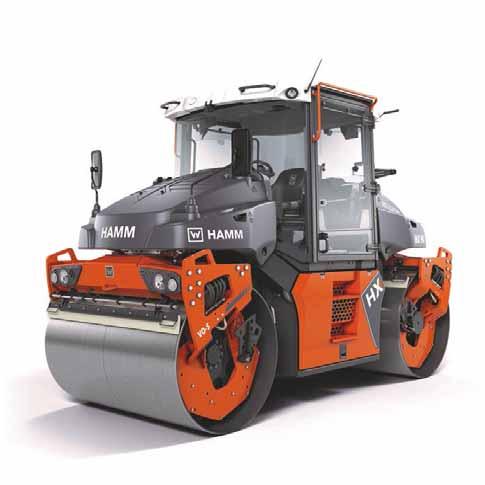
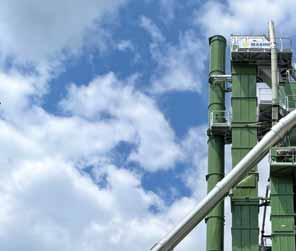
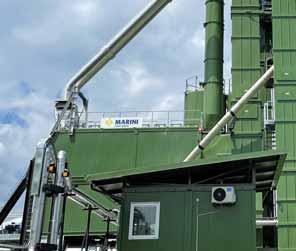
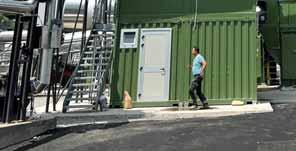

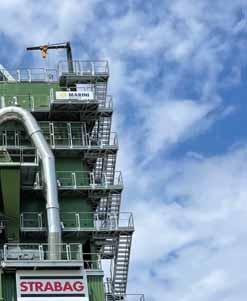
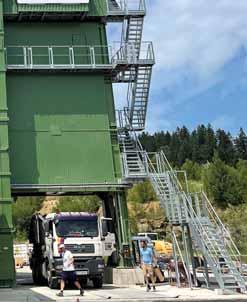

at the mixer outlet and the temperature of the fumes entering the filter. This improvement prevents excessively high or low temperatures of fumes in the filter, avoiding clogging. It also optimises fuel consumption while making the thermal exchange more efficient, especially with high RAP percentages.
Another software development is the dynamic management of RAP, which was demanding in terms of preliminary studies and onsite calibrations. The software allows the operators of the plants to check the maximum amount of RAP that can be used based on the asphalt they have to produce and to the RAP available onsite, in order to stay within the particle size curve. The formula can also be adapted to suit the operating condition, of key importance for this application where only the cold RAP line is used in the mixer.
In addition, this software changes the quantity of bitumen, filler, and aggregates inside the under-screen hoppers, based on the amount of RAP used, in order to ensure the maximum finished product quality. This allows operators to manage the finished product temperature by changing the RAP percentage based on the aggregate temperature.





Austria’s major contractor Strabag recently decided to purchase a new Marini Class Tower asphalt plant
The firm replaced the plant at its site in Haselbach in Austria with a new one better able to optimise the needs of the construction site. The Austrian company wanted a state-of-theart plant able to produce a large output of high-quality asphalt while complying with the technical specifications of Austrian contracting authorities. The company also needed the plant to be able to use RAP and to change the production of the different recipes quickly, from limestone to basaltic materials.
The Marini Class Tower features a sixselection screen with a 45m2 screening surface and a deviator under the screen to divide the dried and checked materials into two rows of
under-screen hoppers. In this way, Strabag can store up to 80tonnes of limestone material and 80tonnes of basalt material in insulated hoppers to minimise heat losses. As a result, the operator can change the production recipe and meet the needs of several paving sites.
A key feature of the plant is the automatic drying process control. The drying/filter processes model retroactively controls the output temperature of the material at the exit of the dryer drum and the temperature of the fumes entering in the bag filter. The software adjusts burner power and drum rotation speed based on the production rate and humidity of the materials in the dryer. In this way, the plant is able to stabilise the temperature of the material leaving the dryer. The function helps to manage the cold RAP in the mixer, because the software helps to stabilise the temperature
The function allows the operator to increase or decrease the quantity of RAP to ensure the correct temperature of the finished product, adjusting in real time all the other components, suiting high or low ambient temperatures. For this jobsite, Strabag has chosen the RAP technology with the RAP line into the mixer. The aim is to prioritise aggregate control to optimise the grading envelope during any operating stage.
The client was keen to optimise maintenance and reduce energy consumption, as well as asking for large aggregate cold feeders with a galvanised steel structure to reduce corrosion from the contact between the wet material and the sheet plates. Most of the hoppers have a bolted anti-wear lining. However, the sand hoppers have a Hypalon inside coating to prevent cold feeder blockages.
The dryer drum has a 16.8MW natural gasburner fitted with an oversize silencer to reduce its noise. The bag filter has a large filtering surface to reduce wear and dust emissions, as well as an inverter-operated exhauster to minimise the energy consumption and fan noise.
Strabag also asked to add liquid and solid metering systems to the plant. Today, rejuvenators must be supplied accurately to handle high RAP percentages. The same applies to binding agents if aggregates and bitumen are poorly compatible. Even fibre additives (or in bags) must be supplied accurately to produce porous asphalt and Splittmastix. The control cabin with the Cybertronic 500 software help control the functions, ensure metering accuracy, and optimise the burner’s consumption and connection with the Group’s centralised software.
Marini
marini.fayat.com/en
A new Ammann ABP 320 HRT plant is considered the most modern asphalt-mixing plant in Australia. This plant is helping the client to repurpose waste materials while lowering the carbon footprint of asphalt production.
“As the time comes to reduce the industry’s carbon footprint, this plant, and its related infrastructure, will help our customers achieve their environmental objectives,” said Dante Cremasco, head of Road Services at Downer.
The Ammann ABP 320 HRT (High Recycling Technology) AsphaltMixing Plant features the firm’s RAH100 drying drum and can make mix entirely from recycled materials. It has the capability to use up to 100% RAP and incorporate other waste materials – such as glass, recycled print cartridges, soft plastics, and packaging.
The market is changing to better address environmental impacts and higher levels of recycling are being accepted by end users. The Ammann plant has the flexibility to produce conventional asphalt but is also equipped to future challenges.
“It’s significantly advanced,” Cremasco said of the plant, which began full operation in Sydney in June 2022. According to Cremasco a key benefit of the plant is, “…its ability to incorporate numerous recycling components, while still being capable of producing standard virgin mixes.”
Able to supply 320tonnes/hour, the plant can satisfy high-volume customers. “It’s also flexible to service the smaller ex-bin customers at any
time,” he said.
Downer opted for the plant to service the Sydney community as it can quickly change recipes. “With the batch plant, we can minimise waste and improve cycle times and most importantly, service more of our customers’ demands,” Cremasco said.
Downer commenced planning for a new plant about two years ago. The firm opted for an Ammann plant based on the success of the other Ammann plants it owns. This new plant allows Downer to leverage its years of experience in innovative asphalt products and enable it to efficiently meet the needs of its customers. “Previously, we had six hot asphalt silos, at 200tonnes each,” Cremasco said. “We now have a similar volume in 10 silos. That gives us more flexibility.”
The plant has five RAP feeders that provide the flexibility to supply the top drum or go directly to the mixer. Downer can include up to three different granular additive types in a mix and up to three liquid additives. The facility can vertically store 6,000tonnes of aggregate and 720m3 of bitumen.
The plant is also equipped with oversized silos for reclaimed and imported fillers. “We have about 500m3 of fillers available across three separate silos, so we’re sure to have the ability to bring the materials in,” Cremasco said. “The hot asphalt silos give us the flexibility to store the mix, so we can keep the plant flexible and efficiently change the mixes on the run.”
Six aggregate cold feed bins complement the bunker storage


system to assist with any specialty mix production or serve as backup. The firm is well set up for the use of RAP. “Downer has constructed a highly advanced RAP processing plant immediately adjacent to the asphalt plant that can shred, fractionate and store the RAP so it’s ready for immediate introduction into the plant,” Cremasco said.
Australia has a goal of carbon neutrality by 2050, with incremental steps along the way. While some targets are voluntary, certain standards must be met in order to do business with the government. The Downer facility helps to reduce that footprint for customers. Currently, about 25% of mix produced in Australia has recycled content. “This plant allows us to significantly increase those percentages,” Cremasco said. “We’re hoping to progressively increase the recycle content to at
least 60% in coming years.”
The plant emissions also easily meet Australia’s tough standards according to Cremasco. Downer continues to work on producing high-quality mixes at increasingly lower production temperatures. “More and more foaming will be the result. We’re reducing the temperature of products by a few degrees/year.”
The long-term goal is producing asphalt at ambient temperatures. “We’re doing lab trials on that and making progress,” he said. A team of scientists has been working on the ambient temperature project for some time.
“The team is really committed. We see the importance of removing heat, and hence energy, from what we do,” he added.
A new asphalt plant in Norway is helping to further the use of recycled asphalt in high-quality mixes for road construction.
The Benninghoven RPP 4000 plant is being used to supply material for the new highway section of the E39 between Mandal East and Kristiansand West. Velde Produksjon opted to purchase an innovative RPP 4000 asphalt mixing plant, which met with the firm’s need for equipment able to deliver high recycling rates combined with low emissions. The use of this green technology has been supported by
the state agency Enova in the form of a grant. Enova supports companies that opt to use innovative, climate-friendly technologies.
The highway section between Mandal and Kristiansand is part of a gigantic construction project for better access to the west coast of Norway. The new Benninghoven RPP 4000 plant is located directly at the Mandal Fjord in Brennevinsmyra and has its own jetty. This modern asphalt mixing plant has been in operation since August 2021. Equipped with a recycling drum with a hot-gas generator using
counterflow action, it allows for up to 100% recycling material to be added while complying with the standard emission limits.
“With innovation, curiosity and investments in modern technologies, Velde will ensure the most efficient and environmentally friendly production possible,” said Egil Velde, CEO Velde Industri.
The relationship between Velde and Benninghoven goes back as far as 2005. Velde has evolved from a medium-sized company into Norway’s second largest mixing plant
owner. The installation of a Benninghoven plant at the firm’s Sandnes quarry provided a way into asphalt production, and only a short time later the company decided to purchase a second plant. In February 2019, Velde took over an existing asphalt mixing plant in Agder county, well positioned for the Mandal–Kristiansand road job. This plant was too small though, so the firm decided to replace it with a larger unit, opting for the new Benninghoven plant in the same location.
Velde has set itself the goal of reducing the carbon footprint of asphalt production with innovative technology and decided that the RPP concept met its needs. Due to the detailed technical description from Benninghoven, Velde was able to secure the support from Enova.
The Enova state agency was founded in 2001 with the aim of driving the transition to more environmentally friendly consumption and sustainable production in the energy sector. The company has been affi with the Department for Climate And the Environment since 2018.
The plant has a number of special features including a loading silo for stocking large quantities of material, a recycling drum that uses counterflow action with a hot-gas generator and housing for all hoppers. It also offers the option for cold recycling with a multivariable feed, has a dust collection system
low operating costs and low Ctot emissions compared to conventional systems. In addition, the plant features a wood dust burner and a production capacity of 320tonnes/hour.
Due to the tight schedule for the motorway job, Velde was under time pressure and needed the plant installed quickly. It took less than a
year until the new plant was commissioned in August 2021, despite COVID-19 rules on quarantine and immigration restrictions, as well as the tough winter weather conditions.
Benninghoven
www.wirtgen-group.com/en-us/company/
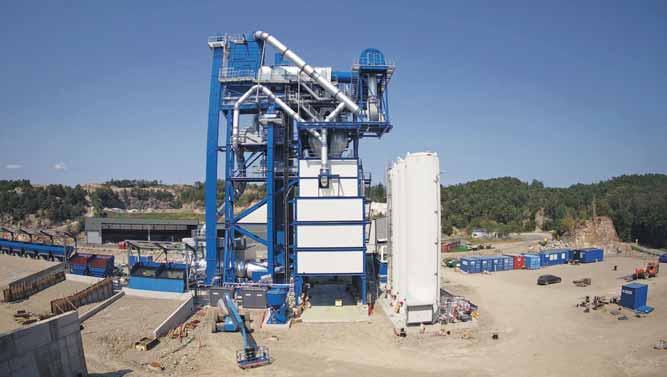



















There are a few common themes in the bitumen technology stories in this issue. One is the slow spread of warm mix; in the UK its use is moving from national to regional roads and in South America, a trial to combine RAP and warm mix could encourage its wider application. We also see the impact that private concessionaire companies can have on advancing the adoption of technologies. Argentina, Autopistas del Sol is being pro-active in reducing cost and carbon emissions while maintaining performance, and in the UK, Connect Plus is pushing ahead with Shell’s AgeSafe technology in a bid to replace surfaces less often, potentially saving cost, carbon and congestion. Meanwhile, a study in the state of New York demonstrates why road authorities everywhere should look into chipsealing sooner rather than later.
Argentina trials warm mix-RAP combo
A ground-breaking trial in Argentina has seen the combination of warm mix technology and RAP in the wearing course of the busy Pan-American Highway, Route 9. Working for highway operator Autopistas del Sol (Ausol), contractor Construcciones Ingevial was able to use RAP from the same highway to produce the mix which contains a modified bitumen binder.
According to bitumen technology consultant Mario Roberto Jair who worked on the project, although both warm mix asphalt (WMA) and RAP have been possible within the national highway specification since 2017, this is the first time that the two technologies have been combined. Before Ausol laid the section using both WMA and RAP in October 2022, it first laid
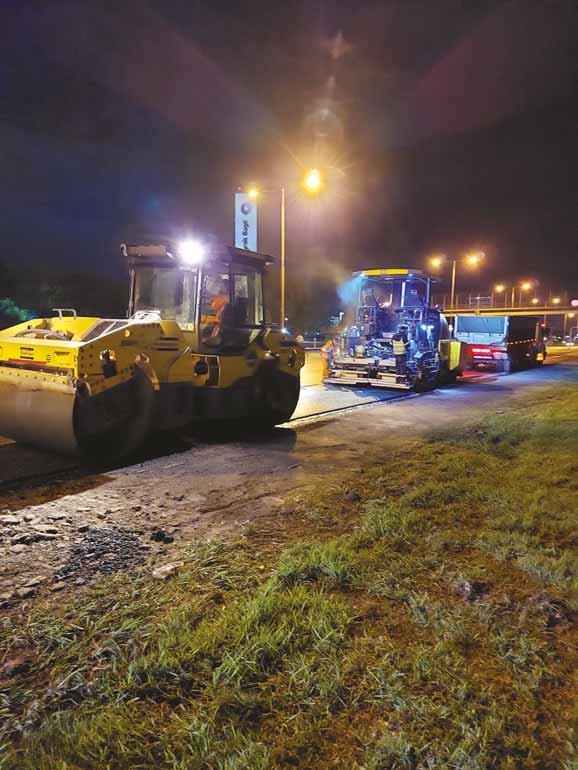
a section with 15% RAP in March 2-22.
Both trials involved 500tonnes of mix laid on a 1km stretch of the Pan-American Highway. The 30mm-thick wearing course is a thin layer with high microtexture. Often RAP is only used in the lower layers of the road, but here wearing course becomes wearing course again. “This is reuse not recycling,” says Jair.
The fact that Ausol is a private company means that it is more likely to trial innovative technologies, says Jair, because they are better placed to manage and minimise the risk: “Private owners have a certain freedom to make decisions, because they are responsible for their successes and mistakes,” he says.
An important element of the acceptance and governance process was making sure that the results obtained onsite matched those from laboratory tests, which took place over a six-month period. “In this way, the concession
authorities trusted in the benefits of the solution offered,” says Jair.
Jair was involved in the introduction of low temperature bunders to Argentina back in 2010 when he worked as technology manager for Shell Bitumen in the Americas. “I was involved in the placement and supervision of more than 200,000tonnes of warm mixes, based on chemical additives.”
The widespread use of RAP has yet to be established, however. “The use of RAP is just beginning but so far not in ‘special’ wearing courses, like this one. And warm mix technology is not yet in mass use, despite of good experiences,” says Jair.
Assuming these sections perform as expected, Ausol can now add the combination of warm mix and RAP to its range of solutions. “The idea is that the next resurfacing and maintenance projects will incorporate the RAP

generated as part of the new mixes to be used,” says Jair “Suitable percentages have been in the order of 15 to 20%. And hopefully other projects at the national level will incorporate these options.”
Austopistasdelsol.com www.ingevial.com
Liverpool goes warm Liverpool County Council opted to use warm mix asphalt for the resurfacing of Liverpool’s Lark Lane – and then offset carbon emissions to make it a carbon neutral project.
The UK’s strategic road network owner National Highways announced in August 2021 that it was accelerating the use of warm mix by demanding that contractors use it; warm mix had been allowed since 2015, but only with permission to make a departure from the specification. The use of warm mix is less common among regional and local road authorities. This means that it takes more time and effort to convince highway departments and engineering firms to work with technology that is new to them. However, it can bring a series of benefits.
Using warm mix, which requires less heating at the asphalt plant, saves on fuel and carbon. Liverpool County Council elected to offset the remaining 16tonnes of carbon through a package that CEMEX calls a ‘CarbonNeutral Asphalt Product’. CEMEX says that the carbon was offset in line with The




passing pedestrians. Secondly, is a positive impact from less congestion, according to Peter Hoare, asphalt area manager with CEMEX which supplied the low carbon asphalt using its Vialow technology:


Impact Partners which is revised annually.
Liverpool’s Lark Lane is a busy street of boutique shops, cafes and restaurants which meant that the council was keen to get the works completed with as little disruption as possible. Another benefit of using warm mix is that it can take traffic loads sooner than traditional hot mix, since it has less cooling to do before it reaches the appropriate temperature.
Working with warm mix rather than hot mix can also have a positive effect on air quality. First, there are fewer fumes as it is laid which is better for both operatives and
“Stationary vehicles at traffic lights on road closures can create four times as many pollutants, when compared to moving vehicles, so it’s really important that we help to minimise traffic restrictions and the resulting car fumes, whilst roads are being maintained and repaired.” The lower temperatures as the asphalt is laid also reduces fumes for operatives and pedestrians, according to CEMEX.
CEMEX supplied the warm mix asphalt from its plant at Liverpool Docklands to Liverpool contractors Dowhigh. Allan Jones, head of business and strategy at Dowhigh hopes that this contract will lead to further uses of warm mix: “This project will hopefully be the beginning of a determined move to make our roads greener and more sustainable for the future.”
www.cemex.co.uk dowhigh.co.uk
London’s M25 gets anti-ageing treatment
UK motorway operator Connect Plus has committed to using new technology from Shell which it hopes will extend the life of its pavements on London’s M25 orbital motorway by between four and ten years.
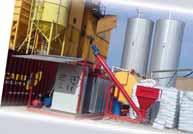



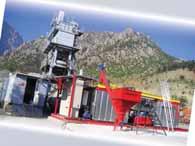




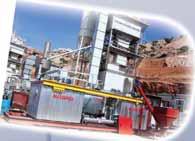








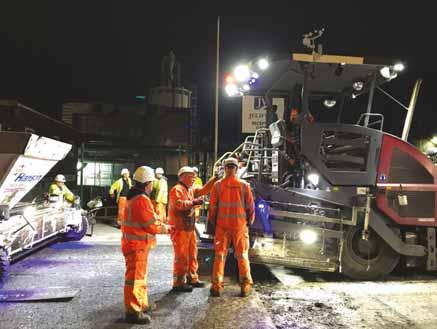
In December 2022, Connect Plus and Shell signed a memorandum of understanding (MOU) to say that the two organisations would work together to decarbonise pavements. As part of the MOU, Connect Plus, which began a 30-year contract to operate and maintain M25 motorway in 2009, has committed to using Shell Cariphalte AgeSafe.
The AgeSafe technology has been a decade in the making, with Shell analysing bitumen from multiple locations to work out exactly how bitumen ages. With ageing,
bitumen becomes more brittle, which means that pavements are more likely to fail. Age Safe includes a way of inhibiting the oxygen uptake within the asphaltenes in bitumen – which give it flexibility – to keep it ‘younger’ for longer.
Cariphalte is Shell’s name for polymer modified bitumen, so Cariphalte AgeSafe should deliver a double dose of durability.
Shell announced its age-extending breakthrough in 2020, with trials of AgeSafe beginning in the UK and Thailand in 2021. Trials in the UK included those carried out by Tarmac and CRH on the A43 near Silverstone, Tarmac in Northampton, and Hanson in Cumbria.
Connect Plus – a consortium of Edge Orbital Holdings, Balfour Beatty and Egis Investment Partners – together with Connect Plus Services – a joint venture of Balfour Beatty, Atkins and Egis – reported in their Proactive Management Review of March 2022 that they were trialling AgeSafe on the M25. The report says: “It is envisaged that long-life bitumen will extend the life of the pavement by between four and ten years, depending on the lane. Over the life of the contract this could lead to a significant saving in maintenance costs and interventions.” www.shell.com www.connectplusm25.co.uk
Early chipseal slows ageing too Early results from a study by New York State Department of Transportation (NYSDOT) are showing that it pays to apply chipseal to a road
surface early. Generally, road authorities tend to wait until roads are showing signs of wear, such as cracking, to apply the treatment which comprises a thin coating of bitumen with fine aggregate on top.
NYDOT is conducting tests on Route 11 north of Homer in New York state,, taking cores annually from an unsealed control section and then from other sections which are sealed at different times. On the first section, chipseal was applied after a few weeks, with subsequent sections to be treated after one year, two years and so on until cracking appears on the road.
According to Greg Harder, a senior regional engineer at the Asphalt Institute who is based in New York, the first set of results show that early chipseal application slows ageing significantly. Comparing the GloverRowe parameter (GR), which is a measure of bitumen ageing, for the unsealed and immediately sealed sections, researchers found that the unsealed section showed an increase in the GR of 88% compared to 32% for the chipsealed section.
While these are preliminary results, they clearly show a trend that early preventative maintenance will extend pavement life,” says Harder, writing on the Asphalt Institute website. He points out that these findings echo those of a similar study conducted in Minnesota. www.asphaltinstitute.org

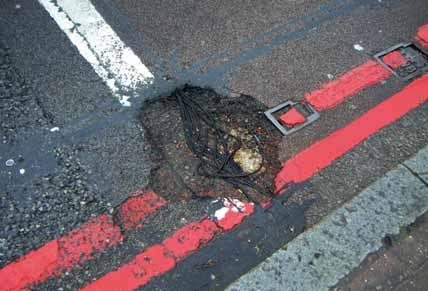



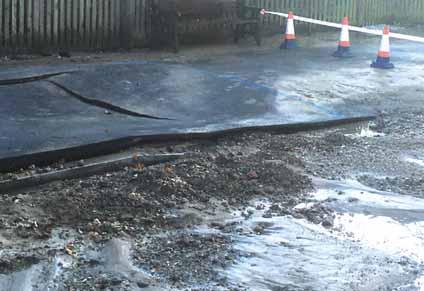


Pothole problems are a major cause of traffic delays and vehicle damage in many developed nations
While major road projects to expand the network are both prioritised and wellfunded, road repairs are often overlooked and ignored. This issue is not restricted to one country but is an endemic problem for much of the Western world, although it is arguably most acute in the US and in some states in particular.
In the UK, neglect of the road network has been a serious problem over many years. The use of old-fashioned repair methods make the problem worse, with an inefficient use of resources and high levels of waste.
According to figures from JCB, each local authority in the UK has an estimated average backlog of road repairs of £75.1 million. JCB’s figures suggest that the total cost of road repairs required across the network in the UK will cost £12.6 billion and will take nine years to clear the backlog. And it is worth noting that this is a serious issue, with potholes and road defects in general having resulted in 24 fatalities in the UK between 2009 and 2018. In addition, £8.9 million was paid out in compensation in 2021 for damage to vehicles caused by potholes.
JCB’s Ben Rawding explained just why the firm opted to develop its Pothole Pro machine. Based on the versatile JCB HydraDig model, this unit comes with breaker, milling and sweeper attachments. Using the breaker, the machine can remove broken asphalt, with the milling attachment then preparing a flat surface. The sweeper is used finally to remove any remaining loose material, ready for the new asphalt and subsequent compaction.
Rawding said that the firm opted to focus on the preparation task for a pothole repair as this is the most time-consuming portion of a conventional road repair. He added that although the firm considered offering a compaction tool also with the package, it was realised that this task would be better addressed using compaction equipment as it would be more productive for the PotholePro to focus on the preparation task.
Traditional methods to fill potholes cost around £60 each and can take several hours. These also require the use of handheld breakers to prepare the area for a repair, exposing workers to hand arm vibration. By comparison, JCB’s pothole Pro machine can carry out the preparation work in just eight minutes and for just £30. In addition, the site worker will be sitting in the comfort and safety of a machine
cab rather than being exposed to the weather.
According to JCB, the PotHole Pro can prepare up to 250m3/day and carry out this work up to 10 times faster than with conventional hand tools. The 600mm-wide milling attachment allows the operator to prepare an area to a depth of around 170mm, sufficient for the vast majority of road surface faults to be addressed.
The 600mm-wide planer attachment mounted on the arm of the machine allows the operator to provide a straight edge around a pothole needing to be repaired. The hitch system allows for full rotation as well as orientation of the cutter. The planer attachment also includes a dust extraction system to help ensure a clean working area.
For those specialist road repair firms handling contracts for local councils, there are
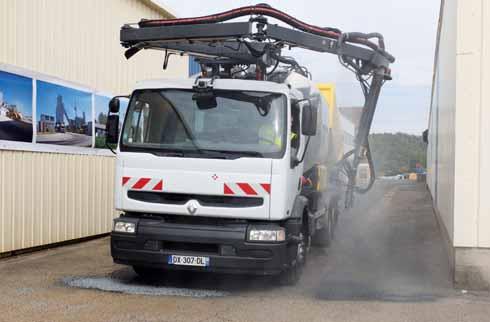


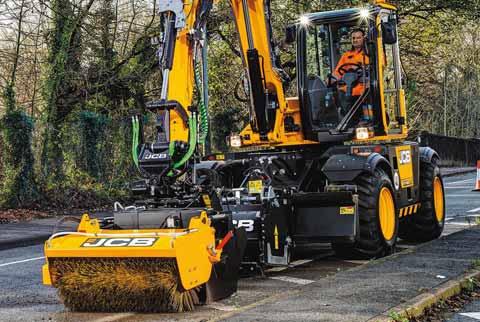
options to lease or rent the machines through JCB’s network instead of buying a machine outright. Since maintenance crews started using the PotholePro for repair work in the city of Stoke-on-Trent, the local authority has had success with its road quality and addressing the pothole problem, without a significant increase in maintenance costs according to JCB. The company has had considerable success in selling this model in the UK and is now looking to expand sales to other territories.
Meanwhile, France used to have amongst the best maintained roads in Europe, a situation that has changed as road quality has declined in the country. An estimate suggests that France’s capital Paris had around 31,000 potholes in 2019. If the data is to be believed, the situation is being addressed at least with the city’s budget for road maintenance, more than doubling from €14.8 million in 2018 to €33 million in 2022.
French firm Secmair is part of the Fayat Group and has also developed a novel machine

that can deliver fast and efficient pothole patching. Called the Greenswift Sprayer-Gritter Blow Patcher, this truck-mounted unit has a three-section arm located at the front of the vehicle. This offers a wide field of movement in front, and to the sides, of the cab and is said to allow good visibility of the working area being repaired for the driver. Operation of the pothole filling unit is controlled by a multifunction joystick. The firm says that this allows effective and precise control both of the material spraying and arm movement functions. A blower system can be used to blast loose material from the pothole, with the special mix then being sprayed into place afterwards. High productivity is claimed while the machine is also said to offer long-lasting repairs. To further boost its versatility, the machine can also be used as a Synchronous Chipsealer and the firm claims that the unit can deliver high-quality, highly accurate surfacing as well as localised preventative treatments.
The machine has been developed following
Secmair’s extensive experience in the market for chipsealing equipment with its binder, sprayers and chip spreaders.
Other machines designed specifically to address pothole repairs include the Jetpatcher and Nu-phalt systems. The former is a proven system first developed in 1987, with over 900 units sold and operated in more than 40 countries around the world. According to the Jetpatcher Corporation, the machine takes approximately two minutes to fix the average size pothole. Using the Jetpatcher, traffic can drive over the repair straight away and this is guaranteed to last a minimum of 12 months.
The firm claims that due to the speed and versatility of the machinery, the process has proved a cost-effective solution with local authorities and municipalities. As a result, customers have been able to increase the number of repairs they can carry out using limited budgets.
Also offered is the novel Nu-phalt Thermal Road Repair System from sister company Nu-phalt Group. This system meets the UK’s spec for ‘standards for highways’ and the series 0900 Nu-phalt unit has obtained the ‘BBA Hapas’ requirement for permanent road repairs.
According to the company, the Nu-phalt Thermal Road Repair System has been proven to reduce costs by up to 40% when compared to conventional pothole repair methods.
JCB
www.jcb.com
Jetpatcher www.jetpatcher.com
Nu-phalt www.nuphalt.com
Secmair www.secmair.fayat.com/en
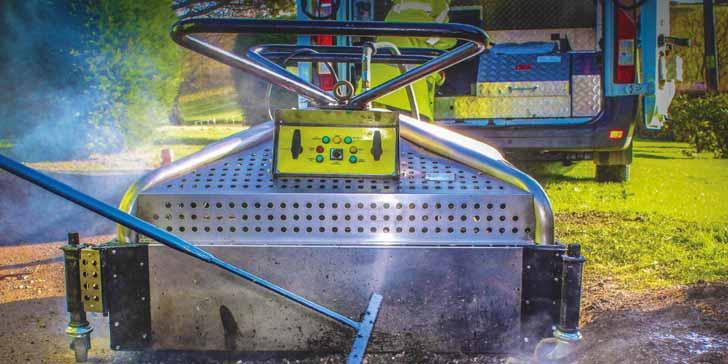
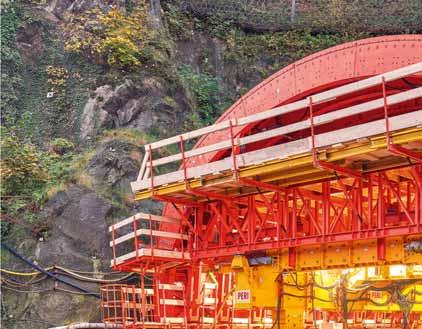

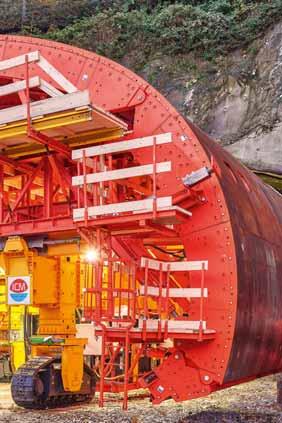

For a project in Linz, PERI has provided what is says is Austria’s first fully hydraulic tunnel formwork carriage with a caterpillar drive
The A26 project is one of the most important infrastructure projects in the Austrian city of Linz and the surrounding area.
The key to success during the project implementation stage was a PERI engineering solution that was innovative, safe and efficient, coupled with comprehensive project support. The highlight of the work was that it was Austria’s first fully hydraulic tunnel formwork carriage with a caterpillar drive.
Tunnel construction to the north and south of the Danube River for the access and exit routes for the new Danube bridge has been in progress since May 2020 (see box). A large section of the tunnel runs underground so that the noise and pollution in the urban area are reduced to an even greater extent. Five different tunnel cross-sections, profile transitions, tight radii of between 50m and 750m in the bends and varying gradients were just some of the challenges that had to be overcome when constructing the 1,600m-long access tunnels for the new suspension bridge.
To overcome the challenges, Peri engineers developed Austria’s first customised and fully hydraulic special-purpose steel formwork carriage with caterpillar drive and a weight of 250tonnes. This alone was enough to produce the different cross-sections in a total of 170 concreting sections.
Given the fact that the very tight curve radii made it difficult to transport the formwork carriage, a caterpillar system was used to move it along. In addition, the formwork carriage impressed with its considerable dimensions of 8m in height and 14.5m in length as well as 10.7m in width when ready to move and 11.2m
in width when ready to pour concrete.
The formwork carriage was assembled in front of the tunnel entrance under the guidance of a PERI supervisor. A short time later, the first concreting section was successfully completed, meaning that the formwork could be stripped away the very next day and the formwork carriage moved forward to the next concreting section – an efficient and time-saving solution.
Before the tunnel formwork carriage was called upon, a mobile 6m-long assembly carriage with rubber tyres and electric motor was used for the sealing work. This was followed by a reinforcement carriage adapted to the block length of 12m, the principle of
quickly and cost-effectively. What’s more, the erected PERI UP scaffold served as a work platform for site personnel. In the end, the drive was controlled by an integrated hydraulic system.
Engineers from PERI Austria and the PERI Infrastructure Sales Support Unit worked together to develop a project solution that was tailored to all the customer's needs. PERI was intensively involved as early as the planning stage, providing solution-oriented input. When it came to the operational implementation stage, there was constant communication between the parties. This meant that the formwork systems could be used in an
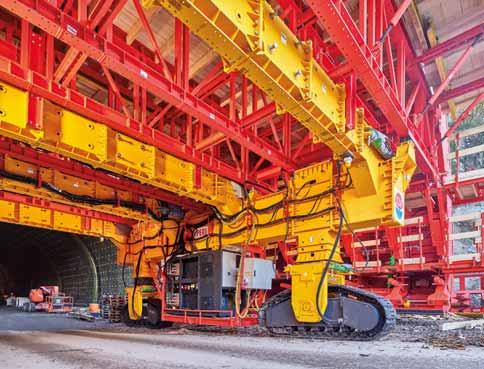

A Manitowoc crawler crane and three Grove all-terrain cranes together lifted a 466.6tonne bridge section onto a self-propelled transporter for later unloading and installation.
The Cherry Street Bridge work is part of the Four Signature Bridges contract for Toronto’s Port Lands lakefront redevelopment project in the central province of Ontario.
The lift of the 22.3m-wide x 57.1m-long Cherry Street North Bridge was performed by R&D Crane which — like the bridge fabricator — is a division of Cherubini Group. It was completed using the four largest cranes in its fleet: a Manitowoc Model 16000 lattice-boom crawler as well as a Grove GMK6400, GMK5250L and a GMK5240 all-terrain crane.
The cranes combined to lift the structure from its supports in the yard at Cherubini’s Pleasant Street Fabrication Facility in Dartmouth, Nova Scotia. This allowed a self-propelled modular

transporter (SPMT) with transfer beams and a huge Cherubiniengineered turntable to move in and take the load. The SPMT was then driven onto a barge moored alongside the site’s dedicated harbourside wharf to begin its journey to Toronto - up the St
Lawrence River and Seaway locks, past Montreal and into Lake Ontario.
The need to bring together the four cranes was an engineering solution to help ensure the bridge was positioned as smoothly as possible at its final destination,
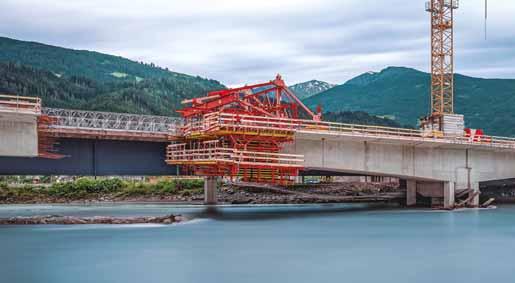
noted Darren Czech, chief executive of Cherubini Group.
“Loading the bridge sections onto the barge wasn’t the issue, as the transporters were able to pick the sections and drive straight on,” he said. “But with this particular section, and also a second one, there were space restrictions which meant we couldn’t simply roll on and roll off the barge using the self-propelled transporters alone.
“Because of this, we engineered a solution that supplied the sections to the jobsite on a turntable structure — our giant ‘Lazy Susan.’ This allowed tugboats in Toronto to spin them around on the barge in the middle of the harbour, ideally positioning them to slot right into their final destination. We used the fourcrane pick at our yard to make sure the section was accurately placed on the turntable ahead of shipping to Toronto,” said Czech.
For the lift, one crane was positioned at each corner of the bridge and all were configured

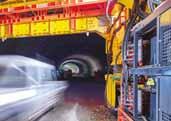
Learn more about PERI systems and solutions on our website. For any bridge construction worldwide –you can at all times rely on PERI.
For 50 years, PERI has been a competent partner of numerous construction companies and contractors all over the world. In the field of bridge construction, PERI’s formwork and scaffolding systems as well as PERI’s engineering expertise point the way ahead in the today’s construction industry. These solutions positively influence construction procedures and thereby improve the results on the building site. PERI engineers constantly strive to optimise construction procedures and to take advantage of remaining efficiency potential.
www.peri.com
with main boom and partial counterweight. The 16000 had 36m of boom with 134tonnes of rear counterweight and 27tonnes of carbody counterweight. All three Groves maximised their outrigger deployment, with the GMK6400 working with 95tonne counterweight and 20m of boom; the GMK5250L working with 70tonne counterweight and 23.5m of boom; and the GMK5240 working with 44tonne counterweight and 23m of boom.
“The lift went without a hitch, taking less than four hours,” said Rob Blois, general manager of R&D Crane. “Although the cranes were mobilised roughly a week prior to help with planning, setting up mats, and finalising onsite details. The key was really the planning to maintain equal weights during the lift and spreading the load to reduce ground-bearing pressure.”
Manitowoc/Grove
www.manitowoc.com
The joint venture of Balfour Beatty VINCI reports that it has completed what it calls “the world-first box bridge slide” over the M42 in England.
Workers slid the concrete shell of 12,600tonne bridge a record 165m to position it across the M42 motorway in the county of Warwickshire. Around 450 people worked on the operation during the Christmas week, a quiet time on the roads. A section of the motorway section was closed for the 10-day operation.
The slide operation itself took only 48 hours at a speed of 4m per hour, explained Sasan Ghavami, Balfour Beatty VINCI’s construction director for the project. “We’ve used innovative construction techniques and worked tirelessly throughout the Christmas period to move this 12,600tonne bridge over the M42 – all done with the aim of keeping disruption to an absolute minimum.”
Over the past six months, the giant 86m-long structure was constructed on land next to the motorway. It was developed by a design joint venture of Mott MacDonald and SYSTRA, working on behalf of Balfour Beatty VINCI. It has a base, three walls and top slab.
The sliding mechanism, designed by specialist civil and structural engineering company Freyssinet, allowed the box to be pushed into place over the motorway on a guiding raft over a distance of 165m. This construction method allowed it to be shifted into place in one movement, resulting in only two one-week closures of the motorway over a 12-month period, dramatically reducing disruption for road users.
On completion, the whole structure will total around 190m in length and will carry HS2 – High Speed 2 rail line - over the motorway.
Freyssinet https://freyssinet.co.uk
Balfour Beatty www.balfourbeatty.com









Vinci www.vinciconstruction.co.uk
High Speed 2 www.hs2.org.uk
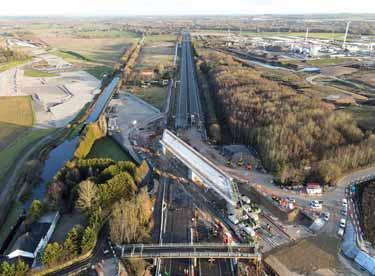




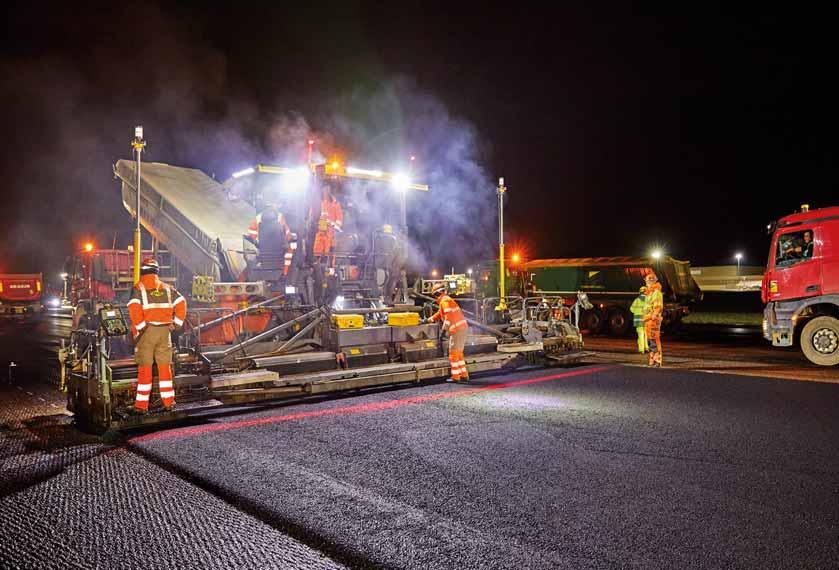



Luxembourg Airport, located in Findel, is handling a growing number of passenger as well as cargo flights. However, to meet international standards the airport’s runway, measuring 4,000m long x 60m wide, was in need of complete renovation and repair
The airport operators needed to complete the runway reprofi scheduled take-offs and landings. With an eye on speed, fl quality, the operators opted to lay a series of new asphalt layers over the existing runway. Milling machines were used to rectify the profi runway, with asphalt pavers then being used to lay the asphalt layers each night. The runway then reopened each morning for normal airport operations to resume during the day.
This was a complex project with no room for delays, but it went to plan. The plan was achieved due to the combination of a skilled team, 3D machine guidance, technology from Trimble and support and training provided by Trimble distributor, SITECH France.
The airport allotted the construction fi slot at night from 11pm - 6am to carry out the runway reprofiling project. The work would be carried out over 210-220 nights and with two paving periods, one in 2021 and one in 2022.
The partners of the *SOMO Findel Airport Consortium that won the tender process based the plan on the use of 3D guidance for milling and asphalt laying operations. “Karp-Kneip
believes in the benefits of our technology,” construction. “As a user of guidance systems
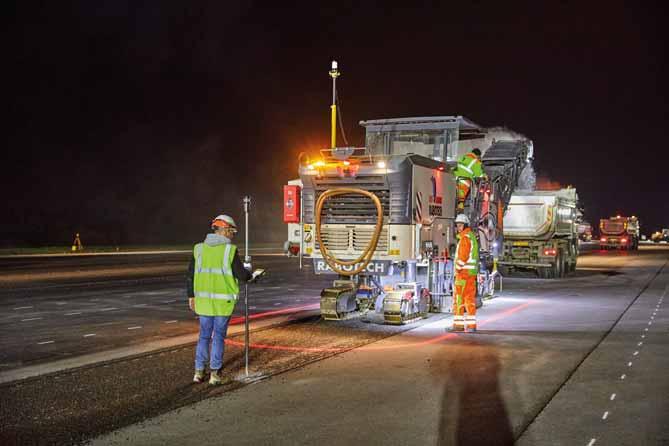
Trimble's 3D machine control solutions for its milling subsidiary Rabotech, which supplies the site's machines with Colas.” "It was not possible to carry out this project without 3D machine control, with a classic workflow," added Christophe Latteur, head of the KarpKneip surveying department. “We knew Trimble equipment and how it worked.” “And we had tested its reliability,” added Clément Larher, project director for Colas Projects, which bought a kit for a milling machine. SITECH France installed the device and also acted assisted in the planning and use of 3D systems, with the simultaneous operation of a large number of machines. “We had to train the new operators and be onsite for the first two to three night operations,” said Damien Grosjean, application engineer at SITECH France. High precision targets The runway project began with the generation of a digital model based on a mobile mapping, point cloud survey of the runway by a subcontractor. Using the digital model, the team was able to set out a daily work schedule.
The construction team then equipped the fleet of milling machines and asphalt pavers with 3D machine control technology. This system featured a Trimble CB460 Control Box and MT900 Machine Targets. Equipment needs varied during the project, with two Wirtgen W200 and two W210Fi milling machines in use as well as up to eight Vögele Super 1800-3 and Super 2100-3 pavers in operation each night. More than 16 Trimble SPS930 Universal Total Stations were mobilised for guidance and control of the work performed. “Our total stations are equipped with a very high precision CDD sensor. The signal emitted by the SPS930 and reflected by the target gives an altimetry accuracy of 1mm at 200m,” said Mattivi. The total stations transmitted the position of the
prisms in x,y,z coordinates 10 times/second to the CB460 Control Boxes via radio. In addition to this system, there were Trimble TCS3 and TCS7 Controllers for setting up total stations, and for checking the level of the milled and paved surfaces. The entire operation required more than 240 people and over 100 machines and trucks to complete.
Every night, at 11pm, the total stations were set up to control and guide the machines. “The most impressive thing is this rush, at the sound of the horn, every evening at 11pm,” explained Larher. “Each MT900 emits a coded unique LED signal picked up by the total station responsible for tracking this target,” said Mattivi. Latteur added, “Each station follows only one prism, and finds it, even if a truck passes between the two.” In addition, the total stations are positioned behind the pavers and on tripods 3m high to avoid any interruption of the beam by the compactors at work.
The areas to be milled, about 2m wide depending on drum width, are marked each evening by the TinyRobots, an autonomous line pre-marking solution, equipped with a Trimble SPS986 GNSS Smart Antenna. The milling machines guided by the Trimble PCS900 Paving Control System can then come into play. “Then we treat the sides of the first zone to cover the entire width of the track,” explained Larher. “These machines have a single mast carrying the MT900 prism,” said Mattivi. “We thus have an altimetry point which, combined with a Trimble GS420 Machine Control Sensor, allows a milling precision of ±3mm for work up to 25m/min.” Then, after sweeping and application of the bonding emulsion, crews could lay the asphalt. However, this operation was only triggered after surveying, as progress was made, of the milled depths.
The pavers worked in groups. The first,
Trimble equipment (3D guidance and positioning)
12x Trimble PCS900 Paving Control Systems
16x Trimble SPS930 Universal Total Stations
6x Trimble TSC3 and TSC7 Controllers Machines
4x Wirtgen W200 and W210Fi planers
8x Vögele Super 1800-3 and Super 2100-3 pavers
guided in 3D on both sides, worked to the left of the axis of the track, and gave the level and slope over a width of 10m. The second, also equipped with a 10m screed, worked on the right, taking its reference from the left using a sonic system on the layer placed by the first. On the right, it was guided by 3D. This pattern continued until crews covered the entire width of the track. At the end of the project, ramps were made according to international standards for airport runways (1% maximum).
“We apply between two and seven layers of asphalt, 4.5cm thick, for the wearing course at a maximum of 10cm,” specified Larher. “The amount depends on the areas and the gap between the old profile and the target profile. At most, we will have laid 37cm of asphalt.” Every night, crews completed from 150-300m of new surface.
The supply of asphalt for the pavers was provided by two plants close to the site and there were some complexities for the logistics as well. "In fact, in the time slot allocated to us, the milling finished around 1:30 am, there are 2:30 hours left to lay the asphalt and compact it, because it takes two hours for the asphalt to cool down from 160°C at the time of application to 60°C, the maximum allowable for the reopening of the track,” specified Larher. On average, 2,500tonnes of asphalt were laid/night, equivalent to 60-65 trucks, not counting those that remove the milled material from the milling machines, continues the project director. “Not all trucks had time to return to the asphalt plant. Trucks average 1.6 laps,” he added. "That’s another advantage of having a 3D model,” said Mattivi. “Not only for accurately meeting specifications of the project, but also for calculating the necessary quantities of asphalt to be produced, transported and applied each night.”
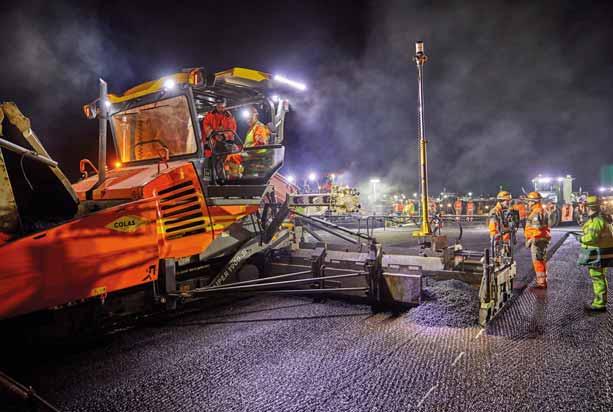
“When we leave the runway, to make way for the first cargo planes to land, it's as if we had never been there. But the equipment is ready for work the next night,” concluded Latteur.
Trimble www.trimble.com
*The SOMO Findel Airport Consortium comprises: Colas (via Colas Projects, Colas Belgium and Colas France)
Felix Giorgetti SARL
C Karp-Kneip Constructions · JDC Airports

Sustainability is a huge topic across the construction and quarrying industry – not just in terms of what can be achieved tomorrow via carbon-free hydrogen fuel cells and hydrogen internal combustion engines of machine fleets, but today, through the use of smart technology to make jobsites more efficient and sustainable by getting work done right first time, every time

World Highways and Aggregates Business spoke with a trio of experts from leading construction and quarrying equipment and linked technology sector manufacturers to hear their takes on helping to address customers’ current and future sustainability needs.

Jeremy is responsible for segment strategy development & execution, digital connectivity leadership for construction, global OEM collaborations, and planning for the future. He describes himself as: “A dedicated off-highway professional who has been at Cummins 14 years, holding various positions in the Off-Highway business." His Cummins career path started in new product service engineering for Tier4 Interim followed by leading the customer care function for Tier4 Final.


Henrik is based at Eskilstuna in Sweden. He describes his role as: “Driving Volvo CE’s powertrain development regarding transmission, axles and electromobility.” In the last 25 years he has held different positions with the Volvo CE Technology and research and development departments. Previously he worked with a deeper focus on engines as the group’s director for Engines & Auxiliaries.


Dietmar is responsible for driving Trimble’s approach to strategic management and Key One Trimble initiatives. Dietmar says that this role “includes commercialising sustainability and carbon through the efficiency and productivity gains delivered by Trimble products across natural resources, construction, transportation and logistics, and related sectors.” Prior to Trimble, Dietmar worked at The Nature Conservancy organisation, responsible for creating distinct, country-specific conservation strategies and regional systems change approaches around the world.
J
If you would like to watch the full interview please go to:



eremy Harsin, Cummins global construction market director; Henrik Amann, Volvo Construction Equipment (Volvo CE) head of driveline and electromobility; and Dietmar Grimm, Trimble vice president of corporate strategy and sustainability solutions, agreed with Round table chair Nadira Tudor’s outlining of the classic definition of sustainability as ‘fulfilling the needs of current generations without compromising the needs of future generations’. They also endorsed the need for collaboration between global construction and quarrying original equipment manufacturers (OEMs) to give customers the best chance to fulfil their long-term sustainability goals.
“It’s about how you get there. You have to somehow protect that future but also account for current needs. There’s a [financial] cost to be green and technology limitations that exist today. That has to be balanced as we think things through,” said Harsin, adding: “There are things we can do today from a practical perspective that are pretty easy. A lot of equipment is in the field for 10, 20, maybe 30 years, and the machines that have been released in the last few years are a lot more efficient and more environmentally friendly. There are other things like HVO (hydrotreated vegetable oil) and other alternative fuels that are coming around that are drop-ins and could be done easily today where they’re available.
“There are definitely some scalability challenges. One of the things I’ve been pushing for a while is idle [machine] management. There’s a lot of untapped potential there. We did a random test on a wheeled loader that we fitted with a makeshift stop-start system. Just through its normal day-to-day operation, we found it was running idle 30-45% of the time. If you work out the wasted fuel and unnecessary emissions, they [its owner] could have gained 15-20% fuel economy by turning the engine off.”
Harsin said that from a Cummins perspective, the US offhighway machine engine giant’s role is converting energy into power and having a portfolio of solutions. “There are going to be different customers and applications where different things make sense, so we need to make sure we have that portfolio available at the right time and help customers along their [sustainability] journey. Some of our customers are in the slice of the market where they are ready for something new today; others are thinking through what they need to do and are looking for a thought partner.”
Speaking about Volvo Construction Equipment’s approach to sustainability, Amann said: “Our overall purpose is ‘Building the world we want to live in’ – which I think is a great purpose. I think it makes people go to work not only for their salary.”
Grimm added: “Sustainability is indistinct from Trimble as a company. For us, we want to drive productivity and efficiency gains that we want to see in society. As a technology company, we have the opportunity to focus on what Jeremy and Henrik were talking about, like driving productivity and efficiency today and finding innovations to do that even more in the future.
“If you look at how society has evolved in the last few hundred years, it has been through technological innovation. We are just past eight billion people on our planet, and technology has really driven that. What we want to help drive through productivity and efficiency gains is better business and improved profitability that drives a strong economy that helps provide the resources for a successful society with high well-being, improved wealth, health and education.
OUR OVERALL PURPOSE IS ‘BUILDING THE WORLD WE WANT TO LIVE IN'
That ties into how we can use those resources efficiently to ensure better biodiversity and improved ecosystems.”
Asked how Volvo CE can play an even more active role in industry


IT IS ABOUT TRUST AND WORKING TOGETHER WITH CUSTOMERS AND PARTNERS
sustainability, Amann replied: “We have tried to do our best in this area for many, many years. We have had environmental protection as a core value for 50 years. We have signed up for the Science Based Targets initiative (SBTi) and see the value of having a good [environmental] plan for the future.”
Addressing much in resources Cummins is putting into its sustainability initiatives, Harsin said: “I don’t have a dollar amount, but my generic answer would be a lot. We continue to invest more and more in advanced diesel solutions. We expect there will be more legislative hurdles to overcome in the next five to eight years, depending on which market you’re talking about. There has been quite a lot of media coverage of our fuel-agnostic strategy as we move towards being greener in an affordable way. One of the big challenges is scalability and how you find scale on some components when the market is only ready to adopt in niches. We think fuel-agnostic [off-highway engines] is a really good bridge product and maybe even a longterm one.”
Harsin said Cummins had invested a lot of money in recent years in acquisitions of companies offering different technologies. “We acquired a battery company, and a year or two later, we acquired a company specialising in electric drivelines. After that, we invested in a hydrogen technology company to get hydrogen fuel cells and hydrogen electrolysers, Most recently, we entered a joint venture with NPROXX, which makes hydrogen storage tanks. We’re making investments to cater for what we think is going to be the long-term future for our industries. The good thing is that most of these solutions are complimentary so that you can share components.”
Highlighting Trimble’s sustainability-based resource allocation, Grimm said: “if you look at how we were founded, sustainability has always been at our core. Our technologies have always been driving productivity and efficiency gains. What’s interesting is that in our sectors, people have often said that they had not recognised that as ‘sustainability’. They see it, say, as just wanting a way to reduce fuel use rather than being what it is, which is a core part of sustainability. As such, much of our investment in improving sustainability is linked to reinforcing our continued product portfolio.”
Grimm said Trimble’s Connect and Scale approach ties in with Harsin’s comments on there not being one solution or specific idea to improve sustainability and that everyone needed to be “all in” on this. He continued: “I think market
forces will drive this, and so we want to make sure everyone is thinking about how to drive carbon emissions down. Through our Connect and Scale approach, we are trying to connect the entire construction industry to drive the productivity and efficiency gains from an individual work site to how the whole industry works together.
“Construction [sustainability] overall starts with design. You work with architects to make sure you’re designing things with lower embodied carbon and lower long-term operational carbon. The second piece is having site management optimised, so you’re reducing the amount of emissions from the site and the amount of site rework and waste. Lastly, you need construction fleet operators to push machine manufacturers to ensure we’re making machines that reduce embodied and operational carbon. Fleet operators can also manage their assets longer term by scheduling maintenance and repairs and thinking about replacement rates. The longer you manage an asset, the lower long-term carbon emissions you have.”
Grimm said Trimble had been working with construction companies, including Ecovie in Italy, that has been using a Wirtgen cold recycling system to reuse asphalt in road reconstruction works. He also cited how Cummins and other leading global off-highway engine makers had done a great long-term job of increasing power production with lower fuel use, thus boosting sustainability. “We do that, too, with our technology. It’s in our DNA. What we need to do is to work better collaboratively to drive sustainability as a whole industry.”
Asked whether OEMs were actually working together to find construction and quarrying industry-wide sustainabilityenhancing solutions, Grimm replied: “I think we are. I’ve met with several of Jeremy’s and Henrik’s colleagues at meetings of industry associations, and we’ve all found that the sectors we work in all want to talk about sustainability and work together more to understand the solutions, including helping to drive [governmental and industry] policies that can deliver a more sustainable future. I think we have to get much better as an industry in measuring our carbon emissions and sharing that information. Once you can measure something, you can manage and start to reduce it.”
On the same topic, Amann said: “It is about trust and working together with customers and partners to develop things together. Customers are eager to get new types of equipment that support their targets of being CO2 emissions-free. As well as committing to the SBTi targets, Volvo CE also aims to have 35% of its equipment range electric-powered by 2030. We have a huge commitment to sustainability.”
Commenting on the growth in battery-electric-powered construction and quarrying equipment available to customers globally, Harsin said: “Everybody believes battery-electric equipment will find its place. Where the line gets drawn on any given type of equipment is probably the biggest debate point. You need to think about how much energy you need onboard to get the job done. It’s very different to what we’ve talked about in the past when it comes to how you power a product. For us, in some markets, we’re talking about natural gas and different alternative fuels. But from an off-highway perspective, the talk is diesel, diesel-battery-electric, and hydrogen, either in a combustion engine or fuel cell form. Many OEMs offer hybrid installations, and we participate in that as a components supplier.”
Grimm added: “What we are seeing is customers not wanting to put all their eggs in one basket. Equipment powering choice can be site specific. Certain locations work well for battery-electric-powered equipment as the power grid supply is nearby. Other places are more remote, so require different power options. You need a kind of ‘pointy pencil’ analysis: within the lifespan of these kinds of projects, we need to make a selection of equipment incorporating different powertrain options.”
“It also depends on where in the world you are,” said Amann. “Different countries offer different opportunities when it comes to powering your equipment. It also depends on the type of equipment you’re running. An excavator may be able to be connected to the electric power grid, but that doesn’t suit your articulated haulers that are travelling over longer distances. It also depends on which segment you are working in, such as quarries or road construction.”
Harsin said it was important for construction and quarrying industry customers to think “thoughtfully” and “carefully” about
powertrain choices for their equipment. “Diesel has been a really convenient power source for a long time. It has kind of spoiled us when you think how complicated some of the other power sources are. You spec an engine based on your peak power demand, and it is easy with the fuel onboard to do a day or a couple of days' job. When you look at some of the alternative power technologies, you need to be a lot more thoughtful about what you actually need to do the job. There are a lot of trade-offs that come with that, such as cost, operation, serviceability and environment.
“From an OEM’s perspective, a lot of the conversations we have with customers are like, “Okay, you have an excavator, wheeled loader or another piece of equipment, and it’s so big, and you ask, ‘How much run time do they need?' the first answer, generically, is ‘a full shift’. Then you must consider whether a full shift is eight, ten, or only four hours. From a battery-electric perspective, there will need to be much more power onboard if you want the equipment to work a longer shift. That will also impact cost and charge time. From a hydrogen power perspective, it comes down to how much you can pack onboard that piece of equipment, and the packaging would be more challenging than it is for diesel-powered equipment.”
Long-term answers
Asked about the timescale for the widespread introduction of alternative power solutions for construction and quarrying customers, Harsin said: “I think there are what I call site-centric applications today where you have a [industrial] population that’s lived there its whole life and is big enough to drive some financial sense to introduce charging infrastructure locally. They will be early and faster adopters. Others working in a more nomadic way are going to lag behind that. From our side, I think a lot of the solutions are going to come in the hydrogen space as we tend to work with larger equipment, where the power demands are higher. In many places, hydrogen fuel cell and combustion engine power will be the long-term answer.”

IF YOU PUT THE RIGHT DATA IN PEOPLE’S HANDS, THEY WILL DO A GREAT JOB OPTIMISING IT



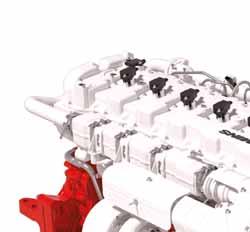
“Like Volvo CE, Trimble has signed up to the Science Based Targets initiative, and thousands of other companies worldwide have done the same,” said Grimm. “Our economy overall is now tied into incentives for reducing carbon emissions. Cummins, Volvo CE and Trimble are all technology innovators. I’m an economist by training, and back in the day, economics was labelled the ‘dismal science’ as people thought we’d run out of resources. But technology innovation and the green revolution are proving the likes of Thomas Malthus [English economist - 1766-1834] wrong. We’re just at the beginning of this in terms of quantifying and supplying data to people, connecting the digital and physical worlds. If you put the right data in people’s hands, they will do a great job optimising it. We have a bright future ahead of us, and we all hope to scale up what we do faster.”

Harsin said greater data availability will bring to light many things that construction and quarrying customers were not thinking about before, thus boosting their sustainability. “It will help focus customers on how and when they might bring older equipment up to newer spec, and, as I said earlier, with their idle machine management. Part of the challenge we have had is, how do you convince people of the value of that? In a lot of cases, it’s seen as just another thing to have to deal with.


“If you look at what we’ve [Cummins] done over the course of the last three to four emissions changes, you’re talking 5-8% fuel economy benefits in one, another 5% in the next, 3% in the one after, with more coming down the line. If all of a sudden, I’ve also then got a fleet report for all my equipment, and it shows its vintage and how much fuel I burn, it is probably a short trip from there to see how I can monetise the value of upgrades.”
“You can save a lot of fuel by educating drivers to drive their machines in an efficient way,” said Amann. “We have also started with select customers producing machines using fossilfree steel, which is coming from the other way in protecting the environment.”
In responding to a question about how autonomous equipment operation can benefit the construction and quarrying industry, Amann said: “I don’t think all machines are suited to it. Finding drivers can be tricky in some markets, and different types of automation can support their work. We have solutions like Dig Assist [for excavators - powered by the in-cab Volvo Co-Pilot tablet], Terrain Memory [a feature of the intelligent Volvo drivetrain that identifies and remembers slippery road segments to ensure optimised articulated hauler traction control and off-road mobility], and Cruise Control [also for ADTs]. There are also opportunities we are looking into around 5G connectivity. You can have a driver sitting hundreds of miles away driving a machine in a challenging place, like a mine or a forest.”
From a Trimble perspective, Grimm added: “There are two aspects of automation-linked sustainability that we believe are very important. One is safety. In the long-term future, as we start to see some equipment that is operatorless, you will end up not having a cab. A lot of injuries onsite are from getting in and out of machines. As you remove the need to do this, you’ll have fewer injuries. Then, from a carbon reduction
standpoint, there’s a tremendous opportunity. We did a study over the past year whilst trying to prove how productivity and efficiency gains drive sustainability of three compactors: one with an experienced operator; one with an inexperienced operator; and one with no operator that was auto steering – driving itself. We found a 15-30% efficiency improvement over those operators, which also equates to a 15-30% reduction in carbon emissions. This was largely because when you use auto steering, you can reduce [compaction] overlap.”
Grimm said that Trimble is seeing in the US and other parts of the world construction and quarrying customers having to get “smarter” on understanding their carbon footprint and how to reduce it. “Whomever they’re building for is starting to demand it, like a federal agency or another client who wants to see a report on their carbon emissions and how they intend to reduce it compared to other contractors. Work that used to be quantified and won on price has a carbon emissions equation going into a competitive bid. As we start to quantify carbon emissions through carbon counting, I think a big trend that is going to be seen in this industry is going to be around carbon insets and offsets. How do you work around a building or piece of infrastructure, from its design to long-term operation?
“We will see more and more companies joining the Science Based Targets initiative, and more and more federal agencies in different countries requiring us and our customers to be thinking more about our carbon net zero feature.”
Commenting on green [renewable energy-based] hydrogen power as part of the off-highway equipment carbon emissions reduction mix, Harsin said: “It is something we are investing in and believe it will have a critical role to play in the future of the medium- and heavy-duty equipment market that we serve. My earlier references to our acquisitions in this area put us in a good position.”
“The problem for our industry has been how to store electricity near the work site. There are opportunities around that with hydrogen fuel cell electricity generation to run construction equipment. Green hydrogen can also allow us to produce more fossil-free steel,” said Amann, adding: “It’s been really nice to sit here today with Cummins and Trimble and discuss our common view on making a better world to live in. We have an opportunity to do something good for future generations.”
The system consists of gearbox and driving wheel in the so-called Basic version or with servomotors in the Advanced or Compact version.
Bonfiglioli says that apart from normal features like torque and speed range, BlueRoll provides opportunities in all crucial aspects: compact dimensions; low-backlash gears; long-lasting brakes; low maintenance requirements; robustness; and efficiency.
The heart of BlueRoll is the new wheel-
mounted gearbox series TQW. A single unit of the three available sizes can load up to 360kg, 720kg or 1,020kg - and still runs up to two metres/second.
The compact gearbox is almost completely enclosed by the wheel, meaning installation space is reduced. Thanks to the mounting flange with both threaded and pass-through holes, the TQW is very easy to install, and, on the vehicle-side, it can be fitted directly to the chassis. Furthermore, the wheel is supported directly by the reinforced gearbox bearings to permit very high radial forces.
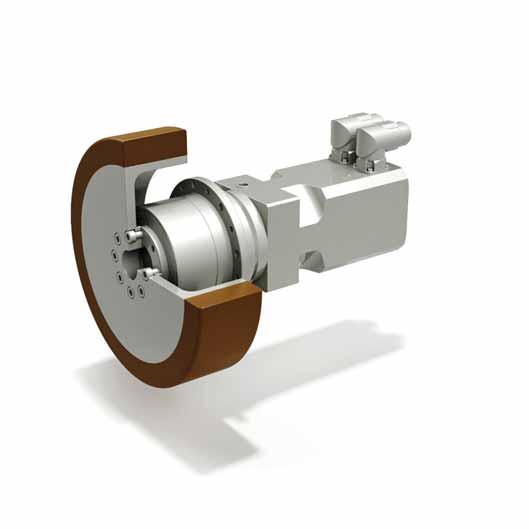
The BlueRoll Advanced version comes with a servo geared motor with a permanent magnet synchronous motor.
Meanwhile, BlueRoll Compact comes with an extra compact servo geared motor, saving 25% of the length of the BlueRoll Advanced system. In addition, it is designed to operate in S1 duty cycle with a reliable thermal optimisation.
Bonfiglioli www.bonfiglioli.com

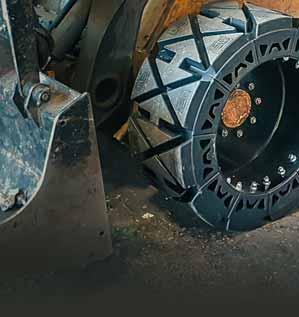
Canadian manufacturer
Evolution Wheel has created the EWRS-HS series solid skid steer tyre, the hard surface version of the EWRS-AT series all-terrain tyre.
The HS tyre is ideal for surfaces like concrete or asphalt, making it perfect for new construction, paving, and recycling operations, according to Evolution Wheel, a global maker of heavy-duty skid steer tyres, based in Winnipeg.
To ensure tyre longevity, the company redesigned the tread pattern to maximise the surface area. The EWRS-HS doubled the surface area of the EWRS-AT Series to 66% to spread the weight of the

machine. This lowers the pressure per square inch on the concrete while extending its wear life significantly. Additionally, the EWRS-HS series has the deepest tread on the market, at almost 41.3mm (52/32 inches). These two features allow the tyre to last 3-5 times the lifespan of a traditional pneumatic tyre.
Solid tyres have a bad reputation for being rough on machines and the operator driving them. To reduce driver fatigue and

make for a smoother ride, the EWRS-HS tyre has a specialised core geometry that allows them to compress like a pneumatic tyre but without the bounce. The tread design also allows the machine to skid smoothly so the operator can push the machine harder and increase productivity.
Like all Evolution Wheel tyres, the EWRS-HS is a segmented tyre. This allows the operator to service the tyre on the jobsite with just a 19mm (¾ inch) wrench, replacing the damaged segment within minutes.

Zepp.solutions has delivered two hydrogen storage and Y50 fuel cell systems to Terberg Techniek for converting two Liebherr 916 Litronic wheeled excavators from diesel to hydrogen-electric.
The hydrogen excavator conversions mark the first application of Zepp's fuel cell systems in the construction equipment industry.
The two excavators, both owned by Dutch contracting company Jos Scholman, have undergone six months of successful operational testing.
Conversion specialist Terberg Techniek, based in IJsselstein, Netherlands, developed the conversion kit surrounding Zepp’s fuel cell systems. Use of this kit is not limited to this type of excavator; Terberg Techniek also plans to use it to convert other construction equipment from a diesel to a hydrogen-electric powertrain.
Zepp.solutions
https://zepp.solutions/en
Evolution Wheel www.evolutioniwheel.com
Terberg Techniek www.terbergtechniek.nl/en
Cummins unveiled a generation of clean off-road engines that meet China’s National Stage IV emissions (CS IV) which came into effect on December 1, 2022.
The upgraded engines, with displacements from 2.8-15litres, range from 36-503kW. Cummins says that they achieve higher power output and torque than their predecessors.
The integration of Cummins latest aftertreatment systems, the single module and switchback, with leading combustion and air handling technology allows the B6.7, L9, X12 and M15 CS IV engines to be free of EGR (exhaust gas recirculation), offering benefits of improved NOx conversion efficiency and better fuel economy.
As part of this launch, Cummins says that it has three new CS IV PLUS engines that will exceed customer expectations, delivering market leading CS IV power, with faster
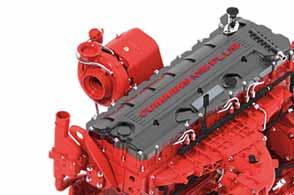
response and smarter system integration capability, helping operators reduce running costs and the environmental impact.
The M15 Plus is a new member of the bright red Cummins engine family for use with excavators, wheeled loaders, drilling rigs, road planing and milling machines and air compressors. Power ranges from 420-503kW with peak torque up to a significant 3,000Nm.
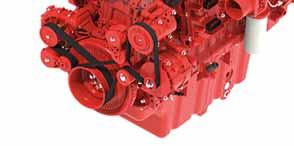
The CS IV compliant Cummins L9 Plus engines with power ratings from 219294kW reach a whole new level of power and versatility derived from millions of L Series engines in service around the world.
Meanwhile, the 4-cylinder F4.5 Plus at 129kW is ideally suited for excavators, with a design that is based on the highly successful F Series engines of which around 1.8 million
Danfoss Power Solutions has launched its Thorx family of cam lobe motors, with the first product, the CLM 8 S compact motor, now available.
Designed for construction machinery with chain drives, such as skid steer loaders, Danfoss says the CLM 8 S offers better performance, higher efficiency, and longer lifetime than other cam lobe motors.
It features newly developed two-speed technology, which offers 70% shock reduction when shifting speeds compared to other cam lobe motors. The technology delivers smoother speed changeover with a consistent, quick response time, even at low temperatures, resulting in superior machine handling and better operator comfort.

are in use across the globe. It delivers a power increase of up to 20% over its CS III predecessor.
Cummins EU Stage V engines, developed as a universal engine platform, will be cocertified to meet CS IV regulations to help OEMs reduce the complexity involved with powering their global equipment platforms.
Cummins www.cummins.com
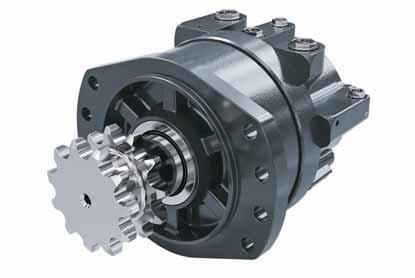
x motor is 33% shorter in length than other cam lobe motors, reducing space requirements
Caterpillar’s new 115kVA XQP115 generator set extends the company’s lineup of mobile power solutions that meet European Union (EU) Stage V emissions standards.
The Cat XQP115 generator set is the third in a series of compact mobile power solutions from 115-310kVA that meet the 90% reduction in nitrogen oxides when compared with the Stage IIIA standard, as well as other changes specified by Stage V standards.
Additionally, they offer an average of 20% higher peak power in prime operation than the previous Stage IIIA Cat XQP models serving this power range. The Cat XQP115 also offers versatility by easily switching between 50Hz and 60Hz and across various voltages.
The motor also produces less noise when shifting, further improving comfort, explained Chris Shrive, head of Cam Lobe Motors, Danfoss Power Solutions. “We didn’t just meet [customer] expectations, we set a new standard for smooth, predictable, fast changeover, regardless of oil temperature.”
By integrating the parking brake rather than bolting it to the rear, the motor is 33% shorter than similar products. The smaller size results in easier integration and assembly while enabling the use of larger, longer-lasting chains. The integral parking brake is the
toughest on the market, say the company, offering a longer service life. Thorx motors use a proven brake design that has been optimised to withstand 100 dynamic emergency stops throughout a machine’s lifetime, which is 20 to 25 times more than competitive cam lobe motors.
The Thorx CLM 8 S motor offers 5% higher efficiency than other cam lobe motors, with better starting efficiency and performance at low rotations per minute, plus improved mechanical efficiency at high speed. Operators can achieve faster travel speeds or use less power at the same speed while wasting less energy in the form of excess heat.
Danfoss Power Solutions
www.danfoss.com
It comes with Cat Connect technology to give operators insights that manage costs and reduce risks. Through a subscription, the telematics send real-time information on fuel level, diesel exhaust fluid (DEF) level, battery voltage and run status.
Caterpillar’s range of small mobile power solutions meeting EU Stage V emissions standards offers numerous features ideal for rental applications. They are equipped with the XQCP digital control panel, which provides all generator set controls and system indicators in a single, easy-to-access interface. Programmable logic controller functionality improves reliability and flexibility for accommodating changes in processes or application requirements.
Caterpillar www.cat.com/euv
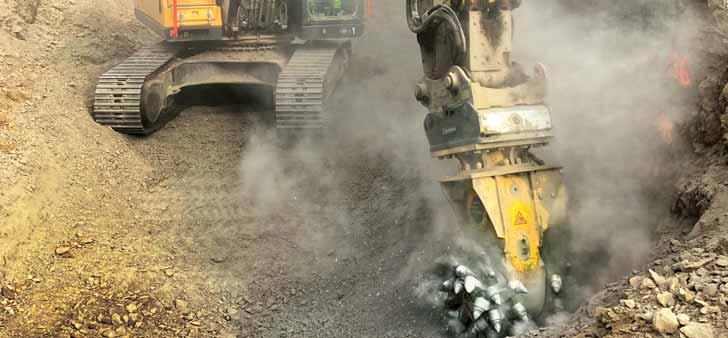

A new VC 2000 drum cutter from Epiroc has come in useful for a road projec t in Germany. The VC 2000 drum cutter from Epiroc has been used for the removal of rock for a retention basin by the A45 near Siegen-Süd. The high performance of the unit impressed both of the main partners – Straßen- und Tiefbau Kirchhundem and Epiroc authorised dealer maschinen + technik Sauerland – with its versatility and performance.
Removing rock for the rainwater retention basin at the summit of the A45 motorway in mountainous Siegen was a sensitive task. The authorities specified that the slope needed to be secured by a retaining wall. There was rock material on the front of this surface that had to be removed with high precision and finesse to ensure that the wall, built from concrete piles, was not damaged. A drum cutter was needed that could cope with the hardness of the rock and work reliably in the confined space. The VC 2000 from Epiroc had been tested on various 20-40tonne excavators beforehand, but mainly on a Volvo CE 30tonne excavator, and met the complex requirements perfec tly : It ensured that removal was quick and that the construc tion work could be completed successfully with around two weeks.
The customer was pleased with the effec tive and efficient performance of the low-vibration and low-maintenance drum cutter. The local nature and environment needed to be protec ted and prior to use, the modern drum cutter was quick ly re-oiled with fully compatible Panolin bio-hydraulic oil, which is biodegradable and does not pollute soil or rock.
Epiroc
www.epiroc.com















Caterpillar is introducing two new technologies for its mini excavator range, Ease of Use Indicate and E-Fence. These are offered for the Cat 306 CR, 308 CR and 309 CR next generation mini hydraulic excavators.
The E-Fence tool limits machine motion to within preset boundaries, while the Ease of Use Indicate system helps operators to reach grade faster. These technologies are suited to a wide range of applications, allowing operators of all experience levels to work efficiently and consistently.
The Ease of Use E-Fence system automatically constrains machine motion to operator preset boundaries. Operators can use these to avoid structures overhead, underground, in front, or to the left or right of the machine.
Once the E-Fence range limits are established using the machine’s touchscreen monitor, no part of the boom, stick or bucket will pass the limits.
Setting height limits using E-Fence Ceiling helps operators avoid obstacles such as powerlines or underground utilities. Structures in front of the machine are protected by E-Fence Wall, and the system is of benefit when the machine is working next to live traffic or walkways or loading trucks.
E-Fence is ideal for new operators and helps minimise job costs from repairs and downtime due to equipment damage and fines. For experienced operators, E-Fence allows efficient working with fewer ground personnel required around the work area.
An entry-level grade system, the Ease of Use Indicate system provides visual and audible indications to bucket position compared to target grade. With Indicate, the operator selects target depth and slope from the in- cab guidance system, and the monitor provides real-time workin-progress and distance-to-grade feedback.
Both the Ease of Use E-Fence and Indicate


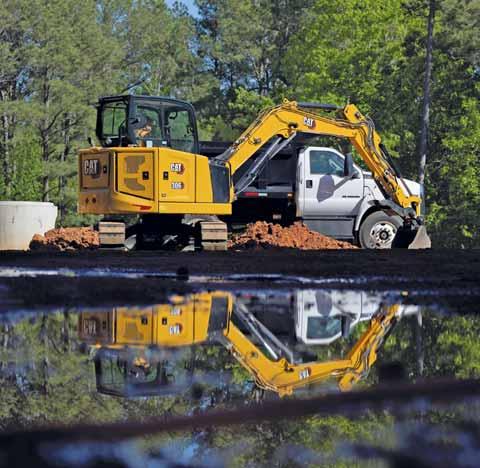

are packaged with Swing Assist and Bucket Assist features. Swing Assist automatically stops machine swing at one or two set points, suiting truck loading and trenching applications. It helps operators, reducing fuel use and improving c ycle times. Bucket Assist maintains last known bucket angle and keeps the cut accurate in sloping, levelling, fine grading and trenching applications.
Current production Cat 306 CR, 308 CR and
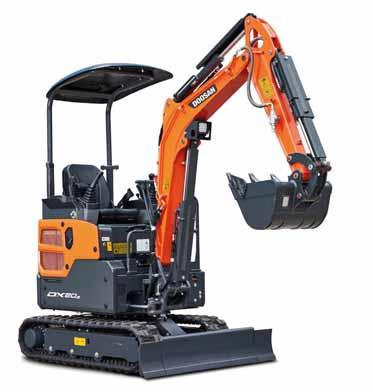
309 CR Next Gen Mini Hydraulic Excavators are shipped from the factory Ease-of-Use-ready to reduce installation time in the field. Ease of Use Indicate and E-Fence can be ordered bundled together or as separate feature packages, installed at the factory or through Cat dealers as an upgrade kit.
Caterpillar www.cat.com
According to Doosan, its new 2tonne class mini excavator offers high performance combined with precision work ing. This compac t unit features a zero tail swing design and a detachable canopy for low height entrance, allowing it to be used in tight spaces.
The optimised hydraulic system in the DX20Z-7 is powered by the Yanmar 3TNV70 threecylinder Stage V diesel, which provides 10.3kW. This results in fast cycle times combined with smooth control of breakout forces.
In its standard configuration, the DX20Z-7 has an operating weight of 1 995kg. With the optional 1 1m long arm, the maximum digging depth of the DX20Z-7 is 2345mm, the maximum dump height is 2750mm and the maximum reach at ground level is 3975mm.
When at its fully retracted width of 950mm, the retractable undercarriage on the DX20Z-7 allows the machine to go through narrow spaces. When fully expanded to a width of 1360mm, it provides stability, especially when working over the side.
The use of highly durable materials ensures that the Doosan DX20Z-7 model offers hard-wearing and robust performance. All components and design features are tested under extreme conditions and the heavy steel gauge tailgate ensures extra durability and peace of mind while working. The cylinder guards and battery cover provide extra protection.
The tailgate can be opened to provide access for daily maintenance and service points, reducing downtime to a minimum.
Doosan Construction Equipment www.eu.doosanequipment.com
National Pile Cropper is off MultiBar cropper, with increased performance. The MultiBar pile cropper is lowered over the concrete pile which is then reduced at 250mm intervals enabling broken pile sections to be removed. The cropper is best used by an excavator of at least 6tonnes, and depending on the variant chosen, weighs either 450kg or 550kg. This all means that it’s small enough to be highly manoeuvrable, but can also deal with the toughest of precast piles with four or more reinforcement bars.
The new MultiBar has been redesigned to reduce its overall footprint and weight. The redesign also enables the new MultiBar easier operation around piles in close proximity whilst also providing protection for the hydraulic cylinders and hoses to avoid damage. At the same time, the fi it easier to repair.
The new MultiBar has already been subject to extensive field testing which it has passed with flying colours. It was recently used to great success on the Omega South development near St Helens. It helped out on a project that saw the croppers deal with over 15,000 piles in a three-month period.
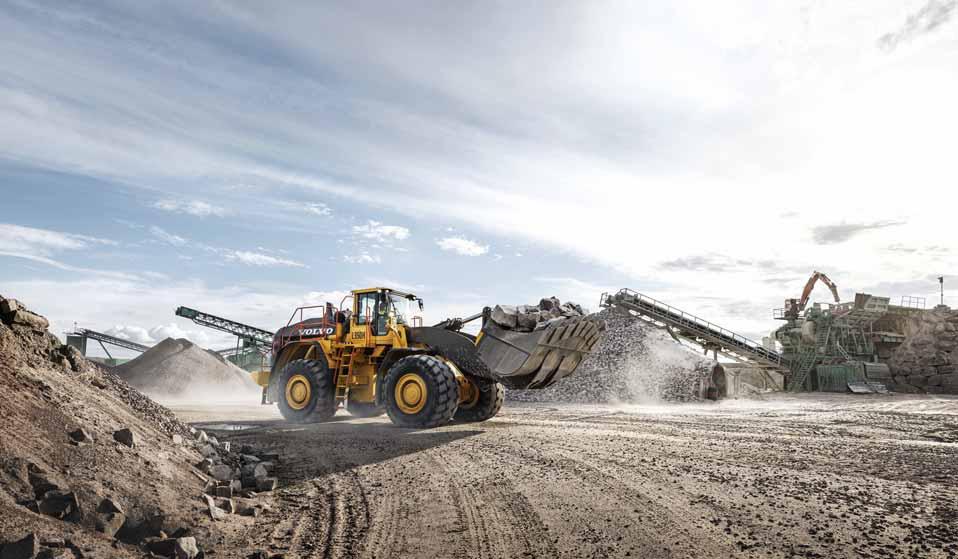

The new MultiBar is now available for hire or purchase throughout the UK and will be introduced globally in the coming months.
The MultiBar 8-12 model weighs 450kg, iis 1.23m long x 1.23m wide x 310mm high. It can be used on 6tonne carriers and suits pile sizes from 200-300mm. The MultiBar 12-14 model weighs 550kg, is 1.3m long x 1.3m wide x 310mm high. It also suits use on 6tonne carriers and suits pile sizes from 300-350mm.

National Pile Croppers www.nationalpilecroppers.com






Volvo CE’s top-of-the -range L350H wheeled loader delivers high performance, as well as greater productivity and fuel efficiency than the previous model
The L350H suits heavy-duty applications and features a proven Z-bar lifting arm with double sealing on each of the pins, and a strong chassis. The new model benefits from a reinforced upper centre hinge, while a range of special packages is also available to suit specific applications.
Other improvements include a more responsive hydraulic system, featuring new lift and tilt cylinders, and an increased hydraulic working pressure that allows for 10% faster work cycles and higher productivity.
Meanwhile, the machine has an upgraded driveline with new Volvo axles and a new Volvo transmission, which enables the third generation OptiShift to be equipped as standard. Already found on Volvo L150H-L260H wheeled loaders, this proven technology integrates the Reverse by Braking function and the lockup function in transmission to boost fuel efficiency by up to 15% Efficiency is further boosted by an optimised gear shifting ratio and the new converter, which delivers higher outputs resulting in up to 22% more tractive force depending on selected gear and machine speed.
duty axles with fully floating shafts, planetary hub reduction, and maintenance-free rear axle trunnion bearings.
Telematics connectivity and established features, such as the Load Assist suite of apps accessed from the in-cab Volvo Co-Pilot display, further improve efficiency and uptime. Starting with the optional Tire Pressure Monitoring System which enables the pressure and temperature of tyres to be checked from the cab and boosts tyre life and saves fuel
Customers can address problems of overloading, underloading, and waiting times with the On-Board Weighing app, providing real-time insight into the load of the bucket and payload of the load receiver. The Operator Coaching Advanced app will support customers in optimising use of the L350H It provides real-time information and guidance to operators, helping them to deliver optimum productivity and fuel efficiency, as well as reduced machine wear. In addition, a range of complementary Volvo Services – including Productivity Report, EcoOperator training and ActiveCare – also provide valuable insights into ways to lower cost/tonne.




Service intervals have been doubled to 4,000 hours for an axle oil change, made possible by an axle oil cooler with filtration fitted as standard. In addition, customers can minimise machine downtime and increase component life with renowned features including heavy-
Operators can configure the machine according to the job with a choice of three hydraulic modes, customisable lockup engagement and rimpull control, while the bucket levelling function automatically returns the bucket to level, from both dump and curl positions, helping reduce operator fatigue.

Our Skidmarks page is highly rated by readers. Your input could help make this page even more entertaining. If you come across any amusing road-related stories or pictures email me at mwoof@ropl.com
A family in Glasgow in Scotland are perhaps regretting the trip they made to get their car cleaned. While being cleaned in an automatic car wash at a local supermarket, the machinery failed and the vehicle became stuck for a number of days. The supermarket staff were unable to remove the vehicle, which had become jammed between two internal components of the car wash. As some of the car doors were jammed, the family had to clamber over the seats to escape the vehicle once the equipment had been turned off The incident was somewhat traumatic and even resulted in one member of the family being prescribed medication.
A mountain biker in California found himself being pursued by a cougar while out for a ride. The c yclist was enjoying the scenery in the Irish Hills Reserve when a very agitated walker approached saying she had just seen a cougar in the immediate vicinity. The c yclist went with the walker to make sure she was safe and then decided to ride back to where he had left his car. Shortly after, he spotted the cougar heading quick ly in his direction. Rather than try to outrun it, he stopped and put his bike between himself and the big cat, shouting loudly at it. He was able to alert police officers who walked with him back to safety.
A team of university students from UNSW in Sydney, Australia have set a new official Guinness World Record for the fastest 1,000km journey made in an EV using just one charge. The team constructed a lightweight EV that travelled 1,000km on a single charge while travelling at an average speed of 85km/h. The record was set at the Australian Automotive Research Centre (AARC) in Wensleydale, Victoria. The vehicle set the record in a time of 11 hours and 52 minutes, with stops being made at intervals to change drivers as well as to deal with a puncture and also make an emergenc y repair to the battery control unit. The 500kg Sunswift 7 vehicle is the latest


generation of several record breaking EVs built by the university.
A new driver in the UK was caught behind the wheel without insurance a short while after passing his test. The person had driven away from the driving test centre in the vehicle but had not changed the insurance details. When police stopped the vehicle, the driver showed the crisp new test certificate. However, the person was insured as a learner and not as a qualified driver and was therefore charged with having no insurance and given a fine.
A woman in New South Wales, Australia was spotted by a police officer driving along a rural road in a car that had no number plates fitted. The officer stopped the vehicle and asked the driver for some identification and also why the car had no number plates. The woman explained that she was no longer part of the state and was independent from laws that applied to others as a result. When pressed what had happened to the number plates, the woman retrieved them from the car while continuing to explain that she no longer required them. She also showed the officer a document bearing her name and the date on which she had drawn her first breath. The bemused officer listened to the woman’s discourse on why ordinary laws no longer applied to her before pointing out that the number plates should be


refitted to the car. The driver is likely to find that fines for driving offences do indeed apply to her and that she will be required to pay them.
A drink driver in the UK county of Kent may be regretting having got behind the wheel, following a crash that caused £100,000 worth of damage. The person lost control of the Vauxhall Astra and the car smashed through a fence, across a patch of ground and smashed into the shop area of a garden centre, landing upside down. A neighbouring restaurant and pet supply store also had to close until the car could be removed. Luckily, nobody was in the garden centre at the time of impact, which happened early in the morning, while neither the driver nor his passenger were seriously hurt in the impact.
Police officers in the UK recently stopped a rider on a motorc ycle they suspected of being in a dangerous condition. The exhaust system on the bike was damaged so that it sounded extremely noisy and it was this that alerted the officers to the poor condition of the vehicle. On closer inspection though, it was clear that things were much worse. Various important components were secured to the bike by cable ties or sticky tape and even a hair tie. The engine was belching out smoke, the rear lights were inoperative and the seat was not properly secured. Bodged welding repairs suggested that the frame was also
in poor condition. The driver was served with an improvement order and the vehicle was banned from the roads until it could be repaired thoroughly.
Police officers in Ireland are looking for the culprits who stole a Caterpillar excavator and used it to smash an ATM machine from a wall in a supermarket. The thieves then used the excavator to place the ATM in the back of a pick-up truck before departing the scene. The excavator was not seriously damaged but the building will need repairs after the incident. The thieves had taken the excavator from where it was parked at a nearby farm and had tracked it across some fields and over a busy road to access the area.
A man in the UK is having to deal with owning a car that has a strange sense of direction.
According to the car’s GPS system, the car is at the VW plant in Wolfsburg, Germany. In addition, the Seat also has a string of technical issues. If the driver hits a bump in the road, the engine will sometimes switch off of its own accord. The radio sometimes turns on and off by itself, with no control of the volume. The owner says the only way to turn off the radio is to stop the engine, get out of the car and then get back in again. Meanwhile, the local garage has been unable to repair the car as it requires a component that has so far proven unavailable.




www.constructiontv.tv
Contact: Roger Adshead radshead@ropl.com | +44 7768 178163
Guarantee your copy of World H Hiighhwwayys by registering today… Register online @ www.rroopplrreegg..ccoom

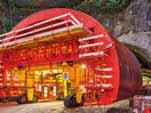















The newly designed World Highways website will bring you the very latest in website functionality, with the most up-to-date content available relating to the road construction and network management industries.














The last time we were all at CONEXPO/CON-AGG the world shut down. But for you, stopping wasn’t an option. Your jobs kept moving and Topcon solutions helped you get more done faster, safer and more accurately. Because what you do matters to us all.
Another CONEXPO/CON-AGG is almost here, and we’re ready to share some new and innovative ways to keep your projects on track. Because together, we can do great things.
#ForWorkThatMatters