WASTE MANAGEMENT REVIEW
ISSUE 110 n SEPTEMBER 2026
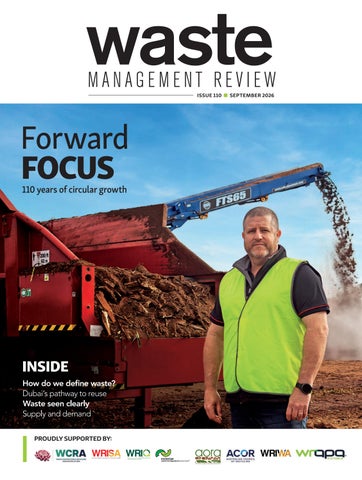
Forward FOCUS 110 years of circular growth
2026 | SEPTEMBER | ISSUE 110
wastemanagementreview.com.au
INSIDE How do we define waste? Dubai’s pathway to reuse Waste seen clearly Supply and demand PROUDLY SUPPORTED BY:
PMS 380 PMS 376 PMS 355
CONTENTS
COVER STORY
12
Forward FOCUS
46
An industry centenarian shares the secret to relevance “We pride ourselves on recovering materials from food waste, green waste, wood waste, and manures – anything that can be recycled, we investigate.”
Get the ball rolling
Waste Expo Australia will host leaders, innovators, and policymakers.
Tim Richards, Managing Director
Features
08
CRUNCHING NUMBERS
27
10
BY DEFINITION
28
16
BY DESIGN
30
RESTORING INCENTIVE
33
DIVERT AND CONQUER
36
SERVICE WITH A SMILE
38
18 20 22 24
New legislation will change PFAS monitoring in this state. Questioning one of the sector’s fundamental concepts. A customer-led approach to recycling. Why Australia needs a 20-cent refund.
A strategy delivering results for circularity. e social impacts of recycling programs.
GIVING BACK
A small attachment with big benefits.
40
GOING GLOBAL
43
AT RISK
46
WORKING TOGETHER
48
NIGHT TO REMEMBER
THE ROAD TO REUSE
51
SOLUTIONS-FOCUSED
A success story 70 years in the making. E-waste volumes pose a dual challenge. Foundations for the industry’s future.
A pioneer sets up shop in the Middle East.
CRYSTAL CLEAR
New technology helps waste information stand out.
IDEAS INTO ACTION
Key sessions to visit at this year’s Waste Expo. Awards have the power to li industry. LEW26 launches in Sydney.
SHIFTING SCALES
is role is changing with the times.
SCREEN TEST
A critical product for this major player.
PARTNERS IN CRIME Two machines for landfill operators everywhere.
Waste Management Review
4
Regulars
54 57
September 2026
PRODUCT SPOTLIGHT LAST WORD
FROM THE EDITOR
Worth returning
G
rowing up in Victoria, I remember collecting aluminium cans for the Alcoa Cash a Can program. Like many kids, I was motivated by the few dollars that could be earned from a bag full of cans. Looking back, it was also one of my earliest lessons in resource recovery, long before I even knew what circular economy and sustainability were about. When the program disappeared, Victorians were le watching other states enjoy the benefits of container deposit schemes. It brings to mind the classic Seinfeld episode where Kramer and Newman hatch an elaborate plan to transport bottles interstate a er calculating the potential returns. While most never went quite that far, it highlighted the simple appeal of getting a small reward for doing the right thing. But the rewards have never been limited to the person returning the container. Australia’s container deposit schemes have delivered meaningful social outcomes, fundraising opportunities and new pathways for participation in resource recovery. In this edition, we take a closer look at how scheme operators are now moving beyond collection targets and return rates to better understand customer behaviour. What motivates someone to return a container? What barriers prevent participation? How can convenience
CEO
be improved? ese questions are helping to shape the next generation of schemes. It’s a reminder that even the most successful programs cannot stand still. Neither has Richgro. As Richgro celebrates 110 years in business, we look at how the Western Australian organics recycler continues to recover value from materials that might otherwise be discarded, while investing in new technologies, renewable energy generation and partnerships that support its long-term growth. We also unpack the latest changes to PFAS (polyfluoroalkyl substances) reporting in New South Wales and what a Victorian court interpretation of the definition of ‘waste’ could mean for the industry. Happy reading!
Christine Clancy christine.clancy@primecreative.com.au
PUBLISHER
Sarah Baker sarah.baker@primecreative.com.au
MANAGING EDITOR
Lisa Korycki lisa.korycki@primecreative.com.au
JOURNALIST
Sean Gustini sean.gustini@primecreative.com.au
HEAD OF DESIGN
Clayton Hawley clayton.hawley@primecreative.com.au
ART DIRECTOR/DESIGN
Daz Woolley, Laura Drinkwater
BRAND MANAGER
Chelsea Daniel chelsea.daniel@primecreative.com.au P: +61 425 699 878
CLIENT SUCCESS MANAGER
Ben Sammartino ben.sammartino@primecreative.com.au
HEAD OFFICE
Prime Creative Pty Ltd 379 Docklands Drive Docklands VIC 3008 Australia P: +61 3 9690 8766 info@primecreative.com.au www.wastemanagementreview.com.au
SUBSCRIPTIONS
Lisa Korycki, Managing Editor
+61 3 9690 8766 subscriptions@primecreative.com.au Waste Management Review is available by subscription from the publisher. The rights of refusal are reserved by the publisher
ARTICLES
All articles submitted for publication become the property of the publisher. The Editor reserves the right to adjust any article to conform with the magazine format.
COPYRIGHT
On the cover Tim Richards, Richgro Managing Director. Image: Richgro
Waste Management Review
6
September 2026
Waste Management Review is owned by Prime Creative Media and published by John Murphy. All material in Waste Management Review is copyright and no part may be reproduced or copied in any form or by any means (graphic, electronic or mechanical including information and retrieval systems) without written permission of the publisher. The Editor welcomes contributions but reserves the right to accept or reject any material. While every effort has been made to ensure the accuracy of information, Prime Creative Media will not accept responsibility for errors or omissions or for any consequences arising from reliance on information published. The opinions expressed in Waste Management Review are not necessarily the opinions of, or endorsed by the publisher unless otherwise stated.
Onetrak
FEATURE NEWS
Collecting data
The New South Wales Environment Protection Authority will soon require certain waste managers to monitor and report concentrations of per-and polyfluoroalkyl substances in their wastewater.
T
he Department of Climate Change, Energy, the Environment and Water defines per-and polyfluoroalkyl substances (PFAS) as synthetic chemicals that make products resistant to heat, stains, water and grease.
It’s because of these properties, that PFAS are widely used in everything from cookware and textiles to industrial applications. But their durability comes at a cost. PFAS are o en referred to as “forever
All licensed landfills and sewage treatment plants in New South Wales will need to monitor and report PFAS concentrations in groundwater and surface water. Image: andrei310/stock.adobe.com
Waste Management Review
8
chemicals” because they do not naturally break down, allowing them to accumulate in the environment and contaminate soil, groundwater and surface water when disposed of in landfill. In a bid to combat this, the New South Wales Environment Protection Authority (NSW EPA) has introduced the PFAS Monitoring Chemical Control Order (CCO) requiring all licensed landfills and sewage treatment plants in the state to monitor and report PFAS concentrations in their wastewater as of October 2026. Licensees will be required to provide an annual report of PFAS concentrations which will be used to help identify potential PFAS exposure pathways and protect the environment at large. Steve Beaman, Executive Director of Regulatory Operations at the NSW EPA, says it’s an important step in the state’s PFAS response, helping to safeguard environmental and community health. “Landfills and sewage treatment plants have been identified nationally as possible secondary PFAS sources,” Steve says.
September 2026
PFAS contaminates soil, groundwater, and other bodies of water through product disposal and waste discharge. Image: Kalyakan/stock.adobe.com
“We are now working with licensed sites across New South Wales to determine whether PFAS levels may pose a risk of harm to accurately consider next steps.” About 140 licensed landfills and 260 sewage treatment plants are monitoring PFAS concentrations under the CCO. Matthew Askeland, Principal Environmental Scientist at ADE Consulting Group, believes the CCO is a step in the right direction. roughout Matthew’s eight years with ADE Consulting Group he has provided a range of services around environmental engineering, contaminated land, PFAS management, and emerging contaminants – specifically in circular economies. “Our philosophy revolves around innovation and going the extra mile to do something different,” he says. “We have a partnered boutique lab and conduct benchtop trials of products. Our investments into experiments, as well as technological development and commercialisation, let us go into the space and see what we can improve for clients firsthand.” Matthew believes many previous attempts to curb PFAS concentrations in the environment have been misguided. “In the past, the narrative around PFAS, both nationally and globally, is that we need to chase down and remove every individual molecule of it, and that
won’t work in reality,” he says. “PFAS is too embedded in our environment for this to ever happen because of its presence in all these products we have used and continue to use. “ ere’s a certain amount that we have to learn to live with, but there’s also a certain amount that we should not tolerate, and should take action on as soon as possible. “ e discussion we should now be having is about the money we are willing to spend on this issue.” He says the concept behind NSW EPA’s new CCO is “a good solution”. “ is is a great way for the EPA to collect some data, and from that, identify where are the PFAS problems that are worth spending the money on. “When we have all that data, the EPA and the wider industry can decide what the appropriate level of PFAS concentration to fight against is, and take targeted and meaningful action.” However, he says the data collection, and the resulting economic decisions from it, will take some time to complete. “ e industry should be informed on what this timeline is. In terms of how long this action will take and when we’ll receive an outcome, the NSW EPA’s announcement isn’t transparent. “I think some signposting would be appropriate – let us know when this data will be fully collected and reviewed,
wastemanagementreview.com.au
9
so other stakeholders can understand this solution pathway, as well as how the information is specifically being used.” He also has some reservations about what he considers to be a lack of clarity surrounding the methodology that the NSW EPA wants licensees to follow as part of this reporting. “ e CCO seems to request licensees to analyse their wastewater for PFAS data using the United States Environment Protection Agency 1633 Revision-A method,” Matthew says. “Most labs in Australia don’t run that exact method – they run a slightly different or older version. Meeting this requirement is very likely to significantly increase analytical costs and lengthen turnaround times. “I think there needs to be some clarity around how this analysis will be completed, or if another analysis method will be stipulated or regarded as suitable for licensees to take up.” He suggests that a ‘town hall-style’ meeting between the NSW EPA, industry stakeholders, and environmental consultants should be held prior to the CCO coming into effect in October, in order to raise any concerns and find solutions. Ultimately, he supports the NSW EPA’s approach to mitigating PFAS risks to human health and the environment, and will be watching how it takes effect. WMR
Waste Management Review
FEATURE NEWS
How do we define waste?
A recent Victorian Supreme Court decision has raised questions about one of the waste sector’s most fundamental concepts: the legal definition of waste.
J
ennifer Hughes, a leading environmental lawyer and partner with Beatty Hughes and Associates, says the definition of waste has become increasingly complex as governments pursue circular economy outcomes and greater resource recovery. A Victorian court ruling involving material used as daily cover (a layer of material applied over the active face of a landfill at the end of each operating day) at Melbourne Regional Landfill has put it back in the spotlight. e decision concluded that a material can be classified as waste simply because it is deposited onto land and causes an alteration to the environment, regardless of whether that outcome is beneficial or harmful. According to Jennifer, the consequences of that interpretation could extend far beyond landfill operations. “ e court found that anything that’s applied to land, even if it has a beneficial use, even if it was never unwanted or abandoned, like fertiliser, could be a waste,” she says. e case focused on non-descript crushed rock supplied from an adjacent quarry and used as daily cover at the landfill. e Victorian Environment Protection Authority argued the material met the definition of waste and was therefore subject to landfill levy payments. Ultimately, the court agreed. Jennifer says what makes the decision significant is not the fact that the levy applied to daily cover, but how broadly the court interpreted the definition of waste. Traditionally, courts have taken a ‘purposive’ approach to the definition and considered factors such as whether a material has a market value, has been processed for a beneficial purpose or has been transformed into a useful product.
However, the Victorian court found those considerations were not relevant when assessing one part of the state’s waste definition. Jennifer believes the decision highlights a long-standing difficulty within environmental regulation. “I think the decision shows that it’s really difficult to define what waste is,” she says. “It’s a bit like art. You can look at something and know whether it’s art or not. But it’s a real challenge to come up with a definition that can reliably determine whether something is actually ‘art’.” She says part of the challenge is that waste is defined differently across Australia. Every state and territory applies its own legislative definition, with some jurisdictions specifically stating that a material can still be waste even if it has value or is intended for recycling, recovery or reuse. e definitions have deliberately been dra ed broadly to prevent loopholes and
Jennifer Hughes, Partner with Beatty Hughes and Associates. Image: Beatty Hughes and Associates
Waste Management Review
10
ensure regulators can address activities that may harm the environment. But Jennifer says there is a downside. “ e regulators want it defined broadly enough so that they can make sure that they can capture all the scenarios,” she says. “But to do that, you run the risk that you will have a definition of waste that is effectively so broad that it can capture anything.” at uncertainty creates practical challenges for businesses trying to determine how materials can be reused, recovered or reused within a circular economy framework. While the decision has attracted attention across the sector, Jennifer does not believe it will force an immediate rethink of every waste management practice. However, she says it will influence how some materials are assessed and may require more careful consideration in situations where it is unclear whether a material remains a waste or has become a product. e ruling has also prompted calls for legislative reform in Victoria. “ ere is a concern about lack of certainty for industry in knowing what materials will be considered to be waste by the regulator,” Jennifer says. “If a beneficial material applied to land can be classified as waste, what does that mean for fertilisers, road base or other construction materials used for a productive purpose?” She says that as resource recovery and circular economy initiatives continue to expand, that question is only likely to become more important. Jennifer unpacked the court case and its ramifications at a recent Zoom webinar hosted by the Waste Management and Resource Recovery Association Australia. WMR
September 2026
COVER STORY
FOCUS on western organics What does it take to stay relevant for 110 years? For Richgro, the answer lies in a long-standing willingness to see value in recovered materials, invest in innovation and continually adapt to change.
R
ichgro was practicing the principles of the circular economy long before it became a policy objective, marketing slogan or boardroom discussion. e Western Australian garden products manufacturer turns 110 this year, but much of its history has focused on finding productive uses for materials that might otherwise be discarded. Sawdust, timber residues and food
waste have all found their way back into the economy through the company’s growing range of composts, mulches, garden soils and potting mixes, with the latter also used to generate renewable electricity. For Managing Director Tim Richards, that work begins with a mindset that challenges the language o en used around resource recovery. “A lot of people call them waste Tim Richards, Richgro Managing Director. Images: Richgro
Waste Management Review
12
products. I prefer not to use the word, ‘waste’. We repurpose materials, if you like, into viable, saleable products,” he says. at philosophy continues to shape Richgro’s approach to growth. Recovered organics now make up a significant part of the business, with the company processing a diverse mix of organic feedstocks sourced from across Western Australia. “We pride ourselves on recovering materials from food waste, green waste, wood waste, and manures,” Tim says. “Anything organic that can be recycled, we investigate.” Supporting that ambition is Richgro’s in-house research and development (R&D) team and laboratory, which assesses new opportunities to recover value from emerging waste streams while maintaining product quality standards. As governments continue to divert organic material away from landfill, Tim says new processing opportunities are constantly appearing, although not every material is suitable or can be handled using existing technologies. “Our in-house R&D team and committee are constantly looking for new and evolving technologies, as well as different ways to recycle,” he says. As the volume and variety of materials processed by Richgro has increased, so too has the need for equipment capable of handling demanding organics recycling operations. at requirement has led to a longstanding partnership with FOCUS Enviro, a relationship that stretches back further than the supplier itself and continues today through Richgro’s recent investment in new processing equipment. Tim says he was purchasing machinery from Director Robbie McKernan long before FOCUS Enviro was established, and
September 2026
Richgro processes a diverse mix of organic feedstocks sourced from across Western Australia.
has continued to work with the business as Richgro’s needs have evolved. For Tim, the value of the partnership lies in more than just the equipment alone. In an industry where machinery regularly operates in harsh, dusty conditions and downtime can disrupt entire processing schedules, durability and technical support are critical considerations. “What I like about the equipment is that it’s built very, very heavy-duty. It lasts,” he says. “ e products are engineered for longevity, so we tend to have minimal downtime. at’s matched with very good service, backup and technical knowledge from FOCUS Enviro.” at combination of equipment reliability and supplier expertise has become increasingly important as Richgro continues to diversify the organic materials it processes. Robbie says the relationship with Richgro goes beyond that of a customer and supplier. “ ey’re more like family friends, they epitomise everything you can imagine a truly successful, multigenerational, Australian family business to be,” he says. “ eir impact on the organics industry as advocates, representatives and leaders are second to none. “Tim and the team continue to set the
benchmark for organics management and processing, while remaining downto-earth, open-minded and willing to embrace changing markets and emerging technologies to stay at the forefront of the industry.” He says Tim, alongside his dad Geoff and brother Matt, has pioneered numerous new technologies and brought countless innovations in organics recycling to the Australian market. eir success can be seen on almost every Bunnings shelf across the garden range. “While their proud history is one of the most fascinating stories in the industry, at the heart of it all are strong family values, a pioneering spirit and a business ethos deeply rooted in the Australian way of doing things. “Personally, working with the Richards family over 20 years has been an honor. As a company we have learned so much from their advice, attitude and approach to customer relationships and work ethic.” Operating from Western Australia adds a layer of complexity. While many businesses can quickly access parts and technical support from eastern states, Perth’s geographic isolation means machinery purchases must be carefully considered from the outset. “Operating in Perth, we’ve become
wastemanagementreview.com.au
13
accustomed to equipment and support taking longer to arrive,” Tim says. “ erefore, we have to be quite savvy about the equipment we buy. It has to be good quality, and we need access to service, spare parts and backup in a prompt manner. “With FOCUS Enviro, you always get a prompt response. We don’t have huge lead times waiting for spare parts.” ose considerations become even more important during seasonal peaks. “For much of the year, our operation here can run around the clock, particularly during spring and summer periods,” Tim says. “At those times of year, we simply cannot afford to have machinery down for a day, let alone several weeks.” Robbie says the FOCUS Enviro team has built the business around one core principle: “Service is at the heart of everything.” “Equipment availability, responsive support and market-leading a ersales service are central to everything we do,” he says. “Whether you’re a first-time owner purchasing a single machine or a large multinational operating a fleet, we pride ourselves on providing every customer with a fast, honest and reliable response.” While equipment helps drive efficiency,
Waste Management Review
COVER STORY
Tim says contamination remains one of the biggest challenges confronting organics recycling. As diversion targets grow and more material is collected for processing, maintaining feedstock quality remains critical to producing safe, marketable products. Plastics, glass and metal are among the most common contaminants entering organic streams. Managing those materials requires a combination of careful feedstock selection, processing controls and, in some cases, the willingness to reject unsuitable loads. “It is a constant battle, and it can’t be forgotten about,” Tim says. “We’re very, very careful to take uncontaminated feedstocks where absolutely possible to ensure our reputation and the safety of the public.” Richgro’s investment in organic recovery extends beyond composting. e company also operates an anaerobic digestion facility that processes food waste and captures the resulting methane to generate electricity, creating value from material that could otherwise decompose in landfill and generate unwanted emissions. Tim says the company has progressively incorporated that renewable energy back into its own operations. “We capture the methane generated from that food waste and run generators to create electricity. We have converted
The company continues to invest in new technologies to extract value from organic materials.
much of our production machinery into electric-powered machinery,” he says. at focus on extracting maximum value from materials can also be seen in Richgro’s approach to compost production. Rather than relying solely on traditional mechanical turning methods, the company harnesses microbiology to accelerate decomposition and improve efficiency. For Tim, the appeal lies in letting natural processes do much of the heavy li ing. “We use a unique style of composting where we add microbiology, or bugs, to our compost piles to help speed up the process and reduce the need for mechanical turning,” he says. “We put the microbiology into the compost pile and it does the work.” e products that emerge from these processes include retail and
Equipment reliability and supplier expertise have been the backbone of Richgro and FOCUS Enviro’s longstanding partnership.
Waste Management Review
commercial potting mixes, composts, mulches and garden soils manufactured under rigorous quality controls and to Australian Standards. In many respects, Tim says, the organics sector was embracing circular economy principles long before the term became fashionable. “We’ve been dealing with timber mills and taking their residual materials, including sawdust, waste wood and bark, for the best part of 60 years,” he says. “A lot of the products we sell have incorporated recovered materials for decades.” Looking ahead, he believes Australia has an opportunity to rethink where organics processing infrastructure is located. He argues that locating fully licensed recycling facilities closer to major population centres would reduce transport costs, improve efficiency and help keep more value within the supply chain. Tim points to Adelaide’s recycling precinct as one example, where multiple recycling streams, including organics, can be processed within a dedicated resource recovery hub. For Richgro, however, the core objective is unlikely to change. Whether it is adopting new technologies, investing in processing equipment through partners such as FOCUS Enviro, or finding new uses for emerging organic material streams, the guiding principle remains the same: materials should be valued for what they can become, not dismissed because of where they came from. WMR For more information, visit: www.richgro.com.au
14
September 2026
JOIN US ON STAND ME-A234
ELDAN SUPER CHOPPER II - SC1412-II FD/SD
HIGH QUALITY RECYCLING EQUIPMENT to Scan ore! m learn
TYRE • CABLE • E-WASTE • ALUMINIUM
www.eldan-recycling.com • info@eldan-recycling.com
CONTAINER DEPOSIT SCHEMES
Recovery by design Inside Container Exchange’s customer-led approach to building a container refund scheme of the future.
A
er almost eight years of operation, Queensland’s Containers for Change scheme has an established network of refund points, collecting record volumes of containers. e scheme has recorded 12 billion returns, marking $1.2 billion in 10cent refunds and more than 3000 returns made every minute.
For Container Exchange (COEX), the notfor-profit organisation that runs the scheme, the next phase is on ensuring its success continues rather than assuming momentum will continue to carry it forward. at means understanding what customers want and need from their container refund scheme, and using that
Lauren Christian, Container Exchange Executive General Manager. Images: Container Exchange
Waste Management Review
16
insight to shape the network, services and experiences that will support higher recovery into the future. is focus sits at the heart of COEX’s Strategy, Design and Technology team, led by Executive General Manager Lauren Christian. “Once a scheme reaches this level of maturity, the question changes,” Lauren says. “It is no longer just about whether people know the scheme exists or whether they broadly support it. It becomes about understanding how people are actually using it, where participation is easy, where it breaks down and what we can do as scheme coordinator to remove friction.” COEX is building a deep evidence base around customer behaviour, motivations and barriers, using research to guide decisions about how the scheme should evolve and what Queenslanders need from it. “We have a responsibility to look beyond the headline participation numbers and ask what the customer experience is telling us,” Lauren says. “ at allows us to make better decisions about designing a network that works for more people in more places.” She says COEX’s inaugural Environmental Behaviours Report 2026, developed with Veracity Research, shows how deeply the scheme has become embedded across Queensland. e report found 79 per cent of Queenslanders participate in Containers for Change, with 1.9 million households taking part. Participation is driven by more than just the 10-cent refund, with 57 per cent of Queenslanders saying their number one reason for recycling containers is to benefit the environment. “Queenslanders want to do the right thing; they understand the environmental value of returning containers. Our job is to keep meeting them where they are and design services around real behaviour, not assumptions,” Lauren says. rough its broader research partnership with Veracity, COEX has explored where containers are bought
September 2026
and consumed, and what happens when people are finished with them. is has helped identify where containers are most likely to be recovered and where they are at greater risk of being lost to general waste. For Lauren, this is where customer insight becomes a practical tool for building a network of the future. “Behaviour change and network design go hand-in-hand. If people are motivated to recycle but containers are still going to waste, we need to understand why,” she says. “Is it convenience, access or the way a service fits into someone’s day? ose insights help us move from strategy into execution.” She says one example is the evolution of the scheme’s home collection service, Container Collect. e service recently underwent its largest evolution since launching as a pilot in 2020, expanding to more households and, for the first time, businesses and commercial customers will be able to book collection. “Container Collect shows how customer insight translates into action,” Lauren says. “Convenience is one of the biggest factors in participation, so we must keep looking at how the scheme can become an embedded habitual behaviour. “Expanding collection services gives more households, and now businesses, another way to take part.” COEX’s Strategy, Design and Technology team is focused on turning research into measurable improvements by identifying customer groups, testing service models and refining customer journeys to capture more containers. “Our opportunity is to combine what customers are telling us with what scheme data is showing, using that evidence to make better decisions,” Lauren says. “ at is how we evolve from a scheme people support in theory to one that is genuinely easier to use.” is customer-led approach is also shaping COEX’s Network of the Future, which considers how the network can evolve to maximise recovery, improve access and support long-term participation. at means looking beyond traditional refund point growth to the
“We have a responsibility to look beyond the headline participation numbers and ask what the customer experience is telling us,” Lauren Christian, COEX Executive General Manager
A new report found 79 per cent of Queenslanders participate in Containers for Change.
full customer experience. A household returning containers from home has different needs from a small business, school, sporting club, event operator or someone finishing a drink on the go. Each setting presents different barriers and calls for a different understanding of convenience. For COEX, the task is to design a network around how people live, work, travel, shop and socialise, creating more opportunities to recover containers within everyday routines. “Customer experience is not separate from resource recovery. If the scheme is hard to use, containers will be lost to landfill. If it is convenient and trusted,
wastemanagementreview.com.au
17
participation will follow. at is why the customer must sit at the centre of how our industry progresses,” Lauren says. She says the scheme has built a strong foundation in the state; the next opportunity is to understand where containers are still being lost and make recovery easier in the places people already spend their time. “By listening to our customers and acting on the evidence, we can keep improving the scheme and move closer to our vision that no container goes to waste.” WMR For more information, visit: www.containerexchange.com.au
Waste Management Review
CONTAINER DEPOSIT SCHEMES
Money back David Singh, Managing Director of Re.Group, outlines why he thinks Australia’s container deposit schemes need a 20-cent refund.
L
egendary investor Charlie Munger once said, “Show me the incentive and I will show you the outcome.” Few public policies prove his point as convincingly as container deposit schemes. e concept is simple. Put a financial value on an empty drink container and people will change their behaviour and recycle them. More containers are returned, fewer are littered and valuable materials are recycled back into productive use. e incentive drives the outcome. It is a principle that has underpinned container deposit schemes in Australia and abroad for decades. With Tasmania commencing its scheme in 2025, every Australian state and territory now operates a scheme offering a 10-cent refund for eligible beverage containers.
e schemes have been largely successful. ey have changed consumer behaviour, supported thousands of community groups and charities, reduced litter and recovered billions of containers that would otherwise have been lost to litter or landfill. But they are no longer delivering the outcomes Australians should expect in 2026. Despite Australia’s investment in world-class collection infrastructure, our aggregate redemption rate sits stubbornly at around 72 per cent. By comparison, Germany consistently redeems about 98 per cent of eligible containers, Finland about 97 per cent and Slovakia more than 90 per cent. Unlike Australia, European schemes also don’t include the containers recovered through kerbside recycling, making the difference even more stark.
at gap represents billions of containers over time. Every single container lost to litter or landfill represents valuable and highly recyclable aluminium, PET (polyethylene terephthalate) or glass that could have remained in the circular economy. At Re.Group, we have a unique vantage point from which to observe this challenge. We are not commentators looking in from the outside, we design, operate and continuously improve recycling systems across Australia. Every day our teams collect, sort and process recyclable materials through some of Australia’s largest recycling facilities. rough our Return-It network, we operate container deposit collection points across multiple states, helping households, schools, charities, sporting
The incentive of the 10-cent refund has lost much of its value, according to Re.Group. Images: Re.Group
Waste Management Review
18
September 2026
Re.Group is calling for container deposit schemes to increase their refunds to 20 cents.
clubs, businesses and local governments recover millions of eligible containers every week. Beyond operating collection points, Re.Group works across almost every part of the recycling value chain. We design collection systems, operate material recovery facilities, process plastics, paper and glass, partner with governments on major recycling infrastructure and help shape public policy that supports Australia’s transition to a circular economy. at breadth of experience matters. It means we see not only how consumers behave, but also how those behaviours influence recycling markets, infrastructure investment and environmental outcomes. We understand what drives participation because we see the consequences every day, from the number of containers arriving at our depots to the quality of materials entering Australia’s recycling system. rough our experience, we have learned a few lessons. When it comes to container deposit schemes, customer service matters. If it’s too difficult or time-consuming to return containers, fewer people will do it. Education matters. If people are unsure which containers can be returned and where, and how to collect their refund, fewer people will do it. But ultimately it’s the incentive that matters most. If people deem it not worthwhile to collect and return their containers, they won’t do it, no matter how easy we seek to make it. Governments have rightly invested in making container returns easier. Victoria has rapidly expanded its network of cash-back depots, reverse vending
machines and over-the-counter collection points. Queensland continues to grow its network. ACT has an upgraded network to incorporate ultra-fast counting technology. Most jurisdictions have committed to expanding eligibility to include wine and spirit bottles, capturing even more containers. ese are important reforms and they should continue. However, none of them address the single biggest weakness in Australia’s schemes today. e incentive has lost much of its value. A¡er almost 20 years without adjustment, the 10-cent refund no longer carries the behavioural impact it once did. Inflation has quietly eroded the purchasing power of the incentive at the heart of Australia’s container deposit schemes. at is hardly surprising. e price of beverages has increased. Council waste charges have increased. Waste levies have increased. e one figure that has remained frozen is the refund itself. Had South Australia’s original fivecent refund introduced in 1977 simply kept pace with inflation, it would now be worth around 35 cents. When New South Wales launched Australia’s first modern scheme in 2017, the 10-cent refund had considerably greater purchasing power than it does today. In real terms, it is now worth just seven cents. Meanwhile, many of the world’s highestperforming schemes offer substantially larger refunds. Germany’s deposit is equivalent to about 40 Australian cents. When the United Kingdom scheme kicks off next October, its 20p is equivalent to about 40 Australian cents. e most telling metric, however, is the ratio of
wastemanagementreview.com.au
19
returned containers required to earn enough to purchase a new full one; four to five empty containers in Germany can be traded for a new full cold beverage, whereas in Australia customers need to bring back 30-40 empties to fund a single new purchase. e relationship between the incentive and the outcome is difficult to ignore. Schemes in Australia have better technology than ever before. Collection networks have never been more accessible. And a¡er the China-Sword-induced crisis of 2018 (when China blocked contaminated foreign waste) put recycling on the front page of newspapers across the country, Australians are more aware than ever of the importance of recycling and the need to do their bit to achieve a more circular economy. Yet redemption rates have largely plateaued. In the case of our oldest scheme, South Australia, has declined precipitously from about 84 per cent in the early 1980s despite increased public awareness and more collection infrastructure. From Re.Group’s perspective, that should not be viewed as a failure of the schemes. It is evidence that the schemes have reached the limits of what a 10-cent incentive can achieve. Increasing the refund to 20 cents would not solve every challenge overnight, nor would it replace the need for continued investment in collection infrastructure and public education. But it would restore the central behavioural mechanism upon which container deposit schemes were built. It would encourage more households to participate, recover more valuable materials, reduce litter, improve feedstock for Australian manufacturers and strengthen the economics of recycling infrastructure that underpins the circular economy. People follow incentives. Charlie Munger understood that outcomes follow incentives. If Australian states want stronger recycling outcomes, they need to establish a stronger incentive. WMR For more information, visit www.re-group.com
Waste Management Review
CONTAINER DEPOSIT SCHEMES
Bin diversion a hit for circularity As Victoria’s CDS matures, attention is shifting from consumer awareness to recovering containers slipping through the cracks. Matt Davis, Chief Executive Officer of scheme coordinator VicReturn, explores how public place bin diversion units are delivering results.
V
VicReturn Chief Executive Officer Matt Davis. Images: VicReturn
ictoria’s Container Deposit Scheme (CDS Vic) launch in November 2023 marked a shi in how eligible drink containers are collected and recycled in the state. Victorians have embraced the scheme, returning billions of containers and creating cleaner streams of recyclable material. Yet one challenge remains common across all container deposit schemes: recovering the eligible containers that still end up in general waste and public litter bins. To address that challenge, VicReturn has been working with Victorian councils to trial and scale public place bin diversion units, commonly known as “bin baskets”, or in some cases “bin rails”. ese modest pieces of infrastructure are proving to be an effective solution, with benefits well beyond litter reduction.
e units help recover valuable materials, reduce contamination, increase community participation and demonstrate practical pathways towards greater circularity. Importantly, they offer lessons for the broader waste industry about how more eligible containers can be captured before they are lost to landfill.
A RECOVERABLE RESOURCE
Bin baskets and rails provide dedicated collection points for eligible drink containers alongside public waste bins. Rather than throwing bottles and cans into general waste bins or littering, empty drink containers can be placed in these units for someone else to collect and return to a CDS Vic refund point for 10-cent refunds.
Waste Management Review
20
For councils, the benefits include increasing container recovery, reducing waste sent to landfill and creating fundraising opportunities for local community groups. Over time, improved source separation may also contribute to reduced waste collection and disposal costs. From a resource recovery perspective, every container diverted from landfill represents material that can be recycled through established CDS pathways. It also reduces contamination, helping maintain the quality and value of recovered materials. Recognising this potential, VicReturn developed a statewide program with three key objectives: creating consistent and recognisable CDS Vic collection infrastructure, diverting eligible containers from landfill, and raising awareness of container recovery opportunities in public spaces.
STATEWIDE MOMENTUM
e program began in early 2025 with pilot projects in three local government areas: Port Phillip, Mornington Peninsula, and Yarra Ranges. Each council trialled 100 bin baskets across selected locations, allowing VicReturn and participating councils to better understand how the infrastructure performed in real-world settings. Rather than treating the installations as short-term trials, all three councils committed to expanding their programs. Collectively, the councils have grown from an initial 300 units to a planned 730 baskets. at early success provided confidence to scale the initiative statewide.
September 2026
In late 2025, VicReturn invited Victorian councils to apply for seed funding through an open Expression of Interest process, followed by webinar sessions to support their roll-out. Funding was awarded to 30 local government areas, with a further nine councils choosing to self-fund installations of the bin diversion units. e level of self-investment has been one of the program’s most encouraging outcomes. It demonstrates growing confidence in the model and recognition that the benefits extend beyond CDS participation. Almost half of Victoria’s councils have since installed or planned public place diversion units. As a population, 84 per cent of Victorians now live in municipalities where diversion units are operating or planned, with more than 3500 baskets and rails installed or planned across the state. Importantly, growth is not limited to metropolitan Melbourne. e program was deliberately designed to maximise adoption across the state and establish a visible social norm around container recovery in public spaces. Regional councils are also embracing the infrastructure and adapting it to suit local conditions and community needs.
BEHAVIOUR CAN CHANGE
One of the most valuable outcomes of the program is the ability to measure how public behaviour changes when dedicated container collection infrastructure is available. In Yarra Ranges, audits identified a 74 per cent reduction in eligible drink containers entering public litter bins. Mornington Peninsula Shire has also generated valuable insights through waste auditing. Audits at Mornington Park found that eligible CDS containers accounted for 8.92 per cent of landfill waste by weight in 2024. By 2026, that figure had fallen to 3.53 per cent, representing a five per cent reduction in eligible CDS materials entering the public waste stream. While every municipality is different, these results indicate that relatively simple interventions can
contribute to meaningful recovery outcomes. It also reinforces an important lesson: infrastructure works best when supported by communication, education and community understanding.
WASTE INDUSTRY OPPORTUNITY
Victoria has already demonstrated that container deposit schemes work. Public awareness is high and participation continues to grow. e next challenge is identifying practical ways to recover the millions of eligible containers that still enter residual waste streams each year. Public place bin baskets are only part of a much larger opportunity. Across commercial precincts, food and beverage operations, manufacturing sites, educational institutions, hospitality venues, entertainment venues and major events, substantial volumes of eligible containers remain available for recovery. For the waste and resource recovery sector, this presents an opportunity to rethink collection models, infrastructure design, logistics networks and recovery pathways to capture more material before it is lost. As CDS Vic enters its next phase, VicReturn’s focus is shi ing towards targeted interventions that deliver the greatest impact, particularly in highpopulation areas and locations with lower redemption rates. Achieving the next stage of growth, however, will require collaboration across the entire waste value chain. e opportunity now is for industry, resource recovery operators, infrastructure providers, venue operators, logistics partners and waste service providers to work together to identify scalable solutions that recover more eligible containers and keep valuable materials in circulation. Whether through collection systems, technology, infrastructure innovation or new recovery models, the sector has a critical role to play in unlocking the next chapter of Victoria’s circular economy. WMR To be part of the solution, contact: operations@vicreturn.com.au
wastemanagementreview.com.au
21
Almost half of Victoria’s councils have installed or planned public place diversion units.
A blueprint for implementation Along Victoria’s northern border, Campaspe Shire Council provides a strong example of how planning and local partnerships can maximise the impact of public place container collection infrastructure. The council installed 100 bin baskets across the shire in response to a growing challenge faced by many communities: eligible drink containers being removed from public bins for the 10-cent refund, often leading to bin damage and safety risks. To reduce costs, Campaspe partnered with seven neighbouring councils to jointly procure the infrastructure, achieving savings of about 25 per cent. The council also prioritised local suppliers for signage and engaged a disability service provider for installation, ensuring the project delivered broader benefits to the community. The initiative helped create a safer and more accessible way for people to recover eligible drink containers while protecting public infrastructure and keeping valuable materials out of landfill. “[Diversion units] provide a safe, clearly marked place for eligible containers only, helping to protect public infrastructure while ensuring valuable recyclables are kept out of landfill,” says Daniel Mackrell, Campaspe Shire Mayor.
Waste Management Review
CONTAINER DEPOSIT SCHEMES
More than 10 cents
TOMRA Cleanaway’s customer service team has handled over 650,000 calls since 2017, revealing that container deposit schemes deliver far more than recycling outcomes.
Human connection has given TOMRA Cleanaway a front-row seat to emerging consumer trends. Images: TOMRA Cleanaway
T
hrough almost nine years of customer interactions, TOMRA Cleanaway has discovered that container deposit schemes are not just about returning bottles and cans. ey’re also about relationships and community outcomes. Since becoming the network operator for Return and Earn in New South Wales in 2017, TOMRA Cleanaway – a joint venture between global reverse vending leader TOMRA and Australian waste management company Cleanaway – has handled more than 650,000 customer calls across New South Wales, Victoria’s west zone and Tasmania through a dedicated Customer Service Centre that
operates 363 days a year, from 7am to 10pm daily. ose conversations range from simple eligibility inquiries to ongoing relationships with regular callers, giving the organisation a unique understanding of the role container deposit schemes play in everyday life. “Customer service is the narrative of the consumers in the field,” says Michelle Mandl, General Manager – Communications, Customer and Engagement. “ eir experience of the return point network is reflected back to our service providers and managed by us centrally at TOMRA Cleanaway every day.
Waste Management Review
22
“So, we will know when there is an issue in the field. If our service providers haven’t noticed the concern, our customer service team will know because they are the heartbeat of what consumers are saying.” While many inquiries are transactional, Michelle says the consistency of service over almost nine years has allowed staff to build lasting relationships with regular callers. One example is a resident in the Wollongong region known for his commitment to container recycling, using his refunds to fundraise for a local hospital. According to Michelle, the relationship between the caller and customer service staff became so strong
September 2026
that team members knew when he was in hospital and regularly checked on his wellbeing. She says the human connection has become a defining feature of the service and has given TOMRA Cleanaway a frontrow seat to emerging consumer trends. Eligibility is one of the most common enquiries, particularly when scheme rules change, such as through expansions that allow the return of wine and spirit bottles in Queensland and Western Australia, or when consumers are unsure whether newly eligible beverages can be returned. e organisation has also seen changes in the types of containers being returned. Over the life of the New South Wales scheme, glass returns have reduced while aluminium has become more prominent. Michelle says the trend mirrors broader changes in beverage packaging and consumer purchasing patterns. Behavioural patterns differ across states as well. In New South Wales, returns tend to occur earlier in the day, while Victorian users generally become more active later. Weekend activity is consistently strong, with Saturdays and Sundays recording the highest participation rates. Summer is also the busiest time of year, reflecting higher beverage consumption during warmer months. Long weekends and major events such as the Australian Football League grand final and the Melbourne Cup generate smaller spikes in activity, creating a return profile that closely follows community habits and consumption patterns. One trend that remains consistent across all states is the growing preference for digital refunds. Michelle says consumers are increasingly choosing direct electronic payments rather than vouchers. e data captured from the Customer Service team also provides insight into why people participate in container deposit schemes and the role refunds can play in household budgets. Reflecting on the COVID-19 pandemic, Michelle recalls conversations from callers who relied on container refunds to help support their families when other options were limited. During lockdowns,
“Our customer service team is the heartbeat of what consumers are saying.” Michelle Mandl, General Manager – Communications, Customer and Engagement, TOMRA Cleanaway
TOMRA Cleanaway’s dedicated Customer Service Centre operates 363 days a year, from 7am to 10pm daily.
some of the network’s busiest areas were also among the hardest hit communities. ose experiences reinforced a lesson that has shaped how Michelle views container deposit schemes today. “I went into container deposit schemes thinking this was a specialised waste service, and it was a specialised recycling service more specifically,” she says. “I think what we have really uncovered is that it’s so much more than that, and the service means so much more to the community than we probably realise.” at understanding is strengthened by the organisation’s ability to connect customer service staff directly with operational teams across the network. Michelle says their integrated structure allows customer service representatives to see live network activity, speak directly with field teams and provide real-time assistance to consumers. Rather than simply recording customer complaints,
wastemanagementreview.com.au
23
staff can o en identify issues as they occur and work directly with operational teams to resolve them. e result is a service model that combines operational oversight with direct community engagement, helping TOMRA Cleanaway respond quickly to issues while building a detailed picture of how people interact with the schemes. For Michelle the biggest takeaway from nearly a decade of customer conversations is that the impact stretches well beyond recycling outcomes. “ e scheme are beloved by the community, and deliver on such high levels,” she says. “Social outcomes, environmental outcomes, and economic outcomes; it really is the grand trifecta of achievement in so many ways.” WMR For more information, visit: www.tomracleanaway.com.au
Waste Management Review
CONTAINER DEPOSIT SCHEMES
Paying it forward
Exchange for Change CEO Danielle Smalley, TOMRA Cleanaway’s Michelle Mandl and Little Wings CEO Clare Pearson celebrate the Little Wings fundraising partnership Images: Return and Earn
A simple basket attached to public bins is reducing container waste, supporting community fundraising and creating significant social benefits across New South Wales.
S
ince launching its bin basket program late last year, Exchange for Change, the scheme coordinator for New South Wales’ container deposit scheme, Return and Earn, has distributed more than 1200 baskets and almost 60 bin-top cradles to councils across 31 local government areas. Installed in parks, sporting fields, beaches and other public spaces, the baskets give people a place to leave eligible containers for others to collect and redeem. Danielle Smalley, Chief Executive Officer of Exchange for Change, says the idea is straightforward: if you don’t want the 10-cent refund, leave the container where someone else can claim it. e results have exceeded expectations. While an earlier pilot in 2025 had achieved promising results, Danielle says the enthusiasm from councils and communities has been phenomenal. Councils participating in the rollout
collected data on the contents of public waste bins before and a er the baskets were installed. e findings showed an average 69 per cent reduction in drink containers in red-lidded rubbish bins and destined for landfill. But the data only told part of the story. Alongside the reduction in drink containers entering landfill, the initiative is generating positive social outcomes. “Rather than placing containers in a rubbish bin, residents can leave them where independent recyclers can access them safely and easily,” Danielle says. “It’s a way, I guess, of paying forward your containers.” For Danielle, one social media post reflected some of the community benefits emerging from the program. “One of the most amazing comments that we picked up on social media was that thanks to being able to collect the containers out of the baskets, the
Waste Management Review
24
participant was able to get dinner that night,” she says. Danielle says the baskets also provide a more accessible way for independent recyclers to collect containers. Rather than retrieving containers from public waste bins, collectors can access eligible containers directly from the baskets. While container deposit schemes are o en discussed in terms of recycling rates and litter reduction, they can also create social value when people choose to pass on a refund. e approach aligns with a wider trend with Return and Earn, which has become a significant fundraising tool for charities, schools, sporting clubs and community organisations. Since the scheme began, more than $100 million has been raised for charities and community groups through container donations and fees from hosting return points.
September 2026
And with almost nine in 10 New South Wales adults having participated in the scheme, there’s a large group of regular recyclers that community groups and charities can readily access through the scheme to support their cause. Danielle points to Little Wings, a charity that provides free flights and ground transport for seriously ill children living in regional and rural areas, as an example of how small actions can deliver meaningful outcomes. During a six-month partnership with the scheme, the organisation raised close to $200,000 through container donations. Its message was simple: 20 bottles could pay for one litre of fuel. “It’s like a triple threat return,” she says of the scheme. “You’ve got your environmental benefits, which we all know about. You’ve also got your economic benefits, putting money back into people’s pockets, and then you’ve got these social benefits.” ose benefits continue to grow. More than 16 billion containers have been returned through the scheme, delivering $1.6 billion in refunds back to the community. Meanwhile, the bin basket program is expanding. A second round of bin baskets for councils is underway, and the scheme is looking beyond councils to schools, sporting clubs and other frequently visited outdoor spaces. With public spaces now covered, Exchange for Change is turning its attention to some of the scheme’s harderto-capture containers. e organisation is exploring new ways to capture containers in more challenging environments, including apartment buildings, retail precincts and food courts, where people may not have an easy pathway to return containers. “We’ve got the easy ones. Now we’re going for the ones that are hard,” Danielle says. She says at its core, the scheme remains focused on a simple behavioural shi : recognising that an empty drink container has value wherever you are. “Every container counts.” WMR For more information, visit www.returnandearn.org.au
Containers at a Return and Earn depot.
A Return and Earn bin basket in a Batemans Bay park.
wastemanagementreview.com.au
25
Waste Management Review
AI VISION INTELLIGENCE FOR MATERIAL RECOVERY
VISION
OS
·
SEE
WHERE
VALUE
IS
LOST
materials-intelligence.oscorpenergy.com.au
MATERIALS INTELLIGENCE — LIVE MATERIAL FLOW
LIVE
CENTRAL PORTAL
E
ani@oscorpenergy.com.au P
W
0452 561 726
www.oscorpenergy.com.au
RECYCLING
Seven decades of innovation How a Danish small-town story has gone global.
E
LDAN Recycling is marking 70 years in business, celebrating a journey that began not in recycling, but in machinery repair. Founded in 1956 by Ejvind Laursen as E. Laursens Maskinfabrik A/S, the company initially focused on servicing equipment used by the scrap industry. Through close relationships with customers, ELDAN gained first-hand insight into the challenges facing recyclers and scrap processors, helping shape the direction of the business for decades to come. Those early conversations revealed a growing demand for equipment capable of processing scrap iron into smaller, more manageable pieces. The need sparked the company’s first steps into recycling technology and laid the foundation for what would become an internationally recognised recycling equipment manufacturer. A major turning point came during the oil crisis of the 1970s. As
energy prices climbed and industries searched for alternative fuel sources, two gardeners approached ELDAN with an idea. Looking for a cost-effective way to heat their greenhouses, they explored the possibility of using waste tyres as fuel. At the same time, tyre waste was emerging as a growing environmental challenge. Working together, ELDAN and its customers developed a machine capable of shredding tyres into usable fractions while overcoming the challenges posed by embedded steel. The project marked ELDAN’s entry into tyre recycling, a sector that remains the company’s largest and most established area of expertise. What began as a practical solution to a customer problem evolved into a core part of ELDAN’s business and helped position the company at the forefront of tyre recycling technology. Over the past seven decades, ELDAN has
A timeline of Eldan Recycling equipment. Images: Eldan Recycling
wastemanagementreview.com.au
Seven decades on, ELDAN remains focused on the same principle that helped launch its recycling journey.
expanded its capabilities across a range of material streams, supplying equipment and complete systems for recyclers around the world. While technology and markets have evolved since the company’s founding, one thing has remained constant: the importance of listening to customers. The company attributes much of its growth and product development to close collaboration with recyclers and processors. New recycling applications, equipment improvements and system innovations have often originated from customer feedback and real-world operational challenges. That customer-focused approach continues to guide the business as recycling markets adapt to changing regulations, emerging waste streams and growing demand for resource recovery solutions. As ELDAN celebrates its 70th anniversary, the milestone serves as a ref lection on its history and a reminder of the role collaboration has played in its success. Seven decades on, ELDAN remains focused on the same principle that helped launch its recycling journey: working closely with customers to identify challenges, develop practical solutions and unlock value from materials that might otherwise go to waste. WMR For more information, visit www.eldan-recycling.com
27
Waste Management Review
E-WASTE
Data at risk As Australia’s e-waste volumes continue to climb, organisations face a dual challenge: recovering valuable resources while ensuring sensitive data does not fall into the wrong hands.
A
ustralia is generating more electronic waste than ever before. e Australian Government estimates the nation produced 511,000 tonnes of e-waste in 2019 and expects that figure to grow by almost 30 per cent to 657,000 tonnes by 2030.
Cameron Boyd, e-Waste & ITAD (IT Asset Disposition) National Manager at Shred-X, says the increasing volume of e-waste is creating new challenges for organisations trying to balance sustainability goals with information security.
The growing volume of e-waste is creating new information security challenges. Image: Hseyin/stock.adobe.com
Waste Management Review
28
As businesses and households cycle through increasing numbers of laptops, mobile phones, tablets and other connected devices, attention is turning to how the data they contain is securely destroyed. While most people recognise that laptops and desktop computers store sensitive information, Cameron says awareness is o en lower when it comes to mobile devices. “I think mobiles are a larger issue that people aren’t necessarily aware of,” he says. “ ere’s a large number of phones being incorrectly disposed of nowadays that still have company emails, contact lists and confidential files saved.” He says the challenge is being amplified by the growing focus on reuse and refurbishment. Rather than automatically shredding and recycling assets, many organisations are seeking to extend the life of electronic devices and maximise their value. at shi can deliver environmental benefits, but only if the information stored on those devices is properly removed. “Even with a laptop and a desktop, people think ‘If I delete it, it’s gone, and then anyone can dispose of it for me.’ “But if it’s not handled in the correct fashion by an accredited partner, if the data isn’t destroyed properly and that asset gets repurposed, all of a company’s information is at risk of still being there. “So, when the next user of that asset logs in, there’s potential for a company’s entire data to still be present.” To address that risk, Shred-X offers both physical destruction and data-erasure services. Depending on a customer’s security requirements and sustainability objectives, assets can either be physically destroyed or securely wiped and prepared for reuse. “ e certified technology that Shred-X uses securely destroys the data allowing that asset to be safely repurposed,” Cameron says. “Our globally accredited and recognised data erasure technology delivers a secure solution that includes a certificate of data
September 2026
“For Shred-X, being able to offer both physical destruction and data-erasure services across the entire country is something we see that makes us unique within our marketplace.” Cameron Boyd, e-Waste & ITAD National Manager at Shred-X
erasure, and all the necessary records you’re going to need for auditing purposes. “For Shred-X, being able to offer both physical destruction and data-erasure services across the entire country is something we see that makes us unique within our marketplace.” Not every device is suitable for a second life. When equipment cannot be repurposed, materials are recovered through dismantling and recycling, ensuring valuable resources remain in circulation rather than being sent to landfill. “Standard e-waste assets that can’t be repurposed, will still be dismantled for recycling. Our facilities have a team of staff that will separate into material types. ey’ll pull out the
boards, they’ll separate the plastic, aluminium, glass and other metals, and from there we partner with multiple downstream recyclers. “ e aim is to reduce e-waste impact on the environment through landfill diversion. We have a downstream recycling avenue for every part of e-waste nowadays.” Shred-X is a National Association for Information Destruction (NAID) AAA accredited full-service provider, offering secure destruction, data erasure and repurposing services across Australia. Cameron says the accreditation provides customers with confidence that processes, facilities, equipment and security controls are independently audited. “It’s a globally recognised accreditation body. It just gives that peace of mind and
assurance that we are doing exactly what we say we’re going to do, and that their information is protected.” e company can also complete physical destruction or data erasure on-site, a service o en used by government agencies and organisations with strict procurement requirements. Regardless of whether a customer is disposing of a single laptop or thousands of devices, Cameron says the same high standards apply. “Whether it’s one laptop or 10,000 laptops, Shred-X still follows the exact same accredited process to ensure, regardless of customer size, their information is protected to the same level.” As Australia’s e-waste stream continues to grow, Cameron believes secure data destruction will become increasingly important in supporting the circular economy, which is why Shred-X is focused on continuing to be one of Australia’s most trusted secure e-waste and ITAD service providers. For organisations looking to extend the life of electronic assets, ensuring information is permanently removed is no longer just an IT issue, but a critical part of responsible e-waste management. WMR For more information, visit: www.shred-x.com.au
Shred-X offers both physical destruction and data-erasure services. Image: Shred-X
wastemanagementreview.com.au
29
Waste Management Review
ORGANICS
Bridging the gap Sphere Infrastructure is working alongside AORA to develop the infrastructure solutions that incoming Food Organics and Garden Organics policies demand.
K
ate Dryden, Ben Bowen, and Chris Godfrey boast decades of combined senior level experience in the waste management sector. In 2018, they pooled this acumen to help alleviate what they considered to be an inefficiency within Australia’s waste management market – a difficulty to develop environmental projects, caused by the conflicting needs of various stakeholders.
Kate, Ben, and Chris established Sphere Infrastructure, a national specialist advisory firm working to deliver next-generation environmental infrastructure. “ is type of infrastructure refers to assets and systems that manage essential resources and environmental outcomes,” Kate says. “It spans water treatment, waste treatment, recycling, and energy generation.”
Since its inception, Sphere Infrastructure has consulted on the development of facilities such as the Advanced Resource Recovery Centre in Queensland, water reclamation plants in Victoria, a materials recovery facility in the Australian Capital Territory, and more. With 11 staff across Sydney, Brisbane and Melbourne, Sphere works with a diverse client base across government Chris Godfrey, Kate Dryden, and Ben Bowen of Sphere Infrastructure. Images: Sphere Infrastructure
Waste Management Review
30
September 2026
and the private sector. Kate explains that bridging the gap between stakeholders’ needs is imperative to advancing Australia’s waste management capabilities. “In order to upgrade existing infrastructure and develop new infrastructure, we need to tailor and support the technical, financial, and legal needs of our various clients,” she says. “ e way these stakeholders operate might differ, but they all want the same thing – to get infrastructure projects over the line. “For a council, this could be to manage the end-to-end process for procuring new infrastructure. Meanwhile, a private enterprise may engage us to manage the development of new projects. “Our goal is to ensure each group’s objectives are met while the common outcome is achieved.” Currently, Sphere Infrastructure is helping clients to implement combined food organics and garden organics (FOGO) collection and processing – an organics management system that the Australian Organics and Recycling Association (AORA) is a staunch advocate of. “Sphere Infrastructure is a proud and active AORA member,” says Miriam Cumming, Associate Director of Sphere Infrastructure. “We’ve sponsored the association since 2021. As of this year we’ve increased this sponsorship to Silver status, in response to the increasing importance of organics to the industry and to our clients. “Although AORA’s members are mainly focused on solid organic waste, there is an overlap with organics in wastewater and waste-to-energy, both of which are key focuses of ours.” Diverting food and garden organics from landfill has become a key focus of Australia’s waste strategy, with the National Waste Policy Action Plan aiming to halve organic waste sent to landfill and achieve an average resource recovery rate of 80 per cent across all waste streams by 2030. State governments have also committed to rolling out FOGO collection services to metropolitan households and businesses by 2030 as part of achieving those organics goals.
Kate and Sphere Infrastructure work closely with AORA to develop infrastructure for FOGO collection and processing.
Sphere Infrastructure is working with both AORA and the private sector to ensure a safe and smooth transition for all stakeholders. “FOGO implementation is not without significant risks,” Miriam says, “including feedstock certainty, evolving regulation, facility approval timelines, transfer capacity, contamination, end-product markets, and community acceptance. “We are working with clients to assist in procuring FOGO services and developing processing facilities.” Kate believes the two groups enjoy a strong synergy to integrate FOGO practices in the industry – AORA is the industry’s advocate and voice, while Sphere Infrastructure advises on the procurement and commercial models that can make organics recycling happen on the ground. “AORA is a champion for putting FOGO and its issues, such as contamination, in front of the waste sector,” Kate says. “And then we come in to help with the practical steps to execute ideas – bidding contracts, running numbers on solutions, and more. “In this way, we’re like a bridge between AORA’s agenda and the needs of investors and clients.” Miriam says that to avoid weaknesses in the FOGO supply chain, risks need
wastemanagementreview.com.au
31
to be allocated and shared between stakeholders – from a government mandate through to planning, education, collection, processing, and end markets. “ e earlier and stronger these collaborations are formed, the greater the likelihood of success,” she says. While FOGO is the immediate focus, Sphere Infrastructure and AORA plan to expand their partnership within the next year, highlighting an opportunity to integrate further across the water and energy sectors. “ ere is a huge opportunity to recover more of the organics from our wastewater systems and use the expertise of the organic recycling industry to find solutions,” Kate says. “Moreover, we know that organic waste can be a great source of energy, with opportunity for greater collaboration across sectors.” She says now is the perfect time to act. “ e momentum behind the circular economy is real,” Kate says. “Getting the commercial and infrastructure fundamentals right is what turns that momentum into outcomes.” WMR For more information, visit: www.sphereinfrastructure.com
Waste Management Review
CIRCULAR ECONOMY
Dubai’s pathway to reuse Blue Phoenix is pioneering regional incinerator bottom ash aggregate processing and reuse market development in Dubai, securing its first operational footprint in the Middle East.
A render of the Blue Phoenix facility to be built in Dubai.
I
n the world of waste-to-energy (WtE), Dubai is a city that defines itself by scale. e Warsan Waste to Energy plant is currently the largest of its kind globally and incinerates nearly two million tonnes of waste every year – almost five times the size of Australia’s WtE facility in Kwinana, Western Australia. at scale brings a massive byproduct: over 400,000 tonnes of incinerator bottom ash (IBA) which – until recently – was destined for landfill. Driven by Dubai’s zero-waste-tolandfill by 2027 mandate, and the expertise of Blue Phoenix Group, that material now has a specialised circular economy solution. Blue Phoenix has secured, via tender, a two-year trial to process 350,000 tonnes of ash to be a suitable, sustainable and responsible
product that will support the secondary aggregate construction material market. Paul Visser, Blue Phoenix Commercial Development Manager Australia, Asia and Middle East, says the trial is designed to prove up the market and demonstrate the This paver was made in Dubai using a 20 per cent blend of incinerator bottom ash aggregate as an example of its use. Images: Blue Phoenix Australia
wastemanagementreview.com.au
33
material’s performance in real-world construction settings. “The success of the Dubai trial will likely serve as the blueprint for the rest of the region, bringing to life Dubai Municipality’s strategy of Zero Waste to Landfill by 2027,” he says. Zero Waste to Landfill by 2027 is an accelerated environmental strategy requiring the closure of all active landfills, at the core of this strategy is waste-to-energy. In late 2023, the Dubai Municipality engaged Blue Phoenix, led by Ian Lynass, Managing Director Australia, Asia and Middle East, to develop the regulatory framework and code of practice for the use of bottom ash aggregate and importantly the identification of incinerator bottom ash aggregate (IBAA) product markets.
Waste Management Review
CIRCULAR ECONOMY
The stockpile of incinerator bottom ash material from the Warsan Waste-to-Energy Plant.
What is Incinerator Bottom Ash Aggregate Incinerator Bottom Ash (IBA) is the non-combustible residue that remains after waste is processed in a waste-to-energy (WtE) facility. While often confused with fly ash – the fine, hazardous particulate captured in air pollution control systems – bottom ash is a much coarser, heavier, and inert material consisting of glass, ceramics, brick, and slag. When processed, this material is transformed into a product known as Incinerator Bottom Ash Aggregate (IBAA), a high-performing secondary aggregate material that displaces virgin aggregates in the construction sector. The transition from raw ash to a usable aggregate involves several stages of mechanical treatment and rigorous magnetic and eddy-current separation and Blue Phoenix’s patented ADR to extract ferrous and non-ferrous metals These metals, which would have otherwise been lost to landfill, are returned to the circular economy for smelting, reducing the environmental impact of mining virgin ores. Once the metals are removed, the remaining mineral portion is screened and graded to meet specific engineering standards. The resulting IBAA is a lightweight, durable material with cementitious properties, making it an ideal sub-base for road construction, bulk fill, and for development of bound applications such as blocks and pavers. For the waste management and construction industries, IBAA represents a “win-win” for the circular economy. It provides a sustainable alternative to the carbon-intensive quarrying of natural stone while ensuring that the residual outputs of EfW facilities are diverted from landfill.
Waste Management Review
34
For 18 months the company’s leadership worked to identify where this material could safely be reintroduced into the local economy, focusing on applications such as sub-road base, pipe bedding, bulk fill, land reclamation and non-structural concrete products. Dubai Municipality released a public tender for the development of an IBA treatment facility. Blue Phoenix was awarded the scope of works for the facility in July 2026. A global leader in the processing and recycling of IBA, Blue Phoenix Group operates facilities in the United Kingdom, Europe, United States of America and Australia and has produced more than 15 million tonnes of aggregate, predominantly for use as a subbase in road construction. The company opened the Hope Valley plant, located in the Kwinana Industrial Region in Western Australia – the first IBA processing facility in Australia – in September 2024. For the management team, the Dubai expansion represents a replication of the successes seen at Hope Valley. “As a global leader in this area, Blue Phoenix is looking to expand and produce the same high-quality secondary aggregate we produce in the rest of the world,” Paul says. The scale of the Dubai facility is significant. It will be housed in a former recycling facility located adjacent to the Al Bayada landfill site, an existing construction and demolition landfill. The contract includes a six-month construction period to bring the facility back up to operational status, and then a two-year processing trial designed to produce and market recovered and useable secondary aggregate. The aggregate will initially be predominantly used in the nonstructural cement-base product market through Blue Phoenix’s offtake partners in Dubai. Paul says the project signals a shift in how the Middle East views its waste residues. Turning IBA into highdemand end markets such as cement-
September 2026
based products displaces a substantial volume of imported materials. “Our new partnership is supporting one of the world’s largest waste-toenergy initiatives into a truly circular economy success story and one that benefits the people of Dubai,” he says. “This is giving Blue Phoenix an exciting and challenging opportunity in the Middle East, one we anticipate will continue to develop sustainably, along with the markets for reuse of IBA. “There are plans for at least another five to six waste-to-energy plants in the Middle East in the next five years, and they all have a need for incinerator bottom ash processing.” WMR
“The success of the Dubai trial will likely serve as the blueprint for the rest of the region.” Paul Visser, Blue Phoenix Commercial Development Manager Australia, Asia and Middle East
A render of the Dubai facility. The contract includes a six-month construction period to bring an old landfill back up to operational status.
For more information, visit: www.bluephoenix–group.com
TURNING WASTE INTO PROFIT
TDS 815
TROMMELS
HIGH SPEED SHREDDERS
SPALECK SCREEN
WINDROW TURNER
SLOW SPEED SHREDDER 1.5m Quick-Change Twin Shaft Shredding Unit Versatile Design for Multiple Applications
Customisable Shredding Programs Intuitive Control System
Call today: 1800 777 300 or Email: sales@finlay.com.au WASTE & RECYCLING
www.finlay.com.au
INDUSTRY OUTLOOK
Supply and demand Josh Feller, Director of Tana Australia, reflects on the changing role of heavy equipment suppliers and the positive impact on the manufacturer’s operations.
Rising demand and higher client expectations could be changing the role of heavy equipment in the waste management sector. Images: Tana Australia
S
uppliers are essential to the heavy equipment industry. ey can assist manufacturers with entering new markets, connecting their products with operators. Such is the case for Tana Oy’s subsidiary Tana Australia. e environmental technology manufacturer has cemented itself as a premier choice among operators and continues to expand alongside the growing waste and resource recovery sector. “We have a few hundred machines in the country, consisting of shredders, grinders, screens, conveyors, and landfill compactors,” says Josh Feller, Director of Tana Australia. “We’re well-positioned to service demand all over Australia as the market experiences an influx in customers. “I think this increase can be attributed to government waste and recycling mandates and the wills of operators, as more of the private sector is investing in waste management operations and corresponding equipment. “ e presence of both these stakeholders has seen waste management blow up as a result. It is now a very high-value market.” Josh says the role of suppliers has grown alongside the industry, shi ing from selling machinery to becoming long-term business partners with customers through equipment lifecycle support, training, data collection, parts availability, and more. He believes this is what customers expect to stay competitive in a crowded waste management space. “I think that our customer base has high expectations for TANA, which we and the suppliers need to meet,” he says. “Customers expect us to deliver a level of service and market intelligence beyond simply building or supplying a machine and then being done with it. ey want a whole-of-asset-life experience, which
C
includes technical service, maintenance, and frequent check-ins. “ e machinery is getting more complicated, and more operators are in the market, so I think customers need suppliers to be more embedded in the journey.” Josh says that because of the increased responsibility suppliers have in the process of distributing TANA products, choosing suppliers is an important decision. “ e brand that distributes our products sets the tone for all of our customers’ experiences,” he says. “ e suppliers we choose to work with handle quality control, product shipping and mobilisation, and site deliveries. It’s a very detailed process that requires consideration and care.” He says TANA Australia has brought tangible benefits to the brand and customers.
Josh Feller says the role of suppliers helps embed the Tana brand deeper into the market.
Waste Management Review
“We get proper coverage of the market and greater penetration of various sectors, as suppliers work to form these more intimate relationships with customers,” he says. “ ese suppliers are invested in each of the products we offer, and work very hard to ensure they stand out in their appropriate markets.” is integration creates an invaluable dialogue between TANA and its customers. “Our suppliers are able to deliver feedback from customers directly to us,” Josh says. “ is allows us to apply it very quickly, and change aspects of our product portfolio in line with the sentiment of the market. “Our customers don’t have to wait five or 10 years to enjoy these changes in a new batch of machinery.” As the role of suppliers continues to grow, Josh believes now is the time to push the company even harder and integrate Tana Australia further into various markets. “We have an exciting challenge ahead of us,” he says. “Every day is an opportunity to build our brand as one that looks a er its customers, responds to their needs, and understands the market. e new role that suppliers play is vital to that, and it keeps our business going.” WMR For more information, visit: www.tana.com.au
36
September 2026
M
Y
CM
MY
CY
CMY
K
20260811 - NSW - Waste Management Review full page ad design.pdf 1 11/08/2026 4:35:20 PM
C
M
Y
CM
MY
CY
CMY
K
Return and Earn
PLANT AND EQUIPMENT
The big screen Ecostar’s Dynamic Disc Screen is vital to Onetrak’s heavy machinery product portfolio, following the distributor’s increased activity in the waste management sector.
I
“
believe screens in any form are one of the most important parts of a waste or recycling operation.” ose are the thoughts of Neil Coyle, Founder and Director of CSS Recycling Solutions, a New South Wales-based equipment supplier that’s brought waste management solutions such as screens, shredders, and magnets from Europe to the Australian market for close to 20 years. Such equipment has proven to be highly effective across commercial waste, construction and demolition waste, organics, and even quarry operations, among others. As of December 2024, CSS Recycling Solutions’ operations have been absorbed by national heavy equipment distributor Onetrak, as part of the development of its own waste management operations. “CSS Recycling is now the recycling arm of Onetrak,” Neil says. “When we sold the business to Onetrak, its core markets were forestry, quarry, crushing, construction, and screening. It was handling a lot of machinery which overlapped with our business, with screens being equally integral to their value proposition. “Onetrak was working in the sector,
but not targeting the sector, so buying CSS Recycling Solutions was a way of establishing a proper presence in the space. It has been a very easy transition for the company.” Onetrak’s absorption of CSS Recycling Solutions has supplied the distributor with a wide variety of screens – sorting devices and industrial mechanical filters used to separate and classify solid materials by their size, shape, or type in waste streams. Neil says the si ing of these smaller materials from bulkier waste is imperative in protecting waste streams from contamination, helps to reduce the risk of equipment damage, and saves materials for reuse across many applications. Among the screening options carried by Onetrak and CSS Recycling is the Dynamic Disc Screen – a hexagonal or octagonal steel-shaped disc built onto a sha , which processes waste material in a conveyor motion – from Italian manufacturer Ecostar. e edges of the screen’s disc agitate the material by bumping it up and down, and separate it when the material falls down between the gaps of the discs.
Onetrak and CSS Recycling Solutions distribute a wide variety of recycling screens. Images: Onetrak
Waste Management Review
38
Neil says this screen stands out among similar equipment for its efficiency and versatility, as a result of key design features. “ e Dynamic Disc Screen is essentially an all-purpose screen for many applications,” he says. “ e machine is constructed with Hardox 500 steel discs of varying sizes, depending on the size of the material they want to screen out. is steel is extremely durable, and makes the screen resistant to many harsh materials that could otherwise damage it. “ e equipment also features an antiwrap system, allowing it to sort waste material such as plastic bags, ropes, string, and wire, without these items wrapping around the screen’s sha and jamming the machine. Anything can go through it.” Neil says that while Ecostar’s Dynamic Disc Screen has been available in Australia for nearly a decade, demand for it has been niche. is is now changing, largely due to a shi in wider waste management practices. “In eight years of supplying this machine to the domestic market, there have probably only been 20 of these screens in operation around the country,” Neil says. “More recently, we’ve been pushing the Dynamic Disc Screens into the market via the organics sector, as food organics and garden organics (FOGO) is becoming a bigger part of the economy. “Between government recycling mandates and an influx in operators filling gaps in this specific application, the waste processing and recycling sectors as a whole are growing rapidly. Because of this, we’re expecting to see a sustained uptick in demand for this screen over time.” He believes another factor in the increased demand for the equipment is more exposure to bigger markets through Onetrak’s national dealership network. “ e combined forces of Onetrak and CSS Recycling allow us to not only put the product in front of more people, but better
September 2026
Ecostar’s Dynamic Disc Screen is a hit among waste management operators for its versatility and durability.
assist them through their equipment’s life,” Neil says. “Together, the two companies sport seven branches around the country that operators can come to purchase or modify their equipment. ere is also approximately 55 service technicians and 30 vehicles travelling to provide technical support and parts where needed.” e momentum behind the Dynamic Disc Screen is keeping employees across
both companies busy and optimistic for the future. “Our teams are very excited to be in the middle of this,” Neil says. “I think Onetrak is very happy with its move into waste management and recycling because of all the change that is happening. “ ese new sectors are undergoing constant change, and constant opportunity.” He said CSS is also happy to be doing
business at such a magnified state. “We’re providing operators with leading solutions as their businesses need it, which means we can see the impacts in real time. “We’ll be supplying the market with Dynamic Disc Screens for as long as they are needed, and that won’t be wrapping up any time soon.” WMR For more information, visit: www.onetrak.com.au
The popularity of the Dynamic Disc Screen is keeping employees across both companies busy and optimistic for the future.
wastemanagementreview.com.au
39
Waste Management Review
PLANT AND EQUIPMENT
Dynamic duo Terex Ecotec’s TDS820 and TDS825 slow speed shredders are integral to both Finlay’s product portfolio and landfill operations across Australia.
F
or more than 10 of Finlay’s 47 years distributing heavy machinery screening, crushing and waste management equipment around Australia, Terex Ecotec’s slow speed shredders have been central to its offering. e equipment has been a favourite among Finlay’s customer base, used in a variety of applications for green waste companies, skip bin services, and waste transfer stations.
But chief among these applications is in landfills, says Brad Scott, Sales Manager at Finlay Waste and Recycling. “The majority of the slow speeds we supply are put in landfills, with demand split between local councils and private contractors around the country,” Brad says. “The waste streams these sites handle require equipment that is reliable and versatile.”
He says Terex Ecotec’s TDS820 and TDS825 slow speed shredders are popular choices for landfill operations, as both are built with features designed to tackle a high volume of different waste materials. Both shredders are equipped with an independent drive on each of their two cutting shafts, powering the individual shafts with separate gearboxes and hydrostatic motors.
The TDS-820 and TDS-825 slow speed shredders are popular among landfill operators. Images: Finlay
Waste Management Review
40
September 2026
Both the shredders’ similarities and differences make them equal assets in landfill settings.
This drive can be controlled remotely, providing operators with autonomy over the shredding chambers, shaft loads, and directions, allowing them to customise the machines’ operations to a specific waste stream. Additionally, both shredders include tipping hoppers – hydraulicpowered moving sections inside the machine’s feed bin that tilt upward and move residual waste into the rotating cutting shafts. The hoppers prevent waste material from sticking together and clogging the system, ensuring low maintenance and reduced downtime. The two machines also contain magnets for metal recovery, saving precious metals going to landfill and providing an additional revenue source for operators. Brad says it’s these qualities, paired with intuitive design, that make the shredders ideal workhorses in a landfill environment. “Both of these shredders are very easy to use, which is important when facilities are under the pump and need to be processing waste at all times,” he says. “While their interface is very user-friendly, the equipment does come with comprehensive manuals, and is commissioned by trained Finlay crews for every customer. So, no operator will be left out of controlling it.”
The TDS820 boasts a two-metre twin shaft at 700 millimetres (mm) in diameter and 100,000 Newton-metres (Nm) of torque per shaft, along with a 497 horsepower (hp) engine. Meanwhile, the TDS825 consists of a 2.5-metre twin shaft at 900mm in diameter and 165,000 Nm of torque per shaft, as well as a 770hp engine. Brad says these differences allow the machines to play different roles in any landfill setting. “The main point of difference is that the TDS820 will give you a smaller piece size of processed waste,” he says. “It is also much better suited to processing smaller and less durable waste itself, such as green waste, tyres, pallets, lounges and mattresses. These waste streams are usually stockpiled separately and the TDS820 settings are easily changed to get to work straight away once in place. “This helps landfill operations since waste of this size, once approved, can be re-purposed as day cover – a layer of material spread over the surface of landfill cells at the end of the day.” The main feature of the TDS825 is the high-volume and throughput it can handle. “The TDS825 has a bigger shredding chamber, and more torque so it can handle bigger materials which are much harder to shred, at higher volumes” Brad says, “Both shredders fill vital roles in processing landfill waste.
wastemanagementreview.com.au
41
“Operations who employ these machines have very versatile and productive setups.” All these features allow the shredders to reduce the size of the waste material, which helps operators to then compact it. Brad says one of the shredder’s most significant capabilities is reducing the volume of waste – in some cases by up to 70 per cent. “All around the country, landfills are running out of space, so it is imperative that operators use everything at their disposal to conserve it,” he says. “By reducing waste so efficiently, Terex’s shredders minimise the amount of space needed, and help extend the life of landfill cells. This also reduces operational costs.” If the shredders need maintenance, operators can rely on Finlay’s extensive service network for technical assistance and spare parts. Brad believes that this mix of product quality and widespread support is what keeps customers coming back. “Terex Ecotec’s value and Finlay’s services feed into each other,” he says. “By choosing from our range of slow speed shredders, operators get a very complete experience.” WMR For more information, visit: www.finlay.com.au
Waste Management Review
C
M
Y
CM
MY
CY
CMY
K
The only Australian company that designs, builds, owns and operates recycling systems.
Re.Group operates the largest network of recycling facilities across Australia and New Zealand, providing high quality recycling outcomes for more than 5 million people. Discover more at: re-group.com Our services include:
Our services include:
Maximising the social & environmental Maximisi ng thesocial &envrionmentla benefits of container benefitsof containerretureturn rn scheschemes mse returnit.com.au returnit.com.au
Combining world’s best technology
Combiningworld’s best technloogy withAust Australian know-how with ralianknow-ho w rdtaust.com rdtaust.com
PLANT AND EQUIPMENT
Waste, seen clearly Waste facilities collect a lot of information every day, but much of it goes unnoticed. New technology can help operators see what they’ve been missing.
Vision OS creates a live operational view of a recycling line. Images: Oscorp Energy
W
hat if waste facilities had a live view of everything happening across their operation, from contamination levels and recovery performance through to equipment health and missed revenue opportunities? at’s the future Oscorp Energy is working towards, through an artificial intelligence (AI)-powered platform designed to provide real-time operational
visibility across material recovery facilities (MRFs) and waste processing sites. As the technology learns how material moves through a facility, it can create a digital representation of operations, effectively building an AI-enabled digital twin that helps operators understand what is happening today and identify opportunities to improve tomorrow. Founder and Chief Executive Officer
Oscorp’s current capability and roadmap example.
wastemanagementreview.com.au
43
Ani Goswami says the first step is not automation but understanding. “It is still business as usual for MRFs, but we install cameras and sensors on the recycling line, and the Vision OS brings that information together into a live operational view of the facility,” Ani says. “It will start monitoring material streams, analysing the composition and contamination.” He says in this first phase, AI isn’t making decisions but is providing facility operators with a level of visibility that has traditionally been difficult to achieve. By understanding what is moving across belts in real time, operators can identify contamination, track material losses and pinpoint inefficiencies that may be affecting recovery rates and profitability. Ani says the technology can also detect valuable materials that are being lost to residual streams, allowing facilities to capture more value from the waste they process. “You don’t know what you don’t know,” he says.
Waste Management Review
PLANT AND EQUIPMENT
“AI will proactively identify revenue leakage, whether that’s valuable material going to landfill or recyclables being missed during the sorting process.” As the system gathers data, the next stage introduces AI-assisted decision making. Equipment such as conveyors, trommels, screens and separators can be connected to the system, allowing operators to receive data-driven guidance on how processes might be improved. Humans remain in control but have access to more operational intelligence. “AI begins making recommendations based on what it observes across the facility,” Ani says. “While AI will recommend action, the operator or decision maker will approve it, depending on what step of the process that is.” As more information is collected, the technology creates a comprehensive digital representation of the facility, known as a digital twin. Rather than relying on manual inspections, periodic audits or operator observations, a digital twin gives managers a live view of how their facility is performing at any given moment. It can highlight where
“AI will proactively identify revenue leakage, whether that’s valuable material going to landfill or recyclables being missed during the sorting process.” Ani Goswami, Oscorp Energy Founder and Chief Executive Officer contamination is entering the system, identify valuable materials being lost, flag equipment performance issues and show how changes on one processing line may be affecting another. Ani says that in many ways, it provides a control centre for the entire facility, allowing decisions to be made using real-time operational data rather than hindsight. at visibility can also be extended across multiple facilities. “It will help compare performance of every site in real time,” he says. “It will also help identify which specific line needs attention at any particular site.” e platform can also support equipment management and compliance. Real-time monitoring enables facilities to identify contaminants that may damage
For more information, visit: www.oscorpenergy.com.au
An example of a live detection stream. Image: Oscorp
Waste Management Review
crushers, trommels or other processing equipment, while creating a data record of material quality and operational performance. e technology could also play a role in improving workplace safety. As facilities become increasingly automated, repetitive and potentially hazardous sorting tasks could be reduced, allowing workers to move away from conveyor lines and into higher-value operational roles. According to Ani, the longer-term opportunity is even bigger. As the AI learns how both materials and machines behave, it can begin coordinating equipment across an entire facility. Instead of individual machines operating independently, the system can identify bottlenecks, respond to performance changes and optimise operations as conditions change throughout the day. “Now that AI has learned what’s on your belt and how your machines operate, it can start coordinating between different machines. It can see if one machine is underperforming and another one is overperforming, for example, and if it’s impacting recovery rates or contamination rates.” While autonomy is part of Oscorp’s long-term vision, the technology’s immediate role is far simpler: helping operators make better decisions using real-time data rather than relying on assumptions or a er-the-fact reporting. For facilities grappling with contamination, revenue leakage and increasingly complex waste streams, Ani says that visibility could prove just as valuable as automation itself. WMR
44
September 2026
SECURE YOUR DATA PROTECT YOUR REPUTATION
shred-x.com.au
EVENTS
Attendance to Waste Expo 2026 is tipped to top last year’s record crowds. Image: RX Global
Ideas into action
Industry leaders, innovators and policymakers will share practical solutions to some of the biggest challenges facing waste, recycling and infrastructure.
W
aste Expo Australia 2026 and the Greener Infrastructure Conference are set to bring together industry leaders, government representatives, engineers, contractors and sustainability experts to explore the practical solutions shaping a more circular future. Co-located at the Melbourne Convention and Exhibition Centre from 28-29 October, the events provide a unique opportunity to connect the waste and resource recovery sector with the infrastructure projects increasingly driving demand for recycled and recovered materials. Conference streams are designed to help delegates stay ahead of industry trends while identifying new opportunities for collaboration and growth. A key drawcard of the 2026 program is its focus on real-world outcomes. Across the two days, featured sessions will deliver practical case studies, policy updates, technical insights and implementation strategies that attendees can apply within their own organisations.
Drawing on practical examples and industry experience, panellists will share insights into the opportunities and challenges of creating a circular economy, and what needs to be done to deliver better recovery outcomes for communities, businesses and councils.
FEATURED SESSIONS – WASTE EXPO
Case study: collaborative biochar innovation – transforming storm recovery into climate action, community benefit and circular economy: When a devastating storm struck the Yarra Ranges in 2021, it le the council with widespread damage and an unprecedented volume of green waste. Rather than viewing the recovery effort
Making the circular economy work in practice: Sponsored by Visy Recycling, this panel will bring together experts from packaging, sustainability, retail and local government to explore the decisions that shape what can and can’t be recovered through Australia’s recycling systems.
Digital twins delivering results for WtE facility design, commissioning and operation: is session with Anthony Douglas, Senior Consultant for Ramboll Australia’s energy division, explores how virtual process models can support every stage of a waste-to-energy (WtE) facility lifecycle from concept design and approvals through to commissioning and operational optimisation. Anthony was previously Phoenix Energy’s Project Engineer during the development of the 460,000 tonne per year Kwinana waste-to-energy project, now known as Kwinana Energy Recovery.
Waste Management Review
46
as a disposal challenge, the council used the event as an opportunity to rethink how organic waste could be managed and repurposed. Presented by Amy Gregorovich, Climate Action Coordinator at Yarra Ranges Council, this case study highlights the role local government can play in developing practical, place-based solutions that strengthen resilience, support sustainability goals and create long-term value from materials that would otherwise go to waste. From waste to watts – how mid-tier businesses can unlock renewable energy and financial incentives through biogas and anaerobic digestion: Organic waste is o en viewed as a costly by-product, but emerging waste-toenergy technologies are demonstrating how it can become a valuable source of renewable energy. is session examines a real-world anaerobic digestion and combined heat and power project being delivered at Hygiene Packers in Victoria. Drawing on the experiences of the organisations designing, implementing and operating the facility, including Hart Bioenergy, EC Focus, Hygiene Packers and the Victorian Department of Energy, Environment and Climate Action (DEECA), the presentation will explore the commercial, operational and technical considerations involved in project delivery.
September 2026
The next decade of waste collection: how service providers are adapting to change: As waste collection providers face growing pressure to improve efficiency, reduce emissions and meet changing customer and procurement expectations, the sector is undergoing significant transformation. is executive panel will explore how leading organisations are adapting through fleet transition, technology adoption, workforce development and innovative approaches to service delivery. It features David Spink, State Manager at Cleanaway, and Matt Ead, National Remediation Services Manager at Veolia Australia and New Zealand, alongside representatives from local government. Cycle back plastics: an update on Australia’s circular soft plastic recycling solution (sponsored by Visy Recycling): Cleanaway and Viva Energy are working together to develop what they describe as a fully circular recycling solution for so plastics and other hard-to-recycle plastics in Australia. Having completed the feasibility stage and an integrated concept design, the project aims to recycle up to 50,000 tonnes of post-consumer so plastics into food-grade resin for new packaging applications. Presented by Dr Jeroen Wassenaar, Head of Innovation at Cleanaway, and Vanessa Lenihan, Head of Future Fuels and Decarbonisation at Viva Energy Australia, the session will provide an insight into the technical, commercial and regulatory considerations involved in creating a large-scale circular solution for so plastics, as well as the policy measures needed to support industry investment.
GREENER INFRASTRUCTURE CONFERENCE
Panel discussion: circular and low-carbon innovation in concrete and infrastructure: is panel will explore how recycled materials, industrial by-products and low-carbon alternatives are being used to reshape construction, from recycled fibres in concrete to 100 per cent cementfree geopolymer solutions and large-scale decarbonisation initiatives.
Bringing together Claire Fraser of ACCIONA/Suburban Connect, Stuart Neilson of Enviromesh, and Mick Lo Monaco of Terra Verde/Suburban Rail Loop East, the discussion will give attendees practical perspectives from organisations at the forefront of infrastructure delivery and materials innovation, while learning how circular economy principles are creating new opportunities to reduce waste, lower emissions and deliver more sustainable construction outcomes. Soil and land remediation for major infrastructure projects: As major infrastructure projects seek new ways to reduce emissions and recover resources, innovative approaches to soil remediation are creating opportunities to turn waste into valuable construction materials. is session will explore how Repurpose It’s Environmental Protection Authority-licensed contaminated soil wash plant is recovering contaminated soils and transforming them into recycled aggregates, sand and clay for reuse across large-scale infrastructure projects. Presented by Mark Foley, Senior Commercial Manager, and Melanie Meredith-Williams, Senior Environmental Manager at Repurpose It, the session draws on real-world examples, including work associated with major projects such as the North East Link. Panel discussion: future-proofing the workforce – skills, technology and circular economy opportunities: Featuring Madeleine McManus OAM, Chief Executive Officer of the Centre for Pavement Engineering Education; Associate Professor Ayon Chakraborty, Circular Economy Stream Leader at Federation University; Professor Veena Sahajwalla AO of the University of New South Wales’ SmaRT Centre; and Gabriel Solorzano Torres, Executive Director at Melbourne Polytechnic, this discussion will examine the critical skills, technologies and training pathways required for the future workforce. Attendees will gain insight into how circular economy initiatives, advanced recycling technologies and industryled training programs can create new
wastemanagementreview.com.au
47
employment opportunities, strengthen workforce capability and support longterm economic resilience as Australia transitions to a more sustainable infrastructure sector. Case study: building beyond compliance and sustainability innovations from the North East Link Project: Drawing on the experience of leading infrastructure and sustainability organisations, the session will highlight how projects can reduce environmental impacts, accelerate decarbonisation and create lasting value while meeting the growing demands of governments, communities and industry stakeholders. Featuring Jessamine Welsh (Webuild), Karen Wallin (South Eastern Program Alliance), Lauren Delon (Arup) and Ken Lunty (Arcadis), the presentation will provide practical insights into how major project teams are integrating sustainability into planning, design and construction. Attendees will learn about the strategies, partnerships and innovations helping drive more sustainable outcomes across one of Victoria’s largest infrastructure projects. Beyond the conference rooms, attendees will gain direct access to leading technology providers, equipment manufacturers and solution specialists, creating opportunities to see the latest innovations firsthand, ask questions of experts, and build valuable business connections. Together, Waste Expo Australia 2026 and the Greener Infrastructure Conference offer a platform not only to learn from industry leaders, but also to explore how policy, technology and practical innovation can work together to accelerate Australia’s transition to a more sustainable and resource-efficient future. For organisations looking to maximise the value of attending, group registration discounts are available. Teams of five delegates receive an additional five per cent discount, while groups of 10 receive an additional 10 per cent discount. e offer is valid until the opening day of the expo. WMR Register now at: www.wasteexpoaustralia.com.au
Waste Management Review
EVENTS
An event to remember
Platinum sponsors of the Waste Innovation and Recycling Awards share their passion for the event, ahead of this year’s ceremony in Melbourne.
F
or nearly eight years, the Waste Innovation and Recycling Awards have shone a spotlight on the people and companies driving Australia’s waste and resource recovery industry. e tradition continues in Melbourne on 29 October, with six new award categories. “Whether you are leading a groundbreaking project, introducing new technologies, driving operational
improvements or making a significant personal contribution to the sector, the Waste Awards are an opportunity to gain national recognition and inspire others across the industry,” says Caitlyn Douglas, Head of Awards and Conferences at Prime Creative Media, the company behind the awards. Year a er year, the awards attract strong sponsorship support from companies that recognise the value of
celebrating excellence across the sector while showcasing their commitment to innovation, sustainability and industry progress. Visy Recycling has been a sponsor of the event since 2022, and looks to the Waste Awards as a platform to promote the entire industry, from Materials Recovery Facility (MRF) operators and specialist processors to local councils and community-led initiatives.
The Waste Innovation and Recycling Awards return in 2026. Images: Prime Creative Media
Waste Management Review
48
September 2026
“ e waste and resource recovery sector is critical to keeping valuable materials in use, supporting Australian remanufacturing capacity, and reducing the amount of waste being sent to landfill,” says Tierry Lauren, Executive General Manager of Recycling at Visy. “Recognising success across our industry is also critical to identifying new ideas and best in-class operations we can all learn from. e Waste Awards highlight these methods, encourage collaboration, and showcase the progress the industry is making towards a circular economy.” Tierry says Visy has been a longstanding supporter of the Community Engagement Success of the Year category, because the company believes education and engagement are essential to helping residents get recycling right. “Recovery outcomes are heavily influenced by the choices people make every day at the bin, so recognising programs that build understanding and drive positive behaviour is incredibly important for the whole sector,” she says. Lisa McCutchion, General Manager for Brand and Marketing at long-time award sponsor REMONDIS, says the company’s corporate identity is aligned with the event’s purpose. “Our mission is ‘working for the future’,” Lisa says. “As a company, we take a long-term view on the solutions we provide, so investing in the recognition and celebration of future leaders is a natural fit for REMONDIS. “When we platform these leaders, we start to change what leadership looks like and open the door to a more diverse and inclusive industry. “We’ve sponsored the Young Professional of the Year award since 2022, and we believe in the power these awards have in upli ing members of our industry and pushing others to keep doing good. Watching the winners receive the awards is unlike anything else – it’s a magic moment which you only experience if you’re in the room.” e 2026 awards gala will be held on 29 October at Evoque Events in Melbourne. Building on the success of the 2025 program, this year’s Waste Awards feature 10 returning categories alongside six exciting new categories designed
The awards gala will be held on 29 October at Evoque Events in Melbourne.
to reflect the evolving priorities and innovations within the industry. e new awards categories will recognise a Start-up Company, the Marketer of the Year, Waste/Recycling Employee of the Year, Recycled Product of the Year, and the Safety Excellence. “ e waste and resource recovery sector is constantly evolving, and it’s important that our awards evolve alongside it,” Caitlyn says. “ ese new categories recognise the emerging technologies, innovative projects and dedicated professionals driving meaningful change across the industry. “We look forward to celebrating the achievements of those making a lasting impact and encouraging even greater innovation across the sector.” e event’s Platinum sponsors, Visy and REMONDIS, are equally excited by the opportunity to celebrate a whole new wave of waste managers and recyclers.
wastemanagementreview.com.au
49
“It’s great to see new categories included in this year’s line-up,” Tierry says, “particularly Recycled Product of the Year. Recognising products that successfully incorporate recycled content helps highlight the importance of building sustainable, scalable and local end markets – this is critical if we are serious about driving a circular economy in Australia.” “I’m also pleased to see the introduction of the Safety Excellence Award. At Visy, the safety of our people is at the core of everything we do. Recognising industry-wide efforts to improve safety is an important way to encourage better practices, share learnings, and continue li ing standards across the sector.” Tickets to the industry’s night of nights are now available. WMR For more information, visit: www.wasteawards.com.au
Waste Management Review
HELP RECOVER THE CONTAINERS WE’RE MISSING Millions of eligible drink containers continue to enter Victoria’s waste bins each year and end up in landfill. A significant opportunity for CDS Vic lies in commercial, hospitality, industrial, event and public place waste streams. We’re seeking innovative and practical ideas from partners within the waste management and resource recovery industry that can help deliver solutions at scale.
CDS0186
Interested in being part of the solution? Contact us at: operations@vicreturn.com.au
EVENTS
LEW26 has been designed to allow attendees to see technologies in action. Images: Expertise Events
Problems solved
Bring your challenges. Leave with solutions: LEW26 launches in Sydney.
CDS0186
A
s liquid and environmental waste operators face increasing pressure from workforce shortages, ageing infrastructure, tighter compliance requirements and rising operating costs, a new industry event is aiming to help businesses find practical solutions they can take straight back to work. e inaugural Liquid & Environmental Waste Expo (LEW26) will co-locate with the established AUSJET26 at Sydney Showground on 28-29 October 2026, creating what is expected to be Australia’s most comprehensive gathering of equipment suppliers, technology providers and operational experts servicing the wastewater, sewerage, drainage and environmental waste sectors. But LEW26 is not simply another trade exhibition. It has been designed to help operators, contractors, councils, utilities and environmental service providers make better operational and purchasing decisions by allowing them to see technologies in action, compare competing solutions side-by-side, ask difficult questions and explore new ways to address everyday industry challenges.
SEE IT FOR YOURSELF
In an industry where equipment, technology and operational decisions can directly impact productivity, safety, compliance and profitability, there is a big difference between reading about a solution and seeing it in person. Visitors to LEW26 will have the opportunity to assess equipment, inspect technology, discuss operational challenges directly with suppliers and compare alternative approaches before making investment decisions. Many businesses are forced to rely on brochures, websites, recommendations or sales presentations when evaluating equipment and services. LEW26 brings those options together under one roof. Whether businesses are investigating wastewater treatment systems, vacuum loading equipment, highpressure water jetting technologies, CCTV inspection systems, robotics, crawler technology, pipe rehabilitation solutions, environmental monitoring equipment or confined-space safety innovations, the event will provide the opportunity to see multiple approaches side-by-side.
wastemanagementreview.com.au
51
e value is simple. See it. Question it. Compare it. en decide whether it is right for your business.
BRING YOUR PROBLEM WITH YOU
One of the greatest benefits of a dedicated industry exhibition is the opportunity to speak directly with the people behind the technology. Do you have a productivity issue? Are you looking for a safer way to complete a task? Trying to reduce downtime? Investigating new equipment? Looking to lower operating costs or searching for better inspection, monitoring or rehabilitation solutions? LEW26 encourages visitors to arrive with those challenges and leave with practical ideas, supplier contacts and potential solutions. As operators continue to face labour shortages, safety obligations and increasing pressure to achieve more with existing resources, even a single improvement can deliver operational benefits. In many cases, one conversation can solve a problem that has been costing a business time, money or productivity for years.
Waste Management Review
EVENTS
And the cheapest day a business may spend all year could be the one that prevents a costly purchasing mistake.
HEAR HOW OTHERS ARE RESPONDING
e second major reason to attend is education. e Cleanaway-sponsored Education Hub will operate throughout the combined event, delivering practical content from across the liquid waste and AUSJET sectors. Operators, councils, contractors, utilities and other industry professionals will gain access to presentations, case studies, industry insights and operational experience from organisations facing similar challenges. All Education Hub sessions are free to attend. Visitors can move between the exhibition floor and education sessions throughout the day, discovering new technologies, hearing how other businesses are addressing workforce shortages, compliance demands and productivity pressures, and then speak directly with suppliers about how those ideas could apply in their own operations.
One of the greatest benefits is the opportunity to speak directly with the people behind the technology.
TWO SHOWS. ONE MUCH BIGGER OPPORTUNITY
e co-location of LEW26 and AUSJET26 delivers an additional benefit. While each event serves its own sector, both industries increasingly face many of the same challenges, including workforce shortages, increasing safety expectations, environmental responsibility, ageing infrastructure, productivity improvement, technology adoption and achieving more with limited resources. By bringing the events together, visitors gain access to a broader range of equipment, expertise and innovation than either show could provide independently. e first LEW26 has already attracted major industry participants including Remondis, Envirowaste Services, Mega Pacific and Emtivac Engineering. e co-located AUSJET26 exhibition further expands the offering with companies including Cleanaway,
Visitors can move between the exhibition floor and free education sessions.
Bucher Municipal, KAISER, Brokk/ Aquajet, WOMA, Hammelmann, KOR Equipment Solutions, Vacuum Truck Supplies, IBAK, Samson Pumps, Den-Jet and BlastOne. For visitors, this creates a rare opportunity to compare technologies, challenge assumptions, investigate emerging solutions and evaluate options across a much larger marketplace.
THE BOTTOM LINE
LEW26 has been created for professionals looking for practical outcomes. It is an opportunity to discover what is new, compare competing solutions, learn
Waste Management Review
52
from industry peers, discuss operational challenges directly with suppliers and return to work with ideas that can improve performance. Rather than spending another day reading about innovation, visitors can experience it firsthand. LEW26 and AUSJET26 will be held on 28-29 October 2026 at Sydney Showground, Sydney Olympic Park. Trade registration and access to the Education Hub are free. WMR To register, view the Exhibitor Directory and explore the Education Hub program, visit www.ausjetconnect.com.au
September 2026
Beyond the Bin
FE ATURED GUESTS
Mike Wheeler Host and Editor, Inside Waste
Lisa Korycki Host and Editor, Waste Management Review
Gavin Shapiro Partner, Hones Lawyers
Beyond the Bin, powered by Inside Waste and Waste Management Review is dedicated to all things involving waste and resource recovery – from EPA requirements and licensing through to infrastructure, landfills, product stewardship and all peripheral issues. Powered by
Inside Waste & Waste Management Review
Trevor Evans Interim CEO, COEX
Listen Now
SEARCH
“BEYOND THE BIN’
PRODUCT SPOTLIGHT
FOCUS Enviro – EDGE INNNOVATE VS420 The Edge VS420 is a high-capacity, high-torque twin shaft shredder that is suitable for the processing of a large array of materials including; green waste, municipal solid waste (MSW) construction and demolition (C&D) waste, biomass and end-of-life tyres. EDGE’s next generation shredder has been developed for versatility and high resistance to contaminants with several customisable shredding programs and chamber configurations available. An intelligent operating system, which incorporates tramp metal protection, provides protection from contaminants and prevents asset damage. At the heart of the
VS420 are twin synchronised, hightorque shredder shafts which can be customised to suit a customer’s exact application and desired product size. EDGE’s twin shaft design provides exceptional material intake, ensures less wear, promotes self-cleaning and
prevents material wrapping, even in the toughest applications. With a range of both rapid volume reduction and intricate piece sizing chambers available, the VS420 series can be deployed as either a primary or secondary shredder.
FOCUS ENVIRO 02 4365 4247 info@focusenviro.com.au www.focusenviro.com.au
The Edge VS420 makes light work of tree stumps and logs. Image: FOCUS Enviro
FOCUS Enviro – TERRACON MV224 The TERRACON MV224 Maverick is a highcapacity, track-mounted portable blending plant designed for accurate, efficient and consistent material blending. Capable of production rates of up to 1000 tonnes per hour, the MV224 features two 12 cubic metre hoppers, a continuous weighing system and a variable-speed single-shaft mixing chamber. Designed for blending and processing a wide range of materials, the 25-tonne unit measures 12.2 metres long, 2.9 metres wide and 3.1 metres high. Suitable for applications including compost, aggregates, recycled materials, soils, sand, sawdust and coal, the unit is engineered to handle large volumes while maintaining a relatively compact footprint. Its 134-horsepower Caterpillar diesel engine and hydraulic track drive provide reliable on-site mobility, while rapid setup reduces commissioning time. The mixing shaft can be deactivated when processing larger particles, increasing application flexibility.
With automated controls, recipe storage, production data logging and hopper level sensors, the MV224
provides a highly productive alternative to conventional loaderbased blending operations.
The Terracon MV224 Maverick is designed for blending and processing a wide range of materials. Image: FOCUS Enviro
Waste Management Review
FOCUS ENVIRO 02 4365 4247 info@focusenviro.com.au www.focusenviro.com.au
54
September 2026
FOCUS Enviro – EDGE INNNOVATE FTS65 MULCH MASTER The EDGE FTS Mulch Master is a portable feed stockpiler specifically designed for the stockpiling of lower-density, bulky materials such as mulch, compost and soils. It combines traditional flipping and rotation with constant material flow
to provide blockage-free stockpiling while also preventing compaction, contamination and risk of combustion. Material can be directly fed from wheel loaders, wood grinders, shredders, screeners or trommel screens. The FTS Mulch Master has a 25 per cent additional
Traditional flipping and rotation are combined with constant material flow. Image: FOCUS Enviro
buffer capacity over the standard EDGE FTS units, with a bespoke hopper design to prevent material bridging. Steep hopper sides and variable high speed feeder conveyor allows unrestricted flow of material that is further regulated via a double-screwed forward/ reverse auger. The auger fulfills two roles; it conditions material by flipping and rotation, allowing the material to separate, aerate and untangle, as well as regulating the flow of material and preventing material bridging at the transfer point. Available with various discharge conveyor lengths from 15.24 to 22.86 metres (50 to 75 feet) with operators having the choice of traditional track-mounted 360 degree track chassis formats. FOCUS ENVIRO 02 4365 4247 info@focusenviro.com.au www.focusenviro.com.au
Komatsu Forest – PETERSON 3710E HORIZONTAL GRINDER For more than a decade, the Peterson 2710D has set the benchmark for horizontal grinders, becoming the most popular Peterson model in Australia.
Recently, Astec Industries unveiled the all-new Peterson 3710E Horizontal Grinder, marking the next evolution The Peterson 3710E Horizontal Grinder builds on the success of the 2710D. Image: Komatsu Forest
KOMATSU COMPANYFOREST PTY LTD Brenton 00 0000Yon 0000418 284 233 info.au@komatsuforest.com info@xxx.com.au www.xxx.com.au
wastemanagementreview.com.au
55
in high-performance mobile grinding. Building on the success of the 2710D, the 3710E delivers significant improvements in productivity and serviceability. Peterson’s range of horizontal grinders range from 339 kilowatt (kW) to 894kW in diesel and electric configurations and are recognised for high production and low operating costs. Powered by a 570kW Caterpillar C18 Tier II engine, the new 3710E offers greater processing capacity and a substantially larger screening area than its predecessor. At its core is Peterson’s proven three-stage upturn grinding system and patented Impact Release System to absorb shock loads from contaminated feedstock reducing costly downtime. It is backed by the Impact Cushion System for additional protection against tramp metal and other contaminants. The 3710E also introduces serviceability improvements for reduced downtime, making routine maintenance safer and more efficient. It is designed to lower operating costs with greater performance, minimising total cost of ownership.
Waste Management Review
2026
Principal Partner
RECOGNISING EXCELLENCE ACROSS THE WASTE AND RESOURCE RECOVERY SECTOR The 2026 Waste Innovation and Recycling Awards will bring the industry together in Melbourne this October to recognise the bold ideas, breakthrough technologies and outstanding achievements shaping the future of Australia’s waste and resource recovery sector.
Get tickets 29 OCTOBER 2026 EVOQE EVENTS MELBOURNE
LAST WORD
The road ahead
Outgoing Australian Organics Recycling Association National Executive Officer John McKew reflects on his time at the helm.
John McKew, has been at the helm of the Australian Organics Recycling Association for four years. Image: AORA
A
s most of you are now aware, I resigned as the National Executive Officer from the Australian Organics Recycling Association (AORA) in late June, so this is quite literally ‘ e Last Word’ from me in that capacity. As I depart the role and the industry, it is a chance to reflect on my fouryear journey and to consider, albeit subjectively, what are the significant challenges that remain for the Australian organics recycling industry. e caveat is that there will always be challenges. ese will vary over time in response to changing government policy and regulation, changes in community expectations and potentially other forces such as international trade deals that reference circularity or recycling ambitions in the future. As I look to the future for the Australian organics recycling industry,
here are a few of my (and I stress again) subjective contemplations: Organics is not mutually exclusive from any other recycling stream or from general waste (household, commercial, construction and demolition, etc). is is particularly evident when we consider the perpetual issue of contamination – anything and everything can find its way into the organics stream and does. It is, therefore, critical to consider potential implications on all recycling streams from changes in policy in any one of them. e frequency of collection of the redlidded household general waste bin by a local council is just such an example. If the red bin moves from weekly to fortnightly collection, there are examples where we see contamination in the green (organics) bin increase – run out of room in the red bin, where will the excess waste go?
wastemanagementreview.com.au
57
No prizes for guessing, probably the bin with available space which will have either a green or yellow lid. A more positive example, for which I have no evidence or data but strongly suspect, is that the introduction of container deposit schemes (CDS) in states where they were not previously available has reduced contamination of green bins by those items. Not completely however – the ubiquitous plastic so drink bottle seems to find itself everywhere it shouldn’t. e CDS is a good example of an extended producer responsibility (EPR) scheme and one that could be expanded to include a wider ambit of containers. We need more of these EPR schemes to help achieve our circular economy ambitions. Batteries come to mind immediately.
Waste Management Review
LAST WORD
e ever-present concern over socalled forever chemicals, especially those that we collectively refer to as PFAS (per- and polyfluoroalkyl substances) is far from resolved. However, I cannot understand the focus on end of life to control these chemicals. For example, compost is tested to ensure it conforms to limits of these chemicals, despite the organic’s recycling industry having no control (or say) over their use at the start of the supply chain. I can close the stable door a er the horse has bolted but I have no idea where the horse is any more. My concern is that PFAS is just the thin edge of the wedge. What is next? Unfortunately, I cannot help but think that microplastics will factor into this scenario at some stage and if
“None of us can achieve the expectations and ambitions without the other.” John McKew, National Executive Officer, Australian Organics Recycling Association we thought the PFAS contamination issue was hard to resolve, buckle in for microplastics. Further to this, I am concerned that government and their regulators are taking too narrow a view. ey cannot achieve their circular economy ambitions without the recycling industries. Yes, we all understand the imperative to protect human health and the environment – there is no argument there – but we cannot expect to achieve any of our recycling ambitions if
John McKew, National Executive Officer of the Australian Organics Recycling Association, delivers the opening address at the 2026 AORA Conference. Image: Paul Benjamin Photography
Waste Management Review
58
governments and regulators do not accept the need to support, promote and work collaboratively with the recycling sectors. None of us can achieve the expectations and ambitions without the other. Finally, and perhaps most contentious of all as I depart, do we have too many peak industry bodies in this space (nationally and on a state-bystate basis)? ere are a lot (of which AORA is one) and the number seems to grow, not shrink. To survive they all require funding from membership fees and sponsorships. And let’s face it, governments are getting harder to get money from. ose that have money and may consider a funding proposal will usually only consider projectbased, not administrative support for an association. ere is a lot of ‘clipping the ticket’ from a relatively stable (if not decreasing) number of players in the market. I cannot help but think that at some stage those players will be forced to pick a limited number of industry bodies to support, especially when the ‘lines blur’ on what each body is doing and the value they are providing. I know everyone thinks they are doing a good job and the value provided is demonstrable. I think in most cases this is true, and I believe it to be so of AORA. However, the costs of running an association do not decrease year on year and therefore, funding needs to increase. ose that do provide funding also have increasing costs and commercial pressures. My view is that this difficult conversation needs to be held sooner rather than later and it should be directed and controlled by those impacted. It is better to try and control your own destiny and not leave it to others to dictate on your behalf. WMR
September 2026
MEET THE BRAND NEW TANA SHREDDER
Superior efficiency & throughput. Optimized for high volume waste streams.
WASTE MANAGEMENT REVIEW
HAMMERHEAD
2026 | SEPTEMBER | ISSUE 110
wastemanagementreview.com.au
TANA.COM.AU sales@tana.com.au +61 2 9457 9399