WASTE MANAGEMENT REVIEW
A e
ISSUE 111 n OCTOBER 2026
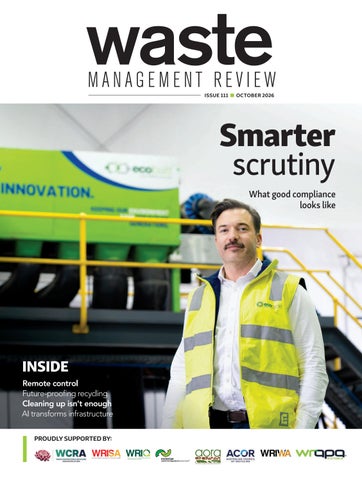
Smarter scrutiny What good compliance looks like
2026 | OCTOBER | ISSUE 111
wastemanagementreview.com.au
INSIDE Remote control Future-proofing recycling Cleaning up isn’t enough AI transforms infrastructure PROUDLY SUPPORTED BY:
PMS 380 PMS 376 PMS 355
WORKING TOGETHER WITH COUNCILS TO SUPPORT A SEAMLESS TRANSITION TO GLASS-OUT Regardless of what stage your municipality is at in the roll-out of the purple-lidded glass recycling bin, APR Kerbside has proven solutions and alternative options that can assist Councils whilst they prepare to make the switch. For Municipal Councils that have partnered with APR Kerbside in the Glass-out program, their recyclables are now being received with less than 1% glass. These remarkable results have directly contributed to reducing contamination levels and further diverting waste from landfill. Improving the separation of household recyclables and having no glass in the kerbside commingled stream has led to a significant improvement in the quality of all recyclables. Key learnings gained throughout the program well positions APR Kerbside to best support the needs of Municipal Councils who are preparing to implement glass out' of the commingled stream, transition smoothly and re-educate residents.
Such benefits include: Eliminate the issue of glass shards that get into all the other recyclables and resources such as paper, cardboard, plastic and aluminium Significantly recover more recyclable materials Reduce contamination levels and further divert waste from landfill Address and combat the limitations presented to approachable end market outlets for recyclable products due to glass shards Increase the value of recyclables and quality of end product
The value-added sorting facility site has the capability to process: Recyclables from Metropolitan Melbourne and Regional councils that have removed glass out of their yellow-lidded recycling bins Paper and Cardboard Plastics such as HDPE, PET, PP and Soft Plastics The APR team are strongly focused on circularity and working in collaboration with industry partners to explore and seize opportunities that will maximise resource recovery and further divert waste from landfill. After glass, soft plastics was identified as the biggest contaminant of kerbside, yellow-lidded bins in Victoria. As an innovative company, the APR Group continuously looks for different ways to achieve and support zero waste strategy goals and give the end user a quality material with minimal contaminants. APR Plastics has brought to market, an advanced recycling solution for the soft plastics stream with the Soft Plastics to Oil initiative. Robotics will also be utilised to pick off Tetra Pak cartons from the Kerbside MRF line for use in saveBOARD.
APR Kerbside Pty Ltd 9 Felstead Drive Truganina VIC 3029
1800 277 800 www.aprkerbside.com enquiry@aprkerbside.com.au
CONTENTS
COVER STORY
Smarter scrutiny
8
42
What good compliance looks like. “Don’t audit everything equally. Follow the risk.”
Shaping the future
Tom Susen, Group Chief Risk and Compliance Officer for EcoCycle Group
Features
12
14
IS CIRCULAR POSSIBLE?
Dr Ross Headifen poses the question.
SAYING GOODBYE
Reflecting on for years with AORA.
17
PACKAGING PUZZLE
20
QUALITY FIRST
22 24 26
Exposing a longstanding challenge.
Quality, consistency, marketability the new standards.
KEEPING DRY
Building flexibility in facilities
28 30 33
UP TO THE CHALLENGE Treating complex waste.
PRIDE OF THE FLEET Waste fleet grows by 26.
FUEL FOR CHANGE
From hydrogen to renewable diesel.
34
IN CONTROL
37
KEEPING IT MOVING
Command Technology changes safety outlook. Rethinking efficiency and productivity.
PACKING MORE IN
40
BRICK BY BRICK
SMARTER MANAGEMENT
42
SHAPING THE FUTURE
Tackling leachate management. Landfill compactors prioritise efficiency. How AI transforms infrastructure.
wastemanagementreview.com.au
Integrated approach to waste recovery.
Building flexibility in facilities.
3
44 46
TRANSFORMATION Difficult waste, commercially viable.
FOR THE TOUGH STUFF
Is this shredder the waste equaliser?
49
HANDLING MORE
52
NIGHT OF NIGHTS
Few machines work harder than the material handler. Countdown to award winners revealed.
Regulars
54 55
PRODUCT SPOTLIGHT LAST WORD
Waste Management Review
FROM THE EDITOR
Beyond good intentions
T
he waste, recycling and resource recovery sector has never been short on good intentions. Across Australia, businesses are investing in infrastructure, councils are expanding recovery programs and communities continue to support initiatives aimed at reducing waste and improving resource recovery. But as several stories in this month’s edition demonstrate, good intentions do not guarantee good outcomes. In our cover story, Tom Susen of EcoCycle Group challenges a common assumption within the sector: that more audits automatically create better assurance. Instead, he argues that compliance should be judged by outcomes, with trust built through clear roles, independence, accountability and evidence-based decision making. That question of trust extends beyond compliance. In this issue’s Last Word, Pip Kiernan from Clean Up Australia argues that community clean-ups, while important, cannot solve Australia’s packaging challenge on their own. Real progress, she says, requires stronger producer responsibility, better design standards and systems that prevent waste from entering the environment in the first place. A similar challenge is explored by Dr Ross Headifen from Biogone,
CEO
who examines whether Australia can realistically achieve a circular economy for plastics. His conclusion is that collection and recycling targets are only part of the equation. Without viable processing capacity, manufacturing demand and stronger regional partnerships, circularity risks remaining more ambition than reality. Together, they point to a common theme. Success is not defined by the number of audits completed, volunteers mobilised or targets announced. It is defined by outcomes. And while good intentions are essential – they often spark the change we want to see – lasting progress depends on something more difficult to achieve: building systems that work.
Christine Clancy christine.clancy@primecreative.com.au
PUBLISHER
Sarah Baker sarah.baker@primecreative.com.au
MANAGING EDITOR
Lisa Korycki lisa.korycki@primecreative.com.au
JOURNALIST
Sean Gustini sean.gustini@primecreative.com.au
HEAD OF DESIGN
Clayton Hawley clayton.hawley@primecreative.com.au
ART DIRECTOR/DESIGN
Daz Woolley, Laura Drinkwater
BRAND MANAGER
Chelsea Daniel chelsea.daniel@primecreative.com.au P: +61 425 699 878
CLIENT SUCCESS MANAGER
Happy reading!
Ben Sammartino ben.sammartino@primecreative.com.au
HEAD OFFICE
Prime Creative Pty Ltd 379 Docklands Drive Docklands VIC 3008 Australia P: +61 3 9690 8766 info@primecreative.com.au www.wastemanagementreview.com.au
SUBSCRIPTIONS
Lisa Korycki, Managing Editor
+61 3 9690 8766 subscriptions@primecreative.com.au Waste Management Review is available by subscription from the publisher. The rights of refusal are reserved by the publisher
ARTICLES
All articles submitted for publication become the property of the publisher. The Editor reserves the right to adjust any article to conform with the magazine format.
COPYRIGHT
On the cover Tom Susen, EcoCycle Group Chief Risk & Compliance Officer asks are we creating more compliance, or better assurance? Image: EcoCycle Group
Waste Management Review
4
October 2026
Waste Management Review is owned by Prime Creative Media and published by John Murphy. All material in Waste Management Review is copyright and no part may be reproduced or copied in any form or by any means (graphic, electronic or mechanical including information and retrieval systems) without written permission of the publisher. The Editor welcomes contributions but reserves the right to accept or reject any material. While every effort has been made to ensure the accuracy of information, Prime Creative Media will not accept responsibility for errors or omissions or for any consequences arising from reliance on information published. The opinions expressed in Waste Management Review are not necessarily the opinions of, or endorsed by the publisher unless otherwise stated.
RESEARCH
Paving a path Charles Darwin University’s Ramin Shahbazi is researching the development of sustainable and resilient bitumen for road paving in the Northern Territory.
R
amin Shahbazi has spent years combining two of his greatest passions – science and recycling. Before moving to Australia, he pursued both a bachelor’s degree and a master’s degree in civil and structural engineering, which provided him with great exposure to the application of recycled materials in infrastructure projects. He furthered this education by moving to Australia, where he completed a PhD in civil engineering at Charles Darwin University (CDU) in the Northern Territory. Here, Ramin developed his thesis around an enduring issue in the territory: the resilience of its road surfaces. “Flexible pavements such as asphalt are very sensitive to temperature,” he says. “In extremely hot conditions, and with consistent exposure to high ultraviolet radiation, the properties of the bitumen within asphalt change. “Pavements can experience accelerated ageing and surface cracking, particularly under heavy traffic.” e Northern Territory experiences intense heat, high UV exposure and highly seasonal rainfall. Road makers in
the region have historically reinforced their pavements by creating asphalt with Styrene-Butadiene-Styrene (SBS) modified bitumen, but the process is expensive and harms the environment through the release of greenhouse gases. Over four years, Ramin has been working with CDU and the Northern Territory Government’s Department of Logistics and Infrastructure to study a potential solution – the use of recycled materials in bitumen to create sustainable road pavement. “ is government-funded research has taken me through my PhD and has consisted of different stages, from screening waste that is suitable for this environment, to creating plans to test the material, and conducting experimental analysis,” he says. Much of Ramin’s work first centred around identifying the right type of material that could be incorporated into bitumen. e structure of this material needed to match that of the polymers within SBS-modified bitumen so that it could be mixed and laid in the same manner.
“ e SBS polymer has an elastic structure which is integral to the performance of the modified bitumen and eventually the pavement,” Ramin says. “We decided early on that we wanted to include a number of recycled plastics in this project, but on their own, none of them had a structure with the required elasticity.” is pushed Ramin and his team to find another recycled material to include in the process. ey quickly landed on crumb rubber from old tyres. “We found that the crumb rubber from old tyres has the elastic structure we were looking for,” Ramin says. “We then began the testing process of combining crumb rubber with recycled plastics to create a three-dimensional interwoven polymer structure that could simulate the optimised polymer in SBS-modified bitumen.” Ramin’s team was able to customise this new polymer’s properties to create a bitumen suited to specific environments and applications – such as road pavement capable of withstanding the Northern Territory’s weather. Ramin says this polymer structure and resulting bitumen is a champion of the
Ramin with his team at the Centre for Advanced Research and Technology. Images: Charles Darwin University
Waste Management Review
6
October 2026
Ramin Shahbazi is developing and testing sustainable bitumen at Charles Darwin University.
circular economy. In addition to reusing recycled plastics, its use of end-of-life tyres diverts the material from landfill and other ineligible dumping sites. According to Tyre Stewardship Australia’s 2023-24 annual report, 500,000 tonnes of tyres reach their end-of-life across Australia each year. Moreover, the Northern Territory Environment Protection Authority reported that between 2022 and 2023, more than 14,000 used tyres were illegally dumped across the territory. Ramin, now a Postdoctoral Fellow at CDU, believes his team’s experiments will
soon be tested in the field, and are one step closer to real-world applications. “We are completing the mixture level studies of our recycled material bitumen, and the government is planning to complete a trial with our substance,” he says. “We’re expecting clear data that will rival the strength of SBS-modified bitumen without its drawbacks, so that we can take our development further.” Ramin feels the use of this new bitumen could help make the public more aware of, and open to, sustainable initiatives, while supporting local communities across the Northern Territory.
NSW, ACT & WA Tony Miller 0429 444 451 tony@garwoodinternational.com.au
“I think the public would celebrate this development if it was adopted in real-world infrastructure,” he says. “In addition to it being customised to withstand harsh weather and supporting motorists travelling wherever they need to go, it could support local businesses and contribute to a larger emerging industry. “Creating the bitumen could support the development of local plastic recycling and tyre recycling facilities, as much of this activity is currently undertaken interstate. Bringing this activity into the Northern Territory could make it more sustainable and more economical. “Before anything else, I’m just excited to see how my research can improve road networks around the region, and the positive impacts that will have on communities.” WMR
VIC, TAS & SA Ian Pinney 0409 905 451 ian@garwoodinternational.com.au
QLD & NT Peter VanHeiden 0414 757 563 info@garwoodinternational.com.au
www.garwoodinternational.com.au
ON THE COVER
Tom Susen, Group Chief Risk and Compliance Officer for EcoCycle Group, checks over the battery shredding plant. Images: EcoCycle Group
What good assurance looks like As compliance expectations across Australia’s recycling and resource recovery sector continue to grow Tom Susen, Group Chief Risk and Compliance Officer for EcoCycle Group, believes there’s an important question to ask: are we creating more compliance, or better assurance?
C
ompliance has a branding problem. Mention the word and most people think of policies, audits, certificates, forms and someone with a clipboard telling them what they cannot do. Tom Susen sees it differently. “ e purpose of good compliance is trust,” says the Group Chief Risk and Compliance Officer for EcoCycle Group. “Can I trust that this operator is doing what they say they’re doing? Can I trust where this material went? Can I trust what happened to it? Can I trust the audit? And ultimately, can the public trust our industry?” For Tom, audits, accreditation and reporting are not the purpose of compliance. ey are the mechanics used to create confidence in a system where participants are constantly relying on things they cannot personally verify. at reliance is everywhere in recycling. Customers rely on operators.
Operators rely on downstream partners. Regulators rely on reporting. Stewardship schemes rely on participants. Communities rely on the entire system holding together. “Trust isn’t a so word in an industry like ours,” Tom says. “It is what allows a system with so many different participants to function.”
MORE AUDITS DOESN’T EQUAL MORE ASSURANCE
Recyclers can be subject to environmental and work health and safety regulation, dangerous goods requirements, ISO standards, R2v3, AS/NZS 5377, customer audits, stewardship scheme audits, government procurement reviews and downstream vendor checks. None of those controls is inherently unnecessary. “ e question isn’t whether an individual control can be justified,”
Waste Management Review
8
October 2026
Tom says. “It is what each additional layer contributes that the layer beneath it did not already provide.” e risk, he says, is that assurance becomes repetitive rather than cumulative. e same management system can be tested repeatedly, the same procedures sampled and the same records reviewed by different organisations. “If five people check the same thing, who is checking what nobody checked?” He is careful to distinguish that from an argument for less scrutiny. “It is the opposite,” he says. “I’m arguing for scrutiny that is pointed at the right things.”
START WITH CLEAR ROLES
For Tom, stronger assurance starts with understanding who is responsible for what. Regulators set and enforce the law. Operators own the operational risk and
EcoCycle Group opened Australia’s first dedicated Battery-In-Device Shredding (BIDS) plant in September 2025.
outcome. Independent assurance tests and verifies. Stewardship schemes coordinate and administer. “Every one of those participants is essential, but they are essential for different reasons,” Tom says. “A recycler shouldn’t regulate itself. An auditor shouldn’t operate the scheme. A regulator shouldn’t run the recycler. And a stewardship administrator shouldn’t need to become the regulator or the auditor.” He says governance problems can emerge when those boundaries become blurred. Warning signs include unclear or changing criteria, concentrated decisionmaking, conflicts of interest, outcomedriven assurance and accountability that operates strongly in one direction but weakly in another. “ e test of good governance isn’t whether we like the outcome,” Tom says. “It’s whether we trust the process that produced it.”
finding, that is not a reason for the finding to change. We provide evidence, we correct factual errors where necessary, but the professional conclusion belongs to the auditor.” For Tom, the same standard should apply across the assurance system. Organisations exercising influence over accreditation, funding, market access or reputation should themselves be transparent, evidence-based, auditable and accountable. “ e greater an organisation’s influence, the stronger its own governance should be.”
RECOGNISE WHAT ALREADY WORKS
Tom believes the industry can strengthen assurance without simply multiplying audits. e starting point is recognising credible assurance infrastructure that already exists, including environmental regulation, accredited ISO certification, R2v3, AS/NZS 5377 and serious independent customer assurance programs. “ ese aren’t just badges,” Tom says. “A proper independent audit tests records, traces transactions, interviews people,
Tom Susen, Group Chief Risk and Compliance Officer for EcoCycle Group.
INDEPENDENCE GIVES ASSURANCE ITS VALUE
at principle is particularly important in auditing. “Independence isn’t a technicality,” Tom says. “It is the entire source of the value.” e chain should be straightforward: evidence is presented, an auditor assesses it, and the auditor forms a professional conclusion. “ e reason anyone places weight on an independent audit is that nobody gets to choose the answer,” Tom says. “And that applies to us. If I don’t like an auditor’s
wastemanagementreview.com.au
9
Waste Management Review
ON THE COVER
walks the site and checks whether what is written in a procedure actually matches what happens operationally.” Where credible independent assurance has already tested a control, Tom says that the next layer should recognise it, rely on it where appropriate, and focus its effort on the gaps. “ at is not a concession to industry. It is how mature assurance systems allocate finite resources.”
FOLLOW THE RISK
e second part of that model is proportionality. “Don’t audit everything equally. Follow the risk,” Tom says. A new operator with no track record should receive more assurance. So should an operator with a poor compliance history. Incidents and complaints should be properly investigated, while new or untested technology should be verified. On the other hand, strong
independent assurance and a repeated history of evidenced compliance should allow unnecessary duplication to fall. “ at isn’t a so er compliance model,” Tom says. “It means the operators doing the least well should receive more scrutiny, because we have stopped spending so much assurance capacity retesting controls that have already been independently tested.”
THE REAL-WORLD SCOREBOARD
Tom ultimately believes compliance should be judged by outcomes rather than activity. For the battery sector, that means higher collection, safer recovery, stronger material recovery, better traceability, increased public confidence and continued investment. At the same time, fires, batteries entering landfill and unnecessary duplication should be falling.
EcoCycle Group operates a mercury conversion plant in Western Australia.
Waste Management Review
10
October 2026
“Not how many audits we conducted. Not how many pages are in the protocol. ose things are inputs,” Tom says. “ e result is what happened in the real world: to the material, the worker, to the community and to the person who trusted all of us to do our jobs properly.” For Tom, good compliance comes back to six things: clear roles, independence, evidence, proportionality, accountability and outcomes. All six serve the same objective. “Operators must be accountable. Auditors must be independent. Regulators must regulate. Stewardship schemes must steward,” Tom says. “If we remove unnecessary duplication and focus assurance on genuine risk, we don’t weaken compliance. We make it stronger. “Ultimately that is how trust is earned.” WMR For more information, visit: www.ecocycle.com
INDUSTRY INSIGHT
Too small to go circular? Can Australia achieve a circular economy for plastics asks Dr Ross Headifen, Co-founder of landfill biodegradable plastics brand Biogone.
T
he idea of a circular economy is that used products and materials are recovered and reprocessed to manufacture new products of a similar standard. is significantly reduces the need and impact of constantly using virgin materials to make these products. It is not simply recycling materials and producing down-cycled low-tech products as this does not prevent the use of virgin materials. An example in the plastics industry would be using so plastics from packaging to make garden furniture; it does not enable more packaging to be made from recycled materials. For a discussion about plastics usage and a circular economy, there are numerous issues to consider. Probably the biggest is taking steps to change the way we do business. is is a step industry most opposes because it upsets business models and forces investment in operations to essentially achieve the same outcomes as present. Under a circular economy, industry must source input materials from different sources, and deal with different material properties. For example, is the recycled material as strong as the virgin material? Do they need to use more? Is it the same quality as virgin material? ese are all issues that were solved many years ago for virgin materials, but now may need to be revisited, which could cost a considerable amount. Hence the pushback by industry and the failure to reach recycling targets promoted by governments. ere are three essential steps to get a circular economy working. 1. Collecting the waste (used products) and returning them back to centralised collection stations for recyclers to access. is is very difficult to achieve voluntarily as individuals’ time is money. Without any incentive, very little energy will be spent on this. e original products may be used over a wide range of societies, of differing economic levels and over a wide spatial range. Reaching all these places and encouraging people to go out of their way to return used
items, for no direct benefit, has in the past proven problematic and ineffective. Introducing a financial incentive results in a substantial increase in recovery rates. e introduction of the CDS (Container Deposit Schemes) for drink containers has shown this. e amount of the financial incentive directly affects the recovery rate. Imposing Extended Producer Responsibility (EPR) costs on manufacturers/importers to hold them partially responsible for the return of used products or pay penalties is another lever that can be pulled. e recent European Union (EU) Packaging and Packaging Waste Regulation (PPWR), imposed on manufacturers and importers is an example. It aims to ensure that all packaging on the EU market is designed to be genuinely recyclable by 2030. 2. Once the used material has been recovered, the next step is to process it to a usable state for manufacturers. ough this step involves less people, it requires expensive sorting, washing, shredding and grinding machinery. For plastics, there is a range of issues that need to be managed. Different materials, such as PET (polyethylene terephthalate), LDPE (lowdensity polyethylene), HDPE (high-density polyethylene) and PP (polypropylene) need to be identified and separated. ere is also the issue of contamination with other types of materials including paper labels, glass, cardboard boxes and general cross contamination from the collection processes. Coloured plastics, even of the same type, have very different recycling value. If incorrectly sorted, a coloured item can contaminate a clear material. is processing step is generally performed by private operators who need to make a profit from their operations. ey need to bale and sell their sorted, cleaned and shredded recyclate to a buyer willing to cover their costs, while also making a profit. 3. e final step requires a manufacturer who can purchase the recyclate and use it to make their products.
Waste Management Review
12
October 2026
ere can be many pitfalls here. Is the recycled material the same strength in all directions as their virgin material? Is colour clarity an issue? Is there any odour? Does it process the same in their machines? With increasing pressure to prevent greenwashing, the recycled material needs to be certified as post consumer content (PCR) by recognised independent agencies such as the Global Recycled Standard (GRS) or ISCC (International Sustainability and Carbon Certification) Plus. is adds another layer of expense to the supply chain. e final decision a manufacturer must make therefore is deciding whether to use lower cost virgin material or pay more to use recycled content. Since the use of recycled content is still relatively new, economies of scale have yet to develop. O en, recycled material can be scarce and more costly than virgin materials, meaning the uptake by manufacturers is only slowly increasing. e EU PPWR establishes mandatory minimum post-consumer recycled content targets for plastic packaging from January 1, 2030. Targets scale significantly by 2040 to drive circularity and reduce fossil-fuel plastic dependence. Now, factoring in all the above, can a relatively small economy like Australia have a circular economy for plastics? We manufacture only a small number of plastic items compared to what we import. is means there is a vast surplus of plastic waste requiring disposal. Currently, about 90 per cent of this goes to landfill. We don’t have enough recyclers to process it, and they don’t have enough manufacturers to then buy it. Our labour rates are too high to perform the three steps above on a world scale, so it is almost always less costly to import products even paying the import freight cost. is doesn’t bode well for being circular. To function effectively, a closed-loop system needs a larger economic region with areas of varying economic strength. Europe is o en cited as an example because it contains both wealthy regions, where recycling and reprocessing can be
expensive, and lower-cost regions that can process waste plastics and return recycled materials to the market. e European Union also benefits from relatively short transport distances and streamlined movement of goods between member countries. Australia faces a different challenge. While geographically large, it has a comparatively small manufacturing base and significant transport distances, making it difficult to establish a fully self-contained plastics recovery and reprocessing system. A more practical approach may be to develop a regional network with neighbouring countries. Australia could collect and process plastic waste locally before supplying recyclate to partner nations with suitable manufacturing capacity or refine the material further and sell it into regional markets. is internationally connected model may offer a more realistic
Australia needs to work with nearby countries to form a local circular zone for plastic waste to be circular. Image: Biogone
pathway for smaller economies seeking to keep plastics in productive use. A comparative example is the auto industry. Populations in every country drive cars, but only a few manufacture them at prices the world can buy. Not every country needs to make its own cars. So too, the circularity of our plastic waste could benefit from this concept.
Contact your local dealer today www.jcb.com/en-AU
For Australia’s plastic waste to be circular, we need to be working with other nearby countries to form this local circular zone. In the interim, Biogone’s landfill biodegradable technology can biodegrade plastic if disposed to a modern landfill. WMR For more information , visit: www.biogone.com.au
INDUSTRY INSIGHT
Saying goodbye
Throughout his tenure, John embraced the opportunities and challenges of organics recycling. Images: Paul Benjamin Photography
John McKew chronicles his time as National Executive Officer of the Australian Organics Recycling Association, as his tenure ends.
B
y his own admission, John McKew’s decision to join the Australian Organics Recycling Association in 2022 came somewhat out of le field. For the previous 28 years of his career, John had worked extensively across the dairy, primary production, and agriculture sectors. His hard work and deep understanding of these spaces – partly served by his own farm upbringing – allowed him to transition to more executive positions. He was Chief Executive Officer (CEO) for Herefords Australia before assuming the same role for the Australian Fodder Industry Association. He then led the Tasmanian Farmers and Graziers Association, which is the peak farming body in the state. John describes his departure from that space to organics as a “definite jump” – he saw the opening for AORA’s National Executive Officer and took it quickly. e decision was fuelled by curiosity, and an ambition to make a difference. “Leaving agriculture was an interesting career move, but that’s what I wanted at the time,” he says. “I was looking for a role that would broaden my scope, challenge me, and allow me to serve what appeared to be a growing and developing industry.” AORA is the peak national industry body representing organics recycling and resource recovery. e association works
with industry stakeholders to spread awareness about and facilitate the recycling and reuse of organics materials – promoting the benefits of compost, mulches, and soil conditioners for communities and businesses across Australia. John helmed AORA for more than four years, embracing the nuances of the organics space and where it was heading. He says in that time the association achieved great headway towards being viewed as a legitimate and trusted peak industry body for organics recycling, both internally and to external stakeholders. “I think AORA has become a more professional association in the past four years, in terms of our management and
Waste Management Review
John McKew is stepping down as National Executive Officer of AORA.
14
self-governance,” John says. “ at’s critical for any association. We became better at advocating, organising, and running our agenda. “We have also developed a much greater reputation as being a voice for the sector. Our messages are being heard, are resonating with policymakers and environmental authorities.” John says this impact can be seen in AORA’s discussions surrounding organics contamination. When the association set a two per cent maximum rate of organics contamination for recyclers to operate within, the figure was widely embraced by the industry. “I am very pleased that stakeholders have adopted this target,” John says. “AORA is being quoted and referenced in the industry by legitimate organisations and is being recognised as key to the country’s circular economy transition. I’m very proud of that. “But I am not a lone wolf. I have a board, a list of close collaborators, and an entire sector who help and guide my thinking.” John’s tenure was not without its challenges. He says these were imperative to him developing a new perspective on problem-solving within organisations. “ e biggest takeaway from my time at AORA is that it’s very easy for all of us to judge an industry without understanding its depth or issues,” John says.
October 2026
03_Bene
“Working in the organics sector exposed me to many different problems, and an equal number of methods to solve them. I’ve come to realise and appreciate that no industry’s problems are straightforward. “Learning this has been enlightening.” John announced his resignation as AORA’s National Executive Officer in June, saying he felt that his “time was up” a er a fulfilling period. He is eager to pass the torch onto someone new to lead the association and wider organics sector in new directions. “I’m excited to see where AORA will go from here,” he says. “I leave the association at a time of increased collaboration with governments and authorities on organics regulation and policy – it is good to get organics recycling action into the mainstream, but it has the potential to pose some operational challenges. Governments
“I will forever be grateful for what I was able to achieve with AORA. To the organisation, I say thank you and farewell.” John McKew, outgoing National Executive Officer, AORA
need to be careful that these rules don’t restrict our sector to the point where it’s unsustainable. “So, to the incoming national executive officer, I hope they keep this growth aspect in mind. I wish them the best of luck.” As for John’s own movements, nothing is concrete for the moment. But he feels a calling to return to his roots. “I’d love to get back into farming, agriculture, and primary production,”
he says. “I am optimistic that wherever I end up, it will be in a sector or for a cause that deeply resonates with me, as AORA has, and my experiences before it. “I will forever be grateful for what I was able to achieve with AORA. To the organisation, I say thank you and farewell.” WMR For more information, visit: www.aora.org.au
Redefining how landfill leachate is managed BeneVap is a high-performance vaporisation system designed specifically for challenging landfill environments — giving landfill operators a smarter, more controlled way to manage leachate on site.
• Continuous, advanced vaporisation technology • Mobile and modular to scale with site needs • Integrates with existing landfill infrastructure • Proven on complex Australian landfill sites
litres of leachate already removed from Australian & New Zealand landfills
Greater control. Lower long-term cost. Simpler operations. See BeneVap changing the way landfill operators manage landfill leachate, visit beneterra.com.au
03_BeneTerra_Waste Management Review_Half Page March 2026.indd 1
6/ /2026 2:
ORGANICS
Packaged organic supermarket waste in the Mavitec hopper. Images: Waste Initiatives
Packaging puzzle Depackaging technology is helping operators separate valuable material from contamination as organics processing continues to grow across Australia.
A
ustralia’s push to divert food organics from landfill is creating new opportunities, but it is also exposing a long-standing challenge: food waste rarely arrives without packaging or contamination. From expired supermarket stock and food manufacturing waste to restaurant and kerbside organics, processors are dealing with material wrapped in plastic, cardboard, cans and other packaging. Recovering the organic fraction efficiently, and with minimal contamination, is becoming a key consideration for composting, biogas and animal feed operations. According to Brenton Sargeant, Solutions Partner (Solid Waste Shredding and Depackaging) at Waste Initiatives, increasing volumes of packaged waste are driving demand for depackaging technology across Australia. He says interest is being fuelled by organics regulations and growth in the biogas sector. “Manufacturers have been managing packaged food waste for a while, but
expanding collection systems means there are larger volumes that require processing,” he says. “ ere’s a need for more equipment, and more processing capacity.” Waste management and recycling equipment supplier Waste Initiatives works with a range of customers, including composters, biogas operators and animal feed manufacturers, to process packaged organic waste. e company partners with clients early in project planning, helping assess waste streams, processing needs and business cases before equipment is selected. At the centre of many of those projects is the Mavitec paddle depacker 2.0. A heavyduty organic waste separator, the Mavitec 2.0 is designed to process packaged waste including everything from food products and liquids to wet and dry materials. Brenton describes the depacker as the “flagship” of the Mavitec range, pointing to its combination of high purity output, simple maintenance requirements and operating efficiency as key reasons why it’s become a preferred solution.
wastemanagementreview.com.au
17
Unlike systems that rely on aggressive shredding, the Mavitec uses a horizontal sha fitted with paddles. As material moves through the machine, the paddles apply force that splits packaging and releases the organic content, helping to produce a cleaner output. Brenton says this design is one of several factors contributing to the machine’s performance. “ e actual design means that it’s not shredding. It’s not a cutting action, it’s more of a transporting action,” he says. “It helps achieve a purity rate of up to 99.7 per cent, reducing contamination in the recovered organics stream. And because the sha is horizontal, the material flows better than a vertical design, trying to push it up, or like a shredder, where it cuts it. “ e versatility, speed settings and the ability to add liquid in a controlled manner through a smart control panel also means that you can adjust the machine to get the optimum performance with a range of different streams.”
Waste Management Review
ORGANICS
The heavy-duty Mavitec 2.0 is designed to process packaged waste.
e technology has been proven at scale, with more than 300 units operating worldwide across a range of waste streams. e latest version of the depacker was developed following feedback from operators. Improvements include hydraulic access doors for tool-free chamber entry, screens that can be changed in minutes without tools, and redesigned paddles that bend rather than break if large contaminants enter the system. e unit is also manufactured entirely from stainless-steel to improve longevity and reduce whole-of-life costs. For Australian operators, contamination remains one of the most significant operational challenges. Unexpected items regularly appear in feedstocks, requiring equipment robust enough to withstand difficult conditions. at led Waste Initiatives and Mavitec to investigate how the equipment would perform when faced with highly contaminated materials. e company drew on international operating experience from markets such as India and Italy, where contamination levels can be particularly high. “We did a lot of work with Mavitec to make sure that these units can handle contamination because obviously we don’t want to say it can do something if it’s not proven,” Brenton says. Cleaner organics streams can also deliver benefits beyond contamination reduction. For biogas operators,
higher purity feedstocks can improve downstream performance while reducing wear on processing equipment. As more food organics collection programs come online around Australia, Brenton believes planning ahead will be critical.
Waste Management Review
He encourages clients to bring the Waste Initiatives team into discussions early to assist with their research and business case. WMR For more information, visit: www.wasteinitiatives.com.au Clean organic output from a Mavitec 2.0.
18
October 2026
CAU0
New Cat® 325 Tier 3. • Tier 3 engine – no AdBlue required. • Helps reduce owning and maintenance costs. • Cat technology upgrades available, including Cat Grade 3D. For what you’ve done and for what you’ll do, we’re here for you. Contact your local Cat dealer for more.
NSW/ACT WesTrac 1300 881 064 QLD/NT Hastings Deering 1300 868 538 VIC/TAS William Adams 1300 923 267
SA Cavpower 08 8343 1600 WA WesTrac 1300 881 064 NZ Terra 0800 93 39 39
© 2026 Caterpillar. All Rights Reserved. CAT, CATERPILLAR, LET’S DO THE WORK, their respective logos, “Caterpillar Corporate Yellow”, the “Power Edge” and Cat “Modern Hex” trade dress as well as corporate and product identity used herein, are trademarks of Caterpillar and may not be used without permission.
CAU0931 325 T3 campaign FPC E&E_01.indd 1
2/2/2026 2:27 PM
ORGANICS
Quality first As organics collections grow, compost producers and councils are paying closer attention to contamination, process control and product quality to secure confidence in end markets. Sustainable Generation’s Scott Woods explains.
Republic Services uses Sustainable Generation’s SG MOBILE System with GORE covers for solar-powered organic waste composting at the Otay Landfill in Chula Vista, California. Image: Sustainable Generation
F
or Australia’s organics recycling sector, success is increasingly being measured not by tonnes received, but by the quality, consistency and marketability of the finished product, says Scott Woods. As Chief Executive Officer of composting innovator Sustainable Generation, Scott works with councils, compost producers and organics processors on facility planning, feedstock management, process control and compost quality. rough that work, he has observed a growing industry focus on the quality of finished compost and the systems required to produce it consistently. “Producers and councils are asking more detailed questions about contamination, odour, moisture management, stormwater and leachate, and whether a defined market exists for the final product,” he says. e shi comes as Australia expands food organics and garden organics (FOGO) collections and continues pursuing
national resource recovery and organic waste diversion targets. While increased organics recovery is expected to divert more material from landfill, Scott says it also introduces greater variation in moisture, contamination, packaging and feedstock composition – all of which directly influence the quality of the final compost product. And compost quality is central to whether FOGO recycling delivers genuine resource recovery outcomes. Sustainable Generation has found that poor-quality compost can undermine confidence among farmers, councils, landscapers and rehabilitation contractors, while creating additional costs for processors through extra screening, storage, disposal and remediation. Scott says the industry is also showing growing interest in stronger process control and integrated facility design. is includes controlled aeration, oxygen and temperature monitoring, operational data collection, alarms and reporting
Waste Management Review
20
October 2026
systems that allow operators to respond to changing feedstocks. Facilities are increasingly seeking tools that provide greater visibility over the biological composting process. Sustainable Generation has recognised that feedstock quality also affects the biological process. Food-rich material can be wet and nitrogen-heavy, while garden organics provide structure and carbon. If those materials are not blended appropriately, processors can face compaction, low oxygen levels, odour issues, uneven temperatures and longer curing times, which affects the outcome. Councils and processors are increasingly adopting a phased approach to development which provides greater flexibility as FOGO participation grows and market demand for compost products evolves. Rather than expanding immediately to full scale, many want the ability to validate feedstocks and operating requirements, begin at an appropriate scale, then expand as participation rates, market demand and regional tonnages become clearer.
“is can reduce the risk of building permanent infrastructure around unverified feedstock volumes or assuming that all collected material will be suitable for processing,” Scott says. Perhaps the most significant trend is that compost quality is being considered earlier in project planning. “Stronger projects begin by defining the intended product, customer and application, then work backwards through screening, curing, active composting, feedstock preparation and collection,” Scott says. ere’s increasing recognition that quality cannot be tested into a product at the end of the process. Instead, it must be embedded throughout the collection, preparation and processing chain. e process behind creating a high-quality end product must be reliable and repeatable,
“Stronger projects begin by defining the intended product, customer and application, then work backwards.” Scott Woods, Sustainable Generation CEO inconsistencies in the process show up with the consumer and the results speak for themselves. For end users, the benefits are tangible. Farmers seek confidence that compost is safe, consistent and suited to their soils and crops. Councils and landscapers place value on cleanliness, appearance and reliable supply, while rehabilitation projects o en focus on soil structure, water retention and plant establishment. Scott says
those expectations are helping reshape industry priorities. “Collection growth remains important, but the sector is increasingly recognising that the long-term success of FOGO depends on producing a safe, consistent and useful product that can earn the confidence of customers and secure dependable end markets.” WMR For more information, visit: www.sustainable-generation.com
LANDFILL MANAGEMENT
Planning ahead BeneTerra’s BeneVap technology keeps landfill operations prepared for increased leachate volumes during wet seasons.
A
ustralia’s wet season can pose significant challenges to landfill operations. Intense and prolonged rainfall can particularly overwhelm key infrastructure such as stormwater and leachate ponds and leachate sumps. For landfills to become resilient to these weather events, they need to have capacity to store more liquid – being prepared for the chance of high rainfall, instead of reacting to it, says Steve Winters, General Manager of environmental solutions provider BeneTerra. “Landfills with leachate ponds tend to operate those ponds just below mandatory reporting levels determined by environmental authorities,” he says. “ is gives them very little capacity to absorb the impacts of intense rain events. “Leachate sumps also tend to be managed right at their reporting levels, similarly leaving no room for this infrastructure to handle more liquid in emergencies, and making operators vulnerable to paying high transport costs when the excess liquid needs to go somewhere.”
Steve says BeneTerra’s BeneVap technology has been crucial to assisting landfill operators with leachate management for close to a decade. Its introduction to the industry was integral to forming BeneTerra’s capabilities. In 2017, Tropical Cyclone Debbie made landfall above Queensland’s Airlie Beach, ravaging local communities and bringing intense rainfall onto unprepared landfills. Leachate ponds and sumps exceeded capacity, and landfill operators turned to BeneTerra for help. “Up until 2017, BeneTerra had been primarily involved in land rehabilitation and the management of wastewater in the Coal Steam Gas (CSG) industry,” Steve says. “Although we had never worked in landfills, we were confident the BeneVap would work in this situation.” BeneTerra first deployed its BeneVap technology at the Bromelton Landfill in the Scenic Rim. Steve says the project provided an opportunity for BeneVap to be tested in a real emergency-response situation. Not
BeneTerra’s BeneVap technology has fundamentally changed how landfill operators approach leachate. Image: BeneTerra
Waste Management Review
22
October 2026
only was it a great success, but it changed the company’s trajectory. “BeneVap’s success in the Scenic Rim led to other landfills in the area utilising the technology,” he says. “ e Swanbank landfill immediately implemented BeneVap to manage its leachate, and others followed suit. “ e technology’s success in this application also launched our business into the landfill water management space, which has grown extensively.” e BeneVap technology has been designed to slot seamlessly into landfill sites and operations. BeneVap is mobile with a small footprint, the device connects to a landfill’s leachate holding tanks or ponds and treats the liquid through high temperature thermal vaporisation. “Inside BeneVap, a flame fires downwards at over 1000 degrees into a vessel where the leachate is contained,” Steve says. “Hot air bubbles will come out of the combustion chamber, hit the leachate and vaporise only the water component. e vapour is absorbed into the hot bubbles, before floating to the surface and being emitted into the atmosphere as water vapour.” While the leachate’s water is removed, any contaminants – metals, organics, per-and polyfluoroalkyl substances (PFAS), and more – stay behind and are concentrated inside the vessel. Additionally, the odour-causing compounds such as ammonia and volatile fatty acids are neutralised. e resulting residual leachate is then returned to the landfill. “All the contaminants stay in the landfill, which is imperative,” Steve says. “ e residual leachate is returned to the landfill with the process reducing the total volume of leachate by anywhere from 90 to 95 per cent.” Steve says the integration of BeneVap into landfill operations has changed the way these sites approach leachate. Where once operators reacted to leachate as wet seasons began, it is now something they predictably manage ahead of time.
“Councils are always limited by budget, and none of them want to spend money on an issue they don’t have yet,” Steve says. “But large weather events with intense rainfall, such as Cyclone Debbie, or the wet seasons experienced around the coastline of Australia over the past four years, will create problems very quickly, leaving sites with no choice but to react if they’re not prepared. “BeneVap solves this issue by proactively managing leachate levels within the landfill cell. is will enable the landfill to absorb rainfall during the wet season, and when a disaster event occurs, leachate will be contained within the landfill cell. is significantly reduces the likelihood of an environmental breach in those very wet periods.” Following its use to assist cycloneaffected communities close to a decade
ago, BeneTerra’s leachate management solutions have grown extensively. Its product portfolio now includes a number of irrigation and water dispersal products and services. BeneVap has been taken up as a leachate management solution by landfill operators across the country – and the world. “In the past few years, it has definitely taken off,” Steve says. “BeneTerra has implemented the technology in Queensland, the Northern Territory, Victoria, Tasmania, and New South Wales, where we operate with a mobile licence on sites for up to six months in a 12-month period. But we’ve also successfully brought the technology to New Zealand and parts of the United States. “ is technology is useful everywhere, particularly as wet seasons and rainfall hit at different times for different places.
ere is never one time in which landfills need to be prepared – it’s all the time.” In Queensland, several landfills have continued to manage their leachate with BeneVap since Cyclone Debbie’s intense rainfall. “It’s been working really well at Swanbank, and the facility is actually out of leachate at some times during the year,” Steve says. “Two of our larger BeneVap units are set up on that site full-time, making the landfill well-positioned if another intense weather event occurs such as in 2022 when a year’s worth of rainfall fell in just a few days. “For our customers, landfill resilience is only one decision away.” WMR For more information, visit: www.beneterra.com
SG Advanced Composting™ Technology Simple Design. Low Energy. SG ADVANCED COMPOSTING™ Technology with Gore® Cover delivers high-performance composting with less than 2 kWh/ton energy use. That’s a fraction of what’s required for energy-hungry tunnel systems. No massive buildings. No round-the-clock blowers. Just smart, scalable, easy-to-operate composting that cuts CAPEX and OPEX—without cutting corners.
SG BUNKER™ SYSTEM AT THE DEPARTMENT OF SANITATION NEW YORK CITY - STATEN ISLAND COMPOST FACILITY
SG ADVANCED COMPOSTING™ TECHNOLOGY OPERATES AT UNDER 2 kWh/TON — A LOW-ENERGY ALTERNATIVE TO COSTLY, HIGH-INTENSITY TUNNEL SYSTEMS sustainable-generation.com
PLANT AND EQUIPMENT
Packing more in Tana’s landfill compactors share a design foundation which prioritises efficiency for operators. Tana’s landfill compactors bring efficiency and savings to waste management operations. Image: Tana
L
andfill compactors are embedded into the DNA of Tana Oy. e Finnish Original Equipment Manufacturer (OEM) built its first twin-drum landfill compactor in 1971 and has since refined the product’s design and capabilities. Today, the company’s ‘H Series’ compactors are distributed to landfills across 50 markets worldwide. Domestically, they are supplied by Tana Australia – a wholly-owned subsidiary of Tana Oy. e compactor’s full-width twin drum design can reduce the number of passes required for compaction from six to four, saving time and fuel while delivering a consistently compacted landfill surface. Tana’s built-in fleet management system collects critical data from the compactors helping fleet managers improve operational efficiency and safety. “We offer many solutions to boost productivity and optimise fuel economy and services, to ensure a longer lifetime of existing machines,” says Josh Feller, Director of Tana Australia. e H Series is available with a range of size, power, and capacity, providing solutions for various scales of waste
management. e smallest machine in the series, the H260, weighs between 28.7 and 30.2 tonnes. It offers operators a maximum crushing force of 150 kilonewtons (kN) and runs on a Cummins L9-C365 with a power rating of 272,000 kilowatts (kW) at 2100 revolutions per minute (RPM). e compactor’s dozer blade is 1.74 metres long and 3.65 metres wide. Josh says the H260 is well-suited to small and medium-sized landfills and waste disposal sites. e H555 is the largest of the range. Boasting a weight range from 52.7 tonnes to 54.9 tonnes and a maximum crushing force of 269 kN, this machine is purpose-built for high-volume municipal and industrial waste disposal sites. e H555 has a Cummins X15-C535 engine, which boasts a power rating of 399,000 kW at 2100 RPM. It features a dozer blade 4.95 metres long and 2.35 metres wide. While made for different landfill applications, Tana’s H Series compactors share the same durable and reliable construction. “Two modular drum frames are connected with a longitudinal upper frame,” Josh says. “ e drum frame acts as a shell
Waste Management Review
24
October 2026
around the drum, which helps to prevent waste raising to the upper parts of the machine from below. “Both compactors also feature forged crushing teeth made of wear-resistant steel, and adjustable scraper bars on both sides of their drums.” e two compactors are also available in ‘eco’ variants, which are fitted with engines that meet different diesel emission standards and regulatory requirements. Across the H series range, Tana’s focus is on helping landfill operators maximise the value of their available airspace. By increasing waste density, operators can fit more material into existing landfill cells before new capacity is required. Josh says this principle has long guided Tana’s approach to compactor design, with a focus on supporting the commercial realities of landfill operations. “ e more waste that can be landfilled at a specific site in the densest possible layers, the longer the landfill can remain operational and generate income for the owner,” he says. WMR For more information, visit: www.tana.com.au
FROM WASTE TO A VALUABLE RESOURCE >99.7% CLEAN ORGANIC OUTPUT.
PACKAGED FOOD WASTE
Waste Initiatives brings Mavitec depackaging technology to Australia, delivering proven
systems that separate packaged food waste into clean organic
material and packaging fractions for further recovery.
PACKAGED FOOD WASTE Mavitec systems process a wide range of wet and dry
packaged food waste, including supermarket waste, factory
rejects, expired products and food production waste.
Contact us today on 1800 674 340 or info@wasteinitiatives.com
Discover more at wasteinitiatives.com.au
SEPARATION & DEPACKAGING
SEPARATION & DEPACKAGING Purpose-built depackaging
technology separates organic material from its packaging,
handling mixed products and packaging types within an
efficient processing system. CLEAN ORGANIC OUTPUT With separation efficiency above 99.7%, Mavitec systems produce
a clean organic fraction suitable for downstream applications
including biogas production and composting.
CLEAN ORGANIC OUTPUT
KEY FEATURES
• 99.7% Clean Organic Output • Wet and Dry Material Processing • Compact, Heavy-Duty Design • Quick-Opening Access Doors • Bolt-Free Screen Exchange • Easy Cleaning and Maintenance • Low Installed Power
TECHNOLOGY
Smarter waste management How Ennovo is using software and AI to transform environmental infrastructure.
A
s the waste management industry continues to embrace digital transformation, the role of intelligent so ware is rapidly becoming as important as the physical infrastructure operating on site. From landfill gas management and leachate control to organic waste processing and emissions monitoring, operators increasingly require realtime visibility, automated decisionmaking and remote management capabilities to optimise performance and maintain compliance. For Ennovo, a technology-driven environmental management company servicing the waste, renewable energy and contaminated land sectors, so ware and artificial intelligence (AI) are
becoming fundamental components of its product offering. Rather than viewing hardware and so ware as separate systems, Ennovo is integrating advanced digital technology directly into its environmental solutions to create smarter, more connected infrastructure. is approach spans products including its biogas flare range, leachate telemetry systems, Gasflux continuous gas monitoring platform and Carbon Air organic waste management technology. Luke Silvester, Instrumentation and Data Scientist at Ennovo, says the company’s partnership with Australian technology company Doover has been central to this evolution. Data and automation are at the heart of Carbon Air, Ennovo’s automated organic waste processing solution.
Waste Management Review
26
October 2026
Gasflux provides detailed environmental and operational data from landfill and biogas sites. Images: Ennovo
Doover’s remote monitoring and control platform enables the collection, analysis and automation of operational data across multiple environmental assets. Luke says the collaboration has allowed Ennovo to consolidate a diverse range of products onto a single digital ecosystem, creating new opportunities for AI-driven optimisation and predictive management. He says the waste management sector has historically relied on manual inspections, periodic data collection and reactive maintenance practices. While these approaches remain important, growing regulatory expectations and operational pressures are driving demand for more sophisticated solutions. Ennovo’s vision is to make environmental infrastructure more intelligent and easier to manage. “e future of waste management infrastructure is not just about building reliable equipment. It’s about creating systems that can collect data, learn from operational patterns and provide actionable insights that improve environmental and commercial outcomes,” Luke says. “By embedding advanced so ware into our products, we’re helping operators move from reactive management to proactive optimisation.” One example within Ennovo’s portfolio is the Gasflux continuous gas monitoring device, that uses the Ennovo App as a platform that provides detailed environmental and operational data from landfill and biogas sites.
Continuous monitoring enables operators to better understand emissions behaviour and identify emerging issues before they become significant problems. e same digital principles apply to Ennovo’s leachate telemetry system. Luke says leachate management has long presented operational challenges for landfill operators, particularly across geographically dispersed sites. By integrating telemetry, cloud connectivity and intelligent analytics, the system provides near real-time visibility of liquid levels, pump performance and critical infrastructure status, helping to reduce downtime and improve operational efficiency. For Carbon Air, Ennovo’s automated organic waste processing solution, data and automation are at the heart of the technology. e system uses forced aeration and moisture control to optimise biological treatment processes while automatically capturing the data required for operational management and compliance reporting. e Doover platform serves as the so ware backbone of Carbon Air, supporting monitoring, control and data collection functions across the system. Tom Wyatt, Founder and Chief Executive Officer of Doover, says the partnership between Ennovo and Doover highlights a growing trend within the waste industry – specialist collaboration to accelerate innovation. “Environmental assets generate enormous amounts of valuable operational data, but historically that information has been difficult to access and utilise effectively,” Tom says. “Our partnership with Ennovo is about making sophisticated technology accessible. By bringing monitoring, automation and AI capabilities together in a single platform, operators gain deeper visibility and can make more informed decisions from anywhere.” Luke says Doover’s platform has enabled Ennovo to create a unified experience across multiple hardware products. Instead of requiring separate systems for different technologies, customers can access information through a centralised application tailored to their operational requirements.
Ennovo’s vision is to make environmental infrastructure more intelligent and easier to manage.
e platform also supports remote updates, workflow automation and integration with emerging AI capabilities. Artificial intelligence is expected to play an increasing role as connected infrastructure continues to expand. AI models can analyse large data sets generated by equipment in the field, identifying patterns that may not be immediately visible to operators. is creates opportunities for predictive maintenance, emissions forecasting, process optimisation and automated compliance reporting. For waste management businesses, these capabilities can deliver tangible benefits. Early identification of equipment issues can reduce downtime. Automated reporting can improve compliance
wastemanagementreview.com.au
27
efficiency. Enhanced operational visibility can support better environmental performance and resource utilisation. Luke believes the industry is only beginning to realise the potential of combining environmental engineering with advanced so ware technologies. “e waste sector is undergoing a digital transformation similar to what we’ve seen across manufacturing, logistics and energy,” he says. “Our objective is to ensure our customers benefit from that transformation through practical solutions that improve performance, reduce risk and provide better environmental outcomes.” WMR For more information, visit: www.ennovo.com.au
Waste Management Review
HAZARDOUS WASTE
Up to the challenge Pure Environmental leverages expertise and resources to treat complex waste streams for clients.
W
aste management isn’t always straightforward. e sector regularly deals with complex waste streams which industry specialist Pure Environmental describes as ‘difficult-to-manage’ material. ese can consist of contaminated soil and industrial sludges, hydrocarbons, wastewater treatment residues, per-and polyfluoroalkyl substances (PFAS), and hazardous and non-hazardous byproducts generated through industrial and commercial operations. Craig Hall, General Manager for Sales and Development at Pure Environmental, says many of these streams have been around for decades. Much of their longevity can be attributed to manufacturers repeatedly and unintentionally using materials that cause environmental risks in their production processes. “ ese waste streams are commonly found across many types of industrial facilities,” he says. “Manufacturing plants, refineries, airports, defence sites, infrastructure projects, landfills, wastewater treatment plants, and more.
“ ey can also arise during remediation projects where historical activity has impacted soil and groundwater.” To combat this, environmental regulations, standards, and community expectations around waste disposal have tightened around Australia. In New South Wales, the state’s Environment Protection Authority (EPA) recently established a Chemical Control Order requiring mandatory PFAS monitoring and annual reporting for all licenced landfills and sewage treatment plants. In Queensland, the state’s waste disposal levy penalises organisations that send industrial and commercial waste to landfill. “ is newer wave of diligence leaves businesses with a lot of rules to navigate in order to handle their complex waste properly,” Craig says. “For some, it can be a challenge to do the right thing, even with the best of intentions.” An Australian specialist in regulated waste management and resource recovery, Pure Environmental helps businesses adhere to these regulations, using its expertise and resources to develop tailored treatment strategies for different
Pure Environmental offers bespoke solutions for a range of complex waste streams. Image: Pure Environmental
waste streams. e company has six waste treatment facilities in Queensland, three offices in Western Australia, and corporate offices in Victoria and New South Wales. All of its waste treatment facilities are equipped to classify, manage, treat or dispose of complex waste streams, ensuring compliance with relevant legislation and thorough documentation of all processes. ese capabilities allow the organisation to combine technical assessment with resource recovery, stabilisation, and treatment where required. Craig says bespoke solutions are integral to Pure Environmental’s value proposition, given the unique circumstances and waste streams of each client. “ e waste we handle for our clients o en contains multiple contaminants that require different treatment approaches,” he says. “ e concentrations of these can vary significantly from site to site. e material may also be in environments that make recovery or treatment challenging. “ e regulatory requirements that we must adhere to add to the specialised nature of our services, as not all types of complex waste apply to the same legislative conditions.” Craig says Pure Environmental’s services deliver benefits beyond the waste sector, creating broader value for society. “Effective treatment not only supports regulatory compliance and enables the reuse, recovery, and safe management of materials – it also reduces environmental and human health risks,” he says. “Our services help clients reduce their environmental footprint while achieving more sustainable project outcomes, which has a wider impact on the community around them. “We’re proud to be helping those who want to do the right thing.” WMR For more information, visit: www.purenv.com.au
Waste Management Review
28
October 2026
E
E E uil un e e eel oa er ol o stoo out for its operator frie l features i is i re i l importa t i e t e time spe t i t e ma i es ea a . Peter Toole, Project Manager Wanless Waste
E
F
E
rom operator omfort to fuel effi ie a lo term alue e er etail is esi e to elp ou et more from e er pro u ti e our.
FE
Fuel Efficiency
rote ti people o e er site.
g no g to Tr st,
Built to perform. Built to last.
all no g to are e uipme t
ontact o r local ranc . om.au
e le lue Built to perform. i eere to last.
suppl
uipme t as a atio al et or a ser i e
upport ou a uil o .
WASTE COLLECTION AND TRANSPORT
Keeping collections moving JR Richards and Sons add 26 IVECOs to the fleet.
W
aste industry leader, JR Richards and Sons, has continued its long and successful partnership with IVECO, recently welcoming 26 new trucks to the fleet as part of its equipment renewal process, to service local government contracts in Picton and Moss Vale, New South Wales. Twenty-five of the new trucks are the latest generation ACCO model in 6x4 configuration and feature a locally developed dual control system designed by IVECO Australia engineers – all are
equipped with side loading compactor bodies by Solo Resource Recovery. e remaining truck, an S-Way 8x4 460 AD, features a Palfinger hookli body. JR Richards and Sons began using IVECO – in particular the ACCO model – almost 50 years ago, and today the company has almost 280 IVECOs on fleet, with the oldest being a 1996 ACCO, with rear loading compactor body. Overseeing the latest acquisitions was Rod Jones, JR Richards and Sons General Manager of Logistics, Fleet and National Heavy Vehicle Regulator (NHVR)
JR Richards and Sons cite safety, emission performance and fit for task capabilities as important considerations for choosing IVECO.
Waste Management Review
30
October 2026
The acquisition cements JR Richards and Sons’ long association with IVECO, with the partnership to soon celebrate its 50th year. Images: IVECO
Compliance. Rod, together with Dave Endycott, General Manager of Fleet and Maintenance, is responsible for evaluating, purchasing and managing all the company’s fleet and plant equipment. With almost 20 years at the company and many more in transport industry fleet management roles, Rod has a thorough understanding of what makes for a good waste collection vehicle. “ ere are a lot of factors to consider when choosing a truck for refuse work,” he says. “Along with the actual performance of the vehicle and how well it fits the role, the purchase decision is also shaped by the contracts we hold and the organisations we work for. “Increasingly there are strict requirements around truck emissions – all trucks need to meet Euro6 emissions standards at a minimum – and occupational health and safety requirements are also high.” In this regard, JR Richards and Sons’ new ACCOs feature the latest IVECO
Cursor 9 engines which meet stringent Euro 6 (Step E) emission measures while producing 310 horsepower (hp) and 1300 Newton-meter (Nm). e engines are coupled to the proven Allison 3200 6-speed fully automatic transmission, providing durability with hassle free operation for the start and stop driving that the application demands. e S-Way 8x4 460 AD’s driveline includes Euro 6 (Step E) Cursor 11 engine producing 460hp and 2150Nm of torque, matched to IVECO’s 12-speed Hi-Tronix Automated Manual Transmission. On the safety front, the latest ACCO and S-Way also excel, with features that include Advanced Emergency Braking System, Brake Assistance System, Adaptive Cruise Control, Lane Departure Warning System, Electronic Stability Program with ABS (disc brakes all round) and ASR (Anti-Slip Regulator). “Having a high level of safety is vital, there’s an expectation that the trucks have all the ‘bells and whistles’,” Rod says. “Along with the long list of equipment the IVECOs already come with as standard, we install a range of extra cameras, along with speed limiters that are activated under certain operating
“Having a high level of safety is vital, there’s an expectation that the trucks have all the ‘bells and whistles’.” Rod Jones, JR Richards and Sons General Manager of Logistics, Fleet and NHVR Compliance conditions such as when the rear hopper door is open.” e latest ACCOs replace a fleet of earlier models that have been on the job since 2014, with the trucks having amassed an average of 25,000 engine hours over their tenure operating in tough conditions, according to Rod. “ e work they do isn’t just on sealed residential roads, a lot of the time our trucks head out into the bush and operate on rough dirt roads and have to deal with a heap of corrugations – they can get a real flogging.” He says there were important benefits available in operating a uniform truck fleet. “ ere’s a familiarity for the drivers; we normally assign a driver to a truck and collection route because it increases
efficiency and minimises the chance of bins being missed, but if there’s a need for another driver to fill in, it’s all straight forward,” he says. “ ere are also advantages in spare part holdings for our workshop. While the new ones will go back to IVECO for servicing and maintenance during the warranty period, we also run our own workshops.” According to Rod, all the new trucks are now in service, and he looks forward to another hassle-free run from the latest fleet investment. “We have a strong and enduring relationship with IVECO,” he says. “I’m confident the latest generation models will meet our expectations.” WMR For more information, visit: www.iveco.com/au
A renewal program has seen 25 new ACCO compactors and an S-Way 8x4 hooklift truck join the JR Richards and Sons refuse collection fleet.
wastemanagementreview.com.au
31
Waste Management Review
SOLAR PANEL
Recycling System Australia’s solar industry continues to grow, and so does the volume of panels reaching the end of their service life. Australia is expected to generate about one million tonnes of solar panel waste by 2035, yet only a small proportion of discarded panels are currently recycled. Within that waste, however, are valuable materials that can be recovered.
What can be recovered?
Technology built around the process
With the right recycling process, end-of-life solar panels can be processed and separated into recoverable material streams.
Aluminium
YVO provides solar panel recycling technology designed around staged size reduction and material separation. At Applied Machinery Recycling, we help customers explore practical recycling solutions suited to their material and requirements.
How does solar panel recycling work?
Glass
Silicon
Solar panels go through a series of processing and separation stages to prepare the materials for recovery.
EVA & TPE
Eddy Current Vibrating Screen Two-shaft Shredder
Round Vibrator Four-shaft Shredder Two-step Electrostatic Separation
Air Sifter
Vibrating Screen
Contact us for a quote
Mill
Airtable
03 9706 8066 sales@appliedrecycling.com.au appliedrecycling.com.au
SUSTAINABILITY
Fuel for change From hydrogen to renewable diesel, JCB is investigating lower-emission fuels and technologies as industries search for practical pathways beyond diesel.
The JCB team celebrates the record at Bonneville Speed Week. Image: JCB
O
riginal equipment manufacturer JCB is using motorsport to demonstrate the potential of hydrogen-powered engines, with its Hydromax streamliner race car setting a new speed record at Bonneville Speed Week in the United States. While far removed from the dayto-day realities of waste collection, recycling and resource recovery operations, the achievement highlights the capability of hydrogen as an alternative fuel for heavy machinery and industrial equipment. Driven by Andy Green, the Hydromax reached 368.347 miles per hour (592.798 kilometres per hour) at the Bonneville Salt Flats in Utah, breaking a class record that had stood for 16 years. e speed also exceeded the 303 miles per hour (487.631 kilometres per hour) hydrogen fuel cell mark – making JCB Hydromax the fastest hydrogen-powered vehicle of any kind in history. e record is the latest milestone in JCB’s broader hydrogen program,
backed by a £100 million ($191 million) investment since 2021. e Hydromax is powered by two production-based hydrogen internal combustion engines developed by JCB, technology the company believes could play a role in decarbonising sectors that rely on heavy-duty equipment. JCB Chairman Anthony Bamford says the Bonneville result demonstrates the performance potential of hydrogen engines. “ is project is about proving that hydrogen power can perform at the very highest level with zero emissions, and today’s result is powerful evidence of that,” Anthony says. “It shows just what JCB’s hydrogen engines are capable of.” JCB Engineering Director Ryan Ballard, who led the project, said the record belongs to the engineering team, which “took a hydrogen digger engine and made it the fastest of its kind on earth”. For industries such as waste and recycling, where equipment o en operates for long hours in demanding
wastemanagementreview.com.au
33
conditions, hydrogen-powered engines are being explored as one pathway to reduce emissions while maintaining the performance and durability required for heavy-duty applications. While JCB has invested heavily in hydrogen technology, the company is also exploring other lower-emission solutions, including battery-electric equipment for smaller machines and urban applications. JCB’s electric mini excavators, dumpers and access equipment developed for jobs where charging is more practical, are available in the United Kingdom. It is also working with HVO (hydrotreated vegetable oil), a renewable diesel alternative that can be produced from waste-derived feedstocks such as used cooking oil and animal fats. e company states carbon emissions can be reduced by up to 90 per cent compared with conventional diesel, depending on the feedstock source. WMR For more information, visit: www.jcb.com
Waste Management Review
PLANT AND EQUIPMENT
Remote control New technology is changing the way safety and productivity is approached in the waste sector.
C
aterpillar first developed its Cat ® Command technology with a key value in mind – safety. e innovation was designed to keep operators in heavy-duty industries away from the potential hazards of large machinery, while still being able to control the equipment. When it originally launched, the technology was limited to specific sectors and applications, but is now growing in both capacity and popularity, according to Matthew Blackwood – Senior Sales
Representative for Industrial, Waste and Forestry at Caterpillar. “ is technology was first available for dozers, wheel loaders, and excavators on construction sites,” he says. “But as we’ve spent more time developing it, we’ve been able to expand it, implementing the innovation in different settings to match the growing needs of many operations.” Cat Command is a remote-control system that connects machinery to a central control system, enabling operators to pilot heavy equipment without needing to be in the cabin, or even on the work site, in some cases. “Heavy equipment sites across a variety of sectors pose dangerous situations for operators controlling equipment,” Matthew says. “Walls can collapse, debris can fall, and surfaces can become unstable, making machine navigation difficult. “Landfills and recycling facilities can catch fire when processing or storing hazardous materials. Removing operators from these settings and using Cat Command technology not only protects them from these fires but allows them to safely control machinery that can be used to extinguish the fire.”
e Cat Command technology comes in two variants – Cat Command with Line of Sight and Cat Command Non-Line of Sight. Cat Command with Line of Sight allows the operator to stand alongside the machine while operating. Workers connect to the machinery via a console that sits over their shoulder. e console has a secure 2.4 gigahertz radio connection, screen, joysticks, and buttons and provides up to 10 hours of continuous operation when at full charge. “With this console, operators can move and command equipment in the same way they could move a remote-controlled car,” Matthew says. With Cat Command Non-Line of Sight, operators can control equipment from a Cat Command Station. Operator inputs are sent directly to a machine’s electronics via a dedicated radio transmitter and receiver, while a high-quality video displays a clear view of the work area. Matthew says the controls deliver the same response time as if the operator was in a machine’s cab, allowing for precise equipment movement and direction.
Cat Command technology allows operators to control machinery remotely. Images: Caterpillar
Waste Management Review
34
October 2026
The technology’s two variants can be controlled with an overthe-shoulder console or a Cat Command Station.
While the technology was primarily designed to deliver safety benefits, Matthew says it has also helped to boost productivity. “ is technology removes the barriers of time and distance for operations,” he says. “If an operator is working on a site 100 kilometres away, and is only needed for a short period, traditionally they would need to travel to site which incurs costs. “But working from the Cat Command Station, this travel is taken out entirely.”
Matthew says the adoption of Cat Command technology in Australia has been a gradual process. “ e further development of our VisionLink™ platform complements this remote control technology,” he says. “Historically, an operator would be the first to identify a fault with a machine, but now fault codes events are logged in real time through VisionLink. “Additionally, machine so ware updates can be installed via internet connection, further bolstering Caterpillar’s remote solutions.”
WASTE DATA · LEVY · COMPLIANCE
WE SOLVE THE PROBLEMS OF WASTE.
We're an Australian-owned consultancy specialising in waste management and resource recovery. Leaders in waste data, levy and compliance, our team deliver trusted expertise across the waste and resource recovery sector nationwide. hello@resourcehub.com.au
On the international stage, the Cat Command technology has been successfully integrated into waste management operations. WM, one of the United States’ largest waste managers, began implementing the technology on a Cat D8 dozer to move and disperse waste at its landfill in Arizona. Matthew says the feedback has been positive. “We know that this technology not only works, but works in waste applications,” he says. “ e Australian waste sector is a critical industry that will only become more important in time. We want to mitigate its safety risks – and meet industry challenges – as early as possible.” WMR For more information, visit www.cat.com
Gatehouse, Systems & Data Gatehouse data, reporting and systems kept running
In-Person Training Practical sessions on systems, data and levy obligations
Disaster Support On the ground and behind the scenes for oods, storms and disaster events
resourcehub.com.au
Consulting Simpler compliance dent and confident operational decisions
Documentation SOPs, guides and tools matched to your site
Digital Training Creating and implementing online digital training
1300 668 445
Innovative Environmental Solutions
Waste and Recovery Infrastructure Solutions
Environmental Infrastructure Products
Digital, Data & Advisory Services
Civil construction
Carbon Air forced aeration system:
Engineering and design
Open windrow application
Site assessment and due diligence
Organic waste processing Waste management facility construction Gas collection system installation Leachate management Site Remediation and Waste Treatment
Enclosed systems Biogas flares Leachate telemetry systems Gasflux continuous gas monitors Monitoring and maintenance
Ennovo App – Environmental Management Platform Data management and reporting ERF reporting Advisory and strategy Project financing
ennovo.com.au
PLANT AND EQUIPMENT
Keeping it moving CJD Equipment’s distribution of waste management solutions helps operators rethink efficiency and productivity in the space.
“
S
pend time at a busy waste or recovery facility, and it quickly becomes apparent that material rarely travels in a straight line,” says Hayden Grant, Volvo Product and Engineering Manager at CJD Equipment. “It arrives, is unloaded, pushed, sorted, and stockpiled. Some is fed into processing equipment, some is recovered and separated, and some is moved into another stockpile before eventually being loaded out.
“Most of those movements are necessary. Some may not be.” Hayden says unnecessary material movements can add to operating costs through additional machine hours, fuel or energy use, tyres, maintenance and operator time, particularly when those movements are repeated across high volumes of material. He says the key to increasing efficiency, and creating a more productive flow of waste, lies in moving the waste less –
something that can be achieved by applying the right equipment to the right tasks. “ ere is no single machine for waste, largely because there is no single waste application,” Hayden says. “A green waste operation has different requirements from a construction and demolition recycling facility. Scrap, mixed waste, and recovered materials present different challenges again. Even within the same facility, the job changes as material moves through different stages of processing.
CJD Equipment’s range of Volvo machinery helps operators achieve efficient waste flow. Images: CJD Equipment
wastemanagementreview.com.au
37
Waste Management Review
PLANT AND EQUIPMENT
“ at makes the application, rather than simply the machine size, an important starting point when selecting equipment and considering where each machine fits.” CJD Equipment distributes task-specific waste solutions nationwide in the form of Volvo Construction Equipment’s line of bespoke machinery. e Original Equipment Manufacturer’s (OEM) wheel loaders are referred to as ‘workhorses’ in waste management and have proven popular among operators. e Volvo L120H, for example, sits in the 19- to 21-tonne class and is suited to rehandling, stockpiling, load-and-carry, and other loading duties. Both the machines and attachment can be configured to suit specific material and working conditions. “In waste, these details matter,” Hayden says. “Bucket design and capacity need to reflect the material’s density and characteristics. Tyres, guarding, and cooling requirements need to reflect the environment in which the machine will spend its life working. “ e attachment that works well with one waste stream may be poorly suited to another.” Volvo’s attachment range, available through CJD, includes general purpose and heavy-duty buckets, grapples, materialhandling arms, and other waste- and recycling-specialised attachments. e Volvo L120 Electric wheel loader brings a 20-tonne machine into waste management applications, with a 3.3 to 5.5 cubic-metre bucket capacity and a li ing capacity of up to six tonnes. “An electric loader will not suit every waste operation, nor does it need to,” Hayden says. “Its potential becomes more apparent when the operating environment is taken into account. “In an enclosed transfer station or recycling facility, for example, the absence of exhaust emissions at the machine and lower operating noise can have value beyond the traditional machine productivity measures.” Additionally, Volvo material handlers, such as the EW200E and EW240E models, are developed for the sorting, picking, feeding, and placing needs of these same recycling operations. e EW200E sits at about 22 tonnes and offers up to 10 metres of working reach –
Equipment organisation and site layout is key to efficient waste handling, according to CJD.
depending on configuration – with a choice of sorting arms and attachments. For applications requiring greater machine mass and reach, the EW240MH moves into the 26-tonne class. When used together, wheel loaders and material handlers can be assigned to the tasks they are best suited to, reducing unnecessary handling and allowing material to move more efficiently through the operation. But Hayden says that applying the right machines to the right tasks is only one part of the productivity equation. “An efficient loader travelling further than necessary is still doing unnecessary work,” he says. “For operators looking for the next productivity improvement, there is value in stepping away from the individual machine and instead following the material through the site.” He says a site’s layout is critical to bettering productivity. CJD assists operators in improving this through the distribution of Volvo Site Simulation technology. e platform can digitally model an operation using variables such as haul distances, loading and dumping locations, equipment selection, traffic flow, and machine interactions. Alternative scenarios can then be assessed against measures such as cycle times, productivity, fuel consumption, and cost per tonne. “ e value lies in being able to test an operational change before making it physical,” Hayden says. “Moving a stockpile closer to a processing area might take seconds per loader cycle, but over the course of the shi , those seconds add up.” He says reorganising machine layouts can also remove instances of inefficient waste management.
Waste Management Review
38
October 2026
“Positioning a material handler beside a processing plant could potentially eliminate a rehandling stage,” he says. “Changing the receiving area or traffic route could alter the way mobile equipment and incoming vehicles interact. “Sometimes the productivity gain isn’t in moving material faster – it is in shortening the journey.” Beyond site planning, Volvo’s connected technologies can provide visibility into machine use, fuel consumption and operating performance. On compatible wheel loaders, Load Assist provides realtime payload information through Volvo Co-Pilot, while production and machine data can be accessed remotely through CareTrack. Production data can also be transmitted to the advanced telematics system CareTrack for remote access. Hayden explains that combining the use of specific machinery for key waste management tasks with planning a waste management site’s physical layout is especially important for productivity in the present, as he says requirements for waste and resource recovery machinery are unlikely to become simpler. He says that as resource recovery operations expand, the need for materials to be uniquely separated, identified, and handled will increase, placing broader operational strain on waste managers. “Facilities are dealing with increasingly diverse waste streams while facing the familiar pressures of productivity, operating costs, safety, and environmental performance so looking at one machine at a time only tells part of the story,” he says. “ e more useful view is how the fleet works together.” WMR For more information, visit www.cjd.com.au
BUILT fOr waste collection
HYVA hookloaders, skiploaders and hydraulics are built for the daily grind of waste collection. From bin collection to site clean-up, JOST Australia supplies tough, practical equipment for waste operators who need reliability shift after shift.
SCAN HERE TO GET MORE INFORMATION
jostaustralia.com.au
PLANT & EQUIPMENT
Brick by brick JOST and Hyva’s Titan 2.0 Skiploaders are critical to the operations of three unified construction recycling companies in Queensland.
I
n Yatala, Queensland, Phil Perrot has spent more than two decades building an integrated approach to construction and demolition waste recovery. e journey began when he and his family established Coast Cat Excavations and Recycling Developments to collect le over construction materials from jobsites and recover earthmoving materials for reuse. For many years, the business serviced major construction companies in the area without its own means of
transporting the waste materials for recycling. Phil rectified that 11 years ago by founding CCE Skips. “All of our companies work hand-inhand to take care of builders’ waste,” he says. “We now control every aspect of recovering these materials – from digging up building sites to moving and collecting bricks, rubble, gravel and more, to carting this material to our recycling yard where 97 per cent of the material is recycled. “Between 500 and 700 tonnes of material is processed each day. We
CCE Skips’ new Titan 2.0 Skiploader. Images: GLT
Waste Management Review
40
October 2026
mulch timber, crush concrete and brick, and sell this material back to the building market.” Phil describes the CCE Skips’ skip bins and skiploaders as the stars of the operation. e company uses 1000 bins across a streamlined fleet of trucks to keep material transport operations running for several large-scale construction clients. He says given the volume of material they handle, equipment reliability and uptime are critical.
This latest Skiploader was supplied to CCE Skips by GLT Trailers.
“In our line of work, we need workhorses,” he says. Phil had previously used a Hyva skiploader so when it was time to find a new one he says returning to the brand “seemed like the obvious choice”. JOST is a global leader in manufacturing systems and transportation components for commercial vehicles. Since acquiring Hyva last year, JOST has expanded the reach of the original equipment manufacturer’s tipping gear and waste handling products. Following the acquisition, JOST and Hyva released the Titan 2.0 Skiploader, two of which are now part of Phil’s 11 vehicle fleet. e Titan 2.0 builds on its predecessor with a range of new features. A lighter tare weight allows operators to carry more material in each load. is can reduce the number of trips required during collection, improving productivity and minimising downtime e Titan 2.0’s li ing arms have also been revamped, with both curbed and telescopic designs improving bin pickup.
Phil is particularly a fan of the new skiploaders’ safety features, including removable floor panels in its middle, giving operators safe access for servicing. “Operators are always at risk any time they need to crawl under a vehicle or poke around a machine to fix it, especially in the dark,” he says. “Removing the floor makes that access much simpler and safer.” e Titan 2.0’s Titan Radio Remote (TRR) also assists with safety, giving operators an unrestricted view of their work area and more control over the vehicle’s movement. e ergonomic controller simplifies delicate material handling and supports precise hydraulic load sensing, fast li -off and simultaneous operation of the support legs, main arms, and telescopic arms. Operators can use the TRR to avoid potential hazards, and position skip bins with accuracy. e vehicle’s Anti-Buckling Safety system also helps achieve stability, built with electronic interlocks for emergency stops.
wastemanagementreview.com.au
41
ese components are further supported by JOST and Hyva’s strong servicing capabilities – another factor that encouraged Phil to select the Titan 2.0. “Our skips and skiploaders face a lot of impact out in the field so we need good and consistent servicing to continue being able to work,” Phil says. “It’s easy to buy a new vehicle, but harder to keep it ticking. “JOST and Hyva are very good at this. ey have a wide collection of spare parts ready whenever we need them and are extremely responsive to any issues we may have.” Between productivity, safety, and a ersales support, Phil is confident that his recycling operations will reap rewards from working with the Titan 2.0 Skiploaders. “I look forward to growing our waste management capabilities with JOST and Hyva in the future,” he says. “I think this is the start of something great.” WMR For more information, visit: www.jostaustralia.com.au
Waste Management Review
PLANT AND EQUIPMENT
Shaping the future As the recycling industry matures, the value of equipment will increasingly be measured not only by what it can produce on day one, but by how well it continues to deliver value years later. Eldan Recycling’s Carsten Nielsen explains.
R
ecycling markets do not stand still. Feedstocks change, commodity values fluctuate and new opportunities emerge. For recyclers making significant investments in processing equipment, the ability to adapt may be just as important as capacity and output says Eldan Recycling’s Carsten Nielsen. “A recycling plant is a long-term investment,” he says. “Yet the materials entering that plant, the markets for recovered commodities and the demands placed on recyclers can change considerably over its lifetime. “ at creates a challenge for recyclers: how do you invest in technology today without limiting the opportunities of tomorrow?”
He says the answer is increasingly not in buying more processing capacity, but in building flexibility into the plant itself. For more than 70 years, Danish recycling technology manufacturer Eldan Recycling has developed equipment around this principle. Its modular approach allows recycling systems to be configured according to current requirements, while providing opportunities to expand, upgrade or modify the plant as a business develops. Carsten says the concept is particularly relevant in markets where the availability and value of different waste streams can change. “A plant designed around a single material and a fixed specification may perform extremely well today but can become
restrictive if feedstock changes or a new market opportunity emerges,” he says. “A modular plant, by contrast, can evolve.”
BUILDING FOR WHAT COMES NEXT
Cable recycling provides a good example. An operation may begin with a relatively straightforward cable recycling system, but increasing volumes can create the need for greater pre-shredding capacity. Alternatively, improving recovery from the plastic fraction may become commercially attractive. Rather than replacing the entire system, additional technology can be integrated. Eldan’s cable recycling systems, for example, can be expanded with equipment such as primary shredding or classifiers for additional metal recovery and separation. e same philosophy applies to other material streams. In tyre recycling, systems can be upgraded as demand moves between different rubber fractions, or expanded with additional processing such as powder production, tyre cleaning and steel upgrading. Carsten says this makes modularity more than an engineering concept. It becomes a business strategy.
C
MULTIPLE OPPORTUNITIES
A particular example is Francisco Alberich S.A., a Spanish scrap and recycling company that wanted to process three different material streams: cable, aluminium and electronic waste. Rather than selecting a machine for each individual application, the company worked with Eldan to develop a single solution capable of processing all three. e plant, installed in 2006, was specifically designed so that switching between cable, aluminium and electronic waste required minimal changes to the process. Carsten says the result is a plant capable of producing up to 99.5 per cent pure copper granules from cable while also processing aluminium and electronic scrap. Importantly,
Spanish scrap and recycling company Francisco Alberich S.A wanted to process three different material streams: cable, aluminium and electronic waste. Image: Eldan Recycling
Waste Management Review
42
October 2026
M
Y
CM
MY
CY
CMY
K
introduced upgrades to existing machinery that improve performance without requiring customers to replace the complete machine. Its updated Multi Purpose Rasper knife system can be installed in existing machines and was developed following feedback from customers processing a range of waste materials. e company’s approach also extends to existing systems from other suppliers, with Eldan offering development, expansion, modification and refurbishment as part of its broader service offering. Carsten says that matters in an industry where capital expenditure needs to be weighed against throughput, commodity prices, labour costs and future demand.
the company was able to meet its capacity requirements across the different materials without major modifications to the equipment between applications. “It is an example of a fundamental shi in how recycling infrastructure can be viewed,” Carsten says. “Instead of asking ‘What can’t his plant process?’, recyclers can increasingly ask ‘What could this plant process next?’”
BUILT TO UPGRADE
Flexibility also matters once a plant is already operating. Recycling equipment is exposed to continuous wear, changing feedstock and evolving production requirements. But a change in requirements does not necessarily mean the entire investment has reached the end of its useful life. DESIGNING FOR CHANGE Technology develops throughout the “ ere is no single definition of a futureWaste Management Reviewtoo. Ad 2025.pdf 1 19/12/2024 2:41:40 PMproof recycling plant. For one operator, it lifetime of a plant, Eldan has, for example,
Struggling to recycle your plastics?
Meet LANDFILL-BIODEGRADABLE PLASTIC C
M
Y
CM
MY
CY
CMY
K
&
Recyclable
Biodegrades
with soft plastics
in modern landfills
Our products complement the circular economy by being recyclable with mainstream soft plastics where programs exist and if not they will biodegrade in modern landfill 90% faster than conventional plastic with no microplastics.
PLUS
They have the same strength, flexibility, versatility and shelf-life as conventional plastic.
may mean the ability to increase capacity. For another, it may mean recovering more material from an existing waste stream. For a third, it could mean adding an entirely new material to the production mix,” Carsten says. “ e common denominator is the ability to change without starting again from scratch. “For recyclers considering their next investment, flexibility may therefore be one of the most important specifications of all.” Visitors to Waste Expo Australia can meet the Eldan Recycling team at Stand E121 to discuss recycling solutions for a range of materials and how systems can be configured, expanded and adapted as recycling businesses evolve. WMR For more information, visit: www.eldan-recycling.com
PLANT & EQUIPMENT
New support Transmutation’s Resin8 eco-aggregate is giving discarded soft plastics new value in the construction industry.
T
he idea for recycling company Transmutation came to Brad Scott during a trip around Australia. Eighteen months prior, he and his wife had up and le their Queensland-based corporate lives in favour of a more itinerant lifestyle. “I got very sick of corporate life in Brisbane,” Brad says. “Our kids had le home, so my wife and I decided that we should do something different. We sold everything in Brisbane, and travelled around the country in a van, working casually as we went.”
When Brad and his wife purchased a shed in Robe, South Australia, it was intended as a place for Brad to explore new business opportunities while his wife worked fulltime. Inspired by videos he had seen online, Brad soon began repurposing and recycling old equipment, putting his chemistry degree to use. He used old ovens, car jacks and recycled metals to create small machines to recycle plastic with. Transmutation soon took form, and customers of all sizes quickly noticed. Charity organisation Aussie Breadtags for Wheelchairs approached the business
Brad Scott, founder of Transmutation. Image: Transmutation
Waste Management Review
44
October 2026
to repurpose bread tags, while retailer Country Road was looking for recycled homeware products. Paint company Dulux enlisted the business to develop a method to recycle powder-coating waste. at early work laid the foundation for a business built around turning difficult waste streams into commercially viable products. An integral part of Transmutation’s value proposition comes from the manufacturing and distribution of Resin8 – an ecoaggregate made from a mixture of so and hard-to-recycle plastics which can be used as an aggregate replacement in concrete and an additive in asphalt. Brad and his team added the product into their portfolio earlier this year. “I came across Resin8 being produced in Melbourne,” he says. “It’s a proprietary product that originated in Costa Rica and came to Australia via a prototype factory in 2023 that received an initial grant from the Victorian Government. “Transmutation had the chance to take control of the factory and expand operations earlier this year, and we did. We now have the intellectual property rights in Australia and are commercialising the product. We should produce around 5000 tonnes of Resin8 from the Melbourne facility in 2027.” Brad says Resin8 is lighter than many other building materials, which is beneficial for pre-casters and other stakeholders who need to transport material when making or distributing concrete drains and pipes. “Carrying a lighter load means less wear and tear on their equipment and allows for more trips to be made, so operators are saving a lot of money in the long run.” Brad says Resin8’s entire composite material can be crushed and re-processed back into new construction aggregates without degrading it. “We’ve taken what have been deemed undesirable items – so plastics and hard-to-recycle plastics – and made them infinitely recyclable as an aggregate for the future,” Brad says. “Instead of treating plastic as a problem, we’re treating it as a resource.”
Transmutation sources plastics for Resin8 manufacturing through a collaboration with recycler iQRenew and the Curby Smart Recycling Program. e program allows households in participating areas to collect their so and hard-to-recycle plastics in designated ‘Curby bags’, which are then placed in households’ yellow recycling bins for collection. Households can collect Curby bags from local supermarket chains, and scan the unique QR codes on the bags using the Curby app, which links the bag to the user’s profile and supports real-time data tracking and material traceability through the recycling process. “ e Curby system makes the collection of plastics for Resin8 easy, accessible, and inclusive for residents,” Brad says. “Being able to store the Curby bag in a typical yellow bin makes the process quite easy, since it fits into the existing recycling system. “And user profiles, which help track specific Curby bags, can also link to recycling-related awards programs on the Curby app. e whole system is very user-friendly and incentivises this recycling, so that we can make Resin8 and support a circular economy for construction.” Once collected, the Curby Bags are sent to iQRenew’s So Plastics Engineered Commodities (SPEC) facility on the New South Wales Mid North Coast for sorting and processing.
iQRenew’s Soft Plastics Engineered Commodities facility. Image: iQRenew
“SPEC provides the link between collection and manufacturing, sorting and processing recovered bags, wrappers and other so plastic packaging into feedstock for new products,” says Danial Gallagher, Chief Executive Officer of iQRenew. “Its role is to help turn household recycling into a reliable supply of Australian recycled material, supporting local manufacturing and keeping valuable resources out of landfill.” Selected recovered plastics are then sent to Transmutation, where they are made into the Resin8 eco-aggregate through a multi-stage manufacturing process. Key to this process is a range of equipment supplied by distributor Applied Machinery – including Genox shredders, granulators, and extruders. “ e equipment from Genox and Applied Machinery was used in the Resin8 factory when we took it over,” Brad says. “ e machines are robust and reliable, so we’ve kept using them.
A range of equipment from distributor Applied Machinery is key to the production of Resin8. Image: Transmutation
wastemanagementreview.com.au
“Similar machines from Applied Machinery are used by a partner of ours, so I know I can trust the brand’s products to get the job done.” Peter Koueik, Sales Manager of Recycling at Applied Machinery, says the work to make Resin8 is a welcome addition to the recycling sector. “We have great admiration for the expertise and resourcefulness Brad Scott and Daniel Gallagher bring to their businesses,” says Peter. “ ose qualities are essential to succeeding in today’s demanding recycling industry and it’s a pleasure to have them running our equipment. ey have built highly capable, self-sufficient teams at Transmutation and iQRenew that we happily support whenever they need us.” Brad says there is a growing willingness in the construction industry to adopt green material alternatives such as Resin8. However, plastic collection remains a barrier to the overall process. “At the moment, the Curby program has been implemented in Victoria, South Australia and in New South Wales, but if we could get the system integrated on a national scale, that would make Resin8 much more commercially viable,” he says. “ ese councils also need the support of their yellow bin processors – the material recovery facilities – to separate the plastics and send them to iQRenew for sorting and processing. It’s a team effort for it to get sent to our factory.” In the meantime, Transmutation’s commitment to the construction industry’s circular economy remains steadfast. “Our end-product is useful, marketable, and sustainable,” Brad says. “And more and more of the market is starting to understand that.” WMR For more information, visit: www.curbyit.com
45
Waste Management Review
PLANT AND EQUIPMENT
Built for the tough stuff
The Equalizor is available in a track-mounted version with battery-powered mobility. Images: Komptech
Some waste streams are notoriously difficult to handle. Komptech believes its latest shredder could be the equaliser.
T
yres, mattresses, textiles and mixed industrial waste have long presented challenges for waste processors. Inconsistent feedstock, contamination and varying material densities can make it difficult to achieve a reliable output while maintaining throughput. Komptech developed the Equalizor to tackle those challenges. e medium-speed, single-sha mobile shredder is designed to process commercial, bulky and household waste destined for recycling or thermal recovery while producing a defined output in a single pass. According to Alexander Popko, Area Sales Manager for Komptech Austria, growing demand from operators handling increasingly complex waste streams was a key driver behind the machine’s development. “ e Equalizor was developed primarily from the engineering experience gained with the Terminator and Terminator Xtron platforms, combined with growing market demand
for a highly efficient one-step shredding solution,” Alexander says. “In recent years, operators have increasingly looked for a machine capable of producing a defined output size in a single pass, A large, 2x3-metre hopper makes material feed easy.
Waste Management Review
46
October 2026
particularly for refuse-derived fuel (RDF) and Solid Recovered Fuel (SRF) production, but also for challenging applications such as textiles, tyres and difficult industrial waste streams.”
Pure Environmental - WMR Ad_ Sept26 Edition_ Half Vertical_FINAL.pdf
Drawing on technology from Komptech’s Terminator and Crambo shredders, the Equalizor combines slow-speed, high-torque shredding with precise control over particle size. An all-electric direct drive system, with motors mounted on both sides of the shredding drum, allows operators to adjust drum speeds and output specifications while maintaining consistent performance. According to Alexander, combining throughput with particle-size precision was one of the biggest engineering challenges. The result is a machine designed to produce a homogeneous output fraction across a wide range of materials, even when feedstock characteristics vary. Field testing focused heavily on the types of waste streams that often create challenges for conventional shredding equipment and reinforced the machine’s versatility, particularly for operators needing to respond quickly to changing waste streams and market requirements. “One of the most impressive outcomes during field testing was the Equalizor’s ability to handle highly mixed commercial and industrial waste streams with very stable operating behaviour,” says Alexander. “Materials with varying densities, moisture levels and contamination are often difficult to process consistently, yet the machine maintained high throughput rates while producing a homogeneous output fraction.” He says the machine also performed strongly when processing tyres, mattresses and pulper ropes, materials that can create feeding and sizing challenges due to their irregular composition. Output specifications can be adjusted through changes to shaft speed, shredding programs and screen basket configurations, allowing operators to tailor performance to different material streams. Screen baskets are available in sizes ranging from 40 to 200 millimetres and can be changed without tools via a hydraulically extending basket frame, helping minimise downtime when switching applications. Depending on configuration, the machine can achieve throughput of up to 50 tonnes per hour under suitable operating conditions. Alexander says the ability to process difficult materials while delivering a consistent output is becoming increasingly important as operators look to maximise resource recovery and fuel production. Looking ahead, he expects greater automation to further improve how shredders respond to changing feedstocks. WMR For more information, visit: www.komptech.com.au
Learn More
C
M
Y
CM
MY
CY
Complex Waste, Technical Solutions
CMY
K
Regulated Waste Management & Resource Recovery Specialists We deliver innovative, compliant solutions to complex environmental challenges. Our services protect the lands, waters and communities on which we work, and align with global sustainable development goals.
REGULATED WASTE MANAGEMENT
RESOURCE RECOVERY
1300 313 314
TECHNICAL & ENVIRONMENTAL SERVICES
info@purenv.au
www.purenv.au
1
9/
MELBOURNE • OCT 28-29
JOIN US ON STAND E121
to Scan ore! m learn
HIGH QUALITY RECYCLING EQUIPMENT TYRE • CABLE • E-WASTE • ALUMINIUM www.eldan-recycling.com • info@eldan-recycling.com
PLANT AND EQUIPMENT
Handling more In a scrap yard, few machines work harder than the material handler.
A
scrap yard can ask a lot of a material handler during a single shi . One moment it may be sorting mixed metals, the next feeding a shredder, loading a truck or relocating material across the site. All require machines that combine handling capacity, precision and durability. For operators, the focus is o en on keeping costs under control
while keeping machines working for as many hours as possible. Liebherr’s material handling portfolio has been developed to meet these demands across scrap, waste and recycling applications. e range includes mobile, crawler and electric material handlers, with different configurations and working equipment designed to suit specific operating environments.
BUILT FOR DEMANDING APPLICATIONS
Scrap handling places significant demands on both machine and operator. Heavy loads, sharp edges and bulky or long materials require equipment capable of handling large volumes while maintaining control. Liebherr material handlers are designed for tasks including the sorting,
A selection of attachments and extended maintenance intervals allow operators to tailor Liebherr material handlers to their application. Image: Liebherr
wastemanagementreview.com.au
49
Waste Management Review
PLANT AND EQUIPMENT
collecting and loading of mixed scrap, as well as feeding shredders, shears and presses. ey can also be used to load and unload trucks and transport material between processing and storage areas. In waste and recycling applications, the machines are suited to handling wastepaper, waste wood, construction waste, used tyres, rubbish and recyclable materials. Material handlers can feed shredders and screening equipment, load and unload vehicles and containers, and assist with sorting and separation activities. Across both sectors, operators require machines that combine high handling capacity with the precision needed for more detailed sorting work.
MOBILE, CRAWLER AND ELECTRIC OPTIONS
Different sites call for different machine concepts. Mobile material handlers use wheeled undercarriages, allowing operators to travel between work areas while handling heavy loads. Different tyre and stabiliser options enable the machines to be adapted to site conditions while maintaining stability and reach. Crawler material handlers offer an alternative solution. Using tracked undercarriages, they provide traction across varying ground conditions and a stable working platform where the application demands it. Liebherr also offers electric material handlers for operations where emissions, energy consumption and noise are important considerations. e company describes the machines as emission-free at the point of operation, while also delivering low energy and service costs. Depending on the application, operators can select different cable configurations or batterypowered options.
EFFICIENCY THROUGH MACHINE PERFORMANCE
For high-volume scrap and waste operations, machine efficiency is closely linked to productivity. Liebherr highlights the interaction between hydraulics and electronics as an important part of machine performance. e system is designed to deliver powerful
“For high-volume scrap and waste operations, machine efficiency is closely linked to productivity.” and fast handling movements while also providing the control required for more precise sorting activities. High load capacities and machine stability further support handling performance across a range of applications. Fuel efficiency is another focus area. Liebherr-Power Efficiency (LPE) is designed to optimise the interaction between drive components and enable machine operation in a range of low specific fuel consumption while maintaining performance. For operators, lower fuel consumption can contribute to reduced operating costs over the life of the machine. Electric drive systems provide another route to efficiency, combining low energy consumption with low-noise operation and reduced service requirements.
MATCHING THE ATTACHMENT TO THE TASK
e attachment is an important part of the overall material handling solution. Liebherr offers a range of tools designed for different materials and applications. In scrap handling, options include multi-tine grabs, sorting grabs, hydraulic magnets, stick extensions and quick-change systems. ese attachments allow material handlers to be configured for everything from sorting and handling scrap through to feeding processing equipment. In recycling applications, sorting grabs can be used for loading and feeding processing plants as well as separating recyclable materials. Quick-coupling systems also allow working tools to be changed efficiently when application requirements change. e result is a material handler that can be configured according to both the application and the material being handled.
RELIABILITY AND UPTIME
Machine availability is critical in scrap and waste operations. Downtime can interrupt material flow and affect the wider recycling or processing operation.
Waste Management Review
50
October 2026
Liebherr highlights robust construction for scrap handling applications, including the use of low-wear materials, high-strength sheet steel and quality components designed to support long service life. Maintaining availability also means reducing the time spent on maintenance. One of the key developments within Liebherr’s Generation 6 material handlers is an extended maintenance interval of 1000 operating hours from the third maintenance onwards. According to Liebherr, the longer interval can reduce maintenance costs by up to 30 per cent. For operators, fewer service interventions can mean more time available for productive work, particularly in high-utilisation scrap and waste environments. Combined with technologies such as Liebherr-Power Efficiency and the availability of electric drive systems, the development reflects a focus on reducing whole-of-life operating costs alongside machine productivity.
BEYOND SCRAP AND WASTE
Liebherr’s material handler range is also used in ports, timber operations and tree care. In port handling, the machines are used for bulk and general cargo. In timber applications, they can load, transport and sort logs in timber yards, sawmills and ports. e range can also be configured for tree care activities including pruning, clearing, milling and mulching. However, scrap and waste handling remains a natural fit. Mobile, crawler and electric configurations, a broad selection of attachments and extended maintenance intervals allow operators to tailor machines to their application while helping to reduce downtime. WMR For more information, visit: www.liebherr.com.au
Pr
2026
Principal Partner
RECOGNISING EXCELLENCE ACROSS THE WASTE AND RESOURCE RECOVERY SECTOR The 2026 Waste Innovation and Recycling Awards will bring the industry together in Melbourne this October to recognise the bold ideas, breakthrough technologies and outstanding achievements shaping the future of Australia’s waste and resource recovery sector.
Principal Partner
Platinum Partners
Get tickets 29 OCTOBER 2026 EVOQE EVENTS MELBOURNE
Gold Partners
Event Partner
EVENTS
A night to remember Recipients of the 2025 Waste Innovation and Recycling Awards reflect on their wins ahead of this year’s event. Dr Diani Sirimewan. Image: Queensland University of Technology
B
“
e open to whatever opportunities come.” For Dr Diani Sirimewan, winner of the Woman of Waste Award at last year’s Waste Innovation and Recycling Awards, that’s one of the most important lessons recipients can take from the experience. “ ese awards are supposed to open doors for you, so you need to walk through them,” she says. e Waste Innovation and Recycling Awards provide an opportunity for the waste and resource recovery sectors to celebrate their wins, achievements, and people. Diani says it also validated her work and brought the wider industry’s attention to its important applications. “I didn’t think my research would make such a huge impact, but it did,” she says. “ e award has provided me with many contacts and opportunities.” At the time of the 2025 awards, Diani had recently completed her PhD in Construction Engineering at Monash University, using Artificial Intelligence (AI) to recognise the composition of construction and demolition waste in cluttered environments. “I first collected a data set of skip bins with construction and demolition waste and
then I trained AI computer vision models to automate that identification process,” she says. “ ese models could then be used to support automated sorting of materials more efficiently in the future.” Word of Diani’s work spread. She collaborated with other researchers to explore automated and robotic waste sorting applications at Materials Recovery Facilities (MRFs). Her work with Monash took her to the Queensland University of Technology (QUT), where she is working with industry to develop AI-powered waste sorting applications. Diani’s journey is one of many success stories to emerge from the awards.
Dr Linda Mitchell. Image: Tyre Stewardship Australia
Waste Management Review
52
Among them is Dr Linda Mitchell, who was last year named the Young Professional of the Year for her work with Tyre Stewardship Australia (TSA). Linda’s win followed a life and career-long involvement with sustainability. “I’ve always been very passionate about this space,” Linda says. “I grew up in the outdoors, and in a very resourceful family. I’ve carried this passion into my adult life, and it has mixed well with my love for truth, facts, evidence, and reporting. “ is combination of passions has definitely influenced the opportunities I’ve taken in the industry.” Five years ago, Linda joined TSA through a PhD internship while studying chemistry. She says these studies provided a great focus for learning about the waste sector and allowed her to gain an understanding of TSA’s goals and challenges. Linda quickly progressed through the ranks to Head of Science and Research at TSA. She says winning the Young Professional award was a great honour. “Even just being nominated was a win in my head,” she says. “But winning was the icing on the cake. e TSA team was around me celebrating on the night, but I remember everyone else in attendance cheering me on also. “ at’s something about the awards that has stuck with me. ere was so much authentic passion throughout the room. People weren’t just there for the glitz and glamour – they believed in the things and people that the ceremony was recognising. ey cared about the industry so much.” Her advice for the prospective winners ahead of this year’s awards. “Being nominated can feel both exciting and a little daunting. My advice for the nominees is to take a moment and appreciate how far you’ve come, and the people who helped you get here.” e 2026 Waste Awards will be held at Evoqe Events in Melbourne on October 29. WMR To book your tickets, visit: www.wasteawards.com.au
October 2026
Beyond the Bin
FE ATURED GUESTS
Mike Wheeler Host and Editor, Inside Waste
Lisa Korycki Host and Editor, Waste Management Review
Gavin Shapiro Partner, Hones Lawyers
Beyond the Bin, powered by Inside Waste and Waste Management Review is dedicated to all things involving waste and resource recovery – from EPA requirements and licensing through to infrastructure, landfills, product stewardship and all peripheral issues. Powered by
Inside Waste & Waste Management Review
Trevor Evans Interim CEO, COEX
Listen Now
SEARCH
“BEYOND THE BIN’
PRODUCT SPOTLIGHT
Focus Enviro – Terracon MV224 Designed for accurate and consistent material blending, the TERRACON Maverick MV224 is a track-mounted portable blending plant suited to compost, aggregates, recycled materials, soils, sand, sawdust and coal. Weighing 25 tonnes, the machine measures 12.2 metres long, 2.9 metres wide and 3.1 metres high. The MV224 features two 12-cubicmetre hoppers, a continuous weighing system and a variable-speed singleshaft mixing chamber, delivering production rates of up to 1000 tonnes per hour. Powered by a 134-horsepower Caterpillar diesel engine and hydraulic track drive, it is designed for onsite mobility and rapid setup. For added flexibility, the mixing shaft can be deactivated when processing
larger particles. Automated controls, recipe storage, production data logging and hopper level sensors help
FOCUS ENVIRO 02 4365 4247 info@focusenviro.com.au www.focusenviro.com.au
operators manage blending accuracy and productivity across a range of applications.
The TERRACON Maverick MV224 is a track-mounted portable blending plant. Image: FOCUS Enviro
Finlay Waste And Recycling – Terex Ecotec TDS 815 The Terex Ecotec TDS 815 is a compact, mobile, slow-speed twin-shaft shredder delivering heavy-duty performance in a 16.5-tonne package. Designed for recycling, waste processing, and mobile
contractors, it combines versatility with easy transportability. The shredder’s independent shaft drives allow operators to control shaft rotation, direction, duration, and speed –
FINLAY 1800 777 300 info@finlay.com.au www.finlay.com.au
Waste Management Review
providing flexibility across a range of materials including construction and demolition waste, bulky household waste, timber and concrete. An intelligent hydrostatic drive system optimises torque under heavy loads, helping prevent stalling and maintaining consistent production. For maximum uptime, the machine features a quick-change shaft system, enabling rapid maintenance and efficient shaft changeovers between applications. Ideal for transfer stations, recycling operations, and mobile contractors, the TDS 815 delivers a balance of power, mobility, versatility, and reliability in a compact shredding solution.
The Terex Ecotec TDS 815 is ideal for transfer stations, recycling operations, and mobile contractors. Image: Finlay
54
October 2026
CSS Recycling – Hammel VB 950 DK – Red Giant The Hammel VB 950 DK twin shaft slow speed primary shredder is a cornerstone of manufacturer Hammel Recyclingtechnik’s product portfolio. Known as the ‘Red Giant’, it is the manufacturer’s largest shredder at 47 tonnes, built for the toughest high-volume applications across waste management, recycling, and scrap treatment. Key to the Red Giant’s versatility is its hydrostatic
driven shafts that run forward and reverse, which draw material into the machine and eliminates the wrapping of long fibre materials when reversing. An over belt magnet removes ferrous materials, assisting with efficient processing. The shredder is capable of processing everything from general waste and green waste to large logs, skip waste, off-
the-road (OTR) tyres, and scrap metal. It’s fuelled by a 765-horsepower CAT C18 diesel engine, supported by a full hydraulic system from Bosch Rexroth, and engineered with a control system from electronics producer IFM. The Red Giant is available across seven branches with parts supply and aftersale services in Australia from distributors Onetrak and CSS Recycling.
CSS RECYCLING 0405613581 contact@cssrecycling.com.au www.cssequipment.com.au
The Hammel VB 950 DK twin shaft slow speed primary shredder. Image: CSS Recycling
Garwood – International Front Loader Garwood International is expanding its front loader offering for commercial and industrial waste collection, with a design focused on productivity, safety and high-capacity performance. Engineered for one-person operation, the front loader allows drivers to
remain inside the cab while collecting and emptying large steel bins, making it well suited to servicing laneways, building surrounds and other confined areas. Available in 31 and 34 cubic metre configurations, the front loader can deliver
payloads of up to 12 tonnes, depending on the chassis. The unit uses a front-to-rear compaction system with a heavy-duty internal ejector panel, while hydraulically adjustable sliding forks accommodate a range of commercial bin widths. Garwood has prioritised straightforward operation through a PLC-based control system that combines a joystick, rocker switches, tactile buttons and a digital display. Nine onboard cameras provide visibility across key operating zones, including the hopper and tipping area. Safety features include overhead cab protection, ejector panel interlocks that prevent unsafe tipping operations, and optional fire safety measures such as body-mounted suppression piping and cabin-linked carbon monoxide alarms.
GARWOOD INTERNATIONAL (02) 9756 3756 www.garwoodinternational. com.au
The Garwood front loaders are designed for one-person operation. Image: Garwood International
wastemanagementreview.com.au
55
Waste Management Review
More scrap. Less fuel. LH 30 M Industry Litronic Powerful, fast and exceptionally stable, the LH 30 M Industry offers endless possibilities across a wide range of applications. www.liebherr.com.au
Material handling machines
Liebherr Australia Pty Ltd • Phone: 1800 033 300 • em-sales.las@liebherr.com www.linkedin.com/company/liebherranz • www.facebook.com/LiebherrAustralia • www.instagram.com/LiebherrAustralia
14066-2009_LHB_131_LH30M IndustryLitronic_2021_06-ENG-Australia-200x265-v03.indd 1
02.09.2026 14:35
026 14:35
LAST WORD
Cleaning isn’t enough Clean Up Australia Chair Pip Kiernan calls for mandated packaging reform to help make Australia the cleanest country on earth.
T
hirty-seven years ago, my dad, Ian Kiernan, saw waste in our waterways and challenged Australians to take greater responsibility for the places we love. His ambition was bold, practical and deeply Australian: to make this the cleanest country on earth.
at vision still sits at the heart of Clean Up Australia. Millions of volunteers have taken action in parks, beaches, bushland, streets and waterways. Businesses, schools and community groups have shown, year a er year, that Australians are prepared to do their part.
Yet the issues Dad was concerned about in 1989 remain stubbornly familiar today: excessive packaging, avoidable plastic and a lack of producer responsibility for what is placed on the market. We have not made enough progress.
Clean Up Australia Chair Pip Kiernan is encouraging individuals, businesses and organisations to join this year’s Great Spring Cleanup. Image: Clean Up Australia
wastemanagementreview.com.au
57
Waste Management Review
LAST WORD
Too o en, products and packaging are allowed to arrive in our beautiful country without sufficient consideration of how they will be recovered, reused, recycled or responsibly managed at end of life. e consequences are visible across our environment. Plastic continues to dominate the waste collected by Clean Up Australia volunteers, accounting for 81 per cent of what was collected in 2025 and increasing year on year. Australia uses more than 1.3 million tonnes of plastic packaging annually, yet only 19 per cent is collected for recycling. More than one million tonnes are landfilled or littered each year, while recycling facilities built to process these materials remain underutilised. An estimated 130,000 tonnes of plastic pollution also escapes into Australia’s marine environment annually. is is why packaging reform is urgent. Clean Up Australia strongly supports a mandatory Extended Producer Responsibility scheme for packaging, including so plastics, so producers and manufacturers are accountable for the packaging they put into the Australian market. Mandatory national standards are needed for packaging design,
“The issues Dad was concerned about in 1989 remain stubbornly familiar today.” Pip Kiernan, Clean Up Australia Chair recyclability and recycled content, supported by incentives that increase the use of Australian recycled content. In 2023, Australia’s environment ministers committed to national packaging reform by 2025. at commitment now needs to be delivered. Australians are doing their part and recyclers have invested; government and industry must now provide the rules and accountability needed to reduce plastic production, increase reliance on reusable alternatives, and prevent valuable materials from becoming waste, landfill or litter. Clean Ups remain essential. ey protect biodiversity, reduce harm to wildlife and marine life, and bring people together around practical environmental action. ey also provide a clear picture of the waste entering our environment and the systems that must change if we are to reduce it at the source. But Clean Ups alone cannot solve the problem. Australia must shi faster
Plastic continues to dominate the waste collected by Clean Up Australia volunteers. Image: MPIX/shutterstock.com
from a linear take-make-waste model to a circular economy where products and packaging are designed to remain in use for longer, be recovered more easily and create less harm when they reach end of life. at requires better design, stronger standards and clearer responsibility across the full life cycle of packaging. e Great Spring Clean Up is an immediate way for businesses to act. Registering a team, hosting a local Clean Up or joining an existing event connects employees with a shared purpose, contributes to local communities and helps shine a light on the waste and litter challenges Australia must address. It is practical, visible action – and a reminder that lasting progress also depends on reform. Dad loved Australia and believed that every generation has a responsibility to care for it. I share that passion. I also believe his vision remains within reach – but only if we match community action with the policy and industry leadership needed to stop waste before it becomes litter. Australia needs progress, and we need it now. Packaging reform must be delivered, producers must take greater responsibility for what they place on the market, and businesses must be part of the solution. Together, we can reduce waste, prevent litter and protect the places that make Australia unique. As the Great Spring Clean Up continues, I encourage businesses across Australia to register a team, host a local Clean Up or join an existing event before the end of October. And as we look ahead to Clean Up Australia Day 2027 on Sunday 7 March 2027, I invite every business, school, community group and household to take part in the next chapter of action for a cleaner Australia. WMR For more information, visit: www.cleanup.org.au
Waste Management Review
58
October 2026
WASTE MANAGEMENT REVIEW
o
Trusted TANA pactor perfor ance
2026 | OCTOBER | ISSUE 111
Up to 10% more compaction a i u landfill capacit
TANA.COM.AU sales@tana.com.au +61 2 9457 9399
wastemanagementreview.com.au
Lower cost per tonne Through efficient landfill operation