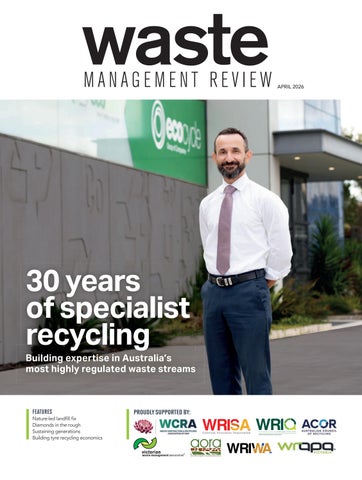
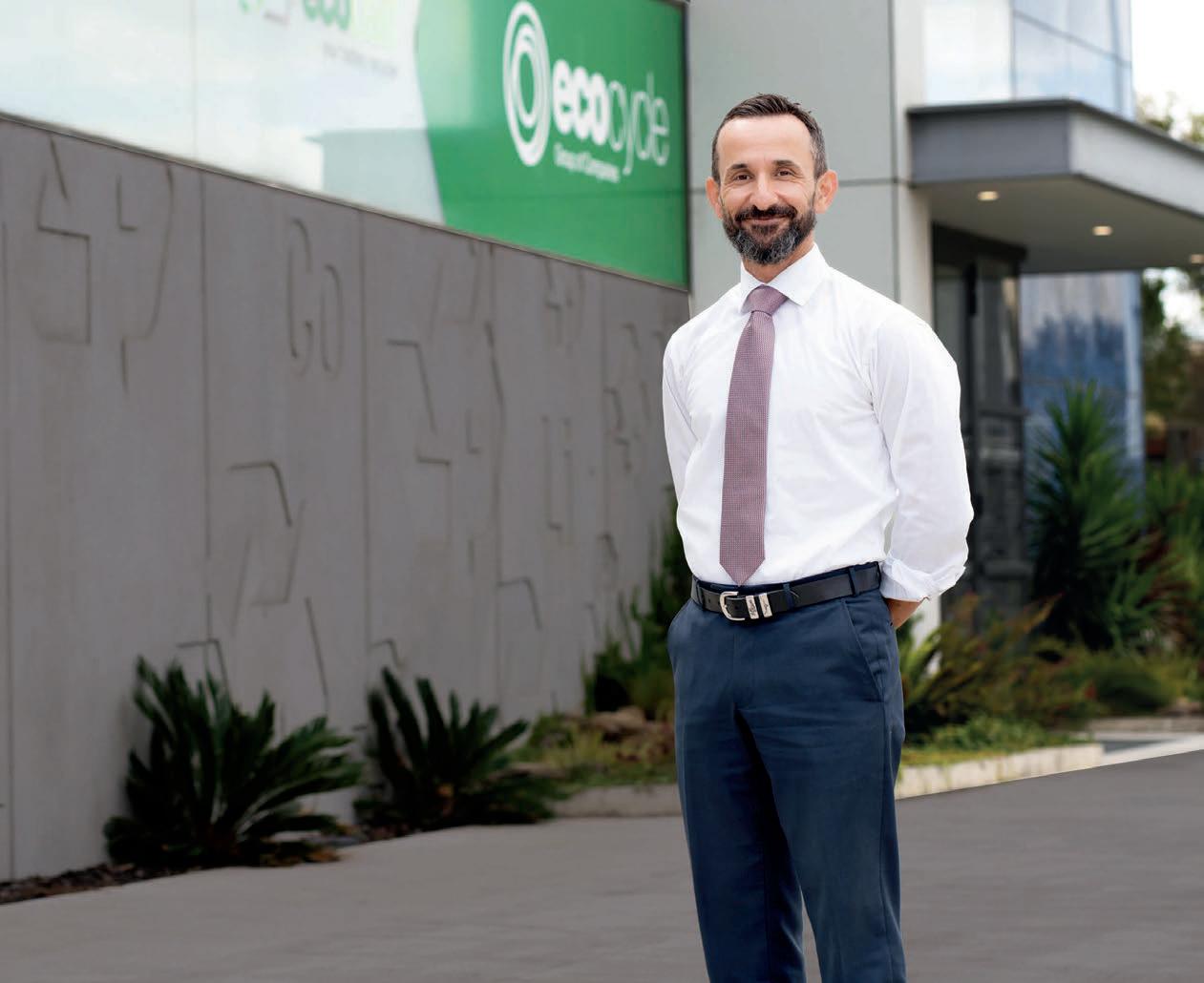
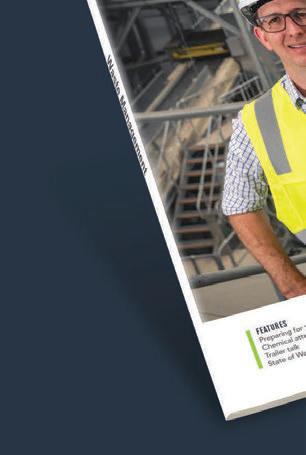
How EcoCycle built expertise in Australia’s most highly regulated waste streams.
NATURE-LED LANDFILL FIX
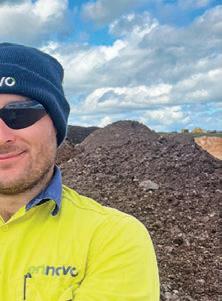
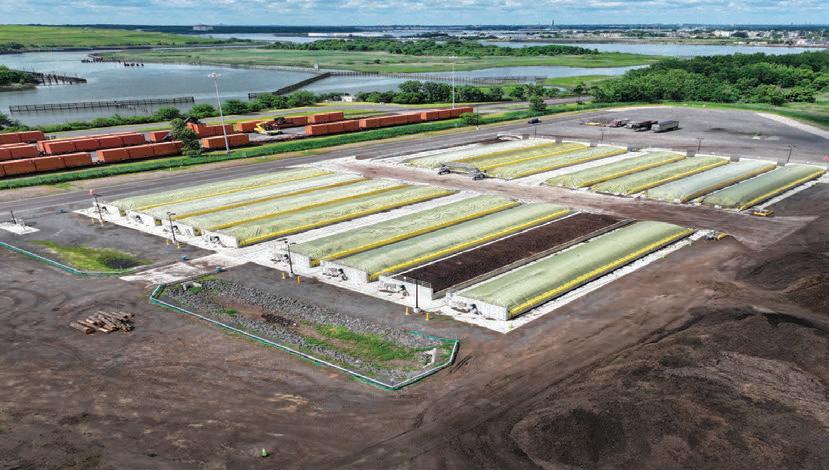
Modern land ll capping o ers an opportunity to restore habitats and boost biodiversity using recycled organics.
Disrupting the global packaging market.
Building expertise in highly regulated waste streams.
Using recycled organics to restore habitats.
“FROM THE BEGINNING WE FOCUSED ON MATERIALS THAT CARRIED GENUINE ENVIRONMENTAL RISK IF THEY WERE A A E R ER
Doug Rowe, EcoCycle Group Chief E e ti e er
New tech treating land ll leachate at the source.
Shifting from disposal to manufacturing.
achieve land ll compaction. 26 FROM DUMP TO ER A
At the intersection of waste and energy.
Why collection and schemes are not enough.
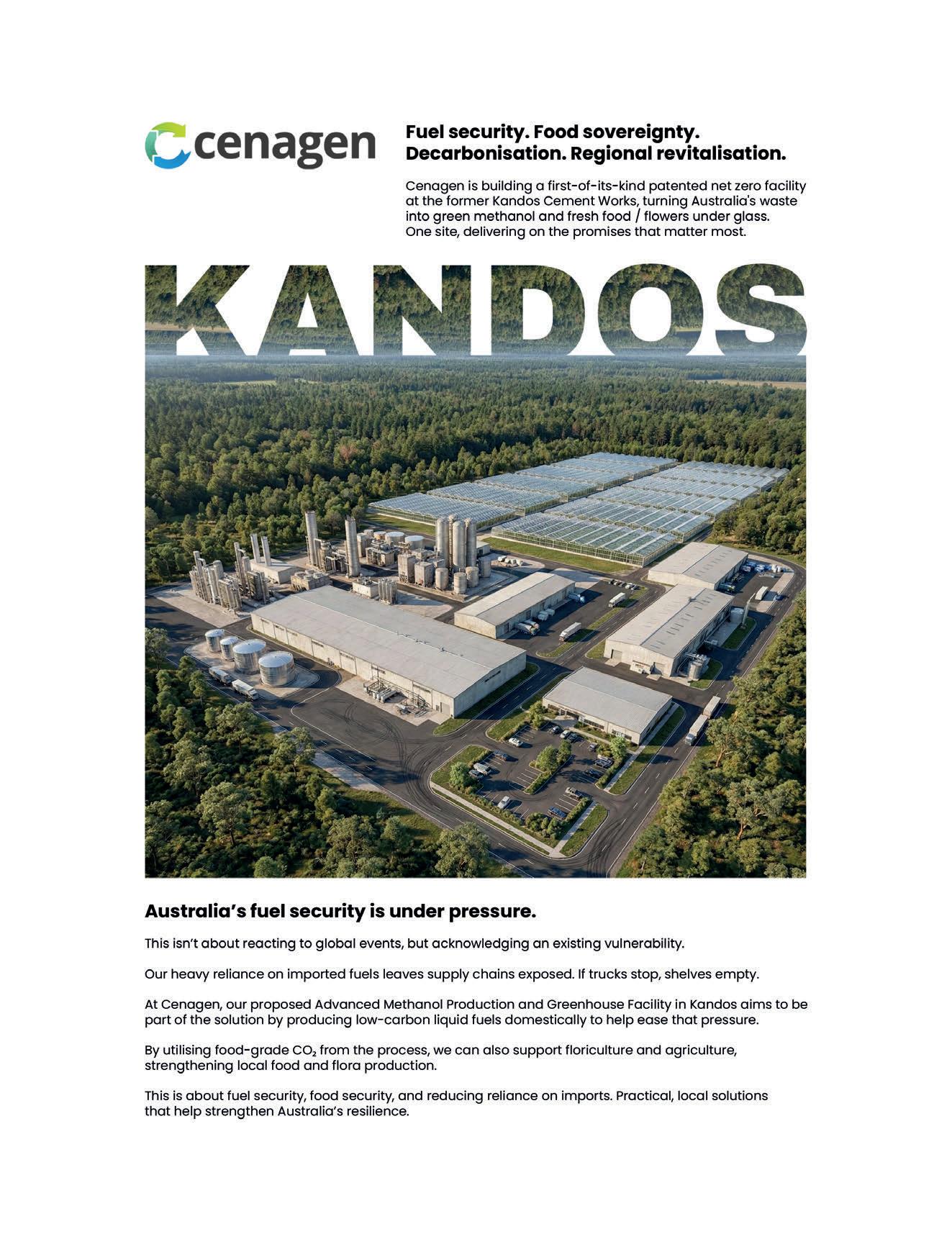
Fuelling Australia’s circular sovereignty.
Bio Gro expands production with new packaging facility.
Tracking keeps recycling convenient and transparent.
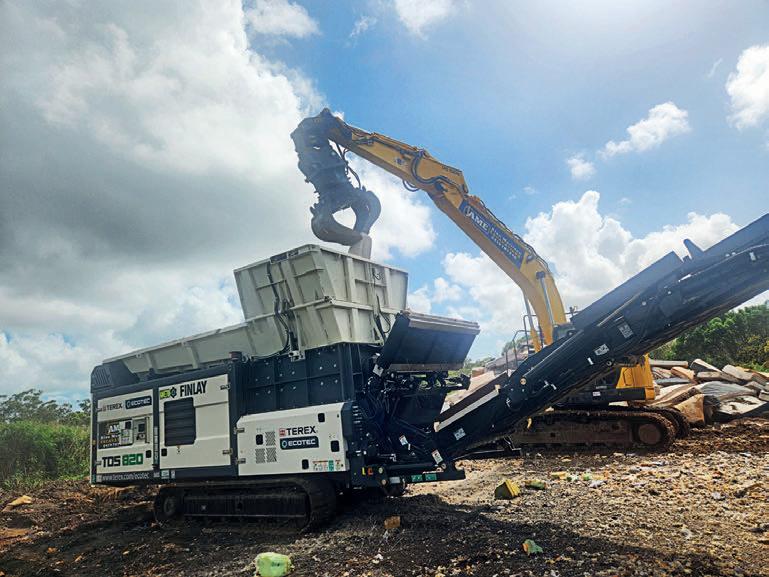
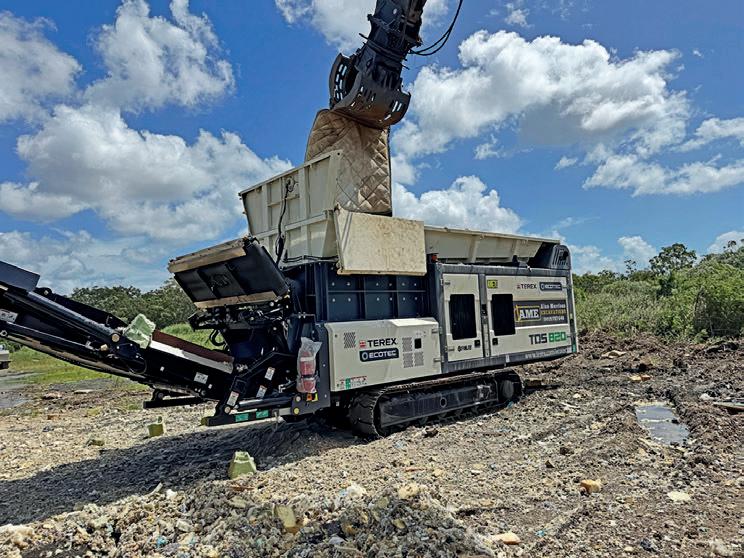
Shredder tested by extreme materials.
A Behemoth solution for plastics.
42 SWITCHING GEARS
Successful transition into waste management.
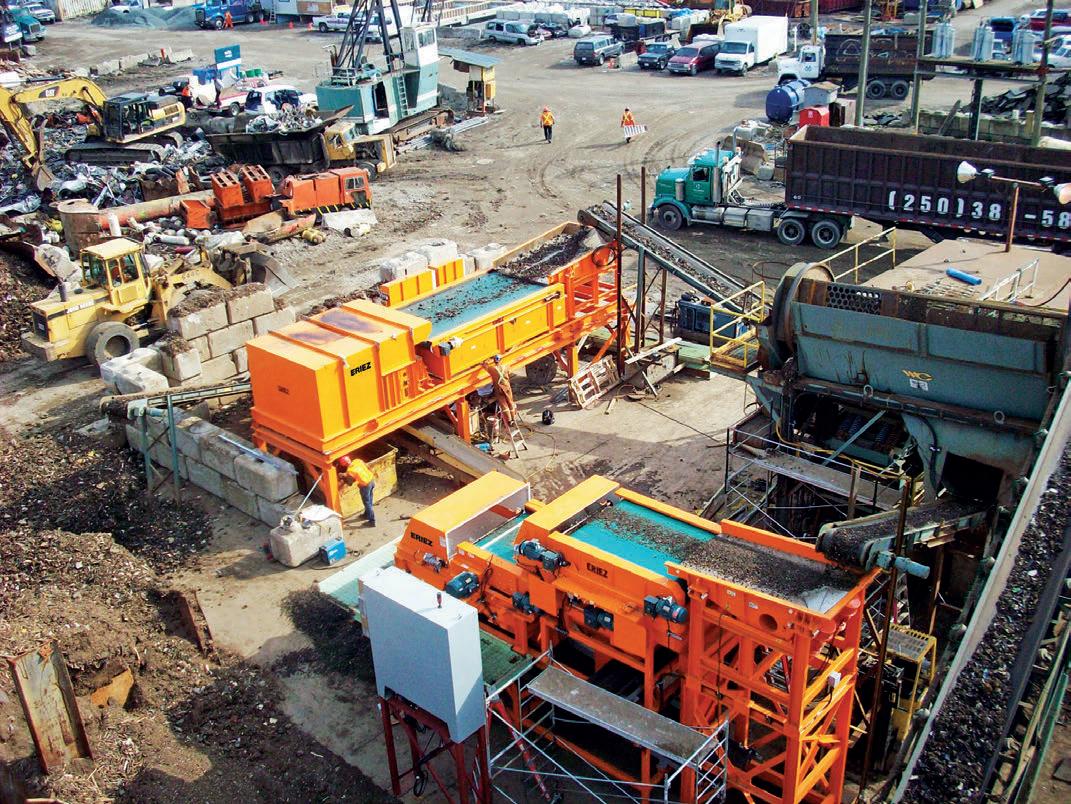
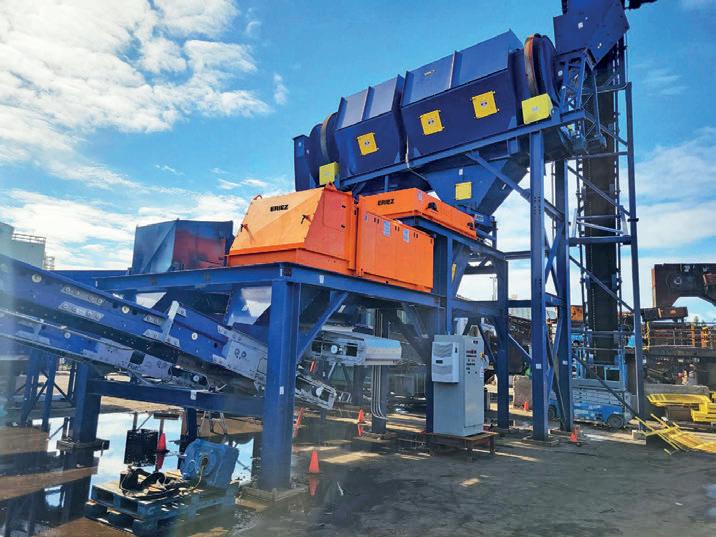
44 DIAMOND IN THE ROUGH e role of eddy current separators.
RAISING THE BAR
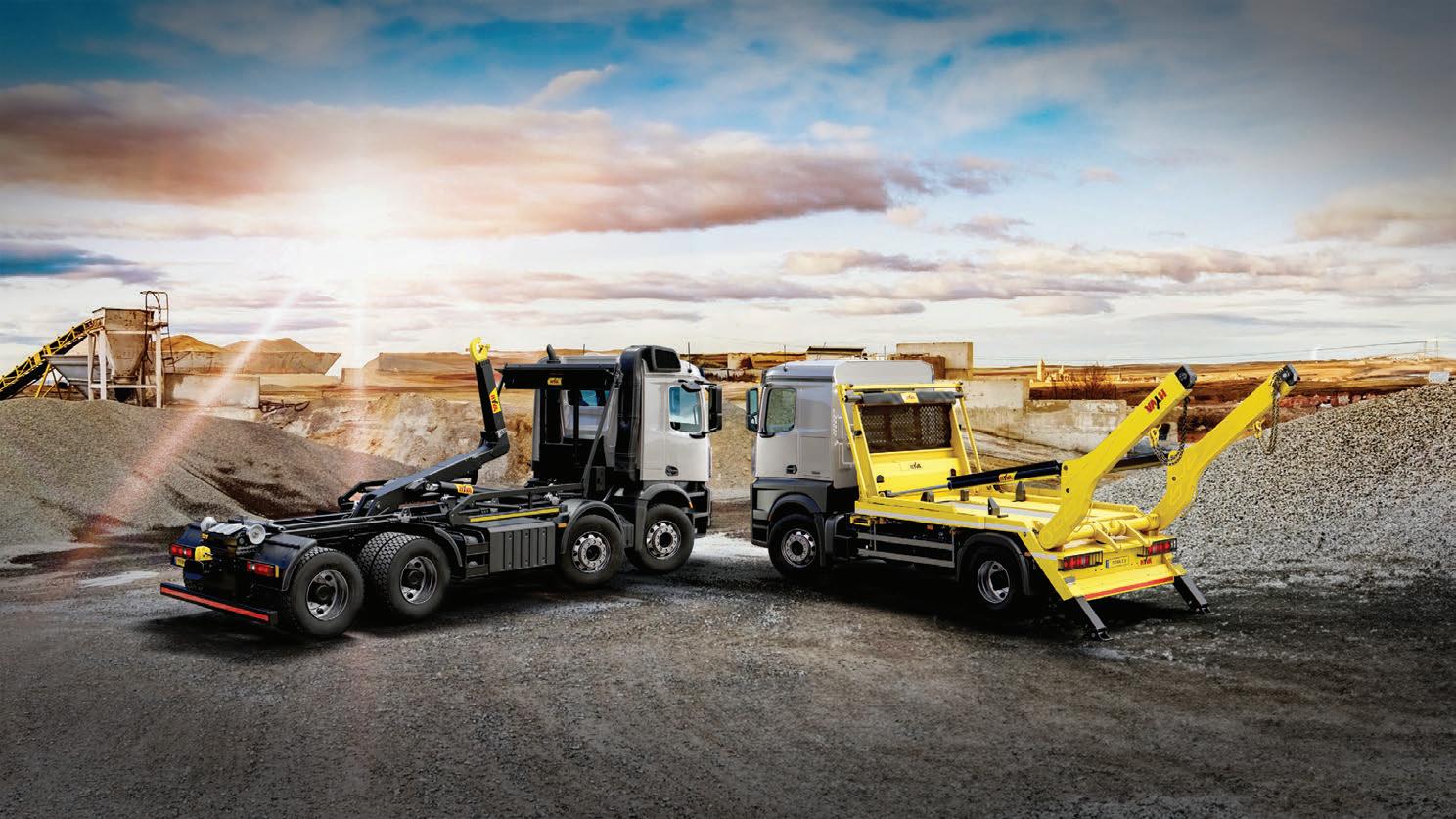
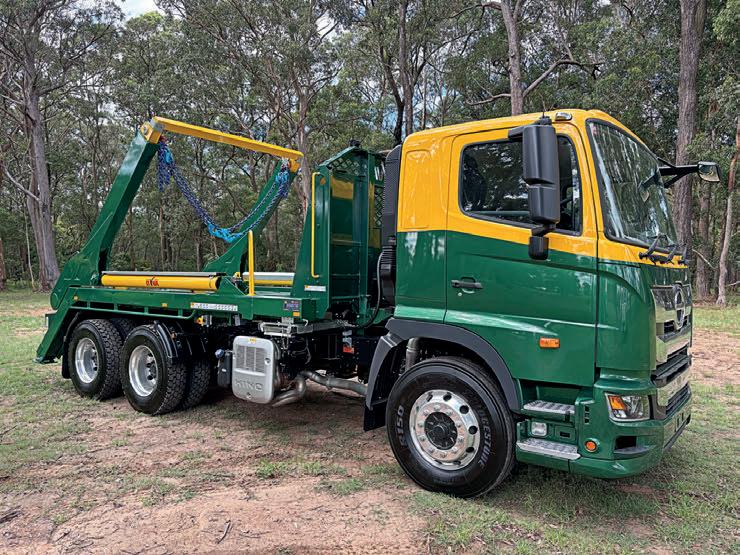
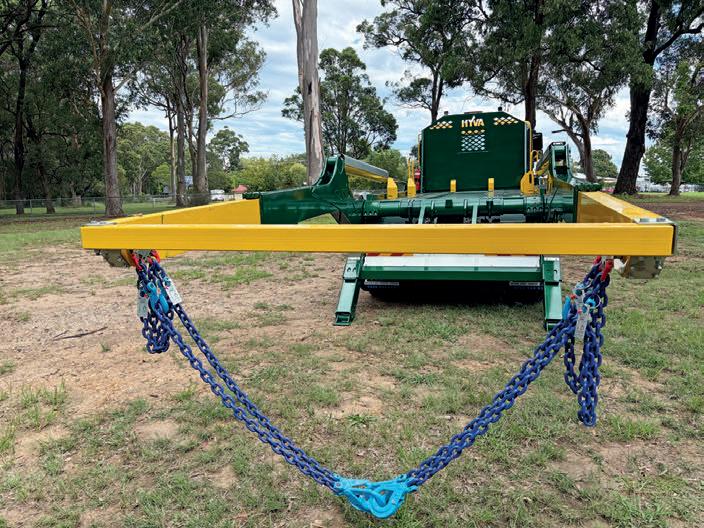
New skip loader launched for the Aussie market.
FUTURE IS BRIGHT
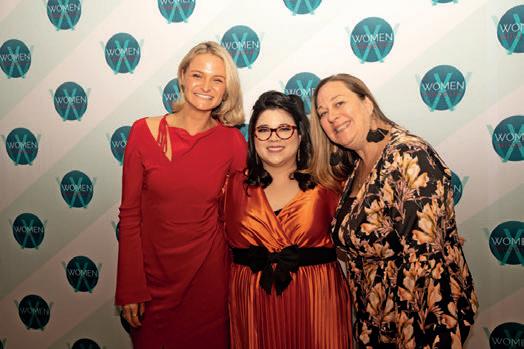
Sydney hosts expanded Women in Industry Awards.
INTRODUCING WRAPA
Heralding a new chapter for the waste and recycling industry.
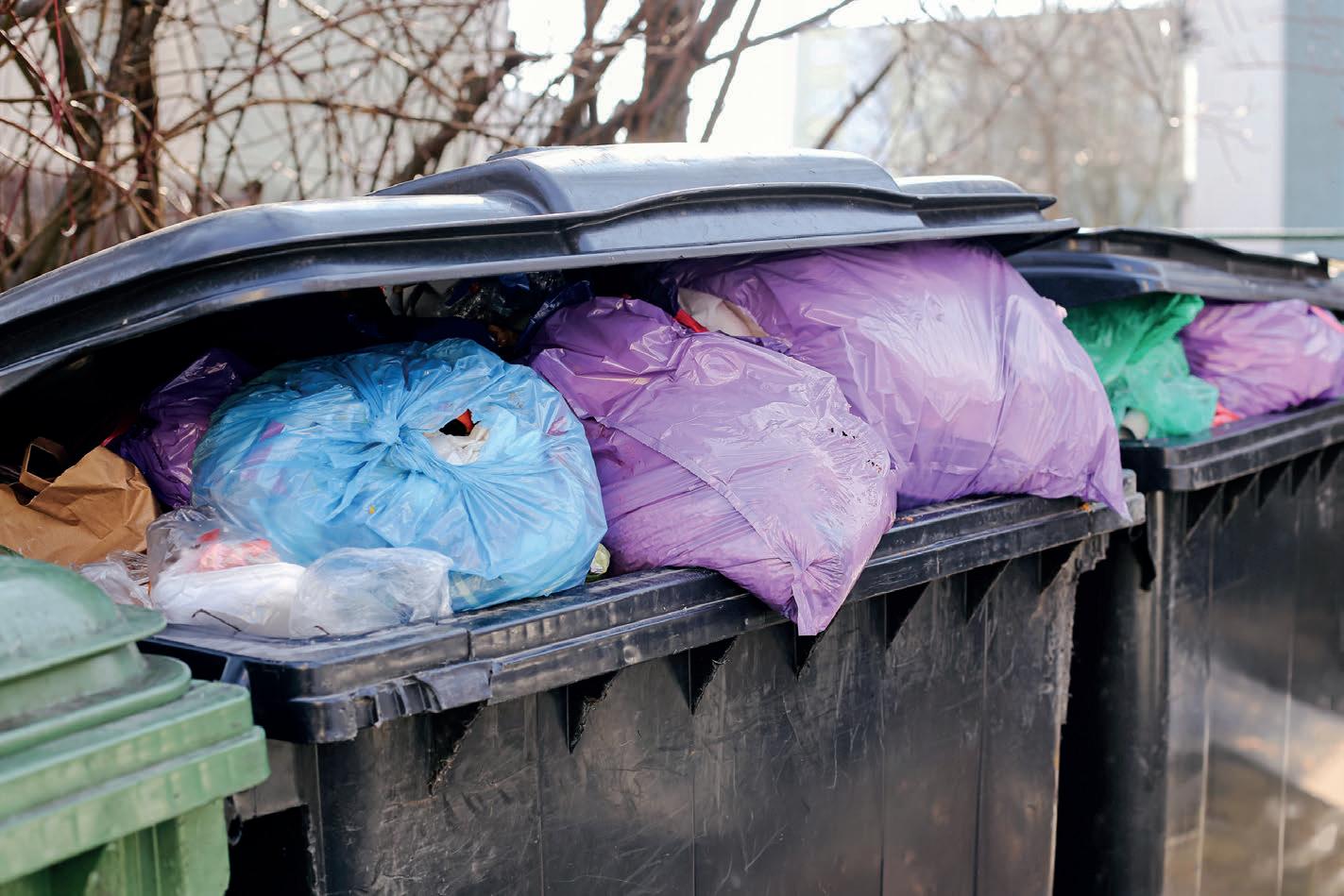
Redefining landfill From the Editor
For decades, land ll was viewed as the end of the road for waste. However, as Australia moves toward a circular economy, land lls are no longer viewed just as containment pits – they are becoming active energy hubs and sites of sophisticated ecological restoration.
As this edition of Waste Management Review shows, the transformation is being driven by a cohort of innovators who treat waste as a resource rather than a liability.
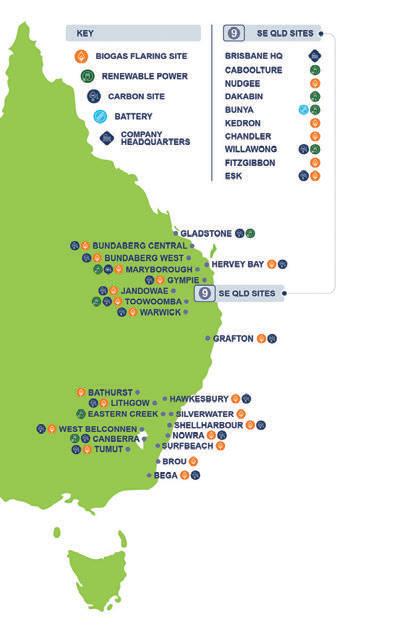
Among them is LGI, a Queensland-based sustainable energy company that partners with councils to turn harmful methane emissions into green energy.
Beneterra is demonstrating how technical excellence can de-risk even the most challenging sites, while Ennovo is proving that organic recovery can turn the “ nal cap” into a thriving, biodiverse ecosystem.
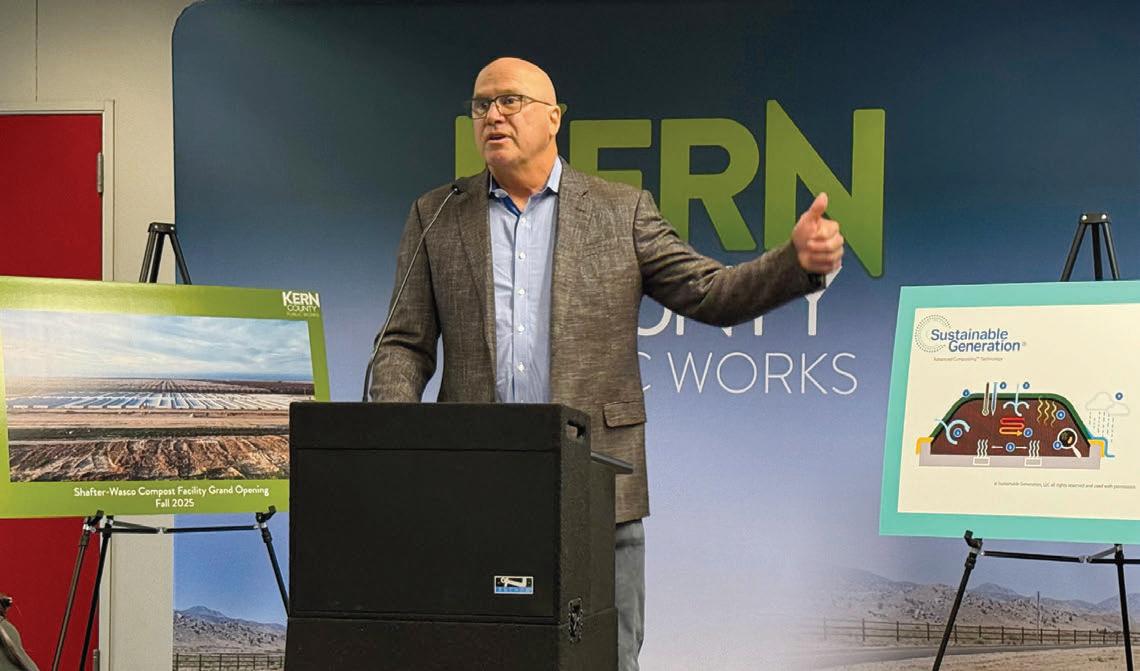
Sustainable Generation has made a signi cant recent push into the Australian market, bringing with it advanced technology and a mindset that harnessing the value of organic waste can create a self-sustaining, pro table and environmentally sound future.
We also acknowledge EcoCycle Group which has spent decades mastering the “hard stu ” in pursuit of an environmentally sound future.
Since 1996, EcoCycle has built its expertise in Australia’s most highly regulated waste streams, such as mercury and silver. Its journey mirrors the broader industry’s trajectory: moving away from mere disposal toward the recovery of our most hazardous materials.
In this edition we also introduce the Waste Recycling and Processing Industry Association (Victoria), meet a regional Victorian demolition specialist scaling circular economy e orts, and speak with Jim Fairweather, Chief Executive O cer of Tyrecycle, as he prepares to front a Parliamentary inquiry into Australia’s tyre industry.
Whether it is methane-to-energy or the safe recovery of toxic metals, the message is clear: the Australian waste sector is no longer just managing trash; it is engineering a sustainable future.
Happy reading!
Lisa Korycki
CEO
Christine Clancy
christine.clancy@primecreative.com.au
PUBLISHER
Sarah Baker sarah.baker@primecreative.com.au
MANAGING EDITOR
Lisa Korycki lisa.korycki@primecreative.com.au
JOURNALIST
Sean Gustini sean.gustini@primecreative.com.au
HEAD OF DESIGN
Blake Storey blake.storey@primecreative.com.au
DESIGN
Laura Drinkwater
BRAND MANAGER
Chelsea Daniel chelsea.daniel@primecreative.com.au p: +61 425 699 878
CLIENT SUCCESS OFFICER
Ben Sammartino ben.sammartino@primecreative.com.au
Waste Management Review is available by subscription from the publisher. e rights of refusal are reserved by the publisher
ARTICLES
All articles submitted for publication become the property of the publisher. e Editor reserves the right to adjust any article to conform with the magazine format.
COVER
Cover image: EcoCycle
COPYRIGHT
Waste Management Review is owned by Prime Creative Media and published by John Murphy.
All material in Waste Management Review is copyright and no part may be reproduced or copied in any form or by any means (graphic, electronic or mechanical including information and retrieval systems) without written permission of the publisher. e Editor welcomes contributions but reserves the right to accept or reject any material. While every e ort has been made to ensure the accuracy of information, Prime Creative Media will not accept responsibility for errors or omissions or for any consequences arising from reliance on information published. e opinions expressed in Waste Management Review are not necessarily the opinions of, or endorsed by the publisher unless otherwise stated.
Innovative Environmental Solutions
Landfill Services
Gas collection system (GCS) design and construct
Carbon credit reporting and management
Civil earthworks
Data management, QA/QC and reporting
Monitoring and maintenance
Leachate system installation and servicing
Advisory and strategy
Power generator servicing and maintenance
Landfill Products
Mobile flare hire
Lo-cal flare range
High temperature flare range
Aerial photogrammetry drones
Gasflux continuous gas analysers
Leachate telemetry systems
Leachate pumps and controllers
Power and heat generation systems
Breaking the plastic bottleneck
Radical label removal, tethered caps and clear material streams; international brands are disrupting the market to overcome traditional plastic recycling roadblocks.
Australia is making real progress towards a circular economy for packaging, but it’s also running into industrial roadblocks.
As the nation attempts to reconcile its environmental ambitions with the realities of its processing infrastructure, the push to reduce plastic waste has moved from a waste management issue to a legislative and engineering challenge.
Central to this are the 2025 National Packaging Targets, a set of voluntary benchmarks designed to overhaul the domestic material stream.
While progress has been made in certain categories, the data for plastic recovery reveals a widening gap between aspiration and reality, according to Sandra Dal Maso, Head of Packaging Transformation at e Australian Packaging Covenant Organisation (APCO).
e National Packaging Targets are a key commitment from Australian industry and government to transition towards a circular economy for packaging. ey apply to all packaging made, used, and sold in Australia.
APCO works across the packaging value chain with brand owners, manufacturers and government to support shared progress towards the targets and help translate these challenges
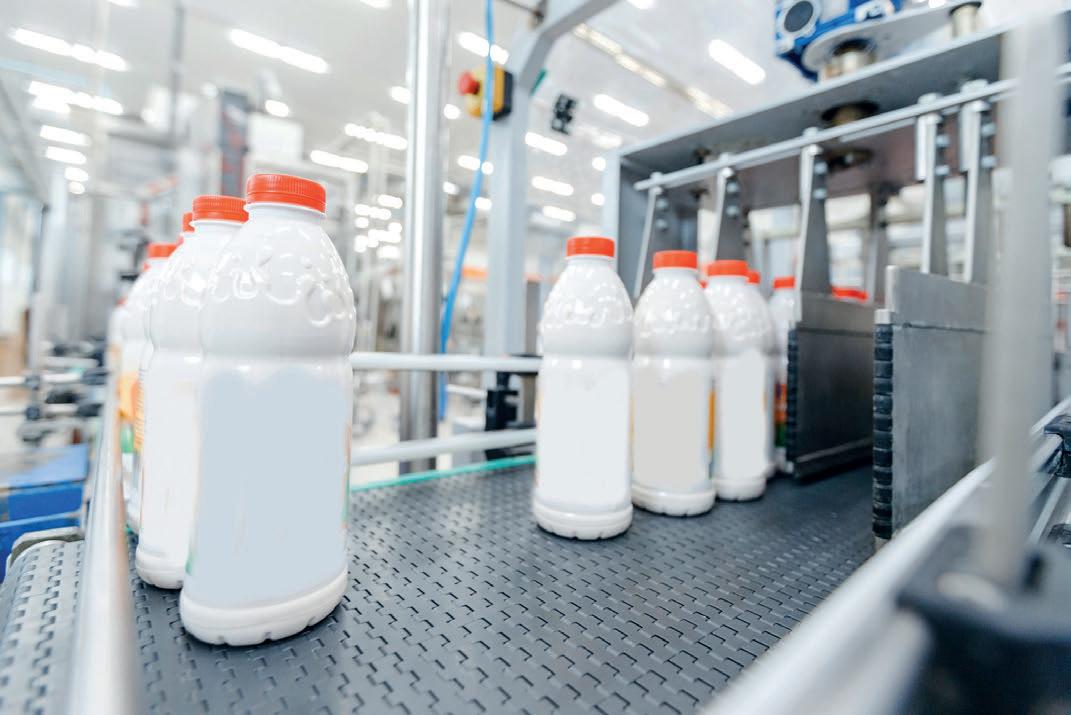
The United Kingdom dairy industry is replacing brightly coloured caps with clear caps to reduce colour contamination in the plastics recycling stream. Image: Parilov/shutterstock.com
“Europe and the rest of the world are intent on going forward.”
Sandra Dal Maso Head of Packaging Transformation at APCO
into practical reform priorities for industry and government.
Dal Maso said Australia has achieved high compliance in making packaging reusable, recyclable, or compostable, reaching 86 per cent of its goal. However, the speci c target for plastic packaging –intended to hit a 70 per cent recovery rate – is stalled at just 20 per cent, suggesting that while the “low-hanging fruit” has been harvested, the remaining hurdles will require more than just corporate goodwill.
“With what’s left, just keeping these targets as they are, without any mandates, will not close the gap,” Dal Maso said.
“Further progress will depend on stronger policy settings, infrastructure investment and end-market demand. Nonrecyclable materials require substantial investment. We need government legislation and mandates to drive investment into material processing.
“A mandate requiring brand owners to use recycled content would establish a viable end-market, making it economically feasible for the recovery and reprocessing sectors to actually treat these materials.”
e call for legislative intervention re ects a global trend where governments are moving from voluntary agreements to strict mandates.
In Europe, the Packaging and Packaging Waste Regulation (PPWR) is introducing a system that categorises materials based on recyclability, with some non-recyclable materials facing market bans as early as 2030.
Similarly, the United Kingdom has implemented Extended Producer Responsibility (EPR) schemes to strengthen producer responsibility settings.
Dal Maso said Australia is watching these international examples closely, as global brands may eventually adopt these more rigorous standards across all markets to gain economies of scale.
But for Australia to remain competitive on the international stage, local mandates would need to align with these global shifts, providing a “stake in the ground” that gives industry the lead time necessary to trial new materials and qualify recycled content.
Disruptive technologies and design shifts are also emerging as potential solutions to contamination issues that can hinder plastic recycling.
One radical solution in South Korea involves the enforced removal of plastic wrap-around labels on PET (polyethylene terephthalate) bottled water. By eliminating the label entirely, the bottle becomes a single-medium package, removing competing materials that complicate the recycling process.
Dal Maso said while this is a “purist view” of waste reduction, implementing similar label-less concepts in Australia would likely require a change in legislation before they could be legally sold. Current Food Standards Australia New Zealand (FSANZ) guidelines require essential information – including ingredient lists, allergen declarations, and nutrition panels – to be legible at the point of purchase.
Other market disruptions focus on keeping components together to ensure they aren’t lost to the litter stream.
In Europe, “tethered caps” – bottle caps that remain attached after unscrewing –have become a legislative requirement for soft drinks and beverages. is ensures that the cap, which is often too small to
be recovered if separated, is collected and processed alongside the bottle.
In the United Kingdom dairy industry, a di erent tactic involves the removal of pigment from milk bottle caps. Moving from brightly coloured blues and reds to clear caps reduces colour contamination in the material stream, increasing the value and quality of the nal recycled product.
“I love those examples, because they are good examples of disruptive technology that helps in the sustainability space,” Dal Maso said.
“Europe and the rest of the world are intent on going forward. We all want to make a di erence, and we all want to improve.
“ e European situation should drive change, which should shape packaging decisions in other markets, to also drive change.”
She said Australia is attempting to foster this type of innovation through material stewardship committees and collaborative research hubs.
e Department of Climate Change, Energy, the Environment and Water (DCCEEW) has been developing a framework for kerbside recyclability to help brand owners understand what can actually be processed in local facilities.
APCO also hosts forums that bring together reprocessors, brand owners, and the recovery sector to identify technical barriers to recycling exible and rigid plastics. e aim is to inform future government policy so that any eventual legislation is t for purpose.
Despite the slow rate of progress in some areas, Dal Maso said the industry remains focused on long-term change rather than incremental steps.
“If the government said, ‘Hey, we’re doing it, and by December 2027 or December 2028 there will be mandates in place’, it would be a really good thing.
“With greater policy certainty, investment and alignment across the value chain, Australia has an opportunity to lift plastics recovery over time.”
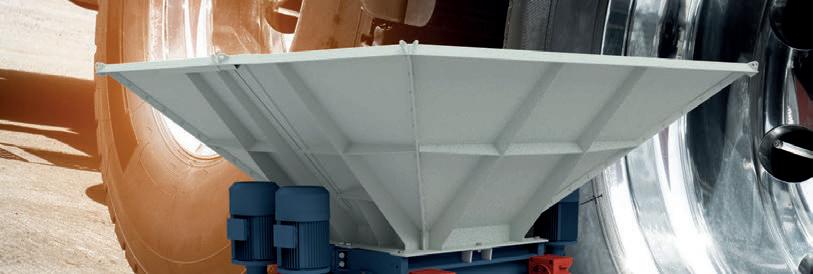
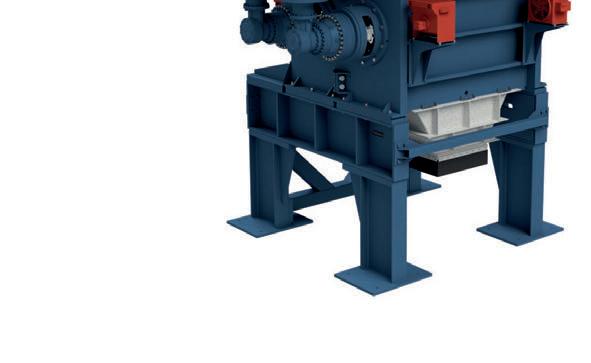
AG SERIES VERTICAL SHREDDER
HIGH-PERFORMANCE METAL SCRAP PROCESSING
The AG Series Vertical Shredder is a super heavy-duty size-reduction solution engineered for high-throughput metal recycling applications. Designed for durability and efficiency, the system delivers powerful performance for processing a wide range of metal scrap while maximising material recovery and value.
Powerful Performance
The AG Series is driven by high-capacity motors ranging from 500–710 kW, transmitting torque to the rotor via high-efficiency belt drives. The large-diameter rotor generates significant linear velocity, enabling aggressive material impact and effective size reduction. A breaker and stepped hammer configuration ensures efficient material processing by:
•Cleaning contaminants from metal surfaces
•Increasing bulk density of processed material
•Separating valuable non-ferrous metals
•Producing high-quality ferrous scrap for downstream processing
Engineered for Easy Maintenance
The AG Series is designed with maintenance efficiency in mind:
•Dual-door chamber opening for quick and safe internal access
•Fast rotor lifting and installation to minimise downtime
•Replaceable internal wear components for long service life
These features significantly reduce maintenance time and improve operational availability.
Advanced Dust Control
An internal airflow recirculation system minimises dust emissions and reduces the required airflow volume for dust extraction systems. This design effectively controls dust inside the shredding chamber and prevents it from being discharged with processed material, contributing to cleaner and safer operations.
Typical Applications
•Scrap steel
•Copper and aluminium scrap
•E-waste
•Electric motors
•Compressed metal scrap (“meatballs”)
Built for the Demands of Modern Recycling
Combining high power, efficient material
liberation, and easy maintenance, the AG Series
Vertical Shredder provides a reliable solution for recyclers looking to maximise throughput and recover higher-value materials.
Thirty years of specialist recycling
How EcoCycle built expertise in Australia’s most highly regulated waste streams.
Hazardous waste rarely attracts the same public attention as more visible recycling streams, yet some of the most complex environmental challenges lie in the safe management of regulated materials such as mercury. ese substances do not degrade over time and require specialised infrastructure, strict regulatory oversight and signi cant technical expertise to manage responsibly.
For three decades, EcoCycle has focused on exactly that challenge.
Longevity in Australia’s waste and recycling sector is rarely achieved by accident. Over the past 30 years the industry has experienced signi cant regulatory reform, evolving environmental expectations and the emergence of increasingly complex waste streams requiring specialist handling.
Many operators have entered the market during favourable commodity cycles, only to exit again when conditions shifted.
Against this backdrop, EcoCycle’s 30th year of operation represents something di erent. Rather than pursuing scale alone, the company has built technical capability in some of the most highly regulated and technically complex areas of the recycling sector.
EcoCycle was founded in 1996, as a specialist recycler focused on complex and regulated waste streams. Today that focus continues to de ne the company’s role within Australia’s recycling landscape.
e company operates as part of the EcoCycle Group which includes EcoBatt (battery recycling), Eco E-Waste (electronic waste recycling) and Recycal (metals recycling), as well
as manufacturing companies Castings Tasmania and ACL Metal Powders.
Doug Rowe, EcoCycle Group Chief Executive O cer, says the direction of the business was clear from the outset.
“From the beginning we focused on materials that carried genuine environmental risk if they were not managed properly,” he says. “ ose waste streams require specialist knowledge, strict operational controls and a willingness to invest in the right infrastructure.
“ at philosophy has guided EcoCycle’s development over the past three decades.”
REGULATION AND RESPONSIBILITY
When EcoCycle was established in the mid-1990s, the recycling sector was far less regulated than it is today. Much
of the industry focused on relatively straightforward material recovery such as metals, paper and plastics.
Specialist recycling of hazardous materials represented a smaller and far more technically demanding segment of the market.
Over time, the importance of specialist recyclers has increased signi cantly. As environmental regulation strengthens and industries modernise, waste streams that once received limited attention are now recognised as requiring careful management and technical expertise.
Mercury is one such material.
Although mercury has been phased out of most modern products and industrial processes, its historical use across mining, oil and gas, laboratories, healthcare and manufacturing means it continues to appear in waste streams across a range of industries.
In many cases mercury is discovered during infrastructure upgrades, industrial decommissioning or environmental remediation projects where legacy contamination has remained undisturbed for decades.
Unlike many other materials, mercury does not degrade over time. If not properly treated it remains a long-term environmental and health risk.
BUILDING EXPERTISE
EcoCycle has been involved in mercury recycling and recovery for three decades. e company has expanded its services to manage mercury arising from a wide range of sources including uorescent lighting, dental amalgam, laboratory equipment and industrial processes.
Operating within these regulated waste streams requires strict controls across every stage of the recycling process. From collection and transport through to treatment and nal disposal, each step must be carefully managed to ensure materials are handled safely and in accordance with environmental regulation.
Nick Dodd, EcoCycle General Manager says that discipline is fundamental when working with hazardous materials.
“In specialist recycling, particularly where hazardous substances are involved, every stage of the process needs to be built around safety, compliance and traceability,” he says. “ at includes how materials are collected, how they are transported and how they are ultimately treated.”
He says it’s this operational discipline that has helped position EcoCycle as a long-standing operator in the management of mercury and other regulated waste streams.
INVESTING IN CAPABILITY
Operating within hazardous waste recycling also requires a level of accountability and transparency that extends well beyond conventional recycling operations.
Facilities must operate under strict environmental licensing conditions, processing equipment must be purpose designed for the materials being treated, and operational systems must withstand regular auditing and regulatory scrutiny.
Tom Susen, EcoCycle Group Risk and Compliance Manager says working within regulated waste streams requires a high level of operational oversight.
“Every process must be clearly documented and auditable,” Tom says.
“From how materials are received through to how they are treated and recorded, compliance frameworks are designed to ensure these materials are managed safely and responsibly.”
EcoCycle operates under certi ed management systems including ISO 9001, ISO 14001 and ISO 45001, supporting consistent quality control, environmental management and workplace safety across its operations.
Maintaining those standards has always been central to how the business operates.
Across its facilities, EcoCycle maintains structured environmental controls, documented operating
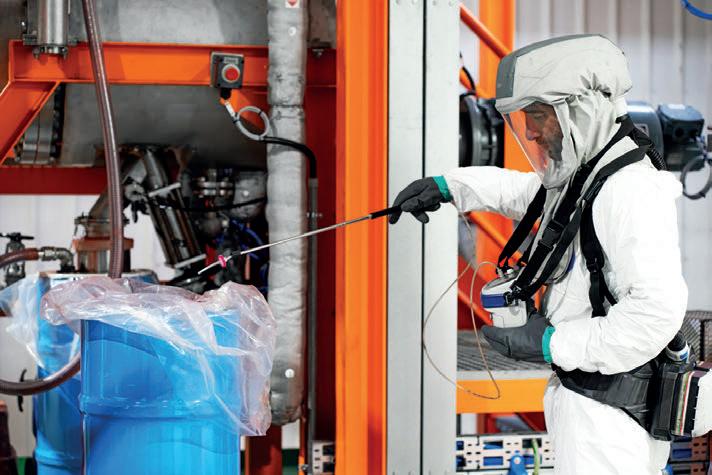
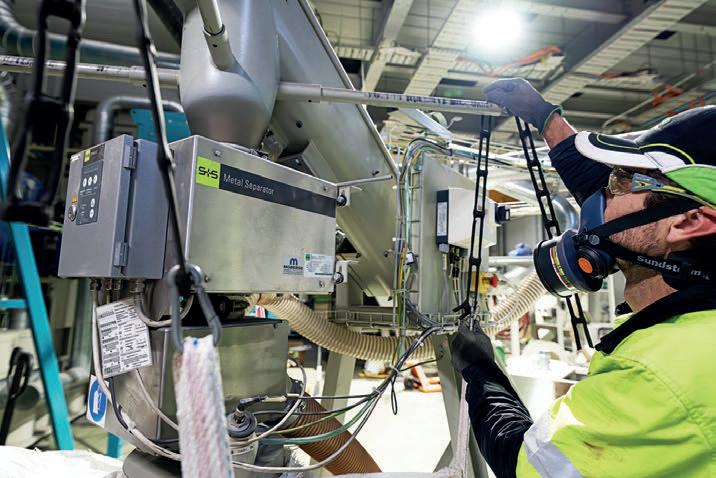
EcoCycle has invested in specialised stabilisation technology.
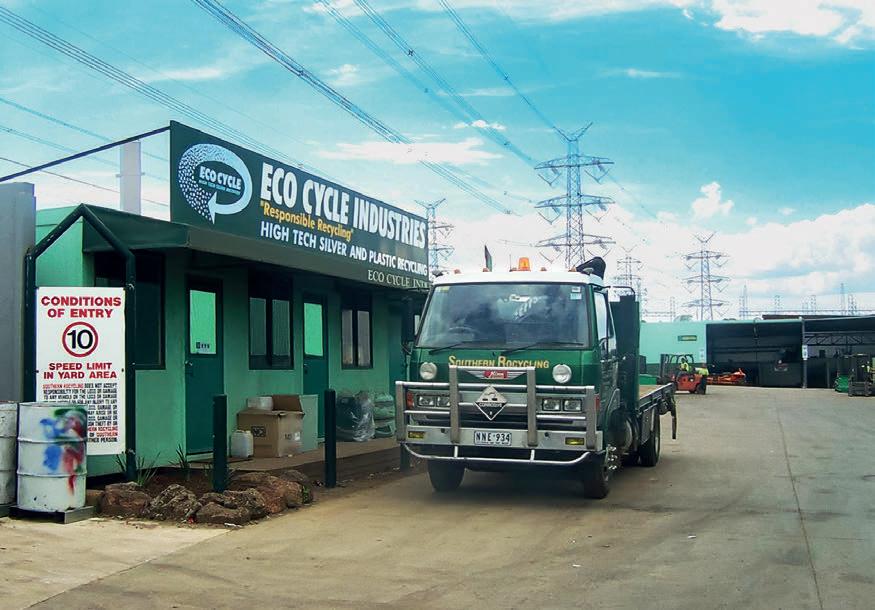
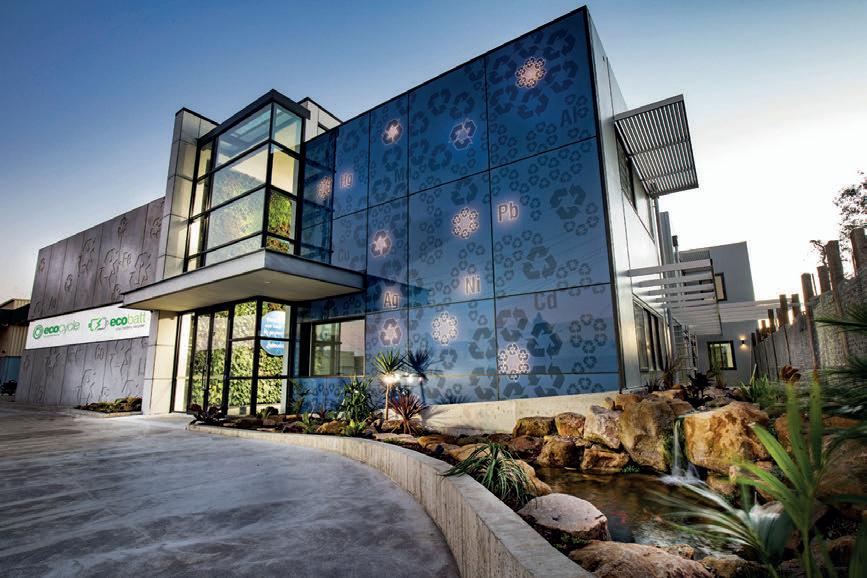
EcoCycle s original head office and the new Campbellfield headquarters. Images: EcoCycle
procedures and certi ed management systems designed to ensure regulated materials are handled safely and in accordance with applicable legislation and licence conditions.
Each stage of the process, from collection and transport through to treatment and nal disposition, is recorded through controlled systems that provide clear traceability and oversight.
Tom says this level of operational discipline re ects the realities of working in highly regulated waste streams, where regulatory authorities, industry clients and the broader community all expect strong governance and demonstrable compliance.
Maintaining that con dence requires constant diligence.
“In specialist recycling, trust is built on transparency and consistency,” Tom says. “Our operations are regularly audited, our systems are designed to meet strict regulatory expectations, and we continually review our processes to ensure they remain aligned with current best practice.”
at commitment has also driven signi cant investment in new infrastructure and technology. Over the past decade EcoCycle has continued to upgrade equipment, re ne processing systems and introduce new facilities designed to improve environmental outcomes and operational safety.
Doug says the evolution of technology has signi cantly reshaped how hazardous materials are managed.
“ e way regulated waste is handled today is very di erent to how it was done ten or even ve years ago,” he says.
“Technology continues to advance and environmental expectations continue to rise. Our approach has always been to invest early in infrastructure and systems so that we remain aligned with best practice.
“Recycling is a challenging business, with co-mingled and mixed materials causing some recyclable items to become unrecyclable. Technology is helping, but education also plays a pivotal role in sorting waste streams to ensure recycling companies can achieve better outcomes.”
INDUSTRY SCRUTINY AND TRANSPARENCY
As with many industries undergoing rapid change, the recycling sector can occasionally attract commentary and criticism. Doug says EcoCycle’s approach has been to remain focused on transparency and professionalism rather than speculation.
Over the years many clients, regulators and industry partners have visited EcoCycle’s facilities and observed rst-hand the infrastructure, environmental controls and operational
discipline required to manage hazardous materials responsibly.
ose rst-hand experiences, together with decades of operational history, continue to underpin the con dence placed in the company’s work.
Doug says that maintaining trust ultimately comes down to consistency and accountability.
“Operating in highly regulated waste streams means your processes, infrastructure and decisions are constantly subject to scrutiny,” he says.
“Transparency and professionalism are fundamental to how we operate. Over time, people who see our facilities and systems rst-hand understand the level of care and discipline required to manage these materials safely.
“We’ve never claimed to be perfect, but we are constantly striving to improve and get as close to it as we can.”
In an industry where environmental responsibility is paramount, he says long-term performance often speaks louder than commentary.
ADDRESSING AUSTRALIA’S MERCURY LEGACY
Although mercury use has declined signi cantly in recent decades, large volumes of legacy material remain embedded across industrial infrastructure and waste streams.
Lighting recycling in Western Australia.
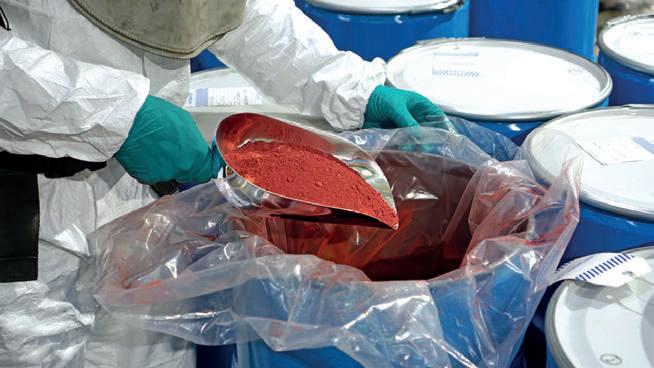
Mercury sulphide, stabilised and processed at EcoCycle’s Western Australia facility.
In the oil and gas sector, mercury can accumulate in processing equipment. Mining and resource operations may encounter mercury contamination during remediation works. Healthcare facilities and laboratories continue to generate mercury-containing waste through the disposal of older equipment and materials.
Historically Australia has had limited options for managing elemental mercury once recovered. In many cases the material has been stored inde nitely or transported overseas for treatment. Both approaches present challenges. Long-term storage requires ongoing monitoring and regulatory oversight, while exporting hazardous materials introduces additional logistical complexity and risk.
Increasingly, attention has turned to the importance of developing domestic capability to permanently treat mercury within Australia.
MERCURY CONVERSION IN WA
A signi cant step forward has been EcoCycle’s investment in a specialised Mercury Conversion Plant located in Western Australia.
e facility enables elemental mercury to be chemically converted into mercury sulphide, a stable solid compound. rough this process the mercury’s chemical structure is fundamentally altered, removing its volatility and signi cantly reducing the environmental risks associated with long-term storage. Facilities capable of undertaking this type of mercury conversion are relatively uncommon, particularly within the Southern Hemisphere.
Doug says EcoCycle’s Western Australian plant is the only facility in the region capable of performing this specialised treatment.
He believes developing domestic treatment capability represents an important step in addressing Australia’s legacy mercury challenge.
“For many years the options available to industry were limited to storing mercury or exporting it,” he says.
“Being able to permanently treat that material here in Australia, under Australian environmental controls, allows organisations to resolve the issue responsibly while maintaining full regulatory oversight.”
e facility also supports Australia’s obligations under the Minamata Convention on Mercury, which seeks to reduce global mercury pollution and ensure environmentally sound management of mercury waste.
EXPERIENCE DEVELOPED OVER DECADES
After three decades operating in regulated waste streams, EcoCycle has developed decades of operational experience working within hazardous material recycling.
In addition to mercury recycling, the company provides specialist services across uorescent lighting recycling, dental amalgam recovery, X-ray recycling and the management of complex industrial materials.
Spyro Kalos, EcoCycle National Partnerships Manager, says that experience plays an important role when working with industry.
“Our clients are often dealing with materials that carry signi cant environmental and regulatory responsibility,” Spyro says. “ ey need con dence that the recycler they work with understands both the technical requirements and the regulatory framework that applies.”
LOOKING AHEAD
Australia’s recycling sector is entering a period of rapid change as electri cation, new technologies and evolving environmental regulations introduce increasingly complex materials into the waste stream.
Doug says managing these materials safely will require specialist infrastructure, technical expertise and strong compliance frameworks.
As part of the EcoCycle Group, EcoCycle will continue to focus on waste streams that require precisely that level of capability.
“Specialist recycling is not always the easiest path,” Doug says. “But it is an essential one.
“If materials carry environmental risk they need to be managed properly, and that responsibility does not disappear over time.”
For more information, visit: www.ecocycle.com.au
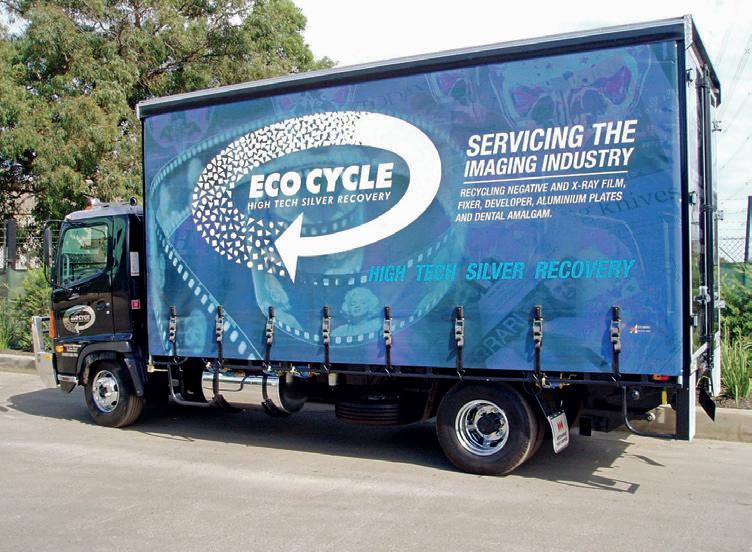
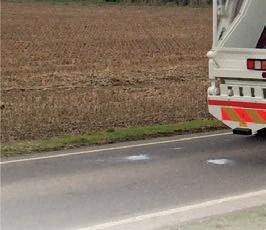
An old EcoCycle truck bearing the original company logo.
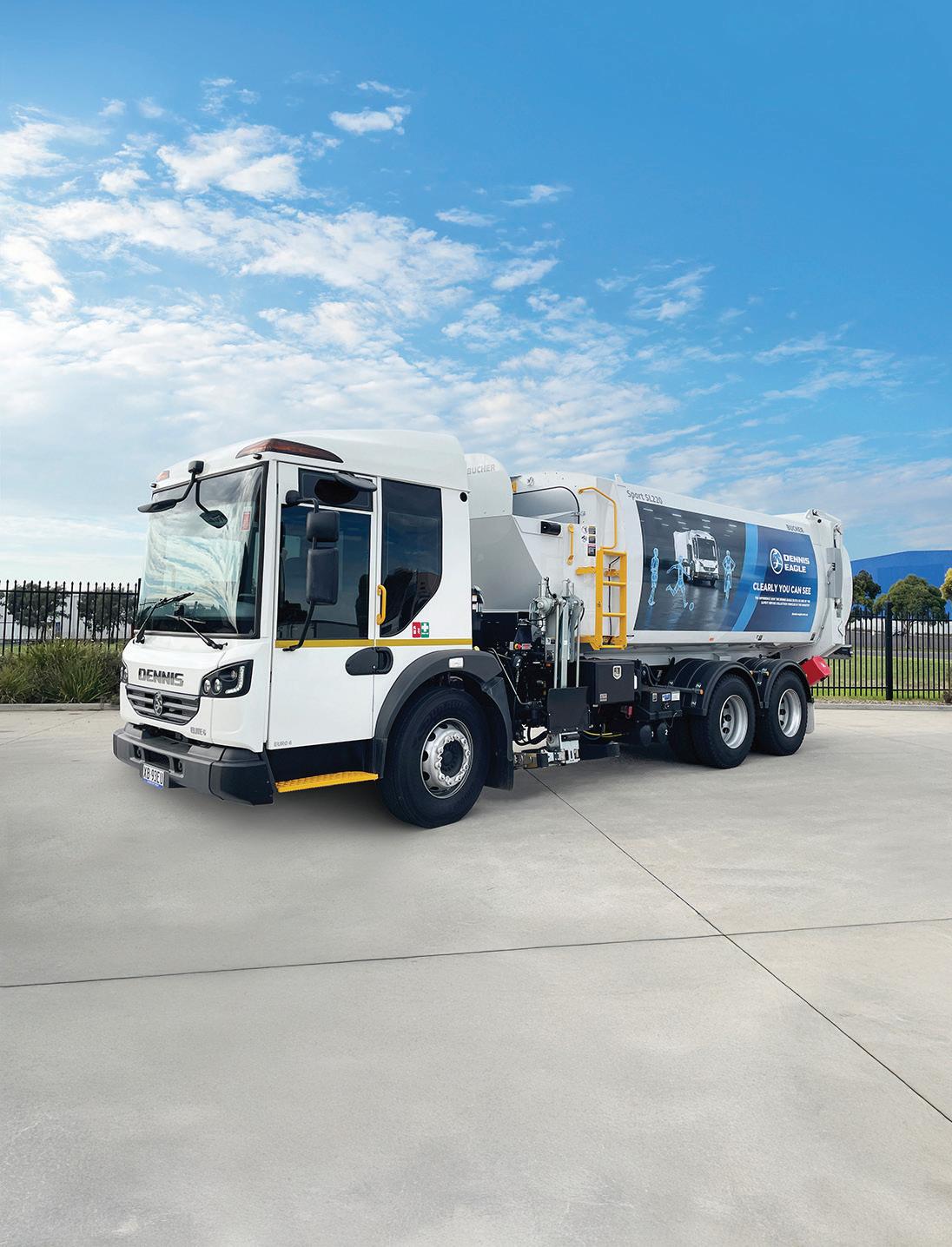
A global leader in refuse collection vehicles, Dennis Eagle o ers market-leading direct vision and is specifically designed to meet the wide range of requirements that comprise this rapidly expanding industry.
Equipping customers with reliability that will last beyond their contract term and the required technologies to stay ahead of changing demands while providing exceptional performance, Dennis Eagle vehicles are powered by well-proven Cummins engines and Allison transmissions.
Key characteristics of the Dennis Eagle range include the integration of excellent safety features such as onestep entry and exit cab, tall and wide door openings, true flat floors, large glass areas for maximum visibility in addition to well-positioned grab handles and a high visibility mirror package.
dennis-eagle.com.au
The nature-led
odern land ll capping offers an opport nit to restore ha itats and oost iodiversit sing rec cled organics.
Historically, mulches applied to a land ll cap surface have been used for their ability to minimise the impact of water and wind erosion and maintain soil moisture levels.
However, the use of recycled organics has far more wide-ranging bene ts, according to Ellie Leopold, an environmental scientist with Ennovo.
Ellie says the integration of recycled organics into evapotranspiration-based (ET) land ll caps or phytocaps is enabling these types of land ll caps to increase their e ectiveness and ultimately achieve the goal of rehabilitating a once highly impacted part of the landscape. Phytocaps are plant-based land ll covers that act as a living, self-repairing barrier to prevent water from entering waste. Ellie says the use of recycled organics as a critical amendment
through the soil pro le is resulting in multiple bene ts.
“Not only does it lead to the establishment of a very e ective plant growing medium, but it also has additional bene ts related to water
holding capacity, nutrient availability, soil biology and storage of carbon,” she says.
“ e bene ts of recycled organics in land ll capping are only just being realised to their full extent, and the results are genuinely exciting.
“Beyond the clear environmental gains, this approach is also proving very cost e ective for land ll operators.”
e rapid establishment of native vegetation on land ll caps is critical, as this vegetation has numerous functional bene ts. e plants themselves work with the surface mulch layer to reduce water and wind erosion, as well as create a habitat for animal species – all part of the broader land ll rehabilitation goals.
However, many land lls are situated in harsh environments, often making it di cult to establish native plants. Ennovo have been involved in the
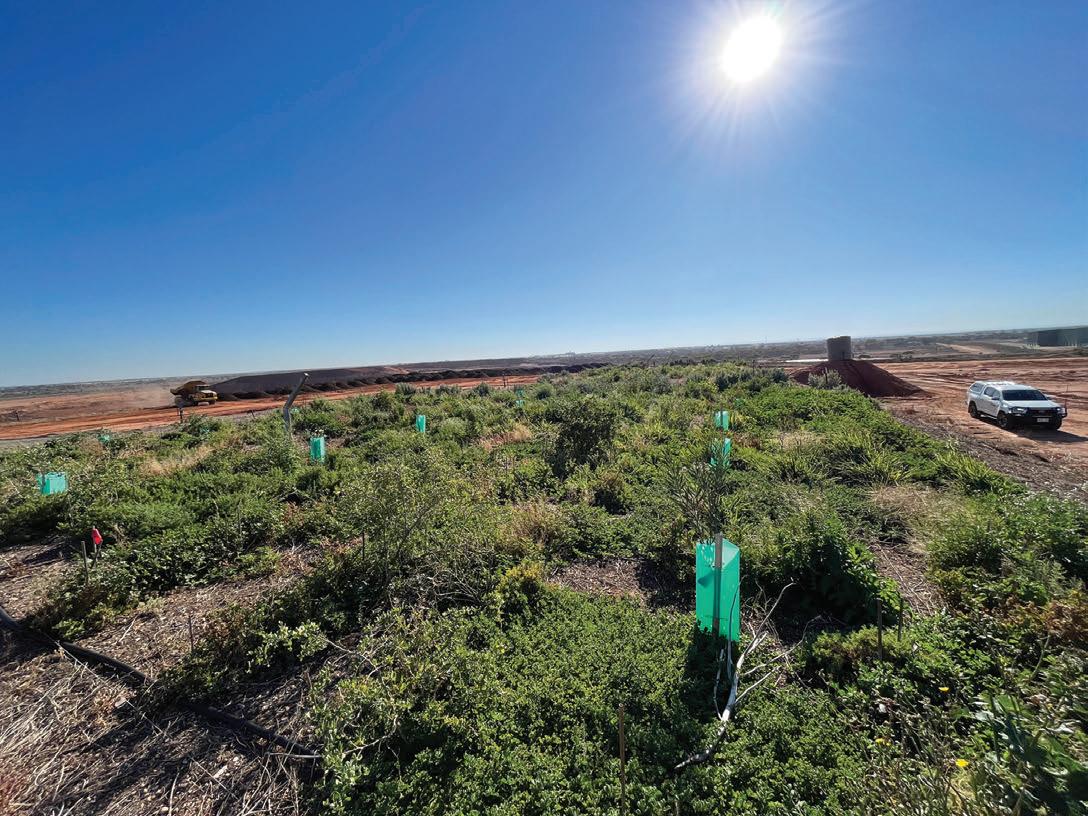
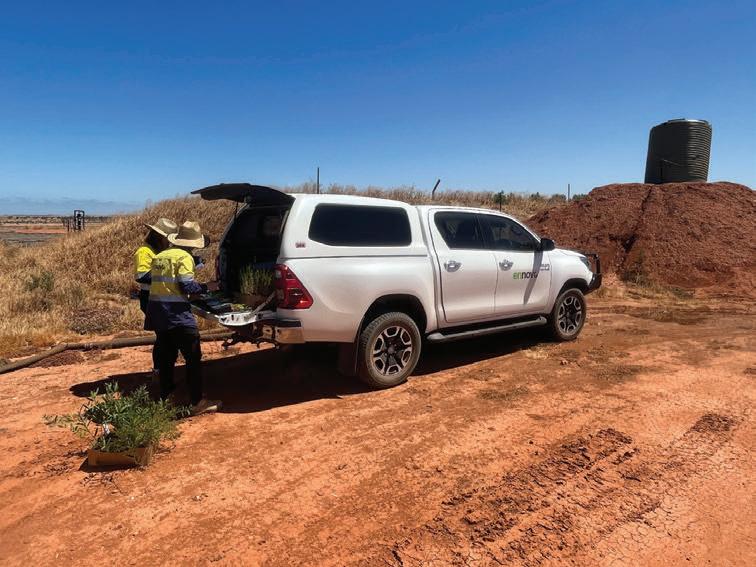
Ennovo has overseen the establishment of native plant species on landfill phytocaps under the harshest of weather conditions. Images: Ennovo
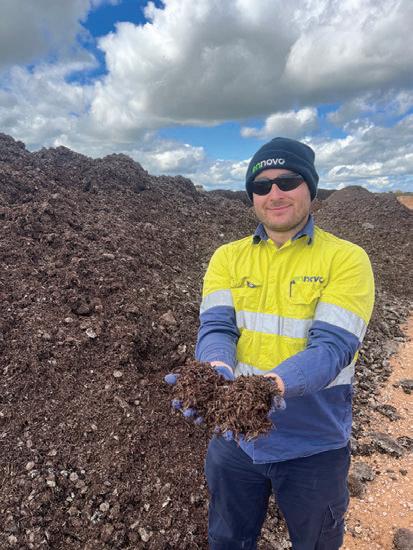
Ennovo technician ylan Simunsen on site.
development of recycled organics-based growing mediums to rehabilitate land lls for many years.
Ellie has overseen the establishment of native plant species on land ll phytocaps under the harshest of weather conditions.
“It was satisfying to see our seedlings get through some very tough times when they were trying to establish, and the use of recycled organics de nitely helped to get them through those early dry periods,” she says.
As part of Ennovo’s recycled organics division, Ellie works closely with the compost processing team to ensure the products required for the land ll cap are t for purpose.
Together with Dr Mitchell Hodgkinson, Technical Manager of the division, they ensure the required quality assurance speci cation is met – a critical consideration due to the volume of product required and the impact it has on the success of the rehabilitation strategy.
e bene ts of recycled organics in agricultural applications are well known. Ellie says that, in a similar fashion, these organics transform soil physics and biology to enhance land ll cap performance.
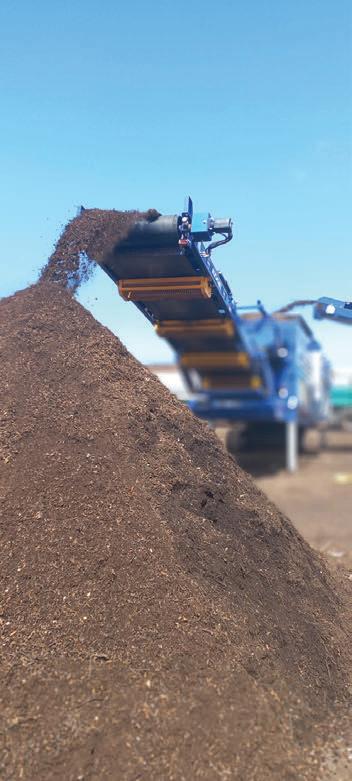
Compost blended with soil increases porosity, aggregate stability, and available water-holding capacity, supporting deeper roots and more vigorous growth.
In turn this improves water balance functionality in the land ll cap, enabling it to pump water back to the atmosphere and complete the cycle.
Ellie says it’s a much more e cient process in comparison to a soil or growing medium that is devoid of organic content. Additionally, land ll caps employing recycled organics, such
as a compost amendment within the soil pro le, together with surface mulch layers, also function as biocovers –oxidising methane via methanotrophic bacteria that thrive in moist, aerated, organic substrates.
“Using recycled organics in land ll caps is a textbook circular solution,” Ellie says.
“Home gardeners, landscapers and agricultural users of recycled organic mulch and soil amendments have received bene ts for many years, but the use of these materials in land ll caps, when designed correctly, can achieve all these bene ts and much, much more.
“Ultimately, they divert organic waste streams from being land lled and return carbon to soils as stable organic matter to support the establishment and ongoing growth of vegetation.”
She says expanding the use of quality-assured recycled organics into land ll rehabilitation provides a reliable, high-volume end market for the sector.
As Australia increases its organics recovery, the development of certi ed products will be critical for specialised applications like land ll caps and the establishment of healthy native ecosystems.
“For Australian land ll owners and designers, the opportunity is clear: we must pair robust design – focusing on water balance and native vegetation –with quality-assured recycled organics that meet local regulatory frameworks,” Ellie says.
“ e end result is a functional land ll cap that performs better hydrologically, resists erosion, and contributes to national organics recovery targets. By doing so, we rehabilitate a once highly impacted landscape and achieve a truly circular outcome.”
For more information, visit: www.ennovo.com.au
The recycled organics division works closely with the compost processing team to ensure the products required for the landfill cap are fit for purpose.
Ennovo has been involved in the development of recycled organicsbased growing mediums to rehabilitate landfills for many years.
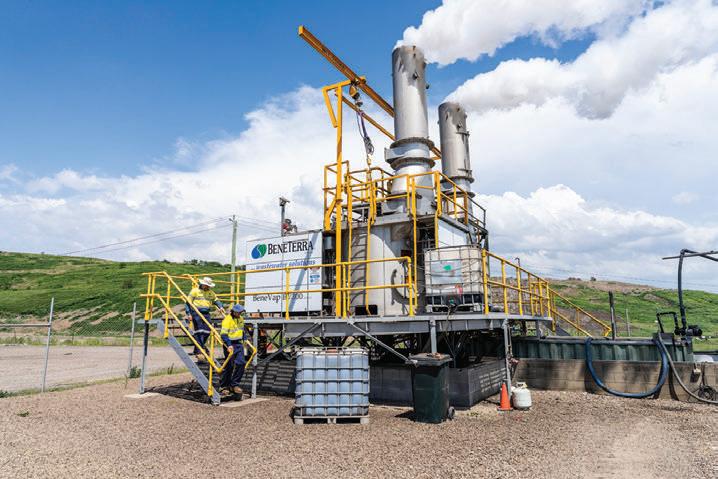
ene erra vaporisation technolog is treating land ll leachate at the so rce providing a localised compliant alternative to li id waste transport.
The management of land ll leachate has historically been one of the most persistent and costly challenges for waste operators across Australia and New Zealand.
For years, the default response to rising pond levels has been “pump and dump” – the expensive and carbon-intensive process of trucking liquid waste to municipal treatment plants.
However, as rainfall variability increases and wastewater facilities tighten their acceptance criteria, particularly regarding PFAS (per- and poly uoroalkyl substances) and other persistent contaminants, the industry is reaching a turning point.
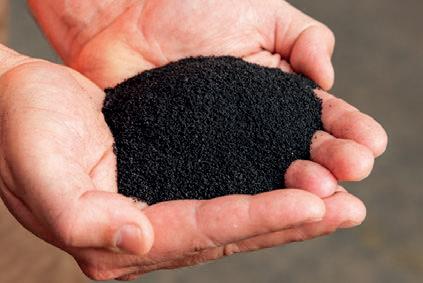
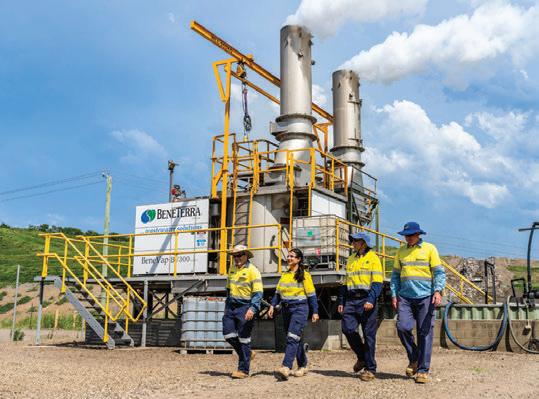
Enter BeneTerra’s BeneVap technology, an engineered vaporisation system capable of more than 90 per cent volume reduction.
e system works by using submerged combustion to heat leachate, vaporising the water component while keeping contaminants contained within the land ll’s existing footprint.
With 12 units now operational across Queensland, New South Wales, Tasmania, and New Zealand, the adoption of BeneVap is accelerating.
For Steve Winters, General Manager of BeneTerra, increased interest in the technology is a direct result of its ability to simplify a messy problem. By treating leachate at the source, operators can avoid road transport while maintaining strict environmental compliance.
Steve says the regulatory landscape has also played a role in BeneVap’s uptake.
In New South Wales, the Environment Protection Authority’s (EPA) granting of a mobile leachate treatment licence to BeneTerra has moved the conversation from whether the technology works to how quickly it can be integrated into a site.
“ e New South Wales EPA mobile licence was a massive milestone because it gives councils and private operators the certainty they need to act,” Steve says.
“It’s not just about having a machine that works; it’s about having a process that the regulator understands and supports. We’ve seen that once an EPA in one state provides that level of endorsement, other jurisdictions tend to follow suit because they are all facing the
same pressure to move away from liquid waste transport.
“It’s about creating a repeatable, compliant model that takes the risk out of leachate management for the site manager.”
He says the impact of BeneVap is best seen in regional applications where transport distances make traditional disposal economically unviable.
In a recent case study at Singleton City Council, the BeneVap system was deployed to manage a saturated land ll after several unusually wet years. e council was facing costs exceeding $1 million to haul leachate hundreds of kilometres.
By processing 1.6 million litres of leachate on site within ve weeks, the council not only saved seven gures in transport costs but also eliminated
BeneTerra’s BeneVap technology is capable of more than 90 per cent volume reduction.
Image: BeneTerra
75 heavy tanker movements from local roads.
is ability to respond to emergencies was also tested in the wake of Cyclone Debbie in Queensland, when a leachate breakthrough into a stormwater pond threatened to over ow, dumping contaminated water into the local environment.
Steve says BeneTerra deployed a unit within two weeks, restoring the pond’s capacity and saving the council 75 per cent compared to the cost of osite disposal.
“Environmentally, this is by far the most bene cial thing an operator can look at because it ensures all contaminants stay in the land ll where they belong,” he says.
“Leachate is an incredibly complex cocktail of every contaminant you can imagine, and traditional water treatment
plants often struggle to maintain consistency or get up and running at all.
“Our system is a single-stage process that manages that complexity with very little maintenance. We are seeing a move away from massive treatment plants toward modular, reliable units like the BeneVap.”
He says the economic bene ts are also a primary driver for adoption. As fuel prices and gate fees at sewerage treatment plants increase, so does the attractiveness of the “cents-per-litre” cost of on-site vaporisation. And the ability to hire or purchase units gives land ll operators the exibility to manage their budgets according to their speci c needs, whether they are looking for a temporary x for a wet season or a permanent solution for land ll sites.
Steve says as BeneVap continues to gain momentum, the focus is
shifting toward long-term operational control with repeat purchases from existing operators.
“We’ve worked really hard over the past few years to show that this isn’t just a temporary x but a sophisticated engineering solution for a permanent problem,” he says.
“Whether it’s a small regional council or a large metropolitan land ll, the feedback is consistent: they want something that just works without requiring a team of chemists to babysit it.
“By keeping the contaminants on-site and only releasing clean water vapour, we’re helping the industry close the loop and manage their liabilities in the most sustainable way possible.”
For more information, visit: www.beneterra.com
Councils, recover more from your hubs
One
partner
- all the tricky stuff handled; small or large quantities, any drop-off
Sustaining generations
Sustainable Generation Founder Scott Woods explains how shifting from waste management to product manufacturing is transforming global organic recycling infrastructure.
In the traditional waste industry, a land ll is often viewed as a cash register – a front-end business where revenue is collected at the gate and the story ends once the material is buried.
For Scott Woods, the Founder and Chief Executive O cer of compost technology company Sustainable Generation, this model is deeply awed because it ignores the inherent value of the material.
Since launching Sustainable Generation in 2012, Scott has operated under a philosophy that challenges the very vocabulary of the sector.
“ is wasn’t about handling waste, it was about manufacturing products,” Scott says.
“In the United States, we would call them bene cial reuse products, but it is about manufacturing highquality products that turns waste into
something that is useful, speci cally into soil amendment products.” is mindset shift from disposal to manufacturing is the cornerstone of Sustainable Generation’s history.
Scott entered the waste industry in 2008 as an owner-operator, but after selling his interests in 2011, he identi ed a signi cant gap in the market. While technology providers were selling equipment, he says they weren’t providing the business acumen, technical knowledge or service required to handle increasingly di cult feedstocks, such as food organics.
He saw that as global diversion mandates tightened, operators needed more than just a machine; they needed a sophisticated manufacturing process.
At the heart of this process is the adoption of GORE® Cover technology. Scott describes the GORE Cover as a “disruptive force” that provides total environmental compliance.
By using an encapsulated oxygencontrolled system that only activates when microorganisms need air, the technology delivers high-level process control with minimal energy consumption.
“ e Gore cover is a pollution control device that delivers the performance of an in-vessel solution without the need for the building or the bio- lter,” Scott says.
“You’ve got lower capital costs because you have a cover, not a big
Scott Woods, Sustainable Generation Founder and Chief E ecutive Officer. Images: Sustainable Generation
metal structure, and you don’t have this bio lter that has this big fan just sucking energy 24/7. When I saw the GORE Cover, I said, ‘this is brilliant’.”
Despite the technological advantages, Scott says the industry was haunted by a “buy cheap, buy twice” mentality. He observed that many compost operators would opt for the lowest upfront price only to nd the technology failed to meet environmental standards.
To combat this, he modelled his service organisation after iconic brands such as John Deere and IBM, ensuring that clients were never left stranded after the initial sale.
“I remember my dad and my grandpa, who were farmers, saying if you buy from John Deere, they give you all the service you need and you’re not going to fail,” Scott says.
“Well, you can fail, but you’re going to do it on your own, not because of their equipment. I said we’re going to model our service organisation after John Deere;
we want to be the John Deere of the composting industry.”
is commitment to reliability has seen the company expand into ve countries, including a signi cant recent push into the Australian market. Scott views Australia as a prime region for growth, driven by the national mandate to halve the amount of organic waste sent to land ll by 2030.
By treating organic waste as a raw material for a manufactured product rather than a liability to be buried, he says the industry can create a self-sustaining, pro table, and environmentally sound future.
However, Scott remains methodical, often using pilot programs to help councils and private contractors validate their business models before committing to full-scale infrastructure. He believes the build-out of this new recycling grid will be a generational task.
e mission is also deeply personal. As a fourth-generation Montana farmer
whose family has worked the same land since 1911, Scott views composting as the essential link that closes the organic loop. By returning nutrients to the soil, the industry isn’t just managing a problem; it is ensuring the longevity of the land for those who follow. is connection to the earth informs the legacy he hopes to leave behind.
“I think we’ve raised the bar on organic recycling when it comes to environmental compliance, and our technology is driving regulations,” Scott says.
“You’ve got to really think about the future generations. We’re only here for a short period of time, and I always like to say, when I get up there to the gates of heaven and St Peter says to me, ‘why should we let you in?’ I’m going to point to Sustainable Generation and say we’ve left the world in a better place because of what we did.”
For more information, visit: www.sustainable-generation.com
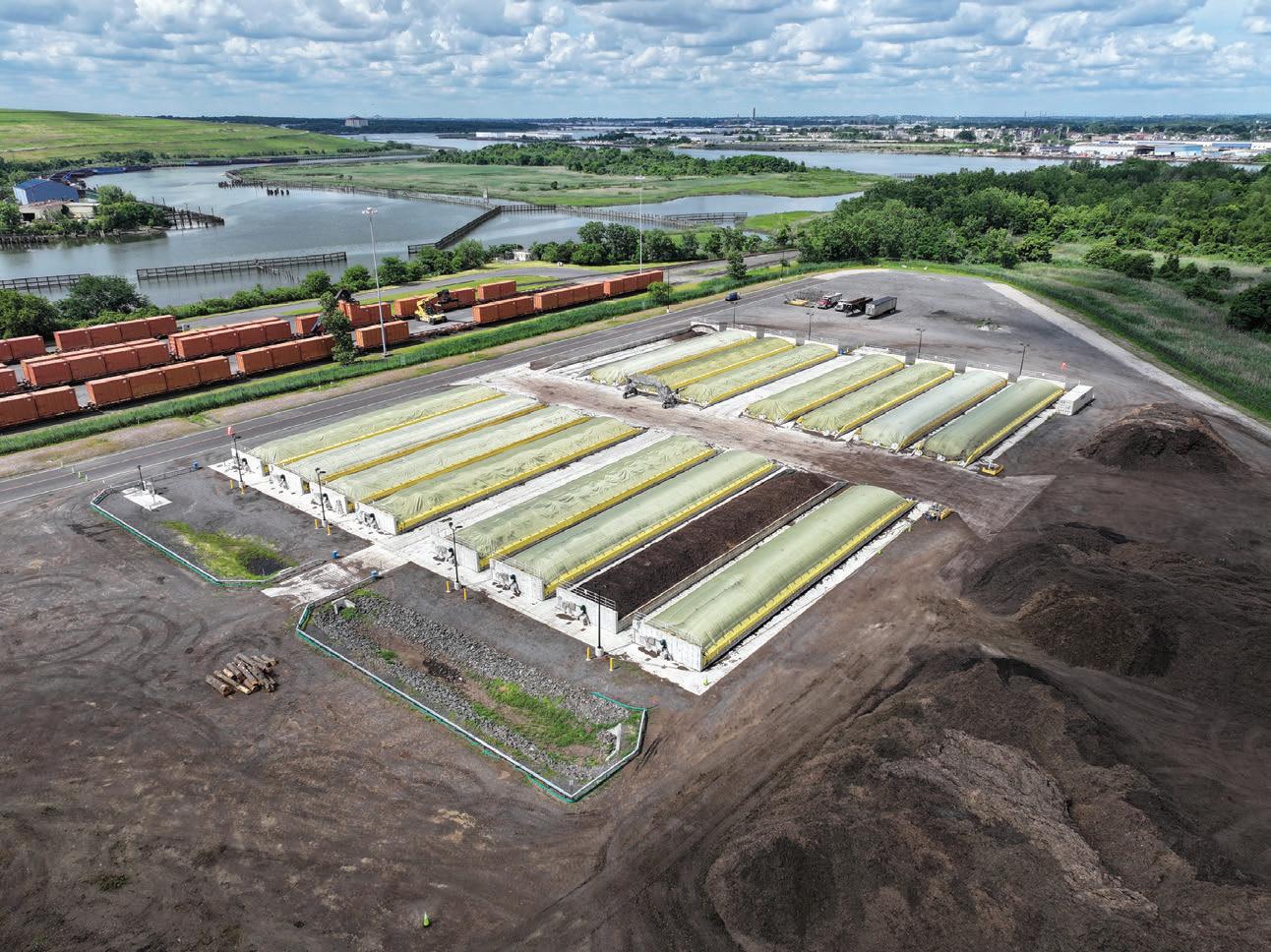
Staten Island Compost Facility, Department of Sanitation New York City where 50,000 million tonnes per annum of FOGO is processed using the S unker System at a landfill.
BThe whole package
tt r ant ipment recentl s pplied a rand new land ll compactor to a key waste management player in Queensland.
OMAG has been active in the manufacture of soil compaction, asphalt and refuse material technologies since 1957. e German Original Equipment Manufacturer (OEM) has engineered more than 250 products since its inception, which are available in about 150 countries and supported by more than 2500 employees worldwide.
In Australia, construction equipment dealer Tutt Bryant Equipment is the exclusive distributor of BOMAG products.
“ ere’s an enormous market for BOMAG solutions in Australia,” says Ryan Pavia, Tutt Bryant Government & Sales Representative Central Queensland.
“ e brand is very well-adapted across most of, if not all, the infrastructure projects in the country.
“Its machines are equipped with the right packages and hydraulic technology for what this market needs.”
decades of distributing BOMAG equipment its team has supplied
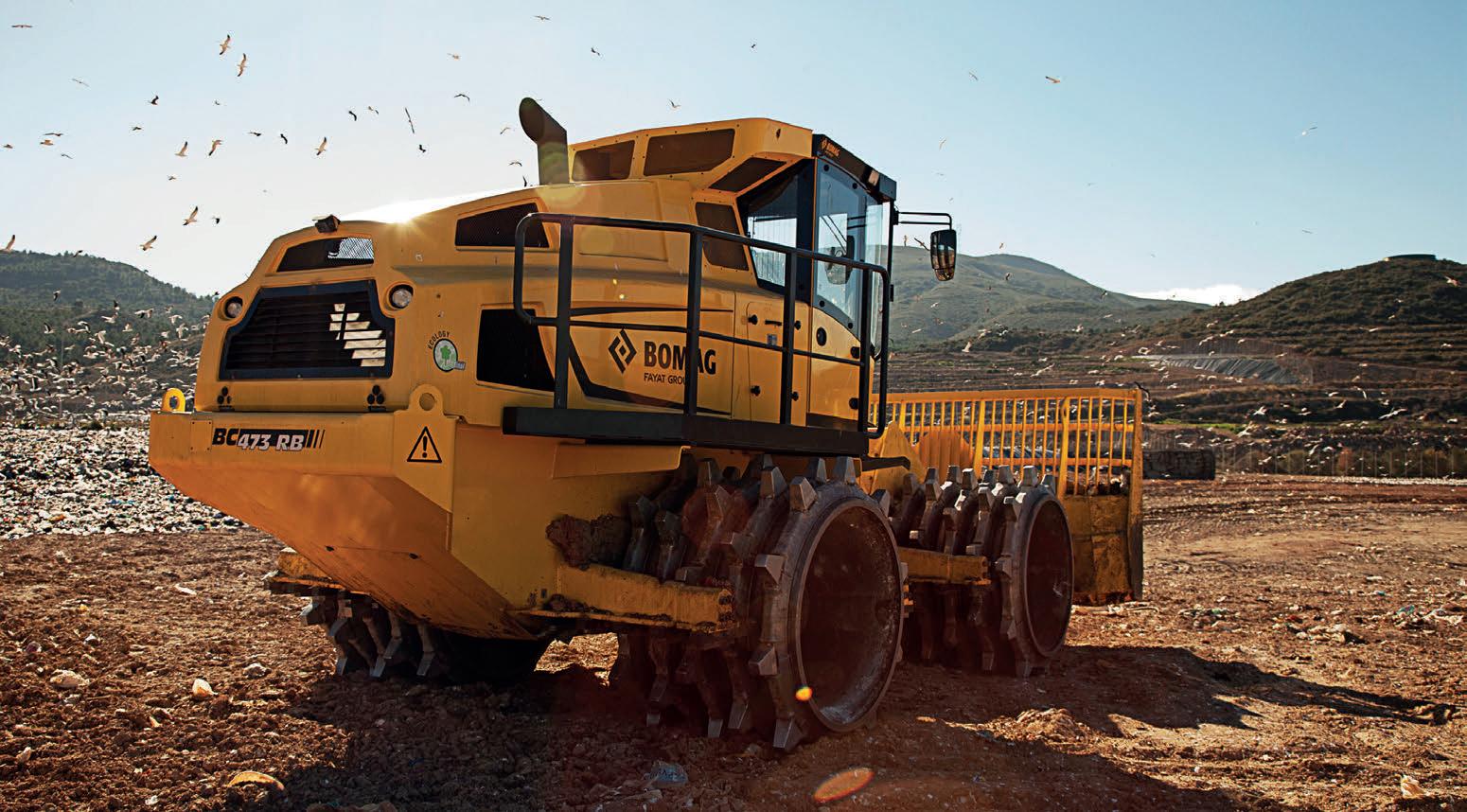
products to local governments and private contractors requiring compacting needs. Most recently, this included the supply and delivery of a BOMAG BC473RB compactor to Wanless Waste Management in Far North Queensland.
Ryan says Wanless has previously used an older second-hand BOMAG compactor – a BC772RB-4 – but upgraded its equipment after being awarded a contract for a new land ll.
“Wanless looks after a number of waste management sites around the state and was recently awarded a few more sites to work in – one of them being the Proserpine land ll in the Whitsunday Regional Council area,” he says. “ ere’s a bit of contrast between BOMAG’s old BC772RB-4 compactor and the new BC473RB compactor, and the machine we’ve just supplied Wanless has a lot to o er.”
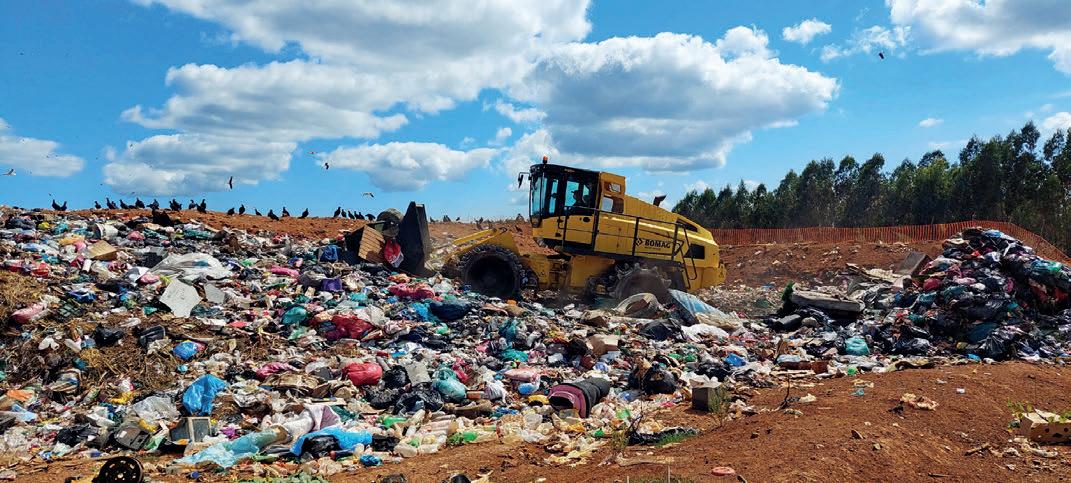
e BOMAG BC473RB is built to move and compress large piles of waste to create more room and air space for
more of it you create the more waste a land ll cell can take, and the longer it can remain open.
“Land ll operators are always trying to achieve compaction density – having the material packed down as much as possible, so this space can be made.
“ is process extends the operational life of a land ll and improves overall site e ciency.”
e BOMAG BC473RB delivered to Wanless has a range of customised features including a semi-U-blade as opposed to a typical dozer blade. e blade’s longer and curved build allows the compactor to move a greater volume of waste.
e compactor is powered by a high-performance, six-cylinder Deutz turbo diesel engine that meets Tier 3 emission standards to minimise environmental impact.
A standard twin pump, quad-drive hydrostatic drive system provides constant traction across all four wheels,
Wanless Waste Management ordered its BOMAG BC473RB with a variety of mechanical customisations. Images: Tutt Bryant Equipment
is manoeuvrability is strengthened by BOMAG’s 35-degree articulation steering angle and 15-degree oscillation angle, both of which ensure the compactor’s wheels maintain ground contact on even and uneven terrain.
Ryan says that combined, these capabilities enable operators to push both uphill and downhill with strong traction and control.
BOMAG’s polygon wheel design also creates a kneading e ect on the waste as they rotate, while compaction teeth (with a wear warranty of 10 years or 10,000 operating hours) help to break the waste down.
e land ll compactor’s mechanics are supported by wide service catwalks and a power-assisted bonnet to make daily servicing quick and safe.
ese features, along with a tried-andtrue history with BOMAG as an OEM, make Wanless excited to put the new compactor to the test.
“We’ve worked with BOMAG equipment for a number of years, and it’s consistently delivered for us – reliable, e cient and built for the demands of
“Machines are equipped with the right packages and h dra lic technolog for what this market needs.”
Ryan Pavia Tutt Bryant Government & Sales Representative Central Queensland
land ll operations,” says Frank Phillips, Wanless Regional Manager.
“ is is the rst brand-new unit we’ve invested in, which re ects both the scale of the opportunity in Far North Queensland and our con dence in the product.
“For our Proserpine site, this compactor will play a critical role in maximising airspace and extending the life of the land ll, which is ultimately a win for the Whitsundays’ community.
e more e ciently we can operate, the longer we can keep the facility open and delivering value for ratepayers.”
e compactor was delivered to site by Tutt Bryant’s heavy asset transport supplier, ColPack.
“ColPack specialises in moving machines like the BOMAG land ll compactor, so it was a very comfortable process,” Ryan says. “ ey took the equipment straight to the Proserpine land ll so it could begin operations immediately.
“Our commitment as distributors is to keep clients supported, limit downtime and be extremely responsive with servicing the equipment if matters arise.
“ e land ll compactor delivery was a great success, and we’re looking forward to assisting Wanless with further equipment needs.”
For more information visit: www.tuttbryant.com.au
The OMA C R landfill compactor was delivered to the Proserpine landfill by Tutt Bryant Equipment’s heavy asset moving contract service.
Versatility, control and reliability Built for modern waste operations.
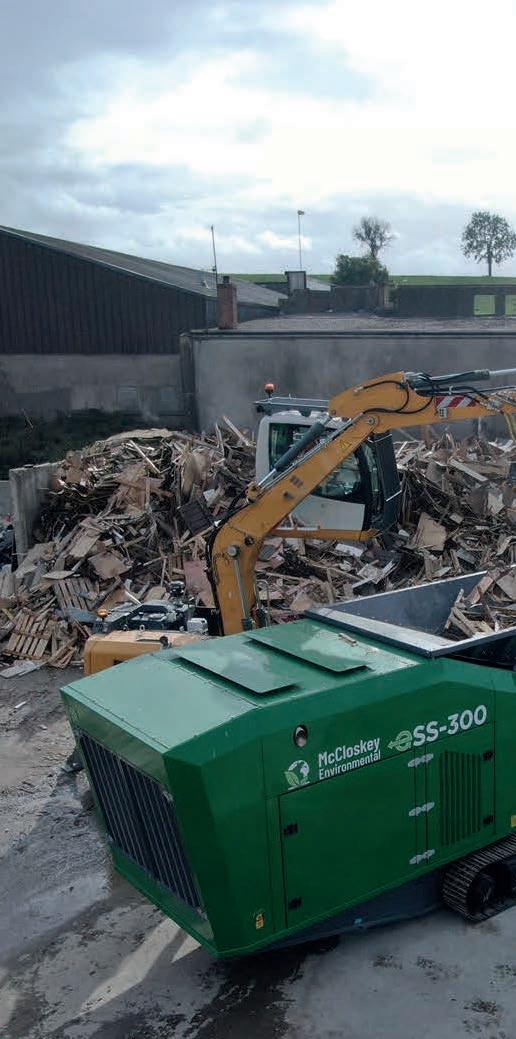
Proudly distributed by Tutt Bryant Equipment, the ESS-300 is a versatile tracked primary shredder built to handle highly variable waste streams with efficiency and reliability. Designed for materials that vary in size, composition and difficulty to shred, it delivers consistent performance in demanding waste and recycling operations.
An aggressive single-shaft cutting system prevents material bridging and maximises throughput, while quick-change meshes, accessed via a hydraulically operated side door, allow fast adjustment of output size. Combined with intelligent controls, fuel-efficient hydraulics and robust tracked mobility, the ESS-300 is a flexible, high-uptime solution for modern processing plants.
At the intersection of waste and energy
As the waste sector evolves, the distinction between a “dump” and a “power plant” is becoming increasingly blurred.
Land lls have long been viewed by local governments as static environmental liabilities, de ned more by their odours and emissions than by their potential.
However, as Australia accelerates toward its target of net zero pollution by 2050, and a 43 per cent reduction by 2030 (compared to 2005 levels), a shift in thinking is transforming these sites into high-performing clean energy assets.
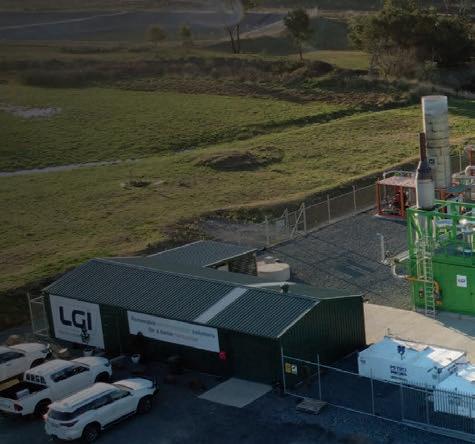
LGI, a premier service provider in the sector, is helping to drive the transition by bridging the gap between waste management, sustainability, and the renewable energy market.
By partnering with councils and private waste management companies across eastern Australia, the company is proving that modernised land ll gas (LFG) projects can o er immediate
and scalable solutions. At the core is the ability to capture methane – a potent greenhouse gas – and repurpose it for bene cial use.
Because there is no “one size ts all” solution to carbon abatement, LGI provides tailored infrastructure speci c for each site ranging from simple aring to full renewable hybrids.
“Land ll biogas projects are not static assets – they must be nurtured and can evolve,” says Jarryd Doran, Chief Executive O cer of LGI. “With new technologies, smarter controls and targeted investment, even longestablished systems can deliver more abatement and energy value.
“For land ll owners, the model is compelling because LGI funds, builds, operates and maintains the entire system as well as ‘chasing the gas’ by
expanding the system as the land lls grow. is partnership model allows local governments to slash their carbon footprint, while receiving a share of the generated credits (which can be used as o sets or for revenue) and a share of any power revenues.”
e Australian Carbon Credit Unit (ACCU) scheme awards carbon credits for creating additional abatement, including by destroying methane from land lls.
e Reducing Methane Emissions from Land ll Gas 2025 Method, e ective from 28 November 2025, implements recommendation 10 of an Independent Review of ACCUs requiring projects to increase capture e ciency over time to maintain the same level of credits. Jarryd says the methodology provides the regulatory
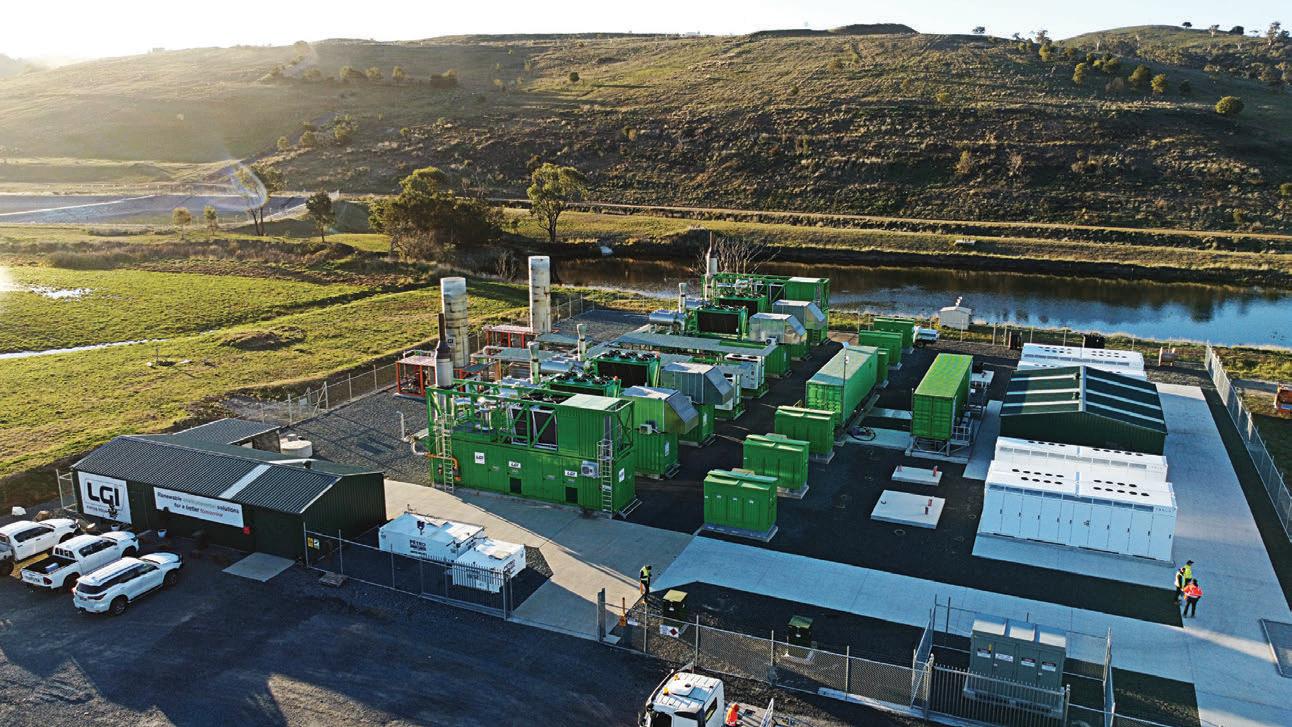
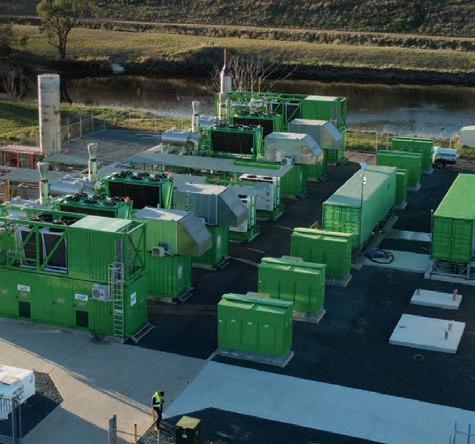
The Mugga Lane landfill in the ACT was e panded in into a -megawatt Renewable ybrid pro ect. Images: L I
certainty and transparency needed to drive new investment.
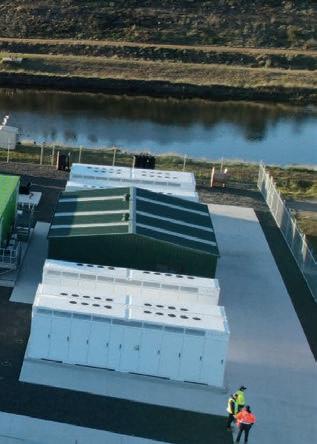
e Mugga Lane Land ll in the ACT is a good example. Established as a traditional gas collection system, the site has been upgraded and expanded into a 20-megawatt Renewable Hybrid project since LGI began operating it in 2020. e upgrade includes the integration of six megawatt power generation, with a 12-megawatt-hour Battery Energy Storage System (BESS) and LGI’s proprietary Dynamic Asset Control System (DACS). e technology allows the facility to store renewable energy and dispatch it during periods of high demand, directly supporting grid stability.
“Modernising legacy systems can dramatically increase methane capture and generate dispatchable renewable power to support regional economies,” Jarryd says. “Our approach delivers immediate, measurable, and permanent carbon abatement that improves local air quality and reduces site odours for the surrounding community.
“By driving new technologies and methodologies, such as BESS and DACS, we are turning sites into contributors to Australia’s clean energy future. is is not about solutions that are decades away; this is about reducing greenhouse gas emissions today and expediting a smoother transition to renewables.”
To date, LGI has abated more than nine million tonnes of carbon and generated 746 gigawatt-hours (GWh) of clean energy. e Mugga Lane project has abated 1.68 million tonnes of carbon dioxide equivalent and created 393,000 ACCUs, while generating enough electricity to power more than 10,800 homes annually.
Jarryd says for many regional councils and private waste management companies, the attraction of the LGI model is the removal of technical and nancial risk. Land ll gas management
requires specialised engineering and constant monitoring. By outsourcing these operations organisations are assisted in meeting their compliance requirements and maintaining site e ciency without diverting funds from other essential community services.
e resulting abatement is permanent and veri able, providing a transparent record of an organisation’s commitment to sustainability.
“LGI is expediting the energy transition by transforming land lls into high-performing clean energy assets,” Jarryd asserts. “Our exible, scalable model can be replicated across land lls of all sizes – from small regional enclosed aring projects to large renewable hybrid projects – providing a proven, measurable and immediate solution to the climate challenge. We want to ensure we leave a site with a legacy of environmental improvement and energy security.”
For more information, visit: www.lgi.com.au
L I has abated more than nine million tonnes of carbon and generated gigawatt-hours of clean energy.
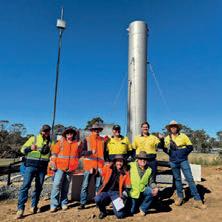
Southern owns Regional Council and L I staff at arwick landfill.
Building tyre recycling economics
As he prepares to appear before a parliamentary inquiry into the state of Australia’s t re ind str rec cle hief ec tive cer im airweather calls for mandator market-based regulation and increased government procurement.
“We don’t want a single tyre dumped in Australia,” says Jim Fairweather, Chief Executive O cer of Tyrecycle. “But collection and schemes are not enough, you must create demand.”
It’s an uncompromising objective that underpins Tyrecycle’s formal submission to a parliamentary inquiry into the state of Australia’s tyre industry. e inquiry, by the Standing Committee on Industry, Innovation and Science, was adopted on 5 November 2025 following a referral from the Minister for Industry and Innovation, and the Minister for Science.
Its remit is to investigate the current state of the Australian tyre industry and identify any challenges and opportunities for the industry within the context of a circular economy.
Jim says it’s an opportunity to address the market failures that currently leave a signi cant portion of Australia’s tyre waste buried or abandoned and to steer the conversation toward the economic triggers required to make the circular economy a reality.
“ ere’s a misconception that markets are created by extended producer responsibility (EPR) schemes. ey’re not,” Jim says. “Just because you have an element to collect tyres doesn’t mean you have a way to dispose of them.”
Jim says Tyrecycle is supportive of the inquiry, regulation and a mandatory market-based stewardship approach, but wants that approach to focus on where there is a market failure – o -the-road (OTR) or mining tyres.
A central pillar of Tyrecycle’s submission to the inquiry is the disparity between di erent sectors of the waste stream. While passenger and truck tyres have a 96 per cent collection rate, the OTR sector – dominated by mining and agriculture tyres – tells a di erent story.
OTR tyres represent nearly 30 per cent of Australia’s total tyre waste by weight. In 2023-24 the recovery rate was 13 per cent, according to the Tyre Stewardship Australia’s submission to the Productivity
Commission. Jim says the circular economy cannot function e ectively while such a large volume of feedstock remains outside the recycling loop.
“If we want to reach national waste targets, then we have to make sure we do something about OTR tyres,” he says.
“ e practice of allowing land lling of OTR tyres and in-pit disposal at mines is the most signi cant regulatory barrier to circular economy outcomes.”
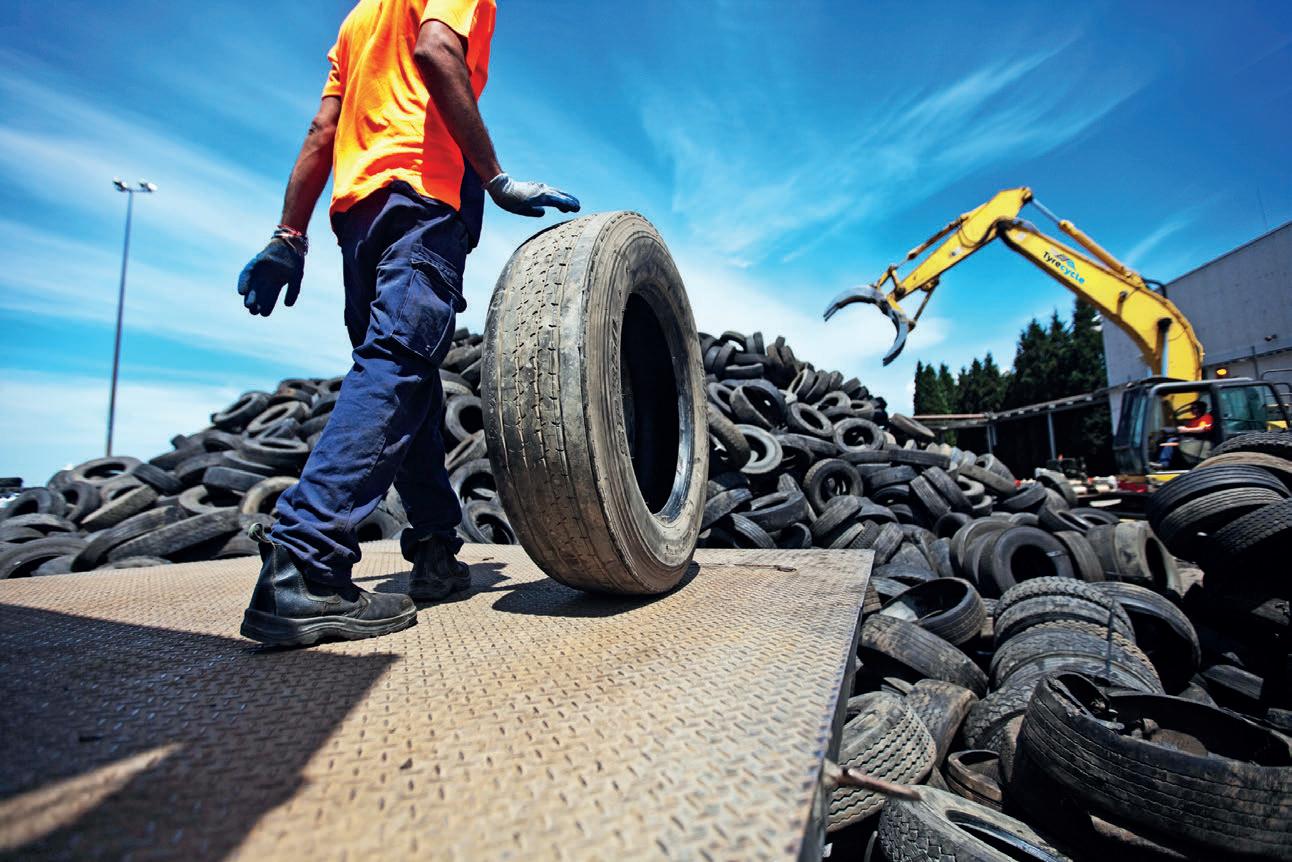
Part of the ResourceCo Group, Tyrecycle is Australia’s leading and only national tyre recycler, processing in the order of 20 million equivalent passenger units (EPU) of waste tyres annually –about 40 per cent of the total collected in Australia, and about 55 per cent of the retail market.
e company’s submission advocates for a mandatory, market-based tyre stewardship approach that holds all participants accountable, including “free riders” who don’t participate in the current voluntary scheme.
Jim says evidence suggests that centralised bureaucracies often prioritise collection targets over the actual creation of end-markets, leading to ine ciencies.
“ is is all about economics, and this is what this inquiry is about.”
To bridge the gap in the OTR sector, Tyrecycle has proposed the implementation of targeted land ll bans that would act as an immediate trigger to redirect mining and agricultural tyres into
Tyrecycle has invested more than $50 million in capital upgrades to expand domestic capability.
the hands of recyclers. It also emphasises the “demand side” of the equation, calling for an increase in government procurement of crumb rubber for road construction.
Australia’s road construction sector consumes about 30,000 tonnes of crumb rubber annually – one of the strongest markets globally – while Tyrecycle is advancing a pipeline of more than 100,000 tonnes per annum in domestic tyre-derived fuel (TDF) from end-of-life passenger tyres.
Jim says this market-led growth in domestic demand demonstrates that the industry is driving sustainable outcomes for waste tyres and improved market resilience through businessled innovation, without the need for centralised intervention.
However, he says continuous improvement is critical. By mandating higher recycled content in asphalt speci cations, the government could create a domestic market ve times its current size.
e logistics of recycling are also no longer the primary barrier. Tyrecycle has invested more than $50 million in capital upgrades to expand domestic capability, including a strategic push into the OTR market with a $12.8 million investment
in Port Hedland, Western Australia, alongside developments in Rockingham, and Newcastle and Erskine Park in New South Wales.
Tyrecycle plants are equipped with advanced rubber re-manufacturing capability, processing in the order of 20 million tyres per annum with a recycling rate of 99 per cent, producing high quality repurposed material for the local and global market.
e company is working with mining customers to align disposal costs with their nancial planning, while calling on the government to hold generators accountable for their waste.
e submission also points to the need for better enforcement of existing laws.
Jim says rogue operators who export non-compliant, low-quality tyre products often use substandard equipment that cannot mechanically produce export-compliant materials, allowing them to operate at a lower cost than legitimate recyclers.
Tyrecycle is urging the Federal Government to allocate more budget for the enforcement of export regulations to ensure a level playing eld.
Ultimately, the submission frames the circular economy as a shared responsibility. While recyclers provide the
technology and capacity, the government is being encouraged to provide the regulatory framework and procurement appetite, and waste generators ensure the tyres they dispose of go to the legitimate recycling industry to ensure circular economy outcomes can be realised.
“We want to see regulation at the right pace and in the right timeframe to ensure that we can direct so much of that waste into the hands of recyclers,” Jim says.
“We have to call all waste generators to account and ensure they manage their waste and dispose of it appropriately and environmentally soundly.”
Jim presented Tyrecycle’s submission to the parliamentary inquiry in March.
For more information, visit: www.tyrecycle.com.au
Tyrecycle processes about 20 million equivalent passenger units of waste tyres annually – about 40 per cent of the total collected in Australia.
Images: Tyrecycle
Tyrecycle plants are equipped with advanced rubber re-manufacturing capability.
Fuelling Australia’s circular sovereignty
The industrial landscape of Kandos, New South Wales, is set to become the frontline of a new kind of national defence: resource independence.
While Kandos was historically synonymous with the cement that built the Sydney Harbour Bridge, its future lies in addressing the modern vulnerabilities of fuel and food security.
e ongoing transformation of the former cement works by Australian-owned company Cenagen will help strengthen the nation’s domestic authority in an increasingly unstable global market, says Jason O’Sullivan, Cenagen Chief Executive O cer.
By converting waste into high-value methanol and horticultural outputs, the $1 billion facility can help toward insulating Australia from international supply shocks while solving the challenge of dwindling land ll space.
Cenagen’s model uses advanced gasi cation – applying high heat in a low-oxygen environment – to break down Process Engineered Feedstock (PEF) into
its molecular components. is feedstock is derived from residual municipal and industrial waste that cannot be recycled. is produces a low-carbon liquid fuel – green methanol – a form of sustainable transport fuel that can be used as an alternative to fossil-based fuels.
e prospect of reducing the greenhouse gas emissions of transportation fuels has generated high demand by the world’s shipping industry, which is heavily reliant on fossil-based fuels.
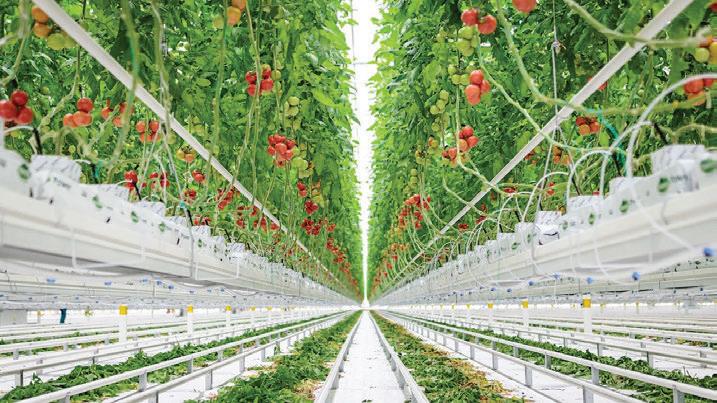
Beyond fuel, the facility will also include a large-scale, 10-hectare enclosed greenhouse complex, using captured and puri ed food-grade carbon dioxide from the methanol production process to grow fresh produce and cut owers.
Jason explains that the facility will ensure that the molecular building blocks and nutrients trapped in waste streams are reclaimed, to fuel and feed the country, rather than being buried in the ground.
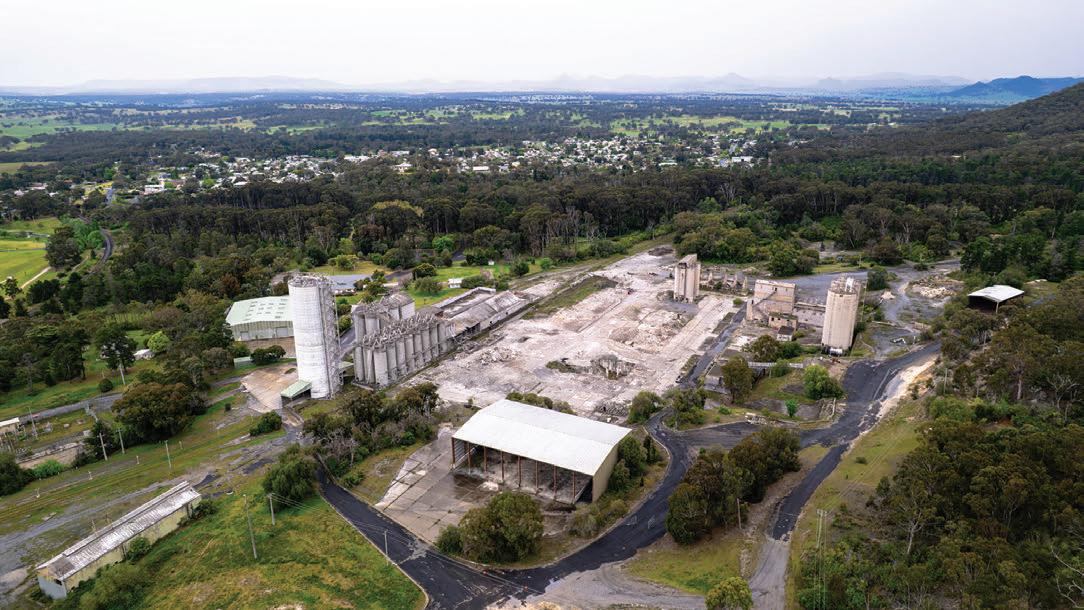
The former cement works site as it stands now. Images: Cenagen
The facility will include a large-scale enclosed greenhouse complex to grow fresh produce.
“Sovereignty is the key, whether it is fuel or food, and simply lowering our reliance on overseas imports,” he says.
“Our project addresses several issues by turning waste into a resource to produce methanol for the shipping industry. is eases pressure on the domestic fuel system, helping to stabilise costs and reduce import dependency.
“It is all intertwined; fuel and food costs eventually impact the consumer at the supermarket.”
Since the project was rst announced, Cenagen has focused on community advocacy and transparency.
Recognising that large-scale industrial shifts require social license, the company has launched a dedicated Visitor Information Centre in the heart of Kandos.
e centre features a physical miniature model of the plant, allowing residents to visualise the scale of the project.
Jason says the company wants to “ ip the script” on the relationship between big industrial projects and small towns, ensuring the local community is part of the transition. And he says community interest is already high, with initial consultation sessions being lled so quickly that additional dates were scheduled.
ere’s also an appetite for the 300 to 350 long-term jobs the facility is expected to create – roles that range from tters and mechanics, engineers, lab technicians to horticultural positions.
“We want to have a positive impact on the community economically and environmentally, acknowledging the history of the town while steering it in a completely di erent direction,” Jason says.
“By modernising waste treatment through advanced resource recovery, we are transforming a national liability into a strategic resource. is approach breaks waste down to its molecular components, delivering a permanent carbon abatement solution that improves air quality while replacing the archaic land lling with a sophisticated, net-zero industrial system for the future of Kandos.
“Ultimately, our goal is to ensure that when we work with a community, we leave a lasting legacy of environmental improvement, resource sovereignty, and economic opportunity for the future.”
e facility is designed to be a “zerowaste”, net-zero emissions operation with no residual waste or water discharge from site. Every output is a resource.
By-products include green methanol to help decarbonise shipping; vitri ed
rock for construction and engineering applications; elemental sulphur to be sold to agriculture businesses as a fertiliser, and liquid carbon dioxide used to enrich the onsite greenhouse complex.
While much of the feedstock will arrive via rail from Sydney, the plant aims to manage 100 per cent of the local Mid-Western Regional Council’s waste.
e project has recently achieved regulatory and technical milestones, including the granting of Australian patents for its integrated process. Cenagen is now moving into the formal planning phase with the launch of its scoping report.
“We are seeing a profound shift in thinking today; as a society, we are far more considerate of the footprint we leave behind and are rightfully rejecting a land ll legacy for future generations,” Jason says.
“While our waste challenges are immense, the solution lies in no longer treating waste as a burden that needs to be buried but as the foundation for Australia’s fuel and food independence.”
For more information, visit: www.cenagen.com.au
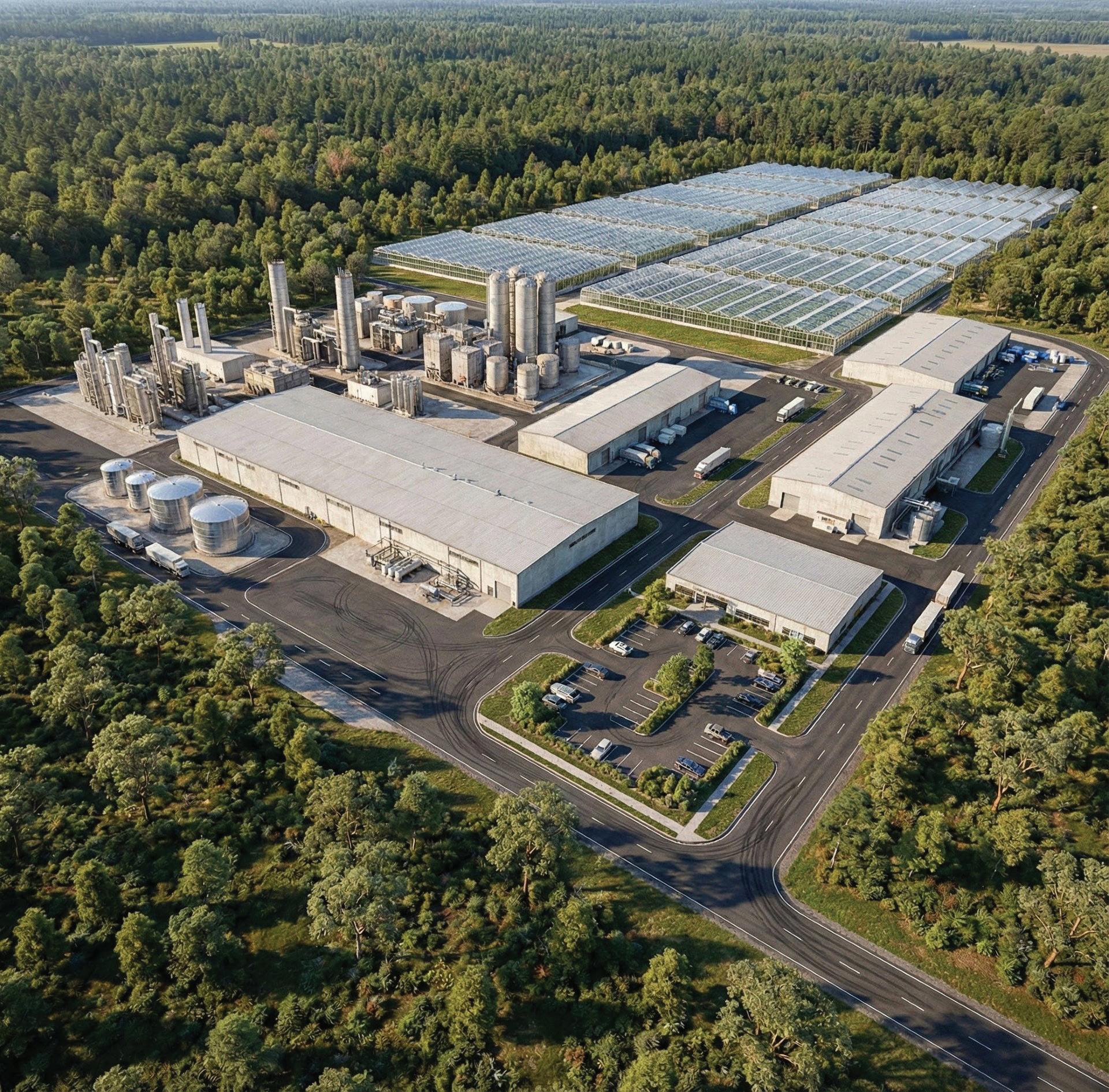
A render of the methanol production facility.
Gaining ground
Van Schaik’s Bio Gro has expanded its growing media, mulch and compost production with a new packaging plant in Victoria.
Hans and Marjan Van Schaik ran a small earthmoving business just outside Mount Gambier, South Australia in the 1970s, which was entrenched in the town’s timber and forest industry.
e pair worked with and around pine bark, sawdust and various organic chippings – materials that were regarded as waste products at the time, until Hans decided to try and reuse them.
“ rough some clever initiative, my dad went about recycling that material,” says son Stephen Van Schaik. “ at move could be considered organic recycling well ahead of its time in that sense.”
is move birthed Van Schaik’s Bio Gro (Bio Gro), an Australian familyowned company that has engaged in the production of growing media, mulches and composts for generations.
Stephen, the company’s Managing Director, has steered Bio Gro through decades of partnership and expansion –such as its alignment with the Australian Recycling Organics Association (AORA).
“Bio Gro was part of an organisation called Compost SA in 2008, which was composed of the three largest
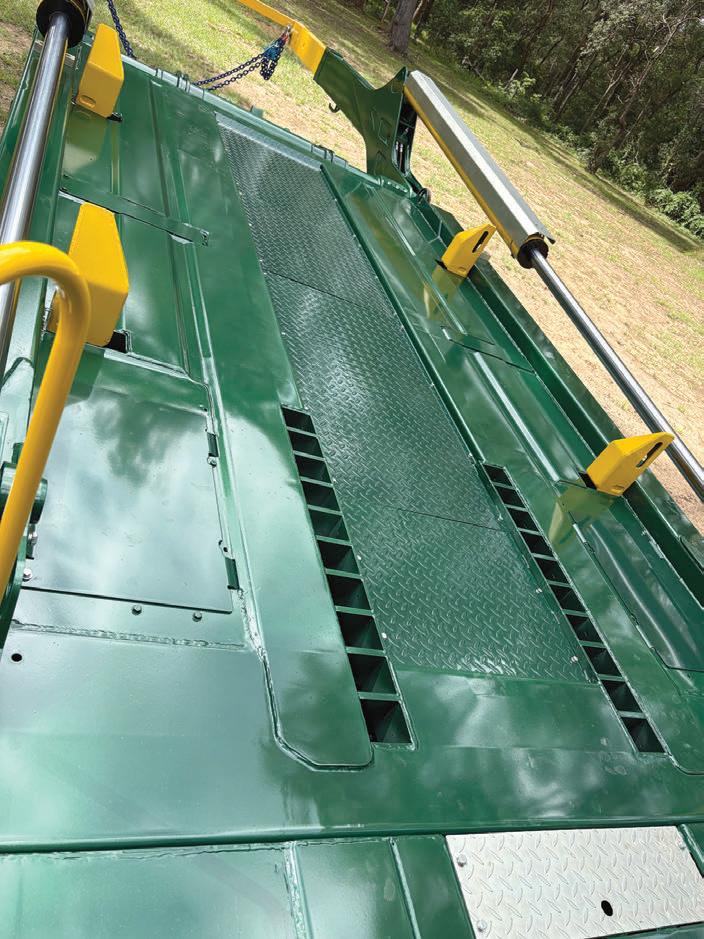
composters in the state,” Stephen says. “Other companies in other states were aiming to do a similar thing, so we all decided to meet in Canberra and discussed forming a national group, which ultimately became AORA.
“I enjoy our membership with AORA because the association provides many opportunities for people to engage with the wider organic recycling and sustainability world. It also supports what Bio Gro does and also helps share our mission.”
Bio Gro now recovers and processes in excess of 400,000 tonnes of organic residues per annum including timber and forest residues, liquid organic residues and food organics and garden organics (FOGO).
“We have the ability to accept and process all types of organic material and have spread our e orts across four facilities in South Australia and Victoria,” Stephen says
Bio Gro’s Mount Gambier head o ce, which manufactures and dispatches bulk potting mix and packaged products, is supported by a 110-acre organics receival and processing facility in nearby Wandilo.
In Victoria, Bio Gro’s receival and distribution facility in South Dandenong receives, decontaminates and shreds in excess of 200,000 tonnes of FOGO annually. Much of this material is delivered and processed at its recently established regional composting facility in Newbridge, which is also home to a newly commissioned packaging plant.
Stephen says the company’s growth has been encouraged by a mix of policy changes and consumer demand.
“ ere has been quite a steep growth curve for our products in the past ve or 10 years, which has come o the back of supporting increasing government policy to divert organics from land ll,” he says.
“But on the consumer side, things have changed too. We’ve found that as backyards and green spaces in homes continue to reduce in overall size taking care of them has become more accessible for people.
“Our typical customers aren’t requiring trailer loads of mulch anymore, but more of them are enjoying the practicality of lling their boots with our bags and take care of smaller backyards in a more convenient manner. is practice and convenience continue to drive more demand for products.”
Stephen explains that the Newbridge facility is strategically located in Central Victoria to give Bio Gro greater market reach.
“ e facility is only 20 minutes from Bendigo, an hour from Ballarat, and even brings Bio Gro’s operations closer to the bottom of New South Wales,” he says.
“Our composting services and the supply of quality products are now much closer to these markets, which
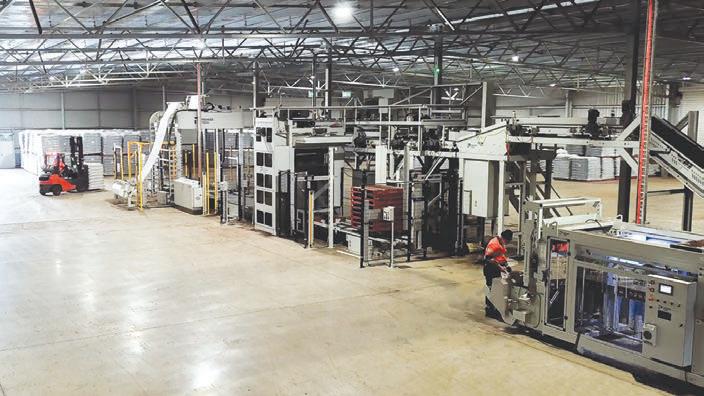
Bio Gro’s new packaging plant in Newbridge has an automated bagging line. Image: Van Schaik’s Bio Gro
is much better for business. But just as importantly, the Newbridge facility allows our packaging operations to be much closer to the Melbourne market. We’re about 350 kilometres closer to the city now compared to our Mt Gambier facility, which means transporting our products to distribution centres in and around Melbourne is a lot easier.”
e Newbridge facility comprises a fully automated ‘Form-Fill-Seal’ packaging line from Premier Tech, another AORA member. Bio Gro now has three Premier Tech packaging plants incorporated into the Mt Gambier and Newbridge facilities, principally because of their speed and e ciency.
“ e Premier Tech packaging plant at Newbridge is very sophisticated compared to our old packaging processes which was a very manual set up,” Stephen says.
“Our early foray into lling bags looked very di erent to today. We had
to physically hold the bags open and then shovel compost and mulch into them and then actually staple them shut. Over time, we advanced to sewing them shut and as the volumes grew, we purchased a manual packaging plant to ll the bags. At one point we had 16 people working on four of these packaging machines.
“By comparison, now our three automated packaging lines can form, ll and seal bags with just two people supervising each of them. e plants can produce upwards of 35 bags per minute.”
e process begins with a frontend loader mixing and blending the Bio Gro product and preparing it for packaging. e product is then conveyed inside, where one employee oversees the automated bagging process.
A large plastic roll of bags is delivered into Bio Gro’s packaging plant, which is then separated, formed, lled and sealed by a technological assembly line, then
stacked robotically in a pattern on a pallet showing a scannable barcode.
Stephen says that each automated packaging line can ll a pallet of Bio Gro’s product every three minutes and has the capability to produce in excess of 4,000,000 bags per annum.
“ e Newbridge facility, with its recently commissioned packaging plant, is such a welcome addition for us,” he says. “We now have the capacity to increase our volumes into the packaged markets, something that we have been looking to achieve for several years now.
“At the end of the day it’s all about pulling consistent volumes through our manufacturing facilities and producing packaged products for the market is a very important method to be able to achieve this.”
For more information, visit: www.aora.org.au
In the loop
ReSmart’s door-to-door waste management initiative relies on key tracking and reporting technology to make recycling convenient and transparent.
Marco Prayer Galletti and Giorgio Baracchi committed to changing Australia’s recycling and waste management landscape more than a decade ago.
e two entrepreneurs began in 2013 with a startup that sought to reduce waste contamination by physically examining bins to check for recycling, while also educating residents.
Marco recalls the venture was “wellmeaning, but a tough sell”.
“Our rst startup in this space was very laborious and expensive,” he says. “It was hard to promote, but we didn’t want to shake our overall goal. We found that recycling can be quite complicated in Australia and hard for people to partake in, and we wanted to x that.”
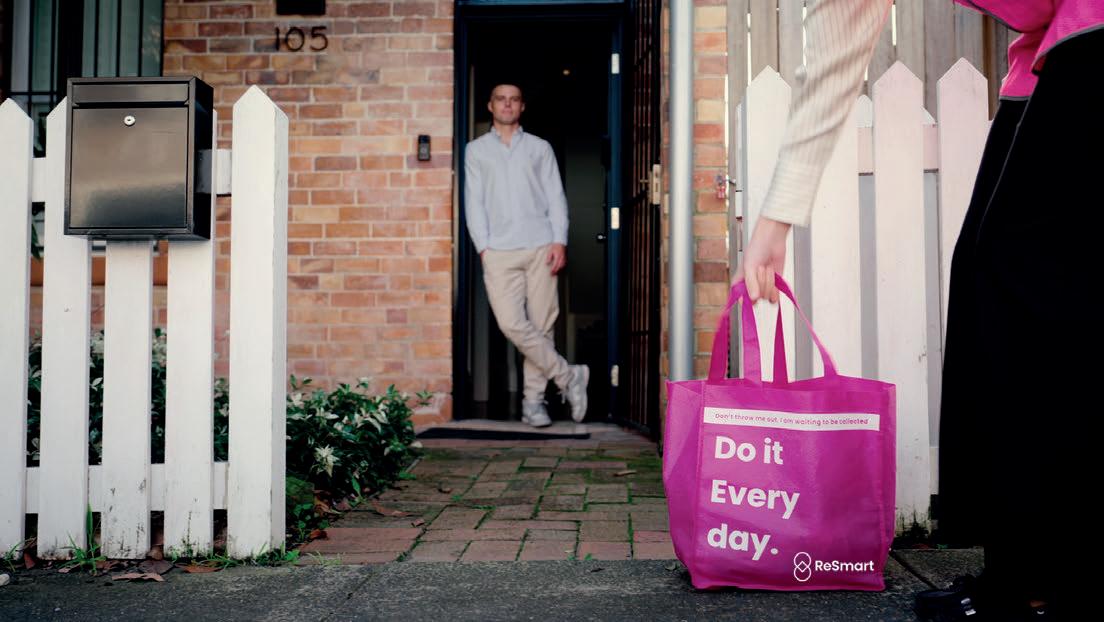
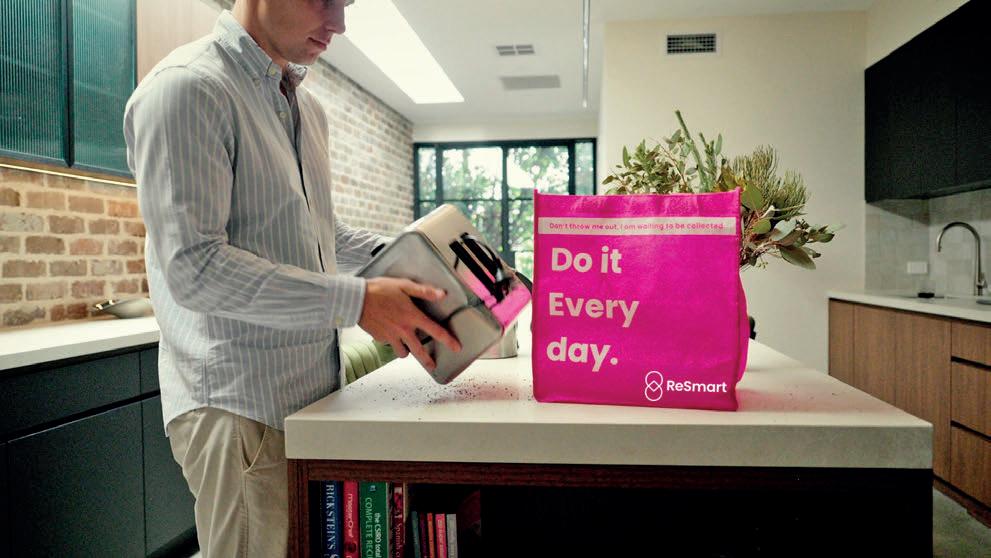
In 2019, the pair regrouped with a new startup – RecycleSmart (now known as ReSmart). Marco, Co-Founder and Chief Technology O cer, describes ReSmart as an intermediary service between people and their recycling or waste management, collecting items from homes, businesses and councils and transporting them to waste sorting and recycling facilities.
“When we began, Giorgio would scoot around on his Vespa doing waste pickups, and I would use my holiday van,” Marco says. “It was a scrappy start, but we were both eager to make a di erence in the space, and we liked the challenge.”
He says the concept has resonated with residents, businesses and councils over the past six years and the operation now
Marco Prayer Galletti, ReSmart Co-Founder and Chief Technology Officer.
ReSmart’s drivers pick up tricky to recycle items from customers’ homes and transport the materials to sorting and processing facilities. Images: ReSmart
works with more than 60 drivers across the country.
While businesses make up ReSmart’s fastest growing customer base, the service is also used by local governments. ReSmart has contracts with 26 councils throughout Australia.
“Councils really appreciate our exible approach to waste and recycling collection,” Marco says. “We work with their recycling centres, recycling hubs, and in some cases, collaborate further and run subsidised programs with their residents.”
Marco describes the business as a proud participant of the ‘gig economy’ – a labour market de ned by frequent short-term contract work.
“Drivers can sign up easily,” he says. “We don’t require them to have a new car, and we keep them local.
“We’re proud to say we’re creating another opening for labour while creating an opportunity for people to take care of their waste more easily.”
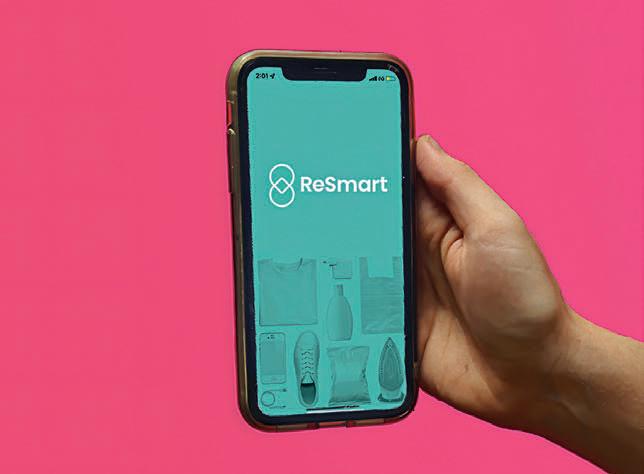
A key aspect of ReSmart’s value proposition is its provision of a next-level chain of custody – a principle of tracing materials from collection to processing.
“Traceability is essential in this space,” Marco says. “We need to be transparent about the items we take, how we sort them, and where they end up, so that we ensure we’re recycling and managing waste in the correct way.
“Waste contamination is the biggest challenge in this area, and by tracing and reporting waste, that challenge can be overcome.”
ReSmart achieves its waste traceability and reporting goals using enhanced technology, waste pickup route recording, and waste sorting infrastructure.
Speci cally, ReSmart drivers log the waste items collected on the company’s app, which connects to a database keeping track of every item of material to be sorted.
Once they pick up this waste, they are rerouted to the closest ReSmart sorting
facility to begin sorting the items to be recycled, reused, or discarded.
“Our waste management and recycling sites are kept to a certain size in each area, because growing and tailoring these services too much would defeat the purpose of what we’re trying to achieve,” Marco says. “ e service we’re trying to provide is a simpli ed and convenient, feel-good alternative to land ll for customers of all sizes.”
Internally, ReSmart uses the data it collates from waste reporting and tracing to inform its growth as a business.
Marco says this data has also proven valuable to the councils and businesses ReSmart works with as they can see the full breakdown of the resources diverted from land ll. is can trigger education campaigns, or structural changes to reduce waste in the rst place.
While happy with ReSmart’s upwards trajectory, Marco’s entrepreneurial spirit is unabated. For him, the company’s goal is the same as it’s always been – to grow its services Australia-wide.
“We’re getting there,” Marco says. “Last year we engaged with Qantas as one of its sustainability partners, and we are opening in more markets.
“We’ll keep expanding, building our infrastructure and perfecting our logistics system as we go to divert as much waste as we can from land ll, together with our council partners, business customers and individual users –our ‘recycle heroes’.”
For more information visit: www.resmart.co
ReSmart’s service acts as an intermediary between homes, councils, and businesses’ tricky to recycle items and recycling facilities.
ReSmart’s app allows users to see the types of waste being collected by the service, contributing to overall waste reporting and traceability.
Eriez patented the world’s first Eddy Current Separator in 1969. Today, our full range of recycling equipment can be found all over the globe, increasing recovery and maximising revenues. Eriez. Always the Right Choice. Eddy Current Separators from Eriez effectively remove nonferrous from automobile shredder residue (ASR), municipal solid waste (MSW), plastics, glass cullet, electronic scrap, and more.
size and extracting valuable metals – the new model features a fully computerised touch-screen interface.
Operators can now adjust conveyor speeds, engine power, and magnet heights with nger-tip control. e machine can even be operated via remote control, allowing it to be moved around a site “like a robot”.
Justin says one of the most signi cant upgrades is the shift to tungsten material on the barrel, which reduces the need for manual hardfacing and maintenance.
Hopley Group’s waste stream is diverse, ranging from timber ooring and weatherboards to tyres, mattresses, and even tree stumps. e shredder acts as the primary processor, often achieving throughputs of three to four cubic metres per minute. is capability allows the Hopley Group to e ciently process large volumes of demolition and green waste that would otherwise require multiple machines or additional handling.
For ner products, such as wood chips intended for composting, the team uses steel screen mats to size the material down to 25 millimetres. Justin says the versatility of the
shredder means the team can tackle almost any feedstock without needing to switch equipment or constantly recon gure the setup.
“Basically, what we do is demolish houses, commercial buildings, and industrial, and we bring them to a site where we recycle everything,” he says. “ e shredder shreds green waste, C&D (construction and demolition) waste, weatherboards, ooring, carpet, mattresses, and tyres; it’ll just about shred anything.
“It shreds everything up to woodchip size and, because it has a magnet, pulls the metals out to one side, which can go straight to the metal recyclers.”
e output from the Shark feeds into several of the Hopley Group’s commercial product lines.
Timber and green waste are blended with soils and composted for 12 months before being screened and sold. Concrete and brick, which the company processes at volumes
The TANA Shark DT Shredder tears through the most aggressive materials, including tyres.
The new model features a fully computerised touch-screen interface.
exceeding 75,000 tonnes a year, are turned into road-base materials, drainage aggregates, and decorative products. Even asphalt is crushed and sold back for use in new road designs.
Tana Australia is the exclusive distributor of TANA equipment, providing integrated, customerfocused solutions to the waste management and recycling sectors in Australia and surrounding regions.
Justin says the service and support Tana Australia provides were also key in the decision to stick with the brand.
With machines running up to six days a week– and plans to increase hours as new picking stations are integrated – any downtime is costly. e ability for TANA technicians to remotely access the machine’s GPS and computer codes via TanaConnect to troubleshoot issues has been a gamechanger for the regional operator. If parts are needed, they usually arrive within two days. “Back-up service from Tana is absolutely awesome. You can
ring out-of-hours on a Saturday afternoon, and the tech guys will answer,” Justin says.
“ ey can also look on their computer and see exactly what’s going on with the machine if there is an issue, and they can help you through it or correct it from where they are.”
For Justin, the Shark’s aggressiveness and ability to handle the toughest waste streams make it a standout in the market. His advice to anyone looking for a shredder?
“I’d say de nitely look at the TANA,” he says.“Come and see one working with di erent materials, because it is a very, very powerful machine. To watch it chop up a big tree is pretty unbelievable.”
For more information, visit: www.tana.com.au
SG ADVANCED COMPOSTING™ Technology with Gore® Cover delivers high-performance composting with less than 2 kWh/ton energy use. That’s a fraction of what’s required for energy-hungry tunnel systems. No massive buildings. No round-the-clock blowers. Just smart, scalable, easy-to-operate composting that cuts CAPEX and OPEX—without cutting corners.
sustainable-generation.com
SG BUNKER™ SYSTEM AT THE DEPARTMENT OF SANITATION NEW YORK CITY - STATEN ISLAND COMPOST FACILITY
Behemoth solutions for a plastic problem
staina le lastic ol tions agric lt ral plastic rec cling efforts have een olstered the deliver of a eno shredder from pplied achiner .
Agriculture is an important industry in Victoria’s Western District, but the area’s high concentration of farms generates volumes of plastic waste.
Materials such as grain tarpaulins and bale twine, among other polypropylenebased products, can pose serious environmental pollution risks if not managed correctly. Over the past four years, this risk has been reduced by the e orts of Sustainable Plastic Solutions (SPS).
SPS is dedicated to recycling agricultural plastics by collecting, shredding, washing and extruding them into pelletised resin.
e company has experienced rapid growth since it was established in Hamilton in 2022 and has increased its recycling capabilities accordingly.
“Our operation has doubled in size every year,” says Matt Nettelton, Chief
Executive O cer. “Our rst extrusion line was able to take on 2000 tonnes of material a year, but in two and a half years this has grown to 4000 tonnes.
“We started o with four employees and are now at 35 – that number is expected to grow to 45 over the next 12 months.”
While SPS is not the only entity in the agricultural plastic recycling space, Matt considers the company unique for achieving what he calls an “absolute circular economy”.
“By processing these plastics into pelletised resin we can deliver the material back to the customer who supplied it to us, so they can use it to make the same product again,” he says.
“We work backwards from the needs of each customer to do this. We consult with them to nd out what products
they require and then make the materials for these products from the used version. is way, we know the end product will be used.”
Powerful shredding is an integral step in the creation of pelletised resin, as agricultural plastics are often durable and tough to break down. SPS uses high-grade, industry-built shredders, such as a large Genox BH2000L Behemoth shredder supplied by Applied Machinery.
Applied Machinery is a Victorianbased industrial equipment supplier which has operated for more than 40 years. It has been a steadfast partner of SPS since the latter’s inception, having provided machinery for every step of the recycler’s operations.
“Applied Machinery has been with us from day one,” Matt says. “We bought our rst shredders from them.
“When we started, we had this huge factory with a tiny Genox shredder in the middle, breaking down coat hangers. Our setup has gone from that to two recycling lines, two twin screws, and ve Genox shredders, all from Applied.”
e Behemoth shredder is wellsuited to SPS’s upscaled operations due to its size and subsequent handling capacity. It’s more than double the size of the company’s previous shredder – it’s so big it necessitated delivery in three containers – and spans the whole warehouse.
Sustainable Plastic Solutions’ infeed conveyor with an electrical cabinet.
“Before our Behemoth shredder, we had a Genox V1200 on an extrusion line that processed 400 kilograms of plastic an hour,” Matt says.
“ at worked really well until we needed to expand. We then brought in a brand-new extrusion line capable of doing 1400 kilograms an hour, but we still had the old shredder attached to it. at wasn’t sustainable because we needed equipment that could break down more, and faster.
“When we ordered the Behemoth, our processing went from an average of 500 to 600 kilograms per hour, to 1000 kilograms per hour overnight. With the Behemoth on our extrusion line, production will increase to 9700 tonnes per year.”
In addition to the shredder’s size, its design and technology contribute largely to streamlining SPS’s plastic processing.
“ e shredder is connected to our recycling line, so both devices communicate when there is material ready to be broken down,” Matt says.
“It’s very automated and has reduced the number of sta we need involved
with this part of the process. e equipment’s size and rate of shredding have given us the throughput we need for e cient extrusion.”
Other features of the shredder include dust extraction capabilities and modi ed conveyors that prevent plastic fragments from contaminating the broader SPS workspace.
Matt says the inclusion of these features are the result of Applied Machinery and Genox’s deep knowledge of agricultural recycling.
“Applied and Genox have long histories in this space in global markets,” Matt says. “With their combined experiences they can diagnose problems and create tailored solutions for our operation. ey have insights that we haven’t seen from other manufacturers and distributors.
“ eir expertise and willingness to customise, along with Applied’s access to spare parts, make receiving and maintaining equipment so easy.”
Matt expects SPS’s relationship with Applied Machinery to continue as the company takes on bigger projects.
“We have other exciting products joining our operation which will make it even more re ned, and many of them are coming through Applied Machinery.”
Peter Koueik, Applied Machinery’s Sales Manager, Recycling, praised the SPS team’s approach to technology selection.
“ ey have built a highly adaptable operation capable of responding to evolving market demands – enabling them to thrive in the industry’s most challenging periods.”
For more information visit: www.appliedmachinery.com.au
The BH2000L shredder monitor.
Sustainable Plastic Solutions’ infeed conveyor with the Genox BH2000L shredder. Images: Applied Machinery
Switching gears
Alan Morrison Excavations has made a successful transition into the waste management market with a Terex Ecotec TDS-820 Slow Speed Shredder provided by Finlay.
Once AME had secured the council contract Brendan “put the order in for the shredder immediately”.
It marked the beginning of AME’s relationship with Finlay, which has delivered, modi ed and serviced the slow speed shredder.
Brendan, who is nascent in the waste management world, has relied on the distributor’s expertise and support to great success.
Maryborough is a regional city on Queensland’s Fraser Coast, located two hours north of Brisbane with a population of about 20,000 people.
For local Brendan Cherrie, Managing Director of Alan Morrison Excavations (AME), the town may seem small, but business is booming.
“Our business has been established since 1994,” he says, “and right now, the industry is incredibly competitive. ere are so many people entering the earthmoving and excavating market these days.”
AME is a family-owned civil contracting business which has mainly delivered wet and dry plant hire solutions to a loyal customer base across private, commercial, and government sectors in and around Maryborough for years.
While the company has taken on di erent services throughout its lifetime, Brendan says recent market conditions have pushed it to evolve further.
“ ere are a lot of moving parts to the company,” he says. “We pretty much do everything related to earthmoving, but we’ve recently tried to branch out to remain competitive and ahead of the curve. We’ve had to change our whole A-game.”
is has included a pivot into the world of waste management.
“Our local government put out an expression of interest to clear some mattresses,” he says. “ e council was entertaining di erent service providers, and I thought this could be our move into a new market. I looked into how our company could specialise to handle this and spoke with other companies to see what working with these mattresses would entail.”
All roads led to the Terex Ecotec TDS-820 Slow Speed Shredder, distributed by heavy equipment dealer Finlay across Queensland, New South Wales, Victoria, South Australia, Tasmania and Papua New Guinea.
“Our partnership with Finlay is quite recent, but has been extremely pleasant so far,” he says. “ e actual dealer we’ve worked with, Brad Scott, is so knowledgeable about the product, and has helped us understand and adopt the machine into our operations.”
Key features of the shredder include a hydrostatic drive, which provides increased protection against material contamination and allows for bi-directional shredding with its two, two-metre-long shafts.
ese shafts are manufactured with a fully welded tooth con guration, allowing for high throughput and e cient material reduction. e shredder’s gearboxes also enable each shaft to be run separately, reducing material wrappage.
e shredder is built with a tipping feeder which increases its feed area, along with hopper extensions to provide increased capacity in bulky applications.
To tackle the mattresses, Brendan and the AME team requested some customisations to the shredder, delivered with the assistance of Finlay.
“We had to modify both the shredder itself and one of our excavators to be able to feed it,” Brendan says, “and then added some other minor changes to suit our needs.
Alan Morrison Excavation’s Terex Ecotec
T S-8 Slow Speed Shredder was first used to break down mattresses. Images: Alan Morrison Excavations
“We added a camera to the shredder, which connects to a display in our excavator cab via Bluetooth.
“By having a real-time view of the shredder, the operator can ensure nothing is jammed or stuck while feeding it. e feeding process becomes much faster that way, and it also becomes safer as it eliminates a big blind spot.”
e shredder continues to break down mattresses and has also been enlisted to break down other materials such as wood and rubber-based items. Brendan says it has become fundamental to AME’s operations and successful expansion into waste management.
“We shred a lot of timber products that previously were being sent to land ll,” he says. “Customers have issues getting rid of pallets, power poles and hardwood timber furniture.
“ is also extends to tree clearing and disposing of car tyres. e machine is getting a lot of use.”
Due to its frequent use and the heavy loads it breaks down, AME’s shredder requires ongoing maintenance, facilitated by Finlay.
“ e shredder’s two shafts are protected by a layer of hard facing welding but still need attention due to the sheer amount of heavy material they shred,” Brendan says.
“But this doesn’t mean they ever break down. e shredder is much more advanced than older equipment on the market.
“It needs care but can go for a very long time.
“And with all the material we’ve been feeding the shredder, it really is paying for itself.”
For more information visit: www. nlay.com.au
The shredder played a critical role in AME’s shift away from pure earthmoving operations.
Diamonds in the rough
The Eriez range of Eddy Current Separators play an important role
In the world of resource recovery, Eddy Current Separators (ECS) play a niche yet critical role. e machines recover nonferrous metal – non-iron or steelbased metals such as aluminium, copper and brass – from metal waste streams by changing magnetic elds to induce eddy currents, which attract and separate them.
e equipment has been around for decades and was pioneered when a machine design was rst patented by Eriez in 1969.
e United States-based company, which had previously built magnetic circuits for the agriculture and food industries, transitioned to include ECS manufacturing along with other recycling machines. e business’ capabilities expanded to other industries and markets over the years, with resource recovery remaining key.
“Eriez now operates all around the globe,” says Jonathan Schulberg, Eriez Heavy Duty Business Development
Manager. “We have manufacturing facilities on nearly every continent and deal directly with end-users for their unique needs.
“While the base market for ECS is resource recovery and recycling, the speci c deployment of this equipment depends on the conditions and recycling demands of each customer. What we do and how we do it is quite varied.”
Eriez has operated in Australia for 55 years, predominantly working with
The Eddy Current Separator recovers nonferrous metal from waste streams by changing magnetic fields to induce eddy currents, which attract and separate them. Images: Eriez
Material Recycling Facilities (MRFs) which process municipal waste, recover what is recyclable, and send the rest to land ll.
Jonathan says the magnetic separation needs of these sites di er from those of others. While other machines in the space remove metal waste, ECS recover valuable material.
“Lots of magnetic separation equipment is designed to recover tramp metals (unwanted metallic debris such as nuts or bolts) in a product because of the dangers those materials pose for other equipment downstream,” he says. “But ECS recover material because it can be used elsewhere.
“Metals are in nitely recyclable because they don’t break down with use. e materials that ECS recover are repurposed and resold, instead of being sent to land ll, extending their lives. is will happen repeatedly as di erent companies use the metal – that’s the whole nonferrous material cycle.” is sustainable practice also comes with commercial bene ts for operators.
“ e nonferrous metals that ECS recover have high value,” Jonathan says. “A typical MRF plant will process roughly 30 to 35 tonnes of material per hour and can recover anywhere from three and a half to four tonnes of aluminium per day.
“ at can have a resale value of between $1400 and $2000 per tonne –substantial returns for any business.”
Eriez o ers two types of ECS for speci c waste-sorting requirements, with a standard model and an ‘ultra high-frequency’ model designed to sort through very ne materials.
Many of the Eriez ECS distributed throughout Australia have been working nonstop for years, withstanding tough conditions and constant use. Jonathan says this is testament to the durable designs and quality, which sets Eriez’s manufacturing apart.
“All ECS work in the same way, so any stark di erence will come down to the quality of the construction,” he says.
“At Eriez, we hold ourselves to a very high standard of quality and we understand our market intimately. We know that in the recycling space, uptime is of the utmost importance, because you’re dealing with a stream of material that never stops.
“Being able to consistently handle and separate this nonferrous waste is essential for both sustainability and achieving nancial returns. e durability of our ECS ensures recyclers can sort as much waste as they want to.”
Another point of di erence at Eriez is its people. e company has a wealth of combined industry knowledge, leveraged across its many international markets.
“ e whole Eriez team might be the greatest tool in the company’s arsenal,” Jonathan says.
“ ere isn’t an application or solution that we haven’t already thought of, investigated or implemented around the world due to our sta ’s varied knowledge and high exposure to di erent customer requirements. We’re able to draw on this collective knowledge pool as expertise in every situation and make a high-quality product as a result.”
He says Eriez’s capabilities, combined with an increasing sustainability movement across various industries,
have resulted in an increasingly diverse customer base.
“We’re seeing more consideration for our equipment in spaces where that wasn’t previously the case,” he says.
“ ese operations still fall under the general recycling umbrella, but some stakeholders used to see ECS as irrelevant to their needs, and that’s now changing. More operators are realising there is an element to nonferrous separation that they need to implement.
“ is has been coupled with a change in the scale of the companies that use our equipment, too. ese machines were never meant just for big players –they are quite accessible, and now we’re seeing them being used by operators of di erent sizes.”
Between this growing uptake by a new market segment and the never-ending need for waste sorting and recycling, Eriez is keeping busy – developing new and exciting endeavours for the future.
“ ere are interesting developments that will be public soon enough,” Jonathan says. “Lots of exciting plans in action as we speak. So, watch this space.”
For more information visit: www.eriez.com
An Eriez Eddy Current Separator.
Raising the bar
JOST and Hyva’s new Titan 2.0 skip loader has hit the Australian market, providing operators with a faster and safer option for waste collection.
When JOST acquired Hyva in 2025, more than two decades of business collaborations were solidi ed.
e Original Equipment
Manufacturers (OEM) had spent years engaging in partnerships to amplify each other’s hardware, grow their respective customer bases, and rely on each of their support networks. But with Hyva now o cially a JOST subsidiary, their combined capabilities have reached a new level.
“Since the two companies have come together, we’ve been guns-a-blazing,” says Roy Gauci, Hyva New South Wales and Australian Capital Territory Sales Manager.
“We are fully operating under the JOST banner, and for the better. We now
have a presence in 25 other countries across six continents and have a much bigger support network at our disposal.
“Together, we’re a force to be reckoned with in the market.”
Jost Australia is a global leader in manufacturing systems and transportation components for commercial vehicles.
Hyva specialises in tipping gear, container handling systems and waste handling equipment. Skip loaders –specialised equipment designed for the loading, transport and tipping of skip bins – has long been a staple of its o erings.
ese heavy-duty containers recently received an upgrade as part of JOST and Hyva’s ongoing commitment to innovation and safety.
“JOST and Hyva have always pushed to integrate advanced technology into their equipment while ensuring safety is present,” Roy says. “Since our skip loaders are essential to the Hyva product line, our newest series was no exception to this.”
New to the Australian market, this latest skip loader series, the Titan 2.0, is equipped with plenty of new features. e equipment has been designed with a lighter tare weight, resulting in higher payload due to the increased available capacity.
Roy says the Titan 2.0’s higher payload creates quicker working cycles and reduces downtimes for operators. is is enhanced by the design and operation of the Titan 2.0’s lifting arms, which are both curved and telescopic to improve bin pickup.
“ e curved arms enable the skip loader to lift bins over the top of any short retaining wall or other obstacle,” Roy says. “When the arms lay back, the bins can get closer to the wall or given structure.
“And by being telescopic, the arms can lift bins that are a further distance away.”
e Titan 2.0’s advanced functions are bolstered by various safety improvements, including the incorporation of Hyva’s new reversed main-lift cylinder system, which keeps the skip loader’s chrome rod out of the vehicle’s working area for operators.
“When the skip loader’s arms go back to lift up a bin, there is typically a chrome rod that goes back into the working space,” Roy says. “For the
JOST and Hyva’s Titan 2.0 skip loader series is new to the Australian market. Images: JOST
Titan 2.0, the skip loader’s cylinder has been turned over the other way, so that the chrome rod stays at the front of the equipment and avoids the risk of being hit or damaged.
“ ere are no exposed hydraulic pipes or hoses on the skip loader, either – they are all integrated into the cylinder.”
While this has boosted the protection and safety of the product itself, Roy says other features aim to protect operators.
e Titan 2.0 is tted with removable oor panels in its middle, to make vehicle servicing more accessible.
“ ese panels provide a safer way for operators to access the skip loader’s insides and bottom for maintenance, rather than them having to try and crawl around under the skip loader in the dark,” Roy says.
“Workers strain themselves less this way, and there’s a reduced cost by not working in the dark, since any maintenance takes less time.”
e Titan 2.0’s design has fewer electronics in general, taking into consideration the harsh environments and the rough materials they can be exposed to. Roy says this aims to decrease maintenance and repairs, keep
the vehicle on the road for longer and ultimately collect more bins.
his own crew, were excited for the product
especially since it’s the rst of its kind in the country. Many customers had even pre-ordered them without having seen the product,” he says.
management service provider Brown Bros Skip Bins, in New South Wales.
dealership and Western Sydney Transport
strength, performance and durability,” he says. “ e job has to be right from start to nish – safety, compliance, and nishings.”
While the Titan 2.0’s release has come amid uncertain economic and geopolitical conditions, Roy says it’s a crucial addition to the waste and resource recovery sector.
“Waste never stops,” he says. “ ere will always be garbage to be taken and moved around and Hyva will always be there to do it.”
For more information, visit: www.jostaustralia.com.au
The Titan 2.0 skip loader features removable plates and Hyva’s new reversed main-lift cylinder system.
The Titan 2.0 incorporates Hyva’s new reversed main-lift cylinder system, which keeps the skip loader’s chrome rod out of the vehicle’s working area for operators.
BIOGAS
Driving the Energy Transition, One Landfill at a Time
Active landfill gas extraction, flaring and power generation systems are proven. LGI takes this further, applying innovation and focus to optimise gas capture, significantly reduce emissions and odour, and deliver more flexible, high-value renewable power.
The New LFG ACCU Method: Certainty for Regional Australia
BUNDABERG
The 2025 LFG methodology provides the regulatory certainty needed to drive continued investment in high-integrity abatement. Our ACCU projects meet the highest standards of integrity, maximising the return for your site, while delivering immediate, measurable, and permanent results.
Expediting the Transition with Renewable Hybrids
LGI has solutions for landfills large and small, regional and metropolitan, open and closed. Our projects range from enclosed flaring systems, to renewable hybrids that integrate landfill gas-fuelled power generation, integrated with grid scale battery energy storage systems (BESS). With our intelligent dynamic asset control system (DACS), we transform landfills into flexible renewable projects, delivering power and critical grid support when and where it is needed.
LGI can fund, build, operate, and maintain these entire systems (at no or low cost to landfill owners) with solutions tailored to complement your core business.
Contact us today to see how you could benefit from superior environmental performance and a share of the ACCUs and renewable energy we create.of the ACCUs and renewable energy we create.
Future is bright
Sydney will host an expanded 2026 Women In Industry Awards, will you be there?
The Women in Industry Awards return in 2026 with a signi cant expansion, including a move to a new host city and the introduction of four new award categories.
e program continues to celebrate and recognise the outstanding women rede ning what is possible across transport, mining, engineering, logistics, manufacturing, and beyond.
Sixteen total categories will feature in the 2026 program, including the four new awards – Marketer of the Year, Excellence in Health and Medicine, Tradeswoman of the Year, and the
Rising Women in Leadership: C-Suite Executive Award.
Caitlyn Douglas, Prime Creative Media Head of Awards and Conferences says the new awards were created to align with the growing industry and will bring more opportunity to celebrate success.
“ is move makes sense for the direction of the awards,” she says. “ e industry is growing, so naturally we wanted to expand the awards program to accommodate a wider audience.”
Previous winners have said that the awards serve as both a personal milestone and a beacon for the next generation
of female leaders. In 2025, Tammy O’Connor won both Woman of the Year and Business Development Success of the Year awards.
Tammy was recognised for her achievements as Founder and Managing Director of KingKira Group, an Aboriginal-owned waste management business servicing the mining sector in Western Australia.
“It is such an honour to be recognised among such an incredible group of women who are all doing such amazing things in their respective industries,” Tammy said following her wins.
2026 Award categories:
• Rising Star of the Year (30 years and under)
• Business Development Success of the ear
• Industry Advocacy Award
• Mentor of the Year
• Safety Advocacy Award
• Excellence in Manufacturing
• Excellence in Transport
• Excellence in Engineering
• Excellence in Mining
• Excellence in Construction
• Excellence in Energy
• Woman of the Year (chosen from winners of the other award categories
• Marketer of the Year
• Excellence in Health and Medicine
• Tradeswomen of the Year
• Rising Women in Leadership: C-Suite Executive Award
The 2026 event promises a night of celebrations. Images: Prime Creative Media
needs to be shared amongst our team. All our success is something that we have achieved together.”
She said the awards are vital for visibility.
“Witnessing other women in senior roles is empowering,” she said. “And so
“ e awards shine a light on how to be role models for other women to look up to, all while providing somewhere to network.”
Tickets are now available for the gala evening at Doltone House Darling Island Wharf on 18 June.
Redefining how landfill leachate is managed
BeneVap is a high-performance vaporisation system designed specifically for challenging landfill environments — giving landfill operators a smarter, more controlled way to manage leachate on site.
See BeneVap changing the way landfill operators manage landfill leachate, visit beneterra.com.au
Join industry leaders, innovators, and advocates to celebrate the achievements of women driving Australia’s industrial future. With the move to Sydney and a broader range of categories, the 2026 awards night is expected to be the largest iteration of the event to date.
For more information, visit: www.womeninindustry.com.au
litres of leachate already removed from Australian & New Zealand landfills
The Women In Industry Awards are an opportunity to meet the industry’s high performers.
The gala event offers a chance to share and celebrate achievements.
Introducing WRAPA
Heralding a new chapter for Victoria’s waste and recycling industry.
The Victorian waste and resource recovery landscape is undergoing a transformation.
Driven in part by the transition to a circular economy with the implementation of the Circular Economy (Waste Reduction and Recycling) Act 2021, and the adoption of the Environmental Protection Act 2017 and subordinate regulations, the industry faces unprecedented opportunities and complex regulatory challenges.
Bringing a uni ed, expert-led voice to this evolving environment is the Waste Recycling and Processing Industry Association (VIC) Ltd, known as WRAPA.
Established in late 2023, WRAPA was founded to provide Victorian waste and recycling operators with a peak body focused on advocacy, safety, and sustainable growth, ensuring that local stakeholders have a seat at the table during high-level policy discussions with government bodies such as the Environment Protection Authority and the Department of Energy, Environment and Climate Action.
e association is led by a board of directors whose combined experience spans more than a century across every facet of the industry.
At the helm as Chair is Ken Dickens, Managing Director of Corio Waste Management. With more than 40 years of experience, Ken is a veteran of the sector, renowned for his expertise in large-scale infrastructure and organics processing.
Joining him is Andrew Swann, Director of Circular Resources Australia. A science graduate with a background in liquid, hazardous and organic waste treatment, Andrew brings a focus on innovation and research commercialisation.
Representing the critical logistics and regional perspective is Zane Foott, Head of Logistics and Business Integration at FOOTT Waste Solutions. Based in Shepparton, Zane is a staunch advocate for safety and professional reputation, bringing a results-driven approach to transport and logistics operations.
Rounding out the board is Tim Isherwood of National Resource Recovery. Tim specialises in hazardous waste recycling, championing regulatory adherence and the use of electronic tracking systems within the sector.
Ken says WRAPA’s mission is to advocate for a legislative and regulatory framework that supports a viable, safe, and innovative waste industry.
“From providing a framework to
bans to providing a voice to operators through the sub-committees, WRAPA provides its members with the resources and representation needed to navigate Victoria’s speci c challenges,” he says.
“As the industry looks toward the 2030 circular economy targets, WRAPA invites operators from across the state to join this collective e ort. By fostering collaboration and sharing best practices, WRAPA is not just representing the industry; it is helping to provide guidance for a cleaner, greener more compliant Victoria.”
Ken says that when a national approach is required WRAPA works with other key players to ensure consistent industry outcomes across all jurisdictions.
For more information, visit:
Tim Isherwood
Andrew Swann
Ken Dickens
Zane Foott. Images: Waste Recycling and Processing Industry Association (VIC)
ELDAN RECYCLING, LIGHT FRACTION SORTER
The Eldan Light Fraction Sorter (LFS) is a high-performance separation solution designed to optimise material purity in demanding recycling environments.
Engineered to separate mixed material streams into light and heavy fractions, the LFS is an essential component for operators processing everything from tyres and cables to electronic waste (WEEE) and municipal solid waste. At the heart of the LFS is an intelligent air-flow system. Material is introduced into a specialised zig-zag-shaped funnel where a frequency-controlled centrifugal ventilator generates a precise vertical airflow. This stream lifts lighter particles – such as textiles, foam, or paper – upward into a cyclone for collection, while heavier materials exit via a secure air-lock at the base.
Available in four sizes (LFS 40, 60, 80, and 120), the system boasts a robust capacity of up to 8000 kilograms per hour. Its closed-loop air system not only ensures energy efficiency but also maintains a dust-free working environment, minimising operational costs and environmental impact.
Whether used as a standalone unit or integrated into a complete Eldan recycling line, the LFS delivers exceptional recovery rates and superior downstream quality.
TURNING WASTE INTO PROFIT
The light fraction sorter is designed for optimal material purity. Image: Eldan Recycling
The EDGE ColorPRO stands as the highest-return colouring system currently available on the market, offering operators an unmatched production rate of 382 cubic metres per hour.
As a fully self-contained and portable unit, it is the definitive solution for large-scale producers who require a highcapacity, mobile colouring system that can be easily transported between multiple sites.
The engineering of the ColorPRO dye trommel reflects a focus on both volume and precision. The system features a 2 metre x 6.9 metre spiral drum equipped with an integrated material detection system, which ensures that no dye is wasted during the process.
To handle diverse workloads, the unit is fitted with a 12.6-cubic metre hopper that includes a forward and reverse feed conveyor, along with a variable speed feeder and drum rotation.
This system achieves superior coverage by combining the aggressive force of a turn-shaft auger with a high-speed drum barrel. The dual-action approach ensures that colorants are delivered efficiently and evenly to the feed material.
The built-in hopper auger flips and rotates the material to allow for effective dispersal before it enters the barrel.
The EDGE ColorPRO’s adjustable settings and robust design
make it a suitable asset for mulch producers who need to satisfy high demand without compromising on material quality or operational efficiency.
The Garwood Miner compactor is a specialised solution designed to tackle challenging waste collection in Australian urban environments. Its key specifications are engineered for accessibility and efficiency in confined spaces. The unit boasts a low height of under 2.1 metres and a narrow body, measuring just 1.9 metres, enabling it to navigate tight basement carparks and restricted access points.
Despite its compact dimensions, the Miner maintains a light footprint, with GVM (Gross Vehicle Mass) options starting from 6200 kilograms and ranging up to 8550 kilograms, allowing for versatile mounting on various low entry cab chassis.
A crucial innovation is its unique two-stage bin lifter tipping design, specifically developed to collect larger 660-litre and 1100-litre waste bins even within height-restricted areas under 2.1 metres.
Garwood now offers Miner bodies in multiple capacities: 5 cubic metres (m³), 6m³, 7m³, and 8m³.
Contact - FOCUS Enviro
P (02) 4365 4247
E info@focusenviro.com.au
W www.focusenviro.com.au
Contact - Garwood International P 02 9756 3756 W www.garwoodinternational.com.au
GARWOOD INTERNATIONAL, MINER
The self-contained dye trommel delivers speed, consistency, and efficiency. Image: FOCUS Enviro
With a low height and narrow body, the Miner is suited to confined spaces. Image: Garwood International
Waste Management Review
Delivers high quality, multi-platform media communications that showcase the world-class performance of the Australian waste management and resource recovery industries.
Waste Management Review is published 11 times a year and contains:
terviews
• In-depth profiles on innovative people, facilities and services
•Coverage on international developments
•Updates and analysis on new regulations and policies
•Interviews with industry leaders
•Successful supplier/client showcases
•Details of new-to-market products and equipment.
and get every Waste Management Review magazine issue delivered direct to your door.
www.wastemanagementreview.com.au
Pressure creates clarity
The waste and recycling sector has always been resilient, but resilience should not be mistaken for unlimited capacity, says Brett Lemin, Executive Director of the Waste Contractors and Recyclers Association, New South Wales.
Here’s the uncomfortable truth: the waste and recycling sector is being stretched in every direction, and the system is starting to show it.
We are being asked to deliver more… higher recovery rates, safer operations, stronger environmental outcomes,
while absorbing rising costs, growing risks, and increasing uncertainty. All while margins are tightening and expectations continue to rise. And yet, despite all of this, the industry continues to deliver. Because at its core, this is an industry that shows up.
AN ESSENTIAL SERVICE
Waste and recycling is not optional. It is a daily, essential service that underpins public health, environmental protection, and the functioning of our communities. When it works, it’s invisible. When it doesn’t, the impacts are immediate.
Waste and recycling is a daily, essential service – if trucks don’t move, waste doesn’t get collected. Image: Pawel Michalowski/shutterstock.com
And right now, that reliability is being tested.
Fuel is the most immediate example. While o cial messaging suggests stability, what operators are experiencing on the ground tells a more complex story of price volatility, supply constraints, and uncertainty that is already in uencing operational decisions.
For a sector that relies almost entirely on diesel-powered eets, this is not just a cost pressure.
It’s a service risk.
If trucks don’t move, waste doesn’t get collected. If machinery cannot operate, material won’t get processed. It’s that simple – the system stops.
at’s why recognition of our sector as a priority fuel user isn’t a request it’s a necessity.
CARRYING RISK
At the same time, we are managing risks that originate well beyond our sector.
Battery res continue to rise across collection vehicles, transfer stations, and processing facilities. e frequency is increasing. e consequences are real. And the cost both nancial and safetyrelated is signi cant. is is not a problem created by waste operators. It’s the result of product design, consumer behaviour, and gaps in end-of-life systems. And yet, it is our industry that is left to manage the consequences.
To be clear, our sector is not stepping away from this challenge. We are working closely with government, regulators, and emergency services to drive better outcomes, but product stewardship must mean shared responsibility.
Not responsibility at the point of failure.
THE INFRASTRUCTURE REALITY
Looking forward, the most signi cant challenge remains the one we have been talking about for years, the infrastructure gap. New South Wales is approaching a critical point. Existing
land lls are nearing capacity. New infrastructure is di cult to deliver. Planning pathways remain complex and slow.
At the same time, policy ambition continues to increase food organic and garden organic (FOGO) mandates, higher recovery targets, reduced land ll reliance.
ese are the right goals, but they must be supported by the infrastructure to deliver them.
Without that alignment, we risk placing unsustainable pressure on a system that is already working at its limits.
INVESTING IN THE FUTURE
What gives me con dence is how the industry is responding.
Across our membership, we are seeing continued investment, not just in infrastructure, but in people.
Training, safety systems, leadership development, and mental health support are all becoming core priorities.
ere is a clear recognition that a sustainable industry is built on a capable and supported workforce.
At Waste Contractors and Recyclers Association (WCRA) NSW, we are proud to be contributing to that through expanded training programs, practical education initiatives, and stronger engagement across all levels of the sector because the future of this industry will not be determined by policy alone, it will be determined by the people delivering it every day.
COLLABORATION IS NOT OPTIONAL
If there is one thing this moment makes clear, it is that no single part of the system can solve these challenges alone.
Industry, government, regulators, and the broader supply chain must work together.
We are seeing encouraging signs of that collaboration, particularly in
areas such as battery stewardship and safety reform, but there is still more to be done.
Collaboration requires more than intent. It requires alignment. Alignment between policy and delivery, between responsibility and accountability, and between ambition and investment.
WHERE TO FROM HERE
is is not a call for less ambition. It is a call for practical alignment.
Recognise waste and recycling as a priority fuel user.
Accelerate the delivery of critical infrastructure.
Ensure product stewardship frameworks genuinely distribute responsibility across the supply chain and continue investing in the systems and people that make this industry work. ese are not aspirational ideas; they are necessary ones.
is industry is not just managing waste, it is supporting the broader economy, protecting the environment, and delivering an essential public service every single day.
We are ready to meet the challenges ahead, but the system must be ready to support the industry because when you strip it back, the role of this sector is simple – we keep society functioning.
And that’s something worth getting right.
Brett Lemin, Executive Director WCRA, New South Wales.