Utility March/April

Page 1


“Please watch the road”

Act on the most urgent risks in seconds.

Geotab’s new all-in-one video telematics solution, the GO Focus Plus, automatically flags distracted driving, tailgating, hard braking and other serious events immediately, delivering instant in-cab voice feedback to enhance driver safety. For managers, patterns and urgent cases rise to the top for fast review and targeted coaching, all in one workflow that tracks follow-up and results. Spend less time searching and more time supporting every driver, addressing risk, encouraging improvement and recognising safer habits.

Ready to transform your fleet?

Visit www.geotab.com/au/ to learn how our telematics solutions can drive your business forward.

REGULARS

4 Welcome from the editor

A word from WIOA

A word from WSAA

A word from ENA

Cover story

Built to last

Beyond buying media

New approaches to recruiting

Building resistance as challenges mount

Maximising e ciency in fleet management

and minimal impact

CONNECTIVITY 58 Taking field mobility to new levels

The new ‘operational brain’ for fleets

Accurate data in a reliable, portable format

MANAGEMENT

More than an after thought

Beyond the devices INDUSTRY INSIGHTS

8 Not to be missed Ozwater’26 50 Innovations in trenchless installation UTILITY EXPANSION

Helping to shape a water future

As Australia’s largest and most in uential water sector gathering, Ozwater’26 will once again bring the industry together in May.

Hosted by the Australian Water Association, this year the event is taking place under a unifying theme; Our Water. Our Tomorrow. is is a powerful idea and also a thought provoking one, that carries the underlying fundamental that without this most basic of services there is no tomorrow.

And if this link highlights the industry’s importance and weighty responsibility, the theme is also rich with the possibilities about what can be achieved together. e challenges may be great but the opportunities provided by dynamic collaboration and innovation are enormous.

If this idea is the overarching theme of the event, there is also no shortage of detail and thinking put into how to make it happen in a practical manner. e May event promises a dynamic program shaped around thirteen forward-looking themes that re ect both the pressures and possibilities facing the sector.

If anyone is in doubt about the breadth and depth of work and ideas that have been collated for the Brisbane event, a quick look at the full program, covering an astonishing number of facets and areas across the water industry, will make them realise the biggest problem for the attendee is almost too many choices for informative solutions.

To look at just some of the themes in the program, Communities of the Future explores how water planning underpins liveability, sustainability and social equity in a climate-challenged world. Excellence in Operations (Analog & Digital) highlights the convergence of engineering excellence with digital transformation, from smart networks and automation to data-driven optimisation and cybersecurity.

Asset Management, Planning & Delivery will focus on whole-of-life thinking, climate-resilient design and naturebased solutions, while Delivering Excellence in Customer Experience elevates the evolving expectations of water users and communities.

For the Australian water industry, the value of Ozwater’26 extends far beyond the conference oor. At a time of accelerating climate volatility, population growth, tightening regulation and infrastructure renewal, the sector cannot a ord to operate in silos. is event provides a rare and vital platform where utilities, regulators, technology providers, contractors and researchers converge to share lessons, challenge orthodoxies and forge practical partnerships.

Collaboration is no longer optional. Whether navigating decarbonisation pathways, building climate resilience, embedding circular economy principles or strengthening community trust, progress will depend on collective insight and shared accountability.

Water utilities and service providers across Australia should see Ozwater’26 not simply as a conference, but as a strategic investment in capability, connection and future readiness. e challenges are signi cant for an industry dealing with a vital commodity on the planet’s second driest continent, but so too is the sector’s ingenuity.

eugene.du y@primecreative.com.au

Don’t forget to follow Utility on social media – find us on LinkedIn, X and YouTube.

CLIENT

Scan

Unlocking housing supply

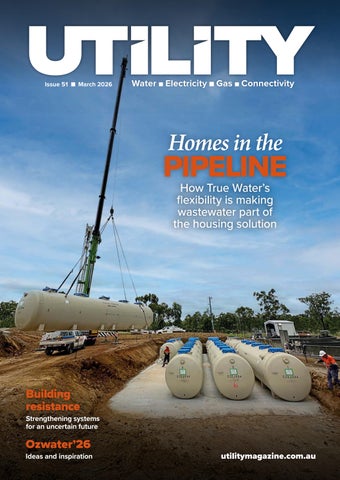
As thousands of approved homes sit idle due to sewerage constraints, True Water demonstrates how licensed independent wastewater infrastructure can unlock housing supply and remove one of development’s most persistent bottlenecks.

Australia’s housing crisis is well documented. e policy debate has focused heavily on planning reform, approval timelines, and workforce shortages. Yet one of the most signi cant and least discussed barriers to bringing new homes to market is far more fundamental: the absence of sewerage infrastructure.

Many approved developments sit idle because municipal wastewater systems are at capacity, decades from upgrade, or simply do not extend to the development boundary. e result is a growing inventory of ‘zombie’ approvals – land with planning consent where construction cannot proceed, contributing nothing to housing supply while investment stagnates and holding costs accumulate.

According to a recent report released by the National Growth Areas Alliance, 82,500 dwellings across outer-suburban growth corridors cannot commence construction because critical infrastructure is missing. In New South Wales, the UDIA NSW Green eld Land Supply Pipeline Report found that 80 per cent of lots programmed for release over the next eight years are constrained by a lack of necessary infrastructure, with 76 per cent constrained by lack of sewerage connection.

When municipal systems can’t keep pace

Demand for municipal sewerage infrastructure continues to grow in step with increased housing demand. Existing infrastructure, particularly that servicing the urban fringe,

o en operates at capacity. Ageing infrastructure, time constraints, and the prohibitive cost to renew existing infrastructure are barriers to the delivery of new housing. NSW Minister for Water, Rose Jackson, acknowledged in January 2026 that a lack of investment in essential infrastructure in Western Sydney has acted as a handbrake on housing goals.

Outside metropolitan areas, the challenge is more di cult. Many regional and rural towns require new or upgraded treatment plants before further development can occur. For developments of 100 to 5000 lots, the timeline for municipal sewer connection can stretch 10, 15, or 20 years – and in many locations, there is no funded plan for connection to municipal sewer at all.

e sewerage utilities servicing Australia’s capital cities are among the most advanced in the world. e industry has the expertise to address challenges while continually increasing the capacity to service major cities. However, in regional areas, local governments face the challenge of servicing new housing with little to no funding available for sewerage infrastructure.

A better path forward

Reliable options for regional communities and green eld sites are needed. Independent small to medium sized utilities dedicated to site speci c developments are a proven alternative.

A key advantage of independent infrastructure is exibility and control. Independent utilities can be employed as either interim measures or as the ultimate solution. Systems are designed to be scalable, and capacity is increased gradually in step with lot delivery and growth.

In New South Wales a regulatory framework supports the delivery of independent infrastructure. e Water Industry Competition Act 2006 (WIC Act), administered by IPART, enables licensed private operators to construct and operate water and wastewater infrastructure. Infrastructure must satisfy all public health and environmental standards and adhere to mandatory independent auditing. Approximately 20 schemes now operate under the Act, serving around 10,000 customers. is pathway is available to developers, councils, and existing utilities alike.

A straightforward, risk-averse model

True Water, a wastewater treatment specialist licensed under the WIC Act, has applied the framework in a way that is straightforward and thorough.

As an approved independent water utility, True Water provides sewage infrastructure for small to large-scale community projects (100 to 10,000 lots). e company’s exclusive partnership with Kubota delivers world leading treatment technology and innovation. It also works closely with Australian partners such as Matalec to deliver supporting electrical and mechanical infrastructure for each scheme.

e approach is deliberately simple. A conventional sewer reticulation network collects wastewater from homes and conveys it to a centralised treatment system. e system consists of compact, modular Kubota treatment plants and supporting components, with treated e uent managed via dispersal or reuse methods. e infrastructure operates as a licensed sewerage scheme with IPART oversight, independent auditing, mandatory reporting, and regulated customer protections – identical in its compliance obligations to any public utility.

What distinguishes the True Water model is its designed exibility. ese systems can operate as the ultimate and permanent wastewater solution. Alternatively, where a municipal sewage treatment plant upgrade is planned, the infrastructure can serve as an interim solution, with the network simply redirecting ows to the municipal network once capacity becomes available. If that municipal timeline shi s – as it o en does – the development is never le stranded, the system continues to operate inde nitely on its own merits.

is removes the single largest risk for developers, councils, and communities: dependency on a municipal infrastructure timeline that no single party controls. A licensed operator delivers and manages the wastewater solution; the council retains its planning and regulatory oversight; and the community gets the homes it needs.

Ashbourne unlocked

Lots are selling and homes are under construction in Ashbourne, a master-planned community in Moss Vale, New South Wales. e development had been on hold inde nitely as the local council’s sewage treatment plant operates at capacity, preventing further land release.

True Water has delivered an independent wastewater utility which operates the sewage treatment infrastructure, unlocking the development.

“ e development of Ashbourne presented a signi cant challenge: releasing lots on time required a reliable, compliant wastewater solution. True Water’s independent sewerage treatment utility provided exactly that, delivering commercial certainty where traditional options created inde nite delays. Australian property group NOVM could release lots knowing the wastewater solution was robust, safe, and entirely t for purpose,” said NOVM Development Manager Angela Villate.

Villate said what was truly remarkable was its simplicity and independence.

“Fully compliant and independently regulated, True Water’s system operates without reliance on council timelines, allowing the development to progress con dently and without interruption. It also o ers the exibility to be expanded as needed, providing a futureproof solution that adapts as the development grows,” she said.

“ is approach not only kept the project on track but also demonstrated the power of innovative water solutions to unlock development opportunities. At, True Water proved that practical, well-designed infrastructure doesn’t just manage wastewater – it creates certainty, supports growth, and enables communities to thrive.”

A proven pathway, underutilised

Licensed private utilities serve thousands of customers and must satisfy the same standards as government-owned water corporations.

True Water’s contribution is a model that is straightforward: tried and tested sewerage infrastructure, deployed at community scale, licensed and regulated, and engineered to operate permanently or transition to municipal services.

Whether the need is a green eld development in a growth corridor, a regional town with an ageing sewage treatment plant and no capital budget, or an existing utility seeking to extend services into an unsewered catchment, the proposition is the same: a licensed, regulated, proven wastewater solution that can be deployed now. U

For more information, visit www.truewater.com.au

The premanufactured sewage plants provide biological treatment using systems developed by Kubota.

Securing our water future together

Ozwater’26 brings Australia’s water sector together to explore how collaboration, innovation, and strategic planning will secure resilient, sustainable services for tomorrow.

Ozwater’26 arrives at a pivotal moment. Australia’s water sector faces population growth, climate variability, ageing infrastructure and evolving community expectations. Hosted by the Australian Water Association, the 2026 conference carries the theme ‘Our Water. Our Tomorrow.’, a reminder that the decisions utilities make today will shape the resilience, reliability, and sustainability of services for generations to come. e theme resonates particularly for trade professionals, connecting strategy with delivery. ‘Our water’ re ects the tangible assets and systems – from treatment plants and distribution networks to recycled water schemes and catchments – that utilities manage every day. ‘Our tomorrow’ challenges the sector to anticipate future needs, ensuring these systems remain t for purpose while balancing nancial, environmental, and social objectives.

Connecting vision with delivery

Ozwater’26 is designed to bridge the gap between strategic vision and operational realities. e program spans keynotes, panel discussions, technical presentations, and practical workshops covering topics such as climate adaptation, decarbonisation, digital transformation,

and circular economy principles. For trade readers, the value lies in learning from real-world examples of asset management, major project delivery, regulatory compliance, and operational optimisation. e conference exhibition complements this applied focus, showcasing technologies, equipment, and service providers who deliver practical solutions across water treatment, network monitoring, digital systems, and asset renewal. For utilities navigating tight budgets and high public scrutiny, exposure to proven solutions is essential. Collaboration underpins these outcomes. No single organisation can secure water resilience in isolation. Integrated planning, catchment-scale management, and whole-of-life asset thinking demand partnerships across government agencies, private sector rms, research institutions, and communities.

Voices shaping the sector

Among those attending Ozwater’26 is David omas, Program Committee Member and Managing Director – North & West Australia at Sequana. With decades of experience in project delivery and infrastructure strategy, omas sees the conference theme as a practical reminder

Ozwater’26 will take place from May 26 to 28 at Brisbane Convention Centre. images: Australian Water Association

that the sector’s success depends on shared purpose.

“I’m excited for the next generation to take control of the future. It’s lled with passionate people driven by the desire to create a positive impact in our industry. When we bring that passion together across utilities, advisers, contractors, and communities, we create outcomes that last,” said omas.

For trade professionals, this insight underscores that collaboration is more than a concept: it informs procurement, alliance contracts, risk-sharing frameworks, and service agreements. As utilities deliver complex programs such as recycled water expansions and network-wide digital upgrades, aligning diverse stakeholders around common outcomes becomes critical.

Sequana’s role in shaping water futures

Sequana operates at the intersection of strategy, engineering and delivery in the water sector. e company provides advisory, program management, and delivery management on large-scale infrastructure programs and projects, enabling utilities to balance cost, resilience and deliver long-term value.

“ e water sector faces challenges which no single organisation can solve alone. By working together we can deliver resilient, future-ready infrastructure that bene ts everyone. Collaboration isn’t optional; it’s essential for creating outcomes that last,” said omas.

From a trade perspective, this signals a shi toward anticipatory planning. Digital tools, predictive maintenance, integrated water cycle management, and scenario modelling are enabling utilities to move beyond reactive approaches. e conference provides a forum to test these strategies, share lessons, and explore where innovation drives tangible results.

Workforce, culture, and capability

A sustainable water future depends as much on people as on pipelines. Skills shortages, ageing workforces, and the demand for digital expertise are pressing concerns.

Ozwater’26 emphasises workforce development, diversity, and inclusion, recognising that attracting, developing, and retaining capable teams is critical to delivering long-term infrastructure outcomes.

“If we want to deliver on ‘Our Tomorrow’, we must invest in our people today. at means creating pathways for young professionals, supporting regional capability, and fostering inclusive cultures that bring di erent perspectives to complex challenges,” omas said.

For utilities, workforce capability directly in uences project performance, governance, and community trust. Ozwater’26 allows trade professionals to benchmark leadership, culture, and capability initiatives against peer organisations, promoting stronger outcomes across the sector.

From ideas to action

e strength of Ozwater lies in linking vision to execution. Strategic discussions on resilience, sustainability, and innovation are complemented by case studies of network renewals, treatment upgrades, and digital transformation programs. Policy debates are grounded in implementation experience. For utility executives, the value is practical: insights into what has been successfully delivered, and how those lessons can be applied to their own programs.

In this context, ‘Our Water. Our Tomorrow.’ becomes a decision-making framework. It encourages utilities to consider how choices around procurement, asset standards, monitoring platforms, and stakeholder engagement will in uence service reliability, environmental performance, and public trust over decades.

Shaping the sector’s future

Australia’s water sector has long been recognised for technical excellence and a capacity to innovate. Ozwater’26 o ers a moment to take stock and set direction.

“We have an opportunity and an obligation to shape the future of water in Australia. Conferences like Ozwater bring the sector together to share knowledge, challenge assumptions, and strengthen partnerships. at collective e ort is what will determine the legacy we leave,” omas said.

For a utility trade audience, the takeaway is clear: the future of water will be determined by thousands of operational and strategic decisions made today. ‘Our Water. Our Tomorrow.’ challenges the sector to approach those decisions with foresight, collaboration, and purpose. In doing so, Ozwater’26 positions itself not just as a conference, but as a practical forum for the infrastructure, policy, and people shaping Australia’s water future. U

Ozwater’26 will feature keynote speakers, panel discussions and more.

Creating water’s future leaders

The water industry is gearing itself up for years of transition toward a sustainable future and its most valuable asset in this change will be its people. Here is one way WIOA helps shape the best of that future workforce.

The Water Industry Operators Association of Australia (WIOA) has o cially opened applications for its highly regarded Victorian Network Operator Development Program (NODP), calling on member organisations to nominate emerging leaders from across the water operations sector.

Designed speci cally for professionals working in water network operations, the NODP is focused on identifying, mentoring and developing the next generation of industry leaders in Victoria. As utilities face increasing operational complexity, evolving regulatory requirements and rising customer expectations, the need for strong, capable leadership within network teams has never been greater. e program o ers far more than technical training. It is structured to broaden participants’ perspectives and equip them with the strategic, commercial and leadership skills required in modern water utilities. rough a combination of structured workshops, eld days, technical sessions and comparative analysis of practices across the industry, participants are exposed to best practice thinking in technology, business management and operational leadership.

Graduates of the NODP leave with practical tools they can immediately apply within their own organisations. From implementing improved operational processes and productivity initiatives to fostering a stronger professional culture within their teams, the program is designed to

deliver tangible outcomes. Importantly, it also strengthens customer focus by encouraging operators to think beyond day-to-day tasks and understand the broader impact of their work on communities and service delivery.

A key strength of the NODP is its emphasis on connection. Participants expand their professional networks across Victorian utilities, building relationships that endure well beyond the duration of the program. In an industry where collaboration and knowledge-sharing are critical, these networks provide lasting value both to individuals and their organisations.

WIOA has acknowledged the signi cant contribution of its NODP Advisory Group, whose members have developed, continually re ned and enhanced the program into the respected initiative it is today. eir ongoing involvement ensures the curriculum remains relevant, practical and aligned with the real challenges facing network operators.

Applications are now open to WIOA members, with utilities encouraged to nominate sta who demonstrate leadership potential and a commitment to advancing their careers in water operations. For organisations looking to strengthen succession planning, build internal capability and invest in long-term operational excellence, the NODP represents a strategic opportunity.

With places limited and strong interest expected, Victorian water utilities are encouraged to promote candidates now. U

To

WHEN PROVEN TIER 1 CAPABILITY MATTERS, TRUST GENUS

You’re under pressure to deliver complex projects faster, safer, and under tighter margins. At Genus, we make that possible.

While others are weighed down by bureaucracy, Genus is a modern Tier 1 contractor: proactive, agile, and collaborative.

We’re big enough to handle nation-shaping infrastructure programs, nimble enough to move fast and care about every detail.

Backed by a strong balance sheet, 1600+ direct employees, and a proven track record working with the likes of Western Power, Ausgrid, Transgrid, and TasNetworks, we’re keeping Australia powered and connected today, while paving the way for what’s next.

Security in a changing climate

Water supply is one of the most critical assets feeling the pressure of climate change. Melbourne Water’s Dr Nerina Di Lorenzo looks at how they are strengthening the growing city’s water security.

Globally, water managers face a di cult reality: climate change is outpacing the capacity of our water systems. e United Nations University calls this the risk of water bankruptcy, where systems become so stressed they cannot recover without intervention. is perspective prompts a critical question: are we living within our hydrological means, or are we using more water than our environment can provide?

For Melbourne, this warning is real, but so are our actions. We are experiencing reduced rainfall, more frequent droughts, longer re seasons that threaten water quality, and more intense heatwaves that stress our rivers and creeks as well as drive up per capita water use.

At the same time, demand from our rainfall-dependent sources already exceeds supply, and desalinated water has supplied around a quarter of our storage capacity since 2016. Heavier downpours and rising sea levels are also increasing ood risks. ese challenges are already in uencing our planning, investment, and operations.

Recent developments underscore the urgency. In parts of central Victoria, in ows to storages have declined by more than 50 per cent over recent decades, while population continues to grow and the threat of damaging bush res increases. It is a reminder that climate pressures are being felt across the state, and that all water corporations, regardless of their size or geography, are confronting similar challenges.

But the Victorian water sector, and Melbourne Water, is taking action now. We are implementing system-wide measures to prevent the water de cits highlighted by the UN. Our role is to safeguard Melbourne’s liveability by ensuring secure water, reliable sewerage, healthy waterways, and resilient drainage. is requires us to adapt now rather than later.

e Victorian Government has established a Water Security Taskforce to investigate long-term options to strengthen water security for our communities. Under the stewardship of this bipartisan taskforce, we are analysing all options in our water supply system to withstand a drier climate for a growing city. is involves expanding supply sources, improving integrated planning across water types, and collaborating with government and retailers to meet the needs of a growing population. Recycled water, stormwater harvesting, and desalinated water are becoming essential to reduce pressure on traditional supplies and support the city’s diverse needs.

Our waterways are also a priority. We are studying the e ects of reduced rainfall and lower groundwater ows on river health and acting early to protect the speci c and ecosystems that depend on them. Working with the Victorian Environmental Water Holder, we deliver environmental ows to support threatened species such as the platypus, maintain critical habitat, and keep our rivers functioning through dry periods. We are also partnering with Traditional Owners to strengthen cultural water rights and ensure reliable water reaches places of deep cultural signi cance, such as the rewatering of the Bolin Bolin Billabong on the Yarra River, a site central to ceremony, gathering and practice for thousands of years. Alongside this, we are supporting wetlands as drought refuges, planning revegetation with climate-resilient species, and creating cooler, greener public spaces that support community wellbeing.

We are upgrading our sewerage network to ensure reliability under climate and population pressures. is includes using our Network Outlook tool to model future stress points, assessing sea-level rise impacts on coastal infrastructure, and planning targeted upgrades to keep the system safe, resilient, and e ective.

Water bankruptcy does not have to be an inevitability, but we must act. Victoria bene ts from foresight, strong institutions, and a community that values water. By acting early, investing in resilience, undertaking bi-partisan investigations into future water sources, protecting natural systems, and planning for current climate realities, we are working to mitigate the impacts of water bankruptcy on our communities. At the same time, the community has a role to play in preserving water. Permanent Water Saving Rules remain in place yearround to encourage conservation e orts. Simple actions like shorter showers, turning o taps while brushing teeth, using a broom instead of a hose for outdoor cleaning, can save precious water – because every drop counts.

e decisions we make now can ensure our water system is strong for future generations. In this decade that matters, we must collaborate to use water wisely, support innovation and implement policies that secure our water future. U

Melbourne Water managing director Dr Nerina Di Lorenzo. Image: Melbourne Water

in a short period of time. ey would’ve struggled to achieve this with their own resources, and that’s where we’ve really been able to assist,” he said.

“ e presentation of our vehicles is also a key advantage. Professional service bodies and vinyl wraps are increasingly important for contractors working on regulated sites, helping to build trust and con dence when representing principal clients in publicfacing environments.”

Scalability is also built into the approach. As eets expand or are refreshed, new vehicles can be brought into the same process, ensuring continuity regardless of eet size or turnover. is can be appealing for growing trade businesses that need systems capable of evolving alongside them.

Collaboration is another de ning aspect of the Enviroline process. Rather than o ering a one-size- tsall solution, Enviroline works closely with customers to understand how vehicles are used, what materials they carry and the conditions they operate in. is allows the lining system and application method to be matched to real operational demands, ensuring protection is e ective without being excessive.

“We have a broad range of standard equipment and t outs. For customers who want something really unique, if there’s enough vehicles involved, we’re happy to invest our engineering time into developing something that’s speci c to them,” Wiggins said.

As trade and utility businesses face increasing pressure to do more with less, eet optimisation is becoming a strategic priority. By shi ing the focus from individual products to a repeatable, eet-wide process, Enviroline has positioned itself as a practical partner for businesses looking to protect assets, streamline operations and control costs over the long term.

In an industry where vehicles are expected to perform day in and day out, smarter eet solutions is not just about durability. It is about e ciency, reliability and long-term sustainability. rough its structured approach to eet design, Enviroline is helping trade businesses achieve exactly that.

“We exist to serve the construction and trade industry. If we can assist in any way and make their life easier and more pro table, it’s a win-win for us, because they’re going to come back.” U

For more information, visit enviroline.net.au

Images: Enviroline
Enviroline designs and builds fit outs focused on e ciency, safety, and durability.

Buying better outcomes

Water utilities that treat filtration media as a commodity leave performance, resilience and value on the table. Filtration experts James Cumming explore how a new emphasis on the outcomes can help deliver the objectives utilities are seeking but lose by focussing too heavily on the media alone.

Across Australia, most water and wastewater treatment plants are already well designed. ey have robust treatment trains, capable operators, and decades of operational knowledge embedded in their teams.

Yet many plants still underperform where it matters most: lter run length, headloss stability, breakthrough risk, backwash e ciency, odour control reliability, and whole of life cost. e reason may lie in plain sight and it is rarely the process.

More o en, it is the way ltration media and activated carbon are speci ed, procured, and supported. Utilities don’t fail because they picked the “wrong” media. ey fail because they bought media and thought the work ended there. What they needed was an outcome from this media.

Media is not the asset. Performance is

In too many projects, ltration media is treated as a consumable line item. Some of the giveaway clauses that appear regularly in procurement documents such as “like for like replacement”, “meets the standard” or “equivalent grade” tell us almost nothing about whether a lter will actually run longer, backwash less, remove more, or operate more safely.

Two media products can technically comply with the same headline standard and once installed, still deliver very di erent operational outcomes.

Utility magazine has already explored how pore structure, geometry and chemistry in uence performance in both water and wastewater applications; the same principle applies just as strongly to grading control, durability and consistency.

e outcome is not “anthracite” or “activated carbon”. e outcome water utilities can be summed up in six priorities:

1. Longer lter runs

2. Predictable headloss development

3. Stable e uent quality

4. Fewer emergency change outs

5. Lower water and energy consumption

6. Safer, simpler maintenance

Media is simply the tool to meet these objectives.

What utilities may specify –and where it falls short

Most Australian water utilities rely on a familiar set of benchmark parameters when specifying lter media or activated carbon:

• For Australian Filter Coal (Anthracite- type lter media)

• E ective Size (ES)

• Uniformity Coe cient (UC)

• Apparent density or speci c gravity

• Acid solubility

• Standards compliance (e.g. AWWA B100 type criteria) For activated carbon

• Iodine number

• Particle size distribution

• Bulk density

• Hardness / attrition resistance

• Drinking water compliance certi cations ese parameters are important — but they are not outcomes.

ey are inputs, and on their own they do not tell you:

• How quickly headloss will rise

• How evenly solids will penetrate the bed

• How tolerant the media will be to hydraulic or water quality swings

• How consistently future deliveries will perform

• How much absorption or length of the media will last given the contaminant parameters

• How safe and practical the media will be to handle and maintain

In not analysing these outcomes, many utilities unknowingly accept performance risk.

The real performance gap: consistency, not capability

In theory, most media works.

In practice, small deviations compound over time:

• Slightly wider grading → faster headloss → shorter runs

• Higher nes content → more frequent backwashing → higher OPEX

• Inconsistent carbon density → unpredictable breakthrough → early replacement

• Inconsistent settling of “ oaters” → longer and more di cult commissioning times

• Poor handling characteristics → safety and con ned space risks ese issues rarely show up in datasheets. ey show up six to twelve months later, when operators are forced to intervene more o en than expected, or worse when the media is procured.

Buying outcomes means changing the question

Taking a di erent approach, utilities can . Instead of asking “Does this media meet the spec?” highperforming utilities are asking more detailed questions ( see breakout box) about target lter run time and the acceptable headloss pro le. ey are also investigating the predictability of breakthrough behaviours and the level of operator intervention. Once those questions are clear, media selection becomes a technical optimisation exercise, not a purchasing exercise.

The right partner makes the di erence is is where the role of a supplier ends — and the role of a technical partner begins. James Cumming works with utilities on the assumption that most plants can be optimised further, without major capital works.

e lever is not changing the process, but aligning media grading and geometry, carbon structure and density. Ensuring handling, loading and safety practices also t into this process, along with monitoring and change out strategies

Because James Cumming manufactures ltration media and activated carbon locally, technical support does not stop at supply.

eir support extends into translating plant objectives into media speci cations that re ect outcomes, not just standards. ey also support utilities in understanding why two “compliant” products behave di erently in service.

James Cumming does this by working alongside

operators and engineers to interpret performance trends and adjust media strategy accordingly. ey also provide continuity of supply and performance, rather than variability from shipment to shipment

In January, Utility magazine demonstrated the value of this approach in the context of odour control, recycled water and carbon selection. e same thinking needs to apply to every lter bed and carbon contactor.

Optimisation; not a project but a relationship

e most reliable water and wastewater assets in Australia share a common trait: they are supported by partners who understand how the plant behaves, not just how it was designed.

Optimising ltration media and activated carbon is rarely about changing everything. It is about making fewer, better informed decisions, supported by local technical expertise and manufacturing control.

When utilities stop buying media — and start buying outcomes — lter beds last longer, carbon works harder, operators intervene less, and risk reduces quietly in the background. at is not a product story. It is a story about operational relationships. U

• What filter run time are we trying to achieve?

• What headloss profile is acceptable for hydraulics?

• How predictable do we need breakthrough behaviour to be?

• How much operator intervention are we prepared to accept?

• What is the cost per year of performance, not cost per tonne delivered?

A technical partner can help in optimising plant performance by aligning media grading and geometry, carbon structure and density. Image: Samuel/stock.adobe.com
FIVE VITAL QUESTIONS FOR UTILITIES FOR BETTER OUTCOMES
With a more outcome focussed approach, water fi ltration plants could be even more e cient.
Iota’s Flow Lotic and Footprint technologies are helping large water users detect leaks early, reduce waste and turn data into lasting water savings.

Unlocking the potential for big water users to become big water savers is a major opportunity for Australia’s water sector. Many organisations with large, complex operations manage extensive internal water networks that span multiple buildings, assets and processes. For major manufacturers, councils, healthcare facilities, sporting precincts and other high-water-consumption industries, this complexity o en makes it di cult to understand exactly where water is being used, or to detect when and where leaks may be occurring. Too o en, water losses remain hidden until the next bill arrives, by which time millions of litres may already have been wasted.

“We’ve had cases where leaks have occurred for up to six months, generating hundreds of thousands of dollars in water costs. When mechanical meters are digitalised with our solutions, customers can be proactive in minimising cost and overall water consumption,” said Iota Customer and Marketing Director David Mason.

Recognising this challenge, Iota – the commercial arm of South East Water – works with large water users to provide greater visibility into how water moves through their networks. e goal is simple but powerful: give organisations the insight they need to manage water more e ciently, reduce losses and make informed decisions based on real data rather than estimates or assumptions. At the heart of this approach are Iota’s Flow Lotic and Footprint o erings, which together deliver a practical, scalable smart metering solution for commercial and industrial companies, large or small.

“Since the Millennium Drought in the 2000s in Australia, South East Water knew it had to develop a solution to reduce water demand overall. As other utilities became interested in the technology, Iota was established to share that innovation – and now others – with the

broader Australian water industry. It would be a missed opportunity if technologies developed by a water authority to solve its own challenges weren’t shared across the sector so everyone could bene t,” Mason said.

Flow Lotic is an IoT data logger designed to transmit ow data from any pulse-enabled water meter. By deploying Flow Lotic devices at both main and sub-meter locations across a customer’s network, organisations can e ectively digitalise their existing water infrastructure without the need for costly meter replacements. Nearreal-time ow data provides the ability to create a detailed picture of how water is used across di erent parts of an operation. is level of granularity is particularly valuable for sites with multiple buildings or processes, where water use can vary signi cantly throughout the day and night and across di erent sections of operations.

“Flow Lotic can be set up wherever there’s a mechanical meter, which is either owned by a water authority, commercial customer, industrial water user or council. Increasingly we’re seeing customers using sub-meters within their local water network, which, when combined with Flow Lotic, allows them to build a hierarchy within the platform. With the main meter separate from the sub-meters, they can pinpoint where any leaks might be,” said Mason.

“Flow Lotic lasts up to ve years in the eld, so it’s a very cost-e ective solution.”

e real strength of Flow Lotic emerges when it is paired with Footprint, Iota’s smart metering platform that simpli es data management. rough an intuitive, easy-to-use portal, Footprint allows customers to visualise and analyse ow data from both main and sub-meters. Water consumption can be monitored daily, monthly and annually, revealing trends, excessive ows and unexpected anomalies that might otherwise go unnoticed.

By presenting data in a clear and actionable way, Footprint empowers organisations to move from reactive responses to proactive water management.

“ e great thing about Footprint is that it doesn’t just show you data; it helps you act on it. It gives users the control to de ne what ‘normal’ looks like for them, then ags exceptions in near-real-time,” Mason said.

Together, Flow Lotic and Footprint enable customers to track usage across all sites, pinpoint irregularities and identify leaks early. is has already delivered tangible results for a range of commercial customers. City of Casey, for example, has achieved signi cant savings from detecting and rectifying leaks within weeks rather than months.

“We had a pipe burst at the back of a building with no easy access, leaking at 30 litres a minute. It was xed the next day, but with no one entering that area, it could have run for a long time before anyone noticed,” said City of Casey CEO Glenn Patterson.

“We also discovered a garden drip irrigation system running through winter. Because the lines were underground, no one realised it was on.”

Patterson said even small leaks can quickly escalate into major costs.

“A leak of 10 litres a minute could cost close to $7000 over a billing period, but if we identify and x it within a week it’s less than $500. When leaks are underground or out of sight, they can run far longer before they’re detected,” he said.

He believes the investment in smart metering is a “no-brainer”, particularly for councils managing large networks of water meters.

“ e savings we’ve seen from improved leak detection have already covered the implementation costs. And the ability to monitor down to the individual plant is

incredibly useful in understanding system e ciencies and planning upgrades,” said Patterson. Similar outcomes have been achieved in other settings. At a local swimming pool, Iota’s Footprint revealed large volumes of water being used overnight when the facility was closed and cleaning sta had nished work. e anomaly was traced to a faulty jacuzzi that was constantly emptying and re lling, a problem that would have remained hidden without continuous monitoring. In another case, an underground leak in a Melbourne parkland equated to approximately 14 megalitres – around $55,000 – in just one quarter.

ese examples highlight why South East Water saw strong potential in working with large water users. While commercial-level customers make up only around eight per cent of South East Water’s customer base, they account for approximately 25 per cent of total water use.

“By partnering with organisations such as councils, healthcare providers, aged care facilities, community and sporting facilities, shopping centres and industrial manufacturers, Iota’s Flow Lotic and Footprint solutions are helping customers better understand their water needs, reduce waste and save both water and money,” said Mason. U

Water networks can be digitalised by connecting Flow Lotic to main and sub mechanical meters.
David Mason is Iota’s Customer Director.

We’re Creating the Future of Water for people, communities and the environment

Supporting careers, supporting lives

From technical to flexible: how a values-led approach to hiring is opening the door for women in water.

Key to attracting a diverse workforce to any industry is breaking down the barriers to entry. One such barrier in the water sector is the idea that an engineering degree is indispensable for project management roles.

Over time, Teia’s changing life circumstances meant she needed a role that could adapt with her.

“My partner and I wanted to extend the family by one,” she said.

Leading pipeline infrastructure company, Interflow, is challenging this by shifting the conversation from ‘who is most qualified for the job?’ to ‘who is best for the team, who will add to the culture and bring new ideas?’

Chris Godsil, Operations Manager at Inter ow, said that the company previously had success bringing people from the eld into traditional engineering and project management roles.

“We took that idea and cast the net wider, outside of the engineering industry,” he explained. “We were looking for people from any industry with strong value and behaviour alignment with Inter ow, people who could communicate and build trust.”

“Technical skills can be developed through training and on-the-job experience. What’s really important to us is that behaviour alignment and transferable skills.”

“About ten years ago I was a chef,” said Inter ow Contracts Administrator Teia Comelli. “I had no work-life balance. I wanted to change my career.”

Teia’s search for more balance led her to a new career in the water industry.

“Eventually I found myself at Inter ow and went straight into the eld, straight into the ground and getting my hands dirty.”

When Teia fell pregnant, she stepped away from the eld into an admin role. e transition set her up for an easy return to work a er being on parental leave.

“She had a unique insight from working in the eld,” said Chris. “But perhaps more importantly, Teia was aligned to the behaviours and values we look for at Inter ow. It was important to us that we support her to stay in the business.”

Teia was o ered a position that leveraged her skills while providing the exibility she needed at this stage of her life.

“ e role had the exibility of being able to work from home, the exibility to take my little one to doctors’ appointments. Taking it was a no-brainer.”

Inter ow’s simple change of approach has solved two problems; it has opened the talent pool in a competitive market, and it created a pathway for women to enter the water industry.

In practice, Chris explains, the bene ts extend even further.

“Exposure to di erent leadership styles gained from other industries will unlock potential in our teams and enable them to be their best,” he said.

“At a time when our industry faces complex issues like water a ordability, water security, climate change, the more diverse our thinking, the better position we’re in to tackle them.” U

Chris Godsil (left) says a new approach to recruiting asking ‘who is best for the team’ is having positive impacts, while fl exibility has helped sta like Teia Comelli (inset). Images: Interfl ow

Let’s create a reliable, energy efficient wastewater future for Australia together.

Low pressure blowers and compressors

Air blowers can use up to 70% of the energy in water or wastewater treatment plants. To help reduce this, Atlas Copco offers a wide range of energy-efficient blowers. Let Atlas Copco help you choose the right technology to optimise performance and lower your overall costs.

Lobe | Rotary Screw | Turbo | Multi-stage

Atlas Copco Compressors Australia 1800 023 469 atlascopco.com/compressorsau

Smart blowers, cleaner water

Atlas Copco outlines how its energy-e cient, oil-free air blower technologies are helping wastewater treatment plants improve performance, reduce operating costs and future-proof critical infrastructure.

Atlas Copco, a leader in compressed air and low-pressure technologies, is helping wastewater treatment plants tackle one of their biggest energy challenges: aeration.

With a wide range of oil-free air blower solutions, the company enables operators to improve e ciency, reduce costs and meet stricter environmental standards while ensuring reliable, compliant performance.

Aeration, which is the process of supplying oxygen to bacteria that break down organic matter, is essential for e ective biological treatment. However, it is also one of the most energy-intensive processes in a plant. Small improvements in blower e ciency can therefore have a major impact on operational costs and environmental performance.

“Our focus is helping operators select solutions that deliver on e ciency, reliability and compliance,” said Nick Drull, Atlas Copco’s Low-Pressure Specialist for Water and Wastewater.

“Modern air blowers are not just about moving air, they are about helping wastewater utilities meet their operational goals, reduce energy consumption and ensure consistent treatment outcomes. With energy costs continuing to rise, the bene ts are tangible.”

Atlas Copco o ers a broad range of blower technologies designed speci cally for wastewater applications, including rotary screw, high-speed turbo and lobe blowers.

“Unlike turbo blowers, screw blowers o er a superior turndown ratio, seamlessly adjusting to a plant’s uctuating ow demands,” said Drull.

Each unit delivers 100 per cent oil-free air, meeting ISO 8573-1 Class 0 certi cation. is is particularly critical for wastewater treatment, where any oil contamination could disrupt the biological process and risk non-compliance.

“We guarantee that no oil contaminates the water to ensure clean air for e cient oxygen transfer. All our oil-free air blower technologies are designed to o er quality air and maximum uptime, safeguarding treatment performance,” Drull said.

Energy e ciency is central to the design of these systems. Many Atlas Copco blowers feature Variable Speed Drive technology, allowing air ow to precisely match real-time aeration demand. Operators can achieve electricity savings of up to 30 to 35 per cent compared to older or xed-speed systems. Beyond cost savings, this exibility reduces mechanical wear, lowers maintenance requirements, and extends equipment lifespan, all key considerations for utilities managing tight budgets and ageing assets.

“Cutting down on electricity costs is crucial, especially with soaring energy prices. By switching to more energy-e cient blowers, utilities can slash operational expenses while signi cantly reducing carbon emissions,

contributing to a more sustainable future,” said Drull. Noise and odour are additional factors that modern wastewater plants must manage. Atlas Copco blowers are engineered for quiet, low-vibration operation, helping reduce environmental complaints from nearby communities while supporting smoother plant operations.

“Selecting the right blower technology is not just a technical decision; it’s a strategic one. Operators need equipment that can adapt to uctuating loads, integrate with existing systems, and deliver predictable, coste ective performance over decades. at’s what our portfolio is designed to achieve,” Drull said.

“We take a close look at things like climatic conditions, optimal ow rate and air pressure before determining the best option for our customers.”

In a sector where energy costs, environmental standards, and operational expectations are all rising simultaneously, Atlas Copco’s air blower solutions represent more than just hardware – they are a pathway to smarter, more sustainable wastewater treatment.

“For utilities looking to reduce energy consumption and improve operations, modern blower technology is a transformative tool. With our specialist expertise, technology-led innovation and proven reliability, Atlas Copco is helping wastewater operators drive measurable e ciency gains while delivering cleaner outcomes for their communities.” U

Atlas Copco’s ZS VSD + screw blowers are compact units that can be installed anywhere.
Image: Atlas Copco

Securing Cairns water supply

kwik-ZIP has supported the construction of the Cairns water security project.

As the city of Cairns grows, so does the need for dependable water infrastructure, and kwik-ZIP is playing an important part in meeting that demand. e company has supplied a range of pipeline spacers for the Cairns water security project, helping to protect buried pipes from ground movement, corrosion, abrasion and other stresses and to support the e cient completion of the project.

Cairns’ main drinking water source comes from the Copperlode Falls Dam, which was built in 1976 when the population was around 58,000. Since then, the population has more than tripled and is projected to exceed 240,000 by 2050. To ensure a reliable supply of clean water for the future, the Cairns Regional Council has launched stage one of its Water Security Project.

is rst phase includes building a new intake on the Mulgrave River near the Desmond Trannore Bridge in Gordonvale, constructing a water treatment plant and reservoirs on council land, and installing a network of pipes to carry raw river water to the plant and deliver treated water to homes and businesses.

Water from the Mulgrave River will be drawn through the riverbank and into intake pumps, naturally ltered through sand and gravel to reduce environmental impact. Untreated water from this new intake, along with water from the existing Behana Creek intake, will be piped to the new treatment plant, processed and stored before distribution.

As part of the project, kwik-ZIP provided multiple models of spacers used on di erent sections of the pipeline works. ese spacer systems help facilitate sliplining operations and protect carrier pipes throughout installation and long-term service.

“It was a meaningful project for us to play a role in,” kwikZIP General Manager Paul Je reys told Utility Magazine.

“When everything is up and running, the project will provide modern, integrated and long-term water security for the people of Cairns.

“ e project had several di erent crossings with speci c requirements, but with kwik-ZIP’s range of models and

availability of di erent runner heights, we were able to nd and supply a solution for all project requirements. ree di erent models of spacers were supplied for the project.” kwik-ZIP’s products are approved for use in utility infrastructure across Australia, including by the Melbourne Retail Water Association, South-East Queensland’s Infrastructure and Materials List, Sydney Water and the WA Water Corporation, and are certi ed by the Australian Water Quality Centre for use in drinking water systems.

Engineered from a high-performance thermoplastic blend, the spacers are durable and include integrated rubber grip pads to prevent slippage and eliminate the need for pipe pre-wrapping. eir modular design accommodates a wide range of pipe diameters.

Low friction and excellent abrasion resistance are hallmarks of these spacers, enabling longer runs with lower insertion forces. is reduces the size of equipment needed on site, saving energy, money and valuable space. Combined with their straightforward installation that requires no special tools, these qualities make kwik-ZIP products a go-to choice for major infrastructure projects like this one.

Once complete, the project is expected to deliver approximately 6.4 gigalitres of additional water to the region each year – about a quarter of Cairns’ current annual usage. e $472 million project is jointly funded by the Australian and Queensland governments and delivered in partnership with Cairns Regional Council, with completion expected by mid-2026.

Catch kwik-ZIP at Ozwater 2026

e kwik-ZIP team will be on the ground at Ozwater 2026 in Brisbane, catching up with existing and prospective customers.

At last year’s event, the team had a highly constructive experience.

“ e conversations we had at Ozwater didn’t stop at the event, they became a leaping o point for future partnerships,” Je reys said.

“We’re looking forward to attending this year in Brisbane and having more great conversations with fellow exhibitors and attendees.

“At kwik-ZIP, we’re proud to be part of an industry driving real change for communities, the environment, and future generations.” U

For more information, visit kwikzip.com

kwik-ZIP at Ozwater 2025 in Adelaide. Images: kwik-ZIP
Three di erent models of spacers were supplied to the project to suit the various requirements of several di erent crossings.

If you’re seeking a reliable, scalable solution for managing your trade fleet needs, Enviroline is your partner in delivery.

We help fleet managers minimise complexity, improve rollout timelines, and ensure every vehicle meets your standards for performance and presentation.

Ageing infrastructure, population growth and remote infrastructure are all converging to challenge utilities. Resistance is preparing them with practical investments and smarter operations. Image: pngkng/stock.adobe.com

Building resistance

Utilities face a raft of challenges as populations grow and systems age. Autodesk APAC Head of Water Infrastructure Chris Ryan takes a look at how a portfolio of evidence-based approaches can strengthen systems for an uncertain future.

“Resistance” in the water industry isn’t about refusing change—it’s about building the capacity to withstand shocks, adapt to pressure, and keep delivering safe, reliable services under increasingly di cult conditions. Utilities and water managers are being stretched from multiple directions at once: ageing infrastructure is failing, populations are growing and concentrating in cities, and regional and remote communities face unique constraints that make “one-size- ts-all” solutions unworkable. Building resistance means tackling all these realities together, with practical investments and smarter operations that hold up when conditions don’t.

Ageing infrastructure: the quiet risk that’s getting louder

Across many networks, the most critical assets are also the oldest. Pipes laid decades ago are reaching the end of their design life. Treatment plants that were built for a smaller, simpler demand pro le are expected to meet higher regulatory expectations, new contaminants, and tighter operating budgets. e result is an increasingly brittle system: more potential bursts/breaks, more leaks, more unplanned outages, and more reactive maintenance, o en at the worst possible time.

Ageing infrastructure also creates invisible losses in non-revenue water, draining network capacity and money. Where higher energy costs and growing climate variability is abound, that waste becomes harder to manage and costly to x.

Building resistance starts with knowing what you have and where it’s weakest. Asset condition assessments,

risk-based renewal programs, and prioritisation that focuses on consequence (not just age) are foundational. Replacing everything isn’t feasible, but replacing the right things is. Pressure management, proactive leak detection, and targeted pipe rehabilitation can delay major capital spend while immediately reducing failure rates. Digital tools help build resistance by shi ing from “ x when it breaks” to “invest where it prevents the most harm and when.”

Demand is rising where access is hardest

Population growth equals demand growth, but the bigger challenge is *where* that growth lands. Cities absorb the largest share, and urban congestion turns every water intervention into a complex logistical exercise. Laying new mains, upgrading sewers, or expanding treatment capacity requires permits, and more. Costs climb, timelines stretch, and public tolerance for disruption drops.

At the same time, urban residents expect more: consistent pressure, fewer outages, stronger performance, and better communication. A small service interruption in a dense city a ects more people, more businesses, and more critical services. at ampli es reputational risk and raises the stakes for operational readiness.

Resistance in urban settings means increasing capacity without relying solely on “dig and build.” Demand management becomes a rst-class strategy: smart metering, tari structures that encourage e ciency, and targeted pressure reduction can defer expensive expansions. Reuse and recycling, where t-for-purpose,

can reduce reliance on potable supply for needs such as irrigation, industrial use, and some municipal applications. Distributed solutions also matter: local storage, decentralised treatment in certain developments, and integrated stormwater management designed using Autodesk’s InfoWorks applications can reduce peak stress on central systems.

Just as important is decision-making speed. Utilities need better planning con dence: scenario modelling, digital twins, and integrated capital planning that accounts for population growth, land use change, and service expectations.

Resilience looks di erent o the main grid

Regional towns and remote communities o en face a di erent set of constraints; distance, smaller rate bases, limited technical workforce, and supply chains that make parts and contractors harder to access. Water quality can be highly variable, with source waters impacted by drought, seasonal runo , or local contamination risks. In some places, a single bore, pump station, or treatment skid represents the backbone of the entire community’s water security. When it fails, there may be no easy redundancy.

Building resistance here prioritises reliability, simplicity, and maintainability. Solutions must match local capability: robust mechanical systems, standardised components, and monitoring that can be supported remotely. Condition-based maintenance is valuable, but only if the data is dependable and the response pathways are clear. Remote telemetry, automated alarms, and operational dashboards can help small teams spot problems early, while regional partnerships can pool expertise and create shared response capacity and potentially buying power.

ese communities should not have to accept lower water safety or chronic outages because of geography. Resistance includes strengthening compliance, ensuring dependable disinfection and monitoring, and investing in operator training and support. In many cases, mobile treatment units, modular upgrades, and staged expansion provide a practical path: improve what matters most now, while keeping options open for future growth or changing conditions.

What “resistant” water systems look like in practice

Building resistance is not a single project. It’s a portfolio approach that balances capital works, operational excellence, and community outcomes:

Risk-based investment: prioritise assets by likelihood and consequence of failure, not just age. Autodesk’s Info360 Asset cloud solution does just that.

Loss reduction: treat leakage and pressure management as capacity creation, not housekeeping.

ese communities should not have to accept lower water safety or chronic outages because of geography. Resistance includes strengthening compliance, ensuring dependable disinfection and monitoring, and investing in operator training and support.

Adaptive supply strategies: diversify sources where feasible—reuse, stormwater capture, aquifer recharge, and interconnections—to reduce single points of failure. Digitally enabled operations: use monitoring, analytics, and predictive maintenance to move from reactive to proactive—especially where workforce constraints exist.

Urban delivery discipline: design upgrades around constructability and disruption minimisation; coordinate with transport and other utilities from day one.

Regional and remote support models: standardise assets, enable remote assistance, and build shared capability across districts.

A resistant future is built deliberately

Ageing infrastructure will not wait, population growth will not slow evenly, and regional and remote water challenges will not be solved by metropolitan playbooks. e water industry’s opportunity is to treat resistance as a design requirement: systems that degrade gracefully, recover quickly, and adapt as demand and risk evolve. at means making disciplined choices like renewing the most critical assets, reducing losses, managing demand intelligently, and tailoring solutions to local realities. ese can be done accurately and swi ly in our suite of digital tools from Autodesk.

In doing so, water providers can protect public health, sustain economic activity, and earn trust, not by promising perfect continuity, but by proving they can withstand what comes next and keep water owing when it matters most. U

Scan the QR code to connect with Autodesk’s Water Infrastructure ANZ team to book a demo, access product resources, explore local success stories and meet the specialists supporting utilities across Australia and New Zealand.

Lifting standards rise

As bulk water mains grow in scale and scrutiny, vacuum lifting is emerging as the safer, more controlled approach to pipe handling for water utilities.

As bulk water mains grow in size, Global Pipeline Equipment is seeing vacuum li ing move from remote energy corridors into metropolitan utility projects.

For more than a decade, vacuum li ing was largely associated with mining and gas pipelines constructed in isolated regions. Global Pipeline Equipment built its early reputation in environments where long distances, harsh conditions, and limited labour availability demanded robust handling solutions. Today, the company is reporting increased engagement with water authorities delivering large-diameter trunk mains in urban and periurban settings.

“We built our early business supporting mining and gas pipelines in some of the toughest parts of the country, but water authorities are now facing similar pressures around safety, productivity and compliance,” said Matt Dridan, Director of Global Pipeline Equipment. “ e di erence is that water projects are o en in public view, so the scrutiny is higher and the risk tolerance is lower.”

Bulk water pipelines present a di erent technical pro le. Diameters are o en larger, pipe sections heavier, and coatings more sensitive, particularly on steel and ductile iron assets designed for long service lives. Alignment tolerances are tight, as installation accuracy directly a ects hydraulic performance and joint integrity.

Traditional chain-and-sling methods can introduce point loading, surface damage, and manual handling exposure. Global Pipeline Equipment’s VacLi systems distribute load evenly across the pipe surface, maintaining control during rotation and placement while reducing the likelihood of coating abrasion.

“Bulk water pipelines are heavier, larger in diameter and o en have protective coatings that simply cannot be damaged,” Dridan said. “We have re ned our VacLi systems to provide even load distribution and precise control so utilities can li and place pipe without compromising the asset before it is even commissioned.”

Water authorities operate within strict safety, governance and compliance frameworks. Major capital

works must demonstrate that risks have been reduced so far as is reasonably practicable. By removing personnel from the immediate li ing zone, vacuum li ing establishes de ned exclusion areas around suspended loads. is simpli es li planning and provides clear evidence that human exposure has been engineered out of a high-risk activity.

“With vacuum li ing, you are removing people from under suspended loads,” Dridan said. “ at changes the whole risk pro le of a job. For water authorities that need to demonstrate safer construction practices to boards and regulators, that exclusion zone is a very clear and defensible control.”

In urban and peri-urban environments, logistics add another layer of complexity. Bulk water mains are frequently constructed alongside live tra c corridors, residential areas or critical underground services. Site footprints are constrained, and community tolerance for disruption is limited. Integrating VacLi units with existing excavators and loaders allows contractors to reduce ground crew numbers and secondary handling equipment. Faster unloading and more controlled placement can shorten daily work windows and reduce congestion within con ned sites.

Productivity pressures are also in uencing procurement decisions. Water utilities face ambitious delivery programs without proportional growth in available skilled labour. Vacuum li ing technology enables a single operator to li ,

“Once

crews see a largediameter water main li ed, rotated and set down without chains or ground crew in the drop zone, the conversation shi s from ‘why would we use it?’ to ‘why wouldn’t we?

manoeuvre and position large-diameter pipe sections with precision. While skilled personnel remain essential, the emphasis shi s from manual rigging to machine operation and li planning. Across long trunk mains, incremental time savings accumulate into measurable schedule gains.

“ ere is still a perception that vacuum li ing is niche or suited only to certain materials,” Dridan said. “Once crews see a large-diameter water main li ed, rotated and set down without chains or ground crew in the drop zone, the conversation shi s from ‘why would we use it?’ to ‘why wouldn’t we?’”

As utilities push for safer, faster and more repeatable construction methodologies, li ing practices are coming under closer scrutiny. For Global Pipeline Equipment, the growing interest from water authorities signals a broader shi in expectations. e method used to li and position the pipe is no longer treated as a minor operational detail. It is increasingly recognised as a strategic decision that in uences safety performance, community impact and overall project e ciency. U

For more information, visit globalpipelineequipment.com

The demand for safe, e cient pipeline placement is growing and this has seen vacuum lifting being used in urban utility projects.
Images: Global Pipeline Equipment
VacLift systems ensure pipes are lifted and placed without any compromising of the asset before it is commissioned.

Clear the air

With water treatment plants facing the triple challenge of ageing infrastructure, keeping costs down and lowering energy use, Grundfos has the insight and experience to help utilities sharpen their aeration e ciency.

For global pump and water technology specialist

Grundfos, biological treatment is one of the most important and energy-intensive processes facing today’s water utilities. Across Australia, it sits at the heart of most municipal and industrial wastewater treatment plants, with aeration tanks doing much of the heavy liing. By supplying oxygen and keeping wastewater mixed, aeration allows naturally occurring microorganisms to break down organic matter and nutrients before the water moves on to clari cation and discharge.

It’s a proven and reliable process, but it’s also energy hungry. According to Grundfos Australia’s Senior Business Development Manager Gabe Vigna, aeration can account for 40 to 75 per cent of a treatment plant’s total electricity use, making it one of the biggest operating costs for Australian water utilities and one of the largest contributors to operational emissions.

“With utilities working toward net-zero and emissions reduction targets, the focus on running aeration systems more e ciently has never been sharper,” said Vigna.

“Across the sector, utilities are being challenged to deliver higher treatment performance while controlling operating expenditure and extending the life of ageing infrastructure. In this environment, simply adding more air to ‘play it safe’ is no longer sustainable. Instead, there is a growing shi toward smarter, more responsive operation of biological treatment systems that balance process stability with energy e ciency.” is is where Grundfos is increasingly supporting Australian utilities, helping them rethink how aeration systems are designed and operated. Best known as one of the world’s largest manufacturers of pumps, Grundfos brings a strong focus on energy e ciency, intelligent control and lifecycle performance to wastewater applications. e company’s approach centres on delivering the right amount of energy at the right time, to support stable biological treatment.

“Grundfos wastewater pumps, mixers and circulators used in aeration systems are designed to operate reliably in harsh Australian conditions, from large

coastal treatment plants to inland regional facilities,” said Vigna.

“High-e ciency hydraulics and premium motor technology help reduce energy losses, while variablespeed drives allow equipment to respond dynamically to changing loads.”

Rather than operating at a constant output, pumps and mixers can ramp up or down as conditions change, reducing unnecessary power use during low-load periods while still providing capacity during peak ows and wet weather events.

“For utilities, this exibility supports both process performance and long-term asset protection,” said Vigna.

Beyond individual pieces of equipment, Vigna said there has been a clear shi toward more integrated and digitally enabled aeration systems.

“Grundfos has invested in electronics, sensors and control platforms that allow operators to monitor and optimise biological treatment processes in real time,” he said.

By linking the aeration system with process control sensors and plant control systems, aeration rates can be adjusted based on actual biological demand rather than xed assumptions.

“For operators, this level of control can improve treatment stability while reducing energy consumption. Maintaining stable oxygen levels protects the biomass within the aeration tank, supporting consistent nutrient and organic removal and reducing the risk of compliance issues downstream,” said Vigna.

Technology alone, however, does not deliver sustainable outcomes. E ective operation of biological treatment systems still depends on skilled operators who understand their process and know how to respond to changing

conditions. Grundfos supports this through application expertise, commissioning support and ongoing technical advice, working closely with utilities, consultants and contractors.

is collaborative approach recognises that every treatment plant is di erent. Load pro les, regulatory requirements and asset constraints vary widely across Australia’s water sector, from large metropolitan utilities to regional councils. Sustainable operation is therefore as much about good design, informed decision-making and operator con dence as it is about equipment selection.

Vigna said aeration tanks will remain a focal point for e ciency gains as treatment plants evolve to meet future challenges. He said expectations around energy e ciency and emissions performance are only set to increase.

“ e next generation of aeration solutions is likely to be even more data-driven, with greater use of automation, predictive control and system-wide optimisation. Pumps and mixers will continue to play a critical role, not just as mechanical components but as intelligent assets within connected treatment processes,” said Vigna.

“By adopting smarter approaches to operating aeration tanks, they can reduce energy use, cut emissions and improve long-term resilience without compromising treatment performance. For Grundfos, supporting this transition aligns with its broader mission to advance sustainable water solutions that respond to real-world operational challenges faced by the sector today.” U

Grundfos helps utilities optimise aeration and reduce energy use.
Image credit: riccardomojana/stock. adobe.com
Gabe Vigna is Senior Business Development Manager at Grundfos Australia. Image: Grundfos

By working together with utility asset owners, Service Stream demonstrates how genuine collaboration can drive better outcomes for customers, communities and the sector.

Delivering reliable water services requires more than infrastructure. It demands collaboration, foresight and expertise.

For Service Stream, collaboration is not just a principle; it is embedded in how the infrastructure services company works with water utilities. With partnerships across planning, construction, and maintenance, Service Stream enables network owners to move beyond a ‘scope-by-scope’ approach and focus on whole-of-network outcomes.

“Continuity allows better planning, smarter execution and more consistent outcomes,” said Service Stream Executive Director, David Zropf.

Long-term water contracts, he explained, enable investment in systems, people and innovation that is not always achievable under short-term transactional models. is continuity supports safer delivery, improved productivity and better value for utilities and their customers.

Moving beyond transactional delivery

Service Stream believes genuine partnerships are characterised by shared objectives, transparency, and mutual accountability.

“In practice, this means early alignment on outcomes, open sharing of data and risks, and joint problem-solving rather than adversarial contract management,” Zropf said.

In the water sector, Service Stream sees partnerships working best when delivery teams operate as an extension of the client’s own workforce and are aligned on safety standards, customer commitments and long-term asset strategies.

By involving the contractor early during planning and design, risks can be identi ed and addressed when they are cheapest and easiest to manage.

Operational and maintenance insights can also be incorporated early, helping to optimise designs, select appropriate materials and stage works to minimise disruption. Integrated delivery models also support more accurate and transparent cost forecasting and reduce the likelihood of variations, as scope, constructability and

sequencing are agreed collaboratively rather than tested later in the eld.

Delivering practical improvements on the ground

To Service Stream, collaboration also drives practical improvements. Across the company’s water portfolio, delivery models have enabled innovations such as improved work packaging, smarter tra c and stakeholder management, and more e cient asset renewal methodologies.

“By working closely with our clients and local stakeholders, delivery teams have been able to reduce repeat excavations, shorten construction timeframes and minimise impacts on customers, particularly in dense urban or environmentally sensitive areas,” said Zropf.

“Our approach is clearly striking a chord with our clients, exempli ed by recent wins and renewals of longterm maintenance contracts for providers in southeast Queensland and Victoria, as well as renewals in South Australia and New South Wales.”

Futureproofing water networks

Service Stream also works with network owners to secure networks under pressure from population growth and climate variability.

“Futureproo ng our water networks requires partners who understand both today’s operational pressures and tomorrow’s demands,” said Michael McNamara, Service Stream’s Operations Manager (NSW).

Infrastructure partners play a key role by bringing insights from across multiple networks, investing in modern construction techniques and supporting lifecycle-based decision-making. Service Stream works with its clients to prioritise resilience, adaptability and maintainability, ensuring assets can respond to population growth, climate variability and evolving regulatory expectations.

As part of the Delivering for Customers (D4C) Regional Delivery Partnership in New South Wales, Service Stream is involved in construction, maintenance, facilities

management and minor works across the full water network within the Southern Region of Sydney, extending to Illawarra.

“ is ten-year partnership allows our team to develop a greater understanding of Sydney’s water assets and the pressures involved in maintaining and growing the extensive infrastructure in the face of mounting challenges,” said McNamara.

Now at the halfway point of the contract, Service Stream has successfully leveraged the combined knowledge and experience of its teams to better manage assets across the full project lifecycle. Working closely with its consortium partners, the team incorporates initiatives such as condition assessments and design development during the planning phase. Collaborating with the maintenance team provides a better understanding of end-user requirements, which are then built into the construction phase.

With a large emphasis on population growth, the teams are currently delivering four major projects involving new and upgraded assets within the Illawarra region, including green eld developments to support the region’s population in the coming decades.

Similarly, within established metropolitan areas, Service Stream’s focus is on renewing and extending the life of existing ageing assets through innovative technologies such as virtual reality, relining and rehabilitation, AI condition assessment, and construction techniques with an emphasis on sustainability.

Drawing insights from multiple networks and investing in modern construction techniques enable Service Stream to support lifecycle-based decision-making. e focus is on resilience, adaptability and maintainability, ensuring assets can respond to changing demands over time.

Embedding digital capability

According to the infrastructure services company, digital innovation also plays a growing role in managing complex water networks.

With the widespread adoption of IoT and the rise of AI, digital tools are increasingly critical to asset management and operational e ciency. Service Stream is embedding digital eld capture, asset condition reporting and datadriven, AI-enabled maintenance approaches into its delivery programs.

“Better data at the point of work drives better decisions across the network,” Zropf said.

Improved data capture and quality provide utilities with greater visibility of their networks, enabling more informed planning, predictive maintenance and improved customer outcomes over the long term.

Shared accountability on live networks

Service Stream sees shared accountability as essential when delivering works on live water networks that a ect communities.

e company places strong emphasis on transparency, joint governance, consistent safety leadership and coordinated stakeholder engagement to ensure works are delivered safely, responsibly and with minimal disruption.

Building long-term sector capability

Workforce capability remains one of the water sector’s most signi cant challenges. For Service Stream, sustained investment in people is fundamental to long-term delivery success.

Long-term involvement in the sector allows the company to build stable, experienced teams and invest con dently in structured training programs, strong safety leadership and clear career pathways. is includes supporting apprentices and graduates, upskilling existing employees and developing multi-skilled crews capable of responding to evolving network demands.

“Our people are our greatest asset, and investing in them is critical to long-term sector capability,” Zropf said.

By providing continuity of work and focusing on professional development, Service Stream helps retain critical skills within the sector and strengthen overall safety performance.

Strengthening industry collaboration

While collaboration delivers clear bene ts, barriers remain, including misaligned incentives, short-term thinking and fragmented delivery models. Zropf believes these challenges can be addressed through clearer outcome-based contracting, early engagement and a willingness to share both risk and reward.

“Collaboration works best when trust is built through consistent performance, open communication and a shared commitment to long-term network stewardship,” Zropf said.

Service Stream’s sponsorship of the Australian water sector’s premier event, Ozwater, re ects this commitment to collaboration. e event provides a platform to share ideas, explore innovation and strengthen relationships across utilities, regulators and delivery partners.

Service Stream sees its role as a long-term delivery partner that brings capability, scale and insight to support clients through ongoing transformation.

“We help modernise networks, embed digital solutions and build the workforce needed for the future. rough continued investment in partnerships, people and innovation, Service Stream aims to support a more resilient, e cient and sustainable water sector.” U

For more information, visit servicestream.com.au

Service Stream provides end-to-end engineering and asset management of water and wastewater services.

PRECISION

IN THE FIELD

The portable solution for high-accuracy asset data. Geolantis GLRM o�ers a turnkey for on-site workers.

THE CHALLENGE

Across the utilities sector, accurate data has never been more critical. Aging infrastructure, tighter regulations, and increasingly complex underground networks demand precise asset information.

“THE GLRM LOWERS THE BARRIER TO HIGH-ACCURACY FIELD MAPPING, MAKING IT FEASIBLE FOR CREWS WHO MIGHT NOT HAVE HAD ACCESS TO SURVEY GRADE TOOLS BEFORE.”

KEY FEATURES

Survey-Grade Accuracy

Sub-centimeter static accuracy with triple-frequency GNSS reception,

Ultra-Portable Form Factor

Weighs just over 100g. Magnetically attached to your mobile device.

Rugged & Reliable IP67 aluminium housing built for construction sites and remote �elds.

Seamless Sync

Capture, visualise, and synchronise data to the cloud in real-time.

Ready to equip your workforce?

Get the GLRM Expert bundle: a purpose-built RTK receiver paired with the Geolantis software stack. No external survey equipment needed.

Making waves

Through a comprehensive, industrially manufactured product portfolio distributed via its global network, SAVECO o ers a one-stop solution, combining innovation with high product and service quality at competitive cost.

SAVECO supplies equipment for e uent pre-treatment, chemical dosing and sludge handling in municipal and industrial wastewater treatment plants.

operational schedules. Industrial operators, by contrast, may be required to treat e uent streams with high total suspended solids and fat, oil and grease content, as well as abrasive or corrosive characteristics.

With manufacturing and assembly operations based in Australia, supported by a dedicated local service team, SAVECO provides ongoing technical assistance, maintenance services and lifecycle support designed to maximise plant performance and ensure operational continuity.

Behind every wastewater treatment process sits a network of mechanical systems responsible for conveying, screening, separating and managing solids. When these systems operate reliably, downstream biological and chemical treatment stages remain stable; when they fail, operational disruption and compliance risks can escalate rapidly.

SAVECO’s dedicated wastewater division within WAM Australia supplies engineered equipment to perform these critical mechanical functions across municipal and industrial sectors.

“In 2017, WAMGROUP decided to establish a business unit dedicated entirely to the water and wastewater treatment, biogas and livestock sectors. e SAVECO brand was created by combining ‘SAV’ and ‘ECO’ from wastewater treatment companies SAVI and SPECO, uniting their technologies and product ranges into a single, integrated wastewater equipment solution platform,” said SAVECO Sales Manager Bhrigu Sharma.

“Since 2017, we have grown to nine dedicated SAVECO subsidiaries worldwide. In regions where an independent SAVECO subsidiary does not yet exist, we operate as a specialised division within the local WAM subsidiary, following the same structure we have in Australia.”

Designed for operational realities

SAVECO developed its solutions to integrate seamlessly into existing treatment plants while ensuring stable dayto-day operation and minimising downtime. Municipal operators o en manage ageing facilities where upgrades must be implemented within constrained layouts and tight

To address these challenges, SAVECO’s equipment is engineered to withstand variable process conditions, with durability, reliability and ease of operation and maintenance as central design principles.

“SAVECO follows a one-stop solution philosophy, o ering one of the industry’s most comprehensive portfolios covering water li ing, e uent screening, mechanical pretreatment, grit classi cation, lime and PAC dosing, and sludge treatment,” Sharma said.

“In addition, WAMGROUP is the world’s largest manufacturer of screw conveyors by volume, which further strengthens our capability to support wastewater treatment applications globally.”

Sludge handling and conveying

A key element of SAVECO’s product range is its SSX sha less screw conveyor series for sludge conveying. e range is available in multiple diameters and lengths and can be con gured for horizontal, inclined or vertical installation to suit speci c site conditions and space constraints.

“ e SSX range is particularly well suited to sludge conveying duties, where variable consistency and high solids content place signi cant demands on mechanical equipment,” Sharma said.

“Local manufacturing in Australia is a further advantage, as it enables shorter lead times and facilitates straightforward integration into both new installations and retro t projects where compatibility with existing infrastructure is essential.”

Lifecycle support and service

Beyond equipment supply, SAVECO places strong emphasis on a er-sales service and long-term asset support. Its in-house service team provides inspection services, fault diagnosis and component replacement, supported by substantial local spare parts stockholding.

“We o er our customers annual maintenance and service contracts and maintain a large inventory of spare parts for all our equipment,” Sharma said. “ is allows us to respond quickly to operational issues and reduce unplanned downtime.”

By combining manufacturing, engineering and service capabilities within Australia, SAVECO can provide rapid and knowledgeable technical support to municipal and industrial customers alike.

“For plant operators, this means specialist assistance is always close at hand. Our aim is to help treatment plants operate smoothly, e ciently and reliably, without unnecessary disruption to critical wastewater services,” said Sharma. U

SAVECO’s shaftless screw conveyors with silo discharging in the background. Image: WAMGROUP.

Get pumped

With downtime posing serious operational and financial risks for utilities, Toolkwip Pumps is simplifying asset management through fit-for-purpose design, proactive maintenance and responsive national service support.

Toolkwip Pumps understands the unique challenges municipalities face in managing water infrastructure, including rapid urbanisation, ageing assets and nancial limitations. According to Sam Allbut, Toolkwip Pumps Sales Representative specialising in water management and treatment, partnering with a pump specialist can simplify operations and ensure longterm reliability.

“Toolkwip Pumps ensures the quality, reliability and performance of its pumping products through careful product selection, rigorous testing, correct application design and strong a er-sales support. A t-for-purposerst approach underpins long-term reliability and performance in the eld,” said Allbut.

Toolkwip Pumps supplies carefully selected pumping systems for community infrastructure across applications including sewer, stormwater, ood mitigation and bypass works, as well as waste and water management. Supporting this is a proactive service model, with technicians promoting routine maintenance to prevent breakdowns and ensure reliable, e cient operation. By identifying potential issues before they escalate, Toolkwip Pumps helps reduce downtime and associated costs.

Toolkwip Pumps understands the challenges posed by pump downtime. It is not merely a temporary pause in operations, but a disruption that can lead to missed deadlines, diverted sta and signi cant nancial impacts. In some cases, downtime can also result in ooding incidents,

For

creating costly and time-consuming clean-up requirements.

“With in-depth industry knowledge and extensive experience, Toolkwip is in a prime position to counter these downtime challenges e ciently. e company is committed to helping customers maintain uninterrupted operations by providing rapid and reliable services that keep pumps operating at optimal capacity,” Allbut said.

Responsive service support is critical for utilities operating pumping infrastructure, Allbut added.

“Responsive service support shortens the time between fault identification, diagnosis and resolution, which directly limits risk. Toolkwip’s out-of-businesshours emergency support allows us to respond quickly to a problem, reducing damage, not just downtime,” he said.

With fully equipped workshops and strategic locations across Australia, Toolkwip Pumps caters to a broad spectrum of customers nationwide. Its eet of rapid response 4WD service vehicles is available for a er-hours callouts, ensuring critical repairs are addressed promptly, regardless of the time of day.

Beyond reactive repairs, Toolkwip Pumps supports customers throughout the full pump lifecycle, from faultnding and repairs through to ongoing performance optimisation. is is delivered through a combination of technical expertise, on-site capability and proactive system reviews.

“Toolkwip doesn’t just x pumps when they fail. We actively help customers reduce downtime, extend equipment life and get better performance from their pumping systems through hands-on service, structured audits and practical optimisation advice,” Allbut said.

Ongoing maintenance plays a direct and measurable role in improving safety, compliance and operational e ciency, particularly for utilities and infrastructure operators where pumping assets are safety-critical and highly regulated. It is not just about keeping equipment running, but about managing risk and performance over time.

Partnering with a pump specialist also simpli es asset management for utility operators by reducing complexity, uncertainty and internal workload.

“ is improves con dence in decisions around maintenance, risk and investment, and avoids trying to manage highly technical details in-house. It consolidates expertise, provides single-point technical accountability and reduces the operational burden on internal teams,” Allbut said.

Allbut added underpinning Toolkwip Pumps’ o erings is a strong commitment to service.

“Leveraging more than 30 years of industry experience, the team provides client consultations, comprehensive design solution advice and product research, so customers can be con dent their pump service and repair needs are in capable, dedicated hands.” U

The Selwood D160 Eco auto-prime drainer pump is designed for high-e ciency, high-volume fluid transfer. Image Toolkwip Pumps

Identify hidden leaks

Automate leak notifications

Digitalise your water network to: An easy-to-use dashboard that enables large water users to view usage across different parts of their network and manage water more efficiently

Flow Lotic data logger
Footprint IoT platform

Safe Secure Sustainable

Safe. Secure. Sustainable.

Working alongside project partners, Denso Australia has delivered a tailored, engineered corrosion protection strategy for critical steel assets at Mt Crosby Eastbank Pumping Station.

The Mt Crosby Eastbank Pumping Station forms part of one of southeast Queensland’s most critical water supply corridors. As a key pumping facility within the region, the infrastructure at Mt Crosby plays an essential role in maintaining reliable water movement into downstream treatment and distribution systems.

In high-consequence environments such as this, corrosion protection is fundamental to asset longevity, operational reliability and whole-of-life cost management.

In late 2024, four discrete sections of steel infrastructure at the site required a corrosion protection strategy tailored to speci c exposure conditions.

The challenge

e a ected areas presented varied environmental risks, including concrete-to-steel interface zones, soil-to-air transition areas, exposure to sodium hypochlorite vapours and UV-exposed above-ground steel surfaces.

Each condition required a considered, engineered response rather than a single universal coating approach.

Wrap Resources Australia were engaged to provide project advisory and technical guidance, supporting the development of a layered corrosion protection strategy aligned with operational and environmental requirements.

System selection

Denso Australia’s VISCOTAQ system was chosen for its ability to deliver controlled, cold-applied corrosion protection within sensitive water infrastructure environments, including applications requiring compliance with AS/NZS 4020:2018 for products in contact with drinking water.

From a performance standpoint, VISCOTAQ provides strong adhesion to prepared substrates and maintains dimensional stability under varying environmental conditions. Its visco-elastic properties accommodate minor movement without cracking or disbondment.

Importantly, the system enables reinforcement and

top-coating layers to be incorporated depending on the speci c exposure pro le of each asset section.

Application across the site

Each section of the pumping station was assessed.

Section 1: Concrete Interface

VISCOTAQ ViscoMastic and EZ Wrap were applied to prepared and stabilised concrete-to-steel interface areas before being painted with Denso Acrylic Topcoat (Grey). Prior to any application, the surface preparation process included leveling, cleaning and adhesion veri cation through test patches, ensuring e ective bonding and longterm barrier performance of the VISCOTAQ material.

Section 2: Soil-to-Air Transition

VISCOTAQ ViscoWrap was spirally applied to prepared steel, followed by a VISCOTAQ PE Outerwrap and Denso Glass Outerwrap. e glass layer acts as a sacri cial barrier, absorbing mechanical and environmental exposure before underlying layers are compromised.

Sections 3 and 4: Chemical and UV Exposure

In areas exposed to sodium hypochlorite vapours and sunlight, the system comprised VISCOTAQ ViscoWrap, VISCOTAQ PE Outerwrap, Denso Glass Outerwrap, and a Denso Acrylic Topcoat (Grey). e topcoat provides UV stability and enhanced environmental resistance, supporting durability in above-ground conditions. e cold-applied methodology contributed to predictable installation outcomes in a live utility environment.

Long-term performance

When installed in accordance with speci cation, the VISCOTAQ system is designed to deliver long-term adhesion, resistance to deformation and sustained corrosion protection across varied exposure environments. e Mt Crosby Eastbank Pumping Station project demonstrates how engineered, zone-speci c corrosion protection can be delivered across critical water infrastructure safely, securely and sustainably. rough cold-applied visco-elastic technology and layered system design, Denso Australia supports water utilities with engineered solutions across their assets. Denso Australia thanks Wrap Resources Australia for providing project advisory and technical coordination. U

For more information on project-specific coating suitability guidance, contact Adam Matthews, Denso Australia National VISCOTAQ Manager, at adam@densoaustralia.com.au

The Mount Crosby Eastbank Pump Station is located near the Mount Crosby Weir Bridge along the Brisbane River. Images: Denso Australia
Denso Australia’s Acrylic Topcoat (Grey) provides UV stability and enhanced environmental resistance.

Hidden gems of pump systems

Getting your mechanical seals right can unlock thousands of dollars of operational e ciencies and avoided downtime.

Water and wastewater utilities face growing pressure to improve reliability, reduce energy consumption, and extend the life of aging infrastructure while managing constrained budgets.

While major equipment upgrades o en dominate capital discussions, one of the most impactful reliability improvements may lie in a smaller, frequently overlooked component: the pump seal.

Mechanical seal and packing failures account for an estimated 70–80 per cent of unscheduled pump shutdowns in water and wastewater facilities. Although seals typically account for only a small fraction of a pump’s purchase price, their impact on lifecycle costs, downtime, labour, and energy consumption is signi cant.

For utilities seeking operational gains without large capital investment, modern sealing strategies o er a practical path forward.

The hidden costs

While inexpensive and easy to replace, compression packing – which remains common in many facilities – is designed to leak, which increases water consumption, accelerates sleeve and sha wear, and contributes to bearing failures and corrosion.

Continuous adjustment is required, and friction losses increase power demand, adding energy costs over time.

Conventional cartridge seals reduce leakage but introduce another challenge: the need to disassemble the pump. Installing or repairing these seals typically requires removing the motor, coupling, and bearing housing, which can mean eight to 10 hours of labour, li ing equipment, production downtime, and safety exposure for larger pumps.

In some municipal environments, the cost of a single disassembly event has been estimated at several thousand dollars per pump, before accounting for lost productivity or system impact.

Eliminating disassembly

Split mechanical seal technology addresses one of the costliest aspects of seal maintenance: equipment teardown. Manufactured in two halves, split seals can be installed without removing the pump or disturbing alignment.

For larger sha diameters, typically above 60mm, this approach can signi cantly reduce downtime and labour hours. Maintenance events that once required a full shi can o en be completed in a fraction of the time.

Beyond installation e ciency, eliminating disassembly reduces safety risks associated with heavy li ing and

alignment errors. It also minimises the cascading downtime that can a ect adjacent equipment.

Utilities adopting split-seal solutions for critical pumps have reported installation time reductions from nearly a full day to just a few hours, along with multi-year performance without chronic leakage.

Improving the seal environment

Seal reliability is not solely determined by hardware, with the operating environment within the stu ng box also playing a critical role. Heat buildup and contamination with solids are leading contributors to premature seal failure.

Traditionally, external ush water has been used to cool seal faces and remove solids. However, this approach increases water usage and operating costs, particularly when treated municipal water is used as the ush source.

SpiralTrac Environmental Controller active throat bushing technologies, from EnviroSeal Engineering Products, now o er an alternative. By promoting internal circulation and controlled solids removal within the stu ng box, these systems can reduce or even eliminate the need for continuous ush water. ey also help vent trapped air that can cause overheating in certain pump con gurations.

For utilities focused on water stewardship and sustainability targets, reducing ush-water dependency can deliver measurable operational and environmental bene ts.

A lifecycle view of sealing strategy

As utilities modernise maintenance strategies, sealing systems deserve greater strategic attention. When evaluating sealing options, decision-makers should consider downtime and labour requirements, energy consumption, water usage, asset preservation, and environmental and safety risk.

In many cases, upgrading sealing technology o ers a low-barrier entry to improving pump reliability, extending equipment life, and reducing operating costs without major infrastructure replacement.

For utilities striving to deliver dependable service while managing limited resources, a smarter sealing strategy may be one of the most practical reliability improvements available today.

To learn more, Chesterton’s e-book, ‘State-of-theArt Sealing Technologies for Water and Wastewater Plants’, explores detailed application guidance, case studies, and sealing recommendations for water and wastewater operations. U

Chesterton’s 442 split mechanical seal. Images: Chesterton
The SpiralTrac Environmental Controller reduces the need for continuous flush water.

Other Pump Maintenance and Repair Products

Power Up Reliability with Lubri-Cup™

638 Electric Motor Grease

Protecting motor bearings helps safeguard the entire pumping process. Take the guesswork out of lubrication for reliable electric motors and dependable pump operation. This powerful combination offers:

ƒ Precise, continuous bearing lubrication

ƒ Optimal protection in extreme loads, heat, and wet environments

ƒ Reduced pump system downtime and longer bearing life

ƒ Lower operating costs with fewer repairs

Real Results from the Field

At a fiberglass manufacturing plant, this solution produced:

ƒ Up to 66% reduction in motor vibration

ƒ 25°C lower operating temperatures

ƒ Extended bearing life and improved uptime

ƒ Plant-wide rollout to multiple motors after early success

Precision in every cut

Boerger has pioneered a new maceration solution ideal for demanding wastewater, sludge, and anaerobic digestion applications.

Maceration technology is evolving rapidly as OEMs push the limits of cutting performance while simplifying maintenance.

At the forefront of this innovation, Boerger has launched the OrbitGrinder, a cutting-basket macerator designed to deliver consistent solids reduction while protecting pumps and downstream equipment in wastewater and sludge applications.

“ e macerator features pivoted cutting blades that automatically adjust to variations in solids content,” said Dominik Straetling, managing director of Boerger Pumps Asia, Singapore. “ is ensures a consistent cutting speed and produces uniform particle sizes that pumps and downstream systems can process e ciently.”

Star-shaped blades

Unlike conventional macerators with round perforated disks, the OrbitGrinder maintains a consistent circumferential speed at every cutting point, ensuring reliable and homogeneous solids reduction. Traditional designs o en accelerate wear at the outer edges of the cutting plates, but the OrbitGrinder’s robust construction extends service life.

e distinctive star-shaped blade arrangement maintains a uniform maceration while protecting the system from blockages, which is essential for demanding wastewater, sludge, and anaerobic digestion applications.

Flexible operation and maintenance

Operators can adjust the maceration degree by selecting cutting baskets with di erent hole patterns, combined with ow speed and rotational adjustments. Inlet and outlet connections can be positioned at multiple angles, making the unit adaptable to diverse plant layouts. Maintenance is fast and convenient thanks to Maintenance-In-Place (MIP) design. A gas-strut-assisted quick-release cover provides rapid access to wear parts, while a debris collector captures impurities e ciently.

“All critical wear components can be accessed and replaced in just a few minutes, minimising downtime,” Straetling said. “Maintenance is safer, cleaner, and faster – allowing operators to focus on core processes.”

Easy retrofitting

e OrbitGrinder is compact and designed for straightforward retro tting into almost any existing installation. Positioned directly upstream of the pump, the macerator allows solids-laden media to pass through before entering the system. Using advanced simulation technology, Boerger has optimised the ow geometry to maximise e ciency and reliability.

“We’ve precisely engineered the blade geometry and ow path to ensure uniform maceration while maintaining smooth operation under varying conditions,” Straetling said.

Perfect for demanding applications

e OrbitGrinder can handle ow rates of up to 260 cubic metres per hour and pressures of up to 5 bar, supporting e cient solids reduction in municipal wastewater and industrial sludge applications. By combining precision engineering, uniform cutting performance, and service-focused design, it sets a new benchmark in maceration technology.

“With the OrbitGrinder,” Straetling said, “we’ve shown that reliability, precision, and maintainability can coexist in a single high-performance unit.” U

3D render of the OrbitGrinder in action.

REDEFINING SOLIDS MACERATION. THE ORBITGRINDER.

We have reengineered the principle of perforated disk shredding. At the core of the OrbitGrinder, pivoted cutting blades rotate within a circular cutting basket, delivering uniform particle reduction, stable performance, and exceptionally long service life.

+ Protects pumps and downstream equipment

+ Uniform cutting speed for consistent performance

+ Automatic blade adjustment to changing solids content

+ Pivoted cutting blades for dependable operation

+ MIP® design for fast, simple maintenance

+ Reliable, consistent maceration

+ Easy retrofit into existing systems

Engineered for reliability. Designed for longevity.

Single-shaft coarse macerator
Pumps
Multicrusher
grinder

Water security for rural communities

Australia is a vast land and water one of its most precious commodities, so putting water security back in the reach of those beyond the reticulated system is vital. Abberfield Technology has the answers.

When water security is discussed in Australia, attention is typically directed towards dams, treatment plants, pipelines and other major assets. While these remain essential, water security ultimately depends on distribution, the ability to move water from established systems to the users who rely on it. is is where Abber eld Technology’s water lling stations play a critical role.

Across regional Australia, thousands of properties, businesses and workforces operate beyond the reach of reticulated town water. Farmers, rural residents, mining and forestry crews, tourism operators and infrastructure maintenance teams commonly rely on rainfall and on-site storage tanks as their primary water source. Even outside declared drought conditions, extended dry periods can place signi cant pressure on these systems.

“Water lling stations for the rural user have not

been considered for generations past. ere are many circumstances where people must fend for themselves or walk o their property. We need to establish a strategy with councils, and more importantly with state and federal governments,” said Abber eld Technology CEO and Director John Colyer.

According to Abber eld Technology, water lling stations provide a practical, scalable way to extend the reach of existing water infrastructure. Supplied from town water grids or approved local sources, these stations allow councils and water authorities to support outer-rural users without the cost and complexity of extending full reticulation networks.

“We have developed the only water lling stations that allow credit, debit, and account card use. At our core, we are a research and development manufacturing company, meaning we design t-for-purpose equipment that can evolve as the need arises. Our goal is to make water available anywhere, anytime,” Colyer said.

Abber eld Technology designs and manufactures Australian-made water lling stations that are engineered speci cally for regional conditions. e systems are built for durability, ease of use and long service life, enabling councils and utilities to deploy dependable infrastructure with minimal operational overhead.

“ e equipment we produce is designed so that it doesn’t need servicing. We cool the electronic equipment by what we call ‘thermos asking’ the entire cabinet. Heat sinks in the water lling stations serve as crucial components for managing thermal energy,” said Colyer.

Abber eld Technology believes its water lling stations address everyday water reliability, not just emergency response. While drought planning remains important, consistent access to supplementary water improves business continuity, supports agricultural productivity and strengthens regional resilience year-round.

Concerns around demand variability and commercial viability are common when assessing new infrastructure. However, real-world deployments demonstrate that usage o en exceeds initial expectations. Colyer said in several regional centres, water lling stations installed primarily for out-of-town users now dispense volumes comparable to, or exceeding, the town’s own consumption. He said many councils that began with a single installation have since expanded to multi-site networks across their outer areas.

“Local councils and water authorities love our water lling stations. Many councils start with one in their township and end up with eight to 10 in surrounding communities.”

Abberfield Technology’s water fi lling stations are engineered specifically for Australian conditions.
Images: Abberfi eld Technology

ese outcomes re ect a simple reality: once reliable access exists, demand follows. Marginal operations stabilise, seasonal industries gain certainty, and rural users can plan with con dence.

“Governments need to realise that water security is essential and ensure that rural communities are viable in times of drought or widespread pandemic. A strategy needs to be put in place,” said Colyer.

For councils and utilities, the value proposition extends beyond direct revenue. Water lling stations support regional economic activity, reduce vulnerability during dry periods and provide a cost-e ective alternative to large-scale network expansion.

Abber eld Technology supports this approach with end-to-end capability, from system design and manufacture through to installation support. Its water lling stations are Australian made and backed by a conditional lifetime guarantee, giving asset owners con dence in long-term performance.

As Australia continues to plan for a hotter, drier future, water security must be viewed not only in terms of supply, but of access.

“Distribution is not optional, but essential,” Colyer said.

With water lling station solutions, Abber eld Technology is helping councils and utilities deliver water where it is needed, when it is needed, without overextending existing networks.

“We are committed as a company and as shareholders to promote water security around Australia. We are working for social good as much as we are working for commercial outcomes,” said Colyer. U

Abberfield Technology’s systems have an extremely low whole of life cost.
Abberfield Technology’s stations are capable of decades of service, with minimal maintenance.

Australia’s power partner

From custom-engineered generators to nationwide maintenance support, CAPS Australia ensures critical infrastructure keeps running smoothly, no matter the conditions.

When the power goes out, water stops moving. Pumps fall silent, treatment processes stall and communities are le exposed. In an environment shaped by severe weather events, ageing grid infrastructure and the growing complexity of renewable inputs, reliable backup power is no longer optional for water utilities, it is essential.

at is where CAPS Australia has forged its position as more than an equipment supplier. According to CAPS Australia Operations Director Paul Goodwin, the company’s role is to be a complete power solutions partner.

“Uninterrupted power supplies are critical to the continual operation of essential infrastructure across the country,” Goodwin said.

“When the power goes out, operations stop. Our job is to ensure our customers have reliable, cost-e ective energy solutions con gured to their exact operating requirements – and the local support to keep them running.”

Global technology, engineered for Australian conditions

As part of global industrial company Ingersoll Rand, CAPS Australia delivers a large range of power generation, compressed air and gas generation solutions, with an extensive portfolio of products and brands.

In establishing its customer speci c solutions, CAPS Australia draws on leading international brands including Mitsubishi Heavy Industries’ Mitsubishi Generator Series, Airman, Teksan and Rehlko to deliver a broad range of generator and power options.

e Mitsubishi MGS-R series, manufactured in Japan, is engineered for rapid start-up within 10 seconds and can accept full load in a single step, a critical capability when pumping and treatment processes cannot tolerate extended downtime. Meanwhile, the Japanese-made quality of Airman box-type generators and compressors, built for heavy-duty outdoor use, with truck or trailermounted options means the equipment is suited for rapid deployment across large distribution networks.

But Goodwin emphasises that the real value lies in how that equipment is applied.

“Safety standards, environmental conditions, duty cycles and integration with existing processes all matter. We take the time to understand the facility and nd a solution that ts technically, operationally and commercially,” he said.

CAPS Australia’s in-house engineering team designs complete power systems, supported by its Australian ISO9001-accredited manufacturing facility. Custom-built containerised and acoustic enclosures are matched to site and task, ensuring installations are robust enough for harsh climates, remote locations or space-constrained urban sites.

A single national partner

For utilities managing geographically dispersed assets, consistency of service is as important as equipment performance. With 10 branches nationwide, CAPS Australia provides a national footprint, ensuring technicians, parts and technical advice are available.

“Being a national provider means we’re working in the same time zones as our customers, and we understand their operating environments. We have the tools on hand to support them, whether that’s routine maintenance, emergency response or scaling up capacity,” Goodwin said.

CAPS Australia’s large rental eet, positioned across Australia, supports short- and long-term projects, planned shutdowns and emergency situations. e company’s 24/7 breakdown service and technical phone support further reinforce its commitment to rapid response.

“Every minute waiting for answers costs money and increases risk. Our customers know they can get expert support when they need it,” Goodwin said.

Service as a critical asset

CAPS Australia’s approach extends beyond installation. rough its CAPS Care programs, the company delivers structured diagnostic and maintenance regimes designed to increase reliability, improve e ciency and reduce risk.

“Local servicing capability is as critical as the generator itself. Failing to adequately maintain equipment can reduce performance or lead to malfunction. Our technicians look at the bigger picture, not just the machine, but how it impacts productivity and the bottom line,” Goodwin said.

Powering resilient water operations

As utilities confront climate variability and rising service expectations, the need for dependable backup power has never been greater. CAPS Australia’s model of combining global technology with systems engineered for Australian conditions and backed by national, local service positions it as a long-term partner in resilience.

“As infrastructure becomes more complex, the risks associated with power disruption only increase. Our focus is on delivering the right solution and supporting it throughout its entire lifecycle. at’s what keeps water pumping and communities protected.” U

A clear understanding of the research, development and innovation initiatives across the water sector landscape can help turn ideas into adopted reality.

Research, Development and Innovation (RD&I) is more critical than ever as the water sector navigates evolving expectations, climate variability, and the imperative to do more with less. WSAA recently released two publications on Research, Development and Innovation (RD&I) in the sector: the RD&I Status Report 2026 and a new Guideline to the WSAA RD&I Ecosystem. Together, these documents strengthen the sector’s shared understanding of current research activity and provide a practical pathway to take ideas from concept through to operational adoption. e sharing of progress and lessons learned sparks new ideas and partnerships that will shape the future of water in Australia and beyond.

e water sector is making signi cant strides in addressing the complex challenges it faces, ensuring safe, secure, and reliable water supplies, optimising resources, and enhancing value for customers and communities. e RD&I Status Report 2026 o ers a sector-wide overview of how utilities are responding to current and emerging challenges. Drawing on member input and industry insights, it identi es ongoing case studies, priority focus areas, levels of investment and the importance of collaboration in supporting evidence-based decision-

making. Key themes include climate risk, asset resilience, environmental outcomes, digital capability and workforce development.

e Report demonstrates how research is being translated into guidance, tools and operational improvements. From microbial risk assessment to circular economy initiatives, the case studies highlight how innovation is shaping more sustainable and resilient water services across Australia and New Zealand.

Complementing the Status Report is the new RD&I Ecosystem Guideline which sets out a clear, high-level framework for progressing research and innovation. It supports utility sta , researchers, consultants and technology providers to align proposals, pilots and trials with utility processes, governance and risk requirements. e guideline outlines each stage of RD&I, from early problem de nition to deployment as business-as-usual. Both publications re ect a coordinated and outcomesfocused approach to innovation. ey provide the structure, transparency and shared evidence base needed to support future planning, partnerships and investment, ensuring the water sector remains adaptive, accountable and prepared for the challenges ahead. U

The WSAA publications cover a wide range of initiatives in the research and development areas that can help utilities. Image: WSAA

Don’t miss International No-Dig

International No-Dig Auckland will showcase the latest and greatest innovations in trenchless technology.

Members of the trenchless industry from around the globe will be brought together for this year’s International No-Dig Auckland – the rst International Society for Trenchless Technology (ISTT) No-Dig conference and exhibition hosted in New Zealand.

e highly anticipated event is one of the most respected trenchless technology conferences in the world.

It brings together the best of the innovations and advancements in the industry, while providing an unparalleled opportunity to connect with an active audience of engineers, researchers, contractors and directors across the water, sewerage, gas, electricity, and telecom industries.

Renowned for its technically rigorous and practical program, International No-Dig Auckland o ers a platform for sharing knowledge that drives better outcomes across underground infrastructure, utilities and the broader community.

Hosted each year in a di erent country to showcase the global industry, International No-Dig Auckland will be held from October 28-29 at the brand-new New Zealand International Convention Centre (NZICC), which opened its doors in February.

Abberfield Water Filling Stations

• Water availability to all, anywhere, any time.

• Can operate for decades.

• Lifetime support. Each day - one day closer to drought Abberfield is prepared. Will Councils be prepared?

Images: Prime Creative Media

L ocated in the heart of Auckland, the NZICC o ers a purpose-built, world-class environment designed for large-scale exhibitions, conferences and networking. With expansive halls, modern facilities and a central city location, the venue provides the perfect backdrop for an event focused on innovation, technology and the future of underground infrastructure.

Prime Creative Media General Manager – Events Siobhan Rocks says hosting the event at the newly completed convention centre marks an exciting new chapter for International No-Dig Auckland.

“Bringing International No-Dig Auckland into a brandnew, purpose-built convention centre feels like a perfect match,” Rocks says.

“ e NZICC represents the future of events in New Zealand, and that aligns so closely with an industry that’s all about innovation, problem-solving and looking ahead.”

Significant lineup

Several international heavyweights have already secured their spaces, signalling strong demand for what’s shaping up to be the world’s agship trenchless technology showcase.

e exhibitor list includes powerful innovators such as Pipe Core, Herrenknecht, IMS Robotics, Creg / Wirth, Norditube / Pipeworks, Inrock, Kaiser, TRACTO, Denson, OptionX, GN Solids / Trenchmate, Channeline International and more.

is indicates the appetite for cutting-edge solutions, live demonstrations and deep technical expertise across the world’s underground infrastructure sector.

“With so many top players already on board, the 2026 show is shaping up to be one of the biggest and most exciting trenchless events in the world,” Rocks says. Companies wanting to be part of this global gathering are encouraged to secure their stand while premium spaces remain.

“Exhibition space is lling up fast, and we’re seeing lots of companies keen to get in early,” Rocks says.

“If you want to get in front of the right people and make the most of the buzz, now’s the time to lock in your stand.”

Contributing to innovation

International No-Dig Auckland recently opened abstract submissions for its 2026 technical program, with the Technical Committee inviting industry professionals, researchers and innovators to deliver realworld insight, showcase innovation and advance best practice within the trenchless industry.

Prospective authors are asked to submit an abstract of no more than 250 words, clearly addressing four key areas, the topic – what the paper will cover, the methodology – whether the work is a case study, product trial, research project or literature review, the ndings – key discoveries and their signi cance, and the value – how the paper contributes to improved trenchless outcomes and community bene t.

All submissions must be in English and should not include tables, gures or references within the abstract. Presenters are also required to supply a 100-word biography and a professional headshot (minimum 1 MB) as part of the submission process, with abstract submissions closing 30 June.

Authors whose abstracts are accepted will be invited to present as part of the International No-Dig 2026 program and are eligible for a discounted presenter registration rate. Registration by the speci ed deadline is required to secure inclusion in the o cial conference proceedings.

e International No-Dig Technical Committee encourages submissions that challenge conventional thinking, share lessons learned and deliver tangible value for the trenchless sector.

Submit your abstract and be part of a prestigious, globally recognised technical program shaping the future of trenchless technology.

Early Bird tickets have now launched, o ering a large discount for attendees. U

To purchase tickets, visit no-dignz.com/attend/

Renewable gas for a future made in Australia

Australia’s ambition to reach net zero by 2050 is necessary and achievable - but only if we commit to solutions that work across the energy system and for the whole economy, says Energy Networks Australia chief operating o cer Dominic Adams.

While we are entering the ‘deep transition’ phase for parts of the energy system, we haven’t scratched the surface in other areas. We need to plan now for the harder to decarbonise tasks that come later, not just celebrate the easier decarbonisation wins we are living through now.

Renewable electricity is rightly doing a great deal of the heavy li ing. Decarbonising electricity and electrifying what makes sense will be the foundation of our decarbonisation success.

But electri cation alone cannot decarbonise everything. If we’re serious about meeting our national targets over the long-term, while protecting Australian

manufacturing, jobs, and energy reliability, we need to be equally serious about renewable gases - particularly biomethane and green hydrogen - and today that means focusing on the policy settings that will scale them in time.

e reality is that around 70 per cent of Australia’s gas use occurs in manufacturing and industry. In these sectors, gas is not simply a household convenience or a fuel of choice - it is built into complex manufacturing processes and is o en the only practical way to deliver high-temperature heat. In some cases, it is used as feedstock for critical products such as chemicals and fertiliser.

Industrial processes are one of the areas heavily reliant on gas for specialised energy. Image: momin/stock.adobe.com

Gas will play an important part in the energy transition. Image: Alan/stock.adobe.com.au

Many industrial processes are di cult or prohibitively expensive to electrify and pushing them down that path without alternatives risks higher costs and, ultimately, the o shoring of production and emissions. at would be a failure on both economic and environmental grounds.

Australia already has a major advantage: an established, worldclass gas network. ere are more than 5.5 million connections serving homes, businesses, and industry, and that infrastructure can be a platform for the next phase of decarbonisation.

Crucially, we’re not starting from scratch. Projects such as Hydrogen Park South Australia, the Western Sydney Green Hydrogen Hub, and the Malabar biomethane injection plant show that renewable gases can be produced and blended or injected into existing networks, and delivered to end users, safely and e ectively.

ese early pilots are proof that the transition can be practical, not theoretical. e gap to close is therefore commercial.

To understand why renewable gas matters, it helps to be clear on what it is. Green hydrogen is produced using renewable electricity to split water through electrolysis, creating a low emissions fuel suitable for certain industrial applications.

Biomethane is produced by breaking down organic matter, such as agricultural waste, sewage, or food waste,in the absence of oxygen. is keeps carbon within the biological cycle by replacing fossil gas with gas derived from organic sources. Importantly, biomethane can be substituted into pipelines seamlessly because the molecule is the same as the gas already owing in the pipes.

As the energy system changes, gas demand will not evolve evenly across the economy or across the country. At the same time, we face pressing challenges: maintaining adequate gas availability in the short to medium term, adjusting to new gas demand patters and building a credible pathway to renewable gases for the sectors that cannot cost e ectively switch to electricity.

Decarbonising gas use can happen in four broad ways: improving e ciency, switching to cleaner gases, electrifying end use where it makes sense, and o setting remaining emissions through measures such as carbon capture and storage or sequestration. e lowest-cost pathway will not rely on a single lever. It will combine

electri cation and renewable gases, applied where each delivers the greatest value and practicality. However, it is only through structured policy support for renewable gases that we will allow our renewable fuels - electricity and gas - to genuinely compete to provide energy services to users.

In short, the point is not to resist electri cation; it is to recognise that a one-size- ts-all strategy will not get us to 2050 at least cost.

at is why ENA has set out three practical recommendations to accelerate renewable gas deployment by 2030 - when the groundwork must already be in place for the late 2030s and 2040s scale up.

First - and this one is well on the way to delivery - we need a certi cation scheme for all renewable gases, so that emissions reductions from renewable gas purchases can be recognised under existing reporting frameworks, including the National Greenhouse and Energy Reporting (NGER) scheme.

Second, we should expand Hydrogen Headstart - a major Commonwealth initiative designed to support largescale hydrogen - to also include biomethane, because biomethane can scale faster in many contexts and is ready to deliver immediate emissions abatement.

ird, Australia should develop a Renewable Gas Target (RGT) for industry, designed now through sectoral planning and ready for application by 2030, providing certainty to investors and customers alike. is policy platform would mirror the policy support that has driven renewable electricity from ve to nearly y percent of total generation over the last twenty years and do the same for renewable gases over the next twenty.

International experience also shows that ambition and clearly articulated targets can deliver investment certainty and ‘on the ground’ outcomes: Denmark has rapidly scaled biomethane in its gas mix and has set clear goals for greener gas, supported by targeted policy mechanisms.

Australia can learn from that kind of policy certainty, adapting it to our own unique context and industrial needs.

e choice before us is not “electricity or gas.” It is whether we build an integrated clean energy system that uses the best tool for each job and protects Australia’s economic resilience along the way. Renewable gasalongside electri cation - can keep Australian industry competitive, sustain secure energy supply, and deliver meaningful emissions reductions through to the long goal of net zero 2050.

If we act now on practical policy foundations, we can ensure that the energy transition strengthens the future we make in Australia, rather than pricing it out of reach. Dominic Adams, Chief Operating O cer, Energy Networks Australia U

Field mobility reimagined

As smart meter programs scale and field demands intensify, PLUS ES and Retriever Communications have collaborated on an innovative, purpose-built field mobility app, FieldXchange, that aligns digital workflows with how technicians actually work.

The demands placed on eld technicians continue to grow as utilities and metering providers drive accelerated smart meter rollouts. Crews are expected to complete more work across increasingly complex sites – whether urban or geographically dispersed – while meeting stringent safety, compliance and regulatory requirements. In this environment, digital tools can either add friction or remove it entirely.

Anticipating this acceleration, PLUS ES and Retriever Communications created FieldXchange to streamline ways of working, rather than imposing generic, rigid systems on eld crews. While initially developed to support electricity metering operations, the design principles underpinning FieldXchange – mobility, scalability and safety by design –are equally applicable to water smart meter deployments, where eld productivity and data accuracy are critical.

“FieldXchange demonstrates the impact of designing technology around real eld conditions. By combining technician driven insight with trusted technology partners, we are scaling our operations safely, e ciently, and with con dence. is outcome is a testament to our people and the strength of our partnership with Retriever,” said Rob Amphlett Lewis, Group Executive for Distribution Services and PLUS ES.

PLUS ES Retriever Platform Lead and Product Owner

Frank Sama said Retriever has helped develop a bespoke eld solution to support the upscale in meter installations and maintenance jobs.

“ e app is a eld mobility tool that captures all eld work information, such as meter installations, maintenance and fault works. e application is streamlined and user friendly, and it follows a logical ow based on the technician’s daily work, which is built on user feedback,” he said.

e FieldXchange solution has been further re ned through continuous engagement and feedback with users of the application. For more than a thousand eld users, this has resulted in a clearer and more intuitive job ow, an approach that also positions the platform well for utilities managing mixed asset environments, including water meters, valves and related infrastructure.

“We built an application dedicated to PLUS ES. With technicians installing over 300,000 meters a year, we wanted to support that huge volume,” said Retriever Communications Operations Director Steve Schultz.

Schultz said a continual feedback loop has reinforced engagement. He said input from technicians and PLUS ES is incorporated into regular updates, meaning eld users can see that their feedback leads to tangible improvements.

“ e upgraded FieldXchange app enables new features to be designed, built and deployed quickly. is agility allows PLUS ES to respond rapidly to changes in operational requirements or regulatory expectations,” Schultz said.

“Importantly, the built-in form capability enables process and work ow updates to be rolled out to eld crews without requiring coding changes, reducing downtime and ensuring consistency across the workforce.” is adaptability is increasingly valuable as utilities look to standardise eld processes across electricity and water metering programs, while still accommodating asset speci c requirements.

The FieldXchange app is a field mobility tool that captures all field work information.
The map-based scheduling feature allows technicians to view their assigned jobs geographically.
Images: PLUS ES

e development process itself has played a central role in adoption. Retriever Communications’ close working relationship with PLUS ES has given it an in-depth understanding of metering operations and eld constraints. Service providers have been engaged early and throughout the design process, ensuring the application re ects realworld use cases rather than theoretical models.

Recent enhancements include a map-based scheduling feature. is allows technicians to view their assigned jobs geographically and optimise sequencing based on the most e cient routing. ese capabilities are particularly relevant for water utilities managing dispersed networks and regional work programs.

Safety is another de ning feature of the improved application. Mandatory site and electrical safety checks are embedded directly into the work ow and must be completed before work can begin. is ensures critical safety steps are not missed, even during high volume rollout periods. By making safety an integral part of the

e app guides them through controls and required safety questions before a job starts, helping reduce risk in the eld.

task sequence rather than an a erthought, FieldXchange supports safer outcomes for technicians working across diverse environments.

“Technicians are o en working in dangerous environments, where they could be exposed to life threatening hazards,” Schultz said. “ e app guides them through controls and required safety questions before a job starts, helping reduce risk in the eld.”

Security has also been strengthened, with features such as biometric authentication protecting access to systems and sensitive customer and network data, an increasingly important consideration for both electricity and water utilities as digital eld platforms expand.

“ e FieldXchange platform has acted as a strategic accelerant for our operations. It has unlocked unprecedented e ciencies, ensuring that as our deployment volumes scale at remarkable speed, our execution remains seamless and our safety and performance industry leading,” said Nural Omer, Head of Metering at PLUS ES.

e improved FieldXchange platform provides a strong foundation for further innovation. PLUS ES has identi ed opportunities to extend the application’s capabilities to support more advanced scheduling, decision making and productivity improvements as eld environments become increasingly complex.

“FieldXchange is the culmination of a cohesive partnership between Retriever, PLUS ES, and our specialist eld workforce. By embedding safety and operational excellence into the architectural core of the platform, we have proven that when market-leading technology is matched with genuine cross-functional collaboration, we don’t just improve eld operations, we set a new industry benchmark,” said Ruvinda Jayamaha, Technology and Product Innovation Manager at PLUS ES.

“Together, the two companies have demonstrated that meaningful digital transformation in eld services is driven not by technology alone, but by close collaboration and a deep understanding of how work is performed on the ground.”

Retriever Communications and PLUS ES have been working together since 2016, delivering scheduling and eld mobility solutions to service providers in the smart metering market. Over that time, Retriever Communications has supported PLUS ES in signi cantly scaling its programs, with more than 1.7 million smart meters installed. U

For more information, visit www.pluses.com.au

PLUS ES technician using the FieldXchange application.

Connecting tomorrow, today

A comprehensive, future-proof digital solution for the planning, use and maintenance of vehicles gives utilities a cutting edge in the fast-paced world of fleet management. Bucher Municipal explains how Bucher Connect links businesses to maximum e ciency.

Across the utility sector, expectations around eet performance, accountability and e ciency continue to rise. Assets are no longer judged solely on how reliably they operate in the eld, but on how well they contribute to smarter planning, reduced downtime and better use of resources.

As digitalisation accelerates, the challenge for many operators is not a lack of data, but how to capture the right information and turn it into something genuinely useful.

Bucher Municipal Product Manager Edward MasonJe eries said Bucher Connect is bridging the gap between tomorrow’s technological advancements and today’s operational demands.

“Bucher Connect is a comprehensive digital platform that brings telematics and real-time data across Bucher Municipal’s entire product range, moving beyond isolated solutions for individual machines,” he said.

“Rather than treating vacuum trucks, jetting units, sweepers or compactors as standalone assets, the system delivers a connected, whole-of- eet view that supports more informed operational and maintenance decisions. It is a holistic approach that recognises the growing complexity of utility eets and the need for clear, actionable insight.”

For eet managers and supervisors, Mason-Je eries said one of the most immediate advantages is real-time visibility.

“Bucher Connect provides a live status overview of vehicles and equipment, including current location, operating condition and key performance data. is enables teams to see at a glance how assets are being used, where they are deployed and whether they are operating as expected,” he said.

“Access to complete vehicle histories, including open and resolved events, allows issues to be tracked over time rather than addressed in isolation, supporting more consistent and proactive management.”

In practical terms, this visibility translates directly into productivity gains. For vacuum and jetting eets, live operational data such as fuel levels, total and working hours, distance travelled and time remaining until maintenance is due provides a clear picture of how machines are performing on the job.

Combined with access to job details, including how long a unit has been on site and how it is being used, operators can schedule work more e ciently, reduce idle time and make better use of available assets.

“Our vacuum and jetting machines allow you to see things like GPS position, road speed in transit through the serial

number or eet ID of the truck, how much fuel or water is in the truck, the current so ware version, total engine hours versus engine hours while it’s in work mode. All of these and more allow the customer to see how their machines are being used and whether they’re being used as e ciently as possible,” Mason-Je eries said.

“By providing our customers with machine hours and usage data we are enabling them to plan for preventative maintenance. is means customers can ensure they’re running their machines at peak performance long-term, with less wear and tear. Bucher Connect helps extend the life of the vehicle and drives better return on investment.”

e platform also streamlines access to information that is critical for both operators and workshops. Centralised digital documentation replaces paper manuals that are easily misplaced or out of date, giving users instant access to operating guides, maintenance plans, repair manuals and warranty information.

For busy utility operations, these e ciencies add up quickly.

“Productivity monitoring and reporting are built into the system, providing live insights into eet output. Sweeping operations and monitoring of on-route key performance indicators support improved cleaning e ciency and more e ective deployment of resources,” said Mason-Je eries.

Beyond vacuum, jetting and sweeping, Bucher Connect extends into waste and compaction applications through Compactor Connect, launching in Q1 of 2026.

“Compactor Connect marks an important step forward for Bucher Municipal, giving customers real-time visibility of their assets so they can optimise collections, reduce downtime, and run more e cient operations,” MasonJe eries said.

“With live compactor status, exible user access, and con gurable noti cations, Compactor Connect puts control directly in the hands of operators, allowing smarter scheduling, clearer accountability, and better decision making.” U

For more information, visit www.buchermunicipal.com

Bucher Connect brings telematics and real-time data to Bucher Municipal’s product range.
Bucher Municipal manufactures refuse, bulk waste and vacuum and jetting equipment.
Images:
Bucher Municipal

Design without delay

From design through to delivery, Lanco Group’s water main renewal projects showcase why reliable local manufacturing matters when delays aren’t an option.

When water mains need renewing, there’s no room for uncertainty. Projects are delivered on live networks, o en beneath busy roads and active communities, where shutdown windows are tight and every hour matters. In this environment, delays don’t just cost money, they impact customers, disrupt operations and put reputations on the line.

For Lanco Group, Australia’s water main renewal pipeline highlights a key truth: successful delivery starts with design – and depends on supply certainty.

“Water main renewals are essential to maintaining safe, reliable drinking water supplies as networks age and demand increases,” said Lanco Group Managing Director Tony Georgiadis. “Renewing these assets reduces water loss, improves network reliability and helps utilities avoid costly emergency repairs that disrupt communities.”

As utilities manage ageing infrastructure alongside growing demand, renewal programs are becoming more strategic than ever. Beyond preventing failures, modern renewal projects improve system performance, strengthen pressure management, support future network upgrades and ensure construction materials meet evolving water quality and safety standards.

“Delivered proactively, renewal projects allow utilities to replace assets in a controlled manner, minimising service interruptions, road damage and long-term maintenance costs,” Georgiadis explained.

Lanco Group works closely with water authorities and delivery partners to provide civil infrastructure design and delivery support across metropolitan and regional networks. ese projects typically involve replacing ageing pipelines with modern materials that meet current performance, durability and compliance standards.

While each renewal project varies in scale and location, the expectations remain consistent: safe design, e cient approvals and seamless construction delivery – all with minimal disruption to the public.

“Lanco Group specialises in civil infrastructure design and delivery support, with a strong focus on water, sewer, drainage and road assets,” Georgiadis said.

“While we don’t manufacture the products ourselves, our role in specifying and approving infrastructure places us right at the point where manufacturing reliability becomes critical.”

In water main renewals, material availability can determine whether a project runs smoothly or stalls. Delays caused by missing components, incorrect ttings or non-compliant materials can extend outages, in ate construction costs and place pressure on stakeholders.

From an engineering and delivery perspective, this creates a clear priority: specify the right products early and ensure they can be supplied exactly when required.

According to Lanco Group, this is why local manufacturing matters.

Australian-made pipes, ttings and ancillary

components typically o er shorter lead times and greater reliability than imported alternatives. For design consultants and delivery teams, this reduces uncertainty and allows projects to be built around products that are proven, compliant and familiar to asset owners.

“O shore manufacturers don’t always have the same understanding of Australian standards or individual water authority requirements. Aligning speci cations and ensuring compliance can introduce unnecessary time pressures,” said Georgiadis.

“Working with Australian-made products that are already familiar to asset owners can streamline approvals and reduce the risk of late-stage non-compliance issues.”

Water main assets must perform reliably for decades, o en buried beneath roads and critical infrastructure. Failures are disruptive, costly and di cult to rectify, which makes quality assurance a non-negotiable part of renewal planning.

“Domestic supply chains provide greater visibility into quality control processes, material traceability and testing regimes. For engineers designing assets that will form part of a long-term public network, that transparency is invaluable,” said Georgiadis.

For Lanco Group, supply certainty is not an a erthought, it is a key part of designing renewal programs that are practical, buildable and aligned with real-world delivery constraints.

By supporting clients to specify compliant materials with dependable lead times, Lanco Group helps ensure projects progress as planned, shutdown windows are met and communities experience fewer disruptions.

“Our project experience reinforces that reliable local manufacturing is not simply a preference, it’s a critical enabler of safe, timely and e ective water infrastructure renewal.” U

Australian mining pays enough tax to fund Medicare

What difference does $74 billion really mean for Australians?

According to the latest government data, Australian mining paid $74 billion in taxes and royalties in one year.

That includes 30% of all company tax paid in Australia, more than any other industry.

This contribution helps fund the services Australians rely on every day. It’s enough to fund Medicare, so people can see a GP, visit a specialist or get a scan without paying the full cost on their own.

For more about the ways mining makes a difference to Australia, please go to thatsmining.com.au

That’s the difference Australian mining makes

thatsmining.com.au

Geotab unveils new “operational brain”

Few cities are better suited for extravagant announcements than Las Vegas, where global connected transportation leader Geotab revealed its latest game-changing developments.

At the agship Geotab Connect 2026 event, held at the MGM Grand, home of David Copper eld, Geotab unveiled its suite of next-generation AI-powered eet technology for Australian and New Zealand operators.

is impressive showcase highlighted how the commercial eet industry is transforming, moving from traditional tracking methods to an integrated, data-driven operational management system. e launch features were described by Geotab as a new “operational brain”, a bird’seye-like system that processes complex data to enhance eet safety and e ciency. Geotab previewed GO Focus Pro, an AI-powered video solution designed to provide 360-degree visibility and predictive risk detection. e system combines surround-view cameras with in-cab AI alerts to identify potential hazards before incidents occur. is proactive approach helps reduce accidents during high-risk manoeuvres and improves operational e ciency.

For heavy vehicles, Go Focus Pro technology includes a zero-latency reversing monitor that delivers near-instant video feeds, enabling safer, more precise backing and docking. is addresses a signi cant risk on high-pressure worksites, busy depots, and last-mile delivery environments.

“Australian and New Zealand eets operate in some of the most demanding conditions in the world,” Geotab APAC associate vice president David Brown said.

“ is next wave of innovation is about turning connected vehicle data into near real-time intelligence that eets can actually use to prevent incidents, sharpen decision making and maintain visibility across vehicles and critical assets, even in hard-to-reach areas.”

Geotab is addressing this persistent challenge of asset visibility in remote Australia with what the company calls “ruggedised” tracking solutions. To improve the monitoring of non-powered assets, Geotab o ers GO Anywhere and GO Anywhere Plus tracking for trailers and heavy equipment, which works in signal-challenged areas.

e GO Anywhere Plus device introduces potential

is development is designed to support asset monitoring in remote areas and eliminate communication dead zones without the prohibitive costs usually associated with traditional satellite hardware.

Complementing this advancement, Geotab used the Las Vegas event to launch a redesigned generation of its GO devices, including the new GO Plus platform. Built on a new architecture, these devices are engineered to enable faster AI data processing and improved diagnostics for both mixedand electric-vehicle eets.

e standard GO device includes native Bluetooth connectivity and enhanced tamper protection, while the GO Plus features satellite-ready tracking and an integrated Wi-Fi hotspot to support incident investigation and unparalleled operational reporting transparency.

For real-time solutions, Geotab also touted the widespread release of Geotab Ace, a multilingual AI assistant. e innovative tool enables eet managers to ask questions and get immediate answers, eliminating the need to manually compile reports or cross-reference complicated spreadsheets. e all-encompassing impact of the data-led approach discussed at Geotab Connect 2026 was highlighted at the event’s 2026 Innovation Awards, where Australian energy distributor Essential Energy was recognised as Safety Champion. Operating across regional New South Wales with crews travelling about 35 million kilometres annually, the company used eet intelligence to nearly halve accident claims and signi cantly reduce maintenance costs, fuel consumption, and emissions.

is local success mirrored a broader shi towards advanced, tech-forward eet ecosystems. Globally, the 19 award winners collectively achieved over 56,327,040 safe kilometres driven, saved over $19 million in operational costs, and removed more than 3,628,739 kilograms of carbon dioxide.

e future of eet technology, unveiled in Las Vegas, will be released in Australia and New Zealand. U

Geotab Connect 2026 was held in Las Vegas, Nevada, from 10 to 12 February, bringing together customers, partners, and industry leaders to explore the future of connected transportation.

Las Vegas, Nevada was the convergence point for the world’s leading fl eet managers for the launch of the new Geotab system.
The AI-powered video solution GO Focus Pro has the potential to revolutionise predictive risk detection with 360-degree visibility, changing the way companies look after their people and assets. Images: Geotab

As utilities face mounting pressure to maintain ageing assets while minimising risk, disruption and whole-of-life costs, the shift from reactive repair to proactive asset preservation has never been more critical. For Mainmark, this transition is central to its next phase of growth, led by newly appointed chief executive o cer Peter Bierton.

Across Australia and globally, utility owners are navigating increasingly complex challenges: ageing infrastructure, constrained access, rising community expectations and the need to keep essential services operating safely and reliably. In response, the industry is shi ing away from reactive maintenance and repair approaches towards smarter, data-driven asset preservation strategies.

Founded in 1989 and headquartered in Sydney, Mainmark has built a reputation as a leader in ground engineering and asset preservation, delivering more than 90,000 projects across Australia, New Zealand, the United Kingdom and Ireland. Its work spans critical utility, transport and civil infrastructure, o en in live, highly constrained environments where disruption is not an option.

At the core of Mainmark’s o ering is a suite of proprietary ground engineering technologies designed to address subsurface issues with precision and minimal impact. ese include Teretek® engineered resin injection, Tere l® foamed concrete, and JOG computer-controlled grouting systems, supported by digitally monitored delivery methodologies, integrated water control solutions and realtime veri cation processes. Together, these technologies improve ground bearing capacity, re-support foundations, manage voiding and re-level structures, all without the need for extensive excavation or service interruption.

Beyond individual technologies, Mainmark’s focus is on delivering integrated ground engineering solutions across the full asset lifecycle. is includes ground improvement to preserve existing assets, slope stabilisation, emergency response works, engineering and asset management of concrete, and targeted interventions designed to extend asset life and reduce long-term risk.

Already recognised for rede ning how structural foundation support can be delivered, Mainmark is now accelerating its evolution under new leadership.

Appointed in June 2025, Bierton brings extensive senior leadership experience from major infrastructure organisations including UGL, Zinfra and Downer. His background spans regulated utility environments, largescale infrastructure delivery and commercial leadership, experience that strongly aligns with Mainmark’s strategic direction.

“I was drawn to Mainmark by its unique mix of innovation, practical application and global potential,” Bierton said.

Mainmark CEO Peter Bierton believes the next phase of the company will be driven by a renewed focus on research and development.

“It’s a business with di erentiated technologies, proven capability and a strong team. ere’s real momentum here, and I’m excited to help unlock the next phase of growth.”

at next phase is driven by a renewed focus on research and development, supported by a company-wide restructure designed to free up technical capability and accelerate innovation.

“Innovation is central to Mainmark’s value proposition,” Bierton said. “It’s not just about developing new technologies, it’s about how we apply engineering, data and digital tools to solve problems faster, safer and with greater certainty.”

is includes re ning existing proprietary systems, expanding into more complex ground improvement applications and enhancing how outcomes are analysed, designed and veri ed. For utility clients, the bene ts are tangible: reduced downtime, lower lifecycle costs, increased con dence in asset performance and solutions that can be delivered within operationally constrained environments.

A key focus of Mainmark’s R&D pipeline is the development of next-generation ground improvement systems that bring the sector rmly into the 21st century. ese innovations leverage arti cial intelligence and advanced monitoring to enable large-scale, non-invasive ground strengthening, achieving performance outcomes

comparable to traditional excavation and replacement methods, but with signi cantly less disruption.

Trials are currently underway in New Zealand, Brisbane and the UK with the other regions earmarked for subsequent testing phases. ese programs exemplify Mainmark’s commitment to continuous innovation and its translation into practical outcomes for asset owners.

Bierton’s experience in highly regulated infrastructure environments has also shaped a deliberate shi in how Mainmark positions itself within the utilities sector, not simply as a specialist contractor, but as a long-term partner in asset management.

“Over the next 12 months, my priorities are to strengthen Mainmark’s position in core utilities and infrastructure markets, expand selectively into international regions, and embed consistency in safety, quality and delivery across the group,” he said. “A major focus is moving from being seen as reactive problemsolvers to proactive asset preservation partners.”

As utilities seek resilient, cost-e ective ways to manage ageing infrastructure, Mainmark’s approach re ects a broader industry shi towards proactive asset preservation, risk reduction and collaborative delivery. With momentum building across technology, capability and leadership, Mainmark’s next phase is well underway, delivering smarter, safer and more resilient infrastructure support for the communities that rely on it. U

For more information, visit www.mainmark.com

Images: Mainmark
Mainmark specialises in a range of ground engineering technologies designed to address subsurface issues with precision and minimal impact.

Empowering the utilities industry

Maintaining critical utility infrastructure requires accuracy, reliability and the ability to work on-site under pressure. Field Machine Tools delivers specialised equipment and solutions that support these demands in challenging conditions, helping to minimise downtime.

Field Machine Tools (FMT) supplies tools and technical solutions used across the utilities sector, supporting the maintenance and operation of critical infrastructure through equipment designed for pipe fabrication, cutting, bevelling, welding and alignment. Its portfolio includes brands such as Modec, Goodway Technologies, Krais Tube Expanders, Climax, H&S Tool and Axxair, which are used in applications spanning power generation, water management, gas and pipeline services. e focus of these tools is on durability, precision and e ciency in environments where reliability is essential.

“Whether addressing scheduled maintenance or unexpected repairs, FMT have tools to provide reliable performance in demanding environments. By combining advanced technology with proven e ciency, FMT supports utility operators in maintaining safe, e cient, and continuous service delivery,” said FMT Director Kim Mills.

Across the utilities industry, the ability to maintain and repair infrastructure without extended outages is critical. On-site solutions play an important role in repairing, maintaining and optimising equipment in power plants, water treatment facilities and utility networks. Portable tooling designed for precision and robustness can assist in reducing downtime, minimising service disruptions and extending the working life of essential assets.

Pipe and tube preparation remains a key consideration in maintaining system integrity and weld quality.

Bevelling and pipe preparation equipment from Climax, H&S Tools and Axxair is commonly used to prepare pipes and tubes for welding, helping reduce the risk of leaks and premature failure. Designed to work across a range of materials, including steel and specialised alloys, these tools are applied in diverse utility environments where accuracy and repeatability are required.

FMT’s portfolio including Axxair equipment ensures smooth, accurate cuts and precise fi ttings. Image: FMT

“Our products are built to handle the demanding requirements of the utilities sector, o ering powerful, user-friendly tools for pipe and tube prep tasks. From bevelling to weld preparation, Climax, H&S Tools & Axxair equipment ensure smooth, accurate cuts and precise ttings, even in challenging environments,” said Mills.

“Designed with e ciency and safety in mind, our solutions reduce downtime and increase productivity, helping utility companies maintain the high standards required for both small-scale repairs and large infrastructure projects. With FMT, utility professionals can count on reliable performance and consistent results across every weld prep operation.”

Valve operation is another area where safety and reliability are critical. Portable valve actuators from Modec are used to support safer valve handling across di erent valve types, with options for remote monitoring and real-time operational data. ese systems are designed to improve productivity while protecting both operators and network assets. For water sector applications, the Modec H2O Kit is used to assist with intervention on buried valves, o ering compact, autonomous operation with built-in protection against overheating and mechanical damage. Compressed air motors from Modec are also widely used in water treatment, distribution and energy production, particularly in environments exposed to humidity, high temperatures or the risk of seizing.

In power generation and high-pressure utility systems, tube expansion remains a critical process in the construction and maintenance of boilers, condensers and heat exchangers. Krais Tube Expanders are used to create mechanical, leak-tight joints between tubes and tube sheets, supporting e cient heat transfer and reducing the likelihood of system failure.

Cleaning and maintenance of heat transfer equipment is another ongoing challenge for utilities. Goodway Technologies manufactures specialised maintenance equipment used in power generation and broader utility applications, including the cleaning of chillers, boilers, cooling towers and heat exchangers.

“ eir systems are designed to address fouling caused by mineral deposits, corrosion products and biological growth, helping maintain thermal e ciency and operational reliability,” Mills said.

Goodway equipment is also used in HVAC system maintenance, hazardous material cleanup with explosionproof vacuum systems, and industrial descaling applications to remove scale from heat exchangers.

Mills said FMT’s distinctive approach to cra ing on-site solutions sets it apart from the competition.

“We are more than a supplier; we are your strategic partner, providing comprehensive mechanical equipment and chemical cleaning solutions with the technical expertise to support them.” U

Precision in the field

As utilities prioritise centimetre-accurate asset data that’s practical in the field and seamlessly integrated with smart devices, PelicanCorp’s Geolantis coupled with the GLRM respond to this shift by delivering precise, reliable asset data in a portable format.

Across the utilities sector, accurate data has never been more critical. With ageing infrastructure, tighter regulatory requirements, and increasingly complex underground networks, organisations are under growing pressure to capture, maintain, and act on precise asset information.

is is where geospatial data collection platform

Geolantis has presented a meaningful step forward for on-site workers who demand positioning accuracy without cumbersome equipment. For utilities, this level of positional certainty is increasingly critical not just for mapping accuracy, but for reducing asset strikes, improving compliance reporting, and maintaining trust in digital records.

e GLRM is a compact, multi-band Real-Time Kinematic (RTK) Global Navigation Satellite System (GNSS) receiver with integrated tilt compensation.

At its core, it is hardware engineered to deliver the kind of positional accuracy traditionally reserved for surveyors with expensive equipment, but in a far more portable package.

“In essence, Geolantis is the eld data collection tool for non-surveyors. What we’re seeing in the global market is that there aren’t enough surveyors to go around. For many organisations, the GLRM lowers the barrier to high-accuracy eld mapping, making it feasible for crews who might not have had access to survey grade tools before,” said Nick Holly, Chief Revenue O cer at PelicanCorp, parent company of Geolantis.

Designed and manufactured by General Laser in Austria, the GLRM uses triple-frequency GNSS reception across all major satellite constellations to capture precise coordinates. is o ers positional precision in the range of sub-centimetre static accuracy and approximately

The ease of integration allows the user to connect to the Geolantis software straight away.

1.5cm dynamic accuracy when used on the move. Its performance metrics include convergence times measured in seconds as well as tilt compensation capable of maintaining accuracy, even when the receiver is tilted beyond 60 degrees.

What makes the GLRM especially appealing is its form factor and ruggedisation. Weighing just over 100g and built into an IP67 aluminium housing, the unit is small enough to attach magnetically to a mobile device and capable of withstanding the environmental rigours of construction sites, urban streets and remote rural elds alike. Built-in Bluetooth Low Energy connectivity and long battery life further enable practical eld operation without tethers or external power packs.

“Other devices with similar capabilities are much heavier. e lightness of the GLRM device means that utilities can have their workforce in the eld, completing data collection all day without carrying heavy gear,” said Holly.

“Similar to connecting your headphones to your iPhone, the reliability is controlled, and the integration works without any issues, making for an optimal experience.”

Holly said Geolantis can turn smartphones and tablets into capable tools for utility asset documentation and data collection. He said it allows eld teams to capture, visualise and synchronise asset data, including spatial features and objects, photos and metadata, back to a

central repository in real time or o ine for syncing later.

“Geolantis can be packaged with high-precision GNSS like the GLRM, or connected to common underground utility detection devices, such as an electromagnetic locator,” Holly said.

e GLRM Expert bundle pairs a purpose-built RTK receiver with the Geolantis so ware stack. In practical utility mapping scenarios, including new installations, repairs and rehabilitation works, crews can move from construction to centimetre-accurate documentation in a single work ow. rough Geolantis, assets can be as-built in the eld and instantly shared to the o ce via the web portal, making precision location data available in near real time. e GLRM provides centimetre-level positioning data, Geolantis captures it, organises it, and ensures it can be integrated into broader operational work ows.

“ ere are many GPS devices out there that don’t have capable or fully functional so ware packages that allow for major data collection. With the GLRM, we can now provide a turnkey solution to customers. Rather than coming to us to buy the so ware and then going to another company to buy the hardware or technology, we can package the whole solution and provide it to the customer,” Holly said.

“ e ease of integration allows the user to connect to the Geolantis so ware straight away without any third-party integration or application. And the cost of purchasing Geolantis and GLRM is signi cantly cheaper than it’s ever been before.”

For eld operations under pressure to deliver both accuracy and e ciency, PelicanCorp believes this technology will elevate the reliability of everyday work.

“ e whole PelicanCorp team have tried out the GLRM and loved it. We’ve already sold a number of devices in Europe, Australia and the US, and we’ve received nothing but praise. e main feedback is the form factor, ease of use and the speed at which it can pick up satellite connection for positional accuracy,” said Holly.

“ e General Laser team speci cally focused on perfecting the antenna on the device, which was the costliest part of the design, to ensure that it identi es and connects to satellites extremely quickly.” U

For more information, visit geolantis.com

PelicanCorp believes the GLRM technology will elevate the reliability of everyday work.
The GLRM is portable hardware engineered to deliver positional accuracy. Images: PelicanCorp

Powering the energy transition

Ventia is expanding its footprint in utility works in Australia following the acquisition of PowerNet Constructions.

Australia and New Zealand are at a pivotal moment in energy transition. e shi to renewable generation, widespread electri cation of industry, and the retirement of ageing thermal generation assets have created an urgent need to transform how power systems are designed, built, maintained and connected. Central to this transition is the expansion and reinforcement of transmission infrastructure, the high-voltage backbone that enables energy to ow from remote renewable generation zones into cities, towns and industrial centres.

Essential services provider Ventia’s expanded substation capability in grid connections for transmission and distribution represents a signi cant milestone for the industry, bringing enhanced capacity, technical depth and delivery con dence at a time when the energy sector most needs it.

“Ventia’s electricity capability has always spanned transmission, distribution, substations, design, capital works and maintenance, but its recent strategic expansion adds a new dimension to what its Australian customers can access,” said Ventia Executive General Manager of Energy and Renewables Agathe Gross.

At the heart of this expansion is Ventia’s integration of PowerNet Constructions (now known as the Australian substations team) into its energy networks and renewables team. e Australian substations team is a specialist provider of electrical infrastructure and substation services with experience in high-voltage transmission and distribution asset projects. Its focus on complex capital works for network service providers complements Ventia’s existing service suite, allowing the combined entity to deliver grid connection projects that span from concept and design through to build, commissioning and ongoing operational support. is strategic addition broadens the scale, geographic reach and technical capability Ventia can o er to customers.

“We wanted to bring a team into our business that had an excellent reputation and expertise that we could grow within Australia. is team was uniquely positioned as they operate across Victoria as well as selected areas of New South Wales, and they cover the full spectrum of work, including design, build, testing and commissioning,” Gross said.

For industry stakeholders, this expanded capability is more than just a corporate growth story. It directly addresses one of the more pressing industry challenges: managing the surge in demand for grid-ready infrastructure while ensuring reliability and safety.

Transmission projects typically require specialised crews, high-voltage live line techniques and deep knowledge of substation design, protection, automation and commissioning. Ventia’s transmission capabilities include large-scale design, live-line maintenance up to 275kV, transmission line stringing and advanced substation work; exactly the kinds of competencies needed to connect

new generation into the grid with as little disruption as possible.

“We have taken the unique capabilities of the team and made them broader and more applicable to our Energy and Renewables team. ey are very skilled at knowing exactly how many people and how long it will take to do very speci c parts of very speci c jobs. Obtaining that knowledge, building on it and using it to provide precision and value to our clients is enabling our expansion,” said Gross.

Another important dimension to Ventia’s expanded role is the built-in continuity of operations. e company’s end-to-end services – from concept design and project delivery to commissioning and ongoing maintenance – mean that grid connection projects are not treated as discrete works but as part of a lifecycle approach that optimises asset performance and longevity. Ventia’s integrated approach supports this by reducing hand-o s, streamlining communications and aligning objectives across engineering, build and maintenance phases.

“ rough maintenance we’re keeping the network up to scratch and can continue accommodating increased levels of demand, and two-way power ows. Now our teams are delivering projects that support the expansion of the transmission grid, and the connection of new renewable generation to the grid. is is our role, and how we contribute to the broader renewable energy transition,” Gross said.

is lifecycle view is especially signi cant when considering the pace and scale of energy transition activity. Operators are under pressure not only to connect more renewables to the grid but also to ensure that existing infrastructure can handle new load patterns and variable generation behaviour. Substations and transmission lines must be upgraded or recon gured to manage bidirectional ows, voltage uctuations

Ventia is one of the largest essential services providers in Australia and New Zealand.

and advanced protection schemes. e industry’s ability to innovate in these areas is dependent on workforce expertise that blends traditional electrical construction skills with modern digital, automation and protection knowledge.

“It’s quite hard to recruit people in this industry, so we’ve been exploring other avenues and bringing people with di erent pro les into the electrician, tter and mechanic space. We’re looking at those who have more of an industrial background or base electrician skills and want to expand to a testing or commissioning capability,” said Gross.

As states and territories pursue ambitious renewable targets and as grid access standards evolve to facilitate faster connections, the need for capable delivery partners will only grow. Ventia’s expanded grid connection o ering positions it as a key enabler for this next phase of transformation, providing network owners, developers and policymakers with a partner who can help navigate complexity and deliver results. By broadening its technical reach and strengthening its workforce, Ventia contributes to an energy future that is more resilient, e cient and decarbonised.

“In essence, Ventia’s expanded capability in grid connections for transmission and distribution work is a strategic response to one of the electricity sector’s most critical needs. It underscores the importance of integrated,

For the utility industry, having access to robust design, construction and maintenance capabilities means being better equipped to deliver the infrastructure that will support tomorrow’s energy system, one that is cleaner, more exible and ready for the demands of the decades to come.”

high-voltage expertise at a time when transmission infrastructure is central to the energy transition,” Gross said.

“For the utility industry, having access to robust design, construction and maintenance capabilities means being better equipped to deliver the infrastructure that will support tomorrow’s energy system, one that is cleaner, more exible and ready for the demands of the decades to come.” U

Ventia’s expanded capability in grid connections enhances its ability to support Australia’s power network . Images: Ventia

Ageing, compromised, or operationally dangerous assets?

Safe Access Audits

Safe Access Upgrades

Safe Access Design Engineering

Operator Safety Equipment

We simplify all the steps involved in accessing and maintaining assets across the network into a single streamlined process, ensuring operation is simple, safe, and efficient.

Anywhere AUS / NZ

Maintenance made easy, and safe

The challenge with ageing infrastructure and increasing OHS compliance, is implementing upgrades that add e ciency and enhance safety. When Dubbo Regional Council faced the task, they called in the experts.

The task ahead

A series of targeted upgrades had been rolled out across 36 of Dubbo Regional Council’s pump stations, strengthening safety standards and creating a more secure environment for employees.

Safe access specialist Mass was engaged by DRC to work alongside sta to conduct an audit of 33 sewerage pump stations and three raw water pump stations.

e detailed audit helped the council identify, prioritise and allocate a budget for legacy maintenance and structural issues at the sites.

e audit found key access issues included dated infrastructure designs that contributed to manual handling risks and potential falls into voids, as well as structural issues.

Across all sites, common problems included heavy covers, a lack of safety grates or permanent handrails surrounding openings, missing restraining systems and access systems that could not be safely operated by one person.

Simplifying access

Mechanical coordinator Dennis Murphy said the wet well at Bunglegumbie sewerage pump station was a prime example of dated infrastructure designs before the upgrades.

“To extract a single pump, we had to remove 17 lid sections and the central beam,” he said. “We even had to lay down on our bellies to reach into the well and undo bolts to get the beam out. e whole well was fully open and we’d just be tethered to a side handrail.”

“It’s dangerous when workers accept that sort of situation as normal – but it is pretty much across the water industry.”

Dennis said the enhancements undertaken since the audit have made the sites much safer.

“Getting a pump out of a wet well now doesn’t take 17 processes; we li one hinged lid and it has a safety grate protecting us. If there’s no exposed opening it’s impossible to fall in,” Dennis said.

Worker safety prioritised

Mass CEO, Paul Harazim, said his company was appointed to design, manufacture and install a standardised system of safe access covers, grates, rails, bollards and lids. Many of these items are ergonomic and lightweight. e program took about 12 months to complete.

“It’s now virtually impossible for council workers to fall into pits and wells. Using a standardised approach makes compliance with workplace health and safety legislation and Australian Standards clear. You don’t need di erent controls for 33 pump stations; you really only need one,” Paul said.

“Maintenance is less of a chore. Mass estimates that a standardised safe access approach can result in a 50 per cent time saving and a 90 per cent cost saving for routine maintenance. For a regional council water business, that could be hundreds of thousands of dollars saved each year”.

Dubbo Regional Council manager operations water supply and sewerage Bec Eade, said the comprehensive enhancements across facilities has changed the work environment for her team.

“ ere have been no safety incidents at council pump stations since we completed the safe access program.” U

Dubbo’s many pump stations posed a diverse range of access issues.
The right investment and design can make water infrastructure access simpler, safer and save councils thousands in maintenance costs.
Images: Mass products

Reliability in action

Quinlan Cranes enters 2026 on the back of a stand-out 2025 – a year where power utilities undertook a vast array of projects and the company cemented its reputation as one of Australia’s most reliable partners in lifting.

Victoria’s electrical and water infrastructure sectors are under unprecedented pressure. Rapid population growth, climate variability, ageing assets and the accelerating transition to renewable energy are forcing utilities and contractors to deliver complex upgrades while keeping essential services live. Reliable partners with a history of safety and project delivery are essential for success.

Electrical projects increasingly involve working around high-voltage assets, constrained urban sites and strict outage limitations. Skilled personnel capable of operating safely in live asset environments are in high demand, and regulatory expectations around safety, training and risk management continue to rise. Projects are also becoming more logistically complex, requiring precision li ing, heavy steel installation and modular construction techniques delivered on tight schedules.

In this environment, crane and li ing partners are no longer simply equipment providers. ey are critical contributors to project success and expected to bring expertise, planning capability and a safety- rst culture to every li . Quinlan Cranes has positioned itself at the forefront of this shi , supporting Victoria’s electrical utilities with specialised skills, rigorous training frameworks and advanced li ing capabilities designed for the realities of modern infrastructure delivery.

2025 saw the successful progression and completion of multiple projects for Quinlan Cranes across the state, all of

which they brought their trademark reliability to the fore, with particular attention to harnessing their experience at problem solving, maintaining the highest safety standards and compliance.

Power lifting for timely upgrades

One large project Quinlan Cranes was intricately involved in was the Templestowe Terminal Station redevelopment undertaken by AusNet Services.

e Templestowe Terminal Station, 6 km north-east of Melbourne’s CBD, is part of the Eastern Metropolitan 220 kV network and a key transmission connection point for a range of distribution network service. is was a project whose successful outcome not only involved multiple utility stakeholders but the reliability of service to their hundreds of thousands of customers.

Here Quinlan Cranes worked with utility engineering specialist Zinfra on the rebuild that included installation of new 220/66kV transformers with re walls and oil bund enclosures.

Across Melbourne, Quinlan Cranes was also playing their part in helping deliver energy reliability to the west, again with Zinfra, to redevelop the 1960’s asset at Footscray West Zone Substation.

For Quinlan Cranes managing director Sacha Sikka successful outcomes on complex projects is about preparation and approach.

An Australian fi rst of safe lifting of live wires at Mortlake shows what great partnerships are capable of achieving. Images: Quinlan Cranes

“We show up prepared, with the right gear and the right people,” Sikka says. “Our crews know live environments. ey understand the risks, they respect the process, and they don’t cut corners. We work collaboratively, not just turning up with a crane but understanding the bigger picture of the project and what our client is trying to achieve.”

Trusted partnerships

One of the most signi cant challenges facing electrical and water projects in Victoria is the need to work safely around live assets. Power stations and substations o en cannot be shut down, meaning crane operations must be executed with absolute precision and a deep understanding of risk. Quinlan Cranes brings to this challenge its eld expertise and long active experience to the challenges the industry faces on di cult projects.

One of these was the live line works on the Mortlake Turn-In Project where they helped deliver an Australian rst, li ing 500 volt lines while still active at Mortlake, safely and e ciently. For Sikka this was a project whose di culty and success brings him great pride.

“A live li of that scale, done safely and without interrupting critical services took a lot of planning engineering, and execution at a high level,” Sikka said.

“It proves what we’ve always known, we’ve got the capability, the depth, and the guts to take on complex jobs others don’t want to and deliver. When you can pull o an Australian rst without compromising safety, you know your systems are solid and your people are sharp.”

Comprehensive training and induction

By prioritising experience and technical competence, Quinlan Cranes helps project partners, manage risk, minimise downtime and maintain con dence when operating in some of Victoria’s most sensitive infrastructure environments.

Quinlan Cranes has made ongoing training a cornerstone of its operations. Personnel undertake extensive inductions tailored to utility environments, including high-risk work protocols, electrical safety awareness and environmental controls relevant to water assets. is preparation ensures crews arrive on site ready to work within established systems, reducing delays and administrative burden for principal contractors.

“You’re only as good as your crew,” Sikka said. “We invest heavily in training and practical upskilling our existing and new trainees. Regular refreshers, scenario planning, equipment updates, safety workshops. We make sure our operators and riggers understand not just how to do the job, but why things are done a certain way. at builds con dence and accountability. When our team step onto site, our clients know they’re dealing with professionals who take pride in their work.”

Customer focus

Quinlan Cranes is also taking an active role in other partnerships, sharing their expertise with major projects that are helping the state meet its 2030 renewables energy targets, including 2.6 gigawatts of storage.

e Terang Battery Energy Storage System in southwest Victoria was an important part of this plan, utilising a location surrounded by renewable generation sources for its 100 megawatt/200 megawatt-hour battery and grid forming inverters. e complex project includes the placement of 38 inverters and 48 battery containers.

Customer focus and tailoring solutions to the particular demands of each project are some of Quinlan Cranes specialties. eir in-house engineering services that o er high quality scaled drawings for all li s have been in high demand in the meticulous and demanding race to upgrade utility infrastructure. is has seen Quinlan Cranes operating all over the Victoria including works in switchyards in diverse locations across Victoria like Brooklyn, Clyde Park, Horsham and Wallan.

is capability supports faster construction programs, safer installation methods and improved build quality; key advantages in an environment where time, safety and reliability are critical. By combining advanced li ing solutions with experienced crews, Quinlan Cranes enables infrastructure providers to deliver resilient assets that support Victoria’s growing communities.

All this leaves Sikka enormously excited about the energy transition and the role Quinlan Cranes can play in making it happen.

“ ere’s a lot happening in energy infrastructure, and it’s only going to ramp up. We’ve built the capability, strengthened the team, and invested in the eet to handle bigger, more technical work. We’re ready to step up on more complex projects, work alongside strong delivery partners, and keep raising the standard.” U

Quinlan Cranes thrives on the challenges the expanding utility sector can present with complex jobs.

Cyber‑harden remote utility infrastructure

Extend your private network to remote assets — without exposure to the public internet.

No public internet exposure

Private, Ethernet connectivity

Designed for remote and harsh environments

Supports cyber hardening strategies

• Gas well heads and pipelines

• Electricity poles, transmission & substation

• Generation sites

• Water storage and transmission

Extend enterprise grade security beyond metro — without compromise.

Training the next generation

Specialist power solutions provider Genus explains why capability, not headcount, will assist in the energy transition.

Australia’s energy transition is o en framed as a numbers game of how many lineworkers, electricians or technicians are required.

But in transmission and distribution, Genus believes the real constraint isn’t headcount. It’s capability.

Across the utility sector, projects are scaling at a pace few predicted a decade ago. Renewable energy zones are expanding, transmission corridors are lengthening, and distribution networks are being reshaped to handle roo op solar, batteries and electri cation.

But Genus questions whether the industry is building the depth of experience needed to deliver it safely and reliably. Working across networks demands judgement, experience, and a deeply embedded safety culture that can’t be downloaded from a textbook or acquired in a few months on site.

Recruitment won’t solve it

Genus’ Safety, Health, Environment, and Quality (SHEQ) Manager for Network Services, Mike Daly, said the industry has relied on competing for the same small pool of experienced workers for too long.

“People move from contractor to contractor, but we’re not xing the problem. We’re shi ing it around,” he said. e result, he said, is a cycle of wage in ation, inconsistent capability and pressure on supervisors to stretch teams further than they should.

“You can’t just rush someone through and hope they pick it up,” Daly said. “A lineworker might complete their four-year apprenticeship, but real con dence and judgement take years beyond that. is isn’t a quick x.”

According to Genus, if workforce growth outpaces capability development, the consequences are real: safety risk increases, productivity dips, and project timelines start to slip. In a sector underpinning Australia’s energy transition, that’s a risk the industry can’t a ord.

Creating capability, not chasing it

To Genus, the solution lies in a shi in mindset: away from competing for scarce talent and toward taking responsibility for creating it. To Genus that means long-term investment in apprenticeships, structured mentorship, and environments where skills can be developed safely, consistently and at scale. Genus is investing in training facilities that replicate real-world network conditions without the pressures of a live site.

“ is will give us control. We can train properly. We can slow things down. We can explain the why, not just the how. And we can make sure people are ready before they ever step onto a live network,” Daly said.

“When you train people internally, they align with your values. ey understand what the company stands for. ey don’t just learn the technical skills; they learn how we do the job.”

Beyond the lineworker

While linesmen are o en at the centre of workforce discussions, Daly said the skills challenge is broader.

“It’s not just lines, it’s supervisors, team leaders, crane operators, safety advisors, store personnel; the whole ecosystem that supports delivery,” he said.

Daly notes that supervisors in particular play a critical role.

ey are the link between experience and inexperience, between planning and execution. In a growth market, promoting too quickly without su cient grounding can have ow-on e ects for safety and quality.

He said a structured training environment helps here too, allowing emerging leaders to develop in controlled conditions before taking full responsibility on complex projects.

And as renewable integration accelerates, the skills pro le of network workers is evolving. Larger transmission projects, higher voltages, new technologies and increasingly complex grid interfaces require broader exposure and adaptability.

“You’re not building for today’s grid, you’re building for what it will look like in ve or ten years. at means the way we train must li with it,” said Daly.

The international equation

Genus adds that Australia’s skills challenge is not isolated. Globally, utilities are grappling with ageing workforces and rising demand.

International recruitment is part of the equation, but without strong training frameworks, it can become another bottleneck.

Highly experienced lineworkers arriving from overseas o en face lengthy familiarisation processes before they can operate at full capacity under local network rules.

“If someone’s been a quali ed lineworker overseas for years, we should be able to turn them around e ciently,” Daly said. “But without the right systems, it can take months. at slows projects and knocks con dence.”

Controlled training environments provide a bridge: a space where experienced international recruits can adapt to Australian standards quickly and safely before stepping onto live work.

But Daly is equally clear that international recruitment cannot replace domestic pipeline development.

“We’ve also got to grow our own,” he said. “And that starts with visibility.”

Making the trade visible

Daly said the lack of visibility about what a linesman does is part of the challenge.

“It’s a fantastic career. You work outdoors. You travel. You work on major infrastructure. But it’s not something young people always see as an option,” he said.

By investing in apprenticeships and structured development pathways, Genus believes companies can demonstrate that a trade in utilities is not just a job, but a long-term career with progression, responsibility and purpose.

At Genus, apprentices are exposed to a variety of projects: transmission, distribution, renewables integration, broadening their experience beyond a single site or task. Senior crew members actively mentor younger workers, transferring not just technical skill but also judgement and a safety mindset. Daly said that transfer of experience is critical.

“When you keep experienced people in the system and give them the space to mentor, that’s when you really strengthen the industry,” he said.

Leading by example

Daly believes the energy transition will still require the project work on the ground and this requires long-term capability responsibility.

He said purpose-built training environments, structured apprenticeships and knowledge transfer are strategic investments as well as the foundation for delivering the energy transition safely, reliably and at scale.

“ is isn’t about lling seats. It’s about building careers. If we get that right, the projects will follow,” said Daly. U

Genus is investing in training facilities to foster new talent in the industry.
Mike Daly is Genus’ Safety, Health, Environment, and Quality (SHEQ) Manager for Network Services.

The PL1500 is a gamechanger for pipeline construction. The unique, quick-hitch, vacuum lifter attaches to your existing excavator, reducing your machine hire cost and getting things moving fast. Capable of safely lifting 15,000kg, the heavy-duty, self-contained unit can handle all types and lengths of pipe. It integrates seamlessly with the host excavator, using the main controls and hydraulics to operate the vacuum lifter. Plus, built-in smart tech ensures it’ll only pick up or put down a pipe on a solid surface. That’s safer than many other vacuum lifters on the market. To find out more, speak to the Pipeline Plant Hire team today.

The power of 5G and satellite

Powercor recently integrated LEO satellite and Ericsson 5G connectivity in its vehicle fleet, enhancing network resilience and improving connectivity for field crews.

The use of both cellular and satellite technologies for in-vehicle connectivity has grown in recent years, driven by the need for reliable communications in the eld.

Powercor is a major electricity distribution company serving both urban and rural areas in the western and northern areas of Victoria, Australia. One of its key operational challenges has been maintaining consistent connectivity for eld crews working in regions with poor or non-existent cellular coverage.

To address this, Powercor implemented Ericsson Wireless WAN (WWAN) in-vehicle connectivity solutions, with deployments evolving over time to meet changing connectivity needs.

Combining cellular and satellite technologies provides robust in-vehicle connectivity to eets by delivering broad coverage, redundancy, and high availability across rural, and remote regions.

Powercor background

e rst iteration of Ericsson’s WWAN solution was introduced in 2018. At that time, Ericsson Cradlepoint devices were installed in trucks as mobile hotspots using 4G cellular technology, paired with large antennas to maximise signal reach. is setup allowed eld crews to access work notes without returning to the o ce – a signi cant productivity gain.

New challenges

Much of western Victoria, including areas like Mildura, has vast stretches in remote areas without accessible cellular coverage. Crews working in these areas previously had to drive back into coverage areas to access job instructions, sync data, and update work orders. is lack of connectivity had the potential to hinder e ciency and delay critical operational tasks.

Technology evolution

Today, Powercor is replacing its 4G cellular devices with Ericsson Cradlepoint R980 routers, enabling the use of LEO satellite and Ericsson 5G connectivity in its vehicle eet. e vehicles rely on satellite technology for primary connectivity and cellular technology for failover connectivity in situations where heavy vegetation, dense cloud cover, and conditions such as thick smoke during bush re events may reduce satellite service quality. Both technologies are being managed using Ericsson’s cloud management platform, NetCloud Manager.

e combination of cellular and satellite connectivity solutions for utilities enhances resilience through multi-

path connectivity, improves data collection for predictive maintenance, and supports automated driving and remote diagnostics, while enabling scalable, cost-e ective updates and services across eets.

User benefits Safety

e introduction of LEO satellite, integrated through the Ericsson NetCloud platform, has improved safety for crews on Powercor elevated work platform (EWP) trucks operating in remote areas where 4G/5G coverage is unavailable. e extended Wi-Fi capability allows crews to maintain reliable connectivity between vehicles, eld teams, and base operations, signi cantly improving situational awareness, communication, and the overall safety posture while working in isolated environments. Wi-Fi capability allows crews to maintain reliable connectivity between vehicles, eld teams, and base operations.

Convenience

Con guration automation eliminates the need for users to remember or manually enter Wi-Fi passwords. Approved work devices (iPhones, iPads, etc.) automatically authenticate and connect to the truck hotspot. is enables crews to seamlessly roam between trucks and Wi-Fi SSIDs (service set identi ers) throughout their daily operations, reducing friction and improving work ow e ciency.

Speed and service quality

Powercor crews have reported a notable improvement in internet performance, particularly in locations where no connectivity was previously possible. Enhanced throughput and stability have directly improved critical services, including voice calls and real time data access.

Impact

By integrating Ericsson Wireless WAN solutions – and now augmenting them with LEO satellite and 5G capabilities –Powercor has signi cantly reduced downtime for eld crews, improved operational e ciency, and enhanced safety for eld crews. is ensures that power distribution operations continue smoothly, even in the most remote or emergency event-a ected service areas.

Powercor has replaced its 4G cellular devices with Ericsson Cradlepoint R980 routers.
Image: Ericsson

From pit to power

The Minerals Council of Australia explains the role of Australian mining in supplying minerals needed for renewable energy infrastructure.

For utilities planning large-scale renewable generation, storage and transmission projects, the focus is o en on engineering, nance and grid integration.

Yet the viability of these projects rests on a less visible foundation: secure and scalable supplies of critical minerals.

e Minerals Council of Australia (MCA) maintains that Australian mining will be central to whether the world can meet its renewable energy and electri cation ambitions, and argues that policy and competitiveness challenges must be addressed to sustain that role.

“Without Australian minerals, countries will never be able to meet their renewable energy goals. Australian mining is essential to the supply of minerals required to build and maintain renewable energy infrastructure,” said MCA CEO Tania Constable.

e material inputs behind renewable technologies are substantial.

Around 400 tonnes of metallurgical coal are required to produce the steel for a single ve-megawatt wind turbine. Copper is widely used in controls and cabling, molybdenum provides corrosion resistance in steel components, and rare earth elements are critical to generator magnets.

“To meet demand for electricity storage alone, the world will require 50 new lithium mines, 60 new nickel mines and 17 cobalt mines by 2050. Global mining investment will need to increase by around US$100 billion annually from current levels to produce the commodities required for net-zero emissions by 2050. at is an enormous task, particularly when it can take up to 16 years to develop a mine in Australia,” Constable said.

For Australia, she argues, scaling renewable infrastructure domestically and supporting global deployment will require expanded mineral production.

“If we are serious about meeting emissions targets, we need more of our critical minerals out of the ground. at means more lithium for batteries, more copper for solar panels and transmission lines, and more cobalt for electric vehicles,” Constable said.

According to the MCA, data from the International Energy Agency (IEA), Geoscience Australia and the Department of Industry, Science and Resources identify copper, nickel, lithium, rare earths, graphite and cobalt as central to low-emissions energy technologies.

Battery energy storage systems require lithium, nickel and manganese, while electric vehicles depend on lithium, cobalt, nickel, graphite and rare earths.

The MCA is a leading advocate for Australia’s minerals industry, promoting sustainability, profi tability and competitiveness.
Image:

Copper underpins wind turbines, solar arrays and transmission infrastructure. Cobalt, nickel and rare earth elements feature prominently in turbine systems and batteries. And uranium remains a signi cant contributor to zero-emissions baseload generation in many markets.

Australia’s resource base provides a strong platform.

e country holds the largest known uranium resources globally – around one-third of the world total – and is among the leading producers.

More broadly, Australia’s geological endowment, established mining capability and skilled workforce have underpinned decades of large-scale mineral production.

However, Constable stresses that global competition for capital is intensifying.

“In today’s competitive global marketplace, comparative advantage can vanish quickly. Increasingly, global investors are asking where companies can produce and innovate at the lowest energy cost with the lowest emissions,” she said.

She contends that rising domestic energy costs are a growing concern.

“Escalating electricity and gas prices are eroding Australia’s competitiveness at precisely the moment a ordable, reliable and low-carbon energy is becoming the de ning factor in global investment decisions,” Constable said.

For utilities, long-term reliability of supply is as important as total volume. Australia’s established regulatory frameworks, transparent governance and strong mining and processing capabilities underpin its reputation as a dependable supplier to Asia, the United States and Europe. Yet, according to Constable, that position cannot be assumed to be permanent.

“Australia cannot rest on its hard-won reputation as a reliable supplier of the minerals the world needs. A more supportive policy environment is required if we are to remain competitive against other jurisdictions that are hungry for mining investment,” Constable said.

She argues that the industry’s capacity to meet future demand depends on its ability to attract sustained investment.

“ e minerals industry’s ability to grow and compete globally as a reliable supplier depends on attracting investment in exploration and in the development, construction and operation of mining and minerals processing projects,” Constable said. e scale of projected demand growth reinforces that urgency. Under the IEA’s Stated Policies Scenario, lithium demand could increase vefold by 2040, graphite and nickel demand may double, and demand for cobalt and rare earth elements could grow by 50 to 60 per cent. Copper demand is projected to rise by around 30 per cent. e IEA has also agged potential supply-demand de cits by 2035 of 30 per cent for copper and 40 per cent for lithium.

“Growth in demand from global electri cation and renewable energy generation will put immense pressure on mineral supply chains. Declining ore grades, rising capital costs and fewer major discoveries present additional challenges,” Constable said.

“However, Australia’s minerals industry has always been a leader in developing and implementing new technologies, driving e ciencies in complex operations while meeting high sustainability standards.”

Collaboration across the energy and resources value chain is also critical. MCA member companies engage with utilities, manufacturers and project developers to align supply with projected infrastructure demand. is includes assessing logistics, export infrastructure, forward contracts and expected market growth.

Because mines are typically planned years before construction begins, companies must make long-term judgments about future demand and regulatory certainty.

Constable said local processing and value-adding are increasingly prominent in policy discussions.

“E cient local processing and value-adding in Australia relies on lower or equivalent costs to other jurisdictions. at particularly applies to labour and energy costs, which are both signi cantly higher in Australia than in many other countries,” she said.

Policy settings, she argues, will be decisive in determining Australia’s future position.

“Compared to many other mining countries, Australian projects face high e ective tax rates, slow and complex regulatory approvals, relatively high labour and construction costs, and rising energy prices,” Constable said.

“Australia’s vulnerability to competition for mining investment from other resource-rich economies with lower input and regulatory costs and faster approval processes is only growing.”

To strengthen Australia’s standing, she advocates measures including support for free markets and transparent price discovery, the development of a functioning strategic reserve to help supply chains navigate an immature global market, and investment in multi-user infrastructure such as ports, roads and rail networks that enable critical minerals mining and processing.

As electri cation and renewable deployment accelerate, Constable sees the industry’s role evolving.

“Australian mining is shi ing from simply extracting bulk commodities to becoming a strategic supplier of the minerals, metals and materials that make electri cation and renewable energy possible,” she said.

“ at means producing with lower emissions, producing more at home where it makes economic sense, and anchoring lower-emissions energy supply chains.” U

For more information, visit minerals.org.au

Achieving excellence in the water industry is your number one priority. Helping you get there is ours. Steel Mains’ manufactures high quality steel pipelines but what makes us a leader is the partnerships we develop with our customers. By understanding your business needs, we are able to provide agile solutions and service. Which means you can focus all your energy on achieving success, while we deliver it.

Through our cutting edge corrosion systems, our Sintakote Steel Pipeline System® has an enviable 150 years’ service life. Choose Steel Mains, the leader in pipeline manufacturing for your next pipeline project.

www.steelmains.com

The new resilience playbook

When storms knock out power, the real vulnerability isn’t just poles and wires, it is the invisible web of digital connections that now underpin every aspect of modern utilities.

Storms, oods and rising digital demand in 2025 exposed a growing risk for utilities: they may be resilient individually, but increasingly dependent on each other, which introduces fragility.

Two major storm systems hit New South Wales in mid-January 2025, cutting power to more than 300,000 homes and businesses at the height of the outages and le thousands without supply for days. Restoration required large-scale coordination between energy networks, emergency services, contractors and control rooms operating under damaged conditions.

Media brie ngs focused on physical restoration. But behind the scenes, the challenge wasn’t just trucks, poles, wires and logistics – it was also comms links, which depend on available power and working backhaul.

For utilities, the storms delivered a reminder that asset strength matters, but interdependence on other systems is equally critical.

Digital dependence

Utilities once treated telecommunications as a support service. If a link failed, water still owed and power could still be dispatched manually. at assumption no longer holds.

Industrial control systems, remote telemetry and safety platforms are now engineered around continuous connectivity. When comms fails, operations do not necessarily degrade gracefully.

As utilities automate more operations remotely –unmanned substations, remote valve control, automated load balancing – communications infrastructure can shi from support service to operational control plane. e more that is automated, the greater the overall reliance on resilient connectivity.

AI is accelerating this shi . Utilities are deploying AI for predictive maintenance, real-time grid balancing and digital twins – virtual replicas of physical assets used to model performance and anticipate failures.

ese applications increasingly run at the network edge, close to remote assets where conditions are harshest and redundancy hardest to engineer.

Vocus head of digital solutions & innovation Greg Phillips said the shi has been gradual but profound.

“Utilities see the bene ts of digital operations, and that brings a critical need for resilient digital infrastructure,” Phillips said. “When connectivity drops out, it can be a real risk to operations.”

Resilience by design

A national review of major incidents across 2024–25 found disasters now routinely impact energy, communications and emergency services simultaneously, with cascading e ects across sectors.

Engineered redundancy remains important, but its limits are becoming clearer. Backup systems o en share the same corridors, technologies or power sources as primary assets. When conditions deteriorate, those shared dependencies can fail together.

“A backup only helps if it fails di erently,” Phillips said. “Redundancy for individual systems doesn’t deliver community-wide resilience in practice. Designing for diversity requires deliberate engineering, not just additional connections.”

e requirement for high availability can lead to complex design choices. Fibre is highly reliable but may not be economical for remote locations. Microwave wireless may be less costly but a ected by weather and terrain. Private mobile networks deliver excellent coverage and performance but depend on licensed radio spectrum. Satellite o ers national reach but still requires ground power. Resilience emerges from using the right mix for each use case.

Shared critical infrastructure

ere is a further dimension utilities are now confronting. As operational technology environments converge with IT networks, the security of communications infrastructure has become inseparable from the security of the utility itself.

“ e organisations making the best progress look beyond their corporate perimeter,” Phillips said. “ ey’re designing for how systems behave together – including communications, security and edge infrastructure – not just how individual assets perform.”

For Australia’s utilities, 2025 made one thing clear. Resilience is no longer built asset by asset. It is built or lost in the spaces where systems intersect.

“As utilities push more intelligence and automation to the edge, the communications layer becomes part of the operational fabric.

Vocus designs and secures our infrastructure with that reality in mind – not as a supplier sitting outside the fence, but as part of the same critical ecosystem.” U

No longer on the fence

Kennards Hire illustrates why temporary fencing can no longer be a routine decision or afterthought on any major project.

Temporary fencing has long been treated as a lowrisk, almost routine part of major construction projects. But equipment hire company Kennards Hire believes that assumption is outdated. What used to be viewed as a commodity is now a critical element of safety, compliance, and site management.

“Our customers want less risk on-site, so we o er them solutions to minimise any hazards,” said Kennards Hire General Manager, Specialist Ben Hitchen.

At rst glance, fencing appears simple: panels, posts, and mesh arranged to de ne boundaries. However, the reality is that incorrect installation or non-certi ed fencing can create signi cant compliance and safety risks.

Wind is one of the most overlooked threats. On exposed sites, a strong gust can topple uncerti ed fencing, turning a safety barrier into a hazard.

Wind ratings dictate whether a fence will stay upright during a strong gust, or collapse and become a hazard itself. Hitchen said misunderstanding this critical parameter can turn a fencing solution into a risk multiplier rather than a risk mitigator.

“Fencing systems are o en built in urban areas with lots of pedestrians and cars. e main risk is hurting someone if the fence blows over,” he said.

“Kennards Hire can complete a wind-rating on-site by considering your location, shielding and terrain. We’ve had our fencing tested so we can recommend the right con guration, bracing and ballast needed. is gives the customer peace of mind knowing we can

Kennards Hire o ers a reliable range of fast-to-install fencing, hoarding and pedestrian management systems. Image: Kennards Hire

provide a comprehensive report to minimise risks.”

Kennards Hire takes an advisory-led approach, working with customers to assess site conditions, regulatory expectations, and operational needs. Hitchen said that guidance is especially valuable when projects evolve, conditions change, or unexpected challenges arise.

“ e best suppliers don’t just deliver product, they bring expertise, guidance, and proactive risk mitigation to the planning table. Advisory support reduces guesswork, elevates compliance, and builds customer con dence that fencing is selected and deployed appropriately,” he said.

Long-term projects can amplify challenges. What might work temporarily in the short term rarely proves robust over months or years of exposure to weather, activity, and changing site demands.

For long duration works, certainty is critical. Customers need solutions that will remain compliant, durable, and t-for-purpose throughout the project lifecycle. is kind of certainty comes from partnering with a supplier who understands long-term performance and backs it with reliable service, responsive support, and industrygrade equipment.

“We have project managers on-site at least weekly who are readily available to discuss our customers’ needs and observe any changes. We also o er 24/7 emergency support and A er-Hours returns, a ording exibility to customers,” Hitchen said.

Another growing consideration for project managers is how to manage the procurement process itself. With dozens of discrete equipment types, from fencing and tra c control to access systems and power solutions, dealing with multiple suppliers can strain budgets, logistics teams, and site mobilisation schedules.

Hitchen said bundling equipment and services with a trusted single supplier delivers clear operational e ciencies and reduces administrative overhead, consolidates billing, and simpli es communications.

“ is streamlines logistics and site mobilisation by synchronising deliveries, aligning service levels, and reducing the risk of scope gaps that can occur when multiple vendors are involved,” he said.

e real cost risk in fencing isn’t the nominal price of panel; it’s the hidden cost of failure, non-compliance, and logistical friction. In today’s environment, where safety and regulatory expectations are higher than ever, treating temporary fencing as a low-risk decision is no longer defensible.

“Fencing is very important because it’s usually the barrier between the public and dangerous worksites. Partnering with a supplier who brings certi ed products, wind-rated solutions, advisory expertise, and integrated equipment services takes the guesswork out of temporary fencing, leaving the customer with more time to concentrate on the rest of their job,” Hitchen said. U

Logistics without lag

Eliminating wasted drive time and unlocking technician capacity is the quest of better fleet management. Droppoint has the insight to drive productivity through its supply chain model of managed logistics.

Productivity is the currency of every utility and contractor. Yet across maintenance and construction crews, some of the biggest losses are hiding in plain sight: on the road.

According to Droppoint CEO Jason Flanagan, the issue is not a lack of e ort, but a legacy way of working that quietly erodes valuable hours.

“ e biggest productivity loss we see is time lost on the road. ere is a lot of drive time baked into the way eld work is supported today. When technicians and supervisors are forced to detour to depots, wholesalers, or multiple pickup points, that time is gone,” he said. ose detours, Flanagan said, are o en triggered by tasks that have become normalised: parcel collection, inventory collection, chasing missing items.

“ is activity deters businesses from revenue-generating work. In a sector where skilled labour is scarce and asset reliability is paramount, every hour diverted from core work is a missed opportunity,” he said.

Droppoint’s managed logistics model is designed to remove that friction entirely. e company provides a complete logistics management solution that takes day-today coordination o internal teams. An around-the-clock service team, supported by state-based experts, manages every transport booking, follow-up, escalation and delivery con rmation through its Materials Orchestration System (MOS).

MOS is so ware that provides visibility, reporting and operational intelligence. Beyond executing deliveries, MOS turns logistics activity into actionable insight. With self-service analytics, organisations gain clarity over inventory location, transport pathways and performance trends, enabling faster, better decisions and continuous improvement.

Utilities can connect into Droppoint in di erent ways, depending on their operating model. In a common scenario where inventory is managed through the Droppoint pick-up-drop-o network, the utility places an order in MOS. From there, Droppoint identi es where stock is held nationally, determines the most appropriate transport pathway and assesses handling requirements, from load weight and unloading constraints to site access windows.

“Delivery is rarely simple. Weight, unloading constraints, access windows, and site requirements all impact outcomes,” said Flanagan.

Droppoint then orchestrates the movement end-to-end, ensuring parts arrive safely and e ciently at the correct staging point. e aim is to remove variability and replace it with control and visibility.

Flanagan said the measurable gains come from what is eliminated.

“Any time that we uncover from non-essential maintenance or service tasks goes directly back to the customer organisation – time that was being spent

driving, collecting, waiting, and coordinating,” he said. Organisations can reinvest that reclaimed time in ways that align with their priorities.

“Some increase throughput and pro tability by completing more jobs in the same day. Others invest in training, onboarding and supervision to strengthen capability. In some cases, improved operational performance translates into greater exibility for teams – a powerful signal that e ciency gains can bene t people as well as the business,” said Flanagan.

Droppoint’s just-in-time model, underpinned by real-time inventory visibility through MOS, enables organisations to unlock capacity without adding headcount. Technicians are empowered with choice and clarity, while management teams gain control over the broader operating picture.

Flanagan said centralising logistics also simpli es supplier and procurement complexity.

“Utilities o en coordinate multiple third parties, including vendors, carriers, steering vehicles, and pilot vehicles, even for straightforward deliveries. When that process is centralised through a single accountable partner, it becomes repeatable and easier to manage. It allows organisations to onboard and upskill people faster. It also ensures internal roles are focused on high-value work, not on logistics management as a full-time job,” he said.

Flanagan sees managed logistics expanding beyond lastmile execution.

“Utilities are asking a bigger question. Not just how to move parts faster, but how logistics should in uence where inventory is held, how service events are supported, and how future demand should be shaped.” U

Droppoint was created over 20 years ago to solve the fundamental problems of field service logistics.
Image: Droppoint

A stronger network starts here Scaled for the work ahead.

Learn more

Essential work. Extraordinary impact.

Join an organisation at the heart of our communities, where your skills help maintain the critical infrastructure networks we all depend on.

Browse available roles and apply now!

Beyond devices

Digitisation needs to extend beyond initial implementation to capture the real e ciencies it can bring to processes and outcomes. Image: tuipo/stock. adobe.com

2026 looks set to be another big year of digitisation for the water industry but one emerging gap in the push for upgrades, is a better understanding not of the devices themselves, but what they can do to add e ciency. As N3Edge investigates, true digital water success depends on strategy, operating models and outcomes.

There is growing momentum across the water sector to “go digital”, with strong focus on digital water meters and sensors, IoT networks and platforms.

What is far less discussed, and o en underestimated, is the strategic and operational transformation required to turn these investments into measurable outcomes and genuine digital success.

Pilot programs and deployments of the technology can fail to unlock the advantages of the technological innovation because they are not accompanied by operating models and processes that embed their advantages from the outset and have ongoing measurements to evaluate their success.

But as N3Edge Group Director of Professional Services Bronwyn Fox puts it, people sometimes wrongly assume “when systems go live, the hard work is done” but in reality, that’s when the real test begins.

“ e most common gap isn’t technical, it’s operational,” she said. “Utilities and councils frequently deliver complex digital platforms successfully yet fail to evolve their operating models at the same pace, and sometimes those models haven’t been fully developed at all.”

Fox o en sees a consistent pattern of gaps post go-live: alerts generated but not embedded into clear response pathways; devices failing to connect or transmitting data with no de ned ownership or escalation path; valuable

data sitting outside daily decision-making; and new tools introduced without rede ning accountability.

“ e technology may be live, but when device exceptions and data gaps aren’t operationalised, value quickly erodes,” Fox said.

At the core of the issue is a misunderstanding about adoption, she said.

“Digital adoption is behavioural, not just technical. Without clear ownership, reinforcement and structured follow-through, teams can revert to old habits or create workarounds outside of the systems. Digital programs succeed when operational readiness, accountability and new ways of working are embedded from day one.”

Digital transformation cannot be bolted onto legacy ways of working, Fox said. It requires operational readiness from day one. Avoiding these gaps requires a fundamental shi in how digital programs are designed and the work must start with outcomes, not platforms.

“At N3, we start with de ning the outcomes,” she said. “We seek to understand rst: the utility or council’s strategic goals, regulatory drivers, operational pressures and desired bene ts. Once we have this view, we design around how the solution will support those goals and enable bene ts realisation.”

Rather than focusing purely on technical con guration, the team draws on experience from other digital programs

to help organisations think through how alerts, data ows and device performance will be managed on a daily basis.

Fox said the key questions that need to be incorporated into the process are: Who responds? Within what timeframe? What happens when something fails?

“ e goal is to surface these operational realities during design, not a er go live,” she said. “When this discipline is applied early, go-live becomes a structured transition into de ned work ows rather than a period of reactive problem solving.”

Defining Ownership

Fox is unequivocal about the importance of roles and accountability in digital operating models.

“It’s foundational,” she said. “Digital programs cut across traditional silos, and without deliberate role de nition, accountability becomes diluted. When ownership is unclear, tasks fall between teams, decisions slow down and the system risks being treated as a technology initiative rather than a business capability.”

Clear accountability establishes decision rights, de nes escalation pathways and ensures someone owns the end-to-end outcome. But ownership alone is not enough. Measurable outcomes must also be embedded, she said.

“Digital investments are justi ed on value creation, and unless daily operational activity is linked to de ned performance measures, that value is di cult to sustain.”

When roles, ownership and outcomes are intentionally designed, digital capability translates into operational performance. Without it, organisations default to legacy behaviours inside modern systems, a scenario that quietly undermines return on investment.

Bene t tracking is another area where utilities can falter if it is treated as an a erthought. At N3Edge it is approached as an operational discipline rather than a reporting exercise.

“We work with utilities and councils to de ne clear value hypotheses upfront, whether that’s reduced truck rolls, improved leak detection, faster fault response,

Digital monitoring devices are only as good as their application and this takes planning, accountability and follow through.

Image: lidid/stock. adobe.com

improved customer engagement or network optimisation. Baselines are established early so progress can be measured meaningfully, not anecdotally.”

Crucially, those intended bene ts are tied to operational metrics and clear ownership. Someone is accountable not just for operating the system, but for delivering the outcome.

Fox also emphasised that digital assets are not static. Device performance improves, rmware evolves, data quality increases and new use cases emerge. As maturity grows, the value pro le shi s.

“What delivered value in year one may not be where the greatest opportunity lies in year three,” she said.

rough structured performance reviews, operational dashboards and continuous optimisation cycles, organisations can reassess and recalibrate to ensure value compounds rather than plateaus.

“Digital value is not realised at go-live. It is realised, and protected, over the lifecycle of the asset.”

When operational design and accountability are not addressed early, the consequences are costly, Fox said. is leads to organisations being forced into post-golive corrections: retro tting work ows, layering new integrations to patch manual workarounds, redesigning escalation pathways under pressure, and hiring reactively to manage unexpected alert volumes or device exceptions.

“ ese adjustments are signi cantly more expensive once the system is live,” she said.

“With deliberate upfront planning, however, utilities can reduce integration complexity, avoid reactive process redesign and achieve a faster transition to stable operations. It also mitigates operational errors and unintended customer impacts.”

“In digital programs, prevention is far less costly than correction; nancially, operationally and reputationally.”

For utilities navigating the accelerating push toward smart networks and data-driven operations, Fox’s message is clear: technology alone does not deliver transformation. Realising long-term value depends on closing the operational gaps that emerge once the system goes live, and designing for them from the very beginning.

Keeping technology and operations on the same track

Operational gaps emerge a er go-live, and one of the most signi cant challenges is keeping operational technology (OT), IT systems and frontline processes aligned so digital data genuinely supports real-world decisions.

So far, this is not an integration the industry has managed well, according to N3Edge Senior OT Consultant Michael Macfarlane.

“We always get in the habit of comparing Digital Meters and IoT to SCADA and how well SCADA has integrated into real world operational processes with some 30 plus years of learnings behind us,” he said.

“I have no doubt in my mind that IoT and IT systems will

surpass OT systems, or the di erentiation between them will become so narrow that we can’t tell the di erence. IoT and Digital are not there yet, what you get is a suite of building blocks and you need to build your own house of Digital IoT/OT.”

ese enable data collection but don’t automatically provide long-term storage, enterprise integration or decision-ready information, he said. Signi cant downstream integration and transformation are required before visualisation, analytics and operational decisionmaking are possible.

He cites alarm management as an example of the gap.

“I have not yet seen an e ective alarm management console in Digital/IoT that comes anywhere close to a SCADA/OT alarm and event console,” Macfarlane said.

“With thousands of meters generating thousands of alarms, utilities must design dashboards, automation and work ows capable of ltering noise into actionable exceptions.”

When data doesn’t drive action

Even technically sound data can fail operationally Macfarlane said, and one recurring issue is inconsistent data and information models in multi-vendor environments, even where open protocols are used.

“Every meter and dataset is just a little bit di erent,” Macfarlane said. “Vendors interpret standards di erently, and calculations for the same outcome can vary. Leak detection, for example, may be derived from interval data that never returns to zero or from minimum instantaneous ow thresholds. Alarm behaviours also di er, some reassert daily, others only when state changes.”

Without a standardisation layer and clear business rules, dashboards and noti cations struggle to translate into consistent operational action.

“As always the business should get involved earlier in the process,” Macfarlane said.

“Ideally when the project mandate is written. Organisations must clearly de ne the problems digital investment is meant to solve.”

De ning rst-round use cases upfront provides focus and builds engagement. At the same time, he cautions against trying to solve everything in phase one. Maturity should be staged.

rough its N3Edge capability, Nucleus3 Group supports

utilities in managing large eets of meters, integrating data into diverse IT and OT environments and embedding lifecycle asset management practices. Ensuring data ows beyond collection into enterprise systems and operational processes is critical.

Maintaining alignment across IT, OT, metering, network and customer service teams requires strong governance.

“ e business should always set the requirements for IT and OT to deliver on,” Macfarlane said. “Clear objectives, sustained stakeholder engagement and a long-term vision are essential.”

“At the end of the day, data is king in digital,” he says. “Collecting it is only the beginning; transforming it into insight, and embedding that insight into business and customer decisions, is where digital value is truly realised.”

True digital success

What N3Edge has learned is that true digital success requires clear digital operating models, de ned ownership and accountability, changes to BAU processes and workforce and capability upli .

N3Edge and InteliEON chief operating o cer Alana Chong said utilities who are embracing a well-planned and targeted approach to digitisation are reaping the rewards in the longer term by reducing risk, preventing wasted spend and increasing return on their investment.

“Across the water sector we’re seeing strong momentum toward digital metering and IoT, but technology alone doesn’t deliver transformation. e organisations that are realising value are the ones that focus just as much on operating models, data frameworks, governance and clear outcomes as they do on the devices themselves,” Chong said.

“Since stepping into the COO role across N3Edge and InteliEON, we’ve spent signi cant time listening to the market and working alongside utilities and councils to understand where digital initiatives succeed and where they stall. What we’ve consistently seen is that success depends on putting the right foundations in place early, from clear business cases and ROI models through to structured pilots and operational readiness.

“Digital investment delivers its real value when it becomes embedded in everyday operations and decision making. at’s where the industry will unlock the full potential of digital water.” U powered by

Industry appointments

Australian Energy Market Operator

Luke Menzel has been appointed a non-executive Board Director of the AEMO. Menzel is CEO of the Energy E ciency Council (EEC), the peak body for energy e ciency, electri cation and energy exibility. e EEC’s mission to harness the power of the demand side of Australia’s energy system to deliver a prosperous, net zero Australia.

Menzel is Vice-President of the Australian Sustainable Built Environment Council, Co-chair of the AustraliaGermany Energy E ciency and Decarbonisation Working Group, and a member of a variety of state and federal ministerial councils and advisory bodies. He also leads the EEC’s engagement with the annual Conference of Parties under the United Nations Framework Convention on Climate Change (UNFCCC).

Josef Tadich has also been appointed a Non-Executive Board Director of the AEMO. As Regional Director of Tesla Energy APAC (Australia, New Zealand, China, Japan, and Taiwan), Tadich is an experienced leader in utility-scale renewable energy and storage, with deep expertise in wind, solar, battery systems, grid integration and wholesale/retail markets.

As an engineer with an expert understanding of the power system and markets, Tadich brings strong technical and commercial acumen.

A graduate of the Institute of Company Directors, Tadich is a Chartered Professional Engineer, Fellow of the electrical college of Engineers Australia and holds a BA Engineering (Hons) in Aerospace from UNSW, a Master of Engineering Management from RMIT University and Master of Energy Systems from the University of Melbourne.

Jemena

Shaun Reardon takes up the role of Executive General Manager, Electricity Networks

Shaun Reardon has been appointed as Jemena Executive General Manager, Electricity Networks. e energy infrastructure company has announced it will implement a new organisational structure for its Jemena Networks business to better meet the changing needs of its electricity and gas customers.

e restructure will establish dedicated leadership and structures for Jemena’s electricity distribution network in Victoria and gas distribution network in New South Wales, ensuring each can sharpen its focus on growth opportunities and customer outcomes as the energy sector evolves.

e new structure will take e ect from 9 March 2026.

Interflow

Inter ow appointed Richard McCarthy as its new CEO. is marks the rst time in Inter ow’s almost 90-year history that someone outside the Weaver family will lead the core business.

Richards brings a wealth of knowledge and experience to the role from his life before Inter ow, where he has led large complex businesses in the water, industrials, waste and building materials industries.

At Inter ow, he has played a pivotal role in the success of the organisation and setting the strategic direction for the future over the past ve years. As CEO, he will continue the company’s legacy of Creating the Future of Water for generations to come.

Richard takes over from Daniel Weaver, who has stepped into the newly created role of Group Managing Director.

Water Corporation

Neema Premji has joined Water Corporation’s board as a Non-Executive Director. She is a highly experienced Non-Executive Director and Independent Chair, who currently serves on the Audit and Risk Committee for the Department of Local Government, Sports and Cultural Industries.

A civil engineer, she brings more than 25 years of experience across infrastructure, utilities, mining and government trading enterprises, with expertise in nancial and asset management, strategic planning and corporate governance. Her appointment is for a three-year term.

“Ms Premji brings exceptional expertise in governance and infrastructure,” Water Minister Don Punch said.

“Her appointment re ects the Cook Government’s continued commitment to increasing female representation on government boards.”

Louise Pratt has also joined Water Corporation’s board as a Non-Executive Director.

Pratt is a respected leader, social advocate and communications professional with two decades of experience in community, government and parliamentary roles. She has served in both the Upper Houses of State and Federal Parliament, most recently as a WA Senator. During her time in the Australian Parliament, she engaged in extensive committee work, including as Chair of the Senate Finance and Public Administration Committee.

“ e appointment of Neema Premji and Louise Pratt introduces fresh skills and insights to Water Corporation’s Board, while maintaining a depth of experience to support robust oversight and e ective decision-making,” Water Minister Don Punch said.

e role is a three-year position. U

Protecting communities with real-time stormwater insight

InfoWorks ICM brings live network data into your flood models so you can plan, predict and respond faster— when it matters most.

Turn static files into dynamic content formats.

Create a flipbook