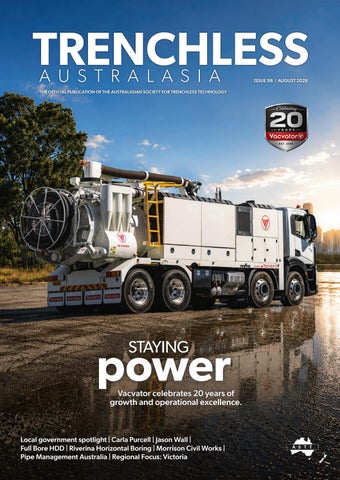
ISSUE 98 | AUGUST 2026 THE OFFICIAL PUBLICATION OF THE AUSTRALASIAN SOCIETY FOR TRENCHLESS TECHNOLOGY
power STAYING
Vacvator celebrates 20 years of growth and operational excellence.
Local government spotlight | Carla Purcell | Jason Wall | Full Bore HDD | Riverina Horizontal Boring | Morrison Civil Works | Pipe Management Australia | Regional Focus: Victoria
/ interflow.com.au
G
R W B
We’re Creating the Future of Water for people and communities, for generations to come 2 TRENCHLESS AUSTRALASIA AUGUST 2026
G T w s u A
F s
GRUNDODRILL JCS/ACS
READY FOR THE FUTURE. WITH HDD TECHNOLOGY BUILT FOR MORE.
Greater productivity, flexibility and operating comfort for your drilling projects. That’s the New Generation of GRUNDODRILL rigs from TRACTO. An intuitive operating concept with numerous automatic functions and top-of-the-range features gives you full control and less stress in tough everyday conditions on site. Our advanced HDD technology performs well even under demanding conditions and adapts flexibly to your needs. A practical all-round service supports you throughout your projects. Find out more about the drilling technology of the future, as well as financing and service solutions by calling + 61 7 3420 5455 or writing to au@tracto.com
TRACTO.COM/AU
AUGUST 2026 TRENCHLESS AUSTRALASIA 3
Contents ISSUE 98
AUG 2026
38
40
60
VELVET UNDERGROUND Executive decisions
NON-DESTRUCTIVE DIGGING 22
COVER STORY Staying power
24
LOCAL GOVERNMENT SPOTLIGHT Ace in the hole
28
Chewing the scenery
32
Underground sunshine
34
Ahead of the game
54
Major moves
56
INDUSTRY INSIGHTS Challenging conventional thinking
58
Controlled environments
60
Beyond price: Interflow’s sustainable procurement journey
62
REGIONAL SPOTLIGHT State of play
HDD
64
Mud meridian
38
REGULARS
Tough trade
40
Editor’s letter
Beast mode
42
From the ASTT President
8
From the ASTT Secretary
10
REHAB & REPAIR Ultra violet vision
44
Box office
46
All the difference
48
Focal point
50
Suitable accommodation
52
6
News
12
Events
66
ASTT Members
68
People on the Move
70
This magazine is the official journal of the Australasian Society for Trenchless Technology (ASTT) and is distributed to members and other interested parties throughout Australia and the Asia-Pacific. It is also available on subscription. The publishers welcome editorial contributions from interested parties. However, neither the publishers nor the ASTT accept responsibility for the content of these contributions and the views contained therein are not necessarily the views of the publishers or the ASTT. Neither the publishers nor the ASTT accept responsibility for any claims made by advertisers. All communications should be directed to the publishers.
24 4 TRENCHLESS AUSTRALASIA AUGUST 2026
Unless explicitly stated otherwise in writing, by providing editorial material to Prime Creative Media (PCM), including text and images, you are providing permission for that material to be subsequently used by PCM, whole or in part, edited or unchanged, alone or in combination with other material in any publication or format in print or online or howsoever distributed, whether produced by PCM and its agents and associates or another party to whom PCM has provided permission.
Cover image: Vacvator
P
TRENCHLESS INNOVATION Premium supplier of liners for wastewater, stormwater, potable water and culverts
PIPECORE.COM.AU | 1800 747 326 Exclusive distributor of SAERTEX-LINERS® for trenchless renewal of gravity and pressure pipelines
Trusted by contractors and asset owners across Australia and New Zealand
Getting grounded William Craske Editor
“W CHAIRMAN
John Murphy CEO
Christine Clancy christine.clancy@primecreative.com.au MANAGING EDITOR
Eugene Duffy eugene.duffy@primecreative.com.au EDITORIAL
William Craske william.craske@primecreative.com.au BUSINESS DEVELOPMENT
Nick Lovering nick.lovering@primecreative.com.au HEAD OF DESIGN
Clayton Hawley clayton.hawley@primecreative.com.au DESIGNERS
Apostolos Topatsis & Deborah Pilarinos ARTICLES All articles submitted for publication become the property of the publisher. The Editor reserves the right to adjust any article to conform with the magazine format.
Head Office 379 Docklands Dr, Docklands VIC 3008 Ph: +61 3 9690 8766 enquiries@primecreative.com.au www.primecreative.com.au Sydney Office Suite 11.01, Level 11, 201 Miller St, North Sydney, 2060
e disapprove of earthquakes,” historian Will Durant observed, “when our feet are on the earth.” He was talking, more explicitly, not about the shockwaves of natural disasters, but a particular mindset that comes with middle age in direct contrast to the reckless adventure of youth. Stability is something practiced, hard-earned through effort and experience. In business, where successful longstanding both repudiates and incorporates the vagaries of constant external change, survival, like in nature, is subject to adaptations. Liquid modernity, to characterise our age, with its technological tumult, leaves behind those not assimilated to it. In each new epoch, it’s the youth that adapt fastest to revolt having no foresight tested by history. In this, the age of information saturation, digital adoption now looks like the tip of the iceberg — large language models, commonly referred to as Artificial Intelligence being the iceberg. Like anything submerged or obscured from sight, questions abound. The question in the case of AI is not its use – adoption, for the moment, appears widespread – but rather its notional value. In social media AI-generated content permeates; it is easy to spot and harder to digest. The emperor truly has no new clothes. But in highly technical industries like science, engineering and construction, where physical obstacles pose problems of force, gravity and geology, AI’s ability to crunch data therefore improving project oversight, for that is what it does best, has potential to open up new horizons, especially in problem solving. In the world of tunnelling, a rock-breaking data filtering method is being developed based on the effective conversion of energy on disc cutters used on boring machines. Understanding the rock mass quality ahead of the machine face has become critical for ensuring construction quality and improving
construction efficiency. Predicting rock mass quality using machine learning and other algorithms is something of a hotbed for research in recent years according to a new report in Nature. One of the proposed methods provides advanced technical support for cross-project data utilisation and realtime prediction of rock mass quality. It will have important implications for construction safety and efficiency in newly built tunnel and pipeline projects where stability matters most. Data has little value before it is generated and for it to be generated there requires, at least, in this sense, real earthly activity. It remains to be seen what kind of viable compromise can be attained between stability and liberty, stagnation and experiment under the AI paradigm. A story comes to mind on this subject. Phillip Glass, one of the world’s most famous composers, announced a series of tour dates earlier in the year to celebrate his turning 90. That kind of longevity is not easily replicated. For many years right up until his 40s, Glass supplemented his music career as a plumber in New York. On one shift, so the anecdote goes, he was installing a dishwasher in a SoHo loft. As he was grappling with the machine laying on the floor, the homeowner walked into the kitchen. It was Robert Hughes the renowned art critic for Time magazine and Australian author of The Fatal Shore. Hughes apparently stared at Glass in utter disbelief and gasped, “But you’re Phillip Glass! What are you doing here?” Glass casually replied that he was installing the dishwasher and would soon be finished. When Hughes protested, “But you’re an artist,” Glass simply explained that, as well as being an artist, he was also a plumber, and politely told Hughes to leave him to finish his work. While there’s work still to be done, we maintain our humanity in doing it. william.craske@primecreative.com.au
COPYRIGHT
Printed by: Precision Group 83-89 Freight Drive, Somerton, Melbourne, Victoria, Australia, 3062 6 TRENCHLESS AUSTRALASIA AUGUST 2026
Trenchless Australasia is owned by Prime Creative Media and published by John Murphy. All material in Trenchless Australasia is copyright and no part may be reproduced or copied in any form or by any means (graphic, electronic or mechanical including information and retrieval systems) without written permission of the publisher. The Editor welcomes contributions but reserves the right to accept or reject any material. While every effort has been made
to ensure the accuracy of information, Prime Creative Media will not accept responsibility for errors or omissions or for any consequences arising from reliance on information published. The opinions expressed in Trenchless Australasia are not necessarily the opinions of, or endorsed by the publisher unless otherwise stated. © Copyright Prime Creative Media, 2021
Excellence in tunneling for water, wastewater and energy infrastructure. With a focus on safety, innovation and collaborative delivery over the last 35 years, Rob Carr has achieved outstanding outcomes in water, wastewater and energy infrastructure projects in both Australia and overseas. Rob Carr is part of Soletanche Bachy a world leader in foundation and soil technologies and subsidiary of VINCI, a global player in construction across more than 100 countries. With outstanding capabilities to manage the complexities of any project, Rob Carr has the people, knowledge and experience to deliver success.
robcarr.com.au
From the President Blair Telfer President, ASTT THE AUSTRALASIAN SOCIETY FOR TRENCHLESS TECHNOLOGY ABN 43 893 870 966 P.O. Box 2242, MALAGA LPO WA 6944 www.astt.com.au President: Blair Telfer Secretary: Trevor Gosatti Vice President: Ash Hamer
COUNCILLORS Western Australia: Aizezi Jiang Queensland: Ben Crosby New South Wales: Jason Marshal Victoria: Ash Hamer South Australia: Shaun Melville New Zealand: Blair Telfer Northern Territory: Luke Woodward Tasmania: Vacant
8 TRENCHLESS AUSTRALASIA AUGUST 2026
W
e’re well past the halfway mark in the year and excitement builds as we fast approach the year’s major event for the industry and ASTT members. With planning for International No-Dig Auckland well underway, it’s pleasing to see the growing list of event partners announced in recent months with some major bodies based in New Zealand pledging their commitment to the cause. As organisations determine how they will fund, manage and deliver essential water infrastructure into the future, International No-Dig Auckland offers a timely platform for stakeholders to connect with industry leaders, explore emerging technologies and discuss the challenges and opportunities ahead. Three pre-conference training courses will be held for those keen for more learning. As a precursor for NZ members, three half day events were held across New Zealand in May/June. These ASTT Forums were a huge success — equally well received and attended. I would like to thank everyone involved from the sponsors, speakers, organisers and our attendees. I hope to see many again at the upcoming 2026 Water New Zealand Conference and Expo. The ASTT will again provide a stream of presentation in collaboration with Water New Zealand – bringing operators from the industry in to share insights and practical knowledge on utilising trenchless technologies in sustainable industry projects. It’s always a pleasure bringing
these events together, seeing new faces, and reconnecting with our peers nationwide. The ASTT is also planning to host another round of events in November. These have been earmarked for Black and Gold, Kumutoto in Wellington on Wednesday, 18 November, and the Sudima Hotel, Wednesday 25 November. The Southern Hemisphere’s leading trenchless technology conference and exhibition No Dig Down Under 2027 will relocate to Sydney next year. The dates have already been confirmed for 21–22 July 2027 at the Sydney Showground. There’s already great anticipation for the biennial event that seems to have gotten bigger and better with each iteration. I hope to see as many of our members there as I can. Aligned with this, our members can look forward to coming updates on the ASTT website. A new user experience with a refreshed appearance is in the works and will provide value and extra benefits. A review and update of some of our published guidelines has begun to ensure we remain current and up to date with the latest techniques and developments. ASTT is preeminent in the global trenchless advocacy and education space, so we are well placed to provide insights to asset owners on the value of trenchless technology to their customers, in terms of both minimising disruptions as well as overall cost efficiency and savings. Finally, I am always available and keen to hear any feedback our members would like to share. Exciting times ahead.
PRECISION UNDERGROUND REHABILITATION Industry leading UV CIPP relining and robotic pipeline solutions for Queensland’s underground infrastructure Trenchless Pipeline Services delivers innovative trenchless rehabilitation solutions that restore ageing infrastructure while eliminating the need for costly excavation. Leveraging industry-leading UV CIPP technology from Brandenburger, IMPREG, SAERTEX, Prokasro, iBak and Kaiser, our experienced team rehabilitates gravity sewer, stormwater and potable water pipelines with precision, efficiency and long-term structural performance. Supported by advanced robotic CCTV inspection technology and a fleet of fully equipped combination jetting and vacuum trucks, we deliver end-to-end pipeline assessment, cleaning, rehabilitation and maintenance services for councils, utilities, commercial clients and infrastructure asset owners across Central Queensland. Our capabilities include: • UV CIPP relining • Robotic CCTV inspection and reporting • Combination jetting and vacuum services • Manhole and large-diameter rehabilitation • Sewer and potable water pipeline renewal • Robotic cutting, milling and lateral reinstatement • Pipe locating and leak detection
Talk to Queensland’s trenchless specialists Ph: (07) 4913 1510 E: info@tpsqueensland.com.au 330 Alexandra street Kawana QLD 4701 PO Box 1425 Yeppoon QLD 4703
ASTT
Secretary’s corner AUGUST 2026 Trevor Gosatti New Members On behalf of the ASTT, I extend a warm welcome to the following new members: Silver Corporate Member – Australia • Australian Pipelining Supplies (Darren Tickell) • Professional Tools Australia (Drew Helmore) Asset Owners – Australia • South East Water (James McKimmie) Individual Members – Australia • Justin Arifin from Hatch • Simon Griffin from Jacobs • Julian Vivoli from Vivoli Consulting Engineers • Dino Everts • Kamal Kamalarasa from DSK Consulting Pty Ltd Registration for the 2026 ISTT International No Dig in New Zealand available A reminder that registrations for the International No-Dig 2026 Auckland in New Zealand to be held from October 28-29, 2026, at the newly built New Zealand International Convention Centre in Auckland are now available and can be purchased. Register now and lock in your spot at this highly anticipated event. The link to access the early registration can be found here: no-dignz.com/ The ASTT is hosting this event on behalf of the International Society for Trenchless Technology and it promises to be a popular event for international visitors. 10 TRENCHLESS AUSTRALASIA AUGUST 2026
ISTT to Celebrate 40th Year Anniversary at Auckland A major feature of the International No Dig at Auckland will be the celebration of the 40th year anniversary of the International Society for Trenchless Technology (ISTT) that commenced in 1986. A number of events are planned to highlight the anniversary including : • a keynote speech from ISTT President, Dec Downey • a special edition 40th Anniversary book on the history of the ISTT and the trenchless industry • a forum of past luminaries of the ISTT discussiong the history of the ISTT, • and much more. The Call for Abstracts at the International No-Dig Auckland extended The call for abstracts for the International No-Dig Auckland 2026 has been extended! As the ISTT’s premier annual conference and exhibition, International No-Dig serves as the global benchmark for the trenchless industry, rotating to a different host city each year. In 2026, we head to Auckland, New Zealand, to bring together the world’s leading experts for an unparalleled exchange of knowledge and technology. The opportunity for you to submit an abstract to be part of this prestigious program is still open. We are looking for submissions that push the boundaries of current knowledge and provide tangible value. If you are considering presenting a paper as a speaker and promoting to the industry
consider the link below. Review the full criteria and submit your proposal via the official portal: no-dignz.com/ speakers/ Nominations for awards at the International No-Dig As I touched on in the last edition of Trenchless Australasia there will only be the ISTT Awards to be presented at the International No-Dig event to be held in Auckland, New Zealand in October 2026. If you have completed a great project or installed on a project with a new technology, please look to complete and lodge your potential nomination now. All ASTT members (as reciprocal members of ISTT) are of course able to nominate for the various ISTT Award categories and encouraged to do so. Go to the ISTT site at www.istt.com and click on the Awards page.
Trevor Gosatti Secretary, ASTT
Expertise You Can Rely On Solutions driven. Quality results.
Our Capabilities
Southern Relining specialises in trenchless pipe repair and relining Australia wide. With over 20 years of experience, we deliver quality outcomes for industrial, commercial and government clients minimising excavation, reducing downtime and extending asset life.
ꞏ Manhole scanning & relining ꞏ Culverts ꞏ UV GRP lining ꞏ Lateral & junction lining ꞏ Epoxy lining ꞏ Silicate patches ꞏ CCTV & reporting ꞏ Robotic cutting Explore More at southernrelining.com.au
Discuss your project needs Call (02) 4871 1254 or email admin@southernrelining.com.au
NEWS IN BRIEF
Pipe Doctor’s newest branch forges ahead under local leadership Family-owned drainage and pipe rehabilitation specialist Pipe Doctor is marking 18 months of operations in Gippsland, with its Traralgon branch, the company’s fourth in Victoria, now a permanent fixture servicing the region’s water authorities, councils, builders and civil contractors. Regional Manager Benjamin Hoskin, who leads the branch, says the decision to establish a permanent presence in the area was driven by sustained demand. “There was an opportunity for the business to grow,” Hoskin said. “Gippsland is an area that we had been receiving numerous requests for, and we had done some work around there prior via travel.” Eighteen months on, the branch is delivering on that opportunity. Pipe Doctor is now working under contract with the local water authority, alongside council and commercial work spanning CCTV inspection, mains and sewer cleaning, and domestic residential blockages, a service range that runs from single pipe repairs through to full municipal drainage network projects. The branch also offers UV relining, sewer compliance work, manhole rehabilitation
and robotics, backed by full Wincan Web reporting capability, part of a broader push by Pipe Doctor to stay ahead of the curve on emerging pipe technology. Pipe Doctor was recently brought on as a design partner with Puralink, the Australian robotics company behind the Ferret autonomous pipe inspection robot, with Hoskin playing a key role alongside Puralink’s team as the technology moves toward wider rollout. Hoskin was appointed to lead the Gippsland expansion after five years at Pipe Doctor’s Bendigo headquarters, where he worked as a project manager specialising in robotics and relining alongside the company’s domestic crews. He had worked as a plumber since 2014 before joining Pipe Doctor. A Traralgon local, Hoskin said the connection to the region has helped him build relationships with local trades, councils and builders as the branch has grown. “Being that I grew up here and lived most of my life here, I was in a good position to spearhead the expansion,” he said. “It’s great being able to support the local community and my hometown.” On the scope of work the branch can
take on, Hoskin said the team isn’t limited by job size. “We have the ability to go right the way through, no matter what size your drainage is,” Hoskin said. “We’re starting to really make some headway, and we’ll continue building up the business.” Growth in the region shows no signs of slowing. Ageing infrastructure, combined with rapid outer-suburban expansion on Melbourne’s southeastern fringe, continues to drive demand for the branch’s services. New estates in Clyde, Officer and Botanic Ridge, along with housing developments in Drouin and Warragul, now fall within the Traralgon branch’s service area. Hoskin said one of the more notable shifts over the past 18 months has been a rise in the number of builders requesting sewer and stormwater inspections during construction. “We’re seeing a lot of builders coming on board now as a way of being proactive. They’re taking the initiative to do these inspections to avoid costly trenchless repairs and relining,” he said. “Getting these checks done is a way to eliminate those kinds of hassles later down the track, and those additional costs.”
W T
Pipe Doctor’s new site in Traralgon.
Image: Pipe Doctor
3
H a
K 12 TRENCHLESS AUSTRALASIA AUGUST 2026
A
CAP VAC INDUSTRIAL 10×4 WET & DRY RECOVERY IN ONE UNIT
WET OR DRY, ONE TRUCK CLEARS IT.
3,800
m³/hr Air flow
High airflow for faster recovery and shorter cycle times.
8″ hydro excavation, high-airflow vacuum recovery and a class ‘A’ high pressure water pump, built for Australian and New Zealand conditions and backed by KOR service on the ground.
8″ hydro excavation
High payload capacity
270° boom rotation and a class ‘A’ water pump for more productivity.
Longer shifts between dumping with a 10x4 high capacity chassis
LEARN MORE
KEEP OPERATIONS RUNNING. AU 1300 567 784 · NZ 0800 567 691 · kor.com.au
NEWS IN BRIEF
Eire Constructions with Pipeline Drillers Group deliver critical Manning River underbore
East Coast of Australia based civil construction company Eire Constructions has delivered a critical infrastructure project for MidCoast Council. Following the failure of an existing river crossing during major flood events in May 2025, MidCoast Council needed to restore redundancy to a key trunk watermain supplying the region. Failure of the existing crossing posed a significant risk to water supply reliability and the urgent project later to be known as the Manning River Watermain Underbore saw Eire engaged to deliver a fast-tracked solution involving the installation of a new DN560 PN20 SDR9 HDPE watermain via horizontal directional drilling (HDD) beneath the river. Recognising the critical nature and urgency of the works, HDD specialist Pipeline Drillers Group were engaged as a major delivery subcontactor and prioritised the project within its upcoming delivery program and worked closely with Eire to rapidly mobilise the specialist resources required to deliver the HDD component. 14 TRENCHLESS AUSTRALASIA AUGUST 2026
Image: Eire Constructions
Installation of the DN560 HDPE watermain in action.
Associated trenching and tie-ins to the existing DN450 trunk main, located between Bootawa and Wingham, were also part of the scope. Key works involved approximately 725 metres of HDD installation, and 335 metres of open trench works, delivered over a compressed 20-week program. Despite challenging subsurface conditions, including cobble seams and high-strength rock, Eire successfully adapted construction methodologies to maintain progress. This included the installation of a 72-metre steel casing to stabilise ground conditions at the HDD entry point and completing trenching and connection works in parallel to mitigate delays. Eire also provided full HDPE weld traceability and data logging, vacuum testing prior to installation and hydrostatic testing post-installation. Implementation of sediment and erosion control measures were also required. MidCoast Council quoted in its Local Government award submission the “exceptional commitment of lead contractor,
Eire Constructions”. “Eire provided the specialised expertise, rapid resource escalation and operational stamina required to navigate complex ‘cobble zone’ challenges through real-time risk management and 24/7 field planning,” noted the Council. Despite the emergency nature of the works and complex ground conditions, the project was delivered safely with no significant incidents and strong environmental performance, with positive feedback from the Council’s environmental auditor. “This project was a great example of what can be achieved through genuine collaboration,” said Ben Granger Eire’s Project Manager. “Eire, Pipeline Drillers and MidCoast Council adopted a best for project approach, working together to overcome significant technical and geotechnical challenges and deliver this time critical piece of water infrastructure.” The project, in sum, restored a vital water supply crossing, ensuring reliability for the community and resilience in the network ahead of peak demand.
Available no
NEW! w.
Order nowl
High flexibility all thicknes YOUR BENEFIT
MANHOLELiner Ml25
Get in touch with our country manager: Colin Murphy +61 486 021784 cmurphy@impreg.com
Benefit from the advantages. 5 hard facts:
+ Homogeneous wall thickness. + Unlimited length. + Perfect fit in the manhole, only minimal annular gap. + Controlled installation. + Perfect resin-viscosity, ,,simple & clean". Available wall thicknesses: 5.6 mm/ 6.5 mm/ 7.4 mm + more sizes to TBC IMPREG (Australia) Pty ltd• www.impreg-australia.com• Suite 1.01, Level 1,201 Elizabeth Street, Sydney, NSW 2000
NEWS IN BRIEF
Fulton Hogan to deliver wastewater upgrades on North Island and Franklin pump stations.” Watercare project manager Stephan Morkel said Pukekohe North pump station will have a capacity of 480 litres per second, significantly increasing the network’s ability to manage higher volumes of wastewater. “The programme reflects Watercare’s core focus on improving infrastructure delivery through stronger planning, smarter execution and better systems,” said Morkel. “The project will also consolidate emergency overflow management by creating a single, engineered overflow point for the new pump station. “This will remove two existing overflow points that currently discharge into the local stormwater network and intermittently into a nearby stream, improving environmental outcomes. “Site establishment is now complete, and crews have begun early works to prepare for the next major stage of construction.” The wastewater pump station and fourkilometre pipeline are expected to be completed by early 2028. Morkel said at the end of this month contractor Fulton Hogan will begin installing the first section of the new wastewater pipeline outside the Pukekohe Train Station. “Works to install the first section will take place across two sites along Station Road,”
he added. “The first site will be outside Pukekohe Train Station, where the pipeline will be installed using horizontal directional drilling, a trenchless method for installing underground utilities without digging a full open trench. “The second work site will be set up south of Subway Road and will use open trenching. “This means the team will close a section of the road, dig a trench, install the new pipeline, then reinstate the worksite before moving on to the next section.” Image:Watercare
Horizontal directional drilling is being deployed to install a new wastewater pipeline outside Pukekohe on the the North Island of New Zealand. The new four-kilometre pipeline is part of a major upgrade to reduce overflows and unlock capacity for around 12,900 homes. Sections of the pipeline will be installed near the train station on Station Road within the scope of a $98.2 million programme that also includes construction of a larger wastewater pump station on Isabella Drive. This work is being delivered alongside the $17 million Jutland Road wastewater diversion project, currently underway on Ward Street. Together, these projects will improve network performance, reduce the risk of overflows, and create capacity for future growth in Pukekohe. Franklin ward councillor Andy Baker said Pukekohe is a fast-growing community, with around 50,000 people expected to move into the area over the next 20 years. “These projects are the first in a series of interdependent upgrades needed to fully support existing communities and future growth in the Pukekohe and Paerata area,” he said. “The new pump station on Isabella Drive will replace both the existing Isabella and Cape Hill wastewater pump stations, while also relieving pressure on the Te Paea
C
M
Y
CM
Fulton Hogan’s work site outside Pukekohe.
MY
CY
CMY
Service Stream awarded nine-year maintenance contract with Yarra Valley Water Service Stream has secured a new nineyear contract with Yarra Valley Water under the utility’s Maintenance Services Delivery Partners program. Yarra Valley Water is Victoria’s largest water utility, providing water and sewerage services to more than two million people across Melbourne’s northern and eastern suburbs. Under a refreshed delivery model, Service Stream has been selected as the Delivery Partner for the Northern Region. Under the contract, Service Stream will deliver mechanical, electrical and civil maintenance services across Yarra Valley Water’s water and sewerage networks and treatment facilities. The scope includes both responsive maintenance and selected programmed works, supporting the ongoing reliability and performance of critical infrastructure servicing Melbourne communities. Mobilisation activities will commence immediately, with operations scheduled to 16 TRENCHLESS AUSTRALASIA AUGUST 2026
Service Stream crew at work in Melbourne.
begin in October 2026. Service Stream Managing Director, Leigh Mackender, said the contract represented an important milestone for the business and reinforced the company’s strong position within the utilities sector. “We are delighted to be selected as a delivery partner for this long-term program. We look forward to working closely with Yarra Valley Water and supporting the maintenance of its critical infrastructure across Melbourne,” Mackender said. “In alignment with
our Group strategy, this award further strengthens and diversifies Service Stream’s operations and maintenance portfolio, providing additional annuity-style revenue and further expanding our secured work-inhand profile.” The award represents a significant milestone for Service Stream’s Utilities business and reinforces the company’s continued focus on building long-term partnerships, delivering operational excellence and supporting essential infrastructure services across Australia.
K
NEWS IN BRIEF
Construction of the Toowoomba to Warwick Pipeline has been awarded by Seqwater to a joint venture between CPB Contractors and NACAP. Stage 1 works are expected to commence in late 2026, marking a major step forward in securing long-term water supply for Toowoomba and the Southern Downs. The pipeline, which is being touted as a vital investment in the long-term prosperity and resilience of the Toowoomba Region, has been allocated $300 million in funding from the Queensland Government. The 111 kilometre pipeline will transfer raw water from upstream of Mount Kynoch Water Treatment Plant to Warwick Reservoir near Leslie Dam. The water will be sourced from Wivenhoe Dam via the existing Wivenhoe to Cressbrook pipeline and other water infrastructure owned by Toowoomba Regional Council. The alignment includes 64 waterway crossings and seven rail crossings predominantly through state and local road corridors. Horizontal directional drilling and pipe jacking are planned at major road, rail and waterway crossings to reduce surface disruption. Stage two will deliver an approximate 64-kilometre pipeline from Greenmount to Warwick, enabling enhanced drought contingency when it is required. This stage will be delivered subject to a future government decision and ongoing assessment of water security requirements for the Southern Downs region. Seqwater CEO Emma Thomas said awarding the contract is a major milestone in making the Toowoomba to Warwick Pipeline project shovel ready.
Image: visoot/stock.adobe.com
Toowoomba to Warwick pipeline construction awarded to CPB Contractors, NACAP JV
“Seqwater is delivering the project on behalf of the Queensland Government to strengthen water security for Toowoomba and protect the corridor for the project that could deliver long-term benefits for the Southern Downs,” Thomas said. “The project is expected to support around 400 construction jobs, with local recruitment already underway. We will continue working closely with the delivery partner to finalise planning and approvals, while keeping the community informed as we move towards construction.” CPB Contractors Managing Director Craig Nuttall said this project represents an important investment in water security for regional Queensland.
“We are proud to have been selected to deliver the Toowoomba to Warwick Pipeline as a joint venture between CPB Contractors and NACAP. “We are committed to delivering the pipeline safely and efficiently while maximising opportunities for local employment and training throughout delivery.” Toowoomba Regional Council Mayor Geoff McDonald said a reliable water supply is essential to attracting future investment in the region. “This milestone brings us a step closer to strengthening water security for generations to come while delivering significant economic benefits for local businesses and workers during construction,” said McDonald.
SA Water completes microtunnelling for Northern Expressway Microtunnelling works beneath the Northern Expressway in Adelaide’s north have been completed. SA Water announced that a boring machine broke through at its retrieval pit on the other side of Petherton Road. This will enable crews to eventually start trenching to continue the process of laying new pipes. McConnell Dowell SRG Global Utilities Joint Venture (MCD-SRG JV), SA Water’s construction partner, performed the microtunnelling under the Northern Expressway as part of the utility’s recent water network capacity upgrades to support 18 TRENCHLESS AUSTRALASIA AUGUST 2026
housing growth. With the tunnel now carved out, crews are set to commence use of a pipe jacking machine to carefully push approximately 115 metres of new trunk water main through the tunnel. It forms part of our second stage of water network upgrades enabling more homes to be built in Riverlea. The work, while considered essential, involved the preservation of historic site which added to its complexity. The retrieval pit was situated near the Petherton Road Pisé Cottage, a State Heritage Place dating back to the late 1850s.
“Protecting the heritage-listed structure was a key priority throughout our microtunnelling,” said SA Water in an online statement. “Real-time monitoring systems were established with automated alerts notifying the project team if vibration levels approached the defined limits. “Importantly, no vibration exceedances were recorded during the tunnelling, confirming the effectiveness of our crews’ construction methodology and monitoring controls in protecting the heritage-listed cottage.”
THE RIGHT NOZZLE. PAYS FOR ITSELF. Australia’s largest enz® Jetting Nozzles range. A nozzle matched to every pipe, every blockage, every flow.
Get every bit of power your pump can deliver Cut your water and fuel bill on every job Replace nozzles less often with enz® build quality Over 50 years matching crews to the right gear. Not sure which nozzle suits the job? Talk to the team who fit them every day.
Talk to the experts
Scan to see the full nozzle range.
1800 028 584 or visit us online seca.com.au
NEWS IN BRIEF
T
Cleanflow completes high-impact asset renewal in Forrestfield No-dig services provider, Cleanflow Environmental Solutions, has confirmed it has completed the trenchless UV-cured relining of two DN900 reinforced concrete culverts. The project included restoring structural integrity to the high-impact assets located at Hale Road, Forrestfield, in addition to improving hydraulic function and long-term service life with minimal disruption. The scope of works required mobilisation, site establishment and safety setup, traffic and pedestrian control, HV/LV identification, overhead powerline controls with signage and spotters, comprehensive service locates, pre-cleaning to remove debris, silt, roots
and dust. Ceanflow also provided CCTV verification and strict manufacturer-compliant UV liner installation targeted to a maximum two days on-site. According to the company, quality control was maintained throughout via inspection and testing, followed by demobilisation, commissioning surveys, defects resolution and final updates to as‑constructed records, the Functional Asset Register and SAP plans. Faced with variable weather and creek flows, Cleanflow said it had implemented and managed a bypass system to control water ingress, enabling completion of the
lining on schedule despite a forecasted storm and without compromising the UV cure or installation quality. “The works were completed within the low‑flow summer window, with full QA documentation and asset records handed over to the client, reducing lifecycle risk and demonstrating Cleanflow’s capability to deliver safe, efficient and high‑quality culvert renewals under challenging conditions,” the company said. Based in Canning Vale, Cleanflow is a privately-owned company in Western Australia that specialises in drainage, sewer, water, and oil and gas asset services.
D
Cardinia Shire farmers set to receive 49km pipeline Construction is underway on South East Water’s Western Port Recycled Water Scheme, delivering up to 4,000 million litres of Class A recycled water each year to local farmers across Cardinia Shire. Work includes around 49 km of new recycled water pipeline, supplying farms in Pakenham South, Cora Lynn, Vervale, Catani, Iona, Garfield, Tynong and Bayles. The project will support regional growth, with an estimated $104 million increase in gross regional output. It will also support more than 90 jobs across construction and agriculture. The $113.2 million scheme is funded through a $66.6 million investment from South East Water, with $46.6 million from the Australian Government’s National Water
Grid Fund. Senator for Victoria, Lisa Darmanin and the Victorian Minister for Water, Harriet Shing, helped mark the start of Stage 1a construction in Pakenham South, alongside South East Water and delivery partner Beca Fulton Hogan Interflow (BFHI) Joint Venture. The scheme supports local food production and creates jobs by improving water availability for agriculture. Using recycled water for irrigation reduces reliance on groundwater and local waterways. It also helps farmers adapt to a changing climate in one of Victoria’s key food-growing regions. Connected customers are expected to start receiving recycled water from 2028. “Recycled water is a safe, sustainable
choice that helps our customers save precious drinking water while strengthening the resilience of our whole community,” said South East Water Managing Director Carla Purcell. “We’re proud to be supporting our local farmers with a reliable source of water that will help increase the amount of fresh food and produce they can grow.” BFHI Joint Venture Program Director Utilities, Martin Sutherland called the project a significant sustainable benefit for agricultural producers in the Western Port area. “It’s a privilege to be involved in a project that creates local job opportunities and keeps our rural communities green.” Delegates and workers gather in Pakenham South.
Image: South East Water
C
20 TRENCHLESS AUSTRALASIA AUGUST 2026
T h b o e T a w
G 1
The Heavy Hitter in NDD Available for immediate delivery ///
DIGGERVAC 9,000L
180º rotating boom
30m / 13mm hp hose
Cassette boom suction
NDD reel
The DiggerVac features a fully hydraulic 6-inch cassette style boom with 180°rotation giving operators excellent reach and easy positioning on site. The boom and vacuum fuction are remote controlled along with manual overrides.
The NDD spring return high pressure reel contains 30m of 13mm hose. A robust 300bar and 17LPM gives you all the performance you need to complete the NDD jobs. The NDD reel is mounted low at the rear of the unit for easy access in all conditions.
Get in touch with our team to find out more. 1800 822 787 sales@vacuumtrucks.com.au
No computer interface
Control system with a remote control
In line with VTS’s “Simple is Better” philosophy, the DrainVac uses straightforward controls with no computer interface. It’s easy to operate and designed for quick faultfinding and repair if needed. And with a wireless remote control to make the job easy.
High performance pumps
Vacuum pump The DiggerVac 9000 NDD is powered by a Jurop Helix blower delivering up to 6,100 m3/h (3590 CFM) of vacuum performance. That means strong suction, faster spoil recovery to keep the job moving.
VELVET UNDERGROUND
An Interflow crew helps deliver a trenchless solution in Mt Eliza for South East Water.
Executive decisions Future proofing critical infrastructure is a high priority for Carla Purcell. South East Water’s Managing Director is enthusiastic about her organisation’s use of new technologies but especially in how they can inform decisions long-term and help make them in real time.
O
rganisations responsible for essential infrastructure cannot afford to lose sight of the future despite the complexities of the now. This is the view of South East Water Managing Director Carla Purcell, who arrived at the business last year and is now 12 months into the role. A thread might be said to run through her career. Her leadership positions have involved leading complex asset-intensive organisations responsible for services that communities rely on every day. Before her arrival, Purcell had already compiled an impressive CV — starting off her career as a Lawyer at Ashurst and then in Qantas’ in-house Industrial Relations team before moving into operations with Qantas at Sydney International Airport. The move into airport operations afforded her first-hand experience in one of Australia’s most complex transport environments, reinforcing the importance of safety, operational resilience and stakeholder coordination.Home in Melbourne eventually called and she returned as the Chief Operating Officer at Yarra Trams, the largest tram network in the world, before becoming the CEO of Yarra Trams in late 2022. For Purcell, the opportunity to make a difference and contributing to community inside an infrastructure framework was important and attracted her to South East Water. “Our Purpose at South East Water is to provide Healthy Water for Life and this is
22 TRENCHLESS AUSTRALASIA AUGUST 2026
something we take very seriously,” she told Trenchless Australasia. “We need to manage today, but do not lose sight of tomorrow.” In an economy increasingly reliant on fast moving consumables, critical infrastructure requires a vastly different framework and leadership mindset to match. South East Water’s service area incorporates one of the most populous areas in metropolitan Melbourne and includes large urban growth areas and significant coastline. It spans from Portsea to Port Melbourne and the Bayside suburbs in between, and inland out to Cardinia Shire, where it recently launched works for a 49-kilometre recycled water pipeline into Western Port. “We have inner city high density living, established suburbs, the greater southeast Melbourne precinct that is the largest manufacturing precinct in Australia and new homes being constructed, in new suburbs,” says Purcell. “We’ve got a bit of everything.” South East Water provides 1.9 million Melburnians with water and wastewater services and employs approximately 1000 employees. The business has an annual turnover of $1.2 billion and manages $7 billion worth of assets. This year the capital works delivery program is approximately half a billion dollars. The spend is split mainly between upgrading and replacing ageing infrastructure and investing in growth and reliability. “Infrastructure plays a fundamental role
in enabling economic growth. Whether it’s housing, manufacturing, logistics or recreation, our role is to ensure communities and businesses have the services and capacity they need to thrive,” said Purcell. “We’re focused on making targeted investments that deliver longterm value for our customers while maintaining Carla Purcell, South East Water Managing Director.
VELVET UNDERGROUND
the financial sustainability needed to support future infrastructure requirements.” The emergence of the municipal activity centres in Victoria – there are 29 in South East Water’s service area – means the business is also shifting its focus from large capital projects in new housing estates. “We are increasing the size of assets in areas that already have water and sewerage services to be able to support higher-density development,” said Purcell. “As we make this transition, we’re focused on minimising disruption for our customers and communities while delivering infrastructure that supports future demand and strengthens resilience across our service area.” South East Water has found that trenchless technology solutions are increasingly more efficient and less disruptive, especially on expansions but also for repairs across its legacy infrastructure network. On its water main upgrades, horizontal directional drilling (HDD), pipe bursting and slip line methods are frequently used. For sewer rehabilitation, the business often engages contract partners to use trenchless spiral lining. On occasion, they’ve also used cured in place pipe (CIPP) or fold and form. Over the past year microtunnelling techniques were used to install over eight kilometres of gravity sewer mains ranging from 300mm to 600mm in diameter as part of upgrades at Albert Park, McKinnon and Noble Park. New recycled water assets were installed via HDD in Frankston North and the Dingley Recycled Water Schemes with over 23km in total installed to date. Recently, South East Water engaged Primus Line for an 850m water main renewal project in Mount Eliza. The business is also currently working toward renewal of 2.4km of DN300 cast iron cement lined pipeline by removing
the cement liner to enable slip line with a smaller diameter HDPE pipe. Trenchless techniques have been enabling South East Water to undertake critical upgrades to extend the life of assets when open trench solutions, in many cases, would cost exceedingly more, take longer to plan and deliver, and cause greater disruption to customers and the broader community. Purcell said the approach aligns with South East Water’s focus on delivering essential services safely and reliably while reducing impacts on customers and local communities. “Where trenchless methods are suitable, they can help us deliver important upgrades more efficiently while limiting disruption to roads, businesses, public spaces and residents,” she said. “In these cases, we often rely on microtunnelling and HDD which can be useful methods when we need to complete works under major freeways or rail crossings.” Through South East Water’s Integrated Planning and Delivery model, established in 2023, the organisation is managing a long-term portfolio of approximately $1.5 billion in critical infrastructure investments designed to support population growth, resilience and future economic development. The IPD partners are Abergeldie, BMD and KBR (ABK), and BecaHunterH20, Fulton Hogan and Interflow (BFHI). Purcell sees major project delivery as a strategic capability and a critical enabler of future economic and community growth. The integrated, program-based delivery model incorporates early contractor involvement, shared planning and design, and Risk Allocated Maximum Price (RAMP) principles to optimise cost, risk, and performance outcomes across a multi-year capital portfolio.
Purcell cites the rollout of digital meters across the Mornington Peninsula and southeastern suburbs as a project she is proud of. She describes digital metering as part of a broader shift toward data-enabled infrastructure management, where real-time information supports better customer outcomes, faster operational decisions and more efficient investment planning. The digital meter rollout is the largest of its kind in Australia with nearly 30 per cent of South East Water’s network now connected to a digital meter. “We’ve already saved around 4.2 billion litres of drinking water,” said Purcell. “As at June this year, our customers have saved around $19.2 million in reduced consumer bills.” Analogue meters are being replaced with smart technology under the $272 million program which will facilitate real-time data, leak detection and usage insights. The program has also expanded to include larger meters for commercial customers and larger properties. It is expected to be complete by 2029. In a changing climate, ensuring long-term water security means reducing water loss, increasing efficiency and investing in alternative sources according to Purcell. “The work we are doing around water security, particularly around the growth of our recycled water network, shows the investment today to deal with tomorrow’s challenges,” Purcell said. “The decisions we make today will shape how future generations live, work and connect. Infrastructure leaders have a responsibility to think beyond the immediate horizon and ensure the assets we build today continue to serve communities for decades to come.” For more information visit southeastwater.com.au/
Images: South East Water
A digital meter being installed by a technician.
AUGUST 2026 TRENCHLESS AUSTRALASIA 23
COVER STORY
Staying power As it celebrates 20 years of business, Goulburn-based Australian owned business Vacvator, is embarking on new markets, innovating with new truck platforms and optimising its expanded production facility.
W
hen supply chains are subject to erratic fluctuations in times of uncertainty core structure is essential. Building a resilient brand takes vision but also stability. Especially in the non-destructive digging segment in which the integrity of an asset is as crucial, in its lifecycle, as the build itself. The distinction is not lost on Vacvator, a business whose industry commitments have been bolstered by several recent developments that will optimise the capabilities it can offer customers. Expanding its footprint in robust markets where clients operate is key to this. On the back of encouraging interest out of New 24 TRENCHLESS AUSTRALASIA AUGUST 2026
Zealand, Vacvator have now established itself as a supplier into that market, with customers now looking to Vacvator to provide a complete package which now includes innovation, support and an asset that will benefit their business long term. For company owner Andrew Rowlands, the prospect of building vacuum excavation trucks is more exciting than it was 20 years ago. “Our beginnings as a business are humble initially running parallel with another trenchless business I co-founded in 1995 where we built vactrucks for our own needs,” he said. “But then we recognised there was an opportunity within a growing industry, not
quite in its infancy but close to it, to build vactrucks and once that became our primary focus probably 15 years ago, that’s when it really started to take flight.” An historical watershed for the company occurred over 12 years ago when it took hold of its current premises in Goulburn. Up until then Vacvator had been renting sites. “Getting our own premises was a major turning point,” said Rowlands. “That allowed us to purely focus on building vactrucks. The other big development was the implementation of the CAN bus operating system on our trucks ten years ago and what that has permitted us to do.”
Images: Vacvator/IVECO
COVER STORY
The HD 8-90 NDD, built on the IVECO S-Way 8x4 platform.
Dual NDD lances support two-person operation.
The HD 8-90 NDD combines high performance with more than 10 tonnes of legal payload.
It has, in fact, allowed for a couple of significant developments. The Controller Area Network (CAN) crucially enables integration with the truck and its transmission. That makes it possible not only to program different safety systems into the vehicle but also simplifies operation and significantly simplifies the amount of wiring needed to control components on the truck, which in turn makes them more reliable. Rowlands described the functions facilitated by the CAN bus system as the biggest leap forward for the business in terms of functionality, safety, controllability and reliability. “We put scales on our truck, and we have designed it so that when the truck reaches legal road limits for that axle configuration it automatically shuts our system down so that the operator knows he or she’s at full capacity and can drive that truck legally on the road,”
he said. “The innovation that has come out of that for us is significant. It also protects the business from receiving significant fines and protects road users” With trucks working in the farthest reaches of Australia – from Barrow Island in Western Australia, to Cairns in Far North Queensland, as far south as Tasmania and in between – Vacvator can log into the truck and perform a diagnosis from Goulburn over the phone. This underpins its commitment to a one-hour breakdown response time for customers. “If there’s a sensor down or a wire broken or something not right with the program we can fix a majority of those things on the run,” said Rowlands. “That’s the point of difference with our unit.” Moreover, the technology has done much for the business including encouraging the team to optimise the payload capacity it offers. Its latest truck platform – the HD 8-90 NDD – in an 8x4 axle configuration delivers a payload advantage in excess of 10 tonnes that many others in the market are not currently able to match this on road legally. “It’s this technology which has driven our design on the unit because we wanted to make these trucks road legal and give our customer the biggest payload that they can get without jeopardising longevity and robustness,” said Rowlands. “All the things we stand for in our business.”
A recent partnership with IVECO, particularly on the latest generation S-Way Euro 6 flagship, which offers a proprietary Sandwich PTO (Power Take Off) made for a seamless integration according to Vacvator General Manager Con Alvanos. “Because it’s done in the factory, we don’t have to physically install an SSU (Split Shaft Unit) which requires modifications to the drivelines, however we are still successfully installing SSUs on other truck brands that don’t yet have the Sandwich PTO,” he said. The HD 8-90 NDD platform, for Alvanos, represents a culmination of years of market research. The upshot of that accumulated knowledge is best described as the three ‘Ps’: Performance, Payload and Price. Powered by a 460hp engine and equipped with a Rotary lobe, Air Injected, Helix 5000cfm blower, one of the largest on the Australian market, gives Vacvator the advantage of having one of the most powerful, maximum payload 8x4 configurations in the industry. “We often talk to our customers and they’ve all said the same thing to us,” said Alvanos. “It will tick the box for anybody who is in the NDD market simply for the reason of the three Ps.” There are vactrucks in the market that carry very small payloads legally. To be able to buy a truck for an affordable price and carry ten tonnes wholly compliant and do it efficiently AUGUST 2026 TRENCHLESS AUSTRALASIA 25
COVER STORY
CAN bus control simplifies operation, safety monitoring and diagnostics.
will attract a broad spectrum of the market, not just the top end of town. Vacvator have a wet-dry version of this truck fitted with a compressor featuring Vacvator’s unique reverse pulse filtration system which returns the dry spoil back to tank to mitigate any risk of contaminated spoil being left on site or exhausting to the atmosphere. This truck also features an air lance for breaking up the soil as an alternative to using water which complements its NDD function giving the operator the choice of both. “That’s the biggest feature of the truck,” added Rowlands. “To move high volumes quickly, to have maximum payload and the ability to adapt to the varying soil condition or the client’s preference of excavation.” Ultimately, customers need to fill a truck quickly and take it off site, dump the spoil and be ready to return back to site. “Especially in suburban areas where the trip to offload can be two hours,” Rowlands added. Vacvator covers the range of vacuum excavation disciplines within the market: from non-destructive digging, dry vac digging and jetting. The company, Rowlands noted, builds trucks that do all three in one truck, a unique selling point not just in Australasia but globally. “I don’t believe anyone builds a truck that does all three,” he said. “We’ve got a number of trucks out there that do that. “Our HD 10-90 NDD-JET-DRY [10x4] is configured in this way and was built specifically for mining and industrial customers, particularly in remote areas where having a unit that covers all three aspects of what vacuum trucks are designed to do, means that they don’t need multiple units to cover a wide range of projects.” Historically the Metro 6-76 NDD truck is the biggest seller in the 6x4 configuration. But now Vacvator’s Metro 6-76 NDD-DRY vactruck 6x4 is its biggest seller in more recent 26 TRENCHLESS AUSTRALASIA AUGUST 2026
times. Customer feedback has encouraged the business to continue this option in the heavyduty range. More specifically, having the option for the client to dump material dry back on site instead of taking it away, as the EPA classifies liquid waste as contaminated material as soon as it leaves site. Versatility, as always, is part of the attraction for customers. “So, you have to take it to a registered site to be able to dump liquid waste,” said Rowlands. “Some of the smart guys in the industry have set up recycling facilities, which allows them to recycle the wet material into a dry resalable product.” In 2020 Rowlands developed the strategic plan for increased productivity from facility expansion. Significant investment has gone into upgrading the premises, where 35 staff are presently employed. This expansion has essentially doubled the factory floor and includes dedicated spray and blast booths, doubled manufacturing and assembly area, and increased the warehouse capacity which has allowed the company to increase its ability of taking orders and the speed in which they can be turned around. In parallel, many of the processes will be streamlined through automation and systemisation. “At no stage are we looking at replacing employees with automation,” said Alvanos. “We’re looking at upskilling employees to be able to manage the automation which is exciting for us and for them. “Ultimately the plan around automation and the improved facilities here is to reduce our lead times. The demand on our units has always been quite strong. To be able to talk to a customer and deliver a completed unit in a timely manner is the driver behind all of this.” All inventory has been consolidated into a dedicated warehouse area. That enables the business to go live with an online store
for spare parts and provide better servicing. Alvanos said this had resulted in the company being in a better position now to meet increasing market demands. “We have a team of very bright young minds in the engineering department contributing to the design of our builds as well,” he said. “This is enabling us to get those payloads that we’re talking about, continuing to improve on our operating systems that make these trucks even easier to use. We have a systems integrator that has been a big part of the business for well over ten years now that is coming along for the journey. It’s exciting times at Vacvator.” The site, according to Rowlands, was originally purchased because it offered overhead crane access. Things since then have undergone a major transformation. The work footprint has been doubled. Dirt and gravel areas have been concreted and asphalted to utilise the land better such as the storage of manufactured parts. “Components like the truck, the vacuum blowers and the split shafts are purchased parts — all manufactured components we design and build here,” said Rowlands. “The whole truck is fabricated, painted and assembled here in our factory. There’s only a couple of us left in the vactruck market doing this that are Australian built and owned. Every industry relies on having good competition to keep it strong and healthy and it’s great to see that there are other manufactures here that build quality units.” Reaching the milestone of 20 years of business is even sweeter for the team at Vacvator knowing they have trucks still running strong on the road that are just as old. The total-cost-of-ownership of the vehicle is a philosophy that the business is forged on. It’s never just about the price, but rather other criteria: how easy is it to operate and train people on? How easy is it to maintain? How robust is the unit? How long does it last? What resale value does it maintain? How much money you can make out of it? Rowlands understands these are the important questions to be asking. “A lot of customers concentrate on the upfront cost of the truck and forget about the tail end,” he said. “They sometimes forget about the minimal downtime, and they forget about how long it takes to do a prestart on the truck.” Vacvator offers a hire unit for customers who might be waiting for production to be completed on an order. The business purchased a unit it had built and sold four years ago for almost the same retail price at the time, proving, moreover, its total-cost-of-ownership philosophy is justified. Aside from celebrating its milestone anniversary, the team at Vacvator are looking forward to continuing to supply and support its existing customers, as well as future customers for many years to come. For more information, visit vacvator.com.au/
Building the Future Together DISCOVER THE FUTURE WITH BOTHAR, A GLOBAL TRENCHLESS CONSTRUCTION EXPERT. Ensure your project is delivered safely, sustainably, and successfully. Bothar possesses comprehensive trenchless solutions alongside expertise in shaft construction and civil capabilities. With over 30 years’ experience, Bothar is your partner for the delivery of complex infrastructure solutions.
Our Services • Vermeer Axis Laser Guided Systems • Auger Boring • Direct Pipe Installations • Shaft Construction • Herrenknecht AVN MTBMs • Bothar Built EPB - TBMs • Open Face TBMs • Tunnel Boring & Pipe Jacking
Get in touch 1300 807 000 www.botharboring.com
LOCAL GOVERNMENT SPOTLIGHT
Ace in the hole TPS and Southern Relining have partnered on a milestone relining project for Livingstone Shire Council which saw them deliver a first for manhole diameter in Australia.
S
28 TRENCHLESS AUSTRALASIA AUGUST 2026
Curing of installed liner under remote temperature and pressure control.
Depending on the condition of each manhole, the inside shell must be cleaned thoroughly. In some cases, a pressure washer risks blowing apart the interior which has already been inspected for structural integrity leaving a vacuum hose as the most suitable tool. Any buildup and debris is removed. Preparing the base of each manhole before installation takes place is also critical according to Southern Relining Owner Andrew Kawalewski who partnered on the works. “Correct preparation of the manhole is vital. While there is no need to isolate the sewer main or use pumps as we often do in horizontal relining, the vertical relining process of manholes brings its own unique challenges,” he
said. “Everything must be prepped and ready to go once the liner is lowered into place.” Delays and unnecessary hang time risk damage to the spiral integrity of the liner. Get it right and the repair will outlast conventional methods, with none of the disruption of a full replacement. Unlike more routine relining practices, manhole projects pose another challenge given the process must happen vertically instead of on a horizontal plane. Serious precautions on vertical relining projects are necessary. “It’s a totally different process to horizontal lining,” said Kawalewski. “You don’t have access to the bottom until you’re finished so you’ve got to have good control on correct placement and
Rehabilitated manhole awaiting trimming.
Images: TPS/Southern Relining
eldom has UV relining technology, a trenchless methodology in which a resinsoaked liner is inserted and moulded into a failing host, been used on manholes in Australia. In Europe the technology is used widely especially in Germany. Southern Relining have pioneered UV relining to rehabilitate DN1050 manholes previously, one of the first outfits in the country to master the process. That experience and expertise was recently drawn upon by Yeppoon no-dig specialty business TPS, who it partnered with on a joint venture for a precedent-setting trial with Livingstone Shire Council to deliver what are the first DN1500 manholes using UV relining technology in Australia. A program to recoat the manholes as they were being installed in the central Queensland town had been attempted in the past. TPS Director Ben Byrne was familiar with the sewer mains having worked with the Livingtone Shire Council among other councils for nine years. In consultation with Council and seeing the condition of some of the manholes, Byrne undertook some research and provided a number of solutions and it was agreed to undertake the manhole relining approach. Among the specialist trenchless services it provides, TPS has extensive experience in the UV relining of linear infrastructure. Livingstone Shire Council were keen to investigate and use new technologies and agreed to a trial of the proposed methodology on ten manholes. The ten manholes chosen were the worst of the lot, all of which had begun to fail. Gas attacks, as they are known, are commonplace in pumped rising sewer mains. Concrete is exposed to these gases that eat away at the surface coatings. In some parts the manholes were crumbling. “There were visible holes and other signs of severe wear on the walls and rapid erosion,” said Byrne. “There were two that literally had no walls left to insert sections of the manhole.” Salt air can magnify the destructiveness of the H₂S. Byrne noted that in Rockhampton, 30 kilometres inland, for instance, the pumped sewer manholes did not suffer to the same extent. Once council had itemised what it needed, a timeline for the trial was soon established. Ten manholes. Ten days. Preparation is considered one of most critical parts of a project of this nature. A manhole scanning device provides a 3D profile of the internal area for recording accurate measurements for depths and circumference. Video recordings help with identifying benching, channels and walls.
LOCAL GOVERNMENT SPOTLIGHT
The final touches being put in place on the DN1500 manhole.
AUGUST 2026 TRENCHLESS AUSTRALASIA 29
LOCAL GOVERNMENT SPOTLIGHT
Brandenburger UVcuring GRP manhole liner is installed on a vertical axis.
timely inflation. You can’t leave it hanging there because it will come apart.” The time allowable for hoisting a vertical manhole liner in situ is not something one necessarily wants to find out either. “A man who carries a cat by the tail learns something he can learn in no other way,” Mark Twain famously quipped. What is certain is that there isn’t long to do so. “The way the liner is structured it can come apart so you’ve got to be organised and confident in your preparation and execution,” said Kawalewski. “There’s no time to stuff around. With horizontal lining time is on your side — you can put it in and leave it there a day or night if you need to. With this if you hang it in you need to get it inflated straight away.” For each installation, a telehandler carefully lifted the liner into position before it was lowered into the manhole and inflated using a Becker blower. The liner was then cured using TPS’s specialist ProKASRO UV Light Train, travelling from the base of the manhole upwards while technicians continuously monitored curing speed, temperature and internal pressure. “You’re keeping your eye on the pressures and temperatures while physically watching it on the camera,” Byrne said. “Because they’re generally only two or three metres deep, it doesn’t take long for the light train to reach the top.” The UV curing process itself takes approximately 20 minutes, although preparation and setup account for the majority of installation time. Once the tops of the liner are cut off, someone is sent in to cut the bottom out before the liner is opened up. Then, the final stage, involves sealing the liner to the manhole from the bottom to the top, always in that order. Preparation and the subsequent setup are the longest part of the whole process. The Brandenburger UV-curing GRP manhole liner BB2.5 VERTICAL is relatively new in the 30 TRENCHLESS AUSTRALASIA AUGUST 2026
market. For that reason, it needs to be handled by a certifier installer. Southern Relining is an accredited operator having previously completed the training for its DN1050 projects with Brandenburger and Stefan Blenke.. Blenke a/k/a Mr Vertical, as he is known in some social media circles, has been involved in an estimated 1000 UV cured large diameter manhole relines. TPS flew him out for a two-day training course held at their headquarters in Rockhampton. He stayed on for the duration of the project providing support. “It’s always good to work with Stefan because he picks up different things from all the training he does around the world and shares that knowledge,” said Kawalewski. “It makes life a lot easier. We didn’t have a problem.” Southern Relining were fortunate to secure training and work with Blenke in Germany and locally in Australia for manhole projects involving early adopters. As a trenchless product, Brandenburger is built differently. It’s a spiral liner made to stretch. Hang time of the vertical liner, however, is time sensitive. If suspended too long in the air without prompt inflation the fibres in the liner can warp. Resin will leak out of the bottom of it. “There’s a preparation involved in how you raise it to get it in the hole within a reasonable time without having it hanging too long,” said Byrne. “You also must be mindful of any hazards like powerlines in the vicinity when you are lifting it.” Because of its weight and size, the DN1500 diameter posed other technical challenges. In that sense it was something of an unknown having never been installed before in Australia using this methodology. Suited for bigger trunk sewer mains DN1500s are considerably heavier than the DN1050. Australian states also have different manhole installation processes. That presents another
challenge. In New South Wales manholes have a straight back taper or squat cone whereas in Queensland a flat lid is more common. “Because the liner is flexible it does stretch out to meet all those parameters,” added Kawalewski. “That’s the other thing that is different to the horizontal liners, where a liner is set for, say a 600 x 600, these liners are designed to accommodate a variety of different sizes within the same structure, such as the 1500 x 800 or 1050 x 600 manhole. It’s an impressive expansion on a liner.” Consensus among council and the key players is that the trial has been a resounding success. Additional manholes are likely to be relined by TPS using this innovative UV method, giving the council a faster, less disruptive path to extending asset life. Kawalewski said the project was a great example of how collaboration between contractors can work. “We’ve worked with a lot of contractors on projects that push into new territory,” he said. “It’s good to know within the industry that you can get other contractors in to help you. You don’t have to try and do it all yourself. Our industry is stronger when we collaborate effectively.” That’s made much easier by working with likeminded teams who are open to new challenges Kawalewski added. “When you’ve got guys like Ben, who is not afraid to try new stuff that makes these kinds of projects satisfying,” he said. “He’s open to giving it a go. You’ve got someone who is willing to put in the effort and push the boundaries for a great outcome.” “It’s a case study in what’s achievable when specialist expertise is paired with the right partner on the ground.” For more information, visit tpsqueensland.com.au and southernrelining.com.au
optionxgroup.com.au optionxgroup.com.au
optionxgroup.com.au
CREATING X-FACTOR OPTIONS FOR GROUNDBREAKING SUCCESS WHEN optionxgroup.com.au ACCURACY MATTERS edgeunderground.com.au MICROTUNNELLING • PIPE JACKING • THRUST BORING LASER TUNNEL BORING • BOX CULVERT JACKING • CANOPY TUBES
DRIVING THE VACUUM REVOLUTION A smarter trenchless option – and a serious alternative to open cut.
Innovative. Adjustable. Australian Made. A WSAA appraised Australian invention to ensure your product pipe finishes on the RIGHT LINE.
optionxgroup.com.au
optionxgroup.com.au
optionxgroup.com.au
LOCAL GOVERNMENT SPOTLIGHT
The sewer main microtunnelling launch pit in Coffs Harbour.
Chewing the scenery Picturesque Coffs Harbour is a hive of activity for infrastructure projects. Some major, others minor. Under Road Boring Australia through its strong partnership with the local council is involved in many.
32 TRENCHLESS AUSTRALASIA AUGUST 2026
know how to get it feasibly done with as little disruption as possible. On this front, URBA has the autonomy to make key decisions, such as which trenchless methodology best suited the ground conditions, within a framework of what was going to be the most cost-effective solution for the council.
“Basically, the Coffs Council told us this is what we’ve got to make happen with their assets and they said make it work,” said Michael Austin, URBA Director. “They gave us the plans for various works which we looked at and from there it was up to us to do all the excavations, supply all the shoring and
On a 136-metre drive of 914mm steel case for the DICL water main.
Images: URBA
U
nder Road Boring Australia (URBA) continues to make its case as a reliable, resourceful and attentive trenchless partner of major municipalities across regional New South Wales and southern parts of Queensland. We might add “adaptable” to the list of modifiers in describing the independently operated tunnelling specialty business based in Grafton. In the midst of a particularly fertile period of activity for the company, URBA has brought its skillsets to bear on two recent projects for Coffs Harbour Council, a long-time client with whom it shares a mutually beneficial working relationship. The Coffs Harbour Bypass, a 14-kilometre upgrade to the Pacific Highway, designed to route heavy freight and through-traffic around the urban centre of Coffs Harbour, nears completion. The $2.2 billion joint project saw major construction officially ramped up in 2023. Before the Tier 1 contractor could get underway, the council had the contract for removing all their assets from the corridor of the bypass. Once the council had prioritised the works that needed to be actioned, URBA were engaged as a trusted advisor that would
LOCAL GOVERNMENT SPOTLIGHT
determine the best course of action equipmentwise.” All of it, what’s more, had to be completed on a strict time constraint before handover to the Gamuda JV, the main contractor for the Bypass, took place. The job was released in three stages. URBA was given six months to finish it. In total, the URBA crew completed 1000 metres of microtunnelling and auger boring. The longest shot on auger boring was 100m for a 323mm diameter gravity sewer. Because URBA’s microtunnelling machine is calibrated to start at 508mm with a 150mm poly inside it, Austin decided to go to a smaller diameter steel sleeve instead. A pilot tube machine was used to control the line and grade. Then came the first major obstacle: a rock mattress that no one apparently had any pre-existing knowledge of. In swampy areas it was not an uncommon practice many years ago, when building roads to throw down a geo-textile fabric on top of heavy rock and bury that under gravel. URBA’s drill team had only just commenced the longest bore, no more than 20 metres along when the rock mattress was discovered. Because the rock mattress was concealed beneath a little used council road it was decided, after discussing the available options with the council, that they would dig down to it, and extricate it once they had adequately cleared the front of the bore area. A ten-metre stretch next to the road was promptly removed. “No one knew it was there,” recalled Austin. “We had to pull out all the augers and remove the rock mattress and the cobblestone which was just before the roadway. Then we filled it with stage sand and continued on boring to finish.” Austin added, “It was right on the invert level of the bore they were putting in.” In one night shift the council had it ripped out. The next day Austin’s team were up and running again. It was two-day turnaround. Obstacles like these tend to come in pairs. Then at the 54m mark on a 100-metre drive of 600mm steel case amid predominantly soft ground they hit something else. Austin couldn’t get through it was so hard. “Chips of concrete were coming out,” he recalled. “I persevered for a bit. Then we pulled the augers out and set up a camera.” What he found was half the 600mm pipe was up against a big concrete slab that obstructed any path forward. Austin surmised it was likely backfilled from the old highway. With that he fitted the rock head and spent half a day chewing through the slab. He eventually got through by chipping away at it before he interchanged the augers with a clay head tool to complete what had cumulatively become a 96m shot. It has been said nothing that is worth knowing can be taught. Experience in that sense is the best teacher. Fortunately, for Austin he knew better than to try to microtunnel
A 762mm auger bore on the Coffs bypass project.
through these obstacles. “Our thinking was that we would have likely gotten the machines stuck under the road,” he said. “Rather than trying to microtunnel those long shots we auger bored because of the risk factor associated with boring through fill so we decided to use the auger boring as you can always retract the augers and deal with the fill as opposed to the microtunnelling which doesn’t give you the luxury to deal with any of that stuff. It just smashes the machine up then it’s basically a job of digging down to remove the machine.” URBA’s most recent project for the council was a microtunnelling job on the DICL watermain. It was relatively straight forward in comparison. The geological assessments this time proved reliable and highly accurate. Because there were no unknowns in the ground conditions, they were able to install metres daily. The location was in a high traffic and a pedestrian area which made it tricky at a depth of about six metres. URBA even provided labour to work in with the council on the necessary excavations. “We started at the lower end of the pipeline right near a manhole and steered the first auger bore on a flat grade which was about 0.4 per cent and finished that one,” said Austin. “We then pulled the augers back out without digging an exit pit.” This was mainly because it was so deep that they anticipated there was a possibility of digging down onto it when they commenced works for the next pit. This would require a microtunnel at the end of it. “Digging our next pit showed us where the auger bore finished so we could tie it all in one go instead of digging a big hole and having to backfill it and then digging another big hole
straight on top of it,” Austin explained. “Once we finished the auger bore, we turned around and bored on a diagonal from the back corner of the box to the manhole with our little wet borer.” The vintage old bed boring machine is particularly handy on projects at the mercy of spatial confines. It was the only machine here that would fit into a 2.4m wide box. That enabled the crew to basically free bore to the manhole on grade. It amounted to an installation of 12m of 225 PVC via wet boring. “There wasn’t a lot of space to deal with,” said Austin. “The old bit of equipment gives us a lot of flexibility in jobs like this. We slid that machine into the manhole and tied the auger bore in with that.” The job was done and dusted in just under three weeks. It also included excavating a launch pit where the augerbore exit pit had formerly been. “We completed our MTBM launch pit right where the exit pit was meant to be for the auger bore,” said Austin. “Because the launch pit was seven metres long and two metres wide, this allowed us to bore a three-metre section of steel case in, instead of six-metre lengths like we normally do.” These recent projects, Austin dually noted, were a memorable experience to be part of. “Coffs Council are great to work for, and we have a healthy open relationship which always helps,” he said. “We’re local and they come to us. Instead of problems, we come up with solutions.” For more information, visit underroadboringaustralia.com/ AUGUST 2026 TRENCHLESS AUSTRALASIA 33
LOCAL GOVERNMENT SPOTLIGHT
Underground sunshine Ageing infrastructure in Queensland is in an increasingly precarious position without urgent attention according to a new report.
A
$5 billion shortfall in funding for urgently needed water and wastewater renewals has been revealed in a new report from the Local Government Association of Queensland. According to new research, a “perfect storm” is brewing for water and wastewater services, in which ageing assets have caused a pipe to break every 73 minutes across the state — a trend that has only worsened since 2018. ‘The Last Drop: Fixing Queensland’s Infrastructure Cliff’ detailed how Queensland communities were increasingly forced to operate with infrastructure well beyond its typical service life. “Queensland’s water infrastructure network is now entering a high-risk age profile, with an average pipe age of 58 years – and more than half the network beyond typical service life,” said LGAQ President Matt Burnett. Successful pressure pipe rehabilitations have been executed in several Queensland locations including the Gold Coast.
34 TRENCHLESS AUSTRALASIA AUGUST 2026
“The scale of this challenge is well beyond the remit of councils to fund, who are managing this ageing network despite being the level of government funded with the least financial resources.” At present there is no dedicated funding source for water and wastewater infrastructure projects in Queensland. “Councils and ratepayers cannot shoulder this significant burden and financial risk alone,” said Burnett. About 90 per cent of Queensland councils directly manage water and wastewater networks for their communities, while 10 per cent do so via councilowned water utilities with a statewide network spanning more than 82,000 kilometres of water and
sewerage mains. Raedlinger Primus Line provides trenchless, eco-friendly systems for rehabilitating aging pressure pipelines. According to Primus Line Engineer Heiko Manzke, the infrastructure cliff, contrary to those who mistake it for
LOCAL GOVERNMENT SPOTLIGHT
a future event in waiting, is a curve we’re already on. “What’s changed is that it’s now visible enough to make mainstream news,” he said. “The engineering community has been modelling this since Queensland Water Directorate’s 2018 work. Pressure mains are the harder problem. They carry load, they’re under cities, and a failure is a frontpage event. “That’s exactly why utilities can’t keep deferring the conversation about how to extend their service life.” For at least two decades sewer rehabilitation has been a mainstream concern in Australia. Manzke opined that pressure pipe rehabilitation is roughly where sewer relining was in the early 2000s. “It’s proven overseas [and] increasingly proven here but still treated as the exception rather than a planning default,” he said. “What’s shifted in the last few years is the proof base. Australian utilities now have local case studies – Urban Utilities, City of Gold Coast, and others – where pressure pipe rehabilitation has been delivered in live corridors, under real traffic, under waterways, or through the CBD. That
Heiko Manzke, Primus Line Engineer.
changes the risk conversation for the next asset manager looking at the same decision.” LGAQ CEO Alison Smith said the current approach was neither fair nor sustainable with Queensland councils calling for an urgent
funding injection from the State Government to kickstart much-needed investment in water infrastructure. “Councils are urging the State Government to act now – or risk leaving Queensland communities of all shapes and sizes behind in the delivery of services that are fundamental to public health, liveability and long-term resilience,” she said. “The report shows Queenslanders are already experiencing the consequences, with supply interruptions already being felt in some households and businesses.” Without urgent support, the gap between infrastructure needs and available funding in all corners of the state will continue to widen said Smith. “Residents and businesses need certainty that when they go to turn on the tap, the water will flow but in some areas, this can no longer be guaranteed,” she said. Cautionary approaches to infrastructure renewal have fast become cautionary tales in their own right in other parts of the western world. Only weeks ago, five water mains burst in a single week in Los Angeles leaving
AUGUST 2026 TRENCHLESS AUSTRALASIA 35
LOCAL GOVERNMENT SPOTLIGHT
Images: Raedlinger Primus Line
Ap
A crew unspools Primus Line technology on a rehabilitation project in Queensland.
angry residents and commercial businesses questioning the city’s outdated infrastructure. A ruptured pipe in Venice flooded homes with a 1.5m waterline, causing hundreds of thousands in damages and disrupting water and gas service. Studio City, Boyle Heights and West Hollywood hours later all had serious infrastructure failures. Los Angeles Department of Water and Power replaces around 72 kilometres of pipe each year, less than 1 per cent of its roughly 11,200km ageing water system. The biggest water main break of the recent ruptures was on 36 TRENCHLESS AUSTRALASIA AUGUST 2026
a 110-year old 915mm pipe that sent 64 million litres of water through homes, businesses and parking garages on the surrounding Sunset Strip. Much of the $7.1 billion allocated for infrastructure ahead of the Brisbane Olympic Games in 2032 is for venue upgrades and support infrastructure. Some 22,000 kilometres of water mains were presently nearing the end of their useful lifespan in the state. Ageing pipes, according to an ABC report, are currently losing enough water to fill 52 Olympic-sized pools daily, placing exorbitant
emergency repair costs onto local councils. The “cliff”, in Manzke’s words, isn’t a problem to be solved once. “It’s a portfolio to be managed for the next 30 years,” he said. “Utilities that treat rehabilitation as a core renewal tool – not an emergency workaround – will get through it.” He added, “The ones still defaulting to dig-and-replace will run out of budget before they run out of pipe.” For more information, visit primusline.com/en-au/
Applications:
Wastewater
Stormwater
Rail and road culverts
Beyond the ordinary
Tunnels
Seawater cooling networks
Custom
Make the impossible possible with Channeline’s fully-structural GRP lining systems. Our trenchless rehabilitation solutions extend infrastructure life for 150 years.
Visit channeline.com
HDD
Mud meridian
Vermeer 60x90 S3 working on the outskirts of Benalla.
Horizontal directional drilling outfit, Full Bore HDD, has turned to Vermeer as a viable path forward in resolving some of the challenges that effect slush strewn topography.
C
areers come in chapters. Or they seem to once we look back on the path that was taken and the time that it took. “It gets away from you when you start to add it all up,” intoned Brandan Stirling, the Managing Director of Full Bore HDD, referring to his two decades operating rigs in the industry. In that sense the business name is not just practical. Full Bore HDD, an independent horizontal directional drilling specialist based in Echuca, applies maximal effort consistently with sovereign control. Stirling got his start at the age of 23, with another local business that has since shut its doors. After nearly six years learning the trade, he took a job at Dunstans Construction Group in Wangaratta. That widened his exposure to various machinery such as maxi rigs and different environments: smaller rigs in the Pilbara and longer shots on gas pipelines in Queensland. By 2016 he was ready to start his own outfit and did so. Ten years on and Stirling is having a year for the books; the order books that is. They are fast filling up with future contracts following the addition of a new HDD rig, a 202hp Vermeer 60x90 S3 — not the company’s first from the brand. A long-time customer of RDO Equipment, the official Vermeer distributor in the region, Stirling chose the new rig as he considered it the most suitable product in the market
38 TRENCHLESS AUSTRALASIA AUGUST 2026
for the challenges of his latest job. That’s the installation of underground cables on a massive solar farm newly commissioned by European Energy at Winton North, outside of Benalla. The 108MW solar asset, which was inaugurated earlier in the year by the Danish Royal couple during their state visit, expands the utility provider’s Australian portfolio. The solar park comprises approximately 170,000 solar panels and will supply renewable electricity to Apple under a long-term power purchase agreement. Full Bore HDD commenced work in early June for civil contractor Sterling Infrastructure. Temperatures in the High Country average around 4’C overnight this time of year. It makes for frosty mornings and often muddy ground conditions. The Vermeer 60x90 S3 is cutting a 28-inch hole over 320 metres. It’s a big job at any time of year and more so in the depths of winter. “We’ve got three of those shots to do side by side under the Hume Freeway,” said Stirling. “It’s cold and wet. They had 150mm of rain not long ago and they had to shut down for the week because it was just too hard to work in.” Once the crew resumed work it went back to pulling in a 500mm diameter sleeve for a bundled duct system incorporating three 180mm ducts for power and a 63mm internal all installed. The new Vermeer 60x90 S3, among
its features, is equipped with 4.5m-long rods. Stirling foremost needed something appropriate for longer shots that was equally operator friendly. “Ease of use is great on the new Vermeer,” he told Trenchless Australasia. “It’s a bit less complicated than other HDD equivalents getting around. It’s definitely user-friendly. Mud recycling and rod length were the two things that sealed the deal for me with Vermeer.” The specialised engineering of the Vermeer mud pump helps to drive large volumes of fluid downhole to clear cuttings, cool the drill bit, and lubricate the drill. It’s a big advantage when recycling. Having parts readily available was another hugely influential factor in the purchasing decision. Sourcing parts, especially mud pumps and associated componentry, is an easier proposition through the distribution network of aligned Vermeer suppliers. “With the ability to run recycled mud through it on the bigger, longer shots in high mud volumes that was a big part of the consideration,” Stirling said. “I can get them from multiple suppliers unlike something that uses proprietary parts and systems.” Flexibility is crucial for a trenchless business especially one in demand like Full Bore HDD is. Stirling especially appreciates the fact that parts are just as easy to come by through secondary suppliers.
HDD
avoid frac-outs.” Instead of drilling from one side and reaming from the other as originally planned, the Full Bore HDD crew ended up drilling three pilot holes from one side, moving the rig once and then adjusted the toolset to use an auger for the first 140 metres to discharge the clay and then using the rock tool to penetrate weathered sandstone which the remainder of the bore consisted of. The goalposts were forever moving as they encountered different conditions on the ground. “That means we’re required to alter mud products and volumes as we go just because of the lack of information provided at the start,” said Stirling. “We’ve worked through it and the Vermeer rig has performed exceptionally in every situation.” With four rod basket changes per bore, going in and out frequently increases these changes. The longer rods also speed up drilling times. The Caterpillar engine on the Vermeer offers 60,000lbs thrust pullback while a generous open-top vise design, for an unobstructed opening above and between the gripping surfaces, allows passage of larger tooling for ease of tool removal and installation. “On the Vermeer 60x90 S3 the baskets are quick to change,” said Stirling. “The power is there and the mud pump volume is there for what we need for the hole diameter and reliability, too.” Stirling has operated Vermeer HDD rigs for the last ten years. He has another older unit from the marque, a 24x40 with almost 7,500 hours on it — and it still runs reliably.
“It definitely does the job and again it’s easy to use,” he said. “I’m very familiar with Vermeer — they are a good workhorse.” Stirling usually self-diagnoses the machines as the business handles all of its own servicing from its workshop. But having the right people to contact, namely Vermeer Australia Sales Manager Kevin Gilbert in Albury and Steve Bachelor in Adelaide on call, gives him peace of mind. “There’s a troubleshooting mechanism in place by mere virtue of Steve’s availability,” said Stirling. “I can ring Steve any time. He does all the equipment handovers.” Stirling’s brother Tyson, who has been with him for eight years, represented the business at the most recent handover. He has helped anchor operations in the field as Stirling recovered from a health scare. If there’s one thing a health scare affords one, it’s an opportunity to take stock, albeit involuntarily. “I’ve had an eventful couple of months and so hopefully we’re now on the up and up,” he said. “We’ve got this new machine working and we’ve got a fair bit of work on for it. That’s been very reassuring.” In fact, there won’t be any downtime for the new Vermeer. As soon as they are finished in Benalla, the machine will be moved to Bendigo where pressing works on a watermain rehabilitation awaits. That job entails drilling through bedrock for a 270m shot of 700mm hole. For more information, visit vermeeraustralia.com.au/ The Caterpillar engine on the Vermeer offers 60,000lbs thrust pullback.
Images: Full Bore HDD
“Vermeer provides me with options and that definitely helps because you can’t carry a spare for everything so you’re relying on these guys to carry spares,” he said. “Downtime is a killer in this business. That’s another thing Vermeer has been really good at is keeping spares and the availability of being able to get aftermarket spares from elsewhere. You’re not pigeonholed into buying from the manufacturer.” The latest project was not without challenges. Geological analysis was initially undertaken at the identified bore paths next to the Hume Freeway. Based on those, the team at Full Bore HDD presumed there was minimal clay in the vicinity. Two substrata surveys were conducted on either side of the 320m bore by an independent party. Leaving a 300-metre gap in the middle where an extra permit would have been needed for additional analysis. That gap in between, turns out, leaves a lot to the imagination. Not only did they find clay they found 140m of the bore comprising clay. “That would have been very handy to know at the time,” said Stirling. “The geos failed to match with what we have encountered. On top of that we found the clay was reactive.” As the crew added product to the clay it began swelling. That meant it became increasingly difficult to keep mudflow going back to the rig. Naturally, they changed their toolset. “We had rock tooling on because that’s what we assumed we were going to hit based off the geos,” explained Stirling. “The situation forced us to revert back to clay tooling and readjust the product mix to stop the clay from taking in the fluid to stop it reacting to
AUGUST 2026 TRENCHLESS AUSTRALASIA 39
HDD
Tough trade
E
xtending sewer services to areas whose populations are on the rise are an ongoing concern for utilities and their contract partners. In growing communities such as Kalkallo, updates to the existing system are necessary for handling the additional pressures wrought by a rapidly expanding modern housing estate. Located approximately 31 kilometres from the Melbourne CBD, Kalkallo offers direct access to the Hume Freeway – it falls under the City of Hume – for commutes and nearby Donnybrook Station making it a key destination for new homeowners, some 7,000 in fact, and a priority for essential upgrades. The Cameron St East Mains will service these homes and improve water reliability for the 2,800 existing households in Olivine Estate, and provide recycled water, drinking water and sewerage connections for another 4,500 homes planned for the area. The project includes 2.2-kilometres of new drinking water
mains, 2.2-kilometres of new recycled water mains; and 1.2-kilometres of new sewer mains. Improving reliability across the evolving system is a must if it is going to run smoothly longterm. At Olivine Estate, the new mains will provide a secondary source of drinking and recycled water, which will help to maintain water pressure and reduce the risk of service interruptions. Augmenting sewer services to the new suburb and surrounding areas such as Donnybrook and Woodstock will also support the anticipated high scale of growth. While the majority of the work, some of which is still in progress, will be completed using open-cut digging, in certain areas trenchless methodology was critical. As a matter of fact, it was the only option particularly underneath a railway line and a section of the Merri Creek whereby horizontal directional drilling, in each case, would limit impacts to infrastructure and a sensitive environment.
S&Z Australia, contracting under MFJ Constructions, was brought in for its specialist horizontal directional drilling services. Namely, to install two 630mm diameter PE pipes needed for a drinking and non-drinking watermain with trenchless technology the preferred option as a cultural heritage overlay imposed certain parameters to the scope of work. In short, no open cut excavation was possible within the designated area. “The 300 metre overlay required that the drilling had to be done in one shot,” said Jim Pound, S&Z Australia General Manager. “That added some extra pressures given only certain equipment could be used to do it. If it was a 100m bore, for example, a smaller rig could have been used.” Due to the complex nature of the project S&Z commissioned a trenchless designer to ensure the project could be delivered on time with minimal disruption. The designer provided bore profiles, setbacks, and frac-out
S&Z Australia operates the only AT Boretec MT45 XL Rock Drill currently in the country.
40 TRENCHLESS AUSTRALASIA AUGUST 2026
Images: S&Z Australia
System fortifications are necessary and urgent for new housing estates which are increasing pressures on services. S&Z Australia is bringing much-needed solutions to often tricky scenarios.
HDD
plans. A geotechnical report of this nature provides information pertaining to the ground conditions and what the drill crew is likely to encounter. It was very detailed according to Pound. “You wouldn’t take on a job like this without it,” he said. “When we quoted the job it was on the proviso that it incorporated a professional designer into the cost of delivery.” Drilling in the ground conditions would prove especially tough with a geological profile predominantly consisting of basalt, an extremely abrasive volcanic rock. With both bore lengths, moreover, exceeding 300 metres in length and reaching depths exceeding 15 metres, it would determine the type of equipment deployed. “In directional drilling there’s three typical ranges of machines from smaller units that do road crossings and the like to medium machines that do longer bores and bigger diameters and then it jumps up to a maxi bore which is a huge machine that has a very big footprint,” explained Pound. “These big pieces of equipment cost a fortune to mobilise, and they are not very nimble.” That would count against it on this type of job. S&Z chose instead to complete the project using their AT Boretec MT45 XL Rock Drill which is ideally suited to large diameter pipes over long distances and in hard ground conditions. It’s also the only one of its kind currently in Australia. For Pound, the Boretec fits nicely into a gap in the market between the medium-sized rig and the maxi bore. “We feel there’s an opportunity for this machine,” Pound said. “It allows us to compete against the maxi bores on some projects like this one, but it doesn’t bring with it the same associated costs and restraints the large machines have in regard to how much room they need to operate in and the equipment involved in their transportation and operation.” The AT Boretec MT45 XL delivers 450kN of thrust and pullback while providing 19,000Nm of maximum torque. Boretec also sent out a team from Germany to lend their support to the job, observing the machine’s performance and to take learnings from what they saw. “The AT Boretec MT45 XL Rock Drill is the ideal machine for this type of project,” said Pound. “It’s nimble and does not require a large footprint but has the power to chew through hard rock over long distances at speed and with accuracy.” S&Z drilled a pilot hole of 195mm and then upsized it to around 350mm and then increased the bore to 550mm and finally to 750mm to house the pipe. Four cuts to get to the required diameter before the pipe was pulled through. “When a set task is 300m it’s outside the capability of the smaller machines,” added Pound. “You really need to go up to a bigger machine like a 45.” He was particularly pleased with the time frames that his crew operated in. The first bore took five weeks while the
The bore path with the second pipe string.
Boring at times exceeded depths of 15m.
second bore took under three. “Certainly, after we completed the first bore, we were able to work out exactly what parameters were required and we completed the second bore in a third of the time,” he told Trenchless Australasia. “You can argue it’s because we hit some softer rock, but we know it’s because we calculated the sort of pressures and rotations and the other minor factors that make a drill more optimal. We worked it out a lot better for the second shot.” The project was successfully and ultimately safely delivered well ahead of the required time frame and demonstrated the expertise of the S&Z Australia team and confirmed
the evolving suitability of the AT Boretec MT45 XL Rock Drill. Pound, in acknowledging the significant challenges confronting the team, sang its praises especially for the effort and commitment shown in delivering the project proficiently. “The S&Z team consistently went above and beyond throughout the project,” he said. “Their commitment, perseverance, and ability to overcome obstacles through long hours, problem-solving, and teamwork ensured the project’s success.” For more information, visit sandz.com.au/ AUGUST 2026 TRENCHLESS AUSTRALASIA 41
HDD
Beast mode Riverina Horizontal Boring is helping to generate greater awareness for the HDD segment through its projects and use of premium grade equipment.
R
iverina Horizontal Boring, a family business founded in 1987 by HDD pioneer Keith Suter, is advancing its game and industry awareness through optimised equipment. Based in Wodonga, the company has a large fleet of equipment that includes seven horizontal directional drills — the most recent a GRUNDODRILL 20ACS, the latest generation HDD rig from TRACTO. With an increased torque of 9,000Nm on the outer rods, the 20-tonne HDD GRUNDODRILL 20ACS excels in mixed and hard rock conditions. Managing Director Brandon Suter got his start 16 years ago. It’s safe to say he was born into HDD. “I came into the industry at a young age and have seen how it has evolved over the years,” he told Trenchless Australasia. “That’s why the TRACTO machine is cool because it feels like you’re running a rig that is from the future.” TRACTO had been on the radar for several years and with a number of upcoming projects
on the books defined by hard rock conditions it paved the way for the purchase. “We know TRACTO machines are well known to handle different rock conditions, well,” Suter said. “That helped us pull the trigger because it often comes down to what you’re comfortable with and that’s going to be what you’re ultimately used to.” The 20ACS debuted on a sandstone ridge running through a farmer’s paddock and acquitted itself brilliantly. Blitzing through the sandstone, it was made relatively easy work in comparison to the next job on the Hume Freeway. At approximately 360-metres, the bore path went under the arterial and featured significant ten-metre cutouts on each side. “We drilled under the road and then brought the head back up on a sharp incline and then we sort of switched the bore around to the right of the road reserve and then it came out perfect on the other side,” said Suter. “The TRACTO annihilated the rock. It went straight through. It’s a very impressive machine.”
Featuring a dual-tube rod system, the GRUNDODRILL 20ACS delivers 200kN of thrust and pullback to maximise drilling efficiency while at the same time minimising bentonite consumption. “On the tray, the bentonite runs down the channels, and it will go into your plate at the front of the rig where they’ve got a bentonite pump with stepless torque adjustment,” said Suter. “Then you pump your fluids that come out of your drill rod, and you pump that back into your entry hole. It just keeps the worksite clean and tidy. It’s very different to anything I’ve used before.” This rig features the flexible ELICON twin-tube rod system. An inner tube drives the rock drill head while the outer tube provides steering, eliminating wear and maintaining effective rinsing making it particularly well suited to long shots. That gives it versatility in variable rocky conditions. “It does the hardest of the rock to the shales, whatever it might be,” said Suter. “It almost feels electric because of the way
TRACTO GRUNDODRILL 20ACS.
42 TRENCHLESS AUSTRALASIA AUGUST 2026
HDD
it maintains power. We’re seeing super fast rod times. There’s very little disruption in the response. It’s very smooth.” Suter is also a fan of the rod sprayer. He particularly likes how it mitigates mud recoil into the carriage. On pullback the rods are kept clean by water shot from the jets. “That also keeps all your clamps clean, your jaws clean, everything is spotless,” Suter added. “It’s little features like that they’ve included in their drills that make them stand out in the market from the competition. It’s quite a different beast.” First impressions count. Suter’s earliest memories of the business are of his father constantly travelling to different parts of the country for work. He fondly remembers one day when Keith’s crew were drilling on a project within view of his kindergarten. “The whole kindergarten class was lined up against the fence watching the machines in action, completely fascinated by what they were doing,” recalled Suter. “I still remember standing there proudly telling everyone, ‘that’s my dad’. Looking back now, that moment probably sparked my interest in the industry more than I realised at the time.” Now in his 70s, Keith Suter, has been in the industry for more than 40 years, and is still working. Over the years he has been involved in nearly every kind of HDD project including installing fibreoptic Melbourne to Sydney, Adelaide to Perth and Sydney to Brisbane. Riverina Horizontal Boring, as a result, has built a reputation for taking on the difficult jobs that others would avoid — rock, sand, clay. “Every successful project helped build trust with clients and that reputation is what has allowed the business to grow into what it is today,” said Brandon Suter. “He’s drilled every street in Albury-Wodonga. Even at his age now
TRACTO Australia’s James Voss with Brandon Suter and his father Keith Suter, company founder.
he will outwork most blokes.” Riverina Horizontal Boring is an active presence on social media where it puts a noticeable effort into its various channels. Their TikTok account, where they aim to post a video every day, has more than 50,000 followers. Their biggest video, to date, has eclipsed 20 million views, a milestone Suter is proud of. The videos are a means to demonstrate the products they are using and the projects they are working on. “We want to provide authentic content to give people an insight into the drilling world,” said Suter.
What started as a small family operation has grown into a company delivering complex HDD projects across Australia while still holding onto the same values it was founded on. “As the next generation comes through, the goal isn’t to change those values, but to build on them by investing in new technology, expanding its capabilities and continuing to push the standard of directional drilling in Australia,” said Suter. For more information, visit tracto.com/au
Images: Riverina Horizontal Boring
The new rig features the flexible ELICON twin-tube rod system.
AUGUST 2026 TRENCHLESS AUSTRALASIA 43
REHAB & REPAIR
T
T P Ultra violet vision
A fully cured Pro Line UV-CIPP liner installed b by Morrison Civil Works.
A partnership between Pro Line and Morrison Civil has helped to support delivery of structural rehabilitation projects across regional Queensland.
44 TRENCHLESS AUSTRALASIA AUGUST 2026
quality rehabilitation projects across a diverse range of asset types.” Morrison Civil Works Director Paul Morrison said having a supplier that remains actively involved throughout project delivery has been an important part of the company’s continued growth. “Pro Line has been much more than a product supplier—they’ve become a genuine project partner,” Morrison said. “The technical support, on-site assistance and willingness to work alongside our team gives us confidence on every installation. Whether we’re rehabilitating large-diameter culverts or delivering council infrastructure projects, we know we’ve got experienced people backing us from planning through to completion.” Morrison said the long-term performance of the Pro Line UV-CIPP system has also been well received by infrastructure owners across the region. “Our clients are looking for solutions that deliver long-term value, and that’s one of the reasons they’ve responded so positively to the Pro Line liner system,” he said. “The independently tested 100-year design service life provides asset owners with confidence that they’re investing in a solution designed to perform well into the future, while the quality of the finished product continues to meet the expectations of councils and other infrastructure managers.” Pro Line’s UV-CIPP liner system has been independently tested for long-term structural performance and is designed to provide fully structural rehabilitation with a 100-year service life, helping infrastructure owners renew ageing assets while minimising excavation, traffic
disruption and environmental impacts. As demand for trenchless rehabilitation continues to grow throughout regional Australia, partnerships between experienced contractors and technical suppliers will remain critical in delivering reliable, long-term infrastructure renewal solutions. For more information visit pro-line.com.au The Pro Line UV-CIPP liner undergoing UV curing.
Images: Pro Line
A
s demand for UV-CIPP rehabilitation continues to grow across Australia, Pro Line continues to support the expansion of UV-CIPP technology by supplying fully structural liner systems and technical expertise to contractors delivering critical infrastructure renewal projects Australia-wide. Working closely with contractors across the country, Pro Line provides far more than certified liner technology. Through technical guidance, project planning and on-site installation support, the company works alongside delivery partners to help ensure successful project outcomes while giving asset owners confidence in the longterm performance of their rehabilitated infrastructure. One of those partners is Morrison Civil Works, which has continued expanding its UV-CIPP capability while delivering a growing number of structural rehabilitation projects for councils and infrastructure owners throughout North Queensland. According to Pro Line Director Jay Sheehan, the relationship demonstrates the value of genuine collaboration between contractor and supplier throughout every stage of a project. “Successful trenchless rehabilitation is about far more than supplying materials. It’s about working alongside contractors as a technical partner, providing practical support before, during and after installation to help deliver the best possible outcome for both the contractor and the asset owner,” Sheehan said. “Paul and the Morrison Civil Works team have built an excellent reputation throughout North Queensland by consistently delivering high-
The Trenchless
Technology Professionals
S&Z offers a variety of trenchless installation
methods including horizontal directional drilling
(HDD), tunnel boring (TBM) and auger boring (AB) S&Z Australia (S&Z) specialize in trenchless pipe and conduit installations. Established in 2010 - S & Z Australia has grown to become one of Australia’s leading providers of trenchless technology, offering a variety of trenchless installation methods including Horizontal Directional Drilling (HDD), Tunnel Boring (TBM) and Auger Boring (AB). S&Z are a trusted and valued partner to industry
leaders throughout the water, sewer, power, telecommunication, and gas industries, providing solutions for difficult infrastructure projects throughout Australia. S&Z has a highly qualified and experienced management team, skilled field personnel and a large range of specialist plant and equipment. S&Z has a reputation for superior quality work and excellent customer and community relations.
Our services include trenchless installation of all infrastructure including: • Water pipelines • Sewer pipelines • Stormwater Drainage • Rising mains • Gas Pipelines. • Electrical & Communication Conduits
Head Office Unit 4 /48-50 Lindon Court Tullamarine Victoria 3043 Phone 9042 5000
REHAB & REPAIR
Channeline’s bespoke GRP solution before installation.
Box office A fit-for-purpose solution for constrained box culvert rehabilitation has helped Pipe Management Australia (PMA) expand its lining capability.
A
geing infrastructure the world over makes demands of modern maintenance procedures and those who perform them. Pipe Management Australia (PMA) is one such organisation. Accustomed to encountering challenging site conditions, the utilities maintenance and infrastructure service provider, brings decades of expertise to the careful analysis it uses to determine the right rehabilitation methodology for each project. Asset suitability can be for nought if it isn’t structurally sound and practical. This theory would again be put to the test on one of its latest jobs which demanded careful planning and a fit-for-purpose solution. The brief on paper involved a valued local government client that needed two stormwater box culverts rehabilitated beneath a road that was only metres from a rail corridor in Queensland. The twin-cells were 1200mm x 600mm box culverts, each around eight metres long. Dating back to around 1970, the 55-year-old culverts were identified for rehabilitation under the client’s FY2024/25 bridge and culvert rehabilitation program, with cleaning, relining, grouting and a final CCTV inspection specified, along with reinstatement of the end structures as required. The CCTV condition reports identified concrete degradation and joint separation as the key defects warranting rehabilitation. PMA needed a solution ideal for noncircular culvert profiles that could deliver
46 TRENCHLESS AUSTRALASIA AUGUST 2026
full structural rehabilitation and would work well in constrained access environments. Culvert rehabilitation often calls for a different approach to conventional pipe relining. Asset geometry, hydraulic performance, access restrictions and structural requirements all shape the right choice of system. The client’s scope initially allowed for either relining the existing culvert or reinstating it to industry best practice. For its preferred relining solution on the stormwater asset, PMA needed to deliver a structural renewal without the disruption of excavating and replacing an asset while sitting beside another live one. So, it opted for full-length relining with Channeline and the bespoke structural GRP liner it offers built for non-circular culverts. In this case Channeline supplied a one-piece box culvert with slipline joint. Liner dimensions measured at (H)456mm x (W)1056mm x (L)2m / Wall 22mm. Channeline is a structural glass-reinforced plastic (GRP) lining system for the trenchless rehabilitation of culverts, stormwater assets, sewers and tunnels. The company has manufactured bespoke GRP systems since the early 1980s and now has a presence in more than 30 countries. What sets the system apart is its custom design. Standard lining systems are built around circular pipe profiles. Each Channeline liner is designed and manufactured to match the existing asset’s shape, size and structural
requirements, which makes it well suited to box culverts and other non-circular structures. In short, Channeline supports structural renewal while reducing the need for major civil works, road closures or large construction footprints. Its wall profile also helped preserve flow, which keeps the rehabilitated asset performing as a stormwater culvert should. For culvert rehabilitation, this matters. A liner has to account for road loads, soil conditions, water flow and the condition of the host structure. Channeline’s bespoke approach lets each liner respond to those factors and delivers a fully structural result, with a design life of up to 150 years. Its liners are also thinner than standard GRP, which helps retain cross-sectional area and protect hydraulic capacity, an important consideration for stormwater assets. The Channeline system also suited the environment. The culverts sat beneath a road, close to a rail line, in an area where excavation or a larger construction footprint would cause significant disruption. At one end, a gap of roughly 1.3 metres separated the culvert from an adjacent culvert, further limiting the space available for crews, equipment and installation. The timeframe for the project was relatively tight. It would run across a one-week window. The site, as mentioned, sat directly alongside an active rail corridor, with overhead powerlines and communication cables within the work area. Weather was another constraint.
REHAB & REPAIR
Images: Pipe Management Australia
A PMA operator inspects the 22mm wall of the Channeline GRP.
The low grade of the land would prevent flows falling away easily, so wet weather posed a potential problem of having fast pooling water across the work area. To manage rising surface water on site, PMA brought in one of its combination vacuum jetter units. The vehicle was already working nearby, so it was on site relatively quickly. It was utilised to remove the water and provide improved access. PMA also needed to coordinate works around school-area traffic restrictions. These can also be disruptive. A traffic control provider was engaged to close one lane and create a safer working area. Because of the nearby school, the works were coordinated to avoid peak traffic periods to keep road users, pedestrians and the project team safe. With a fleet of over 140 specialty vehicles operating from five service centres across NSW and Queensland, PMA can mobilise 24/7 and schedule works around site constraints such as traffic windows and school hours. And because PMA carries a diverse toolkit of relining technologies, the solution is matched to each
individual asset rather than forcing one method to fit every job. “Our philosophy has always been to match the right solution to the individual asset rather than force one product onto every job. For this box culvert, the client needed a standalone structural renewal with reliable, factorycontrolled quality and minimal reduction in waterway area, and Channeline delivered exactly that without excavation or extended closures,” said John Adamo, PMA EGM Specialty Services. “It’s a strong addition alongside our existing culvert solutions and it means there are now very few box culvert conditions we can’t rehabilitate trenchlessly.” Long-term asset renewals like these rely on practical problem-solving. “For the client, the value is in a practical, structurally focused relining solution that suits the culvert profile and the constrained road environment,” said Adamo. “This project shows PMA combining proven international rehabilitation technology with practical local
delivery planning.” The takeaway from using the Channeline product was less a discovery than an unequivocal confirmation for PMA. Despite the nearby complications and considerations to a site prone to water pooling, the installation went according to plan for the team. The project also cemented Channeline’s place in PMA’s culvert toolkit, meaning it has something for virtually every box culvert scenario. The project also marked PMA’s first Channeline installation, adding a new methodology to its lining capability and strengthening how it tailors rehabilitation options for stormwater and wastewater infrastructure. “Selecting Channeline let PMA approach the job as a targeted relining project rather than a disruptive replacement or excavation,” Adamo said. For more information, visit channeline.com
LIMITED TIME OFFER! RECEIVE
$11K DISCOUNT
ANCE KIT* WITH ANY MARKSMAN PLUS HDD GUID
7+ BEACON! + GET A FREEATM1 OVER $10K! VALUED
* Terms & Conditions apply – see dealer for full details.
1300 788 757 www.ditchwitchcea.com.au AUGUST 2026 TRENCHLESS AUSTRALASIA 47
REHAB & REPAIR
All the difference The right nozzle isn’t a generic fit — it’s calibrated to your machine according to Colin Handley, Head of Product and Innovation, SECA. A nozzle must be set up to match the machine driving it.
M
ost conversations about jetting performance start with the pump. Flow rate, pressure rating, engine size. All important, but a pump can only deliver what the equipment around it allows it to deliver. Somewhere at the end of that chain sits a nozzle, and if it isn’t set up to match the machine driving it, you’re leaving performance you’ve already paid for sitting on the table. Two machines may have the same size hose but the pump specs could be totally different. Yet a lot of nozzles are sold as a generic, off-theshelf fit: right pipe size, right style, and that’s treated as job done. It isn’t. A nozzle needs to be ported,
meaning the internal orifice configuration is calibrated to suit the actual flow and pressure your machine produces. Too many orifices are sized for a pressure your machine can’t reach, and you lose thrust and cleaning power even though the nozzle looks correct on paper. The pipe size was right. The nozzle style was right. The performance still wasn’t there. Using the manufacture supplied software Take your machines specs into account and providing the port specs to suit the select nozzle rather than shipping a standard size and hoping it’s close enough. It’s a small step in the ordering process, but it’s the difference
between a nozzle that performs the way the spec sheet says it should and one that quietly underdelivers on every job. Remember water wears the nozzle. Wear changes the performance. Water under high pressure is abrasive, more so once it’s carrying the grit and debris it has picked up inside the pipe. Over time, the orifices a nozzle was originally ported for open up slightly and the tuning drifts. A nozzle that was matched to your machine and had heavy use may no longer be delivering the same performance today, and that shortfall is easy to miss because it happens gradually rather than as a single failure. So why replace the whole nozzle when only the insert has worn? Every nozzle in the enz range we carry is built around a replaceable ceramic insert, the part that actually wears from contact with water and debris. This a genuine point of difference in the market: when the insert wears, you replace the insert and re-calibrate it to your machine, not the entire nozzle body. That means less spent on full nozzle replacements, less downtime waiting on a new unit, and a straightforward way to keep a nozzle performing to the same specification it was originally ported for. The right style depends on the Job, not just the pipe Style matters as much as tuning. The enz range we stock covers a wide spread of applications, and the wrong style for the job affects results even when the size and porting are correct: • Standard: general sludge and clogging removal, and preliminary opening, for pipes from 20mm to 400mm. • Pointed: penetrating badly clogged pipes, opening root masses, and even frozen pipelines, up to 800mm. • Grenade: stone, gravel and soft deposit removal, and prepping pipes ahead of chain flail or cutter work. • Chain Scraper: pipe prep ahead of inliner installation and complete root removal, on pipes up to 1200mm. • Flounder: purpose-built for flat pipes and channels, such as stormwater run-off gutters. • Impact Cutter: removing concrete, injection cement and calcareous build-up. • Bulldog: designed for operation with either recycled or fresh water, for pipes from 40mm to 600mm. • Rotodrill: sludge deposits, fine roots, cloggings and general maintenance cleaning, with forward and rear-facing models, for pipes from 50mm to 250mm.
T
48 TRENCHLESS AUSTRALASIA AUGUST 2026
PD-Anz_
REHAB & REPAIR
Know your machine before you order Getting a nozzle ported and styled correctly depends entirely on the information it’s ordered against. Hose length, hose size, water flow and water pressure all determine what actually reaches the nozzle tip, and all of them need to be accurate at the point of order, not estimated. Pressure drops over the length of a hose. Flow is constrained by hose diameter. If those figures are wrong, or the nozzle is ported against the wrong numbers, the result is the same: less cleaning power than the equipment is capable of. On site, that shows up as longer job times, more passes to get the same result, and extra fuel and water used to compensate. It also means the hose, pump and nozzle are all working harder than they should be, which shortens their working life.
to ignore. Larger operators, in particular, are increasingly being asked to account for the environmental and operational efficiency of their fleets and worksites, as governance and reporting expectations continue to phase in across industries and business sizes. We’re not compliance advisors, and every business should get specific guidance for its own obligations. But it’s worth pointing out that a correctly ported, correctly matched nozzle is a genuinely measurable efficiency gain: less fuel per job, less water per job, fewer hours on site, less wear replaced. It’s a conversation that starts with getting the right nozzle for your machine, not with a compliance form. This is why we don’t treat nozzle orders as a simple catalogue pick. Before we recommend or port a nozzle, we take the
Efficiency that adds up None of this is only about the cost of a single job. Fuel burned, water used and hours spent on site are also the kind of operational efficiency measures that are becoming harder
time to understand the machine it’s going on: hose length, hose size, water flow and water pressure. We also run those specifications through our nozzle selector, so the recommendation is based on how your equipment actually performs, not just what’s printed on a data sheet. The goal isn’t to sell a nozzle. It’s to make sure the one you end up with is genuinely calibrated to your machine, so it performs the way it’s supposed to, wears the way it’s supposed to, and doesn’t cost you more in fuel, water, time and repairs than it should. For more information visit seca.com.au
Images: SECA
Each style is engineered for a specific kind of blockage or maintenance task, not just a pipe size. Using the wrong style of nozzle for the job in front of you, even one rated for the right pipe diameter and correctly ported, will have a big impact on your ability to complete the job at hand at worst or efficiently at best.
Every nozzle in the enz range is built around a replaceable ceramic insert.
The whole world of HDD Technology We are distributed in Australia by: TRACTO-TECHNIK Australia Pty Ltd 10 Aliciajay Circuit, Yatala QLD 4207 Tel. +61 7 3420 5455 www.TRACTO-TECHNIK.com.au
PD-Anz_TRN210x140_14Juni24.indd 1
14.06.24 11:04
Images: Pipe Core
REHAB & REPAIR
Michael Nickolaus, Smart Lock Group, National Technical Manager), Jason Marshall Pipe Core, CEO, Andrew White, Smart Lock Group, General Manager, Paul Southen Group Sales Manager.
Focal point Smart Lock Group has appointed Pipe Core as an exclusive distribution partner across Australia and New Zealand.
F
rom July 2026, Pipe Core becomes the exclusive distributor of the Smart Lock product range throughout Australia and New Zealand, marking an exciting new chapter for one of Australia’s most trusted trenchless point repair technologies. The partnership brings together Smart Lock’s proven point repair technology with Pipe Core’s established warehousing, logistics and customer support network, ensuring customers benefit from greater product availability, faster delivery and enhanced local service. For existing Smart Lock customers, the transition will be seamless. Smart Lock remains proudly Australian owned and operated, with manufacturing continuing in Melbourne, while customers will now enjoy improved access 50 TRENCHLESS AUSTRALASIA AUGUST 2026
to products through Pipe Core’s expanding distribution network. Importantly, Andrew White and Michael Nickolaus will remain the primary contacts for technical support, product advice and training, ensuring customers continue to receive the same expertise and service they have relied upon for years. The partnership allows Smart Lock to continue focusing on product innovation and technical excellence while Pipe Core strengthens product availability and customer support throughout Australia and New Zealand. “This partnership is about making Smart Lock easier for customers to access while maintaining everything that has made the
business successful,” said Andrew White, General Manager of Smart Lock Group. “Pipe Core has established itself as one of the leading suppliers to the trenchless industry, backed by excellent customer service, technical capability and a strong commitment to inventory. By working together, we’re giving customers better access to Smart Lock products throughout Australia and New Zealand while ensuring they continue to receive the same technical support and advice from the Smart Lock team.” Pipe Core CEO Jason Marshall said the partnership was a natural progression for both companies. “Smart Lock has built an outstanding reputation within the trenchless industry and is backed by an exceptional team and a
REHAB & REPAIR
proven product. Bringing Smart Lock into the Pipe Core portfolio is a logical move because both businesses share the same philosophy — providing quality technology supported by genuine technical expertise and customer service,” he says. “By investing in local stockholding across our Melbourne, Sydney and Auckland warehouses, we’re creating a stronger distribution network that supports customers throughout Australia and New Zealand. Customers will benefit from improved product availability, reduced freight costs, shorter lead times and better overall service, while continuing to work directly with the Smart Lock technical team.” Customers will immediately benefit from inventory strategically held in Melbourne, Sydney and Auckland, enabling faster delivery throughout Australia and New Zealand while reducing freight costs and improving product availability. In addition to improved availability and faster delivery, the partnership also delivers immediate customer benefits through enhanced pricing on selected products, while maintaining competitive pricing across the broader Smart Lock range. A proven point repair solution Since launching in 2019, Smart Lock has established itself as one of the industry’s most trusted trenchless point repair systems for gravity sewer and stormwater infrastructure. Designed to rehabilitate localised defects without excavation, Smart Lock combines an expandable, self-locking stainless-steel sleeve with an application-specific resin impregnated fibreglass mat to create a permanent, leak-tight and root-resistant repair. Installed remotely from the nearest manhole or access chamber using an inflatable packer, the sleeve mechanically locks into position while the resin bonds the fibreglass mat to the host pipe. Once expanded, the packer is immediately deflated and removed, allowing the pipeline to be returned to service without lengthy curing times or excavation. Smart Lock provides an effective solution for repairing cracked pipes, redundant lateral connections, root infiltration, groundwater ingress, joint displacement, mechanical damage and erosion across gravity sewer and stormwater networks. Compatible with concrete, vitrified clay, PVC, ductile iron, steel, HDPE and composite pipelines, Smart Lock is available in sizes from DN100 through to DN1050, with larger sizes available on request. Every Smart Lock installation is backed by an independently certified 100-year design life and approvals from WRc, WSAA, DIBt and more than 50 Australian water authorities and councils. With thousands of successful installations completed throughout Australia, New Zealand, Hong Kong and the United Arab Emirates – and zero recorded product failures – Smart Lock has earned a reputation
The Smart Lock point repair achieves a mechanical fit permanently sealing off voids and breaks.
Smart Lock is put on an installation packer before being rolled up the pipe until the correct position is achieved.
for delivering dependable, long-term rehabilitation outcomes. For contractors and asset owners, the system delivers significant operational benefits. Faster installations enable more point repairs to be completed within the same work window, while reduced site occupation minimises traffic management, customer disruption and operational downtime. The hydraulically smooth bore and durable stainless-steel sleeve also provide excellent long-term performance under repeated high-pressure cleaning and robotic cutting. A complete point repair solution While the Smart Lock sleeve remains the flagship product, Pipe Core will distribute the complete Smart Lock product range, providing customers with everything required to undertake efficient point repairs from a single supplier.
By combining the complete Smart Lock system with local stockholding and Pipe Core’s technical sales team, customers will have faster access to equipment, consumables and ongoing support, helping keep projects moving and reducing downtime on site. As investment in trenchless rehabilitation continues to grow throughout Australia and New Zealand, both organisations see this partnership as an important step in strengthening support for contractors, councils and water authorities. Together, Smart Lock Group and Pipe Core are committed to delivering the same trusted technology, backed by stronger local distribution, improved customer service and the technical expertise the industry has relied on for years. For more information, visit pipecore.com.au AUGUST 2026 TRENCHLESS AUSTRALASIA 51
REHAB & REPAIR
kwik-ZIP spacers installed on a pipeline as part of the WORM project.
Suitable accommodation kwik-ZIP spacer systems are continuing to demonstrate their value on major Australian trenchless projects, helping contractors protect pipeline assets and improve installation efficiency.
K
Images: kwik-ZIP
wik-ZIP has helped deliver Victoria’s Western Outer Ring Main (WORM) project, alongside a significant water security development in Queensland, showcasing the versatility of kwik-ZIP products across both gas and water infrastructure. The WORM project involved the construction of a 51km high-pressure gas transmission pipeline that strengthens Victoria’s gas network by creating a new connection between existing supply sources in the state’s north and east and customers in the west. The new pipeline addresses a key capacity constraint within the transmission system.
The WORM project consists of a 51km high-pressure gas transmission pipeline.
52 TRENCHLESS AUSTRALASIA AUGUST 2026
Installation works included 508mm diameter pipeline laid to a minimum depth of 900mm, with several cased crossings completed along the route. For these sections, the project team selected a combination of kwik-ZIP’s HDX-38, HDX-125 and HDXT-63 spacer systems. Designed for demanding pipeline applications, the spacer systems assisted installation by reducing friction during sliplining operations, allowing crews to lower insertion forces and improve overall efficiency. Their thermoplastic construction also helped safeguard the carrier pipe coating by preventing direct contact with the casing pipe, reducing the potential for coating damage and the longterm risk of corrosion. The HDX and HDXT product ranges are engineered to accommodate a wide variety of carrier and casing pipe combinations. Manufactured without metal components, the spacers eliminate corrosion issues commonly associated with metallic alternatives while delivering high flexural strength, abrasion resistance, chemical resistance and reliable temperature performance. kwik-ZIP technology has also been used on a major Queensland water security project, which includes new water intake infrastructure, treatment facilities, reservoirs and an extensive pipeline network designed to increase longterm regional water supply capacity. As part of that project, contractors installed
HDXT-103 and HDXT-63 spacers during several slip-lined pipeline crossings. Integrated rubber grip pads beneath the spacer collars help prevent movement during installation, while the company’s load-sharing suspension system distributes heavy loads across multiple runners. This reduces point loading and increases the overall load-carrying capacity of the spacer system. Both the HDX and HDXT ranges have been appraised by the Water Services Association of Australia (WSAA) against WSA PS-324, the industry specification covering casing spacers used to protect carrier pipes installed within casing pipes. kwik-ZIP products are also approved for use by numerous Australian utilities, including the Melbourne Retail Water Association, South-East Queensland’s Infrastructure and Materials list, Sydney Water and the WA Water Corporation. In addition, the full product range is certified by the Australian Water Quality Centre for use in contact with drinking water. With proven performance across gas, water and trenchless infrastructure projects in Australia and overseas, kwik-ZIP spacer and centraliser systems continue to be selected by contractors seeking reliable pipeline protection and efficient installation outcomes. For more information, visit kwikzip.com
SUPPLIER OF UV-CIPP LINER An established supplier of UV-CIPP liner with a strong international presence, Pro Line is renowned for exceptional service. With an emphasis on training and technical support, Pro Line is the ideal partner for established installers and businesses seeking to expand into the UV-CIPP market.
TESTING & APPROVALS
Pro Line hold all market leading testing from renowned institutes such as the IKT. Pro Line are WRC approved and also hold 420 approval for potable/drinking water.
AUSTRALIAN OPERATIONS
With a team of technicians and a warehouse stocking liner, Pro Line are here to help clients from design through to onsite support.
COMMUNITY PARTNERSHIPS
• Gravity • Pressure • Potable Water
Pro Line is committed to making a positive impact by actively partnering with local community groups and creating employment opportunities that support the growth and sustainability of the communities we serve. By partnering with community groups and Aboriginal businesses, we not only deliver innovative pipeline solutions but also help build a stronger, more resilient future for generations to come.
CONTACT US TODAY TO LEARN MORE
Partner with Pro Line for unmatched support across every stage of your UV-CIPP projects. For more information, visit www.prolinetrenchless.com
PRODUCTS
Pro Line supplies UV-CIPP liner from DN150 – DN2400 and is suitable for the following host pipes:
NON-DESTRUCTIVE DIGGING
Ahead of the game In his first interview since his appointment as Managing Director at KOR Equipment Solutions, Jason Wall talks leadership styles, future directions and his career journey up to this point in time.
“S
Images: KOR Equipment Solutions
trong controls and processes never let you down,” remarked Jason Wall, Managing Director for KOR Equipment Solutions. With over 30 years of commercial experience as senior partner and key advisor, he understands the crucial importance of organisational structure, particularly from an internal control and procedural perspective. From corporate restructures, tax audits, cash flow management, working capital consolidation and acquisitions to bolt on different types of businesses, Wall is well versed in the pressures of growth-driven industries. His self-described leadership style is largely built on “empowerment and inclusivity,” to motivate people to be their best. Though a relatively recent appointment made in late May, Wall’s familiarity with KOR goes back many years and includes his membership on the organisation’s board for the past seven years. Having graduated from Monash University with a Bachelor of Economics in the early ‘90s, he took up as a graduate accountant for Horwath at the famed 500 Collins Street hub, before a secondment took him to New York where he worked as a qualified chartered
accountant. Upon returning he became a senior manager at Grant Thornton for eight years. His next move was to Stannards, a boutique business advisory firm in South Yarra where he was a Business Services Partner for the best part of 15 years. Many of his major clients were in the retail motor industry, with exposure also to construction, hospitality and large corporate family groups. He provided organisational structure advice, wealth planning, facilitated the process for buy/sell agreements and navigated legal tax minimisation. Following a 12-month sabbatical to ensure his parents got through the COVID period in Melbourne, Wall took a job in AlburyWodonga with the family-owned Jacob Group. He was instrumental in helping the organisation work through a transition period by mentoring leaders and professionalising their financial reporting. One of Wall’s first priorities at the helm of KOR, not coincidentally, is to bolster the organisation’s daily management and financial reporting metrics. A project that is underway which integrates data analytics across more functions of the company to drive performance and accountability.
CAP BORA 3200 XL (9000) 10x4 on a Scania chassis.
54 TRENCHLESS AUSTRALASIA AUGUST 2026
“We have invested significantly in IT to really improve the output of meaningful information flow and that is exciting,” said Wall. “It’s a matter of formalising the final piece of the jigsaw, which are the key reports, dashboards and the KPI data for everyone within the business.” New technology exerts perhaps the most palpable influence here and it can be felt across all strata of operational factors. From improvements to the engineering facility, which are ongoing in Dandenong, the advent of its aftersales support digital platform, KOR Connect, to national operations and expansion of its network branch offices which includes increasing its footprint in Queensland. This region continues to be a hotbed of activity with the resources sector in the northern part of the state and infrastructure investment in planning for the Brisbane Olympics. “We’re always exploring our regional markets and with all the capital activity there’s a lot of demand in northern Australia at the moment,” said Wall. “Currently, we’re reviewing our position there and potentially looking at a satellite centre in Townsville, to support that northern region of Australia. This also befits a commitment we’ve made to invigorate and position ourselves in the mining sector, not just in Queensland but in Western Australia and New South Wales. Our Cappellotto industrial vacuum trucks, including the CAP BORA 3200 XL (9000) 10x4, are well suited to vigorous operational activities in the mines.” The CAP BORA 3200 XL (9000) 10x4 is a high-performance industrial vacuum unit designed for both wet and dry applications. This vehicle also represents a significant milestone for KOR, as it will be the 1,000th Cappellotto truck sold, since the KOR and Cappellotto partnership begun.The unit, purchased by a Western Australian mining contractor, will be showcased at the International Mining and Resources Conference (IMARC) in Sydney this October. It’s just one of several milestones KOR will celebrate before year’s end. The company is also set to mark the sale of its 100th Schwarze street sweeper and commemorate its 15th anniversary with a gala event later in the year. Back in May 2026, Wall visited Cappellotto’s main production facility in Gaiarine, Italy. He was excited by the capital commitments of Cappellotto which was evidenced by not only their production facilities, but also the investment in quality leadership and personnel. Cappellotto has made significant advancements in technology, robotics and
P FO
Wh wa Au dis
Es an in pip
Fa ou an
W TA
0
NON-DESTRUCTIVE DIGGING
Jason Wall, KOR Managing Director.
production efficiency under the watchful eye of President, Alberto Cappellotto. “They’ve opened three factories and the manufacturing plant now includes robotics and a SAP system that’s second-to-none in terms of efficiencies,” said Wall. “That really confirmed for me that we are with the best OEM partner. I was very enthused about the exceptional growth in their capabilities and we’re trying to match that in Australia and New Zealand. We have committed service excellence to our
customers, which also includes the delivery process, the truck operational handover and then the aftersales capabilities of our facilities and mobile service vans.” Another development at Cappellotto not lost on Wall was its strategic investment in young leaders. Just last month he promoted three up-and-coming leaders within KOR into the executive. As he puts his stamp on the leadership team, Wall is looking for the right blend of experienced heads and youthful energy. “They just think and adapt differently. They bring an energy and different outlook to the organisation,” said Wall. “From my perspective, young leaders are the future. They will be carrying the legacy of this business going forward. I am highly motivated to identify ambitious talent that can be mentored. KOR is in a sweet spot. It has the perfect combination of intelligent and energetic young people, together with the wise experienced heads.” KOR is also actively taking a lead in the industry with its focus on dedicated training for operators through initiatives like the KOR Academy and TrainRight. The expansion of its customer service team is part of improvements made to mechanisms it has in place around customer support. Trends in ESG (Environmental, Social and Governance) spark immense interest and, from strictly an engineering focus, are
yielding significant inroads when it comes to operating costs, efficiencies and emissions. A new Cappellotto Recycler Truck, developed by Cappellotto and recently launched, is a source of great excitement according to Wall. The Cappellotto Recycler is designed to keep working on site for longer by recycling and purifying water as it cleans drains or extracts waste from pits. “The water is recycled and purified in the tanks to the point where it is almost drinking quality,” Wall explained. “That means the truck can remain on site, reusing water as it works, rather than travelling away to dump waste.” By reducing trips through traffic and lowering fuel use during operation, the technology also helps cut emissions. Cappellotto trucks are, to that degree, more environmentally attached to the future world — the same world Wall is planning for. “We have two really strong OEMs that deliver the highest calibre engineering and performance from their trucks, and we’re the leader in those spaces across Australia and NZ,” he added. “But we also know that if we sit still, competition can creep up on you. KOR is very a good company. I want to make it a great one, and that requires strategic planning and an openness to challenge the way we do business. We need to get better every day!” For more information, visit kor.com.au
PRECISION TRENCHLESS SOLUTIONS FOR UNDERGROUND INFRASTRUCTURE When pipelines and utilities need to cross roads, rail, waterways or sensitive environments, Under Road Boring Australia delivers reliable trenchless solutions that minimise disruption and keep projects moving. Established in 1982, our team has decades of experience and a reputation built on practical innovation, specialising in microtunnelling, auger boring and pipejacking to install pipelines and service conduits safely and efficiently. Family-owned and built on strong industry values, we pride ourselves on delivering practical solutions, dependable service and high-quality results for every project.
WHEN THE JOB IS UNDERGROUND, EXPERIENCE MATTERS. TALK TO A TRENCHLESS EXPERT ABOUT YOUR PROJECT TODAY.
0418 610 184 • urbaustralia@outlook.com • www.underroadboringaustralia.com
NON-DESTRUCTIVE DIGGING
Major moves Vacuum Truck Supplies is undertaking a significant venture as it enters the rental equipment space with the launch of a brand-new division.
T
he rate of change visited upon the industry in recent years, as businesses strive for market resilience, are ongoing and manifold. This is certainly the case in the competitive niche sector of non-destructive digging and vacuum extraction. Manufacturing firms that came to prominence decades ago have been no more insulated against the challenges of progress even when their protocols for safety and productivity are well established and proven. Demand from customers ensures suppliers must be able to meet their requirements even as they alter and evolve. With a new ownership group in place following its acquisition by Swedish industrial group DISAB back in June, Vacuum Truck Supplies (VTS) has already demonstrated this year that it will keep pace with whatever the needs of the market dictate. Expansion through the diversification of its revenue streams is, it would appear, its next major move. The Mansfield-based vactruck and equipment solutions specialist has now launched a new rental division, Vacuum Truck Rentals. For nearly three decades, VTS has built its reputation designing and manufacturing specialised equipment for the liquid waste industry. The rental division is considered a natural extension of that business, according to CEO Adam Johnston, allowing customers to access high-quality equipment when
Images: VTS
Bulk liquid waste trailers will be part of the Vacuum Truck Rentals portfolio.
56 TRENCHLESS AUSTRALASIA AUGUST 2026
purchasing isn’t the right solution. “VTS has long identified that many of our customers have a need for equipment on short notice, or for known distinct periods,” he told Trenchless Australasia. “Whether that be new contracts, contract changes, old equipment breaking down or the opportunity to test out a new market. What we are looking to provide is the opportunity and flexibility for our customers to do just that.” The decision to launch a new business division, of course, wasn’t arrived at overnight. Discussions around inaugurating a rental subvertical have been underway for several years. Growth at once within the business and externally across the fastchanging industry made it apparent that there was an opportunity to provide customers with other compelling reasons to work with VTS. “As with any significant investment, we wanted to take the time and do it right, and now is the right time,” said Johnston. “Aussie businesses today are looking for greater flexibility than ever before.” In that regard, rental often provides an effective solution for short-term projects, unexpected workload, fleet maintenance periods or evaluating equipment before making a longerterm investment. “This doesn’t replace equipment ownership, but in more cases than ever buying the gear outright isn’t always the best fit,” added Johnston. The VTS rental portfolio will, at least
initially, cater to a relatively wide range of vacuum equipment covering liquid waste transport, drain cleaning and non-destructive digging applications including liquid waste trucks, bulk liquid waste trailers, NDD trucks, combi Trucks and portable skid mount liquid waste units. Because VTS is very much a specialist manufacturer, Vacuum Truck Rentals will continue to reflect upon that. Johnston observed that the business had been served well by the ethos of “sticking to our knitting”. “We will be offering a wide range of mobile vacuum equipment but if you are looking for a water cart, excavator or generator it won’t be in our yard,” he said. “But if a customer needs a vacuum unit tomorrow, we want VTS to be the first place they think of.” The offering extends well beyond the equipment itself. Every rental is backed by the technical expertise, parts availability and support that VTS has built its reputation on. Customers can expect wellmaintained, job-ready equipment, responsive technical support and the confidence that they’re working with a team that designs, manufactures and services these same machines. “This is really about providing a more complete solution for our customers,” said Johnston. “We’re giving customers greater
NON-DESTRUCTIVE DIGGING
NDD trucks like the VTS DiggerVac 8x4 will be part of the new rental offering.
&
I D M CR O
L
flexibility in how they access VTS equipment, even if that’s to meet immediate demand, support a short-term project or bridge the gap while a new unit is being built.” From a broader organisational perspective, Vacuum Truck Rentals enhances its facility to support customers throughout every stage of their business. DISAB ownership here brings valuable resources and experience. As a group, it has extensive international experience with rental departments and the opportunities these have presented their customers. Being able to deliver that same positive experience for its customers is another driving force behind this latest development. VTS, incidentally, has received outstanding support from its new ownership in pursuing these outcomes.
After nearly 30 years, VTS has developed a deep understanding and expertise in the manufacturing, maintenance and repair of vacuum equipment which is increasingly refined by its steadfast commitment to quality assurance and customer service. An unwavering focus on simplicity and durability is key to this according to Johnston. “The equipment we manufacture is built tough and engineered not to let the customer down,” he said. “VTS has a huge bank of repair and maintenance knowledge, earned through real experience. Being able to apply that knowledge to service and maintenance across a rental fleet will mean top notch gear that can be totally relied upon, and ready to go at a moment’s notice.” For VTS, Vacuum Truck Rentals represents a new step forward in its ability
support customers. “Whether they’re covering a breakdown, adding capacity during busy periods, or investing in a new fleet,” said Johnston. “It’s about providing more solutions, not just more products. What excites us most is the opportunity to support our customers in a way that we previously couldn’t. Every business needs reliable equipment that performs day in and day out, but sometimes a purchase just isn’t the right way to achieve that. If we can help a customer win a contract, keep the show on the road covering a breakdown or bring confidence to expand their business, that’s what it’s all about.” For more information, visit vacuumtrucks.com.au/
• Specialising in free boring, sleeve • Drill up to 120 meters with boring and pipe jacking a +/- 10mm tolerance • Size ranging from 350mm > 750mm • 30 years experience in the in most ground conditions drainage industry
TUNNELLING EST. 2015
At L&D Micro Tunnelling we specialize in laser guided boring. Our Tunnel bore machines use a vacuum extraction system where all spoil is sucked into interceptor tanks for easy disposal with no mess. All our heads are hydraulically driven and guided by a high accuracy laser to achieve precision over long distances. Unrivalled reliability - Accuracy Guaranteed 36 Frankston Gardens Dr, Carrum Downs, 3201 | luke@ldmt.com.au | chris@ldmt.com.au | 0401 754 929 | ldmt.com.au
AUGUST 2026 TRENCHLESS AUSTRALASIA 57
INDUSTRY INSIGHTS
AdaptX technology is enabling more gravity sewer projects to be delivered using trenchless construction, with a smaller worksite footprint, reduced community disruption and improved safety.
Challenging conventional thinking OptionX Chief Executive Officer Stuart Harrison on why the future of trenchless depends on competing with open trenching.
Images: OptionX Group
Stuart Harrison, OptionX CEO.
F
or too long, trenchless has been treated as the solution when open trenching isn’t possible. The future is about choosing trenchless because it’s the better option. The trenchless industry has spent decades solving problems that could not be solved any other way. While that has helped establish trenchless construction as a valuable part of the infrastructure sector, I believe it has also created one of the industry’s biggest limitations. For much of my career, the first thought on most projects was simple: open trench it. Only after identifying obstacles, risks or constraints would trenchless methods be considered. Trenchless became the solution for projects that were difficult, risky or impossible to construct conventionally. The problem with that mindset is that it
places trenchless construction in a position where it is constantly competing in the highestrisk environments. Contractors are expected to overcome extraordinary challenges while also justifying the additional cost of specialised equipment and methodologies. The future of our industry is not about finding more difficult projects. It is about making trenchless construction competitive enough to be considered from the very beginning. That shift is already happening. Over the past 25 years, one of the biggest changes I have witnessed has been the evolution of vacuum microtunnelling technology. When I first entered the industry, small diameter microtunnelling was largely limited to pilot tube and slurry systems. While both methods had their place, neither was particularly well suited to many Australian ground conditions. The introduction of vacuum technology created new opportunities. More importantly, it created a pathway towards greater efficiency. For me, the real value of vacuum microtunnelling has never been that it is different. The real value is that it allows trenchless construction to become more economically competitive with traditional excavation methods. Every gain in efficiency reduces the barrier to adoption. Every reduction in cost allows trenchless methods to compete for a larger share of the market. I saw this firsthand more than 20 years ago on Victoria’s Somers Backlog Sewer Program. What began as a relatively small scope of
trenchless works expanded significantly as the benefits of vacuum technology became apparent. We arrived expecting to complete a few hundred metres and ultimately delivered around eight kilometres of microtunnelling. The reason was simple. For the first time, we had a system that delivered trenchless outcomes at a cost that made sense. That lesson remains relevant today. One of the challenges I still see across the industry is the tendency to prescribe construction methods rather than project outcomes. While the intention is understandable, particularly where accuracy and risk management are critical, prescribing a specific methodology can unintentionally limit innovation and competition. Instead of specifying how a project must be completed, I believe we should focus on defining the outcome that must be achieved. If the required accuracy, design criteria and performance outcomes are clearly established, contractors should have the opportunity to propose the most effective solution. This becomes increasingly important as new technologies continue to emerge. Recent projects completed using AdaptX technology have reinforced this belief. On a recent SA Water project, we saw the advantages of combining a vacuum pilot and ream methodology with the certainty of establishing line, grade and ground conditions before installing the final pipe. The pilot phase effectively becomes a
58 TRENCHLESS AUSTRALASIA AUGUST 2026
VM_BTS
INDUSTRY INSIGHTS
validation process. It allows contractors to confirm the ground conditions, verify alignment and identify potential issues before committing to the final installation. In an industry where unforeseen ground conditions can quickly become expensive problems, this level of certainty represents a significant advantage. What excites me most about the future is what this means for the broader infrastructure sector. Historically, trenchless methods were often considered economical only at significant depths. Today, we are increasingly seeing trenchless solutions compete with open trenching at depths of three and four metres. As efficiencies continue to improve, that trend will only accelerate. This has implications well beyond construction costs. Gravity sewers are the ultimate whole-oflife investment because gravity never sends an electricity bill and eliminates the ongoing operation, maintenance and replacement costs associated with pumps. While deeper pipelines have traditionally increased construction costs, modern trenchless methods minimise this increase, making deeper gravity systems increasingly viable. In many cases, this allows pump stations to be eliminated altogether. Reduced excavation improves safety, minimises community disruption and lowers environmental impacts. When viewed across
With more than 25 years in the trenchless industry, Stuart Harrison has helped shape the evolution of modern microtunnelling technology.
the entire lifecycle of an asset, the economic, operational and sustainability benefits become increasingly compelling. Perhaps the biggest lesson for the next generation of engineers is that they should never assume established knowledge represents the final answer. Our industry is evolving rapidly. Technologies that were considered unconventional a decade ago are now delivering successful outcomes on major projects. The inclusion of vacuum extraction within the International Society for Trenchless Technology’s definition of microtunnelling is one example of how industry thinking continues to evolve. Engineers should challenge information, question assumptions and seek out emerging technologies rather than relying solely on what has been done in the past. Innovation does not happen by repeating yesterday’s solutions.
Australia has played a significant role in advancing trenchless technology because necessity has forced us to think differently. With a relatively small population spread across a vast landmass, efficiency is not simply desirable, it is essential. That need has driven the development of technologies that are now attracting attention around the world. I believe the next chapter for trenchless construction will not be defined by bigger machines or more complex projects. It will be defined by our ability to challenge conventional thinking and create solutions that make trenchless construction the preferred option, not the alternative. When that happens, the industry’s greatest growth opportunity will finally be realised. For more information, visit optionxgroup.com.au/
THE GUIDANCE SPECIALISTS
vectormagnetics.com/beacon-tracker-system
VM_BTS_TrenchlessAustralasia_Pths.indd 1
3/23/2026 11:15:53 AM
Site access has been a recent focus at Rob Carr.
Controlled environments Nurturing a culture of risk perception around safety-first policy is an evolutionary process at Rob Carr where the functions of Safety, Health, Environment and Quality have been optimised across an ecosystem that is on an upward trajectory.
C
ivil engineering organisations on steep growth curves can encounter additional risks from the special opportunities expansion brings. Safety must be taken seriously and not just as a kind of dogma invoked to demonstrate fidelity with best practices to tender on the biggest accounts. The old mindset that safety is foremost an issue for the boots on the ground is obsolete in the era of chain of responsibility, when buy-in must be at all managerial levels beginning at the very top. High risk activities are a daily common occurrence at civil construction specialist Rob Carr. Workers on tunnelling and major infrastructure projects must regularly navigate confined spaces and working at heights. Ever since 2010, prestart meetings at the company have been recognised as a key mechanism for ensuring Safety, Health, Environment and Quality (SHEQ) information is effectively communicated to the workforce by importantly providing a forum where workers can raise questions or concerns before the shift commences. In 2017, the preparation and delivery of the prestarts was further enhanced by the introduction of a training platform. To maximise the
60 TRENCHLESS AUSTRALASIA AUGUST 2026
effectiveness of these meetings, a structured program was launched to develop the capability of personnel responsible for delivering prestarts, focusing on the preparation and delivery of informative, engaging and consistent sessions that provide genuine value to the workforce. ‘Safety Starts with Me’, perhaps the defining mantra across all aspects of the Rob Carr organisation today, goes back even further. Introduced as an initiative in 2015, Safety Starts with Me was structured around accountabilities and responsibilities of the workforce, putting the onus on the individual to take ownership of safety best practices and, in doing so, effectively becoming a working embodiment of the motto. It proved a potent way to achieve greater advocacy across all levels of the workforce. Today, the Safety Starts with Me motto can be found on the company’s PPE, office paraphernalia including posters and embedded in visual presentations such has been its successful widespread adoption. This very visible uptake, according to Mark Fee, SHEQ Manager, is exactly what makes it indispensable, as it demonstrates a public mindedness beyond an internal boxticking exercise.
“Too often, safety is viewed as a system, a procedure, a checklist, or something that belongs to the safety department,” he said. “While these are all important, they are only tools. The true driver of safety is personal accountability and leadership at every level of an organisation.” Safety Starts with Me is a reminder that safety is first and foremost a choice. That means setting the standard through actions, not just words. It must surpass mere compliance. “It means having the courage to intervene when something doesn’t look right, even when it’s uncomfortable,” said Fee. “It means listening when concerns are raised, learning from mistakes, and creating an environment where people feel respected and empowered to speak up.” Leadership is key. If senior management have buy-in and drive home the messages, it helps ultimately with how they are received by the guys on the ground. “In recent years there’s been a change in the way we adopt and implement these newer processes, and it’s gone ahead in leaps and bounds,” said Fee. “The executive and site managers have supported the move forward on these requirements in how they help reinforce
Images: Rob Carr
INDUSTRY INSIGHTS
INDUSTRY INSIGHTS
the messages. There’s a pride in what everyone is doing. You can see the difference.” An online induction was developed in 2020 to assist incoming workers to gain knowledge of Rob Carr covering its works, systems, expectations and requirements. This included, as part of SHEQ and HR components, an indepth introduction to the business. Two years later, four-week-long campaigns conducted bi-monthly known as the SHEQ Focus were successfully launched. A Toolbox Talk is followed by a QR code survey whose results are later discussed before a dedicated presentation to reinforce the learnings and outcomes concludes the exercise. The SHEQ Focus, more recently, has developed into the ‘Access is a Decision’ campaign which covers specific risks associated with accessing areas such as confined spaces, plant and people interaction and shafts and caissons These modules included comprehensive coverage of what good access and bad access looks like. In addition to developing a Hazard Identification system, the business has also implemented a strategic Safety Action Plan that sets the safety direction for Rob Carr by addressing incident learnings, strengthening governance, improving system clarity and lifting the practical capability of workforce and leaders. By targeting the broader themes that influence safety performance across Rob
The SHEQ Focus provides modules on working at heights for shafts and caissons.
Carr it has facilitated clearer accountability and delegated authority and improved understanding and use of company systems and procedures among several other notable benefits. Because Rob Carr’s projects are scaling much larger it’s vital that it brings along the client with the requirements and necessary footprint which it anticipates will deliver the safest outcomes. That’s as much about growth as it is managing and living up to expectations of how the company does things and the safety and environmental processes it puts into place. Safety outcomes, whether they are around confined spaces or broader operational guidelines, are essentially about decisionmaking. A workplace, according to Fee, can have procedures, permits, inspections, audits
HX20G
VACUUM EXCAVATOR
Kohler 26.5hp petrol engine
and performance metrics, but if people don’t genuinely care for one another and take ownership of their decisions, those systems will always have limitations. The SHEQ Focus successfully supports education, feedback, observation and, crucially, actionable solutions that help deliver best practices within such a dynamic ecosystem. Feedback is, of course, equally important to this apparatus. Surveys, for this reason, often yield the richest information that can be converted into future actions. Identifying trends from feedback is important. Evident patterns of behaviour enable actions to be created so that, with the right procedures in place, the loop can be finally closed. For more information, visit robcarr.com.au
Class leading 568L (150-gallon) tank
3000psi water pump & 15m hose reel
Push button door operation Equipped with a 541cfm blower & a lift of 15 inHg Kerbside mounted controls, integrated tooling & hose reel
Available on a 2.8T ATM trailer
SMALL TRAILER BUILD. BIG ON POWER Don’t let the size fool you, the HX20G is built to work. Engineered with a sleek, low profile for maximum maneuverability, this trailer vac packs heavyweight performance into a compact frame. Whether you’re navigating tight jobsites or demanding high-capacity suction, the HX20G delivers the big machine results you need without the bulk. Like to know more?
1300 788 757 AUS 0800 435 269 NZ ditchwitchcea.com.au
INDUSTRY INSIGHTS
Beyond price: Interflow’s sustainable procurement journey One of the most vital but difficult organisational challenges, sustainable procurement, is all about bringing the market along on the journey of constant sustainability improvement. Sustainable procurement is regularly reviewed by Interflow.
Images: Interflow
Interflow is building a supply chain aligned with its broader purpose.
I
n construction and infrastructure, one factor has traditionally ruled them all when it comes to procuring products and services to get the job done: cost. But that model is changing. While cost is still an important factor, procurement teams in organisations with a strong sustainability focus are increasingly considering a broader set of criteria, including environmental performance, social impact and governance standards. Interflow is well into its own sustainable procurement journey. Supply Chain Manager Rebecca Pombart said the company’s procurement function is evolving toward a broader understanding of what suppliers contribute to the organisation, and to society itself. “Traditionally, procurement has only looked at price as a consideration,” she said. “But we’re moving towards a model that considers whether a supplier or subcontractor is fit-forpurpose in our organisation.” In practice, that means looking more closely at how suppliers operate, rather than just what they charge. “We need to know what we’re looking at, including the social and environmental benefits and impacts,” she said. “It’s about the whole
package and has evolved to include so much more from price.” For Interflow, that shift in focus is increasingly reflected in its procurement processes. The company has updated its screening to introduce sustainability considerations from the very beginning. “We’ve changed our pre-qualification processes for our subcontractors,” Pombart said. “So, they know when they’re onboarding that we’re partnering with particular types of businesses, and that this is what we value.” The goal, Pombart said, is to gradually build and maintain a supply chain that’s aligned with Interflow’s deeply embedded purpose which is ‘to improve the lives of the people we work with, the communities we serve, and the environments we work in, for generations to come’; one that feeds back into and strengthens that purpose. How does Interflow achieve sustainable procurement? While it’s simple to discuss sustainable procurement at a high level, putting it into practice is more challenging. For Interflow’s Sustainability and Environment Manager Pam Johnson, the idea is about partnering with
suppliers that have the same values that Interflow has. And it’s not all about the environment. Sustainability also covers social and governance considerations. “Whether that’s social, organisational or environmental responsibility, the right partners will also help us to continuously improve our own performance,” Johnson said. Sustainable procurement then, is not just about expecting suppliers to meet higher standards, it’s also about learning from them. The approach is particularly important given the role supply chains play in Scope 3 emissions, the indirect emissions generated by suppliers and by purchased materials. “In terms of the performance of all of our procured materials, we’re not at the point we want to be, yet,” Johnson said. “Construction materials contribute significantly to our Scope 3 emissions, so that’s where we’re next looking to improve our sustainable procurement performance.” Much of the early work along these lines involves deep dialogue with suppliers to understand what is possible, what is not, and where Interflow can help with the testing and implementation of new materials. They can then work closely with customers to secure the necessary approvals to put those changes into practice.
O
D M
Th &
W • • • •
62 TRENCHLESS AUSTRALASIA AUGUST 2026
Ausjet T
INDUSTRY INSIGHTS
“We’re engaging with suppliers to understand what can be done in this space, and how they can support us and how we can support them in our shared emissions journey,” Johnson said. There is enormous complexity in the Scope 3 challenge, Johnson said. She offers an example from a recent site where raw materials, including road base materials, were delivered to site in large, bulk bags. The use of these bags has significantly improved site housekeeping, protecting surrounding streets and nature strips and delivering a positive outcome for the local community. However, the question then has to be asked about what happens once those bags are empty. How can they be managed at their end‑of‑use to minimise waste? “It’s a great initiative,” Johnson said. “But we have to go back to our suppliers and ask if there’s a recycling program for these bags in Australia, and whether they can become signatories so we can participate. “Some of our suppliers are small operators, and sustainability programs like this aren’t always in place yet. Working through those gaps together is a small but real example of the complexity of Scope 3 and the kinds of challenges we expect to encounter as we move into this next phase.” Another initiative responding to these kinds of challenges has come from a packaging audit conducted by an engineer within Interflow, identifying opportunities to reduce unnecessary packaging across the supply chain.
Such examples, while they may appear small, represent the practical reality of sustainable procurement. Success comes partly from incremental improvements across thousands of purchasing decisions. Measuring progress: new benchmarks The Interflow supply chain, as the organisation has grown, contains businesses large and small, local and global. These companies are at various stages of their own sustainability journeys. For that reason, education is often a part of the sustainable procurement process, both in terms of suppliers learning sustainability measures from Interflow, and Interflow learning from suppliers. “I haven’t found a single organisation that has resisted,” Pombart said. “Everybody has been keen to improve their performance.” Many suppliers are sensing broader shifts in expectations across the industry, particularly from government, larger contractors and infrastructure customers. Those expectations will continue to shift. Sustainability will never be over or finished. As sustainable procurement is an ongoing process, rather than a fixed destination, measuring success can be difficult. At Interflow, progress is tracked through internal goals and performance plans. Those plans include targets across several sustainability areas. “They include diversity, social, indigenous, environmental and other sustainability goals,”
Pombart said. Progress is regularly reviewed, ensuring Interflow remains accountable to its commitments. And while many indicators already exist, such as indigenous procurement targets, others are still being developed. Particular metrics, such as recycled content in purchased materials, are likely to emerge over time as suppliers join the conversation and innovation occurs as a result. Sustainability is core to Interflow’s purpose Pombart said the long-term sustainability focus reflects Interflow’s identity as a family-owned business focused on positive outcomes for society. “At Interflow, it all directly links to our purpose,” she said. “We often talk about this, and the ripple effect we can have on the sector.” If procurement decisions consistently reward suppliers who invest in sustainability, Pombart said, those behaviours will spread throughout the market. For now, the Interflow sustainable procurement journey has had a strong start. While some of the systems and metrics to measure supply chain sustainability are still being developed, the direction for all stakeholders is clear — it’s about building partnerships that help the entire sector move forward. For more information, visit interflow.com.au/
OCTOBER 28 – 29, 2026 • SYDNEY SHOWGROUND
Discover the Technology. Meet the Experts. Shape the Future.
CO-LOCATED WITH
Safe Handling, Smart Solutions & Sustainable Practices for Liquid & Hazardous Materials
The future forces driving Australia’s water jetting, drain cleaning & infrastructure maintenance industry starts at AUSJET.
TWO INDUSTRY-LEADING EXHIBITIONS. ONE REGISTRATION. FREE TO ATTEND.
What You’ll See
See Technology in Action!
• Connect with industry leaders, suppliers and operators.
| Vacuum Trucks | Water Jetting | Drones
• Access expert insights at the Education Hub.
| Safety & Environmental Technology
| Pumps | CCTV & Robotics | Pipe Rehabilitation
• Explore innovations. • Discover ways to improve productivity, compliance, safety and environmental performance.
Ausjet TRN ad 145mm x 210mm V3.indd 1
Platinum Sponsor
Platinum Sponsor
Gold Sponsor
REGISTER HERE Educational Hub Sponsor
Australia
14/7/2026 3:41 pm
REGIONAL SPOTLIGHT
State of play Image: Victorian Government
Victoria is a hotbed of projects many of which involve some form of trenchless activity and underground boring.
Contractors discuss microtunnelling plans in Albion.
W
ith a looming state election scheduled for November and a record number of major projects in various stages of completion, Victoria is poised, regardless of the outcome, for some interesting times and not just for industry. Big Build infrastructure projects have forged ahead despite the government borrowing an additional $12.7 billion to fund cost overruns. The state’s net debt currently exceeds $161 billion. While the number of trades apprentices drastically dropped again last year, market adjustment post-COVID cannot solely account for an 18.2 per cent decline, the sharpest across Australia, exacerbating what have already been described as skilled labour shortages across the state. Construction is one of the segments most impacted by this fall, what’s more, during a supposed infrastructure boom. Victorian Minister for the Suburban Rail Loop Nick Staikos has said Melbourne is anticipated to become the equivalent in size of London by the 2050s. Rapid population growth across Melbourne’s western region right now requires water infrastructure that can scale efficiently and reliably. In response, utility provider, Greater Western Water, has selected a joint venture between Stantec and Jacobs to support its five-year Infrastructure Planning and Delivery Program. The joint venture will provide a comprehensive suite of engineering and advisory services to help meet the region’s expanding needs and address the escalating challenges posed by extreme weather. “This program reflects our team’s deep expertise delivering water and sewer infrastructure that strengthen essential services for the communities we serve,” said Ashok 64 TRENCHLESS AUSTRALASIA AUGUST 2026
Sukumaran, Australia country leader at Stantec. “Our engineering solutions will help protect Melbourne’s vital water resources by delivering sustainable services in the face of a changing climate and population growth.” Meanwhile, Greater Western Water’s $160 million project to expand Melbourne’s oldest sewer network is closer to completion, with major works underway for the fourth and final stage of the project. The works will see about 750 metres of underground sewer pipes constructed along Siddeley Street, from Spencer Street and Flinders Lane to Wurundjeri Way, connecting them to the existing network. GWW General Manager Asset Planning and Delivery Ian Burton said the expansion of the sewer was designed to help future-proof the Melbourne CBD’s sewer network. “Melbourne’s underground sewer network has played a crucial role in protecting public health and the environment for the past 120 years,” he said. “These are vital works designed to strengthen the sewerage system’s capacity and reliability as Melbourne CBD’s population continues to grow and thrive.” The completed project is expected to double the capacity of the existing sewer network and support more dwellings and offices in the CBD for at least another 100 years. Works on this final stage to expand the capacity of the existing network are expected to be complete by 2028. Melbourne Airport Rail Stage 1 is set to pave the way for trains to the airport and electric trains to Melton. Forecast for completion by 2030, the project recently saw underground drilling works completed on a new pipeline tunnel stretching 2km from Sunshine to Albion. The major jet fuel pipeline running along the rail corridor is being relocated in order to untangle 6km of track between West Footscray and Albion. Crews had been using twin drilling rigs to bore 30m underground, ahead of works to pull the new pipes through the tunnel during winter. The first drill rig operated from the Albion Station car park, boring along the rail corridor towards the city while a second one operated from within the rail corridor at Sunshine, boring towards Albion. The pipeline, currently located between one and 5m underground, is being relocated to create space for two new platforms, an extended concourse and a new forecourt at Sunshine Station. A major five-year project to renew many of Bairnsdale’s older sewer pipes has entered its third year, helping to secure the town’s wastewater system. According to East Gippsland Water General Manager
Sustainability and Infrastructure, Neville Pearce, the renewal process first involves passing closed-circuit TV cameras through the pipes to identify areas in need of priority renewal. East Gippsland Water has allocated $650,000 a year for these essential works which will help ensure the long-term effectiveness and reliability of the town’s sewer network. “The pipes that are identified for renewal then undergo a high-tech relining process that eliminates the need for full pipe replacement,” Pearce said. “This reduces cost, minimises community disruption and saves significant time. What used to take months of planning and weeks of destructive digging, can now be done in hours.” Pearce said the pipe relining process involves inserting a resin-saturated polyester liner into the current pipeline via an existing manhole. “The tube is then pressurised with air, so as to take the shape of the original pipe, and steam is then used to cure the resin, forming a tight-fitting, jointless and corrosion-resistant ‘pipe within a pipe’,” he explained. “Service lines to properties are then restored using a robotic cutting device.” During the past year of the Bairnsdale sewer relining project, more than five kilometres of sewer pipes have been inspected using CCTV, and around three kilometres of sewer pipes have been relined. The relining contractor, Victorian-based company Underground Experts, provides a 50-year guarantee on the integrity of its relined pipes. In Central Victoria, construction of a 4-kilometre pipeline, stretching from a new estate in southern Kilmore to the northern entry of the town, is underway to provide vital infrastructure as part of the continued expansion of Kilmore township. Goulburn Valley Water is working closely with Mitchell Shire Council and the contractor to ensure minimum impact to pedestrian and vehicle traffic during the construction of the trunk main sewer, which will be capable of servicing thousands of new homes in the southern area of the town. Construction will initially follow a route adjacent to Kilmore Creek. Goulburn Valley Water General Manager Planning and Assets, Regan Flanagan, said the project would involve significant collaboration with Mitchell Shire Council over the period of the pipeline’s construction. “This project will be a ‘gamechanger’ for Kilmore,” she said. “It enables future development by providing essential wastewater services, while also protecting the reliability of services to existing customers.”
21-22 JULY 2027
Sydney Showgrounds
SELLING FAST. DON’T WAIT.
2023 2025 2027
GET IN EARLY
Book your stand WWW.NODIGDOWNUNDER.COM
SPONSORS
No-Dig Down Under is the Southern Hemisphere’s largest large-scale conference and exhibition dedicated to trenchless technology.
IN PARTNERSHIP WITH
EVENTS
Peak platform
Image: Prime Creative Media
New partnerships between its leading regional event, International No-Dig Auckland and Engineering New Zealand as well as Auckland Council reflect the importance of the key event to those who want to learn about the work and those who need the work done.
International No-Dig Auckland provides a platform to explore the latest developments shaping the trenchless technology sector.
E
ngineering challenges are becoming increasingly complex. Across New Zealand and Australia, utilities are being asked to upgrade ageing water, wastewater, energy and telecommunications networks while minimising disruption to communities, reducing environmental impacts and delivering better value from infrastructure investment. This is where trenchless technology has the answers. That growing momentum is reflected in a new partnership between Engineering New Zealand and International No-Dig Auckland, with the country’s peak engineering body joining the event as an Industry Partner. For Engineering New Zealand, the partnership aligns with its commitment to supporting professional development, knowledge sharing and innovation across the engineering profession. “Bringing practitioners together to exchange ideas, insights and practical experience supports professional development and drives innovation across the engineering sector,” said New Zealand Chief Executive Dr Richard Templer. Engineering New Zealand advocates for safe, sustainable and high-quality engineering outcomes while helping members build capability throughout their careers. 66 TRENCHLESS AUSTRALASIA AUGUST 2026
Its involvement in International No-Dig Auckland highlights the increasing relevance of trenchless solutions to mainstream engineering practice and infrastructure owners. For engineers involved in planning, design, construction and asset management, understanding these technologies is becoming increasingly important. Vital infrastructure, done well International No-Dig Auckland has also welcomed Auckland Council as an official Industry Partner, strengthening the event’s role as the meeting place for New Zealand’s underground infrastructure sector at a critical time for the industry. With the introduction of the Local Water Done Well reforms, councils across New Zealand are entering a new era of water service delivery. As organisations determine how they will fund, manage and deliver essential water infrastructure into the future, International No-Dig Auckland will provide the ideal platform to connect with industry leaders, explore emerging technologies and discuss the challenges and opportunities ahead. Auckland Council’s General Manager, Healthy Waters and Flood Resilience Craig Mcilroy said the current water services reforms have given a
once-in-a-lifetime opportunity to improve its approach to stormwater. “Innovation is essential if we’re going to meet Auckland’s future infrastructure needs. As New Zealand’s largest city, we manage an extensive network of stormwater assets and waterways, and we’re always looking for better ways to deliver services for our communities,” he said. “No-dig technologies can help us renew critical infrastructure with less disruption, lower costs and better outcomes for residents and the environment. Conferences like this provide a valuable opportunity to learn from industry leaders, share knowledge and explore new approaches that can help us work smarter and deliver greater value for Aucklanders.” Shaping the future Prime Creative Media Head of Marketing - Events, Molly Hancock applauded the partnerships and said they reflect the important role engineers and councils play in driving infrastructure innovation. “Engineering New Zealand is an essential voice in shaping the direction of the profession,” Hancock said. “Its involvement in International No-Dig Auckland reinforces the importance of connecting engineers with the latest thinking in trenchless technology. This is an event where ideas move quickly from theory into application.” As New Zealand’s largest local authority, Auckland Council is responsible for managing extensive underground infrastructure networks that support one of the country’s fastest growing regions. Its partnership with International No-Dig Auckland reflects a shared commitment to fostering collaboration across the sector as councils respond to evolving infrastructure demands. Hancock said the timing of the event provides a unique opportunity for the industry. “With Local Water Done Well reshaping how water services will be delivered across New Zealand, there has never been a better time to attend International No-Dig Auckland,” she said. “Whether you’re a council, utility, contractor or supplier, the event offers an opportunity to connect with decision makers, stay ahead of industry change and be part of the conversations shaping the future of underground infrastructure.” Secure your place at International No-Dig Auckland and join the industry as it prepares for the next chapter. To purchase tickets, visit no-dignz.com/attend/
Utilities | Councils | Engineers | Contractors | Suppliers
The global stage for trenchless innovation Bringing the latest trenchless advancements and industry knowledge to Auckland New Zealand International Convention Centre, Auckland 28 – 29 October 2026
Hosted in partnership with
GET TICKETS
ASTT
Corporate Members Gold Corporate Members
DirectBor Australia Herrenknecht AG J&R Contracting Limited Kellogg Brown & Root Michels Trenchless Pty. Ltd.
OptionX Group Orion Consulting Rangedale Rehabilitation and Renewals Pty Ltd Systra Bamser
Tunnelling Solutions Veolia WSP New Zealand Ltd Water Corporation Witt Consulting
GCE Contractors Pty Ltd GN Solids Control Golder Hard Metals Australia Pty Limited HDI Lucas Holcim (Australia) Pty Ltd Hynds Pipe Systems Ltd IMPREG (AUSTRALIA) PTY LTD Independent Sewer Consulting Services Pty Ltd Insituform Insituform Pacific Pty Ltd Interflow Pty Ltd JB Trenchless Pty Ltd kwik-ZIP Spacers Kynection L P Pipe Civil LKL International Pty Ltd March Cato Ltd Matamata Directional Drilling Maxibor Australia Pty Limited McBerns Innovative Solutions McConnell Dowell Constructors (Aust) Pty Ltd McElroy Manufacturing Inc. McMillen Jacobs Associates (NZ) Metrocorp Technologies Mudex Mullane Trenchless Pipeline Solutions Pty Ltd NEWest Alliance NordiTube AUS Pty Ltd Nu Flow Technologies 2000 Pty Ltd Pezzimenti Trenchless Pty Ltd Pezzimenti Tunnelbore Pty Ltd. Pipe Core Pty Ltd Pipe Doctor Australia Pty Ltd Pipe Technologies Ltd Pipe Tek Pipeline Drillers Group Pipe Pro Drilling PipeWorks
PLUMBLOGIC Prime Creative Media Prime Horizontal Pty Ltd Professional Tools Australia Qalchek Pty Ltd Qenos Pty Ltd R & R McClure Excavations Raedlinger Primus Line Pty Ltd Ravago NZ Ltd RBM Plumbing and Drainage Pty Ltd Ready Group Pty Ltd Rob Carr Pty Ltd Rose Atkins Rimmer (Infrastructure) Pty Ltd RPC Pipe Systems SA Water SASTTI Joint Venture SEKISUI Rib Loc Australia Pty Ltd Sewer Equipment Company (Aust) Smythe Contractors Limited STRABAG Sydney Water TDG Environmental (NZ) TDM Pipeline Solutions TRACTO-TECHNIK Australia Pty Ltd Trenchless Advisor Pty Ltd Tunnel Vision (WA) Pty Ltd UEA Pty Ltd United Tunneling Ltd Vacvator Vector Magnetics Vermeer Australia Vertical Horizonz Australia Veolia (NZ) Vinidex Pty Limited WA Utilities Warren Smith & Partners Yarra Valley Water Zhangzhou Anyue Advanced Materials Technology Co. Ltd
Greater Western Water Knox City Council Rottnest Island Authority
South East Water Unity Water
Silver Corporate Members
Aaro Group Abergeldie Rehabilitation Pty Ltd ACP Australian Custom Pipes AECOM New Zealand Limited AHD Trenchless Applied Felts Aqua Assets AQUATEK Fluid Systems Atteris Pty Ltd Aurecon Australian Pipeline Management Pty Ltd Australian Pipelining Supplies Austunnel Pty Ltd BG Risk Solutions Blick Group Bortec Laser Bore Pty Ltd Boss Attachments NZ Ltd BRP Corporation Pty Ltd Bullseye Boring CC Group CDS New Zealand Ltd Channeline International David Moss Group D.J. Mac Cormick Contractors DCS Manufacturing Pty Ltd Derby Rubber Products Digital Control - Australia Diversified Services Australia Dormway Pty Ltd Draintech Solutions Drillers World Australia Dunstans E&CC Edge Underground ELB Equipment Pty Ltd Empire Infrastructure FJA Consulting Engineers FST Technologies Pty Ltd Fulton Hogan Fulton Hogan Construction Pty Ltd Future-Proof Solutions Asset Owners
Auckland Council Barwon Water Watercare Services Ltd 68 TRENCHLESS AUSTRALASIA AUGUST 2026
Image: Prime Creative Media
ASTT
No-Dig Down Under 2025.
About the ASTT
T
he Australasian Society for Trenchless Technology (ASTT) is a non-profit organisation comprising of members throughout Australia and New Zealand. The successful establishment of the trenchless industry in Australasia has been supported and promoted by the peak industry organisation, the ASTT, since it was founded in 1991. The society works tirelessly to promote the use of trenchless technology in Australasia, lobbying government and client organisations to highlight the advantages of using trenchless technology and the benefits of training for industry. Membership is open to all who are concerned with the provision of gas, water, sewerage, drainage, roads, telecommunications and electrical services. ASTT membership provides trenchless professionals the tools and services they need to be better informed and better connected in this industry. The ASTT is part of the International Society for Trenchless Technology (ISTT), an affiliation of societies in more than 30 countries worldwide. Membership applications The ASTT currently offers seven levels of membership available to residents of Australia Membership Category
and New Zealand or anyone who is also a financial member of an existing ISTTaffiliated society. The benefits of membership depending upon category Up to 10 people from your organisation may be included in your membership and are entitled to receive the below benefits: • Acknowledgment of your company in every edition of the Trenchless Australasia magazine • An annual subscription to Trenchless Australasia magazine (six issues per year) • An annual subscription to ISTT’s Trenchless Works • A company listing in the Australasian Trenchless Directory (print and digital) • The opportunity to promote your membership of the association by including the ASTT logo on your business communications and website • Access to guidelines and standards • Discount rates (normally 10 per cent) at national conferences and exhibitions • Discount rates (normally 10 per cent) at international conferences and exhibitions • Discount rates (normally 10 per cent) at trenchless forums
• The opportunity to become involved in our Special Interest Groups, which are technical divisions of the ASTT representing specific trenchless sectors • Special offers and links with international organisations, including the ISTT • The opportunity to nominate for ASTT and ISTT awards • Free access to ISTT past conference proceedings • A communication network to keep abreast of the advancement of the science and practices of trenchless technology throughout the world • Discounted rates at international NoDigs and national events, including NoDig Down Under How to apply Visit the ASTT website on www.astt.com.au and check out the membership benefits that apply for each category. Membership requests will be emailed to the ASTT for processing. You will receive an invoice based on the information you supply. Acceptance does not take effect until payment is received in full. For more information, visit astt.com.au
12 Month Membership Rates
24 Month Membership Rates
Gold Corporate
$945.00
$1512.00
Silver Corporate
$540.00
$864.00
Asset Owners
$405.00
$648.00
Individual
$135.00
N/A
Young Professional
$100.00
N/A
Retired Individual
$100.00
N/A
Tertiary Institutions (Students)
$40.00
N/A
(The rates shown above exclude GST)
AUGUST 2026 TRENCHLESS AUSTRALASIA 69
HIRE NOON
People on the move Trenchless Australasia is tracking new appointments in the Australia and New Zealand trenchless industries. Read all about the latest people moves.
Mark Ralson John Penicud GM Operations & Maintenance SA Water
Managing Director Ventia
SA Water has appointed experienced utility leader John Penicud as its new General Manager of Operations and Maintenance, strengthening the organisation’s operational leadership at a time of growth. Penicud joins SA Water from the United Kingdom where he has spent his career working across water and energy utilities in senior operational and leadership roles. Most recently, he was Managing Director of Wastewater at Southern Water, one of the UK’s largest water utilities, providing services to about 4.7 million customers across the south coast of England. SA Water Chief Executive David Ryan said Penicud’s appointment reflects a continued priority to provide safe, reliable and sustainable water services to South Australians. “John brings deep operational experience from large and complex utility environments, along with a strong focus on safety, people and environmental outcomes,” he said.
Ventia Services Group has announced Mark Ralston as Managing Director and Group Chief Executive Officer, effective 1 September 2026. The appointment follows an extensive internal and external succession process. Ralston is an experienced senior executive with deep knowledge of Ventia’s operations, customers and markets, developed through leadership roles across the business. During his 12 years at Ventia, Ralston has held multiple executive positions spanning Enterprise Strategy, Mergers and Acquisitions, Telecommunications and, most recently, leading Ventias largest sector, Defence & Social Infrastructure. Ralston will work closely with the current Managing Director and Group Chief Executive Officer, Dean Banks, over the coming months to support an orderly and seamless transition. “Mark is a highly capable leader with a deep understanding of Ventia’s business, our customers and the sectors in which we operate,” said Ventia Chairman David Moffatt.“
Image: SA Water
Image: Ventia
Thomas Pewtress Head of Sales KOR Equipment Solutions KOR Equipment Solutions has announced the appointment of a new Head of Sales. Thomas Pewtress was promoted this week to the role after seven years with the organisation. In that time Pewtress has held various roles across sales, leasing and training content. His expertise in delivering tailored equipment solutions across Australia and New Zealand is considered extensive. “Leading a sales effort to market with a world class product and a team of professionals to deliver options to clients is something I have the privilege to do and take on with great pride,” said Pewtress whose father, Stephen, founded the company. “We aim to continue to innovate to support the ultimate solutions for our clients and will continue to lead the market in pursuit of this vision,” he said in a statement. Image: KOR Equipment Solutions
If your company has recently employed a new person within your business or you would like profiled in ‘People on the move’, send details of the career news alongside a high-res photo to William Craske at william.craske@primecreative.com.au 70 TRENCHLESS AUSTRALASIA AUGUST 2026
Is your pipe spacer compliant?
HD, HDX and HDXT kwik-ZIP casing spacers successfully appraised by WSAA
KWIK-ZIP’S HD, HDX & HDXT CASING SPACERS COMPLY WITH WSAA PRODUCT SPEC #324 CASING SPACERS; REFER WSAA PRODUCT APPRAISAL REPORT #1523
Call us for details on ordering P (08) 9725 4678 sales@kwikzip.com
www.kwikzip.com
YOUR ONE‑STOP SHOP FOR HORIZONTAL DIRECTIONAL DRILLING
COMPREHENSIVE SOLUTIONS. NATIONAL SUPPORT. PROVEN EXPERTISE. Vermeer Australia provides a fully integrated HDD offering: from premium drilling equipment and tooling to mud management systems, vacuum excavation, parts and specialised service support. With nationwide coverage and decades of industry experience, we deliver a single, reliable source for everything required to plan, execute and maintain successful HDD operations. Get in touch with your local HDD specialists today.
VERMEERAUSTRALIA.COM.AU | 1300 VERMEER Vermeer and the Vermeer logo are trademarks of Vermeer Manufacturing Company in the United States and/or other countries. Product specifications are subject to change by OEM. © 2026 RDO Equipment Pty Ltd (trading as Vermeer Australia). All Rights Reserved.