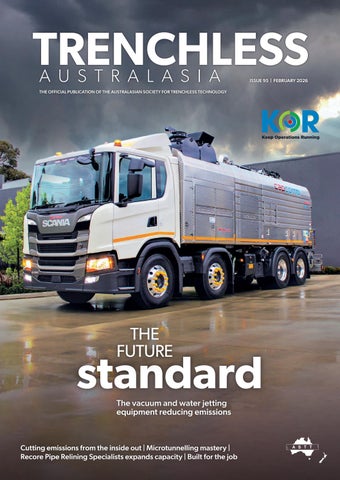
The vacuum and water jetting equipment reducing emissions
Cutting emissions from the inside out | Microtunnelling mastery | Recore Pipe Relining Specialists expands capacity | Built for the job
“Finite Element Analysis delivers a new level of clarity, allowing us to see precisely how a structural liner of any shape responds to real-world loads and conditions.”
– Ervin Hung, Interflow
We’re Creating the Future of Water with innovative solutions to complex renewal problems
This magazine is the official journal of the Australasian Society for Trenchless Technology (ASTT) and is distributed to members and other interested parties throughout Australia and the Asia-Pacific. It is also available on subscription. The publishers welcome editorial contributions from interested parties. However, neither the publishers nor the ASTT accept responsibility for the content of these contributions and the views contained therein are not necessarily the views of the publishers or the ASTT. Neither the publishers nor the ASTT accept responsibility for any claims made by advertisers. All communications should be directed to the publishers.
Unless explicitly stated otherwise in writing, by providing editorial material to Prime Creative Media (PCM), including text and images, you are providing permission for that material to be subsequently used by PCM, whole or in part, edited or unchanged, alone or in combination with other material in any publication or format in
or online or howsoever distributed, whether
by
and its agents and associates or another party to whom PCM has provided permission.
Trenchless Australasia are not necessarily the opinions of, or endorsed by the publisher unless otherwise stated.
All articles submitted for publication become the property of the publisher. The Editor reserves the right to adjust any article to conform with the magazine format.
Welcome to the February edition of Trenchless Australasia, in which we focus on the growing role trenchless technology is playing in reducing emissions across pipeline construction, rehabilitation, inspection and maintenance. We explore how no-dig methods and equipment are delivering measurable environmental benefits, alongside the innovative technologies already supporting the global energy transition.
KOR Equipment Solutions takes the front cover on this edition, showcasing the emissions-saving benefits of the Euro 6 chassis, now standard in its range of Cappellotto equipment.
explore the latest developments in microtunnelling, horizontal directional drilling, non-destructive digging, and much more.
Excellence in tunneling for water, wastewater and energy infrastructure.
With a focus on safety, innovation and collaborative delivery over the last 35 years, Rob Carr has achieved outstanding outcomes in water, wastewater and energy infrastructure projects in both Australia and overseas. Rob Carr is part of Soletanche Bachy a world leader in foundation and soil technologies and subsidiary of VINCI, a global player in construction across more than 100 countries. With outstanding capabilities to manage the complexities of any project, Rob Carr has the people, knowledge and experience to deliver success.
THE AUSTRALASIAN SOCIETY FOR TRENCHLESS TECHNOLOGY
ABN 43 893 870 966
P.O. Box 2242, MALAGA LPO WA 6944
www.astt.com.au
President: Ben Crosby
Secretary: Trevor Gosatti
Vice President: Blair Telfer
COUNCILLORS
Western Australia: Aizezi Jiang
Queensland: Ben Crosby
New South Wales: Jason Marshal
Victoria: Ash Hamer
South Australia: Shaun Melville
New Zealand: Blair Telfer
Northern Territory: Luke Woodward
Tasmania: Vacant
From the President
I’m delighted to welcome you to the first edition of Trenchless Australasia for 2026.
This edition offers us an opportunity to look ahead at the exciting developments on the horizon in our industry.
Emissions reduction is a main theme in this edition of the magazine, which remains an ongoing focus for our industry. As we look toward the future, it’s clear that the momentum behind sustainability and greener practices continues to grow. With net-zero targets approaching, the trenchless industry finds itself in a particularly strategic position. By design, trenchless technologies offer an environmentally preferable alternative to conventional methods. At the same time, there is a clear need for ongoing innovation and the transition to electrified equipment so we can fully align with the broader global push for cleaner, more sustainable solutions.
major development works, be it in HDD, microtunnelling, rehabilitation, and so on. In this edition, we take a look at some of the works going on there and see how the trenchless industry is supporting the state’s booming population.
Looking ahead, the ASTT is looking forward to hosting International No-Dig Auckland, taking place 28–29 October this year. This event is set to be a milestone gathering, featuring technical papers, networking opportunities, industry training, and an exhibition of both established and next-generation products, services, and technologies. We are excited to welcome you and to support the growth of our community.
Ben Crosby President, ASTT
Ben Crosby
ASTT's booth at NoDig Down Under 2025.
UV-CIPP LINER SUPPLIER OF
PRODUCTS
Pro Line supplies UV-CIPP liner from DN150 – DN2400 and is suitable for the following host pipes:
• Gravity
• Pressure
• Potable Water
CONTACT US TODAY
by actively partnering with local community groups and creating employment opportunities that support the growth and sustainability of the communities we serve. By partnering with community groups and Aboriginal businesses, we not only deliver innovative pipeline solutions but also help build a stronger, more resilient future for generations to come.
Partner with Pro Line for unmatched support across every stage of your UV-CIPP projects. For more information, visit www.prolinetrenchless.com
Secretary’s corner
SEPTEMBER 2025
Trevor Gosatti
New Members
On behalf of the ASTT, I extend a warm welcome to the following new members:
Individual Members – Australia
• Jon Oldroyd from IMR Drainage Pty Ltd
Call for Papers for the 2026 ISTT International No-Dig in New Zealand
Planning for the International No-Dig 2026
Auckland in New Zealand to be held from October 28-29, 2026, at the newly built New Zealand International Convention Centre in Auckland is now underway and being actioned.
The ASTT is hosting this event on behalf of the International Society for Trenchless Technology and it promises to be a popular event for international visitors.
The Call for Papers is now underway for speaker opportunities at the Conference and speakers are sought to register their interest and proposed abstracts for papers. The Conference
program promises to be extensive with both international and domestic papers highlighting the latest in trenchless projects, technology and information.
ISTT Webinars provide the latest in topics
If you are always keen to keep up to date with the latest technical information on trenchless technology subjects make sure that you keep your eye on the ISTT Webinars schedule throughout the year. The ISTT has regular webinars held every two months on various trenchless subjects presented by eminent speakers in their field. The next ISTT Webinar is scheduled for the 25th February 2026 and is about the Prediction of the Deviation of the Horizontal Directional Drilling Line in Sedimentary Soils.
It is presented by Dr Henk Kruse from Deltares Delft of The Netherlands.
View the details for this webinar and others at the Events page on the ISTT website.
A reminder that all ASTT members have free access to the ISTT events and information such as past conference papers, past webinars, and a large suite of trenchless resources information via istt.com.
ASTT
Trevor Gosatti Secretary,
Auckland, NZ.
Spotlight: New South Wales
A brief look at some trenchless works ongoing in New South Wales.
Sydney Water has awarded a major infrastructure contract to McConnell Dowell and Gamuda Australia Engineering (together MDGJV) to build a new drinking-water pipeline linking the Ryde Pump Station to the suburbs of Pymble and the Wahroonga Reservoir — restoring a key main first laid down in 1936.
Although the original main was retired in 2014, the reinstatement forms part of a broader effort to future-proof Sydney’s water network as population and housing growth accelerate across the North Shore.
The new pipeline — a DN900 watermain spanning approximately 11km — will be built using a combination of traditional open-trench construction and trenchless techniques for sections requiring minimal environmental and community impact.
Early works, including environmental investigations and detailed design, commenced in early 2026. Construction is expected to be complete by 2028, securing long-term water resilience and supporting continued growth in one of Sydney’s fastest-developing regions.
New TBM for Snowy 2.0
In August 2025, a brand-new tunnel boring machine (TBM) was shipped to the Snowy Mountains to contribute to Australia’s largest renewable energy project. This 178m-long
machine has been purpose-built to excavate a 5km tunnel through a complex geological area deep in the NSW Snowy Mountains, known as the long plain fault zone, that will eventually connect Tantangara reservoir with an underground power station built almost 1km underground.
The pumped hydro expansion to the iconic Snowy Scheme, Snowy 2.0’s incredible scale and power will translate 2200MW of capacity to 350,000MWh of energy, taking the excess electricity produced by wind and solar during the day and delivering it to provide stability to our energy grid when it’s needed most.
Snowy Hydro Chief Delivery Officer
David Evans said the project would play a pivotal role in enabling Australia’s transition to clean energy.
“Snowy 2.0 is essentially a giant battery, providing long-duration storage for wind and solar power to complement the shortduration storage that batteries provide,” he said.
“The successful completion of factory acceptance testing is testament to months of meticulous design, rigorous testing, engineering excellence and collaboration.”
The TBM will soon begin the mammoth task of excavating through the Long Plain Fault to meet up with her sister TBM Florence, and finish the headrace tunnel.
When fully excavated, the Snowy 2.0 power station will be the equivalent of a 20-storey, 250m long building, located 800m underground.
The Snowy 2.0 project is a significant pumped hydro upgrade to the existing Snowy Hydro Scheme, aimed at bolstering the national energy grid.
Snowy 2.0 is on track to be delivered within the $12 billion budget and be complete by the end of 2028.
Major upgrades at Sydney Airport
Microtunnelling is underway at Sydney Airport’s south-west sector to install a new fuel line from T1 International.
This vital infrastructure will enable the opening of seven new bays, each outfitted with in-ground fuel, pre-conditioned air, and ground power, laying the groundwork for additional wide-body aircraft operations and future growth.
Rob Carr has deployed Ethel, a TBM, to site. Ethel will create the new fuel line, which will pass roughly 500m underneath the runway. Once operational, the new area will allow aircraft to be refueled without returning to the main terminal, increasing overall capacity of the airport.
The project is expected to be completed in roughly two years.
Sydney is a hotbed of trenchless activity.
Sydney Metro West TBMs reach the end
The retrieval of TBMs Betty and Dorothy began in December 2025 following their immense work constructing a section of the Sydney Metro West tunnels.
Betty and Dorothy excavated the Metro West tunnels from Sydney Olympic Park to Parramatta, reaching their final breakthroughs at Westmead in September and October respectively.
This 9km drive marked the first in Australia completed by autonomous TBMs fitted with artificial intelligence capable of automatically steering, operating and monitoring the machines.
Now, a careful, piece-by-piece effort is underway to dismantle and lift the 1200-tonne TBMs to the surface using a 750-tonne mobile crane.
The extraction starts deep underground, with each machine being disassembled and hoisted out in sections of various sizes. Important components like the main drives will be refurbished and reused on future TBM projects, with the remaining materials recycled.
The process is expected to be finished by early 2026.
The project will improve Sydney’s water network.
The new metro services will double rail capacity between the Sydney CBD and Parramatta
The TBM Ethel.
Image: Rob Carr
Image: ninaabrevaya/stock.adobe.com
Sydney breakthrough
The Thornleigh inlet/outlet pipeline duplication project is charging ahead.
In late January, the tunnel boring machine (TBM) Jane Starkey successfully completed her 1.2km underground journey through challenging Sydney sandstone. The breakthrough was a milestone in the Thornleigh inlet/outlet pipeline duplication project, signalling a bold step forward in efforts to strengthen Sydney’s drinking water infrastructure.
The challenges were not just physical but contextual. Working within constrained urban environments calls for traffic management, noise and vibration mitigation, and careful planning to ensure that utilities, homes, and natural features remain undisturbed. Above all, ensuring the safety of communities and workers was paramount – a goal achieved through painstaking planning and adherence to best practice in tunnelling safety protocols. Tunnelling beneath the city required sensitivity and precision. Minimising community disruption has been a key objective, with trenchless technology chosen specifically to avoid open excavation, reduce surface impacts, and keep neighbourhoods
intact while work proceeds below. Cleaning, safety, and environmental management have been integrated into every phase of the build.
Project members gathered to celebrate the breakthrough moment when Jane Starkey emerged at the retrieval shaft near the Thornleigh-Wahroonga water pumping station. It was a moment of pride not just for the technical team that operated the 1.2km tunnelling drive, but for the broader collaboration that the project represents.
This complex duplication project, led by Sydney Water in partnership with the Ironbark Joint Venture – a collaboration between Rob Carr and Bouygues Construction Australia – is part of a strategic investment to enhance the resilience of Sydney’s water network. The pipeline being installed runs parallel to the existing main between Thornleigh reservoir and the Thornleigh-Wahroonga water pumping station, vital infrastructure that supplies drinking water to growing communities.
By creating a second, parallel pipeline, Sydney Water is safeguarding against disruptions and enhancing the network’s
capacity to serve northern Sydney as populations rise. Growth projections for the region are significant, and infrastructure like this ensures that essential services keep pace with demand.
More than just a machine
The TBM – affectionately named Jane Starkey – is no ordinary piece of equipment. Tradition in tunnelling projects often sees these powerful machines given human names, and Jane’s name was chosen to honour a Thornleigh nurse known for her tireless welfare work with women and children in the early 1900s. The fitting tribute underscores the deeper role of these infrastructure projects to improve the lives of people in the community.
Completion of the project will reinforce the region’s drinking water network, providing capacity at a time when Sydney’s north is poised for growth. With demand forecast to rise substantially through the next decade, infrastructure investments like this one ensure that the city can meet all needs.
The project will help support Sydney’s rising population.
Planning for the future with KOR
KOR discusses the emissions-saving benefits of the Euro 6 chassis, now standard in its range of Cappellotto equipment.
KOR Equipment Solutions has been distributing industry-leading Cappellotto equipment exclusively in the Australian and New Zealand markets for over 14 years. The wide range of quality vacuum and water jetting equipment is versatile and effective in providing high performance wet and dry industrial vacuum loading, drain cleaning, industrial cleaning, hydro excavation and dangerous goods handling. Typical applications for their diverse range include municipal sewer and drain cleaning, hydro excavation, industrial wet and dry plant cleaning, hazard waste recovery and transport, water treatment and pit cleaning, and utility installation and maintenance.
Industrial operation decisions carry environmental weight, whether you’re managing hydro excavation fleets, coordinating municipal services, or overseeing large-scale vacuum loading assets. As emission regulations are intensifying, clients are demanding cleaner practices, and fuel costs remain volatile, the use of Euro 6 chassis is a smarter, future-aligned solution.
Euro 6 is a European Union exhaust emissions regulation that sets strict legal limits on how much pollution a vehicle engine is allowed to emit.
The Euro 6 chassis is a vehicle chassis built with an engine and emission control system that complies with these stringent emission standards for heavy duty or light duty vehicles.
The Euro 6 standard represents a significant advancement in emission control, delivering a major leap forward from Euro 5 standards. Designed to meet stricter thresholds across a broader range of pollutants, Euro 6 ensures cleaner performance and long-term compliance that is important for operations in urban and sensitive areas.
The key improvements include:
• Nitrogen oxides (NOx): 56 per cent reduction – 180 mg/km (Euro 5) to 80 mg/ km (Euro 6).
• Particulate mass (PM): Lowered from 5.0 mg/km to 4.5 mg/km.
• Particulate number (PN): Newly introduced under Euro 6 – limited to 6.0 x 10¹¹ particles/km, targeting ultra-fine soot particles which was previously unregulated.
• Total hydrocarbons (THC): Reduced from 230 mg/km to 170 mg/km.
• Non-methane hydrocarbons (NMHC): Now capped at 68 mg/km under Euro 6 (previously unregulated in Euro 5).
• Carbon monoxide (CO): Cut back from 1000 mg/km to 500 mg/km in some categories.
The development of advanced emissions control systems in the Euro 6 has made these improvements possible. These are:
• Selective catalytic reduction (SCR), using AdBlue to neutralise NOx.
• Diesel particulate filters (DPFs), capturing up to 99 per cent of soot.
• Exhaust gas recirculation (EGR), optimising combustion for cleaner output.
It is these technologies that ensures Euro 6 engines meet strict standards without compromising on power or reliability and which make them ideal for the demands of industrial fieldwork.
KOR introduced the first Cappellotto Euro 6 chassis unit over a decade ago, and today all 13 Cappellotto models operate on Euro 6 chassis. KOR has seen firsthand how Euro 6 vehicles deliver measurable gains in compliance, performance and sustainability
The Cappellotto range of equipment is mounted on Euro 6 Scania and Volvo chassis that deliver measurable environmental performance in real-world conditions, so there are tangible benefits beyond regulatory considerations.
Some of the figures based on field performance are that you can save up to 55 tonnes of CO2 per vehicle annually and fuel savings up to 20,000 litres per year while up to
A hydro excavation truck in action.
10 litres less diesel consumed per hour under standard operation
So, for KOR customers with Cappellotto equipment on Euro 6 chassis there is a reduced environmental footprint, lower operating costs, and simplified reporting against ESG metrics.
And while the Euro 6 chassis is engineered for diesel efficiency, it is also compatible with a wide range of renewable fuels which include hydrotreated vegetable oil (HVO), biodiesel (FAME), biogas (Bio-CNG) and Bio-LGN, ethanol (ED95), and synthetic diesel (GTL, BTL, e-Fuels).
These approved fuels significantly lower carbon intensity and allow businesses to transition towards sustainability without modifying existing engines. Each of the fuels contributes to reducing well-towheel emissions, and many can be adopted immediately without infrastructure changes.
In addition to the environmental benefits of Euro 6 chassis, the beauty of Cappellotto’s designs is the efficiency from the operational enhancements. These lead to:
• Lower noise output on some models reducing sound emissions by up to 90 per cent.
• Zero water use in vacuum and filter operations on some models, therefore conserving resources.
• Belt-driven main pumps, which can achieve 20–30 per cent higher efficiency than hydraulic systems.
KOR’s Cappellotto equipment with Euro 6 chassis improves customer fleet productivity, reduces wear and tear, and supports work in sensitive environments, particularly in noiserestricted or urban zones.
KOR is actively encouraging its customers to change over their older Euro 4 and 5 units
in their existing fleets to Euro 6 to benefit from these environmental and lower fuel benefits. Transitioning to advanced technology with Cappellotto equipment can raise questions, but with Euro 6, the benefits far outweigh the concerns.
• Cost premium: Operators should think investment, not expense. Euro 6 delivers significant fuel and maintenance savings, reducing total cost of ownership and delivering a strong ROI over time.
• Maintenance complexity: KOR supports every Euro 6 unit with national service coverage and RTO-accredited operator training through the KOR Academy, ensuring operator’s teams can work and maintain equipment confidently.
• Fuel supply: Renewable fuel availability is expanding across Australia and New Zealand. In the interim, all Euro 6 units operate seamlessly on standard diesel.
• Future-readiness: Euro 6 keeps operators ahead of the curve as it meets current and upcoming emissions targets – and when paired with renewable fuels, it exceeds environmental performance.
Adopting Euro 6 chassis is a smart business decision that supports compliance, resilience, and operational leadership. From reducing fuel spend to meeting environmental reporting standards, the value for operators is both immediate and scalable.
Industrial operators seeking to future- proof their hydro excavation, vacuum or dangerous goods tanker fleets in the Industrial sector should contact KOR.
For more information, visit kor.com.au
The Cappellotto range of equipment is mounted on the Euro 6 Scania and Volvo chassis.
KOR Equipment Solutions distributes Cappellotto vacuum and water jetting equipment in Australia and New Zealand.
When pipes aren’t round
Many sewers, drains and culverts are not perfectly circular, which can lead to over-design in renewal. Finite element analysis is enabling Interflow to offer solutions that are more fit for purpose, lower cost and more sustainable.
For many non-circular pipes running below the ground across Australia, the reality of their renewal is imperfect.
If a pipe is perfectly circular then standards, specifications and renewal methods are well documented and accepted. The same can be said for pipes that have deformed to a uniform oval shape within a limited range.
However, as soon as a pipe’s internal shape deflects outside strict parameters, the most efficient and sustainable solutions have been more difficult to design – until now.
At Interflow, there is an innate drive to find world-class solutions to the most complex customer problems. A great deal of thought and research has been put into the effective use of finite element analysis (FEA), a computerbased method that has been used in other engineering sectors, including aerospace and automative, to understand the way complex objects behave under various types of loading conditions.
Understanding FEA
“Fundamentally, FEA is based on mechanics and mathematics,” said Dr Weigang Wang CP Eng, Design Manager at Interflow. “The computer does the calculation and gives us the very best solution.”
The method works by dividing a complex structure into many small, interconnected components, or elements. Engineers can then use computer simulations to evaluate how each element responds to applied loads, and how all the elements interact to represent the behaviour of the complete structure under different loading conditions.
In the 1970s, Boeing made extensive use of FEA during the development of the 747. Through FEA simulations, engineers were able to assess the aircraft’s structural integrity, predict stress distributions, and refine the design to enhance both safety and efficiency.
In these virtual environments, designers can examine how each component responds to different loads and conditions. In the Boeing case, this means things like weight, aerodynamic forces, and material stresses. The digital model closely replicates realworld behaviour, allowing engineers to modify and test the design repeatedly until the structure performs as intended.
Once the configuration and material properties have been optimised through the simulation, the final design can be produced with confidence that it will meet performance and safety requirements.
“At Interflow, we see FEA as the next evolution in the design approach for complex pipeline rehabilitation,” said Ervin Hung, Interflow’s Strategic Solutions Operations Manager. “What transformed the safety and efficiency of aircraft and automotive industries can now redefine how we strengthen and renew pipeline infrastructures.
“FEA delivers a new level of clarity, allowing us to see precisely how a structural liner of any shape responds to real-world loads and conditions. When we apply this to non-circular pipelines, we can design with greater efficiency, reduce material use, and ensure performance with measurable confidence for the asset owners.”
When modelling meets delivery application
The FEA modelling process brings enormous value when it drives decisions in the field.
Take grouting or void filling of liners as an example, Hung said. “When grout is pumped into the void around a flexible liner, the intention is to fill that void. This can involve the build-up of a great amount of pressure. Over-pressuring the liner can deform it beyond design limits, or in the extreme case, burst the liner, which can have unintended environmental consequences.
Simulations
“When the lined pipe is circular, we know the exact forces it can withstand. However, when it is a non-circular shape, the risks are much higher. Using FEA, we can use the grout’s properties and model the buoyancy loads on the liner to generate the most efficient grouting methodology with no risk of overpressure.”
The many benefits of FEA-driven certainty
If an FEA model reveals a liner can be 20 per cent thinner for the same level of performance and efficiency, there is an automatic saving of material, fuel, handling effort and time throughout the entirety of the supply chain and installation process.
It can mean fewer people are underground or on site and are there for less time. This creates a safety dividend and a community benefit.
When designers use FEA to quantify limits, field teams can be confident in their defined procedures. As a result, risk drops and less resources are required.
Interflow isn’t suggesting that FEA is used on every renewal project. The sweet spot for the technology, Wang said, is in complex edge cases, including non-circular sections, asymmetric deterioration, unusual load paths or where unique pressures, such as staged grouting, couple with structural response.
“In these instances, the traditional methods are not very accurate,” Wang said. “As a result, people might apply conservative inputs to be safe. This will cost more, will take longer, require more resources and from the construction point of view might create more challenges.
“As we have been making use of this tool on real projects, we have found it produces a more sustainable design solution that carries less risk. It also delivers greater value for asset owners.”
The final challenge is a cultural one, ensuring project teams and customers know when to tap this expertise, particularly during bid and design as opposed to after methods have been locked in.
A centralised design centre of excellence,
available to everyone at Interflow, helps to route projects through the right channels, improving visibility and sharpening knowledge around tools such as FEA.
“We’re involving our design and engineering
team earlier in the process,” Hung said. “This early collaboration ensures right-sized, fitfor-purpose solutions become the norm for complex, non-circular renewals.”
How does FEA help on site?
• Clear limits: FEA models quantify deflection or pressure outcomes, giving crews clear rules to follow.
• Handling is lighter and safer: Right-sized solutions lead to fewer heavy lifts and less time on site.
• Fewer surprises: When non-circular and weaker areas are identified in advance, sequencing of tasks and bracing is more logical and re-work is dramatically reduced.
• Schedule certainty: Lighter components and fewer mid-project changes mean shorter install times.
• Improve sustainability: Good, robust design drives sustainability across all areas of the supply chain and installation process.
For more information, visit interflow.com.au
A non-circular culvert.
A finite element model of a box culvert.
Images: Interflow
TRACTO on the road to zero emissions
TRACTO’s global business is committed to playing a role in the energy transition, including the recent introduction of the fully electric GRUNDODRILL JCS130E which represented a bold new direction for the company.
TRACTO recognises that the energy transition, including the electrification of the civil construction sector, will be an enduring process that will transform the trenchless industry. To contribute to this conversion, the company is planning electrification across its product range, continuously adapting to technological advances and electrifying additional machines and components.
There’s no doubt modern diesel-powered GRUNDODRILL rigs have come a long way from their predecessors. Fitted with the latest Stage V engines – the current European emissions standard for heavy machinery – these rigs deliver significant reductions in harmful emissions such as particulate matter and nitrogen oxides.
This is achieved through an integrated aftertreatment system that combines diesel particulate filters with a catalytic converter, controlling emissions at their source. The result is near-zero local emissions from nitrogen oxides and particulate matter, quieter operation, and improved fuel efficiency.
With stop-start capability and cleaner combustion, these machines support both environmental responsibility and more pleasant working conditions on site.
Electrification for the future
However, despite these technological advancements, TRACTO’s ambition stretches beyond cleaner combustion. The company recently unveiled the GRUNDODRILL JCS130E, its first fully electric drilling rig designed to operate without local exhaust emissions on the jobsite.
This milestone rig produces no diesel soot and no nitrogen oxide emissions, and operates at noise levels far lower than traditional diesel machines. Conceived and developed over three years, the JCS130E was first introduced as a prototype at BAUMA 2022 as part of TRACTO’s ‘Road to Zero Emissions’ campaign, which signalled where the future of trenchless technology was headed.
TRACTO Australia’s Dan Toms, who was present for the unveiling of the new drill in 2022, said the company’s electrification strategy
is already having an impact locally.
“As soon as we launched the JCS130E we started receiving enquiries about the machine and it’s eventual availability in Australia and New Zealand,” he said.
“Unlike some other parts of the world, local trenchless contractors are keen to push the boundaries of new technology and keen to be the first to try new machines. In a lot of cases this can give them an edge over their competitors, especially when working on public or utility projects where emissions reduction targets are becoming compulsory.”
Electrifying a powerful drilling rig was a challenging concept. The first was purely spatial: electric drive systems and energy storage equipment need to fit into a machine originally conceived around its diesel powertrain, demanding thoughtful design and efficient use of existing space.
The second challenge came outside the rig, from the rapidly changing world of electrical components. Unlike mature diesel technology, which has evolved steadily over decades, electrical parts such as batteries, inverters, and motors are being updated frequently.
This rapid development cycle means component availability and performance can shift quickly, requiring ongoing optimisation and flexibility in design.
TRACTO’s engineers identified that creating an electric rig was only part of the equation, realising fully electric construction sites require infrastructure that is still emerging. In some instances, the electrical grid and charging facilities at construction sites are not yet uniformly prepared to support fully electric operations.
Projects often require careful approvals, grid-connection testing and site-specific energy solutions such as mobile battery containers. By contrast, regions including Scandinavia are already demonstrating plug-and-play principles where electric construction sites are implemented with fewer hurdles, showing what
is possible when infrastructure keeps pace with machine technology.
Performing in the field
Despite these wider challenges, the GRUNDODRILL JCS130E has already proven itself in real-world use in Europe, delivering a performance on par with its diesel counterpart.
One example was a utility pilot project in Essen, Germany with GasLINE which was expanding a fibre optic network. TRACTO used the JCS130E alongside a battery container, providing two weeks energy supply.
The feedback from the project stakeholders and the community was overwhelmingly positive, with local residents appreciating the lack of disruption caused by the installations beyond the usual benefits of trenchless methodologies, namely the lack of noise created by the machine.
Toms said the GasLINE project proved that electric no-dig construction sites are technically feasible and offer real added value for the environment, the community and beyond.
“The JCS130E represents an exciting future for TRACTO Australia. The possibilities are endless,” he said.
“A number of our key partners are often working in remote locations where fuel is hard and expensive to come by, so being able to operate a machine off grid for weeks at a time could revolutionise the construction sector.
“We’re already seeing that portable battery containers are becoming more prevalent and cheaper in industries like mining and resources, it’s only a matter of time till this extends to construction as well.”
“We believe this strategy places us in a unique position to capitalise and support the construction of the next generation of infrastructure.”
For more information, visit tracto.com/au
The GRUNDODRILL JCS130E.
The Pezzimenti name has been synonymous with pipeline construction since 1957 when G. Pezzimenti and Sons began contracting to the Melbourne Metropolitan Board of Works.
Since then, Pezzimenti Trenchless has established itself as a leader in the trenchless industry, using the Pezzimentideveloped laser-guided microtunnelling system to install gravity sewers, water mains, stormwater, gas and electrical conduits ranging in diameters from 325 to 1850mm.
Working with all leading sewer and water contractors and all major water boards throughout Victoria and South Australia.
Cutting emissions from the inside out
How Channeline lining solutions are helping extend the life of existing infrastructure while reducing emissions and avoiding costly shutdowns.
As governments and asset owners intensify their emissions-reduction commitments, much of the focus has fallen on new construction. Yet one of the most significant and least visible sources of carbon impact lies beneath our feet: aging underground infrastructure.
Sewers, culverts, and tunnels form the backbone of modern cities and industrial systems. Many of these assets are decades old and increasingly vulnerable to corrosion, cracking, infiltration, and structural degradation.
Excavation, demolition and replacement of these assets is not only disruptive and expensive, but also highly carbon intensive. A growing body of engineering practice now points to a different approach: extending the life of existing infrastructure through insitu relining.
Among the technologies enabling this shift are Channeline’s glass reinforced plastic (GRP) lining solutions, which are designed to deliver long-term structural rehabilitation while significantly reducing the emissions associated with conventional replacement.
Emissions reduction by design
Channeline manufactures fully structural GRP liners that can be installed seamlessly inside deteriorated assets, creating a new structural and corrosion-resistant internal surface. Channeline liners are entirely custom-designed and manufactured for each individual asset.
This ability to produce liners in any shape and size allows engineers to rehabilitate non-
standard, irregular, or complex geometries that would otherwise require demolition or extensive civil works. From an emissions perspective, this precision matters. Custom
manufacture avoids over-engineering, eliminates unnecessary material use, and ensures that only the required volume of composite is produced, transported, and installed.
Multisegmental liners and transport emissions
Beyond the rehabilitation process itself, Channeline has addressed another often-overlooked contributor to project emissions: logistics.
For large-diameter projects, Channeline produces multisegmental liners that are assembled on site. These segments can be transported in a nested configuration, dramatically reducing shipping volume compared with one-piece or rigid systems.
The impact is practical and measurable: fewer trucks, lower fuel consumption, reduced handling equipment, and simplified site logistics all contribute to lower transport emissions.
Channeline has been providing bespoke structural GRP lining systems to rehabilitate infrastructure worldwide since the 1980s.
Channeline’s multisegmental liner product uses panels manufactured in two or more longitudinal sections.
In large infrastructure projects where logistics can account for a significant portion of a project’s carbon footprint, this design choice represents a meaningful emissionsreduction strategy.
Relining without shut-down
One of the most significant sustainability advantages of relining is the ability to rehabilitate assets without taking them out of service.
Channeline’s installation methods are designed to minimise operational disruption, allowing assets to remain functional during works or to be taken offline only briefly. This avoids the need for extensive bypass pumping or temporary pipework, activities that are both energy-intensive and emissions-heavy. In many applications, Channeline liners can be installed under live-flow conditions. This capability further reduces emissions by eliminating dewatering systems, reducing
Specialising in free
and pipe jacking
sleeve
temporary infrastructure, and cutting the use of diesel-powered pumps and generators. It also minimises the social and environmental disruption that accompanies major shut-downs in urban environments.
Life extension as a carbon strategy
From a lifecycle perspective, extending the service life of an existing asset is one of the most effective ways to reduce its long-term carbon footprint.
According to Channeline, its liners have a service life of 150 years, going far beyond short-term rehabilitation into long-term asset renewal. This level of durability extends infrastructure life for generations to come, significantly reducing the frequency of major interventions and the cumulative emissions associated with repeated construction cycles.
By deferring future rebuilds, relining avoids the emissions associated with new material production, transport, demolition, and disposal, while preserving the embodied carbon already invested in the original structure.
In this context, Channeline’s technology aligns closely with circular-economy principles: preserve what already exists, use only what is needed, and design for longevity rather than replacement.
A smarter model for sustainable infrastructure
The lesson is a simple but powerful one: the lowest-carbon infrastructure is often the one that already exists. By making aging assets last longer, smarter, and cleaner, Channeline is reshaping how emissions reduction can be achieved, without shut-downs, excavation, or unnecessary replacement.
For more information, visit www.channeline.com
Size ranging from 350mm > 750mm in most ground conditions
L&D Micro Tunnelling we specialize in laser guided boring. Our Tunnel bore machines use a vacuum extraction system where all spoil is sucked into interceptor tanks for easy disposal with no mess. All our heads are hydraulically driven and guided by a high accuracy laser to achieve precision over long distances.
Drill up to 120 meters with a +/- 10mm tolerance • 30 years experience in the drainage industry
Channeline liners are custom-designed and manufactured for each asset.
Edge Underground’s diameter evolution
Trenchless Australasia speaks with Edge Underground about the company’s microtunnelling development from 600mm to 1830mm and beyond.
From the beginning, Stuart Harrison and the Edge Underground team built their reputation on being able to repeatably and accurately install small diameter microtunnel drives, particularly in conditions where precision is non-negotiable.
For contractors, the small diameter end of microtunnelling has always been one of the hardest areas to operate in. When man-entry isn’t possible, there is no quick fix underground. No easy access. No room for error. Edge Underground saw this challenge
early and developed a solution that delivered consistent results.
The early work sat comfortably in the 600mm and below range. Solid jobs, plenty of complexity, but within the zone where Edge Underground could prove what mattered most: the ability to stay on line and grade, maintain control, and deliver repeatable outcomes.
Through extensive research and development, project learning and multiple revisions to the systems used in the field, Edge Underground expanded its capability, both in bore diameter and the ground conditions it could reliably handle.
“We didn’t jump straight from small to massive,” Edge Underground Founder, Stuart Harrison, said. “It built over time. Every job gave us something new. That’s what pushed the limits.”
The system that started small didn’t stay small
What began as a small diameter microtunnelling focus gradually grew into something bigger.
Edge Underground enhanced its capability through a vacuum microtunnelling pilot and
Edge Underground enhanced its capability through a vacuum microtunnelling pilot and ream method.
Edge Underground is comfortably working at 1830mm, with plans for future development.
ream method, using the pilot bore not just as a pathway, but as a way to confirm alignment, ground response and steering behaviour before committing to full-size reaming.
Why pipe jack into unpredictable ground conditions when the pilot stage gives the crew a chance to assess conditions, confirm accuracy and validate performance early, before opening up the bore.
“With the pilot, you’re not guessing,” Harrison explained. “You can confirm accuracy in all ways. Then you go into reaming with far more knowledge than we’ve ever had before.”
Edge Underground used the Vermeer AXIS laser guided boring system, originally invented by Harrison. Over time, the same system built for small diameter accuracy became the foundation for scaling up. The machines were upgraded with AdaptX technology, including several patented features developed by Harrison. As Edge Underground’s confidence grew, so did the diameter range.
The company progressed into 900mm installations, and today the team is comfortably working at 1830mm and beyond, including the installation of 1500mm concrete pipe.
Increased pipe sizes typically means increased pressure. 1500mm concrete is heavy, demanding and unforgiving. It puts stress on everything, from the machine and tooling to reaming performance and bore quality. Once you commit, there’s little margin for error.
But Edge Underground doesn’t speak about this diameter as a ceiling.
“This could have been an 1800mm GRP installation and beyond,” Harrison said. “That’s where we’re at now.”
The geared reaming advantage
Edge Underground credits much of this progression to the development of its reaming capability, particularly through a patented geared reaming technique paired with its advanced vacuum system.
Supported by in-house design and manufacturing through OptionX Bournedrill, Edge Underground can develop and build custom reamers to suit the demands of each
drive, expanding its capability across both diameter and ground conditions.
Despite the increase in bore size, Edge Underground’s machines have maintained the ability to retract tooling, even when reaming at larger diameters. Harrison said this provides a key layer of confidence when taking on larger diameter work.
“Regardless of the size of the bore, it must be supported in the event the reamer needs to be retracted. Our patented reamers have a collapsible option that allows us to recover mid-bore if needed. That gives us the ability to repair, adjust and return to complete the line,” he said.
The accuracy and efficiency that shaped Edge Underground’s success at 600mm continues through to 1800mm and beyond.
CUT THRU THE NOISE.
What also remains is the team’s ability to mobilise quickly, with setup taking just hours, while other microtunnelling methods can take weeks before drilling even begins.
In practical terms, it means Edge Underground can be completing drives in the time it takes others to mobilise.
With a commitment to continued innovation, Edge Underground and parent company OptionX Group will continue expanding what’s possible in trenchless installation. They have reached a point where 1830mm isn’t the limit, it’s simply the current benchmark.
The next one is already being built.
For more information, visit edgeunderground.com.au
The Subsite® Marksman HDD Guidance System provides superior performance in high-interference environments with the industry’s widest range of frequencies in a single beacon. Easy to use with your choice of user interface, the Marksman View features intuitive graphics and clear data, and with a simple single toggle control you’re more productive from day one.
Edge Underground’s machines have the ability to retract tooling, even when reaming at larger diameters.
Microtunnelling mastery
Bothar Boring and Tunnelling enters 2026 on the back of a stand-out 2025 – a year that saw the company cement its reputation as one of Australia’s most capable trenchless contractors.
In a landscape defined by rising infrastructure demand and complex subsurface challenges, Bothar Boring’s performance through 2025 embodied both technical mastery and strategic growth. From major sewer and water projects across Victoria and New South Wales to bespoke machine development and refined trenchless capabilities, the company consistently displayed the kind of versatility that clients value and competitors respect.
One of the year’s signature achievements was the delivery of more than 1200m of trenchless installation for both Kemps Creek dual pressure mains and Bonds Creek carrier extension projects in Sydney. This work was done in collaboration with its valued and trusted partner, Quickway.
This project saw Bothar use a comprehensive range of trenchless construction techniques and equipment, including auger boring, a laser-guided vacuum system, ‘Bothar Built’ EPB-TBMs and an AVN600 microtunnelling machine. This diverse methodology, together with their vast portfolio of ‘on-hand’ equipment allowed Bothar to effectively navigate varying and challenging ground conditions across the project.
Further south, Bothar commenced works to relocate a sewer at Doncaster Road as part of the Eastern Freeway upgrade: Burke to Tram Road. This project in Victoria includes major road and bridge upgrades and an interchange connecting the Eastern Freeway to the North East Link tunnels.
Bothar’s scope of (early works) on the Doncaster package included the construction of specialist secant piled shafts, relocation of
approximately 860m of new sewer mains, installation of sewer maintenance holes and decommissioning of redundant sewer assets. The company also strengthened its arsenal with the acquisition of a Herrenknecht AVN400 microtunnelling machine. The AVN400 is a versatile, slurry-supported microtunnelling machine designed for safe tunnelling in diameters starting from 400mm. It has full-face excavation capabilities, combined with remote-controlled operation, which make it suitable for a wide range of ground conditions, including silt, clay and incohesive soils. This coupled with Bothar’s internal transfer of varying trenchless equipment from its Canadian operation marks a significant boost to the company’s delivery
capacity across key sectors, from water and sewer to utilities and energy infrastructure.
As 2026 unfolds, Bothar’s leadership approaches the year with a blend of ambition and strategic focus. Internally, investments in talent and technology have positioned the company to respond rapidly to evolving infrastructure demands. Externally, Bothar continues to deliver strong, reliable results that asset owners have come to depend on.
The coming year will be defined by consolidation and extension – building on 2025’s successes with deeper client alliances, a broader project footprint and continued enhancement of its toolkit. For more information, visit botharboring.com
Bothar has bolstered its arsenal of microtunnelling machines.
Images: Bothar
The Bonds Creek carrier extension project.
The solution for NDD & Drain Cleaning
Rear boom and drain cleaning reel
The DrainVac hose reel contains 180m of drain cleaning hose. Both the boom and reel are linked together with 180° of rotational range allowing easy operation when drain cleaning operations are being carried out. The boom and reel functions are remote controlled, along with very simple manual overrides.
Non Destructive Digging (NDD) reel
The NDD reel contains 30m of 13mm hose and is controlled via the remote control with optional manual operation also. A robust 300bar and 17LPM NDD pump gives you all the performance you need to complete the NDD jobs. The NDD reel is mounted low at the rear of the unit for easy access in all conditions.
Control system
In line with VTS’s “Simple is Better” philosophy, the DrainVac uses straightforward controls with no computer interface. It’s easy to operate and designed for quick faultfinding and repair if needed.
Liquid ring vacuum pump and HP water pump
Chasing performance?
The DrainVac is fitted with proven, high-output components including a CVS 4,000 m³/h (2,354 CFM) aluminium vacuum pump and a Pratissoli 346 LPM (170 bar) drain-cleaning pump. Both are belt-driven to reduce noise, simplify servicing and keep running costs down.
180º rotational range boom 30m / 13mm hp hose
No computer interface
High performance pumps
Engineering breakthrough
CRCHI successfully delivers a complex high-gradient, tight-curvature spiral tunnel.
In December 2025, in an engineering triumph, CRCHI’s Beishan #1 – a large gradient spiral hard rock TBM – completed the advance of a formidable 7.1km spiral incline at Mazong Mountain, Gansu, China. This monumental feat marked the breakthrough of the access tunnel for the China Beishan Underground Laboratory, which CRCHI said is the world’s first large slope, tight turn spiral inclined tunnel. The achievement heralds a technological leap for China in constructing long distance, ultra hard rock tunnels featuring steep downward gradients and continuous spiral curves.
The Beishan #1 TBM boasts a 7m excavation diameter and integrates an advanced autonomous system with one touch activation, surrounding rock prediction, automated tunnelling, real time deviation correction, regripping automation, self adapting parameters, and seamless manual automatic switching. It masters tunnelling on a 10 per cent downward slope while navigating horizontal curves of just 255m radius.
By overcoming the critical challenges of automatic steering correction and flawless mode transition, the TBM achieves fully unmanned excavation under uniform geology – maintaining attitude deviations within ±50 mm. This breakthrough not
only sets a new benchmark but establishes China as a leader of autonomous tunnelling technology worldwide.
Designated a National Key Project, the China Beishan Underground Laboratory is engineered around a sophisticated ‘one spiral ramp, two horizontal drifts, and three vertical shafts’ configuration. The ramp’s bold three-dimensional helix – with a relentless -10 per cent gradient and a remarkably tight 255m horizontal turning radius –traverses granodiorite of exceptional integrity and strength. With rock classifications predominantly at Class I to II, quartz content of 25–30 per cent, and uniaxial compressive strength peaking at 260 MPa (averaging 170 MPa), this ranks among the world’s most formidable tunnelling environments. The dual challenges of sustained excavation through intact, ultra-hard rock while navigating continuous downhill tight curves demanded nothing short of revolutionary engineering and equipment performance.
Rising to this challenge, CRCHI’s R&D team conquered a series of pioneering technologies: advanced cutterhead systems for extreme hard rock fragmentation, artificial joint-assisted rock-breaking methods, a compact, short shield body engineered for sharp curves, a fully automated guidance
system, and a high-capacity continuous conveyor for spoil removal on steep helical paths. Their mastery is embodied in the bespoke Beishan #1 TBM – a machine conceived, designed and built entirely through CRCHI innovation.
Completing the factory acceptance test in Changsha City in September 2022 and transported over 3000km to site, the Beishan #1 commenced its advance on 1 January 2023. In the face of relentless, monolithic hard rock, it set outstanding advance records – 21.6m in a single day and 342m in one month – while achieving fully automated operation throughout the demanding downhill spiral sections. The TBM deftly negotiated all seven tight 255m radius curves and eight straight-line segments, culminating on 26 December 2025 in the breakthrough of the full 7km advance.
The success of Beishan #1 does more than validate China’s proprietary technology for high-gradient spiral tunnelling – it also demonstrates CRCHI’s prowess in global underground engineering in both heavy equipment manufacturing and complex subterranean construction.
For more information, contact tangzhongwu@crchi.com
Beishan #1 has a 7m diameter and an impressive array of technological tools.
Image: CRCHI
Beyond
Breaking ground
Empire Infrastructure reflects on a groundbreaking year delivering recordsetting projects, advanced trenchless technologies, and pipeline systems that are shaping the future of underground infrastructure.
In 2025, Empire Infrastructure delivered milestone projects that reflected both technical excellence and growing industry influence. From major pipeline deliveries in Sydney, New South Wales to the expanding adoption of innovative materials and methods, Empire Infrastructure’s contributions have underscored how niche supply expertise can shape some of Australia’s most challenging infrastructure works.
Empire Infrastructure’s 2025 narrative was anchored by its expanded role in Sydney’s evolving urban water and sewer networks, a landscape characterised by significant investment and heightened demand for durable, sustainable solutions. One of the most prominent achievements was its supply of specialist jacking and trunk pipeline materials for key Sydney works, including the city’s expanding water infrastructure portfolio. In June, Empire Infrastructure supplied the first 800m of DN1500 CP&P reinforced concrete jacking pipe to support major new underground works in metropolitan Sydney, marking a change in how large-diameter, high-performance pipelines are delivered in complex underground environments.
The company also played a key role in the Bona Vista Trunk Sewer Project, located 100km south-east of Melbourne, supplying pipes for the development. Empire Infrastructure was chosen for the project as its BOSSPIPE CCGRP Jacking Pipe was both
cost effective and able to meet the project’s tight timeline.
This accomplishment was followed by another high-impact delivery in October, where the company was tasked with providing an Australian first Reinforced Concrete Steel Cylinder Pipe (RCCP) microtunnelling pipe system for Sydney’s Thornleigh Inlet Outlet Main (TIOM) project.
For Empire Infrastructure, TIOM demanded a highly coordinated technical and logistical approach to supply 1.2km of DN1800 (OD 2400) RCCP jacking pipe manufactured by Bonna Indonesia. Each pipe section weighed approximately 22 tonnes, requiring meticulous planning across the international supply chain. As the pipe was transported via break-bulk vessels rather than containerised freight, this introduced a range of logistical complexities including specialised lifting, handling, and storage arrangements at both the port of origin and arrival. Empire Infrastructure worked closely with shipping providers, port authorities, and the Ironbark Joint Venture to ensure safe, efficient, and damage-free delivery of the pipes from manufacturing through to site.
From a technical standpoint, the RCCP was selected for its high compressive strength, durability, performance under jacking loads, and suitability for pressurised potable water, making it well-suited to single pass microtunnelling. Empire Infrastructure’s role extended beyond supply, involving
detailed technical review of tolerances, gasket performance, and joint integrity to ensure constructability and long-term asset performance.
Across these achievements, Empire Infrastructure’s 2025 performance reflected a broader alignment with key trends reshaping Australia’s infrastructure landscape: the push toward trenchless technology, enhanced material performance, and solutions that balance constructability with lifecycle resilience. Its supply chain capabilities, bringing global pipe solutions into the Australian market while managing delivery, quality, and project-specific engineering requirements, have been central to realising these outcomes.
As the infrastructure sector continues to grapple with heavy investment pipelines, workforce constraints, and the demand for sustainable, long-life utility networks, Empire Infrastructure’s 2025 feats provide an example of how specialised suppliers can drive project success from the early stages of material selection through to delivery and field performance. The company’s contributions this year have not only enabled critical water and sewer works but have also helped demonstrate the tangible value of advanced trenchless and underground pipeline solutions in Australia’s built environment.
For more information, visit empireinfrastructure.com.au
Empire Infrastructure
SPEND LESS TIME REPORTING. GAIN MORE CONTROL OVER COMPLIANCE.
WinCan WebFlex brings desktop-class inspection, reporting and compliance planning into a secure, cloud-based platform. Designed to reduce admin time, improve data accuracy and keep projects moving.
Save Time on Every Job
Create, edit and finalise inspection reports directly in your browser. No software installs. No dongles. No double handling.Spend less time in the office and more time on site.
Reporting You Can Rely On
Standardised, professional reports generated from a single source of truth. Reduce manual errors with direct data transfer from inspection systems. Deliver clear, consistent reports to clients faster.
Built for Compliance Planning
Built for Real-World Sewer Inspections
Web-based reporting and editing
Validate data, score assets and plan maintenance with confidence. Centralised access makes it easier to meet reporting obligations and audit requirements. Ideal for councils, utilities and contractors managing long-term assets.
Cloud-Based Access Anywhere
Access projects anytime, anywhere. Office, home or field. Your team always works from the latest data.
Centralised, reportable inspection data
Compliance-ready workflows
Cloud hosting with secure access GIS integration for smarter planning
Unlimited data sharing across teams
kwik-ZIP poised for a big year in 2026
The year ahead looks promising for kwik-ZIP, with the company leaving its mark worldwide.
After celebrating 25 years of innovation in 2025 and marking an exceptional year of growth, global project engagement, and enhanced market presence, the company is gearing up for an even bigger year. With a packed events calendar and strategic visibility planned across key global trenchless platforms, kwik-ZIP is reinforcing its reputation as a foundational partner in pipeline infrastructure delivery.
Last year, kwik-ZIP paused to reflect on a remarkable milestone: 25 years of sustained innovation and service in the pipeline industry. In that time, the company has made a global name for itself as a provider of spacer and centraliser systems used in pipeline installations such as slip-lining.
In 2025, the company’s products were utilised in many projects around the world, including the Alkimos seawater desalination plant in WA, a $2.1 billion motorway upgrade project in NSW, a major pipeline upgrade project in the UK, and many more.
kwik-ZIP’s engineered thermoplastic spacer and centraliser systems have become synonymous with reliability, ease of installation, and corrosion resistance, attributes that position them well for demanding infrastructure environments across the utilities sector.
The year also saw kwik-ZIP double down on industry events. The company showcased its solutions at major events such as No-Dig Down Under 2025, where delegates could see the latest centraliser and spacer systems and discuss real-world applications directly with the kwik-ZIP team.
Earlier in the year, kwik-ZIP also had a strong presence at Ozwater’25 in Adelaide, Australia’s foremost water conference and exhibition. The event provided an ideal platform for engaging water utilities, engineers, and infrastructure planners on how centralisers and spacers contribute to asset longevity and compliance in water and wastewater networks.
Further bolstering its market presence, kwik-ZIP exhibited at the Queensland Water Industry Operations Conference and Exhibition in Bundaberg, drawing industry professionals from across the state to discuss trends in water infrastructure delivery where spacer systems play a supporting yet crucial role.
Strategic positioning for 2026
Looking ahead to 2026, kwik-ZIP has mapped out an ambitious and focused plan that balances deepening regional engagement with broadening its global footprint.
International No-Dig Auckland
In October 2026, kwik-ZIP will exhibit at International No-Dig Auckland, an event that will be a hub for trenchless professionals in Australasia. The company’s participation is expected to draw attention to its latest innovations in spacer technology, particularly among utilities and contractors focused on trenchless installations in urban and rural water networks.
Ozwater and WIOA shows
The water sector remains a key strategic market for kwik-ZIP. In 2026, the company will return to Ozwater in Brisbane to showcase how its products support improved infrastructure outcomes in potable water, wastewater, and distribution pipelines. kwik-ZIP has been involved in every OzWater exhibition held since 2015.
Complementing this presence, kwik-ZIP will engage with stakeholders at several Water Industry Operators Association (WIOA) events along Australia’s East Coast. These shows provide a unique opportunity to engage state water utilities and operators, reinforcing how spacer systems contribute to efficient trenchless installations and longterm asset performance.
kwik-ZIP HDXT-43 spacers on a 4-pipe HDPE bundle.
ADIA Exhibition
kwik-ZIP is scheduled for the ADIA (Australian Drilling Industry Association) Exhibition in Adelaide, where it will connect with drilling contractors and civil engineers. The ADIA platform offers fertile ground for discussing how centraliser systems help solve centralisation challenges in drilling applications.
No-Dig Live
On the global stage, kwik-ZIP’s participation at No-Dig Live in Kenilworth, Warwickshire, underscores its growing reach within the European trenchless community. This dynamic event, where products are demonstrated in realworld trenchless scenarios, is an ideal showcase for the adaptable design and operational efficiency of kwik-ZIP systems. It also provides kwik-ZIP with an ideal opportunity to spend time talking to European-based customers and obtaining feedback to further enhance their offerings.
NGWA Conference
Rounding out a global tour, kwik-ZIP will exhibit at the National Ground Water Association (NGWA) Conference in Las Vegas, one of the United States’ premier gatherings for water well and groundwater professionals. The company’s technology has a strong fit with NGWA delegates, and kwik-ZIP has a long list of US customers some who have been using kwik-ZIP centralisers on their projects for over 20 years. Participation here signals kwik-ZIP’s intent to deepen its presence in the North American market, where thermoplastic centralisers have seen steady demand and acceptance within the waterwell industry.
Understanding the appetite kwik-ZIP’s centraliser and spacers systems, which are designed with a focus on simplicity, durability, and rapid on-site assembly, keep contractors coming back.
The company’s HD, HDX and HDXT ranges of spacers have been successfully appraised against the Water Services Association of Australia’s (WSAA) product specification for casing spacers (WSA PS-324). This standard covers casing spacers used to
facilitate the insertion and protection of carrier pipes when installed inside encasement pipes.
More generally, all kwik-ZIP products are certified by the Australian Water Quality Centre (AWQC) for use in contact with drinking water. Its products are also approved for use within many utilities’ infrastructure, including Melbourne Retail Water Association, South-East Queensland’s Infrastructure and Materials (IPAM) list, Sydney Water and the WA Water Corporation.
It’s the combination of robust and convenient design features that allow kwikZIP’s products to meet the cut. Unlike traditional metallic alternatives, kwik-ZIP’s non-metallic spacers and centralisers are impervious to rust. Engineered from kwikZIP’s own high-performance thermoplastic blend, they are highly resilient and include integrated rubber grip pads to prevent slippage,
eliminating the need for pipe pre-wrapping.
Low friction and abrasion resistance is another staple of all kwik-ZIP spacers that allows for longer run lengths and lower insertion forces. This reduces the size of machinery needed for installation, saving energy, money, and valuable space on-site. In fact, kwik-ZIP systems are designed for tool-free assembly, eliminating the need for specialised technicians and equipment altogether.
Over the last five years alone, more than three million kwik-ZIP units – spanning a range of sizes – have rolled out from precision injection moulds, destined for projects on every continent. And the order books for 2026 show no sign of the company slowing down.
For more information, visit kwikzip.com
HDXT-103 spacers on a 710mm PE water pipeline.
kwik-ZIP spacers help to preserve the carrier pipe.
Images:
kwik-ZIP
Pro Line enters its next phase of growth
With national contracts secured, approvals in place and coverage spanning Australia and New Zealand, 2026 marks a defining year for Pro Line – one focused on growth and strengthening UV-CIPP capability across the region.
This year sees Pro Line entering the year with national momentum, supported by formal approvals across multiple jurisdictions and a growing pipeline of long-term contracts, positioning the company as a trusted national partner for trenchless rehabilitation across Australia and New Zealand.
With established coverage in every state and territory, and expanded support across New Zealand, Pro Line continues to strengthen its national supply and support capability. This growing footprint enables the company to support major infrastructure programs, framework agreements, and multi-year delivery models – providing asset owners and contractors with consistency, speed, and technical certainty regardless of location.
A key driver of this growth is Pro Line’s increasing presence on national contracts, where consistent technical support, responsive customer service, and value for money are essential. These appointments reflect Pro Line’s ability to support customers with reliable supply, practical on-site expertise, and a marketleading UV-CIPP liner system independently tested to deliver a 100-year service life.
With expanding recognition from asset owners, engineers, and regulators, Pro Line’s UV-CIPP liner is now specified and approved for use across a wide range of sewer, stormwater, and culvert pipelines across a variety of asset owners; from water authorities through to rail networks, underpinned
by rigorous quality control, repeatable manufacturing processes, and independently tested long-term performance.
Supporting this national expansion is Pro Line’s Melbourne Warehouse, which continues to function as a central hub for local stock, training and technical support. The facility underpins rapid mobilisation across the region, ensuring contractors have access to liner, consumables, equipment, and specialist guidance when and where it is needed.
As part of its 2026 focus, Pro Line is also investing further in contractor capability and technical support. Expanded training programs, hands-on demonstrations, and direct project assistance form a core part of the company’s approach – ensuring UV-CIPP installations are delivered consistently, safely, and to the highest standard across all markets.
Reflecting on the year ahead, Pro Line views 2026 as a period of consolidation and leadership. With approvals secured, national frameworks in place, and a growing presence across Australia and New Zealand, the company is positioned to support the next generation of trenchless rehabilitation projects to deliver fully structural, long-life solutions with confidence.
As demand for durable, low-disruption infrastructure renewal continues to grow, Pro Line’s focus remains clear: to provide asset owners and contractors with proven UV-CIPP systems, backed by local expertise, national reach, and a commitment to raising industry standards across the region.
For more information, visit prolinetrenchless.com
The structural renewal of dual DN1550 culverts, delivering long-term performance, supported by independent testing for a 100-year service life.
As demand for large-diameter rehabilitation grows, Pro Line’s UV-CIPP liner is quickly becoming a liner of choice for contractors and asset owners.
Images:
Pro Line
DISCOVER THE FUTURE WITH BOTHAR, A GLOBAL TRENCHLESS CONSTRUCTION EXPERT.
Ensure your project is delivered safely, sustainably, and successfully.
Bothar possesses comprehensive trenchless solutions alongside expertise in shaft construction and civil capabilities.
With over 30 years’ experience, Bothar is your partner for the delivery of complex infrastructure solutions.
Our Services
•Vermeer Axis Laser Guided Systems
•Auger Boring
•Direct Pipe Installations
•Shaft Construction
•Herrenknecht AVN MTBMs
•Bothar Built EPB - TBMs
•Open Face TBMs
•Tunnel Boring & Pipe Jacking
Inspection and profiling, simplified
Why SECA’s RCX100 is influencing how the industry approaches pipe inspection and laser profiling.
For decades, pipeline inspection has followed a familiar rhythm: complete a visual CCTV inspection, pack up, then return with separate equipment to confirm pipe roundness and compliance with a second inspection. It is a workflow shaped more by technological limitations than operational logic. With growing pressure on contractors and asset owners to deliver faster projects and defensible data, that approach is now being challenged.
The introduction of SECA’s RCX100 camera head, developed to be used in conjunction with the WinCan laser module and Rovion HD CCTV pipe inspection platforms, represents a shift towards more integrated inspection and laser profiling workflows.
“There’s a need for quicker, more precise inspection of pipes, sewers and drains. The RCX100 in conjunction with the WinCan laser module allows asset owners and contractors to save time and resources while maintaining accuracy and accountability,” SECA Head of Innovation Colin Handley said.
Laser profiling, which measures how round a pipe is, is typically done in new plastic pipes to ensure that they have been installed correctly and are not squashed or out of shape, affecting
their performance. According to SECA, many asset owners in Australia and New Zealand now require laser profiling reports as part of the asset acceptance process, placing additional demands on contractors to deliver accurate measurement data alongside traditional CCTV footage.
“While ring laser systems have long been the industry standard, they can add time and complexity, often requiring a separate inspection run and careful calibration before meaningful data can be captured,” Handley said.
The RCX100 takes a different approach. At its core is a 1080p high-definition pan–tilt–zoom camera capable of delivering detailed inspection imagery. It can also perform laser pipe profiling, pipe diameter measurement and crack measurement in pipes up to 1.2m in diameter, using the same camera head on the return run, saving significant amounts of time. High-speed internal motors allow the camera to rotate rapidly, capturing profiling data on the return run of a standard CCTV inspection.
“Laser profiling with the RCX100 is significantly faster and easier to use than the traditional ring laser. It can be done after a traditional pipe inspection on the way back,
not in a separate inspection, and without the calibration process of the ring laser variant,” Handley said.
When used with the WinCan laser module, the RCX100 produces profiling data that integrates directly into established reporting frameworks. This is the same WinCan module already used with traditional ring laser systems, allowing existing users to adopt the RCX100 without duplicating software investment.
The RCX100 has been designed specifically for the Rovion HD ecosystem and operates with both VC500 and DCX5000 control units. While it is not compatible with legacy SD systems, most modern Rovion HD setups can support the camera with a software update. As with any laser profiling solution, accuracy depends on correct system configuration. Automatic cable reels are strongly recommended, as precise distance measurement is critical for producing valid profiling reports.
Physically, the RCX100 is a larger camera head, reflecting the additional capability built into the system. It is best suited to larger platforms such as the RX130 and RX400 and is not designed for smaller tractors.
“While operators working predominantly in small-diameter or relined pipes – particularly around 150mm – may find more compact cameras better suited to those environments, the RCX100 is very versatile and suited to all pipe environments,” Handley said.
Image quality remains central to effective inspection, and the RCX100 delivers 1080p HD footage, sharing the same core camera module as the RCX90X. Compared with earlier-generation systems, the camera offers notice improved colour accuracy and faster autofocus, particularly useful in challenging lighting conditions.
“While the imaging experience feels familiar to experienced Rovion users, the camera’s enhanced motor systems unlock capabilities that go well beyond traditional CCTV inspection,” Handley said.
In the field, the RCX100 has been designed with practicality in mind. Accurate laser profiling requires the camera to be properly
centred within the pipe, particularly during high-speed rotation, and excessive lighting is discouraged as it can reduce image clarity. Maintenance requirements are minimal, with routine rinsing, lens inspection and correct air pressure – 1 bar (14.5 psi) – sufficient to keep the camera performing reliably.
More broadly, Handley said RCX100 reflects a changing mindset in pipeline inspection, where inspection data is increasingly used to support compliance, asset acceptance and long-term decision-making.
“By combining high-definition inspection and laser profiling into a single, efficient workflow, the RCX100 reduces time on site while increasing the quality and defensibility of the data collected. It takes the guesswork out of everything,” Handley said.
“Technologies that simplify workflows rather than add steps will define the next phase of the industry. The RCX100 is a clear signal of where pipeline inspection is heading; towards integrated, efficient and datadriven solutions.”
The
WinCan and Rovion HD CCTV pipe inspection
Recore Pipe Relining Specialists expands capacity to support efficient asset renewal
With growing pressure to deliver infrastructure renewal efficiently and with confidence, Recore Pipe Relining Specialists has invested in advanced UV curing technologies to deliver best practice pipeline infrastructure asset renewal.
As trenchless innovation accelerates globally, contractors are being challenged to adapt quickly, investing in technology that expands capability, improves efficiency, and supports sustainable growth. Remaining competitive now requires investment in equipment that strengthens both technical capacity and business resilience.
For Recore Pipe Relining Specialists, this has meant strategic investment in advanced equipment and premium materials to expand operational capacity, enhance quality control, and support the business as project scale and complexity increase.
This modular system enables mainline and lateral inspections, robotic cutting, and the installation of UV-cured tophat seals and shortform patches, allowing the team to deliver a broader range of trenchless solutions efficiently and accurately.
Operating in an evolving market, Recore Pipe Relining Specialists has adopted the latest trenchless technology from Rausch Rehab, including the RRcure 1500 UV curing system – engineered to deliver controlled, verifiable curing outcomes in demanding environments – and the RRLQ Hybrid Manhole light source, which enables curing in vertical shafts and maintenance holes up to DN1800.
The business has also expanded its capability to undertake complex renewal projects with the Cosmic C120 robotic system.
Together, these investments further cement Recore Pipe Relining Specialists as a key player in New Zealand’s trenchless market.
Based in Waikato, Recore Pipe Relining Specialists delivers innovative solutions to complex infrastructure projects on behalf of councils and construction partners across the Waikato and Bay of Plenty regions along with the wider New Zealand market.
Supported by Pipe Core with materials and equipment aligned to project requirements, the team recently completed the renewal of 76m of DN375 sewer main beneath a busy road in Huntly on behalf of Watercare NZ.
The project utilised SAERTEX-LINER® MULTI, a glass-reinforced liner engineered for long-term structural performance in gravity sewer applications and backed by a verified 100-year technical service life, paired with the Rausch RRcure 1500 for curing.
Access was achieved via manholes on either side of the road, with a seven-person crew split across upstream and downstream locations to maintain clear communication and efficient coordination throughout installation.
High-pressure water jetting was used to
Recore Pipe Relining Specialists is supported by Pipe Core.
RRLQ Hybrid Manhole light source from Rausch Rehab.
Images: Recore Pipe Relining Specialists
prepare the host pipe prior to liner installation. Given the pipe’s depth of approximately two metres and its role in servicing a growing catchment, installation quality and curing verification were critical.
“We’ve now completed over 800m of lining using the RRcure 1500, giving us confidence on this project. Curing has gone smoothly across all installations,” said Daryll
Walker, General Manager at Recore Pipe Relining Specialists.
“The ability to monitor the liner throughout the curing process gives both us and our client confidence that the liner has been properly cured, particularly in deeper assets where visibility is limited.”
Traffic management was implemented for the duration of the works, with over-pumping
The whole world of HDD Technology
managed using two vacuum trucks. The crew was on-site for two days, with curing completed within a four-hour window before flows were safely reinstated.
Efficiency onsite was essential to minimise disruption and manage costs associated with traffic control and bypass operations. The project marked Recore Pipe Relining Specialists’ first engagement with Watercare NZ, who were impressed with both the outcome and the contractor’s demonstrated capability.
“Our client wanted a liner system that could clearly support a 100-year technical service life – something SAERTEX multiCom® could stand behind,” said Walker.
“In trenchless work, no two project conditions are the same, but the goal is always long-term asset performance,” said Sergej Fast, Technical Manager at Pipe Core.
Walker acknowledged the collaboration behind the project, noting the partnership approach taken with Pipe Core and SAERTEX multiCom to ensure the right technology was selected and the outcome was a success.
“It all went smoothly, and we can clearly see the benefits of our investments. We look forward to continuing this work in New Zealand backed by our technology partners,” Walker said.
Recore Pipe Relining Specialists is a key player in New Zealand’s trenchless market.
Business is booming
The pipe rehabilitation market is predicted to boom in the coming years, with bigger contracts that will challenge conventional delivery methods.
Ageing city infrastructure, minimising disruption and a consciousness of environmental impacts will help the market for trenchless pipe rehabilitation more than double in the next decade, a new report has found.
A Market Research Future Reports analysis has found the trenchless pipe rehabilitation market will grow from $US21.12 billion in 2024 to an estimated $US46.71 billion by 2035.
The report notes that growth in urban population and the pressure to replace aging water, sewage, and utility networks, cities across the globe means trenchless methods are showing increasing advantages to restore pipelines without the disruption of
It lists heavy machinery, large crews, traffic detours, and extensive surface restoration as some of the elements utilities and governments will look to avoid through the growing technology while completing vital upgrades to pipe infrastructure.
It also notes trenchless technology including cured-in-place pipe lining (CIPP), pipe bursting, slip lining, and spiral wound lining as some of the innovations in rehabilitation that will drive the growth.
The Market Research Future Reports outlines five key areas of advantage that are driving the industry across the globe:
1. Ageing urban infrastructure: Across North America, Europe and the Asia-Pacific, a large proportion of water and sewer
methods provide a fast, efficient solution for restoring ageing assets while extending their operational life.
2. Rising environmental regulations: Stricter government policies around wastewater treatment, stormwater management and pollution control are reshaping infrastructure delivery. Trenchless technologies help utilities meet these requirements by reducing soil disturbance, lowering carbon emissions and minimising the risk of contaminating waterways and surrounding environments.
3. Cost-effectiveness and operational efficiency: Although trenchless equipment can involve higher upfront investment, the long-term benefits are substantial. Lower labour requirements, minimal surface project completion make trenchless solutions
Rehabilitation methods are used to restore the structural integrity of underground infrastructure like pipelines and sewers.
The pipe rehabilitation market is expected to rise to $US46.71 billion by 2035.
4. Urbanisation and infrastructure modernisation: As cities continue to grow and densify, managing underground utilities with minimal disruption is critical. Trenchless rehabilitation enables essential works to be carried out while reducing impacts on traffic, businesses and residents –particularly in heavily populated urban areas.
5. Technological advancements: Ongoing innovation is driving the evolution of trenchless operations. Robotic cutters, CCTV pipeline inspection, advanced resins, UV curing systems and smart sensors are improving accuracy, reliability and performance. These technologies are accelerating adoption across multiple sectors, including water management, oil and gas, and industrial pipeline networks.
Bigger projects, bigger budgets
This trend of growth is beginning to play out in the current market. At No-Dig Down Under 2025, Michels President of Preconstruction
Services Craig Vandaelle participated in an insightful panel discussion on the state of the international trenchless market.
“What we’re seeing is a shift in the rehabilitation market. Rehab a very mature process in North America in the 150mm to one metre pipe size,” he said.
“What we’re seeing now is a shift to large program rehab. Instead of projects that Michels would bid being between $US1–10 million dollars, the projects coming down the road in the next 18 months are $US400–600 million in size.”
In order to keep up with this trend, rehab businesses in North America are shifting to collaborative delivery contracting, which Vandaelle said will push the capacity of the industry.
“We’re seeing the one of the largest collaborative delivery contracts go out, and it’s been tendered for north of $US600 million. It’s for about 50km of trunk rehab of all shapes and sizes, from two meters to over three meters.
“And the owners are saying, instead of us trying to figure it out piece by piece, let’s hire the contracting team, the engineering team, and let them figure it out and apply the right trenchless solutions.”
The collaborative delivery model has also had some unexpected benefits when it comes to ancillary factors such as managing social impacts.
“Social impacts are often overlooked in a traditional bid build contract for low bid price. But with collaborative delivery it’s the complete opposite.
“Once you explain the values of not taking up an intersection and not open-cutting a train track, or whatever it is, they’ll pay for the value of social impact mitigation through collaborative delivery, but they likely won’t pay for it through traditional bid build.”
Clearly, trenchless rehabilitation is on the rise. And as the needs of the market change, delivery models will be forced to evolve alongside it.
Many water and sewage assets are over 50 years old and in need of repair.
Taking it up a gear with the Vermeer D24 HDD
A new D24 horizontal directional drill has hit the spot for SEQ Trenchless, with upgraded features and a compact design.
For the past couple of months, South East Queensland contractor SEQ Trenchless has been using the new Vermeer D24 horizontal directional drill (HDD) for underground infrastructure. With a compact footprint, features such as an automatic rod exchange and a class-leading rod capacity of 150m, the 100hp (75kW) D24 HDD is giving contractors such as SEQ Trenchless access to improved efficiency and easy troubleshooting.
SEQ Trenchless was set up in 2018 by co-owners Josh Taylor and Shaun Newbigging, with both having spent decades in the underground infrastructure construction industry. Speaking with Trenchless Australasia, Taylor said his family ran a business in the industry, which meant that straight out of school he was working with trenchless technologies.
After selling the family business and spending a couple of years working in gas fields
and consultancy, he and his business partner decided to set up their own business and have spent the past seven years growing within this niche.
“Predominantly we operate around the southeast corner of Queensland,” Taylor said.
“We started with just with one rig and have grown from there, but we haven’t wanted to go too big too quickly. We cover a range of different services, so we do comms and electrical work as well as water, sewer and gas for a multitude of different contractors.”
He said SEQ Trenchless works with both utilities directly and with civil construction firms, undertaking the drilling works for pipe installation.
“They might be working on a new subdivision and are bringing the power in or an extension to the gas network for example,” he said.
SEQ Trenchless has been operating a number of Vermeer machines, including a D23x30 S3 drill and D36x50 drill. Taylor said they bought the new Vermeer D24 in November last year from Vermeer Australia as an upgrade to the D23x30.
The D24 paired with the MX300 mixing system delivering reliable performance on site.
Having been used by SEQ Trenchless for the past couple of months, the D24 drill has proved to be a valuable upgrade for the team.
“Our D23x30 drill was our little workhorse,” he said.
“It was a great size – we had it out every day and used it for everything from a short road crossing for a water service to stretches up to 200m of 180mm HDPE.
“We were looking at upgrading that, and had looked around at other options, but Vermeer’s newer model D24 had good specs and a very similar footprint to the previous one, which suited our truck setup and the way we run.”
Having been operating the D24 for the past couple of months, Taylor said it’s had a
strong start with the team, particularly the new automatic rod exchange feature that completes the rod changeout sequence with the push of a button.
“It’s quiet, we like the controls and operation is similar to the D23x30,” he said.
“One of the features on it is the automatic rod exchange, which allows us to concentrate on other things and reduces operator fatigue. It also works out well as far as wear and tear on the gear as well – it’s a bit more consistent.
“The automatic rod exchange is useful when training someone new, but even with
experienced operators you can hit a button and then use that time to think about what’s next in the job, how much mud we’ve got left, etc. It gives you that couple of seconds to let the machine do its thing while you plan ahead.”
With a width of 142cm, Vermeer said this is the narrowest footprint machine in its class – something that Taylor points out is an advantage for work in tighter access areas.
“We’re just finishing up an electrical upgrade at a school and then we’re going on to some street lighting, so that’s a benefit,” he said.
“The other benefit is transport as we have it on a truck with toolboxes down the side.”
He said that there are a range of additional tweaks from the D23x30 S3 model on the D24 that have addressed a couple of pain points, with the vice setup “a lot better”.
“The front plate, the rod loading arms and the frame are all a little bit more robust, but that hasn’t impacted the size of the machine,” he added.
“Another standout for us is that they are backing it up with a 3,000-hour warranty on it – previously the warranty was 1,000 hours. The self-diagnosis system is also an option there for us to use when diagnosing issues or when working remotely with technicians.”
Overall, he said this is an improvement on his older drill and the support from Vermeer Australia has been a key reason why he continues to choose Vermeer equipment.
“Vermeer Australia have provided good support and parts availability and access to their technicians is a fairly big selling point for us,” he said.
For more information, visit vermeeraustralia.com.au or seqtrenchless.com.au
Features on the Vermeer D24 drill include automatic rod exchange.
SEQ Trenchless uses the D24 drill for a wide variety of trenchless installations of utility pipes.
Built for the job
With reliability, ease of operation and long-term support now top priorities for utility operators, Vacuum Truck Supplies delivers a no-nonsense approach to nondestructive digging and drain cleaning that is purpose-built for Australian conditions.
Vacuum trucks underpin a range of utility maintenance and non-destructive digging activities, where downtime and complexity can impact productivity.
Vacuum Truck Supplies (VTS) has developed its vacuum truck range with operation, and durability in mind.
“We design our trucks around how they’re used on site, keeping systems simple,” said VTS Managing Director Rod Glue.
This approach is embodied in the DrainVac 8x4, a combined non-destructive digging (NDD) and drain cleaning vacuum truck. Now available and operational across Australia, VTS has additional 8x4 units ready for delivery, supporting growing demand from utility, mining and civil operators.
Backed by more than 30 years of experience and over 1000 vacuum trucks built, VTS has designed the DrainVac for Australian conditions.
The focus is on robust construction, practical performance and a platform that is straightforward to operate, maintain and support over its working life.
At the core of DrainVac’s design are stainless steel waste and water tanks, tipping tanks and a full-opening rear door, allowing for efficient unloading and faster turnaround between jobs.
KingKira Group commends the DrainVac for its reliability and ease of use.
VTS works with customers to ensure they have the right equipment, training and support.
Images: Vacuum Truck Supplies
These features are paired with VTS’s noncomputer-controlled operating system, keeping operation simple while making fault-finding and repairs faster and more cost-effective.
“VTS has designed its own non-computercontrolled system which is fitted to all VTS models, including the DrainVac,” said Glue.
“This means the operation of these trucks is proven and built as tough as our equipment.”
Glue said the Australian NDD and combination truck market has long been dominated by complex imported units.
“Many European trucks rely on computers and software, and even minor issues can result
in unnecessary downtime while faults are diagnosed and fixed,” he said.
The DrainVac combination unit and DiggerVac excavation ranges are designed to minimise that risk.
“High-quality components from brands such as Udor, CVS and Jurop deliver consistent performance while keeping maintenance straightforward,” said Glue.
“The result is a vacuum truck built for high-utilisation and remote environments, where downtime is costly and support needs to be practical and responsive. The DrainVac is backed by the VTS team to support long-term ownership and operational confidence.”
Contractor KingKira Group is among the operators using the DrainVac in demanding mining environments, where reliability and ease-of-use are critical.
“The system is operator-friendly, requires minimal setup and integrates well with existing site processes and safety requirements,” said KingKira Group Operations Manager Josh Marshall.
“The service throughout delivery, installation and commissioning was of a high standard. Technical support has been excellent, with response times and fault-finding minimising downtime.”
For more information, visit vacuumtrucks.com.au
The DrainVac can be used in some of the harshest environments around the world.
The vacuum truck is designed with operators in mind.
Power below ground
Trenchless Australasia chats with CEA about the Ditch Witch HXT75-800.
Precision matters in trenchless construction, and there’s little room for error below ground. Designed for highrisk, high-demand environments, the Ditch Witch HXT75-800 combines power, precision and productivity to meet the demands of modern underground construction.
Non-destructive digging relies on a simple but powerful principle: using high-pressure water to loosen soil and a strong vacuum system to remove it, rather than mechanical force. The result is controlled excavation that dramatically reduces the risk of striking live services while minimising surface damage and reinstatement costs. The Ditch Witch HXT75-800 vacuum excavator, distributed and supported in Australia by Construction Equipment Australia (CEA), has been engineered specifically with these demands in mind.
“The HXT75-800 offers a balance of raw power and refined control that suits both large infrastructure projects and high-risk urban environments,” said CEA Brand Leader Scott O’Hare.
At the heart of the HXT75-800 is a robust Kubota 75HP diesel powerplant paired with a high-capacity vacuum system capable of delivering strong airflow and consistent suction. This performance allows operators to remove spoils quickly and efficiently, even in challenging ground conditions, without compromising precision. The 800-gallon (3,000L) tank, together with the wirelessly controlled boom is a key productivity feature, enabling crews to work longer between disposal cycles and reducing downtime on busy sites where every hour counts.
“When combined with generous onboard water capacity and a high-pressure pump capable of cutting through compacted or variable soils, the machine provides the flexibility needed to adapt to different site
conditions without swapping equipment,” said O’Hare.
What sets the HXT75-800 apart, however, is not just its specifications but how those capabilities translate into real-world outcomes. Operators working with non-destructive digging equipment often face pressure to deliver fast results while maintaining strict safety and compliance standards. The HXT75800 addresses this by pairing performance with design features that support operator efficiency and site control. Remote and kerbside operation options allow crews to position themselves safely while maintaining visibility of the excavation area, reducing fatigue and improving accuracy. The hydraulically powered boom and hose management systems extend reach and manoeuvrability, helping crews work around obstacles and within confined corridors that are common on trenchless sites.
O’Hare said from a trenchless construction perspective, the role of vacuum excavation equipment like the HXT75-800 continues to expand.
“While horizontal directional drilling rigs, pipe bursting systems and microtunnelling machines handle the primary installation work, non-destructive digging units increasingly provide the precise excavation that makes those methods viable in complex environments,” he said.
“The ability to excavate cleanly around sensitive assets also supports compliance with increasingly strict utility owner requirements and damage-prevention frameworks.”
Efficiency is another area where the HXT75800 is having an impact. Larger debris capacity with a small footprint for tight access areas, reliable suction performance and streamlined spoil off-loading mean fewer interruptions and more consistent progress. For contractors, this translates into predictable productivity and
better cost control, particularly on projects where access windows are limited or traffic management constraints apply.
“In an industry facing ongoing labour shortages, equipment that allows smaller crews to achieve more without compromising safety is becoming a strategic advantage rather than a luxury,” said O’Hare.
Environmental considerations are also shaping equipment choices across the trenchless sector. Hydro excavation is widely recognised for its reduced surface disturbance compared to mechanical digging, and machines like the HXT75-800 support this by enabling targeted excavation that limits over-digging and unnecessary spoil generation. Cleaner excavation zones also simplify reinstatement and reduce the overall footprint of works, an increasingly important factor for projects delivered in live urban environments or environmentally sensitive areas.
As infrastructure owners continue to invest in utility upgrades, renewals and capacity expansion, the demand for precise, low-risk excavation methods is only set to grow. O’Hare said the Ditch Witch HXT75-800 reflects a broader shift in the market toward equipment that supports safer, smarter trenchless construction by integrating power, control and efficiency into a single platform.
“Rather than simply supporting nondestructive digging, it raises expectations of what vacuum excavation can achieve on today’s complex job sites,” he said.
“For trenchless contractors navigating tighter corridors, higher stakes and greater scrutiny, machines like the HXT75-800 are fast becoming essential tools for getting the job done right the first time.”
For more information, visit ditchwitchcea.com.au
The vacuum excavator is designed with maximum tow and payload capacity in mind.
No missing No-Dig
International No-Dig Auckland takes place later this year, and excitement is building.
International No-Dig Auckland provides an unparalleled opportunity to connect with the global trenchless technology industry. Hosted each year in a different country to showcase the global industry, the event brings together the best of the innovations and advancements in trenchless technology.
International No-Dig Auckland will unite members of the trenchless technology industry from all over the world, allowing participants to connect with an active audience of engineers, researchers, contractors and directors across the water, sewerage, gas, electricity and telecom industries.
Set to make a major return on 28–29 October 2026 at the New Zealand International Convention Centre, momentum is already building for International No-Dig Auckland. A powerful line-up of innovators have already locked in their spaces, signalling strong demand for what is shaping up to be the world’s flagship trenchless technology showcase. Attendees can look forward to meeting global heavyweights such as Pipe Core, Herrenknecht, IMS Robotics, Creg / Wirth, Norditube / Pipeworks, Inrock, Kaiser, TRACTO, Denson, OptionX, GN Solids / Trenchmate, Channeline International and more. Their early commitment highlights the appetite for
cutting-edge solutions, live demonstrations and deep technical expertise across the world’s underground infrastructure sector.
“Exhibition space is filling up fast, and we’re seeing lots of companies keen to get in early,” said Siobhan Rocks, General Manager of Events at Prime Creative Media. “With so many top players already on board, the 2026 show is shaping up to be one of the biggest and most exciting trenchless events in the world. If
you want to get in front of the right people and make the most of the buzz, now’s the time to lock in your stand.”
With thousands of trenchless professionals expected to attend, International No-Dig Auckland offers a concentrated platform for solution providers looking to scale their presence. Early exhibitors are already positioning themselves to connect with engineers, utilities, councils, contractors
No-Dig Down Under 2025 took place in Melbourne.
The 2025 No-Dig Down Under awards night ceremony.
Images: Prime Creative Media
and project leaders shaping the pipeline and infrastructure landscape. Companies wanting to be part of this global gathering are encouraged to secure their stand while premium spaces remain.
A highlight of the event will be the Equipment Showcase, offering a unique opportunity to explore the latest advancements in equipment and technology from leading exhibitors. The show floor will feature a diverse array of innovative machinery and tools specifically designed for trenchless applications, allowing participants to experience firsthand the cutting-edge solutions shaping the industry.
International No-Dig Auckland will also feature a comprehensive conference program
with multiple technical streams dedicated to the latest developments in new installation, rehabilitation and technologies. Attendees can look forward to engaging case studies highlighting innovations and best practices from across New Zealand and Australasia, providing valuable insights into the region’s unique challenges and solutions. This diverse range of sessions is designed to equip industry professionals with the knowledge and skills needed to stay at the forefront of the trenchless technology landscape.
In addition to the educational and technical content, International No-Dig Auckland provides valuable opportunities to network with the wider global community. Attendees can engage in meaningful conversations, share insights and forge lasting professional relationships. A highlight of the program will be the prestigious Awards Gala, where outstanding achievements and commitments within the industry will be celebrated.
For more information, visit no-dignz.com
No-Dig is the premier event of the trenchless industry.
The event will give exhibitors the chance to showcase their ideas, technologies and innovation.
Milestone for Belmont desalination project
A major phase of marine and tunnelling work has begun off the coast near the Belmont desalination plant with the arrival of a jack-up barge work platform, Hunter Water has confirmed.
Positioned about 800m offshore from Nine Mile Beach, the platform signals the official start of offshore construction on the critical project designed to secure drinking water supplies for the Lower Hunter.
The offshore works will include installing a direct ocean intake structure and tunnelling a pipeline beneath the seabed to transport seawater to the onshore treatment facility.
Hunter Water’s Acting Chief Executive Officer, Jennifer Hayes, said the milestone marked progression into one of the most technically complex stages of the project.
“Now that the jack-up barge is in place, we’re progressing into the most complex and technical phase of marine and tunnelling works,” Hayes said. “This work is crucial to delivering a reliable, rainfall-independent drinking water source for our community.”
Hayes said Hunter Water and its delivery partner, John Holland, are committed to carrying out the construction safely and with minimal disruption to beach goers and marine life. Ongoing engagement with boating, recreation and coastal user groups will continue, she said, with updates provided on offshore activities, including exclusion zones and vessel movements.
Once operational, the Belmont desalination plant is expected to produce up to 30 million litres of drinking water per day, which is roughly 15 per cent of the Lower Hunter’s average daily demand. The project aims to diversify the region’s water sources and strengthen resilience to drought and climate variability.
Offshore specialist contractor activities currently underway include:
• Est ablishment of the jack-up barge and its pile-anchored platform.
• Inst allation of the direct ocean intake structure using precast caissons set into the seabed.
• Onshore preparation to support construction of a tunnel beneath Nine Mile Beach and the seabed linking the intake to the desalination plant.
Hayes reiterated that Belmont was chosen for its proximity to the ocean, compatibility with the existing water network and minimal expected impact on the local community and environment.
“The marine and tunnelling works are designed to minimise impact to the environment,” she said. “The intake structure has a low velocity design ensuring sea creatures avoid being drawn into the system, while the brine left from the seawater desalination process will be returned to the sea via the existing ocean outfall at the nearby wastewater treatment works.”
Local residents and visitors to Nine Mile Beach, including boaters and sailors, may see the work platform, support vessels and crane operations offshore. Vessel users are advised to observe a 500-square-metre exclusion zone around the works for safe navigation.
Jack up barge arrives at Belmont.
BE SEEN. BE HEARD.
Partner with the new voice of the international no-dig industry
Launched in partnership with the International Society for Trenchless Technology (ISTT) in 2024, Global Trenchless is the new voice for the global trenchless sector, covering the latest news, projects and information in the space.
Partnering with Global Trenchless connects brands with a highly targeted audience of trenchless professionals across the world, delivering measurable marketing opportunities, strengthening brand awareness and connecting brands with decisions makers.
Trenchless Supply Group opens new Melbourne office
Trenchless Supply Group has officially opened a new office in Melbourne, marking a significant step in the company’s expansion as a distributor across Australia and New Zealand.
The move reflects TSG’s growing commitment to providing contractors
throughout both markets with innovative, trenchless rehabilitation solutions. Their offerings span advanced lining systems, high-performance equipment, and full technical support — all aimed at helping contractors take on everything from vertical stacks and manhole rehabilitation to pipe
relining, junctions and more complex underground infrastructure work.
The purpose of the new Melbourne office is clear: to supply cutting-edge trenchless technologies from global manufacturers and deliver comprehensive support across every facet of a contractor’s operation. By bringing the “right products, the right knowledge and the right support” to the region, TSG aims not just to sell equipment but to be a partner in building a stronger, more resilient underground network across Australia and New Zealand.
In an industry where trenchless rehabilitation — such as relining existing pipelines without excavation — is increasingly recognised for its efficiency, durability and minimal disruption, TSG’s expanded presence may meet rising demand for sustainable, no-dig infrastructure solutions.
TSG said it looks forward to partnering with contractors across the region as they undertake both routine and challenging projects — helping deliver long-lasting, future-ready sewer, water and drainage systems throughout Australia and NZ.
Watercare’s $3.3 million pipeline renewal project
and are installed at the lowest points in the network, making them ideal for collecting flows from surrounding coastal areas.”
Du Plessis said to maximise beach working hours, crews will undertake most of the work during low tides.
“However, when the tide is high, the crew will focus on renewing manholes above the high tide mark.
“The pipeline will be relined using a trenchless rehabilitation method called spiral wound lining.
“This method is highly effective at restoring structural integrity. It involves inserting prefabricated interlocking PVC strips into an existing pipe via a manhole.
2km of sewer pipeline along the foreshore at Snells Beach and Algies Bay.
The rehabilitation work aims to reduce the risk of saltwater entering the wastewater network during high and spring tides.
As part of the project, 40 manholes along the pipeline will also be renewed.
Watercare Senior Program Manager Dirk Du Plessis said the goal is to protect key infrastructure, including the Snells Beach Wastewater Treatment Plant, which is
deterioration of pipes, joints, valves, pumps, and treatment plants, which can lead to leaks and structural failures,” he said.
“It also disrupts the biological processes used to break down human waste before highly treated wastewater can be released back into the environment.”
Du Plessis said gravity pipelines are commonly buried within beach foreshores, between the low and high tide marks.
“Gravity mains rely on downward slopes
“Once inside, a winding machine spirals the strip to match the shape of the pipeline, forming a continuous liner.
“This creates a watertight and structurally reinforced inner pipe, significantly improving the condition of the original pipeline without the need for excavation.
“We want to assure the community that access to both beaches will remain available throughout the project.”
The rehabilitation works were scheduled for completion in January 2026.
The new facility opened in December 2025.
Algies Bay, NZ.
The global stage for trenchless innovation
New Zealand International Convention Centre, Auckland 28 – 29 October 2026
EXHIBIT NOW
Corporate Members
Gold Corporate Members
DirectBor Australia
Herrenknecht AG
J&R Contracting Limited
Kellogg Brown & Root
Michels Trenchless Pty. Ltd.
Silver Corporate Members
A aro Group
Abergeldie Rehabilitation Pty Ltd
ACP Australian Custom Pipes
AECOM New Zealand Limited
AHD Trenchless
Applied Felts
Aqua Assets
AQUATEK Fluid Systems
Atteris Pty Ltd
Aurecon
Australian Pipeline Management Pty Ltd
Austunnel Pty Ltd
BG Risk Solutions
Blick Group
Bortec Laser Bore Pty Ltd
Boss Attachments NZ Ltd
BRP Corporation Pty Ltd
Bullseye Boring
CC Group
CDS New Zealand Ltd
Channeline International
David Moss Group
D.J. Mac Cormick Contractors
DCS Manufacturing Pty Ltd
Derby Rubber Products
Digital Control - Australia
Diversified Services Australia
Dormway Pty Ltd
Draintech Solutions
Drillers World Australia
Dunstans
E&CC
Edge Underground
ELB Equipment Pty Ltd
Empire Infrastructure
FJA Consulting Engineers
FST Technologies Pty Ltd
Fulton Hogan
Fulton Hogan Construction Pty Ltd
Future-Proof Solutions
Asset Owners
Auckland Council
Barwon Water
Watercare Services Ltd
OptionX Group
Orion Consulting
Rangedale Rehabilitation and Renewals Pty Ltd
Systra B amser
GCE Contractors Pty Ltd
GN Solids Control
Golder
Hard Metals Australia Pty Limited
HDI Lucas
Holcim (Australia) Pty Ltd
Hynds Pipe Systems Ltd
IMPREG (AUSTRALIA) PTY LTD
Independent Sewer
Consulting Services Pty Ltd
Insituform
Insituform Pacif ic Pty Ltd
Interflow Pty Ltd
JB Trenchless Pty Ltd
kwik-ZIP Spacers
Kynection
L P Pipe Civil
LKL International Pty Ltd
March Cato Ltd
Matamata Directional Drilling
Maxibor Australia Pty Limited
McBerns Innovative Solutions
McConnell Dowell
Constructors (Aust) Pty Ltd
McElroy Manufacturing Inc.
McMillen Jacobs Associates (NZ)
Metrocorp Technologies
Mudex
Mullane Trenchless Pipeline Solutions Pty Ltd
NEWest Alliance
NordiTube AUS Pty Ltd
Nu Flow Technologies 2000 Pty Ltd
Pezzimenti Trenchless Pty Ltd
Pezzimenti Tunnelbore Pty Ltd.
Pipe Core Pty Ltd
Pipe Doctor Australia Pty Ltd
Pipe Technologies Ltd
Pipe Tek
Pipeline Drillers Group
Pipe Pro Drilling
Greater Western Water
Knox City Council
Tunnelling Solutions
Veolia
WSP New Zealand Ltd
Water Corporation
Witt Consulting
PipeWorks
PLUMBLOGIC
Prime Creative Media
Prime Horizontal Pty Ltd
Qalchek Pty Ltd
Qenos Pty Ltd
R & R McClure Excavations
Raedlinger Primus Line Pty Ltd
Ravago NZ Ltd
RBM Plumbing and Drainage Pty Ltd
Ready Group Pty Ltd
Rob Carr Pty Ltd
Rose Atkins Rimmer (Infrastructure) Pty Ltd
RP C Pipe Systems
SA Water
SASTTI Joint Venture
SEKISUI Rib Loc Australia Pty Ltd
Sewer Equipment Company (Aust)
Smythe Contractors Limited
STRABAG
Sydney Water
TDG Environmental (NZ)
TDM Pipeline Solutions
TRACTO-TECHNIK Australia Pty Ltd
Trenchless Advisor Pty Ltd
Tunnel Vision (WA) Pty Ltd
UEA Pty Ltd
United Tunneling Ltd
Vacvator
Vector Magnetics
Vermeer Australia
Vertical Horizonz Australia
Veolia (NZ)
Vinidex Pty Limited
WA Utilities
Warren Smith & Partners
Yarra Valley Water
Zhangzhou Anyue Advanced
Materials Technology Co. Ltd
Rottnest Island Authority
Unity Water
About the ASTT
The Australasian Society for Trenchless Technology (ASTT) is a non-profit organisation comprising of members throughout Australia and New Zealand.
The successful establishment of the trenchless industry in Australasia has been supported and promoted by the peak industry organisation, the ASTT, since it was founded in 1991.
The society works tirelessly to promote the use of trenchless technology in Australasia, lobbying government and client organisations to highlight the advantages of using trenchless technology and the benefits of training for industry.
Membership is open to all who are concerned with the provision of gas, water, sewerage, drainage, roads, telecommunications and electrical services.
ASTT membership provides trenchless professionals the tools and services they need to be better informed and better connected in this industry.
The ASTT is part of the International Society for Trenchless Technology (ISTT), an affiliation of societies in more than 30 countries worldwide.
Membership applications
The ASTT currently offers seven levels of membership available to residents of Australia
and New Zealand or anyone who is also a financial member of an existing ISTTaffiliated society.
The benefits of membership depending upon category
Up to 10 people from your organisation may be included in your membership and are entitled to receive the below benefits:
• Acknowledgment of your company in every edition of the Trenchless Australasia magazine
• An annual subscription to Trenchless Australasia magazine (six issues per year)
• An annual subscription to ISTT’s Trenchless Works
• A company listing in the Australasian Trenchless Directory (print and digital)
• The opportunity to promote your membership of the association by including the ASTT logo on your business communications and website
• Access to guidelines and standards
• Discount rates (normally 10 per cent) at national conferences and exhibitions
• Discount rates (normally 10 per cent) at international conferences and exhibitions
• Discount rates (normally 10 per cent) at trenchless forums
• The opportunity to become involved in our Special Interest Groups, which are technical divisions of the ASTT representing specific trenchless sectors
• Special offers and links with international organisations, including the ISTT
• The opportunity to nominate for ASTT and ISTT awards
• Free access to ISTT past conference proceedings
• A communication network to keep abreast of the advancement of the science and practices of trenchless technology throughout the world
• Discounted rates at international NoDigs and national events, including NoDig Down Under
How to apply
Visit the ASTT website on www.astt.com.au and check out the membership benefits that apply for each category. Membership requests will be emailed to the ASTT for processing. You will receive an invoice based on the information you supply. Acceptance does not take effect until payment is received in full.
For more information, visit impreg-australia.com
(The
No-Dig Down Under 2025.
Image:
People on the move
Trenchless Australasia is tracking new appointments in the Australia and New Zealand trenchless industries. Read all about the latest people moves.
Neema Premji Non-Executive Director Water Corporation
Louise Pratt Non-Executive Director
Water Corporation
outside the Weaver family will lead the core business.
Richards brings a wealth of knowledge and experience to the role from his life before Interflow, where he has led large complex businesses in the water, industrials, waste and building materials industries.
At Interflow, he has played a pivotal role in the success of the organisation and setting the strategic direction for the future over the past five years. As CEO, he will continue the company’s legacy of Creating the Future of Water for generations to come.
Richard takes over from Daniel Weaver, who has stepped into the newly created role of Group Managing Director.
Neema Premji has joined Water Corporation’s board as a NonExecutive Director. She is a highly experienced Non-Executive Director and Independent Chair, who currently serves on the Audit and Risk Committee for the Department of Local Government, Sports and Cultural Industries.
A civil engineer, she brings more than 25 years of experience across infrastructure, utilities, mining and government trading enterprises, with expertise in financial and asset management, strategic planning and corporate governance. Her appointment is for a three-year term.
“Ms Premji brings exceptional expertise in governance and infrastructure,” Water Minister Don Punch said.
“Her appointment reflects the Cook Government’s continued commitment to increasing female representation on government boards.”
Louise Pratt has joined Water Corporation’s board as a NonExecutive Director.
Pratt is a respected leader, social advocate and communications professional with two decades of experience in community, government and parliamentary roles. She has served in both the Upper Houses of State and Federal Parliament, most recently as a WA Senator. During her time in the Australian Parliament, she engaged in extensive committee work, including as Chair of the Senate Finance and Public Administration Committee.
“The appointment of Neema Premji and Louise Pratt introduces fresh skills and insights to Water Corporation’s Board, while maintaining a depth of experience to support robust oversight and effective decision-making,” Water Minister Don Punch said.
The role is a three-year position.
If your company has recently employed a new person within your business you would like profiled in ‘People on the move’, send details of the career news alongside a high-res photo to Gerald Lynch at gerald.lynch@primecreative.com.au
Image: Richard McCarthy
Image: Neema Premji
Image: Louise Pratt
REDESIGNED HERE. TO DO EVEN MORE OUT THERE.
AUSTRALIA’S NEWEST HDD WORKHORSE.
Now available in Australia: the Vermeer D24G Directional Drill. A compact, high-powered solution for precision horizontal drilling in urban and tight-access environments. With 24,000 lbs of thrust/pullback and 4,200 ft-lbs of rotational torque, the D24G delivers serious performance in a streamlined package. Designed for reliability, control, and immediate productivity, the D24G is ready to hit the ground running from day one. Get in touch with your local HDD specialists today.