Trenchless April 2026

Page 1


GRUNDOBURST

This magazine is the official journal of the Australasian Society for Trenchless Technology (ASTT) and is distributed to members and other interested parties throughout Australia and the Asia-Pacific. It is also available on subscription. The publishers welcome editorial contributions from interested parties. However, neither the publishers nor the ASTT accept responsibility for the content of these contributions and the views contained therein are not necessarily the views of the publishers or the ASTT. Neither the publishers nor the ASTT accept responsibility for any claims made by advertisers. All communications should be directed to the publishers.

Unless explicitly stated otherwise in writing, by providing editorial material to Prime Creative Media (PCM), including text and images, you are providing permission for that material to be subsequently used by PCM, whole or in part, edited or unchanged, alone or in combination with other material in any publication or format in print or online or howsoever distributed, whether produced by PCM and its agents and associates or another party to whom PCM has provided permission.

system

for

CHAIRMAN

John Murphy

CEO

Christine Clancy christine.clancy@primecreative.com.au

MANAGING EDITOR

Eugene Duffy eugene.duffy@primecreative.com.au

EDITORIAL

William Craske william.craske@primecreative.com.au

BUSINESS DEVELOPMENT

Nick Lovering nick.lovering@primecreative.com.au

HEAD OF DESIGN

Blake Storey blake.storey@primecreative.com.au

DESIGNERS

Apostolos Topatsis & Deborah Pilarinos

ARTICLES

All articles submitted for publication become the property of the publisher. The Editor reserves the right to adjust any article to conform with the magazine format.

Head Office

379 Docklands Dr, Docklands VIC 3008 Ph: +61 3 9690 8766 enquiries@primecreative.com.au www.primecreative.com.au Sydney Office Suite 11.01, Level 11, 201 Miller St, North Sydney, 2060

Printed by: Precision Group

83-89 Freight Drive, Somerton, Melbourne, Victoria, Australia, 3062

Subterranean homesick blues

Supposing we march backwards into the future, as Marshall McLuhan contends, looking at the present through a rear-view mirror, this year marks a milestone of sorts, in the country’s checkered infrastructure history. It’s 200 years since plans were drawn up for the first major underground project in Australia. Following a series of droughts in Sydney during the 1820s, Mineral Surveyor and Civil Engineer, John Busby was tasked with completing a survey of existing and potential water sources by Sir Thomas Brisbane. It had, by then, become incumbent upon town planners to ensure the growing city had a constant water supply. The Lachlan Swamp was identified as a primary source. From there a 3.5-kilometre-long subterranean tunnel later known as Busby’s Bore was excavated by convict labour through solid sandstone to transport water to Centennial Park. Work, understandably, was slow-going and hard. It was completed in 1837 having taken a decade to build. For 22 years it remained Sydney’s only water supply until the Botany Bay Swamp Scheme later became operational. That scheme was later transferred to the Metropolitan Board of Water Supply and Sewerage in 1888 — a century after settlement.

Today, tunnelling remains a critical component of modern infrastructure supporting everything from resource extraction and transportation to hydropower production and utility networks. Advances in technology, of course, have evolved to meet the complexities inherent in tunnelling projects. Geological uncertainty, high density living, priorities around safety and environmental impacts, not to mention high costs have placed greater onus on efficiency, precision, and sustainability — all key factors in the market’s maturation. There’s no shortage of interesting

tunnelling projects around the globe each often presenting its own unique set of challenges and solutions. None, perhaps more so, than in the nascent domain of subsea infrastructure. China is constructing, at present, what will likely become the world’s longest undersea high-speed rail tunnel. Spanning some 16-kilometres with 11 of these drilled beneath the seabed, the Jintang Undersea Tunnel sounds like something struck from the pages of Jules Verne. Massive tunnel-boring machines encountering everything from soft soils, hard rock, and intense underwater pressure, with problematic ground accounting for nearly 70 per cent of construction which has, so far, involved 24 transitions between soft and hard strata. With peak water-soil pressure recorded at 8.5bar, maximum rock strength meanwhile reaches 191MPa, more than six times that of ordinary concrete. Developed over three years, the system integrates saturation diving technology with TBM construction. Workers reach gas saturation after a single compression and can remain and work continuously at the same depth, with fixed decompression time. The system includes living, transfer and control modules, allowing personnel to stay long-term under seabed-equivalent pressure and travel to the TBM face for maintenance and cutter replacement. Subterranean homesick blues indeed.

The Yongzhou TBM is equipped with 308 cutters. A 30 per cent increase in the rock-breaking disc cutters found on standard configurations. More than 2,900 cutters have been replaced so far. Seabed breakthrough is expected later this year. Once complete the tunnel will operate trains travelling at 250 km/h. It leaves one wondering what tunnelling will look like in another hundred years.

william.craske@primecreative.com.au

to ensure the accuracy of information, Prime Creative Media will not accept responsibility for errors or omissions or for any consequences arising from reliance on information published. The opinions expressed in Trenchless Australasia are not necessarily the opinions of, or endorsed by the publisher unless otherwise stated.

© Copyright Prime Creative Media, 2021

Excellence in tunneling for water, wastewater and energy infrastructure.

With a focus on safety, innovation and collaborative delivery over the last 35 years, Rob Carr has achieved outstanding outcomes in water, wastewater and energy infrastructure projects in both Australia and overseas. Rob Carr is part of Soletanche Bachy a world leader in foundation and soil technologies and subsidiary of VINCI, a global player in construction across more than 100 countries. With outstanding capabilities to manage the complexities of any project, Rob Carr has the people, knowledge and experience to deliver success.

THE AUSTRALASIAN SOCIETY FOR TRENCHLESS TECHNOLOGY

ABN 43 893 870 966

P.O. Box 2242, MALAGA LPO WA 6944

www.astt.com.au

President: Ben Crosby

Secretary: Trevor Gosatti

Vice President: Blair Telfer

COUNCILLORS

Western Australia: Aizezi Jiang

Queensland: Ben Crosby

New South Wales: Jason Marshal

Victoria: Ash Hamer

South Australia: Shaun Melville

New Zealand: Blair Telfer

Northern Territory: Luke Woodward

Tasmania: Vacant

From the President

ASTT

The April edition of Trenchless Australasia serves as a timely reminder of the many fascinating changes taking place in the trenchless and underground infrastructure rehabilitation sectors — particularly as operators and contractors look to future proof their businesses with investments in technology and key system processes. Another is the growing role women have to play within the industry. From entry level to leadership positions including the transition from one to the other, the stories behind these personal journeys are captivating, several of which feature in the annual ‘Women in Trenchless’ showcase. Not only do they give an insight into the real and lasting contributions women are making in many different guises within the sector, these profiles also acknowledge the challenges women encounter and overcome, and the mentorship that has helped forge their pathways forward. Among our corporate members I’m

women are having at the ASTT. On that front we welcome several new partners to our organisation. These include iplex to our Gold Corporate membership and Arup Australia, Pattle Delamore, and Universal Underground to our list of Silver members. The industry both locally and abroad is making great strides. Last year the global horizontal directional drilling market was valued at AUD$13.5 billion. A recently released report confirmed that figure is projected to reach $25.7 billion in the next seven years. In Asia Pacific HDD is enjoying a compound annual growth rate of 14.8 per cent. According to the report, the expanding global adoption of trenchless solutions is being driven by technological advancements, service diversification, and rising infrastructure investments across the world in lieu of the need for efficient, lowdisruption pipeline and cable installations. For the very latest coverage on these pressing matters simply turn the page.

UV-CIPP LINER SUPPLIER OF

PRODUCTS

Pro Line supplies UV-CIPP liner from DN150 – DN2400 and is suitable for the following host pipes:

• Gravity

• Pressure

• Potable Water

CONTACT US TODAY

by actively partnering with local community groups and creating employment opportunities that support the growth and sustainability of the communities we serve. By partnering with community groups and Aboriginal businesses, we not only deliver innovative pipeline solutions but also help build a stronger, more resilient future for generations to come.

Partner with Pro Line for unmatched support across every stage of your UV-CIPP projects. For more information, visit www.prolinetrenchless.com

Secretary’s corner APRIL 2026

New Members

On behalf of the ASTT, I extend a warm welcome to the following new members:

Gold Corporate (24 Month) Members – Australia

• Iplex (Don Tasevski)

Silver Corporate Members – Australia

• Arup Australia (Alvin Chen)

Silver Corporate Members – New Zealand

• Pattle Delamore Partners Ltd (Steve Pearce)

Individual Members – Australia

• Jiun-I-Chai from WSP

• Lachlan Curren from Rangedale

Individual Members – New Zealand

• Paul Loveridge from Loveridge Ltd

• Leandro Blignaut from WSP

ASTT to Survey the Trenchless Technology Industry to Establish Common Occupations

The ASTT will soon look to survey both its membership and the trenchless technology industry to establish an agreed set of occupations for the trenchless technology industry. As a strong advocate for the trenchless technology industry it is clear to the ASTT that the current contemporary labour market does not properly recognise occupations in our industry.

The Australian Bureau of Statistics (ABS) regularly undertakes a review of the Australian New Zealand Classification of Occupations (ANZSCO) to reflect the contemporary labour market. Presently the occupations in the trenchless technology industry are not reflected in the ANZSCO codes accurately and have to be subrogated to subsets of other ‘traditional’ occupations such as plumbers, plant operators and pipe layers.

As an ever-emerging industry, trenchless technology occupations such as horizontal

directional drillers, pipe relining operators, microtunnelling operators, pipe repairers, subterrain locators, vacuum excavator operators, etc should be recognised in their own right and not be a subset of other occupations. Having dedicated ANZSCO codes provides many benefits to our industry not currently available such as:

• Recognition of our industry’s specialised skills and knowledge and providing clear occupations to our competent and qualified workforce.

• Recognition of a dedicated career pathway for school or early entry participants into our industry.

• The ability to sponsor and apply for a Visa application to bring a skilled operator from overseas to support your business. Under new regulations new visa applicants must conform with an existing ANZSCO code to fill occupations where there is skills shortages.

Because we currently fall under other ANZSCO codes occupations, our industry’s skills shortages are not recognised.

• Recognised occupations open the door to obtaining funding for training and qualifications for trainees and apprentices not currently supported.

The ASTT will be approaching members soon to survey this.

Earlybird Registration for the 2026 ISTT

International No Dig in New Zealand now available

Earlybird registrations for the International No-Dig 2026 Auckland in New Zealand to be held from October 28-29, 2026, at the newly built New Zealand International Convention Centre in Auckland are now available and can be purchased. A significant savings can be made by registering early and locking in your spot at this highly anticipated event.

The link to access the early registration can be found here: https://no-dignz.com/

The ASTT is hosting this event on behalf

of the International Society for Trenchless Technology and it promises to be a popular event for international visitors.

A reminder that the Call for Papers is open and underway for speaker opportunities at the Conference and speakers are sought to register their interest and proposed abstracts for papers. The Conference program promises to be extensive with both international and domestic papers highlighting the latest in trenchless projects, technology and information.

The link to register for a speaker opportunity can be found here: https://no-dignz.com/ speakers

Nominations for ISTT and ASTT Awards to be announced soon

Keep an eye out for the opening of nominations for both the ISTT and ASTT Awards that will be announced soon.

Both the ISTT and the ASTT Awards will be announced at the International No Dig event to be held in Auckland, New Zealand in October 2026 as outlined above.

If you have completed a great project, installed a new technology or know an excellent person that would be worthy of recognition, take note of when the various award categories are announced in the next month. Put it in your diary to action your potential nomination.

Provac acquisition set to realign market in NT

Provac Excavations NT has officially been acquired by Plumbing NT according to the latter company. Provac Excavations is a specialist in hydro-vac excavation, nondestructive digging and GPR underground service locating across the Northern Territory.

Plumbing NT said bringing these capabilities in-house was a deliberate move to strengthen how it delivers plumbing, civil and infrastructure projects.

The acquisition, according to Plumbing NT, will allow it to deliver integrated plumbing and excavation scopes under one roof.

Other advantages the company anticipates to arise from the partnership include optimised safety and certainty around underground services; risk reduction and mitigation of delays for clients; and

the ability to take on larger, more complex projects within the region.

Provac will continue operating in the Northern Territory with the same experienced team — now backed by the scale, systems and project capability of Plumbing NT.

The Northern Territory construction market continues to evolve. Clients, in line with this progress, are demanding greater capability depth, stronger risk controls, fewer interfaces, clearer accountability and contractors who can deliver in the territory according to Plumbing NT.

“This acquisition is about meeting that expectation,” the company said on Linkedin. “We’re proud to welcome the Provac team to the Plumbing NT group and excited about what we will build together.”

SEA Infrastructure debuts new cabless custom-designed Vermeer rig

A custom-designed new drilling rig has been officially handed over to SEA Infrastructure. The D24x40 S3 – Non Cab – was delivered in person recently to Joey Roda, owner of SEA Infrastructure. The D24x40 S3 features 28,000lb (124.6kN) of thrust/pullback and 4200ft-lb (5694.4 Nm) of rotational torque, as well as 152m (500ft) of drill rod — all specs align with distinct customer requirements.

SEA Infrastructure historically orders D24x40s with an enclosed cab. This particular sized machine was specified, on this occasion, without a cab to reduce its weight and height for the dimensional

compliance of it being hauled on a tag trailer behind a purpose-built vac truck.

Roda said he was already impressed with the recent purchase. “Not only with the quality of the product, but also with the level of support that came with it,” he said. “The drill itself is a high-quality piece of equipment—well built, reliable, and clearly designed with real-world use in mind. It performs exactly as you’d hope from a professional-grade product.”

Vermeer’s attention to detail in its customer support also came in for high praise.

“In my 20 years in business, this has been

some of the best support I’ve experienced,” said Roda. “It’s rare these days to find both a great product and outstanding service behind it, but Vermeer has definitely delivered on both.”

Vermeer Australia was able to deliver the factory order with help from Vermeer Corp in the US. The drill also features a one-of-a-kind, custom vinyl wrap.

Design and installation were handled by a Sydney-based Hellawraps, who incorporated into the finer details of the wrap several HDD-related themes, from reamers, pipe pullers, dirt bits, tricones and sonde housings.

Vermeer Product Specialist Steve Batchelor and Construction Area Manager Tristan Jackson spent the week with the team at SEA Infrastructure going over the drill’s operation, capabilities, features, maintenance, and productivity.

Roda saw fit to mention the significant role Jackson had played in making the delivery a memorable experience.

“Tristan consistently went above and beyond. Even when I thought I might be pushing the friendship or asking for a bit too much, he still managed to make it happen and delivered everything to the highest quality possible,” he added. “Nothing was ever a problem for him, and it was refreshing to experience that kind of old-fashioned customer service that you just don’t see much anymore.”

The D24x40 S3 has already been put to work on a project in Canberra.

Vermeer D24x40 S3 - Non Cab.
Provac Managing Director James Fitzpatrick with Pat Whitehead, Plumbing NT Managing Director.
Image: Plumbing NT
Image: RDO Equipment

DISCOVER THE FUTURE WITH BOTHAR, A GLOBAL TRENCHLESS CONSTRUCTION EXPERT.

Ensure your project is delivered safely, sustainably, and successfully.

Bothar possesses comprehensive trenchless solutions alongside expertise in shaft construction and civil capabilities.

With over 30 years’ experience, Bothar is your partner for the delivery of complex infrastructure solutions.

Our Services

•Vermeer Axis Laser Guided Systems

•Auger Boring

•Direct Pipe Installations

•Shaft Construction

•Herrenknecht AVN MTBMs

•Bothar Built EPB - TBMs

•Open Face TBMs

•Tunnel Boring & Pipe Jacking

Rob Carr cuts ribbon on new facility in QLD

Underground utilities specialist, Rob Carr has upgraded its Yatala facility in southeast Queensland. The company recently provided a sneak peak of the changes to its office and yard complex.

These included refurbished office spaces, new infrastructure and expanding the capacity of its yard space.

“This upgrade reflects our commitment to investing in our people, our operations, and our future growth,” the company said in an online statement.

“We couldn’t be prouder of the result.”

The milestone was marked by the presence of two of its key regional decisionmakers at the business.

Rob Carr’s Soletanche Bachy Asia Pacific Zone Director Julien Landrot and Asia Pacific Zone Chief Financial Officer Katalin Iszli-Németh were both in attendance to officially cut the ribbon. The company said the moment captured how significant the upgrade was not only for team but the region.

“We’re excited about what this means for our team and the clients we serve,” the company said.

Sydney Water launches first laser-guided microtunnel machine

A major milestone has been reached on the Upper South Creek Networks Program according to Sydney Water. The utilities provider confirmed it had launched its first underground tunnelling machine.

Named Lizzie, after one of the crew members working on the South Creek wastewater gravity pipeline, the machine will tunnel approximately 12 metres underground every day along the 1.6-kilometre pipeline alignment.

The journey, fittingly, is taking place beneath Elizabeth Drive near Kemps Creek, a major industrial precinct for commercial businesses.

Next month, a second tunnelling machine – Fiona – will join the project to help build what is considered an important piece of wastewater infrastructure for Western Sydney.

Delivery partners include CreekConnect and Vaughan Civil whose participation involves the transformation and integration of western Sydney’s water, wastewater, stormwater and recycled water systems to ensure continuity for safe, reliable and affordable services as the region continues to grow.

Greater Sydney’s population is forecast to reach 8 million people over the next 40 years, with approximately half expected to be living in the Western Sydney.

Image:
Rob Carr
Image: Sydney Water
The ribbon cutting ceremony in Yatala.
The excavation pit for the wastewater gravity pipeline at Upper South Creek.

The Trenchless Technology Professionals

S&Z offers a variety of trenchless installation methods including horizontal directional drilling (HDD), tunnel boring (TBM) and auger boring (AB)

S&Z Australia (S&Z) specialize in trenchless pipe and conduit installations.

Established in 2010 - S & Z Australia has grown to become one of Australia’s leading providers of trenchless technology, offering a variety of trenchless installation methods including Horizontal Directional Drilling (HDD), Tunnel Boring (TBM) and Auger Boring (AB).

S&Z are a trusted and valued partner to industry

leaders throughout the water, sewer, power, telecommunication, and gas industries, providing solutions for difficult infrastructure projects throughout Australia.

S&Z has a highly qualified and experienced management team, skilled field personnel and a large range of specialist plant and equipment.

S&Z has a reputation for superior quality work and excellent customer and community relations.

Our services include trenchless installation of all infrastructure including:

•Water pipelines

•Sewer pipelines

•Stormwater Drainage

•Rising mains

•Gas Pipelines.

•Electrical & Communication Conduits

OptionX leaders bolster local representation on ISTT committees

The International Society for Trenchless Technology (ISTT) will see increased Australian representation in 2026, with Stuart Harrison and Kirsty Hutton joining key international committees. Stuart Harrison, CEO of OptionX Group and founder of Edge Underground, will be part of the ISTT Technology and Education Committee.

Kirsty Hutton, Head of Marketing at OptionX Group, joins the ISTT Outreach and Marketing Committee.

The appointments reflect both individuals’ ongoing involvement in advancing trenchless innovation and industry collaboration and signal a continued commitment from Australia to contribute to the global development of trenchless technology. Harrison has long been an advocate for technical progression within the sector, particularly in the areas of microtunnelling innovation and vacuum extraction technology. Through his work across research and development initiatives within OptionX Group, he has focused on improving operational efficiency, reducing jacking forces, increasing accuracy and challenging conventional practices in difficult ground conditions.

“It is essential that our industry continues to evolve alongside emerging technologies and project demands,” Harrison said. “The Technology and Education Committee plays a critical role in ensuring practitioners around the world remain informed, educated and equipped with the latest advancements. I look forward to contributing to discussions that help keep trenchless at the forefront of

infrastructure delivery.”

Hutton’s appointment to the Outreach and Marketing Committee reflects the growing recognition of the importance of clear communication, global collaboration and industry positioning within the trenchless sector. With a background in strategic marketing and international industry engagement, she has worked extensively to promote Australian-made innovation across global markets.

“I’m excited to contribute to the continued

marketing are fundamental to ensuring the value of trenchless technology is understood not only within our industry, but by stakeholders, asset owners and emerging markets worldwide.”

Together, the appointments represent a further step in OptionX Group’s expanding global presence and demonstrate Australia’s increasing influence within international trenchless discussions. As the industry continues to evolve, active participation in ISTT committees ensures that practical field

Hobart needs upgrades to water, sewerage infrastructure: TasWater

New homes across greater Hobart could be delayed without continued investment in water and sewerage infrastructure, according to TasWater.

TasWater raised the issue as the Tasmanian Economic Regulator considers changes to the utility’s proposed Fifth Price and Service Plan (PSP5).

PSP5 outlines the infrastructure upgrades needed to support population growth and new housing supply in greater Hobart, including improvements to water security, network capacity and sewage treatment systems.

TasWater’s proposal seeks an annual increase of 8.8 per cent inclusive of inflation over four years to fund these essential works.

The Regulator’s draft determination has

proposed a reduced annual increase of 4.3 per cent inclusive of inflation, raising concerns that investment in critical enabling infrastructure will have to be delayed.

TasWater Chief Executive Officer, George Theo, said water and sewerage infrastructure is the backbone of housing growth.

“You cannot come out of a housing crisis by not investing in new infrastructure,” Theo said. “We understand that any price increase can be challenging for families, particularly for vulnerable customers, and we are committed to providing support where it’s  needed.

“At the same time, for land to be zoned and homes to be ready for construction, there must be sufficient water and sewerage capacity in place. Without that essential

infrastructure, growth simply can’t move forward.”

Greater Hobart continues to experience strong housing demand, placing pressure on existing networks that were not designed for current or future population levels.

“Our challenge is to invest ahead of demand, planning for the future so new development can be delivered when and where it is needed,” Theo said.

“We have never shied away from naming up the scale of the challenge Tasmania faces. Delaying investment risks slowing housing growth and adding pressure to already constrained parts of the state’s water and sewerage systems. It will also cost us more to invest in the future, placing additional pressure on our customers.”

Stuart Harrison (Left) and Kirsty Hutton (third) have joined ISTT committees.

Beyond

South Coast pump specialist lands pipeline inspection tech

“Expanding into advanced pipeline inspection enables them to deliver endto-end solutions while maintaining local responsiveness.”

Ryan Hall, ECP Co-Director, said the CCTV system would help enhance its strategic offering.

“This allows us to offer the full package now,” he told Trenchless Australasia. “In the past we would have a contract to perform the jetting for the job and then they would get another company in with cameras. Now we can offer a comprehensive service from start to finish,”

Hall said.

“We’re trying to be a one-stop shop for those projects and the iPEK CCTV system is a key part of us being able to do that.”

A South Coast pump specialist has taken delivery of a new iPEK Rovion HD Crawler system from SECA. It’s part of a strategic capability expansion Eurobodalla Coast Pumpouts (ECP) is continuing to make in regional NSW.

The wastewater solutions provider, based in Batemans Bay, was established over 20 years ago but changed ownership in 2022.

At the time it had one truck.

The fleet has expanded in a short space of time to two jetting trucks, three liquid trucks, a dedicated non-destructive digging (NDD) truck and a recently purchased CCTV van, a Mercedes-Benz Vito, to support the new system.

Cameron form the new ownership group. Four years ago the business was predominantly a septic pump-out operation.

The new owners have expedited the broadening of services being offered adding, since then, NDD, hydro-jetting and now, in the last few weeks, the CCTV component. With this, the first crawler purchase, it marks a significant step forward for ECP as it looks to future proof its viability in the market.

“Operating in a region without heavy contractor saturation provides a strong competitive position,” SECA said of its customer in a statement online.

Unitywater project to support 126,000 new Moreton Bay residents

Horizontal directional drilling and microtunnelling will play a crucial part in a vital wastewater infrastructure project commissioned by Unitywater.

Construction works are set to commence in Morayfield to support about 126,000 new residents who will move into the Morayfield South Central Development and Caboolture West areas over the next 20 years.

Unitywater Executive Manager Sustainable Infrastructure Solutions, Mike Basterfield, said the Morayfield Wastewater Network Capacity Upgrade Project would be delivered in two stages and help unlock approximately 6,000 residential lots.

“Our first stage will deliver wastewater services for 26,000 people and includes upgrading two wastewater pumping stations in Coach Road West and Buchanan Road, and laying nearly three kilometres of wastewater pipeline,” Basterfield said.

“The second stage will deliver wastewater services for around 100,000 residents by decommissioning the current pipeline and installing a new one to increase capacity that connects the new development areas to our South Caboolture Wastewater Treatment Plant.

“As the number of households in the region grows, the investment in these infrastructure upgrades will increase the network’s capacity, reliability and reduce the risk of overflows during extreme weather events.

“We are committed to supporting growth in our region and this project forms part of our $2 billion investment over the next five years to deliver critical water and wastewater infrastructure.”

Basterfield said the project would be delivered with Unitywater’s delivery partner, Downer, with early works for stage one

Capable of inspecting pipes between 95mm to 2000mm in diameter, and able to extend its cable up to 500 metres, the iPEK Rovion CCTV Inspection System features a high-resolution zoom and a modular design, ideal for scaleable operational growth.

Both manual and automatic reels are available with remotes.

“As far as I know this new system is a lot clearer and that helps it to locate any defects or cracks in the pipe a lot easier just from having that clearer vision,” said Hall. “We’ve just begun employing it in the business so we’re still in the process of getting that first-hand experience.

“There’s no one near us who does anything like this. It’s important we become that turnkey solution for our local area.”

including geotechnical investigations and service locating with vacuum excavation trucks.

Downer Executive General Manager Water, Neal Firth, said the majority of the wastewater pipeline would be installed using open trenching, however trenchless methods – like horizontal directional drilling and micro-tunnelling – would be used in heavily populated and environmentally sensitive locations to minimise any disruption.

“Our team is committed to delivering these works safely, efficiently, and with minimal disruption and we look forward to working closely with local residents and stakeholders throughout the project,” Firth said.

Construction of stage one is expected to be completed in mid-2027 while stage two is currently in the early design phase.

Handover of the iPEK CCTV inspection system to the team at Eurobadalla.
Image: SECA

SHARPER INSPECTIONS. FASTER DECISIONS. INSTANT DATA.

The new RXC100 HD turns inspections into defensible data and transfers compliant records directly into WinCan.

Laser Profiling. No Extra Setup.

Laser profiling on the return run with no additional setup

HD CMOS Sensor

Crystal-clear 1920 × 1080 resolution for superior image quality

10x Optical Zoom + 16x Digital Zoom

Get up close with unmatched detail and clarity

Real-time Sensor Feedback

Angle sensors, pressure monitoring, and Time-of-Flight sensors enhance operational safety and insight

Delivering unmatched inspection results from DN150 to DN2000 and pipe ovality from DN150 to DN1200

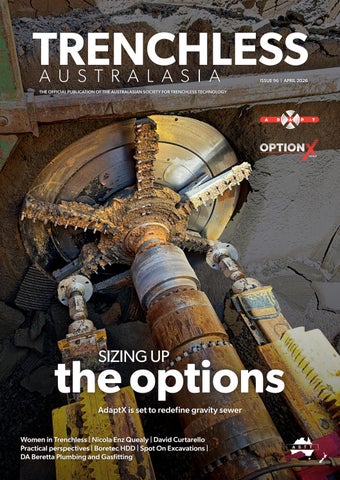
Sizing up the options

The AdaptX system allows for cost-effective adjustments across a wide range of pipe sizes and materials as proven in several recent projects of varying requirements around Australia.

Adaptability is fast becoming one of the defining requirements in trenchless construction. Ground conditions can shift unexpectedly, with project criteria often evolving once work begins. Yet many machines remain restricted to fixed pipe sizes, leaving contractors exposed to costly modifications, delays, or the need to mobilise additional equipment.

OptionX Group Founder, Stuart Harrison, recognised this gap early. While project demands remain constant, ground conditions and performance requirements can shift dramatically. In response, he developed AdaptX, a modular drilling platform engineered to adapt in real time to changing conditions and evolving project needs.

“Geotechnical information is essential and we all rely on it,” said Harrison. “However, we also know it’s based on sampling, and it doesn’t always reflect what we actually encounter underground.”

AdaptX’s modular design extends beyond the core machine, allowing drilling tools and steering systems to be adjusted to suit changing ground conditions and operational demands. This ensures consistent control and efficiency, even in unpredictable environments.

This is particularly important in gravity sewer applications, where installations often

AdaptX enables operators to respond to changing conditions without compromising accuracy, reducing complexity and improving overall project outcomes.

“Traditional approaches often rely on large excavations, heavy equipment, and high volumes of material movement,” said Harrison. “That increases disruption, introduces more variables, and elevates risk on site. Reducing that complexity is critical to improving both safety and project outcomes.”

AdaptX is designed to overcome these limitations. While many high-spec machines are restricted in application or come with significant cost and operational demands, AdaptX offers a more practical and scalable approach. It delivers the capability needed for demanding projects without the same level of burden. The system can be mobilised and operational within a day, offering a significant advantage over conventional setups that can take up to a week to commission.

“Traditional microtunnelling systems come with significant setup costs, which creates pressure to deliver long drives just to make them viable,” said Harrison. “AdaptX changes that model. While it is fully capable of completing long drives, it also makes economic sense for shorter installations, often completed before traditional systems would even be set

operators the flexibility to take on a much wider range of projects.”

AdaptX microtunnelling projects typically begin with a 350mm pilot bore, followed by a single back ream to achieve the required final diameter. Using a powerful vacuum extraction system, material is continuously removed throughout both the pilot bore and reaming

Large-diameter AdaptX tooling, manufactured in-house by OptionX Group, expands the system’s capabilities.
AdaptX delivers accurate results across a range of ground conditions including hard rock.

process, maintaining a clean, stable bore path and allowing operators to retain control as ground conditions change.

This approach not only establishes the bore path early, but also enables operators to confirm alignment, ground behaviour, and overall setup before committing to full-scale installation.

“Many pilot systems don’t remove ground efficiently, which can limit control and visibility,” said Harrison. “With AdaptX, we’re actively extracting material throughout the process. That allows us to move through varying ground conditions while maintaining control of the system. By the time we reach the exit point, we’ve validated the alignment,

confirmed ground behaviour, and can make informed decisions on how to proceed.”

This staged approach gives operators greater control over both design and execution. By completing the pilot bore and validating conditions before pipe installation begins, it provides a clear understanding of the ground conditions along the full alignment, reducing uncertainty and allowing for a more controlled installation process.

The AdaptX reaming method, combined with lower jacking forces achieved through continuous vacuum extraction, further supports this approach. With reduced resistance during installation, pipe selection is not dictated by the limitations of the

machine, allowing projects to be delivered in line with design requirements and long-term performance expectations.

It also allows for adjustments to tooling to be made prior to reaming if required.

With conditions confirmed during the pilot stage, operators can optimise the setup before committing to full-scale installation, reducing risk and improving overall project outcomes.

“Once we’ve confirmed accuracy at the pilot stage, we can proceed with confidence,” said Harrison. “The reaming and installation process delivers a precise fit, ensuring longterm stability. The pipe we install today is built to perform exactly as intended for decades.”

Edge Underground, the microtunnelling

contractor division of OptionX Group, has exclusive use of the AdaptX system in Australia. Its fleet of AXIS machines has been upgraded with AdaptX technology, enabling them to operate at the full capability of the system across a wide range of ground conditions and project requirements.

This capability is reflected in consistent delivery across multiple projects. Edge Underground’s upgraded fleet has completed thousands of metres of smaller diameter bores, typically up to 700mm, demonstrating reliable production across a broad range of applications.

More recent projects highlight the system’s scalability. Installations include a 1500mm reinforced concrete pipe (RCP) within an 1830mm bore through mixed clay, as well as a 1350mm RCP within a 1660mm bore through hard rock and clay in Craigieburn. In nearby Donnybrook, AdaptX technology was deployed to install four 1350mm pipelines in hard rock, further demonstrating the ability to transition efficiently between projects without the need for multiple specialised machines.

Internationally, AdaptX technology has also been applied in New Zealand, where a series of 1500mm installations were successfully completed, reinforcing consistent performance across varying ground conditions and larger diameter requirements.

“By using vacuum extraction to remove material at the cutting face, we’re reducing resistance, which allows us to operate with lower jacking forces,” said Harrison. “That has a direct impact on both performance and cost.”

Microtunnelling has traditionally been avoided in softer ground conditions due to the risk of over-boring. AdaptX addresses this by enabling the system to be configured to create

an earth pressure balance effect. By adjusting the vacuum point relative to the cutting face, operators are able to maintain stability and control within the bore, ensuring that only freshly cut material is removed, rather than

disturbing the surrounding ground. This level of control and adaptability positions AdaptX as a leading solution for applications such as wastewater infrastructure, where demand continues to grow both in Australia and globally.

AdaptX is also supporting a broader shift in how gravity sewer projects are delivered. By combining consistent performance, adaptability to site conditions, and high production rates, the system enables trenchless methods to compete directly with traditional deep trenching approaches, thus challenging the long-standing reliance on deep excavation. When factoring in the inherent safety advantages of trenchless construction, this represents a fundamental change in how these projects can be delivered according to Harrison.

“There is increasing pressure to deliver more efficient and reliable wastewater solutions,” he said. “We believe AdaptX has the capability to fundamentally change how gravity sewer installations are delivered worldwide.”

As safety expectations increase and the risks associated with deep trenching become harder to justify, the shift toward adaptable trenchless solutions is no longer a future consideration, but a present reality.

For more information, visit adaptx.com.au

AdaptX reaming tooling is designed to support efficient upscaling from pilot bore to final installation diameter.
Edge Underground delivers larger-diameter microtunnelling solutions using AdaptX technology.

The solution for NDD & Drain Cleaning

Rear boom and drain cleaning reel

The DrainVac hose reel contains 180m of drain cleaning hose. Both the boom and reel are linked together with 180° of rotational range allowing easy operation when drain cleaning operations are being carried out. The boom and reel functions are remote controlled, along with very simple manual overrides.

Non Destructive Digging (NDD) reel

The NDD reel contains 30m of 13mm hose and is controlled via the remote control with optional manual operation also. A robust 300bar and 17LPM NDD pump gives you all the performance you need to complete the NDD jobs. The NDD reel is mounted low at the rear of the unit for easy access in all conditions.

Control system

In line with VTS’s “Simple is Better” philosophy, the DrainVac uses straightforward controls with no computer interface. It’s easy to operate and designed for quick faultfinding and repair if needed.

Liquid ring vacuum pump and HP water pump

Chasing performance?

The DrainVac is fitted with proven, high-output components including a CVS 4,000 m³/h (2,354 CFM) aluminium vacuum pump and a Pratissoli 346 LPM (170 bar) drain-cleaning pump. Both are belt-driven to reduce noise, simplify servicing and keep running costs down.

180º rotational range boom 30m / 13mm hp hose
No computer interface
High performance pumps

Adding values

Nicola Enz Quealy has, in her journey from Switzerland to Australia, where she is the Co-Owner of SECA, blazed a path in domains historically dominated by men. Her inspiring story, though not without adversity, is a triumph of inner belief and overcoming the odds.

Hard work. Honesty. Integrity. Nicola

Enz Quealy understands these are values to live by because she lives by them. It was her father Albert, a Swiss entrepreneur who introduced her to the wastewater and sewerage solutions segment when she was only a girl, who instilled in her the importance of fairness and reliability and of always telling the truth. Especially to customers.

Her initial calling, it turns out, was down a different path. She recalls her first professional ambition was to be a travel agent. At the time in Switzerland travel agents needed to complete an apprenticeship like many other trades. It proved something of a rude awakening. After undertaking a work experience position at a travel agency, she was soon convinced it was the wrong career for her.

Enz Senior manufactured nozzles for cleaning stormwater and sewer pipes. The internationally recognised Swiss water jetting and water blasting tools of the same name were made in his workshop. Enz Quealy was not unfamiliar with an environment of working

lathes and mills having been brought up around it. An apprenticeship as a machinist or something similar seemed logical. Only it would have to be in another workshop, that was not her father’s, for the reason she didn’t want to clash with him. Family being

family. Enz Quealy subsequently did two work experience placements, just to make sure it was the right path.

“I absolutely loved it,” she recalled. “It was definitely for me.”

Growing up an hour from Lucerne in Giswil, a small town with a population of around 3,000 people, meant she was one of the first women, if not the first, to undertake a toolmaking apprenticeship in the region. Official record keeping, in which a government body assigned a gender typical of a budding tradesman, had to change to make way for her entrance. She was 15.

“Back then in Switzerland, you left school in year nine if you wanted to do an apprenticeship,” Enz Quealy told Trenchless Australasia. “If you wanted to study at university you stayed on.”

With a view to possibly moving into a mechanical engineering degree down the track, Enz Quealy decided to augment her days in the workshop by taking classes for an international bachelorette (IB).

She was, as the Chinese proverb goes,

Nicola Enz Quealy, Co-Owner SECA Australia.
SECA’s headquarters in Sydney.

crossing the river by feeling the stones. Intensely driven as she was, apprenticing in an all-male environment proved a tough experience. For all that she learnt and discovered, including new ways to lift heavy machinery to keep pace with the men, she encountered bullying and even sexual harassment.

“At the time these things were not dealt with how they are now,” she said. “That certainly happened to me. What doesn’t kill you only makes you stronger.”

She added, “I’m not wishing any girl to go through that. It was, however, what it was at the time.”

But she stuck at it. Finishing her apprenticeship in 1996 Enz Quealy went travelling to Australia and New Zealand for a seven-month sabbatical before she returned to Switzerland ready to work as a toolmaker. She got bored not soon after. University beckoned.

“Mechanical engineering wasn’t the be-all and end-all for me but I felt somewhat stuck,” she said. “I didn’t want to be on the tools the rest of my life.”

Having the prerequisite to enter university that’s exactly what she did. She specialised in thermal dynamics. That gave her a lot of insight into flow dynamics and thermal distribution, knowledge she still uses today in her role as co-owner of SECA. After a two-year stint as an engineer with PanGas a subsidiary of Linde Gas she joined her father’s business working as the international sales manager travelling the world and meeting all of the regional distribution partners. Here she was given a comprehensive exposure to the industry which eventually led to her meeting Mark Quealy, who was employed as the general manager of SECA. He’s now her partner in every sense of the word — her husband and co-owner of SECA.

She eventually moved to Australia in 2006 and worked for BOC Gases as a Field Engineer.

In 2011 Enz Quealy had a baby girl. She took time off and eventually re-entered the workforce as a planner for Australia’s Nuclear Science and Technology Organisation (ANSTO). Then Mark and her were presented an offer to buy SECA, which they did.

“It was super interesting because I had to learn so much about people and culture and how sales work here,” said Enz Quealy. “Because I wasn’t in this industry, I had lost a lot of knowledge, so I took on many different roles to learn the ropes again.”

She worked in people and culture, then on the floor in sales and later on in operations before returning to head up Strategy and People & Culture. The proverbial full circle.

Social safety was, for Enz Quealy, an issue close to her heart long before the phrase started circulating in HR departments. It was very important to her that people wanted to be at the business.

“Because I had had a really hard time with my apprenticeship and also with one of my previous employers, I have a very strong drive

to create a really conducive culture in the business,” she says. “We have just implemented a recognition program so people can nominate someone who lives our values really well and the impact that has had on the team and the business.”

In fact, there were no business values in place when she took over SECA. After engaging a HR consultant to run a workshop with employees, of which they now have 28, leadership began to refine the strategy so that their people would better understand where Mark and Nicola were trying to take the company.

Even so, four years ago, when the value sets were first adopted, they didn’t resonate with everyone including Mark.

“They have to mean something to the MD,” Enz Quealy said. “So, 18 months ago, we redid the values.”

These values now include ‘Better Together,’ a mantra for reinforcing the importance of teamwork, “We get Sh!t done’, bias for action, ‘Bring the Love,’ which puts the onus on a happy work environment and ‘Act with Swiss Precision’, whose origins are self-explanatory.

“We’re really trying to embed those values now,” added Enz Quealy. “It’s all about moving the needle in the right direction.”

Employee retention is another point of pride at SECA. There’s staff who have been with the company for 15 and in some cases 20 years.

“They really know their product and that’s why we are the expert in the industry,” said Enz Quealy.

“That expertise anchors the service we provide for our customers so that their performance improves and their downtime and reputational risk is reduced. My husband has been here 33 years.”

That accounts for a lot of knowledge inside the heads of a select few key staff in the business. One of the current strategic initiatives at SECA is to create a third platform, possibly via an AI agent, so that those vast stores of knowledge can be accessed and made available through a system to others internally.

Another priority underway at the business is growing its training capability inhouse. Productivities will likely flow downstream from this endeavour to customers.

Enz Quealy, by her own admission, is a straight shooter. She puts that down to her Swiss background. Hard work. Honesty. Integrity. In that sense those core values have never changed even as her questing spirit has taken her halfway around the world.

All those experiences Enz Quealy has had, both the good and the bad, she insists, have made her empathetic to the plight of others.

“I always have an open ear, and I always try to help in whatever way I can,” she says. “I will do my best in whatever I do. If I don’t know how to do it, I will find the right people to help me to be the best. And the other thing is I just love learning. Whatever you throw in front of me I will dig my teeth in and learn as much as I can about it.”

Images: SECA
Inside SECA’s training facility.

Making their mark

SECA offers many opportunities for women in the trenchless sector.

Parul Chaudhari

• Job title: Accounts & Admin Officer

• Time at SECA: Commenced midAugust 2025

What do you like about your job?

I enjoy keeping our accounts and processes organised, supporting the team, and ensuring everything runs smoothly. I like being able to solve problems, assist colleagues with queries, and see the positive impact of my work on the overall efficiency of the company.

Mentors in your career:

• Job title: Marketing & Training Lead

• Time at SECA: 10 years in August 2026

What do you like about your job?

I am lucky enough to be involved with both marketing and SECA’s training facility, which gives me a unique perspective across the business. On the marketing side, I focus on strategy, campaigns, tradeshows and brand positioning — ensuring we communicate clearly with the industry and showcase the innovation behind our products. Through the training facility, I’m able to see firsthand how our customers use the equipment, the challenges they face in the field, and the skills they’re developing. Being connected to both areas allows me to align our messaging with real-world experience and ensure we’re not just promoting products, but supporting genuine capability and productivity within the industry.

Mentors in your career:

I’ve been fortunate to learn from senior leaders throughout my career, particularly those who value commercial thinking and strategic planning. Their guidance has helped shape my approach to leadership and long-term business growth.

Career Highlights:

Yes, my manager, Augie Chacko, is a great mentor. He guides me in developing my skills in accounts and administration, provides valuable advice, and continues to support my growth within SECA.

Career Highlights:

Career highlights include successfully improving workflow and organisation within our accounts and admin processes, as well as taking on new responsibilities that challenge me and allow me to

• Job title: Administration Assistant (Training & Marketing)

• Time at SECA: Two years (on 20 March)

What do you like about your job?

I really enjoy the people I work with and the fact that no two days are the same. The role is fast paced and gives me the opportunity to be creative while continually learning new skills. Marketing has changed significantly with technology, so adapting and keeping up with those changes is a challenge I enjoy. I also find it very rewarding organising training for customers, whether onsite or at one of our locations, learning more about their needs and working with them to ensure their goals are met.

• Time at SECA: Three years

What do you like about your job?

Leading and managing a major industry tradeshow. Contributing to SECA’s brand positioning and strategic marketing direction. Supporting the expansion of SECA’s training facility, helping grow course participation, increase customer retention, and strengthen industry capability.

I love that no two days are the same—it keeps things fresh and exciting. I enjoy tackling new challenges, continuously learning about our products and services, and building strong relationships with our customers.

Mentors in your career:

I’ve been fortunate to have mentors both formally and informally, learning from how they lead, solve problems, and handle challenges. Mentorship is something I value deeply, and I try to pay it forward by supporting and developing others whenever I can.

Career Highlights:

Before joining SECA, I led the setup of an international office and managed the operational transition, including processes, training, and knowledge transfer. This project demonstrated the trust placed in me and my ability to deliver seamless outcomes in a complex, high-impact situation.

Mentors in your career:

Throughout my career I have worked with many different people across a variety of roles, from executive assistant positions in top tier and small law firms to being the Administration and Cremations Coordinator at Liverpool Cemetery. That role was where I first had the chance to explore creativity and marketing. Two mentors in particular stand out. They trusted me, encouraged my ideas and supported my development. Their guidance helped me build confidence, continue learning and take on new challenges. Their leadership showed me how valuable a good mentor can be.

Career Highlights:

There have been many memorable moments throughout my career. One that stands out was working at the cemetery, supporting families during difficult times and ensuring everything ran smoothly for them. I have always enjoyed helping people, and that role allowed me to combine that with my legal knowledge when preparing and arranging cremation documentation, as well as using my creativity in the way we supported families.

It was meaningful work and brought a real sense of satisfaction knowing we could help people when they needed it most. While many might think it would be a sad environment, the gratitude from families and the strong sense of community made it a very special place to work.

Katherine Neale
Images: SECA
Kristel Hudson

Closing the gap: How Interflow achieved pay equity

Interflow has eliminated its gender pay gap by embedding fair pay practices into every part of the way the business operates.

In past years in construction and engineering, gender pay gaps have often been explained away as an unavoidable by-product of workforce composition. After all, the greater number of field roles tend to be held by men. But at Interflow, leaders decided that explanation simply didn’t work. Over the past few years, Interflow has implemented a series of structural and process changes to ensure people are paid fairly for their specific role, experience and contribution, regardless of gender. The result? Interflow now has no gender pay gap.

For a business operating in the heavily male construction, utilities and water infrastructure sectors, that outcome means a great deal. Internally, however, it was never considered a headline initiative. It instead came from a broader conscious focus on fairness and organisational culture.

Chief Financial Officer Tracy Black said the company’s approach was really about ensuring everyone was paid appropriately and fairly, as opposed to gender, specifically.

“If I think back to the foundation of all of this, we weren’t trying to get to gender pay equality,” she said. “It was instead centred around diversity and inclusion, and about doing the right thing and attracting the right people by paying proper market rates.”

Interflow pays superannuation while people are on parental leave, for example.

“So, we took a big-picture view of what

fairness really means when it comes to pay,” added Black.

One of the first parts of the process was undertaking market assessments of salary ranges, hand in hand with an independent market analysis body, ensuring current internal roles aligned with benchmarks.

Since those first standards were established, updates continue to be made to ensure salaries always sit within correct salary bands no matter the person’s gender. And so the outcome –

practices across Interflow. But that’s not the only positive result according to the company.

Embedding fairness in Interflow culture

In any business, positive cultures are only reinforced at an operational level when systems and processes support constantly encourage new ways of doing things, as well as new behaviours. Once the original work was done around salaries at Interflow, it was embedded into the company’s processes and policies around the setting, reviewing and communication of future salaries. Most importantly, pay would never be influenced by gender, race, faith or any other personal characteristic. Anne-Marie Vella, Interflow’s People Experience Manager, said a vital part of the process was the establishment of a clear policy and supporting salary framework for every role.

“It’s actually fairly simple in practice,” Vella said. “We’ve got a role and a salary range. And no matter what, the people in that role need to be within that range. None of it has anything to do with gender.”

Each role has a defined salary band that aligns with current market data. People are positioned within the range based on performance, experience, capability and responsibility.

“We also look at things like parental leave,” she added. “When someone re-enters the workplace, we test their salary against current data because the market may have shifted while they were away.”

Interflow reviews pay data for team members biannually. Images: Interflow
Tracy Black [middle] Interflow Chief Financial Officer.

promoted or returns after a long absence, the ranges are revisited to ensure they are still good and fair.

That’s just the starting point. Of equal importance is how those standards are communicated across Interflow. Around the time of annual salary reviews, leaders host sessions where they explain the framework and the principles that reinforce it. This is important, as it communicates the fact that the standards are not simply set by HR, but instead are understood and supported by the Executive Leadership Team and senior leaders across the business.

“That was a big thing for me – I didn’t want it to come from HR,” said Vella. “It has to come from the leaders, otherwise it’s not going to be embedded in the way we do business.”

Equality is part of Interflow’s purpose

For the Interflow leadership team, the motivation behind the concept of greater equality across the business connects to the organisation’s broader purpose.

“It’s actually all about our purpose,” Black said. “Our purpose is to improve the lives of the people we work with, the communities we serve and the environment we work in. More simply, it’s just not right to have it any other way.”

While the elimination of the gender pay gap at Interflow was a notable achievement in itself, and in fact earned the WORK180

award for Outstanding Achievements in Pay Equity in 2025, Black said the biggest challenge facing the organisation is stronger gender representation across the industry more broadly.

It’s no secret that construction and infrastructure related sectors have maledominated workforces.

“I think our real challenge now is around attracting and retaining an equal female representation,” said Black. “We have a focus on this in recruitment, from leadership appointments all the way through our workforce.”

In fact, leadership representation has leapt forward at Interflow in recent years. When Black joined Interflow three years ago, she was the second of two women in the executive group. Now, three of eight Interflow executives are female. For Black, those changes matter not just symbolically, but practically.

“When you’re looking at a new role, the last thing that gets you over the line is your sense of how you’re going to fit in,” she said. “If it’s just a bunch of blokes sitting at the table, there’s no way a woman can feel like she’s going to fit in.”

Greater gender diversity at the highest level within a business naturally, and often dramatically, expands the organisation’s potential talent pool according to Black. That offers a critical advantage, culturally and commercially, as engineering and infrastructure

PRECISION TRENCHLESS SOLUTIONS FOR UNDERGROUND INFRASTRUCTURE

When pipelines and utilities need to cross roads, rail, waterways or sensitive environments, Under Road Boring Australia delivers reliable trenchless solutions that minimise disruption and keep projects moving.

Established in 1982, our team has decades of experience and a reputation built on practical innovation, specialising in microtunnelling, auger boring and pipejacking to install pipelines and service conduits safely and efficiently.

Family-owned and built on strong industry values, we pride ourselves on delivering practical solutions, dependable service and high-quality results for every project.

firms across Australia face skills shortages.

“For us, this is now simply the way we work,” Vella said. “It’s embedded into the way we do things.”

In removing the gender pay gap, Interflow has demonstrated that even in male-dominated sectors, structural fairness is not just a nice-to-have, it’s also a powerful competitive advantage.

WHEN THE JOB IS UNDERGROUND, EXPERIENCE MATTERS. TALK TO A TRENCHLESS EXPERT ABOUT YOUR PROJECT TODAY.

Interflow has developed a clear policy and supporting salary framework for every role.

Pathways forward

CRCHI engineer, Tan Qin Yangzi, supervises the requirements for small-diameter, highly flexible tunnelling equipment unique to the South Korean market.

Tan Qin Yangzi has enjoyed an auspicious rise since she graduated with a master’s degree in 2023. Her studies were completed in South Korea before returning to her hometown in Changsha, known as the construction machinery capital of China, where she joined China Railway Construction Heavy Industry Corporation (CRCHI).

Now in her fourth year with the company, she serves as the Overseas Business Manager, more specifically on its tunnel boring machine (TBM) projects.

In the South Korean market, she is responsible for the execution of 13 different TBM projects designed and manufactured by CRCHI. Involvement spans across several cable tunnels and railway tunnels. Tan’s role, which sees her across every key phase of the project, encompasses outset to outcome contract management — from equipment mobilisation and installation, through tunnelling, to the final breakthrough — ensuring each undertaking progresses as smoothly as possible. Constraints now common above the surface for infrastructure builds have meant that companies like Korea Electric Power Corporation (KEPCO) are adapting to get around these limitations increasingly imposed on above ground environments. The

undergrounding of power cables is one way it has sought to do so and now actively promotes — a trend that has prompted growing demand for small-diameter tunnel boring machines.

It’s a welcome development, moreover, for a company like CRCHI, whose reputation rests upon the superior performance and customisation capabilities of its equipment. In this case it’s been its ability to supply highly flexible tunnelling equipment for the likes of the Seosan-Seongteon power cable tunnel project. CRCHI supplied a slurry balance TBM with an excavation diameter of 3.2 metres. The massive dig covered 2,044m on a continuous uphill gradient with a maximum slope of 1.3 per cent. Meanwhile, a 3.0m diameter TBM was deployed on the Suwon-Hwaseong power cable tunnel, a vital infrastructure project for both cities as their populations surpass 1 million people, granting them special city status which, in turn, bestows administrative privileges under the central government.

Trouble with the curve

The Seosan cable tunnel project passes through complex geological formations interbedded with hard rock and weathered rock. The minimum horizontal curve radius is just 120 metres, and the uniaxial compressive strength of the rock reaches up to 71MPa. To address the technical challenges posed by long-distance hard rock tunnelling and extremely tight 120-metre radius curves, CRCHI’s R&D team customised the equipment with a dualarticulated steering system, an efficient rockbreaking solution, and a high-capacity slurry circulation system.

Tan Qin Yangzi.
Tan Qin Yangzi oversees the execution of 13 CRCHI-made TBM projects for the South Korean market.

“The TBM was also equipped with an ultralow-clearance segment erector and a side-coil hose reel system, fully adapting to the specific requirements of small-cross-section tunnel construction,” said Tan.

Following the equipment delivery, the CRCHI team provided comprehensive technical support throughout the entire process, from assembly and commissioning to trial tunnelling and subsequent operational safeguarding. This contributed significantly to overcoming the complex geological challenges and achieving an excellent monthly advance rate of 223 metres.

“The TBM, with an excavation diameter of 3.26 metres and a total assembled length of approximately 135 metres, has demonstrated stable and efficient performance,” said Tan.

Thanks, owing in part, to their outstanding performance, CRCHI’s equipment has earned high praise from its clients in South Korea. The two aforementioned TBMs that successfully completed their drives last year are already scheduled for deployment in subsequent cable tunnel projects such has been the universal

nature of their acceptance. In this instance, the machines have crucially helped CRCHI further cement its brand influence in the country’s underground space equipment market according to Tan who has witnessed firsthand the process of Chinese high-end equipment taking root in overseas markets.

“Through my involvement in these projects, I have gained invaluable experience managing TBM construction operations under diverse geological conditions,” she said.

“I often say: ‘As the machines advance

• Specialising in free boring, sleeve boring and pipe jacking

underground, CRCHI establishes its presence overseas.’”

Each tunnel, it would seem, not only connects different geological layers but also serves as a link, fostering technological exchange and mutual trust between China and South Korea. For young women such as Tan Qin Yangzi, the underground in South Korea has been a pathway forward.

For more information, please contact tangzhongwu@crchi.com

• Size ranging from 350mm > 750mm in most ground conditions

At L&D Micro Tunnelling we specialize in laser guided boring. Our Tunnel bore machines use a vacuum extraction system where all spoil is sucked into interceptor tanks for easy disposal with no mess. All our heads are hydraulically driven and guided by a high accuracy laser to achieve precision over long distances.

• Drill up to 120 meters with a +/- 10mm tolerance

• 30 years experience in the drainage industry

A crane lowers part of the 135m long TBM on site.
One of CRCHI’s TBMs achieving breakthrough in South Korea.

Fortified port

S&Z Australia have helped deliver critical infrastructure upgrades through trenchless innovation at the port in Melbourne.

Besides being considered a major International Container Terminal with its 944 metre wharf relying on three container handling berths, Swanson Dock must accommodate increasing volumes of containers carried into Melbourne by some of the largest ships in the world. As it was constructed in several stages between the 1960s and 1980s, the asset, in this the age of sustainable global logistics, was long overdue to have its design life extended. With pressure mounting on ports to reduce their emissions, port electrification is an opportunity to upgrade, among other things, the high voltage network.

At present, maritime gantries and cranes at many of the world’s leading ports are being electrified alongside other core operations. At the Swanson Dock in Melbourne, specifically at Berths 1 and 3, this is no different. Demands on port infrastructure and for

lowering operating costs are increasing at once. With that the ability to deliver reliable power to heavy‑lifting equipment is imperative not only to remain competitive but also to optimise efficiencies.

Multiple obstacles, however, were preventing the port cranes accessing the electrical capacity that would be needed for future installations. Not least of all in the existing berth structures, each of which presented significant restrictions. The project, in sum posted multifarious problems for Qest Infrastructure who had been engaged by DP World to find a solution. Enter S&Z Australia, the Victorian based specialist in horizontal directional drilling, underboring and microtunneling solutions.

As the concrete deck is an established, heavily trafficked asset, excavation through it was not permitted. This restriction immediately ruled out traditional open‑cut

trenching. Installation of the new HV conduits beneath the berth required a method that avoided surface disruption, protected the marine environment, and navigated complex subsurface conditions. S&Z Australia would need to provide a trenchless solution capable of delivering new conduits without disturbing the dock surface. Installation of four 150mm conduits at each of Berth 1 and Berth 3, would provide the necessary capacity for future crane power requirements. The works involved penetrating the existing sheet pile wall above water level, then sealing the wall post‑installation to prevent any water ingress. Precision with careful sequencing, would be critical, what’s more, incorporating methodology that could operate safely in a marine‑adjacent environment.

The brief was inherently challenging. No relief hole or launch shaft could be excavated

Water management was a constant focus on the project.

through the established dock structure.

Zero liquid waste was permitted to enter the ocean, ruling out methods with uncontrolled slurry or fluid returns. Meanwhile, directional drilling posed significant steering challenges in the known ground conditions, which included variable soils and obstructions. Because of these critical constraints, it was ultimately decided that laser boring, as it afforded greater accuracy, control and environmental protections, was going to be the most effective and appropriate trenchless method put to use.

In addition to this, complex ground conditions would need to be navigated.

The subsurface profile included running sands, Coode Island Silt, and unknown in‑ground piles not easily detected or visually confirmed. These conditions demanded a methodology capable of maintaining line and grade while managing instability and obstructions.

Working below the water table would introduce an additional risk.

“To create a safe and stable environment for laser boring, the team installed a sheet‑pile box and jet‑grouted the base, forming a controlled work zone,” recalls Jim Pound, General Manager S&Z Australia. “Emergency dewatering systems were established to respond immediately to any unexpected water ingress.”

Water management, subsequently, became a constant focus given the proximity to the bay. Controls on this task included having pumps on standby and emergency egress plans for personnel. Drilling activities were carefully coordinated around the timing of tidal movements.

“These measures ensured both safety and environmental protection throughout the works,” says Pound.

Productivity at the port was rarely impacted. In fact, during construction the port remained active with straddle carriers and other dock traffic operating nearby.

To ensure safe coexistence, third‑party engineering assessments were undertaken to confirm safe approach distances, allowable loads, and required depths during drilling and installation.

Construction activities were sequenced to minimise operational impacts while maintaining safety for all personnel.

Despite the constraints of the berth structure, challenging ground conditions, and the need to protect the marine environment, the project successfully delivered a trenchless solution that meets the port’s long‑term HV capacity needs.

In short, S&Z Australia delivered a safe, future ready outcome for its client.

Now that installation of new conduits at Berths 1 and 3 has been completed, it ensures the infrastructure is ready for future crane upgrades while preserving the integrity of the dock and safeguarding the surrounding bay

For more information, visit www.sandz.com.au

Images: S&Z Australia.
A controlled work zone was necessary for laser boring.
Works involved penetrating the existing sheet pile wall above water level.

History in the remaking

Impreg has partnered with Nuflow Tasman to preserve the past below the historic city of Nelson with UV relining.

Beneath one of Nelson’s most important city-centre corridors sits a piece of underground infrastructure that tells its own story about how cities evolve. Bridge Street, now at the centre of Nelson’s wider Bridge to Better revitalisation program, is being reshaped as more than a traffic route. The project combines transport upgrades, threewaters works and public-space renewal in a way that reflects Whakatū Nelson’s identity while preparing the area for future growth. But below the paving, landscaping and streetscape works lies an older layer of the city again: a historic brick barrel dating back to the early days of Nelson’s urban development. Preserving that asset while keeping the broader renewal moving was always going to demand something smarter than open-cut replacement.

Here trenchless technology comes into its own. Nuflow Tasman Managing Director Mike Allen was approached by Nelson City Council to propose a solution for rehabilitating the historic brick barrel stormwater line running between Collingwood Street and Trafalgar Street. The stormwater line is around 250m long and a feasibility study considered four different renewal or relay options before Impreg’s GL16 UV cured liner with a 100-year design life was selected. Nelson City Council described the work as a way to preserve and reuse the structure, while extending its service life for decades. In other words, the chosen method was not simply about repairing a pipe,

it was about retaining a historic asset, avoiding unnecessary excavation and making the old structure fit for a modern drainage role. That decision matters because this was not a standard trenchless rehabilitation job. Bridge Street is part of a major city-centre transformation. Nelson City Council has described the broader program as a significant investment in infrastructure, including increased stormwater capacity, water supply works, wastewater upgrades and a redesigned public corridor. On a site like that, the normal pressures are multiplied: construction sequencing, stakeholder coordination, traffic, business disruption, heritage sensitivity and public scrutiny. Digging up and replacing an 18th century structure under a busy urban corridor would have come with obvious cost, program and community impacts. By contrast, the UV liner solution allowed the project team to work through existing manholes, avoid major excavation and keep the footprint tight. The investigation and preparation work also reinforces a point that experienced trenchless contractors already know well: success on complex renewals is won before curing starts. CCTV inspections showed the brick barrel was still structurally intact overall, despite signs of age including missing bricks, deteriorated mortar and general wear. The team then carried out full cleaning and flushing, followed by hydrovac removal of accumulated debris. Around 20 tonnes of silt were removed over

two visits. It was noted some of that material may have been sitting in the barrel since the late 1800s, which says plenty about the longevity of the original structure. Nuflow also undertook final CCTV and dimensional checks at nine different locations to confirm consistency through the line before installation. That level of pre-install verification is exactly what heritage and non-standard-profile assets demand.

Geometry was another major factor. The brick barrel was an ovoid (egg) shaped profile, a form commonly used in older wastewater systems. One section was mortared and had a slightly different internal diameter, which led the team to split the installation into three separate shots of approximately 130m, 60m and 55m. There were close to 50 old laterals, made from a range of materials, that had to be carefully trimmed so they would not puncture the liner during installation.

“This is the kind of detail that separates straightforward trenchless work from the jobs that really test planning, crew discipline and product selection,” said James Haua, Nuflow Australasia Business Development & Technical Manager.

From there, the installation sequence followed a tightly controlled Impreg UV CIPP installation process. A glide foil was first installed to reduce friction and protect the liner as it was pulled into place. The Impreg GL16 UV liner was pulled in and positioned using

Images:
The Impreg GL16 UV liner here being winched into position.
AFTER

a winch. End cans were then installed and the liner was gradually inflated. The liner was then calibrated by inflating the liner 30 millibar every five minutes until reaching a working pressure of 250 millibar.

“That staged approach was critical to allowing the liners’ fibreglass layers to compress properly to the host pipe and avoid defects such as poor conformance or delamination,” said Mike Allen. “On irregular shapes and heritage assets, that level of patience is part of quality assurance, not lost time.”

ProKASRO dual light core with a total of eight 1,000-watt bulbs, which emits a particular UV wavelength, was used to cure the liner. This was inserted into the inflated liner and then pulled to the other end. During this, the technicians visually monitor the liner interior for wrinkles or other defects. The curing process then commenced, igniting the UV bulbs sequentially to full intensity, then being pulled back at a calibrated speed of 0.6m to 0.8m per minute. Once the light train reached the other end, the liner was allowed to cool before the end cans and light cores were removed. The ends were then cut back and sealed with mortar.

renewal and heritage preservation to happen together. That is a stronger story, Haua said, than

“It shows how rehabilitation can support broader city-making objectives while still solving a hard engineering problem underground,”

For the trenchless sector across Australia and New Zealand, that is the real takeaway. As city centres age and expectations around liveability, sustainability and heritage become sharper, the jobs that matter most will increasingly sit at the intersection of engineering performance and place-sensitive delivery. Bridge Street is a good example of how UV CIPP can answer that brief.

Nuflow’s NUVLINE solution is used according to Haua, because of its “controlled structural rehabilitation process, with each step tied to achieving final quality in a difficult host asset.”

There is also a bigger industry lesson in this project. Trenchless solutions are often justified on the standard metrics of cost, disruption and program. Those metrics absolutely matter here, and Nuflow Australasia highlighted reduced trenching, shorter construction duration, lower stakeholder impact and cost savings compared with replacement. But the Bridge Street job shows something more valuable again: trenchless can be the mechanism that allows infrastructure

It preserved a historic brick barrel, avoided excavation, supported a major public project and delivered a practical stormwater outcome from a structure that might otherwise have been written off. For the many partners involved, the project’s success is a demonstrates where trenchless technology works at its best, by enabling renewal without erasing what is already there.

“It was great to work with the team from design all the way to the final installation,” said Colin Murphy Impreg Country Manager. “Our technician from Australia was involved at all stages of the project and accompanied by a German Impreg tech for the final instal.”

For more information, visit www.impreg.com and nuflow.net/tasman/

The whole world of HDD Technology

Aligning liner design for consistent infrastructure outcomes

Pipe Core CEO, Jason Marshall, provides a practical perspective on technical service life and engineering consistency in pipeline renewal across Australia and New Zealand.

Aand lowering whole-of-life costs compared with traditional excavation and replacement.

The region has demonstrated strong capability in adopting modern trenchless technologies, for cleaning, inspection, repair, and renewal of ageing pipeline infrastructure. Yet despite decades of technical advancement, the sector still operates without a unified framework for liner design or a consistent approach to defining technical service life.

Across projects in Australia and New Zealand, designers typically reference a combination of engineering guidance including AS/NZS 2566.1 alongside international standards such as ASTM and DWA, supplemented by authority specifications and project-specific engineering approaches.

This layered system works in practice, but it is not unified.

The result is that liner thickness, structural assumptions and declared service life can vary significantly between projects addressing very similar conditions. The issue is not technical capability. It is consistency.

infrastructure performance and public accountability. Designers require defensible engineering compliance. Contractors focus on constructability and programme certainty, while manufacturers balance material performance, innovation and economic feasibility.

These priorities inevitably influence how conservatively a liner is specified.

Warranties, defects liability periods, insurances and indemnities further shape the design environment. Construction risk, quality assurance requirements and long-term monitoring expectations all play a role.

Where uncertainty exists, the industry often manages risk through conservative design assumptions.

When uncertainty drives over-speculation

Designs are frequently developed using worstcase assumptions. Thoroughly verifying host pipe conditions, groundwater and loading scenarios can be costly and complex, so conservative parameters are commonly applied.

Over-specification increases material use, can

and how pipes actually fail can lead to more practical design outcomes.

“Good engineering starts with understanding how and why a pipe fails,” Fast says.

“When you look at the condition of the existing pipe, the actual groundwater conditions, and whether loads are temporary or permanent, you can often design more efficiently while still keeping the right safety margins.”

Fast adds that the industry already has the capability to do this well.

“It’s not really a knowledge issue, it’s about being consistent in how we interpret and apply it across different projects.”

Product design: efficiency with integrity

From a product development perspective, liner design generally focuses on three core objectives: achieving structural performance with material efficiency, ensuring reliable installation in real-world conditions and reducing life-cycle environmental impact.

These objectives align closely with the broader

Images:
Pipeline Management
Australian Pipeline Management selected SAERTEX-LINER® MULTI Type S+ Fast Plus for a complex renewal.

sustainability ambitions now influencing infrastructure procurement across Australia and New Zealand.

However, when projects default to conservative assumptions or inconsistent interpretation of standards, opportunities to optimise material use and environmental performance may be constrained.

Katharina Helming, Business Development Manager at SAERTEX multiCom®, says manufacturers play an important role in supporting design decisions with transparent technical data.

“Service life expectations should be supported by recognised testing methodologies so designers and asset owners can clearly understand the technical basis behind those claims,” Helming says.

Helming notes that some manufacturers have undertaken extensive long-duration testing to demonstrate long-term material behaviour.

“For example, SAERTEX multiCom® has conducted long-term testing on its products,” she says. “SAERTEX multiCom® recently conducted further testing, including extending the 10,000-hour test to 24,000 hours and increasing abrasion testing in the Darmstadt tilting test from 100,000 to 300,000 load cycles to simulate more severe conditions. These expanded programs provide a broader data set supporting an expected a technical service life of 50 or up to 100 years depending on the product used.

“Testing at this scale provides empirical evidence that can help support technical service life expectations.”

Declaring technical service life

Perhaps the most fragmented aspect of trenchless rehabilitation is how technical service life is declared.

Across the market, design life is typically expressed through a combination of recognised testing standards, mathematical extrapolation, engineering judgement and, at times, market positioning.

Without consistent methodology, comparing service life claims between products or projects can be difficult.

In some cases, claims of a “100-year liner” are presented without clear explanation of the testing regime or assumptions used to derive that figure.

For the industry to maintain credibility, service life claims should be transparent and traceable to verifiable evidence.

Long-term testing regimes — such as creep rupture testing exceeding 20,000 hours — can provide valuable insight into material durability. When these results are clearly documented and linked to recognised standards, they allow engineers and asset owners to assess performance with greater confidence.

Importantly, the goal is not to reduce safety factors or diminish engineering conservatism.

Rather, it is to ensure design decisions are supported by clear evidence and consistent interpretation.

Moving toward industry alignment

Encouragingly, efforts are emerging within Australia and New Zealand to bring greater structure to liner design methodologies.

The ASTT Specification for Structural Lining of Pipelines provides a practical baseline for design assumptions, material properties and engineering verification processes. While not intended to replace existing standards, it offers structured guidance that can support greater transparency and comparability between projects.

Documents such as this help create a common engineering language for trenchless rehabilitation.

Consistency in design interpretation benefits every participant in the supply chain — from asset owners and consulting engineers through to contractors and manufacturers.

More importantly, it strengthens confidence in the long-term performance of rehabilitated

solutions that extend the life of critical underground infrastructure.

What the industry increasingly needs now is alignment.

Greater transparency around testing methodologies, clearer documentation of service life assumptions and more consistent interpretation of engineering standards will help support informed decision-making across projects.

Manufacturers, engineers and contractors all have a role to play in this process.

When service life claims are supported by recognised testing regimes, when design assumptions are clearly documented and when specifications are applied consistently, trenchless renewal can deliver not only cost and environmental benefits but also longterm infrastructure certainty.

As rehabilitation programs continue to expand across Australia and New Zealand, the opportunity is clear: move from fragmented interpretation toward a shared commitment to evidence-based infrastructure renewal.

Ripple effect

Corrugated pipe installations are ubiquitous in the realm of civil works and trenchless projects. In the spacer market, the HDX and HDXT product range from Kwik-ZIP is a perfect product bedfellow.

Corrugated pipes are becoming prevalent across most essential industries. There are few applications, more to the point, where you won’t find corrugated pipes widely used these days. Having a solution ready-made to support this category is all part of offering a versatile thermoplastic spacer and centraliser system up to the challenges of the trenchless and civil construction projects.

Since its inception in 2000, kwik-ZIP has been designing centralisers and spacers systems for a wide range of applications across many different industry sectors. kwik-ZIP’s HDX and HDXT product range were conceived with this in mind. The popular spacer system series embodies the simple, cost-effective, and high-quality solutions the brand is known for. Manufactured and designed to be utilised on and in many types of pipe SKUs, the HDX/ HDXT series are considered one of the most versatile and adaptable spacers on the market as they are compatible with all types of pipe material including corrugated pipe installations.

The reciprocal design means it is capable of working on corrugated pipe which is being inserted into a smooth pipe and function on a smooth pipe that’s then being inserted into a corrugated pipe.

“Part of kwik-ZIP’s noted innovations are a reason its products are the first choice for many when looking for a versatile spacer solution,” said General Manager Paul Jeffreys. Manufactured from high-grade thermoplastic, kwik-ZIP’s casing spacer and centraliser products are used and recommended by pipeline and civil contractors, water and gas utilities, drilling companies and international engineering firms. For corrugated carrier pipe, the flat base of the HDXT and HDX runners bridge the pitch of the corrugations which allows the load to be transferred to the carrier pipe via the full length of the runners. Additionally, if the enveloper is corrugated, the HDX and HDXT flat-wear pads allow for smooth slip lining along the invert.

“Because our spacer is right across the corrugation as it’s going in the pipe it doesn’t get stuck,” said Jeffreys. “The immediate benefit is the fact that our products work with corrugation pipes versus another product that might not. In short, they’re applicable across a range of different pipes and on-site scenarios.” The design accommodates trenchless and cased crossings, slip lining, gravel packed well screens, pump torque arrestor, water well casing, coal seam methane casing, pump riser/ submersible pump installation and piling. With unique features including a curved bow spring that boasts a superior centralising force, no special tools are required to assemble the HD Series casing spacers.

Coming in four sizes, ranging from a 30mm bow up to a 100mm bow, the HD series can be used for both vertical and horizontal applications.

On a recent civil project, the kwik-ZIP HDXT-43 has worked in conjunction with the iplex SewerMax®, a cost-effective sewer pipe

In Brisbane: kwik-ZIP HDXT-43 works in conjunction with the iplex SewerMax®, a cost-effective sewer pipe system suitable for gravity trunk sewer mains.
The flat base of the HDXT and HDX runners bridge the pitch of the corrugations.
Images: kwik-ZIP

system suitable for gravity trunk sewer mains. Despite being strong, the SewerMax® is lightweight, manufactured from polypropylene, for easy installation. In addition, the structuredwall profile allows for convenient handling, transport, and site installation, often without obligating the extra costs and time of managing heavy lifting equipment.

Designed for use on medium to heavy weight pipes in cased crossings, kwikZIP’s HDX and HDXT series spacers are often utilised on a wide range of pipe material including steel, DICL, HDPE, concrete and MSCL carrier pipes, minimising running friction between the carrier pipe and the casing during installation. The HDX casing spacer comes in four runner heights; 38mm, 65mm, 90mm and 125mm. Likewise, the HDXT casing spacer also comes in six runner heights of 43mm, 58W, 78W, 63mm, 103mm and 153mm. The different runner heights across the two models ensures that pipeline installers can handle a broad range of carrier pipe OD and casing (host pipe) ID combinations and customise pipe position for grade control or ‘centring’.

Designed to last, expertly manufactured and compliant across guidelines, the range of HDXT, and HDX and HD spacers have been appraised by the Water Services Association of Australia (WSAA) against their Product

Specification WSA PA 324 Casing Spacers. The product, along with other kwik-ZIP products have also been added to the Accepted Infrastructure Products and Materials (IPAM) list for the South-East Queensland (SEQ) Water Supply and Sewerage Design and Construction Code and to the list of approved products by Melbourne Retail Water Agencies (MRWA).

“The use of kwik-ZIP products helps contractors to comply with the numerous regulations which require casing centralisers or

pipe spacers such as slippers or spiders, including wastewater and sewerage codes as well as well construction standards,” added Jeffreys. “Making price effectiveness, simplicity, and rapid on-site assembly a priority has ensured kiwi-ZIP’s centraliser and casing spacer systems deliver significant cost, time, and operational advantages to its end user customers.”

Locked and loaded

Fully structural liners are important. Here’s why.

When rehabilitating ageing or damaged infrastructure, one of the most advanced solutions available today is Channeline’s fully-structural glass reinforced plastic (GRP) liners. But what exactly does “fully-structural” mean, and why is it important?

To be called fully-structural, a liner must be able to bear 100 per cent of all specified loads without relying on the residual strength of the host structure. These loads include internal pressures, external soil and traffic loads, and other environmental stresses. Fully-structural liners function as a standalone structure within the original asset, capable of maintaining integrity even if the host fails completely; distinguishing them from semi-or nonstructural liners, which depend on the existing structure for support and performance.

How do fully-structural GRP liners work?

Channeline’s fully-structural GRP liners are produced from strong, corrosion-resistant composite materials. Each liner is engineered with precise wall thickness and structural properties – unique to each project – to meet both short-term and long-term load requirements independently of the existing structure. Installation typically involves placing pre-manufactured liner sections

inside the existing structure and securing them in position. Once installed, the liner effectively takes over from the old structure handling structural loads, conveying flow, and withstanding environmental conditions.

Fully-structural at scale

While many Channeline liners are supplied as lengths of fully-structural liners, very large diameter projects may require multisegmental liners that allow for easier

Images: Channeline
Colorado culvert installation.

transportation and handling. These arrive on site as segments and are then bonded using Channelbond; a high-performance adhesive developed specifically for this application. Channelbond ensures that joints remain watertight, chemically stable, and structurally robust over time, creating a largediameter, fully-structural solution unique to Channeline.

One of the defining benefits of fullystructural GRP liners is their extended lifespan. Channeline liners are designed for

a 150-year design life, providing long-term performance with minimal maintenance requirements.

This durability is achieved by the inherent properties of GRP, including resistance to corrosion, and abrasion, as well as precision engineering that ensures consistent structural performance over time. Even in cases where the host structure has significantly degraded, the liner continues to function as a selfsupporting system.

Fully-structural GRP liners represent a

robust, long-term approach to infrastructure rehabilitation. By independently carrying structural loads and replacing the function of the original asset, they provide a dependable solution for ageing infrastructure.

Channeline’s fully-structural GRP liners build on this by offering custom sizes and shapes, combining the durability and longevity of fully-structural systems with the performance benefits of a precision fit.

For more information, visit channeline.com

Each liner is engineered with precise wall thickness and structural properties unique to the project in question.
Aerial view of the Orakei installation.

Founding principles

From innovation to specification: what the recognition of standards means for aramid-reinforced pressure pipe relining.

Primus Line technology has been available in Australia since 2014, backed by local stock and a wide network of trained and certified installation supervisors. To date, approximately 80 projects have been completed across Australia and New Zealand, with over 25,000 metres of liner installed. The longest single-shot installation in the region reached 1.4 kilometres in one continuous pull — a major feat still unmatched by many rehabilitation technologies. Projects have covered a wide range of applications and clients, including the rehabilitation of a vertical pipe for Sydney Water and a 3-in-1 project with Hunter Water – the first of its kind in Australia – as well as installations for Rio Tinto.

When the Primus Line technology was launched over 25 years ago, there was no global standard to which this new product could conform. No category existed to classify this innovation. As a complete unit, the self-supporting, three-layered liner with its specifically designed connectors uniquely and independently adopts the full operating pressure without relying on the host pipe. For a flexible pipe, this was genuinely unprecedented. From the outset, the inventor and manufacturer, Rädlinger Primus Line, was determined to produce a premium product that would meet the highest quality standards. From the very first installation, this commitment meant one thing above all else: deployment would only occur after adequate testing.

A new product in a world of mismatched standards

An American consultant and engineer once summarised the early challenge plainly: “Solutions like flexible fabric-reinforced pipes were often misclassified or lumped into standards that didn’t really fit.” In contrast to resin-cured liners, the Primus Line system consists of a flexible plastic pipe reinforced with aramid fibres and specially designed connectors. Installation is carried out without bonding to the host pipe, offering fast and minimally invasive rehabilitation for pressure pipelines. The host pipe merely serves as an installation duct. Because no standard adequately described this type of product, Rädlinger Primus Line did not wait for regulation to catch up. The German company took an active role in shaping the testing frameworks and standards that the industry needed.

As early as 2004, Rädlinger Primus Line, in cooperation with the DVGW (German Association of the Gas and Water Industry),

established a testing basis in the form of VP 643: a technical regulation for ‘flexible, fabric-reinforced plastic inliners and associated connectors for gas pipelines with operating pressures above 16bar’. This was the first step towards specific liner testing regulations, and it reflected the company’s founding principle: the Primus Line system would only be installed where the performance data existed to back it up. That principle has guided the company’s testing program ever since. Today, the Primus Line system – liner and connectors as an integrated unit – is supported by a comprehensive body of independently verified test data.

The friction coefficient of the Primus Line system has been independently verified through a dedicated testing program at a German university, rather than relying on published reference values. All test results, certificates and approvals – including those for drinking water applications – are available to customers. The system currently holds 16 hygiene certifications worldwide, including AS/NZS 4020 for Australia and New Zealand.

Global standards recognition: decades in the making

The testing work that Rädlinger Primus Line has conducted over 25 years has increasingly been reflected in formal international standardisation. In 2018, trenchless rehabilitation methods using ’lining with a circular woven reinforced textile’ were formally included in the updated edition of DIN EN ISO 11295 ‘Classification and information on design and applications of plastics piping systems used for renovation and replacement’ – the key reference work for professionals designing and applying trenchless technologies. Since this edition, ‘Lining with inserted hoses’ has its own dedicated chapter. Most recently, the US standard ASTM F3708, ‘Standard Specification for Aramid Fiber Reinforced Flexible Fabric-Reinforced Pipe (FFRP) for Loose-fit Non-Interactive Pressure Pipeline Rehabilitation’, was published in July 2025. This standard formally defines the category of flexible, factory-manufactured, aramid fibrereinforced pipe liners for non-bonded, loose-fit installation in pressure pipe rehabilitation. Like other ASTM standards, it is already recognised beyond the United States. The Primus Line testing program also adheres to API SPEC 15S for the oil and gas industry, and to UBA-BWGL in Germany for potable water applications.

For over 25 years and in more than 60 countries, the German-made Primus Line

system has been deployed in applications spanning oil, gas, potable water, wastewater, brine, diesel and jet fuel. In each case, the prerequisite has always been the same: adequate, independently verified test data must exist before an installation can proceed. This standard has never been relaxed.

Whether described as ‘lining with inserted hoses’ in Europe or ‘flexible fabric-reinforced pipes’ in the United States, products like Primus Line are gaining formal recognition thanks to the introduction of standards that were absent for much of the technology’s history. For municipalities, utilities and engineers evaluating alternatives to traditional cured-in-place pipe (CIPP) and conventional sliplining, this recognition is important: it means independent verification, comparable specifications and clear accountability.

Rädlinger Primus Line remains committed to participating in these regulatory and educational processes. The standards that now exist for aramid-reinforced pressure pipe relining are, to a large extent, the result of the company’s efforts over more than two decades. This commitment to testing, transparency and the highest engineering standards is what the label ‘Engineered and Made in Germany’ is intended to represent.

Primus Line installation on the Gold Coast.
Image: Rädlinger Primus Line

Above. Beyond. Below.

Michels in Motion: Between March 2023 and February 2025, Michels completed three record-breaking HDDs in New South Wales. The 2,250-metre HDDs included an elevation change of 590 metres.

Convenience stores

Ditch Witch CEA has expanded its HX-series offering with the new HX20G vacuum excavator, an extremely mobile unit that offers the end-user optimised efficiencies, greater safety and convenience.

Mobility to and from site is often as crucial as access. The preference for compact modes in which to transport equipment is an increasing trend across industry and especially among prominent contractors in the underground rehabilitation and trenchless segment. No less, for exponents of non-destructive digging (NDD) who rely on vacuum excavation technology. Ditch Witch has recognised the importance of having more capacity on board while reducing transport costs with the HX20G, a vacuum excavator light enough it fits onto a general purpose trailer that can be towed legally by a utility vehicle reducing the need for a truck and the concomitant increased overheads and compliance. That’s a major point of difference according to CEA Brand Leader Scott O’Hare.

“The fact that the HX20G is the largest [567L] towable hydro vac on the market [on a 2.8T ATM trailer] is a major convenience in terms of where they can go and what they can do,” he told Trenchless Australasia

Replacing the successful FX20 vacuum excavator, Ditch Witch distributor, CEA, can offer the new HX20G, which has just entered

the marketplace, mounted to a trailer or on a separate skid. With Australia regarded as one of its major markets in this class, Ditch Witch has worked closely with customers to integrate their feedback into the design and performance of the HX20G. Flexibility is a key consideration. So too safety.

“Ditch Witch have in many ways ‘Australianised’ the product,” said O’Hare. “They’ve fitted all controls onto the kerbside. When people are going to turn on and off different functions, clean the vac filter and use the hose reel, these are now conveniently and safely mounted on the kerbside.”

On that front, O’Hare points to the push button rear door, which he notes is a major feature of the new HX20G as it represents a major upgrade on the submarine hatch-type door historically more common on smaller vacuum excavator units. When the debris tank is full a significant amount of weight, pressure can be concentrated behind the door when it comes time to open it.

“On competitive models, you have to get behind the machine to physically spin a lever to open it, not to mention the additional maintenance and repairs over time,” said

O’Hare. “You can imagine with the best part of 600-litres which can potentially be up to one tonne of debris sitting inside the tank, when that door pops open it can swing out. That was probably one of the main pieces of feedback that went into the new design of the HX20G. Not only is it dangerous but it’s a headache to operate. If you haven’t had your Weet-Bix in the morning, it can be difficult to open and close the rear door — not to mention the ease of access now available on the HX20G for cleaning the debris tank.”

From the standpoint of both convenience and safety having a push button to open/close and lock the door is leaps and bounds ahead of what came before and what today remains standard across parts of the industry.

Featuring a Kohler EFI petrol engine, with an output of 26.5hp, the HX20G delivers 541cfm of suction and 3,000psi water pressure. Built with debris/pit cleanup, exposing utilities and removing slurry front of mind, the advantages it will present in weight and height for dimensional transport compliance also make it an ideal hire option for organisations and operators looking to scale up at short notice.

At 567L the HX20G is the largest towable hydro vac on the market on a 2.8t ATM trailer.
Images: CEA

“It’s a single package that we can slide straight out of a container — and it’s ready to go,” said O’Hare. “Where required, we fit the HX20G on a heavy-duty fully galvanised Australian-built trailer as well. That makes life a lot easier when it comes to machine longevity.”

From a convenience perspective, Ditch Witch opts for a high-capacity vac filter. The idea of the vac filter is to catch any of the fine debris that are sucked into the vacuum so that it protects the blower.

“The fact that we use one that is probably close to double the capacity of most of our competitors equates to higher productivity,” said O’Hare. “That definitely gives the HX20G an edge along with the new push button operation of the debris tank door.”

For operators needing to empty the debris tank multiple times a day, removing the physical aspect is not only a serious convenience, but a huge upgrade in safety.

“Now you’re standing on the side of the machine in full view of the door but you’re not standing directly behind it to open it.,” added O’Hare. “It’s always been a standard feature for the larger truck mounted vacs but on the trailer side, being a smaller cost-sensitive market they’ve always gotten away from that. We now offer that as standard. It’s been a long time coming for us.”

He added, “From a productivity perspective these new features are really what sets the HX20G apart. You can spend more time working and not having to mess around having to manually lift and open and close things and clean out things quite as often.”

HX20G debris tank door now features push button operation.
A 26.5hp Kohler EFI petrol engine supports 541cfm of suction and 3,000psi water pressure.
Top view of the Ditch Witch HX20G vacuum excavator.

Local longevity

VTS is backing Australia’s NDD sector with robust, practical vacuum truck solutions that offer reliability when it’s needed.

Whether a job is in a remote outback corridor or a dense metropolitan street, equipment reliability is non-negotiable in trenchless operations. In remote regions, specialist service support can be days away. In urban environments, downtime can disrupt traffic, businesses, and communities, creating significant project costs beyond the worksite itself. In both cases, the outcome is the same: unreliable machinery can trigger logistical delays, budget overruns, and unwanted pressure on the contractor. That operating reality is exactly where Vacuum Truck Supplies (VTS) has positioned its offering to the trenchless sector. With more than 30 years of industry experience and over 1300 vacuum trucks built, VTS continues to support Australian contractors with dependable, high-performance non-destructive digging (NDD) solutions designed for local conditions. Importantly, VTS currently has selected DiggerVac and DrainVac units in stock and available for immediate delivery, helping contractors respond faster to project demand and fleet expansion requirements.

The DiggerVac and DrainVac are both engineered to combine high-pressure water with vacuum recovery for NDD applications. The DrainVac also adds integrated draincleaning capability, giving operators dualpurpose flexibility in a single unit.

Both ranges are available in 6x4 and 8x4

configurations. The 6x4 platform provides mobility and manoeuvrability for urban and small-to-medium projects, while the 8x4 platform is aimed at higher payload applications and tougher operating conditions.

At the larger end of the range, the 8x4 DiggerVac delivers a 9000L waste capacity and 4000L water capacity, matched with a Jurop 6000m³/h helix blower vacuum pump and an UDOR NDD pump rated at 17L/min at

300bar. The 6x4 DrainVac is configured with an 8000L waste tank and 4000L water capacity, supported by a Pratissoli drain-cleaning system producing 346L/min at 170bar, a 4000m³/h CVS aluminium liquid ring vacuum pump, and the same UDOR NDD pump used in the DiggerVac.

Across both models, VTS specifies stainless steel waste and water tanks, tipping tank design, full-opening rear doors, and its hallmark non-computer control system.

This design philosophy prioritises mechanical and hydraulic reliability over complex electronic architecture, helping operators maintain uptime and simplify serviceability in the field.

“VTS has designed its own simple noncomputer control system which is fitted to all of our models across the VTS range,” VTS Managing Director Rod Glue told Trenchless Australasia. “The Australian NDD market has long had a plethora of European-imported vacuum trucks which are hugely complex, with software issues sometimes challenging even the simplest of tasks.”

He added, “This often results in unnecessary, lengthy and costly downtime while they are fixed. Customers won’t have these issues with our trucks.”

That approach translates to faster diagnostics, easier maintenance, and reduced whole-of-life ownership pressure for contractors managing tight project schedules.

One operator seeing these benefits firsthand is DA Beretta Plumbing and Gasfitting in Geelong, Victoria. The family-owned business services industrial and commercial clients

Volvo FE 350 6x4 platform with UDOR NDD pump and 8000L waste tank.
DrainVac offers dualpurpose flexibility in a single unit.

across utilities, government and council, road and rail, and civil infrastructure.

Beretta purchased its first VTS vacuum truck in 2009 and a second in 2019. When the DrainVac launched in Australia in 2024, the company didn’t hesitate to add one to its fleet.

“Our previous trucks had been dedicated VTS hydro excavation trucks, and we had to rely on additional jetting equipment to deliver drain cleaning works,” Beretta Plumbing owner Chris Beretta told Trenchless Australasia. “The DrainVac can deliver both hydro excavation and drain cleaning, which has given us broader coverage of our industry and what we do.”

Beretta said the unit is in near-daily use on a major water utility replacement project, where safe service identification is critical. It’s deployed predominantly for hydro excavation purposes according to Beretta.

“We’re working around services that we need to identify in the ground. We use this machine to eliminate the risk of damaging these services, which can easily happen through mechanical excavation,” he said.

“Beyond that, we can roll it out for drain cleaning operations, which we do a fair bit of in the rail industry.”

He also highlighted the practical benefits of the control system in live operations.

“We’ve had zero problems with the operation of our DrainVac,” Beretta said. “European vacuum trucks have many sensors, and if one

of those sensors starts to malfunction, it can affect the operation of the whole truck. In our case, the DrainVac has a remote control that runs the system. If the remote happens to fail for any reason, there’s a failsafe control panel on the truck so you can still operate it manually.”

Beretta added that the truck integrated smoothly into the wider fleet.

“The particular vacuum truck that we purchased is built on the solid foundation of a Volvo FE series,” he said. “The truck has had really good acceptance from our crew.

With online training videos available the crew have found the system is easy to operate, is efficient, and digs very well. If we need back-up or parts support, VTS is more than happy to help. Their ethos is that they offer exceptional support for their products and customers.”

For trenchless contractors balancing risk, productivity, and asset longevity, the formula is straightforward: robust engineering, practical controls, and local support that keeps trucks working where they are needed most, on the job, with new units ready for immediate delivery when timelines are tight.

Images: Vacuum Truck Supplies
DA Beretta Plumbing and Gasfitting works out of Geelong in Victoria.

Under the radar

Under Road Boring Australia brings a legacy of operational continuity to the trenchless sector where it is fast getting a name for its resourceful approach.

Asecond generation family business although not strictly by the conventional route, Under Road Boring Australia (URBA) brings a wealth of history to its operational footprint. This incorporates auger boring, microtunnelling and directional drilling across a host of clients, some of whom have been partnering with the business for the best part of four decades. Based at Grafton in New South Wales and enviably headquartered on the banks of the Clarence River, URBA partners with the likes of John

Holland, Downer, Unitywater, Coffs Harbour Council, Toowoomba Regional Council and Ledonne Constructions. Its most recent project is the Dohles Rocks Intersection north of Brisbane where it is tunnelling under the Bruce Highway.

In recent times the business has expanded its capabilities namely through pipe jacking which was identified as an area of opportunity according to owner Michael Austin.

“There doesn’t seem to be too many independent operators around doing it and the

bigger guys have got a bit of a monopoly on the market at the moment,” he says. “There’s an opening we have decided to explore so we’ll see if we can ruffle a few feathers.”

Austin’s father-in-law, Glen Donovan, originally founded the business in 1983. It was his uncle Bill Collier, a respected pioneer of modern trenchless techniques, who was 13 years earlier boring holes for a living, that introduced Donovan to it. There were also three cousins introduced to the sector by Bill: John Kiddle (Midcoast Under Road Boring)

Twin culvert replacement of a DN100 GRP on the Richmond River in Woodburn, NSW.

Michael Collier (Colliers Horizontal Boring) and [Dec] Alan Kennedy (Shoalhaven Under Road Boring).

“People who have been in the game a long time will recognise old Bill Collier’s name,” said Austin. “We’ve been around a while but chose to go under the radar until now”

This is partly because Donovan, who retired in 2022, worked exclusively with a select group of clients. He never advertised. He relied on word-of-mouth and that was, it turns out, more than enough.

“He didn’t have a website, and he worked with the same few clients and that’s all he ever worked for,” said Austin. “Glen was of the old school and avoided the headaches associated with too much paperwork and new contracts, so he kept it that way.”

The first thing Austin did, when he took over ownership, was create a website for the company and refurbish the running gear. There was a lot of it, so it became an ongoing project with upgrades and asset replacements made where appropriate. Donovan had fabricated all of his own microtunnelling and pipe jacking machines. These were built inhouse and it’s a legacy that also continues to this day. URBA employs three fulltime staff in the workshop. The business also keeps plenty of stock on hand. According to Austin, they have spare parts for most everything.

“Because it’s all built inhouse turnaround times for repairs have been minimised and our downtime is negligible,” he said. “Even if there is a complete machine failure, we can be up and running again within a couple of days such is the inventory we carry.”

He added, “We don’t need to wait for it to come in from overseas.”

With no scarcity of assets to draw from, URBA has a boring machine for every size of jacking pipe that is available. They jack everything requiring a high axial load capacity from the DN450 Humes S Series right up to the largest 2100 J Series with a machine on hand for anything in between. The business currently has 20-plus machines on the books. Having that variety of sizes means they don’t encounter many jobs that challenge their limitations.

“The only thing we stay away from at the moment is hard ground,” Austin said. “We’re more of a soft ground specialist.”

Functionality is key. URBA’s machines are designed to be disassembled quickly, what’s more, in confined spaces.

“Having the ability to pull the gear apart in tight exit pits is an advantage,” said Austin. “We don’t need a big, long exit pit to do that generally. We can do it in a 2x2-metre hole if need be. I can strip the machine down in parts, in sections. We’ve designed them for the purpose they can split apart in smaller areas.”

In its auger boring operations, URBA has a current capability spanning 300mm steel case up to 1-metre steel case on grade. In soft ground conditions they can bore to 100 metres. They can dig rock at 30MPa. They also provide steel

case for structural support in microtunnelling. The smallest machine is a 406 with up to onemetre diameter steel case. The microtunnelling and the pipe jacking is all achieved with vacuum extraction. On the most recent project involving a 90-metre stormwater crossing, it was having the machines fully guided that ensured, at once, the path of the bore alignment for microtunnelling and pipe jacking.

The heritage of the business lives on in an old bed boring machine fitted with a wheel that pushes rods for driveway crossings. Even though the technology has been around before directional drilling, the team at URBA have kept the machine in good condition.

“We still have a crew that does that application and it’s part of our legacy going back to the ‘70s,” said Austin. “Even though we do the big jobs we still do all the small jobs as well.”

Austin started working with the company on and off from 2000. He upped his commitment in 2016 by financially investing in it when he saw an opening to broaden the client base and portfolio of projects. Once the realisation they could compete with the bigger companies took

Austin, as he looked to scale up, recognised he needed to invest in administrative support. He brought on a contract manager, legal consultants and an administrator in the office. Despite these key moves in personnel, Austin said he still responds to every quote.

“I go to every meeting. Every job I’m onsite,” he added. “I want to keep it that way, too, so our clients are always dealing with the owner of the business.”

Running as a lean operation also gives the business the versatility and immediacy to effect a rapid response often with less overheads. They will rarely have more than three crews out at one time. Nor are they spread all over the country. This has impressed government agencies like Department of Main Roads in Queensland and Transport for NSW, who they also work closely with.

“Because we don’t have so many variable costs our prices are extremely competitive,” said Austin. “That’s what we’re finding out.”

For more information, visit

Working under the Bruce Highway near Griffin with a 1200 J Series jacking pipe.

Tracking shots

Understanding how to select a Wireline HDD Guidance System can be challenging proposition. Vector Magnetics is here to help.

HCanada.

a period of significant growth over the past decade. For a contractor, the choices have never been better. While heavy equipment on the surface tends to attract the most attention, it is the evolving technical capabilities of the guidance systems that has enabled HDD to expand into ever more challenging environments.

Understanding the capabilities and limitations of current guidance technology is an essential part of the planning process that occurs prior to drilling the first rod. A complete HDD guidance system performs three main functions: steering, surveying, and tracking. The steering and surveying functions may use a magnetic reference, gyroscopic reference, or a combination of both. Most manufacturers also offer one or more forms of surface tracking, providing a secondary method of verifying pilot bore location.

Choosing a steering tool type

Steering tools have long been magnetic in design, pairing a magnetometer measuring the earth’s field with an accelerometer referencing gravity to determine azimuth and inclination, respectively. Recent years have seen the introduction of gyroscopic tools which offer an advantage in magnetically noisy environments which are increasingly common on HDD job sites. Gyroscopic azimuths are measured using the Earth’s rotational axis rather than the Earth’s magnetic field and are not impacted by magnetic interference. Whether using a

bore is calculated based on measurements made within the steering tool.

Perhaps one of the most misunderstood realities of HDD guidance is that all systems, regardless of sensor type, are prone to uncertainties in their calculated positions. While any individual survey measurement is generally accurate to the published specifications, inaccuracies in survey calculation tend to occur as a bias rather than in a random distribution. This may be due to improper centralization, bias in the method of measurement, or a number of unknowable factors. This results in a compounding error that accumulates proportional to drilled length.

and correcting for this bias, the result can be a disastrous break of tolerance or missed exit point.

Getting a second opinion

To counteract survey uncertainty, tracking systems were developed in the late 1980s to provide a secondary verification of borehole location. A magnetic source is placed on surface, its position determined via standard land surveys. This source is energised, generating a signal of known intensity. Sensors in the magnetic steering tool detect the generated signal and accurately measure the position of the tool within the bore relative

Images: Vector Magnetics
Tripping pipe in
ParaTrack guides a series of seven parallel pilot bores in New York State.

to the source. This measurement is made independent of the calculated survey position, and importantly, the positional uncertainty of these tracking shots does not compound with total drilled length.

As with survey and steering tools, tracking technologies have also continued to advance. The original DC wire design has been improved upon with the development of lowcurrent AC wire systems offering enhanced range, improved setup time, and flexible wire configurations. Wireless surface beacons now provide the ability to take rapid ‘check’ shots, verifying position without the need to lay and survey a wire. While the accuracy of modern steering tools is impressive, the residual uncertainty existing in their calculated surveys, no matter how small. presents an unacceptable risk for any project of significant length. When bore position must be guaranteed, a steering tool supplemented with secondary tracking remains the gold standard for HDD accuracy.

Ownership models

Selecting a guidance system also means choosing between owning a system outright or hiring an independent guidance service for each job. Ownership means committing to a specific manufacturer yet offers the benefit of developing in-house guidance expertise that is of added value to your bids. Hiring an independent service is less costly up-front

and provides flexibility in choice of guidance technologies yet leaves the success of a critical component of the project subject to the availability of a third party.

For the HDD contractor, projects that were once unthinkable have become routine and new opportunities continue to develop as technological improvements meet the

imaginations of those who put them to use. A chosen guidance system should offer a range of capabilities, providing cost and operational flexibility to a wide variety of real-world conditions.

A classic ParaTrack guidance setup.

Gaining ground

Spot On Excavations is undergoing an impressive growth trajectory thanks, in part, to the product and support it receives from Vermeer Australia.

Jon Hagelburg knows machines. He has operated and repaired drill rigs since 2004.

He also knows a thing or two about trucks having run his own heavy haulage company for a stint. It was when Spot On Excavations, an outfit based in North Richmond, New South Wales, he has helmed since 2013, shifted from predominant ‘pit and pipe’ work to horizontal directional drilling that the company fortunes began to change, and significantly so from 2020 onwards – lockdown years where essential workers were given the opportunity during COVID to sink or swim. Not content to tread water, Hagelburg saw his business take off.

At first it began with Grundy shots on the back of a D6x6 “baby machine”, a Vermeer Navigator, mainly completing works for metropolitan fibre networks associated with the Optus expansion. Public peering exchanges on PIPE Networks for TPG Telecom soon followed. When the NBN finally came calling the changes wrought across operations were seismic.

“When we started doing kilometres and kilometres of work with the 6x6 we were pushing the envelope,” Hagelburg recalled. “It was obvious we needed something bigger.”

With that decision made, he purchased a D20x22 S3 at an auction. It blew up inside the first six weeks of owning it.

“That hurt me pretty bad,” said Hagelburg. “So, I went out and bought another drill — an

old beaten up D24x40 and then I rebuilt that machine, painted it up and got it where it needed to be.”

He added, “That was my moneymaker that machine.”

Growth in the business enabled better cashflow outcomes. This, in turn, helped facilitate further investments in operational assets. Spot On Excavations now runs three brand-new drills. The first of which was a Vermeer 40x55 dirt rig.

“We were working it pretty hard and often in tough ground,” said Hagelburg. “It seemed like an appropriate time to buy a rock drill.”

The Vermeer 40x55 DR, more specifically, handles this application. It floats around on different assignments, versatile enough to do power, communications, sewer and water utilities projects.

“We pretty much chase the rock with that machine,” said Hagelburg. “Because it’s worth so much money, too, it needs to be working.”

Another new drill, a Vermeer 23x30 purpose-built for smaller diameter groundwork was also added to the fleet. In that sense partnering with Vermeer Australia has helped the business scale up when it needed to. A big project undertaken in Canberra at present, defined by smaller excavations, requires both of the new dirt drills on hand.

These drills proved, shortly after, to be a shrewd investment. Almost immediately, the

scope of work on offer for Spot On Excavations broadened. To the point it now handles much bigger pipeline projects and sewer mains. Only last week the business installed 570mm diameter pipe with a 770mm cut.

“That’s opened the door to doing rail stuff with multiple pipe and rail power [contracts],” added Hagelburg.

In addition to owning its own diggers and bobcats, the company runs a workshop which functions on more than just maintenance and repairs. It also handles Spot On Excavations’ own builds inhouse. In fact, the business has been able to build four vacuum excavation trucks — two Kenworth K200s, a Kenworth T300 and a 2015 MAN.

Each vac truck tows a drill on a tag trailer allowing operations, in an era where skilled labour is hard to come by, to rely less on personnel. They have 16 staff at the moment.

“Finding good people with a strong work ethic can be very hard,” added Hagelburg. Hence the need for his own traffic control and location sidelines that run in conjunction with the excavation offering. Staff might come and go, according to Hagelburg, the only difference is they usually come back.

“They often find out the grass isn’t any greener,” he said. “Staff are rewarded for their extra efforts. We recognise they make sacrifices. Nothing goes unnoticed.”

One of his best staff is Mark Dunsmore. He

Vermeer D40x55 is a specialty unit spec’d for dirt applications.

has been with Spot On Excavations since 2021. Hagelburg described his project manager as a gamechanger.

“He’s so switched on and he’s really helped me build this company into what it is today,” he said. “Guys like that are worth their weight in gold. He’s here on Sundays. He’s been on a rig and running the crews. This year was meant to be his change working in the office full time but if we’re short-staffed, he’s out in the field. You wouldn’t get a more loyal person than him.”

Notwithstanding Jon himself, who refuses to look elsewhere other than Vermeer for his drills. He has declined several overtures to evaluate new equipment for an extended period. He was even taken on a factory tour in Iowa, all expenses paid, after he purchased the Vermeer 40x55 DR.

Official Australian distributor, RDO Equipment, provides support both technical and aftersales that Hagelburg cannot fault.

“For service, you can’t beat it. They’ll come in on Saturday, early morning, whenever you need them to be there and they will be there for you,” he said. “Area Manager Andrew Falvo gives unbelievable support to us. He’ll drive a part through the night to me so I can keep working the next day.”

Even on the older machines, which naturally require extra care, Hagelburg can fondly recall specific examples of when the Vermeer team came to the rescue.

On one occasion, he won’t soon forget, he blew up an ancient drive motor halfway through the pullback on the Central Coast. It was one of those shots an operator can’t afford to leave according to Hagelburg.

“I eventually got it disconnected and I brought it all the way down to Vermeer in Eastern Creek,” he said. “They brought the part in, opened the shop for me, repaired it and I went back and finished pulling the shot that night.”

At that stage, Spot On Excavations hadn’t yet

“You don’t get that service anywhere else. Yes, they’re getting their overtime, but they don’t have to,” he told Trenchless Australasia. “They could have easily said bring it in in the morning and we’ll have a look then. But they didn’t. Stuff like that you never forget.

The support that Vermeer give is secondto-none.”

For more information,

Installing a water main and irrigation pipeline at Hawkesbury Racecource.
Spot On Excavations Owner Jon Hagelburg at the controls.

The harder they come

Rock drilling specialist, Boretec HDD, has recently injected a new TRACTO GRUNDODRILL 20ACS rig into its operations with spectacular results.

As sometimes happens, Mitch Courte had been firmly embedded in another field before he joined the trenchless sector. A licenced plumber and builder by trade, Courte’s initial exposure to horizontal directional drilling (HDD) was via his brother Kyle, who had worked in the industry. Courte, by then, was into HDD boots and all, as they say, having, circa 2021, ventured out on his own.

That operation is now known as Boretec HDD and based at Doyalson on the Central Coast of New South Wales. The strong suit of the business is in rock applications. The harder the task often the better according to Courte.

“Anything long, difficult, out there that other crews shy away from we enjoy,” he told Trenchless Australasia. “Challenging shots — you name it. I like to be their go-to for solutions in that comms space.”

Water mains and pipeline installations represent domains the business could look to

branch out to in the coming years. For the moment Courte intends to build it around the rock boring niche.

“Look, you’ve got to drill dirt when you’ve got to drill dirt, but when you invest in the best German equipment money can buy for rock work it makes sense to stay in that space, if possible,” he said. “That’s what we’re good at.”

The Boretec HDD crew can be found working predominantly up and down the east coast of New South Wales. Courte has, however, taken a drill as far away as Western Australia to work on a project in late 2022. The following year he had a serious look at TRACTO’s drill range having had his interest piqued by conversations with other operators and TRACTO’s Sales Manager Daniel Toms, previously. At the start of 2024 he took delivery of a TRACTO 130ACS and in Courte’s words, “never looked back.”

Able to configure each drilling rig individually, Courte was impressed by the

modular design of the GRUNDODRILL generation along with the increased rotation and flushing capacities. The concept of intelligent control in which overall power is optimally transferred onto the individual components, as required, held special relevance given his operations.

It was on the N2P Evolution contract to support the extension of the NBN Co’s fibreoptic to an estimated eight million premises for Ventia, one of Boretec’s biggest clients, that Courte deployed this first drill from TRACTO. Boretec HDD also operates three hydro vac trucks, and three horizontal directional drills across two crews, which helps maximise efficiencies.

“If there’s ever a break down, I can get to the yard and grab the replacement part I need without much holdup,” said Courte. “Running with only two crews helps in those situations.”

Earlier this year, he added a new TRACTO GRUNDODRILL 20ACS. Between the

Some 800m of pipe was laid inside the first two weeks with the new TRACTO GRUNDODRILL 20ACS.

handover and operator training, Courte put around 800m of pipe in the ground with the machine, what’s more, through rugged conditions.

Among its virtues, the 20ACS offers four different rod types. For Boretec HDD, having the option of two rock type rods means added flexibility. In this case to choose from EL80 rods with 210m of usable length in the rod magazine or EL101 with 144m of rods on board but with, it’s worth noting, stackable rod boxes that can be exchanged in minutes using the on-board crane.

“The rod times we’re getting in hard rock ground is insane,” said Courte. “It’s the most efficient drill I’ve come across in rock. It produces unbelievable power.”

Aside from its flexible rod technology, the 20-tonne GRUNDODRILL 20ACS delivers high torque and advanced automation which for Courte make it something of the ultimate convergence between its predecessor the 18 ACS, known for reliability and its robustness, and TRACTO’s new generation ACS130. In short, it’s the best of both worlds according to Courte.

“I think with the 20ACS it has the brains of the ACS130 and the brawn of the 18ACS,” he said. “Even though it’s got more power

than the 18ACS it has definitely borrowed from it in that sense — They’ve meshed the two together.”

The integration of intelligence, automation and intrinsic “smarts,” as Courte describes them, for the user goes well beyond the percussive mechanism.

“Once you set your parameters on a pullback essentially the machine is doing all the work for you,” added Courte. “It’s basically set to its own devices. Much of the thinking including headaches have been removed. The drill does it all by itself.”

The training and tech support provided by TRACTO elevate, for a business like Boretec HDD, the product package making it a comprehensive offering. With so much advanced technology at your fingertips, Courte said the week of operator training TRACTO offers is compelling.

“The only way to get the most out of a machine with so much tech is to learn the systems inside of it,” he said. “If you’re not going to learn how to maximise its features what’s the point? You might as well stay with the other brands.”

Courte has already travelled to Germany twice with TRACTO. The first time was to attend the Hands On Days event where

TRACTO provides a showcase and instructive demonstrations on many of their working products over the course of a week. Courte, who followed that up with a trip to the Bauma machinery trade show last year, found it illuminating.

“There’s no other company I will align myself with,” he told Trenchless Australasia “TRACTO’s support and service is secondto-none.”

By way of example, Courte cited the time he had a ceramic seal let go while working on a job down at Ulladulla on the south coast of NSW. The timing was less than an ideal. Not only did TRACTO go to great lengths to get the part there in time it mercifully allowed Boretec HDD to meet a critical deadline.

“So, they sent one of their technicians overnight from Brisbane in a service ute loaded with the parts to Ulladulla to get us up and running in a matter of two days,” recalled Courte.

It’s a 1200km trip, one way, on the best of days.

“It’s not uncommon for TRACTO to deliver that kind of customer service,” added Courte. For

The swivel comfort cabin offers an ergonomically optimised working environment.
The Boretec HDD crew consults the COMMANDER fleet management system.

South central story

Trenchless Australasia provides a snapshot of projects on the go in South Australia.

With a net debt to revenue ratio that is second lowest in the nation, South Australia has kept its prized AA+ credit rating and reported population growth by 1.2 per cent, driven mainly by immigration. Subdued consumer spending and business investment hasn’t deterred significant public and dwelling investment with a record infrastructure program totalling $27.3 billion over the period 2025-26 to 2028-29 underway.

Onkaparinga Heights wastewater infrastructure

Public utility, SA Water has delivered what it considers a major milestone for Adelaide’s southern growth corridor having completed delivery of permanent wastewater infrastructure that includes approximately 2.1 kilometres of new sewer main. With more than 1.1 kilometres of new trunk water main constructed and commissioned

ahead of schedule, a reliable water supply is now ensured and ready to support the area’s southern development which includes 1,000 new homes to be built in the area now known as Onkaparinga Heights.

Some 230-hectares was rezoned beginning in 2015 with additional land rezoned in 2023 to allow for land division and housing to support growth in the area previously called Hackham. A record $1.5 billion investment in housing

South Australia capital Adelaide looking out to the hills in the north.

infrastructure has made the water and sewer infrastructure possible.

SA Water’s General Manager of Growth Amanda Lewry said the early delivery of water services provides a solid foundation for development within the suburban development.

“Having this critical water infrastructure in place early gives developers the certainty they need to move ahead with construction,” Lewry said. “It is an important step for a growing part of Adelaide, and we are focused on delivering reliable services that support ongoing development.”

SA Water has also confirmed it will deliver a permanent wastewater solution for up to 1,600 allotments, more than tripling the initial servicing capacity.

“Expanding the scope of the wastewater network means we can support a larger number of homes, while reducing the reliance on temporary wastewater tankering,” Lewry said. “Temporary tankering remains a common and necessary interim measure to service new developments until they reach a population that generates sufficient wastewater flows to maintain normal infrastructure conditions within a permanent network.

“The network will cross Main South Road and connect into our existing system to service homes within the greenfield development.”

Pipes installed across the new network range from 150 to 300 millimetres in diameter.

SA Water is also progressing with infrastructure plans for a further expansion of its water and sewer network in line with forecast development in the area, subject to funding availability in subsequent regulatory periods.

North Adelaide microtunnelling

Roughly 10 kilometres of new infrastructure is being delivered by Fulton Hogan, in the

rapidly growing northern suburbs of Adelaide, where a bold wastewater infrastructure project has taken shape. The project has been heavily reliant on vacuum microtunnelling technology to accelerate delivery and reduce disruptions to a highly serviced, high-density urban area. Conventional open-cut methods were considered prohibitively complicated in many zones. Fulton Hogan project management recognised the presence of existing services –water, gas, electricity – would make relocation difficult. Trenchless microtunnelling provided by Edge Underground has helped reduce reinstatement costs, limiting the traffic footprint, and significantly lessening the impact on the local community.

Initially awarded approximately half of the 10km package, Edge Underground was later called upon to utilise its upgraded equipment featuring AdaptX technology to complete several bores where conventional systems used by other contractors had encountered challenges.

Fulton Hogan Utilities Senior Project Manager Jithu John said the initial design concept incorporated open trenching.

“But when we encountered additional services that required relocation with no commitment from the service providers, then we made the risk-based delivery-driven call that is was easier to go with microtunnelling,” he said. “It shows that it’s not just the ground condition that determines the technology. It’s also the hindrances you are dealing with, and how challenging it is to get around them.”

Two Edge Underground crews, in addition to a third microtunnelling contractor, were deployed on the project.

An ultra-flat grade encountered on the job of just 0.13 per cent, or 0.13mm per metre, required, even in microtunnelling projects, a rare level of precision. Microtunnelling works were on track for Q2 completion.

HDD helps complete Adelaide shoreend landing

Horizontal directional drilling (HDD) has been completed on the Pre-Lay Shore End (PLSE) landing for the SydneyMelbourne-Adelaide-Perth (SMAP) cable in South Australia.

This work sets the stage for the first ever subsea cable landing in South Australia. With the HDD bore complete and tested to spec, SUBCO is now positioned to begin installing the shore end of the SMAP cable –the critical section that connects the subsea system to its land-based infrastructure.

The HDD process involved precision drilling beneath the beach and coastline to create a secure path for the cable to come ashore, avoiding disruption to the surface and ensuring long-term protection.

The PLSE operation involved carefully bringing the cable through HDD works where it was then connected to the CLS.

Bringing international connectivity to South Australia, reportedly a first for the state, the project represents a major step forward for digital infrastructure in the region.

It’s also the second Australian landing for SMAP as it moves ahead to meet demands made of it by the new era of digital infrastructure.

Historic bridge part of restoration in Gawler

A potable water main has been successfully rehabilitated using UV-cured CIPP technology in Gawler.

Located 40 kilometres north of Adelaide, the township features the historic Mill Inn Bridge. Built in 1908, the bridge structure had a DN300 mild steel concrete-lined (MSCL) water main integrated into it. As it was nearing failure and leaking, Pipe Core and Plumbing and Pipeline Solutions, for principal contractor Service Stream, used a UV-cured liner designed and approved for the rehabilitation of potable water pipes.

Initial preparation involved digging two excavation pits, cutting the pipe to gain access to the network, and conducting a CCTV inspection. The inspection revealed that the concrete lining had eroded completely in some areas, leaving the steel exposed and vulnerable. With the risk of failure escalating, urgency and precision became critical.

The success of the project is viewed as having marked a new benchmark in trenchless water main renewal.

Service Stream Service Delivery manager Kym Martin said the project resolved an immediate issue and set precedence for future repairs.

“By embracing innovative UV relining technology, the team was able to extend the life of a critical asset, avoid costly disruptions, and protect a key piece of Gawler’s history,” Martin said.

SA Water headquarters in Adelaide.

Digging deeper for knowledge

New Zealand promises to be a hotbed of future trenchless activity for civil construction as new water reforms and a fast-evolving market become better understood.

International No-Dig Auckland is the world’s premier trenchless technology event, where industry professionals gather to learn, connect and navigate the changes shaping water infrastructure. A key driver of these changes in New Zealand is the Local Water Done Well (LWDW) program.

Finalised in August 2025 through the Local Government (Water Services) Act 2025, it replaces the former “Three Waters” reforms and gives councils greater control over water management. Flexible, regionspecific service models, including CouncilControlled Organisations, now allow councils to tailor water services to local needs, with comprehensive water service delivery plans submitted at the end of last year.

The LWDW program introduces higher standards for sustainable and low-impact water management while emphasising innovation and long-term resilience. It changes operational expectations, encourages the use of trenchless technologies and promotes practices that reduce environmental impact while improving service delivery.

These shifts create new challenges and

opportunities for contractors, engineers and utilities, influencing how projects are planned and managed.

“The LWDW program is reshaping how councils and utilities manage water,” Siobhan Rocks, General Manager – Events at Prime Creative Media said.

“It raises the bar for sustainability, innovation and long-term resilience, and it’s a real opportunity for trenchless technologies to play a central role.”

The changes have also brought new organisations and professionals into the sector, making connections and collaboration more important than ever.

International No-Dig Auckland will provide a forum for utilities, councils, suppliers and industry professionals to engage in discussions about these changes, explore the future of water infrastructure and understand the role trenchless technology will play in shaping it.

Attendees can network at informal Networking Drinks, the ASTT Awards Gala, on the show floor and more. It’s the place to make introductions, strengthen connections and position yourself at the centre of New

Zealand’s evolving water industry.

“With councils now empowered to design local solutions, the industry must adapt quickly,” Rocks says. “International No-Dig Auckland gives professionals the chance to understand LWDW, discuss practical solutions and see how trenchless methods can meet these new standards.”

In that sense No-Dig has always been about more than just equipment. In the past, the event has attracted a strong list of heavyweights from Australasia and from around the globe.

This year will be no different with the likes of Pipe Core, Herrenknecht, IMS Robotics, Creg/Wirth, Norditube/Pipeworks, Inrock, Kaiser, TRACTO, Denson, OptionX, GN Solids/Trenchmate, Channeline International and others confirming their attendance in Auckland. The event will take place at the New Zealand International Convention Centre on 28–29 October.

With thousands of trenchless professionals expected to attend, International No-Dig Auckland 2026 offers a concentrated platform for solution providers looking to scale their presence.

Auckland from Mt Eden.

International No-Dig Auckland has announced McConnell Dowell as a Silver Sponsor, strengthening the event’s connection with organisations delivering major underground infrastructure. A leading engineering, construction and maintenance contractor, McConnell Dowell delivers complex infrastructure projects across the transport, water, energy and resources sectors. The company has built a strong reputation for delivering major underground works, pipelines and water infrastructure using innovative construction methods, including trenchless technologies that minimise disruption while improving project efficiency.

Their involvement, moreover, aligns closely with the focus of International No-Dig according to Auckland McConnell Dowell Pre Contracts Manager - NZ & PI Martin Devlin.

tunnelling projects.

“This event provides a high visibility platform for McConnell Dowell to showcase proven trenchless delivery capability and a New Zealand contractor that can successfully deliver complex, low disruption outcomes in local environments,” he said.

“It creates an opportunity to introduce and normalise innovative trenchless approaches that are already relevant locally, such as Direct Pipe, while clearly articulating where these methods best fit within the New Zealand market.

“Just as importantly, the event supports meaningful relationship building, bringing together clients, consultants, suppliers and contractors to share practical no dig solutions and lessons learned. In doing so, it also contributes to the wider industry by enabling informed comparison of methodologies, a better understanding of risk tradeoffs, and more confident decision making at the front end of projects.”

With significant investment underway in water and underground infrastructure across New Zealand, trenchless construction methods are becoming increasingly important for delivering upgrades and new assets in dense urban environments. Companies like McConnell Dowell play a key role in this transition, applying advanced engineering and delivery expertise to complex pipeline and

“International No-Dig Auckland reinforces the importance of viewing trenchless technology through a New Zealand lens focusing on solutions that are appropriately scaled and suited to local project types, rather than only large, mega project applications,” Devlin said.  “It provides an opportunity to highlight how a more targeted, fit for purpose trenchless approach can deliver better outcomes for the NZ market.”

McConnell Dowell will have a range of trenchless technologies on display that are currently being applied in New Zealand, including E-Power and Direct Pipe, supported by video content that demonstrates how these methods are used in practice and the outcomes they deliver. A TBM model will also be on display, providing a tangible way for attendees to better understand tunnelling and trenchless construction, helping to bring these oftenunseen methods to life through visual and physical representation.

For industry professionals, the message is simple from McConnell Dowell.

“Come along and give it a go,” Devlin said. “Attending the event in person allows decision makers to be directly exposed to trenchless technologies that can materially influence how current and future projects are planned and delivered.

“Seeing these solutions first-hand builds

understanding beyond theory, helping clients and project leaders appreciate where specific methods are best applied, what risks they mitigate, and how they perform in real world conditions.

“This deeper knowledge supports more confident, informed decision making, particularly at early project stages, where awareness of available trenchless options can unlock better outcomes in programme, risk, disruption and overall value.”

ASTT New Zealand-based members will have an opportunity to reconnect at a series of forums leading up to the Auckland No-Dig event. Starting in May these forums, hosted by the ASTT, feature guest speakers and give members an occasion to network with industry peers.

On 6 May at Rydges Latimer Square, Christchurch, the South Island Trenchless Technology Forum, sponsored by CCNZ Canterbury Westland, will take place. On the 13 May, the ASTT Auckland Forum, sponsored by Ditch Witch, is scheduled for Four Points by Sheraton in Auckland. It will involve a buffet breakfast and a series of speakers as will the ASTT Forum Wellington, taking place at the Black and Gold in Wellington.

For more information, visit no-dignz.com/get-involved/

The world-class New Zealand International Convention Centre (NZICC) in Auckland will host the event in October.

Corporate members

Gold Corporate Members

DirectBor Australia

Herrenknecht AG

Iplex

J&R Contracting Limited

Silver Corporate Members

Aaro Group

Abergeldie Rehabilitation Pty Ltd

ACP Australian Custom Pipes

AECOM New Zealand

Limited

AHD Trenchless

Applied Felts

Arup Australia

Aqua Assets

AQUATEK Fluid Systems

Atteris Pty Ltd

Aurecon

Australian Pipeline Management Pty Ltd

Austunnel Pty Ltd

BG Risk Solutions

Blick Group

Bortec Laser Bore Pty Ltd

Boss Attachments NZ Ltd

BRP Corporation Pty Ltd

Bullseye Boring

CC Group

CDS New Zealand Ltd

Channeline International

David Moss Group

D.J. Mac Cormick Contractors

DCS Manufacturing Pty Ltd

Derby Rubber Products

Digital Control - Australia

Diversified Services Australia

Dormway Pty Ltd

Draintech Solutions

Drillers World Australia

Asset Owners

Auckland Council

Barwon Water

Kellogg Brown & Root

Michels Trenchless Pty. Ltd.

OptionX Group

Orion Consulting

Dunstans

E&CC

Edge Underground

ELB Equipment Pty Ltd

Empire Infrastructure

FJA Consulting Engineers

FST Technologies Pty Ltd

Fulton Hogan

Fulton Hogan Construction Pty Ltd

Future-Proof Solutions

GCE Contractors Pty Ltd

GN Solids Control

Golder

Hard Metals Australia Pty Limited

HDI Lucas

Holcim (Australia) Pty Ltd

Hynds Pipe Systems Ltd

IMPREG (AUSTRALIA) PTY

LTD

Independent Sewer

Consulting Services Pty Ltd

Insituform

Insituform Pacific Pty Ltd

Interflow Pty Ltd

JB Trenchless Pty Ltd

kwik-ZIP Spacers

Kynection

L P Pipe Civil

LKL International Pty Ltd

March Cato Ltd

Matamata Directional Drilling

Maxibor Australia Pty Limited

McBerns Innovative Solutions

Watercare Services Ltd

Greater Western Water

R & R McClure Excavations

Systra Bamser

Tunnelling Solutions

Veolia

McConnell Dowell

Constructors (Aust) Pty Ltd

McElroy Manufacturing Inc.

McMillen Jacobs Associates (NZ)

Metrocorp Technologies

Mudex

Mullane Trenchless Pipeline Solutions Pty Ltd

NEWest Alliance

NordiTube AUS Pty Ltd

Nu Flow Technologies 2000 Pty Ltd

Pattle Delamore Partners Ltd

Pezzimenti Trenchless Pty Ltd

Pezzimenti Tunnelbore Pty Ltd.

Pipe Core Pty Ltd

Pipe Doctor Australia Pty Ltd

Pipe Technologies Ltd

Pipe Tek

Pipeline Drillers Group

Pipe Pro Drilling PipeWorks

PLUMBLOGIC

Prime Creative Media

Prime Horizontal Pty Ltd

Qalchek Pty Ltd

Qenos Pty Ltd

R & R McClure Excavations

Raedlinger Primus Line Pty Ltd

Ravago NZ Ltd

RBM Plumbing and Drainage Pty Ltd

Knox City Council

Rottnest Island Authority

WSP New Zealand Ltd

Water Corporation

Witt Consulting

Ready Group Pty Ltd

Rob Carr Pty Ltd

Rose Atkins Rimmer (Infrastructure) Pty Ltd

RPC Pipe Systems

SA Water

SASTTI Joint Venture

SEKISUI Rib Loc Australia Pty Ltd

Sewer Equipment Company (Aust)

Smythe Contractors Limited

STRABAG

Sydney Water

TDG Environmental (NZ)

TDM Pipeline Solutions

TRACTO-TECHNIK Australia Pty Ltd

Trenchless Advisor Pty Ltd

Tunnel Vision (WA) Pty Ltd

UEA Pty Ltd

United Tunneling Ltd

Universal Underground

Vacvator

Vector Magnetics

Vermeer Australia

Vertical Horizonz Australia

Veolia (NZ)

Vinidex Pty Limited

WA Utilities

Warren Smith & Partners

Yarra Valley Water

Zhangzhou Anyue Advanced

Materials Technology Co. Ltd

Unity Water

About the ASTT

The Australasian Society for Trenchless Technology (ASTT) is a non-profit organisation comprising of members throughout Australia and New Zealand.

The successful establishment of the trenchless industry in Australasia has been supported and promoted by the peak industry organisation, the ASTT, since it was founded in 1991.

The society works tirelessly to promote the use of trenchless technology in Australasia, lobbying government and client organisations to highlight the advantages of using trenchless technology and the benefits of training for industry.

Membership is open to all who are concerned with the provision of gas, water, sewerage, drainage, roads, telecommunications and electrical services.

ASTT membership provides trenchless professionals the tools and services they need to be better informed and better connected in this industry.

The ASTT is part of the International Society for Trenchless Technology (ISTT), an affiliation of societies in more than 30 countries worldwide.

Membership applications

The ASTT currently offers seven levels of membership available to residents of Australia

and New Zealand or anyone who is also a financial member of an existing ISTTaffiliated society.

The benefits of membership depending upon category

Up to 10 people from your organisation may be included in your membership and are entitled to receive the below benefits:

• Acknowledgment of your company in every edition of the Trenchless Australasia magazine

• An annual subscription to Trenchless Australasia magazine (six issues per year)

• An annual subscription to ISTT’s Trenchless Works

• A company listing in the Australasian Trenchless Directory (print and digital)

• The opportunity to promote your membership of the association by including the ASTT logo on your business communications and website

• Access to guidelines and standards

• Discount rates (normally 10 per cent) at national conferences and exhibitions

• Discount rates (normally 10 per cent) at international conferences and exhibitions

• Discount rates (normally 10 per cent) at trenchless forums

• The opportunity to become involved in our Special Interest Groups, which are technical divisions of the ASTT representing specific trenchless sectors

• Special offers and links with international organisations, including the ISTT

• The opportunity to nominate for ASTT and ISTT awards

• Free access to ISTT past conference proceedings

• A communication network to keep abreast of the advancement of the science and practices of trenchless technology throughout the world

• Discounted rates at international NoDigs and national events, including NoDig Down Under

How to apply

Visit the ASTT website on www.astt.com.au and check out the membership benefits that apply for each category. Membership requests will be emailed to the ASTT for processing. You will receive an invoice based on the information you supply. Acceptance does not take effect until payment is received in full.

For more information, visit impreg-australia.com

No-Dig Down Under 2025.

Follow the leader

Appointed to the role of Managing Director in 2024, David Curtarello spearheads microtunnelling specialist Rob Carr at a dynamic time in the market.

Four continents. Fifteen countries. Thirtyone years of experience and counting. It’s a resume Rob Carr Managing Director

David Curtarello describes as typical of an expatriate embedded in the construction industry. That said, it’s no less impressive.

Curtarello got his career start in Germany with VINCI’s Campenon Bernard firm, before he moved to Africa to manage projects within the stable for Sogea-Satom building roads, bridges, water infrastructure and airports, often in what he described as “extraordinarily challenging environments”. He worked in Morocco, Burkina Faso, Ghana, Tanzania, in central Sri Lanka, on a huge wastewater supply project, and Qatar, where he helped complete key facilities before the World Cup in 2022 and also a personal “peak project” — the Formula 1 racetrack.

“What that breadth gives you is a kind of commercial and operational resilience that you simply can’t learn in a classroom,” Curtarello told Trenchless Australasia learn to manage risk in environments where the rulebook doesn’t exist yet, to build teams from scratch, to negotiate with governments, and to keep projects moving when conditions are against you.”

Not only can he draw from that deep well of international experience when it comes to the challenges and complexities of microtunnelling, Curtarello also understands the significance of being part of a global group, with Rob Carr a subsidiary of Soletanche Bachy which is, in turn, owned by construction giant VINCI and how best to leverage that relationship for the benefit of the business locally.

“So, any sustained disruption to supply or sharp movement in price flows directly into

A threefold approach has been undertaken to combat the impacts of the current fuel crisis. Contract structures must properly reflect risk allocation for fuel, energy and critical material costs so that Rob Carr avoids carrying exposure that isn’t appropriately priced. The best possible terms must be secured with suppliers to ensure strong lead times; and, most importantly, operational efficiencies need to be maximised.

“We’re looking at how we run our equipment, how we schedule our work, and where we can reduce consumption without compromising delivery,” said Curtarello. “The broader energy transition is also on our radar. How we power our equipment over the next decade will look different to what has been

Most businesses covet the kind of brand equity Rob Carr enjoys in the market. Curtarello believes it comes down to one primary factor: surety of delivery.

“Rob Carr has been operating since 1989 and has built its reputation project by project, client by client,” he said. “In this industry, you are only as good as your last job, and our track record at Rob Carr over 37 years is

“Another advantage of working internationally and also for big groups is I can also bring a link to VINCI Group our shareholder and to build partnerships with sister companies where projects are getting bigger and we need larger expertise in microtunnelling,” he said.

Curtarello takes the reins at a pivotal point in the history of Rob Carr as it scales up into bigger projects and JVs such as the Ironbark Joint Venture on the Thornleigh Pipeline Duplication and the North West Wastewater Connection for Sydney Water. With water and wastewater infrastructure investment in Australia at a generational high, the core opportunity for growth at Rob Carr remains strong according to Curtarello.

“Our position as a market leader in microtunnelling means we are well placed to capture a meaningful share of that,” he said. “Beyond the core, there are several areas we’re focused on: going to new geographies with

The resources sector, particularly in Western Australia, is another area of ongoing activity for us, as evidenced by our work in Kalgoorlie. Also, there’s a growing demand for increasingly large diameter capability, which signals that the scale of what the client needs is increasing, and we have started partnerships with Tier 1 or Tier 2 contractors to move to these larger and more complex projects.”

The sheer volume of infrastructure being built in Australia is another reason for an optimistic outlook.

“All cities are growing very quickly with very big projects,” said Curtarello. “These are very technical projects. Microtunnelling is a technical job and doing it in Australia is an exciting challenge. I’m motivated every day waking up.”

With that said, fuel and critical materials supply are a real pressure point across the industry at present. Curtarello acknowledges Rob Carr is no more immune to these obstacles than any other business in the industry.

“Our operations are energy intensive whether that’s operating TBMs, pumping systems, cranes, transport and our works typically require us to supply critical materials that are also affected by same,” he said.

There’s another important dimension to this: people.

“The knowledge base in this business whether that be from our tunnelling crews through to our engineers, project managers, and senior managers, is genuinely hard to replicate,” said Curtarello. “That institutional knowledge is the foundation of the brand. My role is to make sure we protect and build on that legacy, while also evolving the business to meet future infrastructure demands.”

Newly refurbished facilities were unveiled in Brisbane earlier in the year. The design process was collaborative with team members consulted for their input before going out to tender in the market. Top level senior managers from Soletanche Bachy’s Singapore office were on hand to cut the ribbon. Curtarello said the investment was necessary to offer better working conditions for the team and those they will look to onboard through growth.

“It’s fit-for-purpose not only for the company but to give a good working space to our current team and our future tenants we expect to attract,” he said.

“We are recruiting more people, and we are improving our yard capacity and improving the workshop and the maintenance of our 30-plus tunnelling machines.”

Image: Rob Carr
David Curtarello, Managing Director Rob Carr Pty Ltd.

The global stage for trenchless innovation

Bringing the latest trenchless advancements and industry knowledge to Auckland

New Zealand International Convention Centre, Auckland 28 – 29 October 2026

GET TICKETS

Hosted in partnership with

People on the move

Trenchless Australasia is tracking new appointments in the Australia and New Zealand trenchless industries. Read all about the latest people moves.

projects safely and efficiently.

Southen has previously worked with TDG Environmental, Pipeworks and Fletcher Construction.

Pipe Core said Southen brings to the role a deep understanding of infrastructure delivery from both contractor and strategic perspectives.

“We’re pleased to welcome Paul Southen to the Pipe rteam as our new Group Sales Manager,” the company said in an online statement.

“We look forward to the experience and industry insight he brings to the team.”

James Chisholm

General Manager, Finance and Technology

South East Water

working alongside councils, staff and communities to build a water services organisation that reflects the needs and values of the southern region.

Southern Waters has been created by Central Otago, Clutha and Gore district councils to deliver drinking water, wastewater and stormwater services across the three districts. The appointment follows Department of Internal Affairs approval granted in October last year, with the new entity scheduled to take over services from July 2027 under the Government’s Local Water Done Well framework.

Smith’s career to date includes senior executive roles at WaterNSW and as acting chief executive of the Sydney Catchment Authority, where she guided the organisation through major reform and transition. Smith was appointed alongside Christchurch-based director Bruce Gemmell, who will serve as Establishment Chair.

“The strong interest from across New Zealand and Australia is testament to the scale of setting up a water services company and the confidence experienced professionals have in Southern Waters as a new organisation,” the mayors said in a joint statement.

South East Water has welcomed James Chisholm to its executive leadership team. His role is effective from Monday 25 May. A seasoned executive with extensive expertise across large-scale regulated infrastructure and energy businesses, Chisholm brings extensive experience in commercial finance, financial operations, treasury, tax, and major system transformation programs. Before joining South East Water, Chisholm was Chief Financial Officer at Aurora Energy, where he led significant commercial and financial reforms. He has also held senior roles at John Holland and EnergyAustralia, contributing to major infrastructure, operations and transformation programs across the energy and utilities sectors.

“James’ extensive experience in commercial finance, financial operations, treasury and tax, along with his leadership of major finance and technology transformations, will help take us forward in delivering our strategy for our customers, communities, people and the environment,” said South East Water Managing Director Carla Purcell.

“We’re impressed with his strong track record of leading high-performing teams and delivering meaningful outcomes in complex, customerfocused organisations.”

If your company has recently employed a new person within your business or you would like profiled in ‘People on the move’, send details of the career news alongside a high-res photo to William Craske at william.craske@primecreative.com.au

Fiona Smith in her role as Southern
Image: Paul Southen
Image: Fiona Smith
Image: Kirsty Hutton

DIRECTIONAL DRILLING

Turn static files into dynamic content formats.

Create a flipbook