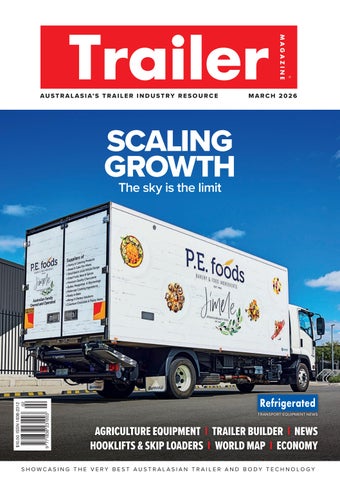
Trailer Magazine March 2026

Page 1


Thermo King and BPW

THE PERFECT ALLIANCE

What

are the benefits of ePower?

Reliable, independent power supply for fully electric or hybrid refrigeration units

Intelligent energy management and efficient operation

Air-cooled

Saves fuel and CO2

March 2026

Business partnerships, people movements, developments that bolster freight productivity and more.

22 Economy

The Federal Government has launched an investigation on imported fabricated steel.

24 Refrigerated transport equipment

See the latest cold chain technologies in road transport.

30 Agriculture equipment

A new Bruce Rock Engineering tipper road train is proving to be a decisive upgrade for Moolyall Farming.

32 Hooklifts & skip loaders

GLT has expanded its collaboration with JOST, becoming an authorised dealer for HYVA hooklifts and skip loaders.

34 Trailer builder

Freighter Group is celebrating its 80th anniversary.

36 Trailer building materials/components

A showcase of the products and services that keep trailers on the move.

42 Haulmax Tyres Trailer Builder Showcase

A list of Australian manufacturers across all major categories, from general freight to heavy haulage to tankers.

52 Infrastructure spotlight

What you need to know about Australia’s biggest road projects this month.

54 World map

More logistics companies are incorporating AI systems to track and monitor their shipments and even drivers.

57 Fleet of the month

Cold Xpress has expanded into a large-scale operation while retaining the family values it was created with.

58 What’s on

Upcoming shows and field days.

Vale Maxwell James Luff

Border Express founder, Maxwell James Luff, has passed away.

Luff was a pioneer of Australian freight logistics, beginning his transport journey behind the wheel where he developed a deep respect for the people and communities which keep Australia moving.

He founded Border Express in 1981 with a clear vision built on reliability, strong relationships and a genuine peoplefirst approach.

In his personal life, Luff was a passionate advocate for lifelong learning and opportunity.

He established the Max and Lynn Luff Scholarship with his wife, Lynn, which was a true reflection of his belief in education, personal growth and giving back to the industry and community which shaped him.

Luff was recognised in the 2026 Australia Day Honours prior to his passing – receiving a Medal of the Order of Australia (OAM) for his service to the road transport industry and to the community.

His award reflected a career of

commitment to the road freight sector and community involvement, underscoring the often-sung efforts of those who keep goods moving across vast regional and metropolitan networks.

The VTA said Luff’s Australia Day honour acknowledges a remarkable legacy that has “shaped Australian road transport” and “inspired generations of industry participants”.

“A pioneering figure in Australian road freight, Mr Luff is best known as the founder of Border Express, building the company from humble beginnings into a nationally recognised transport operator,” the association said.

“His influence on the industry spans more than six decades and reflects a lifelong commitment to professionalism, safety and people.”

In 2011, Luff was named Australian Freight and Logistics Personality of the Year at the Victorian Transport Association’s Australian Freight Industry Awards.

This honour recognised his

New heavy vehicle code to increase safety

The National Heavy Vehicle Regulator (NHVR) has released an industry-driven guide to support safer heavy vehicle operations and Chain of Responsibility (CoR) obligations.

The 2026 Master Code, developed with extensive input from across the supply chain, was designed to support owners, operators and supply-chain participants to better understand, manage and reduce safety risks in day-to-day operations.

NHVR Acting Chief Safety and Productivity Officer, Kelli Walker, said the updated Master Code and supporting material provides clear, practical ways to help businesses meet their Primary Duty to ensure safety under the Heavy Vehicle National Law (HVNL).

“This revised and expanded Master Code is not about introducing new rules or red tape,” she said.

“It provides a clear roadmap to safer operations, informed by the collective experience of industry, regulators and operators right across the heavy vehicle supply chain.”

While the HVNL sets out specific legal requirements such as limits on driving hours, axle loads and vehicle dimensions, it also includes a primary duty which requires all parties to ensure safety so far as is reasonably practicable.

The 2026 Master Code bridges the gap between this legal duty and everyday business decisions by identifying what can go wrong in business operations that involve heavy vehicles and outlining practical ways to prevent harm.

NHVR CEO, Nicole Rosie, said the regulator will continue to work closely with industry over the coming months to develop further resources to support understanding and the application of the code.

“The heavy vehicle industry operates in a complex and demanding environment, and we know operators and drivers are balancing safety, productivity and compliance every day,” she said.

“By continuing to work alongside industry, we can help turn information into action and support safer outcomes for drivers, operators and the wider community.”

entrepreneurial success, leadership, integrity and enduring contribution to the freight and logistics sector.

Border Express acknowledged Luff’s passing in a statement online.

“Max leaves behind an enduring legacy – not just in the business he built, but in the values he lived by and the people he inspired along the way,” the company said.

“Our thoughts are with the Luff family and all who had the privilege of knowing and working with Max.

“He will be deeply missed and fondly remembered. Rest in peace Max.”

According to the NHVR, the Master Code applies well beyond businesses that own trucks or employ drivers.

Parties which contract transport services, manage warehouses, operate loading facilities or influence heavy vehicle activities are also being advised to use the code to understand and meet their CoR obligations.

“Many of the recommendations reflect practices already in place across the industry, while also providing a strong foundation for businesses looking to strengthen or reassess their safety systems,” Walker said.

“By working together and using tools like the new Master Code, we can improve safety outcomes, protect workers and the public and support a more consistent and informed approach to safety across the industry.”

The 2026 Master Code, building on the original 2018 version, reflects the lived experience and operational realities of the heavy vehicle industry.

It incorporates lessons learned, improved safety practices and new insights gained as the industry’s understanding of risk management has matured.

Maxwell James Lu . Image: Border Express.

Ron Crouch Transport acquired

Ron Crouch Transport has been acquired by national transport and logistics provider, Freight Specialists.

The development follows Ron Crouch Transport’s voluntary administration at the end of last year where challenging economic conditions, sustained pressure on freight rates, ongoing driver shortages and “government over-regulation” were cited by Managing Director, Geoff Crouch, as contributing factors to its financial strain.

At the time, it was revealed that the appointed administrator’s first priority would be to identify a buyer and “secure the best possible outcome” for all staff and creditors.

Freight Specialists has since entered an agreement with the administrator and announced the completion of the acquisition.

The company has a long history of

providing reliable, customer-focused freight solutions, and shares a similar heritage and values to Ron Crouch Transport by being a business built on strong relationships, operational discipline and a commitment to its customers, employees and partners.

Freight Specialists said it will transition the Ron Crouch Transport sites and services in an “orderly and considered manner”.

“Freight Specialists will be working closely with Ron Crouch Transport customers to ensure a smooth and well-managed transition, and we look forward to continuing to support customers under the Freight Specialists banner while building on the strong foundations established by Ron Crouch Transport,” the company said.

“Our priority throughout this process is to ensure continuity of service and minimal disruption for customers.

Hallett secures major Govt funding for SA project

The Australian and South Australian Governments are supporting a new project led by Hallett Group which will bolster the state’s green cement industry.

The State Government has announced that it will provide Hallett Group with a $12 million loan as the transport and logistics company advances with its $200 million Green Cement Transformation Project.

The project will repurpose the site of the former Northern Power Station into a ‘beacon’ for low-carbon economic transition – bolstering SA’s cement and concrete supply chain.

It will see the development of two infrastructure hubs at Port Augusta and Port Adelaide where waste by-products from Port Augusta’s Northern Power station ash dam and the Nyrstar Port Pirie smelter will be able to be repurposed into green cement.

The new approach will use fly ash from the Port Augusta legacy dam and the Nyrstar Port Pirie slag pile as supplementary cementitious materials (SCMs) in the production of green cement.

Once operational, the project is expected to stimulate additional economic activities on the Upper Spencer Gulf such as carbon dioxide reuse, synthetic fuels, mineral recovery and potential green lime manufacturing.

The Federal Government has also contributed a $20 million grant to the project through the Modern Manufacturing Initiative.

Premier of SA, Peter Malinauskas, visited Hallett Group’s Port Augusta site last week to announce the State Government’s loan.

He stated that Hallett Group’s Green Cement Transformation Project will turn the region into a “national hub” for the green cement industry.

“Coupled with green iron and steel in Whyalla, and critical metals in Port Pirie, this project is paving the way for huge opportunities for the Upper Spencer Gulf and South Australia,” Malinauskas said.

“It will help SA meet its booming demand for building products used in homes, businesses and industry, while providing sovereign capability and supply chain resilience.

“SA is building – and the state needs to produce the materials to keep up the pace. This project will help realise that ambition, while reaffirming the Upper Spencer Gulf’s long-term prospects as a hub for energy and industry.”

Hallett Group CEO, Kane Salisbury, extended his gratitude to both government departments for their support.

“Hallett Group are grateful to both State and Federal Governments for their support

of our Green Cement Transformation project,” he said.

“The loan announced by Premier Malinauskas today will ensure that Hallett accelerates the delivery of this large-scale project to meet the rapidly growing demand for low carbon cement materials for the SA mining and construction industries.

“Hallett have worked diligently for 10 years to develop solutions to challenging problems, and we are delighted to now implement world leading technology that provides a great product for our customers and great outcomes for our community and the environment.

“As a proud, independent SA owned and operated business, we are incredibly excited to be building this facility in Port Augusta, and we are deeply committed to the success of the Upper Spencer Gulf region and our great state.”

A Hallett Group A-triple. Image: Prime Creative Media.
Geo Crouch. Image: Healthy Heads.

Cool confidence in one move

Team Global Express launches co-branded Dulux fleet

Team Global Express has deployed five co-branded semi-trailers in partnership with DuluxGroup.

The new fleet features some of Australia’s most recognised home and garden brands, showcasing livery for Dulux, Cabot’s, Selleys and Yates/Seasol.

The new assets have been deployed alongside customised rail containers already in operation on east-west routes.

Team Global Express Executive General Manager, Intermodal and Specialised, Fleet and Strategy, Mario Philippou, said the delivery reflects the business’

continued investment in the strategic longterm partnership with DuluxGroup.

“Our partnership with DuluxGroup is built on a shared commitment to solving complex problems together,” he said.

“What began as a transport relationship 26 years ago, has evolved into a deeply embedded logistics collaboration, grounded in trust, operational expertise and open communication.”

TGE was named DuluxGroup Supplier of the Year in 2025, recognising both the company’s operational performance and the strength of the established partnership.

The partnership has also driven innovation in equipment and network design at TGE, including the introduction of co-branded rail containers.

“TGE is proud to be playing a key role in supporting the future growth of DuluxGroup throughout Australia,” Philippou said.

“From large-scale protective coatings projects to national east-west distribution, we continue to design and execute multimodal logistics solutions to meet DuluxGroup’s increasing needs.”

OMFB Pacific Managing Director steps down

OMFB Pacific founder, Simon Tortorici, has announced his resignation as Managing Director.

Tortorici founded OMFB Pacific in 2020 and has been instrumental to its success.

He was responsible for delivering the full internationalisation of OMFB into Australia and New Zealand by building the local subsidiary from the ground up and leading it through various growth phases.

This included defining OMFB Pacific’s market-entry strategy, establishing commercial, engineering and technical operations and transitioning the business from a distributor-led presence to a fully localised operation.

Tortorici was also responsible for expanding product portfolios and

developing strategic partnerships across multiple segments – creating sustainable growth and a platform aligned with OMFB Group’s long-term international strategy.

Tortorici stepped down as Managing Director at the end of last month.

He announced his resignation from the operational role in a statement online where he expressed his confidence in the business’ foundations and its next chapter.

“After six intense and rewarding years, I will be stepping away from my operational role as Managing Director at OMFB Pacific at the end of February 2026,” Tortorici said.

“I step away knowing the foundations are solid, the team is capable, and the

business is ready for its next chapter.

“Good leadership is about building something that can stand and grow beyond you.”

Tortorici also took the time to express his gratitude to OMFB Group and everyone behind it.

“What began as an idea has evolved into a solid and respected business across Australia and New Zealand,” he said.

“I extend my sincere thanks to our customers, partners, suppliers, the OMFB Italy team, our respected industry peers and competitors and especially the Pacific team in Australia who turned vision into execution every day.”

Tortorici is continuing to support OMFB Pacific as a Board Director.

One of the new trailers. Image: Team Global Express.

Toll accelerates decarbonisation at scale

Toll Group has demonstrated how it tackles decarbonisation, safety and regulatory pressure without losing commercial momentum.

This follows a recent sustainability report which marks a clear shift from ambition to execution – particularly for road transport.

It reads less like a corporate ESG statement and more like a playbook for those operating in a hard-to-abate, asset-intensive industry.

Road transport sits at the centre of Toll’s sustainability agenda. With 44,000 vehicles, vessels, plant and equipment across its network, fleet emissions remain its single biggest challenge and opportunity.

In FY25, Toll reduced Scope 1 and 2 emissions by 18 per cent year-on-year. While part of that reduction reflects portfolio changes, the company has been explicit about separating structural shifts from operational improvements.

Toll committed $67 million – co-funded by the Australian Renewable Energy Agency (ARENA) – to deploy 28 heavy battery-electric trucks and more than 30 charging ports across Toll and customer sites.

The rollout included Volvo FM prime movers and Volvo FE rigids, targeting metro and near-metro freight tasks where duty cycles are better understood and infrastructure can be controlled.

Toll estimates the project could cut annual emissions by 1,810 tonnes of CO₂ and, critically, is working with RMIT University to publish operational insights on charging demand, utilisation and total cost of ownership.

Meanwhile, diesel optimisation is also delivering material gains for Toll.

Fleet modernisation delivered up to 10 per cent lower fuel consumption per vehicle, while load maximisation – through better trailer combinations and payload efficiency – reduced the number of trips required to move freight.

For linehaul and contract carriers, these measures remain the fastest, lowest-risk emissions levers currently available.

Toll has also signalled increased engagement with OEMs and fuel partners to explore renewable liquid fuels and hydrogen, recognising that long-haul and regional freight will remain technology-constrained for some time.

For road transport leaders, sustainability that ignores safety rarely survives board scrutiny. Toll’s FY25 safety results show the two agendas are increasingly linked.

Toll reported a 22 per cent reduction in Critical Incident Frequency Rate and an 11 per cent drop in avoidable motor vehicle incidents. Programs such as ‘Together Stronger’ are using wearable tech and motion analysis to reduce musculoskeletal injuries which is still one of the most common risks in transport and warehousing operations.

Toll has also begun rolling out AIpowered pedestrian alert systems on forklifts, automatically slowing vehicles when people enter defined safety zones. More than 200 units are scheduled for deployment, reinforcing the role automation now plays in risk reduction.

Scope 3 emissions, and subcontractor safety, remain two of the road transport sector’s most complex issues. Toll has made progress on both by tightening

TFMXpress unveils new WA facility

TFMXpress has revealed a new depot in High Wycombe, Western Australia.

Construction of a new 3,000-squaremetre warehouse has been finalised, marking a major milestone in TFMXpress’ national growth strategy.

The modern and efficient facility expands the transport and logistics business’ national network while also supporting increasing freight demand across the west.

According to TFMXpress, it reflects the company’s commitment to reliability, performance and continual investment in its network.

TFMXpress Managing Director, Frank Ainalis, said the opportunity for a new WA location arrived following a period of growth in recent years.

“The existing building was quite small, and we were fortunate enough to have

data and compliance frameworks.

In Australia, the company has embedded ComplyFlow for road freight subcontractor pre-qualification and launched a risk-based vehicle audit program. At the same time, improved transport management system data is allowing more accurate calculation of subcontractor emissions based on verified distances and tonnages rather than estimates.

For operators reliant on mixed fleets and third-party carriers, this approach foreshadows what regulators and major customers will soon expect as standard.

Toll is also preparing for mandatory climate reporting under AASB S2. As a Group 1 entity, it will be among the first Australian transport companies required to disclose climate-related financial risks and opportunities.

To support this, climate risk is being embedded into enterprise risk management, capital allocation and board oversight including internal carbon pricing and marginal abatement cost curves. Extreme weather, technology limitations and contract rigidity are now formally recognised as material business risks.

This is a signal to the wider industry where sustainability reporting is moving decisively from marketing to governance.

Also, Toll’s sustainability progress has not come at the expense of growth.

FY25 revenue rose to $5.1 billion, with a 9.0 per cent uplift year-on-year and improved EBIT margins.

Investment in automation, healthcare logistics and e-commerce capability is reported to continue alongside fleet decarbonisation.

quite a significant growth in our business in the last three to four years,” he said.

“We chose AUSPAN after a tender process. They showed to be the most experienced we felt in this field and also showed a lot of enthusiasm to bring this project to life.

“AUSPAN were fantastic, drawing us a new facility which will help us now but also into the future.”

Linfox strengthens partnerships in WA

Transport and logistics company, Linfox, has an extensive property portfolio in Western Australia and continues to invest in its service delivery capabilities.

Linfox, which celebrates 70 years of operation this year, has several purposebuilt facilities and depots across WA.

“The sheer size of Western Australia requires high levels of capability and expertise to manage,” said Linfox President Resources and Industrial, Gary Pyne.

Linfox recently extended its longterm partnership with Fortescue to provide the iron ore produce with specialised warehousing, freight and transport services.

“Our ability to deliver value for mining customers from our Port Hedland and Newman hubs is crucial, especially if a region where economic growth and stability is largely driven by the mining industry,” said Pyne.

The partnership with Fortescue is supported with investment in modern fleet including triple road trains.

“Our alignment with Fortescue on safety is critical, with conditions on site and long

distances travelled demanding the highest levels of safety and compliance,” said Pyne.

“Linfox invests in fleet with the latest technology and equipment to safeguard our drivers against fatigue risk factors and ensure their safety when travelling along the Great Northern Highway.

“With a large fleet of company-owned vehicles and a significant property footprint tailored to servicing the mining sector, Linfox leads the provision of vital freight services in the region.”

Linfox is also well positioned in the Perth metro area with infrastructure and multi-

FedEx announces new President

Federal Express Corporation has appointed Salil Chari as President of its Asia Pacific (APAC) region.

Chari, previously Senior Vice President of Marketing and Customer Experience APAC, assumed his new role on 1 January.

He succeeds Kawal Preet who has transitioned to a new role as Executive Vice President Planning, Engineering and Transformation.

As President, Chari is responsible for shaping the strategic direction of the business and leading a team of nearly 30,000 across APAC to drive profitable

growth, deliver outstanding customer experiences and advance operational excellence throughout the region.

FedEx COO International and CEO Airline, Richard Smith, was pleased to welcome Chari as the new President of the APAC region – stating the appointment will mark an “exciting new chapter” for the business.

“Salil brings exceptional multi-regional leadership experience and a passion for delivering value to customers,” he said.

“With his deep understanding of the region, I am confident he will lead our APAC business to new heights and reinforce the region’s importance to our global growth.

“Thanks to Kawal for her exceptional leadership; she will continue to advance our global transformation efforts.”

Chari began his FedEx career in 1997 as a marketing analyst in Memphis, United States.

Through successive leadership roles he has demonstrated a deep commitment

temperature warehouse facilities.

The 35,000-square-metre Linfox BevChain distribution centre in Maddington, for instance, is located in Perth’s industrial precinct and is equipped to provide high quality warehousing services to beverage customers.

“Our Maddington warehouse facility was designed and built to achieve 5 Star Green Star certification, providing sustainable storage solutions for our customers to deliver drinks out of Western Australia,” said Linfox President BevChain, Matt Sheridan.

Linfox also has a 81,000-square-metre intermodal terminal in Kewdale which delivers linehaul and rail services between WA and the east coast hubs.

“Our Kewdale facility provides direct access to the National rail network and allows efficient rail movements for our customers across the country,” said Linfox President Intermodal, Cameron Trewin.

“Linfox’s partnership with national rail provider National Pacific also enables us to reduce our carbon emissions by moving more freight by rail.”

to elevating customer experience and empowering businesses to expand their global reach and capture new market opportunities.

“It is an honour to lead such a talented team in a region that sits at the centre of global trade,” Chari said.

“Asia Pacific is home to some of the world’s most dynamic and fast-evolving trade corridors, creating powerful opportunities for businesses of all sizes to grow and compete globally.

“As we build on our strong foundation, my priority is to strengthen resilience, accelerate growth and deepen the role FedEx plays as a valued partner for our customers and communities.

“With the unwavering commitment of our team members who live the Purple Promise every day to make every customer experience outstanding, we will continue to connect businesses with new possibilities, drive innovation and enable global trade in an ever-evolving marketplace.”

A Linfox combination in WA. Image: Linfox.

Australia Post announces multiple SA facilities

Australia Post is boosting its delivery network in regional South Australia with an investment in four new facilities.

The purpose-built sites, located at Murray Bridge, Kadina, Port Pirie and Tanunda, will increase parcel capacity and improve delivery speed in some of SA’s fastest-growing regional centres.

Each facility is expected to handle between 2,000 to 3,700 parcels per day, improving delivery reliability and helping parcels reach customers sooner.

As part of Australia Post’s commitment to emissions reduction, all sites will be fitted with rooftop solar to maximise local energy generation and support EV

chargers for our electric vehicles.

Australia Post Executive General Manager Network Operations, Shane Plant, said the investment demonstrates Australia Post’s long-term commitment to supporting regional communities and their growing needs.

“With 80 per cent of SA households now shopping online, parcel volumes in regional areas continue to grow,” he said.

“These modern facilities are built to handle that growth, setting us up to support our customers into the future.

“We’ve focused on designing sites that improve safety, increase capacity

and streamline transport flow, creating more efficient workplaces for our teams so they can get on the road safely and deliver for our customers now and into the future.”

Construction is already underway at all four sites.

The Murray Bridge facility, spanning 1,143 square metres, is expected to be opening in June.

Kadina (1,111 square metres) and Port Pirie (836 square metres) are planned for completion in July.

Australia Post expects the 1,335-square-metre Tanunda site to be operational in August.

Hawk Logistics launches new partnership

Hawk Logistics has announced the successful go-live of its joint national digital freight operations with global Transport Management System provider, FarEye.

Starting with Adelaide, the milestone marks a key step in the companies’ shared mission to modernise and future-proof logistics across Australia.

With Australia’s freight network projected to grow by 77 per cent by 2050, Hawk Logistics is looking to capitalise on the surge.

“For us, this go-live reflects months of shared effort, trust and ambition,” said

Hawk Logistics CEO, Miguel Vitug.

“We are committed to innovation because our customers rely on us every single day.

“Partnering with FarEye has given us the intelligence and predictability we need to scale confidently, and to deliver with the transparency and reliability that today’s market demands.”

Hawk Logistics and FarEye see the partnership as the beginning of a broader movement, as adoption expands across Adelaide and prepares to rollout further across Australia.

“Australia’s supply chain has become one of the most dynamic and complex in the world, and meeting its expectations requires a shift from manual operations to intelligent, data-driven orchestration,” said FarEye cofounder and COO, Gautam Kumar.

“This partnership represents that shift.

“Hawk’s forward-looking approach and our platform expertise have come together to build a new operating model – one that strengthens resilience, improves transparency and sets a strategic foundation for the future of freight in Australia.”

An Australia Post van. Image: Rafael Ben-Ari/stock.adobe.com.

Knorr-Bremse names new Managing Director

Knorr-Bremse Australia has appointed Mike Deakin as Managing Director.

Deakin brings extensive international experience from the rail industry, having started his career in the United Kingdom as

a graduate project engineer and holding various leadership roles across KnorrBremse UK and Australia.

Deakin first joined Knorr-Bremse Australia in 2005 as Business Manager Rail.

He then served as Executive Director and Vice President at Knorr-Bremse Rail Systems in Japan from 2012 to 2016 before undertaking other endeavours.

Prior to returning to Knorr-Bremse Australia this year, Deakin held the position of Parts and Overhauls Director at Alstrom Australia and New Zealand where he oversaw multisite operations and drove strategic initiatives.

Knorr-Bremse Australia was pleased to make the announcement of Deakin’s return to the company as Managing Director.

“We are excited to welcome Michael back to Knorr-Bremse Australia,” the company said.

“[We] look forward to his leadership in driving growth and transformation.”

Mike Deakin. Image: Knorr-Bremse Australia.

Capral launches $20M Australian Made campaign

Capral Aluminium recently hosted the official launch of Australia’s ‘Made Right Here’ campaign at its Smithfield, New South Wales, manufacturing facility.

The six-month ‘Made Right Here’ campaign, supported by a $20 million Australian Government grant, was designed to encourage Australians to choose genuinely Australian-made products – and in doing so, support local manufacturing, jobs, skills and economic growth.

The launch of the campaign marks the start of the largest Australian Made advertising campaign in more than a decade.

Australian Made Campaign Chief Executive, Ben Lazzaro, said ‘Made Right Here’ was designed to remind Australians that locally made products are available across a wide range of everyday categories, giving consumers the confidence to buy Australian and support local industry.

“As the campaign says, Australian Made means made right here in Australia, but the green-and-gold logo means that when you choose it, you’re backing local businesses and home-grown ideas as well as supporting fellow Aussies,” he said.

“‘Made Right Here’ celebrates what we can often take for granted – which is that we have access to such a wide variety of locally made products, made to Australia’s safety and quality standards, which play pivotal roles in our everyday lives.”

As an Australian Made licensee, Capral Aluminium was proud to be selected as the launch site for the campaign.

The event showcased Australian aluminium extrusion in action and highlighted the important role local manufacturers play in supplying highquality products for Australian industries and communities.

Capral Aluminium Managing Director and CEO, Tony Dragicevich, said the campaign

reinforces the value of manufacturing in Australia and the confidence the Australian Made logo provides to customers.

“For Capral, manufacturing in Australia is fundamental to who we are,” he said.

“The ‘Made Right Here’ campaign gives Australians confidence to buy products that are genuinely made locally, thereby supporting Australian jobs, skills and investment.

“Hosting the launch at our Smithfield site provides recognition of the capability and scale of Capral’s six Australian manufacturing plants.”

The campaign launch was attended by Australian Made Chief Executive, Ben Lazzaro, Federal Minister for Industry and Innovation, Tim Ayres, and Federal Minister for Climate Change and Energy, Chris Bowen.

Also in attendance were Australian Made licensees and long-term Capral customers, Aussi Play, BAB Aluminum and DECO.

Boral announces transport partnership, expands fleet

Boral has strengthened the reliability and efficiency of its cement transport network in Western Australia through a new partnership.

Boral has entered an agreement with PNJB Group which, already supporting the company’s operations in Victoria and South Australia, has since expanded into WA.

The partnership is expected to strengthen supply chain resilience, support safe and efficient transport operations and ensure Boral is wellpositioned to meet customer needs across Perth and regional WA.

PNJB Managing Director, Jelly Sandhu, said the move reflects the company’s long-term strategy to grow its national footprint.

“Starting this new chapter in cement transport has not only expanded our capabilities but also strengthened our long term vision,” he said.

“Establishing a strong working relationship and building a reliable service for Boral has been a proud

achievement for the entire PNJB Group.”

To support the transition, PNJB invested in five brand-new cement tankers and has dedicated them to Boral’s WA network.

PNJB will also progressively update its tankers with Boral branding to support a consistent national presence across the fleet.

Boral General Manager Concrete and Quarries WA, Andre Gobett, highlighted the importance of the new fleet for the region.

Boral logo on a website. Image: Postmodern Studio/stock.adobe.com.

“Boral is proud to be partnering with PNJB to expand its capabilities in WA,” he said.

“Our dedicated cement tanker fleet is a first step and will be travelling Perth and WA regional sites, so keep an eye out for them.

“A huge thank you to everyone involved for turning this into a great outcome for Boral in WA. Your teamwork and determination made this possible.”

Non-compliance still a concern: NHVR

One in three intercepted heavy vehicles were found to be non-compliant with the law according to a recent joint operation on the Bruce Highway in Queensland.

Operation Overwatch, which ran ahead of the Christmas holidays, saw National Heavy Vehicle Regulator (NHVR) Safety and Compliance Officers (SCOs) work in partnership with the Queensland Police Service (QPS) to conduct roadside inspections along the highway between Maryborough and Miriam Vale.

NHVR COO, Paul Salvati, said officers completed more than 140 intercepts, with around a third resulting in detection of non-compliance with the Heavy Vehicle National Law (HVNL).

“Operation Overwatch aimed to reduce high-risk behaviours on one of Queensland’s most dangerous stretches of road, with three fatal crashes recorded in the weeks leading up to the operation,” said Salvati.

“SCOs and police spoke to drivers about a range of issues, including mechanical requirements, dimensions, fatigue, permits, loading and mass.

“Concerningly, we saw 10 infringements related to fatigue, which we know is one of the most dangerous behaviours across industry.”

Salvati said areas such as Iveragh, Miriam Vale and Gin Gin were considered a hot spot for traffic crashes, with many heavy vehicle drivers appealing for the presence of officers in these areas.

“While some of the figures from this operation are disappointing from a compliance standpoint, we are really pleased with industry’s positive response to an increased officer presence around the highway,” he said.

“It’s encouraging for the NHVR and our partners to hear first-hand from truck drivers that they appreciate our efforts in educating more motorists on how to

comply with the HVNL.

“We are also pleased that no crashes occurred during the operation in areas where officers focused.”

NHVR Northern Region Operations Manager, Jarrod Wilson, said SCOs worked in partnership with the QPS to increase driver safety and ultimately reduce road trauma throughout the region.

“Every roadside interaction aims to create a safer heavy vehicle industry,” said Wilson.

“Through Operation Overwatch, importantly, we saw 14 targeted education interventions covering topics such as work diaries, dimensions, fatigue and loading.

“Both the NHVR and QPS are committed to helping all drivers reach their destination safely, which is why we will continue to work with industry to make Queensland’s roads safer.”

Major fleets to participate in MegaTrans Operator Hub

MegaTrans, Australia’s largest and most influential supply chain and logistics trade show, is introducing the Operator Hub for its return this year.

The brand-new section of the event is dedicated entirely to the nation’s transport and logistics operators.

Designed as a purpose-built space for connection and collaboration, it aims to shine a light on the people and businesses powering the national supply chain.

Exhibitors will gain direct access to some of the biggest players in Australian transport and logistics – such as Amazon, Centurion, SGS Logistics and more.

Prime Creative Media Events General Manager, Siobhan Rocks, said the Operator Hub represents a high-value opportunity to engage decision makers where business happens.

“MegaTrans has always been about connecting the entire supply chain,” she said.

“The Operator Hub expands on that mission by giving operators a dedicated space to network, share knowledge, and connect with suppliers who understand their challenges and ambitions.”

MegaTrans 2026 will run from 1617 September at the Melbourne Convention and Exhibition Centre, bringing together all corners of the supply chain from warehousing and logistics to ports, transport and technology.

MegaTrans is returning stronger than ever.
Image: Prime Creative Media.

VTA encourages industry to report sham contracting

The Victorian Transport Association (VTA) is urging transport operators and industry stakeholders to report incidences of sham contracting.

The call comes as part of the VTA’s ongoing advocacy to protect the productivity, sustainability and safety of Victoria’s transport industry.

Contracting occurs when operators are engaged using an Australian Business Number (ABN), despite not owning or operating their own vehicle and instead driving another driver’s truck.

According to the VTA, this practice undermines workplace laws, distorts competition and places compliant operators at a commercial disadvantage.

VTA CEO, Peter Anderson, said the association continues to advocate strongly against sham contracting, which erodes legitimate business models, compromises

driver entitlements and weakens safety outcomes across the supply chain.

“Using an ABN does not automatically make someone a contractor,” he said.

“Where drivers do not own their vehicle, they may be entitled to full award wages, superannuation and leave accruals at a minimum.

“Non compliance harms drivers, operators and the broader industry.”

The VTA is calling on members to help address sham contracting by reporting suspected cases whenever they are identified.

Anderson noted that information shared with regulators plays a critical role in tackling tax evasion and shadow economy activity.

“Sham contracting is not a victimless practice,” he said.

“It undermines compliant operators,

exposes businesses to significant risk and ultimately weakens safety outcomes across the transport task.

“This is about protecting drivers, supporting legitimate operators and ensuring our industry remains productive, sustainable and safe.”

Addressing sham contracting remains a key focus of the VTA’s advocacy as it works with government, regulators and industry stakeholders to maintain a fair and competitive operating environment.

The VTA said suspected sham contracting can be reported to the Australian Taxation Office (ATO) confidentially and anonymously, using the online tip off form or calling the Tax Integrity Centre on 1800 060 062.

The tip-off reports assist the ATO to address sham contracting, tax evasion, shadow economy and fraudulent activity.

Tra c crossing the West Gate Bridge. Image: timallenphoto/stock.adobe.com.

Rentco appoints Josh Boyd as COO

Rentco has announced Josh Boyd as its new COO.

Boyd joined Rentco in July last year as General Manager – Operations and quickly made a strong impact across safety, systems and operational performance.

Prior to joining the business, he spent

13 years at Silk Contract Logistics in a variety of positions including Key Account Manager, Site Manager –Contract Logistics, State Manager – Port Logistics and General Manager – Port Logistics.

In a statement online, Rentco commended Boyd’s efforts and

welcomed him to his new role.

“His leadership, accountability and focus on continuous improvement have been instrumental as we continue to grow nationally,” the company said.

“We’re excited to see Josh step into this role and help lead the next phase of Rentco’s evolution.”

Beveridge intermodal works underway

Construction is set to commence on Victoria’s largest intermodal development.

National Intermodal announced December last year that works at the Beveridge Intermodal Precinct have begun. This follows the award of the Stage 1 design and construction contract to John Holland.

Stage 1 of the project will deliver rail marshalling and terminal infrastructure directly connected to the Inland Rail south network, with initial capacity to process up to 200,000 TEU per annum.

Operations are targeted for mid-2028, when the terminal will become Melbourne’s first facility capable of receiving 1,800-metre, double-stacked Inland Rail freight trains.

With key approvals now in place and a competitive procurement process completed, John Holland will begin site preparation and construction in the new year.

The precinct is located adjacent to the Inland Rail freight corridor, providing direct connectivity to Sydney and Perth via Parkes and to Brisbane once Inland Rail is completed.

On completion, the Beveridge Intermodal Precinct is expected to deliver a $14 billion economic uplift to Victoria, including around $12 billion across the Whittlesea–Mitchell region. More than 17,000 jobs are forecast to be created at the project’s peak, with National Intermodal targeting 70 per cent of roles for local workers from the Mitchell and Whittlesea council areas.

The project is also positioned as a major contributor to freight decarbonisation.

As the southern endpoint of Inland Rail, the precinct is expected to drive a significant mode shift from road to rail, removing an estimated 167,000 truck trips from roads each year.

This shift is forecast to reduce transport emissions by 12.1 million tonnes of CO₂ over the next 25 years across Melbourne and national freight networks.

Planning for Stage 2 is well advanced and will include expansion of terminal capacity and the development of an associated 200-hectare co-located industrial land precinct. The broader

development also includes potential for up to 200MW of renewable energy generation through large-scale rooftop solar across more than 300 hectares of warehouse space, while around 500 hectares of land will be preserved for green wedge and long-term environmental outcomes.

National Intermodal CEO, James Baulderstone, said the project would reshape how freight and consumer goods are moved across Australia while delivering tangible economic and environmental benefits.

John Holland CEO, Nick Miller, said the company was proud to partner again with National Intermodal following the delivery of the Moorebank Intermodal Terminal, adding that the Beveridge project would strengthen the national supply chain while reducing emissions.

Once operational, the Beveridge Intermodal Precinct is expected to play a central role in Australia’s east–west and north–south freight task, supporting higher productivity rail freight and easing pressure on road transport networks.

AvonWest hub to boost road train uptime in WA

A new estate being developed in Northam is designed to improve turnaround times for road transport operators particularly those servicing east–west freight routes into Western Australia.

AvonWest Logistics & Enterprise estate is strategically located on the corner of Great Eastern Highway and Yilgarn Avenue and is expected to be completed by December this year..

Procon Developments Australia

Managing Director, Leon Key, said Northam currently acts as a forced stopping point for many long-haul road trains.

“East-west road trains lose time and money when they’re forced to stop in Northam, decouple and send freight into Perth in multiple runs,” he said.

“That drives up transport costs that ultimately flow through to the price

of goods for WA businesses and households.”

Key described AvonWest as a purposebuilt solution for the freight task.

“AvonWest is the fix – a purpose-built turnaround hub that speeds up the reset, cuts wasted handling, and shifts Perth deliveries to a leaner Northam-based distribution fleet.”

Procon said a key feature of the estate is the integration of solar technology embedded into the road infrastructure. The system is designed to generate up to 95MW of renewable energy, powering the precinct and providing tenants with access to competitively priced, low-emissions electricity.

“Transport and logistics is traditionally a carbon-intensive sector and energy costs are now a deciding factor for tenants,” said Key.

“Our plan is to deliver an estate that helps businesses lower their carbon footprint and energy costs through the provision of cleaner energy and smarter, more efficient operations.”

Road train moving through the Pilbara mining region in Western Australia. Image: beau/stock.adobe.com.

Real steel

The Federal Government has launched an investigation on imported fabricated steel.

The Australian Government has commenced its investigation into imported fabricated structural steel following a surge of imports which cause, or is threatening to cause, serious injury to the domestic industry.

On 23 January, Treasurer of Australia, Jim Chalmers, directed the Australian Government’s Productivity Commission (PC) to investigate the import of fabricated structural steel and whether safeguard measures are justified under World Trade Organisation (WTO) rules.

The instruction follows a safeguard application submitted by the Australian Steel Institute (ASI) last November which requested for the Federal Government to apply temporary emergency provisions to protect the Australian fabricated steel industry.

ASI Chief Executive, Mark Cain, said the industry stands at a critical juncture and is facing an unprecedented surge in imports which threatens the viability of domestic manufacturing capability.

“Due to its vulnerable state, the Australian fabrication industry also faces a threat of suffering further serious injury, which will, if not countered, ultimately result in the full loss of sovereign manufacturing capability,” he said.

“Economic modelling shows that the imposition of safeguard measures will result in a net increase of productivity for Australian industry by preserving essential manufacturing capability, protecting employment and maintaining competitive market conditions while minimising adverse effects on other stakeholders through careful measured design and implementation.”

The PC is now undertaking the inquiry into whether safeguard action is warranted against imports of various fabricated

structural steel products of the Australian Customs Tariff.

The Government review and advisory body will consider whether safeguard measures are justified and appropriate.

The South East Melbourne Manufacturers Alliance (SEMMA) since heavily endorsed the decision, citing it as a “win” for local manufacturers.

“We supported the application by ASI and will provide a submission as required as many of our members are steel fabricators,” said SEMMA CEO, Honi Walker.

“Our Australian manufacturers are being savaged by dumped, dodgy and dangerous products.

“Low grade steel products that don’t meet Australian Standards, steel formwork that has been poorly fabricated overseas that does not meet Australian Standards –these products risk lives and livelihoods.”

Walker said in order for local

manufacturers to buy Australian-made products, they need regulators to enforce and uphold local content lows and refuse sub-standard dangerous steel products.

“These dodgy products decimate local sectors and once gone, the dumpers then raise the prices and we all end up paying more,” she said.

“If the practice of dumping is allowed to continue, Australia is at risk of losing thousands of manufacturing careers and decimating entire industries that support our essential sovereign capability.

“It will reduce our already stagnant Gross Domestic Product and gut our manufacturing industry as it fights for a fair go in a greedy global market.”

An interim report of the PC’s investigation is expected to be provided to the Australian Government by September this year.

A final report will then be released in November.

AUSTRALIAN CONSUMER CONFIDENCE

Skel trailers

Evolution side tippers

Road train dollies

Deck wideners and extendables

Coldcore

ANE

Walking

PBS

Refrigerated transport equipment

Growing up

As P.E. Foods grows, a refrigerated fleet supported by Eurocold has become a strategic asset rather than a day-to-day burden.

From a single van delivering sports drinks across Queensland to a multi-site wholesale operation supplying thousands of customers every week, P.E. Foods has grown by adapting early and making deliberate decisions at each stage of its evolution.

Today, with four facilities spanning from northern New South Wales to Cairns, Queensland, and a major new Brisbane headquarters under construction, the business is once again rethinking how transport supports growth. A long-term rental partnership with Eurocold is proving central to that strategy, giving P.E. Foods the flexibility, confidence and scale required to keep moving forward.

P.E. Foods first found its transport bearings in 1981 as a manufacturer’s agent of Staminade sports drinks. Founder, Peter Einersen, personally delivered the beverage line to clubs, bakeries and hotels

during that era until the market began to change, and when popular competitors like Gatorade and Powerade began to rise, he decided to move to packaging products. So, P.E. Foods expanded its operations into bakeries, supplying packaging, cheese, bacon, sugar and icing mixtures to local businesses and crafting what eventually became a one-stop shop for them.

The organisation gained traction in the 1990s by picking up a contract with Donut King to supply it with all of its branded packaging, stock and ingredients. P.E. Foods skyrocketed, and what was once known as a one-man operation delivering sports drinks to local business started to become a leading distributor of frozen goods, meat, chocolate, bakery patisserie and more.

“We completed various acquisitions and diversified into restaurants, cafes, hotels

and function centres,” says P.E. Foods Managing Director and CEO, Matthew Einersen, who joined his father’s business in 2001. “This allowed us to broaden our customer base and product range.”

Today, P.E. Foods operates out of Cairns, Townsville, Brisbane and northern NSW, carrying 5,000 product lines and supplying more than 3,000 customers weekly. Despite how far the business has already come, there are still more plans in place for further growth. Currently under construction is a new 6,533-square-metre Brisbane head office which is being purpose-built to improve efficiency and support future expansion.

“This facility will allow us to consolidate multiple Brisbane operations into one site,” Matthew says. “This includes off-site frozen storage, a smallgoods facility and the Porter Distributors business which we recently acquired.”

P.E. Foods COO, Craig McInerney, with one of the company’s refrigerated vehicles, a key enabler of its growing wholesale operation. Images: Eurocold.
“Partnering with Eurocold allows us to say, ‘We’ve got nothing to lose and everything to gain’.”

The site, located at Archerfield Airport, is expected to be operational in November this year.

“The new facility is state-of-the-art,” Matthew continues. “It includes fridge and freezer rooms, a chocolate room, dry storage, loading docks, truck parking and drive-around access for semi-trailers. It will create efficiencies, reduce rent across multiple sites and allow us to offer our full product range from one location.”

Instrumental to P.E. Foods’ massive growth trajectory in the last few years has been a close relationship with leading refrigerated truck manufacturer, Eurocold. It was a conversation at the 2023 Brisbane Truck Show which planted the seeds for various long-term benefits – ones that are positively impacting the business now.

“The advantages have become very clear since then,” says P.E. Foods COO, Craig McInerney. “We now have 25 long-term rental vehicles from Eurocold which are fully maintained by them. This takes a lot of pressure off us and frees up our capital for growth.”

The rental-based model has made P.E. Foods extremely agile by allowing it to scale up and focus on its core business rather than vehicle management.

“Partnering with Eurocold adds flexibility,” Matthew explains. “That flexibility has enabled us to take risks that we might not have taken if we had to commit to buying a truck. It allows us to say, ‘We’ve got nothing to lose and everything to gain’ which is extremely valuable.”

Eurocold’s national network gives P.E. Foods direct access to rental solutions that can be tailored to its exact requirements, removing the need for it to commit to longterm equipment investments. Additionally, the manufacturer’s highly efficient business model and production process allow the fleet to adapt as operations change.

“This is one of the biggest benefits of working with Eurocold,” Craig says. “They understand our business and have a genuine interest in our future plans.

“Eurocold aren’t trying to just sell us another truck. They offer counter ideas based on industry experience, and every decision they make is about what’s best for us.”

Standard features on P.E. Foods’ Eurocold builds include rear barn doors, side doors positioned according to unique

requirements and refrigeration systems which can run on main power overnight. It’s a simple yet effective specification which can be easily customised if needed.

“Customisation is standard for us,” says Eurocold Managing Director, Avraam Solomon. “Our bodies are built in Italy and designed with engineers to suit each customer’s needs. This includes door configurations, steps, tailgates, layouts and more.

“We also install the refrigeration units, telematics and signwriting in-house, so trucks are delivered fully ready to operate.”

Speed is critical to this operation. While traditional manufacturing methods often see trucks moving between different suppliers for the body, refrigeration unit, tailgate and livery, Eurocold controls the entire process in one facility. This enables Eurocold to deliver a completed refrigerated vehicle in under seven days.

Craig says the end result is a high-quality product which will excel.

“Every Eurocold truck we have performs beyond expectations,” he says. “They’re very well-built and durable vehicles. We’re hard on our trucks, but the body alignment, doors and structure hold up.”

P.E. Foods has found the thermal efficiency of Eurocold rigid vehicles to be equally impressive – a factor which can be attributed to the way the units are constructed. Eurocold’s refrigerated trucks are manufactured with premium ISOKIT isothermal bodies which are engineered for maximum cold retention, reduced energy

use and long-term reliability. Each unit is assembled in-house at the business’ Berrinba, Queensland, facility which also ensures that build quality and durability is consistently maintained.

Furthermore, Eurocold bodies are not only designed to meet European isothermal standards but vigorously tested to achieve results better than those requirements in Australia. This factor alone has been a key differentiator for Eurocold.

“We have invested a lot of money to validate the performance of our bodies,” Avraam says. “Australia doesn’t require this testing, but it’s a key priority for us.”

The next two years will be foundational for P.E. Foods. The Archerfield Airport development will act as a base for future expansion as fleet development continues to evolve in line with customer requirements and market conditions. Matthew and Craig therefore foresee Eurocold playing another major part in the business.

“I regard Eurocold as a true business partner,” Craig says. “Whenever we make decisions on acquisitions and expansion into new areas, we have conversations with them about how we’re going to service those changes and what vehicles we’ll need.

“Growth means volume, and more volume means more trucks. We’re about longterm relationships, and our relationship with Eurocold reinforces that we’re on the right path.”

Contact

Eurocold

Ph: 1300 222 323

Web: www.eurocold.com.au

L-R: Craig McInerney, Avraam Solomon and Matthew Einersen discussing fleet strategy aligned with future growth and P.E. Foods’ new Brisbane facility.

Refrigerated transport equipment

Built on confidence

Trailer Manufacturing Group is positioning itself as a new-generation builder with old-school engineering values.

Confidence is not something that appears overnight in the Australian trailer manufacturing sector. It is earned through longevity, technical credibility and the ability to stand behind what you build. For Trailer Manufacturing Group (TMG), that confidence is anchored in its relationship with Air Brake Services (ABS) Trailquip, a business that has spent decades supplying the industry with critical systems and know-how.

TMG operates as a division of ABS Trailquip, extending the group’s longstanding expertise into complete trailer manufacturing. Established in 2024, TMG represents the latest step in a strategic evolution from supplying components to delivering fully engineered trailer solutions. ABS Trailquip itself was founded in 2004 and has grown into one of Australia’s leading manufacturers, wholesalers and retailers of truck and trailer equipment. Its reputation has been built on the fundamentals which matter most to operators – air brake systems, suspension,

running gear and compliance – areas where durability, safety and strict ADR adherence are essential.

That technical heritage now underpins TMG’s ambitions as a modern trailer manufacturing brand.

For many years, ABS Trailquip was best known as the engineering backbone behind trailers rather than the badge on the side. Its dollies, braking systems and suspension packages developed a reputation for durability and technical depth, particularly among operators running complex combinations.

TMG represents the next logical step in that journey – taking the systems knowledge embedded within ABS and applying it to complete, market-ready trailer platforms.

“TMG is a division of ABS,” says TMG COO, Travis Piek. “My experience in the refrigerator trailer and semi-trailer space, and then working together with the engineers at ABS, allowed us to collaborate and design the products that

we have come up with.”

Travis brings his own global perspective to that collaboration. Having immigrated from South Africa two years ago, he brought with him more than two decades of engineering and manufacturing experience spanning the automotive, heavy equipment and trailer sectors.

“I’ve spent over 20 years as a mechanical engineer,” he explains. “I began my career with a company which designed and built production assembly lines for manufacturers such as Toyota, Volkswagen and Mercedes-Benz. From there, I consulted to BHP Billiton’s smelting operations before moving into design engineering at Bell Equipment South Africa.”

Travis’ career later took him into the trailer sector in earnest, joining Serco Industries where he progressed to Technical Director and worked extensively with European-style trailer designs.

“As a group, we produced around 2,000 units a year,” he says. “I obtained a lot

Trailer Manufacturing Group’s Ice Vault refrigerated trailer. Images: TMG.

of experience in refrigerated trailers, curtainsiders and truck bodies, which was all heavily influenced by European manufacturing philosophies.”

That blend of European trailer design thinking and Australian operating realities now defines the TMG approach.

TMG’s flagship offering is its refrigerated trailer range which was developed with a clear focus on durability and efficiency. The core product is a 22-pallet refrigerated semi-trailer that can be configured as a standard semi or A-double operation using ABS Trailquip dollies. Development is also underway on lead trailers to enable full B-double combinations, while dry freight variants are nearing final release.

“It’s primarily a 22-pallet semi-trailer that can be put into either a semi or A-double configuration,” Travis says. “We’re also developing dry freight trailers which will be offered in the same combinations –A-double, B-double, AB-triple or whatever configuration the customer wants to run.”

Standard specifications reflect the ABS Trailquip DNA throughout the build. Suspension, axles and braking systems come directly from ABS Trailquip, complemented by Right Weigh digital scales, Haldex electronic braking systems, water tanks, spare wheel carriers and toolboxes. The trailers are designed to be coupling-compatible, allowing operators to configure road train combinations with minimal modification.

TMG also offers flexibility on refrigeration units, supporting Carrier Transicold, Mitsubishi, Schmitz Cargobull and Thermo King systems which bolt directly onto the front wall. For customers who prefer to specify their own suspension, it can build trailers on BPW Transpec, SAF-Holland or Hendrickson suspension and axle configurations. The same level of choice applies to braking systems, with both Knorr-Bremse and WABCO options available.

While refrigerated trailers are often viewed as premium assets, TMG has deliberately positioned its offering to balance cost competitiveness with longterm durability.

“We’ve placed our price points really aggressively,” Travis says. “We’re able to do that because of the partnership with ABS Trailquip and the importing of our panels.”

Those panels are currently imported, a strategic decision made while TMG builds

scale and capability locally. However, the engineering, chassis design and final assembly are firmly Australian focused, ensuring suitability for local conditions and compliance.

“We’ve put a lot of effort into making the trailers water-tight and air-tight,” Travis says. “That improves efficiency because the fridge works less and burns less fuel. The focus is on making sure the trailer lasts an entire lifecycle.”

For customers who are more price-conscious, TMG also offers the option of completing the entire manufacturing process overseas.

Serviceability has also been engineered into the product. Many external components, including underrun protection, light bars and many other components are bolt-on rather than welded.

“If there’s damage, you can unbolt the component, replace the part and bolt it back on,” Travis says. “That minimises downtime and reduces repair costs.”

What differentiates TMG in a crowded trailer market is the depth of integration between design, component engineering and final assembly.

“All the running gear, suspension and brake systems are ABS’ core business,” Travis says. “Together, we can offer a complete package. Everything is in-house.”

This single-supplier model streamlines the process end-to-end and makes aftersales support far more straightforward.

“With TMG, the ABS running gear is under our umbrella,” Travis says.

ABS Trailquip’s established workshop infrastructure and skilled workforce further strengthen that proposition. Rather than building a manufacturing operation from scratch, TMG has been able to leverage existing expertise.

“Our skilled team already have industry knowledge,” Travis says. “That’s a big strength.”

While TMG trailers are Australian built, global influence plays a role in both design and supply chain strategy.

“I have quite a few contacts from Europe from my years in manufacturing in South Africa,” Travis says. “We get a lot of help out of Europe.”

ABS’ long-standing supplier relationships also support reliable access to proven components from around the world.

“ABS being in the industry for the number of years that they have gives us the advantage to procure strategically,” Travis says.

TMG’s growth strategy is deliberately measured. The immediate focus remains on refrigerated and dry freight trailers, supported by the completion of lead trailer development to enable full combination offerings. Curtainsiders and skeletal trailers are already developed and ready to scale as demand dictates.

“We want to offer a compelling value proposition,” Travis says. “The market has been struggling, and transport operators are under pressure to keep costs low.

“We want to offer something that does the job without adding pressure to capital expenditure.”

Continuous improvement sits at the centre of that vision, from simplifying manufacturing processes to refining designs that reduce build time without compromising quality.

Beyond the product itself, TMG’s approach to customer support is intentionally direct.

“Customers can pick up the phone and call me,” Travis says. “There are no unnecessary layers in the way.”

Through ABS’ national network, TMG can also draw on established service coverage while continuing to expand its own partner base as the brand matures.

Contact

Trailer Manufacturing Group

Ph: 0418 791 468

Web: www.tmgroup.au

ABS Trailquip dollies are o ered under TMG’s product portfolio.

Refrigerated transport equipment

Rush hour

Scully RSV demonstrates the true extent of its refrigerated fleet abilities during the busiest times of the year.

The year 2025 proved to be a trying time for Australia’s transport industry. Many challenges forced businesses against the wall, even pushing some into administration.

Scully RSV proved that in the face of challenge, it not only stays afloat but grows. The refrigerated transport solutions provider spent 2025 capitalising on previous interstate expansions while also developing its key cold chain offering for an enlarging customer base.

“Last year was an extraordinarily busy 12 months for Scully RSV,” says Scully RSV National Sales and Business Development Manager, Glenn Smith. “We grew our regional markets in South Australia, Western Australia and Tasmania.

“Meanwhile, our rental business skyrocketed. More of our customers chose to be conservative. They saw our rental options as less risky and more flexible due to operating costs increasing quite rapidly.”

These successes resulted in a consistently higher fleet utilisation rate for Scully RSV throughout 2025 which, Glenn explains, proved vital for supporting the busy holiday rush at the end of the year.

“Our fleet utilisation remained high, even through the cooler months which have traditionally been our slow periods,” he says. “This sustained demand continued into the back end of the year, and we saw the typical peak season start earlier than usual.

A Scully RSV rigid body decorated for the Christmas period. Image: Scully RSV.

“We were seeing activity related to peak volumes starting in early September. So, not only did the season start sooner, but it was also much stronger than in the last two or three years.”

Despite the timing and volume of last Christmas’ demand being unprecedented, Scully RSV approached it on a ‘business as usual’ basis.

“We always prepare to have our entire fleet ‘fire engine ready’ for the end of each year,” Glenn says. “We know that retail in particular experiences an enormous increase in volume over the peak period, and it is customers who support the retail sector that mainly come to us for additional capacity during this time.

“We do a lot of work through winter to get our equipment serviced, maintained

and ready to go for these customers. This was admittedly a bit harder in 2025 since our fleet utilisation cut into the wintertime, but we got it done. We always do.”

This was not only achieved by hard work from the team, but also by leveraging resources and knowledge gained from recent expansion.

“We experienced the peak seasons in our SA, WA and Tasmanian markets for the first time in 2024,” Glenn says. “We received great indicators for what to expect in those areas moving forward, and how to best prepare. So, when the peak period rolled around in 2025, we knew how to proceed.

“We also made some strategic trailer acquisitions last year and grew our fleet in time for the Christmas season. We were able to put more vehicles on

the road for the 2025 peak period than ever before.”

With demand being evenly spread across the country for Scully RSV, the specific needs of the market differed greatly. Seasonality played a big role, as the weather conditions between certain states yielded various produce.

“Our freight is almost exclusively food, but this differs depending on where we’re operating,” Glenn explains. “In Far North Queensland, for example, our customers are moving massive amounts of products like bananas, mangoes and strawberries. A lot of these traditional fruits come into harvest at this time. They’re going straight into supermarkets, many of which are big customers of ours. But that freight is not the same everywhere.”

Scully RSV’s success during the festive season also extended into its various charitable partnerships. The company strengthened its relationship with This is a Conversation Starter (TIACS) – a mental health not-for-profit organisation focused on the blue-collar sectors in logistics, construction and farming –via event sponsorships and specially wrapped vehicles.

Furthermore, Scully RSV grew its relationship with food rescue organisation, OzHarvest, with the delivery of a custom rigid body to a key area.

“We put a vehicle into Darwin, Northern Territory, for the first time,” Glenn reveals. “It’s a branded OzHarvest Toyota Hilux application that is now fully supported by us.

“We really wanted to boost OzHarvest’s charity capacity during Christmas in particular. There’s a population in Darwin which really needs support with accessing food, so it was important for us to have a vehicle ready for OzHarvest so that the community could be adequately serviced during the festive season.”

Now on the other side of the gauntlet that was 2025’s holiday rush, Scully RSV is ready to take on 2026 with a healthy mix of caution and growth.

“We’re looking at strategically growing our fleet to continue the rental market expansion,” Glenn says. “We know we’re in a tough market, so we’re approaching it carefully. We’re very excited to see what’s in store.”

Contact

Scully RSV

Ph: 1800 728 559

Web: www.scullyrsv.com.au

A custom OzHarvest rigid body application built to support communities in the Northern Territory. Image: OzHarvest.

Built for bulk

Efficiency in grain farming is as much about the road as it is the paddock, and for Moolyall Farming, a new Bruce Rock Engineering BulkEX grain tipper road train is proving to be a decisive upgrade.

Based south of Western Australia’s Ravensthorpe region, Moolyall Farming is a large-scale, family-run broad acre farming operation with deep roots in the area.

Established in the late 1970s and early 1980s when the property was little more than uncleared bushland, the farm has evolved into a highly productive enterprise cropping close to 9,000 hectares each year. While the business continues to run livestock, grain is firmly at its core, with wheat, barley and canola making up the bulk of its production.

As farm size and output have grown, so too has the importance of transport efficiency. For Moolyall Farming, controlling its own freight task has become a key part of maintaining productivity during harvest and throughout the year.

The operation has been utilising two C-train tipper combinations and a pocket road train which handle the movement of grain from paddock to receival sites and, when required, all the way through to Perth. It was within this context that the business made the decision to invest in a new BulkEX grain tipper C-train from Bruce Rock Engineering (BRE), adding a new combination designed specifically to meet

the demands of WA grain haulage.

The new BulkEX unit comprises of three high-capacity grain tippers which, built with a strong focus on payload, balance and durability, were specified to suit Moolyall Farming’s existing fleet while maximising productivity on regional road networks.

Moolyall Farming co-owner, Mitch Chambers, says capacity was a major driver behind the decision he and his brother, Kye, made to invest in the new C-train.

“The BulkEX C-train has a large carrying capacity and it suits our operations really well,” he says. “The tippers are ideally sized units. You get your weight in the right spot while having great tare weight and payloads.”

From a specification standpoint, the BulkEX tippers tick all the major boxes expected of a modern grain trailer operating in WA conditions. The model is manufactured with a single-piece body made from 3mm Hardox 450 which offers significantly improved wear resistance and structural strength over previous builds using high tensile steel. This choice of material supports longer service life and better resilience in tough operating conditions, making it ideal for Australian

bulk haulage.

Moolyall Farming’s BulkEX combination also incorporates a range of standard features such as greaseless tail-gate hinges, stainless steel grain doors with nylon slides, telescoping tarp handles and stainless steel scuff plates in high-contact areas, as well as electric tarps, airbag suspension and disc brakes which deliver both ease of operation and safety benefits.

While these features are increasingly standard across premium grain tipper builds, their real value is proven in their performance during long harvest days.

Payload is where the new BulkEX C-train truly delivers. Despite not operating under the Performance-Based Standards (PBS) scheme, it’s running at Mass Management limits which allow Moolyall Farming to consistently achieve payloads of up to 85 tonnes, depending on loading conditions. Operating length also plays a role in how well the combination fares. The BRE C-train, measuring just under 36 metres, is well suited to regional WA routes where access can extend well beyond metropolitan PBS limits. While PBS operation into Perth is possible, additional compliance requirements including speed restrictions

Moolyall Farming’s new Bruce Rock Engineering BulkEX C-train. Images: BRE.

and camera implementation mean the combination is primarily utilised in-country, hauling grain from farm to CBH Group receival sites and local storage facilities.

“The bulk of what we do is farm to CBH,” Mitch explains. “Sometimes we’ll take a trailer to Perth, but most of it just cruises around getting our grain into town.”

That steady, repetitive task is exactly where the BulkEX design shines. Grain transport demands reliability above all else, particularly during harvest windows where downtime can be costly.

Since entering service, the new BRE C-train has performed strongly.

“It’s been really good,” Mitch says. “The trailers have held up well so far.”

Durability is a constant concern for operators working across unsealed roads, paddock tracks and regional highways, and early signs suggest the BulkEX tippers are well suited to the task. The robust build quality, combined with well-matched suspension and braking systems, has delivered another stable and predictable combination for Moolyall Farming.

From a business perspective, the benefits have been immediate. Increased payload and efficient loading and unloading have improved productivity, allowing more grain to be moved with fewer trips. That, in turn, has reduced fuel use, driver hours and wear on equipment – all critical factors in keeping operating costs under control.

“Moving more grain with ease is the biggest benefit,” Mitch says. “It’s definitely helped with productivity and efficiency.”

The decision to invest in BRE trailers was also influenced by industry reputation and word of mouth. BRE has long been a prominent name in WA trailer manufacturing, particularly in agricultural and bulk haulage applications, and that local knowledge alone was a key factor for Moolyall Farming.

“We had heard some pretty good things about BRE,” Mitch says. “We knew their trailers were of high quality and extensive capacity.”

Working closely with BRE during the specification process proved to be another positive aspect of the purchase. With a

large Kenworth T610 prime mover forming the front of the combination, finding trailers that would fit correctly and perform as required was essential.

“We told BRE what we were after, and they suited it to the truck,” Mitch explains. “That was the main thing – finding a set of trailers that would fit on the eight-wheeler as a C-train.”

As Moolyall Farming continues to refine its transport operation, the new BulkEX grain tippers are already proving to be a strong investment. For BRE, the delivery reinforces the relevance of purpose-built grain tippers designed for Australian conditions. For Moolyall Farming, it’s a practical upgrade that supports the business’s long-term focus on productivity, control and efficiency across its grain freight task.

The BulkEX grain tipper is the perfect choice for productivity and e ciency.

Hooklifts & skip loaders

Uplifting partners

GLT Trailers has expanded its collaboration with JOST by becoming an authorised dealer for HYVA hooklifts and skip loaders.

Based in Carole Park, Queensland, GLT Trailers combines advanced fabrication, body building, hydraulic integration, repairs and Performance-Based Standards (PBS) approvals within a single facility. Building on its partnership with JOST Australia, the long-renowned trailer builder has officially become an authorised dealer for HYVA hookloaders and skip loaders.

GLT Trailers’ collaboration with JOST and its subsidiary, HYVA, enables the company to offer operators a complete, Australianengineered solution for truck-mounted lifting systems which are ideally suited for applications in the waste, construction, civil and heavy-industry sectors. This capability positions GLT strongly to deliver precise installations of HYVA equipment onto rigid truck chassis, ensuring each system is engineered for durability, efficiency and compliance.

“Operators want confidence that their lifting system has been installed by a team that understands heavy-vehicle engineering from the ground up,” says GLT Trailers CEO, Shay Chalmers. “Our in-house manufacturing and engineering

capability allows us to optimise HYVA hooklift and skip loader systems for the specific truck application, whether that’s waste collection, infrastructure support or bulk material handling.”

GLT’s wide ranging body-building capabilities include custom truck body designs matched to HYVA’s equipment, as well as full hydraulic system integration, structural fabrication and reinforcement for high-cycle lifting and necessary PBS approvals. The latest collaboration is the most recent iteration of GLT Trailers’ longterm relationship with traditional JOST products which spans back to GLT Trailers’ formative period in 2009.

In addition to the HYVA hooklifts and skip loaders, GLT Trailers also supplies and fits HYVA tipping cylinders and tow couplings. This far-reaching approach naturally fits in with the company’s business philosophy, which is built on innovation, agility and genuine commitment to Australian manufacturing.

“We’re driven to create high-quality, purpose-built transport solutions that keep industries moving, backed by

craftsmanship, long-term partnerships and continuous improvement,” Shay says. “We focus on doing what others can’t or won’t. That means leading with smarter engineering, building a resilient and future-ready business and strengthening Australia’s capability to manufacture world-class equipment on home soil.

“Above all, we’re committed to fostering a workplace our people are proud of, collaborative, safe and dedicated to excellence.”

The merger of JOST and HYVA was a natural fit for GLT, as it has been a long-term partner of both companies. Becoming an authorised installer and dealer, installing and providing support for HYVA hooklifts and skip loaders, plus the hydraulic, control and electrical systems, made perfect sense.

“Their coming together aligned perfectly with our existing relationships and the work we already do with both,” Shay says. “It allows us to integrate HYVA products seamlessly into our builds and provide customers with genuine components, certified installation, and strong ongoing support.”

As an authorised HYVA installer, GLT Trailers has the solutions for truck-mounted lifting systems. Images: GLT Trailers.

GLT’s Carole Park outfit also handles repairs, fault diagnosis and provides preventative maintenance. Installation process focus on smart design solutions which allow for consistency, adaptability and serviceability.

According to Shay, the collaboration with JOST and HYVA reinforces the parties’ shared priorities around safety, durability and engineering excellence, ensuring operators benefit from reliable equipment that is built for the demands of Australian conditions.

“In the Australian market, customers consistently point to HYVA’s reliability, strong engineering, safety performance and extensive product range as key reasons they choose the brand,” she says. “HYVA’s equipment is trusted for its durability in harsh operating conditions, its payload-optimised designs.”

An added bonus for JOST has been its strong working relationship with GLT, resulting in it knowing exactly that they were dealing with a high-quality, professional and reliable company.

For GLT, the relationship has been a symbiotic one, finding the JOST and HYVA representatives to be collaborative,

responsive and technically strong.

“Their launch support and local resources accelerate our capability and customer outcomes,” Shay says.

Looking ahead, GLT is stepping into a new phase of growth defined by diversification, innovation and the capability to scale rapidly as market conditions strengthen. The company is deliberately positioning itself as an industry bellwether by investing in what others can’t or won’t do, rather than repeating what has been done previously, according to Shay.

“This approach is creating a more resilient, adaptable and future-ready business built for the realities of a changing transport and manufacturing landscape,” she says.

Shay harks back to GLT’s roots in Australian manufacturing as being the foundation for its forward trajectory. This steadfast commitment demonstrates that locally built equipment can set global benchmarks for quality, performance and ingenuity.

“GLT’s focus on continuous improvement, new product development, and smarter ways of working is enabling us to evolve at a pace that matches customer

expectations and emerging industry demands,” she says.

Crucially what ultimately shapes GLT’s future is the strength of its partnerships –those with its customers, supply partners, such as HYVA, and the people who build its products.

“The insights, ideas, and craftsmanship of our team continue to drive operational improvements and product innovation across the business,” Shay explains.

“Each suggestion, each refinement, each initiative contributes to a sharper, more competitive GLT.”

GLT isn’t waiting for the market to define its next chapter. The business is actively building it – trailer by trailer, idea by idea and team by team – ensuring it remains a leader in an industry that rewards agility, quality and forward thinking.

Contact

JOST Australia

Ph: 1800 811 487

Web: www.jostaustralia.com.au

E: sales@jostaustralia.com.au

GLT Trailers

Ph: 1300 731 442

Web: www.glttrailers.au

Freighter forever

Freighter has made a monumental mark in Australian transport history by successfully reaching 80 years.

Two thousand twenty-six is a revolutionary year for Freighter Group and Australian transport. It’s the one which will forever mark 80 years since the first Freighter trailers claimed their place on Australian roads.

What began as a pioneering postwar workshop eight decades ago has evolved into a position of advanced manufacturing leadership. Freighter Group, now leveraging its legacy, is preparing to spearhead a new era of high-tech trailer design in Australia.

The Freighter story is woven into the fabric of the Australian landscape. It was sparked by the vision of Noel Peel in 1945 who saw untapped potential in McGrath Trailers, the country’s largest but struggling trailer manufacturer at the time.

Peel established ‘Freighters Ltd’, a name that was inspired by a champion racehorse of the era, and under his first order of business acquired McGrath Trailer Equipment. Thus, Freighter was born.

Freighter has operated with an ‘anything is possible’ mentality ever since. It’s this frame of mind that has made the business the national benchmark for heavy-duty trailers according to Freighter Group CEO, Greg L’Estrange.

“Trailer manufacturing is imbedded in our history,” he says. “Freighter is 80 years of age, and with that depth comes an extremely skilled workforce that

understands the trailer business.

“Freighter’s reputation for innovation is driven by a simple mindset that anything is possible. No one else in Australia builds the breadth of products we do, and we’re committed to backing that up with lifelong service and parts support to keep our customers moving.”

In the early days, Freighter’s versatility enabled it to produce everything from aircraft buoys to buses. The brand’s dominance was undisputed by the 1970s, with an estimated nine out of every 10 transport trailers on Australian roads bearing the Freighter name.

The business’ trajectory was further shaped by key industry titans. In 1982, Peter White took the reins and introduced aggressive cost management as well as the landmark licensing of the Tautliner – a move which redefined Australian logistics.

“The Tautliner was a milestone change for Freighter in Australia,” Greg says. “The product helped lead the industry in a new direction, and it now speaks for itself.”

Freighter’s momentum carried into the 1990s. The company eventually caught the eye of Jim Curtis (the force behind the ASX-listed Maxi-CUBE) who acquired the business in 1998 and birthed MaxiTRANS.

Despite the merger, the Freighter name remained a cornerstone of the brand and anchored its expansion throughout the first decade of the new

century. This era of strategic growth saw the integration of industry-renowned brands including Lusty EMS, Hamelex White, AZMEB and Trout River, building a comprehensive suite of products and setting the foundation for the diverse, multi-brand offering available from the business today.

In September 2021, ‘MaxiTRANS’ returned to its roots through an acquisition by a group of local private investors. Their mandate to deliver long-term stability while completely transforming the Australian manufacturing landscape triggered a massive overhaul –leading to a $50 million injection into the business’ Ballarat, Victoria, manufacturing site which pivoted the facility toward a high-tech, advanced manufacturing model.

To signal this new era, the company rebranded as Freighter Group. The move was a tribute to the brand’s rich heritage, but more importantly, an alignment with its reimagined Vision of ‘Freight it for Life’.

“The Freighter brand is symbolic in Australia with freight, and it fitted in with where we wanted to go,” Greg says. “We embarked on a significant transformation journey when we purchased the trailer business, with the aim of creating a new era for the future of the company and the trailer manufacturing industry in Australia.”

The event also marked the arrival of other major milestones. Freighter Group officially announced the release of its

Freighter T-Liner.

new Freez-R refrigerated trailer product, its Ready Range of trailers, the Hitcher Parts brand and the rollout of national OEM spare parts support.

Greg says the announcements ultimately reaffirmed the business’ commitment to the Freighter brand.

“The evolution of the product range and the extension with spare parts support is part of our holistic vision of ‘Freight it for Life’,” he explains. “We are committed to supporting our customers for the life of the product, from the trailer purchase all the way through to servicing and providing spare parts.”

Freighter Group’s outcome is nothing short of revolutionary. Innovative engineering, meticulous manufacturing processes and calculated investments have all been instrumental in executing its success.

“Our shift toward advanced manufacturing allows us to meet the evolving needs of the industry with exacting precision,” Greg says. “For our customers, that translates to higher reliability on the road and greater returns on their equipment. We are taking the pioneering spirit of 1946 and pairing it with the best technology of 2026.”

This most recent chapter marks a rapid transformation for the business. Beyond the advanced manufacturing upgrades, Freighter Group has strategically relocated its company-owned dealerships in Victoria, New South Wales and South Australia to new, purpose-built sites – significantly expanding on its sales and service capabilities in these regions.

“In addition to this growth, we have streamlined support by rolling out comprehensive spare parts across our dealer network for all Freighter Group OEM products,” Greg says. “As our parts range continues to diversify, we have positioned our network to provide a level of aftermarket support that is unmatched in our industry.

“This ensures that support is never too far away for our customers whenever they need it.”

Despite these major advancements in production and aftersales service, the industry’s devotion to the brand has been just as instrumental to its tenure.

“As Freighter celebrates 80 years as Australia’s longest standing trailer brand, we take this opportunity to thank all our customers, suppliers and staff for their

on-going support throughout Freighter’s history,” Greg says. “Eighty years is a significant milestone which is credit to a whole range of innovative people.

“Our success belongs to the support of the multi-generational customers who have trusted us for decades. That loyalty is exactly what fuels our growth, as we want to make sure that the products we design and build today are well equipped for the next generation of transport.”

As Freighter Group commemorates its milestone anniversary and reflects on the path that led to it, it recognises the fact that the future is just as important as the past.”

Now, as the business emerges into another new era, it will remain focused on supporting the operators that keep Australia moving.

“We look forward to the next 80 years of service,” Greg says. “We will ensure that Freighter Group continues to be the backbone of the industry and a vital partner to our customers nationwide.”

Contact

Freighter Group

Ph: 03 5339 0300

Web: www.freighter.com.au

An original Freighter Trailers sign. Images: Freighter Group.

Treading with care

Treadcare has partnered with multiple leading tyre manufacturers to bring high-performing options such as the Apollo EnduRace RT2 to the Australian market.

Treadcare has become one of Australia’s leading national tyre wholesalers in the span of just 15 years. After establishing in 2011 as a single-site Victorian operation, the company quickly expanded its operations along the eastern seaboard, Adelaide and Perth, and solidified its name as a national entity.

Exclusive agreements with multiple toptier global tyre brands have positioned Treadcare at the forefront of the industry. The wholesaler’s diverse portfolio spans agricultural and off-highway tyres from leading brands such as CEAT and MICHELIN, as well as heavy-duty truck and bus tyres from Bridgestone, Continental, Dunlop, Evergreen, Firestone, Yokohama, Goodyear and more – allowing it to deliver comprehensive solutions and support for every customer requirement.

Treadcare also maintains established supply arrangements with several leading trailer manufacturers. Using premium fitting equipment and access to high-quality wheels, it supplies complete wheel and tyre assemblies ready for fitment.

By delivering rims and tyres in line with

customer’s build schedules, Treadcare supports a true Just-in-Time (JIT) approach – improving efficiency, cash flow and inventory management. According to Treadcare, this allows trailer manufacturers to avoid holding excess stock, freeing up warehouse space and reducing working capital tied up in inventory.

Additionally, Treadcare is the exclusive importer of Apollo Tyres in Australia. By supplying its tyre range to dealers along the eastern seaboard, South Australia and Western Australia, Treadcare gives Australia access to one of the world’s most recognised tyre brands.

Apollo Tyres was built around the core principles of creating stakeholder value through reliability in its products and dependability in its relationships. The company has a total of seven manufacturing units (five in India and one each in the Netherlands and Hungary) which provide it with a very extensive manufacturing footprint throughout the accompanying regions.

Apollo Tyres markets its products under two global brands – Apollo and

Vredestein. This product portfolio includes an entire range of passenger car, SUV, MUV, light truck, truck-bus, twowheeler, agriculture, industrial, specialty, bicycle, off-road and retreading material and tyres. These are available in over 100 countries, including Australia, through a vast network of branded, exclusive and multi-product outlets.

Apollo Tyres began its journey in India in 1972. It commenced operations in a single plant in the rubber producing state of Kerala and quickly found major success before venturing into passenger vehicle tyres in the 2000s.

“Apollo Tyres quickly became the largest producer of these tyres in India,” says Apollo Tyres Group Manager –Sea, Oceania, Swaroopa Awasthi. “It entered the truck-bus radial segment around 2006 and already has the largest capacity in this segment in India.”

There’s a rich history of firsts in Apollo Tyres’ heritage. According to Swaroopa, the company was the first Indian tyre manufacturer to make an international acquisition in 2006. It then doubled up

Apollo Tyres’ Indian facility. Images: Treadcare.

with a second acquisition in 2009.

“Apollo Tyres was also the first to start selling India-made products in the European market, which is considered as the most advanced automotive market,” she says. “The company is now poised to be a major force in key international markets on the back of its significant investments in R&D and manufacturing, supported by its brand building activities.”

Treadcare partners with Apollo Tyres to provide local support and national coverage for an extensive range of heavy vehicle tyre solutions. This includes the Apollo EnduRace RT2 which stands out as a highquality trailer tyre engineered for Australian conditions.

Designed to meet the demanding operations of Australia’s freight and logistics industry, the Apollo EnduRace RT2 trailer tyre delivers exceptional mileage, durability and cost efficiency for fleet owners and operators.

The product features a uniform wear tread design which ensures consistent performance throughout its life, resulting in superior mileage and extended service intervals. Its pseudo six-rib tread pattern maximises the rubber available for wear, significantly enhancing tyre life while maintaining stable on-road performance. In addition, precisely positioned tie bars in the centre groove control tread deformation

under load, contributing to lower rolling resistance and improved fuel efficiency – a critical advantage for long-haul and highutilisation trailer operations. Complementing this, wider shoulder blocks deliver excellent scrub resistance and minimise slippage, making the tyre highly suitable for frequent turning, reversing and yard manoeuvres.

“The Apollo EnduRace RT2 provides the best-in-class cost per kilometre compared to major brands,” says Treadcare General Manager, Shoubhik Lahiri. “This is a trailer tyre which provides heavy vehicle operators with many financial and operational benefits in their applications.”

Built with a superior casing construction, the Apollo EnduRace RT2 offers enhanced

resistance to punctures and impact damage, delivering prolonged durability and excellent retreadability. This robust design supports multiple life cycles, making it a sustainable and economical choice for fleets focused on maximising asset value.

To combat harsh road environments, integrated stone protectors effectively reduce stone trapping, helping to prevent casing damage and improving overall tyre durability. A distinctively engineered ply shape and cavity design ensures uniform pressure distribution across the footprint, promoting even wear and improved structural integrity.

“Apollo EnduRace RT2 combines high-quality materials, advanced tread engineering and robust casing design,” Shoubhik says. “This helps Australian fleet owners achieve greater operational efficiency, reduced downtime and improved return on investment.”

From inception to becoming a leading name in the Australian tyre space, Treadcare’s journey reflects a dedication to delivering premium solutions to customers and covering all of their needs across Australia.

Contact Treadcare

Ph: 03 9314 4911

Web: www.treadcare.com.au

The Apollo EnduRace RT2 tyre.
Tyres in production.

Still standing

From wartime sheet production to modern trailer builds, Capral’s 90-year story is deeply embedded in Australia’s transport industry.

When Capral Aluminium marks its 90th anniversary this year, it does so with a transport legacy which stretches back to the earliest days of aluminium fabrication in Australia.

Capral’s heritage encompasses rail, marine, road transport and defence. The company started in 1936 under the name of British Aluminium (Australia) –later known as Australco and then Alcan Australia – and began local production at Granville in 1941. While aviation and defence dominated early output, transport quickly became one of aluminium’s most practical applications.

Australia’s highway network began to expand rapidly in the decades following World War II. Transport began to emerge as one of aluminium’s most important industrial frontiers.

As operators began looking for ways to reduce tare weight without sacrificing durability, aluminium offered a solution. Lighter structures meant greater payload capacity. Corrosion resistance extended service life in demanding operating conditions.

In 1970, Alcan formally established its Transport Equipment Division at Silverwater, New South Wales. This was a fully operational manufacturing division producing aluminium trays, tippers and specialised vehicle bodies through a national network. Among the organisation’s earliest and most recognisable products was the Alcan tray, a one-tonne aluminium tray body with the ability to reduce tare weight and deliver payload gains, while lowering vehicle wear and fuel consumption. Additionally, the introduction of the Luton

van demonstrated the design flexibility aluminium offered over steel (the dominant material of choice at the time) and led to a revolution.

“What followed was a transformation,” says Capral General Manager Supply Chain and Industrial Solution, Luke Hawkins. “Engineers, designers and transport operators discovered that aluminium allowed them to carry more, move faster, maintain less and endure longer.

“For many operators, aluminium moved from being an alternative material to becoming a competitive advantage.”

Another turning point arrived in 1983

when the Alcan Australia Transport Equipment Division merged with Hockney Engineering Group to create Hockney Alcan – a single technically capable and competitive organisation powered by the knowledge and resources of two industry experts. Hockney Alcan accelerated innovation in bulk haulage and reinforced aluminium’s position in tanker and tipper design across Australia.

In 1995, following a change in ownership structure, Alcan Australia officially adopted the Capral name. Shortly afterwards, its direct involvement in transport manufacturing concluded following the

Alcan display at the 1969 Manly Vale Truck and Trailer Show.
Images: Capral Aluminium.
Aluminium trailer construction by Slonebuilt, 2024.

acquisition of Hockney Alcan by Holmwood Highgate in 2000. Although this marked the end of an era for Capral, the company’s relationship with the heavy transport sector did not end. Instead, it shifted upstream.

In 2013, Capral bolstered its market position with the acquisition of OneSteel’s Aluminium distribution business. The purchase marked the beginning of a new era for the business broadening its footprint and abilities in servicing industrial markets.

“Capral consolidated decades of industrial expertise into a more integrated organisation capable of supporting complex aluminium needs for Australian manufacturers,” Luke says. “Integrating OneSteel’s aluminium distribution business with Capral’s manufacturing capability ultimately delivered operational efficiencies and strengthened Capral as a full service provider.”

Since formally adopting the Capral name in 1995, the business has focused on being Australia’s leading extruder and distributor of aluminium products. Today, Capral supplies locally extruded sections and aluminium plate and sheet products used by leading trailer manufacturers including Vawdrey, Freighter, Sloanebuilt and Muscat Trailers. Curtainsiders, tankers, bulk tippers and intermodal equipment built across the country incorporate Capral aluminium.

Sustainability is now shaping procurement decisions in the heavy vehicle sector. In response, Capral introduced its LocAl lower-carbon aluminium range and achieved Aluminium Stewardship Initiative certification across its operations. For trailer manufacturers supplying fleet operators under growing emissions and reporting pressure, verified carbon data is becoming increasingly relevant.

Beyond extrusion and distribution, Capral delivers a comprehensive suite of value-added solutions to support manufacturers within the transport industry. CNC machining capability enables precision cutting, drilling and complex profiling to exact specifications, ensuring repeatability and tight tolerances across production runs. Prefabricated transport kits provide pre-machined extrusion sets that simplify fabrication, minimise waste and improve build efficiency on the workshop floor.

In addition, advanced plate and sheet routing services allow for accurate, highspeed processing of large-format material,

supporting everything from structural components to detailed architectural and industrial applications. Together, these capabilities position Capral not just as a material supplier, but as a manufacturing partner committed to delivering practical, production-ready aluminium solutions.

Last year, Capral reinforced its commitment to local manufacturing by joining the Australian Made Campaign. This was a crucial achievement for Capral and Australia’s manufacturing industry considering the state of the current global trade environment at the time.

Now, as Capral surpasses nine monumental decades of operations, aluminium is no longer experimental in heavy transport. It is expected. And Capral remains one of the companies that helped make it that way.

From the first locally fabricated trays

at Silverwater to the modern high-capacity combinations travelling Australia’s highways today, the company’s role has evolved. But its focus on supplying Australian transport manufacturers with locally extruded aluminium remains constant.

Capral’s milestone 90th anniversary reflects almost an entire generation of dedication and care to the industries it has served. This, Luke says, is what has mattered most to the company.

“Capral is honoured to have been able to play such an instrumental part in the Australian aluminium industry over the last 90 years,” he says. “The end user has and always will be front of mind to Capral. We’re just as committed to them as they are to us.”

Contact

Capral Aluminium

Ph: 1800 258 646

Web: www.capral.com.au

The second aluminium semi-trailer tipping body built by Australian Blue Metals, using aluminium supplied by Australuco in 1956.

Wheel time

As it consolidates its market-leading position in the hyper-competitive commercial tyre segment in Australia, Haulmax Tyres debuts a new range of Australian designed steer tyres.

There are few linehaul carriers serious about optimising their palletised and bulk transport offering who have yet to adopt Performance-Based Standards (PBS). Not only do PBS-approved combinations give them an edge in moving essential goods across borders on key freight corridors, but they also afford significant efficiencies in cost savings, fuel, emissions not to mention make something of a bold statement to prospective customers about the operational credentials of the business. They are, from concept through to building and approval, exacting investments. Therefore, a vital bumperto-bumper solution for truck OEMs that are engineering vehicles to handle the demands of high productivity design itself requires a proven premium product.

Australian Tyre Traders has launched a new range of steer tyres to complement the nationally renowned Haulmax Tyres portfolio. Four new dependable options headline the series – the locallyengineered ATT420, ATT424, ATT499 and ATT120 variants which were specifically developed for Australia’s unique road and transport operations.

The new Haulmax Tyres steer range is best suited for linehaul and regional steer applications. Each model was designed to provide better cost per kilometre performance, wear resistance – and upon deployment – reduce road noise and increase driver comfort.

Australian Tyre Traders National Marketing and Communications Manager, Daniel Sapsead, says the new selection presents the market with another high-quality choice that can be relied on in line with everexpanding government regulations.

“We want to be able to provide a full front-to-back solution for truck and trailer manufacturers, and operators alike,” he says. “Haulmax Tyres now has that complete package with the new steer tyre range.”

The ATT424 model is a dedicated super single steer tyre available in a 385/65R22.5 size. Meanwhile the ATT499, available

in 315/80R22.5, was crafted with stone ejectors at the groove base to help eliminate stone retention and drilling, while also meeting the standards to Euro VI compliant vehicles. It is accompanied by the ATT420 model which is available in the widely used 295/80R22.5 size.

The ATT420, ATT424 and ATT499 are met with the ATT120 which, being smaller in size (295/60R22.5), is more suitable for light trucks and local transport operators and direct changeovers from 275/70 R22.5 tyres for a wider footprint with the same overall diameter.

“Australia has some of the best operators and toughest terrains in the world,” Daniel says. “We’re trying to provide solutions that will work for everyone.”

The new steer tyre range underwent significant trials prior to launch. The products were tested in various applications across Australia, for example in Western Australia’s Pilbara region – an area that is notorious for its extremely harsh operating conditions. The results were vastly positive according to Daniel.

“Steer tyres are one of the hardest

types of tyres to design and manufacture because there’s a lot of technology included,” he explains. “The driver also feels everything. Any vibration or movement is automatically felt through the steering column. It’s therefore very important to get it right for driver comfort as well as application.

“We’ve tested the product in areas it’s going to be the most challenged in. If it works in extremely demanding environments, we know it’s going to work well in easier applications.”

Testing, of course, has been intensive including the punishing grades found in the mountainous terrain of New South Wales. Kilometres under load have been measured. Wear patterns recorded. In sum, Haulmax have recognised the increasing relevance of fit-for-purpose tyres for all applications and delivered a range equal to the task.

Contact Haulmax Tyres

Ph: 1300 761 802

Web: www.haulmaxtyres.com.au

The ATT499 tyre in action. Image: Haulmax Tyres.

Need Australian Made aluminium extrusion? Capral can do.

As Australia’s largest supplier and extruder of aluminium, Capral is committed to supporting Australian manufacturing with high-quality, locally produced aluminium extrusions. Our state-of-the-art facilities provide precision-engineered solutions for the transport industry nationwide.

Choosing Capral is an investment in reliable supply, shorter lead times, and a stronger Australian manufacturing sector.

When you need Australian-made aluminium, Capral can do.

Haulmax Tyres Trailer Builder Showcase

Published every year in our March edition of Trailer, the Haulmax Tyres Trailer Builder Showcase has established itself as the leading guidebook for the road freight industry and is used by transport businesses, component suppliers and original equipment manufacturers.

Australia has experienced steady growth in demand for various trailer types in recent years. This has been driven by many factors, such as the growth of its construction and e-commerce sectors as well as and the continued development of the mining and resource extraction industries.

According to Mordor Intelligence, Australia’s trailer market size is estimated to reach $3.55 billion by 2030 at a compound annual growth rate (CAGR) of 2.5 per cent from $3.11 billion. While this will provide many benefits to the heavy vehicle industry, it will require it to navigate through various challenges.

Recent data from ARTSA-i, for example, has shown a decline in new heavy vehicle registrations. Total new heavy vehicle registrations saw a downturn of -0.6 per cent in the 2024 calendar year and a further 13.4 per cent contraction in 2025 following three years of considerable growth.

Total new registrations for prime movers, trailers and rigids were just over 40,000 units for 2025. This was on a par with the 2022 calendar year, but six to seven thousand units below the peak years of 2023 and 2024. Trailers and heavy rigids alone experienced double digit reductions. The industry is also facing a surge of cheap imported metal. Australian suppliers are now competing with low grade steel products which do not meet Australian standards.

“The Australian fabricated structural steel industry stands at a critical juncture, facing an unprecedented surge in imports that threatens the viability of domestic manufacturing capacity built over decades,” said Australian Steel Institute Chief Executive, Mark Cain. “Economic modelling shows that the imposition of safeguard measures will result in a net increase of productivity for Australian industry by preserving essential manufacturing capability, protecting

employment and maintaining competitive market conditions while minimising adverse effects on other stakeholders through careful measured design and implementation.”

Skilled labour shortages also continue to be a problem. The specialised nature of trailer manufacturing requires experienced technicians and engineers in a market that’s growth is being constrained through skilled labour shortages, limited production capacity and service capabilities according to MarkWide Research. Additionally, Weld Australia projects Australia could have a shortfall of 70,000 welders by 2030.

Despite the current challenges, the fact that Australia has been able to keep the majority of its trailer manufacturing onshore is promising. The industry is full of trailer builders and specialists that have the ability to cater to the country’s unique applications and demands.

08 8346 3711 | aldom.com.au

9844 3883 | www.allroads.com.au

9791 2144 | www.alltruckbodies.com.au

0427 823 481 | www.arendstrailers.com.au

Company Details

Austate Services

02 8795 0600 | www.austateservices.com.au

Australian Trailer Manufacturers

03 5633 3450 | www.austrailer.com.au

Austruck X

03 9776 8989 | www.austruckx.com

AZMEB

07 3726 1166 | www.fwr.com.au

Bailey's Body Builders

08 9399 5485 | www.baileysbodybuilders.com.au •

Barker Trailers

03 5427 9999 | www.barkertrailers.com.au •

Barry Stoodley

08 8340 2033 | www.barrystoodley.com.au

Base Fabrications

08 9437 9381 | www.basefabrications.com.au

Beavertail Trailers

03 7018 5664 | www.beavertailtrailers.com.au

Boomerang Engineering

08 9277 2522 | www.boomerangengineering.com.au

Borcat Trailers

02 9631 9594 | www.borcat.com.au

Company Details

Coastal Transport Engineering

08 9842 6050 | wwwcoastaltransportengineering.com.au

Convair

03 9408 7255 | www.convair.com.au

CTE-Custom Transport Equipment

03 5625 5408 | www.ctequip.com.au

Custom Quip Engineering

08 9258 9688 | www.customquip.com.au

Drake Trailers

07 3271 5888 | www.thedrakegroup.com.au

Duraquip

1800 271 800 | www.duraquip.com.au

Ekebol

07 5445 4755 | www.ekebol.com

Elphinstone Engineering

03 6257 3242 | www.elph.com.au

Euro Pantech dave@europantech.net

Felco Manufacturing

07 4630 2213 | www.felco.net.au

FIRMUS Group

1300 294 253 | www.firmusgroup.com.au

Australia 07 3726 1166 | www.fwr.com.au

Transport Equipment 08 9352 4000 | www.gtetrailers.com.au

03 5625 5580 | www.gippslandbodybuilders.com.au

731 442 | www.glttrailers.au

Trailers 03 9484 4568 | www.graystartrailers.com.au

03 5339 0300 | www.freighter.com.au

Hammar Australia

02 4577 7700 | www.hammarlift.com/au

Company Details

Harris Automation Engineering

03 5625 2388 | www.harristrailers.com.au

Haulmark Trailers

07 3277 3666 | www.haulmark.com.au •

Heath Busch Trailers

02 6888 5100 | www.heathbuschtrailers.com.au

Hercules Engineering

03 9728 2111 | www.hercqld.com.au

Hockney & Co

03 9936 0360 | www.hockneyandco.com.au

Holmwood Highgate

07 3440 9000 | www.holmwoodgroup.com.au

Howard Porter / Steelbro

08 9418 0000 | www.howardporter.com.au

Jamieson

1300 526 437 | www.jamieson.com.au

JG Schulz

08 8262 2447 | www.schulz.com.au

Kennedy Trailers

03 5152 6362 | www.kennedytrailers.com.au

KG Trucks

0417 172 110

Krueger Transport Equipment

03 8331 6100 | www.krueger.com.au

LUSTEC

0477 498 185 | www.lustec.com.au

Lusty EMS

03 5339 0300 | www.freighter.com.au

M&S Truck Bodies

02 4274 3003 | www.mstruckbodies.com.au

M&T Trailers

07 4035 1644 | www.mttrailers.com.au •

Marshall Lethlean 9797 2100 | www.mli.com.au •

Matrix Engineering Aust 0417 669 987 | www.matrixeng.com.au

Maxi-CUBE

03 5339 0300 | www.freighter.com.au

Mick Murray Welding

07 4728 7088 | www.mmwnt.com

Midland

1300 301 570 | www.midlandind.com.au

Modern Transport Engineers Australia

07 3393 5100 | www.modtrans.com.au

Company Details

Moore Trailers

07 4693 1088 | www.mooretrailers.com.au

Muscat Trailers

02 4648 2101 | www.muscattrailers.com.au

NCC Trailers

0434 365 161 | www.nccmaintenance.com.au

North Star Industries

03 5874 5484 | www.northstarindustries.com.au

O'Phee Trailers

07 3271 5888 | www.thedrakegroup.com.au

Peak Engineering Transport Services

07 5467 2211 | www.peakeng.com.au

Pumpa Manufacturing

03 5032 1916 | www.pumpa.net.au

Regal Trailers

1300 073 425 | www.regaltrailers.com.au

RoadWest Transport

08 9272 7500 | www.roadwest.com.au

Robuk Engineering

1300 113 627 | www.robuk.com.au

Rytrans

07 4634 6838 | www.rytrans.com.au

Sloanebuilt

02 4647 4800 | www.sloanebuilt.com.au

Southern Cross Trailers

08 8405 7600 | www.scteg.com.au

07 3390 7007 | www.tefco.com.au

Tieman Tankers

03 9469 6700 | www.tieman.com.au

Trailers

03 9799 6533 | www.topstarttrailers.com.au

Trailer Manufacturing Group 0418 791 468 | www.tmgroup.au

Trout River

03 5339 0300 | www.freighter.com.au

Tru Grit Australia 1300 960 690 | www.trugrit.au

Plant Trailers 03 5272 2827 | www.ultimateplanttrailers.com.au

Varley Group

02 4964 0400 | www.varleygroup.com

Vawdrey Australia

03 9797 3700 | www.vawdrey.com.au

Road upgrades & new developments

What you need to know about Australia’s biggest road projects this month

$60M project to improve WA freight network

Western Australia’s Albany Ring Road project nears completion with the final project being announced.

A new flyover at the intersection of Menang Drive and Chester Pass Road will improve efficiency, providing heavy vehicles with a non-stop connection from Chester Pass Road to the Port of Albany.

Highway Construction has been awarded a contract to deliver the $60 million project.

The first phase of construction activity will include earthworks for the embankments of the new flyover on each side of Chester Pass Road, with most of the activity to take place away from the road – minimising the impact on public traffic.

“In its first 18 months of operation, the [Albany Ring Road] project has taken about 2,000 vehicles per day out of the centre of Albany, including 800 trucks,” said WA Transport Minister, Rita Saffioti.

“This project will complete the Albany Ring Road, generating local jobs in the short-term and supporting the future growth of the region’s economy.”

The new grade separated interchange will allow southbound vehicles to exit Chester Pass Road via an elevated ramp, passing back over the top of Chester Pass Road through a bridge and connecting into Menang Drive westbound.

It is expected to improve safety and efficiency for heavy vehicles by removing the need for trucks to queue in the turning lane before making a right turn across oncoming northbound traffic.

“This flyover is a major road safety upgrade for Albany, separating heavy vehicles from local traffic, making travel significantly safer for families, freight operators and all drivers who use the Ring Road,” said Road Safety and Great Southern Minister, Reece Whitby.

“Completing the final link of the Ring Road will transform how traffic moves around the city, providing a non-stop connection to the Port and making Albany an even better place to live and work.”

Singleton Bypass nears completion

The Singleton Bypass is on track to open later this year.

Construction teams are focused on delivering the project for New South Wales’ Hunter region.

The $700 million project is expected to improve freight efficiency, travel times and safety by removing 15,000 vehicles a day off Singleton’s main street.

The Singleton Bypass features a full interchange at Putty Road and connections to the New England Highway at the southern and northern ends and at Gowrie.

A series of major milestones were achieved last year, with crews opening two bridges which allowed trucks to shift material within the project corridor without going through the CBD – helping to reduce the impact of construction traffic.

Construction of all six bridges is now nearing completion, including the largest on the Hunter Floodplain which is 1.6 kilometres long.

The bridge construction has involved the installation of 435 girders and 207 bridge piles, and pouring of 161 concrete columns and 78 concrete bridge decks.

Only the finishing works remain, which include the installation of safety rails, deck joints, placement of asphalt, noise walls and safety screens.

NSW Minister for Roads, Jenny Aitchison, officially announced that the Singleton Bypass will be open to traffic this year.

“The bypass is going to make a massive difference for road users across the Hunter,” she said.

“We are cutting five sets of traffic lights, and ensuring Singleton locals can reclaim their CBD – with 15,000 fewer vehicles passing through it each day.

“This is a win-win outcome for Singleton residents, visitors and freight operators.”

Road pavement construction has recently commenced across the corridor.

To date, a total of 500,000 cubic metres of earthwork material has been placed across the project alignment.

Reid Highway Interchanges upgrade begins

The $225 million Reid Highway Interchanges Project aims to improve freight efficiency in Perth’s north-eastern suburbs.

The government-funded project will replace the existing signalised intersections at Altone Road and Drumpellier Drive/Daviot Road with two new interchanges – removing two of the remaining five sets of traffic lights on Reid Highway, a key east–west freight corridor.

“The upgrades to the Reid Highway are about providing a safer and more efficient journey for people driving, but also walking and cycling,” said Federal Infrastructure, Transport, Regional Development and Local Government Minister, Catherine King.

“The changes to intersections will also make it safer and faster for heavy vehicles to travel through Perth’s north east.”

WA Transport Minister, Rita Saffioti, described the Reid Highway as one of Perth’s most critical links for residents, businesses and freight operators.

“These new interchanges will make a significant difference for residents, businesses and freight operators moving through our northern-eastern suburbs,” said Saffioti.

“This $225 million joint investment is part of the Cook Government’s commitment to strengthening connectivity across Perth’s north and ensuring our transport network keeps pace with this fast growing region.”

The project includes new entry and exit ramps with connecting roundabouts to maintain access to local roads, as well as improvements for cyclists and pedestrians. A new uninterrupted Principal Shared Path will connect West Swan Road to Malaga, improving access to the Swan Valley.

Federal Member for Hasluck, Tania Lawrence, said removing traffic signals and delivering grade-separated interchanges will deliver tangible benefits for commuters and freight.

“[These works] will reduce congestion, improve travel times and support our local commuters,” she said.

Riding a new wave

The days of tracking cargo shipments by logbooks or phone calls are rapidly coming to an end, as more logistics companies are incorporating AI systems to track and monitor their shipments and even drivers.

Due to its ubiquity, the use of AI across the transport sectors is nothing new. What is astonishing is the rate that it is being implemented.

Operators are seeing the benefits of incorporating AI into their supply chain operations – increasing productivity, delivery times and efficiency, while reducing losses and boosting customer satisfaction. All of these factors lead to the bottom line – business profitability.

The 2025 Ninth Annual Global Transportation Benchmark Survey, conducted by software company, Descartes Systems Group, and SAPIO Research, found that 96 per cent of the 616 logistics service providers surveyed confirmed they were using generative AI for managing their transport solutions.

Descartes has conducted an annual benchmark survey of global transportation professionals since 2017, identifying strategies, tactics and expectations for the industry. Survey participants represent

shippers and logistics service providers from North America and Europe.

The report found that the areas where companies leverage generative AI in transportation were data entry (41 per cent), route/load optimisation (39 per cent), freight forecasting (35 per cent), and automated load matching/capacity sourcing (35 per cent).

The report also found that companies not using AI tend to see view transportation as a “necessary evil” and expected low growth, with it reporting that 37 per cent of respondents were still using heavy manual processes while a small 17 per cent of those surveyed using fully automated processes.

Despite the report stating there was “considerable room for advancement in automation and digital maturity”, it did see an upside to the adoption of AI in supply chain.

“Companies are also broadening the internal and external sharing of

transportation data, advancing the shift toward connected, value-driven ecosystems,” the survey report said.

“Although 96 per cent of companies report some form of generative AI use, broader AI application and deeper integration of transportation data across supply chains remain opportunities for unlocking greater strategic value.”

The report concluded that the supply chain industry was steadily moving towards “a more connected and strategic transportation function”.

“The challenge ahead lies in closing the automation gap, scaling AI adoption, and embedding transportation insights into broader supply chain decisions,” it said.

Similarly, a 2024 survey of manufacturing CEOs by Zogby Strategies and Xometry found that 97 per cent of respondents said they would use AI in their operations by 2026.

In a 2021 report, McKinsey and Company said digital and AI development in supply

Frasle Mobility has successfully engaged with AI to optimise production routines. Image: Frasle Mobility.

chain will lead to faster decision making and greater awareness, saying that early adopters early adopters improve logistics costs by 15 per cent, inventory levels by 35 per cent and service levels by 65 per cent.

MIT Center for Transportation and Logistics Executive Director, Chris Caplice, said at a 2024 MIT Sloan Management Review webinar: “Machine learning, AI and generative AI solving what has been solved pretty well by operations research – but doing it faster, more completely, and solving to nontraditional objective functions.”

In addition to the growth of AI adoption in these sectors, the report highlighted the growth and importance of transportation management systems (TMS), reporting that 80 per cent of respondents plan to increase TMS spending.

At the top of their priorities lists for investment are the areas of performance management, visibility and fleet routing, survey respondents recounted, while fraud and theft prevention are also paramount considerations, understandably with cargo theft a major scourge facing trucking and logistics companies across North America and Europe.

Respondents said they see carrier monitoring for safety, theft and fraud as one of the top three capabilities that they want from their TMS; a higher priority in North

American than in Europe, according to survey results.

While the broader transport sector is facing a tough period ahead, the majority of respondents could see strong growth in the future, with 72 per cent forecasting annual revenues to grow about five per in the next two years.

A shining example of companies embracing AI in its core operations is that of Brazilian mobility solutions multinational, Frasle Mobility. The company, part of the Randoncorp Group, has used AI to optimise production routines in its global business units, particularly the manufacture of brake linings for commercial vehicles in three plants in Brazil, China, and India, involving about 12,000 components.

The program’s structure, consolidating initiatives already underway in recent years, seeks to ensure governance, data security, and the possibility of large-scale adoption. The company’s AI platform, ‘Brain’, aims to educate employees on the topic and encourage the conscious use of this technology to optimize processes and improve efficiency and productivity.

One of the Frasle Mobility initiatives, implemented this year after more than 12 months of research and testing, seeks to better allocate products among factories, aiming for maximum efficiency in the use of

existing assets through advanced modelling and mathematical optimisation techniques. Using highly complex applied AI tools, various variables are analysed to determine the best distribution of this volume of parts, such as factory production capacities, production and transportation costs, process times and requirements, and necessary tooling.

“With mathematical modelling using operational research tools, developed by our engineering and technology teams and supported by partners, we were able to implement a global decision-making mechanism that identifies the ideal location for production and supply of each product sold,” said Frasle Mobility Global Commercial Director, Alfredo Lorenzoni. “Ultimately, this translates into increasingly agile and qualified service for our customers.”

AI-powered management systems are now being frequently used to improve transportation and logistics efficiency. It will only become more ingrained in transport operations, as it helps to automate tasks and optimise goods transportation by such means as route planning, monitoring traffic and weather patterns, shipment and delivery of goods, tracking equipment failures, optimal warehousing and improving product quality.

AI is rapidly becoming an indispensable tool for logistics and transportation companies. Image: Utaem2022/stock.adobe.com.

“Australian Truck Radio is my trucking radio station. So many great trucking tunes with loads of industry news. I lock it on and leave it on all day long!”

ASH ANDERSON
INSTRUCTOR, DYNAMIC TRUCK SCHOOL

Cold pursuit

Cold Xpress has expanded into a large-scale operation while retaining the essential family values it was created with.

Thriving within the bustling last-mile delivery market is Cold Xpress, an Australian family business which specialises in refrigerated transport, storage, and logistics solutions throughout Victoria and New South Wales.

Cold Xpress’ origins date back to 1998 when founder, John Di Losa, created a transport company and steered it towards the direction he foresaw it heading to. John best utilised each of the 28 years that followed and turned the cold chain player from a one-man operation into an interstate force which, priding itself on reliability and accountability, is now emerging on a national scale.

Cold Xpress now boasts a solidified presence in Victoria, powered by two sites

deliveries in regional areas and we can do distribution centres.

“We can do almost everything. There’s not many last-mile carriers that can say that.”

Cold Xpress also runs a family podcast, The CX Show, which touches on a wide range of topics such as the family dynamics behind running the business, emerging industry trends, business strategies and more. Hosted by Jack, his brother, Alex, and John, the podcast symbolises the impactful values and ethos behind Cold Xpress.

A great example of this is found in Episode 10. The three were having a conversation about accountability and John was talking about how much minor accidents matter.

“Every night the night shift manager sends through a report, and he’ll say, ‘This is what happened’ or ‘This box got damaged because someone dropped it,’” he explained. “We could be talking about two or three boxes out of 30,000 that we’ve sent that night, but I still don’t like it.”

The discussion painted the perfect picture of Cold Xpress’ commitment to its customers – the same extent which formed

“That’s how Dad built the company,” Jack says. “He likes to try and minimise accidents as much as possible. Something’s always going to happen here and there, but how you deal with it is what matters.”

Cold Xpress has grown from strength to strength while successfully maintaining

these values. Last year the business doubled its trailer fleet – taking delivery of its first B-double combinations in addition to eight rigids and nine prime movers.

“We’ve experienced a significant increase in demand,” Jack says. “As our volume has grown, we’ve invested in B-doubles to carry more load. They make our whole operation much more productive and efficient by reducing the amount of trucks we put on the road.

“We’ve also started investing in smaller trailer combinations for our local pallet work, instead of heavy rigids. With the current cost of the truck market, including the second-hand market for rigids, we’ve found a sweet spot with smaller trailers that deliver a better fit for the task at a more cost-effective rate.”

There’s no slowing down for Cold Xpress as it now inches closer towards its 30year milestone. The business is eyeing down multiple growth opportunities while ensuring customers continue to be the core focus.

“We will continue to do whatever we can to serve our customers,” he says. “We don’t have a minimum storage amount – we’ll store one pallet for a customer if we have to because all of our customers have started with us from nothing.

“We like being in the trenches with customers and then watching them excel, and that’s a pretty good story.”

Trucks being loaded at Cold Xpress in Victoria. Image: Cold Xpress.

Truck Shows & Field Days

Pencil in some information on dates and venues of various truck shows, field days and road transport industry conferences both locally and internationally.

March

Victoria

Wimmera Machinery Field Days 3-5 March

Horsham, VIC Visit: www.wimmerafielddays.com.au

Queensland

LRTAQ Annual Conference 19-21 March

Townsville, QLD Visit: www.lrtaq.com.au/annual-conference

South Australia

South East Field Days 20-21 March

Lucindale, SA Visit: www.sefd.com.au

New South Wales

Sydney TruckFest 20-22 March

Clarendon, NSW Visit: www.sydneytruckfest.com.au

April

Victoria

Transport Women Australia Limited Conference 16-18 April

Melbourne, VIC Visit: www.transportwomen.com.au/events

New South Wales

National Diesel Dirt and Turf Expo 17-19 April

Sydney, NSW Visit: www.dieseldirtandturf.com.au

May

New South Wales

Tocal Field Days 1-3 May

Tocal, NSW Visit: www.tocalfielddays.com

Brisbane

Australian Manufacturing Week 12-14 May

Brisbane, QLD Visit: www.australianmanufacturingweek. com.au

New South Wales

TruckShowX

18-19 May

Lovedale, NSW Visit: www.hvia.asn.au/events-hvia

June

Queensland

Trucking Australia 3-5 June

Hamilton Island, Queensland Visit: www.new.truck.net.au/ta

September

Germany

IAA Transportation 15-20 September

Hanover, Germany Visit: www.iaa-transportation.com/en

Victoria

MegaTrans 16-17 September

Melbourne, VIC Visit: www.megatrans.com.au

BULK2026 16-17 September

Melbourne, VIC Visit: www.bulkhandlingexpo.com.au

October

Victoria

Wandin Silvan Field Days 16-17 October

Wandin, VIC Visit: www.wandinsilvanfielddays.com.au

November

Brazil

Fenatran 9-13 November

São Paulo, Brazil Visit: www.fenatran.com.br

endeavourawards.com.au

Hyva has built its container handling systems and tipping solutions on proven strength, durability, and reliability, helping waste management companies operate safely, efficiently, and with minimal downtime. Our world-class feature set enables equipment to be configured for different waste streams, vehicle types, and operating environments.

Turn static files into dynamic content formats.

Create a flipbook