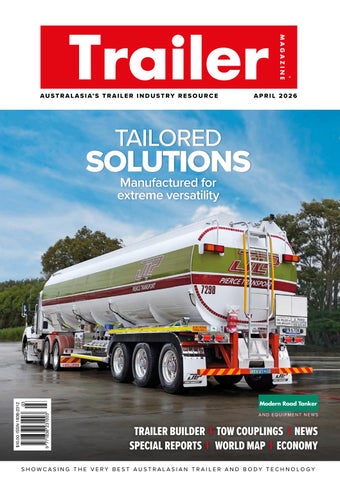
Trailer Magazine April 2026

Page 1


Thermo King and BPW

THE PERFECT ALLIANCE

What are the benefits of ePower?

Reliable, independent power supply for fully electric or hybrid refrigeration units

Intelligent energy management and efficient operation

Air-cooled

Saves fuel and CO2

CHAIRMAN

John Murphy john.murphy@primecreative.com.au

MANAGING EDITOR

Luke Applebee luke.applebee@primecreative.com.au

EDITOR

Peter White peter.white@primecreative.com.au

ADVERTISING

Adrian Kos: 0413 777 670 adrian.kos@primecreative.com.au

Ashley Blachford ashley.blachford@primecreative.com.au

DESIGN

Alejandro Molano

HEAD OF DESIGN

Blake Storey

CLIENT SUCCESS MANAGER

Ben Sammartino ben.sammartino@primecreative.com.au

HEAD OFFICE

Prime Creative Pty Ltd 379 Docklands Drive Docklands VIC 3008 Australia

SUBSCRIPTIONS

03 9690 8766 subscriptions@primecreative.com.au

Trailer Magazine is available by subscription from the publisher. Annual rates: AUS $99.00 (inc GST). For overseas subscriptions, airmail postage should be added to the subscription rate. The right of refusal is reserved by the publisher.

ARTICLES

All articles submitted for publication become the property of the publisher. The Editor reserves the right to adjust any article to conform with the magazine format.

COPYRIGHT

Trailer Magazine is owned by Prime Creative and published by John Murphy.

All material in Trailer Magazine is copyright and no part may be reproduced or copied in any form or by any means (graphic, electronic or mechanical including information and retrieval systems) without written permission of the publisher. The Editor welcomes contributions but reserves the right to accept or reject any material.

While every e ort has been made to ensure the accuracy of information Prime Creative will not accept responsibility for errors or omissions or for any consequences arising from reliance on information published.

The opinions expressed in Trailer Magazine are not necessarily the opinions of, or endorsed by the publisher unless otherwise stated.

O cially endorsed by the VTA

From the Editor’s desk

Tanker talk

Welcome to another edition of Trailer This issue marks our first quarterly Modern Road Tankers edition of the year, a special iteration on our yearly calendar which features the industry’s latest tanker technology across trailers, components and more. We kick this quarter’s promotional edition off on page 24 with our cover story on John L. Pierce (JLP) Transport. The 77-year-old transport company has taken delivery of Hockney & Co’s first super single aluminium barrel tankers – a landmark delivery for both the fleet and the manufacturer. The delivery was one that was completed with ultimate transparency from start to finish, with JLP Transport even travelling to Thailand to assess the units on the production line.

Meanwhile, JOST has announced the upcoming arrival of the new ROCKINGER RO50P coupling (dubbed the ‘toughest connection down under’) which was developed specifically to handle the harsh realities of Australian transport. The outback-ready solution is expected to deliver strength, safety and serviceability in the most demanding environments and applications. We take a deep dive into the new product on page 34.

For Brisbane Transport, trailer fires and increased insurance costs have been significant problems. But that was before the company standardised MICHELIN Connected Fleet Trailer Premium systems on its entire fleet of more than 110 trailers, rigids and prime movers. To find out just how beneficial the solution has been, stop by page 36.

It’s clear the industry is in a tough spot right now. We’ve been faced with the loss of numerous transport and logistics businesses over the last 12 months, with several of them being dedicated family businesses that have served this industry for many years. I recently got the chance to sit down and speak with Geoff Crouch, the former Executive Director of Ron Crouch Transport, about the problem we’re seeing. We discussed the challenges businesses are experiencing, what needs to change, and how ongoing issues such as sham contracting and the current fuel supply situation could further impact them. Make sure to stop by page 42 to read more – this is another one not to be missed. Happy reading!

Trailer Magazine Editor

Peter White

Vale Peter Gunn

Peter Gunn, one of the most influential figures of Australian transport, has passed away at the age of 83.

Gunn was an industry pioneer who significantly contributed to road transport and influenced modern trailer design.

On the back of World War II – decades before high-productivity schemes such as Performance-Based Standards (PBS) were even ratified – he was at the forefront of genuine innovation, solving technical dilemmas and finding better ways to operate.

Gunn began his career as a truck driver during the 1950s at Fred Brown Transport, a company he later acquired which is now known as FBT Transwest.

By the late 1960s, he completed his tertiary studies (commerce at the University of Melbourne) and established his own transport services business, Cubico, where he single-handedly revolutionised the cubic freight market and introduced technologies and processes which are still in use today.

Gunn pioneered the introduction of the 48’ rail container in Australia in the early 1990s.

With the introduction of these containers for cubic freight came a purpose designed five pack well wagon with shared bogies – a design which reduced tare weight and allowed containers to be double stacked between Adelaide and Perth.

His approach to optimising cubic freight in transport also saw other design changes such as low floors, drop decks and smaller wheels which have since been widely adopted by other innovative trailer manufacturers such as Vawdrey.

After decades of strong growth, Gunn merged his business in 1999 with the logistics division of Mayne Nickless to build a powerful Melbourne-based investment firm called PGA Group.

All of his efforts were recognised in the 2012 Queen’s Birthday Honours List, where he was appointed as a Member of the Order of Australia (AM) for his service to the transport industry, development of innovative freight logistics strategies and support for children’s health organisations.

Equally significant was his philanthropy, delivered through the Rae and Peter Gunn Family Foundation which supported

hospitals, medical research and community causes across Victoria.

Victorian Transport Association (VTA) CEO, Peter Anderson, honoured the passing of Gunn by reflecting on the many contributions he made.

“Peter was an industry pioneer whose influence on Australian freight and logistics will be felt for generations,” he said.

“His long association with FBT Transwest further cemented his reputation as a visionary operator and leader.

“Above all, Peter was a dedicated family man, remembered with great love by those closest to him. His family remained by his side throughout his final days, a reflection of the deep bonds that defined his life.

“The VTA Executive Council and Secretariat extend our sincere condolences to the Gunn family, his colleagues and the many people across our industry who were shaped by his leadership, generosity and example.

“Peter’s legacy lives on in the businesses he built, the innovations he championed, and the countless people he inspired.”

TGE and Coca-Cola extend partnership with new fleet

Team Global Express and Coca-Cola Europacific Partners have launched a new co-branded fleet to mark a four-decade partnership.

The first eight co-livery rigid trucks sets are now delivering across Central and North Queensland, travelling routes through Rockhampton, Mackay, Townsville, Cairns and Mount Isa.

A total of 14 new vehicles have been purchased to support the co-branded livery partnership, with the full fleet expected to be on the road by March.

The rollout follows a new contract between Team Global Express and CocaCola Europacific Partners for the North Queensland network – extending one of the longest-standing logistics partnerships in either company’s history to 45 years upon completion.

“Our co-branded fleet of 14 rigid trucks reflects the decades of trust and shared standards that have defined this partnership,” said Executive General

Local Freight expands in Queensland

Queensland freight specialist, Local Freight, has officially opened a new custom-built depot in Rockhampton, Queensland.

Located at 32 Enterprise Drive, Gracemere, the new facility is situated on a 6,800-square-metre block of land and features a 1,200-square-metre warehouse and awning area.

Local Freight Managing Director, Harry Manais, told Trailer the additional location strengthens Local Freight’s ability to service the region and support local businesses with faster, more reliable freight solutions.

“This new facility allows us to better service key areas including Rockhampton, Yeppoon, Gladstone, Emerald and Biloela, while also enabling faster overnight services across the network,” he said.

“As demand continues to grow across regional Queensland, this investment ensures we remain close to our

customers and continue delivering the dependable service Local Freight is known for.”

Local Freight is a carrier specialising in transport services across Queensland.

The business now operates two depots in Townsville and Rockhampton, and works with distribution partners in other areas such as Mackay and Cairns to service a large network of customers.

“Our long-term vision is to establish company-owned depots in all major regional coastal towns across Queensland,” Manais told Trailer

“To that end, we have already secured land in Mackay, with depot construction expected to begin in six to 12 months.

“We look forward to supporting more businesses across Central and North Queensland.”

Local Freight’s new facility. Image: Local Freight.

Agreement signed for Qube’s acquisition

Macquarie Asset Management has signed a Scheme Implementation Deed to acquire Qube Holdings Limited by way of Scheme of Arrangement.

Under the Scheme, Qube shareholders other than UniSuper will receive $5.20 cash per share.

The cash consideration of $5.20 per share represents a 28 per cent premium to the last closing share price of Qube of $4.07 per share on 21 November 2025 –valuing Qube at approximately $11.7 billion.

UniSuper will transfer its existing direct 15.07 per cent shareholding in Qube at equivalent value for a corresponding interest in the holding structure of the consortium acquirer.

The consortium comprises MAM managed funds and co-investors including UniSuper and Pontegadea.

The proposal relating to Qube’s acquisition was first announced on 23

November 2025 when Qube and MAM entered into a process and exclusivity deed.

Qube Managing Director, Paul Digney, since expressed his faith in the agreement – claiming it will contribute to the business’ future growth.

“MAM’s offer underscores the value that has been created through our strategy for growth, the quality of our business, leadership team and people and the strength of our safety culture,” he said.

“Since inception, Qube has achieved significant growth and diversification across markets and geographies.

“I am confident that this transaction will provide the platform for the business to continue that evolution while maintaining our strong track record of enhancing supply chains and delivering outstanding customer service.”

MAM and its co-investors will now

support Qube’s world-class management team to drive further growth and resilience in the business.

According to MAM, the focus will be investing in Qube’s 200 sites in Australia, New Zealand and Southeast Asia, as well as new opportunities across the Asia Pacific region.

“Macquarie Asset Management has a longstanding track record of identifying opportunities driven by long-term thematics,” said Head of MAM, Ben Way.

“We believe Qube exemplifies this approach and will work to deliver positive outcomes for its customers and our clients and partners.”

The Scheme is currently subject to customary conditions and regulatory approvals, including from the Foreign Investment Review Board and the Australian Competition and Consumer Commission.

Total Logistic Solutions opens new SA facility

Total Logistic Solutions (TLS) has announced the opening of a new facility in Adelaide, South Australia.

The new location is a modern and purpose-built site designed to support TLS’ continued growth.

It significantly strengthens TLS’ footprint in SA and enhances its operational capability across the state.

“TLS is now operating from our new purpose-built facility in Adelaide,” TLS said.

“A big thank you to Sagle Constructions,

Daniel Lees and the entire project team for delivering an outstanding building.

“The quality, functionality and finish of this site reflect the professionalism and commitment shown throughout the entire build.”

Qube Holdings company logo on a mobile phone. Image: piter2121/stock. adobe.com.

Adrian Rocks joins JOST

JOST Australia has appointed Adrian Rocks as State Sales Manager of Victoria and Tasmania.

Rocks first joined JOST in 1998 where he served as Sales Engineer of New South Wales for two years.

He then relocated to Melbourne in 2000 to run JOST’s facility as Area Manager of Victoria.

In 2010, Rocks joined CIMC as Sales Manager of Victoria and Tasmania and spent two years improving his wholesale skills, before joining Volvo Group in 2012 and spending the next 14 years at the business as UD Trucks Regional Commercial Manager Southern Region Oceania.

He now returns to JOST after 16 years with the responsibility of growing its Victorian sales team.

“Adrian joins JOST in a newly created role which will see him lead and develop the sales team,” JOST Australia General Manager of Sales and Marketing, Corey Povey, told Trailer

“As the team grows along with our product portfolio, it needs to be managed accordingly.

“This stems from the acquisition of HYVA along with new products being released over the coming months – the next-generation Rockinger coupling as well as axles and suspension systems.”

A key part of Rock’s role will be managing and delivering customer

service excellence – a long-term priority of JOST’s.

“We want every point of contact to be a positive one, especially with our sales teams,” Povey told Trailer

Rocks said he is looking forward to managing JOST’s Victorian sales team in its day-to-day sales business, customer management and business development duties.

“It’s great to be back,” he told Trailer “JOST is very well-respected in the

Arrow Transport announces partnership

Arrow Transport has announced a new two-year League Naming Rights partnership with the Western Football Netball League (WFNL).

The partnership reflects a shared commitment to community, opportunity and long-term investment in people across Melbourne’s western suburbs.

As part of the collaboration, Arrow Transport will support the WFNL in continuing to deliver high-quality football and netball competitions – strengthening support for its clubs and opening up opportunities for players, volunteers and families.

Arrow Transport Managing Director,

Craig Webster, acknowledged the importance of community sport in bringing people together, building resilience and creating pathways for the next generation.

“The WFNL plays a vital role in bringing communities together, and that aligns strongly with Arrow’s values,” he said.

“We’re proud to support a League that stands for teamwork, resilience and regional growth, and we’re excited about what we can build together over the next two years.”

The partnership will focus on increased investment into league and club operations and providing support for

industry, and the business is supported by customers who do enjoy working with it because they are taken care of.

“I gained a lot of knowledge about the JOST product during my initial stint, and I’ve since obtained a lot of background insight into different systems in the way of forecasting, pipeline management and team building.

“I’ve always been passionate about the JOST product and I’m excited to be working with it again.”

community programs and grassroots development.

It will also provide employment, internship and career pathway opportunities as well as leading to a shared commitment to the long-term sustainability of regional sport.

“Arrow Transport’s commitment to the League goes well beyond naming rights,” said WFNL CEO, David Jennings.

“This partnership allows us to invest further into our clubs, enhance opportunities for players and officials and continue building a strong, sustainable future for football and netball across the west.”

Adrian Rocks. Image: JOST Australia.

A XFM AB-triple. Image: XFM.

XFM relocates in South Australia

XFM has marked a major milestone with the opening of a new facility in Pooraka, South Australia.

The new site is a significant upgrade from XFM’s previous location, providing the business with a modern and spacious depot designed to support the next stage of its growth.

It features nearly 5,000 square metres under roof and a large hardstand to enable smoother truck movements and staging.

According to XFM, the Pooraka site will

also offer greater efficiency in inbound and outbound operations with improved pick-up and delivery loading/unloading to reduce dwell time.

“[This facility] is another strong investment in the future of our Adelaide operations and the wider XFM network,” XFM said.

“This is an exciting step forward – not just for the Adelaide team, but for the entire XFM business.

“Thank you to everyone involved in making this move seamless.”

CRL Express announces new NSW facility

CRL Express has revealed that a new facility in Moorebank, New South Wales, is in development.

The business will be transitioning its Sydney operations from Smithfield into the new Moorebank facility following continued growth.

CRL Express said the relocation is expected to accommodate future expansion in the region as well.

“This move strengthens our capacity, enhances service capability, and positions us for continued growth,” the company said.

“We’re carefully coordinating the transition to ensure uninterrupted receiving, dispatch and transport services for our customers.

“We appreciate the ongoing support of our customers and partners and look forward to welcoming you to our new facility.”

New PBS braking standard to increase safety

The NHVR is updating the PerformanceBased Standards (PBS) Directional Stability Under Braking (DSUB) standard to modernise braking requirements and improve safety outcomes.

The revised standard focuses on the use of advanced braking and stability technologies, and will introduce several assurance measures to ensure these systems are powered, operational and fault-free.

Under the updated DSUB standard, trailers will need to be fitted with Trailer Electronic Braking Systems with rollover control compliant to ADR 38/05 or later.

Road trains will be required to provide a 24-volt electrical supply to trailer braking systems, and PBS combinations will need to have devices fitted which confirm braking systems on all trailing units are connected, powered on and provide fault statuses.

The National Bulk Tanker Association (NBTA) is welcoming the updated standard as a win for the transport industry.

“This is a welcome and practical reform

that removes Load Proportioning Valves (LPVs) as a means of compliance,” the NBTA said.

“In their place, the standard will require the fitment of an advanced braking system such as ABS, EBS or TEBS.”

The NBTA filed a submission to the NHVR for the standard which was informed by its members’ on-road TEBS experience.

That practical evidence then contributed to the final policy outcome.

“The NBTA supported the broader rollout

of EBS,” the NBTA said.

“At the same time, we also sought greater clarity regarding the purpose of mandatory TEBS status indicators – whether intended for driver awareness, workshop diagnostics or on-road safety – noting that existing in-cab alerts often provide more effective real-time safety outcomes.

“The NBTA will continue working with the NHVR to ensure implementation supports both safety outcomes and operational practicality.”

Road train moving through the Pilbara mining region in Western Australia. Image: beau/stock.adobe.com.

CEVA Logistics opens new Queensland facility

CEVA Logistics has expanded its footprint in Queensland with the opening of a new 10,000-square-metre warehouse in Berrinba.

The development extends the business’ presence at the Berrinba campus to more than 100,000 square metres – providing additional capacity to support its customers and enable further growth in the region.

The new facility has been awarded a Five Star Green Star Buildings v1 rating by the Green Building Council of Australia.

CEVA Logistics Vice President, Contract

Wymap Transport and TRUCK TECH enter partnership

Wymap Transport has appointed TRUCK TECH as its national heavy vehicle fleet maintenance partner.

The partnership supports Wymap’s time-critical operations with safetyfirst maintenance which are focused on uptime, compliance and reliability. This is backed up TRUCK TECH’s workshop network and mobile field service capability.

Tyre pressure & temperature live monitoring

To ensure that you always have an eye on your fleet's tyre pressures and temperatures, even when your vehicles are on the road.

Our tyre pressure and temperature monitoring tools alert you when pressures drop below set thresholds and identify when service is needed, helping reduce breakdowns, costly repairs, downtime, and fuel consumption

A CEVA Logistics Vawdrey

Linfox launches 2026 Graduate Program

Linfox has commenced its biennial Graduate Program with the induction of the 2026 Linfox Graduate Cohort.

The Linfox Graduate Program is a 24-month development program designed to provide individuals looking to enter the transport industry with career opportunities, a salary and a variety of benefits.

The program commences in February each year and concludes in July the following year, at which time graduates transition into their ongoing roles with Linfox.

Employment is permanent, not fixed for the 24-month period.

This week, the 2026 Linfox Graduate

Cohort participated in a graduate induction and conference which set the foundation for their journey with the business.

In a statement online, Linfox Strategic Talent Manager, Poya Katebi, said he was thrilled to kick off the program.

“[This is] such a proud moment for my team and me as we welcomed our newest Graduate Cohort and hosted this year’s induction conference,” he said.

“There’s nothing more energising than seeing talented, curious and ambitious emerging leaders walk through our doors ready to learn, contribute and shape the future of Linfox.

“This week set the tone for an exciting journey ahead, grounded in our culture,

values and commitment to developing people who will lead our industry forward.

“[I] can’t wait to watch this incredible group grow, challenge themselves and make their mark.”

Through this program, Linfox is investing in the next generation of ‘Linfox leaders’ – individuals that will bring fresh ideas to the business, uphold its commitment to safety and service and help shape the future of Linfox and the transport industry.

“We look forward to seeing them grow, contribute and lead with confidence as they progress through their Linfox careers,” Linfox said.

Drake announces new WA Branch Manager

The Drake Group has appointed Eamonn Gavin as its new Western Australia Branch Manager.

Gavin has extensive experience within the transport industry and heavy haulage.

He brings a range of skills to the role as well as a genuine passion for the industry.

Gavin’s strong commitment to expanding The Drake Group’s presence in WA, combined with his focus on

delivering exceptional customer service, makes him an excellent fit for the role according to the business.

“His focus on expanding our WA presence – across trailer sales, service and repairs and spare parts – means our customers are in great hands,” The Drake Group said.

“Eamonn is available to assist with any enquiries relating to sales, service, repairs and parts, and looks forward to supporting our customers across the region.”

The 2026 Linfox Graduate Cohort. Image: Linfox.
Eamonn Gavin. Image: The Drake Group.

MinRes announces strongest ever half-year results

Mineral Resources’ (MinRes) results for the first half of financial year 2026 (1H26) marked the best six-month period in the company’s history.

Record revenue and earnings were announced alongside key operational milestones during the period ending 31 December 2025.

MinRes reported underlying earnings before interest, taxes, depreciation and amortisation (EBITDA) of $1.2 billion – a massive 286 per cent increase over the previous corresponding period.

A $3.1 billion revenue rose by 33 per cent over the previous corresponding period, while net profit after tax (NPAT) and free cash flow came in at $573 million and $293 million respectively.

Liquidity improved to $1.4 billion and net debt fell by $471 million to $4.9 billion.

MinRes’ Onslow Iron was the standout performer in 1H26, sustaining a nameplate capacity of 35 million tonnes per annum since August and contributing $519 million in EBITDA.

Mining Services hit record production of 166 million tonnes. This was driven by Onslow Iron’s ramp-up and stronger activity on existing contracts which generated an EBITDA of $488 million – 29 per cent higher than the previous corresponding period.

Iron Ore revenue increased by 69 per cent to $1.87 billion, delivering $573 million in EBITDA on the back of strong performances across Onslow Iron and

Meanwhile, lithium operations produced $167 million in EBITDA, up $182 million yearon-year and supported by stronger prices, higher output and improved recoveries.

At Wodgina, output was up by 65 per cent to 173,000 tonnes (driving $113 million in EBITDA) while a 23 per cent increase in production at Mount Marion delivered $57 million in earnings.

MinRes Chair, Malcolm Bundey, said a strong operational half had been complemented by progress towards the company’s focus on governance and financial performance.

“We’ve strengthened our balance sheet, refreshed governance frameworks and welcomed new Board members with valuable skills,” he said.

“As MinRes transitions into a more mature, resilient operating model, we are well placed to seize growth opportunities and deliver enduring value for shareholders.”

Mineral Resources Managing Director, Chris Ellison, said Onslow Iron operating at nameplate capacity and Mining Services delivering record production proves the company’s ability to execute major projects and sustain strong operational performance.

“With Tier One assets generating strong cash flow, a strengthened balance sheet and the dedication of our 7,000-strong workforce, MinRes is well positioned for ongoing growth and long-term value creation for shareholders,” he said.

• 30 + years in the market place

• Clean, grease-free fifth wheel

• More cost effective

• Easy to fit

• Consistent steering characteristics

• Environmentally friendly

• Australian designed & manufactured

• Used by some of the

since 1990

Pilbara Hub operations.
An autonomous road train run by Mineral Resources. Image: Mineral Resources.

Visy opens new Tasmania facility

Visy has invested in a new packaging hub in Devonport, Tasmania, as part of its longterm commitment to the state.

Designed to better serve Tasmania’s farmers and food and beverage companies, the hub will supply cardboard packaging to customers including berry and produce growers, breweries and the dairy industry.

The modern, fit-for-purpose facility includes an 8,500-square-metre warehouse and office space for sales and

customer service.

It was officially opened yesterday [24 February 2026] and will look to support jobs in the state’s growing agriculture and food sectors.

Visy CEO, Mark De Wit, said the investment reflects Visy’s confidence in the future of Tasmanian agriculture and manufacturing.

“We’re helping get premium Tasmanian produce, food and drinks to Australian

BHP appoints new CEO

BHP has announced Brandon Craig as the next CEO and a Director of the company.

Craig will succeed current CEO, Mike Henry, who will step down on 1 July 2026 after six-and-a-half years in the role.

“We are very pleased an executive of Brandon Craig’s calibre and extensive experience has been appointed as our new CEO to lead the execution of our strategy,” said BHP Chair, Ross McEwan.

“I am confident that his discipline and focus will continue to drive BHP’s highperformance culture and advance the

company’s unrivalled pipeline of growth options to maximise shareholder returns.”

Craig brings more than 25 years of operational and corporate leadership experience at BHP to the role.

He is currently BHP’s President Americas, leading the company’s growth strategy in future facing commodities across Canada, the United States and South America.

Craig said he is pleased to accept the new role.

“It is an honour and privilege to succeed Mike Henry as CEO of BHP,” he said.

supermarket shelves and take advantage of export markets in the region,” he said.

“Visy is committed to providing the infrastructure the state needs for farmers and the food and beverage sector to thrive.

“Tasmania has some of the best produce in the world and this new site will deliver greater convenience and responsiveness for customers, with improved capacity and dedicated support.”

“Thanks to his leadership, BHP is well positioned for the future.

“Mike will be remembered for his strategic decision-making, portfolio transformation, operational excellence and focus on safety and highperformance culture.”

Anne Urquhart, Julie Collins, Tony Simpson and Mark De Wit. Image: Visy.

Cleanaway celebrates 10-year partnership

Cleanaway is celebrating one decade of partnering with Clean Up Australia this year.

Clean Up Australia is the not-for-profit organisation which has sponsored the yearly Clean Up Australia Day since 1990.

The 2026 Clean Up Australia Day took place on Sunday 1 March – marking 10 years since its partnership with Cleanaway commenced.

To celebrate the decade of partnership, Cleanaway and Clean Up Australia hosted a Business Clean Up Day with local council members in New South Wales on 24 February 2026.

Around 100 Cleanaway team members and local council representatives participated in the event, tackling litter along Whalan Reserve in Western Sydney.

Cleanaway Head of Strategic Accounts Local Government and Infrastructure Growth, Leigh Newman, said the partnership has assisted Cleanaway in making a positive impact on the environment.

“As Australia’s leading waste and resource recovery company, we see the impact of

litter firsthand,” she said.

“That’s why we’re committed to making a sustainable future possible together with Clean Up Australia and local members of the community.

“Business Clean Up Day allows us to work directly with our customers, their team members and local residents to make an immediate, visible difference, and we’re proud to continue this important work with Clean Up Australia.”

Clean Up Australia Chair, Pip Kiernan, said

Qube delivers another record half-year

Qube has reported continued growth in underlying financial performance for the first half of financial year 2026 (1H26).

The company reported a revenue of $2.36 billion, which was up by almost 13 per cent year-on-year (YOY).

Earnings before interest, taxes, depreciation and amortisation (EBITDA) were $196.3 million, around 10 per cent higher than the first half of financial year 2025 (FY25).

This sound operational performance supported a 10.1 per cent increase in underlying net profit after tax and amortisation (NPATA) to $157.5 million.

Additionally, statutory net profit after tax (NPAT) rose by 101.1 per cent due in part to the inclusion of a $101.5 million pre-tax profit from the sale of Qube’s interest in a 202-hectare parcel of land at Beveridge, Victoria.

Underlying earnings per share (pre amortisation) increased to 8.9 cents –representing a 9.8 per cent uplift on the prior corresponding period.

Qube Managing Director, Paul Digney,

said the results again demonstrated both the strength of the business and the benefits of Qube’s diversification by geography and market.

“Qube again delivered revenue and earnings growth in the period, underpinned by our proven ability to deliver reliable, valuable and efficient logistics services for a diversified customer base,” he said.

“This is another pleasing half year performance, with strong underlying revenue growth in the Operating Division benefitting from positive contributions by some recent acquisitions, including AAT Webb Dock West (formerly MIRRAT), Coleman and the ABH bulk handling facility in Western Australia, and Nexus Logistics in New Zealand.

“These results underscore the value generated through Qube’s successful strategy of making targeted acquisitions to enhance service capabilities and then further investing in these acquisitions to support our customer base and deliver sustainable earnings growth.”

the partnership between both organisations serves as an example of what can be possible.

“Our 10-year partnership with Cleanaway is a testament to what can be achieved when organisations commit to environmental action,” she said.

“Business Clean Up Day allows workplaces to take an active role in cleaning up their local communities and inspiring their teams to become champions for change.”

Looking ahead, Qube expects to deliver continued solid underlying earnings growth in financial year 2026 (FY26) compared to FY25.

“The extent of earnings growth remains difficult to forecast given the various opportunities, challenges and uncertainty across Qube’s core markets,” the company said.

“However, based on the current outlook, Qube presently expects that FY26 underlying NPATA and underlying earnings per share (EPSA) will be between 6.0 per cent and 10.0 per cent above the FY25 result.

“The actual full year earnings growth will depend on a range of factors including market conditions and volumes in Qube’s key markets, any adverse weather events, the inflationary and interest rate environment and the labour and industrial relations environment.

“Qube remains well placed to deliver sustainable long term underlying earnings growth.”

Cleanaway and Clean Up Australia mark the milestone. Image: Clean Up Australia.

MLG reports strong growth in half-year financial results

Western Australian mining company, MLG Oz, has released its half-year financial results for the period ending 31 December 2025.

The business delivered a statutory revenue of $287.2 million (up 5.2 per cent on the prior corresponding period) and net profit after tax (NPAT) of $7.1 million (up 73.2 per cent).

Pro-forma earnings before interest, taxes, depreciation and amortisation (EBITDA) increased by 24.5 per cent to $36.5 million, with margins expanding to 12.8 per cent. Earnings quality continued to improve throughout the period.

Operating cash flow before tax and financing costs increased to $30.1 million, with cash conversion strengthening to 83 per cent.

Net assets grew to $153.4 million and gearing reduced to 0.84x, reflecting a disciplined approach to capital allocation and balance sheet management.

In addition, MLG Oz declared a fully franked interim dividend of 1.25 cents per share.

MLG Oz Acting CEO, Mark Hatfield, said despite a rain-impacted start to the first half of the year, operational teams delivered a strong finish – lifting consistency and margin performance across the group.

“We are very pleased to again demonstrate a strong improvement in profitability,” he said.

“The performance of our operational teams has been exceptional, and it is very pleasing to see continued margin improvement across the group.

“Importantly, demand for our integrated services remains strong, particularly in the gold sector, which is experiencing unprecedented prices and sustained production.”

MLG Oz said gold market fundamentals are remaining supportive, with high prices continuing to drive activity across the sector.

The business now remains optimistic for the remainder of the financial year.

“The second half is well-positioned, and we continue to assess opportunities to strengthen our position within the gold value chain where it makes strategic and economic sense,” MLG Oz said.

NSS expands Port of Townsville presence

National logistics provider, Northern Stevedoring Services (NSS), has announced the completion of a $5 million state-of-the-art facility at the Port of Townsville.

The new logistics hub significantly expands the company’s capability to serve Regional North Queensland and beyond, and according to NSS, cements it as the largest intermodal logistics facility in the port.

The 29,630-square-metre facility scales NSS’ storage capabilities to 4,200 twentyequivalent units (TEUs) with dedicated support for 230 refrigerated containers.

This strategic expansion integrates essential ‘one-stop’ services including

container repairs, break bulk handling and automated weighbridge access to minimise bottlenecks in the supply chain.

“Our latest investment in Townsville extends our capability for customers in mining, refinery and agriculture while reinforcing our role as a long-term logistics partner to Regional North Queensland,” said NSS General Manager, Mark George.

“These developments are a direct response to customer demand for integrated solutions that can safely handle higher volumes with greater efficiency and visibility across the supply chain.

“Our strategy is to combine new physical infrastructure with digital systems so that every participant in the supply chain

benefits from better planning predictability and transparency.”

Incorporated in 1971, NSS also celebrates 55 years since its first operation at the Port of Townsville.

According to George, the logistics provider has, in that time, grown into the largest operator underpinned by shareholders Qube and Glencore.

“I’m proud to say that NSS continues to lead the industry in Townsville and across North Queensland,” he said.

“Our willingness to invest early in innovative infrastructure and systems has delivered a number of important firsts for the Port of Townsville and reinforces our role as a progressive, solutions-focused logistics partner.”

Macquarie Wharf works begin

TasPorts’ largest-ever infrastructure project, the redevelopment of Macquarie Wharf Six in Hobart, has commenced.

TasPorts has commenced early works on the Macquarie Wharf Six redevelopment, marking the start of its largest infrastructure project to date and a major upgrade for Tasmania’s freight and port capabilities.

The redevelopment will deliver dedicated berthing for Australia’s icebreaker and research vessel, RSV Nuyina, as well as a permanent marine base for the Australian Antarctic Program. It forms the first stage of the broader Macquarie Wharf Redevelopment Project, supported by a $188 million investment from the Albanese Government.

Federal Minister for the Environment and Water, Murray Watt, said the project will provide critical infrastructure to support Antarctic science and operations.

“Antarctic and Southern Ocean science has never been more important, and the redeveloped wharf will support the Australian Antarctic Program to continue its critical work,” said Watt.

“This project secures Tasmania’s role as the gateway to East Antarctica and

Representatives from the Australian Government and TasPorts at

provides a permanent home tailored to the Nuyina – Australia’s world-class scientific and icebreaking ship.”

Tasmania Minister for Infrastructure and Transport, Kerry Vincent, said the commencement of works represents a significant milestone for the state.

“The start of works on the first stage of the Macquarie Wharf Redevelopment Project is an important step forward for this nationally significant project,” said Vincent.

“It means jobs on the ground, local industry involved, and real progress on infrastructure that will benefit Tasmania’s economy for decades to come.”

The announcement follows TasPorts awarding the redevelopment contract to Hazell Brady in December 2025.

TasPorts Group Executive Major Projects, Assets and Technical Services, Michel de Vos, said a specialist project team is already in place and working closely with TasPorts to deliver the project.

“Detailed design is now underway with site investigations, including geotechnical surveys scheduled ahead of demolition in the coming months,” said de Vos.

“We’re proud to be partnering with the Australian Antarctic Division and Hazell Brady to deliver infrastructure of national significance that will support Antarctic research, trade and one of Tasmania’s key working ports for decades to come.”

Practical completion of the Macquarie Wharf Six redevelopment is scheduled for August 2028.

KEITH introduces new Walking Floor product

KEITH Manufacturing Company has announced the launch of RX3 Technology, a new flagship heavy duty Walking Floor drive engineered for the rigorous demands of waste and recycling applications.

Designed as the long term replacement for the Running Floor II DX, RX3 builds on KEITH’s proven reliability while delivering a new level of performance, protection and control for high cycle, severe duty operations.

RX3 is purpose built for waste handling and other abrasive, heavy bulk materials in demanding transfer station and fleet environments.

It incorporates comprehensive thermal protection, integrating an over temperature switch and electric heat sensor designed to safeguard the drive during the toughest unloading cycles.

By monitoring system temperature and reacting before damage can occur, RX3 helps prevent heat related failures and

protects critical hydraulic and mechanical components – reducing the risk of unplanned downtime.

Additionally, the RX3 hydraulic circuit is designed to run cleaner, featuring an oil pressure filter which promotes cleaner oil and monitored inlet conditions.

This contributes to smoother performance, longer component life and a reduced maintenance burden over the life of the trailer.

“RX3 is the new benchmark for heavy duty moving floor drives, with every aspect of the system proven through extensive in house testing and real world field validation to meet the toughest performance and reliability standards,” KEITH Manufacturing Company said.

“As a patent pending design, RX3 encapsulates KEITH’s best in class Walking Floor engineering while signalling a new generation of drive technology for waste and severe duty bulk materials.”

RX3 also reduces complexity with internal check valves and fewer parts, eliminating adjustments at the switching valve and minimising potential leak points.

Its simplified layout makes field troubleshooting easier, speeds service and helps lower total maintenance costs for waste and recycling fleets.

Smarter controls are also a core part of RX3 Technology.

It pairs an automatic switching valve with intuitive electronic controls and optional manual control options to enable more automated, hands off operation, reduce operator error and simplify training for new drivers and technicians.

The hydraulic design also gives operators flexibility to unload at extremely slow or extremely fast speeds – depending on job requirements –providing precise control in tight facilities and rapid discharge when throughput is the priority.

Macquarie Wharf. Image: TasPorts.

Patrick Terminals strengthens Port of Melbourne support

Patrick Terminals has announced a new initiative to support importers and exporters using rail freight at its PortRail Melbourne terminal.

From 1 March 2026 for a period of two years, Patrick Terminals will waive the exchange transfer charge for eligible containers moved by rail to and from Patrick PortRail Melbourne.

The temporary concession arrangement will look to support customers’ initial transition to PortRail, and applies to containers originating from or terminating at Somerton Intermodal Terminal, SCT Altona and Salta Dandenong.

Complementing Port of Melbourne’s recently announced Port Rail Shuttle Network (PRSN) start-up incentive, the new initiative reinforces Patrick Terminals’ commitment to improving supply chain efficiency and increasing rail freight uptake at the port.

Patrick Terminals CEO, Michael Jovicic, said the initiative demonstrates Patrick’s ongoing focus on practical, customerfocused solutions that improve the performance of Australia’s supply chains.

“Rail plays a critical role in reducing congestion, improving reliability and supporting long-term efficiency,” he said.

LBRCA enters new era

The Livestock, Bulk and Rural Carriers Association’s (LBRCA) annual conference held in Coffs Harbour, New South Wales, last week marked a significant change for the association.

Following a formal vote of members, and in accordance with the LBRCA Constitution, the LBRCA has now transitioned to operate as an independent state-based advocacy body – separating from the Australian Livestock and Rural Transporters Association (ALRTA) after 40 years.

LBRCA President, Wade Lewis, said

the decision to resign from the ALRTA was not taken lightly and reflects ongoing and substantive differences in approach, priorities and member interests.

“The decision reflects a clear mandate from Members to ensure the association can act decisively, independently and in the best interests of livestock, bulk and rural transporters operating across regional and rural NSW,” he said.

“As an association, we can now focus squarely on outcomes for our members, both NSW and interstate, at a state level

“This arrangement helps remove barriers to the transition to rail use and provides tangible support for importers and exporters who choose rail.”

The announcement aligns with Patrick’s longstanding investment in rail infrastructure to support higher rail volumes which provide more sustainable freight alternatives for Australian importers and exporters.

Patrick will continue to work collaboratively with the Port of Melbourne, rail operators and intermodal partners to support rail growth and deliver more resilient, efficient freight outcomes for Victorian businesses and consumers.

and on national issues that directly impact heavy vehicle operators transporting goods throughout regional and rural NSW.

“We will continue to engage constructively with governments, regulators, industry and stakeholders, but will now do it independently and with greater agility.

“You will see some changes over the next twelve months which we know will bring positive outcomes, not just to NSW operators, but all operators across the eastern seaboard.”

Port of Melbourne. Image: Alistair/stock.adobe.com.

DHL Supply Chain unveils new facility in NSW

DHL Supply Chain Australia has officially opened its newest warehouse facility in Erskine Park, New South Wales.

Strategically located in Western Sydney, the 21,078-square-metre warehouse enhances DHL’s national distribution capabilities to best serve customer requirements and offers proximity to the upcoming DHL transport hub.

The facility offers ambient storage with selective racking and block stack areas, eight recessed docks, six on-grade doors and a mezzanine for rework and valueadded services.

Examples of built-in measures include several energy and resource efficient features such as 256kWp rooftop solar panels that reduce grid electricity reliance, rainwater harvesting for non-potable uses, LED lighting with efficient controls to reduce electricity consumption and EV charging.

DHL Supply Chain Australia CEO, Steve Thompsett, said the opening of the facility marks a significant milestone in DHL’s commitment to supporting the evolving logistics requirements of Australia’s technology and automotive sectors.

“The Erskine Park new facility reflects our ongoing investment in innovation, sustainability and infrastructure,” he said.

“It’s purpose-built to support reverselogistics operations and deliver highperformance logistics solutions for our customers as well as a great site for our workforce.

“It unlocks new opportunities for growth, agility, and customer service excellence.”

The Erskine Park facility is a multi-

user site serving more than five customers including key players in the consumer electronics, white goods and automotive space.

It supports both B2B and B2C operations with advanced reverse logistics services, including supply chain circularity with returns management, returns shipping and technical services such as consumer electronics inspection and spare parts returns.

“Australia is a key market for us, and we remain committed to supporting the country’s growth, including its technology and automotive sectors,” said DHL Supply Chain Asia Pacific CEO, Javier Bilbao.

“On the technology part, businesses in Australia have doubled their spending on data centres in just six months last year, and we have solutions that can help them.

“Likewise, we see growth in the consumer demand for the automotive sector, with nearly 99,000 new vehicles sold in 2025 and increasing aftermarket requirements.

“Our Strategy 2030 focuses on delivering value to our customers, and we’ve been investing ahead of the curve in the region to strengthen supply chain resiliency and flexibility by expanding warehouse capacity and future-proofing logistics centres.”

Cyclone Global Logistics names new CEO

Cyclone Global Logistics has announced the appointment of Jason Drivas as Group CEO.

The appointment marks a major milestone for Cyclone Global Logistics as the business enters its next phase of growth.

Drivas is a highly respected leader in freight forwarding and global logistics. With more than three decades of

experience across Oceania and the Asia Pacific, he is known for building strong teams, delivering for customers and developing trusted partnerships across the supply chain.

Drivas said he is grateful to step into the role of Group CEO at the company.

“This industry has always been about relationships – with customers, partners, carriers and the teams who

deliver every day,” he said.

“That trust is something I’ve always valued and never take lightly.

“Cyclone has strong foundations and a committed team.

“My focus is simple – back our people, strengthen partnerships and build something sustainable for the long term.”

DHL’s new Western Sydney facility. Image: DHL.

WA extends road train load limits

Road trains are now be permitted to carry heavier loads to regional Western Australia.

As of 17 March, 27.5m and 36.5m road trains are permitted to transport up to an additional 10 tonnes per load if they are carrying petrol, diesel and/or fertiliser to certain priority regions.

The decision was made by the WA Government’s Fuel Industry Operations Group, which was formed in response to concerns raised about fuel security amid conflict in the Middle East.

Under the plan, road trains will be able to bring more petrol, diesel and fertiliser to key regions such as the Goldfields, the South West, Great Southern and the Wheatbelt.

“In times of global uncertainty, it’s more important than ever for government to work with industry and the community on practical solutions,” said WA Minister for Transport, Rita Saffioti.

“This is a significant decision, which will enable the delivery of more petrol, diesel, and fertiliser to regional Western Australians.

“Working with industry, we will prioritise key regional areas to support the community and keep our economy strong through any global shocks.”

To help with distribution, industry will work with the government and fuel companies to triage priority areas for more stock.

Industry will provide the location of these depots to Main Roads who will adjust existing permits on a case-by-case basis to allow for the new temporary conditions.

These new permit conditions will be rolled out progressively as required travel routes are identified.

The adjustment to road train loads and introduction of a triaging process will support the Federal Government’s decision earlier this week to relax minimum stock obligations for fuel companies which prioritise sending fuel to regional customers – ensuring regional Western

Australians can more quickly access petrol and diesel.

“By helping bring critical fuel supplies to regional WA, our government is already making considerable progress on its seven-point plan to address fuel security concerns,” said WA Minister for Energy and Decarbonisation, Amber-Jade Sanderson.

“WA has shown before that it can confront global challenges, and through the Fuel Industry Operations Group, we will continue to keep our State safe and strong.”

Newhaul reaches 10M-tonne haulage milestone

Fenix Resources’ haulage business, Newhaul, has transported more than 10 million dry metric tonnes of iron ore from operations in Western Australia’s Mid-West.

The milestone reflects the rapid expansion of Fenix’s integrated mining and logistics supply chain since production began at the Iron Ridge Iron Ore Mine in December 2020.

Iron ore production initially started at a rate of 1.3 million tonnes per annum but has steadily increased as the company developed additional assets in the region.

The commissioning of the Shine Iron Ore Mine in 2024 and the development of the Beebyn-W11 Iron Ore Mine in 2025 have lifted Fenix’s current production run rate to

around 4.5 million tonnes per annum.

The company reported that more than one million tonnes of iron ore was hauled during the December 2025 quarter alone, as mining, road haulage and port logistics operations continued to scale.

The latest figure confirms that total volumes transported by Newhaul since production began have now exceeded 10 million tonnes.

The milestone also completes the final performance target linked to Fenix’s acquisition of Newhaul in 2022. Under the agreement, milestone payments were tied to haulage volumes, with the final tranche triggered once 10 million tonnes had been transported.

Following the achievement of the milestone, Newhaul founder Craig Mitchell has stepped down from his role as a Director of Fenix.

Executive Chairman John Welborn said Mitchell had played a key role in establishing the company’s integrated haulage capability.

“Craig has been integral in Fenix’s success to date and has helped develop the strong management team and the performance-driven culture that will take the business forward,” said Welborn.

Mitchell will remain involved with the company in an advisory capacity for the next 12 months to support the continued development of the logistics business.

Fonterra CEO to step down

Fonterra CEO, Miles Hurrell, has announced his resignation.

After 25 years with Fonterra including eight years as CEO, Hurrell has decided the time is right for him to leave the cooperative.

“When he was appointed CEO in 2018, Miles was tasked with leading a reset of the business to turn around Fonterra’s financial performance and rebuild farmers’ trust,” said Fonterra Chair, Peter McBride.

“Under Miles’ leadership the team has done that and more. From day one, Miles was able to unite the team under a single purpose and drive performance right across the business, setting the co-op up for the future.

“On behalf of the Board, I thank Miles for his courageous leadership.

“He has overseen a significant strategic reset, focused on getting the co-op back to its core strengths. In doing so he has helped lift Fonterra’s financial discipline and built the strong foundations the co-op has today.

“I know I echo the sentiment of farmers when saying that Miles will leave with

sincere thanks for his 25 years of loyalty and best wishes for the future.”

Hurrell said it has been an incredible privilege to have a long career with Fonterra which he has enjoyed immensely.

not just numbers but the livelihood of thousands of New Zealand farming families,” he said.

“I have always felt a great sense of responsibility to do what’s right for farmers and I believe the do-op is now in a really good place.

“While it’s not an easy decision to step away, the time is right for both the co-op and me personally.

“Fonterra’s entering the next phase in its strategic implementation, which marks a natural turning point for a new leader to step in while I consider what’s next for me.

“I know that the business will be in good hands. There’s an exceptional team of people who will carry the co-op forward and continue to drive value for farmers.”

Hurrell has a six-month notice period, enabling an organised leadership transition to take place.

“Board and management regularly discuss succession as part of good governance practices,” said McBride.

“We are confident we can run a robust selection process and appoint a new CEO in the coming months.”

Significant progress made towards ending sham contracting

Major steps have been taken towards eliminating sham contracting, with productive high level meetings having taken place in Canberra and a strong regulatory crackdown announced last month.

Victorian Transport Association (VTA) CEO, Peter Anderson, joined key transport industry leaders in Canberra on 12 March to advocate for meaningful reforms which protect safety, fairness and productivity.

The delegation was led by Senator Glenn Sterle whose ongoing leadership continues to elevate the issue at a federal level.

“Sham contracting undermines the integrity of our industry,” said Anderson.

“It compromises safety, disadvantages compliant operators and erodes the rights of transport workers.

“We are pleased to see federal regulators taking decisive action.”

The Australian Taxation Office (ATO) and Fair Work Ombudsman (FWO)

“When I took the role of CEO, I understood our financial results are recently issued a joint statement confirming a significant escalation in national compliance and enforcement activity targeting sham contracting, specifically identifying road freight as an area of concern.

Fair Work Ombudsman, Anna Booth, said employers should be aware that the FWO has investigations on foot into alleged sham contracting in sectors such as building and construction and road transport.

“We won’t hesitate to take enforcement action where we find unlawful activity in any sector,” she said.

“We are pleased to be joining forces with the ATO to shine a spotlight on this unlawful practice that leaves workers worse off and can land employers in court, exposed to significant penalties.”

Key points from the ATO and FWO’s announcement include:

• intensified investigations into suspected sham contracting across multiple sectors, including road transport;

• ongoing FWO investigations, with enforcement action to follow where unlawful arrangements are proven;

• ATO data matching revealing widespread worker misclassification, unpaid superannuation and failures in PAYG and reporting obligations;

• a sharp rise in tip-offs from the community, with nearly one-quarter relating to road freight; and

• a clear message from regulators: presenting employees as contractors is illegal and attracts substantial penalties.

Anderson said the strengthened national focus closely aligns with long standing concerns raised by the VTA.

“This is an important acknowledgement of the issues we have consistently put forward,” he said.

“We welcome the united stance from regulators and look forward to continuing our work with government to deliver lasting, practical reform.”

Miles Hurrell. Image: Fonterra.

Keeping clean

Australia Post has unveiled an ambitious 2030 Sustainability Framework which places transport decarbonisation directly in the spotlight.

Australia Post is targeting further emissions reductions and stronger circular economy outcomes across its fleet, properties and operations over the next five years, as it works towards its long-term goal of achieving Net Zero emissions by 2050. For an organisation that operates one of the country’s largest and most complex freight and delivery networks, the pathway to 2030 will hinge heavily on changes within its transport task.

Australia Post has already reduced its carbon emissions by 20 per cent and cut waste to landfill by 39 per cent since financial year 2019. However, the next phase of its sustainability journey will sharpen its focus on lowering what it describes as the “more challenging emissions” embedded in its national transport network.

Australia Post has committed to four key

climate and energy targets in its 2030 Sustainability Framework. The first is an additional eight per cent reduction in Scope 1 emissions by 2030 (from a 2025 baseline) which will be driven by further electrification of its fleet, expanded rollout of electric delivery vehicles, electric trucks and increase use of low-carbon liquid fuels.

For the trailer and heavy vehicle sector, this transition signals growing demand for equipment that can integrate with electric prime movers, accommodate alternative fuel technologies and support weight and range optimisation. As fleet operators rethink vehicle specifications to meet emissions targets, trailer design, materials selection and aerodynamic efficiency will play an increasingly important role.

The second target involves increasing installed on-site solar capacity from 14MW to 30MW by 2030. Large sorting centres

and distribution hubs – many of which operate high-throughput freight tasks –will continue to integrate solar technology to reduce reliance on grid electricity and lower operational emissions.

Third, Australia Post will aim to maintain 100 per cent renewable-matched electricity while reducing the proportion of grid energy consumed at operational sites. This ensures that as parcel volumes fluctuate, electricity demand will be supported by renewable generation.

The fourth target addresses Scope 3 emissions. Australia Post has committed to maintaining Scope 3 emissions at 2025 levels through to 2030. Although parcel volumes are expected to increase during this period, this will be achieved by working with air freight partners, contractors and suppliers to reduce their transport carbon emissions.

Given that transport is the largest

An Australia Post truck travelling along a highway in Melbourne, Victoria. Image: Doublelee/stock. adobe.com.

contributor to its carbon footprint, Australia Post will prioritise loweremission vehicles, renewable energy integration and route optimisation across its national network. Australia Post Chief Sustainability Officer, Richard Pittard, said the framework ensures Australia Post will be well positioned to meet its long term sustainability commitments.

“This is about upgrading Australia Post for the future,” he said. “We’re moving beyond incremental improvements to focus on the structural changes that will have the greatest impact, particularly across transport, energy and resource use.

“Reducing emissions in a network as large and complex as ours is not simple. It requires electrification, low-carbon fuels, renewable energy and smarter logistics but just as importantly, it requires partnership across our supply chain.

“We’re also rethinking how we use materials. By embedding circular principles into how we operate, using less, using longer and using again we can reduce waste within our business and explore how our national network can help Australians do the same.”

Alongside emissions reduction, Australia Post’s 2030 Sustainability Framework marks a deliberate shift toward circular economy principles. By moving beyond a traditional ‘take-make-waste’ model, the business aims to embed practices focused on using fewer resources, extending asset

life and keeping materials in circulation for longer.

Australia Post’s circularity targets include a further 30 per cent reduction in waste sent to landfill from a 2025 baseline and achieving an 80 per cent waste diversion from landfill.

Beyond reducing its own impact, Australia Post is also exploring how its national infrastructure can help play a role in supporting a more circular economy for all Australians. With one of the country’s largest retail networks, the organisation is well positioned.

The framework sets new targets to reduce carbon emissions and keep resources in use across Australia Post’s fleet, properties and operations. Image: Australia Post.
AUSTRALIAN CONSUMER CONFIDENCE

The full effect

John L. Pierce Transport has finalised a landmark trailer order by taking delivery of Hockney & Co’s first super single aluminium barrel tankers.

With a legacy spanning over 75 years, John L. Pierce (JLP) Transport has made quite an impact within the Australian transport industry.

The company was founded in 1949 by John Lambert Pierce with just a single truck and an ambitious vision to set the standard in road transport. It has since progressed into a large-scale interstate operation serving a wide range of Australian fuel suppliers with a fleet of 120 trailer combinations and three depots across New South Wales and Queensland.

JLP Transport is now a name that is trusted by a wide range of blue-chip clients in the petroleum, energy and industrial sectors who all share one common commitment – to achieve the highest standards when it comes to safety, compliance and operational reliability.

“JLP has been involved in transport for generations,” says JLP National Fleet Manager, Evan Jones. “The Pierce family is very committed to the transport industry. As a family-orientated business, they are very conscious of what they do and how to do it safely.”

JLP’s competitive advantage is underpinned by the strength of its in-

house capabilities and a track record of performance over many years. An uncompromising approach to safety and compliance has led to various fleet maintenance and workshop training programs that are well-recognised to this day.

Throughout its 77 years of existence, JLP Transport has developed a deep understanding of the mechanics of tanker fleet operations and maintenance practices. The fleet has also developed a proven design and specification for its vehicles by partnering with key suppliers.

Custom 26m B-triples, for example, are employed to maximise payloads and retain flexible access. Unique ‘tight entry’ semitrailers, on the other hand, are utilised for urban environments and sites with constrained access.

JLP Transport’s most recent trailer order added three Hockney & Co aluminium tri-axle tankers to the latter. The delivery was a revolutionary achievement, with the units being the first Hockney & Co aluminium barrel tankers built in super single configurations.

“We saw the need to purchase another three tankers in the middle of last year,”

Evan explains. “We decided to introduce another three tankers into the fleet as additional resources due to the recent growth of the business.

“We bought a Holmwood Highgate tanker back in 2019 which has been fault-free to date. We knew they could build a quality tank based on what we had seen, so they got the nod for these three additions.”

The process was completed with ultimate transparency from start to finish, with JLP Transport being directly involved in the entire production of the tankers. First, Evan was able to visit Holmwood Highgate’s factory in Melbourne, Victoria, to look at some new tankers that had just arrived. Then, after finalising his order, he received the opportunity to travel to Thailand with Wayne Sloane from Holmwood Highgate and Alex Beckov from Hockney & Co to inspect JLP’s tankers as they were being manufactured.

“I was able to view the tankers coming down the production line and get a really close look at them,” he recalls. “I saw the build quality and fabrication of the tanks prior to them being painted, which was invaluable.

Two of the three new Hockney & Co tankers.
Images: Holmwood Highgate.

“I was also able to make modifications to the tankers while they were on the factory line. I suggested a few changes to Hockney and Holmwood, and by the time we returned the following day, they had been made. It was very seamless because they were both interested in what we thought of the tankers and how they would fit into our fleet.”

The end result was three remarkable tankers tailored to JLP Transport’s exact requirements.

“Holmwood Highgate and Hockney & Co did a terrific job,” Evan says. “We are very happy with the end product.”

Since arriving in Sydney, the three tri-axle tankers have been put to work transporting bulk liquids for JLP Transport’s major customers. Evan says they have already made a great impression at the business.

“The drivers are very happy with these trailers,” he says. “They’re only new into the fleet, but the feedback has been very positive.”

Ease of use has been a big advantage. The ‘tight-entry’ tankers are considerably shorter than a typical semi, making them very easy to manoeuvre, especially in tight areas.

“A lot of the service stations we go into are very tight and tricky to navigate,” Evan explains. “But we’ve found that these units are really good at getting around them.”

The tankers feature Hendrickson suspension, Liquip compartment equipment and Camozzi control boxes – features that are all common within the JLP fleet.

With an impressive tare weight of just over six tonnes, the units maintain solid payload figures for the fleet. They’re also backed by Holmwood Highgate’s warranty which gives JLP Transport further confidence in the product beyond the extreme quality it already possesses.

“The tanker structure and build are of very high quality,” Evan says.

Furthermore, the Hockney & Co tankers are supported by Holmwood Highgate’s renowned aftersales service which Evan describes as “too good”.

“Wayne Sloane from Holmwood has been absolutely terrific,” Evan says. “He’s had a close relationship with JLP ever since the ‘80s when he sold general trailers to us. He has continued

Fast fact

In the 1950s, John Lambert Pierce collaborated with Dulux to develop a custom high visibility colour which was known as ‘The Pierce Green’ shade. This was applied on all of JLP Transport’s trucks to improve on-road safety, particularly at dawn and dusk, long before high visibility signage became the norm.

to see us over the years, and he’s never walked in the door expecting to make a sale. That level of service shows just how much Holmwood cares about us.

“We also have regular phone calls with Brendan Pontes in Melbourne about how the tankers are performing, and I’ve had plenty of discussions with Alex following our visit to Thailand. It’s these factors which give us a lot of confidence in Holmwood Highgate and Hockney & Co.”

Contact Holmwood Highgate

Ph: 03 9936 0360 | 07 3440 9000

Web: www.holmwoodhighgate.com.au

The units are Hockney & Co’s first super single aluminium barrel tankers.

Full coverage

AJL Heavy Equipment has become a key service provider in the Tasmanian fuel transport industry and attributes its growth to dedication, innovation and a strategic partnership with Liquip International.

Headquartered in Tasmania and bolstered by branches throughout Tasmania and Victoria, AJL Heavy Equipment brings decades of maintenance and technical support experience to Tasmania’s fuel transport, terminal, stevedoring, mining, marine, forestry and earthmoving industries.

AJL is a business that is held to high standards by its customer base. And to exceed these client expectations and meet industry requirements, it abides by pivotal principles such as innovation and constant improvement. This approach has proven to be extremely successful, leading to multiple expansion phases consisting of personnel and infrastructure growth, investments and acquisitions.

Although AJL has been strongly successful and focused on Tasmania since 1987, it has also been evolving into its current operations interstate. From just a single site in Burnie, AJL now operates an additional five locations throughout Tasmania and Victoria which include Devonport, Hobart, Truganina, Port Melbourne and Launceston.

AJL has significantly built on its capabilities over the last several years in particular by moving to larger sites in Truganina and Port Melbourne. Last year saw the opening of its Hobart branch, followed by the launch of its new Launceston branch which just became operational in March.

The business’ newest 1,400-squaremetre facility features a large, open workshop fitted out with heavy duty mobile hoists, a wash area with easy access for semi-trailers and a dedicated warehouse to store Liquip and other critical transport components. This layout has proven invaluable across AJL’s branches, allowing for versatility and ensuring the site can accommodate all heavy vehicles and trailers.

AJL is predominantly servicing and repairing on-highway equipment such as trailers, prime movers and small- to large-sized trucks of all descriptions at this location. The branch also possesses the ability to service customers all over the state – from northern Tasmania all the way

down to Hobart.

AJL Parts Manager, James Grogan, says the Launceston branch is geared towards looking after the end user.

“By opening this facility, we’re bringing our capabilities to our customers,” he says. “Operators won’t have to bring their equipment down from Launceston to have it serviced at our Devonport branch as often. It’s much more efficient for them.”

Additionally, offering premier brands such as Liquip International, Fuso, Freightliner and Mercedes-Benz will welcome in additional work for customers like SRT Logistics that are based in the area. This offering is expected to play a major part in the business’ goal of further expanding its footprint across the state.

AJL’s strategic growth has given the company the ability to service customers all over Tasmania. The company’s expansion has been directly aimed at improving its coverage and services for customers according to James.

“Local customers can now access all our services under the one roof,” he says. “This

A Bonney Energy tanker being serviced at AJL Heavy Equipment’s Devonport, Tasmania, facility.
Images: AJL Heavy Equipment.

lessens additional loads and extra planning on their part, because they no longer need to send parts of their fleet up to our Devonport or Burnie branches to get their equipment looked at separately.

“We have a big presence across the Burnie, Devonport and Melbourne ports, servicing wharf and stevedoring equipment as well as sales and service of Kalmar material handling equipment throughout Tasmania. We have the ability to service heavy forklifts, reach stackers, terminal tractors and limited ranges of earthmoving equipment too.”

Multiple other achievements have shaped the business into what it is today, and headlining them is a distributorship with Liquip International which commenced more than 20 years ago.

It all began when existing customers were approaching AJL and enquiring if their fuel equipment could be serviced in addition to their trailers and prime movers. Demand for this extra offering grew to the point that AJL was appointed the official Tasmanian distributor for Liquip International.

“We have had a great relationship with Liquip International ever since,” James says. “We deal directly with Liquip International and engage with local customers to service their needs.

“We also benefit from Liquip’s local lead generation, as Liquip directs leads back to us – some of which have become key customers and have supported our growth initiatives.”

As a Liquip distributor, AJL provides, installs, repairs and maintains genuine Liquip products used in new trailer manufacture, tanker servicing and truck retrofitting. This includes an extremely wide variety of components including tanker top parts such as manholes/hatches, coamings, overfill protection probes and vapour recovery units; tanker bottom parts like API adaptors and couplings, foot valves, vapour gates; metering, dispensing and level gauging units including the Swift Delivery System; and a variety of accessories such as gaskets, hose reels, adapters and much more.

“We keep a whole range of Liquip parts in stock, and we back that up by being able to fit them too,” James says.

The arrangement has provided enormous benefits to AJL. First and foremost, having such a close-working relationship with one of the market’s leading manufacturers significantly enhances its product offering while increasing the business’ credibility

and reliability.

“Liquip International is on the cutting edge of their technology,” James says. “They innovate and manufacture their own products in their Sydney facility instead of solely importing. This means we and our customers are dealing with the grassroots Australian manufacturer, and the one that is in charge of their own production.”

The main advantage for customers is they gain access to all of their Liquip requirements via a full-service operation.

“We have become a one-stop shop for Liquip’s customers,” James explains. “Operators can come to us and get all of their vehicles serviced instead of having to go somewhere else for parts of their fleet.”

AJL’s key fuel transport customers include Bonney Energy, Lowes Petroleum, Tas Petroleum, Bennett’s Petroleum and Toll Group. In addition, it also supplies Liquip products to the likes of McDermott Aviation, Tasmanian Helicopters, Viva Energy and Australian Terminal Operations Management via local terminal servicing.

ISO accreditation has also become an integral part of AJL’s operations. The company has been focusing on its quality management systems in recent years and as a result has successfully been certified with ISO 9001, with further developments on the horizon.

ISO 9001 is a globally recognised standard which helps businesses improve performance, meet customer expectations and demonstrate their commitment to quality. It is the most widely used quality management standard in the world and was designed to help organisations ensure they meet the needs of customers and

other stakeholders while complying with statutory and regulatory requirements.

AJL is also a certified Safe Load Program (SLP) and fuel tanker hydro testing facility. SLP and the associated Pass-2-Load Scheme apply to all tankers loading fuel products and gantries at facilities operated by major oil companies. It ensures all fuel hoses and equipment are tested and maintained at six-month intervals to ensure compliance with relevant Australian standards and codes and SLP standard reference documents – ensuring the safest possible entry, loading and exit at fuel storage facilities.

“We’ve been offering our SLP for as long as we’ve been in the Liquip International partnership,” James says. “Our customers have been really happy with it.”

Additionally, AJL technicians are well versed in Dangerous Goods compliance and its strict guidelines. As part of their quality assurance process, supervisors must check and sign off on all servicing and repairs. These records can be provided to customers as needed and ensure equipment is 100 per cent fit for work, safe and compliant.

“We are completely committed to the fuel transport industry and accompanying sectors,” James says. “Our partnership with Liquip International is dedicated to that, and our future expansion projects will reaffirm this.”

Contact

Liquip International

148 Newton Road, Wetherill Park NSW 2164

Ph: 02 9725 9000

Web: www.liquip.com

A taste of the Liquip parts AJL stocks.

Making a mark

FuelSpec Services is using its vast experience to develop creative solutions, reduce customer costs and make road tankers safer.

FuelSpec Services is a business based in Smithfield, New South Wales, which possesses strong expertise in the Dangerous Goods (DG) and fuel handling industry. Formerly known as Liquip NSW, the company marked a new era when it reestablished itself in July last year to form a new entity that would be completely committed to innovation and the road tanker industry. Now, it is best known as a leading solutions provider for fuel, liquified petroleum gas (LPG) and dry bulk transportation within that sector.

“We manufacture new tankers and repair those in use,” says FuelSpec Services General Manager, Tracey Hourd. “We are also dedicated to providing consultancy, engineering solutions, manufacturing and operational support to major fuel tanker fleets as well as terminal and depot operations nationally.”

FuelSpec Services’ capabilities focus on three core categories – fuel tanker engineering, compliance and testing, and fuel terminal and depot infrastructure.

Fuel tanker engineering

• New fuel tanker builds

• Re-horse programs (diesel, petrol, aviation and LPG)

• Tanker spare parts and accessories

• Road tanker and trailer servicing

• Pump and meter repairs

• Pressure welding repairs

• DG flameproofing

Compliance and testing

• Safe Load Program (SLP) inspections

• Hydrostatic testing

• Overfill system testing

• Confined space work

• Training

Fuel terminal and depot infrastructure

• Terminal equipment

• Loading arms and skids

• Self-bunded tanks and depot loading projects

• Flow testing and diagnostics

• NMI meter calibrations

• Fuel filtration systems

• Industry technical support

FuelSpec’s experienced engineering team works closely with customers to explore practical equipment options to help them get the best value for their needs. Having a wide variety of vehicles on site also allows new customers to see different configurations in person and decide what might work best for their operation. While diesel/petrol rigids remain a core part of the business, the LPG sector has also become a strong contributor. Thus, FuelSpec is currently involved in several rebuild programs for major national LPG fleets.

FuelSpec Services is owned and managed by Tracey Hourd and Steve Hudson who both have a combined 56 years of industry experience. Their depth of knowledge has allowed FuelSpec Services to become a ‘go-to’ company for customers needing help with solving unusual problems, sourcing hard-to-find components or turning around work in a short timeframe.

Innovation is a major focus for the business. Both Steve and Tracey have extensive experience in sourcing, developing and launching new products, with a particular emphasis on safety improvements for the fuel transport sector. One example is the Smart Bottom Valve

Actuator (SBVA), a device designed to improve tanker safety in the event of a serious road incident.

“The tanker industry understands the importance of bottom valves being closed in transit and the consequences if they’re not,” Tracey says. “Despite this, for many years bottom valve failures often went unnoticed.

“Like any mechanical component, bottom valve parts eventually wear out, but foreign debris can sometimes also prevent closure. Damaged components have routinely been replaced without much investigation into how long they had actually been inoperable.”

FuelSpec Services identified the need for a solution like the SBVA through analysis of bottom valve failures observed during its own servicing and maintenance work.

The SBVA has the ability to indicate when a bottom valve is open – reducing risk and speeding up deliveries by lowering the amount of time required around driver checks. It was also designed to last two to three times the life of actuators typically used today. Furthermore, the SBVA simplifies troubleshooting problems with pumping systems and can be easily retrofitted to replace most actuators currently in use.

FuelSpec Services will be showcasing the SBVA and its other new innovations next month at the National Bulk Tanker Association’s Bulk Tanker Day.

The FuelSpec Services team.
Image: FuelSpec Services.

Holmwood Highgate is a leader in the tanker manufacturing industry, renowned for its diverse range of capabilities. With cutting-edge technology and a commitment to innovation, we specialize in creating tankers that cater to various sectors, including oil, gas, and chemical transport. Our expert team blends engineering excellence with sustainability practices, ensuring each tanker is built for efficiency, longevity and safety. From bespoke designs to robust production processes, Holmwood Highgate, and it’s associated brands, are dedicated to delivering high-quality solutions that meet the evolving needs of our global clients.

With growth in our brands we have seen the expansion into local firsts and industry demanding transportation systems. We offer various applications for bulk liquid, gas, bitumen, food, ANE and more to cover Australia’s ever growing need and hunger for unique transportation options.

OUR CAPABILITY

BITUMEN TANKERS

AMMONIUM NITRATE EMULSION

FOOD AND MILK

INDUSTRIAL GASES - (LPG & CRYOGENIC)

DRY BULK

AVIATION FUEL

COMMERICAL GRADE FUEL

Queensland 07 3440 9000

20-26 Burchill Street, Loganholme, QLD, 4129

Victoria 03 9936 0360

425 Fitzgerald Road, Derrimut, VIC, 3026

Three generations strong

Family-owned transport operators often measure success not only in kilometres travelled, but in the relationships built along the way.
For JL Transport , those relationships extend from long-standing freight customers to equipment partners such as Vawdrey.

Victoria-based carrier, JL Transport, runs a national freight task across the eastern seaboard and beyond, but its story is grounded in a family business that has developed steadily over more than four decades.

Daniel Hellyer – JL Transport Assistant Manager and Workshop Manager as well as a third-generation member of the Hellyer family – says the company’s longevity has always been tied to its people.

“JL Transport is a family business with three generations currently involved,” he says. “Family involvement and dedication has definitely been a key to the stability of the business, but we are also blessed with a team that share the same values and many friendships built over the years.”

The company traces its origins to founder, John ‘Jack’ Hellyer, who established the

modern version of the business in 1980 after taking over the operation from his father.

In the early days the focus was local cartage work, servicing the liquor industry around Victoria. But the company’s trajectory changed a decade later when key customers began expanding their distribution footprints.

“In 1990 the business evolved from local cartage to offering interstate services for Seppelts Wines and Greens Foods,” Daniel says.

This move marked a turning point. As customer networks grew, so too did the reach of the transport operation.

Rather than aggressively chasing volume, JL Transport expanded alongside its clients – a strategy that has resulted in unusually long business relationships. According to Daniel, one customer has been with the

company for almost 38 years.

“We have a relatively small but long-term relationship with around 15 customers,” he says. “Our growth has been in line with theirs.”

The philosophy has been to maintain a personalised service model even as the freight footprint widened.

“Providing a personal service is still important in this industry and something we strongly believe in,” Daniel says.

For the Hellyer family, transport is part of everyday life. Daniel says the current generation grew up around trucks and depots, gradually finding their place in the operation. The experience has also provided a clear perspective on the realities of the industry.

“One lesson you learn early is that you are often remembered or judged by the one per cent of things that go wrong,” he says. “It’s a high-pressure, high-stress industry.”

something that has shaped the company’s approach to fleet investment. Today, JL Transport operates a fleet of approximately 80 trailers and 38 prime movers, supported by rigid trucks across the business.

The fleet undertakes a wide range of freight tasks including building materials, packaging, medical supplies, flooring products and frozen goods, as well as bulk food-grade liquids. That variety places specific demands on the trailer fleet.

“Our freight varies greatly in weight and dimension and even includes some dock hand loading,” Daniel says. “So, the trailer needs to suit different applications.”

Curtainsiders form the backbone of the fleet, including both straight deck and drop deck designs. The company also operates refrigerated vans, roll-back trailers and bulk liquid tankers.

Drop decks with mezzanine floors have been a particularly important configuration.

“Mezzanine floors are still our most common build because they offer the most flexibility,” Daniel says.

Over the past decade the company has increasingly focused on higher productivity vehicles through the Performance-Based Standards (PBS) scheme. Initially that meant adopting PBS-compliant designs across parts of the fleet.

More recently, JL Transport has begun expanding into the 30-metre highproductivity combinations as network access has improved.

“In the past decade we have started to move into PBS-type builds,” Daniel says. “In the last couple of years, we have extended that into the 30-metre space as routes became more accessible.”

Those developments led to the company’s

most recent trailer investment with Vawdrey. The first delivery was a pair of 30-metre tri/tri Super B-double combinations now operating between Melbourne and Sydney.

According to Daniel, the trailers primarily carry lightweight freight but still offer significant payload capability.

“They are capable of carrying around 36 tonnes while providing at least 25 per cent more cubic capacity,” he says.

More recently JL Transport added a quad/ quad 30-metre Super Double, running between Melbourne, regional New South Wales and Sydney. This unit is primarily tasked with food and packaging freight and can handle payloads of up to 42 tonnes, again delivering around 25 per cent more cubic capacity than conventional combinations.

Daniel says the decision to work with Vawdrey on these builds was influenced by the manufacturer’s experience with PBS equipment and the support it could provide through the development process.

“Recent purchases from Vawdrey were driven by a need to expand into that 30-metre PBS market,” he explains. “Their understanding of PBS builds and the support moving into that space was important.”

The relationship itself began through JL Transport Operations Manager, Scott Campbell, who had previous experience working with the manufacturer. Proximity also played a role, with Vawdrey’s operations located close to JL Transport’s depot in Melbourne’s south-east.

But the partnership extended beyond geography.

“Vawdrey kept us informed during the build process and provided updates along the way,” Daniel explains. “We were also able to visit the factory to make sure what

was delivered was what we expected.”

For a fleet expected to remain in service for more than a decade, those levels of communication and aftersales support are critical.

“When you’re investing in trailers that we will most likely have for 10-plus years, you need to be sure the support will be there,” Daniel says.

The move into high-productivity combinations is also part of a broader strategy to improve operating efficiency.

“Our move into high-productivity trucks has been driven by the need to improve returns for our business and create savings for the customer,” Daniel says.

In an industry defined by tight margins and rising costs, modern trailer design can play an important role.

“It’s important to have an edge for survival in transport,” Daniel adds. “Keeping up with new products and efficiencies is essential.”

Driver feedback on the new equipment has been positive, reinforcing the value of the investment.

While JL Transport remains grounded in its family origins, it continues to adapt with the industry. Future plans include expanding the use of high-productivity vehicles where network access allows.

“At this stage we are working towards more high productivity builds where we can benefit customers and our own business going forward,” Daniel says.

The approach reflects a philosophy that has guided the company since its earliest days – grow alongside customers, invest carefully in equipment and maintain strong partnerships.

For a business now spanning three generations, that formula continues to deliver results on Australia’s freight corridors.

Contact

Vawdrey Australia

1-53 Quantum Close

Dandenong South, VIC 3175

Ph: 03 9797 3700

Web: www.vawdrey.com.au

JL Transport’s new B-double. Image: JL Transport.

Tow couplings

Prepare for landing

JOST Australia has announced the upcoming arrival of the ROCKINGER RO50P coupling.

From road trains and mining operations to construction and agricultural applications, Australian transport environments demand equipment which performs reliably under extreme stress. That is why ROCKINGER, part of the global JOST portfolio, will be introducing the ‘toughest connection down under’ to the market this year – the RO50P tow coupling.

Developed specifically to handle the harsh realities of Australian transport, the new RO50P tow coupling was engineered as an outback-ready solution which will deliver strength, safety and serviceability in one robust package.

“Australia’s heavy transport sector operates in some of the most demanding environments globally,” says JOST Australia General Manager of Sales and Marketing, Corey Povey. “Mining sites, remote infrastructure projects and agricultural regions require couplings that can endure constant shock loads, heavy articulation and abrasive conditions.

“The RO50P’s reinforced design, rotating coupling pin and precisionengineered funnel system help ensure consistent performance even in highvibration and high-wear scenarios. It is the perfect solution for Australian conditions.”

The RO50P is a heavy-duty 50mm automatic towing hitch purpose-built for high-load drawbar trailer applications, rigid trucks and combinations where durability and safety are critical.

Combining proven ROCKINGER coupling technology with enhancements tailored to local operating conditions, JOST claims it will be the strongest 50mm coupling in the market with a D-value rating of 330kN and download of 2,500kg.

“Transport in Australia comes with corrugated and unsealed roads, longdistance haulage and high ambient temperatures,” Corey says. “Road train configurations, high Gross Combination Masses and Performance-Based Standards (PBS) applications are also very common.

“These factors place significant stress on coupling systems. However, the RO50P was engineered to withstand

The ROCKINGER RO50P tow coupling. Images: JOST Australia.
The RO50P is purpose-built for applications where durability and safety are critical.

continuous vibration, high vertical loads and extreme articulation while maintaining secure locking performance.”

The RO50P also caters for the demands of the truck and dog sector, where the coupling is a critical connection between a truck and dog trailer. In Australia, truck and dog combinations are widely used in construction, quarry, mining and bulk haulage applications due to their payload efficiency and flexibility. The often-arduous operating conditions, both on and off-road, require a coupling that delivers strength, durability and consistent performance. This is especially important for PBS-approved trailer combinations including four-, five- and six-axle dog trailers where stability, articulation and compliance with national heavy vehicle regulations are essential for safe and productive operation.

That being said, safety is a defining feature of the RO50P. It incorporates several advanced features such as two automatic safety devices, one manual safety device, a compact auto-balanced funnel locking system allowing for opening at all times, built-in compatibility for additional security devices and a frontal crash damage prevention design. The base model coupling is also ‘future

ready’, meaning it can be upgraded to pneumatic operation, sensors, remotes and even the ROCKINGER Drawbar Finder. Together, these features provide multiple layers of protection against unintended uncoupling and help maintain system integrity.

Several key industry trends led to the development of RO50P. Increasing payload and combination weights, a surge in PBS applications and A-doubles and the expansion of mining and infrastructure projects saw the need for ROCKINGER to design a product which would deliver high durability.

“The transport industry is seeing higher demand for road train applications and high productivity combinations,” Corey explains. “At the same time, there is a greater focus on reducing downtime and lifecycle costs.

“Operators are seeking region-specific products engineered for their actual operating environment rather than ones that can be adapted after purchase. We listened to the market and we’re now introducing a solution.”

The RO50P was also designed to be maintenance friendly – a priority that has long been a core focus of JOST’s. Wearoptimised components (such as a rotating

The coupling be upgraded to pneumatic operation, sensors, remotes and even the ROCKINGER Drawbar Finder (pictured).

coupling pin which distributes wear evenly and increases longevity as well as robust materials which extend inspection intervals) will reduce servicing time and directly improve fleet productivity.

The idea of the ROCKINGER RO50P tow coupling was first unveiled at the Brisbane Truck Show last year. JOST is now planning to release the model via ROCKINGER mid-2026.

“The RO50P will strengthen the heavyduty offering within the JOST portfolio by adding a product specifically engineered for Australian conditions,” Corey says. “It reinforces JOST’s commitment to local market development and demonstrates how global engineering expertise can be applied to meet regional requirements.

“The RO50P represents a commitment to engineering solutions for real-world conditions. By combining precision engineering, multiple safety systems and outback-ready durability, ROCKINGER has delivered what Australian operators need most: reliability when it matters.”

Contact

JOST Australia

Ph: 1800 811 487

Web: www.jostaustralia.com.au

E: sales@jostaustralia.com.au

Problem solved

Trailer fires and increased insurance costs were significant problems for Brisbane Transport before it standardised MICHELIN Connected Fleet’s Trailer Premium.

It was around this time last year when Brisbane Transport made a decision that has since transformed its entire operation.

Brisbane Transport, established in 2021, specialises in providing tailored transport solutions to customers along the eastern seaboard. It operates an extensive modern Performance-Based Standards (PBS) fleet of B-doubles, B-triples and A-doubles which are deployed in long haul linehaul corridors throughout Sydney, Melbourne, Adelaide and Brisbane.

Over the last couple of years, Brisbane Transport was experiencing crucial issues when it came to hub temperatures rising beyond safe limits. In several instances, this led to excess trailer fires, equipment failures and increased insurance costs.

That all changed after the company approached MICHELIN Connected Fleet and found the answer it was looking for in its Trailer Premium system. The solution has since been fitted to Brisbane Transport’s entire fleet of more than 110 trailers, rigids and prime movers, and the advantages have been enormous.

“MICHELIN Connected Fleet’s Trailer Premium provides us with early alerts on tyre pressures and hub temperatures, allowing our team to act quickly,” explains Brisbane Transport CEO, Gary Badesha. “We are able to notify our drivers about an incident ahead of time and then implement the necessary measures. This early intervention has been critical in preventing potential trailer fires caused

by extreme temperatures.”

The pressure and temperature live monitoring system has delivered significant benefits in fleet visibility, safety and reliability as well. It allows Brisbane Transport to track equipment more effectively while closely monitoring tyre pressures, hub temperatures and other key factors such as distances travelled per trip, most efficient routes in real-time, trailer geolocation and braking performance.

“Our experience with Trailer Premium has been very positive,” Gary says. “The system plays a key role in enhancing safety across our operations by providing real-time alerts when readings move outside acceptable thresholds – protecting our equipment, drivers and other road users.”

This, in turn, has led to decreased downtime and improved efficiency. By identifying issues such as irregular tyre pressures and abnormal hub temperatures early, Brisbane Transport’s maintenance team is able to plan repairs proactively, reduce breakdowns and avoid unplanned disruptions prematurely.

“Trailer Premium has become a valuable part of our safety and maintenance

strategy,” Gary says. “It supports proactive decision-making, improves reliability and reinforces our commitment to safe and efficient transport operations.”

Brisbane Transport has now gained an extremely high level of confidence in the ongoing safety and reliability of its fleet. With continuous, real-time monitoring and live alerts from MICHELIN Connected Fleet, the business has unlocked the ability to identify issues early and act before they escalate further.

“We have peace of mind knowing that our equipment is being monitored continuously by a proven and reliable solution,” Gary says. “MICHELIN Connected Fleet’s Trailer Premium has significantly reduced the risks associated with tyre and hubrelated failures that we have experienced in the past. The solution has integrated smoothly into our operations, and it’s well supported by MICHELIN Connected Fleet when we need assistance.”

Contact

MICHELIN Connected Fleet

Ph: 03 9069 1314

Web: connectedfleet.michelin.com/en-au

“MICHELIN Connected Fleet’s Trailer Premium plays a key role in enhancing safety by providing real-time alerts when readings move outside acceptable thresholds – protecting our equipment, drivers and other road users.”
A Brisbane Transport B-double. Image: Brisbane Transport.

DISTRIBUTORS

Liquip’s experienced Distributor Network supports all your fueling needs Australia/NZ wide.

DARWIN RGM DARWIN

CAIRNS NQ PETRO

TOWNSVILLE LIQUIP NTH QLD

PERTH LIQUIP WEST COAST (PAMS)

Corporate Head Office

Liquip Sales NZ 90 Sydney Street Wellington New Zealand (+64) 4568 4933

Liquip International 148 Newton Road Wetherill Park, Sydney, NSW, 2164 (02) 9725 9000

Liquip West Coast 1/91 Kew Street Welshpool, WA, 6106 (08) 9353 1188

Liquip Victoria 476 Boundary Road Derrimut, VIC, 3026 (03) 9311 7822

BRISBANE LIQUIP QLD

DURHAM FABRICATIONS NEWCASTLE

LIQUIP WAGGA

ADELAIDE LIQUIP SA

MELBOURNE LIQUIP VICTORIA BURNIE AJL HEAVY EQUIPMENT

Liquip Newcastle Durham Fabrications 4 Ranton Street Cardiff, NSW, 2285 (02) 4956 8868

Liquip South Australia 10 Creswell Road Largs North, SA, 5013 (08) 8341 7009

NQ Petro 40 Ponzo Street Woree, QLD, 4868 (07) 4054 5100

INTERNATIONAL

NEW ZEALAND LIQUIP SALES NZ

Liquip Queensland 730 Macarthur Ave Central Pinkenba QLD, 4008 (07) 3633 9100

RGM Maintenance 9 Mathew Hopkins Rd Holtze, NT, 0829 (08) 8983 0100

AJL Heavy Equipment 1-3 Massy Greene Drive South Burnie, TAS, 7320 (03) 6430 2777

Liquip North Queensland 659-665 Ingham Road Bohle, Townsville QLD, 4818 (07) 4774 8060

Liquip Wagga 222 Urana Street Wagga Wagga, 2650 (02) 6925 2094

Trailer building materials/components

Rising to the challenge

Patlin Heavy Transport is strengthening its fleet with new trailer equipment built through a collaboration of established industry partners. A recently introduced B-double from Vawdrey Australia, fitted with running gear from BPW Transpec, highlights how the operator continues to rely on trusted suppliers to support its operations.

The equipment required to move cranes, excavators, access gear and other large machinery must adapt as customer needs change and industries grow.

For Joe Papaluca, General Manager of Patlin Heavy Haulage, reviewing fleet capability is an ongoing process.

The company services a wide range of sectors requiring oversize transport, from construction and mining through to infrastructure projects. These industries often involve moving machines that vary dramatically in size and weight, requiring specialised trailers capable of handling different types of loads.

That versatility was one of the key motivations behind Patlin’s decision to expand its fleet with a new B-double set. Rather than focusing solely on extremely large single loads, the combination provides the flexibility to transport multiple smaller machines or components associated with larger equipment.

The B-double will primarily operate along the eastern seaboard, but the trailer set is also expected to undertake interstate work

when required.

“We purchased the new Vawdrey B-double set to meet the requirements of different customer demands,” Joe says. “It adds another versatile piece to our fleet which will spend most of its time running up and down the east coast and occasional trips to Western Australia.”

Operating in the oversize and overmass sector can present challenges.

One of the biggest constraints is the regulatory framework governing permits and travel restrictions. Oversize vehicles cannot simply move at any time of day, particularly when travelling through major metropolitan areas.

“We deal with huge delays through the permit system for oversize and overmass travel,” Joe says. “It’s a costly part of doing business for both our business and our customers.”

Curfews through major cities can also disrupt schedules. Unlike general freight vehicles that may operate around the clock, heavy haulage combinations are often restricted to specific travel windows.

This can create additional fatigue management challenges for drivers.

“When travelling through major cities, oversize and overmass have curfew restrictions,” Joe says. “Sometimes you have to wait a full 24 hours, which adds costly delays.”

Heavy haulage drivers require a high level of skill and experience to manage large combinations, challenging terrain and complex loading procedures.

“It takes a special operator to do heavy haulage,” Joe says. “We are very lucky to have a great group of men and women representing us on the road and on site every day.”

To support these operations, Joe specified several features in the company’s latest trailer investment aimed at maximising flexibility and efficiency.

One of the most important design elements was a lift-up mid-deck configuration combined with drive-through loading capability. This allows operators to load equipment from different angles and configurations, reducing time on site and

Many Patlin trailers are fitted with BPW Transpec axles and running gear for durability and service support. Image: Patlin Heavy Transport.

improving operational efficiency.

“We wanted the lift up mid deck and drive through as this just makes it so much easier when loading all different equipment,” Joe says.

The trailers were also fitted with an electric winch to assist with safer loading procedures, particularly when dealing with machinery that must be rolled or pulled into position.

These features are particularly useful when transporting smaller machines alongside larger equipment. In many heavy haulage jobs, major components are transported separately, with accessory equipment moved on supporting trailers.

Patlin’s new B-double is expected to play a key role in this support function.

“The B-double will work alongside the heavy haulage fleet transporting multi loads of small machines and access gear,” Joe says. “It will also support larger loads where we strip down larger machines for transport.”

This approach improves efficiency by allowing multiple components of a project to move simultaneously.

In heavy transport, trailer specification goes far beyond the structural design of the trailer itself. Axles, suspension and running gear must be capable of handling enormous loads while maintaining reliability across long distances and harsh conditions.

For Patlin, those components are among the most critical elements of any trailer purchase.

“When specifying floats for heavy haulage work, axles and suspension are important,” Joe says. “Buying the right equipment is easy when dealing with companies that understand the industry and our requirements.”

Many of the company’s trailers are fitted with axles and running gear from BPW Transpec. The supplier has built a strong reputation in the Australian trailer industry for durability and support, particularly in demanding applications.

“Most of our trailers have BPW axles due to their durability and parts and service support,” Joe says.

Durability is a crucial factor when equipment is operating in remote areas and challenging environments.

Patlin’s trailers regularly travel across the country transporting heavy machinery to construction sites, mining operations and infrastructure projects. These journeys often involve rough terrain and long distances between service points.

“We travel to all parts of the country where we face all sorts of different challenges with terrain and finding suitable routes for oversize and overmass loads,” Joe says.

In that context, reliability becomes essential.

“Longevity and durability is one less thing to worry about knowing that the running gear we have is the best quality and ensures our reliability for our clients,” he says.

The relationship between Patlin and BPW Transpec is not just about product specification. For transport operators, access to service support and spare parts can be just as important as the original equipment.

Local availability of components plays a critical role in keeping trailers on the road.

“Having suppliers local is important,” Joe says. “It makes sourcing parts easy and efficient.”

This support also extends to maintenance operations within the company’s workshop. Using established brands simplifies servicing procedures and ensures mechanics have access to familiar components.

“Workshop staff are happy to work with reputable brands that we as a company trust,” Joe says.

When operators know their equipment is built with durable components, it provides confidence when working long hours on demanding jobs.

“Drivers prefer it when they have peace of mind knowing the equipment can perform all day, every day,” Joe says.

Patlin’s latest trailer investment also marks the introduction of a new manufacturer into the fleet.

While the company has long relied on

trusted component suppliers, the new B-double from Vawdrey represents its first trailer purchase from the Australian manufacturer.

According to Joe, the build process demonstrated the value of working with suppliers willing to collaborate closely with operators during the specification stage.

“This is the first Vawdrey trailer set in our fleet and we are very impressed with them,” he says. “They are built well and built in Australia.”

The specification process included numerous adjustments to ensure the trailer met Patlin’s operational requirements.

Despite the complexity of the build, Joe says the process ran smoothly thanks to the cooperation between Patlin, Vawdrey and BPW Transpec.

As the heavy haulage sector continues to evolve, fleet investment remains critical to maintaining capability and competitiveness.

“Each trailer we order and add into the fleet has a different purpose,” Joe says.

The company’s heavy haulage capability already includes combinations capable of transporting loads up to 160 tonnes in a single piece. By complementing these specialised trailers with versatile combinations such as the new B-double, Patlin can support a broader range of projects.

That versatility, combined with durable equipment and strong supplier relationships, is central to the company’s long-term strategy.

Contact BPW Transpec

Ph: 03 9267 2444

Web: www.bpwtranspec.com.au

Patlin operates heavy haulage combinations capable of moving loads up to 160 tonnes in a single load.
Images: Vawdrey Australia
The company’s fleet includes specialised floats and a new Vawdrey B-double combination for versatile freight tasks.

Talking tankers

The National Bulk Tanker Association’s Bulk Tanker Day 2026 will once again unite the road tanker industry to discuss issues shaping the future of transport.

Firmly established as a leading technical and safety forum for Australia’s road tanker sector is Bulk Tanker Day, an annual industry event led by the National Bulk Tanker Association (NBTA) which brings together operators, manufacturers, regulators, emergency services and industry experts to focus on the issues shaping the future of tanker transport.

Bulk Tanker Day was created with a clear purpose – to improve safety outcomes for the tanker industry through better communication, shared knowledge and collaboration across the sector. Each year, the event provides a rare opportunity for the entire tanker supply chain to come together in one room to discuss operational challenges, safety improvements and emerging regulatory changes affecting the industry.

The NBTA’s Bulk Tanker Day focuses on the practical realities of tanker operations with presentations and panel discussions covering topics such as tanker design and performance standards, new equipment and technology across the tanker supply chain, vehicle safety and rollover

prevention, regulatory developments, emergency response and incident management and operational issues raised directly by operators. Rather than being purely theoretical, the discussions are grounded in real industry experience, bringing together those designing equipment, regulating the industry and operating tanker fleets every day.

“Bulk Tanker Day has its roots in industry efforts to strengthen tanker safety and emergency response capability,” says NBTA Executive Director, Anthony Germanchev. “The first event was held in 2009 as an Emergency Response for Dangerous Goods forum which brought operators and emergency services together to improve preparedness following the Mona Vale tanker incident.

“Over time, the event evolved into Bulk Tanker Day. It was first formally held under that name in 2015 and has since grown into the leading annual forum for Australia’s bulk liquid transport industry. The event now continues to provide a platform for operators, regulators, equipment manufacturers and emergency services

to share knowledge and address key safety and operational issues affecting the sector.”

A central part of this collaboration is the partnership between the NBTA and the Australasian Fire and Emergency Service Authorities Council (AFAC). Both parties renewed their Memorandum of Understanding at last year’s Bulk Tanker Day, reinforcing their joint commitment to improving emergency response capability, sharing incident data and supporting industry training initiatives.

Bulk Tanker Day 2026 will take place on Wednesday 13 May at Flemington Racecourse in Melbourne, Victoria. AFAC Chief Fire Commissioner, Gavin Freem, has been invited to open the event – reflecting the long-term collaboration between the tanker industry and emergency services in working together to improve safety outcomes.

The 2026 program will feature a range of presentations and discussions aimed at improving safety outcomes, sharing operational insights and exploring new technology and regulatory developments

Bulk Tanker Day focuses on the practical realities of tanker operations with a range of presentations and panel discussions. Images: National Bulk Tanker Association.

The exhibition area allows attended to engage directly with suppliers, learn about new technologies and explore practical solutions.

affecting the industry. Key topics on the agenda include:

• Key safety initiatives and industry updates from the operator’s perspective, highlighting current priorities across the tanker sector

• NBTA project learnings – shared insights from recent EBS data projects including rollover near misses locations and what tyre pressure and temperature data says about eliminating tyre fires

• The latest from NTI and the National Road Safety Partnership Program (NRSPP), including guidance on safely managing steep descents

• A regulators panel discussion covering recently proposed updates to Australian Standards and the Australian Dangerous Goods Code, and their implications for operators

• New WorkSafe Victoria psychological health regulations – what operators need to know about managing psychosocial hazards such as bullying, aggression, fatigue and exposure to traumatic events in the workplace

• New Performance-Based Standards (PBS) requirements for dangerous goods tankers

• The benefits of wide single tyres –improved stability, reduced wear, lower tare mass and potentially higher axle load limits.

Bulk Tanker Day 2026 is proudly supported by major sponsors WHG Technologies and NTI, whose ongoing involvement reflects the strong industry collaboration underpinning the event. Anthony says both organisations support

operator-focused, industry-led initiatives committed to improving safety outcomes and adopting new technology across the supply chain.

“As a leading Australian technology provider, WHG drives innovation through connected solutions that help drivers and fleets stay safer, respond faster and operate more efficiently,” he says. “As an NBTA member, they are a team deeply committed to improving safety outcomes.

“As Australia’s leading provider of specialist transport insurance, NTI is recognised for its leadership in heavy vehicle safety through initiatives such as the NTARC Major Accident Investigation Report and the industry-leading Spilt Milk program which provides the dairy and tanker sector with practical information, training and resources to help improve safety outcomes across the supply chain.”

Bulk Tanker Day also features

participation from organisations including the National Heavy Vehicle Regulator (NHVR), WorkSafe Victoria, the New South Wales Environment Protection Authority, Fire Rescue Victoria and Country Fire Authority and National Transport Commission, as well as major fuel companies, tanker operators and vehicle and component manufacturers such as Hendrickson, SAF-Holland and MTData.

“This cross-sector engagement ensures the discussions are balanced and practical, allowing industry to raise issues directly with decision-makers and technical experts,” Anthony says.

Bulk Tanker Day also provides an opportunity for suppliers and manufacturers to showcase the latest innovations in tanker equipment, safety systems and fleet technology. Exhibitors from across the tanker supply chain will display products and solutions designed to improve safety, reliability and performance in tanker transport.

The 2026 exhibitors include Road Tanker Systems, Dixon, Liquip International, FuelSpec Services, Normec, Haulmax Tyres, V-DAQ, Fort Vale, Alcoa Wheels, Air CTI, Holmwood Group, WHG Technologies, MTData and M2X Group.

“Bulk Tanker Day continues to focus on practical solutions to the challenges facing tanker operators,” Anthony says.

“For operators, the exhibition area offers a chance to engage directly with suppliers, learn about new technologies and explore practical solutions that can be implemented within their fleets.”

Contact

National Bulk Tanker Association

E: exec@nbta.com.au

Web: www.nbta.com.au

After effects

Trailer speaks to Geoff Crouch about the ongoing demise of transport companies and what needs to change.

In December last year, Geoff Crouch made the decision that he had no other choice but to place his transport business, Ron Crouch Transport, into voluntary administration. Although the enterprise and its assets were later salvaged by Freight Specialists via acquisition, the unfortunate development was another example of what is becoming a serious issue within the industry.

The transport and logistics sector has been faced with an unfortunate series of events over the last year, with countless businesses being forced to cease operations. Norton Transport, Don Watson Transport, Francis Transport, XL Express Group, Tailored Freight, Transfer Linehaul and DJK Transport are just some of the many players that have all suffered the same fate.

For Ron Crouch Transport, operating in a competitive and ever-expanding

market was a challenge of its own. But it was the culmination of two main factors in particular which led to the eventual administration of the business according to Geoff.

The first was the failed integration of a company-wide management system which Geoff reveals ended up costing nearly 400 per cent more than what external experts had advised.

“We introduced a new Enterprise Resource Planning program across the entire company three years prior to its collapse,” Geoff says. “Despite us taking all the necessary actions to ensure a smooth implementation, it was a complete disaster.

“It was difficult for us to tell if we were making money and if we were in the right margins because the software wasn’t always operating efficiently. This was in addition to the fact that our original investment for it simply wasn’t enough.

We had a budget of $1.2 million but it ended up costing $4.3 million.”

The second part was the result of Covid-19. Ron Crouch Transport was operating its six national warehouses at full capacity during the pandemic due to customers having large volumes of product onshore and uncertainty on international shipping lanes. The business faced the aftermath when customers returned to ordering – a “tsunami” of outbound product.

“We went from running at 95 per cent capacity down to 45,” Geoff recalls. “It took us a long time to build that capacity back up.”

Challenging economic conditions, sustained pressure on freight rates and ongoing driver shortages are just some of the other widespread issues that have continued to affect a long list of family-owned businesses across the entire industry. This is where Geoff

A sunset along an Australian road. Image: Judah/stock.adobe.com.

“It’s going to be a case of survival of the fittest over the next 12 months. We certainly weren’t the first business to fail in recent times, and we most certainly won’t be the last.”

says sham contracting comes into play and has made matters worse for those like himself.

“There’s an increasing amount of competition within the industry, and not every competitor is playing on a level playing field,” he says. “There are companies out there using sham contracting through ABNs for employees to reduce their costs, and there are businesses submitting tender contracts at rates that companies who do follow the rules can’t compete with.

“This is why longstanding reputable companies like Don Watson’s Transport start falling. Business owners are deciding that it’s too hard to compete with the competition that is out there, so they’re closing down after 75 years. I think that’s a blight on the industry, and a true indication of just how challenging the market conditions are at the moment.”

In Geoff’s view, government over-

regulation is becoming just as equal of a concern. Although parameters and requirements are a necessity, he sees it becoming extraordinarily difficult to keep up.

“Operators are running through different laws across different states in one

24-hour period,” he says. “Contrasting interpretations by each jurisdiction can make life very difficult for them.”

While diesel remains the predominant energy source for transport, the current fuel supply situation also poses the question of whether it will be able to keep up. Action needs to be taken sooner rather than later for the sake of the transport industry as well as national economic and domestic security.

Taking all of these challenges into consideration, Geoff believes the survival of the transport industry is in danger. He foresees “industry-changing” consolidation over the next 10 years being the ramification.

“It’s going to be a case of survival of the fittest over the next 12 months,” he says. “We certainly weren’t the first business to fail in recent times, and the undeniable fact is that there’s going to be many more.

“I think the vast majority of small businesses are going to find it challenging to survive during the continued focus on compliance and will therefore be combined into a much smaller number of significantly larger operators. Compliance wasn’t anywhere near what it is now 30 years ago. There are extraordinarily large costs involved for a business to be compliant. There’s nothing wrong with compliance and there’s nothing wrong with safety, but there is a cost of doing that. This is where the larger players are going to have the advantage because they’ve got the scale to be able to do so.”

So, the question remaining is what needs to change? Geoff says the answer may be found in better support and proper law enforcement from the Federal Government.

“The best thing the Australian Government can do is listen to what the industry is telling them,” he says. “Once you’re out of a minister’s office, they forget that you were there. They need to actually listen to what the industry is saying – hear what the associations made up of grassroots trucking companies are saying and put solutions in place.

“I love this industry, but it’s a brutal one that takes no prisoners. It’s a real shame when you consider the amount of small- to medium-sized family-owned companies that were the heart and soul of the industry but ceased operations because it got too difficult for them.”

Geo Crouch.
Image: Prime Creative Media.

Gold Tiger Logistics Solutions

Eye of the tiger

Gold Tiger Logistics Solutions has closed its doors.

National transport and logistics company, Gold Tiger Logistics Solutions, has ceased operations.

After two decades of sustained growth and operational leadership, Gold Tiger founder and Managing Director, Imad El Masri, made the decision to close the company and step away from the transport industry to focus on his health, wellbeing and family at the start of March.

As part of this transition, all of Gold Tiger’s fleet and equipment will be sold.

El Masri made the announcement in a statement online where he explained it was one of the hardest decisions he’s ever needed to make.

“Gold Tiger has truly been my baby,” he said. “But building and running a business at this scale for so long comes with sacrifices.

“The long hours, the pressure and the responsibility have taken a toll on my health and wellbeing over time. Eventually

I had to be honest with myself about what matters most.

“My family has supported me through everything – and now it’s my turn to be present for them.”

El Masri established Gold Tiger in 2006 at the age of 19. Within the span of just one year, he had expanded his fleet to a total 10 trucks. By, 2010 that figure doubled and was operating at an interstate linehaul capacity.

With a significant passion and determination, El Masri grew Gold Tiger into a national logistics business which now moves more than 250,000 tonnes of freight annually.

Under El Masri’s leadership, Gold Tiger built longstanding relationships across many industries with a focus on quality service, strong partnerships and accountability.

“Gold Tiger has been my life’s work for 20 years,” he said.

“Walking away is not easy. I feel proud, grateful and emotional all at the same time. But I also feel confident that it’s the right decision for this stage of my life.

“I want to thank every employee, customer, supplier and partner who has been part of this journey. You helped build something special.

El Masri will now focus on property development projects which he has been involved in alongside the business in recent years.

“This isn’t the end for me – just the start of a new chapter,” he said.

“I’m proud of what we built. Now it’s time to focus on what matters most.”

The announcement arrives following the closing of several other Australian transport companies over the last year. These include Norton Transport, Don Watson Transport, Francis Transport, XL Express Group, Tailored Freight, Transtar Linehaul, DJK Transport and more.

A road train on the Stuart Highway. Image: Martin/stock.adobe.com.

Door to door

New research has revealed door-to-door warehousing and logistics services as Australia’s fastest growing industry.

A new study by Australian business service provider, Honcho, has analysed internal data from 440,000 businesses showcasing how industries are shaping up across Australia.

The results found that the transport, postal and warehousing sector has boomed by 268.7 per cent over the last 10 years, making it Australia’s fastest growing sector. Within this category, postal and courier pick-up and delivery services also surged by 612.6 per cent, highlighting rising demand for personalised, doorto-door delivery across households and workplaces.

The report claims demand for tailored, customisable door-to-door delivery services is contributing to transport, postal and warehousing becoming one of the fastest-growing industries in the country. Australia’s economy is increasingly being shaped by personalised delivery and inhome care services, with the data showing a sharp rise in businesses supporting door-to-door access and at-home health and social care.

In contrast, traditional goods-based

and intermediary sectors such as manufacturing, wholesale trade, media and real estate services have recorded sustained declines, reflecting a broader shift toward digital, service-led and ondemand alternatives.

“This data underscores a shift in consumer behaviour and social changes in Australia,” said Honcho COO, Miralda Ishkhanian. “Businesses are increasingly built around delivering services directly to people’s homes, whether that’s goods, transport or care.

“At the same time, traditional in-person and goods-based models are facing new pressures from digital platforms and global competition. It highlights how quickly consumer expectations are evolving and how new Australian businesses are adapting in response.”

While there has been a 2.5 per cent increase in recent year-on-year business registrations according to the Australian Bureau of Statistics, Honcho’s analysis demonstrates a pronounced split between expanding and contracting sectors. Mining and public administration are remaining

s tagnant, while service-driven industries continue to accelerate.

Courier and delivery services are joined by other fast-growing transport subsectors (including transport support services) which cover community, assisted and specialised transport – underscoring how both mobility and logistics are increasingly aligned with everyday service access.

“Demand for door-to-door services has grown significantly in recent years,” Ishkhanian said. “Increased remote work and policy initiatives that support older Australians to remain living at home are driving greater need for services delivered directly to households, including courier services, mobile care providers and in-home support services.”

Honcho’s data shows even sharper contrasts at the subsector level, suggesting growth is being driven by highly specific operational functions rather than broad sector expansion. Within the transport industry, courier and delivery services in particular have risen by 613 per cent in 10 years – indicating

a growing demand for door-to-door, personalised consumer delivery services.

“The strongest growth is emerging in fast-developing suburban corridors where population, infrastructure and commercial activity are expanding simultaneously,” Ishkhanian said. “As families move into new estates, businesses follow to meet demand for everyday services, logistics, care and local support. It highlights how closely business formation mirrors Australia’s evolving residential footprint.”

Ishkhanian claims the data confirms a “clear and sustained transition” towards

service-driven, digitally enabled and home-focused industries, and that understanding them is critical when considering starting or growing a business.

“Greater access to global online marketplaces, cheaper imports delivered directly to consumers and apps replacing

in-person services are changing how Australians shop and operate,”

Ishkhanian said. “The data suggests a sustained transition away from traditional goods-based and intermediary industries toward digitally enabled, servicedriven models.”

“Greater access to global online marketplaces, cheaper imports delivered directly to consumers and apps replacing in-person services are changing how Australians shop and operate.”

Law and order

The National Heavy Vehicle Regulator has provided an update on the release of the amended Heavy Vehicle National Law. Here’s everything you need to know.

The National Heavy Vehicle Regulator (NHVR) is progressively working towards implementing the amended Heavy Vehicle National Law (HVNL) which is expected to commence mid2026, subject to successful passage through parliament.

From mid-2026, the National Heavy Vehicle Accreditation Scheme (NHVAS) will start transitioning to the new Heavy Vehicle Accreditation (HVA) scheme. Yet according to the NHVR, operators won’t need to switch straight away. NHVAS and HVA will operate in parallel during the transition period – giving them time to transition to the new scheme until all NHVAS accreditation expiry dates are completed.

“The NHVR will manage this change through a phased transition, allowing operators time to prepare,” the NHVR said. “Importantly, you won’t be required

to move immediately. NHVAS and HVA will operate side-by-side during the transition, and existing NHVAS accreditations will remain valid until their current expiry date.”

The NHVR is focusing on finalising critical instruments (including the National Audit Standard) and supporting guidance, systems and operational tools to make sure the law can be applied consistently. Last month, guidance tools and step-bystep support began rolling out to increase awareness around the upcoming changes and to help the transport industry prepare for the law’s commencement. Further updates are expected to be provided through NHVR Go, On the Road, the NHVR website and industry events.

Main structural changes

The HVNL’s updates include the replacement of the NHVAS with HVS,

a tiered accreditation framework.

It includes:

• General Safety Accreditation (GSA)

- A Safety Management System audit.

• Alternative Compliance Accreditation (ACA)

- Mass

- Basic Fatigue Management (BFM) and Advanced Fatigue Management (AFM) are effectively merged into fatigue alternative compliance accreditation.

• Alternative Maintenance accreditation will remain, whereby operators with Maintenance accreditation will be exempt from annual vehicle exemptions in applicable states only. Access to Maintenance will be provided through obtaining GSA and meeting additional maintenance related requirements.

GSA is based on a whole-of-business Safety Management System (SMS) audit

and forms the foundation for accessing alternative compliance options. Unlike NHVAS, which audits individual modules, HVA focuses on how safety is managed across the entire operation.

Changes to Mass Management accreditation

The updated HVNL will result in changes to Mass Management accreditation.

General Mass Limits (GML) will increase to align with Concessional Mass Limits (CML). CML will be discontinued and accreditation will no longer be required to access current CML weights.

Mass will still be required for certain notices and schemes such as Higher Mass Limits (HML) and PerformanceBased Standards (PBS). Operators requiring these will be required to transition to HVA in line with the transition approach.

Further changes

To support these documents, the NHVR developed the National Audit Standard (NAS) in hopes of providing a nationally consistent audit framework established

on contemporary, safety-focused principles. The NAS enables impartial audits of safety management systems and accreditation requirements under GSA and ACA – ensuring audits contribute to ongoing safety improvements.

The standard incorporates key elements from the existing National Heavy Vehicle Accreditation Scheme Business Rules and Standards and the Audit Framework and Code of Conduct while introducing enhanced measures to reinforce safety outcomes.

The NAS was released alongside the Ministerial Guidelines and the SMS Standard for public consultation, which closed on 1 December 2025.

The following amendments have been confirmed:

• Increase to GML: The maximum mass available under GML will increase to align with the current CML. Buses will not be eligible to access the increased GML.

• Euro VI mass concessions: The Australian Government introduced ADR 80/04, aligning with the European Euro VI emissions standard. The Heavy

Vehicle (Mass, Dimension and Loading) National Regulations were amended to provide increased mass limits for these vehicles, as ADR 80/04 vehicles incorporate more advanced emissions systems and are generally heavier than earlier models according to the NHVR.

• Length increase: The maximum length for general access vehicles, currently limited to 19 metres, will increase to 20 metres.

The review of the HVNL first commenced in 2019. Led by the National Transport Commission (NTC), it was aimed at updating the existing law in order to improve both safety and productivity within Australia’s transport industry.

The review identified various reform options to increase the HVNL’s effectiveness for governments, industry and broader communities, and resulted in the development of the Heavy Vehicle National Law Bill 2025 and the Heavy National Amendment Regulations 2025. The 2025 Amendment Package, consisting of both laws, was passed in Queensland Parliament without amendment on 18 November 2025.

Road upgrades & new developments

What you need to know about Australia’s biggest road projects this month

Final Albany Ring Rd project to boost freight efficiency

Western Australia’s Albany Ring Road project nears completion with the final project being announced.

Construction of a new flyover at the intersection of Menang Drive and Chester Pass Road will improve efficiency along the Albany Ring Road, providing heavy vehicles with a non-stop connection from Chester Pass Road to the Port of Albany.

Highway Construction has been awarded a contract to deliver the $60 million project and will begin work this month.

The first phase of construction activity will include earthworks for the embankments of the new flyover on each side of Chester Pass Road, with most of the activity to take place away from the road – minimising the impact on public traffic.

WA Transport Minister, Rita Saffioti, said delivering the entire Albany Ring Road has been a game changer for the state’s Great Southern region.

“In its first 18 months of operation, the project has taken about 2,000 vehicles per day out of the centre of Albany, including 800 trucks,” she said.

“This project will complete the Albany Ring Road, generating local jobs in the

short-term and supporting the future growth of the region’s economy.”

The new grade separated interchange will allow southbound vehicles to exit Chester Pass Road via an elevated ramp, passing back over the top of Chester Pass Road through a bridge and connecting into Menang Drive westbound.

It is expected to improve safety and efficiency for heavy vehicles by removing the need for trucks to queue in the turning lane before making a right turn across oncoming northbound traffic.

“This flyover is a major road safety upgrade for Albany, separating heavy vehicles from local traffic, making travel significantly safer for families, freight operators and all drivers who use the Ring Road,” said Road Safety and Great Southern Minister, Reece Whitby.

“Completing the final link of the Ring Road will transform how traffic moves around the city, providing a non-stop connection to the Port and making Albany an even better place to live and work.”

Coffs Harbour Bypass approaches completion

The final stages of the multi-billion-dollar Coffs Harbour Bypass have begun as the

project nears its completion.

With the Coffs Harbour Bypass opening to traffic in 10 months, extensive work is now underway to install lighting, fire, and safety systems in the Gatelys Road, Shephards Lane and Roberts Hill tunnels.

The tunnels are currently being filled out with large jet fans, variable speed and message signs, overheight truck detectors, boom gates, CCTV infrared traffic loggers and smoke and heat detectors.

Additionally, cable containment trays are being installed to link the intelligent transport systems across the three tunnels.

Meanwhile, the tunnels are being paved asphalt.

Once complete, all walls inside the tunnels will be covered by architectural panels that will cleverly cover utilities.

“Seeing first-hand the electronics and technology that will keep people safe, and cars and trucks moving through the tunnels is a testament to the hard work being carried out by the project team,” said Federal Minister for Infrastructure, Transport, Regional Development and Local Government, Catherine King.

“The Bypass will take thousands of cars and trucks from the centre of Coffs Harbour in a big boost to business and

tourism, and our works here and in Newcastle mean you will soon be able to drive from Brisbane to Sydney without stopping at a single set of traffic lights.”

The Coffs Harbour Bypass is expected to open to traffic late this year, with project completion in late 2027.

The project is jointly funded by the Australian and New South Wales Governments, with the Australian Government investing $1.76 billion and the NSW Government $440 million.

Upon completion, it will allow motorists to avoid up to 12 sets of traffic lights on the Pacific Highway – cutting travel times by at least 12 minutes and easing congestion in Coffs Harbour’s CBD.

Major NSW road upgrade to deliver safer link

A $6.3 million upgrade is expected to provide operators and motorists in New South Wales with safer, stronger and more reliable transport journeys.

Around 33 kilometres west of Muswellbrook, Wybong Road carries approximately 1,800 vehicles each day – including heavy vehicles – and plays an important role in connecting local communities, freight operators and industry.

Construction on a major project to make the road more durable and resilient has begun.

Key works will include widening and reshaping the road, installing a new box culvert across Pheeneys Creek, safety barriers and upgraded line marking and signage to improve safety.

Once complete, Wybong Road will feature a wider carriageway and significantly improved flood immunity, reducing closures and maintaining access

during severe weather events.

“Some of the Hunter’s most picturesque and proudly regional communities are linked by stretches of road that have been neglected for far too long,” said Minister for the Hunter, Yasmin Catley.

“That puts pressure on families, businesses and farmers who rely on them daily.

“The Minns Labor Government is committed to delivering safer, smoother roads for communities across the Hunter – roads that don’t damage vehicles, compromise safety or make everyday travel harder than it needs to be.

“That’s why these upgrades are so important.”

Work will be carried out between 7am and 5pm Monday to Friday and every second weekend.

A reduced speed limit of 40km/h will be in place under stop/go traffic control during daytime work.

At night, both lanes will remain open with a reduced speed of 60km/h.

A road closure is scheduled for Wybong Road after Easter for 13 weeks, with a permanent detour along Reedy Creek Road in place.

Transport for NSW has also completed tree clearing and improvements along Reedy Creek Rd to allow for Oversize Overmass (OSOM) movements.

Work is expected to be completed by July 2026.

Kamilaroi Highway set for major rehabilitation

A vital stretch of the Kamilaroi Highway in New South Wales will undergo full rehabilitation to boost safety and resilience.

Construction has begun on a three-

kilometre section between Walgett and Cryon, near the Goangra–Beanbri intersection, where the pavement has continued to deteriorate despite routine and heavy patching.

Rather than temporary fixes, crews will carry out a full pavement rehabilitation to rebuild and restore the road surface –improving ride quality and strengthening the highway for the long-term.

“This rehabilitation work is about delivering long-term solutions for communities who depend on this highway day in, day out,” said NSW Minister for Roads, Jenny Aitchison.

“The Kamilaroi Highway is a lifeline for freight, farming and families across northwest NSW – and this upgrade will make it stronger, safer and more reliable.

“We know this section has been impacted by flooding and repeated damage. Rather than continuing with temporary fixes, we’re rebuilding it properly so it can better withstand the conditions and serve the community for the long haul.”

Work is expected to take around four months to complete, weather permitting.

To keep workers and motorists safe, single-lane closures and temporary traffic lights will be in place during construction.

Work will be carried out between 6am and 6pm on weekdays and every second weekend.

“Anyone who travels this stretch knows it has needed more than patching for some time,” said Member for Barwon, Roy Butler.

“This rehabilitation work will make a real difference to safety and comfort for local drivers and heavy vehicles alike.

“It’s important we continue investing in practical upgrades that keep regional roads serviceable and reliable.

Highway interchange in Melbourne, Victoria. Image: Greg Brave/stock.adobe.com.

Modal momentum

Road-rail combinations are no longer a niche logistics solution but a steadily expanding force within the intermodal freight sector, reshaping how goods move across continents and redefining the balance between efficiency, sustainability and commercial viability.

Over the past decade, road-rail freight combinations have evolved from policydriven ambition to practical logistics mainstay. Intermodal transport – the seamless movement of cargo using multiple modes without handling the freight itself – has gained traction as supply chains search for resilience, cost control and lower emissions.

The steady growth of road-rail combinations has been particularly visible across Europe and North America, where long-haul trucking pressures, urban congestion and decarbonisation targets have encouraged modal shift. Rather than replacing trucks, rail has increasingly complemented them. The model is straightforward: trucks handle first- and

last-mile delivery, while rail carries freight over long distances more efficiently.

In Europe, combined road-rail transport volumes have risen consistently, supported by regulatory incentives, moves towards decarbonisation and infrastructure investment. Countries such as Germany, Italy and Austria have promoted rail freight corridors, while the European Union’s Green Deal and Fit for 55 targets have further accelerated modal shift ambitions.

North America, meanwhile, has seen robust growth in domestic intermodal volumes, particularly in containerised freight moving between major inland hubs and ports. Class I railroads have expanded intermodal terminals and improved

double-stack rail capability, enabling longer and heavier trains to compete with over-the-road transport on cost and reliability.

This growth has not occurred overnight. It has been built on gradual infrastructure upgrades, digitisation, equipment innovation and changing shipper attitudes.

In Australia, the country’s largest intermodal transport precinct commenced construction in December 2025, at Beveridge, north of Melbourne.

Research signals and market forecasts

Research across multiple organisations reinforces the narrative of a steady expansion in intermodality.

The trailer lifting process. Image: Krone Trailer.

A recent collaboration between Railinc and North Carolina State University is exploring how advanced data analytics can optimise modal integration.

The collaborative research initiative will investigate how even modest shifts in freight volume from trucks to trains can yield significant cost savings, environmental benefits, and infrastructure planning insights.

According to Railinc, improved data visibility and equipment tracking are critical to advancing freight efficiency and reducing dwell times in intermodal networks. Enhanced digital platforms enable better forecasting, real-time tracking and predictive decision-making –all of which reduce friction between road and rail interfaces.

“The rail industry has made tremendous progress improving freight efficiency over the years,” said Railinc CEO, Allen West. “This kind of analysis can build on that foundation, informing current trucking shippers of the benefits of rail.”

“Our early assessments already point to significant gains,” said Dr. George List, nationally recognised university professor at NC State. “A two per cent

shift from truck to rail could meaningfully increase intermodal rail tonnage and help justify infrastructure investments. We can pinpoint where that shift is feasible and cost-effective.”

This research would support collaborative efforts for emissions reduction and transportation efficiency while advancing the rail industry’s commitment to safety and sustainability, the partner entities said. Additionally, this study builds on NC State’s recent work analysing the modal demands of supply chain businesses across sectors, which laid the groundwork for a more comprehensive national analysis.

“Rail is often an overlooked option in freight, yet it can offer advantages in cost, capacity, and sustainability compared to other modes. This research helps identify where rebalancing is not only possible but practical – creating pathways for more resilient supply chains and stronger communities,” said NC State’s Institute for Transportation Research and Education Associate Director, Dr. Daniel J. Findley.

Market intelligence firms have also documented sustained growth in the sector. Allied Market Research has

projected strong expansion in the global intermodal freight transportation market, citing cost efficiency, environmental advantages and global trade growth as key drivers. The firm’s analysis points to increased containerisation, rising fuel costs and congestion challenges as structural catalysts for intermodal uptake.

Similarly, Mordor Intelligence has reported that the global intermodal freight transport market is experiencing compound annual growth driven by infrastructure development, digital integration and decarbonisation targets. Europe remains a stronghold for combined transport policy, while Asia-Pacific markets are expanding rapidly as cross-border rail corridors mature.

The data suggests that while annual growth rates may fluctuate with economic cycles, the long-term trajectory remains positive. Analysts consistently highlight three reinforcing trends: sustainability mandates, driver shortages and technological integration.

In Europe, regulatory frameworks have explicitly encouraged modal shift to rail to reduce greenhouse gas emissions. Rail freight typically produces

The Schmitz Cargobull EcoDuo trial is a road-rail combination success story. Image: Schmitz Cargobull.

significantly lower CO₂ emissions per tonne-kilometre compared with long-haul trucking. As carbon reporting becomes more stringent, shippers increasingly evaluate transport partners based on environmental performance.

North America’s growth, by contrast, has been more market-driven, but environmental considerations are becoming more influential. Corporate ESG commitments and fuel price volatility have prompted large retailers and manufacturers to rebalance modal splits.

Advantages and headwinds

The advantages of road-rail combinations are well documented. Environmental performance stands out as a major benefit. Rail transport can reduce carbon emissions substantially on long-haul corridors. With governments tightening emissions standards, intermodal solutions offer a pragmatic pathway toward decarbonisation without sacrificing reach.

Cost efficiency is another driver. Rail’s economies of scale make it competitive for distances typically exceeding 500 kilometres. Fuel efficiency per tonne and reduced road toll exposure enhance its appeal.

Driver shortages further reinforce the case. With trucking industries in both Europe and North America facing persistent labour gaps, shifting long-haul segments to rail reduces pressure on limited driver pools.

Congestion relief is also significant. Moving freight off highways reduces traffic density and infrastructure wear, an increasingly important factor as governments grapple with road maintenance backlogs.

However, the mode is not without disadvantages. Intermodal operations require precise coordination. Terminal congestion, equipment imbalances and scheduling mismatches can erode efficiency gains. Rail networks, while reliable, can lack the flexibility of pointto-point trucking, particularly for timesensitive freight.

Infrastructure investment is capitalintensive. Intermodal terminals, cranes and specialised rolling stock demand significant upfront expenditure. Delays in infrastructure development can constrain growth.

Financial volatility has also affected some operators. A number of intermodalfocused companies have faced profitability challenges, particularly during economic downturns when freight volumes soften. Rising interest rates and equipment financing costs have placed additional pressure on balance sheets.

The case of Frankfurt-based roadrail semi-trailer transporter, Helrom GMBH, stands out. The intermodal operator filed for insolvency in July 2025, but in January 2026 completed insolvency proceedings when it was able to secure a new investor, with a purchase agreement said to have been signed. The development is expected to safeguard the company’s continued operations.

Moreover, geopolitical tensions and energy market disruptions can impact rail corridors differently from road networks, adding complexity to risk management.

The sector’s growth, therefore, reflects a balance between structural advantages and operational realities.

Equipment innovation

The expansion of road-rail combinations has stimulated innovation among trailer manufacturers and specialised equipment providers.

Schmitz Cargobull has been at the forefront of intermodal-ready trailer design. Its reinforced chassis and craneable trailers are engineered to withstand repeated lifting between rail wagons and road tractors. By integrating telematics and predictive maintenance systems, the company has positioned itself as a key enabler of efficient modal transfer.

The global trailer OEM sees the efficiency of road-rail-combination transport in efficiency across long distances, having successfully completed a trial operation with Spanish trailer builder, Lecitrailer, under the banner of its EcoDuo system.

It said rail is particularly well suited for less time-critical long-haul transport on defined, repetitive routes, but it is not universally applicable.

“It is therefore not the sole future, but an essential part of it. As a trailer manufacturer we see and fulfil customer demand for equipment that enables seamless intermodal transport without compromising payload, safety or uptime,” Schmitz Cargobull said.

Robust, safe, and easy-to-handle transport units are crucial for fast switching between road, rail, and sea, with Schmitz Cargobull offering a specific product offer for combined transport.

Germany-based trailer OEM, KRONE Trailer sees combined transport as an integral part of its product strategy.

“Specially designed trailers and swap

Krone Trailer’s road-rail combination in action. Image: Krone Trailer.

bodies for rail use prove that this segment is not considered a niche market, but rather a market with a promising future,” said KRONE’s Managing Director Sales and Marketing, Dr. Frank Albers. “The combination of road and rail combines two complementary strengths – maximum flexibility in pre- and post-carriage by road and high transport capacity and energy efficiency by rail.

“Especially over long distances, rail enables a reduction in fuel consumption and CO₂ emissions. At the same time, the necessary fine distribution by truck remains guaranteed. This results in an efficient, scalable and more sustainable overall system for shippers.”

KRONE has similarly invested in swapbody systems and rail-compatible trailers designed for combined transport corridors across Europe. Its Box Liner and Profi Liner ranges are optimised for crane and grab handling, reflecting growing demand for flexibility.

The company said the road-rail combinations present a new mode of transporting their products. Weekly, a freight train with KRONE trailers, hat its customers have ordered but will not collect themselves, departs from Werlte, Germany heading south.

KRONE said this mode avoids empty runs for trailer collection only, saving resources, time and costs.

Dr. Frank Albers observed that

combined transport did have demanding organisational specifications compared to purely road transport. These include additional trans-shipment processes in terminals, fixed rail timetables and the coordination of several players.

He added, the multimodal performance is heavily dependent on infrastructure, terminal capacities, and network availability.

“The vehicles used must also be specially equipped, which requires investment and technical specifications,” he said.

As a result, time-sensitive goods may not be suitable for combined transport.

“In combined transport, the majority of the route is covered by rail instead of the road network. The advantage lies in greater energy efficiency and better scalability for long distances,” said Dr. Albers. “At the same time, the flexibility of road transport is retained. This allows economic and ecological advantages to be combined.”

Road transport may retain its primary importance for very short distances or time-critical direct transport, but “combined transport via road and rail networks will continue to play a role in overall freight transport in the future”, said Dr. Albers.

The road ahead

Looking forward, the growth trajectory of road–rail combinations appears cautiously

optimistic. Rail’s relative environmental efficiency makes it an attractive lever for policymakers.

Future growth will depend on resolving operational bottlenecks. Capacity constraints at key terminals and inconsistent service reliability remain barriers to broader adoption. Coordination between rail operators, trucking firms and terminal managers must continue to improve.

The broader trend is clear: roadrail combinations have transitioned from policy aspiration to commercial reality. Over the past decade, they have steadily built momentum as an integrated solution rather than a competing mode.

The most likely future is not one where rail replaces road, but one where collaboration deepens. Trucks will remain indispensable for first- and lastmile delivery, while rail will anchor longhaul corridors. The synergy between the two offers a pragmatic balance between efficiency, sustainability and flexibility.

In an era defined by supply chain volatility, climate urgency and technological transformation, modal integration represents a strategic response rather than a temporary experiment. The steady growth of road-rail combinations suggests that the hybrid backbone of freight is here to stay – and poised for further evolution.

Kögel Trailer is an OEM seeing the benefits of road-trail combination transport. Image: Kögel Trailer.

“Australian Truck Radio is my trucking radio station. So many great trucking tunes with loads of industry news. I lock it on and leave it on all day long!”

ASH ANDERSON TRUCK INSTRUCTOR, DYNAMIC TRUCK SCHOOL

One small step for man

J & J Robertson & Sons has deployed a custom Freighter T-liner in partnership with the Prostate Cancer Foundation of Australia to increase awareness for prostate cancer.

New South Wales transport and logistics company, J & J Robertson & Sons, has dedicated a Freighter T-Liner to prostate cancer.

The custom-designed semi-trailer was manufactured to raise awareness and funds for prostate cancer research and support in partnership with the Prostate Cancer Foundation of Australia and Dine & Dance for a Cure, and features striking livery artwork with an astronaut and writing which reads, ‘One small test for man, one giant leap for mankind. Talk to your GP about a PSA Blood Test.’

The mobile billboard urging Australian men to get tested for prostate cancer was officially unveiled at the Sydney Opera House in February – marking a new chapter in the fight against the nation’s most commonly diagnosed cancer.

Prostate Cancer Foundation of Australia CEO, Anne Savage, says the curtainsider carries a simple but lifesaving message.

“The message is clear – talk to your GP about a PSA blood test,” she says. “We know that men are less likely to seek medical advice until symptoms appear, and

with prostate cancer, symptoms often come too late.

“Awareness campaigns like this help normalise the conversation and encourage men to take proactive steps.”

The curtainsider is owned by J & J Robertson & Sons and Director, Barry Robertson, both passionate supporters of men’s health initiatives and major sponsors of Dine & Dance for a Cure.

Barry says the semi-trailer’s message is deliberately bold in order to raise awareness for prostate cancer.

“If putting this truck on the road encourages even one man to have a conversation with his GP about a PSA test, then it’s worth it,” he says. “It’s a great way to support such an important cause.

“Prostate cancer affects families, workplaces and communities across Australia. We all have a role to play in changing the statistics.”

The trailer will travel across metropolitan and regional Australia, spreading awareness and encouraging men aged 45 and over to speak with their GP about their risk and testing options. It joins a fleet of over 50

semi-trailers from Freighter Group including six curtainsiders.

“We would like to express our gratitude to Fleetmark for designing the artwork on this vehicle and Freighter Group for supporting us over many years,” Barry says.

“J & J Robertson & Sons has been buying Freighter trailers for over 40 years now, and all of our trailers have been imaged by Fleetmark.

“We thank Leanne and Rob at Fleetmark for producing yet another masterpiece for our company.”

Anne says the co-branded J & J Roberton & Sons semi-trailer is a powerful symbol of hope and action.

“The partnership with Don Bastone and Dine & Dance for a Cure – together with the extraordinary support from Barry Robertson and J & J Robertson & Sons – demonstrates what’s possible when community, business and lived experience come together for a common cause,” she says. “This initiative will spark conversations in towns and cities across Australia. If it prompts men to check their risk and have that important discussion with their GP, it will save lives.”

J & J Robertson & Sons’ new prostate cancer trailer. Image: Prostate Cancer Foundation of Australia.

Truck Shows & Field Days

Pencil in some information on dates and venues of various truck shows, field days and road transport industry conferences both locally and internationally.

April

Victoria

Transport Women Australia

Limited Conference

16-18 April

Melbourne, VIC Visit: www.transportwomen.com.au/events

New South Wales

National Diesel Dirt and Turf Expo 17-19 April

Sydney, NSW Visit: www.dieseldirtandturf.com.au

May

New South Wales

Tocal Field Days 1-3 May

Tocal, NSW Visit: www.tocalfielddays.com

Brisbane

Australian Manufacturing Week 12-14 May

Brisbane, QLD Visit: www.australianmanufacturingweek.com. au

Endeavour Awards 13 May

Brisbane, QLD Visit: www.endeavourawards.com.au

Victoria

NBTA Bulk Tanker Day 13 May

Melbourne, VIC

Visit: www.nbta.com.au/Bulk-Tanker-Day

New South Wales

TruckShowX 18-19 May

Lovedale, NSW

Visit: www.hvia.asn.au/events-hvia

June

Queensland

Trucking Australia 3-5 June

Hamilton Island, Queensland Visit: www.new.truck.net.au/ta

September

Germany

IAA Transportation 15-20 September

Hanover, Germany

Visit: www.iaa-transportation.com/en

Victoria

MegaTrans 16-17 September

Melbourne, VIC Visit: www.megatrans.com.au

BULK2026 16-17 September

Melbourne, VIC Visit: www.bulkhandlingexpo.com.au

CeMAT AUSTRALIA 23-25 June

Melbourne, VIC Visit: www.cemat.com.au

October

New South Wales

MOVE Australia 14-15 October

Sydney, NSW Visit: www.terrapinn.com/exhibition/move-au

Victoria

Wandin Silvan Field Days 16-17 October

Wandin, VIC Visit: www.wandinsilvanfielddays.com.au

November

Brazil

Fenatran 9-13 November

São Paulo, Brazil

Visit: www.fenatran.com.br

endeavourawards.com.au

The New ROCKINGER RO50P: Australia’s Toughest Connection

Developed specifically for Australian conditions, the new RO50P 50mm towing hitch from ROCKINGER, part of the global JOST portfolio, is built to handle the harsh realities of heavy transport Down Under. From road trains and mining operations to construction and agricultural applications, Australian transport environments demand equipment that performs reliably under extreme stress. The RO50P has been engineered as an outback-ready solution – delivering strength, safety and serviceability in one robust package.

Turn static files into dynamic content formats.

Create a flipbook