THE FIRST PRIORITY FOR AUSTRALIA’S MINING INDUSTRY
ISSUE 45 - SEP–OCT 2026
A
2026 | SEP-OCT | ISSUE 45
BREATH of
DATA
Inside smarter respiratory protection
SAFETOWORK.COM.AU
OFFICIAL MEDIA PARTNERS
Air quality and dust suppression
Safety snapshot
Personal protective equipment
Breathe AGILE The world’s first lightweight PAPR with patented AirSensit® technology. Built for movement. Designed for comfort. Engineered to protect everyone on site1.
AS/NZS and ISO loose-fitting certification - No fit testing required ●
●
●
●
●
AirSensit® breath-responsive airflow — adjusts to workload, reducing fatigue all shift Loose-fitting half facepiece — no hoods, belts or hoses. Fits every face, every site1 AGILE Power Unit <425g (excl. facepiece and filter) — light enough to forget, lasts the whole shift Compatible with helmets, eyewear & earmuffs — works with your existing PPE, easy to don and doff Insights Reporting — monitor usage, compliance and filter life across your workforce 1. Refer to certification details for suitability at your site.
PC10269
AS/NZS 17420.2:2021
AS/NZS 17420.2:2021.
Scan for product information & trial
PC4 W2 bL F5
sales@cleanspacetechnology.com | +61 2 8436 4000 CLEANSPACETECHNOLOGY.COM
MK-176AU MCN5017 AUG26 REV2
CMI ProdCert
Comment
Air-ing on the side of safety Prealene Khera
D
With new Workplace Exposure Limits coming into effect on December 1, there has never been a better time to take a closer look at the air workers breathe.
MANAGING EDITOR Paul Hayes T: (03) 9690 8766 E: paul.hayes@primecreative.com.au EDITOR Prealene Khera T: (03) 9690 8766 E: prealene.khera@primecreative.com.au
Prealene Khera Editor
JOURNALIST Jackson Haddad E: jackson.haddad@primecreative.com.au CLIENT SUCCESS MANAGER Janine Clements T: (02) 9439 7227 E: janine.clements@primecreative.com.au RESOURCES GROUP LEAD Jonathan Duckett M: 0498 091 027 E: jonathan.duckett@primecreative.com.au
THE FIRST PRIORITY FOR AUSTRALIA’S MINING INDUSTRY
ISSUE 45 - SEP–OCT 2026
A
BREATH of
DATA
Inside smarter respiratory protection
SAFETOWORK.COM.AU
CEO Christine Clancy
across an entire shift, rather than under ideal conditions? Those questions can help operations take stock of their current standing and then assist in taking appropriate, compliant-friendly steps. Throughout this issue of Safe to Work, we explore some of the technology, equipment and practical measures available to help close those gaps and strengthen the way airborne contaminants are managed. The WEL changes provide the deadline, but the bigger opportunity is to use them as a catalyst for better understanding the air workers breathe every day. With that being said, there’s plenty to prepare for before December, and we hope this issue helps you get ahead of the changes and breathe a little easier about what comes next.
2026 | SEP-OCT | ISSUE 45
ecember 1 will put a new set of numbers in front of every mine safety team dealing with airborne contaminants, as Australia’s Workplace Exposure Standards give way to Workplace Exposure Limits (WEL). Numbers alone, however, do not tell a mine what a worker is actually breathing. Exposure can shift with the task, the equipment, the conditions and even the point in the operation where the work is taking place. Understanding those variables will become even more important when the acceptable limits are lower. Dust, fumes and other contaminants can be generated everywhere from blasting and material handling to processing, or maintenance – and so, the response from miners needs to reflect the source, the task and the people who may be exposed. The WELs should also prompt some hard questions about the controls already in place. If a mine has been operating comfortably below an existing limit, what happens when that limit changes? Are monitoring programs providing enough information? Are controls performing as expected
OFFICIAL MEDIA PARTNERS
Air quality and dust suppression
Safety snapshot
Personal protective equipment
Front cover:
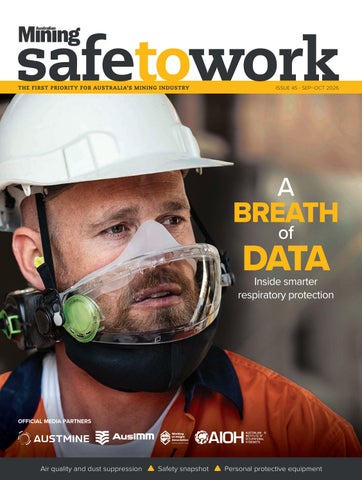
Founded in Australia in 2009, CleanSpace Technology has pioneered innovative respiratory protection, developing lightweight, ergonomic powered air-purifying respirators (PAPRs) for industries including construction, mining, healthcare and manufacturing. Its compact respirators are designed without belts or hoses, making them easy to wear and use. Trusted by workers in more than 77 countries, CleanSpace also provides support, training, and resources to help organisations implement respiratory protection effectively. Image: CleanSpace
BUSINESS DEVELOPMENT MANAGER Jake Niehus M: 0466 929 675 E: jacob.niehus@primecreative.com.au ART DIRECTOR Michelle Weston SUBSCRIPTION RATES Australia (surface mail) $140.00 (incl GST) New Zealand A$148.00 Overseas A$156.00 For subscriptions enquiries please call 03 9690 8766
SAFETOWORK.COM.AU 3 SEP–OCT 2026
PRIME CREATIVE MEDIA 379 Docklands Drive Docklands, VIC 3008 Australia www.primecreative.com.au © Copyright Prime Creative Media, 2016 All rights reserved. No part of the publication may be reproduced or copied in any form or by any means without the written permission of the publisher.
In this issue
Features 10
A new ceiling for exposure Staying below the new limits for airborne contaminants does not always mean the job is done, with mining companies urged to look beyond just the numbers.
12
AGILE’s data advantage CleanSpace is helping operators take a data-driven approach to safety by expanding its Insights reporting platform to include its latest respiratory innovation.
17
Capturing dust at the source Grydale combines advanced dust collection systems with on-the-ground support to help mining companies create safer and cleaner operations.
20
Ticking the boxes BreatheSafe has developed a practical guide on airborne contaminants and a checklist to help operators prepare for the transition to new exposure limits.
17 26
The cabin safeguard SmartTech Australia is helping protect equipment operators with BMair’s advanced cabin air filtration technology.
38
A dose of safety Anglo American has supported a simulated mine emergency workshop, that brought doctors and rescue personnel together for an important session.
48
Putting minds first The Queensland Mining & Engineering Exhibition 2026 highlighted how leadership, workplace culture and better systems help protect workers’ psychological health.
52
Safety leads the way Perth will host two of mining’s biggest events this month; the WA Mining Conference and Exhibition and the Australian Mining Prospect Awards.
26
54
Shedding new light on safety The industry came together at the Queensland Mining Industry Health and Safety Conference in August to share insights, tackle emerging risks and strengthen safety across the state’s mining sector.
Regulars
3 Comment 8 Safety snapshot
38 SAFETOWORK.COM.AU 4 SEP–OCT 2026
BENEFITS Improve Hydration Efficiency Boosts Daily Energy Levels Enhance Mental Clarity Muscle Function & Recovery
Want samples? Contact us here
PROTECTING THE CREW INSIDE & OUT
One SMART partner, Nationwide
artte
a
tra ia o
a
Safety snapshot
Image: naevermillion/stock.adobe.com
Safety in focus Safety has remained a key part of Australia’s mining conversation, with new initiatives, regulatory priorities and operational improvements taking shape across the sector.
T
he last two months have brought fresh attention to critical controls, mobile plant, road safety and the elimination of high-risk work. Safe to Work rounds up the latest developments and incident lessons from across the mining industry.
Safety insights
Mobile plant safety remained a key priority for New South Wales regulators, with SafeWork NSW naming it among four focus areas for 2026–27 alongside falls from heights, psychosocial risks and hazardous substances. The priorities reflected hazards that contributed to serious injuries and fatalities across the state. BHP reported strong and reliable operations during FY26, with chief executive Brandon Craig identifying further opportunities to improve safety, productivity and reliability through the company’s operating system and technology. Major miners also continued to strengthen their approaches, with Rio Tinto introducing a new management system, Mineral Resources lifting its injury reporting standards and Ramelius Resources reporting early gains from a targeted safety initiative. Engineering controls received industry recognition when Anglo American’s Armadillo excavation system won the Macmahon Safety Initiative
Award at the 2026 Queensland Mining Awards. The system removed workers from excavation work over live conveyors at Aquila Mine, replacing a higher-risk task with a purpose-built engineering solution. Western Australian mine operators also received new guidance on managing vehicles, mobile plant and pedestrians, with a new code of practice providing practical direction on road and traffic management. Meanwhile, the NSW Resources Regulator announced a targeted vehicle safety campaign following the fatal United Wambo incident on August 3.
Safety incidents
Vehicle and traffic risks featured in several NSW incidents, including a near miss between two haul trucks after one failed to give way at a T-intersection. Another collision involved a reversing haul truck and a stationary vehicle, with faulty cameras, poor visibility and incorrect visual cues identified as contributing factors. Ground and structural risks were also highlighted after a dozer became stranded when the ground beneath it gave way on a coal stockpile. In another incident, a rock broke away from a dig face and struck an excavator walkway, narrowly missing the operator’s cabin. SAFETOWORK.COM.AU 8 SEP–OCT 2026
Equipment integrity came into focus when a haul truck’s steering wheel detached while travelling at about 41km/h, although the operator was able to bring the vehicle to a safe stop. The incident reinforced the importance of effective defect reporting and inspection processes. Stored energy presented another hazard when a worker was struck by a section of steel pipe during decommissioning work at a Queensland mine. A separate maintenance incident saw a tyre fitter suffer fractured vertebrae after a tyre fell across his legs during work on an underground drill rig. Fall prevention was also reinforced following a fatal incident at a Western Australian processing plant, where preliminary information suggested a contract worker may have fallen through an opening in a grid mesh platform during maintenance. WorkSafe WA issued recommendations while its investigation continued. A light vehicle fire at a NSW underground metals mine also prompted a review of plant modification processes after flames were detected near the rear wheel. The operator safely stopped the vehicle and extinguished the fire before the wheel hub and tyre were cooled.
DON’T JUST WEAR PROTECTION
CAPTURE DUST Helping you plan, improve and limit your workers dust exposure.
As Workplace Exposure Limits change from 1 December 2026, effective dust control is more critical than ever. Grydale designs practical engineered dust extraction systems that capture dust at the source. Independently tested to 99.99% collection efficiency, Grydale solutions help sites reduce risk while supporting compliance and worker health. Learn more at grydale.com.au
Group
Revise your WEL dust control plan before the changes, contact us today. 1300 929 349 enquiries@grydale.com.au
Air quality
A new ceiling for exposure Staying below the new limits for airborne contaminants does not necessarily mean the job is done, with mining companies urged to look beyond the numbers. various particles in the air, such as silica dust, diesel particulate matter and metals found in welding fumes. While they may not always be seen or smelt, even the slightest exposure to them can have significant long-term health effects. The introduction of the WELs now marks a significant step in improving safety across the mining industry and its workforce. Under the new framework, persons conducting a business or undertaking (PCBUs) must undertake air quality monitoring to ensure workers aren’t exposed to an airborne contaminant above the relevant limit. PCBUs must also further eliminate any airborne particles as reasonably practicable or minimise any potential hazards and risks.
It is important to note that an individual WEL is not a dividing line between a healthy and unhealthy work environment, as individual susceptibility means some workers may still be affected from exposure levels below the WEL. For those unsure how to prepare for the transition, Safe Work Australia recommends PCBUs follow a threestep process, starting with identifying which airborne contaminants are used or generated and checking whether their limits have changed, assessing exposure and implementing controls to ensure the new limits are not exceeded. One of the key challenges for mining operations, according to University of Queensland occupational health researcher and mining engineer
Image: Beto Santillan/stock.adobe.com
A
re airborne contaminant exposure levels being treated as target when they really should be a ceiling? That question sits at the heart of Australia’s transition from the current Workplace Exposure Standards (WES) to the Workplace Exposure Limits (WELs), which will be introduced from December 1. The change is about more than just terminology, aiming to completely reassesses how airborne contaminants are controlled, following a comprehensive review to ensure the limits reflect evolving health advice and worldwide language. Mining environments are especially susceptible to airborne contaminants due to the extraction processes and diesel equipment used, which leave
The Workplace Exposure Limits for airborne contaminants will be introduced on December 1.
SAFETOWORK.COM.AU 10 SEP–OCT 2026
Operators must ensure workers aren’t exposed to an airborne contaminant above the new exposure limits.
Image: Parilov/stock.adobe.com
Nikky LaBranche, is being across the full range of contaminants present on a site. As the lead researcher of the Dust and Respiratory Health Program at the university’s Sustainable Minerals Institute, LaBranche has extensive experience focusing on safe work practices to combat the effects of airborne contaminants. “Mining operations typically test for total respirable dust and respirable crystalline silica but testing for metals is often focused on specific tasks such as welding,” she said. “What we are finding in mine maintenance workshops is that some metal containing particles can be found in the air even when there’s no active welding. So it’s important mining operations understand which contaminants are present and where they are being generated, so they can implement preventative controls.” LaBranche’s research is focused on examining the size and shape of airborne particles, highlighting that two environments containing the same mass of dust can present different risks. “The WELs are based on the total mass of dust, but what I’m finding is that one mine can have 20 times the number of particles in the same mass because of the difference in particle size,” she said. “When you have smaller particles, they can penetrate deeper into the lungs and cause disease, so we’re starting to get to the point where it’s not just about that total limit, it’s much more about the characteristics of that dust.” Technology is also providing new opportunities to improve monitoring and controls, including advances in cab filtration. Working with a leading company in this field, LaBranche is applying her research on the size and characteristics of individual dust particles to validate real-time monitoring equipment and improve the reliability and interpretation of its measurements.
A new regulatory landscape
The introduction of the WELs follows the first review of the WES since 2003, with the changes reflecting a growing understanding of the health risks associated with workplace exposure. Silicosis, an incurable lung disease caused by breathing in tiny bits of crystalline silica dust, has received renewed attention following cases among engineered stone workers, while some coal miners have been diagnosed with pneumoconiosis, also known as black lung. LaBranche said chronic obstructive pulmonary disease (COPD), including chronic bronchitis and emphysema, is currently the most commonly reported mine dust lung disease in Queensland. To help prevent these respiratory diseases and support compliance, Safe Work Australia has developed an airborne contaminants hub for PCBUs. The easy-to-use online resource includes downloadable fact sheets, infographics and a comparison table that outlines how current standards will change under the limits. It also offers practical advice on how to assess and manage exposure using the hierarchy of controls.
As part of the online hub, Safe Work Australia recently published three resource guides that provide tailored information for employers, occupational hygienists and other technical specialists, as well as workers and businesses where exposure to airborne contaminants may occur. This includes the Guide for PCBUs: Air monitoring and the workplace exposure limits for airborne contaminants, the Technical guide: Air monitoring and the workplace exposure limits for airborne contaminants, and Managing the risks of exposure to diesel engine emissions in the workplace. All resources provided by Safe Work Australia are designed to support mining companies prepare for the change in regulations, with this initiative welcomed by LaBranche. “It’s always better to move up the hierarchy of controls of managing airborne contaminants if it’s practical to do so,” she said. “The lowest level is personal protective equipment, so if mining companies can use elimination or engineering controls, they will see better safety outcomes.”
SAFETOWORK.COM.AU 11 SEP–OCT 2026
Air quality CleanSpace’s AGILE is a loosefitting respirator certified for all face types.
AGILE’s data advantage CleanSpace is helping operators take a data-driven approach to safety by expanding its Insights reporting platform to include its latest respiratory innovation. staff at many worksites around Stockholm. It’s important that they’re protected. The Insights Report gives me that information completely automatically, without me having to chase anyone down,” the Stockpipe representative said. “With the Insights Report, we can see that their respiratory protection is working, and if it isn’t,
we can help our welders with training and fit testing. I can also show customers and authorities that our welders are protected against the hazardous work environment.” The success of the Insights Report and SMART App has led CleanSpace to expand the use of the platform to the latest addition in their range, the CleanSpace AGILE.
AGILE can operate for seven hours on a single charge.
SAFETOWORK.COM.AU 12 SEP–OCT 2026
Images: CleanSpace
W
hen it comes to safety compliance, the real story is in the numbers. In Stockholm, safety has always been a key consideration for Stockpipe AB and its workers. The Swedish-based pipe installation and welding contractor has a vast workforce that is often on-site at short notice, working across fumeheavy environments. While safety has always been critical for the contractor, ensuring that protective equipment, including respiratory gear, is regularly used has been difficult to track. After all, how can you monitor whether equipment is actually being utilised as intended and functioning correctly across multiple sites and sectors? That all changed when Stockpipe introduced CleanSpace’s Insights Report and SMART App across its workforce, solving a conundrum that had confounded it for years. “It’s important that our workers are protected. At Stockpipe, we have
CleanSpace AGILE is the company’s first loose-fitting powered air-purifying respirator (PAPR), certified for all face types, including facial hair, eliminating the need for fit tests. Its half facepiece is comfortable and loose-fitting. It is designed for all face types and covers the nose and mouth without needing a tight seal. Equipped with CleanSpace’s patented AirSensit technology, it enables real-time airflow adjustments, in response to the wearer’s breathing. The transparent facepiece is a key feature of AGILE, allowing compatibility with helmets, eyewear, and earmuffs, while maintaining visibility and communication. AGILE, featuring a compact batterypowered device weighing less than 425 grams, can operate for up to seven hours on a single charge, which is enough for a typical shift. The kit includes a universal charger for quick recharging if needed between tasks. “The design of AGILE really supports compliance because it can be used pretty much anywhere by anyone,” CleanSpace global technical product director Jon Imms said. “The facepiece takes comfort to a different level, and with it being a onesize facepiece, it is going to work for you. The current half-mask provides good visibility, but we’ve also found that voice can transfer well through the polycarbonate.” Now, CleanSpace’s latest innovation will be integrated with the Insights reporting platform, enabling safety managers to track filter life and compliance data, such as usage, across their workforce using the AGILE PAPR solution. The ability to track these elements in heavy industrial sectors like mining, where workers are frequently subjected to contaminants and other invisible hazards, has an invaluable impact on worksite safety. “We’re now seeing a real push toward gathering continual data on how equipment is actually used in real working conditions,” CleanSpace director of commercial solutions Judith Waugh said.
CleanSpace’s SMART App shows filter status, battery level, protection metrics and live gas and vapour filter lifespan data.
The Insights Platform extends CleanSpace’s SMART App, which currently offers dashboard views of filter status, battery level, protection metrics, and live data on gas and vapour filter lifespan for the current CST range. It enhances this by using real-time CST ULTRA data from the SMART App and syncing it through the app’s interface to the CleanSpace cloud platform. Now with the addition of AGILE, sites can nominate to receive a single unit reports with AGILE data, or combine the data from their CST ULTRA and AGILE fleet into a multi-unit report – valuable insights that support safety initiatives and compliance monitoring at worksites. “We can see, down to the minute, how long units were used. That level of visibility lets sites ask the right questions and close the gaps before they become problems,” Waugh said. Essentially, it consolidates formerly scattered or manual records into
a modern system aligned with a company’s compliance requirements. All user data remains deidentified; CleanSpace only accesses information pertaining to respirator serial number, maintaining privacy while permitting useful analysis. Sites can compare serial numbers to their records to spot patterns; for instance, why a specific respirator’s filters last twice as long, whether workers spent equal time in high-dust zones, or if a device remained unused during a shift where it was expected to be in use. As a trusted partner for its customers, CleanSpace’s team can work with the client to learn how to interpret and use this data to support its operations. “Data always tells the truth,” Waugh said. “It’s not about pointing fingers or telling someone they’re doing the wrong thing. “It is about working together to make sure that, at the end of the day, the worker is safe.”
SAFETOWORK.COM.AU 13 SEP–OCT 2026
A Practical Cabin Compliance Check
AI-POWERED ENTERPRISE ASSET MANAGMENT SOFTWARE
From hours of work. Minutes of conversation. From planning and scheduling to permitting and safety, the Prometheus-AI Platform does the heavy lifting across your mining and resources operation.
GWOS-AI | PLANNING & SCHEDULING
Just tell it what to schedule. Plain-language commands move crews and run mass changes in minutes, instead of hours. GWOS-AI does the work; your team reviews and approves.
E PAS -A I | E L E C T R O N I C P E R M I T T I N G & SA F E T Y
Just ask about any permit. How many hot-work permits are active? What's awaiting approval? What's the average cycle time by type? ePAS-AI answers instantly
Air quality Grydale’s solutions aim to capture more than 99.99 per cent of airborne contaminants.
Capturing dust at the source Grydale combines advanced dust collection systems with on-the-ground support to help mining companies create safer and cleaner operations. with each system playing a different role on site. Fixed units are commonly installed in processing plants and transfer points, mobile systems can be relocated as dust sources shift, while onboard units capture contaminants directly from drilling and mobile equipment. In addition, the systems have been designed to self-clean continuously, reducing equipment downtime.
Each unit is connected to the Internet of Things, enabling operators to remotely control the system and respond to changing dust conditions without entering hazardous areas. “We want to ensure mine sites get the best fit-for-purpose solutions to improve air quality,” De Andrade said. “We’re seeing more issues being caused to operations from a lack of dust management and we have the technology to collect it.”
SAFETOWORK.COM.AU 17 SEP–OCT 2026
Ongoing field support is a key component of Grydale’s offerings.
Images: Grydale
W
hen Alex De Andrade was asked to come on board as the chief executive officer of Grydale, the decision was a “no-brainer”. The company’s genuine passion for improving safety outcomes shone through its employees and De Andrade said he knew he wanted to be part of the journey. “I couldn’t look past the opportunity to help contribute to a safer working environment,” he told Safe to Work. “We’re motivated to leave a legacy in a space that needs attention. “Our team wants to retire one day knowing that the next generation will be safer on mine sites because our machines have improved the air quality in the environment that they’re working in.” Specialising in dust control solutions, Grydale aims to solve the issues associated with air quality in mining through its fixed, mobile and onboard dust collection systems. These machines capture dust at the source before it becomes airborne,
Air quality The particles that get into people’s lungs are often the ones you can’t see in the air, according to De Andrade. “It might seem like you have adequate controls, but once it’s measured, you realise that it’s not all being captured,” he said. With the Workplace Exposure Limits (WEL) for airborne contaminants placing greater emphasis on measurable dust controls, De Andrade said many mining companies are turning to Grydale to bridge the gap between their old infrastructure and modern solutions. Older dust-collecting equipment may fall short on air quality compliance, but Grydale’s technology captures more than 99.99 per cent of airborne contaminants while keeping exposure below the WELs, creating not only a safer working environment but also helping meet evolving compliance requirements. “Our systems supplement the vacuum heating, ventilation, and air conditioning system or the ventilation system at an industry site installation, and reduces the biggest contributor towards the dust that is being created,” De Andrade said. While personal protective equipment is a critical defence against the long-term health risks posed by dust, De Andrade said that using this strategy alone may not be sufficient. Instead, he said effective dust management requires various controls that work together to improve air quality. Other common strategies to suppress airborne contaminants include water trucks and spray fans, but when the mining environment gets wet, it can compromise equipment reliability, create mud, and pose potential contamination risks. However, Grydale’s technology avoids some of the challenges by providing dry filtration solutions. As each mine faces different challenges depending on its circumstances, Grydale brings the expertise to deliver solutions that fit its customers’ individual needs. This is evident through
U E Grydale provides fixed, mobile and onboard dust collection systems.
The dust-collecting systems can help mines ensure they are compliant with the workplace exposure limits.
the company’s registered independent auditors, who conduct site visits to recommend improvements to the working environment. “They are obliged under their professional accreditation and their qualifications to be impartial and call it out like it is,” De Andrade said. “Customers can then make their own decision on if they want to engage with us. “We are totally happy even if they have decided on something else, because it means they still want to make a safety difference and that on its own is a great step forward.” Beyond its equipment, Grydale provides ongoing field support and readily available spare parts to ensure customer expectations are not only met but exceeded. Its team also provides the knowledge to assist with meeting WELs, so mine sites
are confident that their workforce is operating in clean air. De Andrade said he sees Grydale as much more than just an equipment manufacturer. The company also invests heavily in apprenticeships, with many apprentices eventually becoming engineers due to their passion for creating safer workplaces. De Andrade said the goal is to help the mining industry look beyond the return on investment of safety equipment and consider the longterm consequences of inadequate dust control. “We’re seeing miners suffering from silicosis 10, 15 and 20 years later,” he said. “Something really needs to be done to combat this earlier and that’s why I entered this space, to develop solutions that offer a better environment for everyone.”
SAFETOWORK.COM.AU 18 SEP–OCT 2026
Unified Protection Exceptional Comfort Experience comprehensive worksite protection that keeps your workforce safe, compliant, and ready for any challenge.
3M™ PELTOR™ Communication Solutions Maintain clear team communication in noisy environments—no visor lift required, preserving respiratory protection
3M™ Versaflo™ Headtops Respiratory Protection that can offer integrated head, eye, face & hearing protection
3M™ Versaflo™ Accessories Durable backpacks, belts, cap lamp brackets and more for comfortable, practical use in harsh mining environments
3M Australia Pty Ltd Bld A, 1 Rivett Road North Ryde, NSW 2113 Customer Services: 1300 363 565 Email: 3msupport.safety.au@mmm.com go.3M.com/AUMining
Request a Demo at go.3M.com/talktous or Scan the QR Code 3M, PELTOR and Versaflo are trademarks of 3M Company. © 3M 2025. All rights reserved.
Air quality
BreatheSafe is helping operations prepare for the new Workplace Exposure Limits.
Ticking the boxes BreatheSafe has developed a practical guide on airborne contaminants and a checklist to help operators prepare for the transition to new exposure limits.
E
very worker, according to Simon Arbuckle, has the right to return home with a clean set of lungs. As the technical product specialist at BreatheSafe, his sentiment embodies the air quality expert’s approach to managing harmful airborne contaminants on mine sites. With regulations tightening and the introduction of the Workplace Exposure Limits (WELs) drawing closer, BreatheSafe is helping mining operations prepare for the changes, equipping them with the tools they need to get ahead. The company has created a practical guide for mobile equipment operators, covering everything from regulatory changes and responsibilities of persons
conducting a business or undertaking (PCBUs), to preparation strategies and cabin review checklists. Arbuckle said the resource was created after BreatheSafe identified that many PCBUs did not completely understand what they needed to do to be compliant. “It can be difficult to navigate complex and in-depth standards, so this guide aims to provide education to empower decisions that protect workers and those at risk,” he told Safe to Work. “We hope that it offers mining operations an understanding that there are far more risks than what is visible to the naked eye.” While the focus is firmly on safety and compliance, Arbuckle said the
guide’s lessons and procedures can also support productivity by reducing exposure risks that lead to worker illness and operational disruptions. “It’s a win for all involved – compliance, protection and safe work environments benefit workers, their families and the business they are employed by,” he said. The first step in reducing worker exposure, according to Arbuckle, is understanding exactly what hazards are present on site and reviewing them against the WELs list. Once identified, mining operations can begin assessing whether their existing controls are adequate. Dust suppression systems and personal protective equipment remain important controls, but BreatheSafe
SAFETOWORK.COM.AU 20 SEP–OCT 2026
Images: BreatheSafe
believes it’s equally critical to have preventative measures inside equipment cabins. For this reason, the company has also developed a mobile equipment cabin review checklist to help identify whether sufficient controls are in place and where improvements may be needed. Arbuckle said if boxes cannot be ticked, miners can consult industry experts such as BreatheSafe for further guidance. “Customers often don’t always know exactly what they need, and this service allows further engagement into a field that can be foreign,” he said. “Where controls don’t exist, action can be promptly taken to protect the worker and proactively determine an effective solution to be implemented. “BreatheSafe can then advise any recommended measures for consideration, given its experience in identifying and executing engineering controls to manage the risk of airborne contaminant exposure.” Recommended solutions could include any of BreatheSafe’s systems. These include intelligent cabin air quality, high-efficiency particulate air (HEPA) filtration, and pressurisation systems, protecting operators from exposure to airborne particles that can cause long-term health issues. Rather than simply providing offthe-shelf equipment, BreatheSafe works directly with its customers to design and manufacture its air quality solutions, ensuring every system fits the unique requirements of each site. “Air quality is a specialist field and we understand that there is no onesize-fits-all solution,” Arbuckle said. The company’s air quality systems use dual HEPA filtration for both fresh and re-circulated air, combined with positive cabin pressure to prevent airborne contaminants from entering an operator’s cabin environment. All systems are also equipped with active air-quality monitoring and data-logging capabilities, providing operators with measurable performance data over time.
BreatheSafe technical product specialist Simon Arbuckle (left).
BreatheSafe works directly with its customers to design and manufacture air quality solutions for mobile equipment.
Arbuckle said operators can evaluate this data through BreatheSafe’s free auditing portal, with performance assessed in line with the international standard – air quality control systems for operator enclosures (ISO23875). BreatheSafe’s support for its customers’ equipment extends well beyond system installation and is provided over the whole life cycle of the solution. An example of this longterm partnership approach pointed out by Arbuckle, is BreatheSafe’s work with Brisbane-based Lind Contracting in a cement clinker application. Operating in a harsh, tough environment, Lind Contracting fitted one of its excavators with a BreatheSafe OnGuard Real Time Monitoring System to create a safe breathing zone for its operators.
The system achieved this by controlling the volume of air required to maintain positive cabin pressure, reducing carbon dioxide levels and diesel particulate matter in the cabin. “To this day, we continue to monitor effectiveness via particulate measurements with OnGuard telemetry,” Arbuckle said. Feedback from customers such as Lind Contracting has played an important role in helping BreatheSafe refine both its products and support services as mining companies prepare for the upcoming airborne contaminants WELs. At the heart of that goal, Arbuckle said, is a simple principle: “Protecting workers is ingrained deep into our culture; we honour our legacy every day.”
SAFETOWORK.COM.AU 21 SEP–OCT 2026
Clear Visibility. Smarter Efficiency. Everyone Home Safe.
D ct nte a ti e patial nsig ts
ti n an e a et M nit ing
t
i
t t c ss t mati n
at it i et
Dispatch Optimising Fleet Management
t ipment ealt
a
A Scalable Platform for complete Mine Ecosystem Management
D
Si
ac i
s
ti ati a
D
a ic ts
D
Sit ati a
sti ai t as cc pa c p s hic s
S a t i hti S ti s
a ss
Dispatch FMS Dispatch FMS
c ss t ati
itica cti it at th ac
t
api si i c i
p
D cti
a i ts
a i
p
i
t
a ta s
st
M
ts
M S
ss t M
EMEA
APAC
a th it i
www.mstglobal.com
t
Ma ati
ast
it i
t ati s it t
a t
i i isi a i isi
p
s
AMERICAS
ASIA
ts a s cti
Air quality
Images: Force360
Safety from all angles Rather than replacing higher-order controls, Force360’s respiratory protection equipment is designed to add an extra layer of defence against airborne contaminants.
T
here is no single respirator suited to every mining environment, just as there is no single airborne contaminant risk. From dust-generating processing activities to underground work, the hazards can change – and so too should the approach to respiratory protection. This awareness forms Force360’s respiratory protection offering. “Respiratory protection has to work across changing mining environments, and that’s why Force360 offers a complete respiratory pathway rather than a one-size-fits-all product,” Force360 category manager for respiratory Anthony Hawton said. As an Australian personal protective equipment (PPE) provider focused on high-risk industries, Force360 provides a range of respiratory protection equipment for miners, which enables them to select products around specific airborne contaminants, exposure levels, task duration and the requirements of individual workers. The company offers everything from flat-fold disposable and reusable halfface respirators with particulate filters to full-face options, gas, vapour and combination cartridges and powered air-purifying respirator (PAPR) solutions. The importance of PPE in managing exposure to airborne contaminants should always be front of mind. While implementing higher-order controls
is the ideal solution, respiratory PPE can provide an additional layer of protection where risks remain. “Mining companies may consider PAPRs for extended wear, physically demanding work, higher particulate protection requirements, workers who struggle with the breathing resistance of negative-pressure respirators, or where a loose-fitting hood is appropriate for someone unable to achieve a seal in a tight-fitting mask,” Hawton said. Force360’s ability to provide equipment with powered airflow also reduces the breathing burden for mining workers compared with conventional negative-pressure respirators, improving wearer comfort and helping to ensure there is a willingness to keep the protection on throughout a shift. Where eye and face hazards also exist, a suitable hood, helmet or full-face Force360 configuration can provide further practical benefits. PAPRs can also offer more protection for workers with certain types of facial
Force360 can offer powered air-purifying respirators for mine workers.
hair, as they provide positive pressure into a head top. Hawton said advances in PAPR technology have focused on improving the operator experience by making the equipment more comfortable and easier to manage over long shifts. Recent developments have included lighter systems with better battery performance, visual and audible alarms and greater modular head top and filter options. Features such as airflow and battery alerts help workers identify when the equipment requires attention, while modular components can make it easier to match a system to the task. However, Hawton said technology cannot deliver effective respiratory protection on its own. “The benefits are only realised when the equipment is part of a wellmanaged program with inspection, cleaning, maintenance and training,” he said.
SAFETOWORK.COM.AU 23 SEP–OCT 2026
Air quality This approach will become even more important as Australia moves towards its new Workplace Exposure Limits (WEL). To ensure compliance, miners will need to identify airborne contaminants present on-site, review their exposure data against the WEL list and implement measures that prevent exposure levels from exceeding the relevant limit. That places a greater emphasis on understanding the specific exposure associated with each task rather than simply selecting respiratory equipment based on general site requirements. One common mistake, according to Hawton, is using respiratory PPE as the primary control to combat airborne contaminants when it is more suited to complementing higher-order measures. When paired with these controls, Force360’s respiratory PPE should be correctly fitted, maintained and used by trained workers to achieve the most effective outcomes.
“Mining companies should review tasks and contaminant profiles now, involve occupational hygiene expertise where needed, and establish a documented respiratory protection program with training, fit-testing, inspection and review,” Hawton said. “Force360 supports a site’s respiratory protection program by providing certified equipment across multiple protection levels, plus product and selection guidance.” Selecting respiratory protection equipment should always begin with a risk assessment, rather than relying on preference alone. That process also requires an understanding of how different respiratory protection systems work together. The respirator itself forms the facepiece, creating the seal and holding the filtration components, while particulate filters capture airborne dusts, mists and fumes. Force360’s P2-classed filters are suited to mechanically and thermally generated particles, while the P3classed filters add protection from
highly toxic or irritating particulates. However, the protection provided depends on the complete system. “Our reusable Corpro range is designed around comfort, low breathing resistance, a secure fit and straightforward maintenance,” Hawton said. Beyond its products, Force360’s experienced employees can support Australian miners with equipment selection, on-site training and practical respiratory-protection guidance. This reinforces the company’s goal of helping mining operations build fit-for-purpose respiratory programs, rather than solely PPE. “There is no universal best respirator; only the right respiratory system for the specific contaminant, concentration, task, wearer and control strategy,” Hawton said. “Our approach is to develop reliable, fully certified, fit-for-purpose PPE that helps protect workers in demanding conditions, while making selection, use and compliance easier for safety teams.”
Force360 provides flat-fold disposable and reusable half-face respirators with particulate filters.
SAFETOWORK.COM.AU 24 SEP–OCT 2026
REMA-T
REMA-TIPTOP-STW-FULL_200x265mm_300INK_v01.indd 1
3/2/2026 4:34 pm
Air quality
The cabin safeguard As awareness of airborne contaminants continues to grow, SmartTech Australia is helping protect equipment operators with BMair’s advanced cabin air filtration technology.
SmartTech Australia has partnered with BMair to make the company’s cabin air filtration technology available to Australian mining operations.
to ensure that operators have the best opportunity to succeed and stay safe,” he said. “I have a very strong belief that people should go home from every shift clean, happy, and safe, and this partnership is about making that a nationwide reality.” BMair’s ventilation systems are designed to protect equipment operators from breathing in harmful airborne contaminants, including hazardous gases, when fitted with the appropriate optional filter. The technology works by drawing in contaminated outdoor air through a multi-stage filtration system, including a pre-filter and a high-efficiency particulate air (HEPA) filter, before supplying clean air to the operator.
Images: SmartTech Australia
“E
veryone is entitled to healthy air.” That’s SmartTech Australia general manager Jason Fisher’s core belief. Delivering on that principle means ensuring workers are protected wherever their role takes them – including inside the cab of heavy machinery. When operators step into a cabin, they may be shielded from external hazardous elements, but what about those inside? Airborne contaminants such as silica dust and diesel particulate matter can still enter the cabin during operation, making effective exposure management critical to protecting operator health. SmartTech Australia, a mining technology solutions provider, is addressing this issue through a partnership with Netherlandsbased protective ventilation system manufacturer BMair. As part of the collaboration, BMair’s advanced cabin air filtration technology has been made available to mining operations across the country. The partnership combines SmartTech’s nationwide support network with BMair’s proven cabin filtration systems, certified to Australian and international mining standards, including Queensland Recognised Standard 20: dust control in surface mines (RS20) and Air Quality Standards in Australia (ISO 23875). Fisher said the partnership aligns closely with the company’s broader philosophy of improving safety, sustainability along with operational performance across the board. “I think it’s a fantastic opportunity. There’s clearly a need within Australia
While this may seem like any standard filtration system, BMair business development and original equipment manufacturer (OEM) director Robbert Boersma said the technology is far more advanced. “Our system pushes the filtered air inside the cabin into an overpressure, so the operator is surrounded by clean air,” he said. The positive pressure created inside the cabin then forces the airflow outward through small openings, preventing contaminants from entering through those gaps and maintaining clean cabin air throughout a shift. BMair systems have also been designed for easy integration across diverse mining fleets. Virtually any mining machine with a closed cabin
SAFETOWORK.COM.AU 26 SEP–OCT 2026
can be fitted, with the core protector unit able to be easily mounted onto the roof. SmartTech also offers alternative BMair models like low-profile or fender-mounted units, designed especially for equipment with limited space or unusual-shaped cabins. Installation is handled by SmartTech’s certified technicians, who calibrate the systems during a single on-site visit before commissioning them for operation. All BMair ventilation systems are accompanied by a digital smart controller which continuously monitors air quality with built-in sensors and logs the data into an online portal. The recorded data can help mining companies demonstrate compliance with Australia’s new Workplace Exposure Limits for airborne contaminants, which come into effect on December 1. During an inspection or audit, mine managers can instantly retrieve these digital reports, showing inspectors that each machine has maintained safe air quality, with exposures remaining within safe limits required by the new regulation. “Apart from creating a safe work environment for the operator, we’re also creating a safe environment for our customers because they have all the data about the system to show that it’s working properly,” Boersma said. “With our system and the online platform, it’s all taken care of.” While regulatory changes are driving greater interest in cabin air quality, Boersma believes awareness among operators still has room to grow. He said many operators can be put off by new technology due to an overwhelming amount of alerts, but BMair eliminates this by quietly going about its business. “Sitting in a machine cabin, operators can get various alerts popping up and telling them they’re doing something wrong, so they often avoid using new technology,” Boersma said.
“With the BMair system, what’s great is that it sits back and keeps the operator healthy without them having to do anything. “There’s no alerting, and if there is, it’s as simple as something like closing the door to ensure the operator doesn’t lose pressure.” Feedback from operators using the BMair systems has reinforced the value of cleaner cabin air.
“Many people tell us they didn’t know technology like this was an option,” Boersma said. “Others say things like I can’t taste the dust or smell it anymore. The most fundamental thing is the ability to breathe without risk, which is critical to operator happiness. “If they’re being taken care of, not only will their long-term health improve but also their productivity at work.”
Virtually any mining machine with a closed cabin can be fitted with a BMair unit. BMair’s ventilation systems are designed to protect equipment operators from breathing in harmful airborne contaminants.
SAFETOWORK.COM.AU 27 SEP–OCT 2026
3014IMP Impact Resistance
Impact ExoskelExoskel eton Spandex Shell
Impacts come in all forms, shapes, and magnitudes for workers. Whether causedbyfallingtools,equipmentorpinches,impactinjurieshaveonethingin common:unpredictability.Individualsmustalwaysbepreparedandprotected from impact and pinch points, and the patented IR-X® Impact Exoskeleton™ from HexArmor® has proven to reduce the number and effects of injuries.
Liner
High-level impact protection
Enhanced grip in oily conditions
Exceptional cut resistance
Scan or click for more information
STW - Full page Ad (August).indd 1
12/08/2026 4:18:29 PM
26 4:18:29 PM
Air quality
A handy resource The latest whitepaper by 3M explains what lower Workplace Exposure Limits mean for respirator selection and worker protection.
W
hat was considered an acceptable level of airborne exposure a decade ago may no longer be considered safe today. As occupational health research evolves, regulators have continued to lower exposure limits to reflect the latest scientific evidence and reduce the risk of work-related illness. Australia’s transition from Workplace Exposure Standards (WES) to Workplace Exposure Limits (WEL) in December, alongside ongoing revisions to New Zealand’s WES, reflects this shift. These changes will require miners and employers to rethink how they manage respiratory risks and whether existing controls still provide adequate protection. For many businesses, respiratory protective equipment (RPE) has long
been a key part of controlling airborne hazards. But when exposure limits are lowered, a respirator that once met the required standard may no longer offer enough protection. Compliance is, as a result, about ensuring the right respirator is used for the level of risk. Central to that assessment is the Assigned Protection Factor (APF), which indicates the level of protection a properly selected, fitted, maintained and used respirator can provide. By comparing workplace exposure levels with the applicable exposure limit, safety professionals can determine the minimum level of respiratory protection required. As exposure limits become more stringent, that calculation will become even more important. However, respiratory protection is about far more than selecting a respirator with the right APF.
Standards such as AS/NZS 1715 and SA/SNZ TS ISO 16975.1 make it clear that effective respiratory protection depends on a complete program that includes exposure assessment, fit testing, training, maintenance, user competency and ongoing review. Without these elements, even an appropriately specified respirator may fail to deliver the protection expected in real-world conditions. Lower exposure limits also often expose weaknesses that have gone unnoticed. Ventilation systems that were once considered adequate may no longer control contaminants sufficiently. Exposure monitoring may be outdated, while workers may be relying on respirators that no longer provide the required level of protection. That does not automatically mean upgrading respiratory equipment
Images: 3M
Effective respiratory protection depends on understanding the relationship between the hazard, the worker and the task.
SAFETOWORK.COM.AU 29 SEP–OCT 2026
Air quality
3M’s latest white paper breaks down how the right respirator can help operations stay compliant.
is the answer, as the hierarchy of controls remains the foundation of occupational health management. Before increasing reliance on personal protective equipment, employers should first consider whether hazards can be eliminated, substituted, isolated or controlled through engineering and administrative measures. Once those controls have been reviewed, organisations can reassess their respiratory protection program. The first step is understanding how exposure limits have changed and which contaminants or work activities are affected. Existing exposure monitoring should then be evaluated to determine whether it remains valid under the revised limits. Where necessary, additional occupational hygiene monitoring may be required before calculating the Required Minimum Protection Factor (RMPF) and confirming whether existing respirators remain suitable. The outcome of that process can have significant practical implications. Workplaces that previously relied on disposable or half-face respirators may find they now require full-face respirators, powered air-purifying respirators (PAPRs) or suppliedair systems. Those decisions extend well beyond equipment selection, influencing procurement, maintenance, training, operational
procedures as well as long-term program management. Selecting the right respirator also requires a broader view than protection factors alone. Effective respiratory protection depends on understanding the relationship between the hazard, the worker, the task, the environment and the equipment itself. Communication requirements, heat stress, facial hair, maintenance capabilities and the length of time a respirator must be worn can all affect whether it performs as intended. A respirator that achieves excellent laboratory results is of little value if workers find it uncomfortable or impractical to wear throughout a shift. The transition to the AS/NZS ISO suite of respiratory protection standards reinforces this more holistic approach. Future classifications will place greater emphasis on verified product performance rather than respirator type alone, reflecting an industry-wide move towards evidence-based selection and greater accountability. Organisations that establish robust assessment processes now will be better prepared as these standards become more widely adopted. For organisations undertaking this review, practical guidance can help simplify the process. 3M’s whitepaper,
A Practical Guide to Re-evaluating Respirator Selection After Exposure Limit Changes, outlines how to reassess respirator selection following changes to exposure limits, calculate protection factors and strengthen respiratory protection programs using a holistic, standards-based approach. Rather than viewing lower exposure limits as another compliance hurdle, employers can use them as an opportunity to strengthen their respiratory protection programs. Reviewing exposure data, validating existing controls, improving training and reassessing equipment all contribute to better worker protection and more resilient safety systems. As occupational health science continues to evolve, respiratory protection cannot remain static. Selecting a respirator is not a oneoff decision but an ongoing process that should respond to new evidence, changing workplace conditions and updated standards. Organisations that embrace this approach will be better equipped to protect their workers while staying ahead of an increasingly rigorous regulatory landscape. The whitepaper is available to download from 3M and provides a practical framework for preparing respiratory protection programs for the changing regulatory landscape.
SAFETOWORK.COM.AU 30 SEP–OCT 2026
by
I N V E S T I G AT I O N S O F T WA R E B U I LT O N T H E I C A M M E T H O D
The AI speaks ICAM.
Built by ICAM Australia, the people who teach the method and have trained more than 7,500
investigators. Every suggestion cites evidence, the investigator approves every finding, and all processing stays onshore in Australia.
Quality
Efficiency
Proactive
Contributing factors with real ICAM codes and the evidence behind them. Analysis that reaches the organisational layer.
The co-pilot drafts the PEEPO plan and generates the report from the record. Investigator time goes into judgement, not paperwork.
Control health and action discipline across every investigation, so effort moves to where the next event is coming from.
AI built on the ICAM method, by ICAM Australia, the people who train it. F L A G S H I P · 2 D AY S
ICAM for Lead Investigators Delivered in-house at your premises, or as public courses throughout Australia.
D I G I TA L
S E L F - PA C E D
A field companion that walks investigators through the ICAM process, tools and key steps on their phone or laptop.
Build investigation skills anytime, anywhere, without waiting for the next public course date.
The ICAM QRG app
ICAM eLearning
Book a SafetyPulse walkthrough
ICAM training courses
safetypulsetechnologies.com.au
icamaustralia.com.au
Air quality
Dust-suppressing agents can be sprayed directly onto the material, the belt or the dust at transitional points.
Done and dusted ESS Engineering is helping mines reduce dust risks through tailored control, sealing and suppression solutions that improve safety and productivity.
T
ackling dust on mine sites requires specialist expertise. Despite its size, it can impact all facets of operational life – employee wellbeing and health, site visibility and equipment wear. ESS Engineering has built its dust-management offering around these challenges, delivering practical solutions that support safer and more efficient mining operations. “When employees see dust, they may not be able to identify the source of the problem because they see it every day and are used to it, but we deal with dust and are able to diagnose the cause of
the dust,” ESS Engineering accounts development manager for Western Australia Tom Stahura said. While each site has different challenges and expectations of dust management, ESS tailors solutions to solve each site’s unique dust issues. To determine the best dust control method, ESS examines the type of material, the source of fugitive dust, the design of the existing structures and the environmental conditions. “By partnering with our clients and going to mine sites, seeing what they are trying to describe allows us to take the experience gained to find the right mix for that client,” Stahura said.
According to Stahura, there are three primary ways to control dust: minimising air velocity and exposure to the material, increasing the cohesiveness of the material and making the dust heavier by increasing particle size so that it will drop from the air. Solutions like sealing conveyor load zones, transfer points, impact zones and settling zones from ESS Engineering can help mitigate dust issues – with on-site support a key part of the company’s offering. By examining the design and integrity of on-site conveyor transfer points and installing sealing and
SAFETOWORK.COM.AU 32 SEP–OCT 2026
Images: ESS
ESS tailors solutions to solve each site’s unique dust issues.
support systems, better airflow and control can be achieved before considering other alternatives such as water sprays or chute modifications. “As a conveyor discharges its load, that material draws air in from above, so ESS aims to minimise the amount of free air getting sucked into the conveyor transfer chute in the first place,” Stahura said. One benefit of ESS solutions is that its dust suppression strategies reduce the amount of dust leaving the skirted zone by controlling air velocity. Reducing the air velocity the product is exposed to also reduces the production of airborne dust. “When there is dust moving with the top of the conveyor and in the same direction, it is important to slow that air down,” Stahura said. “When we control the airflow at a transfer point, we reduce the production of airborne dust and minimise the need for costly collection or suppression systems.”
Sites that experience crosswinds at certain times of the year may need to apply dust hoods or sealing systems along the conveyor to reduce escaped dust. And in other areas where the material is exposed and cannot be sealed effectively, ESS uses dust suppression systems. The benefit is that dust-suppressing agents can be sprayed directly onto the material, the belt or the dust at transitional points at a mine site, including trucks, conveyors and rail cars, with most spray systems operating on a sensor. Some systems may also involve the use of liquids or foams. Spraying the material directly increases its cohesiveness and can help act as a sealant to prevent dust from escaping the system. In addition to ‘out-of-the-box’ solutions, such as quickfit nozzles and spray bars, ESS’ engineering team also
provides customised solutions for dust suppression applications. Solutions include rail can veneering, truck dust suppression, stockpile dust control, belt wetting sprays, low water applications and dust rings – providing a greater service to mine site operations with systems that work for their specific task. Ultimately, ESS’ suite of solutions helps tackle removing dust from operations as well as secondary dust contamination. “Dust sprays are often used at load zones and discharge points to help prevent dust production,” Stahura said. “Wetting the belt’s surface can help the material to clump together which prevents particles from becoming airborne. “Introducing moisture into the air attracts dust particles so that the particles gather enough mass that they will settle rather than be blown away to contaminate another area.”
SAFETOWORK.COM.AU 33 SEP–OCT 2026
Air quality
From monitoring to action MST Global’s HELIX is helping mines manage environmental hazards in real time.
U
nderground mining is a dynamic, constantly changing environment. Ventilation patterns shift as development advances, water accumulates in sumps and low-lying areas, diesel equipment generates heat, and gas and dust levels fluctuate throughout a shift. While each of these factors has traditionally been manually checked or monitored independently, operators are looking to improve and automate the process for greater efficiency and minimise lost time. This helps understand how changing conditions interact, and whether emerging risks can be identified before they affect production or place workers at risk. Although mines collect vast amounts of operational data, that information is often spread across multiple systems, making it difficult
MST’s HELIX ecosystem provides underground mines with a centralised view of environmental and operational conditions.
to build a complete picture of what is happening underground. Environmental monitoring, process control, equipment health and communications all generate valuable information, but they are not always connected in a way that supports fast, informed decision-making. MST Global has developed its HELIX ecosystem to bring those information streams together. Combining HELIX Smart Monitoring with HELIX Intelligent Control, the platform provides underground operations with a centralised view of environmental and operational conditions while enabling automated responses when predefined conditions are met. HELIX Smart Monitoring sits at the centre of the ecosystem. Working alongside MST’s AXON
communications infrastructure, it collects information from sensors, industrial controllers, cameras and field devices before presenting it through a single operational interface. Rather than requiring operators to switch between multiple software packages, the platform consolidates monitoring into one location, giving control room teams a clearer picture of conditions across the mine. Environmental information such as temperature, humidity, airflow, gas concentrations, dust, noise and air quality can be viewed alongside equipment status and other operational data. Historical trends are displayed alongside live information, allowing operators to compare current conditions with previous shifts and identify gradual changes that may not be obvious from a single sensor reading. The platform also supports ventilation monitoring, including airflow, differential pressure, fan operation and ventilation status. Bringing these measurements together gives ventilation teams greater visibility of one of the mine’s most critical control systems and makes it easier to identify changes before they affect working areas. Water management is another area where continuous monitoring can provide operational benefits. Changing inflows, pumping requirements and storage capacity all influence how effectively water is managed underground. HELIX can incorporate monitoring of sump levels, tanks, pumps, flow rates and pressure, giving operators earlier warning of rising water levels while reducing the need for routine inspections in areas where access may be difficult or conditions can deteriorate quickly. The platform extends beyond environmental monitoring to include
SAFETOWORK.COM.AU 34 SEP–OCT 2026
Images: MST
HELIX supports ventilation monitoring, including airflow, differential pressure, fan operation and ventilation status.
fixed infrastructure, allowing operators to monitor assets that often provide early signs of deterioration before failures occur. Pumps, valves, pipelines, electrical infrastructure and ventilation assets can all be incorporated into the monitoring environment, helping maintenance teams identify abnormal operating conditions before they develop into unplanned outages. Supporting that flexibility is an architecture designed to integrate with existing infrastructure rather than replace it. HELIX connects with industrial controllers, process equipment and field devices using standard industrial communication interfaces, allowing operations to expand monitoring coverage over time without rebuilding their existing control systems. Collecting information, however, is only useful if it helps operators decide what to do next. Every underground mine generates alarms, but determining which events require immediate action and which can be addressed through routine maintenance remains an ongoing challenge. HELIX Smart Monitoring addresses this through configurable dashboards, historical trend analysis and alarm management, helping operations identify ventilation anomalies, rising water levels, pressure deviations, abnormal vibration and equipment overheating before those conditions begin affecting safety or production. HELIX Intelligent Control builds on those monitoring capabilities by
allowing mines to define how the operation should respond when specific conditions are detected. Instead of relying solely on operators to acknowledge alarms and initiate actions manually, the platform uses configurable rules and event-driven automation to support applications such as ventilation-on-demand, pump automation, access control, power management and emergency response procedures. The relationship between HELIX and AXON underpins that capability. HELIX collects, analyses and contextualises operational information from across the mine, while AXON extends that intelligence underground through distributed edge computing. Executing automation logic closer to field equipment reduces response times while allowing critical processes to continue operating if communications are temporarily interrupted. A change in gas concentration, airflow, temperature or water level can therefore be detected through connected sensors, assessed against predefined operating rules and linked to information about nearby personnel, equipment and infrastructure. Depending on how the mine has configured the platform, operators can be alerted, equipment can respond automatically and predefined workflows can begin without waiting for manual intervention. Combining environmental data with workforce locations, mobile equipment, fixed infrastructure and digital mine maps provides additional operational context.
Rather than simply identifying that a condition has changed, operators can see where the event has occurred, who may be affected and which assets are operating nearby. A reduction in airflow, for example, can be assessed alongside the location of underground crews, nearby mobile equipment and the status of ventilation infrastructure before decisions are made. HELIX Telemetry strengthens that operational picture further by providing continuous reporting on equipment performance, sensor status and alarm activity while geotagging events on digital mine maps. Locationbased information helps operators investigate incidents more efficiently and identify recurring issues over time. Bringing environmental monitoring, communications and automation together on the one platform gives mines a clearer understanding of how changing conditions influence the broader operation while improving their ability to respond when intervention is required. The same information can reduce manual inspections, support maintenance planning, improve the utilisation of pumping and ventilation systems, reduce unnecessary energy consumption and minimise production interruptions caused by equipment failures or changing environmental conditions. Essentially, for underground operations focused on safer, smarter and more resilient mining, HELIX is not just tracking critical environmental conditions – it is helping mines act on them.
SAFETOWORK.COM.AU 35 SEP–OCT 2026
Air quality
Building digital compliance trails
Prometheus Group is transforming equipment maintenance and dust suppression safety compliance by giving miners instant access to digital records and operational data.
P
Image: Gorodenkoff/stock.adobe.com
rometheus Group has a simple yet effective goal: to help mining companies “produce more, keep their people safe and leave a clean digital record of their processes.” Those are the words of Prometheus Group Asia-Pacific solution engineering director Stephen Chan, who said the company helps miners carry out equipment maintenance in a safer and easier way through its enterprise asset management (EAM) software, which integrates with enterprise resource planning (ERP) and computerised maintenance management systems (CMMS). “What you’ll find with these more generalised systems is that they’re not built specifically for miners and don’t understand industry-specific language, whereas our software has been developed over years of working in the industry directly with our customers to make planning and
scheduling more user-friendly for the people at the coal face – engineers, planners, schedulers and safety administrators,” he said. As mines invest heavily in technology designed to improve safety, it’s critical to ensure those systems are functioning when workers need them most. Installing equipment is one thing, but making sure it is inspected and maintained on time, every time, is another challenge entirely. This is where Prometheus’ solutions come into play.
Digital assistant
Prometheus’ GWOS-AI platform uses artificial intelligence (AI) to assist in the planning and scheduling of maintenance work orders, reducing the risk of delayed or missed servicing, and helping prevent equipment failures and unplanned downtime.
Prometheus’ GWOS-AI platform uses artificial intelligence to assist in the planning and scheduling of maintenance work orders.
Chan said this platform can be a significant asset to miners, as the introduction of the Workplace Exposure Limits (WELs) for airborne contaminants places greater focus on dust-suppression equipment. “The two important questions miners will be asked are: ‘Is your dust suppression equipment working?’ and ‘is it being deployed when it’s needed?’,” he said. Rather than navigating multiple systems or digging through technical documentation, workers can rely on GWOS-AI to draw from a best practice maintenance library and their own existing records, procedures and operational data to help plan out the tasks and materials required to effectively and efficiently complete work orders. “GWOS-AI has been trained by more than 20 years of real-world maintenance data to standardise and accelerate a customer’s process based on how they currently manage maintenance,” Chan said. “It can effectively mirror how an organisation’s maintenance team would build out a schedule, but within minutes.” For sites managing extensive assets, that capability can significantly reduce
SAFETOWORK.COM.AU 36 SEP–OCT 2026
Image: BESTIMAGE/stock.adobe.com
Prometheus helps miners easily carry out maintenance tasks through its enterprise asset management software.
the time spent on creating plans and schedules, while enabling workers to focus on the complex dependencies required to execute the job. “Typically, it can take days or even weeks to build out a schedule, and if things change, there’s significant time spent to re-schedule it,” Chan said. “By inserting AI into this system, we can reduce that entire process to minutes.” Since GWOS-AI understands and uses industry-specific, natural language, Chan said it can help bridge the experience gap for newer workers – turning the usual months of tedious training to understand the planning process into a self-guided assistant, which can be asked questions to produce quality output. For veterans using the tool, it becomes a trusted advisor and can quickly produce the baseline on which they refine.
Bridging the safety permitting gap
Another key component of the Prometheus offering is the company’s electronic permitting and safety solution, ePAS, which provides operators with a complete Integrated Safe System of Work (ISSOW), giving
greater visibility into safety permits, isolations, and approvals while maintaining a complete digital record of every action taken. This eliminates potential communication gaps in paper-based processes, which can be difficult to both track and audit. In this case, the permit planner adds a work category to the permit HIRA (Hazard Identification & Risk Assessment) that will identify if airborne contaminants are a hazard, and if so, it will automatically recommend appropriate controls and enforce air quality and gas testing as part of the permit’s requirements for release. In the case of dust suppression equipment, that digital record can prove invaluable. “If you’re using paper-based processes, it’s a lot harder to keep a record of what controls are in place to keep your workers safe and to prove compliance to an auditor,” Chan said. “With ePAS, every part of the permit process is time-stamped and recorded, giving miners a permanent digital audit trail which can help with compliance and identify maintenance issues. Instead of digging through paperwork that may or may not exist,
the evidence is readily available and can be pulled up in an instant to show if safety procedures are being followed and if maintenance issues have contributed to a failure.” By combining ePAS with GWOSAI, mining operations also gain greater visibility into the safety of their workforce during maintenance activities. The systems can identify potential hazards based on the work performed and visualise the interactions of work and permit status, enabling miners to implement the required preventive controls so maintenance can proceed. Chan said this helps miners show that they not only have safety equipment in place, but are confident it will operate effectively when needed. “Having a maintenance program is obviously important, but if you can’t effectively and safely execute it, you are exposing both your people and your operations to risk,” he said. “This is a strong case for digitising that end-to-end process. Our GWOSAI and ePAS systems can drive consistency, efficiency and safety into your asset maintenance program by design, providing auditability when you really need it.”
SAFETOWORK.COM.AU 37 SEP–OCT 2026
Indusrty insight
A dose of safety Anglo American has supported a simulated mine emergency workshop, bringing junior doctors and mines rescue personnel together to prepare them for complex response challenges.
W
Delivered as part of the 2026 Junior Doctors Conference, the workshop was a collaboration between the Australian Medical Association Queensland, James Cook University’s (JCU) Northern Queensland Regional Training Hubs, Anglo American and Queensland Mines Rescue Service – helping junior doctors prepare for the complex challenges that can arise during incidents on mine sites. Rather than discussing emergency response in a lecture theatre, participants rotated through three scenarios, including a cardiac arrest following an electrical conveyor incident, a loader entrapment and crush injury, and an underground fire.
Anglo American’s Grosvenor Mine mines rescue captain Boyd Buschmann developed the emergency scenarios using lessons drawn from more than 20 years in mines rescue. “It was very important to create realistic scenarios to ensure that the experience that everyone had was as close as possible to the real thing,” he said. “Reality-based training like this will really cement those training actions in all the participants involved and that’s the best way to retain that type of information and get the best training outcomes.” Underground environments introduce various challenges
Images: Anglo American
hen a serious incident occurs on a mite site, numerous people and agencies have a role to play in ensuring workers return home safely. The cross-communication between emergency services, rescue personnel, medical professionals and site leaders can also directly influence that outcome. That was one of the key lessons of a recent workshop held at the Resources Centre of Excellence’s simulated underground mine in Mackay, with junior doctors placed into simulated underground mine emergencies alongside experienced mine rescue personnel.
Anglo American supported junior doctors to prepare for complex challenges that can arise during incidents on mine sites.
SAFETOWORK.COM.AU 38 SEP–OCT 2026
during emergency response, right from restricted access and limited resources through to noise, smoke, machinery and changing visibility. Doctors who may ultimately be called upon to treat an injured mine worker must not only understand those conditions, but also the injury itself. “I think a day like this was hugely important to junior doctors because this experience has never been done before,” Buschmann said. “If these junior doctors choose a career in regional medicine, there’s a good chance they’ll one day be called upon to support situations where these skills can make a real difference.” The exercises also highlighted the importance of integrating medical teams with established mine emergency response structures. In one scenario, mines rescue personnel worked to free an entrapped worker before handing the patient over to the medical team. “I was so proud to see how the rescue members and medical team thrust themselves into a real-life scenario,” Buschmann said. “The way they applied their clinical training to ensure the worker had the best possible chance of a positive outcome was fantastic to see.” For JCU medical student Lucy McCartney, the exercise reinforced the importance of repeatedly reassessing a situation rather than becoming overwhelmed by its intensity. “One of the biggest things is teamwork and shared decision making in these situations because they are intense,” McCartney. “The adrenaline is pumping so we need to be able to talk to each other and communicate effectively.” It is also why exposing emergency responders to realistic conditions before an incident occurs can be so valuable. Simulation can provide an opportunity to run through the scenario in a safe and controlled environment. With Buschmann adding that the lessons developed
The workshop was held at the Resources Centre of Excellence’s simulated underground mine in Mackay.
The program was delivered as part of the 2026 Junior Doctors Conference.
through mines rescue could extend well beyond the mining environment. “Those skills can be used at major events, with family and to assist community members,” he said. “The skill set isn’t just applied to where we work, it can translate to assistance in the greater community.” For the mining industry, however, the immediate benefit is the opportunity to build a stronger understanding between two groups of professionals that may need to work together when the stakes are at their highest. With positive feedback already gained, the lessons from the recent workshop hold great significance for mine safety.
“I know for a fact [the session] has changed the way some doctors are viewing the Mackay region,” Buschmann said. “I’ve had conversations already with some of the junior doctors who have been positively influenced and are to pursue a career in the Mackay area or the Bowen Basin. “I’ve been in rescue for more than 20 years, so to be able to impart that knowledge and share it with some of the medical professionals, not just rescue members, was a great experience for me. “Hopefully they can take those learning outcomes to their workplace and it makes them better in their field.”
SAFETOWORK.COM.AU 39 SEP–OCT 2026
Heat management
Hydrating industrial athletes
Body Armour is encouraging industry leaders to rethink heat management practices on mine sites, with a greater focus on ensuring hydration solutions are fit for purpose.
A
Body Armour’s hydration products are designed to help workers perform more consistently and safely across extended rosters.
s another scorching summer approaches, every mine supervisor, superintendent and manager wants the same thing – a crew that remains as switched on in hour ten as they were in hour one. This desired outcome requires a greater understanding of what the body actually needs to perform safely under pressure and in extreme heat. In most cases, optimal hydration directly correlates to better concentration, fewer mistakes, greater productivity and faster recovery. While this might seem like a given, most conversations are still centred around whether workers are drinking enough water or consuming electrolyte products, but according to Body Armour, mine sites may need to start thinking outside the box to understand if the hydration solutions provided are fit for purpose for the work that is being performed. This shift in thinking is borrowed heavily from elite sport, where marginal gains in physical and mental performance can determine the difference between winning and losing. Mining may seem worlds apart from professional sport, but the physiological demands have more in common than first thought. The heat, fatigue and dehydration experienced by mining workers are some of the same physiological stresses experienced by athletes. The difference is that professional sporting organisations invest heavily into the science behind nutrition, hydration and recovery, because they know better-performing athletes produce better results. Body Armour director Toni McQuinn believes the mining industry should
SAFETOWORK.COM.AU 40 SEP–OCT 2026
Images: Body Armour
Body Armour believes mining operations should ensure hydration solutions are designed to support both safety and performance.
Left: Sufficient hydration can depend on a combination of key electrolytes working together.
also adopt the same philosophy for its workers. “We don’t need to reinvent the wheel,” he said. “The exciting part is sports science has already done much of the work, and the opportunity now lies with applying those principles to heavy industry. “Our workforce performs some of the toughest jobs in Australia and they deserve the same level of consideration when it comes to what fuels their bodies.” Traditional hydration advice has largely focused on replacing the water workers lose through sweat during a shift, but McQuinn said each litre of sweat also depletes the electrolytes that help transmit electrical signals through the body. When electrolyte levels start to decrease and drop, workers may start experiencing symptoms such as slower reaction times, reduced concentration, muscle cramping, increasing fatigue and poor coordination, well before they show obvious signs of heat stress. These subtle declines in cognitive performance can have significant implications on a mine site, with workers operating heavy machinery, working at heights or making complex operational decisions. “The mining industry has become much stronger at recognising heat stress,” McQuinn said.
“The next opportunity is understanding what happens well before someone reaches that point. “Small physiological changes can reduce performance throughout an entire shift, often without workers recognising what’s happening.” McQuinn said getting sufficient hydration depends on a combination of key electrolytes working together to help perform consistently in demanding and challenging environments. Sodium acts as the body’s fluid regulator, retaining water, maintaining blood volume and supporting nerve functioning, contributing to sustained concentration and physical performance for workers during long shifts. Potassium, on the other hand, supports normal muscle contractions and nerve signalling, helping reduce cramping and maintaining endurance during repetitive work. Magnesium contributes to energy production, muscle recovery and improved sleep quality between shifts, while calcium is essential for efficient muscle contractions and coordination, supporting the physical movements required throughout a working day. Chloride, another essential, regulates fluid balance and assists in managing the body’s temperature during prolonged sweating. Not every hydration solution delivers the same physiological benefits,
according to McQuinn, with Body Armour placing greater emphasis on the make-up of electrolyte products. “Industrial hydration formulations have changed very little over decades,” McQuinn said. “Some products are still formulated with high levels of sugar, an ingredient I don’t believe belongs in an everyday site hydration solution, particularly where workers are trying to maintain steady energy across a long shift.” McQuinn said using artificial colours, flavours and sweeteners – ingredients that provide no functional hydration, performance or health benefit, have been linked to potential long-term health effects and have had serious concerns raised about their consumption. “Mining has never accepted a ‘good enough’ approach when it comes to personal protective equipment, engineering controls or technology. At Body Armour, we believe hydration deserves the same level of scrutiny,” he said. Rather than simply providing electrolyte products, McQuinn said mining organisations should critically assess whether the hydration solutions they provide are fit for purpose. McQuinn said Body Armour’s hydration products are designed around these principles to help workers perform more consistently and safely. Hydration will always help workers manage heat stress, but Body Armour believes the next step is moving beyond simply encouraging workers to drink more to instead ensuring the hydration solutions are designed to support both safety and performance, whilst protecting long-term health. “As we head into another Australian summer, the question is no longer simply whether our workers are drinking enough, or whether we have an electrolyte product available on site,” McQuinn said. “It is whether the hydration solutions we provide are genuinely fit for purpose, and whether we are giving every worker the best possible opportunity to remain sharp, recover well and perform safely throughout the entire shift.”
SAFETOWORK.COM.AU 41 SEP–OCT 2026
HUNTER VALLEY MINING EXPO
The Inaugural Hunter Valley Mining Expo Coming May 2027
WANT TO LEARN MORE?
Brought to you by the organisers of
Newcastle Entertainment Centre, Broadmeadow, NSW 19-20 May 2027
Safety technology
Putting AI on the case ICAM Australia’s SafetyPulse uses artificial intelligence to help investigators connect the dots between evidence, contributing factors and control failures.
Image: Mallika Home Studio.shutterstock.com
P
icture day two of a serious investigation. A site office table holds photographs, statements, a maintenance history and a permit pack. The investigator leading it is trained, capable and under pressure, and will be interviewing workers to find out who saw what and when, cross-referencing statements against the timeline, and turning it all into a report that will stand up in front of a regulator, a board and the crew who lived it. With a lot of safety products on the market now built around artificial intelligence (AI), the question that matters is: what does the AI do between the incident and the signed report? According to Robert Gillespie, the chief operating officer at ICAM Australia, an organisation specialising in Incident Cause Analysis Method (ICAM) training, the company built SafetyPulse to answer that question in the method’s own terms. The AI reads the evidence and gives the investigator working material: a draft timeline built from the statements and records, candidate contributing factors expressed in the doctrine’s own vocabulary, and report sections ready to edit. The investigator’s days shift from formatting to interviewing, verifying and thinking, which is where a qualified investigator earns their keep. The report that once consumed the back half of an investigation gets drafted alongside it. ICAM has a discipline to it. Evidence before analysis, contributing factors before recommendations, and organisational learning as the output. Software can hold that shape in a way a template never quite does.
SafetyPulse helps mining companies turn incident data into stronger operational lessons.
The workflow will not let analysis run ahead of evidence, and the AI audits coverage as the investigation builds. Those checks run before signoff, while gaps are still easy to close. The AI helps give answers, the investigator approves them. Every contributing factor, every drafted paragraph, every flagged gap passes through the hands of the person whose name goes on the report, and the finding that gets signed is theirs. “In a regulated industry, that line is not a design preference; it is an accountability and evidentiary requirement, and we treat it as nonnegotiable,” Gillespie said. The AI is built on the ICAM method by the people who train it. It reads from the same doctrine and factor families as the quick reference guide in the investigator’s pocket, so its vocabulary matches the investigation’s. All investigation material, including every AI process, stays onshore in Australia.
Because every investigation is structured the same way, the data compounds: which controls keep turning up absent or degraded, which corrective actions close on time and which quietly roll over, where a site is drifting. The same lens applies directly to air quality. A respirable dust exceedance entered as an investigation, rather than filed as a reading, becomes a control-failure record. When three exceedance records across two pits share the same failed control, that pattern is a finding no single hygiene report can show, and it points at the engineering or maintenance fix before the disease register does. ICAM Australia has trained more than 7500 investigators in the method. Technology’s task is narrower and humbler than the marketing suggests: put that method in the room, carry the load that does not need a human, and hand the investigator the answers in time to matter.
SAFETOWORK.COM.AU 43 SEP–OCT 2026
Industree is helping bring the R U OK? message to personal protective equipment worn on worksites across Australia.
Protection beyond PPE Through its ongoing partnership with R U OK?, Industree Group is helping Australian workplaces protect what matters most – the mental wellbeing of their people.
F
or decades, personal protective equipment (PPE) has played a critical role in preventing physical injuries on Australian worksites. Yet while organisations continue investing in physical safety, mental health has become an equally important part of creating genuinely safe workplaces. As an official corporate partner of the national suicide prevention charity, R U OK?, Industree Group is ensuring workers are protected on both fronts. The company has developed a co-branded range of high-quality PPE, including safety gloves, safety glasses and hi-vis safety vests, as part of the partnership. These products are designed not only to protect workers from workplace hazards, but also to act as visible reminders to check in with workmates and encourage conversations that could make a genuine difference. “We’re incredibly grateful to have Industree Group as a partner,” R U OK?
partnerships and revenue director, Gina Pollock, said. “Industree Group’s support goes well beyond funding. By bringing the R U OK? message to PPE worn on worksites across Australia, they’re creating a practical cue to check in with the people around us. “Those everyday reminders help normalise R U OK? conversations and reinforce that any day is the right day to ask, ‘are you okay?’” Industree Group supports the charity throughout the year by taking part in R U OK?Day initiatives, fundraising activities and sharing the organisation’s free workplace resources across its business and customer network. By incorporating these kinds of initiatives into everyday operations, Industree Group aims to encourage more open conversations about mental health and make it easier for people to seek support when they need it.
For sectors like construction, mining, manufacturing and infrastructure, where long hours and demanding work environments are common, creating psychologically safe workplaces is an important part of protecting worker wellbeing. For Industree Group chief executive officer Jon Fleming, supporting workplace safety means looking beyond physical protection alone. “We believe that a safe and supportive workplace is crucial to the wellbeing of our employees,” he said. “By partnering with R U OK?, we’re reinforcing our commitment to protecting not only people’s physical safety but also their mental wellbeing. Through its partnership with R U OK?, Industree Group is demonstrating that the future of workplace safety isn’t only measured by the PPE workers wear; it’s also measured by the conversations that help to ensure everyone gets home mentally and physically well.
SAFETOWORK.COM.AU 44 SEP–OCT 2026
Image: Industree
PPE
16-17 September 2026 Perth Convention & Exhibition Centre
GET TICKETS
Register today
Unlocking the future of mining from the west
waminingexpo.com.au
Hear from
PPE
Redefining impact protection Impact protection has long come with a trade-off, but a new glove design is challenging the idea that safety has to come at the expense of dexterity.
and long working hours. The new Helix range has been designed with these demanding environments in mind. Designed for construction, mining, manufacturing, maintenance, engineering and other heavy industries, the Helix 3013IMP is ideal for tasks that demand precision without compromising protection. Its flexible polyurethane palm coating delivers grip and fingertip dexterity, making it easy to handle small components, fasteners and tools without removing the gloves. With a Cut Level F rating, the 3013IMP provides dependable protection against sharp edges, burrs and cut hazards commonly faced in demanding industrial environments. The Helix 3014IMP is engineered to perform in tough mining conditions. Its SandyGrip nitrile-butadiene rubber coating delivers a secure grip on wet, oily, and dirty surfaces.
Like the 3013IMP, its lightweight 18-gauge liner provides exceptional comfort and dexterity, while delivering the high level of cut protection required for demanding worksites.
The bonded advantage
Comfort can be just as important as protection, especially during long shifts in demanding environments. A common issue with traditional impact gloves is the discomfort caused by stitched impact guards, where internal seams can create pressure points and irritation over time. The Helix range overcomes this with
The Helix range possesses the unique bonded i2 impact technology.
SAFETOWORK.COM.AU 46 SEP–OCT 2026
Images: uvex
W
hen choosing impact gloves, there is usually a frustrating compromise: better protection or comfort and dexterity. Most impact gloves on the market use large sections of thermoplastic rubber to absorb impacts. While effective, these solid pieces can restrict movement. Every time a worker grips a tool or makes a fist, the material resists the hand’s natural movement, which can lead to discomfort and fatigue over a long shift. HexArmor and uvex are changing that with the launch of the HexArmor Helix 3013IMP and 3014IMP. More than just two new gloves, they introduce i2 technology, a new approach to impact protection that delivers high levels of safety without sacrificing flexibility and comfort. The “i2” designation stands for impact protection, representing the latest generation of safe guarding. The most noticeable feature is the series of small, flexible hexagons across the back of the hand. Each hexagon moves independently, allowing the protection to flex naturally with the hand instead of against it. The result is a glove that feels lighter, moves more freely and provides a level of dexterity that hasn’t traditionally been available in a Level 2 impact glove. The design also improves breathability and uses less material during manufacturing, helping reduce waste while maintaining excellent protection. Australian workers face some of the toughest conditions in the world. Gloves need to cope with impact hazards, sharp edges, oil, dirt, heat
KEEP YOUR DUST DOWN Fine particles of dust pose a serious health risk, especially when fine particles are inhaled. Other safety risks include the increased risk of slips, trips and falls in areas of poor visibility caused by dust. Dust is a significant operating, environmental and occupational hazard unacceptable to the modern bulk materials handling industry.
The HexArmor Helix 3014IMP provides high levels of safety without sacrificing flexibility and comfort.
bonded i2 impact technology. Instead of sewing the impact guards onto the glove, the i2 hexagons are bonded directly to the liner, eliminating internal friction points across the back of the hand. The result is a smoother, more comfortable fit that reduces irritation, improves all-day wearability and encourages workers to keep their gloves on, supporting both productivity and site safety. The Helix 3013IMP and 3014IMP are manufactured using 15 per cent recycled nylon. Despite incorporating recycled materials, there’s no compromise on performance. Both gloves continue to meet ANSI/ISEA 138 Level 2 impact protection and EN388:2016 cut and durability standards, giving businesses a more sustainable choice without sacrificing the protection workers rely on every day. While HexArmor provides rugged innovation, the technical foundation of this partnership is located in Lüneburg, Germany. This facility serves as the uvex hand protection competence centre, a hub where research, laboratories, and high-tech production are integrated under one roof. The facility has been responsible for several innovations, including the uvex Bamboo TwinFlex, which uses natural bamboo fibres to create a cooling sensation without compromising cut protection. That same commitment to comfort, performance and innovation now forms part of the HexArmor range. Since partnering in 2016, uvex and HexArmor have combined their expertise to develop gloves that deliver outstanding protection without sacrificing comfort or dexterity. The partnership has also brought advanced materials like SuperFabric into the range, a technology made up of tiny protective guard plates that help resist cuts, punctures, needlesticks, and abrasion hazards while maintaining flexibility.
The Quickfit nozzle is part of the ESS Dust Suppression System, which is designed to reduce dust emissions generated during materials handling processes dramatically. ESS Dust Suppression systems are suitable for most sites where the process will allow for small amounts of added moisture. ESS Dust Suppression System utilising Quickfit Nozzles are • Easy to Install and Maintain – These systems allow for servicing from the outside, simplifying maintenance.
• Low Maintenance – Equipped with filters to minimise the chances of blockages, making upkeep straightforward.
• Water-Efficient – Designed to use just 2 litres of water per minute across a variety of pressure settings, suitable for dry environments.
• Available in Kit Form – Offered in sets of 2, 4, or 6, allowing for flexible configuration.
• Tailored to Your Needs – These systems can be customised to fit the specific requirements of your site.
Mental health The QME conference tackled a range of topics, including health and safety.
Images: Prime Creative Media
Putting minds first A panel discussion at QME 2026 highlighted how leadership, workplace culture and better systems can help mining protect workers’ psychological health.
T
he mining industry has made enormous strides in managing physical safety risks, but protecting workers’ psychological health requires a broader approach to how workplaces are designed, managed and led. That was a key message from a panel discussion at the recent Queensland Mining & Engineering Exhibition (QME) in Mackay, where industry and safety experts explored mental health, fatigue management and remote operations. The panel highlighted the difficulty of managing mental health compared with more visible physical hazards. Psychological health can fluctuate, confidentiality must be protected, and mental health remains difficult to measure in real time. “When it comes to mental health, our understanding of the biochemistry of it itself … even how they’re prescribing the medication, has so much trial and error to it,” Wenco International Mining Systems principal scientist – environmental health and safety – Dr Emily Tetzlaff said. “If it’s that complicated on the treatment end of it, our ability to instrument and measure it in real time in industry is going to be just as challenging.”
Breaking down stigma
The discussion also examined the persistence of stigma in maledominated, high-risk industries such as mining, where long-standing attitudes
around ‘hardening up’ can discourage workers from seeking support. “I do think there is a stigma; I think it’s breaking down,” MATES in Mining, Energy and Manufacturing general manager Trent Bazley said. “But I still think there’s an issue around people seeking help, and I think that’s why we need to be thinking more about how we can become better at offering help to those people, so they feel willing to accept the help.” However, the panel argued the industry’s response cannot focus solely on individuals. The emphasis is more and more shifting towards workplace design and organisational systems that prevent psychological harm. High job demands, remote working arrangements, exposure to trauma and poor workplace conditions can create psychosocial risks that need to be identified, controlled, monitored and reviewed like physical hazards. “Our focus should be on ensuring that our systems and our workplace structures are set up in a way where people understand that unacceptable behaviour is not tolerated, but we’re also setting up workplaces and systems that benefit a person’s psychological health rather than having negative impacts on it,” Resources Safety & Health Queensland director – health strategy and compliance – Patrick Jensen said.
Driving change
Leadership was identified as critical to embedding this approach.
Dr Emily Tetzlaff is a health and safety scientist specialising in fatigue risk management, occupational health, and human factors in mining.
BMA CQ Rescue general manager – quality and safety – Danny Ullmer believes good leadership drives cultural change. “If you don’t have leaders that are genuinely, visibly committed and engaged in the process, it’ll just fall over,” Ullmer said. Supervisors and middle managers also require appropriate training and support, while peer-based programs, mental health first-aid and on-site professionals can help create broader networks of support. The panel also pointed to generational change as an opportunity to accelerate progress. “I think that big piece of culture shift that we’re going to see in the next little while has a big part to do with the next generation that’s coming into the mining industry,” Tetzlaff said. “They’re coming in with different expectations of what they want their work environment to be, and hopefully they stay as vocal as I’ve seen some of them be, and they’re already influencing up.” For mining, the challenge is to turn greater awareness into systematic workplace practices, embedding psychological health alongside physical safety as a fundamental aspect of protecting the workforce.
SAFETOWORK.COM.AU 48 SEP–OCT 2026
AIMEX RELAUNCHED GET INVOLVED, EXHIBIT NOW
MINING A SMARTER FUTURE
Industry events
Two shows, one big year From the workshops of the Hunter Valley to critical minerals developments in Adelaide, 2027 hands the mining industry two events worth clearing the diary for.
F
or generations the Hunter region has been synonymous with mining, from the pit face through to the wharf. In a nod to that history, the Hunter Valley will stage a trade show in May 2027 built around the industry, the technology and the people who keep it moving. The Hunter Valley Mining Expo (HVME) kicks off at the Newcastle Entertainment Centre from May 19–20, and is developed by the team behind the Queensland Mining and Engineering Exhibition and the WA Mining Conference and Exhibition. “We knew there was a strong appetite for a dedicated mining event in the Hunter,” Prime Creative Media mining events relationship manager Rebecca Todesco said. “But the response has exceeded expectations.”
Every sponsorship package has now been sold, and the exhibition floor is close to full, with registrations also open less than a year out from the event. “Suppliers moved quickly to secure their place, and the level of commitment we have seen shows how important this platform is becoming,” Todesco said. “To have the floor almost full at this stage tells us the Hunter has been waiting for a show of its own.” Among the many sponsors of show is Apollo Engineering. “When a dedicated show like this was announced, we had to be part of it,” Apollo Engineering business development manager Toma Skroza told Safe to Work. “The Hunter Valley Mining Expo is right in our backyard.”
Apollo has been building industrial cleaning equipment, including hot tanks and automated spray washers, in Tamworth, regional New South Wales, for 30 years. At its end of cycle, every piece of mobile plant eventually comes off the job to be stripped, cleaned, inspected and rebuilt, and that is where the company adds its value. The hot tanks are built to clean the largest mining engine blocks in the industry, using full immersion to reach the internal galleries other methods leave behind. On one recent job, a mine was cleaning final drive components by hand, with a single unit taking more than a full day. Apollo brought in its automated spray washer and a paint-stripping agent and turned that into an hour in the washer and an hour of bead blasting.
Image: jeayesy/stock.adobe.com
Hunter Valley coal reaches the world through the Port of Newcastle.
SAFETOWORK.COM.AU 50 SEP–OCT 2026
Image: Dzikrul Husnani/stock.adobe.com
Coal has anchored the Hunter Valley’s economy for generations, and HVME 2027 will shine a light on its future.
Examples like this capture the role the event is designed to play, bringing together companies that have developed solutions with the mining teams searching for better ways to operate. The exhibition floor will cover the full mining supply chain, from exploration and drilling to engineering services, software, energy solutions and specialised consumables. A dedicated Mining Pavilion gives space to local operators and industry
associations, with many of them based in the Hunter itself.
Another one to look out for
The Hunter is not the only region drawing the industry’s interest in 2027. Later in the year, attention will turn to South Australia for the return of Asia-Pacific’s International Mining Exhibition (AIMEX), a fixture on the national mining calendar, back at the Adelaide Showground from September 28–30.
Image: Prime Creative Media
Exhibitors and operators will once again return to Adelaide in September 2027 for AIMEX.
While HVME is rooted in a single region, AIMEX casts a wider net. “HVME and AIMEX come at the same industry from two directions,” Todesco said. “One is grounded in a region that has mined for generations, and the other looks across the national and international industry to assess where mining goes next.” The exhibition spans automation and robotics, digital mine systems, critical minerals, electrification and net-zero solutions, engineering, cybersecurity and ESG technology. The conference program covers operational excellence, innovation and sustainability. Networking sits at the centre, with dedicated drinks and spaces built for the conversations that follow. AIMEX has long drawn the majors, with recent editions bringing BHP, Rio Tinto, Fortescue and Glencore alongside an international audience of operators, engineers and investors from more than 30 countries. Between the two, 2027 will offer the industry a year of connection across the mining spectrum, from the workshops and operations of the Hunter Valley to the critical minerals projects driving the entire sector forward. To get involved with HVME and AIMEX, visit huntervalleyminingexpo. com.au/attend/ and aimex.com.au/ exhibitor-enquiries/
SAFETOWORK.COM.AU 51 SEP–OCT 2026
Industry events
Safety leads the way Perth will host two of mining’s biggest events in September, with the WA Mining Conference and Exhibition and the Australian Mining Prospect Awards bringing the industry together under one roof.
S
uppliers that keep mines running, spanning equipment, technology and specialist services, will be front and centre at the WA Mining Conference and Exhibition (WA Mining) when the doors open at the Perth Convention and Exhibition Centre on September 16-17. Exhibitors will use the event to put forward the solutions that help mining operations work through some of their toughest problems. Sometimes that means something as simple, and as important, as returning a mine to production after a critical piece of equipment fails. Conveyor specialist, Conveyer Integrated Business Solutions (CIBS) saw exactly that at a Western Australian gold mine, where a conveyor failure brought unexpected downtime. The company sent in a crew, worked through the night and had the line moving again within 24 hours. “When production is on the line, that response is everything,” CIBS general manager Craig Matthews said. It is precisely this kind of challenge and solution that CIBS, a conveyor specialist, will bring to WA Mining. The local company is also backing the event as a sponsor, reflecting its longstanding connection with the industry.
“WA Mining is where CIBS was built,” Matthews said. “We earn trust by solving conveyor challenges and, as we’ve grown, supporting it is our way of contributing to an industry that has been central to our success.” CIBS is among the suppliers demonstrating how much of the mining industry’s productivity depends on the equipment and services operating behind the scenes. That focus on practical solutions is also reflected in the broader exhibition, where established suppliers and emerging technology companies will showcase products and services designed to address the challenges facing modern mining operations. However, the suppliers are not the only drawcard. Hancock Iron Ore has come on board as mining partner, with Glencore and Fortescue also among the major names heading to Perth. The trade floor has also filled out with more than 170 exhibitors after back-to-back successes. Prime Creative Media mining events relationship manager Rebecca Todesco said the line-up demonstrates an industry preparing for its next move. “The calibre of organisations already involved in 2026 shows the strength of Western Australia’s mining
sector and the industry’s appetite to prepare for what’s next,” Todesco said. “You can hear directly from the leaders driving change across the sector, then walk onto the exhibition floor and see the technologies turning those strategies into action.” That connection between industry discussion and practical solutions is a key part of WA Mining. The conference program will bring together highprofile voices from across the mining sector, including State Development, Trade and Investment Minister David Scaife; Fortescue Iron Bridge general manager Sam Luke; Chamber of Minerals and Energy WA head of economics Aaron Walker; and Department of Mines, Petroleum and Exploration director general Chris Shaw. Speakers from the Minerals Research Institute of Western Australia (MRIWA), CSIRO and Gold Fields will also feature across the two days, alongside representatives from major miners including Westgold and Bellevue Gold. The program will examine issues ranging from electrification and the energy transition to critical minerals, project approvals, investment and circular mining. For visitors, those discussions will continue on the exhibition floor, where a
SAFETOWORK.COM.AU 52 SEP–OCT 2026
Images: Prime Creative Media
The Australian Mining Prospect Awards celebrate the people and projects driving the industry forward.
broad mix of established suppliers and emerging technology companies will showcase the equipment, technology and services being developed to address those challenges. When the first day on the floor wraps, the sector will trade hi-vis for black tie and head up to Fraser’s Kings Park for the Australian Mining Prospect Awards. Finalists have already been locked in across three individual and 16 group categories, from first-time prospectors chasing a discovery to the biggest miners in the country.
Automation and monitoring technology will draw steady interest, as operators look to cut downtime before it costs them.
The awards have run for more than a decade as the only national program dedicated to the mining and minerals processing sector. Prime Creative Media head of awards and conferences Caitlyn Douglas said the standard of entries was high. “The quality of this year’s entries is a testament to the talent, innovation and leadership shaping Australia’s mining and resources industry,” Douglas said. Safety is among the strongest themes in the awards, with Excellence in Mine Safety, OH&S,
setting emergency response crews like Rio Tinto Emergency Services against safety tech from AGuyIKnow, DrilLedger and Geographe, while Safety Advocate of the Year backs the individuals pushing change, among them entrants from HEXAGON, IGO, Key Consultation Solutions and Safetec Group. Excellence in FIFO Workforce Experience will weigh how Fortescue, Mineral Resources, Rio Tinto and The FIFO Family Project handle the roster pressures that shape life away from home. The trophies will be handed out on the night, in front of a room that runs from solo prospectors to the country’s biggest miners. The next day, CIBS will be back on the floor, chasing the conversations that keep its crews busy the rest of the year, the ones that start with a stalled conveyor. “We want to understand industry challenges and exchange ideas that help improve outcomes across the mining sector,” Matthews said. To attend WA Mining Conference and Exhibition and the Australian Mining Prospect Awards visit waminingexpo. com.au/attend/ and prospectawards. com.au/attend/
The Prospect Awards will recognise excellence across the resources sector.
SAFETOWORK.COM.AU 53 SEP–OCT 2026
Industry events
Putting people into focus From critical controls to mental resilience, this year’s QMIHSC tackled the many factors that influence safety at the coalface.
W
hen the Queensland mining industry gathered on the Gold Coast from August 16–19, industry professionals had the opportunity to share lessons, challenge established thinking and examine the safety issues shaping the sector. The 37th Queensland Mining Industry Health and Safety Conference (QMIHSC), held at The Star Gold Coast, brought together sector leaders, safety professionals, regulators and frontline workers under the theme ‘Our Greatest Resource, Our People’. That theme underpinned the entire event program, covering the technical and human sides of safety, moving from critical controls and engineering to mental resilience, human performance and organisational learning. The opening day set the tone with a series of keynote presentations that examined safety through different lenses. The sessions included Antarctic expedition leader David Knoff discussing his 537 days of isolation and pressure, while storyteller Yamini Naidu explored the role of connection and engagement. Drawing on a career that took him from apprentice fitter to chief
executive officer (CEO) of a major coal company, Darren Nicholls also compared health and safety approaches across Australia, Canada, Russia and Kazakhstan, while reflecting on the lessons those experiences offer Queensland’s coal industry today. The day also featured a practical session from Komatsu on keeping people out of harm’s way. The technical program took centre stage on day two, with delegates able to choose between sessions focused on leading safe organisations, people and critical controls, and engineering safer operations. Those discussions continued into the afternoon, with sessions examining technology and digitisation, critical risk management and control assurance, and occupational hygiene and exposure management. The program then shifted further towards the human side of safety on day three, with sessions covering worker health, wellbeing and human factors, leadership and organisational learning, and engineering safer equipment. Other presentations examined workforce health and human performance alongside operational
excellence and innovation. Critical risk management, controls and emerging hazards remained a focus, reflecting the ongoing need to understand how new technologies and changing operating conditions affect risk. Mental health and resilience were also explored through several sessions, including a psychologist’s examination of mental agility and resilience, as well as a challenge issued to delegates to consider the difference between creating safe outcomes and simply managing safety anxiety. Outside the formal program, delegates connected with exhibitors and one another through networking events and on the exhibition floor, while an informal dinner and appeal auction raised support for Miners’ Promise, an initiative focused on supporting the families and communities affected by workplace incidents in the resources sector. QMIHSC covered a wide range of health and safety issues across its three days, but the message running through the program was consistent: effective safety depends on more than controls and procedures. It also depends on the people who design, lead and carry them out.
SAFETOWORK.COM.AU 54 SEP–OCT 2026
Image: QMIHSC
The mining industry came together to celebrate QMIHSC’s people-focused theme.
Industry events
A safer way forward Sydney will host a broad cross-section of the safety industry in October, bringing together the products, people and ideas shaping the next phase of workplace safety.
F
The Workplace Health & Safety Show attracts thousands each year to connect over all things safety.
policy to implementation, helping organisations move beyond compliance and put practical safety improvements into action. This year’s event reflects the changing priorities facing Australian workplaces, with a stronger focus on practical implementation, emerging technologies and real-world case studies. More than 200 suppliers will showcase practical solutions that help organisations reduce risk, strengthen compliance and improve operational resilience.. From connected safety systems and workforce wellbeing solutions to training, technology and organisational support services, the
Image: WHSS
or safety professionals working in high-risk industries, the list of responsibilities continues to grow. From psychosocial risk and evolving legislation through to artificial intelligence (AI), workforce wellbeing and emerging technologies, staying ahead has become a challenge in itself. That’s why thousands of professionals will come together at the Workplace Health & Safety Show New South Wales taking place at the ICC Sydney from October 21–22, uniting the latest thinking, technologies and expertise shaping safer workplaces across Australia. A defining theme of this year’s event is the shift from
exhibition floor will focus on practical solutions that organisations can implement immediately. Attendees can explore a wide range of solutions across the exhibition floor, including high-risk safety systems, personal protective equipment (PPE), risk assessment and management tools, wearable safety technology, and psychosocial wellbeing solutions, all designed to help organisations better identify, manage and mitigate risk in complex work environments. The event will also feature a comprehensive education program, with more than 40 continuing professional development (CPD)accredited seminars delivered by over 70 speakers from across industry, government and leading organisations. Sessions will cover topics including high-risk safety, regulatory compliance, leadership and safety culture, emerging safety technologies, psychosocial risk and workforce wellbeing. Visitors from mining, construction, manufacturing, logistics, government and healthcare will attend, creating opportunities to learn how organisations across different sectors are responding to today’s challenges. For organisations operating in high-risk environments such as mining, Workplace Health & Safety Show New South Wales provides an opportunity to stay ahead of evolving standards, explore emerging technologies and connect with industry leaders working to improve safety performance in complex operating environments. Visitors can register for free before the event or pay $75 at the door. For more information, visit whsshow.com.au
SAFETOWORK.COM.AU 56 SEP–OCT 2026
Let’s celebrate excellence in the Mining Industry
Get tickets
GET TICKETS
FRASER’S KING PARK, PERTH
WEDNESDAY, 16 SEPTEMBER The most prestigious awards for the Australian mining and mineral processing industry
Principle Partner
Platinum Partners
Gold Partners
Industry events
Safety at the forefront Safety is emerging as a defining priority for mining’s future, alongside the need to deliver resilient, efficient and sustainable operations in an increasingly complex industry.
V
ale head of strategic mining projects Francisco Manesco left Hanover, Germany, earlier this year optimistic about a safer, more resilient future for mining shaped by factors that went “far beyond technology”. “We are talking about a structural transformation of the sector, supported by five integrated pillars: smart operations, minimally invasive operations, circularity and zero carbon, value-sharing, and the workforce of the future,” Manesco said of themes that emerged from a global industrial tech forum. “The mining of the future is safer, more efficient, circular and people-centric, connecting data, technology, territory and shared value from the source.” Manesco is part of a line-up of international industry leaders who will address critical questions about mining’s future at the 2026 International Mining and Resources Conference + Expo (IMARC) at ICC Sydney from October 27–29. Brazil mining major Vale isn’t the only sector heavyweight at the 13th edition of IMARC. BHP, Agnico Eagle, Fortescue, Alcoa, Glencore, Lynas Rare Earths,
Whitehaven Coal, Hancock Iron Ore, Evolution Mining and Perenti are just some of the companies on a program designed to provide valuable insights into the vital operating, trade, financial and market trends shaping the outlook for mining in 2027 and beyond. BHP vice president innovation Marley Palin, Fortescue director of integrated operations Katie Charuga, Agnico Eagle Australian operations VP Ion Hann, Alcoa Australia managing director Elsabe Muller, Evolution Mining chief executive officer (CEO) Lawrie Conway, Glencore project governance manager Tony Egan, Hancock Iron Ore head of digital innovation Chad Burrows, Lynas Rare Earths strategy VP Daniel Havas, Whitehaven Coal group manager Misha Fazen and Perenti CEO Vanessa Torres are some of the names on that program. IMARC 2026 will dial up attention on the mining industry’s operating and project delivery challenges – and opportunities. EY global mining and metals leader Paul Mitchell, another IMARC 2026 speaker, echoed Manesco’s sentiment that miners are working in an environment that has fundamentally changed.
“The question for mining leaders is no longer simply how do we grow, but how do we deliver that growth reliably when supply is more constrained, costs are higher, and volatility is embedded?” Mitchell said. Tapping into IMARC themes around the industry’s ability to secure approvals, attract capital and compete in a complex market landscape, Mitchell said capital is increasingly tied to execution. “Projects that demonstrate delivery certainty, cost discipline and resilience to volatility are being prioritised,” he said. “This reinforces the link between execution capability and access to capital. Assets with high energy intensity, reliance on global shipping routes or dependence on single processing hubs are experiencing greater pressure. In contrast, those with diversified supply chains and greater operational control are proving more resilient.” Mine site operators can register for a free mining guest pass, or use the code PC15 for 15 per cent off delegate passes or for a free expo visitor pass by visiting imarcglobal.com
SAFETOWORK.COM.AU 58 SEP–OCT 2026
Image: IMARC
The 13th edition of IMARC will feature a packed exhibition floor.
MK-176AU MCN5017 AUG26 REV2
Respiratory Safety
2026 | SEP-OCT | ISSUE 45
Integrated with Twiceme®, a NFC chip that enables safety in seconds.
IMPACT RESISTANCE
AS/NZS 1716:2012 Lic. SMK41827
ANTI-SPLASH
INTELLIGENT POWER
EASE OF USE
Compliance to AS/NZS 1337.1:2010 High Impact Compliance to AS/NZS 1801:2024
SAFETOWORK.COM.AU
HIGH STRENGTH