Roads & Infrastructure Feb 26

Page 1


CLOSE TO OUR CUSTOMERS. For decades, HAMM oscillation has been the go-to compaction method for quality results on sensitive asphalt mixes like SMA and EME-2, especially around vibration sensitive assets like pipelines, bridge decks and buildings. Now HAMM has introduced Smart Compact Pro - another breakthrough in compaction efficiency that incorporates real-time density on the fly. Do you want to be known for producing quality pavements, quickly and with less re-work? Let Hamm help.

COVER STORY

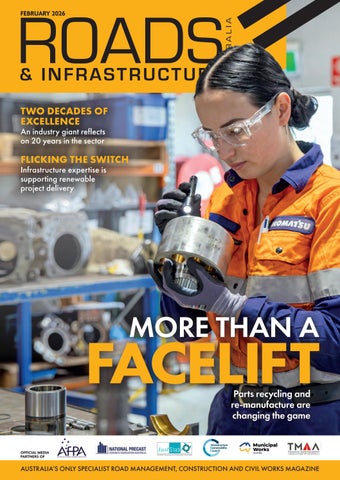
14 More than a facelift

Parts recycling and remanufacture is helping to transform machinery repairs and upgrades.

ROADS REVIEW

17 Roads Review

This month, we asked the industry’s decisionmakers, ‘What changes are needed to encourage greater collaboration and innovation across the sector in 2026?’

COMPANY PROFILE

19 Two decades of excellence

Sripath Technologies is celebrating its 20th anniversary – a reflection of the company’s commitment to industry.

22 From foundation to pioneer

The story and journey of Alltech Industries, from India to worldwide.

24 New centre of innovation

SAMI Bitumen Technologies’ brand new technical centre is set to contribute greatly to the wider transport industry.

SUSTAINABILITY

27 Flicking the switch Kennards Hire is moving further into the renewable projects space, an ever-growing infrastructure segment.

TECHNOLOGY

30 Forging the path

Traffio’s newest expansion is ushering in the next evolution of services for the world’s traffic management industry.

33 Lending a hand

Recent local government audits have highlighted several key obstacles and issues relating to the delivery and maintenance of local roads.

36 Asset visibility for modern fleets How innovation and technology is challenging legacy fleet management issues head on.

INNOVATION

39 Preserving what we have Minimally invasive ground engineering is giving infrastructure owners new ways to extend asset life.

CONEXPO SHOWCASE

41 An essential resource for those attending and interested in CONEXPO 2026.

MACHINERY & EQUIPMENT

46 Calibrated quality

Wirtgen is helping operators achieve unprecedented accuracy and consistency with every pass.

48 Aussie born, world bound QFEAUS continues to grow, with the company now setting its sights on the United States.

50 Strengthening bitumen storage

The role of reliable bitumen storage has become increasingly important.

52 Partnership central to innovation

Tutt Bryant’s new Compact Track Loader range represents a two-decade long relationship.

ASSOCIATION SECTION

54 Calibrating the pavements sector for a new reality

For the Australian flexible pavements sector, 2026 marks an important turn to uncompromising technical and operational viability.

56 Connecting Western Sydney’s future

An overview of the recent major works on the M12 Central Interchange.

REGULARS

4 Editors letter

6 News

58 Contracts in brief

CEO

Christine Clancy

christine.clancy@primecreative.com.au

PUBLISHER

Sarah Baker

sarah.baker@primecreative.com.au

MANAGING EDITOR

Lisa Korycki lisa.korycki@primecreative.com.au

EDITOR

Tom O’Keane tom.okeane@primecreative.com.au

JOURNALIST

Jennifer Pittorino jennifer.pittorino@primecreative.com.au

HEAD OF DESIGN

Blake Storey

ART DIRECTOR

Bea Barthelson

BUSINESS DEVELOPMENT MANAGER

Loren Katie Logan lorenkatie.logan@primecreative.com.au

CLIENT SUCCESS MANAGER

Sabrina Zor sabrina.zor@primecreative.com.au

HEAD OFFICE

Prime Creative Pty Ltd

379 Docklands Drive, Docklands VIC 3008 Australia p: +61 3 9690 8766 info@primecreative.com.au www.roadsonline.com.au

SUBSCRIPTIONS

+61 3 9690 8766 subscriptions@primecreative.com.au

Roads & Infrastructure Australia is available by subscription from the publisher. The rights of refusal are reserved by the publisher.

ARTICLES

All articles submitted for publication become the property of the publisher. The Editor reserves the right to adjust any article to conform with the magazine format.

COVER IMAGE

Komatsu

COPYRIGHT

Roads & Infrastructure Australia is owned and published by Prime Creative Media. All material in Roads & Infrastructure Australia is copyright and no part may be reproduced or copied in any form or by any means (graphic, electronic or mechanical including information and retrieval systems) without the written permission of the publisher. The Editor welcomes contributions but reserves the right to accept or reject any material. While every effort has been made to ensure the accuracy of information, Prime Creative Media will not accept responsibility for errors or omissions or for any consequences arising from reliance on information published. The opinions expressed in Roads & Infrastructure Australia are not necessarily the opinions of, or endorsed by the publisher unless otherwise stated.

KICKING OFF WITH A BANG

WELCOME TO THE FIRST EDITION of Roads & Infrastructure magazine for 2026, a year already marked by anticipation and excitement across the sector. Particularly when we consider the slate of expected project milestone’s nationally.

The Western Sydney International (Nancy-Bird Walton) Airport project is scheduled to open late this year, the culmination of many construction and transport disciplines uniting to deliver. It’s not the only one though, with several METRONET projects scheduled for completion in Western Australia.

As we move further north, our friends in sunny Queensland will also see the commencement of passenger services on the Cross River Rail, a development that’s been a decade in the making.

But it’s not just projects that are already catching our eye.

In this month’s cover story, we learn more about ‘Reman’ or remanufacturing. Reman has emerged as an essential production process for machinery parts, enabling high quality repairs and rejuvenation for aged components. Not only is this method helping to reduce shipping costs and wait times for customers, but it’s also leading to greater sustainable outcomes for the wider industry. The team at Komatsu tell us more.

Kennards Hire is another company supporting sustainable outcomes. The company has been delivering services for major renewable energy projects, backed by its vast range of services and experience gathered as part of its delivery of transport and infrastructure projects. One of Victoria’s largest solar farms is the latest beneficiary.

Also in this edition, we celebrate Sripath’s 20th anniversary. In that time, the company has elevated itself as a pioneer in the research, development and distribution of bitumen additives and other road construction formulations. It’s this innovation that’s enabled the company to make a positive impact nationally, helping to turn the tide and open new doors, particularly around sustainable transport projects.

We also touch base with industry thought leaders to learn ‘What changes are needed to encourage greater collaboration and innovation across the sector in 2026?’.

Happy reading!

TOM O’KEANE – EDITOR

TUNNELLING COMPLETE FOR SYDNEY METRO SECTION

The second and final tunnel boring machine (TBM), which was making its way through the western end of the Sydney Metro West project, has broken through, marking the completion of a two-year journey.

The breakthrough took place at the future Westmead Station, which will be linked to Parramatta in a two-minute trip and the Sydney CBD in 22 minutes when Metro West opens in 2032.

The Westmead metro station will also provide better connections to the hospital and health precinct in Sydney’s west which is also serviced by rail, bus and light rail.

TBM Dorothy travelled through close to 800,000 tonnes of earth to complete its journey, having been preceded by TBM Betty, the first TBM which completed its trip two months ago.

At the other end of the line, two machines are cutting their way underneath Darling Harbour to finish at Hunter Street in coming months.

Six of the nine station boxes for the Sydney Metro West project – The Bays, Five Dock, Burwood North,

North Strathfield Sydney Olympic Park and Westmead – have already been excavated and lined.

More than 150,000 concrete segments will be installed on the Metro West line by full completion.

Sydney Metro West’s Westmead station has also achieved a first for the Southern Hemisphere, with the project housing the largest cavern formwork system of its kind.

1941-tonne concrete pour to create the cavern’s 2.5-metre-thick walls.

It took almost 12 months of careful planning and collaboration – along with multiple crawler cranes – to construct the structure that reaches 21 metres high, equivalent to a seven-storey building.

On top of the formwork delivery, crews are also now retrieving the 1200-tonne Tunnel Boring Machines (TBMs) that arrived beneath Westmead in September

“THE FORMWORK WILL ASSIST WITH LINING THE NEW STATION CAVERN WALLS. THE TALLEST CAVERN ON THE SYDNEY
M ETRO NETWORK HAS ALREADY BEEN FULLY LINED, STANDING AT ABOUT 26 METRES TALL.”

The formwork will assist with lining the new station cavern walls. The tallest cavern on the Sydney Metro network has already been fully lined, standing at about 26 metres tall.

In a tightly coordinated 82-hour operation, crews jacked and winched the temporary arch into position with millimetres to spare. Once the structure was in place, the team completed a

and October, lifting each machine out in sections through an opening in the roof of the acoustic shed built over the station cavern.

Meanwhile, tunnelling at the eastern end is approaching its final breakthrough to Hunter Street in Sydney’s CBD, with TBMs Ruby and Jessie now less than 550 metres from completing the 24-kilometre twin tunnels.

The project will deliver essential and smoother connections for the community. Image: New South Wales Government

COMPACT SIZE CAN MEAN A HUGE ADVANTAGE

CAT® AP400 ASPHALT PAVER

The Cat® AP400 is an ideal machine for those asphalt paving jobs where space is at a premium.

Its compact size and optional front-mounted extendable Cat screed give you the flexibility and versatility needed, especially in built-up urban areas.

Plus, when you purchase a new Cat AP400, you’ll also have the option of:

• access to locally supported parts via the national dealer network

• a comprehensive warranty package

• a Cat Customer Value Agreement (CVA).

To find out more contact your local Cat dealer or visit cat.com/AP400-au

METRO TUNNEL NOW OPEN

After a decade of works, passengers can now catch a train through the twin nine-kilometre tunnels and five new underground stations that form part of Melbourne’s Metro Tunnel.

Since the Metro Tunnel was first announced in 2015, workers have excavated 1.8 million cubic metres of rock and soil, used 754,000 cubic metres of concrete and 157,000 tonnes of steel and laid 40 kilometres of Australianmade rail, creating around 7000 jobs including hundreds for apprentices, cadets and trainees.

Free weekend public transport was made available on the line from 30 November 2025 until 1 February 2026.

What’s known as the ‘Big Switch’ will introduce a new timetable across buses, trams, regional and metropolitan trains, and connect the Cranbourne, Pakenham and Sunbury lines with all services on those lines running through the Metro Tunnel.

The inaugural Metro Tunnel services departed East Pakenham at 9.03am and Sunbury at 9.28am on November 30, arriving a minute apart at Town Hall

Station. Services through the Metro Tunnel travel about every 40 minutes from East Pakenham and about every 60 minutes from Sunbury.

Opening the five new underground stations to passengers has doubled the size of Melbourne’s underground rail network, providing access to new destinations and allowing passengers to cross the city from Arden Station in North Melbourne, to Anzac Station on St Kilda Road in just 12 minutes.

ONE YEAR MILESTONE FOR $700M SINGLETON BYPASS

The one-year mark of major construction has been reached on the Singleton Bypass project in New South Wales, a new eight-kilometre alignment that will help to remove what is one of the Hunter Region’s longest standing bottlenecks.

Once complete, the bypass will remove around 15,000 vehicles a day from Singleton’s CBD, bypass five sets of traffic lights, cut congestion, reduce freight delays and deliver safer, faster and more reliable journeys for the 26,000 motorists

who travel on this section of the New England Highway each day.

In the past 12 months, construction has commenced on all six bridges that form part of the project, which includes the 1.6-kilometre Hunter Floodplain bridge, which is 80 per cent complete.

Key structures such as the new Hunter River and Gowrie bridges are now supporting haulage trucks, reducing construction traffic for the local community.

The past year has also seen more than 500,000 square metres of earthworks placed, as well as peak works getting underway on drainage, utilities relocation, pavement, noise walls and safety screens.

The design and construction contract for the project was awarded to Acciona in late 2023, ahead of major works commencing in early September 2024.

The project is expected to open to traffic in late 2026.

Above: Premier Jacinta Allan dedicated the project’s completion and opening to the local workforce that delivered it. Image: Victorian Government
Works will ramp up later this year on the Singleton Bypass. Image: New South Wales Government

WEST GATE TUNNEL NOW OPEN

The West Gate Tunnel is now open to traffic, providing an alternative journey to the West Gate Bridge thanks to new twin tunnels, as well as new links to the port, the city and CityLink.

The West Gate Bridge had reached its capacity prior to delivery of the project, with a single incident having the potential to bring the network to a standstill.

That’s why the West Gate Tunnel Project was developed, to ease congestion on the West Gate Freeway and West Gate Bridge and reduce what’s believed to be 9000 trucks a day from residential streets by providing more direct links to the port.

A new tunnel under Yarraville will now link the widened West Gate Freeway to a bridge over the Maribyrnong River and a new road above Footscray Road. New exits from this bridge will take trucks directly into the Port of Melbourne.

The West Gate Tunnel project has also delivered 14 kilometres of new and upgraded walking/cycling paths, an extension of the Wurundjeri Way, a total of two river crossings, new express lanes and nine hectares of new parks and wetlands. Nine kilometres of new and improved nose walls were also delivered in conjunction.

Delivery of the project has also seen

WORKS UNDERWAY ON $1.62B BEVERIDGE INTERMODAL PRECINCT

Construction has kicked off on Australia’s largest and most advanced logistics hub, in Melbourne.

Set to be located in the city’s north, the Beveridge Intermodal Precinct will play a key role in connecting essential freight routes with the southern terminus of the Inland Rail freight corridor.

It will be the only terminal in Melbourne capable of supporting and servicing double stacked Inland Rail trains, when it becomes fully operational in mid-2028. It will have the capacity to cater for up to 200,000, 20-foot equivalent units every year.

The project will aim to increase efficiency while reducing associated costs for distribution, by helping to shift freight from road to rail.

Site preparation works are now underway, ahead of the commencement of major construction early next year.

Each train at the precinct will replace up to 110 trucks. Additionally, it’s expected that 167,000 annual truck trips will be removed from the local road network once the precinct is operational.

The precinct is also expected to provide sustainability benefits, with estimations that the modal shift

the implementation of 24/7 No-Truck Zones on key local roads, along with new curfews on Williamstown Road – further removing trucks from residential streets and improving safety for locals.

It’s estimated that the 200,000 motorists that use the West Gate Freeway daily will be able to save 20 minutes of travel time for some journeys from the west.

The project will also help to support surrounding transport infrastructure for the growing regions of Ballarat, Geelong and Wyndham.

More than 6000 workers have helped deliver the West Gate Tunnel Project including 62 million hours on site.

will reduce emissions by 12.1 million tonnes of carbon dioxide over 25 years of operation.

The project is being funded by the Federal Government.

Above: Beveridge will play a key role in marshalling freight from the port and across Victoria. Image: stock.adobe.com/Veronique
Traffic is now flowing on the West Gate Tunnel. Image: Victorian Government

SRE’s telescopic bitumen sprayers or our newly developed 8m fixed wing bitumen sprayers are available for late 2026 delivery.

Fully compliant with all Australian regulations our sprayers meet all Austroads performance requirements for bitumen sprayers and are ready to go straight to work.

WA ROAD SAFETY PACKAGE ANNOUNCED

The Western Australian Government has announced an additional $80 million in road safety funding, which will aim to further prevent dangerous driving in local communities.

Under the package, $27 million will be assigned for additional road safety advertising, community education and public awareness campaigns. A further $25 million will support ongoing road safety

Government will also look to establish more partnerships with community organisations to improve safety at a grassroots level.

Image: Western Australian Government

programs, such as the Regional Road Safety Program, as well as the Safer Roads and Bridges Program.

Another $20 million will help expand the state’s current safety camera program to include six new safety camera trailers, four pairs of fixed point to point cameras, 32 near miss cameras and 100 smiley face cameras with a focus on school zones.

All the revenue derived from the new

safety cameras will go into the Road Trauma Trust Account to be spent on road safety initiatives.

A final $2.5 million will be allocated to support a review of penalties and flexible infringement polices. This review will look into how drivers that are doing the right thing can be rewarded under the current system, as well as a review of the current penalties for dangerous driving.

$500M FOR BRUCE HIGHWAY SAFETY UPGRADES

More than 20 new projects have been announced for the Bruce Highway in Queensland, each aiming to deliver safety upgrades as part of the next stage of improvements for the connection.

Over $500 million has been allocated for 22 projects that will see works delivered along high-risk sections between Gympie and Cairns, and forms part of the $9 billion Bruce Highway Targeted Safety Program.

Nineteen of these projects will deliver 93-kilometres of stronger, more resilient road surfaces to boost skid resistance and improved vehicle stability, particularly in wet weather.

The remaining three projects will deliver 13 kilometres of wide centre line treatments with road widening and audio tactile line marking to create more distance between opposing directions of traffic, reducing the risk of head-on collisions by up to 60 per cent on high-volume rural roads.

This follows progress on an initial round

of 16 projects – delivered under the same (Bruce Highway Targeted Safety) p rogram, announced in March 2025 –which are complete, under construction

or due to start.

Additional rounds of projects are set to be announced as part of the $9 billion program.

This is just a small portion of the total works package for the Bruce Highway.
Image: Queensland Government

MORE THAN A FACELIFT

KOMATSU’S EMPHASIS ON PARTS RECYCLING AND RE-MANUFACTURE IS HELPING TO OPTIMISE THE SUSTAINABILITY AND EFFICIENCY OF ITS SERVICES, WHILE INSPIRING IMPROVED OUTCOMES FOR THE ENTIRE SECTOR’S BENEFIT.

After acknowledging a market need more than three decades ago, Komatsu sought to develop a process and dedicated department, focused on making what was once new, new again.

‘Reman’, or remanufacturing, is the process of taking used parts and components, restoring them to asnew condition and refitting them to used machinery.

It’s a process that has become a core

establishing a global network of sites facilitating reman outcomes in places like the US, India, Japan, South Africa and Indonesia, just to name a few.

As Kelvin Walker, National Operations Manager – Komatsu Australia explains, reman has long been of high importance, reflected in Komatsu’s dedicated reman department and facilities.

“Our main remanufacturing facilities are in Welshpool, Perth and Wacol, Queensland. The Welshpool facility takes care of Western Australia, the Northern

Komatsu has established a national network for parts recycling and re-manufacture.

Territory and South Australia, whilst the Wacol facility handles the entire East Coast,” Walker says.

“The workshops themselves are around 4000 square metres in size and employ about 300 people nationally. Around the country we would build approximately 400 components a month, so reman is a major portion of our business.”

THE PROCESS

Each component on a Komatsu unit –whether it’s an excavator, wheel loader or motor grader, for example – has a defined service life.

It’s this service life that guides the scheduling of maintenance, as well as Komatsu’s production planning. When a component reaches its scheduled service interval or is showing signs of excessive wear, the customer will tend to remove the part and send it to one of Komatsu’s reman facilities.

Upon arrival, the component is disassembled and thoroughly inspected. Findings from these inspections are reviewed with the customer to agree on the scope of the rebuild.

Based on the results of this inspection

and discussion, components are cleaned, repaired, or refurbished.

The rebuilt component is then tested to ensure it meets specifications and quality standards, before being handed back to the customer.

Walker says the age, level of wear and type can change drastically from part to part, meaning each needs to be treated individually.

While it may seem drastic to put such

typically cost 40-50 per cent less than brand new parts. The other big issue, if you take price out of it, is the basic availability for global production to keep up. This service negates that.”

He says customers experience significant financial savings, not just from lower part costs, but also from reduced downtime, as well as an extended asset life, due to the use of quality OEM (original equipment manufacturer) parts.

“REMANUFACTURED COMPONENTS ALSO TYPICALLY COST 40-50 PER CENT LESS THAN BRAND NEW PARTS.”

focus and resources into an already used part, Walker adds that the time required is a far cry compared to waiting on brand new parts.

“The lead time on some new components can be anything from 14 months to two-to-three years. At times there aren’t many alternatives from an availability point of view. The process we use ensures that the part can be returned in a quality that’s as close as possible to ‘new’,” he says.

“Remanufactured components also

A SUSTAINABLE PROCESS

Beyond convenience and time, the other major beneficiary of the reman method is the environment.

According to Walker, 80 per cent of the components of a typical part can be reused or recycled, significantly reducing the volume of raw materials required. Additional savings in shipping, logistics and across the wider supply chain further reduce carbon emissions. Particularly when compared to manufacturing with virgin materials and components.

‘Reman’ forms a key part of Komatsu’s long-term sustainability strategy.

Komatsu’s customers also benefit, with reduced waiting times and costs for rejuvenated parts, compared to brand new.

Reman also contributes to the circular economy by giving existing parts a new lifecycle, rather than sending them to landfill or elsewhere.

Reman is an area that Komatsu continues to heavily invest in, whether it be through financial support for staffing, new facilities, or new equipment.

Just one example has been the company’s adoption of Computer Numerical Control (CNC) machining. CNC refers to automated machines controlled by computers to perform precise actions such as cutting, drilling, or shaping metal components.

It’s Walker’s ambition that such technology would help Komatsu’s reman department achieve higher precision in rebuilding parts, while also improving turnaround time, and further reducing any reliance on outsourcing.

Such a method again helps to conserve

resources and prevent unnecessary scrapping of parts, especially for components such as journal bearings.

Unrecyclable parts and metal scraps are instead melted down by Komatsu’s reman team for reuse.

Walker adds that beyond improving the sustainability of manufacturing, the reman process also helps to encourage greater recycling and reuse amongst customers.

BE PREPARED

Komatsu has also established a network of support services and applications, all geared towards optimising early detection for component maintenance, potentially removing the need for reman or further intervention entirely.

KomServ, an internal program designed for data capture and analysis, collects operational information about both parts and equipment.

This service helps the company to monitor the health and usage of components in the field, predict inventory needs more accurately and identify patterns that could lead to improvements in maintenance, repair and overall machine uptime.

Other platforms, such as myFleet and Komtrax, enable operators and fleet managers to make data-driven decisions around maintenance schedules for individual units, right up to entire fleets.

Walker says that while programs such as this help to extend component life and reduce unnecessary replacements, so does the ingenuity and robustness of Komatsu’s machinery.

“It’s the quality and durability that keeps our machines moving,” he says. “We’re continuing to heavily invest in facilities, tooling and equipment, which includes new technologies.”

ROADS REVIEW

This month, we asked the industry’s decision-makers, ‘What changes are needed to encourage greater collaboration and innovation across the sector in 2026?’

RAQUEL RUBALCABA, DEPUTY SECRETARY, INFRASTRUCTURE PROJECTS AND ENGINEERING – TRANSPORT FOR NSW

To encourage greater collaboration and innovation in 2026, the roads sector will need to embrace practical changes alongside cultural leadership. This includes earlier and more genuine industry engagement, commercial models that reward collaboration and innovation rather than the transfer of risk, and clearer pathways to trial new ideas at scale. Leaders must also encourage the creation of safe environments for teams to test, learn and adapt, rather than simply defaulting to established approaches. Where projects create a collaborative and innovative culture, improved safety, productivity and value for money outcomes will follow.

Image: Transport for NSW

TONY ALOISIO, CHIEF EXECUTIVE OFFICER – AFPA

In 2026, greater collaboration and innovation across the sector will depend on a shared commitment to maintaining Australia’s valuable public asset – our roads. A target of resealing seven per cent of the network annually provides a practical and achievable starting point. Government and industry must work in genuine partnership to deliver innovative, practicable solutions that protect both network performance and road users. To further strengthen industry safety and capability, AfPA’s first major initiative for 2026 is the launch of Asphalt Essentials, a foundational course designed for empowering informed purchasing and best practice.

Image: Australian Flexible Pavement Association

SARAH BACHMANN, EXECUTIVE ADVISOR – NATIONAL PRECAST CONCRETE ASSOCIATION OF AUSTRALIA

To boost collaboration and innovation in 2026, we need to lift baseline knowledge across the sector. As precast continues to gain market share amid a challenging infrastructure pipeline, it’s crucial that everyone engaging with it – from designers to head contractors - has a working understanding of precast regulatory, operational and technical dimensions. That’s exactly what our 10 new micro-credentials deliver. Complete all 10, and they also count as RPL for the new precast units now embedded in the MSM30325 Certificate III in Manufactured Mineral Products, a direct pathway to relevant and recognised skills, and smarter project outcomes.

Image: National Precast Concrete Association of Australia

IF YOU OR SOMEONE AT YOUR ORGANISATION IS AN INDUSTRY LEADER AND WOULD LIKE TO BE A PART OF THIS MONTHLY COLUMN IN 2026

PLEASE GET IN TOUCH WITH EDITOR, TOM O’KEANE: TOM.OKEANE@PRIMECREATIVE.COM.AU

OF EXCELLENCE TWO DECADES

SRIPATH TECHNOLOGIES®’ IS CELEBRATING ITS 20TH ANNIVERSARY, HAVING PLAYED A MONUMENTAL ROLE IN INSPIRING INNOVATION, SUSTAINABILITY, EFFICIENCY AND MORE ACROSS THE GLOBAL ROAD CONSTRUCTION AND MAINTENANCE INDUSTRY.

Maintaining two decades of consistent delivery for highquality, innovative, reliable, sustainable and cost-effective asphalt additives and technologies is no small feat.

Many aspects contribute to such an achievement, but above all, it’s industry experts and thought leaders who have helped establish such a success.

It’s these characteristics that have resulted in one of Sripath’s proudest accomplishments to date.

As Krishna Srinivasan, President and Founder – Sripath Technologies explains, the company was founded on a simple yet purposeful notion – of not only supporting the asphalt industry, but also society at large.

“When we started this company 20 years ago, our vision was simple: use science and collaboration to solve the toughest challenges in asphalt. Seeing that idea grow into a global organisation has been truly remarkable,” he says.

HUMBLE BEGINNINGS

Sripath was founded in 2006 and – like many startups – began with an idea and a plan but had to quickly learn to adapt as real-world challenges emerged.

Srinivasan explains that from the outset, Sripath positioned itself as a technology-driven company, focusing on innovative solutions and a strong commitment to sustainability, even before

it became a formal part of its product development process.

“Sustainability has never been a separate initiative for us. It’s built into our corporate DNA and into every product and technology we develop, design, and market,” says Deepak Madan, Chief Operating Officer –Sripath Technologies.

“Whether it’s enabling higher RAP (reclaimed asphalt pavement) use, lowering production and use temperatures, reducing emissions, or conserving energy, our goal is to deliver practical additives and technologies that help the industry cut its environmental footprint without compromising performance.”

While sustainability has always been an

Pictured: The milestone reflects Sripath’s positive impact on Australia’s transport and infrastructure sectors.
Below: Sripath’s 20 years of operation is the culmination of industry innovation, collaboration and education.
Images: Sripath

Sustainability has long formed a key part of Sripath’s operations and product offering.

underlying value since Sripath’s earliest days, it’s become increasingly integrated and quantified throughout its operations, namely through the company’s development of EPDs (Environmental Product Declarations).

The transparency provided by these EPDs includes information about the materials, production process and logistical elements used to develop and deliver each compatible product.

Srinivasan believes that such transparency has helped to inspire tangible changes in the sustainable output of Sripath’s clients.

“It’s been important to educate the sector and our customers on what is an EPD. How do you use it? What do you use it for? There’s plenty of new technologies, biobased binders and plant-based additives for example,” he says.

“They’re great example of simply not just meeting a performance target but instead doing it in a very conscious manner that either minimises or neutralises your carbon footprint.”

KEY CONNECTIONS

A mainstay of Sripath’s success has been its ability to form local industry connections.

There are few better examples of this in action, than Sripath’s growth in Australia, since it established its operations in Melbourne five years ago. As Ravi Rajagopalan, General Manager – Sripath AsiaPac explains.

“In just five years, Sripath Asia-Pac has become a trusted partner to transport

agencies and contractors across the region. Our growth reflects both local commitment and global expertise,” he says.

“As sustainable, high-performance technologies become even more critical, we’re proud to support that regional evolution with proven additives, strong onthe-ground technical support, and excellent customer service.”

Sripath now has proud connections and partnership with several key associations, such as the Australian Flexible Pavement Association and Austroads, as well as universities, government and other local authorities.

research institutions shows a deep commitment to advancing the science of bitumen and asphalt, not just selling products,” he says.

“Their technical engagement across the Asia-Pacific region has significantly strengthened regional knowledge on RAP, warm mix technologies, and sustainable pavement design.”

Establishing local connections also helped to cement Sripath’s role as an educator within the sector, offering seminars, conducting broad-based outreach and sharing general knowledge about rejuvenation technologies and sustainability.

“EVERY ADDITIVE WE DEVELOP IS DESIGNED TO ADDRESS A SPECIFIC INDUSTRY NEED. TWO DECADES IN, WE CONTINUE TO DEVELOP NEW PRODUCTS AND TECHNOLOGIES THAT HELP THE INDUSTRY PUSH PERFORMANCE AND ACHIEVE SUSTAINABILITY GOALS.”

“We always wanted to be regarded as part of the industry in Australia,” Madan says. “Really early on, we established good working relationships with RMIT (Royal Melbourne Institute of Technology), to learn more about local standards and materials, which was instrumental in opening the door to start interfacing and discussing with major transport agencies across Australia.”

As Professor Filippo Giustozzi – RMIT explains, Sripath has been instrumental in supporting wider outcomes, beyond just its customer base and projects.

“Sripath’s willingness to partner with

Srinivasan says this educational approach has contributed to greater openness within the industry to new materials, methods, and environmental accountability.

“It would be presumptuous to say we led the change, but all I know is where the sector was when we started, and where is it now,” he says. “We’ve had a role to play, as have others, in emphasising better use of materials, technology and sustainability concepts.

“We’ve been part of that process, and it’s resulted in a greater willingness to accept new ways of thinking, all without diluting

specifications. Greater consideration of new ways of doing things – that’s been the biggest change.”

Jill McConaghie, Marketing Specialist –Sripath adds that educating the sector helps to create a cascading effect that benefits all.

“The more we learn, the more the industry learns and evolves. As a result, we then need to learn again to keep up. It’s about pushing ourselves and the sector along, together, using our science-based impetus,” she says.

IMPACTFUL PORTFOLIO

It goes without saying that innovative product developments have played a key role in Sripath’s 20 years of industry impact.

Among the notable innovations developed during this time is the ReLIXER® asphalt rejuvenator and recycling agent. ReLIXER enables the use of high-RAP mixes, while also helping to drive cost savings and reduce the carbon footprint of project outcomes. This is as well as its ability to restore the functional properties of aged RAP binders, making it a preferred additive for many Australian contractors.

“The launch of ReLIXER was a key

milestone. It was a technology that was at least three years in the making, which leapfrogged a number of other solutions in the space,” says Srinivasan. “It really was an entry point, and it’s been very gratifying to see how much – and well – it’s been adopted around the globe.”

Another is PGXpand®, a bitumen-friendly polymeric additive. This innovation helps to enhance high-temperature performance, rutting resistance, stiffness and fatigue.

PHALANX®, ButaPhalt®, NuMIXER® and ReNUBIT® are just some of the other additives that have helped to set Sripath apart from other providers.

“Every additive we develop is designed to address a specific industry need. Two decades in, we continue to develop new products and technologies that help the industry push performance and achieve sustainability goals,” says Vince Aurilio, Senior Technical Director – Sripath Technologies.

EYES ON FUTURE

Despite its multi-decade success, Sripath Technologies is not resting on its laurels. The company is still actively engaged with

the global market, including assessing international opportunities for expansion. This also includes reinforcing and further supporting its mission to “Make Asphalt Better®”.

“Twenty years in, our mission hasn’t changed. We’re here to Make Asphalt Better. The opportunities ahead are bigger than ever and we look forward to working handin-hand with our customers around the globe,” Srinivasan says.

“We recognise that times can be challenging in the Australian paving industry, but this is a cloud that passes. When you come out on the other side, you come out much better, because you learn to cope through ingenuity and thoughtprovoking ideas.”

For Madan, the future is bursting with opportunity, with a constant being the company’s commitment to the local markets it services.

“We’re still on a growth journey,” he says. “We’ll continue to diversify and expand our product portfolio, both organically and via acquisition. We plan to be here for the long term.”

FROM FOUNDATION TO PIONEER

ALLTECH INDUSTRIES’ JOURNEY FROM INDIA TO AUSTRALIA IS MARKED BY AMBITION, FAMILY AND INNOVATION, WITH THE COMPANY’S GROWING REPUTATION AND PRODUCT RANGE EXPECTED TO MAKE ITS MARK DOMESTICALLY IN 2026.

Alltech’s growth, from a small space in industrial India to a global footprint, has truly been the mark of a growing enterprise.

The company was founded in 2009 in Mehsana, Gujarat – India, one of the country’s strongest and most crucial industrialised areas, having facilitated the import of components and global export of road construction equipment.

As a result, the company’s roots are inherently tied to innovation and excellence, having neighboured renowned heavy machinery and related providers since its creation.

Alltech’s journey commenced by stepping into the fabrication of asphalt plant supplement components, laying the groundwork for future innovations.

Among the company’s early commitments was contract manufacturing for one of the leading European asphalt plant manufacturers. It wasn’t long before the organisation’s capabilities grew significantly, mainly in part to cater for growing demand

domestically and abroad.

In response to that growth Alltech launched its first Bitumen Drum Decanter unit, a milestone that helped to streamline bitumen melting and revolutionise handling techniques.

The launch of Alltech’s Bitumen Bag Melting unit (2013), first Asphalt Batch Mix Plant in Gujarat (2017) and first Counter Flow Drum Mix Plant (2018) followed soon after, each marking the next step in the company’s growth.

January 2025 signified a major push for the business in Australasia, after it established its first domesticbased operation.

“As a result of numerous enquires made to the India team over several years regarding Alltech product availability in Australia and other Southeast Asia countries, and further extensive market assessment of the infrastructure pipeline particularly in Australia, it was decided to establish a significant local presence here,” says Jason Sky, Business Development Manager – Alltech industries.

Alltech’s vast range of asphalt batch mix plants, counter-flow drum mix plants and mobile batch mix plants – further supported by a variety of PMB (Polymer Modified Bitumen), CRMB (Crumbed Rubber) and bitumen emulsion plants – provide numerous solutions and possibilities for projects

Alltech also offers advanced, in-house developed, micro-surfacing technology.

Beyond design and manufacturing excellence, Alltech is also guided by strong principles, such as its commitment to a customerfirst approach.

“We uphold the highest standards of quality, pay close attention to detail, and proactively solve challenges. With a spirit of innovation and creativity, we continue to push boundaries and redefine the future of road construction,” Sky says.

Maintaining close relationships with

Since its foundation in Australia the company has moved quickly to establish meaningful industry connections.

Alltech’s journey to Australia has seen it grow its now vast range of solutions along the way.

existing customers has inspired influential feedback and conversations that have driven improvements in Alltech’s range including compatibility and greater support for projects incorporating sustainable elements.

“As global infrastructure moves toward eco-friendly development, green asphalt has become a key component in sustainable road construction,” Sky says. “With growing environmental concerns, stricter regulations, and the demand for low-emission practices, the industry is rapidly adopting cleaner and smarter solutions.

“The Alltech batch mix plant stands at the forefront of this transformation, offering advanced sustainability features that reduce environmental impact without compromising quality or productivity.”

OFFERINGS IN AUSTRALIA

Beyond offering its innovative products across Australia, Alltech is also looking to establish itself as a key industry knowledge exchanger, sharing its expertise with industry to support improved outcomes. The organisation has become a member of the Australian Flexible Pavement Association (AfPA), while also attending leading events such as the 20th AfPA International Conference and Highways AU 2025.

It’s Alltech’s belief that its timing couldn’t be better, with significant

infrastructure spend helping to drive what is a growing industry, Sky says.

“We see an expanding road construction market in Australia over the next five to 10 years to match the growing infrastructure demand,” he says.

“This has also been validated by numerous discussions we have had with the largest industry contractors. All share the opinion that demand will not be able to be met by current supply, so we see this as a great opportunity here in Australia and indeed Southeast Asia.”

Among the many items on the ‘todo’ list for Alltech in Australia is the establishment of a demonstration plant, as well as continued interactions with industry and associations.

As Sky explains, this signifies much more than just a flash in the pan.

“Alltech is committed to its Australian Operation and maintaining a significant local presence here, not just trying to sell products into Australia from overseas with no real commitment to the local market or its customers.”

Australian customers will soon see the iconic yellow livery around major infrastructure projects across the country.

NEW CENTRE OF INNOVATION

SAMI BITUMEN TECHNOLOGIES’ IS CELEBRATING THE OPENING OF ITS NEW TECHNICAL CENTRE, WHICH PROMISES TO PROVIDE A BOOST FOR THE RESEARCH AND DEVELOPMENT OF NATIONALLY SIGNIFICANT INNOVATIONS FOR THE ROAD CONSTRUCTION AND MAINTENANCE SECTOR.

For SAMI Bitumen Technologies, the development of innovative bitumen additives and performance enhancers has long relied on a vast production and design network.

With key facilities and presence across Brisbane, Sydney, Melbourne and Perth, SAMI’s network continues to grow, as does its impact on the industry.

Now the business is further strengthening its domestic ties, with a brand-new technical centre set to reannounce its status as one of the largest independent suppliers of bitumen and bitumen additives in Australia.

The decision to establish a new technical centre was made around October 2024, after SAMI identified that its old Camellia Plant lab in New South Wales was no longer sufficient for current and future needs.

Factors, such as a lack of space for new equipment and optimised workflows, meant different disciplines were often interfering during day-to-day operations.

Hamidreza Sahebzamani, R&D and Technical Support Manager – SAMI Bitumen Technologies explains.

“The last facility was a very old building which was developed as was necessary at the time,” he says. “There came a point where it was no longer sufficient for us and for future development, it was also near our production plant as well.

“What we wanted was a more streamlined site, with better workflows, in an inclusive environment.”

The new technical centre is an independent, purpose-built facility serving as the main hub for SAMI’s research, development, and quality control activities.

Across about 700 square metres, the centre consists of two floors. The first contains multiple laboratory sections

The new technical centre will help to increase collaboration and efficiency between SAMI’s technical experts.

for asphalt, binder, emulsion, and cold mix testing. The second-floor houses boardrooms, meeting and training rooms for seminars and industry events, opening the door for collaboration with industry partners, academic institutions, and other global labs.

Importantly, the new facility separates research and development from

“WE’RE

the binder lab has its own flow, asphalt has its own flow. And just like our previous facility, health and safety are enhanced in the work environment.”

Another major improvement is accessibility, as Kuriachan adds.

“It’s a very inclusive environment and everything is designed to accommodate all types of people,” he says. “There’s

ABLE TO CONTRIBUTE TO THOSE JOINT PROJECTS BETWEEN OTHER LABS, SUCH AS OUR TECHNICAL TEAMS IN COLAS LABS ACROSS PARIS, CANADA AND THAILAND AND MORE REGIONS.”

production. Previously, both research and development, and quality control often overlapped or interfered with daily production activities. As Lijin Kuriachan, Quality Control and Process Manager –SAMI Bitumen Technologies explains.

“This facility is designed particularly around our flow of work. Disciplines are segregated into regions and specific locations and separate labs,” he says. “So,

accessibility for people living with disabilities, works have just finished on our lift, there’s also quiet rooms and spaces to accommodate various religious activities and people.”

Since opening, the centre has already launched a number of joint research and development projects with partners such as the University of New South Wales, helping to encourage

the next generation of innovators and thought leaders, in the form of current PhD students.

Such projects and initiatives are supported by the new centre, with SAMI happy to open its doors, inviting industry to use these new facilities to develop their own projects, again supporting sector-wide outcomes for the industry’s benefit.

“Even if they’re not a customer, it doesn’t matter. We have very highquality testing services available,” Sahebzamani says.

Existing customers are also set to benefit, with expectations that the new centre will help to provide customer support and troubleshooting more efficiently, as well as high-quality outcomes for developed additives.

“This collaborative environment, where we can share ideas, especially around challenges, is very helpful for customers. It’s also helpful internally, especially in a much more open environment,” Kuriachan says.

All such initiatives are supported by the wider COLAS network – SAMI’s parent company – which connects key additive innovators globally. The new facility’s resources, space, and technical expertise will allow for even more active engagement in international research projects, technology transfer, and

A streamlined layout will enable differing departments to focus entirely on their own research and projects.

knowledge sharing with these COLAS colleagues worldwide.

In fact, the centre has already been identified as a COLAS global hub.

“We’re able to contribute to those joint projects between other labs, such as our technical teams in COLAS labs across Paris, Canada and Thailand and more regions,” Kuriachan says.

This vision, to lead the industry and continually develop cutting-edge work, has been aided greatly by the opening of the centre, with Sahebzamani believing it will help to set an example for inclusivity and modern laboratory design.

“I’m confident that in a short period of time, the SAMI technical centre will be a leading resource for pavement innovation

not only throughout the whole region, but maybe in the world,” he says.

“I’m really excited for the future, and am sure that into the future, the industry will see a lot of innovation that originates from here.”

For Kuriachan, it’s the prospect of uniting industry, as well as inspiring staff, that excites him the most.

“This is a flagship centre for SAMI. The openness and inclusivity are a good thing not only for our staff, but also the wider sector,” he says.

“Also, that potential for technical innovation and wider industry collaboration, which is something we desperately need as an industry. That’s the role we can play.”

Images: SAMI
The new facility is yet another addition to the globally connected COLAS enterprise.

Freakin’ Awesome Software

Easy and Enjoyable to Use

Running a business shouldn’t mean drowning in scheduling, chasing the same answers, or juggling disconnected systems. When work feels harder than it should, it’s usually because information is scattered and hard to access.

Traff io removes the chaos, by bringing everything into one clear, easy to use system, giving you real-time visibility, greater eff iciency, and streamlined daily operations. One system, one place and one simple tiered monthly subscription. Find out more at traff io.com

Why Traff io?

Free supported onboarding

Web-based platform

Easy scheduling

Multiple locations / yards

Integrated billing & payroll

Detailed compliance

Great overall visibility

In-field worker mobile app

Live real-time information

FFLICKING THE SWITCH

KENNARDS HIRE’S SUCCESSFUL SUPPORT OF SEVERAL MAJOR RENEWABLE ENERGY PROJECTS HAS REAFFIRMED THE COMPANY’S EXCELLENCE IN MAJOR PROJECT PLANNING AND DELIVERY.

or those in the infrastructure sector, or the general public who frequently travel past infrastructure and construction works, Kennards Hire is a wellestablished and recognisable name.

Long has the company been among the preferred partners for project delivery, offering rental and project services for works across the country.

Despite its success in the construction market, Kennards Hire is often looking to further innovate with its services. Three years ago this ambition led the company to the renewable energy industry.

This foray was inspired by Australia’s national commitment to achieving zero emissions, and an increasing demand from tier one contractors to satisfy netzero targets.

As well as its vast experience delivering services for major infrastructure services, Kennards Hire already had a variety of offerings used across many sites, including diesel generators, site sheds, toilets, lunchrooms, and other onsite facilities.

Each of these options were – and are – backed by dedicated departments and support teams, comprising power, pumps, lift and shift operations, and general site services.

Although the skeleton was there, investment was required to tailor these

services for the renewables sector, as Paul Nicholson, Operations Product Specialist, Power and Renewable Energies – Kennards Hire explains.

“At the time, there was still quite a lot of scepticism around the capabilities of batteries, solar and what they were going to be able to do for major projects,” Nicholson says.

“I think some thought it was a ‘genie in a bottle’ scenario, but by being able to identify sites and power requirements, while producing documentation that supported those capabilities, we were able to explain and justify the benefits.

could give a client a holistic approach for their project, which is the advantage we’d been able to establish for construction projects.”

Kennards Hire’s first step was to quickly invest in and offer battery storage, solar, and hybrid units as part of its rental fleet, with documentation and technical materials to clearly illustrate the practical and financial benefits, helping clients gain confidence in transitioning to renewables.

“Instead of giving them a cost analysis and throwing a product at them and walking away, we work closely with them to guide them and to help them understand the

Kennards Hire is expanding its services across a number of project segments.
Renewable projects benefit greatly when supported by a hire company of Kennards Hire’s expertise.

it’s going to improve their situation on site,” Nicholson says.

“Continuous support throughout the project is next, to ensure that the unit/s work and are as successful as they possibly can be. That’s what we set out to achieve.”

It wasn’t long after establishing these solutions that Kennards Hire won works to support the delivery of the Goorambat East Solar Farm in Victoria – the largest solar farm in the state.

When complete in 2026, the solar farm will have a generation capacity of 250 megawatts, which is enough to power up to 105,000 homes, thanks to the 500,000 solar panels at the site.

Procurement and construction contractor Bouygues Construction Australia had worked with Kennards Hire previously. This past experience, as well as the strength of Kennards Hire’s offering, contributed to the

company’s selection as a project partner.

Kennards Hire’s main task was to supply an 80kVA (Kilovolt-Ampere) BESS (Battery Energy Storage Systems) battery unit, a 44kW (kilowatt) solar array, a diesel generator for back-up, as well as hybrid generators.

Kennards Hire also provided 50 site buildings, such as offices, induction rooms, lunchrooms, a conference space, toilet, shower, and changing-room amenities.

“Effectively, what we were doing was taking the site from running on diesel 24/7 back to using the generator two cycles a day, roughly a maximum of six hours per day of diesel consumption,” Nicholson says.

“That way, a good portion of running time was supplied by solar during the day, while the battery was also charging and supporting the load.

“Going from 24 running hours with

the diesel generator – back to six – has ended up being a reasonable reduction and saving in cost and obviously, carbon dioxide emissions.”

As well as power and infrastructure requirements, Kennards Hire also provided comprehensive day-to-day operational support for the project by assigning a dedicated major project contact to be present on-site.

This individual was responsible for conducting regular checks and balances throughout each day, ensuring that all equipment and services were operating smoothly and efficiently.

In addition to having personnel on the ground, Kennards Hire implemented advanced remote monitoring systems, allowing its in-house specialists and Bouygues Construction Australia to continuously observe the performance and health of the power systems, even when off-site.

“At no stage has the project been without power. It’s been a seamless supply of services at the end of the day, and I think that’s what makes it a cut above the rest, in terms of what we can provide,” Nicholson says.

Looking to the future, Kennards Hire is focused on expanding its renewable energy offerings with larger battery solutions, supporting more complex and larger-scale projects, while also integrating emerging needs such as electric vehicle (EV) charging infrastructure on construction sites.

“One of the things with this sector is that it moves so fast,” Nicholson says. “Sometimes it feels like it’s hard to keep up some days, as there’s always something new around the corner.

“There’s really exciting times ahead.”

Kennards Hire can provide solutions for power, housing and even sanitation.
The renewables market is a growing space for the hire company.

“Please watch the road”

Act on the most urgent risks in seconds.

Geotab’s new all-in-one video telematics solution, the GO Focus Plus, automatically flags distracted driving, tailgating, hard braking and other serious events immediately, delivering instant in-cab voice feedback to enhance driver safety. For managers, patterns and urgent cases rise to the top for fast review and targeted coaching, all in one workflow that tracks follow-up and results. Spend less time searching and more time supporting every driver, addressing risk, encouraging improvement and recognising safer habits.

Ready to transform your fleet?

Visit www.geotab.com/au/ to learn how our telematics solutions can drive your business forward.

FORGING THE PATH

TRAFFIO’S EXPANSION INTO THE UNITED STATES FORMS PART OF A LONG-TERM, GLOBAL VISION, GEARED TOWARDS USHERING IN THE NEXT EVOLUTION OF SERVICES FOR THE WORLD’S TRAFFIC MANAGEMENT INDUSTRY. LEADERS FROM THE COMPANY TAKE ROADS & INFRASTRUCTURE INSIDE THIS VISION.

After concluding a career in digital media project management a little over a decade ago, Nicholas Inglis set his sights on “more rewarding and lasting projects”.

It was Inglis’ ambition to solve real world problems by building practical software products. His only barrier: a lack of clarity around how or where such an ambition could be satisfied.

A fortuitous interaction with a contact from the traffic management industry laid the groundwork for what would ultimately become Traffio, as Inglis explains.

“At the time I’d been dealing closely with Nathan [Wright] for years at our local rowing club,” he says. “If you’re going to start something, you want to work beside someone who you can work well with, and trust.

“Still, I was surprised when he came back to me and said ‘yeah, let’s do this’. Around that time, a contact from the traffic management industry reached out and explained that there was an industryrelated challenge that he had encountered. ‘Come in and see if we can work something out’ is what he said. And that was our first ever project.”

It’s here that Traffio was born.

A software platform that provides business management and operational solutions – initially focused on the traffic management and construction industries, Traffio now helps a broad range of organisations manage people, vehicles, equipment, schedules, and operations, making processes more efficient, digital, and

user-friendly. This digital platform helps to improve and/or replace manual processes, such as spreadsheets or whiteboards, by streamlining scheduling, resource management and other essential business operations and functions.

The company recently celebrated its 12th anniversary of operation, having made a significant impact on Australia’s traffic management industry in that time.

Throughout that time a vision has been developing, a notion that if the company could make such a difference domestically, why not look elsewhere?

OPPORTUNITY OVERSEAS

While international expansion had long been a part of Traffio’s plans, it wasn’t until 2021 that such ambition was finally realised, when the company brought its services to the United Kingdom (UK).

Inglis says the UK expansion provided instrumental learnings, such as establishing Traffio Global, rather than regionalised and separated offices.

“We made the mistake of not thinking of ourselves in a global fashion. Instead, we thought of these locations as Traffio UK,

Traffio Australia and so forth,” Inglis says. “We restructured the team to: ‘Okay, this is our global marketing team. This is our global customer success team. This is our global sales team.’ And so rather than UK being one team by itself, it was actually a part of many teams.

“For what was our first foray into the Northern Hemisphere, that expansion and the time spent there has helped to make us a better product.”

It also helped to inform Traffio on how to operate internationally without losing the authenticity of its culture, as well as its transparency in supporting its customers.

To support further growth, Traffio leveraged participation in trade missions and industry events such as London Tech Week to build connections and credibility in the market. Similarly, Traffio’s return to the ATSSA (American Traffic Safety Services Association) Expo this year is seen internally as yet another milestone in the company’s growing American presence.

GRAND PLANS

Traffio is now gearing up for what is one of the company’s most significant

Traffio Co-Founders Nicholas Inglis and Nathan Wright.

Traffio’s expansion to the United States is a continuation of its global push, which began in the United Kingdom.

expansions and developments to date with its sights set on growing its foothold in the United States.

Inglis says it is the next logical step in the company’s international expansion, with the current market and landscape presenting an opportunity to challenge old processes and build better tools.

The US market also resembled similar aspects and conditions the company had already addressed in Australia, such as the reliance on manual processes, as well as other less efficient methods.

The size, openness, and network-driven nature of the US traffic management and construction industries were also appealing.

Inglis says leveraging previous experience has emerged early as a key to establishing and maintaining success.

“We’ve now got that experience from other parts of the world,” Inglis says. “That’s especially important to apply in markets like the United States that have been – and are – very receptive.

“The first step was establishing meaningful relationships, a key benefit of attending ATSSA and becoming a member of the association, which is something that we look forward to being involved in, as we have with the Traffic Management Association Australia (TMAA).”

It was after this attendance that Traffio

Traffio’s offerings have helped the transport sector to make meaningful improvements and changes to the way it operates.

onboarded its first US-based customers, who provided essential insight into where and how the platform could be adapted to suit local industry needs.

This development once again echoes Traffio’s early days, with every addition or update being led directly by market requirements – an aspect that continues to this day, and one that’s helped the platform to dramatically reduce admin time, support staff training and retention, and ultimately become an embedded service for daily operations.

“What really matters to us are those interactions with individual customers, where and when you can see that they’re having a great experience,” Inglis says.

The next step for Traffio is the further construction of its dedicated US team, including local industry experts to amplify customer success.

Inglis stresses that such services and expertise will remain in-house to maintain consistency, quality and integrity, even as the company continues to grow.

“I remember when there was only four of us in our office,” Inglis says. “Now we’ve got a company of more than 30 people, and a portion of that is approaching 50 per cent female.

“If you’ve got a shared set of goals, you can really succeed.

“That’s why I’m very much looking forward to the success of our team and our customers for years to come.”

LENDING A HAND

RECENT LOCAL GOVERNMENT AUDITS HAVE HIGHLIGHTED SEVERAL KEY OBSTACLES AND ISSUES RELATING TO THE DELIVERY AND MAINTENANCE OF LOCAL ROADS. CIVILTECH SOLUTIONS IS AIMING TO CURB THIS TREND, THROUGH THE APPLICATION OF ITS INNOVATIVE PLATFORM.

Maintaining local roads is becoming a greater challenge by the day, with increasing financial, environmental and community expectations often straining the capabilities of local municipalities.

Reports, such as that completed by the Western Australian Government late in 2025, paint a mixed picture. As it states, the state – and by extension, nation’s –“size and scale make maintaining regional local roads a highly challenging and complex task.”

Western Australia alone consists of more than 113,000 kilometres of local roads, connecting an area of 2.5 million square kilometres, with 107 local governments bearing the monumental task of road maintenance.

One of the most prominent challenges is a lack of data.

Many local councils face gaps in their asset management plans, meaning they lack necessary information about their road networks, such as the condition of various assets, the extent of issues, and areas needing attention.

As Leigh Carnall, Founder and Chief Executive Officer – Civiltech Solutions explains, not having access to key data makes effective maintenance and longterm planning extremely difficult.

“Being able to get a whole picture of the road network, so not just the potholes, but the cracking, the lumps and the bumps, the depressions that lead to structural failure, as well as the signage and the line marking aspects is incredibly powerful,” he says.

“That’s just some examples of the key data that can feed into improved decision making and resource allocation.”

Councils currently face uncertainties and constraints around funding. Securing grants often means making tough choices to prioritise certain projects, sometimes at the expense of regular maintenance.

Having to choose between immediate repairs and longer-term strategies isn’t viable, one of the many reasons why Civiltech Solutions was founded.

Civiltech Solutions empowers councils to take a proactive, data-driven, and strategic approach to road and asset management, transforming fragmented or incomplete

information into actionable plans and infrastructure improvements.

It does this by providing technology and services to help councils and local governments manage, maintain, and improve their road networks using both hardware and software.

Just some examples of the former are sensor systems and scanning technology that’s compatible with existing council vehicles and personnel, allowing flexible data collection based on specific needs.

Information gathered supports councils with day-to-day maintenance planning, forward works, and long-term financial strategies.

As Carnall explains, this solution is designed to make road asset management more data-driven, efficient, and responsive to council needs.

“We’ll sit down with our users to make sure they get the most out of their data,” he says. “Creating dashboards and specific reports, that’s what we provide as part of that service.

“We don’t just give councils a map or list of 5000 potholes and a million cracks, it’s

Civiltech Solutions’ platform helps councils to coordinate and deliver on their road maintenance responsibilities.

Funding and growing environmental uncertainty have emerged as major challenges

for councils.

about supporting the establishment of a targeted reseal program for example, to prevent defects like this from occurring in the first place.”

COMMUNITY AND FUNDING

Another key challenge often faced by councils is balancing community expectations and requests with financial constraints.

It’s an aspect that Carnall appreciates, as someone with 25 years’ experience in the local government segment.

“From a road user’s perspective, we may see the same pothole or same busted sign and think that council isn’t doing enough,” he says.

“When councils have thousands of kilometres to manage, what we see as users is a very isolated and very segmented focus, as opposed to a problem to the whole network.”

the community, helping to optimise transparency with local residents.

To support larger infrastructure works, Civiltech Solution’s platform and service is also capable of helping with funding applications, with detailed data, imagery, and reports capable of strengthening grant and funding submissions. The team can also assist directly in drafting, editing, and finalising applications to increase the likelihood of success.

ENVIRONMENTAL PRESSURES

Another barrier to funding, which Civiltech Solutions aims to break down, are the challenges posed by severe weather events and climate change.

Councils face increasing problems due to more frequent and unpredictable weather events that damage local roads, requiring more reactive and resilient maintenance strategies.

“FROM A ROAD USER’S PERSPECTIVE, WE MAY SEE THE SAME POTHOLE OR SAME BUSTED SIGN AND THINK THAT COUNCIL ISN’ T DOING ENOUGH.”

It’s this understanding and empathy that’s enabled Carnall to develop Civiltech Solutions as a platform designed by industry experts, for industry experts.

“By understanding what the community desires, and having the full picture thanks to data, we can begin to explore where taxpayer funds are being spent and how,” he says.

“That way, councils can introspectively assess what their residents are getting for their money, so to speak.”

Information and summaries are also capable of being shared with

Carnall says councils can at times miss out on disaster relief funding simply because they lack adequate pre-event imagery or data to demonstrate need, making it difficult to secure post-disaster funding.

In regions such as the Northern Territory, gathering updated data on road conditions is particularly challenging and expensive, requiring costly travel to remote communities to document environmental impacts.

Not to mention industries such as mining or forestry that can put stress on road networks, which can potentially combine with climate challenges.

By transforming raw data into actionable dashboards and reports, Civiltech assists councils in identifying climate-vulnerable areas, planning maintenance that mitigates future damage, and prioritising work in areas at environmental risk – all factors that contribute to improved and longer-term residence of the local road network.

“This platform is about so much more than just potholes,” Carnall says. “It’s about setting up your local road network for decades to come.”

Civiltech’s platform is designed to directly address pain points for municipalities.

MODERN FLEETS ASSET VISIBILITY FOR

IN TODAY’S COMPETITIVE TRANSPORT AND LOGISTICS ENVIRONMENT, FLEET MANAGERS FACE A GROWING SET OF COMPLEX CHALLENGES. GLOBAL SUPPLY CHAIN PRESSURES, LABOUR SHORTAGES AND RISING ASSET COSTS ARE INCREASING THE IMPERATIVE TO GET MORE VALUE FROM EVERY PIECE OF EQUIPMENT.

Geotab’s technologies have been designed with transport and infrastructure industry users in mind.

Acore difficulty in fleet asset management is visibility. While vehicles have long been tracked via telematics, non-powered assets such as trailers, generators, containers and specialised equipment often remain in blind spots. These high-value assets can sit idle for weeks, be underutilised across sites, or even be lost or misplaced without any clear indication of location or movement.

The absence of reliable asset data imposes real costs. Businesses can end up hiring replacement equipment unnecessarily, miss opportunities to optimise asset deployment, or incur theft recovery costs. This gap between vehicle and asset tracking is not just a technological limitation but a strategic constraint.

More fleets are demanding solutions that unify all their mobile and fixed assets under one management platform so

they can operate with greater efficiency, accountability and foresight.

The latest evolution in telematics and asset visibility comes through a combination of hardware innovation and intelligent cloud software. Rather than treating devices and platforms as separate pieces of a fleet management puzzle, the focus is shifting to integrated solutions that empower smarter decision making in real time.

WHY INTEGRATED TRACKING MATTERS

Telematics has transformed vehicle management by providing near real-time data on location, driving behaviour, engine diagnostics and compliance metrics.

Modern fleet management platforms such as Geotab’s MyGeotab bring these diverse streams of data together in a single, cloud-based interface. MyGeotab offers detailed analytics, dashboards and reporting

tools that help managers understand overall fleet performance, driver safety trends and maintenance needs.

Data management can be customised and extended to fit a wide range of industry needs. This level of insight ensures decisions are based on reliable and comprehensive datasets rather than anecdote or guesswork.

However, while vehicles equipped with telematics provide a wealth of information, many valuable assets remain unconnected because they lack reliable power or simple connectivity options. This has driven demand for a different class of tracking device that can bridge that gap without adding significant complexity or cost.

GO ANYWHERE

The Geotab GO Anywhere Asset Tracker addresses this challenge by extending

Assets can now be accurately tracked and managed thanks to Geotab’s systems.

telematics insights beyond powered vehicles to virtually any physical asset that needs to be monitored.

GO Anywhere is a battery-powered, rugged asset tracker built with a long battery life and a design suited to enduring environmental extremes. It offers fleet and asset managers a low-cost, highly efficient way to keep tabs on non-powered equipment using the same platform they rely on for their vehicles.

Unlike traditional tracking devices that require wired power or complex installation, GO Anywhere can be easily attached using screws, magnets or other mounting methods, making it suitable for trailers, containers, cranes and tools.

Its compact form factor and IP68/IP69Krated durability mean it can withstand dust, water and pressure spray, an important consideration for equipment that might be deployed in construction yards or exposed outdoor environments.

BALANCING HARDWARE AND SOFTWARE

It is important to emphasise that the value of the GO Anywhere device lies not just in the hardware itself, but in its seamless integration with the MyGeotab fleet management software.

The tracker feeds location and movement data directly into the platform, where it is combined with other fleet metrics for a unified view of operational performance. Managers can configure sync rates based on movement, set geofencing alerts and even leverage asset recovery modes to

receive frequent location updates when an asset is lost or misplaced.

This level of connectivity transforms raw location data into actionable insight. For instance, instead of simply knowing an asset is somewhere on a large site, users can set customised reporting frequencies that align with usage patterns.

They can identify which assets are idle, which are being actively used and where bottlenecks may exist in deployment schedules. These insights can lead to safer job sites, reduced equipment loss, more accurate billing to clients, and better planning for maintenance and replacement cycles.

is a game changer.

Consolidated dashboards reduce administrative overhead, while powerful reporting and geofence alerts help reduce shrinkage and improve utilisation. The scalable nature of the solution means it can be deployed in small fleets and scaled to thousands of items without losing performance or visibility.

The broader implication is that fleets which embrace integrated asset tracking can move from reactive management to proactive planning. Data from trackers like GO Anywhere can inform decisions on asset purchases, site layouts, maintenance timing and workforce allocation. In a market where

“GO ANYWHERE IS A BATTERY-POWERED, RUGGED ASSET TRACKER BUILT WITH A LONG BATTERY LIFE AND A DESIGN SUITED TO ENDURING ENVIRONMENTAL EXTREMES.”

Importantly, the software also provides secure data handling. Through authentication, encryption and unique device identities, Geotab’s platform protects sensitive information and supports over-the-air updates that keep devices current without the need for physical intervention.

STRATEGIC BENEFITS FOR AUSTRALIAN FLEETS

For Australian operators managing mixed fleets of vehicles and equipment across long distances or remote sites, the ability to track all assets within a single ecosystem

cost pressures are steadily increasing, these efficiencies can have a material impact on operational health.

The evolution of telematics into truly unified fleet and asset tracking represents a meaningful shift in how organisations manage their resources. Solutions such as Geotab’s GO Anywhere device, backed by robust platform software, illustrate how blending hardware capability with intelligent analytics can help solve real challenges.

For Australian fleets striving to do more with less, this kind of integrated visibility is no longer optional but essential to future competitiveness.

Yanmar’s new Compact Track Loader range delivers construction-grade strength, smooth hydraulics and exceptional stability across all terrains, perfect for residential, commercial and civil jobs.

Operators get a comfortable 360° visibility cab with a suspension seat and a standard 7-inch touchscreen, SmartAssist telematics, return-to-position, self-leveling systems and optional ride control, boost productivity and ease of use.

Built with heavy-duty undercarriages for tough Australian conditions, the new Yanmar CTLs offer the ideal blend of power, durability and smart technology, now available exclusively from Tutt Bryant Equipment.

INFRASTRUCTURE INNOVATION EXTENDING THE LIFE OF TRANSPORT

FACED WITH AGEING ROAD ASSETS, CONSTRAINED BUDGETS, AND GROWING PRESSURE TO DECARBONISE, INFRASTRUCTURE OWNERS ARE INCREASINGLY ADOPTING NON-INVASIVE, NON-DISRUPTIVE GROUND ENGINEERING SOLUTIONS TO EXTEND ASSET LIFE WHILE KEEPING CRITICAL ROAD NETWORKS OPERATIONAL DURING REPAIRS.

Australia’s road and transport networks are under increasing pressure. Ageing assets, growing traffic volumes, and more frequent extreme weather events are stretching maintenance budgets and exposing the limitations of traditional, rebuild-heavy approaches.

Across the sector, asset owners are being asked to deliver more with less, while also reducing environmental impact and keeping people and freight moving. As a result, greater attention is being placed on a fundamental shift in thinking: preserving, strengthening, and supporting existing assets can deliver better whole-of-life outcomes than full reconstruction.

At the intersection of structural and geotechnical engineering, ground improvement and re-levelling technologies are increasingly used to extend the service life of roads, rail, water assets, and other critical infrastructure, whilst engineered lightweight fill solutions are reframing the decommissioning of buried infrastructure. Rather than replacing distressed assets, these approaches address the root cause of failure by restoring and strengthening the ground beneath them, delivering improved performance with significantly less disruption, lower cost, and reduced embodied carbon.

A SHIFT TOWARDS PRESERVATION OVER REPLACEMENT

For much of the past century, the default response to settlement, cracking, or movement in transport assets has been excavation and reconstruction. While this approach still has a role, it is also highly disruptive, material-intensive, and costly, particularly in urban or hightraffic environments.

Mainmark’s Infrastructure and Mining Manager for Victoria and Tasmania, Anastasia Arestia, sees a clear shift underway across the sector.

“There is a noticeable shift away from striving for engineering perfection, and towards maintenance and asset management “ Arestia says. “It’s about preserving assets where they are safe and serviceable, prolonging their life, and intervening in a way that is fast, non-invasive, and cost-effective.”

By improving ground conditions and re-levelling structures, rather than replacing them, infrastructure owners can often restore performance without the extended closures typically associated with asset renewals.

A key advantage is the ability to return assets to service almost immediately once

works are completed. In many cases, roads are closed only while crews are on site, significantly reducing congestion and the broader economic costs of disruption.

LOWER-CARBON SOLUTIONS, LONGER ASSET LIFE

Sustainability has become a central consideration in infrastructure programs, not only during construction but across the full life cycle of an asset. Extending the service life of existing infrastructure is widely recognised as one of the most effective ways to reduce environmental impact, avoiding the emissions associated with demolition, material disposal, and rebuild.

Mainmark’s ground improvement solutions are designed with this lifecycle approach in mind. Once bound within a soil profile,

Mainmark specialises in innovative ground improvement solutions that minimise downtime and maximise infrastructure resilience. Images: Mainmark
A number of major infrastructure and transport projects have already seen the effective use of Mainmark’s ground

the materials used are environmentally inert, increasing bearing capacity while protecting surrounding ground conditions and waterways.

One area where embodied carbon outcomes can be clearly quantified is in the use of foamed concrete. Mainmark’s Terefil® foamed concrete is a lightweight, engineered solution commonly used to fill voids, decommission redundant assets, and replace soft or compressible subgrades, particularly in constrained or difficultaccess locations.

By carefully controlling mix designs and site production controls, Mainmark’s engineering and technical teams can tailor foamed concrete solutions to meet specific strength and performance requirements, often achieving the desired outcome with significantly lower embodied carbon than traditional alternatives.

“Lower-density solutions can reduce

settlement in surrounding soils while also lowering the embodied carbon of a project,” Arestia says. “It allows us to balance engineering performance with sustainability outcomes”.

PROVEN TECHNOLOGIES, NEW CONVERSATIONS

While these techniques are relatively new in Australia, they have been in use for decades in the US and European markets, particularly residential and commercial construction. Within transport infrastructure, however, awareness and uptake are still growing.

“Our technologies have been around for more than three decades,” Arestia says. “The products themselves are well established and technically proven. The real difference is our approach and how we apply it to complex infrastructure challenges.”

That approach is grounded in a detailed understanding of soil behaviour, structural

loading, and how assets interact with the ground over time. It also relies on close collaboration with asset owners to ensure solutions align with operational, safety, and long-term maintenance requirements.

In one recent project for a regional Victorian council, Mainmark recommended a slip-lining solution with Terefil foamed concrete to pressure fill the annulus, extending the life of a deteriorating culvert whilst providing assurance that the space was effectively filled and future risks reduced. In collaboration with the client and consultant, a design was developed that was practical to install, whilst meeting the needs of local traffic and businesses. This avoided the traditional approach to works of a full open-cut replacement, works were completed off-road, with the roadway requiring only a short single-lane closure to facilitate grouting. As a result, project time and costs were significantly reduced without compromising the quality of the solution.

The culvert continues to meet hydraulic performance requirements, while the road remained largely open throughout construction. Once works were completed, the site was fully reinstated by the civil contractor, minimising disruption to road users and the surrounding community.

FROM ALTERNATIVE TO ACCEPTED PRACTICE

Local governments and rail operators have been among the strongest adopters of non-invasive repair methods, driven by constrained budgets, high asset utilisation, and increasing public scrutiny around disruption and value for money.

“There has been a very positive response across the sector,” Arestia says. “Much of it comes down to effective communication around alternative solutions. Some of our services sit outside traditional structural design pathways, so a key part of our role is helping to inform and educate the engineering and infrastructure community.”

Education is becoming an increasingly important part of that process.

To support a broader understanding of non-invasive ground improvement techniques, Mainmark is planning a live demonstration at the 2026 Municipal Works Conference, to be held on 18–19 March at Bendigo Showground. The demonstration will show how resin injection can be used to densify soil beneath a structure, restoring support while minimising disruption to surrounding assets.

improvement innovations.
Terefil foamed concrete was used to extend the life of a deteriorating culvert.

BeyondthispageliesanessentialresourceforAustraliansattending CONEXPO-CON/AGG2026,oneoftheworld’slargestconstruction tradeshows,takingplace3-7March2026inLasVegas,UnitedStates. Planyourvisitaroundthiscomprehensivelistingofcompanies exhibitingatCONEXPOwithconfirmeddistributioninAustralia.

CALIBRATED QUALITY

REAL TIME DENSITY AND SMART COMPACT PRO FROM WIRTGEN ARE HELPING OPERATORS ACHIEVE UNPRECEDENTED ACCURACY AND CONSISTENCY WITH EVERY PASS, AS CRAIG YEATS, PRODUCT SUPPORT MANAGER – HAMM EXPLAINS.

Milling out and replacing improperly compacted asphalt is a time-consuming and financially intensive exercise, and one that can lead to further impacts on both client relationships and project timelines.

Methods and technology have evolved over time, helping to ensure that compaction measurements and density specifications can be satisfied.

It’s also an area that globally renowned road construction machinery manufacturer Wirtgen has been working hard on.

Craig Yeats, Product Support Manager Hamm – Wirtgen Australia has been integral to this development.

As he explains, traditional systems relied on stiffness measurements and pass counts to determine asphalt density. He reasons that the acceptance of such a method can be attributed to a lack of alternative and improved tools.

In 2022, Wirtgen ushered in a new era for the compaction industry, launching ‘Smart Compact Basic’. This method combines compaction measurement tools with automation features, which let a compatible unit control its own compaction process, also helping to support improved adaption to changing environmental inputs.

Wirtgen’s commitment to safety and efficiency is reflected in its broad range of technological features.

bauma 2025, one of the world’s premier construction conferences.

Yeats says Wirtgen Group’s Smart Compact(ion) Pro is the next evolution of intelligent compaction technology, taking what worked previously, and making significant improvements and changes along the way.

“Smart Compact Basic essentially took all of the traditional asphalt compaction measurement technology that existed at the time and put it all into one system or machine,” Yeats says.

“Thanks to the automation, the operator didn’t have to worry as much about the correct dynamic compaction. Instead, they could just focus on driving the machine forwards and backwards, and getting all their passes in.”

Despite the success of this system, it wasn’t long before the Wirtgen team started looking to the future, to see just how far the technology could be taken.

NEXT ITERATION

Wirtgen released Smart Compact Pro, the next generation of asphalt compaction measurement technology, at

machine to be vibrating, or for the asphalt to be set at a specific temperature.

These benefits allow the scanner to measure density on cold asphalt, or even structures where vibration isn’t possible, such as a bridge deck for example.

“It really opens up a whole world of possibilities,” Yeats says.

The new iteration represents the largest leap forward in compaction measurement to this date.

“Smart Compact Pro does everything that Smart Compact Basic can do. The biggest difference is the addition of a real-time density scanner, which marks a paradigm shift in the word of asphalt compaction,” he says.

“It’s significant because it’s something that nobody else has been able to achieve. It’s an addition that can dramatically improve the accuracy of what a roller can achieve.”

This real-time density scanner is a ground-penetrating radar sensor mounted on the machine. It measures the density of asphalt directly and immediately beneath the roller.

Unlike traditional compaction meters, this new scanner doesn’t require the operating

Users of Smart Compact Pro don’t have to transform their current methods. In fact, the system has been designed to be compatible with existing methods and processes.

Just one example is the correlation of data and measurements.

“We’re able to calibrate the scanner to any trusted gage that the operator is already using, that way they can have realtime feedback and insight over the entire project,” Yeats says.

The system has already been used as part of live demonstrations at the Australian Flexible Pavement Association’s National Conference, with contractor Downer participating in trials at several job sites across Adelaide.

Attendees, consisting of major contractors, state road authorities, asset owners and councils got the chance to

Images: Wirtgen

observe, validate and independently test the system – in some cases applications included parameters that Smart Compact Pro had not yet encountered.

These live demonstrations included a variety of mixes, some including EME2, and others, open grade asphalt.

“The initial feedback was – and continues to be – very positive,” Yeats says. “This system is something that contractors and asset owners have been looking forward to, for a long time.”

And for those looking for greater overlap

between past and current solutions, Smart Compact Pro can also be used in a semiautomatic configuration. This allows the operator to maintain manual control over the compaction process, all the while still benefitting from live density feedback.

ADDITIONAL APPLICATIONS

Beyond Smart Compact Pro, Wirtgen has also released a number of compaction management applications, again providing additional insight for operators and project managers.

Track Assist is just one of them.

An app designed for the roller operator, Track Assist provides a map-like display showing all the roller’s passes, the temperature, or the density – depending on what the operator chooses to see – and helps visualise exactly what is happening on the job in real time.

By allowing operators to track coverage and compaction quality as they work, Track Assist provides unique insights into field guidance and monitoring.

Another application that provides remote oversight is WPT (Working Performance Tracker) Compacting.

Developed for supervisors, engineers and more, WPT Compacting integrates with the John Deere Operation Center to provide near real-time monitoring and reporting on compaction activities at the site, helping management oversee progress and results from a remote dashboard.

Yeats says the potential of these supportive applications, along with Smart Compact Pro itself, help to greatly reduce the risk of costly penalties and rework due to missed density specifications.

“It’s a system that’s shown to deliver results with less than one per cent deviation compared to cores testing,” he says.

“ It’s truly a game changer, and one of the next big things in the world of road construction and maintenance.”

Smart Compact Pro is helping operators to achieve unprecedented consistency in their project outcomes.
Constant improvement is the aim for Wirtgen.

AUSSIE BORN, WORLD BOUND

QUALITY FABRICATION & ENGINEERING (QFEAUS) CONTINUES TO GROW, WITH THE COMPANY NOW SETTING ITS SIGHTS ON THE UNITED STATES, WITH FRESH PATENTS IN HAND. QFE’S DAVID LOCKWOOD AND GLENN HARDIMAN EXPLAIN WHAT THE MOVE MEANS FOR THE COMPANY’S NEW ERA.

Expansion is nothing new for Quality Fabrication & Engineering (QFE). The company’s forward moving aggregate spreader, the Road Ant™, has seen exponential growth and interest since its launch six years ago. The Road Ant has formed the bedrock of the company’s success locally and now is leading a push overseas.

Not only has the Road Ant seen wider use across Victoria, South Australia and New South Wales, it’s also been adopted by major contractors, including some of the industry’s premier tier one providers. Its very existence can be attributed to the foresight and innovation of QFEAUS.

Prior to the Road Ant’s introduction, traditional reverse-tipping aggregate spreaders posed significant safety risks, including operator fatigue and

“Non-reversing on work sites is now becoming more important in Australia,” says Glenn Hardiman, QFEAUS General Manager. “There’s been a number of fatalities and injuries on road maintenance work sites in Australia, and quite a few of them directly related to reversing machinery.

“Having met with industry contractors about what worked and what didn’t – and with the risks of reverse tipping spreading become better understood –we overcame those shortfalls with the Road Ant.”

Designing an Australian-first forward moving spreader opened many doors, including the possibility of developing a global first.

“Forward moving was a new concept in Australia. Because it was unique, we decided to get a patent in Australia,” says David Lockwood, Head of Sales –QFEAUS. “We then did a global search,

Quality Fabrication & Engineering is confident the RoadAnt will make waves in the US.

which is where our patent strategy turned into a global one.

“The Road Ant is a novel and unique Australian invention and it has been recognised internationally as well with a USA patent issued already.”

PUSH OVERSEAS

With global patents issued in New Zealand, as well as process developments in Canada and Europe, QFE is making a strong charge into international markets.

Among these expansions lies the United States (US), a market that QFE had been targeting for some time.

It’s features like the dual-control rear

comfort, helps to reduce fatigue for operators and potentially even increase retention for skilled operators.

“It’s less stressful to operate,” Hardiman says. “It’s so simple in fact that many operators we hear from say they feel like they can operate the unit for longer. It’s one of the many reasons why the Road Ant has been accepted so quickly by industry.

“It’s features like this that could potentially lead to the Road Ant having appeal right across the states.”

Despite the geographical distance between its base in Australia and new market opportunities in the US, QFE

“THE ROAD ANT IS A NOVEL AND UNIQUE AUSTRALIAN INVENTION AND IT HAS BEEN RECOGNISED INTERNATIONALLY AS WELL WITH A USA PATENT ISSUED ALREADY.”

cabin, which allows operation from either the left or right side, that QFE believes will enable the Road Ant to stand apart from current market solutions. While it improves visibility, it also makes the unit adaptable for both US (left-hand drive) and international requirements.

The improved visibility allows operators to sit directly above and in line with the aggregate, also helping to increase accuracy and consistency for output, while again optimising safety and awareness of surrounding objects and people.

The Road Ant also interfaces with global vehicle systems, specifically the CAN (Controller Area Network) bus system, common in US and European trucks, ensuring easy adoption without technical hurdles.

A streamlined and simplified control system, as well as optimal safety and

has already developed plans to ensure that customers in the States can receive constant support.

“As part of that, we’re currently working on a training video, which will be featured in the unit itself,” Hardiman says. “This video will be able to be viewed on the control touchscreen and will talk the operator through how to operate the Road Ant, how to troubleshoot and just generally help to steer them in the right direction.”

Lockwood adds that the establishment of US connections will also help to support local customers throughout the States.

“Once we sign with a licensee, who knows the territory and is also up to speed with the unit, they’ll be able to help customers should any issues arise,” he says.

The use of global software systems will

allow for remote troubleshooting and software updates, meaning many issues can be resolved without the need for onsite visits.

QFE is now exploring potential licensee or partner companies, with 2026 set to be a significant year of growth and market impact for the organisation.

Looking ahead, Lockwood says QFE is confident that this international push will help to transform the global road construction and maintenance market.

“We’re very proud of the design and the feedback that we’ve received already,” he says.

“Ours is really a story of Australian ingenuity, mixed with global technology and aspirations.”

The move overseas follows years of success domestically.
Growth will be a key goal for Quality Fabrication & Engineering in 2026.

BITUMEN STORAGE STRENGTHENING

AS INFRASTRUCTURE INVESTMENT CONTINUES ACROSS AUSTRALIA AND NEW ZEALAND, THE ROLE OF RELIABLE BITUMEN STORAGE HAS BECOME INCREASINGLY IMPORTANT, PARTICULARLY FOR SPECIALITY PRODUCTS LIKE CRUMB RUBBER AND POLYMER MODIFIED BINDERS. AS TEC CONTAINER SOLUTIONS WRITES.

Across both established asphalt plants and new site expansions, the need for specialist storage has grown alongside interest in modular, scalable solutions.

TEC Container Solutions is supporting that growth through the supply of high-performance, electrically heated tank containers engineered to meet the exacting requirements of the region’s asphalt and surfacing sector. With projects already underway across multiple states, TEC continues to provide operators with the technical support and engineered systems needed to handle high-viscosity materials with confidence.

PROJECT COLLABORATION:

SUPPORTING FULTON HOGAN’S CRUMB RUBBER OPERATIONS

One recent example includes a collaboration with Fulton Hogan to

support its asphalt plant network in Australia. TEC supplied custom-built High-Performance Storage Bitutainers™ designed specifically for use with crumb rubber, a material that presents unique challenges due to its elevated operating temperatures, agitation needs, and thermal sensitivity.

The solution delivered by TEC was built to match the project’s operational goals, supporting consistent heating, safe storage, and product integrity over extended periods, all within a modular format suitable for permanent or semi-permanent use. The tanks were deployed to sites where space, energy efficiency, and integration with existing asphalt production systems were key considerations.

This project reflects the broader shift TEC is seeing in the region, from generalpurpose storage tanks towards solutions

built with specific material characteristics in mind. As more asphalt producers look to incorporate crumb rubber into their mix designs, storage infrastructure must evolve to keep pace.

INCREASING DEMAND FOR MODULAR, SCALABLE BITUMEN STORAGE

Over the past 12 months, TEC has seen a noticeable rise in demand for modular storage solutions across both Australia and New Zealand. Driven by factors such as site mobility, seasonal project schedules, and decentralised production, asphalt contractors are seeking systems that offer both performance and flexibility.

TEC’s containerised Bitutainer™ range is well suited to this environment. Available in multiple configurations, including options tailored for crumb rubber, PMBs, and emulsions, each unit is engineered for thermal efficiency, low maintenance, and

TEC’s modular container designs are made to suit a variety of applications.

simplified site integration. Importantly, the modular design allows operators to scale capacity up or down as needed. Whether supporting a temporary facility during a regional resurfacing program or adding long-term capacity at a core plant, TEC’s units provide consistent performance and ease of deployment.

The growing focus on material-specific handling practices has also shaped the direction of recent projects. Equipment design decisions are now increasingly informed by the product being stored, whether that means integrating automated heating and agitation, or accommodating enhanced insulation thicknesses for energy efficiency.

WHO WE ARE

TEC Container Solutions designs and manufactures market-leading bitumen storage and transport systems for use across infrastructure, construction, and industrial applications. With a product

range built for high-viscosity materials and challenging environments, TEC supports customers with containerised tanks designed to deliver safe, efficient and scalable bitumen logistics.

From project design through to delivery and commissioning, TEC offers full technical support and customisation, ensuring every tank matches the operational needs of the site. All equipment is electrically heated, thermally insulated, and engineered for both permanent and mobile use.

With an established supply chain into Australia and New Zealand, and proven experience supporting contractors across the region, TEC remains committed to delivering reliable, fit-for-purpose solutions that support the evolving requirements of the bitumen industry.

To learn more about TEC’s bitumen storage and transport systems, contact the team at, www.teccontainersolutions.com, info@teccontainersolutions.com.

Images:
TEC
Key projects have exemplified the effectiveness of TEC’s designs.
Industry giants, such as Fulton Hogan, have already used these systems.

PARTNERSHIP CENTRAL TO INNOVATION

TUTT BRYANT’S NEW RANGE OF YANMAR COMPACT TRACK LOADERS ARE YET ANOTHER CHAPTER IN A FIVE-DECADE LONG RELATIONSHIP BETWEEN THE TWO COMPANIES. ROADS & INFRASTRUCTURE LEARNS WHAT THESE NEW MODELS WILL BRING TO THE INFRASTRUCTURE AND CONSTRUCTION SECTORS.

TThese models have been designed with compactness and output in mind.

utt Bryant and Yanmar Equipment share much more than just a machinery and equipment portfolio.

The 46-year partnership between the two is a testament to quality, collaborative product development and responsiveness to market demands, all aspects that have contributed to the growth of the shared excavator, wheeled loader, and carrier product lines.

Mark Ewan, Business Development Manager – Tutt Bryant Equipment says beyond sharing similar product lines, both businesses also see eye to eye when it comes to values and vision.

“The Yanmar range is our number one portfolio in our range of equipment,” he says. “We’ve got a long-shared history. I think that’s the strength of the relationship, that it’s been based upon the quality of the product, from a parts backup and warranty side, as well as the willingness to listen to what the market is looking for.”

A key milestone of this partnership

came in 2019, when Yanmar finalised its acquisition of ASV, further increasing the former’s variety of solutions for the compact equipment segment of the sector.

This acquisition paved the way for the latest line of compact track loaders.

A SPECIALISED RANGE

Yanmar’s compact track loader range comprises four key models: the TL65RS, TL75VS, TL80VS and TL100Vs.

As Ewan explains, the 80 and 100 models have been designed and optimised for larger projects, such as infrastructure works.

“For works on major projects, the 100 really stands on its own,” Ewan says. “It can cover all applications, whether It’s your road broom, grading or profiling jobs. You can even fit it with rippers.

“Whereas the 80 is better suited to your local works, like patching on highways or a pothole here and there. It’s really geared towards those jobs where you don’t need – or it’s better to not have – a big machine.”

A key feature that supports this is highflow auxiliary hydraulic power, enabling increased lift capacity, as well as the use of demanding hydraulic-powered attachments for high-production applications.

As such, the sustained performance of high flow was a major consideration during development, as Ewan explains.

“What we’ve found over the years, during our experience with skid steers, is the importance of the heat balance of the machine,” he says.

“When you’re running a high flow, you’ve got a lot of heat running through the machine, partly because it’s running right at its limit. That’s where the heat balance is so important.”

Ewan adds that the unique design of the 80 and 100 allows both units to “outperform” conventional models on the market.

“The oil cooler and air conditioner are separated, as is the radiator, which is really beneficial for preventing overheating

and supporting consistent performance,” he says.

Additionally, both units are powered by a four-cylinder, intercooled turbo Yanmar engine that’s also Tier Four emission compliant, ensuring that operators can satisfy project and regulatory requirements for years to come.

It’s changes like this that have been guided by industry feedback, an aspect Ewan believes is a key strength of Yanmar and Tutt Bryant’s partnership.

“Australia has long been a research and development testing ground for both of us, where we’ve gone out to customers, asked what we could improve, what’s missing, or how else we could help them on the job site,” he says.

“It’s these recommendations that have resulted in new features being implemented into the machines.”

Extended warranties (from one to two years), improved auxiliary piping, as well as the installation of a constructiongrade undercarriage are just a few further examples of this feedback and implementation in action.

OPERATOR COMFORTS

Internal and operational qualities of the units were a keen focus during design and development of the 80 and 100 models –specifically, comfort.

Among improvements are increased

legroom, an enhanced ergonomic layout featuring easy entry and exit, as well as the integration of touchpad controls and camera systems for better usability and visibility. Design changes also help to better protect operators from external obstacles and debris.

“The feedback has been that the cab is nice and quiet, as well as a very smooth ride with stability,” Ewan says. “That stable ride is complemented by great traction force going into a stockpile, which is due to the 50 per cent weight distribution across these units.”

This weight recalibration, the result of an improved balance between the

front and rear axles, helps to decrease the chances of tip-over when traversing challenging terrain. It also provides several performance benefits, such as the ability to achieve optimal traction.

“Others have adopted a skid steer design and made it into a compact track loader,” Ewan says. “That straight away makes the design tail-end-heavy. Because of the weight distribution on a Yanmar, operators can navigate uneven ground far more easily.

“With a Yanmar, you’re getting some of the most advanced technology and designs that are currently available in the marketplace.”

The Yanmar range is yet another key offering in Tutt Bryant’s catalogue.

CALIBRATING THE PAVEMENTS SECTOR FOR A NEW REALITY

FOR THE AUSTRALIAN FLEXIBLE PAVEMENTS SECTOR, 2026 MARKS AN IMPORTANT TURN FROM PURE VOLUME DELIVERY TO UNCOMPROMISING TECHNICAL AND OPERATIONAL VIABILITY. AS TONY ALOISIO, CEO, AUSTRALIAN FLEXIBLE PAVEMENT ASSOCIATION (AFPA) WRITES.

The narrative, for the better part of the last decade, has been dominated by the ‘mega-project’ – the record breaking pipeline of transport infrastructure that reshaped our cities across Australia. But as we look towards the next 12 months, the industry’s challenge is no longer just about volume; it is about long-term viability defined by three non-negotiable pressures: an uncompromising regulatory deadline on worker safety, a maintenance backlog that demands smarter asset management, and the shift towards verified circular economy standards.

For the flexible pavements sector, 2026 is not a year for business as usual. It is the year we must secure our future.

THE SAFETY MANDATE: COUNTDOWN TO DECEMBER 1, 2026

If there is one date that defines our immediate horizon, it is 1 December 2026. On this date, the new Workplace Exposure Limits (WEL) for airborne contaminants come into full regulatory force. For our sector, this is the most significant safety shift in a generation. The WEL for bitumen fumes will drop from the historical standard 5mg (milligram)/m3 (cubic metre) to just 0.5mg/m3 (eight-hour time-weighted average). This tenfold reduction aligns Australia with international best practice and is a welcome evolution for worker health. Practically, it creates an immense compliance hurdle for the unprepared, and with it an opportunity to show the industry at its best, demonstrating leading practice in health and safety. It implies a need for rigorous exposure monitoring, upgraded engineering controls, and potentially significant changes to site methodologies. The industry cannot afford to wait until December 2026 to react. That is why AfPA has mobilised the National Bitumen Fume Compliance Project.

Already underway, this project is a collaborative industry taskforce. We are

currently executing a nationwide data collection program, running through May 2026, to establish a scientifically robust baseline of current exposure levels across different mix types and processes. By September, we will release a definitive Industry Compliance Strategy. This will provide the pragmatic, evidence-based roadmap for which contractors need to demonstrate compliance or bridge the gap between current practice and the new limit. This is AfPA’s core value in action: doing the heavy lifting on technical compliance so our members can focus on delivery.

CLOSING THE CAPABILITY GAP

While regulation tightens, the resource pool continues to shallow. The pavements sector faces a loss of institutional knowledge as senior supervisors retire, coupled with an intake of new entrants who need rapid upskilling to meet quality and safety standards.

Our foundational safety courses, National Worker on Foot Awareness and Working Safely with Bitumen, are running intensively across the first quarter of 2026. This training is no longer optional, it is a critical risk mitigation tool. Simultaneously, we are seeing high demand for technical courses like the brand-new Asphalt Paving Essentials Workshop, and industry-standard Sprayed Sealing Selection and Design course, ensuring that the contractor who gets it right the first time protects both their margin and their reputation.

THE PIVOT TO SMART MAINTENANCE

Beyond operational challenges, 2026 marks a strategic pivot in how we treat the road network itself. After years of extreme weather, the maintenance backlog across local and state networks has moved from a concern to a crisis. AfPA is advocating for a preventative maintenance mindset. We are working with State Road Agencies to shift procurement settings towards

long-life pavement solutions and timely interventions, rather than the ‘worst-first’ approach that has historically plagued asset management.

This initiative directly supports our sustainability agenda. Through the national adoption of AfPA’s Life Cycle Assessment (LCA) tool, we are enabling members to quantify carbon reductions achieved through the use of more sustainable products and processes.

The verified LCA outputs will also support the development of recognised Environmental Product Declarations (EPDs) and clearly demonstrate the value of reduced embodied carbon. As LCA tools increasingly become standard tender requirements, contractors who can provide robust, data-driven evidence of sustainability will clearly differentiate themselves in the market.

THE POWER OF THE COLLECTIVE

The scale of these converging challenges –the fume deadline, the skills gap, and the maintenance backlog – is too great for any single organisation to solve alone. As the flexible pavement industry’s peak-body, AfPA provides the essential platform for industry-wide connection, alignment, and collaboration. In 2026, our commitment is focused squarely on industry delivery and support.

To capitalise on this turning point, collective action is paramount. We urge every stakeholder in the flexible pavements ecosystem to engage: Join your State technical committees writing the national rules.

Invest in the accredited training that secures your workforce’s competence. Participate in the fume data collection that protects your long-term license to operate.

The road ahead is challenging, but through unity and expertise, it is paved with opportunity for a more resilient and sustainable sector.

TRAINING TRUSTED BY INDUSTRY.

The Essential Asphalt Course of 2026

Bridge the gap between specification, production, and onsite performance with this Australia-first course.

Asphalt Paving Essentials Course

This nationally recognised program builds the practical capability of those who specify, supervise, and assure asphalt works. Gain the technical precision needed to deliver durable, high-performance pavements on time and to specification.

Limited availability. Book today!

• Minimise Defects: Apply strategies to reduce paving faults and optimise pavement life.

• Ensure Compliance: Master Austroads Guides and state specifications.

• Practical Experience: Includes a guided asphalt plant and laboratory visit.

• Professional Recognition: Earn an AfPA Digital Badge and 18 CPD hours.

Course Details

Difficulty: Intermediate

Duration: 3 days

Sydney: 10–12 March

Melbourne: 17–19 March

Brisbane: 19–21 May

AfPA Member: $990

Non-member: $1,320

CONNECTING WESTERN SYDNEY’S FUTURE

The M12 Motorway is a key transport link for the new Western Sydney International (Nancy-Bird Walton) Airport, providing direct access between the M7 and The Northern Road. The Central Interchange at Badgerys Creek forms the heart of this new 7.5 kilometre dual-carriageway connection, involving a series of complex bridge structures, ramps, retaining walls and traffic management systems designed to accommodate future growth and high traffic volumes.

The project posed a number of challenges typical of large-scale infrastructure works, including intricate bridge geometry, varying load requirements, strict quality standards, and an ambitious delivery schedule.

National Precast Member Ozcast was engaged to deliver a range of highperformance precast elements for multiple structures across the interchange, supplying a suite of structural and civil components including barriers, bridge parapets and retaining wall panels.

PRECAST INNOVATION IN ACTION

Drawing on its advanced production systems and in-house engineering expertise, Ozcast adapted mould designs

and reinforcement configurations to suit the unique conditions of each site. This responsiveness minimised design changes, reduced delays, and ensured components met the highest quality and dimensional standards. Controlled curing and rigorous quality assurance supported the project’s demanding specifications.

MEETING COMPLEXITY WITH ADAPTABILITY

The project demanded a high level of coordination and planning to protect casting and delivery schedules from weather-related delays. Demonstrating flexibility from design through to installation, Ozcast worked closely with the

National Precast member Ozcast carried out significant works on the project.

PROJECT SNAPSHOT

PROJECT: M12 Central Interchange

LOCATION: Badgerys Creek, NSW

NATIONAL PRECAST MEMBER: Ozcast

CLIENT: Transport for NSW

project team and joint venture partners to plan mould production well in advance and coordinate just-in-time delivery sequencing. This adaptable approach ensured a steady supply of parapets to site. In responding to

the project’s dynamic requirements, Ozcast also stored items as required, allowing the project to maintain construction momentum and ensuring every element reached site precisely when required.

A SUSTAINABLE AND EFFICIENT OUTCOME

By relying on precast manufacturing, the project achieved significant sustainability and efficiency gains. Controlled off-site production reduced waste, improved worker safety, and minimised disruption on the busy construction corridor.

The reuse of custom moulds and optimisation of mix designs also contributed to a lower carbon footprint – aligning with Transport for NSW’s sustainability targets and supporting a longer service life for the structures.

PARTNERSHIP BUILT ON FLEXIBILITY

For Ozcast, the M12 Central project demonstrated the value of adaptability at every stage – from early design collaboration to delivery logistics. Its ability to pivot quickly to evolving design and scheduling needs played a key role

Proudly Distributing

Seal Cracks Smarter with Crafco Polyflex

ADAPTABILITY IN ACTION –OZCAST KEEPS M12 CENTRAL MOVING

When faced with evolving designs and tight delivery windows on one of Western Sydney’s most complex motorway interchanges, Ozcast’s adaptable approach proved invaluable. By adjusting moulds, schedules and production methods on the fly, the team maintained precision, efficiency and safety –ensuring every precast element met exacting standards while supporting construction progress.

in maintaining momentum on site. Its contribution exemplified the role of adaptable manufacturing in keeping one of Western Sydney’s most significant infrastructure projects on track.

“Adaptability is everything in projects of this scale,” says Barry Lindsay, Ozcast’s Precast Manager. “Our team’s ability to adjust designs and delivery plans on short notice ensured we met quality, safety, and sustainability expectations without compromising timelines.”

Crafco Polyflex is a hot­applied crack sealant trusted worldwide for long­lasting road repairs. Now available in meltable packaging, you save time and eliminate waste — no box removal, no mess, just melt and pour.

Ideal for Australian road conditions

Ideal for councils, road authorities, and contractors Shipped Australia­wide from Melbourne and Brisbane

Crafco, leading pavement preservation since 1976.

Extend the life of your asphalt. Get Polyflex now!

CONTRACTS IN BRIEF

ROADS & INFRASTRUCTURE PROVIDES AN UPDATE ON SOME OF THE CONTRACTS AND TENDERS RECENTLY

AWARDED OR PUT TO MARKET ACROSS THE AUSTRALIAN INFRASTRUCTURE SECTOR.

VICTORIA Alliance awarded $6.7B

SRL

East package

The Linewide Alliance has been awarded works for the delivery of the Suburban Rail Loop (SRL) East Linewide package, in Melbourne. KBR, WSP, Alstom, RATP Dev and John Holland make up the Linewide Alliance (formerly TransitLinX). This section of the project will see a fully tunnelled, 26-kilometre twin tunnel metro corridor be delivered, which will connect Cheltenham in the south to Box Hill in the north. The contract includes the design, manufacture, install and testing of all the systems required to run the new network – including signalling, platform screen doors, passenger information displays, communications systems, CCTV and security systems, and tunnel ventilation. Other works will include tunnel fitouts, as well as the development of rolling stock, depot and maintenance facilities. An additional focus will be placed on overall system integration, operations and maintenance.

Contract awarded for Melton Line Upgrade

A contract to deliver the Melton Line Upgrade has been awarded, with early works set to start next month. John Holland, Kellogg Brown and Root (KBR), Metro Trains Melbourne and V/Line have been awarded the contract to deliver the $650 million project, which is jointly funded by the Federal and Victorian governments. The Melton Line Upgrade aims to boost passenger capacity along the Melton Line by 50 per cent and ensure that from 2027,

modern and accessible nine-car VLocity trains will be running. The project will extend platforms at Cobblebank, Rockbank, Caroline Springs and Deer Park stations, allowing the longer trains to park at the stations. A new train stabling yard at Cobblebank will be constructed, with site establishment works already underway. The Cobblebank stabling yard will allow the new nine-car VLocity trains to start from first service to the city. Additionally, the Melton Level Crossing Removals project is removing four dangerous and congested level crossings in Melton and Truganina, and is constructing a new Melton Station, which will open in 2026. Melton Station’s four new platforms will accommodate Ballarat services and provide dedicated platforms for new Melton services, including the ninecarriage trains. These upgrades will ensure the fast-growing community can benefit from improved and more reliable train services as soon as the project is complete.

QUEENSLAND

$7.1B contract awarded for Olympic G ames program

The Unite32 joint venture has been selected as the delivery partner for the $7.1 billion Brisbane 2032 Olympic and Paralympic Games Venues Infrastructure Program. The joint venture comprises Laing O’Rourke and AECOM and will be responsible for delivering 17 new and upgraded venues, as well as the monitoring of two other venues across Queensland. Key projects that form part of this program include works to the new Brisbane Stadium (Victoria Park), the new National Aquatic Centre, as well as upgrades to the Queensland Tennis

Centre, Chandler Sporting Precinct, Anna Meares Velodrome and BMX Track, Brisbane International Shooting Centre, and more. Works will also support upgrades and improvements to new athlete villages in the Sunshine Coast and Gold Coast, as well as the region’s’ wider transport network. This consortium has previously supported the delivery of several Olympic and Paralympic Games programs since the London games in 2012. It’s the Unite32 joint venture’s belief that these works will create “infrastructure that will enhance connectivity, drive economic growth, and leave a lasting legacy for Queensland.”

NEW SOUTH WALES

Contractors announced for Picton Bypass

A contract has been awarded for the delivery of a concept design and environmental assessment for the Picton Bypass in New South Wales. The proposed Picton Bypass will provide motorists and heavy vehicles an alternate route linking Thirlmere and Tahmoor with the Hume Motorway via Picton Road. MRB Technical Services won the works, which when complete will be made available for community feedback. The Picton Bypass is just one of several projects that are aiming to improve transport connections across south-west Sydney. The $18.6 million project will also help to provide resiliency during severe weather events and emergencies, such as fires or floods. A concept design is expected to be available for public feedback in late 2026, after ground investigations are conducted to inform the project’s design.

ATLAS COPCO

MS SOLAR LIGHTING TOWER RANGE

SUSTAINABLE ILLUMINATION

• Up to 5,278m2 Light Coverage

• 420Wp solar panel

• Compact design

• Robust HardHat® canopy

secure your stock today with our exclusive introductory offer!

• Mask down feature as standard

The new MS Solar Light Tower range delivers powerful, reliable illumination with zero emissions and minimal noise. Eliminate fuel dependencies and enjoy reliable lighting, regardless of grid access.

Perfect for construction sites, events, and remote locations. Experience significant cost savings and reduced environmental impact. Exclusively available through Atlas CEA, contact the team today to learn how solar power can light up your operations.

LIKE TO KNOW MORE? SPEAK TO OUR TEAM TODAY

PH: 1800 733 782 www.atlascea.com.au

DYNAPAC PAVERS

DELIVERING RELIABILITY & EFFICIENCY

Dynapac offers a comprehensive range of pavers, engineered with meet every job site challenge, big or small.

Delivering efficiency and high-quality results the range is ideal projects to major highway works. Dynapac pavers deliver advan including high-performance, free-floating screeds and smooth, no material flow systems, ensuring a consistent and impeccable mat benefit from features like the intuitive PaveManager 2.0 interfa and the fuel-saving Eco-Mode or VarioSpeed hydraulics, while fleet managers can utilise the Dyn@Link telematics system for enhanced operati and minimal downtime, delivering a superior return on investmen long-term pavement durability.

Like to know more? www.dynapaccea.com.au 1300 788 757

Turn static files into dynamic content formats.

Create a flipbook