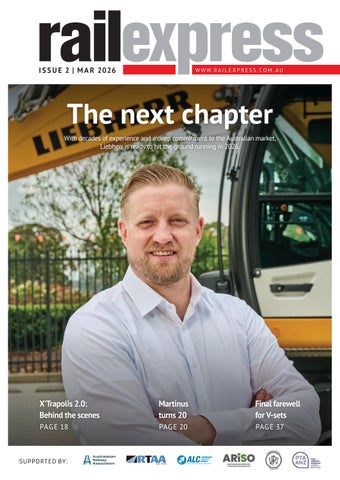

The next chapter
With decades of experience and a deep commitment to the Australian market, Liebherr is ready to hit the ground running in 2026.

X’Trapolis 2.0: Behind the scenes
PAGE 18 Martinus turns 20 PAGE 20
Final farewell for V-sets
PAGE 37


FULL-SERVICE RAILWAY INFRASTRUCTURE
Building the #NextGenRailways of tomorrow


From the Editor
Published by:
379 Docklands Drive
Docklands, VIC 3008
T: 03 9690 8766
www.primecreativemedia.com.au
Chairman
John Murphy E: john.murphy@primecreative.com.au
CEO Christine Clancy E: christine.clancy@primecreative.com.au
Managing Editor Lisa Korycki E: lisa.korycki@primecreative.com.au
Editor Kayla Walsh
E: kayla.walsh@primecreative.com.au
Business Development Manager
Arron Reed M: 0466 923 194 E: arron.reed@primecreative.com.au
Client Success Manager Ben Sammartino
E: ben.sammartino@primecreative.com.au
Head of Design Blake Storey
E: blake.storey@primecreative.com.au
Designer Apostolos Topatsis
Subscriptions subscriptions@primecreative.com.au
www.RailExpress.com.au
The Publisher reserves the right to alter or omit any article or advertisement submitted and requires indemnity from the advertisers and contributors against damages or liabilities that may arise from material published.
© Copyright – No part of this publication may be reproduced, stored in a retrieval system or transmitted in any means electronic, mechanical, photocopying, recording or otherwise without the permission of the Publisher.

Kayla Walsh Editor - Rail Express
Welcome to the March edition of Rail Express
It’s hard to believe we’re three months into 2026 already – and the rail industry has already marked some major milestones this year, including the Metro Tunnel’s “Big Switch”.
As a daily passenger on Melbourne trains, it’s been amazing to see the positive impact of the biggest change to the city’s public transport network in 40 years.
And Melburnians have even more to look forward to later this year, with the introduction of the new fleet of X’Trapolis 2.0 trains.
The state-of-the-art fleet, which is currently in its testing phase, is not just more accessible, sustainable and reliable – it’s also built right here in Victoria at Alstom’s Ballarat facility.
I was lucky enough to get some behindthe-scenes insights from Nathan Hall, the manufacturing site’s Production Supervisor, which I share on pages 18-19.
The story fits nicely into one of the central themes of this issue, manufacturing. I found out more about CRRC Ziyang’s new AC-series diesel locomotive platform, which is bringing Chinese manufacturing excellence to the world stage.
Plus, I share an update on Plasser’s innovative Unimat 09-2X 4x4/4S Dynamic tamping machines, of which two were delivered to Australian customers last year.
Our cover story is a cracker, with Lucas Ortlieb, General Manager of LiebherrAustralia’s Earthmoving & Material handling
division, opening up about why the business is ready to hit the ground running this year.
Meanwhile Siemens Mobility tells me everything we need to know about Signaling X, which helps operators optimise their rail operations and manage them more intelligently.
Elsewhere in the magazine, Martinus celebrates 20 years since it entered the rail industry as a contractor, and reflects on its evolution into something very different.
MTR talks about the process of renewing key assets while maintaining seamless service for passengers, and KeTech explains why integrating intelligent passenger information software with both legacy and modern equipment is often the best approach for operators.
Paul Hawthorne, DTI’s new Executive General Manager – Rail, opens up about how he was bitten by the rail bug and his ambitions for the company moving forward.
S&V also shares insights around the benefits of using rail dampers in tunnels and the impressive results from some recent installations.
Plus we take a look ahead at Rail R U OK? Day and the importance of checking in on your colleagues within the industry. You never know when asking a simple question could save a life.
kayla.walsh@primecreative.com.au


Sydney station wins global design prize
Gadigal Station in Sydney has been awarded the Prix Versailles World Title – Special Prize for Interior.
This global award recognises the station’s architecture and design, which was led by Sydney Metro in partnership with Foster + Partners and COX Architecture.
The win follows Gadigal Station being selected as one of the “Magnificent Seven” most beautiful passenger stations in the world for 2025 by Prix Versailles.
Since it opened in August 2024, Gadigal Station has welcomed about 15,700 passengers daily as one of six new underground stations between Central and Sydenham.
The station was previously praised by the Prix Versailles judges for its innovative architecture, sustainable design and seamless functionality, and described as the “epitome of modernity”.
A notable aspect of the station, which is named in honour of the traditional owners of the land it is built on, is its integration of Indigenous cultural heritage.
The station recently welcomed Return of the Gadi Reed – four cast-aluminium sculptures by First Nations artists Rowena
Gadigal Station welcomes about 15,700 passengers daily.
The artwork is inspired by traditional reed necklaces created from Gadi –native reeds once found across the Tank Stream Valley where the station is now located.
This new public art piece complements Callum Morton’s tiled installation The

Ten years of level crossing removals
The Victorian Government is celebrating 10 years since the Level Crossing Removal Project began.
at Burke Road, Glen Iris in January 2016, with the rail line lowered under the road and a new Gardiner Station opening.
removed, with the government committing to have 110 gone by 2030.
Sunbury lines are now boom gate-free, with the Frankston and Werribee lines set to follow in 2029 and 2030, respectively.
of some of Melbourne’s most dangerous level crossings,” a statement from the government said.

Burke Road in Glen Iris before the level crossing was removed in 2016.
Image: Transport for NSW

Tram services have resumed between Adelaide and Glenelg after six months of construction on the $870 million Tram Grade Separation Projects.
Trams welcomed passengers back on board following weeks of tram testing and driver training.
The Tram Grade Separation Projects removed level crossings at three busy intersections in Adelaide, with new overpasses built at Morphett Road and Marion Road/Cross Road.
Before these level crossings were
peak hours for up to 20 minutes per hour.
This impacted about 50,000 vehicles each day at Marion Road and Cross Road, and about 25,600 per day at Morphett Road.
Jointly funded by the Australian and South Australian governments on a 50:50 basis, the Tram Grade Separation Projects has supported 1115 jobs during construction.
The existing overpass at South Road has also been rebuilt to integrate with the lowered motorway being delivered as part of the Torrens to Darlington project.
Since major construction began in August 2025, crews have poured more than 15,200 cubic metres of concrete, installed more than 3000 tonnes of steel, laid over 6300 tonnes of asphalt, lifted 92 Super T beams into place and installed 6540 metres of new tram rail.
The intersections of Marion Road and Cross Road, Marion Road and Anzac Highway, and Morphett Road and Anzac Highway are also being upgraded, with new dedicated and through lanes, improved lighting and drainage, fresh asphalt, upgraded kerbing and gutters, and new line marking.
The South Australian Government said these improvements will deliver safer and smoother journeys, ease traffic congestion and improve safety across the network.
Construction of the elevated shared use paths along the Mike Turtur Bikeway is also progressing and will open in stages during 2026, with existing pedestrian and cyclist detours remaining in place while works continue.

Sydney Metro extension marks milestone
For the first time, a Sydney Metro train has travelled the entire length of the M1 Metro North West & Bankstown Line from Tallawong to Bankstown.
The train stopped at all 31 stations along the 66-kilometre route, hitting speeds of 100 kilometres an hour on the new section of track.
Transport for New South Wales said this marked an “exciting milestone” for the line extension, which will open later in 2026.
When the project is completed, a metro train will run every four minutes during peak times, with 15 metro trains an hour.
This is an improvement compared to eight trains an hour on the former heavy rail T3 Bankstown Line, almost doubling the services connecting South-West Sydney to the rest of the city.
Passengers at Bankstown will be able to travel to Gadigal Station in 30 minutes, saving 15 minutes compared to the 45 minutes it took to get to Town Hall on the former heavy rail line.
The current high-speed testing phase requires at least 9000 hours and 30,000 kilometres of combined testing to be completed before the line can open.
Across the Southwest line, 79 per cent of works within the corridor and at stations are now complete.
Tiling is largely finished at four stations, with construction continuing at the remaining six. Painting and landscaping are also underway at most stations.
Testing is progressing on the platform screen doors and mechanical gap fillers,
The next stage will involve integration testing with the test train later this year.
During the high-speed testing phase on the Southwest extension, more than 70 critical integration tests will be carried out to confirm systems operate together and to validate the performance, functionality and safety of the trains and new infrastructure.
As part of the final conversion, crews will


A tram travelling across the Marion Road/Cross Road overpass.
The M1 Line will span 66 kilometres from Sydney’s northwest, through the CBD and out to Bankstown.
Image: Government of South Australia
Image: Sydney Trains

and Equipment
A new chapter for Liebherr Plant
With decades of experience, a customer-first philosophy and deep commitment to the Australian market, Liebherr is ready to hit the ground running in 2026.
As Australia’s infrastructure landscape rapidly evolves, so too does the demand for high performance, robust and versatile machinery.
Liebherr, a global leader in equipment manufacturing, has been a pioneer in the development and production of railroad excavators since 1967.
Now, the company is poised for a new phase of growth in Australia – with next generation products hitting the market and an expanding footprint nationwide, bringing its customers better access to parts, service and support.
Helping to steer the business forward in this exciting chapter is Lucas Ortlieb, who was recently appointed General Manager of Liebherr Australia’s Earthmoving & Material handling division.
He spoke to Rail Express about what the rail industry can expect from Liebherr in 2026.
A NEW DIRECTION
Ortlieb said Australia is a key market for Liebherr – and it sets an example for the rest of the world.
“Very few other markets offer the potential that we have here in Australia, across diverse areas, from heavy haul to metro networks,” he said.
“This applies to all of our earthmoving, construction and material handling machines, and particularly our rail machines.”
He said Liebherr Australia has experienced many dynamic changes in the past decade, particularly in the past five to six years.
“The COVID 19 pandemic reshaped the competitive landscape,” he said. “In addition, global market challenges in 2025 have created pressures across all industries –many of which remain ongoing and largely outside our direct control.

“That makes it even more important to focus on what we can influence. By building on our strengths and staying disciplined in our development, we are confident we are moving in the right direction.
“We are very positive about the future and look forward to a strong and successful year in 2026.”
With a solution‑led approach to the market, Liebherr focuses on delivering the best possible outcomes for its customers.
“As a premium brand, we may not always compete on upfront price, but our customers see the difference over the full lifecycle of the machine,” Ortlieb said.
“What sets us apart is our ability to provide reliable, sustainable solutions tailored to different applications, helping customers reduce operating costs, improve efficiency, and achieve better results across their operations.”
Liebherr is committed to shaping the future of the Australian rail industry.

LEADING THE WAY IN RAIL EXCAVATORS
When it comes to rail excavators, Liebherr continues to excel – with its trusted A 922 Rail and A 924 Rail in high demand across Australia.
“Capable of fast turnaround operations on track, its design features multi gauge capability and a Power Lift mode to increase maximum payloads for demanding lifting tasks,” Ortlieb added.
pipe fracture safety valves on hoisting and stick cylinders to protect the operator and environment.

Purpose built for both rail and earthmoving applications, the A 922 Rail Litronic is a Generation 6 railroad excavator with an operating weight between 20,400 and 23,400 kilograms.
Used for loosening ballast, lifting sleepers, dragging rail and handling materials in track areas, Ortlieb said it is particularly effective for working independently on inaccessible sections of track due to its compact and flexible design.
“The A 922 Rail is already popular in Australia and around the world for its exceptional versatility and heavy duty performance,” he said.
“It features rail axles that can be configured for standard and broad gauges and can also be adapted for use on narrow gauge.
“Operators can also easily change between attachments for rail and earthmoving, ensuring maximum efficiency.”
The A 922 Rail is designed to transition seamlessly between rail and road, with a wheeled chassis that increases machine speed compared to crawler rail machines and makes travel between job sites faster.
Powered by a robust 120 kilowatt (163 horsepower) engine, it can be configured with an optional convertible rail undercarriage featuring position control and minimum pressure control for optimised axle performance.
“A key technical highlight is its dual pump system, which utilises a double variable displacement pump with independent regulating circuits to provide a flow volume of 2 X 220 litres a minute.”
Meanwhile the A 924 Rail is a heavier Generation 6 machine, weighing between 21,800 and 25,000 kilograms.
Like the A 922 Rail, the A 924 Rail features a 120 kilowatt (163 horsepower) engine .
Suitable for heavy duty and quick turnaround operations, it has a massive pulling force of 117 kilonewtons and is frequently used for towing both unbraked and braked wagons.
Its specialised undercarriage features both Friction drive (9B or Type 2) for standard and Direct drive (9C or Type 3) set ups.
“The A 924 Rail’s high operating weight and Power Lift mode make it ideal for high performance tasks like pile driving or handling heavy payloads while clearing train stops easily,” said Ortlieb.
Liebherr’s machines also come with a comprehensive safety suite, and both machines integrate safety through electronic lift and swivel limitation, load torque limitation (RCL), and an optional ‘virtual wall’ to prevent contact with adjacent tracks or overhead lines.
The machines also feature standard
The first class Roll O ver Protective Structure (ROPS) safety cab is specifically designed for two man operation, featuring a co operator seat with access to a signal horn and emergency stop switch.
“This layout is specifically engineered for safety and productivity, allowing a co operator to monitor the rear of the machine and access critical controls during complex manoeuvres,” said Ortlieb.
In addition, the ergonomic workstation includes automatic air conditioning, a high resolution touchscreen, and low interior noise levels of 70 A weighted decibels.
Another advantage of these machines is their flexibility for different work environments, with a choice of counterweights, providing a tail swing radius of 2000 millimetres.
The tool control system also allows operators to store settings for up to 20 different attachments, enabling rapid adjustments from the cab.
To maximise uptime, both the A 922 Rail and A 924 Rail feature a service oriented design where all maintenance points are accessible from the ground via large, wide opening doors. It includes a fully automatic central lubrication system for the uppercarriage and equipment as standard.
Ortlieb said Liebherr has received excellent feedback on the A 924 and the A 922 from customers all over Australia.
“Currently, our A 924 Rail customers
Liebherr-Australia provides comprehensive sales, service, and support for a wide range of earthmoving and material handling equipment.
Images: Bruce Robinson Photography
Plant and Equipment
are operating predominantly in New South Wales, where feedback has been exceptionally positive,” he added.
“Operators have specifically welcomed the added lifting capacity of this model, as well as the machine's ability to clear train stops with minimal fuss – a significant advantage facilitated by the specialised undercarriage.”
THE RE 25 M LITRONIC
One of the highlights of bauma – the world's biggest construction machinery trade fair – in 2025 was the premier of the RE 25 M.
Ortlieb describes this Generation 8 railroad excavator as a true “game changer”, featuring a world first undercarriage that combines hydrostatic rail wheel drive (category 9A or Type 1) and Direct drive (category 9C or Type 3) and provides unique direct traction capabilities. Its hydrostatic rail axle allows for standard travel speeds of 20 kilometres an hour.
“What truly sets the RE 25 M apart is its short t ail design, featuring a rear swivel radius of just 1570 millimetres, making it suitable for track use anywhere in the world,” he said.
“Its applications are especially adapted for confined urban construction sites where its tail radius allows for safe operation in restricted corridors.”
Despite its compact size, the RE 25 M is engineered to deliver the highest payloads in its class (24,400–25,700 kilograms) through a patent pending two point outrigger support system.
“Positioned centrally, these outriggers provide exceptional stability and visibility without increasing the undercarriage length, ensuring the machine remains highly manoeuvrable on confined construction sites,” Ortlieb explained.
“Engineered to be ‘the best solution in its weight class’, the RE 25 M Litronic represents the pinnacle of Generation 8 railroad excavator technology.”

the ROPS double cab with a completely new crew cab that integrates the INTUSI intuitive operating concept, featuring a 10 in ch touchscreen display where all rail specific functions and machine settings are centrally managed.
Ortlieb said there has been a significant amount of interest in the RE 25 M Litronic, especially following bauma 2025, where several Australian customers had the opportunity to see the machine first hand.
Liebherr will start taking orders for the RE 25 M towards the end of 2026.
“We expect to see the first units in Australia in 2027,” said Ortlieb.
“Australia is an important market for Liebherr, and our engineers have ensured that the relevant Australian standards were applied to the machine's design to guarantee local compliance."
COMPREHENSIVE SOLUTIONS
With 11 branches across Australia, Liebherr’s market coverage spans all states, with strategically located service centres supporting operations in both urban and regional areas.
To support its growing customer base in 2026, Liebherr is increasing its parts holdings nationwide.
Ortlieb said Liebherr will continue to invest in expanding its Australian footprint to stay close to customers, deliver dependable, end‑to‑end solutions, and provide strong local service and maintenance support.

solutions, our approach is multi f aceted,” he said.
“A core element of our approach is that we act as the manufacturer not just of the machine, but of the entire system behind it.
“By producing many of our key components in house – from hydraulics through to electronics – we are able to deliver higher reliability, better system integration, and machines that perform consistently in the most demanding operating environments.”
For customers, this translates into improved uptime, lower operating risk, and long term confidence in their equipment, Ortlieb said.
“This is an important factor in us reaching better consumption levels and better performance on the job sites.”
Ortlieb said that Liebherr being present in Australia and selling directly to customers rather than via dealerships has given the company a strong understanding of the market.
“Our manufacturing representatives are here regularly, and they know the market, they understand the different industries, and they understand our individual customers.
“The inputs we receive from our customers go to our research and development team and they incorporate that feedback to continuously refine and enhance our product offerings.”
Originally from Germany, Ortlieb has built more than 15 years of international experience with Liebherr, working across diverse markets in South America and Asia.
He added: “I’m delighted to be here in Australia with my family, and looking forward to a great year of growth at Liebherr in 2026.
“With a strong focus on our customers and a range of robust, versatile and sustainable machines, Liebherr works alongside operators and partners to support the future of rail in Australia.”


Lucas Ortlieb, General Manager of LiebherrAustralia’s Earthmoving & Material handling division.
The A 922 Rail is designed to transition seamlessly between rail and road.

Signalling the future Technology

Signaling
signalling systems are becoming impossible to ignore.
Rather than adding more track – which can be complex, expensive and sometimes impossible due to spatial limitations –operators are looking for ways to use existing infrastructure to its best advantage.
One solution is for operators to run more trains on the tracks they already have, and to do so safely, reliably and efficiently. That’s where Signaling X, a smart new solution from Siemens Mobility, comes in.
To find out more, we spoke to Dr. Lazos Filippidis, Head of Mainline Application, Technology Development and Innovation at Siemens Mobility Germany.
WHAT IS SIGNALING X?
Signaling X establishes a common computing platform, enabling the seamless control and operation of signalling applications for multiple countries and cities from locationindependent signalling data centres.
operations,” said Filippidis.
“This improves efficiency, integration, capacity and punctuality while maintaining the highest level of security across rail networks.”
At the core of Signaling X is the Distributed Smart Safe System (DS3), a software middleware layer that fundamentally changes how signalling systems are engineered and maintained.
The DS3 platform provides the basis for moving interlockings and radio block centres to a private cloud or data centre that is owned by the operator, paving the way for cost-efficient country-wide infrastructure management.
It is equally capable of serving in urban transport systems, enabling metro operators to centralise and unify their infrastructure.
With Signaling X, Siemens Mobility is opening DS3 software to more Siemens applications, improving the efficiency
which is very important because currently we have proprietary hardware with a deep interconnection between the hardware and the software layer.
“This means that if you update your hardware due to obsolescence, there could be implications for the software layer. So, you need to reopen what we call ‘the safety case’ and reassess everything.”
This separation of hardware and software also enables Siemens Mobility’s customers to build their own data centres.
“Customers have more freedom because they have that independence from the Siemens Mobility proprietary hardware,” said Filippidis. “They can use different computational hardware or mix it with applications from other vendors using the same computation hardware.
“To give you an example that’s easy to understand: it’s like replacing your computer, but your Microsoft Excel is untouched.”
With
X, moving to a cloud-based, modular signaling platform allows for greater flexibility and adaptability.
Images:
ENHANCING CAPACITY AND RELIABILITY
When it comes to running more trains, more often, rail networks are limited by the way some signalling systems work.
“Only one train can enter a block at a time, and these blocks are usually separated via physical systems called axle counters or track circuits,” Filippidis said.
“To have denser blocks and therefore higher capacity, you would need to install more axle counters.”
To avoid the cost and effort involved with this approach, Siemens Mobility can implement a solution called ETCS (European Train Control Systems) Hybrid Train Detection.
ETCS Hybrid Train Detection removes the need for axle counters and physical line signals and uses virtual blocks instead.
“This means operators can make the blocks as short as they like, enabling trains to run much more densely on the network and massively increasing capacity without additional physical hardware,” he said.
“The less hardware you have on the trackside, the higher reliability and punctuality will be, because sporadic hardware failures are reduced.
“You’re also going to have lower maintenance costs.”

Signaling X debuted for Mass Transit at the Singapore Rail Test Center where it was demonstrated in a live CBTC operation.
“If there are any train delays, you know the reason and you can reroute trains or alter timetables.”
SIGNALING X IN ACTION
Siemens Mobility can also layer Automatic Train Operation (ATO) on top of ETCS, which ensures trains brake precisely and run more smoothly.
“With smoother trains and better punctuality, you’re going to see increased passenger satisfaction,” Filippidis added.
SAFE AND SECURE
Signaling X is as much about digitalisation as it is about signalling. Moving to a private cloud or data-centre-based, data-centric architecture has significant implications for information technology (IT) security and operations.
“With digitalisation, that IT security concept becomes more and more important – especially because of what we call ‘patching’,” said Filippidis.
“Because of the separation between applications with Signaling X, if there is an incident you can quickly and easily update the software on the IT security layer to protect your system.”
Digitalisation can also improve capacity and performance on a network, with more diagnostic data available.
“The more data you have, the better you can analyse your network, and the better you can take specific measures to improve.
“You can easily see the weak points in your network and carry out preventive diagnostics.
Siemens Mobility debuted Signaling X at the Singapore Rail Test Centre in November 2025, demonstrating the technology live in a CommunicationsBased Train Control (CBTC) system.
“To enable Signaling X in Singapore, safety-critical SIL4 (Safety Integrity Level 4) CBTC and interlocking applications with proven, mature functionality were seamlessly migrated from the existing system to the digital DS3 platform, operating on commercial off-theshelf servers, with the signalling logic unchanged,” said Filippidis.
“This demonstrated that transitioning from a conventional system to the next generation of CBTC with Signaling X is quick and easy, while maintaining compatibility and operational excellence.”
Filippidis said the demonstration also showed how existing investments were safeguarded by preserving the untouched signalling logic, while introducing the next generation of CBTC technology.
“This achievement exemplifies the smooth integration of innovation and operational excellence with future-proof solutions,” he added.
“The Singapore demonstration confirmed that Signaling X enhances flexibility, scalability, and maintainability, enabling operators to address both present and future operational and global challenges.”
STANDARDISED APIS
Siemens Mobility’s non-safety and safety applications use standardised application programming interfaces (APIs) to ensure seamless integration and interoperability across the entire system.
Filippidis said this standardisation also boosts efficiency for operators.
“We use standard interfaces, so the client knows what kind of interfaces we use,” he said. “That means they only need to tell us what kind of content to put into those interfaces.
“Take the communication between train and trackside, as an example. Standardisation allows operators to use a train from one vendor with trackside equipment from another, so there is greater flexibility.”
THE FUTURE OF RAIL TECHNOLOGY
For Filippidis, the move to Signaling X is as much a cultural journey as a technical one.
“When you step into digitalisation, it's not only about the technology – it's also about the people dealing with this technology,” he said. “We start with trials and training, we check what the operator needs and the skills of their team, and we are there to answer their questions.
“We co-operate with the customer every step of the way, so we can move forward on the Signaling X journey together.”
Filippidis believes Signaling X heralds the future of rail technology.
“We know digitalisation is coming. We know standardisation is coming,” he said.
“With our DS3 solution, our cloud solution and our data centre solution, Siemens Mobility is ahead of the game.
“I believe Signaling X is the future.”


X’Trapolis 2.0: Trains made by locals, for locals Manufacturing
Alstom is manufacturing 25 modern X’Trapolis 2.0 trains at its Ballarat facility – supporting local jobs, strengthening the supply chain and bringing Melbourne’s rail network into the future.

The next phase of renewal for Melbourne’s trains is fast approaching, with the new X’Trapolis 2.0 (XT2) fleet set to hit the tracks in 2026.
The state-of-the-art trains, which are currently being tested on the network, are part of a $986 million investment from the Victorian Government, along with upgrades to the Craigieburn Train Maintenance Facility.
But this project is not just about investment in Melbourne’s public transport network – it has a wider positive impact on the Victorian economy too.
The 25 new XT2s are being built in Ballarat by leading rail manufacturer Alstom, with at least 60 per cent local content.
This has created up to 750 local jobs across the supply chain, and up to 150 in the local supply chain in Ballarat alone.
We caught up with Nathan Hall, Production Supervisor at Alstom Ballarat, to find out more about the new fleet, the significance of the Ballarat facility and more.
Alstom’s Ballarat site has a storied history, serving as a key regional
manufacturing hub for over 100 years.
“Ballarat is where Melbourne’s original fleet of X’Trapolis 100 trains were made, so there’s a strong connection between the local community and this new fleet of trains,” said Hall.
“The long history of rail manufacturing here also means there is great local knowhow, allowing us to produce an excellent product for Melbourne’s train network.”
Alstom invested $20 million to upgrade the plant after the completion of the X’Trapolis 100 contract, and it now boasts top-of-the-range, custom manufacturing equipment.
“They completely gutted the facility and started again, upgrading the electronics and the amenities and purchasing new tracks and new cranes,” said Hall.
“There was a lot of money put into new custom-built platforms, as well as jigs and tooling.
“These investments make our work safer and more efficient and produce the highestquality products.”
As a major regional centre, the Ballarat site currently provides 75 production
roles plus other support and whitecollar positions.
Projects like XT2 require people from all walks of life, with skills needed across supply chain and procurement, engineering, EH&S (environment, health and safety), quality, human resources and administration as well as production and various trades including welders, coach builders, electricians, trade assistants, logistics operators and apprentices.
Hall added: “We recently put a recruitment call in local Ballarat channels and will be welcoming new local tradespeople to our site soon, which is something we are very proud of.”
Hall, who joined Alstom in 2023, said the engaged and resilient team work well together to get the job done.
“I’m incredibly blessed to work with such a skilled and tight-knit team,” he said. “There is a strong community spirit and pride in Ballarat that translates into pride in our work.
“Today, for example, we knew we had to hit our milestones before the end of the month, and we really banded together to
Alstom’s Ballarat facility underwent a $20 million upgrade ahead of the XT2 project.
Images:
Alstom

achieve everything we needed to achieve.
“When I see the team excited about what they’ve produced each day, it’s so rewarding.”
He’s also pleased to share the diversity of the workforce at the Ballarat facility.
“It’s probably one of the most multicultural places I’ve ever worked, and it’s fantastic because everyone brings a different background and life experience to the job.
“Our collaboration is what helps produce
the best quality trains we possibly can.”
Some of the team at the site didn’t have any prior experience working with trains, with Alstom welcoming young apprentices and trainees as well as people from different industries.
“This project has been a great opportunity for locals to get a foot in the door in the rail and manufacturing industries,” he said.
“We've hired many electricians, mechanical fitters and trades assistants that had never worked on rolling stock or trains
before, and some of them are now among our best employees.
“It’s all about growing skills and building the local workforce for the future.”
XT2: THE NEXT GENERATION
The new XT2 trains will enable the gradual retirement of Melbourne’s longest-serving Comeng trains on the Craigieburn, Upfield and Frankston lines.
Hall said the XT2s are more comfortable and energy-efficient and will provide more reliable journeys and improved accessibility for passengers.
“The XT2 trains have been co-designed with everyday Victorians to ensure they meet their needs,” he said.
“These trains are incredibly spacious, with room for about 1225 passengers, and advanced air suspension systems for a smoother ride.
“One of my favourite things is that they’ve also got wider, externally hung doors to make boarding and alighting easier, especially at peak hour.”
Other features include improved realtime passenger information, designated ‘mixed-use’ onboard spaces for bicycle and pram storage, and enhanced accessibility features such as more wheelchair spaces, semi-automated boarding ramps, hearing loops and a continuous walkway throughout the train.

BENEFITS BEYOND BALLARAT
Alstom partners with more than 900 suppliers across Australia’s rail ecosystem. These local suppliers are delivering important features of the new trains, including accessibility ramps, passenger windows, heating and ventilation systems and couplers.
These partnerships strengthen national and state supply chains and help reduce exposure to international supply volatility.
“Manufacturing in Ballarat gives Alstom the proximity and partnership needed to solve problems quickly with our customers,” said Hall. “Being embedded in regional Victoria means we understand local conditions, community expectations and government priorities, allowing us to deliver solutions tailored to the Victorian network.
“Regional manufacturing also streamlines logistics and reduces complexity, helping us turn around work faster and with greater reliability than would be possible from metropolitan or offshore facilities.
“The Alstom Ballarat site provides certainty for investment in people, skills and capability long into the future.”

Jack Savige, Mechanical Fitter, and Nathan Hall, Production Supervisor, who are both part of Alstom's Ballarat team.
The new XT2 trains are currently in testing before they join Melbourne’s network.
Major Projects and Infrastructure

Martinus: 20 years of building rail
Treaven Martinus shares his company’s journey from contractor to international railway developer – originating, structuring, financing, engineering, building and operating rail assets across its global footprint.
Twenty years ago, Martinus entered the rail industry as a contractor. Today, it operates as something very different.
Across Australia, New Zealand, Chile and the United States, Martinus is originating, financing, engineering, building, operating and maintaining rail infrastructure –positioning itself as a global railway developer and long-term asset owner.
According to Australian rail entrepreneur Treaven Martinus, who founded Martinus in 2005, this transformation was no accident, but the result of two decades of deliberately stacking capability.
“Our journey has involved learning rail from the ground up, removing inefficiency at every interface, and building a business designed not just to deliver projects, but to own and operate them over the long term,” he said.
“For Martinus, the past 20 years are not the story, but the proof.”
DESIGNED GROWTH, NOT ACCIDENTAL SCALE
Treaven Martinus said his company began with a simple conviction: rail infrastructure could be delivered more efficiently if those doing the work truly understood how rail systems function end to end.
Early work focused on turnout supply,
with each project funding the next.
“Capital and capability were deployed deliberately and carefully, and every contract was treated as a platform for the next constraint to be removed,” he explained.
“A breakthrough turnout contract with the Australian Rail Track Corporation (ARTC) validated the model and accelerated expansion into construction.”
Early multidisciplinary projects such as the Gunnedah Yard Upgrade in 2014 – a $40 million project that was part of ARTC’s rollout of 30-tonne axle load (TAL) access to its customers throughout the upper Hunter Valley – demonstrated that Martinus could self-perform complex rail scopes well beyond its perceived size.
“What followed was controlled growth driven by one question: what capability must we add next to remove friction from delivery?” Treaven Martinus said.
“Major programs forced the business to answer that question in real time, and the Murray Basin Rail Project marked a turning point for us.”
A $440 million project that played a key role in the Victorian Government’s strategy to improve regional exports and ensure long-term growth in the grain, mineral sands and agricultural industries, the
scale of the Murray Basin Rail Project was unprecedented for Martinus.
Between July 2017 and August 2018, crews upgraded hundreds of kilometres of track, with multiple work fronts and a workforce scaling into the hundreds.
Chief Operating Officer at Martinus, Ryan Baden, said systems, leadership depth and endurance were tested all at once.
“We learned how to operate at major-project scale,” he said. “It was uncomfortable, but it changed everything.”
The Carmichael Rail Network North Civil Package moved the goalposts again. What began as a track package evolved into the delivery of an entire greenfield rail corridor under extreme conditions.
Martinus expanded from a modest civil scope into full fence-line-to-fenceline delivery, mobilising specialist plant, engineering capability and more than 1000 people through the project, including during the COVID-19 pandemic.
“By the time Carmichael was delivered, Martinus was no longer defined by project size, but by completeness,” Baden added.
THE REAL DIFFERENTIATOR
Treaven Martinus said that through its growth, Martinus learned an enduring lesson.
Martinus has evolved from a rail contractor to a global railway developer and long-term asset owner.

“Delivery capability scales only when people do,” he said. “Our early hiring mistakes reinforced this reality.
“Experience and titles alone didn’t build resilient teams: culture, accountability and hunger did.”
Martinus said the company now focuses on developing people from within.
“We back people with the right mindset, giving them real responsibility and supporting them to grow into leadership roles,” he said.
“The result is a business where delivery confidence does not sit with a few individuals but is embedded across the organisation.
“With the right team, support and belief, people consistently outperform expectations. Martinus treats that as a strategic advantage, not a slogan.”
AN AUSTRALIAN MODEL TAKEN GLOBAL
After proving its capability in Australia, Martinus expanded internationally –exporting a delivery model built on vertical integration, accountability and self-performance.
“New Zealand was a natural next step, and Chile was chosen deliberately, offering strong long-term opportunity and rail systems closely aligned to Australian practice,” said Treaven Martinus.
Today, Martinus Chile employs more
“A rail market many times the size of Australia’s, it demands patience, credibility and local execution,” said Martinus.
“Momentum is now accelerating, with Martinus transitioning from service-based work into major project pursuits across multiple states.
“Measured by capability added, markets entered and scale delivered – not just revenue – Martinus’s international expansion is unusually controlled and unusually fast.”
FROM DELIVERY TO OWNERSHIP
According to Treaven Martinus, the most significant evolution of the business is now becoming visible.
Under Infrastructure by Martinus (IBM), the company is moving beyond traditional contracting into full railway development and ownership – originating, structuring, financing, engineering, building and operating rail assets across its global footprint.
“This platform has been under development for several years, with multiple rail assets already progressing through origination, pre-development and structuring phases in different markets.”
While not all projects are yet public, the approach is deliberate and repeatable.
“The logic is straightforward: the

A PUBLIC EXAMPLE OF A BROADER PLATFORM
While several rail developments are advancing under Infrastructure by Martinus, one project currently in the public domain provides an illustration of the model in action.
In Alaska, Martinus has partnered with Macquarie Bank to establish Alaska Infrastructure Partners (AIP), advancing the Port MacKenzie Rail Extension, a key freight connection supporting long-term industrial and economic development.
Selected by the Alaska Gasline Development Corporation, AIP is leading early-phase development, shaping scope, risk allocation and delivery structure to support a fully financed, fixed-cost delivery model with longterm operational outcomes.
“Rather than a one-off initiative, Alaska reflects a repeatable approach Martinus is now applying across its global rail development pipeline,” said Treaven Martinus.
WHY THE INDUSTRY IS PAYING ATTENTION
Successfully transitioning into development as a rail contractor requires strong delivery credibility, disciplined capital deployment and the confidence to walk away from work that does not fit, Martinus said.
“Few rail contractors successfully transition into development, and fewer still do so internationally,” he said.
“Where traditional contractors are optimised for delivery and financial developers for capital, Martinus is optimised for the entire asset lifecycle.
“Our vertically integrated model compresses interfaces, reduces misaligned incentives and aligns long-term performance with delivery decisions made at the engineering stage.
“In an industry grappling with risk transfer, delivery certainty and value for money, that alignment matters.”
Twenty years after its formation, Martinus remains proudly Australian, but no longer Australia-only.
“Our future lies at the intersection of delivery and development, where railways are conceived, financed, engineered, constructed and operated by the same organisation that will own their performance for decades.
“The past 20 years built the foundation, but the next 20 will define a different way rail infrastructure is delivered – and owned – globally.”

Twenty years after its formation, Martinus remains proudly Australian, but no longer Australia-only.


Operations and Maintenance
Driving excellence in asset renewal and smart operations
MTR is experienced in renewing key assets while maintaining seamless service for passengers. We find out more.

As one of the world’s leading railway operators, MTR Corporation is committed to delivering safe, reliable, and innovative rail services.
Central to the company’s success is its expertise in asset renewal management and its dedication to “smart operations” – leveraging technology and data-driven insights to enhance performance and passenger experience, while ensuring uninterrupted service.
STRENGTHENING
HONG KONG’S RAIL NETWORK
Hong Kong’s railway system is among the busiest in the world, transporting an average of 5.65 million passengers every weekday.
Maintaining service reliability while upgrading ageing infrastructure requires meticulous planning. MTR has committed over $65 billion Hong Kong dollars ($12.5 billion Australian dollars) between 2023 and 2027 to renew and upgrade railway assets

systematically, securing long-term safety and operational resilience.
A key part of this initiative is the fleet renewal program, which will replace 93 first-generation urban line trains.
New, modern trains are being introduced in phases to improve service quality while operating alongside existing trains during the transition.
This upgrade is further strengthened by MTR’s award-winning Enterprise Asset Management System (EAMS), which supports safe, reliable and efficient fleet operations.
This holistic approach enables more seamless maintenance across mixed fleets, ensuring service continuity.
The renewal program also includes signalling, power supply, station chiller and various systems upgrades, boosting reliability and passenger experience while enabling smarter, data-driven maintenance.
MANAGING COMPLEXITY WITH PIONEERING INTELLIGENCE
MTR’s expertise extends beyond rolling stock, with a key strategy focusing on embedding innovation and technology into operations.
A prime example is its Train Performance and Health Monitoring System (PHM), which enables real-time condition monitoring to facilitate data-driven maintenance and smart operations.
Using train-borne data, stakeholder-specific platforms such as for the operations control centre, train operators, and maintenance team were developed to address their respective pain points.
PHM is being deployed across various train fleets of the MTR, enhancing reliability across the entire network.
“By leveraging PHM and EAMS, MTR transforms previously untapped raw data into actionable insights – optimising asset lifecycle management, reducing unplanned downtime, and delivering consistent service quality for passengers,” said KH Lee, Deputy Director – Operations Engineering Maintenance of MTR Corporation.
EAMS was the first from an organisation in Greater China to win the prestigious Team Achievement Award at The Institute of Asset Management’s Excellence Awards 2024, underscoring MTR’s leadership in digital asset management.
The Train Performance and Health Monitoring System (PHM) can monitor the real-time condition of each train and its subsystems.
Operations and Maintenance

THE KWUN TONG LINE TUNNEL RENEWAL
In July 2024, MTR undertook one of the most complex asset renewal projects in its 45-year history, replacing more than 50 power cable hangers and renewing various trackside equipment in the Kwun Tong Line tunnel near Yau Ma Tei Station in Hong Kong.
These components had been in service for more than four decades, and MTR decided to proactively replace the ageing infrastructure. To complete the work safely, a 28-hour train service suspension was needed between Prince Edward and Ho Man Tin stations, with the electricity supply cut off.
Although the operation was extensive, disruption to passengers remained minimal, as services on other metro lines at the
The grey dashed line indicates the section where train service was suspended during the Kwun Tong Line Tunnel Renewal in 2024.
Edward Station continued to function as the primary interchange between the Kwun Tong and Tsuen Wan lines. Alternative bus services were also provided to further ease the impact.
The successful delivery of the project was rooted long before works began— through meticulous planning, rigorous risk assessments, and close coordination across multiple teams. This foundation enabled the critical execution phase, which commenced early in the morning on Sunday, 28 July 2024, and continued seamlessly for 28 consecutive hours.
During this tightly controlled window, a team of approximately 500 engineers worked around the clock to ensure every

resumed with the first train on 29 July 2024, with no delays and no impact on passengers.
“This outcome highlights MTR’s capability to implement precision engineering upgrades within strict timelines—reinforcing the value of robust planning, flawless coordination, and our commitment to maintaining public confidence and trust,” Lee added.
THE TUNG CHUNG LINE EXTENSION
The Tung Chung Line Extension (TCLE) exemplifies MTR’s expertise in managing brownfield railway reconfiguration during ongoing operation, with major track diversion works including turnout installation, track slewing, and system cutovers being delivered while maintaining high-frequency services on the Tung Chung Line and Airport Express in Hong Kong.
Several factors have set MTR’s approach apart, including operations-led planning. Engineering design and possession plans are crafted with direct involvement from railway operations teams.
In addition, sequential possessions support the gradual installation of turnouts and transitions between systems, while thorough risk evaluations and phased commissioning processes take place before each handback.
MTR stands out for multi-discipline interface management. Careful collaboration is maintained among civil works, track, signalling, traction power, overhead line equipment, and telecoms. TLCE also showcases MTR’s ability to execute complex track diversions while safeguarding daily operations – a capability critical for global metro systems.
Major track diversion works are taking place as part of the Tung Chung Line Extension in Hong Kong.
GLOBAL RELEVANCE
“MTR’s established methodologies for fleet renewal, digital asset management, and smart maintenance are fully transferable to international operations, such as those of Sydney Metro and the Melbourne metropolitan train network”, said David Tang, Managing Director –Property & International Business of MTR Corporation.
He added: “Through the integration of engineering expertise and data-driven technological insights, MTR consistently sets industry standards for sustainable and advanced rail services on a global scale, ensuring efficient, safe, and dependable transport for millions of passengers each day.”


Major projects and Infrastructure

Meet Paul Hawthorne: DTI’s new Executive General Manager Rail
Since he first joined the rail industry as a track worker 30 years ago, Paul Hawthorne has climbed up the ranks, gaining experience in everything from highspeed rail to heavy haul. Now, he’s ready to lead DTI’s rail division into the future.
With nearly three decades of experience in the rail industry, Paul Hawthorne brings a blend of frontline expertise, strategic leadership and operational understanding to his new role as Executive General Manager Rail at engineering and construction company DT Infrastructure (DTI).
We sat down with Hawthorne to talk about his journey, his vision for DTI, and his thoughts on the future of rail in Australia.
BITTEN BY THE RAIL BUG
Hawthorne didn’t grow up knowing he wanted to be in the rail industry, but since starting out as a track worker almost 30 years ago, he’s never looked back.
“I was soon bitten by the rail bug,” he said. “You form such a bond with the people you work with in this industry.
“As clichéd as it sounds, it’s like a family – especially when there’s a failure, or things don’t go to plan on site; everyone rolls their sleeves up and digs in until trains are running again.”
Over the years, Hawthorne has worked across many disciplines within the rail industry – from high-speed to conventional rail and heavy haul.
He’s spent time in engineering, maintenance, asset management and managing major projects, with experience across British, European and Australian railways.
His career has spanned high-profile companies such as Network Rail, HS1, Swietelsky Rail Australia, Rio Tinto and Laing O’Rourke.
“Importantly, each of those organisations had strong cultures in continuous improvement, which has instilled in me a mindset of never accepting the status quo and always looking for better ways to do things,” he said.
“I've had the privilege of working alongside some incredibly bright and knowledgeable people – not just senior project leaders, but engineers, machine operators and people from all different fields within rail, who’ve helped shaped me into the leader I am today.”
PEOPLE POWER
Hawthorne brings a strong focus on developing people to his new role as Executive General Manager Rail at DTI.
“I benefited enormously from being
mentored early on in my career, so I want to create that same opportunity for others,” he said.
“I want to encourage people to be curious, ask questions, be ambitious, not being afraid to fail, and most importantly, to feel supported as they grow.”
He believes one of DTI’s greatest strengths is its people.
“There’s an incredible level of energy and enthusiasm at DTI that’s matched by a genuine desire to invest in people through a structured, long-term approach in both professional and personal growth,” he said.
“Across the rail industry – I think now more than ever – there are decades of experience and knowledge that we risk losing soon.
“This reinforces the need to continually develop our people and focus on how we attract people into engineering and construction trades.”
He said attracting, developing and retaining the people needed to deliver the pipeline of work ahead continues to be one of the major challenges facing the rail industry.
Paul Hawthorne has almost three decades of experience in the rail industry.
“DTI is committed to being an employer of choice,” he said. “We’re addressing this through structured career pathways, university partnerships, learning and development programs, and partnerships with organisations such as the Australasian Railway Association (ARA).”
Increasing gender diversity is also a priority for DTI.
“We’re proud to be involved in the ARA Women in Rail Mentoring and Future Leader programs but also understand there’s more to do to in fostering a more diverse rail workforce,” Hawthorne added.
DTI’s Social Impact division is another major focus, with a strong commitment to social procurement, environmental sustainability, diversity and inclusion, and First Nations participation.
“All of these initiatives are critical not just to growing the industry, but to support a workforce that is engaged, capable and proud of what they do.”
A TRULY NATIONAL OFFERING
Hawthorne said DTI provides a “truly national” rail offering, delivering projects of differing sizes and scales all over Australia, across both metropolitan and regional areas.
“With recent successes such as the Waurn Ponds Duplication project in Victoria and METRONET in Perth, Sydney Metro stations and the Queensland Train Manufacturing Program, we are reinforcing our standing as a trusted rail delivery partner,” he said.
“We own an extensive rail plant fleet and pride ourselves on listening to our clients’ needs and being engaged early to help
provide certainty in program and cost and optimal whole-of-life solutions.
“We combine experienced track, civil and overhead wiring capabilities with our rail systems teams, which specialise in signalling and communications design, installation and commissioning, to provide an in-house turnkey offering.”
Hawthorne believes that DTI’s ability to integrate projects sets the company apart.
“We manage projects so that construction is always supported by a progressive assurance approach, using our in-house Systems Engineering and Safety Assurance (SESA) teams.”
LOOKING TO THE FUTURE
With Hawthorne at the helm, DTI plans to build on its existing capabilities and expand to create sustained growth.
“Our ambition is to provide services across a range of project types with various levels of complexity and scope, including maintenance and renewals projects where we are improving reliability and network resilience,” he explained.
“Other focus areas for us are multidisciplinary projects that tackle system obsolescence, constructing maintenance depots for the new train fleets being introduced across Australia, and major rail infrastructure projects that elevate cities and communities.”
Hawthorne said DTI wants to continue to trend as early adopters of technology and innovation, using systems that help it to make better informed, consistent decisions.
“We don’t want to remove people from

the process, but to understand where artificial intelligence can add value at each stage of the project lifecycle and act as a decision support tool to enhance existing knowledge and skills,” he said.
“We are also keen to develop and enhance our rail plant capabilities. We understand that track access time is a precious commodity, and that as an industry, we should continually strive for safer and more efficient methods of working.
“We’re exploring partnerships with Original Equipment Manufacturers (OEMs) and clients, with the goal of introducing rail plant that can increase productivity, reduce carbon emissions, and improve safety of people and plant interfaces through automation.”
Having spent a large portion of his career in high-speed rail, Hawthorne hopes it will become a reality in Australia soon.
“High-speed rail is close to my heart, and I’ve seen first-hand how it can influence regeneration in regions and support economic growth,” he said.
“However, interoperability and harmonisation are front of mind right now, which will make implementing technology, procurement and project delivery more streamlined.
“We’re already seeing European Train Control Systems (ETCS) and Communications-based Train Control (CBTC) systems being introduced in Australia, which are key to developing a more homogenised rail industry.”
Sharing his advice for the next generation of rail leaders, Hawthorne said it’s important to be curious and ask questions.
“Be prepared to step outside your comfort zone,” he said. “Build resilience – there'll be some challenges along the way.
“I also think it is important to be patient; your career is a marathon, not a sprint. I'm sure a few people who know me will laugh at me saying this as patience is still something I’m working on!
“In essence, learn your craft, build your experience, and don’t rush your train journey.”
He said he was lucky to have been guided by a mentor early on in his career.
“My mentor pushed me outside of my comfort zone, which helped me to grow, and they’ve had a huge influence on the path I've taken since.
“Having a mentor wasn’t planned – I was in the right place at the right time – but it’s something I'd encourage anyone to have early in their career, no matter what level you are or the role you’re in.”

Hawthorne on site for the Queensland Train Manufacturing Project.

Doing more with what you have
Paul Warren, Sales Director at KeTech, shares why integrating intelligent passenger information software with both legacy and modern equipment is often the best approach for operators.
Australia builds its railways to stand the test of time, but steel and sleepers mean little without system resilience. Rail technology company KeTech is ensuring the digital systems that support the rail network match its longevity.
Paul Warren, Sales Director at KeTech, said the company’s experience in retrofitting and system integration demonstrates that long-term value is not created through repeated full-system replacement, but by managing obsolescence and enabling systems to integrate across generations of assets.
“KeTech delivers passenger information systems that combine intelligent software with both legacy and modern equipment,” he said. “This adds capability, resilience and insight while keeping disruption and cost under control.”
With budgets under pressure, investment can often be focused on trains, signalling and capacity, while passenger information systems are expected to outlast their original design life.
Warren said that as these systems become central to operations and disruption management, their ability to integrate and evolve is now as important as their initial functionality.
“From KeTech’s experience working with rail operators globally, this pattern is familiar,” he continued.
“Passenger information is rarely the first system upgraded, yet it is one of the most visible and one of the most relied upon when services are disrupted or operating under pressure.”
In recent Australian reviews, passenger communication has been highlighted as a core area for improvement.
The 2025 Independent Rail Review in New South Wales highlighted that perceptions of service reliability are shaped as much by disruption communication as by train performance.

For more than 20 years, KeTech has delivered realtime passenger information systems to rail operators.
At the same time, initiatives such as the New South Wales Digital Systems Program are modernising train control and signalling, generating richer and more continuous operational data.
“If operators are investing in a more connected railway, the systems that translate that data into clear, trusted passenger guidance must be able to keep pace,” said Warren.
RETROFITTING OVER REPLACEMENT
According to Warren, a common assumption in planning is that meaningful improvement requires all-at-once replacement: new screens, new hardware and expensive overhauls. In practice, however, this approach is often impractical for Australia’s predominantly brownfield networks.
“KeTech’s work across similar complex rail environments in the United Kingdom shows that a more sustainable, cost-effective path is retrofitting legacy equipment –retaining proven hardware while upgrading the software intelligence that drives it,” Warren said.
“Done properly, this extends asset life, reduces risk and allows capability to evolve incrementally, without the disruption associated with full system replacement.”
Retrofitting passenger information in an operational railway is not simply a software upgrade. It requires deep integration skills, working across legacy protocols, control systems, onboard equipment and station assets – while maintaining reliability and meeting assurance requirements.
This is where integration-led approaches differ fundamentally from screenled upgrades.

“Obsolescence brings this challenge into focus,” Warren said. “Unsupported operating systems and ageing architectures increase maintenance effort, limit integration and introduce cyber risk.
“Australian cyber guidance increasingly emphasises patching and supportability as baseline controls – something legacy-locked systems struggle to deliver over time.
“By decoupling software intelligence from physical assets, KeTech enables operators to modernise capability while keeping proven hardware in service.”
BEYOND INFORMATION: INSIGHT AND PASSENGER FLOW
For more than 20 years, KeTech has delivered real-time passenger information systems to rail operators.
Warren said that over that time, these platforms have evolved well beyond simple messaging.
“Today, KeTech provides operational insight as well as a better passenger experience,” he said.
“Real-time passenger counting gives operators’ visibility into how services are being used, supporting dwell-time management, more informed disruption response and safer operations during peak periods.
“When shared consistently across the network, this insight becomes a practical, real-time decision-making tool rather than a static reporting metric.”
When combined with dynamic platform wayfinding, the same intelligence can actively influence passenger movement, helping to distribute passengers along platforms and reduce pressure on staff and infrastructure.
Delivered as part of a single, integrated platform, passenger counting, wayfinding and passenger information reinforce one another, sharing a common operational truth rather than operating as disconnected systems.
Through KeTech’s systems, passengers can be informed about onboard facilities such as toilets, food and drink services, accessible amenities and bike storage –all in advance of a train arriving.
This information is updated automatically using live data feeds, decreasing reliance on manual intervention.
Warren added: “This enriched, tailored information reflects the realities of modern travel and helps to increase passenger trust so they can make better informed decisions about their journey.”
WHY LONG-TERM INTEGRATION EXPERTISE MATTERS
Warren said that by combining intelligent software with both legacy and modern equipment, integrationled passenger information systems can make existing assets perform “better than new” – adding capability, resilience and insight while keeping disruption and budget spend under control.
“Australia’s rail investment pipeline remains strong, but funding pressure is real,” he said. “Operators are upgrading trains, signalling and connectivity, and with that comes more data than ever before.
“The challenge for operators is turning that data into reliable, real-time passenger information.”
KeTech’s approach is to equip operators with systems that can integrate and adapt to manage obsolescence rather than simply replacing what already exists.
“From KeTech’s experience, the greatest long-term value comes from platforms designed to integrate across generations of assets, that can evolve with operator and passenger needs in the future,” said Warren.
“Australia’s railways are built to last, and the systems that support them must do the same.”


KeTech’s on-platform Customer Information Systems and on-board Passenger Information Systems provide consistent real-time data.
Through KeTech’s systems, passengers can be informed about onboard facilities.
Images: KeTech
THEJOURNEY TO CUSTOMER TRUST


The next generation
CRRC Ziyang’s new AC-series diesel locomotive platform is bringing Chinese manufacturing excellence to
the world stage. We find out more.

CRRC Ziyang first entered the Australian market in 2011 – marking the first time its high-end diesel locomotives were exported to a developed country.
Since then, the Chinese manufacturer’s premium locomotives – including the world’s most powerful narrow-gauge AC-drive diesel locomotive – have been in rising demand around the globe.
Now, CRRC Ziyang’s next-generation AC-series diesel locomotive platform is emerging as an emblem of China’s rail transit capabilities on the international stage.
The series includes models such as the AC20, AC30, AC40, and AC50, with highoutput engines ranging from 2000 to 5000 horsepower.
The locomotives deliver faster operating speeds and better transport efficiency, in addition to many other benefits.

The AC platform stands out for the high level of customisation it offers, providing tailor-made solutions for operators.
Customers can choose from modular options suitable for specific operational requirements, including power rating, track gauge, braking systems, axle load, onboard equipment and even exterior paint design and interior fittings.
The platform’s pre-designed interfaces also speed up development and production cycles, saving operators time and money by enabling them to deploy their new locomotives more quickly.
Meanwhile the AC technology delivers exceptional traction performance –particularly when it comes to steep or complex gradients, or in heavy haul operations.
Li Xining, CRRC Ziyang’s Chief Engineer, said the locomotives are built to handle the extremes of Australia’s climate – even the sweltering heat and dust of the Pilbara in Western Australia.
“Our AC traction diesel locomotives utilise an independent ventilation and cooling system design, preventing thermal interference and maximising the cooling efficiency of individual systems,” he explained.
“This configuration significantly reduces internal exposure to wind-borne sand and dust, thereby enhancing the environmental adaptability of critical components.
CRRC Ziyang’s new AC50 locomotives are reliable, efficient and versatile.
“Combined with a high adhesion coefficient and robust traction control capabilities, this ensures reliable performance across Australia’s diverse and challenging rail networks.”
Other features of the locomotives include a unique "middle corridor" body design, which allows for easier and more efficient maintenance.
The dual cab design enables more flexible operations and has been developed with driver comfort and ergonomics in mind, integrating effective noise and vibration reduction.
The platform is compatible with major global standards, including AS (Australian Standards), UIC (International Union of Railways), IEC (International Electrotechnical Commission), EN (European Standards), AAR
The locomotives are well-equipped for Australian conditions.
(Association of American Railroads), GOST (Gosudarstvenny Standart), GB (GuoBiao –Chinese national standard) and TB ( TieDao – Chinese railway industry standards).
Xining said CRRC Ziyang, a key subsidiary of world-leading railway equipment manufacturer CRRC Corporation Limited, is committed to delivering technologically advanced, highly adaptable solutions to customers worldwide.
“CRRC Ziyang has supplied more than 1400 locomotives to 37 countries and regions around the world,” he said.
“The company’s achievements not only demonstrate the international competitiveness of China's high-end rail transit equipment but also support the sustainable and efficient development of global railway transportation.”


Ziyang

The sound of silence
Schrey & Veit shares the benefits of using rail dampers in tunnels, and some of the impressive results customers have experienced so far.
When it comes to expanding rail networks in dense urban areas, tunnels are often seen as the best solution.
If space is at a premium, tunnels can unlock extra capacity while avoiding many of the challenges that come with aboveground rail.
A key benefit of using tunnels is minimising noise pollution and disruption to communities that live along the tracks. Unfortunately, that creates a different problem to deal with – that of noise and vibration inside the tunnel.
T his is where Schrey & Veit (S&V) – a German manufacturer specialising in advanced noise mitigation solutions for railway infrastructure – can help.
Dr Christoph Gramowski, Head of Research and Development at S&V, tells us more.
WHY TUNNELS ARE NOISIER
Rolling noise is three to six decibels louder in tunnels compared to open track.
This is partly because the noise, which mostly comes from the wheels of a train and the rails, is primarily radiated horizontally.
“With open track, this issue predominantly affects people living near the rail lines,” explained Gramowski.
“However, with a tunnel you have ‘acoustically hard’ concrete side walls, which means most of the sound is redirected back
towards the train. This doubles – or more than doubles – the noise inside the train when it is running through tunnels.”
Another factor that contributes to the noise is the use of slab track rather than ballast.
Tunnels with a smaller diameter are cheaper to build, so slab track systems are often chosen as they save valuable vertical space.
Well-designed mass-spring systems for slab track can limit vibrations transmitted into the ground, reducing secondary structure-borne noise in nearby buildings. However, slab track doesn’t have the same elasticity that ballast track has, so it needs more flexible rail fastening systems to protect from high static forces and excessive wear.
This increased flexibility allows more rolling noise to be generated, as rails can vibrate more easily.
“The higher noise and vibration levels can create an uncomfortable experience for passengers,” Gramowski said.
“Past examples of line openings where excessive interior noise only became apparent during passenger service highlight the consequences of insufficient attention to acoustic engineering and reliable noise predictions during planning.
“There are also contractual requirements that must be met regarding vehicle interior
noise – so whoever is delivering the tunnel sections must find a way to decrease that noise below the specified limits.”
A SMART SOLUTION
According to Gramowski, rail dampers are the best way to mitigate noise in tunnels.
S&V’s rail dampers use a mass spring system to combat the vibrations created when trains pass over rails, targeting the noise directly at the source.
“We recommend installing dampers both on the rail and on the wheels of the train, working together to reduce noise,” he said.
Other options for reducing noise in tunnels include absorber mats, but these are less effective as they can only muffle sound after it has already been generated. They also require large surface areas and regular cleaning.
“Another disadvantage of absorber mats is that they cover the concrete surface of the tunnel,” Gramowski added.
“When a surface is covered like this, it makes it harder for building and civil engineers to inspect the tunnel and they cannot easily see cracks or leaks.”
TRIED AND TESTED
S&V rail dampers have already been installed in metro tunnels across Australia, Asia and the Middle East, with noise reductions of between six and 15 decibels
The dampers can reduce noise levels in tunnels by up to 15 decibels.


recorded as a result. Gramowski spoke about one trial in Perth where the dampers decreased noise by eight decibels.
“We were very happy with the results,” Gramowski said.
“Eight decibels is a significant noise reduction, especially when you consider that the trial was on a section of tunnel that was only 100 metres long.
“If the test section had been extended, there would most likely have been an increase in noise reduction.
“We have video footage from before and after installing the dampers and the difference is clearly audible.”
ADDITIONAL BENEFITS
Schrey and Veit’s rail dampers bring many other benefits for operators.
Easily and rapidly installed using a clip-on system, the dampers require no glue or structural anchoring and little to no maintenance.
Many of S&V’s customers have also noticed a reduction in rail corrugation thanks to the dampers. As a result, rail grinding is required less often – saving operators time and money.
In some cases, the drop in rail wear and tear has been dramatic, especially on curved sections of track.
“We have one client in Malaysia who went from having to carry out rail grinding 27 times per year, to just four times per year after installing the dampers,” Gramowski said.
“They had a return on their investment within two years from the reduced maintenance, and they also avoided the need to buy a second rail grinder.
“This was not even foreseen before the project – it was just an extra benefit of the dampers."
Another customer in the Far East has installed S&V’s dampers specifically to reduce the high level of corrosion they were experiencing.
“It’s too early to see the results on the corrosion for this customer, but they’ve had a remarkable reduction in vibration and noise.
“The dampers were installed overnight and the next day they recorded a 15 decibel noise reduction.”
When maintenance teams do need to carry out rail grinding or tamping, the dampers don’t get in the way.
And when it comes time to replace rails, the dampers can easily be detached and reattached to the new rails.
S&V’s dampers also contain a low proportion of combustible material, minimising fire load.
“No rail damper anywhere in the world can be produced without a small amount of rubber or plastic,” said Gramowski.
“However, we’ve had an independent assessment from experts in Germany, and they found that the volume of rubber in our dampers is so low – and covered with steel plates – that it is not a significant issue.”
Lower costs, excellent effectiveness, and zero maintenance make rail dampers an essential solution for serious tunnel noise control and improved passenger comfort.
S&V’s rail dampers are homologated for use across all kinds of rail networks, from metro to heavy haul.
They can even be adjusted to reduce specific frequencies, with custom vibration control, and they're robust enough to withstand the extremes of the Australian climate.
“Our dampers are setting a new standard in rail track performance,” said Gramowski.
“They not only promise quieter and smoother operations, but also ensure that rail systems remain efficient and reliable –meeting the demands of the future.”


S&V's dampers are easily installed using a clip-on system.
S&V rail dampers have already been installed in metro tunnels across Australia, Asia and the Middle East.
Images: Schrey & Veit
Plant and Equipment

Keeping Australia’s railways on track
Plasser recently delivered two units of its innovative Unimat 09-2X 4x4/4S Dynamic tamping machines to Australian customers. Now it’s powering towards the future, with growing local manufacturing capabilities and more advanced technology on the horizon.
Plasser is reshaping the way Australia maintains its rail networks – blending European engineering heritage with a growing local manufacturing base in Western Sydney.
In 2025, the manufacturer supplied two high-performance Unimat 09-2X 4x4/4S Dynamic tamping machines to the Australian rail market.
One is hard at work for the Australian Rail Track Corporation (ARTC) across its national network, and has already carried out maintenance all the way from the New South Wales/Queensland border to South Australia.
The other has been put to good use by Rhomberg Sersa across the Hunter Valley and Sydney’s metropolitan area.
These state-of-the-art machines are equipped with many new features to ensure quality track outcomes and increased operator wellbeing.
We spoke to two members of the team at Plasser Australia to find out more.
UNIVERSAL SOLDIER
Nathan Stevens, Sales and Marketing Manager at Plasser Australia, explained that the Unimat 09-2X-4x4/4S Dynamic represents a new level of universal tamping capability, combining high-performance tamping for both turnouts and plain track into a single vehicle.
Stevens said the machine’s design addresses the growing demand for efficient,
versatile track maintenance solutions.
“What sets the 09-2X-4x4/4S Dynamic apart is how it balances flexibility and performance,” he said. “One half of the tamping unit is optimised for complex turnout geometry, while the other half delivers enhanced output on plain-line track and the larger components of turnouts.”
The 2X-4x4 tamping unit enables universal 4x4 turnout tamping in one-sleeper mode, giving precise control where articulation and manoeuvrability are critical.
In plain-track applications or wider turnout sections, both halves of the unit work together in continuous tamping
Rhomberg Sersa has been using its Unimat 09-2X 4x4/4S Dynamic tamping machine in the Hunter Valley and Sydney metropolitan area.
mode, significantly increasing performance and productivity.
Thanks to fewer moving parts on the heavy-duty plain track half, maintenance requirements and lifecycle costs are reduced.
Stevens emphasised that this machine is designed to meet multiple maintenance needs in one vehicle: “Rather than just two functions, the 09-2X-4x4/4S Dynamic integrates turnout tamping, continuous action plain-track tamping, and dynamic track stabilisation into a single pass.
“That combination enhances track quality and durability while minimising the time infrastructure needs to remain out of service.”

Images: Plasser
The Unimat 09-2X 4x4/4S Dynamic tamping machine is equipped with many features to ensure quality track outcomes.
He noted the benefit this brings to areas such as station environments and complex track layouts: “It’s particularly effective for maintaining station approaches, multiple turnouts, and the shorter plain track sections that connect them, reducing the need for separate machines and improving overall operational efficiency.”
Additional machine advantages include the ability to switch to single-sleeper mode to avoid obstacles, integrated stabilisation that enhances track position durability after tamping, and a self-propelled transfer speed of up to 100 kilometres an hour for fast mobilisation between work sites.
TAMPINGASSISTANT PRO
Plasser is committed to continuously improving its machines, and is exploring new ways to make rail track maintenance more efficient through the use of advanced technologies.
One of the solutions it is developing is TampingAssistant Pro: a system that operates in real-time and uses artificial intelligence (AI) to optimise rail track maintenance, particularly at complex turnouts.
“The AI helps to position the tools of the machine in the safest location for the job it has to do,” explained Steven Johnson, General Manager – Customer at Plasser Australia.
“It’s about helping the operator to do their job, so the operator can take on more of a supervisory role. It’s especially useful for supporting less experienced operators.”
TampingAssistant Pro operates in realtime and comes with an integrated obstacle detection feature that reduces the likelihood of damage when tamping.
“Plasser’s Research and Development team in Austria have invested several years in the development of TampingAssistant Pro,” said Johnson.
“We’re excited to extend this feature to Australian customers in the future.”
TAMPINGCONTROL
Another exciting innovation from Plasser is TampingControl: a digital assistant which increases the quality of work for a precise, long-lasting track geometry.
“Sensors on the tamping unit record and analyse measuring values during the tamping process,” Johnson explained.
“Certain phases of the tamping process can be automated, and operators receive feedback on the work result in real time.
“At the same time, valuable information about the track infrastructure and the work carried out can be made available to infrastructure managers.”
Other benefits of TampingControl include

a reduction of infrastructure wear and tear and reduced stress on the machine due to the intelligent ForceAutomation feature.
Both TampingAssistant Pro and TampingControl were previously demonstrated at the International Exhibition for Track Technology (IAF Münster).
“Both systems got a great reception at IAF Münster,” Stevens added. “We’ve had a lot of interest from our customers so far.”
LOCAL MANUFACTURING
Plasser’s modern factory in North St Marys in Western Sydney has the capacity to build the entire Plasser range of products, including even its largest machines.
The factory is fully self-contained, with minimal dependence on sub-contract work.
Virtually all work is integrated within the one complex, uniting several engineering disciplines, from heavy structural steel fabrication to sheet metal fabrication, machining, electrical manufacture and installation, fitting and assembling, testing and calibration and more.
The Unimat 09-2X 4x4/4S Dynamic purchased by ARTC was fully manufactured at the St Marys facility.
With a heritage of building machines in Australia spanning the past 50 years, Plasser has been progressively growing its manufacturing capabilities at St Marys.
“From a geopolitical perspective, it’s becoming increasingly important for Australian companies to have that sovereign capability,” Johnson said.
Plasser’s strong presence in Australia also facilitates better collaboration with its customers across the continent.
“We’re in the process of expanding our service provision from machine supply to helping our customers to manage their assets through the asset life,” said Johnson. “With our local presence comes local support. We’re here to guide you through the process.”
Many of Plasser’s machines have been developed and adapted specifically for Australian railways and local conditions for narrow, standard and broad gauge.
Different configurations can also be selected depending on a customer’s needs.
“Taking the Unimat 09-2X 4x4/4S Dynamic as an example, ARTC’s unit has a different configuration to Rhomberg Sersa’s,” said Johnson.
“Rhomberg Sersa’s version is more compact and fuel efficient, whereas ARTC has focussed its requirements on the distances they will travel with the machines, and the remoteness they will experience.”

CUSTOMER TESTIMONIAL
According to Ryan O'Neill, Resurfacing Operations Manager at Rhomberg Sersa Australia, the results from the company’s new 09-2X 4x4 4S/Dynamic tamper have exceeded expectations across every project the unit has been allocated to.
Here’s what he had to say:
“From high-production mainline work through to complex turnout renewal and maintenance works, the machine has quickly proven itself as a genuine step change in how we deliver resurfacing services.
“What has stood out most is its flexibility and efficiency when working around tight infrastructure and difficult turnout works.
“Operational flexibility has also been a major advantage. Being able to move seamlessly between plain line and turnout work with the one machine has reduced mobilisation time, simplified planning and given us far greater agility when dealing with late scope changes or access constraints.”
The ARTC's unit has already carried out maintenance all the way from the New South Wales/Queensland border to South Australia.


endeavourawards.com.au


End of an era
Many
train fans are sad to say goodbye to the iconic V-set fleet, with the last “steel rattler” recently making its final trip from Lithgow to Sydney’s Central Station.
After five-and-a-half decades in service, the last V-set train has retired from the tracks.
The iconic fleet of workhorses has travelled the equivalent distance of 298 times to the moon since it debuted in 1970, serving millions of Sydney Trains passengers.
The “steel rattler” fleet was well-known for its stainless-steel panelled exterior, with its royal blue and grey livery earning the trains their “Blue Goose” nickname.
The last V-set was freshly painted in the old colours for its final run from Lithgow to Sydney’s Central Station on January 30, 2026.
A large crowd of train enthusiasts gathered on the day to say goodbye to the trains, which were popular due to their comfortable reversible seats and robust design.
The retirement of the last of the V-set fleet marks the full introduction of the modern intercity Mariyung fleet on the Blue Mountains Line.
Speaking on the day of the last V-set’s final journey, New South Wales Minister for Transport John Graham said: “For over two generations, V-Set trains have carried visiting tourists, weary commuters and train lovers alike.
“We all know these trains, whether that’s by their distinctive stainless-steel exterior with the ‘blue goose’ livery or the ‘bush plum’ coloured seats inside, often referred to as ‘eggplant’.
“Happily, this farewell marks the full introduction of the intercity Mariyungs on the Blue Mountains Line bringing a major step up in comfort and accessibility.”

When the V-sets first entered service between Sydney and Gosford and later to Newcastle and the Blue Mountains, their double-deck design marked a new era in high-capacity rail travel. They were also lauded as a smoother ride on the longer intercity routes.
At least four carriages of the V-set used for the final service will be retained for heritage purposes, while the future of the remaining 81 retired V-set carriages is still being determined.
Sydney Trains recently held an Expressions of Interest process which allowed the public – including heritage groups and private collectors – to apply to
acquire the retired carriages.
Mariyung trains began replacing V-sets on the Central Coast & Newcastle Line in December 2024 and on the Blue Mountains Line from October 2025.
The fleet is expected to be launched on the South Coast Line by the first half of 2026.
The Mariyungs come with accessible toilets, designated spaces for wheelchairs, bikes and prams, extra leg room, high seat backs, tray tables for laptops and charging ports for mobile devices.
The new trains are part of a $458 million investment in rail reliability from the New South Wales Government.


The retirement of the last V-set marks the full introduction of the modern intercity Mariyung fleet on the Blue Mountains Line.
The last V-set was painted in the old “Blue Goose” livery for its final run.
Images: Transport for New South Wales
Young Professionals
Breaking the mould
Tahnee
Sumner knew very little about the rail industry when she first started working for Swietelsky Rail Australia. Nine years on, she’s never looked back.
Tahnee Sumner never imagined she’d end up working in the rail industry.
With a background in finance, she fell into a job in the accounts department at Swietelsky Rail Australia (SRA), a leading provider of mechanised services for railway maintenance and construction.
Nine years later, she’s hasn’t looked back – and she’s now thriving as the company’s manager of Human Resources.
“Rail was an industry I never really thought about, until I was in it,” she said.
“What first drew me in was the work SRA does, the way they connect communities is really impressive to see.
“Then when I started the job, I really enjoyed meeting so many people from different walks of life and everything just fell into place.”
Sumner said “no two days are ever the same” working at Swietelsky, and she loves the culture.
“It’s a collaborative environment, with plenty of opportunities for professional development,” she said. “You’re always encouraged to speak up, you feel heard and you feel valued.”
The 35-year-old has fully embraced her Human Resources role and was even awarded Young Workplace Health and Safety Leader of the Year at the Hunter Safety Awards in 2025.
“Winning that award was probably the highlight of my career so far,” she said.
“I never set out to get recognition – I’m not one to chase accolades or anything like that. But unbeknownst to me, the Managing Director of SRA, Anne Connors had
nominated me for the award, and winning it was such a big moment for me.”
Sumner is passionate about workplace health, safety and wellbeing, which she said is particularly important in a highrisk industry.
“I believe that if you look after your people in and out of work, they’re going to perform at their best,” she said.
“Especially in the mental health space, traditionally men have struggled more than women when it comes to asking for support.”
One of Sumner’s biggest achievements in her role at SRA has been the introduction of the C-5 Wellbeing Program, an initiative that takes a proactive and holistic approach to employee safety by addressing mental, physical, financial, relationship, and work wellbeing.

Tahnee Sumner has worked for Swietelsky Rail Australia for nine years.
Images: Tahnee Sumner
“My advice is to find a company that believes in you and back yourself.”
Tahnee Sumner, Human Resources Manager at Swietelsky Rail Australia
“C-5 is really cool,” she said. “It was started by Dean Noonan, who was one of the performance coaches for the [Australian professional rugby team] Newcastle Knights.
“His approach was, if you look after your players off the field, then they're going to perform better on the field, and he tailored that to the workforce and made it applicable to any industry.”
Sumner said things such as financial or relationship stress can really take a toll on people in work.
“Bi-monthly, we send out a text message
to our employees and if they want to, they can anonymously be connected to a network of support services in any of those categories.”
She said C-5 isn’t about ticking boxes, but about making sure every team member is supported long before they hit breaking point.
“The results speak for themselves,” she added. “More than 37 per cent of our staff have used some form of support the program offers, and it has proven successful in tackling many issues, from psychological safety to lifestyle changes, before they became a major concern.
“Over 87 per cent of the staff who’ve reached out for help have followed through with positive change, and that’s what matters most to me.”
Sumner has also played a key role in introducing one day of paid volunteer leave per year for employees.
“It’s just a way to encourage our staff to give back to their communities,” she said.
“It’s been really successful, and we’ve had quite a few staff members who signed up to volunteer who had never done it before.”
The Hunter Valley native is also a passionate volunteer herself, having worked with charities that support animals and elderly people.
“I’ve been a volunteer with Hunter Animal Rescue for the past six years,” she said. “I attend the adoption days and help out where I can.
“I’ve also volunteered with a program called ‘In Great Company’, spending time with elderly people who have no family – just having a chat and a coffee, playing cards or going to the shops with them.”
In addition, Sumner has helped to redesign SRA’s renumeration structures in 2023 to better support overtime work.
“Previously, our employees were on a set base salary with a set annual overtime allowance,” she said.
“This overtime allowance was the same no matter how little or how much overtime they had done – whether that was 10 hours or 10,000 hours.”
Sumner saw that this wasn’t fair on employees who had done more overtime, and it wasn’t contributing to growth for the business.

“We went through quite a long process to reevaluate this structure,” she explained. “We employed external consultants to help us with the legalities around our award rates and the conversion.
“After many consultations with our employees and different proposals, we narrowed the options down to three.
“The employees themselves were able to anonymously ask questions about each option and then we went to a vote to choose the current pay structure, where employees are now incentivised for working overtime.”
SRA also introduced three months of paid parental leave, and Sumner has been pleased to see many parents benefitting from it.
“They can take the leave at any time until their child is three years old, and in whatever blocks they want – all at once, or spaced out,” she said.
“It’s been really positive for the employees, and we’ve had a lot of uptake, especially from dads.”
Sumner encourages anyone considering a career in the rail industry to go for it.
“Rail offers such diverse career paths and great long-term opportunities,” she said.
“You don’t have to fit a mold. I had no prior experience or knowledge about the rail industry.
“Your skills and experience are valuable, so find a company that believes in you and back yourself.”

Sumner was thrilled to win Young Workplace Health and Safety Leader of the Year at the Hunter Safety Awards in 2025.

Going for gold
Belt Wise is now an official Gold Sponsor of Bulk Expo, bringing added value for event attendees seeking proven solutions backed by technical expertise.
The Bulk Handling Technical Conference & Expo – Australia’s only dedicated exhibition and conference for the bulk solids handling industry – has announced Belt Wise as an official Gold Sponsor.
It reflects a strong partnership between the event and one of Australia’s most respected conveyor belt optimisation specialists.
Belt Wise is known for its expertise in safeguarding conveyor systems across mining, ports, quarrying and heavy industrial operations, delivering practical solutions that enhance safety, minimise downtime and protect critical assets.
Siobhan Rocks, General Manager – Events at Prime Creative Media (the organisers of Bulk Expo) said this Gold Sponsorship reinforces Bulk Expo’s commitment to showcasing suppliers who play a pivotal role in keeping bulk materials moving safely and efficiently.
“As a Gold Sponsor, Belt Wise will have a strong presence across the exhibition
floor, providing opportunities to engage directly with operators, engineers and decision-makers seeking smarter ways to protect assets, improve uptime and enhance workplace safety,” she said.
Belt Wise Managing Director Beau Weiss said the company is excited to support Bulk Expo and connect with the broader industry.
“Bulk Expo is an important platform for bringing together the people, technology and ideas that drive improvement across bulk solids handling,” he said.
“At Belt Wise, we’re focused on optimising conveyor performance through engineeringled design, quality execution and innovation, and we look forward to contributing to industry conversations around safety, reliability and operational efficiency.”
Rocks said Belt Wise’s reputation for hands-on engineering and practical problem-solving makes it a strong addition to the Bulk Expo line-up.
“Belt Wise operates at the centre of bulk materials handling, partnering with operators
to keep conveyors running safely, reliably and efficiently in some of the toughest operating environments,” Rocks said. “The company consistently pushes expectations around conveyor performance, response times and service delivery.
“Having Belt Wise join us as a Gold Sponsor brings genuine value for attendees seeking proven solutions backed by deep technical expertise.”
Bulk Expo continues to attract leading suppliers and providers from across Australia and beyond, reinforcing its position as a must-attend event for the bulk handling, mining, resources and industrial sectors.
The event will take place in Melbourne from September 16-17, 2026.

For more information about Bulk Expo, exhibiting or sponsorship opportunities, visit: bulkhandlingexpo.com.au
The Bulk Handling Technical Conference will run alongside the Bulk Handling Expo.
Image:
Prime Creative Media
Endeavour Awards announces two new platinum sponsors

The Endeavour Awards – the premier awards program within Australia's manufacturing industry – is proud to announce the addition of two new platinum sponsors for 2026: the Manufacturing Industry Skills Alliance and RSM Australia.
“This partnership shows a shared commitment to celebrating excellence and driving innovation across Australia’s manufacturing industry,” said Molly Hancock – Head of Marketing – Events at Prime Creative Media, the company behind the awards.
The Manufacturing Industry Skills Alliance (MISA) is an industry-owned and industry-led organisation dedicated to equipping Australia’s manufacturing workforce with the skills needed for a modern, innovative and globally competitive future.
The organisation plays a pivotal role
in shaping workforce planning, training product development, and fostering strong partnerships between industry, employers, unions and training providers across Australia.
Also joining in 2026 as a platinum sponsor is RSM Australia, a leading provider of assurance, tax, consulting and business advisory services.
RSM Australia delivers tailored solutions that help organisations manage risk, optimise performance and drive sustainable growth.
RSM Australia’s sponsorship of the Endeavour Awards reflects its ongoing commitment to supporting innovation and excellence within the Australian manufacturing industry.
“The addition of these sponsors is the perfect fit for the 2026 Awards,” said Hancock.
“The shared passion for industry growth and success will elevate the awards program by creating more opportunities for connection, relationship building and support for manufacturing businesses and individuals.”
The Endeavour Awards are presented annually by Manufacturers’ Monthly magazine. The evening is a chance for all involved in manufacturing across Australia to celebrate the many successes within the industry, to help share these successes with a broader audience, to network, and to learn more about the many remarkable personalities and enterprises that make the industry great. .

The Endeavour Awards are the manufacturing sector’s premier awards program.
Image: Prime Creative Media
Industry Organisations

A signal of support
In the lead-up to Rail R U OK? Day, the TrackSAFE Foundation shares the message behind the movement – and TasRail Safety Advisor Adam Willis opens up about the importance of checking in with colleagues.
Rail R U OK? Day is celebrating its 12th anniversary in April 2026, and continues to evolve from a national industry day of action into a year-round movement that fosters a culture of compassion and understanding among colleagues, any day of the year.
A partnership between national harm prevention charities – the TrackSAFE Foundation and R U OK? – the initiative now sees more than 130,000 rail workers from hundreds of organisations participate each year.
According to the TrackSAFE Foundation, more than half of Australians experience a stressful time at least once a year. While working in rail can be rewarding, it also has its challenges, from shift work to operational pressures. Frontline staff also face an increase in anti-social behaviour.
The organisation, whose mission is to prevent suicides and reduce accidents and injuries on the rail network, as well as improve the wellbeing of rail employees, said social connections can make all the difference when it comes to coping with the ups and downs of life.
It aims to build a workplace culture where colleagues feel more comfortable checking in with each other. It also teaches the signs that someone might not be OK and offers guidance on how to listen and encourage them to seek help. Rail R U OK? reminds the industry of the importance of keeping in touch and noticing when a colleague might not be acting like themselves.
“Throughout my decades (we won’t say how many) working in the rail industry, I’ve seen first-hand the pivotal role that Rail R U OK? has had in breaking down stigma of mental ill-health and encouraging authentic and open conversations,” said Danny Broad, Chair of the TrackSAFE Foundation.
“Rail R U OK? is a movement that resonates with people of all ages, in different roles, and from all walks of life.”
R U OK? Chief Executive Officer Lachlan Searle said he is looking forward to connecting with the rail industry in the year ahead.
“It’s been 12 years since the first Rail R U OK? And the rail industry continues to create environments where genuine conversations can thrive,” he said.
“Now a year-round conversation movement, Rail R U OK? shows how regular, meaningful conversations can strengthen teams and support wellbeing.
“R U OK? are inspired by the thousands of rail workers who make connection a priority, and look forward to our continued work alongside TrackSAFE to support the rail industry look out for one another, any day of the year.”
This year’s industry National Day of Action will take place on Thursday, 23 April 2026.
ADAM WILLIS'S STORY
Adam Willis started working in the rail industry as soon as he got the chance – the day after his 16th birthday, in fact.
More than 30 years later, he’s still employed at the same company, TasRail.
“I’m turning 53 next week so it’s been quite a stint!” he said.
“I’ve had lots of different roles at TasRail over the years. I started out as an apprentice fitter and turner in the workshops, and from there I moved up to supervisor roles before going into project and infrastructure management.”
Now, Willis is a Safety Advisor, working with infrastructure crews and contractors out on the tracks.
A Launceston man through and through, he’s loyal to Tasmania and loves his job.
“Because TasRail is a relatively small rail organisation and the only one in Tasmania apart from heritage and tourist ones, everyone sort of knows everyone,” he said.
“I work with guys who went to my 18th birthday and my wedding, we were friends when my kids were born and we’re still friends.
“The railway has always been like family for me.”
Willis enjoys his Safety Advisor role as he said he’s always been passionate about making sure everyone gets home safe and sound.
“I’ve been fortunate to be able to take my experience from a lot of different areas in the rail industry and use that to work with the crews to improve safety in practical ways,” he said.
But it isn’t just physical health and safety
The R U OK? Conversation Convoy took a 20-day trip around Tasmania in 2024.
that Willis concerns himself with – he also cares deeply about the mental health of his colleagues.
He first got involved with Rail R U OK? Day after he spotted an advert looking for “conversation champions”.
Now he does presentations for other members of the rail industry where he talks about the importance of checking in.
“I’ve always joked that I’m pretty good at chatting, and I thought ‘I could definitely be a conversation champion!’” he said.
“But what really drew me in about Rail R U OK? is the simplicity of it. It’s just about asking that question, getting that conversation started and listening to people.”
Willis said people within the rail industry are often very good at looking after their colleagues if they get physically hurt, but sometimes the mental health side of things can be overlooked.
“We’ll help to cover their roles at work, or
go round to their home and help them out around the house – but do we ever stop to ask them how they are coping mentally with being off work? What pressures is it putting on them at home and their families?”
Willis admitted that you might not always get the reaction you hope for when you try to check in on someone’s mental health –but it’s worth the risk.
“Look, it’s a difficult conversation, and you’ve got to prepare yourself for that,” he said.
“I’ve been told ‘Leave me alone’ before, and that’s no problem. Some people are defensive or don’t feel comfortable opening up at first.”
His advice is to start slow and offer to grab a coffee or go for a walk with someone you think might be struggling.
“You don’t have to go in guns blazing – take a gentle approach. Build up trust and eventually someone might share what they’ve been going through.

“A simple conversation could save someone’s life.”
Adam Willis, Safety Advisor at TasRail
“And be prepared with tissues in your pocket. Even the toughest guys, you’d be surprised when they eventually let go, there are usually tears by the end of it.”
Although Willis loves working in the rail industry, he admits some aspects can be challenging from a mental health perspective.
“The impact that incidents and close calls can have on our drivers is huge,” he said.
“They can be traumatised and afraid that it will happen again.
“Whenever there is an incident, we make sure we put another driver on with the driver involved afterwards and follow up with them to make sure they are OK.”
He said the majority of feedback he’s received after checking in with colleagues has been very positive.
“There is often a major sense of relief,” he said. “The best feedback of all is when I hear my colleagues have gone on to have those conversations with other colleagues.
“If you see someone who’s going through difficulties, don’t just walk past or wait until it’s too late.
“A simple conversation could save someone’s life.”

Visit tracksafefoundation.com.au for free resources to help you have an R U OK? conversation and plan your Rail R U OK? activities
If you or someone you know needs some extra support, you can find contact information for national support and services at: ruok.org.au/findhelp
For support at any time of day or night, Lifeline Australia provides free and confidential crisis support. Call 13 11 14, text 0477 13 11 14 or chat online at: lifeline.org.au
13YARN is a free 24/7 service offering crisis support for Aboriginal & Torres Strait Islander people. Call 13YARN (13 92 76)
Adam Willis, Safety Advisor at TasRail(left) with TasRail CEO Steven Dietrich.
Industry Organisations
Supporting passengers through change
Lauren Streifer, Chief Executive of the Public Transport
Association
Australia New Zealand (PTAANZ) shares why talking to passengers about their changing cities is key.
On the day Melbourne’s Metro Tunnel opened to the public, I stood in the spectacular new Town Hall Station and felt an immediate sense of pride –and anticipation.
The finished station was a powerful reminder of what the transport sector can achieve when government and industry work together.
But what excites me even more than opening day is the launch of the full Metro Tunnel timetable, which is live as of February 1, 2026. It’s amazing to see passengers exploring new connections, changing how they move, and the possibilities enabled by infrastructure.
Across Australia and New Zealand, a once-in-a-generation investment in rail is reshaping our journeys.
So far in 2026, Melbourne’s Metro Tunnel has already increased capacity and created new connections with 1000 extra services a week.
Later this year, Sydney Metro’s M1 extension to Bankstown will tackle key network bottlenecks, giving people a truly turn-up-and-go service at 31 stations.
In Aotearoa, New Zealand, Auckland’s City Rail Link will boost Kiwis’ access to jobs and opportunities, putting public transport front of mind.
Elsewhere, Perth’s METRONET rail extension represents the largest public transport investment Western Australia has ever seen, while Queensland’s Cross River Rail underpins Brisbane’s rapid growth and will support that city as the 2032 Olympic and Paralympic Games host.

emerges. How do we make the most of these opportunities to change customer behaviour, in turn decreasing road congestion and reducing emissions? These projects are transformative, but transformation is not automatic.
AVOIDING THE FIELD OF DREAMS FALLACY
In the 1989 film Field of Dreams, actor Kevin Costner’s character hears a mystical voice which tells him to build a baseball stadium, despite not having a business plan (or indeed any experience!). “If you build it, they will come,” urges the voice.
When it comes to new public transport, we sometimes talk about mode shift

Lauren Streifer with Gabrielle Williams, the Victorian Minister for Transport Infrastructure.
Lauren Streifer, Chief Executive of PTAANZ.

in similar ways. We assume potential passengers will change their behaviour as an inevitable outcome of building new infrastructure. The reality is different.
According to behaviour change specialist Professor Susan Michie, the way people choose to act is shaped by their capability, opportunity and motivation. Travel choices are not just based on the provision of services but a host of other factors, including education and training, cost, communication and marketing.
We have seen this challenge play out in practice. After opening day, some operators have faced the task of increasing patronage to meet their targets, using behavioural marketing, pricing levers, and improved experience to attract more customers.
Even the best-designed rail project will fall short unless communities know how to use it, pay for it, connect with it, and fit it into daily life. Changing travel behaviour is not only an engineering and planning challenge, but a challenge of hearts and minds, too.
WHY THIS MATTERS NOW
The stakes could not be higher. Both Melbourne and Sydney are growing by the equivalent population of Canberra every four years. By 2051, Melbourne is expected to reach 10 million people – almost double its population today.
Meanwhile, transport is one of the
largest contributors to climate change, even as governments are investing record amounts in new rail infrastructure to reduce emissions and move people more efficiently.
Whether that investment succeeds depends on one thing: sustained mode shift towards more journeys on trains, trams and buses, plus walking and cycling.
When passengers are actively supported through this change, public transport becomes their obvious choice. If we fail, we risk missing climate targets, under-serving the people-focused cities our communities deserve, and jeopardising future investment.
SUPPORTING PASSENGERS THROUGH CHANGE
Global examples show us how communities can be supported through change.
For the 2024 Olympics, Paris rolled out 60 kilometres of bright pink cycleways to help move spectators, installed 20,000 bike parking spaces, and splashed maps and “Paris loves bikes!” posters across the city.
To discourage unnecessary driving through the city centre, London has implemented road user charging. It invests half of the money collected back into the transport network – and nearly 40 per cent into improving bus services.
In 2022, Germany introduced a €9 summer ticket to combat cost of living pressures, which proved to be wildly popular. As a result, 35 per cent of passengers surveyed
said they were using public transport more.
Closer to home, Transport for New South Wales worked with leading Macquarie Park employers to herald the extension of Sydney Metro services to the district. Transport officers hosted briefings for local businesses, mapped the district’s new catchment area, provided travel tips, and advertised the new service for weeks after opening day.
Today, people working in Macquarie Park are more than four times more likely to commute by public or active transport than the New South Wales average.
MEASURING WHAT MATTERS
Measuring our sector’s impact is vital for understanding what works, and where we can grow. At the Public Transport Association Australia and New Zealand (PTAANZ), we are proud to bring together public transport agencies across the region to co-develop the first-ever ANZ (Australia and New Zealand) Mode Shift Index. This index will enable agencies to share data on how people travel, and to better understand the impact of policy and investment decisions.
By tracking behaviour over time, rather than just the number of assets or services delivered, this data could be used to support passengers and improve future journeys –leading to more people-focused, liveable, and sustainable cities.
FROM OPENING DAY TO EVERY DAY
Australia excels when it comes to delivering high-quality public transport infrastructure. The next frontier is ensuring that investment translates into everyday behaviour change that benefits everyone.
This requires us to think beyond assets and focus on the end-to-end passenger experience. The true measure of success will be whether people continue to use new services – confidently, repeatedly and by choice.
If we want rail investment to realise its full economic, social and climate value – and ensure we have an ongoing infrastructure investment pipeline – we need to work differently, and together.
These themes will be front and centre at the PTAANZ Public Transport Policy Symposium in Melbourne on 29 – 30 April, where government and industry leaders will explore how to drive sustained mode shift.

Marco Assorati, Managing Director, Spark North East Link Joint venture, with Lauren Streifer and Jess Cunnold, Senior Policy Adviser, Deputy Premier of Western Australia.
Images:
Industry Organisations
Raising the bar for passenger and crew car safety
The Australian Rail Industry Standards Organisation (ARISO) shares why the newly revised AS 7520.3 standard is a major step forward for passenger rolling stock safety.

With Australia’s population booming and demand for public transport continuing to grow, the safety performance of passenger rolling stock is under increasing scrutiny.
Trains are travelling faster, carrying more passengers, and operating in longer and heavier consists than ever before.
In this demanding environment, structural integrity is much more than a background engineering consideration – for the Australian Rail Standards Organisation (ARISO), it is fundamental to passenger and crew safety and survivability.
The recent release of the revised AS 7520.3 Rolling Stock Body Structural Requirements – Part 3: Passenger represents a significant step forward in addressing the challenges surrounding the safety of passenger rolling stock.
ARISO has updated the Standard to reflect lessons learned from serious rail incidents, advances in rolling stock design, and a stronger alignment with international best practice, while remaining tailored to Australian operating conditions.
IMPROVING STRUCTURAL INTEGRITY UNDER INCREASING LOADS
Modern passenger trains are subject to substantially higher loads than their predecessors. Increased axle loads, longer consists and higher operational speeds place greater demands on rolling stock structures, particularly in collision and derailment scenarios.
In the event of an incident, it is critical that the vehicle structure maintains its integrity long enough to protect occupants. Key structural elements – including collision posts, anti-climb posts and corner posts – play a vital role in absorbing impact energy and maintaining structural integrity and survivable spaces.
The revised AS 7520.3 increases performance requirements for these lifesaving structural features, ensuring that passenger rolling stock is better equipped to withstand the forces experienced during collisions and derailments.
Greg Paraan of Transport for New South Wales (TfNSW) and a member of the AS
7520.3 Development Group said that the group worked collaboratively to deliver a “significantly updated revision that aligns with international practices while ensuring it remains fit for purpose for passenger rolling stock operating in the Australian operating environment”.
LEARNING FROM REAL-WORLD INCIDENTS
Australia has experienced several highprofile rail incidents over the past decade that have reinforced the importance of robust structural design.
The 2020 Wallan derailment in Victoria, involving a passenger service, highlighted the extreme forces that can be imposed on rolling stock during high-speed derailments and the critical role of structural elements in limiting harm to passengers. Crew cars have also featured in multiple serious incidents. The Katherine derailments in the Northern Territory in 2011 and again in 2023 involved crew cars operating on long-haul freight services. These incidents underscored that crew cars are exposed
Learnings from the February 2020 Wallan incident were applied in the update of the AS 7520.3 standard.
Image:
Office of the National Rail Safety Regulator
to different loading conditions and risk profiles compared to suburban or intercity passenger vehicles.
A SIGNIFICANT CHANGE FOR CREW CAR DESIGN
One of the most significant enhancements in the revised Standard is the explicit inclusion of requirements for crew cars.
Crew cars, used by rail traffic crews on long-haul freight services, experience higher longitudinal forces due to train length and mass. These forces can be especially severe during emergency braking, collisions or derailments.
“With trains getting longer and heavier, it was important that longitudinal train loads be considered in crew coach design,” said Scott Simson, a design engineer from Bradken who took part in the AS 7520.3 Development Group.
“Further, there is a need for glass warp testing to make sure side wall glass maintains a barrier if a carriage slides on its side. AS 7520.3 delivers on providing those design requirements.”
By addressing these issues directly, the revised Standard brings crew cars to a new level of safety and robustness, recognising their unique operating environment rather than treating them as a subset of passenger vehicles.
NEW TESTING FOR ROLLOVER SURVIVABILITY
Rollover conditions can subject window frames and glazing to forces that can potentially compromise the integrity of the passenger compartment.
The revised Standard introduces tests – based on testing conducted on modern TfNSW passenger trains – to verify that passenger-side windows can maintain structural integrity when window frames and glazing are subjected to the twisting and cracking that can occur in rollover conditions.
This requirement reflects a growing focus on secondary structural elements and their role in preventing ejection and maintaining survivable spaces during serious incidents.
INCREASING WORKFORCE SAFETY THROUGH INDUSTRY COLLABORATION
ARISO convenes industry, operators, manufacturers, workforce representatives and technical experts to translate operational experience, incident learnings and emerging engineering practice into clear, nationally consistent requirements.
The revision of AS 7520.3 was developed through this extensive collaboration, which has been critical in ensuring the Standard is both technically rigorous and practically achievable.
The Australian Rail, Tram & Bus Union
(RTBU) has welcomed the changes, particularly the stronger focus on crew car safety.
“The RTBU National Locomotive Drivers' Committee thanks the AS 7520.3 Development Group for their massive commitment to bring all passenger rolling stock, especially crew cars, to a new level of safety and robustness,” said Keith McMahon, Assistant National Secretary of RTBU’s Locomotive Division.
BUILDING RESILIENCE INTO THE FUTURE FLEET
As Australia continues to invest heavily in new rolling stock and rail infrastructure, AS 7520.3 provides an essential foundation for safer vehicle design.
By strengthening requirements for structural elements, addressing previously overlooked vehicle types, and incorporating lessons from real-world incidents, the revised Standard helps ensure that future passenger and crew vehicles are better prepared for the worstcase scenarios.
The update to AS 7520.3 demonstrates ARISO’s role in strengthening safety outcomes by ensuring standards keep pace with industry requirements, incorporate lessons learnt, and remain aligned with international best practice.


The updated Standard ensures crew cars are better prepared for the worst-case scenarios. Image: Australian Transport Safety Bureau
A strong voice for rail
The Australasian Railway Association (ARA) shares some of the key initiatives it is spearheading to promote investment in rail, an inclusive, future ready workforce and more.

As governments re-examine productivity settings, net-zero timeframes narrow and growing populations drive greater demand for safe and reliable transport, the value of rail is becoming increasingly clear. 2026 will prove a pivotal year for the industry in Australia and New Zealand.
New project completions in recent years have demonstrated the significant economic and community benefits network expansion can deliver, and showcased the inherent value rail offers to cities, towns and our national supply chains.
Meanwhile, increasing climate events have highlighted the need for more investment in measures that improve the resilience of critical transport networks to keep our country moving.
THE VALUE OF RAIL HAS NEVER BEEN CLEARER
The Australasian Railway Association’s (ARA) 2025–2030 Strategic Plan, released last year, recognised that rail can unlock national productivity, improve liveability and accelerate sustainability outcomes, but only if policy settings and investment frameworks fully reflect rail’s value. That is why our strategic plan highlights the need for continued investment in rail, mode
shift, a harmonised and more productive operating environment, capability uplift across the supply chain, and an inclusive, future ready workforce.

The launch of The value of rail 2025 in December 2025 confirmed the rail industry’s rising economic and social contribution in Australia. With the industry now contributing almost $40 billion to the economy each year, it is a genuine driver of growth that enables improved connection across the country. It is also a key contributor to improved safety and sustainability outcomes, making our communities more liveable. Evidence like this strengthens the policy case for a durable, nationally coordinated pipeline and clear mode shift targets.
NEW INITIATIVES TO SPEARHEAD OUR ADVOCACY
As the ARA continues to make the case for greater use of rail in 2026, new projects and research will further demonstrate why continued investment in the rail industry is critical to driving improved outcomes for the wider community.

In the first half of the year, we are launching a range of new initiatives to advance the key issues facing the rail industry.

The ARA will soon release an assessment of the trends shaping passenger and freight rail over the next 15 years.
Beata Lipman, CEO of Rail First, being interviewed by Carina O’Brien, Head of Strategy for Siemens Mobility in Australia and New Zealand, for the new podcast On the Right Track
Caroline Wilkie, CEO of the ARA.
Image: Focused on Photos
Australia’s rail industry contributes almost $40 billion to the economy each year.

The ARA will soon release the Future of rail, a forward looking assessment of the megatrends shaping passenger and freight rail over the next 15 years. Themes such as population growth and urban development, decarbonisation and the energy transition, automation, funding reform and housing integration will all be explored as part of this seminal report.
The clear outcome of this research is that planning must be transport-led. The ARA has long advocated for rail-centred placemaking approaches to planning, to maximise the wider benefits transport infrastructure can deliver. The Future of rail report will examine how the benefits of rail can be more fully realised and identify ways in which the rail industry can respond to and support emerging trends in the economy and community.
This makes a compelling case for mode shift, to enable improved efficiency, productivity, safety and sustainability. It will also reveal opportunities to leverage data, standards and other policy reforms to lift asset utilisation, improve customer experience and reduce delivery risk.
IMPROVING FIRST NATIONS’ PARTICIPATION AND ENGAGEMENT
The ARA will also launch new research on the participation and engagement of First Nations people in the rail industry.
The research will identify opportunities to improve outcomes through a focus on employment pathways, recruitment and training measures, as well as strengthening opportunities for Indigenous businesses to win work in the rail industry.
The research is informed by extensive collaboration with First Nations people and businesses working within the rail industry, as well as rail industry organisations.
The findings and recommendations will inform the development of the ARA’s first Reconciliation Action Plan, to be finalised later this year.
PROVIDING A LEVEL PLAYING FIELD FOR ALL FREIGHT MODES
New research on competitive neutrality in the freight sector will also be released this year, examining how access charges, fees and regulatory requirements differ between road and rail freight. The project will identify reforms to support a future freight network that makes the best use of all modes and enables customers to choose the right freight mode for every freight task.
The report provides pragmatic recommendations for policy reforms that will enable rail to play a key role in meeting the nation’s growing freight task, and ensure Australia has a sustainable national freight network that can deliver on increasing demand over time.
A NEW VOICE FOR INCLUSION, SKILLS AND CULTURE
The ARA launched On the Right Track in February, a new podcast created to support women, champion diversity and demystify rail careers. Listeners will hear candid conversations with drivers, engineers, chief executive officers and emerging leaders, alongside allies who are helping accelerate change. The show is produced by the ARA and supported by Siemens Mobility.
Many of the interviews featured in the first season of the podcast were recorded at AusRAIL PLUS 2025 and focus on leaders and decision makers currently working in the rail industry across Australia and New Zealand. The podcast will put real rail industry voices front and centre, showcase rail careers to attract new talent into the industry, and celebrate the incredible achievements of people working in rail.
A STRONG VOICE FOR RAIL
As we launch these new initiatives in the early months of 2026, the ARA is continuing to build a strong voice for rail, grounded in evidence. We continue our advocacy to advance national rail reforms to achieve improved interoperability and harmonisation, promote ongoing investment in rail infrastructure and support mode shift to meet the future transport needs of Australia and New Zealand.

Image: Adam
Contracts, Tenders, EOIs
Latest project updates

A series of contracts have been awarded for Sydney Metro West, a major infrastructure project connecting Greater Parramatta to the Sydney Central Business District (CBD) via a new 24-kilometre underground metro line.
The contract for Trains, Systems, Maintenance and Operations (TSMO) has been won by the Metro Trains West Consortium, a joint venture led by MTR Corporation (MTR) with CRRC Corporation Limited (CRRC).
This major package spans a 22-year period and includes the delivery of 16 “next-generation” metro trains powered by artificial intelligence and associated rail systems.
The consortium will be responsible for the operations and maintenance of the Sydney Metro West network for 15 years after the line opens to passengers in 2032.
Hitachi Rail has been appointed to provide Central Control Systems (CCS) and Integrated Communications (iCOM) for the project, as a subcontractor to the Metro Trains West Consortium.
"This is a significant achievement for the Hitachi Rail team and enables a successful continuation of deployment of these technologies that have also been delivered for Sydney Metro Northwest, City and Southwest,” said Sarfaraz Samnakay, Managing Director at Hitachi Rail Australia and New Zealand.
Meanwhile John Holland has been awarded the linewide package to deliver the 60 kilometres of track across the network.
The infrastructure, building, rail and transport business will also install rail systems and construct Sydney Metro West’s 38-hectare stabling and maintenance facility in Clyde.
Once tunnelling on the project reaches completion this year, a crew of approximately 1000 workers will begin work in the tunnels up to 37 metres underneath the city.
The tunnels will be fitted out with tracks, power, ventilation and communications systems, along with safety infrastructure including walkways, fire systems and cross passages.
Gamuda has won the first station contract, which covers the design and construction of five new underground metro stations at Westmead, North Strathfield, Burwood North, Five Dock and The Bays.
“Each of these stations will be gateways to modern, world-class metro services but also unique in character and designed to create vibrant places reflecting the local context and future aspirations of each area,” Sydney Metro said in a statement.
The Metropolis Consortium, comprising Lendlease, Mirvac, and Coombes Property Group, has been appointed as Precinct
Development Partner for Hunter Street Station and the surrounding precinct.
This package involves building the underground metro station and two overstation commercial developments.
Hunter Street Station will be the busiest on the Sydney Metro West Line, providing 20-minute journeys to Parramatta, pedestrian connections to Wynyard, and direct access to M1 Metro platforms at Martin Place.
Lendlease is expected to commence construction of the station’s main works in late 2026.
The remaining contracts for Sydney Metro West stations at Parramatta, Sydney Olympic Park, and Pyrmont will be announced later this year.
Separately, a shortlist of three consortia has been invited to tender for the Pyrmont Integrated Station Development contract.
The shortlist includes:
• G amuda Engineering, Gamuda (Australia) and Urban Property Group Australasia
• John Holland and Third.i Property
• Watpac Construction and Plenary Origination.
The successful consortium will deliver the underground station and 31-storey building integrated development above it which will feature five levels of commercial and retail space, as well as up to 160 new apartments.

Metro Trains West Consortium has been awarded the contract to deliver 16 nextgeneration metro trains.
Image: Sydney Metro


September 2026

EXHIBIT IN 2026. BE SEEN. BE HEARD. BE CHOSEN.

TAG Group’s capability is built on a foundation of industry leaders with years of on the ground Industry experience. We have the capacity to handle projects of any scale, from rail maintenance to large infrastructure developments.
Our extensive fleet and highly trained workforce allow us to adapt to the unique requirements of each job, ensuring the highest standards of quality, safety, and

TAG Group’s Rental Fleet provides machines across more projects than ever before. With rail cranes and transport covered we also have access equipment, telehandlers & forklifts available for general hire.
Get in touch.
Ph: 0406 444 824
E: info@tag-group.com.au
