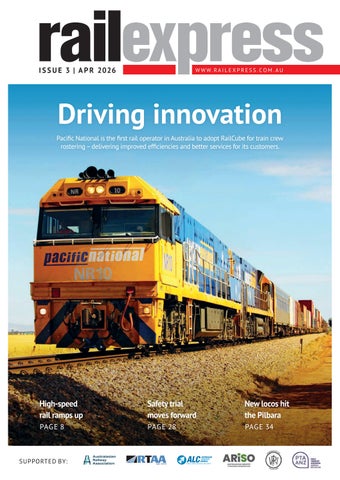

Driving innovation
Pacific National is the first rail operator in Australia to adopt RailCube for train crew rostering – delivering improved efficiencies and better services for its customers.

High-speed rail ramps up PAGE 8
Safety trial moves forward PAGE 28


New locos hit the Pilbara PAGE 34


From the Editor
Published by:
379 Docklands Drive
Docklands, VIC 3008
T: 03 9690 8766
www.primecreativemedia.com.au
Chairman
John Murphy
E: john.murphy@primecreative.com.au
CEO Christine Clancy
E: christine.clancy@primecreative.com.au
Managing Editor
Lisa Korycki
E: lisa.korycki@primecreative.com.au
Editor
Kayla Walsh
E: kayla.walsh@primecreative.com.au
Business Development Manager
Emily Schlegel
M: 0466 317 555
E: emily.schlegel@primecreative.com.au
Client Success Manager
Ben Sammartino
E: ben.sammartino@primecreative.com.au
Head of Design
Blake Storey
E: blake.storey@primecreative.com.au
Designer Apostolos Topatsis
Subscriptions subscriptions@primecreative.com.au
www.RailExpress.com.au
The Publisher reserves the right to alter or omit any article or advertisement submitted and requires indemnity from the advertisers and contributors against damages or liabilities that may arise from material published.
© Copyright – No part of this publication may be reproduced, stored in a retrieval system or transmitted in any means electronic, mechanical, photocopying, recording or otherwise without the permission of the Publisher.

Kayla Walsh Editor - Rail Express
Welcome to the April edition of Rail Express
The months are flying by in 2026 – I can’t believe it’s already April, and that time of year when many of us will be gearing up for the annual Heavy Haul Rail Conference in Perth.
To tie in with the event, several of the features in this issue have a heavy haul theme.
We were delighted to catch up with our cover star, Pacific National, to hear more about how it is the first rail operator in Australia to implement RailCube –a solution that has upgraded Pacific National's crew rostering, with benefits for the company’s operations as well as its customers and drivers.
Meanwhile Loram shares the advantages of its TRACE methodology, which helps railways to identify the root causes of deterioration and plan maintenance more proactively. This is particularly useful for heavy haul railways, which operate under extreme loading conditions, where small structural weaknesses can quickly develop into recurring track defects.
Siemens Mobility spotlights its innovative Broken Rail Detector, which can help prevent derailments, and Wabtec talks us through some exciting new products it has been developing.
Plus, 4AI Systems shares promising results from its trial of a new advanced driver advisory system, EN4CER, on Pacific National locomotives in Queensland.
Vossloh celebrates producing 150 million tension clamps at its facility in Kunshan,
China since it began operations in 2007, while Salix delves into its new partnership with Japanese company Yamato Kogyo.
Elsewhere, ALVI Technologies tells us more about the Knick P45000, a spacesaving, high-voltage transducer that is compliant for rolling stock in Australia.
Olinga Services opens up about its new partnership with rail recruiter Clemtech, which will enable Olinga to deliver resource and recruitment solutions, project management and consultancy services for complex, high-demand rail projects in Australia.
We also have an update from Western Australia as Fortescue commissions two new battery electric locomotives on its rail network, and Alltrack Rail highlights some new tamping tools and broom sweeper elements for ballast regulators, in stock now.
And we’ve got an update on highspeed rail, which has progressed to the development phase after receiving an additional $229.6 million in government funding.
We also bring you our usual columns from the Australasian Railway Association, the National Transport Commission, the Permanent Way Institution of New South Wales and the Australian Rail Industry Standards Organisation.
Happy reading!
kayla.walsh@primecreative.com.au


MAXIMISED NETWORK CAPACITY
Shape the future of mobility
At Siemens Mobility, we are pursuing technologies and solutions for more sustainable, comfortable, and cost-effective rail transport to shape the future of mobility and #transformtheeveryday for a better tomorrow.
COLLISION AVOIDANCE SYSTEM
FROM PERCEPTION TO PREVENTION
The HORUS onboard vision and multi-sensor perception system continuously monitors a train’s surrounding environment to detect potential collisions. When combined with EN4CER, the Advanced Driver Advisory System delivers real-time alerts to help make data-driven decisions. Automatic Train Protection can be engaged to apply the train’s brakes in an emergency situation.


Compatible with modern train control systems
Low-light and inclement weather operations
Integrates with existing onboard systems
Keeping Movement Authorities on Track

TMACS


TMACS uses vital, virtual-block movement authority limits called electronic authorities. Train drivers benefit from risk controls including proximity and out-ofauthority alerts. Versions of TMACS are in use on more than 5,000 km of track across NSW, with expansion on 1,276 km of track from SA to WA in progress.
4PTW supports work on track activities in signalled and train order territory. Track access information is delivered from train control to track workers via a mobile app, reducing potential communication errors and improving network efficiencies. 4PTW is deployed across more than 10,000 km of track across Australia.
EN4CER in-cab driver display configured for mainline operations
Works kick off on Melbourne Airport Rail
Work has started on Melbourne’s Airport Rail Link, kicking off with a $4.1 billion transformation of Sunshine Station.
The first stage of the long-awaited project will create a “transport superhub” at Sunshine. It involves six kilometres of raised track being built between West Footscray and Albion, as well as the realignment of existing passenger and freight lines.
Two new regional platforms will also be added at Sunshine to facilitate transfers between regional Victoria and the airport, with an extended concourse.
Two rail bridges will separate the six regional and metro lines and eliminate bottlenecks, enabling more than 1000 train services per day to run through Sunshine Station in the future.
This work to “untangle” the complex rail junction at Sunshine is intended to create space for the Melbourne Airport Rail Link (MARL) and future electrified services to Melton, both running through the Metro Tunnel.
New “modern and accessible” stations will also be delivered at Tottenham and Albion as part of the project, with work commencing at Tottenham in 2027.
Early designs have now been released for the new Sunshine interchange, and work has commenced to relocate underground utilities and prepare underground service lines along the rail corridor.
A contract for the enabling works package has been awarded to McConnell Dowell, ARUP, Metro Trains Melbourne, V/Line and VIDA Rail.
Stage one of the Sunshine Station Masterplan will be delivered in conjunction with the project and includes a pedestrian and cycling path over the rail line, an upgraded bus interchange, and a new station forecourt with open spaces at each entrance.
A new station at Keilor East will be built as part of future stages of Melbourne Airport Rail.
Once operational, train journeys from the suburb to Melbourne CBD will take around 27 minutes, a travel time saving of around 20 minutes compared to existing public transport options.
People travelling from Keilor East will reach Melbourne Airport in around six minutes.
impression of the
Minister for Infrastructure, Transport, Regional Development and Local Government Catherine King said a rail link to Melbourne Airport has been talked about for as long as she can remember.
“For people in Bendigo, Warrnambool, Geelong and my hometown of Ballarat, these upgrades to Sunshine will change the way we move around the state.”
Victorian Minister for Transport Infrastructure Gabrielle Williams said: “Rebuilding Sunshine Station is the first stage of delivering Melbourne Airport Rail and it will help pave the way for more services across Melbourne’s west.”


Preserving the ‘longest rail corridor in history’
The South Australian Government has announced plans to preserve the “longest rail corridor in recent history”, in a move that could see passenger trains running all the way through to Two Wells.
The new mass transit corridor will stretch approximately 33 kilometres, linking to the existing metro rail network at Dry Creek, and winding through Waterloo Corner and Riverlea before finishing at Two Wells.
Work is already well underway to secure the corridors to Roseworthy and Concordia in the north, and to Sellicks Beach in the south.
This preservation of all rail corridors will be applied through an amendment to the planning code.
The move has been made to plan for future growth in Adelaide’s northern suburbs – with Northern Adelaide already the fastest-growing region in the state.
The area is expected to account for 40 per cent of Greater Adelaide’s population increase over the next 30 years.

Future growth in the region is projected to deliver about 113,000 new dwellings for a forecast additional 250,000 people.
“Securing a mass transit corridor will specifically preserve an area for rail infrastructure and provide public transport options for future State and Federal governments to explore a train network all the way through to Two Wells,” the government said in a statement.
“Further planning work and investigation is now underway to refine options, secure the corridor and develop potential infrastructure solutions and costings.”

An artist's
future Sunshine Superhub’s forecourt at the northern side.
The South Australian Government plans to extend public transport in the northern suburbs of Adelaide.
Image: Victorian Government Image: Adelaide Metro
All METRONET projects now complete
Perth’s new Midland Station is now open to the public, marking the completion of the final METRONET rail project.
The new station features a 12-stand bus interchange, a pedestrian overpass, a multistorey car park with more than 800 bays, secure bike parking, lifts and stairs.
The project also links the passenger rail network to the new Bellevue Railcar Manufacturing and Maintenance Facility, which METRONET said will bring “significant new employment” to Midland.
The new Midland Station has been built to the east of the previous station, which was demolished in January 2026 after more than 50 years of operation.
METRONET has been the largest ever investment in public transport in Perth, spanning about 72 kilometres of railway and 23 new stations in total.
The nine-year project included the recently completed Byford Rail Extension,

the Armadale Line Upgrade, the construction of the Ellenbrook Line and the Yanchep Rail Extension.
Lauren Streifer, Chief Executive of the Public Transport Association Australia New Zealand (PTAANZ), welcomed the opening of the new station and the wrapping up of the METRONET projects.
“Midland is growing, and its community now has real transport choices at the new Midland Station,” she said.
“Perth city centre is just 25 minutes away by train, and it is easy to walk, cycle or catch a bus here – investment that will shorten commutes, expand access to jobs, and help reduce pressure on local roads.
“We know that when city decision makers invest in public transport, it helps our cities grow more sustainably. Western Australia has backed public transport with METRONET, and it will keep Perth moving for decades.”
Roger Cook, Premier of Western Australia said: “METRONET has delivered 23 new stations, 72 kilometres of new rail and removed 15 level crossings, unlocking thousands of hectares of land for housing and local businesses.
“Thank you to the thousands of workers who have brought this vision to a reality.”


The new Midland Station was built to the east of the previous station, which was demolished.
Image: Roger Cook
High-speed rail

Full speed ahead
After being talked about for decades, high-speed rail is finally moving into its development phase.
Australia’s rail industry has welcomed the news that the Federal Government has granted an additional $229.6 million in funding to the High Speed Rail Authority.
It brings plans for a high-speed rail link between Sydney and Newcastle closer to reality, with the government saying the project could be “shovel-ready” within two years.
The funding will go towards the development phase, which includes finalising the design, approvals process, scope and cost of the new transport connection.
Jill Rossouw, Chair of the High Speed Rail Authority, said the development phase is no small feat.
“There will be a significant amount of work needed to understand and refine the alignment and the station locations, and to undertake the design of the project from infrastructure through to rolling stock and systems, as well as the precincts that form an important part of the project,” she explained.
The first stage of high-speed rail would allow passengers to travel between Newcastle and Sydney in about one hour, and from the Central Coast to either city in about 30 minutes.
The proposed network would eventually encompass trains running from Brisbane to
Melbourne, through Sydney and Canberra, while also serving regional communities across the East Coast.
This latest funding announcement brings the total government investment in the project to date to $659.6 million.
The Sydney to Newcastle section of the line is projected to cost around $55 billion, including an advanced manufacturing facility and a fleet of high-speed trains.
The business case for high-speed rail has been released, showing a return of $250 billion in economic activity, as well as the creation of 99,000 jobs and 160,000 new households in the region surrounding the rail link.
Transport Minister Catherine King said:
“This is not just a rail project; it is building the economic future of the Hunter [Valley].”
Tim Parker, Chief Executive Officer (CEO) of the High Speed Rail Authority, said he is excited about the project moving into the development phase.
“This means two years to get the project ready for construction,” he said.
“At the end of this, we’ll have a project where we can get a financial investment decision from the government.”
Lauren Streifer, CEO of the Public Transport Association Australia New Zealand (PTAANZ), welcomed the funding announcement.

“This funding commitment is an incredibly exciting step for Australia, and a step towards greater certainty for our sector,” she said.
“High-speed rail can build on and sustain the capability and skills already being used to deliver transformative projects like Sydney Metro and the Melbourne Metro Tunnel.
“It will re-shape how our East Coast regions and cities grow, better connecting generations to come.”
She said the commitment to detailed planning will help secure the project corridor, keeping overall costs down and delivering services sooner.
Caroline Wilkie, CEO of the Australasian Railway Association, said the development phase funding would enable industry to demonstrate how high-speed rail can best be delivered.
“The next two years will chart the path to making high-speed rail a reality to ensure Australians can make the most of this once-in-a-generation opportunity,” she said.
“We have the industry capability to deliver a project of this calibre here in Australia today and will be ready to put boots on the ground in 2028.”
Wilkie said it is essential that this planning phase identifies opportunities to

The development phase will refine the design of the project, from infrastructure through to rolling stock and systems.
Images:
High Speed Rail Authority

maximise housing and other development opportunities to complement the construction of high-speed rail.
“The Newcastle-Sydney route is just the start, and we must plan as we mean to go on,” she said.
“After decades of debate, it is time to grab the high-speed rail opportunity with both hands and deliver a rail project that will transform how we live, work and travel for many more years.”
Seven major tenders have been announced for the first stage of high-speed rail, covering key technical, environmental, engineering and project delivery.
They will also support environmental approvals and corridor protection activities, ensuring that these are in place when the government makes an investment decision after the development phase is complete.
More information on the tenders is available via the AusTender website: www.tenders.gov.au


SOLID MOLDED RUBBER
The first stage of high-speed rail would allow passengers to travel between Newcastle and Sydney in about one hour.
Driving innovation
Pacific National is the first rail operator in Australia to adopt RailCube software for train crew rostering – delivering improved efficiencies and better service for its customers.
With about 2500 train drivers on the books and some of the most complex labour planning rules in the world to contend with, Pacific National was always going to have its work cut out for it when it came to driver rostering.
The rail operator, which delivers coal, bulk materials and containerised freight for customers across Australia, knew it was going to have to innovate ahead of the competition.
The answer was to team up with RailCube, an advanced operational management solution that has given Pacific National’s rostering a major upgrade – reducing manual effort, improving safety and compliance, and helping the operator to deliver for its customers, at the same time providing benefits for drivers.
We spoke with Pacific National’s Brendan Sellens and Robert Jarvis, as well as Dennis Hendriksen, Chief Executive Officer (CEO) of RailCube, to get the story.
A MAMMOTH TASK
Robert Jarvis, Regional Planning Manager – Coal at Pacific National, said labour planning has always been a complicated problem to solve.
“We’ve been searching for the perfect solution to our planning challenges for a very long time,” he said.
“We actually put out a global tender for a replacement rostering system about seven years ago, but no off-the-shelf software was the right fit.”
The remedy came in the form of RailCube, a small Dutch company with the drive to go above and beyond. For the past five years, RailCube has been working with Pacific National as its exclusive partner within Australia to develop a customised rostering product.
“When we couldn’t find a solution, the Coal Labour Planning Superintendent and I put forward a project concept to complete a proof of concept with RailCube for our Gunnedah depot in New South Wales,” said Jarvis.
“The proof of concept was successful, and now everyone in the coal division is being rostered using RailCube. We’re very happy with the results.”
RailCube was rolled out to Pacific National’s New South Wales coal division
in 2023, with its Queensland coal rollout completed in 2025.
The operator’s Northwest Bulk rollout was also completed in 2025, and the use of the software will be extended to the rest of the company’s bulk and containerised freight operations later in 2026.
FASTER, MORE RELIABLE ROSTERING
Jarvis said the system that Pacific National previously used for the coal division was not efficient.
“The system was old and quite manual, and definitely not as advanced as we wanted it to be,” he said.
“We were relying too much on the knowledge of our labour planners for details such as crew qualifications.”
Fast-forward to the introduction of RailCube, and the process is much more streamlined.
The software can automatically build a compliant draft roster that can easily be reviewed and adjusted by Pacific National’s

Pacific National has a team of about 2500 drivers in total, operating within coal, general freight and bulk.
labour planners – checking labour laws, qualifications, fatigue, leave, availability and more.
Dennis Hendriksen, Chief Executive Officer (CEO) of RailCube, explained that the software can consider both “hard rules” and “soft rules”.
“Labour laws are hard rules,” he said. “For example, you cannot work more than a certain number of Sundays a month, or more than 10 hours a day.
“Then you have things like, Joe wants to have weekends off and Nigel can’t work night shifts – these are soft rules. There are also elements like the driver needing to have certain knowledge about the locomotive they are driving, et cetera.
“RailCube uses advanced algorithms to bring all of these things together, for the most optimised rostering solution.”
Jarvis said RailCube has been a gamechanger for Pacific National.
“It’s a huge step forward,” he said. “We have improved our planning process, knowing that the labour planning team are putting the right people on the right task, at the right time.”
With RailCube, rework is reducing, providing more certainty and reliability for drivers.
“With the old system, there would occasionally be human error when the roster was being put together,” Jarvis said. “If a service changed last-minute, for example,

we might identify that a driver who didn’t actually have the qualifications required had been assigned to that job.
“RailCube avoids this, and the qualification side of rostering is much more stable now.
“Rail operations are dynamic by nature, but we’ve reduced the validation in the process when it comes to operational changes.”
Jarvis said this not only saves a huge amount of time for planners but allows them to create better rosters.
“In coal, our rostering window is four hours,” he explained. “We receive the service plan – telling us what trains are running, and the timing of those trains – at midday each day, and by 4pm we have to deliver the roster and have sent it to our drivers.
“RailCube works as a decision support tool, so our planners don’t have to rush and can really think about the best solution possible.”
Brendan Sellens, Head of Operations – Coal at Pacific National, said: “With automation, we hope to see better outcomes for train crew.
“Our planners will have more time to refine the roster, considering things like ‘This driver is lacking competence in a certain area, so it’s better for them to be on this train with this other driver, so they can upskill’ et cetera.
“It's about that 10 per cent of tweaks that
give you the best outcome as a business.”
Sellens added that creating the roster later in the day leads to a more realtime outcome.
“When you think about the difference between a train plan that’s eight hours away from publishing versus two hours away –that plan that’s two hours away is going to be much more accurate,” he said.
“In the rail industry, a lot can change in six hours.”
Sellens said RailCube has also matured Pacific National in terms of its training records.
“Because RailCube is an integrated labour planning tool, it has driven us to clean up our entire learning and labour management system in terms of records,” he said.
“In a digital environment, everything has to be current and validated, so we led an enormous validation effort across our business.
“That’s been of huge benefit to us because we’ve gained clarity and control. We know that our records are where we need them to be from an integrity perspective, and RailCube is making the right decisions based on those records.”
BETTER RESULTS FOR CUSTOMERS
Jarvis said RailCube allows Pacific National to react quicker and more flexibly to changes and requests from customers.
“When customers want to load a different
Pacific National transports millions of tonnes of critical freight around the country for its customers.

product or go to a different site or they’ve had a change in their business, RailCube allows us to respond faster to those changes and comply with more demanding time frames,” he said.
“It enables us to be more agile and to provide information to the customer in real time around whether we have the labour available to complete the task.”
He noted that in turn, this could help Pacific National’s customers to become more agile.
“It makes their supply chains work better, and reduces costs by improving efficiency,” he said.
Sellens agreed, pointing out that rail is an industry that faces a lot of disruption, and RailCube enables Pacific National to better respond to it.
“When disruption happens – whether that be a rail break or a weather event – rewriting a roster can’t just wait until tomorrow,” he said.
“Now if things don’t go according to plan, we don’t have to rely on the rostering team to rush to fix the roster.
“This gives better outcomes for our customers.”
THE FUTURE OF THE PARTNERSHIP
Sellens and Jarvis both said they expect many more benefits to come from Pacific National’s ongoing partnership with RailCube.
“It’s been a long road to solve our labour planning problem, and we’re very proud of what we’ve learned and achieved so far,” said Sellens.
“We’re lucky that the leadership and subject matter experts for the program have been quite consistent all the way through, and I don’t think we would have been able to reach this outcome without that.
“The opportunities for us now are quite large, and we haven’t yet seen the full value that will come as a result of these key foundations we’ve put in place.”
Jarvis said he’s excited about some new developments coming down the track, including potentially investing in and introducing a new app for drivers.
“We have started engaging the workforce
on the app, but we haven’t rolled it out yet,” he said. “The app would have the details of their roster but also about what train they’ll be on and so forth, giving them access to more information.”
Hendriksen said RailCube is grateful for the opportunity to continue working with Pacific National.
“It’s been great to work with a project team that’s so dedicated and motivated,” he said.
“While it has been a rollercoaster at times, we all agree that this tool is really going to bring their operations to the next level.”


Pacific National has an exclusive partnership with RailCube within Australia.
Pacific National has a team of about 2500 drivers in total, operating within coal, general freight and bulk.

COLLISION AVOIDANCE SYSTEM
FROM PERCEPTION TO PREVENTION
The HORUS onboard vision and multi-sensor perception system continuously monitors a train’s surrounding environment to detect potential collisions. When combined with EN4CER, the Advanced Driver Advisory System delivers real-time alerts to help make data-driven decisions. Automatic Train Protection can be engaged to apply the train’s brakes in an emergency situation.


Compatible with modern train control systems
Low-light and inclement weather operations
Integrates with existing onboard systems
Keeping Movement Authorities on Track

TMACS


TMACS uses vital, virtual-block movement authority limits called electronic authorities. Train drivers benefit from risk controls including proximity and out-ofauthority alerts. Versions of TMACS are in use on more than 5,000 km of track across NSW, with expansion on 1,276 km of track from SA to WA in progress.
4PTW supports work on track activities in signalled and train order territory. Track access information is delivered from train control to track workers via a mobile app, reducing potential communication errors and improving network efficiencies. 4PTW is deployed across more than 10,000 km of track across Australia.
EN4CER in-cab driver display configured for mainline operations
Condition monitoring
Advancing predictive track maintenance
By integrating sub-surface sensing with predictive analytics, Loram’s TRACE methodology helps railways to identify the root causes of deterioration and plan maintenance more proactively.
Loram – a leading supplier of track maintenance, inspection services and infrastructure optimisation services and equipment – is expanding its track condition analytics capability for heavy haul railways.
Building on its established use of Loram’s Ground Penetrating Radar (GPR), LiDAR (Light Detection and Ranging) and track geometry data provided by the infrastructure owner, the company has developed TRACE (Track Root-cause Analytics and Condition Evaluation).
TRACE is an advanced methodology for track geometry-based condition diagnostics, root-cause analysis and predictive maintenance planning.
Australia’s heavy haul railways operate under extreme loading conditions, where small structural weaknesses can quickly develop into recurring track defects.
Where high axle loads and long freight trains operate across remote corridors, track geometry performance is closely linked to ballast and drainage condition.
Mika Silvast, Managing Director at Loram Finland, said: “Under repeated loading, even relatively small structural weaknesses can gradually develop into recurring vertical defects if moisture retention, fouling or drainage constraints are not properly addressed.
“Where transitions in vertical stiffness take place – such as at switches and crossings, culverts, bridges and rail joints –high dynamic loads can also frequently lead to geometry deterioration.”
INTEGRATING GEOMETRY, GPR AND LIDAR DATA
GPR provides continuous insight into ballast fouling, moisture distribution and layer thickness within the track structure.

In heavy haul corridors, longitudinal contamination patterns within the ballast can indicate fines migration (the movement of fine particles) and reduced drainage capacity.
When analysed alongside geometry trend data, or acceleration measurements from instrumented ore cars, these indicators help
to explain why certain locations repeatedly deteriorate under traffic.
Loram’s measurement programs combine GPR and LiDAR surveys with track geometry records and historical maintenance data.
“LiDAR contributes corridor and embankment context, while spatial alignment of all datasets within Loram’s trademarked Rail Doctor platform provides
a coherent view of both structural and functional track condition,” said Silvast.
IDENTIFYING ROOT CAUSES AND EVALUATING MAINTENANCE
Building on this integrated data foundation, TRACE links track geometry condition, structural behaviour and maintenance response over time.
TRACE builds on Loram’s use of Ground Penetrating Radar (GPR), LiDAR and track geometry data provided by the infrastructure owner.
Images: Loram
The methodology identifies defect locations, analyses their root causes and recommends the most appropriate maintenance response.

The methodology analyses track geometry condition at the level of individual defect parameters and investigates their root causes through multi-source data integration.
Rather than evaluating geometry channels in isolation, TRACE correlates defect behaviour with ballast condition, stiffness transitions, moisture distribution, drainage performance and previous maintenance actions to identify the structural drivers behind recurring issues.
TRACE also evaluates the durability and timing of maintenance interventions. By analysing how defect parameters respond before and after treatment, the methodology helps determine whether actions were carried out at the right location and time and whether they delivered lasting performance improvement.
PREDICTIVE
ANALYTICS SUPPORTING TARGETED MAINTENANCE
Through geometry and acceleration timeseries analysis combined with sub-surface condition indicators, TRACE supports forecasting of defect development and
emerging risk. Silvast said this means asset managers can prioritise work based on deterioration trends and structural condition, instead of solely on threshold exceedances.
“This capability is particularly valuable in Australian heavy haul networks, where defects can develop rapidly and maintenance windows are limited,” he said.
“Experience from multi-year deployments in other high-demand rail networks shows that repeat monitoring combined with datadriven maintenance planning can reduce recurring defect areas by up to 70 to 80 per cent over several years.”
Silvast said Loram’s Rail Doctor software presents the integrated measurements and TRACE outputs in a practical visual format, enabling maintenance planners to identify priority sections and understand the underlying causes of deterioration.
“The results can be translated directly into prioritised work plans and longer-term maintenance programs.
“By connecting diagnostics, prioritisation and work planning, TRACE helps railways move from isolated condition reports toward a systematic, data-driven maintenance workflow that improves reliability and optimises maintenance investment in hightonnage operations.”

FROM ANALYTICS TO ACTIONABLE MAINTENANCE PLANNING
TRACE converts integrated measurement data into practical decision-support outputs for asset managers and maintenance planners.
At the location level, the methodology identifies defect locations, analyses their root causes and recommends the most appropriate maintenance response.
These insights are then aggregated to produce section-level and network-level indicators that provide an overview of track condition, deterioration trends and structural risk areas.
“The results can be presented as prioritised maps or target lists supported by concise analytical explanations, enabling maintenance planners to focus resources on the locations with the greatest long-term impact,” said Silvast.
“The outputs can be translated directly into structured work plans, while predictive analysis also highlights locations that are likely to require intervention in the future.
“This improves the predictability of maintenance needs and supports more efficient long-term planning of track works.”
Silvast said Loram continues to advance automation and analytics assisted by artificial intelligence to accelerate processing and expand predictive capability.
“The objective is to support railways in transitioning from periodic condition assessment toward a continuous, datadriven asset management approach that improves reliability, optimises maintenance investment and sustains long-term track performance in hightonnage operations.”

Below: TRACE helps railways move from isolated condition reports toward a systematic, datadriven maintenance workflow.
Innovating with purpose

For more than 150 years, Wabtec’s innovations have helped drive the industry toward a more sustainable and clean future.

Mergers and Acquisitions
Global turnout expertise, proven in Australia
Salix and Yamato Kogyo combine engineering, manufacturing and digital monitoring to deliver reliable turnout and special trackwork systems for modern rail networks.

Turnouts are among the most critical components of any railway network. They must perform reliably under high speeds, heavy axle loads and demanding operational environments, often with limited maintenance windows and little tolerance for failure.
For infrastructure owners and operators, the challenge is not simply sourcing individual components. It is ensuring that turnout systems are engineered, manufactured and integrated in a way that delivers consistent performance over decades of service.
For more than 20 years, Australian company Salix has built a strong reputation for engineering-led solutions across highspeed passenger networks, heavy haul freight corridors, metro systems and light rail infrastructure. The company provides engineering design, system assurance, supply chain coordination and delivery support for complex rail projects where reliability and safety are paramount.
While Australia remains its home market, Salix’s experience extends internationally. The company has delivered turnout systems across New Zealand, Chile and the Middle East, working with infrastructure owners, mining operators and Tier 1 contractors in demanding rail environments.
These projects have shaped a delivery philosophy centred on system integration, quality assurance and supply chain reliability. Rather than simply supplying
individual components, Salix focuses on delivering complete turnout systems designed to perform reliably in service.
"Salix isn’t just about parts; it’s about performance,” said Mark Fulford, Chief Executive Officer (CEO) of Salix.
“Our approach ties system integration, rigorous quality assurance, and a resilient supply chain into one dependable package.
“By delivering complete turnout systems, we shift the focus from ‘pieces’ to ‘performance’, ensuring every turnout performs reliably when it counts.”
A PARTNERSHIP BUILT ON COMPLEMENTARY STRENGTHS
The next step in Salix’s development came through a strategic partnership with Japanese company Yamato Kogyo.
Under their agreement, Salix and Yamato Kogyo operate as a 50:50 joint venture, bringing together two complementary capabilities within the rail infrastructure sector. Salix contributes engineering leadership, project integration capability and international delivery experience developed through more than two decades of turnout projects.
Yamato Kogyo brings over 80 years of manufacturing expertise and is widely recognised as one of Japan’s leading turnout manufacturers. The company is known for its metallurgical knowledge, manufacturing precision and rigorous quality systems developed through decades of supplying
rail networks in Japan and internationally. Together, the partnership provides an integrated approach to turnout and special trackwork systems covering engineering design, manufacturing, supply chain coordination and delivery support.
For Yuichi Yamamoto, Operations Manager at Yamato Kogyo and now Sydney-based Deputy CEO, the partnership represents an opportunity to extend the company’s eightdecade manufacturing heritage beyond Japan’s domestic network.
“Yamato Kogyo has built its reputation by delivering reliable, precision-engineered trackwork for some of the world’s most demanding railways,” Yamamoto said.
“Partnering with Salix allows us to share that experience more broadly and combine Japanese manufacturing excellence with Australian project delivery expertise.”
For rail infrastructure owners and contractors, this integrated model reduces interface risk and provides a single accountable platform for turnout systems across the full lifecycle of a project.
AUSTRALIAN ENGINEERING ON THE WORLD STAGE
The partnership also highlights the maturity of Australian rail engineering capability. Operating in Australia has historically

Salix is a supplier of the KONUX Switch, a turnout monitoring system driven by artificial intelligence (AI).
Images: Salix
KONUX Switch delivers real-time insights to a cloud-based dashboard.
Mergers and Acquisitions
required infrastructure suppliers to work within challenging delivery environments.
Rail projects are frequently undertaken within tight possession windows, under strict safety requirements and within networks that remain operational throughout construction.
These conditions have driven Australian rail businesses to develop strong capabilities in engineering assurance, configuration control and supply chain coordination.
“Salix’s operating model reflects this environment,” said Fulford.
“We focus on integrating engineering design, manufacturing inputs and installation requirements early in the project lifecycle to ensure turnout systems are both technically robust and practical to install and maintain.”
Another important aspect of Salix’s capability is its ability to deliver solutions that meet multiple international standards.
“Rail is a global industry, but every network has its own technical framework,” said Fulford.
“Our role is to bridge those requirements. By engineering turnout systems that align with EN (European Standards), AREMA (American Railway Engineering and Maintenance-of-Way Association), JIS (Japanese Industrial Standards) and AS (Australian Standards), we can support international projects while ensuring the solutions are fully compatible with local network expectations.”
This flexibility allows infrastructure owners to adopt proven systems that can be adapted to local network requirements while maintaining consistent engineering quality.
In practical terms, this means rail operators can benefit from turnout solutions that have already demonstrated performance across a variety of global rail environments.
BRINGING DIGITAL INTELLIGENCE TO TURNOUT SYSTEMS
While physical trackwork remains the foundation of railway infrastructure, the industry is increasingly adopting digital technologies to improve reliability and optimise maintenance.
Salix is introducing the KONUX Switch, a turnout monitoring system driven by artificial intelligence (AI), that provides continuous insight into turnout performance through sensor data and advanced analytics.
The system collects operational data directly from turnouts in service and applies machine-learning models to detect developing issues before they lead to
failures. This enables rail infrastructure owners to move from reactive maintenance to predictive maintenance based on the real condition of assets.
For operators managing large rail networks, Fulford said the benefits are significant.
“We saw a clear need in the market for smarter, more responsive ways to manage rail infrastructure,” he said. “Through AI-driven insights, modular IoT (Internet of Things) technology and the secure KONUX platform, we equip operators and partners with the tools to respond to challenges faster, improve network reliability and unlock new efficiencies across the rail system.”
The software provides a 90-day look ahead to predict failures to switches and crossings.
“It has been proven in large networks such as Network Rail in the United Kingdom and Deutsche Bahn in Germany, where significant operational expenditure is saved annually and it is now key to their operation and maintenance systems,” said Fulford.
Continuous monitoring allows maintenance teams to identify emerging issues earlier, plan interventions more effectively and reduce unnecessary inspections.
This reduces time spent working on track, minimises disruption to rail operations and improves overall network reliability.
In heavy haul and high-frequency passenger networks, where maintenance windows are increasingly limited, predictive monitoring can make a substantial difference to operational performance.
“The system does not stop at predicting future failures – it is also a valuable tool
to validate the success of a maintenance activity,” said Fulford.
“This will allow the maintainer to make informed decisions on how to improve the effectiveness of a maintenance activity and if that activity is even required at all.”
Fulford said the KONUX Switch has the potential to save railways millions of dollars annually across large networks, by improving turnout reliability, reducing maintenance intervention and preventing costly service disruptions. By integrating digital monitoring with turnout engineering expertise, Salix is helping infrastructure owners move towards more data-driven asset management approaches.
“We’re encouraged by Salix’s expansion into data-driven condition monitoring, particularly with the KONUX Switch,” said Yamamoto.
“The move reflects a forward-looking mindset. We share that commitment to embracing technology that enhances reliability, improves asset insight and ultimately strengthens network performance.
“It’s an exciting direction for both organisations.”
THE NEXT GENERATION OF HIGH-SPEED RAIL INFRASTRUCTURE
For Salix, Fulford said the partnership with Yamato Kogyo represents an important validation of the company’s engineering capability and delivery model.
“Together, our organisations bring engineering expertise, manufacturing precision and digital monitoring capability to the delivery of turnout systems designed for modern railway networks,” he said.

He said Yamato Kogyo’s high-speed turnout and special trackwork technology, proven on the Japanese Shinkansen network and now deployed in markets including Taiwan and India, adds another dimension to Salix’s offering.
“The partnership positions Salix to contribute to the next generation of highspeed rail developments both in Australia and internationally,” Fulford continued.
“This includes projects such as the proposed Sydney to Newcastle corridor, where proven high-performance turnout systems will play a critical role in supporting reliable, high-capacity and efficient operations across emerging fast rail networks.
“With this combined expertise, Salix is positioned to drive major rail programs worldwide, helping operators and governments build faster, smarter, and more resilient networks.”


High-speed Shinkansen turnout components during factory assembly at Yamato Trackwork Systems.


Broken rail: Technology
Broken rail is the leading cause of train derailments – but modern train control systems are not compatible with traditional methods of detecting it. Siemens Mobility has a solution.
Siemens Mobility’s Broken Rail Detectors have been refined through sensor simulation, laboratory testing, and field trials under heavy haul conditions.

Train derailments can be catastrophic, with widespread and long-lasting consequences – from loss of life and injury to passengers and crew, to major damage to infrastructure and rolling stock.
When it comes to heavy haul rail, lost or damaged cargo and ensuing production delays can easily end up costing an operator millions of dollars.
Broken rails are responsible for up to 35 per cent of major derailments on rail networks worldwide.
According to Roy Leslie, Business Development Manager for Automated Management Solutions at Siemens Mobility in Perth, this has reinforced the need for technology to mitigate the risk of potential rail failures.
Leslie explained that traditionally, track circuits have provided broken rail detection as a by-product of their train control function. However, new signalling technologies such as axle counter-based
Centralised Train Control (CTC) and Communications-Based Train Control (CBTC) do not have this capability.
“Changes to signalling technology have removed the role of track circuits, making their installation and maintenance as the basis for broken rail risk mitigation a standalone investment,” Leslie said.
In advance of a planned CBTC signalling upgrade, one of Siemens Mobility’s customers recognised the need for an alternative broken rail detection method that doesn’t rely on track circuits.
Fortunately for the customer, Siemens Mobility has developed a solution that combines patented electromagnetic sensors with advanced navigation and communications systems.
The technology, known as Broken Rail Detection (BRD), has been refined through sensor simulation, laboratory testing, and field trials under heavy haul conditions.
Simply put, it checks the condition of the rail network during operation, identifies any damage, and reports it to the customer.
The instrumentation itself – On-board Broken Rail Detection (OBRD) – consists of sensors that can quickly and easily be installed on the bogie of a train operating within regular revenue service, or on other rail-based vehicles.
The solution uses a magnetic field to detect if there’s a discontinuity in the rail, and then reports that back to a trackside Back Office System (BOS).
“The BOS maintains a ‘Track Map’ database of known discontinuities, or ‘features’, and flags unexpected detections to the customer’s Train Control Centre,” Leslie said.
“The system also provides a highly accurate GPS position for the discontinuity, so the customer can take appropriate risk mitigation measures as soon as possible. The technology increases throughput,
Images: Siemens Mobility
because tracks can be quickly maintained and released for operation, instead of being blocked for days due to damage.”
Over the long term, through Siemens Mobility's BRD technology, more than 10 million kilometres of heavy haul network surveys have been conducted, including those in turnouts and on mainline track that can't be detected by traditional track circuits.
“The technology can detect transverse rail discontinuities as narrow as one millimetre, with 98 per cent probability,” Leslie added.
“It works even in hard-to-reach and 'dark territory', detecting rail failure in areas without track circuits or wireless data communications, and before a complete break or electrical discontinuity has occurred.
“The system improves rail safety and operation by significantly exceeding the performance limitations of current detection technologies.”
Because BRD is deployed on trains operating in normal revenue service, it continuously monitors rail condition without the need for additional trackbased detection equipment or planned inspection possessions.
“This saves operators money on equipment as well as labour costs, while minimising the exposure of maintenance crews to live rail environments – keeping them out of harm’s way.”
REDUCING OPERATIONAL IMPACT
When a rail break is reported, operators must immediately implement risk reduction
measures to prevent a derailment. This typically involves closing the affected section of track or imposing speed restrictions until the integrity of the rail can be confirmed and repairs completed.
Leslie noted that the operational impact of this can be significant.
“Line closures and speed restrictions disrupt normal train operations, reducing network capacity and throughput and potentially causing delays across the wider rail system,” he said.
“In heavy haul and freight environments, this can result in lost production, delayed deliveries and increased operating costs, while in passenger networks it can lead to service interruptions and reduced timetable reliability.”
He said downtime varies depending on the location and severity of the break, as well as access conditions, but traditional approaches often require extended maintenance windows and precautionary restrictions while crews locate and assess the fault.
“BRD’s ability to detect rail discontinuities early helps prevent major failures and derailments that can result in extensive infrastructure damage, prolonged line closures and high recovery costs,” he said.
“When issues are identified, BRD provides highly accurate location data, enabling maintenance teams to target specific sections of track rather than carrying out broad, time-consuming inspections.
“This targeted maintenance approach reduces downtime, shortens repair windows and allows assets to be returned
to service more quickly, improving network availability.”
A GROWING DATASET
By continuously monitoring rail conditions during standard operations, BRD generates an expanding, highquality dataset on track integrity that can be integrated into broader digital maintenance and asset management systems.
“Each pass of a BRD-equipped vehicle adds to a growing dataset that builds a detailed picture of track condition across the network,” Leslie explained.
“Over time, this data allows operators to identify patterns, trends and recurring anomalies at specific locations, such as areas subject to higher stress, environmental exposure or repeated minor discontinuities.
“Rather than responding only once a rail has failed, maintenance teams can prioritise inspections and interventions based on early indicators of deterioration, reducing the likelihood of sudden breaks and unplanned disruptions.”
He said implementing a smart, vehiclemounted solution positions an operator’s network as a data-driven, digitallyenabled asset rather than a purely reactive piece of infrastructure.
“As networks progress towards higher levels of automation, including semi autonomous and ultimately autonomous train operations, having reliable, realtime insight into infrastructure conditions becomes critical.”


The product combines patented electromagnetic sensors with advanced navigation and communications systems.
A safe choice

Knick P45000, a high-voltage transducer supplied by ALVI Technologies, is a compliant product for rolling stock applications on Australian railways. We find out more.
When registering rolling stock on specific Australian rail networks, operators must demonstrate compliance with relevant network standards and safety assurance processes.
EN 50155 is a European railway standard that specifies requirements for electronic equipment installed on rolling stock.
It ensures that such equipment can operate reliably under severe railway conditions – from wide temperature ranges, vibration and shock to electrical supply instability, humidity, and electromagnetic disturbances.
Australia does not adopt EN 50155 as mandatory law in the same way European Union (EU) member states use it under EU directives (e.g., the Railway Interoperability Directive).
However, EN 50155 is widely referenced in Australian rolling stock design specifications and contracts.
Engineering and procurement specifications (for example, for electrical and electronic assemblies on trains) often require compliance to EN 50155 or equivalent to ensure environmental and electromagnetic compatibility (EMC) performance.
State and operator technical standards (such as Transport for New South Wales’ equipment specifications) list EN 50155 among key international standards, and
EMC compliance and test plans for rolling stock assets in Australia often use EN 50155 and EN 50121 as the framework for test conditions and acceptance criteria.
This means that, in practice, much Australian rolling stock procurement –especially where equipment is sourced from global suppliers – expects compliance to EN 50155 or demonstrated equivalence to meet technical requirements from the operator.
HIGH-VOLTAGE TRANSDUCER
Knick P45000 is a high-voltage transducer designed for measuring high DC (direct current) and AC (alternating current) voltages on heavy vehicles, especially rolling stock.
They are used for the monitoring and control of traction motors, or the monitoring of DC link voltage in traction power converters or on-board power converters.
In Australia, the German-manufactured product is available through ALVI Technologies, a New South Wales-based business that has more than 40 years of experience in the fields of electronic measurement and controls.
Archit Jha, Director of ALVI Technologies, told Rail Express that the Knick P45000 is the most space-saving high-voltage transducer for rolling stock.
“The transducer is very compact – you could probably fit three side-by-side
compared to older versions,” he said. “The devices can even be mounted in a stack, allowing for very tight space requirements.
“The housing also offers flexible mounting options: upright or horizontal, screwed or snapped onto 35-millimetre DIN rails.”
With the Knick P45000, the voltage measurement input is highly isolated from output and auxiliary power, and the current output is compatible with commercially available control inputs.
The product is certified for use in Safety Integrity Level 2 (SIL2) systems and, redundantly, SIL3. Thus, for example, the presence of dangerously high voltages can be reliably detected.
It’s also robust due to its full vacuum encapsulation, and can withstand wide temperature changes and humidity, as well as vibration and shock.
“The Knick products are used in mining in Australia, and hold up very well in environments where there is a lot of dust and vibration,” Jha added.
ALVI Technologies recently supplied an Australian tram operator with 130 Knick P45000 transducers as part of a rolling stock upgrade.
“The product they had in the trams was from the 1980s, so it was time for an upgrade,” said Jha. “They didn’t need to replace the entire

EN 50155 is widely referenced in Australian rolling stock design specifications and contracts.
trams, so they are just installing new transducers.”
Jha said the Knick P45000 is designed with the high-voltage cables coming from the bottom, which makes carrying out upgrades easier.
“This design is the same as the design of the trams' old transducers, so it’s been a faster process for the installers.
“This has saved them money and ensures that assets can be returned to service quicker.”
The P45000 high-voltage transducer is expressly certified for use on rolling stock according to EN 50155 (environmental and electrical requirements) and EN 45545 (railway fire protection) in its current form.
Manufacturers and operators can demonstrate their compliance to EN 50155 using the P45000’s certificate and declaration of conformity as part of technical compliance evidence in engineering specifications or procurement contracts.
Because EN 50155 is widely accepted in Australian rolling stock specifications, the P45000 can be considered compliant for use in Australian railway applications, provided other system-level requirements (functional safety, EMC, mounting, enclosure protection, etc.) are also satisfied in the specific installation.

SPEED SIGNAL DOUBLER
Another exciting product recently introduced to the Australian market by ALVI Technologies is the Knick P16800, an innovative speed signal doubler for safetycritical applications.
It is used for voltage and current measurement in rolling stock, signal isolation in rolling stock, and voltage and current measurement for DC traction power supply.
“Every train and tram has a speed sensor that is mounted somewhere near the wheels, that tracks how fast the vehicle is going,” Jha said. “Because there is so many different control systems on a train or a tram, they all need their own speed sensor. What happens is, there is not enough space to physically mount so many speed sensors. So Knick has created a speed sensor splitter, so you only need one but you can feed it three or four different control systems.”
The Knick P16800 pulse transducer safely separates signals from one or two speed sensors and duplicates them for other connected devices. It meets SIL 4 safety requirements and ensures the signals are transmitted safely without interfering with each other.
High isolation and double shielded optical signal transmission help protect the signals from interference and keep them accurate when they are duplicated.
To improve compatibility between the sensor and the controller, the P16800 can also convert current signals into voltage signals, or voltage signals into current signals. It can also reduce the output signal frequency by ratios of 2:1, 4:1, or 8:1.


The P45000 is compliant for use in Australian railway applications.
P16800 is a speed signal doubler for safety-critical applications.
Image: ALVI Technologies

It is launched every year at the Southern Hemisphere’s largest rail event, AusRAIL. Copies are distributed to all delegates at the event, as well as being sent to all Rail Express subscribers.
Need a copy for your office?
Email kayla.walsh@primecreative.com.au
Did you miss out on this year’s directory?
You can still update your free listing on the Rail Express website – or if you want to stand out from the crowd, get in touch with our Business Development Manager Arron Reed (arron.reed@primecreative.com.au)


Powering the future Technology
From innovative internal combustion engines to advanced train analysis solutions, Wabtec is going above and beyond to meet the needs of its Australian customers.
Wabtec is already a world-leading rolling stock manufacturer and provider of rail equipment, systems, digital solutions, and more.
With multiple acquisitions completed in the past year and a strong global research and development team, it’s becoming a true one-stop-shop for rail operators looking for sustainable, efficient and reliable solutions.
We spoke with Ockert Van Zyl, Vice President of Sales for Australia and New Zealand at Wabtec, to find out what’s on the horizon.
STEPPING UP THE EVOLUTION SERIES
Wabtec’s Evolution Series locomotive is the most technologically advanced, dieselelectric, heavy haul locomotive in the world today, according to Van Zyl.
He said Wabtec is investing in the platform, to ensure that customers have the flexibility to respond to market pressures.
“We’re continually investing in the internal combustion engine as a platform, ensuring it is capable of consuming various fuel types, whether that is renewable diesel or biodiesel, and we’re keeping a close eye on hydrogen, ammonia, et cetera.
“It's about continuously improving on that engine platform, making it bigger, better, faster and more efficient.”
Van Zyl said the Evolution Series’ efficiency is unparalleled, and customers can gain even more benefits from pairing the locomotive with other solutions from Wabtec.
“I would say the Evolution Series is up to six per cent more efficient than anything else in the market,” he said.
“If you marry the current efficiency of the locomotives with near-future developments or solutions like an eTurbo – a small electric generator inside the turbo that uses wasted kinetic energy to generate electricity, that
is then placed back into the traction bus system – that could get you an extra three to four per cent efficiency.
“If you pair that with some of our solutions in terms of energy management, we’re talking up to a 20 per cent efficiency advantage, depending on the topography of the region.”
SMARTER DIGITAL SOLUTIONS
Wabtec is growing its presence in Australia and around the world, acquiring several companies over the past year.
Van Zyl said these acquisitions have allowed Wabtec to provide better, more holistic end solutions for its customers.
“From a digitalisation perspective, we’ve been developing multiple solutions over the years,” he said.
“A highlight is Expert on Alert, which uses analytics to provide customers with insights into locomotives’ health, or our Kinetix suite

Wabtec’s Evolution Series locomotives are popular with Australian customers.
Images:
Wabtec
Technology

of train inspection solutions that live on the track wayside, “looking” and “listening” as the rolling stock moves around the network, providing insight into the health of the equipment.”
Wabtec is now working on bringing all these insights together under its new Train Analysis Tool.
“As we look at existing solutions we have in our portfolio, we’re developing a platform that then enables the customer to have a systems view,” he said.
“Those analytics and insights will allow customers to make data-driven, realtime decisions.
“We want customers to quickly be able to answer questions like ‘What locomotive should I be putting into this consist that will ensure mission success?’”
Van Zyl said this could unlock greater rolling stock availability.
“When a customer has our rolling stock operating at say, 93 per cent availability, there is a portion naturally associated with regular maintenance,” he explained. “So, the gains we are chasing are one/two percenters, but they make a huge difference.
“We have been working closely with our Australian customers, carrying out deepdive case studies on their networks to figure out those small improvements that can be made to unlock efficiencies in what is already a very efficient, reliable system.
“It’s all well and good having data but we want to provide a customised approach, to ensure that our customers’ rolling stock assets are being optimised.”
SUPPORTING CUSTOMERS
Van Zyl noted that many of the locomotives used in heavy haul in Australia are manufactured overseas and imported –particularly those used on the West Coast.
“If these locomotives are manufactured in the United States or Brazil or whatever the case may be, that’s obviously quite far from Australia,” he said. “So having the ability to put together a support structure with customers that enables the locomotives to
Wabtec structures its customer support in a number of different ways.
“We have long-term parts agreements so if a customer needs a part for a locomotive, it’s readily available,” Van Zyl said.
“That requires close partnership between us and the customer in terms of us having strong visibility of their planning and supporting that with our deep domain experience that comes from having more than 23,000 locomotives in service globally.”
The company can also offer more comprehensive support with a maintenance services agreement.
“With these agreements, we have our highly trained technical experts entrenched at customer facilities, helping them hand-
“When I say they are at the coal face, I mean that literally in the case of our heavy haul customers. They are there with their sleeves rolled up, spotting things as they move through the shop.
“They understand what’s happening with the units and react proactively to tell the customer what needs to happen from a parts and support perspective.”
Van Zyl said this has led to strong relationships between Wabtec and its customers, and better results for customers.
“Customers are getting better availability and reliability from their rolling stock, which is so important in high-stakes


Wabtec’s 100 per cent battery-electric, heavy haul locomotive, FLXdrive.


New solution puts driver safety first
4AI Systems and 4Tel have been trialling an innovative advanced driver advisory system known as EN4CER, with exciting results from recent tests with Pacific National. Mark Wood tells us more.
In Queensland, rail moves millions of tonnes of freight every year – facilitating a strong supply chain and bolstering the local economy.
This essential work couldn’t be done without the train drivers at the heart of it all, and their safety is a top priority.
That’s one of the reasons why leading freight operator Pacific National has teamed up with rail software engineering company 4AI Systems to trial a new flexible onboard solution known as EN4CER on select locomotives operating along Queensland’s North Coast Line.
EN4CER comprises an advanced driver advisory system, automatic train protection, and operational automation functions.
Mark Wood, Chief Technology Officer at 4AI Systems, said the solution is different from other advisory systems that have gone before it, because it focuses on the operational safety of the train rather than aspects such as fuel savings.
“EN4CER ensures that a train does not exceed the permitted speed, any known limit of authority or other operational restrictions,” he explained.
“It brings together track data, train consist data, sensors, locomotive control lines
and signal information, with the Safety Computer confirming the train’s braking curve multiple times per second.
“If the Safety Computer determines that the train is overspeed or above the braking curve, a warning is delivered to the driver – and brake activation can also be applied, as determined by the business rules of the customer.”
Following successful factory testing, field testing began on Pacific National locomotives in 2025.
These tests have demonstrated that the onboard system can brake the train in the case of:
• a rollaway event
• t he train exceeding the calculated brake curve
• overspeed within a shunt yard
• overspeed when reversing
• overspeed on the main line
The tests have also confirmed that the system mitigates numerous risks associated with Signal Passed at Danger (SPAD), where a train moves beyond a stop signal without authority.
Wood said 4AI Systems is very pleased with the results and the progress that has been made.
“It’s been really exciting to see the system in action,” he said. “The accuracy and consistency of the technology during testing has exceeded our expectations.
“We’re talking about pneumatic braking systems, which can be inconsistent as they are analogue in operation, but in our trials, EN4CER proved it can safely stop trains at a consistent distance well before the signal.”
He said feedback from Pacific National drivers has been encouraging.
“The drivers that participated in the testing have asked to continue to be part of the test crew because they’ve really enjoyed seeing the growth of this new product and the benefits it can bring.
“The driver crew has been second-to-none when it comes to their support and adoption of EN4CER.”
Drivers have been involved in the development of EN4CER from the early days, which Wood said has helped to make the product the best it can be, as well as building positive driver sentiment.
“We made early adjustments in response to driver feedback, to simplify the display and make the information as relevant as possible to what the driver needs to know at any given time.
4AI Systems' driver interface for EN4CER in the cab of a train.
“The system isn’t about ‘watching’ the drivers or replacing them; it’s there to support them if they lose situational awareness or something goes wrong, like a medical emergency.”
The next phase of testing will focus on operational integration, rather than testing the system itself.
“We’ll be looking at the procedures, the integration of the system into the cab with the drivers, the operational and maintenance procedures and the management of temporary speed restrictions and construction zones,” said Wood.
"EN4CER can also be integrated with our artificial intelligence vision system called HORUS, which can support operations by providing a visual record for the validation of infrastructure and the detection of objects such as cars or animals on the tracks."
Wood said HORUS has already been successfully installed in the operating environments of Australia, Europe and the United States.
“The system is continuously learning from the enormous amount of data we’re collecting from around the world,” he added. “With every new operator that we work with, the technology is producing better outcomes.”
Genevieve Nix, Chief HSE (Health, Safety and Environment) and Sustainability Officer at Pacific National, said that the safety of their people and the communities in which they operate is their highest priority.
“Trialling innovative technologies like HORUS demonstrates our commitment to continuous improvement and proactive risk management,” said Nix.
Wood said EN4CER is designed in a modular way, so compatibility with a variety of different train control systems is possible.
“Whether it’s European Train Control Systems (ETCS), Train Management and Control System (TMACS), Automatic Train Protection (ATP) or a Communications-Based Train Control (CBTC), they all work through having a limit of authority – how far the train can go and how fast the train needs to be going at any given time.
“We configure the system by uploading the operator’s business rules, the known infrastructure database and other essential information.
“This is fused with the real-time data collected by HORUS and is delivered via a standard interface to the existing system.”
Wood said the fact that the system is designed to be easily integrated with multiple train control systems reduces integration and training requirements for drivers, as well as saving operators time and money.
“If the operator has multiple sets of equipment, it aggregates all that equipment into one common hardware module that is then controlled via software. This integrates with other control systems and allows it to work as the EN4CER unit travels across multiple networks.
“We can keep the display consistent for the driver and just change the information about the limits of authority, as appropriate for the safe working system.
“This level of simplicity is something that the Australian rail industry hasn’t been able to achieve before.”


4AI Systems has tested its HORUS SensorBar and EN4CER advanced driver advisory system on Pacific National locomotives in Queensland. Images:
Vossloh plant hits major milestone
Vossloh Fastening Systems is celebrating a major achievement at its plant in Kunshan, China, after steadily expanding its industrial presence in the rail sector.
The Vossloh Fastening Systems plant in Kunshan, China, has produced a total of 150 million tension clamps since it went into operation in 2007.
The site is part of the company’s global production network and supplies the Chinese market for high-speed lines, conventional rail and heavy haul transport, and urban rail systems.
The Kunshan plant operates according to the same quality standards as Vossloh Fastening Systems worldwide.
Vossloh’s Fastening Systems business unit is a world-leading provider of rail fastening systems, which are used in more than 100 countries.
The screw-fastened elastic systems are designed for reliability and low maintenance. They are suitable for a wide range of applications on ballasted and slab tracks, such as mainline and conventional rail lines, high-speed, heavy haul and urban transportation lines.
Production processes range from raw material testing and heat treatment to mechanical and functional testing.
With increasing travel speeds and growing demands on infrastructure, the technical requirements for rail fastening systems are also evolving.

Many of the locally manufactured clamps are also integrated into the latest MFlex® fastening systems, which are designed to meet these higher performance and durability requirements.
“Since production began, there has been continuous investment in the further development of the plant,” said Tobias Lamm, Managing Director of Vossloh Fastening Systems China. “This milestone is the result of stable processes and the
dedicated work of our team.”
Sven Haag, Chief Executive Officer of Vossloh Fastening Systems, said the production figures show how the business has built up its industrial presence in various markets over the long-term.
“On this basis, we are continuing to work on the automation and digitalisation of our processes and on further integration of environmentally relevant aspects into our manufacturing.”


The 150 millionth tension clamp produced at Vossloh’s facility in Kunshan, China.
Some of Vossloh’s team in Kunshan, China.


Joining forces Workforce
Olinga Services has teamed up with Clemtech, boosting its capabilities in the delivery of resource and recruitment solutions for Australian rail operators, manufacturers and maintainers.
Olinga Services has announced a new partnership with Clemtech, a leading recruitment specialist with over 27 years’ experience providing technical projects and labour in the international rail sector.
The agreement will allow Olinga Services to step up its delivery of resource and recruitment solutions, project management and consultancy services for complex, highdemand Australian rail projects.
We spoke to Badi Noble, co-founder and Chief Executive Officer of Olinga Services, as well as Andrew Clements, Managing Director of Clemtech, to find out more.
A CULTURAL FIT
Olinga Services’ partnership with Clemtech came about after a chance meeting at the AusRAIL PLUS rail conference in Melbourne in 2025.
“It was one of those fortuitous things,” said Noble. “We were introduced at AusRAIL and the conversation went from there.”
Noble said Olinga Services and Clemtech align from a values perspective, which is very important to them.
“We like how Andrew runs his organisation, how they provide their services and how they treat the individuals around them.
“I think that cultural compatibility is key for any partnership to really thrive.”
Clements agreed: “Both Olinga Services and Clemtech genuinely care about doing things the right way and putting people first.
“We’re about finding the right person for the job and making sure they get home safely at the end of the day.”
SCALABLE SOLUTIONS
Olinga Services provides a wide range of services to the rail industry, including:
• Facilities management (maintenance, caretaking, automation, cleaning services, technology)
• Sustainability solutions (audits, consultancy, reporting and data analysis, Internet of Things sensors, Nano coatings and waste management)
• Resource solutions (recruitment and labour hire, surge workforce, project management and project delivery, consultancy, training, technology)
The Australian-owned business works with rail manufacturers, operators and maintainers, providing cost-effective and innovative solutions. It also has its own Registered Training Organisation (RTO), which allows it to provide staff training and certification as required.
Backed by its partnership with Clemtech, Olinga will offer technical workforce supply (electrical, mechanical, installers) and total project delivery (European Train Control System, Train Protection and Warning System, modifications). It will be able to provide comprehensive engineering, supervision and project management support, as well as installation, modification and testing/commissioning teams.
Noble said Olinga Services offers a high degree of flexibility to its customers.
Andrew Clements, Managing Director of Clemtech.


“When it comes to recruitment, we do labour placement or labour hire; we can put project managers into a project to assist, or there’s a full contracting engagement process," he said.
“If they are looking for someone to come in with all the tools and resources and get the work done, we can provide that – or if they’re looking for a hybrid support model, they can choose that option.
“We offer the full suite of services and everything in between.”
Noble said Olinga Services can provide emergency and surge workforce capability to meet short-notice or urgent needs from customers. “We’ve responded to staffing needs as quickly as within 24 hours."


Badi Noble, co-founder and Chief Executive Officer of Olinga Services.
Images: Olinga Services

He shared examples of Olinga’s work with current rolling stock manufacturers in New South Wales.
“They might need people of a midskillset for two or three weeks to complete a specific task and we are able to provide them a flexible resourcing model they can utilise when they need it.
"We can deliver quickly because we maintain a large, licensed work bench of resources.”
NURTURING LOCAL TALENT
Clements said Clemtech has built a strong reputation in the United Kingdom, particularly for its recruitment work for train operators, rolling stock and rail equipment manufacturers, and project delivery specialists.
The company has specialist expertise in supporting rolling stock overhaul, refresh and modernisation projects.
Clements said that its focus will be on using its experience and knowledge to help Olinga Services find the right talent for Australian projects.
“We’ll be supporting them to identify local talent who might be working in other sectors, who have transferable skills,
and who we can help develop from a competency perspective,” he said.
“There are a lot of good people already in Australia and we’re keen to support them as much as we can.
“On occasions where this isn’t possible, we will also be able to use our network to bring in international talent.”
With Australia’s rail industry facing a skills shortage, Noble said Clemtech’s knowledge and connections will prove invaluable.
“There is so much rail activity happening in Australia at the moment – it’s unprecedented,” he said.
“It’s fantastic, but it means there’s a shrinking availability of the local talent pool. We’re excited to be able to draw on Clemtech’s capabilities to widen the resources available to us and to our customers.”
EMBRACING INNOVATION
Outside of the recruitment space, Olinga Services has been embracing technological innovations, successfully implementing the first automatic scrubbing machine to be deployed across the Sydney transport network.
Olinga Services offers a wide variety of services, from facilities management to recruitment and labour hire.
“The machine has been operating successfully, helping to increase process and cost efficiencies while allowing our staff to focus on other tasks on site,” said Noble.
“There have been no safety issues or incidents with the machine even when operating during peak periods.
“By incorporating automation into the delivery of our services, we have been able to focus our resources on cleaning key areas that deliver improved customer satisfaction.
“Automation is not about replacing jobs, but supporting our staff to deliver a better customer experience and outcomes for our clients.”
LOOKING TO THE FUTURE
Clements said Clemtech is very happy with the partnership with Olinga so far, and the companies have already been getting some great traction.
“We're looking forward to working with Olinga and creating opportunities together.”
Noble said the partnership with Clemtech is a “critical and significant milestone” in terms of Olinga Services’ growth.
“We see this partnership as an important part of the future of Olinga Services, and we’re very excited to be on this journey.”

Heavy Haul

Power in the Pilbara
Fortescue has added two of the world’s biggest battery electric locomotives to its fleet in the Pilbara, marking a step forward in its journey towards decarbonisation.
Mining giant Fortescue has launched two battery-electric locomotives, which it says contain the world’s largest landmobile batteries.
The new locomotives will join the operator’s fleet of 70 diesel-powered trains operating in the Pilbara, Western Australia.
Together, the locomotives will eliminate the use of about one million litres of diesel each year, marking a major milestone for the decarbonisation of Fortescue’s iron ore operations in the region.
The locomotives’ batteries will be charged using renewable power delivered through Fortescue’s Pilbara Energy Connect program.
They can also recover 40 to 60 per cent of energy through regenerative braking, much like how electric cars convert kinetic energy into electricity to recharge their batteries.
Dino Otranto, Chief Executive Officer of Metals and Operations at Fortescue, said rail has long been considered one of the most challenging parts of the mining value chain to decarbonise.
“The force and energy behind locomotives have been worked on for more than 200 years and has developed through the combustion two-stroke engine that has historically powered fleets like ours,” he said.
“Even for a company like us, who are so proud of what we’re doing around
decarbonisation and making it profitable, rail is still out there as one of the hardest sectors to crack.
“The reason is simple – we push 40,000 tonnes [of iron ore], 300 to 400 kilometres away, multiple times a day.”
The new EMD SD70J-BB locomotives were manufactured by Progress Rail, a subsidiary of Caterpillar.
Weigh 265 tonnes, they set off from Sete Lagoas, Brazil, making their way around South Africa before arriving in Western Australia.
The units also recover 40 to 60 per cent of energy through regenerative braking.
Progress Rail President and Chief Executive Officer, John Newman, said the introduction of the new locomotives was a major win, not just for the manufacturer and its customer, but for the future of sustainable heavy haul rail.
“These are some of the most powerful battery electric vehicles ever built in the world,” he said. “These units demonstrate what's possible when technology and innovation come together.”
He praised Fortescue for being “extremely ambitious and bold” in its

The use of about one million litres of diesel will be eliminated annually.
Images: Fortescue

pursuit of technological breakthroughs in its drive to accelerate towards a zero emissions future.
“This aligns perfectly with our own commitment to advancing sustainability through technology, while working every day to solve our customers’ toughest challenges,” he said.
“With Progress Rail now realigned under Caterpillar’s resource industries segment, we're in a better position than ever to support our customers with complete portfolio solutions.”
Newman shared that the EMD SD70J-BBs are equipped with Progress Rail’s advanced rail technology suite – an ecosystem powered by artificial intelligence.
“The locomotives come with our NitroETA system, which allows customers to gain precise tools to better manage train
movements and maintenance activities and lock in capacity improvements,” he said.
“They also have our Talos energy management system, which is basically like a smart cruise control technology that reduces energy consumption, improves in-train forces and enhances overall operational performance.
“And we have our Uptime IQ on these units, which is our predictive maintenance platform that leads to an increase in locomotive availability and reliability, detecting issues earlier, optimising service intervals and improving fleet readiness.”
The new locomotives are helping Fortescue to reach its “Real Zero” target of eliminating Scope 1 and 2 greenhouse gas emissions from its Australian terrestrial iron ore operations by the end of 2030. Otranto said Real Zero is about changing the
way Fortescue powers its assets, moves materials and runs its operations – not offsetting emissions, but eliminating them.
“Decarbonising our rail network is a critical part of that task, and the commissioning of these battery electric locomotives demonstrates that heavy-haul rail can operate reliably without fossil fuels,” he said.
“For a mining operation of this scale, decarbonisation only works if renewable energy is firm, reliable and available 24/7.”
In the Pilbara, Fortescue is currently building an integrated system, combining large-scale solar and wind generation, battery storage and transmission infrastructure.
At North Star Junction, Fortescue already operates a 100-megawatt solar farm, which will be supported by a recently installed 250 megawatt-hours battery energy storage system (BESS) capable of delivering up to 50 megawatts of power for five hours.
Meanwhile, construction is moving forward at the 190-megawatt Cloudbreak Solar Farm, which is about twothirds complete.
Fortescue has also received primary approvals for the up to 644-megawatt Turner River Solar Farm, with construction expected to start later in 2026, and a 440-megawatt solar farm at Solomon is in the near-term pipeline.
The company has already built more than 480 kilometres of high-voltage transmission lines, physically connecting its energy assets to its operations and rail network.
“This infrastructure enables renewable power to replace diesel and gas, in real time, across the Pilbara,” Otranto added.
Fortescue’s battery units will be integrated into its heavy haul operations and tested alongside its conventional diesel locomotives.
Otranto said that after understanding the performance of the new locomotives, the intention is to “pull the trigger on a fully decarbonised solution for rail.”
He said Fortescue's decarbonisation will meet strict financial hurdles, and the locomotives will need to deliver from an economic perspective.
“We are not doing this out of charity,” he said.
“We want them to compete on the open market against the old technology.
“Total cost of ownership, including upfront capital and operating costs, must be cheaper than the diesel alternative.”

The EMD SD70J-BBs are equipped with Progress Rail’s advanced rail technology suite.
Plant and Equipment
Quality products for the rail industry
Alltrack Rail shares why its innovative tamping tools and broom sweeper elements for ballast regulators offer value for money.
Alltrack Rail is a leading Australian supplier of railway locomotives, rolling stock and rail maintenance parts and plant, as well as new and used materials such as rails, sleepers, turnout components and fastenings.


Alltrack Rail’s broom sweeper elements for ballast regulators come in two different styles.


endeavourawards.com.au


From research to reality
Panah Fasihi is living her dream, working as a Test and Commissioning Engineer on Alstom’s X’Trapolis 2.0 project.
When Panah Fasihi was nine years old, she and her mother were flying home from an overseas holiday when the engine of the plane they were on suddenly failed.
The pilot had to execute an emergency landing on a remote island – but despite being terrified of what was happening, the young girl couldn’t help being curious.
“I wanted to understand how we had landed safely,” Fasihi said. “That experience sparked further interest in me, and I was driven to learn more about planes, modes of transport and how they can be made safer.”
This drive, combined with a natural aptitude for maths and physics, led Fasihi to pursue a career in engineering.
“Engineering brings together my interests, drive and skillset, combining logic, creativity, and meaningful impact,” she said.
Fasihi, now aged 31, is originally from Iran but migrated 15 years ago to attend university in Australia.
She obtained a Bachelor’s degree in Aerospace Engineering at Monash University in Melbourne, but her academic research gradually led her towards rail.
“Rail stood out to me as a discipline because it brings together mechanical, material performance, electrical, operational and human factors,” she said.
Fasihi went on to complete a PhD focused on rail maintenance and reliability – with an emphasis on development, implementation, and advancement of railway maintenance technologies to improve asset performance.
“Specifically, my research investigated improving the wear and rolling contact fatigue performance of railway rails through the use of friction modifiers and laser cladding,” she explained.
“The project was highly multidisciplinary, combining mechanical and materials engineering with additive manufacturing technologies, data and image processing and project management.
“At its core, the research addressed one of the rail industry’s ongoing challenges – namely extending asset life while maintaining safety, reliability, and cost efficiency.”
She said one of the biggest challenges of her PhD was managing the uncertainty that’s inherent in research while balancing technical depth with realworld applicability.

“There were moments where experiments didn’t go to plan, but learning to adapt, iterate, and refine approaches became an essential part of the process,” she said.
“Integrating these areas while managing complex experimental programs needed strong planning, adaptability, and persistence.”
Fasihi’s work was recognised by the Railway Technical Society of Australia (RTSA), which presented her with the prestigious PhD Thesis award in 2024.
“That recognition was especially rewarding because it reflected not only the technical depth of the work, but also its potential value to the rail industry,” Fasihi said.
Panah Fasihi works as a Test and Commissioning Engineer for Alstom’s new X’Trapolis 2.0 train fleet.
Images:
Panah Fasihi

“From the beginning, I wanted my research to be useful beyond academia.”
Fasihi now works as a Test and Commissioning Engineer for Alstom’s new X’Trapolis 2.0 train fleet, with a focus on documentation, assurance, and customer interface.
She’s primarily based in Melbourne but often visits various Alstom sites and depots as part of the job.
“My role is all about translating complex engineering requirements and testing activities into clear, accurate, customerfacing documents, ranging from test procedures to compliance reports,” she said.
“I work closely with engineers, technicians, testers, quality teams, production, and project managers, coordinating inputs, managing iterative reviews and ensuring every deliverable meets technical and governance standards.
“A typical day might involve reviewing test procedures and/or test reports, leading customer review sessions, coordinating with stakeholders, and ensuring test evidence fully supports train acceptance.”
She loves working on a project that will serve Victorians for decades to come.
“Being part of something that improves public transport, enhances reliability, and supports sustainable city living is a real source of pride,” she said. “Working on a high-profile project such as XT2.0 also reinforces why attention to quality, safety, and diligence matters so much.
“Every test procedure, report and approval contributes to outcomes that people rely on every day, which makes the work both meaningful and motivating.
“It’s incredibly rewarding to see the tangible impact of the work we do – literally watching the trains I help commission carry people safely every day.”
She said it’s a privilege to work with Alstom, a leading global company that is shaping the future of rail transport.
“Alstom brings together global expertise from highly skilled teams across engineering, testing, production, and project management, which makes collaboration a core part of every day,” she said. “I work closely with a diverse range of professionals, from operators and maintainers to designers and regulators. That exchange of perspectives not only strengthens outcomes but also makes the work environment engaging and constantly educational.
“For Alstom, safety, quality, agility, and reliability are not just goals on paper, but integral to every decision and process.”
She said the job has been a tremendous learning experience, developing her systems thinking, assurance mindset and more.
“By reviewing test evidence, ensuring compliance, and supporting acceptance milestones, I’ve learned how small technical details can influence broader operational and safety outcomes,” she said. “My experiences have enhanced my technical and analytical abilities while strengthening problem-solving, communication, and leadership skills; capabilities I rely on and continue to build every day.”
With the rail industry suffering from a skills shortage, Fasihi said she would love to see more structured pathways for students and early-career engineers to gain hands-on exposure to rail technologies and systems.
“While there’s incredible expertise across engineering, operations, and testing, greater integration of R&D (research and development) and targeted training programs at universities could help prepare the next generation of engineers to tackle complex, real-world rail challenges,” she said.
“It’s something I’m personally passionate about, and I hope to contribute to through mentoring, teaching, technical course development, or industry-academia collaboration in the future.”
Sharing her advice to other young people interested in a career in rail, she said it’s important to stay curious and be patient.
“Don’t underestimate the value of communication skills; being able to explain technical decisions clearly is just as important as making them,” she said.
“Seek out mentors, ask questions, and embrace opportunities to work across disciplines.”
“Rail is a complex, safety-critical industry, and understanding takes time. The more you understand the system as a whole, the more of a difference you can make.”


Fasihi loves being part of a project that will serve Victorians for decades to come.
Fasihi won the Railway Technical Society of Australia (RTSA)’s prestigious PhD Thesis Award in 2024.

Bulk Expo welcomes Platinum Sponsor
SRO Technology, which supports bulk operations across Australia, has partnered with Bulk Expo.
Bulk Expo – Australia’s only dedicated exhibition and conference for the bulk solids handling industry – is proud to announce SRO Technology as a Platinum Sponsor of the event. The Australian instrumentation and measurement specialist has also been confirmed as the sponsor of the networking drinks.
SRO Technology’s sponsorship reinforces the company’s deep alignment with the technical, operational and engineering focus of Bulk Expo.
The networking drinks will provide a key opportunity for attendees to connect following the opening day of the expo and technical conference.
Since 1988, SRO Technology has supported bulk operations across Australia through precision measurement, conveyor protection and materials-handling instrumentation. At Bulk Expo, the company will showcase its revitalised Ramsey product range alongside its latest monitoring and protection technologies at Stand C17.
Siobhan Rocks, General Manager –Events at Prime Creative Media, said SRO Technology’s approach to engineering excellence and long-term industry partnerships made it a natural fit for Bulk Expo.
“Bulk Expo is all about real-world solutions for the challenges operators face every day, and SRO Technology is right there in the thick of it,” Rocks said. “The company’s focus on measurement accuracy,
site-level problem solving and engineering integrity aligns strongly with the audience we bring together.”
Rocks added that SRO’s support of both the exhibition and the networking program strengthens the overall event experience.
“Having SRO Technology come on board as a Platinum Sponsor and host of the networking drinks is a genuine win for attendees,” she said.
“It creates meaningful opportunities for connection while reinforcing the technical depth and credibility of the event.”
SRO Technology’s participation closely aligns with the new technical conference running alongside Bulk Expo, including the Australian Society for Bulk Solids Handling technical program, which brings together senior engineers, researchers and industry leaders to explore data-driven solutions and operational challenges across bulk handling environments.
David Steel, Chief Operating Officer at SRO Technology, said the event provides an ideal platform to engage directly with the engineering community.
“SRO Technology has always been about more than just supplying parts; we’re about solving the complex site-level problems,” he said. “Whether it’s tackling flow properties, dust mitigation, or the latest in conveying solutions, we’re here to provide technical integrity where it matters most.”
Steel also highlighted the significance of 2026 for the company, off the back of a global
two-year revival of the Ramsey product range – marking a major milestone for the sector following the range’s discontinuation in 2023.
“We'd love for everyone to drop by Stand C17 during the expo to see the newgeneration V1.5 Ramsey Flex, Oretronic IV Tramp Metal Detection system and the revitalised Pro-Line Conveyor Protection series in person and join us for the networking drinks hosted by SRO. It’s the perfect time to have a chat about how we can support your operations.”
The team is also looking forward to engaging with conference content focused on flow behaviour, conveying performance and wear challenges – areas central to SRO’s on-site engineering work.
Bulk Expo will bring together suppliers, operators, engineers and decision makers from across the bulk-materials handling supply chain, combining a comprehensive exhibition with a robust technical conference program and targeted networking opportunities.

Bulk Expo will be held on 16-17 September 2026 at the Melbourne Convention and Exhibition Centre. Get involved: bulkhandlingexpo.com.au/
Bulk Expo is Australia’s only dedicated exhibition and conference for the bulk solids handling industry.

It’s time to secure your ticket for the manufacturing industry’s night of nights.
With nominations now closed for the 2026 Endeavour Awards, Australia’s premier celebration of manufacturing excellence and innovation, attention turns to securing a seat at one of the industry’s biggest nights of the year.
Join leaders, innovators, and rising stars for an unforgettable night at The Westin Brisbane on May 13, with tickets available now. This year, the gala dinner and awards presentation will be held in collaboration with Australian Manufacturing Week (AMW) 2026.
The awards will feature refreshed categories, reflecting the increasing breadth of Australian manufacturing.
A new addition is the Excellence in Sustainability Award, celebrating a manufacturing business that has
Simply the best Bigger and better
demonstrated leadership and innovation in environmental sustainability.
For the first time in the event’s history, the Endeavour Awards will also feature an Advanced Manufacturing Excellence Award, celebrating achievement in precision engineering, automation, or digital manufacturing technologies.
Meanwhile, the new Rising Star of the Year Award will recognise an emerging leader under the age of 30 who has demonstrated exceptional talent, innovation, and commitment within the manufacturing industry in the early stages of their career.
Categories will highlight excellence in transport, aerospace, health technology, sustainability, advanced manufacturing and food and beverage manufacturing, alongside
The Women in Industry Awards are back with a new location and four new categories.
The Women in Industry Awards are back to celebrate the outstanding women who are kicking goals across transport, mining, engineering, logistics, manufacturing and more.
The 2026 awards are moving from Melbourne to Sydney, taking place at the Doltone House Darling Island Wharf on June 18.
Four new categories have been added, to represent a wider range of talent and skills in different industries.
“This move makes sense for the direction of the awards,” said Caitlyn Douglas, Event Producer at Prime Creative Media, the company behind the event.
“These industries are growing, so naturally we wanted to expand the awards program to accommodate a wider audience and bring more opportunities to celebrate success.”
The four new award categories include: Marketer of the Year, Excellence in Health and Medicine, Tradeswoman of the Year and Rising Women in Leadership: C-Suite Executive Award.
flagship honours such as Manufacturer of the Year and Leader of the Year.
Presented annually by Manufacturers’ Monthly magazine and backed by platinum sponsors RSM and Manufacturing Industry Skills Alliance, as well as long-standing partners including BDO Australia and Weld Australia, the awards continue to attract strong industry support.
“This year’s event will be a true celebration of the ingenuity and resilience of Australian manufacturing,” said Molly Hancock, head of Marketing – Events, at Prime Creative Media, the company that runs the awards. “Attendees will experience a spectacular evening of entertainment, delicious food, and unmatched networking as we celebrate the winners of these coveted awards.”

Kirryn Crossman from SMEC won the Excellence in Transport Award at the 2025 event.

There will be a total of 16 award categories at the 2026 Women in Industry Awards, including: • Rising Star of the Year (30 years and under)
usiness Development Success of the Year ndustry Advocacy Award entor of the Year afety Advocacy Award
xcellence in Manufacturing xcellence in Transport
xcellence in Engineering
xcellence in Mining
xcellence in Construction
xcellence in Energy oman of the Year (Chosen from winners of the other award categories) arketer of the Year (New in 2026) xcellence in Health and Medicine (New in 2026)
radeswomen of the Year (New in 2026) ising Women in Leadership: C-Suite Executive Award (New in 2026)

For
Contracts, Tenders, EOIs
Latest contract updates
SYDNEY METRO WEST

STATUS: AWARDED
Leading communications infrastructure provider BAI Communications Pty Ltd (BAI) has been awarded a contract to deliver critical radio communications systems for the landmark Sydney Metro West project, as a partner to the Metro Trains West Pty Ltd (MTW) consortium.
Following the New South Wales Government’s December award of the Trains, Systems, Maintenance and Operations (TSMO) contract to the MTW consortium – a joint venture between MTR Corporation (Australia) Pty Limited and CRRC (Hong Kong) Co Limited – BAI will design, deliver and integrate essential communications infrastructure across the new metro line, set to open in 2032.
The contract scope encompasses:
• Mission-critical train communication system: Delivering a Private 5G network enabling operational radio systems, train communications, and rail signalling.
• P ublic safety network connectivity: Ensuring New South Wales emergency services maintain reliable coverage throughout the entire corridor.
• P ublic mobile connectivity: Providing seamless 4G/5G coverage for Telstra, Optus, and TPG customers across all stations and tunnels.
• Integrated delivery: Managing the lifecycle elements from design and installation through to testing, commissioning, and operational readiness.
LOGAN AND GOLD COAST FASTER RAIL
STATUS: AWARDED AND W ORK COMMENCED
Construction has begun on the major rail works package for the $5.75-billion Logan and Gold Coast (LGC) Faster Rail project, marking a major milestone in increasing rail network capacity and reliability between Brisbane and the Gold Coast.
The work is being delivered by the ActivUs Alliance, which comprises UGL, Acciona, CPB Contractors, SMEC and WSP, in partnership with the Department of Transport and Main Roads and Queensland Rail.
The LGC major rail package of works includes doubling the rail tracks from two to four between Kuraby and Beenleigh, including all civil works and civil structures,
and carrying out upgrades to make train stations more modern and accessible, including improved park ‘n’ ride facilities.
Rail systems will be upgraded, including conventional signalling and enabling works for the new digital European Train Control System.
Level crossings will also be removed at Woodridge, Bethania, Holmview and Beenleigh, along with changes to the local road network and improved walking and cycling connections to stations.
This contract follows the design and preconstruction contract being awarded to the ActivUs Alliance in 2025.
Mick McCann, UGL's Executive General Manager Projects, said: “UGL is a respected leader in the transport sector, delivering and integrating innovative technology to ensure reliability and safety.
“We’re bringing our in-house engineering expertise in mechanical and electrical to deliver the Logan and Gold Coast Faster Rail project with our Alliance partners.”
Glenn McIlroy, CPB Contractors’ Executive General Manager for Queensland, Western Australia, South Australia and the Northern Territory, said: “CPB Contractors has a
Image: Queensland Government
The Kuraby station precinct is being upgraded as part of the Logan and Gold Coast Faster Rail project.
long history of delivering complex rail and transport projects in Queensland.
“As the state prepares for the 2032 Olympic and Paralympic Games, we’re proud to be laying the tracks to deliver increased rail network capacity, improved train service reliability and reduced end-to-end journey times.”
Bede Noonan, ACCIONA's Chief Executive Officer for Australia and New Zealand, said ACCIONA is proud to bring its local expertise to deliver this project.
“ACCIONA is delivering significant projects across Australia that are contributing to positive outcomes for communities.
“Our team brings an innovative and collaborative approach to deliver better, smarter, more sustainable solutions and we look forward to delivering this for Queensland.”
MR5 (OPERATIONS AND MAINTENANCE OF MELBOURNE’S TRAIN NETWORK)
STATUS: BIDDER SHORTLIST ANNOUNCED
Three groups of bidders have been shortlisted to submit a Request for Proposal for MR5, the operations and maintenance contract for Melbourne’s train network. These include:
• G o Places Melbourne (a consortium of Go-Ahead Australia, Acciona Rail and Tokyo Metro)
• R ATP Dev JH Downer (comprising RATP Dev, John Holland and Downer); and
• Melbourne Grow (a consortium of MTR Corporation Australia, CRRC and DT Infrastructure)
From late 2027, the successful bidder will be responsible for running more than 2000 daily services across 1000 kilometres of track.
This includes the growing train fleet, seven maintenance depots, more than 227 stations and nearly 7000 employees.
Over the next six months, the shortlisted bidders will develop proposals on how they can provide the best value to Victoria.
The State Government said it would be looking for information on how the bidders will deliver uplifted customer experience, stronger network performance, and an “even better experience for passengers with a focus on punctuality, improved accessibility and innovation”.
The contract is expected to be long-term and run for up to 15 years.
HIGH-SPEED RAIL (NEWCASTLE TO SYDNEY)
STATUS: TENDERS ANNOUNCED
The Australian Government has announced seven major tenders for the first stage of high-speed rail from Newcastle to Sydney.
This marks the start of the Development Phase, which will involve finalising the design, approvals process, scope and cost of the project.
The packages will cover key technical, environmental, engineering and project delivery.
They will also support environmental approvals and corridor protection activities, ensuring that these are in place when the government makes an investment
decision after the development phase is complete.
The packages include:
• Technical and Architectural Adviser
• Business, Operations and Maintenance Adviser
• Commercial and Transactions Adviser
• Delivery Partner
• Strategic Property Acquisition Adviser
• Environmental Planning and Assessment Adviser
• Demand Forecasting Adviser.
Minister for Infrastructure, Transport, Regional Development and Local Government, Catherine King, said the tenders show that the government is getting on with delivering highspeed rail.
“The expert teams we are seeking to appoint will help us form a detailed plan to deliver high-speed rail, supporting thousands of highly-skilled jobs across engineering and project management in the process,” she said.
“Australian workers and businesses will be front and centre in delivering this project. Taking these roles to tender shows real and measurable progress.
“Every contract awarded brings us one step closer to delivering faster, more reliable rail between Newcastle and Sydney.” More information is available via the AusTender website: www.tenders.gov.au


Three groups of shortlisted bidders have been announced for Melbourne’s MR5 contract.


September 2026
EXHIBIT IN 2026. BE SEEN. BE HEARD. BE CHOSEN.
On track for reform
Want to have your say on Australia’s Rail Safety National Law? Now’s your chance.
inviting industry input on reforms that will
including 12 proposed legislative changes,

The National Transport Commission has made 24 recommendations, including 12 legislative changes, after its review of Australia’s Rail Safety National Law.
C-RIS outlines three approaches to achieve

non-legislative measures. It weighs up the benefits, risks and trade-offs of each option.
Hopkins said preliminary analysis indicates the recommendations are likely to support long-term reform that improves safety and productivity, reduces costs, provides greater
The proposed legislative changes outlined in the C-RIS support broader reforms being progressed through the National Rail Action Plan, a four-year initiative led by the NTC, in partnership with governments and industry, to tackle the inconsistencies and longstanding fragmentation that has grown out of localised decision-making.
They are also critical to achieving the landmark reforms endorsed by ministers in August 2025. This includes the adoption of the European Train Control System (ETCS) as the digital signalling standard for the National Network for Interoperability (NNI); and strengthening the role of the Rail Industry Safety and Standards Board –now the Australian Rail Industry Standards Organisation (ARISO), as the industry-led body responsible for setting rail standards.
SUPPORTING A MORE COHESIVE, TRANSPARENT RAIL SYSTEM
“Legislation is one of the most powerful tools we have to improve interoperability in
market falls short, particularly when it comes to limited interoperability and barriers to sharing information.
“While the law wasn’t originally designed with interoperability in mind, it’s uniquely placed to drive consistent rail reform across every jurisdiction.”
The RSNL review also highlighted the need for greater transparency and accountability. Hopkins noted that confidentiality, access, and consultation barriers were found to be hindering collaboration and safety promotion across the rail sector. To address this, the proposed amendments aim to clarify information-sharing powers, strengthen ONRSR’s oversight, and support a more cohesive, efficient, and transparent national rail system.
Importantly, the C-RIS does not assume a one-size-fits-all solution. Instead, it assesses
a range of regulatory approaches, from nonlegislative measures to more prescriptive law changes.
“It favours a flexible, pragmatic approach,” Hopkins said. “The goal is to implement the least intrusive option that still delivers net benefits. That means carefully balancing safety, productivity and cost impacts, while expanding ONRSR’s role in oversight, coordination and information sharing.”
Both the RSNL Review and the C-RIS have been shaped by extensive consultation with industry and stakeholders. With the release of the C-RIS, a formal 12-week public consultation period is now underway including virtual briefings and opportunities for written submissions.
Feedback gathered during the consultation will inform the development of a Decision Regulation Impact Statement (D-RIS), which is expected to be presented to infrastructure and transport ministers later in 2026. Once approved, drafting of the new laws will begin, marking the next major step in Australia’s rail safety and interoperability reform journey.
Consultation is now open and closing date for submissions is Monday 4 May 2026.

The consultation documents and information on how to make a submission can be found at www.ntc. gov.au/project/rail-safety-national-law
Image: Henk
Vrieselaar/stock.adobe.com
Industry Organisations
Recognising excellence in rail
The 2025 Permanent Way Institution NSW’s Awards celebrated the technical capabilities of some of the major players in the state’s rail industry.
The 2025 Permanent Way Institution New South Wales (PWI NSW) Awards were held at the Ivy Ballroom in Sydney, bringing together leaders from across the rail, engineering, construction and maintenance sectors to recognise outstanding achievement in track, design, maintenance, innovation and electrical delivery.
The evening was more than a celebration; it was a reminder of the depth of capability across Australia’s rail industry and the collective responsibility shared in maintaining and modernising one of the Southern Hemisphere’s most complex operational networks.
Take a look at the winners below.
STEVE MAXWELL PLATELAYING AWARD –MAJOR PROJECT MORE THAN $5 MILLION
WINNER: Sydney Terminal Area Reconfiguration Phase 2, Central Station –Transport for Tomorrow (Laing O’Rourke, KBR, Transport for New South Wales)
The Sydney Terminal Area Reconfiguration (STAR) Phase 2 project represents one of the most technically challenging brownfield track transformations undertaken in recent years. Delivered within a live, highly constrained environment, the Transport for Tomorrow alliance demonstrated exceptional coordination, engineering

STEVE MAXWELL PLATELAYING AWARD –MINOR PROJECT LESS THAN $5 MILLION
WINNER: Werris Creek Small Bridge Replacement – Laing O’Rourke Rail Operations
can carry significant operational importance, requiring careful sequencing and robust engineering oversight. A disciplined approach to delivery ensured network reliability was maintained throughout.

STEVE MAXWELL PLATELAYING AWARD –PLATELAYING
WINNER: Waterfall to Helensburgh Ballast Cleaning – Sydney Trains
Sydney Trains’ ballast cleaning works between Waterfall and Helensburgh demonstrated operational excellence in maintaining track geometry and asset longevity in a high-demand corridor. The execution reflected strong planning, skilled plant operation, and a clear commitment to best practices in preventative maintenance.
DESIGN AWARD – DESIGN FEES MORE THAN $1 MILLION
WINNER: Clyde Remodelling Design – GHD
HIGHLY COMMENDED: Macquarie Fields
Station Upgrade Design – AECOM
GHD’s Clyde Remodelling Design project was recognised for its engineering complexity and strategic foresight in modernising a critical node in the freight and passenger interface. The design solution balanced
Matthew Longland (Sydney Trains) and Howard Collins (TfNSW) with Steve Butcher (John Holland), centre, who was awarded an Honorary Fellowship.
The winners of the Ken Erickson Award: Luke Pleasance (ARTC), Paul Flanagan (ARTC) and Gareth Beynon (Link Rail & Civil).
Images:
PWI
NSW

constructability, operational continuity and long-term asset performance.
AECOM’s Macquarie Fields Station Upgrade was highly commended for its sensitive integration of accessibility upgrades within an operational station environment, demonstrating strong stakeholder coordination and disciplined design resolution.
DESIGN AWARD – DESIGN FEES LESS THAN $1 MILLION
WINNER: Tallawong Depot Upgrade
Design – GHD
The Tallawong Depot Upgrade showcased technical agility and thoughtful optimisation within a modest budget. GHD’s work demonstrates that smaller design packages can still deliver measurable improvements to asset functionality and operational resilience.
ALAN BARHAM MAINTENANCE AWARD
WINNER: Gunnedah Provisioning Centre
– Australian Rail Track Corporation (ARTC)
HIGHLY COMMENDED: South Coast Territory – Sydney Trains
ARTC’s Gunnedah Provisioning Centre was recognised for its structured maintenance regime, asset stewardship, and commitment to performance reliability. The project underscores the importance of disciplined maintenance frameworks in supporting freight efficiency.
Sydney Trains’ South Coast Territory team was highly commended for sustained maintenance performance across a geographically challenging corridor. Their work highlights the skill and resilience of maintenance
crews operating in varied terrain and weather conditions.
KEN ERICKSON INNOVATION AWARD
WINNER: Heavy Duty Bow Plate – ARTC and Cold Forge Innovation remains central to rail advancement. The Heavy Duty Bow Plate, developed by ARTC and Cold Forge, addresses durability and installation efficiency in a practical and scalable manner. The award recognises both the ingenuity of the solution and its tangible application across the network.
WELDERS AWARD
JOINT WINNERS: Tevita Sili – A Plus Rail and Civil; Stephanie Leigh Andrew – HFC Rail This year’s Welders Award was shared between two exceptional professionals. Tevita Sili demonstrated technical precision and consistent high quality in highstakes welding environments. Stephanie Leigh Andrew was recognised for her craftsmanship and adherence to safety and welding integrity standards. Their joint recognition reflects the highly specialised expertise required in modern rail welding.
ELECTRICAL AWARD
WINNER: Enhanced Conductor Replacement Package (Weekend 16)
– John Holland
John Holland’s Enhanced Conductor Replacement Package was delivered within constrained possession windows, requiring precise coordination and uncompromising safety discipline. The work highlights the complexity of electrical upgrades within active rail environments and the
technical skill required to execute them without disruption.
FELLOWSHIP AND HONORARY FELLOWSHIP
A highlight of the event was the presentation of Fellowship awards, recognising sustained contribution to the rail industry and to the PWI community. Fellowship remains one of the Institution’s highest honours, acknowledging individuals who have shaped the profession over decades.
Particularly significant was the awarding of an Honorary Fellowship to Steve Butcher, Managing Director of Rail and Transport at John Holland. With a career spanning both the United Kingdom and Australia, Butcher’s leadership has influenced major rail programs across jurisdictions. His recognition reflects not only executive capability but also his long-standing commitment to advancing engineering standards and professional development within the rail sector.
WHAT'S NEXT FOR PWI
As the awards concluded, attention turned to what comes next for the PWI NSW community.
On May 1, the Institution will host its inaugural Golf Day: an industry event designed to extend the collaboration and camaraderie evident at the awards into a more informal setting.
With sponsorship packages and player registrations now open, the event offers another opportunity for organisations and individuals to connect beyond project delivery and celebrate the professional relationships that underpin our network.

Tim Hoare (Pandrol), Tevita Sili (A Plus Rail and Civil), Stephanie Leigh Andrew (HFC Rail), Paul Radmann (Goldschmidt) and Mark White (Ingenium Advisory).
Organisations
High-speed rail: From dream to reality Industry
The Australasian Railway Association reflects on what high-speed rail between Newcastle and Sydney could mean for the rail industry and Australia.
The release of the business case for high-speed rail between Sydney and Newcastle marks a pivotal moment for Australian infrastructure.
The confirmation of new funding for detailed planning works brings the project closer to reality than ever before.
With the stage now set for construction to begin in 2028, it is more important than ever to keep the momentum up to deliver this nation-building project.
Australia’s east coast is growing quickly, and our cities are under strain. High-speed rail offers new possibilities for housing, industry and a net zero future.
A LONG-TERM VIEW OF RAIL INVESTMENT
High-speed rail will be the nation’s biggest rail project. While much has been discussed about the cost of the project, the long-term benefits of that investment – and the cost of delay – should not be underestimated.
There is no question that high-speed rail will enable growth and support the
development of our cities and towns as our population rises. While the costs are significant, the benefits will be far-reaching.
The project will deliver a $250 billion boost to the economy, drive productivity and create more than 99,000 jobs across Newcastle, the lower Hunter Valley, Central Coast and Sydney. It will unlock the opportunity for 160,000 new homes as New South Wales continues to grapple with the housing crisis.
These benefits cannot be underestimated.
We have seen this scenario play out overseas as high-speed rail has transformed cities and regions.
In 2011, the British Broadcasting Corporation (BBC) moved its headquarters to Manchester in the United Kingdom, just a few years after the completion of faster rail connections from London.
The rail connection was an influential part of that move and has led to the development of a creative centre that employs 84,000 people and generates

£63billion for the regional economy. Across the channel, high-speed rail from Paris to Lille in France was supported by the creation of a commercial centre around the station, bringing new housing, education and business opportunities to the region.
Euralille is now the third largest business quarter in France and a key centre for tertiary education and innovation.
In Spain and China, the development of manufacturing capabilities to support high-speed rail have not only created local jobs and industry but have led to new export opportunities.
These experiences make it clear that this is not just a rail project, but a nationbuilding opportunity for growth.
As we prepare for high-speed rail in Australia, we must take a long-term view of the wide-ranging benefits it will deliver, and make sure our planning allows us to maximise new housing, industry and jobs as the project becomes a reality.


CAPACITY RELIEF IS BECOMING URGENT
High-speed rail has never been more urgent, with capacity constraints impacting transport networks between Newcastle and Sydney.
Highways are at capacity, while the Newcastle to Sydney rail line is set to reach capacity by the early 2040s.
With the rail line already carrying about 15 million passengers each year, journeys can take up to three hours.
High-speed rail will create a dedicated, separate network that lifts overall capacity and reliability, while freeing up space on existing lines for improved regional services and freight movements.
In addition, significantly decreased travel times will make it easier to choose carbon-neutral high-speed rail services over other, more carbon-intensive transport options.
This is exactly what smart transport planning looks like: creating new infrastructure to expand the network, then using the released capacity to make the rest of the network work better.
Tim Parker, Chief Executive Officer of Australia’s High Speed Rail Authority.
Caroline Wilkie, CEO of the ARA. Image: Permanent Way Institution of New South Wales

MANUFACTURING OPPORTUNITY
While Australia has strong expertise across the rail supply chain, the manufacturing and supply chain sector needs long-term certainty to build scale, innovate and grow.
Over the past decade, major metro and passenger rail programs have created a world-class capability here in Australia, particularly in areas associated with major
“For too long, high-speed rail has been a dream. We now have the opportunity to make it a reality.”
Caroline Wilkie, CEO of the ARA
project delivery and tunnelling. These are skills that will be essential to ensure the successful delivery of high-speed rail.
As the peak of the rail construction boom passes, we need to take deliberate steps to keep that capability here in Australia.
High-speed rail will deliver a longterm pipeline of work on which to build this capability.
We must complement this with the continued development of training pathways to bring new talent into the industry over time, and procurement models that support a strong focus on local content.
High-speed rail would provide the certainty needed to retain and grow Australia’s significant rail capability.
It would also support the development of modern manufacturing hubs and long-term employment in key regional centres along the route.
This is a critical opportunity to develop our sovereign capability, and the Australasian Railway Association (ARA)
looks forward to working with government and industry to support this outcome.
MAKING A BIG COUNTRY SMALLER
High-speed rail will play an essential role in improving connectivity across the east coast of Australia.
It will slash travel times, better connect our major cities and regional centres, and drive economic and social development that can only be achieved through projects such as this.
For too long, high-speed rail has been a dream.
We now have the opportunity to make it a reality and reap the rewards that bold and well-planned infrastructure projects can bring.
The rail industry stands ready to deliver high-speed rail and looks forward to contributing to this transformative project.
The ARA will continue to work with industry and government to make the most of this opportunity, for the benefit of generations to come.

The first stage of highspeed rail would allow passengers to travel between Newcastle and Sydney in about one hour.
Industry Organisations
A national approach for real impact
ARISO has released a new methodology to streamline the way harmonised rail standards are developed and prioritised.
Australia’s rail industry is undergoing major reform, with governments, industry and operators working together to deliver networks that are safer, more efficient and better connected. Despite recent large investments in rail, the legacy of separate state systems has resulted in a collage of jurisdictional standards.
The result is that innovation slows, operations across jurisdictions can be complicated, and skilled workers face barriers to mobility. In short, fragmentation costs time, money and safety opportunities.
A National Rail Standards Framework has been developed, within which the Australian Rail Industry Standards Organisation (ARISO) will support the development of mandatory standards, lead harmonised standards and support industry where local standards are required.
To ensure the standards chosen for harmonisation provide the greatest potential for national benefit, a prioritisation methodology for harmonised rail standards has been developed with input from government and industry.
“This methodology will provide the rail sector with a structured and transparent way to determine which standards should be developed and harmonised,” said Alan Fedda, ARISO’s Chief Executive Officer.
WHY IT MATTERS
By prioritising harmonised standards, the methodology will directly support reforms agreed by Australia’s Infrastructure and Transport Ministers, including:
• Increasing local manufacturing of rolling stock components
• Streamlining infrastructure supply chains
• Improving safety outcomes for passengers and freight
• Enhancing operational efficiency
• Supporting training and skills accreditation for repeatable tasks In practice, harmonised standards sit between mandatory national standards and jurisdiction-specific local standards, offering practical alignment that makes life easier for operators, engineers, and regulators alike.
HOW IT WILL WORK
The methodology will provide a structured, transparent process for prioritising nominations – ranging from technical standards to codes of practice and operational rules. Assessments will be carried out in four stages: nomination, evaluation, decision-making, and development/publication.
Proposals will be evaluated against three themes:
1. Strategic value: How the standard improves safety, productivity, interoperability, workforce mobility, innovation, and sustainability.
2. Implementation feasibility: Practical considerations, including workforce readiness, technical compatibility, and organisational capacity.
3. Stakeholder commitment: Alignment, support, cost efficiency, and realistic adoption pathways.
“Assessment outcomes will be organised into four priority bands: high, medium, mixed, and low, providing a structured way to progress ready initiatives while retaining high-value proposals with lower current feasibility as part of the industry’s longerterm harmonisation pipeline,” said Fedda.
“Even proposals with high potential but low current feasibility will be captured in a strategic opportunities register for future planning.”
GOVERNANCE AND CONTINUOUS IMPROVEMENT
ARISO’s governance ensures both industry

and government perspectives guide decision-making.
An Assessment Committee will prepare evidence-based recommendations, which will be validated by an oversight committee before submission to the ARISO Board.
“Importantly, the methodology helps ensure that harmonised standards are developed where they will deliver the greatest impact,” said Fedda.
To ensure the methodology will remain effective, it will be reviewed after its first cycle, with lessons applied to refine criteria, tools, and guidance – so that each year, harmonised standards deliver even greater impact.
Ultimately, this methodology is not just about documentation, but about building a more productive and interoperable rail system that supports safer journeys, smoother operations, and a workforce that can move and operate more effectively across Australia’s rail networks.
By prioritising what matters most, ARISO will ensure that Australia’s rail network works better for the people who rely on it every day.
The prioritisation methodology forms part of a program of reform at ARISO. Other initiatives that will support this process include the redesign of the ARISO standards development and assurance framework and the structure to support adoption and implementation.
Together, these will create an impactful and influential ARISO that supports national harmonisation, safety and productivity.


The legacy of separate state systems has resulted in many different jurisdictional standards for rail.


