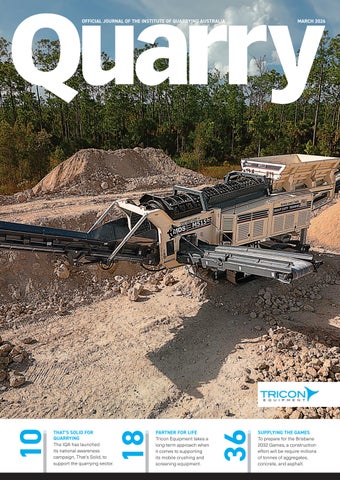
Quarry March 2026

Page 1


THAT’S SOLID FOR QUARRYING

The IQA has launched its national awareness campaign, That’s Solid, to support the quarrying sector. 10

PARTNER FOR LIFE

Tricon Equipment takes a long-term approach when it comes to supporting its mobile crushing and screening equipment. 18

SUPPLYING

THE GAMES

To prepare for the Brisbane 2032 Games, a construction effort will be require millions of tonnes of aggregates, concrete, and asphalt.

IN THIS ISSUE

The

Hallett

A

16 ON THE RISE

The IQA’s Women in Quarrying initiative continues to go from strength to strength.

21 ON A GLOBAL STAGE

Two Australian operators will be tasked with bringing a major honour down under at ConExpo/Con-Agg 2026.

26

DESIGNED FOR AUSTRALIA

Crusher Screen Sales & Hire guarantees that all its equipment is suitable for the Australian quarrying sector.

28

Pacific

Tricon

EYES ON THE TIGER

Onetrak could help quarries access a key ingredient of sustainable cement with a new machine.

A SMART QUARRY SITE IS A

Komatsu is helping keep quarries safe with the latest technologies.

KOBELCO POWERS BAXTERS

Baxters Quarries has expanded its fleet after visiting Kobelco’s factories

FRONTLINE RELIABILITY

Multotec Australia’s team provide quarry operators with expertise they can rely on.

44

CHARITY PARTNER FOR QME

The Queensland Mining and Engineering Exhibition has named BMA CQ Rescue as an official charity partner.

46

PREPARE FOR PNG EXPO 2026

Anticipation for PNG Expo is ramping up, and exhibitors are excited to hit the ground running.

48

EXHIBITORS EAGER FOR BULK EXPO

Belt Wise is gearing up to display its latest innovations at BULK2026.

MANAGING MAINTENANCE

Machinery breakdowns are inevitable. If you run a equipment for long enough, eventually something will stop working. The more moving parts there are, the more potential things that could go wrong.

On a quarry site, there are several machines that rely on critical components, each with the potential to fail. When this happens, then it can quickly cascade.

For example, a bearing could fail and seize which could damage surrounding components, which could then damage the shaft and housing – leading to costly repairs and unplanned downtimes.

To avoid these calamities, quarries follow maintenance routines. If routine maintenance is not performed, it becomes more likely that small things won’t be caught before they become big things, costing the operations thousands (if not millions) of dollars.

Most businesses offer after sales support, to ensure their customers can rely on the equipment

even if something goes wrong. Operations are increasingly moving towards technology for condition monitoring to measure and track equipment condition and predict a immanent failure.

Access to this data allows sites to make more informed decisions and can highlight when something has gone wrong. In many cases, the digital monitoring can spot potential problems well in advance of manual maintenance, giving the operators more time to respond in scheduled downtime.

Others are even beginning to embrace machine learning and cloud-based computing to help predict when something will go wrong before it even happens.

However you handle it, maintenance is a key part of keeping quarries profitable. New technology is helping find ways of removing risks and speeding up the process so that machinery can get back to earning a profit.

IF ROUTINE MAINTENANCE IS NOT PERFORMED, IT BECOMES MORE LIKELY THAT SMALL THINGS WON’T BE CAUGHT BEFORE THEY BECOME BIG THINGS, COSTING THE OPERATIONS THOUSANDS (IF NOT MILLIONS) OF DOLLARS.

Published by:

379 Docklands Drive

Melbourne VIC 3008

T: 03 9690 8766

www.primecreativemedia.com.au

Chief Executive Officer

Christine Clancy christine.clancy@primecreative.com.au

r u i E it r

Paul Hayes paul.hayes@primecreative.com.au

E it r

William Arnott william.arnott@primecreative.com.au

i t t E it r Adam Daunt adam.daunt@primecreative.com.au

ur i t

Daniel Williamson daniel.williamson@primecreative.com.au u i e eve e t er Les Ilyefalvy les.ilyefalvy@primecreative.com.au

C ie t ucce C r i t r

Janine Clements janine.clements@primecreative.com.au rt irect r Michelle Weston u cri ti T: 03 9690 8766 subscriptions@primecreative.com.au

The Publisher reserves the right to alter or omit any article or advertisement submitted and requires indemnity from the advertisers and contributors against damages or liabilities that may arise from material published. © Copyright – No part of this publication may be reproduced, stored in a retrieval system or transmitted in any means electronic, mechanical, photocopying, recording or otherwise without the permission of the publisher.

CHANGING PERCEPTIONS, SEIZING OPPORTUNITIES

Two major initiatives are now front and centre for IQA - our national awareness campaign is live and reaching new audiences, while registrations are building strongly for October’s National Conference on the Gold Coast.

THAT’S SOLID

Our national awareness campaign launched in February, and this edition puts faces to the initiative. You’ll meet four IQA members who’ve shared their career journeys for the campaign - Brandon Catalano, Jacqui Host, Michelle Knott, and Zubayr Colley. Their stories showcase the diverse pathways into quarrying and the opportunities that exist once you’re here. These honest reflections from members across different operations and career stages are exactly what young Australians need to see when considering their futures.

2026 NATIONAL CONFERENCE: EARLY BIRD CLOSES IN APRIL

We’re in our early bird registration period running through April 2026. If you’re planning to attend the IQA National Conference on the Gold Coast from 6-8 October, now is the time to secure your registration and save on standard rates.

Early bird rates include full

conference access, site tour, and all three social events including the Komatsu Conference Dinner and Caterpillar Gala Dinner.

Over 100 exhibitors and international experts will gather for three days of technical presentations, networking, and the IQA National Awards.

STATES FOCUS ON SAFETY

Our 2026 Safety & Health conferences are progressing well. Victoria’s conference runs 27 March, followed by NSW on 13-14 May, Queensland on 4 June, and North Queensland on 29 July. These local conferences provide essential technical updates, networking opportunities, and practical insights specific to each state’s operating environment.

MEMBER ENGAGEMENT CONTINUES

IQA Connect adoption continues growing, with members using the app to network, share insights, and stay informed. If you haven’t downloaded it yet, search IQA Connect in your app store. It’s transforming how we collaborate across states and operations.

and

THAT’S SOLID: OUR FIRST NATIONAL PUBLIC AWARENESS CAMPAIGN FEATURES REAL STORIES FROM MEMBERS ACROSS AUSTRALIA, SHOWCASING DIVERSE QUARRYING CAREER OPPORTUNITIES AND THE VITAL COMMUNITY ROLE OUR SECTOR PLAYS.

I look forward to seeing many of you at branch events and on the Gold Coast in October.

of Quarrying Australia

www.quarry.com.au

The IQA’s Strategic Plan 2023 to 2026 embodies the following vision, values and strategic priorities:

Thriving communities supported by a sustainable industry

Operational Priorities:

• Deepen industry participation

• Sustainable revenue streams

• Highly capable team

• Technological innovation

• Effective engagement

• Great governance

Strategic Priorities:

• Support industry participants with compliance and regulation

• Build a diverse and skilled industry

• Foster strong industry connectivity

IQA Contacts:

For all education, member and branch enquiries: Phone: 02 9484 0577 Email: iqa@quarry.com.au

Chief Executive Officer

Jane Schmitt President

Michael Close

Company Secretary

David Cowie

Follow the IQA on our social media pages: IQAustralia the-australian-institute-ofquarrying/ iqaus

320 GC, 323, 325, 326, 330, 330 GC This offer is subject to finance approval and ends 31 March 2026. For what you’ve done and for what you’ll do, we’re here for you. Don’t miss out. Contact your local Cat dealer for a quote.

CONVERSATIONS WITH MICHAEL CLOSE, PRESIDENT

Michael Close interviews

SLR Consulting technical discipline manager –construction materials and services, Clayton Hill.

Michael Close: What’s kept you and so many SLR colleagues engaged with the Institute?

Clayton Hill: : The industry itself is one that values networking and professional development. The IQA provides access to industry relevant training, networking and learning opportunities that are not found elsewhere. We are a niche industry and the IQA caters for both members and non-members by providing industry specific events and professional development opportunities. Now with the introduction of practising certificates and mandatory professional development in a number of states, this is even more relevant.

For our team members starting their careers in the sector, they have the opportunity to get involved in committees, attend conferences, training and build relationships with industry peers and mentors. They come back with insights that make them better consultants.

MC: The sustainability conversation has shifted dramatically since you joined. What’s different now?

CH: Since I first joined the industry, the sustainability conversation in Australia’s quarry and broader resources sector has shifted from aspiration to expectation—driven by policy pressure, investor scrutiny, technological advancement and the rapid acceleration of decarbonisation initiatives.

The sustainability conversation today is broader, more technical, more urgent, and significantly more strategic. It’s no longer about compliance, it’s about transformation

MC: Community expectations seem particularly challenging. What are you seeing?

CH: Communities expect transparency – real data on dust, noise, water quality, not just assurances. They want demonstrated outcomes, not promises about what might happen at closure in 20 years.

The operations doing well treat community relationships as ongoing, not transactional. They involve locals in monitoring programs, hire locally, contribute meaningfully to regional development.

MC: What worries you about the sector looking ahead?

CH: Skills and capability. Attracting the next generation of quarrying professionals is something that I am concerned about.

The current and likely future generations have a different outlook on work and the sectors they want to be involved with. We’re often invisible to school leavers and those choosing career changes. And were competing with other industries looking to secure talent.

We need to do more in this space which is why I am excited about the ‘That’s Solid’ campaign the IQA is launching and a project I am leading investigating a tertiary qualification for the quarry industry in Australia, partnering and learning from the good work the Institute has done in the UK with the University of Derby.

THE IQA PROVIDES PATHWAYS FOR PEOPLE TO BUILD EXPERTISE, CONNECT WITH PEERS, AND DEVELOP THE CROSS DISCIPLINARY THINKING THE SECTOR NEEDS.

www.quarry.com.au

The IQA’s Strategic Plan 2023 to 2026 embodies the following vision, values and strategic priorities: Vision:

Thriving communities supported by a sustainable industry

Operational Priorities:

• Deepen industry participation

• Sustainable revenue streams

• Highly capable team

• Technological innovation

• Effective engagement

• Great governance

Strategic Priorities:

• Support industry participants with compliance and regulation

• Build a diverse and skilled industry workforce

• Foster strong industry connectivity

IQA Contacts:

For all education, member and branch enquiries:

Phone: 02 9484 0577

Email: iqa@quarry.com.au

Chief Executive Officer

Jane Schmitt

President

Michael Close

Company Secretary

David Cowie

Follow the IQA on our social media pages: IQAustralia the-australian-institute-ofquarrying/ iqaus

The Institute of Quarrying Australia

THAT’S SOLID FOR QUARRYING

The Institute of Quarrying Australia has officially launched its national awareness campaign, That’s Solid, to support the quarrying sector.

The Institute of Quarrying Australia’s (IQA) has unveiled an extensive campaign called “That’s Solid” that showcases opportunities across the national sector for school leavers, teachers, parents, and schools.

By showcasing the careers of quarry workers, the IQA aims to support the next generation of quarry workers in gaining meaningful employment in a sector critical to the future of Australia’s infrastructure and construction projects.

It will also show how the sector supports local communities, employs local people, and delivers essential construction materials to the regions.

“Quarrying is a modern, highly skilled sector, but that story isn’t well understood. This campaign highlights the diverse, technology-driven career opportunities that exist across our sector today,” IQA chief executive officer Jane Schmitt said.

“Today’s quarrying careers combine strong safety standards, environmental responsibility and advanced technology.

“Our campaign is designed to reflect the professionalism and opportunities of the quarrying sector.”

CAREERS IN FOCUS

Four IQA members have been selected from across Australia to front the campaign and share their story of working in the quarrying sector. Jacqui Host from Daracon’s Buttai Quarry, Brandon Catalano from the Italia Stone Group, Michelle Knott from the familyowned and operated Brooklyn Quarry and Zubayr Colley from Benedict Industries are the four IQA members who have shared their stories for the campaign.

These career stories showcase leadership, learning, career growth, and the pathways people can access within the diverse and dynamic quarrying sector.

The four quarry workers have shared their experiences of finding their calling in the quarrying sector so school leavers and others can follow in their footsteps.

WORKFORCE HUB ARRIVES

The IQA has launched the IQA School to Workforce (S2W) Hub, which features comprehensive career resources for students, educators, and employers.

The hub includes career pathway diagrams showing progression from trainee through to senior management, detailed career profiles for roles across the sector, work experience toolkits for both employers and schools, an interactive career quiz, and links to local quarries for work experience opportunities through the ‘Find a Quarry’ directory.

“The IQA School to Workforce Hub is about empowering people with information. By combining education with interactive tools, we’re helping individuals make informed decisions about careers in the quarrying sector,” Schmitt said •

For more information, visit quarry.com.au

The national awareness campaign includes modern branding to showcase the sector..

AN UNEXPECTED PATH

Jacqui Host discusses her unusual path into the quarrying sector, which has led to a career that helps her local community.

Jacqui’s journey to working in the quarry sector is anything but ordinary.

Growing up, she was immersed in the performing arts - dancing, acrobatics, and music from the age of five.

By her teens, she was passionate about guitar, singing, and playing in bands, and even spent nearly two years studying music after finally being accepted into a performing arts course in year 11.

But life took a dramatic turn when her dad moved to Western Australia to work at an underground gold mine.

“One day, he called and asked, ‘mate, how are you going at being broke?’” Host said.

At the time, she was ready for a change and some financial security. As soon as she turned 18, she joined her dad at the mine.

Her career path has since taken her through mining and earthmoving, and now into quarries.

What drew her to quarries was the chance to do meaningful work close to home.

“It’s essentially mining, but in the city, you can go home at the end of each day. The hours are still long, but the work is diverse,” she said.

“You’re not stuck on one machine or in one role; you do whatever needs to be done, which keeps things interesting.”

What’s kept Host in quarrying is the people.

“You work closely with your team every day, and you build strong relationships,” she said.

“Quarry crews are small and tight-knit. There’s a real sense of camaraderie, and every day brings something new.

“The chaos and diversity of the work make it exciting and satisfying.”

Host’s experience spans contract crushing, operating crushers, diggers, loaders, water carts, and dump trucks.

Now, she works in work health and safety, but still jumps in wherever she’s needed, whether that’s covering for a quarry manager or operating machinery.

“The flexibility and hands-on involvement of the sector are what I love most,” she said. “You’re expected to step in wherever there’s

a need, and everyone has the experience to do so.”

She believes everyone should consider careers in quarries.

“It’s a fun and satisfying job, and there are so many different roles beyond just operating machinery. We have engineers, environmental specialists, accountants, and boilermakers. You can come in as one thing and leave as another, with plenty of on-thejob training and opportunities to gain new qualifications,” she said.

“For school leavers, especially those unsure of what they want to do, quarries are a great place to start.”

Equally, Host is passionate about the value that quarries bring to the community.

“Everything we need in a community, roads, bricks, concrete, and more, comes from a quarry. The raw materials produced here are the foundation of our daily lives, supporting infrastructure, creating jobs, and driving the economy,” she said.

Outside of work, Host loves spending time with her daughter, fishing and going to the gym.

“After a long shift, the gym helps release physical stress, but my main passion is fishing. The isolation, quiet, and focus it requires are the perfect counterbalance to the chaos of quarry life,” she said.

“Just go for it. Quarrying is fun, offers financial security, and teaches you valuable life skills. You’ll always be handy, and you’ll never be without a job. You can move anywhere and always find work. It also can provide flexibility,” she said.

When Host had her daughter, she gradually returned to work, starting with just one or two days a week and building up to full-time as her child grew older.

Host’s story is proof that a career in quarries can be as dynamic and rewarding as any stage or spotlight - offering variety, community,

Her advice to anyone considering a career in quarries is simple.

Jacqui Host has held key roles with Daracon Group.
Host is passionate about the value quarries bring to the community

OPPORTUNITY KNOCKS

Brandon Catalano has built a great career with

When Brandon Catalano finished high school, he was not sure what his next step would be. Like many young Australians, he felt a bit lost and uncertain about his future.

That was until his dad suggested he try a local labouring job – a decision that would set Brandon on a path he never expected.

“I got my white card and started as a labourer. That was my first introduction to the construction sector, learning about safety, how things worked, and getting a feel for the environment before I found an opportunity in a quarry,” Catalano said.

After gaining experience on a loader, Catalano was asked if he would like to help out at one of the local quarries.

“At first, I didn’t really know what a quarry was,” he said. “I imagined it as just a pit with rocks in it, but I quickly learned it’s much more than that. There’s a large amount of coordination and teamwork involved, and it takes a lot of skilled people to do it well.”

Over the past decade, Catalano’s career has grown in ways he never imagined. He started out labouring and gradually took on more responsibility, always eager to learn new skills.

“If someone was off sick or it was a quiet day, my supervisor would ask if I wanted to learn a new machine,” he said.

Brandon Catalano shares how he found his calling in the quarrying sector and has since forged a successful career.

“I always jumped at the chance. That  attitude helped me gain experience on a wide variety of machinery, which opened up even more pathways, like GPS work on bulldozers, supervising, and eventually managing my own projects.”

Now, Catalano is studying for his quarry manager’s certificate, with a long-term goal of helping modernise the sector and remove some of the stigma around quarrying.

“I want to create an environment where people feel comfortable and supported, not worried by old stories or misconceptions,” he said.

“I love working with people, tackling complex tasks as a team, and I want to give back by mentoring others who are just starting out - especially those who might feel a bit lost after school, like I did.”

For Catalano, the variety is what keeps things interesting. “It’s not just about doing one thing all day, there are so many different jobs and machines, and every day brings something new,” he said.

“The teamwork is fantastic, and I love meeting new people, hearing their stories, and sharing what I’ve learned. There are so many opportunities in the sector, and I’ve found a real sense of purpose and pride in my work.”

Catalano said he wished more young people knew about the opportunities in the sector.

“When I finished year 12, I was confused and unsure about my next step. If I’d known about the different pathways and careers available in this industry, I would have jumped in much sooner. It’s a great fit for hands-on learners like me.”

Likewise, Catalano is keen to dispel the myths about quarrying.

“There’s a stigma that it’s a tough or even dangerous environment, but that’s not the reality I’ve experienced,” he said.’

“The sector is full of regular people, your neighbours, friends, and community members, who take pride in their work.

“The materials we produce are the backbone of our daily lives, from roads and houses to marinas and infrastructure.

“We’re local, and we care deeply about our community and the environment.”

Catalano takes pride in knowing the work he does helps build the very infrastructure his community relies on.

“We hold ourselves to high standards because what we produce stays in our community. It’s incredibly fulfilling to look back at a finished project and know you were part of something lasting,” he said.

Outside of work, Catalano enjoys ice hockey and building computers, hobbies that help him maintain a healthy work-life balance.

“Ice hockey might seem odd in Western Australia, but I love the fast pace and the challenge,” he said.

“Building computers is another passion. I enjoy tinkering and problem-solving, even if things don’t always work the first time.

“These hobbies help me unwind, and I’m grateful that my job allows me to go home every night and enjoy my weekends with friends and family.”

Catalano’s advice to anyone feeling lost after school is simple.

“Take a breath and just take the first step. It doesn’t have to be quarrying, but for me, that first step changed my life,” he said.

“There are so many roles in this sector that you can look at - plant operator, site supervisor, project manager, engineer, driller, blast crew, rock breaker, truck loader, and more. Each has its own subcategories and opportunities for growth. If you’re hands-on and willing to learn, there’s something here for you. Quarrying isn’t always easy. It can be tough, but it’s incredibly rewarding.

“You get to solve complex problems, work as part of a team, and build skills that are valuable both at work and in daily life. Safety is a huge priority for us. Every day starts with a focus on making sure everyone goes home safely. We look out for each other, and that sense of community is one of the best parts of the job.”

For Catalano, quarrying has given him a career, a sense of pride, and a community. He hopes more people will give it a chance and see for themselves what this sector has to offer. •

Italia Stone Group.

BUILDING A COMMUNITY

Michelle Knott has undertaken a remarkable journey to start the family-owned and operated Brooklyn Quarry which continues to thrive.

When a close family member mentioned there was “rock in the backyard,” Michelle and Scott Knott’s curiosity was sparked.

“Scott’s uncle, for as long as Scott could remember, had said, ‘There’s rock in my backyard,” she said.

For years, the family wondered about it. Then one day, Scott turned to Michelle and asked, ‘Should we go have a look at these rocks in my uncle’s backyard?

“I was all for it. We’re both quite adventurous and love a challenge,” Knott said.

They decided to investigate the potential of the family farm.

“We took samples to a rock testing company, and they confirmed the basalt was perfect for road base aggregates and other essential products,” Knott said.

“That’s when we started the long journey of discovering what a quarry actually is and what it does.”

This discovery set them on a threeyear journey of research, learning, and determination to open their family-owned quarry in regional New South Wales.

In fact, the first time Michelle and Scott set foot on a working quarry, it was their own.

“Prior to this, we’d never been in a quarry,” she said. “I’d been to an old quarry which had been converted into a swimming spot, but not a working site where they drill and blast.”

Her prior experience in project management and juggling the demands of running a business and being a mother of four proved invaluable in running a quarry.

“My previous experience helped greatly in being an operations manager and managing a quarry because it comes down to project management. Being a mother of four, you learn to juggle lots of things happening all the time,” she said.

The learning curve was steep, involving calls to regulators, mountains of paperwork, and countless hours of research. Knott’s persistence and adaptability helped them navigate every challenge.

“I remember calling the New South Wales resource regulator and asking, ‘How do you actually start a quarry?’.

“There was a long pause on the other end, but then the person explained the pathways and things we’d have to do - administration, paperwork, licence applications, accreditations, and testing. It was a rabbit hole, but we kept going,” she said.

Now, nearly three years since opening, their quarry supplies materials to local councils, civil contractors, concrete companies, farmers, and stone masons.

“Our main customer base includes local councils - Walcha, Armidale, Uralla, and Tamworth - as well as civil contractors, local concrete companies, and farmers who use our products for laneways and farming operations,” Knott said.

“We also have stone masons who hand-pick rocks for specialised walls and landscaping. The list of customers is quite endless; we even have people come with a trailer to get rocks for their backyard.”

Knott is passionate about educating the community on the importance of quarries. She wants people to understand that the roads they drive on and the infrastructure they rely on all start with quarry products.

She’s also a strong advocate for quarrying as a career path for school leavers, especially young women.

organisations like the Institute of Quarrying Australia,” she said.

“There’s camaraderie, education, and personal development.”

Knott enjoys the diversity and finds the work both rewarding and fun.

“One day you’re working on a training schedule, the next you’re sourcing parts from overseas, or learning how to test rock,” she said.

“You can’t go to work expecting to tick off a list of tasks; you have to be adaptable. What surprised me most about this sector is how much fun it is. It’s enjoyable and brings a lot of joy. There’s always something new to learn or do.”

Outside of work, Knott enjoys archery, a hobby that mirrors her approach to quarrying.

“There are similarities between archery and quarrying, you have to silence your mind, be determined, and aim for your target,” she said.

Her advice to mothers and daughters considering a career in quarrying is simple.

“It builds self-confidence and belief, and everyone has the right to work in any sector that makes them happy,” she said.

Knott’s story is a testament to curiosity, resilience, and community spirit.

From a simple comment about rocks in the

Michelle Knott runs Brooklyn Quarry with husband, Scott.

THE TEAM LEADER

Zubayr Colley has developed into a team leader at Benedict Industries as part of an exciting journey in the quarrying sector.

Before finding his place in the quarry sector, Zubayr Colley tried his hand at a bit of everything -construction, retail, and truck driving.

Nothing quite felt right until, about seven years ago, he saw a sign on a local quarry saying they were hiring.

He instantly thought: “That’s something I’d like to do.”

With his truck licence in hand, Colley landed the role and started out driving the water cart. Eager to learn, he put his hand up for excavator training and soon became the loader operator, ensuring the quality of sand and other products going out.

From there, Colley worked his way up. He has operated dump trucks and frontend loaders and eventually took on the responsibility of loading the crushing and screening plant. He has also worked in sales.

Colley’s willingness to take on new challenges led him to a supervisor role, and today, he’s the site supervisor at Benedict Industries.

“I’ve done almost every job, water cart, loader, excavator, articulated haul truck and now I lead the team,” he said. “I’m also working towards my quarry manager’s certificate. I want to repay the people who’ve put their trust in me and keep progressing in my career.”

What made Colley feel at home in the quarry sector was the people. “When I walked in, everyone was supportive and wanted to see me succeed,” he said.

“That was new to me, and I just ran with it. I’ve never looked back.”

Having worked in so many different roles, Colley has a strong understanding of every part of the quarry, which helps him support his team.

His biggest inspiration is his family, especially his young son.

“Once you have a child, your priorities change, and I want to give him a good life,” he said.

Every day, he enjoys working closely with a team that’s goal-driven and supportive. “We all want to be successful, and that makes for a great work environment,” he said.

One frustration for Colley is that many people don’t know what a quarry is or what quarry workers do.

“Quarrying isn’t taught in schools, and it’s a sector that tends to fly under the radar,” he said. “People don’t realise that if you work in a quarry, you’ve helped build everything- roads, buildings, all kinds of infrastructure. We make everything, and everything you use comes from a quarry.”

Colley’s keen to change perceptions about the sector. “People still associate quarrying with being dusty, dirty, noisy, and dangerous, but it’s not like that,” he said.

“The sector is advanced, uses a lot of technology, and focuses heavily on safety. I hope that by the time my son grows up, quarries are seen as a rewarding career with endless opportunities.”

Colley also wants the community to know that quarries are highly regulated and take their responsibilities seriously.

“We focus on rehabilitating the land so it can be used after we’re done. We’re not just digging holes and leaving them; we’re making sure the land is usable for the future,” he said.

Outside of work, Colley enjoys spending time with his family and has a passion for Japanese cars.

“There’s something about the golden era of Japanese cars - the fast motors, the ability to modify them, and the fun of always having a project in the garage,” he said.

Colley’s advice to young people is simple.

“Back yourself. Trust yourself, put yourself out there, and give things a go. Don’t be afraid to try different things,” he said.

“At the end of the day, we’re playing with big toys. It’s fun, it’s safe, and it’s rewarding. If you loved playing with Tonka trucks as a kid, now you get to play with the real thing as an adult.”

Colley’s journey is proof that with curiosity, determination, and the right support, you can build a solid career in the quarrying sector. •

ON THE RISE

The Institute of Quarrying Australia’s Women in Quarrying initiative continues to go from strength to strength with bigger events and more members than ever before.

Institute of Quarrying Australia (IQA) member and Women in Quarrying (WIQ) national coordinator Carly Monaghan reflects on the growth of the WIQ initiative and the importance of International Women’s Day (IWD).

WHAT WERE SOME OF THE MAJOR HIGHLIGHTS FOR WIQ IN 2025, AND WHAT THINGS CAN WE EXPECT TO SEE IN 2026?

A big highlight for WIQ was the Victorian WIQ

The first one was from Mawsons, who have supplied sanitary packs at every site across their business, which is a really great initiative across more than 100 sites. That is something we’re looking to carry on throughout the year to highlight the many good works happening in the sector. There was also the Inclusive Futures webinar at the end of last year, which was really well attended.

It was a great hybrid event. It showed how we could get important information

The Victorian WIQ luncheon was one of the biggest yet.

WHY ARE DAYS LIKE IWD IMPORTANT?

International Women’s Day is a great moment for reflection. It is a good reminder of where we are on a larger scale. It’s not just about work, it’s about living conditions and all these things. It’s a reminder of how far we’ve come and how far we have to go.

In the quarrying sector, it is a time when we can put issues that women and people from diverse backgrounds may be facing at the forefront of people’s minds.

HOW DO YOU REFLECT ON WIQ’S ACHIEVEMENTS?

The most notable thing to me is the growth in interaction with not just women but everyone in the sector.

It is great to see engagement from everyone in the sector. In general, we’re seeing participation from men and women at WIQ events, especially at big events like the Victorian WIQ luncheon and similar events.

I think we need to increase that in 2026 and beyond as part of a two-phase approach.

We want to create a platform for women in the industry to connect authentically with each other through forums and events.

But we also want to connect with the wider sector in an inclusive environment where we can present on women’s issues. We’re looking into ways we can achieve this over the next few years.

HOW CAN YOU BECOME PART OF WIQ?

Definitely reach out to your IQA state coordinator, and they can connect you with your state-based WIQ coordinator. You can also reach out to me, and I can connect you to your state-based coordinator.

are also advertised on the IQA’s website and social media pages so you can check those and the IQA Connect app for the latest events and activities. •

For more information, visit quarry.com.au

Compact, powerful and versatile: Introducing the MOBISCREEN MSS 502 EVO mobile coarse screening plant. Its compact size, low transportweight and impressive feed capacity of up to 350 tonnes per hour ensure that this versatile machine can be used flexibly and quickly for even the most heavy-duty applications in natural stone and recycling. The compact MSS 502 EVO, with its advanced ergonomics, was designed for exceptional operability. It can also be operated electrically thanks to its optional dual-power drive. The MOBISCREEN MSS 502 EVO: the (small) multi-talented powerhouse.

www.wirtgen-group.com/mss-502-evo-kleemann

The WIQ program holds informative and educational networking events for members and the wider sector.
WIQ events

PARTNER FOR LIFE

For Michael Tripolone, success in quarrying isn’t about selling equipment, it’s about understanding the realities of tough worksites.

Michael Tripolone has spent his career working alongside quarry, mining, and construction operators, gaining first-hand insight into the challenges that define their day-to-day operations. Over time, one principle has shaped his leadership of Tricon Mining Equipment above all others: no two sites are ever the same.

Even quarries producing identical materials can face vastly different requirements depending on geology, location, climate, and regulatory pressures. For Tripolone, that diversity makes a one-size-fits-all approach ineffective and often costly.

“If you don’t understand the realities of a site, you can’t recommend the right solution,” Tripolone said. “Our role is to be a reliable partner—helping customers maintain the efficiency and reliability of their machinery so they can stay focused on their operations.”

This philosophy has guided Tricon’s growth over the past two decades. Under Tripolone’s leadership, the company has developed long-standing relationships with leading global equipment manufacturers and spare parts suppliers, both in Australia and internationally. These partnerships have positioned Tricon as a trusted importer and distributor of mobile crushing, screening, recycling, and conveying equipment.

But for Tripolone, equipment supply is only part of the equation.

What matters most is what happens after a machine arrives on site.

One of the most consistent concerns he hears from customers is downtime something that can quickly derail production schedules and profitability.

“Downtime causes major disruption,” he said. “That’s why we place such a strong

emphasis on service, parts availability, and technical support. When something unexpected happens, our technicians are ready to assist either on-site or in the workshop to get machines back up and running as quickly as possible.”

With experienced technicians and a well-stocked parts inventory, Tricon works to minimise delays while ensuring machinery continues to perform in demanding environments.

Tripolone believes this hands-on, solutions-focused support is what turns customers into long-term partners.

“Whether it’s selecting the right equipment, improving the performance of existing machines, or solving challenges as they arise, our focus is always on practical, effective support,” he said.

The mechanism also allows the trommels to handle larger feeds.

REAL PROBLEMS

That practical mindset is especially evident in Tricon’s approach to heavy-duty trommel solutions for the quarrying industry.

Sticky, clay-bound material is a common problem across many sites, often clogging crushers, accelerating wear, and leading to unnecessary downtime. For Tripolone, the answer lies in equipment specifically designed to handle these conditions, not machines pushed beyond their limits.

This is where the Terex MDS heavy-duty rock trommel range, and particularly the MDS M515, stands out.

“When you’re dealing with heavy, abrasive, or sticky material, the MDS M515 is in a class of its own,” Tripolone said. “It’s purpose built for the harshest conditions and proven across quarrying, mining, and large scale construction.”

At the heart of the M515 is a CAT 4.4 Tier 3 engine, selected for its fuel efficiency, long service intervals, and reliability in demanding environments. According to Tripolone, this reliability directly translates into reduced operating costs and less

The MDS M515 trommel’s heavy-duty rotating drum delivers an aggressive yet effective cleaning action, allowing material to tumble and scrub against itself and the drum walls. This produces a cleaner output while breaking down clay-bound rock and sticky overburden that would otherwise choke conventional equipment. Designed to handle large feed sizes, the MDS trommel range can screen material up to 800mm, including rip-rap and armour stone. Multiple screening configurations allow operators to separate material into more than just fines and oversize, while integrated drum cleaners keep apertures clear, even in the harshest conditions, ensuring consistent production.

Ease of maintenance has also been prioritised, with features such as a swing-out engine bay.

“Whether you’re producing rip rap, recovering material from overburden, or feeding a crushing and screening plant, the M515 delivers exceptional versatility,” Tripolone said.

“Its robust steel construction, large feed hopper, and optional hydraulic rock breaker

Tripolone said the real value of the M515 lies in its ability to handle difficult material without compromising output.

“It excels at separating large oversize rock from clay-bound material,” he said.

“The rotating drum aggressively tumbles material to liberate fines and prevent clogging. For many sites, it’s a genuine game-changer.”

Thanks to their heavy duty build, userfriendly design, and straightforward maintenance requirements, Terex MDS trommels help minimise downtime and deliver consistent production, key factors in helping quarries meet their targets.

Tripolone’s hands-on approach to equipment selection and site-specific advice was recognised when the company was named 2024 MDS Dealer of the Year.

“Our equipment is proven in tough quarrying applications,” Tripolone said.

“But just as importantly, our customers know they have the backing of a team that understands their challenges.” •

Images: Tricon Equipment
At the heart of the Terex MDS M515 is a CAT 4.4 tier 3 engine.

Engineered to match. Proven to perform.

A partnership which brings over two decades of minerals processing expertise and trusted screening solutions to the industry.

20+ years of screen media in Australia every year

of minerals processing expertise

32,000m2 field maintenance support

24/7 Brisbane, Perth, Newman, Mackay, Newcastle

5 locations part of global Multotec network

100 countries

About Multotec Australia

Multotec Australia is a minerals processing and engineering company which locally manufactures high-performance screen panels, purpose built for quarry applications. With over 20 years of experience and deep engineering expertise, our screening solutions are trusted to perform in some of the world’s toughest minerals processing environments.

ON A GLOBAL STAGE

Two Australian operators will be tasked with bringing a major honour down under as part of Caterpillar’s Global Operator Challenge at ConExpo/Con-Agg 2026.

Tim Lamb and Shane Poole will carry the hopes of a nation when they touch down at ConExpo/Con-Agg 2026 for the Global Operator Challenge (GOC).

Caterpillar’s event is returning to the Las Vegas showcase with the best operators from around the world competing in one final showdown. The GOC saw a record turnout with 87 Cat dealers participating and 125 challenges, which have been whittled down to nine.

Lamb and Poole were in the top three of the Asia Pacific GOC rounds alongside Norio Miyajima, who claimed the top overall prize at the event.

The trio are now set to compete against other regions, including the Americas, Europe, Africa, and the Middle East, in a test of precision, speed, and technical excellence.

The Las Vegas finale will showcase machine control, safety, and efficiency under pressure, and Lamb is excited to step up to the big stage at ConExpo/Con-Agg.

“I’m absolutely honoured to take out third place in the Asia Pacific Regionals,” he said.

“This journey has been incredible, and I’m proud to represent Daracon Group, WesTrac, and Australian Operators at the global finals. I can’t wait to take on Vegas and show what our region can do.

“Up until this trip to Japan, I had never travelled overseas, and now I have a ticket to Vegas to compete against the world’s best.”

INNOVATION ON SHOW

WesTrac chief executive for NSW/ACT
The Global Operator Challenge will take place at ConExpo/Con-Agg 2026.
Images:
Caterpillar
Tim Lamb, Norio Miyajima and Shane Poole were the top three at the Asia Pacific GOC event.

advancements and groundbreaking technologies in the construction industry through our demos, hands-on experiences and interactive exhibits,” Caterpillar group president Tony Fassino said.

“Visitors will see how Caterpillar can solve their toughest challenges as we reshape today’s worksite while providing them an understanding of what is possible in the future.”

Alongside Caterpillar’s Festival Grounds exhibit, which will host the GOC finale, the company will also have a display in the West Hall and Cat Industrial Power Systems will demonstrate its latest industrial engine solutions in the South Hall.

Headlining its technology offering will be the latest VisionLink features focused on equipment management, productivity and safety. Cat Command, including its remote-control, semi-autonomous and autonomous capabilities, will be showcased

in construction and quarrying applications.

At Caterpillar’s outdoor exhibit, visitors will be able to get up close to more than 30 machines across a range of sectors.

NEW DESIGNS

Attendees will be able to see the future designs for new motor grader and dozer models, headlined by a preview of the next generation Cat 150 motor grader and the next generation Cat 150 motor grader.

The manufacturer will also mark 30 years since the Cat Asphalt Paver introduced the Mobil-trac Undercarriage.

As part of the milestone celebrations, an AP1055 Asphalt Paver will be on show with the latest updates.

Part of Caterpillar’s showcase will include Cat Rentals, including its refreshed brand. Attendees can get a first look at the change, including the enhanced online portal. In the online portal, customers can submit rental

GOC FINALISTS:

•Brian Hayden (United States)

•Brock Leclerc (Canada)

•Luanderson Sousa (Brazil)

•Gunter Dewit (Belgium)

•Nicolai Thomsen (Denmark)

•Sebastian Behr (Germany)

•Norio Miyajima (Japan)

•Timothy Lamb (Australia)

•Shane Poole (Australia)

and service requests, call off equipment, make order changes, and view basic telematics and equipment locations.

The GOC can be watched live and in person at the outdoor stadium at ConExpo/Con-Agg or online at Caterpillar’s website. •

For more information, visit caterpillar.com

CEMENTING SOUTH AUSTRALIA’S GREEN FUTURE

Hallett Group’s Green Cement Transformation Project is ramping up to be a revolutionary low-carbon initiative.

After more than a decade of development, investment, and persistence, Hallett Group is approaching a turning point that could redefine how cementitious materials are sourced, processed, and supplied in South Australia.

At the centre of it all is the company’s Green Cement Transformation Project, which relies on a cement distribution terminal at Port Adelaide and a complementary processing operation at Port Augusta. Together, the two facilities deliver low-carbon cementitious

For Hallett Group chief executive officer Kane Salisbury, the project represents far more than a single infrastructure investment. Salisbury said it is the outcome of a longterm, strategic decision to secure supply independence, lower carbon intensity, and future-proof the state’s construction materials sector in an increasingly constrained global market.

“This has been more than a decade of gestation to get where we are today,” Salisbury said.

“But we’ve now got a project that delivers

The Green Cement Transformation Project can be traced back to 2016, when South Australia’s last coal-fired power station shut down, removing the state’s only local source of fly ash.

With the close of the Northern Power Station at Port Augusta, South Australia transitioned from a locally supplied market to one entirely dependent on imported supplementary cementitious materials (SCMs).

“When the power station closed, South Australia became a 100 per cent import

Salisbury said that at the time, global demand for SCMs such as fly ash and slag was increasing as governments and construction companies sought to reduce the embodied carbon of concrete.

“If these materials were easy to process, they would have already been done. None of them are straightforward,” Salisbury said. Hallett Group began investigating whether South Australia’s own industrial by-products could be transformed into viable, highperforming SCM. The challenge lay in those materials.

Legacy fly ash at Port Augusta had been hydraulically deposited using salt water, making it incompatible with concrete without extensive processing.

Slag from the Nyrstar smelter at Port Pirie presented environmental and consistency challenges, while steel slag from Whyalla lacked the granulation needed for cementitious use.

From 2016 onward, Hallett Group embarked on an extensive research and development program that pushed the business beyond traditional quarrying and concrete operations. The company undertook years of laboratory testing, invested in pilot-scale processing infrastructure, and travelled extensively overseas to study similar technologies.

“We went all over the world,” Salisbury said. “Europe, the US, Japan, China, looking at people doing different parts of what we’re trying to do. No one was doing exactly what we needed, but we were able to piece together the technologies.”

By 2020, Hallett Group had established a large-scale pilot plant capable of processing up to 10 tonnes per day, allowing the company to test washing, drying, grinding, and classification techniques at meaningful scale. Over several years of refinement, two of the three industrial by-product streams passed performance, durability, and environmental benchmarks.

“By the end of it, we were able to say, hand on heart, that these products perform as good as or better than other market alternatives,” Salisbury said. “And they’re made from South Australian industrial by products.”

The Port Augusta facility will progressively remediate two of South Australia’s largest industrial legacies, the former northern Power Station fly ash dam and the Port Pirie slag heap, by converting them into construction inputs rather than long-term environmental liabilities.

“We get to fix two of the biggest environmental legacies in South Australia and put them back into concrete,” Salisbury said. “That’s a massive outcome.”

South Australia’s premier Peter Malinauskas hailed the initiative as critical to both industrial renewal and long-term economic resilience.

“It’s appropriate that this initiative is based on the site of the former Northern Power Station, whose waste products will now play a key part in the industrial renewal of the Upper Spencer Gulf and the transition to a low-carbon economy,” he said while announcing a $12 million concessional loan to support the project.

The Government backing builds upon a $20 million federal grant and reflects ongoing support for the project’s goals.

Malinauskas said the Green Cement Transformation Project aligns closely with South Australia’s broader industrial transformation agenda.

“This project will help South Australia meet its booming demand for building products used in homes, businesses, and industry, while providing sovereign capability and supply chain resilience,” Malinauskas said.

“South Australia is building, and the state needs to produce the materials to keep up the pace. This project will help realise that ambition, while reaffirming the Upper

Spencer Gulf’s long-term prospects as a hub for energy and industry.”

For Hallett Group, an equally important component of the project is ensuring that lower-carbon outcomes are delivered without imposing additional costs on customers. Salisbury said the company has no intention of charging premium for green cementitious products.

“These materials will not be sold at a green premium,” he said. “People want greener materials, but they don’t necessarily want to pay more for them. We can process these materials and get them into the market cheaper than general purpose cement.

“South Australian industrial by-products should be in every cubic metre of South Australian concrete. The best way to decarbonise is to use the resources you’ve already got locally, not import other people’s waste streams.”

The new cement distribution terminal at Port Adelaide is near completion and scheduled for commissioning in early 2026. Built on one of the most constrained footprints on the port, the facility integrates bulk import, storage, blending and dispatch into a single, highly automated operation.

“What we’re building at Port Adelaide will set a global standard for cement distribution hubs,” Salisbury said. “We’ve taken a conventional cement dome and added a level of blending capability and flexibility that just doesn’t exist anywhere else.”

The Port Adelaide terminal will serve as a distribution backbone for Hallett Group’s cementitious materials strategy, while the Port Augusta processing facility provides the long-term competitive advantage. Once fully operational, the facility is expected to secure decades of local SCM supply for South Australia.

Malinauskas said the project complements other major industrial investments across the Upper Spencer Gulf.

“Coupled with green iron and steel in Whyalla, and critical metals in Port Pirie, this project is paving the way for huge opportunities for the Upper Spencer Gulf and South Australia,” he said.

As commissioning progresses and operations ramp up, the Green Cement Transformation Project is poised to reshape South Australia’s cement and quarrying landscape.

“We don’t want to be the biggest construction materials business in the country,” Salisbury said. “We want to be the best.” •

20 million tonnes of leftover fly ash from the Port Augusta power station will be turned into green cement.

DESIGNED FOR AUSTRALIA

Crusher Screen Sales & Hire guarantees that all its equipment, including the latest IMS patented PM1200-20TB, is suitable for the conditions of the Australian quarrying sector.

Crusher Screen Sales & Hire (CSSH) has been the long-time distributor for Ireland-based IMS, as part of a collaborative partnership to design and manufacture equipment for Australia.

One of the prime examples of this partnership is the patented IMS PM120020TB pugmill, a popular choice for operators seeking reliability and accuracy.

“The new IMS PM1200-20TB track pugmill has two five-metre-long feed hoppers holding 12 cubic metres each, with separate hopper conveyors fitted with belt scales enabling the blending of two products with accuracy,”

CSSH manager John Andersen said.

“The pugmill has the option of one or two powder hoppers and the ability to add two liquids. This is fully automated with a [programmable logic controller] (PLC) and recording system that can be operated with an iPad in a loader or site office.”

One of the key design features of the PM1200-20TB is its three metre pugbox, which is longer than other options and supports high-quality mixing in applications

involving high percentages of power blending. It has been used in various applications, including roller-compacted cement. It features a four-sided access platform, including stairs, giving operators visibility during maintenance and when the feed is in operation. CSSH contributed to the design, including the integration of the Australian-designed PLC control and recording system.

This addition allows operators to be more proactive in their maintenance, as the system can be monitored from the office. CSSH can also oversee the system from its service department and provide additional support to customers after the machine sale when needed. The reporting program displays data in an easy, digestible way, including percentages of each product used and graphs for each batch. The machine is equipped with an auto-stop feature if the blend does not match the programmed percentages.

Andersen said the pugmill has been designed to meet the evolving needs for blended material in the quarry, construction, and mining sectors.

“The PM1200-20TB pugmill stands out, as it is the only pugmill blender on the market that has two separate conveyors on both feed hoppers,” he said.

“Others have a dividing wall on the feed hopper, but only one conveyor belt, so you can only adjust the percentage of product from both sides with a front of hopper flow gate. The PM1200-20TB has the front of hopper adjustable flow gate plus a variable speed conveyor belt fitted with belt scales and PLC control system, making it more  accurate.”

CSSH also offers other IMS equipment. This includes the BP1200-48TB track blender, which features four five-metre-long feed hoppers, each with a capacity of 12 cubic metres, and is powered by a Cat C7 generator that can be connected to mains power.

The BP1200-48TB blender can operate alongside the IMS modular electric pugmill. Both the PM1200-20TB and the BP120048TB are covered by Australian patent No. 2023201523. •

For more information, crusherscreen.com

The IMS PM1200-20TB pugmill has been popular in Australia.
Image:
CSSH

GET TICKETS

Australia’s largest regional mining event

EYES ON THE TIGER

Onetrak is bringing a new machine to Australian shores that could help quarries access a key ingredient of sustainable cement.

In 2025, Holcim partnered with architect Alejandro Aravena to present the world’s first application of a new biochar technology that could transform buildings into carbon sinks.

The project used an advanced, netzero biochar concrete, with 100 per cent recycled aggregates.

Biochar is created through a process called pyrolysis, where organic materials are exposed to heat in the absence of oxygen, sequestering carbon that would otherwise have been released as CO2. The resulting material can then be added to building materials such as cement, mortar, and concrete to further reduce their carbon footprint and improve overall sustainability.

According to the Intergovernmental Panel on Climate Change, biochar has the potential to eliminate 2.6 billion tonnes of CO2 per year.

Onetrak managing director David Hazell said biochar has been recognised as a potential supplement for cement manufacturing, which makes it a potential benefit for the quarrying industry.

Hazell said the growth of Onetrak’s forestry division has encouraged the company to spread its range across industrial sectors.

“We are the proud exclusive distributor of the Tigercat range of equipment,” he said.

Creating biochar requires pyrolysis equipment – traditionally in the form of fixed plant infrastructure.

“If you have a site where there is a large volume of consistent material coming in over many years, you can justify installing fixed infrastructure,” Hazell said.

“However, so many environments – in particular quarries – are project based. They move around all the time, requiring mobile equipment.”

“The Tigercat 6040 carboniser is one of the only machines globally that incinerates clean, organic material such as green waste, brush, and logs, and converts it into a highquality biochar.”

The machine inputs woody debris and produces a high-quality organic carbon with up to 90 per cent material reduction. It is

“Onetrak supports three key markets – the quarry and extractive industries, forestry equipment, and the waste and recycling market.

“There is the potential to benefit from the Tigercat carboniser across all of these sectors.

“It can support all sorts of things, from invasive weed reduction to organic composting, or easement clearing.

The machine has been designed with ease of maintenance in mind. For example, the grates in the carbonising chamber are made up of seven different sections that can be rotated 180 degrees to balance wear and extend life.

Individual sections can be replaced as required. The undercarriage, auger trough, and conveyor system are all bolt-on sections to the main carbonising chamber frame.

greater yield of higher-quality organic carbon.

The auger trough is designed for minimal air leakage, improving under-air efficiency, further defining the secondary combustion zone, and reducing hotspots that could form from an inefficient base pressure or vacuum. Once the organic carbon drops through the grates, it is fully quenched by the water bath. An onboard hydraulic water supply pump and integrated automatic water level control system monitor and manage water consumption. Automated water fill, level control, and water retention provide the operator a window of time to replenish the water supply if required.

The adjustable conveyor simplifies handling and management of the organic carbon product. It pivots 105 degrees from side to side and can be raised or lowered. The conveyor easily folds for transport and does not have to be detached from the frame.

To showcase the new machine’s potential, Onetrak hosted a demonstration day at its Queensland facility.

Hazell said customers from around the country, including Western Australia and Tasmania, were eager to learn about the new machine.

“It was a great event,” he said. “We’ve got people who want to see how it performs, or to get a biochar sample.

“It’s something new, exciting, and environmentally friendly.”

The company operates from seven workshops across Australia, with more than 50 dedicated service staff supporting its products.

Hazell said Onetrak is constantly growing and is excited to help incorporate the Tigercat equipment into the quarrying industry.

“Come and have a look or give us a call to see what we are doing with this new technology,” he said.

“In just a few years, biochar has gone from something that was produced to help grow tomatoes in the back yard into

a key part of sustainable cement – with growing demand for industrial production.

“We will continue hosting demonstrations, bringing fresh

ideas and new opportunities for the quarry sector.” •

For more information, visit onetrak.com.au

HIRE VS. CAPITAL EXPENSES

Full Capability. Zero Capex

POWER, PRODUCTIVITY, PRECISION

Quarrying operators demand innovative machinery, and the Volvo F Series excavators, distributed by CJD Equipment, are the pinnacle of all things inventive.

Modern excavator design increasingly focused on automation, precision, efficiency, and safety. Today’s machines are expected to do more with less, maximising productivity while reducing fuel consumption, downtime, and operator fatigue. Advanced hydraulic systems, telematics, and intelligent, machine control solutions are now essential components of high-performance quarrying equipment.

CJD Equipment recognises how important these elements are and has launched the new Volvo F Series excavators into the Australian market.

The Volvo F Series blends ruggedness with efficiency for Australian projects. Each excavator is purpose-built to withstand any challenge.

The F Series Model line-up consists of the ECR145F, ECR255F, ECR335F, EC230F, EC260F, EC300F, EC360F, EC400F, and EC500F (Stage V), offering solutions across a broad spectrum of applications. From compact yet powerful machines suited to tight urban environments through to

heavy-duty excavators designed for largescale quarrying and infrastructure projects, the range ensures operators can select a machine precisely matched to their operational requirements.

At the heart of every Volvo F Series excavator is its advanced electro-hydraulic system. This structure continuously regulates engine speed and hydraulic flow based on real-time worksite demands, helping to lower

CJD Equipment provides national coverage for sales, service, and genuine parts as the official Australian distributor for Volvo Construction Equipment.
The Volvo F Series provide solutions to a broad range of quarrying applications.
Images: CJD Equipment

fuel consumption while improving machine responsiveness and control. By delivering hydraulic power only when required, the system enhances efficiency without compromising digging force or cycle times. Extended oil intervals mean less frequent servicing, improving productivity for users.

Operator comfort and ease of use have also been key considerations in the development of the F Series. The redesigned cab environment offers improved visibility, ergonomic controls, and intuitive machine interfaces, creating a more comfortable and productive workspace. Reduced noise levels and smoother machine operation further contribute to lower operator fatigue during long shifts, which can translate directly into improved on-site performance.

The EC400F and EC500F are large excavators designed for quarrying projects, as well as major infrastructure and mass excavation. These heavy-duty models tackle mining and quarry workloads with massive breakout forces and durable construction, designed for Australian industries. The adaptive work modes maximise site efficiency, reducing fuel use and wear.

Every excavator of the F Series is engineered for harsh Australian environments, featuring corrosion-resistant technology and low maintenance needs. As the official Australian distributor for Volvo Construction Equipment, CJD Equipment

provides national coverage for sales, service, and genuine parts. CJD Equipment services include on-stie technical support and maintenance, genuine Volvo parts stocked Australia-wide, fleet management solutions (active care telematics), and training and after-sales support.

All Volvo F Series excavators include active care and lifetime frame/structure guarantee,

with routine maintenance and real-time diagnostics managed by CJD Equipment. For operators wanting to be equipped with the best and most innovative equipment, the Volvo F Series excavators distributed by CJD Equipment are at the forefront of all things power, productivity, and precision. • For

visit www.cjd.com.au

Every Volvo F Series excavator is equipped with an advanced electro-hydraulic system.

A SMART QUARRY SITE

IS A SAFE ONE

Komatsu is helping keep quarries safe with the latest technologies.

Without dependable machinery, quarry operators risk costly downtime, safety hazards, and avoidable operational hurdles.

Komatsu, a global manufacturer of heavy machinery, understands the demands placed on quarrying operators.

The company recognises that customers increasingly rely on innovative technology to help them work more efficiently, safely, and productively, which is why it has launched the HD605-10 dump truck.

Komatsu product manager of wheel loaders and dump trucks Nick Vrontas said the HD605-10 was developed in direct response to customer feedback calling for faster cycle times without compromising fuel efficiency.

“Based on feedback from our quarrying customers, we wanted to improve the speed of our machines,” Vrontas said.

“The HD605-10 is our quickest, 60 tonne dump truck, and customers can now be satisfied that their production times can be quicker and more efficient, helping them save more money.”

Vrontas said that Komatsu has added several features which operators will appreciate.

“The Hill Start Assist holds the machine still on a hill and automatically prevents the truck from rolling back down the hill when the operator moves their foot from the service brake to the throttle,” he said.

The HD605-10 features increased horsepower and payload capacity, delivering maximised productivity while maintaining low operating costs.

Operators benefit from several new features, including a waiting brake that holds the machine stationary on inclines without requiring constant brake or retarder input.

The auto retard speed control (ARSC) allows operators to set a consistent downhill speed, enabling them to focus solely on steering. Speed adjustments can be made in precise 1km/h increments via the control lever, improving control and safety on varying grades.

The truck’s MacPherson strut-type front suspension incorporates a special A-frame between each wheel and the main frame. This design increases the turning angle of

the wheels, resulting in a smaller turning radius, an important advantage in confined quarry environments.

Operator comfort and safety have also been prioritised. The wide Komatsu SpaceCab features intuitive, user-friendly controls and a fully adjustable air-suspended seat designed to reduce vibration and operator fatigue during long shifts. Large front windows and electrically adjustable side windows provide excellent visibility, enhancing on-site safety.

Vrontas said that customer feedback has been “really positive,” and the decision to develop the new model came because of a meeting with relevant stakeholders.

“Komatsu has always been well regarded for its trucks, but customers seem especially pleased with this release,” Vrontas said.

“Major markets, including Australia, the United States, and Europe, collaborated at our Japan factory to identify opportunities for improvement. Speed was the clear focus, and we committed to enhancing performance without sacrificing fuel efficiency.

“Our customers continue to get a good total cost of ownership, with that same reliability

Quarry sites rely on safe machinery, and operations managers can depend upon the Komatsu HD606-10 dump truck.
Images: Komatsu

and assurance that you’d expect from a Komatsu truck.”

Installed in every HD605-10 unit is Komatsu’s smart quarry site (SQS), a fleet management production tool that Vrontas said provides a “holistic overview” of everything that is being used on site in real-time.

SQS features pre-safety notifications, dashboards that go back in time and analyse key productivity indicators (KPIs) and how machinery is performing.

“SQS is an extremely useful tool for site managers and quarrying managers to get a real-time view of what’s happening without needing to go into the field,” Vrontas said.

“What sets SQS apart is being an original equipment manufacturer. The system was being developed in consultation with

customers, to ensure it’s designed to what customers want to see, not what we think they want to see.”

SQS is not limited to Komatsu equipment and can be bolted on to any bit of equipment and mic and be able to get the same amount of data.

“We’ve created a device that allows users to get the most out of their machines, whether its Komatsu equipment or not,” Vrontas said.

“We install SQS to every HD605 that we sell to provide the site the opportunity to trial it if they want.”

For

LEADING PRODUCTION OPTIMISATION

Komatsu’s HD605-10 dump truck is designed to improve production times whilst remaining fuel efficient.

KOBELCO POWERS BAXTERS QUARRIES

Baxters Quarries has added Kobelco’s SK380XDLC-10 model into its fleet after seeing the machines built firsthand when visiting the company’s factories in Japan.

When Brendan Baxter travelled to Japan to visit Kobelco’s manufacturing facilities, it wasn’t simply a study tour. The trip offered a rare opportunity to connect the performance his team sees every day in the quarry with the engineering philosophy that underpins Kobelco’s XD Series excavators, particularly following the launch of the SK380XDLC-10 model.

“Andrew (Brendan’s brother) has worked very closely with our quarry operations manager,” Baxter said. “Since getting our first piece of Kobelco equipment many years ago, we’ve been really impressed.”

The long-standing relationship between the companies provided an opportunity for the Baxters Quarries team to explore the Kobelco

manufacturing ecosystem. Across three separate sites, from compact excavators to large production machines, and even the steel used to build them, the tour highlighted how vertically integrated manufacturing and continuous improvement remain central to the Kobelco brand.

“We went to three different Kobelco plants,” Baxter said. “One was the small excavator factory, which was based outside of Nagoya. The second was the large excavator factory in Hiroshima. We also went to a steel factory just outside of Kobe, where they actually make the steel that’s used in their machines.”

Quarry operators like those at Baxters Quarries are more accustomed to demanding applications and reliance on high-quality machinery. Baxter said that Kobelco’s

heavy excavators continue to perform to the highest standard in the most rugged Australian conditions.

“What I can say from my own personal experience is that when you see the size of the company—the extraordinary detail, the level of commitment to continuous improvement within the organisation—it shows through in their machines,” Baxter said.

The XD Series is specifically designed by Kobelco for severe-duty environments. At the centre of the range is the SK380XDLC-10, engineered to deliver higher durability, lower operating costs, and greater longterm reliability.

The SK380XD model follows the launch of its predecessor, the popular SK500XD, which already forms part of Baxter Quarries’ fleet.

Kobelco’s SK380XDLC-10 model is designed to withstand the harsh Australian quarrying environments.
Images:
Kobelco

The SK380 incorporates reinforced structures, upgraded undercarriage components, and heavy-duty attachments to withstand abrasive materials and highimpact loading. With a base operating weight of 37,700 kg, it is the heaviest excavator in its class.

At the Hiroshima facility, where Kobelco’s large excavators are produced, Baxter said he was struck by the level of precision involved in building machines intended for heavy, quarrying environments.

“You can see the amount of care all of their workers take at their factories in producing such high-quality machinery,” Baxter said. “It really strengthened my understanding of Kobelco machines and the Kobelco brand image.”

The visit to Kobelco’s steel manufacturing plant outside Kobe highlighted another key differentiator: control over material quality. By producing its own steel, Kobelco can ensure consistency in strength and durability.

For Baxter, the Japan visit only continued to improve his perception and relationship with Kobelco and validated the investment of Baxters Quarries in Kobelco excavators.

“It was fascinating to see,” Baxter said. “When you put the factories, the people, and the machines together, it all makes sense.”

As quarry operators across Australia continue to look for ways to improve productivity, the Kobelco XD Series, and the SK380XDLC-10 in particular continues to be a favourite among customers.

Kobelco general manager of product and distribution Mark Johnson said the XD Series is an exciting evolution for Kobelco.

“The new SK380XD is the result of Kobelco’s continuous pursuit of being a leader in excavator design and durability, it’s engineered for the most extreme environments around the world,” Johnson said. “It also builds on Kobelco’s excellent reputation for machine reliability, taking it to a new level by providing a factoryinstalled, comprehensive set of structural reinforcements. Not to mention class-leading digging performance and fuel efficiency. The result is a machine that is the perfect choice for quarry work, infrastructure contractors, and civil construction.”

As quarry operators across Australia, like Baxters Quarries, continue to look for ways to improve productivity while managing costs and asset life, the Kobelco XD Series, and the SK380XDLC-10 model demonstrates that durability doesn’t need to be an afterthought. •

For more information, visit kobelco.com.au

ULTRAFINE SCREENING RESULTS

ULTRAFINE SCREENING. COMPACT DESIGN. PROVEN PERFORMANCE.

ALLU Screener uses advanced vibration technology to produce very fine materials from dry substances.

Instead of large, traditional vibrating screens, this compact excavator attachment delivers precise screening results while screening and loading simultaneously.

Key benefits:

roduces ultrafine fragments down to mm

igh fre uency vibration up to rpm

Screens material without crushing xchangeable, wear resistant meshes , , mm

Simple hydraulics with low oil ow re uirements

Scan for local dealer contact details.

Baxters Quarries continue to use Kobelco excavators in its fleet.

SUPPLYING THE GAMES

To prepare for the Brisbane 2032 Games, a construction effort will require millions of tonnes of aggregates, concrete, and asphalt.

The Brisbane 2032 Olympic and Paralympic Games will require 17 new and upgraded venues from Gold Coast to Cairns.

This will require years of sustained construction activity, a workforce numbering in the tens of thousands, and millions of tonnes of aggregates, concrete, asphalt, and other quarry products from across Queensland and beyond.

Unite32, Laing O’Rourke and AECOM’s joint venture, will be responsible for delivering these venues, as well as monitoring two other sites.

Laing O’Rourke managing director for Australia Mark Dimmock said the appointment is a monumental achievement for both companies.

“It is an honour and a privilege to be selected to work with the Queensland Government, the Games Independence Infrastructure and Coordination Authority [GIICA] and our joint venture partner AECOM to deliver one of the world’s most iconic

events: the Brisbane 2032 Olympic and Paralympic Games,” Dimmock said.

“Together, Laing O’Rourke and AECOM bring expertise, innovation, and an unwavering commitment to excellence. Our combined capabilities mean we’re not just ready, we’re energised to deliver one of the most transformative programs Queensland has ever seen and create a legacy that will endure for generations.”

For quarry operators and materials suppliers, it signals a long-term program rather than a short burst of peak construction. Both the early contractor involvement model and the delivery partner role give industry more visibility of volumes and sequencing, critical for planning extraction, processing capacity, and logistics.

From a materials supply perspective, the scale of the ambition is significant. Olympic and Paralympic venues, athletic accommodation, transport upgrades, and public works will collectively require millions of tonnes of aggregates, concrete, asphalt,

and associated quarry products over the life of the program. Naturally, questions may arise over resource availability.

AECOM’s leadership reinforced the scale of the task ahead. The company’s chairman and chief executive officer Troy Rudd said the appointment reflects its “unmatched experience delivering complex, multibillion-dollar programs” and the firm brings “proven expertise.”

“Our appointment as Delivery Partner for Brisbane 2032 reflects AECOM’s unmatched experience delivering complex, multi-billiondollar programs for some of the world’s most iconic events,” Rudd said. “From our role as Official Venue Infrastructure Partner for the Los Angeles 2028 Olympic and Paralympic Games to decades of program management leadership globally, we bring proven expertise and a commitment to creating infrastructure that delivers lasting benefits for communities. This is about more than hosting world-class sport, it’s about shaping cities and building legacies that endure for generations.”

The 2032 Olympic and Paralympic Games will be held in Brisbane, Australia.

AECOM’s chief executive for its Australia New Zealand region Mark McManamny said the partnership with Laing O’Rourke will shape Queensland’s future and will help shape infrastructure that will serve communities well beyond the Games.

“This is a proud moment for AECOM,” McManamny said.

“We’ve been shaping Queensland since 1957, and now together with GIICA, we will shape its future, delivering critical infrastructure that will serve Brisbane and the region for generations, supporting community sport, major events, and everyday life long after 2032.”

The Australian Constructors Association (ACA) has stated that large, long-term infrastructure programs such as the Brisbane 2032 Games present an opportunity to lift performance across the construction and supply chain.

ACA chief executive Jon Davies said smarter constriction and procurement approaches would be

central to delivering the venues efficiently and on schedule.

“Queensland has a real opportunity with Brisbane 2032 to do things differently and get better outcomes for industry and the community,” Davies said.

“Smarter planning and procurement can help reduce risk, improve productivity, and give the supply chain the certainty it needs to invest and perform.”

The news may reassure quarry operators, because reliable material supply depends on visibility of demand, clear specifications, and coordinated staging of works across multiple sites.

“Delivering the 2032 games in Brisbane is entirely achievable and getting it right will extend far beyond the Olympics. It will strengthen Australia’s construction industry, which currently accounts for over a third of all business insolvencies,” Davies said.

“We need to trust the construction industry to deliver the infrastructure we need, not just for the Games, but for the future.” •

The construction of the 17 venues is an ambitious project, particularly from a materials supply perspective.

FRONTLINE RELIABILITY

Multotec Australia’s team of field service engineers provide quarry operators with the industry expertise they can rely on to support their operations.

Whether it’s in the factory or the field, there’s one mantra that shapes Dennis Klosen Holstein’s approach to any issue.

“From the start to the finish, we’re working with the customer to get what they need,” he told Quarry.

“If I had to give us one thing, we perform

starting out in the company’s manufacturing facility before transitioning to its field service team as a field service engineer.

With years of experience under his belt in both the quarrying and mining sectors, Klosen Holstein has come to know Multotec’s products inside and out.

It has given the former polyurethane casting

I know what it is supposed to look like and what it is not supposed to look like,” he said.

“For example, when something breaks like a bolt snapped, I know it might just be a fatigue issue, rather than a production issue, it is just wear-and-tear. It’s important to know these things when identifying issues.”

Quarrying conditions in Australia are harsh on equipment. As quarries look for higher production rates, the equipment can take more of a battering. But while production rates grow on-site, downtime, especially unplanned downtime, can be ill-afforded. When equipment fails, quarry operators need it up and running again as soon as possible. Lost production is lost money, and negating that is key to any successful quarry operation. With his industry experience, Klosen Holstein takes a wide-scope approach to helping quarries identify the issues that can cause production to stop. As he explained to Quarry, quarry equipment is increasingly integrated, which means customers are better served by taking a whole-of-system view of pain points.

“We don’t just look at our product. We look at how it is bolted together, is rust present in the equipment, things like that. Different sites require you to do different jobs,” he said.

“For example, you may look at the underneath rails. And that’s no drama for us, because our product sits on those rails, so it is in our and the customer’s interest to look at this.”

The whole-of-quarry view isn’t just a theory for Multotec. The company specifically employs trained industry professionals because their industry knowledge can spot issues others may miss. As they visit sites regularly, they understand the issues Australian customers face and the solutions they can provide to address them.

Many quarries are familiar with planned shutdown days, during which the bulk of plant and equipment maintenance occurs. Sites will often push their equipment to reach the planned shutdown period so that regular production is not negatively impacted.

As a trusted partner to several Australian quarry sites, Multotec helps its customers

Dennis Klosen Holstein is an experienced Multotec team member.

plan shutdown days so its field service team can be on hand to isolate equipment, identify issues, and provide solutions.

Other times, equipment can break down unexpectedly. In that instance, customers can contact Multotec’s field service engineers to come out to the site and help them get the equipment back up and running properly.

When this happens, speed of response is the name of the game.

Recently, Klosen Holstein was in Brisbane on a Sunday when a customer called.

An issue had come up on site, and production had stopped. The Multotec engineer flew out on the first available flight and drove to the site at the start of the working day on Monday morning.

“When it needs to be done, it needs to be done,” he said.

“When a customer is working with us, we’ll always try to help. We always want to provide support on planned shutdown days, but when unexpected issues happen, we’ll attend and help as well.

“We don’t want any of our customers to struggle. We make sure to work together as a team, do the job right, and the customer will be happy.”

Safety is more than a value at Multotec.

It is evident in how they manufacture products and in how their field service engineers support customers. Part of Klosen Holstein’s role is to share his knowledge with clients and educate them on best practices.

In one case, Klosen Holstein worked with a customer for eight months on an issue, trialling and testing different solutions to find the best approach.

By following Klosen Holstein’s advice, the customer has found Mutltoec’s hammerless system to be optimal, and the feedback has been instantaneous.

“He told me, he’s like ‘I love it’ and it is all that he wants now,” Klosen Holstein said.

“They started with one screen to convert to our hammerless system.

“So we provided the solution and the training so they could use it properly. Now, it is all they want for their application.”

Industry leading solutions

Purpose built fleets tailored to quarry site requirements

OEM backed support, service and technicians

While Klosen Holstein has seen many things across the quarrying and mining sectors, Multotec’s hammerless screen media solutions, like the ACE System, might top the list. It avoids the need to “whack a big hammer” and risk injury. Or in Klosen Holstein’s own words, “it’s not about relief, it’s about not getting tennis elbow”.

“I am turning 41 this year. How long can I throw a four-pound hammer around? We have advanced that product because safety is important to us . With that system, it means anyone can install it,” he said.•

For more information, visit multotec.com

24/7 service Australia wide

Expert advice and analysis

Late model, low hour fleet

Multotec Australia’s team has extensive industry and product knowledge.

GROWING IN PNG

Pacific Lime and Cement Limited has appointed a key industry veteran to lead its cement division.

Kevin Savory is a familiar name to those in the Australian construction materials sector and now, the experienced industry veteran is back in a key role.

Savory has been appointed as the new chief executive officer of Pacific Lime and Cement Limited’s (PLC) cement division. In his new role, he will work alongside PLC’s chief executive officer for its lime operations and supported by the company’s advisory board.

The veteran previously worked as the CEO of Mayur Resources’ cement and lime business from September 2018 to May 2020. Savory has also worked as the managing director of Infrastructure Products Australia, which is part of CRH’s network, as well as senior leadership roles with Cement Australia and Holcim. With experience across cement, lime, slag, fly ash, precast, concrete

well underway,” Pacific Lime and Cement managing director Paul Mulder said.

“His deep sector knowledge, prior experience with our assets and jurisdictions, and proven ability to execute in capitalintensive environments make him ideally suited to lead the next phase of growth. Kevin will be permanently based in [Papua New Guinea] (PNG).”

CEMENTING FOUNDATIONS

The appointment of Savory to the key leadership continues the momentum behind PLC’s growing cement operations.

In December 2025, PLC announced a key partnership agreement with the International Finance Corporation (IFC) which would make them strategic partners in the former’s phase two of its central cement project in the central province of PNG.

IFC, which is a member of the World

the existing environmental and social management system (ESMS) and make recommendations to ensure the compliance of the ESMS with the IFC’s performance standards. This work is aimed at aligning the central cement project with international standards and pave the way towards full financing and construction in the future.

PLC has described the project as “PNG’s

Pacific Lime and Cement is shaping up as a key player in the PNG market.

production facility” which will help support domestic demand for cement material and reduce the local market’s demand on imported materials.

Mulder said the partnership with IFC enabled PLC to tap into “world-class technical expertise” when it comes to environmental, social, and governance standards and international best practice.

“The International Finance Corporation is a pre-eminent global financial institution in enabling transformational industrial projects in emerging markets,” he said.

“Their engagement recognises the significance of establishing Papua New Guinea’s first fully integrated clinker and cement production operation for nation building.”

Late last year, PLC joined a select group of companies to become dual-listed on the Australian and PNG stock exchanges. The decision enables local PNG investors to invest in the company’s central lime and cement projects and any future resources, renewables or mineral projects. In joining the likes of Santos Limited and Newmont Corporation, PLC signalled its commitment to its PNG projects. It came on the back of the project development agreement (PDA) for PLC’s central lime and cement project being initialled in a “landmark” agreement with the PNG Government.

The PDA provides the government with equity in both the central lime and cement projects of 13 per cent with around an

option to acquire five per cent more postcommissioning of each production facility. In return, The PNG Government will provide extensive support and facilitation measures to the project as well as industry and tariff support, with the project deemed of “national significance” and critical to the country’s national interest.

For example, under the terms of the PDA, the PNG Government will promote that government bodies and local contractors use of quicklime, clinker and cement that is domestically produced, provided these products are competitively priced and deemed of equal or better quality than other available options.

Mulder said the PDA agreement was a “comprehensive” agreement between the two parties.

“With PNG’s National and Central Province Governments, and landowners, to become direct equity holders in our project, this is another opportunity for the people of PNG to participate in nation building by adding value to PNG’s resources,” he said.

“By combining sovereign equity participation, SEZ incentives, and freecarried local equity, the project now stands on firm ground to deliver long-term value to all shareholders and national partners. We are grateful for the trust the Marape-Rosso Government and landowners have in us, and we look forward

“The secondary listing of PLC on Papua New Guinea’s National Stock Exchange creates a simpler pathway for both retail and institutional PNG investors to participate as equity-holders of the company.”

LIMELIGHT

PLC has significantly progressed its central lime project with the project on track to meet its planned timeline for production following the announcement of the project’s final investment decision in mid-2025.

The company issued a construction update in December 2025 which outlined that the project’s construction continued at pace with earthworks, wharf construction and access infrastructure works ongoing.

The construction project workforce is more than 90 per cent local according to PLC. Major milestones, including kiln cutting, the third phase of the wharf design, offshore material procurement and development of the access road are all advancing and on track to be completed as major milestone for the project.

“It’s great to see continued momentum at the Central Lime Project,” Mulder said.

“The team is hitting major construction targets and maintaining a disciplined approach as we work toward first production. The progress we’re seeing across the kiln precinct, wharf, access road and supporting infrastructure gives us increasing confidence as we move through the build.” •

PNG is a market of growing interest for companies.

Aggregates

Contact:

CHARITY PARTNER FOR QME

The

Held in the heart of one of Australia’s most active mining regions, the Queensland Mining and Engineering Exhibition (QME) brings together the people, technologies and services that support safe and productive mining operations.

A key part of this ecosystem is emergency response, which is why the event has partnered with a critical emergency aeromedical services organisation.

BMA CQ Rescue delivers rapid-response helicopter rescue operations to some of the Queensland’s most remote and highrisk environments.

Operating 24 hours a day, seven days a week, the organisation plays a vital role in responding to medical emergencies and serious incidents where rapid intervention can make a lifesaving difference.

BMA CQ Rescue general manager, Lisa Martin, said the partnership with QME is a natural alignment of values.

“Many of the environments we respond to are remote and high-risk, including mining sites and other isolated locations, where time and distance can have a direct impact on patient outcomes,” Martin said.

“As a community-funded service, partnerships like this help raise awareness of the scale of our operations and the resources required to keep them going. Every mission we fly is made possible through donations and ongoing community support.”

Attendees, exhibitors and partners will have opportunities to engage with the organisation and contribute to initiatives that help ensure its services remain available to the communities and industries that rely on them.

The partnership highlights the close connection between mining, regional communities and frontline emergency services, reinforcing the importance of collaboration in maintaining safe and resilient operations across Central and North Queensland.

“We look forward to being part of QME 2026 and connecting with attendees and exhibitors on the day, while sharing more about the work we carry out across Central and North Queensland,” Martin said.

QME 2026 is not just another exhibition, it’s a chance to engage with people, technologies, and services that keep mining operations safe and thriving. Over three action-packeddays, the QMEconference

will explore topicsincluding thefuture of coal, metals, and minerals; the push toward more sustainable mining; and the latest thinking in safety, mental health, and workforce wellbeing.

Prime Creative Media show director of mining events, Rebecca Todesco, said theQME2026isa key opportunity for the mining industry.

“If you want to know where the industry’s heading, QME is the place to be;simple as that,” Todesco said.

“Three days, hundreds of exhibitors, new tech across the expansive expo: QME is a powerhouse of innovation for Queensland’s mining industry.

“We’ll be working closely with our industry partners and tapping into the editorial strength of our leading publications to bring together an insightful, impactful conference.”

With BMA CQ Rescue as an official charity partner, attendees can also support vital emergency services that save lives across Central and North Queensland. •

Get your tickets to QME at www.queenslandminingexpo. com.au/attendee-enquiries/

Queensland Mining and Engineering Exhibition has announced that BMA CQ Rescue is an official charity partner of the 2026 event.
The QME 2026 event is shaping up to be one of the best yet.

The Stanley Hotel and Suites Port Moresby, Papua New Guinea

1-2 July 2026

Secure your spot and showcase your business to the industry’s key players

PREPARE FOR PNG EXPO 2026

Anticipation for PNG Expo is ramping up, and exhibitors are excited to hit the ground running.

As the PNG Industrial and Mining Resources Exhibition and Conference (PNG Expo) draws near, industry leaders and decision makers are eagerly awaiting another successful event.

Lincom Group has been a long-term supporter of the event and will be in attendance following its success at the show in 2025.

Lincom Group marketing manager Renata Hjelmström said it is imperative for the company to be there.

“We want to reach as many people as possible,” she said.

“Papa New Guinea (PNG) is not a side market for us – it’s a core growth region where we already have strong relationships and we are investing for the long term, and the exhibition is the biggest and best platform for us to maintain our brand image.”

“PNG’s combination of large, remote mine sites and an expanding infrastructure pipeline drives sustained demand for reliable crushing, screening, conveying and related support – exactly the areas where Lincom specialises.”

The two-day exhibition will feature an array of equipment displays and stands across an expanded floorplan, while the conference will showcase experts from across the mining and resources sector presenting on challenges and opportunities for the local industry.

Lincom Group sales manager Erwin Koch will represent the company at a panel, where he will discuss topics such as procurement and logistics and all the challenges and opportunities that come as a result.

“We’re excited for his return, after a good presentation at the previous PNG Expo,” Hjelmström said.

“Erwin has been working in the industry for 15 years and will have things to share that industry leaders and decision makers will find valuable.”

The conference will cover all the critical issues that are impacting the future of the mining and greater resources industry, and sessions will feature thought-provoking

discussions, expert analysis, and practical advice for professionals.

Hjelmström said supply chain and procurement are the company’s “biggest target audience at this year’s PNG Expo,” and Lincom Group “bring the complete material processing solutions to the table.”

“The equipment we sell is tailored to PNG conditions: high-reliability machines suited to sticky ores, clay-rich material and remote locations, the customers success is our success,” Hjelmström said.

Networking is the heart of PNG Expo, and in 2026 the resources industry will have the opportunity for high-impact meetups

alongside informal catchups by the pool. It is an invaluable chance to spark conversation, build relationships, and create longlasting connections.

At PNG Expo 2024, 65 per cent of attendees indicated they’re directly involved in the decision making proves at their companies. There was a 10 per cent increase in attendees in 2025, and 62 per cent attendees were local to PNG.

PNG Expo 2026 will be held at the Stanley Hotel & Suites in Port Moresby from July 1–2, 2026. •

Secure your spot now: pngexpo.com/getinvolved

The PNG Expo is the perfect opportunity for industry leaders to connect.

EXHIBITORS EAGER FOR BULK EXPO

Belt Wise and other participants are gearing up to display their latest innovations at the Bulk Handling Technical Conference and Expo.

On 16-17 September at the Melbourne Convention and Exhibition Centre, the bulk handling sector will come together for the industry’s only dedicated exhibition and conference, the Bulk Handling Technical Conference and Expo (BULK2026).

Exhibitors are eagerly awaiting to demonstrate their products and innovations at the show, which acts as a platform for companies to network and demonstrate to end users what sets them apart in the industry.

Belt Wise managing director Beau Weiss said the company is excited to be a gold sponsor of the event, and for all the opportunities that BULK2026 will provide.

“From a Belt Wise perspective, we’re excited to engage with a lot of people because this will be the first time in 20 or so years that I’ve been involved in the market as

Weiss had decades of global experience in the material handling and conveyor optimisation industry when he founded Belt Wise. The company works across Australia and globally to design, optimise, and maintain conveyor systems.

Weiss said he’s thrilled to be among an impressive lineup of exhibitors, and BULK2026 will provide a platform for Belt Wise to showcase its latest innovations.

“BULK2026 has a very good lineup this year, and I’m looking forward to the engagement and networking opportunities,” Weiss said. “BULK gives us a platform to engage directly with end users, which is highly valuable to any company. The face-to-face engagement is important to us at Belt Wise.”

Belt Wise’s latest innovation, an automated splice quality assurance system Weiss said can save companies millions and improve

said. “People attending will be able to see the software being used live and also use the hardware in real-time.”

Engaging with end users and receiving

way for the company to continuously improve.

BULK2026 will be collocated with MegaTrans, an integrated conference and exhibition dedicated to the logistics and supply chain industry.

any other, where thousands of people can get a feel for what we’re doing at Belt Wise,” Weiss said. “We’ll be able to get valuable information from end users in such a fast period, which we can use to improve the company in multiple aspects.”

BULK2026 brings together Australia’s bulk handling industries, which includes the quarry sector, with opportunities to reach a wide audience, meet new clients, and explore the latest technologies. The event also highlights critical topics, including sustainability, workforce safety, and supply chain resilience.

Prime Creative Media general manager of events Siobhan Rocks said the show will now feature a dedicated technical conference.

“When we ran BULK in 2024, it was mainly an exhibition, so we had a lot of great exhibitors demonstrating their products,” she said.

“But in 2026, we are getting back to what we think is the most important thing for a bulk handling event, which is to focus on the technical conference. BULK2026 is really about the content first, supported by the exhibition.

“We are being guided by Australian Society of Bulk Solids Handling and TUNRA, who will curate the program.”

This dedicated technical forum will attract senior engineers, researchers, consultants, and specialists, cementing the expo’s position as a destination for innovation and leadership in bulk handling.

BULK2026 will be co-located with MegaTrans, Australia’s largest integrated conference and exhibition dedicated to the logistics and supply chain industry.

“Despite being different events, we know that supply chain logistics and the bulk handling communities are really interconnected,” Rocks said.

“We are also excited to change what we’re doing from a networking perspective. For the first time ever, we are going to have a dedicated network evening.”

“Join us on 16–17 September 2026 at BULK2026 for an unmissable opportunity to connect with leading suppliers and industry experts. Hear directly from key decision makers shaping the future of bulk materials handling, gain valuable insights, and be part of the conversations driving the industry forward.” •

Get involved: bulkhandlingexpo.com.au

BULK2026 exhibitors are eagerly waiting their opportunity to demonstrate new products and latest innovations.
BULK2026 is at the Melbourne Convention and Exhibition Centre on 16-17 September 2026.

GEOLOGY TALK

NEW DINOSAUR, OLD QUARRY

been identified having been initially discovered in a Brisbane quarry.

The first dinosaur fossil found in Australia was a 115-million-yearold theropod claw, discovered in 1903 at Cape Paterson, Victoria, by William H Ferguson.

The first officially named Australian dinosaur, the Rhoetosaurus brownei, was identified in 1926 from bones found in 1924 near Roma, Queensland.

However, the oldest Australian dinosaur fossil was identified in February 2026.

The 18.5-centimetre footprint was discovered by a teenager at Petrie’s Quarry at Albion in 1958 but remained unstudied for more than 60 years.

University of Queensland (UQ) research has confirmed Brisbane’s only dinosaur fossil is the country’s oldest, dating back to the earliest part of the Late Triassic period 230 million years ago.

UQ Dr Anthony Romilio said the footprint set in stone proves dinosaurs were in fact roaming around Australia a lot earlier than previously thought.

“This is the only dinosaur fossil to be found in an Australian capital city and

shows how globally significant discoveries can remain hidden in plain sight,” Romilio said.

Researchers at UQ said the quarry site has been largely inaccessible due to subsequent urban development, which has left this footprint as the only surviving dinosaur evidence from the area.

“It’s likely the dinosaur was walking through or alongside a waterway when it left the footprint before it was then preserved in sandstone, which was cut millions of years later to construct buildings across Brisbane,” Romilio said. “Without the foresight to preserve this material, Brisbane’s dinosaur history would still be completely unknown.”

It’s believed by the team at UQ that the footprint was made by a small, two-legged dinosaur, likely an early sauropodomorph, a primitive relative of later longnecked dinosaurs.

Romilio said the animal likely stood around 75 to 80-centimetres tall at the hip and weighed about 140-kilograms, based on its size. UQ study co-author Honorary

Professor Bruce Runnegar was the teenager who made the discovery back in the 50’s, having visited the infamous quarry with a group of school friends and has kept it ever since.

“At the time, we suspected the marks might be dinosaur tracks, but we couldn’t have imagined their national significance,” Runnegar said.

“It was a great example of a special kind of trace fossil because the footprint was made in sediment by a heavy animal. When I saw Dr Romilio’s ability to reconstruct, analyse, and map dinosaur footprints, I decided to reach out to have the fossil formally documented.”

Runnegar went on to study a Bachelor of Science and PhD at UQ and then teach palaeontology at the University of New England at Armidale and University of California, Los Angeles, where he’s showed all his students the Brisbane dinosaur fossils.

“More than 6- years after we found it, it’s extraordinary to see it recognised as Australia’s oldest dinosaur fossil,” Runnegar said.

The fossil is now housed at the Queensland Museum where it will be available for continuous research. •

Professor Bruce Runnegar with the fossil he found almost 70 years ago.
Images: The University of Queensland

Australia s quarrying sector comes together on the Gold Coast for three days of expert insights technology showcases and unrivalled networ ing opportunities

a t o sha i ou s to s t ha t

What awaits you:

CPD points available

100+ exhibitors featuring the latest quarrying innovations

IQA National Awards celebrating excellence across our sector

Exclusive site visit to Gold Coast operations

Presentations from sector leaders and international experts

Welcome reception and gala dinner in a stunning coastal setting

he Gold Coast Convention and Exhibition Centre provides the perfect bac drop combine professional development with Australia s premier destination for beaches dining and entertainment

September 2026

EXHIBIT IN 2026. BE SEEN. BE HEARD. BE CHOSEN.

Turn static files into dynamic content formats.

Create a flipbook