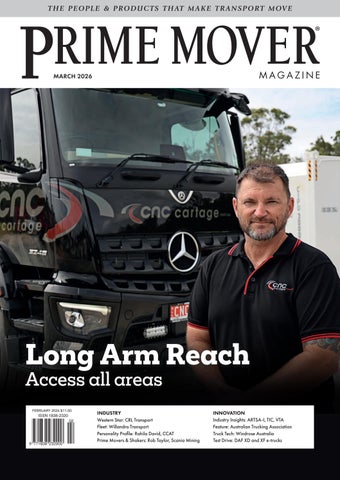
Prime Mover March 26

Page 1


Western Star: CRL Transport

INNOVATION

Industry Insights: ARTSA-I, TIC, VTA

Feature: Australian Trucking Association

Truck Tech: Windrose Australia

Test Drive: DAF XD and XF e-trucks

Is your workhorse pulling its weight? If youʼre still driving a ute, nowʼs the perfect time for an upgrade. The all-new Isuzu Ready-to-Work range tows and carries more than your average ute. It also comes with a sleek new cab design, more advanced safety features and car-like comfort.

With a wide choice of factory-built bodies designed to our exact specifications, Isuzu Ready-to-Work trucks are ready to get the job done. Are you ready to step up to a redefined workhorse?

Head to isuzu.com.au or visit your nearest Isuzu Trucks Dealer today.

MEET THE TEAM

Australia’s leading truck magazine, Prime Mover, continues to invest more in its products and showcases a deep pool of editorial talent with a unique mix of experience and knowledge.

Christine Clancy | CEO

With more than two decades of experience as a media professional, Christine has worked in newsrooms across Canada, Vietnam and Australia. She joined the Prime Creative Media team 12 years ago, and today oversees more than 43 titles, including a dozen print and digital transportation titles. She continues to lead a team that focuses on continuous improvement to deliver quality insights that helps the commercial road transport industry grow.

Paul Lancaster | Editor

Paul joined Prime Creative Media as an editor in March 2025 and has enjoyed a broad career spanning over 20 years across different sectors, including law, journalism and marketing in Australia and internationally. He gets great satisfaction from creating targeted content that appeals to wide ranging audiences. Paul says this comes from listening to industry members, businesspeople and the broader community.

Peter Shields | Senior Feature Writer

A seasoned transport industry professional, Peter has spent more than a decade in the media industry. Starting out as a heavy vehicle mechanic, he managed a fuel tanker fleet and held a range of senior marketing and management positions in the oil and chemicals industry before becoming a nationally acclaimed transport journalist.

Sean Gustini | Journalist

Having completed a Bachelor of Arts majoring in Media and Communications at the University of Melbourne in 2024, Sean looks forward to bringing his passion for writing and journalism to the road freight and transport industries. He previously lived in the Philippines, Vietnam, Indonesia and Malaysia. In his downtime he enjoys playing the guitar and running.

Blachford

Handling placements for Prime Mover magazine, Ashley has a unique perspective on the world of truck building both domestically and internationally. Focused on delivering the best results for advertisers, Ashley works closely with the editorial team to ensure the best integration of brand messaging across both print and digital platforms.

www.primemovermag.com.au

CEO Christine Clancy christine.clancy@primecreative.com.au

Editor Paul Lancaster paul.lancaster@primecreative.com.au

Managing Editor, Luke Applebee Transport Group luke.applebee@primecreative.com.au

Senior Feature Peter Shields Writer peter.shields@primecreative.com.au

Business Ashley Blachford Development ashley.blachford@primecreative.com.au Manager 0425 699 819

Art Director Blake Storey blake.storey@primecreative.com.au

Design Jacqueline Buckmaster, Danielle Harris

Contributors Sean Gustini sean.gustini@primecreative.com.au

Client Success Ben Sammartino Manager ben sammartino@primecreative.com.au

Head Office 379 Docklands Drive, Docklands VIC 3008 info@primecreative.com.au

Subscriptions

03 9690 8766 subscriptions@primecreative.com.au

Prime Mover magazine is available by subscription from the publisher. The right of refusal is reserved by the publisher. Annual rates: AUS $110.00 (inc GST). For overseas subscriptions, airmail postage should be added to the subscription rate.

Articles

All articles submitted for publication become the property of the publisher. The Editor reserves the right to adjust any article to conform with the magazine format.

Copyright PRIME MOVER magazine is owned and published by Prime Creative Media.

All material in PRIME MOVER magazine is copyright and no part may be reproduced or copied in any form or by any means (graphic, electronic or mechanical including information and retrieval systems) without written permission of the publisher. The Editor welcomes contributions but reserves the right to accept or reject any material.

While every effort has been made to ensure the accuracy of information Prime Creative Media will not accept responsibility for errors or omissions or for any consequences arising from reliance on information published. The opinions expressed in PRIME MOVER magazine are not necessarily the opinions of, or endorsed by the publisher unless otherwise stated.

MORE POWER, MORE CAPABILITY, MORE SOLUTIONS TO KEEP YOUR BUSINESS MOVING.

The Hino 700 Series is engineered for operators who demand proven reliability, advanced safety, superior technology, and operational efficiency, all in a versatile heavy-duty truck. The expanded range now offers increased power, more transmission options, and greater adaptability across a wider range of applications. Featuring the most comprehensive Hino SmartSafe package ever, and the trusted, all-encompassing support of Hino Advantage, the 700 Series is the intelligent choice for fleets that work hard and want to stay ah ead. Find out more at hino.com.au

COVER STORY

“The Benz is an excellent truck, yet it drives like a car. The steering is unbelievable. With that big crane everything was at its maximum limit such as the front axles, yet everything was just about perfect.”

Prime Feature STORIES BEEFING UP

FLEET FOCUS

32 Home Away from Home

A trucker’s prime mover is often home on the road. So it makes perfect sense to make sure your rig has the comforts of home while providing power, efficiency and reliability.

36 Point of Difference

Evans Petroleum’s impressive fuel supply capabilities have made it a relied-upon transporter in the Gippsland region thanks to long-term support from Dana Inc.’s heavy-duty rear axles and differentials.

38 Beefing Up

A father-and-son transport company has mastered the art of transporting precious livestock in New South Wales’s verdant Orange region.

AUSTRALIA DAY HONOURS

30 Transport Leaders Rewarded

Several road transport industry stalwarts were justifiably recognised in the 2026 Australia Day Honours list for their longstanding contributions to the industry that keeps the nation moving.

TRUCK & TECH

42 Quiet Achievers

Windrose Australia knew exactly who to turn to when needing a reliable prime mover transportation service.

SPECIAL REPORT

44 Looking Forward

Prime Mover was given exclusive access to Australian Trucking Association CEO, Mathew Munro, for a one-on-one discussion about future outlooks for trucking in 2026.

Welcome to the March edition of Prime Mover.

Just like Australia’s diverse transport industry that we cover every month, so is Prime Mover going through an evolution. A change or metamorphosis.

I am honoured to step into the prodigious shoes of William “Bill” Craske, who for many years has been in the driver’s seat guiding Prime Mover through the transport sector’s good times and bad; objectively and informatively covering the all aspects of this great home-grown industry and the people who bring it to life.

I come from a mixed-bag career background spanning journalism in Australia and editing and communications internationally, and I am thrilled to lead the vastly experienced editorial team who are the backbone of Prime Mover.

A big thanks to Bill for his years of service with Prime Mover and I wish him great success as he takes on the

Keep on trucking

editorship of two magazines in the Prime Creative family.

Rest assured that Prime Mover magazine will continue to cover our “bread and butter” of the array of captivating fleet stories; plenty of fascinating test drives; the who’s who in the transport industry; successes and milestones; and stakeholder news and events from all angles.

We will also be introducing a new segment into the magazine, which sees the amalgamation of another Prime Media title, PowerTorque, into the pages of Prime Mover

Our PowerTorque section will focus on technical issues that affect and impact fleet owners and operators, workshop managers, after-sales experts and industry leaders alike.

In this edition, we are delighted to share with you a variety of interesting stories about fleets, industry news, technical columns and our regular columns, including personality pieces, Movers and Shakers, industry voices and Peter Shields’ monthly fleet numbers of the truck OEMs across Australia.

In addition to issues of cost effectiveness and efficiencies in the industry, topics that will be a common theme in the magazine will

be innovation, technology and AI and how they impact the trucking industry. For instance, there is the spectre of Industry 5.0 and how it will affect the industry. It is the next phase of industrialisation that focuses on human-centric, sustainable, and resilient production by creating a collaboration between humans and advanced technologies, like AI and robotics. It shifts the primary goal from pure efficiency and automation to integrating human creativity with machine precision to address societal challenges.

At Prime Mover we want to hear from you — our loyal readers. If you have any suggestions for content in the PowerTorque segment, or any suggestions, news or queries regarding any aspect of the magazine, please reach out to me, or our team, and we will be happy to hear from you.

Working with, and for, you we look forward to growing Prime Mover and see it maintain its place at the vanguard of Australian trucking and transport news.

Please enjoy this, and future, editions.

We’re clearing all stocks of the DAF CF530 at the low price of $249,900* (ex. GST and Gov’t charges). Plus get a $30,000* BP Fuel voucher or 0% finance* (Max. 48 month term). Only while stocks last. See daf.com.au/CFrunout.

DAF CF530 $249,900* *Terms and conditions apply. See daf.com.au/CFrunout.

> News Latest HVSI funding round opens

The Federal Government, in partnership with the National Heavy Vehicle Regulator (NHVR), has opened a new $4.4 million funding round aimed at improving safety outcomes across Australia’s heavy vehicle sector.

Available through Round 11 of the Heavy Vehicle Safety Initiative (HVSI), the grants will support industry-led projects designed to lift compliance, capability and safety performance in the transport and logistics industry. A strong focus of this round will be on projects that harness new and emerging technologies, helping build long-term knowledge and capability across Australia’s freight network. Industry associations, local councils, researchers, innovators and businesses are all being encouraged to submit proposals addressing realworld safety challenges.

Since its inception, the HVSI has received more than $45 million

in Federal Government funding, supporting 181 projects across its first ten rounds. Past recipients have delivered initiatives including AI-based fatigue monitoring systems, heavy vehicle safety simulators and a range of programs strengthening internal safety management systems.

Assistant Minister for Regional Development Senator Anthony Chisholm said the latest funding round reinforces the Government’s commitment to safer roads and a future-ready freight industry.

“When it comes to investing in heavy vehicle safety, our Albanese Labor Government is backing initiatives that prepare Australia’s freight and logistics industry for the future,” said Chisholm.

“Through Round 11 of the Heavy Vehicle Safety Initiative, we’re supporting industry to develop, trial and scale forward-looking

The latest round of Federal Government HVSI funding has been released.

> VTA calls for sham contractor reporting

The Victorian Transport Association (VTA) is urging transport operators and industry stakeholders to report incidences of sham contracting.

The call comes as part of the VTA’s ongoing advocacy to protect the productivity, sustainability and safety of Victoria’s transport industry.

The VTA explained that sham contracting occurs when truck drivers are engaged using an Australian Business Number (ABN) despite not owning or operating their own vehicle and instead driving another operator’s truck.

This practice undermines workplace laws, distorts competition and places compliant operators at a commercial disadvantage, the association said.

VTA CEO, Peter Anderson, said the Association continues to advocate strongly against sham contracting, which erodes legitimate business

models, compromises driver entitlements and weakens safety outcomes across the supply chain.

“Using an ABN does not automatically make someone a contractor,”

Anderson said. “Where drivers do not own their vehicle, they may be entitled to full award wages, superannuation and leave accruals at a minimum.

Non-compliance harms drivers, operators and the broader industry.”

Anderson said the VTA is calling on members to assist in addressing sham contracting by reporting suspected cases whenever they are identified, noting that information shared with regulators plays a critical role in tackling tax evasion and shadow economy activity.

“Sham contracting is not a victimless practice,” Anderson said.

“It undermines compliant operators, exposes businesses to significant

> $60M project to improve WA freight network

The completion of the Albany Ring Road project’s final stage will bolster freight efficiency in Western Australia.

Construction of a new flyover at the intersection of Menang Drive and Chester Pass Road will improve efficiency along the Albany Ring Road, providing heavy vehicles with a nonstop connection from Chester Pass Road to the Port of Albany.

Highway Construction has been awarded a contract to deliver the $60 million project and will begin work this month.

The first phase of construction activity will include earthworks for the embankments of the new flyover on each side of Chester Pass Road, with most of the activity to take place away from the road – minimising the impact on public traffic.

The new grade separated interchange will allow southbound vehicles to exit Chester Pass Road via an elevated ramp, passing back over the top of Chester Pass Road through a bridge and connecting into Menang Drive westbound.

It is expected to improve safety and efficiency for heavy vehicles by removing the need for trucks to queue in the turning lane before making a right turn across oncoming northbound traffic.

“This flyover is a major road safety

risk and ultimately weakens safety outcomes across the transport task.”

Addressing sham contracting remains a key focus of the VTA’s advocacy as it works with government, regulators and industry stakeholders to maintain a fair and competitive operating environment.

“This is about protecting drivers, supporting legitimate operators and ensuring our industry remains productive, sustainable and safe,” said Anderson.

The VTA said suspected sham contracting can be reported to the Australian Taxation Office (ATO) confidentially and anonymously, using the online tip‑off form or calling the Tax Integrity Centre on1800 060 062.

The tip off reports assist the ATO to address sham contracting, tax evasion, shadow economy and fraudulent activity.

upgrade for Albany, separating heavy vehicles from local traffic, making travel significantly safer for families, freight operators and all drivers who use the Ring Road,” said Road Safety and Great Southern Minister, Reece Whitby.

“Completing the final link of the Ring Road will transform how traffic moves around the city, providing a non-stop connection to the Port and making Albany an even better place to live and work.”

WA Transport Minister, Rita Saffioti, said delivering the entire Albany Ring Road has been a game changer for the state’s Great Southern region.

“In its first 18 months of operation, the project has taken about 2,000 vehicles per day out of the centre of Albany, including 800 trucks,” she said.

“This project will complete the Albany Ring Road, generating local jobs in the short-term and supporting the future growth of the region’s economy.”

The Albany ring road at the Menang interchange is well under way.

> New Blue Mountains transport corridor blueprint released

The New South Wales government has released a white paper that seeks to focus on road safety and efficiencies.

The Sydney to Central West Corridors White Paper outlines an evidence based framework for future road and transport planning across the Blue Mountains and Central West.

The white paper shifts the focus away from large, unfunded mega projects toward practical improvements that prioritise safety, resilience and reliability for both communities and freight operators.

It identifies opportunities for road upgrades, safer speed settings, improved freight efficiency, rail service enhancements, resilience uplift and greater investment in active transport.

Minister for Roads and Regional Transport, Jenny Aitchison, said

the document provides a clear and realistic planning direction.

“This white paper sets a clear direction for how we plan and deliver transport across the Blue Mountains and the Central West – honestly, transparently and based on evidence, not politics,” said Aitchison.

The strategy recognises that the Blue Mountains and Central West are not a single, uniform freight corridor, and that transport solutions must reflect local conditions rather than treating towns and villages as thoroughfares.

“That means safer roads, better resilience during fires and floods and practical improvements that stand up to scrutiny,” said Aitchison.

The white paper will form the foundation for future infrastructure proposals, supporting business

cases for funding across all levels of government and enabling closer collaboration between Transport for NSW, councils and state and federal agencies.

Minister for Regional NSW, Tara Moriarty, said reliable connections were critical for regional communities and industry.

“For communities in the Central West and Blue Mountains, reliable connections are not a nice-to-have, they are essential to daily life, safety and economic opportunity,” said Moriarty.

The plan builds on existing investments, including a $100 million safety upgrade program on the Bells Line of Road, delivering wider curves, improved intersections, new safety barriers and additional rest areas.

The M4 leading into the Blue Mountains from Western Sydney.

> News Vale Border Express founder Max Luff

Border Express founder and transport industry stalwart, Maxwell James Luff, has passed away.

Luff was a pioneer of Australian freight logistics, beginning his transport journey behind the wheel where he developed a deep respect for the people and communities which keep Australia moving.

He founded Border Express in 1981 with a clear vision built on reliability, strong relationships and a genuine people-first approach.

In his personal life, Luff was a passionate advocate for lifelong learning and opportunity.

He established the Max and Lynn Luff Scholarship with his wife, Lynn, which was a true reflection of his belief in education, personal growth and giving back to the industry and community which shaped him.

In January, Luff was recognised in the 2026 Australia Day Honours –receiving a Medal of the Order of Australia (OAM) for his service to the road transport industry and to the community.

His award reflected a career of commitment to the road freight sector and community involvement, underscoring the often-sung efforts of those who keep goods moving across vast regional and metropolitan networks.

The VTA said his Australia Day honour acknowledges a remarkable legacy that has “shaped Australian road transport” and “inspired generations of industry participants”.

“A pioneering figure in Australian road freight, Mr Luff is best known as the founder of Border Express, building the company from humble beginnings into a nationally recognised transport operator,” the Association said.

The transport industry has been saddened at the passing of Max Luff.

Freight and Logistics Personality of the Year at the Victorian Transport Association’s Australian Freight Industry Awards.

“His influence on the industry spans more than six decades and reflects a lifelong commitment to professionalism, safety and people.”

In 2011, Luff was named Australian

This honour recognised his entrepreneurial success, leadership, integrity and enduring contribution to the freight and logistics sector.

Border Express acknowledged Luff’s passing in a statement online.

“Max leaves behind an enduring legacy – not just in the business he built, but in the values he lived by and the people he inspired along the way,” the company said.

“Our thoughts are with the Luff family and all who had the privilege of knowing and working with Max.

“He will be deeply missed and fondly remembered. Rest in peace Max.”

DETROIT, SETS THE BAR.

The industry-leading manufacturer of state-of-the-art engines and transmissions, Detroit sets the bar.

Specifically designed for integrated, optimised performance and efficiency inside Freightliner and Western Star trucks, the Detroit product portfolio has expanded to include advanced safety systems and telematics, delivering a total trucking solution.

Detroit – it’s loved by Aussies and trusted globally.

New emissions laws are here!

Rely on the platform that’s been trusted to meet them since 2019.

The ATA is highly critical of a proposed doubling of the truck fuel tax.

> ATA slams proposal to double truck fuel tax

The tax on truck fuel would more than double under the Productivity Commission’s plan to hike truck taxes, Australian Trucking Association (ATA) Chair, Mark Parry.

Parry made the call as he released the ATA’s 2026-27 pre-budget submission, which urges the Government to reject the plan.

The ATA says the mooted plan would phase out fuel tax credits for trucking operators, while ATA submission argues that the Government should retain fuel tax credits for on-road heavy vehicles in the 2026-27 budget and beyond.

Under the fuel tax credits system, trucking operators pay an effective fuel tax rate of 32.4 cents per litre rather than the full rate, which will be 52.6 cents per litre from Monday 2 February.

The Productivity Commission’s own figures have revealed its plan would more than double the effective fuel tax paid by trucking operators to 66.1 cents per litre by 2035, the ATA said. Mr Parry said the fuel tax credit system reduced the cost of freight for everyone in Australia, as well as rural exporters.

“Removing fuel tax credits would

increase costs for industry and hardpressed Australian households, who have already had to face a 21.5 per cent increase in electricity prices and an 11.2 per cent increase in childcare fees in 2025,” Parry said.

“Many trucking businesses would not be able to pay the increased fuel tax, which would go up by about eight per cent each year.

“Trucking businesses have already had to pay a 19 per cent increase in fuel tax over the last three years, as well as dealing with rising costs, extended payment terms, driver shortages and natural disasters.”

The ATA Chair said the commission’s plan would not achieve its goal of encouraging decarbonisation.

“The commission’s report does not analyse the effect of removing fuel credits on emissions, but I can save everyone the time and trouble,” he said.

“Its effect would be zero, because it would not address the real world barriers holding back the industry’s adoption of low emission solutions.

“It would not address the engineering reality that there is no single technology available to replace diesel engines.

implement a voucher scheme to reduce the up-front cost of electrification or alternative fuel options, a low carbon fuel standard to encourage the use of renewable diesel and support high productivity and low emission vehicles,” he said.

ATA Chairman, Mark Parry.

September 2026

EXHIBIT IN 2026. BE SEEN. BE HEARD. BE CHOSEN.

> WHS reporting expansion targets transport

The workplace health and safety reporting framework is set for its biggest overhaul in more than a decade following the release of proposed amendments to the Model WHS Act by Safe Work Australia in December 2025.

According to MAEZ Director and Principal Consultant Matt Wragg, the changes significantly expand what transport and logistics businesses must report to regulators, introducing the new concept of a ‘relevant occurrence’ in place of the existing ‘notifiable incident’.

“The scope of reporting has broadened considerably,” said Wragg. “It now captures not just serious physical injuries, but extended absences, violent incidents linked to psychological harm, and certain suicides or attempted suicides.”

Under the amendments, violent incidents that expose workers to serious psychological risk, including threats, assaults and sexual harassment, will become notifiable even where no physical injury occurs. Wragg noted this has clear implications for the transport sector, where drivers may experience road rage, delivery point confrontations or abuse while working alone.

The definition of serious injury and dangerous incidents has also been

expanded, with mobile plant incidents now explicitly included – a category that encompasses heavy vehicles, forklifts and remotely operated equipment commonly used across freight and logistics operations.

A further addition is the requirement to notify regulators when a worker is absent for 15 or more consecutive days due to a work-related physical or psychological injury, even if the absence is anticipated rather than confirmed.

“These changes reflect an increasing regulatory focus on psychosocial hazards and mental health,” said Wragg.

“Transport operators should begin reviewing their incident reporting systems now, rather than waiting for state-based adoption.”

While the amendments to the Model WHS Act are not yet law, states and territories are expected to progressively implement the changes over the next 12 to 24 months. Victoria, which operates under its own WHS framework, is excluded.

Wragg said businesses with strong Chain of Responsibility (CoR) and WHS integration would be best positioned to manage the transition.

Xtreme Freight Director Amanda O’Brien said the proposed changes

> Kenworth K220s engineered for WA operations

CJD Equipment has delivered one of two custom Kenworth K220 prime movers to DM3 Logistics. This arrangement reinforces a long-standing partnership focused on performance, reliability and compliance across Western Australia’s most demanding haulage tasks. Delivered last month by Jesse Glassock, Regional Sales Manager at CJD Trucks, the new K220 is the product of months of close collaboration between PACCAR Engineering, KRU Engineering and Tieman Tankers.

The brief involved creating a solution capable of handling extreme payloads in the Pilbara and Goldfields while remaining within legal length limits for operations further south, including Esperance.

Configured as an 8x4 with a 2.8m King Cab, the Kenworth K220 is powered by a Cummins X15, paired with an Eaton Endurant AMT and Dana D52-190 axles. With a total Gross Combination Mass (GCM) of 165 tonnes, the truck is engineered to haul quad roadtrains without compromise.

Driver comfort and long-haul

would add to mounting pressures already facing the transport and logistics sector.

“At the start of 2026, many operators are already under significant strain,” said O’Brien.

“Margins are tightening as costs continue to rise faster than rates, labour shortages persist and businesses face increasing customer expectations alongside growing compliance and administrative demands.”

She said further reporting obligations and regulatory complexity would not land in isolation.

“No one in this industry questions the importance of workplace safety – it’s fundamental to how we operate,” said O’Brien. “But these reforms land in real businesses with real people who are already stretched trying to keep freight moving every day.”

O’Brien said while reform may be necessary, implementation would need to be practical and nationally consistent.

“What the sector needs is clear guidance, realistic timeframes and genuine consultation,” she said.

“Preparation will be critical as these changes roll out, and resilience will continue to be essential for transport operators across Australia.”

practicality were also prioritised, with the cab fitted with multiple fridges, a microwave, Starlink connectivity and a night-vision camera to support safety and productivity on extended runs.

A very welcome delivery of two Kenworth K220 prime movers.

> Ron Crouch Transport finds buyer

Ron Crouch Transport has been acquired by national transport and logistics provider, Freight Specialists.

The acquisition is good news after Australia’s transport sector was rocked by the announcement in December last year that the 47-yearold company had entered voluntary administration.

Managing Director, Geoff Crouch, cited a toxic mix of challenging economic conditions, sustained pressure on freight rates, ongoing driver shortages and “government over-regulation” as the contributing factors for its financial strain.

At the time, it was revealed the appointed administrator’s first priority would be to identify a buyer and “secure the best possible outcome” for all staff and creditors.

Freight Specialists has since entered an agreement with the administrator and announced the completion of the acquisition.

The company has a long history of providing reliable, customer-focused freight solutions, and shares a similar heritage and values to Ron Crouch

Transport by being a business built on strong relationships, operational discipline and a commitment to its customers, employees and partners. Freight Specialists revealed it will now transition the Ron Crouch Transport sites and services in an “orderly and considered manner”.

“Freight Specialists will be working closely with Ron Crouch Transport customers to ensure a smooth and well-managed transition, and we look forward to continuing to support customers under the Freight Specialists banner while building on the strong foundations established by Ron Crouch Transport,” the company said.

He said it was fortunate that his company had been sold to Freight Specialists Pty Ltd.

“Our priority throughout this process is to ensure continuity of service and minimal disruption for customers.”

On his LinkedIn page, Geoff Crouch said of the business sale: “Firstly, may I express my appreciation for the many messages of support after my last post regarding my company being placed into Voluntary Administration. “They were greatly welcomed during a very tough time.”

> Arrow Transport completes A-triple trial

Arrow Transport has successfully conducted an A-triple road train combination trial operating in and around the Port of Brisbane.

The trial focused on moving both full and empty containers between key Port of Brisbane partners in a single movement – six twentyfoot containers (or three forty foot containers) at a time.

Arrow Transport said the A-triple cuts the number of prime movers required for the task and reduces its carbon footprint as it looks to “move more with less”.

Heading up the special Arrow Transport combination is a roadtrainrated Mercedes Benz Actros 2653. It uses a high efficiency 13 litre engine producing 530hp, teamed

with a 12-speed Automated Manual Transmission (AMT) towing Vawdrey skel trailers.

Arrow Transport is reported to be the first operator to use an A triple roadtrain out of the Port of Brisbane. Its Queensland State Manager, Jason Gadd, said the trial demonstrated how the improved productivity delivers real benefits.

“This is a groundbreaking initiative we’ve developed to revolutionise efficiency across the port supply chain,” he said. “It’s an amazing project.”

Gadd said operating the A-triple reduces congestion and boosts efficiency safely and reliably.

“The trial showed how innovative highproductivity solutions can benefit the

“Whilst we have always been competitors, it has always been on a respectful basis,” Geoff said. “As another family company they share similar values and ethics and I’m sure our customers and staff will be in good hands.

“Best wishes to Cameron HowardSmith , Troy Quade and your team for a very successful future.”

He also added a sincere thanks to his “amazing team” who “through the last 7 weeks, under extraordinarily difficult circumstances have done what they always do….head down and get the job done. You are all legends.”

supply chain and the community,” he said.

Arrow Transport thanked the Port of Brisbane, the National Heavy Vehicle Regulator and York Engineering for helping make the A-triple trial a success.

Image: Daimler.
The A-triple road train combination under trial.
Fresh life has been given to Ron Crouch Transport.

> Record-breaking Dakar rally run for Hino team

Team Sugawara Hino has recorded its 35th consecutive finish at the gruelling Dakar Rally in Saudi Arabia, finishing in 15th place in the truck category.

Furthermore, by completing this event, team director and driver, Teruhito Sugawara, extended his record of consecutive finishes to 21, surpassing the previous record of 20 held by his father, Yoshimasa Sugawara, who retired from Hino

Team Sugawara in 2019.

Teruhito Sugawara was accompanied in the Hino 600 Series by navigator Hirokazu Somemiya and navigator/ mechanic Yuji Mochizuki, with additional support from a team of Hino mechanics.

The truck ran smoothly in the first half of the race without any major issues, maintaining 8th place in the truck category.

A variety of problems struck in

ISRI: DEALERS

the second half including a crash in the dune stage; issues with the drivers’ intercom system impacting their communication to each other; damage to the transfer case; and a burst tyre 15 kilometres from the end on the final day.

“Once again, the team’s ability to overcome issues to record yet another consecutive finish is a testament to the quality, durability and reliability that Hino is renowned

The Team Sugawara truck going through its paces.

for,” said Hino Australia President & CEO, Richard Emery.

“As a sponsor of Hino Team Sugawara for the last 13 years, we would like to congratulate the team on their result with a particular commendation to Teruhito Sugawara’s record of consecutive finishes.”

Held over 15 days, the 2026 Dakar Rally consisted of 13 gruelling stages

over a total distance of almost 8,000 kilometres, with 5,000 kilometres of special stages.

In 2026, the Marathon and 48-Chrono stages were replaced by two Marathon-Refuge stages, which provided an extreme challenge as participants were only allowed to receive assistance from their fellow competitors.

The Hino Dakar Rally 600 Series

is equipped with full-time fourwheel drive and powered by a 9-litre, direct-injection A09C engine featuring turbocharging and intercooling.

Delivering an impressive 588kW at 2,800rpm and peak torque of 2,430Nm at 1,600rpm, the powertrain is engineered for exceptional performance in the most demanding conditions.

Members of Team Sugawara Hino, Teruhito Sugawara with navigator Hirokazu Somemiya (left) and navigator/mechanic Yuji Mochizuki (right).

> International report says green hydrogen best for trucks

Locally produced green hydrogen delivers the greatest climate benefit for heavy duty road transport, according to new international research examining the full lifecycle of hydrogen fuel.

A study by Sweden’s Chalmers University of Technology has found that replacing diesel with hydrogen in heavy-duty trucks can significantly reduce carbon dioxide emissions but only if the hydrogen is produced using renewable electricity and supplied locally.

The research, published in iScience, assessed hydrogen’s entire value chain, from production and distribution through to vehicle use. It concluded that so-called green hydrogen, produced via electrolysis using renewable energy, consistently outperforms other hydrogen pathways on emissions.

Sweden’s Chalmers University of Technology has found that replacing diesel with hydrogen in heavy-duty trucks reduces CO2 emissions.

“Hydrogen does not produce carbon dioxide when used in fuel cells, but we need to make sure we do not shift emissions from one part of the life cycle to another,” said lead author Jorge Enrique Velandia Vargas.

The study also raised concerns about blue hydrogen, which is derived from natural gas with carbon capture and storage. While often promoted as a low-emissions solution, researchers found that incomplete CO₂ capture and methane leakage across the supply chain can significantly erode its climate benefits.

“In theory, the production of blue hydrogen is climate neutral, but in reality it is not,” said Associate Professor Maria Grahn from Chalmers University. “Methane leakage is

> Dana Group has positive outlook for future growth

Global driveline and e-propulsion supplier, Dana Incorporated, posted strong preliminary financial results for 2025 and outlined an upbeat outlook for 2026.

Dana reported 2025 sales of about $7.5 billion USD, with adjusted EBITDA of approximately $600 million USD, representing 8.0 per cent of sales. Adjusted free cash flow was around $315 million USD.

A key milestone during the year was the completion of the Off-Highway business sale, which valued the operation at $2.7 billion USD.

Dana also achieved about $250 million USD in cost savings and returned $704 million USD to shareholders, including the repurchase of 34 million shares – roughly 23 per cent of shares outstanding.

Dana Chairman and CEO R. Bruce McDonald said the company delivered on all major strategic commitments in 2025.

“We closed 2025 with strong momentum and executed on every major strategic commitment, from completing the Off-Highway divestiture to delivering substantial cost savings,” said McDonald. Looking ahead, Dana expects 2026 to be marked by further margin expansion and balance-sheet improvements. The company has completed $1.9 billion USD in debt reduction, supported by proceeds from the divestment and raised its cumulative cost-savings target to $325 million USD.

Dana has also lifted its 2026 margin

particularly problematic because it has around 30 times the greenhouse effect of carbon dioxide.”

Another key finding was that hydrogen is best produced close to where it is used. Transporting hydrogen over long distances requires energy-intensive compression or liquefaction, reducing overall efficiency and increasing emissions.

“Hydrogen is the lightest of all the elements and does not ‘like’ to be transported,” said Vargas.

While the study was based on Swedish conditions, the researchers said its conclusions are broadly applicable including to countries such as Australia as governments and industry assess hydrogen’s role in future freight transport.

With hydrogen trucks under development globally and pilot projects already underway, the research adds weight to calls for careful planning around hydrogen infrastructure, production methods and fuel supply chains as the heavy vehicle sector works toward decarbonisation.

Dana Incorporated Chairman and CEO R. Bruce McDonald delivered a positive message on the company for 2025.

guidance, targeting a midpoint of 10.5 per cent, and announced a three-year new business backlog worth $750 million USD.

Of this, $200 million USD is expected to be incremental in 2026, driven by next-generation vehicle platforms across light- and commercial-vehicle segments.

Image: Dana Incorporated.

> Eaton to spin off Mobility

Intelligent power management company, Eaton, plans to separate its Vehicle and eMobility businesses into a standalone, publicly listed company.

The proposed spin-off, unveiled yesterday, forms a key pillar of Eaton’s 2030 growth strategy which prioritises capital allocation to businesses aligned with long-term megatrends such as electrification, digitalisation, artificial intelligence, infrastructure investment and rising aerospace defence and aftermarket demand.

Eaton CEO Paulo Ruiz said the move would allow the company to “lead, invest and execute for growth” by concentrating on its core Electrical and Aerospace portfolios, while unlocking new opportunities for the Mobility business as an independent entity.

“As a standalone company, Mobility will have the strategic focus and agility to best serve customers, pursue independent growth opportunities and drive innovation,” said Ruiz.

“We are incredibly proud of what the Mobility team has built and believe now is the right time to separate the business.”

Post-separation, Eaton will retain a more focused portfolio, bolstered by its recent acquisition of Ultra PCS and the announced acquisition of Boyd Thermal. The company expects

to benefit from stronger earnings consistency, improved margins and increased exposure to data centre, utility, commercial, institutional and aerospace markets.

The move follows Eaton’s earlier portfolio reshaping, including the divestment of its Lighting business in 2020 and Hydraulics in 2021. Eaton expects the Mobility separation to be immediately accretive to organic growth and operating margins upon completion.

For the transport sector, the newly independent Mobility Group will remain a major global supplier of missioncritical and safety-critical systems across commercial vehicles, automotive and off-highway applications.

The business holds leading positions in commercial truck transmissions and clutches in the Americas, along with highvoltage EV fuses and valve actuation technologies worldwide.

and light-duty trucks, passenger vehicles and off-highway equipment.

Mobility works closely with OEMs as an innovation partner, particularly in electrification, leveraging proprietary technologies and system-level integration across heavy-, medium-

Eaton expects to complete the spinoff by the end of the first quarter of 2027, subject to regulatory approvals and final board sign-off. The transaction is intended to be tax-free for Eaton shareholders under US federal income tax rules.

Eaton CEO Paulo Ruiz has announced the move to cleave off its Vehicle and eMobility businesses.
Image: Eaton.

OUT REACHING

Crane trucks, with their extended reach, provide an excellent solution to difficult deliveries of large items to awkward, hard to access premises and building sites.

The continued demand for new housing in Australia has kept the construction industry running at an almost frenetic rate and suppliers need reliable transport operators to deliver the necessary components to the sites of various types of construction across the commercial, residential, and government sectors.

Utilising a crane truck can often avoid double handling of loads, or the need to book in a mobile crane to unload and place the components being delivered.

Business approach

One such operator is Queenslandheadquartered CNC Cartage Solutions, where husband and wife owners

Chad and Chelsea Brown, along with their sons Jack and Max, specialise in delivering mainly building components using rigid and semi-trailer vehicles equipped with truck mounted cranes.

The family business has grown significantly over the past few years with additional company and subcontractor trucks joining the alwaysimmaculate fleet.

There are no shortcuts taken at the

CNC operation.

“We do everything right, so we don’t have any issues,” says Chad. “And we’re always busy which is a good place to be with none of the trucks sitting around wasting money.”

The building industry can be a challenge as some sites become smaller and every boundary is being pushed to the extreme. A full semi load of 12-metre-long floor joists may have to be unloaded onto a site which itself is only 12 metres wide which requires

a high skill level from the driver/ operator.

Complementing their own trucks, CNC’s business model calls for an increasing number of sub-contractors which may be full-time owner- drivers or smaller companies with several trucks. Many of CNC’s own trucks enjoy a second life in the hands of a sub-contractor.

“We need the subbies because they turn up all the time,” says Chad. “We’re fairly specialised in the crane truck

industry so they’re required to be competently trained and licenced.

“Our training is not typical of the industry where someone is turning up one day and driving a truck the next.

We spend a lot of time on training our own guys as well as the subbies and put in a lot of effort to make sure they are good at what they do.”

New staff usually come along due to recommendations from existing drivers. In addition to obtaining their relevant credentials new drivers spend at least

A CNC Cartage Solutions crane truck provides a long reach in tough situations.
“We do everything right, so we don’t have any issues. And we’re always busy which is a good place to be with none of the trucks sitting around wasting money.”
CNC Cartage Solutions co-owner, Chad Brown.

a month on the road with experienced operators which is quite an investment in time and money for the business, but definitely worthwhile.

Regular customers are typically suppliers to the construction industry, including national hardware chains and roof truss manufacturers.

More recently sign companies are a growing sector of the business. Roofing materials are also a significant part of

the mix, with regular trips using semitrailer crane trucks going as far away as Mackay in Northern Queensland, which is commonly a three-day return trip.

Portable buildings, usually for mine sites, are also frequently delivered by CNC Cartage.

“We don’t seek long distance stuff, but we seem to get plenty of it,” says Chad. “Drivers like it, but they don’t want to

be away every night. Crane trucks don’t have big bunks and even though they’re legally sleepers we pay for a hotel room.”

The trucks return to their Narangba or Kingston bases empty as it’s not worth the extra time waiting around for a backload. Chad prefers to get them straight back to Brisbane and on with their regular work.

Fleet mix

The combined company and subcontractor fleet has doubled in size over the past few years and is an eclectic mix of Japanese and European trucks with availability often a factor in choice of brand.

Setting up a new crane truck is a complex project, with axle weights

Images: CNC Cartage Solutions.
CNC Cartage Solutions’ sleek Mercedes Benz Actros.

critical as is the ability to actually physically fit the required crane within the space available and still have it able to perform at its maximum capabilities. Across all of the various trucks, one constant factor is that all cranes are from HMF.

“A lot of that is about relationships. West-Trans provide the cranes, and Tim Hill at Crane Tech do the installations and provide the aftersales service and repair care,” says Chad.

“We buy a lot of Fuso trucks. The Shogun, while it’s a more affordable vehicle, the specs of the truck are just about perfect for us. We don’t need to change wheelbases, and all the weights are spot on.

“The introduction of Euro VI put a bit of a spanner in works, and we bought as many Hino’s as we could in 2025 before the deadline just to make sure we had them in stock. We’ve got some DAFs being built now, as well as some Isuzu’s in build.”

Mercedes-Benz Actros

A recent addition to the fleet has been a Mercedes-Benz Actros 3246 8x4 prime mover supplied by Murwillumbah

Truck Centre which is fitted with a 5020 HMF crane.

“The Benz is an excellent truck, yet it drives like a car. The steering is unbelievable,” says Chad.

“For this build and in particular involving one of the bigger cranes all the specs of the Actros worked out perfectly. We chose the lower 320 horsepower variant due to weight which saved around 300kgs if we’d gone with a bigger engine.

“With that big crane everything was at its maximum limit such as the front axles, yet everything was just about perfect.

“Having Euro VI helped but that raises its own problems because the trucks are heavier so even though we pick up an additional 500kgs on the front axle,

we’re already at the maximum because of everything else that’s gone into the truck.”

The twin steer axles on the Actros allow for 11 tonnes and with the crane and its fly jibs fitted, driving bobtail the truck is just under maximum mass on the steer.

Hooking up the trailer helps to counterbalance the weight and actually transfers takes a little weight off the front axles.

“Servicing is a big thing with the cranes,” says Chad. “We get it done at six monthly intervals, but they also have an annual inspection. I’m committed to compliance and making sure we’re doing everything right.”

In addition to the cranes’ servicing regime each truck is serviced every

“Our training is not typical of the industry where someone is turning up one day and driving a truck the next. We spend a lot of time on training our own guys as well as the subbies and put in a lot of effort to make sure they are good at what they do”
CNC Cartage Solutions co-owner, Chad Brown.
No job is out of reach of CNC Cartage Solutions.

quarter. Major services are carried out by the dealers, while the minor services are performed in-house.

CNC is building a purpose-built workshop equipped with work pits, suspension testing shakers, and brake testers and Chad plans to have it completed by the end of 2026.

“We’ve outgrown old one and always knew it would be the case,” says Chad.

“We do all the minors under NHVR Maintenance, servicing the trucks at 25,000km.

“We’ll do two minor services per year ourselves and when a major service is due, we send them back to dealers.”

Generally, the trucks are replaced between five and seven years, but some are being held onto a little longer due to the shortage of new units which translates to longer lead times for delivery.

Future plans

Looking towards the future, Chad has examined the possibility of electric crane trucks, but the current technologies and weight issues mean it’s unlikely to happen.

“We’ve looked at EV’s but we just can’t do it with electric. I’d love to have some sort of electric trucks in the fleet, but we just can’t make it work, yet.

“We’ve been looking at ways to power an electric motor to operate the hydraulics of the cranes. We might spend one to three hours onsite unloading so if we don’t have to have a diesel engine running to drive the PTO perhaps an electric motor could work and then it charges the battery as we drive with the diesel engine the rest of the day.

“Looking at it it’s a big outlay to get everything to work but I’d like to do it and be one of the first but there are other pressing things on at the moment.”

Next generation

The family business seems to be transferring into the capable hands of the next generation.

Elder son Jack Brown spends much of his work time in the office.

“Because he’s good with figures and at staying calm when things go awry,” says his father, Chad.

Younger son Max is a qualified diesel mechanic and controls the fleet and its maintenance programs.

“They’ve already got a sense of ownership of the business, and they want it to do better. They’ll continue to earn the respect of the older staff,” says Chad proudly.

The aerial view highlights the truck’s stability.

“We buy a lot of Fuso trucks. The Shogun, while it’s a more affordable vehicle, the specs of the truck are just about perfect for us. We don’t need to change wheelbases, and all the weights are spot on.”

Mercedes-Benz and HMC combination provides precision placement of heavy components.

Cartage Solutions co-owner, Chad Brown.
The HMC crane has excellent reach capabilities.

LEADERS TRANSPORT REWARDED

Virtually all aspects of Australia’s life and economy rely on the transport industry; carting goods, stock and precious cargo on the nation’s highways and roads, ensuring Australians have the products they need to earn a living and feed their families. Several road transport industry stalwarts were justifiably recognised in the 2026 Australia Day Honours list for their longstanding contributions to the industry that keeps the nation moving.

The annual Australia Day Honours list acknowledges more than 900 Australians across multiple fields for outstanding service to the nation. Here are four of those recipients who have been recognised for their exemplary service to Australia’s transport industry.

Paul Darren Scurrah AM - Member of the Order of Australia

Paul Scurrah of New South Wales was appointed as a Member of the Order of Australia (AM) for significant service to the transport, logistics and freight industry.

Scurrah is one of the most recognised leaders in Australian transport. With more than 25 years of executive experience spanning aviation, rail, ports and logistics, his career has crossed virtually every major segment of the freight and transport ecosystem. He has held senior leadership roles including CEO of Virgin Australia and Queensland Rail and senior executive roles with DP World Australia and other major operators.

Currently a Director with the Australasian Railway Association (ARA) and holding board roles with

RPM Global and other organisations, Scurrah’s influence reaches both strategic policy and operational leadership. His recognition reflects decades of shaping industry direction, advocating for infrastructure development and workforce capability, and driving operational excellence across freight and logistics networks.

In receiving his AM, Scurrah becomes part of a select group of transport leaders whose careers have helped modernise and strengthen Australia’s freight chains – from ports and rail corridors to integrated logistics chains connecting businesses and communities.

The Victorian Transport Association (VTA) said: “A widely respected industry leader, Mr Scurrah has made a substantial contribution to Australia’s freight and logistics networks, supporting innovation, operational excellence and national connectivity across the transport supply chain.”

Maxwell James Luff OAM - Medal of the Order of Australia

Also honoured was Max Luff of Albury, NSW, and founder of Border Express, who received a Medal of the Order of Australia (OAM) for service to the

road transport industry and to the community.

Sadly, Max Luff passed away in February. However, it was most fitting that he received the Order of Australia in the 2026 Honours list.

Luff’s recognition highlights the vital contributions of professionals deeply rooted in road transport operations – a backbone of Australia’s freight logistics. His award reflects a career of commitment to the road freight sector and community involvement, underscoring the often-unsung efforts of those who keep goods moving across vast regional and metropolitan networks.

The VTA said Max Luff was recognised for service to the road transport industry and to the community.

“A pioneering figure in Australian road freight, Mr Luff is best known as the founder of Border Express, building the company from humble beginnings into a nationally recognised transport operator. His influence on the industry spans more than six decades and reflects a lifelong commitment to professionalism, safety and people,”

the VTA said.

“In 2011, Mr Luff was named Australian Freight and Logistics Personality of the

Year at the Australian Freight Industry Awards, hosted by the VTA. This honour recognised not only his entrepreneurial success, but also his leadership, integrity and enduring contribution to the freight and logistics sector.

His Australia Day honour acknowledges a remarkable legacy that has shaped Australian road transport and inspired generations of industry participants.”

Paula Grace Fox AC – Companion of the Order of Australia

Paula Fox was also recognised for eminent service to the arts, to medical research, and to children and youth, through philanthropic giving, fundraising and governance.

“Her leadership across multiple sectors demonstrates the importance of strong governance and community investment in supporting resilient industries, including transport and logistics,” the VTA said. “Her contribution reflects the broader social responsibility that underpins a sustainable transport sector.”

Dr Gillian Eileen Miles AM – Member of the Order of Australia

Dr. Gillian Miles was awarded a Medal

of the Order of Australia, in recognition of her significant service to the transport and infrastructure sectors. Her work has contributed to improved transport and infrastructure outcomes through leadership in policy, planning and governance, helping to deliver safer, more efficient and more sustainable transport systems for industry and the community.

“Gillian Miles was recognised for significant service to the transport and infrastructure sectors,” the VTA said.

“Her work has contributed to improved transport and infrastructure outcomes through leadership in policy, planning and governance, helping to deliver safer, more efficient and more sustainable transport systems for industry and the community.

“On behalf of the VTA Executive Council and Secretariat, we congratulate these recipients on their well-deserved national recognition. Their achievements have strengthened Australia’s transport industry and serve as an inspiration to all who work within it.”

The honours come at a time when Australia’s transport and freight sectors are under intense focus due to growth pressures and evolving priorities, the VTA said.

“As highlighted in recent government and industry commentary, freight and logistics account for a significant share of national economic activity and face challenges ranging from workforce shortages to decarbonisation and digital transformation,” it said.

“Against this backdrop, the Australia Day honours reinforce the importance of leadership that drives not just operational performance but strategic vision, community engagement and industry-wide collaboration.”

VTA CEO, Peter Anderson, said the honours acknowledge decades of leadership, service and commitment that have helped shape the modern transport industry and delivered lasting benefits to the Australian community.

“These Australia Day honours recognise individuals whose dedication and leadership have not only strengthened the transport and freight industry but have also made a meaningful contribution to the nation,” Mr Anderson said.

Image: Dr. Gillian Miles.
Image: VTA.
Australia is a lucky country thanks to the transport industry members in the 2026 Australia Day honours list.
Maxwell James Luff received the Medal of the Order of Australia.
Dr. Gillian Miles received the Member of the Order of Australia.

HOME AWAY FROM HOME

Transport owners and operators around Australia are always on the move. When it comes to their prime movers there are many TCO considerations, from fuel economy, carrying power, repairs and maintenance and durability. For these road hardy warriors, comfort is also paramount.

For Mark D’Agostino, his truck is not just his livelihood; it’s his home away from home.

As a haulier, Mark’s prime mover must have the comfort and capabilities of a home and office on wheels.

Spending large chunks of time on the road carrying bitumen, under often hot and dirty conditions, Mark heavily relies on a prime mover that will get him to where he needs to be, in comfort.

That is why the bitumen haulier, who operates as CRL Transport, chose a Western Star 49X fitted with the 60inch (152cm) sleeper as his home away from home.

“It has enough grunt to satisfy the workload, but also the sleeping room I need when I’m on a job,” says Mark.

“I can spend weeks, even months, away from home at a time, so important features for me are space and comfort.”

Background

D’Agostino took the leap into bitumen haulage more than 10 years ago.

After building up his business, he now works exclusively with a large aggregate supplier company, relying on the Western Star brand to get the job done for close to a decade.

As Mark is on the road for long periods at a time, reliability is paramount for his business.

“I started the business with another

Mark D’Agostino relies on performance and comfort with his Western Star 49X.

brand but made the switch to Western Star in 2019 and haven’t looked back,” he explains.

“I upgraded to a 49X Star in 2025. The sleeper model appealed to me because it has the room I need and can handle the road.

“I often drive difficult roads in challenging conditions. I need a truck I can trust.”

Specifications

The 49X 60-inch sleeper model that Mark has chosen features premium overhead LED dimmer lights, adjustable to suit reading, computer work, or updating logs. There are also baggage doors and large storage cabinets. On hot or noisy nights, Mark benefits from insulated sidewall windows that can be tilted for ventilation.

The award-winning 49X is part of Western Star’s toughest truck series ever, with a stronger frame, greater field of vision and smart headlights designed to last the truck’s lifetime.

Service

Despite the obvious benefits of providing the comforts of home on the road, what really sealed the deal for Mark with his prime mover is the service he receives from the Western Star dealership network.

“The experience has been excellent. There are some great people at the Westar Truck Centre in Derrimut, Victoria, which is close to where I’m based. They’ve really looked after me.”

He recalls one incident when he needed urgent help and the Westar team delivered.

“I hit a couple of big roos one night and the bumper needed to be repaired quickly. I hadn’t had the truck long,” Mark recalls.

“I rang them up, and they said they would get it in as soon as possible.

“It was fixed the next day and I was back on the road that afternoon. They really came through on that promise.”

Detroit engine

Previous Western Star trucks have been powered by Cummins’ engines, but Mark

has the Detroit DD16 under the hood of the 49X, and it hasn’t taken long for the Detroit engine to win him over.

“When you look at how Detroit has applied the technology to their engines over the years, I think the DD16 is going to perform well. I chose the 49X with confidence!

“Honestly, you can’t take the smile off my face knowing that this is still a new truck for me and that it’s only going to get better.”

Built to last

When Mark came to trade in his previous truck, the 49X’s final selling point was its thorough testing. In

this line of work, where reliability is paramount, it pays to invest in the best. And with Western Star’s legendary durability, toughness is in its DNA.

“Speaking to the Westar team about the design of the vehicles, I know a lot of work has gone into strengthening the cabs,” Mark says.

“When I was considering buying a 49X, I went online and watched all the videos of the testing they did for Australian conditions, and that made up my mind.

“I need a heavy-duty vehicle for some of the places I drive.

“Simply put, this truck is strong, rugged and tough. I know it will hold up.”

Images: Penske
Mark D’Agostino and his Western Star rig make a strong partnership.
The pride and joy of Mark D’Agostino and CRL Transport.

MEMORIES SHARING LAUREN’S

A long-haul Mack Superliner, decked out in strikingly vibrant livery is a family-run business’s mobile tribute to a young life lost to epilepsy, as it travels across Australia.

The folks at O’Brienco Transport at Wellcamp, on the outskirts of Toowoomba, are all about supporting their local community.

The tragic death of Lauren Smith, who hailed from the town of Clifton, some 55 kilometres south of Toowoomba, galvanised the transport business to make a lasting tribute to family friend Lauren and to raise awareness of epilepsy.

On 2 April 2024, at the age of 20, Lauren lost her life to Sudden Unexpected Death in Epilepsy (SUDEP), bringing the entire community of Clifton, some 55 kiliometres south of Toowoomba, together.

The tragedy of Lauren also highlighted the importance of the early diagnosis of the condition, and the many medical conditions associated with it.

Growing up in the Darling Downs with the Smith family, the O’Briens were deeply affected by Lauren’s death and, after hearing about her unexpected passing, they knew they needed to honour her.

“I knew Lauren as a good family friend from my childhood – our families grew

up together,” OBrienco Transport Sales Manager and Linehaul Coordinator, Jack O’Brien, fondly recalls.

“Lauren developed epilepsy as she got older, and became very outspoken on the illness, raising awareness on living with it and how it didn’t stop her from living her life.

“She just wanted people to know that it didn’t hold her back.”

“I was talking to Lauren’s parents, Craig and Susan, at the funeral about how passionate she was around raising awareness for epilepsy,” says Jack.

“She always put herself out there and shared information around her struggles, seizures and the many neardeath experiences she had. So, I said to them, ‘Why don’t we continue that legacy? We have some ambitions and I’d love to do something like that, too’.”

Jack’s wish very quickly became a reality. Working with Epilepsy Queensland, OBrienco Transport ordered and customised a Mack Superliner prime mover to be painted in a distinctive lilac livery and named ‘Lozza’s Legacy’, to honour of Lauren Smith.

It and another Mack Superliner were recently delivered to OBrienco Transport by the Western Truck Group (WTG).

The idea to order and deploy a prime mover commemorating Lauren took the O’Briens and all involved 12 months to bring about, from concept to realisation.

“When we had the idea of doing this charity set, we wanted to partner with companies that have supported us throughout our massive year of growth,” Jack says.

“WTG and Mack were both at the top of that list. Partnering with them has been fantastic, and aligns with our business values. If you support us, we’ll support you back.”

But the O’Brien’s weren’t finished. With the help of its suppliers and customers, launched a Vawdrey Performance-Based Standards (PBS) B-triple road train for Lauren and Epilepsy Queensland.

The new B-triple sets have made a colourful statement as they ply their trade on the highways, with one branded with the standard OBrienco Transport blue and orange colours and the Epilepsy Queensland purple. Through the thousands of kilometres travelled, OBrienco is now bringing awareness to epilepsy while sharing Lauren’s story.

The project was a true multi-

OBrienco Transport’s Epilepsy Queensland B-triple. Image: Vawdrey Australia.

community effort, with all parties involved in the build pitched in to show their support — just how the entire Clifton community came together for Lauren and her family.

“I couldn’t believe the support it got,” Jack says. “I was just throwing some ideas out to some of our partners, but everyone that I spoke to jumped on board. “Vawdrey has donated to the charity. Attards provided the curtains and design work for free.

“The B-triple came with a Mack SuperLiner prime mover and Mack, Western Truck Group and some of our other appliance providers have thrown things in. Our insurance broker, AEI, and one of our main customers, Pacific Seeds, have also come on board.

“The support I received from what could have been considered just a throwaway idea has been amazing. I think it’s going to have a huge impact for Lauren’s family and friends.”

Now fully deployed on the roads, ‘Lozza’s Legacy’, and its sister prime mover, are supporting OBrienco’s national logistics operations by making bi-weekly trips to Perth from Toowoomba, delivering a range of agricultural goods like seedlings and produce.

According to Jack O’Brien, the prime movers’ freight carrying capabilities are greatly bolstered by their 130-tonne ratings.

“She (Lauren) always put herself out there and shared information around her struggles, seizures and the many near-death experiences she had.”
OBrienco Transport Sales Manager and Linehaul Coordinator, Jack O’Brien.

“They can carry a bit of weight, which is what we need for what we’re moving,” he says.

“This will mainly be seen and other goods. Food is among the core freight that we carry, and in the past, we’d deliver seeds to farms, and then return to those farms months later to pick up the fruit which has grown from those seeds.

“These trucks will help us provide an entire solution for the supply chain. We want to pick up the final product as well.”

In addition to agricultural food, OBrienco’s Mack Superliners are moving a range of equipment, including miscellaneous parts to tyre tracks, and other components. These journeys are greatly assisted by the prime movers’ 700hp engines.

These prime movers also boast comprehensive maintenance plans, in addition to a plethora of creature comforts.

The Mack Superliners were ordered with 58-inch sleeper cabs, fridges, freezers, televisions, microwaves, power points and cooler systems.

To O’Brien, including these comfort

of time on these routes,” he explains.

“So, we want these trucks to be as comfortable for them as possible. That’s key to our business.”

As these prime movers venture across Australia, ‘Lozza’s Legacy’ will continue to raise awareness through their use in various charity events, along with its customised livery which includes barcodes to a website providing information on Smith and her campaign.

“The truck and trailer set will be used for charity events around the year,” Jack O’Brien says.

“We plan on having a race day in Toowoomba for epilepsy, and it will fall on Lauren’s birthday.

“This way, Lauren can continue being vocal about the illness, even when she’s not here.”

An estimated five million people are diagnosed with epilepsy each year, and between four and 10 people per 1,000 in the general population have active epilepsy according to the World Health Organization (WHO).

The cause of around 50 per cent of epilepsy cases is unknown. Treatments include anti-seizure medications, brain

Looking smart in its distinctive livery.
The distinctive livery of the OBrienCo Transport prime mover is a moving tribute to Lauren “Lozza” Smith.

DIFFERENCE POINT OF

Evans Petroleum’s impressive fuel supply capabilities have long been supported by heavy-duty rear axles and differentials from Dana.

Evans Petroleum is a staple business within regional Victoria’s petroleum transport space – a position which has been earned after more than five decades of operations.

The company, a trusted reseller of fuel and lubricants, was established in the town of Leongatha, in Gippsland, in 1970 by Reg Evans. He and his wife, Mary grew the business over the next 15 years before passing the baton to their son, Stuart, and his own wife, Jenene.

The operation is an airtight family business.

“I followed my dad’s footsteps right out of school,” Stuart recalls. “He showed me the ropes and gave me plenty of advice over the years. He would often tell me to not go around trying to be everything to everybody, but to do one thing and to do it right.”

Under Stuart’s guidance, this advice of staying loyal to one’s crafts spearheaded Evans Petroleum’s trajectory. The business has since become a leader in Gippsland’s petroleum market, employing 150 people and servicing customers across wider Victoria.

“We’re the BP Castrol distributor for Gippsland and also around the metro bit as well,” Stuart says.

This idea of loyalty has also extended to Evans Petroleum’s business partnerships, chief among them being a longstanding relationship with Australian drivetrain manufacturer, Dana. For decades, Evans Petroleum has happily engaged with Dana’s axles – like the D46-170 heavy-duty rear axles – and differentials.

Dana’s D46-170 heavy-duty axles are designed with durability in mind to support demanding journeys and

applications, featuring a Gross Axle Weight Rating of 20,800 kilograms and a nominal Gross Combination Mass of 110,000 kilograms. Additionally, the heavy-duty rear axle includes a driver-controlled wheel differential lock for maximum traction and an integral welded suspension bracket for increased strength and durability.

Importantly, the axles are built with an axle breather design that allows for unrestricted air-flow to minimise maintenance needs.

Evans Petroleum has been fitting its ever-growing fleet of tanker combinations to ensure the smooth and stable transport of its freight for years, and with great success.

“We don’t have much trouble with Dana’s equipment at all,” Stuart explains. “The axles have always been very sturdy, and I think throughout all our operations, we’ve replaced two diffs in 25 years.”

More recently, the demands of Evans Petroleum’s fleet have extended to farmland deliveries in nearby

customers.

These orders include winter equipment like snowmobiles and generators. In more specific terrain like this, and with an added element of winter conditions, the stability offered by Dana’s equipment has been paramount.

“We run DAF cabovers and other trucks out to farms in order to complete deliveries for commercial accounts, quarries, and other businesses,”

Stuart says. “That environment can be challenging to manoeuvre around, but the trucks we use have great turn circles and air-glide suspensions. The Dana differentials on those makes all the difference.”

The family business has expanded to the point where it has a depot in each of Traralgon and Sale to complement its main base in Leongatha.

With three depots constantly running, Evans Petroleum is doing delivery work for farms in the Gippsland region and even up to the Alpine country, Stuart Evans says.

Evans Petroleum is keeping the Gippsland moving.

These deliveries are complemented by other commercial accounts, such as quarries and “outside cartage” for the BP sites.

Stuart explains that the business operates rigids mainly for farm work, due to their adaptability to tight turning spaces and general manoeuvrability. They therefore maintain six DAF prime movers and four of the Kenworths for this specific style of trucking and haulage work.

The Evans Petroleum main and biggest depot at Leongatha runs 15 trucks and five rigids, Stuart says, fully supported by two trucks and two rigids at Traralgon and four rigids based at the Sale depot.

The Sale rigids are specifically used for carting during winter, where they come in very handy for work throughout the highland country and snow fields, Stuart explains.

The Leongatha fixture is also prominent in linehaul trucking, with Stuart sharing that it maintains up to seven double-shift night shift drivers, and 10 to 12 day shift drivers, with each one covering about 200,000 kilometres. With a large fleet to maintain and be constantly on the road to meet demand, Stuart says it is easier and more effective for the business to have the truck maintenance outsourced to a

“We don’t have much trouble with Dana’s equipment at all. The axles have always been very sturdy, and I think throughout all our operations, we’ve replaced two diffs in 25 years.”
Evans Petroleum Managing Director, Stuart Evans.

professional outfit.

He says they did consider running their own workshop, but considered all the factors involved, including space for workshop facilities.

As Evans Petroleum’s operations have greatly extended throughout Victoria, much of its maintenance for Dana equipment is completed through the Hallam Truck Centre, where the company purchases all its trucks.

“Since we’ve grown so much, we haven’t committed to running our own workshop in any one place,” Stuart says. “But we’re very happy with the quality of servicing we get from the Hallam Truck Centre, and local mechanic Brian McAlpine.

“That’s how we get servicing on Dana products, in the rare event that we ever need them. But the vast majority of the time, the Dana equipment is out on the road with our drivers. Those products are made for work, so we put them to work.”

As managing director, Stuart is happy in the knowledge that the business is a true family concern, with Jenene Evans as a company director and Stuart’s sonin-law as the CFO.

The business has certainly come a long way since those formative days in the 70’s, when Stuart recalls the business grappling with issues such as the global oil crisis.

It was also a formative time for Stuart, who left high school early.

“I wasn’t sure what I wanted to do. But I know I sort of used to play with most airplanes. I went to be a crop dusting,” Stuart recalls.

That wasn’t to work out for the wannabe pilot, but it was sage advice from his father that got Stuart on track for a career in trucking.

“His advice was basically do the one thing and focus on that. Don’t try to do everything to everybody, every different topic. Be like, stay in the fuel industry and just do fuel and don’t try and do general and simple work and stuff like that. Just focus on one job and do it properly,” Stuart recalls.

From those words grew a steely resolve in Stuart to make the most of the fuel business, weathering the tough times and enjoying the successes.

“It reminds me of my mum used to say: ‘You gotta eat your brussels sprouts’,’ Stuart says fondly, knowing that going through the tough times has made him and business stronger.

No matter what is being dished up in the transport industry, whether it be levies, toll charges, PBS, Safety Management Systems and the Heavy Vehicle National Law amendments, or even e-trucks, there is sure to be an Evans Petroleum prime mover keeping the Gippsland moving.

Part of the Evans Petroleum fleet.

BEEFING UP

In an industry where bigger is typically considered better, Leigh Gotch shows that thinking outside the box can deliver dividends.

Carrying precious cargo across Australia, the livestock transport industry requires a special approach to handling such meaty cargo.

Father and son duo Gerry and Leigh Gotch have developed a finely tuned understanding of what farmers require when transporting their valuable animals.

Over recent years, as demand for the Gotch family’s Willandra Transport services has grown, a 550hp Iveco Stralis rigid and dog was replaced with a K200 Kenworth and a 48-foot single deck Truck Art stock trailer.

To complement the 550hp Cummins X15 powered Kenworth, Leigh wanted the flexibility that comes with a rigid

and considered the possibilities of using an 8x4 Iveco S-Way. When it came time to acquire the rigid Leigh knew exactly what he wanted, with the decision proving to be spot on.

Home for Leigh and his family, including wife Amy, is 100 acres at Huntley near Orange in central western New South Wales which supports 40 cows and calves. Livestock transport has become the main factor in the family enterprise, and on average the single deck semi travels up to 120,000 kilometres per year, with the rigid covering up to 90,000 kilometres. Happily declaring himself to be “semiretired”, Leigh’s father Gerry remains very active in the business he started, and he still drives occasionally.

Gerry originally operated a venerable International T2670 truck and dog combination and was one of the first operators to have an Iveco west of the Blue Mountains. The first Iveco was obtained in 2002, a Eurotech powered by a 430hp Cursor engine, which was subsequently replaced by other Ivecos, including rigid and prime mover Eurotech and Stralis trucks over the ensuing years.

Sometimes travelling to Queensland and Victoria, the current trucks perform a lot of their work out in the hills around Sofala, Hill End, and Sally’s Flat, where Gerry was based when he first started carrying wool to Newcastle two or three times per week, often for months on end. The road from Sally’s

Father and son duo, Gerry and Leigh Gotch have built up an impressive carrying business in New South Wales’ Orange region.

Flat to Mudgee was 70 kilometres of dirt, with another 60 kilometres of unsealed road in the other direction to Bathurst.

The Iveco brand holds great sway with the father-son duo, as the latest S-Way is the sixth Iveco the Gotch family has owned.

“We’ve been happy with them and have stuck with them to do rigid work for 20-odd years,” says Leigh. “Not a big truck but comfortable, with good power.

“They tick all the boxes. I didn’t even take it for a test drive, you just know when something is right. This S-Way is the easiest truck I’ve ever driven.”

The S-Way has had its wheelbase extended by 700mm, allowing for a tray length just under 32 feet (9.75 metres) while still keeping the overall length with the regulations 12.5 metres. Despite the extended wheelbase, Leigh describes the turning circle as “pretty good.” Extending the wheelbase resulted in providing the space for an additional long range fuel tank.

Nixon’s Engineering in Wagga constructed the tray while Truck Art made the stock crate, toolboxes, hose boxes and the dog box.

A major contributor to the success of the S-Way 8X4 has been Sydney Iveco Dealer Principal, Daniel Glynn.

“I can’t speak highly enough of Daniel. He’s fantastic,” says Leigh. “There were a few hiccups along the way with cutting and extending the chassis and he stepped in and took control.

“Everything he said he was going to do got done when he said it was going to get done and it was just easy.”

The versatility of the eight-wheeler becomes more evident when the stock crate is removed.

It only takes 15 to 20 minutes to remove the stock crate from the S-Way by removing eight bolts per side. Once the crate is supported on its wind-up legs, it’s a simple matter to drop the trucks’ suspension height by adjusting the air bags and driving out from under the crate.

Without the crate, the S-Way can load 86 wool bales stacked four high and still be within its gross weight allowance which highlights the advantage of the twin steer 8x4 configuration, creating a zero risk of overloading.

“We’re constantly going over weighbridges through the mountains,” says Leigh. “With 15 cows each weighing 700kg plus we’re still around three tonnes under the limit on the steer axles.”

The trucks mostly operate to and

from the Central Tablelands Livestock Exchange at Carcoar, located between Bathurst and Cowra.

A typical week involves delivering fat cattle on Monday, with sheep and lambs on Tuesday and Wednesday. The rest of the week usually involves transporting hay and wool.

Once a month a load of Wagyu beef cattle is taken from Bathurst to the Warwick abattoir in Queensland.

A regular annual task is transporting around 60 head of show cattle to the Sydney Royal Easter Show, as well as sheep for the shearing competitions.

When Willandra Transport first started back at Sally’s Flat in the late ‘80’s, work was around 80 per cent wool and 20 per cent livestock.

“We were in pretty rough country, so why would a city bloke from, say, Bathurst want to travel 120k of dirt to get a load if they’re flat out in town?” asks Leigh.

“Locals asked if we could do other jobs and it just expanded.”

Gerry stored up to 100 bales of wool in his shed and fitted a grab to a tractor to enable him to load two bales at a time, providing a service to graziers to shift their wool.

This avoided farmers waiting a month to get a carrier to collect the wool on a semi simply because the transporter

The Iveco has been a reliable carrier for the Gotch’s Willandra Transport. Image: Leigh Gotch.

wanted to consolidate a full load.

Now, when there is an excess of work, trusted subcontractors Micky and Emily Dyer from nearby Molong are called in.

“Now that Dad is slowing down, they have come on board during the past two years,” says Leigh.

“Their involvement has been fundamentally important with keeping the WT (Willandra Transport) name out there and moving the business forward and that is very much appreciated.”

As with any business, the challenge is to be competitive and offer a good service.

“The business has been successful and progressive as the years have gone on because we’ve had our own little niche market,” says Leigh.

“There’s a lot of 28-foot bogie trucks getting around as well as 20 footers. But you find if you’re above 30 feet you get an extra 20 lambs on, so instead of 180, we can get 200.

“We can go to a lot of places where’s there’s 15 cows, but a 28-foot crate can only handle twelve.”

As a result of strong stock prices over the past few years many farmers are now investing in better yards and facilities.

“It’s definitely getting better,” says Leigh. “When I first started the majority were still working in their grandfather’s wooden yards, now everyone has got steel yards and are putting their yards in better locations.

“Trucks are also evolving and getting bigger. In the old days a lot of yards were built at the top of a hill, and you had to back up to it and access was often an issue.

“There are still a lot of places we go into where the diff locks are engaged for two or three kilometres whether it’s dry or wet.”

Both Gerry and Leigh have backgrounds in motorsport, particularly rallying, so negotiating “roads” with poor traction is second nature to them, even in a truck with precious live cargo on board.

Ten years ago, Gerry and wife Helen decided to slow down and transfer the

A powerful stable at Willandra Transport.
Leigh and Amy Gotch running the business.

business to Leigh and Amy.

“I regard this as my greatest achievement,” says Leigh. “I certainly have felt the responsibility of running the business that Dad had built up over years of hard work to have a great reputation and always putting the clients first. I’ve always kept that in mind alongside my ambition to grow the business.”

Leigh says one of the best parts of his job is getting to see the countryside.

“I go to a lot of places which look different, and I meet a lot of good people while providing a service that people genuinely appreciate.”

Images: Prime Creative Media and Leigh Gotch.
A full load is no problem for the Gotch’s Iveco. Image: Leigh Gotch.

ACHIEVERS QUIET

AAs

a relatively new entity on Australia’s commercial vehicle sector, Windrose Australia listened to market voices when sourcing the best name in vehicle transportation of its e-truck products – Truck Moves Australia.

meeting at the country’s largest commercial vehicle trade show led to heavy vehicle-moving specialist Truck Moves Australia providing key services for emerging electric commercial vehicle startup, Windrose Australia.

The long-haul EV specialist, part of Chinese electric commercial vehicle manufacturer Windrose Technologies, has partnered with Truck Moves Australia to help with logistic needs as it builds its brand in Australia’s highly competitive commercial vehicle sector.

With the paint not yet dry on its head office in Melbourne, Windrose Australia’s first engagement with Truck Moves Australia was to provide support at the 2025 Brisbane Truck Show.

Windrose Australia Director of Business Development, James Walmsley, says he called on Truck Moves Australia after it had been recommended by several OEMs in mid-2025.

“It was a great relief to have them on hand to help. We absolutely couldn’t have met the bump in and bump out deadlines without them,” James says.

“We have used Truck Moves everywhere

for our interstate moves since the Brisbane Truck Show.

“It’s essential for us as we’re a small team. We don’t have the resources to tie up teams with those moves. It’s critical for our business to have that flexibility.”

Several moves between Brisbane and Melbourne followed in quick succession resulting in a “couple of laps” of Australia’s east coast. These were, however, not without challenges. Immediately following the Brisbane Truck Show Queensland was hit with massive floods impacting the Pacific

A Windrose battery electric prime mover pulls a B-double on the Hume Highway. Image: Andy Dorman.

Highway in several sections. This meant the Windrose electric prime mover was forced inland via Tamworth.

Fortunately, Truck Moves Australia team was able to adapt to the circumstances and find the best route forward to get the delivery completed despite, road closures.

“That’s not a big deal for a conventional truck but this was the first time an electric prime mover had been on that route,” James says.

“The Truck Moves team were pioneering it for us. We were there to support them for the journey, but we weren’t behind the wheel.”

The alternate route presented many challenges not in the least the need to charge a four-metre high, eight-metre long, 11-tonne prime mover at charging stations designed primarily for cars in Tamworth — late at night.

“It’s a hard job made harder when some of the public stations were unreliable and not working,” James recalls.

“Some of them were in shopping centres which had height restrictions. The drivers had to have a fair bit of resilience to work with us on a solution to make sure they could get the truck back. They were really accommodating. They were just great blokes.”

Crucially, nothing was too hard for the Truck Moves Australia drivers and according to James Walmsley it was like working with a good mate.

“They were always ‘we’ll get it done’ — ‘we’ll sort it out’. Without that attitude it would have made a hard job ten times harder. I let their team know afterwards. It’s pretty rare to get that kind of feedback these days,” James says.

Following some record-breaking tests in New South Wales, in partnership with New Energy Transport and Multiquip, Windrose has commenced B-double evaluations on the Hume Highway with Hume Transport.

The application managed low 50s in total tonnage travelling from Albury to Melbourne at 100 km/hr. According to James Walmsley, whose own

expectations were greatly exceeded, the Windrose truck arrived ahead of time with 22 per cent state of charge. “We’re immediately getting back on the Hume with some other customers we have lined up this time using some single quads which should be interesting and we should see some more efficiency and we’re going to test beyond Albury — so let’s find out,” he says.

“Because the truck can charge in as little as an hour, we think that we can keep pace with the fatigue management rest stops if you’re in Holbrook, Tarcutta, Wagga.

“We think we can get a truck there in line with diesel and depending on how much you’re paying for energy, if you’re filling up your own depot we certainly think we can do it cheaper than diesel.”

James, who previously worked with Mondo, has an extensive background in emerging market energy projects including hydrogen, virtual power plants, solar battery projects in Australia, offshore wind and nuclear in the United Kingdom, as well as electric vehicles, even the little known electric Commodores that were funded by now defunct Better Place back in 2012.

“Certainly coming from my time working in bus electrification attracting drivers is an increasing challenge for

the whole industry,” he says.

James thinks the Windrose truck will have an advantage Down Under when it comes to attracting and retaining staff for early adopters of the battery electric technology.

“Of course, it’s very hard to measure but certainly drivers love it. They love being the centre of attention,” James explains.

“It is very attention grabbing. I know it’s a mind-blowing cabin. I’d like to think there is some selling points that will work to advantages of attracting potential work force.”

With the Windrose electric truck not a type-approved truck it travels on Australia’s roads courtesy of a permit scheme through a special consultant. Hence, there has been little need, just yet, to engage Truck Moves Australia for registering its vehicles.

But that will likely change next year when Windrose brings in a raft of homologated units in Q1 2026.

‘We most likely will use Truck Moves for registering those vehicles. I can’t see a reason why would not,” James says.

“Again, all the big OEMs are working with them. It’s a great credential. We know and trust them.

“We’ve trusted them with a lot more than registrations this year. So I don’t see why we wouldn’t.”

Image: Charles Yu.
A Windrose electric prime mover at a charging station.
The ATA is the voice of a diverse national industry.

The Australian Trucking Association (ATA) is the national peak body for road transport in Australia and plays a vital role in representing the industry to government.

Prime Mover’s Senior Features Writer, Peter Shields, travelled to Canberra to speak exclusively with the ATA’s CEO, Mathew Munro, and find out what’s on its agenda for 2026.

FORWARD LOOKING

In combination with its member associations, the ATA collectively represents the 60,000 businesses and 200,000 people in the Australian trucking industry.

It really is the leading voice for the nation’s vitally important commercial transport sector.

Leading up to the May 2025 federal election, the ATA formulated a new three-year strategic plan which involved consultation with its members and some analysis of the interests and intentions of both the elected Government and the Opposition.

“We landed on four strategic pillars based around safety, decarbonisation, workforce, and infrastructure and charging,” says Mathew Munro, CEO of the ATA.

“We took those four issues to the election and by and large those issues over the rest of 2025 have not changed, although there are some new things on the horizon.”

SAFETY

Safety is quite probably the main reason the ATA came into being in 1991, after the Grafton truck and bus crash in October 1989 claimed 21 lives and was the worst accident in Australian road transport history at the time.

Road user safety and well-being is now even more of a hot-button issue,

“We landed on four strategic pillars based around safety, decarbonisation, workforce, and infrastructure and charging.”
ATA CEO, Mathew Munro.

following the recent reforms of the Heavy Vehicle National Law, many of which involve safety.

The new HVNL will require all operators accredited under NHVAS to have a safety management system (SMS). The ATA’s own TruckSafe accreditation scheme has adopted an SMS focus and will be particularly suitable for smaller operators who don’t wish to deal with lots of documentation.

“Everyone must operate safely and the best way to demonstrate it is through accreditation and auditing,” says Mathew. “A good SMS like TruckSafe will be tailored to your own business and address your specific risks.”

Following the Mona Vale tanker crash in 2013, the ATA has called for the Australian Transport Safety Bureau (ATSB) to undertake no-blame investigations into crashes involving trucks where there are lessons to be learned.

“We need an independent no-blame safety investigation so people can speak with the investigating team with confidence and not fear they will be prosecuted for what they say. “But it needs to look up the chain and start asking questions about why did this happen. What was going on at the next level?” says ATA’s Chief of Staff, Bill McKinley.

DECARBONISATION

The Australian road transport industry has come under scrutiny in terms of its emission levels and the ATA has been doing a lot of work in this space.

“Decarbonisation has clearly been a challenge for the industry, we’re ready to go in part but cost is an issue and we don’t have a full range of technologies available and mature enough to make a full transition,” says Mathew.

The availability of low carbon fuels is expected to be boosted with the Federal Government’s commitment of $1.1billion over ten years to develop a local industry.

The ATA also supports the expanded availability of incentives to purchase new low or zero emission vehicles.

“When someone buys a truck today it could be on the road for another 15 years or so,” says Mathew.

“Getting over the barrier of the upfront cost of a new low emission vehicle would assist. Recent government commitments to providing discounted finance for EV leases and residual value guarantees is a step in the right direction.”

INFRASTRUCTURE and CHARGING

The ATA is concerned that lobbyists from other industries are pushing to remove fuel tax credits which they say is a fossil fuel subsidy.

“Decarbonisation has clearly been a challenge for the industry, we’re ready to go in part but cost is an issue and we don’t have a full range of technologies available and mature enough to make a full transition.”
ATA CEO, Mathew Munro.
ATA CEO, Mathew Munro, shares the peak body’s 2026 insights with Prime Mover.

The ATA was the voice of Australia’s trucking industry in 2025. Here’s a small sample of the ATA news in Prime Mover.

“We need to look at our licencing pathways, our training support and eventually our skilled migration pathways so we’re exploring every avenue.”
ATA

“We are very strongly against that because fuel tax credits are not a subsidy, it’s a tax correction mechanism,” says Mathew.

“Heavy vehicles pay their fair share of road use via the PAYGO system. Fuel tax credits refund overtax we’ve paid at the bowser. We think there is a very strong case for their retention in our sector.

“There is a new charging model coming soon with a forward looking cost base. When that happens our industry should get a say in what it is we’re paying for and make sure that it’s fit for purpose over the coming generations.”

WORKFORCE

It is generally accepted that the road transport industry is desperately short of workers and has been for a long time. Currently Australia requires 28,000 additional drivers to handle the national freight task.

“We need to have a strategy for fixing this issue and it needs to start with what we can do as an industry to attract and retain people,” says Mathew.

“We need to look at our licencing pathways, our training support and

eventually our skilled migration pathways so we’re exploring every avenue. We’ve done some very good things in terms of attracting people to the industry.”

The ATA has developed its InRoads Workforce Program which includes career fact sheets, recruitment guides and inclusion training, with all of the information free to download.

“We’re also connected into what Transport Women Australia are doing in supporting the career fairs at high schools, starting in Year 10, and we are supporting the ‘Steering the Future’ careers trailer,” says Bianca D’Rosario, ATA’s Director of Marketing and Partnerships.

“We are seeing strong momentum in the space, and we’ll add more resources around other roles in the industry.”

SHAM CONTRACTING

Sham contracting has emerged as a major challenge for the industry.

“Sham contracting was low on our radar at the beginning of 2025 and over the course of the year it became one of the top issues,” says Mathew.

“There is a lot of competition in

the industry and we’ve had a spike in insolvencies. We’ve got people complaining about unidentifiable plain white trucks on the network. People don’t really know who they are working for.

“Those are probably just symptoms of the underlying problem which is sham contracting. People illegally putting drivers on under ABN’s are getting a 30-40 per cent cost advantage by doing so, and they’re robbing the workers compensation system of contributions, plus they’re not paying superannuation.

“Some of these people wouldn’t be paying tax, either. There’s payroll tax and things like that leaking from the system. It’s become a huge issue like we’ve seen in the past with misuse of primary producer registration.

“It gets so out of control that if everyone you’re competing with is doing it, you don’t really have a choice. You either leave the industry or go broke or you have to get on board with them because you can’t compete. If there is no enforcement, people make a rational choice in terms of keeping their business alive.”

CEO, Mathew Munro.

Australia’s trucking and transport sector is facing many challenges to remain viable.

The Federal Government has initiated the Shadow Economy Task Force which will now give some attention to this problem in the road transport industry.

“We want a competitive industry with reasonable rates, but we can’t have people undercutting because they’re breaking the law. That just drags everyone down. We need a level playing field. The biggest impact is on the people who are adhering to the law, the people with all the safety systems and the only way we can be sure they are viable is to stamp this issue out, “says Mathew.

FUTURE OUTLOOK

Despite the challenges facing the industry, Mathew Munro remains upbeat about the immediate future.

“Something really positive to take into 2026 is a lot of the work we have done in skills and workforce, and decarbonisation,,” Mathew says.

“The reformed HVNL has some good productivity measures in there like potentially going to from 4.3 to 4.6 metres high, to go from 19 to 20 metres in length and the general uplift from general mass to our concessional mass limits. These are all significant

“It gets so out of control that if everyone you’re competing with is doing it, you don’t really have a choice. You either leave the industry or go broke or you have to get on board with them because you can’t compete.”
ATA CEO, Mathew Munro.

things which the industry fought hard to achieve.

“We could have an enforceable 30day payment terms order with fair annual rates reviews in place which is something we’ve wanted for a long time. We take the view here it’s a very good industry, a very safe industry, a very productive industry with excellent people in it and it’s a great industry to join.

“We need to start talking ourselves up. We are the backbone of the economy and we need to get back to selling that to people because that’s who we are and that’s what we do.”

ATA FAST FACTS

• Formed in 1991

• Chairman: Mark Parry

• CEO: Mathew Munro

• Represents 60,000 transport businesses and 200,000 people

• Purpose: “ United voice and forum for our members on trucking issues of national importance.”

• Mission: Safe, Progressive, Viable

• 2025-2028 strategies: Safety, Decarbonisation, Workforce, Infrastructure and Charging

MegaTrans 2026 will feature several of Australia’s industry heavy-weights across the transport, logistics, manufacturing, and construction sectors, as well as the entire supply chain.

BETTER BIGGER AND

The countdown is on! Back again at the Melbourne Convention & Exhibition Centre on 16-17 September, MegaTrans 2026 will bring the industry together for two high-energy days of ideas, innovation and real-world solutions.

From road and rail to ports, warehousing, infrastructure and sustainability, MegaTrans is where the entire supply chain meets.

Delegates can expect a packed show floor, future-focused conference sessions, visit the unique Operator Hub, hands-on insights and plenty of opportunities to meet the people shaping what’s next for freight and logistics.

MegaTrans 2026 will welcome decision makers, operators, engineers, solution providers and emerging leaders from across the country, creating a space to learn, network and do business.

Prime Creative Media General Manager – Events, Siobhan Rocks said now is the time to lock MegaTrans into the diary for the year ahead.

“Once MegaTrans is in the calendar, the rest tends to fall into place,” Rocks said.

“It gives the industry something solid to plan around and a reason to get excited about the year ahead.”

“This is where conversations turn into ideas and ideas turn into action. If you’re part of the transport, logistics or supply chain space, MegaTrans is the date you don’t want to double-book.” Sponsors

The premier industry event also boasts a raft of major sponsors supporting the two-day event.

HERE Technologies will be joining the event as a Silver Sponsor.

A global leader in mapping, navigation and location data, over 90 leading OEM brands rely on HERE for locationbased services, with the company servicing over 200 countries and territories.

From smarter route planning and fleet optimisation through to EV readiness, safety and emerging autonomous technology, HERE helps transport and logistics businesses make confident, data-driven decisions every day.

With MegaTrans known for showcasing solutions that solve real industry challenges, HERE Technologies is

a natural addition to the event. Its technology speaks directly to the needs of transport operators, fleet managers and logistics leaders looking to work smarter, cut inefficiencies and prepare for what’s next.

“We’re proud to support MegaTrans 2026 because it brings the transport and logistics ecosystem together at a pivotal moment for the industry,” HERE General Manager for Oceania Daniel Antonello said.

“As fleets become more connected, supply chains become more dynamic and expectations for efficiency continue to rise, location intelligence plays a critical role.

“MegaTrans aligns perfectly with our commitment to helping customers adopt smarter, data-driven technologies that prepare them for what’s next.”

Siobhan Rocks said of HERE’s involvement: “MegaTrans is all about practical innovation, and HERE Technologies fits that brief perfectly.

“They’re the kind of company many

people rely on without even realising it, and their technology is quietly shaping how transport and logistic networks operate around the world.”

Industry leader, Allotrac, is also onboard as a Gold Sponsor of Australia’s leading freight, logistics and supply chain event.

A trusted name across fleet, logistics and supply chain operations, Allotrac brings serious industry credibility to MegaTrans 2026, joining a growing lineup of sponsors and exhibitors shaping the future of transport and logistics.

Allotrac Product Marketing Manager, Matt Edgar, said MegaTrans is a key event for the company.

“Allotrac has been involved with MegaTrans across multiple editions, and we continue to come back because it consistently brings together the right mix of operators, technology providers, and decision-makers shaping the freight and logistics industry,” Edgar said.

“It’s one of the few events where conversations go beyond products and focus on how the industry actually operates - and where it needs to go next. That relevance is why MegaTrans remains an important part of our calendar.”

Prime Creative Media’s Siobhan Rocks said: “We’ve loved having Allotrac on board as a sponsor over the past couple of years, and their continued support really shows just how important MegaTrans is to the industry.

“Allotrac plays a significant role in the logistics and supply chain industry, supporting businesses with smarter fleet and operational solutions. Their technology-driven approach and deep understanding of transport operations align perfectly with what MegaTrans is all about.”

Cement Concrete & Aggregates Australia (CCAA) has also come onboard as an official association partner for MegaTrans 2026.

CCAA represents the heavy construction materials industry in Australia, with its members producing

the bulk of the nation’s cement, concrete and aggregates. These essential materials underpin Australia’s transport, energy, water, housing, defence and social infrastructure, contributing around $15 billion in annual revenue and supporting approximately 30,000 direct jobs.

CCAA CEO, Michael Kilgariff, said the partnership highlights MegaTrans’ role in connecting industries and driving innovation.

“CCAA is proud to partner with MegaTrans, an event that brings together the industries critical to keeping Australia moving,” Kilgariff said.

“Our members across the heavy construction materials sector rely on efficient, resilient and well-planned transport networks to deliver the materials that underpin Australia’s infrastructure and construction pipeline.

“MegaTrans provides a valuable platform for our industry to share insights, showcase innovation and engage with industry and government on shared challenges.”

The Victorian Transport Association (VTA) will also host its Alternative Fuel Summit at MegaTrans 2026.

The summit, to be held on day two of the event (17 September) will feature expert speakers, case studies and panel discussions focused on alternative fuels including electric, hydrogen, biofuels and hybrid solutions, with an emphasis on readiness, infrastructure and commercial viability.

VTA CEO, Peter Anderson, said the association is thrilled to partner with MegaTrans to elevate the Alternative Fuel Summit and bring the industry’s decarbonisation conversations to a significantly broader audience.

“Decarbonisation is one of the defining challenges of our time, and it’s essential that our industry continues to engage in practical, informed and forwardlooking discussions about how we transition to cleaner transport,” he said.

Anderson said the partnership enables the summit to reach more operators, suppliers, policymakers and innovators than ever before.

“Hosting the Summit within MegaTrans means these conversations happen in front of thousands of people who influence, design and operate Australia’s freight and logistics networks every day,” he said.

The VTA Alternative Fuel Summit will build directly on MegaTrans’ overarching sustainability theme, exploring practical pathways toward lower-emissions transport, emerging fuel technologies and real-world transition strategies for operators across road freight, logistics and supply chain sectors.

The partnership also features a VTAhosted breakfast, which will set the tone and provide a valuable networking opportunity ahead of the summit.

Registrations are now open for MegaTrans 2026 and Australia’s transport, logistics and supply chain community is invited to get involved.

MegaTrans will feature a host of industryfocused interactive sites and events.

DAF’S ELECTRIFYING RIDE

The development of electric trucks is moving rapidly. Now, one of the more conservative truck makers, Paccar, has begun serious production of electric prime movers. Tim Giles got the opportunity to drive a couple of examples of the winners of the International Truck of the Year 2026 award, when visiting DAF’s hometown in Eindhoven, the Netherlands.

Late last year DAF Trucks kicked off series production of XD and XF Electric trucks.

These models are said to have been designed from the ground up with electrification in mind. The two models sit at the heart of the DAF offering to European trucking operators, with the pair covering the majority of the regional distribution and short to medium haul market, the sectors which will benefit most from electrification.

The XF cab is part of the next generation of cab designs, which is already available here in Australia with the XG+ model. The new XF cabin is similar in size to the current XF on sale here, but with much improved aerodynamic performance. The XD on the other hand is the completely new replacement for the current CF

models and offers much improved allround visibility as well as a substantial upgrade in aero performance.

The timing of any arrival of electric DAF models on the Australian market is still undecided, but the design launched in Europe will certainly be of interest to truck buyers here in Australia. There is a choice of battery options, making them suitable for both shorter or longer transport operations. Naturally, there is more urgency to introduce electric trucks onto the European market, as carbon emissions from trucks are mandated to be reduced by 43 per cent below 2019 levels by 2030.

The concern for Europeans is that the development of an effective charging infrastructure is not moving fast enough to enable the functioning

of the new electric trucks to be widespread.

Specifications

Here in Australia, truck buyers are gradually getting used to the kinds of numbers which can be quoted in relation to truck specs on an electric truck. It’s no longer all about horsepower and torque plus fuel tank capacity.

The XD and XF Electric can be equipped with batteries with a capacity ranging from 210 to 525 kWh. This equates, roughly, to available ranges of between 200 and 500km, with the XF Electric variant designed for longer distance use and the XD expected to handle local routes in Europe.

The batteries fitted utilise LFP (lithium ferro phosphate) battery technology,

The sleek looking DAF electric prime mover.

which is reckoned to be able to handle 100 per cent charging daily, up to 4,000 charge cycles, and have better thermal stability, when compared with other technologies.

DAF has come up with a smart design strategy for its batteries. They are made up from 35kWh sub-packs, enabling a wide choice of energy storage levels, giving truck buyers more flexibility in specification, to suit freight tasks and distances.

A large battery occupies the space formerly reserved for the diesel engine. Up to four battery modules can be fitted along the side of the chassis, where the fuel tanks used to be.

Located in the former transmission space is a double modular electric motor, the Paccar EX-D2, capable of delivering up to 350 kW (476hp) of power and 2,400 Nm of torque. This consists of two separate electric motors and a central, integrated three-speed transmission. Significantly lighter than a conventional transmission, the two planetary gear sets ensure that the correct gear ratio is selected at all times. To aid efficiency, the sensors can assess engine load and ensure only one of the two electric motors is activated under partial load, further aiding efficiency. When extra power or torque is needed for accelerating, climbing grades or during regenerative braking, the second part of the drive unit can be activated.

DAF’s design has taken the middle road, in terms of configuration, retaining some of the current driveline, but shortening the driveshaft.

Conversely, Mercedes Benz has gone straight to an e-axle, releasing more space for batteries, while Volvo has been much more conservative, filling the engine bay with control systems and an electric motor while leaving the rest of the driveline unchanged. By retaining a driveshaft, but fitting double electric motors with a lighter planetary drive to mitigate torque differences when changing gear, DAF claims its configuration enables seamless shifting.

DAF is said to have looked at an e-axle

design for the XD Electric, but decided to settle for a compromise solution, also used on the XF Electric. DAF’s components suppliers, ZF and Dana, are developing e-axle solutions, so we can probably expect this technology to appear in later generations of the DAF electric range.

DC fast charging is possible at up to 325 kW, with an optional 22-kW onboard AC charger available for overnight battery charging. Currently, various axle configurations for prime movers and rigids allow for gross combination weights of up to 50 tonnes in Europe, while there are no 6x4 electric prime movers or rigids on the market.

Driveline choices have to live with a further complication to meet European standards. That is, the driveline must have full regenerative braking available, even when the batteries are fully charged. In that situation, the energy generated by using the motors to slow the vehicle has nowhere to go. The solution is to fit a much larger cooling package on the truck to deplete that braking force, when regenerative is required.

Safety

This new XD and XF models are fitted with the more advanced safety systems now specified in Europe and which are coming Down Under in the future. This means more small radar and camera

systems will be fitted around the truck, which are looking for pedestrians, cars and obstacles around the vehicle. If anything is detected, a warning sounds and the truck will not move off.

Another new system was also fitted on the tested XD model — the DAF Vision system — using a small camera mounted outside the cab instead of much larger mirrors. The driver can see the images on a screen on each A-pillar. When driving the truck on this test drive the system seemed very effective. However, we were not driving in wet, dark or badly lit conditions, where potential issues have been known to occur on some systems.

One of the gadgets that DAF has pioneered is a very effective one that replaces the front view mirror hanging in front of the windscreen on the passenger side.

Instead, there is a camera mounted at the outside corner of the cabin at the foot of the passenger A-pillar. This presents a wraparound view of the front and side of the cabin on a small screen mounted low down on the passenger A-pillar inside the cabin. This system is certainly a winner. Manoeuvring out of the parking area at the DAF test track, with other drivers milling around waiting their turn to drive the trucks can be tricky, but the image conveyed meant it was simple to see exactly what was going on, at close quarters around the truck. Australian

Images: DAF Trucks.
A Paacar electric charging station.

drivers may have already had some experience with this system, primarily with the XG+ already here.

On the Road

While the truck’s basic power plant is an important part of the operating systems, from the point of view of the driver it is the control systems which are the interface between driver and driveline that dictate the quality of the driving experience.

With the models tested, the fact that there is full torque from the word go means the driving experience is seamless.

In the past, a driver would be interacting separately with engine, transmission and brakes. In these modern electric prime movers, the driver is interacting with the software suite which runs all of these systems. The communication between driver and driveline is now much simpler and subtler.

The way the DAF XD Electric is set up means the driver can do just about everything they need to do on the road with the right foot on the accelerator. Putting the foot down hard urges the truck to get going and get up to highway speed, but backing off can also be controlled with the same pedal. This feature of the system is activated by pressing the regenerative braking button on the steering wheel. It takes a little bit getting used to but

The sleek looking DAF electric prime mover.
A DAF electric truck undergoes a thorough test. Image: Tim Giles.

the way the driver eases off on the pedal can control deceleration. Ease off a little and the truck will start to coast but ease off quickly and the regenerative braking will engage and wash off speed. The faster the driver lifts the foot, the faster it decelerates. There are three separate levels available to the driver, and a bit of practice will see the driver able to modulate deceleration simply with their right foot on the pedal.

This may feel a little strange at first, but a few laps of the DAF test circuit were enough to get used to the subtleties of the intuitive smart control software set up on the power plant.

When the driver gets used to the way this accelerator works, it is possible to be more subtle about acceleration and deceleration. It is also possible, with a bit of practice, to achieve some form of ‘coasting’ using no energy, by holding the foot steady at the point where neither power nor regenerative braking is being asked for.

The default driving mode, Eco, is the smoother one and responds more gently to the accelerator, saving charge and enabling more range. This system measures mass and grade and allocates the torque accordingly.

The Eco Off mode gives the driver the full 350kW all of the time. In this mode the truck picks up quickly from stationary and gets a move on, while also using more energy.

INTERNATIONAL TRUCK OF THE YEAR

The DAF XF and XD Electric models were named as the winners of the 2026 International Truck of the Year award, presented at the SOLUTRANS 2025 expo in Lyon, France.

It is the third year in a row that the prestigious award has gone to electric powered trucks, and DAF’s third win of the top prize in five years.

The trophy was presented to Harald Seidel, president of DAF Trucks, during the International Awards Gala Evening, attended by more than 1,300 guests.

Amassing 92 points, the Dutch manufacturer’s heavy-duty electric series finished ahead of its competitors in the final count.

The diesel-powered MAN D30 PowerLion provided strong competition, while the fully electric SANY e435 marked the first time a Chinese truck has reached the shortlist for Europe’s most prestigious commercial vehicle award.

Of the five vehicles shortlisted for 2026, three were battery-electric models, highlighting that the energy transition remains at the forefront of the truck industry, even as the internal combustion engine continues to evolve.

During extensive test drives, jury members praised the XD and XF Electric for the perfection of their drivelines and the almost imperceptible gear changes.

Their range also benefits from the nine per cent aerodynamic improvement achieved across DAF’s latest generation.

The modular vehicle concept, offering a wide choice of battery and axle configurations, was also commended for providing operators with exceptional flexibility.

“With the new XD and XF Electric, DAF Trucks demonstrates that the combination of a central electric motor and a traditional rear axle can be just as energy-efficient as a driveline with an e-axle,” said Florian Engel, Chairman of the International Truck of the Year jury.

“Moreover, this DAF configuration provides perfect weight distribution, enabling virtually all use cases to be covered by a single technical platform.”

Prime Creative Media European correspondent and IToY jury member, Will Shiers, who drove the DAF trucks, said: “The one-pedal drive system deserves special mention.

“In its strongest regenerative setting, it allows the driver to bring the truck almost to a standstill without touching the service brakes.

“Around town, it quickly becomes second nature, adding to the sense of calm and control that defines the DAF’s driving experience.”

DAF’s electric prime mover is making headway in the transport field.
Bart Bosmans, director marketing and sales; Harald Seidel, DAF President; Jeroen van den Ottelaar, Chief Engineer; and Rob Appels, director corporate communications on stage to accept the award.

WINNING FORMULA

An enterprising five-person team from Dandenong, Victoria will take to the world stage as they prepare to compete in the Scania Top Team World Finals in Sweden later this year.

SScania Top Team World Finals, after clinching two available spots at the Asia/Oceania Regional Finals, held in Bangkok at the end of January 2026.

The team, comprising captain Chris Chilver, Danny Manak, Bede Hutchinson, Frank Jurinec and Kaelan Johnston, was challenged by rival Scania national winners from six other countries, undertaking fault finding and other technical challenges against the clock.

The Dandenong team will now travel to Sweden later this year to compete against 11 other regional winners, including a team from China, the second Asian regional winner.

In the Bangkok round, Team

Malaysia and the Philippines.

“Reaching the World Finals is a great success for us,” says Scania Australia Managing Director, Manfred Streit.

“I am immensely proud that our team will be going to Sweden. It is wonderful recognition for our talented team within the Asian region.

“The Dandenong Team put a lot of hard work into honing their skills and improving their knowledge and drew on many decades of experience in order to achieve this result, guided, supported and well-prepared by their coach, Neil Henderson, and the Australian Top Team Coordinator, Jason Grech.

“Top Team is such an outstanding competition, unique to Scania, which underlines our people-centric

uptime.”

In November last year, Team Dandenong took out the 2025 Australian National Top Team competition, the second time it has won that honour.

Dandenong Team captain Chris Chilver has had some previous Top Team experience, narrowly missing out in Bangkok at the previous Regional Finals, but making sure of a berth in the World Finals this time.

“We went into this event a lot more confident and more prepared because we knew what we were dealing with after competing in the 2023 Regionals,”

Chris says.

“We spent a lot of time practicing, focusing primarily on teamwork and

The Scania Dandenong Top Team celebrates their win in Bangkok.

communication, which is ultimately what got us over the line. None of it would have been possible without the support of our coaches Neil and Jason.”

Scania Dandenong Branch Manager, Liz Mistretta, was overjoyed with the win, saying: “I’m incredibly proud of the team for their outstanding performance in winning a finals berth at the Top Team Regionals in Bangkok.

“Their focus, teamwork, and commitment secured an exceptional achievement that clearly demonstrates the expertise they bring every day in supporting our customers.

“This reinforces the high standards we uphold as a branch and reflects the premium level of service our customers expect from Scania.”

Scania Victoria Dealer Director Alan Hugo sees the long-term benefit for customers from the peak performance of the Dandenong team.

“In an environment with tough market conditions, where hyper competition is rife, it is essential for our customers to reduce the costs and risks associated with unplanned downtime.

“With one of the very best teams in the Scania world conducting routine and preventative maintenance and repairs on their vehicles, our customers benefit from the additional peace-of-mind that their vehicles are in the hands of proven experts.

“Team Dandenong epitomises the Scania philosophy of delivering dependability and reliability, allowing our customers to maximise the profitability of their fleet and operation through unbeatable uptime.”

National competition

The 2025 Australian National Top Team competition put the winners in good stead for their place on the regional and now world stage.

In that local competition, seven teams from Scania’s Australian companyowned network of branches took part in the National Finals following a knockout round involving a further eight teams from around the nation. The competition challenges, held at

Scania’s Campbellfield head office, were aligned with advances in truck and bus heavy vehicle technology, as well as within the workshop environment.

The challenges included working using a virtual reality headset, as well as in a simulated outback roadside, diagnosing and fault fixing in the dark, assisted only by wearable illumination and immersed in surround sounds of a busy freeway.

Other challenges included fault finding on a marine engine, a route bus, and an electronic circuit, as well as completing a written theoretical exam.

All tests were against the clock and required seamless teamwork and logical deductive reasoning in order to successfully complete the tasks.

There was also the Scania Dunk Truck providing some welcome basketball action and teamwork in the sunshine during the day, while in the evening, a ‘Prison Break’ Challenge at Melbourne’s historic Pentridge Prison previewed a gala dinner where the awards were presented.

“Top Team is a global Scania initiative that celebrates and develops the professionalism of our service teams, strengthening technical capability, efficiency, and collaboration within our workshops,” said Scania Australia

The homogenous team from Dandenong honed their skills and knowledge of Scania mechanical and electrical systems by study and practising in their own time as well as being able to work as a team in the workshop on day-to-day activities to trace faults and rectify them.

Scania Product Support & Training Manager, Jason Grech, who devised the local challenges, said of the competition: “Reinforcing our focus on cutting edge technology, this year we introduced a virtual reality headsetbased challenge that fosters good VR hand and eye coordination.

“While this technology has been widely used in gaming, Scania is adapting the environment for training technicians to understand how to inspect and diagnose virtually.

“The challenge in the dark simulates the operating environment experienced by our roadside assistance crews, who have to diagnose and rectify faults in unfamiliar terrain, often with cars rushing past them, as opposed to the usual repair situation in a calm, welllighted workshop.

“Electronic fault-finding skills are also a critical part of any workshop, even allowing for the sophistication

Aftersales Director, Stefan Weber, at the time.
Images: Scania Australia.
The Dandenong team celebrate their win as Top Team in the Australian competition, (L-R) Frank Jurinec, Kaelan Johnston, Liz Mistretta (Branch Manager), Chris Chilver (Team Captain), Bede Hutchinson and Danny Manak.
“We spent a lot of time practicing, focusing primarily on teamwork and communication, which is ultimately what got us over the line. None of it would have been possible without the support of our coaches Neil and Jason.”
Team Dandenong captain, Chris Chilver.

of diagnostic tools, and following the correct protocols ensures timely rectification.”

Team Dandenong captain, Chris Chilver, said the National Finals were the toughest of the four he’s done across his career.

“We had good team spirit; we weren’t put off if we had a low score from one of the stations when we went to the next one,” said Chris.

“We held together as a team. It was evident that it was going to be a tough event, so we just buckled down. We allocated each team member to the tasks that best used their strengths. I think we worked quite well together.

“Our team has over 100 years of Scania experience between us all: Danny Manak’s got 30 years, Bede Hutchinson has 35 years, as has Frank Jurinec, I’ve got 15, and Kaelan Johnston’s been in it for five years, and we all have different strengths.

“We were absolutely stoked to win again. We take this competition seriously. We practice a lot. We always go into it wanting to win.

“Last time in 2023, we lost out in the Bangkok Regional Finals by just one point, which was quite devastating. So, we have our sights set on getting to the World Finals in Sweden this time.”

Scania Dandenong Branch Manager, Liz Mistretta, said the team was successful due to their outstanding commitment, technical knowledge and teamwork across every challenge, securing them a well-deserved victory.

“This is a team of skilled, passionate individuals who consistently show up with their best — not just in performance, but in attitude, teamwork, and spirit,” she said.

“They bring a humble approach, a consistent drive, and they also know how to have fun along the way — and it’s exactly that balance that got them across the line. It’s an absolute honour to be their leader.”

The national and regional final victories have created a winning mindset within Team Dandenong, who are able to combine their joint knowledge and skills towards the ultimate goal at the world finals.

Focus and team work are at play in the competition.
The Dandenong team members going through their paces during the competition stages.
The Top Team competition showcases the varied skills of the competitors. Technical expertise at play for Team Dandenong .

WEIGHTY TOPIC

There has been much publicity and promotion of weighing services for the GVM and GCM of light vehicle combinations and mass compliance, but how much focus is being placed on vehicle dynamics and then getting it correct? Prime Media consultant, Bob Woodward, investigates.

The handling of light trailers, boat trailers, caravans and even road trains has been the topic of great discussion and debate for years. There is little comfort to the owners and operators in having Gross Vehicle Mass (GVM) and/ or Gross Combination Mass (GCM) and being technically legal, when the handling stability is degraded and unsafe.

Background

Revisiting history, the B-doubles of the mid 1980’s were typically eight axle tri/tandem, and to achieve weight distribution often the laden centre of gravity (CoG) of the rear trailer was often near the geometric centre of the tandem axle group. As a result there were a few seemingly

unexplained roll-overs. For B-doubles the introduction of tandem/tri and then tri/tri configurations mitigated some of the sensitivity of rear trailer loading.

The problem was the relationship between the laden centre of gravity and the “S-dimension” (or drawbar length). The typical laden centre of gravity of a semi-trailer is in the range of about 55 to 65 per cent of the S-dimension. However, there has beenn an issue with loading requirements, especially refrigeration where the laden CoG often exceeded 75 per cent. This, in combination with the fifth wheel located behind centre of the towing trailer axle group in combination with some suspensions, exhibited significant roll steer, dynamic stability was often impacted.

Vehicle dynamics of road trains and large truck-trailer combinations is a vexing issue for operators.

Recently, I had reason to drive a truck to Melbourne. It’s been a while since I’d driven a truck on a significant trip and it provided an opportunity to revisit that environment and make some on highway observations. The average Joe motorist really does not give trucks the respect they deserve. Leave a bit of a gap for safe stopping and some lunatic who is either totally ignorant or has a death wish dives into the gap.

It would seem that the driver licensing system fails to educate, or is it simply impatience and the style of aggressive driving is their new norm and then authorities wonder why there are some many accidents. Another observation is that there are more than a few caravans showing less than desirable dynamics. Maybe the caravans were hastily loaded

Truck operators need to be aware of the appropriate GVM and GCM of their vehicles to avoid serious consquences.

to avoid the bushfires in central Victoria. European Regulation R55 - Uniform provisions concerning the approval of mechanical coupling components of combinations of vehicles contains some specifics that not referenced in the Australian Design Rules nor (for light trailers) Vehicle Standards Bulletin #1. Importantly, R55 includes a specific reference for a centre axle trailer (pig trailer) in, “the vertical load imposed on the coupling of the towing vehicle shall not exceed 10 per cent of the maximum mass of the trailer, or 1,000 kg, whichever is the lesser”. This is important for pig trailer design and loading. The definition of a pig trailer: “a trailer having one ‘Axle Group’ near the middle of the length of the goodscarrying surface is vague”. “Near” the middle is very subject to interpretation.

Trailers and caravans

In the case of boat trailers, an owner, who approached me, had been to the sales dealer who indicated that the trailer really needs an additional axle (and they could sell him a kit for $3000. However, after weighing the boat and trailer (single axle) the weights were confirmed within ATM and GTM, but there was a problem the coupling vertical load which substantially exceeded the ECE R55 requirement of less than 10 per cent of the ATM, being upwards of 15 per cent. The trailer axle position was adjustable,

with a sliding suspension subframe. The suspension was moved forward, the coupling vertical loading now being nominally 10%; and importantly the owner, an MC license holder, is now very comfortable with on road dynamics and still has $3000 in the bank account.

With the case of a caravan, it was an expensive exercise for the owner, who purchased a new caravan and from day one was concerned about the towing stability as speed increased trailing fidelity decreased to the extent that he was he limited towing to around 80 km/h. The dealer advised that heavier tow vehicle was required, so he purchased a Ram 1500 – no difference to the towing.

The independent suspension was identified as having near zero roll steer and the caravan weights were confirmed to be within ATM and GTM, but there was a significant problem, the coupling vertical load which was very low and the weight distribution dependent on fresh and grey water status was very low, around 2-3 per cent of ATM. With some ballast 140 kg, increasing the coupling load to around 6.6 per cent of ATM. The caravan is very stable at 100 km/h. The challenge now is to find a resolve to move the water tanks for improved distribution. For centre axle trailers (pig trailers), too much vertical loading on the tow coupling is not good! This results in

tow vehicle pitching. Where there is too little vertical loading on the tow coupling is not good! Results in laden CoG being near the centre of the axle group where any towed dynamic upset impacts on the trailing stability.

Ideal loads

What is the ideal coupling load? The general principles apply to both light and heavy pig trailers.

With many examples, a design target for light pig trailers is a coupled vertical loading of 8-10 per cent of the ATM. For heavy pig trailers drivers should aim for 10 per cent of the ATM and if the coupling vertical load is going to exceed 1000 kg, the application is likely a tag (semi) trailer, consult a heavy vehicle engineer.

On heavy fixed drawbar pig trailers, it is also important to ensure that the coupling has the appropriate V-rating. It has recently been highlighted that some trailers are fitted with weld-on towing eyes; a review of major suppliers suggests that weld-on towing eyes do NOT have a V-rating, as an operator, if in doubt, check with your coupling supplier.

Ultimately, regardless of light or heavy vehicles, the dynamic principles do not change and is an issue that all owner/ operators of these vehicles, whether truck and trailers, light trailers, or even caravans, need to be cognisant of. Safe travels.

FUTURE THE IS NOW

Rahila

David is the Executive Director of the Centre for Connected and Automated Transport (CCAT) where she is responsible for building government and industry collaboration to facilitate Australia and New Zealand’s transition to connected and automated transport.

CCAT held the first-of-itskind National Future Transport Summit in Brisbane in late 2025, which brought together a diverse range of government and industry leaders who highlighted the opportunities and challenges in implementing connected and automated technologies in transport.

These contributions, alongside open collaboration among the 170 Summit delegates representing the more than 100 organisations which made up the Summit’s consortium, reinforced the shared commitment to shaping a safe, sustainable, productive and accessible transport system for all Australians. The delegates arrived at a set of 14 broad recommendations.

Prime Mover: How did the Summit come about?

Rahila David: The idea came from a European study tour we undertook in 2023. We saw that some countries were developing their regulations for new technologies in transport in very strategic ways, particularly in relation to automated vehicles.

It wasn’t about just accepting the technologies and making them legal, but governments were thinking about how they could get the best out of these technologies and implement them in a

way that helped them meet their other goals. That was an idea that we wanted to bring back to Australia. We could see that bringing stakeholders together to have a policy discussion would be worthwhile.

We thought about whether a conference was the best mechanism, but we decided that it wasn’t just about getting people in a room to share some Power Points and listen to people talk. It was about trying to get some agreement and planning on everyone’s minds.

PM: Is coordinating regulations across various Australian jurisdictions a challenge?

RD: We can see some states which are prepared to put more money into testing and trials, and that can be very useful in terms of generating lessons within a jurisdiction.

The challenge then is bringing everyone together to share lessons across the country. Various players are needed for agreement to national law reforms, which is something Australia isn’t new to.

We’re seeing national action in a number of areas like automated vehicles and Co-operative Intelligent Transport Systems (C-ITS). What we are trying to stimulate is a national discussion around what other goals

we can address with these new technologies, for example, around productivity which is on the minds of every government in Australia, and every operator as well. There’s a real commercial incentive for the deployment of some of these technologies, but there may also be other things we can achieve such as improved productivity and sustainability outcomes for Australia if the technology is implemented in the right way.

PM: We’re already seeing automation in engine controls, transmissions and Autonomous Emergency Braking.

Do you see automation as a series of progressive steps or is there still a quantum leap that needs to happen?

RD: I see there being progressive steps. The discussion often jumps to automated vehicles because they’re exciting. But we’ve got advanced vehicle technologies now like lane departure warnings and other assistance systems gradually rolling out in vehicles. That’s not to say that a company couldn’t come and declare they’re ready to deploy a fleet of autonomous vehicles as we see in the US and Europe. We just need to remember there are other technologies closer to market, or even already in market, that we should be using and encouraging. The Summit

Image: CCAT
Rahila David, the Executive Director of CCAT.

was very deliberately focussed on all of these technologies, not just the most advanced.

PM: Where does Australia fit in?

RD: When it comes to automation, in respect of on-road vehicles we may be technology takers, and probably seen as a second or third market for manufacturers, but if you look at mining, Australia is a global leader with some of the highest numbers of automated mining vehicles in the world. Part of the benefit of the Summit was its cross-sector focus, which allowed stakeholders from all transport modes and related sectors to learn from each other about technologies which are common to them all. CCAT is built around crosssector collaboration.

PM: What sort of likely effects on the workforce will automated commercial vehicles have?

RD: We already have driver shortage issues, and that was one of the imperatives we identified for the Summit. There are a huge number of driving jobs that need to be filled and that will increase as the freight task increases, public transport demand increases, drivers retire and we continue to struggle to upskill and retain drivers. What some stakeholders are saying is, in the medium term at least, jobs won’t be removed we’re not looking at removing jobs, it’s really about filling jobs or changing the nature of jobs. You might see less drivers doing those long hub to hub routes and focussing more on driving in the communities – the first and last mile. It’s a more nuanced conversation than ‘automation is taking jobs’. It’s important to note we’re not advocating for automated vehicles full stop, we’re advocating for appropriate planning for these vehicles, and that includes planning for impacts on the workforce.

PM: In terms of connectivity have we reached a point where we can go on to something else?

RD: At CCAT we certainly focus on connected as well as automated (it’s in our title). There are plenty

of companies, organisations and governments focussed on connected technologies, infrastructure and data opportunities.

I don’t think it’s something that has reached its pinnacle. We will probably see more types of connected applications come to market, potentially providing real benefits to Australians including improved safety outcomes.

PM: Across governments is there an understanding and acceptance already happening or is more education required?

RD: When it comes to regulating or deploying new technology, the education factor is important as generally industry, not government, are going to be the experts. We are seeking collaboration, and also a commitment from governments to their own research. There are states which are quite focussed on testing and deploying connected technologies, having seen evidence of the benefits.

There is a trial currently happening on bringing together a number of states looking at how the technology can deal with infrastructure and frameworks across jurisdictions.

PM: Do the governments accept they aren’t the experts?

RD: Yes, I think they do. The Summit was a good example of the type of collaboration that can be useful. There is increasing acceptance and focus on connected and automated technologies but still an opportunity for government and industry and research to work more collaboratively.

PM: What are the next steps?

RD: We’re very much now in the implementation stage. It’s wonderful that we’ve got recommendations agreed by over 120 organisations, but now the question is how do we make sure that they actually have an influence?

How do we make sure that these recommendations have an impact on public and commercial decision making?

At the moment we’re focussed on having senior level government conversations to make the recommendations live. We’ve had good government collaboration to date through the Summit’s Consortium but we’re now going up the chain. We want to see an inter-governmental conversation about this at the highest levels and we’re still focussed on maintaining the collaboration we’ve had to date through the Consortium. There has been a very positive postSummit response to keeping that engagement going.

PM: Is there a risk that progress in regulations can get bogged down and technology moves on?

RD: The content of the recommendations is about linking technology to public goals, so we’re looking for decision makers to have a different lens when we talk about the regulatory work they are already doing. We’re asking governments to say ‘maybe we should also be looking at how implementation can best meet our own safety, productivity and sustainability goals?’ It’s not just about regulating for safety and legality. The Summit made clear the benefits of this technology can be much broader.

A Scania Autonomous truck in test conditions.

DRILL KNOW THE

Rob Taylor has been with Scania Australia for 25 years and heads the company’s National Mining Department, which includes locally developed autonomous and Battery Electric Vehicle (BEV) truck projects for mining applications.

Rob Taylor is Scania Australia’s General Manager, Mining. After completing an apprenticeship as a mechanical fitter, he spent three years in the Army Reserves followed by six years in the regular Army.

Decades later, the influence of his time in the Army continues to shape his professional life and approach to his role in the mining industry.

“The Army taught me the importance of structure, discipline and how to keep my cool and think my way through problems,” Rob says.

“Those traits have served me well in business after my service. Teamwork, mateship and leadership skills are vital elements of military life which former service personnel bring to the commercial world.”

After leaving the Army in 1983 Rob gained extensive experience in Western Australia’s booming industry sectors — working in roles with mining and earthworks companies, along with the associated bulk transport and grain transport operations.

Armed with his significant experience in transport and logistics operations, Rob joined Scania Australia in 2000 as a State Manager, at one point

overseeing both Western Australia and Queensland.

When Rob first joined Scania Australia, then Managing Director, Roger McCarthy, identified mining as a significant opportunity for the brand.

Drawing upon his own mining background, Rob spent time with tier one mining companies developing a strong understanding of their operational needs in relation to trucks.

“They’re strict and very forthright,” Rob recalls.” I believed if we could crack one of the majors, then we could crack anybody”.

That belief paid off and Rob and his team secured a five-year contract with Rio Tinto which kick-started Scania’s Australian mining division.

Other tier-one miners soon followed including BHP, BHP-Mitsubishi Alliance (BMA) and Fortescue. Rob is quick to credit his team with the success across the industry.

“I think we have brought a lot to the table, right from the first big Scania 620 that Roger McCarthy let me bring in to trial,” he says. “With guidance from Scania engineer, Ian Butler, we built it to handle some serious gross tonnage. I told Roger I needed a truck that manage a 200 tonne payload.”

Working with Rio Tinto and others, the truck evolved from 240 tonnes, to 300 tonnes before reaching a 360 tonne gross combination weight.

“We took it to the goldfields of Kalgoorlie and we finished with a 360 tonne gross combination. That truck is still probably best in class,” says Rob. Rob has also played a key role in the development of Scania’s autonomous trucks and with support from Australian and global management began collaborating with Rio Tinto to assess the new technology.

“We started on salt operations for a couple of years, loading under harvesters,” Rob explains. “There was some interruption due to COVID, then we moved into iron ore. We currently have eleven autonomous Scania trucks operating in the Pilbara,” says Rob.

“The autonomous program is nearing the end of the development phase, and we are now looking for broader operational deployment on the horizon. We’re particularly excited with the rigid heavy tipper trucks.”

Beyond the total cost of ownership, the autonomous Scania trucks deliver additional advantages, including the ability to operate on narrower haul roads and having a smaller footprint

An autonomous Scania truck used in Rio Tinto’s mining operations.
“Watching the business grow in volume through the introduction of new technologies has been the highlight of the past ten years. Scania has its own R&D, its own foundries, and component manufacturing. When we go to a customer it’s with a Scania engine, a Scania transmission, so it’s a true one-stop shop.”
Scania Australia’s General Manager, Mining, Rob Taylor.

on the ground which is particularly valuable when working in native title areas. The autonomous trucks also excel in “satellite pit” operations where larger trucks may not be as suitable.

“It’s been a long road and a complex project,” says Rob. “But thanks to Rio Tinto we’ve learned a lot”.

Battery electric Scania trucks are also being trialled across several Western Australian mine sites. The first BEV Scania truck was sold to Rio Tinto and operates as a stores truck servicing the Paraburdoo iron ore mine where the Scania autonomous fleet is also based.

Fortescue has also joined the Scania BEV journey with eight Scania electric trucks currently operating. The first BEV Scania with 8x4 configuration is scheduled to begin operation during 2026. Fortescue plans to use the BEV’s as auxiliary vehicles including water trucks, tilt trays, vacuum trucks and tray trucks.

“The beauty of mine sites is they have their own electricity grids,” says Rob.

“The trucks aren’t travelling 1,000 kilometres; they return to the workshops with battery charging facilities. So far, the performance in the Pilbara has been excellent, even when working in temperatures such as 45 to 50 degrees.”

Rob has relished the evolution of Scania’s mining offering.

“Watching the business grow in volume through the introduction of new technologies has been the highlight of the past ten years,” he says. “Scania has its own R&D, its own foundries, and component manufacturing. When we go to a customer it’s with a Scania

engine, a Scania transmission, so it’s a true one-stop shop.”

Another advantage in Australia, Rob notes, is Scania’s fully owned national footprint.

“We own and operate our facilities in every state. A customer in Western Australia receives exactly the same level of service as one in to Queensland or Sydney.”

In the specialised mining market understanding each customer’s operation is essential.

“We have a sensational customer base, from small miners to major operators,” says Rob. “When you’re in their environment you understand what works for them, and that’s critical.”

Rob believes regulation must keep pace with technological developments.

“I look at the BEV and autonomous products running on mine sites where we can use our trucks at

After 25 years with Scania Rob remains energised by his work, supported by the values instilled during his military service.

“I use the skills I learned in the Army every day,” Rob says. “The core values are the values I live by, and they align closely with Scania’s values. Continuous learning is just as important in business as it was in the Army.”

Images: Scania Australia.
Rob Taylor, Head of Mining, Scania Australia; Christian Levin, CEO Scania; Michael Still, MD Regroup with the first autonomous mining truck.
Scania Australia’s General Manager, Mining, Rob Taylor.

Afriendly suspensions (RFS) on the rear axle group. These have been tested against the technical specification in Vehicle Standards Bulletin No 11 Certification of Road-friendly Suspensions, which can be found on the Federal regulator’s website.

The RFS concept was developed by European regulators about 30 years ago and adopted by the Australian in-service vehicle regulators in about 2004. The idea is to limit the damage that a truck or trailer could do to the road, by limiting the impulsive forces applied by the tyres immediately after a road imperfection is struck. The frequency of impulsive forces into the road is also limited so that these impulses are spread out over the road.

A heavy vehicle that is fitted with a Road Friendly Suspension on the rear axle group is accredited to operate at higher mass limits. The RFS concept is not applied to steering axles on a motor vehicle.

A Road Friendly Suspension must meet the following criteria:

1. Load sharing: For a multi-axle suspension, no tyre carries a static mass greater than 5% greater than the mass it would carry if the load was divided equally.

2. Damping: The mean damping ratio (DM) must be more than 20% of

Heavy Suspension Considerations

critical damping (Co) for normal laden operation. Critical damping has no overshoot and damping = 1.0. The requirement is DM > 0.2 when fully loaded and averaged over several consecutive tests. Consequently, damping is less than critical and overshoot will usually occur when fully laden.

Effectiveness: The damping ratio of the suspension with all dampers incapacitated must be not more than 50% of DM. That is, there must be inherent damping in the suspension (which includes the tyres) when the dampers are ineffective. For example, if tests determine DM = 0.3 with the damper working, then when they are removed, the damping must be at least 0.15.

4. Frequency: The frequency of occasion of the sprung mass (laden truck weight on the suspension) must not exceed 2 Hz.

5. Loading: 10t for a single axle, 17t for a tandem axle group, 20t for a triaxle group. Single-axle testing is not acceptable for a multi-axle group. The performance of the suspension is modelled as a ‘second order engineering system’. The assumed form of response is shown In Figure 1. This is a theoretical response that is almost never true. Suspensions operate in jounce and in rebound. Jounce is the compression stroke and rebound is the extension stroke. Added damping via hydraulic dampers (shock absorbers) plays a key role in achieving the minimum damping required. The first compression movement is the most severe. Dampers are designed to absorb energy in the jounce response with less energy absorption in the rebound movement.

‘Road-friendly’ suspensions are not mandated by the Australian Design Rules (ADRs). Note that the ADRs do not regulate on-road axle mass. The ADRs require that a suspension used

on a multi-axle group is load-sharing. The requirement is in ADR 43/05. The definition of load sharing that is in the ADRs specifies substantially equal sharing of laden mass on the axle group and “effective damping”. There is no ADR test for suspension performance, and they do not need to be ‘approved’. Note that load sharing is for static conditions. No dynamic performance test exists for suspension performance, except for the Road Friendly Suspension test specification applicable to inservice vehicles operating under higher mass limits.

How “effective damping” is achieved is not specified. It can come from friction in the springs, friction in pivots, tyre distortion and hydraulic dampers. The tyres absorb a minor proportion of the energy coming from the bump. Tyres alone contribute perhaps 10% of the energy absorption. For air spring suspensions the airbags and air tubes together provide another 5%. Some of the energy goes into mechanical spring deflection and movement of mechanical parts. For most suspensions dampers are relied upon the absorb perhaps 80% of the bump energy. Stacked spring suspensions derive friction from stacked springs and in pivot bushes. Friction can have an undesirable consequence that it disturbs load sharing because the suspension mechanism can stick. Anecdotal reports that mass differences between wheels of up to 15% occur in practice on stacked-spring suspensions. The NHVR inspectors seem to apply the 5% limit mentioned above as the load sharing requirement for in-service vehicles when parked on a flat level surface. This is problematic for many types of heavy suspensions because successive axles are further away from the load centre and mass equilization via the mechanism cannot be perfect. Whilst suspensions do not need to be “approved“ in the ADR system, they are

classified for use on trailers according to ‘brake reactivity’. A brake reactive suspension experiences notable load transfer between axles during heavy braking. The load transfer that occurs should be allowed for in the trailer brake set-up for an axle group that uses a ‘brake reactive suspension’, resulting in different slack adjuster settings and maybe actuator sizes on different trailer axles in the group. Trailer suspension brake reactivity is tested and reported on the Federal regulator’s Rover website. Therefore, trailer suspensions can get a Component Type Approval (CTA) as a brake component (SS = suspension). The types of trailer suspensions that are used are illustrated on the Federal regulator’s

air spring type suspension groups were available back then. Different suspensions are used to achieve good road handling and vibration isolation, robustness and maintainability. Air spring suspensions have become predominant on most on the new truck and trailer fleet because of superior ride quality, road handling and higher mass limits. Consequently, nearly all Road Friendly Suspensions are air-spring types. Heavy duty spring suspensions are often used on constructionindustry vehicles where robustness of the suspension is paramount. Such suspensions are likely to rely upon spring-friction to provide damping

Suspensions can be found on the Federal Regulators website. It is notable that the approval states the damper part number and the diameter of the smallest tyres that were used in the suspension tests. The implication is that changing the damper model or using a smaller tyre invalidates the RFS approval status. Road Friendly Suspensions are likely to be favoured because of ride quality. This is the start but not the finish of ride comfort for the driver. Cabin ride comfort requires damping rate close to D = 1.0. Consequently, a cabin suspension and probably a suspension seat mechanism are needed. The total mechanical system that isolates the driver from the road is not a regulated system. There are no ADRs for driver comfort in trucks. Therefore, it is very unusual to read about vibration measurements being made inside a truck cabin. Occupational Health and Safety standards exist that could be applied to truck cabins. For example, AS2760.1-2001 Evaluation of human exposure to whole-body vibration can be applied. However, they are not explicitly regulated and only get considered when an OH&S claim reaches a court.

Suspension on heavy-duty trucks and trailers is necessary when dealing with big loads. Image: Prime Creative Media.
A brake reactive suspension experiences notable load transfer between axles during heavy braking. Image: ARTSA-I.

The system has a diesel tax on the fuel a truck consumes. Larger trucks use more fuel, so pay proportionally more, while those that travel longer distances also pay more. This fuel-based element is the closest metric we have to a “pay as you go” system for trucks. However, this metric does not properly account for the mass of the truck, with a truck carrying feathers (maxed out by the volume of its cargo) using only marginally less fuel than a truck carrying lead (maxed out by axle weight due to its heavy cargo). Fuel consumption of a truck is not linearly proportional to the mass of the freight being carried.

Further, TIC has previously detailed that as truck manufacturers move away from traditional diesel power to technologies such as battery electric and hydrogen, the current form of road user charging will generate less and less revenue from diesel and will eventually fall over. The registration component is a fixed fee, irrespective of the distance a truck or trailer travels in a year.

TIC has previously pointed out that the current RUC favours operators travelling greater distances and with heavy (mass constrained) freight. TIC supports a

Road User Charging Reform

Over the years, in this very column, I have discussed the various reviews that have been conducted by the National Transport Commission (NTC) of the heavy vehicle Pay As You Go (PAYGO) Road User Charging (RUC) system in Australia.

new RUC concept based upon the Mass and Distance a vehicle travels over the road network and further proposes that trucks fitted with advanced Safety and Environmental systems should receive a discounted road user charge. Rather than a Road User Charge, the new metric would be a Vehicle User Charge, based on the damage a truck and/or trailers causes to; road infrastructure; road safety; public health; and the

Across the ditch, the New Zealand government has acknowledged and accepted these road user charging issues and has launched a holistic review of their existing light and heavy vehicle RUC schemes.

The government’s favoured proposal is for New Zealand truck owner/ operators/businesses to transition from the current “manual” RUC to a comprehensive electronic Road User Charge “eRUC” system for all vehicles by 2027, to replace existing fuel taxes and distance travelled (kilometre) based charges. For heavy vehicles, this would include extending the RUC exemption for heavy battery and hydrogen electric vehicles until 1st July 2027, after which they must pay under the new charging scheme. The system is moving toward electronic, distance based, and weight based charging.

The mid-2027 timeline (just 18 months from now) that New Zealand is proposing is quite ambitious and is attracting much attention by New Zealand truck operators. TIC is not proposing any such timeline for an overhaul of the Australian heavy vehicle road user charge.

Any change and the associated transition, would need to occur over a number of years here, however the discussions regarding a new heavy vehicle user charge system need to start NOW.

TIC will watch with interest the discussions and progression of the proposed New Zealand heavy vehicle road user charging scheme, over the coming months. Those New Zealand learnings could well point to the direction that a new Australia heavy vehicle charging scheme could develop. In TIC’s view, this would include development of charging arrangement that ensures all vehicles pay proportionally for the damage, or lack thereof, they contribute to the roads that they actually use, the safety they afford all road users, the environmental and public health outcomes that they generate.

At various times over the course of 2026, I will expand on some of the points made above and explore some of the potential parameters that could form the foundations of a new heavy vehicle user charging system in Australia.

Further, TIC, again calls upon State, Territory governments and the Federal government to show leadership and vision, looking beyond the past road user charge discussions, to investigate and develop a heavy vehicle user charging scheme that will take our country out of the 20th century and into the 21st.

TONY MCMULLAN

Infrastructure investment has always been one of the most important enablers of economic growth, supply chain efficiency, and transport industry sustainability. For freight operators, the quality of the roads, rail lines, and intermodal connections we rely on every day has a direct impact on our productivity, emissions profile and business viability. As operating conditions become more complex and the freight task continues to expand, the ongoing commitment of both the Victorian and Commonwealth governments to maintaining, renewing and rebuilding our transport corridors could not be more important. Funding that goes beyond basic maintenance is critical for lifting capacity, improving safety and future-proofing our transport network. Victoria’s freight volumes continue to grow, driven by population, consumption and industry expansion. A rising freight task means more heavy vehicles, more rail demand, and more pressure on existing networks. When governments invest strategically in these corridors, the benefits extend far beyond transport businesses: efficiency improvements through reduced delays, smoother journeys and reduced incident risk flow into every sector that depends on reliable freight.

Nowhere is this more evident than in the southwest of Victoria, where recent announcements from the Albanese and

Transport Infrastructure Critical to Freight Future

Allan Labor governments highlight the profound difference targeted upgrades can make.

Significant works are underway across key freight routes that underpin Australia’s largest dairy production area, including six kilometres of upgrades along Cobden–Stonyford Road, Bullaharre and sections of the Princes Highway West at Pirron Yallock. These upgrades include new road surfaces, enhanced safety barriers, and improved signage and line marking — simple interventions that collectively deliver safer, more resilient and more productive freight lanes.

Southwest Victoria is home to some of the nation’s most productive dairy operations and is also a crucial corridor for timber, agricultural commodities and regional manufacturing. When roads in these regions are improved, it lifts the productivity and safety of entire supply chains. Fewer breakdowns and delays, reduced vehicle wear, and improved access for High Productivity Freight Vehicles (HPFVs) all contribute to stronger, more competitive primary industries.

These upgrades also support expected growth in passenger and freight vehicle volumes, with projections indicating that freight volumes alone could rise by 20 per cent over the next 25 years across Victoria’s southwest. That level of growth simply cannot be supported by ageing infrastructure. The investments being made today are foundational for meeting tomorrow’s freight needs efficiently and sustainably.

Infrastructure spending is also one of the most powerful tools we have in reducing transport emissions and advancing our transition to cleaner freight operations.

Better-designed and better-maintained roads reduce fuel burn by minimising stop-start conditions, smoothing gradients and eliminating deteriorated surfaces that increase engine load. Rail

infrastructure upgrades also support the transition of appropriate freight tasks from road to rail, noting that every rail freight movement typically also involves road transport.

For transport operators, whose margins remain under sustained pressure, these productivity and emissions gains are not abstract concepts — they translate into lower operating costs, more reliable scheduling, better workforce safety, and improved competitiveness. When operators spend less time stuck in congestion or navigating degraded surfaces, they spend more time moving freight. Infrastructure is, in effect, one of the most important levers we have to keep transport businesses viable and sustainable.

It is important to acknowledge the leadership shown by both the Victorian and Commonwealth governments in continuing to fund these major upgrades, including the $37.7 million Dairy Supply Chain Road Upgrades jointly backed with near-equal contributions from both levels of government.

As the freight task grows, the VTA will continue advocating for long-term, coordinated infrastructure planning across both road and rail networks. A strong transport system is the backbone of a strong economy and the work being done today will help ensure Victorian operators remain productive, competitive, and sustainable for decades to come.

As we look ahead, I encourage all industry participants to participate in the March 22-24 VTA State Conference, where road transport infrastructure will feature prominently on the agenda. Your engagement is vital to shaping the future of our industry and ensuring that the issues affecting freight and logistics remain front and centre. To register visit www.vta.com.au

PETER ANDERSON

Crystal Ball Gazing

On the back of growing sales figures in 2025, Australia’s truck market can expect some positive outlook for 2026 but mixed in with some potential pain. Peter Shields crunches the January 2026 numbers for truck OEMs.

The total number of truck sales during the 2025 calendar year was historically the third best result on record and came during a time of global economic challenges as well as some upheavals in the local road transport sector.

For the new 2026 year the Australian truck market is predicted to need to prepare for some additional issues which are already on the horizon, including restrictions in the supply of some models for several manufacturers, and further fallouts attributed to the dire levels of profitability being encountered by both large and small transport operators. Add the uncertainty of many economic factors in relation to world trade and the crystal ball becomes increasingly cloudy.

New truck sales during January 2026 totalled 1,783 units according to the Truck Industry Council, this being 315 fewer than during January 2025 (-15.0 per cent). The Heavy Duty sector’s total for the month of 788 units was down 110 compared with January last year (-12.2 per cent).

Medium Duty trucks accounted for 292 units of the monthly total, 180 less than the corresponding month in 2025 (-38.1 per cent).

The Light Duty sector fared best with the January total of 703 units being just 25 less than last January (-3.4 per cent).

The Heavy Van category continued to exhibit its’ steady sales rate set during 2025, with 681 vans sold during the first month of 2026, being just seven less than last January (-1.0 per cent).

The perennial problem of the shortage of suitably skilled staff in the trailer and truck body building industries may receive some

alleviation as skilled migration may deliver a remedy, at least in the short term, although engaging migrant truck drivers continues to be a case of very mixed results, a situation which will need to be addressed urgently.

Most manufacturers of commercial vehicles are presenting positive outlooks for the 2026 sales year. Major customers, dealers and the industry media can expect to be shown a swathe of new models and innovative updates during the first two quarters of 2026. Several manufacturers “new” to the Australian market are also expected to join the fray during this year, and at first examination at least two seem quite serious about integrating into the local commercial vehicle landscape.

“Australian Truck Radio is my trucking radio station. So many great trucking tunes with loads of industry news. I lock it on and leave it on all day long!”

ASH ANDERSON
INSTRUCTOR, DYNAMIC TRUCK SCHOOL

Turn static files into dynamic content formats.

Create a flipbook