Is your workhorse pulling its weight? If youʼre still driving a ute, nowʼs the perfect time for an upgrade. The all-new Isuzu Ready-to-Work range tows and carries more than your average ute. It also comes with a sleek new cab design, more advanced safety features and car-like comfort.
With a wide choice of factory-built bodies designed to our exact specifications, Isuzu Ready-to-Work trucks are ready to get the job done. Are you ready to step up to a redefined workhorse?
Head to isuzu.com.au or visit your nearest Isuzu Trucks Dealer today.
MEET THE TEAM
Christine Clancy | CEO
With more than two decades of experience as a media professional, Christine has worked in newsrooms across Canada, Vietnam and Australia. She joined the Prime Creative Media team 12 years ago, and today oversees more than 43 titles, including a dozen print and digital transportation titles. She continues to lead a team that focuses on continuous improvement to deliver quality insights that helps the commercial road transport industry grow.
William Craske | Editor
As the Editor of Prime Mover magazine since 2018 William has reported on the commercial road freight and logistics segments extensively. During that time he has been privileged to lead a team entrusted with covering the latest developments in trucks, transport, technology and the rapidly evolving domain of international supply chains and the role of leading Australian eets.
Australia’s leading truck magazine, Prime Mover, continues to invest more in its products and showcases a deep pool of editorial talent with a unique mix of experience and knowledge. www.primemovermag.com.au
Peter Shields | Senior Feature Writer
A seasoned transport industry professional, Peter has spent more than a decade in the media industry. Starting out as a heavy vehicle mechanic, he managed a fuel tanker eet and held a range of senior marketing and management positions in the oil and chemicals industry before becoming a nationally acclaimed transport journalist.
Sean Gustini | Journalist
Having completed a Bachelor of Arts majoring in Media and Communications at the University of Melbourne in 2024, Sean looks forward to bringing his passion for writing and journalism to the road freight and transport industries. He previously lived in the Philippines, Vietnam, Indonesia and Malaysia. In his downtime he enjoys playing the guitar and running.
Ashley Blachford | Business
Development Manager
Handling placements for Prime Mover magazine, Ashley has a unique perspective on the world of truck building both domestically and internationally. Focused on delivering the best results for advertisers, Ashley works closely with the editorial team to ensure the best integration of brand messaging across both print and digital platforms.
CEO Christine Clancy christine.clancy@primecreative.com.au
Editor William Craske william.craske@primecreative.com.au
Managing Editor, Luke Applebee Transport Group luke.applebee@primecreative.com.au
Senior Feature Peter Shields Writer peter.shields@primecreative.com.au
Business Ashley Blachford Development ashley.blachford@primecreative.com.au Manager 0425 699 819
Art Director Blake Storey blake.storey@primecreative.com.au
Design Jacqueline Buckmaster, Danielle Harris
Contributors Sean Gustini sean.gustini@primecreative.com.au
Client Success Ben Sammartino Manager ben sammartino@primecreative.com.au
Head Of ce 379 Docklands Drive, Docklands VIC 3008 info@primecreative.com.au
Subscriptions
03 9690 8766 subscriptions@primecreative.com.au
Prime Mover magazine is available by subscription from the publisher. The right of refusal is reserved by the publisher.
Annual rates: AUS $110.00 (inc GST). For overseas subscriptions, airmail postage should be added to the subscription rate.
Articles
All articles submitted for publication become the property of the publisher. The Editor reserves the right to adjust any article to conform with the magazine format.
Copyright
PRIME MOVER magazine is owned and published by Prime Creative Media.
All material in PRIME MOVER magazine is copyright and no part may be reproduced or copied in any form or by any means (graphic, electronic or mechanical including information and retrieval systems) without written permission of the publisher.
The Editor welcomes contributions but reserves the right to accept or reject any material.
While every effort has been made to ensure the accuracy of information Prime Creative Media will not accept responsibility for errors or omissions or for any consequences arising from reliance on information published. The opinions expressed in PRIME MOVER magazine are not necessarily the opinions of, or endorsed by the publisher unless otherwise stated.
We’re clearing all stocks of the DAF CF530 at the low price of $249,900* (ex. GST and Gov’t charges). Plus get a $30,000* BP Fuel voucher or 0% finance* (Max. 48 month term). Only while stocks last. See daf.com.au/CFrunout.
DAF CF530 $249,900* *Terms and conditions apply. See daf.com.au/CFrunout.
22 32 40 64
“ We were facing the biggest challenges nearly in a lifetime in our business. All our staff during that period put in a huge effort to get us through.” 44
COVER STORY
Prime Feature STORIES IN FULL FLOW 58
FLEET FOCUS
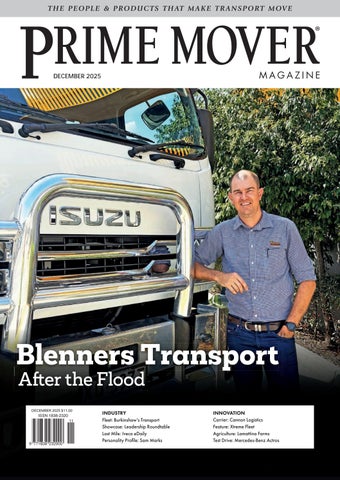
22 After the Flood
Blenners Transport overcame a once in a generation challenge to begin the year and finishes 2025 just as strong with the opening of the latest purpose-built depot in its now impressive property portfolio in Queensland.
28 Horses for Courses
Cannon Logistics retains an operational niche by moving freight to the outer reaches of Queensland, the exclusive domain of the business and a point of pride in the fleet
32 Keep On Moving
Xpress Fleet utilises a fleet of innovative and flexible vehicles to deliver crucial services to the car and truck industry.
TRUCK & TECH
40 King of the Hills
Tasmanian father-son operation, GASPAC Motors, supports the state’s critical dairy industry with the help of its rugged and reliable Freightliner Cascadia.
44 Skin in the Game
Rocky Lamattina & Sons regularly pushes the envelope in versatile truck combination for which it looks to equipment suppliers like Dana Australia for crucial support
TEST DRIVE
58 In Full Flow
The design of the Mercedes-Benz Actros ProCabin is all about fuel efficiency with many underlying advances in safety.
William Craske Editor
There’s a running joke in an episode of Family Guy, from a few years ago, where the otherwise dim-witted father Peter, strikes a contrarian position on The Godfather much to the ire of his household. “It insists upon itself,” he churlishly repeats to those who trust unconditionally in its status as bona de classic. Shows like these, of course, derive their relevance however shortlived, from questioning the sacred cows, however enduring, of the culture. That which is venerated should supposedly be able to withstand criticism. It’s a hallmark, we have been reminded to a fault, of our democracy. Insisting upon oneself is also a form of marketing, a way of disrupting mass media culture. We object to pretension in art, as Peter does, out of suspicion. How good is something that needs to sell itself so readily? But in business it is commonplace. A way to cut against the grain. He who shouts loudest increasingly gets lost in the noise is no longer an axiom of politics or commerce. Nor does that make it any less true. The industrialisation of large language models (LLMs) in public relations is a case in point.
Ghost Protocol
Its widespread adoption has swept through social media and the world of communications. Insistence is everywhere. Now businesses, invoking the third person, de ne themselves through statements of intent, rather than their core function because they have, for our bene t, transcended it. In short, they are supposedly much more than the sum of their parts. Company X is not just A — it is A, B, C and D. Once you see an example of this, you’ll see it everywhere. In the digital sphere this is what is now called slop. And it is spreading like contagion. LLMs use self-supervised machine learning on a vast amount of text, designed for natural language processing tasks. It amounts to what is called, perhaps egregiously, as language generation. In the last 18 months this trend has prevailed in marketing but increasingly reportage, record-keeping, speechwriting, songwriting and journalism itself. It’s not just a trait of systemised coercion — it’s the outsourcing of human agency. See how it works? Everything through the ease of proliferation becomes the same.
“The surest way to predict behaviour is to intervene at its source and shape it,” social psychologist Shoshana Zuboff has observed of how we are herded through surveillance revenues into the behavioural futures market. Our online footprint bombarded back at us from the algorithmic void, in between the prompts and advertising cues we generate because we checked the boxes in the T&Cs and created passwords and security codes to make the opaque agreement to extract our data consensual.
Behavioural markets, like any industry, will be subject, at least momentarily, to the rule of law. As we have seen, particularly in transport, regulation always comes at the price of utility. That’s a potential problem for ChatGPT which will no longer provide medical, legal or nancial advice to individuals due to liability concerns. You only need go back three years to the distorted outputs of the rst Gemini model to understand why. Arti cial intelligence is just that and will only abound when it is the primary way we choose to interact with each other. My four-year-old daughter is a welcome source of contrast. The other day I was showing her Trevor Jones and an orchestra performing his theme from The Last of the Mohicans She was roused enough by it to want to watch some other videos of different symphonies recorded live. Increasingly enthralled by the co-ordination of the many parts that made the sum total, she xated eventually on the involvement of the conductor, his gestures, at rst and then the importance of his role in things, as he juggled distinct sections, and soloists, so that each, far from becoming lost within the whole, became better for its part in the cumulative grand scheme. I’m certain she coined a phrase. Not taking her eyes from the exhilarating human endeavour she said of the conductor, “He is the man who convinces.” Who could argue? But in this case it was towards an authentic, knowable, common good.
THE NEW SHAPE OF EFFICIENCY.
Introducing the Mercedes-Benz Actros ProCabin.
Evolution never stops. The redesigned Actros ProCabin has been reshaped to cut drag and boost your bottom line with ultimate fuel efficiency. Building on recent fuel economy and reliability upgrades, the ProCabin also delivers the kind of safety gains and driver comfort you expect from Mercedes-Benz Trucks.
> Chas elly Trans ort olsters eet in two states
Chas Kelly Transport has upgraded its prime mover eet with multiple units in two states. he leading logistics company has recently sought out solutions in the higher horsepower bracket from ercedesen . In elbourne it took delivery of new 2 ctros models while for its Tasmanian operations it has landed new 2 ctros trucks.
Chas Kelly Transport provides logistics on the road and the water, operating Sea oad freight vessels, ock Logistics, oad unners, ransport quipment Hire H , elly Logistics and FreshFreight. ll of it headed up by ustralian ransport Hall of Fame inductee, Chas elly. he new Chas elly ransport ctros 2 units feature the -litre hp engine, while its new 2 models utilise the hp -litre engine.
oth models use a 2-speed fully automated manual transmission . hey are uro rated, ust like all ercedes- en ctros engines. ercedes- en became the first manufacturer to offer a complete
range of uro heavy duty trucks in ustralia with the new generation ctros back in 2 . o meet uro emission standards, truck engines must produce per cent less hydrocarbons and - per cent less o ides of nitrogen , as well as - per cent smaller particulates.
While some manufacturers are ust now introducing uro , aimler rucks, including ercedes- en , Freightliner and Fuso have notched up a combined billion customer kilometres with uro or equivalent drivetrains on ustralian roads since 2 . Chas elly ransport General anager, ristian elly, says the ctros units are a welcome addition to eet.
“ ercedes- en rucks has a proven track record of utilising the most advanced technology in its vehicles and they align with our goal of using the safest and most efficient trucks we can put on the road,” said elly. “We have a long relationship with aimler ruck and are pleased with the level of support in asmania and the mainland.”
aimler ruck ustralia acific resident and C , aniel Whitehead, said elly Group is known for operating high quality equipment across its different divisions.
“Chas and his team only run the latest and best-maintained equipment, so it is a real honour to have ercedes- en trucks operating in the Chas elly ransport eet,” said Whitehead.
aimler ruck ustralia acific ice resident Sales, arketing and perations, ndrew ssimo, said the ctros will serve the Chas elly ransport eet well.
“ he ctros is the perfect truck for Chas elly ransport. With its advanced safety, comfort and efficiency, ercedes- en will help Chas and his team deliver the levels of customer service that have helped it become a leading logistics solutions providers in ustralia,” he said.
Chas Kelly Transport currently operates trucks from ercedesen rucks, Freightliner and Fuso in its eets.
Mercedes-Benz 2653 leaving the wharf in Tasmania.
> teams u to com at transition challenges
I ustralia has added four olvo FL long-range electric trucks to its eet and announced an innovative new leasing model with Car on Leasing. his strategic investment will enable I to e pand its ero-emissions delivery footprint beyond metro areas into regional postcodes, helping to reach more ustralians sustainably. Since 2 , I has partnered with C elivers, ll urpose ransport, and Kings Transport to implement home deliveries withelectric vehicles across ustralia.
With nearly per cent of delivery vehicles owned by small businesses or subcontractors and not delivery companies or retailers and electric vans and trucks significantly more e pensive than diesel alternatives, le andra elly, ero missions ro ect Leader, I ustralia ew ealand said it remained a ma or challenge for drivers who operate with low margins.
“ he olvo electric trucks, designed for longer distances, will be leased to C elivers contractors through Car on Leasing,” she said. “ C elivers has been a valued partner to I in our transition to ero emissions, and their continued support with this new pilot removes the barrier of upfront vehicle costs for contractors.
“ y offering a leasing package as an attractive alternative to diesel trucks, drivers can access electric vehicles without financial risk.”
In ctober 2 2 , almost per cent of truck orders for I were completed in a zero emissions vehicle — that’s nearly all orders in metro areas.
I ’s ne t step is to go further to reach more ustralians living outside metropolitan areas.
“ t I , we embrace innovation and e perimentation, with sustainability at the core of our decision-making,” said elly. “With this new business model, we aim to prove that ero emission delivery is achievable today for retailers, with electric vehicles that can go the diesel distance.”
including high upfront costs and limited access to suitable electric vehicles for contractors.
In a new way of working, I owns the vehicles while Car on Leasing takes care of their management and leasing. lease cost similar to that of diesel trucks will be offered under the model, with the aim of making electric trucks financially viable for owner-operators and small delivery businesses.
Scott Gillespie, anaging irector of Car on Leasing, said partnering with I on this initiative showed what’s possible when global ambition meets practical local solutions.
“ ur model removes the upfront cost barrier and supports drivers with everything from vehicle sourcing to charging and C reporting,” he said.
“ aking ero-emissions delivery financially viable for small operators isn’t ust good for business, it’s essential for ustralia’s transition to cleaner transport.”
olvo’s long-range electric trucks are engineered to meet the demands of regional delivery, helping I get closer to its customers while reducing emissions.
he new Gen olvo trucks now have a range of up to kilometres and can carry a payload of up to , kg.
“It’s been fantastic to see the evolution of electromobility here in ustralia,” said artin errick, resident and C ,
2 2 this truck has only gotten better.
“ ur ustralian electric truck eet has now clocked up well over million kilometres proving that electric is indeed a reality for transport operators looking to reduce emissions and noise in urban areas.”
his initiative builds on I ustralia’s broader efforts in the ero emissions transition, including a . million investment in national charging infrastructure, to help overcome accessibility challenges for charging electric vehicles operated by its service providers.
In 2 22, ust per cent of truck orders were being made via a ero-emissions vehicle for I . y ctober 2 2 , it reached a new peak of almost per cent for ero-emissions truck deliveries.
“ his partnership with olvo and Carbon is a bold step toward our goal of per cent ero emissions deliveries, demonstrating that with collaboration and innovation, sustainable delivery is not ust a future vision, it’s happening now,” said elly.
“However, to truly scale ero emissions delivery into outer metro and regional areas, we must overcome one of the biggest remaining barriers charging infrastructure.
“ ddressing this challenge will require coordinated investment and action from government, industry, and the broader transport ecosystem.”
Image: IKEA Australia.
IKEA CEO Mirja Viinanen with Volvo Australia President Martin Merrick.
Never underestimate the power of a 16-litre Detroit, to haul dirt, rock, and the
Never underestimate the advantage of saving fuel, load after load after load.
Never underestimate the grind of the long haul, the comfort of our premium cabin to keep you going, and our advanced safety features that bring you home.
> itchie ros ac uires Smith roughton uctioneers
Commercial asset management firm, itchie ros announced that it has signed an agreement to acquire Smith roughton uctioneers and its affiliated company, llied quipment Sales. he deal is pending satisfaction of closing conditions.
oth Smith roughton and llied quipment Sales are respected, ustralian-owned businesses with strong reputations and deep roots in the equipment industry.
he acquisition unites well-established businesses that share the same core values of trust, transparency, and integrity, while strengthening itchie Bros’ national presence and extends its global reach.
ccording to a statement issued by itchie ros, which is part of Global, the milestone re ects its continued investment in strong, growing markets. ogether, the companies will e pand the organisation’s national footprint, enhance its customer reach, and accelerate its goal of being the trusted partner for equipment owners across ustralia.
“Smith Broughton is a respected leader with deep roots in Western ustralia,” said Finlay assey, ice resident, International Sourcing,
itchie ros. “ y bringing these businesses into the itchie ros network, we’re strengthening our national capabilities, connecting local e pertise with our global marketplace, and delivering greater value and reach for ustralian equipment owners.”
Smith roughton uctioneers, based out of idland, Western ustralia, will continue operating under its established brand. Customers will experience no change to current operations or staff, ensuring continuity and what is e pected to be a seamless transition.
“This partnership represents the best of both worlds global scale combined with local service,” said arren Smith, anaging irector of Smith roughton uctioneers.
“For more than years, our customers have trusted us to deliver reliable results with integrity. Joining itchie ros enables us to continue that legacy while opening the door to new markets and opportunities.”
The integration strengthens Ritchie Bros’ presence in the region and complements its global e pertise in the transport sectors and civil, mining, while e panding reach across Southeast sia, the iddle ast, and frica.
he acquisition also re ects itchie ros’ long-term investment in ustralia’s resource-rich states, aligning with the company’s growth strategy in mining, construction, and transport assets.
“ ur combined capabilities create a powerful platform for customers,” said Ghislaine ui melings, General anager, International, itchie ros.
“From local businesses in Western ustralia to multinational mining operators, sellers can now access the world’s largest marketplace for industrial assets supported by local e pertise and a shared commitment to e cellence.”
With Smith Broughton’s expertise and local market knowledge, itchie ros now delivers an even broader range of solutions for clients looking to buy and sell equipment across multiple industries. ogether, the combined group conducts appro imately auctions annually across ustralia, supported by a national team of more than employees. itchie ros said it looked forward to building on the legacy of trusted service and success across Western ustralia.
In July, itchie ros completed its acquisition of 2-year-old labama-based auction house J. . Wood uction.
> order ress rings agtrans, S ectrum under grou um rella
BagTrans and Spectrum Transport have been transitioned to parent company order press.
Since F H Group’s acquisition of order press in 2 2 , the group have been working closely with ag rans and Spectrum to align operations.
“ hese acquisitions mark the culmination of that work, unifying our e pertise, capabilities, and networks to deliver a stronger, more connected service for our customers,” said order press. his week employees, systems, and services were brought together under one brand.
he integration is being rolled out in phases to ensure a smooth transition during its busiest period leading up to Christmas.
order press said it is working closely with customers and suppliers to make the merger as smooth as possible, with dedicated support in place as it migrates systems.
ow that the first phase is complete with ag rans customers, employees, and suppliers having now oined order press the ne t phase will begin in arch ne t year.
hat will see customer service and
operational systems fully migrated to order press, with further process improvements to follow.
s a result, the business will undertake an e panded offering with a new service oining order press’ established parcel and pallet e press network. he ag rans brand will be retired as the integration is completed.
“With ag rans and Spectrum now operating as order press, we look forward to continuing to deliver smarter logistics solutions for our customers nationwide,” said order press in an online statement.
ONTHETOUGHROAD
BLACKMAGIC
Blackon theoutside,brightontheinside, HELLA
BlackMagic ToughRangeleavesnothing inthedark. With 14 light bars in the range Black Magic Tough is the right choice for every situation.
.
High Level Light Output
Up to 20,000effective lumens
Black out appearance
Unique design creates black out appearance withouteffecting performance
Versatilemounting
•Upright/pendant
• Fully adjustable slide brackets also available
Integrated Thermal Management
Thermal Management= high output
Long Lasting LED performance
Tough Construction
•Tough design and fully sealed, protects against sand, dust and water!
• Suits harsh Australian conditions
•Tested to theexacting Hella GermanyRallye standard
Impact ResistantPC Lens
•UV stabilisedto protect againstsun damage
•Tested againsthigh vibration resistance
> ustralia ost announces 00 million 8 ,000m² su er hu
ustralia ost will make its biggest ever investment in South ustralia, with the announcement of an almost half-a-billion-dollar arcel Facility. he new facility has been designed to service and support deliveries across the entire state for the ne t 2 years and will allow ustralia ost to test and learn as it plans its future operations and national network footprint.
pening in 2 2 at the former Holden site in li abeth, the , m site will be the first fully combined ustralia ost and Star rack facility and the largest in the network.
uilt with world leading sortation technology and innovation, it will have the capability to process up to , parcels per day, doubling the current capacity at delaide irport arcel Facility.
ustralia ost Group C and
anaging irector aul Graham said the delaide arcel Facility will streamline parcel processing and customer e perience for South ustralians, ensuring ma imum efficiency delivered in a sustainable way, for decades to come.
“South ustralia continues to e perience year-on-year e-commerce growth, with per cent of residents shopping online in the past year,” he said in a statement.
“ his new parcel facility will help us meet that growing demand over the ne t two decades and deliver to customers’ doors faster than ever before.
“ s online shopping habits evolve, it’s critical that ustralia ost invests in infrastructure that gives us a competitive advantage.”
his parcel facility will be the largest in the country and is considered
> i a nergy o ens new arratha facility
iva nergy has unveiled an industryleading lubricants facility in Western ustralia’s ilbara region.
esigned to streamline the transportation of lubricant products, the 2 million plant at arratha demonstrates its commitment to providing customers with a trusted supply of quality products to support its operations, which include some of ustralia’s most remote mines and offshore facilities.
he new site boasts 2. million litres of on-site lubricant storage capacity, while an additional purpose-built grease facility has been tailored to support the needs of local industry.
he opening of the facility represents iva nergy’s significant commitment to the ilbara economy.
raditionally, the transportation of lubricants to the ilbara has involved a comple , -kilometre ourney, beginning with a voyage by ship from Singapore to Fremantle and concluding with a -kilometre trek by truck to arratha.
With the new facility, products will be delivered directly from Singapore to the ort of ampier, ust minutes by road from arratha.
It cuts the sea ourney by more than kilometres and bypasses the road travel from Fremantle. n road freight alone, that is a reduction of more than , kilometres travelled every year.
iva nergy’s General anager of esources and Lubricants, erry Watson, said by shortening the supply chain and reducing the kilometres travelled, the company was implementing a much more efficient supply chain for customers.
“ s an added bonus, iva nergy is also reducing associated transport emissions by cutting the distance travelled by around per cent,” he said.
“ his initiative contributes to lowering the environmental impact of our logistics operations and supports the company’s commitment to operational efficiency. It also re ects sustainability priorities shared by iva nergy and many of our regional customers.”
s the licensed Shell Lubricants acro
the blueprint for ustralia ost’s most technically advanced facilities going forward.
“It forms part of our long-term strategy to modernise our network, improve efficiency and maintain our role as ustralia’s trusted delivery partner, for consumers and businesses alike,” added Graham.
elligra Group will develop the delaide arcel Facility.
“ his pro ect will provide a broad range of benefits to South ustralia, and we’re e cited to be a part of that,” said Chairman oss elligra.
“We’re proud that ustralia ost selected us to help them breathe new life and activity into a site with significant industrial heritage and help transform it into a state-of-theart facility focused on keeping South ustralians connected.”
istributor in ustralia, iva nergy is looking to underpin timely and reliable deliveries through the new facility as well as improve efficiency and reduce carbon emissions.
Shell S acro istributor Lubricants General anager, Steve uila, said the new terminal re ected iva nergy’s commitment to strengthening the Shell Lubricants brand in this critical mining region.
“Having a dedicated lubricants facility enables direct shipping from Shell’s regional lubricant blend plants to the ilbara ining region, streamlining logistics by offering reduced transit times, enhanced supply certainty and the ability to rapidly respond to customer demand,” he said.
Scott Wyatt, Viva Energy CEO, WA/NT Operations Manager Robyn Smart.
BECAUSE HAULING DIRT, ROCK, AND RUBBLE NEEDS SERIOUS MUSCLE.
A 16L Detroit engine delivering low-end torque is exactly what you need to get those heavy loads rolling. Paired with an aerodynamic design, the Cascadia is built to maximise payload and minimise running costs.
UNDERESTIMATE AT YOUR OWN COST
> oylan Silos adds 0h dro deck rime mo ers to eet
ellerberrin-based wheatbelt business oylan Silos has boosted its prime mover eet with two new Iveco S-Ways. he -horsepower S prime movers oin a eet of trucks at the Western ustralian business the state’s largest manufacturer of grain silos, stock feeders and field bins.
Founder ick oylan was originally a tradesman, who years ago transitioned from plumbing to fabricating water tanks, before pivoting the business to focus on the manufacture of grain silos.
Situated 2 kilometres east of erth, these days the second generation operation is predominantly overseen by son, Corey, and his wife Gemma, who in more recent times have grown and further diversified the business to produce stock fielders and field bins. long with family members, oylan Silos’ team comprises 2 full-time employees plus seasonal casuals. he business employs workers for sheet metal, boilermaking, mechanical, labourers and truck drivers.
ll of oylan Silos’ product lines are manufactured in house using mostly ustralian materials, offering a genuine homegrown range to customers.
“ ad was a plumber by trade and after a while he learned that he didn’t like working for others, so began the business. He was always clever with engineering and good with his hands,”
said Corey oylan.
“ aking what he learnt with the water tanks he applied it to silo manufacturing, and it remains our core product today.”
From ellerberrin, the company transports its products all over W and that’s where its eet of I C s plays a role.
“ 2, kilometre round trip is pretty normal during deliveries but we’ve been as far as ununurra and roome,” oylan said, over , kms and 2, kms, respectively, one way.
he company started using Iveco trucks around 2 years ago, when a orth merican brand was replaced by a urotech, and Iveco has continued to be the vehicle of choice ever since with the eet now consisting of Stralis and -Way prime movers as well as two new S-Way S prime movers.
“We’ve found the Ivecos to be durable and reliable, the last urotech was traded in showing well over a million kilometres and two of the older Stralis models have also e ceeded that mark we never have any trouble with them,” oylan said.
lift and lower the silos, with the process normally taking between and minutes for two team members.
While these larger silos only weigh around three tonnes each, their oversize dimensions means they catch a lot of wind, according to oylan, making the S-Way’s hp and 2 m of torque ideal.
“ he loads might not be that heavy but the trucks still have to work to push through the wind, it pegs us back, that’s why we like to have higher horsepower trucks,” oylan said. “ nother thing we’ve en oyed about all the Iveco trucks we’ve had and it’s particularly noticeable in the S-Ways is the comfort and quietness of the cabins. “ hey’re very quiet and spot on for comfort. We often drive them over very poor roads and the steering and suspension handle the conditions well, they’re e cellent over the corrugations. eally, they’re a perfect truck for what we’re doing.”
oylan Silos’ Iveco eet is maintained in house with the business also calling on erth ealership, ruck Services, when required.
Two of the new 550hp Iveco S-Ways at the Kellerberrin depot.
> Toll un eils ne t hase of rogram with ma or artner
oll Group will deploy a new eet of electric rigid trucks in partnership with Coca-Cola uropacific artners CC . It’s part of the ne t phase of its million investment in sustainable transport solutions across ustralia. Launched across oll’s network, 2 olvo F battery electric rigids will replace existing diesel vehicles in CC ’s national delivery network. hese rigids offer a quieter and lower-emission solution for beverage distribution, without compromising on reliability, safety, or customer e cellence.
ach vehicle has a 2-pallet capacity and a charging range of up to 2 kms. esigned for multiple deliveries across key metropolitan routes, the eet will collectively reduce an estimated 2 tonnes of carbon emissions annually. ehicles will operate from CC ’s distribution centres in otany SW , astern Creek SW , ichlands L , and Ha elmere W , and be supported by site-specific charging infrastructure ranging from kW to kW dual outlet charging stations.
hese facilities have been co-invested by CC , reinforcing its commitment to enabling the transition to electric vehicle technology.
eyond environmental benefits,
the electric rigids are equipped with advanced safety systems and technology to protect drivers, enhance service delivery performance, and support community safety. his initiative marks the ne t phase of oll’s broader million investment in battery electric heavy vehicles and charging infrastructure, co-funded by the ustralian enewable nergy gency through its riving the ation’ program.
oll said ’s support had been instrumental in enabling it to progress the initiative. In total 2 s will be launched with oll customers over the coming months, making it ustralia’s largest deployment of battery electric heavy vehicles in the third-party sector.
“We are proud to have CC take part in our national electric heavy vehicle program. heir support is another key milestone in our 2plus year partnership, as we work together to reduce emissions, improve safety, and meet the high standards our customers e pect,” said ick rckovski, oll resident etail Consumer said.
hillip arsons, irector of Logistics at CC , said the initiative supports their ongoing commitment to working with
> ulti ui artners on landmark electric truck trial
ultiquip has been part of a record single-charge electric truck delivery. long with partners ew nergy ransport and Windrose echnology, ultiquip has completed what is being called the longest single-charge electric truck delivery ever conducted in ustralia.
he -kilometre round-trip included a -tonne GC delivery leg from ultiquip’s icton site, kilometres south of Sydney, to eresfield, ust outside ewcastle, and a return leg with an empty trailer.
he electric prime mover was able to shave minutes 2 per cent off the
total trip time thanks to its ability to maintain highway speed limits going uphill, unlike diesel equivalents must reduce speed in order to keep the engine within the optimal power and torque range. Jason ikosic, ultiquip irector said battery electric technology is something he has been keen to e plore for some time.
“ he trial went e ceptionally well, and we’re proud to have been part of this step toward cleaner, quieter, and more efficient logistics,” he said in an online statement. “It’s e citing to see how electric trucks could shape the future of our business and the broader
“ ur investment in these 2 new electric rigids along with dedicated charging infrastructure across our facilities, re ects our long-term commitment to building a more sustainable beverage distribution network,” he said. “With one of the most e tensive logistics footprints in the country, we are proud to deliver beverages that are made in ustralia to our customers reliably, safely, and efficiently and now more sustainably. “ artnering with oll on this roll out is another meaningful step in our ourney toward achieving net ero emissions by 2 .”
Insights from the program will contribute to broader industry knowledge on energy usage, route planning, and vehicle performance, and support the transition to low-emissions freight transport in ustralia.
industry. hanks to our partners for their collaboration and innovation. We’re looking forward to what’s ne t.” e t year ew nergy ransport aims to establish a pilot eet of heavy electric trucks in Wilton, southwest of Sydney. lans are for up to heavy electric prime movers initially to be housed at the Hume Highway ad acent hub, before increasing the eet to 2 vehicles by 2 . ew nergy echnology’s first heavy electric trucking depot will be the largest of its kind in the country putting Wollondilly Shire at the very forefront of transport electrification in ustralia.
Volvo FM Electric.
Scania’s new industrial hub in Rugao, Jiangsu Province, represents one of the company’s largest global investments to date. Covering 800,000m² , the site has a licensed production capacity of 50,000 vehicles a year and will serve both the Chinese market and selected export markets in Asia and beyond. The facility creates around 3,000 new jobs locally and represents a total investment of 2 billion euros.
Scania is reportedly the first western OEM to be granted a full production licence for a wholly owned truck plant in China, a milestone that underscores the company’s long-term commitment to the market. The Rugao facility will operate almost entirely on renewable energy sources, including locally produced biogas and certified green electricity. These measures contribute directly to Scania’s Scope 1 and 2 decarbonisation targets.
“Sustainability is built into every part of our new factory in Rugao: from energy sourcing to waste management,” said Ruthger de Vries, President of Scania Industrial Operations Asia. “This is not just about producing trucks; it’s about
> Scania notches first in China with 800,000m² factory
setting a new benchmark for efficient and sustainable industrial operations.”
Scania has been present in the Chinese commercial vehicle market for the past 60 years. China is the world’s largest truck market and a global centre for innovation in transport, connectivity, autonomy and electrification. With the new industrial hub, including R&D centres in Rugao and Shanghai, Scania strengthens its local footprint and its ability to jointly develop solutions with Chinese partners. The strategic investment brings Scania closer to customers in China and across Asia, enabling faster deliveries, wider specification options and deeper collaboration.
“Our establishment in Rugao is more than a factory; it will be part of China’s dynamic innovation landscape and fuel Scania’s own development,” said Christian Levin, President and CEO of Scania and TRATON Group, “By also producing and innovating locally, we can tap into China’s speed and creativity, strengthen our global capabilities and accelerate the shift towards sustainable transport.”
The new industrial hub is designed to be part of the TRATON Modular System (TMS), which enables Scania and TRATON
Group brands to efficiently scale, tailor, and innovate across markets, customer demands and product portfolios.
TMS allows for integration of unique Chinese technologies and applications that will strengthen local and global competitiveness.
Scania will offer builds customisable for demanding applications such as prime movers and rigids, with a wide range of service portfolios. It will also launch a new product range – NEXT ERA – developed specifically for China’s competitive long haul and volume segment.
The NEXT ERA product line represents a new chapter in Scania’s commercial offering and is fully integrated with the local digital ecosystem. While sharing its DNA with the TRATON Modular System, it is designed for high-volume transport applications, with a standardised product and service portfolio. The TMS also allows unique technologies to be introduced in China first and then rolled out globally.
Deliveries from production in Rugao will begin in late 2025 and NEXT ERA will be launched in the first half of 2026.
Image: Scania.
A Scania prime mover from the XT range being built.
> Fuso teases fuel cell hydrogen trucks in Tokyo
Mitsubishi Fuso Truck and Bus Corporation (MFTBC) premiered two hydrogen-powered heavy-duty trucks at the recent Japan Mobility Show 2025. MFTBC unveiled not one but two concept models at the event, the H2IC, a heavy-duty truck powered by an internal combustion engine that combusts hydrogen, and the H2FC, a heavy-duty truck powered by a fuel cell system.
Hydrogen is regarded by MFTBC as an effective means to achieve carbon neutrality for commercial vehicles involved in heavy-duty transport and long-distance haulage, owing to its high energy content, long range, and short refuelling time. By utilising components and technologies common to diesel trucks, the H2IC has the potential to enable a faster and smoother transition to hydrogen vehicles.
The H2IC technology, for example, shows particular strength in high-power applications such as construction vehicles. The H2IC is fuelled with compressed hydrogen gas.
In the H2FC, a fuel cell system converts
hydrogen to electricity, which then powers an electric motor.
The H2FC stores hydrogen in liquid form, which has a higher density compared to compressed hydrogen gas. This enables a vehicle with up to 1200 kilometres of driving range, refuellable in 15 minutes and with reportedly no compromise on load body space.
In what is regarded as a Japan-first, the heavy duty H2FC is equipped with a liquid hydrogen tank designed for subcooled liquid hydrogen (sLH2) refuelling.
Jointly developed by Daimler Truck and Linde Engineering, a global leader in industrial gases and hydrogen infrastructure, this is a liquid hydrogen filling technology that eliminates the need to discharge the evaporated hydrogen gas by pressurising hydrogen during refuelling.
It also reduces boil-off during operation. This addresses a challenge previously faced when handling liquid hydrogen. Furthermore, sLH2 significantly simplifies the equipment required at hydrogen stations when using
compressed hydrogen gas, contributing to reduced infrastructure costs and the realisation of what is described as a “hydrogen society”.
To establish the sLH2 technology in Japan, MFTBC has been conducting joint research with Iwatani Corporation, the sole domestic supplier of liquid hydrogen.
The sLH2 is currently being discussed by the relevant parties with a view to develop ISO standardisation.
In Japan, MFTBC has been collaborating with Iwatani Corporation on joint research regarding sLH2 filling technology, regulations, and commercialisation, advancing efforts to establish sLH2 filling technology in the country.
MFTBC is also working to build collaborative frameworks with external companies and institutions to support the implementation of sLH2 refuelling technology in Japan.
As a front runner in BEV solutions for light duty trucks, MFTBC now also aims to demonstrate leading future ZEV solutions for heavy duty trucks.
Fuso concept fuel cell hydrogen trucks.
FLOOD AFTER THE
Blenners Transport overcame a once in a generation challenge to begin the year and nishes 2025 just as strong with the opening of the latest purposebuilt depot in its now impressive property portfolio in Queensland.
It was, by any measure, a once in a century ood. Normanton and nearby towns had initially received 300mm of rain in one night. The Herbert River was at levels not seen since 1967. Disaster areas extended from the Cape York Peninsula down through Pormpuraaw in the Gulf and as far west as Cloncurry. Over 30
councils and many primary producers were directly affected. Thousands of livestock lost. Hectares of crops destroyed. A bridge crossing at Ingham was rebuilt by the army after the town was left completely isolated by the rising waters. As additional lowpressure systems moved through and remained, as if anchored to the sky, for
days on end, river crossings vanished and eventually the network of roads used by freight carriers, into the farthest reaches like Boulia, were swallowed up as the residents of surrounding communities were evacuated. By the time a slow-moving trough dragged tropical moisture inland a few weeks later much of far north and northern
Queensland was under water. Blenners Transport, whose transport network is plugged right into this ecosystem, was one of the major carriers that had dozens of trucks, all over the northern parts of the state, soon marooned. As drivers found the catastrophic scale of the ooding impregnable by road, they reported back to base, as the
Blenners key ops team monitored communications 24/7 in the hope of nding a way through.
It was a tough start to the year as Director Roger Blennerhassett recalls it. “There were widespread power outages across the network and virtually every major road we relied on was under water,” he says. “Our team was looking
Blenners Transport assets include new Isuzus, Kenworths and utility vehicles.
at government websites every hour and when they weren’t they were relying on drivers sending through photos of river levels in anticipation there might be a break.”
This lasted for two weeks. All the while the pinch points started to propagate. Proserpine. Blackall-Tambo. Ayr. Greenvale. Charters Towers. Another
alternate route each time was taken off the board. Even the far western lane often relied upon in times of natural disaster was closed.
“Every route was inaccessible because of the oods, and we physically had no alternative,” recalls Roger. “If we couldn’t get information from some of the remote sites, we had drivers physically stuck there relaying what they were seeing, sending through photos and texts about the river levels. And then we would determine as to which direction we could then send them and identify the route that might have more chance of opening over the many others.”
Driver information was critical. They were the eyes and ears on the ground, ascertaining the level each river was at sitting for days on end feeding back upto-the-minute updates to the Blenners command centre. All of this happening during a staff shortage being felt across vast parts of the road transport industry at the time — peak season for most.
“We were facing the biggest challenges nearly in a lifetime in our business,” says Roger. “All our staff during that period put in a huge effort to get us through. To keep our customer’s freight moving under the toughest conditions let alone having a shortage of personnel put on top of our existing team but they rose above it and got us and our customers through. Everyone stood up.”
The year prior, Blenners had opened a brand-new 3,200m² building on a 16,000m² site at a cost of $17 million in Cairns. It had taken ten months to complete. Having the facility in place this year was timely for the local community during the disaster as it allowed them to hold emergency stock in a dry storage area with capacity for 600 pallets while the freezer/chiller amenity has provision to hold 900 pallets. This was pivotal to have before local roads were eventually obstructed by oodwaters.
“Cairns is a big one to offer a buffer of storage for that wet season period,” says Roger. “We have food already up
there that can be rolled out to keep the community fed if and when the road is cut.”
The Atherton Tablelands, an evergrowing fruit bowl, helps form a bigger picture for the investment Blenners Transport has made into Cairns. This region is expanding in terms of the volume it can produce and the diversity of different products it will yield.
“We now have more service offerings there with room to grow,” says Roger.
“As more crop gets planted and fruit comes off it in the years to come, we’ve got room to handle that growth for our customers.”
In September, Blenners added another new facility to its network this time in Central Queensland. The purposebuilt 2,500m² Rockhampton depot contains ve docks, a temperaturecontrolled anteroom as well as chiller and freezer rooms available for storage of dry, chilled, or frozen products. The site itself employs nine staff and is equipped with onsite diesel storage for refuelling trucks.
For the increase in volume of freight, Blenners is running four B-doubles from Brisbane to Rockhampton daily. Here a semi-trailer, a 16-pallet Isuzu, three 14-pallet Isuzus and an 8-pallet Isuzu provide the area with local deliveries.
The newest depots have enabled Blenners to attract new accounts as well as to bolster their services for existing partners.
“At both sites we have added new customers, straight away,” says Roger.
“By having the extra cold rooms and more storage facilities we have taken on board customers we didn’t have prior to offering that service.”
While the business doesn’t have any plans to expand outside the existing towns it presently operates within, they do expect to offer a larger scope of services as a result of these property investments. A direct byproduct of this will be the bene t of seeing quicker turnaround times for its trucks in delivering and picking up freight. For a 38-year-old family business it retains
Kenworth K220 B-double with the team in Rockhampton.
a serious footprint across the eet. At current they have 204 Kenworth prime movers, 361 refrigerated trailers, and 70 rail containers at their disposal.
The Kenworth units are running across Australia, primarily up and down the eastern seaboard. This includes a new Kenworth T620 powered by a 550hp Euro 6 Cummins X15 Ef ciency Series engine paired with an Endurant XD Pro automated transmission. Since August, the T620 has been pulling a 34-pallet B-double loaded with bananas to Melbourne every week and frozen goods return to Townsville. It has had a seamless integration with the prime mover eet according to Roger.
“It’s performing ne with no issues,” he says. “From our perspective the main changes are having the Euro 6 powertrain, and they’ve noticeably improved the dash electronics and incab systems. The driver is happy with it.”
Just this year the eet has introduced nine sets of new PBS B-doubles for an express linehaul service. There’s a mix of 38-pallet and 42-pallet units all hooked up to Kenworth K220 prime movers that feature FTE refrigerated bodies. They are running on dedicated overnight shuttle legs
to North Queensland. The other brand in the eet commanding a signi cant presence is Isuzu. In fact, Blenners defers to Isuzu for every rigid truck in operations of which it has 50 units. Dual front steering axles are speci ed for Isuzu’s FYJ 300-350 vehicle platform in 14-pallet and more recently 16-pallet con gurations, that were introduced late last year. The push internally for these larger twin-steer units was motivated by increasing the carrying capacity on shorter regional runs that, given the size of the state, work out as distant journeys all the same despite not technically being classi ed as long hauls. From the new site in Rockhampton, the area to cover is massive. Aside from the Rockhampton township itself these Isuzus venture to Emerald, Gladstone, Biloela and Yeppoon. The Rockhampton trucks cover between 1500 and 2000kms per week. High intensity. High miles. “Again, it’s about providing better service capacity for our customers by getting more freight on each run,” says Roger. “We’ve been with Isuzu for over 30 years. Every rigid purchased in that time frame has been with Isuzu
because they are tough and reliable. Parts availability and support are top notch.”
An Isuzu FSR 140-260 with an 8-pallet body is tasked with local jobs going into tight spaces for deliveries such as restaurants, pubs and clubs. It’s a rarity one of their food service trucks is tted with a refrigerated body by anyone other than FTE.
“They are the most thermally ef cient body in Australia,” says Roger. “The quality of nish. Their service and support — FTE are the best.”
That’s crucial when running multiple units, day in and day out, in the sti ing tropics. Relative humidity levels frequently exceed 70 per cent during summer afternoons in ‘Rocky’ where the mountain range makes it a magnet to trap hot westerly winds from the desert.
The FYJ 16-palleters have been introduced across Rockhampton, Mackay, Townsville and Cairns. With one unit each initially delivered into the depots there are more on order for deployment next year. All of these trucks have been purchased from TSV Automotive in Townsville. The partnership goes back nearly 20 years.
Brisbane
Aerial view of the new Rockhampton facility.
“We buy all Isuzu genuine parts and they’ve got great parts supply,” Roger says. “We can always rely on them to have the right part on the shelf.” Blenners Transport relies on third-party independent service agents for their eet. They work, where possible, with the best in each town. Serious longevity is expected of these rigid trucks which are scheduled for replacement on tenyear cycles.
“We run the Allison AMT transmission,” adds Roger. “It’s tough. It’s bulletproof. That pretty much sums it up.”
The current market for road freight is unfortunately ooded with y-by-night operators who are cutting corners and
reducing rates. In the age of supposed sustainability none of it is. Stability therefore is key. Leveraging a network of eight depots, with head of ce in Tully and a large site in Brisbane’s Darra, Blenners is not lacking the rm footing with which to meet the economic challenges all businesses are presently confronted with in the industry according to Roger.
“Our long tenure for nearly four decades and high service levels gives our customers the con dence to stay with us,” says Roger. “We’re available for any customer 24/7. They’ve got our phone numbers, and they know they can call us direct if they want help with
a new job or service requirement.”
As senior management, Roger or his brother Ben Blennerhassett and father, Les, founder of Blenners Transport, know that their personal touch is a point of difference not every business it competes with can offer. Nor are they impervious to recognising the moment when external forces call for holding back the tide before it can move forward.
The rain, as the courageous Blenners staff understood back in February, won’t last forever.
“We’ll keep building our business in close partnership with our cherished customers,” says Roger. “Blenners Transport is here for the long haul.”
Roger Blennerhasset in Brisbane with local Isuzu FYJ trucks.
HORSES
FOR COURSES
Cannon Logistics retains an operational niche by moving freight to the outer reaches of Queensland, the exclusive domain of the business and a point of pride in the eet.
Last year Cannon Logistics debuted its rst B-triple. It agged a direction the Brisbanebased linehaul eet was always headed being something of a specialist in carrying less than truckload freight or LTL as it is popularly known in North America out to mine sites commonly found in the remotest and hottest parts of Queensland. This is achieved on high horsepower spec’d prime movers primarily built by Kenworth and increasingly MAN since 2021.
Four years ago, Zac Popov, Cannon Logistics’ Founder and Director, introduced three MAN TGS 26.580s into his eet of nearly 40 heavy vehicles. They delivered solid fuel economy numbers that were hard to ignore.
The Penske Australia, and by extension, MAN Truck & Bus workshop
facility is in the same Lytton street Cannon Logistics calls home. That’s a convenience not just for the eet but for the Penske team, whose latest products are on show in close proximity to an area brimming with leading exponents from the target market. Cannon Logistics, which originally takes its name from the suburb of Cannon Hill, where Zac founded the business, moved into a boutique estate ten years ago. There are several other major companies with facilities here like Kmart distribution, Amazon, Inghams, PFD, Wickham Freight Lines, Emerald Carrying Co and the container cartage specialist, Wemyss.
The building when Zac purchased it was a sky-blue colour. Suf ce it to say, for a man who orders every truck in cane toad maroon because of his
allegiance to the Queensland Rugby League team, that didn’t last too long.
“I painted our new building immediately even before we had moved into it,” he says. “I’m a Queenslander — simple as that.”
Having Penske Australia in the same street makes the proposition of working with them even easier. The new MANs are not surprisingly on service contracts with xed maintenance intervals to ensure better protection against unforeseeable repairs.
“It’s an attractive option and pricing was fair and reasonable,” says Zac. “That’s de nitely another reason why I bought them. It’s the simplicity of operation that I like foremost.”
The latest truck order comprises six MAN TGX units evenly split between 580-horsepower or the 640 rating with 3,000Nm of torque. These TGX units
The six new MAN TGX units in Brisbane.
FLEET FOCUS
come with ve year/1,000,000km driveline warranties and boast no midlife component changeouts. The bigger GX cab – 2100mm oor to roof internal – was considered an upgrade to give the drivers additional comforts on their northbound treks.
“Hopefully, we will see good fuel economy gures out of them,” says Zac. “The prime movers from 2021 have been achieving really good numbers as well. I’m sure these new ones will achieve better numbers considering it’s a new engine.”
That would be the latest generation 15.2-litre inline six-cylinder D3876, which uses a two-stage turbocharging system with intercooling, a common rail injection system, and an exhaust aftertreatment system with SCR (Selective Catalytic Reduction) and CRT (Continuously Regenerating Trap) to meet Euro 6e standards.
The new trucks are replacing a mixture of brands including previous generation MAN prime movers.
“I’m renewing the eet at present so
them fully painted now in the maroon burgundy with a few other odds and sods put on for me by Penske who offers us a ‘bling package.’”
Some of these features at a glance but not limited to include a roadtrain bullbar with ten marker lights tted to it, custom roof light bar with four 220mm spotlights, a sparkling custom paint job on cabs, tanks and exhaust, polished walk plates and fuel tank tread plates, stainless tank straps cover, stainless fuel tank kicker panels with marker lights, Jost JSK 37 Sensor Lite turntable for added safety, and Custom Air pack.
The MAN TGX 26.640s are hauling B-triples and B-doubles into central Queensland. The nal destinations include coal mining towns like Emerald, Moranbah and Longreach. They also run up the coast to Rockhampton and Yeppoon.
A cold carrier in essence, Cannon Logistics runs an estimated 90 per cent of its jobs carrying refrigerated goods with the remainder tasked with transporting general freight.
“The upkeep of these accommodation companies is impressive,” says Zac. “The mining companies make sure their staff are well looked after. They don’t lack for much.”
For Zac, that translates into carrying new mattresses and replacement beds up into central and western Queensland. With mine sites working on a regular cycle of upkeep programs there is a frequent renewal of linen and bedding.
“As well as the mattresses we’re carrying TVs, white goods, and gym equipment up to them,” explains Zac. “That can mean treadmills, weights, rowing machines even pool tables. You name it.”
That brings with it untold challenges for loading and unloading given the often, incompatible nature of the goods being carted.
“Because we’re not a full load company that means we mix and match the freight for every region that we go to,” says Zac. “We travel to areas where the big boys struggle to go to. I try and stay out of their space where possible.”
about things outside of his control. Keeping operations contained strictly within Queensland, despite the scope and density it entails, is by design according to Zac.
“We carve out our own niche because we’re doing LTL into regional Queensland. It’s something I wanted to do to start with. It works well,” he says. “Of course, there are competitors but there’s not as many as what you’ll nd running up and down the east coast of Australia from Cairns to Adelaide. There’s a lot of guys who do that stuff. I choose not to. I prefer to stick within my own lanes and look after customers within that space by providing a reliable and honest service.”
Prior to starting Cannon Logistics, Zac worked for 15 years at fridge removal specialist, Fridgmobile, a Swire Group company, where he ascended to managerial roles. He has considerable expertise in cold storage and retail logistics. Zac, by admission, likes to stick with what he knows and he knows Thermo King. He says the brand’s
very reliable,” he says. “They have a good network throughout Queensland and other fridge mechanics know their product well when it comes to servicing. It’s the KISS mantra of Keep It Simple Stupid. I don’t like complicated things.”
The business celebrates its 20th anniversary next year. Starting out was a matter of nding a couple of trailers and contracted operators and “away you go” per Zac. There was, however, a much deeper driver pool to draw from back then.
“Was that because of population size? Was it because the Baby Boomers were still working on and not retiring. It’s hard to say,” he says. “You certainly had more availability of experienced drivers and now compliance is a big thing to put on all of us in the transport industry.”
It’s certainly one issue, from the many to pick from at the minute, that appears to marshal the widest consensus. Regulatory compliance would seem to go hand-in-hand with the systemised adoption and reliance of technology. “There’s much more of that and it’s for the better but there’s a cost involved,” says Zac “Keeping on top of your compliance is an additional cost. You have to maintain it because customers demand it. If you’ve got no methods or processes for compliance with the NHVR or Food Safe or whatever it is customers won’t stay loyal. They’ll nd someone who has all of that to start with.”
The eet now has 65 trailers on hand. They have predominantly invested in reefers from Freighter Group. Cannon Logistics deploys up to ten roadtrains a week. They shuttle the trailers out to the decoupling facility at Gatton where they hook up.
“Whether it be Type 1 roadtrains, a B-triple, we even do AB-triples it just depends on the freight,” says Zac. “If we’ve got 60 pallets to go into a region, it could end up being an AB-triple that goes out there. When that happens, we’ve got to hook up out at Roma. It is what it is.”
Cannon Logistics is ostensibly a
Kenworth eet. Because they carry 48foot trailers it’s something of a balancing act when investing in a conventional cab. “I’ve got to be mindful of the type of work we’re doing,” explains Zac. “When it comes to some of the trucks I put bullbars on and some I don’t. It’s horses for courses. Those ones with the bullbars will go onto roadtrains and the others we will stick on B-doubles and so forth.”
He acknowledges driver preference also plays a part in the decisionmaking process.
“Different drivers like different things. I’m aware of that,” adds Zac. With that said he is always open to evaluating new equipment should it have any perceivable upside in his operations. A new run might present a different challenge that an unfamiliar product can help solve.
“When it comes to trucks I’ve tried all sorts of different brands: Freightliner. Western Star. I’ve got four Volvos in my eet,” he says. “The reason I bought them is they’ve got a XXL cab with a nice interior that gives the driver a lot of room. That’s got 600 horsepower. They’ve been reliable and ne for our drivers in the most part.”
Zac’s preference is to keep his drivers on the same runs. This way the customers get to know them.
“All things being equal, they’ll get on and understand each other and make things happen,” says Zac. “It’s all well and good to have people in the of ce but it’s the driver that’s fronting the customers each week. If the driver does a great job and the customer appreciates it that makes everyone’s life so much easier.”
The customer portfolio is a real mix that includes accounts with corporates, multinationals, small businesses and longstanding family rms.
“We’ve got customers that are still with us since my very rst day. We’ve given them no reason to leave,” says Zac. “We provide a scheduled service. If I’ve only got 15 pallets to go to Charleville, for example, we still go on that day. We run on that schedule every day of the week. No matter what.”
The trucks feature roadtrain bullbar, roof light bar with spotlights, polished walk plates and fuel tank tread plates.
XPRESS DELIVERY
Xpress Fleet utilises a eet of innovative and exible vehicles to deliver crucial services to the car and truck industry.
Jdivision. During the ensuing years James progressed through managerial roles in operations, and as his career developed within the industry, James earned the
In 2021, at the urging of many of his industry contacts, James and his wife established Xpress Fleet to provide a range of vehicle transport services
as is the subsequent pick-up and return to dealers of the customer-ready trucks. In just three months during 2025, 100 Woollies’ home delivery trucks have
DELIVERY
rst truck, a Mercedes-Benz Actros, in November 2021. Four additional Actros’ and two Western Stars were subsequently added. The eet is now
decided to design and build custom trucks and trailers.
Always innovative, Xpress Fleet has been an early adopter of the latest in
in the industry which makes my life so much easier”, says James. “We are all ‘car’ people, even the of ce staff, and we actually treat the customers’ cars as
Hino 500 Series car carrier. Image: Prime Creative Media.
if they are ours’.”
Hino is one of a number of key clients, and James expects to complete more than 2,000 Hino truck movements during 2025, including relocating trucks from the wharves, providing storage and delivering to dealers and body builders. Xpress Fleet has a combined 25,000m² of storage space in Sydney and Melbourne which assists customers being able to minimise wharf demurrage fees.
As a motorsport enthusiast himself, it is logical that James is involved with the Supercars Championship, stemming from his relationship with Hino which is a high pro le backer of the popular series. An integral part of this arrangement is Xpress Fleet transporting the of cial vehicles key to the running of the events to and from various raceways around the country including the Porsche safety and medical cars as well as the VW Amarok
recovery vehicle. As with all other cars, each vehicle is secured using four wheel restraints rather than the minimum requirement of two.
“With four, if one fails there are still three to keep it secure,” says James.
“If only two are used and one fails, then the vehicle relies on just a single remaining strap.”
Trucks being transported are restrained by four or six chain systems, depending on the body type, and extreme care is taken to ensure zero damage to components such as brake lines.
Xpress Fleet trucks run daily to Brisbane, Melbourne and Adelaide and it’s the team’s abilities to quickly create and implement logistics solutions which sets them apart.
“We’re the one stop solution,” says James. “We are here to provide a solution to customers’ problems. It might not always necessarily be perfect, but a solution, nonetheless. That’s what
gets us across the line”.
There are many examples of this lateral thinking, including a motoring journalist undertaking a car test drive experiencing a at tyre, so the Xpress team arrange for an Uber to pick up the journo and a recovery truck to collect the car and a tyre service to repair the puncture.
One manufacturer required six vehicles to be delivered to Alice Springs to lm a commercial. Four were in Melbourne and two in Brisbane which posed no problem to Xpress Fleet.
On another occasion nine dual cab utes were required to be delivered to a stadium for an NRL event, then to be picked up at half time before the crowd started to leave.
“We had a solution for them from tilt trays to the big trucks. We even had drivers shuttling cars to and from the stadium because we couldn’t get trucks to the grounds,” recalls James.
James Hussary, Xpress Fleet Director. Image: Hino Australia.
A vehicle sponsor of the NRL State of Origin series required its cars to be onsite at rounds in Perth, Sydney and Brisbane, and for the vehicles to be immaculately clean and detailed, all facilitated by Xpress Fleet.
Other high pro le events in which Xpress Fleet has played a part include the Women’s FIFA World Cup, the A-League Final, and the AFL Grand Final, as well as OEM events such as Hyundai’s Sydney to Perth roadshow in 2024.
In addition to event setup, vehicle delivery and detailing, Xpress Fleet can assist with permits to allow for pre-production vehicles to be driven on road such as when required for lming. The growth of Xpress Fleet’s operation requires additional equipment. The new Hino 700 Series SS, which will be used for local and regional work, will have a larger than standard custom mattress tted for the situation where a driver is out of hours so that they can have a proper sleep with the comfort of a cabin cooler.
“It’s all about driver safety,” says James. “The truck is also being kitted out so if Hino need it for an event it’s got the branding with every available accessory including an aero are kit, bullbar and a stainless steel drop visor.”
Dedicated to his clients, supportive of his staff, and passionate about his vehicles, James Hussary has an
infectious drive for excellence which comes from his early days in the industry.
“I had one person believe in me when I was at Toll which got me to where I am today,” James says. “Now I look at young Aussie blokes who want to have a go, and you’ve got to encourage that”.
Vehicles are secured with four wheel restraints. Image: Prime Creative Media.
A Hino Hybrid Battery 916 with Kyokuto tilt tray at the depot. Image: Prime Creative Media.
ON SOLDIERING
With a distinct looking eet of prime movers and a legacy that now spans nine decades, Burkinshaws Transport can be considered something of national treasure in the realm of Australian commercial road transport.
With not one but three members inducted into the Road Transport Hall of Fame, Burkinshaws Transport is all the more remarkable for it being a relatively small regional business based
in Wagga Wagga. That was not always the case, however. At one stage the family business had over 30 trucks in the eet, primarily servicing wool and livestock accounts and operated from Lockhart, a 40-minute drive southwest, of where the business is currently headquartered.
Well into its fourth generation, the company specialises in linehaul semis running general freight from the Riverina district into Melbourne and Sydney on Kenworth T909s that are near impossible to miss on the road. The trucks are usually presented in
moving livestock from saleyards to farms
Ian’s mother Rita May died at the young
body that he eventually handmade into a wooden semi-trailer with capacity for 28 bales of wool.
He grew up on a farm at Bidgeemia.
had ventured into long haul running regularly to Melbourne and Sydney. The eet featured Diamond Reos and sundry International units certainly the AR160,
“When my mother died it knocked him around a bit and he scaled back giving away the stock part of the business and went back to running three or four
Kenworth T909 en route to Melbourne.
general freight trucks,” recalls Ian. “He was big into livestock for a time.”
For his part, Ian has been with the company that bears his name since he was 14. His father had a gentleman called Jim Johnstone who helped run the show until Ian eventually stepped in.
“Because I was only a young fella they didn’t take much notice of me,” he recalls. He worked in the yard as an apprentice until age 18. Then he went driving for the next decade.
An International R180 was the “little truck” he got familiar with before he stepped into a rigid C1840 with a Cummins engine. He carted wool down to Melbourne and groceries back in that truck. Later on, he took possession of a 1973 G88 Volvo which was pride of place in the yard. He drove that for four years before getting into an F12 Volvo which saw him out as a driver. That was in 1985.
Working on a long-distance network without UHF radios let alone mobile
phones was a challenge in the early days, primarily, when it came to chasing down drivers to nd out where they were and what they were doing or to catchup with them to get them to do something else.
During that time Burkinshaw’s Transport had major accounts with Bunge Australia, a business that operated out of the historic Narrandera Flour Mill, which was built in 1900; and also Carlton United Breweries who it transported for mainly into Queanbeyan. Otherwise, they were a versatile general freight operation that did anything and everything when it came up. They also moved International Harvesters and Ford tractors into Lockhart and bagged fertiliser around the Riverina.
For a time, ‘RG’ who passed in 2002, was loyal to International trucks before eventually upgrading to Volvos.
“The Volvos had little sleeper cabs on them where in the old Internationals you had to sleep on the seat.,” says Ian.
“The Volvos represented a big change in the industry, and they are very comfortable. I like Volvos myself, but Kenworth is popular with the drivers here and my other son sells them which is a bit of a problem as he likes to push the issue.”
Ian’s eldest son Aaron works for Twin City Trucks in Wodonga. These days Ian and wife Debbie Burkinshaw have taken a backseat in the business which is currently managed by his youngest son Brendan and wife Melanie.
Ian’s nephew Shane Burkinshaw and grandson Josh both work in the business and represent the fourth generation of the family. Shane drives a Kenworth T900 Legend.
There are four Kenworth T909s powered by a Cummins X15 in the eet which includes a recent Kenworth T659 and two K200s and two T610SAR prime movers. Other than the Aerodyne K200 all Kenworth tri-axle prime movers feature an 18-speed Eaton Road Ranger gearbox and Meritor 46-160
The unmissable company branding on four semi-trailers.
differentials. There’s also a 2017 450hp Volvo running around the yard and on strictly local jobs in Wagga.
The linehaul trucks cover around 3,000 kilometres a week. Burkinshaws Transport employs ten full time drivers. They have two main lanes they service daily: Wagga to Melbourne and Wagga to Sydney. Being conveniently situated at a central point between the two biggest cities in Australia has its bene ts. They don’t provide an overnight service.
“We don’t push the issue,” says Ian. “They’ll come home unload and reload here in Wagga and head off in the other direction the next day.”
In an era where multi-combination units proliferate, especially in interstate road freight, Burkinshaws Transport bucks the trend. The eet specialises in single trailers. Ian is a rm believer that a better class of driver is attracted to a semi eet. “They seem to like driving singles better,” he says. “Money-wise you can make a case for us to be running B-doubles which we’ve had in the past,
but I nd you get better drivers with the singles, and they stay with you longer. Most of the boys here have been with us for ten or 15 years.”
Because the eet co-ordinates freight that is mixed and often variable, there is very little straight loading. Having drivers running around the city in order to split up trailers became an inconvenience. Not having had to rotate the staff in its driver pool frequently is now a point of pride.
“You’ve got to handpick your drivers if you can,” adds Ian. “All the boys look after their own trucks’, and it shows.”
The depot houses a company workshop with one contract diesel mechanic on payroll who does most of repairs
Nowadays Krueger is the main trailer supplier. The business for many years had been loyal to McGrath Trailers in
“Dad had a really good relationship with McGraths and had probably 30 of their trailers mostly with livestock
crates on them,” Ian says. “The last trailer we bought from McGrath before it closed down was $17,000 brand new. It was a three-axle trailer. They’re a bit different in price today. I was only a young fella when dad was going down to Melbourne to pick them up. But he used to swear by them.”
Ray Burkinshaw was inducted into the Road Transport Hall of Fame in 2011. Ian, alongside elder brother Rod, followed suit in 2024.
After many years in Lockhart, the business moved to Wagga 22 years ago. It turned out to be advantageous longterm as the town continues to thrive as a regional centre.
“There’s a lot more work here which has helped us grow the business over time,” says Ian.
After decades on the road the company continues to move forward with reliability and pride. But its roots are never far away and they remain strong.
Images: Burkinshaws Transport.
One of four Kenworth T909s blinged up with chrome and lights in the depot.
Freightliner Cascadia 126 on the Bass Highway in Tasmania.
KING
OF THE HILLS
Tasmanian father-son operation, GASPAC Motors, supports the state’s critical dairy industry with the help of its rugged and reliable Freightliner Cascadia.
GASPAC Motors has operated as part of Tasmania’s transport industry in one form or another for the last 30 years. In the mid 1990s, it began as Arnold’s — the logistics brainchild of Graham Arnold and his wife, which had completed operations and sold its assets within the decade.
That is, until Graham’s son, Andrew, rebirthed and repurposed the business as a fuel carter in the mid-2000s. Amid the development of this new business, Andrew’s son, Nathaniel, left to pursue a different calling.
“Years ago, I was working with my dad
when we were carting fuel, but then I decided to move away, and went to university in New South Wales,” Nathaniel says. “I studied to be a teacher and worked as one for a while but continued to drive trucks on the side. That kind of work never left me — it’s like a ‘diesel-in-your-veins’ thing, I suppose.”
After eight years of being away, last year Nathaniel returned when his father sold the fuel transportation business to seize an opportunity to start a new venture, which has since begun to grow. That was the chance Nathaniel was looking for to come back and he hasn’t squandered it.
The venture in question is the most current iteration of the Arnolds’ family business, known as GASPAC Motors. The nascent company, based in Tasmania’s northwest region, has worked tirelessly to support the state’s booming dairy industry, which is active for much of the year.
“The dairy season in Tasmania is very reliable,” Nathaniel says, now the company’s Operations Manager. “From around October to May, it’s extremely busy, which keeps operators who are involved in it occupied the entire time. It’s a reliable season and it’s not going anywhere, which is great news for
businesses like ours.”
Within this busy dairy season, GASPAC Motors hauls shipping containers, in two distinct applications. The rst of which is as a sub-contractor for local agriculture company, Cowbiz Stockfeeds. Under this partnership, GASPAC Motors moves containers full of Cowbiz Stockfeeds’ pelleted grain to farms, where it is pumped into silos to then feed cows and sheep, and support the development of dairy products from those animals. The second application sees GASPAC Motors collecting shipping containers from the wharf in the town of Burnie and transporting them to the nearby areas of Circular Head and Smithton, where they are further used
for dairy-related transport.
“That general area is quite a hotspot for the industry,” Nathaniel says.
“Smithton is prime dairy country, and northwest Tasmania is dedicated to the production of dairy products.”
These demands have stretched GASPAC Motors’ capabilities across much of the state and have necessitated growth in the company’s eet as a result.
“When dad started GASPAC Motors in August of last year, he was one man with a secondhand truck,”
Nathaniel explains. “But the success of the business provided him with the opportunity to expand earlier this year, around the time I joined the company.
So, we bought a couple of trucks,
growing our eet to three units.”
These new trucks needed to perform under constant work and the demanding conditions of Tasmania’s hilly landscape. So, according to Nathaniel, it was a no-brainer to pick a Freightliner Cascadia 126 — one of only two in Australia. The truck also features colourful detailing of a maned lion on the bonnet, side and back which serves as a reference to a CS Lewis book series.
“The lions on our truck is a representation of the character Aslan from the famous book series, The Chronicles of Narnia,” Nathaniel says. “It was my dad’s idea, and rst came about because he always wanted
Nathaniel Arnold.
to name a truck Aslan anyway. The character is known for his strength and leadership, which represents GASPAC Motors and its capabilities.”
The Freightliner Cascadia has been put to work moving containers to and around the wharf of Burnie and its neighbouring areas. Carting these containers around the tricky terrain
– Nathaniel and his father have been very pleased with the unit’s reliability on these roads.
“Any truck is only good to us while
day. This is complemented by its great fuel economy — 1.8 kilometers per litre at full weight.
“Our loads aren’t aerodynamic, since
Considering the load we carry and the terrain we travel on, the Cascadia’s fuel economy is just fantastic.”
But the Freightliner Cascadia is also
suited to Tasmania’s elevated terrain in other ways. Nathaniel has found that the truck’s engine, a Detroit DD16, provides great ‘power under the curve’ to keep the truck powerful and fast in spite of its heavier loads.
“The engine itself sits at 600 horsepower, but provides a good number of revs where a lot of torque is available,” Nathaniel continues.
“When driving, as the engine’s number of revs is falling, the torque output stays really high, which makes the truck very quick. Sometimes I’ll drive the Cascadia and my dad will drive one of our other trucks, and we’ll compare the speeds of the two. We’ve found that if we both drive over the top of the hill, let’s say at 28 kilometres per hour, the Cascadia will close a 400-metre gap when compared to the other truck, due to the power and speed from that engine. And so it’s great for covering the environment that we’re always
operations, helping to hold the truck back when it travels over steep uphill roads and down hills. Meanwhile, the truck’s automated transmission shifts gears quickly, too, which is a helpful feature for when the Cascadia is manoeuvring around the wharf of Burnie in short bursts of driving. These qualities of the Freightliner Cascadia have made it the perfect truck to aid GASPAC Motors’ growth in Tasmania. And, between the father-son duo’s satisfaction with the truck, and the ever-present demand in the state’s dairy industry, further eet expansion is likely in the near future.
“What we needed out of the Cascadia was for it to be light, and to drive properly, and it’s done both of those things very well,” Nathaniel says.
“We’re in a great place with our business at the moment, but we’re definitely open to more growth down the line, however that may
The Cascadia features colourful Aslan artwork.
The combination is rated to 68.5 tonnes.
Images: Daimler Truck.
SKIN IN THE GAME
Rocky Lamattina & Sons regularly pushes the envelope in versatile truck combination for which it looks to equipment suppliers like Dana Australia for crucial support.
Trucking might not be the primary business of Rocky Lamattina & Sons but its innovative approach to higher productivity truck combinations is well-regarded among the road transport sector and for good reason. In recent years, the company has compelled widespread attention with the vehicles it has launched in pursuit of greater productivity gains. Last year saw a Stag B-triple introduced and a 30-pallet 18.2-metre fridge van split quad was unveiled the year prior. That vehicle was attached to a Kenworth K200. The fleet according to Workshop Manager John Lamattina,
will be standardising cabovers across its operations as six new K220 variants join the fleet before Christmas.
“We made a decision internally that we’re going to run with the one truck across the board,” he tells Prime Mover.
“Even on the quad there’s no need for the twin-steer to go on there. There’s no advantage in being able to carry the extra weight because the quads are already approved for PBS. We can’t physically t anymore carrots in the trailer anyway and so the decision was made.”
That will leave the sole Kenworth T909 as a dedicated tipper truck and the last bonneted heavy vehicle in the business.
The Northern Victorian based company situated in Wemen, about an hour from Mildura, grows, harvests and ultimately transports carrots from three properties — the other two are in Kaniva three hours southwest and St George in southern Queensland. Upgrades aren’t limited only to trucks. The business has worked diligently on mitigating its waste. In 2010, waste was approximately 15 per cent and sometimes higher of its yield. Two things happened. Lamattina’s got better at growing root crop to the highest standard in the industry; and it improved its packing line eventually enabling it to secure new sales of
The 30-pallet quad leaving the Lamattina’s property in Wemen.
carrots it wasn’t able to previously exploit. Now with three grades of product it can charge a premium for fresh produce, and cater to juice manufacturing, pet food and waste itself, and by doing so, have found an ef cient way of eliminating it.
“There’s a lot of different markets that we can leverage by splitting what we produce,” says John. “If there’s anything left over, we have cows, and you fatten them up and you sell them. We’ve gone from 15 even 20 per cent to zero waste. Because we’ve had to.”
Seldom limited by seasonal windows, production lasts all year round. For the workshop that means trucks are on the road every day of the week.
“When we want to go, we need to go,” says John. “At the end of the day, we
have to deliver. It doesn’t matter.”
This is understandable when one of the biggest supermarket chains is a customer.
“They put in an order, we harvest the carrots, pack them and even transport them ourselves,” explains John. “We control that chain because there can be no excuses at the end of the day. That’s how we operate. We have a no excuses policy.”
Lamattina moves 1,000 tonnes of carrots a week dirty. That’s why the products of their partners are so vital to sustaining operations outside of the farm. The eet of 14 trucks operates daily in the rugged conditions Australia is known the world over. This brings with it a constellation of forces – high temperatures, heat, heavy loads, dust, long journeys, rough roads – central to
the longevity and ongoing performance of the equipment.
“We want to have the best gear to do that job. Reliability for us is the story,” says John who began managing the workshop at Rocky Lamattina & Sons, of which he is one, in 2015. The timing was important as his arrival would herald a major upgrade of the commercial vehicle eet and see it return to Dana as the supplier of its axle assemblies. The axles in use previously from another supplier were running too hot, leaked and sealing them had proven problematic. When Dana approached Lamattina’s, buoyed at the time with a renewed sense of con dence in the Dana Spicer D46-170 tandem drive unit, John was willing to listen.
“Having gone away from them we had always liked Dana,” says John. “And we tried these driveheads and we haven’t gone elsewhere since.”
With linehaul accounting for some 60 per cent of road transport in Australia, Dana’s D46-170 tandem drive axle is a product developed and engineered purposefully for this segment. By localising its drivehead assembly, Dana provides additional quality control and consistency, among many other advantages, during the drivehead build.
and manufactured to improve the lubrication systems of the Dana axle assemblies, especially in linehaul applications, as they undergo recurring stress loading. The low-pressure mechanical oil pump supplies the inter-axle differential optimum lubrication to ensure it performs whether at highway speeds at 100km/h or much slower off-road. A full- ow 40-micron stainless steel gauze lter removes any foreign particles that nd their way into the system, and it’s easily
a truck and had it from factory brandnew with the pump system,” says John. “So far, the difference we have seen is they run a little bit cooler and that adds another element to what we’re doing.”
Evaluations conducted internally by Dana suggest oil temperature can run around 10’C degrees cooler when compared to previous models without pumps. That can make a crucial difference for a eet such as this one which is always looking to nd its limitations and push past them.
Images: Rocky Lamattina & Sons.
Brothers Phil, Angelo and John Lamattina.
John. “Our 30-pallet combination twin-steer single trailer is 62 tonnes a more typical B-double rating.”
The rst driveheads with the oil pumps were on trucks that were eventually moved on. In the workshop they never got to see how those new pumps went over their lifetime. Even so, John is still curious to know.
“For those units we never got to see the trucks live their life out as we ended up selling them and we now have the rst few brand-new trucks with the pumps on them,” he explains. “Our advantage is we have our own workshop so if there’s an issue, say, with thrust washers, we do our own maintenance, regardless. We’ll do rebuilds even though there’s no changeover system offered on the driveheads today, it’s practically replaced straight away when you need a new one.”
John and his team will adjust the differential setting to change how the power is distributed to the drive wheels, which can affect grip and cornering behaviour.
“If we’ve got any seals leaking, we tend to it all inhouse with the support of Dana,” he says. “If I’m not sure I ring them, and they give me the con dence or they give me the information, and they’ll let us know if they’re happy for us to do any work on it and then we do it with their blessing. They’re the people building them and we draw from their experience.”
Dana, as a key point of difference, are
directly available to John to handle warranty claims, servicing, in general, timely advice.
“They do all the liaising and follow ups and describe what it is they’re going to do,” adds John. “They make sure we’re happy. I don’t know if everyone else is like this, because in my experience they’re not, but I’m actually talking directly to them. Their backup is unbelievable.”
Dana has worked tirelessly in recent years to develop improvements to the durability of its new equipment in heavier specs so that they are not only certi ed but build repeatable. One such product is the Dana D50-170, which can handle a heavier load rated at 130 tonnes. Lamattina’s have introduced it on six new trucks. These are equipped with a Hendrickson suspension — the rst time John has gone away from Kenworth’s eight bag suspension.
“We’ve been on the borderline of where Kenworth wanted us to be with the speci cation of the truck,” says John.
“The eight bag is only good for 107 tonnes while the Hendrickson Primaax Ex severe-duty rear air suspension is rated at 130 tonnes. Angelo [Lamattina], decided it was time to go heavier and that’s where the D50-170 product comes into its own.”
The axle housing wall of the Dana D50170 is heftier making it a more robust option for lowering whole of life costs.
From the standpoint of managing a workshop, John can’t afford to mix and
match different product SKUs when it comes to servicing, repairing and obtaining new parts.
“Initially, my worry was that I would need to run a whole different product,” says John. “But the D50170 is the exact same drivehead as the D46-170 only it is reinforced with a heavier duty housing. We’re excited to have the new product join the eet and we’re keen to see how it goes in the heavier application.”
Moving increased loads consistent with the more-with-less-approach now synonymous with high productivity vehicles, brings a paradox to the table. The aim of increasing whole of life while lessening the total cost of ownership when all is said and done must still hold up to empirical reality.
An engine defect gave John’s team an opportunity to make a discovery it might not have been able to learn from otherwise. Originally, they did rebuilds based on kilometres. But in actual fact they realised it was going to be more advantageous to schedule rebuilds off the fuel burn.
“If you pull 107 tonnes for 700,000 kilometres it’s the same amount of fuel burn for a truck pulling a B-double for 900,000,” he says. “It’s been under just as much load. It’s all about fuel burn when you think about how much load it has been under.
Same thing for the diffs especially when they are each running on three different applications.”
The Kenworth K200 twin-steer with 30-pallet quad axle trailer.
BRANCHING
OUT
Campbell Gilmour has had time-honoured involvement in New Zealand’s trucking industry as a driver, eet manager and eet owner.
Born in the deep south in Invercargill, Campbell Gilmour spent most of his formative years in Alexandra in central Otago and started working for Alexandra Transport when he left school at 17. He’s been in transport for the entirety of his working life and the logging sector going on 32 years.
“I started in the industry as a driver when I left school and worked my way up to eet management and then ownership of Gilmour Transport with Warwick [Wilshier],” he recalls. Gilmour Transport was established in 2021 when Campbell and Warwick – another man immersed in New Zealand’s timber industry – acquired log transporter Alan Forbes Transport in Tokoroa in the North Island’s Waikato region.
Forbes had been a highly respected contractor at NZ Forest Products’ Kinleith
mill since 1979. The Forbes business was rebranded Gilmour Transport, and the operation today is moving around 450,000 tonnes of logs annually.
Twenty- ve Kenworths with Cummins X15 power are the foundation of the business. Most of the red engines are in K200s while some T610s and T659s have also come into the eet with the 15-litre Cummins.
Service support is the key to doing business with Gilmour Transport. Loyalty received is deserving of loyalty in return, an adage it soon becomes clear carries weight within Campbell’s business.
“We have a very good relationship with Cummins and Kenworth dealer Southpac,” Campbell says.
“As much as you want a foolproof product, it’s just not realistic. It’s the back-up that counts and we can only sing the praises of Cummins and Southpac and the people we deal with
in those organisations.”
On that score there’s never a cross word between the partners.
“We work with each other. It’s a partnership which is important because we’ll be working alongside each other for a long while yet,” adds Campbell.
Damian Nicholls, Operations Manager for Cummins Bay of Plenty, keeps a rm nger on the pulse of the Gilmour operation.
“We had an engine component failure a few days out from Christmas last year and Damian pulled out all stops and had the truck back in our yard for our Christmas line-up,” recalls Campbell. “That’s typical of the support we get from Cummins.”
The standard X15 rating is 550hp – peak output is actually 578hp at 1800rpm – while the preferred Gilmour con guration is an 8x4 prime mover coupled to a ve-axle trailer
which operates at 54 tonnes over a 23-metre length.
Fuel consumption for each truck is calculated monthly, and Campbell cites a eet average of 1.59 km/litre which he says is in line with expectations.
“Fuel consumption is a huge consideration,” he says. “Long gone are the days when we didn’t worry about fuel.”
Gilmour Transport has two mechanics on site who carry out all repair
and maintenance work, apart from warranty jobs.
Running an ef cient company isn’t Campbell Gilmour’s only business focus. He has been on the Log Transport Safety Council since 2005 and on the executive since 2016 and is immensely proud of the work the council has done in lifting the standard and maintaining the professionalism of the industry.
Safety has become a core value, not just
a priority, he says.
Log trucks are the public face of one of New Zealand’s biggest export industries and since the council was formed in 1996 – a time of chronic log truck rollover accidents – the safety record of the sector has gone from being one of the worst in the transport industry to the best.
“It’s a credit to all logging operators who work together to make our industry safer,” says Campbell. “A lot has been done with the introduction of longer-lower trucks for greater stability and other initiatives such as improved driver training and safety awareness campaigns.”
Campbell Gilmour looks back on his career in road transport with a great deal of pride. There’s been quite a few different chapters including the years he spent with the Dynes family, for example, as a shareholder in Dunedin Carrying Company, and when he started working in the logging industry as a driver for Warwick Wilshier. He even had a stint driving roadtrain triples in Western Australia.
As far as the future goes, Campbell has a positive outlook. One thing is certain, his pride in the industry will never diminish.
Gilmour HQ in Tokoroa in the North Island’s Waikato region.
Some bonneted Kenworths like this T610 are powered by the 15-litre Cummins powerplant.
The man himselfCampbell Gilmour.
ADAPT TO SURVIVE
Easy Choice Removals has achieved success in the road transport industry through a series of critical business adaptations, the most recent of which being the integration of Isuzu trucks to its eet.
Throughout nearly 20 years of operations, Easy Choice Removals has certainly run the road transport gauntlet. Its co-founder and Managing Director, Rhys Pursell, has personally steered the business through a variety of challenges which have struck during both its infancy and older age. The rst of these came in 2008, just two years after Easy Choice Removals’ establishment, when Rhys’ business partner called it quits.
“I worked alongside my brother-inlaw for two years,” Rhys explains. “We founded the business together, and
he handled the bookings and nances while I was in charge of physical labour. But then he and my sister split up.
“At that point, we basically had no money in the bank, and my brother-inlaw decided that he didn’t want to run the company with me anymore. And he really left me in the deep end with it.”
Left with no other choice, Rhys pushed through, determined to make something out of the company with a mix of resourcefulness, perseverance, and help.
“In those early days, guring out how
to run the business was a very hard process,” Rhys admits. “Learning how to manage it all was tough, but I just learned as I went and made it work.”
He also came to realise that he needed more staff for help. So over time, he accrued a team, and several trucks. As he got his operations back on track, Rhys aggressively expanded Easy Choice Removals into Sydney, which proved to be a large and loyal market for the company. While Rhys’ mission to broaden his company’s horizons has been faced with more challenges – a truck accident, lawsuit and resulting
name change – the operation proved resilient, and ultimately, even more successful.
“We’ve been through a lot and have taken some big hits,” Rhys says.
“The last couple of years have been a struggle, but we’ve worked hard and fought back from that, and things are going really well. Now, everything is growing, really.”
Today, Easy Choice Removals is enjoying momentum as a 16-staff interstate operation, moving items like spas, pool tables, household belongings and white goods to Victoria, South Australia and Queensland. The operation is underpinned by a erce commitment to customer service which, according to Rhys, directly impacts every other facet of the business.
“To us, customer service is imperative,” he says. “And it particularly comes in the form of treating our staff well. We treat them well, and in turn, they treat our customers well. This makes
customers happy with our service, so we’re recommended more, and can help people more as a result.
“That’s our primary value, because after that is assured, everything else falls into place,” says Rhys. “If you don’t have the right staff, you won’t have a business.”
Part of treating staff right is providing them with the right equipment to do their jobs. This is where Isuzu comes in.
Following a series of disappointments with another truck brand — which made up his entire eet at the start of this year — Rhys approached Isuzu for higher quality and reliability. Or, rather, he returned.
“I actually bought an Isuzu FRR model in 2015 to shake up my eet at that time,” he says. “It was the rst Isuzu I had ever bought and the whole purchasing process of the truck was so great. We then got the truck, and it was perfect, but was then involved in a highway incident,” Rhys recalls.
“After that, I just went to the old brand I had been using for my other trucks, as it was what I knew better. But I then started having a lot of maintenance and performance issues with that brand. This year, I bought my second Isuzu, another FRR model, to nally change things up again.”
This new Isuzu FRR 110-240 Automatic, supplied by Patterson Cheney Trucks Isuzu, meets Rhys’ transport needs perfectly. Equipped with a 5.2-litre turbo diesel engine, a six-speed transmission and an extra-long wheelbase, the new unit provides a whole new level of power and fuel ef ciency to Rhys’ business.
“Power and payload capacity are such important factors for us considering the heavy furntiure that we move, as well as other products,” Rhys says. “The tare weight for this unit is 5,780kg when tted with the body, which is a great number for us. When driving it, you can tell that it doesn’t struggle with the weight it’s carting at all.
“The truck exhibits great fuel economy too, which is also important for the business, since we’re deploying it across
our interstate network.”
In addition to these advantages, the Isuzu FRR 110-240 Automatic also provides a certain operational exibility to its drivers, which has greatly contributed to their comfort on the road as part of Easy Choice Removals.
“Our drivers are trained and accredited by the Australian Furniture Removal Association (AFRO), so they know what they’re doing and they know if a truck doesn’t drive right,” Rhys says. “They’re really happy with the truck, which is a true testament to its engineering. The drivers, particularly, are big fans of the automatic transmission, which can be changed back to a sequential setting if needed. That exibility is big for them, as it gives them more control over the truck itself, and makes them feel more secure on the road.”
Furthermore, Easy Choice Removals’ new Isuzu FRR 110-240 Automatic is covered by a six-year, 300,000-kilometre warranty, as well as six years of Isuzu’s Roadside Assistance care — both services which Rhys was missing when buying from another truck brand.
“I had a lot of dramas with the warranties of the last truck brand I used,” he says. “The Isuzu warranties, on the other hand, are very encompassing, and have a strong reputation in the market. It’s like night and day.”
Following his immense satisfaction with his new Isuzu truck, Rhys is wasting no time in setting a new standard of quality amongst the rest of his eet.
“We’re going to start upgrading the rest of our eet to Isuzus over the next few years,” he says. “We’ll begin with our oldest truck, then continue down the line, and should have seven Isuzus within the next ve years.
“Making the switch to Isuzu has just been so easy and reliable. I think that, when appplied with the service we provide at Easy Choice Removals, it is making our customers a whole lot happier.”
Isuzu FRR 110-240 at the Easy Choice hea office i ort ac uarie.
STORM WEATHERING THE
As Australia’s transport and logistics sector prepares for a transformative 2026, several leaders across industry segments were invited to share their thoughts on what they expect from the next 12 months, how they have adapted and the challenges they have been preparing for.
Mark Muscat began his professional career at global accounting giant KPMG in Melbourne, where he worked with a range of corporate clients including logistics powerhouse Toll Group. That exposure sparked a passion for transport that ultimately de ned his career path.
“Through Toll Group being one of my clients at KPMG, I took a keen interest in transport,” he says. “After seven years at the rm, I joined Toll as the Finance Manager of their IPEC business. That role was the start of my journey in the transport industry.”
At Toll, Mark gained extensive experience across a variety of commercial and operational roles within the business. By the time he met Aaron Cole, co-owner of Josie’s Transport, and stepped into the role of Chief Financial Of cer, he had developed a unique perspective of what it takes to operate a successful transport business.
“My different experiences in this space have equipped me with a deep understanding of what it takes to make a transport operation successful,” he explains. “I’ve learned that looking at the numbers is only part of the story. You can look at a pro t and loss statement and make numeric suggestions, but it is imperative to understand the challenges with a workforce, on the front line.”
Scully RSV CFO, Mitchell Kilkeary has enjoyed an eclectic career to date. His formative years saw him developing business acumen at two leading global professional service rms before moving into commerce. This took Mitchell to London for three years before returning back to Brisbane with a head of nance role at a private equity rm.
“I was in private equity for over four years and got to know private equity pretty well in that time,” he recalls.
“But afterwards, I decided I wanted to return to commerce, drive change and implement value-add activity.”
Looking for private-equity funded organisations to join, Mitchell came across Scully RSV, which is primarily backed by Sydney-based private equity rm, Redwood North.
“I looked at the industry, its overarching dynamics and headwinds, and what Scully was doing differently compared to other participants,” he explains. “Scully’s business proposition
Scully RSV Chief Financial Officer itchell il ear .
moves away from the industry’s regimented, brick-and-mortar approach of growing by owning assets, by offering long-term and exible rentals.”
Mitchell believes the rental offering has not been properly utilised by the majority of the Australian market as the rental option acts as a exible opportunity for businesses to leverage their balance sheets appropriately and execute a myriad of growth strategies.
Mitchell has now worked as Scully RSV’s CFO for a little over two years, joining the business in a time of sustained growth while many industry operators are struggling in challenging market conditions. This situation has afforded Mitchell with some unique observations especially regarding the commercial transport segment.
“The market has been really tough for transport providers, particularly for the past couple of years,” he says. “But I’ve also noticed that the transport industry is very resilient. There are always going to be peaks and troughs — it’s relatively cyclical.”
It’s critical, in light of this, that operators ensure they can persevere through the leaner periods of industry and continue to deliver for their customers observes Mitchell.
“While also being able to extend their capabilities when volumes return and things look optimistic,” he adds.
“Being able to strike that balance is imperative.”
In an increasingly complex freight environment, few operators embody agility and resilience quite like Xtreme Freight. The Melbourne-headquartered business, a specialist in transport and logistics, has built a reputation on capability, consistency and care.
Under the leadership of Director and CEO Amanda O’Brien, former Chair of the Supply Chain & Logistics Association of Australia, Xtreme Freight delivers a full suite of services spanning air and sea freight, air-side deliveries, taxi-trucks, intrastate and last mile, project cargo logistics and 3PL solutions.
As with many operators across the country, rising input costs are reshaping
nancial decisions. Tolls and stevedore fees continue to increase, while insurance premiums and industrial property costs add further strain to operating margins.
“The new West Gate Tunnel tolling framework and regular CityLink adjustments are forcing us to rethink our metropolitan routing,” Amanda says. “We’re focused on network optimisation. Minimising toll exposure while maintaining our service level agreements.”
Other pressures, such as higher wharf interface costs and stevedore / Vehicle Booking System (VBS) charges from Patrick, DP World, and VICT are being met with technology-led solutions. Xtreme has invested in digital routeplanning and compliance tools including Dangerous Goods (DG) compatibility systems developed inhouse to streamline planning cycles and eliminate handling errors. Despite a softer market, Xtreme Freight is nding opportunity in specialisation and customer experience.
“Our national coverage allows us to offer one-contract, ve-city solutions,” Amanda says. “That’s where growth comes from. Being able to deliver time-de nite B2B last-mile services and project logistics with consistent service standards nationwide.”
Brown and Hurley Chief Executive Of cer, Ryan O’Doherty is the rst non-family CEO in nearly eight decades. Over the last ve years the business through the purchase of its ag equipment dealerships and sustained truck sales growth, has gone from a large family business to the size of a serious corporate enterprise.
“The crossover now is to make sure we have systems that can take us from that larger family business into that corporate business but still retain that customer-focus and family feel,” he says. “How many times do you see businesses, as they grow, put a lot of policies, procedures, systems in place and the number one thing they forget about unintentionally is customers. All these systems might be better for the business but not always for the customer.”
Adopting new technologies when they present themselves, like AI and other integrated digital software, must be balanced with the same propriety that built the business.
“We want to be a forward thinking and cutting-edge business that still supplies that old school family value customer service,” says Ryan. “No one wants to be another Kodak. So it comes down to a question of balance. How can we serve our customers faster and better without
a a O rie tre e rei ht irector a CEO.
losing the human touch?”
The approach of DDMS providers and systems suppliers, who are wholly focused on AI and chatbots to remove the human element, runs contrary to the values of customer-orientated businesses like Brown and Hurley.
“We don’t want to be systems by robot and all of a sudden the customer feels as though they can’t talk to a human,” says Ryan. “That’s not who we are. We don’t want to head down that path. We want the smart technology, but it must have a human element. We have customers who are happy to do everything by text message and emails but we’ve also got a lot of customers that still like to come in have a cup of tea with us and shoot the breeze as we discuss various solutions.”
Implementing commercial initiatives, as Mark Muscat views it, isn’t as simple as cutting costs when people are involved.
“It is essential to implement business change in a way that treats all staff with respect,” he says. “If that doesn’t happen, the initiatives are less likely to be successful.”
Throughout his eight-year tenure as CFO at Josie’s Transport, Mark has guided the business through numerous changes re ecting wider trends in the road transport industry. One of the most transformative, he says, has been the rapid development and uptake of technology across the industry.
“The accessibility of technology has been the biggest shift I’ve seen in the industry,” he says. “When I was at Toll, most transport companies didn’t have electronic booking and dispatch systems. Now, everyone has some version of these tools — it has completely changed the industry.”
According to Mark, the ubiquity of this technology amongst operators has now levelled the playing eld quite considerably.
“Previously, if you were trying to sell your services to customers, technology could be used as a point of difference to your competitors,” he adds. “Now, you need technology to simply be in the game. It is extremely challenging to
succeed as a transport company without these systems.”
Furthermore, Mark believes the burgeoning uptake in online brokerage platforms is leading to some customers using price as their sole criteria when choosing their transport provider, and this has the potential to create negative consequences on the freight industry.
“It’s now so much easier for buyers to compare the prices of different transport companies, and since brokerage platforms remove the relationship between the carrier and the customer, consumer choice is increasingly being driven by price,” he says. “This has the potential to create negative consequences for our industry if operators unsustainably undercut each other to secure work — operators may resort to sham contracting, shortcuts on repairs and maintenance, or compromising on their compliance in order to be pro table. It’s a huge risk.”
Despite current market struggles, Mitchell is seeing optimism return to some parts of the industry.
“Things are starting to look up, particularly due to recent interest rate
Mitchell says there remains huge opportunity for those who are early adopters of this technology, and those who remain agile in the sector.
“In my time with Scully, I’ve seen many of these agile businesses grow and succeed, by working smarter and adopting technology,” he says.
Automation remains a key pillar of Xtreme’s cost advantage.
“We’ve cut manual route planning from hours to minutes,” Amanda says.
“That’s reduced rework and improved overall utilisation both of which feed directly into cost ef ciency.”
In the short term, Xtreme Freight is tightening lane economics and repricing selective work to offset toll and wharf cost in ation. Long-term priorities, however, remain rmly focused on technology and process capability.
Cross-training is embedded across the business, ensuring operational resilience and maintaining the highest service standards. Investment continues in bonded and 3PL infrastructure, while the company’s safety and compliance technology, particularly around Chain of Responsibility (CoR) and under-bond controls, is helping reduce incident costs and strengthen
ar u cat o ie
ra ort rou C O.
customer con dence.
With an established footprint across all major capitals, Xtreme Freight’s appetite for expansion shows no sign of slowing.
“We’re continuing to build capacity in every capital city and broaden our 3PL network nationally,” Amanda says. “There’s strong demand for agile, compliant, and deeply local operators who can move quickly and deliver with precision. That’s where Xtreme Freight shines.”
Value-add 3PL offerings such as pickand-pack and de-consolidation is also helping the business’ customers reduce lead times and improve supply chain ef ciency. The company’s bonded (77G) capability continues to prove to be a competitive edge, allowing Xtreme to handle under-bond freight with fewer touches and lower cost.
At Xtreme Freight clients receive a seamless, integrated footprint.
“What truly sets Xtreme Freight apart is our people and our personalised approach,” Amanda says. “You’re never a number with Xtreme. That care and accountability are what drive our service culture every day.”
At Brown and Hurley, Ryan says they are cautiously optimistic about the year ahead given key sectors like specialised freight, bulk, agriculture and refuse remain active and continue to drive demand for new trucks and trailers.
“Cost pressures are still a factor, but the outlook is supported by a strong pipeline of trucks and improved supply reliability,” says Ryan. “In Queensland, population growth and major projects linked to the 2032 Brisbane Olympics are creating additional demand for freight and logistics. Upgrades to highways and transport infrastructure, particularly in regional corridors, will make moving goods more ef cient and increase activity across the state.”
Amanda offers a CFO-level view of how to navigate market volatility given the economic headwinds affecting the landscape at present.
“Price with precision,” she says. “Index customer pricing to transparent external
drivers like tolls, terminal fees, and insurance so cost recovery is automatic when those variables change.”
She also stresses the importance of specialisation and exibility. Speci cally, investing in systems that compress planning cycles while keeping property commitments agile in a dynamic industrial market.
Through every challenge, Xtreme Freight’s ethos remains unchanged.
“We never say no,” Amanda says. “It’s not just a slogan, it’s how we operate. Whatever the challenge, we nd a way.” Mitchell has one word of advice for operators looking to stay competitive in the industry — advice that has been informed by his own time with Scully RSV.
“Continue to innovate,” he says. “Use technology, use different nancing sources, do it all to ensure your business stays nimble. This will be so important in the next ve to ten years, particularly as Australia’s road freight task continues to grow. As long as businesses continue to push the envelope, the entire transport industry will be better off.”
Mark also believes some of these issues threatening ef ciency and safety in the industry will be exacerbated by another emerging problem — a lack of talent, and particularly within Victoria. According to Mark, much of this issue has been fuelled by frequent
government contracts taking workers away from the industry itself.
“In Victoria, there has been a lot of infrastructure work going on, and many workers that would otherwise be in the industry are working on these government jobs,” he says. “I feel this allocation of capital has taken skilled labourers away from our sector, so it’s much harder to nd talent these days.
“Additionally, I’ve observed that those currently nishing school and entering the workforce aren’t as resilient as those from previous generations. I think the knowledge of the industry and how it operates – that key frontline experience – is slowly disappearing. And that’s going to become a greater problem over time.”
Despite these major challenges currently facing the industry, Mark has also observed one opportunity that will only continue to grow.
“Demand for transport services is increasing,” he says. “With the population growth that Australia is currently experiencing, more people are buying things — food, TVs, fridges, you name it. But people need to move those things for them, and that’s obviously where transport comes in.
“The industry is growing, and there are opportunities for operators to capitalise on that. In the midst of the issues that the sector is facing, people still need its services.”
a O ohert ro a urle CEO.
FULL FLOW IN
The design of the Mercedes-Benz Actros ProCabin is all about fuel e ciency with many underlying advances in safety.
The futuristic styling of the Mercedes-Benz Actros ProCabin may be polarising for some, but it certainly grabs the attention of industry people and the public alike. Improving the aerodynamic ef ciencies of caboverengine trucks was always going to be a challenge due to the drag issues when you’re trying to push a vehicle with the drag co-ef cient of a large garden shed through the air at 100 km/h.
Prime Mover had the privilege of being introduced to the Mercedes-Benz Actros
ProCabin in mid-2024 at Daimler Trucks’ head of ce in Germany, and the unveiling of a validation unit at the 2025 Brisbane Truck Show created much interest among visitors who were impressed by the futuristic design, which has been in uenced by the all-electric eActros, while retaining the familiar conventional diesel driveline.
The Actros ProCabin continues MercedesBenz’s mission to improve virtually every aspect of its range of trucks through inspired design and rigorous research, development and testing.
The aerodynamic design of the Actros ProCabin delivers a signi cant contribution to reduced fuel consumption and Mercedes-Benz are claiming a three per cent fuel ef ciency improvement compared to its predecessor, which itself had been successfully subjected to multiple changes with the aim of improving its fuel ef ciency.
The front of the Actros ProCabin has been extended by 80mm and the new cab features a distinctive roundedoff shape to guide the air around
and under the vehicle with as little drag possible, while still maintaining cooling effectiveness by concentrating much of the air ow through the front openings. Leaving virtually no gaps or spaces between cab components further optimises air ow. Most unavoidable gaps have been blocked off with exible seals, and the front wheel guards have additional strips which closely follow the radius of the steer tyres. The guards stay in place when the cab is tilted for service. The use of the slightly wider cab
has developed an optional polished aluminium bullbar for the new Actros ProCabin which protects the front of the truck from animal strikes, while maintaining cooling ef ciency and also ensuring the effectiveness of the radar sensors. The bullbar also has been designed to not interfere with the Actros’s new LED headlights which can be optioned with a ‘matrix’ package for optimum night time illumination. The ProCabin replaces the existing larger cab Actros models, including the 2.5-metre StreamSpace and GigaSpace.
The current 2.3-metre ClassicSpace and StreamSpace models will continue to be available and will be equipped with additional safety upgrades. All of the new Actros models will gain a signi cant active safety technology upgrade which exceeds the latest European General Safety Regulation standards including the incorporation of the Active Brake Assist 6 package.
The new Mercedes-Benz Actros 2663 ProCabin runs north from Melbourne to Albury on this road test.
translates to less acute angles for the rear side de ectors, smoothing air ow as it transitions past the cab/ trailer interface with a reduction of turbulence. There are also a redesigned roof spoiler and a new under-cab spoiler to ne tune the aerodynamic performance even further. The efforts of design engineers are too often undone by the tment by dealers and owners of aftermarket equipment such as bullbars and additional driving lights. Mercedes-Benz Trucks has worked with Australia’s Durabar, which
Daimler Truck says the new electronics platform can process data 20 times faster than the previous version, enabling the truck’s safety systems to react faster. The Actros now has four new radars tted to the outer edge of the front bumper, in addition to the existing centrally-mounted front radar located in the lower section of the grille and the camera located on the windscreen. This combination provides a 270-degree view around the vehicle, allowing engineers to further improve the Active Sideguard Assist system which monitors both sides of the vehicle and covers an even greater area than before. At speeds up to 20km/h it can even stop the truck when it is turning if it detects a hazard.
The system also picks up on, and alerts the driver to, vulnerable road users who are close to the front of the truck. Orange warning lamps located on the ‘A’ pillars indicate obstacles on each side to avoid the truck changing direction and ash red if the indicators are activated. These triangular lamps are replicated on the main information screen located in front of the driver.
Four steps tted with alloy non-slip tread plates enable access into the cab and the cathedral-like GigaSpace cab has a at oor and exceptional roof height. This test model has the optional leather seats over the standard units that now also feature upgraded fabrics. All interior lighting now uses LED technology, while new exible gooseneck reading lights have been introduced for additional convenience. The sleeper bunk features an inner spring mattress and the bedside control panels have been improved, the ambient lighting has been upgraded and new USB-C sockets have been added to side panels. A high-quality two-tone curtain has been introduced, and a second factory- tted fridge has been added to the option list.
This Actros 2663 test unit is equipped with ‘conventional’ mirrors which, thanks to their design, create very little wind noise. ProCabins tted with the optional MirrorCam system can be expected to be even quieter and have fuel ef ciency bene ts due to the absence of the external mirror assemblies.
On the highway the Actros ProCabin is relaxing to drive and its driver assistance systems encourage con dence that this truck delivers a safer environment for all road users. The Actros is available with the optional Active Drive Assist 3 for partially automated driving (SAE Level 2) which uses an electric motor incorporated with the steering box to provide assistance in addition to the standard hydraulic power steering. It not only helps keep the
truck in the lane but also provides more assistance to the driver and improving manoeuvrability, especially at lower speeds.
The driver can select to be central in the lane, or either slightly to the right or to left of centre, depending upon their own preference. We quickly nd that our own habitual driving style was closer to the left, meaning we were constantly applying slight pressure to steer to the right, a situation readily addressed by selecting to have the truck
drive closer to the left of whichever lane it is in. The system also monitors driver input as a way of maintaining attention, using audible and visual warnings to alert the driver that they don’t seem to be maintaining a suf cient level of concentration or input. In the extreme circumstance of the driver suffering a medical episode, the system will keep the truck within its lane, slow to a stop, apply the parking brakes, activate the hazard lights and automatically unlock the doors to provide access for emergency teams.
The Predictive Powertrain Control system uses topographic map data and GPS information to help the
truck anticipate terrain and select the optimum transmission shift pattern and engine response for maximum fuel economy. In practice, this translates to the truck selecting the correct gear not only at the start of an uphill grade, but also by upshifting or even disengaging the driveline through the Eco Roll function when almost at the very crest of a hill, harnessing the vehicle’s momentum in order to save fuel by returning the engine to idle speed. The OM 471 13-litre and the OM 473 16-litre engines remain the same as pre-ProCabin models, as does the 12-speed automated manual transmission. The test unit is rated at 625hp and the driveline operates seamlessly and makes maximum advantage of the engine’s torque characteristics to maintain the selected speed and maximise fuel ef ciency.
As with our typical approach to truck test drives, we are not really driving to the extremes of fuel saving behaviour. Nevertheless, thanks to the Actros’s combination of driveline controls and aerodynamic ef ciency, we still manage to achieve a very impressive average of 2.16 km per litre on the run up the Hume from Melbourne to Albury in a truck with less than 5,000 kilometres on the odometer and at a gross combination weight of just over 55 tonnes.
The aesthetics of the ProCabin are what initially grabs one’s attention, yet it is the combination of mechanical, electronic and other design features developed to result in safe, ef cient and practical operation, which take this truck to the leading edge of current diesel-powered technology.
The 665hp test combination is rated to 55 tonnes.
Drag is reduced by the new rounded front.
DAILY HOURL Y,
The eDaily marks Iveco’s rst serious battery electric platform in the Australian market with plenty to o er for eets and contractors serious about adopting new technology.
The Iveco eDaily is an important piece for the OEM under the complete build up model it has adopted in recent years after the closure of its manufacturing facility in Melbourne. One of the key considerations for Iveco when developing its electri ed modular chassis platform was to maintain a synergy between its other Daily products hence the motto “the same Daily you are used to. Just electric.’ That’s certainly a selling point for anyone
still uncertain about the practicality of electric vehicles in a commercial application. The Iveco eDaily, as far as that regard, should dispel any remaining concerns longstanding diehard Iveco Daily customers might have about its feasibility in an intensive last mile role, especially commercial operators, as it will achieve what’s required from it provided it has access to an overnight charge. While it is a relatively new product in the local market, the platform has ten years testing under
its belt starting as an LCV in Europe where it likely encountered the negative 30-degree Celsius temperatures Iveco claims have been part of the vehicle’s rigorous evaluation.
The 42S model, driven for this road test, has 208 kilometres of range on two modular batteries and up to 120km/hr maximum speed although *spoiler alert* we won’t push it beyond 105. Iveco also offers the eDaily in three-battery versions that are upgradeable during vehicle life.
Final destination: the Warneet Yacht Club.
After a vehicle check nds a slow leak on the rear right tyre, we’re afforded the opportunity to go over the functions of the eDaily and look over a new dual control ACCO, before its promptly replaced and in ated to 46.0 psi for a better spread of tread on this rearwheel-drive van. After a brief delay we’re rolling out over the mean streets of Keysborough and set to surmount the newly completed roadworks which have just about been everywhere in Victoria for the past nine years, dodging potholes all the way.
In order to maintain a similar transformability as the Daily diesel equivalent, Iveco has been able to keep the same cargo volume of 12m³ on the 3520mm wheelbase variant. For this drive the tray hold is loaded with an intermediate bulk container lled with the equivalent of one metric tonne of water. The additional gravitational force is countered nicely by the regenerative braking which reduces the speed of the vehicle when the accelerator is not engaged. It’s especially useful in built up areas such as Cranbourne where there appears to be a red light apparently awaiting every next corner. The applied tension regenerative braking brings to the axles will certainly be a welcome feature for drivers less accustomed to carrying payloads on battery electric vehicles. Our version of the eDaily has a 1550kg payload and a GVM of 4.3 tonnes. Mild sunny conditions for late spring make culpable use of the air conditioning, one of the main drains on working batteries in an Australian summer, impractical even in a test drive like this one. The plan is to evaluate the BEV on busy roads of the bustling southeastern suburbs and then to run it through an 80km/hr course peppered with roundabouts through scenic farmlands en route to the outer reaches of Western Port Bay. The radio is a cinch to work and without any need to sit and study it for a period of time, we’re accelerating smoothly along the wide roads of a new industrial estate abandoning
the talk radio left behind by the last driver for something more appropriate as we luck onto Grieg. It suddenly brings a gravity to the experience as I’m extra mindful of getting across to the left lane to let trailing vehicles pass. Even keeping to the speed limit, none, however, do, such is the eDaily’s responsiveness as I follow my nose towards the South Gippsland Highway. In classical music the term accelerando is invoked to indicate a piece of music should be played with gradually increasing speed and after the good fortune of moving through half a dozen traf c lights unabated for several kilometres it effectively describes our plight until the dream run comes to an abrupt end when the young driver of an unladen semi with an empty atbed, used to carry heavy construction materials at a guess, realises he is in the wrong lane to commit to an offramp for the M1 and veers in front without an indicator forcing me onto the anchors. Even so, braking the vehicle in fairly dense midday traf c at around 60 km/hr is excellent.
Inside the cab, the layout is sensible. There’s ample storage under the three comfortable seats. I would have liked some more room for my inactive clutch leg which rests against the dash panel below where a lever is situated to shift between ‘Normal’, ‘Power’ and ‘Eco’ modes. In ‘Power’ mode the 140kW/400Nm outputs feels readily available, especially from a standing start. The van functions in three de ned drive modes. These are the aforementioned Regenerative Braking, Sailing and Neutral. Sailing is suited to freeway commuting especially when there are descents in which the driver is periodically taking their foot off the accelerator. The battery, not incidentally, is also depleted quickest in this mode.
As one of four eDaily vehicles currently doing the rounds in Melbourne, it’s an interesting experience being able to drive it now after seeing it as scarcely more than a chassis two years ago. The view outside the windshield
is exceptional and is complemented by heated sidemirrors and the now standard rear camera.
The rear barn doors fold to 270 degrees and the large single sliding door provides plenty of head room upon ingress — a perennial consideration for us six-foot types. The central charge point on the front grille is easy to access and comes with an LED to show battery level status. Iveco provides an eight-year warranty on batteries and up to 250,000km. A full AC charge should take just over six hours. Iveco claims fast charging up to 80kW can add an estimated 100km of range in as little as 30 minutes.
An ePTO up to 15kW and 400V is available to provide energy for refrigeration and cranes. Power supply from the traction batteries makes it possible to use the ePTO even when the eMotor is switched off. The vehicle can be plugged into a domestic or industrial socket to access energy from the network to supply equipment, something that will appeal to tradies no doubt. It corners well despite the longer wheelbase. At 6109mm in total length, it’s big enough to command serious commercial operations with potential as a hire removal vehicle suited to high density residential areas. Because it’s a twin of the established diesel version, the eDaily takes a succession of roundabouts on a long stretch of rural road in its stride which might account for the positive camber en route to Warneet where swarms of dragon ies greet us from the large parcels of nearby mangroves.
The only real grade of any note we encounter is going over the overpass that joins the Dandenong Bypass as it extracts extra revs from the 400Nm motor. Despite the old-fashioned key start, the Iveco eDaily is modern enough to make an immediate impression, conventional enough so as not to be alienating, and familiar enough so the driver nishes the day with the same amount of con dence that they started it with.
TIME IS TICKING
SThe year 2050 is approaching much faster than current preparations across the road transport sector would suggest. Sam Marks is keenly aware of the lack of progress underway to hit the legislated net zero target and advocates for broader market settings to help make the issue much more urgent.
am Marks is the Co-Founder of Green Sphere Project and has an extensive background in policy development, more recently at the intersection of transport and climate. Sam has worked with both the Australian Trucking Association and NatRoad.
Prime Mover: In terms of decarbonisation of road transport, is there a suf cient sense of urgency around the 2050 net zero goal?
Sam Marks: I understand why an operator, who might be on next to no margin and still has customers trying to drive down rates, might be less able
to tackle the issue with any urgency but there is also no real framework providing them the means to address it.
PM: Where should the responsibilities lie, particularly in relation to the timeline?
SM: Everyone has a role to play, and industry needs to step up and take
Image: Green Sphere Project.
Sam Marks is the Co-Founder of Green Sphere Project.
the lead. This is an opportunity for industry to be the author of its own destiny. If industry doesn’t de ne that, somebody else, such as governments, will. You might think you can kick the can down the road because government may currently seem to be not doing much, but they have told us what the outcome will be, which is net zero by 2050. It’s not just a slogan or a marketing gimmick, it’s legislated so it would be hard to unwind if anyone ever tried.
PM: Is there an acceptance within the transport industry that climate change needs to be addressed and become a factor in operations and future planning?
SM: There’s an opportunity for industry to lay out what the pathway should look like and what is the most costeffective way that’s not going to send people out of business. There will come a point when total cost of ownership parity for some alternatives will work out to be better and cheaper in terms of running costs, especially around electri cation wherever that’s feasible. Some of these are unknowns, so we’re trying to work out exactly when these points will be reached. It’s an exercise in modelling but we have clear trends already in terms of the fact that batteries over time will get cheaper and better. How far that goes will be a key factor in terms of what the future of the industry looks like because the more capable and cheaper batteries are, the more viable electri cation will become. Obviously, if you have the right framework in place to encourage the rollout of charging infrastructure that will actually reduce the reliance upon batteries. You can charge the trucks when you need to charge them and do it fairly quickly and you may not need as big a battery to get a particular task done. You don’t have as many of the negatives in terms of costs and payload reduction.
PM: Is electric or fuel cell electric where the main thrust should be? Are alternative propulsions such as hydrogen as a fuel and CNG, LNG diversionary?
SM: The market should sort this out. I’m a little bit nervous around governments picking a technology winner because I’ve been attending government consultations, workshops and reading their reports for a few years now and not that long ago hydrogen was going to be the answer and seemingly every truck was going to be running on it. Now the answer seems to be low carbon liquid fuels. If you’re a transport operator, electric is not clearly a genuine choice for you at this stage because the policy framework is not in place yet.
PM: What could be the main factors in that?
SM: Electric will become cheaper over time, so in one sense the market will eventually take care of it, but if you want to meet the government’s emission targets on time you need to accelerate the take up, which means spending money on some decently sized incentives to get the market established and getting more electric trucks onto the road. It wouldn’t be incentives for ever, just to get the market started. There’s quite a few in the bigger end of the industry that are now operating and it’s good having projects like Centurion, TGE, Toll, and Linfox, but we need the next rung down and enable the medium-sized operators to determine how this works for them, because it’s not just the case of swapping out a diesel truck for an electric truck.
PM: Do liquid low carbon fuels play a part?
SM: We need a low carbon fuel standard which applies a declining CO² target over time. Overseas experience shows that helps to drive investments in low carbon fuels like renewable diesel, and it can also be used to help drive the infrastructure rollout for electri cation because it doesn’t tell the fuel company how to decarbonise, it just tells them that over their whole suite of fuels they sell the level of CO² needs to decline over time. Some may be more aggressive in pursuing EV infrastructure, and some might invest
more strongly in low carbon fuels.
PM: Is that up to the fuel companies?
SM: I guess currently there’s no requirement for them to do anything, and there’s also no certainty around that either. Standards for carbon fuels tackle both of those issues, because it says they have to deal with this issue, and it will provide certainty that the market will indeed shift. It’s a declining CO² target over a period of time and it’s not saying you switch from regular diesel to 100 per cent renewable diesel tomorrow. One of the options available to them is they could just slowly increase the blending of renewable diesel into the fuel supply over time.
PM: Is there a risk of unintended consequences?
SM: You’re always going to get that with any sort of change. That reinforces the need to get started because these things can take time to work through. You can’t leave this job to be done in the last decade before 2050. We’ve got to get started and we also need to get the broader market setting right because it might work out that the composition of the market in the future is different to what anyone can project today.
PM: Does fuel security remain an ongoing issue?
SM: Understandably fuel security is a longstanding concern of this industry. The numbers don’t appear to have changed much over the years in terms of the retail consumption stock which is on hand, and a giant risk in uncertain global environments. The rami cations are huge throughout the economy. If we’ve learned one thing in recent years, if we look at the pandemic and at wars in the Middle East and Ukraine, is that the unthinkable can actually happen, so we need to think about the security of our fuel supply. That, if anything, is another argument for the framework around electri cation to be better because once the electricity grid transitions, we have a domestic home-grown Australian energy source.
LAND PROMISED
Brown and Hurley CEO Ryan O’Doherty nds his feet at a time of great transition in the industry as emissions regulations come into force, Kenworth and DAF launch new trucks and the business prepares for changes in the market.
As the rst non-family Chief Executive Of cer in the 79-year history of Brown and Hurley, Ryan O’Doherty knows he’s got some big shoes to ll. Undaunted by the prospect of helming Australia’s biggest Kenworth dealer, he’s been entrusted with a legacy built on what he describes as “passion, loyalty, and tradition.”
Heavy machinery and equipment form part of Ryan’s earliest memories as a farm boy raised in Gippsland, Victoria. His father had trucks, mainly for livestock, incidentally Ryan’s rst passion. From the age of 16 he had his heart set on becoming a stock and station agent/auctioneer specialising in cattle and sheep but after an ultimatum from his father Ryan soon had to reckon with graduation or an apprenticeship. He chose the latter joining Western Star and International trucks dealer Woods
& Reeves — something he loved. He later on moved to William Adams, a Caterpillar dealer supporting Cat truck engines in Kenworth, Western Star and Mack. There was even a two-year stint managing some branches for a John Deere dealer.
“I was on the tools for eight years in various roles and travelling around Victoria with William Adams,” he recalls. “I was very fortunate to move within that business and look at its different areas closely.”
It was those essential industries — agriculture, construction, rental and transport — that ultimately moulded the diverse perspective Ryan brings to the Brown and Hurley Group today. His rst six months at the helm was chie y dedicated to the mission of understanding the business and learning about customers, people, suppliers and getting involved in the industry.
“It was primarily to learn what customers like about us and what they don’t like about us. We learn what PACCAR likes and doesn’t like about us,” says Ryan.
Being a truck mechanic by trade who had owned and driven Kenworths from a young age in livestock, logging and general transport imbued Ryan with the necessary hands-on experience to deepen his understanding of customer needs and what really matters to them.
“Customer service and customer support — it’s the most important recipe for business success,” he says.
“Customers can buy a truck from anywhere, but we consistently ‘walk a mile’ in the customer’s shoes to ensure we’re giving them more than they need. We strive to be one step ahead.”
While the mandate of any incoming CEO to a business is to improve its weaknesses, Brown and Hurley
Ryan O’Doherty is the Chief Executive Officer of Brown and Hurley.
projects many remarkable strengths, its brand equity, for one, would be the envy of most automotive businesses. Despite its size, providing sales, parts and repairs for trucks, trailers and agricultural machinery across 17 dealerships and TRP stores in two states, the board of directors insist on treating it like a small family business. That’s the perception Ryan had himself and why he was initially attracted to it. This was pleasingly borne out riding shotgun for four months with the previous CEO Paul Hurley before he transitioned to a Director of the Brown
this year by Kenworth have been modi ed extensively in their electrical architecture through a new one-piece digital display, Ryan notes that they will have more commonality of parts across the range to continue its high level of customer support.
“The truck is a lot smarter than it’s ever been,” says Ryan. “While we didn’t expect to see any major changes to the engine or drivetrain given its proven success, the new generation brings a real step up in technology and driver experience. The new Fusion
which has been around forever. The T420 and T620 are in the 2.1-metre cab. Eventually, everything will be in the 2.1-metre cab with different sleeper options.”
Sales of PACCAR stablemate, the DAF XG660, have been extremely pleasing this year for Ryan and his team who have clocked up millions of kilometres validating and demonstrating the product with great success.
“The comfort, vision, torque, and low fuel burn are the common feedback points we receive from everyone who has driven the truck,” Ryan notes. “It’s a credit to PACCAR for building such a perfectly matched product.”
According to Ryan Kenworth has kept pace in such a competitive marketplace through quality, durability and reliability.
“Whether you’re running up and down the coast or out west, customers don’t make money parked on the side of the road,” he says. “They need con dence that when a truck goes to work, it will get home with no issues. We are also fortunate to have a customisable Australian-built product in Bayswater. Customers can build their truck in countless con gurations to suit their needs, applications, and their passion.”
While the latest enhanced models – T320, T420, T420SAR, T620 and T620SAR – launched earlier
safety suite and PACCAR Connect telematics platform also make it far more advanced in terms of safety, viability and eet monitoring. Overall, it’s more driver-friendly, more intuitive and even more reliable.”
The 2.1 metre cab, which is robot manufactured, introduced by PACCAR six years ago, has been a real success story for Brown and Hurley.
“The 2.1-metre cab is actually the biggest selling model for us these days,” says Ryan. “What PACCAR eventually will do is transition everything across to that 2.1 metre platform. Right now, from big trucks down, the 909, the 509 and the 659 are still in the 1.8-metre legacy cab
Another important factor underpinning why Brown and Hurley maintains its sterling reputation for long-term customer loyalty is the role its dealer principals play in upholding it. Ryan says the sales teams deserve the proper recognition for being on
“They’re not just selling trucks — they’re building trust, solving problems, and maintaining relationships that often span decades,” he says. “Their understanding of the customer’s business needs are critical. We measure success not only in sales numbers but in repeat business, referrals, and the strength of those
In the short-term, Ryan views his role being as much about solidifying the foundations for sustainable growth by investing in the company’s staff, systems, and improving overall network capability. That includes re ning its strategy for the next phase of expansion to ensure Brown and Hurley is aligned with where the industry is headed. “Brown and Hurley is very much a hands-on business. There’s an expectation that the board sets and I set for my team that you must spend time with customers. You must spend time with people,” says Ryan. “It’s an honour to continue what they’ve built and to carry the values and culture that have made Brown and Hurley so respected in the industry.”
Images: Peter Wallis.
Ryan O’Doherty in the office at Yatala.
ARTSA-Institute has been analysing Australia’s heavy vehicles for the past decade. This project is called ARTSA-i Data. The information is derived from the National Exchange of Vehicles and Driver Information System (NEVDIS) database. This is the principal government database for road vehicles, registered or not. There are four ‘government’ databases relevant to the Australian vehicle eet. As shown in Figure 1, the Federal system generates three databases, which are: the Model Approvals list; the Register of Automotive Vehicles (RAV) and the Import Approvals list. The fourth vehicle database is focused on actual or potential road registrations. AustRoads, which is a service provider to the state and territory road agencies, is the ‘gate keeper’ and manages the Registration List called NEVDIS. The Vehicle Identi cation Number (VIN) is the common data between these vehicle lists. Except for very special cases, a road vehicle cannot be registered in Australia unless its VIN and make/ model details are in NEVDIS. A wheeled vehicle cannot be imported into Australia unless its VIN is in the Import Approvals list and sometimes vehicles get into NEVDIS via the Import Approvals list even though they are unlikely to be road-registered (for example, tractors and harvesters).
The VIN is allocated by the full-volume
ARTSA-i heavy vehicle data update
manufacturer, by road agency, or by accredited agent or low-volume manufacturer. Once the VIN has been allocated and the vehicle manufactured, the manufacturer or agent will transmit the vehicle information to AustRoads to request it be put into NEVDIS. The manufacturer must have a valid Model Approval to be able to submit new vehicle details. Road Agencies and the Federal regulator can also request that AustRoads enter a vehicledetails including the VIN. The Import Approvals List and NEVDIS are not publicly searchable, whereas the Model Approvals list and the RAV are. ARTSA-i purchases a redacted NEVDIS registration list for heavy vehicles and analyses the data. The VIN format for a particular vehicle make and model is shown on the relevant Model Approval. This is so ARTSA-i can link the
information in its NEVDIS extract to the model approval details.
Figure 2 shows the history of new heavy vehicle registrations for the past nine years. The 2025 data is estimated based upon the available data for the rst three quarters. This year’s sales are comparable to 2022. ARTSA-i also identi es vehicle retirements. Figure 3 shows both new sales and retirements of prime movers over the past 11 years, per quarter year. As a guide, retirements are one third to one half of the new registrations, so the change in eet size is less than implied by new vehicle sales. The uptake of new safety technologies such as Antilock Brakes or Vehicle Stability Control can be estimated based upon manufacturer’s offerings and the date that the technologies were mandated in the ADRs. ARTSA-i can also study the retrorespective improvement in road safety
that is traceable to particular technologies by estimating the eet uptake and considering which technologies should reduce the incidence of speci c crash classi cations in the NTARC accident report for heavy vehicles. ARTSA-i Data can accurately determine the age pro le of the eet by registration category and state of registration.
ARTSA-i Data also allows the country of origin of vehicles sold into the Australian market to be identi ed. This can be done by decoding the VIN. The rst character identi es the country of origin. Some vehicles get imported into Australia with an Australian VIN even though they were manufactured overseas. This can be corrected because the Model Approval document identi es the country of origin despite the VIN allocation. So ARTSA-i Data can be used to determine the level of heavy vehicle manufacture that occurs in Australia. Figure 4 shows the breakdown of the prime mover eet by country of origin. The analysis can be done for each year of manufacture. The data shows a signi cant increase over the past decade in heavy motor vehicles that were manufactured in Europe at the expense of motor vehicles manufactured in North America.
Rob Perkins has been running the ARTSA-Data project for the last decade and is responsible for getting it into great shape. Rob will be handing the baton onto Anthony Germnanchev in early 2026. Anthony will continue
to develop our Tableaux dashboards that allow subscribers to interrogate the data about vehicle makes, models, con gurations, axles and ratings with a registered address in any of Australia’s 566 Local Government Areas, and of course in each state. ARTSA-i plans to further develop the database offerings in 2026 and will add body type and capability level as search features. We will also work on a break-down of the eet according to vocation and ‘industry sector’. ARTSA-i has allowed the Australian community to obtain insights from NEVDIS that can help industry and regulators to understand the character, capacity and features of the Australian heavy vehicle eet. With Anthony’s help, ARTSA-i intends to
use the data to generate some ARTSA-i white papers that report important characteristics of the Australian eet, such as technology and capacity updates. The ARTSA-I database can also be used for sponsored investigations.
Peter Hart ARTSA-I Chair
here in Australia, however it received much attention in the countries of origin. The EU and the USA released a joint statement about a “Framework on an Agreement on Reciprocal, Fair, and Balanced Trade.” Item 8 relating to vehicles detailed, “with respect to automobiles, the United States and the European Union intend to accept and provide mutual recognition to each other’s vehicle standards.”
The announcement sparked much interest in Europe as the agreement would allow European vehicles to be sold in the USA without any of the current regulatory restrictions, seemingly side-stepping any of the actual/proposed USA tariffs being put in place by the Trump administration, contradicting it seems, current USA trade policy. Conversely, USA vehicles would be allowed to be imported and sold in the EU, at the same speci cation levels as sold in the USA. This sparked comments such as those by Antonio Avenoso, Executive Director of the European Transport Safety Council who was quoted as saying: “By signing up to mutual recognition of vehicle standards with the United States,
Australian vehicle certification versus Europe and the USA
the European Union has waved the white ag on road safety. This is not a technical detail — it is a political choice that puts trade convenience ahead of
“Europe’s mandatory requirements for life-saving technologies such as automated emergency braking, lanekeeping assistance and pedestrian protection have made our cars safer and our roads less deadly. None of these protections are guaranteed under
“Allowing American vehicles onto the EU market on the basis of ‘mutual recognition’ of standards is a betrayal of Europe’s safety leadership, and it will cost lives. Europe now risks being ooded with oversized, under-regulated US pick-up trucks and SUVs, vehicles that are heavier, more dangerous to other car drivers, pedestrians and cyclists, and completely out of step with Europe’s vision for safer, more sustainable mobility.”
In theory, the same would happen the other way around, meaning the USA will welcome any vehicles manufactured in the EU to be allowed to be sold within its borders. Allowing higher speci cation European vehicles unrestricted access to the lucrative American market.
This all seems quite simple, however there are some key aspects that have to be considered, such as the homologation/approval processes in each market. In Europe, automakers have to follow a Type Approval model that only allows a vehicle to be sold if it passes the certi cation process established by the EU. In the USA, a Self-Certi cation model exists. Essentially, if the automaker says a given product complies with all standards and regulations, the government just believes it does. There is a quite rigorous auditing regime that is administered
by the USA National Highway Traf c Safety Administration (NHTSA). NHTSA conduct audits and their own tests to ensure that the USA vehicle manufacturers are producing vehicles at the regulatory levels set by the American authorities.
The Australian automotive standards generally aligned with European regulations where possible. This is almost 100 per cent in the case of light vehicles, somewhat less for trucks here in Australia. Our unique heavy vehicle combinations and desire to take vehicles from Asia, Europe, North America, as well as our locally manufactured trucks, requires more Australian unique regulations. There are simply, some Euro centric vehicle regulations that don’t work locally.
The Australian regulators, prodded by industry associations such as the Truck Industry Council (TIC), allow alternative global standards, where these are shown to provide the same safety and/or environmental bene ts as the European base regulation. Standards from the USA and Japan are options in many of our Australian Design Rules (ADRs). This simpli es truck certi cation, allows greater vehicle choice and keeps the cost of trucks as low as possible, by not requiring vehicle manufactures outside of Europe to design and test to Euro speci c regulations. All in all, Australia has developed a vehicle certi cation system that recognises the world’s best practices, rather than being locked into one region’s regulatory system.
As for Europe and the USA agreeing to mutually recognise each other’s vehicle regulations, it will be interesting to watch how that unfolds!
Tony McMullan CEO, Truck Industry Council
TONY MCMULLAN
A year of advocacy –and what comes next
As 2025 draws to a close, it’s worth re ecting on the issues that have shaped our industry and the advocacy efforts the Victorian Transport Association has led on behalf of members. This year has been one of signi cant challenges and opportunities, and I’m proud of the progress we’ve made in advancing the interests of freight and logistics operators across Victoria and beyond.
Early in the year, we renewed our call for the repeal of Part X of the Competition and Consumer Act, a relic of a bygone era that continues to enable anticompetitive behaviour in global shipping. The pandemic exposed the fragility of international supply chains, and Part X has only compounded the problem by allowing shipping lines to manipulate capacity and drive up rates. These practices have placed enormous pressure on Australian businesses and consumers, with costs cascading down to road and rail operators. Our message to government has been clear: repeal Part X, restore competition, and protect the integrity of our supply chains. This remains un nished business, and we will continue to press for reform. Mid-year, attention turned to industrial relations and the implementation of the Closing the Loopholes legislation, which integrated our industry into the Fair Work Commission’s framework. This was a landmark achievement
for transport operators, providing a mechanism for setting and enforcing minimum standards across the sector. The establishment of the Road Transport Advisory Group was a critical step forward, ensuring that the voices of employers and contractors are heard in decisions that affect our industry. While this reform was a win, it also highlighted the ongoing need for vigilance in areas such as skills development, safety standards, and technology adoption. These priorities will remain front and centre in 2026. More recently, we have shone a spotlight on the scourge of sham contracting, a practice that undermines fair competition and exploits vulnerable workers. Misclassifying employees as contractors not only strips them of basic protections but also distorts the market, squeezing out ethical operators who do the right thing. The VTA has called for a coordinated national response involving the ATO, Fair Work Commission, and other agencies to investigate and prosecute sham contracting. This is not just an industrial issue — it’s a moral one, and we will continue to lead the charge for reform.
At a Victorian level, we’ve achieved tangible wins for members. Our advocacy secured the revocation of permit costs from January 2026, eliminating a burden that only Victoria imposed. We’ve also seen continued investment in the Driver Delivery program, which has produced over 400 job-ready heavy vehicle drivers,
including more than 100 women — a milestone for diversity in our workforce. And through our Alternative Fuel Summit, we’ve led the conversation on decarbonisation, ensuring that the transition to cleaner energy is managed sensibly and with members’ productivity and pro tability in mind. Looking ahead to 2026, our commitment to strong advocacy will only intensify. With a Victorian state election on the horizon, the coming year presents a unique opportunity to in uence policy and secure outcomes that bene t our members. We will be engaging with all sides of politics to ensure that freight and logistics remain a priority in infrastructure planning, regulatory reform, and workforce development. The stakes are high, and the VTA will be at the forefront of these conversations, championing the interests of our industry with the same determination that has de ned our work this year.
As we close out 2025, I want to thank our members for their support and engagement. Your insights and feedback drive our advocacy and keep us focused on what matters most. On behalf of the VTA, I extend my warmest wishes for a safe and joyful Christmas and a prosperous New Year. Here’s to a successful 2026 — together, we can make it happen.
Peter Anderson CEO, VTA
STUART ST CLAIR
PETER ANDERSON
Down to Earth
October marks the beginning of the nal quarter of the 2025 sales year, and according to the statistics from the Truck Industry Council 3,066 new trucks and 855 new Heavy vans were sold during the month. Compared with October 2024, this shows 472 less trucks (-13.3 per cent) and 132 fewer vans (-13.4 per cent) for the month. As the Australian commercial vehicle market continues to cool, the slowdown in sales cannot be attributed to any single reason. Predictably the generous instant asset taxation write-off at the centre of the stimulation package conceived by the Morrison government in the early part of the current decade certainly boosted truck and van sales and brought forward intentions to purchase new trucking equipment, and most importantly assisted the overall Australian economy to weather the effects of the pandemic much better than many other industrialised nations. Perhaps some comfort can be had in the knowledge that many of those vehicles purchased in the early ‘20s will begin to be due for replacement in 2026-27.
During October Light Duty trucks actually exceeded October 2024’s result by 40 units with 1,353 units for October 2025 (+3.0 per cent), taking the YTD to 11,266, still 873 less than at the same point last year (-7.2 per cent).
The Medium Duty category secured 487 sales during October, 211 less than during the corresponding month last year (-30.2 per cent) and the YTD achieved 5,763 units, 960 less than at the end of October 2024 (-14.3 per cent).
Sales of new Heavy Duty trucks reached 1,226 during October, which was 301 less than October 2024 (-19.7 per cent) and the YTD of 11,789 shows 2,595 less new ‘big’ trucks compared with last October (-18.0 per cent).
The 3,500kgs-plus GVM Van sector achieved 855 units for October, which was 132 less than October 2024 (13.4 per cent) and the YTD accrual of 8,830 shows 702 less than for the rst ten months of 2024 (-7.4 per cent).
The ludicrous race to the bottom of freight rates is almost a pandemic in itself and is creating its own effect on new vehicle sales — the operating pro t margins are just not there to enable the investment in new gear. An increasing number of operators are
nding this situation untenable and are selling up, which is bringing signi cant numbers of low mileage, well maintained trucks onto the used market as an alternative to purchasing new equipment. Compound that with the increasing number of corporate failures in the transport sector and the new truck dealers miss out on sales of new units. There is some evidence of signi cant new trucks waiting forlornly in holding yards. This, in turn, will probably lead to layoffs by local manufacturers/assemblers as they reluctantly rationalise production to suit weaker demand.