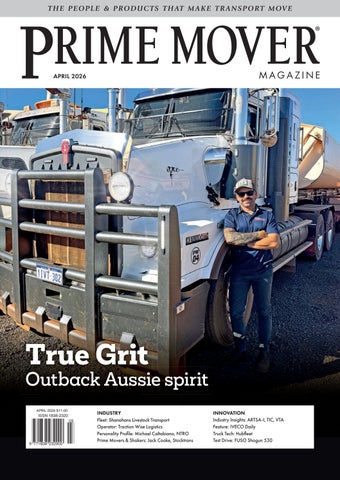


![]()


INDUSTRY
Fleet: Shanahans Livestock Transport
Operator: Traction Wise Logistics


Personality Profile: Michael Caltabiano, NTRO

Prime Movers & Shakers: Jack Cooke, Stocktrans
INNOVATION
Industry Insights: ARTSA-I, TIC, VTA
Feature: IVECO Daily
Truck Tech: Hubfleet

Test Drive: FUSO Shogun 530


Is your workhorse pulling its weight? If youʼre still driving a ute, nowʼs the perfect time for an upgrade. The all-new Isuzu Ready-to-Work range tows and carries more than your average ute. It also comes with a sleek new cab design, more advanced safety features and car-like comfort.


With a wide choice of factory-built bodies designed to our exact specifications, Isuzu Ready-to-Work trucks are ready to get the job done. Are you ready to step up to a redefined workhorse?
Head to isuzu.com.au or visit your nearest Isuzu Trucks Dealer today.


Australia’s leading truck magazine, Prime Mover, continues to invest more in its products and showcases a deep pool of editorial talent with a unique mix of experience and knowledge.


Christine Clancy | CEO
With more than two decades of experience as a media professional, Christine has worked in newsrooms across Canada, Vietnam and Australia. She joined the Prime Creative Media team 12 years ago, and today oversees more than 43 titles, including a dozen print and digital transportation titles. She continues to lead a team that focuses on continuous improvement to deliver quality insights that helps the commercial road transport industry grow.
Paul Lancaster | Editor
Paul joined Prime Creative Media as an editor in March 2025 and has enjoyed a broad career spanning over 20 years across different sectors, including law, journalism and marketing in Australia and internationally. He gets great satisfaction from creating targeted content that appeals to wide ranging audiences. Paul says this comes from listening to industry members, businesspeople and the broader community.
Peter Shields | Senior Feature Writer
A seasoned transport industry professional, Peter has spent more than a decade in the media industry. Starting out as a heavy vehicle mechanic, he managed a fuel tanker eet and held a range of senior marketing and management positions in the oil and chemicals industry before becoming a nationally acclaimed transport journalist.

Ashley Blachford | Business Development Manager
Handling placements for Prime Mover magazine, Ashley has a unique perspective on the world of truck building both domestically and internationally. Focused on delivering the best results for advertisers, Ashley works closely with the editorial team to ensure the best integration of brand messaging across both print and digital platforms.


CEO Christine Clancy christine.clancy@primecreative.com.au
Editor Paul Lancaster paul.lancaster@primecreative.com.au
Managing Editor, Luke Applebee Transport Group luke.applebee@primecreative.com.au
Senior Feature Peter Shields Writer peter.shields@primecreative.com.au
Business Ashley Blachford Development ashley.blachford@primecreative.com.au Manager 0425 699 819
Art Director Blake Storey blake.storey@primecreative.com.au
Design Jacqueline Buckmaster, Danielle Harris
Client Success Ben Sammartino Manager ben sammartino@primecreative.com.au
Head Of ce 379 Docklands Drive, Docklands VIC 3008 info@primecreative.com.au
Subscriptions
03 9690 8766 subscriptions@primecreative.com.au
Prime Mover magazine is available by subscription from the publisher. The right of refusal is reserved by the publisher.
Annual rates: AUS $110.00 (inc GST). For overseas subscriptions, airmail postage should be added to the subscription rate.
Articles
All articles submitted for publication become the property of the publisher. The Editor reserves the right to adjust any article to conform with the magazine format.
Copyright PRIME MOVER magazine is owned and published by Prime Creative Media. All material in PRIME MOVER magazine is copyright and no part may be reproduced or copied in any form or by any means (graphic, electronic or mechanical including information and retrieval systems) without written permission of the publisher.
The Editor welcomes contributions but reserves the right to accept or reject any material.
While every effort has been made to ensure the accuracy of information
Prime Creative Media will not accept responsibility for errors or omissions or for any consequences arising from reliance on information published. The opinions expressed in PRIME MOVER magazine are not necessarily the opinions of, or endorsed by the publisher unless otherwise stated.


“The old saying is, you’d never pass up an opportunity and I’m a bit of an opportunist. I like to act on stuff. I want to keep the business pushing along and growing and taking on new ventures. Put yourself under pressure for a while.””


30 MAN-ing Up
Lactalis Australia in Victoria has developed a love affair over the years with MAN trucks thanks to its close relationship with Penske Truck Leasing. That collaboration has seen the Victorian operations of the international dairy producer become a fully MAN-ed fleet.
32 Beefy Cargo
When it comes to transporting precious beef cattle as cargo across the country, Shanahan’s Livestock Transport requires optimal axle configurations for its fleet of Kenworth trucks.
36 Smooth Ride
South Australian logistics start-up, Traction Wise Logistics, is so positive about the capabilities and comfort of the DAF’s XG Plus that it would convert its entire fleet to feture them.
& TECH
42 Daily Drive
The latest series of the IVECO Daily brims with enhanced safety and driver facilities. Prime Mover took the rig for a test drive to find out all about what makes this truck a safe bet.
46 Audit Ready
Compliance technology provider, Hubfleet, is preparing transport operators for a new era of HVNL safety accountability through a purpose-built digital SMS platform.
54 Pack Leader
The latest Fuso Shogun, the Warrior 530, can justifiably lay claim to the title of the most powerful Japanese truck available in Australia. Prime Mover took it out for a test drive.

Paul Lancaster Editor
Stepping into the editor’s role at Prime Mover has been both a privilege and a genuine thrill – and one of the most rewarding parts so far has simply been getting out from behind the desk and into the industry itself.
There’s only so much you can learn about road transport from a screen. The real heartbeat of this sector isn’t found in press releases or online posts; it’s at the depots, of ces, warehouses, truck stops, workshop bays and across the tables at industry forums where the future of freight is being debated.
Being fresh to the role has given me a valuable opportunity: I hope to listen more than talk. I’ve been making a point of meeting eet owners and operators, OEM representatives, suppliers, association leaders and government stakeholders – not just to introduce myself, but to better understand what makes this industry tick.
What’s already clear is that trucking in Australia is built on relationships
and resilience. Whether it’s a small family eet running a handful of prime movers or a national operator managing hundreds of assets, the challenges are real – rising costs, regulatory pressures, driver shortages, technology transitions – but so is the determination to adapt and move forward.
One of the things I most enjoy in the role is hearing people’s backstories – the personal touch. Why someone chose a particular truck brand. How a business survived a downturn. What keeps an owner awake at night – and what keeps them motivated to keep investing. Those insights don’t always make it into a spec sheet, but they are the fabric of this industry, and they are exactly what Prime Mover exists to capture.
What I’ve learned from a ‘mixed bag’ career spanning different sectors is that the old adage of ‘it’s not what you know, but who you know’ is allimportant. This has been drummed into me several times over the years by my now octogenarian father.
Over the coming months, I’m looking forward to attending more events, conferences and industry forums across the country. From major transport expos to association meetings and
policy discussions, these gatherings are where ideas are exchanged and where the direction of the sector is often shaped. They’re also invaluable opportunities to connect face-to-face which is something our industry still values deeply.
Networking with eet operators, manufacturers and distributors, government representatives and industry bodies isn’t just about building contacts; it’s about ensuring this magazine re ects the full picture. We want to represent the workshop oor and the boardroom, the regional carrier and the multinational OEM, the policy maker and the driver.
Prime Mover has long been a respected voice in the Australian trucking landscape. As I settle into this role, my goal is to honour that legacy while bringing curiosity, energy and accessibility to the conversation. If there’s a story you think needs telling, a challenge that deserves attention or an innovation worth spotlighting, I want to hear from you.
The road ahead is a busy one, and I’m looking forward to travelling it alongside you.


The Australian Livestock and Rural Transporters Association (ALRTA) is calling on the Federal Government to provide clear leadership and transparency on Australia’s diesel supply situation.
Diesel prices across parts of regional Australia are surging as supply pressures begin to emerge, with transport operators reporting diesel price increases of between 30 and 60 cents per litre, with some regional fuel suppliers also introducing rationing measures.
ALRTA President, Gerard Johnson, said while isolated supply pressures were being reported, the priority must be maintaining confidence and stability across the freight network.
“Transport operators and regional communities need clear information and reassurance that Australia has sufficient fuel supplies and that appropriate measures are in place to maintain stability,” he said.
“Panic buying only risks making the situation worse. What we need right now is calm behaviour from consumers and strong leadership and transparency from government.”
The rapid increase in diesel prices is

now placing immediate pressure on rural freight operators who already operate on extremely tight margins.
For many transport businesses, the jump of 30 to 60 cents per litre represents a 10 to 20 per cent increase in operating costs almost overnight. According to the ALRTA, any disruption to freight operations will have direct consequences for Australia’s food and export supply chains.
“With industry margins typically sitting between three and seven per cent, that level of cost escalation places enormous pressure on the viability of small and medium regional operators,” Johnson said.
“If diesel becomes unavailable or unreliable along key freight routes,
TRUCK TECH has reinforced its commitment to sustainability and operational performance with the addition of six BYD utes to its national fleet.
The move forms part of the company’s broader ESG strategy and focus on emissions reduction, as it continues to work with some of Australia’s largest transport fleets on proactive maintenance and responsible fleet management.
Truck Tech said the investment reflects its belief that sustainability and fleet performance go hand in hand. Well-maintained, modern vehicles not only deliver improved efficiency and safety outcomes but
also contribute to lower environmental impact across operations.
By upgrading its own fleet, the company aims to ensure its internal practices mirror the standards it promotes to customers.
The new BYD utes support Truck Tech’s long-term objectives of delivering modern, future-ready fleet solutions, achieving measurable emissions reductions and demonstrating leadership through practical action.
The fleet upgrade comes as more service providers across the transport sector look to electrification and lowemission vehicles as part of broader decarbonisation strategies.
trucks do not move.”
The ALRTA is also cautioning the Federal Government against rushed policy responses aimed at reducing fuel prices at the bowser.
“For transport operators the loss of fuel tax credits can effectively add a further five to seven per cent to operating costs almost immediately,” Johnson said.
The ALRTA claims the priority should be ensuring supply stability and providing clear communication to industry and the community.
“The priority must be ensuring fuel continues to flow so trucks can continue to keep supermarket shelves stocked and deliver the export commodities that underpin Australia’s economy,” the ALRTA President said.


BECAUSE HAULING DIRT, ROCK, AND RUBBLE NEEDS SERIOUS MUSCLE.


A 16L Detroit engine delivering low-end torque is exactly what you need to get those heavy loads rolling. Paired with an aerodynamic design, the Cascadia is built to maximise payload and minimise running costs.
UNDERESTIMATE AT YOUR OWN COST


The Livestock, Bulk and Rural Carriers Association’s (LBRCA) has decided to end its 40-year association with the Australian Livestock and Rural Transporters Association (ALRTA), following a vote at the LBRCA’s Annual Conference held in Coffs Harbour in February.
The milestone decision comes after formal vote of members, in accordance with the LBRCA Constitution, agreeing to transitioned to operate as an independent statebased advocacy body.
LBRCA President, Wade Lewis, said the decision to resign from the ALRTA was not taken lightly and reflects ongoing and substantive differences in approach, priorities and members’ interests.

The LBRCA considered such matters were no longer capable of being reconciled within the existing structure.
“The decision reflects a clear mandate from Members to ensure the Association can act decisively, independently and in the best interests of livestock, bulk and rural transporters operating across regional
> Fuel tax credits could be lost by 2031, ATA warns
The Australian Trucking Association (ATA) has warned that the industry’s fuel tax credits could be gone by 2031 if the Productivity Commission’s plan is implemented.
ATA CEO, Mathew Munro, made the dire warning in the event the Federal Government combines the Productivity Commission’s recommendation to phase out tax credits with its current approach to road user charging.
The Productivity Commission recommendation focuses on a netzero transition, with emphasis on phasing out the fuel tax credits for heavy vehicles on public roads. Munro has recently wrapped up two weeks of intensive lobbying to defend the industry’s fuel tax credits.
The ATA has met with senior government ministers, ministerial staff and departmental officials, including ATA Chair, Mark Parry, travelling to Canberra and Melbourne to press the industry’s concerns.
Munro said the ATA had shared forecasts of the fuel excise, road user
and rural NSW,” said Wade Lewis.
“As an Association, we can now focus squarely on outcomes for our members, both NSW and interstate, at a state level and on national issues that directly impact heavy vehicle operators transporting goods throughout regional and rural NSW,”
Wade said.
“We will continue to engage constructively with governments, regulators, industry and stakeholders, but will now do it independently and with greater agility.
“You will see some changes over the next twelve months which we know will bring positive outcomes, not just to New South Wales operators, but all operators across the Eastern seaboard.”

charge and fuel tax credit rates with ministers.
“In our meetings, we emphasised that the Commission’s plan assumes that the Government will scrap its existing approach to road pricing,” he said.
“We pointed out that it is not possible to increase the road user charge in line with a road pricing model and implement the Commission’s phase out as well.
“This approach would increase effective fuel tax by more than 10 per
cent per year and would mean the industry’s fuel tax credits would be gone by 2031.”
Munro emphasised that freight costs would skyrocket if the fuel credits were ended, leading to thousands of trucking businesses failing.
“Our members have raised the possible removal of fuel tax credits as their number one issue. We have responded by giving it our highest priority. We must deal with the issue right now because the Government is preparing its budget,” he said.


The National Truck Accident Research Centre (NTARC) has launched its latest heavy vehicle safety resource to help drivers cope with steep descents.
The Mount Ousley Steep Descent Resource, relevant to what many drivers see as the notorious Illawarra Descent, was launched at the National Road Freighters Association (NRFA) annual conference.
The resource is a significant milestone in the NTARC’s ongoing mission to reduce heavy vehicle incidents through peer-led, impactful safety resources and features a detailed instructional video and a “Hill on a Page” quick-reference guide specifically designed for the notorious Mount Ousley descent.
To ensure the advice is practical and grounded in real-world experience, NTARC partnered with local transport operator, Ross Transport.
As a third-generation Wollongong business, Ross Transport’s drivers navigate the escarpment daily, making them the leading authorities on the unique challenges of the route.
“Mount Ousley is a beast of a hill, and it doesn’t matter if you’ve been driving for two years or twenty; if you don’t
The NTARC has released a new resource for HV drivers tackling the Illawarra Descent. Image: NTARC.

respect it, it can catch you out,” said Ross Transport Business Manager, True Ross.
“We’re proud to put our name to this project. Our fleet is a part of this community, and we want every driver—especially those visiting the Illawarra for the first time—to get to the bottom safely.
“This isn’t just about technical rules; it’s about sharing the ‘local’s knowledge’ on gear selection and speed management before the descent even begins.”
The Mount Ousley resource is part of a series of site-specific safety tools.
By combining high-production video featuring the well-known Ross Transport fleet with concise, “hard
A major safety transformation on one of the most important highways in regional New South Wales is now finished.
Motorists are set to benefit from safer, smoother and more reliable journeys through Sidling Hill on the New England Highway, after a critical four-kilometre stretch of the highway was upgraded south of Uralla. The works mark the completion of the second stage of the Sidling Hill upgrades, building on earlier improvements delivered to the north and south and creating a consistent, higher safety standard through this challenging section of highway. The first stage of works
strengthened the corridor with improved road alignment, upgraded barriers and enhanced line marking to reduce the risk of serious crashes through the steep and winding terrain.
The second stage has delivered:
• wider road shoulders to improve recovery space;
• new rumble strips to prevent runoff-road crashes;
• extended southbound overtaking lanes to reduce driver frustration and unsafe manoeuvres; and
• additional safety barriers to better protect motorists.
Around 4,000 vehicles travel this stretch of highway every day,
copy” guides, NTARC aims to provide operators with a turnkey solution for driver induction and “Toolbox Talk” sessions.
Features of the Mount Ousley resource include:
• Localised Video Insights: Stepby-step visual walkthroughs of the descent, including gear engagement points and brake cooling strategies.
• “Hill on a Page” Guide: A highimpact PDF summary highlighting mandatory 40km/h zones, safety ramp locations, and critical decision points.
• Peer-to-Peer Learning: Advice delivered by professional drivers who live and work in the Illawarra heartland.
including approximately 650 heavy vehicles – making this a vital freight and commuter link connecting communities across regional NSW.
“This is one of the largest and most complex safety upgrades delivered in this part of the state, and it will make a real difference for the thousands of motorists and hundreds of heavy vehicles that use this route every day,” said Federal Minister for Regional Development and Local Government, Kristy McBain.
“The Albanese Labor Government is proud to partner with the Minns Labor Government to deliver major safety upgrades on key regional highways like the New England Highway.”


“Please watch the road”


Act on the most urgent risks in seconds.


Geotab’s new all-in-one video telematics solution, the GO Focus Plus, automatically flags distracted driving, tailgating, hard braking and other serious events immediately, delivering instant in-cab voice feedback to enhance driver safety. For managers, patterns and urgent cases rise to the top for fast review and targeted coaching, all in one workflow that tracks follow-up and results. Spend less time searching and more time supporting every driver, addressing risk, encouraging improvement and recognising safer habits.
Ready to transform your fleet?
Visit www.geotab.com/au/ to learn how our telematics solutions can drive your business forward.

Ron Finemore Transport has taken delivery of its first Mercedes-Benz Actros ProCabin to boost safety, efficiency and reduce emissions.
The operator moved quickly to secure the ProCabin following its local release, aligning the newgeneration Actros with its longstanding commitment to operating one of the safest and youngest fleets in the country.
Daimler Truck Australia Pacific President and CEO, Daniel Whitehead, said Ron Finemore Transport was a natural early adopter of the new model.
“Ron Finemore Transport’s focus on safety and efficiency is legendary within the industry, so we knew they would be keen to get into the amazing new Mercedes-Benz ProCabin,” he said.
“We’re also thrilled to hear the
truck has been performing beyond expectations with efficiency and that the advanced safety suite is also much appreciated.”
The ProCabin features aerodynamic redesign, reducing drag and delivering fuel consumption improvement.
Ron Finemore Transport CEO, James Dixon, said the ProCabin supports the company’s broader operational strategy. “Ron Finemore Transport is proud to operate the safest, youngest and most modern fleet in Australia and we are committed to boosting efficiency, driving down emissions and adopting the safest vehicles that we can get our hands on,” he said.
“It is still early on, but the ProCabin has already proven to be extremely efficient in its first month on the road. We are also extremely pleased
XFM has marked a major milestone with the opening of a new facility in Pooraka, South Australia.
The new site is a significant upgrade from XFM’s previous location, providing the business with a modern and spacious depot designed to support the next stage of its growth. It features nearly 5,000 square metres
under roof and a large hardstand to enable smoother truck movements and staging.
According to XFM, the Pooraka site will also offer greater efficiency in inbound and outbound operations with improved pick-up and delivery loading/unloading to reduce dwell time.
that it features the Active Brake Assist 6 safety package because we are fully committed to the safety of our drivers and other road users.”
The ProCabin introduces a new fiveradar active safety suite as standard across the Actros range. Active Brake Assist 6 now incorporates five radars providing a 270-degree view around the vehicle, optimising the performance of Active Side Guard Assist 2. The system is underpinned by a new electronics platform capable of processing data 20 times faster than its predecessor.
Delivered by Daimler Trucks Albury, the Ron Finemore Transport Actros 2663 features a 16-litre MercedesBenz engine paired with a 12-speed automated manual transmission. The unit is fitted with a black Durabar bullbar developed in collaboration with Mercedes-Benz engineers.
“[This facility] is another strong investment in the future of our Adelaide operations and the wider XFM network,” XFM said.
“This is an exciting step forward – not just for the Adelaide team, but for the entire XFM business.
“Thank you to everyone involved in making this move seamless.”


in the 80s. Big hair, big suits, big phones and, starting in 1982, the first big FUSO heavy-duty truck. Now it’s time to go even bigger with the new FUSO Shogun 530, a 13-litre hauler with the biggest power figure of any Japanese truck – 530 horsepower. It can haul big weights too, up to 70 tonne GCM, and comes packed with advanced * FUSO Shogun 530. Because bigger has always been better.
Learn more at your authorised FUSO dealer or visit


Viva Energy’s Geelong refinery has received international certification to produce co-processed renewable diesel, opening the door to new sustainable fuel being made in Australia.
The international certification also includes production of recycled polypropylene (rPP) and biopolypropylene (bioPP) products, which are critical components in the growing market for recycled food-grade plastic.
These products can all be manufactured at the Geelong refinery using sustainable feedstocks, including used cooking oil and soft plastics pyrolysis oil made from waste plastic.
In the past 12 months, Viva Energy worked on a trial with Intersnack ANZ, owner of Snackbrands Australia, that involved co-processing used cooking oil from the production of well-known snacks such as Kettle Chips, CC’s, Cheezels and Thins.
The trial converted the used cooking oil into a certified bio circular polymer, which was then used to produce ISCC+ certified, food-grade packaging for Snackbrands’ iconic products.
The ISCC+ (International Sustainability & Carbon Certification) recognition supports Viva Energy’s circular, bio-based and renewable material processing, which helps build customer trust and market transparency, resulting in greater confidence in the sustainability of
these products.
The certification for renewable diesel is an important breakthrough for Viva Energy, positioning the Geelong refinery to become an early manufacturer of low carbon liquid fuels.
This will support the government’s Future Made in Australia and Cleaner Fuels Programs which encourage the development of a lower carbon fuel manufacturing industry to reduce emissions from transport and other fuel-using sectors.
Co-processed renewable diesel is a “drop-in” product that is manufactured by processing a biogenic oil, such as used cooking oil alongside traditional crude oil. It is a quicker and more cost-effective way of producing these fuels by co-processing at an existing refinery than through the construction of dedicated plants.
The co-processed renewable diesel produced will allow diesel users such as heavy vehicle fleet operators to reduce their carbon footprint without having to purchase different technology or modify existing vehicles.
There has been steady growth in the demand for renewable diesel as more businesses seek emissionreduction solutions that are easily implemented. However, until now that renewable diesel has been imported from overseas, but this certification opens up the pathway for it to be manufactured in Geelong.
Viva Energy Chief Strategy Officer, Lachlan Pfeiffer, said the ISCC+ certification had the potential to open new fuel markets as businesses hunt for ways to reduce Scope 1 emissions in a cost-effective way.
“Our goal is to create a variety of options that support our customers’ decarbonisation journeys,” he said.
“We have our Australian-first new energies service station in Geelong offering renewable hydrogen refuelling and EV charging for heavy vehicles and now we are looking to turn waste oil into valuable, lower carbon fuels.
“All of these initiatives will help to contribute to Australia’s energy transition and the country’s fuel security.
“That is why having local refining is so important for the country. We play an existing role in supporting our energy security through traditional fuel manufacturing and we have the technology, skills and connection to existing supply chains to costeffectively develop these lower carbon options in support of the energy transition.”
Lachlan Pfeiffer said that for Australia to truly unlock the power of low carbon fuels, government recognition of coprocessing within the NGERS scheme is essential.
This support will encourage investment and help Australian businesses adopt new solutions that cut emissions and drive competition, he said.
The National Transport Commission (NTC) has released consultation material on a new model for setting truck fuel and registration charges.
The NTC says the new Forward Looking Cost Base (FLCB) model would not affect the way trucking businesses claim fuel tax credits and pay registration. Instead, it would help determine the level of those charges, it says.
The NTC argues that the existing model for setting truck charges, PAYGO, is no longer fit for purpose.
Among other changes, the FLCB would spread the cost of road construction and maintenance over the life of road assets. This approach is intended to improve the stability and predictability of truck charges.

The NTC has released details of a proposed new method of determining fuel and registration charges. Image: Mino21/stock.adobe.com.
If endorsed by Australia’s transport ministers, the FLCB could be used to set charges from 2027-28 onwards. Transport ministers are separately considering the results of industry consultation on their preferred charging option for 2026-27, a six per
Centurion has moved 63 mining trucks for Hastings Deering and Caterpillar as part of a large logistics operation.
The project involved transporting 63 Caterpillar 793 mining trucks from the Port of Brisbane to the Hastings Deering facility at Acacia Ridge before they were distributed to mine sites across the Bowen Basin.
Centurion CEO, Justin Cardaci, attended a Fleet Milestone &
Appreciation Event to mark the completion of the operation and recognise the teams involved.
According to Cardaci, the scale of the project required extensive coordination and planning from Centurion’s logistics, operations and driving teams.
“The Centurion team moved sixtythree Caterpillar 793 mining trucks from Brisbane Port to the Hastings facility at Acacia Ridge, and then

cent increase in charges compared to 2025-26.
In its submission to the FLCB, the Australian Trucking Association (ATA) has argued that charges should increase by no more than four per cent.
onward to their respective mine sites across the Bowen Basin,” he said.
“All done safely and without incident –what an amazing achievement.”
Cardaci said projects of this scale highlight the importance of strong operational planning and teamwork across the supply chain.
“Moves of this scale take serious planning, precision logistics and a team willing to go the extra mile,” he said.
“From our drivers and planners to operations staff working tirelessly behind the scenes, I couldn’t be prouder of everyone involved.”
The project was delivered in partnership with Hastings Deering and Caterpillar, with the trucks ultimately destined for mine sites across the Bowen Basin.
Cardaci also acknowledged the broader project team at Hastings Deering during the event, including Chief Operating Officer Tiffany Kirkwood.
“This project is a great example of what strong partnerships and great teams can deliver,” he said.
TIER IV, a pioneering force behind open-source software for autonomous driving, has completed proof of concept tests for long-haul autonomous trucking with Yamato Transport Co., Ltd. (Yamato Transport) and Mitsubishi Fuso Truck and Bus Corporation (MFTBC).
The tests, part of a Japanese government initiative, evaluated vehicle performance, safety protocols and operational workflows, with customer freight transported on a semi-trailer truck equipped with Level 2+ technology. The data and operational insights gathered will be used to refine autonomous driving technology, with the ultimate goal of integrating Level 4 trucks into Yamato Group’s long-haul transportation routes.
The testing period took place from 1620 February 2026 on a route from the Haneda Chronogate Base Tokyo to the Kansai Gateway Base in Osaka.
Two round trips (four legs) of the approximately 500-km route were completed. The truck operated at Level 2+ for 100 km on the Shin-Tomei Expressway between two service areas in Shizuoka Prefecture.
The truck was evaluated on a number of capabilities during the tests, including:

• Vehicle performance and safety
• Collection of trailer motion data, including sway and articulation trajectories.
• Performance verification, tracking hands-off duration and lane-keeping accuracy.
• Analysis of surrounding conditions, driver decision-making criteria and other factors linked to manual interventions.
• Travel time - Confirmation that schedules were maintained during Level 2+ driving as reliably as during manual operations, without delays.
• Operational workflows - Trials of systems that automate parts of the pre-trip inspection, such as tire pressure checks.
• Remote monitoring of vehicle status and surroundings to prepare for future Level 4 operations. The semi-trailer test driver said of the experience: “There was a bit of a learning curve at first, but once I understood how the system behaves, I felt at ease. Looking ahead, I hope autonomous trucks become a reliable partner for us, helping to maintain our hauling capacity.”


Global delivery and shipping company, FedEx has announced the ten-member Board of Directors for FedEx Freight, ahead of its planned spin-off from FedEx in June.
Current Executive Chairman of the FedEx Board of Directors, Brad Martin, will serve as Chairman of the FedEx Freight Board.
Incoming President and Chief Executive Officer of FedEx Freight, John Smith, will also serve as a Director alongside eight highly experienced leaders across the transportation and logistics, supply chain management and technology sectors.
“We’ve assembled a group of prominent industry leaders who share a strong commitment to the customerfirst culture that defines FedEx,” Martin said.
“Their diverse perspectives and proven leadership will be instrumental in supporting FedEx Freight as it executes a focused strategy and

builds on its position as the largest North American LTL freight carrier with industry-leading transit times, service levels and reliability.”
The remaining eight Board members are Jeffrey Davis, Donald Frieson, Stephen Gorman, Robert King, Cindy Miller, Amy Salcido, John Sauerland and Samantha Smith.
FedEx has announced the Board of Directors for FedEx Freight. Image: Sundry Photography/ stock.adobe.com.
“I look forward to working with our incoming directors upon completion of the spin-off, leveraging their experience and perspectives, while continuing to partner with Brad and our leadership team as we progress toward launching a world-class, independent organisation,” Smith said.
UK battery and solar-powered transport refrigeration unit manufacturer, Sunswap, has entered the Australian market.
The move Down Under marks Sunswap’s expansion into a sixth international market as global demand for zero-emission transport refrigeration accelerates.
The company’s Australian entry, through a strategic partnership with Protran Solutions, follows rapid international expansion across the UK, Belgium, Netherlands, France and most recently Chile and Latin America, where its Endurance model is enjoying a market surge.
Sunswap’s expansion accelerates as operators discover electric refrigeration, particularly the Endurance model, delivers not just zero-emissions but up to 81 per cent reduction in operating costs while eliminating maintenance complexity.
Endurance delivers 24 hours of frozen operation from a single charge, with trailer-top solar extending range and reducing charging requirements.
The units handle -25°C frozen to ambient temperature control across demanding commercial routes, proven through daily operations spanning multiple climates, countries and operational profiles.
Protran Solutions brings decades of combined transport refrigeration experience to provide local sales, service and technical support across Australia.
“European operations prove this technology works in demanding commercial use,” said Protran Solutions General Manager, Grant Turner.
“Australian operators need refrigeration that performs reliably while reducing costs. Endurance delivers both.”
Sunswap’s battery and solar-powered Endurance units now operate for major retailers and logistics operators including Tesco, DLG, Ocado and Noble Foods.
“Operators are choosing Endurance because it handles demanding operations better than diesel while cutting costs dramatically,” said Sunswap CEO, Michael Lowe.
“The environmental benefit is the outcome, not the compromise. That’s what’s driving adoption globally - fleets get better performance, lower costs, and zero emissions. The partnership with Protran brings that to Australian operators.”
The Australian expansion follows Sunswap’s recent manufacturing scale-up at its Surrey facility and continues the company’s international growth as fleets worldwide replace diesel transport refrigeration with electric alternatives.
French hydrogen mobility specialist, Hyliko, has renewed and expanded its renewable hydrogen supply agreement with Lhyfe.
This will lock in the required support for two heavy vehicle refuelling stations in the Paris region.
The new multi-year contract, effective from November 2025, extends Lhyfe’s supply to Hyliko’s flagship station at Villabé (Essonne) and confirms Lhyfe as the supplier for a second site in Tremblay-en-France (Seine-SaintDenis), due to come online in 2027. Together, the agreement covers more than 200 tonnes of RFNBO-certified renewable hydrogen.
Lhyfe already supplies the Villabé station, which has recorded strong early demand. According to the companies, hydrogen dispensed from the site has enabled heavy vehicles to travel more than 342,000 kilometres, avoiding around 234 tonnes of CO₂ emissions and saving close to 110,000 litres of diesel.
The Tremblay-en-France station will be located near the Roissy logistics hub and the A1 motorway, targeting decarbonised freight movements in one of Europe’s busiest transport corridors.
The hydrogen supplied under the contract is certified under the EU’s Renewable Fuels of Non-Biological Origin (RFNBO) standard, making

it eligible for France’s forthcoming TIRUERT (Tax incentive for the use of renewable energy in transport) scheme. Once the final decree is published, Hyliko will be able to generate certificates linked to the hydrogen it distributes, creating an additional revenue stream that could reduce pump prices by an estimated €4-6 per kilogram.
Hyliko Managing Director, Ovarith Troeung, said the renewed partnership was central to the company’s longterm strategy.
“The renewal of our partnership with Lhyfe is part of a long-term collaboration aimed at securing access to renewable hydrogen for

heavy transport applications,” he said.
“This approach will enable us to consolidate a network of stations in line with market needs and anticipate the entry into force of future regulations.”
Lhyfe founder and CEO, Matthieu Guesné, said the expansion highlighted growing momentum behind hydrogen for heavy transport.
“The results of its Villabé station and its decision to open a second station clearly demonstrate the relevance of hydrogen mobility for heavy goods vehicles,” he said.
“With Hyliko we are taking action and making the decarbonisation of goods transport a reality.”


A country-boy-at-heart from Western Australia’s south-west, Matt Henderson has relied on his instincts to become a leading name in Pilbara civil haulage through his business MDH Transport - a haulage business built on a steely resolve and an unshakeable belief in hard work.
The wide, open spaces of Western Australia’s mining country are seen by many as the land of opportunity.
For Matt Henderson that land is not only a source of opportunity, but selfful lment and growth.
His eponymous MDH Transport, named after Matt Daniel Henderson, has been serving clients in the civil and mining, agricultural and infrastructure sectors for the past 15 years or so.
From managing side tippers in the Pilbara, which ply their trade between Dampier and Tom Price, to a cattle hauling company in the south-west, the 40-year-old Managing Director is right at home in the great outdoors.
MDH Transport operates a civil haulage business that spans thousands of kilometres, employs 50 full-time drivers and operates a eet of over 45 Kenworths and a mix of Volvo and Mack trucks.
The transport company has grown into a signi cant civil haulage operation servicing some of Australia’s biggest mining projects, while also expanding into livestock through its sister arm, MDH Livestock.
Among all this growth, the man with country in his blood feels perfectly at home; still very much hands on.
“I’m not an of ce person,” he says. “I run most of it from my phone, and I have a team of six people in the Perth
of ce, and a supervisor in the northwest, who do a lot.
“I still do a bit of driving when I can.”
Business Basics
MDH Transport has developed into one of the largest bulk haulage providers in Western Australia, spanning across the Pilbera region and the state’s northwest, providing civil construction and bulk haulage services, while also supplying graders and water carts.
It is Matt’s knowledge of trucks and industry experience that has seen the business recently acquire six new Minespec T659 Kenworth prime movers, to add to his eet.
The new acquisitions have added

to Matt’s growing eet of big rigs, complemented by more than 40 sets of Side-tipper and End-tipper trailers — ideal for moving aggregate rapidly and ef ciently.
This steady growth has seen the company develop a site at the Karratha LIA as well as a purpose-built yard, workshops, and accommodation facilities.
It’s clear to see the haulage company that started from one man’s self-belief and determination now has plenty of Western Australia covered.
Starting in the dog-eat-dog world of trucking 15 years ago to where he is
now running a multi-million-dollar enterprise at just 40, it’s fair to say that Matt Henderson isn’t one to wait around for something to happen.
“The old saying is, you’d never pass up an opportunity and I’m a bit of an opportunist,” he says.
I like to act on stuff. I want to keep the business pushing along and growing and taking on new ventures. Put yourself under pressure for a while.”
Like many young men searching for a future direction, after leaving high school Matt had something of a nomadic career.
“I left school, went on the machines for a couple of years, then worked on a farm. I’ve worked for myself for
probably fair bit of my life. I’ve had a bobcat business down south in Busselton and then went up north,” Matt recalls.
It was the global economic downturn in 2007 that was the spur for Matt to look further a eld – the lucrative mining regions in the north, where his experience with machinery would come to the fore. Rather than sit tight in the south-west, he was north-bound.
“No one was building houses, and it was all pretty quiet, so I got into the mining area,” Matt recalls.
The allure of driving rigs on the open road saw Matt enjoy a stint as a driver for a haulage company called Earth X logistics.

Ironically, it was the GFC of 2007-2008 that would set Matt on the trajectory that would eventually cement MDH Transport on the mining landscape.
Growing up in Western Australia’s wine-rich southwest, a career in wine making beckoned early on.
“I was actually thinking of going into the viticulture industry,” Matt explains. He graduated from the WA College of Agriculture at Harvey, not far from his hometown of Busselton. “I got plenty of skills and certi cates through that college, which basically steered me to where I wanted to go.”
But between 2005 and 2007 Western Australia’s wine industry fell in a deep hole.
It proved to be a decisive time for the young man who enjoyed working outdoors.
“People were pulling out vines, so that sort of scared me away from that. It just steered me into the earthmoving and
trucks and trucks and diesel, they all sort of go hand in hand and are fun,” Matt recalls.
It hasn’t been all plain sailing for the entrepreneurial business operator. In those formative years growth was far from linear — more stop-start.
In 2014, working in Derby, Western Australia, renowned for its diamond mining, Matt’s young business was left exposed when a client collapsed into administration amid nancial turmoil.
“We were owed a lot of money. We got done over and got very little in return,” Matt recalls.
For a edgling company with just a handful of trucks, it was a brutal hit, almost bringing the business to its knees.
“You just work harder, you just to get yourself out of that problem,” Matt recalls.
“Some luck probably came my way with work, and you just got to work and be there and grow with your clients. That’s the way I see it.”
That perseverance has paid off.
“Now, I’ve got a very strong and healthy relationship with my client now. I’m their go-to for anything that needs to be moved on the back of a truck,” Matt says.
That client specialises in railway building for the mining industry.
“We’d be coming up to seven years with them, working in the mining industry,” Matt says.
“That’s what it’s all about, having reliable clients, and you can supply the goods they need.”
There’s no self-pity in Matt retelling the story — just matter-of-fact resolve. He describes himself as “wired a bit different”.
“I’ve always been a hard worker, a bit like my dad. You just can’t give up. I’m a provider and I want to succeed and grow and become a bigger company,” he says.
“Your company becomes a brand. In essence, your name sort of becomes a brand. MDH Transport – that’s Matt Daniel Henderson. It’s pretty easy.
“You have to maintain that sort of attitude and I tend to work hard towards that and see what happens.”
Even a setback that large hasn’t landed a fatal blow for his business, that would have otherwise ended many operators.
In the Pilbara, opportunity came as a different form in the mining industry.
Matt noticed the side tippers working on rail and civil projects — steady, essential work supporting mining infrastructure rather than mining ore itself.
“I was up there for a couple of years and then I saw these side tippers and got the idea for doing haulage for myself. And the rest is history, it all grew from there,” he says.
Matt started out with one Mac truck and then another, before heading towards the reliability of Kenworth rigs.
“In the early days, it was a bit tough and a bit nerve-wracking. You nd hard times for sure.”
Mining operations around Karratha, Newman and the Pilbara have been bountiful for Matt, helping him to get a foothold.
“It’s all based around civil stuff, carting aggregates and road base for the mines’ rail lines up there,” Matt explains.
Today, MDH Transport is rmly embedded in the rail and mining sectors of Western Australia’s rich mining country, specialising in civil haulage - aggregates, road base and materials essential to maintaining and expanding rail corridors.
That niche has proven critical for the company’s continued expansion, working with top-echelon mining and energy companies.
MDH Transport’s trucks are in constant use for short haul runs, from quick 20-kilometre trips up to 200 kilometres between Dampier, Tom Price and out to Newman.
One of MDH’s major undertakings is working to maintain Rio Tinto’s 5,000-kilometre rail network across the Pilbara, linking its mines to coastal ports. MDH Transport’s trucks work within that ecosystem, supporting contractors responsible for ongoing maintenance and upgrades.
“We’re in that space of working with our client, the contractor, maintaining that rail system, as they’re constantly doing upgrades on the go,” Matt explains.
“They’re also doing the new (rail) lines and doing constant upgrades on it. We’re the leading company with the haulage side of things.”
MDH has also worked with BHP, as well as a large project for Fortescue Metals Group’s (FMG) Eliwana Rail Project railway line, in the Pilbara region. It was also the leading haulage provider on the Roy Hill mine line from 2013 to 2014.
Working in the expansive mining industry Matt knows that reliability and consistency count. “In mining, it’s all about reliable clients and being able to
“The old saying is, you’d never pass up an opportunity and I’m a bit of an opportunist. I like to act on stu . I want to keep the business pushing along and growing and taking on new ventures. Put yourself under pressure for a while.”
MDH Transport and MDH Livestock Managing Director, Matt Henderson
supply,” he says.
“It’s about growing with your clients,” he says. “You supply, you perform, and you build strong relationships.”
Kenworth Country
Central to the company’s growth has been a clear preference in equipment. While Matt’s early days included Mack trucks, today his eet leans heavily towards Kenworth.
“We’ve got the six new Kenworth T659s and we’re moving into more of them — making it nine new ones,” he says.
The Kenworth T659 has become the preference for MDH’s eet strategy, particularly with the Pilbara civil work, where they are paired with side tippers.
“It’s their reliability and it’s about parts availability. They stand up to the harsh conditions,” he says.
“They’re easy to service, as it’s a lot easier to get mechanics to work on a Kenworth, in comparison to other brands.”
In remote Western Australia, that matters. Trucks operating along isolated rail corridors can’t afford lengthy downtime waiting for specialised parts from interstate or overseas.
“With other brands, you need specialist techs to be able to do the work, and they’ve got their own parts so you can’t buy their parts elsewhere. But with Kenworths, you can buy a lot of parts from other providers, other suppliers.”
That serviceability is critical in conditions that Matt describes as “de nitely harsh”.
Matt also highlights that the Kenworth specs enable his drivers to fully complete their pre-start inspections quickly and easily, particularly with Kenworth’s tilting bonnets.
Drivers can log up to 300 hours a month on site, working in heat, dust and isolation along rail lines that cut through some of the country’s most unforgiving landscapes.
With drivers in the seat for long, arduous hours, hauling materials, Matt says the Kenworth’s truck and cabin ergonomics also weighed favourably in the latest purchase of prime movers.
Although the Karratha jobs are relatively short haul - a short 20 kilometres one day, 200 kilometres the next - the terrain multiplies the wear and tear.
The rough road conditions mean the trucks need constant maintenance.
“It’s just too vast. You’re out there in the bush, in the middle of nowhere, working along a rail network. It’s pretty harsh out there, and the trucks get punished by the terrain,” Matt says.
“In Karratha they might only do 50,000 kilometres a year,” he says. “But it triples because of the road conditions.”
With the punishing environment, it’s no wonder that MDH Transport employs three full-time mechanics in its Karratha workshop.
While MDH currently runs around 45 Kenworths, supplemented by some Volvos and Mac trucks, Matt has a de nite eet renewal strategy, aiming to have most trucks under ve years old by the end of next year.
“We have had the T659 series Kenworth models and we’ll continue to get more, and with the eet replenishing program by the end of next year I’d like to have most of my older stuff gone and have the eet with inside of ve years,” Matt says.
“There are some old ones here. There’s some late 2000s – about 2008 to 2009.
“Then they range from a handful of the trucks from 2012 to 2016, and then there’s more models from 2020 up - the newer ones.”
MDH primarily hauls the mining and rail materials using side tipper trailers, working closely with Roadwest, running a large eet of 30 road trains, or sets.
After 15 years of hauling aggregate across Western Australia’s vast and unforgiving Pilbara region, the man, who once dreamt of becoming a wine maker, often has to pinch himself at the empire he has built.
“I’m pretty humble to see where we began, and how it all started. It’s nice to see where it’s all at now,” says Matt. Looking back at his decision to veer away from viticulture and into transport, Matt is convinced it was the right decision.
“With trucks, you can source work all through the state, but it’s not easy to do. You can’t just create work with a truck, like growing something,” he says.
“You need to use them, help that client that people want to use, and they’re all little one percenters, and just try and make your company better than someone else.”
For Matt, it’s not just about working with a good range of clients.
“You need to have good staff. I can’t do all this without my staff. They are very important to me.
“Having good, reliable staff is a is a hard thing to get. So, when you have got them, you need to hold on to them,” he said of his tight-knit team in Perth and in the Pilbara.
Although his day can be lled with managing the business, true to his nature, Matt is more than happy to roll up his sleeves.
He still splits his time between Karratha and the south-west, dividing his time between rail projects in the north and cattle runs down south.
“It’s pretty full on,” he admits. “There’s always a lot going on.”

But he wouldn’t have it any other way.
“I’m still very hands on. I still do driving myself and do a lot of the hands-on stuff myself.,” he says.
“I virtually run everything from my phone.”
While civil haulage remains the core of MDH Transport’s operations, Matt has quietly expanded the business southwards by way of livestock haulage, servicing WA’s south-west, eastern wheatbelt and beyond.
The business has expanded its eet operations into cattle transporting, starting up MDH Livestock — operating mainly in WA’s southwest and the wheat belt.
“We purchased a company called Wedderburn Transport, they’re based out of Brunswick, WA and that’s wholly and solely cattle carting,” Matt explains.
For Matt the purchase wasn’t just an opportunity to grow the business, it was a chance to get back to his roots.
“I’ve been friends with the owners for many years, and when they wanted to retire, we purchased their company, so that’s growing in the southwest of Western Australia,” he says.
“We’ve got good employees down there as well, so that we’re just in a space of building that up over the next couple of years.”
MDH Livestock currently operates a eet of trucks transporting the cattle, with plans to keep growing.
For Matt, working in the outdoors is a big part of what makes his job interesting. “I really enjoy it. I’m not a city boy. It’s nice. Relaxing. Being outside is what I like,” he explains. Working in the state’s cattle region, MDH Livestock is doing a lot of transporting weaner cattle, from the farms to the saleyards.
Covering the huge territory of the south-west across to Western Australia’s wheat belt, the prime movers are each doing about 150,000 kilometres a year.
With operations at opposite ends of Western Australia to manage, one would think Matt Henderson wouldn’t have time for much else. Wrong!
For the past 12 years, Matt has been involved in a car haulage business to Darwin, with two trucks travelling around 250,000 kilometres each per year.
“We’ve also got two trucks that run to Darwin hauling cars for CEVA. Those two trucks will go through to Darwin two-and-half times a month,” Matt shares.
The Darwin trucks are the highkilometre outliers in a eet otherwise dominated by heavy site hours rather than highway mileage. He plans to
introduce two new trucks to the car haulage business in the near future.
The two trucks are currently driven by Matt’s uncle, Max Henderson, and another driver.
Max, who is “70 years’ young”, and on the verge of retiring has been travelling up and down the highway to Darwin for 10 years with MDH Transport, covering about 2.5 million kilometres in that period.
“Max is a very reliable operator doing that amount of driving for 10 years. He’s well-known up and down the highway,” Matt says.
Despite the size that MDH Transport has reached, Matt resists growth for growth’s sake, saying: “I still like to oversee things day-to-day and have a personal relationship with our clients and customers.”
Matt’s ambition is clear. “With both the civil haulage and MDH livestock
I want them to grow more and grow with demand as well,” he says.
“We’ll keep growing it, growing the company to be WA’s leading civil haulier for big civil projects going on.
“To have MDH’s name at the forefront for any big civil projects going on; for anything that needs to be hauled in and out of site.”
That drive is balanced with pragmatism borne from experience.
The Kimberley setback taught him the risks of over-exposure. Choosing good clients, maintaining healthy relationships and managing eet age are now non-negotiables.
“You’ve got to work with good people,” he says. “Choose your clients.”
As an opportunistic man - someone who won’t pass up a chance to expand or improve his businessMatt sees pressure as a motivator, not a deterrent.
“You put yourself under pressure and
“I’ve always been a hard worker, a bit like my dad. You just can’t give up. I’m a provider and I want to succeed and grow and become a bigger company.”
MDH Transport and MDH Livestock Managing Director, Matt Henderson
just keep going,” he says.
Fifteen years on from buying his rst truck, that instinct has carried MDH Transport from a small start-up to a respected name in Western Australian haulage.
“We’ll just keep growing.”
In the vast distances of Western Australia that steady, iron resolve continues to drive MDH Transport forward.
MDH Transport
• Operating for 15 years.
• Civil haulage work.
• Based in WA’s Pilbara region.
• Operates over 45 prime movers.
• Fleet made up of Kenworth, Mac Truck and Volvo prime movers.
• Operates 30 sets of Roadwest side tipper trailers (over 60 trailers).
• Total of over 80 pieces of trailer equipment.
• MDH Livestock operates in southwest Westerna Australia and wheat belt.


For Lactalis Australia, keeping supermarket shelves stocked with dairy products depends on a reliable transport operation.
Behind the scenes, the company’s Victorian transport division manages a complex network of deliveries connecting manufacturing plants, distribution hubs and retail outlets across the state.
At the centre of this operation is a growing eet of trucks supplied through a long-standing partnership with Penske Truck Leasing, built around modern prime movers from MAN Truck & Bus.
Overseeing the system is Daniel Cooksley, Transport Manager for Lactalis Australia in Victoria, who says the company’s internal eet has become a critical part of the dairy giant’s logistics strategy.
Daniel’s role focuses on coordinating the company’s internal transport department, which supports manufacturing operations.
“I manage our internal transport department, consisting of 30 drivers, 15 MAN prime movers and more than 30 trailers across our two main Victorian manufacturing sites in Rowville and Bendigo,” Daniel says.
These vehicles move dairy products between factories, distribution centres and customers, operating across a


A modern eet of leased prime movers is helping one of the world’s largest dairy companies keep fresh products moving across Victoria while improving e ciency, sustainability and reliability.
tightly scheduled network designed to maintain product freshness.
The transport operation supports a manufacturing footprint that stretches across the state and connects with the broader national business.
“Our factories are right around Australia, in every major capital city, every state and territory,” Daniel says.
“They’re all localised products made locally and sold locally.”
Within Victoria, Lactalis maintains a number of production facilities supporting its dairy processing network.
“In Victoria, our main factory site is in Rowville, with our two main production facilities in Rowville and Bendigo,” Daniel says.
“We also have smaller factories in Dandenong and Campbell eld, along with several across regional Victoria.”
From these sites, dairy products move through a distribution network supplying retailers and foodservice customers.
The company’s relationship with MAN trucks began in 2017 as Lactalis looked for ways to modernise its eet, with the rst MAN prime movers entered the operation in 2017. “Lactalis Australia was initially exposed to MAN trucks in 2017, purchasing and operating six prime movers directly,” he says.
As those vehicles aged and the
company’s operational requirements evolved, Lactalis began reassessing how it managed its transport assets.
Eventually, the company decided to expand its eet through leasing arrangements rather than direct ownership.
“As our owned eet evolved and reached end of life, we established a relationship with Penske to initially hire, and then long-term lease, additional prime movers for our predominantly B-double operations,”
Daniel says.
That partnership has since grown into a eet strategy centred almost entirely on MAN trucks supplied through Penske.
Daniel says Lactalis regularly reviews vehicle manufacturers to ensure its eet continues to meet operational requirements.
“Lactalis has used other brands in the past, and we are constantly evaluating a number of brands for suitability in our operation,” he says.
During the company’s most recent review, MAN emerged as the preferred option.
“Our latest evaluation had MAN trucks on top in regard to economy, comfort, speci cations and the support from Penske,” Daniel says.
The decision also aligned with the company’s broader environmental and sustainability objectives.
As part of the global Lactalis Group, the Australian operation places signi cant emphasis on corporate social responsibility and environmental performance.
“The new Euro 6 eet has really helped us reduce our fuel usage,” Daniel says.
But the bene ts extend beyond environmental targets.
“It’s not just about meeting sustainability targets,” he says.
“Less fuel usage equals less cost, especially in the current fuel supply climate.”
The improved ef ciency of the eet has delivered measurable results across the transport operation.
“We are now using less fuel in our operation than we ever have,” Daniel says.
One of the advantages of working closely with Penske, Daniel says, has been the ability to customise trucks to meet Lactalis’ operational requirements.
The current eet is built to a dedicated speci cation tailored speci cally for the company’s distribution network.
“We run exclusively MAN prime movers leased through Penske,” Daniel says.
“Penske has been very helpful in having these trucks built to our own ‘Lactalis spec’, with increased safety and mass management options being built in both ex-factory and optioned locally.”
These modi cations help ensure the vehicles are suited to the company’s demanding transport tasks, which include hauling temperature-sensitive dairy products across Victoria. Safety systems and weight management features are particularly important for B-double combinations operating on long regional routes.
For Lactalis, leasing vehicles has provided several strategic advantages compared with owning trucks outright. Daniel says the leasing model delivers nancial stability while allowing a focus capital investment on other areas.
“The leasing option provides us with a consistent nancial position, without the need to source and use capital that
can be redirected into other business functions,” he says.
Under the leasing arrangement, maintenance and servicing are handled as part of the package, removing unexpected costs and downtime.
“We do not experience surprise repairs and maintenance costs,” Daniel says. “Scheduled servicing, breakdown and after-hours support are included in the package.”
For a transport operation that runs continuously, this level of support is essential.
“The support provided by Penske is important to our operation where we are delivering temperature and timesensitive freight around the clock, seven days a week,” he says.
The reliability of the eet plays a crucial role in supporting the wider dairy supply chain.
Milk and dairy products must move quickly from processing plants to distribution centres and retail shelves. Any disruption in transport can quickly affect product availability, but by maintaining a modern eet backed by strong service support, Lactalis aims to minimise these risks.
The MAN trucks also provide comfort and safety bene ts for drivers, an increasingly important consideration in a tight labour market. Driver satisfaction can in uence retention, productivity and safety outcomes. Looking ahead, Lactalis plans to continue modernising its Victorian eet as older vehicles reach the end of their service life.
Daniel says several new trucks are already scheduled to join the operation.
“We have nine new prime movers slated to be commissioned in 2026, replacing end-of-life eet,” he says. The company’s logistics network continues to evolve as customer demand and distribution patterns change.
“Our business is constantly evolving,” Daniel says. “I am con dent that Penske is in a position to evolve with us.”
The partnership between Lactalis and Penske is therefore expected to remain a key element of the company’s eet strategy.
Penske Truck Leasing Managing Director, Adrian Beach, is pleased to share that the entire Lactalis Victorian eet is made up of MAN prime movers on the Penske full-service lease program. “We wanted to solidify a long-term relationship with Lactalis and truly be their exclusive eet partner,” Adrian says.
“Our branch in Altona North, with its service bay, full-time technician, and rental support vehicles had always been well-positioned to maximise the uptime of their west-side eet.”
He added that with half of Lactalis’s eet based in Rowville takes time,fuel and tolls to travel to Altona.
“So, we built a brand-new standalone Penske Truck Leasing facility in Pakenham with Lactalis in front of our mind.” As a result, Lactalis’s east-side eet is merely 20 minutes away from a dedicated technician, parts, and rental support vehicles.
“We wanted to support this customer and solidify this partnership for many many, many years,”Adrian says.
Daniel says the current combination of MAN trucks and Penske support has proven to be the right collaboration.
“We are brand agnostic for our internal eet,” he says. “But the MAN and Penske service offer is dif cult to surpass.”
For a business responsible for moving large volumes of dairy products every day, reliability, ef ciency and support are critical.
The combination of modern vehicles, tailored speci cations and comprehensive leasing support has allowed Lactalis to build a transport operation capable of meeting those demands.
As the company continues to invest in new equipment and re ne its logistics network, Daniel says the current eet strategy with Penske Truck Leasing is well positioned to support future growth.


For Shanahan’s Livestock Transport, reliability is everything, from the ground up, where every component is vital to keeping their eet of Kenworth T909s on the road. Especially with the drivelines. Operations Manager, Kade Ledger, says the Dana D46-170 driveline has become a cornerstone of the family company’s modern Kenworth eet.


From its twin bases in Albury, New South Wales, and Oakey near Toowoomba in Queensland, Shanahan’s Livestock Transport has built a reputation well over 20 years as a specialist in moving live cattle across Australia.
What began with founder Dom Shanahan a quarter of a century ago has grown into a 35-truck operation handling bulk livestock lifts from Western Australia to North Queensland and down to southern Victoria.
“We’re purely involved in livestock transport as a family business,” Ledger says. “Dom started it himself 25-or-so years ago and it’s grown into 35 trucks on stock. We pride ourselves on being specialists in livestock.”
That specialisation carries weight — literally and guratively. Shanahan’s transports mostly beef cattle, with combinations ranging from B-doubles carrying up to 120 smaller cattle to loads of around 60 averagesized animals bound for abattoirs. It is high-centre-of-gravity freight, constantly shifting and alive, and it demands uncompromising mechanical reliability.
The company is steadfastly committed to providing its clients with the highest level of service at all times, as well as ensuring the safety of the livestock being transported from sale yards across the country.
It is therefore no surprise that Dom Shanahan and his family business are active members of Livestock & Rural Transporters Association of Victoria Inc (LRTAV), Livestock, Bulk and Rural Carriers Association (LBRCA), The Livestock and Rural Transporters
Association of Queensland Inc (LRTAQ).
“With transporting beef cattle, which is precious and expensive cargo, we need to have a good driveline, so we don’t have any axle or diff issues with breakdowns out in the country,” Kade says. “It’s all about reliability with the axles.”
Like many eet owners in the livestock transport industry, Shanahan’s steers towards Kenworth T909’s, renowned as rugged, Australian-engineered heavy-duty truck designed for extreme versatility in applications like logging, livestock, and multi-trailer road trains. With vast amounts of territory to cover, Shanahan’s can typically run their Kenworth’s up to about one million kilometres, or approximately 200,000 kilometres per year, before upgrading them to ensure their eet stays below ve years.
They often run 3,000 head of cattle per day at an average of 800 kilometres per day.
With the specialised nature of cattle transport, the Shanahans have deployed a very high front axle loading due to the dynamic shifting of the live animals’ weight under braking and wen the trucks are cornering.
Five years ago, that focus on reliability led Shanahan’s to reassess its rear axle set-up. After experiencing differential troubles with other brands, the company began looking for a more consistent heavy-duty solution.
“We’d had some differential troubles in the past and started to look around,” says Kade. “The Kenworth salesman, Justin Brooks from Twin City Truck
“With transporting beef cattle, which is precious and expensive cargo, we need to have a good driveline, so we don’t have any axle or di issues with breakdowns out in the country. It’s all about reliability with the axles.”
Shanahan’s Livestock Transport, Operations Manager, Kade Ledger.
Centre in Wodonga, said to have a look at the Dana driveline.”
The product in question was the Dana D46-170 rear axle and driveline package. Shanahan’s decided to trial it.
“We thought we’d give it a go,” Kade Ledger says. “We put a few of the D46170s on the road to see how they’d go.”
Five years on, the verdict is clear.
“As a product it’s been really good, very consistent,” he says. “We’re probably two-thirds of the eet now — or better — running on the Dana product.”
Kade says the Dana brand has proven more consistent than previous options, particularly in the toughest applications.
“It’s doing our job better, especially in heavy-duty work like road train operations and carting cattle with a high centre of gravity,” he says.
“We transport mostly beef cattle, anything from 120 little cattle on a B-double to around 60 average-sized cattle going to the abattoirs and in terms of maintenance, repairs etc. the drive line is very good.”
Livestock work presents unique mechanical stresses. Loads shift, braking is constant and country roads can be punishing. For Shanahan’s, driveline durability is non-negotiable.
“They stand up to the hard work of moving cattle,” Kade says. “We only have to do regular scheduled maintenance — there’s nothing we’re constantly replacing.”
Maintenance across the Shanahan’s eet is largely handled internally through workshops in Toowoomba and Albury. Kade Ledger says the Dana setup has integrated seamlessly into their maintenance regime.
“All the servicing is done in-house,” he says. “If there’s any warranty issue, we sort it through the Kenworth people, but that hasn’t been often.”
Importantly, the company’s mechanics are comfortable working on the Dana components.
“They nd the driveline easy to look into and repair,” Kade adds.
“They’re pretty straightforward.”
Support from Dana has also reinforced that con dence.
“The support we’ve had over the years has been excellent,” he says. “We’ve had techs come out from Dana to help our guys. Our mechanics understand what’s needed and are familiar with the product.”
For a eet that covers vast distances in remote areas, that technical backing adds another layer of security.
Kenworth Backbone
The axles sit beneath one of the most recognisable prime movers in Australian livestock haulage — the Kenworth T909.
Shanahan’s runs a eet of T909s, a model Ledger describes as proven and purpose-built for the task.
“They’re suited for carting cattle around and for long distances,” he says. “In our job, it’s a proven product. The Kenworth T909 is probably one of the preferred trucks for livestock.”
Each truck averages around 200,000 kilometres per year, hauling across the breadth of the country. Working with the B-double and road train con gurations, the T909 and Dana combination has become the backbone of the Shanahan Livestock Transport business.
“We try to avoid breakdowns, that’s why we run a eet of modern vehicles,” Kade says.
Their oldest truck is ve years old.

— a strategy designed to reduce risk when hauling live animals over long distances.
National Footprint
From Western Australia’s vast stations to feedlots in Queensland and processors in Victoria, Shanahan’s Livestock Transport operates on a

Despite uctuations in global markets and occasional concerns around international tariffs, Ledger says the Australian beef sector has remained steady.
“The beef industry in Australia is very solid through the ups and downs,” he says. “Over the last 10 years or so, it’s been very consistent.”
That stability has underpinned Shanahan’s steady growth and strong customer loyalty.
“Business is consistently busy and we’ve got a good network of customers that are very loyal and have stuck with us for years,” Kade says. “We like to concentrate on helping those customers we’ve had for many years to come.”
For Kade Ledger, now in an operations management role rather than behind the wheel, the focus is broader than just machinery.
“As operations manager, I don’t drive

the trucks anymore — I rely on the phone most of the time,” he says.
“We’ve got 35 trucks, plenty of cattle to transport and there’s always something needed.”
But at the heart of the business is a clear philosophy: livestock transport is specialist freight.
“We’re transporting live cargo, so we don’t take that lightly,” Kade says. “It’s our reputation at stake.”
Drivers are assigned one truck each, with mostly full-time operators supported by a few weekend casuals. The company places strong emphasis on animal welfare and professional conduct.
“Our drivers are excellent at looking after animals,” he says. “That’s a big part of what sets us apart.”
In Kade Ledger’s view, the formula for success is simple but demanding.
“With great drivers, you need excellent trucks, drivelines and products — it’s all part of the whole package,” he says.
“It’s a very streamlined business, we’ve got good cattle crates, good drivers, good prime movers, good machinery, good facilities — the works.”
“We emphasise that maintaining a strong reputation depends on excellent animal care, reliable drivers, and quality facilities. That’s what sets us apart.”
While the business has had great success with its rigs and drivelines, there are still issues that it has to grapple with in the beef industry.
“In Australia it is very solid through the ups and downs over the years. In general, we’ve found it’s been very consistent over the last 10 years or so,” Kade notes.
Road conditions across regional Australia remain one of the biggest challenges, with rough surfaces, coupled with long distances and remote routes test equipment daily.
But Kade says running modern Kenworth prime movers equipped with Dana drivelines gives Shanahan’s the best possible platform.
• Shanahan’s Livestock Transport is family owned and operated
• Est. in 2002 by Dom and Caroline Shanahan.
• Transport livestock through NSW, Qld, Vic, SA, NT and WA
• Use Kenworth trucks and nonbruise trailers for cattle.
“The Kenworth eet and the DAF products are standing the test of time and are serving us well, while a major issue for us is to do with road conditions,” he says.
“We do the best we can with our product and having a modern eet and well-trained drivers. That’s the key to a good business – good customers, good employees. We certainly have got a lot of those.
“We’ve got one driver per truck with a few casuals that work on the weekends to help out.
Our drivers are mostly all full timers.” After 24 years in operation, Shanahan’s Livestock Transport continues to re ne its eet and processes, but its core priorities remain unchanged: reliability, animal welfare and customer trust.
As Kade Ledger sees it, the Dana D46-170 under the Kenworth T909 is playing a quiet but critical role in keeping that reputation intact — one axle rotation at a time.


When you operate an interstate line haul company, criss-crossing the country from coast to coast, your drivers need some creature comforts from home. A recent purchase of the DAF XG+ has seen Traction Wise Logistics (TWL) become a true believer.
South Australian start-up Traction Wise Logistics is backing the DAF XG+ to drive its interstate linehaul ambitions, with Operations Manager James O’Callaghan declaring the agship prime mover a “home away from home” that is already reshaping the company’s bottom line.
Based in Strathalbyn, in the Adelaide Hills, Traction Wise Logistics might only be 18 months old, but it is thinking – and running – big. Its trucks criss-cross the country from Perth to Cairns, from Far North Queensland to regional Western Australia, hauling specialised freight into some of the nation’s most demanding industrial environments.
“We focus primarily on interstate linehaul and point-to-point freight movements,” says James O’Callaghan. “While Treadwell remains an important foundation client, we also service a growing number of external customers across construction, infrastructure and industrial sectors.
In just a short time, the business is
starting to bloom. “We’ve recently secured new work through the tender process which starts in the coming months. In addition to interstate linehaul, we also have trucks operating locally within South Australia supporting construction and infrastructure projects.” James explains. While the destinations sound heavyduty, the freight itself often tells a different story. “Our product is reinforced breglass plastic, which is actually not that heavy,” O’Callaghan says. “We’re hardly ever at our weight limit. Sometimes we’re at 21 tonnes, but the majority of the time we’re 15 to 16 tonnes.”
What it lacks in weight, however, it makes up for in size and complexity. Much of the freight is oversized and bulky, requiring careful planning and capable equipment. “All of our Treadwell freight is oversized,” he says. “It could be one small pallet or it could be 12-metre pallets. Our normal stock length might weigh 2.8 tonnes, but it takes up six pallet spaces. It’s big gear.”
Startup Momentum Traction Wise
Logistics was formed as a spin-off from Treadwell Group, a breglass grating company that has been operating for more than 25 years. James explains that Treadwell made the strategic decision to take control of its own freight task.
“They made the decision to invest in their own eet and begin delivering products directly to clients,” he says. “It allowed them to manage the process end-to-end, from the point of sale through to delivery.”
From that model, Traction Wise Logistics was born.
“We branched out and established Traction Wise Logistics as a dedicated transport operation,” O’Callaghan says. “Treadwell remains an important client, but we’re continuing to grow the business by servicing additional customers across a range of industries.”
Since O’Callaghan joined in May 2024, the eet has more than doubled. “We’ve grown from three trucks to ve trucks, and we’re planning to continue expanding the eet as demand continues to grow,” he says.
Two of those trucks are subcontracted
locally within South Australia, servicing construction yards, while the core linehaul eet handles interstate runs that can stretch for more than a week at a time.
“We operate Australia-wide with our linehaul work,” O’Callaghan says. “If there’s a full load available for a client, we’re able to move it.”
Recent jobs have included a full load of 44 pallets for a major South Road upgrade project at Tonsley and Darlington in Adelaide, alongside Treadwell freight heading all the way to Queensland.
A Cairns run, he notes, can take eight to nine days away from base.
To support that kind of distance and time on the road, comfort and ef ciency are non-negotiable. That’s where the DAF XG + has made its mark.
Traction Wise currently operates three DAFs – a CF, a 530 and the XG + –alongside two Kenworth’s, K200 & K220. But if O’Callaghan has his way, the balance will shift decisively.
“We’ve been extremely impressed with the XG +” he says. “As we continue to
grow the eet, it’s certainly a model we would consider investing more heavily in.”
It’s a bold statement for a young eet, but O’Callaghan is unequivocal.
“The drivers really enjoy driving it. It’s comfortable, easy to operate and presents well on the road,” he says.
“From an ef ciency point of view it’s been outstanding. Compared with the Kenworth’s, we’re seeing signi cant savings in fuel and overall running costs.”
He estimates the difference in running costs at between 20 and 30 cents per kilometre in favour of the DAF.
“You can clearly see the difference in the operating costs,” he says. “It’s a signi cant investment upfront, but over time it more than justi es itself.”
For long-haul operators, the cab is more than a workplace; it is temporary accommodation. O’Callaghan says the XG + stands out precisely because it recognises that reality.
“It’s purpose-built for long-haul work,” he says.
“The drivers really enjoy it. The XG + is

comfortable to drive, easy to operate, looks great on the road and the fuel economy has been excellent.”
The truck has already clocked around 102,000 kilometres since arriving in September 2025, regularly tackling runs to Perth and Far North Queensland. On a recent trip, it travelled to Cairns and back, logging just under 8,000 kilometres. Another journey took it from South Australia to Perth and then north towards the Pilbara.
When drivers are away for more than a week at a time, the living space becomes critical.
“We can comfortably have three or four people standing inside the cab without feeling cramped,” James says. “The space and headroom are impressive — it’s one of the biggest cabs we’ve worked with.”
The XG + offers two fridges, extensive overhead storage, a microwave oven, and two bunks.
“The bunk is noticeably larger than in the XG,” he says. “It’s almost like a hospital-style bed. You can adjust it electrically and raise the headrest, so it’s not just a at bunk.”
Compared with the standard XG –which Traction Wise trialled for a week on a Perth run through CMV Kenworth DAF Adelaide – the XG + variant provides extra space and upgraded features.
“The XG was excellent and we were very impressed with it,” James says. “But the XG + just offers that little bit extra — more storage, a bigger bunk and a few additional features that make a real difference.”
For drivers spending eight or nine consecutive days in the cab, those “little upgrades” add up, James notes.
“Everything the drivers need can be stored neatly in the cab,” he says. “There’s space for their equipment, food and personal gear without having things sitting on the oor.
“The amount of storage and usable space makes it very practical for longdistance work.
“It really does become a home away from home for the drivers.”

“They spend a lot of time on the road, so that comfort and space makes a big difference.”
At Traction Wise, the XG + is more than just the agship truck; it is also a symbol of recognition.
“I allocate one driver to each truck, and that driver takes responsibility for it,” James says.
“They take pride in maintaining it and keeping it clean. If someone else uses the truck while they’re on leave, the expectation is that it’s returned in the same condition.”
At TWL the XG + is assigned to one of the company’s longest-serving and most trusted operators.
“One of my most consistent drivers was given the XG + as a bit of recognition,” James says. “He previously drove the K200 and then the DAF 530, and when I upgraded him into the XG + he rang me two hours later and said, ‘I love this truck.’”
James sees the truck as a reward for hard work – and a motivator for others.
“It’s our agship truck, so assigning it to a driver who consistently performs
well is a way of recognising that,” he says. “It also gives the other drivers something to work towards.”
and Performance
Traction Wise runs its DAFs with closed tautliner trailers in B-double con guration. While much of the freight is relatively light, its bulk and dimensions demand stability and power.
“The power delivery has been excellent,” James says of the XG +. “The 660 horsepower handles the work very comfortably, and we’ve found it has noticeably more pulling power than the Kenworth.”
For loads that might be long, awkward or oversized, that combination of horsepower and smooth handling makes a tangible difference.
“We often use the XG + for some of our bulkier freight,” he says. “The loads might not always be heavy, but they can be quite large in size, so having the power and stability makes a real difference.”
Fuel ef ciency, driver comfort and usable power are a potent mix for a linehaul operator trying to carve out a reputation in a competitive market. Service and Support
After-sales support is another area where James says the new DAF rig has really delivered the goods.
“In terms of service and maintenance, it’s been very reliable,” he says. “Aside from the standard scheduled servicing, we haven’t experienced any signi cant wear or mechanical issues.”
Downtime is minimal – typically around 24 hours for a scheduled service.
“That’s been important for us because the downtime is very manageable,” he says. “Generally it’s just a day for servicing and the truck is back on the road.”
He credits the hands-on approach of the CMV team for helping smooth the transition into the European brand.
“They gave us an XG for a week to trial, which gave us a good understanding of what to expect,” he says. “The
team has been very supportive and they understand the operational requirements we have.”
For a startup operation, that kind of partnership matters.
Although headquartered in regional South Australia, Traction Wise’s reach is national. Its trucks routinely head west to Perth, north to Queensland and across major freight corridors linking industrial hubs.
The company also coordinates freight into New Zealand for Treadwell, brokering loads through local operators rather than deploying its own eet.
“We also coordinate freight movements into New Zealand for Treadwell,”
James says. “At this stage we work with trusted local operators rather than running our own eet there, although that’s something we may look at in the future.”
For now, the focus is rmly on consolidating and expanding the Australian eet – with the XG + front and centre of those plans.
“As the business grows, we’re looking to expand the eet beyond the ve trucks we operate today,” he says. “Vehicles like the DAF XG + will certainly play a key role in that growth.”
From a two-truck operation to a ve-truck interstate eet in just over a year, Traction Wise Logistics has wasted little time establishing itself. With a clear preference for high-spec European prime movers, a driver- rst philosophy and a growing client base, the Strathalbyn startup is positioning itself for steady expansion.
For James O’Callaghan, running an up-and-coming transport business, the formula is simple: invest in the right gear, look after the drivers and let the numbers speak for themselves.
“The XG + represents great value for the type of work we do,” he says. “It’s comfortable for the drivers, ef cient to run and well suited to long-haul operations.”
And if early kilometres are any indication, that “Plus” power approach is already paying dividends on highways across Australia.


Stop mobile distraction before it starts CHANGING THE PLAYLIST. CALLING HOME. CHECKING


Distraction doesn’t begin with recklessness. It begins with a moment.
LifeSaver Mobile works at a Mobile Device Management level to automatically manage phone or tablet use while vehicles are in motion — supporting drivers and reducing preventable distraction risk across your fleet.


No hardware No complicated set up Just safer journeys across your fleet


Currently operating in two states, gobox Mobile Storage brings a new concept to self-storage by delivering the storage unit to its clients’ premises.
he concept of having a selfstorage unit delivered to your own premises was pioneered in 2009 by two families who had been involved in conventional self-storage operations since the midnineties.
“They were looking for a way of saving people the time and effort involved in coming to their facilities,” says gobox Operations Manager Sean Finn who has been with the company for eight years.
“They came up with the concept of delivering mobile pod storage units to customers’ own premises where they could load them at a time most convenient to them before we relocated the box and its contents to their next premises.”
There are also the options of leaving the storage units on site or relocated to one of gobox’s warehouses.

The gobox system avoids double handling and having to unpack into temporary storage facilities if the new premises are not immediately available. The storage pod units are constructed from steel for durability, weather protection and security and feature a unique locking system. The units are 2.2 metres wide and 2.2 metres high, with two lengths of 3.6 and 4.8 metres.
A 4.8 metre unit has suf cient capacity to store the contents of a typical threebedroom home, and the units can also be used for storing furniture, personal items, business stock or renovation materials. A loaded unit can weight up to ve tonnes. The 2.2 metre height means a box can generally t into a typical residential garage or carport. Sean Finn worked in the printing industry before becoming a tow truck operator. Working as a “towie” Sean gained the experience and

expertise which has served him well in the transition to gobox’s innovative application of tilt tray trucks. gobox currently has branches in Melbourne and Adelaide, with three trucks based in Victoria and two in South Australia, with a third truck currently in the build phase. The Melbourne eet includes two Hino FD models and an automatic transmission equipped Hino FE. The Hino 500 Series has been a popular choice with operators of conventional tilt trays and meets the speci c requirements of the gobox operation.
The tilt trays are tted with tie down points to secure the motorised ‘lifting units’ as well as being able to accommodate both the 3.6 metre and 4.8 metre long boxes.
A major point of difference of the gobox offering to its clients is the use of a custom-built “lifting device”,


which is a unique type of forklift which has been developed in-house by the gobox team. Weighing around 1,500kgs the machine is tted with a three-cylinder diesel engine which powers the hydraulics and is fully remote controlled. The machine is used to locate the storage boxes once they are unloaded from the tilt tray and is capable of lifting the box to facilitate the tment of wheels.
“We do more than just plonk a box on a median strip or in a driveway,” says Sean. “Our unique system lets us put it into a back yard or a carport because we don’t have a mast like a forklift.”
The gobox operator uses the truck’s winch cable to load and unload the storage boxes as well as the machine which is used to position the storage unit once it’s on the ground.
The remote control is a factor in being able to safely manoeuvre a box into


awkward situations where clearance is tight. The operator can be up to 50 metres away allowing them to move and see around the box such as when repositioning it from the roadway to a residential driveway. This level of vision is not possible when using a typical offroad forklift.
Included in the range of clients are people who head overseas or interstate for extended periods and choose to rent their home out during this time. Keeping their furniture, appliances and other valuable items in one secure location which they have packed themselves is attractive, as is having the potential for a smooth transition when they move back into their home. Using a gobox storage unit can be a very cost-effective way of moving house or of ce without the expense and time constraints associated with conventional removalists. gobox will
deliver a unit and collect it once the client has lled with their items and deliver it straight to the new premises. Another growing area of application of the gobox system are customers who are storing house contents during renovations or reconstruction after disasters such as res and oods.
“We’ll deliver a unit and the items from inside the premises are stored either on site or back at our warehouse while the contractors proceed with their work in a clear area,” says Sean.
“If you’re doing renovations or just need extra storage, we’ll come back and pick it up, or the client can leave it there and access their items or unpack it when it suits them.”
The gobox concept has also been embraced by the organisers of events and festivals as a means of temporarily and securely storing equipment and merchandise on site or used as a satellite storage facility.
gobox containers have been used at events such as Melbourne’s AFL Grand Final, South Australia’s Tour Down Under and motorsport events.
When using mobile storage such as provided by gobox, unlike traditional storage facilities, clients don’t have to go several times with a ute or a trailer and avoid the cost of hiring them (or a truck) if they don’t have their own, or a mate with a ute. gobox will deliver the box and the client can pack it in their own time and at their own pace.
The Melbourne 3,500 square metre clear span warehouse has undercover capacity for 400 boxes and is fully alarmed and monitored providing a high level of security. Clients can still access goods if they need to.
“People are time poor today,” says Sean. “Moving is acknowledged as one of the three major stresses in life apart from deaths and marriages/divorces.
“By using gobox Mobile Storage our aim is to help minimise that stressful experience for them and make it better, as our slogan says: ‘The easy way to move and store’. That’s a key part of why mobile storage has advantages over the conventional self-storage.”
The latest series of the IVECO Daily brims with enhanced safety and driver facilities. Prime Mover’s man behind the wheel, Peter Shields, took the rig for a test drive to nd out all about what makes this new range a safe bet.
Claiming a history dating back to 1864, IVECO is today a European company with a world-wide footprint embracing more than 3,000 dealers. In mid-2025 it was announced that Indian automotive giant, Tata Motors would be acquiring the companies which make up IVECO, other than the defence vehicle business which will be acquired
by the Italian military.
IVECO maintains a R&D centre in Australia but no longer manufactures here following the closure in 2022 of the production facility located in Melbourne which it had purchased as part of International Harvester in 1992. It’s been around six years since the introduction of what was then termed the New Daily, and these “newer” Daily

models revealed in early 2026 provide a range of wheelbase options, cargo capacities and drivelines to suit an impressive broad range of applications, from urban delivery vans to crew-cab light trucks.
The IVECO Daily van menu is an extensive one, including different wheelbases, various payload capacities, two roof heights for the cargo
compartment and load volumes ranging from 12 cubic metres right up to the cavernous 19.6 cubic metre model which is unique on the Australian market.
The 42S Daily van has a GVM of 4,250kg and a GCM of 7,750kg. The 50C can be ordered with a passenger licence compliance of GVM of 4,495kg or a light truck licence version with 5,200kg GVM or 8,700kg GVM for heavier work.
The 70C cab-chassis has a GVM of 7,200kg and an impressive 10,500kg GCM but can be de-rated to passenger vehicle licence speci cations while maintaining the 70C’s more robust chassis and bigger brakes.
In addition to the ‘basic’ spec, for the 2026 Daily there are two additional levels, Premium and Business, which are essentially option packs each with a combination of features allowing buyers to customise their vehicles to best suit their own particular

applications. The Premium package includes such features as auto high beam, automatic wipers and LED headlights, while the interior scores a leather steering wheel and a wireless smartphone induction charging panel. The centre of the dash features a seven inch infotainment screen, with a ten inch version as part of the Business Pack. Both screen sizes have wireless Android Auto and Apple CarPlay and are integrated with Tom Tom satellite navigation.
Buyers have the option for a suspended driver’s seat as well as a sporty at bottomed steering wheel.
The digital instrument cluster in front of the driver is new and can be con gured to suit a driver’s needs, including using larger fonts.
The dash has push button starting and both A and C type USB charging ports and the previously mentioned induction charger for smartphones can be optioned in any model.
IVECO engines are developed and manufactured by the company’s FPT Industrial operation which also provides power trains for marine, electricity generation as well as light, medium and heavy road transport vehicles. For the Daily range, the 3.0 litre diesel engine has with two power ratings. The ‘180’ version produces 176hp (131kW) and 430Nm of torque while the 210 version has 207hp (154kW) and 470Nm of torque. The additional power from the ‘210’ is mostly due to the use of an eVGT electronically controlled Variable Gate Turbocharger. The IVECO Daily range has met the Euro 6 emission standard since 2025 and both of the current engines have transitioned to the more stringent Step E Euro 6 emission standard.
The transmission is an 8-speed HIMATIC from ZF which has ‘eco’ and ‘power’ modes and is a delight to drive in manual mode, although it is

probably much more fuel ef cient if left in ‘Auto’.
The IVECO Daily range has met the Euro 6 emission standards since 2015 and the new range now meets the more stringent ‘Step E’ regulation which demands lower nitrogen oxides particularly at engine start up. Helping achieving this is a signi cantly revised emission control system with a Diesel Oxidation Catalyst (DOC) and a separate Selective Catalytic Reduction (SCR) and a secondary AdBlue injector. It’s a shame that with all of the engineering work associated with the exhaust system that an exhaust brake couldn’t have been incorporated, especially in the higher GVM models.
The optional Air-Pro Electronically Controlled Air Suspension can operate in self levelling mode depending upon payload and road conditions. The improved ride would suit sensitive applications including medical patient transport vehicles and should also be popular with the motor home brigade. On the racetrack we deliberately cross a few kerbs to experience the smooth stability of the air-bag suspension and it comes up very well. An animated graphic on the dash helps in determining the best settings.
The new Daily range is equipped with a very comprehensive suite of the latest active and passive safety systems. IVECO’s Advanced Emergency Braking System and Adaptive Cruise Control are also integrated into the safety electronics.
Big vans such as the Daily tend to
close in the driver and any number of mirrors will not provide the con dence a driver truly needs, particularly in traf c. IVECO’s Advanced Driver Assistance System (ADAS) incorporates ve short range radar systems which are key to safety features such as rear cross traf c alert, pedestrian and vulnerable road user detection, blind spot warning and a feature very applicable to urban deliveries where cyclists play chicken with parked vehicles, door opening warning.
To complement the improved passive safety, if all else fails, such as when another vehicle collides with the Iveco, a chassis integrated ‘crash box’ section of the front chassis rails absorbs much of the impact, and the cabin’s occupants have protection from four airbags.
The safety packages will assist in the Daily making a strong appeal to the government market including ambulance applications, and into major eets including vehicle rental operations.
The venue for the media’s introduction to the latest IVECO Daily range was The Bend Motorsport Park at Tailem Bend, around an hour and a half out of Adelaide where, insulated from the usual distractions of traf c and terrain, we were able to quickly obtain a ‘feel’ for a multitude of models under more controlled conditions than we are probably used to. The absence of any hills didn’t deter us from sampling the engines’ torque capabilities by manually holding higher gears when
we probably should have permitted an automated down shift.
Most of the smaller versions were loaded with one tonne of well secured ballast, while the larger examples of van and light truck were saddled with two tonnes, still well below the maximum payload capabilities but providing enough weight to keep the rear suspension settled and simulate real world applications where, let’s face it, operating at maximum GVM is a rare occurrence.
Comfortable seating, a high-tech leather steering wheel and a switch over to manual shifting of the transmission (which we put in ‘power’ mode) underlined that we were on a racetrack and the temptation to test the limits of traction had to be fought down.
The bonneted design of the IVECO Daily cab chassis models provides an alternative to the cab-over Japanese trucks available in a similar weight range. IVECO has held the position of Australia’s best-selling European light cab chassis for the past 12 years and thanks especially to its safety, comfort and ease of operation continues to be a dominant supplier to the motor home market.
In Australia, IVECO has an extensive sales, parts and service network and the provision for the Daily of a six-year warranty and the availability of veyear service plans will make the total cost of operation attractive for many buyers.


Australia’s heavy vehicle sector is on the cusp of its most signi cant regulatory shift in more than a decade, thanks to the upcoming reforms to the Heavy Vehicle National Law (HVNL) safety compliance reforms.
At the centre is a new Safety Management System (SMS) Standard that moves beyond traditional documentation requirements and toward measurable safety performance. Hub eet, an Australian eet management and Electronic Work Diary (EWD) provider used by more than 10,000 drivers nationally, is developing new digital tools designed to help eets meet the incoming standards and close the compliance gap before regulators begin enforcement. The new SMS framework replaces the module-based structure of the National Heavy Vehicle Accreditation Scheme (NHVAS) with ve outcome-focused standards,focused on Leadership and Commitment, Risk Management, People, Safety Systems, and Assurance, Monitoring and Improvement. Regulators will now examine whether safety systems are genuinely operating and delivering measurable improvements.
Under the new National Audit Standard, operators will be assessed
using a PSOE framework — Present, Suitable, Operating and Effective. In practice, that means an operator can no longer rely on a folder of documented procedures to satisfy auditors. Instead, they must demonstrate that those procedures are actively used and that they contribute to safer operations.
For many eets, particularly those relying on manual systems, generating this evidence consistently will be one of the most complex aspects of the reform.
One of the central hurdles facing transport companies is the need to maintain clear and veri able evidence that their safety systems function as intended.
The PSOE model requires detailed audit trails that show who made safety decisions, how risks were assessed and what actions were taken in response. It also requires measurable performance indicators demonstrating whether safety initiatives are effective over time. Hub eet’s platform is designed to automatically capture that information as part of everyday operational processes.
Every action recorded in the system — from a driver reporting a roadside hazard via a mobile device to a manager completing a corrective action
— generates a digital record. Over time, these records build a comprehensive evidence base that can be used during audits to demonstrate compliance with each of the ve SMS standards. For operators, the advantage is that compliance evidence is generated naturally through routine activities rather than assembled retrospectively during audit preparation.
A key component of the SMS framework is systematic risk management across all aspects of a transport operation. Hub eet’s platform incorporates a series of modules designed speci cally for heavy vehicle eets to support this requirement.
Drivers will be able to report hazards directly through a mobile application, attaching photographs, GPS coordinates and category tags to provide context. Once submitted, eet managers assess the hazard using a con gurable risk matrix that evaluates both likelihood and severity. From there, control measures can be assigned, tracked and closed out within the system.
Incident management follows a similar work ow. When an incident occurs, the system captures event details, guides the user through a root cause analysis process and generates corrective actions
that must be completed before the incident is formally closed.
Trend analysis dashboards allow eet managers to identify recurring patterns across vehicle types, geographic routes or driver groups — the kind of operational insight regulators expect to see when evaluating whether a risk management system is genuinely effective.
Maintenance and Fault Reporting
Vehicle maintenance is another area receiving heightened scrutiny under the new SMS framework.
Hub eet’s maintenance module integrates scheduled servicing with real-time fault reporting to provide a comprehensive view of vehicle health. Servicing schedules can be con gured to repeat according to time intervals, distance travelled or engine hours, with automated alerts notifying eet managers when maintenance is due.
Drivers can also report mechanical faults directly from their mobile devices while on the road. Faults are categorised according to severity at the point of reporting, allowing eet managers to apply formal risk ratings and determine appropriate actions — whether that means grounding a vehicle immediately or scheduling repairs.
All maintenance activities are recorded within a vehicle’s digital history, providing traceability that links maintenance decisions to broader risk management processes.
Demonstrating effectiveness under the PSOE model requires more than activity tracking. Operators must also measure performance outcomes.
Hub eet’s SMS dashboard aggregates operational data from across the platform — including fatigue logs, incident reports, maintenance records and training completions — to provide real-time safety metrics.
Key performance indicators include hazard reporting frequency, corrective action closure rates, maintenance compliance and incident trends. Historical comparisons allow operators to track improvements or identify
emerging risks.
This level of visibility not only supports audit readiness but also helps management teams make informed operational decisions.
Another major change under HVNL2 is the introduction of Alternative Compliance Hours, replacing the Basic and Advanced Fatigue Management accreditation framework.
The new system will allow operators to develop tailored work and rest schedules within de ned outer limits, but must demonstrate that fatigue risks are effectively managed.
Hub eet’s Electronic Work Diary already supports operators working under both Basic and Advanced Fatigue Management arrangements, and will be aligned to the new requirements.
The system will also manage split rest breaks and maintain detailed audit trails of fatigue decisions.
The SMS Standard also emphasises leadership accountability and workforce engagement in safety.
Hub eet addresses these areas through a range of people-management tools embedded within the platform.
A digital policy library allows organisations to manage procedures with version control, approval work ows and role-based acknowledgements. Staff can con rm they have read and understood policies directly through the system, ensuring organisations can demonstrate awareness and engagement.
Training and competency tracking is also integrated, with automated reminders for licence renewals, medical certi cates and role-speci c quali cations.
Drivers complete daily tness-for-duty self-assessments before commencing shifts, creating additional evidence that fatigue, health and wellbeing considerations are actively monitored. Continuous improvement forms the nal pillar of the new SMS framework.
Hub eet’s Corrective Action Register integrates across all operational modules. Issues identi ed during audits, incidents or hazard reports
automatically generate actions assigned to responsible personnel with de ned deadlines.
Progress tracking and overdue alerts help ensure that identi ed safety issues are addressed promptly rather than lingering unresolved.
While the SMS and audit standards represent entirely new frameworks for the industry, Hub eet is already developing dedicated tools to assist operators in preparing for PSOE-based audits. Current capabilities include modulelevel compliance reporting, crossplatform corrective action tracking and automated digital evidence trails. As further regulatory guidance emerges, additional features such as consolidated audit evidence packages and cross-module compliance dashboards are expected to follow. With HVNL2 expected to commence in mid-2026, industry experts are urging operators to begin preparations well in advance.
Hub eet has already begun working with Australian eet operators to conduct gap analyses against the new SMS standards, helping organisations identify where their current systems fall short of the incoming requirements. The company’s full SMS platform is scheduled to roll out from late April 2026, positioning eets to adapt to the new regulatory environment before enforcement begins.
Built in Australia and designed speci cally for the heavy vehicle sector, Hub eet aims to provide transport operators with a single integrated system capable of managing fatigue compliance, vehicle maintenance, safety management and operational risk. As regulatory expectations evolve, the ability to demonstrate safety performance — not just document it — is rapidly becoming the de ning compliance challenge for Australia’s transport industry. Hub eet’s digital approach suggests that the future of heavy vehicle safety management may depend as much on data and systems integration as it does on policies and paperwork.

Geotab Inc. a global connected transportation solutions provider, launched the next wave of innovation on its telematics roadmap for Australian eets at its agship event, Geotab Connect 2026.
Geotab is introducing new AIpowered video safety tools, next generation vehicle hardware, and toughened tracking solutions for visibility beyond traditional coverage.
Geotab Connect 2026, held in Las Vegas from 10-12 February, explored the future of connected transportation, as well as serving as the global launchpad for a new generation of high-precision telematics and AI-driven hardware.
For Australia and New Zealand, the
focus is on transitioning telematics from simple tracking to an “operational brain” that handles complex data to drive safety, ef ciency, and asset visibility.
“Australian and New Zealand eets operate in some of the most demanding conditions in the world. This next wave of innovation is about turning connected vehicle data into near real time intelligence that eets can actually use to prevent incidents, sharpen decision making and maintain
visibility across vehicles and critical assets, even in hard to reach areas,” said APAC, Geotab Associate Vice President, David Brown.
Product priorities for Australia in 2026 include:
AI-powered video safety: GO Focus Pro
Geotab previewed GO Focus Pro, a new AI-powered expansion to the GO Focus family of video telematics designed to deliver 360-degree visibility


and predictive risk detection. Built to support eets facing rising safety concerns and escalating liability exposure, GO Focus Pro combines surround video coverage with in-cab AI alerts to help identify potential issues before incidents occur.
A standout capability for heavy vehicle operations is a zero-latency backup monitor, providing a near instant video feed to support precise backing and docking, a major risk point for lowspeed incidents across high pressure environments such as worksites, depots and last mile delivery.
intelligence: GO & GO Plus
Geotab also unveiled a re-engineered next generation of its agship GO and is launching its GO Plus telematics device, built on a new architecture designed for faster AI processing and higher integrity data.
For Australian eets managing mixed vehicle types and transitioning to electric vehicles, the new devices are designed to handle modern vehicle
platforms with reliable diagnostics for fuel tracking and EV performance.
Key enhancements include:
• GO: native Bluetooth connectivity and enhanced tamper protection with last gasp alerting
• GO Plus: satellite ready tracking and an integrated Wi Fi hotspot to help provide a trusted data stream for incident reconstruction and operational transparency
Together, the new devices strengthen the foundation for eets looking to cut through operational noise and drive measurable gains in safety, compliance and productivity.
To tackle asset loss and underutilisation, especially across regional and remote Australia, Geotab introduced the GO Anywhere family of toughened asset tracking solutions for trailers, heavy equipment and nonpowered assets.
The GO Anywhere Plus asset tracker introduces the potential for satellite
connectivity in Australia (subject to regional availability).
This marks a signi cant milestone in the industry, merging mobile and satellite networks, in a commercial IoT device.
This innovation provides seamless coverage for high-value assets even in the most remote “dead zones,” at a fraction of the cost of traditional, hardware-intensive satellite connectivity.
Australian eets were recognised among the 2026 Geotab Innovation Award winners.
Geotab also announced the 2026 Geotab Innovation Award winners at Connect, recognising 19 eets across commercial and public sector organisations globally for turning AI and connected vehicle intelligence into real world impact across safety, smarter operations and sustainability.
This year’s awards highlight a growing shift toward tech forward eet ecosystems, including new categories that recognise both advanced platform innovation and the essential role drivers play in improving road safety and operational excellence.
Collectively, this year’s winners delivered:
• More than 35 million safe miles driven
• Over $19 million in savings from reduced fuel, maintenance and insurance costs
• More than 8 million pounds of CO2 removed
Among the 2026 winners, Essential Energy, was recognised as Safety Champion, highlighting Australian leadership in safety focused, data led eet management.
With crews travelling an average of 35 million kilometres annually across regional and remote New South Wales, Essential Energy’s program has nearly halved accident claims, while also reducing maintenance costs, fuel consumption and CO2 emissions.


Given the size of Australia, driver fatigue is a major concern for the transport industry.
Fatigue in Australia’s transport industry is no longer viewed as a personal weakness but as a major risk to drivers’ lives, and to eet operations, that requires board-level accountability under Chain of Responsibility laws. AutoSense Australia is championing a new approach to driver fatigue that takes a hefty, and often irreparable, toll on lives, incomes and businesses.
Fatigue management in heavy vehicle transport is undergoing a quiet, but signi cant shift. No longer framed as a driver motivation issue or a matter of “toughing it out”, it is increasingly understood as a biological reality — one that can impair performance as profoundly as alcohol.
At the centre of that shift is eet and driver safety provider, AutoSense Australia, which is urging eets to rethink how they interpret compliance, duty of care and real-world risk. Biological, Not Behavioural Katrina Aubrey, Sleep and Respiratory Physiologist Technician at AutoSense, is unequivocal in her assessment.
“Fatigue is comparable to being over the legal limit of intoxication,” Katrina says. “It’s biological. It’s not motivational. It’s not someone choosing to fall asleep, it’s driven by time awake and circadian rhythm.”
According to Aubrey, fatigue is governed by two core physiological drivers: how long a person has been awake and where they sit in their circadian cycle. Experience, willpower and professional pride do not override biology.
“More often than not, we see fatigue events in the rst two hours of driving. That tells me straight away that this is about sleep quality,” she says. That nding challenges the traditional industry focus on hours worked. Many incidents occur early in a shift, suggesting the real risk lies in what

happened before the driver ever turned the key.
Fatigue, she explains, is also non-linear. Dehydration, poor nutrition, stress, second jobs and undiagnosed sleep disorders compound risk.
“Fatigue doesn’t shout – it whispers,” Aubrey says.
One of the most concerning aspects of fatigue is the phenomenon of microsleeps — brief, involuntary lapses in attention.
“Microsleeps can last up to 30 seconds where the driver cannot process external information. The eyes can be open, and they’re still effectively asleep,” Aubrey explains.
During that period, a heavy vehicle travelling at highway speeds can cover hundreds of metres uncontrolled.
Compounding the risk is human overcon dence. Research consistently shows drivers are poor judges of their own fatigue.
“Science shows we’re less likely to recognise our own fatigue. That’s the danger,” she says.
The implication is clear: self-assessment is not a suf cient control measure.
Sleep is the Foundation
For Aubrey, effective fatigue management begins long before a vehicle moves.
“You cannot manage fatigue without managing sleep opportunity,” she says. Seven and a half to eight hours of quality sleep typically provides around 16 hours of safe wakefulness. But being

in bed does not guarantee restorative sleep. Sleep apnoea, particularly prevalent among ageing male drivers, is often undiagnosed.
“If you snore, you’ve probably got sleep apnoea. It’s that common,” she says.
Untreated sleep apnoea is linked to cardiovascular disease, mental health disorders and increased crash risk.
Cultural attitudes remain a barrier.
“‘She’ll be right mate’ no longer works,” Aubrey says.
Education programs delivered across Australia and New Zealand form a key part of AutoSense’s managed service approach, targeting both drivers and executive leadership.
Compliance Versus Control
For Charles Dawson, CEO of AutoSense Australia, the conversation inevitably turns to Chain of Responsibility (COR).
“A logbook isn’t a fatigue control; it’s an hours-of-work control,” Dawson says.
A driver may be fully compliant yet physiologically impaired.
“You can have a terrible night’s sleep – kids screaming, neighbours partying – and rock up to the depot and legally drive 14 hours. That’s not fatigue management.”
Under Australia’s COR legislation, liability extends up the supply chain, placing pressure on boards and executives to ensure risk is genuinely managed.
“Australia’s Chain of Responsibility legislation has some teeth and claws.

People are going to jail. There are big nes,” Dawson says.
Yet he identi es a recurring problem.
“The big risk for boards is the gap between work imagined and work done. Executives may believe systems are compliant, while operational realities tell a different story. Bridging that gap is central to meaningful duty of care.”
Reaction to Prevention
Traditional fatigue detection systems focused on eye closure. Newer technology moves earlier in the risk curve.
AutoSense deploys Guardian Gen 3 in-cab systems incorporating early impairment detection, identifying cognitive lapses before full microsleep occurs.
“Impairment from fatigue is as bad as alcohol impairment – sometimes worse – because the driver doesn’t know it’s happening,” Dawson says.
At certain levels of sleepiness, drivers may experience up to eight cognitive lapses every 10 minutes.
“Half of those lapses happen with eyes open,” he adds.
This advancement enables intervention well before a crash becomes imminent.
“We’re now moving minutes, hours, days – even weeks – ahead of where that crash would have happened.”
Fatigue 5: Data With Accountability Technology alone, however, is not the solution. AutoSense’s Fatigue 5 program reviews the ve highestrisk drivers in a eet each month, identifying root causes rather than simply logging alerts.
“You can wake a driver up three times a night and feel good about it — but if you haven’t xed the underlying issue, you haven’t xed anything,” Dawson says.
The program blends data analysis, sleep education, policy development and advisory support to strengthen COR compliance in practical terms.
Distraction and Shared Attention Fatigue rarely operates in isolation. Distraction is emerging as a parallel threat.
“With Gen 3 gaze tracking, we’ve moved beyond head position to actually seeing where the eyes are looking,” Dawson says.
Data shows many events involve drivers glancing at company-issued tablets.
“Quite a lot of those events are drivers looking at company-provided tablets. The companies are inadvertently distracting the drivers.”
Even brief glances away from the road reduce hazard perception — particularly when fatigue is already present.
“If you’re not getting good quality sleep, you’re less resilient,” Aubrey says. “You’re more likely to check the phone, more likely to take risks. Fatigue makes people chase little dopamine hits.”
To address this, AutoSense has introduced LifeSaver Mobile in Australia, blocking non-essential phone use while driving.
“Technology should be an enabler,” Dawson says. “It should help protect the driver, not just report on them.”
Commercial and Cultural Impact
Beyond compliance, fatigue management is increasingly recognised as a performance issue. Organisations investing in sleep health, impairment detection and cultural change report stronger retention, improved safety culture and more stable operations.
“Fatigue is predictable. It is manageable. The companies who treat it that way will outperform those that don’t,” Aubrey says.
For Dawson, success is measured not in hardware installations but in partnerships.
“Success for us isn’t being a box dropper. It’s being the trusted adviser when a eet asks, ‘How do we get our people home safely?’”
In an industry where seconds matter and margins are tight, fatigue management is no longer a back-ofthe-mind compliance exercise. It is a strategic, biological and legal reality — and one that Australian transport operators can no longer afford to ignore.
Fatigue Management Points
By Katrina Aubrey, AutoSense Australia
1. Sleep
Sleep is the true recovery strategy.
• Aim for 7–9 hours per 24 hours.
• Avoid <5 hours in 24 hours or <12 hours in 48 hours.
• Sleep opportunity is a safety control, not a choice.
2. Strategic Napping
Planned naps are safer than unplanned microsleeps.
• Short naps are one of the strongest shortterm countermeasures.
• 20–30 minute nap = improved alertness for several hours.
• Before night shifts or during circadian low (2–6am).
• Allow 10–15 minutes after waking to clear sleep inertia.
3. Strategic Ca eine
Ca eine masks fatigue temporarily. It does not remove it.
Ca eine works best when:
• Used before you become severely fatigued.
• In smaller doses (100–200mg).
• Not used within 6 hours of planned sleep.
4. Light Exposure
• Light directly in uences the circadian system.
• Morning daylight improves alertness and anchors body clock.
• Bright light can help during night work (short-term boost).
• Dark, cool sleep environment is essential for recovery.
5. Physical Movement
Short bursts of activity:
• Brisk walking.
• Stretching.
• Fresh air.
6. “Ca eine Naps”
• Drink co ee.
• 20-minute naps immediately.
• Ca eine takes ~20 minutes to enter the bloodstream.
7. Rostering as a Primary Control
• Limit night shifts.
• Avoid long runs of early starts.
• Provide minimum 10-hour breaks.
• Ensure genuine sleep opportunity.
What Doesn’t Work
• Windows down.
• Loud music.
• Phone calls.
• Energy drinks in large doses.
• “Toughing it out”.


The latest Fuso Shogun can justi ably lay claim to the title of the most powerful Japanese truck available in Australia. Prime Mover’s Peter Shields takes the warrior rig out on the roads around Melbourne for a thorough test drive.


The previous model Shogun 510 was the most powerful Japanese truck in Australia thanks to its impressive 510hp, and the new updated model produces 530hp (390kW) and 2600Nm of torque and is lighter than its Japanese rivals.
Japanese trucks accounted for 29 per cent of the Heavy-Duty truck sales in Australia for the 2025 calendar

year and the Shogun 530’s engine speci cations represent an advantage of 50 horsepower and more than 400Nm of torque over the next most-powerful Japanese truck.
Japanese or European application.

The Australian semi-trailer and B-double markets can be a challenge for prime mover manufacturers because operators here expect to run higher weights at higher speeds and often in hotter conditions than a typical
The 13-litre Fuso Shogun came into being in response to requests from Australian customers for a highperformance Japanese heavy-duty truck with B-Double capabilities. The Shogun 530 now certainly has B-double credentials with its GVM now at 70 tonnes, up around ten per cent from the predecessor’s 63 tonnes GVM. Regional transport is not always the


realm of B-doubles so for the purpose of this road test exercise we are hooked to a single trailer and the weighbridge ticket reads just a few kilos over 38 tonnes gross which is nowhere near the Shogun’s maximum capacity but arguably a realistic example of what intrastate operations can expect to weigh.
The new Shogun cab bene ts from some subtle exterior changes designed to assist with the aerodynamics, but it is the interior where the latest upgrades are most evident. First and foremost is the new seating.
The Shogun 530 is equipped with an air-suspended leather ISRI driver’s seat which as standard incorporates heating. A new cloth ISRI driver’s seat has been added as standard equipment in 11-litre Shoguns.
Other changes include a new electronic park brake with a ‘tug test’ function and a new key fob that no longer needs to be inserted into an ignition barrel and operates similar to the proximity keys common in today’s passenger vehicles in conjunction with the dash-mounted start/stop button.
Other upgrades include new interior trim panels, as well as a revised instrument cluster and an upgraded multimedia unit which connects wirelessly to both Apple and Android phones.
The Shogun now features a very
comprehensive suite of safety systems which uses inputs from ve vehicle mounted radars in addition to a forward-facing camera. The Shogun is tted with the latest Active Brake Assist 6 Advanced Emergency Braking System. Also now standard is Side Guard Assist 2.0, which can warn of objects on both sides of the vehicle and can even brake the truck automatically if on the left side of the vehicle it detects a potential collision while turning in that direction. Safety has been further enhanced with the tment of the latest Active Advanced Emergency Braking System.
The Adaptive Cruise Control is very straightforward to set and much of the driving function can be done through the use of the driver’s right thumb. We inadvertently manage to experience the bene ts of the Active Attention Assist system when we gaze too long out of the side window at an interesting piece of new roadside construction. Interesting or not, the Fuso brought our attention back to front and centre with an audible alarm and a bright graphic on the dash suggesting that perhaps it was time for a rest break. It wasn’t, but a worthwhile wake-up call (though in this case not literally) to focus the driver’s attention on the job at hand.
The Shogun 530 is powered by a 12.8 litre (nominally 13 litre) twin turbo six-cylinder engine which has its
origins with Mercedes-Benz and is a slightly tweaked version of the previous 510hp variant.
The maximum 530hp is produced at 1600rpm and the 2600Nm of torque is available from 1100rpm. Fuso’s engineers not only managed to boost power by 20 horsepower and increase the torque by 100Nm, they have also made the truck more ef cient than the previous version.
Drive is through a Daimler-engineered 12 speed Automated Manual
Transmission which has three modes (Auto, Economy and Heavy.
The transmission’s ratios, in combination with the 4.222:1 rear axles, de nitely seem ideally suited to the torque map of the 530 engine. The transmission’s crawler mode when activated allows the vehicle’s speed to be regulated with the brake pedal instead of the accelerator. The crawler mode has been improved for this new model and is handy when connecting trailers or engaging with loading docks. The transmission’s rock-free mode may avoid needing to call for a tow if traction is an issue although the cross locks and the optional limited slip differentials should extricate the Shogun from all but the deepest mud pit.
On the road out of Melbourne and climbing the Pentland Hills on the Western Freeway, the long legs of the
Shogun 530 manage to keep us in the 0.775:1 overdrive top gear (12th) until almost the top of the nal rise when it drops back to direct drive (11th gear) yet impressively, and almost immediately, the Shogun begins to accelerate as the slight change in ratio brings the engine back into a happier position on its very at torque curve. After a quick turnaround, travelling back down the hills provides the opportunity to experience the engine’s three stage Jacob’s brake which does a mighty job of ensuring an appropriate speed was maintained, without having to touch the service brakes. Maximum braking retardation available from the Jake is 1750Nm.
The Shogun’s new-look cab features brighter full-LED headlights and LED tail-lights. All Shoguns come standard with Daimler’s Truckonnect telematics system which provides valuable realtime vehicle and driver information to eet operators. Fuso includes a ve-year subscription to this service at no extra cost. A ve year/500,000 kilometre warranty comes standard with the Shogun.
The 530hp version further increases the Shogun’s lead over its competition but this truck has much more than

just horsepower. Its safety systems are class-leading, it’s comfortable to drive and delivers good fuel ef ciency and its higher GCM will make it a contender as a B-double at much higher weight, presenting a practical package which suits a wider range of applications. Overall, the current Fuso Shogun range includes three different engines, starting with an 8-litre, moving up to the 11-litre and topping out with the 13-litre engine. Fuso offers the Shogun in a range of speci cations and con gurations including 4x2, 6x2 and 6x4 as rigid models or prime movers, as
well as an 8x4 rigid version.
“The existing Shogun has been extremely popular in Australia, but we listened to our customers and took the opportunity to introduce upgrades that would make it even better again,” says Daimler Truck Australia Paci c Vice President Sales, Marketing and Operations, Andrew Assimo.
“From increased GCM to new seats, headlights, an upgraded engine, new interior features and the latest Daimler Truck active safety technology, the new Shogun range is a formidable line up.”

• GVM 26,000kg.
• GCM 70,000kg.
• 390kW/530hp.
• 2600Nm.
• 12 speed AMT.
• ECAS Airbag rear suspension.
The MegaTrans exhibition and conference is all about bringing people together to collaborate on concepts and to grow their businesses.
PRIOR TO MegaTrans 2024, Matt Cooper, the founder of the GPS tracking system Fleetware, was developing a TPMS (Tyre Pressure Monitoring System) software for accurately measuring tyre pressure in heavy vehicles, such as trucks, trailers and buses.
“We were doing a proof of concept to develop the necessary software and were looking globally but couldn’t nd anything suitable,” Matt explains.
Matt’s edgling concept was a webbased solution that takes the TMPS data and produces it as usable information for eet managers, drivers and transport operators.
Fleetware initially searched the global market for a tyre monitoring system that could meet the demands of Australian heavy transport. Matt soon discovered that many available solutions struggled with the scale and complexity of road train operations.
“We went looking around the world for a tyre monitoring solution that could handle the scale of Australian road trains,” Matt says. “But we couldn’t nd one that really worked.”
That was when fate stepped in and Matt’s new tyre management platform, Tyre-Hero was born.“
In 2024 I went along to the MegaTrans exhibition and happened to bump into the guys at Zylus, who ran an in-cab solution for trucks. When I explained what we were doing with needing a web-based solution, they came up with some clever ideas,” Matt says.
The rest, as they say, is history.
Tyre-Hero began life from a problem

raised by one of Fleetware’s customers, and is designed as a cloud-based platform that captures live tyre data and combines it with full lifecycle management tools.
The Zylux hardware measures the tyre pressure and temperature, while Matt and his team monitor and analyse the data passed from the sensors to the cloud.
With the hardware challenge solved, Fleetware turned its attention to building a comprehensive tyre management system.
“We’re now working closely together, and things are really picking up for us,” says Matt.
The collaborators have recently scored work in Japan, signing a contract to supply Tyre-Hero to over 2,000 vehicles through a partner in Japan, supporting them in that market.
“It is just totally amazing, considering that Japan has something like 14.5 million registered trucks on the roads,” he says.
That win was followed by creating a proof of concept with a Perth
company working with tier-one mining companies.
Matt Cooper, sees MegaTrans as offering something more valuable than new technology: a concentrated snapshot of the challenges transport operators are trying to solve.
His company began as a traditional telematics provider focused on GPS tracking.
“Fleetware is about helping transport businesses understand what’s really happening in their eets,” Matt explains.
“In simple terms, we turn eet data into decisions.”
He is adamant that MegaTrans was the turning point for Tyre-Hero. “If you want a quick snapshot of where transport is going, MegaTrans is a good place to start.”
Matt also believes the real value of major exhibitions lies in the conversations that happen between industry participants.
“You end up speaking with operators, manufacturers and technology providers from across the entire supply chain in the space of a few hours,” he says.
“That cross-pollination doesn’t happen very often in day-to-day business.
“In normal business you might take months to discover a new partner or validate an idea.
“At an event like MegaTrans you can have twenty meaningful conversations in a single day.”
Matt will return to MegaTrans 2026as an exhibitor of Tyre-Hero.
www.megatrans.com.au/attend/


Global power technology provider, Cummins is answering customer calls and delivering fully integrated, heavy-duty powertrain for Australian operators.
Following its successful Australian debut at the 2025 Brisbane Truck Show, Cummins is continuing to demonstrate the capabilities of its fully integrated heavy-duty powertrain, for the local market, highlighting the next evolution in performance, ef ciency, and total vehicle optimisation.
Bringing together the X15 engine, Eaton Cummins Endurant 18-speed automated transmission, and Meritor axles, brakes, and drivelines, the system represents a uni ed Cummins solution from engine to road – a major milestone in the company’s transformation into a complete, fuel-diverse and digitally connected
powertrain provider.
“This is more than a powertrain – it’s a platform for optimisation,” says Cummins Drivetrain and Braking Systems (Australia) Managing Director, David Cole.
“It’s a system designed to reduce downtime, improve fuel economy, and lower total cost of ownership.”
The integrated powertrain is the result of Cummins’ strategic 2022 acquisition of Meritor, which complements the established Eaton Cummins joint venture and gives Cummins the ability to engineer and integrate all major drivetrain elements.
This synergy is delivering smarter, more connected, and highly ef cient
solutions designed speci cally for Australia’s demanding linehaul and vocational transport sectors.
At the heart of the integrated powertrain sits the Cummins X15, one of the most widely adopted heavy-duty engines across Australian eets.
The Euro VI compliant X15 is available in two con gurations designed to meet different eet requirements. The Performance Series delivers outputs ranging from 525 to 625 horsepower with torque ratings between 1850 and 2025 lb-ft, providing the strong pulling power required for high productivity freight operations.
While, for eets prioritising fuel economy on long-distance routes,


the Ef ciency Series offers 550 to 580 horsepower with up to 2050 lb-ft of torque, for long-haul ef ciency without compromising durability. Several advanced technologies underpin the latest generation of the X15 platform. A newly designed wastegate turbocharger improves engine responsiveness and overall ef ciency by enhancing air ow and boost control across the operating range.


Fuel delivery is managed through the next-generation Cummins XPI common rail fuel system, which delivers precise injection timing and pressure control to optimise combustion ef ciency and reduce fuel consumption.


electronically integrated, Cummins engineers can calibrate torque delivery, shift points, and engine braking as a single system, ensuring the drivetrain
operates at peak ef ciency.


The engine also meets Euro VI emissions compliance without the use of Exhaust Gas Recirculation (EGR), simplifying the engine architecture while maintaining stringent emissions performance. Cummins has also reduced the number of routine maintenance components within the engine design, helping operators improve uptime and reduce total cost of ownership.
Power from the X15 is delivered through the Eaton Cummins
Endurant XD Pro 18-speed automated transmission, bringing next generation shift logic and precision to the integrated system.
Designed for torque ratings up to 2779Nm, the Endurant XD Pro delivers smoother, faster shifting, even in steep terrain and tough operating conditions.
Paired with the X15’s strong low-end torque, the result is a seamless and ef cient driving experience. With the engine and transmission

Completing the front end of the drivetrain is the Meritor MFS™ Series steer axle, designed to deliver durability and performance in demanding applications.
The steer axle features an optimised The driveline is completed by Meritor
beam design that reduces weight while maintaining structural integrity and long service life. It also incorporates machined bias camber, engineered speci cally to suit Australian road conditions and improve tyre wear characteristics over high-kilometre operations.
At the rear of the drivetrain sits the Meritor 160™ tandem drive axle, widely trusted in linehaul and commercial eets across Australia.
The axle features durable hypoid gearing available in 14 ratios, allowing eets to select the optimal gearing con guration based on vehicle application and duty cycle.
For linehaul eets focused on ef ciency, a high ef ciency pumpless speci cation removes the oil pump, reducing parasitic losses within the axle and improving fuel economy by up to 1.5 per cent.
For vocational eets, a version with an integrated oil pump provides increased durability and protection in heavy-duty and off-road applications.

RPL Permalube driveshafts, engineered to be maintenance-free for more than one million kilometres and designed to deliver durability and reliability in high-kilometre operations.
“It is designed as a single system, with every component calibrated and integrated to work together, reducing friction points and improving uptime,” David Cole says.
By engineering the entire drivetrain as a uni ed system, Cummins is able to optimise torque curves, gear selection and axle ratios to deliver improved fuel ef ciency and smoother overall performance.
Through Cummins’ expansive national service and support network, and part retailers, eet operators can also access diagnostics, training, and parts support to maximise uptime and ensure rapid response, no matter where the vehicle is operating.
The Cummins-Meritor range also include locally assembled and application-speci c drivetrain solutions designed to meet the unique requirements of Australian transport operators.
These Australian-engineered enhancements reinforce Cummins’ long-standing commitment to local industry, job creation, and delivering solutions tailored for the region’s demanding operating conditions.
www.cummins.com/en-apac

In the many years of my career, I can remember many near misses around workshops, some minor injuries and serious injuries. In most of those incidents, a common diagnosis was that the person should have known better, or a case of ‘I wish I hadn’t done that’. On some occasions there were even some ‘after-the-event’ humour to shared with the important safety lessons to be learned. When dealing with heavy vehicle maintenance in a workshop environment, there a number of critical areas that should be prioritised, including:
• Axle and wheel end.
• Brakes and braking system.
• Chassis.
• Couplings.
• Load restraint.
• Steering.
• Suspension.
• Tyres.
In the event something fails, and these critical items are serviceable, then the vehicle or vehicle combination should be able to be safely manoeuvred and bought to stop. For instance, an engine or transmission oil leak won’t impact
on critical roadworthiness.
A past ying instructor I knew brought much common sense and logic and had a saying: “It’s much better to be on the ground wishing you were up there, than up there wishing you were on the ground!”
Programmed maintenance is typically initiated by OEM requirements and speci c equipment history. Some key aspects of maintenance (and potential failure) include:
• Maintenance induced failures – a part not being installed correctly, equipment removed to complete the installation not being reinstalled correctly.
• Human Factors – fatigue, pressure, simple errors.
• Proactive versus reactive –maintenance strategies are essential to managing the failure risk.
• Risk management strategy –identifying key safety aspects. If a clearance light typically fails after 20,000 hours there is little merit in replacing it at the 20,000-hour mark. However, if a steering system ball joint has a history of failing after 500,000
kilometres, then it should be replaced before the 500,000-kilometre mark.
A safe workshop environment
Some pointers to remember include:
• Identify the hazards:
• Vehicle lockout – ensure that the vehicle is inoperable.
• Lifting and safe supporting – rated axle stands.
• Trip, slip and fall – barriers around open pits and no obstacles on the workshop oor. Clean up after each task.
• Do not forget - safety glasses and hearing protection.
• Operating safety procedures
• Hazardous manual tasks – use mechanical aids and reduce manual lifting injuries.
• Machinery Safety – ensure all power tools have appropriate guarding. There are many YouTube videos of people using a grinder with the guard removed.
• Hazardous Substances – maintain a hazardous substance register and provide ventilation.

Safety in the workshop needs to be the paramount concern for mechanics and fleet owners alike.
• Safety glasses and hearing protection must be worn.
• Compliance and Standards
• Ensure all repairs meet a minimum safety standard. The NHVIM is a minimum standard, but more can be done.
• SOPs (Standard (safe) Operating Procedures). Step by step for consistent and safe outcomes.
• COR (Chain of Responsibility)workshop owners/operators are legally responsible.
• Safety checklists - for a speci c task (like brake repairs, wheel bearings, wheel tting.
• Individual responsibilities
• Firstly adopt, I’m responsible for my safety, including PPE.
• Secondly adopt, I’m responsible for your safety, including PPE –and remember the standard you walk past is the standard you just accepted.
• Don’t make the new person or junior feel inferior when they raise an issue. Be respectful, safety has no hierarchy.
“With a hazard free workshop environment, good safe work practices, SOPs and compliant maintenance standards the workshop has done its bit, and the equipment is ready to go.”
Bob Woodward.
• Finally, when a driver reports an issue, don’t just discount it. Research the reported defect and document accordingly.
With a hazard free workshop environment, good safe work practices, SOPs and compliant maintenance standards the workshop has done its bit, and the equipment is ready to go. Other issues to remember include if wheels have been removed, the driver needs to be speci cally advised. Also, does the vehicle need a pre-trip check after leaving the workshop? They most de nitely do!
With the workshop handover the driver/operator is now responsible, and pre-trip checks are an important link in the chain or responsibility.
Most companies operate a pre-trip checklist; this needs to be thorough and regularly reviewed. If in doubt get a second opinion do not be afraid to ask for assistance.
The need to be safe as an individual. ‘IMSAFE’ is a mnemonic used in aviation, however with a couple of minor alterations it could be used by many other industries. In transport and maintenance as a self-assessment tool (but it’s important for you be brutally honest with yourself):
• Illness – Am I suffering from any illness or symptom of an illness which might affect my performance?
• Medication – Am I currently taking any drugs (prescription or over the counter)?
• Stress – Am I overly worried about other factors in my life? The psychological pressures of everyday living on fatigue can be a powerful distraction and consequently affect my performance.
• Alcohol - Although legal limits vary consider alcohol consumption
within the last 8 to 24 hours.
• Fatigue – Have I had suf cient sleep and adequate nutrition?
• Emotion – Have I fully recovered from any extremely upsetting events such as the loss of a family member? I recall an incident; I wasn’t at site at the time, but I did hear the blast several kilometres away. A new start tradie assistant was asked by the welder to replace the oxy bottle on oxy/acetylene cart. Several hours later when the oxygen was turned on there was an almighty explosion, opening the oxy bottle like a jam tin, the blast laid the end wall of the building some twenty plus metres wide and ten metres high, at on the ground. Amazingly somehow there were no injuries. If only they had known better. In the postmortem, the TA found the thread on the oxy gauges tight, so he put some grease on the thread. That was nearly fty years ago, when hazard analysis and risk management was not the norm.
Back incidents were sometimes reported at truck stops and rest areas where unknown persons were pulling the release handle on fth wheel couplings whilst the driver rested. This was a disaster waiting to happen. Other events occurred when the control (blue) line was disconnected while the combination was parked, leading to disaster in an emergency braking event. More recently there’s a few reports of light vehicle towbar hitch pins being removed while the parked, but hopefully the safety chains did their job. Police should always be contacted if these highly dangerous acts happen. Let’s all be safe today around heavy vehicle workshops so we can keep doing what we enjoy doing.
With the help of distribution by PACCAR Parts and TRP outlets, Dana Incorporated’s modular drivehead system with advanced pump technology is helping heavy vehicle operators extend axle life, improve uptime and keep trucks working harder across Australia’s demanding transport and freight environment.
For drivetrain specialist Dana Inc., the evolution of its heavy vehicle drive head range re ects years of engineering development and real-world feedback from transport operators.
According to Matt James, Engineering Manager at Dana Australia, the company’s linehaul drive head platform has matured into a proven solution across a wide range of heavy vehicle applications.
“The Dana drive head is our linehaul product – it’s the drive head that goes into our tandem axles for linehaul trucks,” Matt says.
“We’ve got a really strong product in the lighter 40k market that runs extremely well in applications like agitators.”
It is in the heavier-duty platforms where Dana has built its strongest reputation among eet operators.
“In the heavier-duty products, the 52190 is the kind of heavyweight product and we’re really well renowned in the market for that. We have majority market share on that platform,” Matt says.
While Dana has long been recognised for durability in heavy applications, Matt says the company has been steadily expanding the capability of its lighter-weight drive head platforms, such as its 46-series.
The company has accumulated extensive performance data over the past several years as the drivetrain platform has become standard in production builds.

“We’ve been running this product as 100 per cent of our build for the last couple of years and as an optional t for the previous ve years,” Matt says.
“Since the launch of the drivetrain there have been a couple of thousand trucks built with these products that have delivered really good performance.”
That real-world experience has allowed Dana engineers to re ne the design and introduce improvements that respond directly to feedback from eets and operators.
One of the most signi cant upgrades to the Dana drive head range has been the introduction of an integrated rotor pump.
The pump is designed to enhance the performance of the differential by improving lubrication and temperature control, with the design focused on
ef ciency and simplicity, Matt explains.
“The key points with the pump are that it has low pressure and high ef ciency,” he says.
“That means it doesn’t generate a lot of heat, and it doesn’t take power away from driving the wheels.”
As the pump operates at relatively low pressure, it also offers practical bene ts for reliability and durability.
“Low pressure means it’s quite safe and it’s very abuse-tolerant in the eld,” Matt says.
At the same time, the system is designed for straightforward servicing when required.
“It’s fully serviceable and we’ve got full service kits available,” Matt adds.
“In general, we don’t tend to see many eld issues because the pump is quite simple and rugged. It tends to perform
and just keeps going.”
The pump plays a key role in maintaining optimal lubrication conditions inside the drive head, such as lower operating temperatures, leading to extended oil life and better lubrication.
Lower temperatures also help reduce wear and extend service intervals, improving uptime for operators running high-mileage vehicles, resulting in signi cant long-term cost savings for eet managers.
One of the de ning features of the Dana drive head range is the high level of commonality between different models.
This modular approach allows the company to build lighter-weight drivetrains while maintaining the internal strength of heavier-duty designs.
“What’s good with the 46-170 drive head is that it has a lot of commonalities with our heavier-duty 190 product,” Matt says.
“The product that people know and recognise as a really strong Dana product shares the same internals.”
This design philosophy delivers several advantages for eet operators.
“It gives you compatibility in terms of performance, installation, and service,” Matt says.
“These are major issues for eet operators.”
Dana’s drive head range includes several models designed to suit different transport applications.
The company’s heavy-duty portfolio includes the D-170, D-190 and D-590 drive heads, each model designed to support a particular level of vehicle mass and operations, from linehaul and B-double prime movers (D-170) up to heavy haul and low-loader work (D-190) and mining (D-590).
Another advantage of the Dana drivetrain platform is the ability to mix and match drive heads and axle housings.
“Basically, you can mix and match drive heads and axle housings to give the most tailored option for the
application,” Matt says.
The different con gurations allow operators to match the drivetrain precisely to their workload.
“For example, the 46-170 is rated at around 110 tonnes, while the 50-170 is around 130 tonnes,” Matt says.
“The 50-190 is rated around 145 tonnes and the 52-190 around 155 tonnes.”
These variations provide additional strength for applications involving steep grades or higher gear stress.
“There are customers doing a lot of high-grade work where the gear stress is higher,” Matt says.
“In those cases, you might use larger gear ratios to suit the job.”
The modular nature of the drive head system also extends to differential lock con gurations.
Dana builds its drive heads with diff-lock capability built in, allowing operators to upgrade their trucks if their operating environment changes.
“All our drive heads are built as difflock ready,” Matt says.
“If you’ve got a truck with no diff locks and you change the application, you can add them later.”
Matt cites a case where a truck initially operating in linehaul work may later move into more demanding terrain, such as logging work on unsealed roads.
“In that case, you can put a diff lock kit on it and adapt the truck,” Matt says. Availability of parts and service support is another major factor in drivetrain reliability.
Dana maintains a strong distribution partnership with PACCAR Parts, ensuring operators can access components quickly across Australia. Through this arrangement, drive heads, diff lock kits and service components are stocked nationwide.
“You can get the full kits through PACCAR Parts and TRP outlets,” Matt says.
The Dana system ensures eets can obtain parts quickly when required.
“It doesn’t matter what diff-lock combination your truck has,” Matt says.
“There’s usually a drive head in stock that can be adapted using a conversion kit.”
This reduces downtime and allows trucks to return to service faster.
“That’s a big plus for operators because they don’t have to wait for a custom unit to be built,” Matt says.
“It means better uptime and getting the truck back on the road much quicker.”
Durability remains one of the most important measures of drivetrain performance.
Matt says Dana axles typically deliver extremely long service lives in Australian conditions.
“We usually see between 1.2 and 1.5 million kilometres from the axles, depending on the application,” he says. Some eets choose to run the axles without major refurbishment until that point, while others schedule mid-life refreshes, Matt adds.
“Some customers will refresh at around one million kilometres,” Matt says.
“Every eet has a different use case and we work with them to nd what works best.”
Dana also offers refresh kits that allow drive heads to be rebuilt rather than replaced entirely.
“These kits are available through PACCAR Parts,” Matt says.
The durability of the platform is re ected in the warranty coverage offered on trucks equipped with the drive head.
“We’ve been offering ve-year, onemillion-kilometre warranties on trucks with this drive head for several years now,” Matt says.
Performance data suggests the design is delivering strong reliability outcomes.
“We’ve seen a huge improvement in trucks reaching the end of that veyear period without a single warranty claim,” he says.
“That’s good news for eet operators.” With modular design, pump-enhanced ef ciency and nationwide parts support, Dana’s drive head platform continues to evolve as a key component in the drivetrains powering Australia’s heavy vehicle industry.

The National Transport Research Organisation (NTRO) operates in Australia and New Zealand and is globally recognised as a provider of innovative transport insights. Michael Caltabiano is the Chief Executive.
Prime Mover: What’s the background of the NTRO?
Michael Caltabiano: NTRO was created as the Australian Road Research Board (ARRB) in 1960 by the Commissioners of Main Roads, so it’s owned by the states, the territories and the Commonwealth of Australia. ARRB, now the National Transport Research Organisation (NTRO) is the hub of national expertise in pavement engineering and asset management, bridges and bridge maintenance, and all the hard engineering to build roads. It was a grant-funded organisation and the Commissioners would determine the priorities, and the organisation would go and deliver the outcomes for them.
Sixty years later we have now transitioned from the ARRB to the NTRO. We’re an organisation owned by Governments but we are not grant funded by the public purse. Those Commissioners are now Heads of Departments of Transport, and they have airports, ports, road networks and rail systems to look after. We’ve
doubled the size of the organisation from where we were ten years ago and we’re funded on a fee for service basis. We’re now have an annual revenue of about $65m a year, eight years ago we were doing $30 million.
PM: What are the main areas for focus?
MC: We are focussed on four areas: assets, resilience, safety and sustainability.
The asset owners are the people of Australia through governments, so we focus on asset management, making sure the owners are getting the best value for money out of maintenance programs and delivering better whole of life outcomes for the assets. Resilience for NTRO is all about thinking differently and providing solutions, so things such as bridges and roads don’t get washed away. Our transport system must remain open for longer in spite of external factors impacting on the network. Bridges are being required to last longer and as a consequence we need to reimagine the new loading environments on old bridges and how we can keep them
open for longer and how do we deliver that change safely.
In terms of road safety, we are one of the few countries in the world where deaths are going up, in spite of new vehicles, new roads and new major networks, and that is just not acceptable.
The fourth area is sustainability, not just around using recycled materials and making sure that we’re more sustainable for the planet, but it’s also about nancial models that deliver sector wide sustainability.
PM: The road transport industry makes signi cant contributions through Road User Charge payments and recently the Productivity Commission has suggested phasing out the Diesel Fuel Rebate scheme. How can the industry be expected to pay more than it already is or is this an incentive to go low or zero emission vehicles?
MC: We’ve got economists in the NTRO business who are scratching their heads because it’s an immature space in Australia both from a policy sense and a practical delivery outcome

and there’s a reason for that. We’re a very big country and rural and regional Australia will, under a universal RUC environment, disproportionally pay for the use of low volume roads because inevitably the funding goes where the population base is.
It’s a conundrum that the governments are facing. There are reducing excise revenues through the ef ciency of the Euro 6 trucks, and it will reach a point where they will have to do something. We’ve been articulating that action is needed for some time now. Putting all the eggs into the one basket of a zero-emission electric eet is not going to work in Australia, it’s just too big a country. There’s a lot of work to be done before it’s just as simple as switching to EV’s.
PM: Should the governments get involved in the charging network?
MC: Governments don’t own fuel stations, so why would they own recharging stations? Their job is to enable, through grid accessibility, charging stations to be developed by the private sector when the use case is there. Currently, each state is doing its own thing in the absence of the Commonwealth having a national plan and the outcomes are sub optimal. There’s not enough strategic thinking in a space that requires a truly national approach.
PM: What can be done to minimise the danger where trucks use railway crossings?
MC: This issue is signi cantly high on our safety agenda and there will be some announcements very soon. Technology, including in-cab technology, will help a lot in the solutions around those level crossing interactions. We did a project in regional Queensland, regional
Victoria and New Zealand where we put digital cameras utilising AI at some unsignalised rail crossings accompanied with variable message boards to tell road users, particularly heavy vehicles, how far away the train is in distance and time, and so they can decide whether to stop or proceed. The challenge is getting the parties involved together to agree on the pathway to deploy the technology at scale.
PM: What are the main on-going projects for NTRO?
MC: It’s three things. First is safety. We’ve got a massive road safety problem in this country, which is largely behavioural. When you look at the statistics around Australia there are some local government areas where the only deaths in the last seven years on the road network have been middle aged men. The shift has gone from the 18-24 year-olds to men over 50, experienced, probably in modern cars but are the ones who are most at risk. We are looking at questions like: Why are deaths occurring and what does the data show? Who will we communicate the road safety message to? How are we seeking to deliver behaviour change? What’s going on in rural and regional Australia where a high percentage of these deaths happen?
The most urgent problem to solve is not about changing speed limits from 50 to 40 or 30 in our urban areas. It’s about focussing on the problem we are trying to solve, which is in regional and rural Australia, typically a high-speed run-off the road and hitting a tree incident. The second focus for NTRO is the journey of economic productivity around the skills challenge in the workforce. In the heavy vehicle sector, we’re 27,000 drivers short of where we
“Resilience for NTRO is all about thinking di erently and providing solutions, so things such as bridges and roads don’t get washed away.”
NTRO Chief Executive, Michael Caltibiano.
need to be. One of the pathways to a solution is autonomy. So how do we get autonomous vehicles, including buses and trucks, into the network to support the economic productivity and the growth of the nation? Other nations are already well advanced in this space but our infrastructure, legislative frameworks, use cases and delivery of real-world autonomous vehicles to test these use cases has not been given the priority it needs. We’re ten years behind and counting.
The third issue we are zooming in on is construction methods and construction quality and with that comes the focus on resilience. Looking at what we are building and how are we making sure we’re building for the future and that we’re building in a smart and costeffective way that delivers resilient outcomes.
Costs have exploded in the construction space. We’re not getting value for money in the road and rail construction space as a community. We can’t be serious about delivering better quality outcomes unless we link that to a value for money construction environment. We’ve got to bring the costs down and that’s about understanding risk and applying engineering skills and principles and not doing what we’ve always done. We cannot be in that environment anymore. NTRO are in a position to be the enablers of change and the deliverer of new standards and better ways of constructing our infrastructure.
Eighteen years ago, China had zero kilometres of high-speed rail, yet they’ve now got 48,000 kilometres of 360 km/hour high speed rail. We have just commenced the journey of building high speed rail but at a unit cost of $464 million per kilometre, which is not sustainable.
It’s 2026 and technology has moved on and material science has moved on. Our capacity to think through problems has moved on. We must now deliver the implementation of innovation as the enabler of a smarter, safer more connected future.

At a time when the trucking industry is experiencing a severe shortage of drivers, exceptional young people like Jack Cooke are stepping up, demonstrating their capabilities and receiving industry recognition.
The Livestock, Bulk and Rural Carriers Association (LBRCA) each year presents the Young Driver of the Year Award which celebrates young truck drivers who demonstrate best practice driving behaviours. The young people who are nominated are recognised as outstanding members of the next generation of heavy vehicle drivers in the livestock, bulk and rural transport sectors.
The three nominees who made the nal cut, and who attended the LBRCA conference in Coffs Harbour at the end of February for the nal round
of judging, were Jake Wassink from Thompson’s Livestock Transport, from Cowra, NSW; Duncan Peter from Riordan Grains, from Lara, Victoria; and the ultimate winner of the 2026 award, 23 year old Jack Cooke from Glen Innes in the New England district of New South Wales.
Jack is a third-generation truck driver, employed by Stocktrans which has been operating since 1988 and is a part of the Joe Sepos group.
“I grew up around trucks all my life, and my father and my grandfather were both truck drivers,” says Jack, whose father Steve Cooke now works
as allocation manager at the Glen Innes Stocktrans depot.
Growing up around Glen Innes, when Jack was 18 years old, he moved from home and relocated to the Hunter Valley where he drove a rigid tipper assisting in the construction of re trails.
Jack obtained his Heavy Combination (semi-trailer) licence when he was 20, progressing to his Multi Combination credentials a year later. Since beginning working at Stocktrans, as the name suggests, Jack has specialised in transporting livestock, mostly cattle, at the wheel of a company Kenworth T909.

“I’ve always been around livestock trucks, and every day can present a di erent challenge such as road closures. The animals themselves can be challenging some days, but as a driver you’ve just got to learn to be patient.”
Jack Cooke, LBRCA Young Driver of the Year winner.
Although now based back in Glen Innes, the nature of Jack’s job means he travels “anywhere and everywhere” and is usually away from home for a few days at a time most weeks, which he says his partner Olivia is “OK” with.
Complicated by transporting a very valuable living load and the importance of animal welfare, when performing livestock transport no two days are ever the same and Jack genuinely seems to relish the challenges that come with the territory and displays skills and competencies beyond his 23 years.
“I’ve always been around livestock trucks and every day can present a different challenge such as road closures,” Jack says. “The animals themselves can be challenging some days, but as a driver you’ve just got to learn to be patient.”
Jack’s enthusiasm is strongly supported by his family.
“I’m very passionate about what I do, and I get great support at home from my partner Olivia and from Mum and Dad”.
Proving that even truck drivers can be romantics, on the occasion of receiving the award at the LBRCA Gala Dinner, Jack proposed to Olivia and, of course, she accepted.
As much as he enjoys his current driving role and all that goes with it, Jack has ambitions beyond the cab. “I’d like to keep driving trucks for a while and then eventually end up in operations,” he says. “I’m very passionate about the livestock industry.”
When he’s not driving the Kenworth Jack enjoys spending time with Olivia and their two dogs.
The Young Driver Award means a lot to Jack and along with the recognition of his peers and senior members of the livestock transport industry, he remains humble about his achievement.
“It was good to be nominated, but it was de nitely a surprise to win,” Jack says. “I didn’t see that coming too much.”
The Young Driver Award includes an industry study tour valued at $7,000 enabling the winner to expand their professional development
Founded by LBRCA stalwart, Lynley Miners, the Young Driver of the Year Award has been presented annually for the past twelve years and is made possible by the generous support of a

number of LBRCA sponsors including Haulmax Tyres, NTI, V-DAQ and Toowoomba Truck Specialist Centre.
“We’re really proud of Jack,” says Joe Sepos Snr., who himself received Life Membership of the LBRCA in 2025. “He’ll have a great career in this industry, and I expect he’ll be a future leader.”
As the winner, Jack takes on the role of safety ambassador for the industry during the next twelve months, helping promote safe driving practices, displaying a high level of professionalism and promoting the various career pathways the industry offers.
“We’re really proud of Jack. He’ll have a great career in this industry, and I expect he’ll be a future leader.”
Stocktrans owner, Joe Sepos Snr.


Iwant to consider Advanced Analysis (AA) in heavy transport. Sounds complicated, doesn’t it? Advanced Analysis (AA) is the use of computer intelligence on the ground to improve safety, productivity, delivery timeliness and reliability, by using computers to predict the best decisions in real time.
A modern heavy vehicle (including its trailers) has many on-board computers. There are more computers back at base. They monitor data and try to predict outcomes or control them. It is very likely that the complexity of the systems and the volume of the data they produce will overwhelm the human operator. The development of increasingly smarter computer intelligence at base offers simpli cation and understanding from all this data. None of this comes free because Advanced Analysis relies upon rules and the rules must be developed by humans. But I expect that machine learning will improve the rules and tailor them to particular eet operations.
Let’s identify the intelligent subsystems that a modern truck probably has. The on-board subsystems that are controlled by a computer are shown in the gure. They probably talk to other computers on a CAN network so that some operational data of the vehicle is shared. Each of the sub-systems performs a control function based
upon local sensor data and shared operational data. So, for example, the wheel speeds are calculated by the ‘Electronically Controlled Brake System’ which is ‘local data’. The ‘Vehicle Stability Control’, which oversights the brake system needs to know the engine speed, and it must be able to control it. The camera system that may be installed to improve driver visibility around the truck, can give alerts to the driver, but probably does not need to talk to the engine. Therefore, some operational data is shared, and some is ‘local’. A modern truck has a CAN data network with several hierarchies in the CAN network. The Figure shows some of the systems that could be installed; but not all.
The Robert Bosch company developed the Controlled Area Network (CAN) and patented it in 1983. It was a relatively low-speed computer communication network intended for use on vehicles, so that additional computer control modules could be added without any programming or recon guration being needed. This was possible because the modules were manufactured with the CAN message format set and with a method for resolving clashes built into the protocols. Effectively, each module knows what to say, how to talk and how to grab the microphone! Each module will also listen to the operational data that was being broadcast. The message
structure is described in SAE standard J1939 (29 bit message identi er and up to 8 data bytes - CAN 2.0B frame format) and ISO standard physical layer speci ed in 11898:2023. The communication bit rates are 250 kbits/s and 500 kB/s.
I won’t go any deeper into how CAN works and will nish with the following summary:
• All modern heavy trucks have a CAN communication network. The basic channel has a two-wire twisted pair that is terminated at each end by 120 ohm resistors. Computer modules containing CAN transceivers are ‘teed’ into the data bus. This is called the physical layer. It can be 40m long and contain 30 computer modules, called nodes.
• CAN allows computer modules communicate operational data and messages in a format described in standard SAE J1939.
• There can be a mixture of low and high-speed CAN data-buses on a vehicle. The powertrain CAN databus is usually high speed whereas the instrumentation CAN might be slow.
• There is usually a ‘gateway’ CAN module that interconnects the multiple CAN data-bus on a vehicle. This is often the body controller in the cabin. It provides a level of isolation between different CAN data-buses and directs appropriate data between them.

• The CAN on North American vehicles is referenced to 12V whereas on a European truck it is referenced to 24V. This should not matter because the physical layer standards around the world use the same communication voltages (High: 3.5V Low: 1.5V)
• The message types and structure have been harmonized between USA and international standards via the SAE J1939 standard. However, manufacturers do use different length message structures, and it is unlikely that a node made in Europe will seamlessly work on a North American truck, and vice-versa.
• Non-original CAN nodes are not usually connected to the OEM manufacturers’ CAN network, but they could be. The gateway module may not pass the information on, but the module could obtain operational
data. OEM manufacturer’s would probably not want non-original nodes added to a CAN data bus.
• External modules such as telematics units are usually connected via the OBD II diagnostic plug. This is in the cabin (usually close to the steering column). The connection is via a standard connector type.
• The brake CAN on a European and Japanese truck is available on pins 6 & 7 of the trailer EBS connector (ISO 7632).
• North American trucks do not provide the brake CAN to the trailer, because there is no brake CAN. That is, North American trucks do not have brake module CAN communication.
• Telematic systems do not communicate to the outside world via CAN. They use a telecommunications network.
The transmission of vehicle data between the truck telematics system and home base is likely to be via satellite or mobile phone tower communication. Integration of this data into the operator’s business system is now routinely done. Systems that are used to justify compliance with regulations should meet standards developed by the Transport Certi cation Agency (TGA). TGA is the owner of the National Telematics Framework that underpins the use of operational vehicle data to meet regulatory, contractual or commercial requirements. This Framework has been incorporated into ISO standard 15638, which signi es the TGA’s world leadership in this domain. This work has assisted Australia to be world-leader in the interconnection of vehicles to business systems and regulators accreditation schemes. The Figure shows the possibility of Vehicle-Infrastructure communication, which has not been implemented here (or in North America). It is probably a 20-year project that is yet to start. The Figure also shows OEM (static) access to module data via the Internet of Things (IoT). This will raise issues of data ownership when an incident occurs.
The full promise of Advanced Analysis is yet to be realized. The decisions that could come from analysis of real time vehicle data off the vehicle are:
• Driver condition.
• Freight condition prediction.
• Active route selection and route warnings.
• Truck warning message management.
• Maintenance scheduling including refurbishment planning.
• Emergency responses.
• Inventory control.
• Pro tability calculations.
• Fuel ef ciency calculations.
• Travel time calculations.
• Real time alerts to truck phones.
Watch this space!
Peter Hart Chair ARTSA-I

The development of Autonomous Vehicles (AVs), including trucks, continues at pace globally and you might be surprised to hear that there are approaching 100 autonomous driving trucks currently operating in Australia, none of which are operating on public roads.
Australia is something of forerunner in autonomous vehicles, being the second country in the world to introduce a driverless mining truck in 2008, second only to the rst deployment in Chile in 2007. Then in 2016, the Australian Rio Tinto Group, was the rst in the world to transport all its iron ore via driverless trucks. The primarily reason for the introduction of an autonomous truck eet was to remove human error and eliminate risks like fatigue and distraction. Rio Tinto and BHP have since reported signi cant reductions in safety incidents, some cases citing up to an 80-90% decrease in accidents compared to human operated eets. These real-world outcomes and the steady development of autonomous driving technologies, begs the question, could similar safety results be achieved in a driverless on-road truck eet?
Operating autonomous vehicles in a “closed environment” such as a mine site, or on a private road network, is very different to deploying such technology on public roads. Let us look at the fundamentals of driverless vehicles
and the potential roadblocks to their widespread deployment.
The development of autonomous vehicles has been structured around six levels of automation de ned by SAE International. These levels range from Level 0, where a human driver performs all driving tasks, through to Level 5, where a vehicle is fully autonomous and capable of operating without any human involvement. This scale helps clarify the capabilities of automated driving technologies and de nes how responsibility is distributed between the human driver and the vehicle’s Automated Driving System (ADS). Level 0 has no automation, meaning the driver performs all driving tasks. Level 1 provides limited assistance, such as adaptive cruise control or lanekeeping support. Level 2 allows the vehicle to control steering and speed simultaneously, but the driver must continuously monitor the system and the road. Level 3 enables the truck to manage driving in certain conditions without constant monitoring, although the driver must be ready to take back control of the vehicle. Level 4 vehicles can drive themselves in speci c environments, say on speci c roads and/or weather conditions, without any human help/ input. Level 5 represents full automation, where vehicles operate in all conditions without a driver or traditional controls. A key distinction across these levels is who holds responsibility for driving. In Levels 0 through 2, the driver remains responsible for the vehicle and must monitor the environment at all times. In Levels 3 through 5, responsibility gradually shifts to the automated system. This transition raises important legal, safety, and technological challenges. Currently in Australia, our driving laws require “hands on steering wheel”, hence only Level 0 and 1 vehicles are legal here. This is the rst roadblock that must be overcome by our government regulators.
This would potentially allow Level 2 automation to be deployed. Another major concern involves liability. With Level 3 automation, responsibility shifts more toward the vehicle manufacturer when the ADS is controlling the truck. If a crash occurs while the vehicle is operating autonomously, it may be unclear whether the driver or the manufacturer is legally responsible. This uncertainty will slow the adoption of Level 3 and beyond technology unless regulators establish clear rules.
Some Truck Industry Council (TIC) members have deployed Level 3 and even Level 4 trucks in “closed environments” across the country, however broader adoption on public roads will require the above regulatory issues to be resolved in a pragmatic manner.
There is no doubt that autonomous driving features can and will continue, to aid human drivers in cars and trucks, reducing driver fatigue and crashes on Australian roads. Level 3 and beyond autonomy in trucks will deliver better safety outcomes for all road users, however due to the barriers detailed above, deployment of such trucks is some way in the future.
There is a more immediate issue effecting heavy vehicle safety in Australia, that could be addressed today, that is the age of our truck eet. At 15 years average age, many of the trucks on our roads do not have even basic safety features such as Anti-lock Brake Systems (ABS). Governments across Australia should be looking to action the measures detailed in TICs National Truck Plan that are designed to renew the Australian truck eet, improving road safety and environmental outcomes for all.
Tony McMullan CEO, Truck Industry Council


Australia likes to think of itself as a secure, self-reliant nation. Yet when it comes to fuel, we’ve quietly surrendered a pillar of our sovereignty— not simply because we hold some reserves offshore, but because we no longer have the re ning strength to reliably power our own economy.
When fuel prices spike or supply becomes unreliable, the effects move quickly through the economy: transport operators face immediate cost pressures, retailers and manufacturers follow, and eventually households bear the burden. Food, building materials, pharmaceuticals and consumer goods all depend on trucks, trains and ships. Without a resilient domestic fuel system, cost-of-living pressures intensify and vulnerability spreads.
The heart of the problem is not merely where our reserves are stored—it is that Australia has allowed its re ning industry to erode to the point where we are almost wholly dependent on foreign supply chains. We have become a pure price taker in global energy markets. With just two re neries remaining, limited national re ning capacity, and a shrinking onshore storage buffer, we expose ourselves to every geopolitical tremor, shipping disruption and price shock.
This structural weakness carries an economic cost far greater than the price displayed at the bowser. Australia is already experiencing historically low
productivity growth. Fuel insecurity accentuates the problem: unpredictable supply or price spikes force freight operators to adjust schedules, expand inventory buffers, delay deliveries and absorb inef ciencies. Lost hours and disrupted transport compound across supply chains, dragging on productivity in an economy where every sector depends on reliable fuel.
Transport never stops. Our economy— and our quality of life—relies on the seamless movement of goods through towns, cities and regional communities. Undermine the fuel system and you undermine the logistical foundation that keeps Australia functioning. Recent instability in the Middle East, including threats around the Strait of Hormuz, underscores how fragile global supply chains have become. When shipping lanes are disrupted, supply contracts matter far less than physical access to re ned fuel. In such moments, nations with strong domestic re ning capacity can insulate themselves—those without must simply hope the tankers keep coming.
Australia is now an outlier among advanced economies for the limited scale of its fuel-re ning capability. In an era de ned by supply-chain weaponisation, geopolitical fragmentation and strategic competition, relying on foreign re ners to meet our essential daily fuel needs
is a sovereign-risk no nation can ignore. A country that cannot re ne enough of its own fuel cannot fully control its economic destiny.
Energy security is economic security. And in a crisis, it is national security.
Australia urgently needs a policy reset centered on fuel sovereignty—one that strengthens our re ning capability, expands onshore strategic reserves, and ensures essential industries have priority access during periods of disruption. The freight and logistics sector must be recognised as vital infrastructure within this framework. When trucks stop, supermarkets empty, construction halts, medical supplies run short—and the economy grinds to a halt.
Industry cannot absorb volatility inde nitely. Transparent, indexed fuel-surcharge mechanisms are not pro teering; they are essential to keeping operators viable, staff employed, and supply chains safe. Nobody can predict how long current global tensions will last. But we can say with certainty that global fuel markets will remain volatile and contested. Australia’s exposure will not decrease unless we take deliberate steps to rebuild our capacity to re ne, store and secure the fuel that keeps our nation moving.
Peter Anderson CEO, VTA


With the explosive events occurring in the Middle East, global fuel supplies are being impacted, which could spell trouble for Australia’s fuel supplies, leading to a knock-on effect for the transport sector, the national truck market and more.
Peter Shields crunches the February 2026 numbers for truck OEMs.
Late February 2026 we witnessed the beginning of what could be the most serious global upheaval since World War II and the Middle East descended into the con agration which has been simmering and expected for years.
For Australians lucky enough not to be caught up in the grounding of commercial aircraft across the region, the rst effect to be felt has been at the fuel bowser.
Our reliance on oil, and Australia’s failure to invest in realistic fuel stock holdings, will leave the road transport industry, among others, exposed to higher costs at best, and crippling shortages at worst. The situation is likely to goad operators to seriously consider alternatively fuelled vehicles or at least put fuel ef ciency at the top of their list of requirements for a new truck.
A total of 2,137 new trucks were sold during February of this year, according to the statistics released by the Truck Industry Council. This was 574 less than during February 2035 (-21.2 per cent) and resulted in an YTD accrual of 3,920 units, 889 less than for the rst two months of last year (-18.5 per cent).
The Light Duty truck category accounted for 796 new units, 227 less than during February 2025 (-22.2 per cent), which took the YTD total to 1,499 which, in turn, was 252 less than for the same period in 2025 (-14.4 per cent).
Medium Duty trucks added 364 new units during February, 205 less
than in the same month last year (-36 per cent) and the YTD of 656 was 385 less than at the same point in 2025 (-37.0 per cent).
The Heavy-Duty sector achieved registrations of 977 for the month, 142 less than during February 2025 (-12.7 per cent) and the YTD of 1,765 was 252 less than at the end of February last year (-12.5 per cent).
The Large Van category continued on from January’s good results with 866 units for February, 131 more than in last February (17.8 per cent) and the YTD of 1,547 shows an additional 124 big vans hitting the streets so far this year (+8.7 per cent). By comparison, the large van category was minus 8.5 per at the same point last year compared with 2024’s YTD result.


MegaTrans is Australia’s largest logistics conference and exhibition, uniting industry leaders and cutting-edge technology to drive a smarter, more sustainable supply chain.


Is your workhorse pulling its weight? If youʼre still driving a ute, nowʼs the perfect time for an upgrade. The all-new Isuzu Ready-to-Work range tows and carries more than your average ute. It also comes with a sleek new cab design, more advanced safety features and car-like comfort. With a wide choice of factory-built bodies designed to our exact specifications, Isuzu Ready-to-Work trucks are ready to get the job done. Are you ready to step up to a redefined workhorse? or visit your nearest Isuzu Trucks Dealer today.


