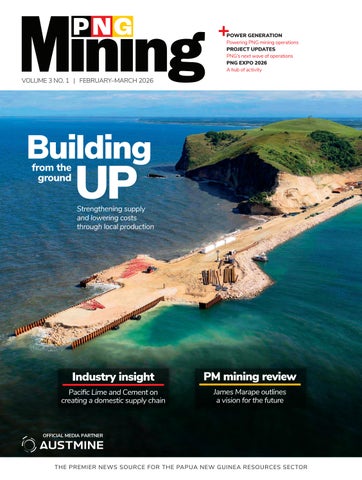
Strengthening supply and lowering costs through local production
+
POWER GENERATION
Powering PNG mining operations
PROJECT UPDATES
PNG’s next wave of operations
PNG EXPO 2026
A hub of activity
Industry insight
Pacific Lime and Cement on creating a domestic supply chain
PM mining review
James Marape outlines a vision for the future
CEO Christine Clancy
GROUP MANAGING EDITOR
Paul Hayes
T: +61 3 9690 8766
E: paul.hayes@primecreative.com.au
EDITOR
Ben Cartwright
T: +61 3 9690 8766
E: ben.cartwright@primecreative.com.au
CLIENT SUCCESS MANAGER
Janine Clements
T: +61 2 9439 7227
E: janine.clements@primecreative.com.au
RESOURCES GROUP LEAD
Jonathan Duckett
M: +61 498 091 027
E: jonathan.duckett@primecreative.com.au
BUSINESS DEVELOPMENT MANAGER
Ezra Wolde
M: +61 411 188 322
E: ezra.wolde@primecreative.com.au
ART DIRECTOR
Michelle Weston
COVER IMAGE Pacific Lime and Cement
SUBSCRIPTION RATES
Australia (surface mail) $140.00 (incl GST)
New Zealand A$148.00 Overseas A$156.00
For subscriptions enquiries please call +61 3 9690 8766
Momentum and opportunity
Papua New Guinea’s mining industry is entering a new phase defined primarily by renewed confidence and expanding opportunity.
IN A PERIOD defined by global uncertainty, project delays and shifting commodity cycles, the sector is once again demonstrating its resilience and, increasingly, its strategic importance to the national economy and the broader Asia-Pacific resources landscape.
Mining has long been a pillar of PNG’s export earnings and regional development. Today, however, the conversation is shifting from stability to strength.
Higher commodity prices across gold and copper, improving operational performance at established assets, and steady progress on expansions and restarts are collectively reinforcing the industry’s outlook.
Across PNG, the link between mine performance and national prosperity is immediate and tangible.
Exploration activity is also gaining renewed attention. Sustained drilling programs and near-mine resource growth are critical in a country where long-life assets underpin regional employment and economic continuity.
The strength of PNG’s mining industry lies in its combination of resource quality, operational resilience and growing strategic relevance. Against this backdrop of growth, further underpinned by this year’s iteration of the PNG Expo, it is an exciting time to take over as the new editor of PNG Mining
As the industry evolves, so too must the conversations that shape it. This publication will continue to highlight the projects, partnerships and policy developments driving progress.
All rights reserved. No part of the publication may be reproduced or copied in any form or by any means without the written permission of the publisher.
Operations such as Lihir, Ok Tedi and Porgera remain central to national output, and their performance continues to have a direct influence on economic growth forecasts.
Ben Cartwright Editor
10 Industry insight
In it for the long haul
Import reliance is a vulnerability for PNG’s mining sector. Pacific Lime and Cement’s Kevin Savory explains how a domestic supply chain will cut costs for miners and build a lasting national legacy.
14 Government strategy
Mining’s “extraordinary” place in PNG economy
PNG Prime Minister James Marape has outlined a confident vision for 2026, positioning the resource sector as the engine room of a $73 billion economy.
20 Community projects Building digital capability in PNG communities
As part of continued operations across PNG, Orica is supporting communities beyond the mine sites.
22 Power generation Powering production
The evolving role of energy on PNG and its mine sites.
30 Asset management Local impact, global standards Tidal Fluid Power is expanding into Papua New Guinea, offering hydraulic components, repair services and technical expertise tailored to demanding mining environments.
32 Mineral processing Next-generation processing
Optimising mineral processing with machine learning is at the heart of DEKA Dynamics’ approach to helping operators turn complex plant data into performance gains.
38 Industry events Connection, collaboration, growth
With an expanded floorplan, conference program and strong early interest, PNG Expo 2026 is already shaping up to the best yet.
42 Case study Future-proofed VPA filters
Through close partnership and innovative solutions, Ok Tedi Mining Limited and Metso lifted throughput by over 30 per cent – even amid COVID-19 travel restrictions.
52 Women in mining Women and PNG’s mining growth
As Papua New Guinea’s mining sector enters a new phase of growth, women are emerging as a powerful force shaping its future.
Ok Tedi commits to continued safety for Tabubil operations
Ok Tedi Mining has extended a Memorandum of Understanding (MoU) with the Royal Papua New Guinea Constabulary to ensure a safe and secure operating environment in Tabubil.
The renewed agreement strengthens collaboration between the miner and national police to maintain a safe and secure operating environment across Ok Tedi’s footprint, including Tabubil, Kiunga and the Fly River region.
Ok Tedi General Manager Social Performance and Sustainability Jesse Pile said the extension underscored the company’s commitment to operational and community safety.
“This MoU extension and partnership is important for us at Ok Tedi as it emphasises our commitment to community and operational safety," he said.
"We want to ensure our employees and assets are protected while also supporting our sustainability goals of maintaining peace in our mine associated communities.”
It is understood the support from the Constabulary contributes to Ok Tedi’s success and that of Papua New Guinea.
“It is important to note that your support to us is contributing to our success and that of Papua New Guinea as we are 100 per cent PNG-owned,” Pile said.
Acting Commissioner of Police (ACP) Samson Kua welcomed the extension, saying the past five years had delivered both triumphs and challenges and
that the Constabulary looked forward to continuing the fruitful partnership.
“The Royal Papua New Guinea Constabulary is aware of the importance of extending this MoU for security and law enforcement purposes. We look forward to continuing this partnership with Ok Tedi to deliver on our goals for this project,” Kua said.
ACP Kua also acknowledged Ok Tedi’s ongoing support, including police housing projects in Tabubil and Ningerum and the donation of vehicles.
The extended MoU will run
Pacific Lime secures offtake agreement with Newmont
Pacific Lime and Cement has announced a long-term quicklime offtake agreement with Newmont for supply to the company’s operations in Papua New Guinea (PNG).
The Central Lime project, based in Central Province, will be the hub for supplying one of the world’s leading gold producers and establishes it as a “cornerstone customer”.
The agreement equates to approximately one-third of the Central Lime project’s nameplate production capacity and is said to underpin Pacific Lime’s commercial development of PNG’s
first domestic quicklime production operation. Offtake represents the first large-scale commercial commitment to locally produced quicklime in PNG, the company said, and reflects both Newmont’s support for PNG’s buy-local framework and the growing demand for domestically sourced industrial material that meets the standards of a Tier-1 global mining company.
The offtake agreement for the Central Lime Project is structured as a multiyear arrangement commencing after construction and commissioning, subject to customary conditions.
Under the agreement, product will be supplied from Pacific Lime‘s integrated project precinct within a designated Special Economic Zone, under standard commercial delivery terms.
“This agreement validates more than a decade of work to establish domestic quicklime production capable of meeting Tier 1 mining standards,” Pacific Lime managing director Paul Mulder said.
Newmont Lihir general manager Dawid Pretorius said the agreement reflected the company’s commitment to creating long-term social and economic value in PNG.
Image:
Ok Tedi Mining
Great Pacific Gold hails high-grade gold at Sinivit
Great Pacific Gold has released further high-grade drilling results from the Sinivit target and outlined its expanded 2026 drilling program at the Wild Dog Project on New Britain in Papua New Guinea’s East New Britain Province.
Diamond drilling at Wild Dog began in May 2025 with one rig focused on the Sinivit target, part of the 15km Wild Dog epithermal structural corridor.
Sixteen holes were completed in 2025, defining the Southern Oxide and Northern Sulphide shoots. Previously released results included high-grade intercepts such as 8.4m at 50.1 grams per tonne (g/t)
of gold equivalent and 9.5m at 13.75g/t gold equivalent.
Recent results returned 13.48m at 8.08g/t gold equivalent, including highergrade sub-intervals.
The first rig will continue to expand at Sinivit and define the high-grade shoots and test two other priority targets. The second rig will begin systematic drilling along the Wild Dog Structural Corridor, including Kasie Ridge, Kavasuki and Mengmut. Kasie Ridge is a large, highsulphidation epithermal target under a 400–500m wide advanced argillic alteration cap with no previous drilling.
“The Northern Sulphide Shoot continues to deliver strong, highgrade results,” Great Pacific Gold vice president exploration Callum Spinks said. “The combined datasets indicate a large-scale high-sulphidation epithermal target beneath an advanced argillic lithocap extending approximately 1.5 to 2km in strike length and several hundred metres in width.”
This drilling plan reflects an effort to advance exploration across multiple high-priority targets beyond Sinivit along the Wild Dog corridor. PNG
Geopacific reports high-grade gold at Woodlark
Geopacific Resources has reported high-grade near-surface gold has been intersected at the company’s Wayai Creek, part of the Woodlark gold project in Papua New Guinea.
The results are said to further define a coherent zone of shallow, high-grade mineralisation and improves confidence in the project’s existing mineral resource, with Woodlark boasting a resource
estimate of 1.67 million ounces. Drilling results include 17m at 5.29 grams per tonne (g/t) gold from 36m and 9m at 1.62g/t gold from 56m, 5m at 4.15g/t gold from 122m and 5m at 3.94g/t from 30m.
Additional drilling will commence at Wayai Creek to test a southern extension of mineralisation to help further improve confidence in the site’s
existing resource model according to Geopacific chief executive officer James Fox.
“These results continue to improve our geological understanding of the prospective areas, and deliver highgrade intercepts that support the significant exploration and growth potential that remains at Woodlark,” Fox said. “We have a clear pipeline of near-mine and regional exploration work to progress, with much of the drilling focused close to existing resources and planned infrastructure. This includes testing for potential extensions to known mineralisation under shallow cover, where there has been little recent exploration focus.
“Importantly, this work is being progressed in parallel with finalisation of the Woodlark definitive feasibility study.”
It is understood the study remains on track for 2026.
A drilling program at the secondlargest known gold deposit in Woodlark, Busai, is also underway to test extensions of the mine’s western lode.
Busai hosts a mineral resource of 20.3 million tonnes at 1g/t for gold for 655,000 ounces. PNG
ExxonMobil nabs long-term boat maintenance agreement for Papua LNG project
ExxonMobil PNG Limited recently secured a long-term contract for the provision of a Bareboat Charter and Operations and Maintenance services with MISC Berhad for its Papua LNG operations.
The agreement with MISC Berhad services a Floating Storage and Offloading (FSO) unit in Papua New Guinea (PNG),
significant milestone for the Malaysian maritime and energy logistics company.
The FSO charter is set for a firm period of 15 years, with an option for ExxonMobil PNG to extend it for another 15 years.
Operations are expected to commence in the first half of 2028, making it PNG’s first offshore floating facility as part of the
Frieda River reaffirms commitment to protecting Sepik ecosystem
Frieda River Limited has publicly reiterated its commitment to safeguarding the Sepik River and its surrounding communities as part of the Sepik Development Project (SDP), a major mining and infrastructure initiative.
The company said the project was designed not only to develop one of the world’s largest copper and gold deposits but also to protect the region’s environment through innovative and advanced engineering and environmental safeguards.
In a statement, Frieda River Limited emphasised that the SDP aims to be among the lowest-emission mining operations globally, powered largely by
a new hydroelectric dam that will supply about 270 megawatts of clean energy to the national grid while reducing Papua New Guinea’s long-term carbon footprint.
The company highlighted its use of world-leading tailings and waste management technologies, including underwater tailings storage and sophisticated water quality controls informed by over a decade of environmental baseline studies and biodiversity monitoring.
Modelling cited by the company indicates minimal downstream impacts on water quality and aquatic life.
Frieda River Limited stated that engagement with local communities
MISC described the contracts as a strategic entry into the PNG energy sector. While acknowledging inherent risks, including commercial, project execution, operations, and regulatory compliance, MISC emphasised its capability to mitigate these challenges using its experience and expertise in offshore operations.
The contracts do not require shareholder or governmental approval and will not affect the company’s share capital, major shareholders, or materially impact the MISC Group’s earnings per share, net assets, or gearing for the 2026 financial year.
MISC’s board confirmed that none of the company’s directors, major shareholders, or connected parties hold any direct or indirect interest in the contracts.
The contracts position MISC as a service provider for PNG’s first offshore floating facility, marking the company’s strategic entry into the country’s energy sector. PNG
and stakeholders will continue through annual outreach programmes to ensure that traditional landowners and other voices are involved in project planning and delivery.
The project’s guiding principles such as technical appropriateness, environmental safety, and social responsibility are said to underpin its approach.
Despite long-standing environmental and human rights concerns raised by advocacy groups and local communities over the project’s potential risks to the Sepik River, the company maintains that protective ecosystem-led measures are a central focus and key priority as development progresses. PNG
Image: Fotogrin/shutterstock.com
South Pacific Metals pushes exploration ramp-up with second drill rig
South Pacific Metals has announced a second drill rig is being added to its Ontenu project in Papua New Guinea (PNG) to speed up exploration.
The new rig is expected to arrive in March at the site in the Osena region and will work alongside the company’s current drilling equipment.
The move is designed to accelerate testing of multiple targets across the Ontenu area, where previous surface
sampling in 2025 identified several promising mineralised structures with high levels of copper, silver and gold.
Initial drilling with the new contractoroperated rig will focus on the Onki Fault area in the Ontenu Northeast zone, a site discovered last year through soil sampling and geological mapping that revealed broad mineralised zones.
Drilling is also continuing with the company’s existing rig further south in
the project area, on the border of K92 Mining's Kainantu Gold Mine.
The broader Osena Project lies in the Kainantu District near other major mining operations and covers a large land package. South Pacific Metals aims to complete about 5000 metres of drilling across several targets in 2026, stepping up efforts to determine the potential scale and quality of the goldcopper system. .PNG
Tolu Minerals reports encouraging roadside gold-copper results at Tolukuma
Tolu Minerals Limited has announced promising early exploration results from a reconnaissance geological mapping program conducted along the 63km access road from Bakoiudu to its Tolukuma mining lease area.
The company said the work has identified multiple zones of gold, silver and copper mineralisation, reinforcing the prospective nature of its regional targets.
Highlights from the mapping program include high-grade rock samples taken from narrow massive sulphide and epithermal quartz-sulphide veins, with gold grades up to 27.6 grams per tonne (g/t), silver to 111g/t and copper up to 1.02 per cent.
A number of other samples also returned significant precious and base metal values.
In addition to the rock chip results, airborne magneto-telluric (MT) geophysical surveys have helped refine targets associated with porphyry, epithermal and volcanic-associated massive sulphide (VMS) systems, which Tolu says offer multiple follow-up opportunities along the road corridor
servicing the Tolukuma site. All five of the company’s recently mobilised drilling rigs are now on site, boosting capacity for the next phase of detailed sampling, soil geochemistry and drill testing once targets are prioritised. This has been lauded as a big achievement by the
company's managing director Chris Muller, who described the results as “highly encouraging”. He said combination of mapping, sampling and geophysics is building a pipeline of priority targets that could expand the company’s gold-copper base. PNG
In it for the long haul
Import reliance is a vulnerability for PNG’s mining sector. Pacific Lime and Cement’s Kevin Savory explains how a domestic supply chain will cut costs for miners and build a lasting national legacy.
KEVIN SAVORY isn’t going anywhere.
In an industry often defined by the transient rhythm of fly-in, fly-out work, the newly appointed chief executive officer – cement of Pacific Lime and Cement (PLC) is planting his feet firmly in Papua New Guinean soil.
It is all part of the “sweaty”, tactile work of nationbuilding, where real progress happens on the ground, he told PNG Mining
Savory brings a resume rich with more than 30 years of senior leadership experience across lime, cement and heavy civil infrastructure.
The Queenslander holds a Master of Business Administration (MBA) and is a graduate of the Australian Institute of Company Directors. His resource-industry background includes senior roles at Cement Australia and Holcim, and he served as managing director of Infrastructure Products Australia at CRH. Savory’s expertise covers every link in the chain.
“My international work with Holcim, which was based in the Philippines for three years, involved working directly with cement and, equally importantly, concentrating on the logistics,” he said.
“When you couple that deep knowledge with my running of cement plants in Australia, from the mine to the clinker kilns and to the cement mills, you’ll realise that I’m here for the whole process.”
Savory’s philosophy on industrial leadership was forged in the kiln-heat of Kandos, a small mining town on the western plains of New South Wales.
With a population of just 1700, the town’s heartbeat was the cement plant.
“We used to joke that the plant manager was the unofficial mayor of Kandos,” he said.
“That always gave me a sense of responsibility, and I’ve carried that through my career.”
It is this sense of civic duty that Savory intends to bring to PLC’s operations. He will be permanently based in PNG, where he will lead the cement
strategy alongside John McBride, who continues to head the lime division.
PLC managing director Paul Mulder said Savory’s proven ability to execute in capital-intensive environments makes him especially well suited for the role.
“Kevin’s appointment significantly strengthens our leadership capability as we advance our cement strategy in parallel with our quicklime construction already well underway,” Mulder said.
Savory is no stranger to the PNG jurisdiction. He previously served as chief executive officer of Mayur Resources’ cement and lime business, where he led commercialisation strategy and stakeholder engagement in PNG between September 2018 and May 2020. Alongside McBride, Savory will aim to entrench the business in PNG’s economy.
Their aim is ambitious: to displace the 100 per cent imported product currently utilised by major sectors, including gold mining, with locally manufactured materials.
According to Savory, the local environment demands specific solutions that only a domestic producer can truly understand. He points to the
synergy between the lime and cement divisions as a key to unlocking infrastructure potential, particularly in road stabilisation.
“Particularly, quicklime is used in road stabilisation,” Savory said. “You get the road base sorted out with quicklime, and then we can start doing a concrete seal or roller-compacted concrete. That is the opportunity, particularly in a high-weather environment like PNG.”
Savory highlights that similar methods have proven effective in the Philippines and are already visible in PNG’s Lae district. The strategy is not about reinventing the wheel but providing a cost-effective local alternative that can withstand the punishing tropical elements.
“A big focus for us is reducing production costs and passing those savings on to customers,” Savory said.
This localisation strategy also serves as a buffer against global volatility. Savory points to the logistical hurdles of recent years as a key driver for developing domestic capacity.
“It’s about providing access to infrastructure and the downstream precast elements locally,” Savory said. “This shortens supply chain timelines and ensures we are immune, or have greatly reduced exposure, to supply chain disruptors, which we’ve all seen exemplified during the COVID period.”
By securing the supply chain, PLC aims to improve the financial viability of mining projects across the region. The broader strategy also aligns with the Asia-Pacific region’s decarbonisation journey, as PLC plans to power its operations with renewable energy initiatives, including solar, wind and geothermal.
Image: Pacific Lime and Cement
Sand destined to the manufacture of cement.
New CEO – cement of Pacific Lime and Cement Kevin Savory.
Image: Enrique del Barrio/stock.adobe.com
“It is also an opportunity to reduce cost,” Savory said. “Mining is a capital-intensive business. If we can help reduce the cost of downstream processing, we create the scope to speed up or expand development in the mining industry. That benefits the whole country.”
Savory believes that by helping mining houses achieve a better return on invested capital, they can encourage further investment in a competitive global market.
“At the end of the day, we’re competing on an international stage for shareholder funds,” he said. “That is how we can support the mining industry.”
The physical manifestation of this strategy is the Central Lime project. Located 25km north-west of the capital of Port Moresby, it is set to become
PNG’s first fully integrated cement and lime manufacturing facility.
Situated within a Special Economic Zone near the Exxon LNG facility, the site is being developed in two stages. A quicklime production facility is already under construction and is targeting production by 2027, followed by a clinker and cement plant.
The project is designed to be a self-sustaining industrial hub, featuring its own dedicated wharf, power station and a 27km access road that will open up the corridor north of the capital.
For Savory, the scale of the project is matched only by the opportunity to shape the workforce that will run it.
“Having been shaped by those early experiences, I think PNG holds immense potential,” Savory said. “I see the chance to train, teach and forge a local team. It creates strength and a legacy that endures.
“It’s not about me. It’s about what the company can do and the legacy that we can pass on.”
The mandate extends beyond operational oversight. Savory is tasked with transferring critical skills to the PNG workforce, ensuring the project delivers on its promise of nation-building through infrastructure.
“When you’re building or expanding a city like Port Moresby or Lae, and you know it’s going to be there for a lifetime, you enjoy it,” Savory said.
“Infrastructure might not look sexy, but it is when you are helping to build something that will last a lifetime.
“That’s why we talk about it as nation-building, and it is immensely satisfying when you do it.”
PLC aims to improve the financial viability of mining projects across the region.
Mining’s ‘extraordinary’ place in PNG economy
PNG Prime Minister James Marape has outlined a confident vision for 2026, positioning the resource sector as the engine room of a $73 billion economy.
MINING REMAINS at the beating heart of Papua New Guinea’s (PNG) economic plan.
Prime Minister James Marape has intensified his focus on the nation’s resource industries in 2026, championing a partnership model that balances fair returns for the state with recognition of the sector’s role in job creation.
It comes at a boom time for the nation’s financial outlook. The ‘Asian Development Outlook: December 2025’ report highlighted PNG is the largest economy in the Pacific region and has a forecast 3.4 per cent growth for 2026, driven by “strong resource-related output, higher prices for key exports, and improved foreign exchange availability”.
PNG recorded a “sharp increase” in economic activity from May to July last year, rising by about 30 per cent year-on-year. US tariffs have had only a marginal effect, mirroring the experience of many other nations, as the affected goods account for less than two per cent of exports to the US. Instead, the real economic driver is the surge in global prices.
The PNG PM is championing a partnership model that balances returns for the state with recognition of the sector’s role in job creation industry.
“With global gold, silver and copper prices reaching historic highs, mining operations in Papua New Guinea, whether large-scale or alluvial, are now generating extraordinary profits,” Marape said in a statement in February.
“Most production costs remain relatively fixed, apart from inflation. When commodity prices rise sharply, the country must also benefit through appropriate tax returns and dividends. We are not increasing taxes. We are simply ensuring that when extraordinary profits are made from our resources, the state receives its fair share.”
To put this into action, the Prime Minister confirmed that the Treasury and the Internal Revenue Commission have been instructed to compile individual files for every operating mine, including state-owned entities such as Ok Tedi Mining and joint ventures such as Porgera.
This process will involve accuracy and compliance testing of all production and revenue declarations. This 2026 outlook is further anchored by a strategic
sequencing of what Marape calls the “Big Four” projects: Wafi-Golpu, Papua LNG, P’nyang LNG, and the restart of Porgera.
By staggering these developments, the PNG Government aims to solidify the nation’s economy, by ensuring each can be overseen with adequate support. Marape said that if managed correctly, this pipeline represents
between $US55–80 billion in foreign direct investment over the next decade.
“We are not just looking at the next fiscal year but at a 10-year horizon of continuous construction,” Marape said.
The Prime Minister highlighted that the “Reset@50” roadmap, tabled as a 20-year development blueprint, identifies these projects as the primary catalysts for infrastructure and human capital growth.
By focusing on downstream processing and local content, the Government intends to ensure that the wealth generated stays within the country, fuelling the broader ambition of a $73.12 billion economy.
[The PNG] people are educated, capable and ready to participate.
Papua New Guinea Prime Minister James Marape
Marape balanced this compliance drive with an acknowledgment of the industry’s major domestic contribution. He described the sector as a cornerstone of national development, noting that the benefits of mining extend far beyond the pit.
“Whether you are a lead investor, sub-contractor or community partner, it is because of your contributions that we are seeing this progress,” Marape said. “My people are educated, capable and ready to participate.”
To secure this trajectory, Marape gave firm assurances at the beginning of the year regarding the country’s two largest pipeline projects:
PNG Prime Minister James Marape.
Chalking-up growth opportunities
Project Yumi is strengthening local businesses to create lasting economic benefits in Papua New Guinea’s remote regions.
IN PAPUA New Guinea (PNG), mining operations are often located in remote provinces where infrastructure and economic opportunities are limited. Roads, schools, health services, and local businesses frequently rely on the presence of a large mine, and when operations scale down or close, these communities can face immediate financial and social disruption. Project Yumi was established to address this challenge by supporting sustainable local business development alongside mining activity.
Project Yumi is a multi-stakeholder partnership designed to strengthen local economic participation in PNG’s extractive sector. Its focus is practical. It works with landowner companies, local entrepreneurs, community groups and mining operators to build the systems and skills required for sustainable business development. The aim is
Project Yumi’s purpose is to support sustainable local development alongside mining activity.
to make existing arrangements function better for all parties, rather than replacing the role of mining companies or government agencies.
At its core, Project Yumi supports the development of capable, compliant and competitive local suppliers. In many project areas, landowner companies are formed quickly in response to a new mine. They may secure contracts but lack governance structures, financial controls or long-term planning. This creates risk for operators and limits the broader benefits flowing into communities.
Project Yumi steps into this space with structured business development support, which includes governance training for directors, financial literacy for managers, contract management guidance and assistance to meet industry standards for safety, reporting and compliance. By improving internal
Images:
Project Yumi
systems, these businesses are better positioned to win and retain work with major operators.
A central component of this work is Project Skul, a practical training initiative designed to build the commercial capability of landowner companies, small businesses and aspiring entrepreneurs operating in mining regions. While Project Yumi provides the broader partnership framework, Project Skul delivers hands-on business education aimed at improving governance, financial management and operational standards.
In many project areas, landowner companies are formed rapidly in response to new mining developments. They may secure contracts but lack internal systems, compliance processes or long-term planning. Project Skul addresses these gaps through structured workshops and mentoring covering director responsibilities, bookkeeping, pricing, contract management, safety standards and tender readiness. The objective is to help local enterprises become capable, compliant and competitive suppliers.
For mining operators, the benefits are operational as well as social. A stronger local supplier base reduces procurement risk, supports smoother project delivery and helps meet development agreement commitments. Project Skul also works with informal and small-scale businesses, offering practical entrepreneurship training that can diversify household incomes beyond royalties.
Importantly, Project Yumi does not operate in isolation from the commercial realities of the sector. It works alongside mine procurement teams to understand upcoming contract opportunities and capability gaps. Where local businesses need support to meet tender requirements, Project Yumi provides targeted mentoring. Where expectations from communities exceed what is commercially viable, it facilitates clearer communication about standards and performance requirements.
Project Yumi supports the development of capable, compliant and competitive local suppliers.
The organisation also recognises that economic inclusion extends beyond formal contracts. In many mining provinces, informal and small-scale enterprises provide goods and services that support both the workforce and surrounding communities. Project Yumi runs entrepreneurship training and business clinics aimed at these smaller operators. Topics include pricing, bookkeeping, customer service and basic regulatory compliance.
While modest in scale, these businesses often provide critical household income and reduce reliance on royalties alone.
A key strength of Project Yumi is its emphasis on collaboration. It brings together mining companies, government representatives, development partners and community leaders around shared objectives. In the PNG context, where coordination between stakeholders can be fragmented, this convening role is significant. It helps align expectations and reduces duplication of effort.
The program also places strong emphasis on inclusion, given that women and youth frequently face barriers to participation in the mining economy, particularly in rural areas where traditional land ownership structures shape decision-making. Project Yumi incorporates targeted initiatives to support women-led enterprises and youth entrepreneurs, recognising that broader participation contributes to social stability and long-term economic resilience.
As PNG prepares for the next generation of large-scale projects, including expansions and new developments, the question of how to maximise local benefit will remain central. Initiatives such as Project Yumi demonstrate that with structured support, local participation can move beyond rhetoric and become a practical component of project delivery.
For the mining sector, this is a sound operational strategy in a country where community relationships are inseparable from commercial success. PNG
Building digital capability in PNG communities
As part of its operations across Papua New Guinea, Orica is supporting communities beyond the mine sites.
COMMUNITY INITIATIVES
are an important part of Orica’s long-standing presence in Papua New Guinea (PNG). Alongside the company’s operational role supporting the country’s mining sector, it continues to invest in projects that create lasting benefits for local communities.
Guided by Orica’s charter and sustainability commitments, its focus is on practical initiatives that build capability and support long-term development in the regions where the company operates.
One recent example is the delivery of a fully equipped computer container for Finalbin Primary School near Tabubil in PNG’s Western Province. Funded through the Orica Impact Fund and delivered in collaboration with Ok Tedi Mining, the container supports digital learning and provides students with opportunities that were previously out of reach.
The container was officially handed over in October 2025, with representatives from Orica and Ok Tedi in attendance, including Ok Tedi drill and blast supervisor Bill Ambut.
The container was dedicated to Ambut in recognition of his ongoing support of Orica and his strong engagement with the local community. A placard marking the dedication has been installed on the exterior of the unit.
Delivery of the project required close coordination across multiple teams and locations. The container was fitted out in Port Moresby with desks, internal
walls, flooring, air-conditioning, and 12 computers with accessories. Ok Tedi provided logistical support to transport the container to Tabubil and assisted with its installation at the school.
Bill Ambut points to a
For Finalbin Primary School, the new container highlights a significant addition to its learning infrastructure, with access to computers and digital technology limited in the region, it gives students the chance to learn basic computing skills and undertake digital research.
Early exposure to technology is particularly valuable for students in remote areas and helps broaden future education and employment pathways, Orica said.
During the opening event, the school’s headmaster described the donation as an investment in local students and their future.
The project reflects Orica’s commitment to initiatives that build capability, create opportunity and deliver long-term community benefit.
The Orica Impact Fund continues to enable community projects across PNG and other regions. The fund supports initiatives aligned with Orica’s sustainability priorities and allows employees and business units to contribute to projects that address
identified local needs. In PNG, this has included education-focused programs delivered in partnership with local organisations and industry stakeholders. These initiatives aim to strengthen access to science, technology, engineering and mathematics (STEM) education and provide students with relevant, industry-aligned learning experiences.
Many mining operations in PNG are based in remote areas where access to infrastructure and services is limited.
Targeted investment in schools and training facilities helps to address key challenges and support broader social and economic development.
The Finalbin Primary School project demonstrates Orica’s broader approach to community engagement in PNG.
By working closely with partners such as Ok Tedi, the company continues to deliver practical and locally relevant initiatives that reflect commitments to safety, responsibility and sustainable outcomes. PNG
Tailored Spatial Solutions (TSS) Services
ꞏ Hydrographic surveying
ꞏ Asset Inspection via drones and robotics (working at height, confined spaces ect)
ꞏ Side scan sonar Inspections
ꞏ Drone and fixed wing LiDAR surveying
Drone and fixed wing Photogrammetry Survey
ROV (remotely operated vehicle) Inspections & sub surface laser/photogrammetry scanning
The evolving role of energy on PNG and its mine sites.
ENERGY INFRASTRUCTURE is a critical underpinning of the Papua New Guinea (PNG) mining sector, shaping everything from operational continuity to community development and economic resilience.
In a country where the national electrification rate remains among the lowest in the Pacific, mining companies have taken a lead role in powering their operations and, in many cases, neighbouring communities, through a mix of self generation, grid connections and innovative energy solutions.
Mining in PNG contributes significantly to the national economy, and reliable energy is essential to keep large-scale mineral extraction and processing operating effectively.
According to the Asian Development Bank statistics, PNG has about 580 megawatts (MW) of total installed generation capacity, approximately 280MW of which comes from self-generation systems owned and operated by industrial facilities, including mining companies, illustrating how major projects help fill gaps left by limited grid capacity.
Beyond the grid
Unlike many countries with extensive national grids, PNG’s electricity network remains fragmented due to its challenging geography and dispersed urban centres. The state-owned utility PNG Power Limited (PPL) manages around 300MW of generation capacity across several grids and smaller regional
systems, but this infrastructure alone cannot meet all industrial and community demand.
Large mines have responded by building and operating their own generation infrastructure. These on-site power systems can take multiple forms, from hydroelectric plants and diesel generators to hybrid solutions, reducing reliance on expensive imported energy and minimising operational risk from unreliable grid supply.
One of the most prominent examples in PNG is the Ok Tedi Mine in Western Province, which operates its own hydroelectric facility on the Ok Menga River.
Only around 13 per cent of PNG’s population has reliable access to electricity. Diesel remains a common – and costly – fuel source on PNG sites.
Powering PNG mines
Mining operations in PNG rely on a mix of generation methods to ensure reliable electricity for processing, milling and site infrastructure.
Hydroelectric power
• Mines such as Ok Tedi and Porgera utilise small-to-medium-scale hydro plants on nearby rivers or tributaries
• Provides base-load power, often supplemented by diesel for peak demand or low-flow periods
This on-site power station provides the majority of electricity for the mine’s processing and milling operations, with back-up diesel generation to supplement supply when river flows are low.
This energy autonomy has enabled Ok Tedi Mining Limited (OTML) to maintain production continuity even in times of wider grid instability, contributing to the company’s ability to deliver strong operational results, as recently reported in its 2025 performance review. The mine’s output of copper, gold and silver contributed substantial revenue to PNG’s economy and showcased how reliable energy underpins broader mining sector success.
Mining companies’ generation assets often serve dual roles: powering mine sites and supporting local access to electricity.
In parts of Western Province, Ok Tedi Power, a subsidiary of OTML, extends retail power supply and distribution to towns including Tabubil and Kiunga, as well as smaller mini-grids in rural areas. This model highlights how mining-driven energy systems can contribute to broader electrification goals in regions beyond the mine gate.
Such initiatives are particularly important in PNG given the country’s limited national grid coverage. According to external energy sector data, only around 13 per cent of PNG’s population has reliable access to electricity, with the majority located in urban centres.
Increasing energy access is a key government objective, with aspirations to expand electrification to 70 per cent of the population by 2030, a target
• Offers lower operational costs and reduced carbon emissions compared with fuel-based generation
Diesel generation
• Common for remote and off-grid operations
• Offers flexibility and rapid deployment but comes with higher fuel costs and emissions
• Used as primar y power in smaller mines or as back-up for hydro or gas plants
Gas-fired power
• Integrated into larger industrial projects like PNG LNG-related facilities and Port Moresby power stations
• Provides reliable, lower-emission generation compared with diesel
• Some mining operations collaborate with local gas infrastructure to reduce dependence on imported fuel
Hybrid and renewable
• Emerging use of solar PV, battery storage, and hybrid configurations to supplement diesel or gas
• Reduces operational costs and supports sustainability targets
• Still relatively limited but growing as technology becomes more affordable and site conditions allow
Mini-grids and self-generation
• Many mines operate standalone mini-grids combining the above methods
• Essential where national grid coverage is limited or non-existent
• Provides energy autonomy, supports continuous operations and, in some cases, supplies nearby communities
With PNG’s national electrification rate at roughly 13 per cent, mining companies play a pivotal role in powering industrial activity and often extend energy access to local towns and settlements, making self-generation a business necessity and a social contribution.
Image: Hairem/stock.adobe.com.au)
Power generation
that industrial self-generation and private sector energy investment can help support.
For mining companies, investments in power infrastructure not only ensures operational reliability but can also strengthen community relations and social licence to operate.
By contributing to local energy access, whether through grid-connected supply or community mini-grids, mines can expand their developmental footprint and share the benefits of infrastructure that would otherwise be absent or unaffordable.
Collaboration and strategy
In some cases, mining operations collaborate with national energy initiatives to improve industry and community energy outcomes. One notable example is the larger gas to electricity work associated with the PNG LNG project.
In that initiative, industry, government and utilities worked together to deliver 25MW of reliable electricity, demonstrating that coordinated action can enhance domestic power delivery while also integrating industrial demand.
Work continues on further gas-fired capacity expansions near LNG facilities, with plans to support an additional 50MW gas-fired-generation plant that could contribute to broader grid resilience and industrial energy stability.
These developments signal the potential for PNG’s energy sector to evolve in ways that improve overall supply reliability and reduce costly dependence on diesel and other imported fuels.
The PNG Government is also encouraging independent power producers (IPPs) and private
sector energy investment. A policy framework exists to integrate hydro, thermal and renewable sources into PNG’s energy mix, and IPPs have already contributed significantly.
For mining companies exploring productive partnerships with IPPs and government utilities, this evolving policy environment offers avenues to locally source cheaper, reliable energy and to integrate renewable sources where feasible.
Despite strong investments in on-site generation and collaborations with utilities, the sector still faces challenges. Mines must balance the high cost of energy generation with operational efficiency. Diesel generators, while reliable, are expensive to operate
Frameworks exist to integrate hydro, thermal and renewable sources into PNG’s energy mix.
Diesel generators
in remote areas, motivating some companies to shift toward alternatives such as hydroelectric, gaspowered and hybrid systems wherever possible.
In Port Moresby, national infrastructure such as the gas-fired 58MW Port Moresby Power Station, demonstrates another example of how shifting away from expensive diesel generation can reduce costs and emissions while supporting broader power reliability. However, the fragmented nature of PNG’s energy sector, with multiple mini-grids and isolated systems, means that many mining operations continue to rely primarily on self-generation. This reality reinforces the strategic importance of energy security for mines, where production can be jeopardised by outages or fluctuating fuel prices. Reliability of power supply remains a focus not only for mining companies but also at the national policy level, where the expansion of generation capacity and grid connectivity is seen as essential to unlocking wider economic growth and driving sustainable industrial development.
As PNG’s resources sector moves into a new decade of growth, the role of on-site power generation will remain central. From hydroelectric systems at Ok Tedi to integrated gas power plans and expanding collaborations with IPPs, mining operations are shaping the country’s energy landscape in ways that extend beyond their immediate operations.
These developments not only support mining productivity and reliability but also contribute to national goals of improved electrification, community energy access and economic inclusivity.
With energy infrastructure continuing to evolve, supported by government policy and private sector participation, PNG’s mining sector stands poised to lead improvements in both industrial power generation and community electrification.
In a nation where major mines are economic drivers and energy innovators, the synergy between mining and power is a cornerstone for future growth. PNG
Power generation
Driving beyond tomorrow
As the world drives towards a greener future, Ela Motors PNG is helping push mine fleets towards greener alternatives with the upcoming rollout of hybrid electric vehicles in the Pacific nation.
MAKING MINING operations more environmentally sustainable has undoubtedly become deeply ingrained in many organisations’ workflows and project pipelines, and operations in Papua New Guinea (PNG) are no different.
The Pacific nation, according to communication with the United Nations Framework Convention on Climate Change, is aiming to decrease greenhouse gas emissions by at least 50 per cent before 2030. It also has plans to be completely carbon-neutral before 2050.
One avenue via which this goal can be reached is through the electrification of mine fleets, fundamentally changing how power is generated and how site transport is perceived. Instead of relying solely on petrol or diesel to power fleets, a new way has emerged to reach similar performance without the harsh environmental impact.
Toyota Tsusho, trading as Ela Motors across PNG, is at the forefront of “driving beyond tomorrow” and is attempting to help solve various issues faced by society and individuals with its suite of hybrid electric vehicles (HEVs).
The rising level of carbon dioxide is one area HEVs aim to address, thanks to the seamless integration
with traditional petrol engines, utilising rechargeable batteries regenerative braking while coasting and braking in motion
Toyota’s innovative designs enhance fuel efficiency and minimises emissions without the need to charge externally, a significant problem for many PNG mine sites due to their isolated locations and electrical infrastructure.
The company is committed to innovation that doesn’t just redefine the driving experience but positively contributes to the environment. Toyota HEVs epitomise this commitment, offering a seamless blend of cutting-edge technology and ecoconscious design.
But what does this ultimately mean for PNG’s resources sector? According to Ela Motors PNG chief operating officer – distribution and retail Denzil Robertson, it represents a pivotal shift in hitting key environmental goals.
“By embracing hybrid technologies, PNG’s industry can take practical steps toward lowering greenhouse gas emissions and improving fuel efficiency in the short term. HEV is a solid and established technology that has existed since 1997 and offers safe and reliable solution,” he told PNG Mining
HEVs switch between petrol and electric power on demand.
The rollout of HEVs across the Pacific helps to shape the future of what power generation looks like.
“Toyota’s electrification strategy follows a ‘multipathway approach’, recognising that no single technology can solve global carbon emissions and that different regions require different solutions,” Robertson said.
“The goal is to reduce emissions quickly and broadly while keeping mobility accessible and practical for all customers.
“HEVs play a central role by lowering fuel use and emissions without needing charging infrastructure, which is a major advantage in areas where electricity grids are limited or still developing.”
Much like the mass uptake of new technologies –computer, internet, smartphone – the acceptance of HEVs can be slow, despite 29 years of successful implementation, due to scepticism around effectiveness. This is something Ela Motors PNG understands and why it is on hand to provide support by keeping customers well informed and committed to training all technicians on hybrid technology to ensure after-sales support.
With a lack of charging infrastructure in PNG, for example, Ela Motors has outlined that HEVs effortlessly switch between petrol and electric power on demand. Using petrol for cruising and stored electric power for both acceleration and cruising, resulting in a dynamic and efficient driving experience.
Concerns around vehicle longevity are also alleviated thanks to advanced self-charging technology. This means the battery inside HEVs is
HEVs address rising levels of carbon dioxide with rechargeable batteries.
replenished through a motor generator, capturing energy during deceleration and braking and eliminating the need for external charging.
And thanks to a combination of a responsive petrol engine and powerful electric motor, HEVs provide sufficient power when needed. But work doesn’t stop there. Collaboration with customers in-country ensures mine operators have all the information they need for making the switch.
“Ela Motors PNG continues working with Toyota to increase the available HEV model range that can be offered to customers in PNG and seeks to introduce other electrification models as the infrastructure continues to develop in the Country,” Robertson said.
As PNG’s resources sector charts its path toward a lower-carbon future, HEVs may prove to be a decisive step in turning climate ambition into measurable action. PNG
Images: Ela Motors PNG
Open for business in the Pacific
ITR Pacific is formally expanding its footprint into Papua New Guinea, marking a significant milestone in the company’s strategic growth across the Pacific Islands.
PAPUA NEW Guinea’s (PNG) mining sector continues to evolve, driven by large-scale, long-life projects operating in some of the world’s most demanding conditions. As activity increases, so too does the need for reliable parts supply, cost certainty and efficient procurement processes.
ITR Pacific has identified a clear gap in the market with an opportunity to simplify supply chains and provide mining and earthmoving companies with direct access to high-quality replacement parts, straight from the manufacturer and supplier.
By establishing a direct supply route into PNG, ITR Pacific is removing layers of intermediaries that traditionally add complexity, time delays and additional procurement costs.
This approach allows PNG-based operators to source parts directly from a trusted global supplier, delivering measurable cost savings while improving availability and lead times.
The move will be showcased at the PNG Industrial and Mining Exhibition and Conference (PNG Expo) in July, where ITR Pacific will present its expanded earthmoving parts offering and introduce its direct supply model to the PNG mining and earthmoving market.
In addition to cost efficiencies, the expansion introduces a single-source procurement solution for PNG customers. Rather than managing multiple suppliers across different product categories, procurement teams can now deal with one supplier for a broad range of critical components, saving valuable time and reducing administrative burden.
The PNG market launch will initially focus on ITR Pacific’s core product categories, including undercarriage components, ground engaging tools (GET), machine repair parts, final drives, diesel engine parts and off-the-road (OTR) tyres.
Within the GET range, the company will also introduce its premium Futura Mining products,
ITR Pacific’s Queensland warehouse.
engineered specifically for high-wear, high-impact mining applications.
While ITR Pacific’s products have previously been supplied into the Pacific Islands through indirect channels, increasing demand and market maturity prompted the company to establish a more direct and collaborative presence.
According to Queensland state manager Jordan Byrne, the expansion is about improving communication, consistency and service outcomes.
The mining sector, Byrne said, aligns strongly with ITR Pacific’s strengths – scale, long-term project requirements and harsh operating environments where reliability and performance are critical.
“By supplying directly from source, we are better positioned to support customers with product expertise, pricing transparency and dependable stock availability.”
ITR Pacific’s supply capability is underpinned by a substantial Australian footprint. The company operates eight branches nationwide, with its headquarters based in Brisbane.
Across the country, ITR Pacific holds more than $50 million in inventory and operates over 25,000 square metres of warehousing facilities. This scale enables consistent supply throughout the year and provides the logistical strength required to support customers beyond Australia’s borders. Beyond its extensive product range, service and support remain central to
Images:
ITR Pacific’s value proposition. The company has built a strong reputation for responsive customer service, fast quotations and reliable after-sales support. These capabilities will form an important part of its PNG offering as it works closely with mining and earthmoving companies to reduce downtime and keep fleets productive.
Quality assurance also plays a critical role in the expansion. ITR Pacific’s parts are backed by strict quality control standards and warranties, supported by global manufacturing capability and strong local technical knowledge. This combination allows the company to position itself as a long-term partner rather than simply a parts supplier.
Looking ahead, ITR Pacific sees its entry into PNG as the foundation for deeper engagement across the Pacific region. Plans are already in place to continue strengthening logistics pathways, expanding product availability and building sustainable relationships with local operators. As Byrne explained, the company’s focus remains on supporting the growth of PNG’s
mining and earthmoving industry by delivering reliable supply, competitive pricing and dependable service – ensuring customers can keep machines working harder for longer, even in challenging conditions.
With its debut at the PNG Expo, ITR Pacific is signalling that it is officially open for business in the Pacific and ready to support the region’s mining industry with direct access, simplified procurement and proven global capability. PNG
PNG CONDITIONS
Local impact, global standards
Tidal Fluid Power is expanding into Papua New Guinea, offering hydraulic components, repair services and technical expertise tailored to demanding mining environments.
IN THE often-unforgiving world of mining, where efficiency, uptime and reliability come with millions of dollars attached, every minute of equipment downtime impacts productivity and the bottom line.
Papua New Guinea’s (PNG) diverse and rapidly evolving industry landscape is no exception.
Operations stretch into remote terrain and infrastructure challenges, increasing the stakes for hydraulic system performance.
Into this environment enters Tidal Fluid Power, a company built on decades of hydraulic engineering experience, bringing a fresh alternative to traditional suppliers and a suite of services tailored to keep hydraulic systems performing at their best.
Founded in 1999, Tidal Fluid Power has steadily grown from a local supplier into a respected national player in the hydraulic components market.
For over two decades, the company has specialised in the manufacture, supply, repair and maintenance of high-performance hydraulic pumps, motors, valves and spare parts across a range of industries, including mining, transport, agriculture and manufacturing.
The company’s ethos centres on four key principles: availability, service, quality, and competitive pricing.
Tidal’s long-standing commitment to ensuring components are readily available – and, where possible, shipped the same day – has helped it build strong relationships with customers who cannot
afford delays. As it enters the PNG mining market, the Brisbane-based Tidal Fluid Power is focusing on saving time.
Hydraulics is the lifeblood of mobile and fixed plant, and their optimal performance underpins productivity. Failure in these systems can lead to costly stoppages, long lead times for parts and frustrating logistical hurdles when sourcing replacements from overseas.
Tidal’s model, which combines a broad local stock range with expert technical support, directly
Power’s ethos centres on availability, service, quality, and competitive pricing.
Inside Tidal Fluid Power’s warehouse.
Tidal Fluid
addresses this issue by reducing turnaround times and improving availability, something in which it truly believes, even in a new market.
“Our customers often notice their machines slowing down, struggling with heavy loads, or that the hydraulic system is overheating,” Tidal general manager Tania Howard told PNG Mining “That’s when it’s time to bring pumps and motors into our repair centre for assessment.”
Beyond off-the-shelf products, the company’s engineering team provides custom solutions and technical consultations, ensuring systems are optimised for specific operational demands. This capability makes Tidal a partner of choice for maintenance teams and engineering planners alike.
Importantly, the company’s philosophy does not stop at parts supply. Tidal offers repair, rebuild and fault‑finding services through its workshop facilities, which means worn or damaged components don’t always have to be replaced outright.
Skilled technicians can diagnose issues, execute precise repairs and reintegrate parts into service, extending equipment life and further reducing total cost of ownership.
Faster testing, better support
Tidal marked a significant milestone in late 2025 with the opening of a new state-of-the-art facility in Deception Bay, Queensland. Designed to enhance the company’s service capabilities, this facility houses an advanced test rig for motors, pumps and electronic and hydraulic pilot control.
This upgrade translates directly into improved service performance for customers with the new test
A full set of 11 Tidal Fluid Power pumps is mounted to an S59000 quad drive funk gearbox.
rig enabling a reduced turnaround time for testing, as well as greater traceability of performance data and more detailed test reporting.
“We’re incredibly excited about this new chapter and the improvements it brings to our services,” Howard said.
In practical terms, this means customers can expect faster diagnostics, more accurate assessments of equipment condition, and faster movement from diagnosis to repair or replacement.
This enhanced facility also reflects Tidal’s broader commitment to innovation and service excellence.
As hydraulic systems become increasingly complex and electronically integrated, Tidal has positioned itself as more than just a supplier, able to support advanced troubleshooting and proactive maintenance.
For operators in PNG, having access to a supplier with Tidal’s depth of product, commitment to service and improved testing capabilities means that lead times can be drastically reduced and clients can tap into a network that prioritises rapid supply, responsive technical support and local engagement.
As the mining sector in PNG continues to evolve, embracing higher productivity targets and more sophisticated equipment fleets, having dependable technical partners like Tidal Fluid Power provides greater clarity in asset management.
Since 1999, Tidal Fluid Power has steadily grown from a local supplier into a respected national player in the hydraulic components market..
By combining quality components, expert support and an enhanced service infrastructure, Tidal is well placed to support the industry’s growth, helping to ensure that when hydraulic systems are called on to perform, they do so longer, stronger and with confidence. PNG
Mineral processing
Next-generation processing
Optimising mineral processing with machine learning is at the heart of DEKA Dynamics’ approach to helping operators turn complex plant data into performance gains.
AS PART of its program to increase exposure to Papua New Guinea (PNG) mining professionals, DEKA Dynamics, through one of the company’s experts in the field, Doctor Stephen Rayward, offers insight into the impact of machine learning in optimising mineral processing plants through his courses in Port Moresby in March and again in July.
Modern mineral processing plants are among the most data-rich industrial environments in operation today. Thousands of sensors continuously record pressures, flow rates, densities, power draw and equipment states, while routine plant surveys generate additional information such as particle size distributions, metallurgical recoveries and chemical assays.
Despite this abundance of data, converting raw measurements into reliable, actionable insight remains a major engineering challenge for operators seeking to improve performance, reduce costs and increase sustainability.
Mineral processing optimisation has traditionally relied on techniques such as mass balancing, statistical reconciliation and periodic metallurgical test work. These methods remain essential foundations of good metallurgical practice, providing consistency checks and ensuring data integrity.
However, on their own, they often struggle to capture the full complexity of modern processing circuits, particularly in plants that experience variable ore characteristics, changing operating conditions and increasingly tight economic and environmental constraints.
In recent years, machine learning and informationdriven optimisation approaches have emerged as powerful complements to conventional metallurgical tools. Rather than replacing firstprinciples understanding, these techniques build on it, using data to reveal patterns, interactions and inefficiencies that are difficult to detect through manual analysis alone.
When combined with flow sheet knowledge and unit operation fundamentals, machine learning models can quantify the true performance of individual pieces of equipment and their contribution to overall plant outcomes.
Dr Stephen Rayward
A key enabler of this approach is the development of plant-wide digital twins.
A digital twin is a virtual representation of the processing plant that integrates real-time operational data with process models, metallurgical relationships and physical constraints. Unlike static simulations, digital twins continuously update as new data becomes available, allowing engineers to track performance, diagnose issues and test alternative operating strategies in a risk-free environment.
For example, a digital twin can help identify whether a decline in recovery is driven by upstream grinding inefficiency, poor classification performance, reagent imbalance or downstream flotation constraints. Machine learning algorithms can analyse
historical and real-time data to determine which variables most strongly influence performance, even when relationships are non-linear or obscured by noise. This enables more informed decision-making and more targeted interventions.
One of the major advantages of digital twins is the ability to experiment virtually. Engineers can assess the impact of changes in operating set-points, equipment configurations or feed characteristics without disrupting production. Bottlenecks can be identified and prioritised, control strategies refined, and trade-offs between throughput, recovery and energy consumption explored before changes are implemented on the plant floor. In an industry where downtime is costly and risk tolerance is low, this capability represents a significant step forward.
The financial implications of data-driven optimisation are compelling. While large step changes in performance are rare, even modest improvements can translate into substantial value.
Reductions of around five per cent in operating cost per unit of valuable mineral recovered are often achievable through improved stability, reduced variability and better utilisation of existing assets. These gains may come from lower energy consumption, reduced reagent usage, improved recoveries or a combination of all three. Importantly, such improvements are typically realised without major capital expenditure.
Beyond economics, machine-learning-driven optimisation also supports broader industry objectives. More efficient plants consume less energy and water per tonne of product, reduce waste generation and improve overall environmental performance. As regulatory scrutiny and stakeholder expectations increase, the ability to demonstrate
provides targeted training courses in mass balancing, machine learning and information theory.
DEKA Dynamics offers insight into the impact of machine learning in optimising mineral processing plants.
data-backed improvements in efficiency and sustainability is becoming a competitive advantage. Unlocking this value, however, requires more than just advanced software. It demands engineers who understand the process fundamentals and the data science techniques underpinning modern optimisation tools. Bridging this gap between metallurgy and analytics is a growing challenge for the industry, particularly as experienced practitioners retire and digital technologies evolve rapidly.
“Once it can be estimated how particles are being processed, this provides an instantaneous ‘snapshot’ of the unit process and by considering how these snapshots change for different operating conditions, models can be constructed directly from the data,” Rayward told PNG Mining
Recognising this need, DEKA Dynamics offers targeted training courses in mass balancing, machine learning and information theory, specifically tailored to mineral processing applications. These courses are designed to equip metallurgical and process engineers with practical, industry-relevant skills that can be applied directly to real plant data and operating challenges.
By strengthening the capability of engineering teams, operations can maximise the return on their data investments and accelerate the adoption of data-driven optimisation strategies.
As mineral processing plants continue to grow in complexity and data availability, the integration of machine learning, digital twins and sound metallurgical principles will become increasingly central to operational excellence.
Organisations that invest early in technology and people will be best positioned to extract maximum value from their assets – safely, sustainably and profitably – in an increasingly competitive mining landscape. PNG
Australia’s largest regional mining event
Built for drilling
With downhole performance driving results, Australasian Mining Services delivers specialist drilling support developed through decades of hands-on experience.
production crews operating around the clock, AMS has earned a reputation for supplying consumables
AMS supports rotary, reverse circulation (RC) and ranging from 159–349mm, accommodating diverse rig configurations and hole diameter requirements.
enhanced bearing structure and composite sealing system designed to improve durability in demanding conditions. Manufactured to stringent specifications,
AMS has built its business on supporting drilling operations with thorough product
these bits deliver consistency and reliability in challenging environments, with optional protective treatments available to suit specific formation types.
Beyond rotary tooling, AMS supplies DTH hammers and bits selected for dependable penetration rates and hole accuracy, particularly in hard ground, where mismatched tooling can quickly compromise efficiency. AMS also provides RC hammers engineered to support effective sample recovery – a critical factor in mineral exploration, where data quality underpins resource definition. Reliable RC performance allows contractors to maintain steady drilling progress while protecting sample integrity.
With experienced teams across multiple branches, AMS also provides practical technical support, rapid dispatch and responsive service that keeps rigs productive.
Whether supporting exploration campaigns or large-scale production programs, AMS remains a trusted partner in keeping drilling operations moving forward. PNG
Mapping the future
Through cutting-edge spatial intelligence services, Tailored Spatial Solutions is leveraging in-country experience and a breadth of technology to support Papua New Guinea’s industrial infrastructure.
PAPUA NEW Guinea’s (PNG) mining and heavy industries operate at scale and often in remote, highrisk environments. Infrastructure must withstand tropical climates, heavy rainfall, seismic activity and the logistical complexities of isolated operations.
Regular, high-quality inspections are fundamental to preventing costly failures, ensuring worker safety and maintaining compliance with evolving regulatory standards.
Tailored Spatial Solutions (TSS) serves industry and government clients with cutting-edge geospatial services. At its core, the Cairns-based company specialises in high-precision mapping and inspection solutions, leveraging advanced drone technology, light detection and ranging (LiDAR), photogrammetry and robotic inspections solutions
TSS specialises in highprecision mapping and inspection solutions.
to gather and process accurate spatial data that informs project planning, asset management and operational decision-making.
A subsidiary of the Tailored Marine Group, TSS utilises an extended equipment offering to the mining and heavy industries across PNG thanks to its proximity on the far north east coast of Australia. This provides quick delivery and deployment of services to service PNG and the Pacific Islands while helping support local industries with cutting-edge technology.
“We’re under an hour away on plane to Port Moresby with an additional direct flight from Cairns –so we’re in a really good position logistically to offer services in a timely manner. Experts are close by and we can have a fleet of vessels and specialised equipment there in a matter of days,” TSS director Craig Genga told PNG Mining
The benefit? Innovative and cutting-edge technologies can be used in-country while supporting construction through local supply chains to future-proof PNG’s mining industry, ensuring equipment and infrastructure are compliant and structurally sound.
“TSS sits at a really important intersection of being able to offer a full suite of services and support to the PNG market, meaning we can act as a one-stop shop to both support and rectify issues found on-site,” Genga said.
Vessels ranging from 6m to larger than 34m for long deployment can be supplied at ease,
supporting infrastructure built in PNG through partner company Tailored Marine Solutions, which specialises in commercial diving, marine construction and vessel chartering.
The company’s breadth of services encompasses aerial mapping, structural and thermal inspections, 3D terrestrial scanning, and specialised robotic capabilities including underwater remotely operated vehicle (ROV) inspections, hydrographic services and pipe crawler investigations. These capabilities support complex industrial applications, from infrastructure assessment to environmental monitoring and compliance tasks.
From underwater structures to advanced thermal imaging, asset inspections leave nothing to chance through a suite of cutting-edge robotic monitoring systems. Terrestrial 3D scanning services capture every curve, corner and crevice of a mine site to bring designs to life, while drone inspection solutions provide real-time data for asset management and structural assessments.
Projects across Australia and Torres Strait Islands showcase the variety of conditions and climates the company supports, even dealing in areas affected by extreme weather events like cyclones.
“We are focused on bringing technological advancement into the mining industry and being available to assist where needed, especially in remote operations and leveraging our experience in PNG and the Pacific,” TSS operations manager Jago Whitford said.
Considered a more cost-effective option than traditional aerial and ground inspections, drones represent a smart solution by offering live inspection views with telemetry overlay videos, allowing immediate analysis and decision-making, while also helping to minimise risk and reduce hazards while working at height or confined space.
TSS’s expert team delivers tailored approaches designed to minimise disruption while maximising insight, with fast turnaround and detailed reporting that enhances safety, efficiency and project outcomes. Offering precision bathymetry expertise through advanced unmanned surface vessel (USV) solutions, the company’s hydrographic survey service is just one of many in supporting the support of critical infrastructure.
Customised to each environment and project scope, sonar technology helps collect precise underwater data for use in planning, development and maintenance. USVs allows high-accuracy data collection safely and efficiently, especially in hard-toaccess areas.
Multi-beam echo sounders help to deliver highdensity bathymetric data, ideal for seabed mapping, whilst side scan sonar produces detailed imagery of the sea floor, supporting the detection of submerged objects, debris or hazards.
Collected data supports marine construction and engineering, channel and harbour maintenance, asset inspections and reporting, pre- and postdredging surveys, and environmental monitoring and compliance whilst being processed with industry-standard software.
We are focused on bringing technological advancement into the mining industry and being available to assist where needed, especially in remote operations while leveraging our experience in PNG and the Pacific.
TSS operations manager
Jago Whitford
With a well-equipped base and a commitment to precision and innovation, the company continues to drive value for organisations needing reliable, data-rich geospatial intelligence across diverse sectors.
“It’s not just the innovative equipment we offer, but direct in-country experience to better service the heavy industries in PNG. We’re experienced in remote operations,” Whitford said.
“By serving multiple parts of a mine site and by working with operators directly on the ground, we are supporting the industry with solutions that can be, as the company name suggests, tailored site to site, climate to climate.”
Standing at the forefront of innovation, TSS works to ensure site decisions are informed and operations are seamless, strengthening PNG’s industrial backbone. PNG
Connection, collaboration, growth
With an expanded floorplan and conference program, plus strong early interest, PNG Expo 2026 is shaping up to the best yet.
THE PNG Industrial and Mining Resources Exhibition and Conference (PNG Expo) will return to Port Moresby from July 1–2 as Papua New Guinea’s (PNG) resources sector continues to expand, reinforcing the event’s position as a key platform for industry connection, collaboration and growth.
As the Pacific nation’s premier mining and resources event, PNG Expo brings together businesses, government representatives and
industry leaders from across the country and the wider region. The 2026 iteration will feature a comprehensive exhibition floor showcasing the latest products, services and technologies supporting PNG’s mining, energy, construction, infrastructure and industrial sectors.
Attendees will have direct access to decisionmakers, suppliers and service providers, supported by structured networking opportunities that are
PNG Expo brings together suppliers, customers and miners.
Images:
designed to foster meaningful connections and new business partnerships.
Prime Creative Media show director – mining events Rebecca Todesco said that PNG Expo plays a vital role in supporting sustainable growth across the country’s resources sector.
“When industry, government and communities meet in one place, it creates real opportunities for growth, collaboration and long-term success in the mining sector and across the country,” Todesco said in a statement.
“PNG Expo welcomes industry leaders, government representatives and local businesses to come together, share insights and be part of discussions that will help guide the future of mining in PNG.”
A new addition to PNG Expo 2026 will be on-site editorial coverage led by PNG Mining. Throughout the event, industry journalists will conduct interviews on the conference stage and across the exhibition, highlighting key projects, technologies and challenges shaping the sector, while providing exhibitors with an opportunity to amplify their
The 2026 event will feature a comprehensive exhibition floor showcasing the latest products, services and technologies.
presence beyond the exhibition floor.
Beyond collaboration and discussion of industry trends, the event brings suppliers and customers together in one place, making PNG Expo an attractive proposition for businesses wishing to expand their presence into the Pacific.
For sponsor Tricab, the exposure the event provides is a key differentiator.
“One of the key focuses of the expo is the conferencing,” Tricab general manager sales for Australia and New Zealand Shane Plumridge told PNG Mining.
“You learn so much from these discussions that translates directly into in-country knowledge to help better suit customers. Events like this give businesses access to best-in-class manufacturing
Events like this give businesses access to best-in-class manufacturing capabilities and the opportunities to create long-lasting business partnerships.
Tricab general manager sales Australia/New Zealand Shane Plumridge
capabilities and the opportunities to create longlasting business partnerships. There are challenges facing PNG’s market that others might not have to deal with, such as having key distribution routes and strong supply chains. It’s this that made us want to really get behind the project because it’s a key meeting place to do business.”
Exhibitor spaces are available, including premium indoor stands and tailored exhibition packages designed to suit a wide range of business needs. With demand strong and space limited, companies are encouraged to secure their position early.
As mining and resource projects continue to develop nationwide, PNG Expo offers a timely platform to exchange knowledge, strengthen collaboration and support safe, sustainable and resilient operations.
“We’re seeing more and more investment into PNG as a nation, particularly in the industrial space. We want to be at the forefront of that and make meaningful connections with local businesses,” Plumridge said.
With strong early interest, PNG Expo 2026 is shaping up as a must-attend event for anyone involved in or supporting the country’s resources sector. PNG
Secure your tickets now at pngexpo.com/attend
Gateway to a growing resources market
As PNG’s mining, energy and infrastructure projects continue to expand, PNG Expo offers a central platform for connection and collaboration. It provides:
• direct access to in-country decision-makers
• face-to-face engagement with government and industry leaders
• exposure to emerging projects and operational challenges
• opportunities to build long-term business partnerships. With suppliers and customers brought together in one location, PNG Expo offers a strategic entry point for companies looking to strengthen or establish their presence in the Pacific.
Combining the resources of our respected editorial team with the knowledge and insights of some of the best and brightest minds in the sector, Mining keeps you up-to-date with the latest news, discussions, innovation and projects in the Australian mining sector.
Future-proofed VPA filters
Through close partnership and innovative solutions, Ok Tedi Mining Limited and Metso lifted throughput by over 30 per cent – even amid COVID-19 travel restrictions.
OK TEDI Mining Limited’s (Ok Tedi) site is an open-pit copper and gold mine located in the Star Mountains in the Western Province.
Two of the main pieces of equipment at the site are the pair of Metso VPA (Vertical Plate Airblow) dewatering filters. First installed in 2007 and workhorses in the process, by 2015 these two large machines were showing wear-and-tear, resulting in reduced performance and throughput, potential safety risks and requiring increased maintenance and spare parts.
Ok Tedi’s solution – a major upgrade completed in partnership with Metso – not only restored the filters to original manufacturer specifications but delivered impressive results: throughput increased more than 30 per cent to 2850 tonnes per day.
Possibly even more remarkable was how the second phase was completed entirely through remote guidance, with COVID-19 travel restrictions in force at the time.
PNG staff received expert remote support from teams across three other countries.
The vertical plate airblow filters are a critical part of the production process at Ok Tedi’s Kiunga plant.
Ok Tedi’s former Kiunga operations manager Dexter Wagambie said the intervention couldn’t wait for a more convenient window. “We were having plant reliability issues since the filter units were ageing and the refurbishment project was timely,” he said.
This innovative approach to equipment upgrade and international collaboration, recently showcased at the 2025 PNG Industrial and Mining Exhibition, served to demonstrate how PNG’s mining sector can leverage global expertise while building local technical capabilities.
The VPA filters at Ok Tedi’s Kiunga plant are a critical part of the production process. Their purpose is to dewater the copper concentrate slurry and produce material that does not exceed the safe moisture level limit for shipping.
The technology’s importance in copper operations can hardly be overstated.
Copper concentrates must meet strict moisture specifications before shipping, typically below nine per cent.
Excessive moisture also increases shipping costs and can cause handling difficulties at smelters.
VPA filters achieve greater dewatering through their unique vertical plate design. Slurry is pumped between filter plates where solids form filter cakes. Compressed air is then blown through the cakes
At Ok Tedi’s request, Metso developed a comprehensive training package for future face-to-face delivery, demonstrating significant Ok Tedi commitment to building local competencies in VPA filter operation.
from the back side, forcing out remaining moisture. This process produces consistently dry concentrate while minimising filter cloth wear and maintenance requirements. VPA reliability becomes even more critical in tropical environments. High humidity, temperature variations and remote locations make equipment failures costly and difficult to resolve.
Ok Tedi chose Metso to undertake a major audit of the equipment, covering key areas of the mechanical operation and automation of the VPA presses. Both units showed evidence of wearand-tear that subsequently decreased the performance and reliability of the equipment and increased the demand for routine maintenance and spare parts.
Significant investment in the plant’s future from Ok Tedi
The Metso audit identified key elements in upgrading the VPA filters to optimise their performance. Ok Tedi decided to proceed with the refurbishment of the units as part of its Plant Asset Renewal (PAR) project.
The completed VPA upgrade is now
The PAR project is a progressive replacement and refurbishment program of the processing, dewatering and ship-loading facilities. It represents a significant investment by Ok Tedi into the future of the plant, and was implemented over two years.
Images:
Metso
This K1 panel added next-level control and human–machine interface to the Kiunga plant.
The audit identified the key elements in developing the next level of sustainable and economical upgrades and refurbishments.
The upgrade was divided into two distinct stages.
Stage one of the upgrade was to bring the VPA
Showcasing success at PNG Expo
Metso’s Ok Tedi VPA filter upgrade was a standout presentation at PNG Expo 2025, delivered by Stephen Mansell. The case study drew significant attention among the record-breaking attendance of more than 560 delegates at the two-day event in July.
Mansell’s presentation highlighted how the remote collaboration model developed during the pandemic could serve as a template for future mining projects across PNG’s challenging geographical landscape.
The case study particularly resonated with local operators facing similar equipment reliability challenges in remote locations, positioning Metso as a leader in innovative project delivery for the PNG mining sector.
presses back to original equipment manufacturer specifications. This included dismantling and removing the original equipment and re-levelling the press’ sole plates. Certain items, such as the fixed press head end and rear frame, were refurbished and reinstalled. Some new items were required, such as the main beams, yokes, cylinders and supports, which were then installed. The final upgrade component was the inclusion of a K1 panel which added next-level control and humanmachine interface to the plant. The Ok Tedi and the Metso team worked very closely together, with Ok Tedi responsible for the complex work around preparation for additional cabling and other in-field components, necessary to facilitate this next-level control system at the site.
Stage two of the upgrade is planned to occur in the future and will upgrade the Hydraulic Power Units (HPUs) to NextGen HPUs, thereby future proofing the plant, reducing the HPU cycle time by an estimated 10 per cent and further increasing throughput.
Pandemic challenge
The first VPA unit was upgraded in January 2021, and the astounding results prompted Ok Tedi to bring forward the second VPA upgrade to July 2021. The second upgrade was hampered by travel challenges brought on by the COVID -19 pandemic. With the Metso team unable to travel to the site, the work was performed by Ok Tedi staff under guidance from Metso staff in Australia, South Africa, and Finland.
Fortunately, there was extensive skills transfer during the first VPA upgrade, familiarising the Ok Tedi staff with the upgrade process. Weekly meetings were also held to collaborate on planning and to make sure requirements were met for the shutdown. Additional ad-hoc meetings were also held, dependent on the project stage and whatever expertise was required from the Metso team. Metso remotely guided the Ok Tedi team in the step-bystep procedure for removing the older components and installing the new ones. Extensive procedure documents were provided for Ok Tedi to reference, with further support from Metso experts on the phone to talk through the procedures.
At Ok Tedi’s request, Metso developed a comprehensive training package for future face-to-face delivery, demonstrating significant commitment by Ok Tedi to building local competencies in VPA filter operation to industry-leading standards.
Results with impact
The upgrade process brought the two VPA units back to original specification and fully equipped them with the latest in Metso’s VPA technologies. This included an upgraded control system and HMI features that would future-proof the units in anticipation of further upgrades.
By resolving the continuing maintenance issues, and providing the latest technology, Ok Tedi now implements proactive and predictive maintenance for the filters, enabling reliable operations with the current set-up and into the future. Since the upgrade, Metso’s training and ongoing filter support have also helped with embedding the latest industry practices and procedures on-site.
Wagambie said results were immediately visible from the completion of the refurbishment.
We were having plant reliability issues since the filter units were ageing, and the refurbishment project was timely.
Ok Tedi former Kiunga operations manager Dexter Wagambie
“These units are now processing 125 tons per hour with more than 24 hours’ slurry and no downtime. The units can produce 2850 tonnes per day. Prior to the overhaul, we were averaging 2152 tonnes per day,” he said.
The Ok Tedi VPA filter upgrade also showcases Metso’s ability to deliver complex technical solutions in challenging circumstances.
The project’s presentation at PNG Expo 2025 highlighted its significance as a model for future
remote mining operations across the region. The 30 per cent throughput improvement proves that strategic equipment upgrades, even in remote locations during periods of global disruptions, can deliver transformational operational benefits for PNG’s mining sector. PNG
VPA upgrades at a glance
The refurbishment lifted throughput by more than 30 per cent, increasing production from 2152 tonnes per day to 2850 tonnes per day.
The upgraded units now process 125 tonnes per hour, with more than 24 hours’ slurry and no downtime.
The scope of works comprised bringing the VPA presses back to OEM specifications, including replacing major structural components such as main beams, yokes and cylinders and installing an advanced K1 control panel with enhanced HMI functionality. The system has also been prepared for potential future upgrades.
Operational benefits include:
• improved plant reliability
• reduced maintenance demand
• enhanced automation and monitoring
• optimised local technical capability
• future-proofed dewatering performance for remote operations.
Transforming Tolukuma’s underground potential
Tolu Minerals is advancing a major infrastructure initiative at the Tolukuma gold mine.
TOLU MINERALS is working towards redefining access, safety and exploration capabilities at one of Papua New Guinea’s (PNG) most important gold assets. Its plan to establish twin multifunctional underground drives at the Tolukuma gold mine is part of a broader strategy to unlock value from existing resources, enhance operational performance, and position the project for long-term growth.
Located in the Goilala District of Central Province, the Tolukuma gold mine has a long history as a high-grade producer within a mineralised epithermal structure, with the site’s historical output including approximately one million ounces of gold.
In September 2022, Tolu Minerals completed the full acquisition of the mine and associated land holdings, securing a fully permitted project with a strategic footprint and substantial mineral potential.
The twin drives
The twin multifunctional underground drives represent a significant capital investment in long-term underground infrastructure at Tolukuma. These side-
Tolu Minerals plans to enhance performance and position Tolukuma for long-term growth.
by-side access drives are designed to support a range of critical functions, including gravity dewatering, improved ventilation and expanded underground void capacity, all essential for deepening mine development and enhancing productivity.
By creating dual access routes, Tolu expects to improve operational efficiency and safety. The additional access provides more robust emergency routes, helping personnel moves and reducing risk in the event of unplanned stoppages. Crucially, the new drives will also support the establishment of underground exploration hubs, structural platforms from which drilling can be conducted more efficiently. These hubs offer several practical benefits, including better drill platform intercept angles, shorter drill distances and materially lower drilling costs, which can accelerate the company’s ability to test extensions of known mineralisation and expand resource estimates. Infrastructure is only one part of Tolu’s strategy at Tolukuma. The company has also welcomed a fleet of new drill rigs to the site, establishing the capacity to meet ambitious drilling targets. Over
the next calendar year, Tolu plans to drill 30,000m of exploration and resource expansion holes, a substantial program aimed at delineating extensions of known mineralisation and testing high-priority targets identified through recent surveys.
Another practical investment at Tolukuma is the improvement of personnel transport arrangements. Starting from early 2026, the mine will operate buses on the newly minted access road, making travel between key site locations more efficient and reliable. This development enhances worker mobility, reduces reliance on off road vehicles and reflects the company’s broader effort to improve logistical reliability across the mine.
Tolu Minerals chief executive officer and managing director Chris Muller reiterated that there has been a surge of activity across the mine’s key projects over the last couple of months.
“Review of key projects and the assessing of 2026 priorities will see Tolu advance its growth strategies at Tolukuma with its focus on achieving
upgraded resources and significant infrastructure advancements, including the critical underground developments supported by the initiation of the twin-drives developments at the mine,” he said.
Better physical access, more efficient mine operations and expanded exploration activity mean Tolukuma can deliver sustained employment, infrastructure enhancement and economic stimulus at a local level. As the mine continues to progress toward full production and resource expansion, infrastructure becoming operational will be central to achieving these broader outcomes.
Tolu Minerals’ investment at Tolukuma also occurs against a broader backdrop in which PNG is positioning itself as a world-class gold and copper producer with significant untapped potential.
The company’s activities at Tolukuma – including resource drilling, infrastructure investment and logistical upgrades – contribute not only to its own development targets but also to the economic growth of the Goilala District and wider Central Province. PNG
HYDRAULIC PUMPS & MOTORS TO KEEP PLANT & EQUIPMENT MOVING!
St Barbara’s golden opportunity at New Simberi
St Barbara’s New Simberi project has received a mine lease extension to 2038, paving the way for greater future investment.
GOLD BLOOMS and continues to grow in Papua New Guinea (PNG) as St Barbara’s New Simberi project entered a decisive phase thanks to greater regulatory certainty and a more defined pathway for expansion.
In addition to the potential for greater strategic partnership, the project, based in New Ireland province, is fast becoming one of the country’s most closely watched gold developments.
Earlier this year, St Barbara confirmed that Mining Lease ML 136 for the New Simberi gold project had been formally extended until 2038.
The extension aligns the company’s tenure with the expected mine life outlined in its feasibility study and clears a critical hurdle ahead of a final investment decision (FID), targeted for the third quarter of the 2026 financial year (FY26).
“The extension of the mining lease for the New Simberi gold project is an important condition precedent to the Lingbao strategic investment and the 20 per cent asset acquisition by Kumul,” St Barbara managing director and chief executive officer Andrew Strelein said.
“This is the key step towards a final investment decision planned for this Q3 FY26 to expand gold production to more than 200,000 ounces per annum from the New Simberi gold project.”
St Barbara said it had received formal notice of the extension in accordance with the Mining Act 1992, with the tenure now secured.
For St Barbara, the lease extension represents more than administrative certainty.
It underpins a sulphide expansion that aims to lift production beyond 200,000 ounces per year, transforming Simberi into a long-life, low-cost gold operation.
The project is benefiting from strong gold markets, with 10,000 ounces sold at an average price of $6404 per ounce.
Simberi Island is located in New Ireland Province.
During the 2025 advisory process, the Papua New Guinea Mining Advisory Committee resolved to recommend the lease extension to Mining Minister Rainbo Paita, marking the final stage of a 10-month process.
Unlike special mining leases that require National Executive Council approval, Simberi’s extension only required ministerial sign-off, streamlining the pathway to renewal.
The recommended extension to 2038 is consistent with the company’s expected mine life for the Simberi expansion, based on proven and probable ore reserves updated after a pre-feasibility study confirmed a likely 13-year mine life and total production of 2.2 million ounces of gold.
Strelein described the renewal at the time as pivotal to unlocking Simberi’s next chapter.
“Our sincere thanks are again expressed to the managing director of the Mineral Resources Authority and his team in progressing our application with the Mining Advisory Committee,” he said.
“We also thank the committee for its resolution to recommend the grant of an extension of the Simberi mining lease.
“The renewal is a key step towards unlocking the sulphide ore reserves and expanding gold production to over 200,000 ounces per annum.”
Those ambitions are already being matched by early capital deployment.
In its most recent quarterly activity update, St Barbara reported $19 million in early works growth capital, including ball mill procurement, camp expansion, a water treatment plant, infrastructure and mobile fleet expansion, all tied directly to the New Simberi expansion pathway.
The strategic dimension of the project has also deepened with Lingbao Gold International set to acquire a 50 per cent interest in St Barbara for around $370 million, ultimately owning 40 per cent of the New Simberi project.
Meanwhile, Kumul subsidiary Eda Minerals will acquire a 20 per cent interest in the gold project for approximately $100 million.
“We are very glad to see the mining lease has been extended, especially during the settlement period of Lingbao’s strategic investment,” Lingbao chairman Wang Pinran said.
“It is a great milestone achieved towards the development of the Simberi Project and importantly meets the key condition precedent.
“Lingbao remains committed to completing the settlement of the investment as quickly as
possible, to developing the New Simberi project together with Kumul and St Barbara to ensure good returns to shareholders, and to contributing value to the local community.”
With 10,000 ounces of gold sold at an average price of $6404 per ounce in the most recent reporting period, the project is also benefiting from strong gold markets even as it prepares for a production step-change.
The renewal is a key step towards unlocking the sulphide ore reserves and expanding gold production to over 200,000 ounces per annum.
St Barbara managing director and chief executive officer Andrew Strelein
Strelein reinforced St Barbara’s forward timeline, saying that they expect to make a final investment decision on the New Simberi gold project at the end of Q3 FY26.
“At which time we also expect to complete the agreements with Lingbao and Kumul for their investment in the Project,” Strelein said.
With tenure secured to 2038, capital partners aligned and early works underway, the New Simberi gold project is transitioning from feasibility to execution.
St Barbara plans on extending gold production to over 200,000 ounces per annum at the project.
For PNG, it represents continuity and another long-life gold operation in the pipeline, while also highlighting a test case for a more integrated model of mining development, where international investment, national ownership and community engagement converge around a single significant asset. PNG
All clear on the Western Province
Fresh from a year of record financial and operational performance, Ok Tedi Mining is turning its attention to the future, unveiling a plan to revive the Misima gold project.
OK TEDI Mining Limited (OTML), the largest wholly owned Papua New Guinean mining company, has unveiled a comprehensive five-year plan to develop the Misima gold project, a move underpinned by strong operational and financial performance throughout the 2025 fiscal year.
The company reported unaudited revenue of approximately $3.1 billion, a result driven by solid production volumes and favourable commodity prices. This financial stability has positioned the business to aggressively pursue its longterm sustainability targets, the acquisition and development of the Misima mine chief among them.
Located 625km east of Port Moresby in Milne Bay, the Misima project was acquired from Kingston Resources for $60 million in May 2025. Ok Tedi has now established a development structure across three phases: detailed feasibility and permitting; construction; and production. The entire project is scheduled for completion by 2030.
During 2026 and 2027, the company plans to conduct further exploration at the Umuna, Ewatinona and Kulumalia pits. The objective is to optimise mine planning and plant design while simultaneously running baseline environmental and social studies to ensure full compliance and community alignment.
OTML general manager for social performance and sustainability Jesse Pile said the company has a clear, phased plan to reopen the Misima gold project. Speaking during a community engagement session in late 2025, Pile outlined the path forward.
“The ... early phases are critical. It is where we lay the groundwork for everything that follows, detailed exploration, environmental and social studies, and permitting,” Pile said. “This is about doing things right from the start, leveraging Ok Tedi’s 40 years of operational experience.”
Approvals will be formally sought from the Conservation and Environment Protection Authority and the Mineral Resources Authority, with decisions expected by mid-2027.
“Once permits are secured, construction will transform Misima into a hub of activity,” Pile said. “This phase is about building the capacity to operate safely and efficiently.”
Subject to those permits, major construction is scheduled to run from mid-2027 to mid-2029.
Commercial production is targeted to begin around 2030 following plant commissioning.
However, in a move designed to build immediate trust and value, OTML confirmed it will commence work on enabling infrastructure projects earlier than expected.
Ok
Tedi’s ambitious growth plan follows a year in which the copper-gold-silver operation exceeded production targets.
Images: Ok Tedi Mining
“We are not waiting until production to make a difference. Roads, power, water and support for schools and the hospital will start early,” Pile said. “These improvements will benefit communities long before the mine is operational.”
“Community support is the foundation of this project. We have seen incredible positivity from the Misima people, and we will continue to engage openly, transparently and honestly.”
Disciplined delivery
The ambitious growth plan follows a year in which the copper-gold-silver operation exceeded production targets. OTML produced 106,018 tonnes of copper, 298,350 ounces of gold, and just over one million ounces of silver in 2025.
The results mark a significant turnaround for the company, attributed to a strategic shift implemented over the past two and a half years.
“As we move into 2026 under our ‘disciplined delivery’ business theme, we remain focused on safe operations, operational excellence, and long-term value creation under our Growth 2050 strategy,” OTML managing director and chief executive officer Kedi Ilimbit said.
This performance translated into substantial returns for the state, with OTML delivering PNG $370 million in taxes, $60 million in royalties, and $340 million in dividends in 2025. Beyond direct cash contributions, the company delivered approximately $261 million in infrastructure projects through the Tax Credit Scheme, along with $34 million in compensation payments and $13 million in direct training and regional
Ok Tedi plans to conduct further exploration at assets in PNG across 2026 and 2027.
infrastructure investments. The company also strengthened its balance sheet during the period, reducing net debt from $241 million at the end of 2023 to $126 million following early debt repayments.
The heart of OK Tedi
OTML remains a central driver of economic development in Papua New Guinea (PNG) and the Western Province. As the province’s largest employer, OTML directly employs more than 2800 people, 98 per cent of whom are PNG nationals.
To support this workforce, the company began 2026 with a renewed focus on employee health through its ‘90 Days Live Well’ campaign.
This program encourages the workforce to adopt active, resilient lifestyles and features a new Live Well app. This digital tool allows employees to track progress, set goals, and access resources on fitness, nutrition and mental health.
“By integrating technology with a company wide wellbeing program, Ok Tedi is reinforcing its commitment to creating a safe, healthy and fulfilling working environment and supporting employees in making positive lifestyle changes that extend well beyond the workplace,” OTML health services manager Raymond Singamis said.
OTML general manager for engineering, infrastructure and projects Franz Hemetsberger said employee welfare remains paramount to the company’s operational success.
OTML is aiming to complete development of the Misima gold project by 2030.
“Our employees are the heart of Ok Tedi,” Hemetsberger said.
“Supporting their long-term health is essential to maintaining a strong, productive and high performing workforce. PNG
Women and PNG’s mining growth
Women are emerging as a powerful force in the Papua New Guinea mining sector’s new phase of growth.
AS PAPUA New Guinea’s (PNG) mining sector matures and expands, women are increasingly recognised as vital contributors to the industry’s success – in the workplace and in communities closely tied to resource development.
With March’s International Women’s Day 2026 as a backdrop, the progress women are making across the nation’s mining landscape deserves recognition, not just for social inclusion but for the economic and developmental benefits it brings.
Mining has long been a cornerstone of PNG’s economy, accounting for significant export earnings and providing employment opportunities in regions where formal jobs are otherwise limited. Yet, like many extractive industries around the world, it has historically been male-dominated.
However, recent efforts reflect a growing understanding that gender inclusion enhances resilience, innovation and sustainability in the sector.
Industry-led initiatives
In July 2025, the Papua New Guinea Chamber of Resources and Energy officially launched the Women in Resources and Energy (WIRE) Committee, a
collaborative industry initiative designed to champion greater equity and inclusion across mining, petroleum and energy sectors. The establishment of this committee marked a step in acknowledging the progress women have made.
The committee’s mandate encompasses promoting women’s participation in science, technology, engineering and mathematics (STEM), trade and leadership roles within the extractives sector; identifying and addressing systemic barriers to workplace equity; recognising women working in frontline, field and technical roles; and fostering an inclusive and respectful industry culture.
By encouraging collaboration and industry-driven solutions, the committee represents a commitment to building a mining workforce that better reflects the diversity of the communities it serves.
The committee’s focus on women across STEM and trade disciplines aims to broaden the pipeline of talent entering technical positions, a priority for an industry facing skills shortages and rising demand for specialised expertise.
Efforts to promote women’s participation extend beyond the workplace. The Women in Mining Program managed by the Mineral Resources Authority (MRA) is designed to address development challenges faced by women landowners in mining communities.
Initially established as a directive to empower women to participate in decision-making processes
Women are increasingly taking frontline mining roles in PNG.
around mining project agreements and benefitsharing, the program now includes initiatives such as capacity-building, women’s development planning and micro finance schemes aimed at improving economic autonomy for women in affected regions.
Across projects such as Simberi and Hidden Valley, micro finance and other livelihood support programs are helping women landowners establish alternative income opportunities that contribute to financial security and community resilience. By engaging women as active stakeholders in mining development, these programs help to ensure the benefits of resource projects are more equitably shared, amplifying the sector’s contribution.
Recognising women’s role in economic growth is also reflected in broader national strategies to support gender equality. The Papua New Guinea Women Lead (PNGWL) program, a bilateral initiative supported by the Australian Government, is investing $55 million from 2023–28 to strengthen women’s economic participation, leadership and decision making across PNG. This strategic investment aligns with national gender equality priorities and underscores the importance of enabling women to access opportunities in sectors like mining where they have historically been underrepresented.
The program’s goals include enhancing women’s voice in leadership and economic spheres, promoting gender-equitable access to decision-making and fostering long-term sustainable change across communities and industries. While not specific to mining, the focus on economic empowerment and leadership resonates with the needs of the resources sector, where attracting and retaining diverse talent is critical to competitiveness and innovation.
Impact on culture
Increasing women’s participation in mining – from technical and field roles to executive leadership and policy influence – is not just an equity initiative; it responds to practical workforce needs.
Like many resource-rich nations, PNG faces demographic shifts and skills gaps that demand a broader talent pool. Encouraging women into mining careers helps meet these needs while strengthening organisational performance and resilience.
Women engaged in the mining sector also serve as role models for the next generation, inspiring young women and girls to consider careers in engineering, geology, environmental sciences and operations. These pathways contribute to the pipeline of skilled local workers, helping PNG reduce reliance on expatriate labour and build domestic capacity.
Efforts to foster inclusivity also intersect with broader workplace improvements, such as enhanced safety standards, workplace culture reforms and policies designed to support families and caregivers, all of which benefit women and contribute to making mining a more appealing and sustainable career.
But despite progress, structural challenges remain. Women’s representation in operational and technical roles remains relatively low, and barriers such as cultural norms, access to education and safety concerns continue to limit inclusion.
Addressing these challenges requires coordinated action across government, industry and community stakeholders, from updating legal frameworks to expanding training opportunities and strengthening workplace policies that support gender equity.
As PNG’s mining sector continues to grow, women are increasingly recognised as essential contributors to its success, enhancing technical capacity, enriching leadership perspectives and strengthening community engagement. The establishment of industry bodies focused on inclusion, community development programs that empower women landowners, and international initiatives supporting women’s economic participation underscore the momentum toward a more equitable and resilient resource sector. In the context of International Women’s, celebrating women’s contributions to mining highlights the evolving character of a sector that is embracing diversity as a strategic advantage while strengthening the social and economic fabric of the nation.
By continuing to remove barriers, promote inclusive policies and invest in women’s skills and leadership, PNG’s mining industry can unlock broader economic benefits and build a workforce equipped to meet the challenges and opportunities of a changing global landscape. PNG
The PNG Women Lead program is a bilateral initiative supported by the Australian Government to strengthen women’s economic participation, leadership and decision-making.
Local distributor of Donaldson Filtration
Remote Global will be warehousing in-country to enhance production and reduce the total cost of ownership.
PAPUA NEW Guinea (PNG) mine operators face some of the world’s most extreme operating environments from torrential rain and high humidity to talcum like fine dust.
With modern diesel engines consuming up to 20,000 litres of air for each litre of fuel that is burned, the challenges faced by mining companies can appear overwhelming.
Donaldson has engineered original equipment manufacturer (OEM) air intake systems for over a century and their customer focus remains unchanged, cost effectively managing high levels of incoming contamination to maintain the performance and longevity of machinery.
Many air filter housings are delivered first fit with Donaldson cellulose filters designed to capture and retain fine dust particles. Combined with appropriate service practices, cellulose medias provide acceptable performance across a diverse range of operating conditions.
PNG mining equipment can be faced with extreme conditions requiring precise maintenance procedures to maximise the air filter housings integral precleaning. Substandard routine maintenance results in dramatic loss of pre-cleaning efficiency allowing great amounts of contamination to rapidly load primary air elements
Primary air filters that load quickly require frequent replacement, compromising engine longevity, increasing labour and consumable costs while reducing equipment availability.
Sites that have optimised maintenance procedures can obtain additional benefits when upgrading to Donaldson Blue high efficiency air filter media. Blue media with ultra-web fine fibre technology has excellent performance in high-humidity environments providing your engines with even cleaner air without compromise to service life. Air intake challenges often present as the greatest single source of added
Donaldson Blue Air Filters are engineered to perform in extreme temperature and humidity conditions.
cost and unscheduled downtime at mine sites, but it doesn’t stop there.
Downtime due to low power events, poor vehicle availability, and fuel injection maintenance impact operational profitability, resulting in reactive rather than proactive maintenance.
Donaldson’s advanced diesel fuel filters for onengine and bulk tank applications have proven to enhance equipment reliability and reduce operational costs.
Cleaner hydraulic and lube oils contribute to reduced wear rates, extending component life, reducing unplanned downtime events and possibly extending service intervals.
Cleaner air, fuel, hydraulic and lube oils can all contribute to lower operating costs.
With products deployed across global mining and construction applications, Donaldson’s proven field performance offers impressive protection and equipment availability. They focus on reliability, efficiency and performance so that you can focus on maximising production output.
PNG miners face brutal environmental conditions. Dependable, high-efficiency filtration systems are not just nice to have, they are essential to keeping machinery and operations running at peak performance. PNG
Image:
Donaldson
Kainantu rising: K92’s growth story
After record production and commissioning a new high-capacity processing plant, K92’s Kainantu mine is emerging as one of PNG’s most dynamic gold-copper operations.
K92 MINING is heading into 2026 with strong momentum at its Kainantu gold mine in the Papua New Guinea (PNG) Eastern Highlands, following a record year of production and the commissioning of new processing capacity that is already outperforming expectations.
For PNG, where mining remains a key pillar of export earnings and national development, Kainantu’s expansion story is landing at a time when the country’s broader resources outlook is being shaped by the ramp-up of established operations and the timing of major new projects.
K92 capped 2025 with a strong December quarter, reporting production of 47,178 ounces (oz) of gold equivalent (AuEq), made up of 44,129oz gold, approximately 1.94 million pounds of copper, and 47,427oz silver.
The quarterly performance was supported by higher throughput, strong grades and solid metallurgical recoveries, helping the company deliver record annual production of 174,134oz AuEq for 2025, placing it at the upper end of its guidance range.
Operationally, the quarter showed what K92 believes is the emerging shape of a larger, higherthroughput mine. The company processed a record 186,198 tonnes of ore during the December quarter, a 93 per cent increase on the same period the prior year, while recoveries continued to exceed the parameters outlined in the operation’s updated feasibility settings.
Across the quarter, K92 reported average metallurgical recoveries of 94.3 per cent for gold and 93.9 per cent for copper, underscoring the orebody’s quality and the plant’s performance as it transitions into the next growth phase.
A central milestone for Kainantu during the quarter was the successful commissioning of the stage three expansion processing plant. In a company update, K92 said commissioning and performance testing of the new 1.2-million-tonneper-annum (Mtpa) process plant were completed in December, and by month-end it was processing all plant feed.
Early results pointed to throughput and recovery performance exceeding design levels, providing a platform for further optimisation as operations mature through 2026.
This kind of brownfields expansion carries particular weight for PNG’s mining sector.
The country hosts a suite of major producing operations across gold, copper and other minerals, including Lihir, Ok Tedi, Porgera and others, and expansions and restarts at established mines are frequently the most immediate levers for lifting national output and export income.
Recent economic commentary has highlighted that stronger production from operations such as Porgera and Ok Tedi can materially influence national growth forecasts, illustrating the direct link between mine performance and the wider economy.
Drilling to support longer-life mining is part of K92’s nearterm planning.
Kainantu’s stage three expansion is also a step-change for K92’s ambition to position the operation among globally competitive, high-margin underground mines. On K92’s published project descriptions, the stage three configuration centres on a throughput profile of 1.2Mtpa, underpinned by high grades and strong recoveries, and sets the operating base for continued mine development and improved material movement.
With 2025’s record year in the rear view, K92 is flagging a further production lift in 2026 as expansion work translates into sustained higher output. Under its operational guidance, the company expects between 190,000–225,000oz AuEq to be produced in 2026, with output strengthening in the second half as key projects progress.
It is also forecasting by-product cash costs of $US710–770 per ounce, and all-in sustaining costs (AISC) of $US1250–1350 per ounce, positioning Kainantu as a low-cost producer on a global curve while it scales.
“Building on our record operational performance in 2025 ... we are pleased to provide our 2026 guidance, forecasting a significant increase in production, with low cash costs and all-in sustaining costs,” K92 chief executive officer (CEO) John Lewins said in a statement.
Beyond the numbers, the cost profile is an important part of what makes Kainantu stand out in PNG’s production mix.
Gold operations that also generate copper and silver by-products can benefit from credit streams that support margins through commodity cycles, and K92 has increasingly framed Kainantu as a goldcopper operation rather than a pure gold story.
K92 plans to deliver performance, expansion and strong drilling.
That positioning aligns with broader global themes as miners pursue resilient economics and diversified revenue streams, a narrative also relevant in PNG, where flagship operations can be multi-commodity producers with outsized influence on national exports.
K92’s medium-term growth pathway, however, is being driven as much by what comes next as by what has already been commissioned. The company has pointed to a stage four expansion that would lift capacity further, targeting around 1.8Mtpa, and supporting a longer-term production profile that could move the operation towards Tier 1 scale.
K92’s broader investor materials describe stage four as part of a wider “growing production” strategy anchored in plant throughput, mine development and continuing resource growth.
To support the pathway, K92 has budgeted $US31–35 million for exploration in 2026, targeting near-mine and regional prospects, alongside $US100–108 million in growth capital focused on completing elements of stage three and initiating stage four-related work.
In its guidance update, K92 said most stage three growth capital had already been spent or committed at the end of 2025, and the company’s financial position supported accelerated 2026 growth.
“Exploration also remains a key priority, with a record program planned to target new discoveries and expand resources across multiple near-mine and regional targets,” Lewins said. “We look forward to another strong year of execution while continuing to deliver long-term value for our employees, communities and all stakeholders.”
The emphasis on exploration is notable in PNG, where the long-term value is often tied to the ability to extend mine life and sustain local employment and procurement over decades rather than years.
At a national level, PNG’s economic outlook continues to be shaped by the timing and execution of major resources projects, from mine expansions and restarts to new developments still moving through approvals, financing and construction pathways.
For K92, the near-term picture is simpler: deliver consistent operational performance at higher throughput, push the expansion pipeline forward, and keep drilling aggressively to support longer-life mining.
After a record year and a commissioned 1.2Mtpa plant already exceeding design expectations, Kainantu enters 2026 as one of PNG’s clearer growth stories, and one that may increasingly shape how the industry talks about the country’s next generation of high-grade, underground gold-copper operations. PNG
Industry events
Conferences, seminars and workshops
Event submissions can be emailed to ben.cartwright@primecreative.com.au
GLOBAL RESOURCES INNOVATION EXPO
May 5–7
Perth Convention and Exhibition Centre
The Global Resources Innovation Expo (GRX) is an industry-led conference and exhibition hosted by Austmine in partnership with AusIMM. It represents an exciting evolution from previous Austmine conferences, building on the successful run of GRX25 in May.
The 2026 iteration promises to connect attendees with global delegates while discovering cutting-edge solutions and partaking in insightful discussions.
GRX26 will be a showcase of technology and emerging industries within the mining and resources sectors.
• grx.au
PNG INDUSTRIAL AND MINING RESOURCES EXHIBITION AND CONFERENCE
July 1–2
The Stanley Hotel, Port Moresby
The PNG Industrial and Mining Resources Exhibition (PNG Expo) is set to return in 2026 following a record-breaking show in 2025.
PNG Expo has already gained a trusted reputation within the industry following extensive support from government, associations and industry stakeholders.
The 2026 showcase is set to be the premier regional event for industry professionals looking to expand their horizons and connect with high-quality
customers who are engaged in PNG and Australia’s key resources sectors, including mining, and oil and gas.
• pngexpo.com
QUEENSLAND
MINING AND ENGINEERING EXHIBITION
July 21–23
Mackay Showgrounds
Queensland Mining and Engineering Exhibition (QME 2026) will return to the Mackay Showgrounds as the industry converges at state’s leading mining show.
The Queensland showcase will bring together leading stakeholders, thought leaders and working professionals from Australia’s mining sector under one roof.
Considered Australia’s largest regional mining event, QME has been at the heart of the mining sector for more than three decades.
Set against the backdrop of Mackay and the broader region, QME 2026 promises to be a showcase of innovation, excellence and unmatched exposure for companies wanting to be seen by mining professionals.
• queenslandminingexpo.com.au
BULK HANDLING EXPO 2026
September 16–17
Melbourne Convention and Exhibition Centre
The Bulk Handling Expo returns to Melbourne for the first time since 2024 for a bigger and better event. As one of Australia’s key exhibitions for the bulk
material handling sector, the event will welcome key personnel from across the industry to network, share ideas and shape the profession’s future.
The exhibition program, curated by the editorial team from Australian Bulk Handling Review, will provide attendees with key takeaways relevant to their daily operations and allow them to discuss the trends present across the nation.
• bulkhandlingexpo.com.au
IQA NATIONAL CONFERENCE 2026
October 6–8
Gold Coast Convention and Exhibition Centre
Australia’s largest exhibition for the quarrying and aggregates sector is set to take place in the Gold Coast in October
Hosted by the Institute of Quarrying Australia (IQA), the national conference returns after a successful run in Adelaide in 2024. The biennial event will welcome delegates from all around the globe, as well as the IQA’s extensive membership base in Australia.
The Gold Coast iteration will bring together the leading voices in the quarrying and aggregates sector to discuss key industry issues and network across its three days.
Exhibitors will also be able to showcase their products and services to a dedicated quarrying and aggregates professionals in attendance.