VOLUME 3 NO. 2 | APRIL–MAY 2026


INDUSTRY EVENTS
PNG Expo continues to grow INTERNATIONAL COLLABORATION
How Australian companies are boosting local support PROJECT UPDATES
The latest insights from mines across the country

![]()

VOLUME 3 NO. 2 | APRIL–MAY 2026


INDUSTRY EVENTS
PNG Expo continues to grow INTERNATIONAL COLLABORATION
How Australian companies are boosting local support PROJECT UPDATES
The latest insights from mines across the country


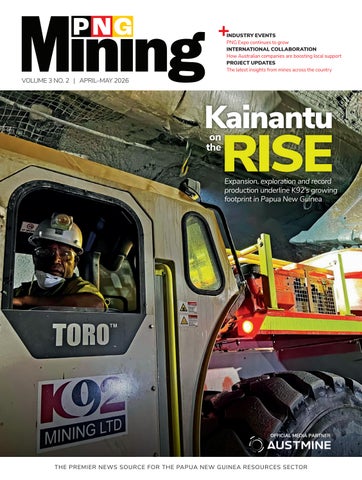
on the

Expansion, exploration and record production underline K92’s growing footprint in Papua New Guinea


Donaldson delivers OEM grade filtration for the world’s toughest environments.

BY OEM’S
BY PROFESSIONALS
CEO Christine Clancy
GROUP MANAGING EDITOR
Paul Hayes
T: +61 3 9690 8766
E: paul.hayes@primecreative.com.au
EDITOR
Ben Cartwright
T: +61 3 9690 8766
E: ben.cartwright@primecreative.com.au
CLIENT SUCCESS MANAGER
Janine Clements
T: +61 2 9439 7227
E: janine.clements@primecreative.com.au
RESOURCES GROUP LEAD
Jonathan Duckett
M: +61 498 091 027
E: jonathan.duckett@primecreative.com.au
BUSINESS DEVELOPMENT MANAGER
Ezra Wolde
M: +61 411 188 322
E: ezra.wolde@primecreative.com.au
ART DIRECTOR
Michelle Weston
COVER IMAGE K92
SUBSCRIPTION RATES
Australia (surface mail) $140.00 (incl GST)
New Zealand A$148.00 Overseas A$156.00
For subscriptions enquiries please call +61 3 9690 8766

Papua New Guinea’s mining and heavy industries are continuing to grow in size and significance, buoyed by international investment and rapid mineral exploration.
GROWTH ACROSS Papua New Guinea’s mining sector doesn’t look to be slowing, with greater mineral resource being seen across many of the country’s biggest assets.
2 Mining has celebrated a record year across its ainantu operations, hinting to a nationwide trend that the wheels are well and truly in motion to benefit from greater exploration.
Mining isn’t the only industry where innovation is being made, thanks to acific ime and ement signing a first-of-its-kind agreement to future- proof G s capabilities.
and workforce development into dayto-day operations. This is where the conversation around digital mining becomes particularly important. No longer a distant concept, transforming operations to become more digitised offers opportunities to improve efficiency, safety and decision-making on site whilst also giving greater insight into mining operations.
Of course, this progress doesn't happen in isolation. The mining sector continues to rely on a network of supporting industries, from heavy equipment suppliers and engineering firms to transport providers and energy producers.
As these industries innovate alongside mining, PNG is gradually building a more resilient industrial ecosystem capable of supporting large-scale projects for decades to come.
PRIME CREATIVE MEDIA
379 Docklands Drive
Docklands, VIC 3008 Australia
www.primecreative.com.au
© Copyright Prime Creative Media, 2016
All rights reserved. No part of the publication may be reproduced or copied in any form or by any means without the written permission of the publisher.
Across the country, investment appetite remains strong. G s mineral wealth, from gold and copper to emerging critical minerals, remains a powerful driver of both domestic opportunity and international interest. However, growth in resources alone will not define the industry s future. Increasingly, success will depend on how effectively operators integrate technology, sustainability
The future might not be here just yet, but we’re certainly on our way and it's never been a better time to take a look at what the country's heavy industries have to offer.
Ben Cartwright Editor
16 Digital mining Digging smarter
As the mining sector enters a data-driven era, DEKA Dynamics is equipping professionals in Papua New Guinea with the tools to thrive.
18 Cover story
K92’s golden year
Expansion, exploration and local programs have put K92’s Kainantu gold mine on a path towards greater growth.
24Education
The talent pipeline powering PNG mining ince its first cohort graduated in the mid1990s, PNG University of Technology’s School of Mining Engineering has continued to produce the workforce of the future.
34 Community projects
Transforming education opportunities
Expo is bringing industry leaders together to build partnerships, share ideas and unlock new opportunities.
44 Industry insight
A hydrocarbon horizon


Project Yumi is helping rural communities across PNG access quality education by redirecting surplus resources to those that need it.
40 Industry events
PNG’s industry stage
As Papua New Guinea’s mining and industrial sectors expand, PNG
Papua New Guinea’s hydrocarbon future is gaining momentum following recent high-level discussions between Santos executives and Prime Minister ames Marape.
52 Industry insight
Expanding industrial capability


The PNG Government has signed a project development agreement with acific ime and Cement for its Central ime and ement project, a huge step forward in advancing domestic capabilities.


Ok Tedi Mining has reaffirmed its commitment to Western Province in Papua New Guinea with a major electrification pro ect aimed at providing reliable, affordable, sustainable power.
ower, a wholly owned subsidiary of Ok Tedi, and supports western regions including parts of East and West epik provinces.
T is described as a multi-decade
long-term social licence with host communities, economics diversification across the region and national government electrification goals.

Ok Tedi is 00-per-cent- apuaNew-Guinea-owned, and our people are driving this development,” Ok Tedi managing director edi limbit said in a statement.
“Lighting Up the West starts at home. estern rovince is our host, and it is our priority. ork in other provinces is about planning for the future, not replacing our commitment to the people of estern rovince. ork is already underway in Western Province with construction and delivery including grid extensions in iunga and the highway corridor, the establishment of the ingerum mini grid and a standalone solar power system for priority ommunity Mine ontinuation Agreement villages. f you live in estern rovince, T initiative is already underway, limbit said. PNG
ewmont has announced key upgrades at its Lihir mine in Papua New Guinea ( G), helping to enable the production of over five million ounces of gold. n its most recent reporting, the company said Nearshore Barrier upgrades will unlock access to mining additional phases of the apit ore body through construction of a water seepage barrier and extend the site s mine life to beyond 2040.
The cost of upgrades are estimated to sit in the region of 500 550 million and are expected to be complete in the next two years.
The company hailed the site one of the world’s largest producing gold operations as pivotal to its increase in attributable gold production this year, expected be weighted 52 per cent to the second half of 2026.
It’s understood production at the site on Aniolam sland is expected to be largely in line with 2025 figures this year, at around 560,000 ounces of gold.
Reserves at the project have increased by 200,000 ounces to 6 million over the course of the year due to favourable price impacts , the company said.
Across Newmont’s portfolio – spanning Africa, Australia, PNG, Canada and atin America total gold mineral reserves sat at .2 million attributable ounces at the end of 2025, compared to 4. million the year before. 2025 was a milestone year for Newmont, as we delivered on our full-year guidance, strengthened our financial position and made meaningful progress on our commitments,” Newmont chief executive officer atascha il oen said. PNG
t arbara has reported strong operational and resource growth at its imberi operations in apua ew Guinea ( G), underscoring momentum behind the proposed ew imberi Gold ro ect.
At the imberi gold mine, the company produced 20,2 5 ounces of gold in the first half of the 2025 26 financial year ( 26), generating an operating
ore, maintaining production continuity while development plans advance. The result supported a near break-even group outcome during a period of continued investment.
A key highlight was a substantial lift in mineral inventory. pdated figures show gold mineral resources increased by 0. million ounces to 5. million
estimates, including 5. million ounces of silver mineral resources and 4.5 million ounces of silver ore reserves, marking an expansion in the pro ect s precious metals profile.

statement also introduced inaugural silver
To fund the next phase of development, t arbara has entered binding agreements with ingbao Gold nternational, which will ac uire a 40 per cent interest in the ew imberi pro ect for 0 million, and with umul Mineral oldings, whose subsidiary will take a further 20 per cent stake. oth transactions are targeted for completion by the end of the third uarter of 26. Together, the strengthened resource base and secured funding position imberi as a long-life asset poised for its next stage of growth.
Growth was also seen across the company s Atlantic operations in anada, which contributed to an increase in total mineral resource across assets.at 2.5 million ounces at period end. PNG
Tolu Minerals recently announced the appointment of Rob Taube as the company s new head of geology, bringing more than 0 years global experience in gold and copper exploration.
ith an excellent discovery and resource growth track record at companies such as ewcrest Mining and T Merdeka opper Gold, Taube s immediate focus will be on accelerating drilling and updating mineral resource at the Tolukuma gold mine.
Taube oins Tolu Minerals at a time described as pivotal in the company s evolution” as it transitions to a new phase of growth, where he will work
closely with chief executive officer hris Muller and the broader technical leadership team.
Taube s experience includes senior leadership roles including as geosciences manager at Tujuh Bukit in Indonesia and geology manager at Gosowong gold mine.
am excited to welcome Rob at Tolu at what is clearly a defining moment for the company, Muller said in a statement.
Rob brings exceptional technical depth, strong discovery credentials and extensive experience leading large-scale drilling and resource growth programs. PNG

PGreat acific Gold recently began drilling at its asie Ridge target within the Wild Dog project on New Britain in Papua New Guinea, marking the next phase of the company s exploration efforts.
The 5km structural corridor earmarked for exploration has shown strong potential for gold-copper mineralisation.
The second diamond drill rig recently arrived on site and has started drilling at Kasie Ridge, located at the northern end of the ild og structural trend, following months of preparation. This included extensive geophysical work and earlier drilling at the inivit and avasuki targets.
asie Ridge has become a priority target after detailed ground and airborne surveys identified a large one of altered rock beneath the surface. The company used MobileMT, a geophysical method that maps changes in rock properties below ground, along with high resolution i AR, a laser-based aerial scanning system that produces detailed surface maps.
hile the first rig continues drilling at inivit and avasuki, the asie Ridge drilling will provide first-pass reconnaissance of this newly prioritised target. rilling at inivit has already delineated high grade ones within the orthern ulphide and outhern Oxide shoots and continues to extend the system at depth and along strike.
hase one drilling at ild og has been underway since May 2025, with a 2,500 metre program targeting the most promising areas identified from earlier airborne surveys.
Results so far show the mineralisation continues along the structure, helping the company narrow its focus for the next round of drilling, including at asie Ridge.

LCL Resources has reported high-grade gold and silver rock chips following exploration work at its usi pro ect, part of the company s Ono pro ect in apua ew Guinea ( G).
Results include exceptionally high assay values, highlighting strong mineralisation in a previously under-explored portion of the Kusi Corridor, showing opportunities to enhance the pro ect s broader precious and base metal potential.
Rock chip samples found to the southwest of usi have returned assay
grades of up to 5.5 grams per tonne (g t) gold, 5g t silver, 5.24 per cent lead and 4. 5 per cent inc.
Trench sampling at Ono returned 20m at 2. g t gold, . g t silver and 2. m at 5. g t silver, . 5 per cent lead and . 4 per cent inc.
ield work included both prospecting and mapping, confirming the continuation of the Kusi Lower Limestone unit, which hosts over 00,000 ounces of gold.
peaking on the positive exploration results, Resources executive chairman
hris van i k said the company is entering an exciting phase.
t unlocks significant new areas for exploration, which has not previously been sampled, with targets both in the Lower Limestone itself and also targeting magnetic features at depth identified from the inversion of magnetic data, he said.
“In addition, our multi-element results demonstrate extremely high silver grades present at Ono which complement the prospectivity of the pro ect. PNG
Pouth acific Metals has announced a strategic expansion of exploration activities for the coming year, introducing a second drill rig at the Ontenu project in the Kainantu District of apua ew Guinea ( G).
As part of the broader Osena regional mineral exploration portfolio, the company revealed the additional power will help expedite subsurface testing of sever high-priority targets, located ad acent to the southwestern boundary of 2 Mining s ainantu gold mine.
The newly contracted rig, expected to arrive in March, will begin operations at the Onki ault area, complementing the existing company-owned rig already active in the southern Ontenu E area.
PThis move re ects outh acific Metals intent to significantly scale up its 2026 drilling program, which now aims to complete up to 5000m of drilling across multiple structures and ones.
Early surface work at the Onki ault has already yielded impressive rock chip results, with assays returning values as high as 2 .2 per cent copper, 2 4 grams per tonne (g t) silver and 0.4 g t gold, underlining the potential for significant subsurface mineralisation.
peaking on the expanded program, outh acific chief executive officer Timo Jauristo noted the potential for greater pro ect growth.
Ontenu, and especially Ontenu E, has revealed multiple targets from
Great acific Gold has reported a new high-grade channel sample from its agship ild og pro ect on the island of New Britain in the East New Britain province, highlighting the pro ect s potential.
The company said follow-up field exploration, including channel sampling, rock-chip sampling and mapping, was conducted across the project area to better define mineralisation and prepare targets for future drilling.
At the Magiabe est vein, exceptionally high-grade rock-chip samples returned up to grams per tonne (g t) gold, . per cent copper and 6g t silver.
Additional rock-chip sampling located 5 metres southwest of the discovery also identified a uart sulphide outcrop returning . g t gold, 20g t silver and 0. per cent copper, suggesting the Magiabe est vein system may extend further than previously recognised.
At the Morgan ein system, channel sampling delivered . m at 4. g t AuE , including a highergrade interval of 2.5m at 0.6 g t AuE . The broader interval contained 4.0 g t gold, 6g t silver and 0.0 per cent copper PNG
Osurface exploration across a number of mineralised structures and ones over a broad area, he said.
“In order to accelerate testing of these high-grade epithermal targets, the company is adding a second drill rig to the campaign. Our challenge is prioritising the many targets.
The second drill rig has been contracted through a apua ew Guinea-based drilling company and will operate in tandem with the existing rig to advance drilling and targeting at both the Onki ault one and the southern Ontenu E area.
The Onki ault has returned significant surface grades of copper, gold and silver since its discovery in 2025, suggesting substantial target widths. PNG


As operations in Papua New Guinea expand, a new frontier of technology could be the answer to extracting even more value from the ground.
Mining technology can put workers out of harm’s way.
PAPUA NEW Guinea’s (PNG) mining industry has long been defined by scale, geology and remoteness.
From high-altitude gold deposits to remote island nickel operations, the country s pro ects often operate in some of the most challenging environments in the global resources sector.
Logistics are complex, infrastructure can be limited, and operations must balance productivity with strong environmental and community expectations. Against this backdrop, digital mining is emerging as a new frontier is emerging that could reshape how G mines operate.
Companies across the global industry are adopting digital technologies to support real-time operational monitoring, predictive maintenance and analyse data at never-before-seen speeds.
While these tools are becoming standard at large operations in Australia, North America and parts of Africa, their relevance to PNG may be even greater.
PNG hosts world-class mineral deposits but often in locations that test the limits of conventional mining practices. Remote mountainous terrain, heavy rainfall,
limited road access and high logistics costs all place pressure on mine operators.
Digital technologies provide tools to manage these realities more effectively, with one of the immediate benefits coming through improved operational visibility.
Digital platforms allow operators to connect equipment, sensors and production systems into a single dashboard, enabling supervisors and management to see exactly what is happening across the operation. This kind of visibility can be transformative for a mine located hundreds of kilometres from a ma or service centre.
Just as importantly, digital systems can reduce the risks associated with operating in isolated regions. Equipment downtime, for example, is expensive anywhere in the world, but the cost multiplies in remote PNG operations where replacement parts or specialist technicians may take days, or even weeks, to reach site.
Predictive maintenance, enabled by sensors and data analytics, offers a practical solution. Instead of waiting for machinery to fail, digital monitoring systems track factors such as vibration, temperature

and engine performance in real-time. By analysing this data, software can detect early warning signs of potential breakdowns and alert maintenance teams before a critical failure occurs.
Having greater oversight of operations can be extended further thanks to remote monitoring. In some cases, e uipment specialists located in ma or mining centres such as Australia or Singapore can analyse operational data and assist site teams with
Digital technologies support real-time
troubleshooting without ever leaving their offices. This can make a ma or difference for sites where technical expertise could be limited.
Safety is another area where digital technologies are making a significant impact. G s terrain and climate present unique safety risks, from steep pit walls and unstable ground conditions to heavy rainfall and landslides.
Geotechnical monitoring systems, for example, use sensors to detect subtle ground movements around pit walls or waste dumps. If movement exceeds safe thresholds, alerts can be triggered automatically, giving teams time to respond before a serious incident occurs.
Wearable technologies are also gaining traction across the industry. Smart helmets, location trackers and fatigue-monitoring systems can provide data about worker conditions and location. In emergency situations, this information can dramatically improve response times.
These technologies are particularly valuable in PNG operations where terrain and weather conditions can complicate emergency access.
How connectivity and automation are the future hile the benefits of digital mining are clear, one ma or barrier in G is connectivity.
Many mine sites are located far from established telecommunications networks. However, advances in satellite communication are ust one of the way this gap is being bridged.


Mining companies are increasingly building site-wide wireless networks that connect equipment, sensors and personnel across the operation. These networks form the backbone of digital mining systems, allowing data to ow from equipment in the pit or underground directly to control rooms or remote operations centres.
Automation, including drill rigs, remotely operated underground loaders and advanced process control systems in mineral processing plants, is another key component of digital mining. Across operations in PNG, automation has the potential to deliver several benefits and provide drill or haulage systems greater precision and fewer interruptions.
Importantly, automation in PNG is increasingly viewed as a complement to the workforce rather than a replacement. The focus is shifting toward digitally enabled obs that combine operational experience with data analysis and technology skills.
Environmental stewardship is another area where digital technologies are playing an increasing role. ro ects operate in areas known for their biodiversity and strong community connections, meaning environmental performance remains under scrutiny.
Digital monitoring systems can track water quality, tailings storage facilities, air emissions and other environmental indicators in real-time. Instead of relying solely on periodic sampling, operators can maintain continuous monitoring and respond quickly if readings move outside acceptable ranges.
Drone technology is also becoming more common across the industry, allowing operations to survey large areas of land quickly and safely while assisting with tailings dam inspections, vegetation monitoring and mapping of rehabilitation areas.
Predictive maintenance can help equipment stay online for longer.
While technology is central to digital mining, people remain the most important factor in successful implementation. Developing local digital skills is critical to taking advantage of the rapidly evolving technological landscape.
Mining companies, training institutions and government agencies all have a role to play in ensuring the local workforce can participate in the industry’s digital transition. Training programs focused on data analysis, equipment monitoring, drone operations and digital maintenance systems are becoming increasingly important.
Operations are already investing in workforce development programs that expose local employees to digital tools and technologies, such as G niversity of Technology, where digital skills make up the backbone of mining engineering courses.
Digital mining is not a single technology or a quick upgrade. It represents an ongoing transformation in how mines collect data, make decisions and operate equipment, with shifts likely occurring gradually due to infrastructure constraints, capital requirements and workforce development.
However, the direction is clear. As global mining companies seek to improve productivity, safety and environmental performance, digital technologies will increasingly become standard practice.
In many ways, PNG’s remote and rugged landscape makes digital mining not ust beneficial but essential in bringing about change that will change operations into truly future-proofed.
The necessity to adopt technology offers benefits that will transcend the mining industry to future-proof G s economy. PNG
Built to perform in the toughest mining and industrial environments, our lighting solutions combine rugged durability, advanced optics, and energyefficient LED technology. Engineered to meet strict OEM requirements, they deliver enhanced visibility, reduced power draw, and long service life helping operators improve safety, minimize maintenance, and maximize equipment uptime.

Explore Our Complete Industrial Lighting Portfolio


J.W. Speaker Global Headquarters
N120 W19434 Freistadt Road PO Box 1011, Germantown, Wisconsin 53022 USA jwspeaker.com
johnstoner@jwspeaker.com + 0064 21 2787 757
Orica Digital Solutions is deploying predictive blast technology across Papua New Guinea to help operations extract more value for the same resources.
PAPUA NEW Guinea (PNG) is widely recognised as one of the most resource-rich nations in the Asia- acific region, with significant deposits of gold, copper, nickel, oil and gas supporting a major share of the country s economy.

OREPro helps mining operations get more out of the ground.
long-term economic benefits of the country s mineral wealth are fully realised.
With world-class operations across the country, some benefitting from a mineral resource as high as double-digit grams per tonne, the resources sector continues to drive investment, employment and infrastructure development.
For mining companies, the ability to extract more value from existing deposits through improved mining practices, efficient e uipment and advanced processing technologies becomes increasingly important, with Orica Digital Solutions on hand to support operations from day one.
Maximising recovery and productivity help extend mine life, strengthen export revenues and ensure the
Predictive technology helps mine sites i itise effi ien

For Orica Digital Solutions, this very focus is what drives its continued innovation in the OREPro technologies built for blast movement modelling and grade control optimisation. These advancements help mining operators around the globe maximise the value recovery from their mineral resource.
The company s ORE ro technologies are helping mining operations in Porgera, Hidden Valley, Lihir and Tabubil regions of PNG get more out of the ground.
“Companies spend millions of dollars on resource definition only to blast their precious orebody to a different location, and into an entirely different shape, prior to mining. Traditional blast movement vectoring using physical indicators assumes 2D lateral translation of blockouts. If you watch one blast video you can see it s a three-dimensional problem, Orica OREPro lead for the AUSPAC region Andrew Duffy told PNG Mining
“In a nutshell, OREPro Predict simulates the impact of blast dynamics on the movement of rock and algorithmically optimises polygon boundaries that yield the best value recovery during mining. ompanies can be confident where their payzones are in the post blast space and dig for maximum return.
“What excites our clients the most is OREPro redict s ability to optimise blast designs before the shot is even fired, enabling teams to select the optimal blast design that gives the best ore recovery potential.
The OREPro Predict simulations performs in near real-time, ensuring its effective use in fast-paced mining production environments. Used with or without a post-blast topographic scan, resource

definitions are accurately transformed from in-situ grade control models to a post-blast model.
Using readily available mine data as inputs, including blast designs, explosive types, block models and topography scans, sophisticated physics-based algorithms predict movement dynamics throughout the entire blast volume to create a swelled post-blast grade control block model.
After generating the post-blast model, the polygon optimisation tools will then generate optimal block-outs for ore value recovery. Mining cost, mill recovery, extraction costs, metal price and time costs are assessed against the site s material classification tree and block model, producing a set of editable dig polygons ready for export to the dig eet.
f a mine wants to see the cash ow impact of digging with a different bucket size, mining in a different direction or itching differently, they can do that ahead of time. uffy said.
These results aren t ust theorised across the acific, uffy noted. ORE ro has been used by more than 600 users across the globe, including over 60 in G. Globally, more than 0,000 blasts have been processed using OREPro, and in PNG alone more than 500 blasts have been modelled.
OREPro uses readily available data to make blasts more valuable.
“We are seeing more and more geologists with OREPro experience transferring between mines and bringing that expertise with them. As mining transitions to the digital space, OREPro experience is a must have for high functioning mine geology teams uffy said.
e ve seen in some instances across the acific, multi-million-dollar value adds resulting from OREPro usage. Sometimes I need to go and doublecheck the numbers because it seems ridiculously lucrative, but at double-digit gold grades we can make huge bottom-line impacts from the use of this technology.
“Small percentage improvements in the mine geology work ow in G can literally add millions of dollars overnight. t s uite breathtaking when we look at what could have been mined if we had modelled the blast movement.
There s a high probability a lot of mines are missing out without even realising. This is why digital technology is an integral part of a mining operations arsenal of tools.
As PNG advances its digital transformation, solutions like OREPro are essential. They allow operations to mine high-value ore, increase recovery and maximise returns without expanding their physical footprint. PNG

As the mining sector enters a data-driven era, DEKA Dynamics is equipping professionals in Papua New Guinea with the tools to thrive.
AS PART of its program to increase exposure to Papua New Guinea (PNG) mining professionals, DEKA Dynamics is helping support the industry adapt to its next pivotal phase where data could be as valuable as the minerals dug from the ground.
The company focuses on training and upskilling mining professionals across PNG, with focus on exploration, geophysical surveys and resource modelling and estimation. Through tailored workshops run by experts, DEKA Dynamics can help bridge key knowledge gaps.
Workshops taking place in July focus on utilising key digital tools to streamline complex work ows.
Managing director Dennis Kattowitz highlighted that, for modern geologists, the challenge is no longer a lack of information. Rather, it’s the ability to extract meaningful insight from overwhelming volumes of technical data.
With potentially thousands of data points –from public reports to historical drilling logs and geophysical surveys artificial intelligence (A ) is rapidly emerging as a transformative force in how this work is performed, particularly in the resource estimation process.
“Advanced algorithms can rapidly scan large datasets, identify inconsistencies, highlight outliers, and surface relationships that may be difficult or time-consuming to detect using conventional work ows, attowit told PNG Mining. “This allows geologists to focus more of
their effort on interpretation and validation, rather than manual data handling.
attowit also highlighted A has significant impacts in high-level review and audit of mineral resource estimates through assisting in stress-testing assumptions and identifying potential aws.
“What once required weeks of manual comparison across multiple technical reports can now be completed in a fraction of the time, attowit said.
“For companies operating under tight timelines, such as during ac uisitions, financing, or feasibility studies, this capability can materially reduce technical and commercial risk.
Training in AI gives mining operators crucial skills for t e futu e


AI is also reshaping how geological uncertainty is understood and managed across the acific.
y integrating drilling data with information around geological domains and historical interpretations, AI systems can help support more transparent sensitivity analysis processes.
Beyond formal resource estimation, Kattowitz noted A as increasingly in uential in upstream exploration and downstream mine planning.
“As AI takes on more of the repetitive analytical workload, geological expertise becomes even more valuable, not less. Professional judgement, domain knowledge, and ethical responsibility remain central, but they are now augmented by tools that enhance speed, consistency, and insight, he said.
“In an industry facing increasing scrutiny, tighter capital markets, and growing technical complexity, AI is becoming an essential component of modern resource estimation.
ompanies that successfully integrate A into their geological work ows are better positioned to improve estimate robustness, reduce risk, and make faster, more informed decisions.
Through DEKA Dynamics, Kattowitz will be offering insight into this world with a two-day AI during its July visit to PNG as part of it 2026 Mining Pathway Program, with workshops designed specifically for mining-oriented geologists, helping to bridge the gap between traditional geologist expertise and the intellectual superpower of generative A .
The workshop, led by geologist and technology consultant Ashley Brown, will focus on mastering high level reviews of mineral resources and how

Above left: Geologist and technology consultant Ashley n
Above right: DEKA Dynamics focuses on training and upskilling mining professionals ss
to deploy sophisticated prompts that can perform fatal aw analysis on public reports.
By benchmarking mineral resource estimates against global standards, delegates can identify risks and validate robustness in minutes, a task that previously took days of manual auditing.
“Even with zero prior background in AI, workshop delegates will learn to leverage these Large anguage Models to transform work ows to focus on practical, field-tested applications, attowit said.
The workshop also dives into exploration driven by AI, looking at how mine operators can integrate geophysical data and classical geological techniques to identify new mineral deposits within brownfield sites.
“Expanding delegates’ toolkits beyond resource geology is key, which is why we’re also focusing on mine plan analysis and pro ect financing. These modules empower delegates to evaluate the engineering feasibility of a deposit and understand the financial mechanisms re uired to move a pro ect from exploration to production, attowit said.
“This isn’t just a theoretical computer science workshop. It’s a masterclass in geostatistics and resource geology that’s augmented by AI. elegates will leave this workshop with the tools to produce high-level geological reviews that are clear, professional, and easily interpretable by corporate decision-makers. PNG
Expansion, exploration and local programs have put K92’s Kainantu gold mine on a path towards greater growth.
HIGH IN Papua New Guinea’s (PNG) Eastern Highlands, K92’s Kainantu gold mine is reshaping its own horizon and the communities around it, as expansion, exploration and local investment drive a year of record growth.
K92 has set a target to reduce greenhouse gas emissions on a business-as-usual basis by 25 per cent by 20 0, with an approach that includes using hydroelectric power, no cyanide in processing and modified tailings management practices.
These measures form part of a broader sustainability framework that has been outlined in the company s 2024 report.
The operation has a significant domestic footprint, with more than 2300 employees and contractors directly engaged in PNG – 92 per cent of which are drawn nationally and close to one-third are from communities surrounding ainantu.
K92 is continuing to see gains with the Kainantu gold mine.
Procurement expenditure across PNG reached $US119.8 million ($170.86 million) across the year, representing 45 per cent of total procurement spend. In addition, $US28 million ($39.9 million) was invested into local joint ventures linked to the mine’s supply chain.
Government revenues remain a key component of the mine’s contribution. In 2024, K92 paid 0.4 million ( . 4 million) in taxes and royalties in PNG and allocated $US6.6 million ( .4 million) to its inaugural nfrastructure Tax redit cheme pro ect.
ommunity programs continue to run alongside operations. Sixty-six tertiary scholarships were awarded to PNG students during the year, and 2 s ustainable Agriculture ivelihoods program received recognition from G ORE for the third consecutive year.


In addition, the Kainantu Endowment has been established to provide ongoing funding for local initiatives. Set up in 2023, the independent charitable trust helps advance education and skills development and is supported by 2. t focuses on fostering local talent and supporting initiatives like the Tookie Angus Memorial Scholarship to strengthen educational pathways. The Adult iteracy program, also run by 2, remains one of the more visible pro ects.
Around 50 participants graduate each year, with women representing approximately 90 per cent of the cohort.
Operationally, 2 is continuing to see gains with the Kainantu gold mine, recording more than nine consecutive quarters without a lost time injury as of the end of September 2025.
Across the year, 2 also logged record production statistics and strong financial statements, further emphasising the strong foothold for growth.
The company’s fourth quarter and full-year financial results show production of 4 , ounces of gold e uivalent (AuE ), with record annual production sitting at over 4,000 ounces AuE , marking a significant milestone.
Kainantu’s production levels reached over 170,000 ounces of gold equivalent ounces in 2025.
Alongside production gains, the company reported substantial economic contributions to the country, paying or acruing G 42 million ( . million) in corporate taxes to the national government, along with $16.5 million in royalties and $3.6 million in Mineral Resource Authority levies.
K92 also continued to invest heavily in PNG's resources sector and local economy.
As production grows, so too will the e n i enefi s f e e n en f Papua New Guinea, our landowner partners, local communities, and business stakeholders.
K92 Mining chief executive officer John Lewins
apital investment reached in excess of $285 million, largely directed toward the tage expansion of ainantu.
“[The year] 2025 was a transformational [one] for K92 and for the ainantu gold mine, 2 chief executive officer ohn ewins said.
“We delivered record annual production and financial results while successfully commissioning the new 1.2-million-tonnes-per-annum tage expansion process plant.
As production grows,so too will the economic benefits for the Government of apua ew Guinea, our landowner partners, local communities and business stakeholders.

A ma or focus over the past year was the completion of the Stage 3 process plant expansion to 1.2 million tonnes per annum. First commercial grade saleable concentrate was produced in October 2025, with the plant officially inaugurated on October 6.
Once fully ramped up, tage is expected to support an average annual production run rate of more than 00,000 ounces gold e uivalent.
Planning for Stage 4 is also underway, with throughput targeted to increase to 1.8 million tonnes per annum and an average annual run rate above 400,000 ounces AuE .
Production for the third quarter of 2025 totalled 44, 2 ounces AuE with underground development reaching a monthly record of 02 m in October, re ecting continued investment in access and mine preparation. The coming uarters will be critical in determining how effectively the expanded plant and underground development translate into sustained output at the higher design rates.
Recent drilling at Arakompa has identified high-grade mineralisation, with a maiden
wider economic gains can be made through Kainantu’s success.
mineral resource estimate targeted for mid 2026. pdated resource estimates at the ora and udd deposits stand at 2.6 million ounces AuE at 0 grams per tonne (g/t) in the measured and indicated category, and 4.5 million ounces AuE at .5g t of inferred resource.
The scale of drilling positions K92 as one of the most active explorers currently operating in PNG.
Financially, the third quarter of 2025 delivered revenue of $US177.5 million ($252.95 million) and net income of 5. million ( 22. million).
K92 reported a net cash position of $US185.4 million ($264.18 million) at quarter end, including $US131.2 million ($186.96 million) in net cash.
ith an available credit facility in place, funding for the staged expansion program is secured.
“We will look forward to working in ongoing partnership with all our stakeholders to deliver transformational value from our operations now and into the future. ewins said.
As the ainantu mine moves through this expansion phase, the interplay between production growth, exploration success and community engagement will shape its longer-term role within the mining landscape of PNG. PNG


Ela Motors operates across Papua New Guinea to help operations navigate unforgiving environments backed by global manufacturers.
LIGHT VEHICLES play an important operational role across mine site, supporting a wide range of day- to- day activities. upervisors rely on them to travel between operational areas, while maintenance crews use them to access infrastructure.
Exploration teams and survey crews also depend on capable four-wheel drives to reach undeveloped terrain beyond established haul roads, making dependable eet vehicles a critical component of mine-site logistics.
The need for dependable light vehicles is reinforced by the scale and geographic spread of apua ew Guinea s ( G) mining sector.
Operations such as the orgera, idden alley and ihir gold mines rely on extensive eets to
Land
transport workers, contractors and equipment across large operational footprints.
In these environments, vehicles capable of operating reliably in isolated conditions help with maintaining productivity and reliability.
Ela Motors across PNG, has the answer with its range of vehicles for any and every eventuality, from traditional s like the RA 4, ilux, and Fortuner to the world leading heavy-duty Land Cruiser 70 series.
“The PNG road network is frequently challenging, with ma or routes like the ighlands ighway suffering from significant washouts after heavy rain and seismic activity, an Ela Motors spokesperson told PNG Mining

eries uses a heavy-duty ladder-frame chassis and solid axles that can withstand the constant pounding of deep potholes and unpaved, bumpy rural roads.
igh ground clearance is essential for traversing washed-out sections and shallow river common in remote areas.
The Land Cruiser single and double cab options are particularly favoured by heavy industries because of the power under the hood, featuring a bulletproof 4.2 diesel engines available with a five-speed manual and high sulphur diesel engine with a new four cylinder six-speed automatic transmission. ixteen-inch steel or alloy wheels come as standard, offering greater adaptability to any kind of surface.
“We believe reliability and durability are critical factors for vehicles used in mining operations as they are typically located in remote and challenging environments where vehicles are exposed to rough terrain, extreme weather, and continuous daily use, the spokesperson said.
Other features include halogen headlamps, front and rear mudguard, power windows, manual air conditioning and vinyl seats. These features ensure the ride is comfortable for mine operators whilst the outside handles rugged terrain.
ehicles can also be adapted to specification with a range of accessories to best suit site-specific needs including Bridgestone tyres for heavy off-road and industrial outfitting and integrated T M accessories including suspension kits that are fit for purpose to match the terrain.
Access to spare parts and maintenance support is another critical factor for companies operating across G s remote provinces.
Vehicles can also be adapted to s e ifi ti n it range of accessories.
Ela Motors is backed by the global supply chain of Toyota Tsusho.
re uirements and higher operating costs.
Another exciting addition to the Ela Motors eet, arriving later this year, is the ninth generation Toyota ilux, continuing the model s five-decade legacy of being more than unbreakable . irst deployed in 6 , the first-generation was described as a new, versatile bonnet-type truck. ince then, improvements to si e, comfort and drive train have made the ilux the upper echelon of toughness, perfect for what remote sites can throw at it. Through consolidating essential industrial transport needs into a one-stop shop for eet requirements in PNG, Ela Motors is a key partner for operators in the heavy industries that re uire diversified transport options. PNG

ince its first cohort graduated in the mid- 0s, G niversity of Technology s chool of Mining Engineering has continued to produce the workforce of the future.
MINING REMAINS the backbone of apua ew Guinea s ( G) economy, contributing to more than a uarter of the country s national gross domestic product in recent years. t has also generated a substantial portion of foreign export revenue and employed more than 0,000 workers.
ith strong mining revenue continuing to buoy the nation s coffers now and into the future, high- uality workers are needed to ensure that growth can continue, with education playing a pivotal role in this pipeline.
ocated in ae, Morobe rovince, and founded in 65, G niversity of Technology ( G oT) is recognised as the only educational institution in the outh acific region to offer integrated undergraduate degrees in mining engineering. Through state-of-the-art hands-on learning, G oT e uips students with knowledge and expertise to be successful in industry careers. Offering a breadth of courses under the aculty of Engineering, including civil, mechanical and electrical engineeringl, G oT is dedicated to fostering excellence in mining and mineral process education, research and innovation.

team.
G oT is committed to providing graduates with the professional skills re uired to excel technically and understand the importance of sustainable and responsible mining practice. aboratories focusing on rock mechanics and pyrometallurgy are central to the university s hands- on learning experience.
acilities such as these give students a direct insight into industry practice and supports knowledge of advanced e uipment, something that is also underpinned by improved teaching methods under accreditation..
The basis of our degree program is giving students the ability to be work ready when they graduate, G oT deputy head of school for mining engineering r aepae en Ail told ining Mathematics, physics, underground mining practice, rock mechanics and geology are all

founding principles that ensure we re giving students the best exposure to the mining sector.
n the last 6 years, we produced around 000 mineral processing and mining engineering students.
Accredited by Engineers Australia, courses go beyond the classroom to help ensure students have the best possible outcomes beyond G,


helping create a workforce that is competitive and mobile on the global stage.
This accreditation is the next step to developing the courses on offer at G oT to ensure they are as good as they can be for our students, G oT dean of the faculty of engineering r hoeb Ahmed yed said.
Recognition from a key industry body highlights that our degree classifications benchmark with mining schools in Australia and the . ut simply, it means our students can work for the biggest mining companies across the world. ith industry work experience a core re uirement of our engineering courses, it means students are ready from day one when they get a ob. ith mining being a very hands-on industry, we have a very good training process.
artnered with key statutory bodies across G the hamber of Resources and Energy, Mineral Resources evelopment ompany and Mineral Resources Authority as well leading mining companies such as Ok Tedi Mining and 2 Mining, students are presented with additional opportunities through strong industry connections connections.
ourses on offer feature work experience as an integral strand of a students learning,
Students are provided hands-on experience in mining engineering.
expanding on G oT s goal of producing the highest uality graduates, with results speaking for themselves.
Our high-performing graduates have worked across different sectors, including petroleum, Ail said. e ve been supplying technical expertise everywhere, not ust commercial industries. Government and state agencies have roles occupied by our graduates.
Recognition from a key industry body highlights that our degree lassifi a i ns en a k with the likes of Australia and New Zealand.
PNGUoT’s Dr Shoeb Ahmed Syed
The university is looking to expand on its current offering for the next academic year to further enhance opportunities by offering a degree in petroleum engineering. Ail noted this helps to ensure the university continues to provide tailored education for what the economy needs, a sentiment echoed by yed.
e are a highly technical institution and the future of G lies here at G oT.
e have been producing manpower for the industry for a long time with graduates working in places like Australia and America.
n an era where G s mining industry is seeing exponential growth, G oT is firmly cementing itself as being the pipeline for the best mining talent. PNG


onaldson helps to protect key assets with air filtration systems that stand up to even the harshest of environments.
MINING OPERATIONS in remote areas of apua ew Guinea ( G) are known for high dust levels and high humidity, with haul trucks bearing the brunt of this unforgiving landscape. hortening the time in between trucks being serviced does not always prevent premature fuel in ector, transmission, engine or hydraulic system wear and failure.
or operators, it comes down to a simple uestion hat is the impact to prospective earnings and profitability if production e uipment is not available or capable of operating at peak efficiency
onaldson supports global heavy industries with first-fit filtration systems, ensuring operators are able to maintain their e uipment s optimum performance levels.
peaking to PNG Mining, onaldson s territory manager an alsh identified key issues impacting e uipment performance.
ust is a huge problem in mining, on average it only takes one gram of dust per horsepower


of an engine over its lifetime to destroy it. e ve worked with sites that were forced to rebuild diesel engines at about half of the expected operating hours between rebuilds, he said.
There is also the short-term impact of high dust. Many workshops do not understand how to maximise air housing efficiency meaning that they will experience high restriction events between scheduled intervals, creating high consumable and labour costs.
Anyone can sell you a filter, but we are here to work with you to maximise e uipment availability and life, while reducing your total cost of ownership.
alsh emphasised that solving customers issues, providing training and technical support are part of onaldson s value, offering over and above highperforming filtration products.
ome customers do not understand the links between air and uid cleanliness, maintenance practices and production output and operating

costs, he said. onaldson s two-pronged approach can maximise service life and e uipment availability issues.
onaldson goes beyond the development and manufacture of high- uality filtration products and extend its offering to include site-based training programs. This presents key opportunities to better understand site-specific challenges.
A comprehensive portfolio of filtration training packages can be tailored for both mobile and fixed plant applications, focusing on best practice concepts that are intended for stakeholders at all levels, from the shop oor, planners, reliability engineers and superintendents.
essions are interactive, encouraging people to share knowledge and experiences as technicians demonstrate good maintenance practice looks like. Attendees are provided with the tools to embrace best-practice maintenance.
onaldson have a lifetime of experience in the mining industry, we love to get down in the dirt with you and find methods for you to do better business, alsh said.
n addition to site maintenance practices there are products engineered to overcome common challenges faced by mining companies. onaldson first pioneered the use of proprietary fine fibre air filtration technology for reciprocating engines over two decades ago.
ithout compromise to service intervals, onaldson s lue Air filters with ltra- eb fine fibres provide initial and full-life efficiencies
Donaldson has a large filt ti n ffe ing
that exceed conventional cellulose media. igher efficiency means less dust can enter machinery engines and when combined with uality maintenance practices can mean longer engine life.
t doesn t end with air filtration. onaldson offers upgraded on-engine li uid and hydraulic filters engineered to perform under extreme conditions. epending on local operating environments, the ways oil and fuel are prefiltered can change. recleaning fuels and uids removes the contamination load, allowing on-vehicle original e uipment manufacturer (OEM) filtration systems to do the ob they were designed to do.
iltering bulk uids before the point of dispense into e uipment may result in longer on-vehicle service intervals, reduced low power events and extended component life. reventing unplanned downtime, reducing premature plugging of onboard fuel filters and improving fuel in ection systems protection is often easily achieved with a lean iesel kit.
Mining operators throughout G expose their e uipment to conditions known to accelerate e uipment wear. The results achieved through onaldson s filtration programs highlight a practical pathway to improving reliability, through prioritising greater contamination control.
ouple that with preventative maintenance and workforce training, mine sites can extend service intervals and enhance engine protection. PNG


PPAs Papua New Guinea mining operations look to the future, Austmine’s latest mission highlights how closer international collaboration can unlock the next phase of growth.
PAPUA NEW Guinea’s (PNG) mining sector is entering a period of sustained project expansion, driven by strong commodity pricing and renewed capital commitment across major operations.
Buoyant gold prices have prompted an industrywide review of operations by Prime Minister James Marape, with operations across the country reporting gains in both mineral resources and expansion opportunities.
St Barbara is a key example, reshaping its global portfolio to focus primarily on the PNG market with the New Simberi project continuing to gain traction towards production. ompanies like Great acific Gold are also reporting gains in resource growth, with drill programs highlighting additional gold and copper mineralisation at Wild Dog on New Britain. Expansion through international partnerships is another key opportunity for the acific s mining economy to unlock additional capabilities, resources and expertise for the region’s next mining boom.
Australian industry body Austmine – supporting mining equipment, technology and services (METS) companies – recently led a delegation to explore
opportunities in PNG’s mining industry to assess how both countries could benefit from collaboration.
The Austmine mission to PNG is designed to create direct business and engagement opportunities between Australian METS companies and key stakeholders in PNG’s resources sector.
The mission focuses on establishing connections and delivering targeted networking opportunities with senior decision-makers in Port Moresby, enabling participants to build relationships with mining companies, industry bodies and government representatives.
A key aim is to help international companies better understand local market conditions, identify opportunities and form potential partnerships within PNG’s mining industry. By facilitating on-the-ground engagement, the mission supports companies looking to expand into or strengthen their presence in the region.
The program also aligns with Austmine’s broader objective of promoting Australian METS capabilities globally, while helping members access new markets and generate business outcomes.


International investment plays a critical role in supporting PNG’s resource development, infrastructure growth and economic expansion. Missions like Austmine’s help attract and strengthen this investment by building trust, facilitating partnerships and connecting global expertise with local opportunities.
A distinguishing feature of PNG, according to Austmine manager of international projects Sheldon Varcoe, is the strength of its operational links with Australia. Many decision-makers responsible for PNG assets are based in Brisbane, Perth or Townsville with familiar procurement processes and management styles.


“From a logistics perspective, it doesn’t require getting on a plane for 12 to 15 hours to access key stakeholders, arcoe said.
“It’s a familiar operating model across the board, and the unique operating environment creates interesting opportunities around infrastructure, especially the communications network.
This alignment lowers barriers for international companies already servicing global miners in Australia. Operators such as Newmont and Harmony Gold
The Austmine PNG Mission takes place
maintain Australian operations and vendor networks, creating opportunities for suppliers to extend existing relationships into PNG.
Operational priorities in G also re ect current industry focus areas in Australia. Companies are concentrating on de-bottlenecking production circuits, increasing productivity and reducing waste.
“It’s important that mining organisations have a strong digital backbone and architecture, and then that provides the opportunity to optimise operations, Varcoe said.
“With project extensions and expansion comes new investment in technology, new equipment, revitalising eet and establishing new systems and processes. Predictive maintenance and asset management technology are critical, especially in a tough operating environment.
Exploration is another area where technology can deliver measurable impact. PNG retains prospective geology, and operators are seeking more accurate, faster methods to understand what is in the ground. Digital modelling, improved data capture and advanced analytics offer pathways to shorten exploration cycles and improve resource confidence.
Varcoe emphasised that the opportunity extends beyond product supply. Consultancy, systems integration and training are critical components of PNG’s development pathway.

“It is not just about supplying a technology or a piece of equipment. It is about taking operations through that process of increasing sophistication," he said.
Training more broadly represents a defined growth area. From operator competency and maintenance capability to trades development, cross- acific expertise can support G s ob ective of building local skill sets and strengthening longterm industry sustainability.
During the mission, Austmine worked closely with key G industry bodies, including the Mineral Resources Authority and the PNG Chamber of Resources and Energy. Discussions centred on sustainable industry development, job creation and ensuring benefits for local communities.
Varcoe noted that relationship building remains essential in PNG’s relatively concentrated mining network. “It is a small network and tough to break into if you are not present and active in the market, he said.
Direct engagement with stakeholders and participation in industry events in Port Moresby are practical steps for companies seeking entry, such as the G ndustrial and Mining Resources Exhibition and Conference (PNG Expo) hosted in Port Moresby in July.
The best way to build your business [in PNG] is to meet the key stakeholders and connect locally.
Austmine manager of international projects Sheldon Varcoe
“The best way that you can start to build your business there is to meet the key stakeholders and connect locally, Varcoe said.
“It creates a natural opportunity to follow your customers over into the market and to expand your horizons that way. We’re seeing key bodies in the market focused on how they develop the PNG mining industry sustainably.
It’s clear that, across the board, PNG’s operators are planning for longer-term production. Companies prepared to align capability with those priorities are positioned to complement the country’s next phase of mining growth. PNG


JW Speaker is reshaping how light is considered on mine sites with its advanced technology.
WHETHER UNDERGROUND or in open pits, mining operations rarely stop. Equipment and personnel often work around the clock in environments filled with dust, vibration and low visibility. In these conditions, lighting plays a central role in helping operators see hazards, position equipment accurately and maintain productivity across shifts.
Historically, heavy mining equipment relied on halogen lamps to illuminate work areas.
Large haul trucks, excavators and loaders were commonly fitted with multiple lights to generate enough brightness for night operations.
However, the industry is rapidly shifting toward light-emitting diode (LED) technology.
JW Speaker, a company specialising in the design and manufacture of LED systems for heavy equipment and industrial applications, aims to reshape how mine sites manage both safety and operational efficiency.
JW Speaker business development manager for Asia-Pacific, Africa and Latin America
Robert Johnstone said the transition is already well underway, with major original equipment manufacturers (OEMs) now moving towards the use of LED lights.
The appeal of LED lighting lies in both performance and efficiency. According to JW Speaker head of engineering Gary Durian, improvements in technology allow manufacturers to “provide more light with fewer LED lamps and with less power output than original halogen lamps.”
This can translate directly to practical advantages like achieving the same level of illumination with fewer lights and reducing maintenance intervals and equipment downtime.

The appeal of LED lighting lies in performance and efficiency.

urability is another critical factor in mining environments where vibration, impact and extreme conditions are common. nlike halogen lamps, E units do not contain fragile filaments and are less susceptible to failure caused by vibration or shock.
Turning lighting into a safety system arge e uipment can create moving ha ard ones that can be difficult for workers to udge, especially in low visibility conditions. ro ection lighting technology offers a clear visual solution, with E lights pro ecting coloured lines, symbols or warning ones directly onto the ground around machinery, creating a visible boundary that can be easily recognised.
urian pointed to the example of large mining shovels, where swing movement can create unexpected ha ards.
A large mining shovel s rotation or swing is not symmetrical on the central axis, he said. f a haul truck pulls up too close to the shovel, the back end of the shovel might hit the truck.
To address this issue, peaker developed a red one E light that pro ects a clear boundary on the ground. The pro ected light helps drivers understand where it is safe to position their trucks during loading operations.
Mine sites often present difficult lighting conditions beyond simple darkness. ust clouds, fog and re ective surfaces can reduce visibility or create glare that makes it harder for operators to see ha ards.
Some lighting solutions allow operators to switch between different colour temperatures depending on conditions. A bright white beam can maximise visibility in clear darkness, while a warmer colour tone can penetrate dust or fog more effectively. This adaptability helps operators maintain clear sight lines as conditions change throughout a shift. Advanced lighting systems can also ad ust beam direction to match e uipment movement. or example, directional sensing technology can alter the angle of light as machines travel over uneven terrain or hills. By keeping the beam focused on the ground ahead rather than pointing upward, these systems ensure that illumination remains where operators need it most.
AModern mine sites are under constant pressure to increase productivity while maintaining strict safety standards.

According to peaker, lighting technology can support both goals simultaneously. eavy e uipment lighting systems are increasingly designed with the principle that safety features should also support operational efficiency. As the company said, these technologies aim to deliver safety measures that can actually enhance worker productivity while also keeping them safe”. or peaker, integrating both safety and performance is central to the company s approach to product development.
e re in the mining industry to integrate technology that improves productivity and safety, urian said.
y improving visibility and increasing e uipment reliability, modern E lighting systems are helping operations maintain safety and productivity. PNG
Project Yumi is helping rural communities across PNG access quality education by redirecting surplus resources to those that need them.
ACROSS PAPUA ew Guinea s ( G) remote regions, including many communities located alongside mining and resource corridors, access to uality education is still determined by a simple factor whether a classroom has the most basic learning tools.

In many rural schools, students attend lessons seated on dusty oors without desks, books, or essential learning materials, while teachers are often re uired to deliver lessons without whiteboards, storage, or even basic stationery.
These limitations directly impact student engagement, literacy outcomes, attendance rates, and ultimately long-term economic participation within their own communities.
This is a key opportunity that ro ect umi addresses with its ro ect kul (school) initiative.
The program works by redirecting surplus, uality educational resources from Australia to under- resourced schools throughout G. urniture such as desks, chairs, bookshelves, whiteboards, and classroom learning materials, often discarded due to infrastructure upgrades in Australian schools or businesses, are collected, repurposed and delivered to communities where they are urgently needed.
By improving classroom environments, Project kul supports increased student attendance and engagement, enables teachers to deliver more effective and measurable lessons, improves access to literacy and numeracy resources, and helps create safe and functional learning spaces that foster meaningful learning outcomes.
ased in Queensland, Australia, and founded by a group of friends with connections to G, ro ect umi aims to reduce in ustices and ine ualities sometimes faced by rural communities across the country. Through connections with education and health sectors in Australia, the team has been able to gain donations and support which has since supported the team in delivering key pro ects to rural communities.
The team’s goal is to continue to supply sustainable and achievable outcomes through assisting communities in G that are often shut off due to geographic location.
To date, Project Yumi has saved more than three million educational and health resources from landfill,

delivered support to over 150 schools and health centres, and reached communities across 20 provinces throughout PNG. For industries operating in remote regions, particularly mining organisations with long-term community investment commitments, access to uality education is widely recognised as a key driver of social stability, economic development, and future workforce readiness.
or organisations in Australia and G operating across the mining and resource sectors, initiatives such as ro ect kul present a practical opportunity to align corporate, social and responsibility commitments with measurable environmental and social outcomes.
Once classroom supplies in Australia are disposedof, not because they aren t functional but because they re no longer re uired, a key opportunity is presented.
Through ro ect kul, these uality surplus resources are diverted from landfill and delivered to under-resourced schools throughout G, where they can make an immediate impact.
y partnering with ro ect umi, companies can sponsor the fit-out of an individual classroom or support the broader delivery of the ro ect kul initiative, helping align with global development priorities including giving children a quality education, reducing inequalities and responsible consumption and production.
This, in turn, enables organisations to play a tangible role in improving access to education in the communities where they operate.
on collaboration with businesses, community organisations, and local stakeholders.
By sponsoring a classroom or supporting resource delivery through ro ect kul, mining companies can contribute to long-term education outcomes, future workforce capability, community wellbeing and resilience, and environmentally responsible resource management within their host communities. Education remains a foundational determinant of economic growth, employment readiness, and community resilience. Through partnerships that transform surplus into opportunity, ro ect umi is working to ensure the next generation of G students are not limited by a lack of desks, books, or safe learning environments, but empowered by access to education to help create stronger communities for the future. PNG

Tidal Fluid Power’s expansion into Papua New Guinea is buoyed by direct local support for companies in-country to deliver smarter hydraulic solutions.
AS INDUSTRIAL operations across Papua New Guinea (PNG) continue to expand into increasingly remote and technically demanding environments, companies are relying more heavily on international partnerships to ensure access to specialist equipment, expertise and fast supply chains.
The partnership between Australian hydraulic specialist Tidal Fluid Power and PNG-based engineering services provider imali imited, is one example of this approach.
Founded in 1999, Tidal Fluid Power has steadily grown from a local supplier into a respected national player in the hydraulic components market. For more than two decades, the company has specialised in the manufacture, supply, repair and maintenance of high-performance hydraulic pumps, motors, valves and spare parts across a range of
industries, including mining, transport, agriculture and manufacturing.
The company’s ethos centres on four key principles: availability, service, quality, and competitive pricing.
Tidal’s long-standing commitment to ensuring components are readily available – and, where possible, shipped the same day – has helped it build strong relationships with customers who cannot afford delays.
A direct example of this is the cross-industry collaboration with PNG-based company imali imited.

Based in the northern province of Madang, Fimali offers specialised industrial equipment and technical support to key sectors including mining, oil and gas, utilities and manufacturing. Its capabilities include the supply, installation and servicing of pumps, valves,
instrumentation and process control systems used in critical industrial operations.
e first met imali at the G ndustrial and Mining Resources Exhibition and Conference (PNG Expo) in Port Moresby and immediately saw a strong alignment between our businesses, along with the value of having a trusted partner on the ground in PNG,” Tidal Fluid Power national sales manager Alan Taylor told PNG Mining
“With our base in Queensland, Tidal supports Fimali with rapid turnaround on pumps, motors and spare parts and with our new test rig, that service will now be even quicker.”
One piece of equipment pivotal to this collaboration is the TPV series 11 piston pump – one of Tidal Fluid Power’s most sought-after offerings, offering high efficiency, high self-priming, low noise performance in a compact design that caters to mobile applications.
aving been operating in the acific since 2000, Fimali supplies quality engineered products to industrial clients across PNG, with their own capabilities being strengthened by working with Tidal – resulting in overall reduced lead times and an improved client network that prioritises rapid supply and local engagement.
Being based in Brisbane plays to Tidal’s strengths in this case, allowing for a much reduced support time.
“We carry a large inventory of pumps, motors and spare parts – if it’s on the shelf, it leaves the warehouse today,” Taylor said.
With decades of experience and strong support systems that extend beyond Australia and PNG, Tidal provides greater clarity in asset management.

The TPV-11 Piston Pump is one of Tidal Fluid Power’s most sought-after products.
ith 2 years in business, Tidal knows how critical it is to keep operations moving,” Taylor said.
“Whether you need new hydraulic pumps, motors and spare parts, or fast, reliable repair, we work to minimise your downtime and help reduce your machinery operating costs.
ater this year, Tidal will be going back to where the relationship with imali started the PNG Expo, taking place at the Stanley Hotel and uites ort Moresby from uly 2, to continue strengthening relationships with existing clients while forging new ones.
Tidal’s large stock holding allows for fast
As the mining sector in PNG continues to evolve, embracing higher productivity targets and more sophisticated e uipment eets, Tidal is well placed to support the industry’s growth. PNG


A memorandum of understanding between key gas players in Papua New Guinea could deliver long-term economic benefits for the acific nation.
THE CHALLENGE of developing smaller offshore gas discoveries in Papua New Guinea (PNG) may soon have a new solution aggregation.
Kumul Petroleum Holdings Limited (KPHL) recently signed a memorandum of understanding (Mo ) with Mineral Resources Development Company (MRDC) and its subsidiary evehe etroleum, alongside Twin a Oil, to investigate the potential for gas aggregation in the Gulf of apua.
The agreement has established a collaborative framework for the parties to study the technical and commercial feasibility of aggregating gas from discovered or prospective resources in the region. The concept aims to assess how gas from multiple offshore fields could be brought together and developed using shared infrastructure to improve pro ect economics and support future production.
The Gulf of apua has long been recognised as a region with significant hydrocarbon potential.
owever, many offshore gas discoveries in the area are relatively small or geographically dispersed, presenting challenges for standalone development.
Gas aggregation offers a possible pathway to overcome these barriers by combining multiple resource streams into a single development model.

The MOU was signed in February.
nder the Mo , the partners will explore whether consolidating gas resources could enable more efficient development of the region s offshore petroleum assets. This includes evaluating potential infrastructure requirements, commercial structures and development options that could support coordinated production.
acting managing director uke iria said the partnership re ects the organisation s mandate to advance G s hydrocarbon sector.
, as the national petroleum and energy company, looks forward to partnering with MR and Twin a to explore pathways that could accelerate the development of apua ew Guinea s offshore gas resources and contribute to the national economy, he said.
or MR , the agreement represents another step in strengthening the participation of resource owners in the development of the country s petroleum pro ects. MR managing director and chief executive officer Augustine . Mano said the partnership will allow the organisations to evaluate opportunities to unlock value from offshore resources while delivering benefits to stakeholders.
The study will also consider how gas aggregation could align with the development of the asca A pro ect, operated by Twin a.
ocated in the Gulf of apua, the pro ect is a significant offshore petroleum discovery and is expected to become G s first offshore oil and gas development. t represents a key step in expanding the country s offshore hydrocarbon sector.
Through the new agreement, the partners will assess whether combining resources from asca A with other potential gas discoveries in the region could strengthen the commercial case for development. f successful, the initiative could help unlock additional offshore resources while supporting the continued growth of G s petroleum industry and delivering long-term economic benefits owners. PNG

As Papua New Guinea’s mining and industrial sectors expand, PNG Expo is bringing industry leaders together to build partnerships, share ideas and unlock new opportunities.
AS THE global mining industry enters its continued phase of growth and development, fuelled by demand for critical minerals and increasing technological advancements, the need for locally grounded solutions and to expand projects is reshaping how the industry operates.
Expectations in Papua New Guinea (PNG) are no different.
With momentum continuing, national industry forums and events are playing an increasingly important role in aligning stakeholders, including operators, suppliers and decision-makers around the challenges and opportunities ahead.
It is against this backdrop that the PNG Industrial and Mining Resources Exhibition and Conference (PNG Expo) is positioning itself as a key industry player.
To be held at the Stanley Hotel and Suites in Port Moresby from July 1–2, the PNG Expo will again bring together businesses, government representatives and industry leaders for two days of connection, collaboration and innovation.
With a redesigned exhibition footprint and comprehensive conference program tackling key industry opportunities and presenting a platform for projects to be showcased, the 2026 edition signals a new chapter for PNG’s premier mining and resources showcase.
An all-encompassing exhibition oor will showcase the latest products, services and technologies supporting the mining sector, along with networking opportunities to provide attendees with direct access to decision-makers and service providers.
Networking opportunities underpin the expo, offering direct access to suppliers and service-providers.


The timing of the event aligns with continued expansion across the mining and energy sectors. PNG’s economy continues to be the fastest growing in Oceania, driven by record outputs from gold, copper and li uefied natural gas ( G) pro ects. Growth in 2025 has been revised to 4.6 per cent by the Asian Development Bank and emphasises the surge in demand for seeking opportunities in the region.
The PNG Expo conferencing program tackles key opportunities for the country’s mining and resources sector.
Complementing the exhibition, the conferencing program will deliver presentations focused on local challenges, emerging opportunities and best practice across mining and industrial operations. As projects continue to expand nationwide, the program provides a timely forum for collaboration and knowledge-sharing .
The PNG Expo is a critical platform because it brings together key decisionmakers from mining, oil and gas, construction, and indus ial se s in one place.
Blackwoods business development manager James Stalker
The event’s ability to deliver real commercial value has also been clearly demonstrated by previous editions. ast year’s event saw 65 per cent of attendees directly involved in decision-making processes within their organisations. Domestic engagement was equally strong, with 62 per cent of attendees based in directly in-country, underlining the importance of local participation and partnership.
Australian industrial and safety supplier Blackwoods is among the companies returning to the PNG Expo in 2026 to capitalise on these key offerings, highlighting the event’s importance in connecting the country s growing industrial sector.
For Blackwoods national export manager Darren Jones, the exhibition plays a critical role in facilitating meaningful engagement.
The PNG Expo is a great place to discuss emerging industry trends and opportunities.
“The PNG Expo is a critical platform because it brings together key decision-makers from mining, oil and gas, construction and industrial sectors in one place, ones said.


PNG Expo 2025.
“It’s not just about showcasing products; it’s about building relationships, understanding local challenges, and reinforcing our commitment to supporting G s growing industrial economy.
The PNG market presents distinct challenges that require tailored responses from suppliers like lackwoods.
“The biggest challenges we see in PNG’s mining and industrial sectors include safety compliance and workforce protection in remote and high-risk environments especially around sourcing quality goods fit for task, ethical sourcing, and supply chain reliability for critical consumables and PPE [personal protective e uipment , ones said.
Blackwoods addressed these challenges at the 2025 PNG Expo by showcasing innovative solutions designed for tropical and rugged conditions and customised safety programs including glove audits and product standardisation.
Jones said the key takeaway from last year’s event was the growing demand for solutions that re ect PNG’s unique operating environment.
“This reinforces our strategy to strengthen partnerships and deliver tailored solutions rather than one-si e-fits-all products, he said.
This year, Blackwoods is focused on showcasing further product innovations, connecting with new customers and strengthening relationships with existing partners.
The company will continue to emphasise solutions that are technologically advanced, practical and


resilient, particularly in response to logistical challenges and temperamental weather conditions.
Prime Creative Media show director – mining events Rebecca Todesco said the PNG Expo re ects the strong momentum currently building across the sector.
“The launch of our 2026 event marks a new phase for the PNG Expo and one we’re especially proud to lead, Todesco said.
rom a redesigned oorplan to stronger content streams and bigger networking opportunities, everything we’re doing is designed to add value for both exhibitors and attendees.
The PNG Expo, Todesco said, is a vital platform for long-term collaboration.
“PNG Expo is about bringing people together faceto-face, she said.
“When industry, government and communities meet in one place, it creates real opportunities for growth, collaboration and long-term success in the mining sector and across the country.

With tickets available and strong interest from exhibitors and attendees, PNG Expo 2026 is shaping up as a must-attend event for anyone involved in or supportig PNG’s mining and industrial sectors. PNG
To secure your tickets for the PNG Expo, head to pngexpo.com/attend


Papua New Guinea’s hydrocarbon future is gaining momentum following recent high-level discussions between Santos executives and Prime Minister James Marape.
PAPUA NEW Guinea’s (PNG) hydrocarbon industry is entering a new phase of investment and expansion, with renewed exploration commitments and a pipeline of major gas developments positioning the country as a long-term energy supplier.
A recent meeting between the PNG Prime Minister James Marape and Santos managing director Kevin Gallagher highlighted growing confidence in the nation’s oil and gas potential and underscored the sector’s role in supporting broader economic growth across mining and heavy industry.
PNG’s hydrocarbon industry has been a cornerstone of the national economy for more than a decade, anchored by the success of the G li uified natural gas (LNG) Project, which began exports in 2014. The project has served to demonstrate the country’s ability to deliver complex resource developments in challenging terrain and helped establish PNG as an emerging LNG exporter.
Now the sector is preparing for its next growth cycle.
During discussions in Port Moresby, Santos signalled plans to invest more than $US1 billion ($1.42 billion) in exploration and resource development activities across PNG, targeting new discoveries and the expansion of existing oil and gas fields.
“The fact that they are spending money on exploration is commendable,” Marape said in a statement.
The renewed exploration push is expected to focus particularly on the highly prospective Southern Fold Belt corridor, which stretches from Southern Highlands Province to Western Province and remains one of the most promising petroleum regions in the country.
This increase in exploration activity represents more than a way to find more reserves, and shows that the potential for new infrastructure developments, local employment opportunities and downstream industrial growth is real.
A bridge to industrial development
All around the world, natural gas is increasingly viewed as a transition fuel as countries move toward lower emission energy systems, presenting a strategic opportunity to both expand exports while strengthening domestic development.
“PNG will continue to be a safe oil and gas producing nation for the next 20 to 30 years as the world transitions toward cleaner energy,” Marape said.
This outlook aligns with PNG’s geographic advantage as a supplier to fast-growing Asian
energy markets thanks to its proximity to north Asia, which reduces shipping distances compared with many competing LNG exporters.
Opportunities abound as gas projects continue to develop through supporting domestic energy supply. Reliable power remains one of the biggest constraints on industrial growth in PNG, particularly for large scale mining projects operating in remote regions.
The availability of additional gas resources could support new power generation, processing facilities and energy intensive industries, strengthening


linkages between the petroleum and mineral sectors. Beyond exploration, the PNG Government has outlined a long-term plan to sequence multiple oil and gas developments over the next two decades.
Among the pro ects identified as part of the country’s hydrocarbon pipeline are Papua LNG Project, Juha Gas Field, Pasca Gas Field, Pandora Gas Field, Stanley Gas Field and Wildebeest Gas Field, along with further offshore exploration prospects in the Gulf of Papua.
“In all, [there are] close to 10 resource areas we want to sequence over the next 20 years,” Marape said.

“The southern side of our country is shaping up to be oil and gas powerhouse territory.”
The staged development is designed to maintain a consistent ow of investment while maximising infrastructure utilisation.
LNG trains, pipelines and export terminals require substantial capital investment, which means aligning project timelines is critical to maintaining long-term industry momentum.
This approach also helps to ensure continued demand for engineering services, construction capability and technical expertise across the wider resource sector.
International partnerships remain at the centre to the development of projects across PNG, including the country's hydrocarbon resources.
The country’s major LNG projects have historically been delivered through joint ventures involving global energy companies alongside participation from government.
antos is one of the most significant investors in this field, maintaining a long-standing presence in the country s oil and gas operations and holding a key stake in the PNG LNG Project.
“Santos remains one of the biggest oil and gas energy companies operating in Australia and Papua New Guinea. They are a welcomed corporate citizen of our country,” Marape said.
State participation is expected to continue through Kumul Petroleum Holdings, the national oil and gas company responsible for representing PNG’s interests in petroleum developments.
While hydrocarbons are central to the country’s economic strategy, the growth outlook for the energy sector is closely tied to developments in mining.
PNG currently has multiple large mining projects moving through regulatory processes, including the proposed afi-Golpu ro ect, which is widely viewed as one of the most significant undeveloped copper gold deposits in the Asia- acific region.
The work on afi-Golpu is going as we speak,” Marape said. “Once the peer review is
completed, abinet will make a final decision on how the pro ect is progressed.
This convergence of new mining developments and expanding gas production could create powerful synergies as large-scale mining projects that require energy intensive processing facilities, transport infrastructure and workforce development programs that can also support petroleum operations.
Santos remains one of the biggest oil and gas energy companies operating in Australia and Papua New Guinea. They are a welcomed corporate citizen of our country.”
PNG Prime Minister James Marape
The continued interest from international energy companies re ects growing confidence in G s geological potential and regulatory environment.
“PNG stands ready to work with credible partners to unlock our energy potential responsibly and sustainably for the benefit of current and future generations, Marape said.
construction platform for oil and gas.
If the current project pipeline proceeds as planned, the coming two decades could see G strengthen its position not only as a mineral rich nation but also as a significant energy exporter to the Asia- acific region. PNG


Australia’s largest regional mining event


As Bougainville approaches its independence target, the government is transforming the Panguna Mine from a symbol of contention to the financial cornerstone of a ourishing region.
THE PANGUNA Mine holds a special place in the history of apua ew Guinea ( G). Established in 6 by a subsidiary of Rio Tinto, the anguna mine became one of the world’s largest openpit operations and a primary driver of PNG’s national economy.
In the prior years to 1989, when the mine closed, Panguna produced concentrate containing three million tonnes of copper, 06 tonnes of gold and 4 tonnes of silver, with a production value of 5.2 billion (approximately .6 billion).
The site also generated close to half of the region s export revenue during that time and is credited as being a significant factor in the funding that enabled PNG to establish its independence from Australia in 5.
The Autonomous Region of ougainville (ARO ), managed by the Autonomous Bougainville Government (A G), established in 2005, seeks to

secure more mineral-related funding for local constituents. The region comprises a collection of islands in the Solomon Sea that are politically part of Papua New Guinea but have established a “special” status that continues to evolve. ust as it was 50 years ago, the Panguna mine is earmarked to sit at the heart of this reshaping region.
Today, the A G is spearheading a transformative shift in resource management through the Panguna Initiative, a strategic program that recognises the mine s pivotal role in the economy.
The A G has positioned the revitalisation of the Panguna mine as the primary engine for “economic readiness”, which the government views as a prerequisite for the region’s path toward full sovereignty.
Crucial to this initiative is clarifying the partnering arrangements and the status of Bougainville Copper imited ( ), the owner of the anguna mine.


This follows the historic transfer of shares from the G Government to the people of ougainville. As of early 2026, the A G has solidified its control over the anguna legacy, confirming a 2. per cent ma ority stake in .
The A G represents the ougainville Executive ouncil ( E ), which is led by resident shmael Toroama. The council has asserted its legal authority to direct the redevelopment of the mine, marking another turn in its storied history.
“It is important for our people to understand that is no longer the entity it once was, the E said in a statement. ith the transfer of shares, is now a ougainville-owned company. This means the ma ority of the benefits and the decisionmaking power now rest with the Autonomous ougainville Government and the landowners.
Recognising that the history of Panguna is marked by communication breakdowns, the ABG has launched an intensive stakeholder awareness program. ed by the epartment of Mineral and Energy Resources, these meetings aim to bridge the gap between government policy and community expectations.
The government s stance is that by utilising as the vehicle for exploration, the region avoids the complications of introducing a third-party developer who may not respect the hard-won sovereignty of the ougainville people. The partnering arrangements are designed to ensure that the “social license to operate is held by the people themselves.
uring a recent session with landowners and community leaders, officials emphasised the importance of unity. e cannot move forward if we are divided,” a government representative said during a meeting in entral ougainville.
The awareness meetings are designed to ensure that every landowner group, every chief, and every woman leader understands the technicalities of the exploration license. e are here to provide the facts and to dispel the rumours that often surround the mining sector.
In a media statement addressing the complexities of the license, the A G clarified Our partnering arrangements are built on the principle of partnership, not exploitation. e are looking at a model where the government, the landowners, and the developer work in a tripartite arrangement. This ensures that the environmental, social, and economic impacts are managed collectively, with the interests of ougainvilleans at the forefront.
This model is intended to prevent capital ight , the significant profits moving out of the region,

which characterised the mine’s operation in the 0s and 0s. y keeping the corporate structure under the ABG’s guidance, the government intends to reinvest profits directly into regional infrastructure, healthcare, and education.
The ougainville eace Agreement, signed in 200 , remains the guiding framework as the A G prepares for its target independence date in 202 .
To achieve this, the region re uires the copper and gold resources of the Panguna mine, whose days as a dormant site appear numbered. t is a powerful reminder of how natural resources can power change and shape a state s future.
The A G is preparing for the next phase of the anguna pro ect. This will involve technical assessments and further negotiations regarding the specific terms of the mining lease, should the exploration phase prove successful.
The ougainville eace Agreement provides us with the right to self-determination,” the government said in a statement. owever, self-determination must be backed by economic independence.
Panguna remains our most viable path to achieving the revenue levels required to sustain a sovereign state. e are not reopening a mine we are building a nation. PNG

GRX26 returns in 2026 with an innovation-focused agenda, uniting mining and METS to accelerate the future of resources.
GLOBAL MINING trends are rapidly changing, with the focus now on critical minerals, decarbonisation and supply chain resilience, as the sector increasingly relies on innovation to achieve new, measurable outcomes.
In Papua New Guinea (PNG), international partnerships are becoming one avenue through which these innovative ways of working come to the fore, with mining e uipment, technology and service (METS) providers at the centre of the conversation.
rom helping to deploy artificial intelligence in exploration to delivering net-zero operations and securing global market access, discussions are shifting now to what can be done – and implemented at scale.
ater this year, the Global Resources nnovation Expo (GRX26) will further build that narrative. osted by peak bodies Austmine and Aus MM, and endorsed by the Minerals ouncil of Australia (M A), GRX26 takes place in erth from May 5 , bringing together leaders from across mining, government, investment and research.
The inaugural program sets a clear theme for the three-day event competing globally in the critical era.
The plenary line-up re ects the breadth of ambition, with former Australian foreign minister Julie Bishop set to examine the new rules of resource diplomacy in an era defined by critical minerals and strategic competition.
GRX conferencing stage.
GRX26 will also emphasise the importance of international collaboration, positioning companies across Asia- acific as key beneficiaries of the conferencing program.
y connecting global markets with Australia s innovation ecosystem, GRX helps strengthen the partnerships needed to advance mining performance and sustainability worldwide, Austmine director international business Robert Tr ebski said.
Australia s MET sector plays a critical role in optimising mining operations around the world through technology, industry s best practices and innovation. Events like GRX bring together mining companies, METS leaders and international experts to share knowledge, build new collaborations and accelerate the development of practical solutions for the industry.
On the commercial front, Austrade chief executive aul Grimes will address international market access for METS companies, highlighting how companies across the acific can benefit from this renewed focus and pivot towards greater collaboration. e is oined by a cross-section of respected voices, including M A chief executive officer Tania onstable and global mining company erenti chair iane mith-Gander, underscoring the event s intent to bridge policy, technology and operational leadership. eyond the plenaries, the program spans the full value chain. Sessions will cover AI-driven exploration, net- ero mining pathways, critical

minerals strategy, ndigenous economic inclusion and global market delivery. These collaborative conversations are structured to move beyond panel discussions to define practical solutions and make public commitments.
“Innovation is critical to the continued performance and competitiveness of the mining sector. GRX brings together mining companies and METS organisations to showcase technologies and services that are already making an impact in operations today, while also exploring the ideas and partnerships that will shape the next generation of mining solutions, Austmine interim chief executive anessa aberland said.
mportantly, it provides a forum where the industry can come together in person to see technology in action, share real operational experiences, and gain a clearer view of what is genuinely delivering value.
The GRX26 program is proudly built by industry, for industry. e are showcasing the gamechanging leadership, groundbreaking innovations, and collaborative thinking needed to supercharge Australia s mining and MET sector and lay the foundation for growth in a complex, globally competitive environment, Aus MM chief executive officer tephen urkin said
The GRX Global Open nnovation olab is a uni ue aspect of the program, with global technology developers pitching live, delegates voting for winning solutions in real time, and partnership discussions unfolding on the oor.
aberland also noted the sector s competitive edge hinging on its ability to scale ideas uickly and strengthen global partnerships.
“Australia has long been recognised for its mining capability, she said.
“The next phase of our competitive advantage will be defined by how uickly we translate innovation into scalable outcomes and strengthen our global partnerships.
GRX26 brings industry together at a time when decisive action matter more than ever.
n a such as globally competitive industry environment, the message from GRX26 is clear. nnovation alone is no longer enough and implementation is considered the new benchmark for leadership. PNG


The apua ew Guinea Government has signed a pro ect development agreement with acific ime and ement for its entral ime and ement pro ect, a step forward in domestic capabilities.
PAPUA NEW Guinea ( G) has taken a ma or step toward building a domestic cement and uicklime manufacturing industry following the signing of a pro ect development agreement ( A) for the entral ime and ement pro ect in entral rovince.
The agreement between the ndependent tate of apua ew Guinea and acific ime and ement, formerly known as Mayur Resources, establishes the framework for developing an integrated lime, clinker and cement manufacturing facility at Kido and Rea Rea, a pro ect designed to significantly expand the country s industrial base and reduce reliance on imported construction materials.
am delighted that we have finally, after 0 years, reached an agreement on the entral ime and Cement Project at Kido and Rea Rea in Central rovince, Minister for nternational Trade and nvestment Richard Maru said during the meeting at Government ouse.
“These works are progressing strongly and will deliver G s first ma or uicklime production capacity by 202 .
tage of the pro ect includes uicklime kilns, a limestone uarry, wharf infrastructure and supporting facilities. The second stage will involve the construction of a clinker and cement manufacturing plant, enabling G to produce cement domestically for the first time at scale.
Reducing dependence on imports
PNG currently imports most of its cement and uicklime re uirements, creating foreign exchange pressure and higher construction costs for infrastructure and resource pro ects.
The country imported approximately 4. million ( 20.4 million) of cement in 2024, while also importing significant volumes of clinker valued at . million ( .24 million).
The project has been recognised as nationally important. Prime Minister Marape meeting members of t e ifi i e nd Cement executive team.

These materials are sourced primarily from regional suppliers in Asia.
As a country, we should not be importing limestone and cement because we are endowed with limestone resources, Maru said.
Once fully developed, the entral ime and ement pro ect is expected to supply for domestic construction demand and export markets across the region. The G Government believes domestic production will help stabilise supply and significantly reduce costs across the construction sector.
nder this agreement, the price of cement in the country will be reduced by half, Maru said.
This improved supply balance is underpinned by the fact the pro ect has been recognised as one of national significance and importance, re ecting the criticality of building G s industrial capacity.
The development comes at a time when PNG is investing heavily in national infrastructure programs, including the onnect G rogram, which aims to expand the country s road network and improve regional connectivity.
Reliable access to locally produced cement could become a critical enabler for these pro ects, particularly as construction activity increases across both the public and private sectors.
ement is essential in building our nation, Maru said. e want to see all our roads built with cement from the limestone resources within G.
“Our priority is to meet our domestic demand before exporting the surplus.
The pro ect also includes significant provisions for local participation and economic benefits, with landowners in the project area set to receive a two
per cent loyalty under the agreement, with the state providing additional support through business and infrastructure development grants. This will total around 40 million ( . million) over two years.
These works are progressing strongly and will deliver PNG’s fi s a ui kli e du i n a a i
Thirty per cent of the shares of acific ime and ement will be bought by G shareholders including the Central rovincial Government, the landowners and the National Government through a state nominee, Maru said.
“Other PNG shareholders will also buy into this company through an initial public offering which will come out by eptember this year to raise up to billion ( 20 million) to build the cement factory.
The pro ect is expected generate substantial employment during construction and operational phases, with approximately 2000 obs set to be created.
Moving towards greater production
or G s mining, infrastructure and heavy industry sectors, the development of a domestic cement industry could have far reaching implications.
The pro ects are set to establish a new nationbuilding manufacturing industry in G that supports the country s ision 2050, which aims at creating national infrastructure development and eliminate the dependence on imported building materials.
ntegrated development plans, released by acific ime and ement, include a 400,000-tonne-perannum quicklime production facility to supply


industrial sectors across G and the wider Asiaacific region, as well as a 5000-tonne-per-annum clinker facility with a cement grinding capacity of .65 million tonnes per year.
Also approved by rime Minister ames Marape, the project will underscore the PNG Government’s goal of turning natural resource into opportunity.
This pro ect is exactly the type of investment apua ew Guinea needs, one that turns our natural resources into industries that create obs, support infrastructure development and build long-term value for our people, Marape said.
The PDA being signed ifi i e nd t e PNG government.
y partnering with responsible investors and ensuring landowners participate directly in the benefits, we are demonstrating how ma or pro ects can be developed in a way that supports both national growth and local communities.
arge-scale resource pro ects rely heavily on cement and lime products for processing facilities, infrastructure foundations and construction works. Establishing local supply chains could reduce project costs while strengthening industrial capability within the country.
“The PDA represents a genuine partnership between the G Government, local landowners and our company, acific ime managing director aul Mulder said.
Together we are building a pro ect that will create a new manufacturing industry for Papua New Guinea while ensuring that the economic benefits are shared locally.
ith construction of the entral ime project now underway and strong international interest in the financing of the entral ement pro ect, we are excited to advance one of G s most important nation-building industrial developments.
Construction is already underway for the ent l i e nd Cement project.
As the entral ime and ement pro ect moves into construction and development phases, it is expected to play an important role in supporting G s broader ambitions for industrial growth, infrastructure development and resource driven economic expansion. PNG


Combining the resources of our respected editorial team with the knowledge and insights of some of the best and brightest minds in the sector, Mining keeps you up-to-date with the latest news, discussions, innovation and projects in the Australian mining sector.


As part of continued commitments to supporting local communities, the newest cohort has recently graduated from Ok Tedi’s development programs.
OK TEDI Mining continues to invest not only in copper and gold production at its operations in the estern rovince, but in the people who will help shape the future of Papua New Guinea’s (PNG) resources sector.
The company recently marked a significant milestone in that commitment, celebrating the graduation of 24 trainees during its 38th Combined
Graduates completed training across a range of disciplines.
Engineering skills form a key part of Ok Tedi’s training programs.

Graduation Ceremony held in Tabubil. The graduating cohort comprised 14 participants from the Graduate Development Scheme (GDS) and 10 from the Preferred Area Development (PAD) Program, both of which are designed to build technical capability and leadership skills among Papua New Guineans.
By helping to develop skilled professionals in the areas in which it operates, Ok Tedi is fulfilling a longterm strategy to strengthen communities through its Growth 2050 initiative, working to sustain operations and the communities that support them.
Graduates from the GDS program completed training across a range of disciplines critical to mining operations, including accounting, environmental science, information and communication technology, geology, engineering and mineral processing.
Delivering the keynote address at the graduation ceremony was Ok Tedi manager for mine technical services James Bu, himself a former GDS graduate, whose career has taken him to Australia and the US before returning to PNG and Ok Tedi.
Bu encouraged graduates to view their training not only as a personal achievement but as an opportunity to contribute to the nation’s development.
Paraphrasing former US president John F. Kennedy, Bu told the new graduates, “Ask not what Ok Tedi or Papua New Guinea can do for you, but what you can

do for Ok Tedi and Papua New Guinea”.
That message underscored a broader theme, focusing on the role industry has in developing a pipeline of professionals capable of supporting PNG’s future economic growth.
Ok Tedi has played a major role in training and workforce development across the country’s resources sector for more than four decades.
The company has produced 689 graduates through its GDS since 1988, while the PAD Program has supported 731 graduates since 1982. The company’s apprenticeship program has also delivered more than 000 skilled tradespeople since 4.
Many of these graduates have gone on to build careers within Ok Tedi, across the wider PNG mining industry or internationally, re ecting the long-term impact of the company’s training initiatives.
The company’s continued investment in training is substantial. In 2025 alone, Ok Tedi invested around K37 million ($12 million) in training and development programs, reinforcing its commitment to building technical capability and leadership within the national workforce.
For a mining operation located in one of the country’s most remote regions, the ability to develop local talent is particularly important.
By helping to develop skilled professionals in the areas in which it operates, Ok Tedi is fulfilling a long-term strategy to strengthen communities through its Growth 2050 initiative, working to sustain operations and the communities that support them.
Programs like GDS and PAD ensure that Papua New Guineans can access career pathways in mining and associated industries while strengthening the capacity of the national workforce. Beyond workforce development, Ok Tedi has maintained a strong focus on community development throughout its operating history. The company has supported a range of initiatives in estern rovince and beyond, including investments in education, healthcare, infrastructure and small business development.
These initiatives re ect a broader approach to resource development in PNG, where mining companies play a central role not only in economic output but also in supporting local communities and national development.
Ok Tedi is fulfilling its Growth 2050 initiative through community initiatives.
As Ok Tedi continues to advance its Growth 2050 strategy, the latest group of graduates represents more than just a training milestone. They are part of a growing generation of skilled professionals who will help lead the country’s mining sector into the future, helping to ensure PNG’s natural resources continue to deliver lasting benefits for the nation. PNG

Event submissions can be emailed to ben.cartwright@primecreative.com.au

GLOBAL RESOURCES INNOVATION EXPO
May 5–7
Perth Convention and Exhibition Centre
The Global Resources Innovation Expo (GRX) is an industry-led conference and exhibition hosted by Austmine in partnership with AusIMM. It represents an exciting evolution from previous Austmine conferences, building on the successful run of GRX25 in May.
The 2026 iteration promises to connect attendees with global delegates while discovering cutting-edge solutions and partaking in insightful discussions.
GRX26 will be a showcase of technology and emerging industries within the mining and resources sectors.
• grx.au
PNG INDUSTRIAL AND MINING RESOURCES EXHIBITION AND CONFERENCE (PNG EXPO)
July 1–2
The Stanley Hotel, Port Moresby
The PNG Industrial and Mining Resources Exhibition (PNG Expo) is set to return in 2026 following a record-breaking show earlier this year.
PNG Expo has already gained a trusted reputation within the industry following extensive support from government, associations and industry stakeholders.
The 2026 showcase is set to be the premier regional event for industry professionals looking to expand their horizons and connect with high-quality
customers who are engaged in PNG and Australia’s key resources sectors, including mining, and oil and gas.
• pngexpo.com
MINING AND ENGINEERING EXHIBITION (QME)
July 21–23
Mackay Showgrounds
Queensland Mining and Engineering Exhibition (QME 2026) will return to the Mackay Showgrounds as the industry converges at state’s leading mining show.
The Queensland showcase will bring together leading stakeholders, thought leaders and working professionals from Australia’s mining sector under one roof.
Considered Australia’s largest regional mining event, QME has been at the heart of the mining sector for more than three decades.
Set against the backdrop of Mackay and the broader region, QME 2026 promises to be a showcase of innovation, excellence and unmatched exposure for companies wanting to be seen by mining professionals.
• queenslandminingexpo.com.au
BULK HANDLING EXPO 2026
September 16–17
Melbourne Convention and Exhibition Centre
The Bulk Handling Expo returns to Melbourne for the first time since 2024 for a bigger and better event. As one of Australia’s key exhibitions for the bulk
materials handling sector, the event will welcome key personnel from across the industry to network, share ideas and shape the profession’s future in Australia.
The exhibition program, curated by the editorial team from Australian Bulk Handling Review, will provide attendees with key takeaways relevant to their daily operations and allow them to discuss the trends present across the nation.
• bulkhandlingexpo.com.au
IQA NATIONAL CONFERENCE 2026
October 6–8
Gold Coast Convention and Exhibition Centre
Australia’s largest exhibition for the quarrying and aggregates sector is set to take place in the Gold Coast in October 2026
Hosted by the Institute of Quarrying Australia (IQA), the national conference returns after a successful run in Adelaide in 2024. The biennial event will welcome delegates from all around the globe, as well as the IQA’s extensive membership base in Australia.
The Gold Coast iteration will bring together the leading voices in the quarrying and aggregates sector to discuss key industry issues and network across the three days.
Exhibitors will also be able to showcase their products and services to a dedicated quarrying and aggregates professionals in attendance.
• quarry.com.au


