AUGUST/SEPTEMBER 2018 | VOL.71 NO.4 | Est. 1953
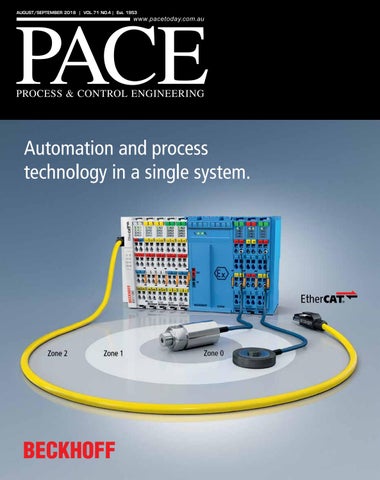
Automation and process technology in a single system.
| EK11-15E |
High-end measurement technology. Extremely accurate, fast and robust.
www.beckhoff.com.au/measurement-technology With ELM series EtherCAT measurement I/O modules, high-precision, fast and robust measurement technology becomes a system-integrated function of PC-based control from Beckhoff. The ELM modules can be integrated directly into the modular EtherCAT I/O system, enabling combination with the comprehensive portfolio of more than 500 EtherCAT Terminals. fast: sampling rates of 50,000 samples/s precise timing: exact synchronisation < 1 Οs precise values: measurement accuracy of 100 ppm proactive: integrated functional diagnostics for individual modules flexible connector front-end: LEMO, BNC, Push-in input circuitry: voltage 20 mV‌ 60 V, current 20 mA, IEPE, SG, RTD/TC
A seamless measurement chain from data acquisition to analysis in the cloud.
AUGUST/SEPTEMBER 2018 | VOL.71 NO.4 | Est. 1953
INSIDE PACE
Health and Safety
Women in Industry
Robotics
Increasing profitability by boosting safety
Why Karen Stanton loves her job
Using brainwaves to control robots
Post Print Approved PP100008186
IS THERE AN ENGINEER SHORTAGE LOOMING?
EXCLUSIVE:
Why robots aren’t job killers
CONTENTS
Managing Director: John Murphy Publisher: Christine Clancy Managing Editor: Syed Shah Editor: Mike Wheeler Ph:(02) 9439 7227 mike.wheeler@primecreative.com.au
IN THIS ISSUE
Journalist: Miri Schroeter Ph: (02) 9439 7227 miri.schroeter@primecreative.com.au
22
Sales/Advertising: Johnathan Thwaites Ph: 0422 616 054 johnathan.twaites@primecreative.com.au Production Coordinator: Natasha Shekar Ph: (02) 9439 7227 natasha.shekar@primecreative.com.au Art Director: Michelle Weston Designer: James Finlay, Blake Storey, Adam Finlay SUBSCRIPTIONS: $99 pa incl GST NZ: $A109 pa & OS: $A119 pa Subscriptions: Gordon Watson Ph: (03) 9690 8766
12 Editor’s Comment 6
How wireless sensors keep an eye on the health of key infrastructure in a major city
Education 12
AES 2018 26
Thought Leadership 16
Automation 28
Why automation and robotics can create jobs, not take them Health and Safety 18
Five steps that not only will increase safety, but boost profitability Drives 20
How integrated drive technology minimises control cabinet space and optimises machine design
© Copyright Prime Creative Media, 2018
Surge Protection 22
Articles All articles submitted for publication become the property of the publisher. The Editor reserves the right to adjust any article to conform with the magazine format.
How to monitor surge protection devices intelligently
Head Office 11-15 Buckhurst St South Melbourne VIC 3205 P: +61 3 9690 8766 enquiries@primecreative.com.au www.primecreative.com.au Sydney Office Suite 303, 1-9 Chandos Street, Saint Leonards, NSW 2065, Australia
Sensors 24
News 8
How to make engineering sexy
Copyright PACE is owned by Prime Creative Media and published by John Murphy. All material in PACE is copyright and no part may be reproduced or copied in any form or by any means (graphic, electronic or mechanical including information and retrieval systems) without written permission of the publisher. The Editor welcomes contributions but reserves the right to accept or reject any material. While every effort has been made to ensure the accuracy of information, Prime Creative Media will not accept responsibility for errors or omissions or for any consequences arising from reliance on information published. The opinions expressed in PACE are not necessarily the opinions of, or endorsed by the publisher unless otherwise stated.
24
The Australian Energy Storage Conference How automation stopped leaks in a potato factory Women in Industry 30
How one woman wakes up everyday to a job and industry she loves Robotics 32
Controlling robots with brainwaves Process Control 34
PLC-SCADA vs DCS
Operator Efficiency 36
Introducing B&R’s SuperTrak New Products 37
ON THE COVER
Trying to make engineering a go-to career for students AUGUST/SEPTEMBER 2018 | VOL.71 NO.4 | Est. 1953
INSIDE PACE
Health and Safety
Women in Industry
Robotics
Increasing profitability by boosting safety
Why Karen Stanton loves her job
Using brainwaves to control robots
IS THERE AN ENGINEER SHORTAGE LOOMING?
PRINTED BY: MANARK PRINTING Ph: (03) 9794 8337
Post Print Approved PP100008186
28 Dingley Ave Dandenong VIC 3175
EXCLUSIVE:
4 www.pacetoday.com.au AUG/SEP 2018
Why robots aren’t job killers
Australia needs more engineers over the next decade. While more than 50 per cent of those working in Austraiia are imported, Engineers Australia believes that the industry needs to supply more home-grown candidates. Not that they would discourage graduates from other continents to make Austraiia home. It’s more about trying to
make the industry appealing to students while they are at high school. Even 10 years ago, there were four to five branches of engineering students could aim towards in getting a degree. That has blown out to about 15 disciplines. Now it’s just a matter of convincing students what a worthwhile career it can be.
Low-cost level measurement. Radar sensor for water management. Reliable level measurement in water treatment facilities, pump stations and rain overflow basins. Open channel flow measurement and water level monitoring.
VEGAPULS WL S 61 ▪ Measuring range up to 8 m
▪ Can be used outdoors without restriction ▪ Flood-proof IP 68 housing
▪ Operation via Bluetooth with Smartphone, tablet or PC
Further information: www.vega.com/wls61
Phone 1800 817 135
COMMENT
EDITOR’S MESSAGE
Mike Wheeler Editor
Why Australia will need more engineers in the next 10 years
TWO key issues in this edition of PACE. Education and robotics – and they both intertwine. First, education. Engineers Australia is the industry body for all engineers within Australia. It has its finger on the pulse when it comes to what is happening within the industry regarding the number of people working in the field of engineering. Speaking to NSW president Julie Mikhail, and Sydney and Canberra general manager Greg Ewing, they both mention that there is a scarcity of local engineering graduates from Australian universities. So much so, that just over 50 per cent of all engineers working in Australia
6 www.pacetoday.com.au AUG/SEP 2018
are foreign born, meaning we are competing internationally for the best brains. Both Mikhail and Ewing say that over the next decade or so, Australia is going to need as many engineers as it can get. Both of them see the future need for a number of engineers across a range of disciplines. However, the industry suffers from an image problem where people think that it is about men in overalls working in dank/dark manufacturing plants. Nothing could be further from the truth. As robotics and automation start making inroads into the industry, and along with the Internet of Things (IoT), nanotechnology, mechatronics and a range
of other things, the range of jobs that engineers are needed for has expanded almost three-fold. Now, lets talk about robotics. For many years, people at the coal face of process engineering and manufacturing – the workers – have been worried about robots taking their jobs. While it is true that the more mundane processes have been automated, or are going to be, there are still related job opportunities. According to robotics and automation specialists Bosch, there are a lot of upsides to robotics. Not only do they make sense from a safety point of view, it also allows people to upskill themselves. They can be retrained and
be more prepared for the future. Also, in this issue there is a great article out of MIT about how researchers are gearing towards using brainwaves and hand gestures to correct robots when they make mistakes. While the technology is in its early stages, those in charge of the project are excited about the potential, especially in the manufacturing sector. Finally, check out our article on the Australian Energy Storage Conference and Exhibition. It offers an overview of what is happening with renewables and some of the new innovations and exciting projects that are underway in that sector. PACE
Bosch Australia Manufacturing Solutions Leading User Leading Provider
I4.0 - Networked Manufacturing of the Future Bosch has over 270 manufacturing sites worldwide. The use of Industry 4.0 is becoming increasingly important to allow Bosch to monitor and improve performance of its own manufacturing. Bosch Australia Manufacturing Solutions builds on this learning & experience to provide clear advice on the best ways to implement Industry 4.0 in our customer’s plants. Using open standards, we are able to integrate equipment and software of various suppliers to provide the optimum connected concept and provide Real-Time analysis of relevant manufacturing and logistics data.
Contact us for help on your I4.0 journey M (61) (0) 434 185 329 T
(03) 9541 5086
E
john.croft@au.bosch.com
W bosch-manufacturingsolutions.com.au
NEWS
Infrared sensing gives forest drones a new edge
A
n ‘x-ray vision system’ that overlays three specific technologies to assess the structure and health of individual trees in plantation forests through the canopy is being developed in South Australia. University of South Australia autonomous systems expert Professor Anthony Finn said an infrared sensor gave the drone the “x-ray vision” to see through forest canopies. The collaboration between the forest industry, University of South Australia and the South Australian Government was launched last week to undertake research to boost productivity in the large plantation forests in the south east of the state. One of the first projects undertaken by the Forestry Research Mount Gambier, is to develop sophisticated imaging sensors that can be fitted to drones. The three-pronged measurement approach uses Light Detection and Ranging (LiDAR), thermal infrared imaging and the hyperspectral imaging to generate 3D data. The
remote sensing will allow both ground data and airborne data to accurately predict wood volumes, consider the impact of fires, insect damage and wind damage on yields. University of South Australia autonomous systems expert Professor Anthony Finn said the addition of the infrared sensor gave the drone the “x-ray vision” to see through the canopies to provide a full image of the trunk. “We – like everyone else – use LIDAR to get point clouds but one of the challenges of LIDAR is the canopies to the trunks of the trees,” he said. “What we do with the infrared cameras is we carefully manage the spectral properties of what we’re looking at so we can see through to the trunks – in simple terms you could consider it almost like x-ray vision. “In addition to this we look at the surface chemistry using the hyperspectral imaging sensor, which provides us with an insight into how the trees are thriving as well.”
The x-ray vision system assesses the structure and health of individual trees in a plantation.
8 www.pacetoday.com.au AUG/SEP 2018
LiDAR and drones have been used by the forestry industry for a decade but the additional use of high-resolution cameras and infrared sensors allows the researchers to “fill in the gaps”. The system aims to achieve significant cost savings through a reduction in manual groundwork and more precise measurement and troubleshooting capabilities. Field trials of the technology were conducted last month in South Australia and New South Wales, with mapping set to soon begin near Mount Gambier. The drones are currently only able to scan small sections of forest at a time but Professor Finn said miniaturisation of the imaging software and possible commercialisation in the future would shrink the payload and allow it to be fitted to much smaller, more efficient drones. “The trick at the moment is you’ve got to get a high-resolution sensor and in order to get one of those you almost have to build your own,” he said.
“Initial prototypes tend to be bigger than people are used to so you have to use a bigger drone.” Forestry Research Mount Gambier is developing sophisticated imaging sensors that can be fitted to drones. The city of Mount Gambier is in the Green Triangle, Australia’s second largest plantation forest region stretching from South Australia’s southeast to western Victoria. It includes about 350,000 hectares of plantings, which are roughly split between Radiata Pine and Tasmanian Blue Gum. High quality Radiata Pine in Australia is used for structural timber in the domestic construction industry while Blue Gum is generally woodchipped. UniSA’s general manager of Forestry Research Dr Jim O’Hehir said the industry wanted to move towards more effective methods of assessing tree quality. “If you can better quantify and assess the quality of plantations you can improve the matching of the resource with the requirements of customers so it’s about optimising production,” he said. “It can also be about trying to detect health and nutritional problems as early as possible so you can apply corrective action. O’Hehir said because modern harvesting techniques were fully mechanised, the more information that could be provided ahead of operations the better. “Then you can pick and choose the areas of forest you go into to achieve a certain product mix. “This mean that the data of the kind that you can get from the research work that Anthony’s been doing can give you those kind of improvements,” he said. “In the end it can be about improved profitability because you are doing a better job of matching what you cut from the forest with what your customers are requiring at the time.” PACE
When you require a specialist Engineering Construction company to ensure your project proceeds without a hitch‌ turn to Total Construction. With a specialist builder such as Total Construction you can avoid potential cost blow outs in your project before design and location is determined. Contact us today to ďŹ nd out how we can help with construction planning for your next project.
Call: (02) 9746 9555 Visit: totalconstruction.com.au
NEWS
World’s first common interface for collaborative robots
A
BB and Kawasaki Heavy Industries showcased the world’s first common collaborative robot operating interface at Automatica in Munich, Germany from June 19-22, 2018. The common interface will help address the shortage of skilled workers in many industries. In Japan for example, one in five people is within a decade of retirement. Demand for collaborative robots has outpaced the rapidly growing industrial robot market, as easier-to-use robots open doors to new users. The fact that collaborative robots can be programmed and operated by people
without specialised training helps small and medium enterprises, in particular, to leapfrog traditionally longer industrial robot learning curves. Collaborative robots (cobots), which can be operated by nearly any user, can help offset labour shortages. Their flexibility to work nearly anywhere in a factory without safety barriers also makes them ideal for meeting sudden and unexpected demand peaks. “The new state-of-the-art, industrystandard operating interface will accelerate the already rapid growth we see in collaborative robots,” said Per Vegard Nerseth, managing director of Robotics for ABB. “It will give many new
manufacturers flexibility and scalability, while providing more interesting jobs for the world’s vital industrial workforce.” The interface is a result of the collaboration between ABB and Kawasaki announced in November of 2017. It is designed to share knowledge and promote the benefits of collaborative automation, in particular dual-arm collaborative robots. It includes a simplified human-robot interface with intuitive, smartphone-like navigation and icons. Collaborative robots will make a large contribution to society in making manufacturing more flexible and efficient and in keeping our factories productive with an increasingly scarcer workforce.”
A joint collaborative automation demonstration located at the East Entrance of automatica will feature Kawasaki’s unique and innovative dual-arm SCARA Robot “duAro” working together with ABB’s dual-arm YuMI robot. In addition to continued development of the operating interface, the collaboration also focuses on other topics such as common safety standards. Traditional industrial safety standards are based on years of practice, supported by specific parameters. The goal for collaborative automation is to develop safety standards that allow for new ways of working together without restricting collaborative robots’ benefits. PACE
Flexible. Dynamic. Optimised. You connect the dots. Welcome to Industry 4.0 brought to you by SMC.Whether you have a new installation and seeking to attain the Industry 4.0 Gold Standard of a Smart Factory; or you have legacy machinery which needs an upgrade and a gradual move towards an Industry 4.0 Smarter Factory– SMC can assist you! Welcome to Industry 4.0 brought to you by SMC. Contact us to request your SMC catalogue: AU – 1800 763 862 or AUSales@smcanz.com NZ – 0800 1320 762 or NZSales@smcanz.com
10 www.pacetoday.com.au AUG/SEP 2018
NEWS
Portable solar system could replace generators
P
op-up mobile solar PV panels could soon replace diesel generators as a temporary power supply due to an Australian-made innovation. The Australian Renewable Energy Agency (ARENA) has announced $289,725 in funding for Canberrabased ECLIPS Engineering to design, manufacture and test its rapidly redeployable Container Roll Out Solar System (CROSS). CROSS is a factory-assembled, relocatable solar array that has been developed to reduce the logistics challenges associated with deploying solar PV generators. Designed to fit inside a standard shipping container,
the CROSS units can be stacked up to seven units high. The $703,468 total project opens up markets not previously available to the renewables industry, including defence, disaster recovery, humanitarian, construction and temporary network augmentation. The systems come available in 20ft and 40ft configurations, with a maximum output of 2,175W and 4,350W delivered in minutes ready for connection to an inverter. ARENA CEO, Ivor Frischknecht, said the CROSS units could see solar energy delivering temporary power that is required in a remote location or an emergency situation.
“CROSS units can be deployed in off-grid and fringe-off-grid areas, displace or offset diesel consumption and improve the security of existing networks,” he said. “These renewable options can reduce some of the barriers to entry for renewable power users in remote locations, including short project durations and where power systems need to be periodically relocated. Renewable energy can provide an emissions-free, silent energy system that could replace diesel generators.” ECLIPS managing director, Shaun Moore, said that the original objective for CROSS was to improve power selfsufficiency for defence.
Beamex MC6-Ex
New intrinsically safe field calibrator and communicator!
“One of our early objectives was to provide rapidly deployable utility scale PV generators to improve the self-sufficiency of Defence’s deployed forward operating bases. Diesel consumption related to the provision of electricity can account for up to 70 per cent of deployed forces’ fuel usage and is a cost driver. More importantly, deploying CROSS to forward operating bases also reduces the frequency of convoys for fuel resupply, which reduces the threat to soldiers in contested environments. These same logistics efficiencies and benefits are transferable to commercial and utility customers in remote areas of Australia,” he said. PACE
AMS AMS INSTRUMENTATION & CALIBRATION PTY LTD Unit 20, 51 Kalman drive Boronia VIC 3155 AUSTRALIA Phone: +61-3-9017 8225 Fax: +61-3-9729 9604 E-mail: sales@ams-ic.com.au Internet: www.ams-ic.com.au
-
ATEX and IECEx approved for all hazardous zones Very accurate calibrator delivered with traceable, accredited calibration certificate Enables a fully paperless and automated calibration process Integrated field communicator for HART, FOUNDATION Fieldbus and Profibus protocols Multifunctional process calibrator for pressure, temperature and electrical signals
www.beamex.com info@beamex.com
AUG/SEP 2018 www.pacetoday.com.au 11
EDUCATION
The definition of what an engineer is has changed as it reaches up to 15 disciplines
How to make engineering sexy With more than half of all engineers being imported from overseas, Engineers Australia believes the industry needs to do a better job of selling itself. Mike Wheeler explains.
E
ngineering has never been a sexy industry. Whether it be structural, process, chemical, civil or mechanical, the stereotype is a usually a male, dressed in overalls with greasy hands building a bridge or running a manufacturing plant. Talk to anybody in the industry and they’ll laugh because they know it’s not true. Not only can it be a varied and interesting career, but also very lucrative. Especially in the process space where AI, robotics, automation and mechatronics are coming to the fore. But a perception is a perception and that is part of the key to trying to change the way young people see engineering when it comes to their career path. 12 www.pacetoday.com.au AUG/SEP 2018
“Engineers can choose to stay at home or travel the world with their degree. It’s an all-embracing, multinational career and the language of maths travels anywhere.” Engineers Australia Sydney president, Julie Mikhail, knows that she has an uphill battle when it comes to changing perceptions, but changing they are, she said. Albeit slowly. Not just because the association is working hard to make engineering an attractive career option, but the definition of what an engineer is has also changed. “Up until 10 or 15 years ago you had a choice of chemical,
civil, mechanical and electrical engineering,” she said. “They were your core career paths. Now you can go up to maybe 15 different disciplines of engineering to choose from. When you go out into the workforce you are not stuck in the one discipline as much as you used to be. Today, engineers are more rounded and have the soft skills, as well as technical skills that are needed
Engineers Australia Sydney president, Julie Mikhail, said peoples’ perceptions of engineering are slowly changing.
2D/ 3D Laser Profile Scanner for Welding Quality Inspection Highest Performing Profile Scanner with respect to accuracy and measuring rate Compact, Integrated Intelligent Controller for detection and evaluation of different surfaces Optional Blue Laser technology offers higher focused, higher resolution measurement for finer details with maximum precision. Also enabling a more reliable measurement on polished surface, organic, red-hot glowing and transparent objects
To find our more, please visit our website at https://www.bestech.com.au/laser-profile-scanning-2d3d/ OR Contact us below: Email: enquiry@bestech.com.au
GLOBAL TECHNOLOGY LOCAL SUPPORT
Phone: (+61)3 9540 5100
EDUCATION
to be great engineers. The role of an engineer in the workplace has definitely changed and has evolved significantly.” However, there are a couple of worrying statistics. A recent report by Engineers Australia titled The State of the Engineering Profession 2017 shows that gender diversity is still an issue with women only making up 12.4 per cent of the engineering population. An interesting insight into the report stated that, among other things, “…young women who accept places in engineering courses… have better ATAR scores than young men. From the male-dominated courses grows a male-dominated profession, which is an unsustainable situation given our national ambitions. We need to encourage interest in engineering-related subjects from both genders equally.” The other issue, which backs up the gender inequality statistic, is that the traditional STEM high school subjects that students need to pass in order to gain entry to do an engineering degree are falling in popularity. In 2001, almost 16 per cent of males were studying advanced maths while 11.5 per cent of females were doing the same. By 2015, the number of males had dropped to just over eight per cent, while females were at 6.2 per cent. Similar figures could be found with Intermediate maths, physics and chemistry. In the case of physics, there has been an alarming drop off. From 25.1 per cent of males studying the subject in 2001 down to 8.8 per cent in 2015. Women have dropped from 21 per cent to 5.9 per cent. No wonder more than half the engineers in Australia come from overseas. In 2015 16,500 students started an engineering degree, while just over 20,000 permanent and temporary migrants added to the engineering skill supply. Hardly numbers that build confidence in locally grown talent. There has been a long-term trend in Australia where the country does not graduate enough engineers from its universities. This means that is even in the boom years Australia is only graduating 50 per cent of the number of engineers it needs. When getting into a boom/bust cycle it can be quite detrimental to the pipe line of engineers that are coming through. 14 www.pacetoday.com.au AUG/SEP 2018
Australia is only graduating 50 per cent of the number of engineers it needs.
The majority of engineers in Australia were born and educated overseas so the country has had a long-term trend of buying in expertise. “Australia needs to continue that trend but it really needs to look at how it can grow its own pool of talent by increasing local numbers,” said Engineers Australia general manager for Sydney and Canberra, Greg Ewing. But how can the shortfall be addressed? Ewing believes part of the problem is that engineers are their own worst enemies when it comes to promoting the profession. “I’m not an engineer, but I have noticed that engineers are a humble profession who perhaps don’t shout their successes from the roof tops the way that they should,” he said. “The underpinning subjects of science and maths stretch a person’s mind. However, maybe the way we teach those subjects needs to be looked at because we’ve had some great scientists, mathematicians and engineers here in Australia that come
up with things like Wi Fi. Maybe it’s the way we contextualise the sciences, technology and maths for young people, and how that comes across, needs to be looked at. “Also, parents and teachers and the rest of us need to think how we use our language around engineering so that it is more positive and push the fact that it is a fantastic career to have.” While it might sound that engineering is not in a good space when it comes to a career option, both Mikhail and Ewing are positive about the future. Engineers Australia recently went to the Riverina where a careers expo was held, and they fielded enquiries from more than 1000 young people. The organisation’s stand was busy and there were a lot of students who understood that engineering can offer them a range of different disciplines – whether that be aeronautical, biomedical or chemical engineering as well as the traditional civil, structural and mining and resources. Mikhail
said that parents are also starting to understand that such a career is not only rewarding from remuneration aspect, but also job satisfaction point of view. “We were at a careers expo about a month ago at [Sydney’s] Knox Grammar,” said Mikhail. “Parents were coming up to me and asking me to explain what does an engineer do and what can I expect from an engineer. What does the day in the life of an engineer look like? What kind of decisions do they make? What is the pay like?” A basic tenet of economics is supply and demand and how scarcity affects the outcomes of pricing and wages. It makes sense if engineers are thin on the ground, then a lucrative career can await. Ewing put it best when he said, “Engineers can choose to stay at home or travel the world with their degree. It’s an all-embracing, multi-national career and the language of maths travels anywhere.” PACE
S E M I N A R S E R IE S A U S & N Z L 2 0 1 8 EtherCAT (Ethernet for Control Automation Technology) is the fastest Industrial Ethernet solution that provides industry leading performance, exibility and cost advantages. - Learn about the benefits and the challenges of Industrial Ethernet - EtherCAT information days are educational events from the experts - Explore and understand EtherCAT technology - Talk with EtherCAT experts face-to-face, and see how EtherCAT can accelerate your application Participation is free of charge and you are cordially invited
REGISTER TODAY, IF YOU ARE: In charge of control and automation systems with machine builders and OEMs Working with system integrators or design firms for machine builders or end users Involved in application and controls design or product management Interested to know the latest trends in industrial automation and how fieldbus selection plays an important role Interested in application examples and possible migration strategies
Supported by
October 2018
For more information, visit www.ethercat.org/2018/AUS_NZL
THOUGHT LEADERSHIP
Understanding robotics is not as hard as it used to be Robotics and automation need to be embraced by the manufacturing sector. Mike Wheeler explains why.
Working in the robotics and automation space allows people to move up the career food chain.
D
uring the Napoleonic Wars of the early 19th century a movement in Britain called the luddites grew. This group of working class people opposed progress in the manufacturing arena – in this case they destroyed new weaving machines, as they feared their jobs were in the firing line. Over the years nothing much has changed, and as we enter the first few decades of the 21st century, some within the manufacturing sector are seeing that automation and robotics are taking some of the more menial manual labouring jobs that were once the purview of the working class. However, if you talk to people in the automation arena, the introduction 16 www.pacetoday.com.au AUG/SEP 2018
of robotics not only saves time and money – which is part of the reason manufacturers find these products appealing – but it is an opportunity for those with a limited skills base to up their knowledge and learn new areas of expertise. One company in this space that has seen a few changes over the past decade is Bosch. General manager for Bosch Manufacturing Solutions, Andrew Bartlett, is a person who sees the positive side of a new era in robotics and automation – not just because he works in the arena. “With robotics and automation you are taking away the mundane and allowing people to work in higher level activities,” he said. “To keep businesses
growing – which is the overall aim of a business to drive productivity and growth – you can move people out of the mundane activities and use robotics. This is because these systems are more reliable in terms of quality, safety and operator interaction. It allows people to move up the food chain; to become more data management and process improvement focussed and control their own destiny, or move to collaborative approaches with regard to automation as opposed to just rote work.” But are people being trained in the new way of doing things or are they being thrown on the scrap heap? “We do see ongoing retraining happening within Bosch,” said Bartlett. “Despite the level of automation –
which is very high – we continue to bring in new infrastructure and people and grow the area.” Bosch Manufacturing Solutions national sales manager, Peter Hook, gives a more recent example of where technophobes got it wrong with regard to advancements in the technology space. “The parable that we often see relates to advent of the computer, when everybody said all the typists would lose their jobs,” he said. “But nobody anticipates that there is a multi-trilliondollar software industry that is out there now and there are still typists. The challenge with fearing technology is that you revert back to alarmist views. However, generally speaking technology
THOUGHT LEADERSHIP
Helping to put you in Control
Temperature and Humidity Sensor
developments end up creating opportunities that we have never thought of. “I thought the purpose of civil society was to push people up the value chain in terms of employment. From moving away from the mundane, repetitive and harmful, to much more collaborative and creative and socially sensible jobs.” The problem is though, that surely some people like their rote-type jobs. They don’t have to be Einstein to carry out a task that gives them a living wage and doesn’t test the brain cells too much. Thing is, said Hook, people would be surprised – with a little bit of training – how easy robotics are to install and use. “Ten years ago, outside of the automotive industry, there was limited uptake in robotics,” said Hook. “Over the past decade it has become more mainstream. People who typically would not have looked at it before are now looking at automation and robotics. That goes to some of the misconceptions that are out there. People think that robotics are hard to install. A few years ago, there was a handful of people that knew how to do it. Today, there are many different people and companies that integrate robotics and automation systems. What’s rare out there is being able to understand the process and to hold their hand and be able to take them through product development all the way through to full production line.” Bartlett goes as far as saying that robotics and automation have revitalised not only the industry but job opportunities, too. “The general environment around manufacturing, particularly in the past two years show things are growing,” he said. “There is also an attitudinal change, too. We see an influx of people who are much more automation savvy. Who know
how to actually bring it in from their previous days in automotive after transitioning into other industries. We see more people coming through talking the right language, which is enabling their businesses to bring that kind of knowledge in-house.” Both men also see a couple of other silver linings in this space. One is that they are seeing some skeptics who are no longer intimidated by the technology. The other is that some manufacturers are returning home after a foray into the cheaper, overseas markets. “There’s an awareness of it now and a need for robotics and automation gear in the manufacturing process,” said Hook. “It has almost gone from a mystery to a necessity. We’ve got customers that have not installed any automation – any equipment – since the 1960s and they are now looking at putting in full robotics and automation systems so that they can keep their manufacturing in Australia. “Which brings me to another point. We’re also talking to people that have gone through the outsourcing, low-cost manufacturing parts of the world in Asia and are now saying we are wanting to manufacture back in Australia due to quality issues. And they accept that the only way we can do that is automate. We are talking to three or four companies that are interested in bringing their manufacturing back onshore after being in offshore sites. Some manufacturers have to go through the process of manufacturing overseas to see what it is like. However, ‘low-cost’ manufacturing overseas is not always low cost. There are a whole lot of overheads to do and lack of control. The people feel they want manufacturing back home where they can control what it going on.” PACE
The RHT Climate features high accuracy, two 4-20mA/0-10VDC Outputs, two digital outputs for alarm/control, a buzzer, LCD display and modbus comms. SKU: RHT-105 Price: $274.95 ea + GST
Advanced Digital Stepper Drive New from Leadshine the EM556S powers bipolar stepper motors smoothly with very low motor heating & noise. It can take 20-50VDC supply voltage and output 1.8 to 5.6A current. SKU: SMC-054 Price: $117.50 ea + GST
Closed Loop Stepper Drive
Leadshine CS-D508 is a closed loop stepper drive, suitable with 2-phase stepper motor in frame size NEMA 17, 23, or 24 with 1000-line incremental encoder. SKU: SMC-160 Price: $169.00 ea + GST
Mean Well DDR-30G-12
30 W Isolated DIN Rail DC-DC converter module accepts 9 to 36 VDC input and gives 12 VDC out at up to 2.5 A.. SKU: PDC-1052 Price: $54.00 ea + GST
Ethernet Modbus TCP 8 isolated
The A-1855 Remote Modbus module provides 8 Isolated Digital Inputs and 8 transistor Digital Outputs (sink). Ethernet supports a Modbus TCP protocol. USB port for configuration. SKU: YTD-555 Price: $164.00 ea + GST
Pressure Transducer 0 to 10 Bar Hunan Firstrate FST800801 series IP65 pressure transmitter with Modbus RTU RS485 output and ¼” BSP process connection. ±0.5% F.S. accuracy. 0 to 10 Bar. SKU: FSS-1604 Price: $44.95 ea + GST
Soil Moisture and Temp Sensor
RK520-01 Combined Soil Moisture & Temperature Sensor and provides 4-20mA out. Can be perminantly underground. SKU: RKS-055 Price: $249.95 ea + GST
The past two years has seen an influx of people who are much more automation savvy.
For Wholesale prices Contact Ocean Controls Ph: (03) 9782 5882 oceancontrols.com.au Prices are subjected to change without notice.
AUG/SEP 2018 www.pacetoday.com.au 17
HEALTH AND SAFETY
Five steps to boost safety and increase profitability Peter Braun, senior technical sales consultant process automation, Schneider Electric, explains how safety within the manufacturing process can help with profitability.
T
raditionally, safety and profitability have seemed to be diametrically opposed for many manufacturing and production operations. Although no-one disputes the value of investing in safety, the primary objective for a manufacturing or production business is to drive profitability, and protecting the safety of the plant’s people, assets and environment have often been viewed as somewhat necessary evils to achieve the bottom line. However, the safety of a business can have a direct, positive impact on the operational profitability of the plant. A safe operation is one where production isn’t forced to stop due to downtime, repair, or – even worse – an injury caused by incident. Less-than-compliant conditions that cause production stoppages will have a direct effect on revenue. Such occurrences, along with potential worker compensations costs or regulatory penalties, can add up to far more than the cost of prevention, i.e., the expense of installing safety systems and equipment. The potential for increased operational profitability that can be realised through more effective safety management is really starting to turn heads, and is truly bringing safety and environmental integrity into the mainstream of industrial business processes. The recent technological revolution and the proliferation of devices to be connected to the internet or a cloud has resulted in Industrial Internet of Things (IIoT)-related technologies across industries. This technology influx has changed industrial work execution processes which, in turn, may require modifications to the way safety is managed, especially in high hazard industries. 18 www.pacetoday.com.au AUG/SEP 2018
The five steps for integrating new IIoT technologies to better manage risk and hazards and to avoid costly unscheduled asset downtime are as follows:
1. Digitise and connect
A first step in the process is to capture the data flowing from the various safety related tools such as Safety Instrumented Systems (SIS), Safety Instrumented Functions (SIF), Layer of Protection Analysis systems (LOPA), Process Hazards Analysis tools (PHA), and Hazard and Operability tools (HAZOP). By digitally connecting to existing systems and data sources, the need for manual data collection and data handling is minimised and the new real-time information can then complement the safety information gleaned from existing reports. Newer software offerings such as SIF Manager from Schneider Electric provide persistent monitoring, validation, and documentation of all aspects of SIF performance for the life of the plant. Automatically tracking SIF key performance indicators (KPIs) and SIS device metrics can reduce manual efforts by as much as 90 per cent. Over the operating life of an asset, this might represent savings of from $1 million to $2 million.
3. Deploying the cloud
Using the cloud for digital safety design, analysis and validation makes it easily accessible to everyone, anywhere and at any time. Safety data and its context is available to experts anywhere in the world. Such a solution also drives transparency throughout the organisation and removes the traditional barriers and silos within departments, management structures, assets and/or fleets of assets.
4. Simulation
Virtual models referred to as “digital twins” analyse the gathered data and then use it to run simulations and to benchmark performance, allowing plant operators to pinpoint where efficiency gains can be made. By pairing both virtual and physical worlds (the twins), problems can be actively averted before they occur, preventing potentially threatening safety situations.
5. Integrate a cybersecurity strategy Digitisation of course comes with
its own risks, namely the threat of cyberattacks. Safety teams must examine whether it makes sense to enable safety systems for internet connectivity at all and, if so, under what conditions. In some cases, a tool such as the plant historian might require access to safetyrelated data or information. In summary, IIoT has the potential to be transformative when applied correctly to process safety and there are instances where IIoT tools and techniques can deliver profitable safety. Safety is not simply a compliance program or an add-on. It’s a corporate value – a way of respecting and caring for the people that keep the company running. Continuous improvement and investment in safety demonstrate that you’re committed to protecting them on the job, and ensuring that they can go home to families, friends, and loved ones at the end of every day. Each safety decision must adequately protect the functioning and lives of your workers and contractors, and the community. Unsafe production costs money, while safe production makes money. PACE
2. Analyse
Safety analytics can be descriptive, diagnostic, predictive or prescriptive. Once the data is collected and the type of analysis required is determined, this analytical data crunching can help plant personnel determine the optimal production and maintenance activities across multiple assets to reduce cumulative risk and to minimise downtime.
More effective safety management can increase operational profitability.
the wait
is over
a new partnership has formed Global powerhouse Hirschmann, specialist for automation and networking technology, has partnered with Control Logic to be their master distributor in Australia.
global leader in ethernet comms. purpose-built for
industrial industries easy to maintain & rapid recovery industry leading
software (HiVision)
Founded in Germany, Hirschmann is currently the only brand on the market to offer homogeneous data communication in the industrial sector using Ethernet and Fieldbus systems including Layer 2 and Layer 3 switches as well as industrial security and WLAN systems. The entire Hirschmann range is available to order now through Control Logic, Australia’s most awarded and trusted product and service providers. With a dedicated team of technical engineers and access to 24-7 support, Control Logic is here to help.
PROUDLY DISTRIBUTED BY CONTROL LOGIC
for more information call 1800 557 705 or email sales@controllogic.com.au
www.controllogic.com.au
DRIVES
Distributed servo drive system for modular machines Integrated drive technology minimises control cabinet space and optimises machine design. PACE explains.
T
he AMP8000 distributed servo-drive system provides support for the implementation of modular machine designs. The system involves having a servo drive directly integrated into a servomotor, with a compact design. In this way, the power electronics have been relocated to the machine, reducing space requirements in control cabinets to a single coupling module. In addition, decentralised distribution modules and the universal EtherCAT P solution further optimise the modular machine design approach. The system consists of three main components – a single-channel or alternately dual-channel coupling module that forms the starting point, and the only component that still needs to be installed in the control cabinet. The coupling module establishes a connection between the DC link, 24V DC supply and EtherCAT communication. For use with the high-performance AX8000, the AX883x coupling module is connected to the AX8000 supply module in order to provide a link to the IP 65-rated devices with one or two outputs. In combination with the AX5000 digital compact servo drive, the AX503x coupling module can also be used in stand-alone mode due to an integrated power supply unit. In this way, 20A (per output in the case of the AX883x and as sum current in the case of the AX503x), 600V DC link voltage, 24V power supply and EtherCAT networking are available via the EtherCAT P outputs (B23 sockets). This power is initially supplied to an AMP8805 distribution module as a second system component. As an IP65-rated component that is integrated into the machine layout, it supplies up to five AMP80xx distributed servo drives. It can be
20 www.pacetoday.com.au JUNE/JULY 2018
Decentralised distribution modules and the universal EtherCAT P solution optomise the modular design approach.
mounted either directly (brick style) or using a bracket available as an accessory (book style) and adapted ideally into individual machine designs. The distribution module has an internal capacitance of 1120 ÂľF to support the DC link. Additional EtherCAT P Box modules, such as for I/Os or for a second feedback system, can be connected simply and quickly via an additional EtherCAT P M8 output. The third system component is the AMP80xx distributed servo drive. It is identical to the standard servomotors in the AM8000 series with regard to its mounting dimensions and performance data. Only the overall length has increased in comparison
with the standard motors due to the integrated power electronics. Since this added length is not usually critical for the installation, most existing machine designs can be upgraded without the need for modification. The AMP80xx distributed servo drives are initially available in the flange sizes F4 and F5. Various versions are available with rated outputs of 0.61kW to 1.18kW and standstill torques of 2.0Nm to 4.8Nm (F4) or rated outputs of 1.02kW to 1.78kW and standstill torques of 4.1Nm to 9.7Nm (F5). The STO and SS1 safety functions are integrated as standard and a range of extended safe motion functions are currently being prepared. In addition,
the new flange sizes F3 and F6 are in development and will complement the AMP8000 distributed drive system in the lower and higher power ranges.
Universal cabling and cascadable installation via EtherCAT
The components in the AMP8000 system are universally connected with the uniform One Cable Automation (OCA) cabling technology, which connects via identical cross-sections and connectors. This is a dynamic, drag-chain compatible EtherCAT P cable with ECP-B23 connectors, which means the one cable solution features a hybrid cable that combines
DRIVES
One main distribution module can supply five sub-modules. EtherCAT P (communication plus 24 V system and peripheral voltage) with additional power cores. Also it is worth noting that preassembled cables and connectors facilitate easy installation and minimise errors during cabling. The AMP8000 system is also cascadable via the distribution module, meaning even highly complex machines and plants can have a simple and clear-cut topology layout. For this purpose, one or several additional distribution modules are connected to one of the module outputs in place of a distributed servo drive. For example, one main distribution module can supply five sub-modules, to which a maximum of 25 distributed servo drives can be connected, assuming an adequate supply of power to the individual motors is provided.
Compact drive integration in optimised design With the AMP80xx, the integration of drive technology has been implemented in a compact design, made possible through the use of the latest output stage technologies.
The power module is attached at the rear end of the servomotor shaft, ensuring that the attachment dimensions are identical to those of the corresponding standard servomotors in the AM8000 series. Only the overall length is about seven centimetres larger. For machine builders, this means only a small amount of additional space is required, making it possible to change their drive concepts without any fundamental design modifications. Apart from the small overall volume, the elegant and slim design of the AMP80xx offers further advantages over certain servomotors commonly encountered on the market, where the power electronics are mounted on top. With the AMP8000, the two dissipated heat sources – motor and power electronics – are separated from each other and ensure much better heat dissipation by design, without the need for additional installation space or heat sinks. As a result, the distributed servo drives attain the same properties as the corresponding standard AM8000 servomotors from Beckhoff. PACE JUNE/JUL 2018 www.pacetoday.com.au 21
SURGE PROTECTION
Intelligent surge protection device monitoring Surge protection is becoming an important facet of process engineering as more plant become automated. PACE explains.
To ensure high system availability, SPD aging must be detected as early as possible.
A
pplicable DIN standards demand the regular inspection of surge protective devices, and many users also want additional monitoring during operation. But what options are there for monitoring, diagnostics, and the electrical testing of devices? To be able to react quickly to device overloads or failures, the status of surge protective devices is transmitted and evaluated throughout the system or between systems. Sensitive electronic devices are increasingly being installed in areas where high system availability is required. Surge protective devices (SPD) are used as effective protection against
22 www.pacetoday.com.au AUG/SEP 2018
man-made surge voltages and against weather-related surge voltages and lightning currents. SPDs are designed such that typical man-made or weather-related surge voltages or lightning currents do not lead to appreciable premature aging of the devices. Frequent man-made surge voltages and high-energy lightning events can, however, lead to the SPDs themselves aging prematurely. At the end of their service life, SPDs are automatically switched to a safe state and are normally disconnected from the protected circuit. To ensure high system availability, SPD aging must be detected as early as possible – prematurely damaged SPDs
should be replaced as part of a preventive maintenance program. Premature SPD aging can be easily detected through smart monitoring functions and qualified electrical testing.
to detect overloads in SPDs due to impermissibly high external voltages – for example through the unintentional connection of a higher voltage to a circuit with a lower dielectric strength.
Surge protective devices with simple status indicator
Smart status monitoring
Many SPDs are equipped with a simple status indicator. On varistor-based SPDs, for example, the temperature of the varistors is monitored, and the status of the thermal disconnect device is displayed on the front of the SPD. Thermal disconnect devices are not just used in SPDs for energy technology applications. They can also be used in signal or data-related applications
In SPDs for signal and data-related applications, monitoring electronics integrated into the devices have been used increasingly in the past few years. Such smart SPDs can measure leakage currents, detect short circuits and register surge voltages and lightning currents. Smart SPDs often need an auxiliary voltage supply – 24V DC, for example. User-friendly SPDs are designed in such a way that the supply of auxiliary voltage
SURGE PROTECTION
and the acquisition of status information is possible without the need for additional wiring or configuration work – for example via a DIN-rail-integrated bus system.
Acquiring and processing status information
SPDs are often equipped with remote indication contacts for transmitting status information. Users often want a group message to be issued if one or more SPDs are defective. A group message can be realised through the series connection of remote indication contacts. Some more technically sophisticated SPDs enable the generation of optoelectronic group messages, for example. One vendor, Phoenix Contact, offers its TERMITRAB complete product range, while the PLUGTRAB IQ product range is available for group messages via DIN-rail-integrated bus systems. In some cases, SPDs are installed in remote locations – for example in elevated water tanks, well systems and
pumping stations. Wireless modems are a suitable option for such applications, enabling status information to be transmitted to superior automation and signaling systems. The status information of surge protection devices is displayed, transmitted and processed by: • Local display (lamp, signaling panel); • acoustic signaling equipment (horn, buzzer); • input of a PLC or automation system; • remote input of a fieldbus system or TCP/IP based network; • field multiplexer; • analogue modem; • GSM/GPRS wireless modem (SMS, e-mail, smartphone app, ODP protocol); and • trusted wireless networks.
Regular SPD testing
The regular testing and maintenance of lightning and surge protection devices is required by various parties. These include legislative, regulatory and professional bodies, and also
applicable DIN standards, such as DIN EN 62305-3 Appendix E.7. The test interval for visual inspections and for comprehensive testing depend on the type of system and the lightning protection levels to be used in accordance with DIN EN 62305-3 Table E.2. Comprehensive testing for lightning protection levels I and II must be performed at the latest every two years, and at least every four years for lightning protection levels III and IV. Many SPDs have a simple function display. Some smart SPDs have additional monitoring functions which enable extended SPD monitoring and diagnostics. Comprehensive testing of the devices, as stipulated in DIN EN 62305-3, is not possible during ongoing operation of an electrical system. A suitable high-voltage test device is therefore necessary for testing SPDs comprehensively. The measurement results obtained during the tests are then compared with reference values and evaluated. For meaningful testing, SPDs must thus be designed such that
it is possible to test all relevant SPD components. Monitoring SPDs is essential for high system availability. SPDs with smart monitoring functions can detect complex error states, therefore going far beyond the function of a simple thermal monitoring system. The status information of SPDs can now be acquired conveniently and then displayed and processed throughout the system and between systems. Furthermore, intelligent high-voltage test devices enable the comprehensive electrical testing of SPDs within the scope of test intervals specified in standards and by legislative bodies. Standards for surge protection are: • DIN EN 62305-3 and VDE 0185305-3 (2011): Protection against lightning - Part 3: Physical damage to structures and life hazard • DIN EN 62305-4 and VDE 0185-305-4 (2011): Protection against lightning - Part 4: Electrical and electronic systems within structures. PACE
Introducing the new
Flexy205 IIoT Gateway and Remote Access Router
www.flexy205.biz
AU +61 3 9338 8189 | NZ +64 9 889 0110 sales@globalM2M.com.au | sales@globalM2M.co.nz AUG/SEP 2018 www.pacetoday.com.au 23
SENSORS
Deployment of wireless sensors for structural health monitoring
Image credit: shutterstock.com
Wireless sensors are a key element in monitoring the health of a range of infrastructure. PACE explains.
Bestech Australia has released modern wireless sensors from Germany for structural health monitoring applications.
B
estech Australia has released wireless sensors and data acquisition systems from BeanAir Germany for structural health monitoring applications. It is a mature technology with solar energy harvesting and capability to withstand freezing temperatures in winter conditions. In one of the applications it has been used in, BeanAir deployed the wireless sensor networks for large-scale condition monitoring of highway bridges in Montreal, Canada. 24 www.pacetoday.com.au AUG/SEP 2018
The Turcot Interchange is a threelevel stack freeway interchange within the city of Montreal in Quebec, Canada. Located southwest of downtown, the interchange provides access to Champlain Bridge, one of the largest bridge infrastructures in the Northern America. It is the third busiest interchange in Montreal (after Decarie and Anjou interchange, respectively), as of 2010. The numbers averaging a northsouthbound flow of about 300,000 daily drivers and more than 350,000
west-eastbound in total. It sees about 50 million crossings annually, of which 200,000 are buses. In June 2007, the Quebec government announced the demolition and reconstruction of the structure. This project was estimated to be completed by 2016. The announcement came four years after a study on the interchange revealed that the Turcot structure was crumbling. After careful studies, it was discovered that the concrete structure has been degraded by the excessive use of
de-icing salt. Huge concrete slabs up to one square metre were reported falling from the overpasses. A new interchange was also proposed to be built lower to the ground with a large segment to be rebuilt towards the north. Reconstruction of the interchange is expected to cost the government between $1.2 billion and $1.5 billion. It was proposed to use wireless sensors for remote condition monitoring of this interchange to reduce costs and complexity.
SENSORS
Wireless Sensor Network for interchange monitoring
The wireless sensors from BeanAir are mature technology for long-term structural health monitoring of large infrastructure such as bridges, dams, stadiums, tunnels, churches and other buildings. The wireless sensors network (WSN) technology was deployed for assessing the impact of construction-related activities and evaluating the effect of structural retrofitting. The inherent monitoring of environmental loads and influences, operational loads and traffic patterns were used to collect a database of field measurements. They are useful to provide feedback for interchange structure extension. A total of 300 wireless sensors were installed on the interchange to monitor the vibration, inclination and deformation of the interchange structure. These fit customer requirements to monitor several physical parameters which included vibration, tilt, cracks, shocks and deformation, at the same time. The vibration response and shock level of the bridge was measured with wireless accelerometers mounted on the interchange pillars. Sampling rate was configured to 100Hz on concrete structure monitoring and to 400Hz on steel/ metallic structure monitoring. A wireless data acquisition system connected to a displacement sensor was also used to measure the bridge displacement for vibration analysis. Wireless inclinometers were used to monitor bridge foundations and to detect structure sinking during the construction works. The inclinometer has smooth accuracy of Âą0.1 per cent and measurement range of Âą15o. For crack measurements, several wireless crack metres utilising LVDT technology were mounted on the interchange pillars. They were used to measure the existing cracks, and evolution were compared to the resonance frequencies of the interchange pillar. This provides indication on when the structure is due to fail. To coordinate these wireless sensors, more than 25 wireless
network coordinators with the same NTP clock source (provided by a 3G/4G modem) were deployed on the monitoring site. The wireless sensors nodes were synchronised using a two-way ranging technique. For power supply options, the combination of solar panel and lead acid battery were used. They are mature technology and are suitable for long-term monitoring solutions.
Technical Challenges
When implementing the wireless solutions, experts discovered the issues with network bottleneck and aggregation capacity of the wireless network. Networks have generally relied on either local data logging and post-sampling transmission of sensor data or on low sampling rate and/or limited number of sensors in order to address the issue with bandwidth limitations. By managing several WSN together with a unique supervision system, BeanAir wireless sensors were able to address these limitations and deliver optimised sampling duration, data acquisition rates and spatial resolutions for accurate monitoring. During operations with WSN, clock drift may be observed which requires time re-synchronisation of the networks. This can be managed by bringing a time-triggered on-demand synchronisation which allows the network to obtain sensor data from multiple sensor nodes at a specific time. Using this method, there is no event set to trigger the sensor nodes, allowing the nodes to sample data at a right time.
The deployment of WSN in highway bridge monitoring in Canada oversees a reduction of 60 per cent in total costs for installations when compared to wired sensors.
duration needed for installation as compared to the use of wired sensors. It also provides new added value services to the users in terms of accessing and monitoring the real-time data remotely through a cellular network. Perhaps, the greatest benefit of WSN in this case is its ease of integration and flexibility to adapt with changes in the bridge’s behaviour. As a full wireless system, the sensor position can be easily interchanged depending on the bridge behaviour.
In terms of scaling-up, new wireless sensors can be easily added to the same network or by adding a new network without interfering with the existing wireless network. The system can also be easily integrated to the customer IT system through BeanScape monitoring software. For this project, BeanAir integrated an OPC DA server in the supervision software as it is particularly well suited for real time measurement and data sharing. PACE
Integrating WSN gives numerous customer benefits
Wireless sensors prove to be serious competition to wired sensors for structural health monitoring applications. Especially in monitoring large structure/infrastructure, wireless instrumentations greatly reduce the wiring complexity and overall cost required for installation. The deployment of WSN in highway bridge monitoring in Canada oversees a reduction of 60 per cent in total costs and shorter AUG/SEP 2018 www.pacetoday.com.au 25
ENERGY EFFICIENCY
AES 2018: a showcase of energy storage technologies The Australian Energy Storage Conference and Exhibition 2018 saw the biggest names and companies in energy storage come together to showcase new technologies. Tara Hamid reports.
T
he fifth edition of the Australian Energy Storage Conference and Exhibition (AES) saw more than 60 companies in the energy storage industry exhibit their newest technologies. The conference sessions during the event revolved around the latest developments in lithium batteries, flow
More than 60 companies were at the AES Exhibition in Adelaide.
26 www.pacetoday.com.au AUG/SEP 2018
batteries, hydrogen, silicon thermal storage, compressed air storage, flywheel energy storage, inverters, lead acid batteries, pumped hydro, hybrid system providers and energy management. This was the first time the event was being held in Adelaide. The attendees had an opportunity to take part in tours prior to the main event to
explore commercial and utility storage facilities in and around the city. This included Tesla’s big battery located at Neoen’s Hornsdale Wind Farm and the Highbury Pumped Hydro Energy Storage installation north east of Adelaide. A dominant message in the conference was the need to prepare Australia for the inevitable transition
to renewable energy and the available solutions to do so in the most sustainable way. Sanjeev Gupta, chairman of the GFG Alliance and majority shareholder of SIMEC ZEN Energy, delivered the keynote presentation, which touched on his company’s investment plans in various sectors in Australia. This included more mining
ENERGY EFFICIENCY
Tesla was one of the exhibitors at AES. acquisitions, establishing a bank for the mid-corporate companies and expanding its scrap steel and scrap aluminium recycling businesses (Green Steel and Green Aluminium). He also confirmed plans by his company to enter electric car manufacturing in Australia and hinted at future plans to step into lithium battery production and recycling sectors. Noting that energy is a considerable cost in all of his company’s present and future businesses, Gupta said the GFG Alliance was taking charge of its energy costs through investments in renewable energy generation and storage solutions. On the generation side, while Gupta’s company had earlier committed to building 1GW of largescale solar plus storage in and around Whyalla in South Australia, he said GFG’s investments in renewable energy across Australia could increase to as much as 10GW – keeping in line with the company’s industrial growth. In a conversation with PACE, he encouraged manufacturers in all sectors to look for renewable energy solutions for long-term benefits to their businesses. “If you have a warehouse that is processing goods, you can easily apply roof-top solars and batteries. The key is to bring the cost of these things down. At the moment, the costs are quite high, and one of the reasons is the cost of finance and how long it takes to amortise it, because many businesses cannot, or will not, amortise these plants over a long period. They want
to pay them back in much shorter periods,” he said. While admitting that not all companies can follow suit with GFG Alliance’s integrated model to generate their own renewable energy, he recommended that companies look for energy generators who can offer renewable energy at competitive rates. An example was GFG Alliance’s recent deal with Neoen to supply power to the Laverton steel works in Victoria. “Where some other company has a cheap form of generation, we buy from them. It all depends on what is the best opportunity available,” he said.
Small-scale flow batteries as a sustainable solution
Sustainable energy storage solutions were a focus of the conference sessions. Simon Hackett, non-executive director and technology evangelist for Redflow Limited, highlighted the merits of adopting flow batteries, which are constructed from recyclable or reusable components. Flow batteries offer benefits over traditional battery chemistries – such as lead-acid and lithium-based batteries – by providing 100 per cent daily depth of discharge and retaining their full energy storage capacity throughout their warranted life. Redflow offers ZBM2 (Zinc Bromide Module) flow batteries for telecommunications, commercial, industrial and grid-scale applications, and ZCell for home energy storage. While flow batteries have been used for years in large-scale applications, such as to power telecommunication
towers in remote locations, Hackett said Redflow was the first company to introduce flow batteries in a scalable, small-scale format for commercial and residential applications. “This is the only flow battery you can get in through the door,” Hackett told PACE. But the small size does not mean limitations in storage capacity, as Redflow’s batteries can be arrayed in any number of configurations to meet the required storage capacity. An example of this is demonstrated by Redflow at its “battery lab” in Adelaide, where an array of 60 Redflow ZBM3 batteries are installed in a container-sized unit, creating the capacity to store 660kWh of energy. Redflow recently moved its production from Mexico to Thailand, enabling the company to supply its flow batteries at predictable quantities across Australia and in key markets across Africa, Asia Pacific and Australasia.
Victron Energy introduces new battery inverter-charger
Another exhibitor was Victron Energy, which showcased its latest battery inverter-charger, the MultiPlus-II. The MultiPlus-II is a 48-volt inverter-charger that connects with a range of energy storage systems, from lead-acid and lithium-based batteries to zinc-bromine flow batteries. The unit is easier to install than earlier models with AC connections accessible via a single plate on its base. The 18kg MultiPlus-II draws 11W of standby power, less than half that used by the
model it supersedes. Victron Energy sales manager, Philip Crotty, told PACE that the MultiPlus-II converters use old, long-proven design methodology, but offer the device at a competitive cost through adoption of modern manufacturing methods and new components. “We have designed this model specifically for on-grid energy storage systems, but it can also be used in off-grid and micro grid connections,” he said. As with all Victron inverterchargers, the MultiPlus-II is a transformer-based system, which can immediately deliver backup power if the grid drops out. This includes start-up supply for high-demand devices such as air conditioners and freezers. Another popular application, according to Crotty, is in optimising the work of diesel generators. “Diesel generators are used in many remote sites, such as mining applications,” said Crotty. “The diesel generators are built for the maximum load, but quite often the load is way below the maximum. In this situation, the efficiency is very low and it causes quicker wear-out. “If you have a battery, instead of running the generator 24-hours a day, you can run it for two to three hours a day at peak efficiency and fill up the battery. And then, those variable loads can be taken out of the battery,” he said. The MultiPlus-II has optional internet-enabled remote monitoring, both through a secure Victron portal or authenticated third-party applications. This remote monitoring enables the 24/7 performance logging of connected batteries. Other exhibitors launched new products, allowing delegates to be the first to see ground-breaking technologies in the market. Tesla showcased its Powerwall 2 battery storage, while ESS featured its iron flow battery system. Delta Energy Systems, who are in the switching power supply solutions space, displayed its Electric Vehicle charging products, while Mitsubishi Motors Australia was present with its Super-Select 4WD system, Australia’s first mass produced electric vehicle and the world’s first plug-in hybrid electric SUV. PACE AUG/SEP 2018 www.pacetoday.com.au 27
AUTOMATION
Reliability and expertise stops leaks at potato factory The South Australian Potato Company partners with SMC to bring field-to-fork while saving energy. PACE explains.
A
s a staple food item the world over, potatoes play a key role in the world’s food supply. This humble starch is the world’s fourth-largest food crop and was first introduced to European diets in the second half of the 16th Century by the Spanish. Now, more than 400 years later, the South Australian Potato Company, founded by the Raschella family, has been supplying potatoes for every recipe, occasion and season for more than 20 years. “Despite the bad rap that potatoes sometimes get, they are virtually fat free and have 40 per cent less carbohydrates than cooked pasta or rice. Potatoes are also gluten and cholesterol free and contain more fibre than five bananas,” says Jay Dawson, maintenance manager for the company. The company is an independently run business situated in Mount Barker, South Australia. The team comprises more than 100 employees who help to grow, pack and market over 60,000 tonnes of fresh potatoes for consumption each year. “Exclusive to the South Australian Potato Company, and what’s made us famous, is the Kestrel Potato which is instantly recognisable by its smooth white skin and unique purple spots,” said Dawson. “The purple skin markings are formed naturally by antioxidants called anthocyanin, the flavonoid also found in other superfoods such as blueberries.” Dealing with more than 60,000 tonnes of potatoes annually requires quality automation by reliable suppliers to ensure always-on productivity and extreme care with this wholesome produce. When looking to kit out its factory, which does everything from washing and sorting to weighing and packaging potatoes, the company looked to SMC to help find a solution. 28 www.pacetoday.com.au AUG/SEP 2018
The South Australian Potato Company provides more than 60,000 tonnes of fresh potatoes each year.
“In selecting the perfect automation partner we look to deciding factors such as an excellent, broad product range, superior technical expertise, a factory maintenance plan, a reputable brand that aligns with ours and a company that is innovative and keeps up with the trends,” said Dawson. “Cost is also a big driver for us. In both the good and bad times, we enjoy steady, competitive pricing and great value. We want to build relationships with our suppliers and as such, SMC fitted the bill to the tee.” Saul Weste, an SMC area sales manager in South Australia said the project’s objectives were so much more than just “kitting out the South Australian Potato Company’s machinery” with the team looking to help drive down costs and improve efficiencies. “The state-of-the-art machinery contains an automated air processor with electronic solenoid valves controlled by a PLC; here, digital flow
switches were included,” said Weste. “This project saw a big focus on energy saving and a mandate to minimise air leaks to help save on money and energy,” said Dawson. “In conducting an air leak audit, the maintenance team at The South Australian Potato Company tested the cubic feet of air used and wasted.” “When using a sonic tester to find and measure the leaks, we realised that leaks were costing the company about $95 of energy per normal operating day [cubic feet study],” says Dawson. Based on the findings, SMC supplied a range of products for everyday use such as air cylinders and solenoid valves, as well as our more advanced energy saving products, such as digital pressure switches, which form part of the process control systems. “Thanks to the upgrades and replacement of components, The South Australian Potato Company saw a major improvement on leaks,”
said Dawson. “This translates to a saving of approximately $24,000 per annum.” Weste said that SMC’s mandate is to provide savings for its customers and that the team is working closely to ensure that the right products are selected for the application to minimise energy use. SMC provided advice to customers on best practice when replacing old parts or starting out on new projects. “We strive to work closely with our customers to help them realise savings and achieve a competitive advantage,” said Weste. “The South Australian Potato Company is a valued customer and we have worked hard to ensure that they truly experience the benefits of partnering with SMC.” “We have a reputable, reliable partner in SMC. We always feel supported and valued, and we look forward to a long-lasting relationship with SMC,” said Dawson. PACE
SAFETY For this major refinery, investing in
added revenue from 1.2 million more barrels of oil
Investing in safety can accelerate profitability – a bold idea proven by a global energy producer who turned to Schneider Electric’s EcoStruxure Triconex Safety Systems so they could deliver a complex safety solution under rigid time constraints. Combined with Schneider Electric’s safety expertise and EcoStruxure Triconex Safety Validator automated safety testing, the refinery restarted 4 days earlier than scheduled, resulting in 1.2 million barrels of oil worth of additional revenue. Some key results: • 4 days downtime prevented • More than 1 million barrels of oil to market faster • 50% quicker factory acceptance testing • 85% reduction in site acceptance testing & commissioning time
schneider-electric.com.au/triconex
© 2018 Schneider Electric. All Rights Reserved. Schneider Electric | Life Is On is a trademark and the property of Schneider Electric SE, its subsidiaries, and affiliated companies. • 20323351_AU-GB
A love of industry Mike Wheeler spoke to Karen Stanton, director at Heat Treatment Australia about her passion for the industry she works in.
K
aren Stanton has Heat Treatment Australia (HTA) in her blood. The Queensland-based company is a family affair that started out with her father Max running the show. Now, Karen, together with her brother Norm, are the ones in charge. Some of her earliest memories are of working for the family business. “I started in admin and accounts while I was at the university,” she said. “However, when I was about eight or nine years old I used to be at the plant every school holidays working where I helped dad with the machines, load the furnaces and all those kind of things. “I’ve pretty much been here all my life. I spent all my school holidays helping out.” Now a director of the company, Stanton believes she is in a unique position when it comes to being a woman involved in heavy industry. She has no other reference point to compare it to any other career – especially since she has been part of the landscape since she can remember. “I honestly haven’t noticed any sexism because I have been in a maledominated industry since I was born,” she said. “I don’t even notice it if I am surrounded by men in one way or another, I just treat them as I would treat anyone else and they treat me the same way too. I guess women who are new to the industry, that don’t know as much about it, and are not used to being surrounded by men 24/7, perhaps they would think there is some level of sexism. But I don’t notice it.” Just because Stanton started in a family-owned business doesn’t mean she hasn’t had to prove to herself and those around her that she deserves her spot. Stanton has a Bachelor in
30 www.pacetoday.com.au AUG/SEP 2018
Commerce, majoring in accounting. She then did an MBA and Masters in Technology before completing a Doctorate in Business 18 months ago. Like many women in this space, she is excited about the times ahead and believes it is up to women themselves to put up their hand for these roles. She feels there has never been a better time for women to get involved. “There are more opportunities now for women,” she said. “There is a movement for women in industry and manufacturing. In particular in my space – manufacturing. There is conscientious thought by a lot of companies, their boards and industry associations. While some women might think that is tokenism – they’re there to make up the numbers – my view is that if you get the opportunity, then you take. And you know what, chances are you’ll be good at it.” Stanton also believes that up until recently there has been no push to educate women about having an industrial-type career where they would be able to make that crucial decision about their future and apply for those kind of jobs. “Especially women in the manufacturing space,” she said. “It wasn’t a thing for girls going through high school to think of manufacturing as a career. It was accounting, teaching and those types of things. That’s what I grew up with and was pushed towards those career options. Manufacturing was not even on the table. “Now there are jobs out there that are in that space that are being targeted and they want women to apply for them. The problem is we’ve grown up with this mentality that women’s education was based around us doing female-friendly roles. The skill base isn’t quite there yet, but it is changing.”
“I absolutely love this industry.The pace at which manufacturing and defence is moving in Australia right now is extraordinary. ”
Karen Stanton is a director at Heat Treatment Australia (HTA).
WOMEN IN INDUSTRY
Manufacturing opens peoples’ eyes to so many opportunities and things that they wouldn’t have done before. In order to get change, people like Stanton need to facilitate it as well. She believes schools are definitely pushing women towards manufacturing and advanced manufacturing. Stanton has done quite a few forums to teach high school kids – girls especially – that manufacturing is exciting and that they can do a really good job of it in Australia. “I absolutely love this industry,” said Stanton. “The pace at which manufacturing and defence is moving in Australia right now is extraordinary. We are in this transitional space with the whole defence industry movement. We’ve finally got a defence industry minster appointed, previously just a procurement minister. The defence industry minister is now on a level footing with the defence minister. In my world we’ve now got some guidance, we’ve got some policy framework and SMEs are becoming involved in manufacturing in the defence industry. There is so much going on, and so many fantastic things to do, I wake every day and I’m excited. “I pretty much eat, live and breath
work. I genuinely love it. When I’m not working I’m travelling, or travelling for work, which I love to
do. Travel is amazing and opens your eyes to so many opportunities and so many things that you wouldn’t have
done before.” Stanton’s advice to any woman who is thinking of a career in the industrial landscape would be to do any type of degree. She believes a finance or business degree are really good solid foundations, even for somebody going into the manufacturing space. “When you are doing an under graduate, whatever you’re going to do then, it’s probably not going to turn out to be your career in the end,” she said. “It’s more often than not a pathway for you to find your feet and work out what you love to do. “I always say, especially to kids in Year 10 at high school – and they’re trying to decide what their life long path is – to pick a broad, wellrounded degree in something you’re interested in,” said Stanton. “Is it business, is it engineering, is it arts – a degree to give you a start? As you go through your degree you’ll find out what you want to do and maybe focus on that. “I wouldn’t necessarily suggest an engineering or business degree, just a degree to get your feet in the door and start contemplating what you love doing.” PACE
Manufacturing and defence are moving at a fast pace right now. AUG/SEP 2018 www.pacetoday.com.au 31
ROBOTICS AND AUTOMATION
Controlling robots with brainwaves and hand gestures A new systems, lead by MIT, aims to allow users to correct robot mistakes with brain signals and the flick of a finger. PACE explains.
G
etting robots to do things isn’t easy – usually scientists have to either program them or get them to understand how humans communicate via language. But what if it was possible to control robots more intuitively, using hand gestures and brainwaves? A new system spearheaded by researchers from MIT’s Computer Science and Artificial Intelligence Laboratory (CSAIL) aims to do exactly that, allowing users to instantly correct robot mistakes with nothing more than brain signals and the flick of a finger. Building off the team’s past work focused on simple binary-choice activities, the new work expands the scope to multiple-choice tasks, opening up new possibilities for how human workers could manage teams of robots. By monitoring brain activity, the system can detect in real time if a person notices an error as a robot does a task. Using an interface that measures muscle activity, the person can then make hand gestures to scroll through and select the correct option for the robot to execute. The team demonstrated the system on a task in which a robot moves a power drill to one of three possible targets on the body of a mock plane. Importantly, they showed that the system works on people it’s never seen before, meaning that organisations could deploy it in realworld settings without needing to train it on users. “This work combining EEG and EMG feedback enables natural humanrobot interactions for a broader set of applications than we’ve been able to do before using only EEG feedback,” says CSAIL director Daniela Rus, who supervised the work. “By including muscle feedback, we can use gestures to command the robot spatially, with much more nuance and specificity.” PhD candidate Joseph DelPreto was lead author on a paper about the project alongside Rus, former CSAIL 32 www.pacetoday.com.au AUG/SEP 2018
The system detects robot errors in real time.
postdoctoral associate Andres F. SalazarGomez, former CSAIL research scientist Stephanie Gil, research scholar Ramin M. Hasani, and Boston University professor Frank H. Guenther. The paper was presented at the Robotics: Science and Systems (RSS) conference that took place in late June in Pittsburgh . In most previous work, systems could generally only recognise brain signals when people trained themselves to “think” in very specific but arbitrary ways and when the system was trained on such signals. For instance, a human operator might have to look at different light displays that correspond to different robot tasks during a training session. Not surprisingly, such approaches are difficult for people to handle reliably, especially if they work in fields like construction or navigation that already require intense concentration. Meanwhile, Rus’s team harnessed the power of brain signals called “error-
related potentials” (ErrPs), which researchers have found to naturally occur when people notice mistakes. If there’s an ErrP, the system stops so the user can correct it; if not, it carries on. “What’s great about this approach is that there’s no need to train users to think in a prescribed way,” said DelPreto. “The machine adapts to you, and not the other way around.” For the project the team used “Baxter”, a humanoid robot from Rethink Robotics. With human supervision, the robot went from choosing the correct target 70 per cent of the time to more than 97 per cent of the time. To create the system the team harnessed the power of electroencephalography (EEG) for brain activity and electromyography (EMG) for muscle activity, putting a series of electrodes on the users’ scalp and forearm. Both metrics have some individual
shortcomings: EEG signals are not always reliably detectable, while EMG signals can sometimes be difficult to map to motions that are any more specific than “move left or right.” Merging the two, however, allows for more robust bio-sensing and makes it possible for the system to work on new users without training. “By looking at both muscle and brain signals, we can start to pick up on a person’s natural gestures along with their snap decisions about whether something is going wrong,” said DelPreto. “This helps make communicating with a robot more like communicating with another person.” “We’d like to move away from a world where people have to adapt to the constraints of machines,” said Rus. “Approaches like this show that it’s very much possible to develop robotic systems that are a more natural and intuitive extension of us.” PACE
CONGRATULATIONS TO ALL 2018 WOMEN IN INDUSTRY AWARD WINNERS OPPORTUNITIES TO PROMOTE YOUR BUSINESS AS AN INDUSTRY LEADER ARE NOW AVAILABLE FOR 2019
WOMENININDUSTRY.COM.AU P R O U D LY P R E S E N T E D B Y
SPONSORED BY
PROCESS CONTROL
PLC-SCADA vs DCS PLC specialist Martÿn Hilbers takes us through the differences between a PLC-SCADA control system and a DCS configuration. A PLC-SCADA system relies on extensive skills, whereas a DCS needs up-to-date knowledge.
C
urrently there are two main stream types of control systems – PLC-SCADA and Distributed Control Systems
(DCS). DCSs were traditionally used to control large processes, while PLC systems were used to control machines. Since the introduction of PC Windowsbased SCADA systems and Ethernet networks, the dividing lines between DCS and PLC-SCADA systems have become blurred. PLC-SCADA solutions cater to meet specific client needs but require extensive work to manage the associated complexity of the PLC and SCADA software. A PLC-SCADA solution is characterised by its open nature, flexibility, complexity and can be considered to be a blank canvas. DCS offer validated software modules, enforce standardisation, modularity and consistency at the cost of flexibility and are accompanied with
34 www.pacetoday.com.au AUG/SEP 2018
vendor locking and restrictions. A DCS is characterised by its consistency/ rigidity, closed and proprietary nature, and requires specific system knowledge. It can be considered to be a paint-bynumbers solution. Today, DCS and DCS-like configurations aim to provide solutions for most types of processes from the field components, across control functionality and visualisation, to MES functionality (vertical solutions). These solutions are often comprehensive and are limited to the products available from that manufacturer because these vertical solutions require a great amount of integration between PLC/controller software, SCADA/visualisation software and MES software. DCS manufacturers don’t allow end users to change the standard and validated software modules, as these changes would affect the integrated functionalities. These limitations reduce the flexibility of the control software
and functionality. This gives a DCS a more proprietary and rigid nature. It also shifts the role of the software engineer from creating software to configuring software by knowing the features (secrets) of the standard software provided by the manufacturer. PLC-SCADA systems are applied across many industries and provide clients with tailor-made solutions. As a PLC is a blank canvas, subsequently the quality of the software is highly dependent on the skill set and experience of the engineer(s). PLC-SCADA solutions tend to be less comprehensive than DCS solutions and are therefore leaner. Software is custom made and is open, therefore changes can be made to suit the client’s specific needs at any time. A PLC-SCADA solution is somewhat limited to the PLC and SCADA functionality and does not have standard integrated MES functionalities (these would need to be custom made).
PLC-SCADA systems offer freedom and require a high level of discipline in regards to structuring and managing of software. If discipline is not adhered to, software can become complex and unreliable. What both systems have in common is that they follow the ISA88 guidelines and support the IEC 61131 programming languages. The ISA88 guidelines contribute to the establishment of a paradigm in the industrial automation community in regards to how control software is structured and created. This paradigm results in a consistent high level of complexity of control software in the majority of the most prevalent systems (PLCs and DCS). For an engineer, the difference between the two systems is that programming a PLC-SCADA system relies more on extensive skills, while configuring a DCS relies more on extensive and up-to-date knowledge. Smart industry, or the fourth
PROCESS CONTROL
Electric is also the manufacturer of Wonderware, a MES and SCADA platform. The combination of a PLC, that is capable of passing field meta data without programming, with an open SCADA-MES platform that allows the integration of multiple vendor software solutions, could prove a to be a solution in the coming fourth industrial revolution. PLC-Easy software breaks with the paradigms currently existing in the automation industry. Through the use of a patented universal algorithm, an unconventional single layer software architecture can be utilised. A single layer architecture is simpler compared to the conventional architectures currently used in the industry. By basing the PLC software library on a universal algorithm, the software modules have a nearly identical programmer’s interface for all levels of the ISA88 physical model. As the interface consists of eight parameters (connection pins), the learning curve is short and programming can be done with minimum skill and effort similar to that of building with Lego bricks. As the library is built with standard PLC programming techniques, the software modules and data structures
of the library can be extended with user-defined data structures allowing for custom-made integration of control functionalities for batch control, motion control, MES and energy consumption. Main Features of PLC-Easy are: • PLC-Easy offers the possibility to integrate any hardware diagnostic signals of any type of device from any vendor. This allows accurate and instantaneous fault diagnoses and sequence of events analysis by the operator. • Because more than 90 per cent of the software created with PLC-Easy consists of standard, tested software modules, the amount of unique software, and therefore complexity, is reduced by at least 50 per cent. The almost 100 per cent utilisation of standard, tested modules, makes the control software and functionality predictable and reliable as the complexity (and subsequent susceptibility to faults and downtime) is reduced. • PLC-Easy, theoretically, reduces the amount of software by at least 30 per cent, however empirically the reduction is a multitude of 30 per cent. For the recent pilot project, 47 sheets of code were replaced by
PLC-Easy provides a lean-tested framework with the rigidity of a DCS and the flexibility of a PLC-SCADA.
five sheets of code (940 per cent). • It offers unlimited functional redundancy in any configuration and at any level of the ISA88 physical model (configured with basic programming skills). • Its speed (developing and diagnosing), ease of use and simplicity are key features. It not only empowers people with limited programming skills (like process engineers and electrical engineers) to create the more complex aspects of control software, it also empowers maintenance personnel and operators to diagnose and change control software. PLC-Easy aims to separate the MES and DCS rigidity from the control software/functionality. The benefits of a DCS are combined with the benefits of a PLC, without the disadvantages of both systems. PLC-Easy provides a lean-tested framework where functionality for every type of process and industry, as well as MES supporting functionality/data, can be easily created, added and modified by using basic programming skills. It provides the rigidity of a DCS and it provides the flexibility of a PLC-SCADA system without the proverbial “spaghetti programming”. PACE
Image credit: shutterstock.com
industrial revolution (Industry 4.0), includes the full utilisation of production and field data (other than control data). Currently, the information from field instruments is retrieved by the PLC and passed to the SCADA system where the data is made available to software that can analyse and use this field data. Currently this data exchange must be programmed in the PLC. However, the purpose of a PLC is to provide control functionality, not predictive maintenance. Programming additional data exchanges/ handling that is not used for controlling the process, does not only require PLC programming expertise, but also poses risks to the continuity of the controlled process. Schneider Electric does not have a traditional business model that is based on vendor locking or vendor restrictions, but applies an open philosophy to its automation products. This open philosophy allows unlimited possibilities for users to create solutions that meet their specific requirements. The symbiosis of the PLC-Easy software and Schneider products results in modular solutions that require less time, efforts and skills to create, while providing reliability, flexibility to be customised to any requirement, and providing integration possibilities with many innovative products. The largest expenses associated with the procurement of a control system is not the hardware nor the licenses, but the costs associated with the development of the control software. New hardware technology is developed at an increasingly faster rate, offering more and better solutions. SchneiderElectric guarantees all control software to be forward compatible, which allows the end client to take advantage to replace hardware with the latest technology without the expense of replacing the control software. Schneider-Electric has developed a new PLC/PAC (M580) with an additional integrated network card for the purpose of collecting data from field devices. A Time Sensitive Network protocol and VLAN techniques are utilised by this additional network card to make non-essential data (to the control of the process) available to systems other than the PLC or SCADA system (without any PLC programing or any interference to the PLC’s hardware and data exchanges). Schneider-
AUG/SEP 2018 www.pacetoday.com.au 35
OPERATOR EFFICIENCY
B&R presents high-speed, no-spill transport technology SuperTrak is the only long-stator linear motor-based system on the market with anti-sloshing technology.
S
uperTrak is a new generation of operator-friendly intelligent transport technology based on long-stator linear motors. Unlike similar systems available, it offers true industrial-grade reliability and easy serviceability. Its independently controlled shuttles allow mass production of highly customised products, while also minimising time lost on stoppages and product changeover. B&R uses open standards like
POWERLINK, OMAC PackML and OPC UA to provide seamless connectivity – the lifeblood of industrial IoT solutions. From the sensor to the cloud, across multivendor lines and value chains, this connectivity will bring a leap in operating efficiency. B&R offers beverage and liquid food producers a new generation of high-speed, slosh-free transport with versatility for fast format changeovers. At this year’s drinktec exhibition
from September 11-15, visitors to Booth 328 in Hall A3 can learn how to make the most of the smart manufacturing revolution., from B&R’s industry experts. Industrial-grade, service-friendly SuperTrak is the only long-stator linear motor-based system on the market to feature anti-sloshing technology. This prevents spills during transport and positioning and allows filling lines to be operated at higher speeds. Independent SuperTrak
shuttles allow mass customisation with minimal time lost on stoppages and changeover. Another highlight will be mapp View, which allows developers to create web-based user interfaces right from the engineering environment without any knowledge of the underlying web technology. Authorised users gain intuitive access to advanced control and diagnostics – whether on an IP69K multi-touch panel, smartphone or tablet. PACE
B&R offers beverage and liquid food producers a new generation of highspeed, slosh-free transport with versatility for fast format changeovers. 36 www.pacetoday.com.au AUG/SEP 2018
NEW PRODUCTS
Fanless embedded PCs come with Intel 8th gen processor BACKPLANE Systems Technology has released the Neousys Technology’s New Nuvo-7000 Series of next generation fanless embedded PC, powered by Intel’s 8th generation of processors. The Nuvo-7000 series, powered by Intel 8th-Gen Core i processors with up to six-core/12-thread architecture offers performance improvement over previous 6th or 7th generation platforms. The Nuvo-7000 series incorporates Neousys’ track-proven technologies for ultimate ruggedness and versatility. It features technologies such as an effective passive cooling design, patented expansion cassette and proprietary MezIO interface.
The series offers a selection of on-board I/O functions such as GbE, USB 3.1 and COM ports and also feature protection circuits to endure stress from ESD and power surges. The Nuvo-7000 series is flexible and versatile for a variety of applications. The Nuvo-7000 variants are available with different cassette expansion options. With Neousys Nuvo-7000 series, users get a rugged platform that can accommodate a single PCIe card (Nuvo-7000E), dual PCIe cards (Nuvo-7000DE) or a single PCI card (Nuvo-7000P) according to a customer’s application needs. Key features include: • Intel 8th-gen Coffee Lake core i Hexa-Core 35W/ 65W LGA1151 CPU; • patented cassette for PCI/PCIe add-on card accommodation; • mezIO interface for easy function expansion • rugged, -25°C to 70°C fanless operation • up to 6x GigE ports, supporting 9.5 KB jumbo frame; • up to 32 GB, DDR4-2666 SODIMM • 4x USB 3.1 gen2 Ports and 4x USB 3.1 gen1 ports; and • VGA/DVI/DP triple independent display, supporting 4K2K resolution. Backplane Systems (02) 9457 6411 www.backplane.com.au
Gearboxes provide flexibility for heavy-duty applications BONFIGLIOLI is introducing new sizes for its HDO drives to enhance flexibility and durability in heavy duty applications such as mining, bulk materials handling, building and construction, food and beverage, as well as water and wastewater recycling. The new HDO sizes – 71, 81, 91 and 95 – complement the existing Bonfiglioli range from HDO 100-180, which cater to torque requirements from 31,790Nm to 209,900Nm. The smaller sizes have torque outputs from 6,800Nm to 23,200Nm and are made from a monobloc housing design for added rigidity. The new sizes have been developed for arduous applications and harsh conditions. For example, the HDO drives use case-hardened gears, which are stronger and durable. The HDO is a rectangular bevel-helical gearbox, as opposed to square helical bevel gearboxes used in less demanding applications. The backstop (or anti-run-back) is positioned on the outside of the HDO drives, which makes it easily accessible for maintenance. The whole drive does not need to be dismantled to access it. Another feature of the gearboxes is their symmetrical design. They are designed with both horizontal and vertical symmetry for ease of installation in a variety of applications. The new sizes will also come with an ATEX-certified option for use in explosive atmospheres, the HDO-EX. This option comes with compliance certificates for painting, surface protection, mounting and sensors, along with ATEX application verification. HDO-EX drive standard options include: • equipped with service plugs for periodic lubricant level checks;
• equipped with vent caps with anti-intrusion valve; • fluoro elastomer seal rings; • no plastic component parts; • nameplate indication of the product category and type of protection; • components operable at above the operating temperature; and • temperature indicator supplied with each unit. Bonfiglioli 1300 656 757 www.bonfiglioli.com.au
AUG/SEP 2018 www.pacetoday.com.au 37
NEW PRODUCTS
Powerful diagnostics for flow meter XXX xxx intelligence and measurement confidence Xxx SMART meter verification software allows users to fine tune and adjust their engineering processes to ensure absolute measurement confidence and top performance. Emerson has launched the latest version of its smart meter verification software for Coriolis and magnetic flow meters, providing flow meter verification on demand and empowering process engineers, technicians and operators to look beyond the meter and make real-time decisions based on the most advanced meter and process diagnostics in the industry today. New tools in the Smart Meter Verification software allow users to fine tune and adjust their engineering processes to ensure absolute measurement confidence and top performance in the chemicals, food and beverage, life sciences, oil and gas, and other process industries. In addition to onboard diagnostics, Smart Meter Verification also accelerates implementation of companies’ Industrial Internet of Things (IIoT) strategies with its powerful remote diagnostics, digital intelligence and multiple data points providing users with a complete process overview and greater operational certainty. Rather than costly and time-consuming calibrations and laboratory testing, leading to production interruptions, shut-downs and safety concerns, the advanced Smart Meter Verification provides in situ calibration verification on-demand without any impact on process or meter outputs. The new system also provides operators with crucial information on other flow issues across the plant. “Whereas traditional diagnostics often provide just an entry point to further, time-consuming analysis, the Smart Meter Verification system generates real-time, decision-making intelligence and flow measurement confidence here and now,” said Taylor Scott, software product specialist, Emerson Automation Solutions. “For plant operators and engineers, this move from reactive to predictive diagnostics means improved knowledge, operational
certainty and productivity, and the acceleration of IIoT strategies.” Key features of the advanced Smart Meter Verification include: • Innovative algorithms that detect coating, corrosion and erosion in the meter with remedial action able to be instigated immediately. Emerson is also the first company to integrate a 99 per cent-confidence statistical meter damage detection algorithm that enables early detection without false alarms. • New process diagnostic capabilities that include a “flow range” diagnostic, which alerts the engineer when flow rates are not within the specified range of the meter; instrument diagnostics that can identify if entrained gas is in the process; and immediate alerts to process upsets that may affect measurement performance, such as severe aeration. • Tube coating diagnostics that offer crucial data points and drive valuable information to the end user, alerting them when the meter is coated by something unexpected from the process line, particularly important in food and beverages and life sciences applications. • Clear and transparent verification audit trails, and advanced visual analysis and reporting software that meets third party regulatory agency compliance requirements in lieu of meter calibration, inspection or removal. By providing a time-stamped verification report, an increasing number of third-parties, such as the U.S. Food and Drug Administration and the U.S. Environmental Protection Agency, recognise verification technologies, such as Smart Meter Verification, as a method to confirm instrument calibration and extend recalibration or proving intervals. • Reduced meter maintenance requirements with vital variables, such as mass flow, verified to be within factory accuracy specifications. Smart Meter Verification also generates detailed information on all sensors, including serial numbers, condition temperature and calibration information, ensuring a simple path to instrument and process compliance. Emerson’s Smart Meter Verification diagnostics are an easy-to-use, automatic tool for Micro Motion Coriolis and Rosemount magnetic flow meters that monitor the entire flow meter’s performance and integrity and are applicable in a wide variety of process industry sectors, such as oil and gas, food and beverage, and chemicals. Emerson Automation Solutions 1300 55 3051 www.emerson.com/en-au
Schneider Electric expands its Harmony range SCHNEIDER’S Harmony range of pushbuttons, switches, and pilot lights has been expanded and improved with redesigned products for a modern look and feel, new IP69-rated products, and patented anti-vibration technology for industrial environment. The Harmony range is available in both plastic and metal body versions and comes in a colour palette to give machine control interfaces a contemporary appearance. The new Harmony flush products are robust, enhancing the intrinsic and perceived quality of machines and electrical panels while keeping them cost effective. Harmony products meet the performance requirements of machines and electrical panels in severe environments, as proven by the compliance to IEC and UL international 38 www.pacetoday.com.au AUG/SEP 2018
standards and marine certifications. These are: • High dust and water resistance: IP66, IP67, IP69, IP69K, Type 13, Type 4X • Operating temperature range of -40 °C to 70 °C • High impact resistance up to IK06 The expanded range includes new products designed to make operators’ work easier and more efficient on the shop floor. Features include: • IP69-rated buzzer offering a dual alarm with sound and light • High brightness and full-surface illumination for a clearer view of control features • Good resistance to chemical agents and/or double electrical insulation of the pushbuttons ensure a long operating lifespan and operator safety. Schneider Electric 137 328 www.schneider-electric.com.au
SPONSORSHIP OPPORTUNITIES
2018 NOW OPEN FOR
For more information visit www.paceawards.com.au
Simply reliable.
Get more from your industrial applications with Altivar variable speed drives and Altistart soft starters With Altivar and Altistart, you experience the benefits from day one. Product selection is easy, the ranges are comprehensive, and commissioning is fast and intuitive. Enjoy enhanced machine performance, energy savings, improved safety, and longer equipment lifetimes. Even in the toughest environments.
schneider-electric.com.au
Š 2018 Schneider Electric. All Rights Reserved. Life Is On Schneider Electric is a trademark and the property of Schneider Electric SE, its subsidiaries and affiliated companies.
Simply available.