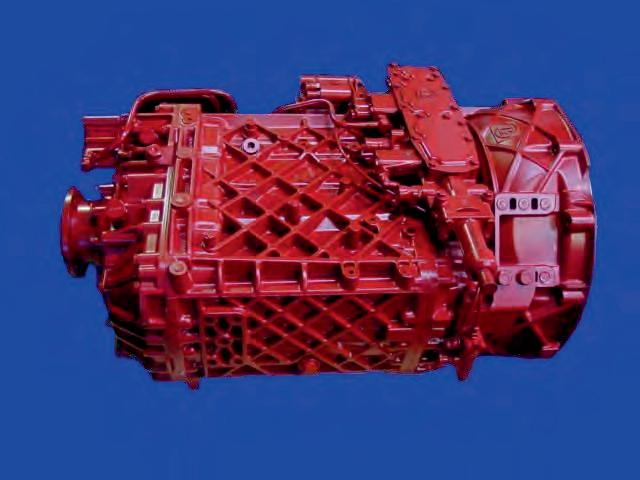
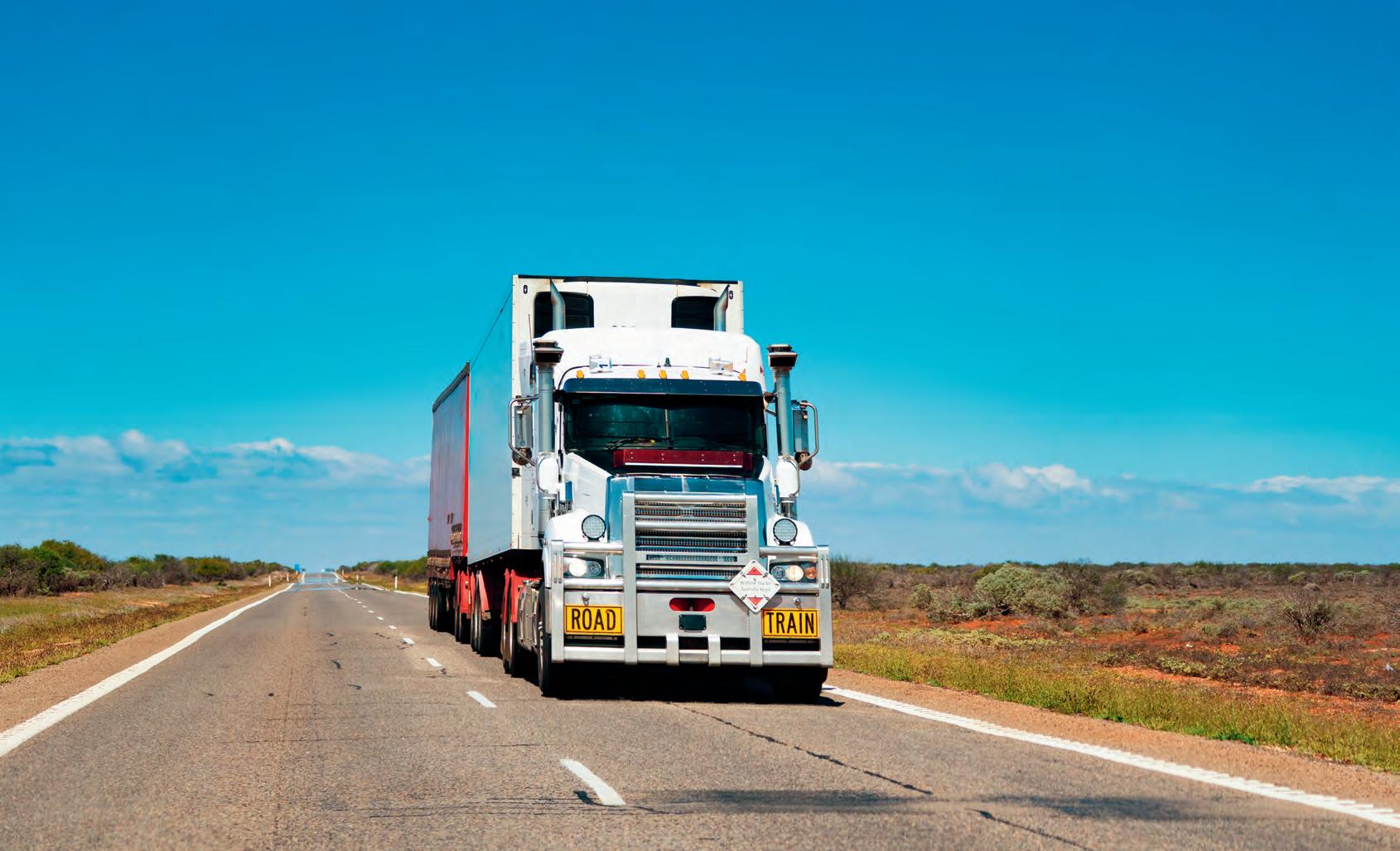
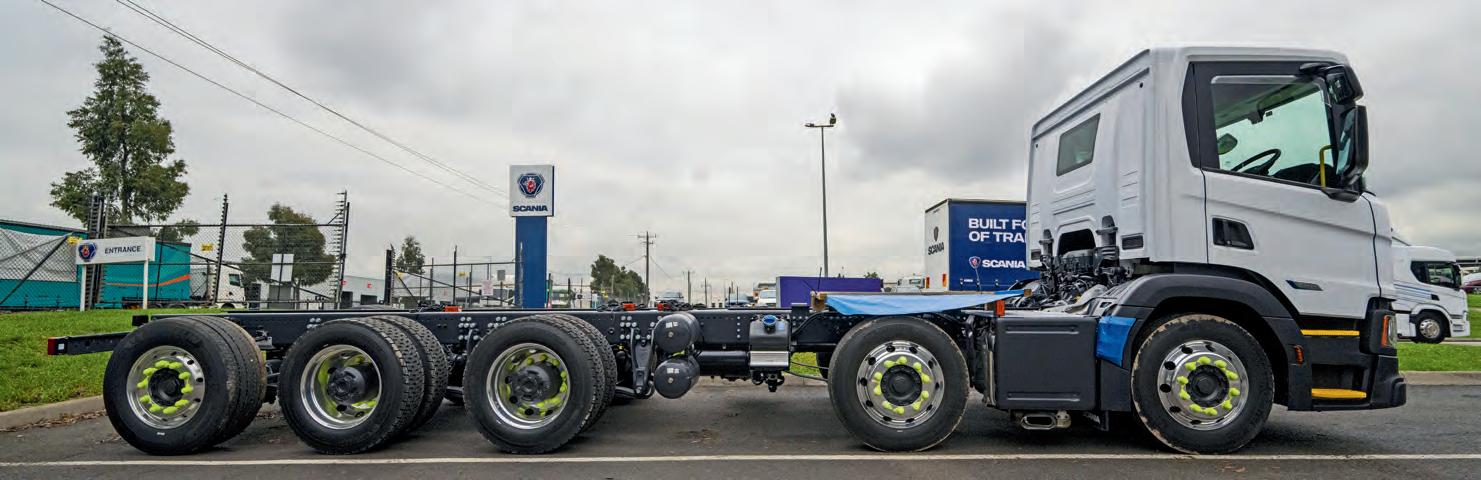
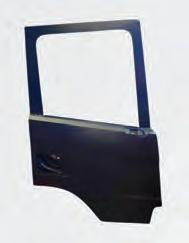
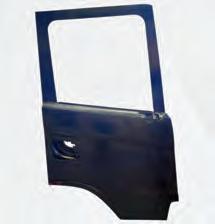
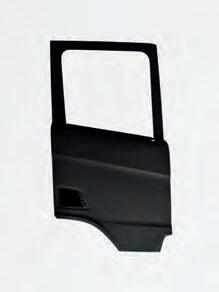
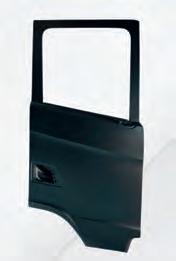
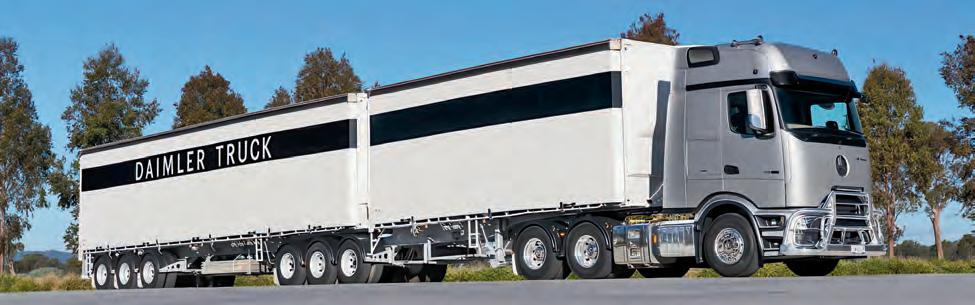
The Mercedes-Benz Actros 2.5 StreamSpace Run-Out Event is now on. Drive away with a complimentary 3-year BestBasic Service Plan covering all scheduled maintenance* , plus predictable running costs and the legendary fuel efficiency Actros is known for. Available for immediate delivery. Contact your Mercedes-Benz Trucks dealer.
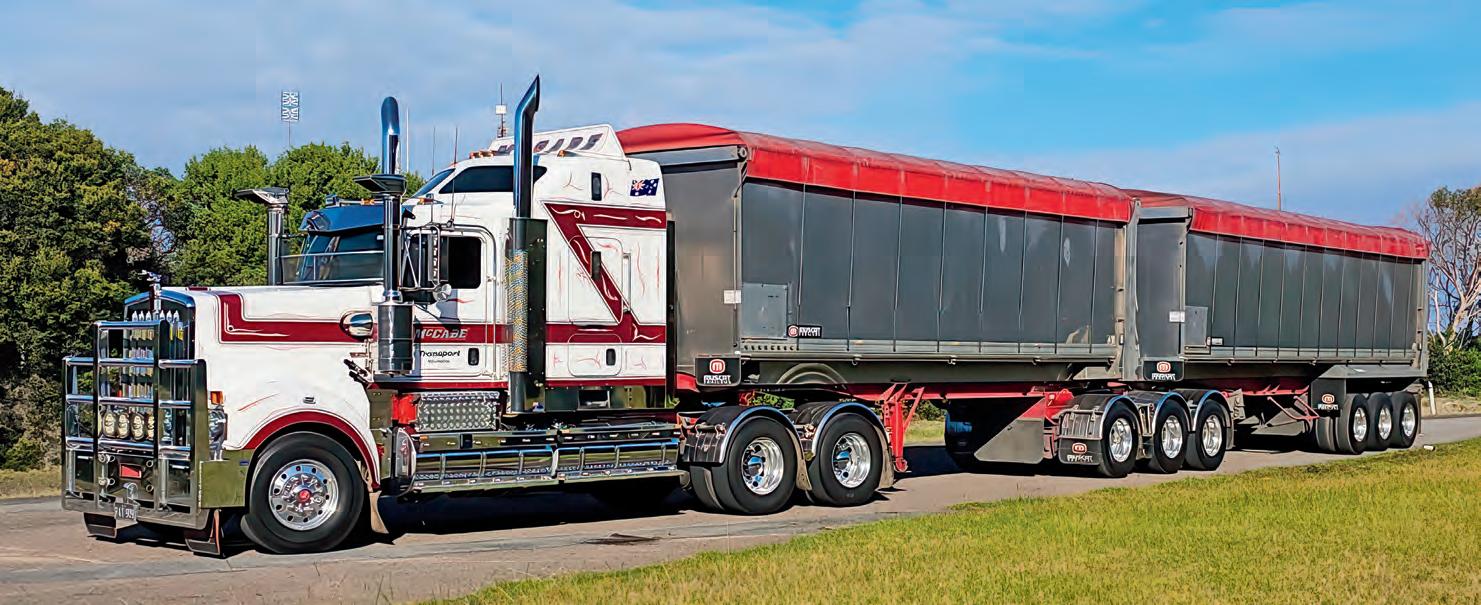
For 30 years, McCabe Transport has evolved to become a diverse bulk heavy haulage operator
18
SMOOTHING OVER CRACKS
OwnerDriver finds out how the regulator is hoping a new compliance tool will pave the way for a safer and more productive future for operators
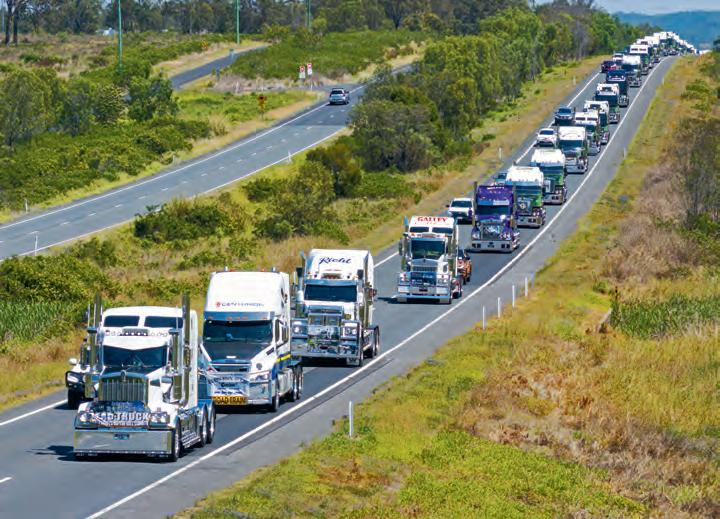
22 A CRACKING CONVOY-LESS CONVOY
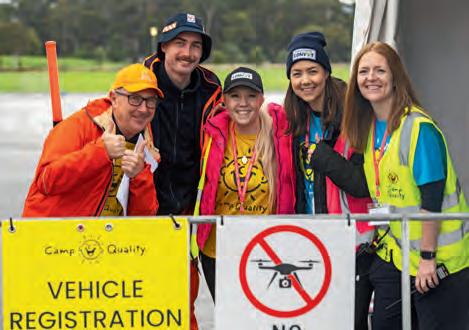
Despite it being turned into a Show’n’Shine event for the 2026 edition, Warren Aitken still thoroughly enjoyed his debut at a Camp Quality Convoy event
26 CROSSING THE FLOOR
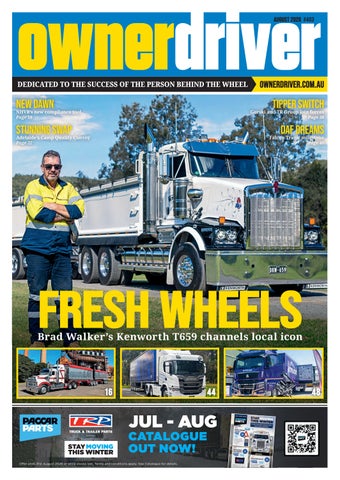
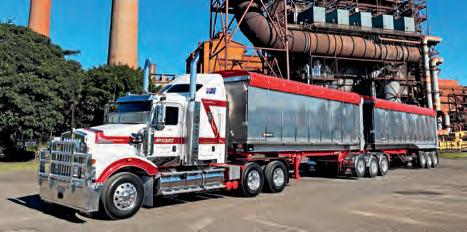
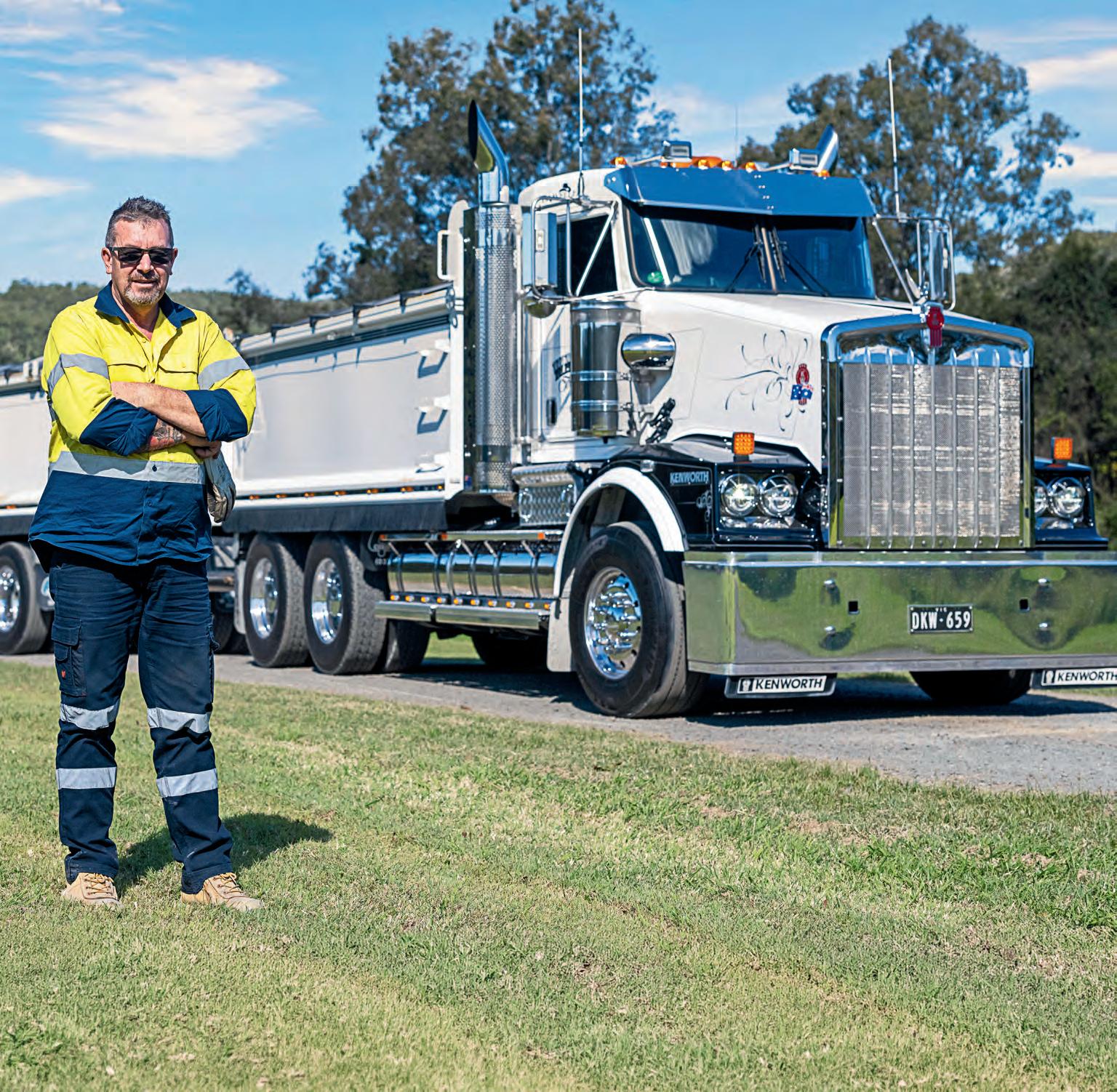
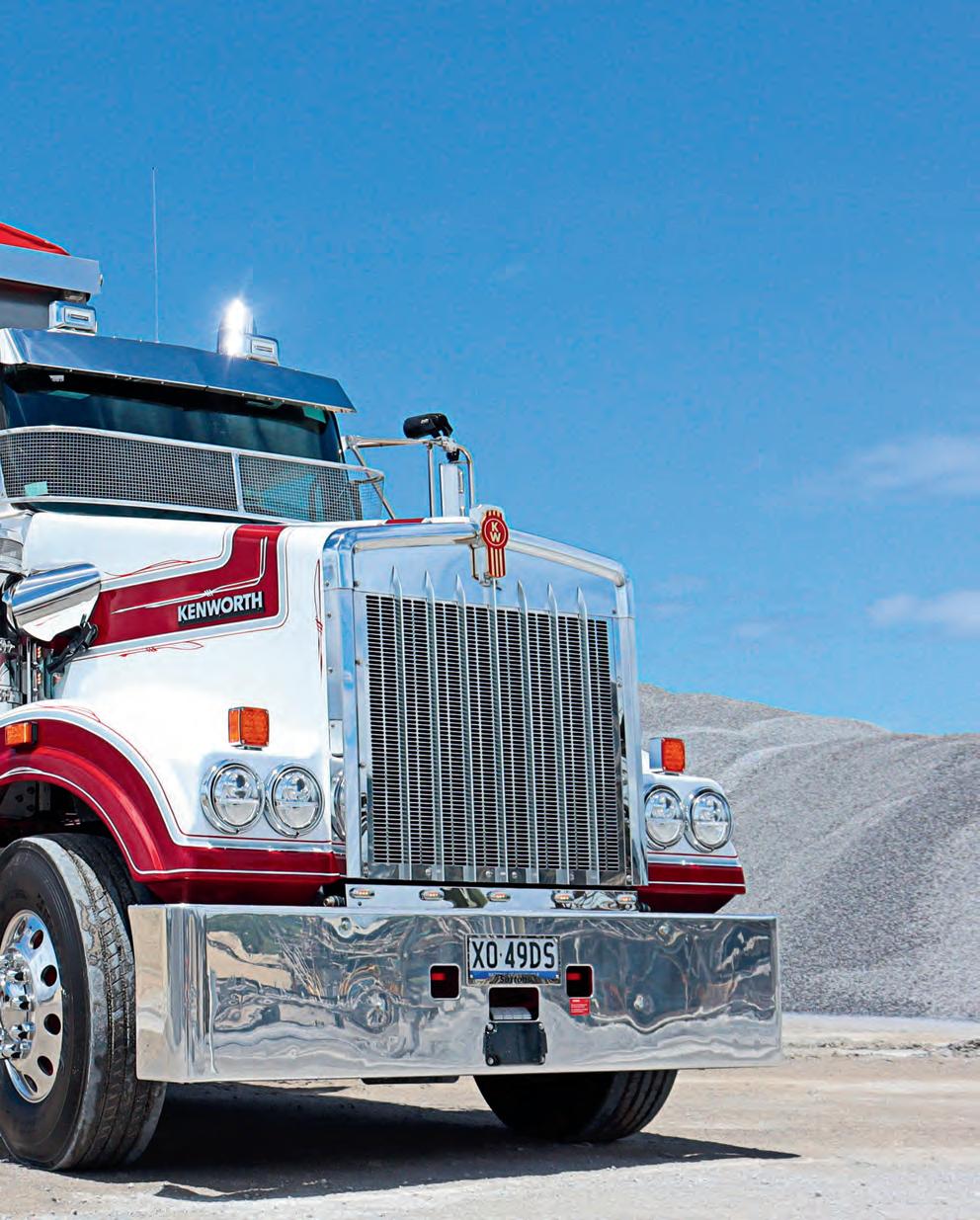
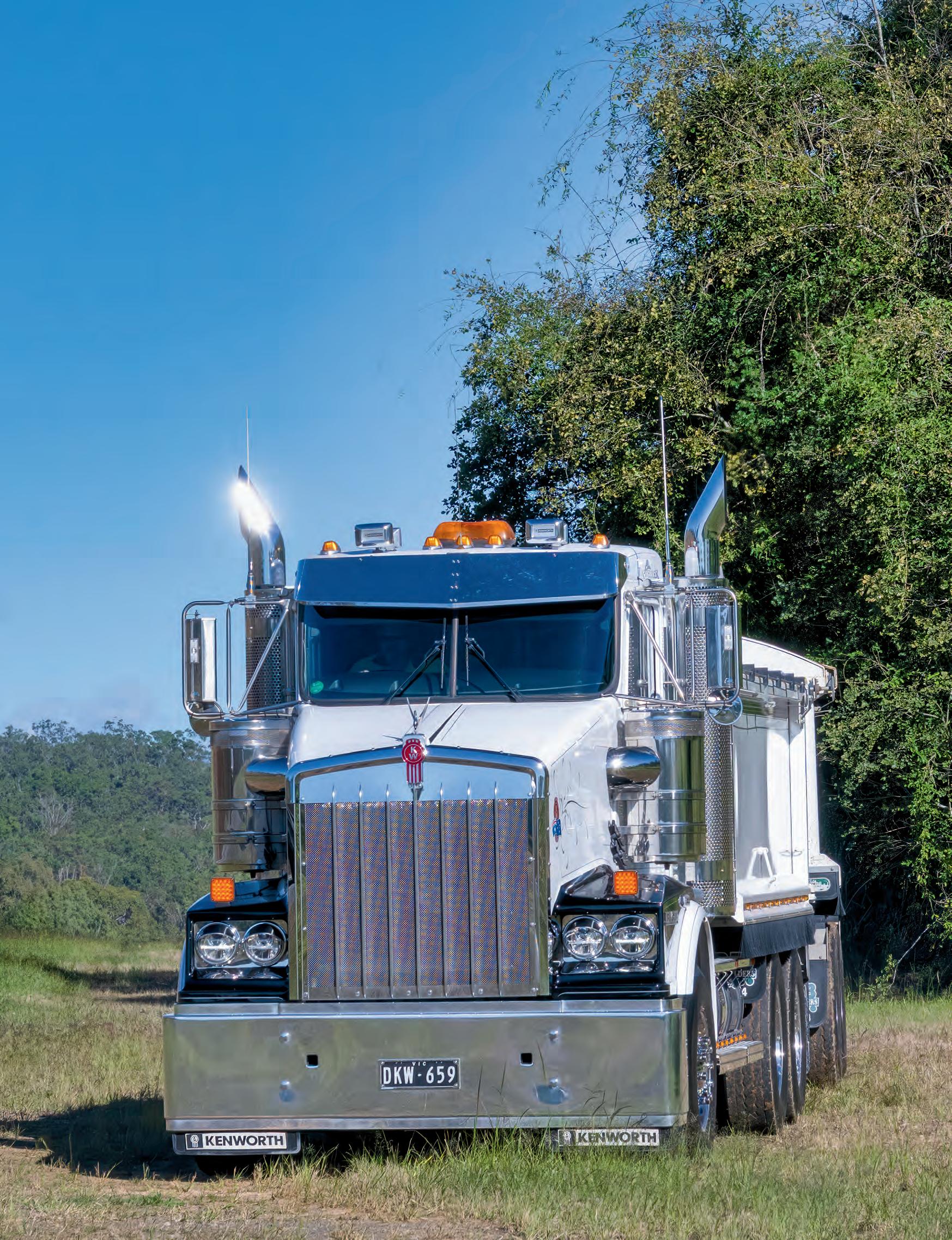
As a long-term self-confessed ‘Mack man’, it was always going to take something special to convince Brad Walker to buy a different truck brand. Enter this special Kenworth T659
37
AUSSIE EXPANSION
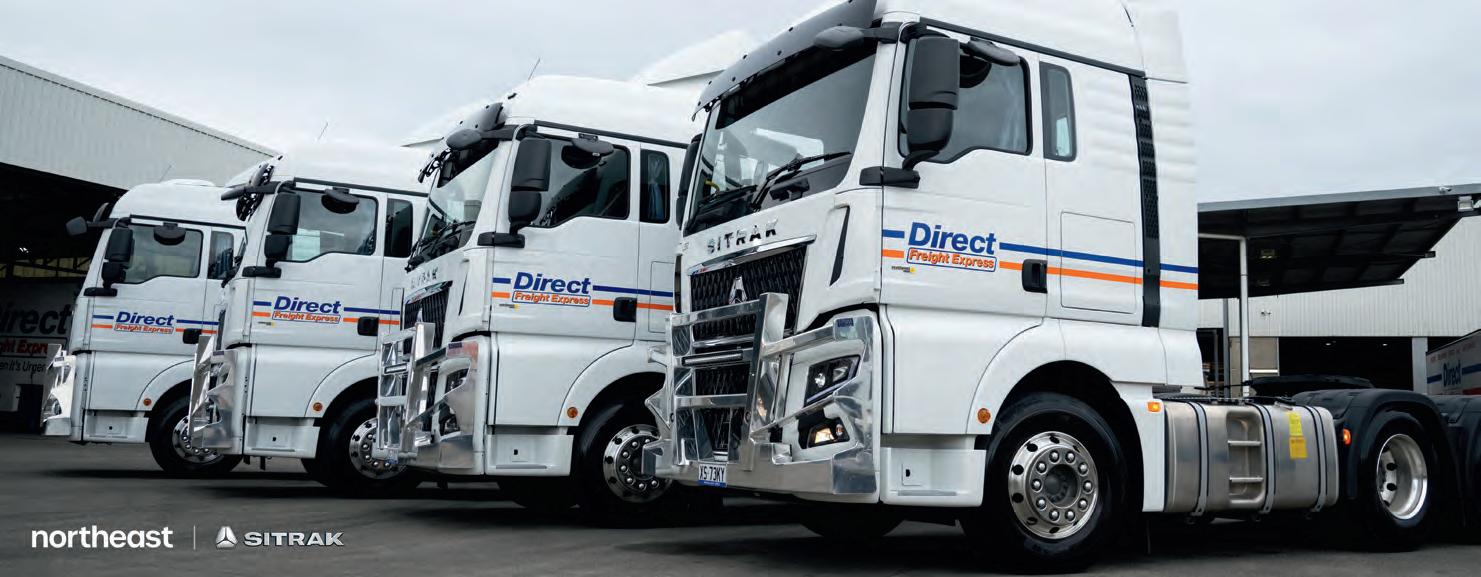
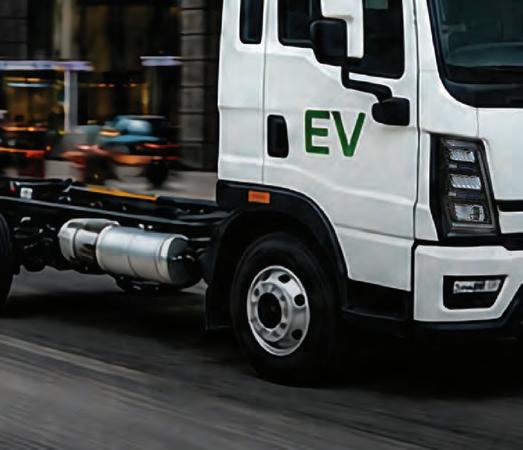
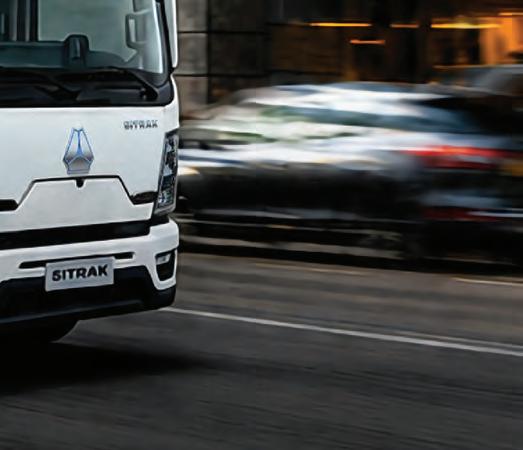
SITRAK has recently delivered 27 SITRAK prime movers to a major national operator as it continues evolving its local product line-up
38
FAST-PACED PARTNERS
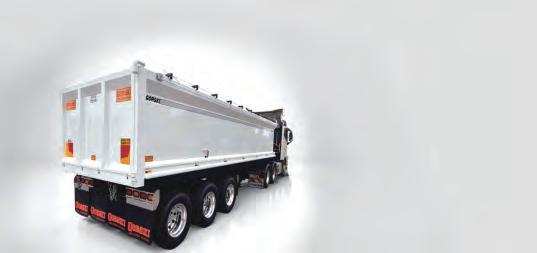
In the space of a year, Gorski and TR Group have joined forces to create an exciting new heavy-duty rental offering for a range of local transport operators
40
DARING TO DREAM
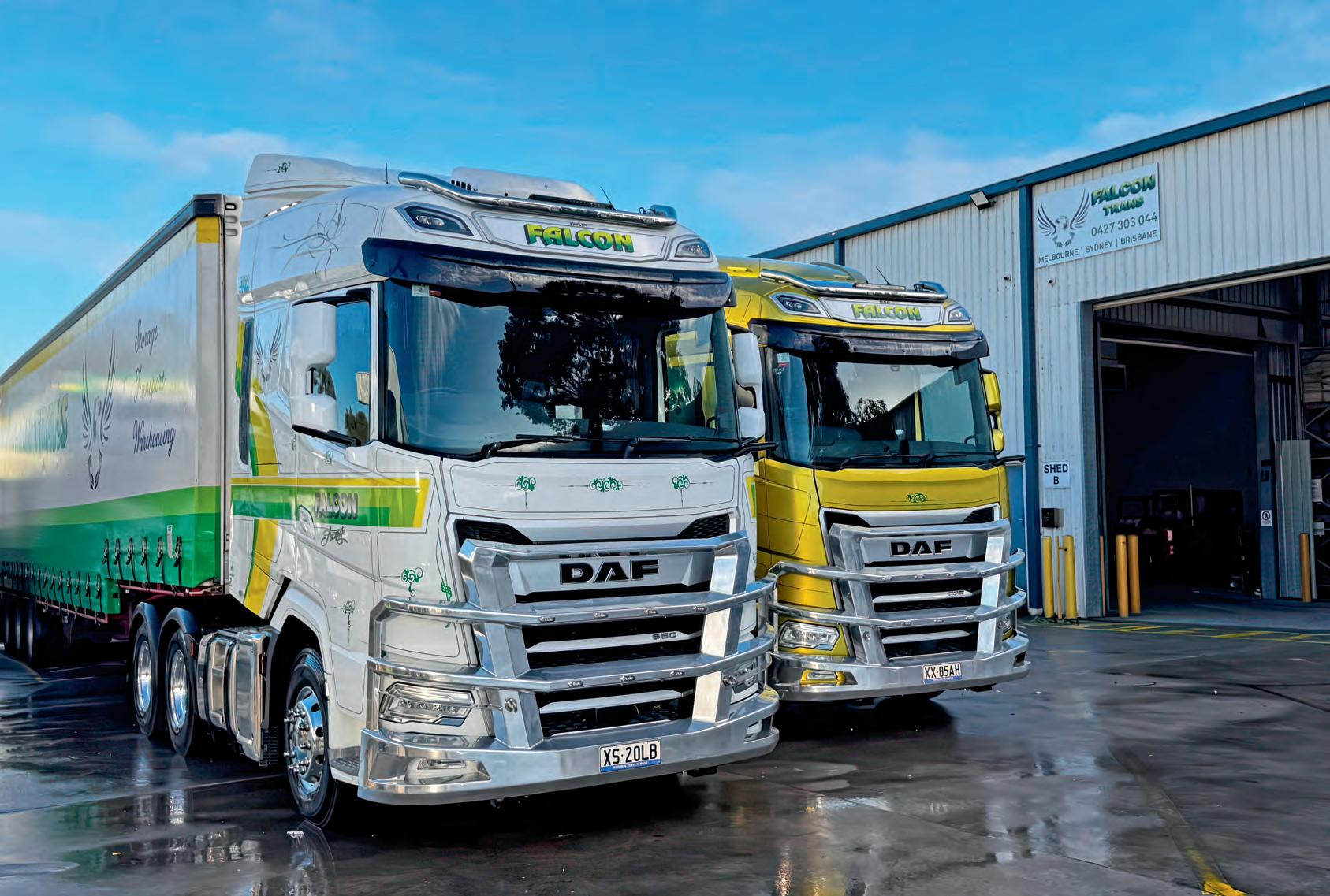
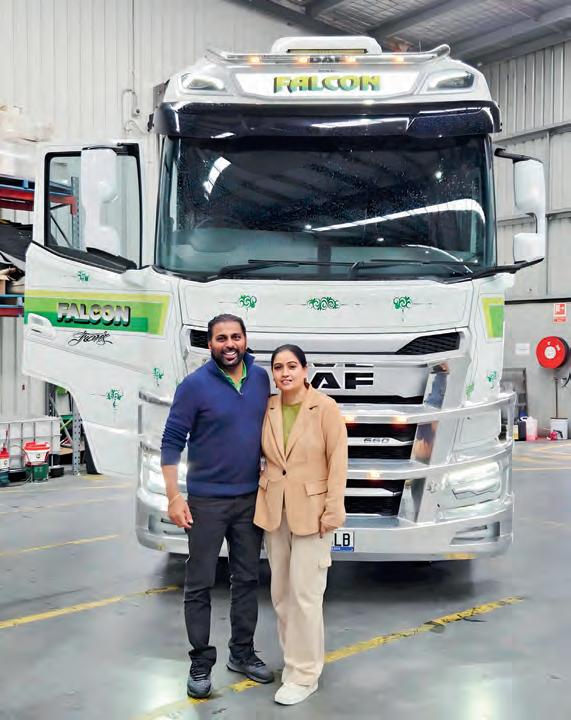
A decade ago, Mickie Shingari made the call to go out on his own and create Falcon Trans. Now, having reached lofty goals, the operator is continuing to evolve through an emerging partnership with DAF
42
SUPER SMOOTH
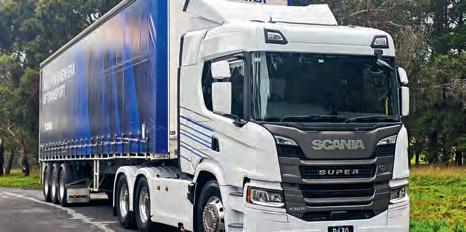
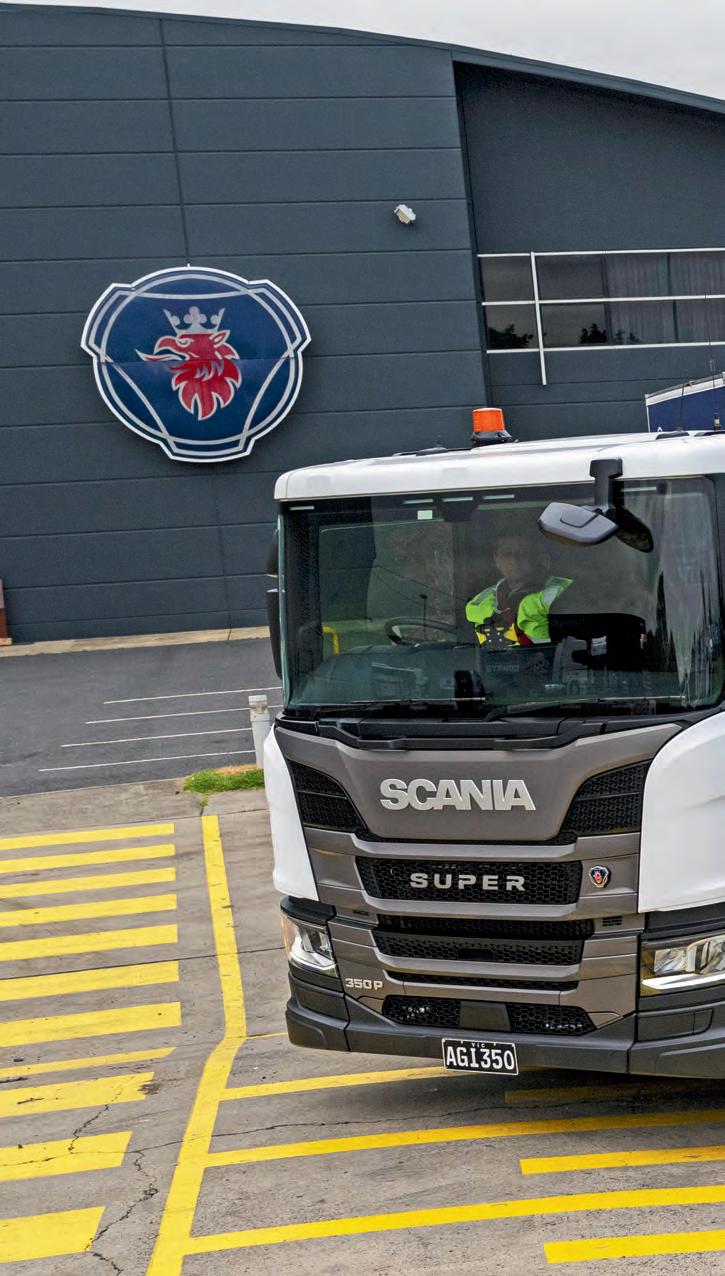
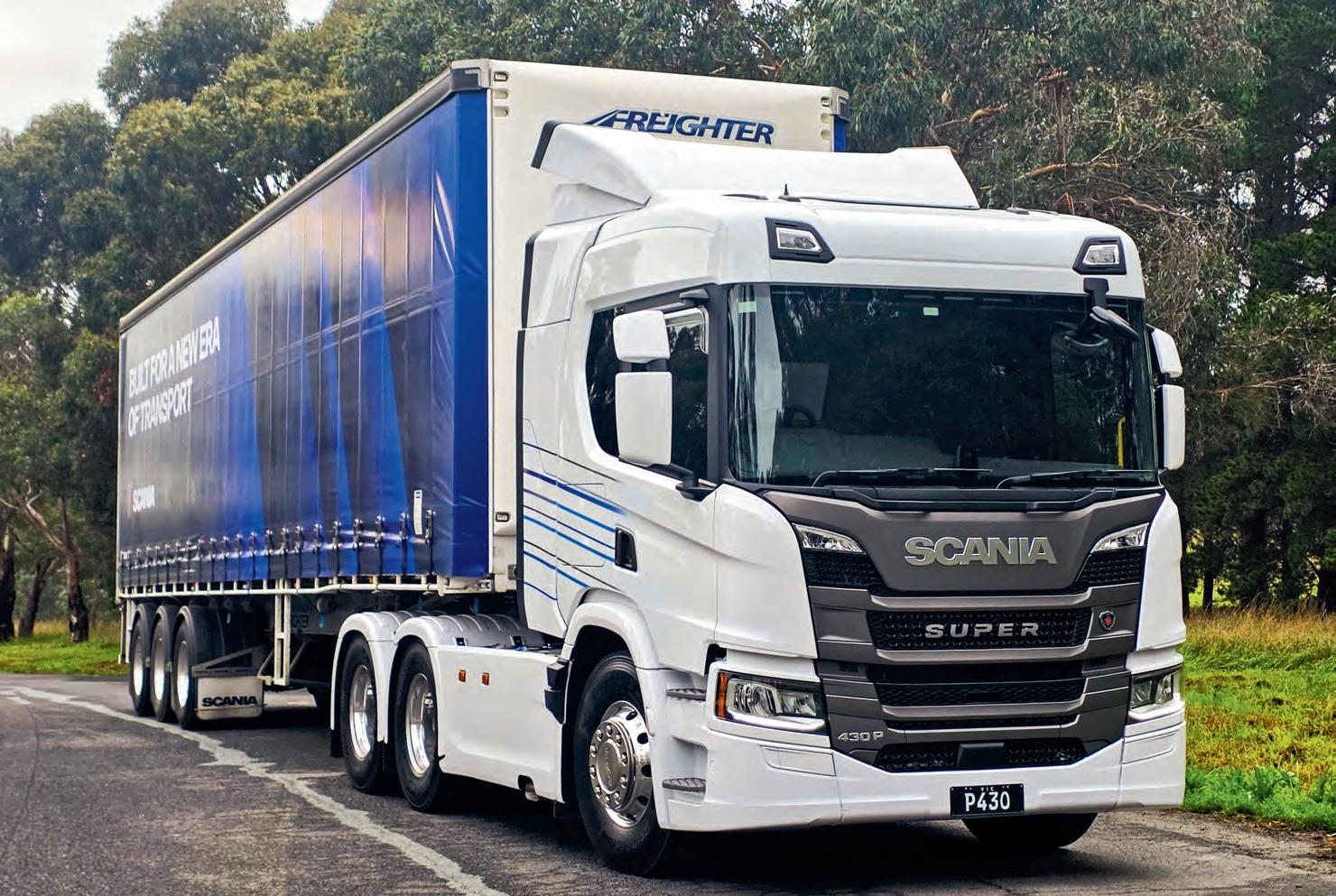
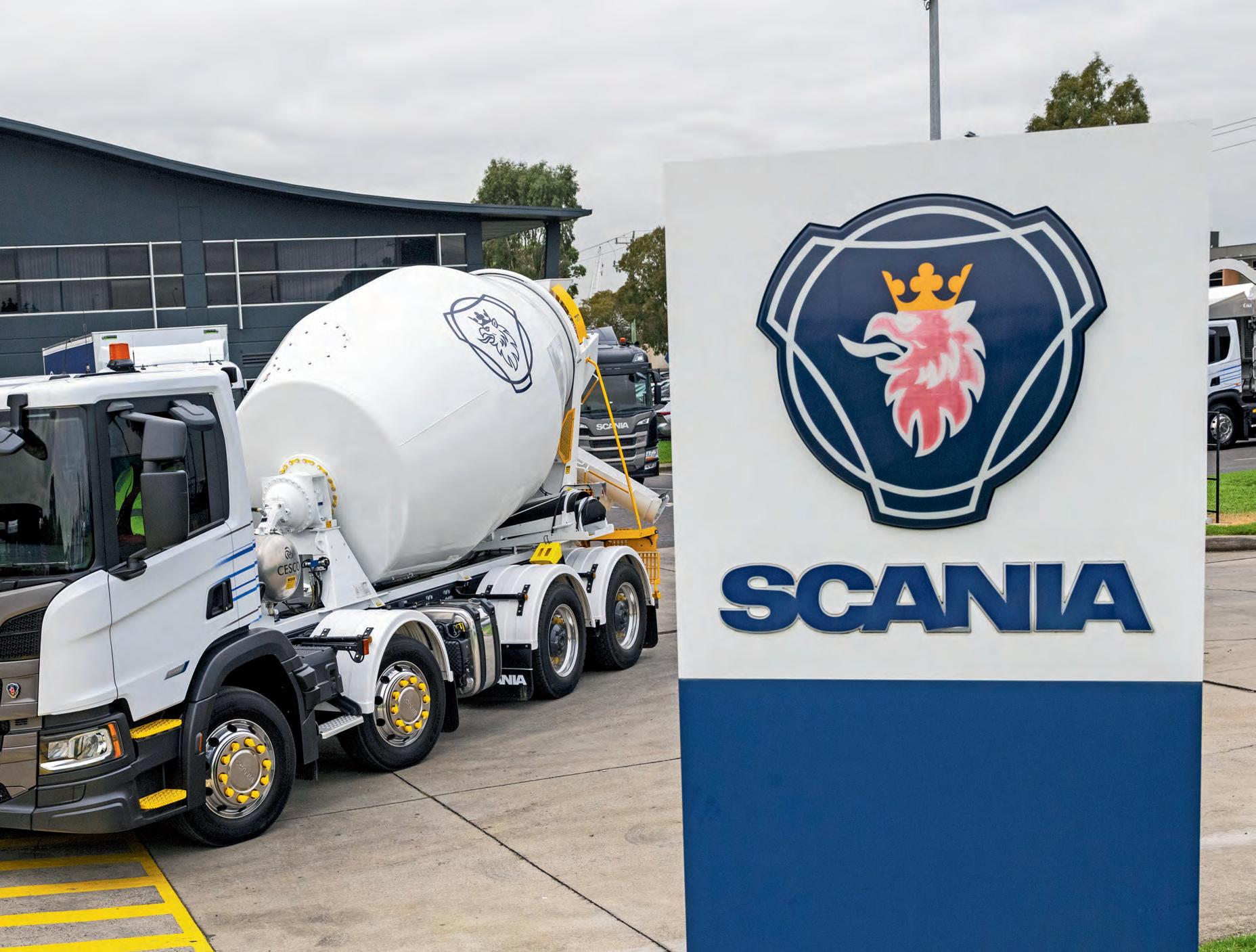
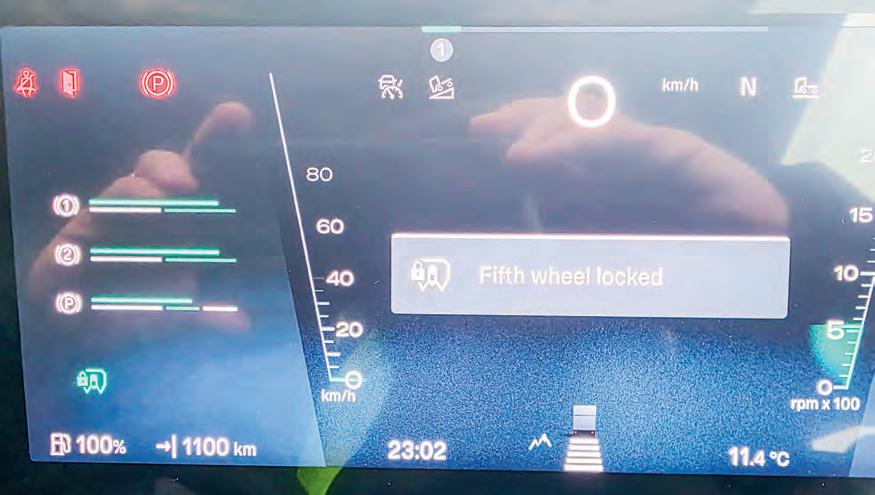
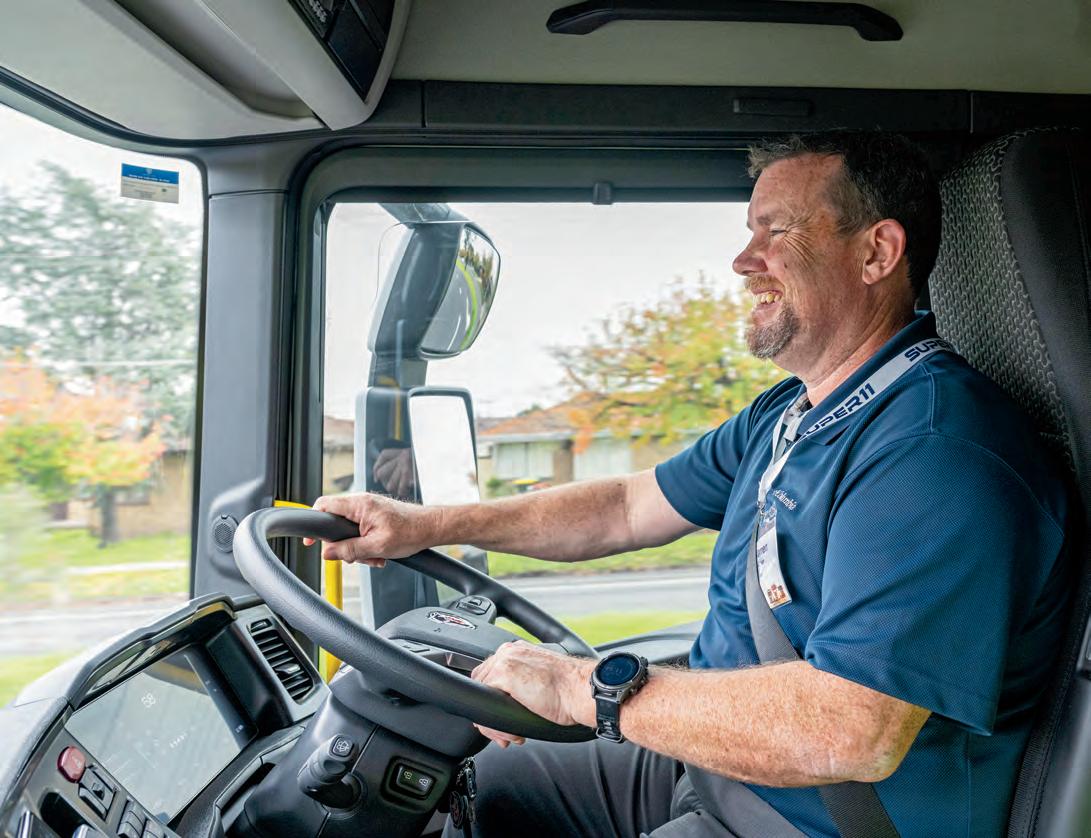
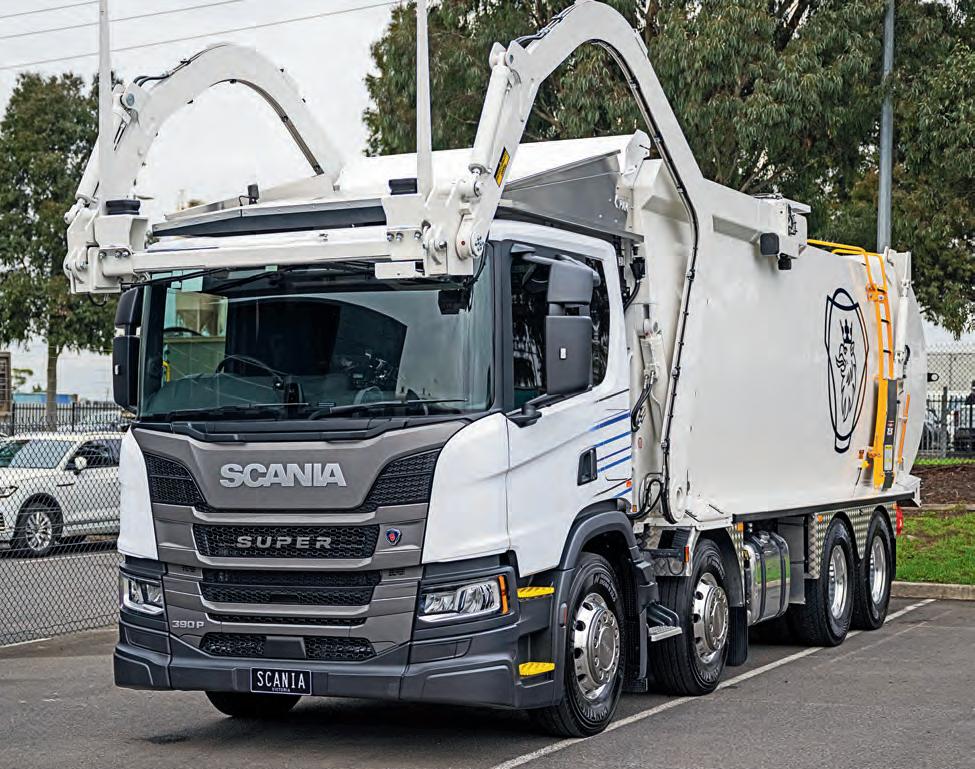
Warren Aitken made the pilgrimage to Melbourne to hop behind Scania’s new Super 11 engine range and put them to the test, including a new agitator model
48
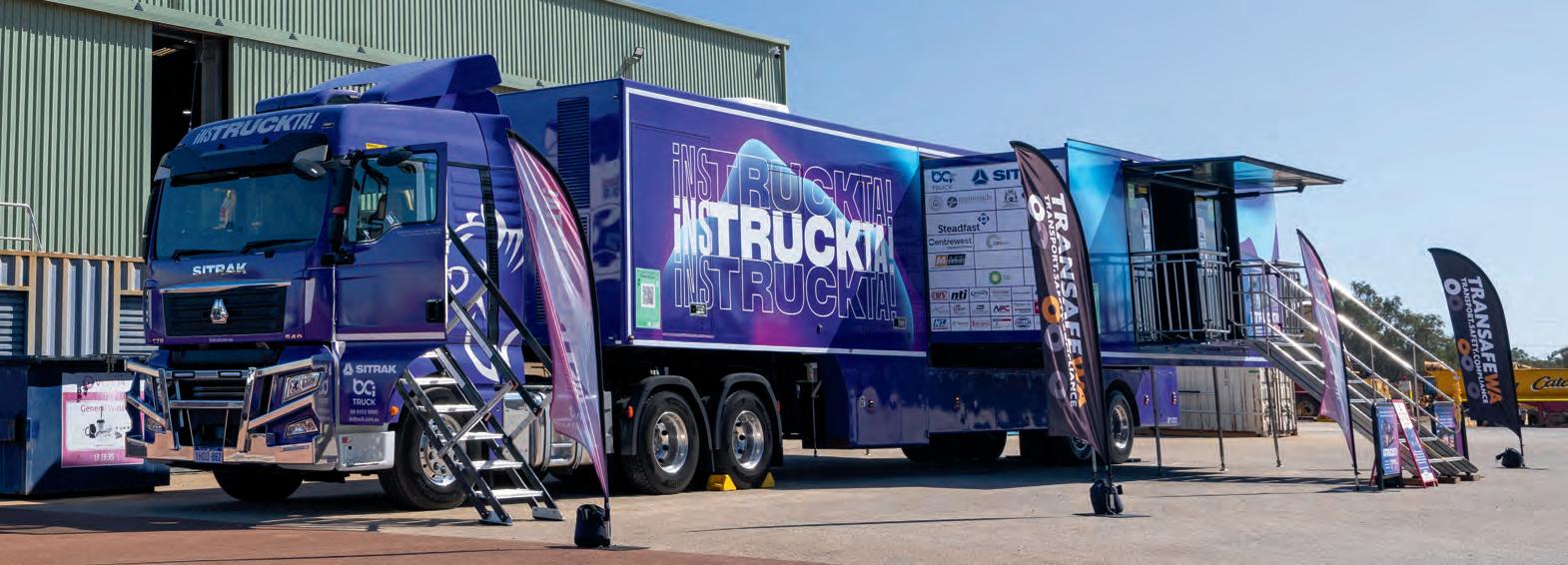
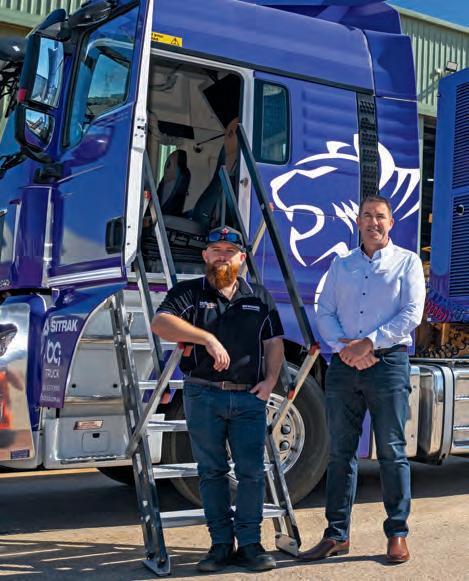
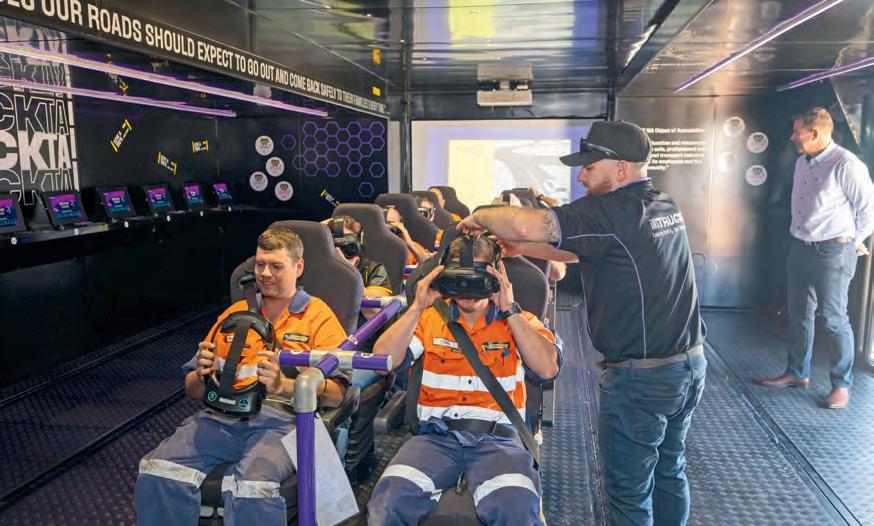
PURPLE PRIDE
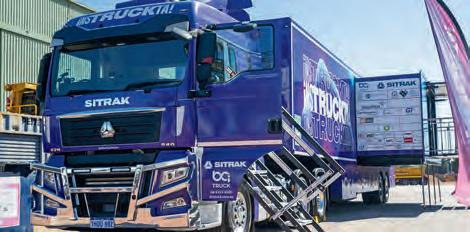
While waiting for the 2026 Mack Muster to commence, Warren Aitken caught a glimpse of a special purple truck
Image: Warren Aitken
EDITORIAL
Editor Sean Mortell
E-mail Sean.Mortell@primecreative.com.au
Phone 0468 577 166
Contributors Warren Aitken, Frank Black, Warren Clark, Rod Hannifey, Simon Smith
Cartoonist John Allison
PRODUCTION
Art Director Bea Barthelson
Print IVE Print
ADVERTISING
Business Development Manager
Tosan Popo
Phone 0481 260 352
E-mail Tosan.Popo@primecreative.com.au
SUBSCRIPTIONS
www.ownerdriver.com.au/subscribe
Phone +61 (0)3 9690 8766
Mon-Fri 8am-4.30pm (EST)
Email subscriptions@primecreative.com.au
Mail 379 Docklands Drive, Docklands, VIC 3008 Australia
EXECUTIVE GROUP
Chairman John Murphy
CEO Christine Clancy
Publisher Sarah Baker
Operations Manager Regina Fellner
Sales Manager – South Danny Hernandez
What’s the answer?
As more and more zero-emissions heavy vehicle announcements are made, the industry is in a state of transition – so what will define the future?
It’s been slowly creeping in. A couple of announcements here and there. The cutting of a ribbon, the smiles in front of the camera. Despite the ongoing debates around the technology, zeroemissions heavy vehicles continue to be unveiled across the country. But does that make it the answer for an industry looking to reduce emissions?
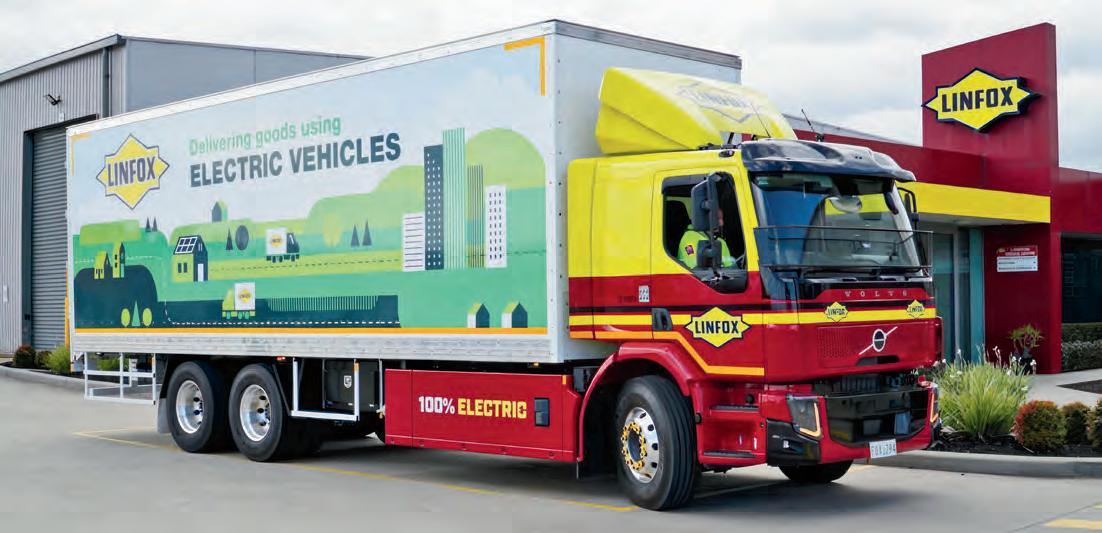
In mid-June, Australian transport giant Linfox revealed the first of 26 new electric prime movers started running across major Australian cities. A couple of weeks later, the Clean Energy Finance Corporation (CEFC) announced it would commit $22 million in funding to back electric fleet specialist Zenobē’s leasing of 148 battery electric trucks to Woolworths to deploy a low-emissions grocery network.
Whether people like it or not, it’s hard to deny the momentum of low-emissions heavy vehicle technology and subsequent deliveries in the nation’s transport industry. The larger operators are investing in the technology and deploying it, with more and more sites being filled with charging infrastructure. But where does this put the industry?
A clear message from the National Heavy Vehicle Regulator (NHVR) suggests safety and compliance will remain paramount regardless of the technology
used in the sector’s future. The regulator recently unveiled a new compliance tool for tech-savvy operators wanting to track their fleet’s compliance without having to turn to dedicated heavy vehicle management systems. From page 18, we spoke exclusively with the NHVR’s Paul Salvati about the tool and what the regulator is looking to do with its technology to improve safety outcomes across Australia.
Even if zero-emissions heavy vehicles become the norm in Australia, the glory of the old-style diesel truck show will continue to have a place. Warren Aitken confirmed this for us, heading to Adelaide’s Camp Quality Convoy from page 22 to explore how the popular event is continuing to thrill enthusiasts while raising funds for an important social cause. While he was travelling, he also tracked down Brad Walker to learn more about his special Kenworth T659 that’s our Truck of the Month for August from page 26.
Partnerships will also remain paramount for the sector regardless of the power source of the future, with Gorski and TR Group proving this. From page 38, the pair have joined forces on a unique bunch of new trucks and trailers that are revolutionising the local rental market. Flick over to page 40 to learn more
“Scania Australia is bucking the trend of veering solely to zero-emissions models, with its latest Super engine range finding fuel efficiencies to drive down emissions for operators.”
about Falcon Trans, with the operator celebrating its 10th anniversary with the impending delivery of beloved DAF trucks.
When it comes to the latest heavy vehicle technology, sustainability is being found in various ways. Scania Australia is bucking the trend of veering solely to zero-emissions models, with its latest Super engine range finding fuel efficiencies to drive down emissions for operators. From page 42, Warren hopped behind the wheel of a raft of new Scania models to test how the global manufacturer’s latest offerings are expanding Scania’s capabilities. As usual, our array of technology features and in-depth columns continue to lay the foundations for the industry during a busy period for the sector. Regardless of the way technology shapes the heavy vehicle market’s future, it’s clear the same principles of partnerships, hard work and respect will continue to be key pillars for all involved. We hope you enjoy the read.
Image: Warren Aitken
nhvr.gov.au/hvnl
The Goods
NEWS FROM THE HIGHWAY AND BEYOND
What’s new on the roads
A contract has been announced to reopen Great Western Highway while rest areas are the focus for the month as a Bruce Highway site is open and $1 million has been committed to improving NSW areas.
It’s a busy month for rest areas as we head into August, with the New South Wales government announcing a $1 million funding commitment to improving truck rest areas across the state and a new site being opened on the Bruce Highway. Outside of this, more clarity has been provided to operators in NSW regarding the planned reopening of the Great Western Highway.
$1M TO IMPROVE NSW REST AREAS
Australian governments have committed $1 million to making heavy vehicle rest areas safer and more comfortable along the Sturt and Hume highways.
The joint funding from the federal and New South Wales governments will look to improve three rest facilities along the two busy freight corridors, supporting driver wellbeing, reducing fatigue-related risks and improving conditions for the wider freight sector.
The investment will result in upgrades to both the eastbound and westbound Ravensworth rest areas at Maude, delivering new toilet blocks, improved lighting and better amenities.
Transport for NSW executive director Cassandra Ffrench says quality rest areas play a vital role in supporting truck drivers and improving road safety.
“Roads are a heavy vehicle driver’s workplace, and rest areas are important facilities that support drivers’ health, safety and wellbeing, and enable compliance with mandatory fatigue management breaks,” Ffrench says.
“These upgrades are about giving truck drivers access to cleaner, safer and more accessible facilities so they can take proper breaks and return to the road refreshed.
“Fatigue is one of the biggest risks on our highways and providing quality rest areas is one of the most practical things we can do to address it.”
Work started on the westbound rest area on June 29, with work at both sites expected to be completed by late August, weather permitting. Throughout the work, Ffrench says one rest area will remain open.
Meanwhile, the $2.4 million upgrade of the southbound Kyeamba Gap East rest area between Tarcutta and Holbrook is finished, with a
reopening date of July 31.
Transport for NSW says the work will transform an existing basic stop into a modern facility featuring toilets, disability accessible amenities, picnic areas, improved lighting, two heavy vehicle parking lanes, drainage upgrades, new signage and upgraded safety barriers.
The body says it is working with the road freight industry to improve the quantity and quality of heavy vehicle rest stops and support driver wellbeing and safety.
These projects build on upgrades delivered in the past two years at more than 10 sites across the Silver City, Pacific, Hume, Newell and Sturt highways.
GREAT WESTERN HIGHWAY TIMELINE UNVEILED
The New South Wales government has awarded a contract to help reopen the Great Western Highway.
The state government announced which successful contractor will deliver a new and more durable crossing at Mitchells Causeway, with major construction beginning in July and the road expected to reopen in the second quarter of 2027.
The state government has also
unveiled an expanded support package for local businesses impacted by the closure, saying there’ll be no shortcuts in providing the safest long-term solution.
Following an accelerated procurement process, Seymour Whyte has been selected to construct a new crossing that will restore the connection between the Blue Mountains and Central West while improving its long-term resilience.
The NSW government says extensive geotechnical investigations carried out over the past few months were critical to the procurement process, providing the evidence needed to develop the proposal for the safest and fastest reopening.
The investigations confirmed the bedrock beneath Mitchells Causeway remains stable, enabling a design that builds on the existing crossing, rather than replacing it entirely.
The new crossing will see a bridge structure built over the existing Mitchells Causeway, supported by deep piles anchored into the stable bedrock below. The new structure will sit above, but independently of the convict-built causeway, which will be stabilised as part of the work.
“I want to acknowledge how difficult the past few months have been for families, businesses, freight operators and everyone who relies on this road every day. Thank you for your patience while we worked to find the safest and fastest way forward,” NSW roads minister Jenny Aitchison says.
“In 109 days, we have completed thorough geotechnical testing, convened a global industry roundtable, run an accelerated procurement process with leading Australian and international engineering experts, and finalised both the contract and the solution to reopen this road.
“This news will not be easy to hear. I know it will mean sitting down at the kitchen table, working out how your family moves around and what the next year looks like in practice. But I want to reinforce what this also means: we have a timeline, contractor and major construction on the new crossing beginning in July. In tandem, the detour routes are being upgraded to make your journeys safer and easier going forward.
“The NSW government will not apply a band-aid fix. We are building a new crossing designed to serve local communities and freight for the next 100 years – because this community deserves a permanent solution, not a temporary fix.”
BRUCE REST AREA OPENS
A new rest area along the Bruce Highway has been opened for Queensland heavy vehicle drivers, with the Curra rest area now open.
Situated north of Gympie, the site provides new and improved facilities for both motorists and truckies. This is headlined by parking for up to 16 heavy vehicles, with total parking available for up to 25 vehicles.
Other facilities include toilets, picnic shelters, amenities and an off-leash dog area.
The opening of the Curra rest area is part of the Queensland and federal governments’ $9 billion package to upgrade the Bruce Highway.
It also means the existing Gunalda rest area will be closed, with the Department of Transport and Main Roads saying it no longer meets current design standards or capacity needs.
trusted worldwide
MANUFACTUREDBY ADR GROUP WITHMORETHAN 50 YEARSOF MANUFACTURINGEXPERIENCE
TRADEMARKREGISTERED IN MORETHAN 130 COUNTRIES WORLDWIDE
TECHNICAL ASSISTANCE & JOINT VENTURES WITH GLOBAL INDUSTRY LEADERS
EXPORTED TOMORETHAN 125 COUNTRIES WORLDWIDETHROUGH AGLOBALDISTRIBUTIONNETWORK
ADR GROUPPRODUCTSARESUPPLIEDAS OEM & OES COMPONENTS FORBOTH DOMESTIC & INTERNATIONALMARKETS
COMPLETERANGEFOR AUTOMOTIVE & HEAVY-DUTYAPPLICATIONS, WITH MORETHAN 7,000 PARTNUMBERS
THE GOODS NEWS FROM THE HIGHWAY AND BEYOND
Linfox begins electric introduction
The first of 26 new electric prime movers have started running across major Australian cities as the operator cuts emissions
An Australian trucking and logistics giant is in the midst of introducing a heavy-duty electric truck fleet across Melbourne, Brisbane and Adelaide to cut emissions on some of the country’s busiest freight routes.
Linfox has announced it’s putting the first of 26 battery-powered prime movers into service on heavy-hauling duties, including food and beverage distribution and integrated rail transport.
The trucks will cover about 500km a day, replacing diesel trucks on existing freight routes from Linfox’s hubs in Laverton North, and then from Willawong and the Adelaide rail freight terminal once deployed.
The federal government has provided funding for the project in a targeted move to overcome barriers to the adoption of electric trucks at scale, such as financial, operational, business model and market sentiment barriers.
The grant from the government’s Driving the Nation program is aiming to accelerate the uptake of battery electric vehicles, with federal climate change and energy minister Chris Bowen saying the fleet will help cut diesel bills, lower transport emissions and prove heavy haulage has a strong electric future.
“This investment in electric trucks, fast chargers and onsite solar systems could deliver the biggest cut to Linfox’s fuel use, emissions and running costs in its seven-decade history,” Bowen says.
“While governments across Australia continue to secure Australia’s supply of diesel and exhaust fluid, Linfox has taken a huge step to secure its energy security and consistently low running costs – today and for decades to come.”
Federal transport minister Catherine King also welcomed Linfox’s investment.
“Freight is the backbone of the Australian economy, but it has historically been heavily exposed to global fuel markets,” she says.
“Getting trucks on the road that are powered by electricity will ensure costs are more consistent for consumers and make our supply
Toowoomba convoy to miss 2026
Organisers have confirmed the annual event won’t be held this year, with economic pressures in the industry leading to the decision
The Lights on the Hill Convoy will not run in 2026, with organisers announcing in June the event has been postponed to 2027.
The event this October will not be run due to economic pressures being felt across the Australian transport industry, with organisers recording a live message at the memorial over a weekend in June to announce the news.
“As much as it hurts us saying it, we want to let the trucking community and local community that supports us know that this year we won’t be running our Saturday convoy event,” the organisers said.
“It’s a lot of deliberation to come to this choice, but after talking to a lot of the trucking community amid the current economic times we’re
living in, we think running an event like this is going to put too much pressure on the transport industry.
“We know there are other trucking events still going ahead this year – good on them and I hope they get the attendance they need.”
Despite this news, the memorial event will still run on October 4, with organisers confirming merchandise will still be available and an expanded memorial service is planned.
“It is devastating for all of us, but the thing is if we have an event and don’t pull it off, there might not be able to have this thing that lives on for generations to come,” the organisers said.
“I’m sorry if we’ve hurt anyone,
chains more resilient.”
Local MP Tim Watts says the investment means cleaner air and quieter streets for his community in Melbourne’s west, while keeping Australia moving.
“Our government’s Driving the Nation fund isn’t just an environmental story, it’s an economic one, where logistics companies like Linfox, with government support, are investing in the infrastructure and operations that keep our community moving and our workforce employed,” Watts says.
“Anyone who lives near a busy freight route knows the noise. Electric trucks are significantly
quieter, and that’s a real qualityof-life win for our community in Melbourne’s west.”
Linfox’s heavy truck electrification project is backed by $19.63 million from the Australian Renewable Energy Agency (ARENA) through its Driving the Nation program, which includes targeted funding for heavy battery electric vehicles and charging infrastructure.
This announcement is in addition to $70 million to help more drivers drive Volvo heavy electric vehicles and support skilled jobs in Volvo’s truck manufacturing plant in Queensland through the Clean Energy Finance Corporation (CEFC).
but we feel we’re doing the right thing.
“There will still be names being put on the wall, and it’s still the same memorial service as every year. Our main focus is this wall
and all the names that go on it. We are going to have a bit more at the memorial after the service this year – more of a family event – so keep an eye out for that.”
Image: Linfox
Image: Warren Aitken
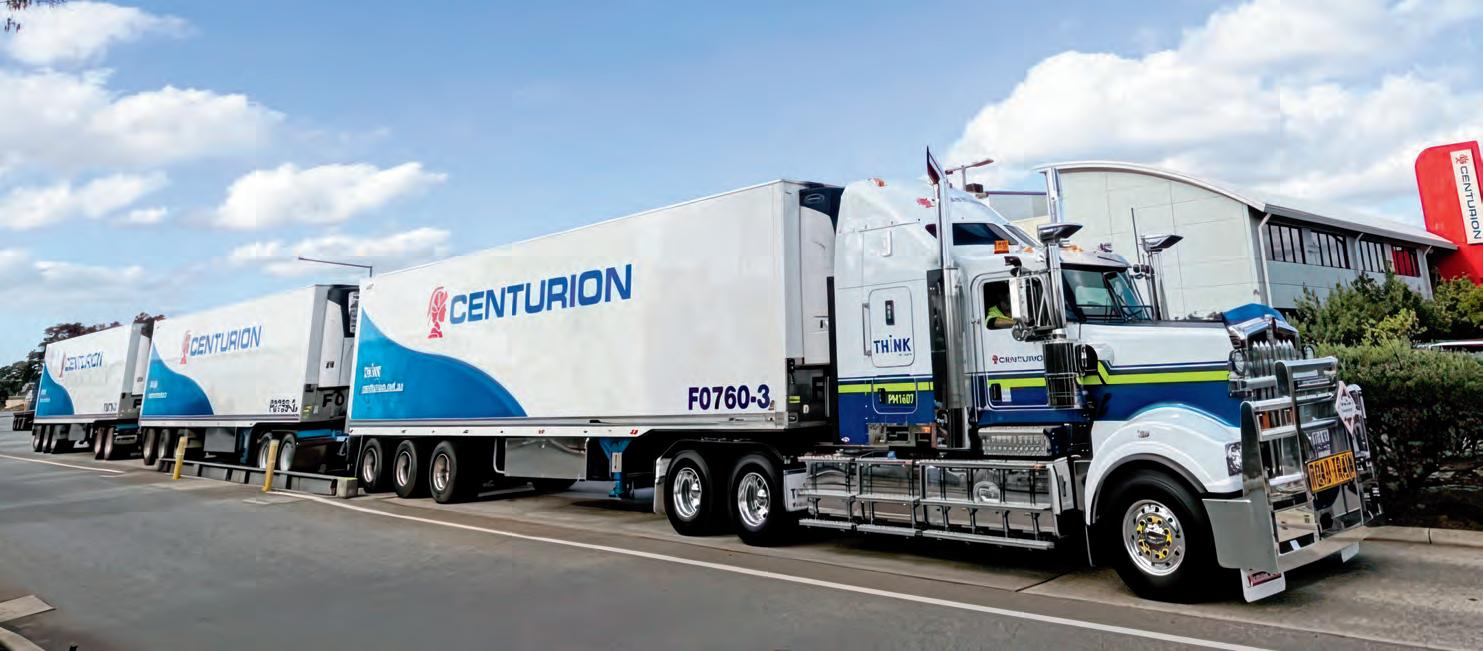
Centurion leader steps down
The leader of Australian transport business Centurion has revealed he’ll step down as CEO, with a leadership transition underway.
After 12 years as CEO of Centurion, Justin Cardaci has announced he’ll step away from the role.
“It has been a privilege to lead the business through a period of significant growth. Together, we have expanded our national footprint, strengthened our position as one of Australia’s
leading transport and logistics providers, and built a business that is well positioned for the future,” he says.
“While I’m proud of what we have achieved commercially, my proudest moments have been seeing our people live Centurion’s RIPPA values every day – Respect, Integrity, Passion, Persistence and Accountability.
“I have had the opportunity to work alongside a talented and dedicated team, and I am grateful
for the support, commitment and shared achievements that have defined my time with the business.
“I would like to sincerely thank our employees, customers, partners and Centurion’s executive chairman Philip Cardaci, for their support and commitment throughout my time as CEO.”
The leadership transition will see Michael West from Centurion’s parent entity CFC Group take over as interim CEO while the board begins a recruitment process.
“Michael knows the business well, having worked closely with the Centurion leadership team and served on the advisory board for the past seven years,” Cardaci says.
“Centurion is in a strong position, with an outstanding team and significant opportunities ahead. I will remain actively involved over the coming months to support a smooth transition, before enjoying some well-earned time off after a very busy 12 years in the CEO role.”
Image: Centurion Transport
Toll appoints new MD
The major transport and logistics business has announced a new leader, with the appointment taking over in July
Major transport and logistics operator Toll Group has announced the appointment of a new group managing director.
Effective from July 1 this year, Robert Reiter assumed the role in addition to his current position as president of global forwarding at Toll.
As group managing director, he’s responsible for setting the strategic direction and driving the overall performance of the group, ensuring alignment across all businesses to deliver sustainable growth and long-term value creation.
Working closely with the board
and executive leadership team, he will now focus on strengthening performance, enhancing competitiveness and positioning the group to capture emerging opportunities.
“I am honoured to be appointed group managing director at such an important time for Toll. We have strong capabilities, dedicated people and significant opportunities ahead,” Reiter says.
“I look forward to working closely with our teams, customers and partners to build on our momentum and continue delivering strong outcomes for our customers and stakeholders.”
A transition plan is in place to ensure continuity for customers, employees and partners as Reiter assumes his new role.
Reiter first joined Toll Global Forwarding in August 2025 and currently serves as the group’s president, playing a key part
in strengthening customer relationships, improving regional operations and leading transformation initiatives across the business.
He brings extensive global freight forwarding experience, with leadership roles at organisations including Kuehne & Nagel, Panalpina, DB Schenker and DHL, alongside expertise across end-to-end supply chains, including contract logistics.
“Robert is a proven leader with deep knowledge of our business, customers and operations,”Toll Group executive chairman Thomas Knudsen says.
“His appointment as group managing director reflects our strong confidence in his leadership and his ability to drive the group’s continued growth, performance and transformation. We are pleased to have him lead Toll through its next phase.”
MT35J-G4D-V
MT45J-G4D-V
DIVERSE SKILLSET
For 30 years, McCabe Transport has evolved to become a diverse bulk heavy haulage operator. The NSW business has no intentions of stopping as the fleet continues to grow into new markets
It was in the mid-1990s that Tony McCabe made the bold and brave decision befitting of a man in his 20s. Having fostered a passion for trucking in his youth, Tony launched his own venture, starting McCabe Transport in 1996. Operating in New South Wales’ Wollongong and Illawarra regions, he had only one truck carting for members of the scrap metal industry.
Now at the round age of 60 and at the head of a growing transport outfit, Tony says he wouldn’t have it any other way.
“I started running scrap metal for a year or two, but like all good stories, I had a lucky break,” he told OwnerDriver
“I was in the right place at the right time and scored a contract with Alcoa to cart their waste products in Newcastle.”
The initial deal saw McCabe Transport carry dross from two Alcoa sites down to Geelong for recycling in Victoria, quickly allowing Tony to grow his fleet to four trucks. Instead of being a defining moment that would set a permanent course for the operator, Tony and his team used the contract to continue growing and diversifying in various markets.
After years of running only tipper trucks, Tony recalls the decision to welcome flat top trailers as a pivotal marker of McCabe Transport’s evolution.
“When we diversified into flat tops, it allowed us to keep going and growing,” he says.
“It led to us eventually buying another recycling company, meaning we could grow further.”
This spurred McCabe Transport’s productive mindset, with the operator then buying another Wollongong based transport company. The purchase allowed the fleet to welcome floats and tilt trays, with a total of eight new vehicles from the acquisition putting McCabe’s badge into a new market in the heavy haulage game.
“Now we’ve got eight floats and six tilt trays that we use for heavy haulage – we can do anything up to 100 tonnes nowadays,” he says.
“It’s resulted in us heavily growing the heavy haulage side of our business in recent years.”
This culminated in perhaps Tony’s largest purchase yet, with McCabe Transport buying another New South Wales bulk haulage operator roughly 18 months ago. The operator was renowned as a family-owned bulk haulage contractor in Sydney’s south-west, with the purchase also allowing McCabe Transport to diversify both the business’ operations and fleet.
The end result is a fleet of roughly 40 trucks completing a diverse range of work. From its main depot in Unanderra in NSW, McCabe Transport is a leading bulk haulage carrier of industrial waste, scrap steel, gravel and agricultural products, as well as heavy haulage, offering services both in NSW and interstate across Australia. This is complemented by an ongoing expansion into the gravel transport sector,
Images: McCabe Transport
with the decision to venture into the market roughly eight years ago seeing more truck and dog combinations enter the fleet.
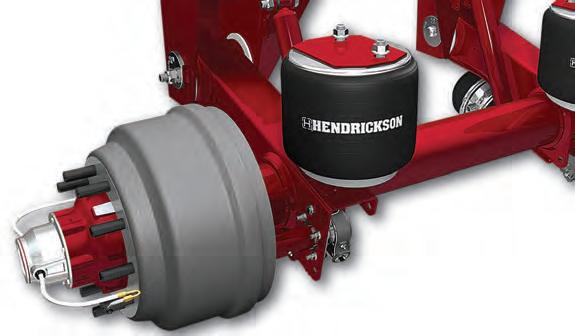
While Tony admits the fleet was recently larger due to recently selling some older equipment, he’s satisfied with the way McCabe Transport has been able to grow over the years. He says investing in updated modern equipment has been central to the business’ continual expansion, with a long-term partnership with Hendrickson being a prime example.
“Hendrickson is a common feature across our wide range of trucks and equipment,” Tony says.
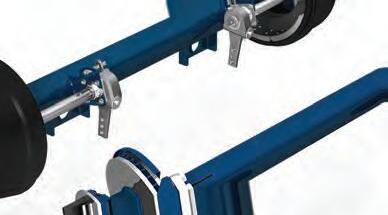
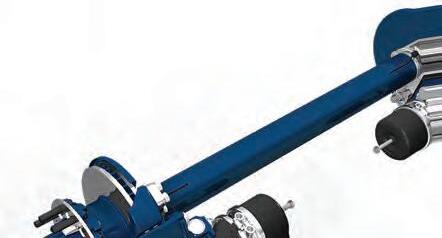
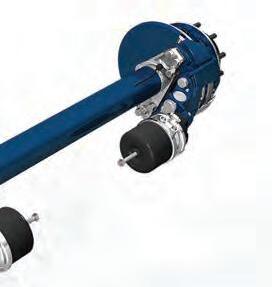
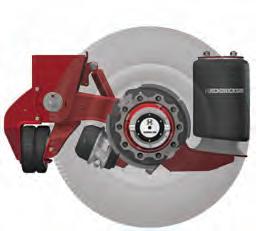
“All of our gravel truck and dog combos have Hendrickson suspensions on them, while our tippers also heavily feature Hendrickson. The only area I can think where we don’t have Hendrickson running is in our powder tankers, but we’re buying
Above: McCabe Transport’s growing fleet features plenty of Hendrickson
Below: The transport business runs services in a diverse range of markets
“All of our gravel truck and dog combos have Hendrickson suspensions on them, while our tippers also heavily feature Hendrickson.”
some soon and we’ll put a set in.
“Choosing Hendrickson was the best move we ever made. We’ve tried other suspensions over the years but none compare to Hendrickson. The HXL7 wheel end is even covered by a 1.2 million kilometre warranty – it just gives us peace of mind.”
This has been bolstered in recent times with the addition of other Hendrickson technology like its TIREMAAX PRO tyre pressure control system, significantly improving tyre life.
While Tony may no longer be the bold young man in his 20s deciding to venture into the transport game, he’s maintained the explorative nature that has seen him expand into so many haulage markets over the years. Instead of being satisfied with McCabe Transport’s diverse bulk heavy haulage capabilities, Tony is preparing to welcome new vehicle combinations to his fleet this year as he continues growing his heavy vehicle empire in NSW.
“In June our first A-Double came off the line from Freighter Group,” he says.
“It’ll feature a set of skel trailers built to run containers, which opens another avenue for us at McCabe Transport.
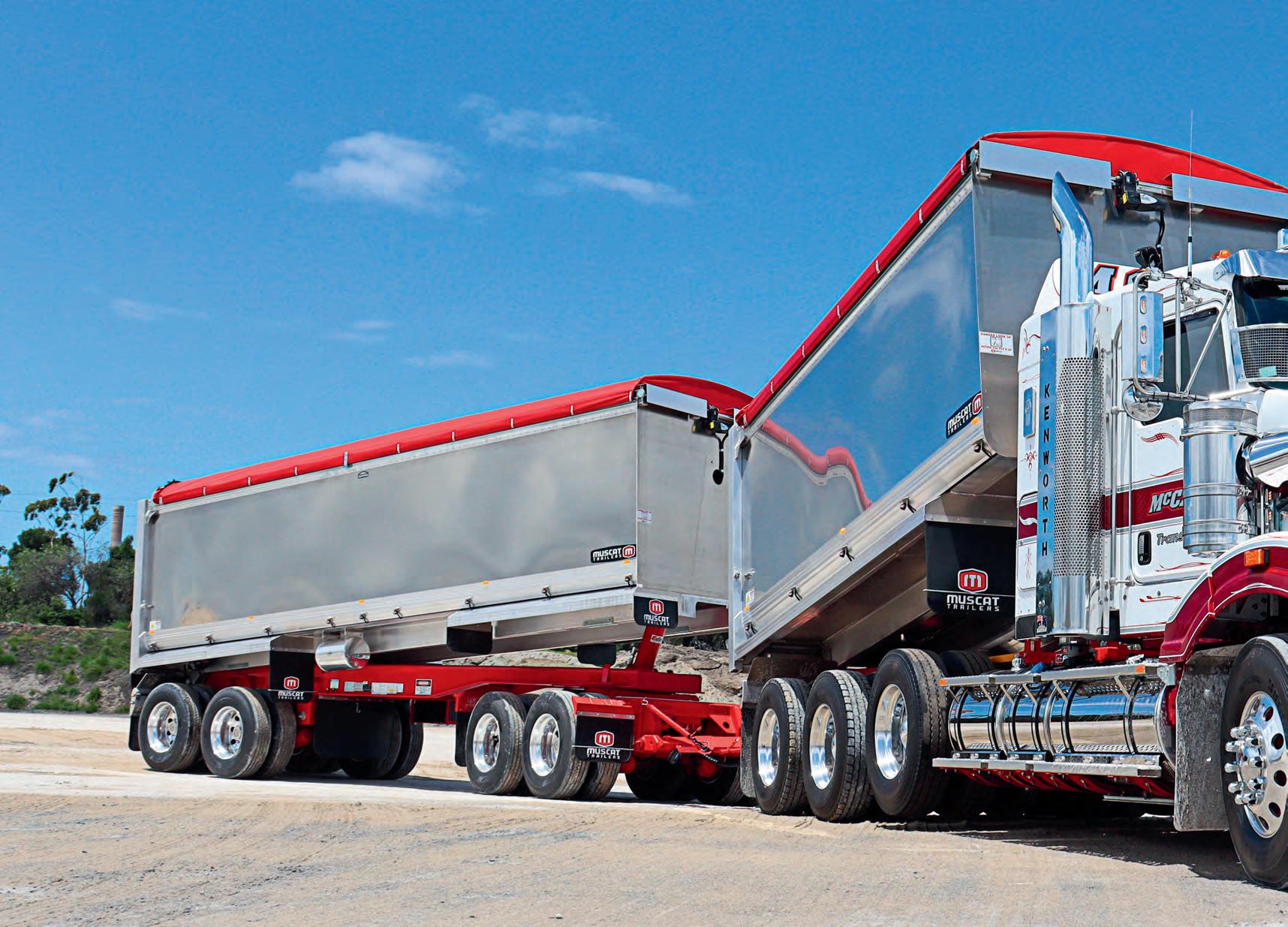
“We’re also working with suppliers like Muscat Trailers to have aluminium tippers built to cart our products. It’s an exciting time and we’re grateful to have supplier partners like Hendrickson to continue growing our fleet.”
HENDRICKSON AUSTRALIA
Hendrickson Asia Pacific Head Office 32-44 Letcon Drive Dandenong South Vic 3175
Phone: +61 3 8792 3600
Email: customerservice@hendrickson.com.au
SMOOTHING OVER CRACKS
The NHVR has recently unveiled a new compliance tool for the heavy vehicle industry to use. OwnerDriver finds out how the regulator is hoping the system will pave the way for a safer and more productive future for operators
Starting a new job can be a whirlwind. Plenty of new faces and names to remember, onboarding and a wealth of information to grapple with. It was in March 2019 that Paul Salvati lived this experience when he joined the National Heavy Vehicle Regulator (NHVR) as its new chief operations officer. A couple of conversations in these opening months with heavy vehicle operators across the country stuck with him and inspired the regulator’s ongoing push to introduce improved compliance technology.
“When I first joined the NHVR, what I heard from operators in Australia was that they weren’t always being made aware by drivers what was happening on the road,” he told OwnerDriver
“We knew what was happening and expected drivers to tell operators, but we realised pretty quickly there was a regulation gap between what we knew and what they knew about their own vehicles.”
In the seven years since Paul began his journey at the regulator, a dominating focus has been to develop technology to bridge this communication gap. A suite of programs resulted in the launch of a new compliance tool in April this year – the Intercept Outcomes Tool – a free tool aimed to help operators access intercept and non-compliance data relating to their fleet.
After giving NHVR Go accredited operators first access, the wider industry has now been given the green light to use the program and revolutionise their compliance data capabilities.
“This technology started by showing any vehicle defects we had identified so the operators can log onto the portal and see any defects to vehicles registered in their name,” Paul says.
“The thinking is the more time we can give operators to do what they need to do if they have a vehicle off the road or needing parts, the better it is for everyone.
“It’s a productivity tool to help operators find out sooner rather than relying on drivers to tell them – if they know it’s happened earlier than they can pre-order the part.”
Paul says this first part of the tool has received “really good feedback” from operators across the board. Now, the unveiling of the second phase of the program, which is now live, allows operators to find out if a vehicle has been intercepted on the NHVR Go portal. Paul stresses this isn’t just for negative reasons, as operators can also see when their vehicles are
Above: The new tool is set to make compliance easier for many operators
Left: The NHVR’s Paul Salvati
Image: NHVR
“This tool is trying to do two things at the same time it’s aiming to help operators manage safety on their end, while on our end it allows us to ensure operators know about their safety and compliance performance.”
deemed compliant. If a vehicle happens to be non-compliant, they can quickly find out why and the severity of this to resolve any issues.
From the NHVR’s perspective, this technology allows the heavy vehicle industry to run more efficiently, as drivers may not always share this information whether it be good or bad. Paul says the initial trials of this capability have found operators are gaining a better understanding of their vehicles and how their training is working among drivers.
“This tool is trying to do two things at the same time – it’s aiming to help operators manage safety on their end, while on our end it allows us to ensure operators know about their safety and compliance performance,” he says.
“We know it can be difficult when operators don’t have this knowledge, so the technology bridges that gap.”
The new capabilities aren’t mandatory, with the technology free and voluntary for operators to use on the NHVR Go portal. Before the latest phase of the system was made live, the NHVR spent six months trialling it with a small group within the industry, allowing these operators to provide any recommendations for tweaks. The key piece of feedback is how operators enjoyed being able to view not just the negatives of non-compliant vehicles, but also the positive moments when vehicles were intercepted and deemed compliant.
“We found that drivers would be quick to tell their operators if an interception uncovered something wrong, but they would rarely mention if they were intercepted and given the all clear,” Paul says.
“Both the operators and the NHVR think these positive moments are just as important as any issues when it comes to consistently running a safe and productive fleet.”
Now, the portal capabilities have been expanded, allowing all operators in the industry to sign up and access the technology. All that’s needed is to enter
one’s fleet into the NHVR Go portal, with the intercept data matching the registration number of vehicles in a fleet. It’s then as simple as looking up the vehicles and learning more about how they’re performing every day.
“I’m hoping to see operators who aren’t able to afford sophisticated telematics systems enjoy receiving this data that they can use to uncover trends in their fleet,” Paul says.
“A single non-compliant event can happen and could be due to a range of factors, but when multiple happen over time, it’s these trends they can use to address any issues.
“The overarching goal is to drive down non-compliance in our industry and lower accidents on Australian roads.”
The NHVR has worked hard behind the scenes to ensure all privacy elements are adhered to, meaning operators can breathe easy with the data made available on the portal. When it comes to the interface and its accessibility, Paul admits it currently may have “more clicks” than he’d like to navigate the system, but that it’ll continue to be streamlined to make it a simple tool for operators.
It’s been a seven-year journey to get to this system, but it’s not the end of the road for Paul’s ambitions to close communication gaps for heavy vehicle operators. The next stage of the process will involve listing what education has been provided to drivers over time and on what subjects these occur, meaning operators can stay abreast of training programs and their success.
“I hope operators can then use this system to identify where they need to be better when it comes to training drivers,” he says.
“This may take time, but I hope it starts to build a library of information available to an operator to help with not just vehicles, but the business’ wider productivity and safety performance.”
Another major goal is to allow the highest
performing operators to prove their quality when it comes to bidding for contracts. Paul’s long-term vision has been to create an in-depth tool that shows operators how they perform in safety, compliance and training compared to industry averages. This final phase of the portal tool will give operators the chance to view how they stack up against the rest and either address issues or use this data to impress potential clients.
“If you can see how you perform against your competitors, it’ll either provide a wake-up call or an opportunity to provide more evidence when bidding for contracts or hiring staff,” he says.
“This isn’t just for non-compliance, but also in other areas like mechanical safety, defects and fatigue management. If you’re a driver deciding where you want to work, you can use this tool to see how a potential employer looks after their trucks or trains their staff.
“We’ll take the data we have to create a way that operators can compare themselves on a graph to industry averages, not against specific operators. By nature, humans are competitive and want to know where they can improve. By signing up, they can get feedback to push to be the very best.”
While the work isn’t yet done, Paul is satisfied with the ongoing work being completed to revolutionise communication in the heavy vehicle sector. When the project reaches its crescendo, he’s hopeful the industry will greatly benefit from a complete fleet management tool that can reward the best operators and allow others to identify and resolve any ongoing issues.
“We want to give a commercial advantage to those being safe and a wake-up call to those below the industry average,” he says.
“Any operator can now call our contact centre and we can walk you through how to sign up and use the tool. There’s so much information for operators to use and we hope this knowledge becomes power for the entire industry.”
Paul’s hope is to allow operators to compare their safety performance against industry norms
“Australian Truck Radio works for me. Great trucking tunes and heaps of handy info day and night. Keep on trucking guys!”
Visit us on www.australiantruckradio.com.au
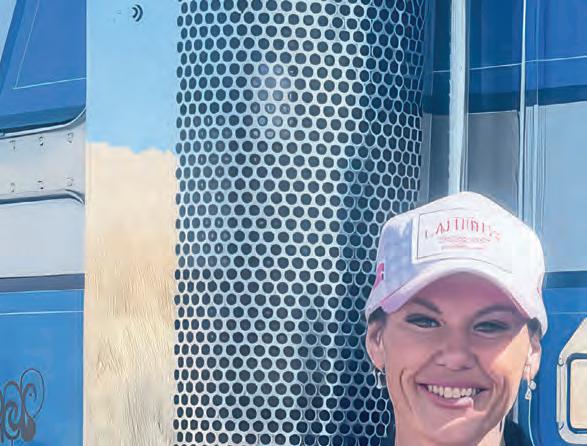
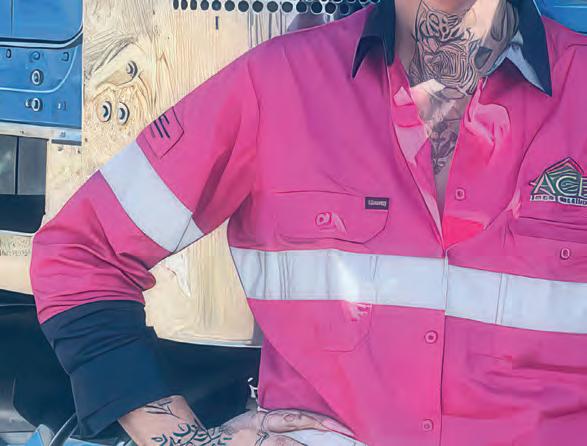
KIRSTY MARTIN DRIVER FOR ACE CRANE TRUCKS
A CRACKING CONVOY-LESS CONVOY
Despite it being turned into a Show’n’Shine event for the 2026 edition, Warren Aitken still thoroughly enjoyed his debut at a Camp Quality Convoy event
Ilove getting out to a new show. It’s always fun to meet new people, see different trucks, experience, participate and become involved in new events. I know it all sounds very cliché and fabricated, but it’s true. I love my regulars, but getting to new shows means I add to my list of regulars.
This year I’ve added a new show to my regular list with my first ever Camp Quality Convoy Adelaide event. In fact, truth be told, it was also my first ever Camp Quality event. For that I do feel a little ashamed – Camp Quality is an amazing organisation and Camp Quality convoys have been part of our transport scene since the first one in Geelong over a decade ago. I have no valid excuse and, after finally experiencing what all the fuss is about, I really can’t afford to miss anymore.
For those like me that were a little oblivious,
Camp Quality is an organisation that has been around since the ‘80s. The best way to define the organisation is direct from their mouth – ‘Camp Quality was founded on the belief that when a child is diagnosed with cancer, you can’t always change the quantity of their life, but you can change its quality’. The first event was run in New South Wales’ Blue Mountains back in 1983 and around 40 kids afflicted by cancer turned up for the event. Since then, it has grown exponentially with now dozens of kids camps, family camps and now even virtual camps catering for the 16,000 kids and 6000 families across Australia on the Camp Quality books. And to run all these action-packed experiences, you need fundraising. If it involves helping those in need, especially children, you know the transport industry will readily get on board. I do believe the first convoy was actually held up in Brisbane back in 1989, however now the Camp Quality Convoy banner is synonymous with Geelong and its decades-long Camp Quality Convoy event that regularly hosts up to 300 trucks. You can also find the convoys in Newcastle, Perth and, for the last three years, Adelaide, which is where I chose to visit.
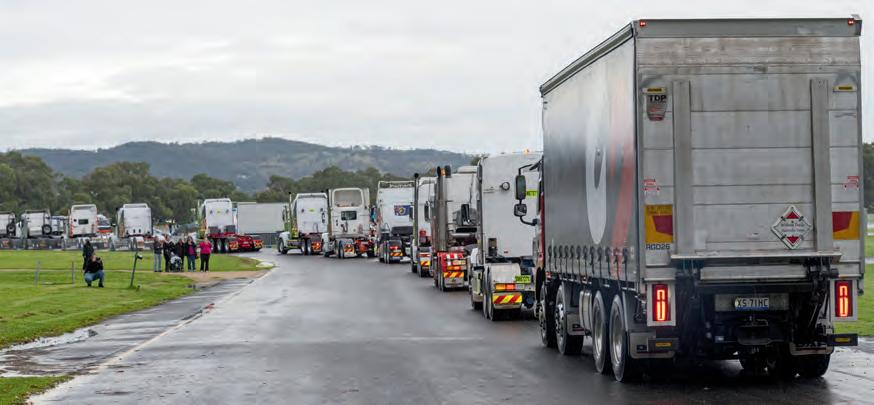
My first visit to a Camp Quality Convoy event was also a first for the Adelaide team as well because it was the first year the Camp Quality Convoy would not in fact include a convoy. Speaking to Sandie Hall, Camp Quality’s chief commercial officer and Kaarina Allen, the media and communications coordinator, I got the rundown on exactly why.
“This year has had a bit of an interesting few months,” Sandie admits.
“With the fuel prices and shortages, and all the cost-of-living effects and even a couple of weeks ago there was talk of fuel restrictions, we started thinking ‘can we really expect 200 trucks to burn fuel running around for a charity event?”
Sandie admits there was a fair bit of debate but responses from a lot of the regular supporters of the event that convinced them to keep the event going, but to change the parameters.
“In the end, we thought cancer doesn’t stop, so neither do we,” she states with pride.
“We chose to shift to a Show’n’Shine event rather than
a convoy and just hoped the truckies would stick with the event, and it seems they have.”
I have been told there was a drop in numbers from last year, with 160 registered for this year’s event, but I don’t believe that is a convoy over Show’n’Shine thing at all. The current working conditions are seeing numbers down at every show I’ve attended this year.
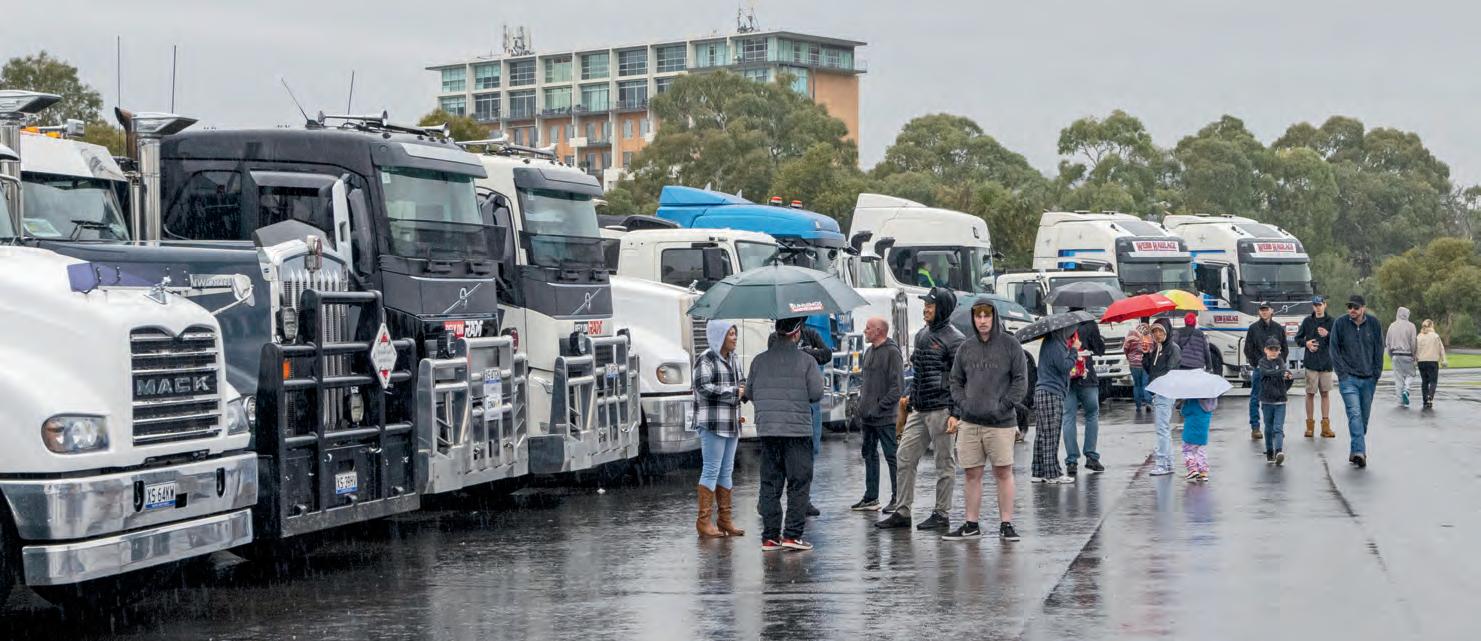
That is about all you need to know from a backstory point of view, so onto the experience itself. Firstly, damn you mother nature. Seriously, I don’t think I have ever had windscreen wipers on when I’ve ever driven through, around or near Adelaide. I even did a bit of work just to get to Adelaide and as I inched down the Adelaide Hills at 45km/h on Saturday afternoon, it was a picturesque view. Wake up Sunday morning with camera in hand and mother nature was punishing me like it taught Ashley Klein how to referee. It was bucketing down. I had a friendly chauffer to drive me into Victoria Park in central Adelaide for the event, half expecting the ‘Rained Out’ signs to be out. Instead, I was greeted with exuberant smiles and contagious enthusiasm from Kaarina, Sandie
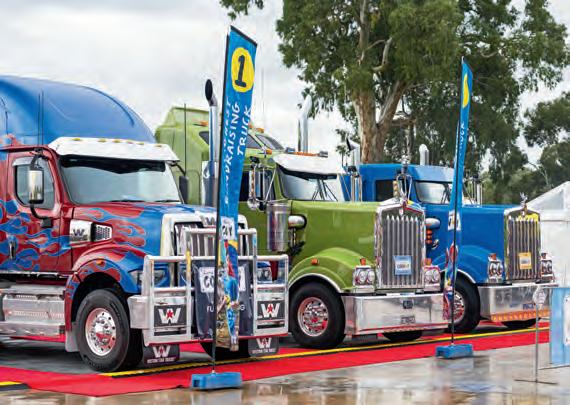
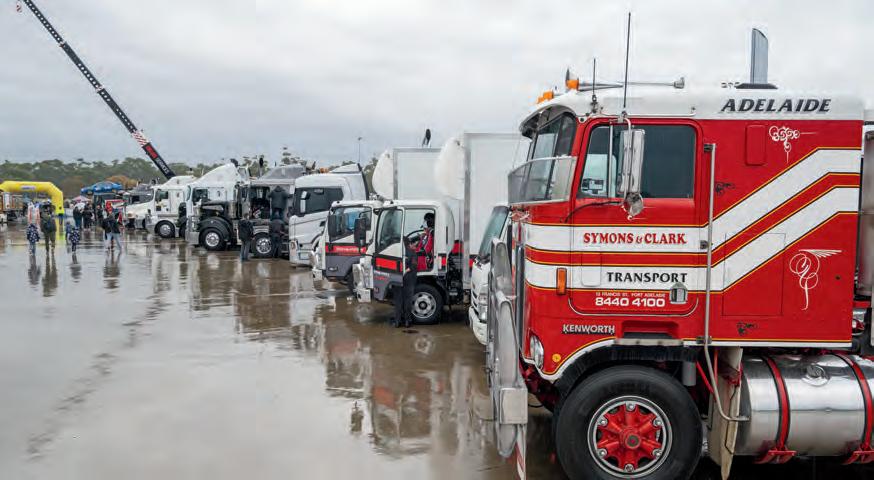
Opposite top: One thing I will credit the Camp Quality Convoy Adelaide with is the diversity of the event. Scania, Western Star and Mack in one photo, and so many more manufacturers represented
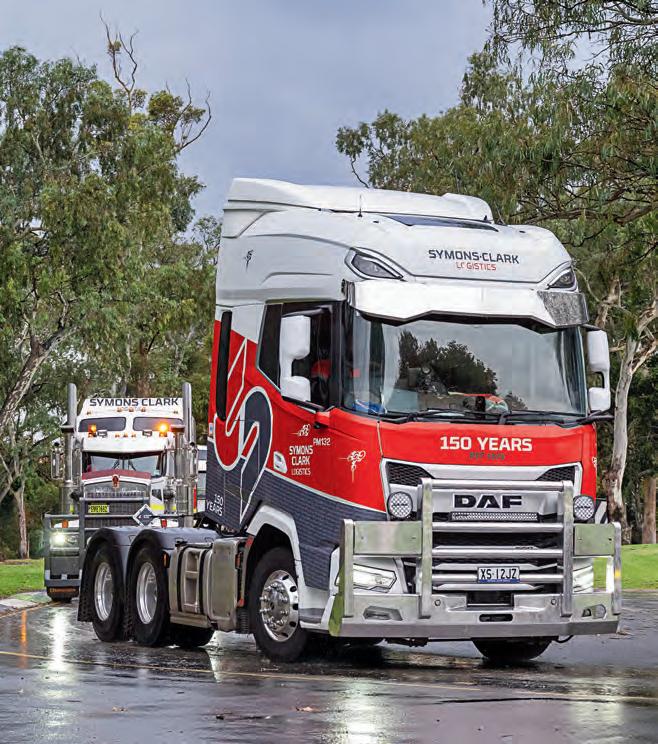
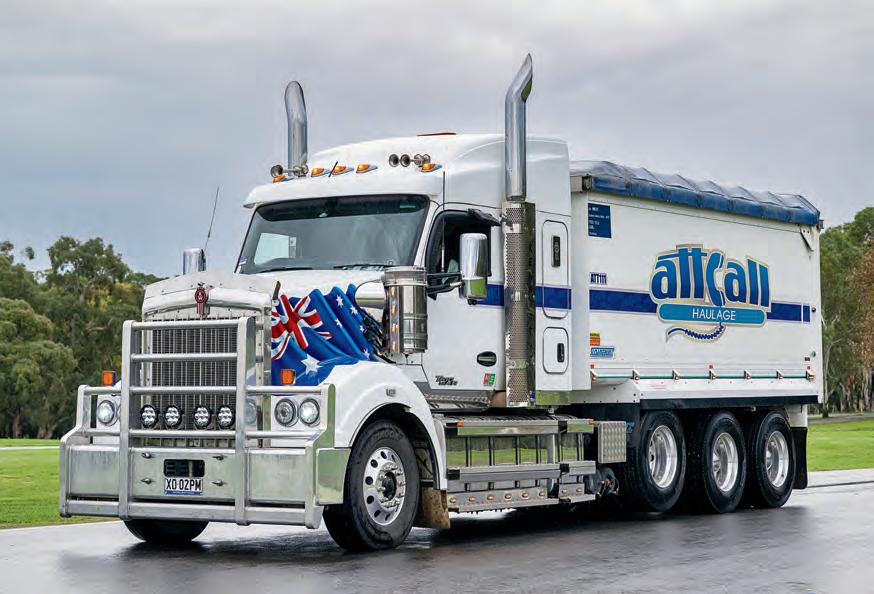
Top, L to R: One of my favourites for the day was the big Symons Clark Logistics XG+ DAF; One of the Attcall rigs rolling in in the rain, I’m wondering if the boys used this truck to practice the truck pull – it must’ve helped
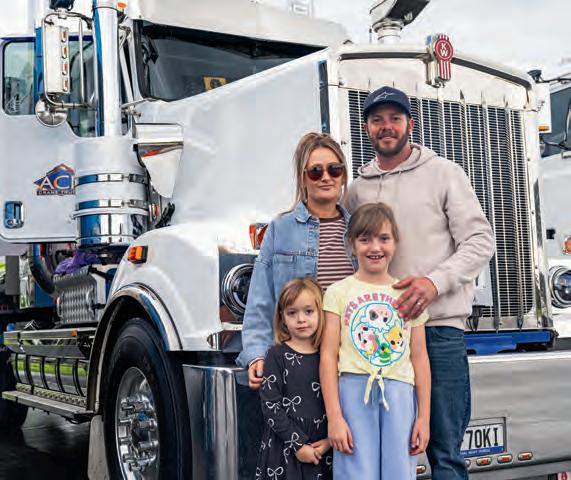
Left: Standing in front of the stunning tipper that Brenden drives around Adelaide is Brenden and Jess Kelly with their two girls, Eva and Layla
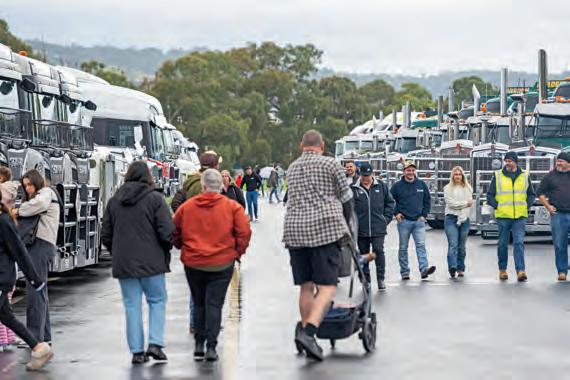
Below right: The weather didn’t deter those keen to attend this year’s event
Images: Warren Aitken
and the entire Camp Quality team. The weather wasn’t bothering them at all.
At 8.30am it was clear the weather had deterred a few of the truckies. Understandably so, but there were still plenty rolling in for the event and plenty of kids already waiting there to greet them. The final count for the day was 130. Looking at it without my water spackled glasses, it is the perfect location for a Show’n’Shine – it’s sealed all the way to the sealed carpark, there is plenty of room and the backdrop was pretty good. Next to the truck parking, there were several rather inviting food trucks and a couple of coffee vans doing a roaring trade on a cold Adelaide Sunday. As you would expect from an event designed to entertain kids, there were several rides and attractions available, though I think the inflatable slide and castle was deflated for safety reasons. I think there would just be too much speed down those slides with
lubed up kids tearing down them.
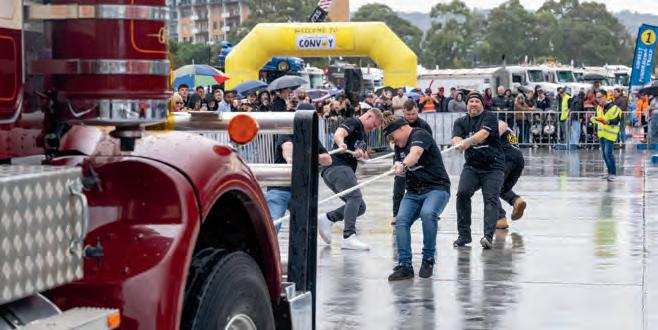
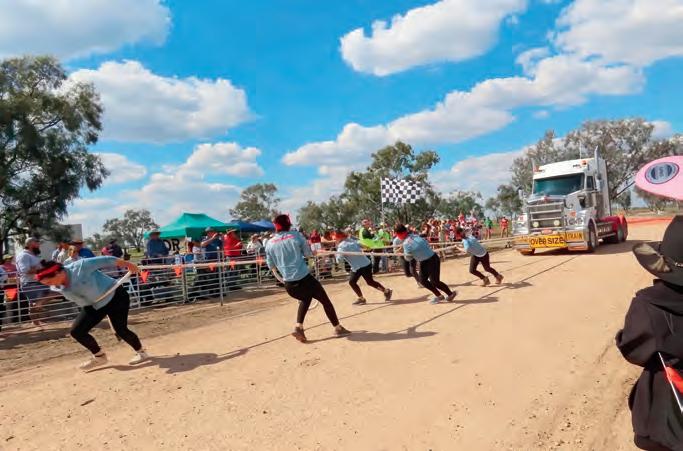
A new addition to this year’s event that took centre stage in Victoria Park was a truck pull competition. The idea was simple – teams of six grab a rope and pull a truck over a certain distance as fast as they can. While it was a timed competition, the Camp Quality organisers still set it up with two trucks so teams could run at the same time, just to up the ante a little. Thankfully the rain held off for long enough for the volunteers to brush the track and get the competition going. I would say it looked easy, especially after watching the Camp Quality team do it in practice on Saturday, but truth be told everyone was giving it their all. When you have another team beside you, you definitely up the effort. In the end, bragging rights went out to the team from Attcall Group – they got through the prelims, semis and blitzed the final. There was a lot of friendly ribbing and a fair bit of on-field banter, but that just added to the fun.
I will admit for me, the weather took a little fizz out of the day, mainly because as an over-protective father, I do hate seeing his babies getting wet (I’m talking about my cameras). As for the locals, the truckies, the kids and the families, the day was a success. Kids in particular running around all the activities, pointing out every truck and every shiny part to their parents – it was good to see. I think the locals approach to this very wet convoy-less Camp Quality Convoy can be summed up by the photo of the model truck display. Take in in your stride and enjoy.
As far as the fundraising side of things go, well that once again was a huge success. A big shout out goes to all the South Australian companies that get behind the Camp Quality events. This year’s event raised a whopping $190,000, with a special shout-out to the top three fundraising trucks – Craig Arthur from Craig Arthur Transport with a winning total of $29,047. Second place went to Ryan Collins from Collins Transport Adelaide with $25,839 and third place went to Daniel Quaini from Bonetti Transport and Hire with $3,672. The highest fundraising team went to Garden Grove Haulage with a total of $41,108.
The rain didn’t dampen the South Australian generosity. See you next year Camp Quality Convoy Adelaide.
Top: One thing that was obvious at the Adelaide Camp Quality Convoy was the diversity of entrants. There was representation from nearly every possible manufacturer
Above right: Brendan and Jill Dowd from Victor Harbor Pastoral with their hobby Kenworth. It’s a rig they bought and have been doing up just so they can attend events like this and bring a little cheer to others
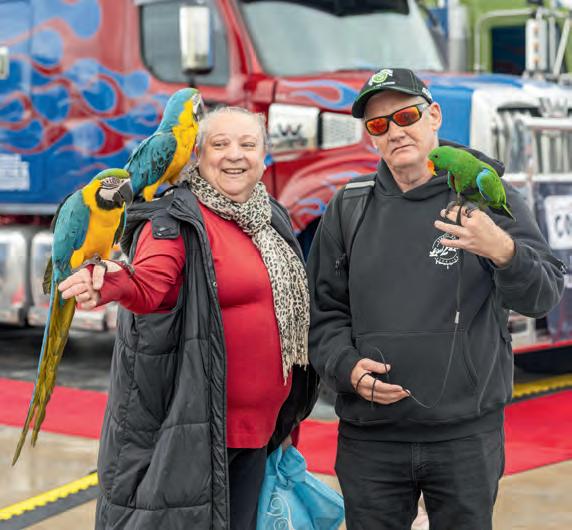
Right: Rebecca Rammell, David Fewings and their emotional support animals, Lily Harley and Patty
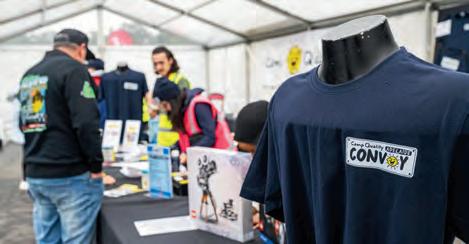
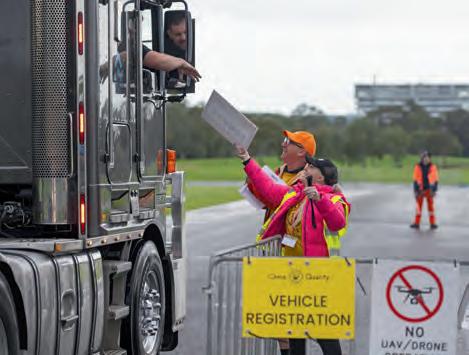
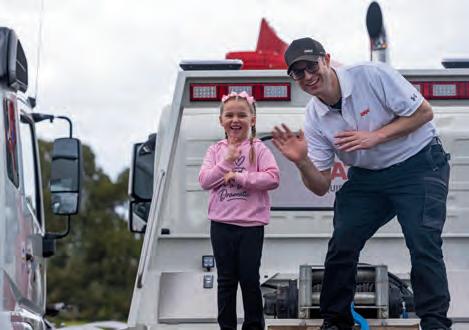
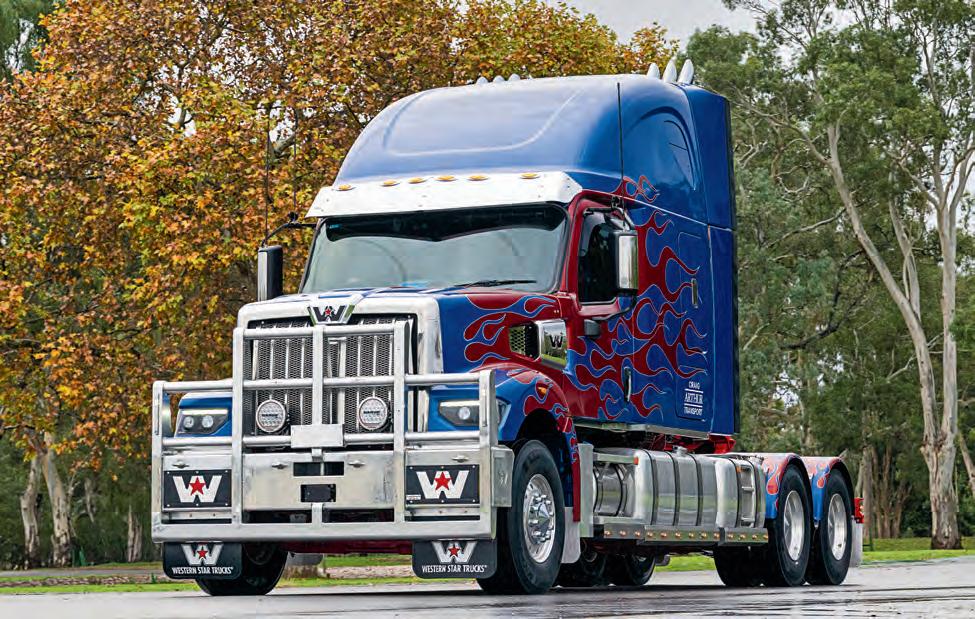
Opposite, clockwise from top left: The merchandise tent was not just a reprieve from the rain, it was a popular stopping spot for all those out to support the event; The highest fundraising truck, Craig Arthur’s Optimus Western Star; Big smiles from the Camp Quality team, it was a quick snap shot between trucks – thanks guys; Reg and Layla from RAM Equipment; Camp Quality volunteers Simon and Amanda were in charge of keeping everything running smoothly at the front gate
truck of the month
We are going to start this story way back in 1987. I was a mere 10 years old, still collecting the Rigs of the Road Weet-Bix cards over in New Zealand. On a global stage, it was the year The Simpsons debuted. For the music fans, it was also the year Michael Jackson released the ‘Bad’ album and U2 released ‘The Joshua Tree’. Over in Australia, it was the year the West Coast Eagles and the Brisbane Bears (now the Brisbane Lions) made their debut in the VFL and, February 23, 1987, Australia’s very first mobile phone call was made. It was also a massive year for trucking in Australia, being the birth of a legend in the Kenworth T650 – a truck that would garner a near cult-like following and
eventually steer us to its successor in the Kenworth T659. It was a truck built for Australian conditions, perfected by Australians and loved by all those that get behind its wheel, including a self-confessed Mack man in Brad Walker. The stunning tipper you see on the pages before you is the work vehicle that keeps a smile on the passionate truckie’s face and he was kind enough to offer up his passenger seat for the day so I could get a touch of the 659 experience.
Before we get into Brad Walker – the mighty Mack man beaming from ear to ear in his ‘I’m not a mud carter’ Kenworth – let’s do a little background on the mighty T659 and its iconic ‘daddy’ in the T650.
While Kenworth is a worldwide brand, Australia has its own history of specific Australian designed
and manufactured variants, all of which started with the iconic W900SAR that debuted back in 1975. Up until the SAR, Kenworth’s Bayswater complex had been building and adapting American models for Australian conditions. With the success of the Aussie designed W900SAR came a push for more fit-for-purpose Aussie Kenworths and that push would eventually result in the release of the T650 in 1987.
The T650 was an Aussie designed derivative of another iconic Kenworth launched in 1987 – the revolutionary T600, also known as the ‘Anteater’.
Pictured: One of the big advantages for Brad with the 659 is its ability to get around in the very tight concrete plants he deals with
CROSSING THE FLOOR
As a long-term self-confessed ‘Mack man’, it was always going to take something special to convince Brad Walker to buy a different truck brand. Enter this special Kenworth T659
Images: Warren Aitken
“An Aussie designed truck happy to haul heavy loads in off-highway adventures and just as happy to suit up and roll out in regional deliveries or urban excursions.”
For Kenworth, it was a massive leap forward in its design, prioritising aerodynamics and efficiency over the traditionally staunch straight look of a Kenworth. Around the world, the T600 was a drastic step for the Kenworth badge, and it took a while for a few of the purists to accept it.
Not content with just rolling out the T600 down under, the lab coats at Kenworth Australia had been working hard on designing an Aussie truck that could take advantage of the intent and technology of the highway spec’d T600 and add in a bit of
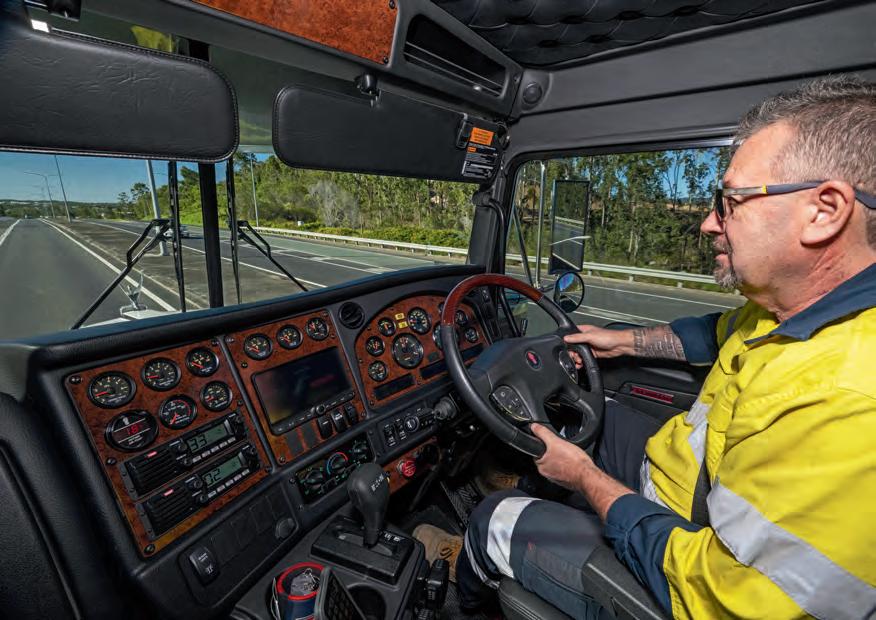
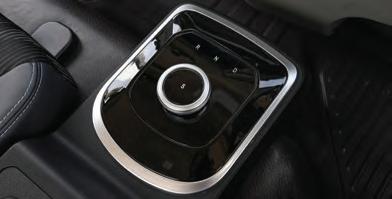
Top, L to R: Yes you will notice there is no stick in this particular Kenworth and, while he is a fan of the Kenworth box, Brad also knows his knees aren’t as young as he thinks he is these days. The auto means he gets to the end of the day still feeling life in the left leg; Doing his best to look as tough as his T659, Brad Walker loves his iconic truck and loves the work he gets to do with it
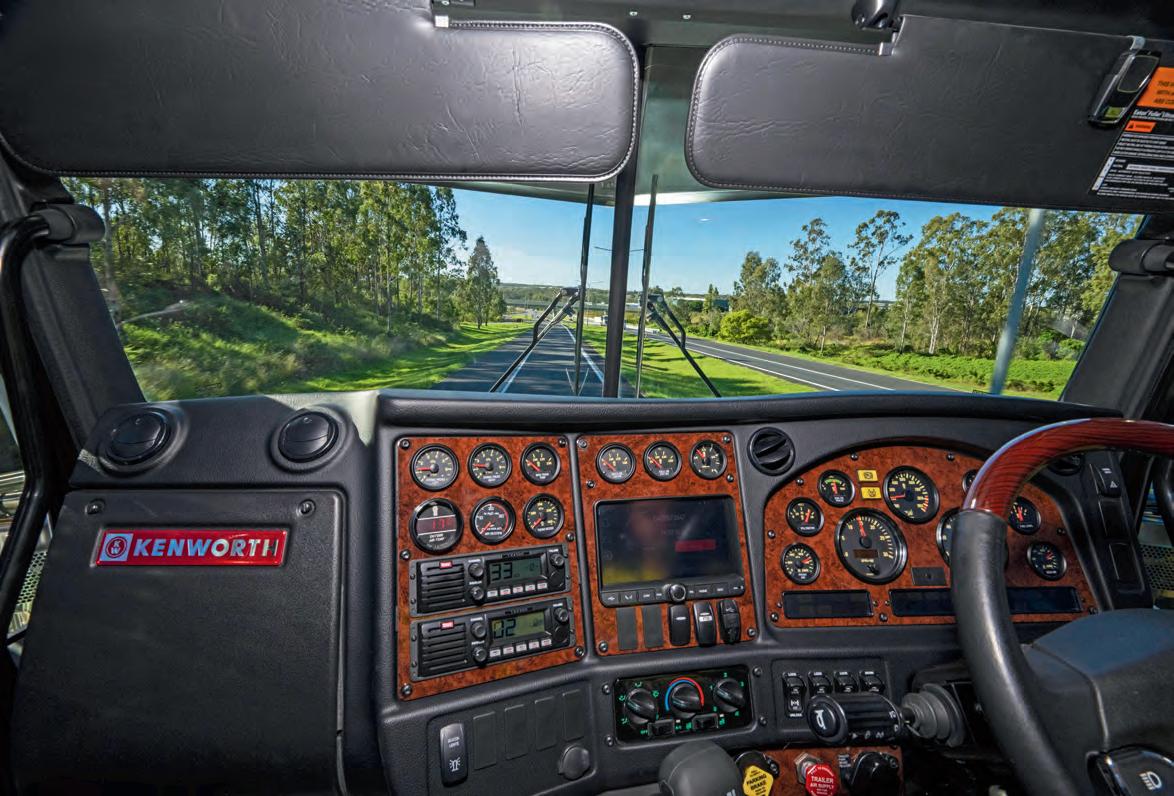
Right: The old school flat dash was another big selling point for Brad when it came to buying the T659
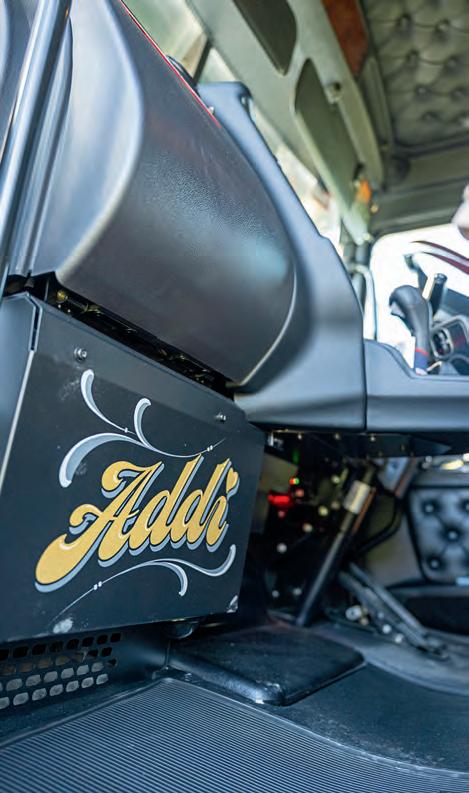
Opposite bottom: Family is all important in the Walker household and Addi is a shoutout to the couple’s granddaughter
hardness and off-road toughness that the Kenworth C500AR was displaying. The idea was to have a truck that could and would operate in that happy medium. It would happily plod along on the expanding highway network in Australia and, when needed, it would get its shoes dirty on the corrugated byways that many operators still tortured their tools with.
The Aussie designed T650 featured the higher horsepower engine options from Caterpillar like the C15 and C16, or the legendary Gen 2 Cummins. The truck was renowned for massive fuel capacity, larger cooling systems and reinforced frames. It also offered a much steeper slope on the traditional big Kenworth bonnet that vastly improved the vision from the driver’s seat and, with the setback front axle and upgraded steering boxes, could hook around in much tighter areas, all of which was designed to ensure the big rig could handle the toughest of Aussie conditions as well as being able to hold its own in the less brutal regional and urban vocations.
The T650 hit all its target markets and became a truckies’ favorite, particularly striking a chord with the logging and livestock aficionados and, with ratings up to 140 tonnes, it became the backbone of the outback road train operators. Over the years it saw its share of upgrades and iterations, with the T658 coming along before morphing into the current T659 model. Throughout its lifespan it has never branched away from its core DNA profile – an Aussie designed truck happy to haul heavy loads in off-highway adventures and just as happy to suit up and roll out in regional deliveries or urban excursions.
Now with its pedigree established, we can jump ahead to our protagonist – the Mack man who bled bulldog for many years and still in fact does (just wait until you see his next project). That man is a Victorian born and bred in Brad Walker. And while he is a self-confessed Mack man, during my day in the passenger seat you could not wipe the Kenworth grin off the man as he explained his origin story and how he ended up in Queensland in this stunning ‘it’s not a mud-carter’ Kenworth T659.
Before I do attempt to condense down the Brad Walker story, let me address a couple of very important points. First, while most of the attention in this story will focus on Brad and his T659, the truth is there is another person that flies under the radar but deserves significant acknowledgement, and that is Brad’s lovely wife Lisa. Brad and Lisa are a package deal and, aside from tolerating Brad’s trucking obsession, Lisa has also worked tirelessly behind the scenes keeping things on track from the couple’s home office.
Before anyone assumes this is an unsolicited compliment aimed at the lovely Lisa by Brad himself in a vain attempt to butter her up in case she reads the quote about Brad ‘having one more Kenworth in him’ – that is very much not the case. It can’t hurt, but it is not the case. The truth is Brad and Lisa have built their businesses together and deserve to share the accolades together as well, which leads me to addressing point number two.
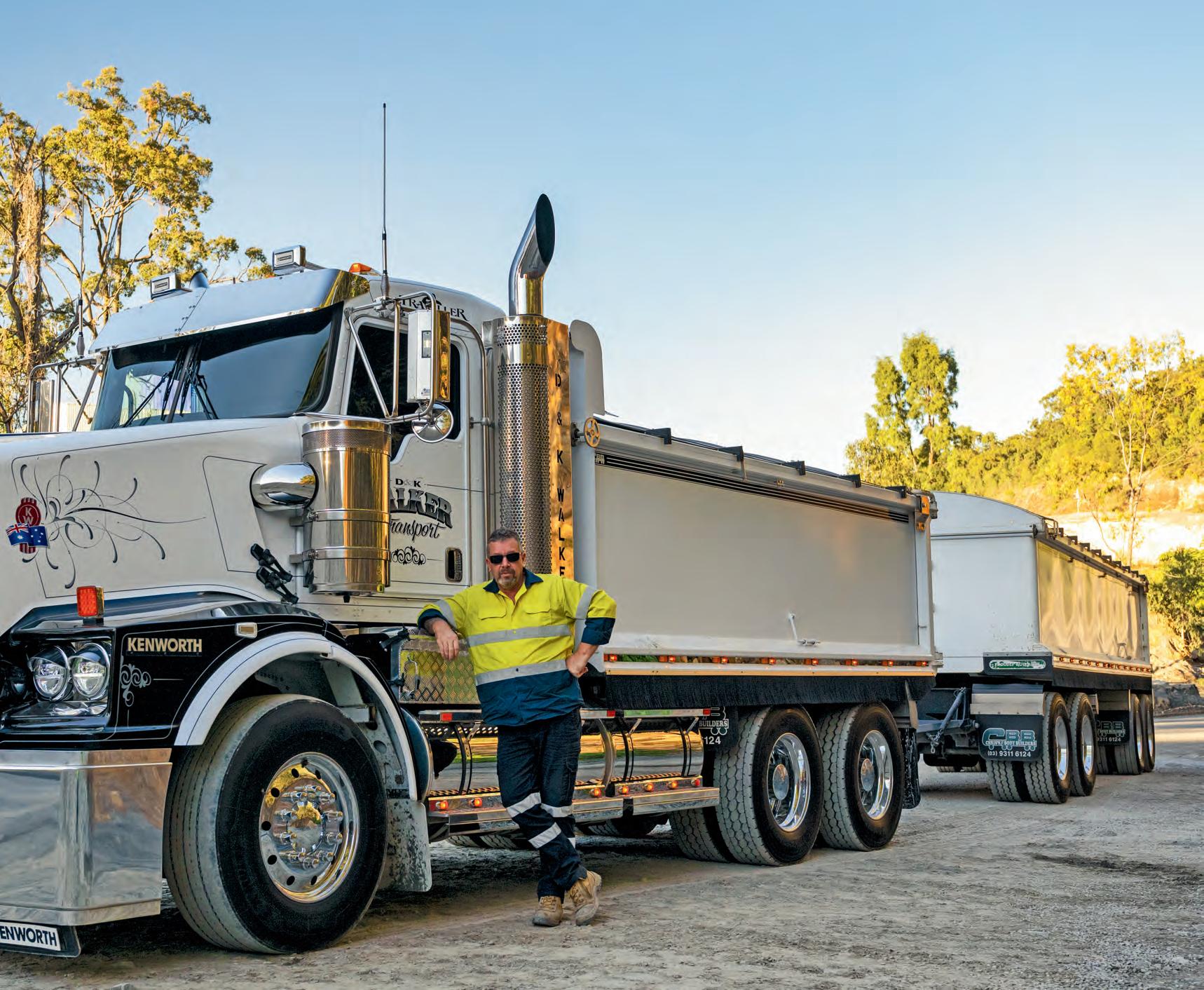
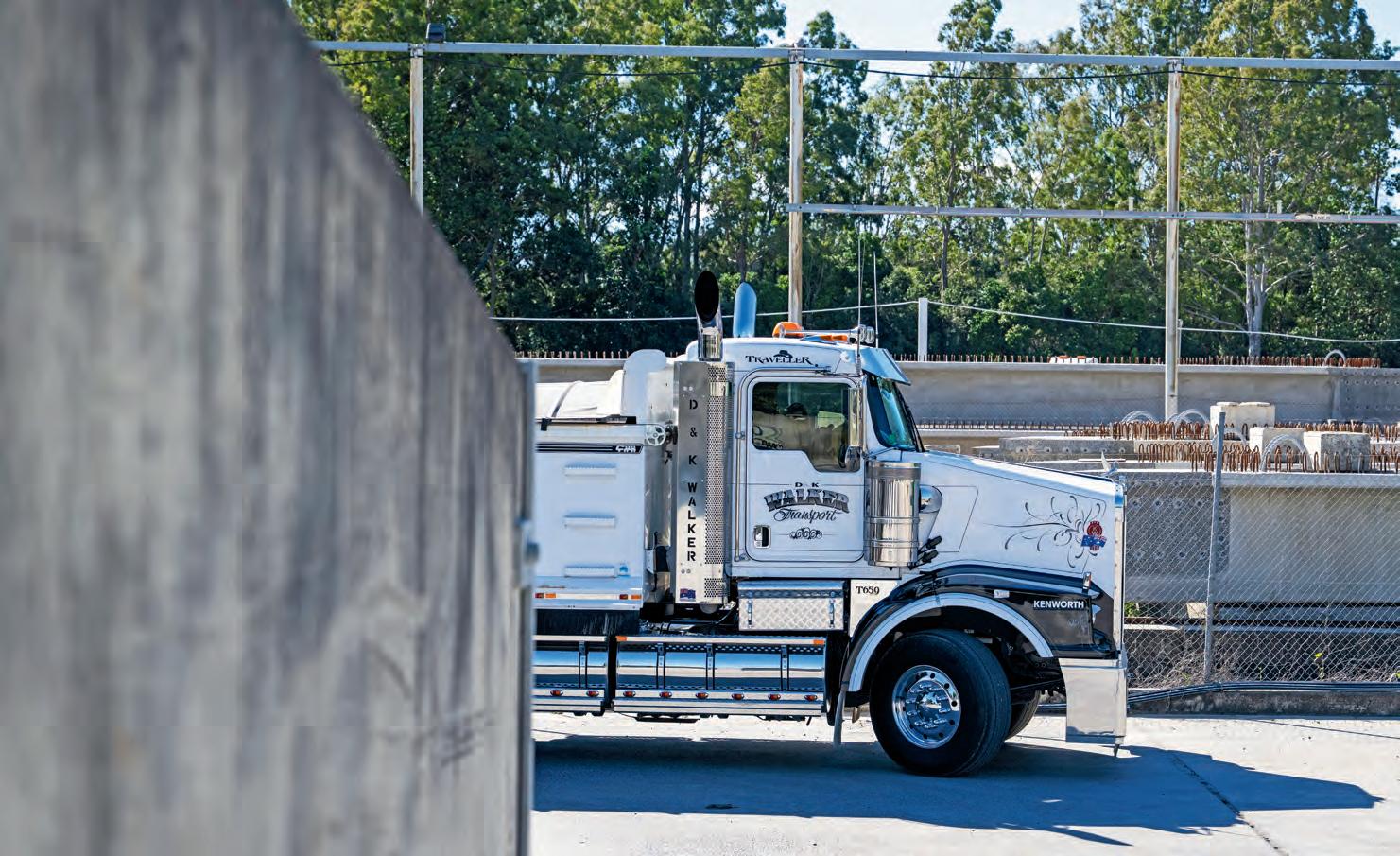
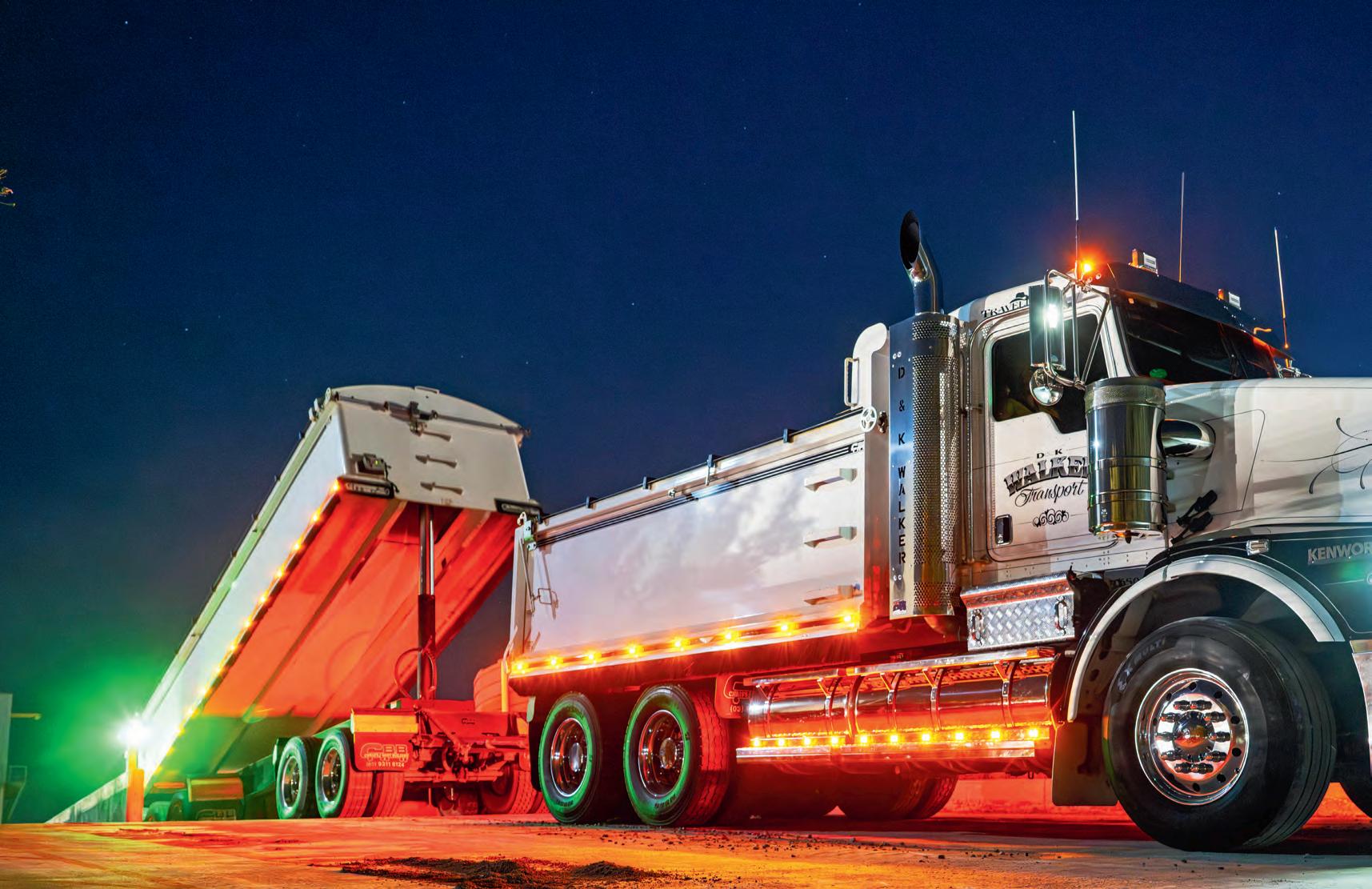
You will notice on the door of the company is D & K Walker, not B & L Walker. Well folks, that is because
the D and K stand for Brad and Lisa’s two sons Dylan and Kayne. Family is a huge thing for the couple, and the company fittingly represents that. And don’t think the boys are there in name only –Dylan was a full-time driver alongside his father for about seven years, and Kayne has been a constant call-out for relief working, helping out as a driver whenever he can.
Now that those points are covered and we’ve established a bit of T659 history, along with an introduction to Brad and Lisa, let’s fill in the gaps that jump from a 13-year-old truck washer to a Jim’s Mowing franchisee to the owner of an incredible Mack Super-Liner and now piloting a pristine tipper around the Brisbane back blocks.
Like all of us with a diesel addiction and a penchant for power,
Brad’s story dates back to his formative years.
“I reckon from about 10 years old I just knew I was going to be a truckie,” he says.
“My Grandfather was in trucks, and my Dad was in and out of them, so it was just part of my life.”
It’s a childhood that many of us can relate to, though it was one of his Dad’s best mates, Brian ‘Barney’ McFadyen, that took young Brad under his wing and taught him the ropes, literally.
“I learnt heaps from Barney – he taught me how to tie ropes,” he says.
“It was a big thing for me – I was about 11 and he taught me how to tie ropes. I am still tying ropes the same way.
“It was Barney that told me what I needed to do to get into trucking, and that was to go and find a company that would take me on washing trucks and stuff like that.”
That is exactly what Brad did. At 13 he wrangled an unpaid job washing the tankers at the local McColl’s depot. His enthusiasm for washing, even in the Victorian winters. only spurred Brad on, and it also led to him gaining more driving experience – off the books of course.
“The mechanics ended up getting sick of me pestering them to bring trucks round to wash, so eventually they just started getting me to do it myself,” Brad laughs as he recalls the moment that soon led to him gaining more experience. He would ride shotgun on night runs and the drivers would let him take the wheel when they were off the highway.
As is sadly the case with a lot of young ones back in the day, his age prohibited him from getting a licence well before his enthusiasm for school disappeared. So, Brad found work in several different arenas, always coming back to trucks, whether it was as a loader and wash boy again. There was a time at United Transport and another taking on a role at W A Freight Lines, where he worked his way up to operations manager.
It was during his time at United that Brad’s Mack passion originated.
“Barney loved Macks as well, he was always a Mack fan,” he says.
“When I was working at United, I would often get a ride to work with Wayne Smith in his old B-model. I loved that truck.”
You may ask why the truck-mad young man was opting for loading and management over time behind the wheel? Well, let’s just say as much as Brad loved working, he also had an incredible ability to lose his licence. Often. Behind every action is a new story however, and without a truck licence to get him out on the open highway, Brad instead ended up purchasing a Jim’s Mowing franchisee.
Top: The set back axle of the 659 helps with the truck’s impressive turning circle
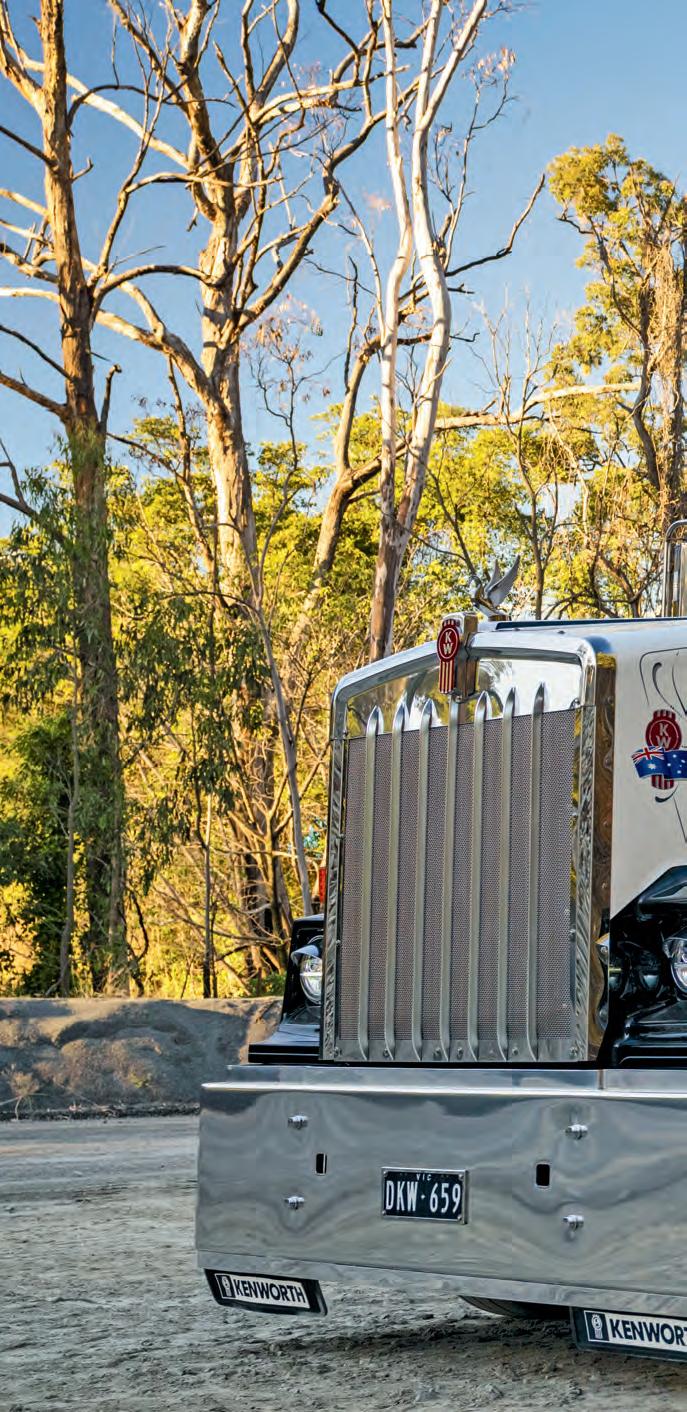
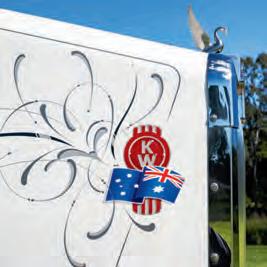
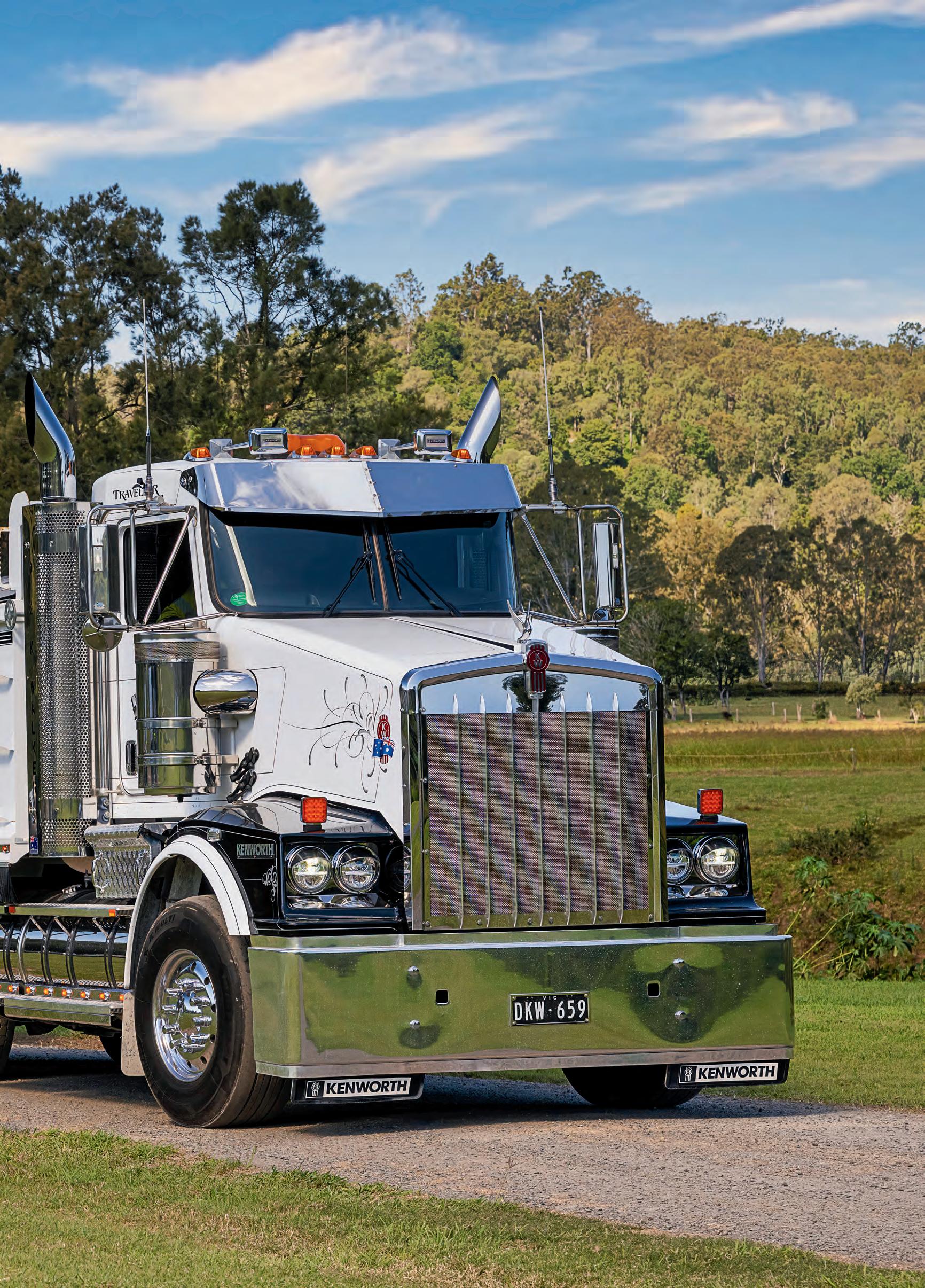
Above: Old school scrolls and the classic swan hood ornament are another suburb finishing touch on Brad’s hot rod
Right: A little clean up before hitting the road and heading off for another load
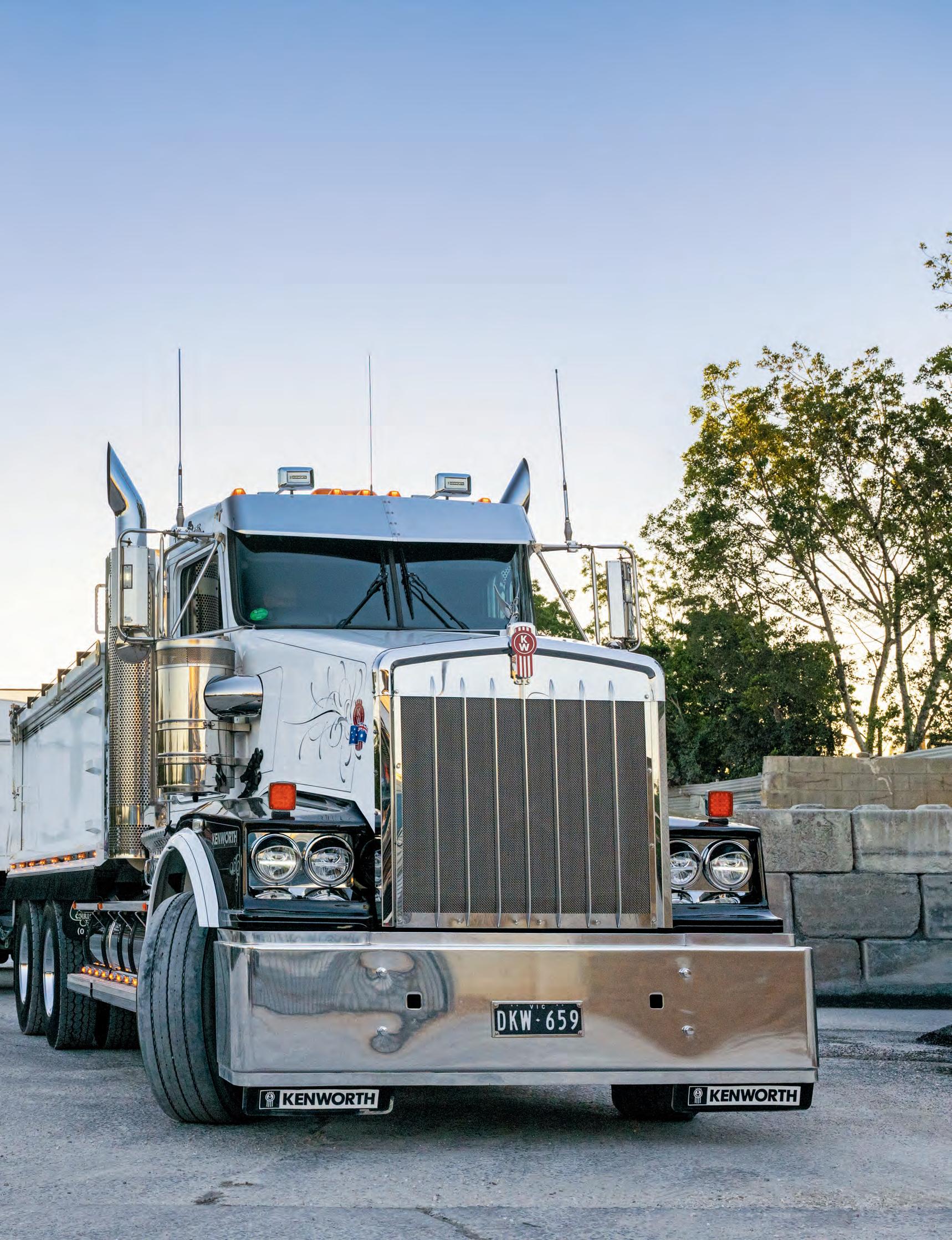
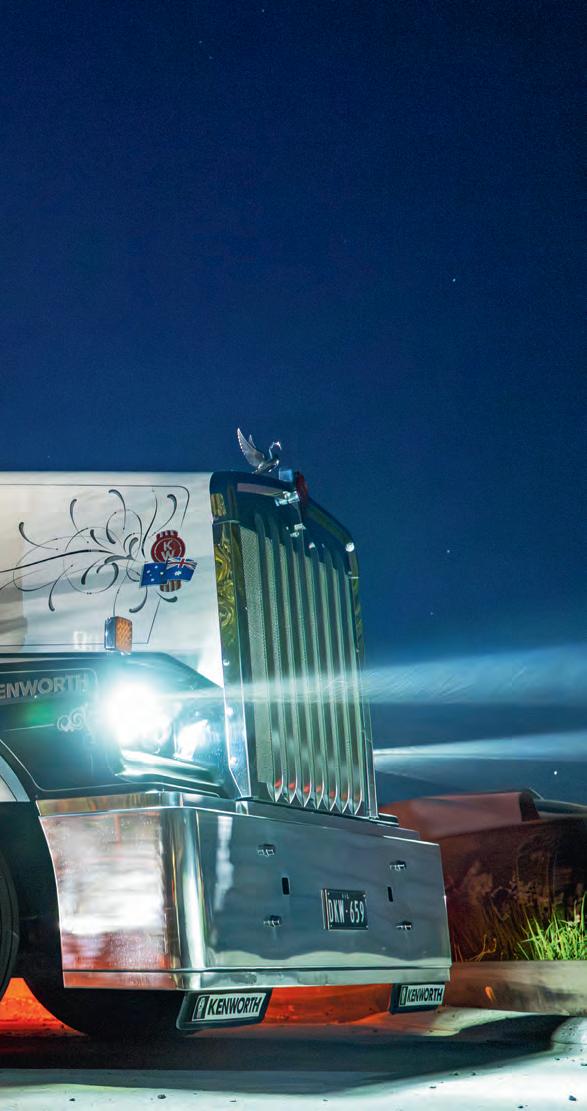
Opposite: From the front, the T659 has an iconic look
“My Grandfather was in trucks, and my Dad was in and out of them, so it was just part of my life.”
Top: The early morning start may have been a little fresh for me, but it’s all in a day’s work for Brad and his T659
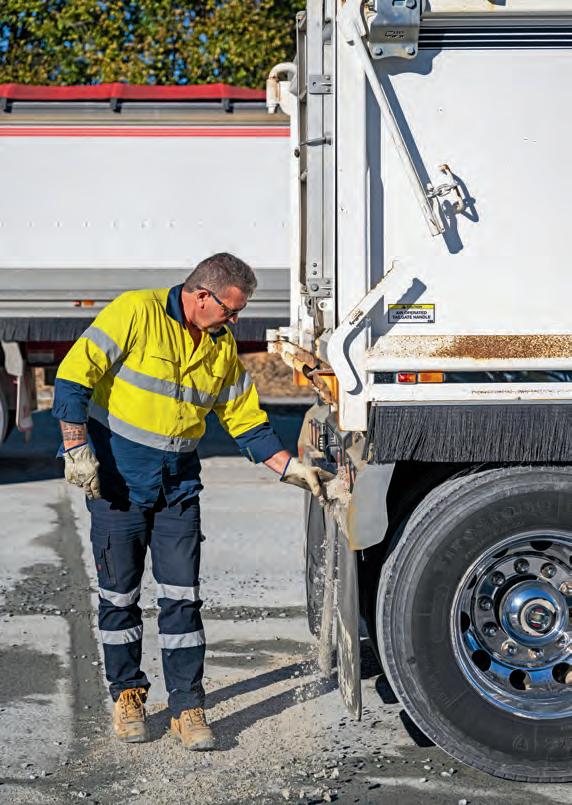
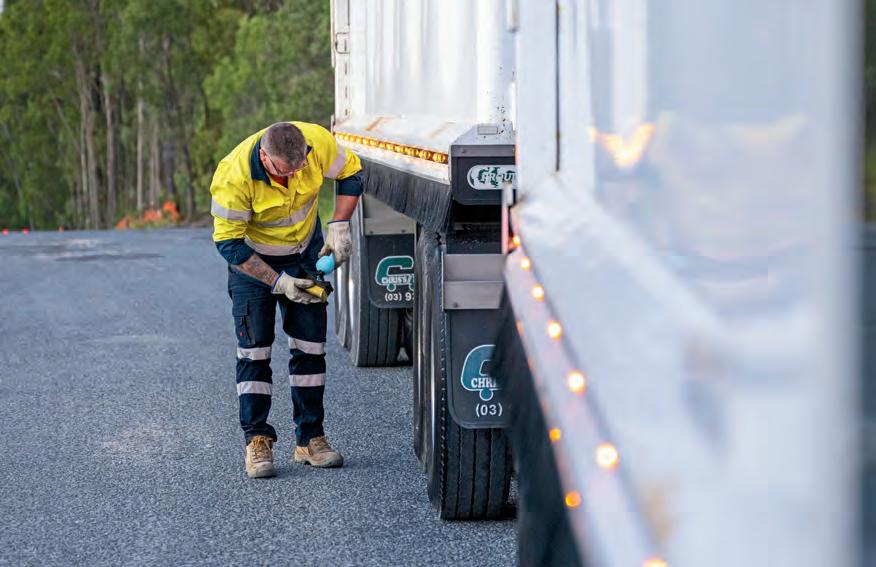
Above: I would love to tell you the reapplication of tyre shine by Brad was just to curry favor with me and the cameras, but no, this is standard Brad Walker practice while waiting to unload – always something to clean
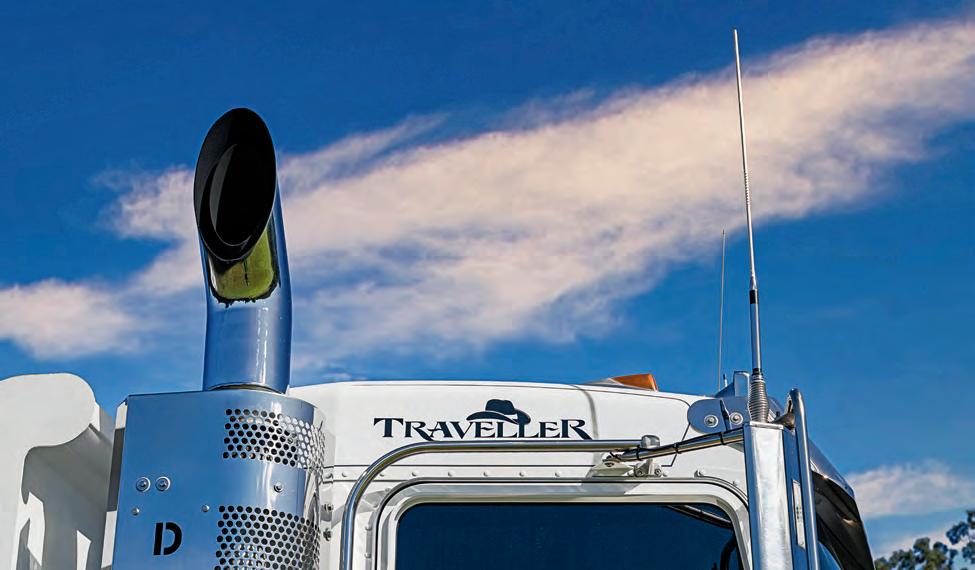
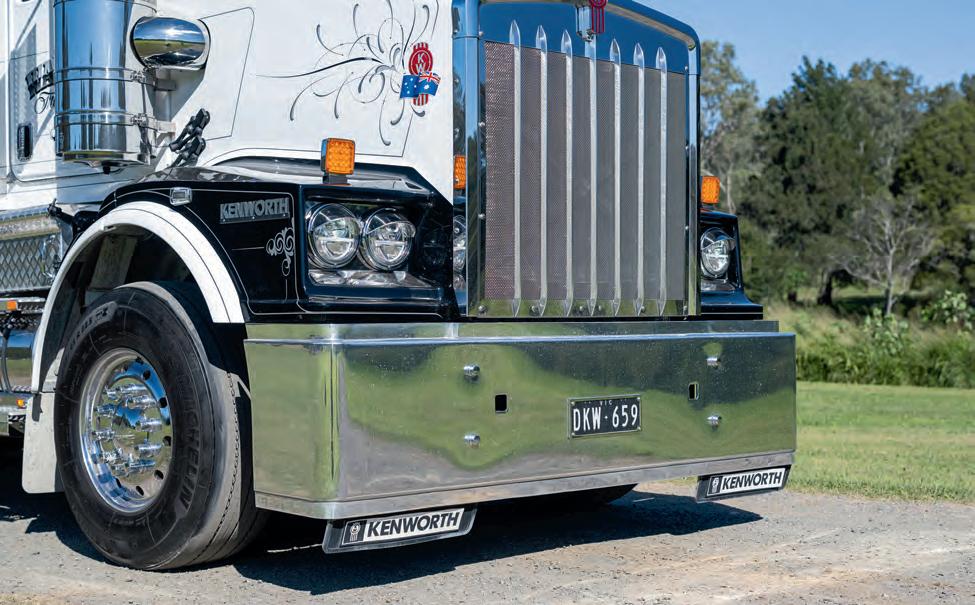
Opposite top & bottom: The Traveller name; Big shout-out to Thomas Quigley for the work he did making a standard bar look anything but. The added extensions on the top and bottom definitely work on this T659
“Basically I was burned out – I was doing way too big hours and was missing the kids growing up,” he admits.
“I was talking to some mates and realised they all had people doing their lawns and I figured if I could get four lawns done in the morning and four in the arvo then I could make a go of it, so I bought a lawnmowing set-up.”
I was fortunate to have the day with Brad and really got to appreciate the work ethic and dedication that took him and Lisa from Jim’s Mowing to where we were, sitting in his stunning T659. What I will try and do, however, is abbreviate it a bit for the readers. I do need you to understand a few things first.
To start, Brad isn’t afraid of hard work. Getting burned out with big hours and hard work was as common as his ability to lose his car licence in his 20s. Next is while Brad is the first to admit schooling wasn’t his forte, and you won’t catch him curled up with a copy of War and Peace, seeing business opportunities and making the most of them has been as easy for him as losing his car licence in his 20s. Lastly, enjoying his work has always been a huge part of Brad’s success, and no, I won’t make any more digs about losing his car licence repeatedly in his 20s.
Here’s how the Brad and Lisa business trajectory went. From a simple Jim’s franchise, Brad grew to the point where he had multiple employees covering pubs and businesses around Melbourne. That business was sold when Brad started running his own garden supply outfit, which brought trucks back into his life again. That business soon became a seven-day a week runaway, which the couple sold off. They held onto the tipper trucks that had been working at the garden supplies business, using them to do local work and even at one stage sending a couple of them to do contract work in Queensland.
Although they enjoyed focusing purely on the trucking side of things, it wasn’t long before customer needs and Brad and Lisa’s nonstop work ethic saw them starting another landscape business, which again grew into a thriving little enterprise. And again, it was snapped up by a lucky buyer, allowing the couple to return to a truck-only business once again. I say trucks only rather than specifically tipper trucks because at one stage Brad and Lisa also had a firewood supply company and were dabbling in some interstate work, all of which was possible due to the success of the couple’s core focus with the tip trucks.
Again, there are so many avenues of discussion it does seem wrong to simplify the Walker’s story into two short paragraphs, but we are on a time schedule here, so let’s look at the trucks from their history.
“Believe it or not, the first truck I legally drove was in my 30s and it was the first truck I bought in an FM11 Volvo,” he admits.
“It was a great truck, I bought it for $14K and ended up selling it for $27K. It was the first truck in the Walker’s Garden Supply business but was soon followed by a range of Macks. We had a Valueliner – we had a V8 Super-Liner, a Tritent and a CH at one point.
“I always kept my trucks looking clean and tidy, but it wasn’t until I did up am 07 Super-Liner that I really went all in.”
He confesses that while presentation was important, he also couldn’t afford to throw money around on the trucks, instead focusing on ensuring they were well maintained, safe and pristinely clean.
The switch to Kenworth came when Brad was ordering his very first brand new truck. It was no easy decision.
“I needed a new truck and at the time the new breed Macks had just come out and I wasn’t a fan of them. It wasn’t easy changing, we’d always joked that Macks were a Mack build truck, Mack gearbox, Mack diffs, Mack motor, whereas Kenworths were different,” he laughs.
“They build a chassis and cab and then see what’s on special to put the rest together.”
However, the need for a good reliable truck was there, so in 2018, Brad ordered a brand-new Kenworth T909.
“I figured if you are going to order a Kenworth, then you go big and the 909 was it. I also knew the resale value would be there when I wanted to move it on,” he says.
Brad’s 909 hit the dirt roads and turned heads immediately – over the next five years Brad would put over half a million kilometers on the truck himself. We will skip over the fact that he sold the 909, because it was only out of the stable for about 12 months before Brad would end up buying it back. It was and still is an eye-catching rig and Brad admits it was “a pleasure to drive”, but now we get up to 2023 and Brad needing a new truck to join his small team of tippers.
“I had always liked the look of the T659s and, considering we go into a lot of tight concrete plants and stuff, with its vision and turning, it just seemed to be the right set-up.”
“I love the 909, but we needed a new truck and, after five years driving the 9-oh, if I bought another one it would just feel like I was in the same truck,” he confesses.
“I didn’t want a 610 or anything because I just love that old school style and old school kind of interior. I had always liked the look of the T659s and, considering we go into a lot of tight concrete plants and stuff, with its vision and turning, it just seemed to be the right set-up.”
Brad opened the chequebook a bit more with the 659 – at the time his thoughts were around this being his last new truck, so he took the opportunity to have some fun with it. This started at the Klos Custom Trucks workshop.
“I knew of Justin and Turk but never met them before the 659,” he says.
“My salesman got me in there and I just found them to be real genuine people. Like me, they love their
trucks and they are very good at what they do. They have a real passion for it and it shows. They took me through their shed, showed me other trucks and other ideas and it was fantastic.”
Brad is very much a passionate man when it comes to trucks, and letting the Klos team loose on his new ride was the perfect partnership.
Keeping with the old school styling Brad loves, Heath Saunders from Saunders Signs and Graphics took control of the lines and scrolls, playing heavily into the traditional look. Another shout out must go to Thomas Quigley from TQ Detailing and Repairs. When you look at the front bar, you can see the custom work Thomas did to turn this standard bar into such an eye-catching statement. What you can’t see is all the work he put in taking the bonnet and everything off and remounting the whole thing to ensure it was picture perfectly aligned.
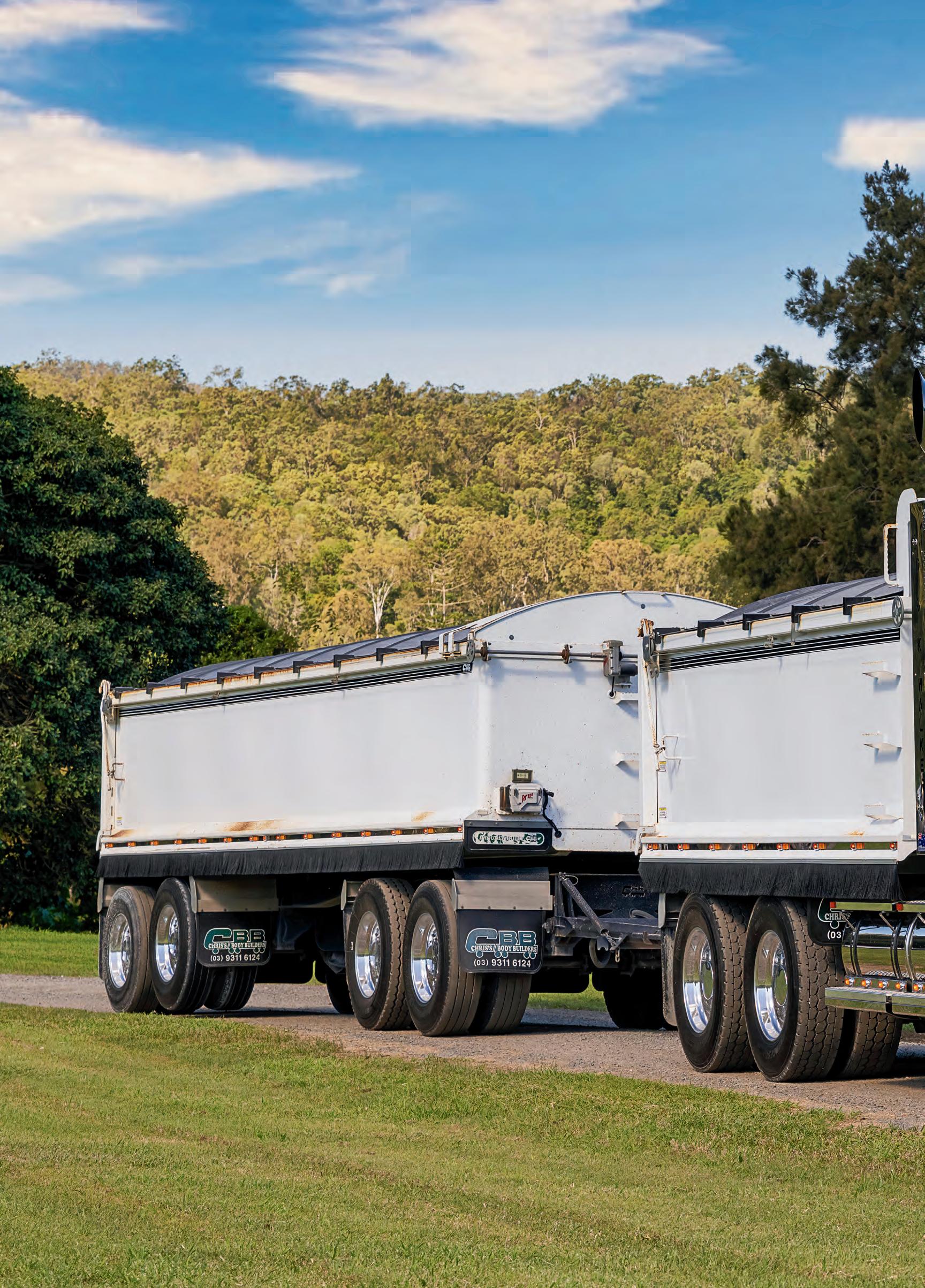
Chris’ Body Builders once again fronted up to put the multipurpose bins on both the truck and trailer, just like they have for all of Brad’s trucks.
“I don’t go with the alloy bodies because we do a lot of different work,” he says.
“With the CBB bins, if there is a break we can weld it up easy, they are extremely tough though and we don’t worry about what we are carting.”
Adding in COVID dramas, the whole build took around two and a half years, but the end result for Brad was pretty much perfect.
“I love my job, I’m very lucky and I love trucks. Some guys are into their hot rods and stuff, and I get to drive my hot rod every day. Who can ask for more than that?” he says with a big smile.
As I aim to wrap this all up, it has been a bit difficult. Brad has more stories than I could possibly retell, many of which the language would prohibit me from retelling. But all of them are centered around his love of trucks and trucking. As many days as the Queensland weather allows, Brad suits up and turns the key on his T659 and heads to work with a smile. It is only fair that I leave the final summation to him.
“I love my job, and I love the 659,” he says.
“It’s a great vision, it does the job really well and it just looks cool.”
NATROAD Warren Clark
Fundamentals matter
NatRoad’s Warren Clark provides numerous ways the industry can help tackle rising costs across the board
There is no question that Australia’s trucking industry is under pressure. Fuel prices remain volatile. Insurance, maintenance, compliance and operating costs continue to rise. Across the industry, operators are feeling the impact. But there is another conversation we need to have.
Over recent months, NatRoad has spoken to many operators concerned about rising costs and shrinking margins. Those concerns are real. However, periods like this also highlight the importance of strong business fundamentals.
One issue that continues to surprise me is the number of operators who still don’t have effective fuel recovery mechanisms built into their contracts. Fuel is one of the largest variable costs in any transport business. It can move dramatically in a matter of weeks, yet some operators remain locked into agreements that leave them carrying the full impact of those increases.
When freight markets are strong and
work is plentiful, these arrangements may not seem like a problem. But when fuel prices rise sharply, cash flow tightens and margins come under pressure, weaknesses in pricing structures quickly become exposed.
The reality is that fuel volatility is not a new challenge. It is part of running a transport business. That is why operators should regularly review their contracts, understand exactly how fuel costs affect their profitability and ensure they have mechanisms in place to recover significant cost increases where possible.
Good operators do this well. They know their numbers. They understand their margins. They review their pricing regularly and make commercial decisions based on the actual cost of doing business.
Unfortunately, not everyone does. Too often, businesses focus on winning the work without fully considering whether the rates being offered are sustainable over the life of a contract. Others assume current conditions will
continue indefinitely and fail to plan for inevitable market changes. When costs rise unexpectedly, businesses can quickly find themselves under financial pressure. This is not about criticising operators who are doing it tough. Many are facing genuine challenges despite making good business decisions. Nor does it remove the responsibility of government and industry to address issues such as road user charges, fuel costs and unfair commercial practices. However, in difficult trading conditions, the importance of sound business practices becomes most apparent. Understanding your operating costs, reviewing your pricing structures, monitoring cash flow and ensuring major variable expenses such as fuel are properly accounted for in your commercial arrangements becomes essential.
Every operator should be asking themselves a few simple questions:
• Do I understand my true operating costs?
• Are my rates keeping pace with rising expenses?
• Do my contracts include appropriate fuel recovery mechanisms?
• How exposed is my business to sudden cost increases?
• How am I going to manage through periods of cost volatility and cash flow pressure?
These are not always comfortable questions, but they are important ones. The transport industry will continue to face changing economic conditions. The operators best placed to navigate them will be those who combine hard work with strong business discipline. NatRoad will continue advocating for fair outcomes on behalf of the industry. We will also continue providing operators with practical tools, information and resources to help them make informed business decisions, including an online fuel levy calculator. Because while none of us can control every challenge facing the industry, we can make sure our businesses are better prepared to respond when those challenges arrive.
*Warren Clark is CEO of the National Road Transport Association. NatRoad communications are intended to provide commentary and general information.
“The operators best placed to navigate them will be those who combine hard work with strong business discipline.”
WARREN CLARK is CEO of the National Road Transport Association (NatRoad).
AUSSIE EXPANSION
Northeast SITRAK has delivered 27 SITRAK C9H 660hp prime movers to Direct Freight Express, strengthening the national operator’s capacity
It’s been a busy period for Northeast SITRAK and SITRAK Australia. Between April and June 2026, Northeast SITRAK, part of Northeast Auto Group, completed the delivery of 27 high-specification
SITRAK C9H 660hp heavy-duty prime movers to Direct Freight Express. The significant fleet order was delivered in collaboration with SITRAK Australia and reflects the strong working relationship between Direct Freight Express, Northeast SITRAK and the manufacturer. Northeast SITRAK worked with Direct Freight Express throughout the delivery process, supporting vehicle selection, order coordination, handover and ongoing aftersales requirements.
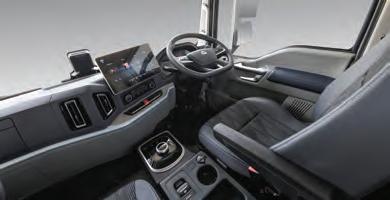
Adopting German technology and world-class parts, the SITRAK C9H 660HP is built for heavy-duty long-haul transport, featuring a 660hp engine and ZF AMT gearbox for strong power and fuel economy. Complete safety configurations and a comfortable cab guarantee safe and pleasant driving, with largecapacity dual fuel tanks and a robust body resulting in long range, durability and strong load-bearing capacity to suit diverse road conditions.
After putting the SITRAK C9H 660HP prime movers into trial operation, executives and drivers from Direct Freight Express spoke highly of the vehicle’s overall performance, reliability and cost-effectiveness.
“We have compared multiple mainstream heavyduty tractor brands before placing the order,” a Direct Freight Express operations director says.
“The SITRAK C9H 660HP stands out for its strong
power, outstanding fuel economy and solid build quality. Since we started using these vehicles, our fleet downtime has been reduced and the overall operational efficiency has improved significantly.
“This batch of vehicles perfectly matches our demand for high-intensity long-haul and heavyload transportation. We are fully confident in the subsequent delivery of the remaining units and look forward to a deeper cooperation with SITRAK.”
Many veteran drivers have also shared their practical driving experience with the new models.
“The 660-horsepower engine delivers plenty of power, and the ZF 12-speed AMT transmission shifts extremely smoothly, which greatly eases our driving burden on long journeys,” one senior driver says.
“The comprehensive safety configurations including AEBS and 360-degree surround view camera make every trip safer. The roomy cab and shock absorption design relieve fatigue.
“What surprises us most is its fuel efficiency. Even under full-load conditions, its fuel consumption is better than our old fleets, which will bring us considerable cost savings in the long run.”
A Northeast SITRAK representative says: “Northeast SITRAK is proud to have supported Direct Freight Express with this significant fleet delivery.”
“Our team worked closely with the customer throughout the purchase and delivery process to coordinate the supply and handover of the 27 vehicles. This delivery reflects the capability of
Northeast SITRAK to support major fleet customers with fit-for-purpose vehicles, coordinated delivery and ongoing customer support. We look forward to continuing our relationship with Direct Freight Express as the trucks are put to work across its national operations.”
The SITRAK C9H 660HP prime mover integrates top-tier technology and practical design, creating tangible economic benefits while also satisfying requirements for power, safety and endurance.
The SITRAK C9H 660HP is engineered for high-intensity, long-distance and heavy-load logistics scenarios, integrating world-leading German technology and localised manufacturing craftsmanship. Equipped with WEICHAI WP15H high-power engine and paired with a ZF 12-spped automated manual transmission (AMT), the vehicle delivers a maximum power of 660hp.
Northeast SITRAK will continue to support Direct Freight Express following the delivery, working alongside SITRAK Australia to provide reliable, fitfor-purpose transport solutions. SITRAK Australia will also focus on product development and the introduction of energy-efficient and reliable heavyduty transport equipment for the Australian market.
“SITRAK will continue to focus on technological innovation, launch more energy-saving and reliable heavy-duty transport equipment and work with Northeast SITRAK and logistics partners to create greater value,” a SITRAK representative says.
FAST-PACED PARTNERS
In the space of a year, Gorski and TR Group have joined forces to create an exciting new heavy-duty rental offering for a range of local transport operators
In a period of rapid expansion, it presented itself as another unique opportunity for tipper body and trailer builder Gorski Engineering. Having recently completed a suite of major projects and churned out 670 units to date for the calendar year, there’s barely been a quiet period for the family business. Then another job arose, this time with one of Australia’s truck and trailer rental leaders.
“We first heard from TR Group roughly 12 months ago as they were exploring the option to introduce heavy-duty steel tippers,” Gorski Engineering general manager Paul Baker told OwnerDriver.
“When they reached out it got very serious quickly, and it went bang from there.”
The decision to work with TR Group to provide the latest series of heavy-duty rental options saw two fast-paced businesses come together. Within weeks, Gorski and TR Group had agreed to the new venture, with trucks being dropped off the very next day for Gorski to begin working on. A couple of weeks later these bodies were rolling out the door, with a fleet of heavy-duty 6x4 steel tippers ready to be delivered to TR customers across the country – an accelerated timeline if ever there was one.
“There was a little bit of to and fro at the start, but we were honoured they trusted us as a partner, so we came in with an open mind to work with them,” Paul says.
“They had an opinion on the spec they wanted and the running gear they were after, but they also listened to our data on market demand and our
most popular specs, so they were very good to work with throughout every level of management.”
To date, 10 trucks have already been spec’d on the first build, with most already working throughout Victoria, New South Wales and Queensland. Gorski and TR Group had discussed the full truck and
trailer combination from the outset, with TR opting to get the tipper bodies on the road first before following up with matching trailers soon after. Once the trucks were in service, enquiries for trailers came through almost immediately, prompting TR Group to act quickly – six premium
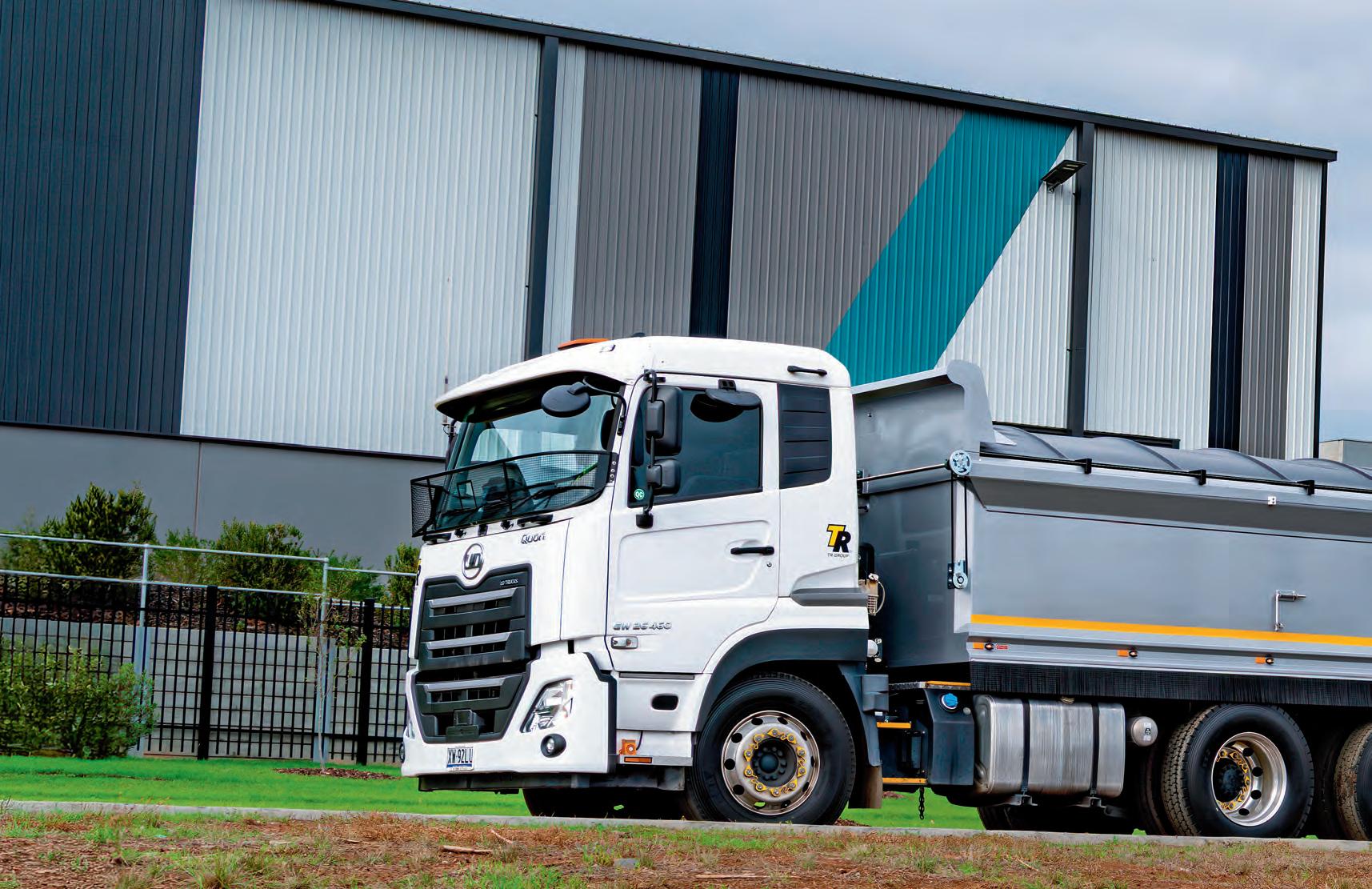
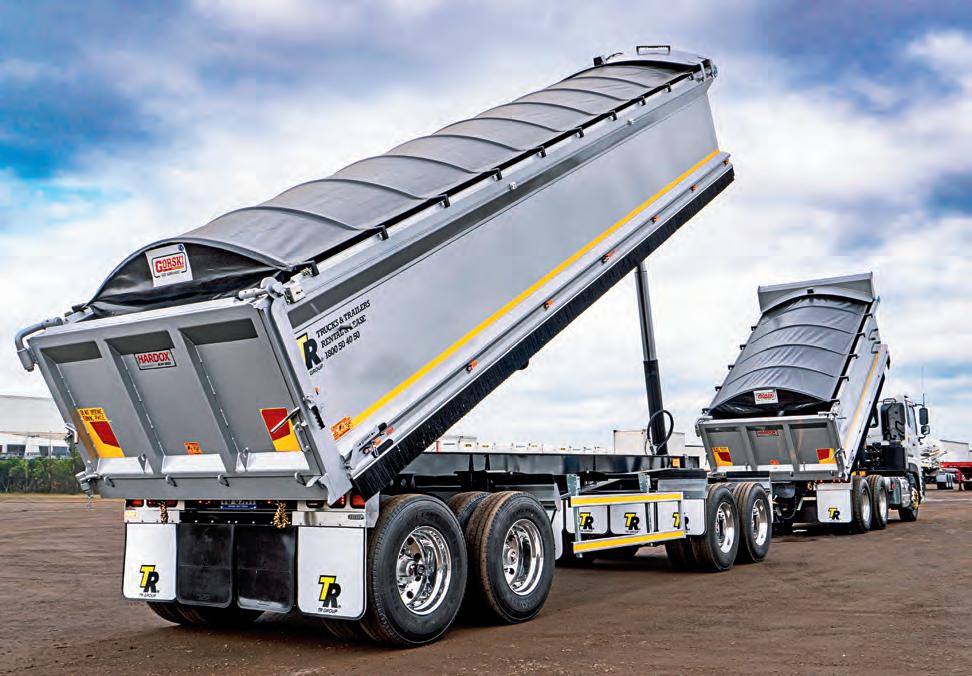
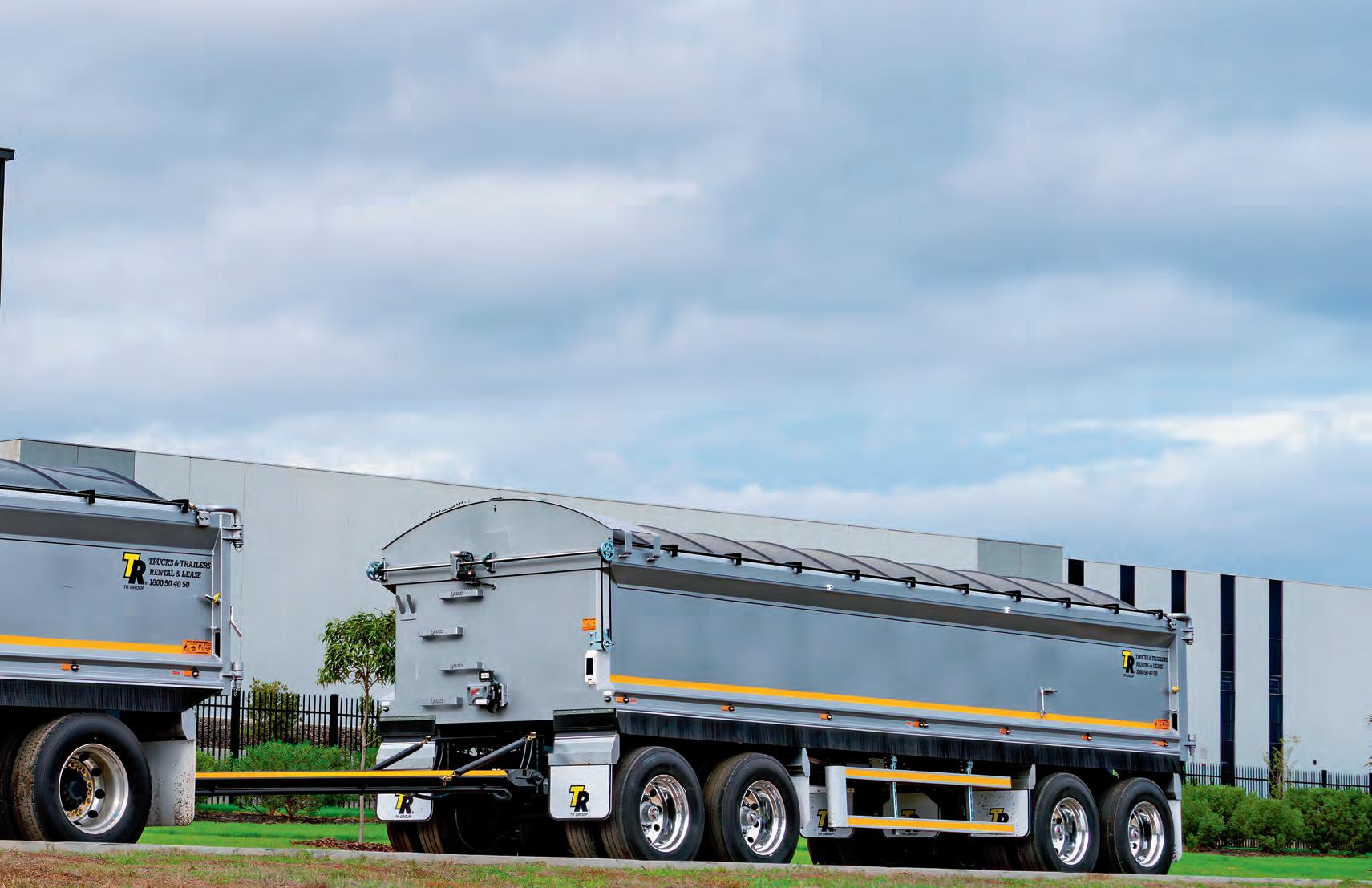
Hardox dog tipping trailers (three-axle, 48 tonne) and four premium Hardox dog tipping trailers (four-axle) were delivered just weeks after the tipper bodies, rounding out the fleet. The expanded offering of TR Group’s rental fleet is designed to provide operators in the civil and construction industries with robust, ready-to-work solutions for demanding quarry, infrastructure and civil work. The new units are based on the UD Quon GW26460 platform, with a Gorski-built Hardox steel body adding extra durability, safety and reliability to the units for a range of operating environments.
Purpose-built for heavy-duty site work, the trucks feature 10.6m³ Hardox steel tipper bodies, with the matching Hardox dog tipping trailers built to the same rugged specification. Both the tipper bodies and trailers are reinforced with five mm sides, six mm floors and a heavy-duty two-way tailgate configuration to handle abrasive materials such as rock, aggregate and demolition spoil.
TR Group national rental manager Ryan Robertson says the introduction of the steel tipper categories to TR’s fleet reflects growing demand from local customers who need reliable specialist trucks to deliver for their civil and earthmoving projects.
“We’re seeing strong demand from contractors and civil operators who need dependable, site-ready trucks quickly,” he says.
“Our new steel tippers are built tough for Australian conditions and give customers the flexibility to scale their fleet up or down as projects or seasonal demands require.”
Designed to meet the requirements of Tier 1 civil and government projects, the new tipper units are equipped with a range of safety and operational features including hoist alarms, grain locks, beacons and dual camera systems. In addition, the tipping operation is controlled via an in-cab remote control, while the trucks are also fitted with a Razor electric tarp system with wireless remote and Right Weigh on-board scales with Bluetooth connectivity to improve safety and efficiency during loading and transport.
As part of the complete package available with the rental units, site-ready features include being fully equipped to tow trailers, with the tow coupling designed for both Ringfeder and pintle hook options and tarp shrouds to protect tarps when open and a shovel rack, toolbox and access ladder for operator convenience.
The steel tippers and trailers are available for rental
nationwide through TR Group’s Australian branch network, with hire periods ranging from short one day requirements to longer project-based contracts. Robertson says rental solutions are becoming increasingly attractive for businesses operating in project-driven sectors such as construction and civil works.
“Many customers want access to high-quality equipment without tying up capital in assets that may only be required for specific projects,” he says.
“Rental gives operators the ability to respond quickly to new work while knowing they have the 24/7 backing of TR Group’s maintenance support and fleet expertise.”
Paul says this national approach is echoed by Gorski, having recently grown its footprint out of Victoria into both Queensland and South Australia. With ambitious plans for growth and ideas for solutions in the local rental market, Paul says the flourishing partnership with TR is another highlight for the business.
“TR Group is a serious player in the rental market, so it’s very rewarding that we were identified by a business so highly regarded,” he says.
“To be identified by them is a tick for us and what we’re doing – it’s nice to be acknowledged by a business like TR and to have them trust us to work together.”
The addition of steel tippers and trailers continues TR Group’s strategy of expanding its specialist rental categories to support operators across the transport, logistics, construction and infrastructure sectors. This allows the brand to provide rental options for major national infrastructure projects, with the likes of the 2032 Olympic Games and The Wave network on the Sunshine Coast providing opportunities for Tier 1 suppliers moving forward.
Having partnered with TR Group, Gorski is looking to continue its recent momentum by working closer with largescale suppliers like TR on major projects in the local transport and infrastructure market.
“To be part of TR’s first foray into tippers as they look to target major government infrastructure projects, both state and federal, is a wonderful moment for Gorski,” Paul says.
“For us, it’s just another part of our massive growth this calendar year. We’re on target for about 170 unit deliveries in Queensland this year, so this growth with the likes of TR Group allows us to invest further in our network.
“It’s an exciting moment for both of us and we hope it’s just another milestone in our ongoing journey.”
“RENTAL GIVES OPERATORS THE ABILITY TO RESPOND QUICKLY TO NEW WORK WHILE KNOWING THEY HAVE THE 24/7 BACKING OF TR GROUP’S MAINTENANCE SUPPORT AND FLEET EXPERTISE.”
ABOVE: The new equipment features premium Hardox dog tipping trailers
OPPOSITE BELOW: The partnership sees TR Group venture into tippers for the first time
DARING TO DREAM
A decade ago, Mickie Shingari made the call to go out on his own and create Falcon Trans. Now,
having reached lofty goals, the
operator is continuing to evolve through an emerging partnership with DAF
They say a week is a long time in football, so how long is a decade? For Mickie Shingari, the past 10 years have been a whirlwind period that’s seen him go from starting a transport company to expanding the business into a popular local business.
Back in 2016, Mickie founded Oz Haul transport (which was later changed to Falcon Trans) in Melbourne with a singular prime mover. Driven by experience, the transport business has now evolved over a decade to become a leading provider of interstate freight services for Australian companies.
“In 2016 I was driving for a transport company and decided I wanted to have a go on my own,” he told OwnerDriver
“I had roughly a decade of experience before making the decision, and it was based on the wider opportunities available when you buy and run your own trucks and trailers. I thought why not give it a go and I haven’t regretted it ever since.”
Despite the emerging success of Falcon Trans, it hasn’t all been sunshine and roses for Mickie and his growing team. In a period he labels as “challenging”, Mickie started the business by saving his money and buying a second-hand truck to get operations underway. Having put all of
his hard earned into the venture, Mickie worked to finance the vehicle before he ran into early troubles on his very first trip.
“On the first run I did to Brisbane and back, it went there fine but it broke down on the way home,” he says.
“It was a massive issue as the radiator broke – I wanted to come home but I struggled to find a mechanic who’d help. Luckily, I found someone who fixed it over the weekend and got me back on road. As it was first trip, I had no earning so I could only pay with my credit card, it was a hard time.”
While it was a tough start to life out on his own, Mickie soon settled with the truck while towing trailers. Throughout this period, a constant challenge persisted – maintenance. It led Mickie to working hard, saving and eventually buying his very first brand new truck in a DAF XF.
“I wanted to buy brand new to get around the maintenance and service issues I was having,” he says.
“It was all about providing the best possible service to customers, and using new trucks has been critical to this.”
After this first truck entered the fleet and services became more consistent, the money and more work began rolling in. Mickie says trucks
became easier to buy and add to the fleet, with the appointment of a partner allowing Falcon Trans to set lofty goals.
“We aimed to build to the point we had 10 trucks in the fleet,” he says.
“We were worried what would stop us was the lack of good drivers available on the market, but we’ve been very lucky to find some wonderful people. When they arrived, we’ve been able to grow and buy more trucks.”
As the Falcon Trans logo and distinctive green and yellow colours was poised to spread onto more vehicles across the country, a critical question for Mickie emerged. What brand and model would he choose to carry forward the Falcon Trans legacy? As a Kenworth fan, he originally turned to the popular brand, but a chat with a DAF dealership led him down a path he continues to gratefully head down to this day.
“The dealership got me interested in DAF trucks, and I soon discovered they are incredibly reliable trucks that are easy to access so I’ve gone with them,” he says.
“Everything has been good with the very first DAF truck we bought – I’m impressed by the XG 660’s power and efficiency. They’re such good and reliable trucks that allow us to offer top notch services to customers.”
A year after acquiring the first DAF, Mickie made the choice to go back to the well. With this decision to become a repeat customer came the start of a flourishing relationship with Kenworth DAF Melbourne’s Sundar Baskar.
“We’ve surpassed our goal of having 10 trucks which is incredible – we currently have 18 trucks,” Mickie says.
“Recently we’ve been buying DAFs to add to some Kenworths. A key reason behind this is my relationship with Sundar – he’s very honest and knowledgeable, which I like when working with dealers – and I consider him a mate now.
“When I ask questions, I get answers straightaway, and I have always had wonderful
experiences when dealing with Kenworth DAF Melbourne.”
Now, a decade into his venture, Mickie’s team runs a variety of general palletised freight between Melbourne, Sydney, Adelaide and Brisbane while also offering a dedicated overnight express service. With experienced interstate drivers running the diverse fleet, including the recent DAF XGs, Mickie says the brand’s latest technology has been the source of Falcon Trans’ next stage of its evolution.
“These latest DAFs include an upgraded software system
“WE ORIGINALLY AIMED TO HAVE 10 TRUCKS IN OUR FLEET AND WE’VE ACHIEVED THAT, SO WE’LL CONTINUE TO LOOK AT EXPANDING IN A STEADY AND SMOOTH MANNER. OUR PARTNERSHIP WITH DAF WILL BE IMPORTANT TO THIS AS WE CONTINUE GROWING ALONGSIDE THEM.”
compared to previous models that I really enjoy,” he says.
“I also love how they use a Cummins motor, which I find to be more powerful and reliable. These trucks run so well and reliably.”
As Mickie and his team celebrate the special milestone throughout 2026, he says he has no plans to stop growing past the 18 prime movers currently in the fleet. It may be just a handful of years since he was first grappling with a second-hand truck prone to breaking down, but now Mickie says a major marker of Falcon Trans’ emergence in the market is the DAF trucks in the fleet. Critical to the brand’s ongoing growth as Falcon Trans moves forward will be the latest DAF technology.
“I feel so proud and I’m thankful to my team who work hard, I’m so proud to have served our customers so well and to continue making them happy,” he says.
“A great mark of our success has been the ongoing customers we work with – over half of our clients have been with us for the best part of our 10-year journey to date.
“We originally aimed to have 10 trucks in our fleet and we’ve achieved that, so we’ll continue to look at expanding in a steady and smooth manner. Our partnership with DAF will be important to this as we continue growing alongside them.”
SUPER SMOOTH
Warren Aitken made the pilgrimage to Melbourne to hop behind Scania’s new Super 11 engine range and put them to the test, including a new agitator model
Is it wrong that I am more excited to recount my test drive of the 8x4 Scania agitator than to get into the specifics of the latest engine release from Scania? I mean, Scania’s newest engine release is a pretty big deal and the two are intrinsically intertwined – don’t get me wrong.
The fact is without Scania Australia launching its all-new Super 11 engine, then I wouldn’t have been down in Melbourne behind the wheel of a concrete truck for the first time in 15 years. Yes, part of my excitement was just the whole concept of driving a concrete agitator, which ranks up there with fire trucks for me. But it’s not just that – it’s also the fact
it is a Scania concrete agi. I’ve driven a lot of Scanias and know how stable, secure, quiet and comfortable they are. I’ve also driven a few concrete trucks, and those four adjectives, together, aren’t commonly used when referring to an agi, hence my excitement. We should get to the central sales point though; it can’t all be about me. So let us look at the futuristic five-cylinder work horse that Scania Australia has just unleashed on us in the Super 11.
My role is to give a bit of feedback after having a drive day in Melbourne’s city streets, experiencing the performance of the powerplant and the joys of traversing the real-life working conditions these
trucks will be seeing. Let’s start with a bit about the Super 11 itself.
Eleven litre motors are not a new thing for Scania (10.62 litres if you want to be precise, but a Super 10.62 doesn’t have the same marketing flair). The six-cylinder DC11 was still powering the good old P114s in 2002 until they were upgraded to the DC12 in 2003. Since then, Scania’s mid-range motor market has been looked after by its efficient nine-litre range for over two decades now. That range will now phase out as the new Super 11 is lighter, more economical and more efficient than not just its predecessors, but the majority of its competitors as well.
Benjamin Nye, truck sales director at Scania Australia, was the man who highlighted some of the key innovations that make the Super 11 such a ‘super’ addition to the Scania range.
“The Super 11 is a double overhead cam, 20 valve, in-line five. It is quite an unusual engine, but not unusual for Scania as our predecessor, the DC09, was also a five-cylinder,” he says.
“It is the first diesel engine, as in for truck use, with variable valve timing. It’s something that’s been in car use and motorbikes for some time, now we have introduced it in heavy diesels.
“It also introduces another new feature called turbo dosing, which is where we dose AdBlue directly into the turbo itself, therefore atomising the AdBlue in a more efficient way.”
All of these innovations are aimed at not just improving the performance of the Super 11, but keeping an eye on future requirements in regards to Euro 7 standards and beyond.
While Scania is leading the way with advances in electric vehicles and alternate fuel options, they have not been sitting idly when it comes to the backbone of our industry – the internal combustion engine. Its efforts have seen astonishing figures tied to the performance of the new Super 11. In its three iterations, the truck can be ordered at 350hp, 390hp and 430hp with torque ratings for each sitting at 1800Nm, 2,000Nm and 2,200Nm respectively, all of which is achieved at a mind-blowing 950 rpm. Add in the diversity of it, with all three options able to run on HVO, and the 390 and 430 also able to operate on B100 (that’s the 100 per cent renewable biodiesel option, recycled cooking grease and animal fat kind of thing).
The Super 11 shares 85 per cent of its big brother’s architecture, that’s the Super 13, but that remaining 15 per cent includes some
pretty innovative ideas that has led to up to seven per cent lower fuel consumption than the existing nine-litre engine, the higher torque at lower revs and, coupled with the new G25, a significant weight reduction, though losing a cylinder plays a big role in that as well.
The big agi getting parked up ready for my turn behind the wheel
Above: Having worked for several companies that pay to get fifth wheel lock systems installed, Scania’s in-built system caught my eye immediately
Opposite bottom: Scania’s 6x2 P430 does exactly what you need. The Super 11 preforms perfectly, and honestly – if you didn’t know it from the brief, you couldn’t tell it wasn’t a 6x4
The lab coats at Scania have also admitted the engine has been designed for a 25 per cent longer working life, with the Super 11 expected to easily clock up two million kilometres, depending on application, of course.
This segues us nicely into the test drive day. Before I get all giddy over the concrete truck, I’ll fill you in on the other trucks that Scania Australia had on hand and the motivation behind them. Scania has always had a strong presence in the linehaul arena, the fire truck arena and a pretty good footprint in the mining market, but like its advancements in engineering, it knows being able to adjust and adapt to the market is the only way to keep moving forward.
The other three trucks on offer are all examples of Scania’s push for smart and efficient options in a newer market for the
Top:
Images: Warren Aitken
every stop start and incline with ease, it just wasn’t setting quarter mile records doing it. What you can definitely appreciate though is the low-end torque of the Super 11. Every pull, every restart – there was never any strain on the engine. The Super 11 was pulling with ease, it just wasn’t pulling with urgency. My impatience was negated by the fuel results – 2.77 kpl across the day. Imagine what an in-tune driver could get.
Next cab off the rank was the P350 8x2 Curtainsider. Once again, Scania is pushing the fuel savings side over a traditional 8x4 and looking at the stability of the set-up for local and regional
deliveries. With the axle set-up you aren’t worrying about instability as drivers unload over the course of the day, the four-axle setup means the truck feels grounded all day. We were only loaded to 23-tonne and, as opposed to the 36-tonne P430, you could really feel the horsepower as well as the torque in this demo. Economy wise, between us eight journos it averaged out around 3.2kpl.
Scania Australia did have a P390 on display for us, all set up as a front lift waste truck. Rightfully so, they didn’t trust us to not go out and try picking up bins just because we could, so I didn’t get a chance to check out the performance or the economy of the 390hp variant. I can pretty accurately surmise the interior experience however, as that is something that just doesn’t change with Scania. You know exactly where everything is, you know everything is easy to get to and you know you are going to enjoy the ride. You also know you can hold a conversation with even the most mellow passenger due to the incredible insulation within the truck. That is why I haven’t spoken a lot about the ride or the features. Scania hasn’t changed those – it may have updated some software, but you are still getting all the safety acronyms you expect, you are still getting incredible vision and class leading comfort, the stereo still rocks Dire Straits like a boss and the truck still drives like a luxury car. I should mention the braking. Scania’s innovative Variable Valve brake offers a pretty impressive 344kW of braking power, and on both the P430 and P350 drives, you could feel that this was more than adequate. In my attempts to chase the top driver scores, it made it very easy to get through the drives while rarely ever using the foot brake. Let’s get to the last drive of the day, the P350 8x4 agitator. The agi market is a very new market for Scania, and it will be pushing very hard with this platform, rightfully so as well, when you look at it. Scania now has a truck perfectly suited for such a niche market. The Scania chassis is already constructed with 9.5mm rails, all of which are powder
“The fuel figures we were able to achieve indicate the possibility of some pretty impressive numbers and the performance of each of the vehicles was bloody good.”
brand. We started with the P430 6x2 prime mover – this is another range that Scania is pushing in the 6x2 market, the idea being this truck is designed for local and intrastate distribution. More often than not, that is into and out of distribution centres, where roads and driveways are pretty good and a 6x4 can be overkill, so why add the extra weight and wear of an extra drive shaft, extra diff, power divider, all that jazz when you don’t use it? You lighten your tare and drastically improve your fuel economy in one go. The Scania set-up still sees 60 per cent of the weight targeted on the drive and if you do happen to find a rather tight or difficult driveway, there is a button inside the cab that will remove air from the tag axle and push it into the drive. The Europeans have been running like this for years and Scania is now showing its capabilities down under.
We had the little P430 loaded up to 36-tonne for our hour-long jaunt, which involved a little bit of industrial estate aerobics followed by some highway running just to enjoy the ride. What I learnt? Benjamin was right and you really couldn’t tell it was a 6x2. Even the angled driveway in and out of Scania headquarters was a breeze. I also learnt you do miss the zip of the Super 13 and Scania V8 engine, but then you remind yourself that this truck is not about that. I think it’s due to the uniformity of the Scania range and the fact you can feel how easy the Super 11 is pulling that you also expect it to get off its butt and haul, but you need to remind yourself it is only a five-cylinder truck with 36-tonne in tow. It managed
coated at birth and sealed wiring is standard, meaning the acid washes and harsh conditions the old agis go through are nothing for a Scania chassis.
The biggest advantage the Scania brings is stability. Scania records a front-end roll stiffness of 830kN, the highest of any manufacturer. If you have a sufficiently talented driver that’s determined to roll it, the factory fitted rollover airbags that come as standard with a Scania mean the driver will still be around to explain his stunt driving.
My Scania guide for the agi test drive made sure we headed into some new estates to see exactly what it would be like getting this truck onto site, mixing repeated roundabouts with tight tradie-packed streets and a little bit of 80km/h roads back to the depot. What I noted first off is as quiet and insulated as a Scania cabin is, even it can’t completely drown out the constant drone of an engine operated PTO system running around the clock. For a regular agi driver, it possibly sounds like muffled perfection, but for me, you could easily still hold a conversation if you had a passenger, but you can feel as much as hear the drive running out behind the cab. It’s nothing the incredible Scania stereo wouldn’t drown out, though.
While you can get the 390 or 430 as an agi, I was super
impressed with how the 350 fared while dodging extruding work utes, roundabouts and rogue pedestrians. Apparently we were weighing 26 tonne all up, but the sprightliness of the set-up was extremely surprising. I did deviate off course a couple of times to see how easy it was to back in and manoeuvre the big girl around, and with the Scania steering and extremely good vision, it really was a breeze. If only I knew how to actually pour concrete, I am pretty sure I would have ended up on a few sites testing out the traction as well. Although having driven a lot of Scanias in snow and ice, I don’t doubt you would be hard pushed to get one of these agis stuck.
While a drive day in a Scania is always going to leave you feeling relaxed and chilled, we were in fact there to test out the engine and the set-ups rather than the ride itself, and it seems the Super 11 is an extremely fit-for-purpose evolution. The fuel figures we were able to achieve indicate the possibility of some pretty impressive numbers and the performance of each of the vehicles was bloody good. The G25 gearbox means you can let the smarts of the truck extricate the best out of the five-cylinder engine and, from the comfort of your Scania seat, it will feel like a breeze. Your job is just to sit back, count the savings, crank up the stereo and enjoy.
Above: Another trick up the Scania sleeve is this 10-wheeler with a steering rear axle Opposite from top: It is hard not to be smiling behind the wheel of a Scania. Quiet, comfortable and, with the new Super 11, powerful and economical; Chasing the fivestar braking score, and before you ask – the other two rating systems were turned off, so I accept no responsibility; I may not have gotten the chance to play rubbish truck driver in the 390P, but it looks inviting
FILTERING THE FUTURE
For more than 35 years, Sakura Filters Australia has brought leading global vehicle filter technology to the local market, with the heavy vehicle industry now part of its ongoing expansion
Throughout its global history spanning more than 35 years, Sakura Filters has been renowned as a supplier to the automotive sector. From commercial vehicles to motorcycles and marine vessels, Sakura’s filters have become synonymous across the sectors as a quality part.
As one of the market leaders in the import, distribution and export of automotive filters, the brand has also expanded its lens in the heavy equipment sector, catering to the local transport industry. Since 1990, Sakura has been established in Australia, bringing the latest products in all four markets to the region.
The latest filters to hit the local transport industry come from Indonesia, where more than 50 years of experience is channelled into one of the largest filter manufacturing facilities in the Asia Pacific region. Its strong ties producing OEM and aftermarket brand products through its Kapuk and Tangerang production sites allows Sakura to produce 96 million filter pieces and 1.95 million radiator pieces each year.
The Sakura Filter trademark is registered in more than 130 countries worldwide, making it a renowned provider of filters.
This comprehensive range includes passenger, commercial, agriculture, mining, marine and industrial equipment, with the transport sector being a growth area for the brand.
“In the automotive and heavy duty applications alone we provide more than 8,000 part numbers, highlighting our global range,” Sakura Filters Australia operations manager Damien Wu told OwnerDriver
“Our filter product range starts with automotive filters for air, oil, fuel, cabin and transmission and extends to the heavy equipment and industrial sector, including air, oil, fuel, cabin, hydraulic, transmission, coolant, separator, HEPA, EDM and dust collectors.”
One of Sakura Filters’ products centre around the latest challenges presented to the local transport sector. In the wake of the COVID-19 pandemic, Sakura started manufacturing filters with triple layer protection, including anti-virus cabin air, to stop virus growth and prevent bacteria and mould from forming and being transmitted.
This limiting of germs and viruses by deactivating dangerous airborne bacteria now does more than just preventing the spreading of diseases – it also prevents allergies by maintaining
TOP: The brand’s range includes a variety of filters for heavy vehicles
BELOW: Sakura’s global manufacturing expertise is benefitting the local market
clear air circulation and reducing up to 99 per cent of the presence of allergens. The triple layer filtration technology starts with a bio-guard layer that prevents viruses, germs, allergens, bacteria or fungi from entering the vehicle cabin. The carbon layer removes unpleasant odours and reduces the impact of harmful exhaust gases like sulphur dioxide and nitrogen oxides, while the final protective layer eliminates microscopic particles and pollen up to 2.5 micron (0.0025mm).
“When it comes to replacement, the Sakura Bio-Guard cabin air filter should be replaced every 15,000km or in one year from the date of installation to ensure best performance,” Wu says.
“This triple layer filter technology keeps air clean and safe both in cars and in heavy vehicle cabins.”
The latest innovation is Cabin Filter CAFR series, which have this Bio-guard feature also an additional flame-retardant media for more protection for the driver and passengers. The Sakura Cabin Filter CAFR Series will be available in the Australasian market soon.
The global quality of Sakura’s filters is ensured through its ISO/TS compliance, with joint ventures with international industry leaders allowing the brand to provide constant technical assistance. Sakura first received ISO qualifications in 1997, with the business being ranked first in numerous years in Indonesia for its quality management capabilities.
Sakura’s rich experience working with some of the largest automotive and heavy duty equipment companies in the world has allowed it to refine its technology. These filter innovations are now on display in its laboratories, with triple loop multi-pass test stands, air filter tester stand machines and cold and hot chambers allowing Sakura to conduct efficiency, vibration and impulse tests on its latest filters.
“For Australian operators, this means we bring more than 35 years of local experience and global expertise in the automotive filtration sector to the industry,” Wu says.
“We operate out of four branches in Australasia – our head office in Sydney, then branches in Melbourne, Brisbane and Auckland.”
The cornerstone of Sakura Filters’ current range includes panel soft PU air filters, eco filters, spin on filters, plastic frame air filters, cabin filters, round metal air filters, round soft PU sets and fuel water separators. Wu says there’s a lot more variety of filter types available for the wider industry, ranging from light and commercial vehicles to heavy equipment products.
Sakura Filters Australia is constantly releasing updated technology for the local market, with 10 to 20 new products included in the brand’s catalogues every month. Through its online catalogue, which allows users to search by VIN and plate number, the right filter parts are able to be found and bought with ease, redefining the filter market experience for operators.
“These products have been developed throughout the years with an emphasis on the Australian market,” Wu says.
“The result is Sakura Filters Australia now has an extensive range which covers most of the local market’s needs.”
Speak up
The transport, postal and warehousing industry in Australia is calling on everyone who works in it to have their say in a new national survey aimed at improving mental health and wellbeing. It’s a chance for people on the road, in sheds and behind the scenes to share what life is really like in this essential and high-pressure industry.
Healthy Heads in Trucks & Sheds, in partnership with SuperFriend and supported by GT Insurance, has launched the Thriving Workplace Index (TWI) survey. The goal is to capture the experiences of people working across the supply chain so future programs can meet their needs.
Data from SuperFriend shows transport and logistics staff consistently rank lowest of 19 industries in Australia for workplace mental health. In October 2025, Healthy Heads and SuperFriend hosted an Industry Think Tank, bringing together truck drivers, warehouse staff, managers and wellbeing experts. The conversations were clear and consistent, showing people across the sector want better mental health support, stronger connection at work, capable leadership and practical solutions.
The Thriving Workplace Index survey is the next step, moving from conversation to evidence, helping organisations understand what is working, where the gaps are and what action will make a difference.
COMPLETE THE SURVEY TODAY
The survey is quick and straightforward, taking around seven minutes to complete, and is open to everyone in the sector. It explores topics to better understand overall workplace experience and wellbeing. You’ll be asked about how safe you feel at work, how fair and equitable your workplace is, the support you receive from management and your workload. The survey also includes questions about workplace experiences and how these factors may affect your mental health.
Your privacy is a priority. The survey is completely anonymous. No names, identifying details or traceable information are collected and individual responses cannot be linked back to you. All answers are combined and reported only in summary form, so you can share your experiences with confidence.
The aim is to understand what’s working and what isn’t in workplaces right now. By capturing real-world experiences across the sector, it helps identify where mental health support is needed most and which actions and programs will make the greatest difference in high-pressure environments.
To make it easier for people to get involved, Healthy Heads has provided a Marketing Kit that can help workplaces promote the survey, which is available for download now on the Healthy Heads website via the resource library.
The survey is a simple but powerful tool to ensure people across the industry have a say in shaping the future of mental health and wellbeing support. It’s not just about answering questions; it’s about taking part in real change for the sector.
PURPLE PRIDE
While waiting for the 2026 Mack Muster to commence, Warren Aitken caught a glimpse of a special purple truck that’s providing a unique safety message to thousands of drivers
For those of you that keep track of my excursions, you may recall I recently wandered across the paddock to Perth, making the journey to enjoy the biennial WA Mack Muster and Truck Show. It is one of my favourite shows and well worth the 4,500km journey. I always get there early so I can do a little truck spotting out at the Quarry Farm location.
The Thursday and Friday before the show sees quite a few of the display trucks rolling in for staging, so I headed out on both days to relax and watch the big rigs randomly rock up. On the Friday, as I sat at the entrance gate, feeling relaxed and beginning to drift off thanks to the balmy Western Australian weather, my attention was immediately snapped back into focus as I glimpsed rapid flashes of bright purple snapping through breaks in the dense trees that lined the side of the South Western Highway.
The purple flashes emboldened by the contrast of the greenery, I was immediately dialled in and as the
rapid flashes started to slow, I realised that whatever this bright purple people pleaser was, it was slowing down to enter into Quarry Farm for the WA Mack Muster and Truck Show. As I lifted the lens up in preparation, around the corner came an eye catching big SITRAK with a trailer that resembled more of a NASCAR transporter, all colour and creation.
My immediate reaction was one of wonderment. I wondered what all this meant? It was a shined-up SITRAK with a silhouetted Griffin growling on the side, gleaming with stainless silicone tyres wrapped around shiny alloy wheels, a perfectly polished bullbar protecting the bottom half of the truck while the top half was bearing the brand I had yet to comprehend- ‘insTRUCKta!’
The decked-out trailer also bore the brand insTRUCKta!, only bigger and repeated and there was a mystical artwork flowing down the length of the bogie axle semi-trailer. The question was what the hell was it? Well, as I am inclined to do, I chased it down and met two of the pivotal players in this standout SITRAK. They were Rob Sharpe, executive officer of Transafe WA and Adam, the man steering the SITRAK safely to site at the show.
It turns out the sophisticated set-up I saw rolling into the show is a massive safety and awareness tool put on the road by Transafe WA. I wasn’t able to learn much about it at the WA Mack Muster as the line-up of people also keen to look inside and learn was constant and I’m too impatient to wait in lines. The interest in the big insTRUCKta! Set-up also kept Rob and Adam flat out for the entire weekend. Thankfully though, following the show, the team were happy to invite me along to B & J Catalano Bulk Haulage’s yard where the big purple project is kept inbetween events. B & J Catalano are one of several high-profile safety supporters without whom projects like insTRUCKta! would not be possible. They were also happy for me to gate crash their yard as Rob and Adam opened up the safety initiative to not just me, but some of the Catalano staff that had yet to experience this one-of-a-kind program over in WA. While Adam took the real workers for a look through, I took the time to catch up with Rob.
Here is what I learnt – the short story long version
is insTRUCKta! is an interactive experience designed to open people’s eyes in regard to heavy vehicles and educate them on how to safely share the road with heavy vehicles. It does this through all the standard stuff like literature, short videos and the like, which is fine. But what gets people inside and really understanding is the virtual reality experience that this truck and trailer was designed for and built to share.
InsTRUCKta!’s origin story dates back to 10 years ago.
“This truck is the result of a pilot program we did back in 2016,” Rob says.
“Back then, Transafe was responsible for bringing the ATA safety truck over from the east coast. It spent about six weeks here in Perth and the result of this was the Transafe chair and committee wanted to have its own dedicated WA safety truck.
“Of course, being WA, we also wanted to make it bigger and better.”
It took several years for the fundraising to get to the point to where the project could officially begin. Some assistance from the NHVR and the road safety commission of Western Australia helped secure the extra funds that got the ball rolling.
Transafe’s plan was to very much follow the lead taken by the Australian Trucking Association’s safety trailer. When it was first launched in 2008, it was very paper heavy, though as it transitioned over the years, first into the safety truck which was the version that Transafe had brought over west, and then into the ‘SafeT360’ version which first introduced the idea of interactive virtual reality to simulate a drivers view of the road, Transafe wanted to take the interactive approach over the paper heavy approach, and, as Rob said, make it bigger and better.
To do this, the body opted to get a dual side expanding trailer. It was built in China and shipped over to Western Australia, where it was fitted out by a local company in RV Solutions in Rockingham. The trailer was designed to be able to fit double the amount of virtual reality sets of the ‘SafeT360’ trailer and, thanks to local company Modern Motor Trimmers, it would even be able to feel like a real truck.
“Modern Motor trimmers over here donated 10 actual truck seats for the trailer,” Rob says.
Along with the 10 seats, having the expanding sides allowed for a big screen at the rear which loops plenty of safety videos and interactive tablets down the side. But the real prize is the interactive virtual reality set-up.
Creating the VR experience to be useful and educational was the biggest part of the program. The idea of the trailer, while useful for truckies, was aimed more for the general public than anyone else. The trailer was being built just after the release of the 2020 National Truck Accident Research Centre (NTARC) Major Accident Investigation Report that found in fatal multi-vehicle crashes involving a truck and car, the car driver was at fault in 80 per cent of the incidents. A lot of that comes from ignorance rather than arrogance, and that is what motivated Rob’s direction for the VR videos. His ideas and scripts became reality thanks to another Perth company in 3D Walkabout.
“The videos are short but deal with the key areas – overtaking trucks, blind spots, turning trucks and the dangers of cutting off trucks,” Rob explains.
In the videos the general public get to put themselves into the driver’s seat and really experience what it is like. I don’t want to spoil the surprise, but there is a particular point during the blind spot video that is an absolute hoot to watch the reactions from the non-VR viewpoint.
Along with the 10 VR spots that take up the centre of the trailer, there are also 10 educational tablets attached to the wall where different age-appropriate quizzes can be undertaken. Again, the scripts for these programs are from Transafe and the interactive experience can be very educational with the programs catering for 0-5 years, 6-11, 12-15 and 16-plus years.
The trailer also sports living quarters for the driver, a role filled by truckie Adam, who relishes the role he has with the insTRUCKta! program.
“It’s a very fulfilling role; I take this to so many different events,” he says.
“If I can go home at the end of the day knowing I have educated someone and it may save their life, that’s a pretty cool feeling.”
Adam is the first to admit he’s been surprised by the truck driver’s reactions as well.
“With the general public, if I get them inside I can usually get 99 per cent of them into the VR program,” he says.
“Drivers don’t normally want to, they come in look around and figure they already know. But when they do sit down and see what we are trying to teach people, they really appreciate it.
“I often get a few come back later with their kids and stuff and make them sit down and watch.”
Knowing how important the message is and the need to attract people to the experience also drove the Transafe team pretty hard when it came to kitting out the exterior of the set-up.
“Once we had the trailer started, we then had to look at getting a truck to put in front of it,” Rob recalls.
“It was in the middle of COVID with the massive truck shortage. We tried every manufacturer, but none had trucks to spare even if they wanted to. Then when I was at the wharf watching the trailer arrive from China, I saw a few SITRAKs on the ship with the big Griffin on the side and thought they looked cool. We approached BCI Truck here in Perth and they had an ex-demo which they happily let us wrap and put under the trailer.
“We then employed a marketing company to help come up with
a colour scheme and name that would grab people’s attention. We probably could have painted it bright yellow and written safety on it, and you would have gotten people walking past saying ‘oh it’s a safety truck’, but we wanted a curiosity evoking colour. The marketing company went with purple, and instructor had ‘truck’ inside it, so it became the play-on words we needed.”
Those choices turned out to be the perfect pitch – it worked on me, seeing the glimpses of purple between the trees drove my curiosity. Since the set-up hit the road in 2023, it has attended 185 events and the VR seats have seen in excess of 55,000 people.
“The key takeaways for most people seem to be the blind spots and the ‘do not overtake turning vehicles’,” Rob says, with Adam also doubling down on that.
“The amount of people we see who admit in their licence testing they had no ideas trucks are allowed to take up multiple lanes when turning, they don’t know what the yellow and red signs with ‘do not overtake turning vehicle’ really means is too many,” he says.
Top: Adam gives his wellrehearsed tutorial for the first wave of VR recipients and helps set them all up
Above: It wasn’t just me getting the personalised tour down at B. & J. Catalano’s yard, some of the workers took a break to come and check out the eye-catching set-up
Opposite top & bottom: I missed the opportunity at this year’s Mack Muster due to the crowds, but the Transafe team were pretty happy to open up and talk me through the InsTRUCKta trailer; Driver Adam Koslover and Transafe head man Rob Sharpe pictured with the insTRUCKta! SITRAK
It’s this sort of realisation and enlightenment that Transafe WA and insTRUCKta! are aiming to educate the general public on, and this outstanding safety resource all pimped out in purple is precisely what is needed. Rob and the team have attended events from Kalgoorlie to Geraldton, but ideally would love to spread the message further.
“We do want to take the message further and evolve the whole concept, but evolving costs money, and being a not-for-profit makes that hard,” Rob says.
“We aren’t funded by the government, we get a little from the Main Roads Department in WA, but we rely on our generous safety partners.”
With truck movements and truck sizes continuing to increase, education and safety awareness is paramount for all of us. Opening people’s eyes to exactly what their behaviour looks like from inside a truck isn’t easy, but the insTRUCKta! project is doing a fantastic job. Sure, it is looking colourful and cool while it does it – I mean who doesn’t love a big purple truck – but the main takeaway is what a fantastic concept insTRUCKta! is. Well played WA, well played.
Images: Warren Aitken
ARE OUR TRAILER WIRES CROSSED?
TRAIL-LINK
general manager
Erin BurgessCollins on Australia’s approach to vehicle standards, and an important crossroads for owneroperators and the local transport industry
There are not many things in transport more frustrating than a reliable prime mover, a hard-working B-double trailer and a connection that refuses to let the two speak the same language. A driver backs under a trailer. The air is up, the kingpin is in, the load is waiting – and then nothing. Or worse, everything all at once. Lights, indicators, clearance lamps, reverse lights and auxiliary power are all functions that should simply connect. Instead, they can suddenly become a midnight exercise in travel adaptors and crossed wires.
It is often not because the driver does not know what they are doing, nor because the workshop has got it wrong. More often, Australian heavy vehicle electrical parts supplier TRAIL-LINK says it is because Australia has allowed too many versions of “standard” to exist side-by-side.
“The current discussion around trailer electrical connections, ADR 42/05, AS 4735, ISO 1185, SAE J560 and the older AS 2513 large round plug is not just a technical debate for engineers and committees,” TRAIL-LINK general manager Erin Burgess-Collins told OwnerDriver.
“It is a much more costly and practical dilemma for operators, drivers, trailer builders, repairers, importers and anyone trying to keep Australian trucks moving.
“Simply explained, imagine Australia has standardised on USB-C cables, but plenty of equipment is still running USB-A. Then add the problem that some of the USB-C ports are wired differently. That is the kind of everyday frustration operators are being asked to manage.”
Burgess-Collins says there are still many trucks and trailers in Australia running the older large round AS 2513-style plug and socket arrangement.
“Many fleets are mixed,” she says. “Some equipment is old, some is new, some is imported, some is locally built and some has been modified over years of hard work. A regulation can change overnight on paper, but the fleet doesn’t magically change with it.
“This is where the industry needs more than theory. It needs a practical transition path.”
She says discussions are happening at peak body level and around various industry meeting tables, which is a good thing for the sector. However, the problem is that there does not yet appear to be a clear and unified position on how to standardise –only broad agreement that standardisation is needed.
TRAIL-LINK manufactures electrical, EBS and air connectors, and is directly affected by the legislative environment. BurgessCollins says TRAIL-LINK understands how the industry arrived at this point and how to work around the different connector types, but she says the company also understands the on-the-ground frustration of operators who do not want three different leads,
two wiring diagrams and a prayer just to connect a truck to a trailer.
“It is still unclear who is guiding, or even influencing, decisions at legislative level. But if the last ADR change is anything to go by, the advice reaching decision-makers has not always reflected what happens in Australian yards, depots and workshops.
“That is not a personal criticism – it is a practical one. Rules made too far away from the people using the equipment can create confusion, cost and inconsistency, and potentially compromise safety.”
Burgess-Collins says despite the critical importance of road transport in Australia, the reality is that Australia is not big enough, or isolated enough, to keep creating local variations where international standards already exist. With fleet designs becoming increasingly global, she says drifting away from international standards creates unnecessary adaptation work for importers, manufacturers, repairers and operators.
“Following ISO-based systems gives the industry a cleaner path,” she says.
“It means imported vehicles can be put to work with less re-engineering. It means Australian-built equipment is easier to understand and support. It gives workshops and roadside repairers clearer wiring logic. It also reduces the risk of errors.
“In the next revision, Australia would be remiss not to seriously consider recognising the 15-pin ISO 12098 plug and socket as an available option. Not necessarily as a forced replacement for every existing arrangement overnight, but as a sensible, modern pathway for new, smart equipment and more complex trailer functions.”
She says the 15-pin system gives the industry more capacity without trying to cram modern trailer requirements into a limited seven-pin arrangement.
As trailer electrical demands grow, Burgess-Collins says extra capacity matters. The industry now expects more from trailer wiring than basic lamps and indicators. Additional functions, auxiliary power and modern equipment need proper conductors, not clever workarounds.
That leads to another of her key points. Burgess-Collins says left and right tail lights should be split across separate conductors, creating a safety back-up so that, if one circuit fails, at least part of the trailer lighting remains operational.
Burgess-Collins is adamant this is about making life easier, not harder, for operators in the long run. Her view is that a national approach should respect existing fleets and avoid punishing operators who have invested in equipment that remains safe and serviceable, while also limiting further confusion.
“The industry needs a forward direction that is practical, internationally aligned and understood by the people who actually connect trucks and trailers every day – and, at some point, consistently enforced,” she says.
“There is no value in another confusing compromise. There is no value in a rule that looks neat in a document but fails in a yard at 4am.
“The people moving freight deserve better than that. They deserve standards that work, equipment that connects and a wiring system that does not need a committee meeting every time a trailer is hooked up.
“In this instance it make sense to let the big international standards do the heavy lifting, and let local industry focus on building, maintaining and operating equipment that works.”
TOP, RIGHT: Burgess-Collins says fleets around Australia are mixed, leading to regulatory confusion
Images: TRAIL-LINK
UNVEILING MAJOR NAMES events
The MegaTrans conference schedule will see the event explore the most pressing freight topics while the exhibitor listing is now live
As the 2026 edition of MegaTrans gets ever closer, the transport and logistics industry is preparing for the bumper event to take hold of Melbourne.
From September 16 to 17, the Melbourne Convention and Exhibition Centre will host MegaTrans, bringing together hundreds of leading organisations from across the entire supply chain, giving attendees direct access to the latest technology, equipment, vehicles and services shaping the future of the industry.
Australia’s largest integrated conference and exhibition dedicated to the logistics and supply chain industry will allow the wider sector to plan for the future and unveil the latest technology.
With freight volumes projected to grow by 26 per cent over the next 30 years, the need to adopt advanced technologies and smarter infrastructure has never been more urgent. MegaTrans provides a unique platform to explore the innovations, equipment and services that will shape the future of logistics.
The MegaTrans conference is jam-packed with speakers from a range of logistics and transport businesses, offering a unique experience on the dominant issues and challenges in the industry. From sustainability discussions to preparing for freight’s
future, the MegaTrans conference will explore the sector and tackle the biggest topics.
The full exhibitor directory for MegaTrans 2026 is now live, giving visitors their first look at the companies set to take stage at Australia’s largest integrated conference and exhibition dedicated to the logistics and supply chain industry.
The newly released exhibitor directory features an impressive line-up of global brands and industry leaders, including Amazon, DP World, Maersk, UPS, WiseTech Global, Team Global Express, Aramex Australia, Centurion, Visy Logistics, Geek+, HERE Technologies, Geotab, Jungheinrich Australia, Microlise, Powerfleet and Viva Energy Australia.
“The exhibitor directory gives visitors a real sense of the scale of MegaTrans 2026. From global logistics leaders and major transport operators through to
the companies developing the next generation of automation, AI and fleet technology, MegaTrans will truly showcase the end to end supply chain,” Prime Creative Media head of marketing – events Molly Hancock says.
The exhibition floor will showcase solutions designed to help businesses improve productivity, strengthen resilience and prepare for the future.
“This is an opportunity to have conversations with the people behind the products, compare solutions side by side and discover technologies that can deliver real operational improvements,” Hancock says.
“Whether you’re responsible for transport, warehousing, procurement or supply chain strategy, you’ll find ideas and connections that can make an immediate impact.”
With strong industry support and an expanding exhibition floor, MegaTrans 2026 is set to be the destination where transport, logistics and supply chain professionals come together to explore what’s next.
The full exhibitor directory is now available online, with more exhibitors continuing to be added in the lead-up to the event.
Register now to secure your free trade pass and start planning your visit to MegaTrans 2026 at megatrans.com.au.
load restraints are engineered for reliable cargo control across transport, freight and logistics applications. From ratchet tie downs and straps to edge protectors and transport accessories, our products are designed for strength, durability and compliance. Trusted by transport operators Australia-wide, TYMATE delivers dependable restraint solutions that help keep loads secure on every journey.
SPREADING THE LOVE truck technology
As an emerging option for transport-specific load restraint systems, Pacific Packaging Australia is growing its TYMATE distribution network
In the local transport industry, the load on the back of a truck reigns supreme. Without its safe delivery, operators and drivers don’t move and get paid. Supermarkets aren’t replenished.
Deliveries aren’t made. It’s in this sphere that tying down loads properly becomes a critical part of successfully running a reliable freight service.
Through Pacific Packaging Australia and its dedicated brand TYMATE, load restraint and securing solutions are emerging as products tailored to the local transport and warehousing market, ensuring these deliveries are made and supply chains remain efficient.
The TYMATE suite of ratchet tie-down systems have been engineered for strength, reliability and repeat use across demanding transport environments. Unlike other tools from adjacent industries, the TYMATE product range is designed specifically for owner drivers, freight operators and logistics teams wanting to secure loads without compromise.
Whether it be across ratchets, ropes, twines
built with transport and logistics operators in mind.
Now Pacific Packaging Australia is supporting transport operators even more through a growing national distribution network and local stock holdings for its TYMATE range across Australia. The move is allowing more owner drivers and fleet operators to access the popular load restraint, transport and packaging products quickly when they need them to reduce downtime and keep freight moving.
“Transport operators don’t have the luxury of waiting weeks for critical load restraint and transport products,” Pacific Packaging Australia managing director Gary Manais told OwnerDriver
moving safely and efficiently.”
The emergence of Pacific Packaging’s national footprint extends across major Australian cities, providing local stock availability and fast dispatch across the country’s vast expanses. This includes TYMATE’s load restraint products and transport accessories, highlighting the importance of reliable supply partners in keeping operations running smoothly.
or strapping, these systems offer benefits from heavy-duty ratchet mechanisms and high-strength webbing to reliable and repeat-use performance
“Our focus is on maintaining stock across our
national network so customers can access the products they need quickly and keep freight
For local operators, this means the TYMATE ratchet tie down range, which comes in red, blue, orange or yellow options, will be more widely available. As part of the wider Pacific Packaging Australia capability, the TYMATE range is backed by the brand’s national supply network to make it easier for industry members to access sturdy solutions wherever they are.
Pacific Packaging Australia is able to cater to members of the local transport, logistics and warehousing sectors at any of its sites across Melbourne, Sydney, Brisbane, Perth, Townsville and Rockhampton.
“Whether it’s a single owner driver or a national fleet, our goal is to provide dependable products, local support and consistent service across Australia,” Manais says.
“Whether you’re securing pallets for dispatch or managing loads onsite, TYMATE delivers dependable solutions that keep operations running smoothly.”
To explore the TYMATE range for reliable load restraint products that help you secure with confidence, shop online at www.pacificpackaging. com.au or speak to the team at 1300 234 235.
truck sales
BUILDING MOMENTUM
The June truck sales data showcases an industry continuing to build heavy vehicle sales across the board
The latest truck sales data is in for June, with the newest numbers seeing a spike in mid-year sales despite still falling below last year’s levels. The latest Truck Industry Council (TIC) T-Mark data recorded 4,172 sales made in June, seeing a spike compared to recent months but falling below the 4,888 sales made this time last year.
Total trucks
An improved June effort saw 4,172 sales made across
all markets for the month, with Isuzu (921) continuing to lead the way. Hino settled into second spot with 455 sales, with Fuso claiming third with 320. Kenworth (249) narrowly beat Volvo (240) for fourth, while IVECO (194) fell just shy of the 200 mark. MercedesBenz was the next best with 143 monthly sales, while Scania (125) and UD Trucks (102) were the only other brands to reach triple figures. Below this mark, DAF (71) beat Mack (61), Fiat edged ahead of MAN – 44 vs 38 and Hyundai and LDV were tied on 29 apiece.
Heavy duty
A better month throughout the heavy duty market saw 1,347 sales recorded for the month, with Kenworth (249) once again topping the leaderboard. Volvo finished a close second with 237 sales, with Isuzu claiming third through a round 150 sales. Scania (125) wasn’t too far behind, with MercedesBenz finishing on a perfect 100 to sit slightly ahead of UD Trucks (96).
Medium duty
There was a slight increase in numbers for the medium duty market in June, with 468 sales recorded. Isuzu was yet again the leader with 264 sales, well ahead of the next best in Fuso (100). From there, Hino had the 56 sales, IVECO the 12, Hyundai 10 and the final 34 sales were split between five brands.
Light duty
A consistent June effort for the light duty sector saw 1,256 sales made for the month as Isuzu continued to flex its muscles. The market leader notched 507 monthly sales, nearly doubling the second placed Hino (319). A clear gap was established before Fuso came in third with 156 sales, edging ahead of IVECO (137). An even larger gap came after this, with Fiat (44) coming in next ahead of Mercedes-Benz (35) and LDV (29).
Vans
A spike in the van market saw 1,101 sales recorded in June as Mercedes-Benz won a tense battle against LDV. The former finished with 301 sales for the month compared to the latter’s 277, with Ford (164) firming in third with 164 sales. Renault was next best with 138 sales, with Volkswagen (110) also finishing in front of Fiat (89) and IVECO (22).
Image: Warren Aitken
NRFA Glyn Castanelli
Stronger voice
NRFA president Glyn Castanelli discusses how recent decisions have given the association more
opportunity to push for change where it matters
Since 2008, the National Road Freighters Association has worked to represent the drivers, owner-drivers and small business operators who keep this country moving.
The NRFA was formed because there was a gap. The people behind the wheel were often the ones most affected by industry rules, regulation and reform, but they were also the people least able to spend time in meetings, consultation sessions and policy discussions.
Drivers were busy doing the job. Owner-drivers were busy running trucks, chasing invoices, managing maintenance, meeting compliance obligations and trying to keep a small business alive. While others had the time and resources to sit around the table, many of the people actually doing the work felt they were missing out on having a say.
That feeling was especially strong during the development of the first Heavy Vehicle National Law. Many drivers and small operators felt their practical input had not been properly heard before rules were developed that would affect their working lives every day.
That experience helped shape the NRFA’s purpose. The association was built by passionate individuals who gave their time, effort and, often, their
own money to make sure drivers and small transport businesses had a voice. They did it because they understood that if those behind the wheel were not represented, decisions would continue to be made without enough practical industry experience.
Today, the NRFA has grown into a recognised and active contributor across the transport industry. The association is currently involved in more than 20 industry committees, working groups and consultation processes, giving drivers a voice where it matters. That includes work on sham contracting, rest areas, national heavy vehicle driver competency, Fair Work Contract Chain Orders, the Closing Loopholes review, driver training and apprenticeships, the HVNL review, heavy vehicle driver shortage planning, access reform, heavy vehicle health, road user charges, productivity, NHVR industry meetings and now participation through the ATA structure.
This matters because these are not abstract policy issues. They go directly to the daily reality of road transport. Rest areas affect fatigue and safety. Driver competency affects training, licensing and the future workforce. Contract Chain Orders and minimum standards affect whether small operators can work safely and sustainably. Access reform affects
productivity and whether freight can move efficiently. Heavy vehicle health matters because the industry cannot keep relying on drivers to absorb pressure without considering the human cost.
The NRFA’s role in these discussions is to bring practical input. The question we ask is simple: how will this work for the driver, the owner-driver and the small business operator who has to deal with it on the ground?
That practical voice is now being heard more clearly. At the NRFA’s 2026 Annual General Meeting, members unanimously agreed that the association should seek membership of the Australian Trucking Association. It was a significant decision because it recognised that the time had come for the drivers’ voice to be included within the national peak industry body.
At the recent ATA Council meeting, the NRFA’s application was approved. This marks an important moment, not just for the association, but for the drivers, owner-drivers and small fleet operators it represents.
It means the practical input of those behind the wheel is now part of the national industry conversation in a stronger and more formal way. It means driver and small business experience can be brought to the table when the industry discusses safety, reform, regulation, productivity and the future of transport.
Being part of the ATA does not change who the NRFA is. It strengthens the opportunity to do what the association was created to do.
The NRFA will continue to speak up for those doing the job. It will continue to push for practical, fair and workable outcomes. It will continue to work with industry, government and regulators where common ground exists, and it will continue to raise concerns when the practical reality for drivers and small operators is being missed.
This is not about sitting at the table for the sake of it. It is about making sure the people who keep Australia moving are part of the decisions that affect them.
Now is also the time for more drivers and small business operators to get involved. The NRFA is invigorated. It is active across more committees and industry discussions than ever before. But no association can do this work properly without the support, input and lived experience of its members.
If you are a driver, an owner-driver or a small fleet operator, your experience matters. The issues you deal with every day are exactly the issues that need to be carried into consultation rooms and industry forums.
The transport industry is changing. Regulation, safety expectations, workforce pressures, commercial conditions and technology are all shaping the future. If drivers and small operators are not part of those conversations, others will shape that future for them.
Since 2008, the NRFA has worked to give drivers and small business operators a fair go. Now, with a stronger place at the national table, the next chapter begins. The NRFA is here. The door is open. And now is the time to get involved.
GLYN CASTANELLI is the president of the NRFA.
truck technology
PURPLE PARADISE
Having added AdBlue products to the Purple Industrial portfolio five years ago, the supplier has now introduced a new 2,000L pumping station for smaller operators
Fuel has been a defining issue throughout the first half of 2026, with transport operators around the nation struggling with rising costs and, at times, supply challenges. As we pass the halfway mark of the year, ongoing federal government measures present small bursts of relief. Despite this, real advancements are being made throughout the country to innovate and make the transport industry more efficient and less reliant on diesel.
Since late 2025, Purple Industrial, through its trailer hire brand, has been finding its own niche in the local AdBlue market. The venture, led by Andy Kassing, started in 2021 when AdBlue faced its own local shortage. Continuing on Purple Trailer Hire’s legacy that tracks back to 2008, the introduction of Purple AdBlue quickly found a footing in the local transport sector as a reliable and high quality provider of AdBlue Intermediate Bulk Containers (IBCs).
“We sell IBCs of AdBlue either as a whole container or we have an exchange program that is a cheaper way for transport companies to use AdBlue,” Andy told OwnerDriver
“By having us around to recycle these IBCs, it’s both cost efficient and environmentally beneficial. Sometimes a client might buy half a dozen and we can collect the empty containers and bring fresh ones back for them.”
Andy continued his AdBlue push into the early stages of this year, with the iconic purple brand expanding down from Queensland and New South Wales into Victoria through an AdBlue IBC production facility at Pakenham.
“We decided to expand into Pakenham and Victoria firstly because we had demand – plenty of people were calling us in Victoria to ask for the IBCs,” he says.
“Then, when freight costs from transporting IBCs down to Melbourne from Sydney continued to rise, we decided to make the move.”
Based on the idea that buying directly through Purple is cheaper than going through the pump, the recent combination of both of Purple Industrial’s brands in AdBlue and trailers resulted in a new selfcontained trailer that’s revolutionising how operators can refuel trucks with AdBlue on the go.
“Our new trailer is a first-of-its-kind in the sector – I haven’t seen it anywhere before,” Andy says.
“It started when I noticed that farmers might travel great distances within their own property and paddocks to refuel equipment – I thought there must be an easier way for farmers and transport operators to do this for both fuel and AdBlue.”
The next stage in this purple evolution is the
INDICATE AND RETAIN:
introduction of a 2,000L pumping station to make it even easier for operators to store and use AdBlue for their trucks. Starting just in Brisbane over the past few months, Purple Industrial has already delivered four stations to operators throughout the state.
“People are able to get their IBCs and electric pumps for free while they use Purple Industrial and get our pumping station,” he says.
“There’s no gimmicks to it – customers can get AdBlue delivered at a cost of roughly $1 per litre to their site to then use through the pumping station.”
Initial deliveries have already seen Andy supply pumping stations and IBCs all around the Brisbane metro region and as far out as Toowoomba and Kingaroy. Andy says the latest addition to Purple Industrial’s flourishing AdBlue range is ideal for customers wanting an IBC of AdBlue but are unable to transfer it.
“If they don’t have a forklift in the yard or have an issue with accessing AdBlue, this is ideal for smaller operators who have up to 20 trucks,” he says.
“We want to push this to more operators who can benefit from it and then look to expand the pumping stations into Sydney and Melbourne in the future while continuing to sell IBCs out of Pakenham and Sydney.”
• 2 in 1 indication and retention
• Australian made
• Enhanced visibility and early detection
• Save on fleet maintenance costs
• Reliable, rugged performance
• Simple to use
• NATA tested and accredited for Australian conditions
the power of LugLinx Available now in 32mm & 33mm only from Redcat’s patented LugLinx next-generation indicator/retainers are trusted by fleets right around the world. They not only offer a visual way to check for wheel nut tightness, they also provide safe retention in the event of loosening wheel nuts.
Images:
Purple has now unveiled a pumping station for operators
TWU Michael Kaine
Future focus
The
TWU looks at the rapid evolution of technology in the transport sector and what
it’s doing to protect local trucking workers
The nature of work is changing before our very eyes. AI and automation are no longer a thing of the future and it’s clear that corporations are piling pressure on governments to abandon regulatory protections so they can make even greater profits. But the technology they are promoting is still a long way from being perfect, and the transport industry in particular cannot let AI and automation run riot and destroy lives and livelihoods. That is why it is essential and urgent that we build on the industry unity we have developed in recent years and tackle this newest, existential threat together to deliver the best outcomes for all.
I want to tell you a story about a man from the US, where self-driving taxis have started springing up in some major cities. A man from Phoenix Arizona got into one of these taxis owned by a company named Waymo to get a ride to the airport. Midway through the trip, the car started driving in circles and after about seven minutes of this, a customer support agent called into the car with the not so surprising news that the customer might be experiencing a “routing issue”.
The customer then asked the agent to take control of the vehicle, but the agent said they couldn’t. So, a passenger was locked in a moving car with no driver and nothing could be done about it. And, get this, the customer support agent couldn’t help him? Reportedly, it was an AI bot!
Waymo is not a small business run out of someone’s garage. It is a multibillion-dollar company ($126 billion in fact) and it’s owned by the same parent company as Google. Yet with all that money and all those resources at their disposal, clearly that taxi was not fit for purpose. You don’t have to search for long to find similar incidents like that online.
I mention this because Waymo now has its sights set on Australia and is knocking on the doors of regulatory bodies like the National Transport Commission trying to get driverless taxis up and running.
And it’s not just taxis. Driverless trucks are already completing commercial deliveries in the US. FedEx Freight CEO John Smith says “the technology is there” but “the regulatory piece will be the biggest
hurdle”. This quote confirms that huge corporations want all regulatory protections or barriers removed so they can do as they so often do –whatever the hell they like.
So that is both our challenge and our opportunity. It can be summed up two words: Who decides? Who decides when a truck doesn’t need a driver? Who decides whether an entire industry is turned upside down? Whether it becomes fully automated? Whether workers should be replaced by a bot and then told to look for work elsewhere?
The answer to that question should not be multinational corporations and big business. It should not be left to Amazon, FedEx, Uber or now Waymo to decide. They have already shown that, if left to their own devices, the relentless pursuit of profit will always take precedence over the safety and standards of transport workers and the wider community.
We know all too well the cost when standards are not the priority in Australia’s deadliest industry. Already this year, there have been 74 truck crash deaths on our roads and 21 of those have been fellow drivers.
Our task now is to ensure this race to the bottom isn’t kicked into overdrive and to keep the human element in the equation. We must face this challenge head on, we must ensure that it is the industry and the community deciding on our future, not billionaires and unaccountable corporate structures.
It is crucial we make sure that employees, owner drivers and transport operators like you, the ones who keep the wheels of the economy turning, are not left in the dust. To do that, we must work together as an industry and as a community to find the best path forward to incorporate
NSW Transport Workers Union, Transport House, 188-390 Sussex Street, Sydney, NSW 2000. twu@twu.com.au.
these technologies into our everyday lives.
We should take heart that the community is with us in this fight. The TWU recently commissioned a national poll to see exactly what ordinary Australians think about this. Polling shows that just over seven out of 10 Australians are opposed to having driverless vehicles on the road, and 73 per cent say they would feel unsafe sharing the road with these vehicles.
Six in 10 Australians say the federal government should intervene to stop large corporations from deploying driverless automated vehicles on Australian roads. And they go even one step further – 75 per cent agree the government should act to stop transport workers losing their jobs to these technologies.
These results show that the public shares our very real concerns and do not think that it should be left up to the corporations and billionaires competing for poll position in some uncontrolled driverless vehicle race to call the shots, to rake in all the profits and skirt the responsibilities.
To those who say it is too difficult or too costly to reassert control over AI and automation in transport, point them towards what we’ve achieved together as an industry. Only weeks ago, the TWU joined with the country’s peak road transport employer body
“2026 is the year we ratchet up our efforts to return critical decision-making about our roads, our skies, back to the wider community. Back to the truckies and transport operators, who do all the heavy lifting.”
MICHAEL KAINE is the national secretary of the Transport Workers Union of Australia. Contact Michael at:
(the Australian Road Transport Industrial Organisation, ARTIO), the National Road Freighters Association (NRFA) and lobbying group the Australian Trucking Association (ATA) to ensure companies at the top of supply chains paid up for the war-induced spikes in fuel bringing an important measure of fuel
relief to many across the industry. In another constructive use of these new transport laws put in place by the Albanese government, we also convinced gig behemoths Uber and DoorDash, companies already using AI in their business models, to come to the table to work together to improve pay and conditions in the
industry. Thanks to our united efforts, we will soon see world-leading, enforceable standards for gig-workers in food delivery, rideshare and last mile sectors.
I mention these victories because they shatter the false narrative that changing the trajectory of our industries to benefit workers, small businesses and the wider public cannot be done. We have shown that when all industry participants fight as one, wealthy clients and corporations can and will put the human element back into the equation, but our work doesn’t stop there.
2026 is the year we ratchet up our efforts to return critical decision-making about our roads, our skies, back to the wider community. Back to the truckies and transport operators, who do all the heavy lifting. The TWU’s 2026 Our Roads, Our Skies, Our Future campaign is the largest coordinated campaign in Australia’s transport history. Tens of thousands of workers and industry participants playing an active role in the struggle, because it is all of us who collectively know how our industries work best.
To those companies and associations that have been so willing to put their shoulders to the wheel for constructive, collaborative industry progress, we thank you. To those corporate giants, billionaires and special interests who think they can automate their way around us, or use an AI bot as an obstacle, or bully governments into their service, 2026 is your year of reckoning.
The industry is speaking as one, the Australian public is with us and we are ready to fight to ensure decent, safe jobs remain at the heart of the transport economy. To fight for Our Roads, Our Skies and Our Future. Together, we decide.
EYES ON THE ROAD
Rod Hannifey
Analysing new laws
Rod Hannifey casts his eye over the updated HVNL and reviews what works and what may be a pain point for owner-drivers
Goodaye all, well by now the new HVNL 2 is due to have commenced. Yes, there are some good things, but I feel the bad far outweigh them. Yes, they have dropped some penalties, but they have not just increased more than double that number, they have more than doubled the penalties for many of those offences and, of course, they will all increase yearly with CPI. And yes, these are the courtimposed maximums, but not only will they flow down to increases on the road side, they must be seen to any outsiders that we are such a bad bunch that the fines had to be increased so much.
When there is a crash or vehicle incident and the driver can be proved at fault, they should and must be charged if they have broken the law – that is how society works. The penalty must aim to deter people from breaking the law, but the level of some of the fines and the vagueness and, of course, we are guilty until we can prove our innocence, makes it all an issue. Does the term interpretation scare you as much as it does me now?
I rang the NTC to be told when the review was done, the minor fines seemed to them to be too close to the
major fines and that is because they have always been way above a fair level, particularly when you compare them with other offences. I raised this in my initial reply to the review, then the review of the review and then the review of the fines, but they did not listen to me, nor did they listen to the industry associations, so who did they listen to, and if not us, why?
I am told there will be changes to move the onus from the driver – wasn’t that what COR was meant to do over 10 years ago? From what I’ve heard, there is no requirement to do so – is that an improvement or a smoke and mirrors one? We were told the intent of all of this was to get more people into accreditation, but will it? Many doubt this.
With the new templates, I had already received a call from a driver asking about the 30-hour reset. In the USA, you can have a rest break and restart your clock if something holds you up for a long time, and so I anticipated it may be similar as I have voiced concern over the 14-day rule now for some time. But no, and when I asked the NHVR, they said it came from the NTC years ago and the NTC would not review it.
Then it has times and further requirements, which no one I have
ROD HANNIFEY, a transport safety advocate, has been involved in raising the profile of the industry, conducting highway truck audits, the Blue Reflector Trial for informal parking bays on the Newell, the ‘Truckies on Road Code’, the national 1800 number for road repairs proposal, and the Better Roadside Rest Areas Group. Rod is the current president of the NRFA. Contact Rod on 0428 120 560, e-mail rod.hannifey@bigpond. com or visit www.truckright.com.au.
spoken to had any clue about. However, I will give credit to the person I spoke with at the NHVR for over an hour. She answered all my questions and removed some of the doubts, but admitted it had not been communicated or handled well and I was told that was partly due to the delay in reply from the ministers. Still, the consultation we were told would occur did not, so again, who are they listening to?
Another good thing that I did find out and again, this had not been explained anywhere I could find until recently, your current BFM certificate and your companies will roll over if they are suitably current, so anyone saying we all have to redo new courses is leading us astray.
In one week, I had three drivers ring regarding serious fine threats, so not only are they being threatened with these bigger fines, it seems when you go to court, from a number of people I have spoken to in this line of work, NHVR prosecutors are going for the jugular as hard as they can.
They will jump up and say it is all about safety, but what about our safety on the road? They won’t fix the roads, they have stalled and held up better driver testing and training for years and some governments simply handed out licences to those who should never have been given one for a MC combination.
I would like to see better road transport representation on the NTC. They have made all these decisions and yes, the ministers have approved them, but why wouldn’t they?
Look at the new cannabis laws in NSW. Yes there are terms and conditions, but they get two warnings if they go over the new legal level. What do we get? Bigger and more fines. Good luck getting drivers to stay in the industry, let alone getting new ones in!
Some say it is all good, I disagree and the process has failed us in many ways. Is it all bad? No, but again, I ask, please show me one thing in the HVNL that makes it better, easier and safer for me to do my job. Show me that those who do the job that most others won’t or can’t and who will never see the weight of these changes on them or their families ever really listened to a driver. Safe travelling.
Rocking the Roads Simon
Smith
Eventful August
An array of Australian rock music legends were born in August, creating an impressive list
of music history
When casting the mind back over the years, Australia has been a hotbed of rock music history. August has witnessed numerous pivotal moments in rock music, from iconic album releases to legendary birthdays from the Australian Truck Radio Rock & Roll Diary!
AUGUST 8
1928: Australian jazz musician Don Burrows was born, with the jazz and swing specialist going on to play the clarinet, saxophone and flute.
1981: Australian singer-songwriter Vanessa Amorosi was born. Her career has seen her sell at least two million units in albums or singles globally.
AUGUST 10
1961: A critical member of one of Australia’s most popular bands was born on this day in Jon Farriss. Born as Jonathon James Farriss in Perth, the founding member of INXS starred as the band’s drummer.
AUGUST 15
1969: Another star-studded name in Australia’s rock music history was born on this day in Bernard Fanning.
AUGUST 16
1957: It’s another member of INXS who was born on this day, and another member of the Farriss family. This time around, Tim was born in Perth, going on to become a founding member of the band.
is the manager and producer of Australian Truck Radio. He has been in the radio game for 44 years and has been customising playlists for truckies for at least 20 of those. For great tunes 24 hours a day, 7 days a week, download the digital app for your phone at www.australiantruckradio. com.au.
AUGUST 20
1956: Matt Moffitt of Matt Finish was born on this day. The Australian singersongwriter and guitarist fronted the band in separate stints until 2003.
1974: From one iconic Aussie rock band to the next – Andy Strachan of the Living End was born as Andrew Douglas Strachan in Adelaide on this day.
AUGUST 23
1949: Rick Springfield was born in Merrylands, NSW as Richard Lewis Springthorpe. The Australian-American musician and actor is known for his time with band The Zoot before branching into solo work and releasing ‘Jessie’s Girl’.
AUGUST 29
2001: A sad day in Aussie music as Graeme ‘Shirley’ Strachan, the Skyhooks front man, died in a helicopter crash.
AUGUST 30
1952: Australian musician, songwriter, music producer and talent manager Graham Leslie ‘Buzz’ Bidstrup was born on this day.
August stands out as a month rich in rock history, with its blend of groundbreaking album releases, memorable events, and the birthdays of rock legends. These events and individuals have played pivotal roles in shaping the landscape of Australian rock music from the Australian Truck Radio Rock’N’Roll Diary!
SIMON SMITH
August
Stay
August
WONDAI
Bring
Join
Start
THALLON TRUCK PULL
August
THALLON,
FOR THE OWNER-DRIVER Frank Black
New burdens
Frank Black has his say on the latest reforms to the Heavy Vehicle National Law for Aussie ownerdrivers
The NHVR keeps insisting the 2026 HVNL overhaul is a ‘modernisation’ and yes, if you squint hard enough, you can find a few changes that might make life slightly easier. There’s a bit more flexibility in a couple of areas, a cleaner mass framework and the odd tweak that might shave a minute or two off the paperwork.
But let’s not kid ourselves. For the people who actually keep freight moving, especially those of us who own the truck, pay the bills and carry the risk, most of these reforms translate into more burden, more cost, more exposure and more risk, with almost nothing meaningful in return. Nowhere is that imbalance clearer than in the updated ‘Unfit to Drive’ duty, a rule that sounds sensible in theory but, in practice, dumps yet another layer of responsibility squarely onto the driver while everyone else in the chain hides behind policies and paperwork.
The NHVR loves to say the obligation applies to everyone in the chain. Anyone who has lived under the HVNL knows exactly how this movie ends. The chain gets policies, procedures, templates, training modules and plausible deniability. The driver, and especially the owner driver, gets the fine, the defect, the interrogation, the licence risk and the blame. Until schedulers, freight forwarders, platform operators and big corporates are fined on the same day as the driver, not months later after a quiet investigation, if at all, ‘shared responsibility’ remains nothing more than a slogan.
And no one is hit harder by these reforms than owner drivers. If a company driver declares themselves unfit, the business absorbs the cost. If an owner driver declares themselves unfit, they absorb the cost, the lost income, the lost contract, the lost credibility. The law pretends owner drivers have the same safety net as big fleets. They don’t. They have a mortgage, a truck payment and a customer who will replace them in a heartbeat if they dare stop midrun. There’s no spare driver waiting in the wings, no paid sick leave, no buffer. This isn’t safety. It’s economic punishment dressed up as compliance.
The lawmakers never address the most obvious scenario: what happens when a driver gets sick in the middle of nowhere? It’s the question that exposes how unworkable the revised duty really is. Under the new rule, the requirement is brutally simple. If you’re unwell, you must stop. If you don’t stop, you’re in breach. There is no allowance for remote areas, no phone reception, unsafe shoulders, perishable freight or the complete absence of help.
A driver who becomes ill between towns, somewhere on the Newell, the Stuart, the Hume, the Bruce, or any of the thousands of kilometres where help is hours away, is expected to pull over and wait. For what? For who? There is no mechanism in the HVNL that obligates the customer, the forwarder, the platform or the prime contractor to assist, compensate or even answer the phone.
If the driver continues to a safer location, even for their own protection,
they’re technically in breach. If they stop on a dangerous shoulder, they’re compliant, but at risk of being hit, stranded or unable to get help. The law creates a safety paradox where drivers must choose between compliance and survival.
The most absurd part of the revised ‘Unfit to Drive’ rule is that an NHVR or police officer can issue a breach based entirely on appearance, behaviour or their personal judgement. No medical training. No diagnostic tools. No paramedic, no nurse, no doctor, no test of any kind. A driver can be fined for a medical condition without a medical professional ever being involved. If the NHVR genuinely cared about safety, not liability, not optics, not revenue, then medical confirmation would be mandatory before any breach is issued. It isn’t, and that tells you everything. This is not safety. It’s bureaucracy pretending to be safety.
Yes, some reforms are sensible. Raising GML to today’s CML levels, cleaning up parts of the fatigue framework and streamlining work diary requirements are all overdue. But for every improvement, there’s a new obligation, a new standard, a new audit requirement, a new ‘duty’ that shifts more risk onto the operator. The NHVR calls it modernisation. Owner drivers call it death by paperwork. And then there are the penalty increases – the biggest red flag of all. Some people, usually those who’ve never held a logbook or paid a fine, dismiss the massive increases by saying they only apply to higher level breaches. That statement alone proves they have no understanding of how penalties actually work in this industry. In the real world, minor issues get escalated, technicalities become ‘serious breaches’, paperwork errors become ‘safety risks’, misunderstandings become ‘recklessness’ and an officer’s interpretation becomes fact. Under the HVNL, the difference between a low level and high level breach is often nothing more than the officer’s mood, the wording on the form or whether the driver dares to question the decision. When penalties jump into the tens or hundreds of thousands of dollars, pretending it ‘won’t affect most people’ is either naïve or dishonest.
Owner drivers, small fleets, big fleets, we all complain about the same things. We all know the system is broken. We all know the HVNL has drifted so far from reality that it barely resembles the job we actually do. And yet we keep working. We keep absorbing the cost. We keep carrying the risk. We keep taking the blame. Maybe that’s the real problem. Because history shows one thing very clearly –governments only listen to industries that are willing to stand together. If every driver, every owner driver, every fleet, large and small, said enough, Australia would be brought to a stop. Not out of anger. Not out of spite. But out of necessity. Because without trucks, nothing moves. And without fairness, nothing improves. Maybe it’s time lawmakers were reminded of that.
FRANK BLACK has been a long distance ownerdriver for more than 30 years. He is a former long-term owner-driver representative on the ATA Council.