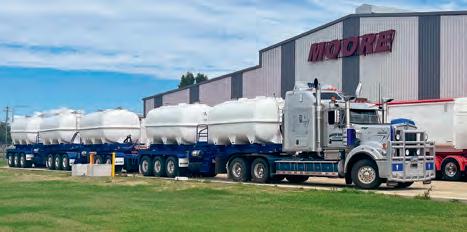
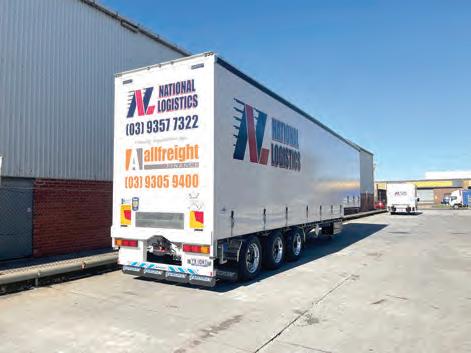
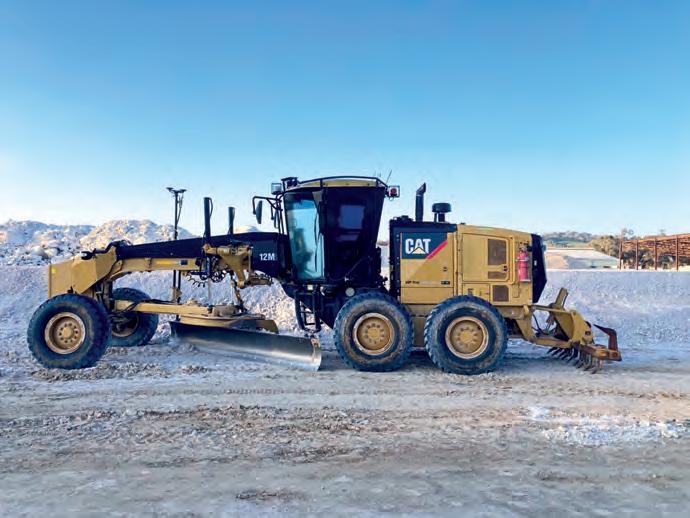
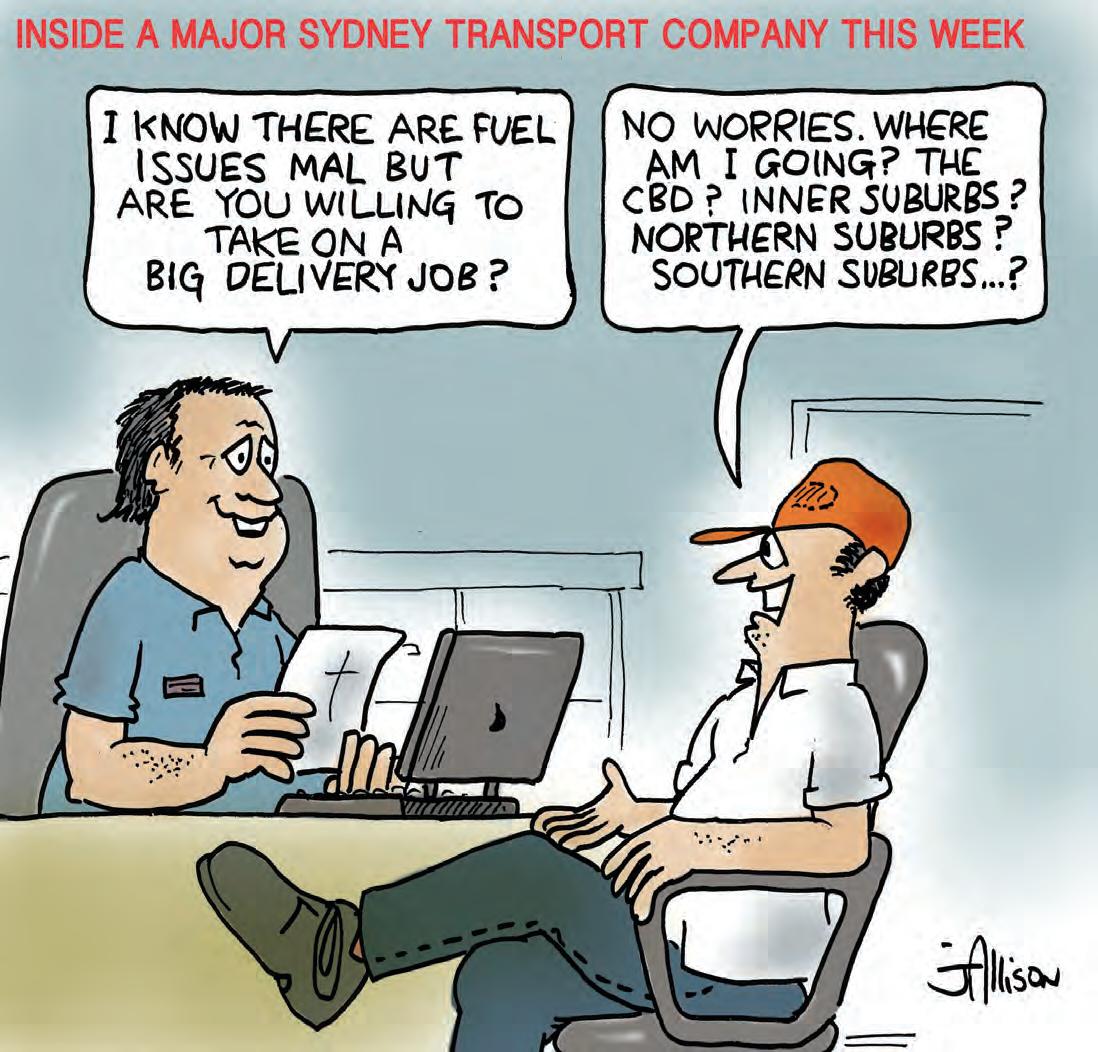
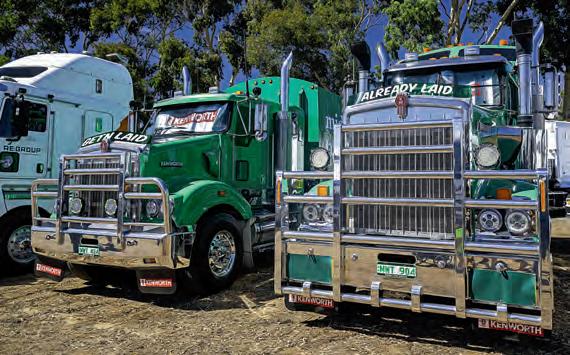
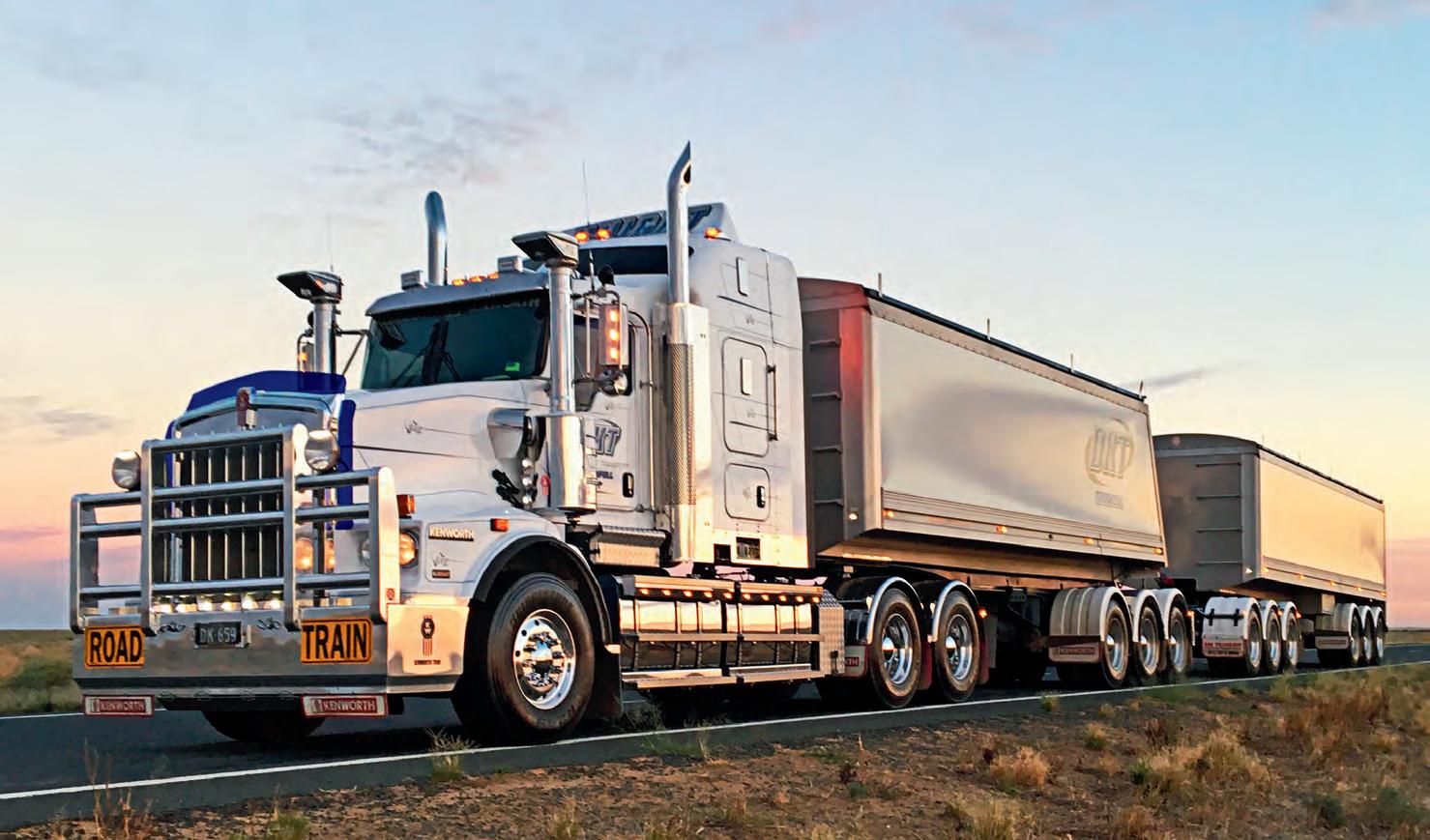
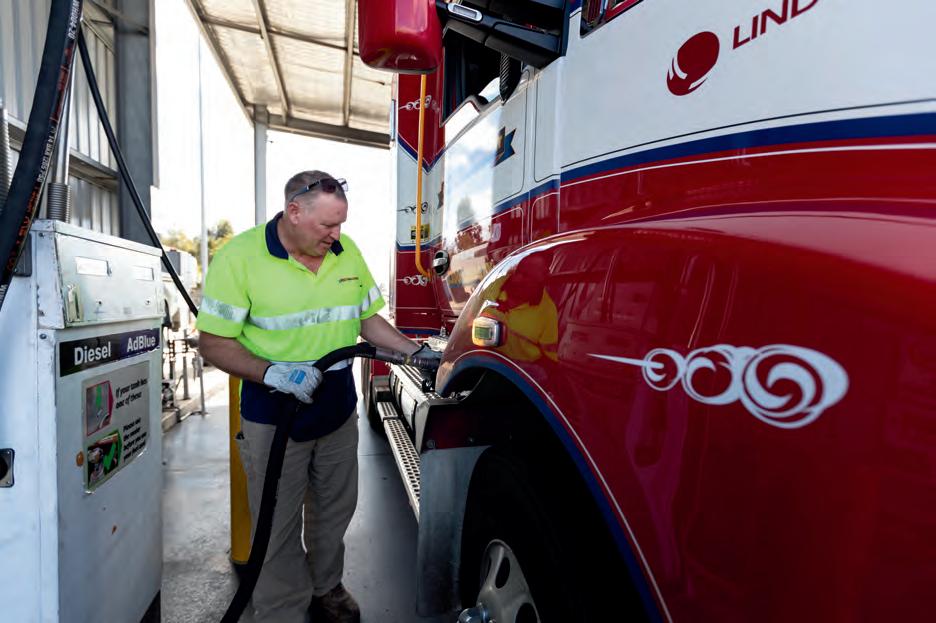
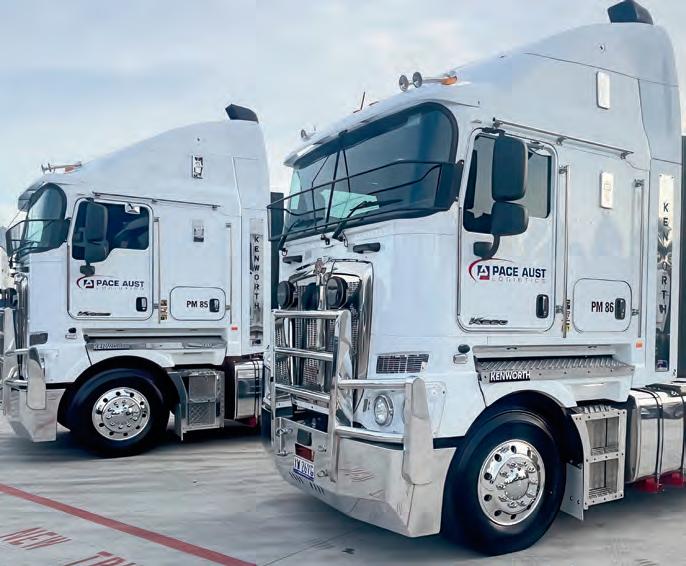
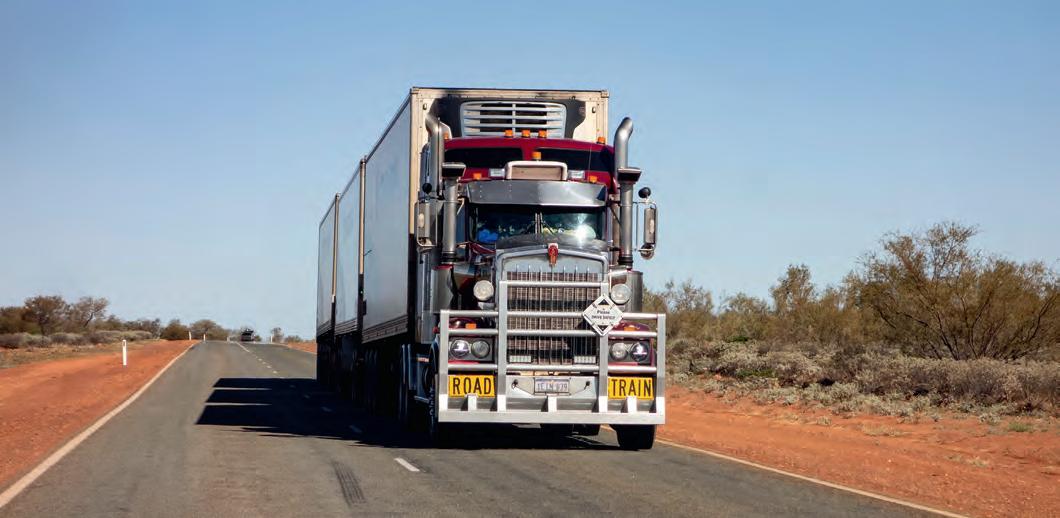
James Gilbert, through Darling Downs Haulage, is looking to offer a service with a difference in various transport avenues around Australia
20 MAGNIFICENT MUSTER
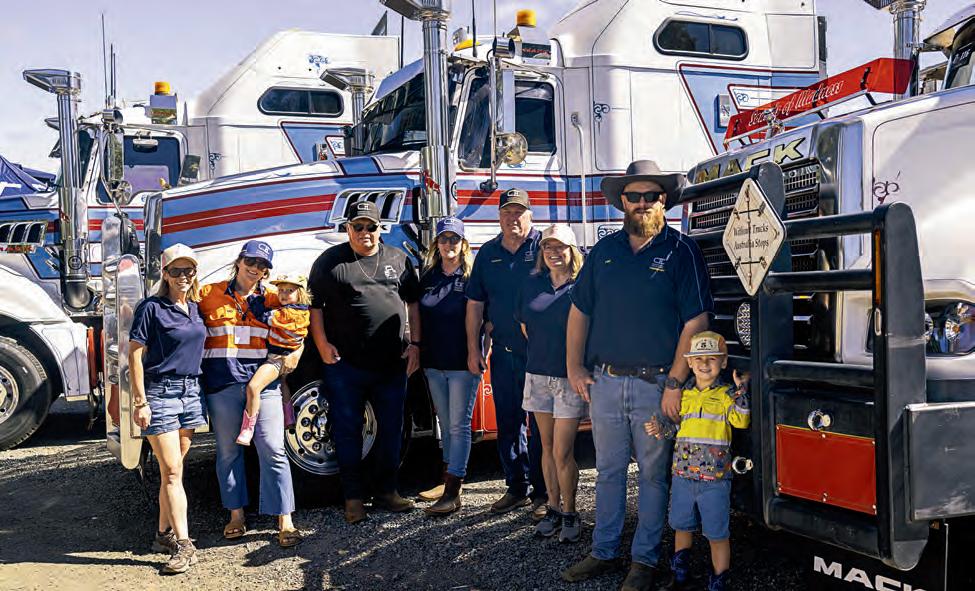
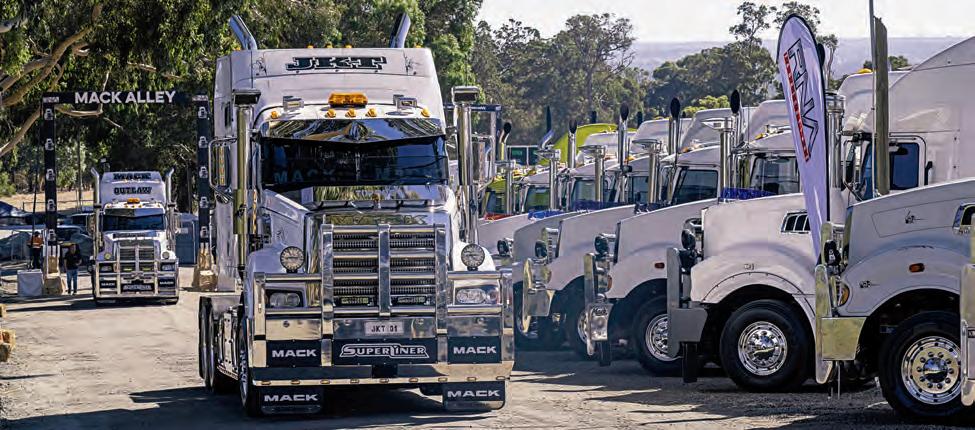
Warren Aitken was left amazed by the latest iteration of Western Australia’s popular Mack Muster and Truck Show
26 CLEAN SWEEP
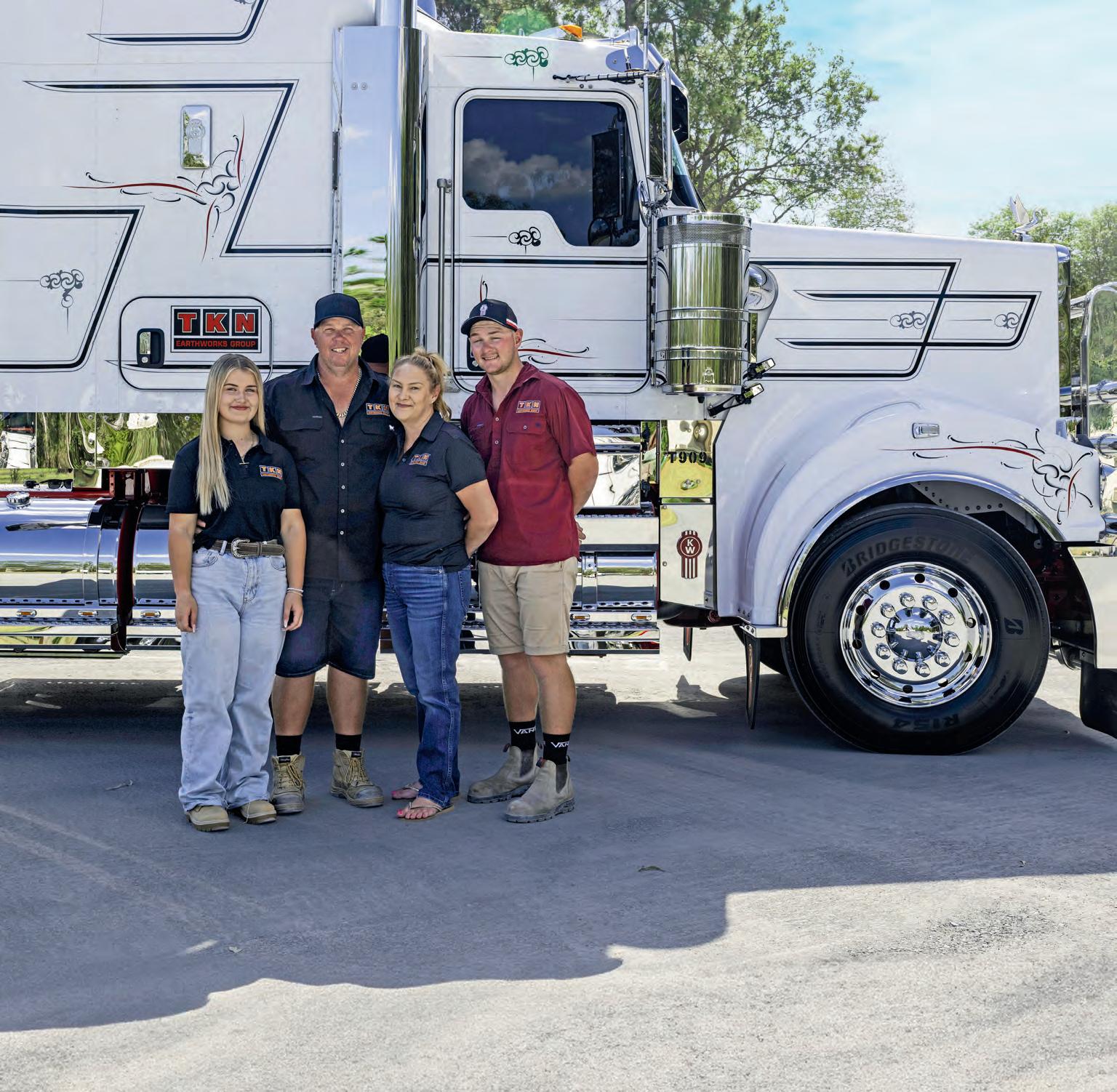
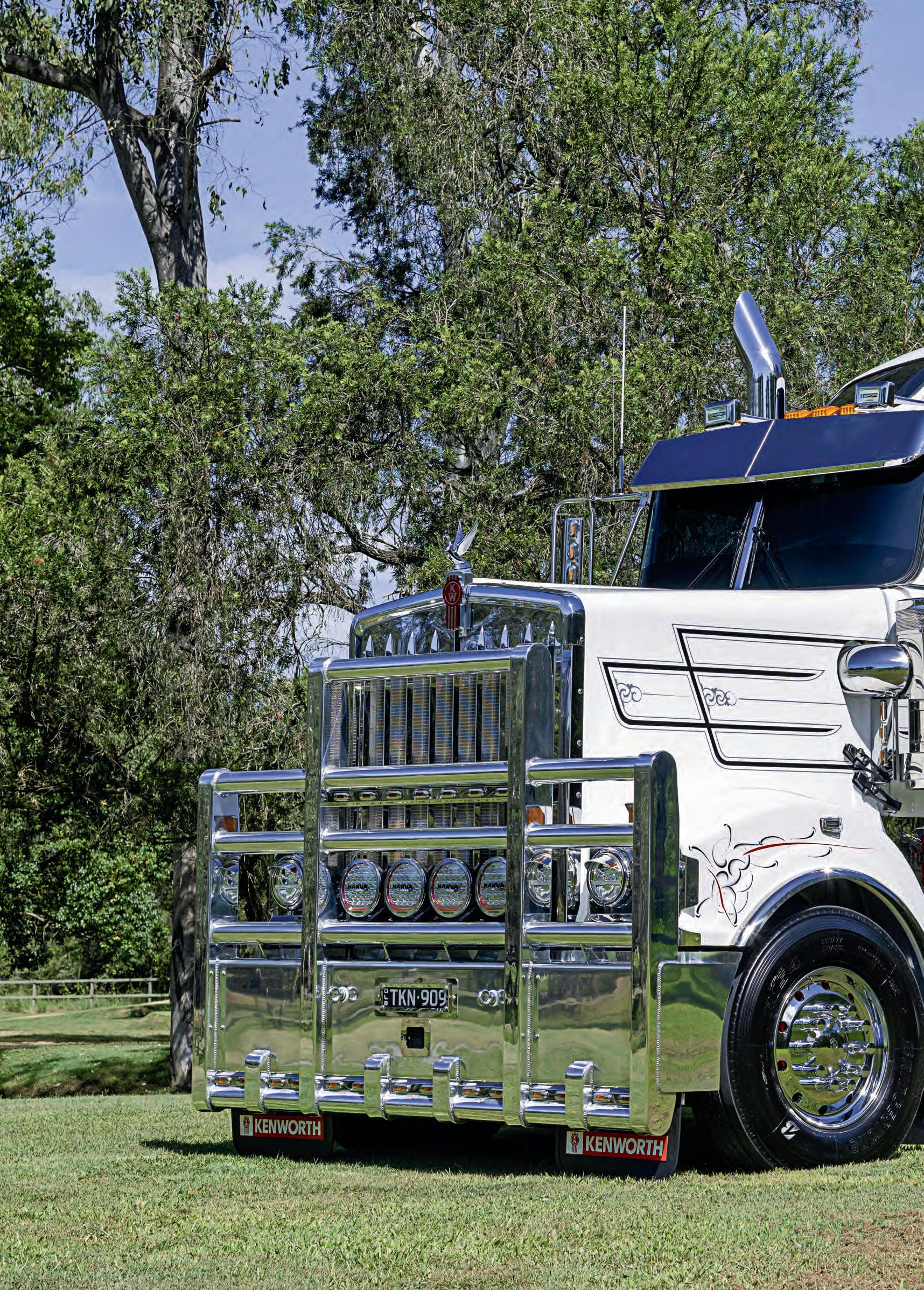
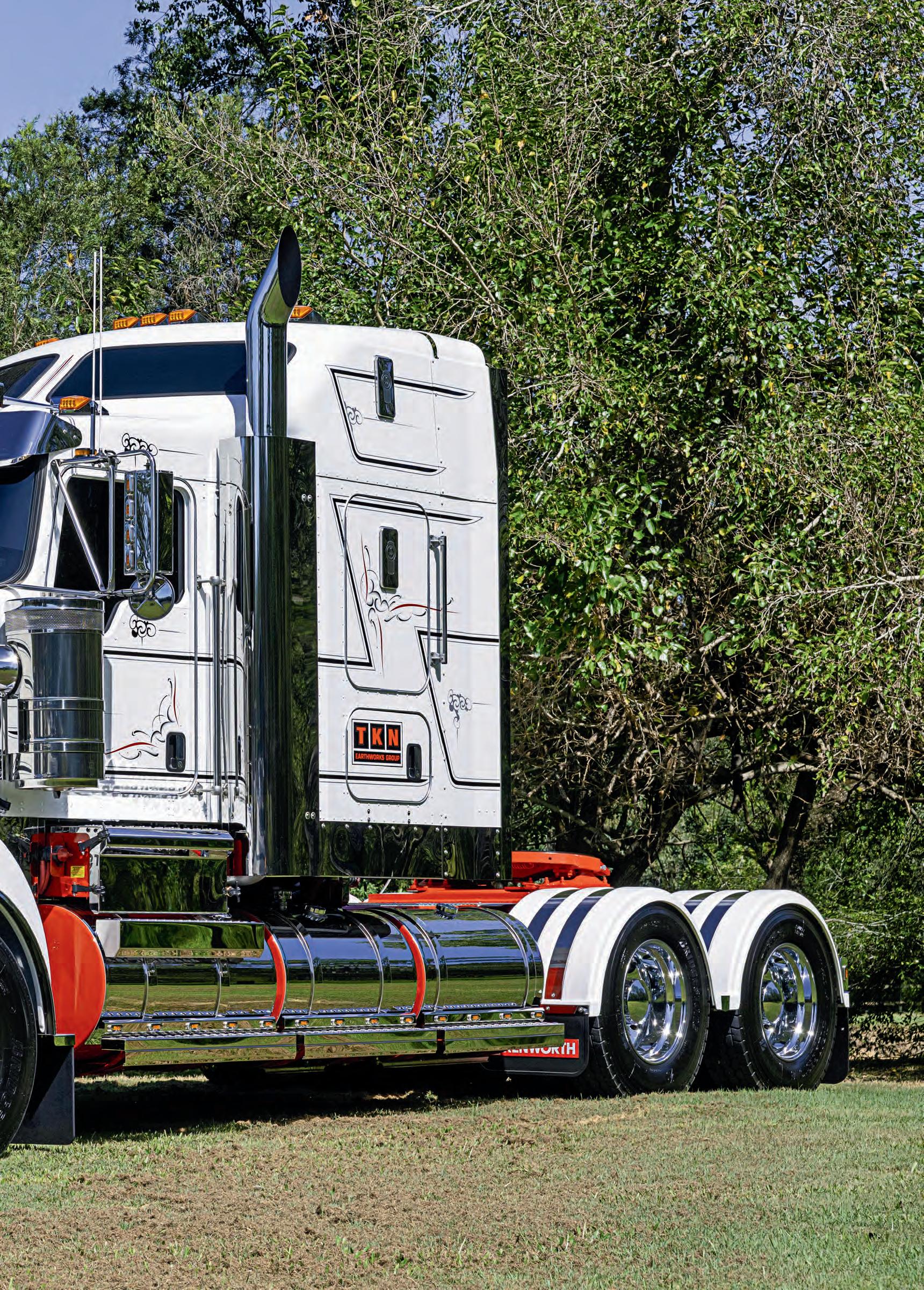
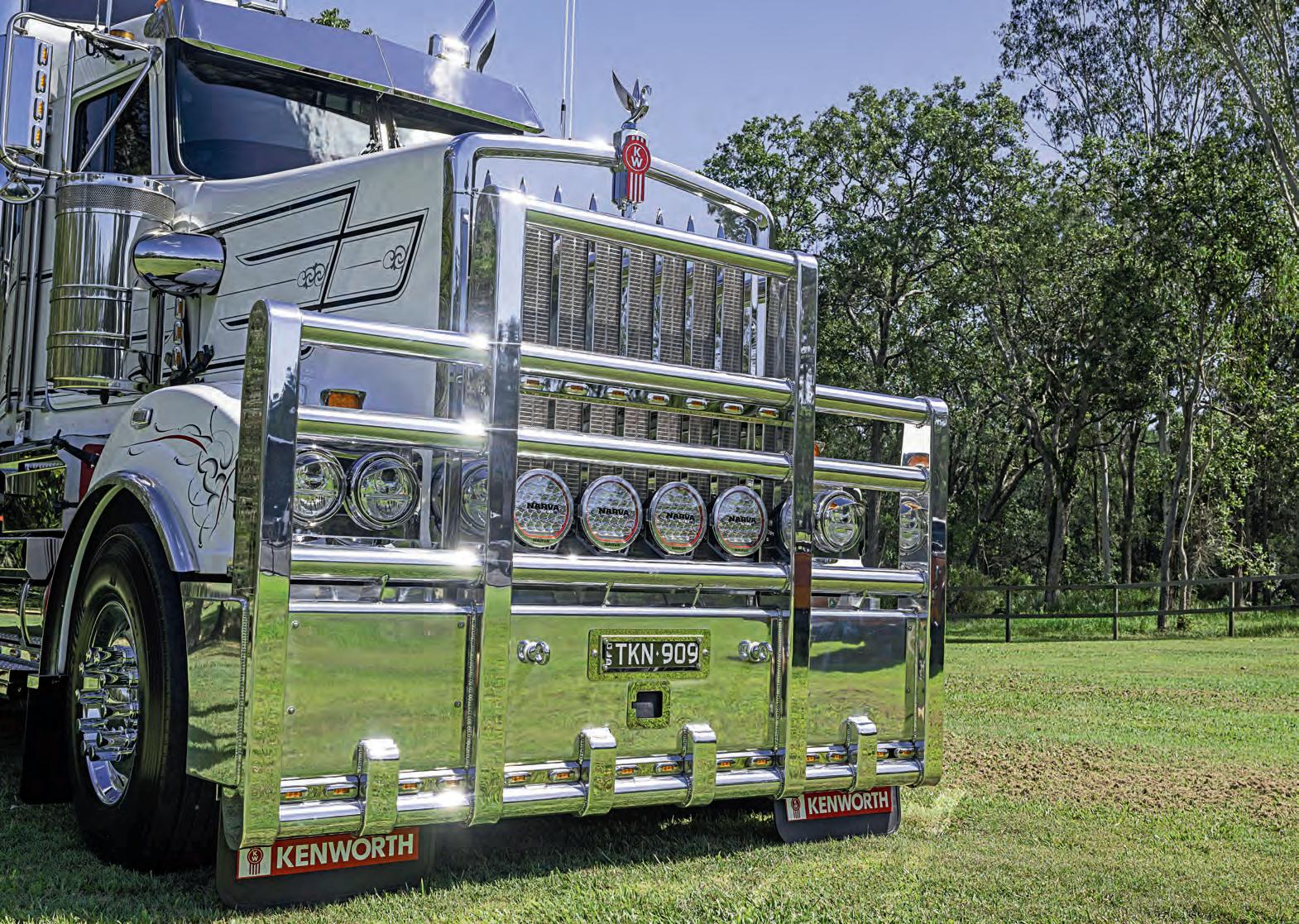
In Queensland’s Tamborine region, TKN Earthworks Group is a contradiction – keeping fleet clean while shifting dirt
36 UNLIKELY EMPIRE
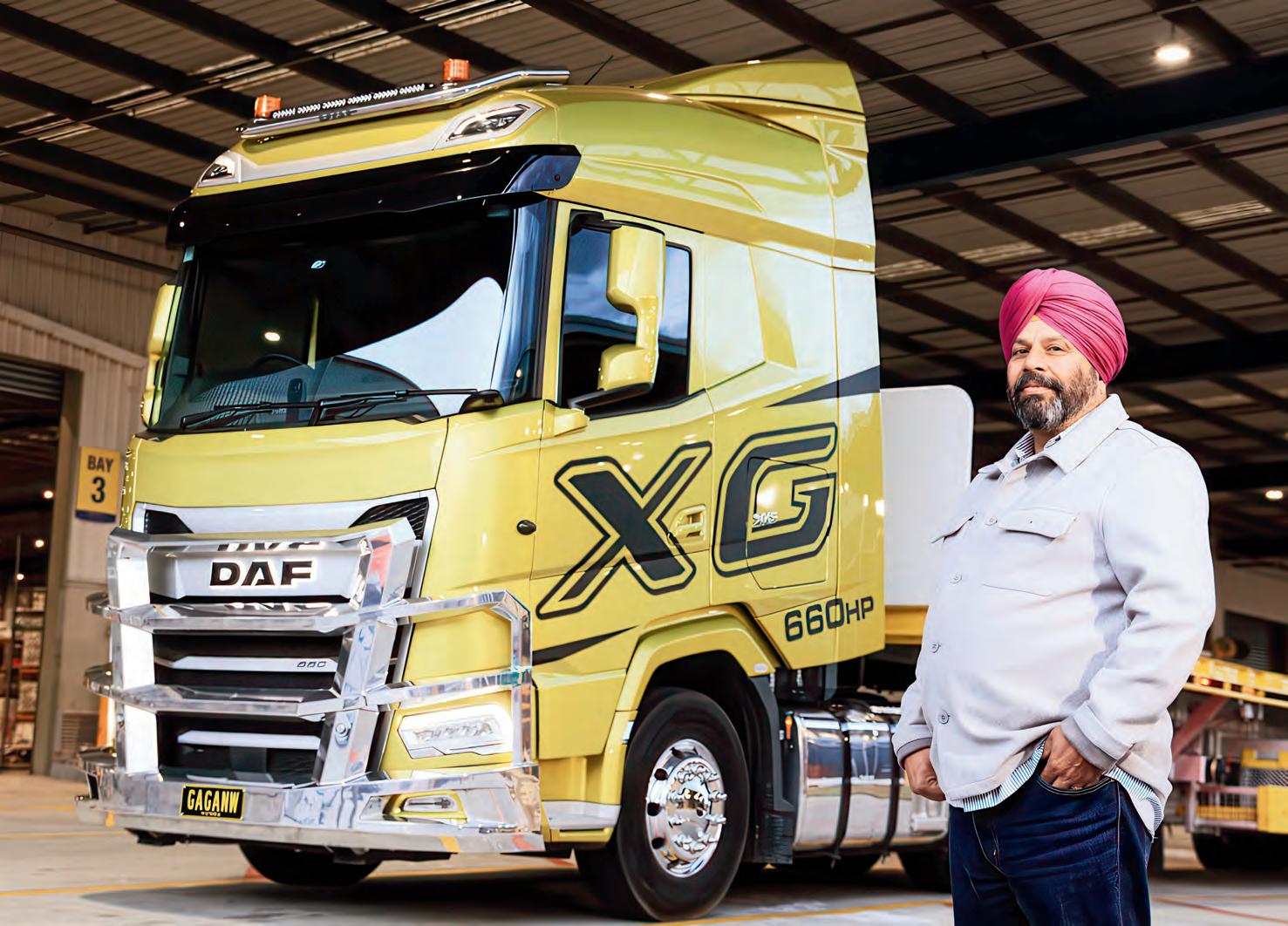
When Hakam Gill decided to start Gagan Warehousing and Transport in Melbourne 20 years ago, he made an incredible leap of faith
38
FUEL SAVINGS FLOW
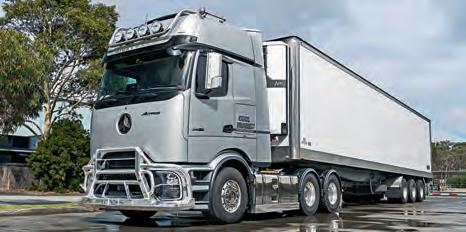
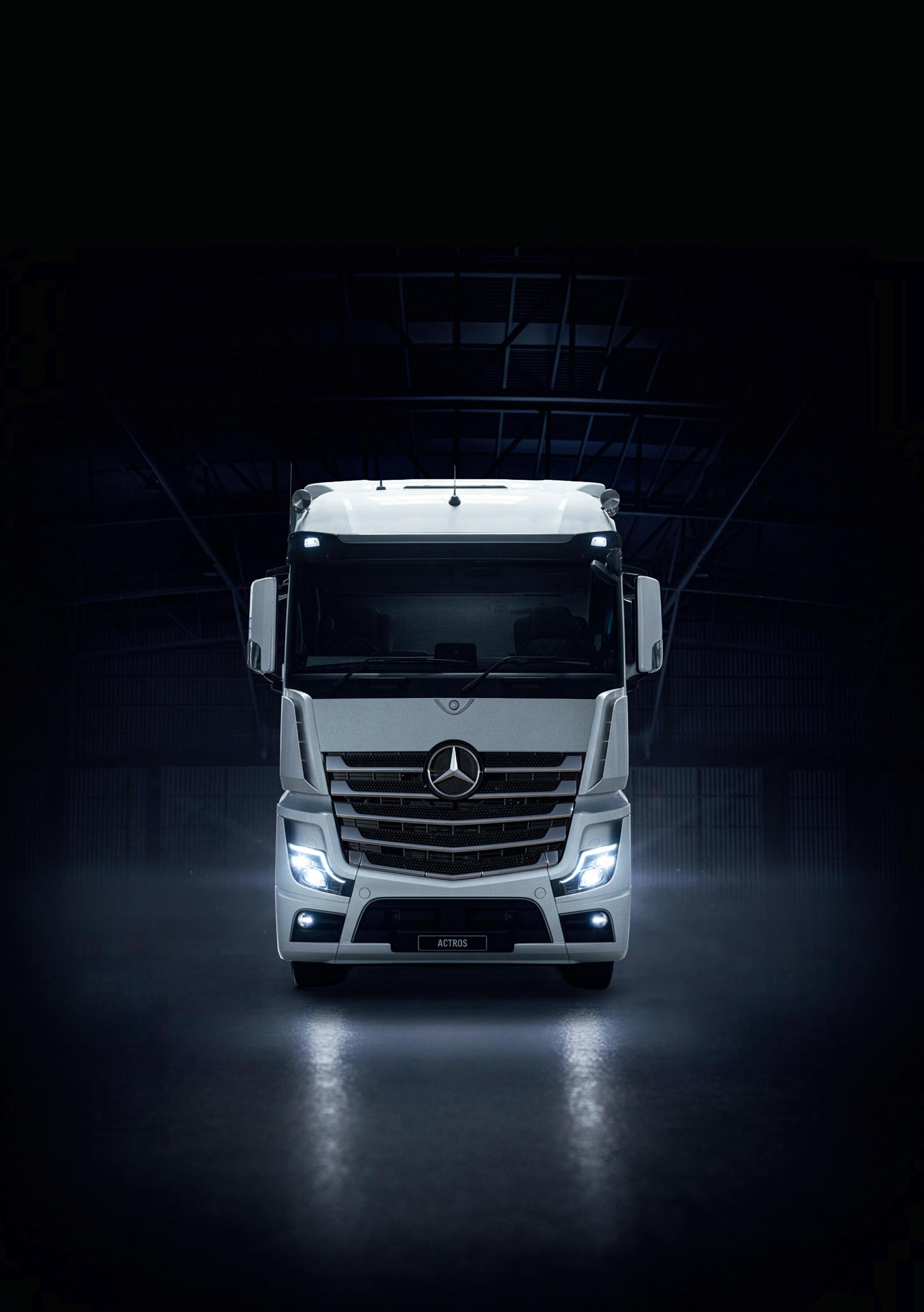
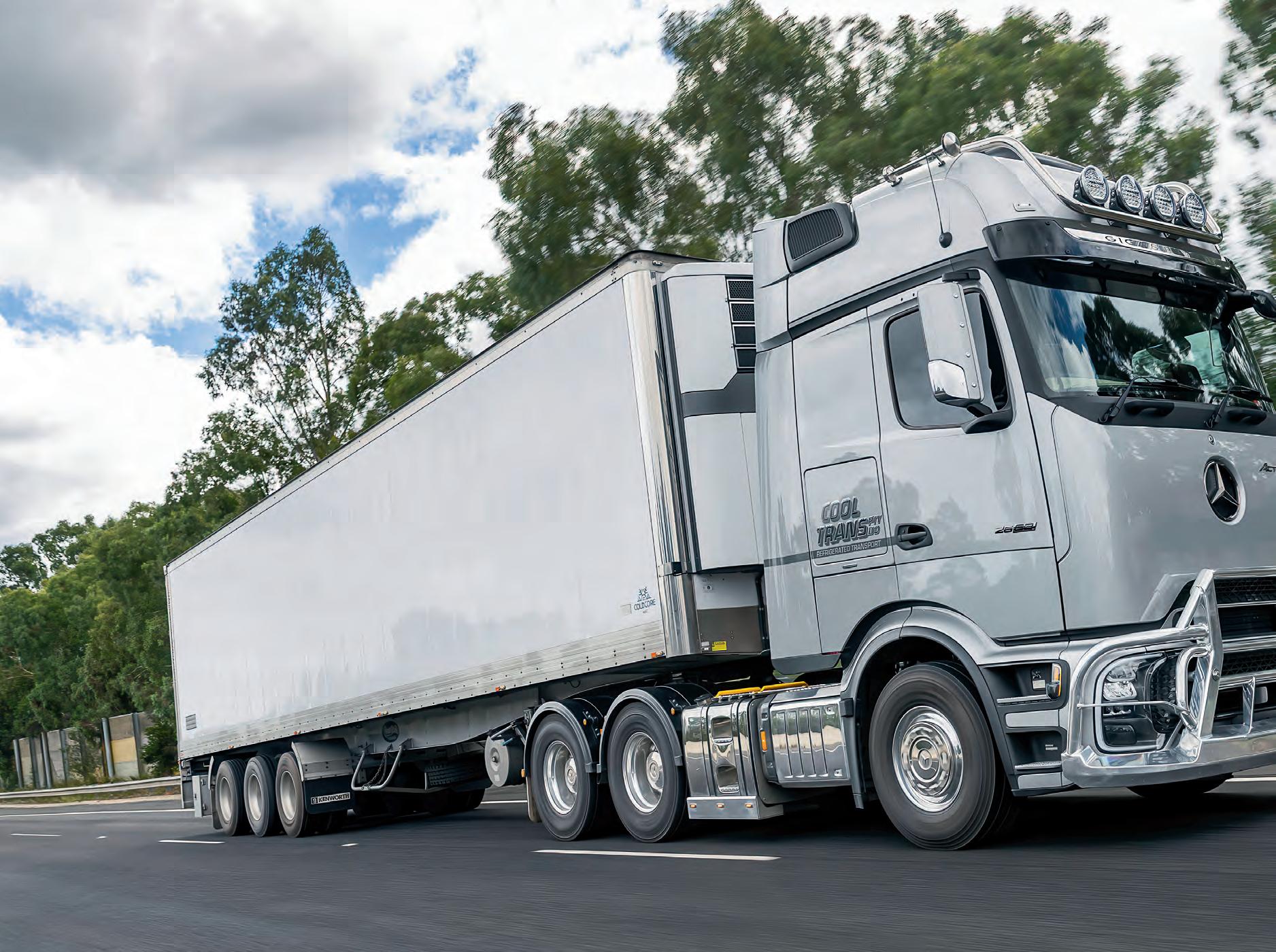
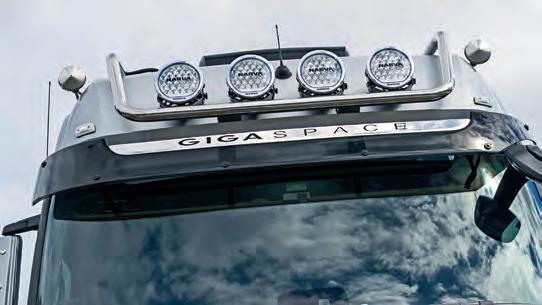
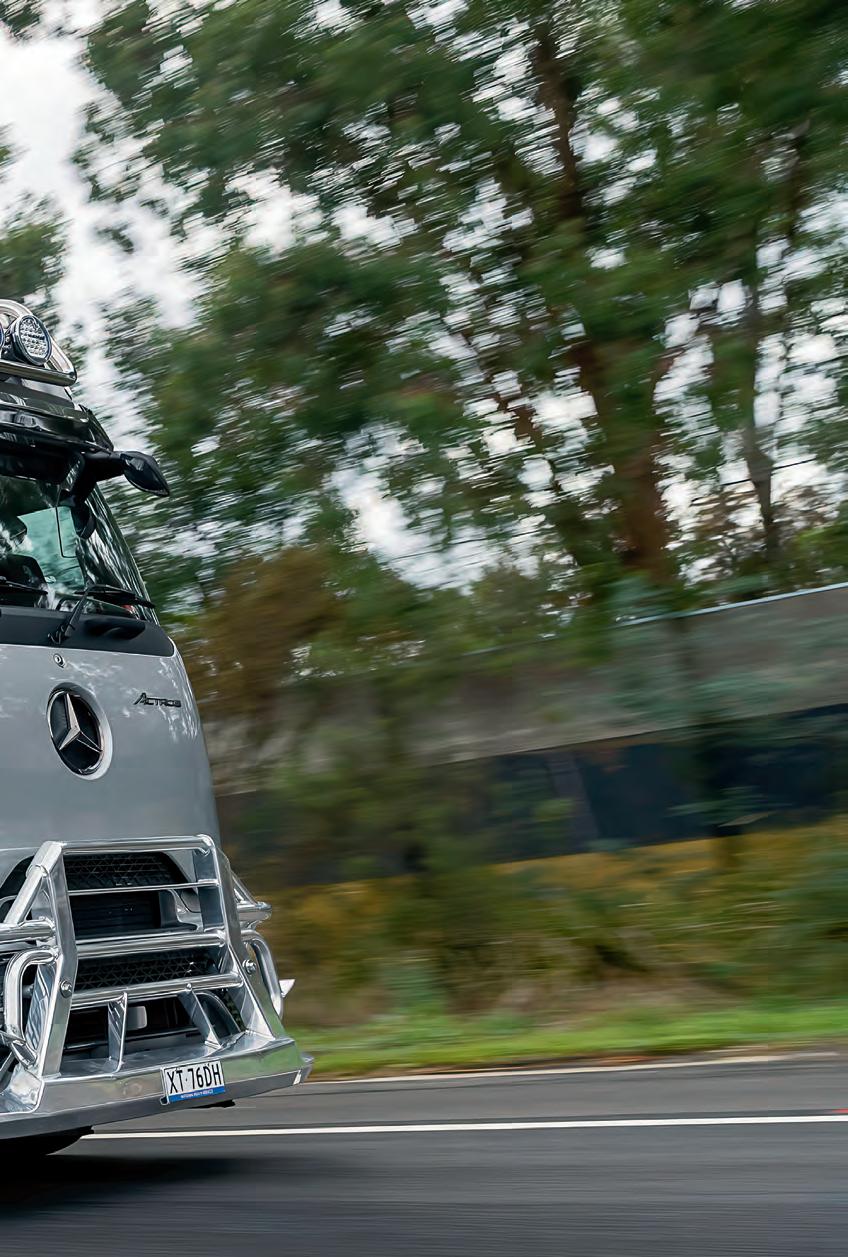
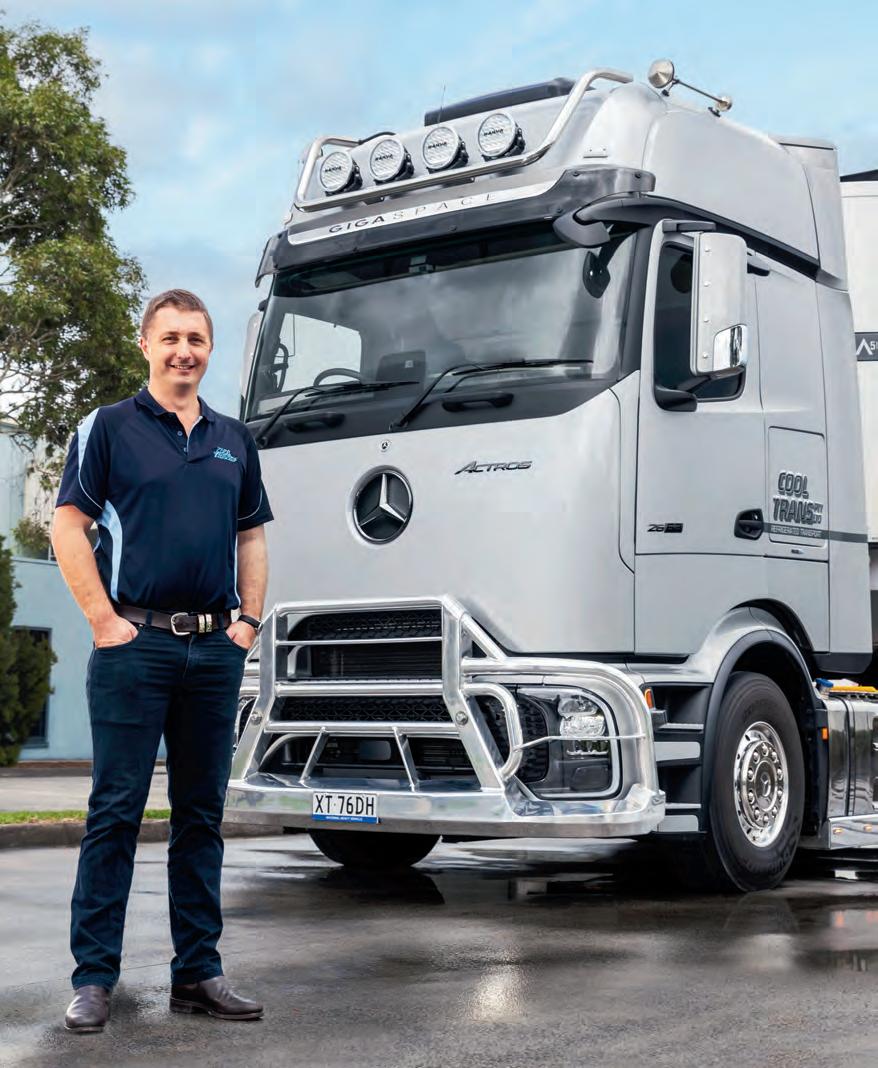
A Melbourne freight company has welcomed Mercedes-Benz’s latest Actros ProCabin to its fleet, with the savings already proving to be evident
40
TRUSTED, RELIABLE, PROVEN
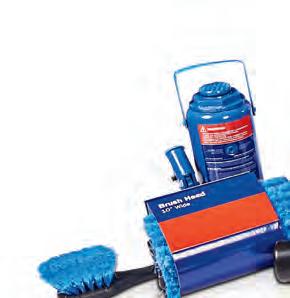
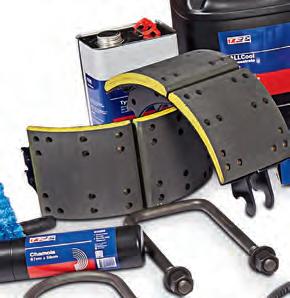
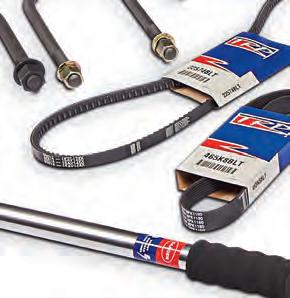
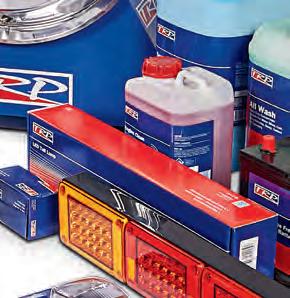
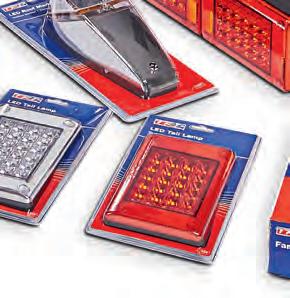
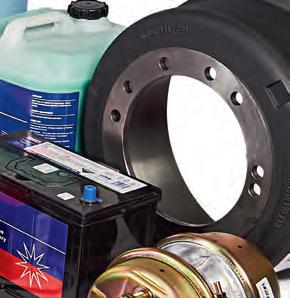
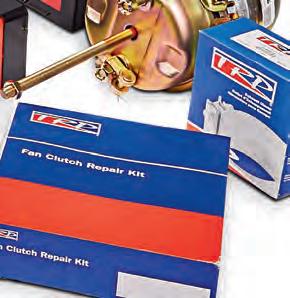
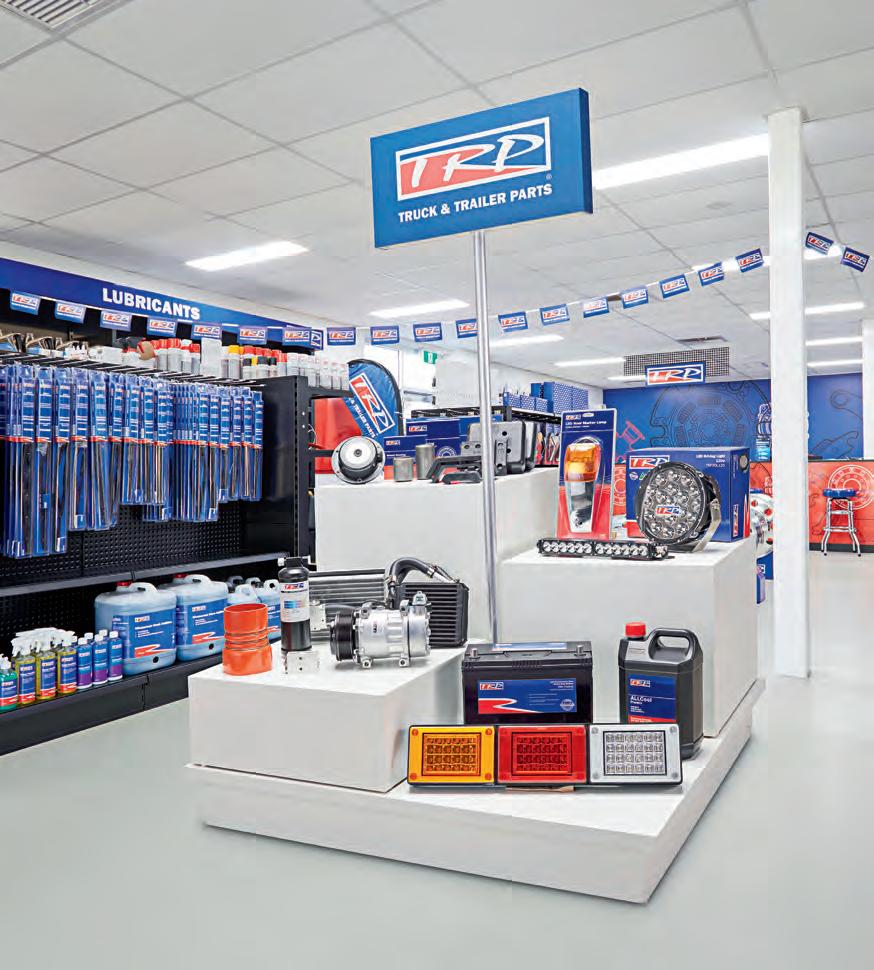
TRP is growing in popularity across Australia and New Zealand for its expanding range of quality, tested products
42
TIMELY UPGRADES
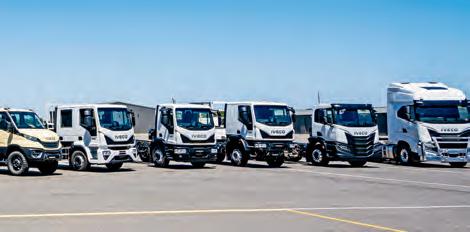
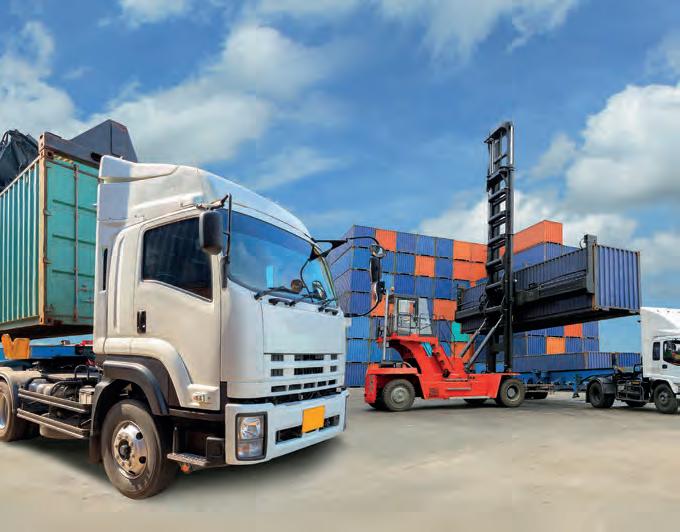
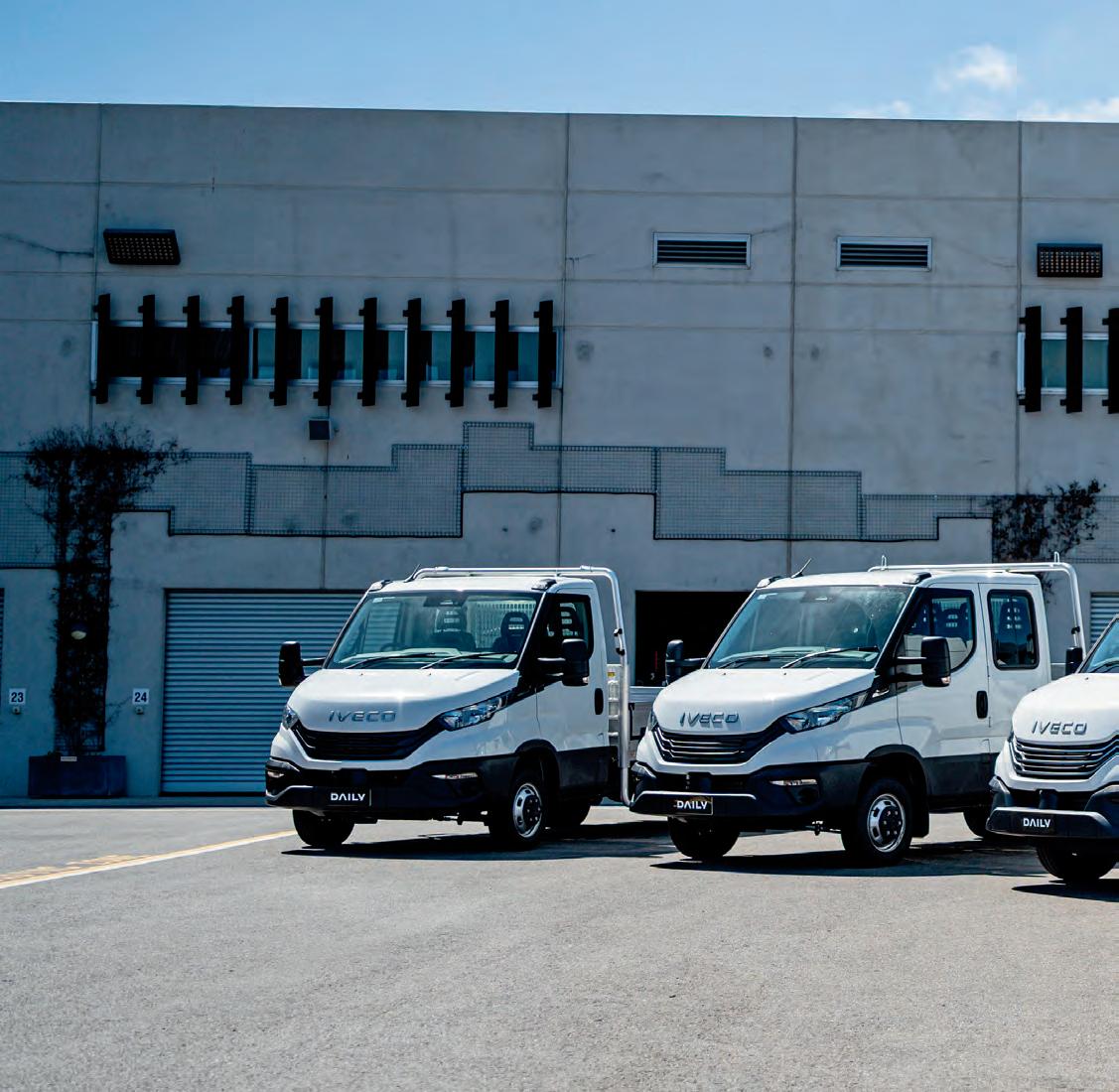
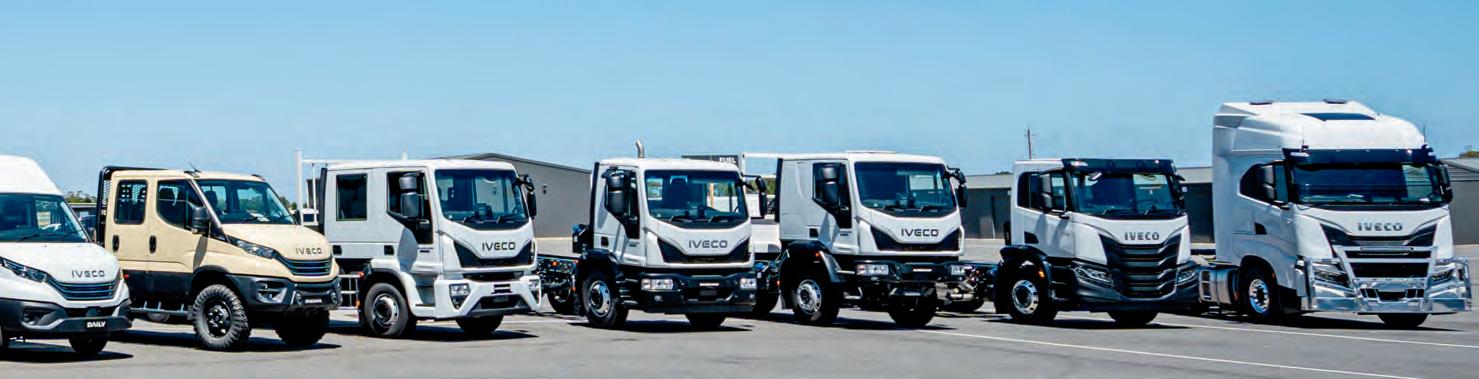
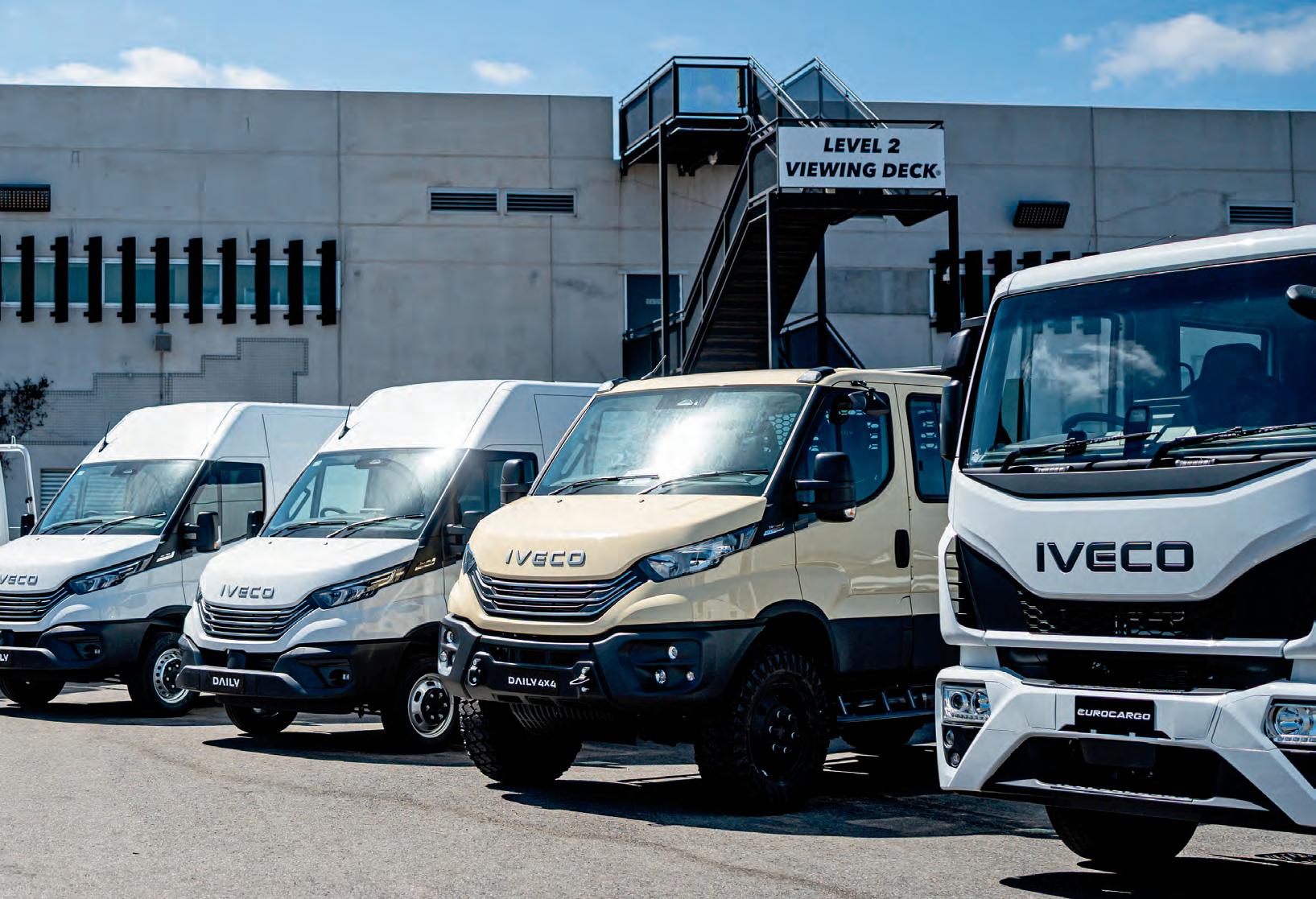
IVECO Australia is continuing its latest product development with the roll-out of an updated truck and van range featuring boosted efficiency and performance
44 MEDIUM DUTY MARVEL
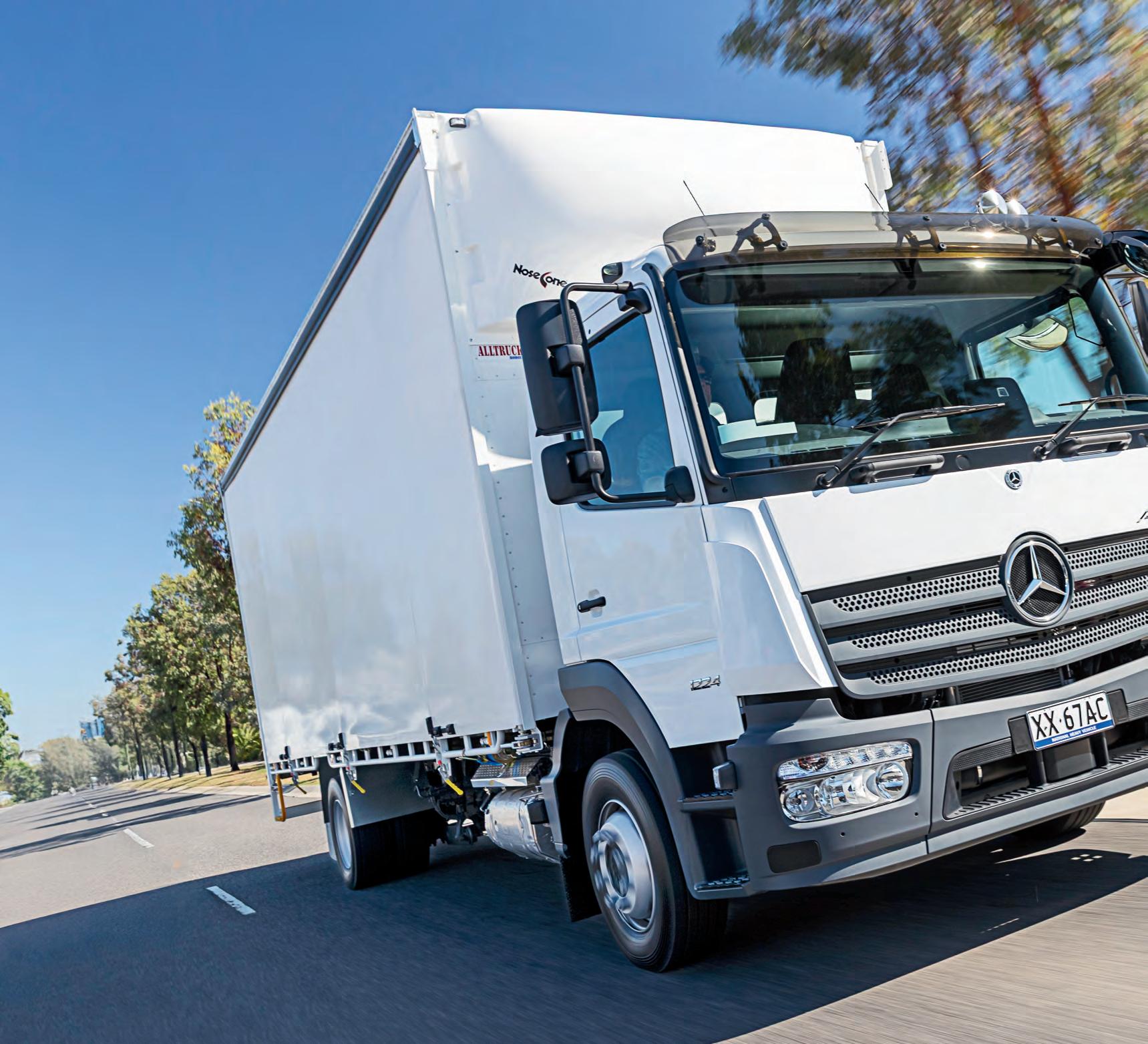
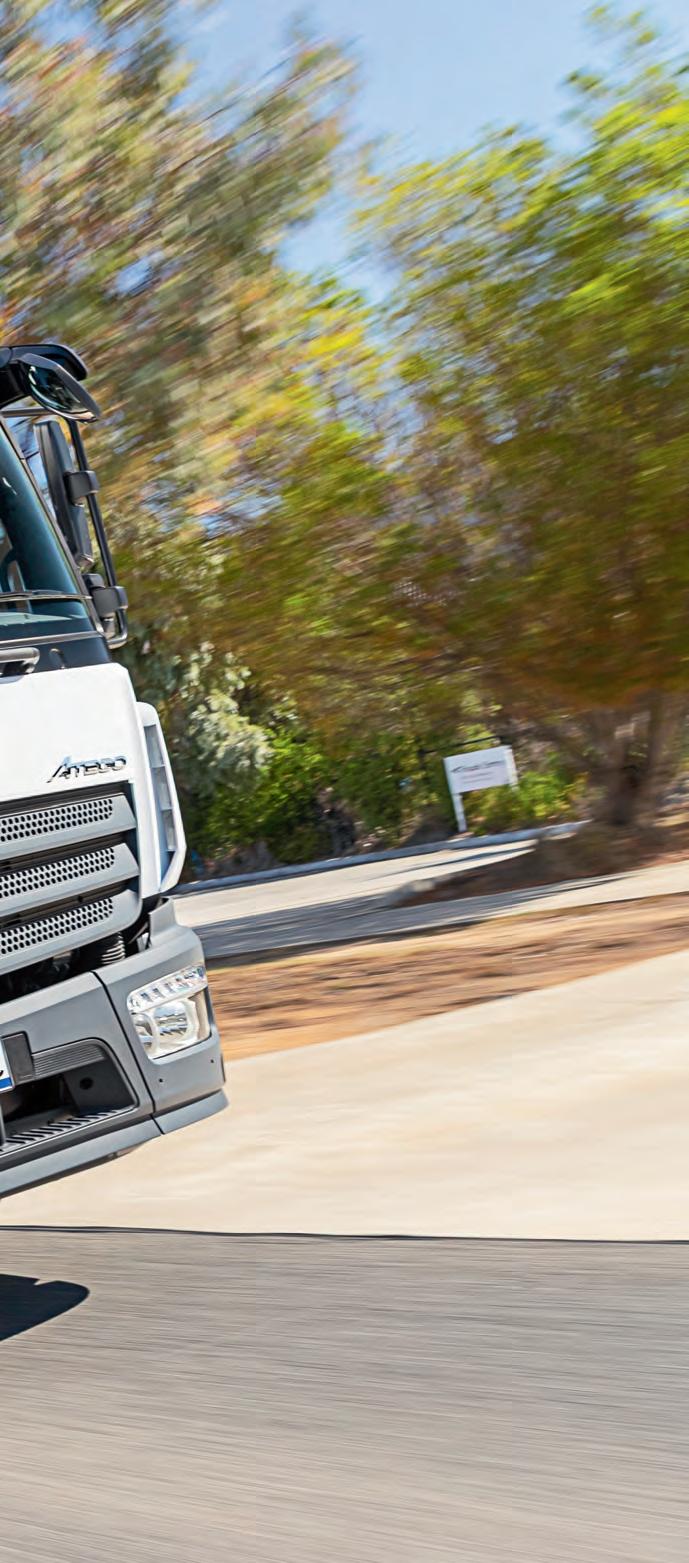
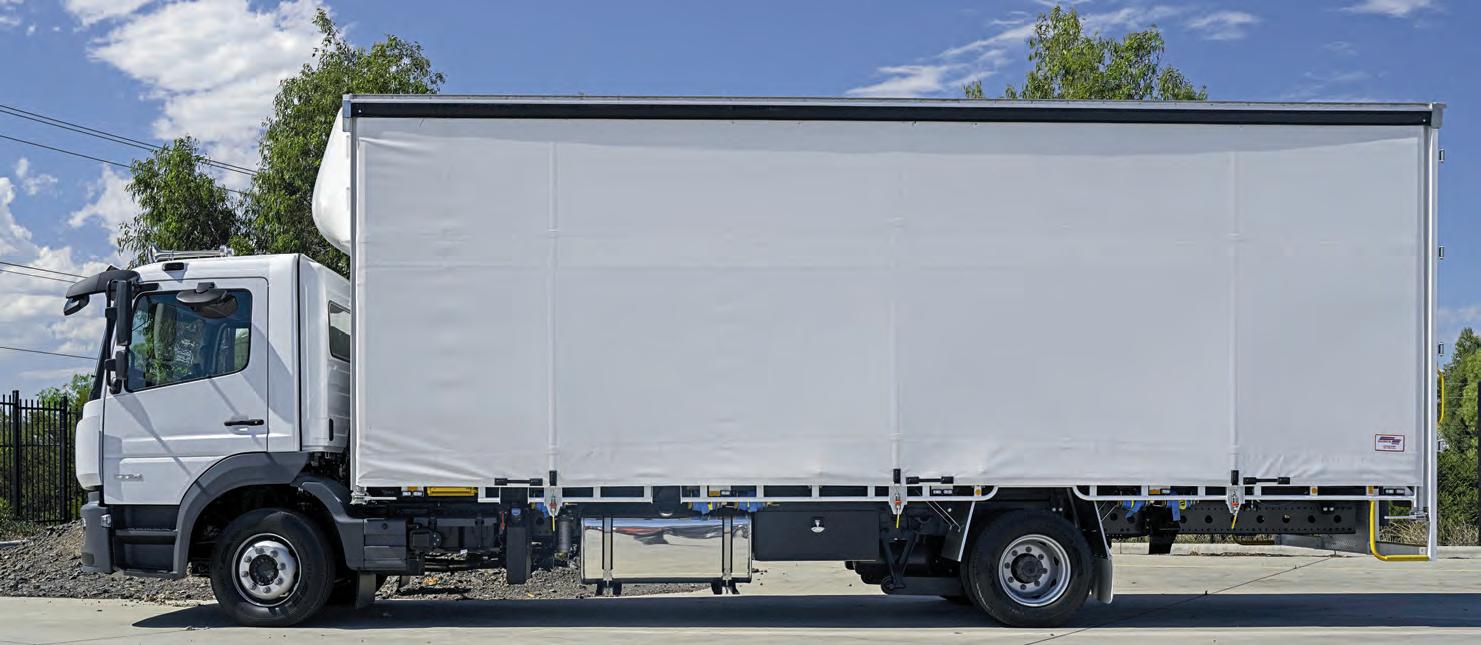
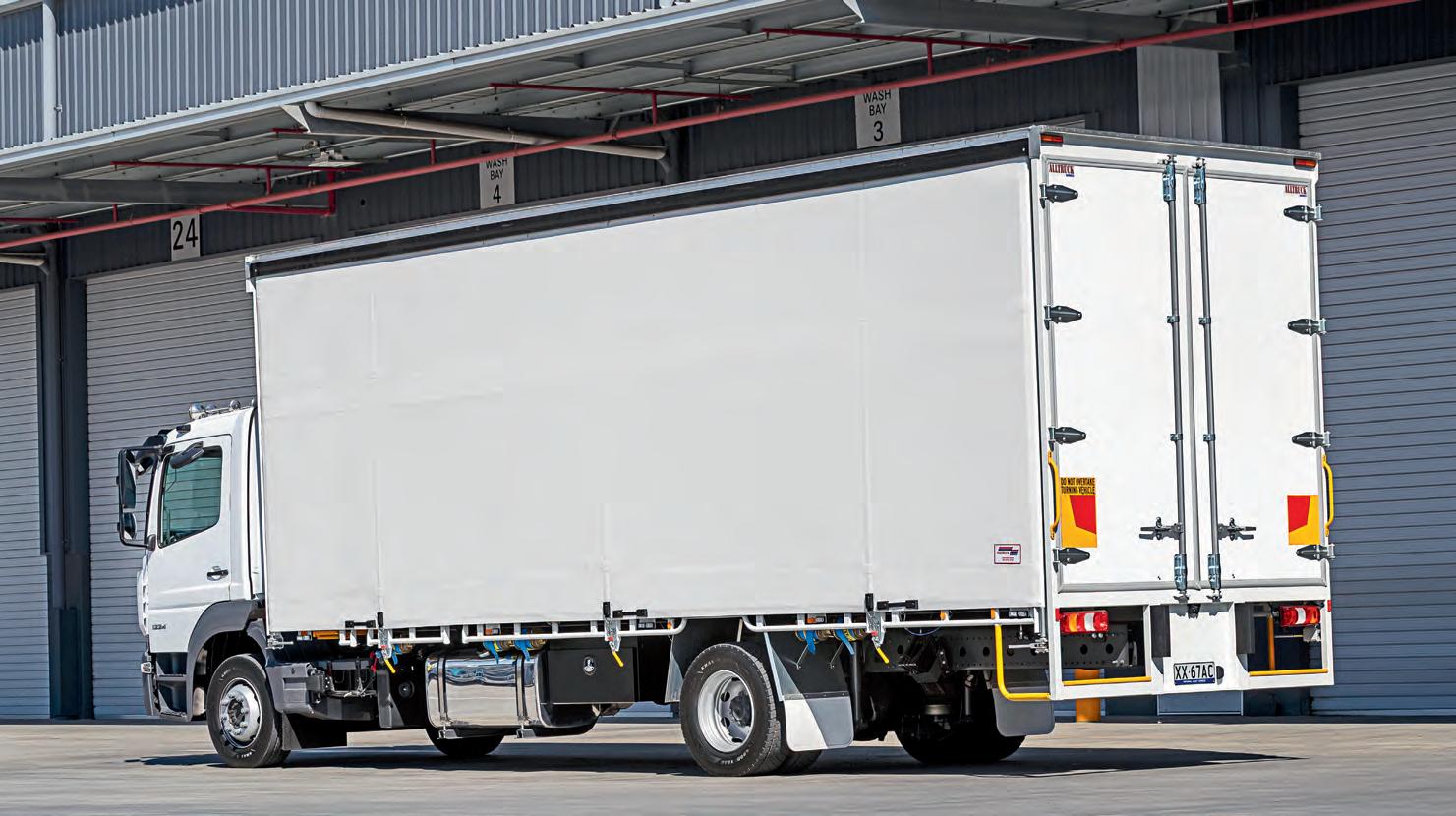
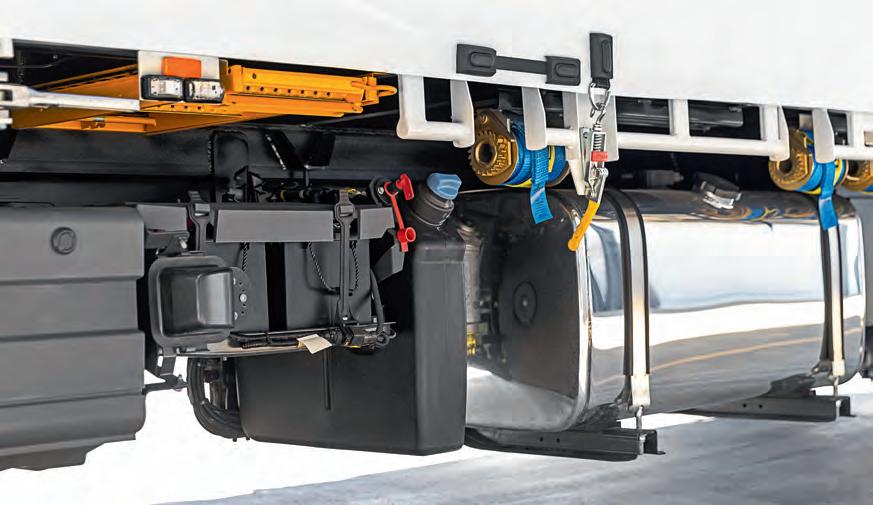
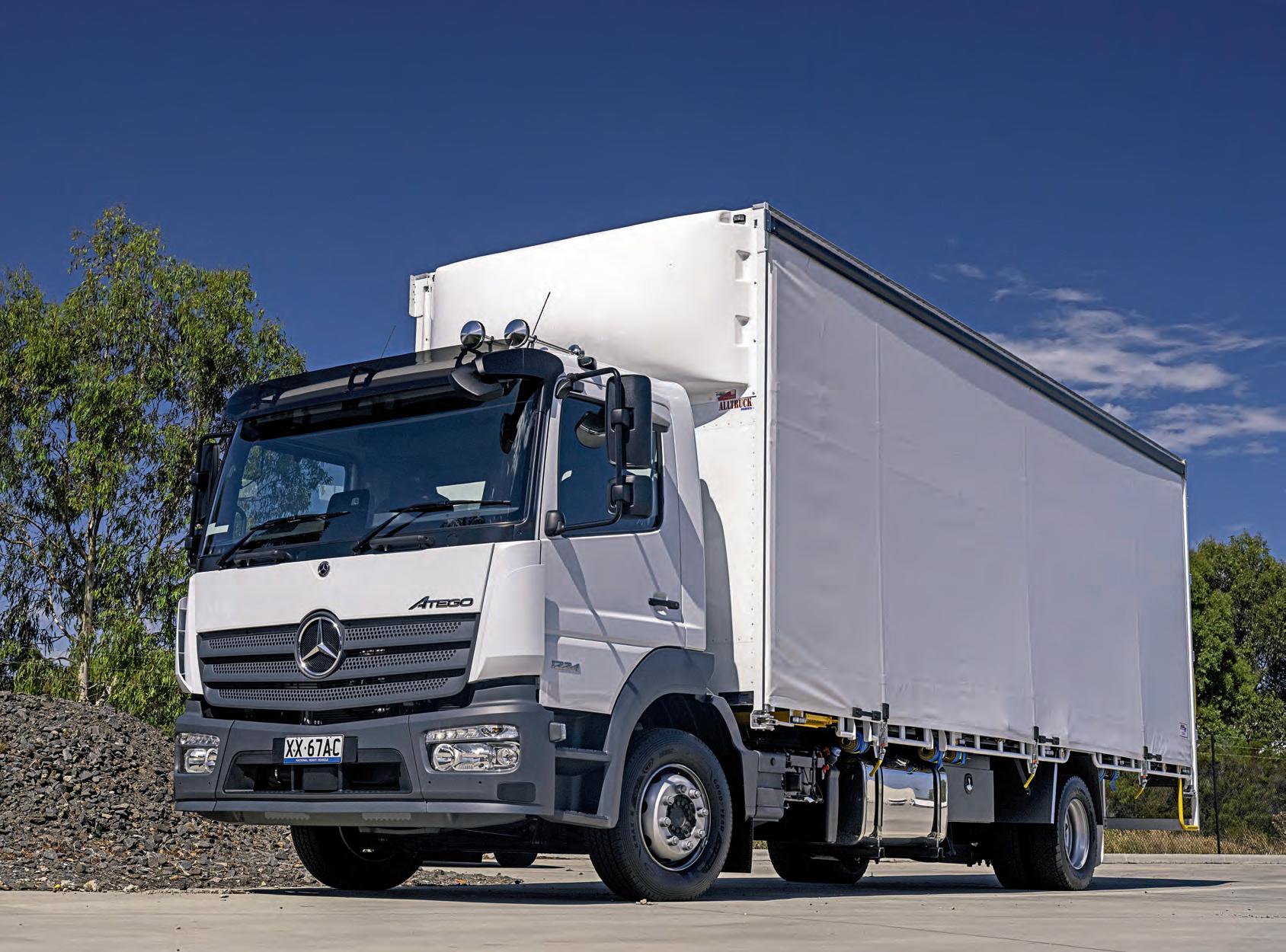
Warren Aitken recently put the new Mercedes-Benz Atego to the test in perfect medium-duty style –by taking it around the tight inner city streets of Melbourne. The end result was a new appreciation for the latest Mercedes-Benz entrant
Part
EDITORIAL
Editor Sean Mortell
E-mail Sean.Mortell@primecreative.com.au
Phone 0468 577 166
Contributors Warren Aitken, Frank Black, Sarah Marinovic, Rod Hannifey, Simon Smith
Cartoonist John Allison
PRODUCTION
Art Director Bea Barthelson
Print IVE Print
ADVERTISING
Business Development Manager
Tosan Popo
Phone 0481 260 352
E-mail Tosan.Popo@primecreative.com.au
SUBSCRIPTIONS
www.ownerdriver.com.au/subscribe
Phone +61 (0)3 9690 8766
Mon-Fri 8am-4.30pm (EST)
Email subscriptions@primecreative.com.au
Mail 379 Docklands Drive, Docklands, VIC 3008 Australia
EXECUTIVE GROUP
Chairman John Murphy
CEO Christine Clancy
Publisher Sarah Baker
Operations Manager Regina Fellner
Sales Manager – South Danny Hernandez
BEHIND THE WHEEL Sean Mortell
Correcting the course
As solutions begin to emerge for the fuel price issue, OwnerDriver’s June edition captures an industry that’s starting to pick up the pieces and move forward
Amonth ago it was a bittersweet moment for OwnerDriver. As the publication celebrated our 400th edition, the industry was in the grips of a fuel price crisis. Fast forward a month and the sector is nowhere near recovered from the ongoing impacts of the fuel issues, but there are signs present that the industry is once again starting to put together the pieces in the wake of the storm.
As this latest edition of OwnerDriver headed off to the printers, the federal government had announced an extra 50 million tonnes of diesel was en route to the country to help bolster the nation’s truck fleets. At the same time, an additional two shipments totalling 100 million litres of jet fuel were also convened and shipped over to Australia in an overall boost for transport in the country.
“My government is working day and night, here and abroad, to shield Australians from the worst of the impacts of a war on the other side of the world,” Prime Minister Anthony Albanese said.
“We have now secured more than 450 million litres of additional diesel and 100 million litres of additional jet fuel to keep Australia moving.
“In the face of global instability, we are leaving no stone unturned as we work to keep Australia moving, working and flying.”
But securing additional fuel isn’t the sole way the industry is working to correct the fuel price issue. From a regulation perspective, the National Heavy Vehicle Regulator (NHVR) announced at the start of May that it is developing a national notice to fast-track increased mass limits for heavy vehicle across the country.
The NHVR’s notice would effectively raise General Mass Limits (GML) to align with current Concessional Mass Limits (CML). The notice will provide operators with greater flexibility and improved productivity across the road network by making CML weights the new standard for general access, while maintaining a strong focus on safety
“We have now secured more than 450 million litres of additional diesel and 100 million litres of additional jet fuel to keep Australia moving. In the face of global instability, we are leaving no stone unturned as we work to keep Australia moving, working and flying.”
and protecting infrastructure.
NHVR director of service delivery Steven Miller says the initiative responds to ongoing pressures being experienced across the heavy vehicle industry.
“We recognise the challenges currently being experienced across industry and are committed to delivering solutions that improve access while maintaining safety,” Miller says.
“The new notice is being developed by the NHVR, in close collaboration with state road agencies and local government, with everyone working together to arrive at an outcome that benefits the entire supply chain.
“Planning is underway for the notice to be available in May pending road manager consent, and the NHVR is committed to keeping industry informed as development progresses.”
As these solutions begin to gain pace, this edition of OwnerDriver follows a similar trajectory in covering the latest vehicle reviews, event news and industry features that this publication is renowned for. It’s no surprise that Warren Aitken was once again busy this month, heading out west for the Mack Muster. His review of the day, as can be read from page 20, captures the optimistic atmosphere from the event, which is continuing to go from strength to strength.
Alongside another superb Truck of the Month – head to page 26 – Warren also had time to put Daimler Truck’s latest Atego offering to the test. Flick through to page 44 to see what Warren thinks of the European brand’s latest truck technology.
Whether it be these leading features, our usual array of columns and vehicle technology articles or the latest news, you don’t want to miss out on this jam-packed edition of OwnerDriver. We hope you enjoy the read.
www.nhvr.gov.au/whatsyour20
What’s new on the roads The Goods NEWS FROM THE HIGHWAY AND BEYOND
A major road maintenance blitz has been launched in Victoria while extra safety cameras will be installed out west and a notorious Queensland freight route receives more love
Potholes and certain freeways across Victoria will be targeted by state Budget funding in a major move for the state’s drivers. Out west, the state’s fixed safety camera network will be bolstered by new investments and in Queensland the Bruce Highway is continuing to receive upgrades in the far north.
VICTORIA UNVEILS ROAD MAINTENANCE BLITZ
The Victorian government has announced a record $1 billion investment into upgrading roads, targeting potholes and graffiti to make roads safer as part of its pre-Budget commitments.
Before the Budget was unveiled in early May, the government revealed it will invest a record $1.04 billion to rebuild, repair and resurface roads across the state.
This will include removing 200,000 potholes, 200,000 graffiti tags and more as part of one of the biggest roads blitzes in Victoria’s history.
The state government says 70 per cent of funds will go to regional Victoria, repairing arterial roads, maintaining bridges and delivering emergency roadworks.
“This is the biggest roads blitz in the state’s history, and most of that money is going to regional Victoria,” Victorian Premier Jacinta Allan says.
“We’re delivering better, safer roads – and with 20 per cent off rego, it’s cheaper to get around.”
As part of the funding, $36.9 million will clean up 10 of the state’s busiest freeways with rubbish and graffiti removal, including on the West Gate, Hume, Calder and Monash freeways.
This follows the state’s recent road maintenance focus, with 187,000 potholes being repaired over the past year and 31,000 signs being repaired.
This takes the state government’s road maintenance investment to nearly $3 billion over the past three years in what it labels the “largest sustained investment in road maintenance” in Victoria’s history.
WA BOLSTERS FIXED SAFETY CAMERA NETWORK
The Western Australian government has announced a major new funding package to save lives on the state’s roads, including money for road infrastructure and enforcement.
The $339.9 million road safety investment, funded through the Road Trauma Trust Account, will support
both new and expanded infrastructure projects as well as enforcement.
Out of the funding, $22.2 million will go towards enforcement initiatives, including $13 million for camera operations and $9.2 million for targeted WA Police operations.
As part of the WA government’s commitment to saving lives and changing driver behaviour, new fixed safety cameras capable of detecting seatbelt, mobile phone and speeding offences have been installed on the Mitchell Freeway at Vincent Street.
A six-month education and awareness period for these fixed cameras on the Mitchell Freeway starts on June 1, with drivers receiving caution notices for seatbelt and mobile phone offences only, before infringements are issued from December 1.
Since these safety cameras on the Kwinana Freeway were rolled out in February 2025, alongside safety camera trailers operating state-wide, the state government says the rate of seatbelt and mobile phone offences has dropped by about 80 per cent.
As part of the infrastructure spend, $41.6 million will go towards delivering the first stage of upgrades to the Great Northern Highway between Fitzroy and Gogo.
“This massive investment is all about saving lives on WA roads. Our government has a strong track record of delivering safer roads across Western Australia, upgrading more than 10,000km of regional roads since 2020,” WA treasurer and transport minister Rita Saffioti says.
“Every dollar collected through safety camera infringements is invested into improving road safety, helping reduce road trauma and save lives.”
These measures complement a range of ongoing road safety initiatives underway across the state, including a renewed focus on heavy vehicle compliance with a roll-out of
compliance blitzes across regional WA led by Main Roads.
The announcement builds on the $80 million investment in road safety reforms recently delivered through the Mid-Year Review.
“Road Safety is about making sure every Western Australian gets home safely, no matter where they are travelling across the State,” WA road safety minister Reece Whitby says.
“This is a significant investment that reinforces the WA government’s commitment to increasing road safety and saving lives across Western Australia.
“With $339.9 million being invested from the Road Trauma Trust Account, we are improving roads, supporting new technology and increasing education – exactly as the RTTA is intended for use.”
BRUCE WORKS BEGIN IN FNQ
The Bruce Highway is set to receive more safety upgrades, with 22 kilometres of works beginning in Central Queensland while more upgrades are underway at Tully.
The federal and Queensland governments are continuing with the joint $9 billion safety upgrade package on the popular freight route, with construction underway on a 22-kilometre stretch between Pine Mountain Creek and Deep Creek, north of Marlborough.
The works aim to make the highway safer and more reliable through Central Queensland by widening the highway, improving wet weather resilience and providing a smoother driving experience.
The Bruce Highway Safety Package, announced early last year, is gaining pace, with eight projects completed, 19 underway and another 16 construction projects rolling out from early 2026.
The safety upgrades between Rockhampton and St Lawrence include
road widening, wide centre line treatments, audio tactile line marking, pavement strengthening, targeted intersection upgrades and drainage improvements.
Federal transport minister Catherine King says the project would provide a more reliable Bruce Highway for Queenslanders.
“The Australian government’s investment in the Bruce Highway is focused on improving safety and reliability along this critical route,” King says.
“In partnership with the Queensland government we are undertaking these safety works to reduce accidents and crashes while supporting freight and tourism along the Bruce Highway.”
Queensland transport and main roads minister Brent Mickelberg says the project will make a real difference to Central Queenslanders, providing a more reliable Bruce Highway for Central Queenslanders now and in the future.
“The Crisafulli government is focused on making the Bruce Highway safer and more reliable for Queenslanders,” Mickelberg says.
“The Bruce Highway is the backbone of our state’s transport network, and these upgrades will improve safety and strengthen connections for everyone who travels this stretch.”
At Far North Queensland, construction has started ahead of scheduled on Bruce Highway upgrades between Dean Road and Tully High School.
Early works have been underway since August last year to prepare the site, with main construction now ramping up and the project on track for completion in mid-2027, weather and construction conditions permitting.
The project will deliver an upgrade of the signalised intersection at the Bruce Highway and Dean Road, as well as road and shoulder widening, wide centre line treatment, culvert installations and extensions, and drainage and edge treatments.
Wide centre line treatment will replace the existing narrow road section, providing greater separation between oncoming vehicles and reducing the risk of head-on crashes.
To keep road users and roadwork crews safe, changed traffic conditions will be in place, including temporary speed limit reductions and single-lane operation.
NHVR fast-tracks national mass limits notice
The regulator has revealed it is pushing for a new notice to raise overall mass limits for heavy vehicle combinations
The National Heavy Vehicle Regulator (NHVR) has announced it’s developing a national notice to fast-track increased mass limits for heavy vehicle across the country.
The NHVR’s notice would effectively raise General Mass Limits (GML) to align with current Concessional Mass Limits (CML).
The notice will provide operators with greater flexibility and improved productivity across the road network by making CML weights the new standard for general access, while maintaining a strong focus on safety and protecting infrastructure.
NHVR director of service delivery Steven Miller says the initiative responds to ongoing pressures being experienced across the heavy vehicle industry.
“We recognise the challenges currently being experienced across industry and are committed to delivering solutions that improve access while maintaining safety,” Miller says.
“The new notice is being developed by the NHVR, in close collaboration with state road agencies and local government,
“The new notice is being developed by the NHVR, in close collaboration with state road agencies and local government, with everyone working together to arrive at an outcome that benefits the entire supply chain.”
with everyone working together to arrive at an outcome that benefits the entire supply chain.
“Planning is underway for the notice to be available in May pending road manager consent, and the NHVR is committed to keeping industry informed as development progresses.”
The notice brings forward planned mass limit changes ahead of the Heavy Vehicle National Law (HVNL) amendments, due to commence mid-year.
Under the changes, overall mass limits will increase by one tonne for combinations below 55 tonnes and two tonnes for combinations above 55 tonnes.
Maximum axle group limits will
also increase to 17 tonnes for a tandem axle group – dual tyres and to 21 tonnes for a tri-axle group –dual tyres.
The changes remove the requirement for Mass Management accreditation and the one-tonne tri-axle mass transfer allowance. There will be no changes to bus axle group limits, which will remain consistent with current CML settings.
The notice does not apply to PBS combinations – operators of PBS vehicles must continue to comply with the mass limits and conditions specified in their PBS Vehicle Approvals.
“Simply put, this means many operators will be able to carry
more without the need for additional requirements such as holding Mass Management accreditation,” Miller says.
“By accelerating these higher mass limits, we are aiming to improve freight productivity and reduce unnecessary cost and complexity, during a time where supply chains continue to face pressure and operators are working hard to meet demand.”
The NHVR is continuing to work with local government authorities to ensure road managers are supported in preparing for implementation, including identifying any local conditions or restrictions required to manage infrastructure impacts.
New safety compliance tool launched
The National Heavy Vehicle Regulator (NHVR) has launched a new tool that gives operators direct visibility of their compliance performance.
For the first time, operators will be able to access intercept and non-compliance data relating to their fleet, supporting more proactive, informed safety and compliance management.
Available through NHVR Go, the new tool allows accredited operators to view details of NHVR-conducted intercepts and outcomes involving vehicles linked to their account.
NHVR chief operations officer Paul Salvati says the new Intercept Outcomes Tool is a first for the regulator
and marks a significant step forward in supporting industry-led compliance.
“Working in the heavy vehicle industry can be a challenging and demanding task, meaning timely, relevant information is critical,” he says.
“By sharing data collected during intercepts, operators can identify trends and patterns of non-compliance across their operations earlier – and importantly, take action.
“We want to empower industry through the sharing of information to self-manage their compliance performance, while providing timely visibility of enforcement actions that may otherwise be delayed or not known to operators.
“It is a service designed to support industry, with access to this information supporting safer, more productive business practices and supports freight operators to meet their primary duty obligations under the Heavy Vehicle National Law.”
The Intercept Outcomes Tool will alert operators when one of their vehicles is intercepted by the NHVR, regardless of the interception outcome. It provides information including vehicle registration number, VIN or chassis number and, where available, the vehicle make and model.
Operators can also view date and time of intercepts, state location and offence category
if an offence is detected. All information is de-identified to protect driver privacy, with NHVR-issued compliance data updated every 24 hours to ensure operators are working with accurate, current information.
Salvati says the new tool was an example of the NHVR working collaboratively with industry to ensure the highest safety standards were met.
“The Intercept Outcomes Tool was tested and refined using real-world operator feedback,” he says.
“We trialled this function with a small pilot group in 2025 and made improvements based on their input. That collaboration will help ensure the tool continues to evolve to meet industry needs.”
The NHVR says this use of the Intercept Outcomes Tool is voluntary and free of charge and will not replace paper-based notices or record keeping requirements.
Access is available to National Heavy Vehicle Accreditation Scheme accredited operators as part of a staged rollout, while there will be broader industry access later in 2026.
A major bank has listed the requirements for businesses to access the loan as operators continue to push for much-needed benefits
An Australian transport company has accused the major banks of “gatekeeping” federal disaster relief as one bank has outlined the eligibility criteria required to access the loan.
Best Rated Transport CEO and founder Katie Gardner says the transport and logistics community is “outraged” by the major banks’ “restrictive handling” of the federal government’s recently launched $1 billion Economic Resilience Program.
The program sees Australian banks support the roll-out of zero interest loans, with applications opening recently.
Gardner says operators are reportedly being met with an “extra layer of internal red tape” that requires the company to have existing credit or debt with the bank in order to access the loan.
Gardner says this “debt-first policy” creates a ‘catch-22’
situation for owner drivers and transport businesses that have maintained debt-free balance sheets as it restricts them from accessing the loans.
“It is a slap in the face to every small business owner who has worked hard to stay in the black,” Gardner says.
“The banks are essentially shaming businesses for being in good financial condition. By requiring a pre-existing debt relationship, they are making it impossible for the very people who contribute most to our supply chain to get the assistance the government promised.”
Gardner says she has been on the phone for hours recently to various banking departments to confirm the actual process, which starts with an expression of interest before a lending officer calls back to progress the application.
Gardner says she was told in
order to receive the loan, the business must have existing credit or an active debt facility with the bank.
One of the major banks told OwnerDriver that it’s important to note the federal government funding announcement is for a loan, not a grant, meaning banks have to ensure businesses applying for the loan are capable of paying it back.
It says the eligibility criteria, including having an existing credit or active debt facility with the bank, plays a key part in a bank ensuring a business will be able to repay the loan once the zero-interest period ends.
The bank says it is wanting to help businesses in need and is still in the expressions of interest stage.
“Small businesses are the backbone of the Australian supply chain, yet they are being treated like a second-tier priority,” Gardner says.
“If the banks and the federal government don’t remove these artificial barriers immediately, we won’t just lose businesses, we will lose the owner-drivers who keep this country moving. You shouldn’t have to be in debt to prove you’re worth saving.”
“Small businesses are the backbone of the Australian supply chain, yet they are being treated like a secondtier priority”
SA productivity notices fast-tracked
The regulator, alongside the state’s Department for Infrastructure and Transport, has moved quickly to introduce the freight efficiency notices
The National Heavy Vehicle Regulator (NHVR) has issued five new notices to boost freight efficiency and improve productivity across South Australia.
Devised in partnership with the South Australian Department for Infrastructure and Transport (DIT), the new measures are set to improve productivity for livestock transport, high productivity combinations and tri drive prime mover and rigid truck combinations, each with their own criteria on what they can now carry.
NHVR chief operations officer Paul Salvati says the notices demonstrate the NHVR’s commitment to working with partners and supporting industry.
“This is a strong example of the NHVR working closely with government and industry to deliver practical, on-the-ground improvements,” he says.
“These changes demonstrate our commitment to supporting industry and improving productivity –particularly at a time when we know
industry are facing increased cost pressures.”
The increased capacity will mean more goods can be moved in a single trip, using less fuel – while reducing administrative burden by removing the need for some permits, cutting road manager consent requests, and providing greater certainty of access for operators.
The new notices include:
• National Class 2 B-double
Authorisation Notice 2026 (No.1) –amended to include prime movers with tri-axle groups.
• National Class 2 Road Train
Authorisation Notice 2026 (No.1) –amended to include prime movers with tri-axle groups.
• National Class 2 Performance Based Standards (High Productivity)
Authorisation Notice 2026 (No.1)
– amended to include a South Australian schedule and the incorporation of Euro VI mass provisions.
• South Australia Class 3 Road Friendly Suspension Mass Exemption Notice 2026 (No.1) – amended to include rigid trucks and prime movers with tri-axle groups.
• South Australia Class 3 Livestock Transportation Mass and Dimension Exemption Notice 2026 (No.1) –amended to include road train combinations.
These changes formed part of a significant body of work undertaken by the NHVR under the South Australia Minister Commitment program, which aimed to reduce permits by transitioning access to notice.
The publication of these notices was fast-tracked at the request of the South Australian government to help ease fuel and cost pressure.
Followmont welcomes more prime movers
The suite of new Volvo prime movers mark a milestone for the operator and supplier, with the trucks including the latest safety technology
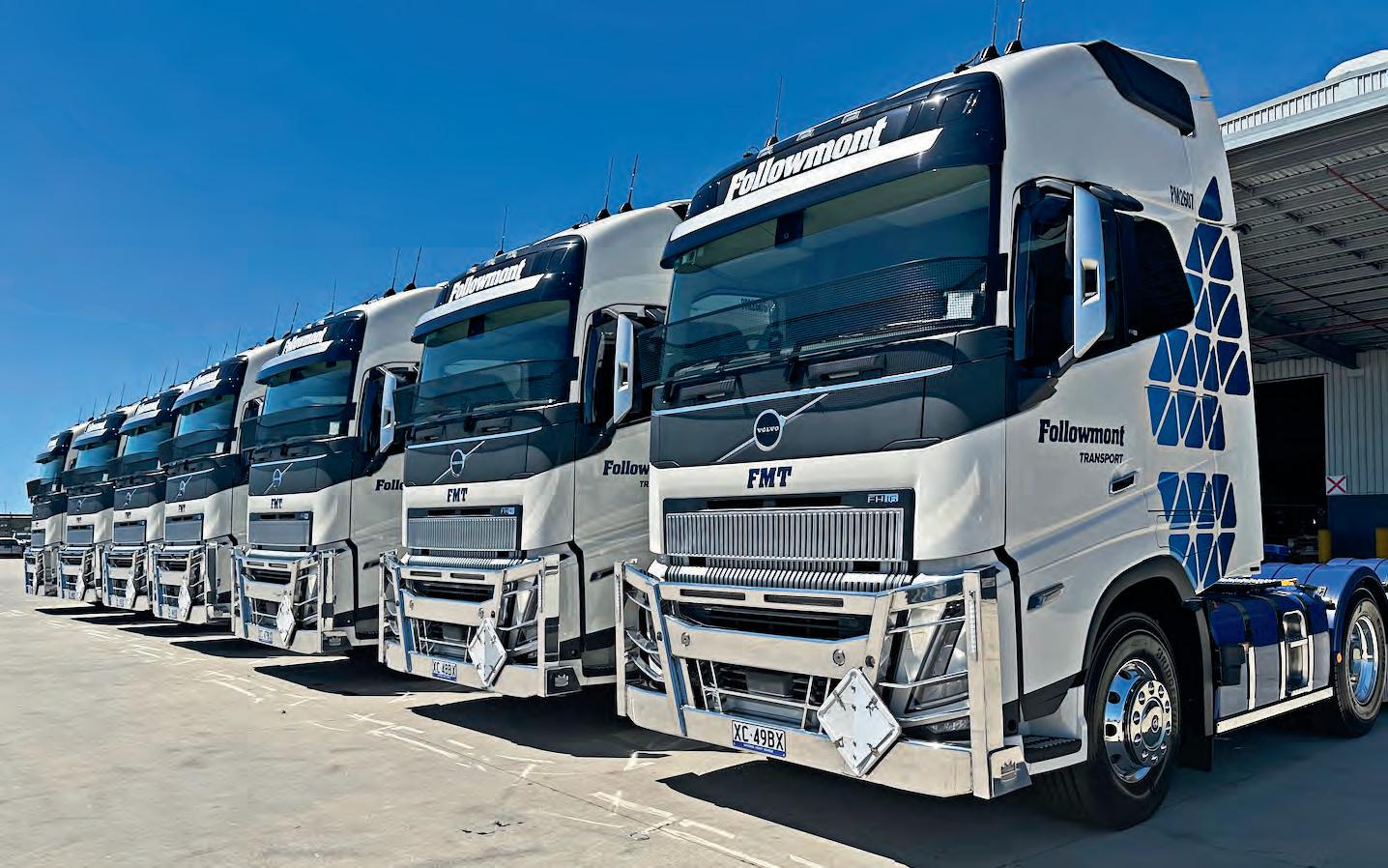
Australian operator Followmont Transport has recently received a suite of new prime movers as it reaches a milestone with a leading global truck manufacturer.
Followmont received seven Volvo FH prime movers with a Euro 6 D17 engine, building on a significant milestone for the business as it surpasses 50 Volvo units in its fleet.
The latest delivery forms part of Followmont’s ongoing investment in fleet capability, ensuring the business can continue to meet the demands of its network and deliver for customers across Queensland and New South Wales. With freight moving daily between metropolitan centres, regional towns and remote communities, the fleet underpins how Followmont operates. From linehaul connections through to local distribution, delivering both reliability and efficiency on
the road is critical to keeping freight moving and communities connected.
Followmont says these new Volvo FH prime movers have been purposefully selected to handle that task, built to perform across long distances, changing road conditions and high-frequency movements, while supporting drivers to operate safely and consistently.
Of the seven new prime movers, five will service Townsville and two will service Sydney, supporting freight movements across key parts of the Followmont network and helping maintain reliable service for customers in both regional and metropolitan markets.
Followmont is also expecting a further four Volvo prime movers to join the fleet in the coming months, continuing the business’
investment in strengthening its network capability.
The new trucks feature the latest Euro 6 engine technology, reducing the company’s carbon footprint and fuel consumption as it moves toward its long-term sustainability targets.
The Volvo FH is equipped with an industry-leading suite of active and passive safety features. Key features include Dynamic Steering and Pilot Assist to combat fatigue during long-haul operations. This focus on safety and performance sits behind Followmont’s long-standing partnership with Volvo.
Followmont managing director Mark Tobin says the milestone represents more than just fleet growth.
“Reaching and moving beyond 50 Volvo prime movers in our fleet is something we’ve taken the time to reflect on,” Tobin says.
“It speaks to the consistency and reliability we’ve experienced over time, and the strength of the relationship we’ve built with Volvo Group Australia and Volvo Commercial Vehicles.”
Tobin says the latest delivery ensures Followmont continues to invest in equipment that supports both its people and its customers.
“These trucks are built to perform in our network, and early indicators are showing a seven to 10 per cent improvement in fuel consumption compared to our Volvo Euro 5 units,” he says.
“More importantly, they are designed to support our drivers on the road every day. And when our drivers are supported, our customers can rely on us to deliver.”
Volvo Trucks Australia vice president of sales and marketing Tom Chapman says reaching the milestone 50th Volvo delivery is a “testament to the trust and shared values” between the two companies.
“Safety and sustainability aren’t just buzzwords for us; they are the pillars of our operation. By investing in the latest technology, we are ensuring our customers have the best tools to stay safe all the while minimising our impact on the communities we serve,” Chapman says.
“Not only are these trucks safe and efficient, but we’re also extremely proud of the FH’s proven track record of reliability and uptime.”
Images: Followmont Transport
Centurion launches triple trailer trial
The Australian operator recently celebrated the milestone departure of the vehicle from its Perth Airport depot
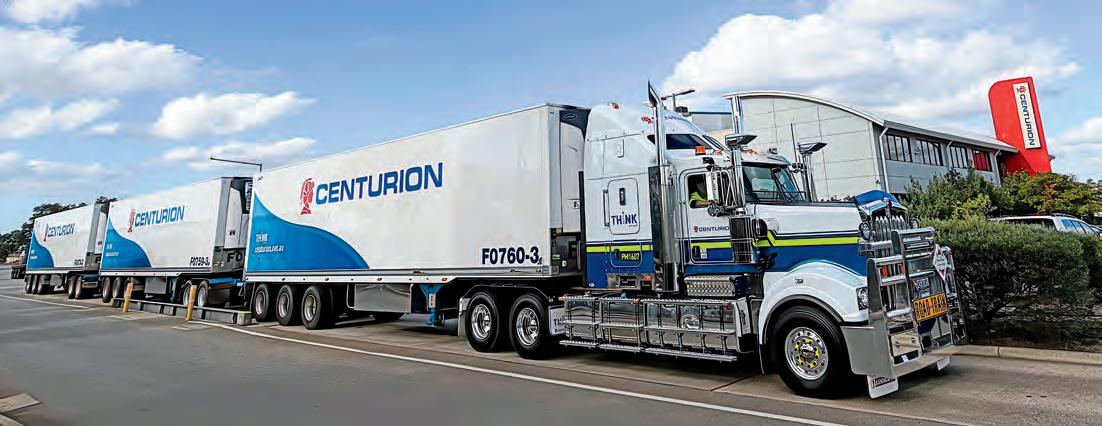
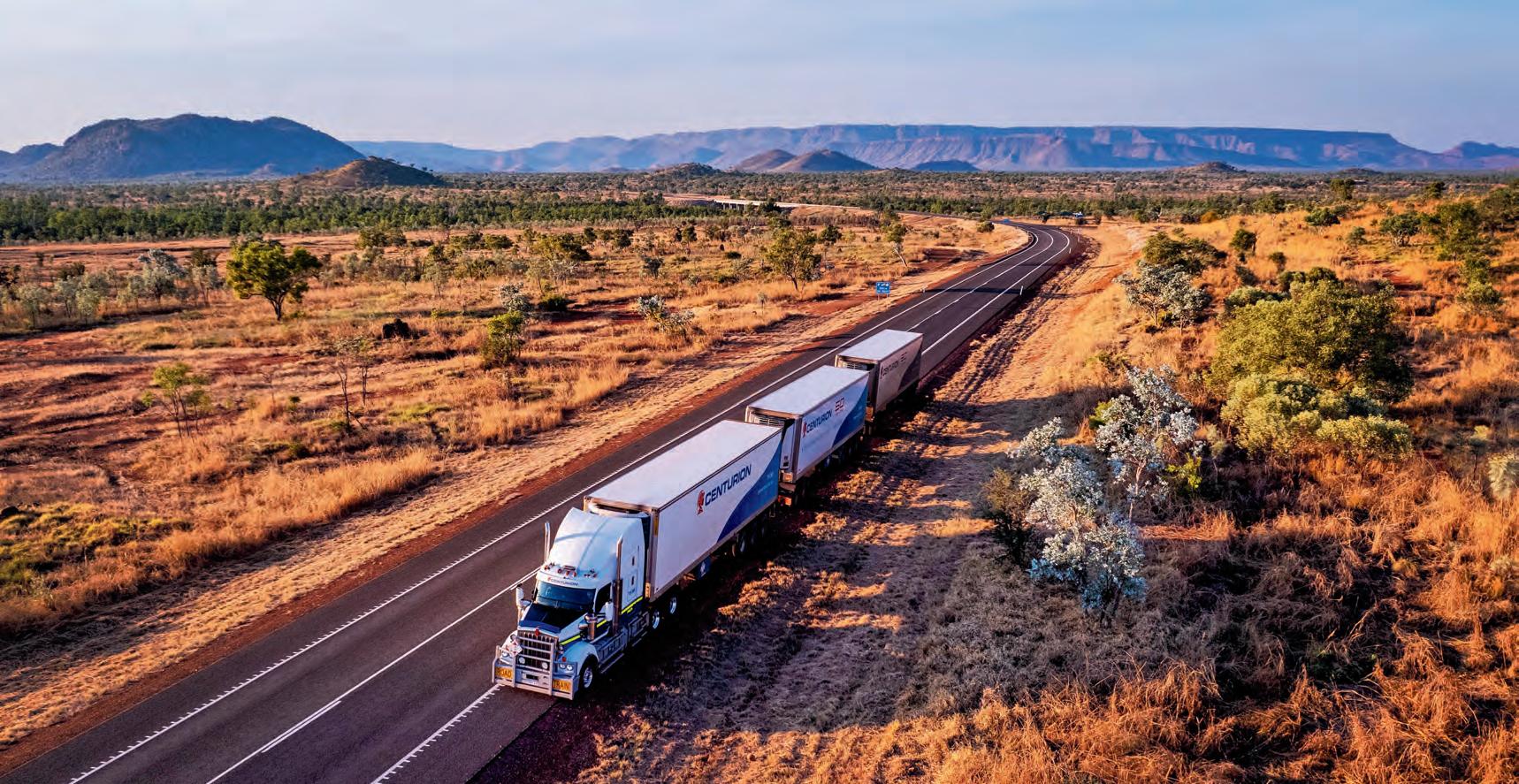
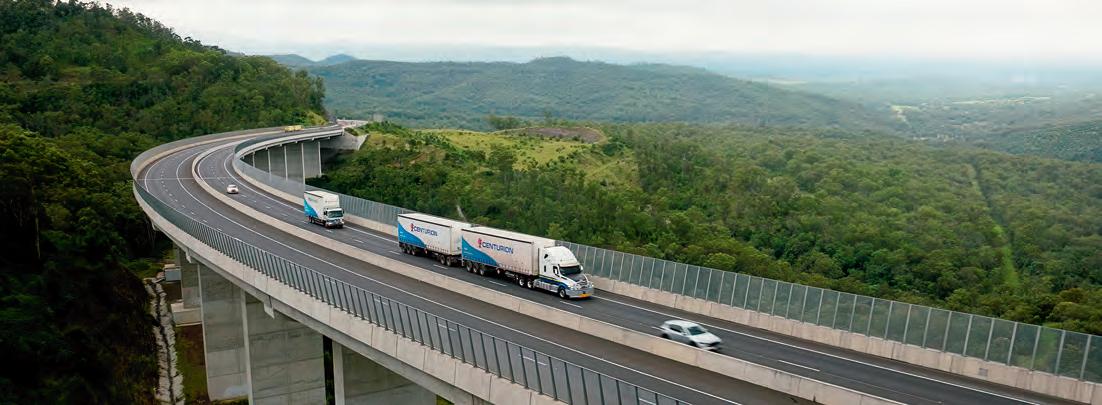
Australian transport operator Centurion has announced a milestone in Western Australia, with its first triple-trailer road train starting a three-month trial in the region.
The milestone vehicle departed Centurion’s Perth Airport depot recently as it got its trial underway along the Great Northern Highway.
Prior to this trial, a triple-trailer road train could only operate from Wubin when travelling north, with Centurion working with the state government and Transport Workers’ Union (TWU) to initiate the trial.
The Centurion team says the initiative demonstrates what can be achieved through strong collaboration, delivering meaningful improvements in productivity, efficiency and sustainability across Western Australia’s freight network.
“From a Centurion perspective,
the ability to carry more goods further with fewer trips is a significant step forward. The success of this new operating model is underpinned by the latest trucking technology, with advances in safety systems, vehicle performance and fuel
“Reducing overall truck movements along this key corridor helps in managing local fuel demand and supports positive emissions outcomes, while ensuring essential supplies continue to reach regional
communities and industries.
“Centurion looks forward to supporting the success of this trial and continuing to work alongside government and industry partners to deliver the safest, most efficient and sustainable freight solutions for Western Australia.”
efficiency,” Centurion says.
MORE.
Savings.
The Mercedes-Benz Actros 2.5 StreamSpace Run-Out Event is now on.
Drive away with a complimentary 3-year BestBasic Service Plan covering all scheduled maintenance* , plus predictable running costs and the legendary fuel efficiency Actros is known for. Available for immediate delivery. Contact your Mercedes-Benz Trucks dealer.
EXPANDING LEGACIES
With a family that has had rich involvement in the local trucking game, James Gilbert, through Darling Downs Haulage, is looking to offer a service with a difference in various transport avenues around Australia
Like many in Australia’s illustrious road transport industry, James Gilbert grew up around trucks. The familiar smell of diesel, the grime and the exhaust. With a father who loved trucks and built a career around running them around the country, James was never going to stray far from the profession.
“I’ve been in transport my entire life,” he told OwnerDriver
“My Dad owned Gilbert’s Transport Queensland and owned cattle trucks, molasses tankers and grain tippers, so I grew up around a variety of trucks.”
Despite this close connection, James didn’t allow nepotism to define his rise in the industry. Instead, he went about it his own way, starting as a diesel mechanic by trade.
After finishing his apprenticeship at Mack Trucks’ Brisbane site, James looked to find his feet in the sector. When he met his business partner Matt Gardner, the pair decided roughly a decade ago to take the opportunity to go out on their own and, as James puts it, start their “own show” – Darling Downs Haulage.
“Matt has been driving trucks for years, so we decided to do our own thing when we took over a
fleet of trucks from a cousin of ours at Ezyquip Hire,” James explains.
“We started off moving earthmoving equipment all over Australia for them with floats and road trains, and it’s grown from there.”
James is underselling himself. The pair started like all humble owner operators do – with a single truck and plenty of hope. For the first year, James and Matt hired three trucks and equipment from Ezyquip. As James says, the banks “weren’t particularly keen on two young fellas wanting to start a business”. So, the loan allowed them to run with one truck and a float. Fast-forward a year and the Darling Downs Haulage team had four trucks in its fleet that it had bought out from Ezyquip and one new Mack Super-Liner.
“Ever so slowly we have grown from that stage nearly 10 years ago to the point that we once had 13 trucks before we backed it off a little to 12, running an all Kenworth fleet,” James says.
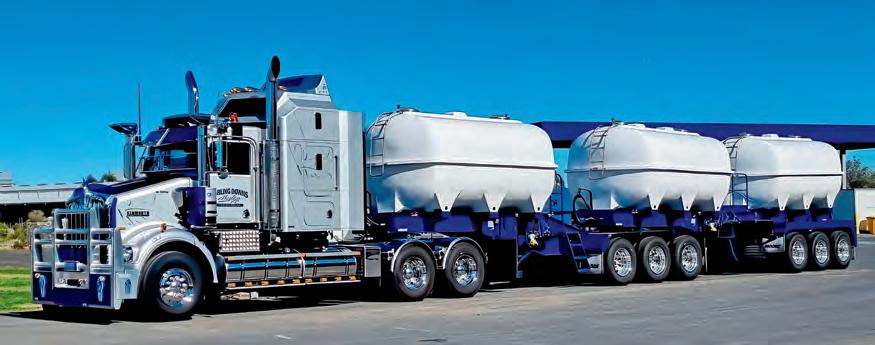
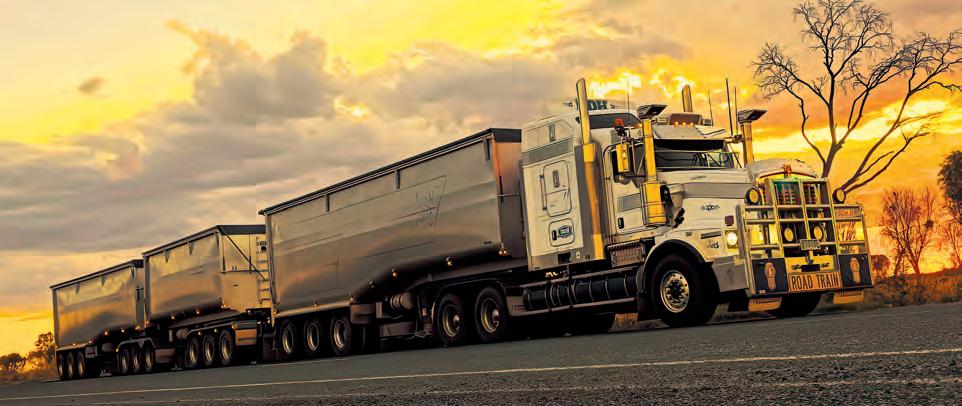
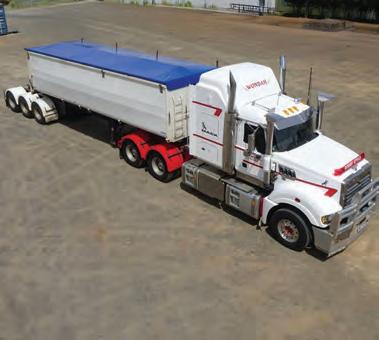
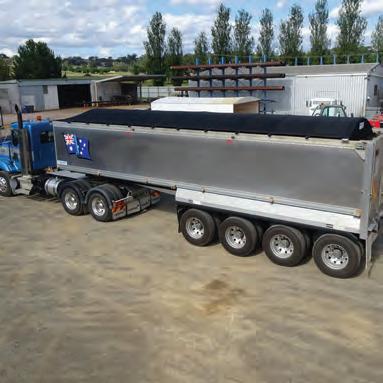
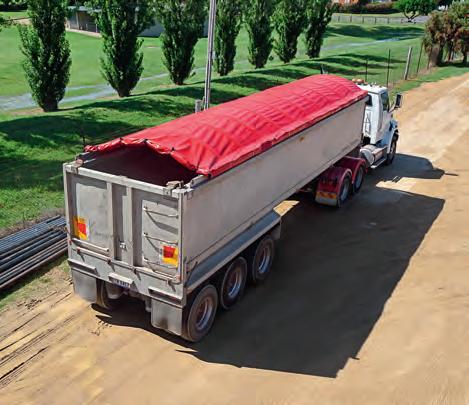
Despite these humble beginnings, Darling Downs Haulage is now anything but uniform. Its fleet boasts an array of prime movers, floats, road trains, molasses tankers and grain tippers (including flat tops, step deck extendables and a super tilt). While it echoes some of the services that his family used to run, James says he’s only briefly used his father’s experience over the years to source certain contracts and jobs.
“Between Matt and I, we’ve expanded the business into a fleet of tankers carting molasses and liquid all over the eastern seaboard of Australia,” he says.
“We cart molasses from Townsville, Mackay and into the Downs where we reside. We then cart supplement from Bundaberg all the way into the top end of
Victoria and over into South Australia.”
Throughout this time of expansion, the Darling Downs Haulage pair could’ve been forgiven for keeping it simple. However, James and Matt don’t do things simply, so they decided to also get back into grain tipper work while they were at it alongside dabbling in heavy haulage and general freight work.
If that wasn’t enough, the operation then found another avenue to grow into when natural disaster saw Darling Downs Haulage come to the rescue with its fleet of trucks.
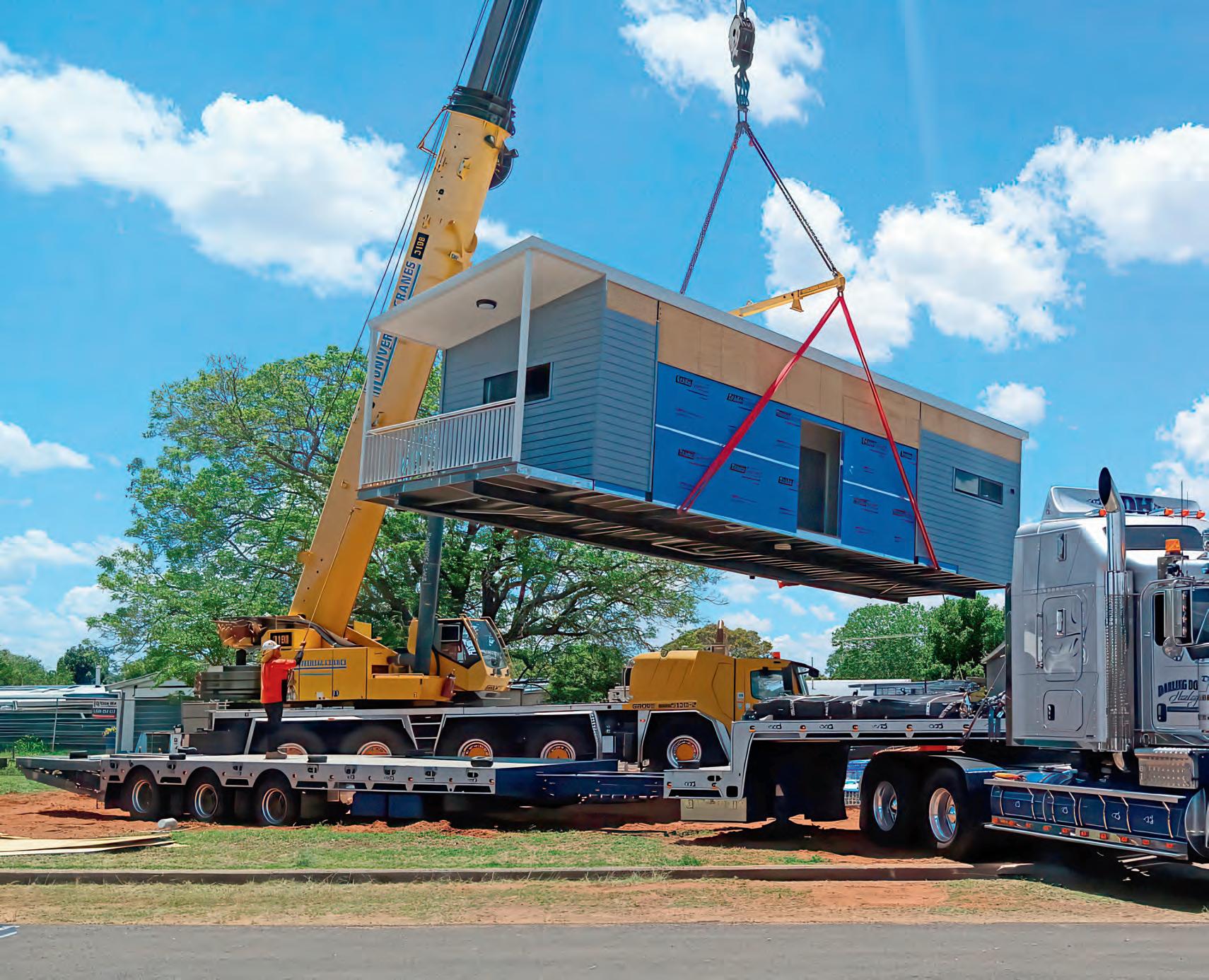
“When floods started to hit the Lismore region hard back in 2022, we got involved in carting modular huts for Hutchinson Builders (Australia’s largest privately owned construction company),” James explains.
“In roughly four years, we’ve forged a good relationship with Hutchies and now every year we cart a fair few modular huts around Australia for them, fulfilling some government jobs for a
“We’ve had no issues with Hendrickson and have appreciated welcoming new technology.”
range of housing commissions, schools and hospitals.”
A “fair few” is quite the understatement – in 2024 the operator transported around 90 modular huts in one job to the Fitzroy Crossing in Western Australia’s Kimberley region to help build a remote community school.
To put it into perspective, this is just one facet of Darling Downs Haulage’s increasingly diversified capabilities. When the Fitzroy Crossing project first began in 2024, James and Matt had teams of subbies taking 10 trucks each fortnight from Toowoomba, while 10 trucks a day were travelling to the Lismore and Ballina project in 2022 when the operator lent a hand to move between 700 and 800 huts into the region for flood relief.
While these modular huts projects can quickly take plenty of attention, work and trucks, James says currently molasses tankers remain the business’ largest and most popular service.
“It all makes for rewarding work, particularly when we are now involved in flood relief tasks and modular hut carting for community projects,” he says.
“The key to our business is being diverse. We aim to pretty much do a bit of everything with our fleet of 12 trucks. It’s about being in the right place at the right time and doing the right things to help us grow.”
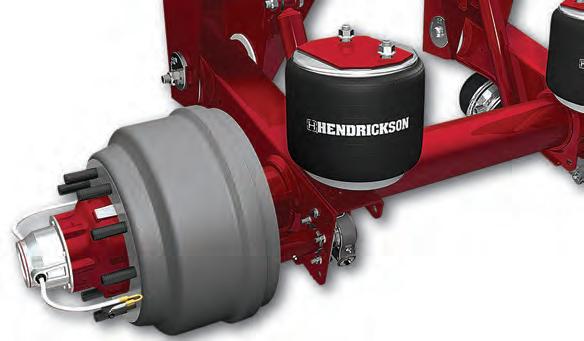
James is quick to add that a critical part of Darling Downs Haulage’s growth can be attributed to the quality equipment it uses. Hendrickson, much like trucks, has been a constant in his life. At Gilbert’s Transport Queensland, the operator ran a fleet of Macks that ran on Hendrickson suspensions. Years later, James has continued this family tradition, with a variety of Hendrickson systems proving critical to the daily running of Darling Downs Haulage’s equipment.
“I’ve had a lot to do with Hendrickson over the years, especially since I was a mechanic,” he says.
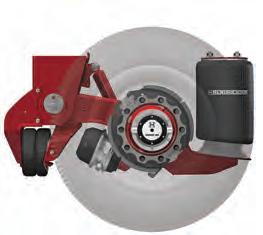
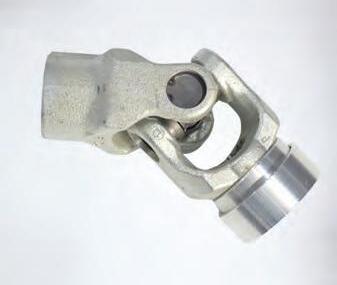
“I like the product a lot – we run it underneath roughly half of our fleet, starting with the Hendrickson PRIMAAX EX product on our prime movers to the latest HXL7 wheel ends on our trailers.”
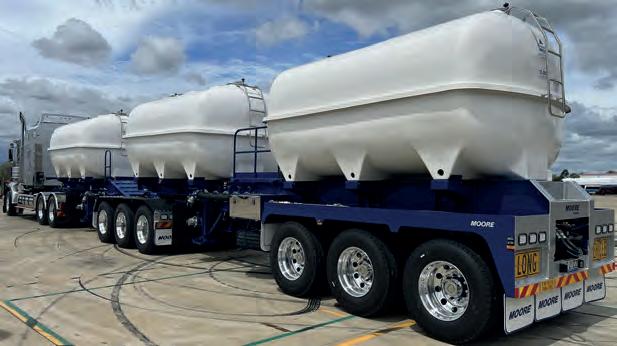
James says there are some standout combinations worth mentioning in the fleet, particularly one of the operator’s grain tippers featuring Hendrickson suspension. While some of the earlier trailers to enter the fleet run on the older HXL5 wheel ends, James says the team has welcomed the introduction of the HXL7 product with INTRAAX’s locally optimised air suspension to provide a great total cost of ownership.
“We’ve had no issues with Hendrickson and have appreciated welcoming new technology,” James says.
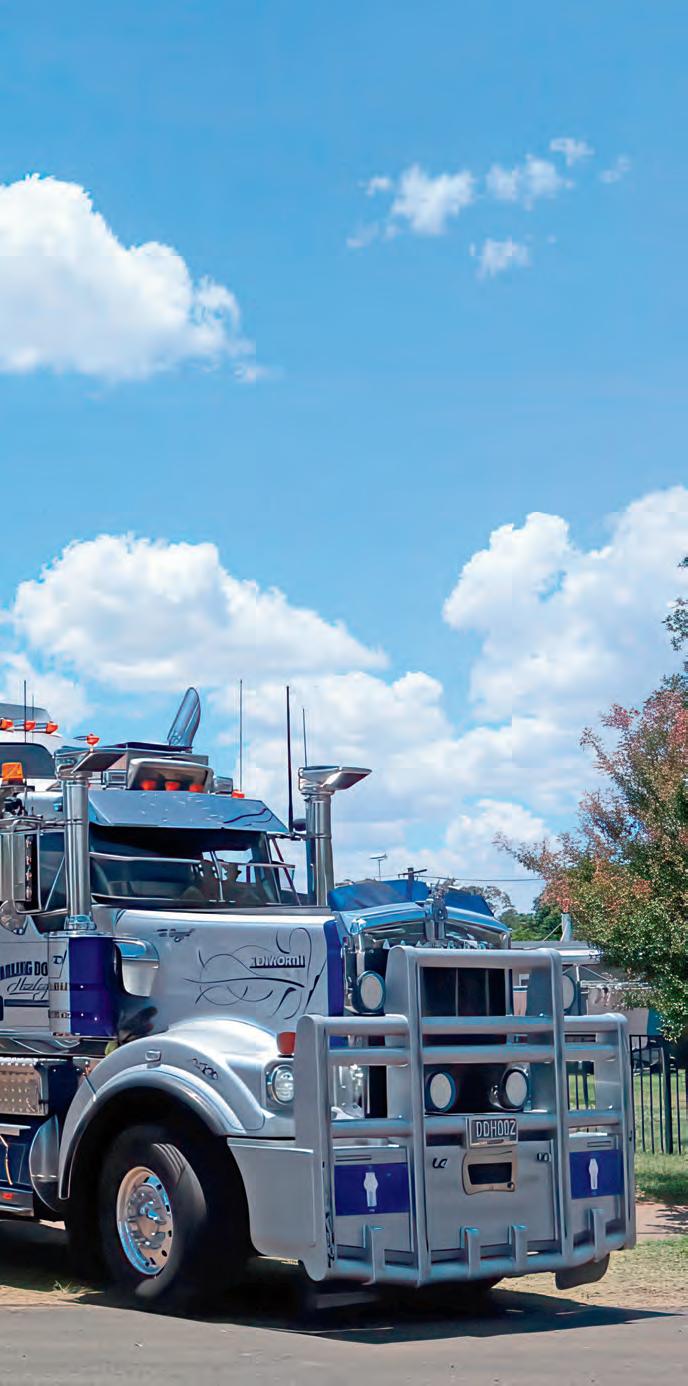
Above: Darling Down Haulage’s diverse fleet relies on Hendrickson gear to keep running
Opposite: The operator has excelled with its range of services in the local transport market
Below: The operator also has a rich history of helping communities in times of need
“Wayne McPhail, Hendrickson’s Queensland business development manager, has also provided incredible support.”
While it’s only taken Darling Downs Haulage a decade to grow to where it currently is, James has no intention of continuing to increase the fleet. Instead, his focus is on ensuring the transport operation can remain as diverse as possible and allow him to add to his lifetime of memories in the local road transport industry.
“We’ve grown at quite a substantial pace in a short period of time, so we want to maintain what we have, depending on the numerous projects that may come our way,” he says.
“You never know what the sector may throw at you, but we’re confident we’re ready for anything.”
HENDRICKSON AUSTRALIA
Images: Darling Downs Haulage
MAGNIFICENT MUSTER
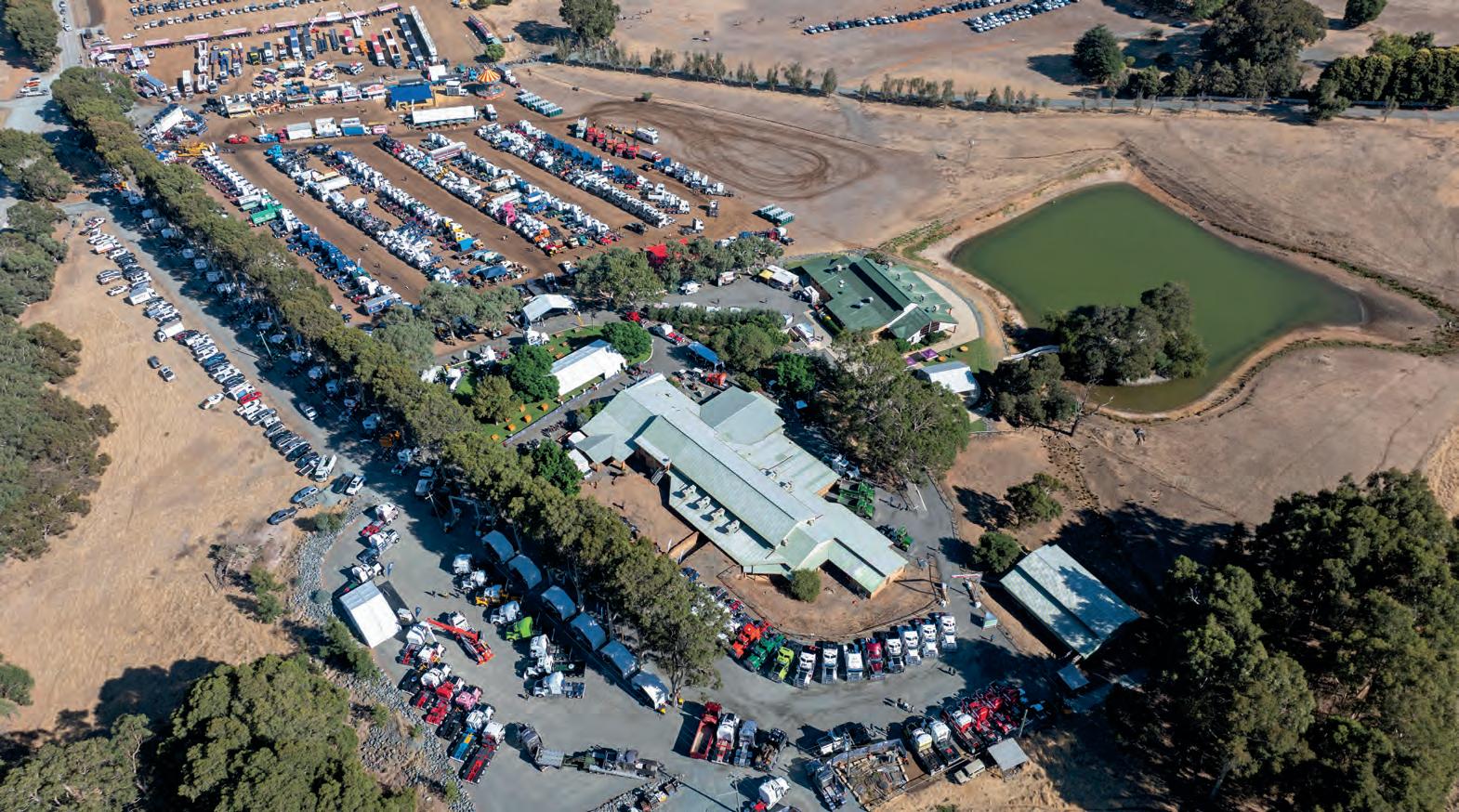
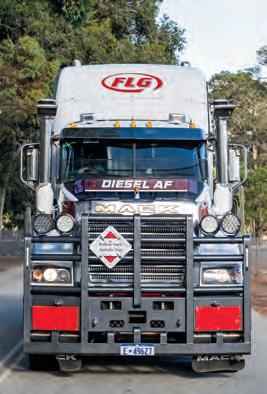
Warren Aitken was left amazed by the latest iteration of Western Australia’s popular Mack Muster and Truck Show, with hordes of people descending on Quarry Farm for the major event
Consider me officially blown away. Wow. I guess those two sentences are a pretty abstract way to start a truck show summation, but allow me to expand and expound on those six words. I am lucky enough to get to a lot of truck shows. A lot. I am lucky enough to get to a lot of truck shows repeatedly. The ones I often return to are shows that I have really enjoyed and the readers of this publication love to experience with me.
On my return visits I am rarely disappointed. Shows that are well run and are well represented tend to stick to their winning ways and keep that high level of performance. One of those shows that is always on my repeat cycle is the WA Mack Muster and Truck Show. The bi-annual event has
always been one of my favourites – a good cause, good people, good location and great trucks. Hence, I was happy to make the 4,500km journey over from Brisbane once again.
This year, however, the hard-working volunteers that organise and run this show didn’t just maintain a good show, they lifted their game. There was no ‘one thing’ that elevated the show itself – it was a cumulative effect of multiple little things that really made the 2026 WA Mack Muster and Truck Show the best yet. I guess my job now is to try and explain, because I finished the day with those six words I started this story with – consider me officially blown away. Wow
Before we get to the show, let’s look at two things that haven’t changed – the why and the where.
The motivation behind the WA Mack Muster and Truck Show is fundraising. Fundraising for the Harry Perkins Institute for Medical Research, an institution dedicated to cutting edge cancer research and on a mission to make cancer a non-lethal disease. It is hard to find anyone not affected either directly or indirectly by cancer, so it is a cause we can all get behind. In 2020, the first year the WA Mack Muster ran, it raised funds for the Harry Perkins Institute and raised over $100,000. In 2022 they more than doubled that at around $250,000 and then two years ago in 2024 they doubled that again with a total just over $500,000. This year the committee, with the aid of some incredible sponsors, aim to surpass the record 2024 total and while the figures are still to roll in, it seems like a pretty achievable goal.
As for the where – Quarry Farms, Whitby, WA. Every two years this incredible wedding and event venue transforms into a Mecca for machinery and this year more doors and parking were opened up to this event. Located just outside Perth, it is an amazing location, aside from the fact that as I age, the walk-up Mack Alley seems to steepen. There is
a huge pavilion at the top of Mack Alley and plenty of parking for trucks, stalls, the DJ stage and, most importantly, the bar.
The hill leading to the pavilion is the general truck parking area and all up the place comfortably fits the 400 odd trucks on display, with the road train and second entertainment area located at the bottom of the hill. You can survive without walking up to the top, but you’ll miss some cool trucks.
That’s the why and where, let’s look at the how. The WA Mack Muster and Truck Show is a single Sunday event that works over several days. Yes, I realise the hypocrisy of that statement, but we are in Western Australia, so it works. Staging up for the event normally begins on the Friday, but this year it started even earlier. That is because a new addition to this year’s show was the Road Train area near the car parking allocation. There were several remarkable road train displays set up to give the public a closer look at these gigantic combinations that operate on and off WA roads, capped at the end by two gigantic MGM Bulk quad tipper set ups. You would almost knock over your 10,000-step limit just checking out those two set-ups. Tippers, belly dumpers, even stock trucks. There was a road train for every inclination.
One of the major fundraising events tied to the Sunday show is the Friday Night Gala dinner. It is where everyone gets suited and booted, dines out on incredible food, shares a few bevvies and then opens their wallets for the charity auction at the end of the evening. Obviously struggling journos like me are there just for the free food and drink, but it is nice to watch some of the biggest names in WA transport getting out and supporting a good cause. What made this Gala Dinner even more impressive was the incredible donation from Mack Trucks Australia of a 2025 780HP Big Bunk Mack Super-Liner. The auction was broadcast live across Australia via Smith Broughton Auctioneers webcast and the big Super-Liner, with it’s 70’ bunk and MP11 top of the line motor, went for a staggering $615,000, all of which goes directly to the Harry Perkins Institute for Medical Research.
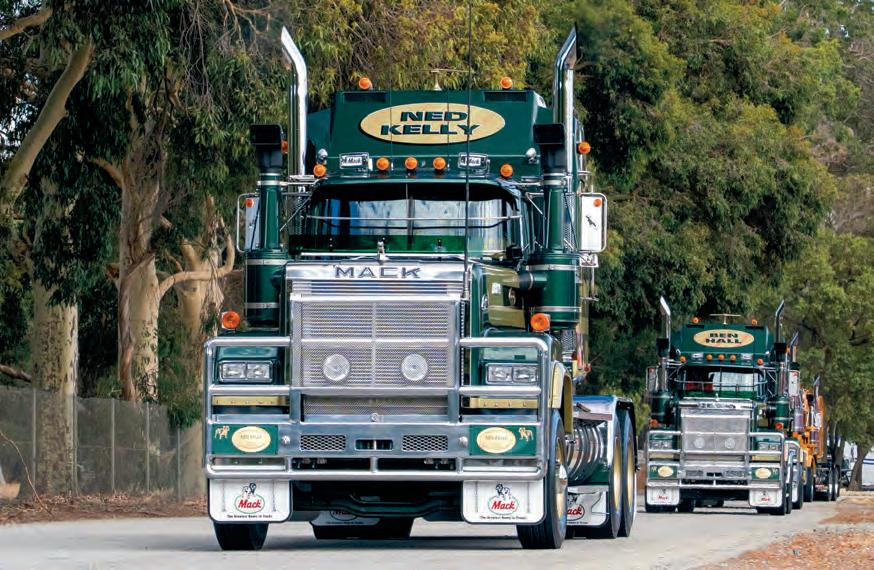
It is also worth noting the enormous generosity from the Western Australian operators at the other end of the scale, literally. Bruce from Drake Collectibles was on hand to offer the latest in his incredible Bicentennial Mack Model collection, auctioning off the first ‘Ned Kelly’ diecast model, as well as Ben
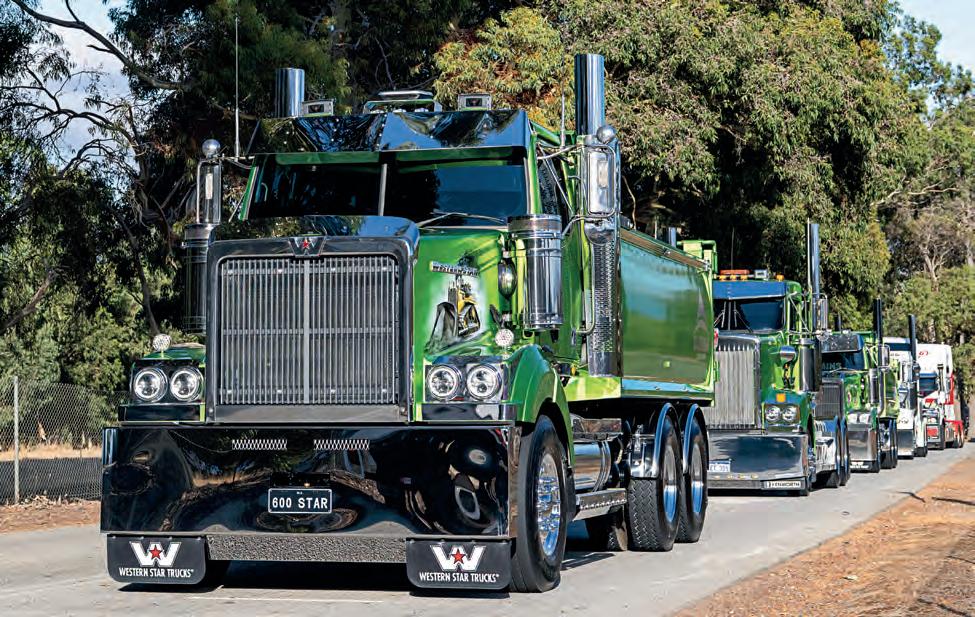
Opposite top: Sunday morning and the picturesque Quarry Farm location is stacked
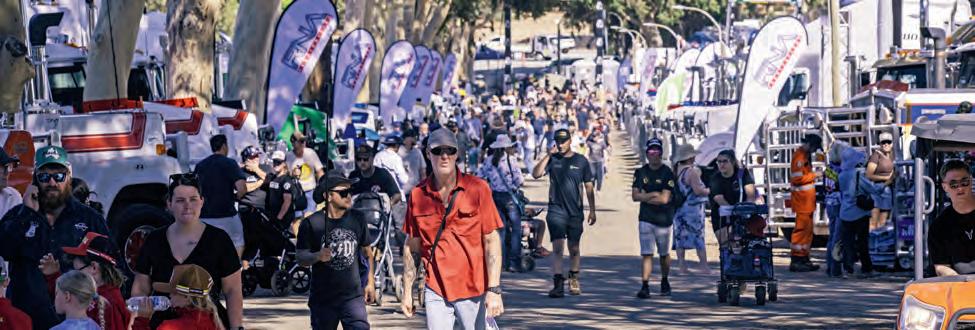
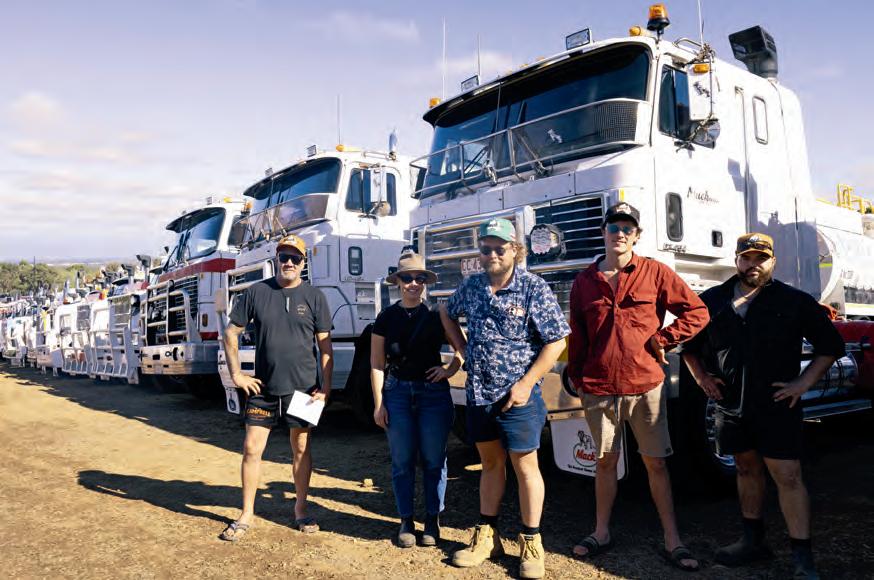
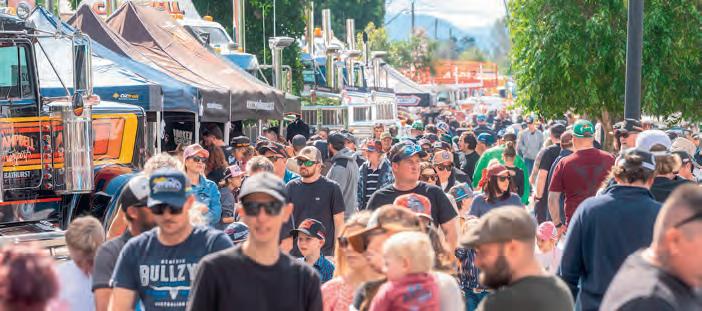
Opposite bottom: Over 11,000 people attended this year’s event, setting new records. This show is a massive part of the WA transport scene
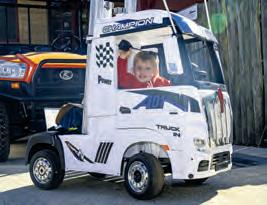
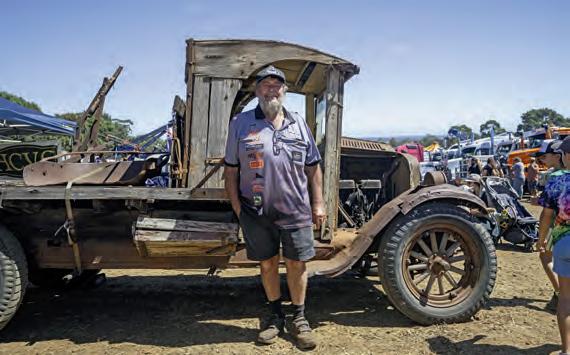
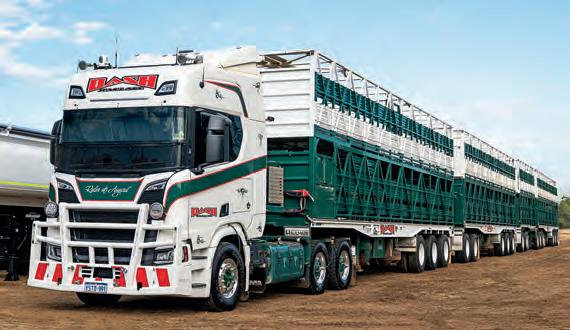
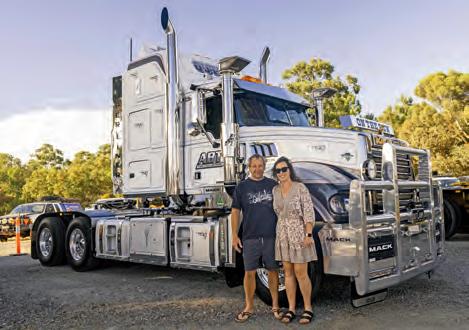
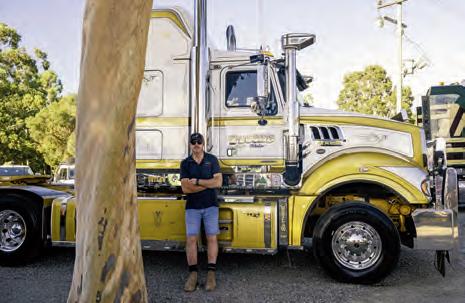
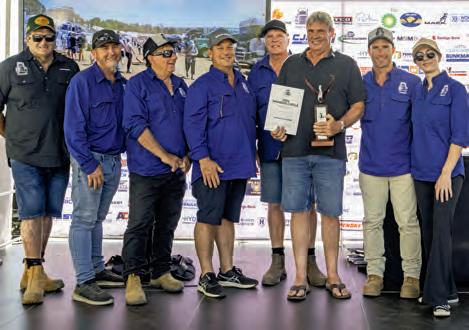
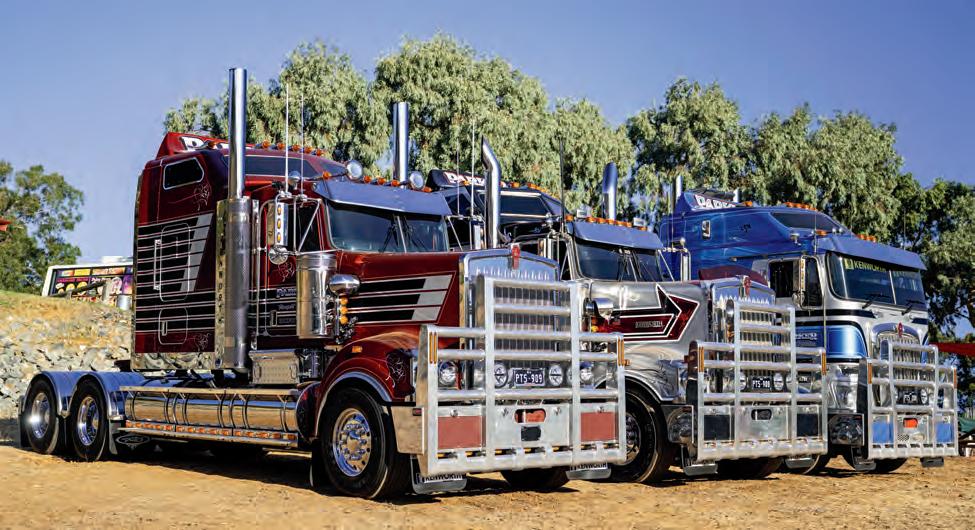
Clockwise from top left: The stars of any show are the iconic Bicentennial Macks and there were three of them that rocked up to this year’s event; One of the main men behind the WA Mack Muster is Matt Lawrence, seen here catching up with one the the Mack Muster’s main characters in Ryan Demasi; HCVC member Colin Danks garnered a lot of attention with his 100-year-old Chev 4. This still runs and is absolutely amazing; If they had prizes for truck names, these two would be topping the boards; One of the stars of the Road Train area was this Scania road train of Dash Haulage; The West Australian MackTRANS Australia team were on hand with some extremely rare old Ultraliners; I did not envy Penne Murphy, Peter Allbeury or Tony Liddle as they set about the judging tasks at this year’s event; Three-year-old Chase Baldwin had the right idea – why walk when you can truck it? I think the bug deflector says it all
Images: Warren Aitken
Hall and John Stuart models. Ned Kelly went for an incredible $17,000, with the three of them in total raising $27,000.
Saturday at Quarry Farm is a chance for us dogged truck nuts just to sit back and watch everyone start to roll in. As the sun passed over, Mack Alley began to fill up and up at the top, Kenworth Corner started to stretch around to Kenworth Avenue. A vast array of food vans and entertainment began to park up, and my keen eye was already detecting a massive step up in the size of the day coming.
Sunday morning, I was out of bed before the local Midland drunks had even cleared the pub’s steps and I rocked up to Quarry Farm nice and early, in part to ensure I got a parking spot close to save me lugging my gear up and down through the show and also in part to beat out the remaining trucks that would make up the 400 entrants at this year’s event. I got the park but didn’t beat the trucks. Mack Alley was bulging and Kenworth Avenue was stacked with Stacks.
By the time the gates opened at 10am for the public, the last remaining spots on the Quarry Farm hill were packed and the car park was chockas. I heard tales told of kilometres of traffic in both directions waiting to get into the carpark – the local support was incredible.
Let’s discuss the show now. What they have always done well at this event, and what they have stepped up again with this year, is the immersive nature of the event – not just from the number of truckies hanging around showing people their rides and explaining their roles, but also the activities for the families and kids. Up in the pavilion you have one room set up with an elaborate remote control truck display – bridges, building and even construction sights. For the first time this year, there was also a static model display in one of the other rooms and that was a huge winner for me. The skill of those model builders was incredible. Up the top end of the show, they still have the kids’ corner where there was every imaginable distraction on hand for the future truckies of the world. There were also plenty of food options available up that end as well. I can vouch for the dumplings and the handmade pizza, although it was quite the wait.
The walk down the hill is always easier than the trudge back up, but in order to appreciate all of the trucks you do spend a fair bit of the day walking up and down the aisles. There is tremendous support from both the large WA companies and many of the small independent operators as well. There is a great mix of modern Macks and Kenworth, Volvos, Stars, Scanias and Mercedes. In fact, when you couple in the impressive historic truck section of this event, it is hard to pick a manufacturer that wasn’t represented.
Once you got through the truck watching, you end up back down the bottom of the hill, where the committee once again have fronted up with endless entertainment and consumables. They even had a huge screen playing the AFL live so the parents could watch that while they sent the kids off to one of the many rides and games available. There were sponsors displays and stalls spread appropriately throughout the entire area, and you were never short of something to see or someone to talk to.
Another advantage of having the hill to walk up is when you are up there, you get an appreciative view of not just the show, but the support the show has from the Western Australian public. The car parks were full and there were lines of traffic waiting to get in. There were throngs and throngs of spectators throughout the grounds, from truck spotters and historians to countless families with sugared-up offspring in awe of the trucks and treats.
The photos will tell you more than I can at the moment. I am sitting at my gate waiting on the big tin taxi home, still smiling after my latest WA experience. If you check out their website, you will see the WA Mack Muster and Truck Show with the self-proclaimed ‘Western Australia’s Premier
Truck Show’ moniker. It is a deserved title, and they really have stepped it up another notch. Plenty of extremely high-quality trucks. Awesome participation and representations from the Historic Truck Club, the Remote-Control model club and the static model club. A non-stop DJ that kept everyone on their toes. Enough interactive family activities meaning the kids never had a chance to get bored. They were smart with added shade and shelter from the blistering Perth sun. There were static truck displays and recruitment stands from a mix of different companies. Food choices were many and varied and of course the bar was fully stocked with all the right libations.
By the end of the day, I’d racked up nearly 30,000 steps and all of them with a huge smile. Full credit to all of those that put this event together. It is a fantastic cause and a fantastic show. As I anticipate how they will up the ante again in 2028, I shall finish with the same sentiment I started with. Wow.
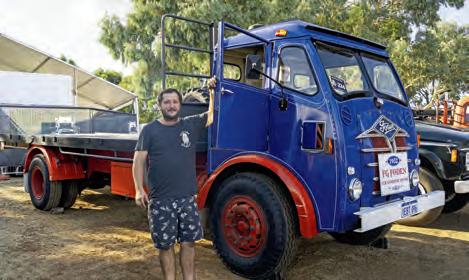
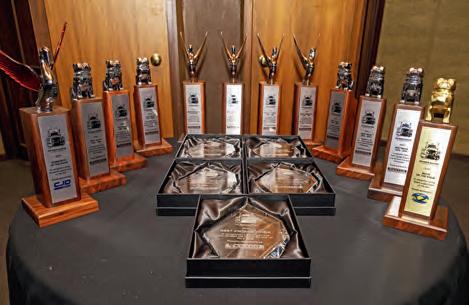
Clockwise from top left: The ever-sharp Bandana Earthmoving team rocking up in style again this year; This was the huge auction item at Friday night’s gala dinner. The 2026 780hp Mack went for a staggering $615,000; Blair Parker picked up several awards this year, including the Truck of the Show award; The coveted trophies, on display at the gala night; Blair Parker had three of his stunning fleet on display with his immaculate Maroon T909 taking out the coveted Truck of the Show award; Shane Tyson from Kulin WA with the 2024 Mack Outlaw that he operates; Murray and Kerry Belfield with the Outlaw Mack they pull fertiliser tankers with; Jake Wagner with the Ex Shell, 1952 Foden that Jim Piercy restored. You don’t see a lot of these around
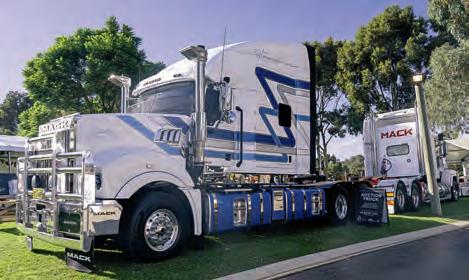
Above: The Charles Hull Contracting crew had a fleet of outstanding Macks lined up in Mack Alley this year
Right: Jason Templeman arrives with his two JKT Macks looking on point
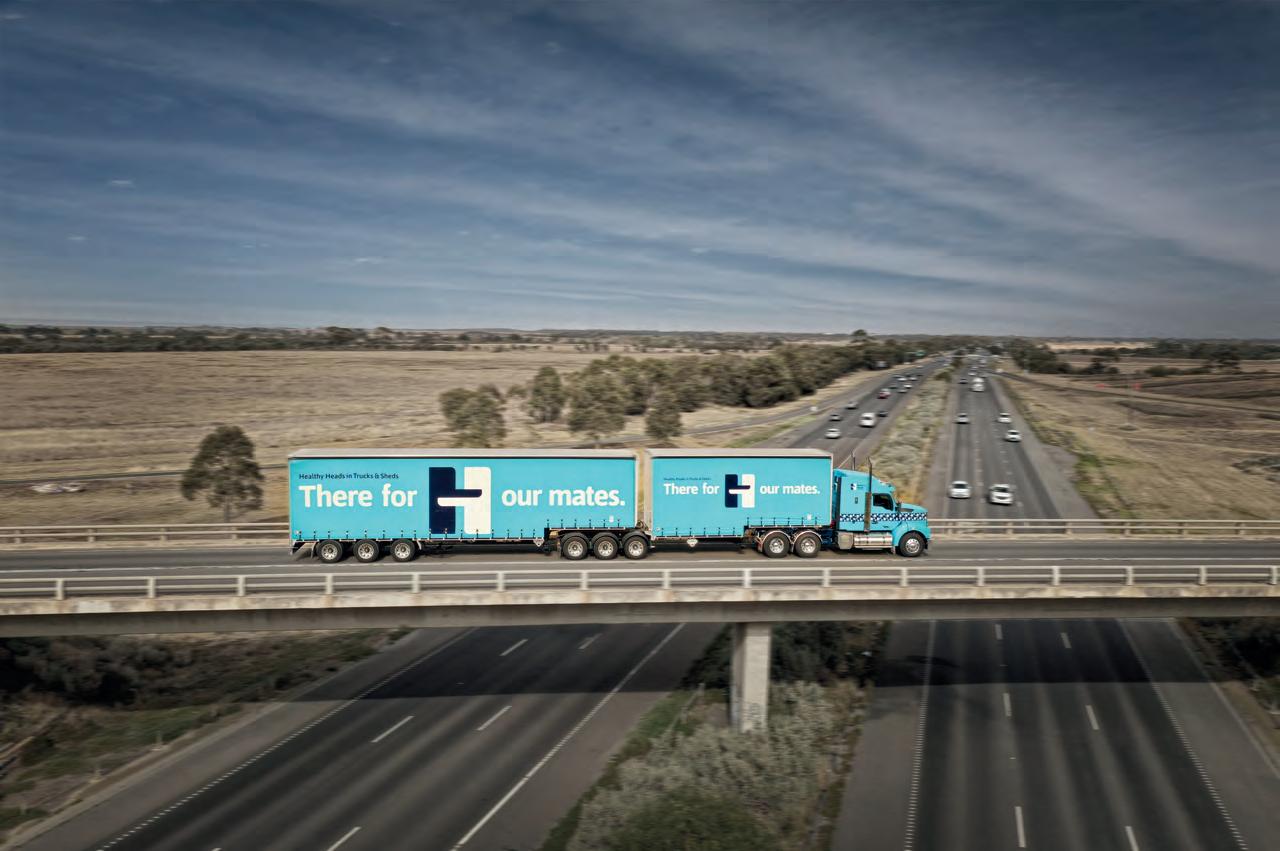
KEEPING TRUCKIES HEALTHY - Healthy Heads
Navigating the crisis
Healthy Heads has a range of options, from its allencompassing App to a podcast episode, tackling issues arising from the fuel price challenge
When fuel costs keep climbing, the pressure doesn’t just hit your wallet; it hits your headspace too. Across the country, truckies have been feeling the strain of the current fuel crisis. Tighter margins, longer hours and constant uncertainty can build up quickly, and that pressure doesn’t switch off when the engine does.
At Healthy Heads in Trucks & Sheds (Healthy Heads), we know this is about more than dollars and cents. It’s about the mental load that comes with trying to keep things moving when costs keep rising. While you can’t control fuel prices, you can take steps to stay steady, and having the right support tools close by can make a real difference.
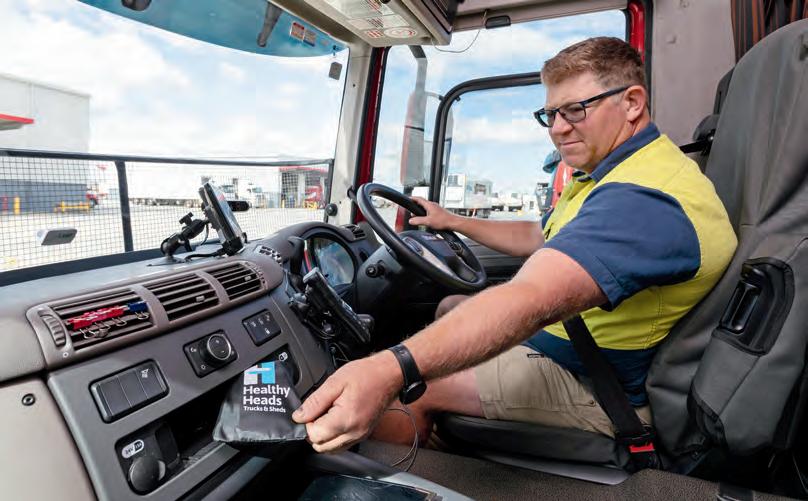
This is where the Healthy Heads App can help. Built specifically for people in transport, warehousing and logistics, it provides practical mental health and wellbeing resources exactly when and where they’re needed most, whether you’re on the road, at a depot or taking a short break. It also brings together clear links to crisis support and professional services, so if things escalate, help is close at hand in your pocket.
One of these support services is TIACS – the Home of Blue Collar Counselling, which offers free, confidential support tailored to truckies and blue-collar workers. Through the App, you can call or text and connect with a professional who understands the realities of your work. It’s flexible, anonymous and fits around your schedule.
If things feel more urgent or if you’re experiencing a crisis, it’s important to
reach out to someone straight away.
That’s why the App also connects you to services like Lifeline and the Suicide Call Back Service, both of which are available 24/7 and offer immediate support if your thoughts are overwhelming or causing distress.
If financial stress is starting to weigh on you, then further support is available through the National Debt Helpline and Beyond Blue, which can provide guidance on managing debt, bills, and rising living costs. To contact Beyond Blue, use the Healthy Heads App. For more information about the National Debt Helpline and other financial wellbeing resources, visit our fuel crisis page at www.healthyheads.org.au/fuel-crisis/.
Another great thing about the App is that you can also access the How Ya Travellin’? podcast, including Episode
ABOVE: Healthy Heads has content available to help those impacted by fuel price rises
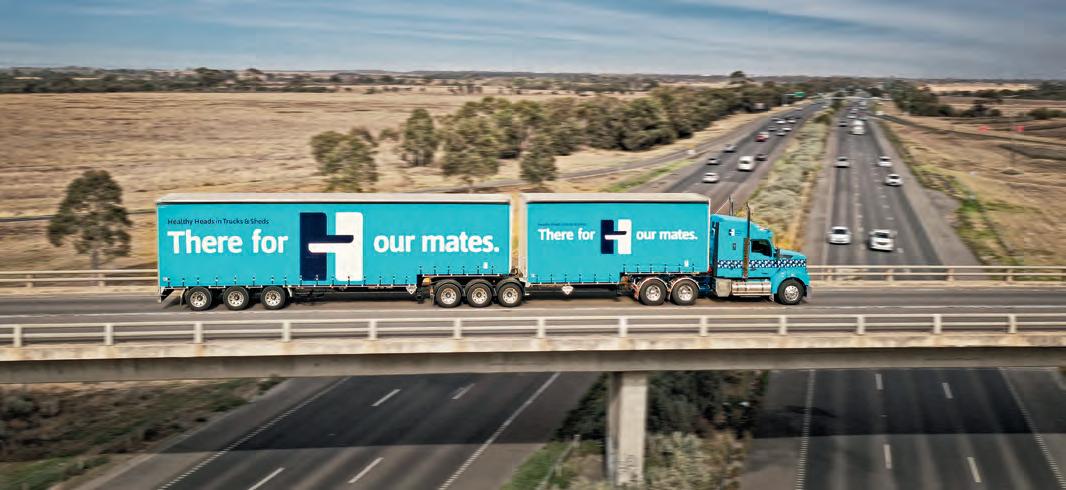
BELOW: The Healthy Heads Road Show is continuing to hit the freeways
14, which focuses specifically on the fuel crisis. In this episode, host and Healthy Heads ambassador Shane Jacobson is joined by WA truck driver Heather Jones and psychologist Arthur Papagiannis, who sit down with Shane to unpack what’s happening from both a practical and mental health perspective.
Heather shares real insight from life on the road and the decisions truckies and business owners are making every day to manage rising costs and keep moving, while Arthur explains how financial stress can build over time, affecting sleep, mood and focus if it’s left unchecked. Together, they highlight the importance of mental health awareness and early support.
The App also contains a wellbeing check-in, which acts as a simple starting point for users. When stress and pressure are ongoing, it’s easy to push through without recognising how much it’s affecting you. This quick check-in gives you a snapshot of how you’re tracking mentally and physically, helping you pick up on stress early.
From there, you’ve got access to tools to manage day-to-day life, helping you stay organised, grounded and in control, even when things around you feel uncertain. It’s about focusing on what you can influence, especially when things feel outside of your control.
If things start to feel overwhelming, the App’s guided breathing exercises can offer a quick reset. Just a few minutes can help calm your body, clear your head and improve focus, something that can make a big difference during a long or stressful shift.
There’s also a strong focus on building resilience, with resources designed to help you handle ongoing pressure over time.
On the physical side, the App includes fitness content, like stretching and resistance band exercises, to help reduce tension from long hours behind the wheel. And with discounted healthier meal options through our partnership with bp, it supports better choices on the road, even when budgets are tight.
The fuel crisis is creating real pressure across the industry, but you don’t have to carry that pressure alone. With the right tools, support and conversations, it’s possible to stay steady, even when the road ahead feels uncertain. Get the help you need by using our dedicated fuel crisis webpage and downloading the Healthy Heads App, available now on the App Store and Google Play.
Healthy Heads in Trucks & Sheds is dedicated to improving mental health and physical wellbeing in Australia’s road transport, warehousing and logistics sectors.
Images: Healthy Heads
Banding together
The TWU recaps a hectic time helping owner drivers receive protection from rising fuel costs
It’s a historic moment in Australia’s road transport industry and one worth celebrating. The TWU has joined with transport employers and associations to secure world-leading reforms for owner drivers and operators.
In the last global crisis, the pandemic jolted the community into realising that road transport is the backbone of Australia. If anything, this fuel crisis has reinforced that if the wheels of the industry stop turning, then so does the economy, and we could not stand by and let it happen again.
The industry has united and secured a major victory for all road transport workers. The Road Transport Contractual Chain Order handed down by the Fair Work Commission demonstrates that owner drivers and operators like you, who do all the heavy lifting, now have
the power to hold clients at the top of the supply chain to account and make them pay their fair share.
It was a long-fought battle and took a massive team effort from the TWU, ARTIO, the NRFA and the ATA. They were side by side with us as we began the fight to bring fuel relief to those who need it most.
It was a sight to behold, seeing owner drivers right across the industry stand up to big business groups, representing billions of dollars’ worth of revenue.
For Zak O’Brien, an owner driver for Team Global Express, doing the same run each day would cost him between $300 –$400 per week for diesel before the war broke out, but blew out to between $650 - $750 per week. Zak is also a delegate for the union and had been taking calls late into the night from fellow workers, many of them telling him they could not afford
to operate their trucks for the next day. Gagandeep Singh, an owner driver for 10 years, spoke in the FWC about the toll it was taking. He had to leave the courtroom because he’d received a call about an overdue fuel bill. He talked about how the stress was so high he couldn’t pay proper attention to his family and how his business was on the edge of collapse.
Stories like these are far too common – many owner drivers and operators are under similar burdens, subsidising the behemoths at the top of the supply chain. It’s why the TWU and the industry stepped up and took swift and decisive action.
We saw what was coming down the road for owner drivers and operators. Fuel bills were due on April 21 for many in the industry, and road transport workers could not pick up the tab, with the rate that petrol and diesel was skyrocketing. They were barrelling towards a debt cliff and we needed urgent action, so we got the ball rolling. This was no easy feat. Not only did we change national laws as an industry, but we also quickly got in place a historic order that, for the first time, puts obligations on the top of the supply chain.
This took a major effort from the entire road transport industry. It took long hours and many sleepless nights, but we secured a major victory and historic reform.
But we’re not stopping there. There are still huge challenges ahead for the industry.
This fuel order shows what this industry is capable of when we combine our strength and fight together as one, and it’s just the beginning.
MICHAEL KAINE is the national secretary of the Transport Workers Union of Australia.
UNLIKELY EMPIRE
When Hakam Gill decided to start Gagan Warehousing and Transport in Melbourne 20 years ago, he made an incredible leap of faith. Now, his expansive range of DAF trucks is allowing him to play a pivotal role in building the future of Australia
Starting a transport business is no mean feat in itself. Long hours are a necessity to establish the brand, from logos to administration processes. Finding customers and securing those crucial first few contracts involve plenty of stress and doubt. Then try balancing rates, fuel and maintenance costs and the other monetary pressures that come with running a business and it makes for a rich mixture of factors to consider.
Add in moving from another country and starting a transport business becomes very close to impossible. Not for Hakam Gill, who has now been at the helm of Gagan Warehousing and Transport for more than two decades in Australia since starting the company.
“I started Gagan Warehousing and Transport back in 2005 in Melbourne after my background was working in transport in Auckland,” Hakam told OwnerDriver
“When I arrived from New Zealand and started the business in Australia, I had only the one small tray truck. I started by delivering timber to construction sites.”
Like any enterprising member of the local transport industry, Hakam had the foresight to not stay with just the one small truck for long. In just two years he expanded the business into
the general freight sector courtesy of using tautliner trucks – by the end of 2007, Gagan Warehousing and Transport consisted of just under 10 trucks.
How does one do this so quickly in a country they’ve just arrived in? Hakam says the answer isn’t pretty, as it’s wrapped in layers of hard work, perseverance and hope.
“After years of running general freight and timber for construction sites, I decided to start the crane truck hire side of the business in 2009,” he recalls.
“That has since made work easier for the company compared to solely unloading steel and timber off our trucks. We now provide crane truck hire services for major warehousing brands like Bunnings and Mitre 10, while also continuing store-to-store and other residential deliveries.”
As this rapid expansion continued in the late 2000s and only escalated in the 2010s, a new element entered Hakam and Gagan Warehousing and Transport’s lives that would shape its future. DAF Trucks. After 15 years of tireless work and growing into the crane truck hire space, Hakam came across the DAF brand courtesy of Hallam Truck Centre and Muza Syed.
“I bought my first DAF truck in 2021 – it was
my first prime mover and I bought it from Muza,” Hakam says.
“It was a DAF XF 530hp that I ordered in March 2021. I liked it so much that in the same year I bought another DAF model in the LF 290hp with a flat tray and crane on the back.”
These initial DAF deliveries signalled a milestone shift for Hakam and his team at Gagan Warehousing and Transport, as the operator had grown to the point that it was buying only cranes and tray trucks instead of tautliners. This spurred the business on, as DAF proved central to Gagan Warehousing and Transport buying more and more crane trucks in the early to mid 2020s.
By this year, the fleet looks remarkably different from what it was five years ago. Nowadays Hakam says nearly 80 per cent of the fleet is made up of the DAF badge, with recent deliveries taking his collection of DAF trucks to beyond 20.
“With these new trucks coming, I will have 22 DAF trucks in my fleet,” he says with a smile.
Unlike many operators who find one model and tend to stick with it, the diversity of Hakam’s operation means he has had the luxury of buying a variety of DAF trucks. He boasts that he now owns every available DAF
Images: Gagan Warehousing and Transport
model in Australia, from prime movers to crane and tray trucks.
“I’ve bought all the models – I have LF trucks, CF models in the twin steer and prime mover options, three XF models that are 530hp rated and I’ve now bought one XG 660hp,” he says.
“I’ve also bought three LF 290 models. My DAF trucks are mostly rigid trucks with cranes on them – mostly all trucks I’ve bought in the past few years have been through DAF and Hallam Truck Centre.”
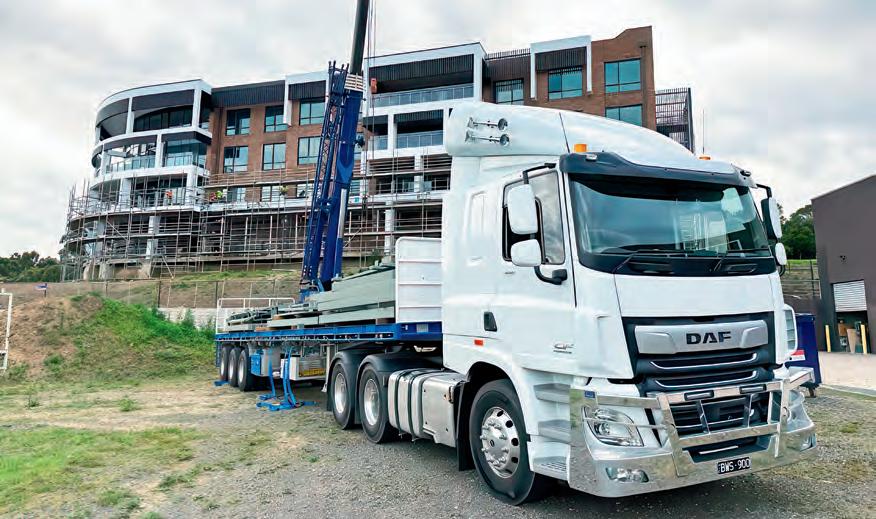
This quick ascension means it’s quite common to spot a Gagan Warehousing and Transport DAF roaming the various highways and roads of Melbourne, transporting supplies to any timber yard one can imagine. Whether it be construction sites, warehousing giants or residential projects, Gagan Warehousing and Transport is often there in one of its many DAF trucks to get the job done.
These trucks are also now doing interstate jobs, carting large building materials and helping build Australia’s future with his fleet of DAFs. Hakam says DAF has been central to this growth due to their numerous benefits.
“I like DAF trucks as they’re very quiet and fuel wise they’re good – I love driving them,” Hakam says.
“The XF and XG models are my favourites as they’re both comfortable and fuel efficient. Overall, buying DAFs has allowed me to grow my business into being one of the largest building material suppliers in south-east Australia’s residential and building materials sector.”
From Muza’s perspective, Hakam and Gagan Warehousing and Transport form one of his oldest and best customers that he’s had at Hallam Truck Centre.
“He’s the best person to deliver trucks to, and whenever he visits us at Hallam Truck Centre he brings an incredible positivity to the room,” Muza told OwnerDriver
“He’s very good at what he does and he’s done a wonderful job at expanding the business, while he’s loved by all of us here as he always has a smile on his face.”
This positivity is made even better by the origin story of Gagan Warehousing and Transport. When Hakam
“WITH THESE NEW TRUCKS COMING, I WILL HAVE 22 DAF TRUCKS IN MY FLEET.”
OPPOSITE: Gagan has risen quickly in the local transport market
ABOVE: Gagan Warehousing and Transport has every
first decided to start the business in Melbourne, he was already committing to a lifestyle of grinding work with no guarantees of success. Through his constant joy and passion for the industry, he’s created a flourishing transport business in Australia’s south-east, helping build the nation through his fleet of DAF trucks. He has no intentions of taking his foot off the pedal.
“My plans are to keep growing, and DAF will be central to this,” he says.
“I don’t know where we’ll end up, but my priority is providing great service to our customers in order to become the best transport operator in Australia.”
CLEAN SWEEP
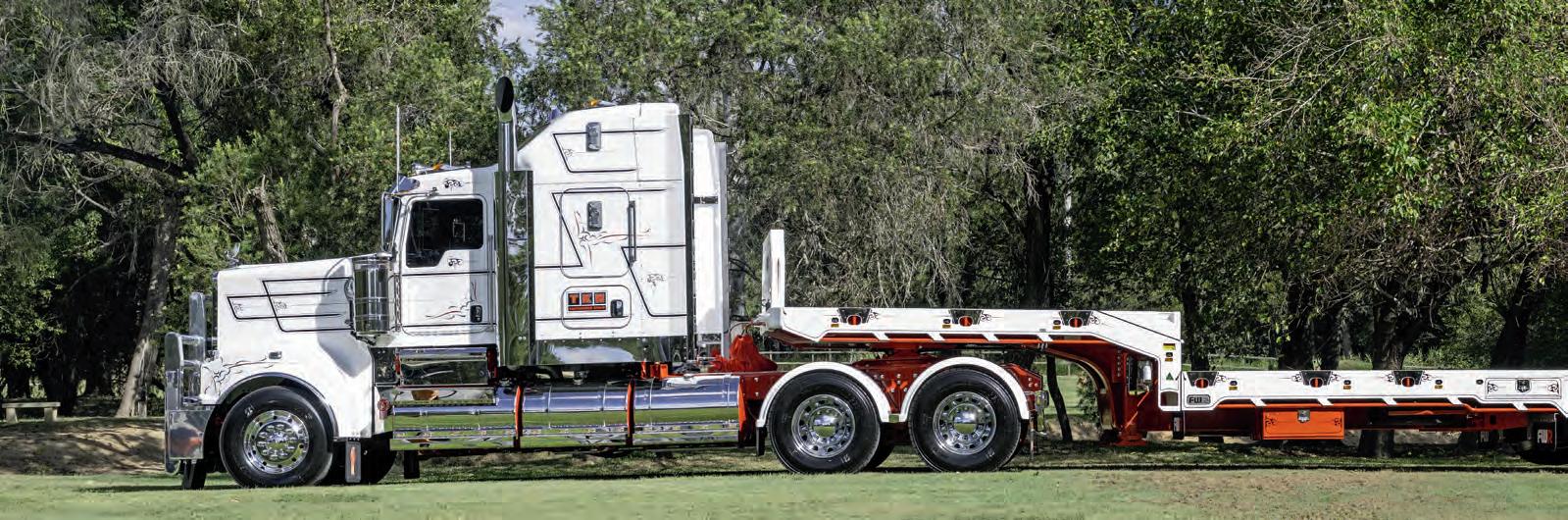
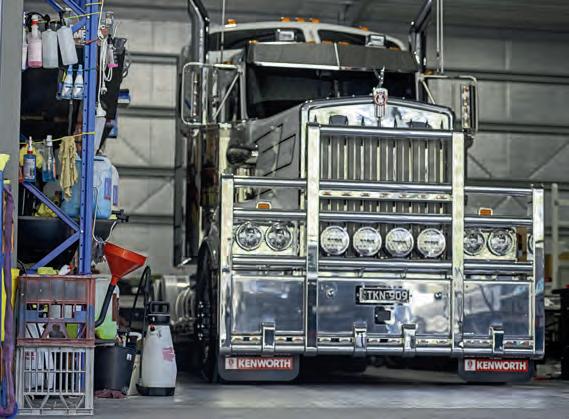
In Queensland’s Tamborine region, TKN Earthworks Group is a contradiction – keeping fleet clean while shifting dirt. Warren Aitken caught up with the family business to check out its first brand new Kenworth
Earthmoving, demolition and shiny are not words that tend to go together with ease. I’m not saying they don’t align with each other at all, but if you were undertaking one of those word association games, my money would be on earthmoving and dirt, demolition and debris, or even more likely, some derivative of earthmoving, demolition and big yellow excavators. The collaboration of earthmoving, demolition and shiny just doesn’t seem as linear, understandably so when you think of the conditions earthmoving equipment operates in. However, tucked away in the foothills of Queensland’s Tamborine region is a small family company that is breaking that mould – TKN Earthworks Group.
TKN Earthworks is an earthmoving company with a trucking addiction.
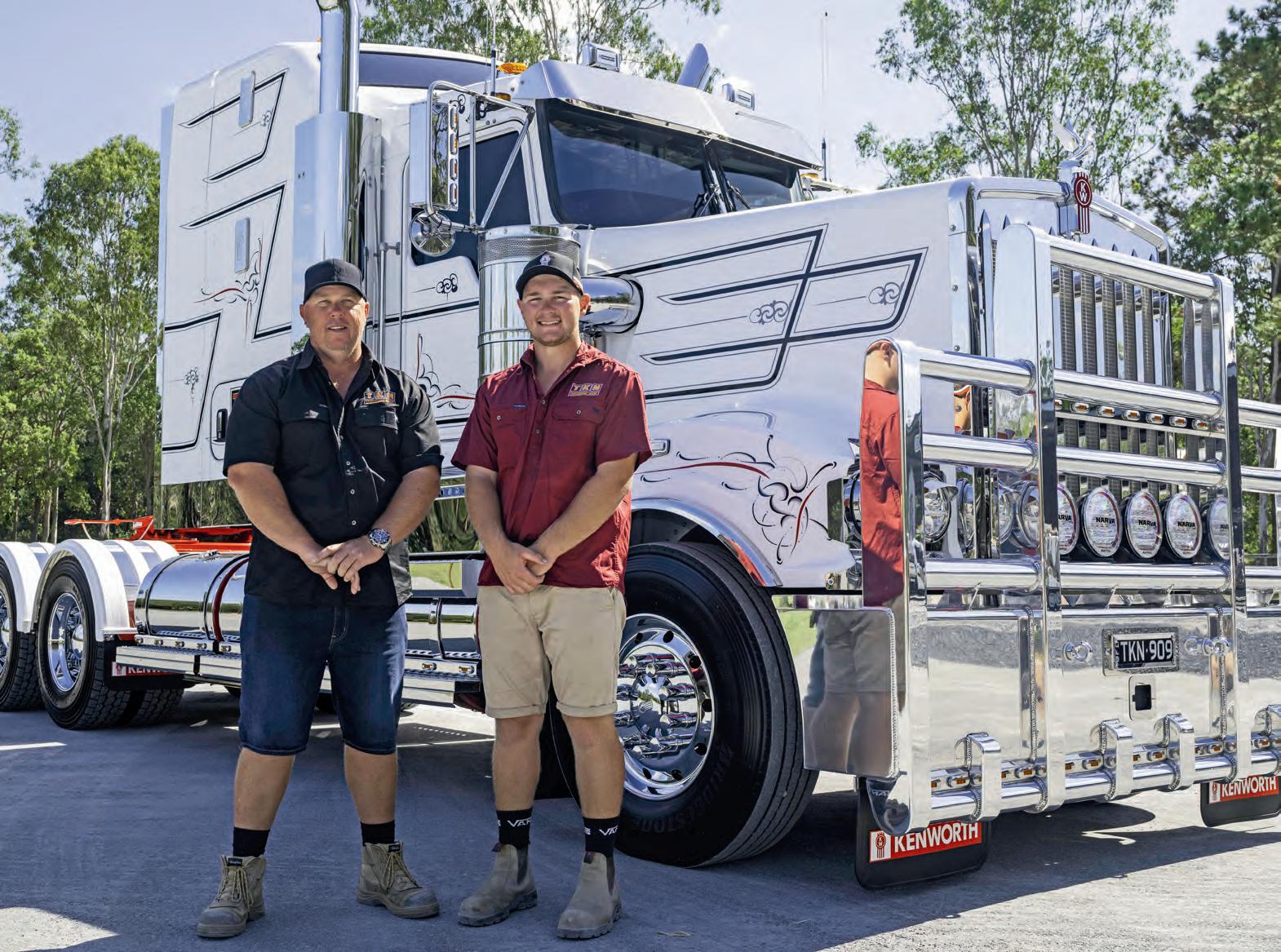
“The trucks are a by-product of our business,” TKN Earthworks project manager Travis Northcott admits.
It’s a by-product that’s necessary to keep the company going, but a by-product nonetheless. The condition and standards the trucks, and all the earthmoving gear, is kept in is a by-product of Travis’ upbringing.
“When they are out there, they are a representation of our business – clean. Clean is the word,” he says.
“People know if we are going to present like that, we are going to leave their footpath or road clean.”
It is a mantra that sees all the company’s gear looking like new
Images: Warren Aitken
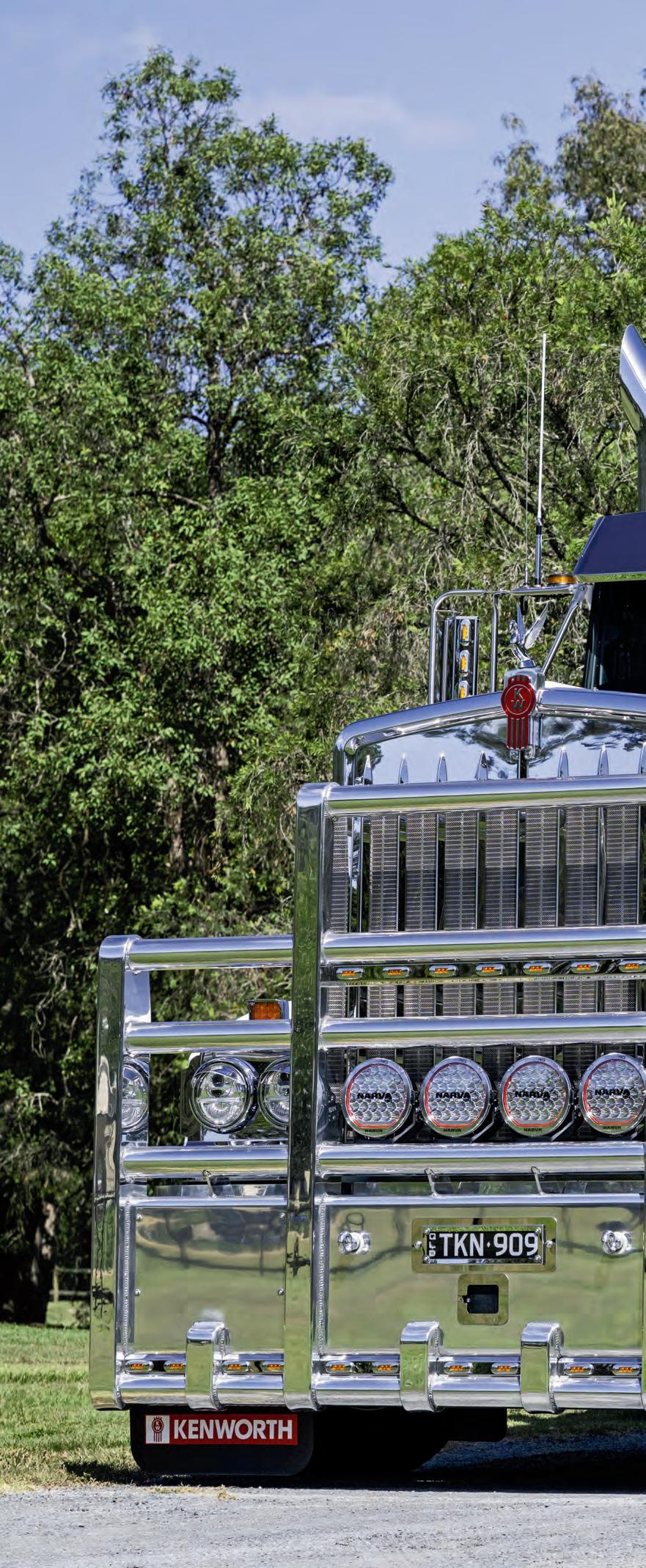
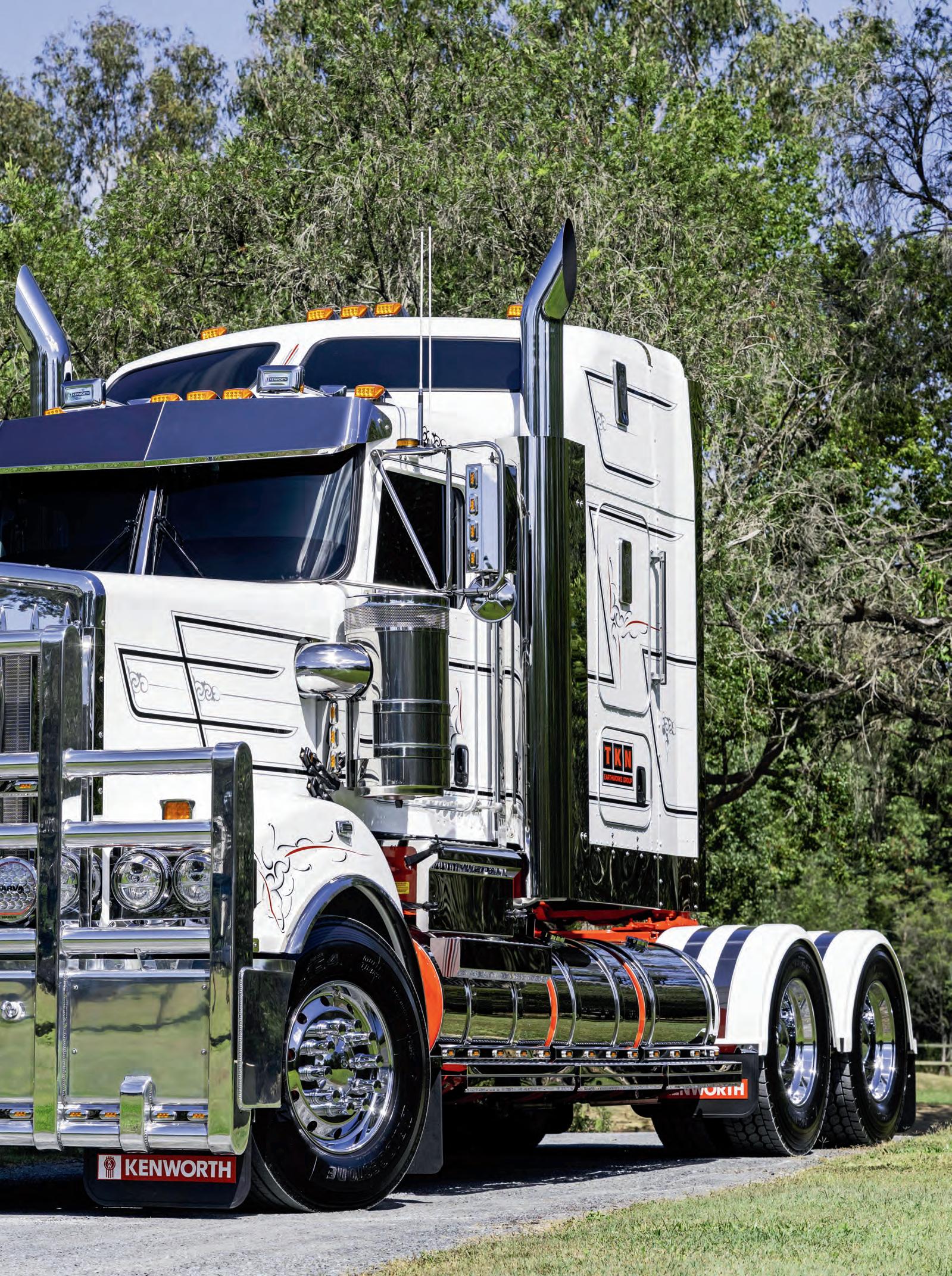
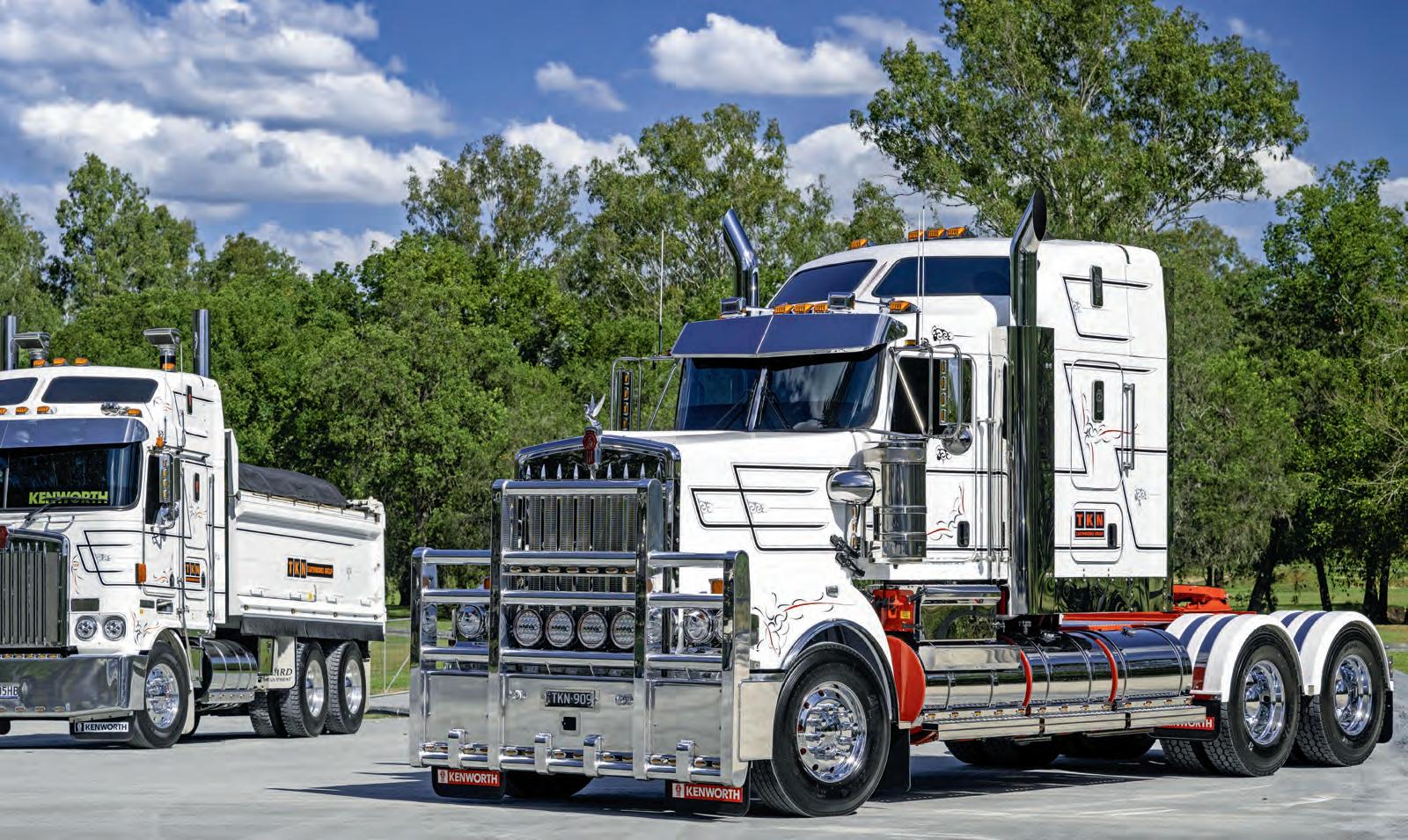
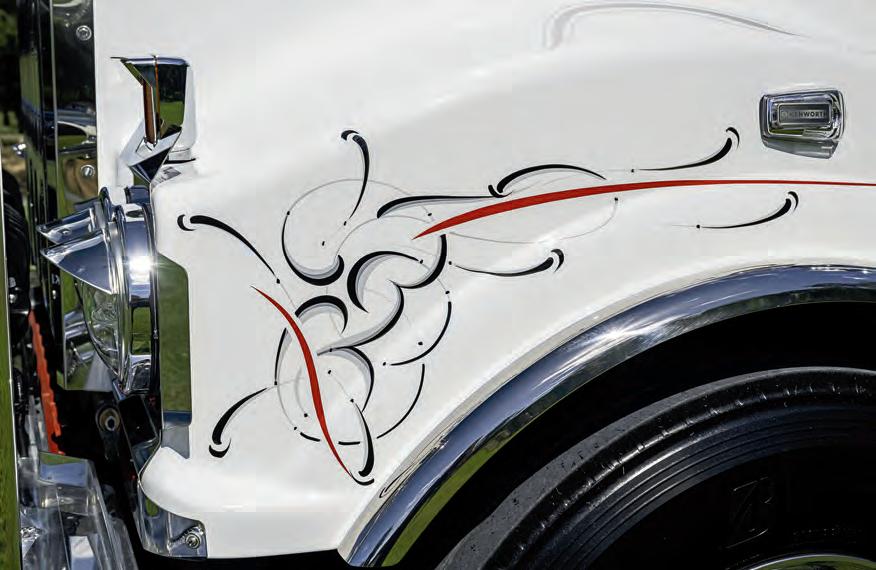
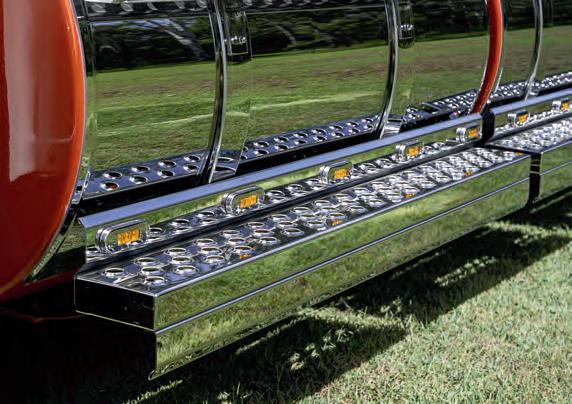
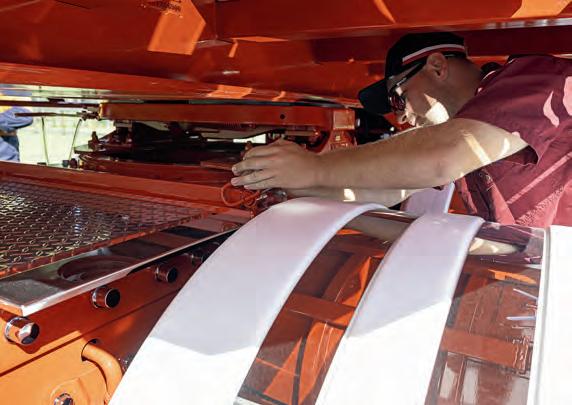
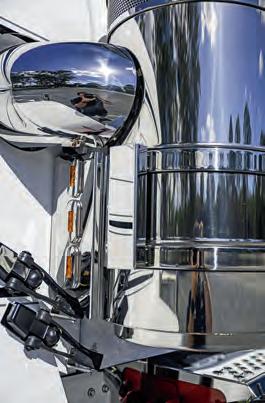
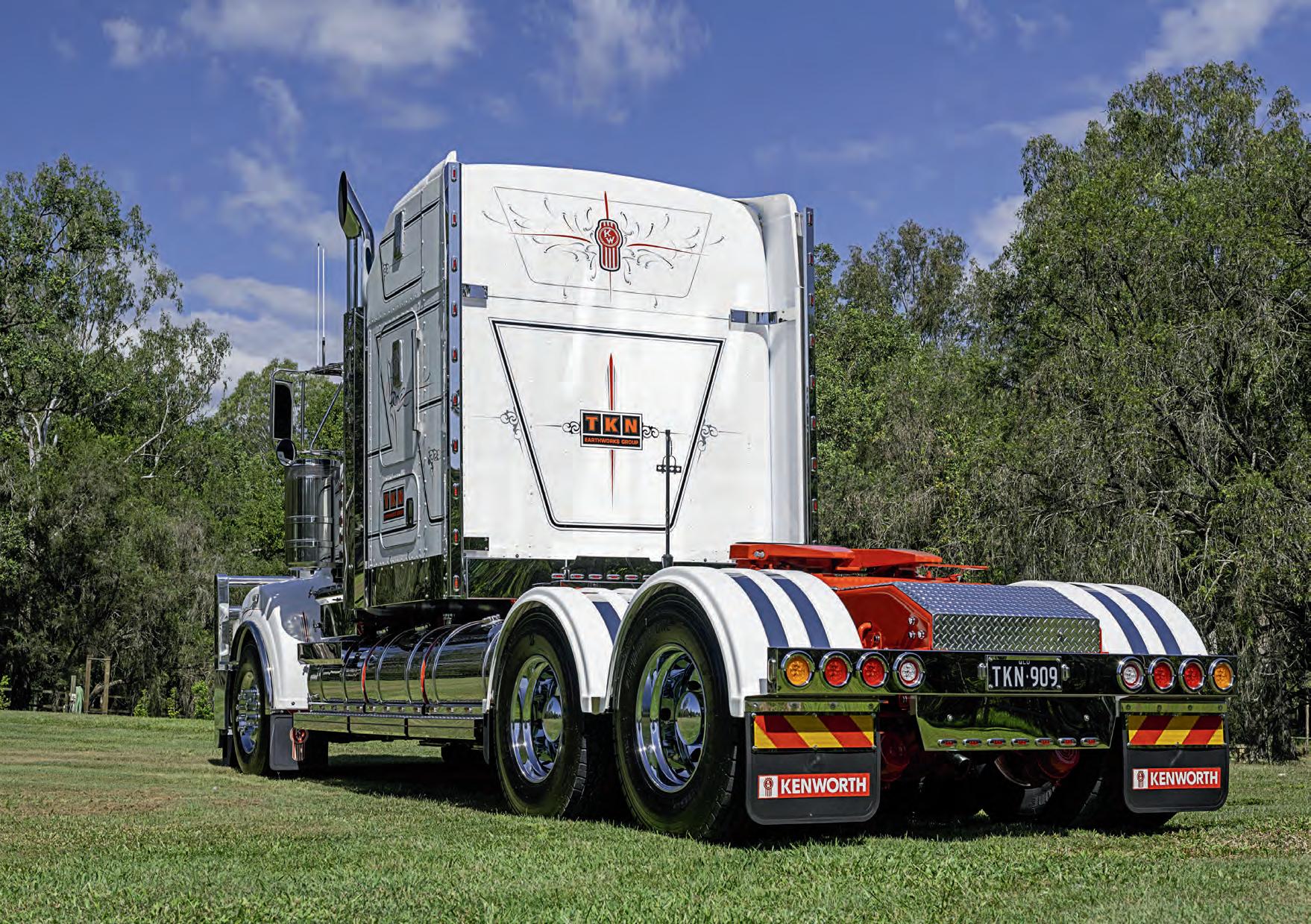
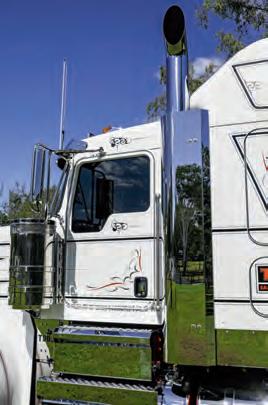
Left: Highway Lights down on the Gold Coast has done a fantastic job with TKN’s new T909. Plenty of mirror stainless, smooth shrouds, even step removal on the round tanks, all add to the look of the big bunk Kenworth
“As a young fella they taught me a lot of good stuff. One big thing I took was ‘clean as you go’ and I have carried that through everything I did a fter that. Even now, when we are on job sites, we are always cleaning as we go.”
every day it rolls out the company gates, normally on the back of an immaculately presented ‘by-product’ – AKA a TKN Earthworks Group truck. And it is a mantra that has drawn me to sit down and chat with Travis and his son Bailey to see how we got here.
other ACCO on the road combined. There are some incredibly well presented Hinos, again sporting stainless out the wazoo and enough shine to blind the beaches of Bondi. Although Travis wants to play down the ‘by-products’, his approach to business, family and trucks seems pretty universal. Do it right and do it proudly.
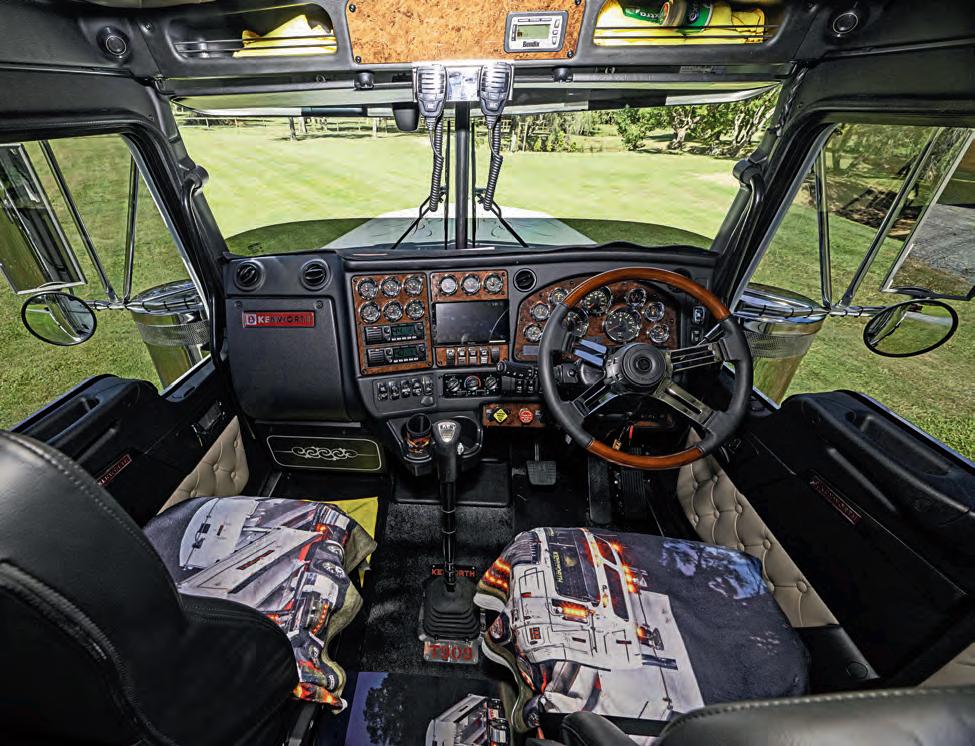
Opposite top: The old school steering wheel has replaced Kenworth’s more modern smart wheel, keeping with the Northcott’s love of the classic Kenworths
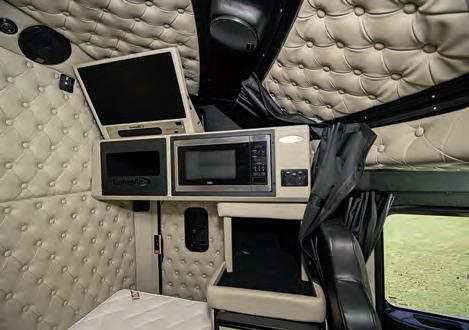
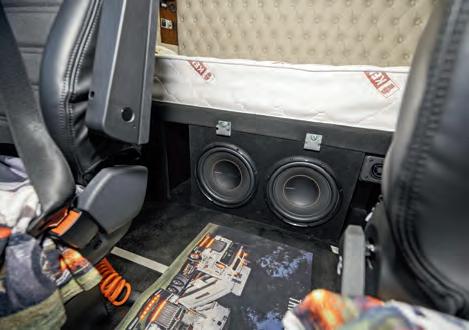
Opposite middle, L to R: Although it may not get a lot of use, the sleeper has been built for haul comfort; The stepped-up stereo also gets a fair bit of use
Opposite bottom: The newest Kenworth and the original. The ex-Campbell’s tractor unit now converted to one of the coolest tippers around
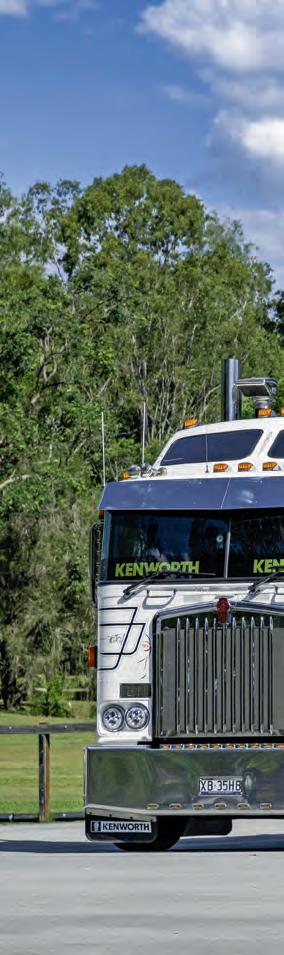
While the pages before you are graced with the company’s very first brand new Kenworth, a T909 sporting all the bells and whistles, I could easily write feature stories on any number of the half a dozen stunningly restored working Kenworths in this impressive fleet –from the ex-Campbell’s K104 Aerodyne that hit the road for Travis when he wanted to indulge in a little linehaul work, and is now a stretched out tidy tipper, to maybe the flat roof 104 that got torn down and rejuvenated to be able to tow around one of TKN’s semi tippers. It is not just the Kenworths that warrant attention – among the 14 odd ‘by-products’ of TKN Earthworks are a handful of impeccable ACCOs, sporting more bling and stainless than I believe every
You will find throughout this story I have made several assumptions and generalisations that comes about because Travis is about as humble a bloke as you can get. He doesn’t do what he does for the glory, and as cliché as it sounds it isn’t done for the money. Travis does it because he enjoys it.
“I love having a good team around me, our staff are family and as long as the wages are paid, the bills are covered and our team is happy, that’s why I do this,” he says.
Trucking and earthmoving have always been in Travis’ blood. His father Ken was into the earthmoving side of things when Travis was barely old enough to lift a shovel and by the time he could be put to work, his dad was doing
Top: The father and son duo, Travis and Bailey Northcott
linehaul work between Sydney and Brisbane.
“I still remember every second night being out washing the wheels with Dad before he went to Sydney,” he recalls.
“He’s still going too, now doing Brisbane to Melbourne, and he still keeps the truck immaculate.”
It would be fair to assume this was the origins of Travis’ cleaning compulsion. His dad led by example, always taking immense pride in the trucks he was driving. Even though they weren’t his, he always kept them immaculate and taught his boys that same resolve.
“We even had to make sure all the mudflaps were washed on the inside as well,” Travis laughs as he recalls how that spurned his mudflap OCD.
“Now I am all about the straight and even mudflaps, they’ve got to be straight and they’ve got to be long.”
It wasn’t just the hereditary family trait that has inspired Travis – his career path took him through a veritable treasure trove of unexpected learning institutes that have fuelled his dedication and respect for cleanliness.
“I was going to go into the police force when I finished year 12, but I had a job at Maccas and I just stayed there,” he happily admits, crediting the McDonalds training for influencing his approach.
“As a young fella they taught me a lot of good stuff. One big thing I took was ‘clean as you go’ and I have carried that through everything I did after that. Even now, when we are on job sites, we are always cleaning as we go.”
So how does a young fella with a managerial position at Maccas end up with a shed full of classic Kenworths and a yard full of spotless earthmoving gear? Easy – passion and someone else’s tax write-off.
That’s an over simplified answer, but let me elaborate. Travis’ affliction for cleaning and his eye for detail led to him starting his own
mobile detailing business. His enjoyment of that job and his work ethic saw that business grow and his client base expand very quickly.
One of those clients happened to have a brand-new Hino truck and Bobcat that didn’t get the use it should’ve. On one of Travis’ excursions down the back shed to dust the Bobcat down, the client made the remark that Travis looked pretty good in that.
“At the time the detailing was going well, but it was hard to teach people to have an eye for detail,” Travis confesses.
“So when he offered to sell me the Bobcat, even though I’d had no experience with it, I loved earthmoving equipment and I figured I’d give it a go.”
And so it began. Eventually, roughly six months afterwards.
“I had to go and get my tickets and stuff and I kind of left the Bobcat in the backyard,” he laughs.
“My wife eventually came to me and said ‘well are you going to do it or not?’”
Travis rang one of his other clients who did some earthmoving to see if he had any work, and the next morning Travis was behind the controls and into it. So it began.
The path from a single Bobcat to the five 14-tonne plus excavators, and more than seven eight-tonne mini excavators, as well as the handful of Bobcats and other equipment, has been an up and down affair. TKN has ebbed and flowed through the past couple of decades of fluctuating economies and landscapes. At one stage, the company had as many as 35 employees and now sits happily between 15
and 20. They have carved out a happy market looking after their loyal customers who appreciate that the TKN team don’t just take the ‘clean as you go’ approach to their trucks, but also to every job they turn up to. Really, you’re here to find out about what they are turning up to the jobs in, right? So let’s focus in on the trucks, specifically the eye-watering T909 on the pages before you.
Now I can honestly say I have never written these words before, but a big thank you for this truck has to go to the NHVR – they’re Travis’ words, not mine.
“Thank you to the NHVR,” he says. “We had been looking at getting a new truck for a while, something that could tow a float. We always towed our bigger excavators on a tag trailer and one day when we got wheeled in, they
“We’ve now got a K104 Aerodyne in the tipper, a K104 fat cab in a prime mover, a K104B fat cab prime mover and a 404SAR in a tipper spec, actually it’s probably better if I say what we don’t have, which is a 604 and a 904 in that series.”
pointed out if we had an extra bucket or something on, we would really be pushing the limits. So that was kind of what pushed the idea of a truck and float over the line. So the NHVR helped me get this over the line with the wife.”
While this was all said tongue in check, Travis also took the time to point out exactly what the TKN Earthworks Group stands for.
“In my head it is Travis and Kassie Northcott Earthworks, that’s how I designed the name,” he admits.
“But it also suits my middle name – Travis Kenden Northcott. So, I get told on the good days it’s both our business – Travis and Kassie – but on the bad days it’s just mine, Travis Kenden.”
Back to the truck. While TKN Earthworks has had several brand-new trucks before, they have been limited to the Hino and ACCO models only, and yes every one of them has been spruced up and blinged out to the highest TKN standards. The Kenworth corner of the garage however has always been passion project trucks.
A lot of this has been because of both Travis and his son Bailey’s love of old school looks, as well as a passion for the classic CAT motors. All that paired with an employee by the name of Gerald Horan, and you had the driving force behind all the Kenworth refurb projects.
“Gerald was my go-to guy for nearly a decade. He started here as a truck and dog driver, by then we were pulling engines out of trucks, gearboxes, diffs. He was all self-taught. He could do anything, such a great work ethic,” Travis recalls as he reflects on his mate.
“He’d always know if something was out of our league, he’d say ‘we’ll send that out’ – not often though.”
Having a mate like that as a staff member had Travis
feeling, as he put it, ‘pretty ballsy’ when it came to buying trucks, particularly the Kenworths. Travis has a thing for the K104 models and knew with Gerald by his side they could bring life to any of Travis’ project ideas.
“We’ve now got a K104 Aerodyne in the tipper, a K104 fat cab in a prime mover, a K104B fat cab prime mover and a 404SAR in a tipper spec, actually it’s probably better if I say what we don’t have, which is a 604 and a 904 in that series,” he laughs.
Now we get to the brand new T909. This came about because Gerald decided retirement, or more like semi-retirement, was on the cards for him.
“This is the kind of bloke he is though,” Travis states.
“Gerald gave us 12 months’ notice that he was leaving. When we processed that, though, we realised we probably couldn’t do the project trucks we had been doing without him. So, the decision was made that the next truck we’d get would have to be a brand new one.”
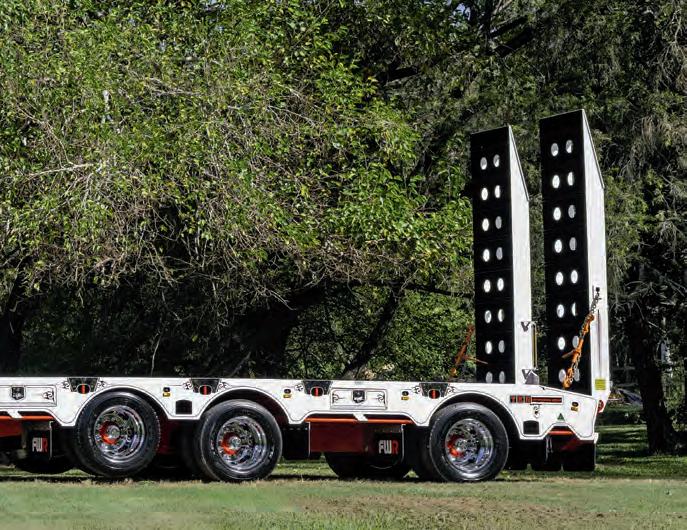
All of this was coinciding with the advice from NHVR and the thought of moving into some bigger excavators as TKN Earthworks and demolition clients moved onto larger projects. Thus the decision was made to look at a new T909 and FWR three-axle drop deck widening float trailer.
Before you make the observation that a 50’ bunk,
Opposite top: The GozBar may not be needed, but boy does it set the truck off
Opposite bottom: TKN Earthworks Group has put together this stunning looking set-up – its first brand new Kenworth and first ever low loader trailer
Top: Every TKN Earthworks Group unit has the Sam Keddie touch and the new one is no exception.
Above: Just check out the attention to detail in the finishing from Highway Lights
Left: Chromed steps in the earthmoving and demolition world take a lot of care and upkeep, but you can bet the Northcott team will stay on top of it
Bottom: Not the kind of turntable you see often these days, but it works for the TKN fleet
“Attention to detail and pride is as evident as the mirror stainless adjourned on this beast of a truck.”
Top: Travis admits he is a fan of the white plastic guards. He loves his stainless but believes the look of the white guards with stainless straps works for the fleet look
Above right: There is almost more cleaning equipment than machinery in the TKN sheds, but the results speak for themselves
Below: It is a different look when you swap out the shrouds for a smooth look, but it definitely works
fully specced with dual fridges, microwave, TV, custom sound system and sleeper air is a bit of overkill for a truck – even Travis jokes it’s the ‘Tamborine to Gold Coast Express’ – you are correct. Travis himself had a bit of fun teasing his Brown and Hurley salesman about his lack of reply at times, to the point that it resulted in Travis turning up on his Yatala doorstep and buying the highway spec stock model that was sitting in the front yard.
“I was sitting there thinking this is way too big for what I need, but everyone seems to be buying these things so I might as well,” he laughs.
“It didn’t have cross locks or diff locks, but we priced it with Brown and Hurley doing that for us and bought it.”
Brown and Hurley did the major rear end changes and then handed it over to Travis to get everything else done that he wanted, with the suppliers he wanted.
“Brown and Hurley basically didn’t see it for three months,” Travis says.
“So thanks to them for allowing us to move it around and get what they needed done.”
Top of that list was sending it to Highway Lights down on the Gold Coast and getting every bit of stainless removed.
“The factory stainless is bright annealed (BA), and we got everything replaced with mirrored stainless. They also deleted the smart wheel while it was there,” he recalls.
“I’d seen a bullbar I liked at GozBar; I didn’t need a bullbar, I just got it because I like hanging all this stuff off it – stainless spotlights, that stuff. Shephard Transport Equipment did the hydraulics, chrome wheels and turn table. Ash at On Highway Electronics did the stereo
system. Matt from Precision Truck Air and Stainless did the fridges, cabinets and everything in the sleeper. Sam Keddie Signs took care of all the lines and scrolls like he always does. I have also got to thank the likes of Midway Signs, Matt from Tint Focus and Sam at SJG Heavy Auto Electrics for their work.”
By the time Brown and Hurley had the truck back ready for pre-delivery, it was barely recognisable as the stock standard truck that TKN had signed up for.
“It is more than we need, to be honest,” Travis admits, but doing things by half measures is not the way TKN approaches anything, from every job they rock up to to every truck they have and to every piece of earthmoving equipment bearing the TKN logo. Attention to detail and pride is as evident as the mirror stainless adjourned on this beast of a truck.
“If Gerald was still here full-time (I should have mentioned that Gerald’s ‘semi-retirement’ involves flying down from Bowen several times a year to help and work with the TKN team), we would probably still be doing up the old girls,” Travis says.
As much as we can appreciate that, what Travis, Bailey and his family team at TKN Earthworks Group can do with a brand-new truck definitely pairs earthmoving and shiny together well.
“Please watch the road”
Act on the most urgent risks in seconds.
Geotab’s new all-in-one video telematics solution, the GO Focus Plus, automatically flags distracted driving, tailgating, hard braking and other serious events immediately, delivering instant in-cab voice feedback to enhance driver safety. For managers, patterns and urgent cases rise to the top for fast review and targeted coaching, all in one workflow that tracks follow-up and results. Spend less time searching and more time supporting every driver, addressing risk, encouraging improvement and recognising safer habits.
Ready to transform your fleet?
Visit www.geotab.com/au/ to learn how our telematics solutions can drive your business forward.
Video Telematics Powered by AI
FUEL SAVINGS FLOW
A Melbourne freight company has welcomed MercedesBenz’s latest Actros ProCabin to its fleet, with the savings already proving to be evident
Melbourne-based freight company CoolTrans has added an efficient Mercedes-Benz ProCabin to its fleet, with the operator already noticing extra savings.
CoolTrans delivers a range of food products up and down Australia’s east coast and across to South Australia and Tasmania. It was one of the first companies in Australia to take delivery of the new aerodynamic ProCabin, which it put to work in February towing B-doubles.
“The previous Actros really set the standard for fuel economy, but this new one is more efficient again,” CoolTrans general manager Jono Hookway says.
“It’s a clear improvement, which is great for us.”
Hookway says driving down fuel consumption is critical.
“Saving money on fuel has always been important but it is even more so now with the price of fuel,” he says.
“It just makes sense to reduce the costs you can control.”
CoolTrans also has a strong focus on sustainability. It switched to Euro 6 emission level trucks when it
started purchasing Actros models back in 2018, well ahead of any legal requirement to do so.
“Sustainability is a key part of our operation, which is another reason we choose Mercedes-Benz trucks,” Hookway says.
This time, CoolTrans chose a 2663 model with the taller GigaSpace cab fitted with the approved DuraBar bullbar. The truck was sourced through Daimler Trucks AJL Hobart. While efficiency was a leading driver for CoolTrans, it also places a sharp focus on safety.
“Safety is absolutely at the centre of everything we do at CoolTrans, so Mercedes-Benz is a natural choice given how much safety technology they have in their trucks as standard,” Hookway says.
All Actros now feature the Active Brake Assist 6 Advanced Emergency Braking Systems (AEBS) safety package that now includes five radars providing a 270-degree view around the vehicle and allows for optimum operation of the Active Side Guard Assist 2 (ASGA) system.
The backbone of this safety suite is a new electronics platform that can process data 20 times faster. The new Actros ProCabin has been shaped
for maximum fuel efficiency through aerodynamics, featuring a rounded nose and smooth panels to cut consumption.
Daimler Truck Australia Pacific Vice President Sales, Marketing and Operations Andrew Assimo says he was glad to hear how well the Mercedes-Benz ProCabin was performing for CoolTrans.
“We knew the ProCabin would use less fuel, but to our customers tell us how they are benefitting is just brilliant,” Assimo says.
“Driving fuel costs down has never been more critical to business success, which makes the ProCabin an even smarter choice.”
The CoolTrans Actros is a 2663 featuring a 630hp 16-litre Mercedes-Benz engine teamed up to a 12-speed Automated Manual Transmission (AMT) and features the taller GigaSpace cabin. Mercedes-Benz extended the front of the Actros by 80mm and then rounded off the face to reduce drag.
The ProCabin design removes unwanted gaps and joints and guides air either around the cabin or straight into the truck’s cooling system. This concentration of the airflow maintains the cooling effectiveness of the Actros.
There are also new sail-shaped side air deflectors at the rear of the cabin and a new roof spoiler as well as a new under-cab spoiler. Along with the new exterior design, these features reduce air turbulence and improve air flow.
Images:
Daimler
truck technology
TRUSTED, RELIABLE, PROVEN
Just over 30 years ago, the TRP brand was founded on the other side of the world before being introduced to Australia. Since then, the brand has grown in popularity across Australia and New Zealand due to its expanding range of quality, tested products
It’s been more than 30 years since PACCAR introduced a unique alternative truck and trailer parts brand in Europe. Now, over three decades later, the TRP brand has emerged as a leading, trusted name across multiple continents, including Europe, North and South America, Australia and New Zealand.
In recent years the TRP product range has become an emerging force in the local heavy vehicle parts sector. As Australia’s fastest growing truck and trailer parts business, the brand has fast grown to offer an extensive range of proven, affordable, reliable and highquality parts. What many may not know is the motivation behind the TRP Parts brand and how it differs from other parts suppliers in the local market.
As one of PACCAR Parts’ suite of exclusive brands, TRP joins PACCAR Genuine, Kenworth Genuine and DAF Genuine ranges. With its own range of quality reliable parts, the ethos of TRP is to provide value for money for Australia’s transport industry. As PACCAR Parts product manager Theresa Weymouth describes, TRP finds an ideal middle ground between more expensive genuine parts and cheaper lower quality parts.
“TRP is the perfect choice for customers seeking a balance between cost and reliability,” she told OwnerDriver
“It caters to those who cannot justify the expense of premium first-fit parts or simply don’t require them, yet refuse to compromise on quality. With TRP, you get dependable components that protect your engine from the risks associated with inferior aftermarket alternatives.”
TRP occupies the middle ground of the parts market, quality and reliability remain at the core of its offering, frequently punching above its weight in this category and even rubbing shoulders with OEM competitors with several products.
“Every product bearing the TRP name is sourced from established, reputable manufacturers and subjected to rigorous testing protocols,” Weymouth says.
“This ensures that all components meet or exceed industry standards, delivering customers peace of mind alongside value.”
Through this rigorous testing process, TRP ensures consistent quality and performance across diverse applications and systems. This comprehensive approach allows the company to stand behind its products with confidence, providing customers with the assurance that their vehicles will operate safely and efficiently without risk of damage or complications.
“In terms of the TRP brand, our value proposition is to fill the gap between higher cost premium parts and cheaper untested
products. Our parts offer a competitive pricepoint coupled with rigorous testing, meaning you get genuine value without sacrificing quality or performance,” Weymouth says.
“We pride ourselves on supplying tested parts that won’t damage any part of a truck, both now and down the track. All of our parts are backed by a minimum warranty of 12 months. In the unlikely event there is a problem, customers can contact us without any dramas and we’ll replace it.”
This unique offering has proven successful with the TRP brand experiencing rapid growth in the local market. PACCAR Parts now offers a vast range of TRP branded products across the Australian and New Zealand markets. The range is extensive and includes products such as oils, batteries, lights, air springs, wheel bearings, charge air coolers, brake shoes and safety triangles. Every product under the TRP brand meets or exceeds industry standards.
TRP brake shoes, for example, are tested and certified to meet FMVSS 121 standard and ECE R90 (European) standards, meaning that the brake shoes can come with an industry leading two-year warranty. Weymouth says the brake shoe kit has emerged as one of the industry’s leading braking range, offering value, durability and proven performance.
“TRP branded parts are available exclusively from 78 PACCAR dealers and TRP stores across
“TRP BRANDED PARTS ARE AVAILABLE EXCLUSIVELY FROM 78 PACCAR DEALERS AND TRP STORES ACROSS AUSTRALIA AND NEW ZEALAND AND ARE FULLY SUPPORTED BY PACCAR PARTS’ DEALERS AND TECHNICAL TEAMS.”
Australia and New Zealand and are fully supported by PACCAR Parts’ dealers and technical teams,” she says.
The global success of TRP branded products has led to the creation of over 360 TRP stores worldwide, expanding the reach of TRP’s network of high-quality parts for prime movers, rigid trucks and trailers.
Australia and New Zealand are home to over 20 TRP stores, with TRP Bendigo, TRP Brisbane Port and TRP Leongatha being recent additions. TRP stores offer both TRP branded products as well as a great selection of PACCAR Genuine, Kenworth Genuine, DAF Genuine and vendor brands.
“TRP parts may not necessarily be the cheapest products available in the market, but they sit between quality genuine parts and untested and questionable options that have the potential to destroy an engine or damage another part of the vehicle,” she says.
“TRP products are all about quality and value for money, offering a tested, reliable part, with a warranty backed by PACCAR – the company that builds Kenworth and DAF trucks for Australia.”
TOP: A growing number of stores are part of the TRP network
TIMELY UPGRADES
IVECO Australia is continuing its latest product development with the roll-out of an updated truck and van range featuring boosted efficiency and performance
IVECO Australia has capped off an extensive new model development and launch phase by introducing major upgrades across its range of vans and trucks. The updates provides prospective owners with greater productivity, efficiency and safety, coupled with lower total cost of ownership benefits.
This major product investment applies to IVECO vehicles covering all weight segments and includes both on-highway and off-road models, giving buyers access to one of the most modern and comprehensive model line-ups available in Australia. The product is backed by an expanding suite of support services including extended warranties, service and repair programs, telematics and a professional dealer network of over 60 outlets, including service and parts locations.
The IVECO range begins with passenger car licence Daily van and cab chassis models. Vans start at the 42S with volume of 12m³ and 4,250kg GVM and extend to the 70C (requiring a light truck licence) which offers a market-leading payload of 19.6m³ and 7,000kg GVM. The cab chassis line-up includes single and dual cab variants along with ‘work-ready’ models available with factory fitted trays from the dealership, making it a great choice for tradies looking to get to work on site faster.
In the medium segment, IVECO offers the Eurocargo, renowned as one of Europe’s bestselling trucks in the medium category. Three principal models are available in this range –the ML140, ML160 and ML180, with respective GVMs of 14,000kg, 16,000kg and 18,000kg. The Eurocargo is characterised by its advanced safety features, fuel efficiency and comfort while still offering generous payloads and impressive output of up to 320hp (235kW) and 1,100Nm of torque
“IVECO SAYS THE DAILY, EUROCARGO, ACCO AND S-WAY MODEL LINE-UPS PROVIDE SOLUTIONS FOR JUST ABOUT EVERY APPLICATION, OFFERING OPERATORS THE EFFICIENCY AND CONVENIENCE OF PARTNERING WITH A SINGLE SUPPLIER FOR MOST FREIGHT AND TRANSPORT REQUIREMENTS.”
from their advanced Euro 6 (Step E) engines.
MAKING THEIR MARK
Two of the latest models that are experiencing strong demand in recent months are the ACCO and S-Way, which spearhead IVECO’s heavy duty line-up. The ACCO nameplate is well known in Australia, normally associated with demanding applications such as refuse collection. ACCO models of old were well known for their durability and toughness for this type of work, becoming a favourite among local government and private fleets. The latest generation models build on this toughness, bringing a raft of
sophisticated active and passive safety features, enhanced comfort and powerful yet efficient drivelines to the range.
In developing the latest ACCO, IVECO consulted extensively with industry, particularly the refuse sector, to ensure the model is fit-for-task and continues to be a leader in vocation-based applications. The latest product mix includes 6x4 and 8x4 configurations along with a 6x4 dual control variant which was locally engineered in Australia specifically for the ACCO platform.
Models feature IVECO’s 8.7L, Euro 6 (Step E) Cursor 9 engine in two output ratings with up to 360hp and 1,650Nm of torque available. Matched
PICTURED: IVECO’s new look local range
PICTURED: The updated line-up includes an array of trucks and vans
to the engines is the proven Allison 3200 6-speed fully automatic, a favourite for demanding stopand-start applications.
In a further benefit for prospective operators and bodybuilders, the latest ACCO places a high emphasis on clean chassis rails allowing greater body mounting options, while new systems have been introduced to allow easier integration between the cab chassis and body.
IVECO says the latest models have been well received by operators with large sales into fleets, including Solo Resources, who recently invested in a large number of ACCO trucks for compactor use as part of a 50 vehicle IVECO truck order which also included Eurocargo and S-Way models.
Similarly, the S-Way, which is available in 4x2, 6x2, 6x4 and 8x4 configurations, in a variety of cabin choices and as either a rigid or prime
mover, have also found their way into fleets around the country large and small and into the hands of hard-working owner drivers.
Like the rest of the IVECO line-up, S-Way again balances payload, comfort, safety and efficiency, making it suitable for a broad array of local, intra and interstate general freight work as well as more specialised applications such as construction and civil, municipal and specialty tasks.
The S-Way engine range begins with the 8.7l Cursor 9 which produces 360hp and 1,530Nm of torque. In the 11.1l Cursor 11, output jumps to 460hp and 2,150Nm of torque. The largest of the engine family is the 12.9l Cursor 13 which starts with output of 530hp and torque of 2,400Nm; a second output of 550hp and 2,500Nm of torque is also available. All meet stringent Euro 6 (Step E) emissions levels. GVM and GCM for the range
Haulage Australia
span from 18,200kg to 27,600kg (GVM) and from 50,000kg to 70,000kg (GCM) for prime movers and 27,600kg (GVM) and 70,000kg (GCM) for selected rigids.
Together, IVECO says the Daily, Eurocargo, ACCO and S-Way model line-ups provide solutions for just about every application, offering operators the efficiency and convenience of partnering with a single supplier for most freight and transport requirements. As well as its road going models, IVECO has one of the most comprehensive off-road ranges available which includes the Daily 4x4, Eurocargo 4x4 and the T-Way, available in 4x4, 6x6, 8x4 and 8x8 configurations.
For more information on the extensive IVECO product line-up and associated support services, visit Iveco.com/au or contact your local IVECO Dealer.
MEDIUM DUTY MARVEL
Warren Aitken recently put the new Mercedes-Benz Atego to the test in perfect medium-duty style – by taking it around the tight inner city streets of Melbourne. The end result was a new appreciation for the latest MercedesBenz entrant to the local market
The Australian truck market is one of the most competitive and heavily saturated markets around the world. It is so in all categories, especially the medium duty market. That first leg pick-up market and last leg of the journey vehicle. Transport operators are flooded with options, and it is a market dominated by brands offering cost effective, lightweight options. But they are not the only option, and recently the Mercedes-Benz Atego has seen a resurgence in popularity as operators start factoring in versatility, GCM – not just GVM – and of course all the new safety and emissions regulations.
Mercedes-Benz has always had a voice in the light to medium duty market here in Australia with its Atego range. It has normally been a quieter voice than over in its European stomping ground, but it has been a voice nonetheless. With its latest range of fit for purpose Ategos, however, it has found its voice, getting
a little louder in the highly competitive market and, as such, I got an invite to pop down and take one of the brand’s new 2026 Ategos for a little work experience around Melbourne.
We will make something clear to start with – the Mercedes-Benz Atego I was getting the pleasure of driving is one of the ready-to-go tautliners, brought in, fitted with a body and ready to be sold straight into work. It is a concept that Mercedes-Benz has been implementing over here and is making life much easier for customers. They can rock up, grab the truck, throw some signage and straps on and head straight into town for some pickups. I was test driving the truck, not actually taking it to work, just in case anyone was worried I was guilty of finally doing some real work. It’s all the joys of the Mercedes drive without having to do any real trucking work.
The Mercedes-Benz Atego is not a new player in the Daimler Truck arsenal – the first generation hit the roads way back in the late ‘90s and the latest variant is the fourth generation. In its time it has picked up a couple of ‘International Truck of the Year’ awards and throughout the world the Atego has been a solid representative of the three-pointed star.
The Atego range is as varied as its vocational usages. The key models in Australia are the 1224 – the model I was having a play in – the 1427, 1623 and 1630, all of which are sporting Euro VI compliant Mercedes-Benz engines delivering up to 300 hp and 1200 Nm of torque. The range also offers varied cab options as well, from S-cab where you can squeeze your fluoro vest behind the cab to the extended S-cab which is what I was driving, and you can easily fit a decent sized lunch box in the back, along with the BBQ to cook said lunch, and, if packed right, the collapsible table and chairs. I wouldn’t try sleeping in it, but your swag would almost fit. Mercedes-Benz also sports the L-cab variants in case you are cooking lunch for an entire crew or you really are trying to sleep in the back.
As mentioned earlier, the Atego range is powered along by the Mercedes-Benz 7.7 litre OM936 turbo diesel engine. The Euro VI complaint powerhouse is pumping out 175 kw (238 hp) in the 1224 model and opens up to around 220 kw (299
“The Atego range is powered along by the MercedesBenz 7.7 litre OM936 turbo diesel engine.”
Top, L to R: With its slightly set back front axle, the manoeuvrability of the 1224 Atego was pretty impressive; The radars are rather subtle but extremely effective in the Atego front and side guard assist system. Indicators inside the cabin notify you if there are hazards that you haven’t picked up on
Below: The Atego badge has been a solid staple of the Mercedes-Benz garage for almost 30 years now
Bottom: You do have to watch the overhang a little on the dual axle 1224, but all in all, it’s a pretty perfect workhorse
Images: Warren Aitken
“Let’s get to the driving side of things. Medium duty or not, the Atego is still a European truck and with that comes an expectation of quietness and comfort. That expectation was satisfied.”
hp) in the bigger and 1630 model. The torque range varies between 1000 Nm and 1200 Nm respectively.
The OM936 engine is paired to Mercedes-Benz Powershift automated transmissions throughout the range which ensures optimum efficiency between the state-of-the-art systems.
All of this stuff is sales brochure reading – the real story comes from getting in behind the wheel and pretending I am a local driver with a 10 hour shift of negotiating tight turns and ignorant idiots on E-bikes for the day, and that really is where the Atego shines. Let’s get behind the wheel and have a look.
The interior of the Atego – by Mercedes-Benz standards you would class as basic, or maybe minimalist would be more appropriate. The functionality and aesthetics of the interior are fantastic; I love the way the dash and doors have more of a sweeping curved feel to them than the more rigid straight-lined interiors. You will find the Atego range has missed out on many of the luxuries the heavy duty Actros range comes equipped with – little things like climate control, built-in fridges or bigger things like electronic park brakes, but all of that is as much a cost saving effect as it is a practical usage issue. Where they haven’t skimped is in the safety features. The new Atego comes with the likes of Active Sideguard Assist, Front Guard Assist, Active Brake Assist 6 plus, Advanced Emergency Braking and Attention Assist, all of which are extremely valuable for the roles these medium duty trucks undertake.
Let’s get to the driving side of things. Medium duty or not, the Atego is still a European truck and with that comes an expectation of quietness and comfort. That expectation was satisfied. As we skirted around Melbourne’s tight city streets, there was no need for raised voices as the truck was extremely well insulated. As I pointed out before, the layout of the cabin was more curved and flowing than other vehicles but there was no issues getting set up with the seat or steering wheel adjustments. You found yourself with an easy observation of all the gauges and information on hand, no matter what your seating preference. The only thing I did find a little ‘in your face’ was the reversing camera.
Above: Most inbound Ategos come sporting the small AdBlue tank and the 325L fuel tank, all of which is plenty for the work these trucks do
Below: While 35 litres may not sound like much for the AdBlue, the efficiency of the Euro VI engine ensures it is more than enough for the average workday
Opposite from top: She looks pretty basic from the outside, but the ready to go Atego range packs all the necessary safety features, and all the best of Mercedes Benz start of the art engine technology into the perfect little package.; Along with the front and side guard assist radars, the MercedesBenz Atego is sporting plenty of mirror options for the driver. It’s pretty hard to miss anything
Quick side note here; in Europe it is already a requirement for local delivery trucks to have reverse cameras fitted and operating. It is expected that Australia will follow suit in a few years, hence Mercedes already has them as part of the Atego set-up. The downside is it involves a rather inconvenient screen mounted on the dash just in your left eyeline. It is something you would get used to, but seems contradictory to the rest of the cabin that seems so ergonomically attuned.
Another feature of the Ategos that Mercedes-Benz is bringing into Australia is the addition of the middle seat as standard in the range. With the Atego becoming very popular as tilt tray setups, having the middle seat as factory has become quite an appealing addition. If you aren’t interested in having extra passengers, it can be folded down and doubles as a rather large desk and drinks tray.
As you would expect from a truck aimed at metropolitan use, vision through the large windscreen and the abundance of mirrors is fantastic, paired with all the radar sensors you
really need to be deep asleep in order to miss any hazards around your vehicle. And if that’s the case, you’re doing the job wrong anyway.
I must say I was pretty impressed with the manoeuvrability of my little 1224. Throwing it into full lock in the carpark, you really can whip it around some tight spots. Initially I felt the steering was a bit heavy, but after a while you began to appreciate the read it gave you of the road and the corners.
As far as the ride goes, that’s where the downside of a European truck for the owners becomes a plus side for the drivers. The Atego range, like most European trucks, is heavier than its Japanese counterparts. The two areas where that is obvious is in the payload and in the ride. The Atego rides beautifully. We had a couple of concrete blocks in the back to get us to maximum weight and with that it really road the Victorian cattle grates (the local streets) well.
Performance wise, once again no complaints. Pulling away from traffic lights and roundabouts, you can feel the Ategos OM 936 6-cylinder engine packs some very handy low-end torque. You’re not doing eight to nine second quarter miles by any means, but you also aren’t having to pull out of the way for mobility scooters. Paired up with the Powershift 3s six-speed transmission, the gear changes are extremely smooth and well timed. Putting the power, quietness, harmony and comfort together, you get a real modern car feel to the Atego experience. Base model, of course –there’s no heated seats after all.
Yes, the Atego range does get hamstrung with the higher tare, therefore slightly lower payload, compared to its Japanese counterparts, but as you move into the bigger 1427 and 1630 models, that gets negated a little with a higher GVM on both models. And where the Atego really sets itself
above its Japanese rivals is in its GCM.
The Atego range is engineered to allow up to 20-tonne towing capacity across the board, meaning even with the likes of the 1224 I was experiencing, which can be operated on an MR licence, can be coupled to a pig trailer and it takes the little rig from a GVM of 11,900kg, to a GCM of 34,000kg. As operators strive for maximum usage and versatility from their fleet, this raises the Atego’s appeal tremendously.
By the time I had to hand the keys to the little 1224 back, I was pretty happy. I’m still not willing to go back to round-town work – the drivers and pedestrians just push my buttons – but if I had to, then you couldn’t really ask for more from a medium duty truck than the Atego. It offers the efficiency and versatility the owners and accountants want, and it offers the comfort, luxury and power that the driver needs.
truck technology
DEFENDING DIESEL
As fuel prices remain volatile, fuel theft is on the rise in Australia. FuelDefend’s systems offer security for the nation’s truck operators against the rising trend
There was a time, not all that long ago, when fuel theft in Australia was something you heard about happening somewhere else.
The UK, perhaps. Parts of Europe. Places where diesel seemed to disappear in bulk, not by the litre. Here, it was different, or so we thought.
In Australia, fuel rarely vanishes in dramatic fashion. It doesn’t announce itself. It slips away quietly – a few litres at a time, a tank that doesn’t quite add up, a number that feels off but not enough to chase too hard. Until one day, it does.
Anyone running trucks knows the margins are tight enough without mystery losses creeping in. Yet that’s exactly how fuel theft tends to show itself – not as a single hit, but as a pattern. A couple of hundred litres gone from a yard overnight. A recurring shortfall across a fleet. Fuel purchased that somehow never quite turns into kilometres.
Write it off once and it’s easy. Write it off every week and it starts to look like a problem.
In today’s climate, it’s more than a problem. It’s expensive. With diesel prices still sitting high by historical standards, even small discrepancies carry weight. What might once have been shrugged off as “just one of those things” now lands squarely on the balance sheet.
For years, Australian operators haven’t had to think too hard about fuel security. The risk was low, the solutions were often costly or complicated, and the numbers didn’t justify the effort. That balance is shifting.
Recent incidents tell the story. In Sydney, a man was
way – that reacting after the fact is rarely effective. The lesson is straightforward – it’s far easier to stop fuel leaving the tank than to recover it once it’s gone. That thinking sits behind FuelDefend, a system now making its way into the Australian market through TRAIL-LINK. There’s nothing especially complicated about the concept. In fact, that’s rather the point.
Instead of tracking fuel after it disappears, FuelDefend focuses on preventing it from being taken in the first place – physically stopping siphoning at the tank. Devices in the UltraElite range are designed to do one job – make it extremely difficult for fuel to be removed without authorisation.
No electronics to fail. No major modifications required. No noticeable impact on how the truck operates day to day. Fit it, forget it, and get on with the job.
And if something does find its way into the tank that shouldn’t be there, it’s not a complicated exercise – access is straightforward via the sender unit up top, or it can be drained and cleaned out from below in the usual way.
What’s changed is more than just the risk – it’s the practicality. Where anti-theft systems were once expensive or overly complex, newer designs are comparatively straightforward and affordable. In some cases, the cost of installation is less than the value of a single tank lost to theft.
That changes the conversation – it’s no longer about whether fuel security is worth considering, it’s about whether it makes sense not to. Particularly for operators with vehicles parked outside secure depots, on farms, roadside or even in public fuel stops – the sort of places where access is easy and oversight is limited.
The trucking industry has never been slow to adapt when something starts affecting the bottom line. Fuel theft, for a long time, sat below that threshold. It was there, but not enough to drive change. Now it’s edging past that point, being thrust into the spotlight as fuel prices rise. Nationally, the question has turned to how soon operators will feel it and how much it will cost when they do.
FuelDefend is still new to Australia, meaning local case studies are only just beginning to take shape. But if overseas experience is anything to go by, the trajectory is fairly clear. As fuel remains valuable and accessible, theft follows. And as theft increases, prevention becomes part of normal operations – more than just an afterthought.
caught on CCTV allegedly helping himself to hundreds of litres of diesel – nearly $3,000 worth. In regional Queensland, a thousand litres disappeared from a rural property. These are far more than isolated curiosities – they’re signs of a changing environment.
As fuel prices rise and supply pressures linger, diesel becomes something more than just a running cost. It becomes an asset – and like any asset, it attracts attention.
If this all feels a little unfamiliar locally, it shouldn’t. Operators in the UK and Europe have already been through it. They’ve seen what happens when fuel theft moves from occasional nuisance to operational headache. And they’ve learned – sometimes the hard
In the end, it comes down to something quite simple. Every litre that stays in the tank is one you don’t have to pay for twice. And in this business, that’s reason enough to act.
To find out more about FuelDefend’s anti-siphon systems, visit fueldefend.com.au
ABOVE: FuelDefend’s technology helps protect diesel tanks from any shady business
BELOW: The simple system can have a mighty impact
Images: FuelDefend
ROARING TO LIFE truck show
It’s officially under 100 days until the 2026 North Coast Petroleum Casino Truck Show is back, with plenty more on offer for truck lovers this year
Now firmly established as an unmissable highlight on the calendar of truck enthusiasts across the nation, the Casino Truck Show will return to the Casino CBD, with Friday Night Lights on July 31 and the Main Show on Saturday August 1.
The Casino Truck Show is a celebration of innovation, craftsmanship and community spirit, recognising the pride and dedication of the men and women who keep Australia moving. Richmond Valley Council General Manager Vaughan Macdonald says anticipation is high as preparations gather momentum for another standout year celebrating the transport industry.
“With fewer than 100 days to go, the countdown is well and truly on for one of Australia’s premier trucking events,” Macdonald says. “Each year, the Casino Truck Show continues to grow, attracting industry leaders, passionate owner-operators and thousands of visitors from across the country.”
This year’s event promises to be bigger and better than ever, with an expanded Friday Night Lights set to shine brighter in 2026. The popular opening-night celebration will feature a spectacular illuminated truck display, live music and displays delivering a festival-style start to a weekend dedicated to the pride and passion of the transport industry.
Camping sites are available at the Casino Showground, allowing visitors to immerse themselves in the full Truck Show experience across the weekend.
Macdonald says the event is a boon for the Richmond Valley, bringing millions to the local economy. He encourages people to take advantage of the show’s multiple days and explore what the area had to offer.
“The Richmond Valley is proud to host this nationally recognised event, and we’d encourage everyone to come and experience what makes this show truly special,” Macdonald says.
Event co-founder Darren Goodwin says the level of interest from drivers, sponsors and enthusiasts still amazes him.
“We also extend our sincere appreciation to our sponsors and partners whose continued support ensures the ongoing success of this iconic event,” Goodwin says.
The ever-popular Dawsons Haulage street parade will once again draw crowds from across the region, complemented by a full program of live music, street entertainment, industry exhibits and family-friendly attractions.
North Coast Petroleum continues as the Naming Rights Sponsor, alongside Dawson’s Haulage as the Parade Naming Sponsor. Pittsworth Fleet Maintenance joins the event as the new Friday Night Lights Sponsor, supporting the continued growth of this crowd-favourite feature.
The event is proudly supported by Official Media Partner Prime Creative Media, while Heavy Haulage Assets’ Jon Kelly returns as Event Ambassador, bringing his respected industry voice and expertise to the show.
Aside from principal sponsors North Coast Petroleum and Dawson’s Haulage, a number of well-known industry companies are supporting many categories and prizes up for grabs. These include:
• Rig of the Show Prize Sponsor – RTE Custom Trucks
• Judged Elite Sponsor – Country Trucker Caps
• Supreme Show Truck Sponsor – Trucker Lid Co
• Show Truck Champions Sponsor – Wales Heavy Vehicle Repairs
• Robuk Randoms Sponsor – Robuk Engineering
• Elite Fleet Sponsor – Ampol
• Industry Pride and Passion Sponsor – Tefol
• Elite Paint Series Sponsor – Masterart Designs
• Through the Years Sponsor – Mader Group
• Fleet Excellence Sponsor – Chevron Finance
• Trophy Sponsor – Brown and Hurley
• Highway Heritage Sponsor – Highway Lights
• Future Operator Sponsor – VE Group
• Best Owner/Driver Sponsor – Reflection Metal Polishing
• The Five Star Selection Sponsor – Transport Insurance Solutions
• Stage Sponsors – Levanta and Schaeffers Transport
• Premium Exhibitor Sponsors: Omikron Auto Detailing Products, Lelox, RC Metalcraft, DA Campbell, Moore Trailers, Vortox, Alltruck Diesel Repairs, Scott Taylor Motorsport, All American Custom Chrome, Aircans Australia and S&S Heavy Haulage.
Entries open on July 13, and the cost for entry has been kept low remaining at $30 per truck, with the show limited to 550 trucks. Stay tuned to the Casino Truck Show’s website and social media pages for updates.
1000 Litre IBC
Available in New IBC’s, Refurbished or try our exchange program and Save!
We also sell Pumps 240V, 12V or gravity feed hose and trigger. It contains 32.5% technical grade urea and 67.5% deionized water (Pure water).
Purple Industrial AdBlue® is Made in Australia. Andy 0448 847 133
AVAILABLE FROM QLD Darra, Bohle, Bundaberg, Cooroy, Gympie, Mt Isa, Theodore, Emerald, Moranbah, Toowoomba. NSW Minto, Moree, Dubbo, Wagga Wagga, Tamworth. ACT Hume. VIC Pakenham
Image: Casino Truck Show
® = registered trading name of Verband der Automobilindustrie e. V. (VDA)
truck technology
HELPING HAND
As Australian operators face fuel price challenges, ProAxle’s wheel alignment services are helping fleets remain efficient and reliable
Without trucks, Australia stops. It’s a wellknown adage, popular among the driving cohort taking to our many long highways and freight routes each day and night. Badges with this message adorn a variety of heavy vehicles around Australia, from the dusty Kenworths to nifty Isuzu light duty trucks zipping around the suburbs.
In recent years, this message has been tried, tested and proven. The COVID pandemic showcased the impact that the whole country feels if freight movements are disrupted or delayed. Toilet paper disappeared. Panic buying started. As fuel prices have risen in recent months, the effect of trucks not being able to run efficiently and constantly is once again testing the general public.
It’s in these times that reliable partners and suppliers come to the fore for transport operators.
Pro-Axle Australia, as one of these trusted partners to trucking companies, has spent more than 40 years providing wheel alignment services to the Victorian and New South Wales commercial vehicle market. Ranging from four-wheel drives to heavy vehicles, the business’ collection of truck laser wheel alignments and axle corrections has ensured many different vehicles have been able to perform at their peak and fulfil the growing freight task in Australia.
This year has proven more than ever the importance of Pro-Axle’s services to the local market. More than ever, truck transport is relied upon to deliver freight across Australia, from the inner-city hubs on the eastern seaboard to the wide expanses
of the outback. Pro-Axle’s job has been, for decades, and especially since Bryan and Melisa Freestone took over the ownership of the business in 2016, to support operators by making their equipment safe, reliable and efficient.
“Pro-Axle Australia can support the nation’s operators to maximise tyre wear and minimise fuel wastage,” Bryan told OwnerDriver
“We do this by having the correct an often checked wheel alignment, acting as a partner to operators to keep their fleets up and running for as long as possible.”
In a time where many in the industry are focused solely on fuel, it’s easy to overlook the numerous other factors that can influence how efficiently a truck runs. Instead of worrying about more fuel economic driving techniques and practices, Bryan says Pro-Axle’s wheel alignment services can free tyres to run for longer, maximising the capability of a vehicle on a single tank.
This philosophy has augured well for Melisa and Bryan – the pair first owned the Pro-Axle outlet in Narellan in Sydney’s south-west, taking the business’ capabilities to new heights via a newer facility before taking over ownership of the wider business a decade ago.
“In 2016, the opportunity then presented itself to purchase the Pro-Axle head office from original owners, and we took it,” Melisa says.
The pair then merged Pro-Axle’s two offices into one, allowing the business to run out of its state-ofthe-art purpose-built facility in Smeaton Grange, Sydney. The upgraded site has allowed the brand to better service the six current franchisees in its wider network, which spans 4WD, car, bus and truck wheel alignment outlets alongside other specialist trade customers who require Pro-Axle’s products. These products include patented alignment correction products and various products coming from all over the world, with technical data required in the day-byday operations of businesses also available.
Nowadays, Pro-Axle has six stores, with five situated across NSW and a solitary store in Campbellfield, Melbourne. Whether it be its three sites in Sydney (Narellan, Enfield and Smithfield) or its other NSW sites in Newcastle and Wollongong, Bryan says the brand has a great understanding of how heavy vehicles need to have optimal driver comfort and safety.
He says its stores pride themselves on listening to their customers and providing a seamless experience for them maximising tyre wear and driver comfort.
While Melisa and Bryan both specialise in quality heavy vehicle servicing, the skilled Pro-Axle team also services caravans and provides roadworthy certificates. Melisa says customers across a wide range of vehicles are seeing “exceptional” tyre wear results. Another reason fuelling Pro-Axle’s growth in a market craving efficiency and reliability is its dedication to using experience. Melisa says the brand’s team members prioritise minimal turnaround times, making it the most competitive in the field.
The Pro-Axle business has also boosted its operations to perform wheel alignment services on new vehicles that are delivered not to Australian standards while continuing to wheel align older vehicles for customers. While Melisa says Pro-Axle is also eyeing growing demand in the four-wheel drive market, she says the current challenges facing the heavy vehicle industry mean Pro-Axle is intent on helping as many truck operators as possible keep their fleets running smoothly each day.
Both Bryan and Melisa, as well as the wider ProAxle family, acknowledge cost of living pressures are having an impact on owner drivers who need to keep their own trucks on the road. By providing regular wheel alignments, Pro-Axle Australia can keep trucks on the road for longer and ensure that fuel efficiency remains at an optimal, reducing cost pressures.
Bryan says Pro-Axle is positioned to help all operators maximise the efficiency of their trucks, curbing the impact of rising fuel costs.
“One of the things that I am especially proud of is our valued relationships that our stores have built with their local customers,” he says.
“We understand that their trucks are their lifeline and when they break down, we do everything we can to get them back on the road as soon as possible.”
You can find out more about Pro-Axle’s range of alignment correction products on their website www. proaxle.com.au, or you can call 02 4647 1867.
PICTURED: Pro-Axle is focusing on keeping fleets productive
Images: Pro-Axle
PICTURED: Wheel alignment services can help in more ways than one
truck technology
SMART CHOICE
Beyond
the product,
Prolube Lubricants offers the tools and expertise to help operators make smarter lubrication
decisions
For owner drivers and fleet operators, keeping trucks on the road is the priority. Every hour of downtime costs money, and every maintenance decision carries weight. Choosing the correct lubricant for each application isn’t always straightforward, particularly when managing multiple vehicles, varied equipment and an ever-expanding product landscape.
Prolube Lubricants has been supporting Australia’s transport industry since 1988, and that support goes well beyond the products themselves. To eliminate the guesswork, at prolube.com.au, operators can access lubricant selection tools designed to match the correct product to every vehicle and application with confidence. Search by vehicle type or registration to quickly identify the correct specification for each application, a practical starting point for any operator reviewing what’s running through their equipment.
For those wanting to dig deeper, Prolube’s full range of product datasheets is also available on the website. Cross-referencing selections against these datasheets, alongside manufacturer service requirements, is always a sound practice, particularly when reviewing or consolidating lubricants across a fleet.
That review process can also present real opportunity. With lubricant pricing continuing to shift in line with global supply conditions, there’s genuine value in assessing where products can be consolidated across a fleet. Where specifications overlap, it’s often possible to reduce the number of products in use without compromising protection or performance. Prolube’s technical team can assist with this directly, conducting lubricant surveys and fleet reviews to give operators a clear picture of what they’re using, where efficiencies exist and how to streamline without cutting corners.
Alongside selection and specification support, Prolube also offers condition monitoring services and oil analysis kits. Rather than relying solely on scheduled changes, oil analysis provides real data on lubricant condition in service, helping operators make informed maintenance decisions that protect equipment and manage costs over the long term.
Prolube’s product range is built to cover
“ENGINE OILS ARE FORMULATED TO HANDLE THE DEMANDS OF MODERN HEAVY-DUTY DIESEL AND PETROL APPLICATIONS, WHILE HYDRAULIC OILS AND TRANSMISSION FLUIDS ARE ENGINEERED FOR PRECISION AND PROTECTION ACROSS A WIDE RANGE OF OPERATING CONDITIONS.”
every lubrication requirement across transport and beyond. Engine oils are formulated to handle the demands of modern heavy-duty diesel and petrol applications, while hydraulic oils and transmission fluids are engineered for precision and protection across a wide range of operating conditions.
Gear oils deliver durability under load, greases provide long-lasting protection in highwear environments, and coolants are blended to manage heat effectively across varied climates and duty cycles. Specialty products round out the range, addressing the specific needs of industrial, agricultural and marine applications where standard solutions don’t always fit.
As Prolube approaches four decades in the industry, that commitment to practical, reliable support remains at the core of what the brand delivers. Proven protection. Powerful performance.
For more information or to find your nearest distributor, contact sales@prolube.com.au, call at 07 3881 1733 or visit www.prolube.com.au.
TOP, RIGHT: Prolube’s expertise is helping keep fleets moving efficiently every day
Images: Prolube Lubricants
THE LEGAL VIEW Sarah Marinovic
Fine line
Sarah Marinovic busts some myths on what transport companies can do if camera fines come through in the company name
When you’re operating business vehicles, it’s common to receive camera fines in the company name. In most cases, operators know about the obligations to nominate the driver and process it with no problem. But sometimes things don’t go to plan. When nominations get overlooked, the penalties for businesses can be significant.
Problems around nominations are one of the most common things we help businesses with. So, this month I’d like to remind our readers of some important information for nominations and hopefully keep you on the right side of the rules.
In NSW, camera detected offences, such as speeding, red light, mobile phone and seatbelt offences are sent to the registered operator of the vehicle. If that person was not the driver, then the operator is required to nominate the person who was in charge of the vehicle within 21 days.
Where the registered operator is a company, it’s obvious that they were not the driver. Revenue NSW makes sure that a nomination is received for any fine issued in a company name.
The nomination process is straightforward. You can submit the details through Revenue NSW’s ‘My Penalty’ website.
The authorities in NSW take the nomination process seriously and routinely pursue prosecutions when a nomination isn’t submitted. The penalties are tough:
• For a first offence they will usually issue a penalty notice fine of $1,784.
• For a second offence they will usually issue a penalty notice fine of $4,783.
• After repeated fines, the authorities start issuing court notices. When the case goes through court the fines can be up to $22,000 for companies.
• The authorities can also suspend vehicle registrations, although this is less commonly used.
With tough sanctions on the line, it’s worth making sure your business has the right knowledge and processes in place.
The most common mistakes we see businesses making are:
• Administrative errors – one of the main reasons businesses get in trouble is that they simply overlooked the original penalty notice or failed to process it properly. Some simple
this isn’t a common issue with heavy vehicles, since the regulations around record keeping means drivers are usually easy to identify. Where this becomes a problem is usually with the business’ light vehicles that might be shared between different staff or family members. Keeping a log book in shared vehicles is a simple way to avoid nominating problems down the track.
SARAH MARINOVIC is a principal solicitor at Ainsley Law – a firm dedicated to traffic and heavy vehicle law. She has focused on this expertise for over a decade, having started her career prosecuting for the RMS, and then using that experience as a defence lawyer helping professional drivers and truck owners. For more information email Sarah at sarah@ ainsleylaw.com.au or phone 0416 224 601.
procedures can avoid most problems. Ensuring the company address is up to date, having a member of staff who is responsible for completing all nominations and that staff members are diarising due dates and follow ups is usually enough to avoid missed nominations.
• Not having the nomination details – another common mistake is not keeping records of who had the vehicle at any given time. This can make it very difficult to identify the driver when a fine arrives several months later. We find
• Not realising that nominating is mandatory – when the penalty notice for the camera offence arrives in a company name, the fine is significantly higher than it would be if issued to an individual person. There is a misconception doing the rounds that businesses can choose to pay this higher fine instead of nominating. That is not correct. If the business doesn’t nominate, they will both pay the higher fine for the original offence and also be issued separate penalties for failing to nominate.
I hope that these tips will help you avoid nomination problems. But if you do find yourself with a fine or court notice for failing to nominate, there are things you can do to minimise the impact. We can often reduce the fines and sometimes even be issued a caution. It’s worth seeking advice from a lawyer experienced in these cases. Our team at Ainsley Law is always happy to speak with and help our OwnerDriver readers.
TIE DOWN WITH CONFIDENCE
Pacific Packaging’s extensive TYMATE ratchet tie-down range is allowing more and more Aussie operators to secure loads reliably every day
There are many tools an owner driver needs in their kitbag. Alongside their trusty truck, they need to ensure they have all types of loading and unloading gear, the relevant accreditation, bags and safety equipment. Throw in logbooks and other compliance requirements and it can quickly become a lengthy list.
Ratchet tie-downs fall into this category, but they are often difficult to forget. When transporting a variety of goods around the daily or weekly runs, tie-downs become an indispensable part of an owner driver’s arsenal. Ensuring these systems are sturdy, safe and dependable is pivotal to running transport operations. Enter Pacific Packaging and TYMATE.
“TYMATE is Pacific Packaging’s dedicated brand for load restraint and securing solutions, built for reliability in transport, warehousing and industrial environments,” Pacific Packaging Australia managing director Gary Manais told OwnerDriver
“Designed to keep loads stable and controlled, TYMATE products help reduce movement, improve safety and support compliant load handling.
“These ratchet tie-down systems are engineered for strength, reliability and repeat use across demanding transport environments.”
Far too many systems and tools are designed for adjacent industries, with owner drivers then being able to benefit if they used the technology in a particular way. With TYMATE, the ratchet tie-down systems are designed specifically for owner drivers as well as freight operators and logistics teams who need secure load restraint without compromise.
Whether it be for daily deliveries or heavyduty haulage, TYMATE has been created to keep loads locked in and moving safely. The TYMATE range is complete for load restraint, strapping
and securing applications, made from strong and durable materials that are designed to handle tension and movement.
This provides consistent performance across ratchets, ropes, twines and strapping, offering efficient and easy-to-use solutions for fast load securing.
“The key benefits include heavy-duty ratchet mechanisms, high-strength webbing and reliable, repeat-use performance that’s built with transport and logistics operators in mind,” Manais says.
Beyond the TYMATE ratchet tie down range, which comes in red, blue, orange or yellow options, is an extensive support network that is just as trusted as the product itself. As part of the wider Pacific Packaging Australia network, the TYMATE range is backed by the brand’s national supply network, making it easier to access the sturdy solution wherever you are.
To explore the TYMATE range for trusted load restraint products that help you secure with confidence, shop online at www. pacificpackaging.com.au or speak to the team at 1300 234 235.
“Whether you’re securing pallets for dispatch or managing loads onsite, TYMATE delivers dependable solutions that keep operations running smoothly,” Manais says.
TOP: Pacific Packaging’s diverse TYMATE range
BELOW, L TO R: The ratchet tie-down range is helping secure a variety of loads
truck technology
CRUCIAL COVERS
In the midst of the fuel price issue, reliable, high quality tarp covers like Ellis and Sons Group’s products are critical for protecting loads with confidence
With the current fuel crisis significantly impacting the transport industry, Australian truck tarp manufacturer Ellis and Sons Group says it is now more important than ever for truck drivers and haulage companies to make sure they have a tarp or cover that will last.
With skyrocketing diesel costs and supply shortages across Australia, transport companies have taken large hits to their bottom line, and it has become important for them to find savings in other areas.
For those that use trailers with tarps and covers, the last thing they want to worry about is having to replace it frequently, and this where a high quality, Australian-made tarp cover will help them save not just money, but the loads they are hauling, according to Ellis and Sons.
Ellis and Sons is a family run business that has been operating in the textiles industry for 113 years, with the company passed down the Ellis family through several generations, and during that time, they have developed industry-leading expertise and innovation in manufacturing tarpaulins for the transport industry.
Under its brand Tail-Wind Tarps, the company manufactures both roll-over and retractable tarp covers for trucks and trailers from its state-ofthe-art factory in Cowra, central western NSW, with its central location meaning it can easily supply tarps to any haulage company in eastern Australia.
Tarpaulin Department Manager Sarah Ellis says, like its longevity in business, the company’s tarp and covers were designed for the “long haul”.
“Replacing a roll-top or retractable tarp on a trailer isn’t everyone’s favourite way to spend a couple of hours too often, so we do it once, and we do it right so it lasts,” she says.
“Our tarps are made from the highest quality 900gsm European PVC material. We don’t use the
cheaper Chinese or other Asian options out there because we are in this game for the long-haul – and this is what our customers have come to know and expect from us.
“We understand the transport industry needs to be on the move all the time, and our great quality products prevent downtime and keep trucks moving while protecting their precious loads.”
Ellis says while they used to best quality PVC on the market, they still remained competitive in pricing, with their state-of-the-art manufacturing equipment allowing them to produce a high volume of tarps very efficiently, allowing them to keep their prices down. She says what sets Ellis and Sons apart from other roll-over and retractable tarp manufacturers is its offering of a full installation service and its supply of all hardware parts of the tarp systems, meaning
BOTTOM: The retractable tarps are helping operators keep equipment reliable and safe
customers don’t have source these services anywhere else and duplicate their costs.
“For those that are able to get our trucks to us, it is a drive-in-and-drive-out service, with tarps fitted perfectly by our experts and tailored to the trailer so the tarp can fully protect the load,” she says.
“We commission our own hardware parts, meaning they are always in stock, and if a customer is in need of a replacement part in a hurry, we can ship it directly to them on the same day.”
Operators around Australia are now swearing by Ellis and Sons’ roll-over tarps. David Knight Transport (DKT) is a family owned and operated business based in the agricultural heart of NSW – Grenfell – and has been a regular buyer of Ellis and Sons roll-over tarps since 2012. Owners David and Rebecca Knight are specialists in the transportation of grains, fertilisers and feed and are the transporter of choice for many larger growers in the region and beyond.
The operator’s tipper trailers frequently travel hundreds of kilometres and even interstate, meaning they rely on roll-over tarps that will protect their cargo and last under rough conditions. Knight says he gets, on average, a third more lifespan with an Ellis and Sons tarp compared with the tarps fitted by the manufacturers of his tipper trailers, giving him an added value of 33 per cent.
“I find that when I install an Ellis and Sons roll-over tarp, it’s an install and forget tarp – it’s going to last the distance under rough working conditions,” he says.
To find out more about Ellis and Sons Groups tarpaulin products for the transport industry, and to get a quote, give the team a call on 1800 808 769 or send them an email at sales@ ellisandsonsgroup.com.au. Check them out online at www.ellisandsonsgroup.com.au.
TOP: Ellis and Sons Group’s products are keeping loads protected across the country
Images: Ellis and Sons Group
EYES ON THE ROAD Rod Hannifey
Reflection time
Rod Hannifey reflects on a tragic month on the roads and how the industry must band together to make the roads safer
Hello all, in April, we lost one of our drivers. He had been with Pilons for some time. I am told he had spent most of his life driving trucks and while I was not personally close to him, he was one of ours and I had only spoken with him before leaving Melbourne that day – he was going to get the truck washed and head home to have a week off.
I wasn’t there, nor were many who have commented about what happened. Only any eyewitnesses do and of course, Ron cannot make any comment to defend himself now. It is always a tragedy when a driver dies while simply doing their job, worse of course when they are closer to you than yet another driver, being killed on the road.
To those who offered condolences and genuine thoughts of concern, thank you. We all hope it never happens to us. There will be an investigation and I hope we learn what really happened to allow us all to consider and be more careful, perhaps being able to avoid something in the future. It is often said that if even only a single vehicle crashed, there can be other factors involved – road, vehicle, driver, weather and from my point of view, things that may sometimes be overlooked in a serious investigation, when roads are closed and people are delayed for hours.
I have asked for many years for knowledge from crashes to be made available, not the driver did this or that,
but were there any additional factors involved that could be changed or improved to prevent it from happening again? I had only the day before made another attempt to get a serious failure fixed further north on the Hume and the reason I keep doing this is simply to do what I can to make the roads safer for all.
Reporting an issue of any sort to the road authority can be at times frustrating – will they act or simply fob you off, but unless you report it, who else will? I often feel the road authorities do not think it is as important to them as it is to us, but we must keep trying.
To all those who have commented and should not have because they were simply making comment without any real knowledge or concern, if it was a member of your family or crew, would you say such things then? I have not pursued or commented on some of the absolute rubbish that gets put down for others to read, but I will ask all of you, do you at any one second in time, think before you write such tripe, when you don’t really know what you are talking about and unless you were there, why write anything other than sorry to hear of the loss of a driver’s life?
It is hard enough in this industry now to survive on the road – no one else really cares about our lives and what we give up to improve their lives daily, so if we don’t respect and try to help one another, who will? If we don’t work together, why would anyone else help us either?
I offer my condolences to Ron’s family,
ROD HANNIFEY, a transport safety advocate, has been involved in raising the profile of the industry, conducting highway truck audits, the Blue Reflector Trial for informal parking bays on the Newell, the ‘Truckies on Road Code’, the national 1800 number for road repairs proposal, and the Better Roadside Rest Areas Group. Rod is the current president of the NRFA. Contact Rod on 0428 120 560, e-mail rod.hannifey@bigpond. com or visit www.truckright.com.au.
I wish I could do more to make the roads safer, but unless we work together, then we are tearing our own industry apart. Yes, we may have differing views and yes, you can and should make constructive and genuine comments so all views can be heard and considered, but I do remember a saying.
It was said by many: “My mother said, if you can’t say something nice, then don’t say anything at all”. Perhaps if those who want to be seen to make a comment could consider this, then maybe the world could be a nicer place. But if only two of us make the effort, will things change? Sadly no!
Can we ever have perfect roads? No. Can we ever prevent every crash? Again, sadly no. While we are all human and do make mistakes, can we reduce them by driving as safely as we can? I think so. Can you then make a difference when some idiot does the wrong thing? Perhaps not, but if we all try, then just maybe we can save a life, even if it is only your own.
Jaz’s column in April, where he was cheated and ripped off by those who employed him as he tried to get a start in this industry, is a tale many hear, but what is being done about it? Jaz and the NRFA did try to get some drivers to come forward with information, and while initially reluctant, they then agreed, only to change their mind, even when offered anonymity. But to be fair, we have all been told ‘you will be safe’, only to find that is not the case.
Many of those drivers lost everything when a company employing a number of them went bankrupt, then simply started over again. Until we get rid of these unscrupulous employers, drivers will be cheated and abused, they will gain an advantage over those trying to do the right thing and we may then end up with more crooks.
So how do we get rid of them?
Unless drivers are protected, will they even then come forward with the information needed? Do we need an undercover employee to go and start these jobs and then have those cheating us all caught out? It might make a good TV show. So how do we get rid of these scumbags? Is it a problem, or not? Safe Travelling, Rod Hannifey.
Rocking the Roads Simon Smith
Jumping into June
From popular local birthdays to some of the world’s most beloved albums being released, June is filled with pivotal moments in Australian music
history
We now turn to June for Australian Truck Radio’s Rock’N’Roll music dates, featuring a mix of Australian and international legends. Whether it’s new releases, anniversaries, birthdays or important gigs, there’s a wide range of rock music history moments to uncover as we descend into the winter months!
JUNE 1
1947: English rock musician Ron Wood was born on this day. Best known as a member of the Rolling Stones since 1975.
JUNE 2
1980: Cold Chisel continued to gather steam on this day with the release of album ‘East’.
Courtesy of Elektra Records, the album peaked at number two.
JUNE 4
1976: Kasey Chambers, a prominent figure in Australian country-rock, was born in Mount Gambier. The country music icon was born in Mount Gambier to musician parents Diane and Bill Chambers.
2014: The Aussie rock music scene lost a good one in Bernard ‘Doc’ Neeson. Aged 67, the former The Angels front man passed away on this day. He was at the front of The Angels from its formation in February 1976 through to 1999.
JUNE 13
1949: Red Symons, guitarist and vocalist of
Rising fuel costs weighing on
you?
SIMON SMITH is the manager and producer of Australian Truck Radio. He has been in the radio game for 44 years and has been customising playlists for truckies for at least 20 of those. For great tunes
Skyhooks, was born in Brighton, England. While he rose to fame as the lead guitarist of Skyhooks, he also went on to become a judge on ‘Red Faces’ and ‘Australia’s Got Talent’.
JUNE 18
1942: One of the most popular members of the music world was born on this day in Paul McCartney.
JUNE 20
1942: Just two days later, Brian Wilson of the Beach Boys was born.
JUNE 22
1957: It’s time to talk about INXS, with former bass guitarist Gary Williams Beers being born on this day in Manly, Sydney.
JUNE 24
1984: A sad young death shocked the Aussie music scene as Guy McDonough passed away aged 28.
JUNE 29
1953: Colin James Hay was born on this day in Scotland’s Kilwinning.
June is a popular month for some of music history’s biggest albums, including Sgt. Pepper’s Lonely Hearts Club Band, released by The Beatles in June 1967 and One of These Nights by The Eagles rising to fame
TAKING CENTRE STAGE
Centurion, as part of MegaTrans’ Operator Hub, is looking forward to showcasing its national network and cover the industry’s most pressing issues at MegaTrans 2026
MegaTrans is set to return to Melbourne this September, with a raft of new-look features and a conference program built around the real-world pressures and opportunities reshaping Australia’s freight and logistics sector.
A major part of MegaTrans 2026 at the Melbourne Convention & Exhibition Centre is the inaugural Operator Hub – presented by Geotab, giving Australian transport, logistics and freight companies the opportunity to showcase their leading services and features.
Part of the growing Operator Hub is long-standing Australian transport operator Centurion, who will represent its national capabilities as a full logistics solutions provider.
“Centurion is continuing to strengthen our national footprint through key freight corridors and delivering a more integrated, end-toend logistics network, especially to the vitally important regional and remote areas,” the corporate third person for Centurion told OwnerDriver.
“The focus remains on network efficiency, fleet and infrastructure investment and practical sustainability initiatives to support the next phase of Australia’s freight demand.”
The MegaTrans Operator Hub provides a range of companies with the chance to showcase their operations and latest developments. For Centurion, this means discussing its longevity in the Australian logistics sector (having been founded in 1971) and its extensive fleet of more
than 4,900 vehicles and specialised equipment alongside a branch network in key centres across Western Australia, the Northern Territory and Queensland.
In WA, Centurion’s footprint covers more than 400,000 sqm including Perth, the Pilbara, the Kimberley, Murchison and the Goldfields, while the Queensland operators cover branches in Brisbane, Emerald, Mackay, Rockhampton and Townsville.
In the Northern Territory, Darwin headquarters provide port services, heavy haulage and line haul transport, 3PL logistics, warehousing and refrigerated freight. Centurion says it’s looking forward to representing its brand at the Operator Hub in Melbourne later this year.
“It’s a strong initiative and an important platform for operators to contribute directly to industry conversations,” the third person says.
“We’re pleased to be part of it and
to represent the operational realities of delivering freight at scale across Australia.”
The conference also provides a key way of covering the latest topics in the industry, allowing operators, suppliers and stakeholders the opportunity to discuss the most pressing issues facing the sector.
Reflecting an industry in transition, the program will explore the key challenges shaping the future of supply chains, from decarbonisation and automation to workforce pressures and infrastructure planning.
Whether it be Beyond Diesel: The Best Way Forward or Automative All Avenues: Driving All Modes Forward, the MegaTrans conference features a diverse range of topics and panels.
“Key areas we’re looking forward to hearing at the conference include freight efficiency, supply chain resilience (particularly in regional
and remote Australia) and the role of technology in improving visibility and performance across the supply chain,” the third person says.
In its entirety, Centurion is looking forward to MegaTrans and showcasing its latest updates to the Australian logistics and broader supply chain sector.
“For our whole team, it’s about meaningful engagement –understanding industry challenges and sharing how Centurion is addressing them,” the third person says.
“We want visitors to leave with a clear view of our scale, regional commitment and ability to deliver integrated logistics solutions across Australia.
“Just as importantly, we hope people walk away with a stronger appreciation for the industry itself –seeing the impactful, essential work it does and the rewarding, long-term career opportunities it offers.”
Images: Centurion
truck sales
STATUS QUO
The latest truck sales have returned to the norm following a busy finish to the first quarter of 2026
The latest truck sales data is in for April, with the newest numbers suggesting the sales cool is back on across the country. The latest Truck Industry Council (TIC) T-Mark data revealed 2,871 heavy vehicle sales were made in April, down from the 3,665 sales made in March and also lower than the 3,416 sales made in April last year.
Total trucks
Despite the lower number recorded in April, this didn’t impact Isuzu’s prowess at the top of the sales leaderboard. The market leader continued its momentum with 709 sales made in April, with Hino solidifying its spot in second with 335, ahead of Fuso (256) and Kenworth (208). Volvo came in fifth with 177 sales, with Scania (95) the next best. From there, IVECO recorded the 79 units, Mercedes-Benz sold 68, while UD Trucks (60) finished narrowly ahead of DAF with 59 sales. Fiat (49) was one short of the half century, while Mack (40) came in ahead of the final group of brands for the month.
Heavy duty
The heavy duty market still recorded the majority of sales for the month, but its 1,005 sales in April were still lower than the 1,240 sales made in March. At the top of the market was Kenworth once again with its 208 sales, ahead of Volvo (167) and Isuzu (158). There was a drop off following the top three, with Scania (95) filling the gap before the likes of Hino (62), UD Trucks (59), Mercedes-Benz (57), DAF (54) and Fuso (53) all ended in a tight finish. Mack had the 40 sales, ahead of the likes of IVECO (19) and Freightliner (15), while MAN and Western Star couldn’t be split with nine sales apiece.
Medium duty
The medium duty market continued to reduce its numbers in April, recording 360 units compared to the 419 registered in March. Isuzu was still the clear leader, recording more than half of the market in April with 189 sales. Fuso was a distant second with the 68 sales, while Hino also separated itself from the pack with 47 units. IVECO was the next best with 21 sales, with the remaining 35 sales being split between seven brands in a shared finish.
Light duty
The light duty market also experienced a drop in April, yet still remained consistent with its 888 sales compared to 1,131 in March. Isuzu remained at the top with a further 362 sales for the month, with the top three consisting of Hino (226) and Fuso (135). There was a huge gap between third and fourth, with Fiat coming in with 49 sales, while IVECO claimed fifth with 39 units. Volkswagen had the 24 sales, Foton Mobility recorded 20, Hyundai 13 and LDV 12, while Mercedes-Benz (five) came in ahead of Renault, Ford and Foton with one unit each.
Vans
The van sales market recorded 618 sales in April, down from March’s 875 sales. LDV lost its lead last month, with Mercedes-Benz claiming the top spot 190 v 148. Ford was a clear third with 128 sales, while Volkswagen (63) came in ahead of Fiat (43) and Renault (35). To wrap up the market, IVECO (nine) finished ahead of Peugeot with the two sales.
Kenworth continued to lead from the front in the heavy duty sector. Image:
Kenworth DAF Melbourne
ALEXANDRA
June 7, 2026
ALEXANDRA, VIC
SHOW
Alexandra hosts over 300 trucks of all descriptions, log trucks, tippers, vintage and tow trucks. There are Utes on display, including B&S utes, working utes, town utes, and more. Don’t forget the hot rods on display, and a great line up of bands playing on the back of a truck in the main street. Great fun for the whole family.
NORTH COAST PETROLEUM CASINO TRUCK SHOW
July 31-August 1
CASINO CBD, NSW
The Casino Truck Show is one of Australia’s largest truck shows with a large parade through the CBD, Friday Night Lights, hundreds of trucks on display, trade stalls, live music and family entertainment. The show attracts tens of thousands of visitors and several hundred trucks (500+ trucks in recent years).
For truck registrations, exhibitor packs and sponsorship, check the offi cial site/contact forms when registrations open.
For more information, look for @casinotruckshow on Facebook or Instagram or go to https:// casinotruckshow.com.au/
GOLDEN
OLDIES TRUCK, TRACTOR, BUS AND QUILT SHOW
August 1-2, 2026
DUBBO SHOWGROUNDS, NSW
There’s a whole heap going on in Dubbo in August, when the best looking golden oldies gather up to show off their stuff. The event will feature a truck show, a tractor pull, bus muster, quilt show, live entertainment, food vendors and various trade stands.
TEAM SHOALHAVEN BBR ANNUAL TRUCK SHOW
May 2-3, 2026
SOUTH NOWRA, NSW
The Team Shoalhaven BBR INC proudly presents the 2026 annual truck show Beyond Blue Beyond Bitumen Supporting Men’s Mental Health.
ROB BURNS MEMORIAL SHOW
May 2-3, 2026
TUMUT, NSW
All categories of cars, trucks and plane models are welcome at the Anglican Church Hall, on River Street, Tumut.
FOR THE OWNER-DRIVER Frank Black
Paying the price
Frank Black queries why owner drivers are always the ones in the industry left to shoulder the burden when rates and fuel prices rise
Out on the highway, there’s no escaping it. Every time you pull into a servo, the numbers aren’t just creeping up, they’re jumping.
Diesel recently pushed toward s$3.20 a litre in some city areas, and in parts of regional Australia it climbed as high as $3.50. Not over years, not even over months, but in sharp, sudden spikes that can hit within weeks when global markets tighten or supply chains wobble.
For people outside transport, those figures might sound extreme. For those of us in the industry, they’re becoming the new normal. And the impact is immediate.
Fill a prime mover with 1,000 litres and at $3.20 you’re handing over $3,200. Hit $3.50 in the regions and that same fill becomes $3,500. Not long ago, that tank might have cost $1,600–$1,750 before this war started. That’s a jump of more than $1,000 every time you pull up to the bowser. Multiply that across a week’s work and you’re no longer talking about pressure –
you’re talking about survival. Fuel spikes today. Rates stay where they were yesterday. The biggest issue isn’t just the price, it’s the lag in recovery. Take a typical east coast return run burning 1,200–1,500 litres:
• At $2.20/L $2,640–$3,300
• At $3.20/L $3,840–$4,800
• At $3.50/L up to $5,250
That’s a difference of $1,500 to $2,000 on a single job. But the rate for that job doesn’t increase by $2,000 overnight. It doesn’t increase at all unless the operator fights for it, and even then, it rarely keeps pace.
It’s pulling into a servo and seeing diesel at $3.30, then doing the maths on whether the week’s work just turned into a loss. It’s watching $1,000 disappear from your margin in a single fill.
It’s asking yourself how long you can keep going if the next spike hits before the last one’s recovered. And it’s seeing others step away – not because they want to, but because they have no choice. So who wears it? The operator. Every time.
“As far as I am concerned, the abolition of the Road Safety Remuneration Tribunal removed one of the few mechanisms that recognised the link between operating costs, safety and fair pay.”
A LONG RUNNING PROBLEM, NOW LAID BARE
These pressures haven’t appeared out of nowhere – a few years back it was COVID that pushed fuel prices up. This time it’s the war in Iran, so what will it be next time?
As far as I am concerned, the abolition of the Road Safety Remuneration Tribunal removed one of the few mechanisms that recognised the link between operating costs, safety and fair pay. It wasn’t perfect, but it was a step toward slowing the race to the bottom. Operators were not left to absorb rising costs just to stay competitive.
Instead of fixing it, it was scrapped. And now, with global instability and fuel volatility worse than ever, the industry is exposed.
The fixes are simple, but still missing. We must not forget it is not only fuel going up – so is everything else; spare parts, maintenance costs, living on the road and expenses, just to mention a few.
If we’re serious about making transport sustainable, now and for whatever comes next, the solutions are straightforward:
• Automatic fuel levies that move with real world diesel prices
• Enforced 30 day payment terms so operators aren’t bankrolling the supply chain
• Mandatory rate reviews so contracts reflect actual operating costs
• Proper cost models that all participants in the chain adhere to. If those measures were in place, a spike to $3.20 or $3.50 wouldn’t be catastrophic. It would be manageable. Right now, it’s neither.
FLEXIBILITY FOR THE TOP, COST SHIFTING FOR THE BOTTOM
Major clients and prime contractors benefit from a flexible, on demand transport network. But when costs spike, the expectation is that small operators simply absorb it. That’s not a business model. That’s cost shifting.
The Transport Workers’ Union, working alongside industry, has continued to push for enforceable standards and fairer systems. Not everyone agrees on the method, but the problem they’re highlighting is undeniable.
As this column goes to print, the combined efforts of the TWU and industry have prompted emergency changes to recent reforms, and emergency applications under those reforms have led the Fair Work Commission to issue a historic Emergency Fuel Order. It’s a lifeline for operators pushed to the brink, compelling those at the top of the supply chain to contribute their share of rising fuel costs through an enforceable, fortnightly reviewed fuel levy passed down the chain. This order isn’t a magic fix for every problem in the industry, but it does provide a crucial tool for fuel cost recovery at a crucial time, something operators have been denied for far too long.
FRANK BLACK has been a long distance ownerdriver for more than 30 years. He is a former long-term owner-driver representative on the ATA Council.
“Love listening to Australian Truck Radio. Such a great mix of music with loads of Slim, plus it has heaps of trucking industry news. Great radio for what I do 24/7!”
CLARE TEMBY OWNER DRIVER, TEMBY’S CONTRACTING
Powered by the 435hp MP8 engine, the Mack Anthem Agitator delivers more power, greater torque and more intuitive safety features than previous models, including Apple CarPlay and standard reverse camera. With access to comprehensive maintenance through Mack’s extensive dealer network, the Mack Anthem sets a new standard for concreting applications—engineered and delivered by Mack Trucks.