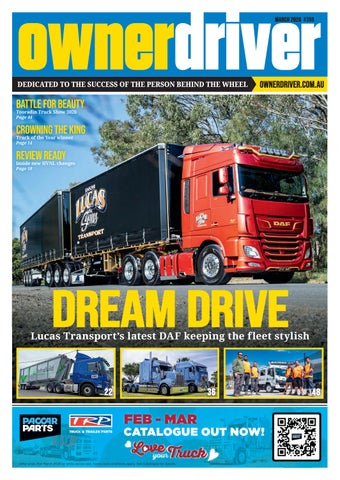
Owner Driver 398

Page 1


Contents #398

MARCH 2026

14 KEEPING IT KENWORTH

The Truck of the Year voting is in and a special Kenworth cabover has taken home the coveted award for 2025

18 PREPARING FOR CHANGE

After nearly eight years since the review first began, the updated HVNL is set to come into effect this year. OwnerDriver chats to the transport industry about the slated changes and whether it’s the right step forward for the sector

20 AIM OF THE GAME

Having established itself for over 30 years in a unique part of Australia’s transport industry, HPS Transport is continuing to build a high-quality fleet dedicated to carting refrigerated freight

22 THE TURNING TIP

26 SLIDING DOORS MOMENT

It presented as the opportunity of a lifetime – a major contract for 28 new trailers. After months of hard work, Gorski Engineering is exceeding expectations in a milestone moment for the family business

If it wasn’t for an important moment back in 2003, Dean Lucas may never have gone to DAF for trucks. Now, his latest XF530 that Warren Aitken got to see is proof that it was fate

36 BATTLING THE ELEMENTS

In the midst of a Victorian heatwave, Warren Aitken made the trip to the Koroit Truck Show to take in the annual day of family fun and big rigs

44 TAKING ON TOORADIN

Gusty easterly winds and blue skies set the scene for the 2026 edition of the Tooradin Truck Show, Geoff Crockett reports

Image: Warren Aitken
Image: Geoff Crockett

The all-new Ready-to-Work range.

The workhorse redefined.

Is your workhorse pulling its weight? If youʼre still driving a ute, nowʼs the perfect time for an upgrade. The all-new Isuzu Ready-to-Work range tows and carries more than your average ute. It also comes with a sleek new cab design, more advanced safety features and car-like comfort. With a wide choice of factory-built bodies designed to our exact specifications, Isuzu Ready-to-Work trucks are ready to get the job done. Are you ready to step up to a redefined workhorse? Head to isuzu.com.au or visit your nearest Isuzu Trucks Dealer today.

EDITORIAL

Editor Sean Mortell

E-mail Sean.Mortell@primecreative.com.au

Phone 0468 577 166

Contributors Warren Aitken, Frank Black, Sarah Marinovic, Rod Hannifey, Simon Smith, Geoff Crockett

Cartoonist John Allison

PRODUCTION

Art Director Bea Barthelson

Print IVE Print

ADVERTISING

Business Development Manager Tosan Popo

Phone 0481 260 352

E-mail Tosan.Popo@primecreative.com.au

SUBSCRIPTIONS

www.ownerdriver.com.au/subscribe

Phone +61 (0)3 9690 8766

Mon-Fri 8am-4.30pm (EST)

Email subscriptions@primecreative.com.au

Mail 379 Docklands Drive, Docklands, VIC 3008 Australia

EXECUTIVE GROUP

Chairman John Murphy

CEO Christine Clancy

Publisher Sarah Baker

Operations Manager Regina Fellner

Sales Manager – South Danny Hernandez

BEHIND THE WHEEL Sean Mortell

Celebrating the sector

A range of truck shows, announcements and new products headline a productive start to the year for the Australian truck industry

There’s nothing like the year getting into full swing on the Australian trucking calendar. For the sun to still be blazing while perusing an array of trucks and shining chrome. Of the arid summer days spent shining your dearest vehicle and preparing it for another run filled with dust and spray.

We’re currently at this point – summer is wrapping up but the days remain long and the weather nice and warm (except for the odd Melbourne morning). It’s in this time when the industry deserves to celebrate the mighty range of events currently running and then get to work.

This March edition of OwnerDriver is all about the latest events, shows and developments, as well as the issues that owner drivers need to know about. The past month or two has been spent discussing sham contracting and how it’s impacting the industry, but the ongoing Heavy Vehicle National Law (HVNL) has now emerged as another pressing issue in the sector. We investigate where the long-standing review currently sits and what the proposed changes coming this year mean for drivers – check it out from page 18.

Our Hendrickson Business Spotlight is back for another month, this time focusing on HPS Transport. From page 20, the operator has carved a niche in running the notorious Adelaide to Perth return trip over many years, handling temperature sensitive freight as it crosses the Nullarbor daily. To do so, the operator relies on quality running gear like Hendrickson to get the job done over decades. It was wonderful chatting to Gorski and CMV about a recent InfraBuild and Visy waste contract and what it has meant for all parties involved from page 22, with the well-known Gorski quality coming to the fore.

On the truck event side, we have some wonderful recaps in store, with Warren Aitken heading to the Koroit Truck Show and battling a Victorian heatwave to check out the array of trucks on offer from page 36. Also in Victoria, Geoff Crockett headed to Tooradin for the annual show, which can be seen from page 44.

While Warren was at it, he also found a wonderful Truck of the Month to continue the 2026 momentum, with this special DAF standing out as a beauty on page 26. While introducing a new entrant, we also crowned a winner for the 2025

“On the truck event side, we have some wonderful recaps in store, with Warren Aitken heading to the Koroit Truck Show and battling a Victorian heatwave to check out the array of trucks on offer from page 36. Also in Victoria, Geoff Crockett headed to Tooradin for the annual show.”

Truck of the Year. Flick over to page 14 to see who won the award after the OwnerDriver fraternity recorded nearly 800 votes for their favourite truck entries.

Outside of these events and announcements, Isuzu delivered its 300,000th truck in Australia, with the local truck market leader celebrating in style on page 48. Penske Australia discusses its Detroit engine range and how subtle tweaks are offering a range of performance benefits for operators on page 42, while PACCAR, courtesy of TRP Parts, unveils its innovative spill kits on page 40. Outside of this, don’t miss our usual spread of columnists, ranging from NatRoad and the NHVR through to Rod Hannifey, the NRFA and Frank Black. It all provides for an edition of OwnerDriver bursting with stories, from features to recaps. We hope you enjoy the read and stay safe.

The Goods

NEWS FROM THE HIGHWAY AND BEYOND

What’s new on the roads

Construction is underway on major freight routes to start the year while some projects are also opening to traffic

SINGLETON BYPASS ON TRACK

The New South Wales government has announced the Singleton Bypass is on track to open to traffic later this year with construction now back underway.

The $700 million project jointly funded by the federal and state governments is set to take 15,000 vehicles per day off Singleton’s main street in a move that will improve travel times and freight efficiency.

The eight-kilometre bypass will start near Newington Lane in the south and rejoin the highway just past Magpie Street in the north, featuring a full interchange at Putty Road and connections to the New England Highway at the southern and northern ends and at Gowrie.

Last year, crews opened two bridges that allowed trucks to shift material within the project corridor without going through the CBD, while construction of all six bridges is now nearing completion, including the largest in the 1.6km long Hunter Floodplain bridge.

The bridge construction has included installing 435 girders and 207 bridge piles, as well as pouring 161 concrete columns and 78 concrete bridge decks.

“The 1,300 workers on this project are making some incredible progress, and I know Hunter motorists, and anyone regularly passing through Singleton, can’t wait to enjoy smoother, safer and more reliable journeys when the bypass opens later this year,” federal transport minister Catherine King says.

“It’s one of the many projects across NSW being delivered by the Albanese and Minns Labor governments together that will be a real game-changer for the community.”

Only the finishing works remain, including installing safety rails, deck joints, placing asphalt, noise walls and safety screens.

Construction activities ongoing in early 2026 include drainage and earth works, continued pavement construction, relocating and connecting water, electrical and sewer services, constructing interchanges and starting landscaping.

“I am delighted to be able to say for the first time that Singleton Bypass will be open to traffic this

year. The bypass is going to make a massive difference for road users across the Hunter,” NSW roads minister Jenny Aitchison says.

“We are cutting five sets of traffic lights, and ensuring Singleton locals can reclaim their CBD – with 15,000 fewer vehicles passing through it each day. This is a win-win outcome for Singleton residents, visitors and freight operators.”

WESTERN VICTORIAN ROUTES TO RECEIVE MAJOR UPGRADE

Victoria’s west is set to receive major road safety upgrades with a popular freight route ready to undergo rehabilitation works.

The Victorian government has revealed, as part of its $976 million road maintenance blitz, that the Henty Highway will be upgraded along a seven-kilometre section at Kewell, near Horsham, between Old Minyip Road and Barrat Road.

Crews will be out in coming months to rebuild the road and repair and strengthen the surface, with resurfacing works also set to get underway at a 1.5 kilometre stretch of the freight route at Kellalac.

It’s part of Victoria’s road maintenance program which this year focuses on high-traffic corridors and key freight routes.

The state government says these roads were prioritised based on expert assessments and community feedback, ensuring that upgrades are focused where

they’re most needed.

“These works will ensure out road freight and farming network continues to operate safely and efficiently across the network,” Victorian roads and road safety minister Melissa Horne says.

“That’s why we’re investing in maintaining our regional roads across the state, including delivering these upgrades on the Henty Highway.”

As well as repairing some of Victoria’s busiest roads, crews will also mow, slash and spray tens of thousands of kilometres of roadsides, inspect and repair thousands of bridges and other structures.

They’ll also fix hundreds of sets of traffic lights and electronic signs, clean up graffiti and deliver other maintenance works as needed.

REOPENED BRIDGE TO HOLD HEAVIER TRUCKS

The ribbon has been cut on a major upgrade to a key bridge in New South Wales that can now carry larger freight vehicles.

The upgraded Brunners Bridge at Mitchells Flat in the Upper Hunter is now officially open to traffic and is able to take heavier freight vehicles with an increased load limit of 68.5 tonnes.

The NSW and federal governments say the upgraded bridge improves reliability, supports local industry and keeps the region connected.

“Projects like these are critical to ensuring regional infrastructure can safely accommodate modern freight and vehicles,” federal regional development and local government minister Kristy McBain says.

“Replacing the previous bridge, which dates back around 80 years, will help keep communities safely and reliably connected.”

The upgrade involved full demolition of the old structure and construction of a new bridge, culvert and approaches. Wider lanes and an improved road surface allow heavier vehicles to cross safely, reducing pressure on surrounding local roads and improving safety for all road users.

The $7.2 million upgrade replaces an ageing bridge with a modern, heavy-duty crossing designed to carry larger freight vehicles and better connect local communities.

The project was jointly funded, with $6.5 million from the NSW government and $700,000 from the Australian government’s Safer Local Roads and Infrastructure Program.

For communities in the Upper Hunter, Brunners Bridge is a vital everyday connection that links Singleton, Elderslie and Gresford and provides access to the Hunter Regional Livestock Exchange.

“The completion of this project is great news for locals, visitors and businesses in the Upper Hunter. Brunners Bridge isn’t just concrete and steel, it’s a daily link for families, farmers and freight in the Upper Hunter,” NSW roads minister Jenny Aitchison says.

“In regional NSW, roads are not a convenience. They are the lifeblood that connects people to work, school and services, and keeps freight and agriculture moving. That’s why upgrading local bridges like this matters so much.

“The NSW government is backing regions like the Upper Hunter with tangible investments –building stronger connections and supporting regional economies.”

This upgrade follows the recent completion of Kilfoyles Bridge in Singleton, a critical project delivered under the jointly funded Australian and NSW governments’ Disaster Recovery Funding Arrangements in response to the 2022 NSW floods.

DETROIT, SETS THE BAR.

The industry-leading manufacturer of state-of-the-art engines and transmissions, Detroit sets the bar.

Specifically designed for integrated, optimised performance and efficiency inside Freightliner and Western Star trucks, the Detroit product portfolio has expanded to include advanced safety systems and telematics, delivering a total trucking solution.

Detroit – it’s loved by Aussies and trusted globally.

New emissions laws are here!

Rely on the platform that’s been trusted to meet them since 2019.

Operator acquires Ron Crouch Transport

A fellow long-standing Australian operator has come to the rescue to acquire the business after it entered voluntary administration last year

An Australian operator has come to the rescue to acquire a transport business that entered voluntary administration last year.

After Ron Crouch Transport entered voluntary administration in December, the long-standing business confirmed it would be seeking a buyer.

Now, family-owned Australian transport business Freight Specialists has confirmed it has entered into an agreement with administrators to acquire Ron Crouch Transport.

Over the coming weeks, Freight Specialists will transition the Ron Crouch Transport sites and services in an “orderly and considered” manner, prioritising the continuity of services and minimising disruption for customers.

As a family-owned business with a long history in local freight, Freight Specialists has saved Ron Crouch Transport, which has its own legacy since first serving a client in 1978.

“Like Ron Crouch Transport, the business has been built on strong relationships, operational discipline and a commitment to doing the right thing by customers, employees and partners,” Freight Specialists says.

“This shared heritage and approach were important factors in bringing the two businesses together.

“Freight Specialists will be working closely with Ron Crouch Transport customers to ensure

a smooth and well-managed transition, and we look forward to continuing to support customers under the Freight Specialists banner while building on the strong foundations established by Ron Crouch Transport.”

Fremantle Traffic Bridge officially closes

Despite

industry tension with a government department

heating up over the closure, the industry is calling on drivers to remain calm

The Fremantle Traffic Bridge is now officially closed for up to 12 months, with local transport bodies urging the sector to remain calm amid frustrations.

After nearly 90 years of service, the bridge has been closed, with the construction project to remove the old bridge, install a new bridge deck and build a new road.

Western Roads Federation (WRF) told members in late January that it’ll be a challenging few weeks for operators in the area, but urged them to maintain calmness.

“Inevitably there will be some

short fuses among all vehicle type commuters,” WRF says.

“Can you ask your drivers to rise above the frustrations and demonstrate to all other users the cool calm professionalism of our industry?”

WRF says it asked for industry to be allowed to access Main Roads live feed traffic cameras to monitor traffic levels, but that this idea was unsuccessful.

WRF says it will continue working with other impacted associations to present a “unified position” to government that highlights “practical, evidence-based solutions” around the expanded use of High Productivity Freight Vehicles (HPFVs) to reduce total truck movements.

WRF CEO Cam Dumesny says the WA government has “little to no room left” to avoid an independent review into “claimed industry consultation” in the two-year lead-up to the closure of the bridge.

“I wrote to the government refuting in detail claims by the Department of industry consultation. I thank CTAA, FTA and LRTAWA for their invaluable input,” Dumesny says.

“In my letter, I also detailed a similar pattern of behaviour over

several major freight disruptions, that in all cases required industry to step up to fill the leadership and response gaps left by the Department and its “token industry engagement subsidiaries”. I have also briefed the opposition parties on the matter and background briefed the mainstream media.

“The desired outcome is simple –the government commits to collaboratively working with industry. The

methods to do this and the required changes including leadership needed have already been identified by WRF.

“Noted in my letter of refuting the Department’s claims was how we maintained exceptionally constructive relationships with multiple other local, state and federal departments and agencies, except with this one particular group of the Department.”

Image: Ron Crouch Transport

Border Express mourns passing of founder

The founder of the Australian logistics and freight operator sadly passed just a week after receiving special national honour

Australian freight and logistics company Border Express has announced the passing of its founder Maxwell James Luff OAM.

Luff passed just a week after he received a Medal of the Order of Australia, one of Australia’s highest civilian recognitions, for his lifetime of service to Australian road transport.

Luff’s journey in the transport industry started in 1981 when he founded Border Express with the vision of creating an operator with reliability, strong relationships and a people-first approach.

Luff was behind the operation as it grew into a nationally recognised logistics network that continues today under the ownership of FMH Group.

“Max’s journey in freight began behind the wheel, where he developed a deep respect for the people and communities that keep Australia moving,” Border Express says in an online tribute.

“Beyond business, Max was a passionate advocate for lifelong

learning and opportunity. Together with his wife Lynn, he established the Max and Lynn Luff Scholarship, reflecting his belief in education, personal growth and giving back to the industry and community that shaped him.”

Border Express also pointed to Luff’s recent Australia Day 2026 honours as a “fitting acknowledgement” of a lifetime “defined by hard

work, leadership, resilience and service to regional Australia and the transport industry”.

“Max leaves behind an enduring legacy – not just in the business he built, but in the values he lived by; and the people he inspired along

ATA slams fuel tax rise

The ATA says the Productivity Commission’s idea to slash the fuel tax credit scheme would double truck fuel taxes for operators

The Australian Trucking Association (ATA) is the latest industry body to criticise the Productivity Commission’s plans to increase truck fuel taxes.

Following the South Australian Road Transport Association’s comments in late January, ATA chair Mark Parry says the plan to hike truck taxes would result in taxes on truck fuel more than doubling.

Parry made the comments while releasing the ATA’s 2026-27 pre-budget submission, which urges the federal government to reject a plan that would phase out fuel tax credits for trucking operators.

Under the current fuel tax credit system, truck operators pay an effective tax rate of 32.4 cents per litre rather than the full rate, which now sits at 52.6 cents per litre.

The Productivity Commission’s figures show the plan would more than double the effective fuel tax paid by truck operators to 66.1 cents per litre by 2035.

In response, Parry says the current

system reduced the cost of freight for everyone in Australia, as well as for rural exporters.

“Removing fuel tax credits would increase costs for industry and hard-pressed Australian households, who have already had to face a 21.5 per cent increase in electricity prices and an 11.2 per cent increase in

childcare fees in 2025,” he says.

“Many trucking businesses would not be able to pay the increased fuel tax, which would go up by about eight per cent each year.

“Trucking businesses have already had to pay a 19 per cent increase in fuel tax over the last three years, as well as dealing

the way,” Border Express says.

“Our thoughts are with the Luff family and all who had the privilege of knowing and working with Max. He will be deeply missed and fondly remembered. Rest in peace Max.”

with rising costs, extended payment terms, driver shortages and natural disasters.”

Parry says the Commission’s plan would not achieve its goal of encouraging decarbonisation.

“The Commission’s report does not analyse the effect of removing fuel credits on emissions, but I can save everyone the time and trouble,” he says.

“Its effect would be zero, because it would not address the real world barriers holding back the industry’s adoption of low emission solutions.

“It would not address the engineering reality that there is no single technology available to replace diesel engines.

“Many regional communities rely on trucking operators to move and deliver all their daily necessities. This requires diesel engines, so the commission’s approach would just be an unavoidable increase in tax.

“For those businesses that do have an alternative to diesel, the effective tax increase would reduce their financial capacity to invest in new vehicles and equipment.

“Instead of taking up the Commission’s advice, the government should implement a voucher scheme to reduce the up-front cost of electrification or alternative fuel options, a low carbon fuel standard to encourage the use of renewable diesel and support high productivity and low emission vehicles.”

Images: Border Express

truck of the year

KEEPING IT KENWORTH

The Truck of the Year voting is in and a special Kenworth cabover has taken home the coveted award for 2025

Every year, OwnerDriver starts off by crowning the prized Truck of the Year winner. In the past year, sponsored by Geotab, the competition remained as fierce as ever, with some stunning entrants being featured in our Truck of the Month section, profiled by Warren Aitken throughout 2025.

At the end of 2025, OwnerDriver opened voting for just under 1,000 voters to pick their favourite Truck of the Month entrant throughout the year. Ranging from Kenworths to Scanias and on to a suite of Macks, voters picked their particular favourites. The results are now in, with a new winner being crowned.

Starting our podium for 2025 was our December entrant which came from the team at Queensland House Removers (QHR) and their marvellous Mack. The bulldog showed off while Warren was there, completing a complex house moving job in Brisbane.

“Hot damn, did I have some fun constructing this story,” Warren said at the time.

“Seriously, I chased down this story because I happened to catch a glimpse of this impressive looking Mack getting a fit out at the Bling HQ headquarters in Hatton Vale, Queensland. My natural Mack admiration was piqued when I saw the not-sosubtle 780HP badges on the side.”

In fourth was another Mack, this time from March, with the special Mick’s Mack being not just a beautiful rig, but also coming with a poignant story behind it. Matt James Haulage overcame recent tragedy to produce this restored Mack that honoured the passing of one of the family’s greatest members.

Getting to the top three, and bronze went to Craig Tesch and his team courtesy of their shiny new Kenworth K220 that was profiled by Warren in February. The stunning model formed just a small part of a wonderful family tale at Morgans Long Distance Transport.

The silver went to ‘Jamesy’s’ milestone Mack in June, with Andrew James receiving this Mack as a 60th birthday present. It was his first ever-brand new truck, with the 2024 Mack SuperLiner quickly becoming a hit.

Finally, it’s time to crown the winner. The 2025 Truck of

the Year is Schaeffers’ brand new Kenworth beauty that was in our May edition of OwnerDriver. The unique cabover model received just over 35 per cent of the votes, comfortably surpassing the field to win the award. OwnerDriver caught up with Trent Schaeffer to celebrate the victory and learn more about how the truck has fared since Warren profiled it in May.

“It’s a wonderful achievement to be recognised – we built this truck for a specific reason, and it’s come a long way,” he said.

“It’s been talked about a lot, and we actually built a second version recently, a slightly bigger 220 that is identical to the 200 but can just take a bit more weight.

“We built the first one (the TOTY winner) for a specific customer in Sydney, but we wanted to build a second one to get more weight on. Both are working trucks – after the Brisbane Truck Show, the Pacific Highway was shut so we were sent around the back road. A week after the show, the trucks were almost orange due to the road spray.

“It’s a good win for the cabovers.”

ABOVE & BELOW: Schaeffer’s special Kenworth took home the top prize
Images: Warren Aitken

“Australian

ASH ANDERSON TRUCK INSTRUCTOR, DYNAMIC TRUCK SCHOOL

PREPARING FOR CHANGE

After nearly eight years since the review first began, the updated HVNL is set to come into effect this year. OwnerDriver chats to the transport industry about the slated changes and whether it’s the right step forward for the sector

Everything tends to move quickly in the trucking industry. Interstate runs are completed in a manner of days and nights. Trucks are often unloaded and then loaded again in the blink of an eye, drivers traversing enough suburbs in a shift to fill a book. It’s this high-octane nature that makes the ongoing Heavy Vehicle National Law (HVNL) review a frustrating topic for all in the nation’s road transport sector.

The National Transport Commission (NTC) was first directed to review Australia’s HVNL in 2018, with the idea being to create a “modern, outcome-focused law regulating the use of heavy vehicles” around the country. After getting underway a year later, the impact of the COVID-19 pandemic pushed the timeline of the review back three years, with transport ministers not endorsing a package of HVNL reform recommendations until August 2022.

Two years later, the NTC unveiled 71 proposed rate changes to HVNL penalties, with the official reform package finally passing through Queensland Parliament late last year. This year is slated as the time when the updated HVNL will eventually come into effect. It should be a moment of relief for the sector – finally a guiding set of modernised principles will lead the trucking sector into a more productive and efficient future.

It’s not been the sentiment of the industry. When the HVNL’s proposed changes passed through Queensland Parliament on November 18 last year, a trio of Australian transport associations in the Queensland Trucking Association (QTA), Victorian Transport Association (VTA) and National Road Transport Association (NatRoad) led the way in calling proposed changes to the guiding law “fundamentally flawed”.

“The proposed HVNL reform, despite its stated objectives of improving safety and productivity, introduces a systemic conflict that we simply cannot accept,” QTA CEO Gary Mahon said.

“It effectively reverses the burden of proof, denies standard legal defences and will actively deter operators from engaging with a system designed to improve safety.”

The main source of consternation among the industry are the flagged changes expected to soon come into place. Once the review reached the key milestone of the HVNL amendment bill passing through Queensland Parliament, the NTC unveiled four draft statutory investments for public consultation. This feedback period lasted only a couple of weeks until December 1, with the NTC telling OwnerDriver it is now “considering stakeholder feedback” alongside the National Heavy Vehicle Regulator (NHVR).

These proposed changes included the introduction of a new ‘fit to drive’ duty for drivers, while general mass limits (GMLs) are set to be scrapped and replaced with concessional mass limits (CMLs) as the new general access weights. Livestock and hay carriers also won’t need to have a 4.6 metre gazette notice to operate, while NHVASS-accredited operators will require an NHVR-approach Safety Management System, or SMS, aligned with WHS and HVNL obligations.

The new SMS has been a prominent point for the industry, with National Road Transport Association (NatRoad) CEO Warren Clark saying the framework is

designed to embed proactive safety practices across the industry.

“While the intent is sound, NatRoad warns the SMS must be practical, scalable and developed in genuine consultation with operators to lift safety outcomes without unfairly disadvantaging smaller businesses,” Clark says.

“Despite ministers endorsing the findings of the report, the 2025 Bill delivers only piecemeal amendments. For many operators, fatigue and mass management will remain complex, access decisions are still plagued by red tape and the promised productivity uplift is yet to materialise.”

Clark says a key demand from NatRoad is for the SMS to be developed in close consultation with the industry. The concept is based on risk identification and control, shared responsibility and continuous improvement through the collection and analysis of data. While NatRoad supports the concept in principle, Clark says the benefits must outweigh the risks.

“We need to avoid the experience we’ve had with accreditation schemes of the past, which often imposed heavy audit costs without apparent safety gains,” he says.

“The SMS must be scalable and proportional to business operations, keeping in mind many of the 50,000-plus transport operators in Australia are small, family-run businesses.

“Further, the SMS must be integrated with the proposed Alternate Compliance Framework, currently under development by the regulator. Fatigue, mass and maintenance risks should all be managed proportionately under this umbrella, giving operators flexibility while ensuring risks are controlled.”

Not all in the industry have been as magnanimous as NatRoad in responding to the proposed SMS as part of the new-look HVNL. Gary Mahon says the reforms will impose “significant new burdens” such as increased costs to develop and implement the SMS, along with higher consultancy fees and audit

Image: Philip Schubert/stock.adobe.com

expenses that he warns could potentially double or triple existing rates.

“Accreditation should be an incentive for improved and consistent safety practices, not a punitive mechanism that imperils fundamental legal rights,” Mahon says.

“If the scheme is perceived primarily as a means of imposing personal liability for executive due diligence failures, operators will rationally choose to opt out, negating any public safety benefits.”

Mahon says a new mandatory 28-day audit submission timeline also places significant risks, be it financial, operational or professional. He says the new framework imposes an “unsustainable level of risk” on both the industry and independent auditors.

“This policy proposal must be revoked and reconstructed with full and meaningful participation from the industry,” he says.

“Anything less risks creating a system that fails in its primary goal of improving road safety, while imposing unsustainable burdens on the heavy vehicle industry.”

A spokesperson from the NTC told OwnerDriver these four draft statutory instruments that were released for public consultation have been “critical” to ensuring the new legislative framework “operates as intended”, particularly when it comes to alternative compliance accreditation.

“The NTC and NHVR are working together to ensure these arrangements deliver on the policy objectives of improved safety, greater flexibility and increased responsiveness to industry needs, while also being scalable and accessible for owner drivers and small operators with minimal administrative burden,” the spokesperson says.

“In parallel, the NTC is consulting on draft amendments to the Heavy Vehicle (Mass, Dimension and Loading) National Regulation.

“These changes include increasing the general vehicle length limit from 19 metres to 20 metres

and lifting general mass limits to align with existing concessional mass limits.”

The consultation window remained open on these proposed amendments until January 19 this year.

The spokesperson labelled the changes “important” as they will “deliver meaningful productivity benefits” for the industry while “reducing regulatory burden”.

“Operators will be able to access 20-metre vehicle combinations without needing to go through the Performance-Based Standards process, and operate at increased mass limits without requiring mass management accreditation.”

The NTC is also adamant the slated increase in vehicle length limits will support “improved working conditions” for long-haul drivers by allowing for larger prime movers with more spacious sleeping cabins. The spokesperson says this will all occur “without sacrificing productivity”.

“This reform has been strongly advocated for by the National Road Freighters’ Association (NRFA) on behalf of owner drivers and small operators, particularly as a measure to support fatigue management.”

Alongside finalising the Mass Dimension and Loading Regulations and statutory instruments, the NHVR is also progressing implementation planning. This will feature system and process improvements while also preparing education and guidance materials to help the industry prepare for and comply with the amended law “confidently”.

“Transition arrangements are also being developed for operators currently accredited under the NHVAS, with the introduction of General Safety Accreditation and an Alternative Compliance Accreditation regime. This new framework will operate alongside the current NHVAS, allowing accredited operators up to three years to transition,” the spokesperson says.

“The NHVR will ensure all industry stakeholders are kept informed on how the changes may impact

their operations and can expect to receive more information through the NHVR’s various industry channels including on the NHVR website, On the Road newsletter and social media platforms in the coming months.”

The ongoing reform to the HVNL may finally have gained traction after nearly eight long years, but it hasn’t eradicated doubt in the industry. Warren Clark says the fact statutory instruments are yet to be officially finalised is “already playing on the minds” of operators who want to prepare for the changes.

“This Bill is a significant step towards modernising Australia’s heavy vehicle regulatory framework, however the details operators will rely on are still being developed,” he says.

“We recognise there will be a level of ambiguity until the regulatory instruments are finalised, however ultimately operators will need certainty and time to prepare.

“NatRoad will continue to call for sensible implementation pathways that recognise the day-to-day realities of running a transport business.”

While this debate continues to intensify as 2026 gets well and truly underway, the slow wheels of reform will remain turning at their slower than expected pace. The HVNL reform may not come into place with the precision nor efficiency of the Australian road transport sector. It may not mirror the timeliness of truckies delivering around the country each and every day. However, when it does finally become clear and official this year, the NTC is expecting the long wait to be worth it.

“Substantial progress was made throughout 2025, with the implementation of the amended law expected to commence in mid-2026,” the spokesperson says.

“A commencement date will be set once the remaining elements of the legislative packages are finalised, including the Mass, Dimension and Loading regulations and statutory instruments.”

Reduces Maintenance

AIM OF THE GAME

Having established itself for over 30 years in a unique part of Australia’s transport industry, HPS Transport is continuing to build a high-quality fleet dedicated to carting refrigerated freight

The year 1999 was an important one for people named Tony. In the opening weeks of the year, popular TV show ‘The Sopranos’ first hit the airwaves, with protagonist Tony Soprano becoming a cult-like figure for the series that is now widely regarded as one of the best ever made in the history of TV.

In the same year, Tony Graziano used his farming background to formally launch HPS Transport.

While it was an evolution of Hard Produce Services, which Tony had founded in 1988, the day 11 years later when HPS Transport began trading under its enduring name serves as a milestone for the national operator.

Nowadays, HPS Transport is a well-known name in the transport sector for its express services from Adelaide to Perth, carrying perishable and temperature sensitive freight across the Nullarbor.

With a fleet of roughly 165 trailers, 80 linehaul trucks and another 80 dollies, this large-scale transport business has made a name for itself with its specialised service in handling fresh produce for growers, vendors, market agents and supermarkets in South and West Australia.

While workshop manager Brian Cooke wasn’t with the business for its formative years under the leadership of Tony Graziano, he has learnt in the two years since he started with the business

what makes it a special part of Australia’s transport industry.

“I’ve been a diesel mechanic for 26 years, but I only joined HPS Transport a couple of years ago, starting as a workshop coordinator and evolving from there,” he told OwnerDriver

“HPS Transport is a very well organised company with drivers who are well looked after and a set structure of operating that works well.”

Outside of the set structures implemented over the decades, Brian was quick to reveal the main secret to HPS’ enduring success. With more than 200 pieces of equipment forming the fleet, paying attention to preventative maintenance and choosing the best quality products has been critical to HPS’ growth in a demanding market. This is where running on Hendrickson gear has become a key ingredient for HPS’ organised operations.

“We run new fridges for around 20,000 hours before we take them out of our trailers and replace them,” he says.

“We run good quality trailers from Graystar Trailers and we use Hendrickson running gear. We put in a lot of effort to service and maintain our fridges – recognising that if something goes wrong then you could potentially lose the freight.”

To minimise that risk, a standard HPS Transport arrangement also comes with a large 400L fuel tank in the trailer so that if something does happen on

the remote road between Adelaide and Perth, both the driver and freight can stay safe. It also allows the trailer to sit for up to three days and stay cool, meaning no freight is spoiled while sitting under the harsh Australian sun.

Whether it be meat, seafood, dairy, confectionery, fruit, wine or medicinal products, Brian says the quality focus that HPS has means all freight can be delivered in the best possible condition.

“However, this is obviously a last resort that we aim not to rely on and that’s where running high quality trailers with reliable and low maintenance components comes into play.” he says.

“In the early days, the company tried a lot of different axle brands, but roughly five or so years ago we concluded that the Hendrickson product was the most reliable.

“We’ve since made this the primary spec on our trailers – of our 165 trailers and 80 dollies, only a handful in the fleet wouldn’t be on Hendrickson.”

HPS Transport’s range of Hendrickson products includes the INTRAAX® integrated axle and air suspension system that is trusted by many Australian fleet owners and OEMs.

The locally optimised air suspension delivers one of the lowest maintenance suspension systems on the market while being up to 100kg lighter than competing solutions, all without compromising strength or longevity.

Brian says he is impressed with the INTRAAX® system and how it delivers a lower total cost of ownership, generating real savings across the HPS fleet.

The HPS Transport trailer fleet is also equipped with HXL7®, Hendrickson’s extended‑life sealed wheel‑end system.

Backed by a five‑year, 1.2‑million‑kilometre warranty, one of the key benefits for HPS is the system’s simplified maintenance approach, requiring only a basic external inspection at scheduled maintenance intervals.

Featuring Hendrickson’s HP Parallel Spindle, Precision 320® nut locking system, and a patented axle filter and venting system, HXL7 provides a clear point of difference within the HPS fleet, helping keep trailers on the road by remaining reliable, while reducing the need for traditional bearing adjustments.

“The HXL7 offers us less downtime, as all that’s required is a simple external inspection of the hubs,” Brian says.

“Put simply, the trailers aren’t off the road for as long because we don’t need to carry out wheel‑bearing services every 200,000 or 300,000 kilometres. The durability and reliability of the system really make a difference.”

“Hendrickson has been very important to our success as its gear has allowed us to deliver consistently for our customers.”

Lastly, the TIREMAAX PRO system is part of HPS’ fleet, providing an advanced automatic tyre pressure control system which equalises dual tyre pressure and is capable of actively inflating and relieving the tyres to a pre set pressure level. The system extends tyre life and saves fuel while improving safety by reducing the risk of critical tyre failures.

While automatically maintaining a consistent tyre pressure setting across the trailer and dual tyre pressure matching might seem like small things, Brian says a difference of as little as five psi can have a big impact on tyre life and fuel savings.

Since installing TIREMAAX PRO, HPS has seen its tyre life double, meaning tyre expenditure and maintenance costs have significantly reduced.

“With TIREMAAX PRO, if you get a small puncture on any of the tyres, the system keeps it inflated, meaning it won’t go flat or potentially explode over time,” he says.

“It also has the added feature of constantly monitoring tyre pressure, so as the day gets hotter and the tyres warm up, they won’t expand to a pressure where you could have too much air in it. It gives us real peace of mind that the tyres will keep going in any conditions.”

The trio of products have proven critical to HPS Transport’s operations in recent years.

Having been such a loyal Hendrickson customer for many years, Brian says this combination of product innovation and Australian specific developments is allowing HPS Transport to provide greater benefits and returns for freight customers.

“Hendrickson products are simple to use and maintenance is easy,” he says.

“We only carry out a full rebuild on a trailer running Hendrickson gear every one million kilometres, or roughly every three years. By comparison, other trailers in our fleet are rebuilt every 500,000 to 600,000 kilometres.

“Eventually, when a trailer running Hendrickson gear does need a rebuild, it only takes two people around three days to do, which highlights just how low‑maintenance and reliable the system is.”

As the longstanding operator focuses on providing a reliable freight service for decades to come, Brian says Hendrickson will be critical to HPS’ future.

“Our main goal is to maintain what we’ve got and where we run, and then start expanding when customers demand it,” he says.

“Hendrickson has been very important to our success as its gear has allowed us to deliver consistently for our customers.

“That level of reliability gives us the confidence to keep our promise to customers; that their freight will be delivered on time, day in day out.”

HENDRICKSON AUSTRALIA

Hendrickson Asia Pacific Head Office 32-44 Letcon Drive Dandenong South Vic 3175 Phone: +61 3 8792 3600

Email: customerservice@hendrickson.com.au

Images: Hendrickson/HPS Transport
Top, L to R: A selection of Hendrickson products (including PRIMAAX® EX, TOUGHLIFT™ and INTRAAX®) have been fitted to the HPS Transport fleet
Below: The fitment of Hendrickson is proving critical to HPS Transport’s enduring success

THE TURNING TIP

It presented as the opportunity of a lifetime – a major contract for 28 new trailers. After months of hard work, Gorski Engineering is exceeding expectations in a milestone moment for the family business

Lifechanging moments have a habit of creeping up on people, sneaking with precision to tap the hard-working on the shoulder and shock them into action. Paul Baker will find it difficult to forget the moment last year that changed the outlook for the family business he’s part of.

“Sometimes people need an opportunity in life,” he told OwnerDriver

“Sometimes you need the dancefloor there to be able to dance.”

The general manager of trailer builder Gorski Engineering first received the inviting hand to dance, so to speak, in the back half of last year. The entire Gorski team entered planning phase when Victorian based heavy duty truck dealer CMV Truck & Bus approached them about an impending tender.

It was for packaging and logistics giant Visy and its latest contract for steel recycler and manufacturer InfraBuild, with Gorski joining forces with CMV Truck & Bus to quickly throw their hat in the ring to produce a modernised fleet of trucks and trailers.

“We had this unique chance, and we believed we could do it, we just needed that contract,” Paul says.

The opportunity came to fruition, gifting the family business the opportunity to produce trailers for 28 new heavy vehicle units before the end of February. The Gorski family had no time to celebrate the tender win, instead launching into action to begin manufacturing an innovative range of new trailers.

“Visy requested certain trailer features for us to build into the units, including automating certain

parts and adding more safety benefits,” Paul says.

“Existing units required operators to have to hop out of the vehicle and open the tailgate manually before pinning it around to the curb side and jumping back in to tip. Visy wanted operators to be able to control this process from within the cabin, easily achievable with new technology.

“We also included a lot of safety features in these units such as stability control, hydraulic updates and settings to control the angle of the tipping.”

What made this demand tough wasn’t simply the sudden additional units required to be manufactured in a short timeframe – Gorski also had to design the new concept from scratch to satisfy Visy, CMV Truck & Bus and InfraBuild. It meant Gorski’s engineering team had no existing trailer models to base the design off of, with the Victorian-based builders having to produce the trailers from a simple scope handed down for the contract.

Once the design and engineering phases wrapped up, Gorski started a constant conversation with CMV Truck & Bus and Visy to continually add and refine features of the trailer models in the back half of 2025.

“We deal with Visy’s management daily, even hourly to be honest, as these are brand new trailers with new specifications, safety technology and features,” Paul says.

“Visy, and in particular Rick Smith, have been brilliant in working with us, as has Jedd Dyer from CMV Truck & Bus in Clayton, Victoria.

“Throughout this process, we were continuing to

complete our standard deliveries – we simply had to take this opportunity and that meant adding it into our current workload.”

When CMV Truck & Bus Clayton account manager Jedd Dyer was asked who would be able to produce a trailer to stand up to the work required on the contract over many years, one brand stood out.

“Gorski was always the first to come to mind –heavy but indestructible,” he told OwnerDriver

“They threw everything at this contract and have continued to over-deliver on original time frames.”

Jedd says there were 12 months of discussions and planning that occurred prior to the first bit of steel being moved, but once the order landed, it was all systems go for both brands. He laughs as he reflects on the constant ringing of the WhatsApp group chat that Gorski and CMV Truck & Bus representatives had, buzzing all night as the two parties coordinated where the next prime mover or trailer were going to be.

“Visy and InfraBuild wanted to promote safety and productivity – Gorski took this and, with the help of CMV Truck & Bus, created an incredibly safe trailer paired with the world’s safest truck,” Jedd says.

“It’s a winning combination for the drivers, Visy and InfraBuild. It’s hard to miss them now, with the striking blue Volvos pulling massive grey Gorski trailers.”

As part of the five-year contract, Gorski also had to move quickly to secure certain supplies and materials to build the new-look trailers. A primary material that

had to be included in the trailers was Hardox – an ultra-hard, tough and abrasion-resistant steel plate that would maintain durability in the crash and bash nature of the scrap metal industry.

Paul and the team were quickly on the hunt for a Hardox plate from suppliers around the country before securing processors. Throw in axles sourced from Hallam manufacturer TMC Australia and the relevant paints and it made for a helter-skelter period for Gorski.

“It’s been a massive job for us, especially considering it takes two-and-a-half times the normal man hours that are required for

any of our other trailer models,” Paul says.

“It’s been a huge effort in a short timeline – we started this deep into the third quarter of 2025 and we ended up producing 20 of the 28 units delivered before Christmas.”

When OwnerDriver began discussing this remarkable effort with Paul in December, Gorski had 14 of the trailers already on the roads, with a further four with the customer. The Gorski general manager said the ongoing launch of the models had all gone to plan so far, with driver training underway at Visy on the new features included.

“It was pretty daunting at the start to take on such a large contract with a short timeframe to deliver, but we’ve exceeded it, the units are working out well and the clients are happy,” Paul says.

“We have built in a lot of modern safety features, and we’ve aligned ourselves with good brands to produce a high quality unit.”

Currently there’s still no time to stop and smell the roses – Paul only had a short timeframe to chat about this milestone project for the trailer builder. In that sliver of time, he was still quick to convey the pride he has in his team and the wider industry partnership working to meet a tight deadline.

“With our footprint including two sites in Melbourne, one up in Yatala in Queensland and potentially another in Adelaide that we’re discussing, we’ve placed ourselves in a great position to fulfil this contract,” Paul says.

“For major companies in Visy and InfraBuild to choose a family business in Gorski represents our staff and what we’ve been able to do in recent times. This has made us realise what our capabilities are, and we hope we’ve opened the eyes of many in the market as we’ve been able to deliver quicker than anyone in the industry could’ve.

“It’s been a logistical nightmare at times having to move materials around and source Hardox from around Australia within a very short time, but our staff have been terrific since day one.”

Such is the humble nature of Gorski, Paul is fast to reiterate that “you’re only as good as your last fight”, and that the family business won’t be putting the feet up once the final units are delivered. While he is already offering himself tiny moments of time to reflect on the whirlwind journey to date, he wants this landmark contract to be the foundations for more growth.

“It’s something we’ll all be able to sit back and look on with pride, and the sense of achievement is already massive for our staff. These models stand out and we’ve put in so much hard work,” he says.

“Most importantly, it puts us in a good position as a company and it’s so rewarding to be able to deliver and exceed for Visy as a small family business.

“It’s something we’ll reminisce on for a long time once it’s done – it was a sliding doors moment, and we’ve been able to take the opportunity with both hands.”

“WE HAVE BUILT IN A LOT OF MODERN SAFETY FEATURES, AND WE’VE ALIGNED OURSELVES WITH GOOD BRANDS TO PRODUCE A HIGH QUALITY UNIT.”
TOP: Special Gorski trailers were required for the contract
LEFT: Many of the 28 trailers are now in service for Visy and InfraBuild
Images: Gorski Engineering

NATROAD Warren Clark

Get HVNL ready

NatRoad’s Warren Clark provides a list of what trucking operators need to know to prepare for the reformed HVNL this year

Significant reforms to the Heavy Vehicle National Law (HVNL) will come into effect from July 2026. These changes mark the most substantial update to national road freight regulation in over a decade and will reshape how operators manage compliance.

The new framework will shift away from a set-and-forget approach, placing greater emphasis on how well you identify and manage risk. While non-accredited operators are not required to have a ‘Safety Management System’, or SMS, in place, all operators will need to show they are proactively managing risks.

Preparing early, by reviewing systems, understanding audit expectations and moving to digital recordkeeping will put you in the best position when the new laws take effect.

It is expected those who are under current accreditation schemes will transition to the new framework when their accreditation expires, with the regulator working with operators as they near their expiration date.

WHAT’S CHANGING

Under the updated HVNL, there will

be a stronger focus on demonstrating proactive and effective management of safety obligations, not just having policies on file.

Key changes include:

• There will be a new SMS standard for accredited operators, which underpins the general safety accreditation. All operators will continue to be required to proactively manage safety risks (accredited or not).

• National audit standard, or NAS: Replaces the NHVAS audit model with a more consistent and rigorous approach.

• Fatigue management: Stronger controls and new limits introduced under the Alternative Compliance Framework (ACF).

• Accreditation pathways: Two new tiers - General Safety Accreditation (GSA) and Alternative Compliance Accreditation (ACA).

• Shift to digital evidence: Greater reliance on telematics, electronic work diaries and digital records.

• More frequent updates: Key rules will move into external standards and guidelines, allowing for regular updates and greater industry input. While these changes are designed to

lift safety across the sector, they also require operators to adjust how they manage risk and prepare for audits.

WHAT OPERATORS SHOULD DO NOW

While the details and ultimate regulations are being finalised in the coming months, now is the time for practical preparation.

1. Review your safety systems Conduct a gap analysis. Are your systems current, practical and in daily use? The SMS Standard requires documented processes, staff training and regular reviews, not just written policies.

2. Understand the new audit approach . Audits will assess whether systems are present, suitable, operating and effective (PSOE). Be ready to demonstrate that your processes are working and reflect what’s happening in your business day to day.

“NatRoad is helping operators understand what the changes mean for their business, and how to prepare as information becomes available.”

3. Move to digital recordkeeping Start migrating records -– including fatigue logs, maintenance, training and incident reports, into digital formats. Remote audits will become more common and digital readiness will streamline the process.

4. Engage your team . Ensure all staff, including drivers and contractors, understand the upcoming changes and their responsibilities. HVNL compliance applies across the entire business.

5. Seek early advice. Talk to your auditor, advisor or NatRoad about how the NAS and ACF may affect your operations. Early engagement gives you more time to plan, adjust and reduce risk during the transition.

While the new laws won’t apply until July 2026, the statutory instruments and regulations are expected to be published in late-March or earlyApril. Preparing takes time, and waiting until the last-minute risks audit issues, compliance gaps and unnecessary disruption.

Early action allows you to roll out changes gradually, avoid pressure during audit season and strengthen your accreditation and business resilience.

NatRoad is helping operators understand what the changes mean for their business, and how to prepare as information becomes available. We’ll be sending updates to our members and providing information and updates on our website.

Members can contact the NatRoad team for help finding the information they need to get ‘HVNL ready’. Operators who act now will be better placed to comply, stay competitive and protect their business in a changing safety environment.

WARREN CLARK is CEO of the National Road Transport Association (NatRoad).

NHVR Kelli Walker

Supporting safety

The

NHVR

discusses the key takeaways from the newly released updated 2026 Master Code for the heavy vehicle industry

Safety within the heavy vehicle industry is a shared responsibility that requires commitment, collaboration, clear guidance and practical solutions. To support heavy vehicle owners, operators and all parties in the Chain of Responsibility (CoR), the National Heavy Vehicle Regulator (NHVR) is excited to introduce the 2026 Master Code.

This new edition is a practical, industrydriven tool that empowers businesses to meet their safety obligations, and is designed to help operators address risks, promote safe practices and foster a strong safety culture across their operations. For business owners and operators, who often balance the complexity of managing compliance, operational efficiency and staff welfare, the 2026 Master Code can serve as a vital guide. It’s not a bureaucratic hurdle, nor a set of mandatory rules. Rather, it’s a roadmap to safer operations, drawn from the collective knowledge of industry experts, regulators and operators.

HOW INDUSTRY CAN USE THE MASTER CODE

Unlike specific legal requirements found elsewhere in the Heavy Vehicle National Law (HVNL) – such as limits for axle loads, driving hours or vehicle dimensions, the HVNL contains a Primary Duty to ensure safety. This can often leave business owners and operators unsure of what steps to prioritise, particularly within the complex and diverse supply chain. The 2026 Master Code bridges this gap by providing clear and practical solutions, tailored to real-world operational activities. It simplifies risk management by offering recommendations on what can go wrong and how to prevent it, helping you take proactive steps to protect both your workforce and the public.

In conjunction with the release of the Code, the NHVR has also developed a suite of how-to guidance materials and access to related FAQs. Further guidance tools and resources will continue to be developed over the coming months in partnership with industry, to ensure accessibility and understanding of the Code.

Importantly, the Code is not just for businesses that own trucks or hire drivers. Many business owners who contract transport services, manage warehouses or are otherwise involved in the supply chain can also use it to ensure

they are meeting their CoR obligations. By raising standards and improving safety, the entire industry benefits.

DEVELOPED WITH INDUSTRY, FOR INDUSTRY

The 2026 Master Code is the result of two years of development and collaboration between the NHVR and hundreds of industry stakeholders across different sectors. This extensive consultation ensured the final product reflects the practical needs and realities of those on the ground. Since the original 2018 Master Code, the industry has progressed significantly in understanding and operationalising safety standards.

The updated version embodies these advancements, integrating lessons learned and new insights collected over recent years.

An initial draft was released in August 2025, welcoming feedback from a wide range of industry players. Over the next few months, further revisions were made in consultation with stakeholders, informed by written submissions, focus groups and expert panels. The final version builds on the collective expertise and experience of those working across the heavy vehicle industry. It highlights both the NHVR’s commitment to partnership and the industry’s dedication to making safety a top priority.

MYTHS ABOUT THE CODE DEBUNKED

When the original Master Code was released, some common misunderstandings circulated. It’s important to address these myths and clarify what the Code is and what it isn’t.

Myth: “You must comply with the Code.”

The Master Code is not law. Instead, the Code is a resource for understanding risks, recommending safe practices and showing how these could be applied in the real world to fulfil your Primary Duty to ensure safety. Its primary purpose in legal contexts is to provide evidence of what CoR parties knew or should have known about their risks and the controls available to mitigate them.

Myth: “The Code is just more red tape for operators.”

The Code is structured to work around existing operations, not to impose unnecessary complexity. There are more than 500 safety controls detailed in the

Master Code, but no one business will need to implement all of them. These controls are spread across 45 specific activities, many of which are targeted at distinct parts of the chain such as manufacturers, construction sites or loading facilities. Most businesses are already following many of the Code’s recommendations and, where alternatives exist, they remain free to choose other approaches to risk management that are equally effective.

Myth: “The Code will make life harder for drivers.”

Drivers, particularly employed drivers, are not considered CoR parties under the HVNL, and the Master Code is designed to support them, not create additional challenges. For example, drivers will likely see benefits from changes recommended in the Code, such as better scheduling practices, improved load management and a stronger emphasis on fatigue risk management. Owner-drivers, who are considered CoR parties, will also benefit from the guidance in this Code, which directly addresses the risks and responsibilities unique to their position.

Myth: “The Code is another audit tool.”

The Code is not and was never intended to serve as an audit tool, though some businesses may choose to adapt its recommendations for auditing purposes to suit their operations. The primary purpose of the Code is to provide guidance and improve safety, not to create regulatory checklists.

WHAT THIS MEANS FOR YOUR OPERATION

“The 2026 Master Code bridges this gap by providing clear and practical solutions, tailored to real-world operational activities.”

The significant input from the industry ensures that the Master Code is shaped by the lived experience and operational knowledge of those working in the heavy vehicle supply chain. The recommendations in the Code are structured around operational activities, so it’s easy to identify where your efforts and resources will have the biggest impact. Newly created templates and online filters make it even easier to navigate the content and tailor the Code to your unique business needs. Many of the recommendations will feel familiar, as they reflect best practices already followed by much of the industry. For businesses that may be starting from scratch or reassessing their safety systems, the Code provides an excellent baseline to build from.

WORKING TOGETHER FOR SAFETY EXCELLENCE

The heavy vehicle industry is vast and diverse, with every stakeholder playing a unique role in ensuring safety. By working together and utilising tools like the 2026 Master Code, we can achieve a safer and more efficient future for everyone involved.

With the release of the 2026 Master Code, owners and operators can equip themselves with the tools and knowledge needed to navigate their obligations, protect their workforce and ensure the public is safe when a heavy vehicle is used on the road. To maximise the benefits, the NHVR encourages all CoR parties to explore the 2026 Master Code now available on the NHVR website.

KELLI WALKER is the Acting Chief Safety and Productivity at the NHVR.

SLIDING DOORS MOMENT

If it wasn’t for an important moment back in 2003, Dean Lucas may never have gone to DAF for trucks. Now, his latest XF530 that Warren Aitken got to see is proof that it was fate

Images: Warren Aitken

What are the chances that anyone reading this write up is a fan of the 1998 romantic comedy ‘Sliding Doors’? I’m guessing it is fairly close to minimal chances. If you are a huge Gwyneth Paltrow fan, or maybe a John Hannah fan, then you’ll know the movie, but more than likely if you were, you wouldn’t be sitting in a truck stop reading an article on DAFs, hence I am guessing many of you won’t get the ‘Sliding Doors’ reference. Let me break it down for you because, like a good husband, I sacrificed a John

Wick movie night for 1 hour and 44 minutes of romcom rubbish. The premise of the movie is based around how one little incident can lead to a very different future. One choice can lead you down very different roads. How does all this segue into the fine-looking DAF XF530 you see before you? For that I will take you back to early 2003 when Dean Lucas was looking to purchase his first brand new truck.

“I rang Brown and Hurley in Darra to get a price for a twin steer, bogie drive set up, just thinking about a Kenworth,” Dean recalls.

Above: DAF has always put a lot of practical planning into its interior and the colours of the D & M Lucas XF add a lot of warmth to a very well thought out cab

Below: When you get a chance to appreciate the whole set up, you can really see how well Dean and the team have spec’d this big DAF out

Opposite top: Dave Weiden is the lucky man that gets to pilot the big XF530 doing deliveries from the Gold Coast and Byron Bay to the Sunshine Coast and everywhere in between

Opposite middle: While the D & M Lucas team may not do a lot of overnight work, the trucks are equipped for when they do. The bunk bed, however, is more of a handy storage area than a necessity

Opposite bottom: It is the little details that really lift the interior detailing in the DAF cabs – well finished and solidly built

“When I got the price, I thought it was quite a good deal, I checked it all out again and then noticed it was for a DAF. The receptionist had given my number to one of the DAF salesmen rather than a Kenworth guy. It was such a good price that I couldn’t not get it.”

That miscommunication over 20 years ago has led to a decades long love of the PACCAR product for Dean and his family. It has led to a fleet with nearly 70 per cent of the trucks wearing the DAF badge and it has led to arguably one of Australia’s coolest looking Dutch creations in D & M Lucas Transport’s Hells Bells XF530.

Before we look at Dean and his impressive fleet, I think it is worth a bit of a history lesson when it comes to the legendary Dutch DAF brand. Yes, the country known for its fields of colourful tulips, windmills and Amsterdam’s infamous red light district is the home to the ever-innovative DAF truck brand.

When it comes to the trucking industry, DAF has a pretty decent history behind it. Its centenary celebrations are only a couple of years away – 2028 will mark 100 years since Dutchman Huburt ‘Hub’ van Doorne and A H Huenges began van Doorne’s Aanhangwagon Fabriek Van Doorne’s Trailer Factory. Yes, they started as a trailer manufacturer, and with a little creative licence we could say DAF started over a cold beer in the pub. The creative licence comes from the fact Hubs’ co-founder and investor was the managing director of a brewery, which I am going to assume Hub drank at for the sake of this story. In reality, Hub worked on A H Huenges’ cars and was doing such a good job that the brewery man

“The receptionist had given my number to one of the DAF salesmen rather than a Kenworth guy. It was such a good price that I couldn’t not get it.”

offered to help get Hub into his own business.

Over the years the brewery owner sold out and Hub’s brother Wim bought in. When the name was changed to van Doorne’s Automobiel Fabriek (van Doorne’s Automobile Factory) they moved from repairs and conversions to designing and building their own trucks, starting in 1949 with the DAF A30 – a three-tonne workhorse designed for the Dutch local market.

The family owned company only grew from there. Over the years DAF has become a leading innovator within the transport industry – in the late ‘50s it was one of the lead manufacturers responsible for adding turbo chargers to its engines. In the early ‘70s it was the first to introduce turbo intercooling technology and a decade later pioneered

Advance Turbo Intercooling.

The DAF brand also broke new ground with its cab design as well. In 1962 the DAF2600 was the first European truck that could be spec’d with a fully-fledged sleeper cab. In the mid ‘80s it revolutionised the European market again with the new ‘SpaceCab’ and then the bigger ‘Super Spacecab’.

All of this is a long way from Australian shores, and although there was some imported DAFs in Australia early on, they never officially entered Australian shores until the 1990s. DAF’s reputation for efficiency, comfort and durability made it an appealing option for Australian operators. In 1996, when DAF Trucks became a part of PACCAR, it gained more popularity with an even larger global presence and, in Australia in particular, it allowed the brand to leverage the extensive dealer and service network that PACCAR and Kenworth had already established.

All of this history helps with the DAF story and the DAF product, but we need to get back to the impressive XF530 on the pages before you, and how a misplaced note from a receptionist led to a DAF affiliation that has been going on for over 20 years now.

Like many good folks in our industry, Dean’s origin story started back in the land of the

Long White Cloud. Yes, that is a little Kiwi parochialism. Dean’s truckie childhood was limited to helping his old man deliver soft drinks from the back of the old Bedford he owned, or from riding around Auckland in one of his uncle’s trucks.

Once he shifted over to Australia when he was 13, the trucking life gave way to schooling and then landscaping work. Eventually the landscaping work reignited the truck driving bug for the young man.

“I got my truck licence when I was 20 and was doing landscaping work, but never really started driving until I was 22 and was allowed to drive the tipper at the landscape mob,” Dean says.

“My job wasn’t to drive there, but whenever I got a

chance I would have a drive. I didn’t really know much to start, it was an old T-line with a 13 speed box, and I just had to learn it on the run. I did love the driving and doing the tipper stuff though.”

Luckily the landscape work was very sporadic – I say luckily because Dean’s move from landscaping to working with his brother delivering plaster board is the catalyst for his success now.

“My brother had a job hand delivering plaster board to site and his boss wanted to put on a second truck. So, I got the job driving that truck, which was a Hino, and my brother was my off sider,” he says.

“It was driving that truck that got me thinking about having my own truck one day.”

That day would come about a year later when the company Dean and his brother were working for wanted to get rid of their trucks and delegate the work exclusively to subbies. It didn’t take much for the hardworking young man to be convinced and back himself.

“The plasterboard place helped set me up – they gave me the truck, a Ford Cargo that they had been running, they’d pay me per square metre, pay me weekly and just deduct $500 for the truck,” he says.

“It was great because at 24 I wouldn’t have been able to get finance myself.”

That was back in 1993 and was officially the creation of D & M Lucas Transport (the M is the marvelous Maree, Dean’s very tolerant wife). For the next seven years, Dean worked tirelessly with that old Ford Cargo, keeping his customers happy and paying off the truck as quick as he could. His business acumen surpassed only by his work ethic.

By 2000 his job performance saw more and more opportunities opening up.

“I did buy a trailer to put behind the Cargo because, by then, I was covering two stores, but it was too much for the Cargo to pull,” Dean laughs.

This led to Dean’s next truck, a P113 Scania.

“I traded the Ford in on the Scania and got a great deal,” he says.

“The Scania had to be stretched, get a deck put on and a ring feeder added so it could tow the trailer.”

That Scania and trailer was the turning point for D & M Lucas Transport. All of a sudden, their work ethic and experience with their niche market saw the work requests piling up. It meant a second truck was soon

Top, L to R: Dean’s choice of gold highlights works amazingly well. It really emboldens the badging and emphasises the grill’s design; It’s the little extras that really make the D & M Lucas DAF stand out. The painted tanks and stainless tank skirts and straps match up perfectly

Above left: Believe it or not, Dean is not a massive AC/DC fan but woke one morning with a vision of a cracked concrete bell in his mind. He spoke to the very talented Damo at MasterArt and this is the creation that transpired – the Hells Bells XF530

Left: As Dean has added more trucks to the fleet, he has also found places to add more lights. The guard mount lights are a new feature on his latest DAF

From opposite top: I managed to catch a couple of the stunning D & M Lucas DAFs loading up early in the morning – Dave with the big XF530 and the show-winning CF driven by Mick Barnard; Dean has this hanging strap system built into all his trailers now. It makes it a lot easier and safer for the drivers, while also reducing loading and unloading times; The stunning custom Freighter B-double set is a long way from Dean’s original Ford Cargo. Check out the custom strapping system in the trailers, making the loading and unloading a lot easier and safer

“As I’ve bought more, my thinking has gone from just trucks that make money to trucks that make money but look really cool as well.”

purchased in a second-hand Volvo FL7 that Dean put his brother behind the wheel of.

From a Ford Cargo to a 113 Scania and now a Volvo FL7, in its formative years the D & M Lucas fleet had no brand affiliation.

“I never really had any preference for truck brands back then, it really was just about what was affordable,” he admits as he reflects on the menagerie of manufacturers he had in the beginning.

Unknowingly that would change with the purchase of D & M Lucas’ third truck in early 2003 – Dean’s first ever DAF in a second-hand 1987 DAF 3300.

“It was a really good truck, it could go,” he recalls.

“It didn’t really like the hills, but it was a good truck.”

Roll on the end of 2003 and D & M Lucas Transport was in a position to buy its first new truck, and Dean had his eye on getting the iconic Australian Kenworth badge to join the fleet. That is where we hit the ‘Sliding Doors’ moment for Dean. If the note had been handed to a different salesman, this could be a very different story.

“I always wanted a Kenworth, because that was the thing to have,” he confesses, but after over 20 years of DAFs through the fleet, he admits he is glad it was DAF salesman Maurie Brown that appeared.

“One of the best things has been the relationship we’ve had with the salesmen at Darra. We dealt with Maurie Brown first and now Matt King up at Caboolture,” he says.

“The DAFs are good for what we do, they have a good turning circle, they are comfortable, which is good. The drivers can be waiting around a lot, so it is good for them to have somewhere to lay down if they need to.”

Dean also sends high praise for the reliability and efficiency of his DAF collection – an important aspect in any transport business these days. Longevity has never been an issue at D & M Lucas Transport as Dean

is the first to admit they don’t really clock up that many kilometres.

“On average they probably only do around 80,000 kilometres a year. It’s mainly local stuff, with the odd trip away,” he says.

The big XF530 that drew my eye is a long way from the original ‘Sliding Doors’ DAF that kicked off the DAF delirium D & M Lucas now seems wrapped up in.

“The first one was just white, very basic,” Dean admits as I question him about the pimping out progress of his trucks.

“As I’ve bought more, my thinking has gone from just trucks that make money to trucks that make money but look really cool as well.”

That change in thought process began in 2012 when Dean purchased an ex-Brisbane Truck Show DAF demo and, along with a lovely colour scheme, there were stainless guards fitted as well.

“I just thought the stainless guard looks so much better than the other ones, and they are actually cheaper,” he says.

Since that day, each new DAF purchase has seen more and more being done to each truck, leading to 2024 when Dean ordered the big XF530.

“Our fleet doesn’t have a set colour, I like to mix it up, even our logo changes colour based on the truck. I tend to pick colours of cars I like,” he says.

“This one here is actually red, but it looks so different depending on the day. On overcast days it looks a different shade compared to sunny, even the panels can look different. It has been described as pink, salmon and red. At nights with the red lights on it can look bronze.”

It was Dean who picked the colour and he also chose gold paint for the extras, notably the handle, the light bar, the front grill and the DAF badging.

“Every truck we try and do a little more, with this one we got the visor painted, added the light bar, added a heap of extra light. We also got the deck plating customised and built a whole new rear bar for it. It’s modelled off the Mack we have,” he says.

“There are also the compulsory stainless guards that

The big DAF’s B-double set also carries a special acknowledgement of the company’s success – up to 33 years now, well done

Above: Something very different for a DAF is this custom rear bar

Below: Painted tank steps and smooth painted deck plating give a perfect finish to the XF530

kicked off this customising bug back in 2012, as well as painted tanks, tank skirts and lights and all the badging being removed and painted gold to match the other gold highlights.

“The cab was painted before it left the workshop in Eindhoven and then PJs did all the extra bits over here, like painting the tanks.”

Dean adds the painted tanks are just to avoid having to polish them.

“We also go with Dura-Bright rims, just to make it easier for the drivers to keep them clean and looking good,” he says.

The end result of all this forethought is an extremely cool looking set-up. The Europeans have had nearly 100 years to perfect a picturesque DAF, while Australia have had less than half that time. Dean Lucas himself has had even less time and, in his voyage to create a hard-working truck that makes money and still looks good, he has created a near perfect masterpiece. His DAF XF530 may be the offspring of a Sliding Doors moment but there are no complaints. It earns its keep; it keeps the driver happy and it looks damn fine doing it. Sliding door closed.

Top:

“Please watch the road”

Act on the most urgent risks in seconds.

Geotab’s new all-in-one video telematics solution, the GO Focus Plus, automatically flags distracted driving, tailgating, hard braking and other serious events immediately, delivering instant in-cab voice feedback to enhance driver safety. For managers, patterns and urgent cases rise to the top for fast review and targeted coaching, all in one workflow that tracks follow-up and results. Spend less time searching and more time supporting every driver, addressing risk, encouraging improvement and recognising safer habits.

Ready to transform your fleet?

Visit www.geotab.com/au/ to learn how our telematics solutions can drive your business forward.

Video Telematics Powered by AI

WBATTLING THE ELEMENTS

In the midst of a Victorian heatwave, Warren Aitken made the trip to the Koroit Truck Show to take in the annual day of family fun and big rigs

ell folks, it looks like we are underway for my 2026 truck show schedule. Notice I said ‘my’ 2026 truck show schedule, seeing as there has already been a couple of shows in the early part of January, but I missed those and decided to break my new year cherry with a trip down to one of my regular haunts – the Koroit Truck Show in Victoria.

The Koroit Truck Show has been a staple of my truck show haunts for quite a few years now. It has always had a fantastic turn out, it is well supported by a bounty of altruistic sponsors and the characters down in Koroit make it a must-see on the truck show list. Sadly, I missed it last year because it conflicted with my impending nuptials, but any show would have played second fiddle to that day. For 2026 I made sure I placed my wedding anniversary plans outside the window of the Koroit Show and took the big tin taxi down south to see if the show was still knocking it out of the park.

It was great to be back at the Koroit Truck Show and like every year the standard was right up there. It is never easy for entrants when this show is a regular for at least three of the invitees that competed in the National Show’n’Shine competition in Brisbane last year. It is kind of like going to play a game of backyard cricket down at the Valley District Cricket Club (home to the likes of Matthew Hayden, Allan Border and Usman Khawaja) – the level of competition is right up there.

If I am going to wax lyrical about the virtues of the Koroit Show, I also need to be fair and call a spade a spade when needed – 2026 was a tough one for the Koroit Truck Show. It was the first time in many years the team missed out on breaking the triple figure mark for entrants. If we tallied the trucks based purely on pre-entries then it would have been a stellar year once again, but unless you’re in politics, we don’t fudge numbers for appearance’s sake.

There are several reasons for a lower turnout in both trucks and people at this year’s event. One of those being how tough times are in transport these days. Numbers are down across the board at many rural shows as people either can’t afford the trip or can’t afford the trucks not to be working. I spoke to several operators across the day and many of them repeated the same rhetoric. ‘We wanted to bring more trucks, but we couldn’t afford not to have them working, if the work’s there we need to snap it up.’ It is a harsh reality of the times we live in.

The biggest factor in the diminished turnout, however, was that harsh mistress Mother Nature. Almost two dozen trucks that had planned on attending this year’s event were called into

action helping with carting hay to fire affected farmers around Victoria. Those heroes of the highway were out rescuing the livelihoods of hard-hit farmers, and no one can begrudge them for that.

Mother Nature also dealt another blow with the forecasted weather in Koroit due to peak well above 40 degrees on show day. This hit the event hard on several fronts. Let’s be honest, no one wants to be out polishing in Death Valley style heat, much less dragging their families around in that stifling weather. The option of skipping the event and lapping up all the air con in the comfort of your own home is something many did choose, understandably.

It also had a significant impact on the Koroit Truck Show Committee’s planned events as well. The inflatable kingdom that is normally packed to the brim was only at a whimper, which was good because the heat was playing havoc with the equipment and, in the end, there was no blue pill big enough to help keep the slides and bouncy castle up once we surpassed the 40 mark.

The amazing ladies at the Flying Flamingo Acrobatics Club also succumbed to the conditions. Their incredible aerial agilities were on display early, but in the end it was just too damn hot.

Oh, and I can’t forget the tug of war, one of my favourite events on the Koroit Truck Show schedule. I would be lying if I said I hadn’t been putting in a few leg days at the gym in the lead up to this year’s show. Having been pipped by the unbeatable Wilsons’ Warriors in 2024, I was optimistic this year I could find myself back on a team and aim to topple the kings at this year’s event. Imagine my dismay when I went looking for the medieval tug of war contraption that dominated the landscape out front of the prize trailers and found no sign. Through my tears of despair, I learned that like the attendance figures, the tug of war was a victim of the forecasted extreme weather. I guess overheated truckies exerting extra energy just wasn’t a feasible insurance risk. Mark my words, I expect it back in 2027 team.

Those few paragraphs may make it sound a little discouraging but please don’t read too much into it. The fact is there were a lot of mitigating factors that are beyond the organisers’ control

Opposite top & bottom: The sun soon started scorching in Koroit and while it may have kept a few people inside in the air-conditioning, there was still a pretty good turn-out for the 2026 event; The Midfield Group Transport convoy rolled in very early this year, warming up the scene before the day warmed up

Clockwise from top left: I caught another couple of the judges melting with fatigue as they tried to separate the high-class entries at this year’s event; There is something about that blue. The TF team rocked up with two impressive rigs for their debut at the Koroit Truck Show in 2026; Trevor Davis ignores his doctor’s orders to ease up after surgery and he was full on with his custom 1960 AA International. In fact, the classic build ended up walking away with one of the Elite 5 Awards; Like the trucks, the classic car numbers were down a little this year, but the variety seemed to be highlighted by that fact. There was some very random rebuilds on show this year; As always, the Factory FMX boys never fail to entertain. Their high-flying antics were curtailed slightly by the sea breeze, which became more of a gail than a breeze, but they still put on a show; Malcolm McCosh picked up the Best Prime Mover 1980- 2000 runner-up award with his hard working 1980 T2670 International. It isn’t a show piece; Mal still works the old girl, just not running the paddock with it like it used to; The team from Midfield Group Transport looking full of vigour after parking up the fleet that would eventually take out the Best Fleet award for 2026

Images: Warren Aitken

Clockwise from top left: My personal favourite fleet went to the incredible Morris Transport team. These impressive machines spend most of their lives turd herding the back blocks of Australia and still managed to rock up looking brand new; It wouldn’t be the Koroit Truck Show without the lumberjacks getting their competition in. I don’t watch it any other time, but I always make it back to the arena at the Koroit Show for each of the heats. These guys take this stuff seriously; The Boyles Livestock Transport team from Mepunga are longtime supporters of the Koroit Truck Show and once again they had an impressive turnout; There is always a crowd around the Cornwill family. Most of the crowd are there just to gaze in awe at the award-winning fleet they have, and most of them leave rehydrated and entertained from the openness of the Cornwill family’s hospitality; What happens when Grandad is left in charge? All the right lessons are learnt. Getting the young ones into the machines cannot be wrong; Another of my favourites from this year’s show was John Mahonys 2018 Hino. The cattle carting John takes a lot of pride in his truck, and it shows. He was dutifully rewarded with the winner’s trophy for best Japanese truck

Opposite, clockwise from top left: Winner of the best Prime Mover, 1980-200 went to John Cozen’s historic 1980 K125 ‘Mack Muncher’ Kenworth; Always one of the class acts at Koroit is local boy Andrew Durham and his Mack ValueLiner. It has won before and it is no surprise that Andrew picked up an award, making the Elite 5 at the 2026 event; This year’s winners’ group, led from the front by Rig of the Show winners Cornwill Transport

and weather, and emergencies are two pretty compelling ones. The energy from Richard and his team of tireless volunteers ensured that the vibe of the show stayed upbeat and positive, even when we were melting like ice cream in a sauna.

Back to those who braved the conditions and rocked up for the day. There were still 90 plus trucks that rolled into the small town’s showgrounds on Saturday morning, joining the handful of trucks that had rocked up on Friday and set up swags to see them through the weekend. When I arrived at around 7am cold and shivering, you heard me – after lunch it was over 40 and roasting but at 7am, the cold sea breeze had me looking like a human popsicle. Anyway, my arrival timed in nicely with the Midfield Group Transport convoy rolling into the grounds with some impressive Scanias peppered among a line of empowering Kenworths. The Warrnambool based Meat Processing Group appeared to have their entire transport division shined up and turned out. It was not just me they impressed – the company took out a couple of awards this year, including the Best Prime Mover 0-1 year and also the Best Fleet award.

Their entrance was quite the sight, and after patiently watching their team roll in, I went walkabout to find a vantage point to enjoy the rest of the trucks rolling in. On my travels I found the always impressive Cornwill family, with a fleet of three trucks, a cast of about 10 and even their own cleaning parts trailer, all set up in their standard spot in the back corner. It will come as no surprise to hear the dedicated team took home another bundle of well-earned trophies including the coveted King Rig trophy with their incredible Dynamite Kenworth SAR.

As if their impressive rigs weren’t enough, sitting next to them was the Whitehaul Transport trucks. Last time I was here they were debuting an impressive T909 and B-double set, this year the T909 was still there, and I swear it looked like it was still brand new.

Morris Transport, a company that previously had one of the coolest DAFs waving the company banner, was this year represented by an outstanding array of Paccar products – C509, T659, T909 – hell they almost had the entire Kenworth sales brochure on display.

And yes, like many shows, the Kenworth bug dominates the landscape, but down in Koroit the manufacturer putting up the next best showing was the European equivalent – Scania. It has a very strong presence down south and as such there were some impressive rigs on hand, with the Best European Award going to Bartlett and Sons’ impressive Scania R660.

The numbers may have been down, but those that did make it on the day sure set the bar pretty high. The Koroit Truck Show has always been a family day out – the added features like the motorbike display, classic cars and historic trucks were all present and there to enjoy. The heat didn’t deter the legendary woodchopping competition either, they were sweating bullets over by the food area, but they still put on a tough show.

We can’t forget the impressive Factory FMX team either. I do love seeing these lunatics in action, but Mother Nature once again threw a spanner in the works. They tried their best but, as if it was deliberate on Mother Nature’s behalf, every time they were scheduled to perform, up came the wind. Seeing how high they were getting, the extreme jumps became a little too extreme. Personally, I didn’t want them landing on my camera, so I was ok with a more subdued approach.

As is always the case at the Koroit Truck Show, the prize giving is always an interesting event. I am not talking about who wins, I am talking about what they win. The prizes on offer are incredible, with a huge list of sponsors chipping in and watching kids go up to collect their parents’ prizes is a laugh when they have neither the strength nor appendages

to carry their loot off stage.

It was taken to even larger extremes this year thanks to the amazing custom trophies erected by committee member Leigh ‘Buddha’ Campbell. His Elite 5 trophies, and the gigantic Rig of the Show award, were just incredible.

So now as I sit at the airport awaiting my cramped seat home, joyfully exhausted and with another 20 odd thousand steps clocked up on my Nikes, I can reflect. Yes, the numbers were down. Yes, the heat was debilitating and yes there wasn’t a single Western Star on show, but did I enjoy it? Yes I still did. Full credit to all of those that put this event together. They maintained the joyous atmosphere, even though I am sure they were wiped out as well. A good show, under extreme conditions. See you next year Koroit.

The

PEACE OF MIND

newly launched TRP Spill Kits are presenting truck drivers around Australia and New Zealand with another layer of safety for emergencies

There’s nothing worse than looking over in a time of need and noticing an important piece of kit isn’t there.

For so many days in a year, it’s an item that holds no significance. For many, they hope they’ll never have to worry about it, but it serves as security. Peace of mind. A layer of protection if an issue does arise.

There are many nifty pieces of equipment that fulfil this brief, but one that often flies under the radar is a spill kit. They may seem like an unnecessary addition until something goes wrong. Just picture it – if you’re in a workshop or on the road, what would you do if a chemical spilt?

TRP Spill Kits are now available to the local transport market, providing portable, heavy-duty kits that contain everything needed to quickly and effectively clean up all accidental spills, wherever they may occur.

“We saw these spill kits as a great opportunity to provide an important piece of safety equipment to transport fleets around the country,” PACCAR Parts product manager Theresa Weymouth told OwnerDriver.

“We launched the general purpose spill kit last year and now also have a hazardous chemical spill kit available. The general purpose kits are perfect for cleaning the most common liquid spills, such as petrol, oils and coolants, while the hazardous spill kit has everything needed to clear all classes of dangerous goods, including battery fluid and blood.”

The importance of carrying these kits extends beyond just a feeling of safety and security. Nowadays, it’s the responsibility of drivers and transport companies to clean any liquid spills from trucks or other commercial vehicles. If one fails to do so, it can lead to heavy penalties and reputational

“TRP PORTABLE SPILL KITS PRESENT AN EASY SOLUTION TO DEALING WITH LIQUID SPILLS OF UP TO 40 LITRES.”

damage to the operator if it’s made public.

For transporting hazardous chemicals, it’s also a legal requirement. The Australian Dangerous Goods (ADG) code states that, when transporting Class 2 to Class 8 goods in liquid form, an appropriate spill kits should be carried in case of an emergency spill. Other regulations like the Environmental Protection Act (EPA) 2017 and Safe Work Australia (W & S) also stipulate the importance of this equipment.

“Spills can occur both when the vehicle is moving or stationary and must be immediately dealt with regardless of the location,” Weymouth says.

“TRP portable spill kits present an easy solution to dealing with liquid spills of up to 40 litres. They contain premium, biodegradable and organic absorbent particulate that is up to six times more absorbent than kitty litter to quickly clean liquid spills.”

TOP: The new TRP Spill Kits offer another layer of safety for drivers

endeavourawards.com.au

FINDING EFFICIENCIES truck technology

The long-standing Detroit engine range

powering

Australian trucks continues to innovate, with the latest updates discovering new ways of increasing efficiency

What comes to mind when you think of efficiency? Is it getting from A to B quicker? Minimising disruptions while out on the road? Minimising fuel used on any given trip? For years, efficiency in trucks has tended to boil down to the latter, with manufacturers working to maximise the length driven on a full tank.

Nowadays, the idea of efficiency is quickly expanding to encompass much more than just fuel usage. Leading this charge is Detroit, with its engine range for Australian trucks finding efficiencies in numerous ways.

“Efficiency covers a broad range of factors and there’s more than one way to be efficient,” Detroit business manager at Penske Australia Jonathan (Jono) Wrightson told OwnerDriver

“Whether it be streamlining a cooling system, an EGR system or fuel usage, efficiency comes from a range of different factors and fuel is only one part of this.”

When it comes to the Detroit range, its enduring line-up of truck engines have led the way in efficiency for the best part of a decade in Australia. Wrightson says Detroit’s evolution of the fuel system it has today started back in 2010 when the brand first released the DD15 and DD13 models.

Fast forward 16 years and he admits not much has been changed over time on these leading products due to the efficiency benefits they hold. Instead, only incremental changes have been made over time, tweaking these models when necessary to stay at the cutting edge of efficiency.

“As it stands, we haven’t changed a great deal, we just keep continuously working on these models,” Wrightson says.

“Since the original model release, we have had a high pressure pump and injectors that have increased injection pressures through hydraulic principles.”

This has led to Detroit’s new-look pumps and injectors producing a maximum of 950 bar out of the fuel pump, with up to 2,200 to 2,500 bar coming out of the injectors. By having this two-pronged approach to the engine’s system, this has allowed Detroit to increase the overall operational efficiency of its leading models.

It permits the injectors to increase the pressure when needed, shifting away from needing engine speed to reach the right injection pressure. This means Detroit can meet the ultimate goal of producing an engine that reaches a much higher injection pressure at lower RPM.

“The commonality we have and the proof of concept we’ve achieved with these long-standing models have become a strength for the brand,” Wrightson says.

“Other brands have introduced newer engines and have to prove them in the market, but we’ve done the hard work across our range including the DD13, DD15 and DD16, to ensure that it’s not just our fuel systems that feature this commonality across our models.”

When it comes to finding efficiency through reducing emissions, Detroit is also using its international experience to continue pushing the Australian truck market forward. Many in the local sector know about Euro 6 and the ongoing requirements in place for trucks to move to this power requirement, but what many don’t discuss are the various levels that form part of the Euro 6 standard. Within Euro 6 itself there are steps from A through to E – Wrightson says it’s critical to note in engine models that not all Euro 6 models are the same when it comes to efficiency.

“Euro 6 is a big umbrella, but there are lots of different niches within it,” he says.

“Being a US-based company, we’re following US regulation and there’s some differences between European standards. The later variants of the Euro 6 range, including D and E, seek further greenhouse gas reductions than others, which is what the Detroit range has been looking at since 2014.

“Our engine range looks for these further greenhouse gas emission reductions – we know if you burn less fuel then you create less greenhouse gases, and that’s another form of efficiency.”

This US backing is what leaves Wrightson and the Detroit team confident about leading the way in efficiency locally. Wrightson points out that the American industry first led the race to higher horsepower in truck engines before shifting perspective. He says this same focus has been applied to increase the efficiency and sustainability of Detroit’s latest truck engine range across Australia.

But what else goes into efficiency in a modern truck engine? Wrightson says reducing AdBlue consumption is another key pillar that Detroit has focused on with its engine models. The main aim of lowering AdBlue usage is to introduce other technologies into the engine that can help reduce nitrous oxides.

“We use systems that have had small tweaks and changes over the years, particularly in our 13 litre model,” Wrightson says.

“Having our exhaust gas recirculation (EGR) technology allows us to control this flow – our engine platform is designed for this as we don’t have it as a bolt-on option, instead it’s designed in from the get-go.

“By using this EGR system, it lowers AdBlue consumption and makes the engine more efficient in another way.”

Wrightson says this EGR technology has allowed

ABOVE: Detroit’s engine range is all about efficiency and reliability

Detroit to control the turbo boost inside its engines. Additionally, Detroit has also moved its EGR cooler to sit on top of the engine after taking learnings from its Series 60 model, where the cooler was bolted down to the bottom of the engine behind the wall pump. Since moving it, the Detroit team has found that the higher the cooler is, the easier it is for air pockets to escape and limit the cause of cracking.

“Our cooling system is a large part of our engines, with the EGR cooler on top, while our coolant module separates coolant flow,” he says.

“We also have a thermostat on the inlet side of the engine, not the outlet, to moderate cooler water coming in, and the module splits water flow so that it can go to the EGR cooler and into the block to help with cooling the engine.

“This has allowed us to offer more stable temperatures without using as much power. Our current engines keep cooler engine flow around warmer systems before mixing it and flowing it back out to the radiator.”

Reusing and rethinking are clear themes of Detroit’s product evolution over the years. This cooling system design, combined with its EGR technology and emissions focus, mean Detroit’s engine range addresses much more than just fuel efficiency. Wrightson says it’s all about aligning with current and future market needs to ensure Detroit’s engines stay at the forefront of truck technology innovation.

“We’ve learnt that maintaining a consistent temperature is key to reliability and efficiency,” he says.

“At this stage we shall continue updating our current engine range when needed, but we also have a new generation of models being built in the US. We think it’ll be similar to what we have today in the Australian market, so we can’t wait to continue working our leading designs.”

Detroit business manager at Penske Australia Jonathan (Jono) Wrightson

BATTLING TOORADIN

Gusty easterly winds and blue skies set the scene for the 2026 edition of the Tooradin Truck Show, Geoff Crockett reports

Truck shows come in many shapes and sizes around Australia.

For some shows, like Casino in August and Castlemaine in November, it really is centred on the trucks – although Casino does have a rodeo tagged on at the end.

At Tooradin in January, it’s trucks, tractors and cars with a little bit of a country fair vibe thrown in.

On one side of the showgrounds, more than 100 trucks roll in early and line up for judging as part of an extensive awards program that caters for all manner of truck uses and ages.

In the centre, a temporary food hall materialises as a variety of carnival food operators circle the wagons around a central collection of tables, chairs and shelter.

Then there’s the truck-related exhibitors showcasing everything from new trucks to brand merchandise, cleaning solutions, clothes and specialist services.

Climb up a grassy embankment and look over the other side and the show ring is a hive of activity with

volunteers busy smoothing out the burnout ring and grading the dirt on the long straight for the second big drawcard of the day – the tractor pull.

The crowds gradually grow during the day, with arrivals bringing camp chairs and picnic blankets and claiming a spot on the hills to watch the burnouts and tractor pull.

They are also ideally located to check out the skills of the stunt pilot who drops by just after lunch to perform loop after loop and high-speed passes down the track.

The country fair element includes a sideshow alley of sorts with a showbag stand, a small range of rides, child friendly food and coffee for the folks, all captured in a “no-alcohol” area of the venue. And yep, that means there is also an “alcohol” area and a bar set up on site.

The fun starts at 10am with doors open until 10pm at night, and tickets for the day range from $40 for adults to $25 for concession.

Having landed at Tooradin early thanks to a smoother than expected drive across Melbourne, I found myself in a queue chatting to truck fans, one

of whom had driven nearly three hours to check out one of the first shows of the season. At 87 years old, auto-electrician Kevin Baker was up the front of the queue, keen to get out and have a look at what was on show. As we watched the water truck rolling past trying to keep a lid on the dust being stirred up by the strong coastal breeze, Kevin told me he still helps people find parts for old trucks and cars and has a shed full of electrical parts books from all of the major brands for the past 60 or so years.

He has worked on cars for a who’s who of Melbourne’s business world, including a few of the vehicles in the Lindsay Fox Museum, and says he still enjoys the challenge of helping people to get their vehicles going. While he says it’s just a hobby for him now, he also handed me his own printed business card letting me know his hours are 9am to 2pm daily and his mobile is 0429 465 736. He spent a lot of his

working life in Queensland, so he may be familiar to readers from that part of the world too.

At the other end of the scale in the queue was a youngster who was chaffing at the bit to get through the gates and hopefully have his photo taken with Glenn “Yogi” Kendall of Outback Truckers fame. His excitement was contagious, and I’m happy to report Yogi did indeed make the trip from WA to hand out trophies at the event, and I saw the young fella and his family having a catch up and a photo within half an hour of the gates opening.

For truck drivers and owners from the Gippsland area of Victoria, Tooradin’s their local show, and it was clear as I wandered through taking photos that this annual event was the first catch up of the year with work stories being swapped alongside tales of Christmas holiday breaks and the latest additions to the trucks they’d brought to the show.

Darrin and Harley Wilson had come down from Korumburra with the 2005 Kenworth T904 they drive for M & N Blands out of Foster. The father and son duo were there with daughter/ sister Danielle Wilson and CHD Trucking owner and boyfriend Calab Dihm and his classy Western Star 4900.

Another driver busy putting the final polish on her ride was Molly Courtney, 22, who spends her days behind the wheel of a 2024 Kenworth T610 SAR for Moncur Excavations out of

Above: An array of beautiful rigs were on display in Tooradin
Right: This Kenworth had plenty of admirers
Left: Despite the wind, it was a lovely day for onlookers to attend the show
Images: Prime Creative Media

Rosedale in Gippsland. Now in her fourth year of driving, Molly says she’s enjoying the challenge of pulling a quad dog trailer in the “most comfortable truck I’ve ever driven”.

With truck driving in the family, Molly learned to drive on her Dad’s V8 Scania – she says she’d like to go for her multi-combination licence next and “see where that goes”.

While the Kenworth brand dominated the line-up among the 100 or so trucks on display on the day, there were a few outliers including the 2010 Peterbilt 388 that CTR Truck Sales brought out for the show. Admittedly, the team also had a Kenworth K100E there that CTR’s Andy Dinicol pointed out was one of only 20 ever sold.

The green and white paint job of Dave Rule’s 1985 K100 CR Tipper was another truck that attracted plenty of attention. Dave had a ‘for sale’ sign up at the front of the truck and told me it was a reluctant sale based on the fact he had recently broken his back and could no longer drive full time.

He has his own small transport company, with his son driving for him, but as his son’s licence was automatic, not

manual, so the fleet needed to change.

As for the injury, Dave says he caught COVID, which had hit him hard. He’d passed out in bed, rolled out, broke his back on the fall and had spent two days on the ground before his son found him and he got the medical treatment he needed. Anyone keen on finding out more on the truck should give him a call on 0415 543 321.

For the AC/DC fans out there, Mick Pazek had something a little bit extra to share in the form of “Ball Breaker” album cover plaques fitted to the bullbar of Norman Transport’s 2023 Kenworth T909.

Mick says his boss is a big fan of the band, and the blue, black and white artwork featuring an electrifying Angus Young front and centre was a great talking point wherever the truck landed.

On a different note, Ava Booth, Sherri Booth and Tom Crumpton were kept busy at the show sharing their clothing brand Highway 31 with interested showgoers. The brand pays homage to the Hume Highway that rolls up the east coast of Australia from Sydney to Melbourne, and its range stretches from hoodies to singlets and caps.

Sherri says they’re only just getting into the show scene but she’s looking forward to travelling the country a little more this year to promote the range within the trucking community. For those who like to scroll online, you can see what they have at highway31.com.au.

This was my second time at Tooradin. The first time it rained a little. This time, while it was certainly windy and dust was a bit of a challenge, especially come burnout time, the breeze helped to keep the summer temperatures comfortable.

The organisers summarised it pretty well on their Facebook post after the event, saying:

“It was a cracker of a day, not too hot and not too cold, so all the trucks presented were on point. Thank you to all of you who attended to make our show a success.”

By the time I rolled out of the grounds at 1pm, the crowds on the hill had well and truly settled in for the afternoon, cheering at the burnouts and readying themselves for the noise and spectacle of the tractor pull to come.

As the stunt plane roared past trailing smoke and drew the eyes of everyone in the showgrounds and even in downtown Tooradin itself, it was clear this event had well and truly cemented its spot at the start of the annual truck show calendar, and it has the fans to prove it.

Above: Another line-up of Kenworths for attendees to enjoy
Below: A mixture of Scanias both old and new

LOCAL MILESTONE

The market leader recently celebrated a major milestone with a special delivery to a family-owned Victorian construction group

Isuzu Australia has marked its 300,000th truck delivered in Australia with a milestone handover to a Victorian family-owned construction group.

To celebrate the landmark achievement, Isuzu delivered an all-new MY25 NQR 88-190 Crew Cab to Able Constructions and Management.

For 25 years, Able Constructions has been a force in Melbourne’s growth corridors, evolving from shop fit-outs to a full-service operation tackling projects ranging from medical centres to high-rise developments.

The family company chose the 8.8 tonne NQR Crew Cab to balance load capacity with the agility needed for greenfield sites and urban areas.

“We’ve got the longest wheelbase you can get with the crew cab,” the company’s project manager, known affectionately as ‘Fonz’, says.

Above: Able Constructions received Isuzu’s 300,000th truck delivered in Australia

Below: The Able team is adamant it’ll continue buying from Isuzu

“It was easy enough to just get a bigger truck, but being a light truck, it is a lot easier to manoeuvre in tighter spaces and the crew cab means I can bring the boys with me, and on rainy days, we can keep gear dry in the cabin. It’s the perfect tool for the job.”

The truck’s specification, including a 4.5 tonne rated tow bar, aligns with Able’s diverse workload and transport requirements.

Fonz says the Able team is particularly impressed by the advanced standard technology, saying it’s more like driving “an advanced car”.

“The Full-Speed Adaptive Cruise Control makes it very easy to drive. It’s like an autopilot airplane,” Fonz says.

The delivery comes in the aftermath of Isuzu achieving a 37th consecutive year of leading Australia’s truck sales market, with Isuzu Australia head of sales Craig White saying the 300,000th sale is a testament to decades of trust built with local businesses.

“Reaching 300,000 sales a powerful reflection of the countless partnerships we’ve forged with hard-working Australian companies like Able Constructions,” White says.

“This milestone coincides with our latest and most impressive product offering now on sale across the country.

The Able Constructions NQR 88-190 Crew Cab is powered by Isuzu’s 5.2-litre 4HK1-TCC engine, delivering 140 kW and 513 Nm of torque, paired with a 6-speed Automated Manual Transmission.

“Our all-new MY25 N Series, featuring our Euro VI compliant 4HK1 engine and comprehensive safety technology, represents the next generation of Isuzu’s commitment to reliability, innovation and driver comfort,” White says.

“It’s this relentless focus on delivering what our customers need that secures our position at the forefront of the industry, year after year.”

Fonz says the new Isuzu NQR will act as a mobile workshop, a team transporter and a reliable partner for Able Constructions.

“I’d definitely go for an Isuzu again,” Fonz says.

“We’re extremely happy with them, if there is another option to buy another truck, we’ll definitely be going back.”

TWU Michael Kaine

Cracking down

The TWU discusses the recent closure of Sendle and what the transport industry needs to be wary of moving forward

In January, Sendle closed its doors abruptly. It was widely publicised –the times people pay most attention to the transport world are when they’re impacted. Grocery shelves not being stocked, or parcels not arriving at their door.

Right now, it’s parcels that are catching the public’s attention. The last mile sector is only gathering speed and with it people’s expectations for faster, cheaper transport. Meanwhile in the background, transport workers are still being killed on our roads and transport businesses are becoming insolvent at ever more alarming rates.

Sendle was part of a conglomerate called the FAST Group, which just tells you what the priorities are. Change is now urgent. The status quo in road transport doesn’t just mean inaction – it means more deaths and more businesses going under.

Other courier companies are popping up as we speak, ready to further undercut owner drivers and decent transport operators. Amazon Flex’s arrival has only deepened this crisis. At the end of last year, drivers spoke out against unfair deactivations from the platform, the impossibility of speaking with a human and difficulties working around busy CBDs.

The transport industry is cannibalising itself. That’s why those who’ve been in the industry and care about its sustainability have never been more united against the outliers destroying its future.

“Other courier companies are popping up as we speak, ready to further undercut owner drivers and decent transport operators.”

We’ve now got the laws in place that let us start fixing the industry. We’ve worked with employers, industry associations and drivers to put the first applications in and consult on the issues. Here’s where we’re at with the new laws.

FIRST SET OF APPLICATIONS

In consultation with the industry, here were the first round of applications we made to the Fair Work Commission as soon as we could:

• An applications for decent standards in last mile parcel delivery –consultation has finished, and we’ll soon see standards put in to stop any further race to the bottom.

• Maximum 30-day payment terms, instead of drivers and operators having to wait up to 120 days to be paid – similarly this application will now go back to the Fair Work Commission so we can get this in place as soon as possible.

• Food delivery – we’ve reached agreement with Uber and DoorDash on standards in food delivery to end the rampant undercutting infecting the rest of transport.

• Cash in transit application to force the big banks to the table and call for them to step up and fund cash transport.

Transport House, 188-390 Sussex Street, Sydney, NSW 2000. twu@twu.com. au.

END OF 2025

At the end of last year, we launched two more applications dealing with the concrete industry and rideshare:

• Concrete – we made an application to stop employers like Boral threatening their drivers with contract termination if they didn’t accept lower terms and conditions. The application calls for fair rates of pay (including cost recovery), training, vehicle standards, consultation rights and improved rights around contract termination for drivers who often invest significant expenditure in their small businesses. It also calls on big building clients to be part of the solution and only enter contracts with fair pay and conditions for drivers.

• Rideshare – we made a world-first application for decent pay and conditions for rideshare drivers.

A survey of over 1,600 rideshare drivers found the average driver earns just $703 a week after costs, despite working 47 hours.

There are more applications to come, which we’re working with the industry on, dealing with the most pressing issues affecting drivers and operators. The laws will change the industry for the better. But we can’t rely on them alone.

Right across the country, 60,000 transport workers across both road transport and aviation are gearing up to negotiate new agreements with their employers. That’s more than agreements all tallied.

Over a decade, we’ve lined up all of these agreements so that everyone can negotiate together – this is power in action.

If the clients of transport – those profiting from faster, cheaper transport while workers and operators suffer – don’t come to the table with a decent offer, what’s clear is that these workers are willing to take action for better standards. Our goals are bigger than negotiating agreements. We want to raise the bar for everyone. Well, not quite everyone.

MICHAEL KAINE is the national secretary of the Transport Workers Union of Australia. Contact Michael at: NSW Transport Workers Union,
BELOW: The TWU is continuing to take up the fight to major transport companies

truck technology

LEGACY OF LOYALTY

There are a variety of milestone moments over the years for the Gibbs Gearbox & Diff team, as they look to continue growing as a leading Australian supplier of truck gearboxes and differentials

Nearly 70 years ago, Ivan Gibbs and Bert Wilson founded Gibbs Truck and Trailer Parts (GTTP) on the Gold Coast. At the time, GTTP was intended to simply run as a car and truck wrecking yard. Fast-forward nearly seven decades and the business has evolved into Gibbs Gearbox & Diff and is now a supplier of heavy vehicle transmissions and differentials to the nation’s trucking industry.

This evolution to the enduring force that it is today started in 1980 when Chris and Paul Gibbs took over the business as owners. They became actively involved in the day-to-day operations of the company, leading to the brand rebuilding gearboxes and diffs. This success soon paid off, with the business closing its truck wrecking business in 1997 to focus on providing new parts to its growing legion of customers.

GTTP flourished, resulting in the opening of another four parts outlets in south-east Queensland.

However, the business’ latest and greatest milestone moment came in 2020 when the gearbox and diff rebuilding side of the business relocated to Larapinta in Brisbane and renamed itself Gibbs Gearbox & Diff (GGD). This bold decision to relocate to where there was a higher demand for truck gearboxes and differentials made it easier to transport units to customers around Australia.

“This has allowed GGD to rapidly grow into the business that it is today,” GGD’s Ivan Ivankovic told OwnerDriver

“We now have 10 mechanics in the workshop and four dedicated parts interpreters who cater to external customers and the requirements of the mechanics.”

The parts side of the business can be tracked back to the success of GTTP, with a commitment to increase its differential

and transmission repair range of products. To do this, it turned to including vehicles made in Europe, introducing brands such as Volvo, Mercedes-Benz, Scania, ZF and Renault. From this moment on, GGD’s differential and transmission repair services have continued to grow with the increase in market demand.

“We cater to all heavy truck vehicles, whether they be European, Japanese or American. We also use genuine parts and provide a warranty period of six months for all our gearbox and diff rebuilds,” Ivan says.

“We send reconditioned gearboxes and diffs all over Australia and we have a wide range of spare parts for gearboxes and diffs which we also offer to our customers. We have our own dedicated delivery service that runs locally, as well as to the Gold Coast.”

With a mission to provide quality truck gearbox and diff parts at competitive prices, Ivan says GGD thrives in ordering in parts for customers when they need them. By treating the industry in such a valued manner, the team are becoming a major supplier of new and reconditioned truck gearbox and diff parts around Australia.

Currently, the GGD team has built a reputation as one of the leading suppliers when it comes to offering competitive prices for gearbox system rebuilding and gearbox services, as well as repairing and selling new parts. With a proven record in excellent customer service and a wide range of products to choose from, GGD has built a reputation in the industry that customers can rely on. It’s this ongoing legacy that GGD is looking to build on to become a nationally recognised company of choice for Australian truck owners.

“We offer a range of new and reconditioned exchange gearboxes and differentials, as well as parts throughout southeast Queensland and Australia, while our workshop is equipped to handle all rebuilds for a range of makes and models of trucks,” Ivan says.

“Every gearbox and diff rebuild comes with a warranty, so you have the peace of mind from every purchase. We are continually expanding our coverage so that we can continue serving as many customers as possible.”

If you have any questions or would like to chat to the GGD team, please call us on 07 3276 9300 or email at sales@ggd.net.au.

TOP: GGD saw more success when it relocated to Larapinta
RIGHT: The team offers a range of gearboxes and differentials to trucking operators
Images: Gibbs Gearbox & Diff

KEEPING TRUCKIES HEALTHY - Healthy Heads Checking in

Healthy Heads is calling on the industry to check in on each other on this year’s National Day of Action

In 2026, Healthy Heads in Trucks & Sheds (Healthy Heads) and R U OK? are calling on workplaces across the transport, warehousing and logistics industries to make checking in a normal part of everyday life, not just something we think about once a year. At the heart of this partnership is a joint initiative known as the R U OK? in Trucks & Sheds National Day of Action, an annual event that is set to take place on Tuesday, May 12, 2026.

Built around the theme “Ask R U OK? – Any Day”, the campaign reinforces a simple but important message: mental health doesn’t run on a schedule and support shouldn’t either. While the National Day of Action provides a powerful moment to bring teams together, the real goal is to encourage regular, meaningful conversations all year round.

Workplaces can encourage these conversations by using new free resources and practical guides, due to be released on the Healthy Heads website in March 2026. These tools are designed to help businesses plan activities, approach meaningful check-ins with confidence and know how to respond if someone needs additional support. For more direct resource updates, we highly recommend that you sign up as a Company Champion.

A Company Champion is a business, operator, team or an individual that takes a lead in promoting mental health conversations and encouraging people to look out for one another within their workplace. In 2026, Champions will receive more support than ever before. This includes a Champion Kit designed to help with R U OK? presentations, along with merchandise and practical

guidance to support involvement in the Conversation Cap video promotion, a brand-new social media initiative that encourages members of our industry to “Ask R U OK? – Any Day”. Champions will also be invited to a virtual event that explores the campaign in more detail.

One of the most effective ways to get involved in the R U OK? in Trucks & Sheds National Day of Action is by hosting a workplace event. It’s a meaningful way to bring your team together and share the R U OK? message, helping staff feel confident to ask, ‘are you OK?’ when they notice someone might be struggling. Whether it’s a morning tea, toolbox talk or online session, a well-planned event can have a positive impact on everyone involved.

To learn more, use the interactive Workplace Guide PDF on the Healthy Heads website.

Hosting a workplace event is a great way to bring your team together, but checking in with one another shouldn’t stop there. In the transport, warehousing and logistics sector, it can be hard to spot when someone is struggling. People often keep pushing on despite the pressures of daily work, which is why regular checkins are valuable, even when someone seems to have it all together. This is because checking in can help you stay connected, feel valued and make asking ‘are you ok?’ a natural and normal part of everyday conversation.

Some people think asking someone if they’re ok is complicated, but it doesn’t have to be. A simple ‘How are you going?’ or ‘How’s your day been?’ can open the door, with no special training or clinical language required. What matters most is being genuine, taking the time to listen and creating space for an honest conversation. Even a quick chat over coffee, a short phone call or a conversation during a break can make a real difference. If they say they’re not OK, encourage them to reach out to family, a trusted friend, their doctor, a support service or their Employee Assistance Program (EAP). You don’t need to have all the answers or solve their issues; just listening can sometimes make all the difference.

So, this R U OK? in Trucks & Sheds National Day of Action, don’t just ask ‘are you ok?’ once and leave it at that. Get involved – plan an activity or event, check in with those around you and encourage support if someone says they’re not ok. Sign up as a Company Champion today, “Ask R U OK? – Any Day”, and make championing the R U OK? message a daily habit.

“People often keep pushing on despite the pressures of daily work, which is why regular check-ins are valuable, even when someone seems to have it all together.”
Healthy Heads in Trucks & Sheds is dedicated to improving mental health and physical wellbeing in Australia’s road transport, warehousing and logistics sectors.
LEFT: Healthy Heads is ready for this year’s National Day of Action
BELOW: Now’s the time to become a Company Champion
Images: Healthy Heads

How do we see change?

The NRFA’s Glyn Castanelli drills down to what Australian owner-drivers want to see and how they can achieve industry change

Ask people across the transport industry what they want and the answers are remarkably consistent. Drivers, operators and owner-drivers all talk about fair rates, safe work, clear rules, a level playing field and a future where doing the right thing does not put you out of business. None of these expectations are radical or unreasonable, yet despite decades of reviews, reforms and promises, the industry continues to struggle with the same fundamental problems. That raises a more difficult question than simply what we want: why haven’t we achieved it, and what needs to change to get there?

The uncomfortable truth is that the road transport industry has been allowed to operate in a system of selfregulation that rewards those willing to take shortcuts. Government is often blamed, as are migrant drivers or so-called over-regulation, but those arguments fall apart when examined closely. An industry cannot be overregulated while simultaneously lacking effective enforcement, consistent standards and accountability. What we actually have is a framework where the law exists, but understanding and complying with it is treated as optional. Compliance knowledge is left to individual operators to acquire on their own, enforcement is largely reactive and commercial pressure encourages

businesses to weigh the risk of noncompliance against the reward of getting the job done cheaper and faster. Too often, the reward wins.

People working in the industry are not asking for more red tape –what they are asking for is certainty. Drivers want to know they will not be pressured into unsafe schedules. Operators want confidence that competitors are not undercutting them by skipping maintenance, pushing fatigue limits or misclassifying workers. Owner-drivers want assurance that contracts will not force them to choose between breaking the law or losing work. Across the board, there is a strong expectation that parties higher up the contractual chain should understand and accept their legal obligations rather than using commercial power to push risk downwards.

At its core, what the industry wants is the introduction of minimum standards that actually mean something. These standards are not about maximum control or micromanaging businesses, but about setting a clear and enforceable baseline that applies to everyone involved in moving freight. There is a common fear that calling for standards invites heavy-handed government intervention and a loss of independence. In reality, the opposite is true. If industry does not define and enforce its own minimum

standards, government will eventually impose them, and those imposed solutions rarely reflect operational realities.

Proper minimum standards do not dictate how a business runs day to day. They simply establish that transport operators must have functioning safety systems, properly trained and competent people, lawful employment arrangements and the ability to demonstrate compliance. For drivers, this means safer systems of work and realistic expectations. For operators already doing the right thing, minimum standards are not a burden; they are protection against being commercially undermined by those who do not.

The pathway to achieving this is contract-chain accountability. If freight is to be moved safely and lawfully, every party in the contractual chain must share responsibility for ensuring the operator performing the work meets basic safety, training and employment standards. This means requiring Safety Management Systems aligned with the Heavy Vehicle National Law and verified through independent auditing. It means ensuring drivers, schedulers, loaders and managers are trained and competent for their roles. It also means verifying that workers are correctly classified and that sham contracting has no place in modern supply chains. Trust alone is not enough. These standards must be verified, audited and made a condition of engagement.

This conversation matters now more than ever. The Fair Work Commission is considering Contractual Chain Orders that could establish enforceable minimum standards across the road transport industry. This represents a genuine opportunity for drivers, operators and owner-drivers to push for systemic change rather than another inquiry that produces a report and little else. However, that opportunity will only be realised if industry is clear about what it is asking for.

Rejecting standards altogether guarantees the continuation of chaos. Demanding government step away without offering workable alternatives leaves the industry stuck with blame instead of solutions. A call for fair, enforceable minimum standards that apply across the entire contract chain offers a different path, one that supports safe operations, fair competition and long-term sustainability.

The industry is not seeking special treatment. It is seeking fair treatment in a system where safety is not optional, compliance is not a competitive disadvantage, cutting corners does not win contracts and responsibility does not end at the loading dock. We already know what we want. The real challenge is accepting how we get there. That starts with stopping the race to the bottom, continues by holding the entire contract chain accountable and succeeds only if industry has the courage to support standards that protect good operators rather than the worst ones. The choice is straightforward: lift the floor together or continue falling through it alone.

GLYN CASTANELLI is a long-distance truck driver, independent compliance auditor, TruckSafe board member, NRFA president and co-host of the Risky Business Radio Show on Big Rig Radio.

truck technology

TRUSTED TOOLS

For more than two decades, Trucktools has continued emerging as a leading local supplier of quality truck workshop tools and equipment

Much like a tradie, a good truck mechanic gives credit to their tools, while only a bad one blames them. In an industry where the demand for servicing trucks is only continuing to grow, locally sourcing quality tools for the workshop is as important as ever for mechanics.

For more than decades, Trucktools has been a leader in the local heavy vehicle tools scene. As a proudly Australian owned and operated brand based out of Pakenham, Victoria, Trucktools is only continuing to power on further.

The thriving business covers specialised tooling for heavy diesel mechanics and fleet service shops, sourcing quality global products specifically manufactured to meet or surpass trade standards. Trucktools provides quality diesel mechanic tools that are designed and manufactured for heavy vehicle workshops and truck fleet service centres throughout Australia. On top of this, it’s also a national preferred supplier to Australasia’s largest auto industry cooperative Capricorn. With more than 30,000 members across Australia and New Zealand, Trucktools provides its quality assortment to Capricorn commercial and fleet workshops all around Australia.

This array of industry involvement means Trucktools has been able to continue growing within the local transport industry to the point that its homebase is expanding. The brand’s warehouse is currently growing due to the continuous growth seen in the market for speciality tools suited to the heavy vehicle, truck and trailer industry.

This has seen Trucktools establish itself at Pakenham’s Tango Circuit, located a kilometre off

the popular Princes Freeway in Melbourne’s east. Situated in the largest growing commercial area in Victoria, the location is conveniently placed for logistics companies to pick up tools daily from Trucktools’ dispatch centre.

Trucktools provide a wide range of quality products and service. Trucktools stocks major brands from Canada and the USA, as well as carrying its own Trucktools brand of trade quality products.

Whether it be for the ZF range, the Detroit diesel line or Scania truck parts, Trucktools is stocked with

the tools needing to work on these diverse products. More of its latest deals include tools for Volvos, Isuzus, MAN trucks and Cummins engines, plus plenty more. To guarantee quality diesel mechanic tools and truck workshop equipment from a locally trusted supplier, Trucktools’ growing enterprise in Victoria is allowing the transport industry to ensure good mechanics can use the very best tools on offer.

To learn more, head to the Trucktools website at www.trucktools.com.au or place an order over the phone from Monday to Thursday on 1800 000 561.

Rocking the Roads Simon Smith

Marvellous March

As summer winds down, Australian Truck Radio’s array of March Aussie rock music dates is full of interesting history

As summer slowly begins to fade, the sound of great Aussie rock songs never will. Australian Truck Radio is back with another month of music history highlights from the Rock’N’Roll diary, spanning famous Aussie acts to international moments of wonder. Enjoy the trip down memory lane for March!

MARCH 1

1975: This first date is one that many from yester-year would know. It was on this very famous day that Australian influential music television program Countdown premiered with its first episode in colour. In the years following it became a formative platform for Aussie rock and pop acts, providing opportunities to the likes of AC/DC, Skyhooks, Child Chisel and INXS through the ‘70s and ‘80s.

MARCH 11

2006: Fast-forward to more modern times and Aussie band Augie March released its third studio album ‘Moo, You Bloody Choir’ on this day. It became a landmark in 2000s Aussie indie rock that’s been celebrated for its lyrical depth and sonic range and features hit single ‘One Crowded Hour’.

MARCH 20

1955: On this day legendary guitarist and member of Cold Chisel, Ian Moss, was born. He became a key member of the iconic Aussie pub-rock band, also emerging as a vocalist and songwriter for the group.

MARCH 21

2025: On this day last day, emerging Aussie indie-rock duo Old Mervs unveiled its debut album. The record reached number four on the ARIA charts, helping spotlight a new voice in the indie rock scene.

MARCH 22

1946: Switch back in time and it was on this date that Harry Vanda was born. The guitarist and songwriter became a prominent member of The Easybeats and formed half of the Vanda and Young songwriting/production team behind many Aussie rock hits.

MARCH 26

1949: Moving forward a few years and Jon English was born. The Englishborn Australian singer, songwriter and actor managed to bridge rock, musical theatre and pop in an illustrious career that spanned decades before he passed away in 2016 aged 66.

SIMON SMITH is the manager and producer of Australian Truck Radio. He has been in the radio game for 44 years and has been customising playlists for truckies for at least 20 of those. For great tunes 24 hours a day, 7 days a week, download the digital app for your phone at www. australiantruckradio.com.au.

MARCH 27

1959: Exactly a decade and one day later, another famous member of Australia’s rock music scene was born in Andrew Farriss. The keyboardist and guitarist was also the principal composer of INXS, which became one of Australia’s biggest global rock bands.

2026: This month, well-known Aussie artist Courtney Barnett will unveil her new album ‘Creature of Habit’, raring to become another major contribution to Australia’s indie-rock scene.

MARCH 31

1965: Taking it back to the 20th century, Guy Maddison was born on this day. The Perth-born punk/grunge bassist and rock musician is known for his work with Lubricated Goat and later Mudhoney.

WHAT’S TO COME

In late January, outside of the Aussie rock music scene, there was a range of new music, as The Killers, Arctic Monkeys and Harry Styles all unveiled new music and teased upcoming releases. It serves as a bustling time for the global music sector, with Australia, of course, being no different.

TAKE CHARGE, SAVE BIG

If you’re an individual truck owner or operate a fleet of vehicles, you could access funding for battery electric vehicles

The year 2050 may seem a while away, but by then the transport sector, and life as a whole, could look completely different. In New South Wales, 2050 is an important milestone, with the state government committing to net zero greenhouse gas emissions by then.

Every electric vehicle (EV) on the road could help your budget and helps NSW reach its net zero emission targets. An average NSW fleet driver is likely to save around $3,100 in running costs per vehicle per year by switching to an EV.

The latest round of the NSW government’s EV fleets kick-start incentive has $5 million available, so check if you’re eligible before applications close on May 29 this year.

For operators and drivers, the incentive provides various benefits: from financial savings and upfront cost reduction to charging infrastructure support, operational flexibility and a positive community impact. EVs can also save up to 90 per cent of the maintenance and operational costs you would normally spend on an internal combustion engine vehicle, because EVs have fewer parts to maintain. Batteries currently have warranties of up to 10 years.

With up to $50,000 per vehicle available, the funding supports a variety of vehicle types. For the first time, this includes heavy commercial vehicles up to 23 tonnes GVM. Financial incentives are also available for chargers, letting you charge your EV at your convenience.

The EV fleets incentive has assisted traffic, security and safety business CATO Group to buy a new light commercial electric vehicle and install a new charger at their Marrickville headquarters.

“The kick-start funding made it possible to move faster. We’d been talking about EVs for a while, but this gave us the push we needed to make it happen,” CATO Group managing director Kieran Cato says.

“We were surprised by how straightforward it was. You apply online, submit your fleet details and quotes and, once approved, the funding is there.

“We’ve proven the vehicles can do the job, the next step is scaling up. For us it’s about showing leadership and helping normalise EVs in the commercial space. It’s a great way to take the first step.”

Search ‘NSW EV fleets incentive’ to find out how to kick-start your fleet’s EV journey.

Images: NSW DCCEEW

THE LEGAL VIEW Sarah Marinovic

Work diary errors

the HVNL or the front of the diary that says anything about the timing of corrections. In fact, that the instructions say that you can date a correction suggests to me that the date you are fixing up an error may well be a different one to the date at the top of the page.

Sarah Marinovic offers answers to the question: ‘What do I do if I’ve made a mistake in my work diary?’

We all know that what you record in your driver work diary has to be correct. There are hefty penalties for recording something in the work diary that a driver knows, or ought reasonably to know, is false or misleading. But what happens when you make a mistake? Page 17 of the work diary says that “you may correct an entry in a work diary daily sheet by drawing a thin squiggly or straight line over the incorrect information and entering the correct information. When correcting an incorrect entry you do not need to black out the entry. You may write your initials and date next to where you have crossed out the incorrect entry, however this is not mandatory”. It goes on to say on page 18 that “if corrections result in the work diary daily sheet becoming confusing or illegible, you

events

should cancel the daily sheet by drawing two parallel lines across the middle and writing in the word ‘CANCELLED’. All correct information that was or should have been recorded on the cancelled page should be written on the next daily sheet”.

This is all straightforward enough if your line between work and rest is crooked and you need to straighten it, or if you get which truck stop you’re at wrong and need to fix that up.

But what about if you realise later that something you recorded in your work diary wasn’t right? This might happen if your record keeper picks up an error when they are going over your diary pages after you have submitted them, or if a helpful NHVR officer notices something at a roadside check that they counsel you to do differently.

There actually isn’t anything in either

My view of the legislation is if the error is made in a context where you didn’t know and shouldn’t have known that the original entry was wrong, then you are allowed to correct the error as soon as it comes to your attention. This only applies to the paper work diary though, as the Electronic Work Diary locks off the entries for a day once the driver has signed off on them, and this has to be done before the next work day starts.

It is important to know though that it is an offence to change a correct record, so this ability to make corrections can’t be used to do things like change the diary where you have worked over your hours or not rested for long enough. Also, if the original mistake is something that you should have picked up at the time, then that entry may have constituted an offence.

In short, correcting errors in the work diary can range from simple to complex. I recommend taking care to get it right the first time where you can, and if you find yourself needing a correction that isn’t straightforward, get some advice from a heavy vehicle lawyer.

If you have been charged with changing a correct entry, or with making a false or misleading entry in your work diary, then getting good legal advice and assistance early can make all the difference. As always, the team at Ainsley Law would be happy to help you.

ENDEAVOUR AWARDS ANNOUNCES NEW SPONSORS

The Endeavour Awards have welcomed two new platinum sponsors to the 2026 edition of its awards program

The Endeavour Awards 2026 is proud to announce the addition of two new platinum sponsors: the Manufacturing Industry Skills Alliance and RSM Australia. This partnership shows a shared commitment to celebrating excellence and driving innovation across Australia’s manufacturing industry.

Manufacturing Industry Skills Alliance (MISA) is an industryowned and industry-led organisation dedicated to equipping Australia’s manufacturing workforce with the skills needed for a modern, innovative and globally competitive future.

The organisation plays a pivotal role in shaping workforce planning, training product development and fostering strong partnerships between industry, employers, unions and training providers across Australia.

Also joining in 2026 as a platinum sponsor is RSM Australia, a leading provider of assurance, tax, consulting and business advisory services. RSM Australia delivers tailored solutions that help organisations manage risk, optimise performance and drive sustainable growth.

RSM Australia’s sponsorship reflects its ongoing commitment to supporting innovation and excellence

within the Australian manufacturing industry.

“The addition of these sponsors is the perfect fit for the 2026 Awards. The shared passion for industry growth and success will elevate the Awards program by creating more opportunities for connection, relationship building and support for manufacturing businesses and individuals,” Prime Creative Media head of marketing – events Molly Hancock says.

For more information about the Endeavour Awards 2026 and sponsorship opportunities visit the website here.

EYES ON THE ROAD Rod Hannifey

Setting the standard

Rod Hannifey discusses a leading new DC he recently got to see and how the industry can follow these trends to raise standards

Goodaye all. Just before Christmas last year, I had a delivery to the new Elders Wool DC in Melbourne. The first time I went there, I did think this was a bit unusual –how the hell would they get wool bales into racks? I did have a stickybeak, got a quick look inside and thought ‘wow, what a set up’. So this time, while unloading, one of the supervisors came over and I mentioned having spoken of the DC on the ‘Bonafide’ podcast and that Luke had asked whether I could get some photos and details. “Would that be possible?”

To my surprise, the answer was yes. So once I was finished unloading, we did a quick tour and I got some photos. Elders claim it is the largest single investment in the Australian wool industry this century. The Ravenhall site has capacity for up to 60,000 bales and they are more than happy to show people what it can do. It is certainly a radical change to wool marketing in Australia.

When most of us think of a DC, it is food and household products, so wool did not seem to be a likely candidate, but watching the 22 robots, or Autonomous Guided Vehicles (AGVs) handle the wool, I was amazed. Forklifts still unload the trucks, then feed the conveyor. From there, bales are cored, clips are sent for testing and then displayed in large, light filled show floor facilities.

“These strategically located centres create a link between growers, buyers and port access, allowing for professional marketing to overseas or domestic destinations,” Elders says.

I watched the process and again, while you would think rounded wool bales could be a problem, they are held, cored in different spots and the testing is all done automatically, before the bale is released and then stored. Not being a wool buyer, the intricacies of that process are beyond me, but as they say above, it is checked, tested and then put up for sale.

They then have their own carriers who, once the wool is sold, forward it to the buyer for use or export. The old days of country carriers taking local wool to sales seem to have changed and is not what it used to be. Speaking with a Narromine local, every town had many local trucks in the days when Australia was said to ride on the back of the sheep. While the sheep population has

considerably declined over the last few years, wool is still a major commodity. The finer the wool, the more valuable it is. A normal bale can be worth $1,500, but superfine down to 14 microns can be worth a substantial amount more.

So things can and do change, but compared to most of the DCs I deliver to, the hours here, facilities and turnaround seem to be so much better. Yes, it is still relatively new, it is still to reach its capacity, where some DCs do that the day they open, so it could experience longer delays when that volume gets closer, but for now, it works well for us and, it seems, for all the others in the chain.

In some ways, having followed some US trucking music sites and just recently some other US trucking Facebook pages, we may not be as bad off as they are there. Yes, we have many of the same issues, but I do think the biggest one overall is that no one really recognises what our lives on the road are like. It’s true they don’t care at all either, the public just want it all delivered

ROD HANNIFEY, a transport safety advocate, has been involved in raising the profile of the industry, conducting highway truck audits, the Blue Reflector Trial for informal parking bays on the Newell, the ‘Truckies on Road Code’, the national 1800 number for road repairs proposal, and the Better Roadside Rest Areas Group. Rod is the current president of the NRFA. Contact Rod on 0428 120 560, e-mail rod.hannifey@bigpond. com or visit www.truckright.com.au.

yesterday and the shippers want it done as cheap as possible so they can sell more stuff to more people and in many ways, like here, the regulators all want us to do it their way without any real idea of what they impose and how it then affects the lives of those they in some ways control.

I have said for many years that those who design and then police the laws under which we operate don’t have to live under those rules – the often ridiculous penalties for things that have little to do with road safety and the lack of flexibility, both the rules and penalties enforced, even if only by default.

We must have rules – we don’t want to go back to the days of “I don’t care how tired you are, that load has to be there or you won’t have a job!”, but anyone in any other industry would likely laugh if you told them the latest review has taken now nine years and done little to really change how a driver does their job.

The US has many more state differences than we do – they have compulsory Electronic Logging Devices (ELD as opposed to our EWD), less hours, many more trucks and vast distances in some spots, but many more towns and facilities in-between. Their roads can be better, but their national highway system and many of their bridges are nearing the end of their planned life, so similar but not.

The one thing they do have that many here would like is length rules that apply only to the trailer, hence they can have an apartment on the back of their Pete or Kenny etc and live in it with much more ease and comfort than we can here in a cabover. Would I like to drive there? Maybe for a bit, but this is a better place to live and, for my part, better for our families as well. What do you think? Safe Travelling.

BELOW: Inside the Ravenhall site Image:

VTA PARTNERS WITH MEGATRANS

The popular annual industry summit will coincide with the supply chain event later this year to create an overarching sustainability conversation

The Victorian Transport Association (VTA) has signed a new transport industry partnership that will see its Alternative Fuel Summit held at a major industry event later this year.

The VTA has signed a deal with Prime Creative Media that will see the summit feature at MegaTrans 2026 in September.

The summit will be held on day two of the supply chain event (September 17) and will feature expert speakers, case studies and panel discussions focused on alternative fuels, including electric, hydrogen, biofuels and hybrid solutions.

VTA CEO Peter Anderson says the association is “thrilled” to partner with MegaTrans to elevate the Alternative Fuel Summit and bring the industry’s decarbonisation conversations to a significantly broader audience.

“We’re delighted to be joining forces with MegaTrans for this year’s summit,” he says.

“Decarbonisation is one of the defining challenges of our time and it’s essential that our industry continues to engage in practical, informed and forward-looking discussions about how we transition to cleaner transport.”

Anderson says the partnership allows the summit to reach more operators, suppliers, policymakers and innovators than ever before.

“Hosting the summit with MegaTrans means these conversations don’t happen in isolation –they happen in front of thousands of people who influence, design and operate Australia’s freight and logistics networks every day.

“It’s an opportunity to share knowledge, accelerate understanding and bring alternative fuel solutions into the mainstream.”

Anderson says the VTA is committed to supporting operators through the energy transition with realworld insights.

“This partnership helps us broaden that mission. By combining VTA’s industry expertise with the scale of MegaTrans, we’re ensuring the sector has access to the information, debate and collaboration needed to navigate the pathway to lower emissions.”

The Alternative Fuel Summit will build directly on MegaTrans’ overarching sustainability theme, exploring practical pathways towards lower-

emissions transport, emerging fuel technologies and real-world transition strategies for operators across road freight, logistics and supply chain sectors.

Prime Creative Media general manager of events Siobhan Rocks says the collaboration reflects MegaTrans’ commitment to delivering meaningful, industry-led conversations around sustainability.

“Sustainability is a core pillar of MegaTrans, and alternative fuels are a critical part of that journey for the transport and logistics sector,” she says.

“Partnering with the VTA allows us to take that conversation further by bringing together policy, technology and operational insight in a way that is relevant and actionable for industry.”

The partnership also features a VTA-hosted breakfast on day one to set the tone for the event and provide a valuable networking opportunity ahead of the summit.

“Having the VTA involved across both days adds real depth to the MegaTrans program,” she says.

“The VTA breakfast creates a strong platform for connection and discussion, while the summit extends our sustainability narrative into a dedicated forum focused on future transport solutions.”

MegaTrans continues to evolve as a leading platform for the freight, logistics and supply chain sector, bringing together road, rail, sea and air under one roof to address the challenges and opportunities shaping the industry.

The VTA Alternative Fuel Summit will take place on day two of MegaTrans, with full program details and ticketing information to be announced in the coming months.

Be part of the action. Get involved at: https:// megatrans.com.au/get-involved/.

“BY COMBINING VTA’S INDUSTRY EXPERTISE WITH THE SCALE OF MEGATRANS, WE’RE ENSURING THE SECTOR HAS ACCESS TO THE INFORMATION, DEBATE AND COLLABORATION NEEDED TO NAVIGATE THE PATHWAY TO LOWER EMISSIONS.”

SLOW START

The truck industry’s sales decline is in full force to start 2026 as the latest Truck Industry Council sales numbers have dropped

The gradual stagnation of the Australian truck sales market has continued into 2026, with the January numbers seeing the industry slip behind last year’s pace to start.

The January Truck Industry Council (TIC) T-Mark truck sales data recorded 2,464 sales in January, down from the 3,733 sales made in December, as well as the 2,786 recorded in January, 2025.

Total trucks

In the total truck sales market, Isuzu may have had a slow start to the year, but it did enough to top the charts yet again with 537 sales. It more than doubled the next best, with Hino’s 257 sales seeing it grab second place ahead of Fuso with 243.

Heavy duty

The heavy duty sector reflected the overall market decline, with only 788 sales made in the segment for January. This is down from the 861 recorded in December and the 898 sales made in January last year.

Medium duty

The sales pinch was felt the most in the medium duty market, finishing with just the 292 sales in

January. This is down from the 445 sales made in December and the 472 sales made in January last year.

Light duty

The light duty market was one of two segments to stay relatively consistent to start 2026, with 703 sales made in January. While it’s well down on the 1,183 sales made the month prior, it stacks up closer to the 728 sales made in January, 2025.

March

A

March

stalls and family entertainment. The show is targeted at light- and heavy-vehicle owners in the Otway/Colac region and is positioned as a one-day public celebration with awards, live music and food.

SYDNEY TRUCKFEST

March 21-22, 2026

HAWKESBURY SHOWGROUND, CLARENDON NSW

Sydney TruckFest returns as a large, family-friendly celebration of trucking culture with show trucks, custom rigs, industry exhibits, live entertainment and food stalls. The show fills much of the Hawkesbury Showground with static displays, a truck parade and attractions aimed at both enthusiasts and the general public.

WA MACK MUSTER & TRUCK SHOW

March 22, 2026

QUARRY FARM, BYFORD WA

WA’s Mack Muster & Truck Show is Perth’s premier truck meet: a one-day festival of Mack and other heavy trucks featuring displays, awards, traders and family activities at Quarry Farm (Byford).

CRAWLIN’

THE HUME

April 11, 2026

THE CHILTERN RACECOURSE, VIC Crawlin The Hume is an event held in Victoria for the truck drivers of Australia to display their classic trucks and celebrate the history and relive the memories in a convoy up the Old Hume Highway.

The Scenic Rim Truck Show will run again in May. Image: Warren Aitken

FOR THE OWNER-DRIVER Frank Black

Fighting the beast

Frank Black calls on the ways industry can curb sham contracting and uplift industry standards

There is an uncomfortable truth in Australia’s road transport industry that too many prefer not to talk about: sham contracting has become normalised.

For years, some drivers have been told to get an ABN, sign a “contract” and invoice for their work, all while being treated, day to day, exactly like employees. Same routes. Same start times. Same rules. Same consequences if they refuse work. The only real difference is who carries the risk. And it isn’t the company.

Sham contracting is nothing new. It has been around for years and was arguably created by the industry itself. Operators, both large and small, were quite happy to quietly engage in these practices because, at the time, it worked in their favour. Costs were pushed down, responsibilities shifted away and risks transferred onto the individual behind the wheel.

But this has been a thorn in the side of owner-drivers for years, alongside other practices such as double manifesting. When owner-drivers raised concerns about sham contracting, they were ignored or dismissed as complainers who “didn’t understand business”. Now that the practice has begun to bite the very operators who allowed it to thrive, it has suddenly become a matter of urgency. And frankly, it’s about time.

Sham contracting isn’t a grey area. Under Australian law, it is illegal to label a worker as an independent contractor

when, in reality, they are functioning as an employee. Yet, in road transport, this practice has quietly spread across fleets large and small, distorting competition and pushing risk downhill onto drivers who have little or no control.

The appeal for operators engaging in sham arrangements is obvious. By shifting drivers onto ABNs, businesses avoid paying minimum wages, overtime, leave, superannuation and workers’ compensation. They also reduce exposure to unfair dismissal claims and other employment obligations. On paper, costs drop. In reality, the industry pays a much higher price.

For drivers, the consequences are brutal. They shoulder costs and liabilities that should be covered by an employer, while having little genuine control over their work. Miss a run? You’re replaced. Question rates? You’re “not a good fit”. Get injured or sick? You’re on your own. This is not freedom at work. It’s employment without protections.

What makes sham contracting particularly corrosive is the way it undermines honest operators. Businesses that do the right thing paying decent wages, super and entitlements simply cannot compete with companies that offload their obligations onto drivers. Owner-drivers are forced to compete for work against operators whose business models rely on unlawful practices that drive rates down.

The result is a race to the bottom, where legality becomes a commercial disadvantage and survival often depends on who can cut the deepest corners. That is not a sustainable freight industry, nor is it a fair one.

Recent changes to workplace laws have attempted to tighten the screws, requiring companies to have a genuine and reasonable belief that a contractor is truly independent. In theory, this should curb sham arrangements. In practice, enforcement remains patchy, and the burden still too often falls on individual drivers either to accept these arrangements or to risk having no work by challenging them.

That is another injustice rarely acknowledged. Drivers should not be put in that position just to prove what everyone already knows. If you are controlled like an employee, treated like an employee and economically dependent like an employee, then you are an employee, whatever the contract says.

The transport industry already operates under immense pressure: razor-thin margins, rising operating costs, regulatory overload and constant scrutiny. Allowing sham contracting to flourish only deepens those pressures and erodes trust across the sector. It also undermines safety, as drivers pushed to absorb more risk are often the same drivers pushed to work longer hours for less reward.

There has been talk lately of tightening controls around ABNs as a way to address the problem. While this may make legitimate operators nervous and while the issue does appear to sit squarely at the ABN level, any reform must be handled carefully. Genuine consultation is critical, particularly with grassroots operators: the people who actually work under ABNs. Not just policymakers, accountants and advisers who often have limited understanding of how these changes impact owner-drivers in the real world. If we are serious about safety, sustainability and fairness in road transport, then sham contracting cannot be dismissed as “just the way it’s done”. Regulators must enforce the law consistently. Businesses must be held accountable for the labour models they impose and drivers must be given real, accessible pathways to challenge unlawful arrangements without risking their livelihoods.

The backbone of Australia’s freight task deserves better than a system that disguises exploitation as independence because an ABN doesn’t make you free, especially when someone else still controls the road ahead.

“If we are serious about safety, sustainability and fairness in road transport, then sham contracting cannot be dismissed as “just the way it’s done”.”
FRANK BLACK has been a long distance ownerdriver for more than 30 years. He is a former long-term owner-driver representative on the ATA Council.

3 AXLE SEMI TIPPING TRAILER

$ 226,600

excluding GST and on roads

"Gorski Premium" Body up to 74m3 approx.

"GorskiPremium"Bodyupto74m3approx.

12.330m long x 4.200m high approx. Floor Slope 2.5°

Heavy duty chassis and main bearers

TMC Drum Brake Axles

Aluminium Rims low profile 255/70R22.5

AluminiumRimslowprofile255/70R22.5

Hidromas 60T approx. 41 degree tipping angle.

NEW 2026 GORSKI

TTRU HARDOX ®

2 AXLE SEMI TIPPING TRAILER

Body up to 21m³ approx. 8.000m long x 1.200 m high approx.

$ 104,159

Tarp solutions customisable. in

inc.GST + ON ROADS

NEW 2026 GORSKI

3 AXLE SEMI TIPPING TRAILER TTRU HARDOX ®

Demolition Spec

Airbag Suspension

Body up to 38m³ approx. 9.600m long x 1.800 m high approx.

$ 176,979

inc.GST + ON ROADS

CHECK OUT THESE DEALS!

NEW 2026 GORSKI

3 AXLE DOG TIPPING TRAILER TTRU HARDOX ®

Body up to 14m³ approx. 6.000m long x 1.050m high approx.

$ 103,906

NEW 2026 GORSKI

inc.GST + ON ROADS

inc.GST + ON ROADS

4 AXLE DOG TIPPING TRAILER TTRU HARDOX ®

Body up to 22m³ approx. 8.300m long x 1.200m high approx.

$ 126,445

inc.GST + ON ROADS

www.gorski.com.au Gorski VIC 195-199 Hume Highway, Somerton, VIC. 3062 Gorski QLD 10/6 Quinns Hill Road Strapylton QLD 4207 1300 99 61 61 0499 467 754 sales@gorski.com.au

Turn static files into dynamic content formats.

Create a flipbook