manmonthly.com.au
MANAGEMENT >> TECHNOLOGY >> SOLUTIONS
AUGUST 2017
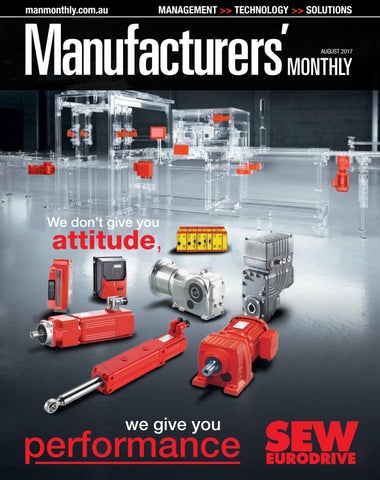
We don’t give you
attitude,
we give you
performance
Melbourne (Head Office) I Sydney I Brisbane I Mackay I Townsville I Perth I Adelaide Gearmotors and Frequency Inverters offer versatile mounting arrangements, flexibility and include motors and brake motors up to Super Premium Efficiency.
Servo Drive Systems are characterised by their dynamic performance, precision, high flexibility and control.
Decentralised Drive Systems fulfil the three most important criteria for use in automation applications: they are modular, flexible and economical.
Functional Safety Technology offers a powerful drive engineering solution for your application incorporating monitoring for safe motion, safe positioning and safe brake management.
Industrial Gear Units combine power, quality and robust design and meet all technical requirements for heavy industrial applications.
Energy efficient solutions for the logistics and materials handling industry
Services With our solution expertise and comprehensive range of pre-sales and after-sales services, we meet your individual requirements.
1300 SEW AUS (1300 739 287) www.sew-eurodrive.com.au
manmonthly.com.au
MANAGEMENT >> TECHNOLOGY >> SOLUTIONS
AUGUST 2017
SAFETY, EFFICIENCY & PRODUCTIVITY INSIDE >>
Print Post Approved PP100007882
12
The manufacturing industry comes together to discuss tomorrow’s issues.
30
Staying abrest of the changes in technology.
32
Have a better understanding of CMM technology for manufacturing.
>>
The Perfect
PALLET WRAPPING Solution SAVE
50
+ %
Innovative Sustainable Packaging and Processing
Award Winner 2017
On Conventional
Stretch Film Usage
=
1300 764 963 www.aaapackaging.com.au sales@aaapackaging.com.au
manmonthly.com.au twitter.com/Manmonthly facebook.com/Manmonthly
Inside
For daily news visit manmonthly.com.au
AUGUST 2017
20
Managing Director: John Murphy Managing Editor: Syed Shah Ph: (02) 9439 7227 syed.shah@primecreative.com.au Journalists: Steven Impey & Stephanie Stefanovic Ph: (02) 9439 7227 steven.Impey@primecreative.com.au stephanie.stefanovic@primecreative.com.au Art Director/ Production Coordinator: Michelle Weston michelle.weston@primecreative.com.au
24
Design: James Finlay, Blake Storey, Adam Finlay Sales/Advertising: Sunita Panchadar Ph: 0435 946 869 sunita.panchadar@primecreative.com.au Subscriptions Published 11 times a year Subscriptions $140.00 per annum (inc GST) Overseas prices apply Ph: (03) 9690 8766
Copyright Manufacturers’ Monthly is owned by Prime Creative Media and published by John Murphy. All material in Manufacturers’ Monthly is copyright and no part may be reproduced or copied in any form or by any means (graphic, electronic or mechanical including information and retrieval systems) without written permission of the publisher. The Editor welcomes contributions but reserves the right to accept or reject
12 6 Editor’s Comment
24 Women In Industry 2017
8 News@MM
27 Sensors & Automation
34 Endeavour Awards Winners Profile
12 Issues & Insights
30 Internet of Things
36 What’s New
20 Hire & Rental
32 Precision Engineering
38 The Last Word
any material. While every effort has been made to ensure the accuracy of information, Prime Creative Media will not accept responsibility for errors or omissions or for any consequences arising from reliance on information published. The opinions expressed in Manufacturers’ Monthly are not necessarily the opinions of, or endorsed by the publisher unless otherwise stated. © Copyright Prime Creative Media, 2016 Articles publisher. The Editor reserves the right to adjust any article to conform with the magazine format. Head Office
Behind the cover
manmonthly.com.au Gearmotors and Frequency Inverters
P: +61 3 9690 8766 enquiries@primecreative.com.au www.primecreative.com.au Sydney Office Suite 3.06, 1-9 Chandos Street Saint Leonards NSW 2065, Australia
Average Net Distribution Period ending Sept ’16 17,911
Printed by: Manark Printing 28 Dingley Ave Dandenong VIC 3175
AUGUST 2017
offer versatile mounting arrangements, flexibility and include motors and brake motors up to Super Premium Efficiency.
11-15 Buckhurst St South Melbourne VIC 3205
MANAGEMENT >> TECHNOLOGY >> SOLUTIONS
Melbourne (Head Office) I Sydney I Brisbane I Mackay I Townsville I Perth I Adelaide
Servo Drive Systems
Due to the nature of their job, workers in the manufacturing industry face many safety risks. In 2015 alone, Safe Work Australia showed that the industry encountered at least 10 work related fatalities. This has been an ongoing trend for while and the manufacturing sector has featured among industries with the highest number of workplace deaths in Australia. However, immediate and long term health hazards can be avoided with the correct education, maintenance and technology. Training should always be conducted by experts and should include machine maintenance. Exposing
workers to periodic safety training can also help keep them up-to-date with current safety practices. However, proper maintenance does not eliminate every risk posed Energy efficient for the by machines in solutions manufacturing. logistics and materials handling Some of the chemicals used in the industry industry are dangerous, hence there is a need to exercise care when handling them. Last but not least, investing in the latest technologies can help lessen workplace injuries. Sensor technology has certainly progressed over the years. With automation and robotics occupying more of the factory floor, the hazards to worker health decreases significantly. sew mm 8_2017 FrtCvr IFC products group.indd 2
are characterised by their dynamic performance, precision, high flexibility and control.
Decentralised Drive Systems fulfil the three most important criteria for use in automation applications: they are modular, flexible and economical.
Functional Safety Technology offers a powerful drive engineering solution for your application incorporating monitoring for safe motion, safe positioning and safe brake management.
SAFETY, EFFICIENCY & PRODUCTIVITY
Industrial Gear Units combine power, quality and robust design and meet all technical requirements for heavy industrial applications.
Services With our solution expertise and comprehensive range of pre-sales and after-sales services, we meet your individual requirements.
INSIDE >> 12
30
32
1300 SEW AUS (1300 739 287)
>>
www.sew-eurodrive.com.au
Print Post Approved PP100007882
All articles submitted for publication become the property of the
The manufacturing industry comes together to discuss tomorrow’s issues.
Staying abrest of the changes in technology.
Have a better understanding of CMM technology for manufacturing.
6/07/2017 10:00 AM
Ph: (03) 9794 8337
manmonthly.com.au
Manufacturers’ Monthly AUGUST 2017 5
Comment
SYED SHAH – Managing Editor, Manufacturers’ Monthly
Entering a new era
I
Saac Asimov famously wrote in his novel, “I, Robot” how robots came about and eventually replaced the last of the humans. The 2004 movie of the same name took us to the year 2035 where automation and robots were the centre of everyone’s lives, serving humanity in just about every function imaginable. While these robots were meant to do only menial work initially, their evolution to perform tasks of a higher nature led to a near apocalyptic extinction of humanity. So, are we entering a new era of robotics and automation in vehicle manufacturing? This is the ongoing central topic at manufacturing conferences. And there’s always something new to learn after each event. At the recent Women In Industry conference during the manufacturing breakout session, participants agreed that the industry is well aware that the increasing level of automation makes some people feel uneasy because they see the introduction of more robots as an obvious threat to jobs.
6 AUGUST 2017 Manufacturers’ Monthly
But far from a gloomy dystopian future, I would like to think that the rise of robots will actually benefit the wider human workforce, by helping to deliver improved productivity, wages and working conditions. About a year ago, research company IHS released figures about the sale and installation of medium voltage electric motors – a cause for both celebration and sobriety because industrial automation has seen its greatest rise in the region yet. Celebration because this is an indicator that Australian companies are embracing automation, not just for the sake of keeping up with the times but as an ROI enabler. However, the sobriety bit kicks in because, as many would have worked out, more automation equals to less staff and the inevitable shrinkage of the industrial workforce. With this happening, there are several factors that come into play. In certain sectors where robot density is reaching very high levels, participants at the Women In Industry event pointed out that
further automation programmes will aim to enhance the work of humans rather than replace them. With the Industry 4.0 movement getting increased traction through better R&D, there is greater software control for robots and their integration into more operations, leading to increasingly flexible automation systems. But the question on whether we should still worry looms. Decades ago, manufacturing made up roughly 50 per cent of the Australian GDP, but today, it is just about five per cent. Since the 1970s, roughly 400,000 manufacturing jobs have disappeared and currently, manufacturing in Australia only has slightly under 1 million people employed across the country. We are looking towards a future where the only people to get meaningful employment will be those that have the technological skills to create, fix and install technology. Then rest of the populace may be confined to work in a range of service based industries or otherwise, be unemployed.
Robots are getting more sophisticated and adept at performing complex tasks. The cost differential with humans is narrowing, to the advantage of robots. Halfway across the world in the US, Wendy’s restaurant chain is rolling out self-service kiosks for ordering in its 6,000 restaurants. It is no secret that the estimates for labour cost savings in various countries through automation and robotics now are increasing substantially in industrialised nations. The key, I believe, is to manage the policy challenges of manufacturing carefully. The country needs to look at its longterm manufacturing technology plans intelligently and invest in infrastructure, reform tax policy, and boost trade and global markets. Otherwise, there will be a lot more jobs lost over the coming years as the new wave of advance technologies sweep across the industry. Hence, this could go either way – a real and frightening prospect or an ongoing opportunity for everyone.
manmonthly.com.au
5-6 SEPTEMBER MELBOURNE CONVENTION & EXHIBITION CENTRE
CREATING A HEALTHIER AND SAFER WORK ENVIRONMENT TOGETHER
FREE registration available now at www.safetyinaction.net.au
G Australia’s Leading Occupational Health & Safety Event G 100+ Exhibitors G 3 Dedicated Safety Zones with free seminars & interactive Safety features G 3 Co-located Conferences discussing Safety Strategy, Leadership & Culture, Return to Work & Workplace Wellness
Major Corporate Sponsor:
Technology Partner:
News@MM Australia’s first Green Star-rated factory opens in Victoria Kingspan Insulation has announced the opening of its insulation manufacturing facility at Somerton in Melbourne. The $40 million factory is the first Green Star-rated manufacturing facility in Australia, aiming to support production entirely through renewable energy. With the opening of the Melbourne plant, Kingspan will not only be able to supply products to Australia, but it will also be exporting throughout the Asia Pacific region with 20 per cent of production already scheduled for export. The company expects this to increase to 35 per cent by 2020. The factory will be the first in the world to manufacture the company’s fourth-generation Kooltherm insulation, according to Kingspan Group chief executive Gene Murtagh. Kooltherm is a high performance rigid thermoset phenolic insulation with ultra-low conductivity for roofs, walls and floors. It offers strong
thermal and fire performance, and its ultra-thin profile allows more internal floor space to be created due to thinner walls. “The market for high performance insulation is growing rapidly around the world in response to government policies aimed at making buildings more energy efficient,” he said. “This facility gives Australia world leading technical capability in a sector experiencing significant sustained domestic and international growth.” Kingspan’s new facility is also the first Green Star-rated manufacturing facility in Australia. The 14,000 square metre facility was designed by sustainable architect Tone Wheeler, using sustainably sourced building materials, a 750kW solar system, a rainwater harvesting system and energy renewing ventilators providing double the minimum fresh air requirement.
The facility also utilises Kingspan technology, including a smart lighting system and high performance insulation. According to Murtagh, Kingspan places a high priority on net zero energy manufacturing and aims to meet the energy needs of its 100plus factories around the world through renewable energy by 2020. It currently meets 60 per cent of energy requirements.
Located in the City of Hume, where Ford Australia shut down local production in 2016, the plant has already created 26 jobs with another 24 people to be employed in the near future, according to the company. Jobs include production and warehouse positions and trainee positions in chemical engineering and information technology, as well as support roles in sales, management, operations and administration.
Kingspan looks to supply to Australia and the rest of the Asia Pacific.
Government helps to advance Australian manufacturing Matthews Australasia has announced the appointment of Mark Dingley to the role of Chief Executive Officer (CEO). Dingley’s appointment coincides with the transition of current Managing Director Lester Nichol to the role of Chairman, after 36 years as CEO/ managing director. Matthews is a market leader and has been a consistent innovator in the
product identification, traceability and inspection sector, providing equipment, technology and services to Australian and New Zealand companies – predominantly, food and beverage, pharmaceutical and FMCG manufacturers. Dingley joined Matthews in 1994, and before assuming his previous role as General Manager – Operations,
The Advanced Manufacturing Growth Fund will encourage increased investment in advanced manufacturing activities in Victoria and South Australia.
8 AUGUST 2017 Manufacturers’ Monthly
was instrumental in developing and introducing Matthews’ iDSnet, the award-winning software that revolutionised the delivery of product identification and traceability solutions through the manufacturing process and throughout the supply chain. With the Matthews team, Dingley has recently presided over significant growth in vision, quality inspection
systems and product authentication solutions that have provided itemised proof of providence for producers and exporters of Australian products, according to the company. His career with Matthews has also included roles in customer service, marketing, product management and sales. “I am extremely confident that Mark’s energy, experience and dedication makes him the ideal appointment to this important role, and will ensure that Matthews Australasia continues to grow in a rapidly changing market,” said Lester Nichol. Nichol’s two sons, Ben and Matt, also form a part of the Matthews’ leadership group and continue to play significant staff roles in the business, including being active participants on the company’s Advisory Board. Mark Dingley is also Chairman of the Australian Packaging and Processing Machinery Association (APPMA) and is actively involved with GS1 Australia. manmonthly.com.au
News@MM ABB motor sets world record in energy efficiency ABB has achieved almost 100 per cent energy efficiency with its synchronous motor. Tests carried out on a 44 megawatt 6-pole synchronous ABB motor shortly before delivery showed an efficiency 0.25 percent greater than the 98.8 per cent stipulated in the contract, resulting in the world record for electric motor efficiency. This efficiency improvement could save approximately $500,000 in electrical energy costs over the course of a 20year lifetime for each motor. “With electricity costs being, by far, the largest component in the total cost of ownership of such a motor, savings like these have a significant impact on profits,” said Sami Atiya, president of ABB’s Robotics and Motion division. “In addition to extremely high efficiency, synchronous motors are renowned for their proven quality and reliability. Their robust design ensures reliability through cool operation temperatures and low vibration.” The world record efficiency was reached by optimising the motor’s electrical and mechanical features. The average efficiency for this type of synchronous motor is between 98.2 and 98.8 per cent. If the motor is in continuous operation, the 0.25 per cent efficiency improvement saves 1000MWh energy per year which is equivalent to annual electricity consumption of 240 European households. The world’s demand for energy today is nearly twice what it was 30 years ago. By 2030, it may have risen by over 50 per cent again, according to estimates by the International Energy Agency. To cope with this not only are new energy resources necessary but the more efficient use of energy already available is critical. The energy saving potential in industry is enormous just in motor-driven applications alone. Variable speed drives and high efficient motors can help lower energy use typically by 20 to 50 per cent, by reducing power consumption and losses. Motor efficiency is the ratio of manmonthly.com.au
The average efficiency for this type of synchronous motor is between 98.2 and 98.8 per cent.
mechanical power output divided by electric power input. The world record results were obtained during tests carried out with a customer that will be installing ABB synchronous motors to drive compressors at an air separation plant that produces industrial gases. The synchronous motor is a special type of alternating current (AC) motor, being some 5 x 4 x 4 metres in size for an output power of 44MW. Typical uses of synchronous motors are for driving fans, pumps, rolling mills, mine hoists, and compressors in such industries as air separation, oil and gas, chemical, marine, metals, mining, water, and pulp and paper. Manufacturers’ Monthly AUGUST 2017 9
News@MM UNSW developing touch screens with WeTouch New types of touch screens that would be very robust but also sensitive enough to detect ten fingers at once, are to be developed in a research partnership between UNSW Science and Chinese company WeTouch. WeTouch, which is based in Sichuan Province, has grown rapidly since it was founded in 2011 by major shareholder Guangde Cai. It now employs more than 300 people in China producing medium to large scale touch screens for a variety of industries, including retail,
finance, gaming, health and the automotive industry. The UNSW project with WeTouch to develop new piezoelectric-based screens that overcome the drawbacks of current screen technologies is led by Dr Danyang Wang, Dr Dewei Chu and Professor Sean Li of the UNSW School of Materials Science and Engineering. UNSW Dean of Science Professor Emma Johnston said she was proud that the Faculty’s scientists were taking leading roles in Torch projects, including the first one announced
The UNSW project with WeTouch to develop new piezoelectric-based screens that overcome the drawbacks of current screen technologies.
last year – a project to develop new graphene-based cable technology that could cut power costs and greenhouse gas emission by improving electricity transmission. “Development of touch screens is a massively expanding industry,” said Johnston. “So, it is no understatement that this project to develop new touch screens that are highly sensitive, accurate, low cost and made from readily available technologies could have a global impact.” “It represents a great opportunity for the company, for Australia and for China.” In April 2016, in the Great Hall of the People in Beijing before Australian Prime Minister Turnbull and Chinese Premier Li, UNSW signed contracts to host the first-ever Torch science and technology park outside China. UNSW Deputy Vice-Chancellor (Enterprise) Professor Brian Boyle said that the Torch initiative was visionary, and more than 20 programs of cutting-edge research have now been established with industry partners, delivering research contracts worth more than $70 million to UNSW. “Our relationship with WeTouch represents the pinnacle of that approach,” said Boyle at the launch
on 22 June, which was attended by Mr Cai and other company representatives from China. First generation touch screens use a resistive technology which relies on pressure on flexible layers of material. This approach is robust, but energy expensive, single-touch and subject to rapid ageing. Most of WeTouch’s screens rely on capacitive sensing, where touch is detected by a change in the capacitance when a conducting object like a finger is placed on the screen. This approach allows for multi-touch capability and is energy efficient, but can be inaccurate. Chairman of WeTouch Australia Dr Peter French said the new technology using piezoelectric materials was aimed at delivering a robust, yet precise, multi-touch screen, with the added benefit that “typing with all ten fingers is possible”. “As chairman of WeTouch Australia I am very pleased to be part of this very exciting program of research that can showcase Australian innovation generally and that of UNSW in particular . . . to enhance and improve all our lives,” he said. WeTouch’s customers include Siemens, Schneider Electric and Canon and the company will list on the Australian Stock Exchange at the end of July.
Mark Dingley appointed CEO of Matthews Australiasia Matthews Australasia has announced the appointment of Mark Dingley to the role of Chief Executive Officer (CEO). Dingley’s appointment coincides with the transition of current Managing Director Lester Nichol to the role of Chairman, after 36 years as CEO/managing director. Matthews is a market leader and has been a consistent innovator in the product identification, traceability and inspection sector, providing equipment, technology and services to Australian and New
10 AUGUST 2017 Manufacturers’ Monthly
Zealand companies – predominantly, food and beverage, pharmaceutical and FMCG manufacturers. Dingley joined Matthews in 1994, and before assuming his previous role as General Manager – Operations, was instrumental in developing and introducing Matthews’ iDSnet, the award-winning software that revolutionised the delivery of product identification and traceability solutions through the manufacturing process and throughout the supply chain. With the Matthews team, Dingley
has recently presided over significant growth in vision, quality inspection systems and product authentication solutions that have provided itemised proof of providence for producers and exporters of Australian products, according to the company. His career with Matthews has also included roles in customer service, marketing, product management and sales. “I am extremely confident that Mark’s energy, experience and dedication makes him the ideal appointment to this important role, and will ensure that Matthews
Australasia continues to grow in a rapidly changing market,” said Lester Nichol. Nichol’s two sons, Ben and Matt, also form a part of the Matthews’ leadership group and continue to play significant staff roles in the business, including being active participants on the company’s Advisory Board. Mark Dingley is also Chairman of the Australian Packaging and Processing Machinery Association (APPMA) and is actively involved with GS1 Australia.
manmonthly.com.au
News@MM Industry 4.0 will open “unrecognisable world” for manufacturers More manufacturers across Australia will rely on customised production in the advent of Industry 4.0, according a champion of data technology. The Internet of Things (IoT) is growing at such a rapid rate, leading researchers are predicting a future dominated by autonomous production and logistics – and much sooner than many may expect. Dr Ian Oppermann, CEO and chief data scientist at the NSW Data and Analytics Centre, insists factory floors will be “unrecognisable” within a decade and claims that automated technology is going to vastly change the manufacturing landscape. “Change is happening but change is happening at different rates,” Dr Oppermann told Manufacturers’ Monthly. “Change will happen quickly for those who are already digitalised and we are already starting to see it in the finance and insurance services. “Then you look at all the other industries that are a little bit like that – highly digitised and highly automated – and, the longer they stay in the digital world, the faster things will start to happen. “In Western Australia, we already have the automated dump trucks
and we’ve also got other areas where repetitive jobs can be automated. Very soon, I think you will see a wave of different automated technologies in different industry sectors.” Dr Oppermann was a guest speaker at an industry event run by Ceda at the Shangri-La Hotel in Sydney earlier this year, and discussed the potential impact disruptive technologies will have on businesses in the near future. “In five years’ time, we will have
seen such dramatic change that the world will be unrecognisable,” he continued. “In 10 years’ time, we will look back on now and think, ‘Wow, that really was primitive’. “Not having vast stores of things that are made generically for generic consumption, allows ‘just-in-time’ production to be much more highly personalised. “Interestingly, if cars do disappear in the future and we do see autonomous vehicles take
over the roads, we have a really interesting opportunity with the use of land because substantial space in a city is made up by car parks. “We could have all this space available to us, which offers the potential for ‘just-in-time’ delivery services in space which is no longer being used to deliver close to the customer and allow for last-minute customisations. “That’s the sort of thing I think we will see in five to 10 year’ time.”
Automated technology will vastly change the manufacturing landscape in the years to come.
Robust MAGNETIC PROGRAMMABLE Incremental and Absolute Encoders
Features TM
www.pca-aus.com.au
+ 61 2 9482 3733
manmonthly.com.au
• Program with a mobile phone • No software to install • Wi-Fi connection to encoder • Online storage of configuration • Range of housing sizes 58 and 36mm Dia.
Configu re with you mobile p r hon
e
Options • Incremental Only • Absolute single or multi turn • Gray or Binary Code • Dual Incremental and Absolute • Any values 1 to 16,384
Manufacturers’ Monthly AUGUST 2017 11
Issues &INSIGHTS Putting manufacturing back on the political agenda Leaders from all walks of industry united in Canberra to discuss the future of Australia’s manufacturing sector. Steven Impey reports from Parliament House.
D
Picture Credit: David Howe
URING the winter solstice in the Australian capital – where many of the decisions that influence the future of the nation’s economy and infrastructure are made – the spotlight was shone on some burning issues. Out from the cold and inside the
12 AUGUST 2017 Manufacturers’ Monthly
modernistic Parliament House, which sits on a high-security compound at the centre of Canberra, members of the manufacturing industry were welcomed to speak freely during a conference dubbed Manufacturing Matters while parliament was in session.
“I can’t claim that we planned it that way but the winter solstice is of course the shortest day of the year, which means, as of tomorrow, they will start getting longer,” said Jim Stanford, an economist at the Australia Institute, in his opening address. “Somehow I think that is fitting
for a conference on Australian manufacturing because anyone in the industry will tell you that it has been cold and dark for a few years.”
Manufacturing policy “key” Co-authored by Stanford and Tom Swann, the Centre for Future Work at
A welcome sight for Australian manufacturing as the industry unites at the Parliament House, Canberra.
manmonthly.com.au
Issues&INSIGHTS Picture Credit: David Howe
Innovation that saves you space, time and money “Do it right!”
Industry minister Arthur Sinodinos reflected on the resiliency of the Australian manufacturing sector despite its many challenges.
My job as minister – and particularly in a portfolio like this one – is to reach out to all the people who have a common interest in promoting what I think is a great set of industries in Australia. - Sinodinos the Australia Institute has released a paper called Manufacturing: a moment of opportunity, which highlights two key dimensions it urges the industry to consider. “One of course is the economic context for manufacturing in Australia,” Stanford said, “but there is a parallel opportunity to this, which is the political opportunity. “Our polling results suggest that Australians – despite the doom and gloom of much of what they have been told about manufacturing over the last decade – retain a deep and gut-level confidence that manufacturing must be part of a manmonthly.com.au
prosperous national economy.” The paper reviews the qualitative features as to why manufacturing is a strategically important sector and that it is not a “nostalgic” industry as some may portray it, but should be an active target for policy within Australia’s leadership.
Taking industry to the floor Between speeches and Q&As, senators Arthur Sinodinos and Kim Carr – Australia’s respective industry and shadow industry ministers – were invited to join the conversation. “My job as minister – and particularly in a portfolio like this one
BAC Systems - Market leaders in High-Density Storage for Parts and Tools, Modular Workbenches and Tool Display Boards. BAC Modular Drawers, Cabinets and Benchtops are the building blocks of the modern workplace. Call us now to arrange a free site survey and to see how the BAC Modular Range can transform your workplace. BAC Systems Pty Limited 193-195 Power Street Glendenning, NSW 2761 Phone: (02) 9832 2777 For more details, please visit:
www.bacsystems.com.au
Manufacturers’ Monthly AUGUST 2017 13
Issues &INSIGHTS
– is to reach out to all the people who have a common interest in promoting what I think is a great set of industries in Australia,” said Sinodinos. “Let’s look at the record. The manufacturing industry survived the resources boom. Yes, there was job shedding and there were issues but it has survived and is still here today. “In the last 12 months, employment has grown and the report you are putting out here is illustrating the way the sector is growing and that there are some really good prospects ahead. “What that tells me is that the sector is resilient. It tells me that the sector sees a future and that, in the government, our role is to back the sector in doing it.” He called the industry an “indispensible part of an innovation ecosystem” the nation is attempting to build for a future where smart manufacturing “gives us scale”. “We can’t hold back the tide of change and we all have to adapt – we all know that,” Sinodinos added. “The world really is our oyster.” 14 AUGUST 2017 Manufacturers’ Monthly
Jobs increase recorded
The true cost of energy
According to the Australian Bureau of Statistics (ABS), 40,000 jobs were created in the sector in the last financial year. Nick Xenophon, the South Australia senator, welcomed the figures but fired a warning that brought about a sense of perspective surrounding a challenging road ahead. “There is something seriously wrong where in a country such as Australia – one of the most advanced, developed nations in the world – our manufacturing sector has shrunk from 12 per cent a decade ago to just over six per cent,” he said. “The fact that employment, according to the [Australia Institute’s] paper, has increased in the past year and that manufacturing exports and profits are on the rise is very welcoming. But I am cautious whether we should consider these a trend. “We need to be wary because ABS is not forecasting figures and are not looking at the pending job losses in the automotive sector and all of the follow-on effects of that, for which we are ill-prepared as a nation.”
Energy costs have become the manufacturing sector’s biggest challenge, Xenophon claimed Most companies are facing longterm gas contracts of $15-20 per gigajoule up from only $5, which he believes will have “inevitable ramifications on business profits” and could “lead to job losses in the tens of thousands”. Xenophon explained the paradox surrounding the energy intensity scheme he devised with Liberal leader Malcolm Turnbull, which he said has gone from “a mongrel to a top-dog” after a Labor U-turn to support the programme – only to see it scrapped by the existing coalition government. Senator Lee Rhiannon, of the Australian Greens party, also spoke of how the steel industry can put manufacturing on course to become an “economically and environmentally sustainable economy”. “A strong manufacturing sector is crucial to addressing global warming and possibilities of growth in the renewable energy industry,” she said. “Bringing global procurement into how we manage steel production
and imports will ensure that Australian steel is used to build the infrastructure – from new rail lines to the renewable energy projects – this country so urgently needs.” In the federal budget, Xenophon admitted he would have liked to have seen more than the $100 million invested in the manufacturing sector but insisted that more dollars are on their way “once the government sees the good economic sense” investing in the industry can serve. During the conference, the Australia Institute’s executive director Ben Oquist described manufacturing as the “process of adding value to natural resources”. Among some of its greatest fiscal opportunities, it was also noted that the federal government’s $195 million investment into the defence industry is hoped to boost jobs, especially within naval shipbuilding in Adelaide and Perth.
“It’s not only economics” Amid the era of digitalisation, senator Carr discussed the position held by the European Union and how the dawn of Industry 4.0 is being manmonthly.com.au
Issues&INSIGHTS Picture Credit: David Howe
Jim Stanford, director of the Centre for Future Work stressed on why manufacturing is a “strategic” sector instead of a “nostalgic” one.
Bringing global procurement into how we manage steel production and imports will ensure that Australian steel is used to build the infrastructure – from new rail lines to the renewable energy projects – this country so urgently needs. identified as an opportunity for industry expansion in Germany. “It’s important to address questions about what sort of society we want to be,” Carr said. “Questions in terms of the capacity of this country to develop as a prosperous, egalitarian, culturally-diverse and technologically advanced society. “It’s not just about the economics. What about significant questions about standard of living, levels of investment and questions about our capacity to be independent on the fluctuations of
global commodity prices? “These are all important questions. Do we want to be more than just a quarry or a beach? For me, these matters should be central to our political debate and political conscious.” Carr noted the downturn of Australia’s automotive assembly sector as the industry’s “most recent and egregious” failure; where “by political choice, we chose to drive an industry out of the country”. “The ludicrous nature of the conversation is that somehow or another we say, ‘We must have
NORD DRIVESYSTEMS offering Industry 4.0 ready drives for Australia´s industry Getriebetechnik n n n n
Starke Lagerung Geräuscharmer Lauf Korrosionsschutz (AL) Hohe Leistungsdichte
Motorentechnik
Steuerungstechnik
n Alle Effizienzklassen n Weitspannungsbereich
n n n n
(380-420V)
n Auch als Brems - oder
Alle Umgebungen Schutzklasse bis IP69K Flexible Schnittstellen Skalierbare Funktionalität
ATEX-Variante
an agriculture sector’ – no one questions that,” Carr continued. “But there are some who say that we can get by without a manufacturing sector; that it is ‘someone else’s problem’. “We have had to deal with this for quite a while and it is, of course, commentary we read in the media all too often, as if this is a sector that is inevitably going to decline. “But we have choices to make. We know there are opportunities and we know there are risks – but politics is about making choices,” he concluded.
NORD Drivesystems (AU) Pty Ltd 18 Stoney Way, Derrimut , Victoria 3030 Australia Phone: +61 3 9394 0500 Fax: +61 3 9394 1525 www.nord.com.au National Customer Service 1300 00 NORD (6673) au-sales@nord.com Member of the NORD DRIVESYSTEMS Group
The
Gear Unit
n Strong bearings n Low noise n High power density
The
Motor
n High efficiency n Global Standards n All operating conditions
The
Drive Electronic
n Compact design n Easy commissioning n Scalable functionality
Wide power range – Versatile system solutions – High overall efficiency
Manu Monthly_210x122_March.indd 2
manmonthly.com.au
29.05.17 10:47
Manufacturers’ Monthly AUGUST 2017 15
Issues &INSIGHTS Changing public perceptions of manufacturing While it is widely reported that Australian manufacturing is “out-dated” and on the decline, research suggests the public values the industry more than expected.
Picture Credit: David Howe
Mark Goodsell, head of the Australian Industry (Ai) Group’s NSW branch, addresses the Manufacturing Matters summit.
A
NALYSIS around Australia’s attitude towards manufacturing has revealed a startling misconception about the industry. Despite a culture that is consistently told that the sector is in decline, an investigation carried out by a team at the company, Research Now, suggests the public are not as lost on the value of making things as they are led to believe. According to the Australian Bureau of Statistics, the sector invests more into research and
16 AUGUST 2017 Manufacturers’ Monthly
development (R&D) than other industries across the nation. Although it is underestimated in the public eye (many believe innovation in manufacturing is far behind that of scientific services, mining and the media), more than three quarters of the country agree exporting Australian-made products is key to a strong and stable economy. “There are many paths to becoming a successful manufacturer in this country,” said Mark Goodsell, head of the Australian Industry (Ai)
Group’s NSW branch. “A lot of them are different from what they used to be – even those who have only been around for 10 years. “When you talk to them, they will tell you they are much more different; that they are much more focused on the customer than their factory. “That doesn’t mean they run poor factories but rather that being lean and having good machinery is now just the price to pay when entering into manufacturing.
“The real differentiate for success is about knowing which part of the chain you are good at where there may be less competition, and also really understanding the customer – which, in most cases, means knowing the customer better than the customer knows themselves.”
Manufacturing is changing Speaking at the Manufacturing Matters summit at Parliament House, in Canberra, Goodsell was joined by a panel of industry experts, who discussed the issue of manmonthly.com.au
Issues&INSIGHTS manufacturing is “out-dated” – with more than half of its respondents (55 per cent) saying they disagree with the statement. “Manufacturing production is no longer the same,” said Dr Jens Goennemann, managing director at the Advanced Manufacturing Growth Centre (AMGC). “To be a manufacturer in Australia, you have to be competitive. “To avoid the drop and to sustain our lifestyle – which does not support manufacturing – you need to be better than anybody else and means you need to serve a market of seven billion and not only 25 million. “If, as a nation, we transform the opportunity our manufacturing has to offer by moving away from production and offering smarter services, only then can we send something clever from this wonderful country into the world.”
Generational split
“They certainly know we can make cars because we have done that before but I want to make the point that there is still a lot of manufacturing success [in Australia]. “It is perhaps hidden away from the traditional public branding and, leading into a second point about our self image around manufacturing, there seems to be several different paths to success.” One of the research’s findings that stood out relates to a misapprehension that manmonthly.com.au
In general, the majority of older respondents agreed that manufacturing growth requires government policy and that exports are necessary for success in trade. Meanwhile, younger respondents were more likely to agree that the industry is in an inevitable decline and therefore government support isn’t necessary. Dr Jill Sheppard, who works at the Centre for Social Research and Methods, based at the Australian National University, presented some of her own findings. “Public opinion towards manufacturing in Australia is understudied,” she said. “We got this data back and we asked people whether they agree or disagree that we rely too heavily on foreign imports. “I expected the results to be fairly partisan but, [when] we started to break it down, we found that there are some weak spots. There is incredibly wide and robust support for manufacturing in Australia and there are both weaknesses and challenges.” She calls it a “generational softness”, explained largely by those university graduates who
Jens Goennemann, managing director at the Advanced Manufacturing Growth Centre pointed out the the rules of the game have changed for manufacturing in Australia.
Picture Credit: David Howe
public perception around the sector. “Most of the public would never know that we made components for the Mars Rover, for example, or even think that we were capable of doing so,” he said.
To avoid the drop and to sustain our lifestyle – which does not support manufacturing – you need to be better than anybody else and means you need to serve a market of seven billion and not only 25 million. are “not conditioned” to look to manufacturing as a realistic career prospect. “There is a real opportunity here of how manufacturing industries frame manufacturing as a thriving and prosperous industry of the future,” Dr Sheppard continued. “This is a contrast from potentially what we see in intergenerational replacement – as the older generations die out, they are being replaced by younger generations who don’t expect to work in manufacturing. “If we take that as being a fact, it does tend to contrast with other intergenerational trends that you see away from materialist perceptions of the world – towards
post-materialist attitudes that emphasises environmental sustainability and the luxuries of social progressiveness. “In terms of framing manufacturing, I think there is definitely an opportunity there to frame it as something that aims to those post-materialist roles, including environmental sustainability and technology efficiency.”
“Manufacturing should be differentiated” Despite a generational split, the poll shows that 78 per cent of people think that, in the long run, manufacturing will only succeed if it is shown government support. Manufacturers’ Monthly AUGUST 2017 17
Issues &INSIGHTS “Traditional political leverage has been dropped and has pretty much undifferentiated jobs,” Goodsell said. “The manufacturing industry has said for a long time that we’ve got better jobs and have good value.” But that’s where his view of the industry differs from the current status quo. “It is reasonably feasible to argue against that however,” Goodsell explained. “The boundaries between manufacturing and other sectors are really breaking down these days “Typically, the model of success shows that successful manufacturing companies are now making more money out of the services they provide than the goods they produce. “We ought to take it upon ourselves to present manufacturing
as part of the solutions for those kinds of problems, which may challenge our traditional way of thinking but that is not a bad thing.” Over the years of public policy debates, Goodsell insists there are too many manufacturers telling the government what it should do to guide the industry to better days. Yet, he explains there is too few who say what they are prepared to do to get there and are the people worth listening to.
Replenishing lost workforce In contrast to the apparent optimism in the public realm, there is concern that the loss of jobs within the manufacturing sector won’t necessarily mean other industries will welcome them with open arms. On the subject of workforce, only 19 per cent of respondents agreed other industries would naturally
create positions for out-of-work manufacturers. “Our responsibility is to build for the next generation of Australian workers and their families, which is really what this conversation is about,” said Scott Connolly, assistant secretary at the Australian Council of Trade Unions (ACTU). “If you look at what’s happening in our economy, we have got over a million workers unemployed or underemployed; record low-wages growth, record levels of youth unemployment; unprecedented levels of insecurity, casualisation and uncertainty among our labour market in particular. “We believe that securing a sustainable future for our manufacturing-related industries has really never been more important. Not just to workers in that sector or related sectors, but much broader in society.”
He described the steel suburb of Doveton, in the southeast of Melbourne, as an example that is now, after 30 years of economic reform, a “shadow of the place it used to be”. “The factories have all but gone and 7,500 jobs have been reduced to a few hundred,” Connolly said. “It is critical to see how we got here – both in terms of our collective history on the back of thousands of manufacturing jobs that have built this country across generations and also how we imagine our country to be going forward. “One where growth is sustainable, more fair and where workers can get decent jobs where we have stable communities and social cohesion. “We can’t do that without the manufacturing sector. We don’t have to look far to see what it can do for our communities.”
Shadow industry minister Kim Carr called the downturn of Australia’s automotive assembly sector as the industry’s “most recent and egregious” failure.
18 AUGUST 2017 Manufacturers’ Monthly
manmonthly.com.au
2017
AUSTRALIAN MINING PROSPECT AWARDS
NOMINATIONS NOW
OPEN To nominate, please go to
www.prospectawards.com.au Platinum sponsor
Sponsors
Hire &RENTAL Part time resources: full time safety With today’s business uncertainties, financial projections even in the short term are becoming harder. Hire and rental specialists, Dräger, believes that it is flexibility and agility is what it takes for companies to not only survive but also thrive.
D
YNAMIC business environments have had a significant impact on the way businesses execute their operations. All businesses are experiencing these symptoms – lack of available capital, fear of commitment (due to uncertainty), seeking greater understanding of on-going costs, complex approval processes for capital expenditure, seeking extended payment terms or even delaying payments. In an effort to excel through the challenging times, businesses are exploring other options to improve efficiencies and control costs supplier consolidation, outsourcing work to contractors, preference to casual employment contracts vs full time contracts, collaboration with competitors and suppliers in similar
industries, collaborative consumption and sharing resources etc. This brings into sharp focus the question, should I rent or buy equipment? Employ full time or employ casual professionals?
Understanding the Total Cost of Ownership (TCO) At first glance, it may seem a foregone conclusion that companies should own all equipment and employ permanent staff to conduct business activities. The obvious benefits include immediate availability of tools or people, process and site familiarisation, standardisation of equipment and operational independence. However, many organisations overlook the indirect costs (in time and dollars) that should be considered when calculating the
Fig 1. The interplay between risk level of activity; specialisation of equipment and frequency of use of equipment and personnel. 20 AUGUST 2017 Manufacturers’ Monthly
TCO. These include: • The cost of capital (money tied up, reduced financial flexibility) • Maintenance planning and scheduling • Training and development of personnel • Equipment warehousing and office facilities (equipment – warehouse, personnel – office, vehicles, IT infrastructure) • Complacency and outdated practise (personnel not keeping up with best practice) • Managing compliance • Obsolescence • Depreciation costs By calculating all the indirect factors into the TCO, it may not be as cost-effective as initially assumed. In some situations,
there is another, potentially better way to reduce the TCO: renting or hiring.
Looking to other alternatives - equipment rental There are a number of obvious benefits in renting. Through the rental of equipment, businesses can achieve more efficient and effective asset utilisation, while managing the costs. Renting allows companies to free up money for other productive purposes such as investment into growth projects or new markets. The other benefits of renting, include the fact that important operational facets such as service calibration, and repair costs are often covered in the hire price for the duration of the rental period. In most cases, the rental company
Fig 2. The interrelationship between the cost of a resource and its frequency of use
manmonthly.com.au
Hire&RENTAL is obliged by law to maintain at optimal operating levels, at the same time, liability and risk firmly remain the responsibility of the rental company; not the renter. One example can be seen from the mining sector in Australia. Over recent years, high commodity prices coupled with heavy CAPEX investment in the mining sector meant that extensive purchase of equipment was not a problem for some miners. Seemingly endless amounts of money were often thrown at any problems all at the expense of efficiency and productivity of the actual mining operation itself. According to the 2015 McKinsey MineLens Productivity Index (MPI), mining operations around the world are 28 per cent less efficient today than they were 10 years ago. In the research, McKinsey noted the decline is not surprising considering that the industry has just come out of a demand super
manmonthly.com.au
Fig 3. An example of a customer’s changing need for portable gas detection equipment cycle which saw the production of certain commodities rise by 50 per cent over the past decade. As the mining boom declines and costs come under greater scrutiny, mining companies (along with other sectors) are asking themselves: Is the initial investment in machinery
worth it for the potential utilisation we will get out of the asset? Companies that take advantage of renting equipment are better able to optimise their asset utilisation and costs, and thus be more focussed, agile, and competitive in achieving business goals.
Some of the benefits of renting equipment include:
1. Cost-effectiveness Equipment is expensive to purchase and involves a huge number of extra costs, including registration fees, storage, maintenance and inevitable
Manufacturers’ Monthly AUGUST 2017 21
Hire &RENTAL repairs. When a company hires equipment, it requires no large upfront outlay, which, in turn, frees up capital for where it is most needed. Hiring is also cost effective because it is a fixed cost. Procurement managers and businesses can therefore better forecast their budgets. There is transparency in the cost – the real cost to do the job. Hiring can also be transacted as an operating expenses, meaning its tax deductible.
Today’s businesses are exploring other options to improve efficiencies and costs.
2. Time-effectiveness Ensuring that your equipment complies with industry regulations means regularly carrying out time-consuming services and maintenance procedures. Hire companies do this as part of the rental/hire contract. Hiring is also time effective because it allows companies to increase compliance with occupational health and safety regulations. With equipment that is already safety ready, companies do not have to worry about liability in relation to any accidents, should they recur while using the equipment. Figure 3 shows an example of
a customer’s changing need for portable gas detection. It shows that they are paying for the upkeep and storage of gas detectors that are only utilised for a small part of the year. In this
instance, the rental of gas detectors for peak periods would make good business sense. Depending on the overall usage in off-peak times, it may even be financially viable and reduce risk to set up a
rental solution for all portable gas detection requirements across the whole year.
Another way - hiring industry professionals There are a number of benefits to hiring professional personnel rather than employing them as full-time staff. These benefits include:
1. Hiring personnel can meet temporary changes in demand
Hiring gives the flexibility to companies to avoid the high initial outlay.
22 AUGUST 2017 Manufacturers’ Monthly
Renting/hiring can meet temporary changes in demand. It makes far more economic sense to hire people rather than to pay a high initial outlay and then have to let go of people of there is not as much demand. Hiring is flexible to meet changing business needs, which means companies can avoid the high initial outlay. Seasonal changes in the need for additional resources can easily by met through renting/hiring, as business trends demand and change.
manmonthly.com.au
Hire&RENTAL 2. Risk management Companies are better equipped to manage OH&S regulations when they engage industry professionals. Hired personnel are also available on-demand on the worksite to advise and implement best-practice safety solutions. These professionals can provide specialist advice and solutions on your applications. Rental providers ensure all equipment is maintained as per the manufacturer’s recommendations and delivers compliant equipment, fit for purpose.
3. Multi-disciplinary experts With most industrial tasks, there’s a clear connection between each step of the task. Utilising multi-skilled individuals throughout, consolidates suppliers, creates consistency and improves information flow, achieving safer and effective execution. An example of this is a confined space
entry coordinator. This individual can classify your confined spaces, prepare risk assessments and rescue plans, train entrants, supervise entrants and if required assist in a rescue operation.
When should you hire? When should you buy? When determining whether to buy or rent, companies need to look at the activity in relation to two factors – risk and cost. In this case, risk also relates to the specialisation of the equipment / personnel required to do a task or activity. The relationship between the risk level of the activity (or the specialisation of the equipment/ personnel) and frequency of use is described in figure 1. If the risk level or specialisation is high, rental or hire is recommended. Importantly here, high risk-high frequency work should always be
done in consultation with specialists in order to minimise risks. For high frequency-low risk / specialisation work, keeping the work or skills in house is recommended. For anything in between, individual analysis of the particular application needs to be conducted. A company can also assess whether to rent or buy by looking at the interrelationship between cost and frequency of use of the resource (Figure 2). If the cost is high and the frequency of use is low to medium, a company should use short-term rental or hire.
Creating an optimal Australian safety environment Specialist hire and rental companies like Dräger Rental and Safety Service helps businesses meet their changing staffing and equipment needs. The company deploys highly trained staff in accordance
with client needs; provide safety equipment that can satisfy any business need; and provide training for employees once the client has finished their asset hire which means less downtime, cost or loss of productivity. Dräger’s safety services offer a holistic safety solution: Rescue Coordinators, Hygiene Technicians, Health Safety and Environmental (HSE) Coordinators and Confined Space Entry Safety Teams can manage your process from start to finish. The company’s multi-skilled safety professionals can offer any business flexibility and real efficiencies. In addition, Dräger employees have extensive experience in the industry, they bring learnings and best practices from a wide range of industries to offer an organisation current and efficient safety compliance.
There is a need to look at risk and cost factors when determining whether to buy or rent.
manmonthly.com.au
Manufacturers’ Monthly AUGUST 2017 23
Women In Industry CONFERENCE The need for diversity for unity The inaugural Women In Industry Conference showcased many prominent leaders sharing their thoughts on the state of the transport, mining, and manufacturing. The manufacturing track featured many takeaways for participants that centred around greater awareness for STEM related subjects in the curriculum.
T
HIS first Women In Industry (WII) Conference was held at Melbourne Convention and Exhibition Centre earlier this year in June. It hosted roughly about 80 prominent women, mostly from the engineering sector who shared their insights, advice and statistics on their respective industries through a series of case studies, panels and roundtable discussions. Trailer Magazine’s Bianca Dohnt opened the conference noting that the various sectors have differing agendas in terms of business direction but share a common goal through providing equal opportunities for both genders and how diversity in the workplace can make all the industries a better place in return. In a conversation styled keynote address, speakers, Jennifer Conley, executive director, Australian Advanced Manufacturing Council, and Robyn Elliot, senior director, strategic expansion projects at CSL shared with the room about the importance of “striking a balance” between masculine and feminine traits.
24 AUGUST 2017 Manufacturers’ Monthly
Keynote speakers Jennifer Conley (left) and Robyn Elliot (right) kicking off the WII conference.
Conley mentioned that women juggle more in their lives besides just the issues at work – family and work take centre stage for a lot of high flyers and she called for the need to have the industries understand this better. “You have to think about what you want to achieve from your career, whether it is taking on a leadership role, or not – both options are perfectly okay, if it is what you want,” Elliot said – adding that staying true to your personal values can help provide guidance. While the keynote address set the tone for the conference, it is evident through the various speakers that women add the missing dimension to growing any business that extra mile. Jack Ma, founder of Alibaba famously said that “men only cared about their personal growth but women cared for how the family (business) grows” and his “secret sauce” to his success was hiring a lot of capable women. On this note, Vanessa Kearny - commercial manager of Geelong Refinery, Viva Energy Australia shared her
distress when a refinery she worked at previously was closing. Instead of letting it go completely, she dedicated herself to retraining the workers so that they may be relevant elsewhere. “I wanted mentor some people and that they were given the best opportunity to redeploy,” Kearny said, adding that she was drained at the end of the process. She then highlighted the success of Viva Energy to the style of leadership that the company employs. “The key success factors for me are how we developed the vision for the refinery which defined us – doing it together,” she said. Following the lunch break were the three ‘Industry Insight’ sessions to discuss topics on an industryspecific level, with Australian Mining Editor, Ben Creagh moderating the mining group, Syed Shah, Editor of Manufacturers’ Monthly in the Manufacturing session and Trailer Magazine’s Bianca moving in to the Road Transport group. At the end of these sessions, it was concluded that there was
definitely a shortage of women taking up STEM (science, technology, engineering and math) subjects at school, especially at girls only schools, simply because the curriculum and the messaging still leaned towards traditional patriarchal tenets on gender roles and how each industry’s public perception as male-dominated contributes to it staying that way. The manufacturing track attendees also called for more men in leadership positions to attend such seminars to listen in on the benefits of gender diversity to the manufacturing sector. The consensus was that only through this can the old gender defined roles in the industry be re-framed. “Road transport, mining, manufacturing and engineering are major contributors to the Australian economy and if we don’t do something to create a more diverse working environment, it will affect us all. It is through the collaboration of men and women together that we can secure the country’s future,” Bianca concluded. manmonthly.com.au
Women In Industry Awards WINNER’S PROFILE Developing a passion for success This year, the award for Excellence in Manufacturing went to Lisa Lamb, manufacturing director of Seqirus.
S
EQIRUS is a pharmaceutical company that operates one of the world’s largest influenza vaccine manufacturing facilities, supplying seasonal influenza vaccines to Australia and global markets. The company is also the sole supplier of anti-venoms specific to the Australian environment. These include anti-venoms to some of the nation’s most dangerous creatures, such as venomous snakes, spiders and marine animals. Having worked with Seqirus for 23 years, Lamb has taken on a range of different roles, and is now the Manufacturing Director for Seqirus’ Products of National Significance portfolio. It is her job to manage a team of around 30 people in the manufacture of these products. According to Lamb, the manufacturing process is quite complex. “Anti-venoms are quite unique because of their unusual starting
material (venom collected by very specialised suppliers from the animals), complex method of manufacture, and infrequent manufacturing process where some products are only produced once a year or less,” she said. “Q Fever Vaccine has a very different small-scale manufacturing process which starts with the inoculation of eggs and is also very complex.” Speaking of her win at this year’s Women in Industry Awards, Lamb has attributed it to her efforts to foster an environment of collaboration and learning within her manufacturing team, as well as promoting engagement with the wider business, a better understanding of the end to end supply chain, a stronger link between the manufacturing and commercial teams, and the patients whose lives are saved with these important products.
There is a great importance in encouraging girls to study STEM subjects.
“It is essential that every person is valued for their contribution, and by creating an emotional connection between the manufacturing operator and the product they are making, it can drive behavioural change and decision-making throughout the manufacturing process and in turn improve productivity and quality.” According to Lamb, she is one of many women in leadership roles at Seqirus. The company fosters a culture of equal opportunity, and
Lisa Lamb, manufacturing director of Seqirus (right) accepting the Excellence in Manufacturing Award.
manmonthly.com.au
close to 55 per cent of its employees are women. Lamb has expressed the importance of encouraging girls to study STEM subjects in school in order to get more women in industrial roles. “It would be great if more women already working in these types of industrial roles were encouraged to present at school careers nights about the different types of STEM opportunities in the workforce,” she said. “It is difficult for teachers and careers counsellors to identify all the different opportunities for women in these industries as they are not necessarily exposed to them, and they are so many and varied.” “Industrial organisations should also be encouraged to offer work experience placements or internships to women. In addition, they could encourage women already within these organisations to mentor other less experienced women within the organisation to create a strong network which in turn over time will hopefully encourage other women to join the organisation.” Lamb’s advice for women looking to succeed in industry is to “work hard and smart, always have a go, be passionate about what you do and have the confidence to take opportunities as they present themselves”. Manufacturers’ Monthly AUGUST 2017 25
Women In Industry Awards WINNER’S PROFILE Dedicated to serving the industries ABB were in the spotlight with Catherine King, it’s country health, safety and environment manager, snagging the Safety Advocacy Award at the Women In Industry Awards 2017, and sponsoring the BDM Of The Year Award.
S
HE has a glowing reference – including many nominations and awards for her contributions to safety in heavy industry. However, receiving the Safety Advocacy Award sponsored by BOC – in the category’s debut year at the Women in Industry award ceremony, held in Melbourne – was an “all-time career” high for Catherine King. “Receiving this prestigious award in the company of Australia’s finest female talent is extremely humbling,” said King, ABB Australia’s Country Health, Safety and Environment manager. “Within our organisation, we have a strong and diverse programme for women – not only in leadership but across the board. “A lot of investment goes into giving female employees recognition for their work and in terms of
progression – not only in Australia but across the entire group at ABB. Her passion, focus and tenacity were among many attributes, which prompted her peers to put her forward for the accolade. Within a period when the downturn in heavy manufacturing in Australia has posed considerable challenges for health and safety professionals in the sector, King has driven a safety message, “Zero Harm – it’s up to me” across the ABB group. She is recognised for advocating ‘tone up at the top’ leadership, which involves co-facilitated workshops, presentations and campaigns with all levels of management at ABB. “Let us continue to lift up our organisations with passion, zeal and loads of care and watch that approach drive employee
Catherine King, country health, safety and environment manager, ABB, snagged the Safety Advocacy Award.
26 AUGUST 2017 Manufacturers’ Monthly
ABB was the proud sponsor of the BDM of the Year Award which went to County human resources manager Beverly Stacey.
engagement, retention rates, business results and more importantly, make our people feel safe.” She has also shown creativity in her campaigns for safety, vigilance in managing critical risk and engineered a safety reporting culture within the group – welcoming business leaders, sportspeople and actual victims of workplace accidents to the workplace to tell their motivational stories. “During a four-year term with ABB, I believe I have achieved some very strong results with a focus on developing a ‘zero harm’ safety culture,” King continued. “I knew that this was the first year that safety advocacy was included in this award ceremony and it was a great compliment to find out that the managing director had chosen to put me forward.” Alongside the event’s other finalists, King said she marvelled at the diversity of talent right
across the board. Sponsored by ABB, County human resources manager Beverly Stacey was also on hand to present the award for Business Development Manager of the Year, which was won by Shelley Hyslop, major account manager at Atom. “As a company, we are always delighted to support an event where women are recognised for their contributions to their industry,” Stacey said. “It is really important that companies continue to come together to celebrate women in industry and in business. “If we didn’t do this, we wouldn’t have so many fantastic resources in our workforce. “To be recognised as leaders and role models in their field, not only by industry but by their peers is an amazing and inspiring achievement. “A true example of how ABB drives diversity and inclusion. These awards are a small step towards a bigger picture in Australia.” manmonthly.com.au
Sensors &AUTOMATION Understanding demand: the secret to success Staying abreast of changes in industry is key for manufacturers who want to navigate its future. John Leadbetter, managing director, Vega Australia, explains how Vega’s ceramic pressure sensors are offering something new.
C
OMPANIES the world over own a range of different needs and approval prerequisites when attempting to fit new technology into their business. The thing they all desire when adopting innovation is less complicated however; and that is the simplicity of transfer. In industry, the turnover of ideas and inventions continue to fill exhibition halls year on year with suppliers pitching new concepts they hope will revolutionise the way you go about your business. For the majority of the time, it takes persistence to make a marketable idea catch on. The best ones offer a solution no one previously knew they needed and can adapt to the needs of the many, and not the few. John Leadbetter, managing director at the process measurement manufacturer Vega, believes this is a key principle when creating the company’s latest sensor technology.
manmonthly.com.au
“We have got two major sides to our company,” he said. “We have the level products and the pressure products. For a number of years we have concentrated on our level sensors, which we have had a lot of success with. “However, when we look at the overall picture, we have realised our pressure sensors offer us a bigger market opportunity.” Vega has been manufacturing and supplying pressure measurement technology from its factory in Schiltach, Germany since 1973. Australian industries including mining, oil and gas, exploration and power have all benefitted from their technology – as has the country’s food and beverage sector, which is showing growing interest. After revisiting the needs of their customers who are now in the market for higher-resistant sensors, Vega has come up with something new. “What makes our latest transmitters stand out is what we call
a ceramic diaphragm,” Leadbetter said. “The diaphragm is made with pure ceramic, which has some advantages in regards to abrasion. “If you look at the food or chemical industries – where they clean their vessels with a hot washer – with a ceramic pressure measure, those high temperatures won’t affect the transmitter.” Depending on the pressure range, Vega’s sensors can withstand pressures up to 200 times the range. This, according to Leadbetter, offers security to the customer as well as financial sense at a time when more companies are thinking in the long-term. By listening to the needs of the customer, Vega has managed to adapt its sensors to benefit a changing and demanding marketplace. “We have won some contracts here in Australia with mining companies who want high-pressure transmitters resilient enough to handle what they call ‘burst pressures’,” Leadbetter explained. “It’s not the cost of purchase they should consider but the cost of ownership. Considering long-term ownership, if you are using a product that has inherent defects, you may have to replace that product every two years. “What it comes down to is that most plants are now fully automated, so they rely heavily on the units in the field. They don’t have the staff and technicians that we had 20 years ago. “The downsizing of staff on sites and the uplifting of technology means your units now must become more reliable. Companies now are looking at the cost of production.” As well as the quality of the product, other factors also come into play when you have a desirable product. Every industry – and every company within each sector –
requires different approval standards for the same new technology. Therefore, to make a product successful, investment in research and development (R&D) is key. “Companies like Vega spend an enormous amount of time and effort getting their equipment approved for different industries,” Leadbetter said. “So we need to be compatible to their industry and meet the customer’s needs – not the other way around. “One of the biggest things we rely on is feedback. Our R&D department is funded by our customer feedback. “Every company we deal with produces something for the marketplace; whether it’s oil and gas; whether it’s food; or chemicals; or pharmaceuticals. “If we can help them control their own costs, that in turn helps them become a profitable company.” Training is carried out by specialised personnel, which offers traceability for each of Vega’s services – however, with modern communications now readily available to all site managers, maintenance for these kinds of operation is a lot less arduous than it would have been 10 years ago. “Nowadays, everyone runs around with a smart phone, Leadbetter explained. “All of our sensors – whether used through level or pressure – can be accessed via Bluetooth on your smartphone or tablet.” It some cases, that means the need for specific calibrators or expensive test equipment is no longer necessary. “For us to keep up with technology, it is also the technology that exists in the current marketplace,” Leadbetter added. “And that, ultimately, is what drives us to these kinds of development across all types of industry.” Manufacturers’ Monthly AUGUST 2017 27
THE GLOBAL X LOGISTICS REVOLUTION Xxx Xxx
XX xxx. Xxx.
xxx xxx
MAY 10-12 2018 MELBOURNE CONVENTION & EXHIBITION CENTRE
MEGATRANS2018.COM.AU
Proud Partner
Association Partners
Internet OF THINGS A World “Simply Connected” Following the 2017 Bosch Connected World conference held in Berlin earlier this year, Bosch Australia president Gavin Smith takes a look at the possibilities artificial intelligence presents for the future of manufacturing.
T
AKE a moment to imagine a world that is even more connected than today. A world built on artificial intelligence and cyber physical systems. A world where factories are seamlessly connected throughout the value chain; where production is optimised automatically in synchronisation with customer needs; where breakdowns never occur thanks to continuous equipment monitoring and reconfigurable processes; and, where the optimum batch size of one is the standard and most cost-effective unit of production. A world where driverless cars have
been made ‘smart’, and agricultural yields are significantly improved by real-time actionable and predictive data. A world in which data exchange is unquestionably secure and where sharing data for the benefit of others within and across economies is desired rather than avoided. A world of open standards, where traditional competitors co-operate and collaborate for the greater good. In a connected world, collaboration is the new black. These advancements and more are all in the making today, and were presented at the 2017 Bosch ConnectedWorld conference that I
attended in Berlin earlier this year. Over the past decade, Bosch innovation has expanded in focus from the development and manufacture of “Things”, to also enabling the Internet of Things (IoT) and offering technology and services that are ‘Simply Connected.’ The Fourth Industrial Revolution (Industry 4.0) can be described as a range of new technologies, and technologies that have finally come of age, that enable the fusing of the physical, digital and biological worlds. Industry 4.0 will impact all disciplines, economies and industries and will fundamentally change the
manufacturing landscape as we know it. Customers that will demand an increasingly wider range of variants and more personalised products will present a formidable challenge in the future, as will those that dictate participation in a connected value stream as a condition of supply. Whether appreciated or not, this will present challenges to manufacturers that we believe can truly only be met by factories and supply chains that are Industry 4.0 enabled. Similarly, dramatic are the changes in personal mobility. A case in point is the driverless car, or what we call
A world in which data exchange is unquestionably secure is a desired scenario.
30 AUGUST 2017 Manufacturers’ Monthly
manmonthly.com.au
Internet OF THINGS the highly-automated vehicle. It is expected that this technology will be brought to market and highly automated driving will be a part of everyday life by 2020. So, Bosch technology is not only bringing connectivity and AI to factories, it is also teaching cars how to learn and take appropriate action. When you consider that 90 per cent of crashes are caused by human error, the application of the technology goes
In a connected world, collaboration is the new black. Projekt1 02.06.17 13:37 Seite 1
manmonthly.com.au
far beyond convenience, and takes on a much greater imperative. In essence, Bosch is creating the brain for the highly-automated vehicles of the future via an on-board connected Artificial Intelligence (AI) computer. This AI computer can interpret road traffic and manoeuvre through it autonomously. Cars already use Bosch sensors to monitor their surroundings, but with artificial
intelligence they will also be able to interpret this data and use it to make predictions about the behaviour of other road users. The computer will store whatever it learns while driving. Following further testing and validation on the road, the artificially generated knowledge can be transmitted to other AI on-board computers via a connected update to further improve the behaviour of all the vehicles similarly equipped. Going forward, it is the company’s aim to assume a leading role in artificial intelligence across many and varied fields. Another example of the use of AI was presented by Australia’s own Ros Harvey, Managing Director of Agtech start-up The Yield, in which the company is both a lead investor and technology partner. Together with Bosch, The Yield is developing IoT solutions that will significantly improve farm productivity. The IoT solutions combine micro-climate data
collected at the point of growth with historical and forecast weather data, to deliver predictive analytics with the help of AI. These solutions will help growers make critical on-farm decisions which will in turn improve agricultural yields. Besides artificial intelligence and the cloud, “blockchain” technology is also a major enabler of the connected world. For the layperson, a blockchain uses a type of decentralised database which distributes the information entered across thousands of computers making it impossible to retroactively alter records. When data is stored in this way it can guarantee the provenance of products, services and data. A fundamental requirement in a connected world. The 2017 ConnectedWorld event was an eye opener in many respects. It highlighted for me that we are about to see a major technological leap, where the opportunities are perhaps limited only by our imagination.
Manufacturers’ Monthly AUGUST 2017 31
Precision ENGINEERING CMM Technology: Dealing with Microns Having made significant inroads into the Australian market, 3D measurement specialists Faro Technologies show how CMM technology is increasingly important to today’s manufacturers.
Optical or non-contact measurement technology has grown over the years.
Q
UALITY is not monitored, it is produced. Suppliers to the automotive sector will tell you a tale or two about this. They not only need to deliver their parts to large car manufacturers just-in-time (JIT), the parts must also be near fault-free. Quality control is no longer just for finished products – measurement technologies now actively control the entire manufacturing process. If product quality isn’t up to standard, business can be lost. The importance of precision measurement is now a recognised reality in today’s manufacturing world. As technology has improved, so have the tools available to manufacturers – both in their function and in their accuracy. A broad range of tactile and optical measurement technologies are now available. The most common – and basic – of these tactile, or touch, technologies is a group of devices
32 AUGUST 2017 Manufacturers’ Monthly
collectively known as hand tools. This family includes such classics as micrometres and callipers. They are some of the most frequently used hand measuring instruments, but they are not without fault. Because they rely on the user to take the measurement properly and correctly interpret the result, measurements can vary greatly depending on the operator. Furthermore, hand tools also do not easily provide the measurement documentation demanded by today’s customers. Optical or non-contact measurement technology has been greatly improved in recent years. Though they often work reliably, offer the advantage of being contact-free, and are increasingly easy to use, many of these devices do not provide the high level of accuracy of tactile methods. Those optical devices that do yield relatively accurate results can only take measurements in two dimensions. When industry and
market demands require threedimensional measurements in the micron range, tactile methods continue to be the best option. Though traditional in their use and common in manufacturing, lowercost tactile technologies like hand tools are not enough by themselves to ensure long-term manufacturing quality. Traditional hand tools and improving optical methods can be used to support other measurement processes, but to achieve the measurement accuracies demanded today, they often cannot be viewed as standalone full solutions.
Complex manufacturing processes It is not just about accuracy. Parts and components are becoming increasingly more complex as a result of faster, more accurate processing techniques. Measurement technologies need to keep pace with this reality. If users want to
safeguard complex manufacturing processes, they must make use of improved coordinate measurement technologies. In modern manufacturing, a wide variety of products are produced in a single process. This is an additional challenge for measurement engineers as control must be maintained over manufacturing processes at all times. Such control is currently only possible with flexible coordinate measurement technologies. Design engineers also play an important part as their work is yet another area where companies use coordinate measurement technologies. While designing new or improved parts on their computer, they generally do not worry about how easy or difficult it will be to inspect it later on. Often, such measurement problems can only be handled using a coordinate measuring device. Fabrication methods that take measurement technologies into manmonthly.com.au
PrecisionENGINEERING consideration could help alleviate this problem. Sceptical quality managers claim that manufacturing methods have become more complicated since the introduction of CAD systems. In reality, their level of freedom has increased which has only made the quality engineer’s job more difficult. Coordinate measurement technologies help resolve this dilemma.
Traceability A decisive advantage of coordinate measurement technologies is traceability. Conformity to national and international standards is extremely relevant as it is the only way to validate measurement results. It enables users to verify that their parts are in tolerance with a high level of confidence. Companies integrated into the global value-added chains rely heavily on traceability.
Coordinate measuring machine design Coordinate measurement technology is often deemed as the ultimate authority in the metrology sector – and with good reason. Coordinate
measuring machines (CMMs) have experienced an extremely rapid level of development since their introduction in the 1950s. CMMs collect detailed dimensional data by moving a ball tip sensing device called a probe along the surface of the part being measured. Basically, all CMMs determine the coordinates of a point in space. Linear encoders built into each axis allow them to track their movement relative to the probe with very high precision. High end devices used properly and under ideal conditions can give results that deviate from the true value by as little as 0.1μm. Some CMMs are manually operated while others are computer controlled for automated inspections. When first introduced, all CMMs required a specialised operator to manually move the probe from point to point to take measurements. These devices were not computerised and still required the operator to record and calculate measurement data and results. Today’s manufacturers increasingly rely on the precision provided by CMMs. This fact is due to the accuracy and traceability they provide to an ever-demanding market
Functionality The parts to be measured by CMMs are usually digitised point-by-point. Touch probes trigger when contact is made with the surface, automatically recording the resulting position. To ensure the effectiveness of the process, encoders and sensors must be routinely calibrated. The measurement values are processed using a host computer and the captured points are used to calculate basic geometry. These include deformities, curves, and freeform shapes. The computer is also responsible for controlling the measurement machine itself. Results can be easily graphed – optimising the reporting process.
Measurement technology as a service The recommendation, or demand, to use CMMs is often made by a company’s engineering or quality department. The measurement technology manufacturer must work with the prospect’s engineers in order to ensure the technology provided fulfils the customer’s requirements. CMM software must be flexible and adaptable to various needs to ensure that the quality of the parts and part components being manufactured is
Today’s manufacturers increasingly rely on the precision provided by CMMs.
manmonthly.com.au
not compromised. Often, measurement technology manufacturers offer various solutions for a company’s entire product portfolio and the unique problems each presents; giving those looking for improved measurement and manufacturing processes more control of their measurement strategy.
A better solution Today’s CMMs are offered in different performance classes and can be customised to match individual requirements. Regardless of company size, CMMs are an integral part of the quality control process. Large, small, and even medium-sized companies all can have similar applications and even more similar goals: to manufacture the best possible product using the best possible process. Though CMMs have been improved from their early days in the 1950s, they still operate using the same principles as when they were invented. Accuracy has been improved as well as functionality, but what has become known as traditional, or fixed, CMMs still have their own flaws. The most obvious of those is their need to remain in a fixed position. To effectively monitor manufacturing processes, dimensions must be checked quickly and accurately right on the production line. A suitable alternative to fixed CMMs is the portable CMM. They take the accuracy and consistency of traditional machines right to the manufacturing floor where they can be moved around and used at will. This minimises or eliminates the down time created by having to take parts to a CMM room. Traditional CMMs still carry relative high price tags and complexity. Portables have not only broken the inspection room barrier, they are far less expensive and relatively easier to use than their traditional cousins. Portable CMMs deliver faster ROIs, improved functionality, and a better user experience. Faro Singapore Pte Ltd Tel: +65 65111350 www.faro.com/sg Manufacturers’ Monthly AUGUST 2017 33
The keys to success: Safety, quality and continued growth In the 2017 edition of the Endeavour Awards, Nufarm snagged the Exporter of the Year award. They shared their success story with Manufacturers’ Monthly and how they look forward to continued growth in the coming years.
L
AST year Nufarm celebrated it’s 100th year of operations and has been based in Australia for more than 60 years. In this time it has worked alongside growers to provide a wide range of quality crop protection products. Nufarm is the largest manufacturer of crop protection products in Australia. Within Australia the company manufactures at its Pipe Road and Raymond Road facilities in Laverton, Melbourne and its Kwinana WA facilities. These facilities also manufacture products for export and tolling customers. The company also owns manufacturing sites in Asia, Europe, North America and Latim America. The company is listed on the Australian Stock Exchange (ASX), with global headquarters based in Laverton. Nufarm employs over 3,000 people worldwide, 684 people in Australia and New Zealand and 487 of these people employed in Victoria, 189 of which are manufacturing related roles. Nufarm has an extensive team of agricultural and horticultural specialists who offer local know how and support that assists in delivering
the results Australian farmers demand for their long-term sustainability. Through the years, the company has built a reputation of providing quality, thoroughly tested and locally made products. This is a key differentiator in the Australian market where many competitors choose to import products. Supporting farming within Australia but also for export; the company’s product range is extensive with over 315 product registrations in Australia; and a total of 4000 product registrations and markets products in over 100 countries globally. The company owns leading brands including Weedmaster, Nuprid, Kaiso, Amicide and Credit. The herbicide facility also accommodates a synthesis plant utilised to manufacture 13,000 tonnes per annum (tpa) of the phenoxy compound (di-chloro-phenoxy acetic acid) the active used for many of its herbicide products here in Australia, and for export to several overseas markets. Combined with operations at Nufarm Limited sites in Austria and the UK, Nufarm is a global leader in manufacture of phenoxy crop protection products. During 2016, at a cost of over
Matthew Arblaster heads up Nufarm’s state of the art insecticide and fungicide facility, which was built at a cost of $14 million.
34 AUGUST 2017 Manufacturers’ Monthly
Anwar Ali joined the team from Nufarm’s New Zealand site to share his granular infusion skills.
$15 million, Nufarm expanded its manufacturing footprint in Victoria with the construction of five new stateof-the-art facilities (three of which are globally unique and one of a kind) for the manufacture of insecticides and fungicides at the Raymond Road site. These new facilities are expected to deliver $25 million per annum. A further new facility for herbicide manufacture has recently been completed at the Pipe Road site. These new operations are able to innovative wettable granule products and support Nufarm Australia’s ongoing commitment to manufacture in Victoria.
Possessing the right stewardship Matthew Arblaster, the site and manufacturing manager of Nufarm joined the company in September 2015. A Monash University graduate in industrial engineering, he kicked off his manufacturing career at Bayer Material Science before switching to the wine industry in the Barossa Valley and working across wineries such as Wolf Blass, Penfolds and Lindemans. Eager to bolster his people management skills, he moved to a winery in California to experience the shop floor, driving forklifts and crushing grapes with a largely
Hispanic workforce, learning a lot and enjoying the cultural differences before returning to Bayer Material Science in China. Mr Arblaster’s work there included commissioning a sheet plastic plant in Guangzhou and training the staff before moving to Shanghai to take responsibility for the capital budgets, operations and safety performance of 22 Bayer production sites around the world. Along the way, he was named ‘Young Manufacturer of the Year’ by Business Victoria and inducted into the Manufacturing Hall of Fame. In 2015, Mr Arblaster looked for a new opportunity back home in Melbourne and so began his career at Nufarm. “At Nufarm, I’ve been given the opportunity to work for a global company running a brownfield site, commissioning a state of the art Insecticide and Fungicide facility and developing the manufacturing team to run it,” he said. “I am fortunate to have landed such a rare opportunity.”
Laying out the roadmap for success Nufarm is setting new standards for safety, quality and efficiency in manufacturing insecticides and fungicides at its new facility in manmonthly.com.au
Endeavour Awards 2017 WINNERS PROFILE other manufacturing sites to incorporate their good ideas about safety into our practices.”
Chris Rezuk brought valuable skills in liquid formulations from Nufarm’s Lytton site in Brisbane to the new Laverton facility. Melbourne’s industrial heartland. Built at Raymond Road, Laverton, over the last two years, the $14 million facility is supplying insecticides and fungicides for farmers all over the world. The state of the art facility features the latest technology and best practice processes and procedures to protect the safety of the 55 employees working on site and minimise the risk of cross-contamination in the products formulated there. Back in 2014, few could have imagined how impressive the Laverton facility would be when Nufarm decided to replace its four older insecticide and fungicide plants in Brisbane, Perth, Melbourne and New Zealand at this one site. “The design process for this site started with a blank sheet of paper and the question, what do good plants look like?” Arblaster, manufacturing manager at the Raymond Road site, said. “You don’t often get the chance to design a new Insecticide & Fungicide plant, but this allowed our engineers, operators and support teams to put forward their best ideas at the start of our journey to achieve the best safety, quality and efficiency of any site around the world.” It’s taken more than two years of design, construction, fit-out, plant installation, operation and training to bring the facility to full operational capacity today. The facility features eight individual plants using core market technology including liquid formulations, wettable granules, suspension concentrates as well as technology unique to Nufarm including granule infusion, granule coating and even a plastics facility. manmonthly.com.au
Subject to product demand, the manufacturing and packaging plants operate around the clock five or seven days a week to produce well-known brands such as suSCon, HiLoad Gold, Astound and Captan. “It’s exciting to know that about 40 per cent of our production is exported around the world to New Zealand, Brazil and Europe as well as far flung countries such as Sierra Leone and Morocco,” Arblaster said.
Overcoming challenges on the road to growth 1. Safety Arblaster and his colleagues are proud to lay claim to over 1500 days without a lost-time injury and a first-class record for quality and efficiency. “While safety is everyone’s responsibility, I am particularly proud of our safety achievement, particularly when we’ve done a heap of construction, installed eight new plants, brought in people from other sites, recruited new people and trained them to run different equipment,” Arblaster said. “When people are distracted, they get hurt, so we continue to work actively on safety. “This means regular training sessions, plenty of posters and visual aids around the site and town hall meetings every Friday afternoon so everyone understands Nufarm’s safety standards and we can visibly reward good performance and those going above and beyond. “Our people are encouraged to speak up any time they notice a safety issue and we regularly arrange visits to
2. Continuous improvement Continuous improvement crops up often when Arblaster speaks about safety, quality and efficiency at the site. “We are striving for a site where everyone embraces continuous improvement and operators own their plants, resulting in people being more engaged at work, with deeper skills, more flexibility and a better team environment.” All operators are asked to raise problems in their work area and work as a team with plant managers and engineers to solve them, resulting them greater productivity and engagement. 3. Quality “There are two aspects to quality – the first is built around systems, procedures and operators who are well trained to do their job of running the plants,” he said. “The second aspect is testing the products we make and checking that they are free of contaminants, because crosscontamination is such a key issue in Insecticide & Fungicide production. “Our 30 operators lead our quality program, but we employ another 10 people in our laboratory who are continuously testing our products to ensure their integrity and performance.” A further 15 people work
in safety, maintenance and occupational health. Operators at the facility include six people who brought skills from Nufarm’s old I & F plant in New Zealand and two from Brisbane. New employees were chosen for their people skills and the correct attitude, rather than their experience in crop protection manufacture.
Sharing the secrets of success When it comes to growth, Nufarm believes in investing in a strong team. In terms of training, Arblaster and his team took an innovative approach to training which continues today. “Before production started in 2016, we asked teams of operators to create their own procedures to operate the machinery as a way of cross training with the help of a facilitator,” he said. “This was followed by three months of training on the floor and in the classroom. “We ran interactive training using everything from billycart assembly to demonstrate continuous improvement, blurry glasses to show the effects of alcohol and pigs’ eyes from the butcher to show the importance of eye safety. The site’s training programs have been so successful that they won the Nufarm 2016 award for safety and were finalists in the Endeavour Awards Safety Solution of the Year.
David Graham has acquired new skills in the new technology used at the site, following many years with the Mastra business acquired by Nufarm, Peter Walker joined the Raymond Rd site from the Nufarm Pipe Rd Site.
Manufacturers’ Monthly AUGUST 2017 35
What’sNew Slewing jib crane PROLIFT Solutions has announced its 270 degree overbraced, free standing Slewing Jib Crane. It has been designed fully in accordance with Australian Standards AS1418 for lifting loads up to 500kg. The crane jib incorporates an over-brace design for a cost effective entry-level slewing jib crane, simple to operate and taking up minimal floor space area using a square base plate for mounting onto existing concrete floors. Slewing jib cranes are used in a variety of workplaces and production lines for lifting loads in and out of machinery, and lifting loads up onto work benches. Slewing jib cranes are extremely versatile, as they cover a large area able to lift anywhere within the crane jib’s swinging radius. The crane is simple to assemble and easy to operate with 270 degree manual slewing rotation. It is supplied in kit form complete with crane installation, operation and maintenance manual, making installation of the crane easy and cost effective. Prolift also provides phone advice should the user need assistance at any stage during the crane’s installation.
Colour label printer BUSINESSES with on-site labelling requirements can now have a state-ofthe-art label printing solution from QuickLabel, a division of AstroNova. The new QL-800 colour label printer’s technology produces wide format vivid colour labels at higher speed and higher resolution than previous printers, delivering the power and quality of a commercial printing press right from a desk or tabletop. It is the fastest, most versatile digital colour label printer available for on-site label production, according to the company. The printer is a powerful, digital colour label printer that saves time, money, and inventory space, printing brilliant high-resolution (up to 1600 dpi) colour labels. The company’s DVT (Data Visualisation Technology) inkjet expertise offers businesses the flexibility to print an array of both narrow and wide format labels on demand. Developed by the company’s engineering team, the QL-800 is designed to print labels in short-run or long-run batches for industrial, commercial, warehouse, and manufacturing/distribution applications. With a print speed of up to 304.8mm per second, the printer supports labels from 50.8mm to 210.82mm in width and up to 762mm in length. It includes the user-friendly QuickLabel Omni Software program suite for label creation and print management for professional-looking label designs. The printer represents a fully re-engineered printing system where both the hardware and the software have been designed for ease of operation. Metromatics 03 9872 4592 www.metromatics.com.au
36 AUGUST 2017 Manufacturers’ Monthly
Crane specifications: 500kg Capacity 4.0m Swing 270 degree manual slewing 3.5m to underside of Jib (U/S) Square mounting base plate Crane Classification C3/M3 Crane comes complete with the following: • Manual girder trolley and manual chain block (Total Headroom 385mm) • Approval drawing for client sign off prior to manufacture • Slewing jib crane certification to A.S.1418 • Crane Installation/operation/maintenance manual • Indoor paint treatment - Colour ‘Harbour Blue’ or ‘Safety Yellow’ (as standard) • Warning stripes on jib end, capacity signage and manufactures date plate Prolift 07 5579 8889 www.prolift.com.au • • • • • •
Formula to improve RFID bond reliability NORDSON EFD has announced a new SolderPlus dispensing paste formula to improve bond reliability in RFID (Radio Frequency Identification) tags, dual interface (DI) smart cards, and biometric passports. These applications require attaching an antenna electrically connected to a chip. Manufacturers often use a silver filled epoxy to bond these components. This method requires a curing process, which can affect bond strength if not enough time is allotted for complete curing. Other process considerations include low storage temperature requirements of minus 0° C. The process of applying Nordson EFD solder paste is faster and easier because there is no curing time required, according to the company. Solder paste can also be stored at a higher temperature, requiring less time to thaw. A bending test is often used to determine the lifetime of an RFID card. It simulates what can
happen when a card is bent in a wallet to determine at what point electrical disconnection happens. The test indicates a SolderPlus bond lasts for more than 20,000 cycles of use, which is equivalent to approximately 10 years in a wallet. Silver filled epoxy bonds last roughly 1000 cycles or six months. In addition, the chemistry of solder paste makes it safer to use when compared to the chemistry of silver filled epoxy, which contains toxic materials. Solder paste is also much less expensive because it contains no silver. The reliability of solder joints is 20 times better than existing standard connections, according to Nordson. When paired with faster production time, this allows DI smart card and RFID tag manufacturers to improve the quality and reliability of their product while meeting increasing consumer demand. Nordson EFD www.nordson.com
manmonthly.com.au
Brought to you by
Public safety software solution FARO has announced the availability of its Zone 3D software. This platform is the first of its kind to enable investigators to move fluidly between 2D and 3D environments, and enhance the quality of incident reconstruction analysis or presentations for public safety professionals, according to the company. The software elevates the visual impact of presentations, including courtroom exhibits, by enabling accurate 2D and 3D scene diagrams, 3D scene walkthroughs, and full scene reconstruction animations. It also enhances the ability of public safety professionals to plan for, and respond more effectively to emergencies by creating accurate representations of real-world locations within local communities. Key features: Advanced smart tools to drive a more confident result • Precise diagramming and measurement tools • Blood spatter analysis tools • Bullet trajectory analysis tools • Dynamic momentum and skid crash analysis tools • Vehicle crush analysis tools • Accurate scene replication with more than 10 million 3D models included or
Industrial Ethernet switch ANTAIRA Technologies has announced the expansion of its industrial networking infrastructure family with the introduction of the LNP-1002G-10G-SFP. It is industrial-grade equipment that is Ethernet-ready to fulfil various markets’ edge-level networking applications in harsh and outdoor environments, such as manufacturing automation, security surveillance, power/utility, water wastewater treatment plants, oil/gas/mining, and transportation. This device supports high-density Ethernet port connectivity, 10G fiber backbone and long-distance data transmission. It is the latest industrial Gigabit PoE+ unmanaged Ethernet switch series that offers high-density for eight full gigabit Ethernet ports with PSE: 30W per port and two 10G SFP+ fiber slots for long-distance connectivity. This product series has an IP30-rated metal casing design that has DIN-Rail or wall mounting support. The device provides a dual redundant power input range of 48 to 55VDC with an overload current and reverse polarity prevention, as well as high EFT (2,000VDC) surge protection and ESD (6,000VDC) protection. Additionally, there is a built-in relay manmonthly.com.au
warning function to alert maintainers when power failures occur. Each unit is built to withstand industrial networking hazards like shock, drop, vibration, electromagnetic interference (EMI) and temperature extremes (-40° ~ 60°C). The units conform to the following dimensions of 54mm (W) x 99mm (D) x 142mm (H). Antaira Technologies www.antaira.com
imported from free, online sources • Accurate 2D and 3D animations and walk-throughs Enhanced flexibility to drive a faster result • Easily draw and edit in 3D or in 2D and see both views simultaneously • Explore “what if” animation scenarios in real time with exact measurements taken from the scene • Quickly and simply import measurement data from other sources such as drones, satellite maps, or laser scanners • Import Faro laser scan data directly from Faro Scene software • Backwards compatibility with Faro CAD Zone and ARAS applications Faro Technologies www.faro.com
Hard engineering plastics for extended use ACETAL is a hard engineering plastic with high tensile strength and rigidity, excellent machining ability and versatility of application. This type of plastic has creep resistance and is resistant to hydrolysis, strong alkalis and thermos-oxidative degradation. Acetal is suitable for use in components where exceptional strength is needed for above average temperature or moisture levels because its chemical composition gives it high tensile and flexural strength. In addition, because of its tensile strength, it is unlikely that breakages will occur, hence giving it long term stability. The acetal resins are among the strongest and stiffest of all thermoplastics, and are characterised by good fatigue life, low moisture sensitivity, high resistance to solvents and chemicals, and good electrical properties. Because of these properties, acetals often compete with nylons for many of the same applications. The main area of application for acetal is industrial and mechanical products. Some of its key features include that of excellent corrosion resistance, dimensional stability, high levels of lubricity, resistance to organic solvents and is recyclable. This plastic can be used in automotive applications, bobbins, for bushes in car washing equipment, conveyors, electronic parts, food machinery components, rollers, washers and even parts of a telephone. The thermoplastic is an excellent choice for precision components. Acetal is the perfect choice for applications that require complex, tight tolerances. It is available in the following specifications: Size (mm): 1000 x 610, 2000 x 610, 3000 x 610 Thickness (mm): 3 - 100 Colours: Natural, Black Acetal Rods: Lengths (m): 0.25 – 3 Diameter (mm): 5 - 200 Colours: Natural, Black Allplastics Engineering 02 9417 6111 www.allplastics.com.au Manufacturers’ Monthly AUGUST 2017 37
The LastWORD Compliance and safety is paramount Innes Willox, Ai Group chief executive talks about reviewing existing construction regulatory systems, better collaboration and action plans by the authorities.
T
HE Grenfell fire in London and its aftermath are a tragic reminder of the potential consequences that may occur when building regulators and industry participants lose sight of their core responsibility: to provide safe and compliant construction outcomes for the public. In Australia, our policy makers and regulators are acting to address the issues, but there is a risk that unless we are diligent and committed to the task the building regulatory system will not be reformed soon enough or sufficiently. The discovery of asbestos in new roof panels at the Perth Children’s Hospital; the Lacrosse cladding fire in Melbourne; and the installation of 4000 kilometres of potentially hazardous Infinity electrical cable to 22,000 premises are recent local incidents that we hope are not the tip of an iceberg of non-conforming products, or products that are used for non-compliant purposes. Regulators and industry need to act proactively to avoid these problems, rather than simply react to them after the event. In Australia, the construction sector has excellent standards and regulatory systems available to it, but the conformance framework is letting us down. Ai Group’s 2013 report – The quest for a level playing field: the non-conforming building products dilemma – found significant shortcomings in the standards and regulatory framework. These shortcomings included: lack of knowledge; inadequate surveillance; lack of testing, auditing and enforcement; over-reliance on first party certification, unclear responsibilities or guidance for building certification and inadequate post-installation enforcement. Progress in fixing the problems since our 2013 report has been slow, but is now being expedited. The Building Ministers Forum (BMF) has 38 AUGUST 2017 Manufacturers’ Monthly
released its report “Strategies to reduce risk related to nonconforming building products” that clearly indicated that it had listened to industry’s concerns, and the QLD Government has now introduced legislative reforms. Ai Group encourages the BMF and other Australian governments to further accelerate action to implement the recommendations in the BMF report. The elephant in the room is this: if one of the strongest conformance frameworks in the country is unable to prevent products or component parts containing asbestos from being imported, what is missing? One element of the answer may well lie in a comment made by an Ai Group member in our 2013 report: “In Australian culture, there is only compliance when there is a policeman”. Industry discussions have raised the option of having two “policemen”: building regulators and supply-chain participants operating on a co-regulatory basis to ensure our existing legislative and administrative regimes are effectively implemented. Unfortunately, for the first “policeman” – building regulators – resourcing for surveillance, check testing and enforcement has reduced over the years across all agencies as budgets have been relentlessly cut and governments have focused on the commendable objective of reducing
How do I know that this product complies with the relevant Standards and Building Codes? red tape. But some red tape is good for the community, for industry and for consumers. Regarding the second “policeman” – supply chain participants – many businesses take the view that if there is real enforcement with meaningful support, collaboration and effective deterrents for non-conformance they will gladly support surveillance and testing of products brought to the market. Ai Group believes that supply chain participants can do more to highlight the issue of non-conforming products. Asking the simple questions of “How do I know that this product is safe?” or “How do I know that this product complies with the relevant Standards and Building Codes?” will place pressure on all importers, suppliers and users of building products to ensure that the products conform. In this regard, it can be noted that Queensland’s Non-Conforming Building Products Bill places obligations on all supply participants. While this approach appears to make good sense, it will need to be monitored carefully for its
effectiveness and impacts on the costs of doing business. Calls for more inquiries and audits after the event, while useful to some degree in identifying responsibilities, do not prevent the car crash. To do this effectively we need the following key components: • Regulatory systems that are properly resourced, proactively focused on the core issues and prepared to implement effective deterrent strategies. • Collaboration between regulators, contractors and the supply chain to prevent non-conforming products reaching the marketplace. • Effective building certification processes to ensure that only products that meet relevant standards and are fit for purpose in terms of their use are incorporated into building projects. • An efficient intelligence gathering and exchange mechanism between all regulators coupled with effective educational regimes for industry participants, clients and consumers. If Australians cannot be confident in the safety of a modern hospital, a high rise and their own home-wiring, then the erosion of public confidence in our regulatory systems will continue and deepen.
Innes Willox, Chief Executive Australian Industry Group
manmonthly.com.au
, D E E N U T. O Y E R R E ER N. V E F O T N S A I O H W D IT RCH A N I E F ES TH
RELY ON AUSTRALIA’S MANUFACTURING, MINING AND INDUSTRIAL HUB 70,000 monthly users can’t be wrong. Find what you’re looking for with over 12,000 business listings and 8,000 specific product listings. Access relevant information and resources, empowering you to make a qualified purchase decision. You can always rely on your industry hub.
FERRET GROUP OF WEBSITES
F E R R E T.C O M . AU
Dust and buildup on the antenna? No problem! The future is 80 GHz: a new generation of radar level sensors
VEGAPULSÂ 69 is designed specifically for level measurement of bulk solids. Even in dusty conditions, it always provides precise readings. Dust in the silo or buildup on the antenna have no effect. This radar sensor also features unrivalled focusing at a frequency of 80Â GHz. Simply world-class! www.vega.com/radar