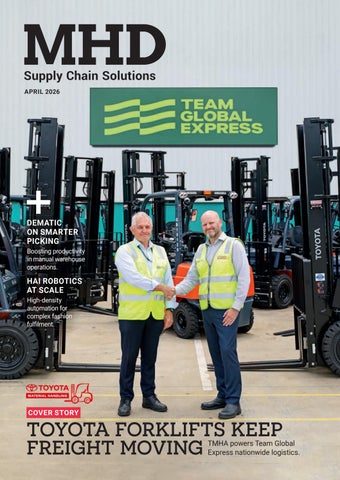
MHD Supply Chain Solutions April 2026

Page 1


DEMATIC ON SMARTER PICKING

Boosting productivity in manual warehouse operations.

HAI ROBOTICS AT SCALE

High-density automation for complex fashion fulfilment.

As a global leader in temperature-controlled logistics, Americold understands the importance of keeping operations moving. Partnering with the Connected Workforce Solutions (CWSTM) division at Dematic, they modernised their cold chain operations in Australia, upgrading wireless connectivity, voice-picking systems, and RF devices.

The transformation signi cantly boosted ef ciency, accuracy, and productivity. Dematic’s robust solution included meticulous planning and mapping to ensure seamless WiFi coverage and device connectivity, maintaining smooth operations, even in sub-zero conditions.

Learn more at dematic.com/americold

MHD

Supply Chain Solutions

CONTACT

MHD Supply Chain Solutions is published by Prime Creative Media

379 Docklands Drive, Docklands VIC 3008

Telephone: (+61) 03 9690 8766

Website: www.primecreative.com.au

THE TEAM

Chairman: John Murphy

CEO: Christine Clancy

Managing Editor: Mike Wheeler

Editor: Phillip Hazell

Business Development Manager: William Jenkin

Design Production Manager: Michelle Weston

Art Director: Blake Storey

Graphic Designers: Danielle Harris, Jacqueline Buckmaster

Client Success Manager: Caitlin Pillay

FOR ADVERTISING OPTIONS

Contact: William Jenkin

william.jenkin@primecreative.com.au

SUBSCRIBE

Australian Subscription Rates (inc GST) 1yr (11 issues) for $99.00 2yrs (22 issues) for $179.00

To subscribe and to view other overseas rates visit: www.mhdsupplychain.com.au or Email: subscriptions@primecreative.com.au

ACKNOWLEDGEMENT

MHD Supply Chain Solutions magazine is recognised by the Australian Supply Chain Institute, the Chartered Institute of Logistics and Transport Australia, the Supply Chain and Logistics Association of Australia and the Singapore Logistics and Supply Chain Management Society.

MHD magazine is owned by Prime Creative Media. All material in MHD is copyright and no part may be reproduced or copied in any form or by any means (graphic, electronic or mechanical including information and retrieval systems) without written permission of the publisher. The Editor welcomes contributions but reserves the right to accept or reject any material. While every effort has been made to ensure the accuracy of information Prime Creative Media will not accept responsibility for errors or omissions or for any consequences arising from reliance on information published. The opinions expressed in MHD are not necessarily the opinions of, or endorsed by the publisher unless otherwise stated.

The growth behind Australia’s logistics engine

Warehousing and logistics continues to evolve rapidly across Australia, and this month’s news cycle reflects just how quickly the sector is reshaping itself around sustainability, infrastructure investment and operational resilience.

One of the more interesting developments comes from the retail sector, where a major supermarket group has confirmed it is now operating on 100 per cent renewable electricity across Australia and New Zealand. For supply chains, this is more than a symbolic milestone. With large distribution centres and energyintensive cold chain operations, logistics networks have traditionally been heavy power users. The shift highlights how decarbonisation is now becoming embedded into everyday warehouse operations rather than sitting on the periphery of corporate sustainability strategies.

Industrial property activity also remains strong. A new intermodal warehouse at Yennora Distribution Centre is preparing to launch ahead of completion in 2026, reinforcing the importance of rail-connected logistics facilities close to major population centres. At the same time, major industrial landlords continue to secure long-term commitments from retailers expanding their distribution capacity, reflecting the ongoing demand for large, automation-ready facilities across Australia’s logistics corridors.

This month we also include a Decision Maker Comment from FedEx Regional VP, Peter Langley, exploring global trade dynamics. The piece highlights how export diversification is becoming increasingly important for Australian businesses, particularly as supply chains adapt to shifting geopolitical and economic conditions. It argues that European markets remain an opportunity for Australian exporters, particularly those offering premium and specialised products.

On the cover this month is Toyota Material Handling Australia (TMHA) and its long-running partnership with Team Global Express. The scale of that operation, with equipment deployed across a national network of freight facilities, highlights how fleet reliability, service capability and digital management tools are becoming essential to keeping modern logistics operations running smoothly.

Finally, this month’s special feature also takes a broader look at the sector itself. Through a dedicated data journalism piece, we explore just how significantly the transport, postal and warehousing sector has expanded in recent years. The figures point to a level of growth that reinforces the sector’s increasingly central role in Australia’s economy.

Taken together, the stories in this issue highlight a broader shift taking place across supply chains. Warehouses are no longer simply storage and distribution points. They are becoming energy hubs, technology platforms and strategic infrastructure supporting Australia’s growing freight task.

As always, happy reading!

THIS ISSUE

COVER STORY

12 Toyota forklifts support Team Global Express operations

SUPPLY CHAIN

24 SICK highlights pallet inspection for automation reliability

30 Flexco addresses conveyor safety and transfer gaps

MATERIAL HANDLING

16 Linde demonstrates lithium-ion durability beyond 30,000 hours

22 Jungheinrich launches AntOn forklifts targeting value segment

WAREHOUSES

18 Dematic highlights picking as key warehouse productivity driver

26 Extolla explores strategic value of warehouse systems

32 Hai Robotics enables high-density fas ion fulfilment

ASSOCIATIONS, EVENTS, AND REGULARS

06 Ed’s Letter

08 Industry News

35 Special Feature: Growth in the logistics sector

39 Special Feature: Strait of Hormuz

43 Decision Maker comment

46 Women in Industry Awards

49 BULK2026

52 MegaTrans 2026

54 ASCLA

57 People on the Move

58 Product Showcase

ON THE COVER

Team Global Express relies on Toyota forklifts and I-Site fleet management to support productivity, safety and reliable operations across its national logistics network.

Digital tracking, real-time updates and faster delivery expectations are reshaping how businesses manage B2B shipping and fulfilment. Image: monticellllo/stock.adobe.com

FedEx report highlights four B2B trends shaping 2026

Businesses are navigating a landscape shaped by rapid technological change, rising customer expectations, and continued supply chain complexity, according to FedEx. The company says what once felt innovative has now become the operational norm.

In its B2B Business Trends 2026 report, FedEx identifies four trends defining how businesses across industries and company sizes compete, serve customers, and manage risk.

Supply chain visibility and automation are described as core requirements for resilience. FedEx says businesses are relying on connected systems, automation, and predictive tools to monitor shipments

in real time, identify disruptions earlier, and improve decision-making.

The report cites industry research stating that IoT-enabled sensors can detect more than 60 per cent of potential supply chain disruptions earlier.

FedEx also says B2B expectations now mirror B2C experiences, with business customers demanding speed, transparency, and ease of use, including real-time tracking, clear delivery timelines, and digital self-service. Industry research cited in the report states 75 per cent of B2B buyers would switch suppliers for a better experience. FedEx says businesses are responding by investing in mobile-first portals, AI-powered customer support, and personalised communications.

A third trend is that AI adoption is now “table stakes”. FedEx says AI is no longer experimental in 2026, with small- and medium-sized businesses embedding it into customer support, marketing, accounting, forecasting, and search visibility. The report references research showing eight in ten small business owners credit AI and technology with helping them navigate inflation, supply chain challenges, and access to capital. Finally, FedEx says healthcare logistics is taking centre stage, driven by growth in home health, specialty care, wearables, GLP-1 therapies, and telehealth. The report cites industry data suggesting big data analytics can halve equipment downtime in healthcare logistics. ■

Charter Hall signs long-term ALDI pre-lease

Charter Hall has announced it has expanded its national partnership with ALDI through a new 20-year pre-lease agreement at Tarneit in Victoria and an expansion of ALDI’s existing distribution facility lease at Brendale in Queensland.

The new Victorian development will be delivered at the Tarneit Logistics Hub, owned by Charter Hall’s $14 billion Charter Hall Prime Industrial Fund (CPIF), with ALDI committing to a 20-year pre-lease for a 102,000 square metre ambient and temperature-controlled warehouse and office facility.

Charter Hall says the Tarneit facility will also include automation technology throughout the site, supporting ALDI’s operational growth in the region. Practical completion of the base building is expected by the end of this year, with automation commissioning to follow.

In Queensland, ALDI has extended its tenancy at the Brendale Distribution Facility, also owned by CPIF, through an additional eight-year lease, including a 13,500 square metre ambient warehouse and office space extension.

ALDI has also signed an additional eight-year pre-lease for a 9,000 square metre freezer facility, expanding its total footprint at Brendale to 22,500 square metres. Completion for the new facility is expected in July this year.

Following the new agreements, Charter Hall says its industrial and logistics partnership with ALDI now spans 378,000 square metres across nine sites, while Group-wide ALDI leases total 407,000 square metres across 27 sites nationally.

The Tarneit Logistics Hub development will include automation and temperature-controlled infrastructure to support ALDI’s growing Victorian distribution network. Image: Charter Hall

Charter Hall Industrial & Logistics CEO Richard Stacker says the agreement reflects the difficulty businesses face in securing largescale industrial sites.

“As demand for industrial and logistics space continues to outpace supply, it’s increasingly difficult for businesses like ALDI to be able to secure large-scale sites that allow

for automation while also having proximity to major infrastructure and metro areas, enabling effective cost management and supply chain efficiency,” he says. ■

Intermodal warehouse facility at Yennora DC launches

A40,000 sqm next-generation intermodal warehouse facility at the Yennora Distribution Centre has been launched for lease ahead of its expected completion in Q3 2026.

Warehouse 2, located on Loftus Road in Yennora, will comprise 38,000 sqm of high-clearance warehousing and 2,000 sqm of modern office accommodation. The site can be leased as a single contiguous tenancy or split equally into two 20,000 sqm occupancies.

Positioned within Sydney’s tightly held Central West corridor, the facility offers on-site rail access to Port Botany, approximately 35 kilometres away, via the Yennora Intermodal Terminal. The estate integrates rail and road connectivity, providing occupiers with access to arterial motorways including the M4, M5 and M7, as well as proximity to Port Botany, Sydney Airport and the CBD.

The location enables transport connectivity to around 75 per cent of Sydney’s population within 30 minutes.

The building has been designed to support high-volume logistics

Woperations, with internal clearance of up to 16.8 metres, loading infrastructure and sustainability initiatives aligned with institutionalgrade development standards. ■

Woolworths Group reaches renewable milestone

supermarket, BIG W store, distribution centre and support office across the network has been operating solely on renewable electricity.

The milestone was reached at the end of 2025, fulfilling a commitment first set in 2020 and positioning the Group ahead of the global RE100 target of 2030. Since December, every

More than two-thirds of the Group’s electricity requirements are sourced through strategic wind and solar partnerships across Australia and New Zealand. These are supported by more than 320 on-site solar systems installed across its property portfolio, collectively generating enough energy to power more than 17,000 homes. Renewable sourcing arrangements are complemented by large-scale generation certificate contracts that match the Group’s consumption.

Woolworths has prioritised backing new renewable energy projects rather than relying on existing infrastructure,

contributing additional capacity to the national grid.

The transition is projected to deliver a reduction of more than 74 per cent in operational emissions, moving the Group closer to its target of an 80 per cent reduction by 2030.

Chief Group Public Affairs, Communication and Sustainability Officer, Simon Lowden, says the retailer’s scale gives it a responsibility to support Australia and New Zealand’s clean energy transition.

Energy efficiency remains a parallel focus, with refrigeration upgrades, LED lighting, infrastructure retrofits and optimised distribution centre design supported by real-time monitoring through the Group’s Energy Management Centre. ■

oolworths Group is powered by 100 per cent renewable electricity across Australia and New Zealand.
Large-scale distribution centres are a major focus of Woolworths’ renewable energy transition. Image: Woolworths
Yennora’s intermodal precinct links warehouse operations directly to rail services connecting Port Botany with Sydney’s inland freight network. Image: Cushman & Wakefield

NSS expands footprint at Port of Townsville

NSS has expanded its presence at the Port of Townsville with the completion of a new $5 million logistics facility, strengthening its position as the largest intermodal logistics operator within the port.

The 29,630 square metre building increases NSS’s storage capacity to 4,200 TEU, including dedicated support for 230 refrigerated containers. The expansion brings the company’s total footprint at the port

to eight hectares and is designed to meet growing demand from mining, refinery and agricultural customers across Regional North Queensland.

Mark George, General Manager of NSS, says the investment responds directly to customer requirements for integrated, higher-volume solutions.

“Our latest investment in Townsville extends our capability for customers in mining, refinery and agriculture while reinforcing our role as a long-term logistics partner to Regional North

Queensland,” he says.

The new hub incorporates container repairs, break bulk handling and automated weighbridge access to streamline movements and reduce bottlenecks.

Adjacent to the container facility, NSS has also developed a 6,000 square metre warehouse and distribution hub, including specialised storage for general and dangerous goods, a DAFFapproved machinery wash bay and a Customs 77G bond store. ■

Bulk cargo operations at the Port of Townsville support mining, agriculture and refining industries across Regional North Queensland. Image: Cameron/stock.adobe.com

Toyota Forklifts help team Global Express keep moving

Team Global Express depends on Toyota forklifts and I-Site fleet management to drive nationwide productivity, safety and reliable service delivery.

Team Global Express, a national multimodal transport and logistics provider, uses Toyota Material Handling Australia equipment across its operations to support fleet performance and reliability.

Currently one of Australia’s largest express pallet carriers with over 120 sites across the country delivering over one million items per year around Australia and overseas, Team Global Express was born in 2021 when finance company

Allegro Funds purchased selected business units from the Toll Group.

TMHA machinery plays a central role in Team Global Express’ logistics operations, with the company operating approximately 1,000 Toyota forklifts across its national network under a single, nationwide account. Team Global Express National MHE Business Fleet Manager, Wayne Pearce, says managing such a large rental fleet through one account has provided clear operational

advantages for the business.

“Toyota is probably the only company that can manage our fleet and rentals on one account,” Wayne says.

“Flexibility-wise, TMHA can manage the scale of our business, especially in remote areas. TGE doesn’t have to try and find third parties, and TMHA can manage the whole account as a “one-stop-shop.”

Team Global Express recently added a new fleet of 23 x 8FG25 counterbalance forklifts to its facility in Karawatha,

Queensland, with the site itself running over 80 pieces of TMHA equipment.

Using Toyota forklifts across its fleet provides another clear advantage for Team Global Express, with operators able to seamlessly transition across different sites without difficulty.

“It’s good to have most sites on one brand, because if we bring in casuals or transfer employees to other branches there is little or no familiarisation required,” Wayne says.

TMHA’s I-Site fleet management system provides an advantage for Team Global Express, helping to increase

Representatives from Team Global Express and Toyota Material Handling Australia stand with the newly delivered Toyota forklift fleet at the Karawatha facility.
A fleet of Toyota counterbalance forklifts staged at Team Global Express’ Karawatha, Queensland facility. Images: TMHA

productivity and safety while reducing downtime across the fleet.

I-Site lets businesses decide which employees can operate which forklifts, monitor utilisation, incidents and breakdowns, and allow the easy scheduling of maintenance across the fleet.

“Toyota have the I-Site system on the machines so that the operators have to log in, log out and report any issues that have been found during the prestart checks,” Wayne says.

“TGE also use the system to record forklift licence expiry dates. When an operator’s forklift licence expires, the system will deny them access to the forklift. Other features include speed limiting, with none of our fleet going over 10km/h.

“The forklifts have anti-spin when changing direction, to prevent wheel spin, so we’re saving on tyres. We also have blue lights which indicates a three-metre exclusion zone, as you can’t be within three metres of a fork while it’s being operated.”

Team Global Express and Toyota Material Handling Australia representatives mark the handover of new Toyota forklifts at the

A Team Global Express operator uses a Toyota forklift inside a distribution facility to move palletised freight.

With more than five decades of forklift industry experience across service, management, and sales roles, Mr Pearce knows what it takes to deliver quality customer service, calling out Toyota Corporate Account Manager Gareth

Conlan for his ability to meet Team Global Express’ needs.

“The relationship I have with Gareth Conlan and the service he and the Toyota team provide reminds me of the way I used to manage when I was in an account manager role.

“He answers all the phone calls, he’s switched on, he knows what’s going on in the business, so I find him very easy to deal with.”

The majority of the Team Global Express fleet is managed under a fully maintained lease arrangement, which allows for simple scheduled servicing.

TMHA’s extensive nationwide servicing network comprising 21 fully branch owned locations allows Team Global Express to keep their fleet up and running across its sites, helping to deliver freight to all corners of the country.

Wayne says TMHA’s excellent servicing capability is a primary reason why TMHA is a market leader in Australia.

“There is a saying in the industry: ‘The salesman can sell or rent you the first forklift, but it’s the service side keeping them going after the sale that sells the next forklift.’” ■

For more information freecall Toyota Material Handling Australia on 1800 425 438 or visit: www.toyotamaterialhandling.com.au

Karawatha site.

Your global partner for integrated warehouse automation

With the combined strength of Bastian Solutions, Vanderlande’s Warehousing automation business and viastore, three proven leaders are now united under one brand. Backed by the power of Toyota, Toyota Automated Logistics brings together advanced technologies, deep warehousing expertise and tailored solutions for reliable, continuous performance. The result, is one trusted partner, and one connected solution from design to delivery and across the entire lifecycle. Scalable systems, intelligent software and future-ready performance that grows with your business. We simplify complexity, accelerate growth and help you build a sustainable competitive advantage. For every challenge a reliable solution.

Find out more:

Linde E18 forklift surpasses 30,000-hour milestone

A Linde E18 electric counterbalance forklift has exceeded 30,000 operating hours in a demanding industrial environment, offering rare real-world insight into lithium-ion battery longevity.

Over the past decade, lithiumion batteries have increasingly replaced traditional leadacid systems in material handling fleets. The technology allows forklifts to charge opportunistically throughout the day, removing the need for battery swaps and dedicated charging rooms that were once common in high-intensity warehouse environments.

Against this backdrop, a Linde E18

electric counterbalance forklift from the 386 Series has surpassed 30,000 operating hours, providing valuable real-world insight into the durability of lithium-ion material handling technology in continuous industrial operations.

Delivered in 2017, the 1.8-tonne Linde E18 was among the early factory-integrated lithium-ion forklifts introduced in the region. Nearly a decade later, the truck

has accumulated more than 32,000 operating hours, running in a threeshift, 24-hour operation at a large New Zealand dairy producer.

According to Allan Spackman, Technical Support Trainer for Advanced Systems at Linde Material Handling, the milestone highlights how lithium-ion technology can perform under sustained, highutilisation workloads.

“This truck is doing hours that I

Running in a continuous threeshift operation, the Linde E18 averages about 3,600 operating hours each year.

would consider quite heavy for that type of machine,” says Allan. “In a reasonably heavy application, you might see 2,000 to 2,500 hours a year. This one averages about 3,600 hours annually, running in a full threeshift, 24-hour operation.”

An operational benchmark

Reaching 30,000 hours is a notable milestone for any forklift. Across much of the material handling industry, equipment approaching that level of utilisation would typically be considered close to the end of its practical service life.

“For most of our industry, 30,000 hours would be considered close to the end of a truck’s serviceable life, or very near it,” Allan says.

However, analysis of the lithium-ion battery powering the E18 has revealed that the system remains well within its expected operating life. Technicians recently downloaded performance data from the battery to assess its condition after nearly ten years of continuous use. The results showed the battery still retains a substantial portion of its cycle life.

“We looked at the battery’s state of health and the cycle data,” Allan says. “Based on the numbers, the battery has completed around 1,618 full cycles,

while its expected lifespan is about 4,000 cycles, so it still has well over half of its cycle life remaining.”

“At around 4,000 cycles the battery isn’t dead,” Allan explains. “It simply drops to about 80 per cent of its original capacity.”

Given the current utilisation pattern, Allan says the battery could potentially remain operational for many more years.

“I don’t see any reason this battery couldn’t still be running strong when it’s 20 years old, even in a demanding application.”

Designed for intensive applications

Part of the forklift’s performance can be attributed to how the lithiumion system was specified for the application. Rather than matching the capacity of traditional lead-acid batteries, the truck was equipped with a larger lithium-ion battery pack to support heavy-duty operations.

“Where a comparable lead-acid truck might have a 620 amp-hour battery, this one was delivered with a 936 amp-hour lithium-ion battery,” Allan says.

The truck also operates with a 18kW charger, capable of fully charging the battery in approximately 145 minutes. However, the system rarely requires full charge cycles thanks to lithiumion’s ability to accept opportunity

charging throughout the day.

“Every time the operator gets off the truck, even for five minutes, they plug it in,” Allan says. “Five minutes of charge can give you about 20 minutes of run time, so the truck is almost never running with a flat battery.”

Reliability beyond the milestone

Despite the demanding duty cycle, the forklift has largely stayed off the maintenance radar, a key factor in environments where operational continuity is critical.

“The only reason the fleet manager knew it had passed 30,000 hours is because it appeared in a spreadsheet,” Allan says.

According to Allan, the truck has not generated repeat service issues or maintenance concerns despite the high utilisation. In operations where production schedules are tightly managed, reliability can outweigh equipment cost considerations.

“If a machine stops, the impact on production can outweigh any savings on the equipment itself,” he says.

Real-world data shaping future deployments

Beyond marking a milestone, the truck’s performance is helping Linde refine how lithium-ion systems are specified for future customers. Data gathered from the forklift will be used to further validate modelling tools that estimate battery performance across different applications.

“We have specialised tools that allow us to calculate the expected lifespan of the battery based on the application,” Allan says. “This truck gives us a real-world reference point that confirms how well the technology performs under sustained workloads.”

For operators, however, the impact is simpler.

“It becomes something they don’t need to think about,” Allan says. “They get on the truck, it does the job, and they get off again.” ■

Performance data shows the forklift’s lithium-ion battery has completed around 1,618 charge cycles, with significant cycle life still remaining.

Productivity in manual warehouses starts with picking

Lee Koutsos, Director Connected Workforce Solutions and Storage Equipment Division at Dematic, explains why improving order picking is often the fastest way to boost warehouse productivity without expanding facilities or adding labour.

Warehousing operations across Australia are under sustained pressure. Customer expectations continue to rise, with faster delivery times, higher accuracy and seamless returns now considered standard. At the same time, many facilities still operate with manual processes, making it difficult to keep pace with rising order volumes, labour shortages and growing operational complexity.

For many businesses operating manual warehouses, additional pressures come from labour shortages and rising labour costs, which are impacting operations, customer service levels and squeezing margins. Meanwhile, land scarcity and high building costs are forcing businesses

to extract more value from existing facilities rather than expanding their footprint.

Combine these pressures with tighter safety and regulatory requirements, as well as the need to remain resilient in the face of disruption, it becomes clear why warehouse productivity has become a critical focus. For manual or partially automated warehouses, order picking is where the greatest opportunity exists to lift productivity.

Why picking dominates labour in manual warehouses

In a typical predominantly manual distribution centre (DC), picking is the single most labour-intensive activity. In many operations, up to 65 per

cent of warehouse staff are involved in picking tasks, particularly item or eaches picking. Yet despite the level of effort involved, traditional manual picking processes are inefficient.

Studies of manual warehouse operations show that up to 70 per cent of a picker’s time can be spent travelling between locations rather than picking product. This travel time adds a hidden cost, contributing to lower productivity, increased fatigue and higher error rates. As order volumes grow and order profiles fragment, these inefficiencies are magnified.

Improving picking performance offers a good strategy for lifting productivity in manual warehouse operations while reducing reliance on labour.

Autonomous mobile robots transport goods across warehouse floors, reducing operator travel time.

Voice-directed picking: lifting productivity and accuracy

Voice-directed warehousing solutions are one way to improve picking productivity, accuracy and flexibility in manual warehouse environments. These systems guide operators through tasks using spoken instructions delivered via a lightweight rugged headset, directing them to locations, quantities and destinations. Pickers confirm actions verbally, allowing the system to validate each step in real time.

Voice-directed picking can increase productivity by up to 45 per cent for item picking and up to 25 per cent for case picking, while delivering accuracy rates of 99.99 per cent or higher. Training times are typically reduced by around 50 per cent, making voice valuable in labour-constrained environments where onboarding speed matters.

In operations where workforce turnover can be high and seasonal peaks are common, voice systems also provide the flexibility to redeploy staff quickly without sacrificing performance.

In Australia, a voice-directed picking solution helped food distributor Tasty Fresh transition from manual, paperbased processes to a more efficient operation, delivering a 35 per cent productivity improvement and reducing errors across picking and stocktaking.

An additional development of voice picking pairs audio instructions with visual feedback through a small display terminal. This allows pickers to see the pick location, quantity and even product images, along with guidance on optimal pallet builds.

By combining audio and visual cues, these systems further improve accuracy and productivity while supporting compact and stable pallet builds. This enables smoother downstream handling, fewer errors and more consistent performance across shifts.

Vision systems: hands-free precision

Vision picking systems take handsfree operation a step further by using wearable smart glasses with a heads-up display. These systems visually direct

operators to pick locations and provide confirmation through images, quantities and check digits, ensuring the correct product is selected every time.

Vision solutions can operate independently or in tandem with voice systems, making them suited to environments where visual verification is critical or where operators benefit from an additional layer of confirmation. As with voice, the hands-free nature of vision systems improves ergonomics and reduces cognitive load on workers.

Flexible automation for manual warehouses

Autonomous Mobile Robots (AMRs) can be deployed incrementally and expanded as demand evolves, making them suitable to manual warehouses seeking productivity gains without committing to large-scale infrastructure changes.

AMR picking systems are a type of goods-to-person (GTP) solutions, which change the picking model by eliminating operator travel altogether. Instead of people walking to product, automated systems deliver product directly to the picker.

By transporting shelves, totes or goods directly to operators, AMRs reduce travel time, improve accuracy and enable faster fulfilment while supporting increasingly complex order profiles.

Shelf-to-picker AMR systems deliver entire shelving units to operators,

eliminating walking time and improving picking productivity, often doubling manual cart-based rates. They are suited to smaller fulfilment environments or operations with varied inventory types, including small items, cartons and hanging garments, and additional units can be introduced as volumes grow.

Bin-to-picker AMR systems extend these benefits by using automated storage towers and tote movers to deliver items to pick stations. With pick rates of up to 500 order lines per hour and storage heights reaching 12 metres, these systems deliver productivity gains alongside high storage density and efficient use of vertical space. Their modular design enables throughput to increase as demand rises, helping operations improve speed and accuracy while maintaining the responsiveness required in modern fulfilment environments.

Radial Europe deployed 299 binto-picker and tote transport AMRs alongside 45 goods-to-person stations, transforming previously manual processes into a flexible automated system that improved efficiency and enabled faster response to fluctuating eCommerce order volumes.

The right GTP solution for the right application

Additional GTP solutions include AutoStore and Multishuttle-based

Voice-directed picking guides operators through tasks using spoken instructions.
Images: Dematic

WAREHOUSES

systems. It’s important to evaluate which solution is the right for a particular operation and application.

AutoStore is a GTP system designed to increase capacity and picking efficiency within a compact footprint. Items are stored in bins stacked within a dense cube, while robots travel across the grid to retrieve products and deliver them to operators at pick stations, eliminating travel time and streamlining fulfilment.

The cube-based design provides ultrahigh storage density for small items and can reduce space requirements by up to 25 per cent compared with conventional shelving. Its modular structure, typically up to six metres high, allows installation within existing facilities, around building columns or in constrained areas, with the flexibility to expand as demand grows.

By delivering goods directly to operators, AutoStore can lift picking productivity by 300 to 500 per cent while maintaining accuracy levels above 99.99 per cent. For operations managing expanding SKU ranges and rising eCommerce volumes, it offers a scalable way to boost throughput without increasing footprint.

At WesTrac’s Tomago facility in New South Wales, an AutoStore system enabled the business to store more spare parts in a smaller footprint, fulfil orders 30 per cent faster with existing headcount, and pick urgent orders in minutes rather than hours.

Dematic’s Multishuttle GTP systems combine ergonomically designed pick stations with shuttle-based storage and retrieval, delivering items in sequence directly to operators. Multiple shuttles operate within each aisle to store and retrieve totes or cartons, enabling a continuous flow of goods to pick stations and supporting some of the highest throughput rates available in automated fulfilment.

Designed for speed and scalability, Multishuttle systems can achieve pick rates exceeding 600 order lines per hour per station, increasing productivity while reducing manual handling and travel time. Dematic’s inter-aisle transfer technology allows products to be routed to any pick station,

minimising conveyor requirements and reducing overall system footprint.

With full headroom utilisation and flexible system expansion, Multishuttle solutions are well suited to operations managing high volumes, large SKU ranges and rapid order cycles, helping maximise warehouse cube utilisation while supporting future growth.

At AS Colour’s Auckland distribution centre, a Multishuttle GTP system replaced manual shelf picking with high-density automated storage and sequenced fulfilment. This boosted throughput per worker by 344 per cent, improving accuracy, reducing warehouse footprint by 30 per cent and increasing storage capacity by 35 per cent to support faster, more sustainable growth.

Automating pallet movement for safer, more predictable operations

Pallet transport is a critical and often under-optimised element of warehouse performance. Automated Guided Vehicles (AGVs) can manage pallet movements between receiving, storage, production and dispatch, creating a safer and more consistent flow of goods while reducing reliance on manual handling.

In addition to labour efficiency, AGVs improve safety and asset protection. Controlled navigation reduces the

risk of collisions, product damage and racking impacts, while integrated tracking provides real-time visibility of pallet movements, strengthening inventory accuracy and operational

Operating continuously, including in chilled and freezer environments, AGVs can integrate with racking systems, block stacking zones and production workflows. As part of a broader optimisation strategy, they support smoother material flow, better infrastructure utilisation and more resilient, data-driven operations.

Improving picking productivity does not require an immediate leap to automation. For many predominantly manual warehouses, measurable gains can come from introducing technologies incrementally. This might begin with voice or vision systems that improve accuracy and reduce travel time, before layering in goods-to-person or robotics solutions as volumes grow and operational needs evolve.

This staged approach allows organisations to balance investment with operational priorities while building resilience and flexibility into their facilities. In a market challenged by labour constraints, rising customer expectations and ongoing disruption, the ability to improve productivity without dramatically changing the warehouse footprint is increasingly valuable.

For manual warehouses, order picking remains the single biggest opportunity to lift productivity. By focusing on practical technologies that reduce travel time, improve accuracy and support workers more effectively, businesses can unlock faster, more efficient and more resilient operations without fundamentally redesigning their warehouse. ■

Scan this QR to download Dematic’s eBook on improving warehouse productivity.

Automated pallet handling helps create safer, more consistent material flow across warehouse operations.

Jungheinrich introduces AntOn brand

Jungheinrich expands its portfolio with practical and cost-effective material handling equipment designed for value-focused operations.

Rising cost pressures are reshaping the Australian materials handling market. While premium equipment continues to serve large fleets and complex

equipment they can rely on without unnecessary complexity.

A broader market with different needs

Across the country, retailers, trade suppliers, convenience stores, produce businesses and smaller warehouse operations often rely on one or two pieces of equipment to keep their day-

This is the customer group Jungheinrich had in mind when it created AntOn.

Why Jungheinrich created AntOn

“AntOn was created to serve a different type of customer,” says Michael Ankrett, Director – Manitou and Partner Business at Jungheinrich Australia.

“These are businesses that don’t need highly customised solutions or large fleets, but they still need equipment they can trust.”

Rather than trying to stretch its premium portfolio to suit every possible use case, Jungheinrich made a deliberate

business operates the same way,” Michael says. “A family-run business or independent operator has very different needs to a large corporation – and AntOn is built specifically around those needs.”

‘Made

to rely on’

Jungheinrich describes reliability as central to the AntOn concept, reflected in the brand’s “Made to rely on” tagline. For businesses operating with only one or two machines, downtime can quickly disrupt productivity and customer service.

“Many of these businesses don’t have backup equipment,” Michael explains.

“If a machine stops, work stops. What they want is confidence – confidence that the equipment will perform as expected, and confidence that support is available when they need it.”

AntOn aims to deliver equipment that is dependable, easy to operate with and suited to everyday business use, without unnecessary complexity.

Built for everyday business operations

AntOn is designed for businesses that rely on equipment to perform consistently in day-to-day operations. The focus is on practical ownership, with machines intended to be straightforward to operate, easy to support and cost-effective across their working life.

Michael explains that for business owners who are directly involved in daily operations, this approach is particularly important, as purchasing decisions are often hands-on and driven by real-world experience rather than long-term fleet strategies.

“These customers want something that just works,” he says. “They don’t want to overcomplicate things. They want reliability, clarity and a solution that fits the way they run their business.”

A different route to market

Another key distinction between AntOn and Jungheinrich lies in how the brand is brought to market.

While Jungheinrich has traditionally operated through a direct sales model serving large corporate customers,

AntOn will be distributed through a partner network. The approach is intended to support businesses that prefer local purchasing relationships and accessible service support.

“For many businesses, dealing with someone local makes a real difference,” Michael says. “They want to know who they’re buying from, who they can call, and who understands their operation.”

AntOn customers will also have access to Jungheinrich’s existing service and parts infrastructure, which the company says will provide ongoing technical support and spare parts availability across Australia.

Complementing the Jungheinrich portfolio

Jungheinrich says AntOn is intended to complement, rather than replace, its existing premium product range. The new brand allows the company to address two distinct segments of the market with equipment designed for their respective needs.

“AntOn isn’t about competing with our core Jungheinrich brand,” Michael says. “It’s about offering the right solution for the right customer, rather than trying to force everyone into the same model.”

Under this approach, Jungheinrich will continue to position its flagship brand around high-end, customised materials handling solutions, while AntOn is aimed at businesses seeking simpler, valuefocused equipment options.

Confidence for everyday business

Jungheinrich says AntOn represents a long-term commitment to supporting businesses seeking practical, reliable equipment backed by local service and support.

The company will formally introduce the AntOn brand to the Australian market at CeMAT Australia in Melbourne this June, where operators will have the opportunity to see the equipment firsthand and learn how it fits alongside Jungheinrich’s existing portfolio. The exhibition is expected to be an early step in building awareness of the brand as Jungheinrich expands its presence in the value-focused segment of the materials handling market. ■

The AntOn range is designed to support value-focused material handling operations. Images: Jungheinrich

Pallet inspection systems help ensure AMR and ASRS reliability by eliminating pallet defects that disrupt automation.

The logistics industry is entering an era where automation isn’t an advantage, it’s the baseline expectation. Autonomous Mobile Robots (AMRs) and Automated Storage and Retrieval Systems (ASRS) are redefining speed, accuracy, and labour efficiency across global supply chains. But as more organisations push toward higher levels of automation, one critical truth

is becoming impossible to ignore: automation is only as reliable as the pallets feeding it.

This reality is catalysing a surge of interest in Pallet Integrity Inspection Systems (PAIS), intelligent automated quality gates that ensure every pallet entering an automated workflow is structurally sound, compliant, and ready for robotic handling. Thought-leading logistics

operators are beginning to treat pallet inspection not as a peripheral task, but as a strategic enabler of automation ROI.

Automation’s hidden bottleneck: Pallet variability AMRs and ASRS are precision-engineered technologies. Their performance depends on predictability, stable loads, consistent dimensions, and reliable material flow.

Warehouse operators continue to rely on pallets as the foundation of material flow, making pallet integrity critical to automation. Image: standret/stock.adobe.com

structural damage, or inconsistent quality entering automated environments.

Pallet variability creates multiple downstream risks:

• Robot stoppages caused by protruding nails, broken planks, or unstable blocks

• ASRS jams triggered by deformed or out-of-tolerance pallets

• Safety incidents when pallets collapse or shift while being handled autonomously

• Excessive manual intervention, undermining automation’s value proposition

What PAIS actually does

PAIS is a fully automated pallet quality gate that uses 3D vision, advanced vision algorithms, and industrial HMIs to ensure every pallet entering an automated supply chain is fit for use. It is built precisely to support operations like yours, where AMR and ASRS performance, uptime, and flow reliability are critical KPIs.

PAIS solutions deploy multi-angle scanning towers to identify defects not visible to the human eye. By providing

consistent, real-time inspection at high throughput, often 650+ pallets per hour in documented use cases, PAIS introduces a data-driven quality gate before pallets enter automated infrastructure. This elevates pallet integrity from a variable to a controlled asset.

“In high-velocity automated environments, pallet integrity isn’t a nice to have, it’s mission critical. Effective pallet inspection ensures every load that enters an AMR or ASRS workflow is consistent, safe, and automation ready,” says Praveen Kannan, Senior Director, Focus Sales & Key Account Management (Logistics). “When we remove variability at the pallet level, we unlock the full performance potential of advanced robotics and dramatically reduce unplanned downtime. It’s one of the simplest ways to create immediate efficiencies and protect the long-term reliability of automated systems.”

The emerging trend: Pallet quality as a KPI

A quiet transformation is sweeping through high-performance logistics networks. Pallet integrity is becoming a measurable KPI. Companies are beginning to track:

• Defect frequency by pallet pool

• Inspection pass/fail rates

• Supplier-specific pallet performance

• Impact of pallet quality on robot uptime

• Correlations between pallet seasonality and defect trends

This data enables procurement optimisation, supplier accountability, and predictive maintenance cycles for automation assets, all anchored by PAIS.

As logistics accelerates into a future dominated by AMRs and ASRS, companies must confront an unavoidable truth. Automation cannot compensate for poor pallet quality. The smartest robots in the world cannot overcome broken wood, missing blocks, or dimensional inconsistencies.

PAIS provides the bridge, the automated, data-driven assurance that every pallet entering an advanced warehouse is fit for automation.

And in a landscape where reliability, safety, and predictability define competitive advantage, pallet inspection doesn’t just support automation. ■

Warehouse design and system orchestration play a key role in improving fulfilment performance. Images: Extolla

Unlocking strategic value from the warehouse

How warehouse design, automation and the right warehouse management system drive measurable supply chain performance

For many organisations, the warehouse was once viewed solely as a necessary operational function. A place to store inventory and dispatch orders. Today, it is something different.

The warehouse has become one of the most strategic control points in the supply chain. It influences customer service performance, cost-to-serve, labour productivity, working capital efficiency, and increasingly, competitive advantage.

When service levels drop, inventory accuracy falters or fulfilment costs escalate, the issue often traces back to three areas: sub-optimal warehouse design, poor execution discipline, and outdated technology architecture. Most commonly, it is a combination of all three.

Where

warehouse performance breaks down

Across retail, 3PL, manufacturing and FMCG environments, Extolla has observed recurring patterns:

• Legacy warehouse management systems (WMS) that no longer support operational complexity.

• Manual workarounds layered on top of outdated processes.

• Automation deployed without proper system orchestration.

• Growth outpacing the original warehouse design.

• Poor data integrity limiting visibility and decision-making.

This is why more leaders are asking:

• How do we improve warehouse efficiency without increasing labour costs?

• Do we need a new warehouse management system?

• What is the best WMS for complex distribution in Australia? Technology alone does not solve these problems. When selected and implemented correctly, the right supply chain software becomes a powerful lever for enhancing customer experience and productivity.

A warehouse management system is the execution engine

A WMS is more than an operational tool. It’s the system that drives supply chain execution. It controls inventory accuracy,

directs labour, integrates robotics and automation, manages replenishment logic, and determines how efficiently orders flow through the facility.

For organisations evaluating “how to select a warehouse management system” or “WMS implementation best practice”, the critical factor is alignment between system capability and operational requirement.

This is where Softeon Warehouse Management System plays a role.

Softeon has built its platform specifically for complex distribution and fulfilment environments.

Its architecture enables detailed configuration without heavy customisation, allowing operations to evolve without re-engineering the core system.

For organisations searching for “WMS for automation integration” or “scalable warehouse management system for retail and 3PL”, capability depth matters, particularly in highvolume, multi-channel environments.

“The true impact of warehouse technology comes when advanced system capabilities enable experienced

supply chain teams to drive smarter decisions, higher productivity and better operational results in a straightforward way,” says Scott Gillies, Vice President & Managing Director, IFS Softeon.

However, even the most capable WMS will underperform if implementation discipline is weak.

Why warehouse design still matters Before technology, there is flow. Effective and insightful warehouse design remains fundamental to performance.

Slotting logic, SKU velocity positioning, pick path optimisation, cross-dock strategy and ergonomic layout all influence labour efficiency and throughput capacity.

Many businesses exploring “warehouse design optimisation” or “how to improve warehouse throughput” discover that layout inefficiencies are quietly driving cost and service variability. They also impact safety, staff engagement and overall business culture.

A well-designed warehouse reduces touch points, shortens travel paths, improves safety and increases scalability. When warehouse design is aligned with a capable WMS, the benefits multiply.

Real-time inventory visibility, intelligent task interleaving and system-directed workflows enable operations teams to execute consistently, even during seasonal peaks or demand volatility.

Robotics and automation: orchestrated, not bolted on Automation and robotics are now embedded in modern distribution centre design. Autonomous mobile robots (AMRs), AS/RS systems, conveyors and goods-to-person solutions are increasingly part of the landscape.

A robust WMS must:

• Integrate seamlessly with robotics and automation platforms;

• provide real-time task allocation;

• manage exceptions and recovery processes;

• balance labour and machine throughput; and

• adapt workflows dynamically.

Softeon’s WMS is designed to integrate with automation ecosystems, enabling centralised visibility and execution control across both digital and physical workflows.

The critical gap: definition and implementation

Despite strong technology capability, many WMS projects fail to deliver full value. Why? Because the most important work happens before configuration begins. Organisations evaluating “WMS implementation Australia” or “how to reduce risk in WMS projects” often underestimate data quality issues, process inconsistency, change readiness, growth assumptions and automation sequencing. This is why Extolla’s methodology centres on Consult, Implement, Operate.

Consult

Extolla can diagnose the operation and clarify requirements before vendor alignment. This includes operational diagnostics, future-state modelling, commercial validation and structured WMS selection support.

Implement

Extolla governs deployment with rigour, configuration discipline, data migration integrity, testing frameworks, automation integration and change management.

Operate

Extolla supports performance postgo-live, ensuring the WMS continues to drive inventory accuracy, labour productivity and service outcomes. This structured approach is important for organisations asking how to successfully implement a warehouse management system, how long WMS implementation takes, and how to ensure ROI from warehouse automation.

The Softeon and Extolla partnership

But some common questions organisations are now asking are how to integrate robotics with their warehouse management system and what WMS works best with warehouse automation. However, automation without orchestration creates new bottlenecks.

When automation, robotics and WMS operate as one ecosystem rather than disconnected investments, measurable performance improvements follow, including higher inventory accuracy, productivity gains through optimised picking workflows, traceability reduced from hours to minutes, and fulfilment operations capable of shipping up to 99 per cent of orders the same day.

To deliver robust WMS capability supported by operational depth across Australia, New Zealand and Asia Pacific, Extolla has partnered with Softeon.

Softeon contributes a feature-rich, automation-ready WMS platform built for complex, high-volume environments, while Extolla provides senior-led supply chain advisory,

Peter Kendall, CEO, Extolla.
Scott Gillies, Vice President & Managing Director, IFS Softeon.

warehouse, automation and robotics design expertise, structured WMS selection and implementation governance, local execution capability, and ongoing optimisation support.

Together, the partnership enables organisations to select a scalable WMS, integrate robotics and automation effectively, improve inventory visibility and accuracy, increase labour productivity, reduce warehouse operating costs, maximise customer and brand experience, and build resilient supply chain infrastructure.

For businesses researching “warehouse management system Australia” or “WMS and automation partner APAC”, the combined technology and advisory model reduces both technical and operational risk.

Solving supply chain problems, not just deploying software

At its core, this is not about software.

“Do it once and do it properly. Get the right people with the right experience and processes involved from the outset. Combining these factors with selecting the right software solution, makes all the difference,” says Peter Kendall, CEO, Extolla.

It is about solving supply chain problems by reducing cost-to-serve, improving working capital efficiency, increasing fulfilment reliability, enhancing customer experience and brand value, and creating operational resilience. WMSs, robotics and automation are tools that support these outcomes.

The outcome that matters is warehouse performance that positively impacts end-customer experience. When this is achieved, positive returns on investment are delivered.

By combining Softeon’s WMS capability with Extolla’s structured

advisory and implementation approach, organisations can transform the warehouse from a reactive cost centre into a strategic performance lever. In today’s supply chain environment, that shift is no longer optional. ■

Warehouse operators rely on warehouse management systems to improve inventory visibility and operational efficiency.

PALLET INTEGRITY INSPECTIONSYSTEM

Closing the gap in conveyor safety and performance

Segmented transfer plates are gaining traction across logistics and airport operations as operators look to reduce conveyor pinch points, prevent jams and maintain uninterrupted material flow.

As distribution centres and parcel networks grow more automated, even small design gaps in conveyor systems can create operational challenges. One of the most common issues arises where two conveyor sections meet. If the transition between belts is not properly managed, products can jam, become damaged or fall into the gap, creating safety risks and costly disruptions.

Across logistics facilities, airports and e-commerce sortation centres, operators are increasingly looking at ways to eliminate these transfer gaps. One solution gaining traction is the segmented transfer plate, a device designed to bridge conveyor transitions while maintaining both safety and

Flexco, says the concept emerged from the need to address safety risks at conveyor transfer points.

“Any time one conveyor ends and another begins, a gap is created, and that gap presents potential risks for workers,” Aaron says. ‘The concept was developed in response to long-standing safety challenges at conveyor transfer points. They were designed specifically to close that gap and minimise worker exposure.”

While safety concerns helped drive the development of transfer plates, operational performance is another major factor. In highthroughput environments such as parcel distribution centres, even minor interruptions to conveyor flow can

at the transfer point and create a pinch point,” Aaron explains. “That’s where you start to see damaged items or flow issues. What operators want is a smooth transition between conveyors.”

Pinch points are a known issue in logistics operations. Many facilities conduct regular safety and operational studies to identify them, particularly in environments where thousands of items move through automated systems each hour.

In these environments, conveyor jams are not simply a nuisance. When a package falls between belts or becomes trapped at a transfer point, it can force operators to stop the entire conveyor line while maintenance teams locate and remove the obstruction.

Transfer plates can be specified in a range of sizes to match the distance between conveyor rollers and different transition configurations.

down,” Aaron says. “Then you’re sending maintenance teams to find the problem. It’s not just about the product, it’s about the labour and the disruption as well.”

Segmented transfer plates are designed to reduce this risk by closing the gap between conveyors while allowing products to pass smoothly from one belt to another. Unlike rigid or homemade transfer plates, the segmented design incorporates multiple independent pieces that can detach if an object becomes caught.

According to Aaron, this “sacrificial” design feature is intended to protect both the conveyor belt and the product moving across it.

“If something gets caught on one of the segments, the segment is designed to come off,” he says. “It sacrifices the segment to protect what’s being conveyed and the belt itself.”

The alternative, he explains, can lead to more severe damage if rigid plates remain fixed in place.

“If a strap or parcel gets stuck on a fixed plate, the belt keeps moving and pulling against it,” Aaron says. “That can damage the belt or the product because the plate is stationary.”

The risk is not limited to parcel networks. Conveyor transitions are common across baggage handling

systems at airports, where luggage components such as wheels or straps can easily catch in gaps between belts.

“I’ve seen it underneath conveyors,” Aaron says. “You’ll find luggage parts, wheels, bags, all sorts of things that fall through those gaps.”

Beyond reducing jams, conveyor transition solutions are also increasingly influenced by evolving safety standards. In some jurisdictions, operators must now control the size of gaps to minimise potential hazards.

“There are standards that look at how gaps between conveyors should be controlled,” Aaron says. “We designed the transfer plates so they fit within those requirements and reduce the risk of items falling through.”

Transfer solutions must also be adaptable to different conveyor layouts. Conveyor systems vary widely in design, depending on whether belts run horizontally, on inclines or declines, and on the spacing between rollers at each transition point.

To address this, the systems are specified based on measurements between conveyor rollers and the configuration of the transfer point.

“We need the dimension from the centre of one roller to the centre of the next roller,” Aaron says. “Once we understand that distance and the

Automated conveyor systems are widely used across logistics facilities, where smooth transitions between belts help maintain uninterrupted baggage. Image:

transition type, we can determine the right transfer plate configuration.”

As automation expands in the logistics sector, conveyor reliability is becoming increasingly important. Facilities handling high parcel volumes cannot afford frequent stoppages caused by product jams.

Large operators have already begun incorporating transfer solutions into standard conveyor designs. Aaron says that in some cases, the technology has become part of the standard bill of materials for new distribution centre builds.

“If a solution works well in those environments, it gets built into the design of new facilities,” he says.

Looking ahead, Aaron expects conveyor transfer technology to continue evolving as logistics operations become more complex and automated. Rather than focusing on a single product, development efforts are expanding into a broader range of conveyor optimisation tools.

“By working closely with our customers and understanding their challenges, new opportunities for innovation emerge,” he says. “The focus isn’t just on improving one product, but on building a broader range of solutions that enhance overall conveyor performance.”■

High-density robotics for fashion logistics

Hai Robotics delivers high-density automation enabling Maersk to manage complex fashion fulfilment across B2B and e-commerce channels.

Anew robotics-driven fulfilment centre developed for Maersk, a global integrated logistics company, and a fashion manufacturer is demonstrating how high-density automation can transform fashion logistics operations, particularly in environments handling large numbers of SKUs and both B2B and B2C order flows.

Located in Singapore, opened in February 2026, the warehouse was designed to support the brand-owner’s regional fashion distribution using a goods-to-person robotics model developed by Hai Robotics.

The facility integrates 49 A42T robotic systems and 110 autonomous mobile robots (AMRs), enabling operations at picking heights of up to 10.6 metres while supporting highthroughput fulfilment for both retail and e-commerce channels.

Nathan Zeng, President of Hai Robotics SEA & ANZ and South Korea, says the project has been in development for several years and required extensive analysis before finalising the system design.

“The project began with detailed data and workflow analysis to understand how orders move through the Maersk facility and how the brand-owner releases orders,” says Nathan.

“Our role involved analysing inventory profiles, order structures and operational processes, and then working with Maersk to determine the most suitable warehouse footprint and system configuration.”

Designing for fashion logistics complexity

Fashion fulfilment presents operational challenges due high SKU counts, fluctuating demand, and strict requirements for picking accuracy.

In this case, the facility is designed to manage tens of thousands of SKUs, with between 30,000 and 40,000 items stored within the ACR system, while maintaining high throughput across both wholesale and consumer orders.

According to Nathan, the goods-toperson robotics model was well suited to these operational requirements.

“Robotic automation allows operations to store more SKUs in a smaller footprint because the aisles can be narrower and the full vertical airspace can be utilised,” he says.

“This enables Maersk to achieve higher storage density while still leaving space in the warehouse for other operational processes.”

The robotics model also reduces manual handling and improves picking accuracy by delivering storage totes directly to workstations, rather than requiring workers to travel through the warehouse.

“With goods-to-person automation, you reduce human touch points and streamline the process,” says Nathan.

“Because the system is driven by software, it also reduces picking errors and improves productivity.”

Combining vertical storage and AMR transport

The system combines two different robotics technology to optimise storage and material movement.

Hai Robotics’ A42T robots manage vertical storage within the racking system, retrieving totes from storage heights exceeding 10 metres.

Nathan says the hybrid approach helps maintain high throughput while avoiding congestion within the storage system.

“The A42T robots handle vertical storage retrieval, but the compact AMRs are responsible for transporting totes from the racks to the workstations,” he explains.

“If the larger storage robots were responsible for the entire movement process, they would occupy more space and potentially slow down system performance. Using AMRs for

Autonomous mobile robots transport totes across the warehouse floor to fulfil both B2B retail orders and B2C e-commerce shipments. Images: Hai Robotics

horizontal transport ensures the system can handle high volumes efficiently.”

The system is designed to move more than 1,000 totes per hour while maintaining strict sequencing requirements for the brand-owner’s order fulfilment process.

Supporting both B2B and B2C fulfilment

A key requirement for the facility was flexibility to support both wholesale and e-commerce fulfilment operations.

The warehouse includes configurable workstations and order fulfilment areas that can be dynamically allocated to either B2B or B2C operations depending on demand.

“For the brand-owner, B2B orders are typically carton-based shipments to retail outlets, while B2C orders are individual items going directly to customers,” says Nathan.

“Our workstation design allows operators to convert stations between B2B and B2C processing depending on daily demand. This flexibility helps Maersk manage fluctuations in order profiles.”

Convertible put-wall systems and adaptable picking stations allow the operation to scale different fulfilment processes as required.

Data-driven design and optimisation

Data analysis played a central role throughout the project, from early design simulations through to longterm system operation.

During the planning stage, Hai Robotics conducted simulations using operational data from Maersk and the brand-owner to model inbound, outbound and returns workflows.

“These simulations helped us evaluate different operational scenarios and confirm that the system could maintain both high storage density and high throughput,” says Nathan.

Once operational, the system continues to generate data that can be used to optimise performance.

Operational teams can monitor SKU movement patterns, identify fastmoving inventory and adjust storage allocation accordingly. Data also supports predictive maintenance by

monitoring robot utilisation, charging cycles and system performance metrics.

“This transparency allows the operations team to better understand system utilisation and plan maintenance activities more effectively,” Nathan says.

Engineering for height and safety

Operating robotic systems at heights exceeding 10 metres introduces additional engineering and safety considerations.

According to Nathan, maintaining stable flooring conditions and robust rack design is critical to ensuring consistent robot performance.

“For high picking heights, we require enhanced flooring standards to ensure the robots remain stable,” he explains.

Fire safety and regulatory compliance also played an important role in system design. Rack spacing, tote placement and aisle configurations were developed in consultation with fire safety experts to ensure compliance with local regulations.

The system is also integrated with the facility’s safety infrastructure. In the event of a fire alarm, robots automatically move to predefined positions to maintain safe evacuation routes.

Integration with warehouse systems

To support seamless operations, the robotics platform was integrated with Maersk’s warehouse management and control systems.

The integration process involved detailed collaboration between the software teams from both organisations, including the development of API connections to enable real-time data exchange.

Hai Robotics also created a virtual testing environment to allow Maersk’s IT team to validate system integration before hardware installation.

“Before the physical deployment, the Maersk IT team could access a virtual environment to test the system integration and confirm that the software functions worked as expected,” says Nathan.

By the time the hardware arrived on

site, much of the software integration work had already been completed, helping accelerate commissioning.

Scaling robotics for apparel fulfilment

For Maersk and the brand-owner, the project demonstrates how robotics can support the growing complexity of fashion supply chains.

With high SKU volumes, rapid product turnover and increasing e-commerce demand, apparel distribution centres are under pressure to deliver both speed and accuracy.

According to Nathan, combining vertical robotics, AMR transport and data-driven optimisation provide a scalable model for managing these demands.

“The system allows operators to maximise storage density, reduce manual handling and maintain high throughput while remaining flexible enough to adapt to changes in demand,” he says.

As automation continues to expand across global logistics networks, facilities like the Maersk warehouse illustrate how robotics platforms are evolving to meet the requirements of modern retail supply chains. ■

Hai Robotics A42T robots retrieve storage totes from high-density vertical racking, enabling Maersk to maximise storage capacity.

Rising demand for transport and delivery services is helping drive rapid growth across Australia’s logistics sector. Image: Ondra/stock.adobe.com

Logistics surge reshapes Australia’s business landscape

New data shows transport, postal and warehousing businesses expanding faster than any other industry over the past decade.

Australia’s logistics sector has recorded the fastest growth of any major industry over the past decade, reflecting the expanding role of delivery networks, transport services and warehousing infrastructure in the national economy.

New data analysing business registrations across more than 440,000 Australian businesses shows that Transport, Postal and Warehousing has grown by 268.7 per cent over the past ten years, making it the country’s fastest-growing industry. The growth significantly outpaces other sectors, including Health Care and Social Assistance, which increased by 205.4 per cent over the same period.

The figures highlight the central role logistics now plays in supporting Australia’s increasingly service-driven and digitally enabled economy. As e-commerce continues to reshape retail behaviour and supply chains become more distributed, transport and delivery services are expanding rapidly to meet demand.

Within the broader logistics category, the strongest growth has occurred in courier and parcel delivery operations. Postal and courier pick-up and delivery services increased by more than 612 per cent over the past decade, signalling a surge in demand for last-mile distribution.

Miralda Ishkhanian, chief operating officer at Honcho, says the data reflects how consumer expectations are changing and how businesses are responding by building operations around direct-to-door service models.

“Demand for door-to-door services has grown significantly in recent years,” she says.

“Increased remote work and policy initiatives that support older Australians to remain living at home are driving greater need for services delivered directly to households, including courier services, mobile care providers, and in-home support services.”

While parcel delivery has been the most visible growth area, other parts

of the logistics ecosystem have also expanded. Transport support services, which include specialised transport operations and mobility-related services, recorded growth of more than 240 per cent, while road transport businesses increased by nearly 70 per cent.

These trends illustrate how logistics activity is broadening beyond traditional freight transport to support more complex service and distribution models. Businesses that provide enabling functions, such as transport coordination, fleet services and specialised mobility support, are becoming increasingly important as supply chains evolve.

The growth of logistics businesses also reflects the operational demands created by e-commerce fulfilment. As retailers and manufacturers expand online channels, they are increasingly relying on third-party transport operators, courier networks and fulfilment services to handle order distribution.

This shift has strengthened the role of last-mile delivery in the supply

chain. Instead of large shipments moving primarily between warehouses and retail stores, logistics operators are managing growing volumes of smaller parcels destined for individual households and workplaces.

At the same time, the study indicates that traditional goods-based sectors have struggled to maintain growth. Manufacturing and wholesale trade both recorded declines of 22.5 per cent over the same ten-year period.

Other sectors showing contraction include information media and telecommunications, which declined by 19.5 per cent, as well as professional services and real estate-related industries.

According to Miralda, the data reflects a broader economic transition toward digitally enabled service models and direct consumer engagement.

“Greater access to global online marketplaces, cheaper imports delivered directly to consumers, and apps replacing in-person services are changing how Australians shop and operate,” she says.

The findings suggest that logistics is increasingly acting as the operational

backbone of these changes. As businesses shift toward on-demand delivery and service-based models, the infrastructure and workforce supporting transport, warehousing and distribution continue to expand.

Geographically, the data also shows strong logistics activity concentrated in rapidly developing suburban corridors, where population growth and infrastructure investment are occurring simultaneously.

In New South Wales, areas around Lakemba and Wiley Park account for around 25.5 per cent of national activity in transport, postal and warehousing business registrations. Meanwhile, Victoria’s Craigieburn recorded particularly sharp growth in the sector, highlighting how emerging logistics hubs are developing alongside new residential and industrial precincts.

The pattern reflects a close relationship between urban expansion and logistics demand. As new suburbs and distribution centres emerge, transport and delivery businesses often follow to support both residential services and commercial supply chains. More broadly, the data indicates that logistics will continue to play a central role in Australia’s evolving economy. As e-commerce volumes increase, last-mile delivery becomes more complex and supply chains grow more distributed, transport, postal and warehousing businesses are likely to remain among the fastest-growing sectors in the country. ■

PERFORMANCE THAT MEANS

Efficiency is the backbone of logistics and warehousing. Kärcher’s industrial range ensures pristine facilities with zero downtime, led by the powerhouse KM 170/600 R D Classic. Featuring a massive 23,800 m²/h performance and a 600-litre waste container, it’s built for the largest and toughest environments. With flexible rental and leasing options you can clean smarter, scale faster, and maximise performance with Kärcher. karcher.com.au

RENTAL AND LEASING AVAILABLE

LEARN MORE

The Aisle Master range of articulated and pedestrian forklifts are designed specifically for warehouses that require ease of movement through very narrow aisles. With the ability to operate in aisles as narrow as 1.6m, the Aisle Master maximises storage capacity, dramatically increasing your storage space by up to 50%.

CONTACT US TODAY

To find out how Aisle Master

every inch of your storage space.

Hormuz tensions unsettle energy shipping

Hormuz attacks disrupt tanker traffic, raising energy prices and global freight volatility, with limited direct Australian exposure.

Image: teamjackson/Adobestock.com

In August 2025, MHD examined the potential consequences of a disruption in the Strait of Hormuz, one of the world’s most critical maritime chokepoints. At the time, analysts suggested that while tensions in the Middle East had prompted warnings about restricting access to the

Strait, a full closure remained unlikely due to the economic and geopolitical risks involved.

Half a year later, those risks are no longer theoretical.

In early March, commercial maritime traffic through the Strait has slowed dramatically following a series of

attacks on vessels and infrastructure across the Gulf region. Reports indicate tanker movements have dropped sharply as shipping companies and insurers reassess the safety of the route, effectively paralysing large portions of energy shipments through the corridor. Oil tanker transiting open waters, representing energy shipments moving through critical maritime routes such as the

Strait of Hormuz.

The Strait of Hormuz sits between Iran and Oman and remains one of the world’s most important shipping routes. Roughly one-fifth of global oil consumption and a substantial share of liquefied natural gas exports pass through the narrow waterway each day.

Archival Garcia, CEO of Fluent Cargo, says the strategic importance of the Strait extends far beyond energy markets.

“The Strait of Hormuz carries around 20 million barrels of oil per day,” Archival says. “That represents roughly 20 per cent of global petroleum liquids consumption and more than a quarter of seaborne oil trade. It is also responsible for approximately one-fifth of global LNG shipments.”

As of writing this, in recent days, tanker movements have declined sharply as shipping companies and insurers reassess the operating environment in the region. A number of vessels have reportedly been struck or damaged near the Gulf, while maritime authorities have also recorded explosions close to commercial ships operating near the United Arab Emirates. Archival says tensions in the region can quickly ripple across global logistics systems.

“When geopolitical tensions escalate in this region, the effects extend well beyond energy markets,” he says. “Fuel costs rise, war-risk insurance premiums increase, vessels slow or reroute, and freight rates climb, particularly across energy-dependent supply chains.”

Shipping data suggests the disruption has already begun affecting tanker movements across the Gulf.

According to Lloyd’s List Intelligence, around 200 internationally trading, non-sanctioned tankers are effectively stranded in the Middle East Gulf, either anchored, berthed at terminals or slow steaming while operators assess the situation.

The congestion is particularly visible among very large crude carriers (VLCCs), with 60 vessels currently inside the Gulf, representing almost 8 per cent of the global

compliant VLCC fleet. Of these, 13 are alongside loading terminals, 33 are anchored and 14 are slow steaming as owners and charterers consider their next steps. In the Suezmax segment, 23 vessels remain in the Gulf, with five berthed and the remainder waiting offshore or proceeding at reduced speeds.

The slowdown in tanker traffic has already begun influencing global energy markets, with oil prices rising as traders respond to potential supply disruptions. Brent crude briefly traded around US$83 per barrel, roughly 10–13 per cent higher than levels recorded before the disruption. Archival says shipping disruptions can quickly reshape freight networks if instability persists.

“Global shipping has navigated major disruptions before,” he says. “The Red Sea crisis forced carriers to reroute around the Cape of Good Hope, adding 10 to 14 days to Asia-Europe voyages and causing freight rates on affected routes to surge.”

“If instability around the Strait of Hormuz persists, similar dynamics could spread across additional trade lanes,” Archival says. “Longer voyages reduce the number of round trips each vessel can complete, effectively removing capacity from the global system even when the number of ships remains unchanged.”

While the Strait carries a significant share of global energy supply, Australia’s direct reliance on Middle Eastern oil is relatively limited. Most of the country’s crude oil imports come from suppliers such as Malaysia, the United States, Vietnam and Brunei. However, Australia remains indirectly exposed to disruptions in the region. A large portion of the refined petroleum products imported from countries such as Singapore and South Korea are produced using crude oil sourced from the Middle East and transported through the Strait.

Resources Minister Madeleine King says the government is closely monitoring developments but remains confident in Australia’s energy security.

“Australia is very well supplied for

gas at this time,” King says. “The ACCC and AEMO have confirmed this.”

She says policy measures introduced after the 2022 energy crisis have strengthened the country’s ability to manage supply volatility.

“All the policies we brought together at that time mean we have a much more resilient energy and gas market system,” King says.

One area where Australia could see some pressure is fertiliser supply, particularly urea used in agriculture.

“Australia is reliant on imports of urea,” King says. “Half of our urea imports do come through the Strait of Hormuz.”

King says existing stockpiles and alternative suppliers should help manage any short-term disruption while domestic production capacity expands.

“There is a urea project underway right now, the Perdaman Urea Project in Karratha,” she says. “That will be producing urea and make us basically independent in terms of that fertiliser component.”

Archival says uncertainty itself can quickly shift freight markets.

“Freight pricing, capacity availability and transit times can change within days as carriers adjust networks and shippers move to secure space,” he says. “For supply chain teams operating on static data or outdated assumptions, that lag translates directly into higher costs and missed delivery commitments.”

He says companies with better visibility across freight markets will be better positioned to manage geopolitical volatility.

“The companies best positioned to navigate this volatility are those able to model alternative routes quickly, monitor live freight rate movements, evaluate carrier capacity across multiple options, and adjust shipments dynamically as conditions change,” Archival says.

“At a time when geopolitical uncertainty is becoming a constant feature of global trade, access to realtime freight intelligence is no longer a competitive advantage,” he says. “It is a baseline operational requirement.” ■

Segmented Transfer Plates and Hitch Guards

• Provide smooth transitions at transfer points

•Reduce pinch points for improved worker safety

• Quick and easy installation

Europe is the export opportunity Australian businesses are overlooking

Trade diversification is now a commercial imperative, and the European Single Market offers scale, stability and largely untapped potential – by Peter Langley, Regional Vice President, FedEx Australasia.

As global trade conditions evolve, Australian businesses must reassess long-standing export strategies. For small and medium enterprises (SMEs), diversification beyond traditional trade corridors has become directly tied to resilience and long-term growth.

Europe remains one of the most underutilised opportunities for Australian exporters. The European Single Market spans 27 European Union Member States and around 450 million consumers, forming the world’s second-largest economy with a collective GDP of approximately €18 trillion. Yet many Australian SMEs remain focused on a narrow set of traditional markets, overlooking

European demand for premium, sustainable, and differentiated products.

Europe’s e-commerce sector continues to grow robustly, driven by digitally savvy consumers seeking variety and value. While mature markets such as Germany and the UK are natural entry points, fastgrowing hubs like Poland and Hungary are emerging as high-momentum e-commerce markets. For Australian niche producers, premium brands, and technology innovators, these markets represent potential growth opportunities.

The defining feature of the European opportunity is its high level of economic integration. Presently, once

goods clear customs in one European Union member state, they can circulate across the region with minimal friction. Harmonised regulations,

Peter Langley, Regional Vice President, FedEx Australasia. Image: FedEx

common customs processes, and the Common Customs Tariff (CCT) reduce complexity and assist efficient scaling across multiple markets.

Beyond the market itself, Europe is a major trading and investment partner.

The Australian Department of Foreign Affairs and Trade reports that in 2024, the EU was Australia’s third-largest two-way trading partner (A$109.7 billion) and second-largest source of foreign investment (A$869.3 billion), highlighting its strategic relevance beyond consumer demand alone.

For Australian businesses, this translates into access to a large, affluent and digitally mature consumer base. Demand is strong for premium, sustainably sourced and differentiated products areas where Australian exporters have a clear competitive

advantage across food and beverage, wellness, lifestyle and specialised retail categories.

However, capturing this opportunity depends on disciplined execution rather than aspiration. Compliance with Europe’s stringent product, environmental and data protection standards is non-negotiable. At the same time, logistics capability, including reliable delivery, transparent tracking and efficient customs clearance, is no longer an operational consideration; they are core differentiators for competing effectively in cross-border commerce.

Australian SMEs must also localise strategies for language, payments and consumer preferences. With mobile commerce dominating online retail across the region, digital readiness is

equally essential to match European online behaviour.

Recognising the need for clearer guidance, FedEx has launched the Go-To Europe Hub across Australasia for tips on navigating these requirements.

As global supply chains continue to recalibrate, Australian SMEs that broaden their export exposure will be better positioned to manage risk and capture sustainable growth. Europe offers scale, stability and long-term demand. The challenge for Australian businesses is not the size of the opportunity, but their preparedness to pursue it.

Disclaimer: The information in this article is of general nature only. It is not intended to address circumstances of any specific entity or individual. ■

Australian SMEs increasingly target Europe’s integrated market to diversify exports. Image: Valerii Evlakhov/ stock.adobe.com

Women in Industry Awards return to Sydney in 2026

The Women in Industry Awards will return to Sydney in 2026, bringing together professionals from across Australia’s industrial sectors to recognise leadership, innovation and achievement.

The 2026 Women in Industry Awards will culminate in a gala dinner at Doltone House, Darling Island Wharf in Sydney on 18 June, where professionals from across manufacturing, engineering, mining, transport and other industrial sectors will gather to celebrate outstanding contributions to industry.

Finalists for the awards will be announced on 27 April, ahead of the event which has become a wellestablished fixture on the national industrial calendar. Each year the awards recognise individuals whose work has helped advance their organisations, strengthen industry

capability and contribute to Australia’s broader industrial economy.

Beyond the awards themselves, the evening also provides an opportunity for industry professionals, decisionmakers and business leaders to connect with peers from across sectors that play a critical role in Australia’s economic development.

For organisations attending, the event offers an opportunity to recognise employees’ achievements while engaging with leaders from across Australia’s industrial and supply chain landscape.

Atlas Copco Group has been confirmed as principal partner for the

2026 programme, which will feature a total of 16 award categories. Four new categories have been introduced this year to reflect evolving leadership roles across modern industry: Marketer of the Year, Excellence in Health and Medicine, Tradeswoman of the Year, and Rising Women in Leadership: C-Suite Executive Award.

These join a range of returning categories that recognise achievement across different industrial disciplines, including:

• Rising Star of the Year (30 years and under)

• Business Development Success of the Year

The Women in Industry Awards will take place at Doltone House, Darling Island Wharf in Sydney on 18 June 2026. Images: Prime Creative Media

• Industry Advocacy Award

• Mentor of the Year

• Safety Advocacy Award

• Excellence in Manufacturing

• Excellence in Transport

• Excellence in Engineering

• Excellence in Mining

• Excellence in Construction

• Excellence in Energy

The programme also culminates in the Woman of the Year award, selected from the winners of the other categories.

Leadership in focus

Among those recognised in 2025 was Naomi Elliott, who received the Excellence in Manufacturing award for her leadership at contract manufacturer Concept Labs.

Naomi’s career reflects the type of leadership recognised by the awards. After spending more than a decade in finance and insurance broking, she joined Concept Labs in 2013, the skincare, cosmetics and cleaning products manufacturer founded by her parents in 1998.

What began as a temporary step into the family business evolved into a longterm leadership role as the company expanded its operations and customer base internationally.

“After quitting my corporate job, I went overseas to study for six months and came back unsure of what I wanted to do,” says Naomi. “I had exposure to Concept Labs all through school, and that’s how I learned most of my accounting and business background.

“The business was quite small then, so I said to Mum and Dad, ‘I’ll look after the business while you travel. I’ll figure things out’. Thirteen years later, I’m still here.”

Now general manager, Naomi has played a key role in the company’s development as a manufacturer supplying global brands across Australia, the US, the UK, New Zealand, Malaysia and Singapore.

Concept Labs manufactures products using both client formulations and its own white-label product ranges, positioning the company as a flexible manufacturing partner for brands operating in competitive international markets.

Manufacturing award, Naomi describes the recognition as both surprising and rewarding.

“There were some really big companies and so many amazing women in the room, so it felt quite overwhelming,” she says. “The award really recognises how far I have come through personal and professional development over the last few years.

“It’s also recognition of my team. I couldn’t have come away with the win without their support.”

Concept Labs’ workforce is approximately 70 per cent women, something Naomi says reflects a focus on creating an environment where employees can develop and grow within the organisation.

“As a women-led business, the flexibility and support we provide around working hours, locations and

that’s what has attracted more women to join my team, to stay, and to grow within the business.”

While accepting the award, Naomi also highlighted the role of supportive mentors throughout her career.

“I’ve had really supportive male role models and mentors who never questioned my right to be there, to have a voice, or to be capable,” she says.

Stories such as Naomi’s reflect the broader purpose of the Women in Industry Awards, recognising the leadership and expertise shaping the future of Australia’s industrial sectors.

With finalists to be announced in April and the gala dinner scheduled for June, the 2026 event will once again bring together professionals from across Australia’s manufacturing, resources, transport and supply chain industries. ■

Naomi Elliott received the Excellence in Manufacturing award at the 2025 Women in Industry Awards.

Menotring page

2026 NATIONAL MENTORING PROGRAM APPLICATIONS OPEN

Are you ready to accelerate your career or inspire the next generation of supply chain leaders?

LEARN MORE

The 2026 National Mentoring Program is back, runing from May to November, bringing together Australia’s brightest supply chain and logistics minds in a powerful journey of growth, connection, and industry excellence.

Whether you’re an experienced professional eager to give back, or an emerging talent looking to fast-track your development, this program is your gateway to real-world insights, career-defining relationships, and personalised guidance from leaders who’ve walked the path before you.

Registrations for both Mentors and Mentees are NOW OPEN.

Spaces are limited. This is your chance to engage in a structured, highimpact program designed by supply chain professionals, for supply chain professionals.

Looking to inspire future leaders in supply chain?

“The Mentoring Program connected me with someone who truly understood my career aspirations. The guidance I received was invaluable — it’s been a game-changer.” - 2025 Mentee

Delegates have the opportunity to hear technical insights, discuss operational challenges and exchange ideas during Bulk Expo conference sessions.

Early Bird tickets now live for Bulk Expo

Early Bird tickets are now available for Bulk Expo 2026, offering discounted access to Australia’s leading bulk solids handling conference and exhibition.

Early Bird tickets are now available for Bulk Expo 2026, offering discounted access to Australia’s leading bulk solids handling conference and exhibition.

For a limited time, attendees can secure Early Bird tickets to the Bulk Handling Technical Conference & Expo, guaranteeing their spot at Australia’s only dedicated exhibition and conference focused on bulk solids handling.

Taking place on 16–17 September at the Melbourne Convention and Exhibition Centre, Bulk Expo brings together professionals from across the bulk handling ecosystem for two days of technical insights, networking opportunities and technology showcases. Engineers, operators, equipment suppliers and industry decision-makers will converge to

explore the latest developments shaping the sector.

The event serves as a meeting point for industries that depend on the safe and efficient movement of bulk materials, including mining, cement, grain, ports, agriculture, manufacturing and bulk logistics. As these sectors face growing pressure to improve efficiency, manage environmental impacts and strengthen operational resilience, Bulk Expo provides a platform for sharing knowledge, exploring new technologies and discussing practical solutions.

For a limited time only, attendees can secure a full Conference Pass for just AUD $155, representing a discount of more than 60 per cent. The pass includes two full days on the show floor, access to the Day One Networking Event sponsored by SRO Technology, and entry to the Bulk Handling

Technical Conference, curated by the Australian Society for Bulk Solids Handling (ASBSH).

Siobhan Rocks, General Manager of Events at Prime Creative Media, says the Early Bird offering is designed to make the event accessible to as many industry professionals as possible.

“We know budgets are always front of mind,” Siobhan says.

“This deal is designed to give people maximum access to Bulk Expo without the usual barriers, so more of the industry can be involved.

“Between the conference, the expo, the networking events and the awards, it’s shaping up to be a brilliant couple of days for the industry.”

The first evening of the event will feature Networking Drinks sponsored by SRO Technology, giving attendees the opportunity to connect with peers,

suppliers and industry leaders in a relaxed setting. The session is designed to encourage conversations across sectors and create new professional connections that extend beyond the exhibition floor.

Alongside networking opportunities, the conference program remains a central drawcard for delegates. Curated by ASBSH, the program will feature presentations and discussions led by industry specialists, covering the technical and operational challenges associated with handling bulk solids.

Sessions will explore topics including flow properties, storage design, conveying technologies, dust mitigation, wear management and system optimisation. The program will also include case studies that highlight real-world approaches to improving reliability, safety and efficiency across

bulk handling operations.

Bulk Expo continues to attract strong support from industry bodies and solution providers, reinforcing its position as a key meeting point for Australia’s bulk materials handling sector. Organisations across the supply chain are using the event to showcase technologies, exchange ideas and engage with professionals responsible for managing large-scale material movement.

The 2026 edition has already attracted backing from industry groups including the Australian Society for Bulk Solids Handling and the International Cargo Handling Co-ordination Association of Australia. Conveyor belt optimisation specialist Belt Wise has also joined the event as a Gold Sponsor, further strengthening the exhibition’s industry participation.

Siobhan says interest in the event continues to grow as organisations seek opportunities to stay informed about new technologies and operational approaches.

“If you’ve been thinking about coming along, this is the perfect time to jump in,” Siobhan says.

“Demand is expected to be high, making now the best time to lock in a spot at this can’t-miss event.”

Bulk Expo will take place at the Melbourne Convention and Exhibition Centre from 16 to 17 September 2026. Early Bird tickets are now available for a limited time. ■

For more information or to secure tickets, follow the QR Code.

Industrial professionals can engage with exhibitors, explore new technologies, and discuss practical solutions for bulk handling operations. Images: Prime Creative Media.

September 2026

EXHIBIT IN 2026. BE SEEN. BE HEARD. BE CHOSEN.

MegaTrans Operator Hub gains momentum as major transport operators come onboard

MegaTrans 2026 introduces Operator Hub, bringing major freight operators together for practical discussions and industry networking.

MegaTrans 2026 introduces Operator Hub – presented by Geotab, bringing major freight operators together for practical discussions and industry networking.

MegaTrans is set to shine a brighter spotlight on Australia’s transport and logistics operators, with the new Operator Hub quickly filling up ahead of the event.

Making its debut at MegaTrans, the Operator Hub places operators front and centre on the show floor, creating a dedicated space where some of the

country’s largest transport and logistics companies will connect directly with industry peers.

Household names including Amazon, Toll, DP World, UPS, Maersk, Centurion, Wettenhalls, Cold Xpress, Hi-Trans Express, Aramex and SGS Logistics have already confirmed their involvement, bringing their teams along to meet attendees, share insights and talk candidly about the realities of keeping freight moving across Australia.

The feature is designed to provide

a practical counterbalance to the exhibition environment. Rather than simply showcasing technology or services, the Operator Hub is intended to bring operational experience directly into the conversation, allowing visitors to speak with the people responsible for running transport fleets, distribution networks and large-scale freight operations.

“We are happy to confirm Maersk’s participation in the Operators Hub at MegaTrans 2026,” a Maersk representative says.

MegaTrans brings suppliers and operators together to discuss technologies and the future of transport. Images: Prime Creative Media

“This platform is a pivotal industry gathering, and we see it as the perfect venue to engage in meaningful, faceto-face dialogue with our partners and customers. We are excited to share our vision for integrated logistics and collaborate on building more resilient and sustainable supply chains for the future.

“MegaTrans represents a key moment for the sector, and we look forward to being at the heart of the conversation.”

Designed specifically for fleet managers, transport companies and owner-operators, the Operator Hub offers a rare opportunity to engage with the people behind the operations. From day-to-day challenges to longterm strategies, the Hub focuses on practical experience, real conversations and meaningful connections.

Tony Mellick, CEO of Hi-Trans Express, says the event will provide a valuable platform to connect with industry peers.

“The Operator Hub at MegaTrans will provide Hi-Trans Express with the opportunity to connect face-to-face with the industry,” Tony says.

“We’re eager to be part of the 2026 event.”

The Operator Hub experience will extend beyond the exhibition floor, with operator representatives also stepping onto the MegaTrans conference stage. Attendees can expect firsthand stories, lessons from the road and discussions around operational challenges, innovation and the future of transport and logistics.

According to organisers, this focus on operators reflects a broader shift within the industry. As supply chains grow more complex and customer expectations continue to rise, the insights of those responsible for executing the freight task have become increasingly valuable to the wider sector.

Siobhan Rocks, General Manager –Events at Prime Creative Media, says the Operator Hub was designed to provide that direct access.

“Having these major operators involved gives attendees direct access to the decision makers shaping Australia’s

MegaTrans provides a platform for industry professionals to connect and share insights.

transport networks,” Siobhan says.

“It means real conversations about contracts, partnerships, efficiency and future planning, straight from the businesses moving freight at scale every day.

“For anyone looking to grow, adapt or sharpen their operation, the Operator Hub delivers insight you can take straight back to the business.”

The new feature forms part of a broader effort to ensure MegaTrans reflects the full breadth of Australia’s freight and logistics ecosystem. Alongside operators, the event brings together technology providers, infrastructure stakeholders, policymakers and supply chain specialists to discuss the issues shaping the sector.

Industry partnerships are also continuing to grow ahead of the event.

Peak bodies including the Victorian Transport Association (VTA) are contributing to the conference agenda, with the VTA set to host its Alternative Fuel Summit as part of the MegaTrans program. The Summit will focus on decarbonisation pathways for freight operators, covering technologies such

as electric, hydrogen and biofuel transport solutions.

Together with the exhibition floor and conference sessions, these features are designed to create a platform where industry participants can explore both the operational realities and the strategic decisions shaping Australia’s freight networks.

MegaTrans organisers say the Operator Hub will also serve as a meeting point for businesses looking to form new partnerships or strengthen existing relationships within the transport and logistics sector.

With strong interest continuing to build, the Operator Hub is shaping up to be one of the most dynamic areas of the show floor and a genuine pulse check on the Australian transport and logistics industry.

MegaTrans will take place at the Melbourne Convention and Exhibition Centre from 16 to 17 September 2026, bringing together suppliers, technology providers, fleet operators, logistics companies, infrastructure stakeholders and government to address the challenges and opportunities shaping the future of freight. ■

The compliance wave is coming: Is your supply chain ready?

For much of the past five years, supply chain risk has been defined by the unexpected. A pandemic. A container ship wedged sideways in the Suez Canal. Port backlogs, geopolitical shocks, tariff escalations. These were disruptions that arrived fast and demanded immediate tactical responses. What is bearing down on Australian supply chains in 2026 is different in character. It is slower moving, largely foreseeable, and it carries real penalties for organisations that treat it as someone else’s problem. A wave of regulatory compliance obligations is building across climate reporting, modern slavery and international trade requirements. Most supply chain functions are not yet positioned to absorb it.

The most immediate pressure comes from two directions converging at once. Australia’s mandatory climate disclosure regime, legislated in September 2024 through the Treasury Laws Amendment (Financial Market Infrastructure and Other Measures) Act, is already live for the country’s largest entities and will extend to Group 2 companies from 1 July 2026. Group 2 captures any entity with consolidated revenue of at least $200

million, consolidated assets of at least $500 million and more than 250 employees. At the same time, reforms to the Modern Slavery Act are advancing. The Australian AntiSlavery Commissioner’s January 2026 position paper recommends introducing a mandatory risk-based due diligence obligation for entities with $100 million or more in annual revenue, with a proposed two-year implementation window. Neither of these is a distant regulatory horizon. Both are arriving now, and both have their epicentre in the supply chain.

The climate reporting requirements under AASB S2 are more operationally demanding than most supply chain leaders have yet appreciated. Scope 1 and Scope 2 emissions, those directly controlled by the reporting entity, are required from the first year. But Scope 3 emissions, which capture the full

carbon footprint of the value chain including suppliers, freight, transport and distribution, become mandatory from the second reporting year. For many Australian businesses Scope 3 will account for the majority of their total emissions footprint, and the data required to report it accurately does not currently exist in most organisations. Collecting it will mean engaging upstream and downstream supply chain partners in ways most businesses have never attempted at scale. The modern slavery picture is similarly sobering. Analysis published by Walk Free and Fair Supply in February 2026 estimates that nearly AU$100 billion worth of imports to Australia are at heightened risk of modern slavery, representing approximately one dollar in every five spent on imported goods in 2024. The most exposed categories include electronic machinery and appliances, apparel, computers, footwear and vehicle parts. Supply chains are not peripheral to either of these compliance frameworks. They are the primary site of risk.

The structural problem is that neither obligation has been designed primarily with supply chain operations in mind. Climate disclosure sits within the Corporations Act and is administered

Steven Ballerini, CEO, ASCLA.

by ASIC. It is fundamentally a financial reporting requirement. Modern slavery reform is being developed through the Attorney-General’s Department. In most organisations, both are being managed as legal or sustainability issues, with the supply chain team brought in to provide data rather than to shape strategy. This is a significant governance gap. Accurately mapping Tier 2 and Tier 3 supplier emissions, assessing forced labour risk across complex sourcing networks and building the systems to maintain that data at scale are operational challenges, not compliance ones. They require procurement capability, supplier relationship investment and data infrastructure that legal teams alone cannot build. Organisations waiting for a deadline to prompt action are likely already behind.

The European dimension adds further urgency. The EU’s Corporate Sustainability Due Diligence Directive is reshaping the baseline for responsible business conduct across major trading partners. Australian businesses exporting into European markets, or operating within global supply chains that do, face the practical reality of multiple overlapping compliance regimes. The

Global freight and supplier networks are facing growing scrutiny as climate disclosure and modern slavery reporting obligations expand across supply chains. Image: aerial-drone/stock.adobe.com

Anti-Slavery Commissioner’s position paper explicitly flags this risk, noting that without comparable domestic reform, Australian companies face competitive disadvantage, restricted market access and growing compliance complexity across jurisdictions. Unlike tariffs, which can be partially offset through inventory buffers or supplier diversification, regulatory non-compliance does not offer a tactical workaround. The exposure is reputational, legal and commercial simultaneously.

The companies best placed to navigate this are those already investing in supplier transparency and supply chain data capability, not because regulation demanded it, but because resilience required it. The lesson from the tariff response explored in last month’s article holds here too. Organisations that treated the last disruption as a catalyst to build capability, rather than a crisis to survive, are now better positioned for what comes next. Supply chain leaders who engage now with their legal, sustainability and procurement counterparts to define data collection requirements, map high-risk supplier categories and establish governance frameworks will find the compliance

obligation significantly more manageable than those who wait. The window to get ahead of this is narrowing quickly.

The final word

Compliance has a habit of arriving as a surprise only to those who were not paying attention. The regulatory wave now building across climate disclosure, modern slavery due diligence and international trade requirements is not a future risk. It is a present one. Supply chains that treat these obligations as the concern of a legal team will find themselves scrambling. Those that treat them as an operational and strategic imperative will find themselves ahead. ■

Sources: Australian Anti-Slavery Commissioner, Building an Effective Response to Modern Slavery in Australia: Initial Position Paper (January 2026); Walk Free and Fair Supply, Australia Spends Billions on Imports at Risk of Forced Labour (February 2026), walkfree.org; Australian Accounting Standards Board, AASB S2 Climate-related Disclosures (September 2024); Treasury Laws Amendment (Financial Market Infrastructure and Other Measures) Act 2024 (Cth); ASIC Regulatory Guide 280 Sustainability Reporting; PwC Australia, Sustainability Reporting Standards and Legislation Finalised (2024), pwc. com.au; Australian Anti-Slavery Commissioner, EU Regulatory Developments and Human Rights Implications for Australian Businesses (2025), antislaverycommissioner.gov.au.

Jungheinrich

Jungheinrich’s newly launched AME 20 is engineered to boost productivity in high demand warehouse and retail operations. Its compact design ensures effortless manoeuvring in tight aisles, while the powerful lithium ion system delivers long runtimes, fast opportunity charging, and zero maintenance. Operators benefit from smooth, ergonomic handling that reduces fatigue and enables faster, safer load movement. Built with robust components and intelligent control, the AME 20 offers reliable performance across diverse applications, including Euro and Australian pallets. For businesses upgrading from manual pallet jacks or older electric models, the AME 20 provides a measurable uplift in efficiency, safety, and total cost of ownership.

HELI G Series Internal Combustion Tow Tractor

The HELI’s G Series Internal Combustion Tow Tractor delivers powerful, reliable towing performance for demanding industrial and logistics environments. Designed for 2-3 tonne applications, it combines a robust China IV-compliant engine with smooth, responsive

handling to ensure consistent performance across long shifts. Operators benefit from a comfortable, ergonomic cabin layout, hydraulic power braking and fully hydraulic steering for superior control. With flexible configuration options including

enclosed cabins, safety lighting and multi-layer traction seats, the G Series adapts seamlessly to warehousing, airports, ports and manufacturing sites. Built for durability and efficiency, it’s a trusted choice for high-duty towing operations.

Turn SAP Logistics into a productivity engine

An AI-enabled UX for SAP to simplify warehouse execution and improve workforce productivity

Scan to find out more:

Turn static files into dynamic content formats.

Create a flipbook