JULY 2026
BEYOND THE GO-LIVE NEOS helps turn WMS implementations into stronger outcomes.
BUILT FOR WHAT’S NEXT BHD highlights its expanding automation capability at CeMAT 2026.
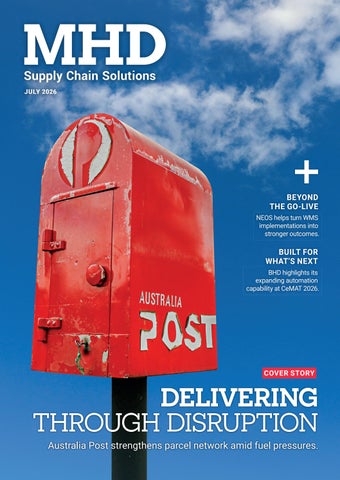
DELIVERING THROUGH DISRUPTION Australia Post strengthens parcel network amid fuel pressures.
Making Space for Critical Services A modernised logistics system supporting regional healthcare.
Growing demand and constraints of outdated facilities meant South West Healthcare needed a new approach to meet the region’s supply chain needs and future-proof operations, ensuring uninterrupted delivery of essential medical supplies, linen, and equipment to hospitals across Southwest Victoria. Dematic provided an AutoStore solution that significantly increases storage capacity, improves order accuracy, and reduces the time to process orders. South West Healthcare can now deliver vital orders faster and has more space to dedicate to other important functions. Learn more at dematic.com/southwesthealthcare
Scan to watch the video! Dematic.com 02 9486 5555 info.anz@dematic.com
EDITOR’S NOTE
MHD
Supply Chain Solutions CONTACT MHD Supply Chain Solutions is published by Prime Creative Media 379 Docklands Drive, Docklands VIC 3008 Telephone: (+61) 03 9690 8766 Website: www.primecreative.com.au
THE TEAM Chairman: John Murphy CEO: Christine Clancy Managing Editor: Mike Wheeler Editor: Phillip Hazell Business Development Manager: William Jenkin Design Production Manager: Michelle Weston Graphic Designers: Danielle Harris, Jacqueline Buckmaster Client Success Manager: Justine Nardone
FOR ADVERTISING OPTIONS Contact: William Jenkin william.jenkin@primecreative.com.au
SUBSCRIBE Australian Subscription Rates (inc GST) 1yr (11 issues) for $99.00 2yrs (22 issues) for $179.00 To subscribe and to view other overseas rates visit: www.mhdsupplychain.com.au or Email: subscriptions@primecreative.com.au
ACKNOWLEDGEMENT MHD Supply Chain Solutions magazine is recognised by the Australian Supply Chain Institute, the Chartered Institute of Logistics and Transport Australia, the Supply Chain and Logistics Association of Australia and the Singapore Logistics and Supply Chain Management Society.
ARTICLES All articles submitted for publication become the property of the publisher. The Editor reserves the right to adjust any article to conform with the magazine format. COPYRIGHT MHD magazine is owned by Prime Creative Media. All material in MHD is copyright and no part may be reproduced or copied in any form or by any means (graphic, electronic or mechanical including information and retrieval systems) without written permission of the publisher. The Editor welcomes contributions but reserves the right to accept or reject any material. While every effort has been made to ensure the accuracy of information Prime Creative Media will not accept responsibility for errors or omissions or for any consequences arising from reliance on information published. The opinions expressed in MHD are not necessarily the opinions of, or endorsed by the publisher unless otherwise stated.
Resilience under pressure
T
his month’s edition of MHD looks at an industry operating under pressure, but still investing, adapting and building for the future. On the cover, we examine Australia Post’s response to rising fuel costs and the broader volatility affecting transport and logistics operators across the country. Fuel has always been a major operating cost for freight networks, but the scale and pace of recent increases have sharpened the challenge. For Australia Post, the pressure comes as it continues to manage structural declines in letter volumes, increasing parcels competition and changing customer expectations. The story is not only about fuel surcharges or short-term cost recovery. It also points to a longer-term operational question for the logistics sector: how businesses reduce exposure to volatility while maintaining reliable national networks. Australia Post’s investment in electric vehicles and parcel infrastructure highlights how major operators are looking beyond immediate pressures and preparing for a different operating environment. This edition also features an industry explainer on Inland Rail, a project that remains central to Australia’s long-term freight ambitions. Once pitched as a nation-shaping Melbourne to Brisbane corridor, Inland Rail has been reshaped by cost increases, governance changes and a staged delivery model. The current focus on Beveridge to Parkes shows how large infrastructure programs can evolve when scope, funding and delivery realities become clearer. For supply chain, warehousing and transport operators, the project still matters. Inland Rail’s promise has always been tied to freight productivity, rail capacity, regional connectivity and the ability to move more goods efficiently across long distances. The next phase will be closely watched by industry, particularly as intermodal terminal planning and broader network upgrades remain part of the national freight conversation. Elsewhere in the issue, our industry news section captures the pace of activity across the past month. From major property transactions and new warehousing investments to road resilience projects and manufacturing expansions, the sector continues to move despite uncertainty. These stories show businesses and governments responding to many of the same pressures: energy costs, infrastructure constraints, supply chain resilience, freight access and future capacity. Taken together, this month’s edition reflects an industry balancing immediate challenges with long-term planning. Whether it is a national parcels network managing fuel volatility, a major rail project being reset, or businesses investing in new facilities and freight corridors, the common thread is resilience. The conditions are not simple, but the direction is clear. Australia’s supply chain sector is continuing to adapt, invest and prepare for what comes next. Happy reading! Phillip Hazell Editor, MHD Supply Chain Solutions
mhdsupplychain.com.au
3
RELIABILITY • SAFETY • INNOVATION • UPTIME
As Australia’s leading forklift company, it doesn’t matter whether we are supplying you with a single spare part, a rental forklift, or helping you manage your entire fleet, our objective and commitment remain the same – adding value to your operation. Whether it's the legendary reliability and world leading safety of our Toyota forklifts, the ongoing support of one of Australia’s most dedicated service and parts networks, or the innovations that have made Toyota the World’s number one forklift brand* , you can be assured we’ve got all your needs covered to power your business forward. To find out more contact your local Toyota Material Handling branch today. *dhf Intralogistics online / magazine 2024/25
PROUDLY DISTRIBUTED BY TOYOTA MATERIAL HANDLING
1800 425 438 toyotamaterialhandling.com.au
JULY 2026
THIS ISSUE COVER STORY
12 Australia Post confronts fuel shock cost pressures.
MATERIAL HANDLING 16 Toyota reliability supports Garage Door Solutions’ growth. 20 Linde fleet supports Reid Stockfeeds’ operational reliability.
WAREHOUSES 24 BHD showcases integrated warehouse automation capability
12
28 NEOS frames WMS projects as
COVER STORY
operational transformation. 30 Hai Robotics builds ANZ momentum with SSI Schaefer. 32 LAPP harnessing reduces intralogistics installation risk. 35 CH Racking expands manufacturing capacity in Australia
ASSOCIATIONS, EVENTS, SPECIAL FEATURES AND REGULARS 03 Ed’s Letter. 06 Industry News. 38 ABS data reveals extent of fuel price pressure on businesses.
28
41 BULK2026. 44 MegaTrans 2026. 46 Mercury Awards 2026. 49 ASCLA. MHD SUPPLY CHAIN SOLUTIONS
24
52 ASCI. 54 People on the Move.
JULY 2026
55 Product Showcase.
JULY 2026
56 Inland Rail reset prioritises Beveridge to Parkes. BEYOND THE GO-LIVE NEOS helps turn WMS implementations into stronger outcomes.
BUILT FOR WHAT’S NEXT BHD highlights its expanding automation capability at CeMAT 2026.
ON THE COVER Australia Post says surging fuel costs are pressuring logistics operations, prompting surcharge adjustments,
BHD’S STATEMENT ON CANTILEVER RACK
WE WILL NOT BE BEATEN ON PRICE!
If you can provide evidence of a cheaper price, we will beat it by 5%. 130 0072 254
www.bhdstorage.com.au
Email: sales@bhdstorage.com.au
DELIVERING THROUGH DISRUPTION Australia Post strengthens parcel network amid fuel pressures.
continued parcel infrastructure investment and accelerated fleet electrification to reduce diesel reliance and improve resilience. mhdsupplychain.com.au
5
INDUSTRY NEWS
Moorabbin Airport comprises aviation operations, industrial and logistics facilities, retail precincts and commercial assets across a 294hectare site. Image: Moorabbin Airport
Consortium to acquire Moorabbin Airport
A
consortium led by Barings has agreed to acquire Melbourne’s Moorabbin Airport from Goodman Group for $1.5 billion. Barings Real Estate Australia will oversee the property, including future development activities. Goodman Group, the current owner of the airport, will reinvest alongside the consortium, which includes Aware Super and Rest Super. The acquisition covers Goodman’s Moorabbin Airport Corporation, a 294-hectare site that includes aviation operations, industrial and logistics facilities, large-format retail, office accommodation and ground lease interests. Shaun Hannah, Executive Director, Barings Real Estate Australia, says the off-market acquisition includes a strategic landholding with diversified uses, income streams, development potential and exposure to Melbourne’s industrial market. “The acquisition of this portfolio is the latest example of Barings’ ongoing positive outlook for the industrial sector in Australia and continues our investment strategy of targeting welllocated precincts with significant underlying value and long-term development potential,” Shaun says. “Importantly, Moorabbin Airport has a long-standing role as a critical aviation hub, supporting flight training, charter and maintenance operations,
and we recognise the importance of preserving and supporting these aviation activities as part of the precinct’s future.” The airport includes tenants across aviation, industrial, logistics, retail, manufacturing and business services. It also includes Kingston Central Plaza, a large-format retail and direct factory outlet precinct. Moorabbin Airport is operated by MAC under a 71-year leasehold granted by the Commonwealth Government. The airport supports flight training, charter and maintenance operations and is one of Australia’s busiest general aviation airports. Hannah says Barings has experience with airport and industrial assets, including Bankstown and Camden Airports in New South Wales. Barings’ Australian portfolio currently includes more than 120 investments. Jason Little, CEO Australia, Goodman, says Goodman has invested in the airport operations and surrounding land since acquiring Moorabbin Airport in 2011. “Goodman acquired Moorabbin Airport in 2011, and since then has invested significantly in the airport operations and surrounding land to create a thriving precinct,” Jason says. “The area comprises high-quality, well-located assets with strong underlying fundamentals, reflecting
the value created through Goodman’s active management and development over time,” he says. Aware Super Senior Portfolio Manager for Property Anjana Moran says the fund will work with Barings and the other consortium partners on the asset. “Aware Super is proud to invest in Moorabbin Airport on behalf of its 1.3 million members, and we look forward to working with Barings as an experienced and trusted investment manager and other consortium partners to unlock further value through new growth initiatives and development activities,” Moran says. Rest Head of Investments, Real Assets Andrew Bambrook says the asset offers diversified income and development potential. “Rest is pleased to invest in Moorabbin Airport alongside Barings and our consortium partners,” Andrew says. “The asset offers diversified income and long-term development potential in a supply-constrained Melbourne precinct, supporting Rest’s focus on resilient, long-term returns for our more than two million members. We look forward to working with our partners to enhance performance and unlock value over time,” he says. The transaction is subject to customary conditions precedent and regulatory approvals, with settlement expected in mid-2026. ■
6
LMH260
LMH260610_MHD July 2026 issue full page ad.indd 1
11/6/2026 1:13 pm
INDUSTRY NEWS
Safcol expands warehousing and manufacturing capacity
S
afcol Australia will expand its national warehousing and food manufacturing operations through an $80 million investment in a new purpose-built facility at Edinburgh, in Adelaide’s north. The new site will replace Safcol’s existing Elizabeth factory over the next two years and is expected to deliver approximately double the production capacity of the current operation. The Elizabeth site currently houses Safcol’s national warehousing and import business, supporting seafood and pet food distribution across Australia. The new Edinburgh facility is designed to strengthen Safcol’s local manufacturing footprint while improving operational efficiency, supply chain resilience and long-term production capability. Safcol Australia CEO Andrew Mitchell says the investment is a strategic decision aimed at securing the future of the company’s local manufacturing operations while responding to rising energy, logistics and infrastructure pressures. “Our Elizabeth facility has served us incredibly well over many decades, but increasing energy costs, rising logistics pressures and ageing infrastructure meant we reached a point where maintaining long-term competitiveness required significant change,” Andrew says. Safcol officially broke ground on the Edinburgh facility on Tuesday 2 June, alongside the opening of its new Adelaide Fish Market facility in Thebarton. Safcol has appointed South Australian company Sagle Constructions as lead contractor for the new facility. Andrew says the new site will allow Safcol to rethink how its manufacturing and operational network is structured. “The new site gives us the opportunity to redesign our operations from the ground up with modern manufacturing capability, greater efficiency and room to support future growth,” he says. Safcol currently manufactures around 60 per cent of Australia’s wet baby food
8
supply, including products for a leading baby food brand in Australia. It also produces soups, canned vegetables, seafood products and products for major supermarket and national food brands. The company also manufactures its own South Australian Gourmet Foods range, as well as products for several Australian food brands, supermarket private labels and other food partners. Safcol also processes local mussels and Australian canned abalone for export markets. The new facility will incorporate advanced manufacturing technology and provide opportunities for future renewable energy integration, with a focus on improving productivity and reducing energy and water consumption. Safcol says sustainability and operational efficiency will be central to the design and future operation of the Edinburgh facility. The company has already introduced several sustainability initiatives across its existing operations, including solarpowered infrastructure and upgraded retort machinery. Safcol says these upgrades have reduced carbon emissions by approximately 240 tonnes annually and cut water usage by around 136
million litres each year. The company says its fishing practices have also contributed to a 90 per cent reduction in marine bycatch, while packaging materials, including plastics, are recycled wherever possible. For Safcol, now in its 81st year of operation, the Edinburgh facility represents the next stage of its manufacturing presence in South Australia. “This investment is about building a manufacturing footprint that is fit for the future while continuing to support Australian producers, local supply chains and South Australian jobs,” Andrew says. The announcement coincided with the opening of Safcol’s new Fish Market facility at 36 West Thebarton Road, Thebarton. The reinvigorated Fish Market has evolved from the company’s original Mile End Market and will serve as a central seafood hub in Adelaide, supporting South Australian fishermen, seafood suppliers and wholesale customers. Representatives from Safcol’s parent company, Tropical Canning Thailand, attended the Edinburgh groundbreaking alongside company executives. ■
Representatives from Safcol Australia, Tropical Canning Thailand and project partners break ground on Safcol’s new $80 million manufacturing and warehousing facility. Image: Safcol Australia
INDUSTRY NEWS
Road resilience upgrades in south-west Queensland aim to improve freight access and reduce flood-related disruptions on key regional supply routes. Image: ShahinAlam/stock.adobe.com
Queensland road upgrades target critical supply routes
T
hree road resilience projects in south-western Queensland have moved to detailed design, with the upgrades aimed at improving access along critical freight and supply routes during flood events. The projects form part of a $155 million jointly funded infrastructure betterment package for western Queensland roads damaged by the 2025 floods. A total of six priority sites will be rebuilt to reduce future flood damage and help maintain access to essential services, freight corridors and supply routes. Detailed design contracts have been awarded for projects at Bulloo Developmental Road at Paroo River Bridge, Eulo, Quilpie–Thargomindah Road at South Comongin Crossing, and the Balonne Highway at Wallam Creek, Bollon. The design phase will refine concept plans into detailed construction designs for each project, with a focus on improving flood resilience across road corridors relied on by regional communities, freight operators and emergency services. At Eulo, the existing Paroo River Bridge will be replaced with a higher bridge and road approach. The bridge currently closes for an average of 10 days each year
due to flooding, affecting access along Bulloo Developmental Road between Cunnamulla and Thargomindah. On Quilpie–Thargomindah Road, the South Comongin Crossing and approaches will be raised. The crossing can currently be cut for more than seven weeks each year during flooding, disrupting local access and transport movements. Major drainage improvements will also be delivered at Wallam Creek on the Balonne Highway, a key freight and tourism route connecting St George to the regional centre of Cunnamulla. Detailed design for the Balonne Highway betterment project is expected to be completed in mid-2026, while designs for the other two projects are due for completion in late 2026. The works are being supported through the jointly funded Commonwealth-State Disaster Recovery Funding Arrangements. Federal Minister for Emergency Management Kristy McBain says the Australian Government is committed to supporting projects that improve disaster resilience. “The Albanese Government is committed to providing support that
improves disaster resilience to the regions that need it,” McBain says. “We will continue to work closely with the Queensland Government to ensure that when we help disaster affected communities recover, we make them stronger for the future.” Queensland Minister for Transport and Main Roads Brent Mickelberg says resilient road corridors are critical for flood-impacted communities. “These roads are the lifeline of these communities, and our aim is to make them more resilient to future flooding,” Mickelberg says. “I’m confident these upgrades will assist in ensuring these regional road assets are fit for purpose to enable reliable access, timely evacuations and the delivery of critical supplies during and after adverse weather events.” Federal Assistant Minister for Regional Development Senator Anthony Chisholm says the projects have been selected to deliver benefits for drivers and freight operators. “This package of work has been designed to make travel safer and roads more reliable for families, truckies, workers and visitors in Western Queensland,” Chisholm says. ■ mhdsupplychain.com.au
9
INDUSTRY NEWS
Western Sydney Airport to begin freight operations
W
estern Sydney International Airport will begin freight operations on 26 July 2026, three months before the airport welcomes its first passengers. The Federal Government has confirmed the opening timeline for Western Sydney International (NancyBird Walton) Airport, with Qantas Freight to begin regular flights to and from the new airport from the evening of 27 July. The new 24-hour airport will provide international, domestic and freight services, with its curfew-free operating model expected to support Sydney’s overnight air cargo capacity. In line with the Sydney Airport Curfew Act 1995, 1 November 2026 has been determined as the intended gazettal date for WSI to be open for night aircraft movements. This will have the effect of ending currently permitted overnight freight flights at Sydney Kingsford Smith Airport during the curfew period, except in emergencies or where special dispensation applies. The shift is expected to strengthen WSI’s role as a dedicated freight Western Sydney International Airport will open as a new 24-hour freight gateway for time-sensitive cargo. Image: Steve/stock.adobe.com
10
gateway for Sydney, particularly for time-sensitive cargo and supply chain operators requiring access to overnight air freight services. The airport will be supported by new cargo and business precincts, as well as major infrastructure upgrades across Western Sydney, including the future Sydney Metro Airport rail connection and upgrades to Elizabeth Drive, Fifteenth Avenue and Mamre Road. The Federal Government says the airport forms part of a near $18 billion investment in Western Sydney, building on the recent opening of the M12 Motorway. Minister for Infrastructure, Transport, Regional Development and Local Government Catherine King says the airport’s new cargo and business precincts will support jobs and activity across the region. “With the new Nancy-Bird Walton Terminal, and brand-new cargo and business precincts readying to open, this won’t just be the centre of travel in Western Sydney, but also jobs,” Catherine says. Prime Minister Anthony Albanese says the airport follows more than a decade of planning and delivery.
“In 2011, I commissioned a joint study with the NSW Government into how we’d deliver a second airport. I said at the time, it wasn’t ‘a matter of if Sydney needed a new airport, but when’,” Anthony says. “15 years later, this new airport is almost ready to open. “I want to thank the tens of thousands of people who over the years planned, built and are now testing Western Sydney International Airport and the surrounding infrastructure right here in Western Sydney.” The WSI project has created more than 12,800 jobs, with around half of those jobs going to local workers. More than $500 million has also flowed to more than 360 Western Sydney businesses during major construction works. Passenger services will begin on 25 October 2026, with Jetstar to operate the airport’s first commercial passenger flight to the Gold Coast. Air New Zealand will begin flights to Auckland on 26 October 2026, while Singapore Airlines will commence daily flights to Changi from 23 November 2026. Qantas will begin passenger services from WSI from 28 March 2027. ■
UP-Carrier GTJ Your gateway to warehouse automation, scalable for tomorrow’s growth.
Maximum Space Utilisation
Flexible Storage Strategies: FIFO & LIFO
Flexibility With Load Carriers
Safe Handling Without Collision
Time Saving Through Parallel Processes
Reliable In Deep-Freeze Areas
131 687 www.jungheinrich.com.au
SPECIAL FEATURE
Creating a more resilient parcel network Australia Post is investing in fleet electrification and parcel infrastructure while responding to rising fuel costs.
12
SPECIAL FEATURE
A
An Australia Post truck on the road, as rising fuel costs continue to place pressure on transport and logistics operators. Image: Doublelee/stock.adobe.com
ustralia Post has revealed a increase in fuel costs as ongoing volatility in global energy markets continues to impact transport and logistics operators across Australia. Appearing before Senate Estimates on 27 May, Australia Post Group Chief Executive Officer and Managing Director Paul Graham described the current situation as the largest oil shock on record, outlining the financial impact rising fuel prices have had on the organisation’s operations over recent months. According to Paul, fuel costs increased from $35.7 million in February to $50.3 million in March before climbing again to $56.5 million in April. The figures highlight the growing pressure being placed on transport operators as fuel prices remain elevated following disruptions to global oil markets and shipping routes. “Our April fuel costs were significantly higher than December last year, despite volumes being a third lower than our busiest ever peak period,” Paul told the committee. For Australia Post, which operates one of the country’s largest delivery and logistics networks, fuel represents a major operating expense across its road transport, parcel delivery and freight operations. The increase in fuel expenditure comes at a time when many Australian businesses are reporting similar challenges. Recent data from the Australian Bureau of Statistics found fuel prices and supply availability have negatively affected the majority of Australian businesses, with transport, logistics and supply chain-intensive sectors among the most heavily impacted. >> See the full ABS fuel data breakdown on page 38. Australia Post says the fuel shock has compounded other challenges already facing the organisation, including structural declines in letter volumes and increasing competition in the parcel market. “Structural declines in letter volumes and intensifying parcels competition, driven by global marketplaces, have been further compounded by the largest oil shock on record,” Paul says. mhdsupplychain.com.au
13
SPECIAL FEATURE
To help offset the increase in operating costs, Australia Post has adjusted fuel surcharges applied to larger contracted parcel customers. Paul stressed that fuel surcharges are not a new measure, noting the mechanism has existed since 2017 for Australia Post customers and since 2005 for StarTrack customers. “A fuel surcharge is a standard, industry-wide mechanism for recovering fuel costs from contract parcel customers that’s based on a rigorous formula, is externally benchmarked, and reviewed by our auditors,” he says. Australia Post says the surcharge affects only a small proportion of its customer base. According to Graham, 94 per cent of parcel customers are not subject to the surcharge, with the measure applying to approximately 17,000 contracted customers, representing around six per cent of all customers. The organisation also sought to clarify reports regarding the scale of recent surcharge increases. “I want to stress that 94 per cent of our parcel customers are not subject to the fuel surcharge,” Paul says. “Claims in the media that it will increase parcel prices by over 300 per cent are simply wrong.” He told the committee that the cost of sending a parcel valued at $10 had increased from $10.48 before the fuel crisis to $11.95 under current surcharge arrangements. While fuel surcharges provide some cost recovery, Australia Post says they are unlikely to fully offset the increase in expenses. “Given the highly volatile nature of this fuel crisis, we do not expect that the fuel surcharge will cover the significant additional cost increases of recent months,” Paul says. “So we will suffer significant losses on fuel despite the surcharge.” The comments provide insight into the scale of the challenge facing logistics operators as fuel costs continue to fluctuate in response to geopolitical uncertainty. Despite ongoing pressures, Australia Post says there are indications that fuel markets may be beginning to stabilise. Paul told Senate Estimates that the
14
Paul Graham, Group Chief Executive Officer and Managing Director of Australia Post, outlined the impact of fuel volatility during Senate Estimates. Image: Australia Post
C
M
organisation’s fuel surcharge would reduce to 12.3 per cent in July, reflecting easing fuel prices and the lagged nature of surcharge calculations. “Tomorrow our July surcharge will reduce to 12.3 per cent,” he says. The organisation is also pursuing longer-term measures aimed at reducing its exposure to fuel price volatility. Central to that strategy is the continued electrification of its vehicle fleet. Australia Post currently operates more than 5,100 electric vehicles and is expected to expand that number following the Federal Government’s recent announcement of a $40.5 million investment to support additional electric vehicle deployment. According to Paul, the investment is expected to reduce diesel consumption by almost 900,000 litres while lowering emissions across Australia Post’s operations. “We are also future proofing our business and reducing our reliance on fuel by accelerating the electrification of our fleet,” he says. Alongside fleet investments, Australia Post continues to expand its logistics infrastructure network to support growing parcel volumes and changing customer expectations. Paul highlighted several recently completed and planned infrastructure
projects, including the opening of the Brisbane North Parcel Facility, known as Mookin Yaba, and the announcement of a new parcel facility adjacent to Hobart Airport. The projects add to a broader pipeline of logistics investments, including a new Sunshine Coast Parcel Facility and the company’s half-billion-dollar Adelaide Parcel Super Hub. “These complement major projects already underway as we build safer, more efficient facilities that support our teams and deliver for customers now, and into the future,” Paul says. The investment program reflects Australia Post’s continued focus on parcel and logistics operations as e-commerce activity reshapes freight and delivery networks across the country. While the organisation continues to face rising costs and challenging market conditions, the latest figures illustrate the extent to which fuel price volatility remains a major concern for transport and logistics operators. For Australia Post, the combination of elevated fuel costs, growing competition and changing customer demand underscores the importance of improving operational efficiency while continuing to invest in the infrastructure and technology needed to support future growth. ■
Y
CM
MY
CY
CMY
K
Australia MHD Ads.pdf 1 2026/4/13 19:11:40
C
M
Y
CM
MY
CY
CMY
K
MATERIAL HANDLING
Toyota forklifts drive success at Garage Door Solutions Garage Door Solutions relies on Toyota forklift reliability to support growth, efficiency and on-site installations.
A
long-term Toyota Material Handling Australia (TMHA) customer has used the reliability and performance of Toyota forklifts to help steadily grow its business over the course of nearly two decades. Garage Door Solutions, based in the Launceston suburb of Prospect, first opened its doors in 2006 as a singleman operation run out of the garage of owner Paul Crisp, and has grown over
16
the years into a thriving Tasmanian business employing 12 people. Providing services for both residential and industrial customers, Garage Door Solutions first introduced a Toyota forklift into its operations in 2013 and has continued to use the brand’s equipment across its business since then. “Naturally, as a young business starting out, I bought a second-hand Toyota, a 1.8 tonne,” Paul says. “I think
it had about 8,000 hours on it. I’ve still got that one, it’s never missed a beat – it’s been really reliable.” Seeing the long-term durability of his Toyota forklift meant that when the time came to expand his business further, Paul went back to Toyota to purchase a larger, new 2.5-tonne 8FG25 unit to help with the on-site installation of taller and heavier industrial garage doors.
MATERIAL HANDLING
Paul Crisp (right) and a member of the Garage Door Solutions team with a Toyota forklift at the company’s Launceston headquarters.
“A couple of years ago we bought a 2.5-tonne Toyota with a 5.5-metre mast, so that’s to do high roller-shutter doors,” Paul says. “Getting that one fitted with a bigger mast helps us do our doors, and the 2.5-tonne machine takes care of the weight side of things.” However, the new unit presented something of a logistical challenge for Garage Door Solutions, as taking the 8FG25 to on-site installations required the hire of a tilt tray truck, adding additional logistical legwork for the company. To come up with a solution, Paul worked closely with his local TMHA branch manager Rob Cornwell to find the ideal machine which could continue to help managing on-site door installations while providing an easier logistical arrangement.
After consultation together, Paul settled on a new 8FG15 forklift which was specified to continue the on-site installation of doors while making travel significantly easier. “I worked with Rob Cornwell because I wanted to be able to tow a forklift behind our ute and keep it under 3.5 tonnes,” Paul says. “So I got a 1.5-tonne fork with a 5-metre mast, he kept the weight down for me, and we had a trailer built so we can actually tow it for our smaller roller doors and industrial projects that we do, and we don’t have to get a tilt tray truck like we do with our 2.5-tonner. “We had a trailer specially built as well, so the 1.5-tonner goes on the trailer, and we can tow it behind our 4WDs which have the towing capacity of 3.5 tonnes, so we have it pretty well covered now. Only for our bigger jobs we’ll have to get the 2.5-tonner on a tilt tray.” “It keeps us more competitive as well, by the time you add the tilt tray and freight, it makes more sense if we can do it ourselves.” Paul says working with Mr Cornwall and his team helped make the purchase process easier, working together to find the exact spec that would work for the business. “It was good, he worked with me on weights and things like that. Masts,
Toyota forklifts help Garage Door Solutions safely store and handle garage door components at its Launceston facility.
mhdsupplychain.com.au
17
MATERIAL HANDLING
heights, weights of masts, what I can take off to keep us under that 3.5 tonne, things like that. So, he was great to deal with.” The three Garage Door Solutions forklifts are not only used for remote installations but also work at their warehouse to unload and store the doors, as well as loading them onto their fleet of utes to send out to job sites. Paul says that it was crucially important for his business to use products which provide consistent and reliable performance, which is why Toyota has been his first choice for equipment. “I’m someone who doesn’t mind spending extra money to buy good gear that I know we’re going to have trouble-free operation,” he says. “We’ve never had an issue with a forklift and the whole buying process with Toyota and the communication with Rob has always been good. “It just comes down to buying a good
Garage Door Solutions has relied on Toyota forklifts for more than a decade, supporting both warehouse and installation activities.
18
The forklifts are used to load products for delivery and installation across Tasmania. Images: TMHA
quality machine and knowing I’ve got a person I can contact and build a relationship with and if I have any issues I can go back with. “That’s the biggest thing in business, everything is going well when things are good but if there was an issue, I know Rob and the team would help me out and those are the things I look for with anyone I deal with in business.”
Garage Door Solutions has plans to expand its business with a second warehouse, where their original 1.8tonne unit will continue to provide the business with years of dependable use. ■ For more information freecall 1800 425 438 or visit online at www.toyotamaterialhandling.com.au
MATERIAL HANDLING
Reid Stockfeeds upgraded to a tailored Linde fleet to support feed production, warehousing and transport operations across its sites.
Locking in long-term reliability at Reid Stockfeeds Reid Stockfeeds upgrades to a tailored Linde Material Handling fleet, improving comfort, safety, efficiency and service support.
F
or over 40 years, Reid Stockfeeds has helped livestock producers across Victoria, South Australia, Tasmania and New South Wales deliver strong nutritional outcomes for their animals. Behind that commitment is a business built on trusted performance, operational reliability, and partnerships that keep feed moving every day. With five sites, including a major manufacturing plant in Trafalgar and a high-output bagging facility in Cobden, the company’s daily operations rely heavily on its forklifts to keep product moving. With each site presenting different operational challenges, such as gravel roads to high pallet volumes, finding the right mix of equipment was essential. To support that need, Reid Stockfeeds transitioned to a long-term rental agreement with Linde Material
20
Handling, opting for a customised fleet of seven forklifts - three Linde H25 hydrostatic IC units, one Linde E25 electric forklift and three Baoli KBE25 electric forklifts.
A reliable fit, tailored to site conditions Jason Shelley, Transport Manager at Reid Stockfeeds, was in charge of finding a new long-term solution after previously relying on another provider. “Our forklifts are critical to running our mills. If one goes down, the whole site feels it,” says Jason. “So, we needed equipment that was reliable – and a partner who could respond quickly when we need servicing.” While the team initially hoped to go fully electric, site surveys conducted by Linde Account Manager Mia Whiteoak guided them toward a blended fleet. “Mia came out to site and really looked
at what we needed,” Jason adds. “That was a big factor. It gave us confidence we were making the right call. Some of our sites, like Cobden for example, are fully concreted and better suited for electric forklifts,” explains Jason. For the team’s outdoor operations, which includes an instance where the forklift has to cross the road, the Linde H25 Series 1220 hydrostatic trucks deliver the performance and comfort the team needs.
Keeping up with demand in comfort Reid Stockfeeds runs two shifts daily across most sites, and across all their locations, their forklifts are in near-constant use to keep up with operational demand. At the company’s Cobden facility, Reid Stockfeeds produces bagged feed that is stacked onto pallets, resulting in the movement of hundreds of pallets
MATERIAL HANDLING
each day. Daily deliveries of mineral additives, including salt and sugar, further contribute to the high level of forklift activity. “Our guys are moving bags and bulk pallets all day,” Jason says. “That’s why comfort, reliability, and easy handling were non-negotiables. Jason explains that the Reid Stockfeeds previously used forklifts from another supplier, but operators experienced discomfort when travelling over rough ground, with some
reporting bruising as a result. “When we tested the Linde hydrostatic unit, the difference in comfort was huge,” he says.
Cleaner and greener with Baoli’s Electric Forklifts Inside Reid Stockfeeds’ production facilities, sustainability and air quality are just as important as productivity. That’s why the business now runs Baoli electric units inside their warehouses and production
areas. Jason says the company previously used gas forklifts in its warehouses, but fumes generated during indoor operation were not considered ideal. “With the electric Baoli units, it’s cleaner, greener, and we’re not paying for gas anymore,” he says. The electric forklifts deliver zero emissions, quieter operation, and tighter turning circles, making them ideal for working around pallet racking, particularly in Cobden. Jason says
Baoli electric forklifts support indoor handling operations, helping improve air quality and reduce operating costs.
mhdsupplychain.com.au
21
MATERIAL HANDLING
the electric forklifts eliminate fumes during operation, while also offering lower running costs and environmental benefits compared with the company’s previous equipment. “As long as we put them on charge overnight, we can get a full day’s usage out of the machines,” he says.
FleetFOCUS for safety and visibility Reid Stockfeeds’ forklifts are fitted with Linde FleetFOCUS, a fleet management system offering digital pre-start checklists, electronic tagouts, impact monitoring, and driverspecific logins.
Reid Stockfeeds selected a mix of Linde electric, hydrostatic, and Baoli electric forklifts to suit the operational requirements of different facilities. Image: Linde
A Linde E16 electric forklift delivers the comfort, reliability and performance required for high-volume pallet handling operations at Reid Stockfeeds.
22
“For us, it’s about safety and compliance,” Jason says. “Pre-start checks, individual operator logins, impact monitoring – from a safety perspective it’s a real benefit to the company as it all adds up to a safer worksite.” The system also provides greater confidence when it comes to accountability and incident tracking – particularly valuable in high-traffic sites like Cobden. Locking out unauthorised users, it ensures only licensed staff can operate the forklifts. Jason says access controls through FleetFOCUS help ensure that only authorised operators can use the equipment, providing an additional layer of oversight and reassurance. “It gives us peace of mind,” he says. Reid Stockfeeds also opted for the Linde BlueSpot warning lights to help
MATERIAL HANDLING
protect pedestrians in shared zones and all of their units are also fitted with fork positioners to suit the varying pallet sizes used across the business, including everything from narrow pallets to bulk bags. “Our operators like that they don’t have to manually adjust the tynes,” Jason adds. “They now have the ability to do that while sitting on the machines, which saves them a lot of time.”
Responsive support, reliable service Like many regional businesses, access to reliable servicing was a key consideration. “Whenever we’ve needed support, Mia and the service team have been
responsive,” Jason says. “We’re in country Victoria, so we understand delays happen – but with Linde, we usually have someone onsite within a day or two. That wasn’t the case with our previous provider – it could take days, sometimes weeks.” Mia says access to responsive maintenance and support was an important consideration for Reid Stockfeeds when selecting a materials handling provider. “It was important for Reid Stockfeeds to know they had a contact on hand for service who could get out to site as soon as possible if something went wrong,” Mia says. “They wanted someone at their fingertips for maintenance and support, and that’s why they went with Linde. We offer 24/7, 365-day support
nationwide – whether our customer is based in metropolitan or regional areas.”
A partner that understands your ground game For Jason, the long-term rental model with Linde just made sense: a fixed monthly cost, bundled servicing, and the ability to test equipment before committing. Jason says he would recommend Linde to other businesses because of the reliability of the equipment, the responsiveness of the service team, and the structure provided by the long-term rental model. “The equipment’s reliable, our operators are happy, and we know we’ve got support when we need it. That’s what matters.” ■ mhdsupplychain.com.au
23
WAREHOUSES
BHD showcases global capability at CeMAT 2026
F
Following CeMAT 2026, BHD reflects on how its presence at the event highlighted its expanding automation capability, global project experience and long-term focus on integrated warehouse solutions.
or BHD, CeMAT 2026 was an opportunity to show the market how its role in warehousing is evolving. While the business has long been recognised for its racking capability, its presence at this year’s event placed a stronger emphasis on the broader systems, technologies and global experience now shaping its direction. Rather than filling the stand with physical rack, BHD used the event to demonstrate the capability of the wider group, including its parent company JRacking, its international project work, and the automation technologies it is preparing to bring further into the Australian market. According to John Harrison, General Manager, BHD, the stand was designed to communicate that broader capability. “Our stand isn’t filled with rack,” John says. “It has a lot of imagery in relation to our parent company, JRacking, and shows the partnership between the two. It’s about our supply chain, highlighting some of the large projects that we’ve done, showing the automation space we’re moving towards, and showing BHD’s capability.” That capability is becoming increasingly relevant as warehouse operators across Australia face rising labour costs, limited industrial land, increasing throughput demands and pressure to extract greater value from existing facilities. In this environment, automation is no longer being viewed only as a future investment. It is becoming a practical pathway for businesses seeking to improve productivity, increase density and reduce reliance on manual handling without necessarily relocating or expanding their footprint.
24
“There’s no doubt that’s the direction the business is heading in, and all businesses are heading in terms of automation,” John says. For BHD, CeMAT provided a platform to present that direction clearly. The company’s message centred on the scale of its manufacturing capability, the strength of its global supply chain, and the role integrated automation will play in its future offering. “It’s certainly about highlighting the capacities, the manufacturing ability, and the global presence,” John says. A key part of that story was BHD’s connection to major projects delivered overseas, including large automated storage and retrieval system projects in Argentina and the United Arab Emirates. These projects were used at the event to illustrate the size and complexity of the systems the wider group has delivered, as well as the range of storage technologies BHD can draw on as it expands its automation focus locally. “There are a couple of very large ASRS projects that have been done overseas, one in Argentina and one in the UAE,” John says. “They’re really large projects that we’ve been able to complete from start to finish, and we’ve got some imagery of those up.” The projects highlight the type of mixed, integrated storage environments that are becoming more common across the sector. John says these major installations include a combination of technologies, including ASRS, four-way shuttle automation and traditional racking systems. “It’s a combination of products, mainly ASRS or four-way shuttle automation projects that are quite sizeable,” John says. “But there are a multitude of different products in
there, including standard selective rack. I think there’s even a little bit of cantilever rack in some of them.” This mix reflects the way warehouse automation is evolving. For many operators, the future will not be defined by a single piece of equipment, but by the ability to combine racking, shuttles, conveyors, software and autonomous systems into one efficient operating environment. Four-way shuttle systems are central to that shift. Unlike more traditional automated systems, four-way shuttles can move in multiple directions, enabling more flexible layouts and improved use of cubic space. This makes them particularly relevant for businesses operating in space-constrained or high-volume environments, including cold storage, food manufacturing and fast-moving distribution. “The next main one is going to be the four-way shuttle,” John says. “The four-way shuttle will replace the ASRS in the not-too-distant future.” The broader appeal of these systems is being driven by their ability to deliver denser storage and more controlled movement within existing facilities. In markets where land and labour are expensive, the ability to increase output without expanding a footprint is becoming a major advantage. “Less space, more automation, denser in terms of storage ability, and certainly a lot easier to control and use into the future,” John says. For BHD, the next stage is not only about supplying racking or automation hardware. It is about developing a more complete solution that can bring multiple parts of the warehouse together. This includes racking
WAREHOUSES
BHD’s Tongling R&D centre will let customers test a complete automation setup – including racking, shuttles, AGVs, AMRs and software – before it reaches the warehouse floor. systems, four-way shuttles, AGVs, AMRs, conveyors, lifts and the software required to coordinate these systems. “The efficiencies gained from warehouse automation are quite amazing,” John says. The commercial drivers are clear. Labour costs in Australia continue to place pressure on operators, while customer expectations around speed, reliability and service are increasing. Automation offers a way to extend operating hours, improve consistency and reduce dependence on manual processes. “The cost of labour here in Australia is going up,” John says. “Seven days a week versus five days a week, eight hours a day versus 24 hours a day, all of those sorts of things have an impact.” As a result, return on investment remains central to automation decisions. For many businesses, the question is not simply whether automation can improve performance, but how quickly that improvement can be realised and how effectively it can be implemented within an existing operation.
“It’s predominantly driven by cost,” John says. “The shorter the return on investment, the better it’ll be.” Software is becoming increasingly important to that equation. As systems become more complex, the warehouse management system and warehouse control system are critical to ensuring equipment works together effectively. Without that integration, even advanced automation can struggle to deliver its full value. “The integration of the software, the warehouse management system and warehouse control system, is huge,” John says. BHD is developing this capability alongside its automation and racking offer. John says the company has a WMS and WCS in production, giving it the software foundation required to support its broader move into integrated automated systems. “We’ve got a WMS in production, and we’ve got a WCS in production, so we’re going to have the IT and software available to run all of this equipment,” John says. This is also where BHD’s R&D centre
in Tongling is expected to play a major role. The centre, which is being built within the company’s new factory, has been designed to test and validate full systems before they are deployed to customer sites. For operators investing in automation, this ability to test integration before installation can reduce risk, improve confidence and limit disruption. John says the R&D centre will allow customers to bring together the components of a warehouse automation system, including racking, shuttles, AGVs, AMRs and other equipment, and test them in one place before implementation. “We’re encouraging clients to use our R&D centre if they want to see their racking systems used in conjunction with their automation product,” John says. “We’ll assemble it, run it, test it, and make sure it all works before it lands on the customer’s shop floor.” For customers, that process is designed to remove uncertainty. Instead of installing multiple components into an operational warehouse and resolving issues on site, the system can be mhdsupplychain.com.au
25
WAREHOUSES
The BHD stand at CeMAT 2026 showcased the company’s racking, storage and automation solutions to warehouse and logistics operators.Images: BHD
assembled, tested and refined before it is shipped. “We’re giving our customers the ability to pull all of their components together, whether it’s AGVs, shuttles, four-way shuttles or AMRs, and bring them together in one place off their site,” John says. By validating the system in advance, BHD aims to help customers reduce the trial-and-error phase that can come with complex automation projects. “Put it all together, make it work, integrate a racking system into it, and test it,” John says. “Once you know that it works, you can box it up, send it over to your site, plug it in, and away you go.” CeMAT also reinforced the importance of relationships in the Australian market. Beyond the stand, BHD hosted customers at a function at South Bank, using the event to thank existing partners and continue building long-term relationships.
26
For John, that engagement remains an important part of how business is done locally. “Here in Australia, a lot of business is done based on relationships,” John says. “It comes from relationshipbased sales. It’s important that we do these things, and we appreciate what customers give us, because they could quite easily give it to others.” Following CeMAT 2026, BHD is positioning itself not only as a racking supplier, but as a partner capable of supporting more intelligent, integrated and automated warehouse environments. As automation adoption accelerates, warehouse operators will increasingly look for suppliers that can help them connect physical infrastructure with software, controls and autonomous systems. For BHD, its global project experience, R&D capability and developing software platform are all part of that transition.
CeMAT gave the company an opportunity to show that broader capability to the market. It also allowed BHD to frame its next stage of growth around the needs of operators seeking more density, higher productivity and better use of existing assets. “We’ve seen the requirement moving forward to become a one-stop shop,” John says. For warehouse operators assessing automation, the message from BHD after CeMAT is straightforward. The technology is becoming more integrated, the business case is becoming clearer, and the opportunity to test systems before deployment is reducing the risk of change. “Come and talk to us, and we’ll be able to tell you what we can do for you,” John says. “We’ve got some great solutions, and we’d love to share them.” ■
WAREHOUSES
From go-live to real operational gains
NEOS by Argon & Co helps organisations turn WMS implementations into operational transformation programs that deliver measurable outcomes.
M
any warehouse transformation projects begin with the implementation of a new Warehouse Management System (WMS), but success is rarely determined by software alone. While organisations often focus on the technical deployment, the real challenge starts once the system goes live. Across Australia and New Zealand, warehouse operators are facing growing pressure from rising labour costs, workforce shortages, increasing customer expectations and the continued expansion of e-commerce. At the same time, many businesses are approaching critical technology upgrade cycles, forcing them to reassess the systems that underpin their operations. For Johnny Balich, SAP Practice Lead at NEOS by Argon & Co, says these pressures are driving a new wave of warehouse transformation projects. However, he says many organisations continue to view WMS implementations primarily as IT initiatives, rather than operational change programs. “I think you’ve got two sides of the equation,” says Johnny. “From a business perspective, labour costs continue to rise, there’s skills shortages, higher customer expectations, the need for faster fulfilment, speed
Warehouse technology plays a key role in helping operators improve visibility, accuracy and operational performance. Image: Alena/stock.adobe.com
28
and accuracy, and e-commerce growth is consistent. At the same time, many organisations are working through major technology upgrade paths.” These technology upgrades are particularly relevant for businesses operating on ageing enterprise systems. As software vendors phase out legacy platforms and support models evolve, warehouse operators are being forced to evaluate how their existing systems align with future operational requirements. At the same time, warehouse complexity continues to increase. Many operators are still relying on legacy WMS platforms that were implemented years ago and designed for a different operating environment. While these systems may continue to function, they often struggle to provide the visibility, scalability and integration capabilities required by modern warehouses. “A lot of people are finding that their legacy WMS warehouse processes just can’t keep up with today’s complexity,” Johnny says. “They need better visibility, tighter cost control, real-time inventory and scalability.” Yet replacing outdated technology is only part of the solution. According to Johnny, one of the most
common reasons WMS projects fail to deliver expected outcomes is that organisations focus too heavily on software deployment while neglecting the operational changes required to support it. “From what I’ve seen in my experience, the absolute number one reason is it’s treated as an IT project rather than an operational transformation,” he says. “Common reasons would be poor process design, weak master data, underestimating the complexity of integration, lack of stakeholder involvement, insufficient testing and inadequate change management.” This distinction is becoming increasingly important as modern warehouse platforms evolve beyond traditional inventory management tools. Solutions such as SAP Extended Warehouse Management (EWM) now sit at the centre of warehouse operations, connecting inventory, labour, automation, planning, quality management and broader supply chain processes. As a result, decisions made during implementation can have far-reaching consequences across an organisation. “If I use EWM as an example, it is not just a WMS. It’s not just a warehouse system. It is an operational inventory system,” Johnny says.
WAREHOUSES
“It touches all aspects of the operation.” The challenge, however, is that many businesses approach implementation by attempting to replicate existing warehouse processes rather than redesigning them. Instead of viewing a new platform as an opportunity to improve operations, organisations often seek to recreate the workflows and processes they have used for years. Johnny says this approach limits the value that modern WMS platforms can deliver. “The way I look at it, it’s an absolute opportunity to relook at what our processes are, look at the standard process in the new WMS and really understand how you can optimise your existing process,” he says. “It’s not about trying to replicate your existing process in the new system. You need to look at what the new system is capable of and how you can adopt that moving forward.” Operational redesign also requires broader participation across the business. Warehouse managers, supervisors, planners, quality teams and production personnel all interact with inventory and warehouse processes in different ways. If these stakeholders are excluded from project planning and design, critical operational requirements can easily be overlooked. “I’ve seen it time and time again where the right people aren’t engaged,” Johnny says. “Warehouse managers, supervisors and the people who really understand what’s happening on the floor need to be involved.” This focus on operational alignment becomes even more important as warehouses become increasingly connected. Modern facilities rely on a growing ecosystem of technologies, including automation systems, conveyors, robotics, RF scanning, voice-directed picking, transport management systems and enterprise resource planning platforms. While each technology can deliver benefits independently, real value is only achieved when they operate as part of an integrated environment.
Johnny Balich, SAP Practice Lead at NEOS, says WMS projects should be treated as operational transformation programs, not just software implementations. Image: NEOS “A WMS only delivers value when it’s connected to the full warehouse ecosystem,” says Johnny. “ERP, automation, RF, voice, transport systems, conveyors, robotics and reporting tools all need to work together.” Without seamless integration, visibility can be lost, exceptions increase and automation investments may fail to deliver expected productivity gains. “If these systems don’t communicate in real time, teams lose visibility, exceptions increase and automation can actually slow down an operation,” he says. As warehouse technology continues to evolve, integration will become even more important. Artificial intelligence, predictive analytics and automation are increasingly being incorporated into warehouse operations, creating new opportunities to improve efficiency and decision-making. Rather than simply reacting to operational issues as they arise, future warehouses will be able to anticipate disruptions and optimise performance proactively. “AI and automation will move warehouses from reactive to predictive operations,” Johnny says. “It will help forecast labour needs, optimise slotting, predict bottlenecks, improve replenishment and automate task allocation.” For warehouse operators facing
ongoing labour challenges, this predictive capability could deliver significant benefits. Labour remains one of the largest operating costs in many facilities. Improved forecasting and visibility allow operators to better align resources with demand fluctuations, seasonal peaks and changing customer requirements. “Having better real-time forecasting of labour requirements based on volume changes and seasonality ensures you’ve got the right people there at the right time,” Johnny says. Beyond labour planning, predictive technologies can improve warehouse layouts, picking paths, inventory positioning and overall operational efficiency. However, none of these benefits can be realised without a strong foundation. For organisations beginning a WMS journey, Johnny believes success starts with operational clarity rather than software selection. “First and foremost, start with the operation, not the software,” he says. “The operation needs to be reviewed and organisations need to define the business outcomes they want to achieve before going into the software side.” He also emphasises the importance of data quality, process mapping and realistic testing. Master data must be accurate, futurestate processes need to be clearly understood and end users should be involved throughout the project lifecycle. Most importantly, warehouse teams must be given the opportunity to test real operational scenarios before go-live. “The more real scenarios that can be tested, the better,” Johnny says. Ultimately, successful warehouse transformation extends well beyond system implementation. Technology may provide the platform, but lasting operational gains come from redesigning processes, engaging people and aligning the broader business around a common vision for improvement. “The best WMS projects are not just systems implementations,” Johnny says. “They are operational redesign programs.” ■ mhdsupplychain.com.au
29
WAREHOUSES
Hai Robotics strengthens ANZ push
Hai Robotics is strengthening its Australia and New Zealand strategy with its autonomous casehandling technology and a mix of direct engagement and partnerships.
H
ai Robotics is increasing its focus on Australia and New Zealand as it looks to expand its local presence, strengthen its partner network and build confidence in its autonomous case-handling robotics technology. The robotics provider, which develops automated systems for carton and tote handling, is positioning ANZ as an important market in its Asia Pacific strategy. Its collaboration with SSI Schaefer has emerged as one of the key channels through which the company intends to grow, with the two businesses now working together on their first Australian climbing robot project. Nathan Zeng, President of Hai Robotics SEA & ANZ and South Korea, says the company is actively investing in the local market and wants customers to understand that Australia remains central to its regional plans. “We are operating in Australian markets, and we want to continue investment and we want to expand our team,” Nathan says.
30
Nathan, a founding team member of Hai Robotics, oversees the company’s Asia Pacific business, including business development, project management and service across the region. He says ANZ is a market where Hai Robotics sees long-term opportunity, particularly as warehouse operators look for systems that can support throughput, flexibility and peak demand. The company’s strategy is based on a mix of direct engagement, local service capability and strategic partnerships. SSI Schaefer is one of the companies Hai Robotics works with in the ANZ market, but Nathan says this cooperation should be seen as part of Hai Robotics’ broader ANZ strategy, rather than the strategy itself. “Working with SSI Schaefer is one of our important strategies, but it’s not everything,” Nathan says. The relationship between the two companies began in Europe, where Hai Robotics and SSI Schaefer have already delivered more than 30 projects together over several years.
Hai Robotics now wants to translate that experience into Australia and New Zealand, where local customers are weighing automation investments against changing fulfilment requirements, labour pressures and the need for systems that can be scaled over time. Nathan says the collaboration works because Hai Robotics’ technology complements SSI Schaefer’s existing offering. Rather than competing with SSI Schaefer’s automated storage and retrieval systems, Hai Robotics adds a flexible robotic option for carton and tote-based applications. “What we designed, what we manufactured is nothing SSI Schaefer had,” Nathan says. “So we are not competing with them, but we are complementing SSI Schaefer’s product offering.” For Brett Thirup, Managing Director, SSI Schaefer Australia and New Zealand, the decision to work with Hai Robotics reflects SSI Schaefer’s role as a solutions provider. SSI Schaefer is focused on bringing
WAREHOUSES
Hai Robotics’ autonomous casehandling technology is designed to support carton and tote handling within high-density warehouse automation environments. Image: Hai Robotics
together technologies that solve specific customer challenges, whether those systems are developed internally or delivered through trusted partners. That endorsement is important in a market where warehouse automation projects often require long-term capital commitments and confidence in local support. For customers, the value of the collaboration is not simply access to another technology. It is the ability to work through an established integrator that can take responsibility for how that technology performs within a broader system. SSI Schaefer’s role is to design and support the complete solution, including the interfaces between different parts of the warehouse. That is particularly important in operations where receiving, storage, picking, replenishment, consolidation, dispatch and returns all need to work as part of a connected process. Brett says many technology providers solve one part of the warehouse challenge. “By integrating that technology into our broader solutions, we can address more of the customer’s challenges,” Brett says. The local collaboration has already moved beyond discussion. Nathan says Hai Robotics and SSI Schaefer have secured their first climbing robot project together in Australia, which he describes as an important moment for the relationship.
“It highlights the strong potential for both companies to work together across different markets,” says Nathan. The project is planned to become a local reference site for both companies and is expected to be completed by December. It will allow prospective customers to see a live local deployment of the collaboration with SSI Schaefer and of Hai Robotics’ newer rack-climbing robot technology, rather than needing to travel overseas to inspect the system. “We see this as a positive example of how our collaboration can create value for customers by delivering flexible, scalable and integrated warehouse automation solutions,” says Nathan. “Looking ahead, we are excited to continue strengthening our cooperation with SSI Schaefer.” The reference site is part of Hai Robotics’ wider plan to build confidence across sectors where fast inventory movement, high throughput and flexible capacity are becoming more important. Nathan points to e-commerce, grocery, fashion and footwear as verticals where the company sees opportunities for its technology. These sectors often require systems that can support fast turnover and peak demand while allowing operators to scale capacity as needed. Hai Robotics’ robots can travel on the ground, climb racking and retrieve totes before presenting them to picking or replenishment stations. This architecture allows customers to add robots when volumes increase, including during peak periods. For SSI Schaefer, that scalability is one of the key advantages of the technology. Brett says customers are looking for automation systems that can be implemented faster and adjusted over time, particularly in environments where order profiles, customer demand or product mix continue to change. “The flexibility and the scalability become a really key consideration, especially if you’re in a 3PL type environment or an environment where your business is changing rapidly,” Brett says. That flexibility also explains why Hai Robotics is positioning its technology
as a complementary system rather than a replacement for every form of automation. Nathan says the company is focused on carton and tote handling, not pallet handling, which means the technology can sit alongside other systems within SSI Schaefer’s broader automation and storage portfolio. For Hai Robotics, service capability is another important part of the ANZ strategy. Nathan says the company has local engineering capability and is working with partners that can support customers on the ground. He says local support is critical because a customer relationship does not end when a project is installed. “A sales cycle only starts when you successfully deliver a project and the client starts using that system,” Nathan says. Nathan says Hai Robotics will continue working with multiple partners in Australia and globally. The company does not have an exclusive arrangement with SSI Schaefer, and Nathan says that approach gives Hai Robotics flexibility as it builds its local pipeline. The non-exclusive model forms part of Hai Robotics’ wider go-to-market strategy. Hai Robotics intends to work with different partners in the market while maintaining a clear framework for lead registration and collaboration. As Hai Robotics builds its ANZ presence, the collaboration gives the company a clearer path to market, a recognised systems integrator and a local reference point for customers assessing flexible automation. For SSI Schaefer, integrating Hai Robotics adds another system to its automation portfolio while allowing it to remain accountable for the complete solution. For both companies, the next phase will centre on delivery. This first Australian climbing robot project will be a great opportunity to demonstrate to the local market the power of connecting innovative technology with expertise in solution design and implementation, to deliver an integrated warehouse automation solution focused on addressing customers’ challenges. ■ mhdsupplychain.com.au
31
WAREHOUSES
Harnessing certainty in intralogistics LAPP’s pre-assembled harnessing solutions help reduce installation complexity and commissioning risk in automated warehouses.
I
ntralogistics environments are evolving at pace. Automated warehouses, high-speed sortation systems, robotics, and conveyor networks are becoming more complex, more dense, and more critical to supply chain performance. According to LAPP Australia’s Harnessing Solutions Division General Manager, Stuart Fleming, the industry is looking for faster, more efficient solutions for installation and commissioning, to get automated systems to market faster.
Modern intralogistics environments are becoming more complex, increasing demand for installation-ready solutions.
32
“We’re seeing an increase in demand for pre-assembled harnessing solutions because they remove variability from installation and give integrators far greater certainty on timing and outcome, as well as providing end-toend traceability,” Stuart says. LAPP Australia’s Harnessing Solutions Division provides engineered, pre-assembled cable systems tailored specifically for industrial automation and intralogistics applications. The division designs and manufactures complete, application-ready harnesses
that integrate directly into conveyors, sortation systems, automated storage and retrieval systems (AS/RS), and robotic equipment. Each solution is built to specification, fully tested prior to dispatch, and delivered in installation sequence to simplify on-site deployment. “We essentially bridge the gap between cable supply and system integration,” Stuart says. “Our focus is on taking engineering intent and turning it into a ready-to-install solution that removes uncertainty on site.”
WAREHOUSES
Speed, certainty, and reduced site complexity “One of the most immediate benefits of harnessing is speed to market,” says Stuart. “By shifting wiring complexity into a controlled manufacturing environment, installation time on site is significantly reduced, allowing automation systems to be commissioned sooner.” “It simplifies installation, bringing it closer to a plug-and-play solution. Each cable assembly is supplied labelled and sequenced in installation order, helping ensure the correct part is fitted in the correct location without interpretation errors.” Other key advantages include: • Application-specific cable selection, including high-flex, drag-chain, and freezer/chiller-rated solutions • LSZH (low smoke zero halogen) options for safety-critical environments
Pre-assembled cable systems can help simplify conveyor installation and reduce commissioning risk. Images: LAPP • Kitted and labelled deliveries to streamline installation workflow • Reduced site sorting, handling, and cable management • Lower variation across multiple installations or rollout sites • Reduced commissioning risk through pre-tested assemblies “Every layer of simplification on
site reduces the likelihood of delays or rework during commissioning,” Stuart explains. “Harnessing allows us to transfer that complexity into a controlled, repeatable process before anything reaches site.”
Designed for demanding environments Modern distribution centres place significant stress on electrical infrastructure, from constant mechanical movement in robotics and conveyors to temperature extremes in cold storage environments. Harnessing systems are designed with these conditions in mind, using applicationspecific cabling to suit high-flex, dragchain, or low-temperature applications. “The key is matching the cable system to the application from the outset,” Stuart says. “That decision has a direct impact on uptime, reliability, and lifecycle cost.”
Reducing commissioning risk Cable harnesses reduce commissioning risks, including incorrect terminations, inconsistent labelling, or installation errors under time pressure. Pre-assembled harnesses are tested prior to dispatch, shifting quality assurance upstream and reducing uncertainty during commissioning. For integrators and operators, this translates into fewer delays and a more predictable handover process. “Intralogistics success depends on uptime from day one,” he says. “Harnessing is about removing avoidable complexity so systems can perform as intended, right from installation.” ■ mhdsupplychain.com.au
33
Cable Harnessing Solutions Your trusted partner for customised connectivity in intralogistics. LAPP Harnessing Solutions delivers custom cable assemblies, wiring harnesses, and ready-to-install connectivity that helps the intralogistics industry reduce installation time, simplify supply, and keep projects moving. 1800 931 559 sales@lappaustralia.com.au lappaustralia.com.au/cables-harnesses
WAREHOUSES
CH Racking expands manufacturing capacity with new facility CH Racking & Displays’ manufacturing partner has expanded its production footprint in Zhejiang Province, strengthening the company’s ability to support Australian warehouse operators with compliant, high-density and automated storage solutions.
C
H Racking & Display is strengthening its supply chain for the Australian warehouse market, following the expansion of its manufacturing partner’s production campus in Zhejiang Province, China. The new facility has been built within Shanghong’s existing manufacturing base in the Jiashan Economic Development Zone, the same site that has supplied CH Racking & Displays since the partnership began. Jessica Zhu, General Manager, CH Racking & Displays, says the investment reflects sustained growth in demand from Australian warehouse operators. “CH Racking & Displays has seen consistent growth in demand from Australian warehouse operators, particularly as businesses invest in AS4084-2023 compliance upgrades, high-density storage fitouts, and automated retrieval systems,” she says. “That growth created a clear commercial imperative: the supply chain needed to scale with the business.” The expansion adds approximately 21,000 square metres to an operation that already employs more than 600 staff. The broader manufacturing footprint now spans approximately 156,000 square metres of production space, giving CH Racking greater capacity to support larger projects and tighter delivery windows. Jessica says the investment is about more than manufacturing capacity. “The expansion is as much a statement about CH Racking’s growth ambitions in Australia as it is about manufacturing capacity,” she says.
Shanghong’s expanded Zhejiang campus increases manufacturing capacity for CH Racking & Displays.
By expanding within Shanghong’s existing campus, CH Racking says it can increase production capacity while maintaining continuity across production standards, quality processes, and export pathways. “The new facility is built within Shanghong’s existing campus in the Jiashan Economic Development Zone, Zhejiang Province, the same manufacturing base that has supplied CH Racking & Displays since the partnership began,” Jessica says. “Expanding on the same site means zero disruption to CH Racking’s existing supply chain, same production standards, same quality processes, same export pathways.” Jiashan’s location within Zhejiang Province also provides access to major Chinese export ports, supporting delivery timelines for racking and
shelving systems bound for Australia. “Jiashan’s position within Zhejiang Province gives the facility direct access to major Chinese export ports, which is critical for delivering racking and shelving systems to Australia on predictable, competitive timelines,” Jessica says. The facility has been designed to support the precision fabrication required for technically demanding storage systems. CH Racking supplies a range of products to the Australian market, including AS/RS automated storage and retrieval systems, high-density shuttle racking, pallet racking, shelving, and other warehouse storage solutions. Jessica says the expanded manufacturing base will support the company’s ability to deliver complex storage projects for Australian customers. mhdsupplychain.com.au
35
WAREHOUSES
“CH Racking & Displays supplies some of the most technically demanding storage systems in the Australian market, including AS/ RS automated storage and retrieval systems and high-density shuttle racking, and the new facility is built to support the precision fabrication these products require,” she says. A purpose-built 4,700 square metre office building has also been included alongside the production plant. CH Racking says this reflects an investment in engineering, research and development, quality control, export operations, and technical support. “The inclusion of a purpose-built 4,700 square metre office building alongside the production plant reflects a deliberate investment in engineering and R&D capability,” Jessica says. This additional capability is expected to support product development, technical documentation, compliance certification, and order management for the Australian market. For CH Racking, the expanded campus is also expected to improve operational efficiency. The company says more hands on the factory floor will support faster production cycles, greater parallel output across product lines, and the ability to run CH Racking orders concurrently with other export commitments. That increased flexibility is expected to help reduce scheduling constraints on large Australian project deliveries. “The new office building creates dedicated space for engineering, quality control, and export operations staff, roles that directly support CH Racking’s requirements for technical documentation, compliance certification, and order management,” Jessica says. The investment comes as Australian warehouse operators continue to reassess storage infrastructure in response to changing supply chain requirements. Across the sector, businesses are seeking to improve density, maximise existing warehouse
36
CH Racking’s CTU project for a tier one Australian retailer. Images: CH Racking & Displays space, support automation, and ensure racking systems meet current compliance standards. For CH Racking, the expanded manufacturing base provides a stronger platform to support those projects at scale. “For CH Racking & Displays, this expansion is a competitive advantage already embedded in how the business goes to market in Australia,” Jessica says. “With a manufacturing partner now operating across approximately 156,000
square metres of production space, CH Racking can confidently take on larger project scopes, tighter delivery windows, and more complex fitout requirements than ever before.” Jessica says the expansion will support the company’s next stage of growth in the Australian market. “The next chapter for CH Racking & Displays is growth without constraint, backed by a manufacturer that has spent 30 years building the capability to deliver it,” she says. ■
Intralogistics Automation & Robotics
Automation Innovation your way Tailored solutions for your business success
PALLET AS/RS
TOTE AS/RS ROBOTICS AMR’S VLM/VRC’s WMS/WCS
Production Reality advances productivity through innovative warehouse automation and robotics—delivering smarter, more efficient fulfilment. Custom-engineered in Australia for your operation to boost throughput, reduce costs, and scale with confidence.
productionreality.com.au
Australian Owned & Operated Guaranteed AS4024 Safety Compliant
SPECIAL FEATURE
Fuel shock hits 72 per cent of Australian businesses ABS data shows fuel shocks are disrupting costs, revenue and operations across Australian supply chains. 38
SPECIAL FEATURE
Fuel prices and supply availability are placing pressure on Australian businesses and supply chain operations. Image: Rabizo Anatolii/stock.adobe.com
F
uel prices and supply availability have negatively impacted 72 per cent of Australian businesses, according to new data from the Australian Bureau of Statistics. The ABS says the figures show the economic impact of the closure of the Strait of Hormuz, with businesses across all industries affected by rising fuel costs, global volatility and ongoing supply chain disruption. Tom Lay, ABS head of business statistics, says one in six businesses experienced supply chain disruptions, with transport, logistics, agriculture and small businesses among the most affected. More than one third of businesses, 36 per cent, reported revenue had fallen over the past four weeks, while 27 per cent expect revenue to fall over the next four weeks. Half of all businesses reported higher operating expenses, with fuel prices, freight and delivery costs the most frequently cited reasons. The impact was particularly acute across supply chain-facing sectors. Among businesses reporting higher operating expenses, 95 per cent of transport, postal and warehousing businesses cited fuel prices, while 94 per cent of manufacturing businesses and 85 per cent of wholesale trade businesses also pointed to fuel prices.
Freight and delivery costs were also a major pressure point, cited by 78 per cent of manufacturing businesses, 72 per cent of wholesale trade businesses and 73 per cent of retail trade businesses reporting higher operating expenses. About 60 per cent of businesses reported making operational changes in response to fuel prices or availability in May. These included absorbing cost increases, increasing prices, delaying production targets or implementing a fuel surcharge or levy. The figures come as transport and logistics associations continue to warn that fuel volatility is placing pressure on freight operators and their customers. NatRoad has pointed operators to fuel crisis support measures and Fair Work Commission fuel cost recovery arrangements, while the Australian Trucking Association has called for urgent measures to support trucking business viability. The Federal Government has also outlined support for affected businesses, including temporary fuel excise relief, a reduction of the Heavy Vehicle Road User Charge to zero for three months, and the Road Transport Contractual Chain Order, which applies from 21 April 2026. ■
Business citing fuel, freight or delivery costs behind higher operating expenses
mhdsupplychain.com.au
39
TICKETS NOW ON SALE AUSTRALASIA’S MOST PRESTIGIOUS AWARDS RETURN THIS OCTOBER Join industry leaders from across Australasia as we celebrate excellence, innovation and achievement throughout the supply chain and logistics sector.
PURCHASE NOW
Nominate. Celebrate. Support. Nominations are now open for the 2026 ASCLA Industry Awards. Recognise the businesses, teams and individuals helping shape the future of Australasia’s supply chain and logistics industry. Whether you are attending the gala, submitting a nomination or supporting the awards as a sponsor, this is your opportunity to be part of the industry’s premier night of recognition.
SPONSOR AN AWARD
ALIGN YOUR BRAND WITH EXCELLENCE Gain premium exposure to industry decision-makers while supporting the recognition of excellence, innovation and achievement across the sector. Award sponsors receive premium brand exposure while helping recognise and celebrate excellence across the sector.
BULK2026
Minerals Council of Australia officially partners with Bulk Minerals Council of Australia partners with Bulk Expo 2026 to strengthen collaboration across mining and bulk handling sectors.
T
he Minerals Council of Australia (MCA) has officially partnered with the Bulk Handling Technical Conference and Expo (Bulk Expo 2026), reinforcing a shared commitment to strengthening Australia’s bulk handling, mining, manufacturing and infrastructure sectors. Taking place on 16-17 September, Bulk Expo 2026 is Australia’s dedicated exhibition and conference for bulk materials handling, processing, transport, logistics and storage. The event brings together industry leaders, technology providers, equipment manufacturers, decision-makers and operators from across key sectors
including mining, construction, agriculture, ports, manufacturing and infrastructure. Designed to showcase innovation, practical solutions and emerging technologies, Bulk Expo provides a platform for industry collaboration, knowledge sharing and business growth. The MCA is the peak national body representing Australia’s minerals industry, advocating for policies and initiatives that support a safe, sustainable and globally competitive resources sector. Representing many of the nation’s leading minerals companies, the MCA works to address critical challenges facing industry,
including productivity, workforce development, decarbonisation, supply chain resilience and regulatory competitiveness. Through this partnership, the MCA will further strengthen its position as a leader across the minerals value chain, helping industry solve some of its biggest challenges, including building resilience through new technologies and services, navigating rising cost pressures and responding to increasing compliance obligations. The partnership also supports the MCA’s objectives of delivering added value to existing members while fostering stronger engagement with partner industries
Bulk Expo brings together suppliers, operators and decision-makers from across the bulk handling sector. Images: Prime Creative Media
mhdsupplychain.com.au
41
BULK2026
and attracting new members. Head of Marketing Events at Prime Creative Media, Molly Hancock, said the partnership highlights the growing importance of collaboration between mining, minerals processing and bulk materials industries. “Bulk Expo is designed to bring together the industries and innovators shaping Australia’s industrial future. We are delighted to welcome the Minerals Council of Australia as an official partner for 2026 and look forward to creating valuable opportunities for
collaboration, innovation and industry advancement,” Hancock said. Minerals Council of Australia CEO Tania Constable said the bulk handling sector is a vital partner of Australia’s world-class mining sector, with strong alignment between mining and bulk handling on safety, competitiveness, productivity and innovation. “We’re proud to partner with Bulk Expo 2026 because the scale and success of Australian mining wouldn’t be possible without the bulk handling expertise and innovation that will be on
show at this great event,” Constable said. “With more than half of previous Bulk Expo attendees working either in mining or engineering companies that specialise in mining, it’s clear that our industry and the bulk handling sector are natural partners in building national prosperity and resilience.” Bulk Expo 2026 will feature an exhibition floor, expert-led conference sessions, networking opportunities and the latest technologies and solutions driving efficiency, productivity and sustainability across the bulk materials sector. ■
Conference sessions at Bulk Expo provide a platform for discussion, knowledge sharing and industry engagement.
42
SOLVE YOUR TOUGHEST PROBLEMS AT AUSTRALIA’S ONLY BULK HANDLING EVENT Melbourne Convention and Exhibition Centre
16-17 September 2026
ASSOCIATION PARTNER
Get Tickets
MEGATRANS 2026
MegaTrans welcomes new Industry Engagement Partners MegaTrans welcomes Austroads and TCA as partners to support industry dialogue on freight, data and telematics.
M
egaTrans has announced Austroads and Transport Certification Australia (TCA) as Industry Engagement Partners, strengthening the event’s connection to the organisations shaping the future of freight and supply chains across Australia and New Zealand. Austroads is the collective of Australian and New Zealand transport agencies, working together to improve the safety, efficiency and sustainability of the transport network through research, guidance and nationally consistent practices. Through its subsidiary, Transport Certification Australia (TCA), Austroads supports the certification and operation of telematics and vehicle-based technologies, enabling governments and industry to MegaTrans conference sessions provide a forum for discussion on freight, infrastructure, technology and supply chain challenges.
44
access trusted, verifiable heavy vehicle data. Together, Austroads and TCA lead key national initiatives including the National Telematics Framework and associated data services, as well as the National Heavy Vehicle Driver Competency Framework, supporting more consistent driver capability, improved freight productivity and safer, more efficient transport outcomes. The partnership is a natural fit for MegaTrans, which brings together leaders from across the supply chain, logistics, warehousing, infrastructure and transport industries to explore the trends, technologies and ideas driving the sector forward. As part of its involvement at MegaTrans, TCA will host the
Telematics Industry Group (TIG) meeting alongside the event, bringing together key stakeholders to discuss data-driven reform, regulatory telematics and the evolving digital landscape of the heavy vehicle sector. “This reflects the broader role of MegaTrans as a forum for industry dialogue,” said Gavin Hill, General Manager Strategic Engagement and Performance at Austroads. “MegaTrans is where the freight and transport industry comes together to look ahead. For Austroads and TCA, partnering with the event provides a direct opportunity to connect with operators and technology providers, and to focus on how data and telematics can support safer and more productive supply chains.”
MEGATRANS 2026
MegaTrans brings together exhibitors, suppliers and industry professionals from across the transport and logistics sector. Images: Prime Creative Media
Prime Creative Media Head of Marketing – Events Molly Hancock said the involvement of Austroads reflects the growing importance of collaboration across the transport industry. “Austroads and TCA are well recognised across the Australasian transport sector, so we are thrilled to welcome them as Industry Engagement Partners for MegaTrans,” Hancock said. As part of the partnership, Gavin Hill will also deliver a keynote at MegaTrans, reflecting the event’s role in fostering connections across government, industry associations and operators.
“The work they do across freight, infrastructure and transport innovation aligns strongly with the conversations happening at MegaTrans. Their involvement adds significant value to the event and to the industry professionals attending.” The partnership also highlights MegaTrans’ role in connecting government, industry associations and operators. “MegaTrans is about bringing every link in the supply chain together,” Hancock said. “Having organisations like Austroads and TCA involved helps create
meaningful discussions around the future of transport, the challenges facing industry and the opportunities ahead.” MegaTrans will showcase the latest developments in logistics, materials handling, supply chain technology and freight solutions, while also providing opportunities for networking, education and industry collaboration. The event will bring together decision makers, operators, suppliers and innovators from across the transport and logistics sector to explore the future of freight and infrastructure in Australia on 16-17 September 2026. ■ mhdsupplychain.com.au
45
MERCURY AWARDS 2026
Mercury Awards return to celebrate excellence
From breakthrough automation projects to transformative leadership and sustainability initiatives, the Mercury awards honour those making a meaningful impact across the supply chain industry.
P
resented by MHD Supply Chain Solutions, the Mercury Awards are set to once again recognise and celebrate the outstanding achievements, innovation and leadership shaping Australia’s logistics, supply chain and materials handling sectors. Held on Day 1 of the 2026 MegaTrans Expo, Australia’s leading integrated exhibition and conference for the logistics, transport and supply chain sectors, this year’s Mercury Awards gala dinner will take place at Evoque Events in Melbourne on Wednesday, 16 September 2026. Bringing together industry leaders, innovators and decision makers from across the country, the awards evening will provide a premier platform for networking, collaboration and celebration during one of the industry’s most significant national events. Building on the success of the 2024 program, this year’s Mercury Awards feature four returning categories Returning in 2026, the awards will spotlight excellence across technology, sustainability, freight, warehousing and leadership.
46
The Mercury Awards bring the industry together to celebrate achievement and build new connections.
alongside 12 exciting new categories designed to reflect the evolving priorities and innovations within the industry.
Returning Award Categories • Best Technology Application Award • Sustainability Initiative Award
• Freight Transport Solution of the Year • Supply Chain Innovator of the Year
New Award Categories • Supply Chain Leader of the Year • Rising Star Award • Customer Experience Professional of the Year • Workforce Development Award • Warehouse of the Year • Automation Project of the Year • Last Mile Delivery Award • Fleet Management Excellence Award (TMS) • Supply Chain Transformation Award (Consultancy-led) • Warehouse Optimisation Award (WMS) • Marketing Professional of the Year Award • Supply Chain Excellence of the Year Award (Excellence/overall award) “We are excited to bring back the Mercury Awards in 2026 with an expanded awards program,” Caitlyn Douglas Prime Creative Media Head of awards and conferences said. “These changes highlight the growing importance of operational
MERCURY AWARDS 2026
The expanded program reflects the sector’s changing priorities, from automation and workforce development to customer experience and operational performance. Images: Prime Creative Media
excellence, workforce development, customer experience, automation and sustainability across the sector,” Entries are open to businesses and professionals across the logistics, supply chain, freight, warehousing, transport and materials handling industries. The Mercury Awards continue to serve as a benchmark for excellence, recognising organisations that are not only achieving operational success but also helping shape the future of the industry. ■
Held after MegaTrans 2026, the awards will form part of a major national gathering for logistics professionals.
For more info visit mercuryawards.com.au mhdsupplychain.com.au
47
16 SEPT 2026
Melbourne
2026
Lets celebrate excellence across the supply chain industry 2026
HELD IN CONJUCTION WITH
NOMINATE HERE mercuryawards.com.au
ASCLA Steven Ballerini, CEO, ASCLA. Image: ASCLA
The margin squeeze: When the easy cuts run out By Steven Ballerini, CEO of Australasian Supply Chain & Logistics Association (ASCLA).
C
ost has quietly become the defining problem of the Australian supply chain in 2026. Not disruption, not capacity, not even the structural shifts reshaping who owns the freight network. Cost. The price of running a supply chain keeps climbing on every front, and the levers operators have leaned on for two decades to bring it back down have largely stopped working. Argon & Co’s Operations Outlook 2026, drawn from more than 800 C-suite leaders globally across procurement, logistics, supply chain and manufacturing, put rising operating costs near the top of the agenda. Forty-three per cent named cost as one of their biggest challenges of the past year, alongside technological change and workforce strain. The firm’s read on the data is that resilience is no longer tested by any single shock but by an accumulation of cost, workforce and complexity pressures arriving at once. As Argon & Co partner James Watson put it, the same handful of pressures keep returning to the top, and they are biting “after several years of margin erosion”.
A squeeze on every front What makes this cycle different is that the pressure is coming from everywhere at once. Freight costs
remain volatile on the back of fuel price swings, tariff effects and continued Red Sea disruption to global shipping. Labour costs in warehousing and transport have risen sharply, driven by persistent shortages of drivers, warehouse staff and skilled logistics professionals. Interest rates have only just begun to moderate, which has kept working capital expensive and made carrying excess inventory genuinely painful. On top of all that sits a growing compliance load, with Scope 3 emissions reporting, modern slavery due diligence and tightening product safety standards each adding operational cost before a single carton moves. The result is an industry running on razor-thin margins against sluggish economic growth. The federal government’s National Freight and Supply Chain Strategy 2025 has set out the right priorities around productivity, resilience and decarbonisation, but the businesses doing the actual work are being asked to deliver all three while protecting a margin that gets thinner each quarter.
The easy levers are spent Here is the uncomfortable part. The traditional ways of taking cost out
of a supply chain have been run so many times there is very little left in them. Renegotiating supplier rates, consolidating shipments and trimming headcount were the standard responses for two decades. Most operators have now done each of these repeatedly. The supplier who could sharpen a rate has already done so. The freight lanes that could be consolidated already have been. What remains is harder, and it requires changing the shape of the operation rather than squeezing the existing one. Argon & Co makes a related point in its work on margin resilience. The old reflexes of carrying excess inventory, stacking up multiple suppliers and building in redundancy are no longer sustainable, and the value has shifted to managing spend more intelligently through better data and disciplined supplier management. On a A$1 billion spend base, the firm notes, even a 2 per cent reduction in operating costs can add around A$20 million to profit. The point is not that procurement is finished as a lever. It is that the crude version, leaning on suppliers for another few points, is spent, while the smarter, data-led version still has room to run. When the obvious levers are exhausted, the reflex is to reach for the bluntest one of all, which is labour. mhdsupplychain.com.au
49
ASCLA
The labour reflex, and where it stops The numbers from the northern hemisphere show how far that reflex now runs. UPS has announced up to 30,000 operational job cuts and the closure of at least 24 buildings across 2026, on top of roughly 48,000 roles removed in 2025, a year in which it also closed 93 buildings and lifted automation across another 57 facilities. On its most recent earnings call the company reported those moves saved around US$3.5 billion in 2025 and projected a further US$3 billion in savings to come. Amazon, for its part, moved to cut about 16,000 corporate roles globally in January 2026, following some 14,000 the previous October. In contract logistics, GXO and DHL Supply Chain have both trimmed headcount as client contracts have rolled over. Cutting labour works, but only once, and only in one direction. It lowers the cost base for a quarter or two. It does not change the underlying cost curve, and it carries real operational risk. The cautionary tale is Kroger, which is closing its automated fulfilment facility in Nashville and stepping back from large-scale automation, taking 132 jobs with it. The lesson there is worth holding onto. Throwing capital at automation is not an automatic win either. Both the headcount reflex and the automation reflex can destroy value if they are not part of a wider redesign.
What the Best Operators Are Actually Doing The businesses handling this cycle well are not simply cutting. They are redesigning. The clearest local example is Coles, which has poured more than A$2 billion into automated distribution centres at Redbank in Brisbane and Kemps Creek in Sydney, and is now building a third automated facility at Truganina in Victoria at a cost of around A$880 million, a site expected to lift capacity by roughly 15 per cent. Just as importantly, Coles has attacked complexity rather than just headcount, cutting its product range by around 10 per cent, reducing
50
thirteen salt varieties to five, and pushing home brand to about a third of sales. Chief Executive Leah Weckert has been candid that this is a multiyear play, noting that “fiscal 2026 is when we would expect the benefits to flow through”. The transition is not free. Coles booked A$92 million in supply chain transition costs in a single quarter, up from A$46 million a year earlier, a reminder that structural change costs money before it saves it. Woolworths is running the same logic through a A$400 million costreduction program that underwrites its lower shelf price strategy, leaning on distribution centre automation to fund price cuts it could not otherwise afford. For a business that size, a single percentage point of gross margin is worth roughly A$300 million, so the automation is not a vanity project. It is the only way the price strategy adds up. Beyond the warehouse, the structural moves are happening in sourcing and inventory. Global research on retail supply chains heading into 2026 found that 77 per cent of leaders have already shifted sourcing away from China toward tariff-neutral countries, 87 per cent are lifting buffer inventory to hedge volatility, and 93 per cent are prioritising diversification within Asia. Single-country dependency is being replaced with layered, multisource networks. The other quiet lever is inventory itself. Carrying costs can run as high as 30 per cent of a product’s value a year, so inventory optimisation, network redesign, digital twins and AI-enabled planning are where serious money is now being found. As one analyst framed the shift in thinking, the question has moved from managing a single shock to “how do I manage my overall viability”.
The Australian picture Australia feels this more acutely than most because it has fewer ways out. Around 99.3 per cent of the country’s merchandise trade by volume moves by sea, which means freight cost is not a line item to be managed but a structural exposure baked into
almost everything we import and export. Where a European operator can shift volume across a land border, an Australian one often cannot. That makes the network and inventory levers more important here, not less, and it makes the lazy option of simply cutting people even less of a real answer.
What supply chain leaders should be doing now Stop treating headcount as the cost strategy. Labour will always be part of the equation, but a workforce reduction is a one-off, not a plan. If the only cost lever a business has pulled in the last year is people, it has not yet started the real work. Redesign the network before you cut it. Model where stock should sit, where it should be sourced, and how many nodes the network actually needs. Nearshoring, buffer inventory and multi-source sourcing are no longer risk-management luxuries. They are cost decisions with a hard dollar value, and they are best made with a scenario model rather than a spreadsheet and a gut feel. Make inventory and data the lever. The cost hiding in carrying inventory, in poor visibility and in manual planning dwarfs what is left in another round of supplier negotiation. The operators pulling ahead are the ones investing in the planning and visibility tools that let them hold less stock, in the right places, with fewer surprises.
The Final Word The cost squeeze of 2026 is not a passing storm to be waited out. It is the new baseline. Fuel, tariffs, labour, capital and compliance are all structurally higher than they were five years ago, and they are not going back. The businesses that come through the next two years in good shape will not be the ones that cut the hardest. They will be the ones that redesigned the smartest, treating cost as a question of structure rather than subtraction. The easy cuts are gone. What replaces them is harder, slower and far more valuable. ■
16–17 SEPTEMBER 2026 Melbourne Convention and Exhibition Centre
MOVE STORE OPTIMISE CONNECT
2026
Where the whole supply chain connects. Experience Australia’s largest integrated conference and exhibition dedicated to the transport, logistics and supply chain industry.
Be part of the future supply chain
REGISTER FOR FREE megatrans.com.au
ASCI
APICS CPIM 9.0 – In-class Certification Review Course
T
his course follows the new CPIM 9.0 version. Candidates taking this course only need to complete one exam to earn the CPIM certification.
Topics covered The sessions covered in this course include: • Module 1: Align the Supply Chain to Support the Business Strategy • Module 2: Conduct Sales and Operations Planning (S&OP) to Support Strategy • Module 3: Plan and Manage Demand • Module 4: Plan and Manage Internal Supply Sources • Module 5: Plan and Manage External Supply Sources
Develop expertise in end-to-end supply chain management, global sourcing, logistics and supply chain strategy through APICS CSCP certification. Image: Framestock/stock.adobe.com
52
• Module 6: Plan and Manage Inventory • Module 7: Plan, Manage, and Execute Detailed Schedules • Module 8: Plan and Manage Distribution • Module 9: Manage Quality, Continuous Improvement, and Technology
satisfaction and enhance profitability The course is suitable for buyers, planners, product planners, material managers, supply planners, demand planners, inventory managers, supply chain analysts, supply chain managers and graduates entering the supply chain profession.
Who can benefit from the program?
Course dates and duration
This program is suitable for: • Professionals seeking in-depth knowledge of internal operations, production and inventory management • Employees seeking to improve productivity and collaboration • Managers looking to improve operations, increase customer
18 August – 1 December 2026 Classes are conducted weekly from 7:00pm to 10:00pm Sydney time, totalling 15 sessions and 45 training hours. Pricing • ASCI Member: $3,099 • Non-Member: $3,499
ASCI
APICS CPIM 9.0 Online Certification Review Course
T
his course follows the new CPIM 9.0 version. Candidates taking this course only need to complete one exam to earn the CPIM certification.
Topics covered The sessions covered in this course include: • Module 1: Align the Supply Chain to Support the Business Strategy • Module 2: Conduct Sales and Operations Planning (S&OP) to Support Strategy • Module 3: Plan and Manage Demand
• Module 4: Plan and Manage Internal Supply Sources • Module 5: Plan and Manage External Supply Sources • Module 6: Plan and Manage Inventory • Module 7: Plan, Manage, and Execute Detailed Schedules • Module 8: Plan and Manage Distribution • Module 9: Manage Quality, Continuous Improvement, and Technology
Who can benefit from the program? This program is suitable for: • Professionals seeking in-depth
knowledge of internal operations, production and inventory management • Employees seeking to improve productivity and collaboration • Managers looking to improve operations, increase customer satisfaction and enhance profitability The course is suitable for buyers, planners, product planners, material managers, supply planners, demand planners, inventory managers, supply chain analysts, supply chain managers and graduates entering the supply chain profession.
Course dates and duration
APICS CPIM provides practical knowledge in production planning, inventory management, and operations management. Image: Thanawat_ Suesoypan/stock.adobe.com
18 August – 1 December 2026 Classes are conducted weekly from 7:00pm to 10:00pm Sydney time, totalling 15 sessions and 45 training hours.
Pricing • ASCI Member: $3,099 • Non-Member: $3,499
APICS CSCP (Certified Supply Chain Professional)
T
he APICS Certified Supply Chain Professional (CSCP) program provides end-to-end supply chain knowledge to help organisations remain competitive. The certification develops expertise in managing global operations, implementing strategic improvements and improving customer satsfaction.
Flexible online learning ASCI’s Online Certification Review Courses are delivered through an online webinar platform. Participants are supported by a live facilitator who guides them through the course content, facilitates questions and
discussion, provides guidance while working through the Learning System between sessions, and shares practical insights and experience to support successful certification outcomes.
Topics covered The program consists of eight modules: • Module 1: Supply Chains, Demand Management, and Forecasting • Module 2: Global Supply Chain Networks • Module 3: Sourcing Products and Services • Module 4: Internal Operations and Inventory
• Module 5: Forward and Reverse Logistics • Module 6: Supply Chain Relationships • Module 7: Supply Chain Risk • Module 8: Optimisation, Sustainability, and Technology
Course dates and duration 5 August – 25 November 2026 Classes are conducted weekly from 7:00pm to 9:30pm Sydney time, totalling 16 sessions and 40 training hours.
Pricing • ASCI Member: $2,599 • Non-Member: $2,999 mhdsupplychain.com.au
53
PEOPLE ON THE MOVE
People on the move
Sven Adler
Gabriele Famousi
Primo Danieletto
Infios has appointed Sven Adler as Chief Financial Officer, bringing more than 20 years of global finance leadership experience to the intelligent supply chain execution company. Adler joins Infios after senior roles across technology, services and private equity-backed companies, including more than a decade at SAP, where he served as CFO of the North America services business. Infios CEO Ed Auriemma says Adler’s experience connecting strategy with execution will support the company’s focus on purposeful innovation and agile growth. As CFO, Adler will lead Infios’s global finance organisation, overseeing financial strategy, performance and the development of a more insightdriven finance function. ■
Radaro has appointed global technology executive Gabriele Famous as Chief Strategy Officer, reinforcing the company’s ambitions to lead the future of enterprise last-mile delivery. With more than 20 years’ experience across Salesforce, Oracle Aconex, Versent, Zendesk and Trustpilot, Famous brings expertise in technology, go-to-market execution and enterprise expansion. CEO Brenton Gill said the appointment reflects Radaro’s ambition to evolve beyond a traditional logistics technology provider and define the future of enterprise delivery orchestration. As Radaro marks ten years in the market, Famous will help drive the company’s next phase of growth, with a focus on AI, automation and ensuring clients can deliver better at every mile. ■
Primo has recently joined Argon & Co as Associate Partner, bringing extensive experience in logistics and supply chain strategy across consumer, retail and industrial sectors. He specialises in automation investment strategy, business case development, supply chain planning, network strategy, operating model design and large-scale program delivery, helping organisations translate complex logistics challenges into practical, executable outcomes. At Argon & Co, Primo strengthens the firm’s logistics and distribution offering, supporting clients to design and deliver end-to-end supply chain transformation from strategic network design through to execution and performance uplift. His work is grounded in enabling more efficient, resilient and scalable logistics operations. ■
Do you have career news to share? Email Phillip Hazell at phillip.hazell@primecreative.com.au to be featured.
54
PRODUCT SHOWCASE
Swisslog launches 4-way pallet shuttle ASRS Swisslog has launched a new 4-way pallet shuttle Automated Storage and Retrieval System (ASRS) designed to increase storage density, flexibility, and throughput in pallet warehouses. The system enables shuttles to move forward, backward, laterally, and vertically, supporting dynamic routing and seamless aisle transitions for more efficient pallet handling. Swisslog
says the modular system is suitable for ambient, chilled, and cold-store environments, with scalability allowing additional shuttles or lifts to be added as warehouse demands grow. Designed for high-density storage applications, the solution also aims to maximise cubic space utilisation while reducing manual interventions and improving operational flexibility.
The Belt Edge Protector Logistics facilities move countless packages through complex conveyor systems made up of belts, chutes, and transfer points. While efficient, these systems are vulnerable to jams and damage that can lead to costly downtime. The Flexco Belt Edge Protector (BEP) helps reduce product
loss and unplanned stoppages by preventing packages from slipping beneath the belt. Designed for simple installation using link plates, the BEP can be quickly staged and fitted along the conveyor edge, providing a practical solution to protect product flow and maintain system performance.
mhdsupplychain.com.au
55
SPECIAL FEATURE
Back on track Inland Rail was pitched as a nation-shaping freight corridor between Melbourne and Brisbane. After cost increases, governance changes and schedule delays, the project is now being delivered in stages, with Beveridge to Parkes at the centre of the Commonwealth’s near-term plan.
I
nland Rail remains one of Australia’s largest freight infrastructure projects, but the way it is being delivered has changed substantially. The project was designed to create a 1700-kilometre inland freight rail corridor between Melbourne and Brisbane, supporting double-stacked trains and providing an alternative to the existing coastal route. Its central objectives include shifting more freight from road to rail, improving network resilience, reducing emissions and better connecting regional producers, manufacturers and logistics operators to domestic and export markets. The delivery model has been reshaped following an independent review led by Dr Kerry Schott AO. The review found the project was late, over budget and affected by issues across governance, scope, approvals and project management. It also reaffirmed Inland Rail’s role in meeting Australia’s future freight task, while finding there was not enough certainty around the project’s final cost and completion date. In April 2023, the Australian Government said it would accept all of the review’s recommendations in full or in principle. The Government also said the project would move to a staged delivery model, with delivery from Beveridge in Victoria to Parkes in New South Wales prioritised. The review found Inland Rail had been managed as a division of the Australian Rail Track Corporation, a Commonwealth-owned Government Business Enterprise with responsibility for a broader operating rail network. It recommended Inland Rail be established as a subsidiary company of ARTC with a dedicated board and chief executive.
56
In July 2023, the Australian Government announced Inland Rail Pty Ltd would be established as a new subsidiary to govern delivery of the project. The Government said the move would separate Inland Rail’s governance and delivery arrangements from ARTC’s day-to-day operations. At the time, Infrastructure, Transport, Regional Development and Local Government Minister Catherine King says the Government was acting on the review’s recommendations. “We are making good on our commitment to act on the recommendations of the Independent Review of Inland Rail,” Catherine says. “The establishment of Inland Rail Pty Ltd and the updated Statement of Expectations, are examples of this Government getting on with the job to refresh the approach to delivering Inland Rail ensure it is adequately funded and resourced.” Finance Minister Katy Gallagher says the new structure was intended to strengthen oversight of the project. “The Government has established a dedicated subsidiary company with an experienced and skilled board of directors to ensure Inland Rail is appropriately managed,” Katy says. “The Government’s updated Statement of Expectations brings ARTC and Inland Rail in line with highest standards of governance, transparency and accountability for corporate and government-owned entities.” The project reset has also placed renewed attention on terminals. For Inland Rail to operate as intended, it needs intermodal terminals capable of handling double-stacked trains and connecting rail freight into metropolitan and port networks. The Schott Review recommended open-
SPECIAL FEATURE
ARTC team members mark the completion of the Narrabri to North Star Phase 1 section. Images: ARTC
access terminal capacity at Beveridge and Truganina in Victoria, and at Ebenezer in Queensland. In Melbourne, the review found Beveridge could support the Inland Rail section to Parkes and doublestacked freight movements through to Perth. It also recommended the Western Interstate Freight Terminal at Truganina be developed over time as a complementary site. In Queensland, the review found there was no feasible way to operate 1800-metre double-stacked freight trains within Brisbane’s city environs and port. It recommended an intermodal terminal at Ebenezer, outside Brisbane, where double-stacked trains could be managed before freight is moved by single-stacked rail or road for the final leg. The review also recommended that terminals be operated on an openaccess basis, rather than by rail freight operators, to support competition. The service offering considered by the review included a reliable 24-hour transit time between Melbourne and Brisbane, 1800-metre trains and double-stacked container capability. The review found this service offering should be accepted because Inland Rail needed to compete with road freight to support a shift from road to rail. Cost was one of the central issues. The review found the project’s estimated cost had increased from $16.4 billion in 2020 to about $31 billion in 2022. It said that estimate should not be accepted without further work because there was insufficient certainty about scope, schedule and delivery costs. In May 2026, the Australian Government announced a further $1.75 billion investment in ARTC’s existing rail network, taking the total Network Investment Program to almost $2.8 billion. The Government said the funding would support track renewals, passing loop extensions, signalling upgrades, resilience works, larger trains and improved service reliability and safety. The same announcement said independent cost assurance work by ACIL Allen had confirmed the estimated mhdsupplychain.com.au
57
SPECIAL FEATURE
cost of delivering the full Melbourne to Brisbane Inland Rail project now exceeded $45 billion. It also said the full project could not be delivered until at least 2036. As part of the same announcement, the Government said it would consolidate Inland Rail by completing construction between Beveridge and Parkes by the end of 2027. That section would enable doublestacked freight trains to travel between Melbourne and Perth via Parkes. Parkes is a key junction in the national rail network, linking the north-south Inland Rail alignment with east-west freight routes. The Government also said works north of Parkes would focus on preservation of the rail corridor and protecting sites for future Inland Rail intermodal terminals in Queensland. Catherine says the ARTC network funding would support broader rail freight productivity. “The Albanese Government’s $1.75 billion investment in the ARTC network will shift more freight onto rail and protect this network for decades to come,” Catherine says. “This is critical funding that follows decades of underinvestment in the network by the former Coalition Government. “The 2023 independent review found major deficiencies in the governance and delivery of Inland Rail by the Liberals and Nationals. We are taking sensible decisions to realign the future of Inland Rail and build a safe, efficient and reliable network for the future.” The 2026-27 Regional Ministerial Budget Statement also confirmed the Government would continue focusing on delivering Inland Rail between Beveridge and Parkes by the end of 2027. It said this would enable doublestacked freight trains to travel between Melbourne and Perth via Parkes. Work is also progressing on road and rail safety upgrades along the Inland Rail corridor in New South Wales. In February 2026, early works began to support the removal of two level crossings in regional NSW, at the Newell Highway near Tichborne and the Olympic Highway at Harris
58
Gates. The Australian Government is investing $280 million, with the NSW Government contributing $70 million. The projects form part of a broader $450 million Commonwealth commitment to grade-separate Inland Rail interfaces with roads across NSW. Catherine says the works are being delivered in partnership with the NSW Government. “We are working in partnership with the NSW Government to remove rail level crossings by building bridges to separate road and rail along the Inland Rail route in the state,” Catherine says. “Australia’s investment in Inland Rail is critical to help us move more freight as our population grows. “Inland Rail can reduce our transport emissions and make our roads safer, and we are prioritising delivery of the sections between Beveridge and Parkes in line with our independent review of the project, which was handed down in mid-2023.” NSW Regional Transport and Roads Minister Jenny Aitchison says the works will improve safety at the two intersections. “This investment will improve safety at two key intersections on the Inland Rail route while realising the projects potential to expedite the movement of freight on our road and rail networks,” Jenny says. “Crashes at level crossings have the potential to cause major trauma and even fatalities, which have devastating impacts on families and local communities. “By grade separating road and rail we will eliminate the potential of incident at these two locations while paving the way for faster freight movements and business benefits for regional NSW.” The review also identified community impacts along the route, particularly in regional towns where Inland Rail would use existing rail corridors. It recommended disruption from additional train traffic be addressed through appropriate modifications, including measures to limit noise and maintain cross-town access. It also recommended that bypass options be investigated and easements protected where train traffic increases.
Inland Rail’s delivery has been reset, with the project now focused on a staged, more targeted approach.
The review found Inland Rail could provide regional benefits through local employment, business parks and freight-related development. It cited progress in Wagga Wagga and Parkes, with future plans developing for Moree and Narrabri. In June 2026, the Government also reappointed Erin Flaherty as a nonexecutive director and board chair of the National Intermodal Corporation, as well as a non-executive director of Inland Rail Pty Ltd. The Government said her role on the Inland Rail Pty Ltd board supported links between the Inland Rail program and associated intermodal terminal development. The current delivery program is centred on Beveridge to Parkes, ARTC network upgrades, corridor preservation north of Parkes, and planning for future intermodal terminals. The full Melbourne to Brisbane corridor remains subject to further work on cost, scope, approvals and future investment decisions. ■
MHD SUPPLY CHAIN SOLUTIONS JULY 2026
BHD’S STATEMENT ON CANTILEVER RACK
WE WILL NOT BE BEATEN ON PRICE!
If you can provide evidence of a cheaper price, we will beat it by 5%. 130 0072 254
www.bhdstorage.com.au
Email: sales@bhdstorage.com.au