manmonthly.com.au
MANAGEMENT >> TECHNOLOGY >> SOLUTIONS
SEPTEMBER 2026
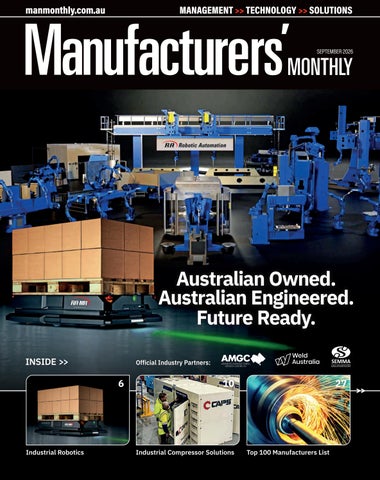
Australian Owned. Australian Engineered. Future Ready. INSIDE >>
Official Industry Partners:
6
Industrial Robotics
10
Industrial Compressor Solutions
27
Top 100 Manufacturers List
>>
COMPLETE SOLUTIONS COMPRESSOR
AIR TREATMENT
PNUEMATIC TOOLS
GENERATOR
*For illustrative purposes only
VACUUM PUMP
BLOWER
CHILLER NITROGEN GENERATION
Engineering & delivering air and power solutions to drive operational efficiency.
COMPLETE AIR & POWER SOLUTIONS
CAPS.COM.AU
E
only
air ve y.
U
manmonthly.com.au
SEPTEMBER 2026
For daily news visit manmonthly.com.au
twitter.com/Manmonthly facebook.com/Manmonthly linkedin.com/showcase/manufacturer’s-monthly/
Manufacturers’ Monthly Contents
Chairman: John Murphy CEO: Christine Clancy Managing Editor: Mike Wheeler
4
Editor’s Note
Editor: Jack Lloyd jack.lloyd@primecreative.com.au
6
Cover Story: Robotic Automation
10
Industrial Solutions
Design: Alejandro Molano Head of Design: Clayton Hawley Sales/Advertising: Emily Gorgievska Ph: 0432 083 392 emily.gorgievska@primecreative.com.au Subscriptions Published 11 times a year Subscriptions $140.00 per annum (inc GST) Overseas prices apply Ph: (03) 9690 8766
Copyright Manufacturers’ Monthly is owned by Prime Creative Media and published by John Murphy. All material in Manufacturers’ Monthly is copyright and no part may be reproduced or copied in any form or by any means (graphic, electronic or mechanical including information and retrieval systems) without written permission of the publisher. The Editor welcomes contributions but reserves the right to accept or reject any material. While every effort has been made to ensure the accuracy of information, Prime Creative Media will not accept responsibility for errors or omissions or for any consequences arising from reliance on information published. The opinions expressed in Manufacturers’ Monthly are not necessarily the opinions of, or endorsed by the publisher unless otherwise stated. © Copyright Prime Creative Media, 2024 Articles All articles submitted for publication become the property of the publisher. The Editor reserves the right to adjust any article to conform with the magazine format. Head Office 379 Docklands Drive Docklands VIC 3008 P: +61 3 9690 8766 info@primecreative.com.au www.primecreative.com.au Sydney Office Suite 11.01, 201 Miller St, North Sydney, NSW 2060 Printed by: The Precision Group 83-89 Freight Drive. Somerton Vic 3062 Ph: (03) 9794 8337
12 Manufacturing Software: Central Innovation 14
Financial Advisory
16
Multidirectional Forklifts
18
Avalon 2026
20
Manufacturing Software: ADP
22
Aluminium Window Manufacturing
24
Industrial Tooling
16
27 Ibis World Top 100 Manufacturers List 38
Industrial Sideloaders
40
Manufacturing Software: MRP Easy
42
Robotics Manufacturing
44
Battery Engineering
46
Weld Comment
48
MegaTrans
50
Bulk Awards
Behind the cover Welcome to the September edition of Manufacturers’ Monthly. This month’s cover story from Robotic Automation explores how Australia’s manufacturing sector is entering a new era, with automation, AI and strong local partnerships set to shape a more resilient future. Our September showcase edition also spotlights Ibis World’s Top 100 Manufacturers List, highlighting how Australia’s leading producers are navigating growth, volatility and global supply challenges. Also featured is an in-depth exploration from CAPS of how manufacturers are shifting their focus from simply buying equipment to getting more value from critical infrastructure across its entire lifecycle.
18
manmonthly.com.au
MANAGEMENT >> TECHNOLOGY >> SOLUTIONS
SEPTEMBER 2026
Australian Owned. Australian Engineered. Future Ready. INSIDE >>
Official Industry Partners:
6
Industrial Robotics
10
Industrial Compressor Solutions
27
>>
Top 100 Manufacturers List
manmonthly.com.au Manufacturers’ Monthly
3
EDITOR’S NOTE JACK LLOYD – EDITOR, MANUFACTURERS’ MONTHLY
Image: wi6995/stock.adobe.com
The trends shaping Australian manufacturing
O
ur September edition brings the annual release of IBISWorld’s 2026 Top 100 Manufacturers List, spanning 62 industries. The report highlights several promising trends, alongside some important challenges. By sector, the meat processing industry is now the most represented on the list, with six companies, narrowly ahead of pharmaceutical product manufacturing. Collectively, the Top 100 manufacturers generated approximately $395.7 billion in 2025, up from $376.0 billion the previous year. However, this headline growth masks a sector moving in two directions. Commodity processors and defence contractors enjoyed a strong year and helped drive growth, while fuel refiners, steelmakers and pharmaceutical product manufacturers that benefited during the pandemic experienced a significant slowdown. Victoria accounts for the largest share of revenue, at $156.9 billion, or 40 per cent of the list, while New South Wales is home to the most companies, with 47. Western Australia’s presence is smaller in number but significant in value,
4
Manufacturers’ Monthly September 2026
reflecting the state’s concentration of gold refining and alumina production. For a closer look at the companies and sectors driving Australian manufacturing, take a look at the full report within this edition. Following on from an edition that looks extensively at industry trends, Robotic Automation’s cover story explores Australia’s manufacturing future. According to the company, Australia’s manufacturing sector is entering a new era as automation, artificial intelligence, mobile robotics and data-driven production systems create new opportunities to improve productivity and global competitiveness. While manufacturers continue to face rising costs, skills shortages and international competition, advanced technologies are helping businesses produce more efficiently, strengthen resilience and address workforce challenges. The company, which has supported this transformation for 38 years, said that successful automation depends not simply on purchasing technology, but on building reliable systems
supported by long-term service, maintenance and strong customer relationships. The integration of Robotic Automation into Australian-owned Varley Group marks a further step towards strengthening domestic manufacturing capability. Combining Robotic Automation’s expertise in robotics, mobile automation and industrial systems with Varley’s engineering, manufacturing and asset management capabilities, the partnership aims to provide Australian manufacturers with greater access to advanced technology backed by local expertise and accountability. Looking ahead, AI-enabled robotics, autonomous systems and humanoid robots are expected to reshape industrial operations. For manufacturers, however, the challenge will be ensuring these technologies translate into genuine operational value. As the industry navigates this next phase, the combination of technology, local capability and long-term partnerships will be critical to building a more productive, resilient and competitive Australian manufacturing sector.
C
M
Y
CM
MY
CY
CMY
K
MaXXflow_AU_Roadshow_Magazine_Ad_Print.pdf
C
M
Y
CM
MY
CY
CMY
K
1
21/08/26
7:31 AM
COVER STORY Robotic Automation has spent the past 38 years helping Australian manufacturers adopt and integrate emerging technologies.
Stronger together: the next era of Australian manufacturing According to Robotic Automation™, Australia’s manufacturing sector is entering a new era, with automation, AI and strong local partnerships set to shape a more resilient future.
A
ccording to the Australian Industry Group’s Manufacturing in Australia Performance and outlook report 2025, Australia’s manufacturers are facing a productivity paradox. Despite investing billions in technology, many businesses continue to struggle with rising operating costs, skills shortages and increasing global competition. Industry research shows manufacturing productivity has declined over the past decade, while access to skilled technical workers remains one of the sector’s biggest constraints. Yet within this challenge lies one of the greatest opportunities in Australian manufacturing history. Advanced robotics, artificial intelligence, mobile automation and data-driven production systems are creating new ways for local manufacturers to compete on a global stage. Few organisations have had a closer view of this transformation than Robotic Automation, which has spent the past 38 years helping Australian manufacturers adopt and successfully integrate
6
Manufacturers’ Monthly September 2026
emerging technologies. Over that time, the company has witnessed first-hand how automation has evolved from a specialist capability into a strategic necessity for businesses looking to remain globally competitive. According to the company, manufacturers today are under pressure to produce more with fewer available workers, improve quality, manage costs and build resilience into their operations. Governments and industry leaders are placing renewed emphasis on domestic capability and advanced manufacturing, creating a unique moment in time for Australian industry. The question is no longer whether automation will play a role in Australia’s future. The question is how Australian businesses can implement it successfully while ensuring the benefits remain firmly rooted within local industry.
A journey through nearly four decades of change When Robotic Automation was established in 1988, industrial robotics was still considered a niche technology by many Australian manufacturers. Automation projects were often reserved for the largest industrial organisations, and the idea of robots operating across a broad range of manufacturing environments was still emerging. Over the following decades, the company grew alongside the industry it served. From robotic welding and palletising systems through to automated guided vehicles, pharmaceutical
Robotic Automation leverages R&D from the Motoman Yaskawa global centre for excellence in Sweden to deliver a complete range of welding solutions.
automation, healthcare logistics and warehouse systems, Robotic Automation has participated in many of the technological advancements that have shaped modern Australian manufacturing. More than 3,500 successful installations later, the business continues to support manufacturers across Australia and New Zealand. Importantly, the company’s growth has never been built solely on technology. It has been built on long-term relationships. Many of Australia’s leading manufacturers have partnered with Robotic Automation across multiple generations of equipment upgrades, expansions and optimisation projects. These relationships demonstrate an important lesson that the manufacturing sector has increasingly embraced: successful automation is not about buying a robot. It is about creating a reliable, productive system that continues delivering value for years, and often decades, after installation.
Why partnership matters more than ever One of the most important shifts in industrial automation has been the growing recognition that
support and service are just as important as the technology itself. Manufacturers today are becoming concerned with questions such as who will maintain the system ten years from now, where spare parts will come from, how future upgrades will be managed and whether experienced technicians will be available when production-critical equipment requires support. This has reinforced the importance of working with automation partners rather than equipment suppliers. Robotic Automation has long maintained that commissioning is not the finish line. It is the beginning of a relationship. The company’s national service network and lifecycle support philosophy have been developed around helping customers maximise operational performance, reduce downtime and achieve the greatest possible return on investment throughout the life of their automation assets. As Australian manufacturers continue investing in increasingly sophisticated automation ecosystems, this partnership-based approach is becoming even more important.
A stronger future through Australian ownership The recent integration of Robotic Automation into the Varley Group marks an important milestone for both organisations and for Australian industry more broadly. In an era where domestic capability is becoming more important, the partnership represents two Australian-owned businesses combining their strengths to create a more capable and resilient engineering and automation organisation. The benefits extend beyond scale alone. By combining the extensive experience of Robotic Automation in robotics, mobile automation and industrial systems with Varley’s long-standing expertise in engineering, manufacturing and asset management, the combined organisation is better positioned to support increasingly complex customer requirements across a broad range of industries. Perhaps most importantly, the shared commitment to Australian ownership remains unchanged. Both organisations recognise the importance of maintaining local expertise, supporting local manufacturing and ensuring
Images: Robotic Automation
manmonthly.com.au Manufacturers’ Monthly
7
COVER STORY Australian businesses have access to worldclass engineering capability backed by local accountability.
The next frontier: AI, autonomous systems and humanoid robotics While robotics has already transformed many manufacturing environments, the next wave of innovation is rapidly approaching. Artificial intelligence is set to transform industrial automation, creating a new generation of robotic systems that can see, learn, adapt and make informed decisions in real time. Technologies such as the Yaskawa Motoman NEXT robot series, with its integrated machine vision, self-learning and autonomous decision-making capabilities, provide a glimpse into a future where robots are easier to deploy, easier to program and far more capable of operating in dynamic production environments. At the same time, humanoid robotics is moving from research laboratories into real-world industrial testing environments around the world. It is likely that humanoid robots will become part of future manufacturing ecosystems, particularly in applications that require mobility, flexibility and interaction with existing infrastructure designed for human workers. However, selecting the right platform will require far more consideration than software capability alone. Industrial manufacturers will need to evaluate reliability, robustness, maintenance requirements, spare parts availability, lifecycle costs and longterm support capability. The most advanced robot is not necessarily the best robot for industrial production. This is where experience will become increasingly valuable. With nearly four decades
Artificial intelligence is set to transform industrial automation, creating a new generation of robotic systems.
of automation integration expertise, Robotic Automation is well positioned to help Australian manufacturers navigate the growing range of robotic and AI-driven technologies entering the market and identify which solutions can genuinely deliver operational value.
Building Australia’s manufacturing future Australian manufacturing stands at the beginning of another significant transformation. The technologies driving the next decade of industrial growth, including AI, autonomous systems, advanced robotics and eventually humanoid robots, are arriving faster than many expected. Yet technology alone will not
determine success. The manufacturers that thrive will be those that combine innovation with practical implementation, strong engineering capability and long-term partnerships built on trust and accountability. For Robotic Automation, now strengthened through its partnership with Varley, the focus remains clear. Continue supporting Australian manufacturers with proven automation expertise, while helping them confidently embrace the next generation of industrial technology. Because advancing Australian manufacturing has never been about the machines alone. It has always been about the people, partnerships and organisations working together to build a stronger industrial future. The recent integration of Robotic Automation into the Varley Group marks an important milestone for both organisations.
8
Manufacturers’ Monthly September 2026
YOU
MILLING
INTELLIGENTLY?
9
M
COST INIMUM
PUT UM OUT MAXIM
10
3
11 1
16
12
15
13
14 7
MINIM
UTPUT IMUM O X A M T UM COS 4
5 6 2
A smart, cost-saving solution for indexable face milling, delivering greater part-making capability with fewer tools to stock and the right tool for the job with outstanding value and efficiency.
This miniature, double-sided tangential insert with 4 cutting edges offers a cost-effective solution for square shoulder milling at shallow depths.
2
MINIM
UTPUT IMUM O X A M T UM COS
1
3
4
With 4 indexable cutting edges, the small-sized insert enables higher tooth density in high-feed milling cutters for increased productivity.
w w w.i sc a r.c o m
COMPRESSOR SOLUTIONS
Investing beyond the compressor As manufacturers navigate known challenges, the focus is shifting from buying equipment to getting more value from critical infrastructure over its entire lifecycle.
C
ompressed air, power generation and supporting infrastructure are fundamental to many manufacturing operations. When these systems perform reliably, production can continue with fewer interruptions. When they fail, the consequences can quickly extend beyond the equipment itself. For manufacturers, this has made the way critical infrastructure is selected, installed and maintained increasingly important. Energy consumption, maintenance, downtime, system efficiency and future production requirements are all becoming part of the decision-making process. CAPS Australia has worked across compressed air, power generation, gas generation and blower solutions for more than 45 years. Its approach combines equipment supply with system design, installation, monitoring, maintenance and technical support.
“While the size and scale of operations vary, CAPS has always focussed on delivering the right equipment for the task. This includes developing a solution that provides the mix needed for now and catering for additional future capacity if needed,” said CAPS Australia’s director of operations, Paul Goodwin. “It is more than picking something from a catalogue. It is about helping to sustain and enhance their operations with the right equipment and support.” Energy costs remain a consideration, while production schedules are becoming increasingly demanding. Skills shortages can also leave manufacturers with fewer internal resources to manage complex infrastructure and identify developing problems. For CAPS, this involves looking at the wider operating environment rather than simply selecting equipment to meet an immediate requirement.
CAPS has skilled, trained service technicians based at its 10 branches across Australia.
10 Manufacturers’ Monthly September 2026
Understanding production processes, operational risks and future requirements can help ensure infrastructure is designed around the needs of the business. “Understanding the load profile and operational conditions, and adequate reticulation, allow us to model efficiency. Efficiency is key, from equipment scale, capacity and pressure to the operating environment, existing infrastructure and available operational data,” said Goodwin. “An air system is more than picking a compressor. There are numerous variables to consider, and CAPS has the technology, people, experience and breadth of products to deliver the right solution and support customers to identify and meet their requirements.”
The real cost of equipment The initial purchase price of a compressor, generator or other critical asset is only one component of the overall cost. Over an asset’s life, energy consumption, servicing, replacement parts and unplanned downtime can have a greater influence on financial performance. CAPS encourages manufacturers to consider lifecycle costs and assess how equipment will perform as production requirements change. Infrastructure designed only around today’s requirements can become a limitation as a facility grows. “Compressors are like any other working machinery, the better you look after it, the better and longer it will perform, maximising its service life. So, it is vital that they are properly maintained with the correct tooling, to the right tolerances, using the appropriate consumable parts, and at the right intervals,” said Goodwin. This regular maintenance can help extend equipment life, maintain efficiency and identify developing problems before they result in unplanned failures. The CAPS Care program provides scheduled servicing, diagnostic testing, genuine replacement parts and technical support for compressed air assets. It includes Packaged Care, Planned Care, Parts Care and Performance Care options, while Power Care provides support for power generation equipment. “Prevention is always better than dealing with a cure, especially when it comes to avoiding downtime and lost production. CAPS has skilled, trained service technicians based at its 10
Images: CAPS
Ecoplant provides a dynamic controls platform designed to deliver real-time insights into compressed air system performance.
branches across Australia, each supported by direct factory links to parts and support,” said Goodwin. “In-built and optional monitoring technology can support the identification of potential issues or improvements that can keep equipment performing at its peak. Data from a customer’s machine can be compared against that from around the globe to predict issues, prevent failures and improve performance.”
Data changes the maintenance equation Digital monitoring and remote connectivity provide greater visibility over equipment performance, allowing businesses to track operating conditions and identify potential issues. Predictive maintenance can then help determine when intervention is required. CAPS is also exploring artificial intelligence to analyse operating conditions and tailor equipment performance to individual site requirements. Ecoplant, an Ingersoll Rand company, provides an advanced dynamic controls platform designed to deliver real-time insights into compressed air system performance. It is compatible with compressed air systems from original equipment manufacturers and can provide predictive maintenance insights and alerts relating to potential system failures. “AI and its utilisation across manufacturing continues to increase, as industry naturally seeks to maximise operational efficiencies and returns,” said Goodwin. “As part of the Ingersoll Rand family, CAPS is able to directly support its customers on this journey utilising the Ecoplant controls platform. Ecoplant is a machine learning, compressed air
monitoring and control network that optimizes the efficiency of compressed air generation systems. “AI will continue to help identify potential improvements or predict possible issues, and our skilled technicians can in turn work on the equipment to support our customers.”
Planning for what comes next Production volumes can increase, new processes can be introduced and operational requirements can shift. Infrastructure may also need redundancy to protect production if an individual asset becomes unavailable. Manufacturers can work with technical partners to consider capacity, redundancy, energy efficiency, maintenance requirements and future expansion as part of a single strategy. “Having the right balance of efficiency and additional capacity can be a tough call. The timeframes of current needs and those of an operation’s growth and future volumes are part of the efficiency calculation that CAPS supports customers through,” said Goodwin. “Investing in a machine that has additional capacity but then runs for an extended period below its peak operating window, can prove more costly than having the right machine for now and then adding or replacing equipment when the capacity is actually needed.”
Support beyond the installation Even well-designed systems can experience unexpected issues, making access to technical support important for production continuity. CAPS operates a nationwide network of 10
branches, providing technical expertise, genuine spare parts and 24/7 emergency breakdown assistance. Its rental fleet provides short- and long-term compressor and generator solutions for planned shutdowns, seasonal peaks, project work and emergencies. “With service, support and rental equipment if needed, there is no need for customers to experience extended disruptions to their operations,” said Goodwin.
Building value over the lifecycle For manufacturers, the challenge is no longer simply ensuring critical equipment is installed and operational. The greater opportunity lies in improving infrastructure performance throughout its working life. As energy efficiency, sustainability, workforce constraints and digitalisation become increasingly important, the relationship between manufacturers and equipment providers is also changing. A supplier that combines equipment with engineering expertise, maintenance, monitoring and technical support can play a broader role in helping manufacturers manage operational risk. For CAPS Australia, this means focusing on the complete lifecycle rather than viewing installation as the end point. “Reliability and efficiency will always be the key drivers of any infrastructure. While the specifics will vary by industry, location and demands, having the right equipment and it performing reliably and efficiently will always be critical to the success of any Australian company delivering locally, nationally or competing on a global scale,” said Goodwin.
manmonthly.com.au Manufacturers’ Monthly
11
MANUFACTURING SOFTWARE
Shannon Reshno charts Central Innovation’s next chapter Central Innovation is building on more than 35 years of manufacturing expertise with the market launch of its MaXXflow MRP platform.
A
fter more than 35 years working alongside engineering, design and manufacturing businesses across Australia and New Zealand, Central Innovation is entering a new phase of its development. At the centre of that evolution is MaXXflow, an Australian-developed material requirements planning (MRP) platform designed specifically for small and medium-sized manufacturers. The product is the result of Central Innovation drawing on decades of customer experience to address a gap it identified in the market – manufacturers that wanted to improve planning and production but found existing enterprise systems too
MA
AI
ME What items are below their ROP?
complex, expensive or disruptive. “We have always believed that innovation should not be reserved only for the largest enterprises, or for businesses with the biggest budgets and the most complex systems. Innovation should be practical. It should be accessible. And most importantly, it should help real businesses solve real problems,” said managing director of Central Innovation, Shannon Reshno. “That belief is what led us to MaXXflow.” For Reshno, the development of MaXXflow came from repeatedly hearing similar concerns from manufacturers. Many businesses were attempting to manage production through disconnected systems, manual processes, spreadsheets and whiteboards, while critical operational knowledge could remain concentrated in individuals rather than accessible across the organisation. 3 items are currently below their Reorder Point (ROP), all showing zero available stock. The company also saw an opportunity among SMEs that needed greater digital capability but were not well served by conventional enterprise systems. All three items are completely out of stock. The most critical by shortfall volume is Mounting Plate (500 kg below ROP at AUD 300.00/kg), followed by Wood Screw 30mm (400 kg) and Rubber Pad 50mm (120 kg).
ME
Purchase orders should be raised for all three immediately.
Which work centres are processing MOs linked to high value sales orders? 2 work centres are processing active MOs linked to high-value sales orders (defined as the top 25% by grand total — above AUD 10,500.00).
Both work centres are processing the same MO — WH/MO/00003 — which is tied to a sales order worth AUD 10,500.00. This order passes through both the CNC Machine Center & the Heat Treatment Furnace sequentially, suggesting a multi-stage production route. Given the high commercial value, it's worth monitoring both stations for any delays or capacity constraints.
12 Manufacturers’ Monthly September 2026
Built around manufacturing realities Rather than developing MaXXflow for a theoretical version of manufacturing, Central Innovation set out to create a system based on the practical. The company wanted a platform that could bring together the information manufacturers need to manage production, including jobs, inventory, bills of materials, purchasing, scheduling, MaXXflow is an Australiandeveloped MRP platform designed for small- and medium-sized manufacturers.
Shannon Reshno, Managing Director of Central Innovation.
customer requirements and production priorities. That focus reflects Central Innovation’s longstanding relationship with its customer base. “We realised that small and medium-sized organisations were telling us the same story,” Reshno said. “The products available were too complex, too expensive and required resources they simply didn’t have. Around 80 per cent of manufacturers across Australia and New Zealand are SMEs, and there was no suitable solution for them.” MaXXflow is intended to give manufacturers clearer visibility and stronger control over their production and supply chain operations. By bringing key information into a connected planning environment, the platform is designed to help teams access the information they need more quickly and make betterinformed decisions. Central Innovation’s approach to developing MaXXflow was deliberately collaborative. Customers were brought into the research and development process, helping the company identify the functionality they needed, explain where existing systems fell short and define the business outcomes the platform needed to achieve. That customer-led process was intended to ensure MaXXflow remained practical and accessible, particularly for manufacturers beginning their digital transformation journey. Instead of adding features for the sake of technological sophistication, Central Innovation focused on addressing genuine manufacturing problems and making the transition to connected systems more achievable. “We listened to the customer voice,” Reshno said. “We invited a number of our key customers into the development process. They told us what functionality they needed, how it should work and what business outcomes it needed to deliver.”
Releasing cash from inventory
Beyond software Central Innovation’s future strategy extends beyond MaXXflow itself. The company is developing its capabilities in bespoke software development and systems integration, including the ability to connect factory equipment such as CNC machines, brake presses, storage systems and conveyors into a more unified digital environment. That approach reflects the company’s view that manufacturing transformation is ultimately about connecting the entire value chain rather
Images: Central Innovation
For Reshno, however, the value of that visibility extends beyond operational efficiency. One of the central problems MaXXflow is intended to address is the amount of working capital manufacturers can have tied up in inventory, particularly when businesses carry more stock than they need because they lack confidence in what materials will be required and when. Manufacturers can have hundreds of thousands of dollars tied up in inventory sitting on shelves. While that stock may provide a degree of security, it can also restrict the cash available for other investments and create the risk that materials become obsolete. MaXXflow is designed to analyse forecasts, existing orders and inventory levels to determine what materials are required and when. The aim is to reduce excess inventory while ensuring manufacturers have the materials needed to meet customer commitments, improving both operational performance and cash flow. “Cash flow is the blood life of any business,” Reshno said. “We wanted to assist SMEs to become more productive, introduce them to digital manufacturing and release cash back into their business. “MaXXflow takes away that daily uncertainty for procurement managers, operations managers and finance teams.” The platform is now available for SMEs to buy and implement, marking the point at which Central Innovation’s development work moves from product awareness into market adoption. In recent months, the company has introduced MaXXflow through industry media, trade shows, customer conversations and digital campaigns, with manufacturers now able to engage with Central Innovation to assess the platform for their own operations. The release also marks a step in the company’s broader strategy in positioning itself as an end-toend solutions partner that can combine software, intellectual property, systems integration, consulting, education, implementation and technical support.
Manufacturers helped shape the platform by identifying the functionality and features they needed.
than implementing isolated software products. As more equipment and operational systems become connected, Central Innovation sees an opportunity to help manufacturers integrate the different stages of production and improve how information moves through the business. “It’s not just engineering anymore. It’s the entire value chain, even reaching externally from the business into the market,” Davis said. “Industry 5.0 is around the corner, but almost half of the SME market hasn’t yet accessed Industry 4.0. We’re bringing the benefits of connected manufacturing and digital transformation to businesses that previously didn’t have access or didn’t have the appetite because of cost and risk.” The pressure to adopt these technologies is also being shaped by Australia’s competitive environment. Manufacturers are operating against international competition while dealing with increasing energy, material and import costs, making productivity and efficiency increasingly important to maintaining competitiveness. “The Australian manufacturing sector is competing with Asia,” Davis said. “With rising energy costs, material costs and import costs, we have to get smarter and leaner. Many smaller organisations think they’re not complex enough for these solutions, but the truth is they are, and they need to consider them to remain competitive.”
A roadmap for growth The launch of MaXXflow represents the first stage of Central Innovation’s software roadmap rather than the completion of it. While the initial platform focuses on MRP functionality, the company plans to introduce AI-powered automation by the end of the year, followed by MRP II capabilities 12 to 18 months later. Those developments are intended to broaden the platform’s role from materials planning into areas
including production capacity, machine utilisation and resource planning. The objective is to give manufacturers a more comprehensive view of how their factories operate and how resources can be deployed to meet production requirements. “We’ll introduce the AI component to bring more automation,” Reshno said. “Then we’ll introduce MRP II, which brings factory capacity into the system as well – how we use machines and resources to build products.” The roadmap will continue to be shaped by customer requirements, with Central Innovation intending to identify gaps in the market and determine where its own development capabilities can provide practical solutions. Ultimately, Central Innovation sees MaXXflow as the foundation of a broader ambition to become a leading provider of manufacturing data management and planning solutions across Australia and New Zealand. The platform represents an investment in Australian-developed technology while reflecting the company’s confidence in the future of local manufacturing. “We want to be the number one solution provider in Australia and New Zealand when it comes to MRP and data management solutions,” Reshno said. For Central Innovation, the significance of MaXXflow therefore extends beyond the launch of a new software product. As Reshno puts it, digital transformation does not necessarily have to begin with disruption. It can begin with clarity – giving manufacturers a connected view of their materials, production, priorities and risks, and providing teams with the information they need to understand what is happening, determine what comes next and act with confidence. That is the role Central Innovation intends MaXXflow to play as the company enters its next chapter.
manmonthly.com.au Manufacturers’ Monthly
13
FINANCIAL ADVISORY Food and beverage, defence and advanced manufacturing are among the areas Dixon sees as particularly important.
Image: Todayphoto/stock.adobe.com
Building on RSM Australia’s manufacturing momentum Taking the reins of RSM Australia’s national manufacturing practice, Ross Dixon will focus on deepening industry expertise and helping manufacturers build for long-term growth.
F
or Ross Dixon, taking on the role of national manufacturing leader at RSM Australia marks the next step in a career that has already seen him involved in the development of the firm’s manufacturing sector. “It’s a genuine privilege and a natural progression of work I’ve been part of for several years. Louis Quintal and Jessica Oliver built a truly national sector, and my focus is to build on that momentum rather than reinvent it,” he said. His immediate priorities are centred on deepening genuine industry specialisation across RSM’s people, strengthening the firm’s presence in key subsectors and ensuring its different service lines work together more effectively. Food and beverage, defence and advanced manufacturing are among the areas Dixon sees as particularly important, with the broader objective of ensuring manufacturers experience RSM as one integrated partner rather than a collection of separate specialists.
A partner across the lifecycle That integrated approach reflects how Dixon believes manufacturers’ expectations of their advisers have changed. Rather than simply seeking compliance support, businesses increasingly want an adviser that understands their operating environment and can help them navigate the different stages of growth, from establishing a business through to raising capital, listing or exiting. Dixon sees an opportunity for RSM to act as a trusted adviser and concierge across this entire business lifecycle. “A real point of difference for us is our ability to leverage RSM’s global network to provide solutions that can scale with the business as it grows and
14 Manufacturers’ Monthly September 2026
expands into international markets,” he said. “Our footprint means we can support clients across rural, regional and metro markets right across Australia.” Quintal, who has now moved on from the national manufacturing leadership role, said Dixon’s approach makes him well suited to continuing the practice’s development. Having worked with Dixon on RSM’s manufacturing strategy, he highlighted his practical, collaborative and growth-focused leadership style that is highly suited to the manufacturing sector. “Throughout our work together on the national strategy, he has consistently demonstrated a strong understanding of both the opportunities and challenges facing Australian manufacturers, while also recognising the importance of bringing people together across service lines and offices to deliver value for clients,” Quintal said.
Manufacturing in transition Dixon’s appointment comes at a time when Australian manufacturing is undergoing change. He describes the sector as being in transition rather than decline, with manufacturing contributing roughly six per cent of GDP and around $137 billion in value-added output. The issues he hears most frequently from manufacturers are centred on resilience and operational agility. Businesses are managing cash flow conversion and seeking to preserve balance sheet strength while navigating supply chain disruption, rising input costs and uncertain demand. Despite these pressures, Dixon said the tone across the sector is cautiously optimistic. For manufacturers operating in a high-cost environment, Dixon believes competitiveness increasingly depends on productivity rather than simply cutting costs.
Ross Dixon, national manufacturing leader, RSM Australia. Images: RSM Australia
“Competitiveness now comes from productivity, not just cost-cutting,” Dixon said. “Firms that have implemented Industry 4.0 technologies are reporting revenue growth rates up to six times the industry average of around 3 per cent.” The foundation for those gains, however, is data. Dixon points to quality management reporting around efficiency against benchmarks, plant utilisation, inventory turnover and work in progress as critical measures that allow manufacturers to make decisions based on evidence rather than instinct.
Turning data into productivity Automation, robotics, artificial intelligence and 3D printing are among the clearest levers Dixon sees for improving productivity and global competitiveness. But technology alone is not enough. The quality of the information being used to make decisions is equally important, meaning manufacturers need sound underlying data, scalable IT infrastructure and disciplined finance functions. The shift towards more sophisticated technologies is also changing what manufacturers expect from professional advisers. Conversations that once centred primarily on tax and accounting are increasingly incorporating research and development, grants, cybersecurity, environmental, social and governance requirements, decarbonisation, digital adoption and CFO-style advisory. “Data-driven utilisation, robotics, AI and 3D printing are the clearest levers for productivity and global
competitiveness. The caveat is ‘garbage in, garbage out’: you can’t get quality insight without sound, consistently processed underlying data, which is where scalable IT infrastructure and disciplined finance functions matter,” Dixon said. He said RSM’s cross-service-line model is designed to respond to that changing demand. The firm’s manufacturing committee brings together specialists from across the business to work collectively around a client rather than operating independently. “This is the heart of our model. Our committee is deliberately cross-service line, and our case studies show what happens when Business Advisory, R&D, Corporate Finance, Cyber and ESG work as one team around a client,” Dixon said.
Where growth is emerging While manufacturers continue to contend with cost pressures, Dixon sees opportunities emerging from investment across defence, infrastructure, energy and advanced manufacturing. Defence supply chains are a standout area, supported by initiatives including the Future Made in Australia policy and the National Reconstruction Fund. Export-oriented subsectors such as food processing, medical devices and precision engineering also continue to benefit from strong international
demand. For manufacturers pursuing innovation-led growth, government incentives and grants remain an important lever, particularly as businesses look to invest rather than simply respond to immediate challenges. The role of RSM, Dixon says, is to help manufacturers establish the foundations that allow that investment to occur sustainably. “This means building a scalable finance function, getting investor and funding readiness right, and using our corporate finance capability and global network to help clients prepare to raise capital, grow, or plan succession and exit, delivering solutions that scale with the business,” he said.
Building the next generation For Quintal, the handover represents the next stage of a manufacturing strategy that has already established a strong foundation within RSM. During his tenure, the team developed a national presence, strengthened its industry profile and deepened client relationships, while creating a culture of collaboration across the firm. He said the practice is now positioned to continue building its capabilities while developing the next generation of manufacturing leaders within RSM. That continuity is important as the firm seeks to increase
its presence in key subsectors and maintain the momentum created over recent years. “I am incredibly proud of what the manufacturing team has achieved over the past few years. Together we have built a truly national sector, strengthened our industry profile, developed deeper client relationships and created a platform for sustainable growth,” Quintal said. “Importantly, we have established a culture of collaboration that brings together expertise from across the firm to support manufacturers at every stage of their journey.” For Dixon, that culture will be central to what comes next. His measure of success is not simply the growth of RSM’s manufacturing practice, but whether the firm becomes recognised as a genuine partner to manufacturers across the middle market, from rural and regional businesses through to those operating in metropolitan Australia. That means continuing to develop sector expertise within RSM while strengthening relationships with the businesses that will shape Australian manufacturing’s future. “I’d like our relationship with the sector to keep deepening: growing the next generation of manufacturing leaders within RSM and being the trusted adviser to the businesses driving Australia’s manufacturing future,” he said.
TURN WORKFORCE DATA INTO BETTER PRODUCTION DECISIONS Bring payroll and workforce management data together to improve labour visibility, align rosters with production demands and manage workforce costs with greater confidence.
Plan smarter
Control costs
Protect productivity
Discover workforce solutions built for manufacturing.
Visit au.adp.com
manmonthly.com.au Manufacturers’ Monthly
15
INDUSTRIAL FORKLIFTS
Moving material handling forward From a 1998 start-up in Ireland to more than 100,000 machines operating across 85 countries, Combilift is rethinking how manufacturers move and store materials.
W
hen Combilift was founded in Monaghan, Ireland, in 1998 by Martin McVicar and Robert Moffett, its proposition was to create a forklift that could move like a conventional machine but also travel sideways. The first result was the multidirectional 4-tonne C-Series, which remains in production almost 30 years later. The business has grown from producing 18 machines in its first year to more than 100,000 operating across more than 85 countries, while maintaining its focus on practical customer problems. “We are customer-centric, and our goal is to understand the challenges our customers face and develop practical solutions that make their operations safer, more productive and more space-efficient,” said McVicar, Combilift’s managing director.
Solving the long-load challenge The original challenge remains relevant across steel, timber and aluminium. Long materials can be difficult to manoeuvre with traditional counterbalance forklifts because wide turning circles restrict movement, waste time and require additional space. Combilift’s multidirectional trucks allow operators to travel forwards, backwards and sideways, moving long loads through narrow aisles and tight corners without the turning areas required by conventional forklifts. The approach also removes the need for overhead carrying, helping reduce the risk of accidents and damage while improving workflow.
Combilift’s headquarters and manufacturing operation remain in Monaghan, Ireland.
16 Manufacturers’ Monthly September 2026
As manufacturers face pressure to reduce costs and emissions, respond to changing demand and make better use of valuable floor space, Combilift’s focus has expanded from moving materials to optimising the wider operation. McVicar said this application-led approach can improve workflow as well as space utilisation. It can also support safer, more productive handling across facilities. “We’re looking at the whole operation, the space in the warehouse or yard, how materials flow through it, and how our trucks can optimise storage and enhance overall operational safety and productivity,” he said. Combilift’s equipment can increase storage positions within existing footprints by operating in narrower aisles, while its warehouse design and layout optimisation service produces layouts tailored to products and operational requirements. McVicar said storage capacity can often be doubled while throughput is improved and double handling reduced. “It’s really about the ‘improving, not moving’ approach, finding ways to get more capacity and productivity from the existing footprint rather than automatically assuming that more space is the answer,” he said. “Australia is a particularly good fit for our technology because many of these industries deal with exactly the types of loads and environments that Combilift was designed around: long steel products, structural timber, aluminium, mining, and other bulky loads.”
A portfolio built around applications Combilift’s portfolio spans multidirectional forklifts, sideloaders, articulated forklifts, pedestrian trucks, autonomous solutions, container loader/unloaders and straddle carriers for heavy and oversized loads. Customisation is particularly important for industries where loads and operating conditions are nonstandard. The C-Series and CB ranges can operate as traditional counterbalance forklifts, sideloaders and narrow-aisle forklifts, potentially replacing several specialist trucks. The Aisle Master articulated VNA truck can lift to 15m and operate in aisles as narrow as 1.85m. “There isn’t a one-size-fits-all solution when it comes to material handling,” said McVicar. Combilift invests 7 per cent of annual turnover in research and development, with 98 per cent of that investment focused on energy-efficient and electricpowered equipment. Customer feedback is central to the process, with teams identifying operational problems and developing solutions around emerging requirements. “Innovation is very much part of our DNA,” said McVicar. “Around 90 per cent of the machines we manufacture will be customised and different in some way, whether that’s because of the load being handled, the working environment, the dimensions of the facility or a particular operational requirement.” Combilift’s headquarters and manufacturing operation remain in Monaghan. Innovation, customer focus and engineering underpin its culture,
BOGE’S NEW E-SERIES Complete. Compact. Ready to go.
Images: Combilift
while training, servicing, spare parts and ongoing support are provided through its distributor and dealer network. “We have always seen ourselves as more than a forklift manufacturer, more as a solution-based partner for material handling operations and challenges,” said McVicar.
Safety and sustainability designed into the machine Long, heavy and awkward loads place greater demands on visibility, stability and manoeuvrability. Combilift incorporates features including elevated cabs, generous glazing, ergonomic controls, stability systems and application-specific safety technologies. Its pedestrian-operated electric trucks use a patented multi-position tiller arm that allows operators to move from behind the truck to the side, away from the crush zone, while maintaining visibility and reducing operational aisle width. “Ultimately, though, safety isn’t just about adding technology; it’s about designing the right truck for the application,” said McVicar. Alongside safety, sustainability is also a priority of the company. More than 70 per cent of production is now electric, with almost the entire product range available with electric power. Combilift also considers how denser storage and more efficient material flow can reduce the need for facility expansion and unnecessary movement. At its Monaghan operation, solar panels supply around 450kW, while skylights use natural light and rainwater is harvested. “Our approach is really about looking at sustainability across the whole material-handling
Combilift’s multidirectional trucks allow operators to travel forwards, backwards and sideways.
system, rather than focusing on the power source of the truck alone,” said McVicar.
6
Automation meets human flexibility Automation and connectivity are increasingly important as manufacturers address productivity, labour and skills shortages. Combilift’s Combi-AGT is described as the world’s first autonomous sideloader designed specifically for long loads in very narrow aisles, while retaining manual operation. Combi-Connect, the company’s cloud-based telematics platform, provides real-time performance monitoring, diagnostics and usage analytics covering energy consumption, idle times, maintenance alerts, performance indicators and remote updates. “Automation is becoming increasingly important, particularly as customers look for ways to improve productivity and address labour and skills shortages,” said McVicar.
Best value for money pa age Long lasting BOGE quality Wide performan e range from 4 30 W tailored to every need Intelligently ontrolled through BOGE ase ontrol Availa le with fixed speed or frequen y ontrol Dura le low maintenan e Sustaina le -
-
-
-
,
,
-
The next decade For Australian manufacturers, McVicar sees an opportunity to increase productivity by rethinking existing facilities. Narrower aisles and greater lift heights can create additional storage capacity without larger warehouses or yards, while improved material flow can support competitiveness. Over the next five to 10 years, Combilift expects electrification, connectivity and intelligent warehouse design to continue developing, supported by continued investment in R&D and people. “Our priority will be to keep developing solutions that address real-world challenges while making material handling safer, more efficient and more sustainable,” said McVicar.
Contact your nearest BOGE Partner boge.com/en-au (03) 5940 5913
17
AVALON 2027
AVALON 2027: A strategic platform for Australian manufacturers Avalon 2027 offers Australian manufacturers a strategic platform to showcase capability, build supply chain connections and access emerging defence and aerospace opportunities.
Beyond aviation While Avalon is best known as an aerospace and defence exposition, its relevance extends beyond aircraft and aviation. Modern defence capability relies on a broad industrial ecosystem encompassing advanced manufacturing, materials engineering, electronics, communications, software, autonomous systems and specialised components. As technology continues to blur traditional boundaries between air, land, maritime and joint domains, opportunities are emerging for manufacturers across a range of sectors. Avalon reflects this evolution, bringing together capability developers, end users, supply chain partners and decision-makers in a single environment. For manufacturers seeking to diversify, explore defence opportunities or better understand future market requirements, the event offers insights into where industry demand is heading.
Building connections that matter In specialised industries, meaningful business outcomes are often built on relationships developed over time. Avalon provides an opportunity to engage directly with the people responsible for capability
18 Manufacturers’ Monthly September 2026
Images: AMDA
A
ustralia’s defence, aerospace and advanced manufacturing sectors are entering a period of growth, underpinned by investment in sovereign capability, industrial resilience and emerging technologies. For manufacturers, the opportunity extends beyond supporting current programs. Increasingly, success depends on understanding future requirements, strengthening relationships across supply chains and ensuring capabilities are visible to the organisations driving investment and procurement decisions. Avalon Australian International Airshow 2027 will provide one of the country’s best opportunities to do exactly that. From 23–28 February 2027, more than 900 exhibiting organisations are expected to gather at Avalon Airport in Victoria alongside senior Defence and government representatives, industry primes, international delegations, researchers and technology leaders. Together, they form a cross-section of the organisations shaping Australia’s future defence and aerospace landscape.
From 23–28 February 2027, more than 900 exhibiting organisations are expected to gather at Avalon Airport.
development, program delivery and industrial partnerships. Defence representatives, government agencies, procurement specialists, prime contractors and international stakeholders all attend the event, creating opportunities for conversations that may otherwise be difficult to facilitate. For exhibitors, the value goes beyond product displays. The event provides a platform to demonstrate technical expertise, manufacturing capability, innovation and capacity to support complex programs, while positioning organisations within both existing and emerging supply chains.
Taking Australian capability to a global audience As Australian industry becomes increasingly integrated into allied and international markets, opportunities to engage with overseas customers and partners continue to grow in importance. Avalon’s international delegation program attracts representatives from governments, defence organisations from around the world, offering Australian manufacturers exposure to global markets without leaving home. For organisations with export ambitions, the event can provide a starting point for discussions around collaboration, market entry and participation in international supply chains. At a time when trusted partnerships and supply chain resilience are becoming key strategic considerations, visibility within the right environment has never been more important.
Maximising your presence While exhibition space remains the foundation of
many organisations’ participation strategies, Avalon also offers a range of sponsorship and branding opportunities designed to increase visibility across the event. From prominent locations throughout the venue to event publications, digital channels and key networking facilities, sponsorship provides additional opportunities to strengthen brand awareness and reinforce market positioning among trade and public audiences alike. For organisations looking to make a lasting impression, these opportunities can complement an exhibition presence and extend engagement throughout the week-long event.
Positioning for future growth As investment in defence, aerospace and advanced industry continues to accelerate, the ability to engage with customers, partners and decision-makers remains a critical component of growth. Avalon 2027 offers manufacturers an opportunity to demonstrate capability, strengthen industry relationships and gain insight into the technologies, programs and partnerships shaping the future. For organisations considering how they will position themselves in an increasingly competitive market, Avalon remains a significant industry event on the Australian calendar. Exhibition, sponsorship and branding opportunities are now available. Avalon Australian International Airshow, presented with the Royal Australian Air Force and the Victorian State Government, will be held at Avalon Airport, Geelong, Victoria, from 23–28 February 2027. To learn more, visit airshow.com.au.
ROBOTIC WELDING
MOBILE ROBOTS
MACHINE TENDING
COBOTS
PALLETISING
PACKAGING
STRAPPING + WRAPPING
Australia’s Trusted Automation Partner Since 1988. WELDING | PALLETISING | MOBILE ROBOTS | COBOTS | WMS | PACKING | MACHINE TENDING | MATERIALS HANDLING
Robotic AutomationTM is an Australian owned, leading integrator of industrial robotics and automation solutions. Choosing an experienced integrator with proven local service and support is integral to the success of any system. Robotic Automation Pty Ltd T. 1300 552 333 E. sales@ragroup.com.au W. www.ragroup.com.au
Exclusive Partners:
INDUSTRIAL SOFTWARE
The workforce advantage manufacturers can’t afford to overlook As manufacturers accelerate investment in automation, AI and digital operations, a new challenge is emerging, ensuring the workforce evolves as quickly as the technology.
A
ustralian manufacturers have spent years investing in productivity-enhancing technologies, from automation and advanced planning systems to industrial AI and connected operations. Yet many organisations still manage workforce decisions through fragmented processes, disconnected systems, and incomplete data. That disconnect is becoming harder to ignore. While manufacturers have traditionally focused on workforce planning through the lens of labour availability and cost, leading organisations are adopting a broader approach: Total Workforce Strategy. This involves orchestrating all talent sources across employees, contractors, consultants and contingent workers, supported by integrated data, technology-enabled visibility and workforce planning aligned to future business needs.
The skills challenge behind digital transformation The shift is occurring against a backdrop of intensifying skills shortages and changing workforce expectations. The ADP People at Work 2026 research shows that only 11 per cent of Australian cycle workers (those who do similar repetitive tasks each day), believe they currently have the skills needed to advance to the next job level within three years. While that represents a slight improvement from 10 per cent in 2024, it remains significantly below India (35 per cent), the Philippines (27 per cent) and Vietnam (17 per cent). The findings suggest that workforce capability development remains a significant challenge for Australian employers, particularly as manufacturers seek to adopt increasingly sophisticated digital technologies on the factory floor. At the same time, employee perceptions of employer investment in career development have declined. Just 3 per cent of Australian cycle workers report feeling their employer invests in the skills needed for future career progression, down from 6 per cent in 2024. While comparable figures across APAC remain modest, markets such as the Philippines (15 per cent), Vietnam (14 per
20 Manufacturers’ Monthly September 2026
cent) and India (18 per cent) report considerably stronger sentiment.
AI adoption is outpacing workforce readiness For manufacturers, these findings raise an important question: are workforce development programs keeping pace with technology investment? The answer matters because AI adoption is accelerating rapidly across manufacturing environments. ADP Research found that 50 per cent of manufacturing employees already use generative AI tools at least weekly, with 19 per cent using them nearly every day. Employees are increasingly integrating AI into everyday work, regardless of formal organisational strategies. Australian workers also appear increasingly optimistic about AI’s impact on their roles. Among Australian cycle workers, the proportion who believe AI will have a positive impact on their job responsibilities increased from 5 per cent in 2024 to 6 per cent in 2025. While modest, the trend mirrors stronger growth across emerging APAC economies, including Vietnam, where positive sentiment more than doubled from 10 per cent to 23 per cent. For manufacturing leaders, this highlights an important distinction. The competitive advantage may no longer come solely from investing in AI technologies, but from ensuring the workforce has the skills, confidence and support to apply those technologies effectively. That requires visibility.
Why workforce visibility matters According to the ADP People at Work 2026 research, organisations across Asia Pacific spend an average of 22 hours per week, per country, managing data flows between payroll and other business systems. Meanwhile, 77 per cent of organisations say they would find significant value in working with a provider offering a single solution for HR, payroll and workforce management. For manufacturers operating across multiple sites, shifts and workforce types, fragmented workforce data can create operational blind spots. Decision-
makers may struggle to understand overtime trends, workforce utilisation, skills availability, labour costs and compliance exposure until issues have already affected production performance. The most effective organisations are moving beyond traditional workforce reporting and building workforce intelligence capabilities that support realtime decision making. Workforce data is increasingly being used alongside production, financial, and operational metrics to improve agility and resilience.
Measuring workforce success differently Measuring success also requires a broader set of performance indicators. Best practice organisations typically monitor a balanced workforce scorecard across three dimensions. Financial measures include workforce costs as a percentage of revenue, cost-per-hire, and budget variance. Operational measures focus on timeto-fill, workforce composition, and compliance performance. Strategic measures assess workforce agility, manager satisfaction, and access to critical capabilities. Most organisations begin by tracking six to eight core workforce KPIs quarterly before expanding their measurement framework as maturity increases.
Image: DC Studio/stock.adobe.com
LONG LOADS. TIGHT SPACES. ONE SOLUTION.
Many organisations still manage workforce decisions through fragmented processes and incomplete data.
manufacturing leaders, this “ For highlights an important distinction.
The competitive advantage may no longer come solely from investing in AI technologies, but from ensuring the workforce has the skills, confidence and support to apply those technologies effectively.
Building a workforce advantage for Industry 4.0
”
The urgency is growing. Skills’ half-lives continue to shrink; workforce expectations continue to evolve, and competition for specialised talent remains intense. Manufacturers that develop strategic workforce capabilities today are creating an advantage that will be difficult for competitors to replicate. The next step is not a large-scale transformation program. The most successful organisations start by assessing current workforce visibility, identifying capability gaps, piloting targeted improvements, and then scaling proven approaches. As manufacturers continue their Industry 4.0 journey, workforce strategy is increasingly becoming a determinant of operational performance. Technology remains essential, but the organisations most likely to succeed will be those that combine digital innovation with the workforce intelligence needed to deploy the right skills, in the right place, at the right time.
MULTIDIRECTIONAL HANDLING SOLUTIONS FOR AUSTRALIAN MANUFACTURING
Watch the PhoeniX in action! 21
09-26 Manufacturers Monthly Vertical V3.indd 1
19/08/2026 11:24:12 AM
ALUMINIUM WINDOW MANUFACTURING
A partnership built to last For more than 50 years, Tucks Windows has relied on Australian-made Capral aluminium systems to deliver custom glazing solutions.
F
or more than half a century, Tucks Windows has been a fixture of regional Victorian manufacturing. Based in California Gully, Bendigo, the family-owned business has built a reputation for producing custom aluminium windows, doors and glazing solutions for residential and commercial projects throughout central Victoria. Throughout that journey, one partnership has remained almost constant – its longstanding relationship with Australian aluminium manufacturer Capral.
From modest beginning Founded on 1 July 1972 by Tony Tuck, the business began as a modest operation supplying aluminium windows to support a local builder. More than five decades later, Tucks Windows manufactures a broad range of products including custom windows and doors, shower screens, wardrobes, mirrors and glazing systems for projects ranging from architectural homes to hospitals, prisons and commercial developments. While the business has evolved, its commitment to quality craftsmanship, personalised service and Australian manufacturing has remained unchanged. “We’re not a mass producer, we’ll make it to their specification, to their sizing. We like it to be proper, fit well and good quality,” said managing director, Mark Daley. “That willingness to customise has become one of the company’s defining strengths. Rather than relying on standardised sizes, Tucks Windows produces made-to-order solutions designed around each individual project.” Daley joined the business more than 23 years ago when founder Tony Tuck retired, continuing the family legacy while maintaining the values that established the company’s reputation. Today, Tucks Windows continues to undertake everything from complete residential window replacement projects through to complex commercial installations, including work at local hospitals, correctional facilities and the St John of God Hospital boardroom, which features switchable glass. Its flexibility has become increasingly important as modern architecture demands larger openings, more complex geometries and higher-performing building envelopes. Much of the company’s work now centres on upper-market architectural housing, where customisation, precision and problem solving are essential to meeting both design ambitions and regulatory requirements.
22 Manufacturers’ Monthly September 2026
Tucks Windows’ relationship with Capral extends well beyond purchasing aluminium extrusions.
“It’s not run-of-the-mill residential sliding windows. We’re doing a lot of commercial-style products going into residential homes – shapes, rakes and designs that are trending at the moment,” Daley said. That depth of experience is one of Tucks Windows’ greatest assets. Many employees have spent decades with the business, including sales staff approaching 50 years of service and glaziers with more than 40 years on the factory floor. The longevity of the workforce has created an environment where practical knowledge is continually shared, allowing experienced tradespeople to mentor newer employees while maintaining the quality standards the business has become known for. “The guys are all hands-on. They’ve got to think outside the box and make things work. There’s enough experience on the floor that if somebody’s struggling with something, there’s somebody else that can guide them in the right direction,” said Daley. Daley believes fostering a supportive workplace has played a large role in retaining skilled staff. Alongside its experienced workforce, the company continues investing in the next generation by employing apprentices and encouraging young people to pursue careers in glazing and manufacturing, ensuring valuable knowledge continues to be passed on.
Aluminium meeting modern demands Aluminium has long been at the centre of Tucks Windows’ product offering, but the way the material is used has changed over the past five decades. As building standards have evolved, so too have customer expectations around energy efficiency, structural performance and compliance.
Architectural trends towards larger glazing systems, wider openings and increasingly complex designs have pushed manufacturers to continually improve the performance of window and door systems. At the same time, requirements such as seven-star energy ratings, Section J compliance for commercial buildings and bushfire standards have placed greater emphasis on thoroughly tested, highperforming products. “The performance requirements in building now, the ceiling’s been lifted,” Daley said. “Architects love doing stuff bigger, taller, wider. So, you’ve got to move and be able to provide products that can meet those requirements. “The good thing about Capral is the stuff is all tested so that we can provide that documentation.” For customers, those certified systems provide confidence that the products installed today will continue performing well into the future. Daley said quality and longevity have become increasingly important purchasing considerations, particularly as uncertainty grows around imported building products and global supply chains. “With imports at the moment, it’s scary times ahead. At least we know by being Australian made, locally manufactured, we’re here for the long haul,” Daley said. The company’s showroom reflects that philosophy, giving customers the opportunity to see, operate and compare products before making purchasing decisions. Rather than relying solely on brochures or specifications, clients can experience the performance and finish of the products first-hand. “I believe showrooms are like car yards,” Daley said.
For more than half a century, Tucks Windows has been a fixture of regional Victorian manufacturing.
Images: Tucks Window/Capral
“You wouldn’t go and buy a car without test driving it. I encourage customers to come and have a play with the products before they place their order.”
Aluminium has long been at the centre of Tucks Windows’ product offering.
More than a supplier Tucks Windows’ relationship with Capral extends well beyond purchasing aluminium extrusions. Beginning shortly after the company was established, the partnership has grown into a collaborative relationship built on technical support, product development and mutual trust. After initially manufacturing with Comalco systems during the business’s earliest years, Tucks Windows transitioned to Capral and has remained with the company ever since. Daley attributes that loyalty to consistent product quality, dependable supply and a relationship built on open communication. The partnership has also provided opportunities for Tucks Windows to contribute directly to the development of new systems. Drawing on decades of fabrication experience and close contact with customers, Daley and his team have provided practical feedback on products including the Urban Plus range and, more recently, the AGS Comfort thermally broken system before they entered production. “We’ve always had a good relationship,” Daley said. “In building, you need a good relationship so that you can rely on each other. It’s a two-way thing. We can help them; they can help us. “We ran our eyes over the original plans and made some suggestions. The same with the new Comfort range. We gave some suggestions which they accepted and altered before it went into production.” That collaborative approach allows Capral to receive
direct feedback from fabricators working at the frontline of the market while helping Tucks Windows ensure future systems align with changing customer expectations and regulatory requirements. As sevenstar energy standards continue driving demand for thermally efficient products, those conversations have become increasingly valuable. Daley said Capral’s national manufacturing footprint also provides an additional level of confidence. With manufacturing facilities across multiple states, the company can source products from different locations if stock becomes unavailable locally, helping customers avoid project delays while maintaining reliable supply. “The advantage with Capral is they have so many base factories. If we’re short in Melbourne of a product, it can be outsourced from somewhere else and freighted over so we can keep our projects going,”
he said. “If they don’t know what the market’s demanding, how do they provide that product to the market?” In regional communities such as Bendigo, reputation remains one of the most valuable assets a business can have. After more than 50 years, Tucks Windows continues to grow largely through repeat customers and word-of-mouth recommendations, underpinned by quality products, dependable service and long-term partnerships. Daley said those relationships extend beyond customers to suppliers and employees alike, creating a business built on trust, collaboration and shared success. Whether pointing out completed projects around town or walking through the factory each morning to greet staff, he remains proud of what the business has achieved and optimistic about its future.
manmonthly.com.au Manufacturers’ Monthly
23
INDUSTRIAL TOOLING
ISCAR’s tooling strategies for titanium and nickel-based superalloys Machining titanium and nickel-based superalloys demands specialised tooling and proven process strategies to improve tool life, maintain precision, and deliver reliable performance.
T
itanium alloys and nickel based superalloys are widely used in aerospace applications due to their high mechanical strength, corrosion resistance, and thermal stability under extreme operating conditions. Despite their advantages in service, these materials present machining challenges that directly affect tool life, surface integrity, and overall process stability. Application knowledge developed by ISCAR’s engineering teams and ISCAR cutting tool technologies address dominant wear mechanisms, heat generation, and vibration. The focus is placed on achieving improved tool life, dimensional consistency, and process efficiency in aerospace manufacturing environments Aerospace components are frequently manufactured from materials specifically engineered to perform under high mechanical loads, elevated temperatures, and aggressive environmental conditions. Titanium alloys and nickel based superalloys enable high strength to weight ratios and thermal resistance, making them essential for structural components, engine parts, and other critical assemblies. However, these same properties result in poor machinability when compared with conventional steels or aluminium alloys. Low material removal rates, accelerated tool wear, and strict quality requirements contribute to overall manufacturing costs, particularly when machining high value aerospace components. Titanium alloys such as Ti 6Al 4V are characterised by low thermal conductivity, approximately one sixth that of steel, which causes heat generated during cutting to concentrate at the tool–workpiece interface. This localised heat accumulation accelerates flank wear and can lead to plastic deformation of the cutting edge. Titanium also exhibits strong chemical affinity with cutting tool materials, increasing the tendency for built up edge formation and material adhesion, particularly at lower cutting speeds. To address these challenges, ISCAR employs fine grain carbide substrates and advanced PVD coatings used across tool families such as HELIDO, CHATTERFREE, and solid carbide cutters, which are designed to maintain edge stability while minimising friction and heat generation.
24 Manufacturers’ Monthly September 2026
For titanium and nickel-based superalloys, Physical Vapor Deposition coatings developed under ISCAR’s SUMOTEC technology are frequently applied.
Nickel based superalloys present a different but equally challenging set of machining conditions. These materials retain high strength at elevated temperatures and exhibit pronounced strain hardening behaviour during plastic deformation. In machining operations, this leads to increased cutting forces, rapid work hardening ahead of the cutting edge, and aggressive wear mechanisms such as notch wear, diffusion wear, and crater wear. Cutting speeds are typically limited to control heat generation, which further impacts productivity. ISCAR addresses these conditions with reinforced insert geometries and thermally stable coatings found in turning and milling systems such as SUMOTEC grades and HELITURN and LOGIQTURN tool platforms, which are engineered to provide predictable wear behaviour during prolonged cutting cycles. Machining processes for aerospace components must meet demanding requirements that extend beyond dimensional accuracy alone. Typical tolerance bands are often within ±5 to ±10 micrometers, while surface integrity must be controlled to avoid micro cracking, smeared material, or tensile residual stresses that could compromise fatigue performance.
Many aerospace components feature thin walls, complex geometries, or interrupted cuts, all of which increase sensitivity to vibration and tool deflection. ISCAR’s variable pitch and variable helix cutter designs, used in milling families such as CHATTERFREE and HELIMILL, are specifically intended to suppress chatter and improve process stability under these conditions. Cutting tool substrates used in aerospace machining must balance hardness and fracture toughness to withstand high mechanical and thermal loads while resisting edge chipping. Fine grain carbide grades are commonly selected to provide sufficient wear resistance without sacrificing toughness, particularly in interrupted or unstable cutting conditions. For titanium and nickel based superalloys, Physical Vapor Deposition coatings developed under ISCAR’s SUMOTEC technology are frequently applied due to their strong adhesion, thermal stability, and ability to reduce friction at the tool– chip interface (Fig.1). These coatings act as a thermal barrier, slowing heat transfer into the cutting tool and contributing to more predictable wear patterns. In milling operations, variable pitch and
ISCAR tooling strategies emphasise predictable and repeatable wear behaviour rather than maximum theoretical tool life.
Hole making operations represent a critical aspect of aerospace machining.
chip evacuation and reduce thermal load at the cutting edge. These solutions support consistent hole quality across a wide range of aerospace materials and component geometries. Tool life in aerospace machining is governed by a complex interaction of cutting parameters, tool geometry, coolant application, and machine tool rigidity. Production data and empirical studies consistently show that relatively small reductions in cutting speed, often in the range of 10 to 20 per cent, can result in substantial improvements in tool life when machining nickel based superalloys, without a proportional increase in cycle time. ISCAR tooling strategies emphasise predictable and repeatable wear behaviour rather than maximum theoretical tool life, as predictability simplifies tool change planning and reduces the risk of sudden tool failure on high value components (Fig. 3). In a production environment machining titanium structural component for aerospace assemblies, excessive flank wear and inconsistent surface finish were observed during peripheral milling operations. By applying a variable helix ISCAR milling cutter, optimising coating selection, and adjusting cutting parameters, tool life increased by more than 30 percent. Surface roughness values were reduced to within specification limits, resulting in improved process stability, reduced scrap, and lower operator intervention. The integration of digital tool libraries with CAM
Images: ISCAR
variable helix cutter designs are used to disrupt harmonic frequencies and reduce chatter, which is especially important when machining thin walled aerospace components. In titanium applications, high feed milling strategies implemented with tools such as HELIMILL HFM allow reduced radial engagement combined with higher feed per tooth, lowering cutting forces and limiting heat generation. For nickel based superalloys, milling strategies emphasise stable cutter engagement and uniform chip thickness to minimise localised wear, particularly at depth of cut transition zones where notch wear is most likely to occur. Turning and parting operations for aerospace alloys require rigid insert geometries and secure clamping systems to manage elevated cutting forces and thermal loads. ISCAR turning systems such as HELITURN, JETCUT, and LOGIQTURN are designed with strong insert seating and optimised edge preparations to support stable cutting. Effective chip control is critical, particularly in titanium machining where long, continuous chips can interfere with the cutting zone and damage the workpiece or tool. In superalloy turning, insert geometry and edge preparation play a central role in controlling notch wear and extending usable tool life during long, continuous cuts. Hole making operations (Fig. 2) represent a critical aspect of aerospace machining, as hole quality affects assembly integrity and fatigue performance. ISCAR’s drilling solutions such as SUMOCHAM and LOGIQ-3-CHAM, along with indexable systems like DR TWIST and TRIDEEP, provide optimised point geometries and internal coolant delivery to improve
systems plays an increasingly important role in aerospace process planning. ISCAR’s digital tooling platforms provide standardised tool data that supports consistent tool selection and parameter definition, reducing setup variability and shortening process development cycles. Simulation and verification tools further enable the evaluation and optimisation of cutting strategies before implementation on the shop floor, lowering the risk associated with machining high value aerospace components. Improved tool life and stable machining processes contribute to lower scrap rates and reduced energy consumption per component. Given the high cost of aerospace raw materials, even marginal reductions in scrap can yield economic benefits. Efficient machining strategies also support sustainability objectives by minimising material waste and maximising tool utilisation. Machining titanium and nickel based superalloys for aerospace applications requires careful alignment of material behaviour, tooling technologies, and cutting strategies. Data-driven tool selection and process optimisation, supported by ISCAR’s aerospace focused tooling portfolio, enable measurable improvements in tool life, surface integrity, and process reliability. ISCAR’s strategies provide a technical framework for addressing the inherent challenges of aerospace alloy machining while maintaining compliance with strict quality and performance requirements.
manmonthly.com.au Manufacturers’ Monthly
25
Some suppliers come and go.
Capral stays. For 90 years, Australian manufacturers have relied on Capral. We manufacture aluminium extrusions right here in Australia, backed by a nationwide network supplying extrusion, sheet and plate.
90 years supporting Australian businesses. And we’re planning on the next 90. Need a reliable supplier? Call us 1800 ALUMINIUM 258
Australian Made. Nationwide. Here for the long haul.
646
Order online 24/7 Pick-up & Delivery shop.capral.com.au
2026
TOP 100 MANUFACTURERS LIST Exclusive insights into the top manufacturers in Australia.
POWERED BY
TOP 100
2026
MANUFACTURERS LIST
Top 100 Manufacturers List reveals key industry trends The Top 100 Manufacturers List, based on 2025 financials, highlights how Australia’s leading producers are navigating growth, volatility and global supply challenges.
I
BISWorld’s 2026 Top 100 Manufacturers List spans 62 industries, the same breadth as last year. The Meat Processing industry is now the most represented industry on the list, with six companies, narrowly ahead of the Pharmaceutical Product manufacturing industry. Taken together, the top 100 manufacturers earned approximately $395.7 billion in 2025, up from $376.0 billion the previous year. However, this headline growth masks that the sector is pulling in two directions at once. Commodity processors and defence contractors enjoyed a strong year, fuelling this growth, while fuel refiners, steelmakers and the pharmaceutical product manufacturers that found success during the pandemic experienced a major slowdown. The Top 100 made about $15.6 billion in after-tax profit and employed roughly 409,000 people. Victoria accounts for the largest share of gross revenue, at $156.9 billion, or 40 per cent of the list, while New South Wales is home to the most companies, at 47. Western Australia’s presence is smaller in number but heavy in value, reflecting the concentration of gold refining and alumina production in the state.
Key takeaways • Record gold prices reshaped the top of the list. The Perth Mint moved past Ampol into first place, while precious-metal refiner Pallion almost doubled its revenue. • The Top 100 earned a combined $395.7 billion, up from $376.0 billion the previous year. But the growth was uneven, splitting the sector into clear winners and losers. • Defence manufacturers and companies growing by acquisition rose strongly. By contrast, fuel refiners, steelmakers and COVID-era pharmaceutical product manufacturers went backwards.
Gold overtakes oil at the top The most visible change this year occurred at the top. The price of gold climbed to a series
28 Manufacturers’ Monthly September 2026
POWERED BY
of record highs through 2025, driven by heavy buying from central banks and investors seeking a safe-haven asset amid global uncertainty. Because a precious-metals refiner’s revenue moves with the price of the metal it handles, the surge fed straight through to Australia’s two large gold refiners. The Perth Mint, whose activities primarily consist of refining and trading gold and other precious metals, ranked number one on the 2026 Top 100 list on the back of a 29.9 per cent jump in its revenue to just under $33.0 billion. Pallion, Australia’s largest preciousmetals refiner, almost doubled its revenue to $18.4 billion and climbed to sixth place. Both businesses turn over very large sums at slim margins, so their figures are better read as a measure of gold’s strength in price than as a leap in profitability. Even so, the sheer size of the increase carried them strongly up the list. In taking the top spot, The Perth Mint displaced
Perth Mint, whose activities primarily consist “ The of refining and trading gold and other precious metals, ranked number one on the 2026 Top 100 list on the back of a 29.9 per cent jump in its revenue to just under $33.0 billion.
Ampol (2nd), the fuel refiner and retailer that led the 2025 list. Ampol’s revenue slipped by 10.3 per cent, though there’s more to the story than this headline figure would suggest. Even as lower oil prices reduced the value of fuel sold, the company’s Lytton refinery earned wider margins per litre, meaning underlying earnings held up while revenue dipped.
Beyond gold: a two-speed metals sector Looking beyond gold, the broader metals
”
sector moved in multiple directions. Among the winners, diversified miner South32, ranked tenth, lifted its revenue by 19.1 per cent on the back of higher realised alumina prices, and Sun Metals (58th) grew by almost 50 per cent after expanding its zinc refinery in Townsville, QLD. Steelmakers went the other way. BlueScope Steel (7th), Liberty Steel Group (18th) and InfraBuild (19th) all recorded year-on-year revenue declines as domestic construction activity softened and imported steel undercut domestic supply for local builds. The troubled
manmonthly.com.au Manufacturers’ Monthly
29
TOP 100 MANUFACTURERS LIST
Whyalla steelworks spent much of the year in administration. Feeling the brunt of high operating costs and intense competition from China, zinc and lead smelter Nyrstar Australia (100th) also struggled, needing a government support package to remain operational. Gold refiners’ near-term outlook depends on whether prices hold. For the rest of the sector, the Commonwealth’s Future Made in Australia program, which offers incentives to process critical minerals and produce green metals, will lend support once its measures take effect from 2027-28.
Food: a steady backbone Outside the volatility in metals, food manufacturing remains the steady core of the Top 100. On the global stage, Australia remains a premium producer of high-quality meat. Meat processing is the single most-represented industry in the Top 100, with six companies, led
30 Manufacturers’ Monthly September 2026
by JBS Australia in eighth place, which recorded a 17.3 per cent rise in revenue. Thomas Foods International (21st) and Teys Australia (22nd) sit close behind, having seen similar revenue growth over the year. All three benefited from record beef exports through 2025 as a rebuilt national cattle population met strong overseas demand. The United States was a major buyer, with a fall in its domestic beef production over the year to a multi-decade low contributing to robust demand for Australian beef.
Healthcare shows steady demand and a COVID-19 hangover Pharmaceutical and medical-device manufacturing emerged with very different results over the year. On one side, CSL (3rd), the largest pharmaceutical product manufacturer on the list, grew its revenue by 5.1 per cent on the strength of its plasma therapies, gene therapy products and confirmed plans to spin
2026 off its Seqirus vaccine business as a standalone company. Device makers also did well. ResMed Australia (24th), which makes sleep-apnoea equipment, grew its revenue by 15.7 per cent and hearing-implant maker Cochlear (40th) recorded a 5.7 per cent revenue uplift. ResMed Australia’s results run against the common assumption that weight-loss drugs would erode demand for its products; in practice, the drugs have drawn more people into screening for sleep disorders. On the other side sits Pfizer Australia (88th). Year on year, its revenue fell 25.2 per cent, the largest drop on the list, driven by unwinding demand for its COVID-19 vaccine and antiviral treatments. AstraZeneca Holdings’ Australian arm (85th) also faced unwinding demand, but its revenue only fell by 7.8 per cent, reflecting the more stable mix of pharmaceutical products in its Australian operations compared with Pfizer Australia’s greater exposure to declining
POWERED BY
COVID-19-related demand. Underpinning the steadier names is a longrunning demographic shift. Approximately 4.9 million Australians are now aged over 65, close to 17 per cent of the population, and that share is continuing to climb, expected to exceed 23 per cent of the population by 206263. An ageing population supports durable demand for medicines, implants and other medical equipment, which helps explain why the healthcare sector’s underlying performers grew even as its pandemic winners retreated.
Defence: a clean sweep for shipbuilders Defence manufacturing was one of the clearest sector winners. Every company on the list involved in shipbuilding recorded revenue growth: BAE Systems Australia (34th) grew by 12.8 per cent, Austal (50th) by 20.4 per cent, Thales Australia (56th) by 14.2 per cent and
the volatility in metals, food manufacturing “ Outside remains the steady core of the Top 100. ” ASC (74th) by 15.8 per cent. The two aircraft manufacturers on the list, Boeing Australia (48th) and Lockheed Martin Australia (83rd), also grew. Government spending was the prominent driver behind this growth. According to SIPRI data, Australia’s defence spending reached $56.1 billion in 2025-26, about 1.9 per cent of GDP, and has grown by more than half over the past seven years. Broader definitions put the figure higher, at close to $59.0 billion once agencies like the Australian Signals Directorate and the Australian Submarine Agency are included and around $63.2 billion across the full defence portfolio. Much of the work flows through the AUKUS submarine program, a commitment worth up to
$368.0 billion over its life, which is generating activity at the Osborne shipyard in South Australia and Henderson in Western Australia. Each company’s 2025 revenue was underpinned by a specific slice of this government spending pipeline. BAE Systems Australia ramped up construction of the first of six Hunter-class frigates at Osborne, begun in 2024, with the first ship due in the early 2030s. ASC’s growth came from expanding submarine sustainment work, ahead of the $11.0 billion Collins-class life extension program that began in 2026. Austal’s 2025 revenue grew on the back of its US shipbuilding work. Thales Australia, which builds Bushmaster vehicles and munitions, was lifted by fresh 2025 orders, including
manmonthly.com.au Manufacturers’ Monthly
31
TOP 100 MANUFACTURERS LIST
2026 questions “ Several will shape the future
of the manufacturing sector. Whether gold prices can continue to hold or rally to new heights will be decisive for which manufacturer remains at the top.
”
Building products and the deals that rearranged the ranks
44 more Bushmasters as well as steady munitions production. Defence contracts often run for many years, even decades, and the revenue they provide depends on political commitments holding. A United States review of AUKUS in 2025 created a period of uncertainty before the pathway
32 Manufacturers’ Monthly September 2026
was formalised. Disruption can also come from overseas ownership risk, like South Korea’s Hanwha, which spent the year increasing its shareholding in Austal. For now, though, the direction of defence spending is clear – and it’s feeding straight into the order books of Australian defence manufacturers.
Building product manufacturers performed well in 2025. However, much of their growth stemmed from corporate deals rather than everyday building activities, a dynamic that explains some of the largest moves on the Top 100 list. James Hardie Industries, a fibre cement manufacturer, saw revenue growth of 23.1 per cent, moving it to 12th place. The rise, however, had little to do with higher sales of cladding (which were largely flat), the segment from which the company derives most of its revenue, and instead reflected a major revenue lift from its purchase of AZEK, a US decking and outdoor-living company. This purchase was completed in July 2025 and is included in the year’s revenue. Two other companies similarly gained from acquisitions. Saint Gobain (37th) doubled its revenue after taking in CSR, a Gyprock plasterboard maker, and CRH (47th) more than matched this revenue growth rate when it absorbed the cement and lime producer Adbri. Their revenue growth rates were the steepest on the list. Amcor (4th) is another example of a company that achieved revenue growth, though at a lower 10.5 per cent, when it landed a merger with the US packaging group Berry. What these examples show is not necessarily a booming market but one where companies are growing by swallowing or merging with others, the same move that carried last year’s fastest riser, rail maker Alstom. Cement and concrete producers Holcim (43rd) and Heidelberg Materials Australia Group (36th) both grew at a comparatively
POWERED BY
gentle pace, at 1.7 per cent and 4.1 per cent, respectively. Their demand is contingent on Australia’s pipeline of large transport infrastructure projects, like the Melbourne Metro Tunnel project and the Sydney Metro – Western Sydney Airport project. These projects and similar ones maintain demand for local cement, aggregates and concrete. Another demand source is home building, which by comparison has been a low point of demand. In the first year of the Federal Government’s National Housing Accord, to June 2025, just over 174,000 homes were completed, according to ABS building activity figures, more than one-quarter below the 240,000-a-year pace the target demands. This shortfall kept a lid on demand for many building products. Standing out more acutely in the sector was Orora, which fell 26 places to 46th position
after separating from its North American packaging business. However, the drop is more a reflection of a smaller business than of a weak year: the company’s profit rose sharply, showing that a drop on the list isn’t always indicative of how a business is trading.
Final Word The 2026 Top 100 Manufacturers List reflects a sector that’s still growing but is increasingly divided into distinct lanes. The gains were concentrated in gold and other metals, defence and companies that grew through acquisitions or mergers. The declines were found in fuel refining, steelmaking and manufacturers that were still running off pandemic-era demand, which has faded. The gap between these groups is what defines the year. Several questions will shape the future of the manufacturing sector. Whether gold
prices can continue to hold or rally to new heights will be decisive for which manufacturer remains at the top. The pace at which defence spending continues, particularly the AUKUS spending, will be crucial for big names. The Future Made in Australia incentives, due from 2027-28, may begin to appear in the results of the metals and clean-energy manufacturers. And a strengthening in home building, if it comes, would lift prospects for building product manufacturers. Automation and artificial intelligence remain slower-moving themes in Australian manufacturing and appear more likely to shape margins over several years than to reshape the ranking in any single year. The IBISWorld Top 100 Manufacturers List was compiled by Varis Desai and Monica Ella, with the report written by Jayson Cooke and edited by Sam McLeod.
manmonthly.com.au Manufacturers’ Monthly
33
TOP 100
2026
MANUFACTURERS LIST
RANK
TRADING NAME
CURRENT REVENUE ($000)
PREVIOUS REVENUE ($000)
CHANGE (%)
NPAT ($000)
TOTAL ASSETS ($000)
1
The Perth Mint
32,968,501
25,381,862
29.9
10,894
11,067,421
2
Ampol
31,378,800
34,966,347
-10.3
82,400
12,159,800
3
CSL
23,716,525
22,567,823
5.1
4,565,081
59,920,875
4
Amcor
22,978,995
20,804,885
10.5
777,067
56,365,525
5
BP Australia
22,682,000
21,215,976
6.9
-132,000
8,911,000
6
Pallion
18,382,885
9,539,639
92.7
32,915
3,543,398
7
BlueScope Steel
16,450,800
17,222,362
-4.5
83,800
15,781,000
8
JBS Australia
11,187,444
9,534,212
17.3
738,338
5,908,193
9
Visy
10,135,904
9,911,895
2.3
-
-
10
South32
9,490,564
7,966,561
19.1
323,905
20,874,374
11
Orica
8,159,400
7,965,830
2.4
162,300
9,949,000
12
James Hardie Industries
6,987,731
5,677,851
23.1
150,280
19,780,027
13
Aristocrat
6,411,100
5,806,104
10.4
1,640,300
10,392,500
14
Coca-Cola Europacific Partners Holdings (Australia)
6,357,000
6,329,152
0.4
340,000
14,025,000
15
MML Holdings
5,593,654
4,588,888
21.9
187,356
5,015,962
16
Alcoa of Australia
5,588,300
5,925,459
-5.7
-592,100
6,170,400
17
Asahi Holdings
5,357,000
5,239,120
2.3
511,000
21,574,000
18
Liberty Steel Group
4,843,100
5,273,985
-8.2
-284,300
3,516,100
19
InfraBuild
4,516,000
4,929,593
-8.4
-250,300
3,443,500
20
DuluxGroup
4,242,174
4,017,971
5.6
301,080
6,512,987
21
Thomas Foods International
4,074,260
3,304,347
23.3
142,772
1,790,271
22
Teys Australia
3,810,652
3,326,337
14.6
305,701
1,649,700
23
Dyno Nobel
3,800,700
3,667,921
3.6
-52,100
7,829,900
24
ResMed Australia
3,775,118
3,263,415
15.7
909,555
3,914,749
25
Baiada
3,659,465
3,668,269
-0.2
194,371
2,637,639
34 Manufacturers’ Monthly September 2026
POWERED BY
RANK
TRADING NAME
CURRENT REVENUE ($000)
PREVIOUS REVENUE ($000)
CHANGE (%)
NPAT ($000)
TOTAL ASSETS ($000)
26
Bega Group
3,557,500
3,559,992
-0.1
-8,500
2,040,700
27
Nufarm
3,454,434
3,379,742
2.2
-165,319
4,543,143
28
Inghams
3,155,500
3,265,211
-3.4
89,800
2,364,300
29
Treasury Wine Estates
3,121,700
2,971,067
5.1
436,900
8,310,900
30
Saputo Dairy Australia
3,081,018
2,904,976
6.1
15,744
2,358,040
31
George Weston Foods
3,056,305
3,083,128
-0.9
96,816
3,676,909
32
Ansell
3,056,263
2,469,707
23.8
154,501
5,052,307
33
Nestle
2,900,237
2,864,998
1.2
-40,629
1,592,538
34
BAE Systems Australia
2,769,256
2,456,103
12.8
169,117
1,947,717
35
BOC
2,659,811
2,634,520
1.0
442,277
3,159,328
36
Heidelberg Materials Australia Group
2,637,400
2,532,796
4.1
163,600
4,180,200
37
Saint Gobain
2,604,200
1,298,529
100.6
187,500
4,917,500
38
Lactalis Australia
2,556,029
2,483,510
2.9
54,067
1,710,029
39
Kin Group
2,464,180
2,461,472
0.1
-
-
40
Cochlear
2,393,900
2,265,663
5.7
388,900
2,825,000
41
Manildra Group
2,294,400
2,314,070
-0.8
-
-
42
Mondelez Australia
2,270,748
2,125,969
6.8
101,036
222,687
43
Holcim
2,234,635
2,196,417
1.7
87,658
3,914,077
44
Wilmar Sugar
2,202,900
2,410,703
-8.6
84,900
3,552,200
45
Lion
2,137,400
2,119,595
0.8
33,000
5,002,400
46
Orora
2,114,600
1,696,022
24.7
973,100
4,848,100
47
CRH
2,074,400
958,817
116.4
78,200
4,739,600
48
Boeing Australia
1,995,179
1,777,917
12.2
209,635
1,603,377
49
Mars Wrigley Australia
1,962,675
1,977,506
-0.7
187,279
1,328,064
50
Austal
1,870,144
1,553,534
20.4
89,733
2,945,295
manmonthly.com.au Manufacturers’ Monthly
35
TOP 100
2026
MANUFACTURERS LIST
RANK
TRADING NAME
CURRENT REVENUE ($000)
PREVIOUS REVENUE ($000)
CHANGE (%)
NPAT ($000)
TOTAL ASSETS ($000)
51
SunRice
1,807,679
1,850,992
-2.3
70,731
1,278,830
52
PACCAR Australia
1,791,090
2,153,788
-16.8
192,902
3,395,714
53
Arnott’s Group
1,768,500
1,654,659
6.9
2,600
3,918,700
54
Opal
1,764,987
1,797,888
-1.8
-173,675
2,507,442
55
Simplot Australia
1,759,599
1,750,322
0.5
67,941
1,487,680
56
Thales Australia
1,657,906
1,452,011
14.2
-4,751
1,807,170
57
Southern Steel Group
1,495,331
1,614,654
-7.4
85,241
1,138,550
58
Sun Metals
1,482,781
999,448
48.4
5,382
3,297,669
59
Alstom Transport Australia Holdings
1,460,786
1,307,308
11.7
87,441
1,657,571
60
Daikin Australia
1,410,483
1,333,206
5.8
39,118
778,054
61
Ridley
1,311,933
1,264,148
3.8
43,322
734,552
62
NH Foods Australia
1,274,854
1,035,961
23.1
28,129
616,131
63
PepsiCo Foods Group
1,239,511
1,226,389
1.1
76,523
1,595,371
64
Weir
1,221,190
1,274,330
-4.2
131,780
3,147,108
65
Queensland Sugar
1,187,238
1,399,715
-15.2
-992
313,609
66
McCain Foods
1,136,562
1,130,458
0.5
15,458
854,877
67
Goodman Fielder
1,108,100
1,162,139
-4.7
18,500
2,018,900
68
Australian Meat Group
1,103,467
731,209
50.9
35,465
576,756
69
AMA Group
1,087,167
1,023,698
6.2
-7,469
884,840
70
Baxter Healthcare
1,083,002
1,071,113
1.1
29,609
460,150
71
Porta Products
1,041,053
980,553
6.2
104,208
1,074,398
72
Amotiv
1,000,200
992,459
0.8
-106,300
1,601,200
73
Caterpillar
982,132
1,016,910
-3.4
74,674
987,329
74
ASC
976,930
843,563
15.8
15,835
865,472
75
IVE
960,708
974,349
-1.4
46,708
663,858
36 Manufacturers’ Monthly September 2026
POWERED BY
RANK
TRADING NAME
CURRENT REVENUE ($000)
PREVIOUS REVENUE ($000)
CHANGE (%)
NPAT ($000)
TOTAL ASSETS ($000)
76
Prysmian Australia
959,138
835,486
14.8
27,196
592,923
77
RDO Equipment
952,007
1,079,985
-11.9
-4,776
707,760
78
Kirin Holdings Australia Pty Ltd
937,496
859,851
9.0
18,027
2,319,260
79
NEPEAN Group
931,973
814,306
14.5
56,209
738,159
80
Leica Microsystems
921,356
803,976
14.6
199,080
1,497,547
81
Kraft Heinz
907,357
877,267
3.4
17,396
937,437
82
Bradken
905,499
892,645
1.4
39,073
1,241,310
83
Lockheed Martin Australia
893,404
819,261
9.1
59,159
449,180
84
Ameropa Australia
890,827
792,692
12.4
8,460
414,604
85
AstraZeneca Holdings
887,375
961,924
-7.8
60,551
936,290
86
Turosi
880,570
836,408
5.3
5,380
489,989
87
Tassal
879,441
777,166
13.2
-66,022
2,022,260
88
Pfizer Australia
866,742
1,159,366
-25.2
17,326
1,202,651
89
Metso
864,406
860,619
0.4
28,016
688,553
90
Allied Pinnacle
856,530
901,210
-5.0
-15,267
966,226
91
Amphora Wines
855,916
525,456
62.9
271,149
1,823,009
92
Unilever Australia
848,408
826,908
2.6
45,909
1,190,322
93
Patties Food Group
819,348
794,250
3.2
10,294
1,159,072
94
Bindaree Beef Group
790,065
642,381
23.0
7,900
379,024
95
Norco Co-op
788,036
769,792
2.4
2,619
289,684
96
Leader Computers
758,580
650,806
16.6
42,038
267,630
97
Kimberly-Clark Pacific Holdings
758,121
761,319
-0.4
140,203
1,019,018
98
Refuelling Solutions Group
752,301
842,537
-10.7
11,079
164,960
99
ARB
739,031
698,781
5.8
97,527
904,774
100
Nyrstar Australia
737,233
821,247
-10.2
-340,874
266,724
manmonthly.com.au Manufacturers’ Monthly
37
MATERIALS HANDLING Image: Hubtex
The ability to keep long loads within the footprint of the machine becomes valuable as warehouse space becomes more expensive.
Handling long loads with confidence Hubtex is helping manufacturers handle long and bulky materials more safely and efficiently, while using warehouse space more effectively.
F
or businesses handling timber, steel, aluminium and other long materials across steel service centres, fabricators, manufacturers and larger wholesalers, conventional forklifts can quickly become a constraint. When a load is longer than the machine carrying it, the product can overhang the forklift, making manoeuvring more cumbersome and increasing the risk of product damage. Hubtex managing director, Bruce Peatman, said its sideloaders are designed to address these challenges by carrying the load in the same direction as the machine. “With a sideloader, the load travels in the same direction as the truck, supported by both the
38 Manufacturers’ Monthly September 2026
load bed and a wide carriage, helping to reduce these challenges,” he said. Peatman said a six-metre pack, for example, can be carried on a machine with a three-metre carriage, with the forks positioned approximately 1.5 metres from each end of the load. This means the load travels fully supported and within the width of the machine, allowing the truck to operate in an aisle width of around 2.5 metres or less, compared with the more than six metres of space required when manoeuvring a conventional forklift with the same load.
Making every metre count The ability to keep long loads within the footprint of the machine becomes valuable as warehouse
space becomes more expensive. Peatman said the space-saving benefits extend beyond the aisle itself. At the end of an aisle, a conventional forklift needs room to turn, while a sideloader can drive straight out of the aisle and through a roller door without turning the load. Depending on the application, this approach can deliver substantial space savings of 40 per cent or more, while also supporting more efficient material flow. The sideloader’s design is central to its ability to transport long products safely. While a conventional forklift carriage may be around 1100 or 1200 millimetres wide, Hubtex machines handling long products generally start with carriages around three to 3.2 metres wide . The forks are hydraulically adjustable and can extend
“
We start with the product and build the machine to suit the load that’s being handled rather than adapting a standard forklift to suit an unusual application.
”
towards the ends of the carriage, with Hubtex having produced carriages up to 10 metres long for particularly lengthy products. “We start with the product and build the machine to suit the load that’s being handled rather than adapting a standard forklift to suit an unusual application,” he said. Mast reach allows the product to be pulled back within the confines of the machine once it has been picked up, whether from the floor or a rack, reducing the chance of the load protruding into racking or other equipment while travelling. The company’s patented HX multi-directional steering system further expands the machines’
capabilities. Hubtex trucks can travel longitudinally with steel or other long products, move crossways for bulk stacking, rotate on the spot and steer diagonally to navigate through doors or aisles – changing direction seamlessly without stopping or turning the load itself. These aspects show how safety is built into the machine from the outset, rather than being treated as an adaptation to conventional forklift design. “Everything about our truck is designed and built to handle long loads and do it safely and efficiently,” Peatman said. Reducing product damage is another important consideration, particularly for high-value materials such as aluminium and finished steel products. Scratches, bends or damage caused by catching a load on racking can quickly become costly when products are moved in high volumes. “The less you move a product, the less chance of damage to the product,” Peatman said. “There are many ways that we can make sure that the product is protected. When it gets out to a customer, they’re not going to return it because it’s of less than merchantable quality.” Hubtex also uses electronic controls for smooth acceleration and braking, with automatic speed reduction when cornering to improve stability. Widely spaced forks provide greater load support,
while cameras, laser indicators and positioning aids help operators align forks and place products accurately in racking.
The shift to electric Peatman said energy efficiency is becoming more important for manufacturers, driving greater uptake of battery-electric sideloaders, particularly those using lithium-ion batteries. One Hubtex customer switched from an LPG-powered fleet after reliability and cost issues, benefiting from zero on-site emissions, reduced noise and improved workplace health and safety. “We can save them as much as 75 per cent of the cost of running an LPG machine,” he said. Lithium-ion technology also allows machines to be charged during normal breaks rather than requiring lengthy charging periods. The electric equipment also requires less maintenance, with fewer moving parts and longer service intervals. “There’s far fewer moving parts, which means there’s less items that can break down and fail and cause stoppages,” said Peatman. Looking ahead, Peatman expects automation, semi-automation, telematics and lithium-ion technology to drive further efficiency gains. For Hubtex, the focus remains on specialised material handling solutions that improve space utilisation, safety, sustainability and productivity.
manmonthly.com.au Manufacturers’ Monthly
39
ENTERPRISE RESOURCE PLANNING
A small manufacturer’s case for early ERP adoption CENMAC founder Jason Ford said manufacturers should implement ERP systems early, before spreadsheets and growing complexity become obstacles to efficient growth.
A
ustralian precision engineering and industrial instrumentation company Centreline Machining (CENMAC) implemented ERP software when it was still a one-man operation. “I couldn’t imagine us growing to this size without MRPeasy,” said Jason Ford, founder.
CENMAC could integrate several workflows into a single system with MRPeasy.
From precision engineering to precision instrumentation
Spreadsheets and accounting software became an obstacle From the beginning, CENMAC’s work has required close control over quoting, job costing, materials, production orders, and delivery dates. Ford realised early on that he needed a system to bring these workflows together in one place. “When it was just me, it was spreadsheets,” said Ford. “I also used Xero, which is good for sending invoices and quotes, but it lacks on the manufacturing side.” Ford also recalled needing a better way to assess whether each project was profitable. The details behind each job – the time spent, materials used, and true production cost – were difficult to track with spreadsheets and memory alone. “I couldn’t keep track of costs. Whenever a repeat job came in, I needed to know whether the previous price was still good,” he said. Ford began searching for a system to support the manufacturing side of the business. After trying out a few options, MRPeasy stood out for its balance of functionality and user-friendliness. “I used it, it was easy, and it made sense to me compared to other systems that were a bit clunky or a bit basic,” he said.
40 Manufacturers’ Monthly September 2026
Image: MRPeasy
CENMAC is an Australian precision engineering and instrumentation company serving industries such as food, mining, and industrial processing. Founded in 2018 as a CNC machining operation, CENMAC has evolved into an expanding manufacturing business. Alongside its machining work, the company manufactures its own line of temperature instruments, pressure gauges, diaphragm seals and pressure transmitters. It also produces analytical equipment, pH and conductivity instruments, and flow meters for customers who need reliable measurement and monitoring equipment for demanding production environments.
An early implementation to accommodate growth Ford implemented MRPeasy while CENMAC was still a one-man company, before the wider team came on board. This gave him time to build the system around the company’s actual needs, starting with the essentials. “I reckon we had MRPeasy up and running in 2-3 weeks,” he said. That early adoption gave CENMAC a foundation it could grow with. Instead of waiting until spreadsheets became unmanageable, the company introduced a system while its processes were still simple enough to structure properly.
Achieving clear workflows without complicating things With MRPeasy, CENMAC was able to integrate several core workflows into a single system. The team uses it for CRM, manufacturing orders, purchasing, inventory tracking, job management, and Xero integration. Instead of relying on paperwork, spreadsheets, or separate systems, the business now has a clear process for fulfilling orders. “There’s a flow from quote to order confirmation to production to shipping, which has helped us a lot,” Ford said. MRPeasy has also made it easier for different team members to access the information they need. Shop floor employees use the system to clock time, view drawings, add setup notes, and attach supporting information through Google Drive. This
means production knowledge can be built up inside the system rather than sitting in one person’s head. “By the time the job is done, I can just confirm it, and then it goes to shipping,” Ford said. Because each team member only needs to use the parts of the system relevant to their role, CENMAC has been able to introduce MRPeasy without overwhelming the shop floor. “We’ve got permissions set up to keep the noise away from people who don’t need to see certain parts of the system,” Ford said.
Growth feels unimaginable without a proper system Looking back, Ford thinks it would have been much harder for CENMAC to reach its current size without a manufacturing system in place. By implementing MRPeasy early, the company created a foundation that could support more part numbers, more routings, more work orders, and a growing team. “I couldn’t imagine us growing to this size without MRPeasy,” he said. “There would be too much paperwork, too many spreadsheets, and too many things getting lost or forgotten.” For manufacturers still relying on spreadsheets, Jason’s main advice is to put a proper system in place before the business becomes too complex. “I’d say do it sooner rather than later because it is easier when you’re small,” he said. “We’ve now got thousands of columns, routes, and part numbers. Back when I started, there were maybe 10. When you only have a small number of part numbers or a small number of people, it’s much easier.”
E b m
Engineering the power behind Australian manufacturing Custom Engineering
Proven Reliability
From cell & component selection through
ISO 9001:2015 QA systems with Arbin
to production — engineered to meet
testing for performance and condition
operational requirements.
assessment in Sydney & Perth.
Nationwide Support
Our Brands & Trusted Partners
Local distribution, service and technical
Enepower, Drypower, Saft, Panasonic, Procell,
support, backed by global battery
Energizer, VoltGo, Victron Energy, MG Energy
technology.
Systems, Electrochem & Ultralife.
Start your engineering conversation 02 9519 1200 sales@mibattery.com.au www.mibattery.com.au
INDUSTRIAL AUTONOMY
From Automation to Autonomy
Operational Intelligence is emerging as the next step for Australian Manufacturers moving beyond Industry 4.0: a framework connecting physical, process, analytical and enterprise intelligence, which shifts manufacturing from Automation to Autonomy.
A
ustralian manufacturers have spent years investing in Industry 4.0. Today, the factory floor is generating more data than ever. Where the challenge lies now is turning that data into live, actionable insights. “Most factories aren’t short on data anymore, they’re short on decisions. The real shift with Operational Intelligence is moving from collecting information to acting on it, in the moment it matters,” said Isaac Roach, COO, Applied Robotics. Data doesn’t automatically create intelligence. If information is collected, analysed and reported only after an event has occurred, operators are still left to identify the problem and decide what to do next. The step towards autonomous operations is to close that loop, by using live data to identify issues, make decisions and respond in real time. That progression from automation (where systems perform predefined tasks) towards autonomy (where systems can interpret changing conditions and respond accordingly) can be called ‘Operational Intelligence’.
The Cost of a Single Defect A global confectionery manufacturer provided a practical example of what this can look like. On one of their production lines for this partner, a single defect previously meant scrapping an entire row of product. One bad piece could result in around 36 good pieces being lost with it. The line was upgraded to a single-piece pick-and-weigh system with individual defect removal. Rather than treating the entire row as compromised, the new system would isolate the individual defective product and remove it. This result is the difference between automation and autonomy. The system is not simply identifying a problem; it’s using information to actually solve the problem at the point where it occurs.
intelligent decision-making further up the chain. The outcome should be real-time insight into what is happening across the production environment. If production information only becomes available once a shift, batch or reporting period has finished, there is a fundamental gap between what is happening on the factory floor and what the business knows about it.
Ask yourself: Does your factory generate live data, or batch reports after the fact? 2. Process Intelligence The next layer is Process Intelligence, where Manufacturing Execution Systems (MES) drive workflows that synchronise machines, operators and production schedules in real time. Manufacturing does not operate as a collection of isolated machines. Production schedules, labour, materials and equipment all influence one another. When these systems operate independently, even highly automated equipment remains part of a disconnected network. Process Intelligence results in synchronisation between people and processes. Ask yourself: Do your machines and schedule talk to each other and share information successfully? 3. Analytical Intelligence Analytical Intelligence moves the focus from understanding to actioning. This is where quality automation can connect detected defects with machine conditions, triggering immediate correction in-line.
1. Physical Intelligence The foundation is Physical Intelligence - the device, sensor and PLC hierarchies that connect the physical factory to its digital systems. Without reliable, real-time information from machines and equipment, there is little basis for
42 Manufacturers’ Monthly September 2026
Image: Applied
The Four Pillars of Operational Intelligence
KUKA robots in an advanced manufacturing cell with FactoryTalk Vision AI.
Instead of generating another alert for an operator to investigate, the system can use the available information to respond.
Ask yourself: When a fault is caught, does something act on it, or does it wait for a person? 4. Enterprise Intelligence The final pillar, Enterprise Intelligence, connects live production data with planning, scheduling and ERP systems to support faster, unified decisions. For manufacturers, this means breaking down the divide between the factory floor and the rest of the business. Production information should flow into planning and scheduling, while business requirements can inform what happens on the floor. Ask yourself: Does the floor talk to planning and ERP without someone re-entering the numbers? When the answer is no to any of the above questions, manufacturers can still find themselves relying on manual processes despite investment in digital systems. Operational intelligence makes your investment work for you.
Building from the factory floor The architecture behind Operational Intelligence is critical. Applied Robotics takes an OT-first approach, starting at the device, sensor and PLC layer and building upwards. Instead of generating another alert for an operator to investigate, the system can use the available information to respond. Industry 4.0 has given manufacturers greater visibility into their operations. Operational Intelligence is about turning that visibility into action. Are your production bottlenecks automated, and are you ready to move to towards autonomous operations? These days, that’s the real question, and what the four pillars are building towards: closing the gap between what’s happening on the floor, and what the business knows about it, in the moment it matters. “Industry 4.0 answered the question of whether a factory could see itself clearly. Operational Intelligence is answering whether it can act on what it sees, without waiting for someone to tell it to,” said Dr Paul Wong, founder and technical director, Applied Robotics.
Gain complete control over your manufacturing operation
ERP software for manufacturing SMBs Production planning, inventory, traceability, cost tracking, sales, purchases, and more! Learn more and start your free trial at mrpeasy.com
BATTERY ENGINEERING
Powering the next generation of Australian Manufacturing Bruce Rayment brings extensive industrial experience and a growth mindset to his new role as CEO of MI Battery Engineering, aiming to transform it into a strategic technology partner.
A
ustralia’s manufacturing sector is undergoing a transformation. Electrification, energy storage, automation, distributed energy, connected equipment and increasingly sophisticated industrial systems are changing the way products are designed and manufactured. At the heart of many of these technologies is something that has traditionally been treated as a component rather than a strategic capability: power. For Bruce Rayment, the new chief executive officer of MI Battery Engineering, this represents an opportunity. “I don’t see MI simply as a battery business,” Rayment said. “I see us as a power solutions business with an enormous opportunity to help Australian manufacturers design better products, improve reliability and solve increasingly complex energy and power challenges.” That ambition builds on a company with a long history. Master Instruments was established in 1942 and today operates as an Australian-owned engineering, manufacturing and distribution business. Its capabilities span batteries and battery packs, chargers, renewable energy products, power solutions, test and measurement equipment and specialist battery engineering. Rayment’s appointment comes at an important time for both the company and the broader manufacturing sector.
From component supplier to solutions partner One of Rayment’s key priorities is changing the way MI engages with manufacturers. “The opportunity is to move further upstream in the customer’s decision-making process,” he said. “Rather than receiving an order for a battery after the product has already been designed, we want to be involved much earlier – when the customer is defining the product, understanding the application and making decisions about power, energy storage and system architecture.” For an OEM developing industrial equipment, for example, the battery may determine much more than simply how long a product operates. Voltage, capacity, discharge characteristics, physical dimensions, operating temperature, charging requirements, lifecycle, communications, monitoring and safety
44 Manufacturers’ Monthly September 2026
can all influence the overall design. “The battery can be a critical part of the product’s performance,” Rayment said. “That’s why our role should be to understand the application and help engineer the right solution. Sometimes that will be an off-the-shelf product. Sometimes it will be a customised battery pack. In other cases, it could involve a much broader power solution.” That philosophy is reflected in MI’s battery engineering capabilities, which include the design and manufacture of bespoke battery pack assemblies and solutions. The company also provides battery testing and analysis to support product development and performance evaluation.
A complete power capability The breadth of MI’s portfolio is another important part of Rayment’s strategy. The company’s offering encompasses replacement and rechargeable batteries, industrial batteries, lithium battery packs, chargers, power supplies, DC power solutions, renewable energy products, test and measurement equipment and a wide range of accessories and associated components. “For manufacturers, that breadth is extremely valuable,” said Rayment. “A customer may come to us because they need a battery, but the actual requirement could include the charger, power supply, monitoring, connectors, battery management or testing. “We want to be able to look at the whole application rather than just one SKU.” This creates opportunities across a broad range of industries, including industrial equipment, transport, communications, medical equipment, automation, energy, security and emerging technologies. It also provides manufacturers with an opportunity to simplify their supply chains. “The more technically complex a product becomes, the more important it is to have suppliers who understand the whole system,” Rayment said. “Our objective is to make MI easier to do business with and more valuable to our customers.”
Engineering for the real world Battery technology is advancing rapidly, but Rayment believes the biggest opportunity is not necessarily in chasing the latest technology. “It is about selecting the right technology for
Bruce Rayment, CEO of MI Battery Engineering.
the application,” he said. “Different customers have different requirements. Energy density might be critical for one application, while lifecycle, temperature performance, safety, cost or reliability may be more important for another.” This application-led approach is relevant in Australia, where products can be required to operate in demanding environmental conditions and across large geographical distances. It also means manufacturers need confidence that their power systems will perform throughout the life of their product. “Total cost of ownership is much more important than simply the purchase price of a battery,” Rayment said. “If a lower-cost solution results in more downtime, shorter service life or higher maintenance costs, it isn’t necessarily the better commercial decision.”
Building Australian capability For Rayment, the growth strategy also has a strong local dimension. Australia has strengths in engineering, research, resources and specialist manufacturing, but local manufacturers operate in an intensely competitive global environment. The national battery strategy has identified battery technologies and energy storage as important areas of future manufacturing capability, with governments investing in programs intended to strengthen domestic battery and clean-energy manufacturing. At the same time, Australia’s energy transition is driving increasing demand for energy storage and
Growth with discipline Rayment brings considerable experience in industrial, wholesale, distribution and manufacturingrelated businesses to the role. He has previously led businesses through periods of growth and transformation and says those experiences have shaped his approach at MI. “We want the right growth,” he said. “That means putting greater emphasis on data, customer segmentation, sales performance, inventory management and commercial accountability. “We need to understand where the opportunities are, and where we have a genuine competitive advantage.” Digital transformation will also form part of the company’s evolution, providing better visibility of customers, products, inventory, margins and sales performance. For Rayment, however, technology is only one part of the equation. “People are fundamental,” he said. “We have a lot of knowledge and experience within MI. Our job is to build on that, develop our people and create an
Images: MIBE
associated technologies. Austrade has highlighted the country’s strong position in battery deployment and manufacturing, supported by rapidly expanding renewable energy investment and local expertise. Rayment believes MI can play a practical role in that transition. “Our opportunity is to take global battery technologies and combine them with Australian engineering, application knowledge, manufacturing, assembly, testing and customer support,” he said. That includes developing customised battery packs and solutions for OEMs and industrial customers. “The real value is in the integration,” he said. “How do you take the cells, electronics, battery management, charging and mechanical design and turn that into a reliable solution that works in the customer’s product?”
MI’s battery engineering capabilities include the design and manufacture of bespoke battery pack assemblies and solutions.
organisation capable of supporting the next phase of growth.”
Supporting Australian OEMs One of the biggest opportunities Rayment sees is the relationship between MI and Australia’s OEM and specialist manufacturing community. Many Australian manufacturers operate in relatively specialised markets, where flexibility, engineering expertise and responsiveness can be more important than simply achieving the lowest unit cost. “Australian manufacturers often need suppliers who are prepared to work collaboratively with them, rather than simply sell them a standard component,” he said. “We want to be the company that an engineer can call and say, ‘I’ve got a problem. Here’s what we’re trying to achieve. Can you help us find a solution?’” That conversation could begin with a battery but potentially extend into charging, DC power, energy storage, monitoring, testing and other components.
The next chapter Rayment’s vision for MI over the next three to five years is ambitious. He wants the company to become one of Australia’s leading specialist power and battery solution providers – not simply by increasing its product range, but by increasing the depth of its relationships with customers. “That means being involved in product development, engineering, supply, manufacturing, testing and ongoing support,” he said. The opportunity extends well beyond batteries themselves. As manufacturing becomes increasingly electrified and connected, power management and energy storage are becoming strategic considerations across more industries. For MI, that creates a compelling opportunity to expand its role. “We have a very strong foundation,” Rayment said. “We have the heritage, the products, the engineering capability and the customer relationships. Now we need to bring those things together with a clear growth strategy.” His message to Australian manufacturers is straightforward. “Talk to us early. If you’re designing a new product, trying to solve a battery or power problem, looking for a more reliable supply partner, or simply wondering whether there is a better way to power your product, involve us in the conversation,” Rayment said. “Our goal is not simply to sell you a battery. Our goal is to help you build a better product.”
Powering the future of manufacturing
The company also provides battery testing and analysis to support product development.
For MI Battery Engineering, the next phase is about positioning the business at the intersection of battery technology, engineering, manufacturing and Australia’s accelerating electrification journey. “We want MI to be the partner manufacturers turn to when power is critical.” Rayment said.
manmonthly.com.au Manufacturers’ Monthly
45
WELD COMMENT
GEOFF CRITTENDEN, CEO, WELD AUSTRALIA
Images: JU.STOCKER/stock.adobe.com
The Brisbane 2032 Olympic and Paralympic Games pipeline should represent an enormous opportunity for Australian manufacturers.
Australian certification expertise must support Australian industry Weld Australia is calling for major infrastructure projects, including Brisbane 2032, to prioritise local fabrication and build lasting Australian manufacturing capability.
A
ustralia is entering a period of extraordinary infrastructure investment. Transport, energy, defence and construction projects are being planned and delivered across the country, while preparations for the Brisbane 2032 Olympic and Paralympic Games are gathering pace. This pipeline should represent an enormous opportunity for Australian manufacturers. It should create skilled jobs, support apprenticeships, strengthen regional economies and provide local businesses with the confidence to invest in new equipment, technology and workforce development. Most importantly, it should help build the sovereign industrial capability Australia will need long after the current generation of projects is complete. Yet many Australian fabricators are concerned that they will once again be left watching from the sidelines as major packages of work are awarded offshore. That is why Weld Australia has made its position clear: we will not provide company certification to overseas fabricators seeking to compete against Australian businesses for local infrastructure and manufacturing projects. This is a deliberate policy decision, grounded in our purpose as Australia’s peak welding body. Weld Australia cannot campaign for greater local content, stronger procurement policies and meaningful opportunities for Australian fabricators
46 Manufacturers’ Monthly September 2026
on one hand, while using our certification expertise to help overseas companies compete for that same work on the other. Doing so would be fundamentally inconsistent with our responsibility to the Australian welding and fabrication industry.
More than a certificate For more than two decades, Weld Australia has delivered internationally recognised company certification through the International Institute of Welding Manufacturer Certification Scheme for AS/ NZS ISO 3834 and, more recently, AS/NZS 5131. Company certification is sometimes viewed as little more than the issue of a certificate. It is a detailed and ongoing process. It requires technical assessment, independent auditing, qualified personnel, continued surveillance and engagement throughout the certification cycle. It examines whether a business has the systems, processes, expertise and controls required to consistently deliver safe, reliable and high-quality fabricated products. When this work is undertaken with an Australian fabricator, the benefits extend well beyond the individual company. Certification supports highly skilled Australian jobs in welding engineering, auditing, inspection, welding coordination and technical compliance. It helps retain specialised expertise within the country. It
strengthens the systems and capabilities of Australian manufacturers and gives their clients greater confidence in the quality of their work. Every certification undertaken by Weld Australia is therefore an investment in Australian industrial capability. This is why our company certification activities are intentionally focused on Australian businesses, together with organisations participating in Australian Government-supported international development programs. Our technical expertise and resources should first and foremost support Australian manufacturers, Australian jobs and Australian sovereign capability.
This is not about restricting trade It is important to be clear about what this position means. It is not about restricting international trade. It is not an argument that overseas companies should be prohibited from obtaining certification. Nor is it a criticism of internationally recognised certification schemes, which play a critical role in supporting quality, safety and confidence across global supply chains. The question is not whether an overseas fabricator can obtain certification. The question is whether Weld Australia, as the organisation established to represent and strengthen the Australian welding industry, should use its expertise to help overseas companies compete
directly against the local manufacturers we exist to support. Our answer is no. Certification must not become a gateway through which overseas fabricators gain access to major Australian projects while capable local businesses are left on the sidelines. Compliance with Australian Standards is essential, regardless of where fabricated steelwork originates. However, certification alone does not address the broader industrial and economic consequences of sending fabrication work offshore. A project may technically comply with the relevant standards while still delivering very little lasting value to Australian industry. It may create few local apprenticeships, support few Australian jobs and contribute little to the development of our domestic manufacturing capability. Once the project is complete, the knowledge, skills and productive capacity generated by that work may remain overseas. Australia cannot build sovereign capability simply by purchasing compliant products from elsewhere. Sovereign capability is created when Australian companies have the opportunity to perform meaningful work, develop their people, invest in their facilities and build the experience required to compete for increasingly complex projects.
Major projects must build long-term capability Australia faces skills shortages across welding, fabrication, engineering and manufacturing. At the same time, governments regularly speak about the importance of sovereign capability, supply-chain resilience and rebuilding domestic manufacturing. These priorities cannot be separated from procurement. If Australian projects routinely send fabrication
packages offshore, local businesses lose more than individual contracts. They lose the revenue needed to employ apprentices, retain skilled workers, upgrade facilities and invest in advanced technologies. Over time, this erodes the very capability governments say they want to strengthen. Conversely, when Australian fabricators participate in major projects, the benefits multiply throughout the economy. Local work supports direct employment, but it also sustains engineering firms, inspectors, training providers, equipment suppliers and countless small and medium-sized businesses throughout the supply chain. It develops technical knowledge that can be applied to future projects in infrastructure, energy, defence and advanced manufacturing. Governments, project owners and head contractors must therefore look beyond the initial contract price. Procurement decisions should consider whole-ofeconomy value, supply-chain resilience, workforce development and the long-term national interest.
Brisbane 2032 must leave a manufacturing legacy This issue is particularly urgent in South-East Queensland as planning and procurement intensify for infrastructure associated with the Brisbane 2032 Olympic and Paralympic Games. The Games represent a once-in-a-generation opportunity to deliver far more than sporting venues and transport infrastructure. They can create a lasting manufacturing and skills legacy for Queensland. However, many local fabricators have reported seeing few meaningful opportunities to tender for major fabrication packages, despite the unprecedented scale of investment planned for the region. Queensland has highly capable fabrication businesses, experienced technical professionals and
skilled tradespeople who are ready to contribute. They must be given genuine opportunities to tender and compete, not simply asked to watch as major packages are awarded offshore. Weld Australia encourages the Queensland Government, project owners and head contractors to ensure that a substantial proportion of the fabricated steelwork required for Brisbane 2032 is manufactured locally. The Games should leave Queensland with stronger businesses, more skilled workers, more apprentices and greater manufacturing capability. That would be a meaningful legacy for local communities and the broader Australian economy. It would also help ensure that the enormous public investment associated with Brisbane 2032 continues delivering value long after the closing ceremony.
A clear and consistent position Weld Australia exists to ensure that the Australian welding industry remains locally and globally competitive, both now and into the future. Our certification programs are an important part of that mission. They help Australian businesses strengthen their systems, demonstrate compliance, build customer confidence and compete successfully at home and internationally. We will continue to invest our certification expertise in Australian businesses and the people who work within them. This is not about closing Australia off from the world. It is about making sure our policies and actions are consistent with our purpose. Australian expertise should support Australian capability. Australian infrastructure investment should create Australian opportunities. And Australian certification should help build the skilled workforce, strong businesses and sovereign manufacturing capacity our nation’s future depends upon.
manmonthly.com.au Manufacturers’ Monthly
47
MEGATRANS 2026 Images: Prime Creative Media
MegaTrans 2026 is set to bring Australia’s transport and logistics leaders together to explore challenges, opportunities and innovations.
MegaTrans 2026 is nearly here Australia’s transport and logistics leaders are set to converge in Melbourne next week as MegaTrans 2026 brings together the people, technologies and ideas shaping the future of freight.
W
ith less than a week until one of the industry’s most anticipated events of the year, MegaTrans 2026 is set to bring Australia’s transport and logistics leaders together to explore the challenges, opportunities and innovations shaping the future of freight. Held on 16–17 September 2026 at the Melbourne Convention and Exhibition Centre, the event will provide a platform for leaders from across the supply chain industry to connect, collaborate and explore the technologies and strategies driving the next generation of transport and logistics. A major highlight of the event will be the Operator Hub, presented by Geotab, which will bring together some of Australia’s largest transport operators onto the show floor. Companies including Amazon, Team Global Express, UPS, DP World, Maersk and more have all signed on and will be present across the two days. The VTA Alternative Fuel Summit will also return in 2026, co-located with MegaTrans. Bringing together industry experts to examine the transition towards cleaner transport solutions, the summit will explore the practical challenges and opportunities surrounding alternative fuels, infrastructure requirements and the pathway towards a more sustainable freight future.
48 Manufacturers’ Monthly September 2026
Adding to the conference offering, the Australasian Supply Chain & Logistics Association (ASCLA) Conference will deliver a program focused on critical issues impacting the logistics and supply chain sector. The MegaTrans Main Stage will feature an impressive line-up of speakers, including Andrew Newman from Freight Victoria, Bruno Porchietto from Victoria International Container Terminal Melbourne, Summer Steward from Team Global Express, Stephen Forshaw from Airbus, Mark Mazurek from
The MegaTrans Main Stage will feature an impressive line-up of speakers.
Linfox and Hermione Parsons from Australian Logistics Council. Beyond the conference sessions, attendees will have further opportunities to connect through Networking Drinks, sponsored by Allotrac, providing an informal setting for industry professionals, exhibitors, speakers and decision makers to build relationships and continue conversations from the show floor. Molly Hancock, Head of Marketing – Events at Prime Creative Media, said MegaTrans 2026 will provide an important meeting point for the industry at a time of significant change. “Transport and logistics are evolving rapidly, and MegaTrans provides a space for industry leaders to come together, share ideas and explore practical solutions for the future,” Hancock said. “From alternative fuels and technology to operational challenges and workforce needs, the event program has been designed around the issues that matter most to the industry right now.” With the event now only days away, registrations are expected to continue accelerating as the industry prepares to come together for two days of learning, networking and collaboration. For more information and to register for MegaTrans 2026, visit https://megatrans.com.au
16–17 SEPTEMBER 2026 Melbourne Convention and Exhibition Centre
MOVE STORE OPTIMISE CONNECT 2026
Where the whole supply chain connects. Experience Australia’s largest integrated conference and exhibition dedicated to the transport, logistics and supply chain industry.
Be part of the future supply chain
REGISTER FOR FREE megatrans.com.au
BULK AWARDS 2026
Bulk Awards finalists revealed
N
ational recognition for outstanding individuals and businesses in bulk handling remains at the heart of the prestigious Australian Bulk Handling Awards, with the 2026 finalists representing some of the strongest talent and achievements across the industry. “We received a record number of submissions for the Bulk Awards this year, marking the highest level of nominations since the awards were established,” Caitlyn Douglas, head of Awards and Conferences at Prime Creative Media, said. “This reflects not only the remarkable talent across Australia’s bulk handling sector, but also the continued growth of the industry, something these awards are designed to celebrate and showcase.” The finalists span a broad range of categories, recognising achievements in areas including automation, safety, sustainability, reliability,
received a “ We record number of
submissions for the Bulk Awards this year, marking the highest level of nominations since the awards were established.
”
innovation, training and facility performance. The winners will be announced at the Australian Bulk Handling Awards cocktail event, held at ONE23 Rooftop Melbourne on 16 September. The event will provide an opportunity for the bulk handling community to celebrate industry achievements, recognise outstanding contributions and connect with fellow professionals from across Australia. Bulk handling businesses from across the country are invited to attend the event and be part of an evening celebrating the strength, innovation and success of the Australian bulk handling industry.
50 Manufacturers’ Monthly September 2026
Image: Prime Creative Media
Less than a week out from the Australian Bulk Handling Awards 2026, attention is turning to the finalists and the individuals, businesses and innovations shaping the future of bulk handling.
The 2026 finalists of the Bulk Awards represent some of the strongest talent and achievements across the industry.
THE 2026 AUSTRALIAN BULK HANDLING AWARDS FINALISTS ARE: Women in Bulk Handling Award • Maria Davoren, Davoren Environmental • Trinh Le • Jayne O’Shea, TUNRA Bulk Solids • Dr Jie Guo, Jenike & Johanson Bulk Handling Training and Development Award • Flexco • HOSCH • Kinder Australia • NEPEAN • TUNRA Bulk Solids Bulk Storage Solution Award • Allied Grain Systems • Jenike & Johanson Digital Transformation and Automation Award • AutogenAI • Belt Wise • Metso • METTLER TOLEDO • REMA TIP TOP Dust and Spillage Control Award • Aspec Engineering • DSH Systems • EnviroMist & AngloGold Ashanti • Kinder Australia • R AM Lifting Technologies Excellence in Conveying and Material Transport • Bonfiglioli • ESS Engineering • Flexco • Hawk Measurement Systems • Kilic Engineering • Kooragang Bulk Facility • Lincom Group • RCR Mining Technologies • TUNRA Bulk Solids • Ridge • The University of Newcastle, Fluor and First Quantum Mineral Excellence in Drive Systems and Power Transmission • Bonfiglioli • TECO
Excellence in Reliability and Maintenance • Anval International • Conveyor Components Company • Fenner • Koch Solutions • Metso • METTLER TOLEDO • Terra15 Technologies Facility of the Year (Manufacturing and Processing) • Concetti • LGPM • Ridge Facility of the Year (Resources and Infrastructure) • Ahrens • DHHI • Jenike & Johanson • Koch Solutions (Australia) • Kooragang Bulk Facility • TUNRA Bulk Solids Innovation in Bulk Handling Award • Bonfiglioli – Ontrak • Bonfiglioli – Terex® Minerals Processing Systems • Crisp Bros Haywards • DICE Computing • Flexco – FXC • Flexco – PXT • Hawk Measurement Systems • Jenike & Johanson • Koch Solutions (Australia) • Mettler Toledo • Pacific Automation Safety Excellence in Bulk Handling • E X Engineering • Rettar • Sync Lift Engineering Supplier of the Year • Flexco • Kinder Australia • Lincom Group • Mettler Toledo • SEW-EURODRIVE Sustainability in Bulk Handling Award • Boral • Fenner Conveyors • Metso
E ross.dixon@rsm.com.au
25
WORK
SAFER. STORE MORE.
ENHANCE THE SAFETY, STORAGE AND EFFICIENCY OF YOUR LOGISTICS
For almost 30 years, Combilift has been revolutionising the way companies handle and store goods. We help companies of all sizes and from every industry to maximise the capacity, safety and efficiency of their warehouse and storage facilities. Our pioneering product range of multidirectional, articulated and pedestrian forklifts, straddle carriers and container loaders allows you to manoeuvre long loads safely, reduce aisle widths and increase the amount of space available for storage.
CONTACT US TODAY To find out how Combilift can help you unlock every inch of your storage space.
combilift.com Manufacturers' Monthly 235x210 rev 3.0.indd 1
18/08/2026 10:32:18