manmonthly.com.au
MANAGEMENT >> TECHNOLOGY >> SOLUTIONS
AUGUST 2026
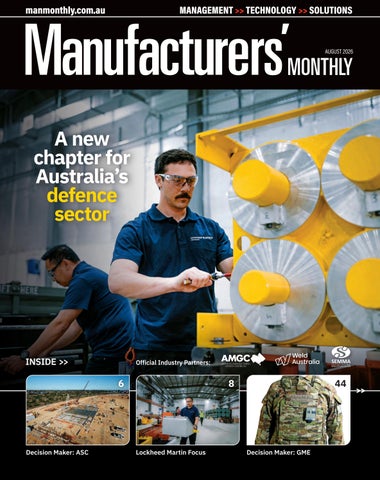
A new chapter for Australia’s defence sector
INSIDE >>
Official Industry Partners:
6
Decision Maker: ASC
8
Lockheed Martin Focus
44
Decision Maker: GME
>>
COMPLETE SOLUTIONS COMPRESSOR
AIR TREATMENT
PNUEMATIC TOOLS
GENERATOR
*For illustrative purposes only
VACUUM PUMP
BLOWER
CHILLER NITROGEN GENERATION
Engineering & delivering air and power solutions to drive operational efficiency.
COMPLETE AIR & POWER SOLUTIONS
CAPS.COM.AU
E
only
air ve y.
U
manmonthly.com.au
AUGUST 2026
For daily news visit manmonthly.com.au
twitter.com/Manmonthly facebook.com/Manmonthly linkedin.com/showcase/manufacturer’s-monthly/
Manufacturers’ Monthly Contents
Chairman: John Murphy CEO: Christine Clancy Managing Editor: Mike Wheeler
4
Editor’s Note
Editor: Jack Lloyd jack.lloyd@primecreative.com.au
6
Decision Maker Column: ASC
Design: Alejandro Molano
8
Manufacturer Focus: Lockheed Martin
12
Air Compressor Solutions: CAPS
14
Financial Advisory
16
Pallet Inspection Systems
18
Land Forces 2026
20
Air Compressor Solutions: ATG
22
Space Manufacturing
24
Aluminium Manufacturing
26
Industrial Software
28
Electric Motors
30
Welding Technology
32
Industrial Tooling
34
Manufacturing Components
36
Statistical Software Solutions
38
Export Finance
40
Industrial Lubrication
42
SEMMA Comment
44
Decision Maker Column: GME
46
Bulk Expo & Awards
48
Weld Comment
50
MegaTrans
Head of Design: Clayton Hawley Sales/Advertising: Emily Gorgievska Ph: 0432 083 392 emily.gorgievska@primecreative.com.au Subscriptions Published 11 times a year Subscriptions $140.00 per annum (inc GST) Overseas prices apply Ph: (03) 9690 8766
Copyright Manufacturers’ Monthly is owned by Prime Creative Media and published by John Murphy. All material in Manufacturers’ Monthly is copyright and no part may be reproduced or copied in any form or by any means (graphic, electronic or mechanical including information and retrieval systems) without written permission of the publisher. The Editor welcomes contributions but reserves the right to accept or reject any material. While every effort has been made to ensure the accuracy of information, Prime Creative Media will not accept responsibility for errors or omissions or for any consequences arising from reliance on information published. The opinions expressed in Manufacturers’ Monthly are not necessarily the opinions of, or endorsed by the publisher unless otherwise stated. © Copyright Prime Creative Media, 2024 Articles All articles submitted for publication become the property of the publisher. The Editor reserves the right to adjust any article to conform with the magazine format. Head Office 379 Docklands Drive Docklands VIC 3008 P: +61 3 9690 8766 info@primecreative.com.au www.primecreative.com.au Sydney Office Suite 11.01, 201 Miller St, North Sydney, NSW 2060 Printed by: The Precision Group 83-89 Freight Drive. Somerton Vic 3062 Ph: (03) 9794 8337
Behind the cover Welcome to the August edition of Manufacturers’ Monthly. This month’s Manufacturer Focus follows a new Lockheed Martin Australia Defence contract to manufacture GMLRS components, marking a step in linking Australian suppliers into a global production network. In our Decision Maker column, Neil Crewdson, chief nuclear officer explores how ASC is laying the foundations for Australia’s nuclear-powered submarine future. Also featured in a bonus Decision maker column, sees Christopher Rule, general manager – Defence at GME speak to why sovereign defence manufacturing is emerging as a critical pillar of national security and operational resilience.
18
24
manmonthly.com.au
MANAGEMENT >> TECHNOLOGY >> SOLUTIONS
AUGUST 2026
A new chapter for Australia’s defence sector
INSIDE >>
Official Industry Partners:
6
Decision Maker: ASC
8
Lockheed Martin Focus
42
>>
Decision Maker: GME
manmonthly.com.au Manufacturers’ Monthly
3
EDITOR’S NOTE JACK LLOYD – EDITOR, MANUFACTURERS’ MONTHLY
Image: AMDA
Defending Australia’s manufacturing future
O
ver the past year, Australia’s defence manufacturing industry has entered a period of momentum. Driven by major government investment in sovereign capability, programs such as the $12 billion expansion of the Henderson Defence Precinct, continued progress under AUKUS, and the rollout of the Guided Weapons and Explosive Ordnance (GWEO) Enterprise, are reshaping the nation’s industrial landscape. For decades, Australia has relied heavily on imported defence capabilities. That approach is changing, with a growing focus on building domestic expertise, strengthening supply chains and creating the manufacturing capacity needed to support Australia’s security objectives. Across shipbuilding, missile production, autonomous systems and advanced technologies, local manufacturers are increasingly becoming part of global defence programs. This edition explores how industry is building
4
Manufacturers’ Monthly August 2026
the foundations for a more resilient future. In our Decision Maker column, ASC chief nuclear officer Neil Crewdson discusses the importance of investing beyond the submarines themselves – developing skilled people, embedding a strong nuclear safety culture and building the industrial capability required to support Australia’s nuclear-powered submarine future. The same theme is evident across Australia’s guided weapons ambitions. Lockheed Martin Australia’s latest GWEO contract, involving AW Bell and Moog Australia, demonstrates how local manufacturers are moving further into sophisticated defence production. By producing critical missile components including canards and Control Actuation Systems, Australian companies are becoming more deeply integrated into international defence supply chains. Our second Decision Maker Column in this edition sees GME general manager
– Defence Christopher Rule explore how sovereign manufacturing capability is about ensuring Australia can contribute meaningfully to global partnerships while maintaining the ability to sustain and respond to its own defence requirements. He speaks to how building expertise in advanced manufacturing, engineering and intellectual property will be critical to achieving this goal. This edition will also be present during Land Forces 2026, Australia’s premier land defence industry exhibition, where industry leaders, defence organisations and innovators from around the world will gather to showcase emerging technologies, discuss capability requirements and explore opportunities for collaboration. The event provides an important opportunity to examine how Australian manufacturers are supporting the next generation of defence capability and strengthening the nation’s industrial base.
Need Aluminium Extrusions made
?
Capral can do. As Australia’s largest supplier and extruder of aluminium, Capral is committed to supporting Australian manufacturing with high-quality, locally produced aluminium extrusions. Our state-of-the-art facilities provide precision-engineered solutions for industries nationwide, from construction, to engineering, transport, and marine. Choosing Capral is an investment in reliable supply, shorter lead times, and a stronger Australian manufacturing sector. When you need Australian-made aluminium, Capral can do.
Order online 24/7 Pick-up & Delivery shop.capral.com.au
Celebrating 90 years of Australian manufacturing
DECISION MAKER COLUMN
NEIL CREWDSON, CHIEF NUCLEAR OFFICER, ASC
Images: Australian Naval Infrastructure.
The Skills and Training Academy Campus.
Building Australia’s nuclear capable industrial future - the Australian way ASC is laying the foundations for Australia’s nuclear-powered submarine future by investing in skills, safety culture, industrial capability and sovereign manufacturing.
W
hen people discuss AUKUS, they usually talk about building and sustaining nuclearpowered submarines. However, at ASC we are focused on the things that will enable our success, and that is by investing right now in developing our people, cultivating new skills, and driving a national industrial capability uplift. Most importantly, success will depend on embedding a nuclear safety culture and mindset across our workforce, our suppliers and our broader industry partners. AUKUS presents Australia with a once-in-a-generation opportunity to invest in people and grow the engineers, tradespeople, project managers, technicians, operators and leaders who will shape the future of Australia’s manufacturing and technology sectors. Having spent nearly three decades in the UK’s nuclear sector, I have seen what a mature nuclear enterprise looks like. Together, the US and UK have more than 130 years of combined experience designing, building,
6
Manufacturers’ Monthly August 2026
operating and sustaining nuclear-powered naval assets. That history matters. It brings with it proven standards, deeply embedded safety cultures and an industrial discipline refined over generations. Australia now has the unparalleled opportunity to work with our AUKUS partners to build a highprecision industrial ecosystem capable of operating to nuclear standards, drawing on more than a century of combined international experience in naval nuclear propulsion technology.
Building from strong foundations Australia is not starting from scratch. ASC’s history building and sustaining the Collins Class submarines has established a highly capable sovereign industrial base. From precision engineering and fabrication to systems integration and sustainment, there is already a deep capability that underpins the national submarine enterprise. The difference with nuclear is not a complete reset – it is an uplift.
It is about taking an already capable manufacturing base and aligning it to the culture, discipline and standards required to operate within a nuclearpowered submarine enterprise. That means elevating quality assurance, embedding rigorous controls, and ensuring safety, quality and security requirements are not simply met, but deeply embedded in how we work. Meeting nuclear standards will require us to draw on and work closely with Australia’s resident nuclear expertise – but it is about more than technical capability. It requires a culture where quality, safety and attention to detail are embedded in every decision, process and shift. The goal is not simply compliance, but developing a mindset where people do the right thing even when no-one is watching. This is where the partnership at the heart of AUKUS is so important. We are not developing these capabilities in isolation. We are working alongside organisations in the US and the UK that bring decades of experience, learning what works and
what doesn’t, understanding where complexity lies, and applying those lessons in an Australian context. Ultimately, however, this will not be a replica of either system. It will be something distinct: a nuclear-powered submarine industrial enterprise built in Australia, for Australia.
Building the workforce No industrial transformation is possible without the right workforce. One of my core responsibilities at ASC is ensuring we have the people – with the right skills, training and mindset – to deliver on Australia’s commitments under the AUKUS Optimal Pathway. That effort is already well underway. ASC is investing heavily in its early careers pipeline, bringing apprentices, graduates and trainees into highvalue roles that will underpin the next generation of submarine sustainment and construction. These are long-term careers in highly skilled fields – the kind of opportunities that anchor advanced manufacturing sectors. At a national level, we are also seeing critical capability being developed closer to home. Australians can now access nuclear training through organisations such as the Australian Nuclear Science and Technology Organisation (ANSTO) and pursue nuclear engineering pathways through institutions including Flinders University – reducing reliance on overseas training. Equally important is the investment in infrastructure. At Osborne in South Australia, work is progressing on a new Skills and Training Academy that will train up to 1,000 learners each year, once fully operational. Alongside the academy, a Production Demonstration Facility will provide a controlled environment to develop and test advanced manufacturing techniques and validate processes in conditions that replicate real-world submarine construction. These government investments matter because they demonstrate a fundamental truth: building the workforce to sustain and construct nuclearpowered submarines is not a distant ambition – it is happening now.
Integrating into a global supply chain One of the most significant shifts underway is the integration of Australian industry into global submarine supply chains. Through the Defence Industry Vendor Qualification (DIVQ) Program, ASC is working closely with the Australian Submarine Agency, Electric Boat and Australian suppliers to qualify local businesses to operate within the US submarine supply chain, supporting them to meet the stringent engineering, quality and security requirements expected within a nuclear program. Five Australian businesses have already qualified,
Construction of the Production Demonstration Facilities continues to gain momentum, with structural steel erection progressing well and precast wall installation now underway.
and dozens more are progressing through the national qualification program to support Australia’s nuclear-powered submarine program, including construction and sustainment requirements. ASC is also uplifting suppliers for UK and US sustainment support in-country under the DIVQS program, focussing first on the existing Collins Suppliers, and then working with the US and UK to uplift specialist service providers and materiel suppliers into their sustainment capabilities where needed. What we are seeing is a step change in how Australian manufacturers engage with global defence programs. Qualification is not simply about winning work today; it is about building enduring capability that allows Australian firms to compete for decades to come. Strong supply chains are not built overnight. They require investment, persistence and clarity of standards. The capability developed through this process extends well beyond defence. High-precision engineering and manufacturing practices that meet nuclear standards are equally valuable in other highreliability sectors, including aerospace, energy and advanced technology industries.
Innovation driven by real-world challenges A common misconception about nuclear programs is that they are conservative by nature. In reality, they are defined by continuous innovation, driven by the need to solve complex, real-world problems in highly complex environments. At ASC, we are already seeing Australian ingenuity come to the fore. Partnerships with local industry are delivering practical innovations that improve submarine sustainment outcomes. From the design and delivery of deployable containerised SSN support equipment, such as the MAK Water ultra-pure water plant and ASE’s High Pressure Air Compressor, to digital and physical innovation in production methods – including additive manufacturing partnerships with organisations like WA shipbuilder Austal – these are tangible examples of how local capability is evolving. Even seemingly small improvements can have
an outsized impact in a submarine environment. ASC is always looking to implement efficiency gains, improved reliability, reduced maintenance burdens – incremental changes that add up to major performance gains.
A once-in-a-generation opportunity What makes AUKUS unique is the alignment of effort across government, industry and education. Through coordinated investment in workforce, infrastructure and supply chain capability, Australia is positioning itself to deliver one of the most complex manufacturing programs ever undertaken in this country. For industry, the message is clear. There are opportunities not just for traditional defence suppliers, but for advanced manufacturers across sectors – from energy and resources to transport and technology – whose capabilities can translate into this environment with the right standards and support. The challenge is to engage early, understand the requirements, and invest in the capability needed to meet them.
Doing it the Australian way Having worked within established nuclear industries for much of my career, I am often asked how Australia compares. The honest answer is that Australia is doing something different – and that is our strength. We are taking the best of what has been developed in the US and the UK, learning from decades of experience, and applying it with a fresh perspective. We are not starting from scratch, and we are not working alone. What we are doing is building a high-precision industrial capability that can meet the exacting standards required of a nuclear-powered submarine enterprise – one that is safe, resilient, and globally competitive. When we get this right, the impact will extend far beyond submarines. It will strengthen Australia’s advanced manufacturing base, create opportunities across multiple industries, and help shape the nation’s industrial future for generations to come.
manmonthly.com.au Manufacturers’ Monthly
7
MANUFACTURER FOCUS Images: Lockheed Martin Australia
A new phase for Australia’s guided weapons industry
Lockheed Martin Australia has signed a new contract with Defence to begin manufacturing key components for guided weapons.
A new Lockheed Martin Australia Defence contract to manufacture GMLRS components marks a step in linking Australian suppliers into a global production network.
L
ockheed Martin Australia has signed a new contract with Defence to begin manufacturing key components for guided weapons, marking another step in the Federal Government’s push to establish a domestic guided weapons industry. The agreement centres on the Guided Multiple Launch Rocket System (GMLRS), with Australian companies AW Bell and Moog Australia selected to produce critical parts including canards and the Control Actuation System (CAS). The contract sits within the broader Guided Weapons and Explosive Ordnance (GWEO) Enterprise, which is aimed at strengthening supply chain resilience and lifting domestic manufacturing capability. It also follows earlier milestones including the commencement of missile manufacturing at Port Wakefield in December 2025 and the first test firing of Lockheed Martin Australia’s GMLRS missiles earlier this year. Together, these developments are positioning Australia as a more active participant in global guided weapons production rather than solely a procurement customer. James Heading, director and general manager, Missiles and Fire Control at Lockheed Martin
8
Manufacturers’ Monthly August 2026
Australia, described the agreement as a culmination of sustained effort under the GWEO framework, particularly around supply chain resilience and industry uplift. He said the initiative is designed not only to improve availability of critical munitions, but to ensure the supporting industrial base can be sustained and expanded over time. He added that the program is about producing a structured capability that can expand over time. “We need to have a solution for all components. We can’t just build one and think the rest of it will take care of itself. We must be methodical,” he said.
Selecting Australian industry partners AW Bell and Moog Australia were selected following an assessment process that focused not only on existing capability, but also on their ability to scale and integrate into global supply chains while meeting stringent defence requirements. Both companies already have experience in high-specification manufacturing for defence and aerospace applications. According to Sam Bell, CEO of AW Bell, the company was selected because of its established
expertise in highly complex castings and its proven performance across global defence programs. He said there are few companies worldwide capable of manufacturing components of this complexity, with AW Bell building more than 15 years of experience supplying advanced castings to international defence projects. Bell also noted the company has been recognised through industry awards and maintains certifications including DISP, NADCAP and AS9100. “In the case of AW Bell and Moog in particular, it was really about looking at the capabilities they currently had and the capabilities that they could expand to,” said Heading. “It’s not necessarily that they’ve got it sitting there now, but how they demonstrate the ability to get to a larger stage.” He pointed to AW Bell’s experience working within the F-35 program and its demonstrated engineering capability as key differentiators, while Moog’s established US operations and supply chain depth provided assurance around scalability and technical transfer. “They demonstrated strong engineering and technical skills and an openness to improving capability,” said Heading.
What the components do inside GMLRS The contract covers two of the most technically demanding elements of the GMLRS: canards and the Control Actuation System (CAS). While physically small compared to the missile itself, both components are critical to accuracy, stability and guidance during flight. The canards are small fin-like structures positioned at the front of the missile. Bell said these components – while seeming straightforward – play a critical role in the steering and aerodynamic control. The CAS sits behind them, acting as the system that interprets guidance inputs and physically adjusts the canards using actuators to maintain the missile’s trajectory. “They’re very complex machined components, and you need structural integrity to survive a very demanding environment,” said Heading. “You need quality, you need consistency, and you need strength. If one is slightly different to the other, you’ve already caused problems for how the missile flies.”
Manufacturing complexity and precision requirements From a manufacturing perspective, Bell said the canards are among the most demanding components to produce because of the specialised materials involved and the extremely tight tolerances required throughout production. Bell said AW Bell has developed a unique investment casting process specifically for
manufacturing the GMLRS canards. While the details remain commercially sensitive, the proprietary process is followed by advanced machining programs and probing cycles that verify part geometry before the components undergo extensive NADCAP testing. Rather than requiring multiple changes to its manufacturing operations, Bell said the company invested in research and development to establish the new casting methodology. Multiple design iterations were trialled before arriving at a manufacturing process capable of delivering high yields while consistently meeting Lockheed Martin’s technical and quality requirements. Heading said this level of collaboration is a defining feature of how Lockheed Martin works with suppliers in Australia. “We provide a lot of engineering and technical support using both our supply chain and engineering teams,” he said. “Once there’s confidence, it becomes a case of standing back and letting them get on with the job.” He added that participation in global supply chains introduces additional compliance requirements, including US Government oversight on export controls, intellectual property protection and raw material sourcing.
“It’s about how you get a production line that can build thousands,” he said. “It’s not just turning the handle faster. It’s about designing better processes and understanding how decisions are made at scale.” He added that tooling, testing and qualification systems are just as important as the manufacturing process itself, as components must be rigorously validated before entering service. “If you can’t test them and qualify them and make sure they are doing what they say they are supposed to do, that becomes a major failure point,” said Heading. Bell agreed with this sentiment, saying that collaboration between AW Bell and Lockheed Martin has been central throughout development. Engineers from both organisations have worked closely during the project, with transparent communication helping to ensure compliance while also creating opportunities for continuous improvement. “Our focus on collaboration and transparency improves trust and outcomes,” he said.
Knowledge transfer and workforce development
Broader opportunities across the GWEO program
A key element of the contract is knowledge transfer between Australian and US engineers, including
Beyond GMLRS, the GWEO Enterprise is expected to create wider opportunities for Australian
an exchange program between teams working on Moog’s CAS development. The initiative is designed to accelerate skills development in advanced manufacturing processes that are not yet widely available in Australia at scale.
The contract sits within the broader Guided Weapons and Explosive Ordnance (GWEO) Enterprise.
manmonthly.com.au Manufacturers’ Monthly
9
MANUFACTURER FOCUS manufacturers to enter the global defence supply chain, according to Heading. This includes future work across rocket motors, propulsion systems, sensors and other precision components required for next-generation weapons. Heading said the scale of opportunity is considerable but constrained by the complexity and regulatory oversight inherent in weapons programs. However, he noted that the breadth of subcomponents within systems like rocket motors alone presents multiple entry points for Australian industry. “It’s not just a rocket motor,” he said. “There’s a casing, a liner, nozzles, end caps. There are all sorts of components that need to be supplied.” He added that participation in one program can also open pathways into adjacent systems, including platforms not currently in Australian service.
Capability gaps and future priorities Despite progress, Heading identified ongoing capability gaps in areas such as battery systems and sensor technologies, which remain challenging due to performance requirements and regulatory constraints around technology transfer. He also highlighted the increasing complexity of qualification processes, where suppliers may need to develop not only manufacturing capability but also design authority in cases where specifications rather than detailed drawings are provided. This shift, he said, adds complexity but also creates opportunities for Australian firms to move further up the value chain.
AW Bell’s perspective on long-term growth For AW Bell, participation in the GMLRS program is expected to strengthen its position within both Australia’s sovereign defence industry and Lockheed Martin’s global supply chain. Bell said the company hopes its success manufacturing canards and the Control Actuation System housing will create opportunities to support future international GMLRS production, as well as aligned programs such as the Precision Strike Missile (PrSM). Bell said the contract has further strengthened AW Bell’s relationship with Lockheed Martin and demonstrated the company’s ability to deliver highly specialised components for global defence programs. “This opportunity has strengthened our relationship with Lockheed Martin as an enterprise, and we look forward to further collaborating with them in the future,” Bell said.
A maturing sovereign defence manufacturing base Looking ahead, Heading said the long-term goal of the GWEO Enterprise is not only to deliver individual
10 Manufacturers’ Monthly August 2026
The contract represents a further step towards embedding local manufacturers into international supply chains.
contracts, but to build a resilient, competitive and self-sustaining industrial base in Australia. That includes ensuring suppliers are not dependent on single contracts, but capable of operating across multiple sectors and global markets. “What we really want is a company that can do this inside defence, perhaps in an adjacent industry, or another sector entirely,” he said. “We want them
thriving and competitive on the global stage.” As Australia continues to expand its domestic guided weapons capability, the Lockheed Martin contract represents a further step towards embedding local manufacturers into international supply chains – while testing how far sovereign industrial ambition can be translated into sustained production capacity.
COMPRESSOR SOLUTIONS
Beyond the equipment: Why manufacturers are looking for complete solutions As manufacturers face rising costs, skills shortages and growing pressures, CAPS Australia is helping businesses deliver long-term operational reliability.
F
or many manufacturers, compressed air systems, power generation and supporting infrastructure are essential to keeping production moving. Yet, while these assets underpin daily operations, the greatest challenge is often ensuring equipment continues to perform efficiently throughout its entire lifecycle. As manufacturers contend with increasing operating costs, tighter production schedules and ongoing workforce shortages, the focus is shifting away from one-off equipment purchases towards long-term operational partnerships. Rather than simply supplying machinery, businesses are seeking providers that can help optimise efficiency, minimise downtime and support critical infrastructure for years after installation. For more than 45 years, CAPS Australia has supplied compressed air, power generation, gas generation and blower solutions to Australian industry. Today, the company continues to provide complete operational solutions, combining equipment supply with system design, installation, monitoring, maintenance and ongoing technical support to help manufacturers maximise reliability and productivity. “Providing complete solutions means taking responsibility for the entire operational outcome rather than just supplying a piece of equipment,” CAPS Australia director of operations, Paul Goodwin
said. “Our role is to understand the process, identify the risks, design the right solution, install it correctly and provide ongoing support throughout the lifecycle.”
improve reliability, reduce energy consumption and support long-term operational resilience. They want solutions that deliver measurable outcomes, not just picking a compressor and chucking it in.”
A changing manufacturing landscape
Looking beyond the purchase price
According to Goodwin, manufacturer expectations have changed considerably over the past decade. Where purchasing decisions once centred primarily on upfront capital costs, businesses are now taking a broader view that considers operational resilience, lifecycle costs and long-term efficiency. This shift reflects the growing pressures facing Australian manufacturers. Rising energy prices are driving businesses to seek greater efficiency from existing assets, while downtime continues to have impacts on production schedules and profitability. At the same time, ongoing skills shortages mean many organisations have fewer internal maintenance personnel available to support increasingly complex infrastructure. Rather than simply purchasing equipment, manufacturers are asking strategic questions about energy consumption, asset management and longterm operational performance. “Ten years ago, most customers were focused on the upfront cost of the capital equipment, not so much the lifecycle,” Goodwin said. “Today they’re looking for partners that can help optimise efficiency,
For CAPS, one of the most common mistakes manufacturers make is placing too much emphasis on initial purchase costs without considering the ongoing expenses associated with operating critical infrastructure. While capital expenditure is often closely scrutinised, Goodwin said the purchase price represents only a small proportion of the total cost of ownership. Energy consumption, servicing requirements, reliability and the financial consequences of unplanned downtime frequently have a far greater impact over the life of an asset. Infrastructure also needs to be designed with future growth in mind. Systems that only meet current production requirements can become operational constraints as businesses expand, resulting in costly upgrades or avoidable inefficiencies later. Instead, CAPS works alongside manufacturers to understand their production goals, operational risks and long-term business objectives before recommending solutions that align with their broader operational strategy. “The purchase price of the equipment is only a small proportion of the lifecycle cost,” Goodwin said. “Energy consumption, maintenance requirements, operational risks and downtime can all have a much larger impact on the financial efficiency of that equipment. “In many cases, the greatest value isn’t found in the equipment itself, but in the operational improvements achieved through better system design, monitoring and maintenance practices.”
For more than 45 years, CAPS Australia has supplied compressed air, power generation, gas generation and blower solutions to Australian industry.
Supporting the entire operational lifecycle Maintaining critical infrastructure has become increasingly important as manufacturers seek to extract greater value from existing assets. Effective maintenance not only extends equipment life but
12 Manufacturers’ Monthly August 2026
also improves reliability, reduces operating costs and helps avoid unplanned production interruptions. CAPS continues to encourage manufacturers to focus on maintaining and optimising the equipment they already have, rather than relying solely on expensive replacement programs. The company believes appropriate maintenance remains one of the most effective ways to improve long-term asset performance while reducing operational risk. Its CAPS Care maintenance program supports compressed air assets through scheduled servicing, diagnostic testing, genuine replacement parts and ongoing technical support designed to identify potential issues before they develop into costly failures. Manufacturers can choose from Packaged Care, Planned Care, Parts Care and Performance Care programs depending on their operational requirements, while Power Care provides dedicated support for power generation equipment.
Technology driving smarter maintenance As manufacturers continue to pursue greater efficiency, CAPS is also investing in technologies that enable businesses to make better operational decisions. Digital monitoring, remote connectivity and predictive maintenance are becoming increasingly important tools for reducing downtime and improving asset performance. The company is also exploring artificial intelligence to further enhance system performance, with technology capable of analysing operating conditions and tailoring equipment performance to suit individual site requirements. Combined with predictive maintenance strategies, these technologies provide manufacturers with greater visibility over equipment health while enabling maintenance to be planned before failures occur. Rather than reacting to unexpected breakdowns, businesses can use operational data to identify efficiency opportunities, improve service planning and extend the life of critical infrastructure. “We’re using digital monitoring and remote connectivity, and we’re also moving down the path of AI,” Goodwin said. “The systems are becoming capable of analysing operating requirements and tailoring the operational aspects of the system to suit site conditions.” A fellow Ingersoll Rand company is Ecoplant, providing an advanced dynamic controls platform, that delivers real-time, actionable insights which can unlock annual savings by enhancing the performance of compressed air systems. One of Ecoplant’s standout features is its compatibility with all major original equipment manufacturer compressed air systems, providing predictive maintenance insights and instant alerts for potential system failures. “We’re strong believers in predictive maintenance. It extends equipment life, improves service planning
and provides data-driven insights that enable businesses to optimise performance and identify opportunities for efficiency improvements.”
Avoiding costly mistakes Goodwin believes one of the biggest lessons manufacturers can learn is to take a longer-term approach when planning critical infrastructure. Too often, businesses specify equipment based only on current production requirements without considering future expansion, redundancy requirements or changing operational demands. While this approach may reduce initial capital expenditure, it can create operational limitations as facilities grow. The most successful manufacturers, Goodwin said, invest time in understanding their long-term operational objectives before selecting equipment. They engage with experienced partners early in the planning process and assess solutions based on total lifecycle value rather than purchase price alone. Equally important is ensuring equipment is properly maintained by trained technicians using genuine replacement parts. Appropriate servicing not only improves efficiency but also helps prevent unnecessary wear, reduced output and premature equipment failure. “The big mistake is focusing on the upfront capital cost and not considering the lifecycle cost or the operational risk associated with that equipment,” Goodwin said. “Another common issue is designing infrastructure purely for today’s requirements without considering future growth, redundancy needs or increasing production demands. “The businesses that get the best outcomes take a strategic, long-term approach. They understand their operational requirements, engage experienced partners early and evaluate solutions on total value rather than purchase price.”
Support when it matters most Even with robust maintenance programs in place, unexpected failures can still occur. To minimise disruption, CAPS supports manufacturers through a nationwide network of 10 branches, providing local technical expertise, genuine spare parts and 24/7 emergency breakdown assistance. The company’s rental fleet also provides short and long-term compressor and generator solutions for planned shutdowns, seasonal production peaks, project work or emergency situations. With equipment positioned across Australia, CAPS can respond quickly to help keep production lines operating while permanent repairs are completed. For manufacturers facing increasing pressure to maximise productivity with leaner maintenance teams, having rapid access to technical expertise and equipment can reduce the impact of unplanned downtime.
A fellow Ingersoll Rand company is Ecoplant, providing an advanced dynamic controls platform.
“Technology alone isn’t enough,” Goodwin said. “Our clients can be confident that our trained technicians are available to keep plants operating.
Building partnerships for the future For Goodwin, delivering a complete solution is ultimately about building relationships that extend well beyond commissioning a new piece of equipment. Critical infrastructure continues to influence manufacturing performance long after installation, making ongoing collaboration essential to achieving reliable, efficient operations. As manufacturers pursue greater sustainability, digital connectivity and operational resilience over the coming years, suppliers will increasingly be expected to contribute strategic expertise alongside quality equipment. CAPS believes those long-term partnerships will become even more important as manufacturers navigate rising energy costs, workforce challenges and increasing demands for operational efficiency. By combining engineering expertise with proactive maintenance, digital technologies and responsive support, the company aims to help manufacturers continue improving performance throughout the life of their assets. “Long-term partnerships are fundamental,” Goodwin said. “Critical infrastructure plays such an important role in manufacturing that success can’t be measured on day one of an installation. It’s created over years through ongoing support, optimisation and collaboration. “When we genuinely understand a customer’s business, production goals and operational risks, we’re in a much better position to provide advice and respond to future challenges.” Looking ahead, Goodwin expects energy efficiency, sustainability, digital connectivity and operational resilience to shape manufacturers’ infrastructure decisions. “Manufacturers will increasingly need infrastructure that delivers greater efficiency, supports environmental goals and provides real-time performance data,” he said.
manmonthly.com.au Manufacturers’ Monthly
13
COMMENT
LOUIS QUINTAL, PARTNER AND NATIONAL MANUFACTURING LEADER, RSM AUSTRALIA
Image: Daco/stock.adobe.com
The latest national figures show manufacturing returning to broad-based growth, yet profitability remains thin.
Australian Manufacturing 2026/27: A sector at a crossroads Australia’s manufacturers enter the new financial year with growth returning, but rising costs, skills shortages and global uncertainty continue to test the sector’s resilience.
A
ustralia’s manufacturing sector enters the 2026/27 financial year with cautious optimism, tempered by persistent structural challenges and global uncertainty. The latest national figures show the sector returning to broad-based growth, yet profitability remains thin, productivity continues to slide, and conditions on the factory floor stay subdued. While a maturing pipeline of government incentives and rapid technological change are driving transformation, manufacturers must navigate elevated energy costs, an uneven labour market, and renewed geopolitical and trade volatility to remain competitive.
Sector snapshot: growth returns, but margins stay thin According to the Australian Bureau of Statistics (ABS), whose 2024–25 Australian Industry release was published on 19 June 2026, the manufacturing industry recorded growth across all key data items for the first time in several years. Division earnings rose 1.6 per cent (around $753 million) reversing the previous year’s decline led by a 7.8 per cent ($815 million) lift in food product manufacturing. Industry Value Added, which had grown 1.6 per cent to $134.8 billion in 2023–24, continued to expand, while employment edged up 0.2 per cent (about 2,000 people) to roughly 904,000. Wages and salaries climbed 5.2 per cent ($3.8 billion). Profitability, however, remains under pressure. Total expenses jumped 7.8 per cent ($38.3 billion),
14 Manufacturers’ Monthly August 2026
with purchases of goods and materials up 8.6 per cent ($25.6 billion) input costs in the primary metal and metal product subdivision were inflated by high gold and silver prices. The earnings rebound also follows a $3.6 billion fall in manufacturing earnings the year before, and productivity continues to weaken, the ABS reported that manufacturing productivity declined again in 2024–25, one of several industrial sectors where output has gone backwards since the pandemic. Survey data echo’s this fragility, with the Australian Industry Group’s saying Australia remains firmly in contraction through the first half of 2026, with manufacturers citing weak demand, higher input and logistics costs, and capacity utilisation below its longterm range.
Energy costs and decarbonisation: a balancing act Energy remains a critical concern. The sector depends on stable, affordable power yet continues to face elevated costs and policy uncertainty. Australia no longer publishes an official industrial electricity price index, but the available benchmarks point in one direction. The Australian Energy Regulator’s Default Market Offer rose for 2025–26, with small-business reference prices increasing by between roughly 8 per cent and 8.5 per cent from 1 July 2025, and the wholesale market price cap climbed from $17,500 to $20,300 per megawatt hour on the same date. For 2026–27, the regulator’s
reformed Default Market Offer eases standing offer prices in New South Wales and south-east Queensland by up to 7.2 per cent from 1 July 2026, while South Australia rises 1.4 per cent offering modest and uneven relief. The federal government’s “Future Made in Australia” agenda, an investment package now exceeding $22 billion, continues to provide grants and incentives aimed at fostering green and advanced manufacturing. For manufacturers, this represents both an opportunity and a challenge. While these incentives offer a pathway to modernisation and competitiveness in global markets, the transition to greener operations requires substantial upfront investment, which could strain already tight profit margins for smaller enterprises. Moreover, industry leaders continue to emphasise the importance of a cohesive national energy strategy to complement these sustainability efforts. Without this strategy, including provisions for long duration energy storage, diversified renewable sources, and grid reliability, manufacturers face heightened risks of energy insecurity. The lack of affordable and stable energy options hampers their ability to plan for long-term growth and adopt energy-intensive innovations, such as hydrogen fuel cells and large scale battery systems. The ripple effects of this energy uncertainty are clear. Manufacturers reliant on high energy
consumption such as those in chemical production, food processing, and heavy machinery may be forced to cut costs elsewhere, potentially impacting workforce growth, research and development efforts, or operational expansion. For manufacturers to fully leverage government incentives, policymakers must address these systemic gaps to ensure that the sector can thrive in a changing energy landscape while maintaining resilience against economic and geopolitical pressures.
Workforce challenges: the skills gap widens The sector’s digital transformation is still constrained by a persistent skills gap. Roles such as robotics engineers, data analysts, and CNC machinists remain among the hardest to fill. Even as the national labour market has softened, with overall job vacancies falling 2.1 per cent in the three months to May 2026, manufacturing bucked the trend, recording the largest rise of any industry at 16.9 per cent. This underscores how acute demand for skilled manufacturing workers remains. Employers continue to report unfilled positions, rising wage costs, and competition from other sectors as key constraints on capacity. Key challenges include high training costs, limited access to upskilling opportunities for SMEs, and employee resistance to change. To address these issues, manufacturers are encouraged to form partnerships with TAFEs and universities to better align educational curricula with industry needs. Investing in simulation-based training and virtual reality tools can enhance workforce capabilities. Furthermore, leveraging government grants for workforce development provides a valuable opportunity to bridge the skills gap and prepare employees for the sector’s evolving demands.
Investment Trends: Technology, Sustainability, and Resilience Investment in the manufacturing sector has seen notable growth across several areas. Advanced manufacturing technologies, including robotics, artificial intelligence, and 3D printing are revolutionising production processes by boosting efficiency, precision, and competitiveness in global markets. These innovations are not only enabling manufacturers to meet evolving consumer demands but are also reshaping traditional practices, making them more adaptive to modern challenges. This momentum is increasingly visible in the investment data. Private new capital expenditure rose 6.4 per cent in the September quarter 2025, with the ABS noting that large manufacturing projects helped drive spending on new buildings and structures, while businesses lifted their planned 2025–26 investment by around 9.4 per cent and continued to channel funds into equipment, plant,
and machinery. Technology adoption is broadening in step with the National AI Centre estimating that roughly 43 per cent of Australian small and medium enterprises now report some level of artificial intelligence adoption. Collaborative robots, digital twins, and AI-driven predictive maintenance are increasingly deployed to raise equipment uptime and offset labour shortages. Uptake remains uneven, however capital-intensive sectors such as manufacturing face steeper adoption curves, and a lack of trust is the barrier most often cited by firms yet to invest – an issue the federal government’s 2025 Guidance for AI Adoption seeks to address. Additionally, research and development is receiving heightened attention, particularly in materials science and process optimisation. Breakthroughs in these fields promise to unlock new efficiencies, reduce manufacturing costs, and create innovative solutions that set companies apart in competitive markets. Public co-investment underpins much of this activity: the federal Research and Development Tax Incentive continues to offer eligible companies with aggregated turnover under $20 million a refundable offset of 43.5 per cent, effectively underwriting close to half the cost of qualifying work and providing an important lever for de-risking investment in automation, advanced materials, and process innovation. The National Reconstruction Fund (NRF), the $15 billion vehicle established to diversify and transform Australian industry, has moved from a slow start into active deployment. Through the NRF Corporation, it had made around 28 investments by early 2026 including $200 million in Macquarie Technology Group, $75 million in aerospace company Gilmour Space Technologies, $50 million in navigation manufacturer Advanced Navigation, $45 million in The Arnott’s Group, and stakes in semiconductor and quantum manufacturers spanning its priority areas of enabling capabilities, defence, transport, medical science, and valueadding in resources and agriculture. In April 2026, responding to global supply-chain disruption, the government brought forward $6.15 billion in concessional capital and opened three new sub-programs ahead of schedule: an Economic Resilience Program, a Net Zero Fund, and a Forestry Growth Fund. An Australian National Audit Office review, nonetheless, flagged early governance gaps, noting that the Corporation approved investments before finalising its investment strategy.
the Treasury Laws Amendment Act 2025, and the 2026–27 Federal Budget, handed down on 12 May 2026, announced making the concession permanent from 1 July 2026, subject to the passage of legislation removing a recurring source of yearend uncertainty for capital purchases. Without that change, the threshold would revert to $1,000.
Tax and legislative settings: incentives sharpen
A sector in transition
The policy and tax environment has shifted materially in manufacturers’ favour over the past year. The $20,000 instant asset write-off for small businesses (those with aggregated turnover under $10 million) was extended to 30 June 2026 through
Supply chain resilience and localisation Recent years have laid bare the fragility of global supply chains, and 2025–26 has brought new surprises. Renewed tariff escalation and conflict in the Middle East disrupted trade flows and pushed container shipping costs sharply higher, exposing Australian manufacturers to volatile input, freight, and packaging costs. In response, manufacturers continue to reshore operations and invest in local suppliers, with sub-sectors such as food processing, medical technology, and renewable energy leading this shift. The government’s Feeding Australia food security strategy and the new National Food Council have placed supply-chain resilience at the centre of the policy agenda. Digital supply chain tools such as predictive analytics and real-time tracking are being adopted to improve resilience. Challenges remain, including high logistics costs, limited domestic supplier networks, and regulatory red tape.
Looking ahead: strategic priorities for 2026–2027 Embracing Industry 4.0 technologies, such as advanced robotics, artificial intelligence, and the Internet of Things, is essential in enhancing operational efficiency and driving innovation. Workforce development should focus on fostering lifelong learning and implementing training programs aligned with industry needs to address skills shortages and prepare for future demands. Energy resilience must also take precedence, with investments in renewable energy diversification, storage solutions, and sustainable practices that mitigate risks associated with policy fragmentation. Additionally, manufacturers must actively engage in policy advocacy, pushing for cohesive, long-term industrial strategies that integrate energy, education, and infrastructure reforms. By adopting these measures, the sector can build robust foundations for resilience while positioning itself to play a pivotal role in the nation’s economic prosperity.
Australia’s manufacturing sector is not just adapting it is evolving. With the right mix of innovation, investment, and policy support, it can become a basis of national resilience and prosperity. But this requires bold leadership, strategic foresight, and a commitment to long-term reform.
manmonthly.com.au Manufacturers’ Monthly
15
WAREHOUSE SAFETY
Keeping pallets in check Image: SICK
SICK’s Pallet Integrity Inspection System (PAIS) is helping manufacturers and logistics operators improve safety, reduce downtime and protect automated operations.
P
allets are one of the most fundamental components of material handling, yet their condition is often overlooked until something goes wrong. Damaged pallets can lead to product losses, equipment damage, conveyor jams, costly operational downtime and safety risks for workers. As manufacturers continue investing in warehouse automation and Industry 4.0 technologies, ensuring pallet quality is becoming an important part of operations. SICK’s Pallet Integrity Inspection System (PAIS) has been developed to address these challenges through automated, non-contact inspection. Using high-resolution 3D cameras and dual-line lasers, the system detects missing boards, cracks, protruding nails and other defects before damaged pallets enter the production or distribution process. Designed for seamless integration into existing facilities, PAIS provides real-time inspection results while collecting valuable data that can support continuous quality improvement initiatives. “As the need for automation and sustainability becomes more prevalent, customers are looking for automated pallet inspection systems to be able to identify these defects early so that they are able to take corrective action before these affect productivity and safety on site,” said Edem Akplu, solution business manager at SICK.
Designed for flexibility Interest in automated pallet inspection was evident when SICK showcased PAIS at CeMAT Australia. According to Akplu, visitors from distribution, warehousing and logistics businesses were particularly interested in solutions that could be incorporated into existing facilities without requiring extensive modifications. “The feedback was that there were not many systems out there like the pallet inspection system that can seamlessly integrate into an existing infrastructure on site,” Akplu said. The system addresses many of the shortcomings associated with traditional manual inspections. Visual checks can be slow, labour intensive and susceptible to human error, particularly in high-
16 Manufacturers’ Monthly August 2026
SICK’s Pallet Integrity Inspection System (PAIS) has been developed to ensure pallet quality as it becomes an important part of operations.
throughput environments. PAIS performs inspections while pallets continue moving along the conveyor, maintaining productivity without sacrificing accuracy. PAIS consists of two inspection towers positioned on either side of a conveyor. Each tower houses 3D laser triangulation cameras together with additional lasers that improve reliability when inspecting wet or dirty pallets. “The towers scan the pallet as it travels on the conveyor, taking a high-resolution 3D image of the top, the sides, the bottom and the inner parts of the pallet. Detection and measurement tools then identify defects such as cracks, protruding nails, chunks of boards missing or missing planks,” Akplu said. Beyond standard Euro pallets, manufacturers can configure multiple pallet types and customise inspection criteria to suit their own operational requirements. Individual thresholds can be established for each defect type, allowing businesses to determine whether pallets should remain in circulation or be automatically rejected for repair or replacement. The intuitive touchscreen interface also allows operators to easily select pallet types, monitor inspections and review results.
Beyond inspection The system has also been designed to minimise disruption during installation. Most pallet handling facilities already have sufficient space to accommodate PAIS, requiring only clearance beneath the conveyor and an opening for the lower cameras to inspect the underside of each pallet. Installation typically takes around two days, followed by commissioning support from SICK to reduce
operational downtime. Once operational, PAIS does more than simply identify damaged pallets. Every scan is recorded, creating historical datasets that include pallet type, defect size and defect location. “The historical data is able to generate reports containing the pallet types, the location and size of defects that have been found,” Akplu said. “This is key to operational teams so that they can identify patterns of defects and put measures in place so these defects can be minimised throughout the whole process.” Akplu pointed to one warehouse operation where damaged pallets had progressed from causing occasional conveyor jams to creating daily disruptions that resulted in downtime and damaged goods. Introducing pallet inspection before loading, followed later by bottom scanning of loaded pallets, eliminated the recurring faults and restored smooth operations. “Currently they are running smoothly and have been able to eliminate all these faults associated with damaged pallets on site,” he said.
The future of pallet quality As warehouse automation continues to expand, Akplu believes pallet quality will become an increasingly critical factor in maintaining reliable operations. SICK expects artificial intelligence to further enhance pallet these inspection capabilities. AI-powered cameras, combined with lifecycle tracking across multiple facilities, could enable predictive analysis, improve pallet quality throughout the supply chain and provide greater transparency between suppliers and users.
YOU
TURNING
INTELLIGENTLY?
1
1 4
MINIM
UTPUT IMUM O X A M T UM COS
2
5
3
MINIM
UTPUT IMUM O X A M T UM COS
3
4
2 6
A unique six-edged positive insert offering a cost-effective alternative to ISO DCMT/TCMT for semi-finishing and finishing turning, delivering more cutting edges and a lower cost per part.
MINIM
The 80° design features double-sided, 4-edge CXMG inserts that replace 2-edge CCMT inserts. A dovetail pocket enhances stability, extends tool life, and reduces cost per part on Swiss-Type and compact lathes.
UTPUT IMUM O X A M T UM COS
ISCAR FLASH-TURN offers a more economical alternative to standard-size inserts by lowering cost per cutting edge, improving operational efficiency, and minimizing inventory costs.
w w w.i sc a r.c o m
LAND FORCES
Land Forces 2026 puts manufacturers at the centre of Defence opportunity From supply chain engagement to innovation and thought leadership, Land Forces 2026 is set to connect Australian manufacturers with the people shaping the future of Defence. Image: AMDA
Land Forces 2026 will unite Defence personnel, government representatives, prime contractors, SMEs, technology developers, researchers and manufacturers.
R
eturning as one of Australia’s largest international land defence expositions and forums, Land Forces 2026 will once again unite Defence personnel, government representatives, prime contractors, SMEs, technology developers, researchers and manufacturers from Australia and overseas. Land Forces has also evolved into a broader industry engagement platform, combining networking, policy discussions, technical presentations and innovation showcases designed to help businesses better understand where they fit within Australia’s defence ecosystem.
Connecting industry with Defence priorities According to AMDA Foundation, the event organiser, one of Land Forces’ greatest strengths is the accessibility of its conference and presentation program. Visitor registration provides complimentary access across all three days of the exhibition, including entry to the exhibition floor and most conference sessions running throughout the event. Trade Visitor registration is available to individuals working in, or affiliated with, defence and related industries, while Defence Visitor registration is open to personnel holding valid Australian or international defence identification credentials. Throughout the event, attendees will hear from organisations like the Australian Army, Department of Defence, Defence Delivery Group, Guided Weapons Explosive Ordnance Enterprise (GWEO), Austrade, the US Commercial Service and the Advanced Strategic Capabilities Accelerator (ASCA) will provide updates on procurement priorities, capability development, export opportunities and industry participation. The Australian Army will also play a central role throughout Land Forces 2026, with a program designed to strengthen dialogue between Defence and industry. Among the headline sessions will be the Chief of
18 Manufacturers’ Monthly August 2026
Army Symposium, Army Innovation Day and the Junior Leader Forum. These sessions are designed to provide industry with a deeper understanding of Army’s future requirements, operational priorities and innovation challenges.
The Hub brings industry conversations together The Hub adds another dimension to the Land Forces experience by creating a dedicated platform for thought leadership and practical industry discussion. Open to all trade badge holders and fully integrated into the broader conference program, The Hub will host experts from across government, Defence, industry and academia, exploring the strategic, technological and industrial issues shaping Australia’s defence future. Running across all three days of the event in the BelleVue Ballroom at the Perth Convention and Exhibition Centre, the program will focus on practical conversations that matter to manufacturers. Topics include government funding opportunities for defence businesses, resilience across Australia’s industrial base, optimised supply chains, workforce and salary trends, industrialising munitions manufacturing, artificial intelligence, defence manufacturing resilience through additive manufacturing, contested logistics and intellectual property protection. Other sessions examine Australia’s future defence posture, Army’s enhanced littoral manoeuvre capability, large-scale solid rocket motor manufacturing and the growing role of quantum computing and high-performance computing within Defence. For manufacturers, The Hub offers an opportunity to move beyond product demonstrations and engage with broader strategic questions surrounding workforce capability, sovereign manufacturing and emerging technologies. Also, it provides an environment where industry peers, government representatives and Defence stakeholders can exchange ideas and build new partnerships.
Showcasing Australia’s innovators Innovation has long been a defining feature of Australia’s defence industry, and Land Forces 2026 is placing even greater emphasis on recognising and accelerating new ideas through
the return of the Innovation Pitchfest and Awards. Designed as a national showcase for Australian innovation, the program provides organisations, researchers, SMEs and emerging innovators with an opportunity to present breakthrough technologies to an international audience of Defence representatives, investors, industry partners and potential customers. Innovations are recognised across four categories: the Innovation Award, Emerging Technology Award, Young Innovator Award and Blue-Sky Thinking Innovation Award, reflecting the breadth of Australia’s innovation ecosystem from early-stage concepts through to commercially mature technologies. Following a competitive judging process, finalists will deliver live presentations during Land Forces, with category winners to be announced onsite. Winners of the Innovation Award, Emerging Technology Award and Young Innovator Award will each receive a $30,000 cash prize, while the BlueSky Thinking Innovation Award winner will receive $10,000 to further support personal and innovation development. A Best Presenter Award will also recognise excellence in communicating new ideas to industry audiences. This year’s projects as a part of the pitchfest range from sovereign intelligence systems developed by BlakBox, advanced electronic warfare concepts from the Australian Army, AI-driven capability forecasting by Cyndr and UNSW, new body armour technology from Chiron Global Tech, augmented reality display systems developed by the University of Melbourne, innovative deployable infrastructure from Varley and medical technologies designed to address defencespecific injuries.
Introducing the Innovation Base: For the very first time at Land Forces, Innovation Pitchfest and Awards finalists will present their ideas and technologies in a dedicated precinct. The finalists will showcase their concepts in a purposebuilt exhibit featuring a dedicated pod. Visitors will have the opportunity to explore new ideas, meet the innovators behind them, and learn more about the technologies shaping the future of defence capability.
Register now Visitor registration for Land Forces 2026 is now open and free for eligible trade and Defence attendees at https://landforces.com.au/registration/.
T I
THE NEW BENCHMARK IN INDUSTRIAL WELDING.
Lorch has the solution with the new iQS, future proof platform that will set the new benchmark in industrial welding. A smart iQ, Industry 4.0, game changing welding platform with wifi connectivity and leading new welding processes to drive quality, efficiency and productivity improvements. Serious machines for serious welders. To arrange a product demonstration contact: david.wilton@lorch.eu
INDUSTRIAL AIR COMPRESSORS
Cleaner air, smarter operations In all manufacturing including pharmaceuticals, the quality of compressed air directly affects product performance.
Image: Surachai/stock.adobe.com
Pneumatech’s new SHM Heatless Modular Desiccant Dryer delivers reliable ultra-dry compressed air for manufacturers across the board.
20 Manufacturers’ Monthly August 2026
needed, installation is easy even in tight spaces or existing facilities. The SHM series also uses aluminium alloy extrusion modules for rust and corrosion resistance, making it a long-lasting solution in demanding environments. Ease of use is another strong benefit. The dryer comes standard with a digital dew point display with alarm, giving operators visibility and confidence that their air quality stays within target. For industries where precision matters, this real-time monitoring can help avoid product spoilage, machine wear, or production delays. By delivering stable, high-quality compressed air, the SHM dryer aims to help manufacturers extend equipment life, reduce maintenance costs, superior product finishes and improve overall process reliability. Whether a business is packaging food, assembling electronics, painting and finishing or running pneumatic tools, clean air means better performance and fewer interruptions. And with flexible model sizes from 10 to 140 m³/h, with a maximum operating pressure of 16 Bar there’s a solution that fits operations big or small. In short, Pneumatech believes the SHM Heatless Modular Desiccant Dryer brings together smart design, durability, and user-friendly features – helping businesses achieve cleaner air and smoother operations with confidence.
Image: ATG
I
n today’s industrial world, reliable, clean, and dry compressed air isn’t just a “nice to have” – it’s essential. From food packaging and pharmaceuticals to electronics, tools, automotive refinishing and manufacturing, the quality of compressed air directly affects product performance, machine reliability, and long‑term operating costs. That’s why the latest update in compressed air treatment technology, the Pneumatech SHM Heatless Modular Desiccant Dryer, is designed for businesses wanting dependable air quality without complicated installation or maintenance demands. According to Pneumatech, the SHM series (models SHM10–140) delivers a consistent pressure dew point of ‑40°C, for applications requiring ultra‑dry air. This ensures moisture is removed before it can cause corrosion, damaged tools, product contamination, or costly downtime. The unit uses a heatless desiccant drying method – simple, efficient, and proven – to remove moisture by cycling air through high‑quality adsorbent material. This design not only maintains stable dew point performance but also protects the desiccant with a special compression device that reduces the risk of dusting or breakdown. For customers, one of the advantage is the compact, cabinet-style design. With small footprint requirements and no pressure vessel inspections
The SHM series (models SHM10–140) delivers a consistent pressure dew point of ‑40°C.
SPACE MANUFACTURING
Building for space at scale Space Machines Company is combining artificial intelligence, advanced manufacturing and sovereign propulsion technology to reshape how spacecraft are built in Australia.
A
ustralia’s space sector is entering a new phase of maturity, moving beyond proving concepts towards establishing the manufacturing capability needed to support long-term commercial and defence ambitions. For Sydney-based Space Machines Company (SMC), that evolution is being driven by two initiatives – a $6 million Cooperative Research Centres Projects (CRC-P) investment to develop AI-driven spacecraft manufacturing, and the successful system-level qualification of its Scintilla propulsion system. Together, the projects represent milestones for the company as it works towards producing its Optimus Viper spacecraft at scale. While one focuses on reducing spacecraft design and manufacturing timelines through artificial intelligence and advanced production techniques, the other demonstrates a flight-like propulsion system capable of supporting future spacecraft while creating opportunities to supply propulsion technology to the wider space industry. The CRC-P project, titled Optimised Generative AI Design for Mass-Manufacturable Spacecraft, brings together Space Machines Company and multiple
partners together in Bradfield City and engineering specialist Fordyno. Over the next two years, the consortium will develop machine learning software capable of automatically generating optimised spacecraft structures while additive manufacturing and robotic assembly produce flight-ready hardware in weeks. “The project is a $6 million consortium investment bringing together Space Machines Company, the University of Technology Sydney (UTS), Fordyno, and the Advanced Manufacturing Readiness Facility at Bradfield City,” said Rajat Kulshrestha, CEO of Space Machines Company. “The final deliverable is a flightqualified Optimus Viper primary structure, validated to launch standards and ready to scale.”
Reimagining spacecraft design Traditional spacecraft design is a lengthy and highly iterative process, often requiring engineering teams to spend months or even years refining computer-aided designs before manufacturing can begin. Even with sophisticated modelling software, changing mission requirements frequently require designers to revisit portions of the development process, extending timelines and increasing costs.
SMC’s new AI-driven approach aims to fundamentally change that workflow. Developed alongside Professor Zhen Luo’s team at UTS, the system uses topology optimisation to automatically determine the most efficient distribution of material throughout an entire spacecraft structure. Rather than engineers optimising individual components one at a time, the software evaluates hundreds of competing variables simultaneously while satisfying structural, thermal and missionspecific requirements. The result is a lighter, more efficient spacecraft that reduces launch costs while increasing available performance. More importantly, the technology allows designers to rapidly regenerate an optimised structure whenever payloads, orbital requirements or mission objectives change – a capability that SMC believes does not currently exist within Australian spacecraft manufacturing. “Engineering software can model spacecraft in extraordinary detail, but many teams spend years refining computer aided designs before committing to manufacturing,” Kulshrestha said. “The target is completing each build-test-iterate cycle from updated requirement to hardware. That is a capability that does not exist anywhere in Australian spacecraft manufacturing today.”
Manufacturing for speed and scale
Australia’s largest industrialscale spacecraft manufacturing facility at UTS Tech Lab.
22 Manufacturers’ Monthly August 2026
Artificial intelligence is only one component of the broader manufacturing strategy. Physical production of the prototype structures will take place at the AMRF’s advanced facility at Bradfield City, where additive manufacturing, composites capability and robotic processes will work together to rapidly produce and validate spacecraft components. “By enabling the rapid build, test and validation of the spacecraft structures, the AMRF is helping the project move quickly from concept to flightready hardware, creating the foundation needed for production and deployment,” said Natalie Camilleri, acting CEO of the Bradfield Development Authority. The project will also focus on optimising composite honeycomb panel structures by varying lattice density, unit cell size and material distribution using AI. Beyond improving structural stiffness and thermal performance, the approach will enable cable routing and plumbing to be integrated within the panels themselves, increasing packaging efficiency without compromising performance.
Images: Space Machines Company
For SMC, these manufacturing improvements are directly linked to its long-term commercial ambitions. Producing more than 20 Optimus Viper vehicles annually will require manufacturing systems capable of responding quickly to different mission profiles while maintaining consistent quality, reducing production costs and shortening delivery schedules. For the Bradfield Development Authority, the project demonstrates how advanced manufacturing infrastructure and collaboration can help companies move rapidly from concept to flight-ready hardware.
An Optimus Viper Rapid Response Vehicle designed to make space security affordable.
Research meets industry While the project is ultimately focused on delivering commercial manufacturing capability, it also reflects the growing integration between Australian research institutions and industry. “This partnership demonstrates the power of bringing industry, research and government together to accelerate innovation and build sovereign capability in advanced industries like aerospace that are critical to Australia’s future,” said Camilleri. UTS has played a central role in Space Machines Company’s growth, with the partnership evolving from a small research collaboration into a co-located research and development facility that combines academic expertise with commercial engineering. “We now seamlessly integrate our deep academic expertise with SMC’s industrial and commercial know-how. We bring these together with a collaborative and commercial mindset to address the big challenges faced by the industry, and translate research into real-world outcomes,” said Professor Robert Fitch, academic lead for Deep Sector Engagement in Space & Defence and director of Defence Robotics at the UTS Robotics Institute. Alongside UTS, Fordyno brings complementary expertise in lightweight structures, composites and additive manufacturing, helping ensure the AIgenerated designs can be efficiently manufactured in the real world. The engineering firm’s experience in designing cost-effective components across multiple industries provides an important manufacturing perspective as the consortium works towards producing flight-qualified spacecraft structures.
Powering sovereign capability Alongside advances in manufacturing, Space Machines Company has also reached a milestone with the development of its Scintilla propulsion system. The company recently completed systemlevel qualification testing of the complete propulsion subsystem in a flight-like configuration, marking the first time the engine, tanks, valves, control systems and sensors have operated together using flight hardware rather than laboratory equipment. The successful test means Scintilla can now serve as the foundation for integrating additional spacecraft subsystems, including guidance,
navigation and control hardware, reaction wheels and payloads. Previous testing had demonstrated extended burn durations of 65 seconds, more than 40 restarts and over 1,200 seconds of cumulative run time, but this milestone validates the propulsion system as it would operate aboard a spacecraft. Designed around scalability and manufacturability, Scintilla also differs from many existing propulsion systems through its use of safer, more readily available propellants and locally manufactured components produced using metal additive manufacturing. The architecture allows thrust to be scaled from 50 Newtons to between 100 and 500 Newtons with relatively minor modifications, while 3D printing enables rapid development of future variants as market requirements evolve. “The flight hardware handled propellant supply itself – the right pressure, the right flow rate and remote ignition – using the tanks and manifolds that will fly,” Kulshrestha said. “With this crucial stage of development now proven and ready for integration into our vehicles, we can explore opportunities to push it further, such as scaling up the engine for larger spacecraft and optimising the design for massmanufacturability and modularisation.”
Creating a broader ecosystem The successful qualification of Scintilla also opens opportunities beyond Space Machines Company’s own spacecraft. Rather than limiting the technology to internal use, the company is exploring modular versions of the propulsion system that could be supplied to other spacecraft developers. A flight-qualified propulsion and attitude control system could allow researchers and emerging space companies to build custom spacecraft without needing to develop their own propulsion capability from scratch. By lowering both cost and technical complexity, SMC believes the technology could unlock entirely new classes of space missions
while supporting Australia’s broader sovereign manufacturing ambitions.
Building Australia’s industrial future For Space Machines Company, the AI manufacturing project and Scintilla propulsion system represent complementary investments in Australia’s sovereign manufacturing capability. One addresses how spacecraft are designed and built, while the other ensures a critical subsystem can be developed and manufactured domestically rather than relying on overseas suppliers. Government support through the CRC-P program has been instrumental in bringing together industry and research partners while ensuring the project remains focused on commercial outcomes. Over the project’s duration, it is expected to create between 15 and 20 highly skilled roles, with the company’s longer-term production plans requiring a workforce several times larger as Optimus Viper manufacturing ramps up. “They are two sides of the same problem,” Kulshrestha said. “Scintilla gives us propulsion that we control end to end, while the CRC-P project gives us structural design and manufacturing processes that can respond to requirements in weeks rather than years.” Looking ahead, Kulshrestha believes Australia’s space sector is now entering a phase where manufacturing scale, production speed and sovereign industrial capacity will determine longterm success. “Australia has moved past the stage of proving the concept, and we are now executing. The opportunity over the next decade is in the intersection of national security demand and advanced manufacturing investment,” said Kulshrestha. “The CRC-P project and Scintilla are evidence of an industry that is choosing to build capability here rather than import it.”
manmonthly.com.au Manufacturers’ Monthly
23
ALUMINIUM MANUFACTURING
Play, learn, grow From a one-man workshop to national production, Aussie Play’s growth story highlights the power of Australian manufacturing and a long-standing partnership with Capral Aluminium.
F
or more than 15 years, Aussie Play has been designing and manufacturing playground equipment that helps children develop confidence, resilience and physical skills through play. Today, the company’s products can be found in childcare centres, schools and community spaces across Australia and New Zealand. However, its origins were more modest. Founder and director Peter Ingram started the business with little more than practical manufacturing skills, a welder, aluminium tubing and an understanding of the early learning sector gained through his family background. What began as a small operation producing equipment by hand has grown into a sophisticated manufacturing business producing a range of playground and educational products. “My father had a business supplying the early learning sector many years ago and so I guess being brought up in a manufacturing business paved the way for me to learn how to manufacture,” said Ingram. Recognising a need for better playground equipment within the early learning sector, Ingram began designing products himself and marketing them directly to childcare centres. In the early days, he produced his own promotional flyers, mailed them to potential customers and manufactured every order personally. “I would cut the aluminium and weld the aluminium, bend it and manufacture it all myself,” said Ingram. “Just manufacturing a good quality product meant that more orders came in and so then I had to employ staff and the business kind of grew from there.”
Steel products were heavy, difficult to handle and susceptible to rust, creating both practical and compliance concerns. The introduction of aluminium represented a shift within the playground sector. According to Ingram, there was little aluminium playground equipment available when Aussie Play entered the market. By adopting the material early and investing in the capabilities required to work with it, the company helped establish a new benchmark for durability and usability. While aluminium delivers numerous advantages, it also presents manufacturing challenges. Welding and bending aluminium require greater expertise and more advanced equipment than comparable steel fabrication processes. “To work with aluminium is lovely, however, welding aluminium is much more difficult than welding steel and bending aluminium is much more difficult than bending steel,” said Ingram. “Part of the reason we’ve been able to be successful with that is because we’ve invested in the right machinery to do all of that.”
Manufacturing every step in-house Aussie Play’s commitment to Australian manufacturing extends far beyond final assembly. The company controls virtually every stage of production, transforming raw materials into finished products within its own facility. Recent investments in larger premises and advanced machinery have further expanded its manufacturing capabilities. The business now operates CNC tube lasers, Recognising a need for better playground equipment within the early learning sector, Ingram began designing products himself.
Why aluminium changed the game
24 Manufacturers’ Monthly August 2026
Images: Aussie Play/Capral
One of the first playground products developed by Aussie Play was an aluminium trestle, designed as an alternative to the heavy steel versions commonly used in childcare centres. Another early innovation was the “Wave Rider”, a hump-shaped climbing ladder that remains emblematic of the company’s focus on active play. At the time, steel dominated the sector despite presenting challenges around weight, corrosion and maintenance. For Ingram, aluminium offered an obvious solution. Childcare centres typically leave equipment outdoors year-round and often require educators to regularly move and reconfigure play spaces.
mandrel benders, routers, sheet metal lasers, press brakes and other advanced equipment to support increasingly sophisticated designs. The production process begins with raw materials including aluminium extrusion, aluminium sheet, timber and HDPE plastic sheet. These materials are cut, bent, machined, welded and assembled before being powder coated and prepared for delivery. “When we say Australian made, we literally do every single aspect,” said Ingram. “We don’t buy in pieces and just bolt it together. We are true manufacturers.” This vertically integrated approach has also accelerated product development. Today, a dedicated design team uses advanced CAD software and manufacturing technology to bring concepts to life more quickly than ever before. The company’s growing capabilities have enabled it to move beyond its traditional early learning focus and into larger fixed playground projects for schools and public spaces, including bespoke installations tailored to specific customer requirements.
The Capral connection A key component of Aussie Play’s success has been its long-standing partnership with Capral Aluminium, a company that has supplied aluminium extrusion and sheet products to the business for almost its entire history. As Aussie Play expanded, access to reliable Australian-made aluminium became increasingly important. Rapid growth meant larger material requirements, tighter production schedules and a need for consistent
product quality across high manufacturing volumes. Consistency has become one of the most important benefits of the partnership. Because many Aussie Play products require precision bending and fabrication, even small variations in material performance can create production inefficiencies. “One important thing for us is because we manufacture such a high volume of products batch to batch, there could be variations,” he said. “We found our aluminium through Capral to be really consistent and so it means that when we bend a product, it always goes into the jig the same.” The relationship extends beyond simple material supply. Aussie Play works closely with Capral to source custom tempers that allow aluminium profiles to be bent to tight radii while maintaining the strength and performance required for playground applications. This collaboration helps the company satisfy both design ambitions and stringent playground safety standards. For Aussie Play, the value of sourcing Australianmade aluminium is equally evident in lead times. The company operates in a fast-moving environment where schools and childcare centres often work to strict project schedules. New facilities have opening dates that cannot be delayed, making dependable delivery essential. Being able to source material quickly from a local manufacturer provides a competitive advantage. “We work in a very fast-paced environment,” said Ingram. “The beauty of Capral is that we can put in an order and we can have that order within two weeks because it’s made in Australia.” In contrast, imported products can involve lengthy shipping delays and unpredictable supply chain risks. Having direct access to local manufacturing also allows Aussie Play to respond rapidly when urgent requirements arise. The relationship has also provided valuable insight into aluminium manufacturing itself. A recent visit to
The company’s motto, “Play, Learn, Grow”, reflects a philosophy that extends beyond recreation.
For more than 15 years, Aussie Play has been designing and manufacturing playground equipment.
Aussie Play works closely with Capral to source custom tempers.
Capral’s operations allowed the Aussie Play team to observe the extrusion process first-hand, improving their understanding of material behaviour and helping inform their own fabrication processes.
More than playground equipment Despite its manufacturing growth, Aussie Play’s core purpose remains unchanged. Every
product is designed around the developmental benefits of play and the belief that children learn best through challenge, exploration and outdoor activity. The company’s motto, “Play, Learn, Grow”, reflects a philosophy that extends beyond recreation. Ingram sees playground equipment as a tool for building resilience, confidence and problem-solving skills. “To watch a child play on the equipment and reach a ladder and it’s too high and they don’t know how to go down it, and then to see them thinking about it and processing and changing how they go about it, that’s rewarding,” he said. As Aussie Play continues to expand its product range, enter new markets and invest in advanced manufacturing technologies, its formula remains remarkably consistent: innovative Australianmade products, local manufacturing expertise and strong partnerships that enable the business to keep delivering for customers. Together, those foundations have transformed a small workshop operation into one of the country’s leading playground equipment manufacturers – while helping generations of children play, learn and grow.
manmonthly.com.au Manufacturers’ Monthly
25
SOFTWARE SOLUTIONS
MaXXflow shapes Central Innovation’s future Central Innovation is building on decades of expertise with MaXXflow, part of a broader strategy to deliver practical digital transformation for SMEs.
A
fter more than 35 years supporting manufacturers across Australia and New Zealand, Central Innovation has reached a milestone. Long recognised as a provider of engineering and design software, the company is now investing in its own intellectual property, using decades of customer experience to create solutions tailored to the needs of local manufacturers. Leading that transition is MaXXflow, an Australiandeveloped material requirements planning (MRP) platform aimed at small- and mediumsized manufacturers. Rather than competing with enterprise software providers, Central Innovation identified an underserved market where many businesses need the benefits of digital manufacturing but are often deterred by the cost, complexity and lengthy implementation associated with traditional ERP systems. “We realised that small and medium-sized organisations were telling us the same story,” said Shannon Reshno, managing director of Central Innovation. “The products available were too complex, too expensive and required resources they simply didn’t have. Around 80 per cent of manufacturers across Australia and New Zealand are SMEs, and there was no suitable solution for them.” According to Damien Davis, general manager of Data Solutions at Central Innovation, the company has spent more than three decades working
closely with thousands of designs, engineering and manufacturing businesses, leading to great insights. “That has given us deep insights into the dayto-day challenges these businesses face and puts Central Innovation in a unique position to have conversations about business impact and strategic growth,” he said.
Solving real manufacturing problems For Reshno, the biggest issue isn’t simply inefficient planning – it’s the amount of working capital trapped inside inventory. Businesses often have hundreds of thousands of dollars tied up in stock sitting on shelves, limiting their ability to invest elsewhere while increasing the risk of obsolete inventory as market conditions change. MaXXflow has been designed to address that challenge by analysing forecasts, existing orders and inventory levels to calculate exactly what materials are required and when. By reducing excess stock while ensuring manufacturers have the right materials available to meet customer commitments, the platform aims to improve both operational performance and cash flow. “Cash flow is the blood life of any business,” Reshno said. “We wanted to assist SMEs to become more productive, introduce them to digital manufacturing and release cash back into their business rather than having it tied up in assets. “If your product is promised in 10 weeks and you suddenly discover a critical part takes 16 weeks to arrive from offshore, you’ve broken that promise to your customer. “MaXXflow takes away that daily uncertainty for procurement managers, operations managers and finance teams.”
Built with manufacturers, not for them
Shannon Reshno, managing director of Central Innovation.
26 Manufacturers’ Monthly August 2026
Rather than developing the software behind closed doors, Central Innovation invited customers into the research and development process from the outset. Manufacturers helped shape the platform by identifying the features they needed, explaining where existing systems fell short and providing ongoing feedback throughout development. That collaborative approach reflects the company’s broader philosophy of creating practical solutions that solve genuine business problems instead of
MaXXflow is an Australian-developed MRP platform aimed at small- and medium-sized manufacturers.
adding unnecessary complexity. Ease of adoption has been a key priority, particularly for manufacturers taking their first steps towards Industry 4.0. “We listened to the customer voice,” Reshno said. “We invited a number of our key customers into the development process. They told us what functionality they needed, how it should work and what business outcomes it needed to deliver.” The result is a platform that fits naturally alongside Central Innovation’s existing data management capabilities while providing manufacturers with better visibility across production, procurement and inventory planning.
Beyond software MaXXflow also represents a much broader evolution for Central Innovation itself. While software development has become an increasingly important part of the business, Davis said the company’s future lies in delivering complete digital manufacturing solutions rather than simply supplying software licences. That includes bespoke software development, systems integration and connecting factory equipment such as CNC machines, brake presses, storage systems and conveyors into a unified digital environment. As connected manufacturing becomes increasingly achievable, the company sees itself helping manufacturers integrate every stage of the production process. “It’s not just engineering anymore. It’s the entire value chain, even reaching externally from the business into the market,” Davis said. “Industry 5.0 is around the corner, but almost half of the SME market hasn’t yet accessed Industry 4.0. We’re bringing the benefits of connected manufacturing and digital transformation to businesses that previously didn’t
have access or didn’t have the appetite because of cost and risk.” Davis believes this transformation has become increasingly important as Australian manufacturers compete internationally while facing higher operating costs. “The Australian manufacturing sector is competing with Asia,” he said. “With rising energy costs, material costs and import costs, we have to get smarter and leaner. Many smaller organisations think they’re not complex enough for these solutions, but the truth is they are, and they need to consider them to remain competitive.”
Looking ahead The release of MaXXflow is only the beginning of Central Innovation’s software roadmap. The initial launch focuses on MRP functionality, but future releases will expand the platform considerably. The company plans to introduce AI-powered automation by the end of the year, followed by MRP II capabilities 12 to 18 months later. Those future developments will extend beyond inventory management to include production capacity, machine utilisation and resource planning, providing manufacturers with a more comprehensive view of factory operations.
Manufacturers helped shape MaXXflow by identifying the features they needed.
“We’ll introduce the AI component to bring more automation,” Reshno said. “Then we’ll introduce MRP II, which brings factory capacity into the system as well – how we use machines and resources to build products.” That roadmap reflects Central Innovation’s long-term ambition to continue developing its own software based on customer demand rather than technology for technology’s sake. “We always look at what customers want,” Reshno said. “If we identify another gap in the market, we’ll look at whether we can develop it. We’re always open to new ideas.” Ultimately, the company’s goal extends beyond
a single product launch. MaXXflow represents the foundation of a broader strategy to become Australia’s and New Zealand’s leading provider of manufacturing data management and planning solutions. “We want to be the number one solution provider in Australia and New Zealand when it comes to MRP and data management solutions,” Reshno said. With decades of industry knowledge now being channelled into home-grown software development, Central Innovation is positioning itself for a future where practical innovation, customer collaboration and connected manufacturing sit at the heart of its business strategy.
• • • •
manmonthly.com.au Manufacturers’ Monthly
27
INDUSTRIAL MOTORS
Powering Australia’s next generation Electric Motor Power is combining decades of motor expertise with advanced R&D and local manufacturing to strengthen Australia’s sovereign capability in electric motors.
A
ustralia’s push towards sovereign manufacturing is creating new opportunities for specialist suppliers, particularly in sectors such as defence and autonomous systems. For Victorian company Electric Motor Power (EMP), it is an opportunity that has been decades in the making. Established in 1989, the family-owned business originally specialised in brushed DC motors before expanding into brushless motors in 2006. More recently, the company has strengthened its capabilities through ISO9001 and ISO45001 accreditation, investment in axial flux motor development, research into advanced materials and the recruitment of electric machine specialist
Dr Reza Faramarzi. Together, those investments are positioning EMP to support customers seeking locally designed and manufactured motor solutions. . “EMP focuses on customisation and working with customers to understand their challenges and address them,” said operations manager Hristos Matheou. “We’ve been designing different types of motors, improving existing products and automating our testing and quality control systems,” added electric motor design specialist and postdoctoral research fellow Dr Reza Faramarzi. “That allows us to make our products more robust through better laboratory testing and data.”
Investing in sovereign capability One of EMP’s latest investments is specialised machinery to manufacture outrunner motors locally. While the equipment is still being commissioned, it represents an important step towards establishing an Australian production capability for motors widely used in drones and other advanced applications. The new automated winding equipment is expected to deliver greater production consistency, faster manufacturing and improved quality control compared with manual processes. More importantly, it gives Australian customers access to a local supply chain at a time when demand for sovereign capability continues to grow across defence and aerospace.
EMP has investigated advanced materials for high-speed electric motors
Images: EMP
28 Manufacturers’ Monthly August 2026
“By investing in this machinery, we can automate production of outrunner motors and establish a sovereign production line, providing greater consistency and greater production speed,” said Matheou. “It also helps improve our commercialisation pathway.” For EMP, local manufacturing is about more than producing components domestically. It is about giving customers greater control over performance, design changes and supply chain certainty.
Driving innovation through collaboration That philosophy has also shaped EMP’s involvement in the Defence Trailblazer Program through the Accelerating Sovereign Industrial Capabilities (ASIC) grant, aligned with the autonomous systems Sovereign Defence Industrial Priority. Working alongside the University of Adelaide, EMP has investigated advanced materials for high-speed electric motors, focusing on improving efficiency, power density and sustainability for autonomous systems. The project has enabled the team to compare traditional electrical steel laminations with amorphous materials while building and testing prototype motors. “This has been a win-win for both parties,” said Faramarzi. “EMP has gained significant knowledge
about materials, motor components and how they affect performance. It has been a great project and will significantly improve motor efficiency.” “We had to align with one of the sovereign defence industrial priorities, which was autonomous systems,” added Matheou. “The defence industry presents very specific engineering challenges, and understanding those challenges is critical to developing the right solution.”
Designing for every application As well as being able to supply off-the-shelf products, EMP works closely with customers to understand how each motor will be used before beginning the design process. Factors such as operating environment, vibration, duty cycle, speed and power requirements all influence the final design. According to Faramarzi, this collaborative approach enables customers to achieve higher efficiency and power density while reducing unnecessary weight and cost. In drone applications, even small efficiency improvements can reduce battery requirements and improve overall system performance. “We first understand the application and then come up with the ideal solution,” said Faramarzi. “Customisation allows us to deliver the highest
Electric Motor Power has strengthened its capabilities through ISO9001 and ISO45001 accreditation.
achievable performance within the size and weight restrictions of that application.” Looking ahead, EMP expects advances in batteries, controllers, materials and manufacturing methods such as 3D printing to continue reshaping the electric motor industry. By combining research, local manufacturing and close customer collaboration, the company aims to remain a trusted Australian partner as demand for sovereign electric motor capability continues to grow.
CONTACTLESS PALLET CONTROL FOR FAST RELIABLE DEFECT DETECTION • • • • •
High precision detection of missing parts and damaged pallets Real time information Customisable to inspection requirements Suitable even on wet and dirty pallets Smooth integration into existing product lines
Discover more here
manmonthly.com.au Manufacturers’ Monthly
29
WELDING TECHNOLOGY
Lorch expands iQS capabilities with SpeedWave XT technology Lorch’s iQS platform continues to build with the introduction of SpeedWave XT and expanded Speed process technology for aluminium, stainless steel and applications.
T
he rapid evolution of industrial manufacturing continues to place greater demands on welding technology, with fabricators seeking equipment that can adapt to new materials, improve productivity and remain relevant well into the future. When German welding specialist Lorch launched its iQS platform, it introduced a connected, software-driven welding system designed to evolve through digital updates rather than hardware replacement. Now, the company is delivering on that vision with the release of SpeedWave XT and an expanded suite of Speed process technologies exclusive to the iQS platform. “When introducing the iQS, we announced that
we would quickly implement new application areas and process innovations. Our cutting-edge Smart Process Control Engine enables us to put this into practice speedily as well,” said Jonas Kappel, head of Product Management and Marketing at Lorch Schweißtechnik. Designed for increasingly demanding welding applications, SpeedWave XT builds on Lorch’s established Speed process portfolio to improve the welding of medium to thick aluminium plate and chromium-nickel stainless steels. Combined with the new Twin function, expanded characteristic synergic curves and the platform’s Smart Process Control Engine, the latest developments further strengthen the iQS as a long-term solution for manufacturers.
“This is a future-proof platform,” said David Wilton, managing director of Lorch South Pacific. “Once upon a time, it was about building good transformer rectifiers. Those days are gone. Today, welding is all about software and advanced welding process controls.”
A platform designed to evolve Unlike conventional welding equipment, the iQS was never intended to be a single-generation machine. Instead, Lorch invested years developing a modular architecture capable of supporting products across a broad performance range, from 300 to 600 amps, for both manual and automated welding applications. The platform was designed with a lifespan of at least two decades, allowing new welding processes and software capabilities to be introduced as manufacturing requirements continue to evolve. That philosophy underpins the release of SpeedWave XT. Rather than requiring manufacturers to invest in entirely new equipment, the iQS provides the hardware and digital architecture necessary to accommodate advanced process innovations through firmware and software updates. The system’s Smart Process Control Engine, coupled with its fast-adjusting inverter operating at 100 kilohertz, provides the foundation for increasingly sophisticated waveform-controlled welding technologies. “The iQS has a fast-adjusting inverter that makes it possible to reach even higher and stable frequencies now – laying the basis for a new welding process,” said Kappel. “We are going to continue to develop the Speed technology in this direction in order to make applications simpler and more effective for our customers.”
Advancing aluminium and stainless steel welding
30 Manufacturers’ Monthly August 2026
Images: Lorch
The Lorch iQS platform introduced a connected, software-driven welding system.
SpeedWave XT represents the latest expansion of Lorch’s Speed process technology, introducing a synergistic waveform-controlled process specifically developed for welding medium to thick aluminium applications while also delivering benefits when welding chromium-nickel stainless steels. The process operates as a voltage and current-controlled pulse process with cyclic symmetrical energy changes while maintaining a
The Smart Cockpit is a seven-inch fullcolour touchscreen interface designed to operate much like a modern tablet.
constant wire feed speed throughout welding. Maintaining a constant wire feed provides several practical advantages. It reduces wear on wire feeding components while allowing the process to influence the weld pool through adjustable wave frequencies ranging from approximately 4 Hz to 40 Hz. These frequencies excite the natural resonant frequencies within the molten weld pool, increasing gas expulsion from the melt to help reduce porosity while simultaneously refining the grain structure as the material solidifies. The result is improved resistance to cracking, superior fusion, improved deposition characteristics and the fine chevron weld profile increasingly demanded across aluminium and stainless steel fabrication. The process also offers flexibility across both manual and automated welding applications. Suitable parameter adjustments can further improve melt degassing to minimise blowholes while achieving finer grain refinement than conventional pulse welding processes. Users can fine-tune arc length, dynamics, SpeedWave frequency and SpeedWave amplitude while the system automatically predicts current, voltage and power requirements based on the selected wire feed speed. “We can take a welding waveform that exists and replicate it exactly,” said Wilton. “That means we can match or outperform any system while continuing to develop new, optimised processes as materials, wires, and gases evolve.”
Building on proven Speed technology The introduction of SpeedWave XT does not replace Lorch’s existing Speed processes but expands them. One of the developments is the availability of the proven TwinPulse technology as a Twin function that can now be activated across all non-cyclic Lorch MIG-MAG Speed processes, providing users with more flexibility depending on the application. For many welding tasks, SpeedPulse XT combined with the Twin function delivers excellent performance, particularly at Twin frequencies
between 3 Hz and 5 Hz. Where more demanding aluminium or stainless steel applications require further improvements in grain refinement, crack resistance or porosity reduction, SpeedWave XT extends those capabilities through higher operating frequencies while maintaining constant wire feed speed. Compared with TwinPulse, the process also reduces wear on wire feeding systems because it avoids cyclical wire feed changes. Lorch has also expanded its portfolio of characteristic synergic curves to support popular high-strength fine-grained steels. These materials are widely used throughout crane construction, heavy transport and vehicle manufacturing because they offer high tensile strength while reducing overall structural weight. However, they also demand precise heat input during welding to maintain their mechanical properties. The new characteristic synergic curves are aligned with specific materials and wire brands, allowing welders to quickly select optimised settings for everyday production. This simplifies setup, improves weld seam quality and reduces rework caused by spatter, with curves already available for leading high-strength steel brands including wire electrodes from manufacturers such as Fliess and Böhler.
Digital intelligence improving productivity The software-driven philosophy behind the iQS extends well beyond welding processes. Central to the user experience is the Smart Cockpit, a seven-inch full-colour touchscreen interface designed to operate much like a modern tablet. Visual navigation, configurable QuickAccess menus and intuitive controls simplify setup while allowing operators to confirm parameters quickly, even while wearing welding gloves. Every iQS unit is also Wi-Fi enabled from the factory, allowing direct connection to Lorch’s global network. Software updates can be delivered automatically, ensuring customers continue receiving the latest welding processes and performance improvements without replacing hardware. Through the cloud-based Lorch Connect platform, manufacturers can monitor welding performance, record production data, analyse productivity and optimise workflows across connected operations while maintaining European data security standards. “It links to Germany, and when there’s a new software update, every connected iQS machine worldwide will receive it automatically – just like an iPhone or a Tesla,” said Wilton. “This is cutting
edge. It’s normal for Tesla, but not in welding. It’s the new standard.” Remote connectivity also improves servicing. With customer approval, engineers can diagnose software issues, identify component faults and guide service technicians before they arrive onsite, reducing downtime and improving maintenance planning. “If there’s an error code, we can be one step ahead,” Wilton said. “We’ll know whether it’s a software issue or a component fault before we even send someone out.”
Reliability engineered for demanding environments Alongside new process capabilities, Lorch has continued to focus on long-term reliability and ease of maintenance. Drawing on more than two decades of operational data from its previous S platform, the company redesigned the iQS with separated clean and dirty zones, encapsulated electronics and a modular internal layout to improve performance in harsh industrial environments. Sensitive electronics are protected from conductive dust generated in industries such as mining and heavy fabrication, while externally accessible components allow technicians to replace modules quickly without dismantling the entire machine. The redesigned Water Circulation Cooling Unit further improves serviceability through quick filling, draining and replacement, supported by QuickConnect water hoses and leak-safe fittings that minimise maintenance time. “Machines today often fail because of conductive dust – metal particles sitting on a circuit board will eventually cause a short,” said Wilton. “With iQS, all the critical electronics are sealed, so you can put it in coal dust or iron ore and it makes no difference.” The platform’s connected architecture also lays the groundwork for increasingly proactive servicing as remote diagnostics continue to evolve. “Once you have the iQS, you’re not upgrading machines anymore,” Wilton said. “You’re upgrading software.” With SpeedWave XT, the expanded Twin function and additional synergic curves already demonstrating the platform’s ability to evolve, the iQS is delivering on its original promise of futureproof welding. By combining advanced waveform control, digital connectivity, intelligent software and modular hardware, Lorch continues to position the platform as a long-term investment capable of meeting the changing demands of modern manufacturing.
Aluminium fillet weld, welded with the SpeedWave XT process.
manmonthly.com.au Manufacturers’ Monthly
31
INDUSTRIAL TOOLING
Make better use of carbide by leveraging CAM strategy with ISCAR By aligning ISCAR carbide tooling with CAM strategies, manufacturers can unlock greater productivity, longer tool life and lower cost per part across every operation. Image: Iscar
increasing metal removal rates and tool life. In drilling, coolant delivery, feed control, pecking strategy and hole depth must support the tool’s design. In turning and grooving, insert geometry and chip control must be matched with appropriate sequencing, feed direction and cutting data. Planning the tooling and programming together reduces trial and error and supports a more reliable process.
Using NEOITA for smarter tool selection
ISCAR tooling, modern CAM techniques, and digital resources such as NEOITA and online tool assemblies can help manufacturers unlock more value.
I
n today’s competitive manufacturing environment, machine shops are under pressure to increase throughput, improve part quality and reduce cost per component. Advances in machine tools, workholding and cutting materials have increased productivity, but further gains can often be found by better aligning carbide tooling with computer-aided manufacturing (CAM) strategy. Selecting the right endmill, drill, insert or indexable cutter is only part of the process. The tool must also be programmed according to its geometry, grade, coating and intended cutting conditions. ISCAR tooling, modern CAM techniques and digital resources such as NEOITA and online tool assemblies can help manufacturers extract greater value from each cutting edge.
CAM as a process-control tool CAM software does more than create toolpaths. It allows programmers to control how the cutting edge engages the workpiece, including depth of cut, ramping, step-over, feed rate, corner smoothing and tool engagement angle.
32 Manufacturers’ Monthly August 2026
A well-planned strategy can maintain consistent cutting forces, control chip thickness and prevent sudden load spikes, allowing carbide tools to operate more predictably. Sharp internal corners, for example, can cause sudden engagement changes that lead to chatter, edge chipping or tool breakage. Smooth arcs, adaptive clearing and constant-engagement paths can reduce these stresses. The objective is not simply to run faster, but to remove material consistently while protecting the cutting edge.
ISCAR’s online tooling advisor, NEOITA, helps users identify tooling based on the operation, workpiece material, machining conditions and production requirements. Programmers and process engineers can use it to narrow down suitable tool families, carbide grades, insert geometries and cutter bodies while accessing recommended speeds, feeds and depths of cut. This is particularly useful when quoting unfamiliar work, machining new materials or developing processes for difficult components. NEOITA recommendations provide a starting point for the CAM strategy, which can then be adjusted for the machine, setup, part geometry and production target. For CAM programmers, this information provides a stronger starting point. Recommended cutting data from NEOITA can be used to build the initial CAM strategy, then adjusted based on the machine, setup, part geometry, and desired productivity. Instead of guessing at parameters, shops can begin with application-specific recommendations that align with ISCAR tooling capabilities.
Matching ISCAR tooling to the strategy
Online tool assemblies improve CAM accuracy
ISCAR offers carbide tooling for milling, drilling, turning, grooving, threading and other applications. Each tool family uses specific geometries, grades, coatings, chipbreakers and coolant features that must be matched to the CAM strategy. High-efficiency milling often combines light radial engagement with a deeper axial cut. This spreads wear across more of the cutting edge and maintains a consistent chip load, potentially
A cutting tool is not just a carbide insert or solid endmill. It is a complete assembly that may include the cutter body, insert, toolholder, adapter, extension, reducer, collet chuck, arbor, screw, coolant component, and machine interface. Every part of that assembly affects performance. ISCAR’s online tool assembly resources allow users to digitally configure and review complete tooling assemblies before they reach the machine.
This helps ensure that the tool selected for the operation is compatible with the holder, provides the required reach, maintains adequate rigidity, and can be accurately represented in the CAM system. This is important because inaccurate tool data can create problems in both programming and production. If the tool assembly length is wrong, simulation may not detect a clearance issue. If the holder is not modeled properly, collision checking may be unreliable. If the assembly is too long for the operation, the tool may chatter even if the cutting data is correct. By using online tool assemblies, shops can improve CAM simulation accuracy, support better tool management, reduce setup mistakes, and build more confidence before machining begins.
High-efficiency milling and dynamic toolpaths One of the best examples of carbide optimisation through CAM is high-efficiency milling, also called dynamic milling, adaptive clearing, or constantengagement machining. Traditional roughing often uses heavy radial cuts that create high cutting forces and heat concentration. High-efficiency toolpaths use lighter radial engagement with deeper axial cuts. This allows more of the cutting edge to be used while reducing sudden load changes.
The benefits can include higher metal removal rates, longer tool life, improved chip evacuation, better machine stability, and reduced risk of tool breakage. When paired with the correct ISCAR carbide tooling, this strategy can help shops machine faster while maintaining process security.
Controlling chip thickness Chip thickness is another critical factor in carbide performance. If the chip is too thin, the tool may rub rather than cut. This generates heat, accelerates wear, and can contribute to work hardening in materials such as stainless steel. If the chip is too thick, the edge may overload and fail. CAM software allows programmers to manage chip thinning, especially when using small radial stepovers or high-feed strategies. By adjusting feed rates based on engagement, programmers can help keep carbide tools operating in their ideal cutting range. ISCAR cutting recommendations and NEOITA data can provide starting values, while CAM applies those values to the actual part geometry and toolpath.
Setup still matters Even the best carbide tool and CAM strategy cannot overcome a poor setup. Toolholding, runout, machine rigidity, coolant delivery, and work holding
all influence performance. Excessive runout causes uneven edge wear. Poor work holding leads to vibration. Inadequate coolant or air blast can cause chip recutting and heat buildup. This is why online tool assemblies are so valuable. They encourage shops to consider the complete tooling system before machining begins, including gauge length, reach, rigidity, holder compatibility, and coolant capability.
Reducing cost per part Ultimately, the goal is not simply to increase speed. ISCAR’s MAXOUT goal is to reduce cost per part. A properly optimised CAM strategy can reduce cycle time, extend tool life, minimise downtime, improve part consistency, and reduce scrap. By combining ISCAR carbide tooling, NEOITA tool selection, online tool assemblies, and modern CAM strategies, manufacturers can create a more connected and reliable machining process. Tool selection, cutting data, assembly configuration, and toolpath programming can all be aligned before the first chip is cut. Better carbide performance comes from better planning. With the right tool, the right assembly, and the right CAM strategy, shops can make better use of every cutting edge and achieve better machining results with ISCAR’s MAXOUT strategy.
Solstice OS / AI-driven Orbital Threat Prediction and Response
We build the hardware and software that make space secure. Optimus Viper / Rapid Response Orbital Vehicle
Designed and built in Australia.
Safeguarding space for everyone
spacemachines.com
manmonthly.com.au Manufacturers’ Monthly
33
COMPONENT MANUFACTURING Images: Townley
Australian Made, Australian trusted: Why manufacturers are rethinking offshore risk As global supply chains grow more volatile, Townley Drop Forge believes Australian manufacturers are turning to local sourcing and dual-supply strategies to reduce risk.
A
ccording to Townley Drop Forge, there was a time when ‘lowest unit cost’ was a sound procurement strategy. Source offshore, protect the margin, repeat. For many Australian manufacturers and distributors, it worked – because the world, broadly speaking, cooperated. That world has changed. And for businesses supplying safety-critical or compliance-sensitive industrial products, the company believes the old playbook now carries risks that rarely appear on a purchase order.
A volatile global landscape The past few years have exposed just how fragile global supply chains can be. Vessels are rerouting thousands of kilometres to avoid conflict in the Red Sea and Gulf of Aden. Rising tensions continue to threaten trade flows, sanctions, and access to
critical materials. Port infrastructure is increasingly targeted by cyberattacks. Freight costs and insurance premiums have surged. Any one of these disruptions can halt the supply chain. Combined, they create a level of uncertainty that pure pricebased procurement simply cannot absorb. According to Townley Drop Forge, for Australian businesses, there is an additional layer of exposure that offshore suppliers cannot resolve: compliance with Australian Standards. If imported components fail to meet local requirements, the consequences extend well beyond a rejected shipment. Company directors can face personal criminal liability if a product failure causes injury or death – and when things go wrong, overseas suppliers are typically beyond the reach of Australian civil or criminal proceedings. When a business imports, they carry all the risk. Australian Made shifts that equation.
The hidden cost of offshore The company believes exchange rate volatility can wipe out an offshore margin in a single session. But the less visible costs are often more damaging: quality failures requiring costly local inspection and rework; delays caused by miscommunication across language and cultural barriers; and the working capital burden of holding inflated inventory buffers to compensate for supply uncertainty. When these factors are properly accounted for – warehousing costs, financing costs, quality inspection, freight surcharges, insurance premiums for high-risk shipping corridors – the economics of offshore-only procurement frequently tell a very different story to the headline unit price.
A smarter approach: Dual sourcing
Townley’s in-house NATA-accredited mechanical testing means every product is independently verified to meet Australian Standards.
34 Manufacturers’ Monthly August 2026
The solution isn’t to abandon global sourcing entirely – it’s to diversify deliberately. A dualsourcing model, pairing one offshore supplier with a trusted Australian manufacturer, reduces exposure to geopolitical disruption while preserving cost flexibility. It protects continuity of supply and it ensures that when global events turn unpredictable, businesses can keep moving.
Townley Drop Forge has been forging Australian quality for more than 100 years.
It’s not a compromise. It’s risk management applied to procurement.
A century of Australian quality Townley Drop Forge has been forging Australian quality for more than 100 years. Proudly Australian owned and operated, Townley designs, manufactures, and tests its full range of forged components – eyebolts, shackles, turnbuckles, and more – right here in Australia. Every product bearing the Australian Made logo is produced on Australian soil, not assembled here from imported components. That distinction matters. Townley’s in-house NATA accredited mechanical testing means every product is independently verified to meet Australian Standards before it leaves the facility. Full certificates of conformance come as standard. There are no hidden costs, no compliance surprises, and no language barriers when something needs to be resolved quickly. For procurement managers navigating a volatile global landscape, Townley offers certainty, local stock holdings, guaranteed compliance and a supply chain that doesn’t depend on conditions in the South China Sea or the Gulf of Aden. Supporting local manufacturers such as Townley can help strengthen Australian manufacturing capability, sustain skilled jobs and improve supply chain resilience. As supply chain security becomes an increasingly important consideration for industry, these factors are playing a greater role in procurement decisions. To find the nearest Townley distributor or discuss a custom supply solution, visit townleydropforge.com.au or call 1300 869 653.
C
M
Y
CM
MY
CY
CMY
K
Print Ad 3_Print.pdf
C
M
Y
CM
MY
CY
CMY
K
1
17/06/26
1:02 PM
MANUFACTURING SOFTWARE
From data to decisions According to Minitab, real-time visibility is becoming a competitive advantage by helping manufacturers turn data into decisions, quality outcomes and operational gains.
M
anufacturers have never had access to more operational data, according to statistical software company Minitab. Machine sensors, inspection systems, programmable logic controllers (PLCs), coordinate measuring machines (CMMs) and enterprise software generate a constant stream of information across the factory floor. Yet, according to the company, many organisations continue to struggle with the same problem: transforming that information into timely action. Rather than suffering from a lack of data, manufacturers increasingly face a visibility challenge. Valuable information often remains trapped in disconnected systems, spreadsheets or delayed reports, preventing operators, engineers and managers from identifying problems until production has already moved on. The result is an environment where decision-making becomes reactive rather than proactive, leading to avoidable downtime, quality issues and higher operating costs. Across four separate analyses, Minitab’s experts argue that improving real-time visibility is less about installing more technology and more about connecting existing information into workflows that enable faster, more informed decisions.
Visibility beyond the dashboard Digital transformation has become one of manufacturing’s most frequently discussed themes, but according to Agnes Ogee, senior area
36 Manufacturers’ Monthly August 2026
Image: NVB Stocker/stock.adobe.com
Valuable information often remains trapped in disconnected systems, spreadsheets or delayed reports.
marketing manager at Minitab, its greatest value is realised when it improves day-to-day decisionmaking on the shop floor. Drawing on observations, Ogee described how a company overseas adapted after transitioning from high-volume, low-mix manufacturing to a complex high-volume, highmix production, which created more variability, additional changeovers, increased operational complexity and placed more pressure on quality and equipment uptime. Without structured data collection, production teams relied on experience and manual observation, making it difficult to consistently identify root causes or prevent recurring issues. According to Ogee, the company’s response centred on embedding digital data into everyday operations. Operators began capturing machine performance, downtime, quality defects and cycle-time information directly on the production floor. Realtime dashboards provided visibility into Overall Equipment Effectiveness (OEE), Pareto analyses and production alerts, while standardised escalation processes ensured problems were addressed consistently across different organisational levels. Digital work instructions, triggered through barcode workflows, further reduced variation during changeovers while helping operators perform tasks consistently across increasingly diverse production runs. Ogee argued that successful digital transformation depends less on software itself than on creating systems people can readily use.
Importantly, improvements were documented, shared and reused across teams, allowing organisations to build institutional knowledge instead of repeatedly solving the same problems.
The cost of delayed information Oliver Franz, content marketing manager at Minitab, suggests many manufacturers already possess the measurements needed to improve quality, but struggle because those measurements arrive too late to influence production outcomes. He said that based on the experience of the company’s solution architects, quality data is still frequently captured and collated only for monthly reports or quarterly reviews. By that time, the information is no longer contemporaneous and arrives far too late to be actionable. Thus, that timing, rather than volume of information, often determines whether quality data creates operational value. In many factories, inspection measurements still pass through multiple manual stages before becoming visible to decision-makers. Operators collect data, technicians enter information into separate systems, spreadsheets are consolidated and supervisors review reports after production shifts have concluded. By that stage, process drift may already have produced defective products requiring rework, containment or disposal. According to Franz, shortening the path between measurement and action fundamentally changes how manufacturers manage quality. When inspection data flows directly from shop-floor equipment into live statistical process monitoring systems, operators can respond while production remains active rather than reconstructing events after problems emerge. Franz said that effective real-time visibility requires three connected elements: capturing inspection data directly from equipment, monitoring processes while production continues, and linking quality signals to structured investigations capable of identifying underlying sources of variation. This approach allows operators, supervisors and quality engineers to intervene before small process deviations become expensive production disruptions. Rather than waiting for end-of-shift reports, manufacturers gain continuous visibility into process behaviour while decisions can still alter outcomes.
According to Minitab, many organisations continue to struggle transforming that information into timely action.
Image: Nanci/stock.adobe.com (Ai Generated)
Operational friction often hides quality costs While recalls, customer complaints and failed audits receive immediate attention, Caitlin Pagano, expert brand and growth marketing strategist at Minitab, argues these visible failures often begin with much smaller operational inefficiencies that organisations gradually learn to accept. According to her, quality costs frequently accumulate through what she describes as operational friction. Examples include manually compiling reports, transferring production data between disconnected systems, delayed rootcause investigations and engineers spending time consolidating information instead of improving processes. Individually, these inefficiencies appear manageable. Collectively, however, they reduce organisational visibility and slow decision-making, allowing process variation to spread before corrective action occurs. Pagano argued many manufacturers incorrectly view such problems as isolated process issues rather than symptoms of fragmented quality systems. A delayed investigation may appear to reflect staffing shortages, while inconsistent measurements may be attributed to operator variability. In reality, disconnected data often sits at the centre of both issues. She noted that preventing quality failures is inherently difficult to measure because successful prevention produces no visible event. Leadership teams can easily calculate the cost of scrap, recalls or production downtime after problems occur, but placing a financial value on avoided disruptions remains considerably harder. According to Pagano, connected quality systems help close that gap by centralising operational information, improving traceability and enabling earlier intervention. When quality data becomes accessible in real time, engineers spend less time
searching for information, operators receive faster process feedback and management gains clearer visibility into operational risk. This improved transparency also strengthens the business case for quality investment by linking initiatives directly to measurable improvements in response times, downtime reduction, process stability and operational performance.
Trust begins with trusted data Among manufacturing’s most widely used performance indicators, OEE remains central to measuring equipment productivity. However, according to David Peralta, senior marketing manager at Minitab, many organisations continue to struggle not because of the calculation itself, but because they lack confidence in the underlying data. Referencing findings from a recent Minitab webinar, Peralta reports that only 17 per cent of surveyed participants automatically measured machine utilisation and downtime through machineconnected systems. Meanwhile, 30 per cent indicated they were not confident in their utilisation and downtime metrics. Manual data collection remains one of the biggest contributors to inconsistent OEE reporting. Human error, differing definitions of downtime between machines and limited real-time visibility all reduce confidence in production metrics and limit their usefulness for decision-making. Peralta argued reliable OEE begins with automated machine data collection using standard industrial communication protocols alongside configurable rules that reflect how individual factories actually operate. Importantly, automation does not remove operators from the process. Instead, he suggests manufacturers should combine automated machine monitoring with operator input, particularly in highmix manufacturing environments where human context remains essential for explaining downtime
or production interruptions that sensors alone cannot identify. Different organisational roles also require different information. Operators benefit from shift-level utilisation views, supervisors require hourly trends, while executives often need broader production summaries. Providing tailored dashboards across each level helps create what Peralta describes as a single source of truth throughout the organisation. Real-time alerts further reduce response times by notifying supervisors immediately when machines stop or prompting operators to record reasons for unexplained idle periods. According to Peralta, this combination of automation, operator engagement and shared visibility improves communication while strengthening accountability and confidence in operational performance.
Building a connected factory Although each Minitab author approaches manufacturing from a different perspective, their conclusions share a common theme. Whether the focus is quality, operational efficiency, OEE or continuous improvement, competitive advantage increasingly depends on reducing the time between identifying a problem and acting upon it. Real-time visibility enables organisations to move beyond retrospective reporting towards proactive management, where decisions are supported by accurate, connected and accessible information. Rather than replacing people, these digital systems strengthen human decision-making by providing greater operational context while production remains underway. As manufacturers continue pursuing productivity gains, improved quality and resilience, connected data systems are becoming less about collecting more information and more about ensuring that the right people have the right insights at the moment to make a difference.
manmonthly.com.au Manufacturers’ Monthly
37
GLOBAL EXPORTS
Export Finance Australia helping manufacturers take on the world
A
ustralian manufacturers are navigating one of the most complex global trading environments in decades. Conflict in the Middle East, shifting defence priorities, supply chain realignment and the rapid expansion of artificial intelligence are reshaping international markets. While these developments present clear risks, they are also creating opportunities for export-focused manufacturers. Against this backdrop, access to export finance has become more important than ever. Even manufacturers with healthy order books can find themselves constrained by the long production cycles, inventory requirements and cash flow pressures that come with delivering international contracts. Export Finance Australia, the Australian Government’s export credit agency, is increasingly working alongside commercial banks and existing lenders to provide additional finance that enables Australian businesses to fulfil export contracts, invest in production and pursue overseas growth opportunities that may otherwise be difficult to finance. According to the May edition of EFA’s World Risk Developments report, several global economic trends are creating favourable conditions for Australian exporters, particularly in advanced manufacturing and defence.
Defence spending reaches record levels According to the report, global military expenditure reached a record US$2.9 trillion, equivalent to 2.5 per cent of global GDP in 2025. The United States remained the world’s largest military spender at US$954 billion, while Europe and Southeast Asia recorded the strongest regional increases, with defence spending rising 14 per cent and 15 per cent respectively. Increased NATO commitments and conflict in the Middle East are expected to drive defence expenditure even higher over coming years. Importantly for Australian manufacturers, many of the spending priorities of Australia’s strategic partners closely align with the capabilities already available and being developed locally. The United States’ proposed US$1.5 trillion FY2027 budget,
38 Manufacturers’ Monthly August 2026
if approved by Congress, includes substantial investment in weapons systems, drone capabilities and shipbuilding. Japan is set to become the world’s third-largest defence spender with a JPY9 trillion (US$58 billion) FY2026 defence budget, prioritising longer-range missiles, air and missile defence systems, unmanned assets and space and cyberspace capabilities. Canada has pledged to increase investment in core military capabilities to 3.5 per cent of GDP, including submarines, aircraft, drones, sensors and radar systems. Meanwhile, Germany plans to spend €83 billion on defence in 2026 – an increase of €20 billion compared with 2025 – with funding directed towards combat drones, helicopters, fighter aircraft, maritime patrol aircraft, infantry vehicles and protective equipment. Collectively, these investments present opportunities for Australian manufacturers supplying specialised technologies, defence systems and advanced engineering solutions.
Technology boom strengthens Southeast Asia As EFA’s report highlights, Southeast Asia continues to provide strong export opportunities, beyond defence, despite growing geopolitical uncertainty. Accelerating global investment in artificial intelligence capability and infrastructure has sustained strong growth across ASEAN’s electronics-focused economies. Almost every ASEAN economy recorded doubledigit export growth during the first quarter of 2026. However, countries integrated into advanced technology value chains – including Malaysia, Singapore and Vietnam – outperformed regional peers. The report notes that continued strong trade data from Taiwan and South Korea, which supply key components upstream in the global electronics supply chain, indicates AI-driven demand should continue supporting downstream ASEAN producers throughout the year. The region’s outlook, however, remains vulnerable to external shocks, with exposure to energy prices which increase production cost while reducing spending and investment.
Image: Thomas Global Systems
As global demand shifts and geopolitical uncertainty reshapes trade, Australian manufacturers are looking more widely for new export opportunities and the finance needed to secure them.
Thomas Global Systems has experienced significant growth, winning contracts with numerous US and international airlines.
Conflict in the Middle East poses economic risks because many ASEAN economies rely heavily on imported energy. Higher energy prices increase production costs while reducing household spending and business investment. Thailand and the Philippines are particularly exposed because of their high energy import intensity and the rapid passthrough of fuel costs into consumer prices.
Financing growth beyond traditional lending While demand for Australian manufactured products continues to grow in several global markets, winning export contracts is only part of the challenge. Manufacturers frequently face lengthy production lead times, upfront investment in inventory and delayed customer payments, creating funding gaps that traditional commercial finance may not fully address. Export Finance Australia works with businesses and their existing banking partners by providing additional finance to support export-related contracts, helping manufacturers bridge these cash flow challenges while maintaining production capacity. Rather than replacing existing banking arrangements, Export Finance Australia’s finance solutions are designed to complement them, giving businesses greater flexibility to pursue international growth.
Thomas Global Systems scales for export success Sydney-based Thomas Global Systems knows exactly how additional working capital can help manufacturers capitalise on expanding international demand.
Founded in 1956 as a manufacturer of monochrome television picture tubes, the company has evolved into a global supplier of advanced avionics and defence electronic systems trusted by airlines, defence forces and governments worldwide. Today, the company operates research and development, manufacturing, corporate and maintenance, repair and overhaul facilities across Australia and the United States. CEO Angus Hutchinson said solving complex engineering challenges has always remained central to the business. “From designing new flight deck displays and managing avionics obsolescence, to highly engineered, high-reliability electronics for missioncritical environments, we design solutions that are trusted by our customers to help achieve their missions, safely and efficiently,” he said. “This is at the core of our market offering.” Following expansion into the United States during the 1990s after securing US Federal Aviation Administration certification, Thomas Global Systems experienced significant growth, winning contracts with numerous US and international airlines. “Our growth has always been driven by trusted partnerships with airlines and defence organisations around the world,” Hutchinson said. “Expanding
into North America and strengthening our export capabilities has allowed us to deliver critical solutions to customers wherever they operate.” After securing a long-term supply agreement in the United States, the company required additional working capital to fund production. Its specialised electronic components involve lengthy engineering processes, with some parts requiring six-month lead times, production taking up to six weeks and payment terms extending a further 30 days. These factors naturally created cash flow gaps despite strong customer demand. Export Finance Australia provided an Export Contract Loan to support the company’s working capital requirements, enabling increased inventory levels while maintaining production schedules for multiple US contracts. Chief financial officer Geoff Fardell said the arrangement proved an ideal fit. “Export Finance Australia was aligned to what we were after – a working capital facility to fund our growth. It seemed to me like a really good fit,” he said. “There is a significant investment to get everything up and running, and that’s where the Export Finance Australia funding comes in. It has been perfect for us.” Fardell also highlighted the importance of
Powering Australia’s next generation of electric motors. From defence and marine to advanced manufacturing, EMP helps organisations solve complex motion challenges with customised DC motor solutions backed by decades of engineering experience.
working with a finance provider that understood manufacturing realities. “We were dealing with someone who understood exactly what we were trying to do,” he said. “The process was seamless. Everyone was engaged, and the support was extremely important for us.” For manufacturers considering international expansion, he encouraged businesses to engage with Export Finance Australia early. “If you’re seeking an overseas market, go to Export Finance Australia. They’ve got experienced people who can give advice, suggest options and support you when you’re ready to grow. I’d have no hesitation recommending that conversation,” added Fardell. As demand for the company’s advanced cockpit display systems and replacement instruments continues to increase globally, Thomas Global Systems is focused on expanding production capacity to meet future orders. Thomas Global Systems is one of many Australian businesses seizing the moment. Despite the major shifts in global trade and growing uncertainty, there are still opportunities to be found, and Export Finance Australia is helping Australian businesses secure the finance to make the most of them.
GET IN TOUCH TO SEE HOW EMP CAN SUPPORT YOUR NEXT PROJECT.
Reliable engineering. Local support. Proven performance.
manmonthly.com.au Manufacturers’ Monthly
39
INDUSTRIAL LUBRICATION
FUCHS: Strengthening sovereign defence capability FUCHS combines local production with global expertise to strengthen Australia’s sovereign defence capability through advanced lubrication solutions.
Building on global expertise Backed by more than 90 years of global experience, FUCHS develops and supplies high-performance lubrication solutions for industries including defence, aerospace, manufacturing, transport and fabrication. The company’s capabilities were strengthened in 2020 through the acquisition of US-based Nye Lubricants, a recognised provider in synthetic lubricants for defence, aerospace and space applications. The addition of Nye expanded FUCHS’ expertise in engineered lubrication solutions designed for critical systems operating in extreme environments. Today, FUCHS offers more than 12,000 products across manufacturing, fabrication, corrosion prevention, cooling and asset operation,
with a range of military-grade lubricants supporting defence platforms across every operational domain.
Supporting defence operations The company’s defence portfolio includes MIL-SPEC and DEF STAN-compliant engine oils, hydraulic fluids, greases and specialty lubricants registered with National Stock Numbers (NSNs). Through Nye, FUCHS also supplies advanced PFPE and MAC lubricants engineered for ultrahigh vacuum, radiation exposure and extreme temperatures, making them suitable for satellites, launch vehicles and sensitive avionics applications. Corrosion-resistant and biodegradable marine lubricants support naval operations, while specialised “Lube-for-Life” products provide longterm performance in mission-critical components where maintenance opportunities are limited. FUCHS is JOSCAR and ICN registered and is progressing Defence Industry Security Program (DISP) accreditation. The company also operates under internationally recognised management systems, including ISO 9001:2015, ISO 14001, ISO 50001, ISO 45001 and IATF 16949, while its UK operations hold EN 9100 aerospace certification. As a global defence supplier, FUCHS also maintains CAGE Code U1757 and holds approvals from leading aerospace manufacturers including Airbus, Boeing, Bell Helicopter, Bombardier, Embraer, Pratt & Whitney, Rolls-Royce and Safran.
Innovation with sustainability Sustainability and innovation continue to underpin the company’s product development. FUCHS
The company operates highend facilities including one in Beresfield, New South Wales.
40 Manufacturers’ Monthly August 2026
Images: Fuchs
A
s Australia continues to invest in sovereign defence manufacturing and industrial resilience, the role of trusted local suppliers has become increasingly important. Lubrication technology may sit behind the scenes of defence operations, but it plays a critical role in ensuring the reliability, performance and longevity of missioncritical equipment across land, sea, air and space. FUCHS Lubricants Australasia combines local manufacturing capability with the resources of the world’s largest independent lubricant manufacturer to support Australia’s growing defence sector. Operating from advanced production facilities in Sunshine, Victoria, and Beresfield, New South Wales, the company manufactures a broad portfolio of lubricants, greases, metalworking fluids and specialty products tailored to the needs of Australian industry.
FUCHS offers a range of military-grade lubricants supporting defence platforms across every operational domain.
supports Defence’s environmental objectives through technologies such as Nye’s low-outgassing lubricants and biodegradable formulations, while continuing to develop products capable of operating across diverse climates and operational theatres. Its capabilities also extend to supporting international defence forces, aerospace OEMs, satellite manufacturers, naval engineering programs, defence logistics and sustainment activities, munitions manufacturing and Industry 4.0 smart manufacturing initiatives.
Why FUCHS for defence? As Australia’s defence industry focuses on strengthening sovereign capability, FUCHS positions itself as a partner able to combine global expertise with local delivery. Its Australian manufacturing facilities provide domestic production capacity and technical support, helping improve supply chain resilience and responsiveness for defence customers. The company’s long history of supporting defence organisations worldwide is complemented by access to Nye Lubricants’ advanced research and specialty formulations for highly demanding applications. Combined with rapid local support and reliable supply, these capabilities align closely with the objectives of Australia’s Defence Industry Capability Plan, providing Australian manufacturers and defence organisations with a trusted partner focused on performance, reliability and sovereign capability.
E e
Put your brand in front of Australia’s manufacturing decision-makers POWERED BY
Be showcased alongside Australia’s top manufacturers in our most anticipated edition of the year. Gain targeted exposure, industry credibility, and direct access to decision-makers actively shaping the market.
FEATURE
YOUR BRAND
LEAD THE INDUSTRY
Emily Gorgievska | Business Development Manager emily.gorgievska@primecreative.com.au | 0432 083 392
Scan the QR code to secure your copy of the Top 100 list
ASSOCIATION COMMENT
HONI WALKER, CEO, SEMMA
Policy must encourage business, not control it
Victoria represents 37 per cent of the overall manufacturers that ceased operations in Australia. Why? Taxes, red tape, increased Workcover Premiums and increasing payroll tax are stifling manufacturing growth.
SEMMA CEO Honi Walker with Andy Lee, Buy Australian Ambassador 2026.
Image: SEMMA
SEMMA CEO Honi Walker argues local content must be the first choice, calling for a renewed commitment to buying Australian whenever possible.
O
ur local manufacturers are under pressure not just from overseas imports of fabricated steel but from Australia’s own policies. At the heart of these policies are different ideologies that differ somewhat to the Australian culture of a “fair go”. In Victoria, we’ve seen this with the ever-increasing rise in land tax. Some SEMMA members have reported to me that their land tax has increased by 300 per cent in five years. I have the annual statements proving these unjustified and unsustainable land tax increases.
42 Manufacturers’ Monthly August 2026
No where else in the world are businesses being slammed by government taxes like those in Victoria. We are the most and highest taxed state in Australia. In 2025-26, 860 Australian manufacturers closed. In Victoria there were 318 manufacturers that folded according to Australian and Victorian Manufacturers Insolvent chart 2.4.2 ASIC (as of 14/6/2026). They can’t predict how much these taxes will rise therefore can’t predict these costs and simply won’t invest capital in their business. They won’t hire apprentices or graduates. They will look to reduce overheads any way they can to remain in competitive operation. Victoria’s net debt is predicted to reach $194 billion by 2029. This tax environment is unsustainable for small/medium businesses and that’s exactly what the government want. Federally, on June 23 a new piece of legislation called the Building Cooperative Workplaces Bill was snuck through without following parliamentary process. This is something we should all be very concerned about. SEMMA is
demanding a Senate inquiry. This legislation effects every manufacturer in every sector – unless you already have union workers. Eventually you won’t have a choice if you want to supply to government projects or to the Tier One companies that do – you will have to welcome these militant unions into your business. You will be at their mercy when it comes to negotiating wages and conditions. This also means local product will be under threat as imports offer greater profit margins for Tier One businesses who are usually international. We’ve seen this many times and we are working with these Tier One businesses to bring back local content to our local infrastructure projects supplied by our local SME manufacturers. It should not be about price. It should be about local content, sovereign capability and supporting local manufacturing – supporting local jobs and our economy. Our Local Jobs Content regulations must be focused on material content not human content – which is a given. We’re all for inclusion and sustainability but not at the cost of local manufacturing. Now, more than ever, we must make our voices heard and reject these policies. I agree with Weld Australia CEO Geoff Crittenden’s comment that “If we want a future made in Australia, then governments must start buying, verifying and backing what is made in Australia.” SEMMA advocates to governments on behalf of local manufacturers. If you are a local manufacturer – get in touch, tell us your pain points and join the Voice for Manufacturers. honi@semma.com.au
GET TICKETS
LET’S CELEBRATE EXCELLENCE IN THE BULK HANDLING INDUSTRY ONE23 Rooftop, Melbourne
16 September 2026 bulkhandlingawards.com.au
DECISION MAKER COLUMN
CHRISTOPHER RULE, GENERAL MANAGER – DEFENCE AT GME
Why Australia’s defence edge depends on what we build at home Why sovereign defence manufacturing is emerging as a critical pillar of national security and operational resilience.
A
s global conflict and supply chain disruptions continue to test defence readiness, questions are growing around Australia’s reliance on capabilities manufactured offshore. No longer a hypothetical concern, the issue reflects a structural vulnerability that grows harder to ignore as the Indo-Pacific becomes more contested and less predictable. The release of the 2026 National Defence Strategy, alongside the Federal Government’s latest defence budget allocation, signals a shift in thinking: resilience, not just efficiency, must now sit at the centre of Australia’s defence planning. At the heart of that shift sits a simple but consequential idea. Australia’s defence edge increasingly depends on what can be built, secured, and sustained at home. As such, the Australian Defence industrial base is now central to the country’s national security.
A changing strategic reality For decades, globalisation has enabled defence forces to access advanced technologies and components through complex international supply chains. This model prioritised cost-effectiveness and speed, allowing countries like Australia to integrate best-of-breed capabilities sourced from around the world. However, recent disruptions have exposed the fragility of this approach. From pandemic-driven shutdowns to geopolitical tensions and ongoing conflicts, supply chains have proven vulnerable to shocks. Components can become scarce, lead times can blow out, and access to critical technologies can be constrained by export controls or shifting national priorities of countries on which Australia has come to rely. The 2026 National Defence Strategy reflects this new reality. It underscores the need for Australia to be prepared for prolonged disruption and to operate effectively in a contested environment. That requires more than acquiring advanced platforms. It requires confidence that those platforms can be maintained, adapted, and sustained when access to global supply chains is under pressure.
The risks of offshore dependence Overreliance on offshore manufacturing introduces a range of risks that are often underestimated
44 Manufacturers’ Monthly August 2026
during peacetime. Availability is the most immediate concern. In a crisis, supplier nations will prioritise their own defence needs or those of more influential partners. Australia risks being deprioritised at precisely the moment when demand is highest. There are also issues of assurance and security. When production occurs offshore, it becomes more difficult to maintain visibility over supply chain integrity, quality control, and cybersecurity standards. This creates potential vulnerabilities, particularly as defence supply chains become a growing target for cyber intrusion and espionage. Sustainment adds another layer of complexity. Modern defence capability requires continuous maintenance, upgrades, and integration. If expertise and production capacities sit offshore, Australia’s ability to respond quickly to emerging operational needs becomes constrained. These risks are now shaping how governments around the world recalibrate industrial strategies and place greater emphasis on domestic capability. Australia must do likewise, and with urgency.
Sovereign capability as strategic advantage Strengthening sovereign manufacturing does not require stepping back from global partnerships. On the contrary, it strengthens Australia’s position within them. A robust domestic industrial base gives Australia greater autonomy, flexibility, and the ability to sustain operations when required, while also enabling it to make a meaningful contribution to partners during joint operations. Military-to-military interoperability is strengthened when Australia is developing and contributing capability, rather than relying solely on others. In parallel, multinational industrial interoperability improves scale, responsiveness, and resilience by leveraging the complementary strengths and favourable geography of allied nations to meet shared defence requirements. This is evident in the role of Australian manufacturers with established expertise, whose locally developed solutions are already supporting both Australia’s sovereign capability and the needs of allied partners. In practical terms, sovereign capability acts as a force multiplier. Local production and sustainment reduce reliance on extended logistics chains, improve
responsiveness, and enable faster adaptation to changing operational requirements. Companies like GME, which design and manufacture communications technologies and advanced electronics in Australia for domestic and global defence customers, demonstrate how proximity to Defence and deep technical knowledge can translate into more resilient, adaptable capability. In a region defined by distance and complexity, these advantages become significant.
Industry as a critical enabler Delivering on the ambition of sovereign capability will depend on the strength and depth of Australia’s industrial base. Australian manufacturers, including those with a lot of experience in communications, electronics, and advanced systems, are well-positioned to play a central role. They offer proximity to Defence, enabling closer collaboration and faster iteration. Collaborating with local manufacturers also means contributing to a skilled workforce that can be developed and retained domestically. And they form part of a broader ecosystem that includes SMEs, primes, and research institutions working together to drive innovation. However, unlocking that potential requires a shift in how capability gets developed and procured. Manufacturing cannot remain a downstream activity. Focus needs to move toward end-to-end capability, where design, production, integration, and sustainment form part of a continuous lifecycle. Such an approach strengthens control over critical technologies and ensures capability evolves alongside operational requirements.
Investment as a catalyst The Federal Government’s Advanced Capability Investment Fund sends a strong signal of intent. By co-investing with private capital, the investment recognises that building a resilient defence industrial base requires both public commitment and marketdriven innovation. This model helps unlock growth in several ways. First, it reduces the risk associated with investing in emerging technologies and advanced manufacturing. Second, it supports the scaling of Australian companies so they can meet Defence requirements. And finally, it sends a clear message that sovereign capability is a priority area for long-term investment. Importantly, this initiative aligns with broader defence budget priorities, which emphasise capability acceleration, industrial uplift and supply chain resilience, creating a more coherent framework for
Moving up the value chain If Australia is to fully realise the benefits of sovereign manufacturing, it must move beyond a model focused primarily on assembly and integration. The goal should be to build depth in design, engineering, and advanced manufacturing. This includes developing and retaining intellectual property, investing in critical technologies, and ensuring that Australian companies have a meaningful role in shaping capability outcomes. Achieving this will require sustained coordination across government, industry, and the research sector. It will also require long-term policy certainty to give industry the confidence to invest in skills, infrastructure, and innovation. The result, however, is a more resilient and capable industrial base. One that can support Defence not just in acquisition, but across the full lifecycle of capability.
Image: GME
strengthening Australia’s defence ecosystem. However, private investment will only flow at scale when there is confidence in sustained government demand, meaning government must lead by providing long-term funding certainty and a clear pipeline of defence programs that gives industry the confidence to invest, innovate and grow.
A national security imperative While the economic benefits of sovereign manufacturing are significant, the primary driver is national security. In an era when access to technology and industrial capacity can influence strategic outcomes, dependence on external sources for critical capability represents a material risk. The ability to build, secure, and sustain those capabilities domestically is a strategic asset that enhances both resilience and deterrence. For many years, Defence and Government have described industry as a “fundamental input to capability” – a term intended to elevate industry’s importance across the Defence sector, but one that no longer fully captures its role in national security. Just as we view the Army, Navy and Air Force as national capabilities that underpin Australia’s defence strategy of deterrence, we must view industry in the same way. It must be developed, exercised, expanded and sustained over time, because market forces alone cannot be relied upon to ensure Australia’s defence industry meets our national needs. The 2026 National Defence Strategy and the accompanying budget allocation make it clear that this is now a central consideration in Australia’s
GME Defence delivers advanced electronic design, prototyping, manufacturing, and test services to Defence.
defence planning. The challenge now lies in translating the Strategy’s ambitions into tangible outcomes for Australia’s defence industrial base.
Building Australia’s defence edge Australia’s defence edge will not be defined by a single investment or program. It will be built over time through deliberate, sustained effort to strengthen local capability. By prioritising sovereign manufacturing, supporting industry through targeted initiatives like the Advanced Capability Investment Fund, and aligning policy with long-term strategic objectives, Australia can position itself to operate more effectively in an uncertain world. The strategic environment is becoming more complex, not less. In that context, the ability to rely on what can be built at home becomes not just an advantage, but a necessity.
Stop moisture before it stops production Protect critical operations with reliable, dry compressed air from the Pneumatech SHM Desiccant dryer with energy savings and dew point down to -40°C. Built for industries where air quality matters Food & Beverage | Packaging | Electronics | Automotive | Pharmaceuticals | General Manufacturing
www.pneumatech.com 0826_MM_HP_ATG_SHM dryer.indd 1
23/07/2026 11:08:27 AM
manmonthly.com.au Manufacturers’ Monthly
45
BULK AWARDS 2026
Celebrate Australia’s bulk handling industry Tickets are now on sale for the 2026 Australian Bulk Handling Awards, where the industry’s leading people, projects and organisations will be recognised. Image: PCM
Bulk Award Image: More than an awards program, the evening is one of the bulk handling industry’s premier networking events.
N
ominations for the 2026 Australian Bulk Handling Awards have officially closed, with an outstanding field of submissions highlighting the innovation, leadership and excellence driving Australia’s bulk handling sector. The focus now turns to the industry’s biggest night of celebration, with tickets on sale for the 2026 Australian Bulk Handling Awards, taking place on 16 September 2026 at ONE23 Rooftop, Melbourne. Held on the opening day of the biennial Bulk Handling Expo, the awards bring together leaders, innovators, suppliers, operators and emerging professionals from across the industry to recognise the people, projects and organisations setting new benchmarks for excellence in the industry. “Each year, the Bulk Awards showcase the incredible talent, innovation and commitment that exists across Australia’s bulk handling industry,” said
46 Manufacturers’ Monthly August 2026
Caitlyn Douglas, head of awards and conferences at Prime Creative Media. “We look forward to bringing the industry together to celebrate this year’s finalists and winners while providing an opportunity for professionals from across the sector to connect and strengthen industry relationships.”
Why attend? More than an awards program, the evening is one of the bulk handling industry’s premier networking events. Attendees will have the opportunity to connect with decision-makers, customers, suppliers and peers from across the supply chain in a relaxed setting, making it an ideal occasion to build new relationships, strengthen existing partnerships and celebrate shared achievements. The event also provides a valuable opportunity to recognise businesses and individuals driving progress across the industry. From operational excellence and
technological innovation to safety, sustainability and leadership, the awards highlight the achievements shaping the future of Australia’s bulk handling sector. As Australia’s only dedicated awards program for the bulk handling industry, the event continues to bring together the people and organisations leading change while fostering collaboration across the sector. Whether you’re supporting a finalist, celebrating your team, entertaining clients or looking to expand your professional network, the 2026 Australian Bulk Handling Awards promises an evening of industry recognition, meaningful connections and celebration. Join industry leaders for an unforgettable evening celebrating the very best of Australia’s bulk handling industry. Tickets are now available at https://primecreative. eventsair.com/bulk-awards-2026/bulkawards/Site/ Register
16–17 SEPTEMBER 2026 Melbourne Convention and Exhibition Centre
MOVE STORE OPTIMISE CONNECT 2026
Where the whole supply chain connects. Experience Australia’s largest integrated conference and exhibition dedicated to the transport, logistics and supply chain industry.
Be part of the future supply chain
REGISTER FOR FREE megatrans.com.au
WELD COMMENT
GEOFF CRITTENDEN, CEO, WELD AUSTRALIA
Image: robertoa/stock.adobe.com
The energy build-out can rebuild Australian manufacturing – if we choose to let it
Weld August Image: Australian manufacturers are asking for the chance to compete with certainty, scale and fair policy settings.
As Australia’s renewable energy pipeline accelerates, manufacturers have a rare opportunity to secure lasting industrial growth.
A
ustralia is standing in front of one of the largest industrial opportunities of the next decade. It is not theoretical. It is not a slogan. It is not just a line in a policy document. It is steel. It is fabrication. It is welding. It is transport. It is engineering. It is thousands of tonnes of work that can either be manufactured in Australia or imported from somewhere else. The question is simple: are we going to build the infrastructure of the future with Australian capability, or are we going to watch another major industrial opportunity sail past us? The latest results from the Federal Government’s Capacity Investment Scheme make the scale of the opportunity very clear. Tender 7 selected 19 projects, delivering 7.8GW of generation capacity across the National Electricity Market – enough to power four million households – with associated hybrid projects adding 7.9GWh of storage capacity. Wind dominated the tender in capacity terms, with 10 wind-based projects delivering 4.8GW. These include Origin Energy’s 1,498MW Yanco Delta Wind Farm in NSW, Windlab’s 1,150MW Bungaban project in Queensland, and RWE’s 1,022MW Theodore Wind Farm in Queensland. This is a massive pipeline of work. And every one of those projects needs steel. Wind towers are large, complex fabricated structures. Transmission towers and associated infrastructure require steel, welding, coatings, logistics, inspection and quality systems. This is exactly the sort of work Australian manufacturers and fabricators should be doing.
A unique opportunity Earlier this year, the Department of Industry, Science and Resources launched consultation into domestic
48 Manufacturers’ Monthly August 2026
manufacturing of wind and transmission tower infrastructure, stating that Australia has a unique opportunity to build a competitive, viable and resilient domestic manufacturing industry for wind and transmission towers. That is the right starting point. Consultation alone will not build a factory. It will not employ apprentices. It will not give businesses the confidence to invest in plant, robotics, people and quality systems. For that, industry needs certainty. We have already seen what is possible when Australian companies are given the opportunity to participate. Squadron Energy’s Uungula Wind Farm in NSW provides a practical example. Western Sydneybased Precision Oxycut fabricated the steel plates for 69 turbine anchor cages using 100 per cent Australian steel supplied by BlueScope from Port Kembla. Allthread Industries manufactured the bolts in nearby Regents Park, and the cages were assembled at Oxycut’s Newcastle warehouse before delivery to site. The impact was immediate. The project created six new jobs at Precision Oxycut. It helped re-establish apprenticeship roles that had not existed in the factory for decades. It created opportunities for young engineering graduates to work on infrastructure projects early in their careers. That is what local content means when it is done properly. It is not a number on a spreadsheet. It is a young apprentice getting a start. It is a workshop investing in equipment. It is a regional supply chain getting stronger. It is a manufacturer developing the confidence to compete for the next job, and the one after that. The anchor cages at Uungula are important. But they are only the beginning. The much larger prize is wind towers themselves, and the transmission towers required to connect major projects into the grid. Australia used to have more local wind tower
manufacturing capability than it does today. That capability did not disappear because Australian fabricators were not good enough. It declined because demand was inconsistent, policy settings were intermittent, and local content requirements were too weak or too opaque to justify investment. For manufacturers, a sporadic pipeline is poison. No business can justify investing tens or hundreds of millions of dollars in advanced manufacturing capacity if it cannot see a stable market. This is the core problem Weld Australia has been working to solve.
A four pillar framework Over recent months, Weld Australia has led an industry working group that includes organisations across the steel, fabrication and wind supply chains, including BlueScope, Goldwind Australia, Oxycut, Prince Engineering, Climate Energy Finance, Tilt Renewables, Acciona, Nordex and Vestas. Together, we have developed a practical four-pillar policy framework for government consideration. The framework is built around one idea: if Australia wants local manufacturing, it must create the conditions that allow local manufacturers to invest and compete. The framework proposes: 1. S table demand: domestic wind quota ramping up to ~4.3GW per year, matching 2035 emissions target, creating known wind power demand via CIS or equivalent. This would give manufacturers the pipeline certainty required to invest. 2. L ocal content mandate: A clear 20 per cent local content mandate for wind tower sections in Australian wind projects, to drive local demand, underpinned by a local wind tower certificate scheme.
3. Incentives: Manufacturing Production Credit ($/ tonne) to offset local towers cost and maintain wind competitiveness. 4. C apability investment: capital grants to uplift and establish greenfield manufacturing capability in regional locations, with opportunities for the all governments to drive regional outcomes. These four pillars are designed to work together. In isolation, they will not succeed. A local content rule without demand will not unlock investment. Demand certainty without capital support may not deliver competitive scale. Financial incentives without verification will not build real capability. And grants without a stable market risk creating stranded assets. But together, these pillars can create a serious domestic industry.
A strong economic case The economic case is strong. Analysis referenced in the working group’s policy framework shows that for every $1 million invested in the Australian steel industry, seven full-time equivalent jobs are supported in steel and related industries, $2.9 million of output is added to the economy, and $1.3 million of value is added to GDP. This is why manufacturing matters. A wind tower is not just a tower. It is plate steel. It is cutting. It is rolling. It is welding. It is testing. It is blasting and coating. It is transport. It is engineering.
It is inspection. It is maintenance. It is training. Every dollar spent locally moves through the supply chain. The working group found that adoption of locally supplied towers using the current domestic supply chain could add up to seven per cent to wind costs. But a purpose-built, scaled, fit-for-purpose wind tower facility in regional NSW could reduce the levelised cost impact to around one per cent. That is the difference scale makes. Modelling for a regional NSW facility suggests capacity to produce around 90 to 100 towers per year, supporting approximately 177 direct jobs and 588 indirect jobs, while generating up to $2.7 billion in additional economic activity across NSW between 2027 and 2040.
We need momentum Weld Australia understands that the four-pillar framework is now being favourably reviewed through Cabinet processes. Minister for Industry and Innovation, Tim Ayres, has provided strong support for the scheme and is doing everything possible to see it implemented. That is encouraging. It suggests government is listening, and that the link between energy infrastructure and industrial capability is being taken seriously. Now we need momentum. The danger is not that Australia lacks capability. The danger is that we hesitate for too long and allow the work to default offshore. If policy is unclear, developers will choose the lowest-risk procurement
option. If local content requirements are too weak, they will be satisfied through minor components rather than towers. If funding support is too slow, manufacturers will not invest. If we fail to build scale, we will continue importing the most valuable fabricated components of the energy build-out. That would be a missed opportunity. Transmission towers, utility-scale solar infrastructure and other large fabricated components can all benefit from the same industrial base. The skills are transferable. The equipment is relevant. The supply chains overlap. This is how a manufacturing ecosystem is rebuilt – not through one-off announcements, but through stable demand, sensible policy, private investment and committed local procurement. Australian manufacturers are not asking for charity. They are asking for the chance to compete with certainty, scale and fair policy settings. The renewable infrastructure build-out is going to happen. The steel will be bought. The towers will be fabricated. The welds will be made. The only question is where. If we get this right, Australia can create skilled jobs, strengthen regional industry, improve supply chain security, support steelmakers and fabricators, and rebuild industrial capability around a pipeline of real work. If we get it wrong, we will import the infrastructure and wonder later why our manufacturing base keeps shrinking. This is a once-ina-generation opportunity. We should take it.
6 – 8 OCTOBER 2026 PERTH CONVENTION & EXHIBITION CENTRE, WESTERN AUSTRALIA
Your gateway to AUSTRALIA’S LAND DEFENCE FUTURE Land Forces 2026 brings together the senior decision-makers, program leads, and industry innovators shaping Australia’s land domain, giving you direct access to the insights, connections and opportunities needed to position your organisation for growth. MAJOR SUPPORTER
STAKEHOLDERS
ORGANISER
REGISTRATION NOW OPEN
manmonthly.com.au Manufacturers’ Monthly
49
MEGATRANS 2026
Geek+ brings robotics to MegaTrans as silver sponsor Global robotics leader Geek+ will showcase scalable warehouse automation solutions at MegaTrans 2026 after joining the event as a Silver Sponsor. Image: Prime Creative Media
MT Image Aug: Registration is now open for MegaTrans, taking place on 16–17 September at the Melbourne Convention and Exhibition Centre.
M
egaTrans is pleased to announce global robotics leader Geek+ as a Silver Sponsor for the upcoming event, reinforcing the show’s position as a key meeting point for transport, logistics and supply chain decision makers. Geek+ joins the event as demand accelerates across Australia for scalable automation solutions in warehouse environments, with businesses increasingly looking to robotics to support growth and operational performance. Speaking on the partnership, Geek+ highlighted the importance of engaging directly with the industry at MegaTrans. “MegaTrans is the meeting point for Australia’s logistics and supply chain community, and that’s exactly where Geek+ should be,” a Geek+ representative said. “Warehouse automation is no longer a future conversation – operators across Australia are actively looking for robotics solutions that work at scale, and MegaTrans gives us the right stage to have those conversations with the people making those decisions.” The company said the strength of the audience was a key factor in its decision to partner with the event, pointing to the depth of experience across attendees.
50 Manufacturers’ Monthly August 2026
“MegaTrans brings together operators, engineers and decision makers who are dealing with real supply chain pressures every day. As a global leader in AMR solutions, Geek+ is here to show what’s possible – and MegaTrans is where that dialogue happens,” they said. Beyond showcasing technology, Geek+ emphasised the value of practical, in-person engagement with industry professionals working through real operational challenges. “When someone walks off the floor with a concrete idea of how automation could work for their warehouse – not just a brochure – that’s a good day. MegaTrans creates the right environment for those practical, grounded conversations,” they said. The company also highlighted the ongoing importance of face-to-face engagement in an industry shaped by complex decision-making and multiple stakeholders. “Supply chain decisions are rarely made in isolation – they involve multiple stakeholders, real operational constraints, and a lot of questions that don’t fit neatly into a slide deck,” the company said. “Face-to-face events like MegaTrans give you the space to have those unscripted conversations, meet the people behind the solutions, and walk away with
clarity you simply can’t get from a screen.” Prime Creative Media head of marketing – Events, Molly Hancock, said Geek+’s involvement reflects a broader shift across the sector as automation becomes a practical priority rather than a future concept. “Geek+ joining MegaTrans signals the pace of change we are seeing across logistics and warehousing. Operators are no longer asking if automation fits, but how quickly it can be implemented in real environments,” she said. She added that the presence of global leaders helps deepen the quality of discussion across the event floor. “When leading robotics providers are in the room, the conversations become more focused and more useful. It allows attendees to move beyond ideas and into real application, which is exactly what MegaTrans is designed to support,” she said. Registration is now open for MegaTrans, taking place on 16–17 September at the Melbourne Convention and Exhibition Centre. Secure your place now and be part of the conversations driving the industry forward. Register for free at https://megatrans.com.au/ attend/
E louis.quintal@rsm.com.au
E ross.dixon@rsm.com.au
We Make What you Make Better
At the core of manufacturing, visibility is everything. Minitab turns equipment data into real-time insights, delivering the operational clarity teams need to reduce downtime, boost efficiency, and maximize productivity. You have data. We have solutions. Imagine the possibilities. www.minitab.com
Minitab Pty Ltd | Level 10, 20 Martin Place, Sydney NSW 2000 Phone: +61 2 9312 3700 | Email: sales@minitab.com.au
Talk to Minitab