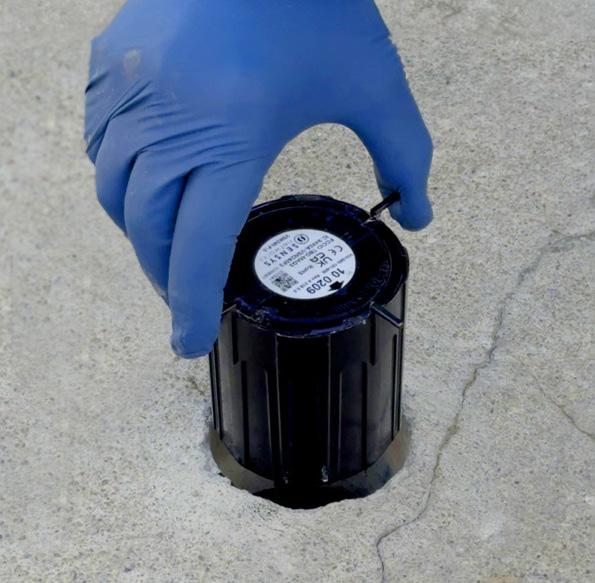
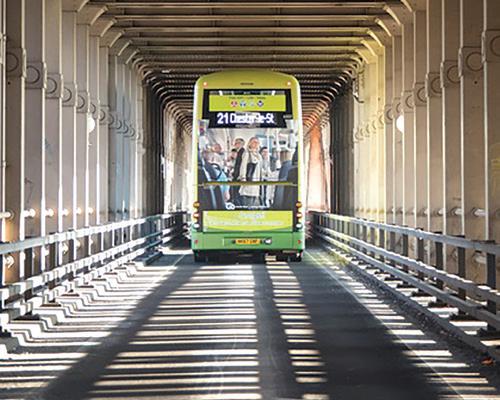
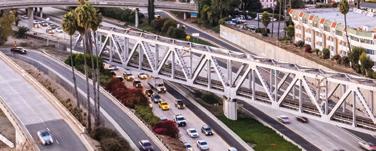
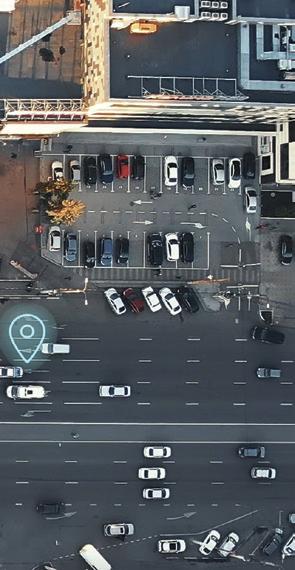
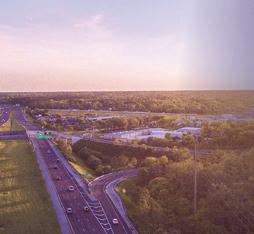
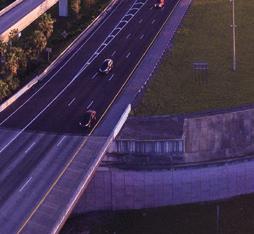
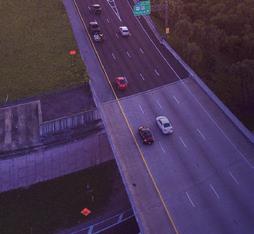
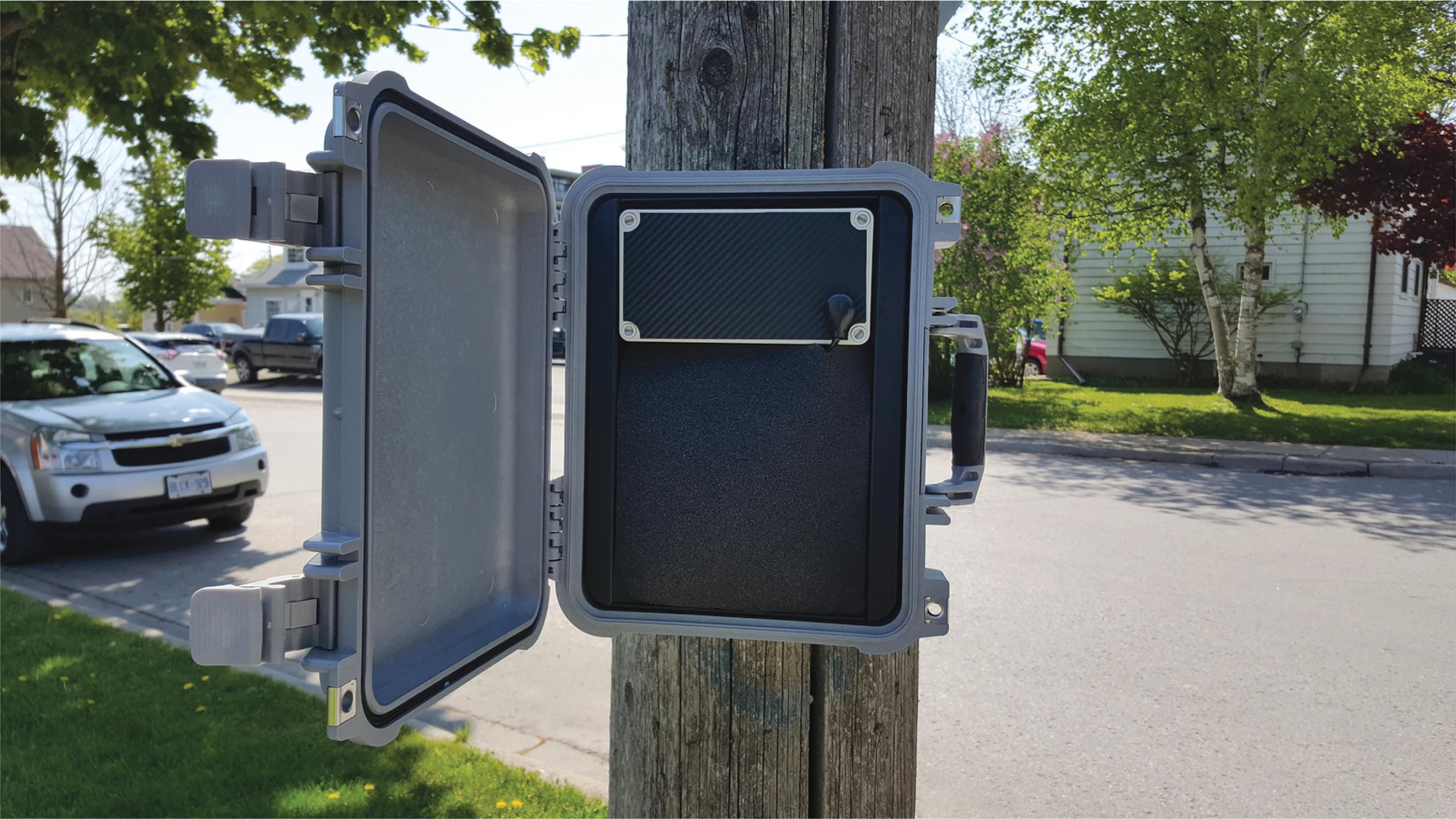
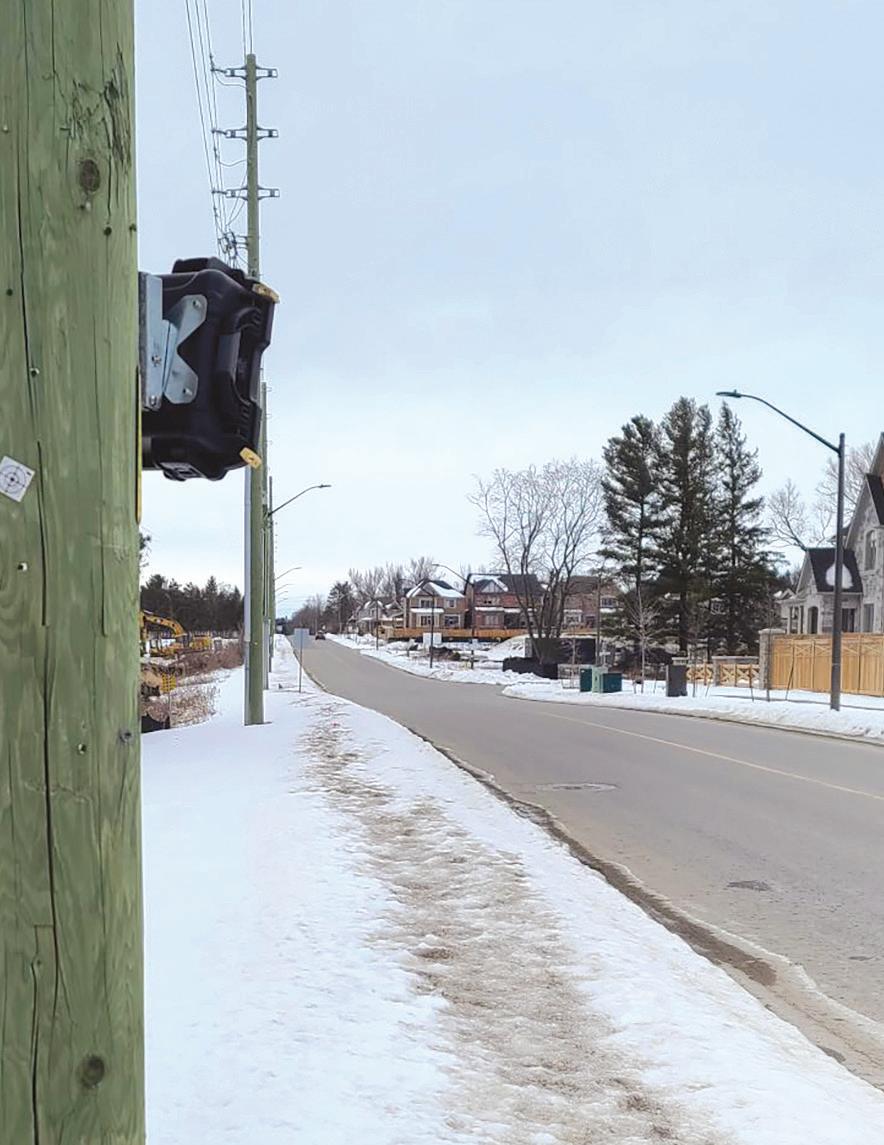
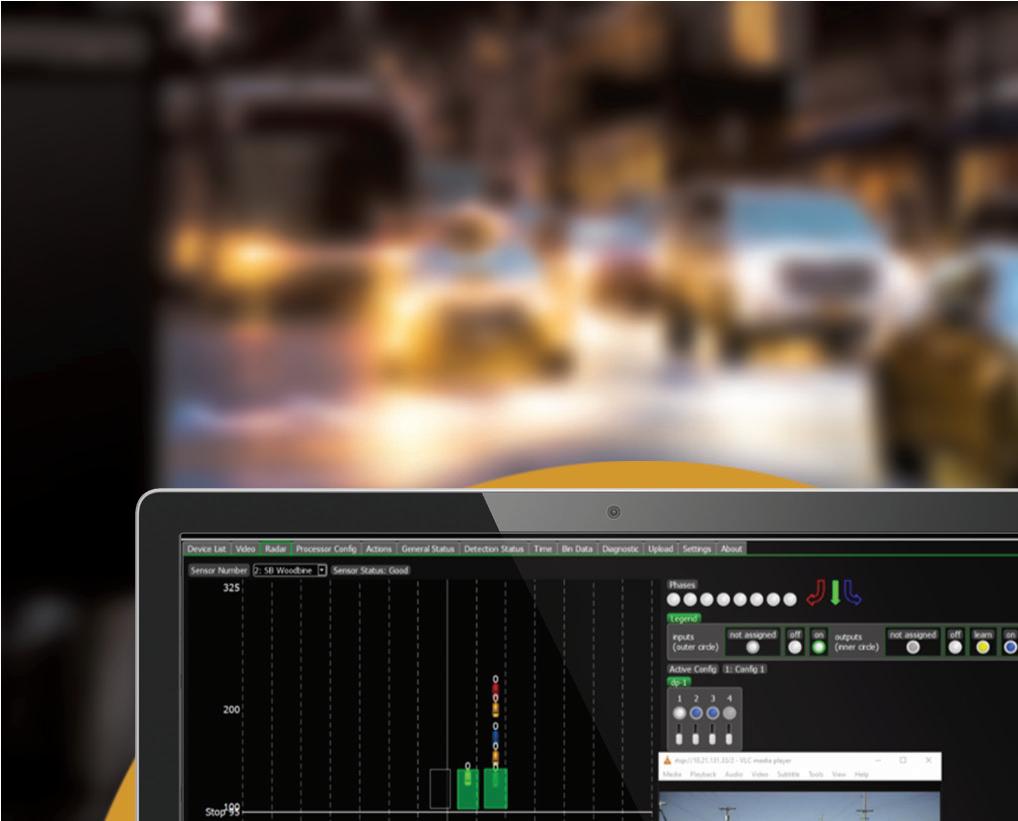
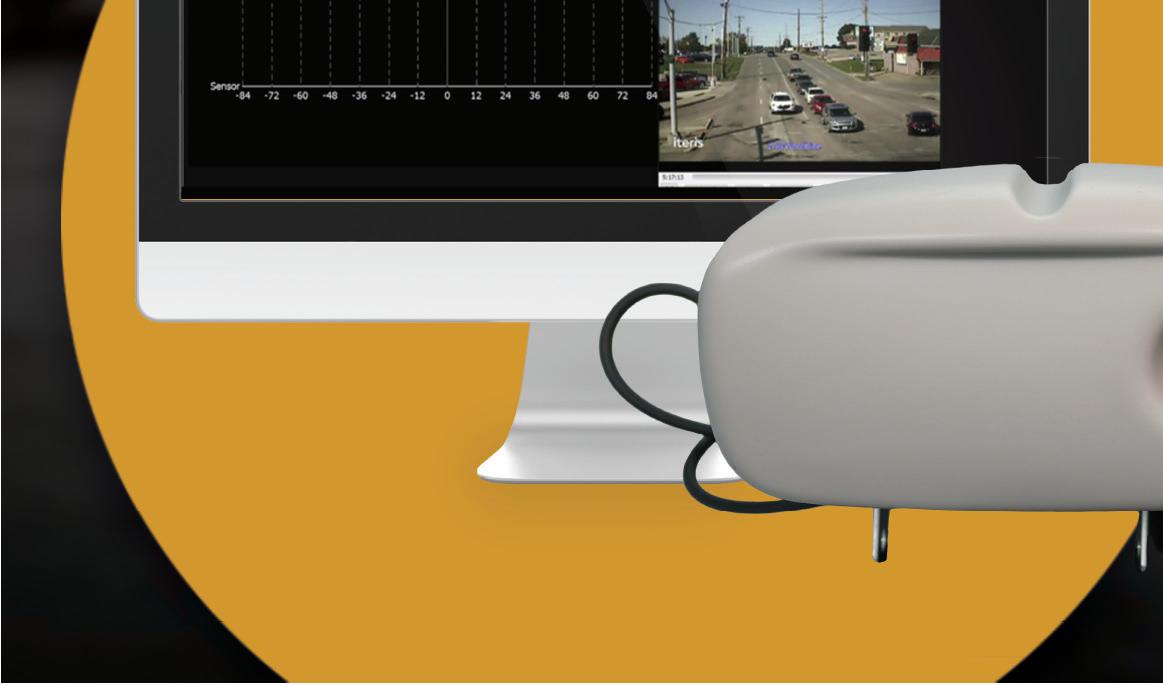
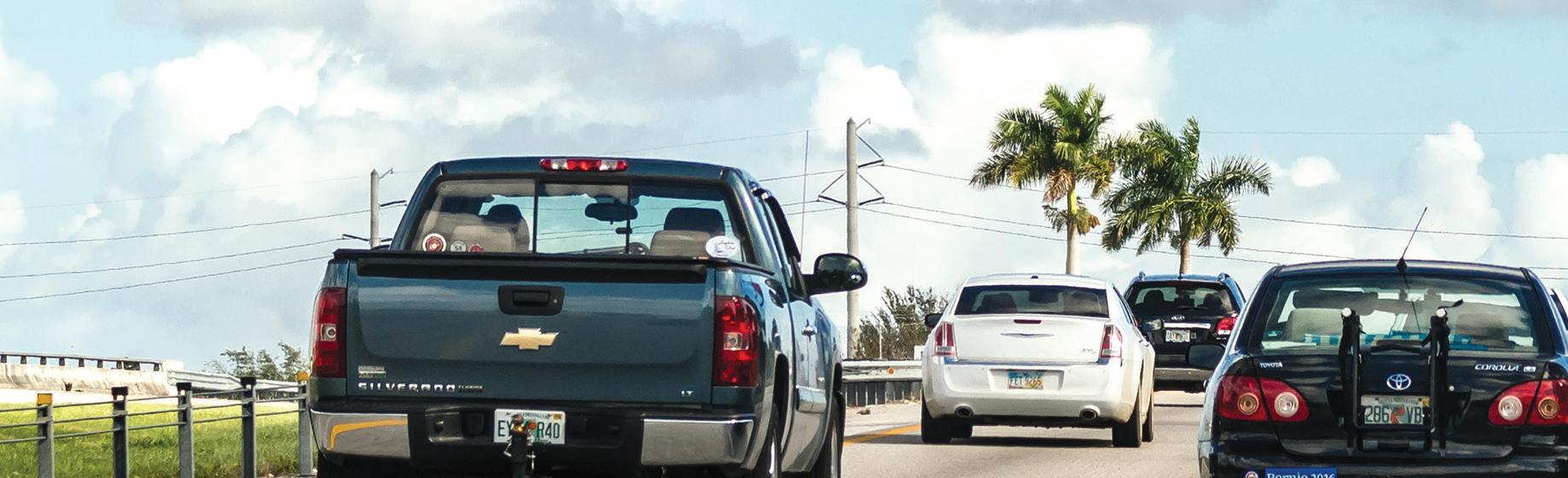
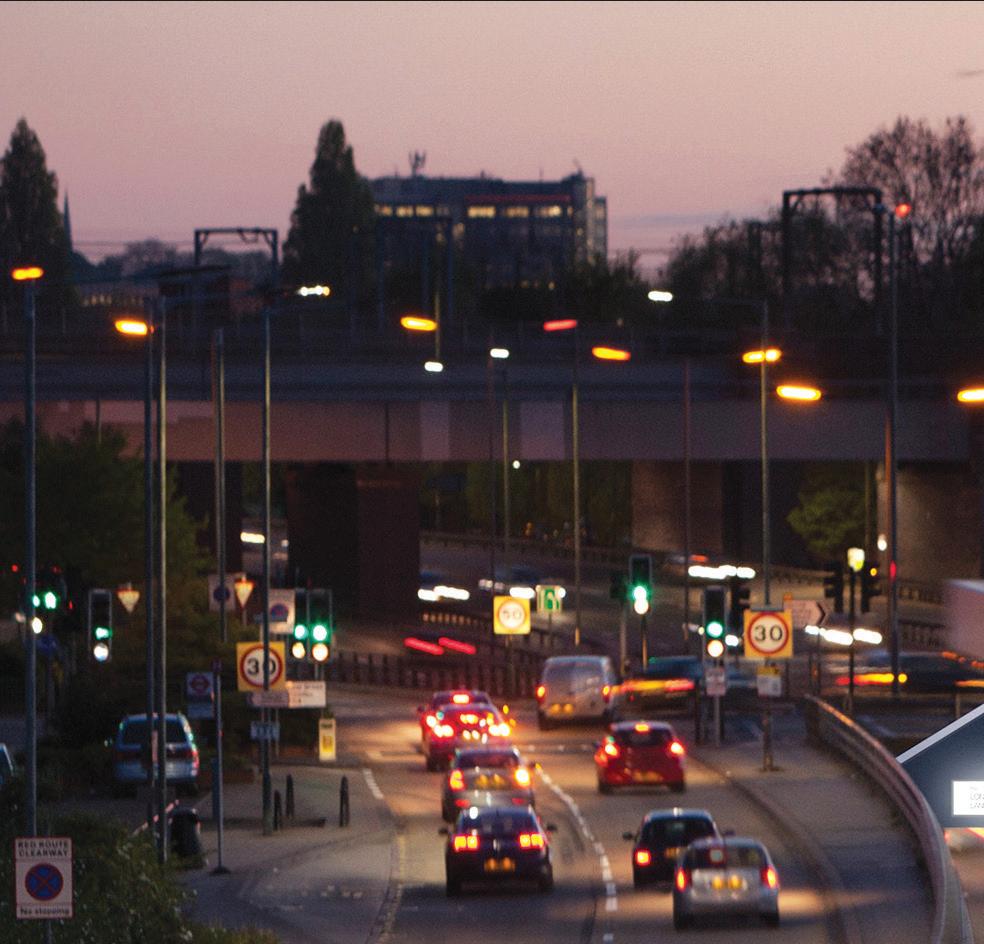
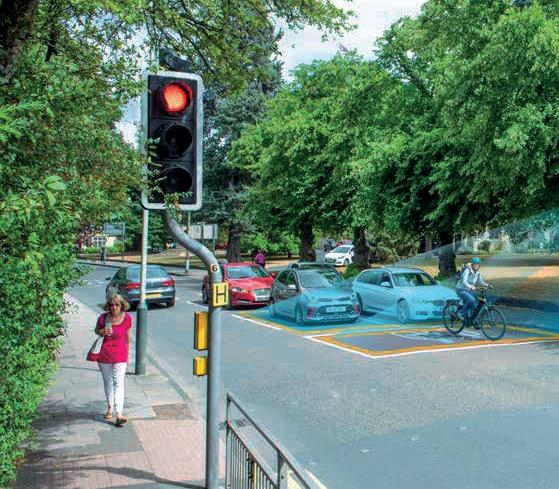
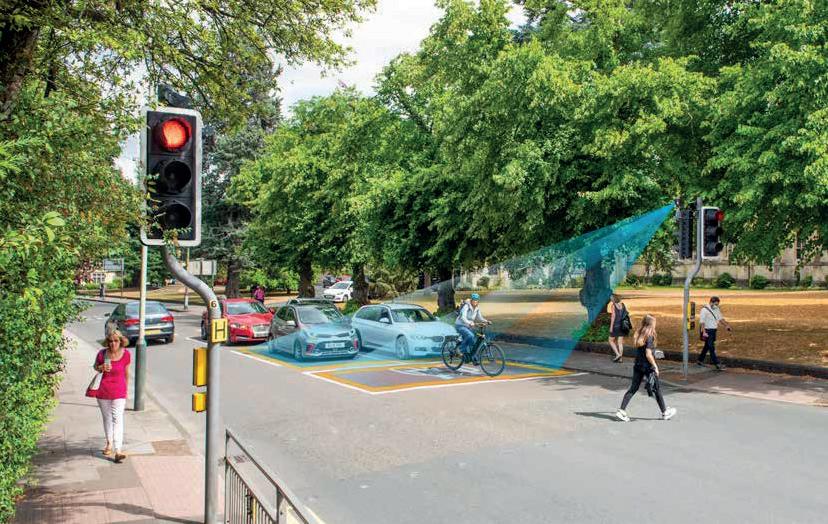
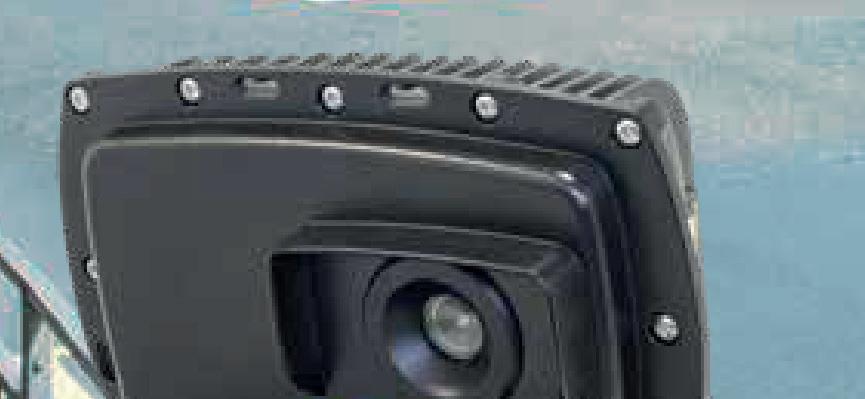
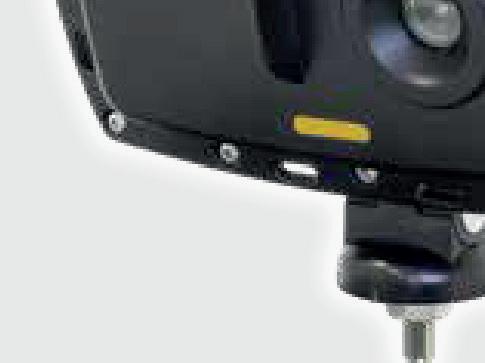
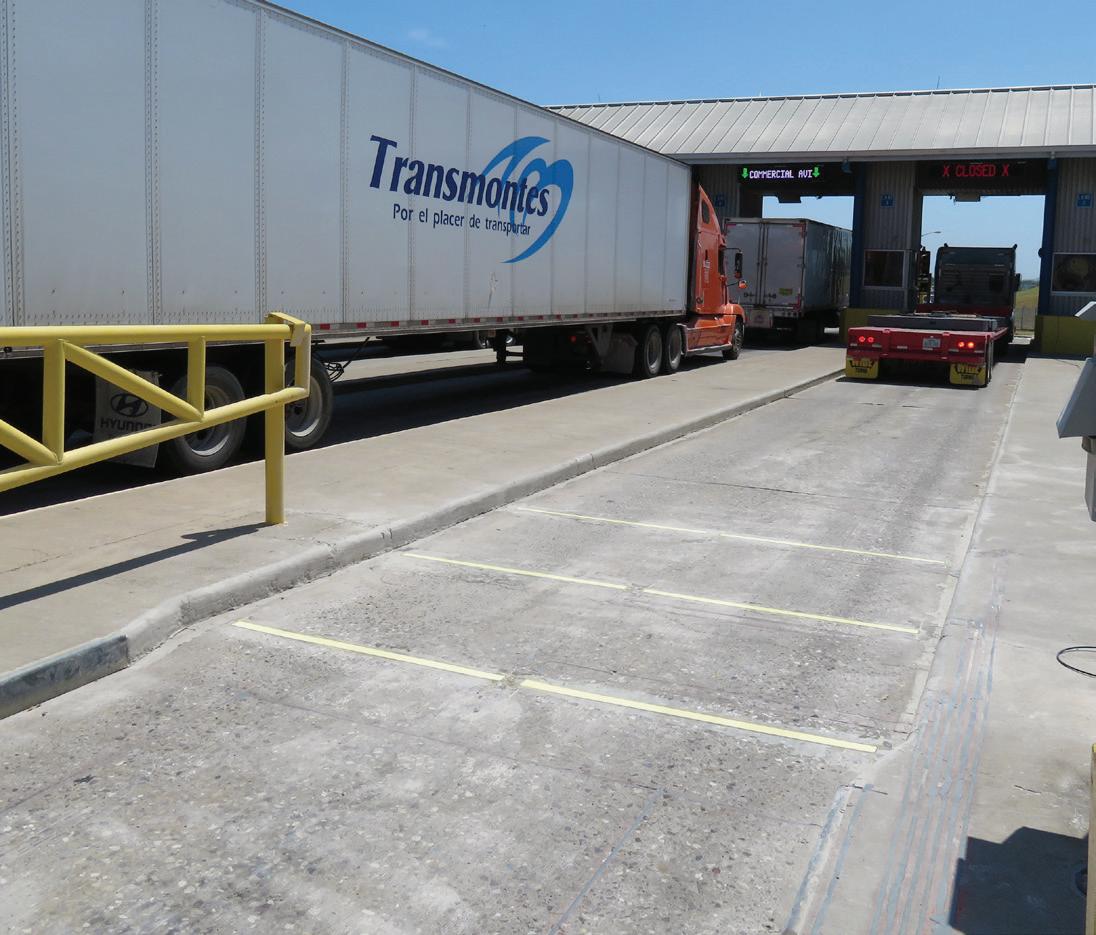
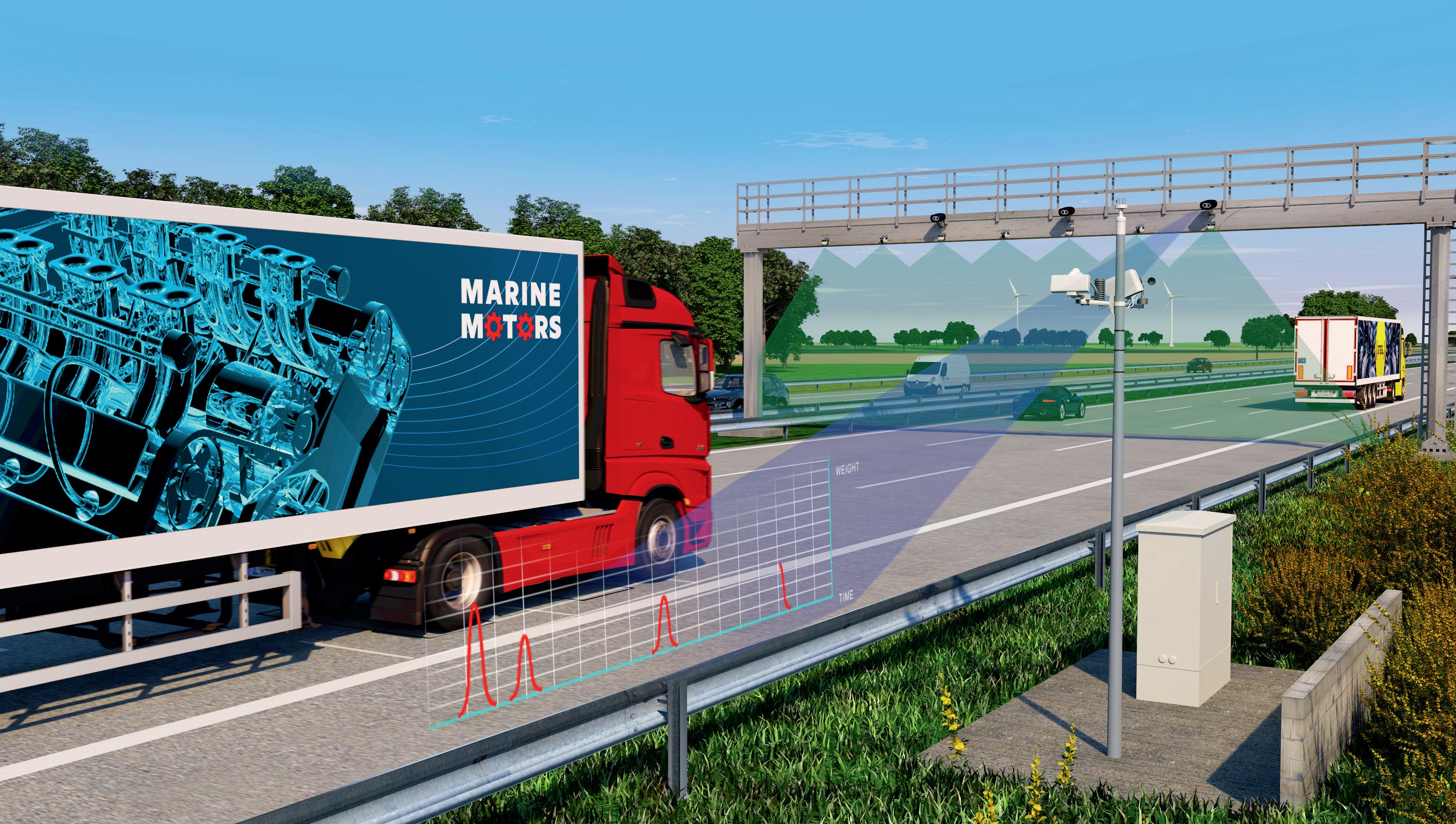
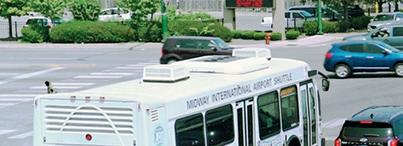
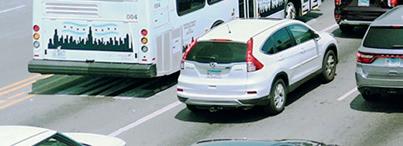
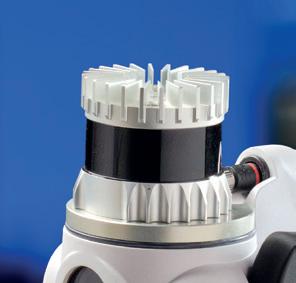
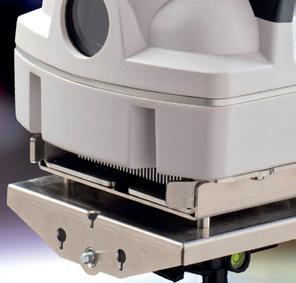
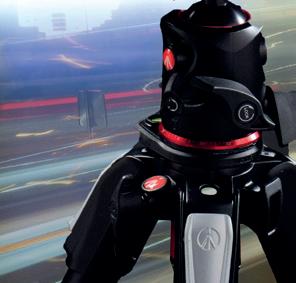
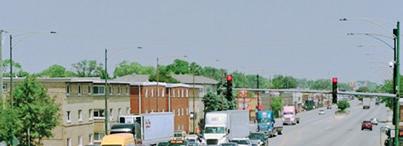
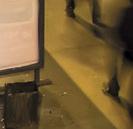
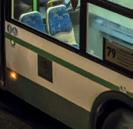
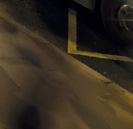
Introducing FlexMag3 with EZ-Out, enabling swift sensor removal for replacement or relocation. Minimize traffic disruptions and detection downtime for:
• Repaving projects - remove and reinstall intact after resurfacing
• Easy replacements - swap sensors instantly without lengthy lane closures
• Relocation - move temporarily for work zones or permanently for redesigned lanes
COMMENT
NEWS DIGEST
CONTRACTS & DEALS
INTERVIEW
What is Laura Chace most looking forward to at ITS America 2024? “Well, of course, the entire event, right? I always say this, but it’s true!”
SAFETY
Collaboration between AGD Systems and North Line Canada demonstrates the value of traf c experts getting together to improve pedestrian safety
URBAN TRAFFIC CONTROL
Digital twin and graph technology are helping Transport for London to ease congestion in the UK’s capital
DIGITAL TWINS
Simulation-based optimisation is the foundation for real-time predictive analytics when it comes to optimal traf c signal programming
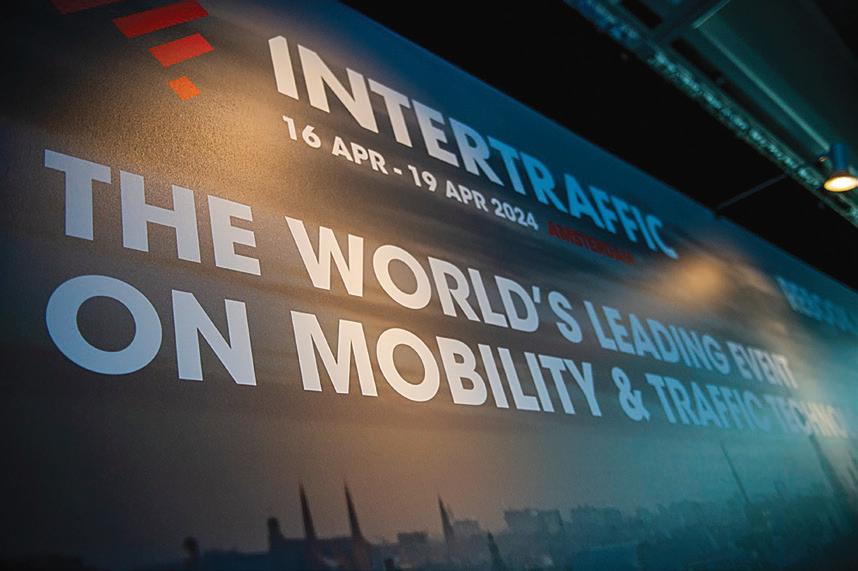
INTERTRAFFIC AMSTERDAM 2024
Smart, safe & sustainable mobility for all: with its emphasis on climate, AI - and even drones - this edition has something for everyone
VENTURE CAPITAL
March/April
35 WEIGH IN MOTION
WiM vendors are frustrated that OIML accreditation is not proving to be enough to satisfy tenders in some countries. ISWIM suggests a way forward…
39 TOLLING
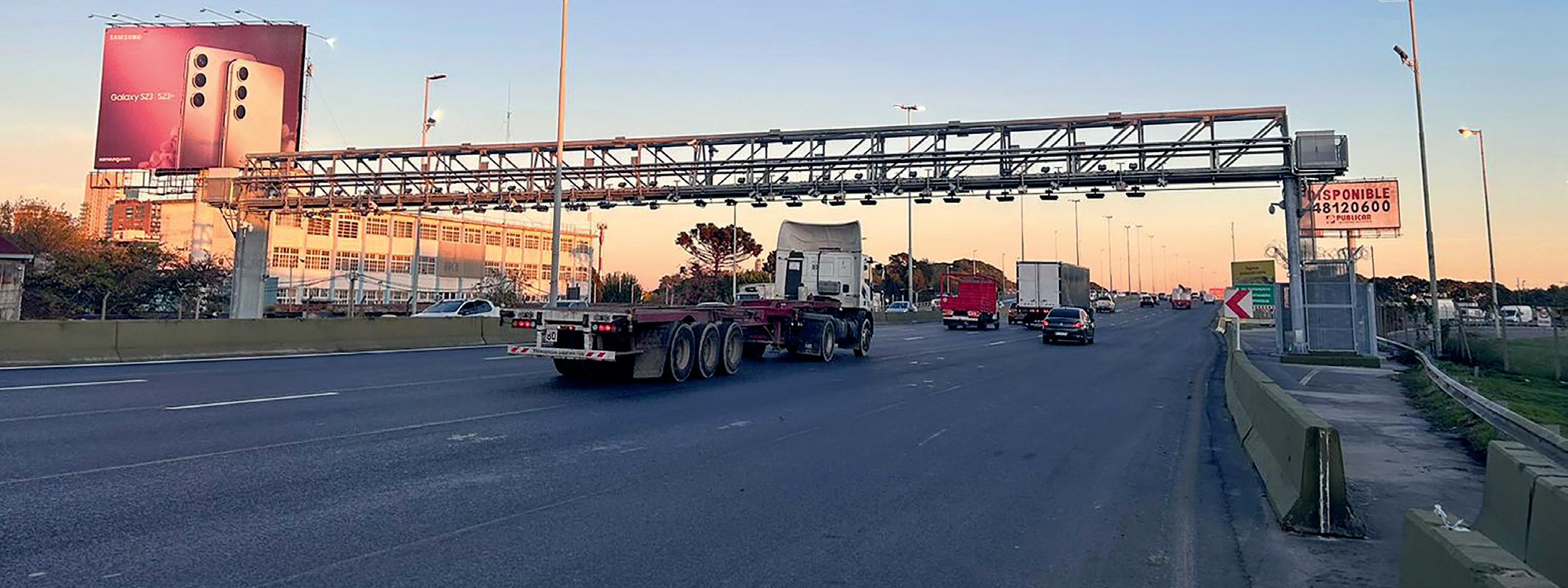
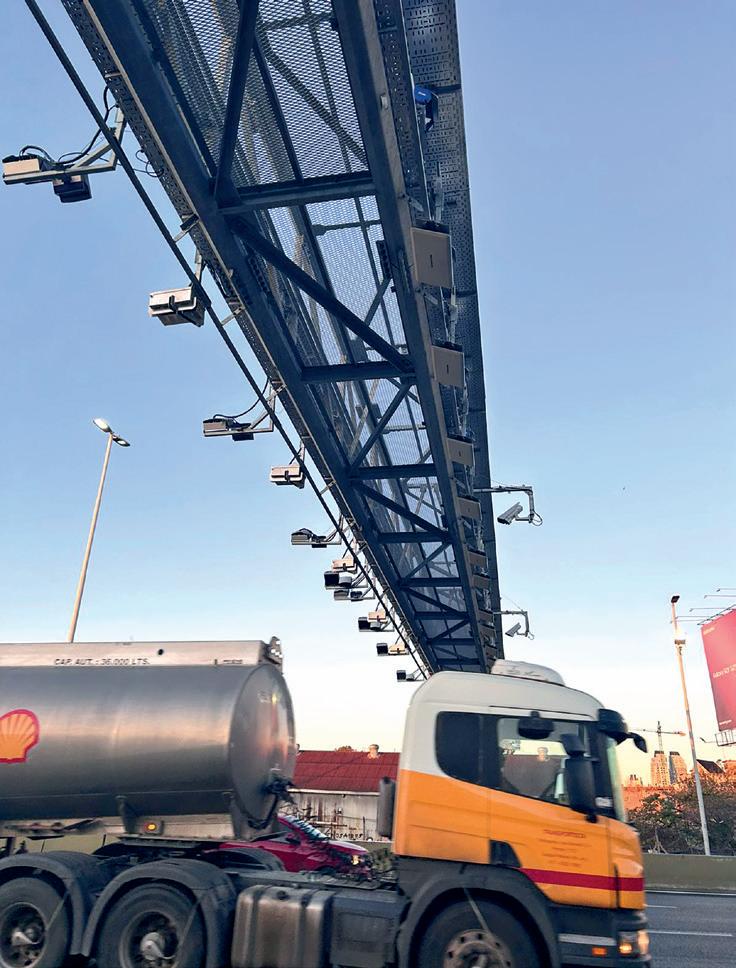
Tattile has deployed its free- ow ANPR system consisting of Vega Smart 2HD and Axle Counter cameras - powered by AI - in Buenos Aires
43
AUTOMATED DRIVING
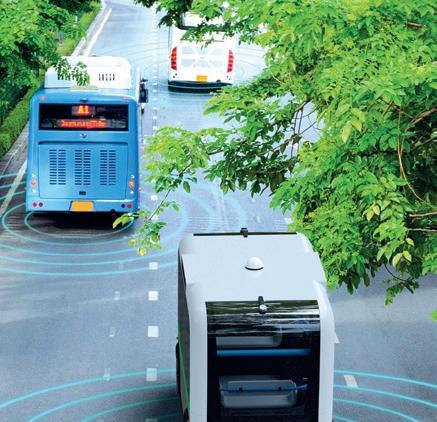
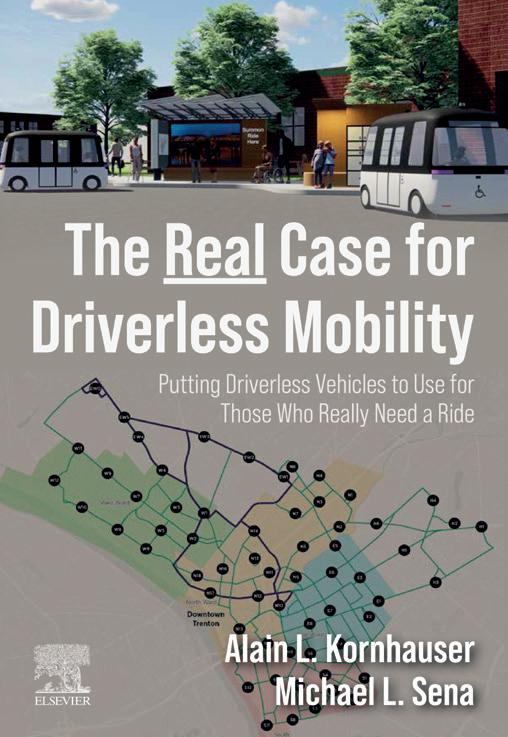
What will driverless vehicles really be good for? Bern Grush of Urban Robotics Foundation offers his thoughts on the big issues
Seed funding can help budding creators of mobility solutions realise their dreams: Laura Fox of Streetlife Ventures explains what venture capital investors look for
“TRAFFIC NERDS ASSEMBLE! IT’S SHOW TIME”
Two events loom large on the intelligent transportation horizon: Intertraf c Amsterdam and ITS America Conference & Expo, both in April. ITS International is proud to be of cial publisher for both events and will produce the Daily News in Amsterdam and in Phoenix, Arizona. We hope to see you there: Traf c nerds assemble!
By the way, this isn’t an insult – this is a rallying cry for the ITS industry.
Not all superheroes wear capes –although actually they do in our new promotional campaign, which reclaims the word ‘nerd’ and celebrates our pride in the sector.
Transportation is seen as – shall we say – a niche technical arena populated by engineers and eggheads. That’s probably why we love it: serious minds produce the life-saving technologies that have a positive effect on road safety. You don’t get to excellence without being enthusiastic and knowledgeable and, maybe, even a tiny bit obsessive about your subject. Attention to
Editor Adam Hill
Email: ahill@ropl.com
Tel: +44 1322 612062
Editorial Director
Geoff Hadwick
Email: ghadwick@ropl.com
Tel: +44 1322 612013
Sales Director
Dan Emmerson
Email: demmerson@ropl.com
Tel: +44 1322 612068
Sales Team
Graeme McQueen
Email: gmcqueen@ropl.com
Tel: +44 1322 612069
Production Manager
Nick Bond
Email: nbond@ropl.com
Tel: +44 1322 612066
Design Team
Simon Ward, Andy Taylder
Of ce Manager
Kelly Thompson
Email: kthompson@ropl.com
Internet, IT & Data
Services Director
James Howard
Email: jhoward@ropl.com
Tel: +44 1322 612070
“
“ Being a nerd should be a badge of honour in our industry
detail is what makes the difference between a good product or solution and a great one.
Nerds are cool: who hasn’t nerded out at a particularly interesting conference session on trends in urban mobility? Which of us hasn’t spent more time photographing intersection infrastructure than tourist spots on a city break? Why are road signs so fabulous? Why doesn’t the US have more roundabouts?
We should be embracing the difference. It’s time to get in touch with our inner geek. This is our tribe, these are our people. Being a nerd should be a badge of honour in our industry – literally, as it happens, since we have a number of branded pin badges to give away in Amsterdam and Phoenix. Come and say hello at Intertraf c - stand 01.105 – and you’ll see us walking the oors at the ITS America Conference & Expo. If you can’t be there, then please follow our coverage at the links below. Either way, join our movement. ITS
ITS International, USPS 13324, is published bimonthly by Route One Publishing Ltd, Second Floor, West Hill House, West Hill, Dartford, Kent, DA1 2EU, UK. No part of the publication may be reproduced in any form whatsoever without the express permission of the publishers. Views expressed in this journal do not necessarily re ect the opinion of the Editor or Route One Publishing Ltd.
All editorial, advertising or circulation enquiries to: ITS International, Second Floor, West Hill House, West Hill, Dartford, Kent, DA1 2EU, UK.
Reader Enquiry Service: data@ropl.com
Tel: +44 1322 612061
Subscription Enquiries: subs@ropl.com
Global: Print ISSN 1463-6344
Digital ISSN 2057-3421
NA: Print ISSN 2632-4458
Digital ISSN 2632-5950
The US annual subscription price is US$173.00. Airfreight and mailing in the USA by agent named World Container Inc, 150-15, 183rd Street, Jamaica, NY 11413, USA.
Periodicals postage paid at Brooklyn, NY 11256.
US Postmaster: Send address changes to ITS International, Air Business Ltd, c/o World Container INC 150-15, 183rd St, Jamaica, NY 11413, USA.
Subscription records are maintained at Route One Publishing Ltd, Second Floor, West Hill House, West Hill, Dartford, Kent, DA1 2EU, UK.
Air Business Ltd is acting as our mailing agent.
San Francisco to introduce speed cameras in 2025
San Francisco Municipal Transportation Agency is to install automated speed enforcement cameras at 33 locations on city-owned streets following an analysis of speeding hotspots. They will be distributed along San Francisco’s High Injury Network, the 12% of streets that account for 68% of the city’s serious and fatal roadway injuries. They will enforce lower speeds outside eight school sites, 12 parks, 11 social service sites serving seniors and people with disabilities and 12 neighbourhood commercial districts where many people walk or bike.
AI traffic project developed in Hungary, Turkey and Japan
Medianets Lab, part of Budapest University of Technology and Economics in Hungary, is developing a traffic congestion forecast and control system that will use artificial intelligence to control traffic lights. The threeyear project, called Multi-Input Deep Learning for Congestion Prediction and Traffic Light Control – Tralico - is being developed with the Istanbul IT and Smart City Technologies company in Turkey and the Nara Institute of Science and
$3.9m Tennessee Weigh in Motion deal for IRD
International Road Dynamics has been awarded a $3.9 million contract by the Tennessee Department of Transportation to install Weigh in Motion (WiM) systems at 28 sites on interstate and state routes across Tennessee, US. IRD, a subsidiary of Quarterhill, expects to complete the installation - its first in the state - in May 2025. The state-wide WiM programme will capture and record axle weights and gross vehicle weights as well as data on commercial vehicle characteristics in certain transit corridors for asset management and design improvements.
Peru highway speeds incident detection time with Valerann
Peru’s Lima Expresa, a Vinci concession, says it has reduced the time it takes to detect incidents on its highways following the introduction last year of Lanternn by Valerann. The 25km road carries 180,000 vehicles per day, connecting the centre of Peru's capital Lima with the port and airport. Speaking on a webinar hosted by IBTTA, Francisco Chenguayen, general manager of Lima Expresa, explained that average incident detection time was 12 minutes, prior to the deployment of Lanternn. Now the average is five minutes, he confirmed.
Dublin unveils lowtraffic city centre plan
Authorities in Dublin have released plans for reducing traffic - with one of its main points being a ban on cars travelling through the city centre area "while still balancing the necessary access for deliveries". Dublin City Council, in partnership with the National Transport Authority, developed the draft Dublin City Centre Transport Plan 2023, and envisages a city centre "not dominated by traffic". This could open up new opportunities in the Irish capital, with a greater emphasis on "fast and reliable" public transport.
by Miovision
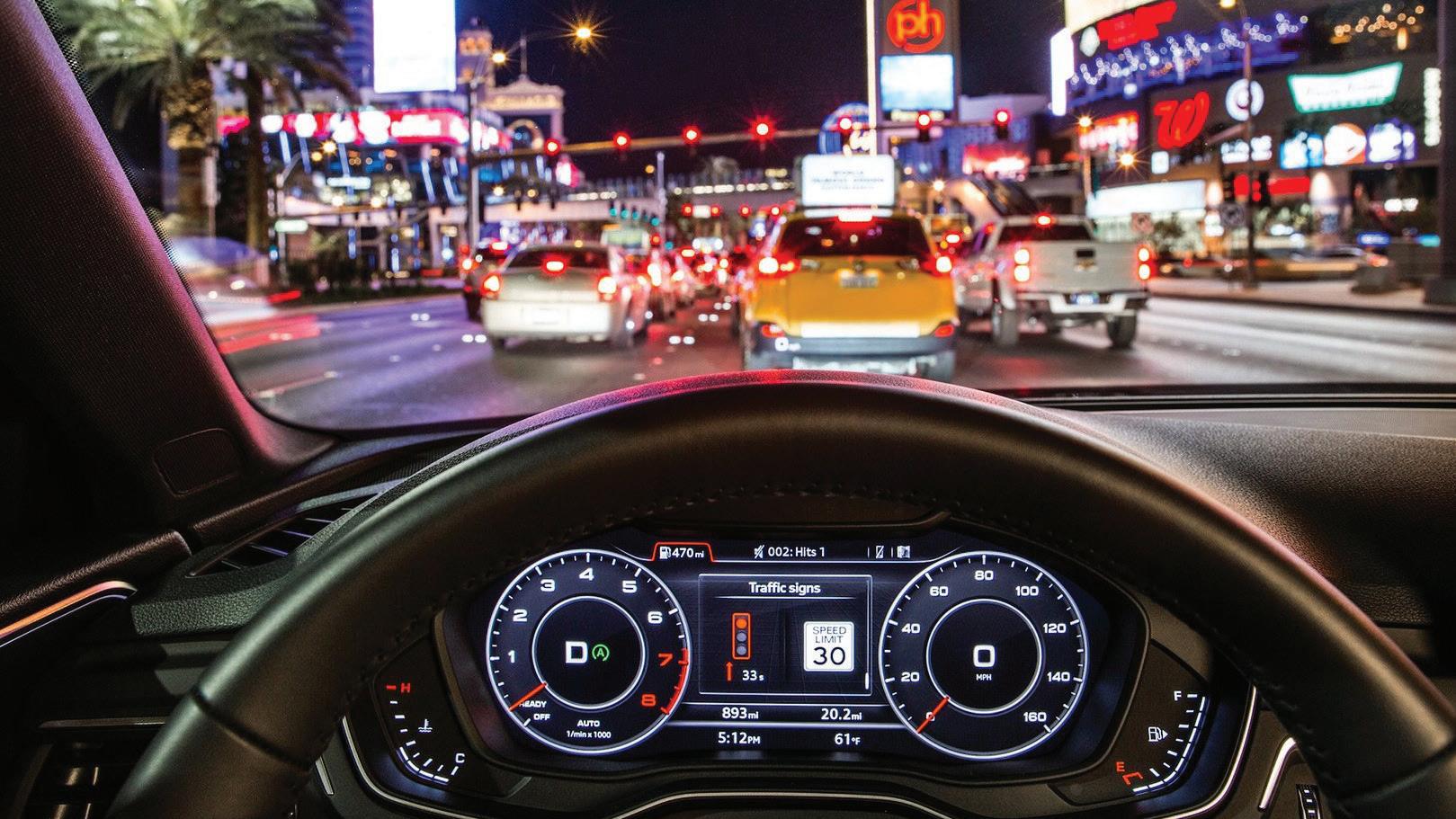
Miovision has bought Vehicle to Everything technology provider Traffic Technology Services. TTS provides the connection to traffic infrastructure that powers solutions such as the in-car product Audi Traffic Light Information, which helps drivers identify optimum speeds to avoid red lights and reduce fuel consumption. The patented technology is the only real-time 'situational awareness' service directly available to drivers through the vehicle’s instrument panel, says Miovision. TTS has agreements with 180 agencies, providing insights from 80,000 signalised intersections.
Q-Free tolls go live on Sydney Harbour Bridge
Q-Free's tolling systems for its Harbour Crossing Tolling contract in Sydney, Australia, have gone live. The deal has seen Q-Free provide the design, supply and installation of tolling roadside systems for the famous Sydney Harbour Bridge and Sydney Harbour Tunnel. The solution encompasses detection, classification and charging. The crossings unite Sydney's business district and the North Shore, serving over 40 million vehicle crossings annually for drivers, commuters, cyclists and pedestrians. Around 150,000 vehicles cross each day, making it one of the busiest roads in
Welsh default 20mph limit leads to 4mph speed drop
The 20mph default speed limit in built-up areas of Wales, introduced in September last year, has led to a fall in drivers' speed, according to Transport for Wales. Data over the first three months shows 'weighted mean' speeds (that is, average speeds when differences for traffic volumes are taken into account) on a sample of main restricted roads dropped by an average of 4mph: 24.8mph instead of 28.9mph. While there has been opposition to the limit, the authority says it expected this behaviour change from drivers.
Iteris wins $1m California traffic SaaS contract
Aimsun & Yunex deliver digital twin for Tees Valley
The Tees Valley Combined Authority in the UK has selected Yunex Traffic and Aimsun to provide a digital twin to help with traffic management. It will deliver a range of benefits including automated incident detection and alerts, supporting network-wide traffic management for the region, improving bus service reliability and reducing delays, congestion and emissions. It uses data from Yunex’s existing Stratos and UTC-UX traffic management systems, integrated with the Aimsun Live predictive decision support system, and will allow traffic management actions to be implemented either automatically or by a traffic operator.
California's Ventura County Transportation Commission has awarded a three-year, $1 million contract to Iteris for use of its ClearGuide solution - part of the ClearMobility platform. The product is designed to help improve real-time operations, incident management, workzone mobility and transportation planning with traffic data and map content powered by Here Technologies. Iteris says the software will be available to all cities and other agencies throughout the county, where it will also provide traffic volume estimates for freeways and arterial roads.
Serbia to upgrade ITS on state road 23
Serbia’s state highways agency - JP Putevi Srbije - has launched a project to integrate modern ITS technical solutions along one of its major highways. State road 23, from C ˇ acˇak via Zlatibor - commonly known as the Zlatibor Highway - is a 1B-class road in central and western Serbia, connecting Pojate with Gostun on the border with Montenegro. Upgrades include variable message signs and better meteorological road stations to alert drivers of changeable weather, with sensors for measuring visibility distances, wind speed and road surface conditions.
Green light in US for C-V2X intersection tech
Cellular Vehicle to Everything (C-V2X) technology has seen its first use on US public roads to request a green light for passenger vehicles. The 'detector call' application was developed by Applied Information for the Texas Department of Transportation. It was demonstrated using the TravelSafely smartphone app, an Audi e-tron Sportback equipped with a C-V2X Direct on-board unit programmed to ask for the green light, and a cellular network-connected Ram pick-up truck using Haas Alert’s Safety Cloud technology, which then delivered the location data to Applied’s cloud platform.
CONTRACTS & DEALS
Thales signals Montreal Métro modernisation
Three-year Florida pilot for One.network
Fairtiq offers PAYG ticketing in Czech Republic
Société de transport de Montréal has awarded Thales a train control contract to modernise one of Montreal Métro's four lines - the Blue Line - with a five-year maintenance period. The city in Quebec has a 71km metro network, which is the second busiest rapid transit network in Canada and the fourth busiest in North America. The communications-based train control (CBTC) work is designed to improve service punctuality and reliability, with Thales’ SelTrac signalling solution replacing the existing system - the first CBTC system to be deployed across the Montreal Métro network.
Hayden AI and Lyt agree mobility cooperation
Hayden AI and Lyt have agreed to jointly develop urban mobility solutions. The companies seek to combine the real-time data and location-accuracy applications of Hayden AI’s bus-mounted vision AI platform – an automated bus lane and bus stop enforcement platform installed on hundreds of transit buses in the US – with Lyt’s transit signal priority system. Lyt.transit uses cloud technology powered by AI and edge processing to successfully time traffic signals so that transit buses regularly receive green lights at intersections.
A yes for NoTraffic
Fairtiq is to provide a digital ticketing solution for multimodal public transport in the Czech Republic's Zlín Region. Public transport authority Koved chose the Swiss technology company to develop an advanced mobile PAYG (pay-as-you-go) solution that will be launched later this year. Fairtiq’s app will enable riders to use buses, trolleybuses and trains throughout the region seamlessly. Before boarding, passengers check in by swiping the app on their smartphone; when they get off, they swipe again to end the cost calculation.
One.network is to pilot and deploy its Live Link workzone safety module and Network Monitor, its traffic management solution, in the city of Altamonte Springs, Florida. One.network, recently acquired by Causeway Technologies, has a three-year deal with the city, north of Orlando. Live Link will allow road construction, utility and event contractors working in the city to notify GPS mapping providers about road disruptions directly from the roadside via an app - for instance, letting drivers know whether workzones are active, have detours or require speed changes.
NoTraffic has received approval from Florida Department of Transportation to deploy its traffic management solutions across agencies in the Sunshine State. The company said the approval will also showcase NoTraffic as a viable choice for other states seeking innovative mobility solutions. Its Software as a Service platform offers a mobility store which provides one-stop-shop access to multiple applications for enhanced safety, data analysis, efficiency and detection. On one single, unified platform, NoTraffic allows transportation departments and other stakeholders to introduce and manage customised mobility services.
The Union of Passenger Transport Companies of the State of Amazonas (Sinetram) in Manaus, Brazil, has chosen Optibus' transportation management platform for the planning and optimisation of the city’s 1,000 buses run by seven companies, with 2.7 million annual passenger journeys and 278 routes. Sinetram will use Optibus’ route planning, crew and vehicle scheduling, and timetable optimisation products to create more efficient schedules and bus driver shifts, and gain visibility into their operation.
“WE’RE ON THE PRECIPICE OF POTENTIALLY INCREDIBLE CHANGE”
Laura Chace, president & CEO of ITS America, talks to Adam Hill about knowledge gaps, Phoenix, the pace of change, digitalisation, AI - and the importance of authenticity…
hen ITS America president & CEO Laura Chace speaks to ITS International, it is just a few days after the organisation’s latest board meeting. As well as the vital issues of engaging existing members, and bringing new members into the fold, they talked about a lot of weighty issues.
“Everything from connected transportation ecosystem to arti cial intelligence, to digital infrastructure, to issues of security and privacy,” Chace says with enthusiasm.
“There’s a lot of really complicated but important issues. We had really good discussions.”
There are three main areas of focus for ITS America this year: rst up is Vehicle to Everything (V2X) roll-out. “As you well know, connected transportation – V2X - is absolutely mission-critical to us,” she says. “We are working with USDoT to get a nal plan on interoperable connectivity that hopefully will be released this spring, so that is a critical milestone.”
This process is well advanced, and moving into its nal stages. The second critical issue on the radar is developing policy for the next transportation reauthorisation in the US to put technology on par with physical infrastructure.
“Digital infrastructure authorisation policy funding for technology that is not just discretionary and baked into competitive grants,” Chace says. “How do we start to actually look at the tools we have and ensure that we are structuring them in a way that is going to allow for technology deployment? That’s one big issue encompassed in our digital infrastructure work.”
AI is not going to solve every problem; however, it is very good at solving many problems “
In this industry we have a challenge with making these technologies and solutions accessible and understandable to regular people
There’s another aspect to this. “While there’s a lot of movement on different individual use cases, for showing how digital infrastructure can save lives, increase the ef ciency of our system, increase sustainability and equity, all of those thingswhat’s missing is a unifying vision,” she explains.
V2X roll-out remains a top priority for ITS America
Digital infrastructure
“So that’s an area where we’re working with our federal partners and with our members and the broader community to really come together and say: ‘What is that vision and framework for advancing digital infrastructure that will provide a guide for the whole industry’, so that people on both the public and the private sector side will have more certainty to make these digital investments for the future.”
And the third area of focus for ITS America is arti cial intelligence. “AI is not new, it’s been a part of transportation for some time,” Chace points out. “But the speed at which the technology and the solutions are advancing is unlike anything we’ve ever seen in the past, and so there is this proliferation of new tools and new solutions everyone is really trying to get their head around.”
How do you use it to improve the operations of your systems? And what are the considerations and risks that you have to be aware of when you’re using an AI solution? We don’t want people to over-rely on it - and we don’t want people to be afraid to use it. We want them to take a really educated approach to AI.”
This means there is a need to develop AI governance policies: “What are some of the risk considerations? How do I take a balanced approach to this and keep a human-centric lens on my use of arti cial intelligence?”
For this reason, ITS America has a new working group developing AI policy principles and guidelines. “There’s a lot of confusing terminology and I think there’s an opportunity for ITS America to help provide some clarity to the transportation industry on the different terms,” Chace explains. “And we’re also going to create some use case examples to show how AI can be used to advance our goal of safer, greener, smarter mobility for all.”
going to create some use case examples to show how AI can be
There is a lot of hyperbole around AI – which is all the more reason to have a calm voice providing a practical overview of what’s possible. “The approach that we’re taking is: AI is not going to solve every problem,” Chace says. “However, it is very good at solving many problems. So understanding the limits of what it can do, understanding transparency in these AI systems, understanding what data it is using - because it’s only as good as the inputs it’s receiving - we’re really trying to take some of the hype out of these conversations and target it more towards real applications that are useful.”
In transportation, there are quite a few of these, she suggests. “How do you use it to augment and help your workforce now?
Arti cial intelligence
Chace is on the AI working group of the Transforming Transportation Advisory Committee (TTAC), which was recently set up to offer advice to USDoT and transportation secretary Pete Buttigieg about plans and approaches for transportation innovation.
It includes a number of ITS America members, with experts from academia, think tanks, the public sector and industry covering topics including automation, cybersecurity, safety, accessibility, law, government, entrepreneurship, privacy and equity.
“The industry is going to keep moving forward and I’m hopeful that TTAC will come up with some helpful recommendations, in a timely fashion, that will be relevant,” Chace says. “But the pace of technology doesn’t stop. It always depends on how quickly you can get recommendations through a very large, diverse group. So the speed of it will remain to be seen - but I think we have a good cross-sectoral representation to provide some good inputs and recommendations.”
Chace has been in her current role for nearly three years. Before that she was chief operating of cer at ITS America. “The biggest change for me personally was going from being the one who was responsible for making everything happen to being at that CEO level where my role is to set the strategy and guide everybody - but other people are implementing.”
It’s quite a leap and one she says took time to get used to. Meanwhile, shifts in the ITS sector itself – even in that short time – have been signi cant too. “When you start to look at the amount of real-time data that’s now available in transportation,” she begins, “it’s really hard to harness from phones and from sensors and from all this different equipment because we don’t really have that digital infrastructure in a standardised way. I think we’re on the precipice of potentially incredible change and transformation if we can get this right: you’ve got all this digital infrastructure investment; you’ve got all these AI-based tools coming online; we have to grapple as an industry with issues of data privacy. And those are things that have become much more top of mind in the past 12 months than they were when I took on this role in August 2021.”
With this pace of technological change in mind, an online training programme - the ITS America Academy - will be launched towards the end of this year, beginning with a single course on how to use transportation data. “We’re going to crawl, walk, run,” Chace smiles. “We’re going to start small and our goal over time is to create a suite of courses. What we’ve realised is that there is a role that ITS America can and should play in terms of education and workforce development with regard to some of these emerging technology tools.”
ITS America thinks it has identi ed a knowledge gap in the industry. “There’s a lot of really good technical, very in-depth, documents and resources for ITS professionals,” Chace suggests. “There might even be some basic introductory resources. But there’s not a lot in that middle.”
Practical resources
So while maintaining its traditional focus on policy, the organisation will also branch out into creating “more practical resources for deployers” in areas such as V2X, digital infrastructure, AI and transportation integration. The ITS industry is relatively small, so scaling ITS technologies requires buy-in from the broader transportation industry who are interested in the technology – but for whom it is not exactly their day job.
She explains: “There are practitioners who don’t really understand: ‘What is V2X, how does it work and how does it bene t me? How do I actually integrate these solutions into my systems? What do I need to be thinking about? Who do I partner with?’ All of these next-level conversations.”
Chace sets great store by the power of conversations. As a highly-visible transportation leader, she is comfortable sharing both professional and personal thoughts on social media, particularly LinkedIn. She often brings something of herself to
What to see at ITS America 2024 in Phoenix
Asking Laura Chace, president & CEO of ITS America, to name the sessions she is particularly looking forward to at the organisation’s Conference & Expo in Phoenix, Arizona, on 2225 April is clearly unfair. But it’s worth a try. “Well, of course I’m looking forward to the entire event, right?” she laughs. “I always say this, but it’s true. The thing I love most about our conferences, really, is that time to bring the broader industry together in one space. I’m really excited.”
When pushed, she points to two keynotes with highpowered panels. Rethinking Infrastructure in the New Digital Era will see her speaking with Brian Cronin, head of USDoT’s ITS Joint Program Of ce as well as panelists including Selika Talbott, CEO of Autonomous Vehicle Consulting, Miovision boss Kurtis McBride and Seleta Reynolds, chief innovation of cer of LA Metro. The second looks at emerging solutions: Arti cial Intelligence – Unlocking the Next Frontier in Transportation includes luminaries such as Veronica Vanterpool, acting administrator of the Federal Transit Administration and Robert C. Hampshire, chief science of cer at USDoT. “I think they’ll be thought-provoking, ones you won’t want to miss,” Chace says. “And I think I’d be remiss if I didn’t call out the party for Atlanta that we’re doing on Wednesday night. That will be a fun event to get everybody ready for the ITS World Congress in Atlanta in August 2025. But I’m just excited to actually walk the exhibit oor and see some of the new solutions that people are bringing to Phoenix.”
“Digital infrastructure can save lives, increase the ef ciency of our system, increase sustainability and equity, all of those things - what’s missing is a unifying vision”
her posts there - for example, by mentioning her children in the context of wanting to see safer roads, or on the issue of girls achieving their academic potential – as well as talking about more obvious ‘business’ subjects.
“It is my natural style,” she says. “It is something I’ve done deliberately but at rst I did it very sparingly because I was afraid that I wouldn’t be taken seriously, that people would think I didn’t know what I was talking about. But I did it a few times, and I got really good feedback. And then I remember having a conversation with my communications director at the time, and some other people, and they said: ‘You’re most authentic when you’re talking about your personal views and how it impacts your personal life’. And I think in this industry we also have a challenge with making these technologies and solutions accessible and understandable to regular people. Almost by de nition, you don’t see ITS technology, right? I mean, yes, you can see a sensor or a camera – but it’s not like when they resurface a street and it’s very smooth or you can see when they put a bike lane in. People don’t see ITS technologies very often, if at all.”
Authentic self
Chace has spoken before about ITS “providing real outcomes for real people” and this is partly why she brings her personality to her posts. “We have to gure out a way to relate them to people so they understand: yes, this is actually making your journey safer, or yes, this is actually helping you get home on time,” she insists. “So that’s really why I did it. Because when I talk to people outside of this industry, that’s how I talk to them: I explain it to them in ways that they can understand, and it resonates so I wanted to bring that forward.”
There is another reason. “And also, it is my authentic self,” she laughs. “So it feels more natural.”
Her reticence to reveal this in the rst place will be familiar to many women in the transportation industry. “It’s probably ‘impostor syndrome’, that many, many women and some men have,” she says. “I’m not a transportation engineer yet I’m running this organisation that speaks essentially to transportation engineers across the country. And so it was my own self-doubt that led me to hold back a little at rst.”
That doesn’t seem to be an issue now. “No!” she says rmly. “Really and truly now I think that’s what we need. We need to be talking to people: consumer acceptance of these technologies is a real challenge for the industry.”
Moving forward, the ITS industry must try to engage with people to understand these technologies and want to use them. “So now” – she laughs again – “I feel much more emboldened. Because we need that mix of both technical expertise on the issues, but we also need that ability to communicate this and make it understandable to a very broad array of users of the system.” ITS
Driving Road Safety and Security.
Jenoptik provides innovative and sustainable smart mobility technology and services.
As an end-to-end solution provider, we support our customers with the provision of roadside equipment and software, including integration and installation through to full-service operation. Our strong global presence and installation base is supported by a reliable partner network.
With innovation as our driving force, Jenoptik is a world-leading enabler for smart mobility, making roads, journeys and communities safer around the globe.
Follow us! jenoptik.com/markets/public-safety
Hard data supports traffic monitoring
A
collaboration between AGD Systems and North Line Canada has demonstrated the value of traf c experts putting their heads together to improve pedestrian safety
In recent years, the issue of speeding, high traf c volumes and aggressive drivers in communities and school zones has become a growing concern in Canada. Unlawful driving puts pedestrians at risk, as well as installers deploying technology to monitor and enforce safer road usage.
To address this problem and prioritise safety for all, gathering data on speeding violations and road usage has emerged as a valuable tool.
AGD Systems, designer and manufacturer of urban traf c and pedestrian control products, and North Line Canada, provider of traf c, data and asset management solutions, have taken a proactive approach to traf c management. The rms see bene ts in their collaborative solution, designed to enhance safety levels in key zones across North America.
The value of data
Like many other locations globally, community safety programmes in Canada encompass a wide range of initiatives
and strategies to promote safety, crime prevention and wellbeing within local communities. These initiatives often involve collaboration between various stakeholders, including law enforcement, community organisations, local businesses, schools and residents.
When an initial complaint has been made to the authorities, while colloquial feedback from ‘eyes on the ground’ is essential, undertaking an unbiased traf c study is vital before any formal action can be taken.
To enhance safety levels in these locations, it is necessary rst to gather and analyse the data to understand the scale of the problem. Traf c studies can highlight issues at given periods of the day or support the case for enforcement or other traf c management measures.
Supported by data, authorities have the hard evidence they need to analyse traf c ow effectively, identify problematic areas and behaviours, and develop strategies to manage traf c better, enhancing road safety and ef ciency.
In Canada, depending on the situation, strategic changes may begin with educational
initiatives to raise awareness about the dangers of speeding and promote responsible driving behaviour, or fundamental changes to the site may be required - such as adjusting speed limits, installing traf c calming measures or optimising signal timings.
This targeted monitoring also feeds into the average annual daily traf c (AADT) counts, which must be carried out four times a year on roads of a particular classi cation in Canada and the US. This important metric is used to understand traf c patterns, identify congestion points and forecast future traf c volumes to support ef cient and safe transportation system updates and management.
“Regarding communities and school zones, where there is an elevated risk to pedestrians, traf c studies usually occur over seven to 10 days, look at issues such as speeding violations, and feed into AADT data,” explains Jim Sheehan, director of sales, research & development at North Line Canada. “Aside from accessing data to back up the need for immediate action to improve safety, there is also a strong requirement for data to use in the future. Our customers
“ “ Our customers see power in hard data and request it as a way of future-proofing systems
Jim
Sheehan
Northline Canada
see power in hard data and request it as a way of future-proofing systems. It may be that planned investment or advancements in technology will allow them to use the data at a later point. This means solutions need to consider society's future traffic management and enforcement needs and develop technologies ahead of their time.”
A collaborative solution
With the notion of ‘data is power’ in mind, North Line worked with AGD to integrate a specialist radar, the 331, into the Fox product solution. The result is an all-in-one solution for authorities who need to gather detailed dynamics about road usage and daily and AADT.
The Fox captures vehicle data and reports on volume, speed and direction of travel, with multi-lane detection, all with a date and time stamp per event. The radar is combined with a processor and on-board modem, which allows data to be accessed remotely through North Line's proprietary reporting software.
and AADT compliance reporting, all while being simple to use and quick to deploy by the end user.
North Line worked with AGD to integrate a specialist radar, the 331, into the Fox product solution
deployed either in a temporary or permanent location off to the side of the roadway, away from live traf c, keeping installers safe from high-speed vehicles or aggressive road users. Another key consideration to further enhance safety is reliability and reassurance that the solution is rugged enough to withstand the harsh Canadian winters. AGD had already put its 331 radar through US National Electrical Manufacturers Association (Nema) testing, which involves subjecting electrical equipment to a series of rigorous tests under controlled conditions to assess its suitability for use in speci c applications and environments.
“The 331 radar was designed to offer a direct physical retro t capability for those wishing to build additional functionalities into the solution, and this ease of integration has enabled North Line to create a bespoke detection platform,” says Dean Jarvis, commercial engineer at AGD. “Operating in the 24GHz K-band, the 331 offers accurate speed and range measurement while discriminating between advancing and receding traf c; these features make the radar ideal for use in communities and school zones, where pedestrians face heightened risks.”
Originally intended for speed awareness signs, the 331's versatility positioned it as the optimal selection for integration into the Fox system.
“Its initial design for compatibility with other products resulted in a compact form factor, allowing us to ship more units internationally with reduced packaging and yielding environmental bene ts,” Jarvis continues. “Additionally, the minimal waste generated from disassembly and reintegration into the Fox product further emphasises its ef ciency and eco-friendly attributes.”
North Line’s Sheehan adds: “We needed the ability to install the system anywhere, so it had to be standalone. The low-power draw of the 331 radar meant that we could achieve a suf cient run-time rate to perform a study over seven or more days. AGD also worked with us to develop a low-speed version of the 331 so we could use it for speci c applications, further proving the importance of collaboration and manufacturers’ agility.”
On-the-ground feedback
The Surrey Royal Canadian Mounted Police (RCMP) is presently utilising four Fox radar systems supplied by North Line Canada. “These units have been critical to our operations on several fronts,” explains Corporal John Stables of Surrey RCMP Traf c Services. “They assist with data collection which allows us to liaise with City of cials to implement traf c calming measures, such as speed humps, speed reader boards and roundabouts.”
The radars have also enabled
“
AGD’s 331 radar passed Nema testing, ensuring suitability for use in speci c applications and environments
“ The 331 radar was designed to offer a direct physical retro t capability for those wishing to build additional functionalities into the solution
Dean Jarvis AGD
Stables’ unit to carry out intelligence-led enforcement. “These advancements mean that we have been able obtain intelligence, deploy our units to speci c areas, and have been able to instruct of cers as to what day and what time to be in that area for enforcement action,” he adds.
“This intelligence-led approach has allowed us to deploy our of cers to where they are needed, when they are needed. Importantly, we can now rule out areas that the of cers are not needed, ensuring resources are used in an effective way.”
In a community setting, Christine Kinahan, engineering technician at The Corporation of the Town of Lincoln, explains why Fox has emerged as the initial course of action. “The Fox radar units have allowed us to identify problem areas with
quali ed and quanti ed data pertaining to speed and traf c volumes and to target speci c times of day when issues are clearly present,” she says. “These are our rst line of action when a resident or council complaint is received and have provided exceptionally valuable and complete data in all weather and both urban and rural locations.”
In summary, temporary detection systems serve an instrumental role in data collection, enabling intelligenceled enforcement and targeted traf c management initiatives, leading to improved road and community safety. ITS
• For more information visit www.agd-systems.com www.northlinecanada.com
n
n
n
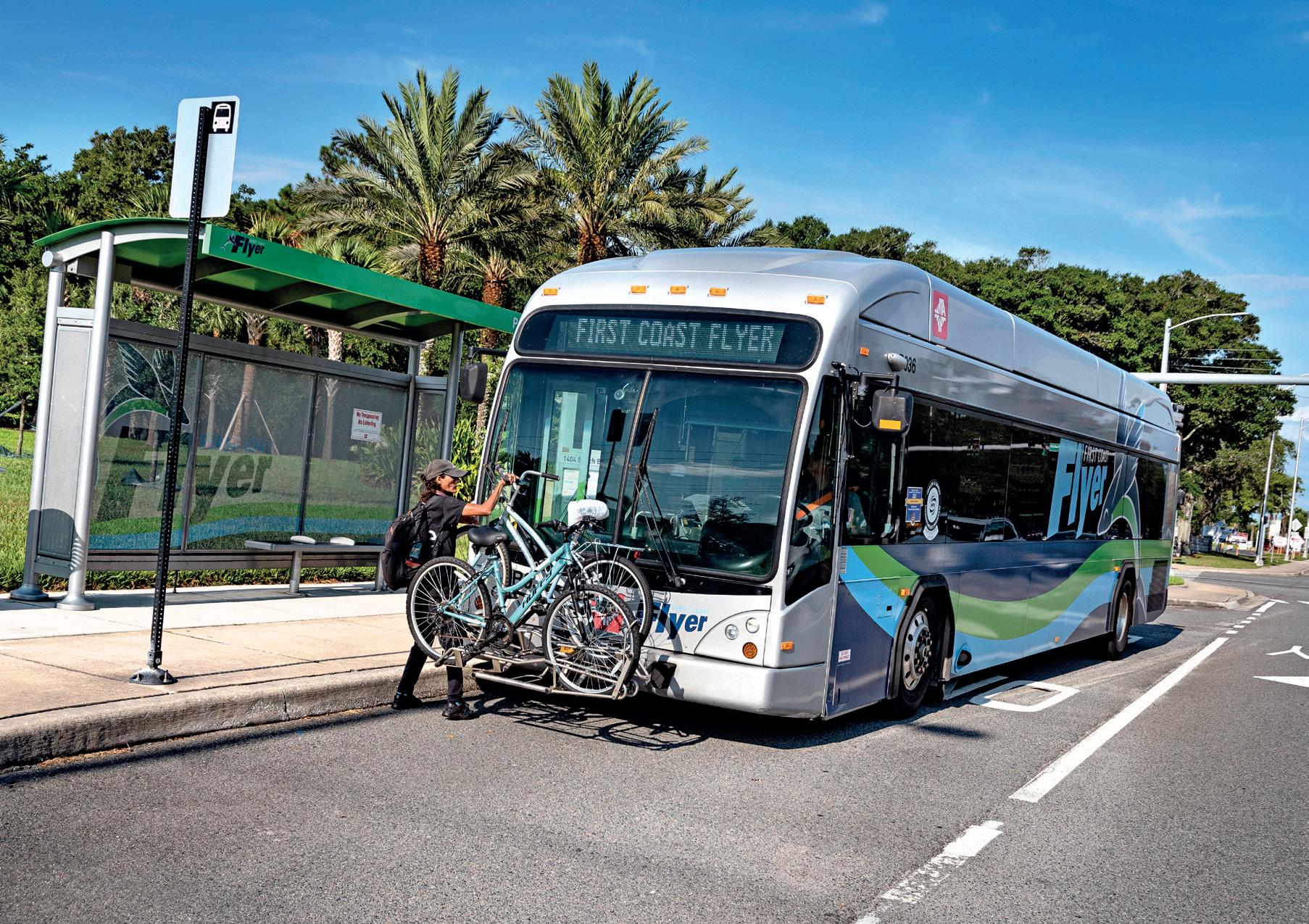
JTA is the regional multimodal transportation authority for Northeast Florida
Picking it up as we go: how transportation agencies can learn from university research
JTA Research Lab has been created to identify critical transportation policy questions, and get academics to help solve them. Pencils sharpened? Nathaniel P. Ford explains…
Atransportation agency should always be learning. That simple but powerful idea underpins the new Jacksonville Transportation Authority (JTA) Research Lab, an innovative model for collaboration between transportation agencies and academia. For the first time JTA, the regional multimodal transportation authority for Northeast Florida, is inviting researchers to examine the authority's most pressing policy questions and share what they learn with transportation experts and professionals worldwide.
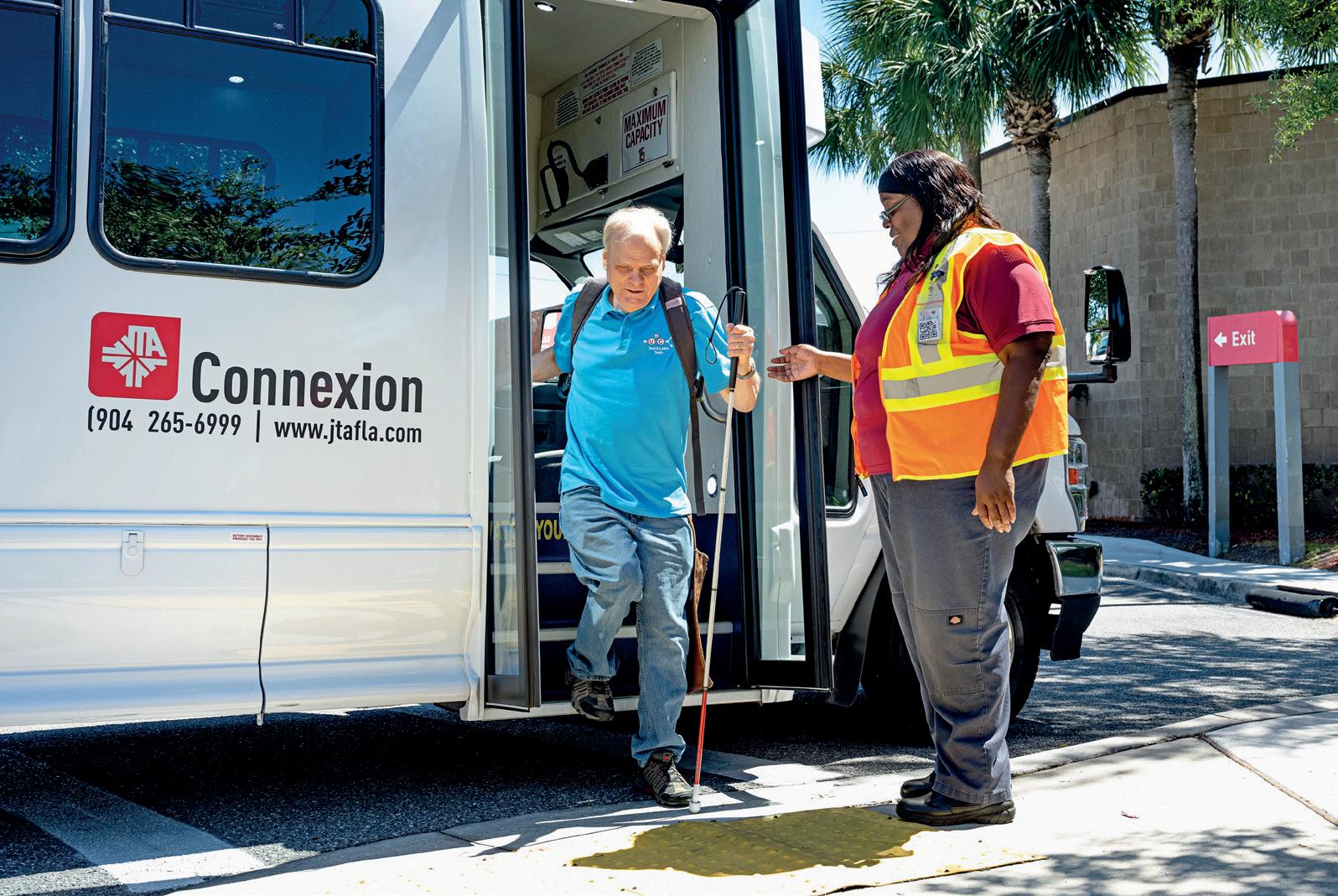
This region includes Duval County, which has a population of around 1.7 million (the 40th largest metro area in the US and the fourth biggest in Florida) and a total area of 874.3 square miles (2,264 km2), making Jacksonville the largest city in land area in the contiguous US. Built as a state agency and an independent special district, JTA designs and constructs bridges and highways and provides varied mass transportation services. These services include fixed route and bus rapid transit service, paratransit services (Connexion), a
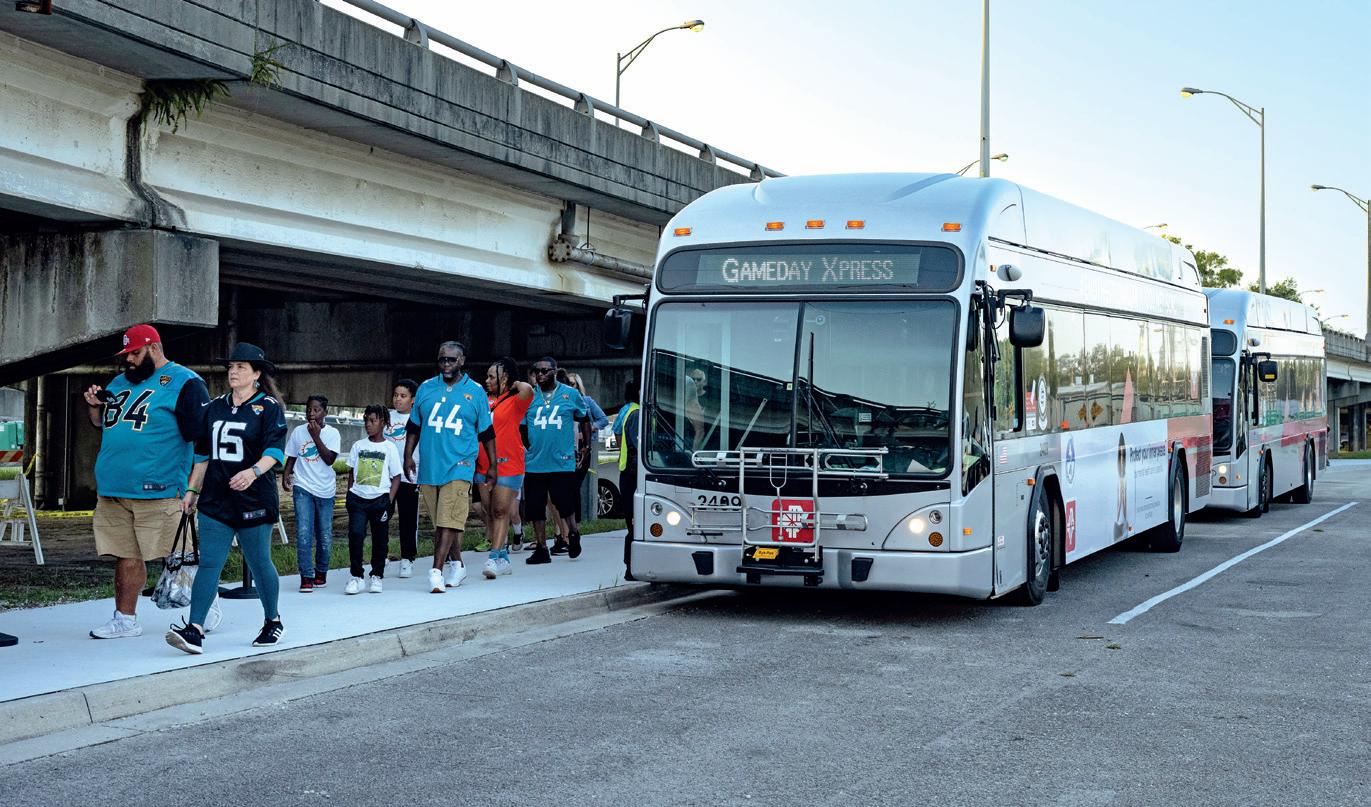
downtown, automated, elevated people mover known as the Skyway, the St. Johns River Ferry, the Gameday Xpress, as well as other on-demand and regional services to Clay, Nassau and St. Johns counties.
The JTA Research Lab grew out of Move2027, a five-year strategic plan adopted by the JTA board in 2022. Move2027 includes dozens of initiatives, many of which are novel - not just in Jacksonville, but in the US. For instance, JTA is now committed to adopting a universal basic mobility programme and utilising artificial intelligence to improve
customer service, and both emerging and evolving mobility strategies.
Unique and innovative
With any new programme, JTA builds upon the lessons learned from those who have previously sought to do something similar, searching for design elements that we should emulate - and those which are best avoided. A challenge for JTA was that many of Move2027's tactics are unique and innovative, and therefore few case studies are available to inform our planning.
Academic research, while helpful, provided few real-world case studies from which to find guidance. Rather than plunge ahead and risk missteps in the implementation of Move2027, I instead opted for JTA to learn as we went: a careful, interactive process that would draw upon lessons learned from early deployments and incorporate them into subsequent ones. Better yet, we could share those lessons with other transportation systems around the country – and even globally – helping to advance an industry that faces severe headwinds as it strives to recover from ridership declines during the Covid pandemic and funding challenges.
Those goals led to the formation of the JTA Research Lab, which my team developed through months of discussions with transportation academics.
Here is how it will work: each year, JTA
Reliable data begins with accurate detection
Don't compromise on accuracy. Choose Iteris, the proven leader in traffic detection technology, and elevate your traffic management with unmatched performance and unwavering support.
will identify a small number of critical policy questions that we cannot adequately answer through academic ndings or the experiences of other transportation agencies. We will then create and disseminate a Request for Proposal (RFP) targeted toward academic institutions, describing the issue and explaining what JTA would like to learn. Because high-quality research takes more time than consulting engagements, each JTA Research
Lab initiative will be funded for at least a year (sometimes longer).
Fare capping and future bus stops
The JTA team ultimately selected the rst two topics to be investigated through the JTA Research Lab. The rst was cash fare capping, a policy designed to ensure that regular transportation riders do not “overpay” because they cannot afford the upfront
cost of a monthly pass. With capping, the transportation agency monitors how much a rider has spent on individual trips in a given period and stops charging them once they reach the cost of an unlimited pass (i.e. if a monthly pass is $40 and a ride is $2, only the rst twenty trips would be charged in a single month – all subsequent ones would be free).
Move2027 calls for JTA to implement cash fare capping in the coming months (a few other transportation agencies, like New York City's MTA and Portland's TriMet, have already done so). Although some research on cash fare capping exists, including a study by the National Academies, JTA could not answer several pivotal questions: Which kinds of riders bene t most from cash fare capping, and who bene ts least? Are its equity bene ts limited by the requirement that riders pay with mobile ticketing? What is the impact on farebox revenue? These are among the topics that the JTA Research Lab will explore. We will also encourage the researchers to disseminate their lessons broadly through peer-reviewed papers.
The second RFP concerns JTA's Bus Stops of the Future programme, a Move2027 tactic that involves overhauling 111 bus stops in north-west Jacksonville. Over the next several years, JTA will upgrade the bus stops to enhance safety, increase customer satisfaction, and attract
Meet MyCity, our newly rebranded traffic management solution, formerly known as Transparity® TMS, featuring a modern design, upgraded functionalities, and the addition of two innovative products:
MyCity Smart Priority - An advanced traffic preemption solution that leverages existing infrastructure to optimize traffic flow.
MyCity TrafficPlanIQ - A cutting-edge real-time data monitoring and traffic control timing solution.
new riders. Added amenities will include crosswalks, bus shelters, sidewalk expansions, and real-time bus information, among other interventions.
Evolving needs
The JTA Research Lab will collaborate with academics to measure and analyse the value of these bus stop amenities. Questions to be considered include: To what extent do the upgrades appeal to riders or enhance safety? Which amenities are particularly valuable
are complete? Since implementation of Bus Stops of the Future will continue throughout the MobilityWorks 2.0 Program, JTA will incorporate lessons from the research into subsequent upgrades (and also share those lessons with peer agencies). Again, we will encourage the researchers to publish their ndings in academic journals.
In future years, JTA plans to launch many more research projects that will be determined by the authority's evolving needs.
I should note that JTA is far from the
agency and a university are widespread. However, we believe that the JTA Research Lab breaks new ground as a collaboration invitation for all academics. Rather than establishing a single university relationship intended to ful ll all research needs, the JTA Research Lab capitalises on the unique strengths of various university transportation departments.
My team and I are well aware that success is not assured in any innovative venture, and the JTA Research Lab is the same. Time will tell if its model of open collaboration between transportation and academia achieves our vision, both in Northeast Florida and beyond. But if it succeeds, we believe it could powerfully improve transportation services and spur more practical transportation research. ITS
About the Jacksonville Transportation Authority
“ “
We believe that the JTA Research Lab breaks new ground as a collaboration invitation for all academics
The Jacksonville Transportation Authority (JTA) is a state agency and an independent special district serving Jacksonville, Florida, and Northeast Florida with multimodal responsibilities. The JTA provides varied mass public transit services and builds roads, bridges, and other infrastructure to enhance mobility. Public transportation services include bus rapid transit and regular bus service, paratransit, the St. Johns River Ferry, Skyway APM, and other mobility and on-demand services in Duval, Clay, Baker, Nassau, and St. Johns counties. To learn more, visit www.jta a.com
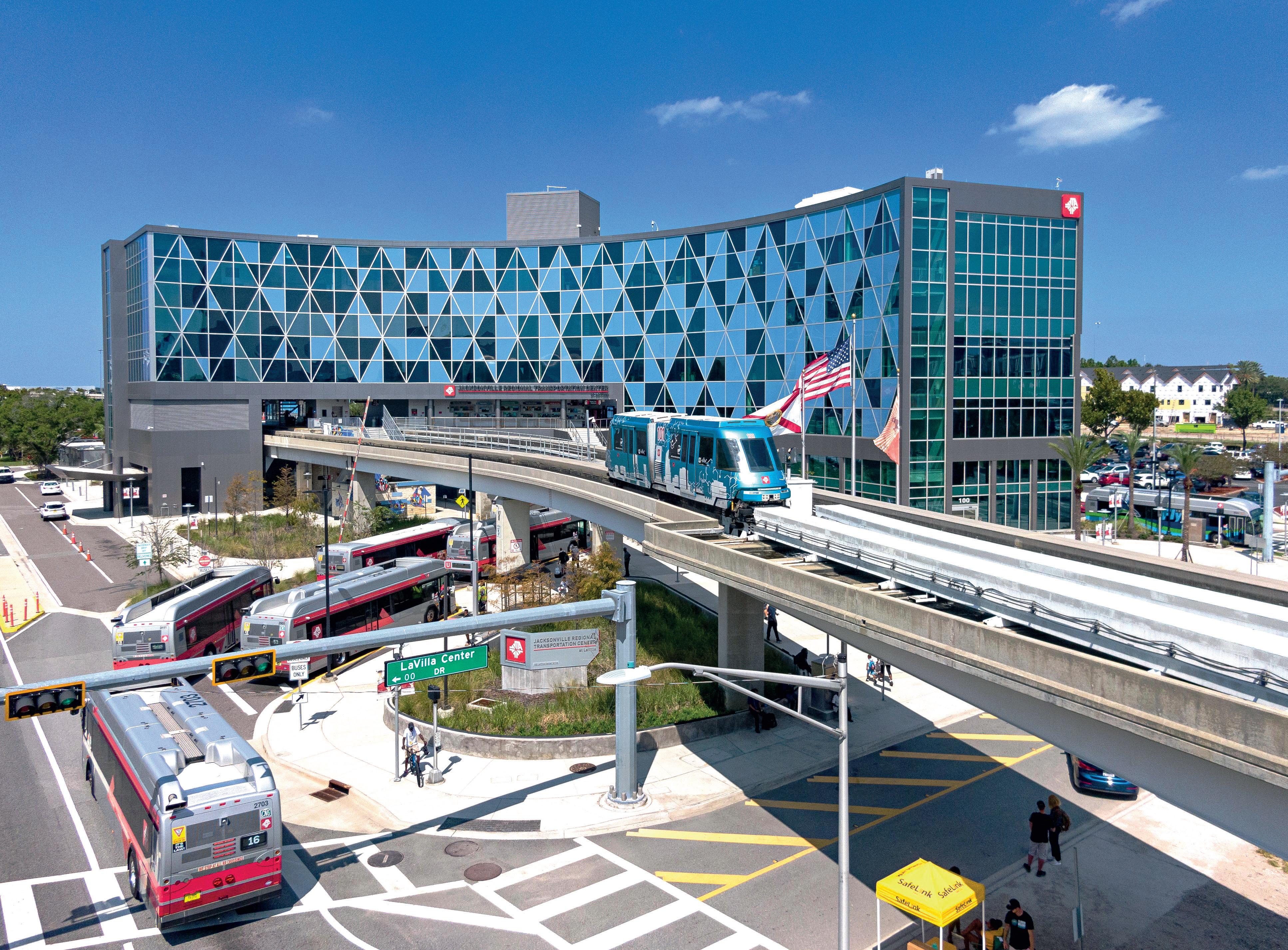
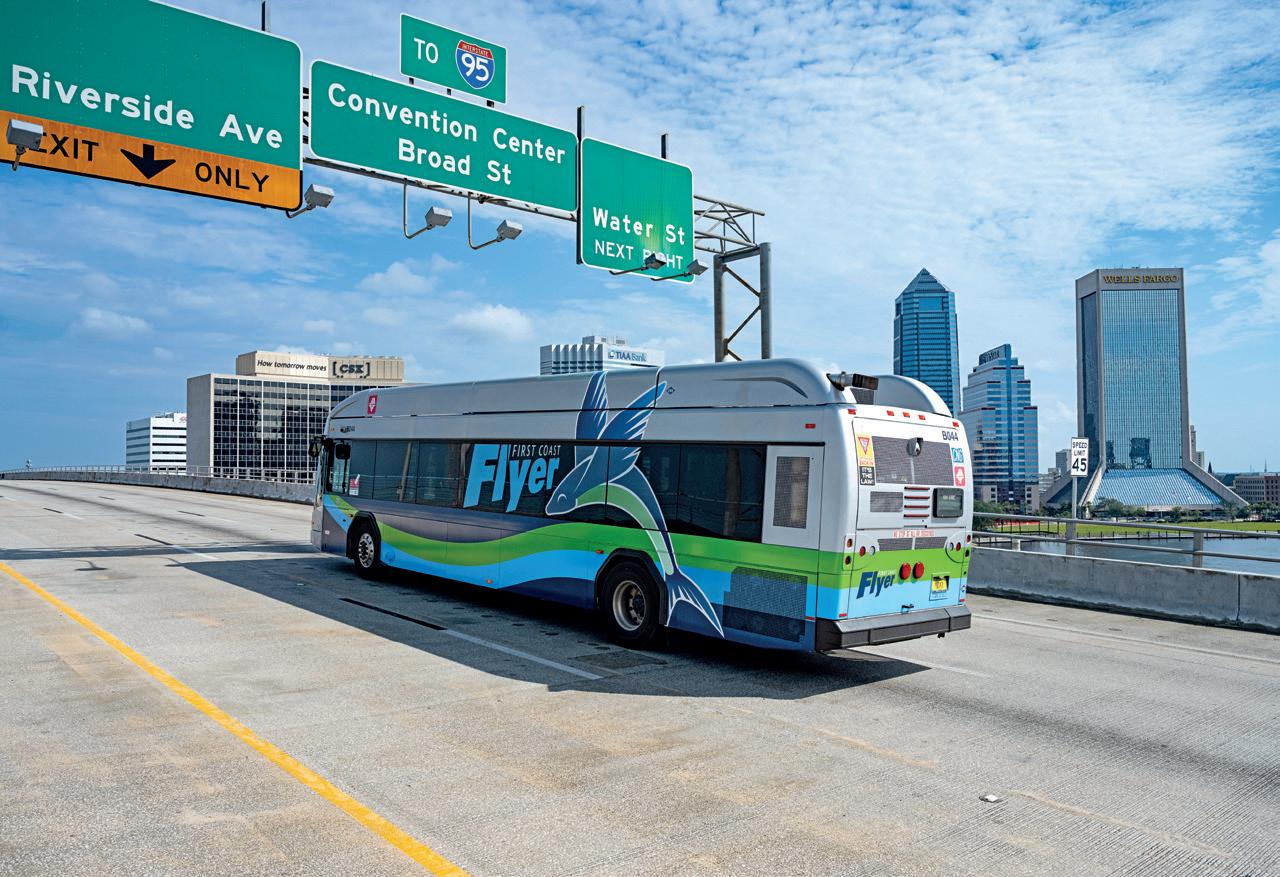
LEFT: Moving people to big events is a major undertaking RIGHT: Bus services – including bus rapid transit – are a key part of Move2027
Nat Ford, CEO of Jacksonville Transportation Authority
Leader
Econolite and PTV Group, united under the brand Umovity, serve as the global market leader for end-to-end traffic management and transportation technology, providing safer, smarter, and more sustainable Mobility for Humanity. Umovity unites best-in-class solutions for intelligent traffic management systems, cloud-based adaptive traffic control, real-time traffic management software, controllers, cabinets, and sensor products by Econolite, and simulation and predictive modeling software by PTV.
Standard approach
National Electrical Manufacturers Association’s revision of standards relating to variable message signs will help to improve interoperability and re ect changes in vehicle technology
Variable message signs (VMS) have a vital role to play on highways worldwide, alerting drivers in near real-time to events and incidents. Readability is crucial so ickering is a hazard – it’s important that you can quickly and easily absorb the information you are being shown without the graphics dancing in front of your eyes. And as intelligent transportation technology, such as Vehicle to Everything (V2X), moves on, it is vital that roadway hardware keeps pace.
This is where the National Electrical Manufacturers Association (Nema) comes in. Nema is the American National Standards Institute (ANSI)-accredited standards developing organisation, made up of business leaders, electrical experts, engineers, scientists and technicians, which brings together a neutral forum of members to discuss industry-wide concerns and objectives under a legal umbrella.
It has released its latest revision of Nema TS 4-2023 hardware standards for VMS and dynamic message signs (DMS) with NTCIP (National Transportation Communication for ITS Protocol) requirements. NTCIP allows interoperability among various manufacturers of ITS products such as DMS, cameras, signals and communication methods.
“The updated standard aligns and harmonises with other national regulatory standards,” says Jason Morrison, national chair of the Nema TS 4 committee and Daktronics market manager for ITS, parking & public transport.
The latest revision updates language to align with industry standards for connected vehicles and provides solutions to problems such as ickering, to promote safer roadways and reduce accidents.
“These updates include de nitions for VMS and DMS along with guidance on their use when implementing MUTCD [Manual on Uniform Traf c Control Devices]-compliant symbols and graphics,” Morrison continues. “Other safety and technology issues de ned include FCC [Federal Communications Commission] radio interference requirements to ensure uninterrupted service for emergency and mobile phone service, additionally de ning minimum display refresh rate requirements for V2X technology.”
The signs can emit no radio interference, which means emergency and mobile phone services will not have any interrupted service when near a DMS. The LED refresh rate must also be greater than 200 Hz to reduce refresh or icker rate, which means autonomous vehicle technology can read all the information on digital signs.
As V2X roll-out and increased levels of autonomy become a reality, this is a timely change. In a blog post, Morrison explained the history of the standards themselves. “It all started in the early 1990s when many different DMS technologies were being installed,” he wrote. “There were no set speci cation standards, and the industry couldn’t agree on how to de ne a DMS. So, in 1997, DMS manufacturers came together to form the TS 4 technical
committee. In 2005, we published the rst National Standard for DMS, and then we released an updated version in 2016.”
The latest iteration is important. “VMS and DMS described in Nema TS 4-2023 provide real-time, traf c-related messages. This includes alerts and advisories, early warning messages, alternate route information, travel times and workzone information. They can also assist in disaster recovery efforts and emergency preparedness activities,” adds Steve Grif th, Nema’s executive director of transportation systems.
Given the recent prevalence of extreme weather events such as oods and wild res, there is a clear safety angle – and for the transport community, this is a welcome update. "Nema TS-4 and the MUTCD are more aligned than ever with this newest revision to TS-4,” says veteran transportation engineer Ransford S. McCourt. “As both documents evolve, the ever-changing discipline of changeable message signs advances toward greater consistency and uniformity in design and construction.”
This can only be a good thing. For its part, Nema believes that standards “play a vital part in the design, production, and distribution of products destined for both national and international commerce”.
They help both user and manufacturer “by improving safety, bringing about economies in product, eliminating misunderstandings between manufacturer and purchaser, and assisting the purchaser in selecting and obtaining the proper product for his or her particular need”. ITS
SEE CLEAR. ACT FAST.
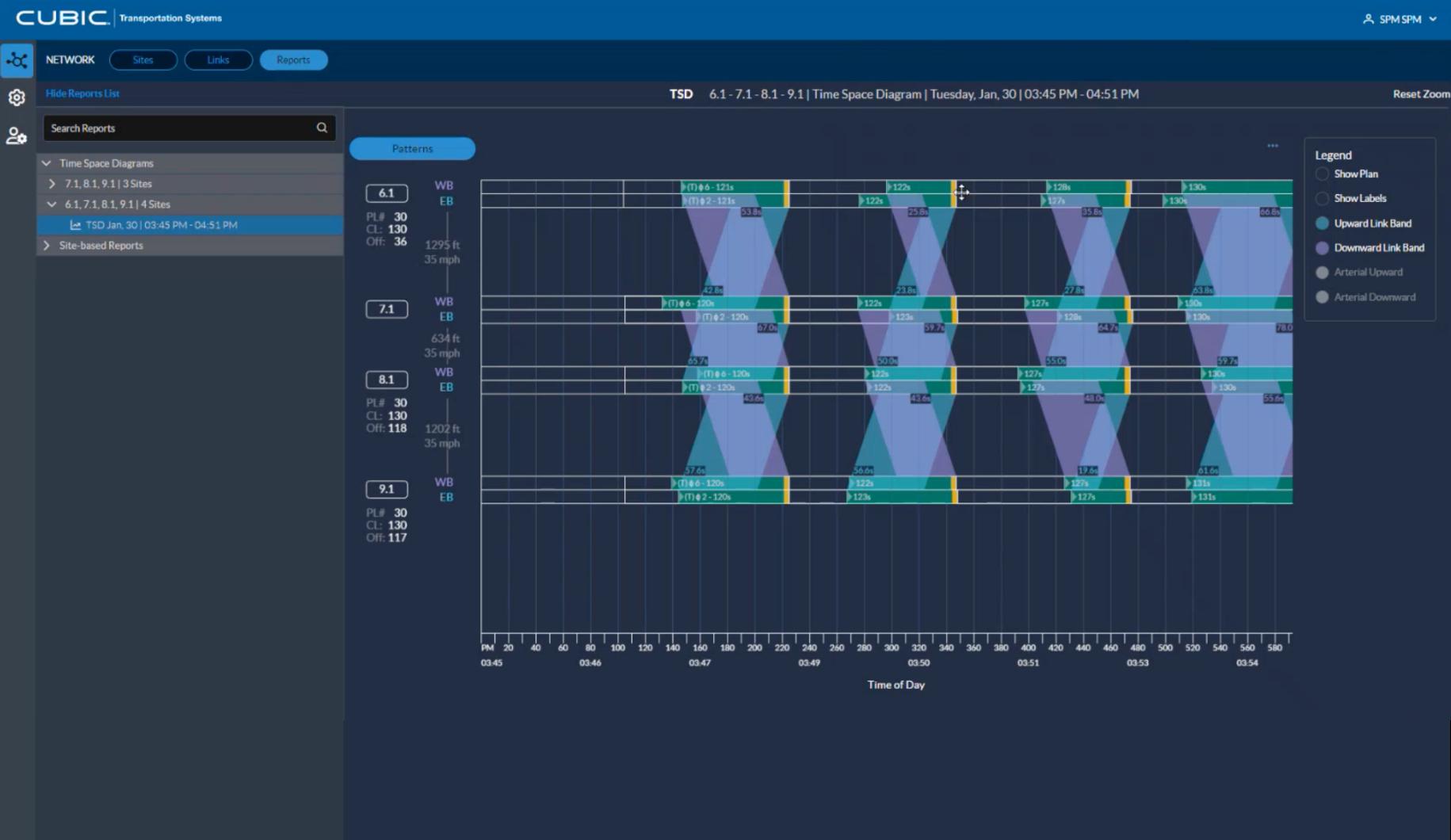
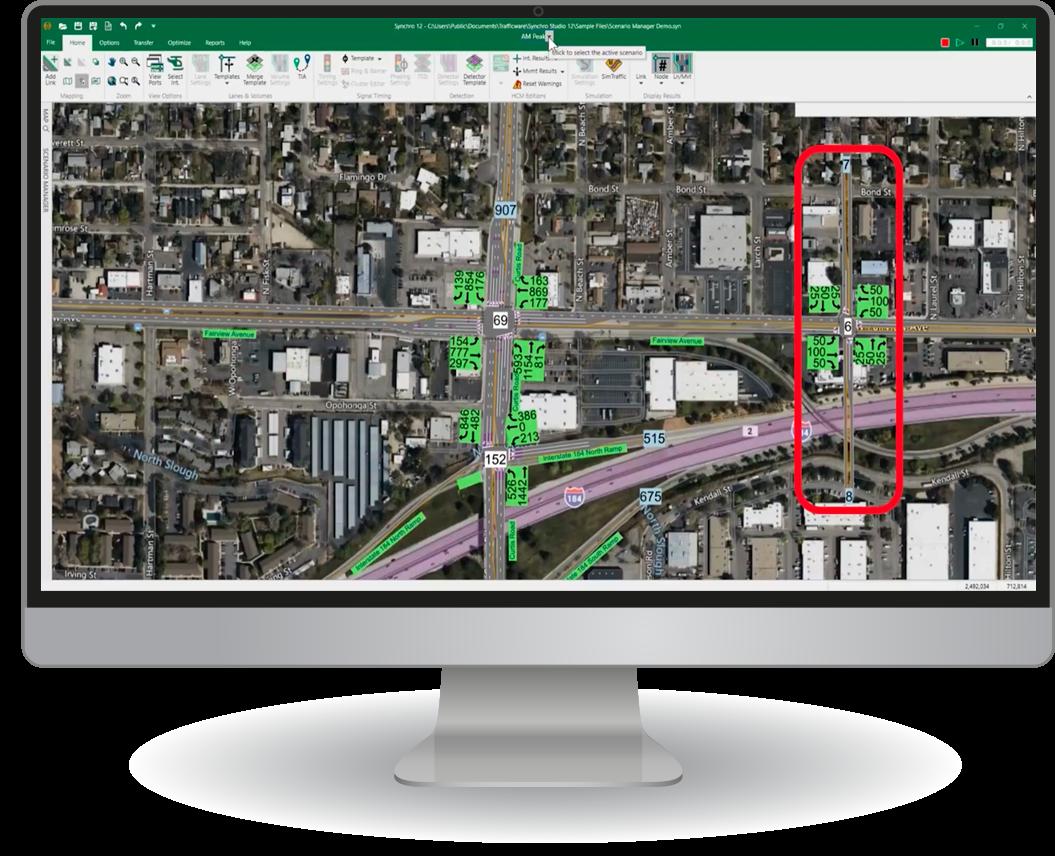
SIGNAL PERFORMANCE MEASURES 2.0
An innovative approach to cycle-based performance measures, empowering agencies with actionable insights for faster, better decision making. Meet SPM 2.0, now enhanced with:
• Interactive Performance Diagrams
• Map-Based User Interface
• Intuitive Configuration Workflows
• Customizable Reporting
• Standalone SPM Platform
Request a demo to find out how SPM 2.0 can help you improve operational efficiency.
London has 65,000-plus roads and 20,000 transport incidents each year
No jam tomorrow
Every year, Transport for London helps make billions of road journeys congestion-free - but could it do better? Digital twin and graph technology are starting to make London less congested and greener, says database expert Aaron Holt
Transport for London (TfL) is the integrated transport authority responsible for transport in London, UK. It’s the body in charge of the day-to-day operation of London’s public transport network - and of all of London's busy main roads.
That’s no easy job. TfL data suggests that on an average day, London residents make 4.6m car driver trips and 1.4m car passenger trips. If you add in the one million journeys non-residents make, then that is around ve million journeys a day. In fact, as much as we love the London’s metro system – the Tube - around one in eight of journeys in London actually take place on the road network, says TfL.
That equates to over 3.7 billion trips per year, so there is a lot to manage and keep moving ef ciently, says the organisation’s chief transport analyst Andy Emmonds.
Managing this network is a deeply complex, intricate challenge. In fact, monitoring it is a technical feat when you consider there are 65,000-plus roads. Reacting to incidents is even more of a challenge, but essential. London experiences 20,000 transport incidents yearly - and each minute left unaddressed means traf c jams build exponentially.
There is a serious cost to road inefciency, which Mayor of London Sadiq Khan (who has ultimate responsibility for transport in the capital) is acutely aware of. It is estimated that congestion costs London £5.1 billion per year in lost productivity. Per driver, says TomTom, that equates to at least £1,211 a year. But the negative consequences of jammed-up streets go way beyond that. There’s also huge stress and inconvenience for road users, pedestrians, and residents.
“ “ Breaking a traf c jam within seconds rather than minutes would save the city and drivers huge amounts of time
In response, TfL is on a mission to nd ways to ensure that London’s nine million residents and 20 million annual visitors can travel safely and easily—moving London forward in a healthy, inclusive and sustainable way. The aim is to mitigate the environmental and health impact caused by slow-moving traf c, particularly the concerning levels of CO2 emissions. The immediate challenge was the prolonged time it took for TfL to detect incidents, ranging between 14 and
17 minutes. By the time interventions were in place, an average of 27 minutes had already been lost due to traf c build-up. Each minute saved in addressing incidents holds signi cant nancial value, amounting to thousands of pounds.
Emmonds and his team believe they have identi ed a strategy to begin recovering those nancial losses at long last.
A virtual reproduction
The idea is to aggregate real-time data on all those roads and spot an incident not when it appears on CCTV in the TfL traf c control centre, but as it’s about to become a problem. This will address the issue before the situation escalates.
Emmonds highlights the signi cant advantages of such a capability: breaking a traf c jam within seconds rather than minutes would save the city and drivers huge amounts of time, as well as reduce the pollution created by stationary vehicles.
He has been exploring two advanced forms of computer simulation and modelling to address these challenges: a digital twin and graph technology. A digital twin is a virtual reproduction, with a high level of detail and real-time data feeds to mirror a real-world process.
In TfL’s case, the digital twin represents the actual transport network, in which different scenarios can be tested and evaluated.
Emmonds decided the best way to build his planned system was to work with a graph database.
The conceptual roots of the approach go back to a branch of mathematics, but the point of graph technology is the idea of a network. When we say network here, we're describing a method to depict various entities for storing information while also modelling the connections and relationships between them
By design, graphs enable people to store and examine the connections between data points as data itself—much in the same way commuters think about the routes and connections in their daily travel. “We found that real-time data can only be solved by a graph database because a graph database is an agile and adaptive way to interpret granular data at scale,” Emmonds says.
He acknowledges that to fully leverage digital twin and graphs, his organisation's approach to utilising data had to be overhauled, emphasising the transformative role that data plays in realising the potential of such innovative technologies.
“For a long time, we took a totally reactive approach to data,” he says. A persistent historical challenge to using a digital solution to solve London’s congestion problem was the prevalence of low-quality and fragmented travel data. Many of the journeys TfL needs to track involve private and multimodal transportation (e.g. citizens or tourists may drive or cycle, then catch a train, then walk), making them hard to compile and track.
Before adopting the digital twin and graph approaches, TfL's strategy involved collecting separate data sets, limiting its ability to address the full spectrum of questions
the team wanted to explore. The challenge wasn't a lack of data—they were accumulating terabytes of data every week. However, due to the way this data was stored and analysed, meaningful conclusions couldn't be drawn based on the relationships within these datasets.
In addition, not having enough on-road sensors to gather fresh data, like cameras and telematics, often meant that TfL only received insight into traf c incidents once they had been visually spotted. Emmonds explains: “We were effectively using this disparate data through Excel sheets, and none of this data was aligned or real time. What we needed was to be a real-time operator, and to do that we needed a digital twin.”
Real-world ‘connection’
The emphasis on tracking relationships is a key concept in this scenario. Emmonds is clear that graphs represent the most ef cient, cost-effective, and performant way to uncover hidden relationships and patterns across billions of data connections to make the decisions needed to predict and handle traf c incidents.
In a graph representation, a road link becomes a 'node'—an element within the graph. It’s a route from A to B that also has many properties, providing a more intuitive and comprehensive way to capture and analyse the complexity of transportation data. Unlike the cumbersome spreadsheets that TfL previously used, a graph-based approach is tailor-made for this type of analysis, making it easier to understand and work with the intricate relationships and properties associated with each road link. “Trips and routing can only be efciently managed through such a database,” Emmonds says.
“
Many of the journeys TfL needs to track involve private and multimodal transportation, making them hard to compile and track
Testing was imperative. Emmonds explains: “We set up a test product which was fed data powered by graphs that could tell us in near real-time if there was a problem on the road. And on the day of the test, the system detected ve incidents that the control room didn’t pick up. For us, that was the proof in the pudding.”
Overall vision
The TfL road traf c twin consists of ve layers:
1. The rst level of the model, where input data is aligned with the business challenge
2. the data is organised to solve the challenge
3. in the Neo4j platform, the data is set up so it mirrors the physical network it is modelling
4. the data is sent to TfL’s control room for interpretation
5. the data is used to solve different road problems.
TfL now connects and feeds its datasets into the digital twin, and the solution plays a crucial role in TfL’s overall vision of cutting congestion by 10%. If this ambitious goal is achieved, it would result in a productivity gain of £600m, equating to £1,211 in time per driver.
Using his new innovative technology stack, Emmonds also hopes to streamline peak traf c events, such as major football matches or music concerts. The goal is to enhance the planning and controlling of routes across the network driven by data.
In the medium term, TfL aims to leverage the solution to develop data-driven and effective emission-reduction strategies for London. Looking ahead, there are aspirations to use this technology as a basis for establishing an autonomous vehicle network.
Emmonds concludes: “The next step is making London’s roads autonomous and green.”
And as the great thing about a solution like this is that the architecture is open and agile, there’s “nothing stopping us” from using it to build and understand the metropolis of the future. ITS
ABOUT THE AUTHOR: Aaron Holt is enterprise account executive at graph database and analytics company Neo4j
Twin peaks
Simulation-based optimisation is the foundation for real-time predictive analytics when it comes to optimal traf c signal programming, explain Sunny Chakravarty of Econolite and Lorenzo Meschini of PTV Group
Digital twin (DT) technology as a strategy has been widely adopted and applied to help optimise complex systems and operations in many industries, including enterprise networking, retail, healthcare, structural engineering, manufacturing, and production operations.
For transportation, Digital Twins in the Intelligent Transport Systems by Andrey Rudskoy et al, describes DT as a detailed digital reproduction of the roadway, enabling modelling and to test solutions and simulate different scenarios and events.1
DT adoption as a strategic capability for surface transportation management has lagged behind other industries due to the limitations of data. This is especially true in applications for traf c signal control optimisation. Fortunately, the data structures and layers for signal performance measures (SPM) and adaptive signal control technologies (ASCT) applications have
helped set the stage for the adoption of DT. By combining higher resolution and real-time traf c data available from new sensors, cloud-based analytics, with leading-edge simulation and modelling software technologies, DT technology - as a data-driven strategy - can be applicable for optimising traf c signal programming.
The intelligent transportation system (ITS) era ushered in the necessary information technology-based traf c management platform to establish data-driven traf c management. This platform leverages data to help transportation agencies and engineers make more informed traf c operation decisions. As a result of more and more traf c data becoming available and driving new transportation management applications, there have been many approaches to enhancing traf c signal operations.
While applications such as adaptive
signal control have proven to incrementally reduce travel times and congestion along roadway segments or corridors, the traf c data resolution input and analytical capabilities have been a limiting factor in making larger ef ciency gains. Until now, the industry has not experienced the coalescence of sensor, data taxonomy and analytics, distributed computing, and software technologies necessary to power real-time applications that actively optimise traf c signal control programming necessary to dynamically enhance mobility.
A foundation in data ASCT and SPM, combined with a pattern optimisation capacity, have proven to incrementally reduce average wait times and improve corridor travel time reliability. For example, when traf c congestion reaches a pre-determined threshold, the adaptive signal control program is triggered to adjust the traf c signal timing manually or automatically to a pattern
that better distributes green time, reduces arrivals on red, and traffic queuing at select intersections according to the current traffic conditions.
However, adaptive signal control is reactive by design and its application. As a result, it is a challenge to effectively reduce traffic delays throughout an entire transportation network for already-congested traffic conditions, including due to planned and unplanned events.
In addition, adaptive signal control has traditionally been applied only to priority corridors. While this helps to reduce travel and average wait times for vehicles where adaptive signal control is applied, cumulative average wait times can increase citywide.
To address the limitations of ASCT, as well as many other future traffic management capability issues, including connected vehicle (CV) operations, leveraging a DT strategy that runs a simulation with real-time data integration during system run-time has the potential to move traffic management optimisation from a reactive operation to proactive.
Digital twin as a strategy for traffic signal operations
Digital twin technology has the potential to fundamentally transform traffic signal management and operations. The concept of creating a DT is to help improve traffic signal operations decision-making by leveraging higher resolution traffic data within an architecture that provides real-time simulation, modelling, testing, and verification.
The transportation DT can be conceptualised as traffic data being collected from different sensing and messaging systems, including deployed detection sensors, CV
communication systems, personal mobile devices and CCTV cameras in real time to create an operational cyber copy of the roadway and systems.
Although the concept of DT is to replicate the physical system, it is still a static representation of the roadway. For a transportation DT to be a functional and strategic tool, it must also include a mathematical modelling architecture layer on top to leverage the deployed sensor systems of the physical roadway as well as other sources of data, to be able to estimate and predict traffic and mobility interactions and user travel behaviour, ultimately to provide a representation of real-time movements of all roadway users.
“
For the first time, we have the necessary coalescence of traffic signal performance measures, machine learning and information communication technologies
A roadway DT presents a new technology paradigm in roadway traffic management strategy. In the past, traffic operation simulations and analytics - if they were utilised - occurred separately offline and used historical traffic data.
Digital twin technology raises the decision-making capability bar to the next level by enabling simulation-based control optimisation in near real-time that was technologically unattainable until now. It helps to establish a technology platform that fosters a systems operational state that can deliver real-time predictive analytics in support for new safety and optimisation strategies in traffic management. Macro
The traffic data platform can now be leveraged as a distributed computing architecture to power new applications such as digital twin
and microscopic simulation results based on real-time traffic data can provide a foundation for the future real-time analysis and predictive optimisation strategies for traffic signal operations of comprehensive roadway networks.
Adopting a digital twin strategy
Real-time traffic signal optimisation and the efficacy potential of a DT platform have been made possible by new sensor and software technologies, and the high-resolution traffic data they are able to provide. One of the critical capabilities of new sensor and software technologies is the availability of vehicle classification, trajectory, tracking data, as well as data on pedestrians and bicyclists. Driven recently by the safety applications of CV technologies, Vehicle to Vehicle (V2V) and Vehicle to Infrastructure (V2I) communications or Vehicle to Everything (V2X), the higher resolution traffic data represents continuous communication between vehicles and other roadway users with the infrastructure. This provides the fundamental physical roadway data to accurately establish a current and future state of the intersection and roadway, or situational awareness2, which is essential to the next process step in adopting an effective DT strategy.
The
importance of traffic controllers and software
In a DT-driven strategy to constantly monitor and optimise traffic flow and operations, it is necessary to create a DT of the traffic signal controllers, which requires a traffic controller firmware that provides virtual interface and control with the DT.
The DT of the traffic controllers establishes a current state of vehicles and
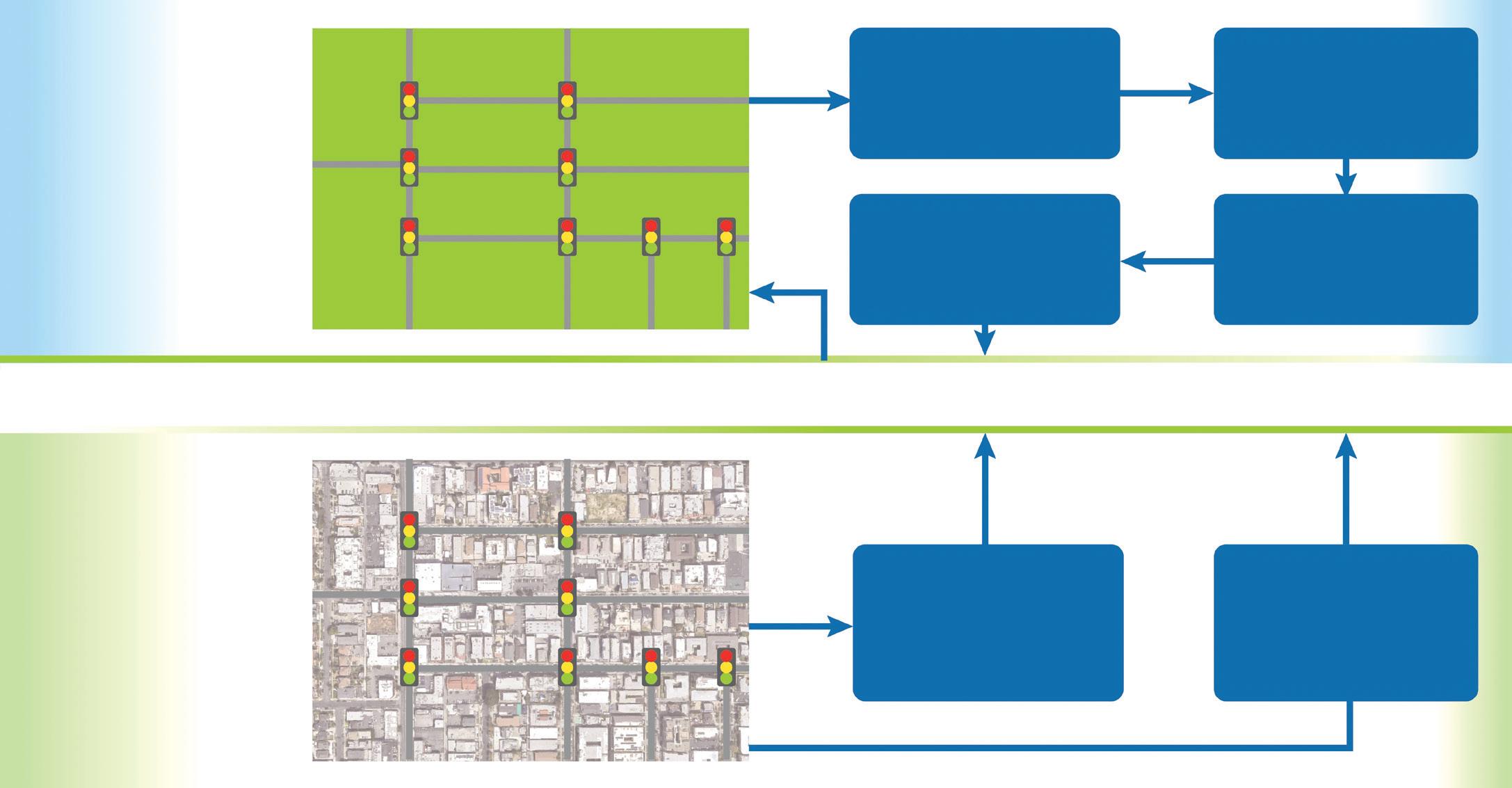
DIGITAL TWIN
Digital replica of vehicles, traffic signals and roadway network
PHYSICAL ROADWAY ENVIRONMENT
Physical replica or real vehicles, traffic signals and roadway networks
the roadway network and provides access to the sensor and CV communications data, including object trajectories, classifications and traffic signal data.
Signal phase and timing (SPaT) and MAP (intersection geometry) messages must be transmitted from the traffic controller at the intersections to the corresponding DT. This also establishes and requires the controllers as an integral part of a distributed or edge computing network. After the traffic data is communicated from the physical controller to the DT, the process is nearly identical to existing SPM and adaptive signal control applications whereby the data is fed into the adaptive signal control algorithm that
Collecting vehicles and traffic signal phase and timing data
Decision making for traffic controller
Wired & wireless communication
Generation of traffic signal phase and timing information
Sensing of vehicles' trajectory data and traffic signal timing and phasing information
generates SPaT parameters, which are then pushed back to the physical traffic signal controller to change signal timing in response to current traffic conditions.
Unlike traditional adaptive signal control applications, the digital twin provides the capability and platform to simulate the effects of the signal change across an entire roadway network - more like a neural network instead of at a few intersections along a single priority corridor.
As a result the DT, leveraging trajectory and tracking detection data, can establish the cumulative average wait time of vehicles approaching an intersection and then the average wait time of the vehicles at
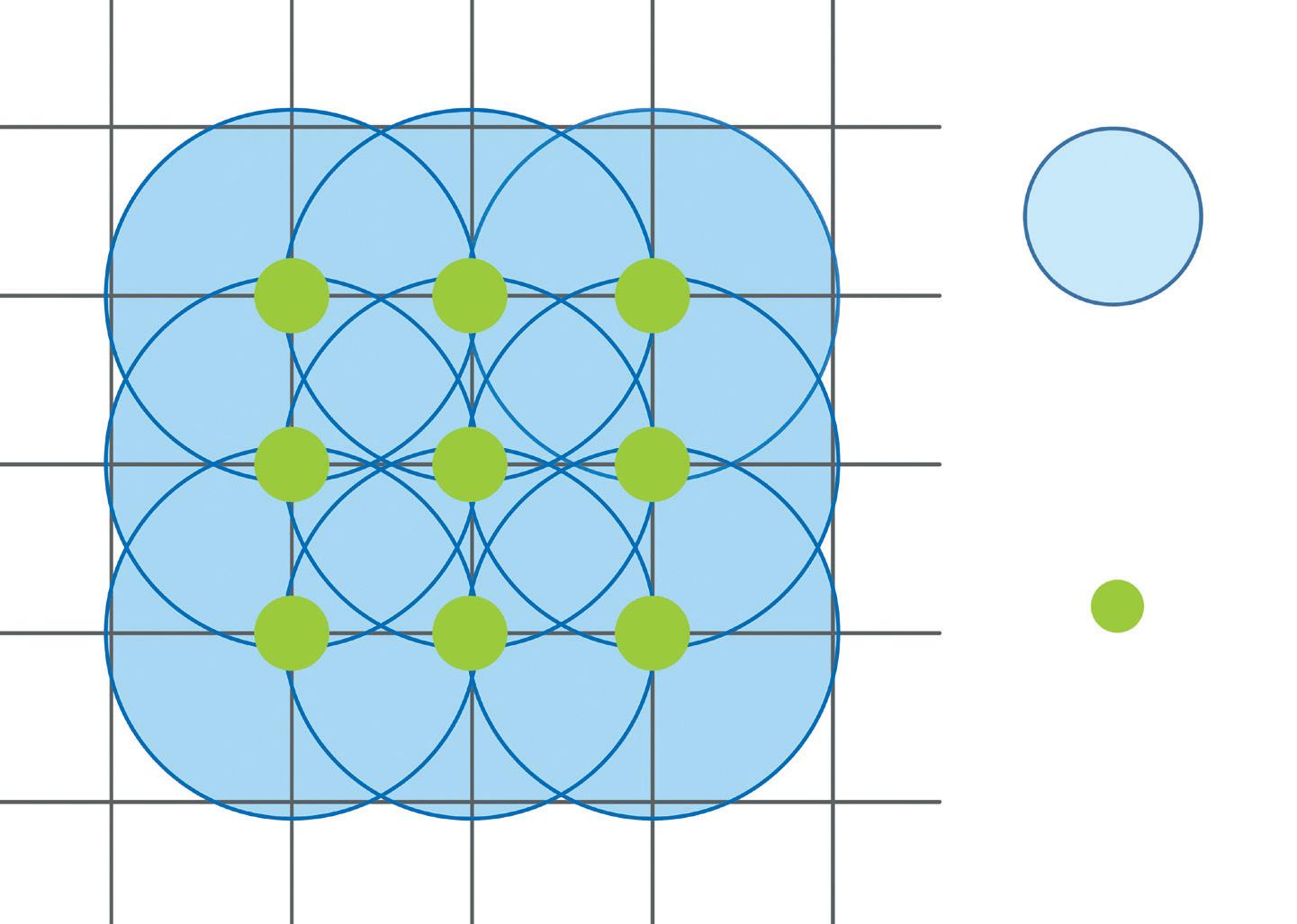
The traffic controller network with the traffic data coverage of adjacent signalised intersections takes on a neural network appearance
Signalised intersection
Actuation information of traffic signal controller
intersections citywide. This can only be accomplished through the DT of the larger roadway system, including the network of traffic controllers – not just the immediate intersection(s) along a single or priority corridor.
Green time can then be prioritised at intersections based on the longest average wait time for a given movement, including adjacent intersections, simulated, tested and then immediately applied. Allocating green time according to distributed average wait times throughout the roadway network can significantly reduce cumulative average wait times.
Mathematical model layer is key
The objectives of DT-driven traffic signal control operations should be able to improve mobility by:
• Reducing wait times by dynamically distributing green times
• Responding to real-time traffic demands and allocating SPaT according to cumulative average wait times
• Scaling to a citywide roadway network
• Applying predictive traffic signal control strategies
The primary challenge to leveraging a DT for traffic signal operations will be applying a mathematical model layer on top of the DT. This modelling architecture will provide the basis for macro and microscopic simulations. However, this requires combining and linking traffic data from diverse and disparate sources of the physical roadway to create a highly accurate cyber copy of the physical roadway traffic operations.
The mathematical model is key to collect
This simplified diagram of a traffic controller digital twin network environment illustrates the cyber and physical versions of the roadway
Adjacent coverage area
Adaptive traffic signal control algorithm
and enhance information from real-time data sources to help optimise the traf c signal operations. It will aggregate real-time data feeds and real-time events, which provide information on the traf c state on the road, fusing various sources of information into one comprehensive view. This then allows the model to use a variety of analytical, simulation, and AI tools to deliver measurable traf c and mobility predictions and forecasts.
In general, predictive analytics applies various techniques including statistical inference, machine learning, data mining and data taxonomy toward the goal of dynamically and proactively optimising the signal operations through forecasting, modelling and understanding of future traf c behaviours. This methodology complements well with the architecture put in place through ITS, SPM and ASCT systems based on the aggregation and analytics of historical and real-time traf c data.
As with most highly variable operations that require process optimisation, it is also advisable to adopt an operational strategy that optimises the adaptive signal control for a range of time periods. Often referred to as a rolling-horizon3, this strategy leverages micro and macroscopic simulation that aims to help effectively optimise a large-scale operation periodically by utilising additional data from proximate following periods. Applying this strategy for adaptive signal control will be important for predictive analytics4
Arti cial intelligence-driven predictive traf c control algorithms that leverage the same highly accurate vehicle trajectory and tracking data developed using a rolling-horizon strategy can optimise SPaT for future traf c conditions. This can be achieved by using CV and other anonymous mobile device data.
This additional layer of high-resolution data enables the use of a phase allocation algorithm that can generate geopositional
Digital twin technology has the potential to fundamentally transform traf c signal management and operations “ “
status of all roadway users to predict and proactively optimise the SPaT sequence and duration. As a result, the DT-driven adaptive signal control with predictive analytics can solve a two-level optimisation problem by prioritising and allocating traf c signal timing for a particular intersection, as well as distributing SPaT to predictively optimise travel times and ef ciencies throughout an entire signalised network.
Conclusion
The introduction of DT as a strategy for traf c signal operations is expected to fundamentally change surface transportation operations. DT paired with mathematical modelling technology offers simulation-based optimisation at real time and forms the foundation for real-time predictive analytics as support for optimal traf c signal programming and safety-critical decisions in traf c management.
For the rst time, we have the necessary coalescence of traf c signal performance measures, machine learning and information communication technologies to effectively adopt DT strategies that will deliver profound bene ts to mobility. ITS
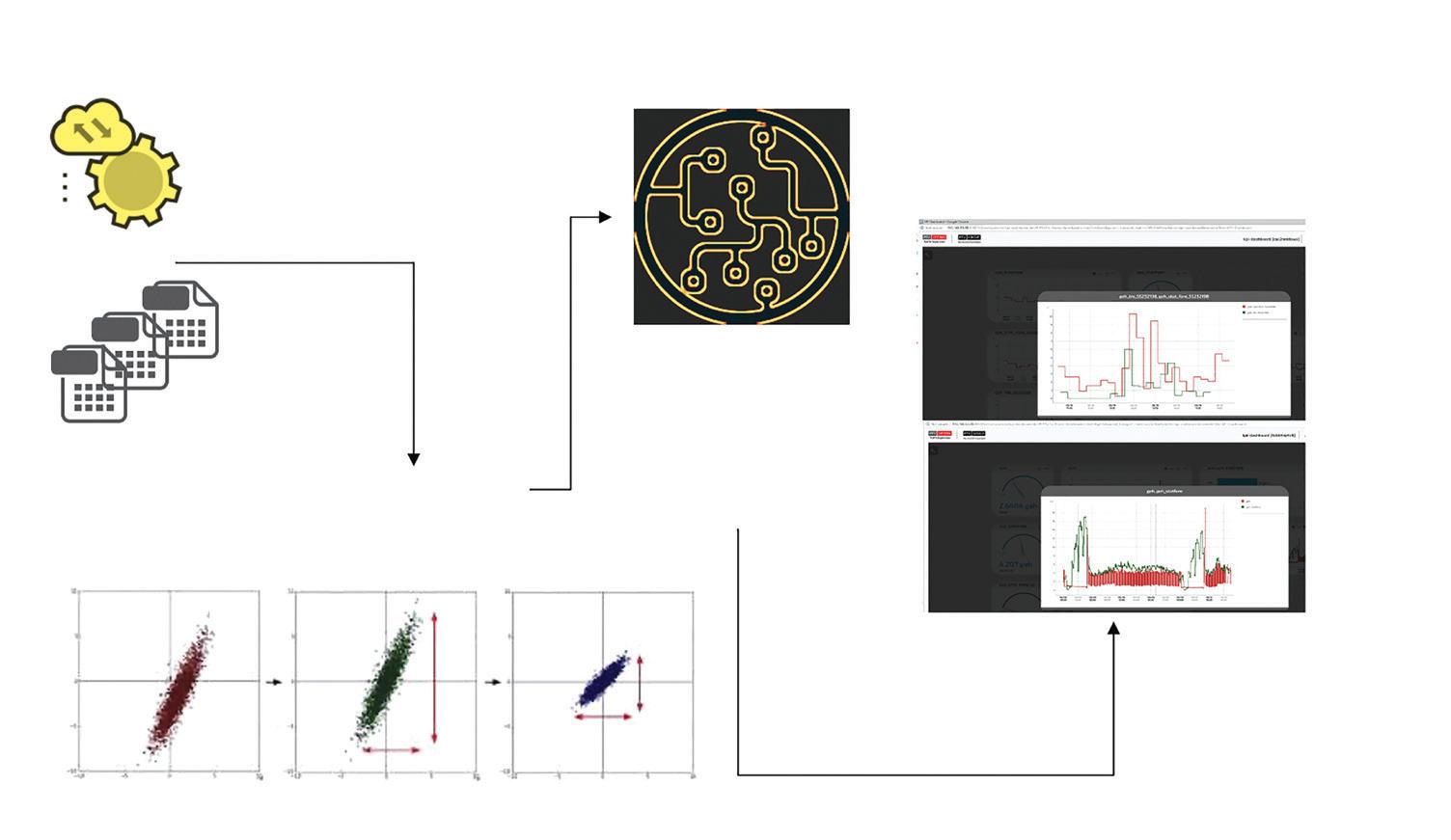
Forecast:
Identi ed time pro les (typical days) as input for the short-term forecast
Algorithms of machine learning
References
1. A. Rudskoy, I. Ilin, and A. Prokhorov. Digital Twins in the Intelligent Transport Systems, Transportation Research Procedia, Vol. 54, 2021. ISSN:2352-1465
2. U.S. Department of Transportation (USDOT) – Raising Awareness of Arti cial Intelligence for Transportation Systems Management and Operations – FHWAHOP-19-052, December 2019. https://ops.fhwa.dot. gov/publications/fhwahop19052/index.htm#toc
3. L. Glomb, F. Liers, F. RÖsel. A Rolling-Horizon Approach for Multi-Period Optimization, European Journal of Operational Research, Vol. 300, Issue 1, July 2022.
4. G. Shmueli, O. Koppius. Predictive Analytics in Information Systems Research, MIS Quarterly, Vol. 35, No. 3, September 2011, Management Information Systems Research Center, University of Minnesota
ABOUT THE AUTHORS: Sunny Chakravarty (left) is Econolite VP of engineering; Lorenzo Meschini is PTV Group VP product management & engineering real-time
A sample machine learning architecture for forecasting traf c
► COMPAS
Automated Speed Enforcement System
> Advanced speed control to improve road safety
> Compact, easy-to-use, and type-approved equipment for control at speedsfrom 30 to 250 km/h
> No system installation check necessary to start a speed enforcement mission
> Smart traffic management through 3D-LiDAR technology
INTEGRATED SUMMIT PROGRAMME
Enjoy a knowledge programme of over 120 sessions, from debates to demonstrations. 200+ speakers will cover the hottest topics touching on policy support, best practices, user cases, trends and more.
LARGEST EVER EVENT FLOOR
900+ public and private organisations spread over 12 halls will present the latest solutions and developments in mobility and traffic technology. From road safety to parking solutions, intelligent infrastructure, traffic management, smart mobility, and everything in between.
Smart, safe & sustainable mobility for all
Working towards climate resilience
Sustainable urban mobility solutions and seamless mobility services are covered at Intertraf c, which takes place at RAI Amsterdam. There is particular emphasis on cooperating in an ecosystem, successful Mobility as a Service applications and integrated services, software interoperability, data-driven platforms and creating digital infrastructures for for MaaS, parking and charging and, speci cally, parking in MaaS offerings. But sustainable and inclusive mobility will also be tackled, as will creating
Intertraf c Amsterdam 2024 is the place where the movers and shakers of the global ITS industry will gather from 16-19 April. With emphasis on climate, arti cial intelligence – and even drones – this edition has something for everyone in the transportation sector…
public-private frameworks to achieve sustainability goals, digital twins to tackle transport problems, as well as lessons learned from micromobility pilots and mobility hubs. Visitors can attend workshops and panel discussions on cycling and transit solutions and bicycle-oriented infrastructure and on stimulating active travel and micromobility challenges from the European Cyclists’ Federation, Polis, the Dutch Cycling
gathered excellent examples on sustainable urban mobility development for policymakers around the world. The Summit Programme showcases various examples of seamless mobility services focusing on interoperability and user-friendliness too. There is a dedicated MaaS providers pavilion in hall 3.
Need for seamless parking experiences
various trends and developments to speed up
Parking technology is well represented in the Summit Programme with trends and challenges highlighted in workshops from the
European Parking Association and presentations from major players such as EasyPark, Flowbird, Skidata, IEM and Riverty. The presentations mainly focus on convenience for the traveller, free-flow parking, parking data collection, parking in MaaS offerings, on-street parking going digital, innovative payment systems for parking, and how to create smart parking solutions and smart kerbside management. In their presentations, parking exhibitors and parking stakeholder organisations underline the need for seamless parking experiences, optimising the customer journey and shining a spotlight on new and emerging technologies to gather data and create interoperable customised parking services.
Improving safety with AI
Attendees can also learn about new technologies to improve road safety such as AI, smart enforcement and detection solutions, improving intersection safety and creating safer work zone areas, smart mobility applications to warn road users, mobility data for safer cities, smart asset management, smart sensor technology and smart ways to clear road debris from Yunex, Valerann, Acusensus, Rijkswaterstaat, PTV, Vitronic, Ramudden, Parifex and J-tech. IRF Global and the International Road Federation are also part of the programme, with workshops and special sessions on smart ways to reduce accidents and congestion and smart asset management. They will share ideas and best practices to improve road safety and achieve vision zero for policymakers around the world.
Embedding EV charging in public areas
A recent addition to the Summit Programme is electric vehicles & charging, concentrating on the integration of EV charging and
parking, EV parking services, EV charging regulations and fast-charging stations - with presentations from EasyPark Group, Royal Haskoning DHV and Vega Chargers. There will also be a panel discussion on Challenges and Prospects of Embedding EV Charging in Public and Semi-Public Areas, while Electric Vehicles & Charging will have a designated pavilion on the exhibition floor in hall 3. The sessions aim to equip policymakers and parking operators with tools and practical examples to effectively address the growth of electric vehicles and corresponding services needed for charging.
Using AI for smart asset management
Smart and sustainable infrastructure is high on the agenda at Intertraffic Amsterdam, along with practical applications for smart road infrastructure and the utilisation of AI for smart asset management. Software interoperability, ensuring that cities and towns have choices in digital infrastructure, is a topic explored by Miovision. Digital infrastructure for future-proof mobility is explored with TNO and a workshop from the IRF Global and its partners looks at constructing safe and climate-resilient roads. Other topics are: smart cycling infrastructures, smart road marking from Geveko, and digitalisation for improved asset management. The numerous innovations and learning experiences presented during Intertraffic empower road operators to proactively address the construction of secure, future-proof roads and navigate the sustainable and digital transition they are undergoing.
Co-located event: Amsterdam Drone Week (ADW)
There’s a bonus opportunity to get up to speed on urban air mobility (UAM) while visiting Intertraffic. ADW is the premier
gathering of the urban air mobility community and comprises a high-level conference and a Future of Urban Mobility stage and showcase area in hall 11. Embracing UAM in urban mobility is pivotal for numerous reasons, with sustainability at the forefront. On the Air Mobility stage a spectrum of topics are covered related to urban planning and traffic management, including the future of electric vertical take-off and landing (eVTOL) aircraft, insights from regional and city experiences with UAM, strategic considerations for deploying UAM infrastructure like vertiports, optimising last-mile logistics, and the integration of drone delivery services. Attendees can witness the latest unmanned aerial vehicles up close, engage with exhibitors, and learn all about the UAM developments. This is an unparalleled opportunity for urban planners and traffic professionals to stay ahead in their fields, foster collaboration, and contribute to the sustainable and innovative future of urban mobility.
Visitor registration is now open!
Professionals are invited to join and get up to speed on the key global mobility developments and find the necessary tools to facilitate the mobility transition. A visitor pass gives access to the entire event including the summit programme. More information is available at www.intertraffic.com ITS
Robust, AI Data Driven Detection at the Stop-line
AGD 650
DUAL ZONE STOP-LINE DETECTOR
AGD 650
DUAL ZONE STOP-LINE DETECTOR
AGD 650
DUAL ZONE STOP-LINE DETECTOR
Delivering robust vehicle detection data at the stop-line of multi lane approaches
• Detection of moving and stationary targets at the stop-line
AGD 650
DUAL ZONE STOP-LINE DETECTOR
• Enhanced with a dedicated bus detection filter, providing priority to buses for efficient transit management at junctions.
• Two independent user adjustable detection zones
• Deep learning image recognition allows for prioritisation of vehicle types
• In-built AI aids target differentiation
• WiFi AGD Touch-setup - speeds installation and reduces risk
The AGD650 stop-line detector is a smart, optical, dynamic environment detector that makes intersections and junctions more efficient by delivering robust vehicle detection data at the stop-line of multi lane approaches.
The 650 has in-built artificial intelligence and makes use of a new neural processing platform and sophisticated algorithms to provide ultra-reliable real-time detection and automated decision making on vehicle types, including bicycles and scooters.
Seed
Sowing the seeds
funding can help the budding creators of mobility solutions
to realise their dreams and
It’s one thing having a great idea in transportation – it’s quite another turning it into a game-changing product or solution. It’s not just a question of imagination and expertise: you need cash.
Streetlife Ventures is a venture capital fund which provides money to start-ups and early-stage initiatives which may otherwise struggle to access funding.
ambitions. Laura Fox of Streetlife Ventures tells Adam Hill
The company was recently named Spotlight Venture in the Empower Women in Shared Mobility (EmpowerWISM) Awards, recognised in particular for its potential to help female-founded entities.
Streetlife co-founder and managing director Laura Fox’s background includes time as general manager of Citi Bike at Lyft, growing it from under $40 million in ridership revenue to over $120m.
Free dollars
what venture capital investors look for
might be incredibly exciting, and maybe the founder has incredible market t,” Fox says. “But the thing that we tell them immediately is: ‘Before you go out and ask for venture dollars, why don't you go take a look at all of the free dollars that are available from grants?’ Europe and the US have a lot of those dollars available right now.”
This could be used to fund R&D, attract a customer and create a working version of a product, for example, giving the entrepreneur more leverage to attract
The rst thing the Streetlife team does with any budding mobility entrepreneur is to tell them how to access other funding rather than theirs. Fox will typically advise companies to seek ‘non-dilutive’ nancing rst, which allows start-ups to access money while retaining full ownership of their company. “We see a lot of people reaching out to us with a deck and an idea that
further investment.
“Every venture investor should be counselling founders on this,” she insists. “It's a really critical and good thing for both the founder as well as for the venture investor. We've been mentoring start-ups, advising on some of the things that they were lacking from their current venture investors.”
Streetlife focuses on ve sectors, “all at the intersection of cities and climate and drawing on our own background”, says Fox. As well as mobility & logistics, these are: buildings, energy, waste & water and, nally, adaptation.
“When we think about cities as these dense components where half of humanity lives and 70% of emissions come from - those sectors are really critical to change,” she explains. Approximately 75% of the urban infrastructure of 2050 is yet to be built, representing a $5 trillion market opportunity.
With these factors in mind, Streetlife wants to know about the pain point in the industry that the entrepreneur is trying to tackle – what is the problem? Also, how does it help with the climate question? What’s the potential size of the market and how well does the founder understand it? How good are they at selling and bringing on early employees? How viable is the business? What's the current state of the product in terms of technical risk? How high are the
regulatory hurdles? How much ethnographic research have they done? How well do they understand the customer profile? What kind of testing has been carried out? What does the pipeline look like? Despite this exhaustive list of questions – and because these companies tend to be at such an early stage - Fox acknowledges with a laugh that there is also an element of faith required: “What do we have to believe that feels reasonable and is in line with the business that the entrepreneur is trying to grow?”
‘Embrace chaos’
All venture capital investors have to look at the business that exists today, but must also see the potential for growth ahead. “There’s going to have to be a lot of pivots as it relates to that,” Fox continues. “So how well has an entrepreneur learned from the pivots that they've already made? What are some of those learnings? What did they do with the information that they gathered? How has that led to the business in front of them today? And so building trust in the general path that someone is heading onbelieving that something big is possible - and that this is the founder to really drive for that vision, and that they have the grit and adaptability and all those other attributes, is pretty critical.”
It’s no surprise, perhaps, that Streetlife says it is keen to “embrace chaos”. But what does that actually mean? “We see a lot of people who might invest in climate but don't want to invest in urban areas because there is this natural chaos to it,” Fox smiles. “We joke that ‘who owns the kerb?’ could have a different answer in every single city that you're involved in, so there's a degree of complexity to that. But one of the things that we get excited by is navigating that chaos. It has the potential for incredible impact in the streets and neighbourhoods where we all live, as well as for building incredible modes for entrepreneurs. And so there's a great opportunity there on both ends of the spectrum.”
Streetlife has a couple of different meas ures for success. “We are a returns-focused fund,” says Fox. “We believe intimately that to create the best impact, you have to build the best businesses. And so we're looking for returns, and those returns drive forward impact. So if, at a unit level, you're creating impact in terms of reducing emissions based on vehicle-type use, you create the most impact if you can scale the most. We see those things as very intertwined. That’s why we have total available market and also a climate impact hurdle when we're first looking at a company, before we do anything else.”
Making a return for investors is crucial. “We like to think about the value prop[osition] for folks that invest in us as you can have a lot of incredible impact,
Mergers and acquisitions in the ‘climate’ space are common at present, Fox adds, with corporates acquiring earlier-stage companies. “Those valuations are quite high, which is really exciting for a lot of entrepreneurs in the space,” she continues. “The IPO [initial public offering] market has been lagging but that's something that, over the next 10 years, we expect to change as climate solutions become the solutions and every company becomes a climate company to some degree.”
One of the things I love about mobility is that you can just go try it
Laura Fox Streetlife Ventures “ “
support founders who are going to be creating the next game-changing initiatives in urban and climate areas, and also see substantial return yourself,” Fox explains.
Making an exit
Venture funds typically look for an exit after 10 years, she says. “Early conversations with an entrepreneur can involve things like how many different customer types are you planning to expand to? What does that look like in the short-, medium- and long-term?”
Fox’s time at Citi Bike saw it grow from under $40 million in ridership revenue to over $120m
A major factor in bringing a solution from concept to deployment is having the right ecosystem in place. Fox and her fellow co-founder and managing director Sonam Velani “both have a life's work network from past roles and we’ve been in this space for a long time”, Fox says.
As well as investors in real estate and infrastructure, the fund has links with pre-commercialisation test beds such as Brooklyn Navy Yard in New York.
“And these are really critical because the private sector - as much as it wants to try and adopt new things - can only really feel comfortable if it's been tested and tried before, otherwise it's expensive, costly and time-consuming for them,” Fox concludes.
“And one of the things I love about mobility is that you can just go try it. I can't tell you how many investors I've spoken to who are invested in something in the same city in which they live - and they call me for diligence. I say: ‘Well, have you gone over there? It's just two miles away. Have you actually tried it and thought about this from the perspective of a consumer?’ I think that
How can we ensure a safe crossing of our paths?
Traffic at intersections may be complex, but ensuring safety should be straightforward.
Enhance your intersection security with red light enforcement from VITRONIC. Safety in all directions!
Keep track of your bridge’s vital signs
Structural Health Monitoring (SHM) from Kistler provides continuous real-time information about the condition of any bridge. Sensors installed at key positions accurately track vibrations, changes in structure and other safetycritical parameters. With its dedicated sensors, signal processing units and cloud-based software solutions, Kistler partners with bridge engineers and operators worldwide to maximize service lifetimes and optimize user safety.
www.kistler.com
Benefits of a harmonised international standard for Weigh in Motion
Weigh in Motion vendors are frustrated that OIML accreditation is not proving to be enough to satisfy tenders in some countries. In this article, the board of the International Society for Weigh in Motion suggests a possible way forward…
Weigh in Motion (WiM) is a technology that can be used for various applications related to the weights and axle loads of road vehicles. Road-based WiM systems are installed either at the side of the road with measurement sensors embedded directly into the road pavement for direct measurements or beneath a bridge for indirect measurements.
Weighing while in motion is generally de ned as the process of measuring the dynamic tyre forces of a moving road vehicle (dynamic wheel loads) and estimating the gross vehicle weight (GVW) and the portion of that weight carried by each wheel, axle and axle group of a corresponding static vehicle (static wheel and axle loads).
In addition to measuring the GVW, axle group loads, axle loads and often wheel loads of the passing vehicles, a WiM system will also determine other parameters related to the vehicle (i.e. vehicle length, vehicle class and number of axles) and its passage over the WiM system (i.e. date, time, speed and lane).
As a result, a WiM system will measure, store and provide detailed data from the traf c ow and the traf c loading. For WiM systems certain speci c conditions apply.
These conditions have an impact on the quality and reliability of the data measured by the WiM system and of the durability of the sensors and WiM system itself.
LS-WiM and HS-WiM
WiM systems are often divided into two different groups: Low-Speed WIM (LS-WiM) and High-Speed WIM (HS-WiM). While these terms are commonly used, there is the possibility of some confusion because the terms suggest there will be a speed limit that separates LS-WiM and HS-WiM. It is more accurate to de ne LS-WiM as a WiM system that operates in a controlled weighing environment with limited variations in the way the vehicle will pass the system during the measurement.
On the contrary, HS-WiM is de ned as a WiM system that operates under either freeow traf c conditions without any control over how the vehicles will pass over the WiM system or controlled environments such as a dedicated heavy vehicle lane. Albeit more controlled than a free- ow environment, controlled HS-WiM environments remain quite dynamic.
The primary difference between the two is that for LS-WiM, measurements of the
vehicle dynamics (movements of the vehicle and its axles while driving) are signi cantly reduced and may be ignored. While for HS-WiM systems, the vehicle dynamics are part of the measurement and may not be ignored. This raises the question if a WiM standard should include requirements for both LS-WiM and HS-WiM systems, and how this could be achieved without including unnecessary restrictive requirements.
The use of HS-WiM has many bene ts: from identifying overloaded vehicles to helping engineers design pavements to carry the anticipated traf c and providing a powerful tool for enforcement of cers to reduce overloading.
HS-WiM is not a perfect science as the measurement of the dynamic weight of vehicles is impacted by variations in both road (traf c and infrastructure) and weather conditions. Accuracy and reliability of measurement data as a function of usage is a key consideration for WiM systems.
Governments and industry have worked over many years to establish speci cations such as COST323 developed in Europe and standards such as ASTM-E1318 developed in North America, and many more on a national or regional basis.
Another document that is often used internationally as a reference is the OIML R-134: the international recommendation on “Automatic instruments for weighing road vehicles in motion and measuring axle loads”, to give it its full title. OIML (www.oiml.org) is an intergovernmental treaty organisation that develops model recommendations and related documents for use by legal metrology authorities and industry. There are currently 64 member states and 63 corresponding members within the organisation. Whilst recommended for adoption each member (and beyond) may adopt in full or part, or not at all. OIML can also appoint laboratories globally with the task of testing equipment under each of their international recommendations. In the case of R-134, there are six such laboratories listed by OIML on their website with this accreditation.
Free- ow HS-WiM
The OIML R-134 was initially introduced to address low-speed and static weighing. With the advent and growth of high-speed WiM, amendments have been added to this international recommendation over the years. Fortunately for the industry, about four years ago OIML began the process of revising R-134 to consider the advancements in technology since its original inception in 2006 to speci cally include free- ow HS-WiM. This has been welcomed by the membership of the International Society for Weigh in Motion (ISWIM). ISWIM (www.is-wim.net) is a society that unites the broader Weigh in Motion community and comprises three distinct stakeholder groups. The stakeholders are: users of WiM and the information it collects; academics and researchers in WiM technology and its associated data; and vendors that manufacture WiM products and/or services.
OIML’s website states that its mission is to enable economies to put in place effective legal metrology infrastructures that are mutually compatible and internationally recognised, for all areas for which
governments take responsibility, such as those that facilitate trade, establish mutual con dence and harmonise the level of consumer protection worldwide. This is where the issue for the high-speed WiM industry occurs.
Several vendors have already carried out - or are in the process of obtaining - OIML accreditation by OIML-certi ed laboratories. Vendors in particular see this as a necessary investment, while noting the signi cant drain on cost, time and human resources for making systems available for laboratory tests, nding new test sites, installing a test system, hiring of test trucks, etc. This is a task not to be taken lightly, but for vendors who seek to demonstrate the performance and compliance of their HS-WiM systems it is a necessary one.
Once accreditation has been awarded to the equipment, in theory vendors should be able to apply for tenders globally where OIML R-134 accreditation has been achieved. Industry vendors are becoming increasingly frustrated that in daily practice, their OIML accreditation is not proving to be enough to satisfy tenders in other member states - i.e. Vendor X has achieved certi cation from member state A but member state B says they want more of the same tests to be carried out before they accept the equipment as OIML standard. If member state A’s tests have been carried out in accordance with the regulations, what more tests need to be carried out in member state B? This is a hinderance for vendors as mentioned previously. The leadership of ISWIM is under increasing pressure from the members of its Vendors & Consultants College to address this situation.
Harmonised approach
From the point of view of the buyers/end users of WiM systems, it may seem like a good idea to have their own dedicated set of speci cations or a ‘procurement document’ with a set of requirements that is speci c to their needs including retesting the OIML R-134. However, in practice
this approach often means that many WiM vendors will choose not to go through the repeat and additional tests for this speci c set of requirements. As a result, the buyer may end up with very few or even just one vendor preparing a bid for a tender with a well-known impact on both the price and the long-term quality due to lack of competitive forces. It is appropriate to apply a strict set of speci cations in a tender to select the highest quality providers. However, this can back re when the speci c nature of the speci cations results in providers of high-quality solutions deciding not to participate in a tender for no other reason than having to retest what they have already been independently certi ed. This is especially valid for buyers representing a (very) small market where the costs for the type of approval procedure will weigh heavily on the price of each system.
Clearly, there are bene ts in a harmonised approach, where recognition of OIML R-134 is warranted without having to do additional tests speci c for the unique user needs re ected in the tender document.
The ISWIM membership base combines the most expertise and experience with WiM technologies and applications worldwide. However, ISWIM - apart from acknowledging the importance of, and supporting them - has no formal position in the development and implementation of international standards.
ISWIM is serving as an external expert in the current revisions of OIML R-134. ISWIM welcomes the opportunity to collaborate with OIML in the ‘education’ of the end users of WiM on the pros and cons of using an international recommendation versus using a set of speci c tender speci cations. In addition, ISWIM is willing to assist OIML in educating management of national legal authorities and certi cation institutes of the bene ts of adopting an international recommendation over developing their own speci c speci cation.
ISWIM is trying to determine its role to help improve the situation and seeking constructive discussion from the WiM community to resolve this dilemma. ITS
State of the Art
Project-specific weigh-in-motion solutions for statistical, preselection and enforcement applications based on COST 323 respectively OIML R134.
Our toll collection systems can work with other systems and meet international standards, including the highest safety standards.
T O L L
COLLECTION
INTETRA provide services for both technical and commercial system operation. All the basic technologies are produced in-house.
All eyes on Buenos Aires
Tattile has provided its high-performance, free- ow ANPR system consisting of Vega Smart 2HD camera and Axle Counter cameras - powered by arti cial intelligence - to the capital of Argentina. David Arminas reports
The City of Buenos Aires has set up a multi-lane, automatic number plate recognition (ANPR), free- ow tolling system to help tackle traf c congestion as part of a wider climate change action plan. The barrier-free system is along the 10.5km-long Autopista Arturo Umberto Illiam, also called the AU Illia, one of the main entrances and exits to the south Atlantic port city.
The freeway links the Argentinian capital’s northern suburbs with the downtown and connects truck and bus traf c from La Plata to the north, running along the east shore of the city. (Arturo Umberto Illiam was a noted physician and politician who was Argentinian president from 1963-66).
The new system has been implemented for Ausa - Autopistas Urbanas Sociedad Anónima - the company in charge of maintaining and operating highways within Buenos Aires with its three million population. But the wider metropolitan population is around 17 million – about a third of the country’s total. Ausa’s main shareholder is the government of the City of Buenos
Aires, which is neither part of Buenos Aires Province nor the province's capital; rather, it is an autonomous district.
Halving urban emissions
With such a large population, traf c congestion and resulting air pollution from near-stationary vehicles at times are major issues for residents. The city’s Climate Action Plan, launched in 2020, aims to halve all urban emissions by 2030 and achieve carbon neutrality by 2050. Many of the initiatives are focused on both reducing vehicle trips and transitioning to cleaner fuels. Free- ow tolling is seen as part of the solution to cut down on both for the more than 93,000 daily users of the AU Illia.
and service providers. The company’s technology is deployed on 75% of the roads in Italy and within 10 million on-board devices for dynamic toll collection across Europe, handling more than a billion transactions annually.
Technical solutions for the Buenos Aires highway project were provided by Tattile, a maker of ANPR and other vehicle identi cation solutions based mainly on arti cial intelligence. The company was founded in 1988 in Brescia, Italy, and became part of TKH Group in 2018. TKH (Twentsche Kabel Holding) is based in the Netherlands and makes smart technology for vision, manufacturing and connectivity systems.
Atsa Argentina, a specialist in Weigh in Motion, traf c signal and vehicle counting solutions, was chosen by Ausa as the project lead. Atsa worked closely with the systems integrator for the project, Movyon, based in Italy.
Movyon develops and integrates ITS, tolling and infrastructure monitoring solutions and is the centre of excellence for research and innovation of Autostrade per l'Italia Group. Movyon provides solutions for motorway concessionaires, road authorities, public administrations
Barrier-free structure
In the Argentinian capital, Tattile provided a high-performance ANPR system that charges all highway users according to their vehicle’s class and the distance they have travelled along the AU Illia. In the end, the ANPR system replaced 28 traditional toll stations with a system of gantries and an imposing, technologically advanced,
Buenos Aires has set up a MLFF, ANPR system as part of a wider climate change action plan
barrier-free structure that allows the free transit of all types of vehicles.
The project includes two automatic toll collection gantries and accompanying structures. Tattile provided 54 Vega Smart 2HD cameras for the two tolling gates covering 11 transit lanes in total. Tattile will also provide maintenance, support, monitoring and periodic software upgrades for two complete lanes.
Tattile says its Vega Smart 2HD cameras guarantee high-performance detection and recognition even at high vehicle speeds. This is achieved through the use of an embedded optical character recognition (OCR) algorithm, which is capable of reading both re ective and non-re ective licence plates. OCR technology can extract editable text content from text that appears inside images - for example, in a photo of a road sign or even a scanned document.
Tattile’s system provides detailed information about the vehicle, including OCR and colour context images, as well as optical speed evaluation. With the ability to read both re ective and non-re ective licence plates, Smart 2HD offers a comprehensive solution for transit management in complex applications. The system is also able to detect and recognise different types of licence plates, including those on cars, trucks and motorbikes.
The Smart 2HD camera has been speci cally designed for the requirements of free- ow toll collection, traf c monitoring and security. The system covers two lanes at maximum 7.5m width and detects vehicles at a speed of up to 250km/h.
Optical speed evaluation
Additional standard functionalities for the Smart 2HD camera include embedded ANPR, monochrome vehicle images and colour-context vehicle images. There is an optical speed evaluation as well as the capability to read re ective and non-re ective licence plates. Tattile says that an extrasensitive sensor mounted on the Smart
2HD’s camera ensures quality images also in low-light conditions. The modular system architecture allows an easy customisation of the hardware platform, according to the complexity of each given application.
These standard features are complemented by optional functionalities which transform the camera from a standard plate reader into a true smart vehicle recognition and a security system.
Such a system can be added to recognise the vehicle brand, vehicle class and even the vehicle colour and additionally offer HD – high de nition - streaming for video surveillance. The Smart camera can also be equipped to simultaneously run two different OCRs on-board. The real-time number/ licence plate identi cation is then performed by two independent software tools inside the system in order to provide a maximum accuracy. Through this double OCR, the validated number plate data is a direct output from the camera; additional third party analysis software is redundant which reduces complexity and system costs for the user.
Meanwhile, to have a complete automatic, multi-lane, free- ow system, Tattile’s Axle Counter cameras were introduced along the AU Illia highway. The Axle Counter system is specially designed for tolling applications where vehicles pass through without stopping. It comes with a dedicated
algorithm that can detect the number of axles, the presence of twin wheels and raised axles.
The vandal-proof Axle Counter comes in a robust, water-proof protection IP67certi ed case. It features a power-over-ethernet (POE) interface for minimising installation and maintenance times. The Linux-based camera captures images with a high frame rate and processes them with its internal deep learning algorithms (AI) trained over a very large number of images and continuously increasing to provide high performances in a compact processing device.
Optimising image quality
Thanks to the external infrared illuminator at wavelength of 850nm, the Axle Counter captures clear and detailed images in any weather conditions and during the night, without interfering with vehicle drivers. Furthermore, the camera controls the illuminator optimising the image quality and the overall results.
The Axle Counter system allows for fast image processing to determine details about the vehicle, such as its speed and other characteristics, at any time of the day or night. Axle Counters detect vehicle axles through image analysis, eliminating the need for road work during the installation or maintenance of external devices.
The combined installation of Smart 2HD and Axle Counter for a free- ow tolling system allows complete information about the vehicle. The system generates the images of the vehicle, coming from the Smart 2HD and from the Axle Counter, together with the con gurable set of metadata, offering a cutting-edge solution for modern applications.
The success of the project can be measured by evaluating some key performance indicators (KPIs) and evaluation criteria that were de ned and shared with the customer at the beginning of the project. These KPIs were fully achieved, with a number plate recognition rate of 99% and a vehicle classi cation level higher than 95%. ITS
Atsa Argentina was chosen by Ausa as the AU Illia project lead, working closely with systems integrator Movyon
The real case for driverless mobility
What will automated driving really be good for? Bern Grush of Urban Robotics Foundation offers his thoughts on the big issues around its implementation - and suggests a newly-published book might point the way forward
The advantages claimed for passenger vehicles controlled by automated driving systems (ADS) remain in the future.
Some may be exaggerated, others are likely unreachable due to human preferences and fears, and still others are many decades away because of built environments, human habits and resistance to change. Our progress toward removing the human driver from road vehicles will be slower than anticipated, crammed with unintended consequences, and possibly never fully complete, implying there will always be some human-driven vehicles, even a century from now. This is a cultural and sociological observation, not a technological one.
The principal claim in favour of ADS deployment is safety—the potential to reduce crashes, injuries and fatalities. While I do not doubt this potential, and in fact some approaches to ADS development anecdotally appear to support this claim, experts such as Philip Koopman (Carnegie Mellon University) and Missy Cummings (George Mason University) argue that we have not yet collected enough data for a de nitive understanding. It is also evident to the layman reading casual news articles that
there still seems to be an unending supply of edge cases that ADS systems need to learn.
Variable human behaviour
Beyond the concern of these experts, when we compare the safety of common carrier vehicles equipped with fully-engaged ADS (Level 4) versus that of ADS-equipped household vehicles that may be engaged arbitrarily or under select conditions by their driver (Level 3), we have far too little suf ciently-reliable evidence to gauge the safety of ADS-equipped vehicles under private ownership.
Another claim frequently heard is that ADSs can optimise traf c ow, reduce bottlenecks and enhance overall road ef ciency — i.e. smoother travel and less congestion for everyone. This would surely be true in an engineered environment in which all of the vehicles involved were under standardised
Our progress toward removing the human driver from road vehicles will be slower than anticipated, crammed with unintended consequences, and possibly never fully complete “ “
ADS control, but no such environment yet exists, and no-one has worked out how to convert—and afford to convert—our existing mixed-driving environments with highly variable human behaviour, motivations, emotions and attention states behind the wheel.
Furthermore, if more people are able to own and use driverless vehicles, the increase in road traf c would negate this optimisation advantage. Hence, unless we address both private vehicle ownership and how we engineer road systems, it is hard to see how ADS can idealise traf c ow on real-world roadways.
Another favourite is productivity and convenience. Commute time becomes productive or less stressful when passengers can work, read or relax while their vehicle drives autonomously. Since this would hardly make any difference on short trips, it implies longer trips (which in turn implies more sprawl). Furthermore, the large majority of drivers, relieved of the task of driving, will tend to engage in social or entertainment activities as opposed to productive work or education. In other words, unless “productivity” means to engage in one’s favourite form of distraction or a nap, then this value case for automated driving is weak at best.
The Real Case for Driverless Mobility is written by real experts from rst-hand experiences, including the mobility requirements for people with special needs.
Dr. Alain Kornhauser is professor, operations research & nancial engineering, and chair, Princeton Autonomous Vehicle Engineering, Princeton University. For decades, he has been singular in his focus on autonomous taxi and urban transit to enable widespread, equitable mobility.
Michael Sena has worked in the automotive industry for over 40 years with advanced driver assistance systems and services, covering all aspects of their design, development, sale, use and nancing.
There have been multiple claims of environmental bene ts in that ADS can optimise driving patterns - especially during stop-andgo traf c, thereby reducing emissions. While I am certain such optimisation is readily achievable and scalable, any additional road traf c due to productivity and convenience afforded by ADS would offset this. Knowing human consumption behaviours (more cars, bigger cars, heavier cars), such bene ts would be readily wiped out.
Favourite-to-hate claims
One of my favourite-to-hate claims involves parking. Automated cars can drop you off, then drive away from a busy employment or shopping area and park in a cheap lot at the fringe, where they can be cleverly packed in very tightly. Or your car can drive back home, and wait there. Better yet, skip parking, and let it circle the block while you visit the dentist. Send your car off to be someone else’s problem. This is often combined with the idea of needing very much less parking in our cities.
These parking ideas imply private ownership and free road use. Private ownership means more vehicles, more driving, more congestion, more sprawl, more road costs, and more frustration and dissatisfaction with how we commute, shop and take our children to school. It will be the same thing, just a different day — business as usual.
Among the remaining claims for the value of ADS are two critical elements of access: improved mobility for people with disabilities, and improved access to jobs, shopping, healthcare, and education for people in “transit deserts” — areas underserved by public transportation.
A new book by Alain L. Kornhauser and Michael L. Sena, The Real Case for Driverless Mobility (Elsevier, 2024), advocates for automated driving systems as a core component of public transportation — speci cally to provide access to underserved communities. This book is sourced from Princeton University’s long-standing and
highly regarded Smart Driving Cars effort, which has for years advocated the intelligent application of automated vehicles to improve equitable access for mobility disadvantaged populations. To paraphrase from its introduction:
Even where public transit is provided, a car is required for many of the regular trips persons of all ages must take. Understanding how and why cars have become the main ticket to a better life is the rst step to addressing this problem. Unequal access to jobs, education, recreation and affordable, nutritious food is a direct cause of the social disorders that plague our communities. Those who can afford to travel to where the opportunities exist can take advantage of them. Those who are poor cannot, and the cycle of poverty continues.
What better societal purpose can anyone recommend?
Another uncomfortable observation
Kornhauser and Sena go on to make another uncomfortable observation. People currently being served in the initial roll-outs of robotaxi applications in US cities like Austin, Phoenix, and San Francisco are from demographics that generally already have affordable access to personal cars, ride-hailing or transit—often all three—implying that the robotaxi companies operating there are competing with existing and plentiful supply rather than offering any societal value by addressing transit deserts.
There are several compelling reasons to adopt robotaxis as a facet of public transportation:
• Make xed-route public transit more attractive and convenient by providing rst- and last-mile connectivity
• Increase accessibility for people in underserved areas or those with limited mobility;
help them reach locations not covered by existing public transit routes
• Reduce congestion by using driverless shuttles to pool passengers and to replace full-size, off-peak buses when they are near-empty or infrequent
• Substitute driverless shuttles for underutilised buses to optimise eet management and reduce operating costs
• Driverless shuttles can provide greater service frequency at lower cost
• Robotaxis operate on-demand allowing passengers to travel at preferred times, exibly complementing or replacing xed-transit schedules
• Well-integrated mobility bene ts the local economy; it creates mobility-related employment as well as encouraging other employers to locate or stay in a community as it can now rely on its workforce having access to its places of operation—a virtuous circle of employment and community health
• Thoughtful integration of robotaxis with public transit helps build public trust; as passengers become familiar with automated systems through shared services, acceptance and adoption grows
Subsidising robotaxis within public transportation systems also has a strong rationale. Subsidies would: make robotaxi use more affordable, encouraging adoption and reducing the environmental and parking burden of an overpopulation of household vehicles; ensure that equitable mobility services are accessible to all, regardless of income or housing location; and facilitate the transition from traditional transit to ADS-based systems, promoting a smoother shift toward sustainable mobility.
Filled with the reasons, methods and logic of addressing transportation inequity using driverless passenger vehicles, the Kornhauser-Sena book provides the reader with the history of how we got to so many mobility-starved populations, the purpose and value of solving this issue, and a roadmap to do so. I doubt you can read this and still turn your back on the evident best purpose of deploying driverless mobility to address one of the most egregious shortcomings of so many of our cities. ITS
ABOUT THE AUTHOR:
Bern Grush is executive director of the Urban Robotics Foundation, a non-pro t drafting an ISO standard for public-area mobile robots including a draft standard for the robotaxi pickup-dropoff problem www.urbanroboticsfoundation.org
April 22-25, 2024
Phoenix Convention Center, AZ
Phoenix Convention Center, AZ
Tech Tours: April 22 | Exhibit Hall & Conference: April 23-25
Tech Tours: April 22 | Exhibit Hall & Conference: April 23-25
ITS America Conference & Expo, taking place April 22-25, 2024 at the Phoenix Convention Center in Phoenix, Arizona, will bring together the entire intelligent transportation community for thought-provoking education, networking, and demonstrations exploring the technologies and solutions that will enable a better future. REGISTER TODAY AT
ITS America Conference & Expo, taking place April 22-25, 2024 at the Phoenix Convention Center in Phoenix, Arizona, will bring together the entire intelligent transportation community for thought-provoking education, networking, and demonstrations exploring the technologies and solutions that will enable a better future. REGISTER TODAY AT ITSAMERICAEVENTS2024.COM/ROPL Hosted By:
Yutraf c Blade running in Kansas
Yunex Traffic reports the first installation of its Yutraffic Blade intersection controller is now operating in the city
of Salina in the US state of Kansas. Yunex says that Salina currently operates Yunex’s M60 advanced traffic
controllers and its decision to upgrade demonstrates its commitment to staying at the forefront of traffic management technology. “Benefits like being able to access the controller from anywhere and having an edge computing device at the intersection are what really motivated us to install the Yutraffic Blade,” said Dennis Dewitt, traffic signal superintendent for the City of Salina. Yutraffic Blade has been designed with enterprise network security in mind to respond to the growing needs
OPTIBUS MAKES GTFS MANAGER AVAILABLE IN EUROPE
Optibus, a software platform for planning, operating and optimising public transportation networks, is making its General Transit Feed Specification (GTFS) Manager available in Europe. At the moment, GTFS is used by more than 350 transportation operators and state and federal agencies in North America. It helps to digitally transform passenger information systems, leading to more reliable services and better passenger satisfaction. Current users of Optibus’ GTFS offerings include the Oregon Department of Transportation, Vermont Agency of Transportation (VTrans) and Caltrain - a California commuter rail line serving the San Francisco Peninsula and Santa Clara Valley. Optibus’ expansion into Europe starts with a focus on Spain with Geoactio, whose own offerings integrate with third-party solutions used by mass transit authorities. Geoactio is making Optibus’ GTFS Manager accessible to Spanish public transportation agencies and cities that have been struggling to transfer service data to the cloud and make service information more accessible to passengers. Many of these agencies have received funds for digitalisation under the European Commission’s Next Generation Funds programme, established to address the economic and social impacts of the coronavirus pandemic.
around critical infrastructure and zero-trust environments. Users can remotely view, diagnose and dispatch staff with the information and equipment they need to fix and maintain intersections. Yunex says that the Yutraffic Blade is the only device on the market that empowers transportation engineers to optimise timing plans. They can easily access advanced analytics based on historical data stored locally on the transportation controller without the need for additional third-party reporting solutions.
THEIA OPTIMISES CONTROL OF ZOOM AND FOCUS LENSES
Theia Technologies’ MCR IQ™ Motor Control Board series and new MCR IQ™ application facilitate operation of Theia's motorised lenses, allowing users to control zoom, focus, P-iris and optional IR filters. Theia’s motorised lenses are designed for use in high-detail imaging tasks such as ANPR or OCR in intelligent traffic systems. The motor control boards include the MCR IQ™ application with graphical user interface (GUI) and Python module to easily send and receive commands
integration of the lenses. The user doesn’t have to worry about formatting the commands for the board. The Theia MCR
commands required by the board and sends the commands to the board. The companion GUI allows the user to easily
operate the lens through the MCR IQ™ control board. The motor control board connects to the host computer via USB, UART, or I2C connection. The byte-string commands are the same regardless of connection method. The Theia MCR IQ Python module assumes a USB connection to a computer with a Windows operating system. The user may change this software to fit their needs.
Content produced in association with Theia Technologies
Parifex's Compas is a small, mobile speed camera which is revolutionising enforcement of road traffic offences. Perched on its tripod, the Compas is an ultra-light mobile system for automated speed enforcement. Designed to make interventions easier, its installation requires no inspection. Indeed, its fully automatic calibration system offers a high positioning tolerance, enabling it to be deployed in just a few minutes. It is easy to use and is certified for bi-directional control on four lanes from 30 km/h to 250 km/h. Its robust, weatherproof housing can
PARIFEX'S COMPAS IS BUILT FOR SPEED
be mounted on a tripod or placed in the boot of a stationary vehicle.
As a pioneer in speed control thanks to its 3D Lidar sensor and camera, the Compas guarantees high performance in controlling road offences, such as ticketing of up to five vehicles per second and per lane, automatic number plate recognition (ANPR), vehicle classification, maximum speed per vehicle class and per lane. The Compas comes with a carrying case that holds all the components, plus a long-life battery.
Content produced in association with Parifex
Vitronic’s ef cient intersection monitoring with AI
Vitronic's new Poliscan Redlight VA video-based red-light enforcement system uses AI to keep up with the complex requirements of intersection safety. It can automatically distinguish between different road users, including pedestrians, cyclists and motorised vehicles, allowing the system to monitor more complex traffic situations with various road users. In addition to monitoring normal red-light violations, offences such as failure to give way at pedestrian crossings are detected, which significantly increases the safety of vulnerable road users. It captures different violations simultaneously, which addresses several accident causers at once. In addition to red-light enforcement and pedestrian crossing monitoring, it is also possible to document turning violations and other intersection hazards. Poliscan Redlight VA is a combination of state-of-the-art hardware and AIpowered software. The hardware, consisting of sensor and processor, features advanced camera technology that exceeds the capabilities of the human eye. The powerful processor guarantees fast processing of large amounts of data in real time. The hardware is complemented by a sophisticated software system based on Convolutional Neural Networks, which play a central role in processing and analysing traffic data and outperform conventional algorithms in terms of recognition and identification. Simple installation ensures a budget-friendly implementation.
Content produced in association with Vitronic
CUBIC & SAMSUNG COMBINE ON UMO PLATFORM READER
Cubic Transportation Systems has updated its cloud-based Umo Platform with a handheld reader for more accessible, efficient fare collection. The Umo Handheld Reader pairs Cubic’s software application with Samsung’s off-the-shelf commercial device for easy and seamless electronic fare collection on buses, trains and other types of mobility, explained Mike Barboni, chief product officer for the Umo platform. Benefits of the Umo Handheld Reader include its accessibility for smaller transit operations with limited budgets. Cubic says this provides seamless integration into existing services while expanding to new vehicles or shuttles for paratransit
and on-demand transport services. Additionally, as transit agencies’ networks evolve and new vehicles are added, the Umo solution can adapt and expand rapidly, meeting changing demands. Finally, with 5G LTE support built in, the reader offers high-speed connectivity, facilitating efficient and speedy data transfers.
“This device offers transit agencies an affordable and convenient solution to accept payments, eliminating the need for costly hardware installations on new vehicles or shuttles,” said Barboni. “Features of a traditional fare card reader, like tap-to-pay technology, can now be accessed from the palm of a hand and easily operated by transit personnel.”
AMG Systems makes contact with new bre optic line
AMG Systems has introduced a new fibre optic video, data and contact closure line. Designed for ITS installations where fibre optic transmission is used for secure distance transmission, AMG says they will support a new generation of multi-megapixel coaxial cameras which require ultra-high security. The fibre optic transmission line is not IP-based, "disallowing any potential security risk into the network", AMG insists. There is no latency due to no encoding used as with an Ethernet system, the company adds. The AMG line consists of fibre optic video, video, and data, serial data and contact closure products for signal transport. The portfolio comprises the AMGFIB-1VT/ (VR) Series of single channel video transmitter/receiver, with one Duplex RS422/485 Serial Data, two Contact Closure, and supports all modern SD & HD
(PAL, NTSC, SECAM), CVI, TVI & AHD and camera resolutions up to 1960p with SD, HD, up to 5-megapixel camera types
is also an AMGFIB-1SD Series industrially hardened serial data transceiver with one Duplex RS422/485 Serial Data, and
AMGFIB-3CC Series industrially hardened contact closure transceiver with two contact closures.
INTERTRAFFIC AMSTERDAM DATE FOR KISTLER BRIDGE MONITORING PORTFOLIO
Kistler will showcase for the first time its complete Structural Health Monitoring portfolio for bridge protection and traffic safety at Intertraffic Amsterdam. Kistler also will highlight the potential of digitalisation through its new KiTraffic Digital platform - which it says is the most advanced and accurate Weigh in Motion (WiM) system available. Overweight trucks, extreme weather, cracking and corrosion are just a few of the factors affecting bridge infrastructure and shortening lifespans. Kistler’s Structural Health Monitoring portfolio system automatically monitors bridge structures on a 24/7
basis. It continuously measures and tracks the actual structural resistance of the bridge and the real traffic load as reported by the integrated WiM system. In this way, it detects even the smallest structural movements and vibrations as they occur and before they cause more serious damage. Structural engineers and road operators are constantly informed of the relevant data and are notified immediately via notifications and alarms. The monitoring system provides seamless availability of highly reliable bridge structural data thanks to its acceleration sensors from the K-Beam family.
NOTRAFFIC V2X TECH GETS US PATENT APPROVAL
NoTraffic has been granted US Patent Office approval for V2X connectivity technology that it says bridges the gap between connected and non-connected vehicles. The company was granted the patent - titled "Enhancing Traffic Control Using V2X Communication and Sensor Data" - for the Vehicle to Everything (V2X) technology used in its AI mobility platform. The platform ensures all nonconnected vehicles and vulnerable road users (VRUs) share the same benefits that were previously reserved only for connected cars. NoTraffic says that its AImobility platform offers the first software-defined infrastructure which includes sensors installed at signalised intersections, a Mobility Operating System that enables the management of the traffic light grid in real time and a Mobility Store that acts as a one-stop shop, activating a variety of mobility applications. With V2X connectivity already embedded into the NoTraffic platform, traffic operators can easily activate various V2X applications with a single click, eliminating the need for separate, dedicated hardware. The company says the solution is cost-effective, easy to install and compatible with existing infrastructures. Additionally, the platform's built-in monitoring capabilities work 24/7 to ensure smooth operation of the safety-critical applications.
Alternate routes with SkedGo’s Traf c-Alt
Mobility as a Service (MaaS) provider SkedGo has launched Traffic-Alt, a traffic alert app to give drivers information about disruptions to their journey. SkedGo says that the Traffic-Alt app distinguishes itself by providing users with real-time data on traffic disruptions, including congestion, accidents, roadworks and special events. The app employs geofencing technology to alert drivers to disruptions as they approach an incident or congested area. It is built for and powered by data sourced from Main Roads Western Australia – the agency in charge of constructing and maintaining the major roads, bridges, verges and reserves in what is Australia’s largest state by area. Traffic-Alt offers instant updates on both scheduled and unforeseen events, said Mehdi Langroudi, executive director of network operations for Main Roads Western Australia. It provides road users with timely information for a more seamless travel experience. Unlike traditional navigation apps, Traffic-Alt does not replace existing mapping solutions. Instead, SkedGo says, it complements them, providing users with the ability to choose their own route based on real-time disruption alerts. The app allows users to preview disruptions on the map before starting their journey, providing details such as delays, travel times and the nature of the disruption.
Advertisers INDEX
AGD Systems p29 www.agd-systems.com
Cross Zlin p45 www.cross-traf c.com
Daktronics p14 www.daktronics.com/tms
Emovis p41 www.emovis.com
ESRI p18 http://go.esri.com
IBTTA p42 www.ibtta.org
Intercomp p34 www.intercompcompany.com
Intertraf c p26 www.intertraf c.com
Intetra p38 www.intetra.com.tr
ITS America p46 www.itsamericaevents.com/ropl
ITS World Congress p48 www.itsworldcongress.com
Jenoptik p13 www.jenoptik.com
Kistler p34 www.kistler.com
Miovision OBC www.miovision.com
Parifex p25 www.parifex.com
Q-Free p14 www.q-free.com
Quarterhill Inc p9 www.quarterhill.com
TagMaster IFC www.sensysnetworks.com
Tattile p4 www.tattile.com
Traf c Data Systems p37 www.traf c-data-systems.com