
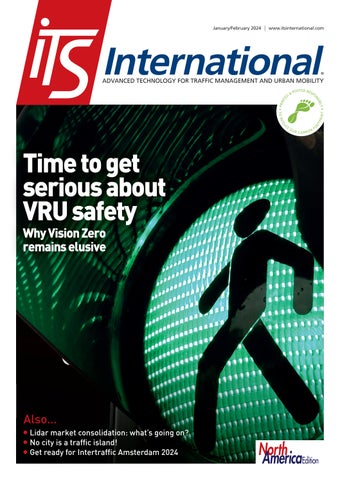


Why Vision Zero remains elusive







Lidar market consolidation: what’s going on? No city is a traffic island! Get ready for Intertraffic Amsterdam 2024 Also…



















































COMMENT
NEWS DIGEST
CONTRACTS & DEALS
INTERVIEW
Mohamed Mezghani of UITP: “For me, there are two ‘holy lands’ of public transport: Singapore and Switzerland”
Around two dozen companies are actively involved in the Lidar market today - less than, say, three years ago. Why?
Beate Kubitz re ects on the rising tide of suburban drivers - and how cities across Europe are dealing with them as worries over air quality multiply
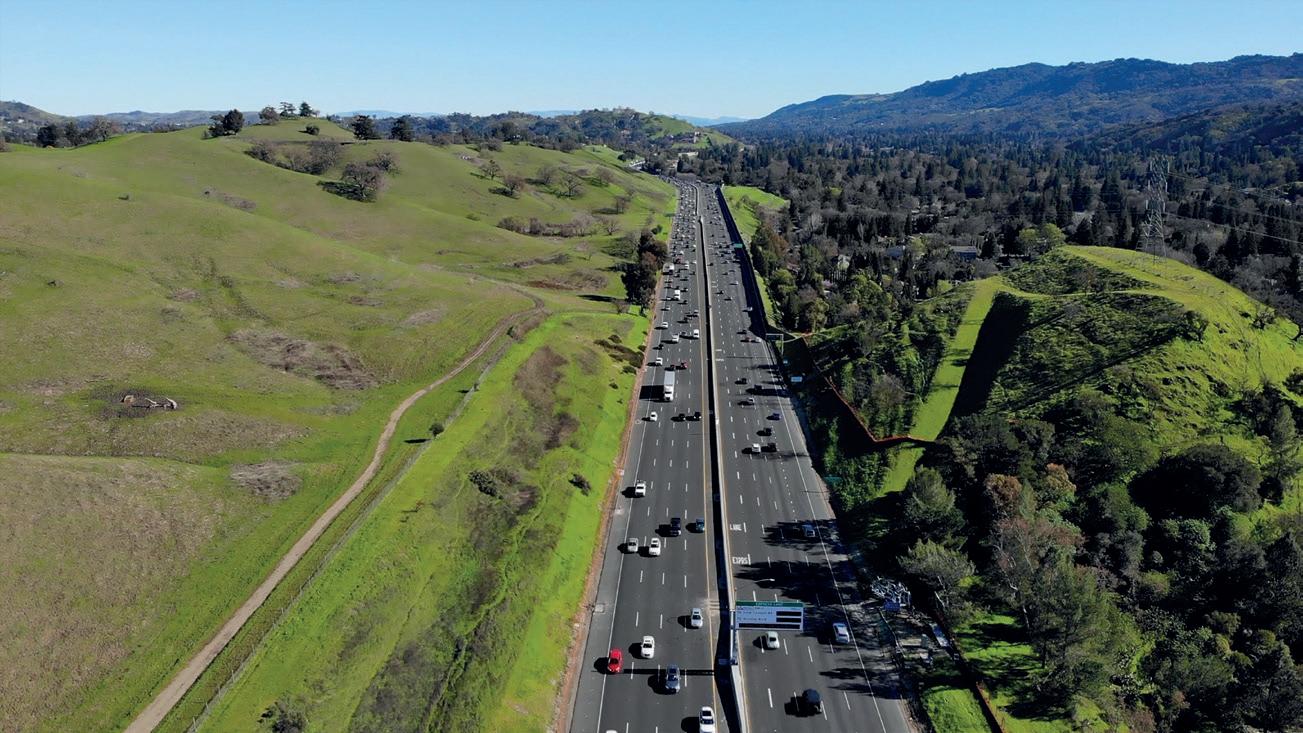
Coalition of the willing: A living lab on the streets of Georgia, US, is helping to improve traf c safety by real-world deployments of technology
Focused on innovation and implementation in ITS, the show’s emphasis this year is on smart, safe and sustainable mobility for all
40
Mass transit ridership is getting back onto its feet after Covid. Now we need to continue that momentum, says Miki Szikszai of Snapper Services
42 CONNECTED VEHICLES
45



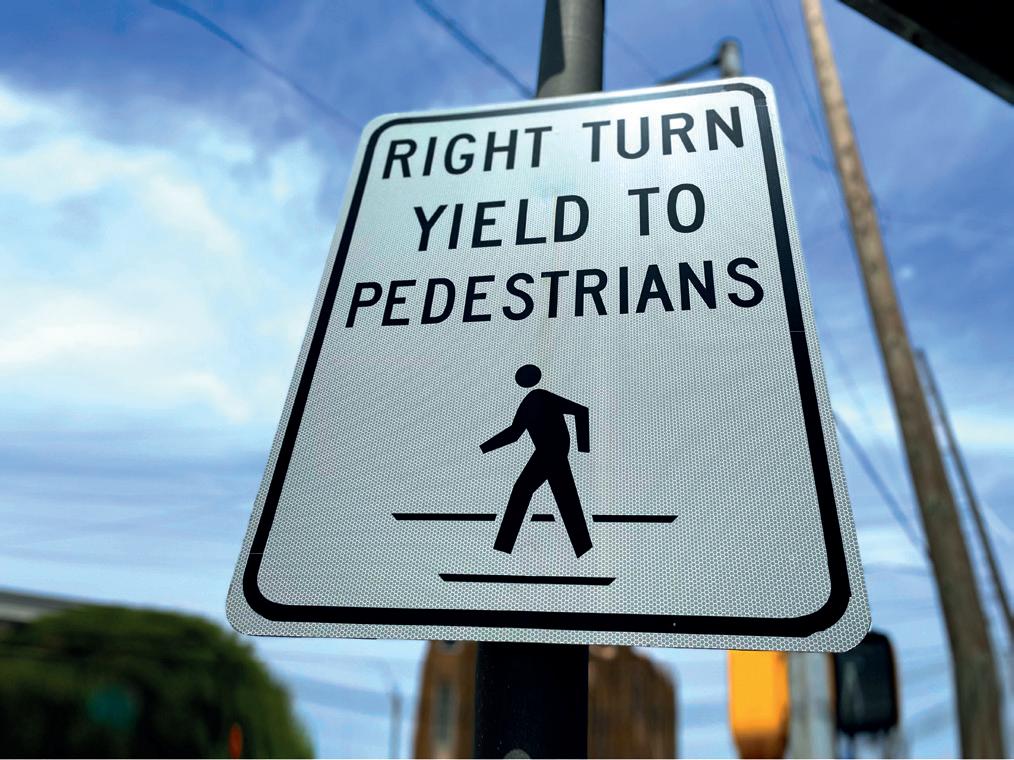
Banning right-hand turns after stopping for a red light is gaining momentum in the US. But not everyone is on board with the idea...
















The V2X ‘zombie’ is alive! But the technology still requires a critical mass of users to make it work, warns Przemysław Krokosz at Mobica
Incompatible tech, local control and limited funding prevent pilots becoming real-life: Tim Haile of Contra Costa Transportation Authority thinks they can be overcome
48 PRODUCTS & INNOVATIONS
North America area only
NA 01 The effects of Covid are still being felt: how has the pandemic affected toll revenue on Seattle’s newish SR99 tunnel? And what’s next for the Alaskan Way?
NA 06
Billions of dollars in funding from the Bipartisan Infrastructure Law is still available for transportation agencies. But the clock is ticking... January/February



“MAKING


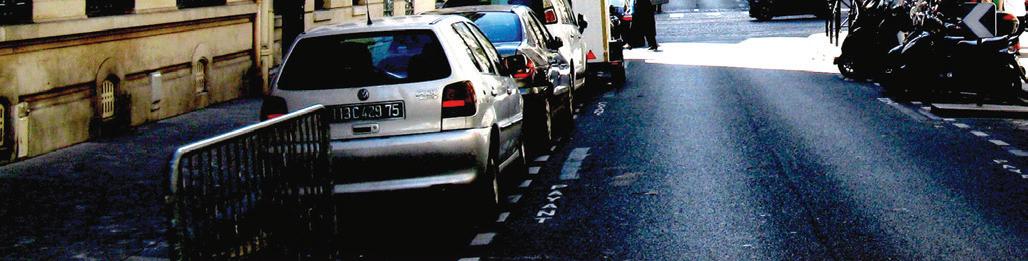
The city of Paris has voted to charge drivers of sport utility vehicles (SUVs) three times more than drivers of smaller cars to park their vehicles in the city centre (see p6). For some, this will be further evidence of the frankly dreary claim that there is a ‘war on motorists’. No such war exists: instead this move is a re ection that, despite the popularity of SUVs, they take up more space on the road than smaller cars (and have even led to demands that parking spaces should be super-sized to accommodate them – a bizarre case of the tail attempting to wag the dog). Paris – along with many other cities round the globe – has expanded the space it gives to cyclists and pedestrians.
The Covid pandemic and lockdowns, in many cases, drove this expansion, but it has continued. If car drivers feel under threat, it is because this change represents a rebalancing in how we move around our urban areas. You don’t have to be an ardent cyclist or determined pedestrian to accept that moving away from a fundamentally car-centric model of urban development
Editor Adam Hill
Email: ahill@ropl.com
Tel: +44 1322 612062
Editorial Director
Geoff Hadwick
Email: ghadwick@ropl.com
Tel: +44 1322 612013
Sales Director
Dan Emmerson
Email: demmerson@ropl.com
Tel: +44 1322 612068
Sales Team
Graeme McQueen
Email: gmcqueen@ropl.com
Tel: +44 1322 612069
Production Manager
Nick Bond
Email: nbond@ropl.com
Tel: +44 1322 612066
Design Team
Simon Ward, Andy Taylder
Of ce Manager
Kelly Thompson
Email: kthompson@ropl.com
Internet, IT & Data
Services Director
James Howard
Email: jhoward@ropl.com
Tel: +44 1322 612070
“
“ The safety of all road users should be a priority
makes some sense. Car drivers can feel that way too.
More importantly, SUVs have been found to cause greater injuries to pedestrians. SUV drivers feel safe, they command the road, they enjoy their elevated driving position – but their vehicles are often deadly for pedestrians. A study of nearly 18,000 pedestrian crashes by the US Insurance Institute for Highway Safety found that SUVs are “about 45% more likely to cause fatalities in pedestrian crashes” than cars with lower bonnets.
Vehicle manufacturers make a lot of SUVs because, they say, people like them; car drivers buy SUVs because vehicle manufacturers make a lot of them. If this is not exactly a vicious circle, you can see where it is going. Pedestrians don’t get a look-in.
Speaking of coexistence, we are also considering (p35) the growing list of US cities seeking to ban drivers from turning right on a red light. While this may be a speci cally US debate, it is global in terms of what it says about the need to look at the potential impact of our behaviours.
The safety of all road users should be a priority. ITS
Adam Hill EDITOR


@ITSeditorAdam
@adamhillwriter

@itseditor_adamhill
@ITSInt

Web Manager
Sarah Biswell
Email: sbiswell@ropl.com
Tel: +44 1322 612078
Social Media Manager
Tatyana Mechkarova
Email: tmechkarova@ropl.com
Publisher/
Managing Director
Andrew Barriball
Email: abarriball@ropl.com Tel: +44 1322 612057
CEO
Roger Adshead
Email: radshead@ropl.com
Printed by Warners (Midlands) PLC
ITS International, USPS 13324, is published bimonthly by Route One Publishing Ltd, Second Floor, West Hill House, West Hill, Dartford, Kent, DA1 2EU, UK. No part of the publication may be reproduced in any form whatsoever without the express permission of the publishers.
Views expressed in this journal do not necessarily re ect the opinion of the Editor or Route One Publishing Ltd.
All editorial, advertising or circulation enquiries to: ITS International, Second Floor, West Hill House, West Hill, Dartford, Kent, DA1 2EU, UK.
Reader Enquiry Service: data@ropl.com Tel: +44 1322 612061
Subscription Enquiries: subs@ropl.com
Global: Print ISSN 1463-6344
Digital ISSN 2057-3421
NA: Print ISSN 2632-4458
Digital ISSN 2632-5950
The US annual subscription price is US$173.00. Airfreight and mailing in the USA by agent named World Container Inc, 150-15, 183rd Street, Jamaica, NY 11413, USA.
Periodicals postage paid at Brooklyn, NY 11256.
US Postmaster: Send address changes to ITS International, Air Business Ltd, c/o World Container INC 150-15, 183rd St, Jamaica, NY 11413, USA.
Subscription records are maintained at Route One Publishing Ltd, Second Floor, West Hill House, West Hill, Dartford, Kent, DA1 2EU, UK.
Air Business Ltd is acting as our mailing agent.










IBTTA pledges to be 'proactive' on GHG emissions

Itis Holding is to buy machine vision specialist Vitronic Group for an undisclosed sum. The transaction is subject to review by antitrust authorities in Germany and other countries. Vitronic, which has interests in traffic enforcement and tolling, will join electronic toll system operators CzechToll and SkyToll, as well as tech company TollNet, under the Itis banner. Itis specialises in toll collection schemes and is itself owned by international investor PPF Group, covering the latter's investment activities in intelligent transport infrastructure.
Moves towards the decarbonisation of transport have been pledged by the International Bridge, Tunnel and Turnpike Association. IBTTA's board of directors has endorsed a Sustainability and Resilience Framework, whose two pillars are: decarbonising operations, business practices and customer choices; and resilience of infrastructure and organisational readiness to confront future environmental conditions and risks. IBTTA says these will be supported with activities to address data and measurement, partnerships and social impacts.



Ertico – ITS Europe has launched the Intelligent Transport Systems Market Radar report that focuses on market insights, new technologies, employment and trends within the sector. The inaugural publication, created in collaboration with consultant EY, spotlights two sectors within the Ertico Partnership: service providers and the traffic and transport industry. The report focuses on connected, cooperative & automated mobility, clean & eco-mobility, urban mobility & Mobility as a Service and transport & logistics, while highlighting trends such as AI, machine learning, quantum computing and 5G.

New York City is seeking to create an administrative framework to deal with new and non-traditional delivery modes such as e-bikes, mopeds and cargo bikes on streets and sidewalks. City mayor Eric Adams said he was in discussion with the City Council to create the Department of Sustainable Delivery which would establish clear goals and guidelines for the future of delivery in the city. This would be "a first-in-the-nation entity that will regulate new forms of delivery transit and ensure their safety", Adams said.


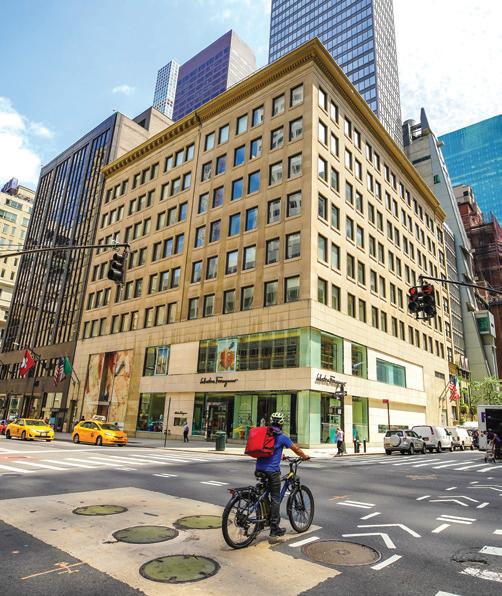

Oklahoma Turnpike Authority (OTA) has chosen Conduent Transportation to provide technology and services for the state’s PlatePay cashless tolling system. The firm will retrieve registration ownership data for vehicles, enabling invoices to be sent to motorists who travel through tolls without a PikePass transponder. The new contract builds on Conduent’s current OTA relationship for identifying licence plate information for processing. Conduent said that its solutions support the OTA’s move to all-electronic, cashless tolling operations on its turnpikes, eliminating the need for vehicles to slow or stop at toll plazas.

Seoul is piloting a single card which will allow riders unlimited use of the city's subway, bikes and buses. Riders in the South Korean capital will be able to use the Climate Card until May, with plans for full implementation in the second half of the year. Two types of cards will be available for a monthly fee: one allowing access to subways and buses for € 62,000 ($46.90 per month); and one that also includes the Seoul Bike service for € 65,000 ($49 per month).




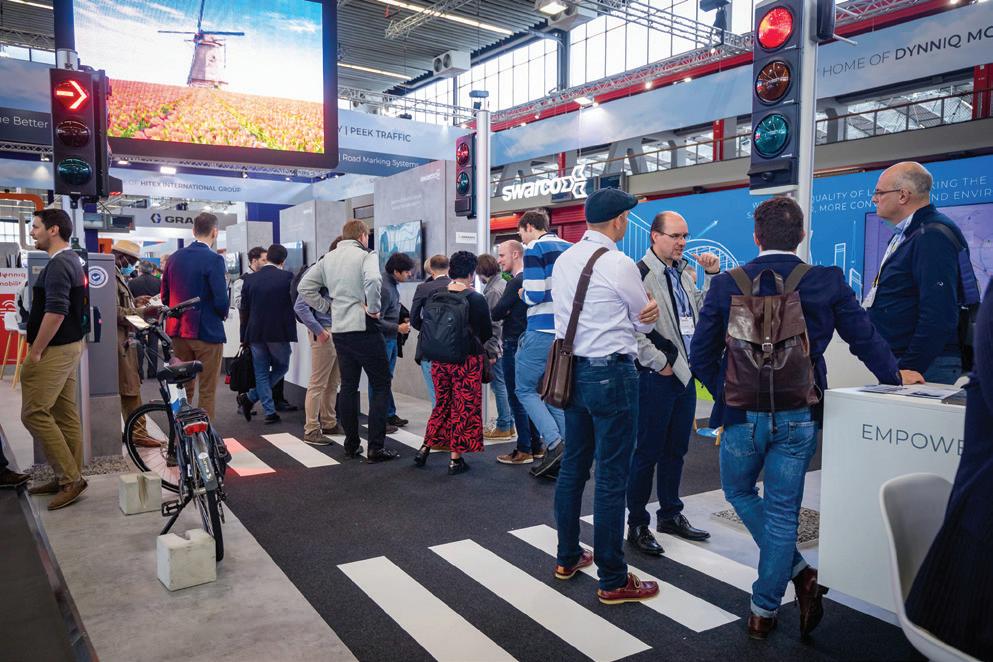
Intertraffic Amsterdam 2024, which runs from 16-19 April, will have a strong focus on digitalisation, climate resilience, artificial intelligence, connectivity and interoperable solutions. It is set to be the biggest edition yet, with 900 exhibitors over 13 halls, says organiser RAI Amsterdam. ITS International will be producing Daily News magazines at the event. In the Intertraffic Awards 2024, five innovations in each of three categories - Green Globe, Inspiration and User
Openvia Mobility, Globalvia’s technology and innovation platform, has signed a collaboration agreement with technology group GMV as part of its NeoRoads initiative. NeoRoads focuses on the development of connected, safe and sustainable roads. The companies will jointly develop solutions for Vehicle to Everything communications technology – on-road and in-vehicle – with a particular focus on 5G-V2X cellular-based connectivity. GMV will play a key role in this Openvia project when it comes to using C-V2X communications, in road safety situations such as road works ahead, as well as cooperative manoeuvres between vehicles and infrastructure.
French start-up SequoIA Analytics plans to use information from roadside fibre-optic cables to measure vibrations that will indicate traffic congestion in near real-time. SequoIA Analytics is part of the Inria Startup Studio programme hosted by Inria - National Research Institute for Digital Science and Technology. The company says it has successfully used DAS technology – distributed acoustic sensing – in a small test project along the Voie Pierre Mathis bypass around Nice, southern France. SequoIA Analytics is now in the process of constructing software for a much larger







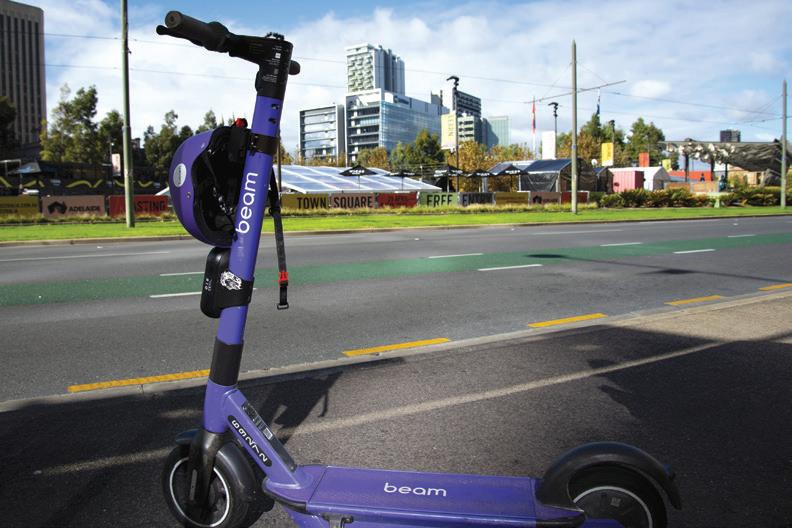
Beam has started trialling its e-scooters in Kogarah, the first such pilot in Australia's greater Sydney area. Kogarah, with a population of around 16,500, is located 14km south-west of the Sydney central business district and is part of the Georges River recreational area in New South Wales. Residents and visitors 16 and over can hire one of 60 purple Beam Saturn 5 e-scooters as well as helmets. Beam says that its Saturn 5 has wireless phone charging and auditory alerts, as well as improved geofencing capabilities to ensure safe operation.





US Department of Transportation has launched a $15m initiative aimed at small businesses which can use artificial intelligence to improve transportation. The Complete Streets AI Initiative is being offered through USDoT’s Small Business Innovation Research programme. “Complete streets are easier to plan with more complete data," says principal deputy assistant secretary for research and technology and chief science officer Dr. Robert C. Hampshire. "This is a bold effort to build out that data along with the technology platforms that make it easy to use."









Kapsch TrafficCom and the Swiss company LostnFound (part of AddSecure) have been awarded a contract by the Swiss Federal Office for Customs and Border Security to supply hardware and services for the national truck tolling system. The eight-year deal - with optional two-year extension - totals around €54 million. The 50:50 joint venture deal involves customer service, vehicle equipment and data collection for heavy goods vehicles weighing more than 3.5 tonnes. Kapsch says this will make the toll collection system "more user-friendly and transparent".






Iteris has been awarded contracts for traffic engineering, signal coordination and signal timing services for two Illinoisbased transportation agencies. The contracts are with the Illinois Department of Transportation (IDoT) – for districts 2, 3, 4, and 5 - and with the Lake County Division of Transportation. Iteris develops and provides traffic signal timing plans, on-call traffic operations, time-of-day plan recommendations, safety analyses, and more. The IDoT deals will total $6m. Additionally, Iteris will be the only consulting firm with traffic engineering expertise to maintain active traffic signal operations contracts with all nine IDoT districts.







Miovision has bought data collection specialist CJ Hensch & Associates, whose clients include government agencies, engineering firms and developers. The firm will be established as a standalone business unit of Miovision, with vice president Roger Allen staying on. Traffic industry veteran Marshall Cheek has been hired as the unit’s new general manager, with a remit to find new opportunities within the business. Texas-based Hensch, established in 1995, was an early adopter of the Miovision Scout multimodal traffic data collection tool.

Mobility data platform Vianova has joined a new consortium in the Netherlands to develop digital tools for cities and regions to better manage public space over the next five years. DRO (Digital Orchestration of Public Spaces) was launched as part of the Dutch Metropolitan Innovations ecosystem and has a €23 million budget. It has a contract from the Dutch Ministry of Infrastructure and Water Management, and Vianova will contribute mobility data to improve road safety and reduce carbon emissions. The company already works with Utrecht and Eindhoven on sustainable mobility programmes.

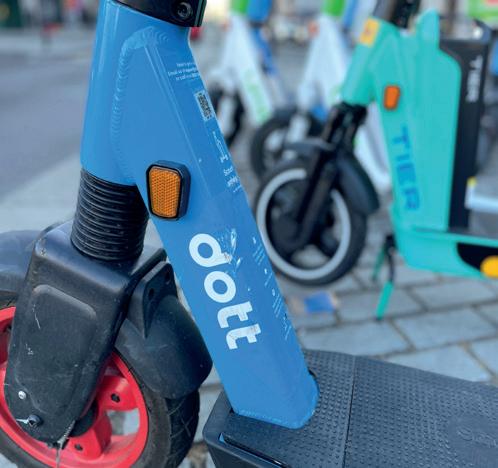
Tier and Dott are no longer riding solo. The shared e-scooter and e-bike operators have announced a preliminary agreement to merge, forming a Europe-based micromobility group with revenues of €250m. The combined entity will continue to operate under the Tier and Dott brands, with users accessing rides through their respective apps - although the firms say "more convergence [is] possible in the future". Both companies have a significant presence in various European cities, with Tier also in Saudi Arabia, Qatar and United Arab Emirates and Dott in six locations in Israel.








Rekor Systems’ mobility division has formalised its pilot programme with the Philadelphia Industrial Development Corporation in Pennsylvania, which saw it initiate testing to analyse traffic patterns within Philadelphia’s Navy Yard campus. Meanwhile, its traffic services operation, now including the recently-acquired All Traffic Data, has secured a $1 million traffic-counting contract with Gwinnett County, part of Metro Atlanta and situated nine miles north-east of the city limits. It will collect data for annual traffic volumes programme, traffic signal timing optimisation projects and studies that include vehicle, bicycle and pedestrian counts.





















































Mohamed Mezghani of UITP tells Adam Hill how you can create your own bubble on public transport, why riding a tram gives you a new perspective – and how regulation is like a French pastry










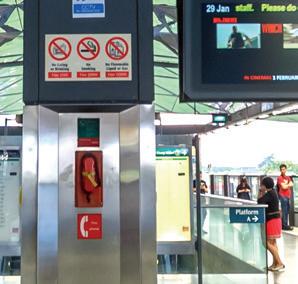
ome ITS International readers might nd this hard to believe but just using public transport can be a pleasure in itself, regardless of whether you are trying to get somewhere. “When I use the public transport in Venice, I feel like I am on a sightseeing tour!” says Mohamed Mezghani. “And you also have some emblematic public transport systems, like the New York subway, for example, or the red buses in the centre of London; you like being in this kind of system.”




As you might have already gathered, Mezghani loves mass transitand this is part of the reason why he has just started his second, elected, ve-year term as secretary general of UITP, the International Association of Public Transport. “I like travelling in a city which just implemented a new public transport system or a new line, you know, because it changes completely your perception of the city,” he continues with enthusiasm. “And when you do that, you realise all the bene ts that public transport can bring, you see that these bene ts are really that tangible.”
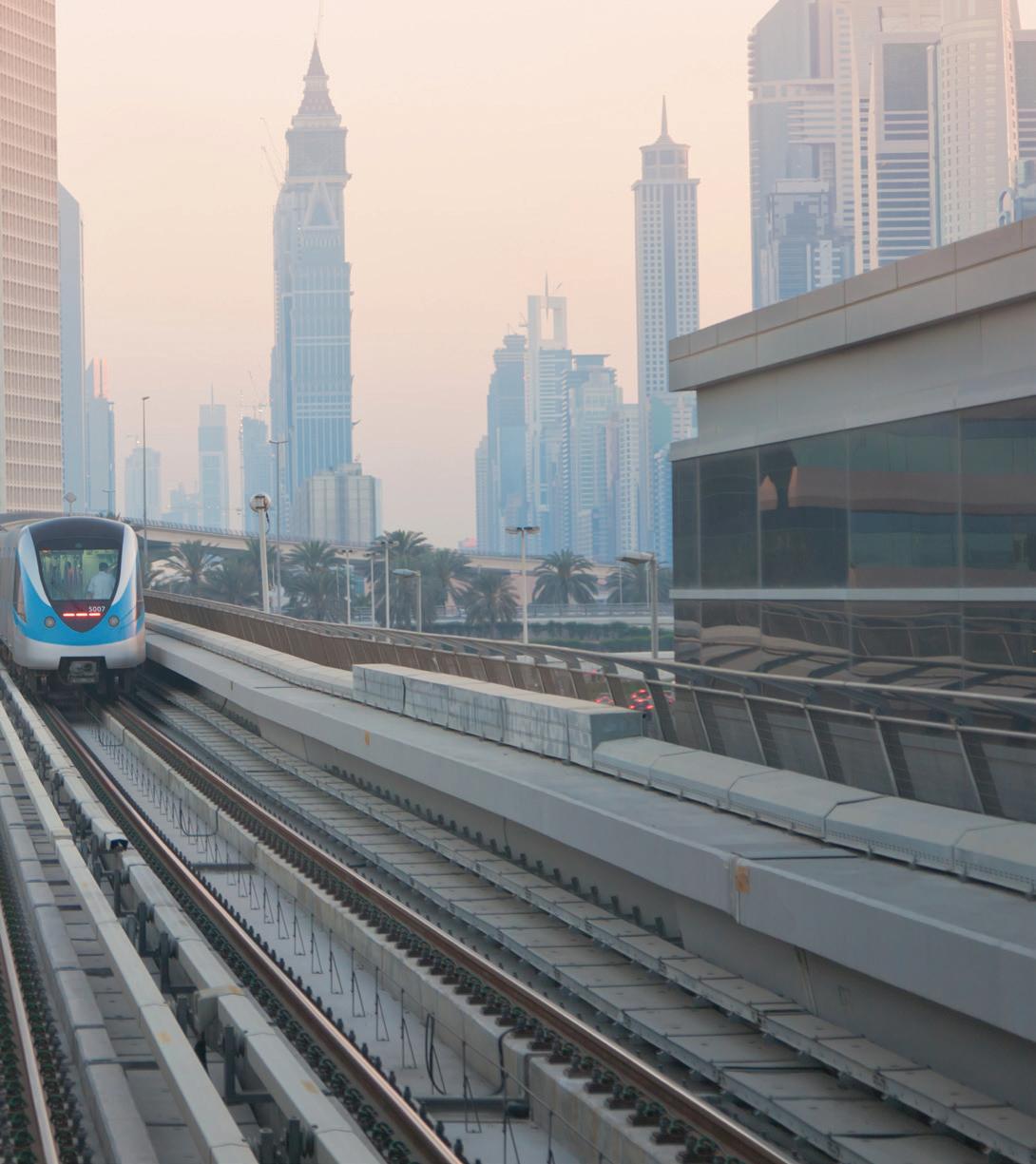
Using the Dubai Metro and the Casablanca Tramway for the rst time are happy memories for this reason. “These are cities where there was almost no real public transport system,” he recalls. “Public transport is my passion so I feel a kind of pride when I see what it can bring to the city.” Both are continuing to develop public transport, too, he points out. Even the notoriously car-centric Dubai is recognising the appeal. “It is becoming the backbone in those cities,” Mezghani




have transport see that these bene ts are really that tangible.” are continuing to develop public the backbone in those cities,” Mezghani says happily.



“






Public transport was seen as the mobility solution for those who have no choice“

















It’s unlikely that public transport has a more committed champion, and Mezghani is looking ahead with con dence: from 2025, UITP will begin holding its Global Public Transport Summit every year (rather than every two), one year in Europe and one outside. “What I say to our members now is if you have to travel once per year, go to the summit,” he laughs. “So 2024 is the year of transition where we de ne the way we work from

Rede ning the transport ecosystem


A lot has changed about public transportation since he nished studying in the late 1980s.


Mezghani is a UITP veteran. With dual Tunisian and French nationality, he graduated with a degree in industrial engineering from Ecole Nationale d’Ingénieurs de Tunis in Tunisia, and has a master in transport from Ecole Nationale des Ponts et Chaussées
solutions,” he suggests. “One of the challenges we have is that we need to reduce the weight of cars, of traf c congestion, in our cities. So we need to nd a solution to that. Mass transit alone cannot answer all the mobility needs – we need to combine it with shared and on-demand mobility.” In other words, public transport is “not just from station to station, but from door to door”. It is with this in mind that UITP has created a new shared mobility division. “It’s important that we look at mobility from the perspective of the travellers and not from the perspective of an operator or an authority or an industry supplier, and then develop the system with the best offer for that.”
There are challenges here, of course – between public and private players, the sharing of data, how to develop ticketing.
“One main change is the perception of public transport,” he says. “Before - and it’s still the case in some countries - it was seen like the mobility solution for those who have no choice; for poor people [who] don’t have any other alternative, and they were forced to use public transport.”

Not any more, he thinks. “Now we see that public transport has many more implications, more bene ts for cities, for the
Mobility as a Service will be vital, he thinks. “I know that three years ago there was hype about MaaS,” he says. “Now it is a little bit, you know… silent, I would say! We thought initially that MaaS is just a technology issue - but then we discovered that it’s a governance issue. The tool is easy to develop - but then how to de ne all these interactions between the different players? That is key. So now we are taking time to think about that more. I’m con dent it will come.”

public transport in the decarbonisation of mobility.”
Not any more, he thinks. “Now we see that public transport has many more implications, more bene ts for cities, for the environment, for the economy. It’s not just a way to go from A to B: we see that public transport is a game changer for cities. And this is, I think, one very important change compared to when I started 30 years ago or more. And also now we see the role of public transport in the decarbonisation of mobility.”
UITP has been participating in the annual Cop series of climate conferences since 2011. “I see how the discussions around public transport have taken a new dimensionrecognising public transport as a way to ght climate change, as part of the solution,” he says.

UITP has been participating in the annual Cop series of the
He is at pains to point out that – although he gave up his own car four years ago – he is not anti-car. He lives in suburban Paris, with good public transport, and he knows this is not everyone’s experience. “And I don’t have small kids I need to drive around,” he smiles. “Maybe I appear as someone presenting cars as enemies to public transport, but it’s not that. I think we should approach it differently: neither cars nor public transport can satisfy mobility needs separately. We need both of them. But it’s important to use each of them in a rational and in an ef cient way.”
to include modes such as shared e-scooters or bikes.
“Public transport is not just limited to mass transit, [it
“Public transport is not just limited to mass transit, [it goes] beyond that, embracing on-demand and shared mobility










One of Mezghani’s aims when he took over the top job at UITP was to rede ne the idea of the public transport ecosystem, to include modes such as shared e-scooters or bikes.









In France, he says, 25% of all car trips are less than 1km, and 60% are less than 3km. “So there is room for us to be using bikes, using public transport – and not using carbon. There are people who don’t even question: they take their car every day – every day - even to go and buy some bread at the bakery 1km away from home. So it’s important that we think about the optimal use of each.”


[On public transport] if you want to dream you can dream - in your car, you can’t do that


















There is also the question of the road space required for individual car journeys. “Public transport, of course, is much more ef cient in the number of people it can move on a reduced space, so we need to take this into consideration. Then we can talk about CO2 emissions, energy consumption, road safety, etc. There are bene ts for each mode. Extreme behaviours are not good, either for public transport or for the car. So it’s important that we use the right mode at the right place.”
When it comes to public transport, Mezghani has travelled just about everywhere. The places that get it right tend to be those which have an integrated authority covering all modes, bringing together ticketing and traveller information. “People don’t care who is operating [transport] but they want a smooth, seamless transfer from one mode to the other, where public transport is a real alternative to cars,” he says.
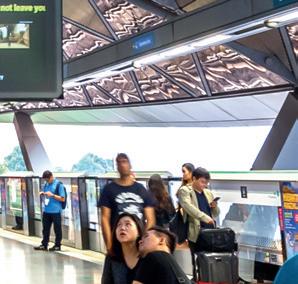
Switzerland, the Scandinavian countries and the Netherlands spring to his mind, followed by a stream of names: London, Barcelona, Berlin, Vienna, Budapest, Prague, Milan, Moscow, New York, Brussels. Also some Asian cities, especially in China (“incredible”, he says), and Singapore.
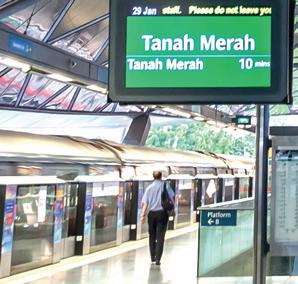
“These are cities where it is easy to move with public transport. We need to make public transport easy to use: that’s the key. For me, there are two ‘holy lands’ of public transport: Singapore and Switzerland,” he grins.
Mezghani worked with the French Agency for Environment and Energy Management at the start of his career, evaluating transport energy ef ciency projects. Where does he see the relationship between transport and energy now? “We need transport and energy in all sectors of the economy,” he says. They rely on one another and “transport is also the sector which is seeing its contribution to CO2 emissions growing the fastest in the world”.
The urban mobility dimension is huge, he says. “It’s important that we reduce the impact of transport on CO2 emissions, and that we have a structured approach to that. The problem is the complexity of the transport sector, because it is governed at international level, at national level, at regional and local level.” In Europe, some regulation is even de ned by the European Commission at supranational level, yet is applied at the local.
“So this is the complexity: in France we have a cake called mille-feuille, where you have layers of cream,” he muses. “If you have an integrated transport offering, covering all modes, it








Global challenges




makes things a little bit easier, and there is less con ict between the different layers.”


Outside of decarbonisation, there are several other challenges for the public transport sector. Staff shortages is a global problem, he says. “We need to make public transport a stronger ‘employer’s brand’, you know, to attract people because we compete with other sectors, of course.”



Digitalisation’s impact on public transport is another issue, as is the business model of the sector as a whole. “The costs are growing, and not just because of in ation,” he explains. “It is also because of electri cation and digitalisation, because we want a better service for people. And at the same time we see that there is an appetite from politicians who would like to have low-fare or even free public transport. We need to work on that to increase awareness with policymakers that this is not the right approach - because when you ask people why they don’t use public transport, they will never tell you it’s because they have to pay; they will tell you it’s because it’s not available. So we need to work on the quality, on the availability – but not on reducing fares. Or if we reduce fares it’s only for those who need it, but not for everyone.”
The nal problem is a big one: the relative lack of women in the industry. Mezghani is on the board of Femmes en Mouvement, which promotes women in mobility, and last year UITP voted in the rst female president in the association’s 138year history. Renée Amilcar, general manager of OC Transpo in Ottawa, Canada, is looking at “how to grow the gender balance”.
To go back to a subject that is never far away: one of the arguments in favour of travelling by car is that you are in your own ‘bubble’. But Mezghani – unsurprisingly - is not convinced. “In public transport, you can also create your own bubble,” he insists. “That’s one of the bene ts: you can have your headset, you can listen to your own music, you don’t even hear what is happening around you - but at the same time, you are in a permanent interaction with people. But if you want to sleep you can sleep, if you want to read you can read, if you want to dream you can dream - in your car, you can’t do that.”
Even he acknowledges it is not always perfect. “Of course, there are some days where it’s very crowded, but generally speaking, the experience is very positive. I mean, in your car it is every day where it is congested, not only some days,” Mezghani concludes. “ I think you have more days of very bad experience with your car than with public transport.” ITS


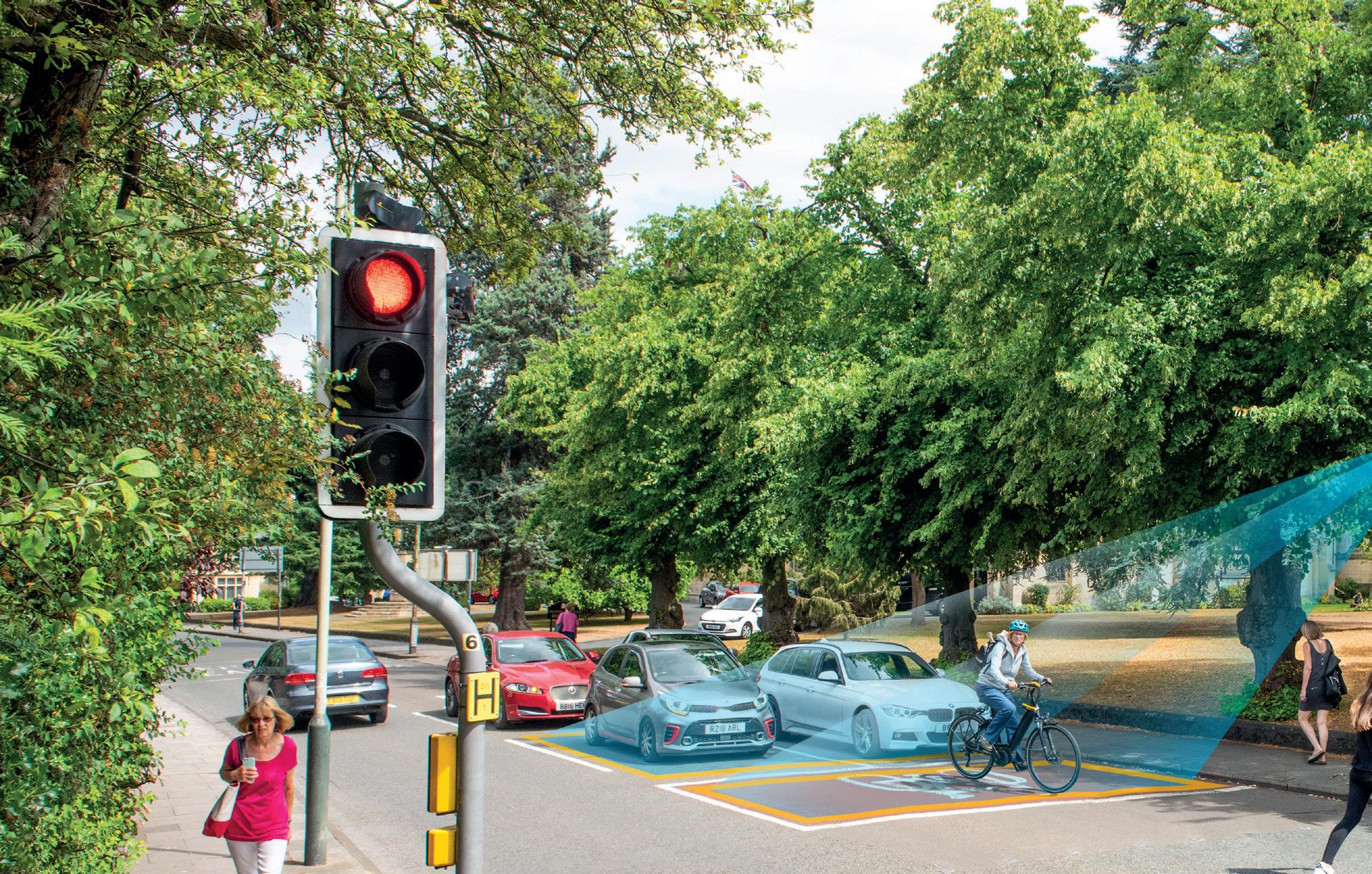










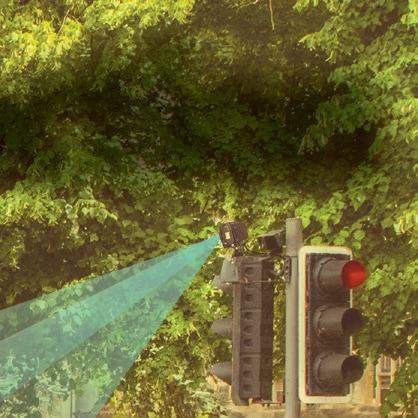




























Delivering robust vehicle detection data at the stop-line of multi lane approaches



• Detection of moving and stationary targets at the stop-line
• Two independent user adjustable detection zones
• Deep learning image recognition allows for prioritisation of vehicle types
• In-built AI aids target differentiation
• WiFi AGD Touch-setup - speeds installation and reduces risk AGD 650 DUAL







The AGD650 stop-line detector is a smart, optical, dynamic environment detector that makes intersections and junctions more efficient by delivering robust vehicle detection data at the stop-line of multi lane approaches.
The 650 has in-built artificial intelligence and makes use of a new neural processing platform and sophisticated algorithms to provide ultra-reliable real-time detection and automated decision making on vehicle types, including bicycles and scooters.

The program will showcase innovations in tolling technology presented by professionals from around the globe.
Topics include:
» Innovations in Roadway and Roadside Safety
» Artificial Intelligence Opportunities & Challenges
» “Tech Talks” focused on Sustainability, Cyber Security and Digital Transformation
» Data & Analytics
» Improving Equity in Tolling & Transportation
» Operations and Back Office Transformation
» Perspectives from Transportation Futurists
» And much more!

May 4-7, 2024
Atlanta, GA
www.IBTTA.org/atlanta





There has been a great deal of ux and restructuring over the last few years in the Lidar market – what drives this and where will it end?
Only one way to nd out: Adam Hill asks the experts

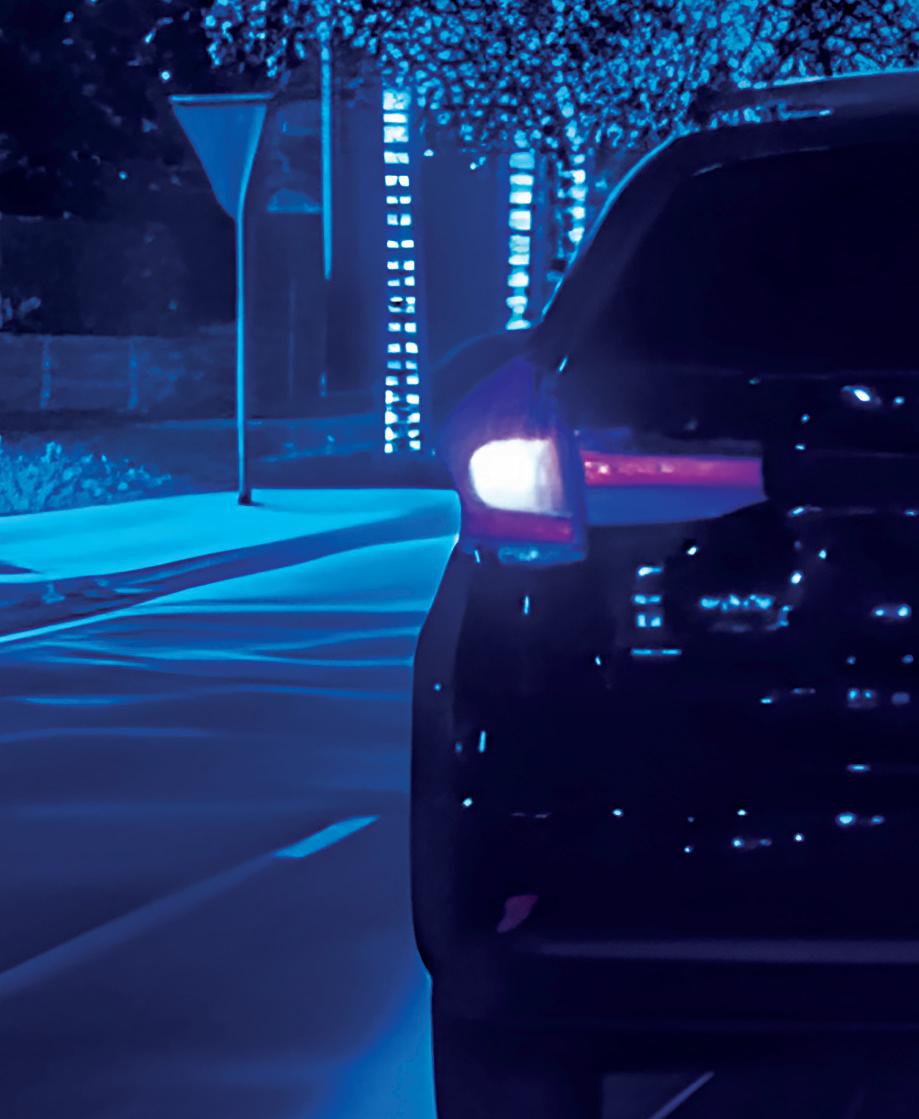
Around two dozen companies are actively involved in the Lidar market today; rather less than, say, three years ago. Automotive – a huge potential market - has been an obvious target for Lidar providers, yet consolidation has still been the name of the game. But why? “No company can exist forever without a revenue stream, and for automotive Lidar companies it’s near-impossible to make money without major OEM customer wins,” says Elad






Hofstetter, Innoviz Technologies chief business of cer. “Yet the barrier to winning a new major contract is at an all-time high and without showing a track record of successful Lidar programmes, it’s extremely dif cult to win new business.”
Compounding this is the fact that developing Lidar solutions to meet automotive grade standards is “vastly more intensive” than developing a Lidar for a non-automotive application, he says: “Maturing a product to meet automotive grade standards requires huge investment and effort, and many Lidar companies have been left with a choice: consolidate, be acquired or go bankrupt.”

There are other reasons, in other sectors. Steven Shef eld, PE, US product marketing and strategy manager at Seyond, identi es what he calls the ‘gorilla in the room’. “Investor-backed start-ups of any kind, really, can’t seem to stomach the sometimes-multiple-year lead times, certi cation requirements,






testing and validation before even getting so much as some side-eye from the public sector for consideration on an upcoming project,” he says. “Doesn’t matter if you’ve worn the prettiest, most expensive dress to the prom. Given the public domain, purchase - and repurchase - cycles, safety focus, locked-down networks of the hosts in smart infrastructure, there is a path to success with no easy wins and no shortcuts. It’s a drudge if you are accustomed to winning multi-million dollar contracts every three months. The contracts will certainly come, but only after you’ve studied and understand the customer and have done your certi cations and your industry homework.”
The fact so many of the original Lidar companies were start-ups is another major factor in subsequent consolidation, agrees Steve Bird, CEO at Red Fox ID. “And as is often the case, the technology they were working on turned out to be much harder or too costly to achieve or they just ran out of cash and failed to raise more,” he suggests. “Some just decided it would be better to merge to save what they could. Others sold out to the automotive supply chain or limited their focus on a single market – automotive. Others pivoted away from being a product manufacturer and repackaged their core technology into a component for others to use in a nished product.”


incurring substantial annual losses” meant “signi cant disappointment for stock market investors”. That makes it hard to secure extra cash, leaving mergers as a means of ensuring survival.
Raul Bravo, president co-founder at




Outsight, thinks the market “attracted substantial investment, which funded numerous development teams lacking any real uniqueness. As a result, many of these early-stage companies have ceased to exist. Rather than true consolidation, it appears to be a euphemism for bankruptcy.”

In some cases, a rush to public listing “before reaching a suf cient level of industrialisation for their products and



Also, he says, the automotive market, which initially fuelled the sector, has not been able to move quickly enough: “[It] has demonstrated its limits to provide the expected growth, as these programmes take many years to enter into mass production except in China. Very few companies anticipated what's happening: the fastest-growing segments are infrastructure-based markets like people ow monitoring in transportation hubs, ITS, and security. This has led to companies without enough cash to survive the long-term cycles of the automotive industry without having the right products for the non-automotive markets.”
So much for the ‘why’ – how much more consolidation is there yet to come? Quite a bit, it appears. “It's dif cult to predict de nitively ,” says Hofstetter. “But it wouldn't be surprising to witness the consolidation of two to three more companies in the upcoming year, ultimately resulting in a scenario where only a few key industry players remain.”
Companies are acquiring new skills, new features, and new software which should promote their ability to enter new, more specialised domains, thinks Shef eld. “Companies who are ‘full service’ and








‘in-house’ are just going to be more attractive to customers versus those who must piece together solutions with multiple partners,” he says. “So there will be increased interest in acquiring companies with specialised services that add value. In the engineering consulting world, which is where I’m from, it’s common to see large rms buying other rms who have specialised services. It’s really no surprise, nor much different, to witness it going on in Lidar. As these companies realise they must either build out these services themselves or acquire companies that already have them, the path to new big biz can be streamlined.”
“I doubt this is over yet,” agrees Bird. “There are too many companies chasing the one huge opportunity which is automotive. If you don't win big then you are likely to fail big. When the start-ups were chasing the investment, most if not all were promoting the automotive market as the key area for growth and a rapid return on investment. This market never really materialised in the way many expected. There were a lucky few, but the rest had to resize their business and nd new market opportunities.”
Lidar isn’t going away, but the last few years have shown why it needs to be pushed into new areas of interest to continue being an attractive investment. So what Lidar applications will come to the fore as the industry consolidates further?


required. For the latter, “the full privacy value-added of Lidar is one of the key success factors, but also the much higher precision compared to cameras and its lower cost - thanks to a much lower ratio of sensors per m2”.
Even with consolidation, there is good news, Bravo adds. “There are many Lidar sensor companies that have very competitive products for smart infrastructure applications, which gives the customer the right choice to combine the most appropriate models and brands depending on its context.”


There will be increased interest in acquiring companies with specialised services that add value
Steven Shef eld, Seyond “
Hofstetter thinks it will be those with high
Hofstetter thinks it will be those with high volumes like highway Level 3 autonomy, “as opposed to niche applications”. Bravo says Outsight is seeing “tremendous traction” in different segments including kerbside activity monitoring and vehicle traf c measurement; people ow monitoring in transportation hubs; security; industrial applications involving automation but also people safety; and venues where crowd management is
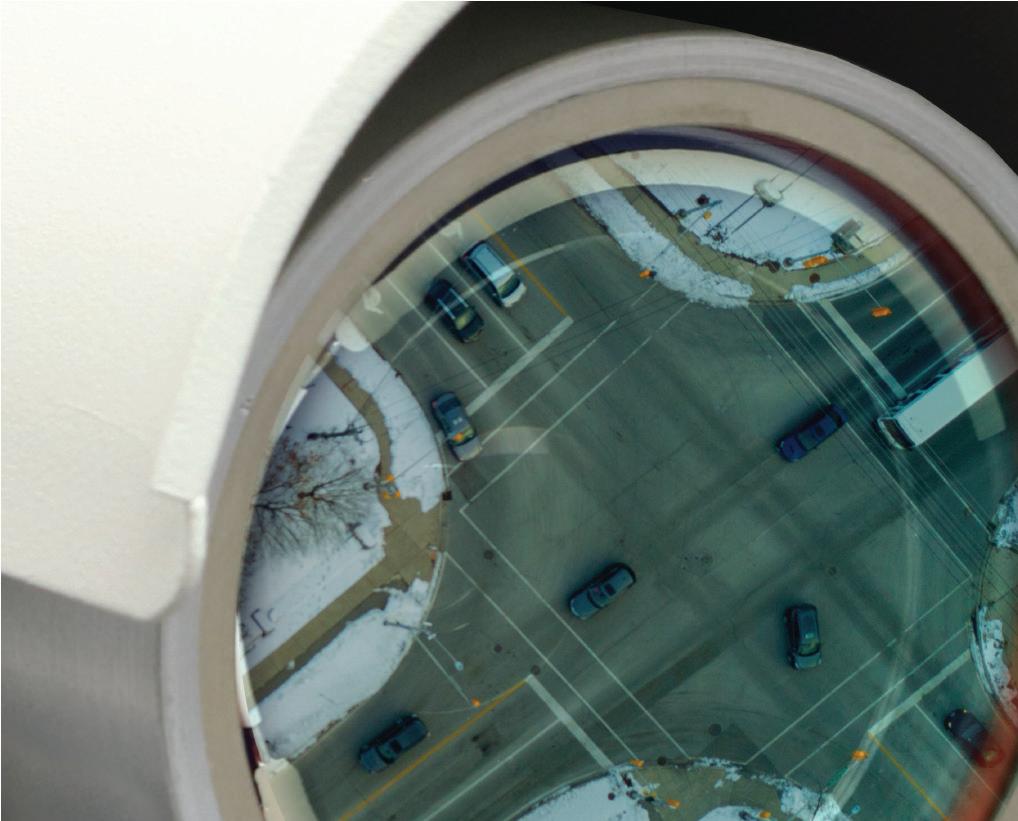



Smart infrastructure will certainly be crucial going forward, agrees Shef eld, who sees “increased interest” in this domain. “Smart infrastructure alone is a multi-billion dollar domain backed by billions in [US] federal grants and state funding, but one must be willing to adhere to the rules - and by rules I mean being willing to make substantial modi cations to your product to adhere to well-established industry standards versus moulding them to t yours. Earn the certi cations and be recognised as a consistently high quality, low-cost, out-of-the-box failsafe product, and get on a winning team to win the work. Lidar is, after all, just a component of the overall solution.”
Shef eld concludes: “The $60,000 question is, will they each be patient enough to take the long road to get there?” ITS





Reliable data begins with accurate detection


Don't compromise on accuracy, even in harsh weather. Choose Iteris, the proven leader in traffic detection technology, and elevate your traffic management with unmatched performance and unwavering support.


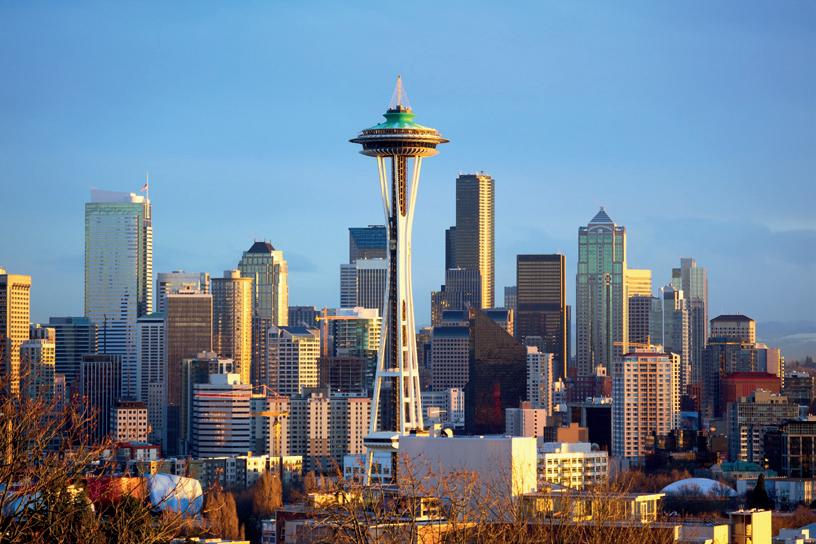
The effects of Covid are still being felt. David Arminas considers how the pandemic has affected toll revenue on Seattle’s newish SR99 tunnel – and looks at the traf c management and emergency plans in place for drivers
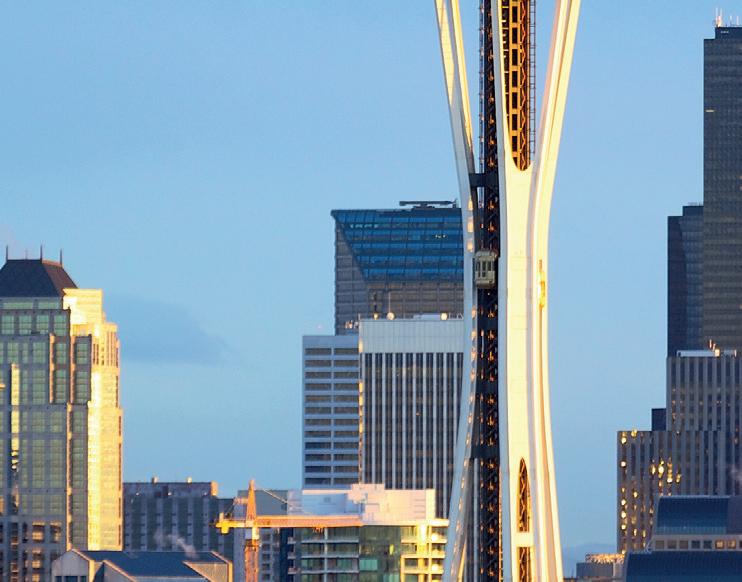
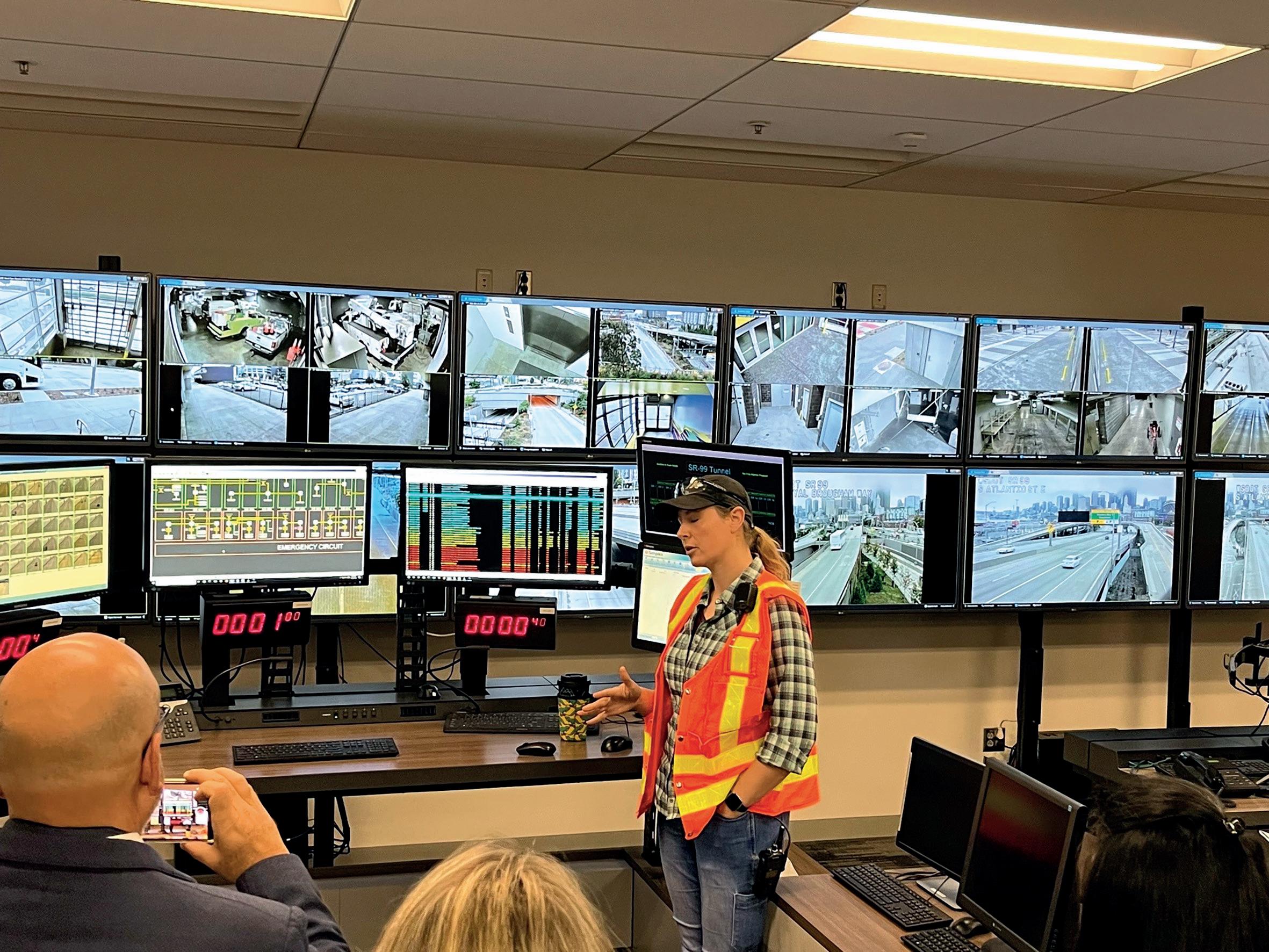
At the International Bridge, Tunnel and Turnpike Association (IBTTA) Annual Meeting & Exhibition in the US city of Seattle last October, ITS International toured the State Route 99 tunnel. Also called the Alaskan Way Viaduct replacement tunnel, SR99 is in the centre of the Paci c coast port city in the north-west state of Washington.
The 3.2km-long double-deck bored tunnel carries a section of SR99 under the city centre, following closely the old Alaskan Way viaduct alignment that used to carry SR99 and which ran close to the city’s waterfront. Structurally, it is a masterful piece of engineering, being an ef cient mover of vehicles in a safe fashion.

The tunnel opened in 2019 and for a brief period was not tolled. But when charges were introduced, usage dropped and then Covid hit, further depressing tolling revenue. Shutdowns and lockdowns and the lack of travellers hit most major US transportation facilities hard and traf c-level recovery has been slow for some - including the SR99 tunnel.
Its variable-rate tolling changes based on time of the day, number of vehicle axles and payment method. Tolls are collected electronically, with a lower rate for holders of a Good to Go pass and a higher rate for


other drivers where the tunnel system scans their vehicle licence plates and they are sent an invoice in the mail.
According to the Washington State Department of Transportation (WSDoT), tolling the SR99 tunnel helps repay $200 million borrowed to build the structure. It also pays for the ongoing cost of operating and maintaining a safe facility. This funding is part of the $3.3 billion construction cost to replace the ageing Alaskan Way Viaduct and rebuild SR99 through Seattle.
The recently published 2023 Annual Tolling Report from the Washington State Transportation Commission highlighted the issues facing infrastructure construction repayment and the nancing of maintenance and operation. As Washington State’s tolling authority, the commission is responsible for setting toll rates and policies for all tolled facilities statewide. It noted that it must take action to close the projected SR99 tunnel funding gap.


Total revenues for all ve tolled facilities for which the commission is responsible dropped 22.8% below the pre-Covid forecast. Revenue for the SR99 tunnel has been among the slowest to recover, the commission noted. “The disparity between traf c and revenue recovery… can largely be attributed to a attening out of traf c levels throughout the day, with fewer peak-period transactions observed than pre-Covid. The length of time these travel behaviour changes and related impacts will persist remains unknown.”
The number of downtown Seattle of ce workers in October 2022 was only about 40% of that in October 2019, which has contributed to lower traf c volumes and revenues for the tunnel, according to the commission. “For example, the SR99 tunnel is expected to generate nearly $49.7 million in revenues in 2021-23, which is about $9.1 million, or 15.4%, below pre-Covid forecasted levels from November 2019…. Looking ahead, revenues are expected to rise in 2023-25 to about $53.5 million – however, this is still about $7.2 million, or 11.8%, below the pre-Covid forecast.”

The result is that the state government will have to consider a nancial injection to operate and maintain the tunnel. According to a report in the Seattle Times newspaper in October 2022, a bailout was on the cards earlier that year.




Part of the problem, the Times said, is that construction of a giant Alaskan Way surface street, when completed, will give drivers more leeway to pass downtown Seattle without paying tolls. “Already, the tunnel is $29 million in the red, despite an urgent 15% toll-rate increase to catch up last year [2021]. Tolls range from $1.20 to $2.70 each direction for Good to Go passholders, varying by time of day.”
Jason Richter, deputy state treasurer, warned the commission to expect reduced demand because telework will continue for decades.
Soon after opening with no tolls in early 2019, the tunnel attracted 75,000 trips on weekdays, nearly the same as 80,000 who would take the old Alaskan Way viaduct.
By comparison, to be scally sustainable with minor diversion, it was estimated that 53,000 daily tunnel trips were needed in 2020, rising to 67,400 by 2040. But several events shredded the projected gures.
When tolling was installed, WSDoT lost 20,000 daily trips, dropping to 55,000 per weekday. Of the 20,000 lost trips, it was estimated that about 10,000 began using Interstate 5 (I-5), city streets and transit. The rest of the lost trips perhaps were because of more home teleworking, bicycling to work, side-street use or simply cancelled personal drives.
Volumes sank further when the pandemic struck, to an average 25,655, including weekends, for 2020, and generated $14 million - half the target. The projection for 2022 was $22.9 million, still short of the $35.4 million benchmark.
Despite the issues surrounding toll revenue, removal of the old viaduct has opened the way for major waterfront development, although this is a long-term project for Seattle. Development includes a more userfriendly Alaskan Way with wide cycle lanes
and more pedestrian traf c, creating a leisure atmosphere for city dwellers and tourists.
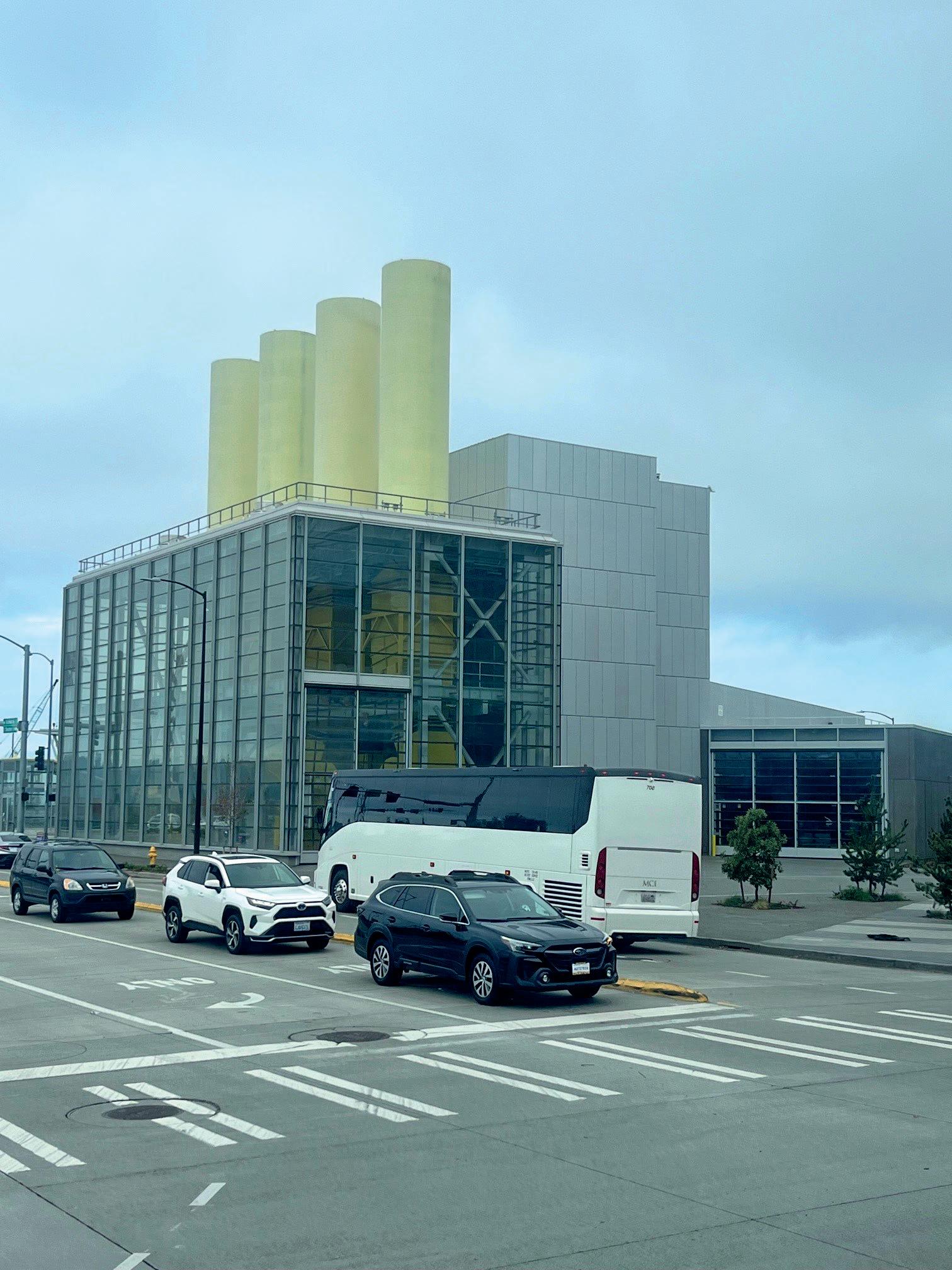
Within each of the north and south main ventilation buildings of the SR99 tunnel sit four immense fast-extraction ventilation fans, side by side in a glass enclosure for passersby to view. These bright yellow giants are so big that the building was actually built around them.
The fans kick in only during emergencies - if a re breaks out or during vehicle incidents as a precaution against res starting. Because they otherwise sit idle, each extraction fan is tested and maintained once a month. They sit on large coil-spring dampers to absorb vibrations because the units shudder when they rst start up. Their 373kW motors shift 135,000m³ of air per minute. However, since opening, there has never been an emergency that requires all four fans to operate at the same time.
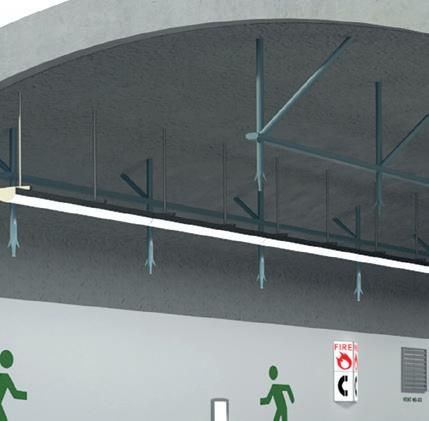
Smaller jet fans situated along each tunnel level continually circulate the air as needed on a daily basis. Hundreds of “sniffers” – sensors – line the tunnel and react to any hint of gasoline or diesel spillage as well as smoke. If the sniffers detect something, video cameras along the tunnel can zoom in on the suspected or actual incident. Dampers close to the incident will automatically open for greater air extraction.
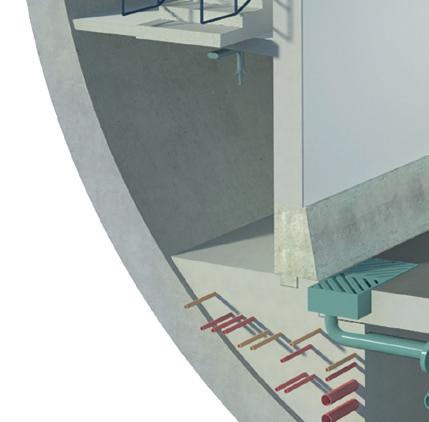
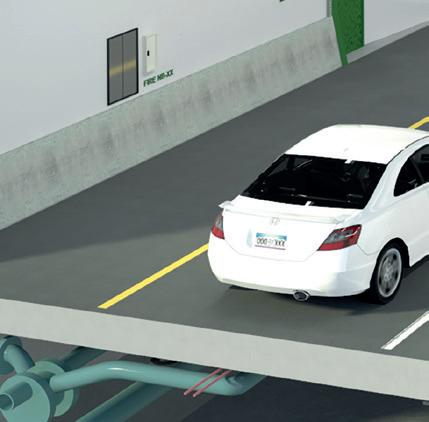
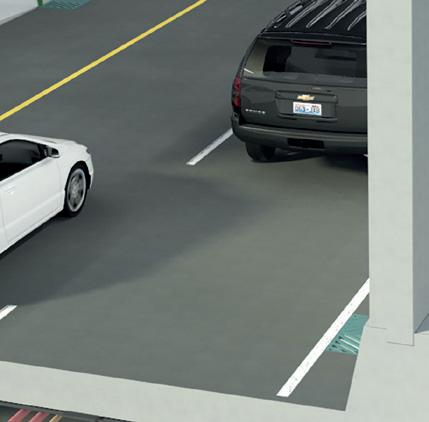
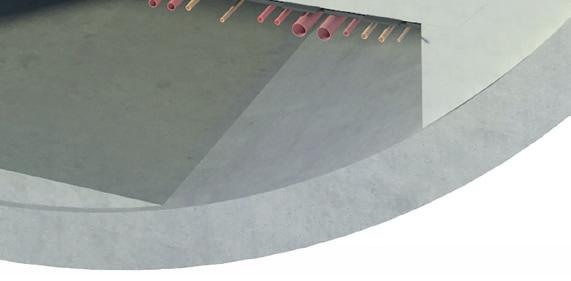
Next stop on the tour was the tunnel’s invert – being the lowest section of a tunnel that acts as the tunnel oor (see box: Squares in a round). On a circular con guration, it is approximately the bottom 90 degree of the arc of the tunnel. For the Alaskan Way, the oor is between 36.5m and 42.6m below ground. The ambient temperature within the invert is around 63 degrees. But it can gradually get colder in winter although never falling below freezing, given the mild west coast climate.
Drainage pipe systems and electrical cables are suspended along the walls of the invert and stretch off into the distance along the tunnel’s full two miles. General maintenance openings to the road sections above are located along the invert. Deluge valves open and the drainage pipes have to ef ciently handle the 3,200 gallons of water that can be dumped each minute onto a re zone during an emergency.
There is a constant low-level rumbling of the traf c above. As one employee said: “It’s the sound of a cash register for us”meaning the vehicles are paying their tolls. The very slight vibrations of the traf c used to cause the bolts on the holding racks for the water drainage pipes to come loose on a regular basis. The original speci cations for construction did not include washers so staff were continuously tightening the bolts – at least until they installed washers.
As well, the nature of a tunnel invert means that the ceiling will be low. In the Alaskan Way’s case, the invert’s clearance




This



Despite being made of 1,400 concrete rings, the bored tunnel is very much watertight, except for small leakages around the start at both ends. This is where the Omega joint is located which connects the cutand-cover entry and exit sections with the beginning of the bored tunnel structure and its connecting rings. Light pumping duties keep the omega joints dry enough.
Meanwhile, inside the main electrical room, it’s “please don’t touch any buttons”. The supplying local power company may consider its customer only a “medium voltage” client, but there are still 26,000V running into the system. This is stepped down onsite at each of the two main buildings (where the fast-extraction fans are located) to 480V for general use. The two buildings share the tunnel's power needs. If one site goes down, the other site can supply the stricken one with power within ve seconds.
Strangely, the 5,700 lights for the tunnel are not LED. They remain uorescent and high-pressure because, as at the time of design back around 2010, LED lighting was not as common as today. To replace them now would be a major technical challenge and nancial outlay, although this is not ruled out. Nonetheless, the lights operate on ve levels of brightness to ease the adaptation to lighting coming into the tunnel and daylight when leaving. ITS

















































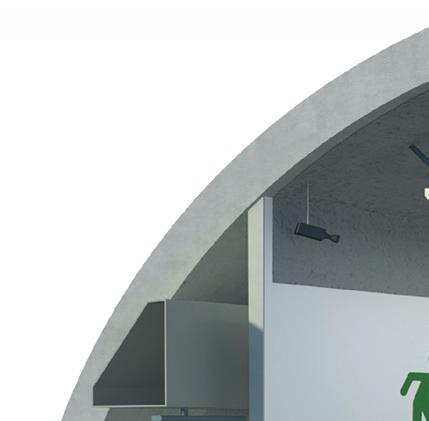
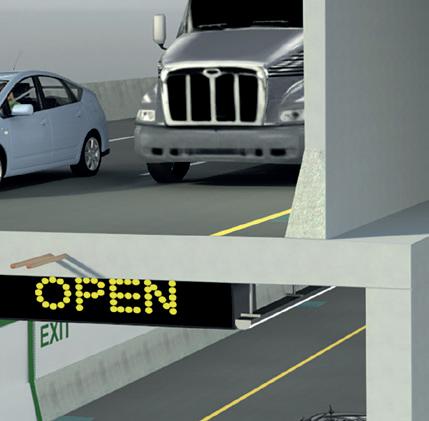
two concrete boxes, one atop the other, and their bottom surfaces – their oors - are the road surfaces. The lower box’s oor carries north-bound traf c, while the top box’s oor carries southbound traf c.
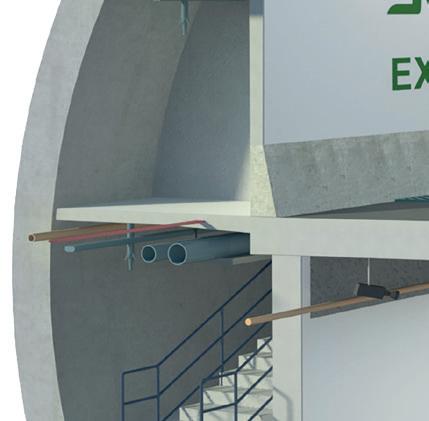
To support the two stacked boxes, the lower box sits upon concrete corbels (edges) built into the sides of the circular tunnel. This creates, underneath the oor of the bottom box, the invert, the lowest section of a tunnel that acts as the tunnel’s oor running the length of the structure. In this case, the invert is for maintenance and holds such systems as those for drainage and power.
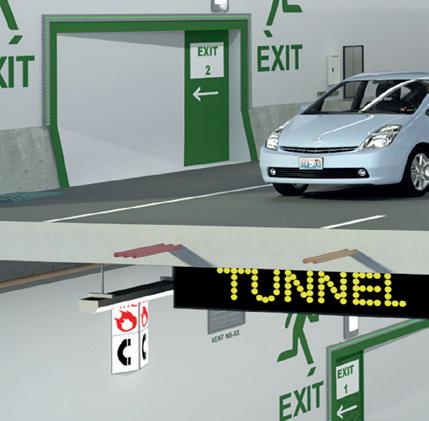
Running beside each concrete box is an escape section of the tunnel. There are doors running the length of each box for entry into the escape section should an emergency arise. In the event of an emergency, fans in the escape section automatically kick in to increase the section’s air pressure to that just above the adjoining road section. This gives the escape section a positive air pressure, greater than that of the road tunnel. Smoke- lled air from the road tunnel cannot then enter the escape section as the ow of air will be from the main road tunnel.








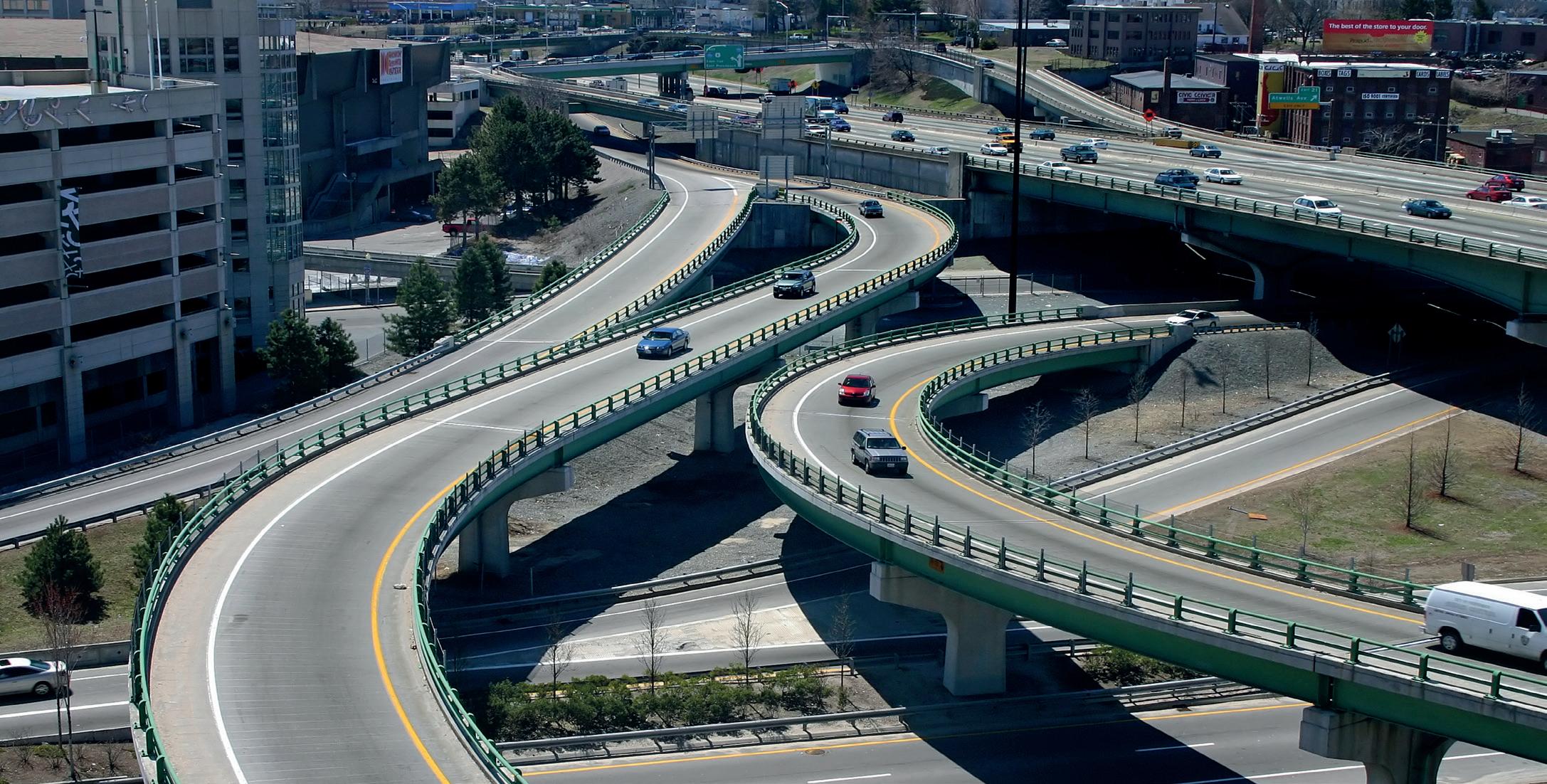
Billions of dollars in funding from the Bipartisan Infrastructure Law is available for transportation agencies. But Mary Scott Nabers, president/CEO of Strategic Partnerships, warns that the clock is ticking
Two years after the passage of the Infrastructure Investment and Jobs Act (IIJA), also called the Bipartisan Infrastructure Law (BIL), an estimated $492 billion remains in federal funding for American infrastructure projects. However, it is crucial to note that there’s a ticking clock because the remaining funding is allocated solely for use between 2024 and 2026.
When Congress passed the IIJA in 2021, it authorised $1.2 trillion in spending over ve years for the country’s critical infrastructure - transportation, energy, broadband, water, technology, healthcare, education and more. It is estimated that between $345 billion and $400 billion has been disbursed to date.
Since much of the IIJA funding was designed to be distributed to states based on population, larger states have received the most revenue. The top three states that bene tted most are California ($32.7 billion), Texas ($28 billion) and New York ($23.6 billion).
However, with billions still left to be allocated, knowing how the funding will be distributed and what projects it will ultimately support is important. Some fund distributions will be based on a formula or a competitive grant. Here’s the difference between the two options – a competitive grant is awarded based on the merits of a submitted application. Competitive grants are discretionary which means that they
don’t have to be awarded if the granting agency does not approve. Formula grants are awarded based on a statistical formula. Infrastructure funding to be allocated in 2024 by the US Department of Transportation is approximately $131 billion. In 2025, another $134 billion will be distributed and then a nal installment of $136 billion will be made in 2026. This revenue will ow from various programmes including the Federal Highway Administration, Federal Transit Administration (FTA), National Highway Traf c Safety Administration and Secretary of Transportation.
“
“ Sadly… it is evident that many states are not competing as well as others
FTA has 20 programmes and 34 sub-programmes that received funding in the IIJA. The largest amount of funding will be distributed through formula grants to states. More than $6.6 billion will be available for each year between 2024 and 2026 and the funding will support operating assistance, planning, engineering, design, analysis of transportation-related studies and other projects.
The Port Infrastructure Development Program will allocate $450 million annually between 2024 and 2026. The funding is for the improvement of the port and related
freight infrastructure. The Port of Tacoma’s terminal expansion in Washington was awarded $54.2 million in November to support an initiative to recon gure the Husky terminal yard for better truck circulation, install roughly 40 reefer racks and related power supplies, and relocate on-terminal structures. There are other programmes that also support US port projects. Overall, the IIJA earmarked about $17 billion for port infrastructure projects.
Transportation still has $346.8 billion left to allocate. With so much funding remaining, and so little time left to spend, it seems imperative for public of cials to immediately analyse critical infrastructure needs. Time passes quickly, and the funding is nearing its expiration date.
Sadly, when one looks at which states are receiving large amounts of this once-in-a-generation amount of federal funding, it is evident that many states are not competing as well as others. Of cials fear it is because some local governmental entities lack the resources to develop grant applications. That trend, however, may be changing as non-pro ts, community organisations and private sector contractors are beginning to step up to provide grantwriting support to governmental of cials who lack the internal resources to submit grant applications. Here’s hoping that trend continues to gain strength throughout the US because infrastructure is the most critical component of economic vitality in any part of America. ITS


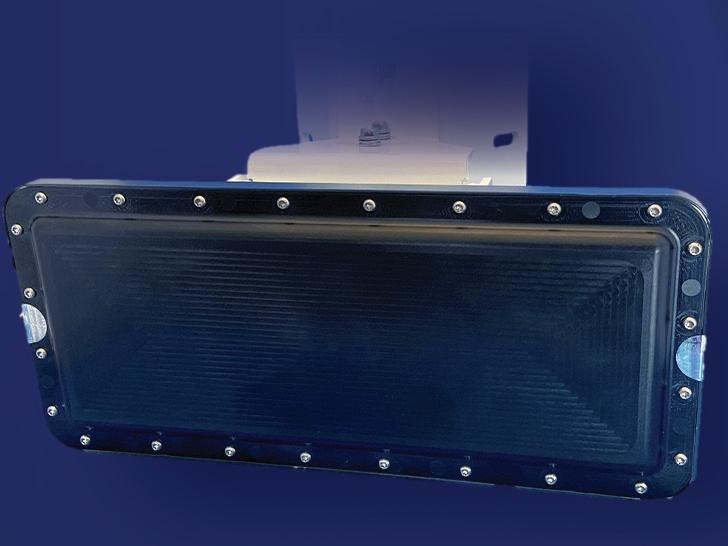
The Most Capable Radar Detection Solution on the Market
Econolite’s EVO RADAR™ sensors are designed for all approaches, which helps to reduce travel times and traffic congestion, while increasing safety at intersections for pedestrians, cyclists, and motorists. The EVO RADAR sensor solution is ideally suited for a variety of intersections, using a 110-degree field-of-view designed to cover two approaches with a single sensor. EVO RADAR provides trusted, situational awareness at every intersection.




















April 22-25, 2024







Phoenix Convention Center, AZ
Phoenix Convention Center, AZ


Tech Tours: April 22 | Exhibit Hall & Conference: April 23-25
Tech Tours: April 22 | Exhibit Hall & Conference: April 23-25













ITS America Conference & Expo, taking place April 22-25, 2024 at the Phoenix Convention Center in Phoenix, Arizona, will bring together the entire intelligent transportation community for thought-provoking education, networking, and demonstrations exploring the technologies and solutions that will enable a better future. REGISTER TODAY AT ITSAMERICAEVENTS2024.COM/ROPL
ITS America Conference & Expo, taking place April 22-25, 2024 at the Phoenix Convention Center in Phoenix, Arizona, will bring together the entire intelligent transportation community for thought-provoking education, networking, and demonstrations exploring the technologies and solutions that will enable a better future. REGISTER TODAY AT ITSAMERICAEVENTS2024.COM/ROPL Hosted By:


No city is a traf c island! Beate Kubitz re ects on the rising tide of suburban driversand how cities across Europe are dealing with them as worries over air quality multiply
AUK parliamentary by-election last year – caused by the resignation of former UK prime minister Boris Johnson - highlighted an issue I’ve come to think of as ‘the city island’ problem. Or maybe that should be ‘the city traf c island’ problem.
Uxbridge is an area at the western edge of London. The topic that is attributed with a (very marginal but unexpected) win for the incumbent Conservative party in the by-election was that of the ultra-low emission zone (ULEZ).
The ULEZ is a measure to address poor air quality, rst introduced in central London in 2019 and expanded to include all areas within the inner city ring road in 2021. Vehicles with high emissions are discouraged from entering central London by a charge.
This measure has resulted in a dramatic drop in the number of older and more polluting vehicles – both commercial and private –driving in central London.
The ULEZ has been measurably and signi cantly successful. Since its introduction in 2019, emissions of nitrogen oxides (NOx) are estimated to have been reduced by 23% and particulate emissions by 19% in the ULEZ area. Air quality in central London has improved substantially, with reductions of 46% in nitrogen dioxide concentrations (and more in some places). The success of the
“
Whilst many people see travelling less by car as an ideal, the reality is that this is much more dif cult the further they live from the city centre “

scheme in inner London has been extended by expanding the area to include outer areas such as Uxbridge in 2023.
At this point, however, the good news story has received a setback. Rather than welcoming the development to improve air quality in outer areas, a high-pro le campaign against the expansion of the ULEZ became one of the rallying points in the recent by-election.
Unpicking the issues here and working on solutions, I suggest, will be one of the great challenges for transport practitioners, urban planners and all those concerned with air quality and carbon reduction in the near future.

Solving the city (traf c) island problem will need to combine practical and social measures and recognise transport equity – otherwise it will continually pit inner city
dwellers against the suburbanites and threaten cleaner air, less congestion and lower emissions across the board. It is not just a London problem, but one that is repeated across European cities, with varying responses.
The trouble with London London shares characteristics with many cities. It has a central core with excellent connections by public transport, an increasing number of great active travel routes plus multiple other options including cycle and e-scooter hire schemes, car clubs and the like. This central zone is surrounded by a penumbra of less dense areas with lower levels of public transport, poorer active travel infrastructure and fewer choices in the shared transport sector.
Whilst many people see travelling less by car as an ideal, the reality is that this is much
more difficult the further they live from the city centre. Indeed, maps of car ownership and usage and transport availability correlate strongly. The further someone lives from the city core, the less dense public transport is, and the less dense public transport is, the more cars people own and the more mileage they travel by car. In outer areas the car has become the default choice and, for many, life is unimaginable without being able to drive in the current conditions.
This motif is not unique to London. It is repeated in cities across the world – although the boundaries, distances and even electoral or administrative zoning may not quite be the same.
It represents a very real challenge to plans to decarbonise transport, to reduce congestion and to improve air quality. Whilst city centre dwellers are often happy with their choices they can be puzzled and even
dismayed when their suburban counterparts travel from their outlying homes into the urban core. If no-one in your block owns a car, where does all the traffic come from? Equally, suburbanites see no alternative to their car – and expect to be able to drive anywhere they like.
This pattern was highlighted in Berlin in 2023 when Berliners were divided in an acrimonious election. Berlin is a thriving European metropolis with a dense core and diffuse outer area. In the 2023 election the strongest parties emerged offering polar opposite transport policies. The Green Party has consistently proposed policies to reduce reliance on the private motor vehicle as part of efforts to reach net zero – supporting public transport and active travel in particular. The more conservative CDU took the opportunity to make equally strong promises to allow people to keep their cars. The election outcome is distribution of representatives forming an almost perfect doughnut. Inner areas are comprehensively Green and outer areas almost exclusively CDU.

The resulting administration immediately began to pit the desires of those living largely car free in the urban core with suburban dwellers’ requirements that they should be allowed to drive – and park - wherever they want. Instant controversy was generated when the CDU demanded that a network of already planned new cycle lanes be cancelled if they remove a single parking space. In response, central dwellers – and particularly cyclists - have taken up demonstrating to protect plans for reallocating car lanes to bike lanes.
This is one illustration of the urban/suburban split – and an outcome precipitated by the combination of central and outer zones in one administrative area.
The administrative situation in Paris is slightly different. The mayor of Paris, Anne Hidalgo, first elected in 2014, has presided over wholesale changes in the apportionment of road space, reducing car access to the grand boulevards of central Paris and creating a network of green-painted segregated lanes for cycles, e-cargo bikes and e-scooters.
The Paris equivalent of the ULEZ, Paris Respire, was launched in May 2016. In 2017, the first permanent low-emission zone was introduced, the Zone de Circulation Restreinte (ZCR). Following the success of the ZCR, in 2019 the first metropolitan LEZ was set up, banning diesel cars made before 2006 from the city centre. The current Low Emission Zone permits only vehicles with the lowest emissions into the area from Monday to Friday, between 8am and 8pm.
Hidalgo also launched a comprehensive and well-funded ‘Plan Vélo’ (2015-20) which
Shared bikes – such as the Vélib’ Métropole scheme – are big in Paris,
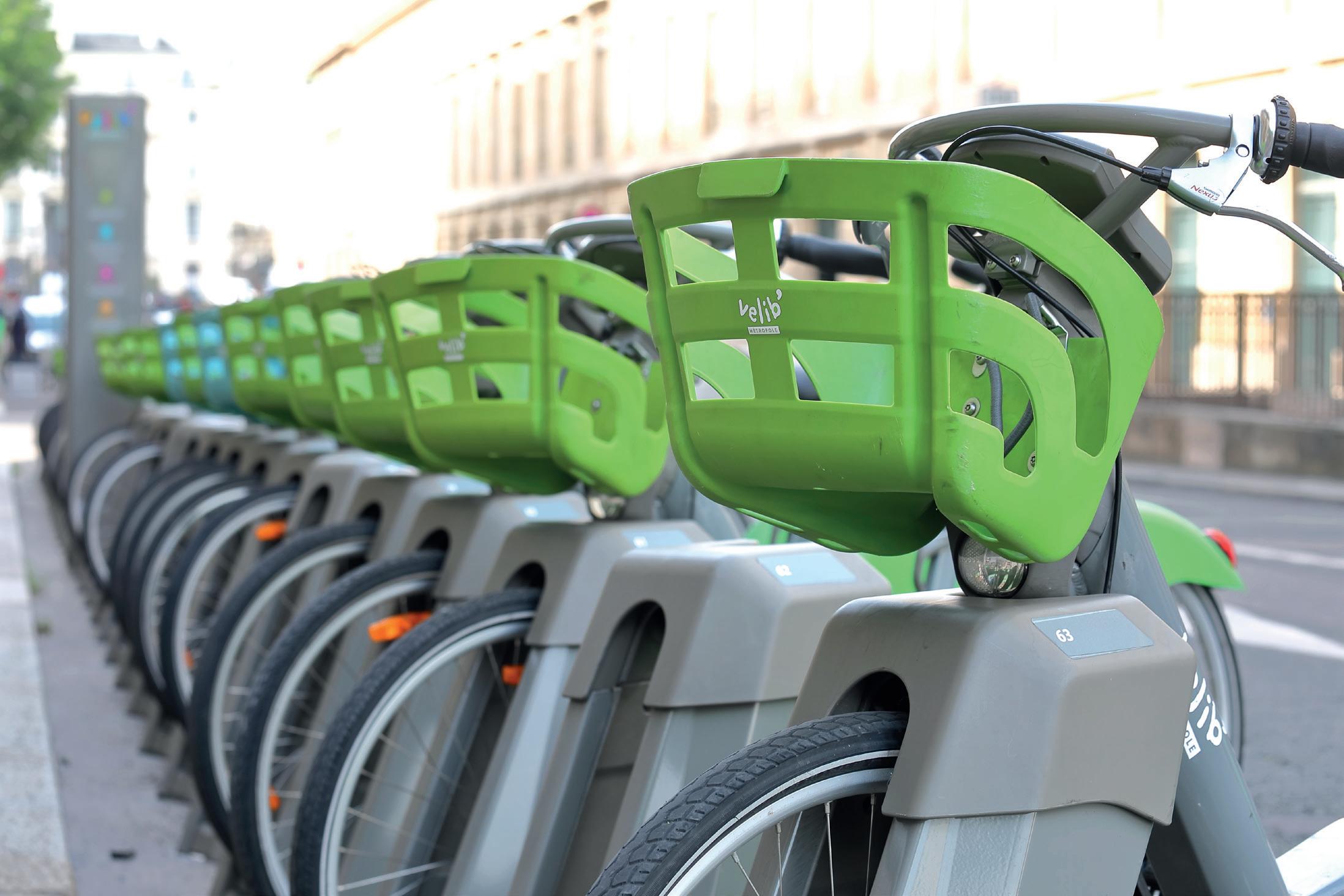
created cycle ‘expressways’ along the north to south and east-west axes, the banks of the Seine and to access the parks of the Bois de Boulogne and Vincennes. A secondary network of quiet ‘cyclable routes’ creates a network at local level. Importantly it also provided over 10,000 cycle parking spaces. The package also included subsidies for people buying e-bikes and cargobikes. Roads were further calmed with almost universal 30km/hr speed limits and more road space was reallocated to bus and tram routes.
This radical activity was followed up by plans to remove 72% of on-street parking and making all streets cycle-friendly in Mayor Hidalgo’s 2020 campaign for re-election. Since re-election she has announced further bold measures to restrict traffic, including a new Low Traffic Zone, active from 2022, which will prevent non-residents’ cars and vans from crossing the city centre at all, and a high-profile plan to remodel the ChampsElysées as a pedestrian and cyclist-friendly linear park. In a March 2020 interview with The Guardian, Hidalgo made her position clear: “We’ve given vehicle owners plenty of notice so they cannot complain they were not warned. The place for the car in our city will be reduced even more with more alternative mobility available like bicycles, more buses and car sharing.”
Whilst the impact on central Paris is better air quality and quieter streets for inhabitants, the surrounding area, the other
seven departments which make up the Île-deFrance region regard the changes much less favourably. In common with outer London, these other areas have significantly poorer public transport.
People drive more – and expect to be able to drive into central Paris. They have no influence over the elections in central Paris, however, so there’s no electoral impact on the Mayor. Indeed, there was vocal opposition to her re-election. However, given the result, the protest is more likely to have come from outer areas than her electorate in the centre.
It’s notable that there has been recognition across the Île-de-France zone that the public transport situation requires improvement for people in outlying areas. The transport authority, Île-de-France Mobilités has recently made considerable investments in the greater Paris region, including new express routes to connect outer and inner Paris better and on-demand bus services in outlying areas to ensure that people can connect with rapid transit even from low-density areas.
Meanwhile, less politically fraught measures in Luxembourg are still at the mercy of the inner/outer split.
Luxembourg is a prosperous city state (residents enjoy the world’s highest per capita income of any independent state worldwide).
This prosperity has enabled a very high level of car ownership – and by 2020 the highest car density in the EU (696 per 1000 people vs an EU average 560). High car ownership also came with extreme congestion and high emission levels.
To tackle congestion and emissions, the government made all forms of public transport in Luxembourg free in March 2020. The launch of free transport coincided with the Covid pandemic, making subsequent impacts difficult to disentangle from the impact of the pandemic, which suppressed both passenger numbers and new car registrations.
Some indicators can be seen, for instance in passenger numbers on trams which have risen from 22,000 tram journeys per week in 2018 to 88,000 per week in 2022. Car registrations are difficult to follow because of the impact of the Covid pandemic, however they have remained lower than the years preceding 2020. That said, independent research has found only a small impact on traffic levels.
This may be for several reasons. Primarily, there’s a strong car culture in the country and the lowest petrol prices in Western Europe. Changing deeply embedded behaviour and values is no short-term project. In addition, population growth within Luxembourg will swell car as well as public transport numbers.
However, there are also significant
external factors. The population of Luxembourg is 630,000, however this number is augmented daily by 230,000 commuters from neighbouring Belgium, France and Germany. This pattern is driven by a thriving economy and jobs market, coupled with the very high cost of housing in Luxembourg. The net result is that there are substantial commuter ows crossing the border. Whilst these commuters can bene t from the free transport within Luxembourg, at the start of their journeys, beyond the country’s boundaries, they are liable to pay fares.
A detailed analysis of the impacts of the free public transport policy found a small positive impact in favour of public transport for people living in Luxembourg, however a much more mixed result for cross-border travellers. Whilst some cross-border travellers bene ted and chose public transport this was more pronounced for shorter trips. The

researchers also noted that cross-border travellers experienced ‘a signi cant increase in their travel time if using public transport, and indeed resistance has been observed in the expected modal shift’.
The response is a plan to improve access to Luxembourg free public transport from beyond its borders. This involves increasing the number of seats on commuter services to France by 50%, the frequency of trains and investing in services crossing the border (even on the French side). At the same time, motor vehicles are attracting a new carbon tax.
A repeated pattern in transport planning is an extreme focus on city centres - dealing with dense populations offers a great return on investment. However, until we look at the whole system these schemes may not always yield the desired results because people living outside the core urban areas have a huge impact on city centres.
To misquote the great English poet John Donne, ‘No city is an island entire of itself, every city is a piece of the continent, a part of the main.’ ITS

ABOUT THE AUTHOR:
Beate Kubitz is an independent researcher and consultant. In 2020 she was granted a Foundation for Integrated Transport Fellowship to study traf c ows between urban and rural areas. Her forthcoming book on Mobility as a Service will be published this year


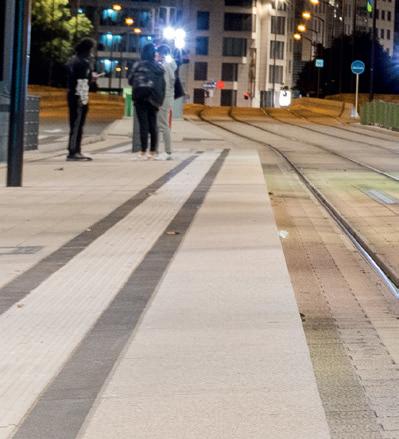





The population of Luxembourg Is 630,000, however this number is augmented daily by 230,000 commuters from neighbouring Belgium, France and Germany “



























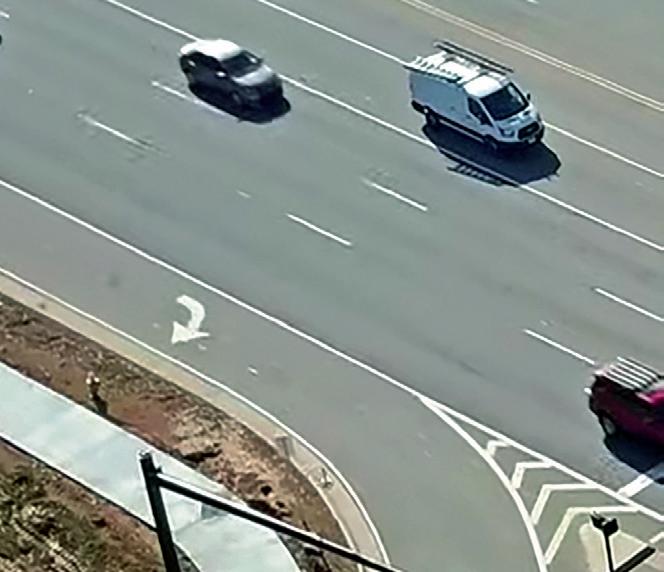
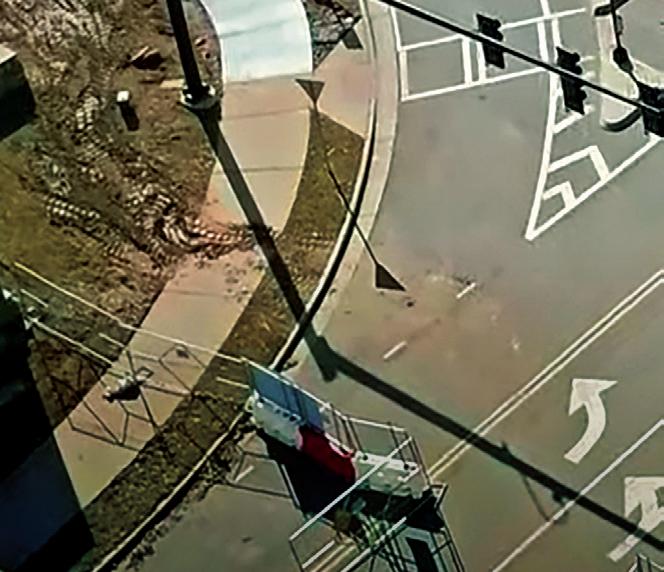
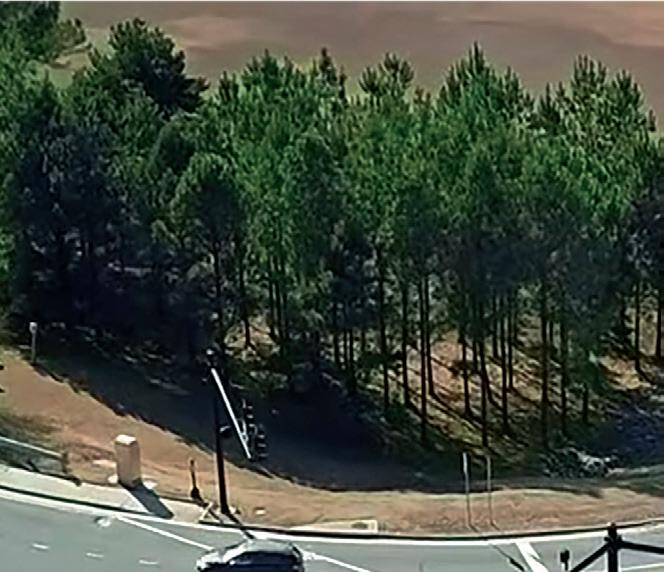
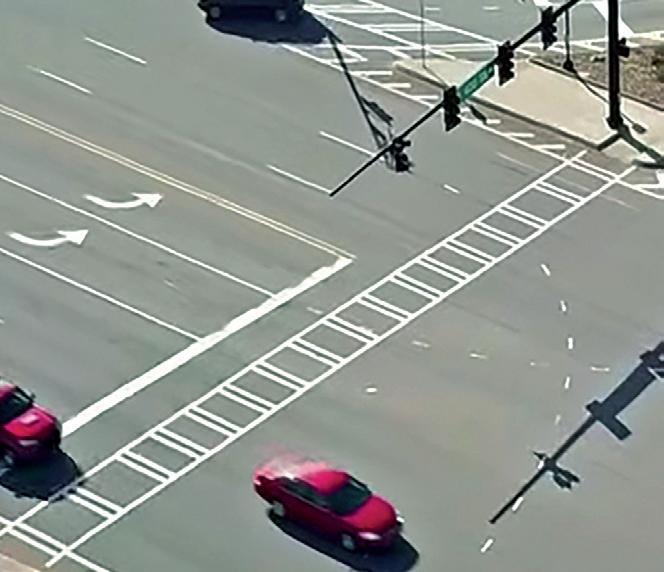
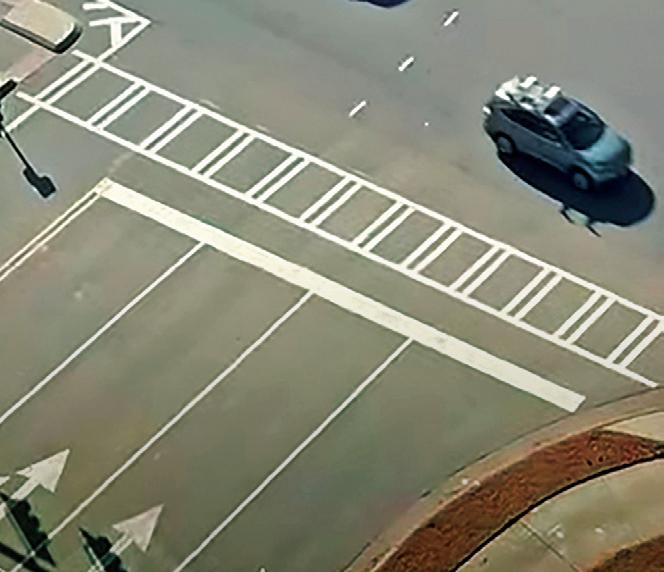
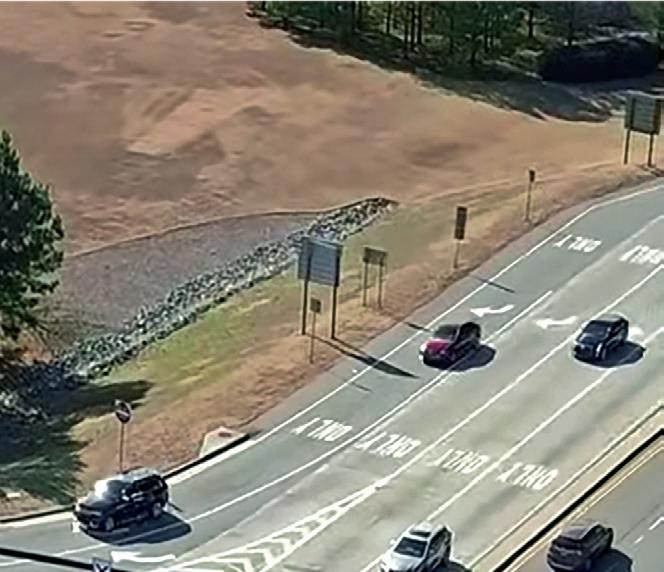
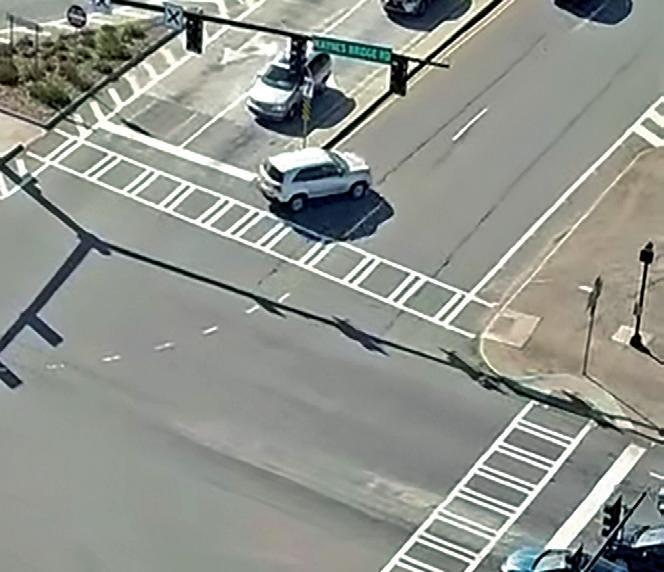
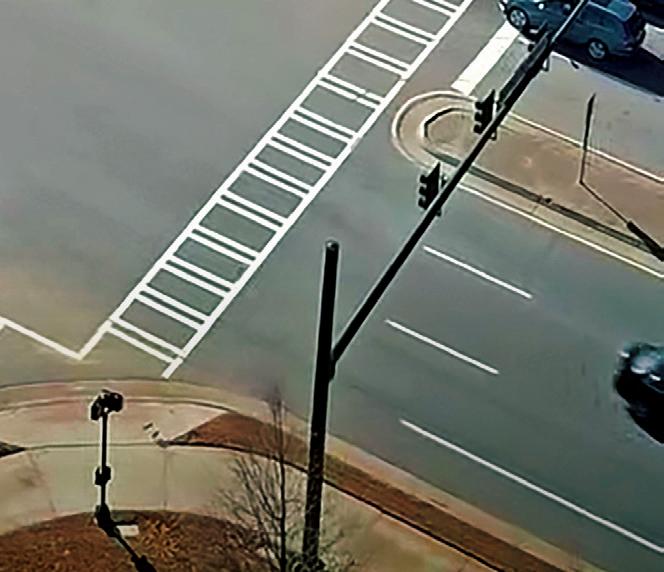


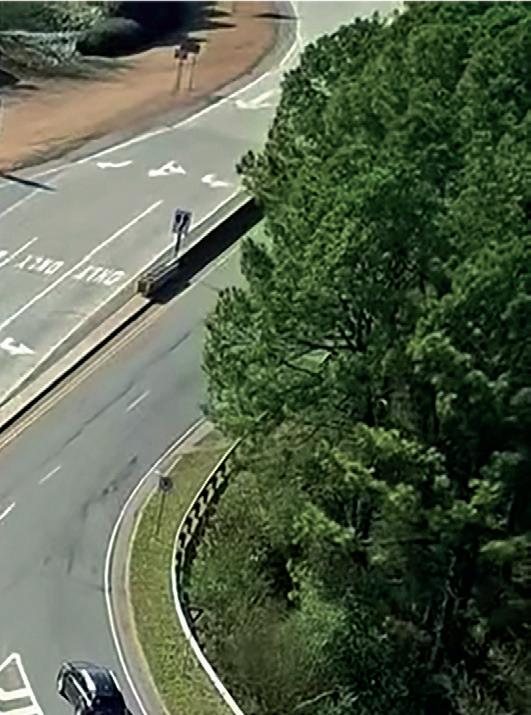
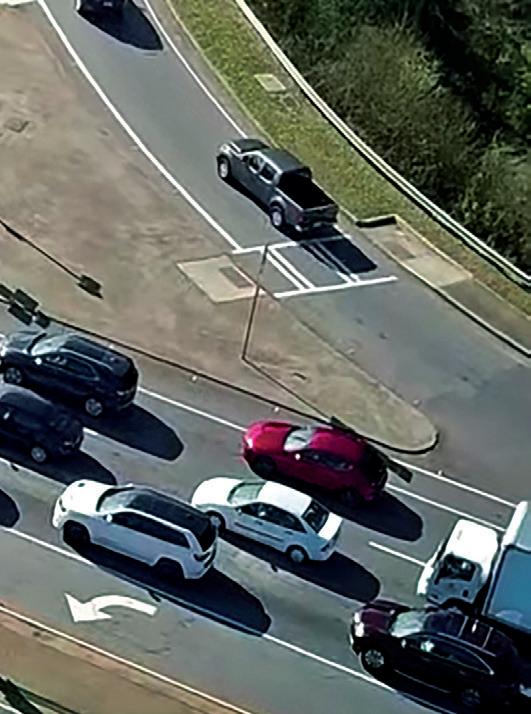

A living lab on the streets of Georgia, US, is helping to improve traf c safety by real-world deployments of technology. ITS International talks to the founder and some of the partners
Timing, as we all know, is everything. Ensuring that you are launching a brand new, real-world connected vehicle testing facility in the US state of Georgia at exactly the right time is an incredibly involved process that has taken years of planning and thinking and re-planning and re-thinking.
One of the main tenets of this living lab is that members can come to the facility and test their innovative, new, potentially life-saving solutions, with the epithet of “everything connected to everything else” clear in the minds of all interested parties and with future physical collaborations between the members one of the foreseen by-products of this initiative.
Imagine, then, the incredulity of its founders that just two months after its launch in January 2020, spending time in
an enclosed environment with other human beings had been rendered not just impossible but potentially life-threatening.
This is, however, exactly what happened to the Infrastructure Automotive Technology Laboratory (iATL), a private-sector-led initiative that is fully committed to enhancing safety on US roads by fast-tracking connected vehicle technology deployment.
The iATL, based at founding partners’ Applied Information’s Alpharetta, GA headquarters, is the very de nition of a living lab and is working to accelerate connected

With its unique testing environment, iATL is a key hub for stakeholders dedicated to the future of connected vehicle applications and its inherent safety and mobility bene ts “
vehicle technology through industry collaboration to save lives, improve traf c, and reduce the environmental impact of transportation
The iATL brings together a diverse array of industry sectors to develop practical, lab-controlled, real-world road safety applications, and central to its mission is the 46-member iATL Partner Alliance, a coalition of both public and private entities directly connected to the lab or supporting the advancement of connected vehicle technology. Among its impressive list of partners are Audi, AT&T, T-Mobile and ITS America – the iATL clearly means business and that business is reducing the horri c number of people that are killed and seriously injured on the US road network.
With its unique testing environment, iATL is a key hub for stakeholders dedicated to the future of connected vehicle applications and
its inherent safety and mobility bene ts.
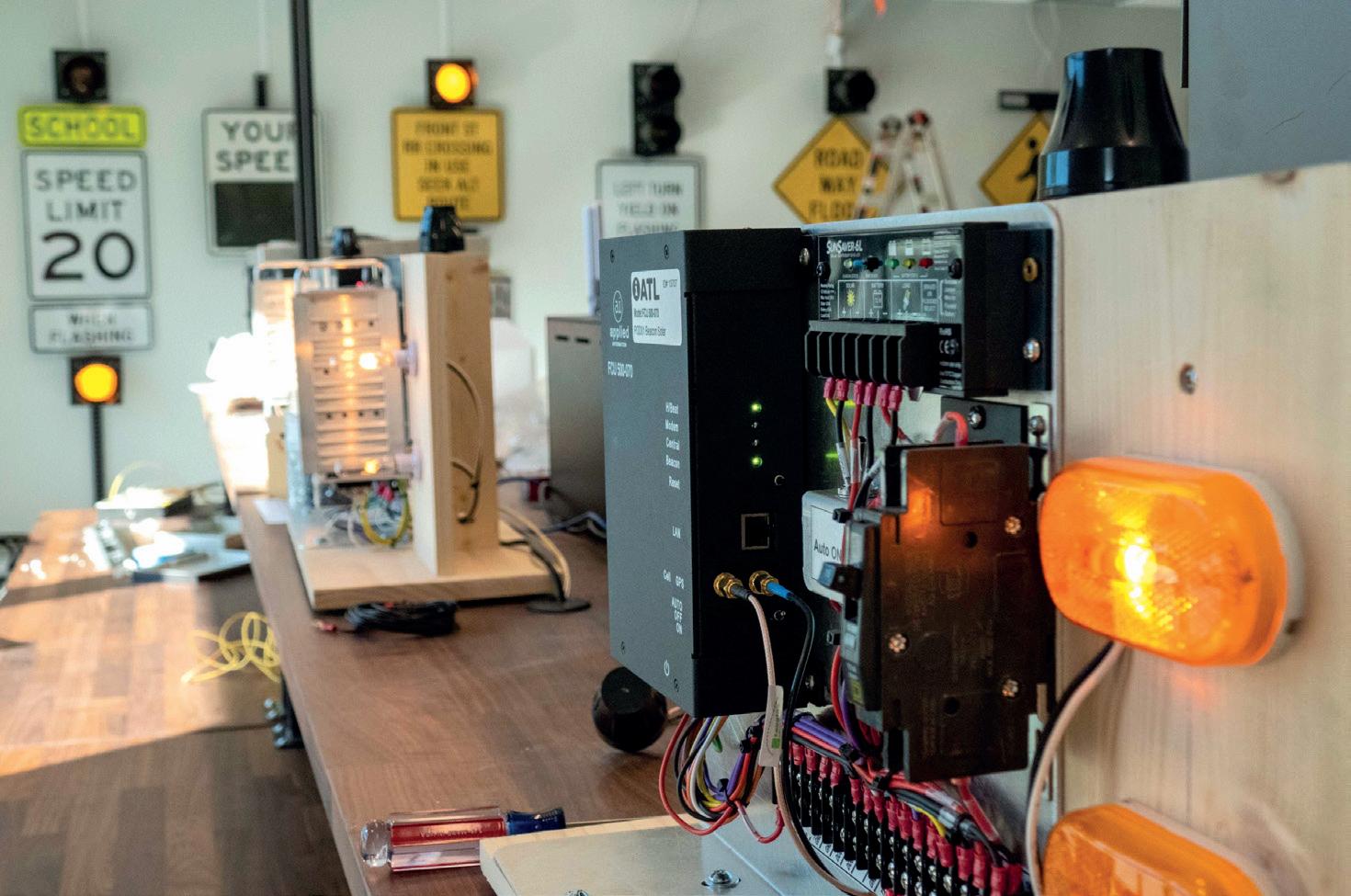
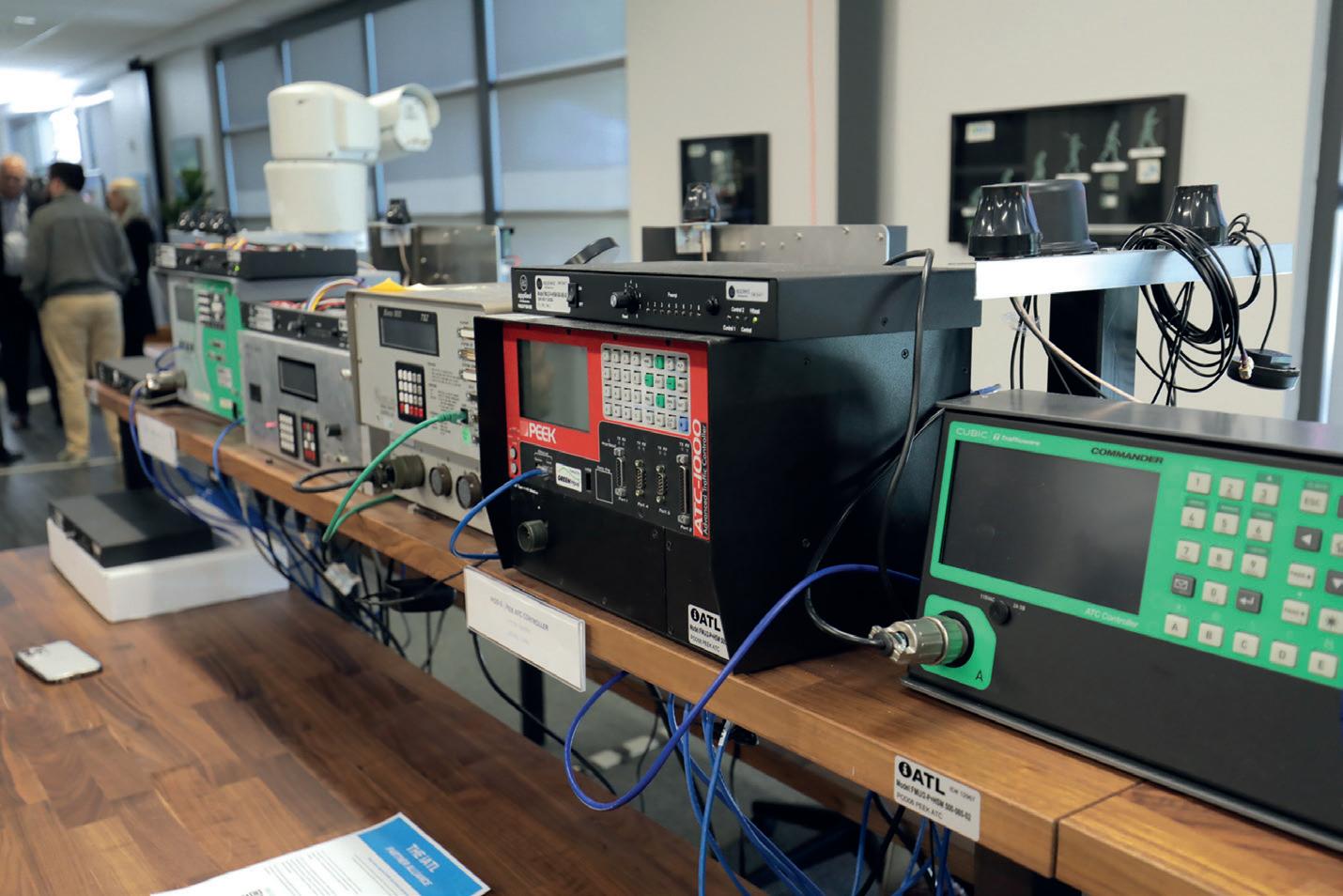
To improve real-world C-V2X testing capabilities, the iATL operates a 4,400-square-foot lab serving as a dedicated engineering facility to test CV applications. The lab houses dozens of signs, signals, smart arrows, school zone beacons and other advanced traf c control equipment, making it a vital hub for testing CV technology across multiple platforms or devices.
With its focus on interoperability and less than four years after its most unfortunately timed launch, the iATL is now rmly established as one of the world’s leading connected vehicle testing facilities. ITS International spoke to its founder and ve partners to discover how and why its rise to prominence has been so rapid after such an inauspicious start.
Bryan Mulligan, president, Applied Information & executive director and founder of the iATL
I'm a practical guy. My thinking was that it’s no good using a disused Second World War air eld to test connected vehicle technology. You've got to be out in the street. So now here we are, with 75 square miles of pedestrian crossings and traf c intersections and re trucks and ambulances, school beacons and school buses and all in the real world. And we understand, being infrastructure guys, how to keep everybody safe. We're not being reckless – this is what I would call “applied risk” but we're exposing the automotive world to the real world.
Look at MCity up in Michigan. It’s great but it's a sterile track, it’s not the streets of Detroit. This was really the driving force behind iATL. You can call it ‘servant leadership’ if you like but we just chose to lead and to attract like-minded people around us.
Also, we didn't ask anybody's permission. We just went ahead and did it out of our own resources and the resources of the folks who

We didn't ask anybody's permission. We just went ahead and did it out of our own resources and the resources of those who donated their equipment and who want to collaborate with us
Bryan Mulligan, iATL/ Applied Information
cessful events out in the streets of Alpharetta for the 5GAA [5G Automotive Association]. We make the point that competition stops at the door. Everybody's welcome. If we make this work the rising tide will lift all boats, and that's what the iATL Partnership Alliance is about.




they've got to solve is funding, so they spend all their time writing grants. It's like a university. The government-led labs and the government-funded labs and the grant-funded labs are all beholden to whoever provides the funding and that's not how innovation is born. Space-X is a great example: they weren't beholden to government funding, they were funded entirely by private sector capital. That’s been our focus - focus on the prize, focus on the problem. We're trying to make the world a better place.
If you bring people together and their opening words to each other aren’t “Can you send me some money”, then you’re onto something. There's an expression that I like to use which is ‘enlightened self-interest’. You put people together who've got self-interest, but they understand that there's a common good, suddenly all sorts of good things happen. This has been entirely organic, and that's the power of willing collaboration.
Jim Misener, global V2X ecosystem lead, Qualcomm
Bryan Mulligan is such a passionate advocate for safety. The iATL is basically a focal point to bring together like-minded entities and this was attractive to us.
more than just a regional centre, the iATL brings together the forces of Georgia, and Georgia is leading in C-V2X initiative in the US. It made so much sense to us to become a member. As it was gelling in Bryan's mind, he was discussing this with me – we were one of the early partners but I had known about his plans and that it was going to happen since it was in the oven, so to speak.
Don’t forget that these were Covid times. We were thinking of how to advance the deployment of safety in North America, but there was a lot of excitement generated by Georgia institutions for C-V2X and there still is. Bryan was able to bring in ITS America (Qualcomm are members and I'm on the board) so it just seemed to be a combination of the right players at the right time with the right mission.
We choose our organisations very judiciously. They have to meet several criteria, some of which are very general, that have to be legitimate to really align with our mission. But from a C-V2X perspective Bryan’s mission is all about deployment as soon as possible with a focus on safety countermeasures. Even though I work in the automotive business unit, we understand that the automobile is an important part of the safety equation but it takes the infrastructure to really complete that equation. So it just made so much sense to us.
Qualcomm doesn’t have offices in Atlanta or the Southeast, so the connections afforded by iATL were beneficial. We have business relationships with various partners
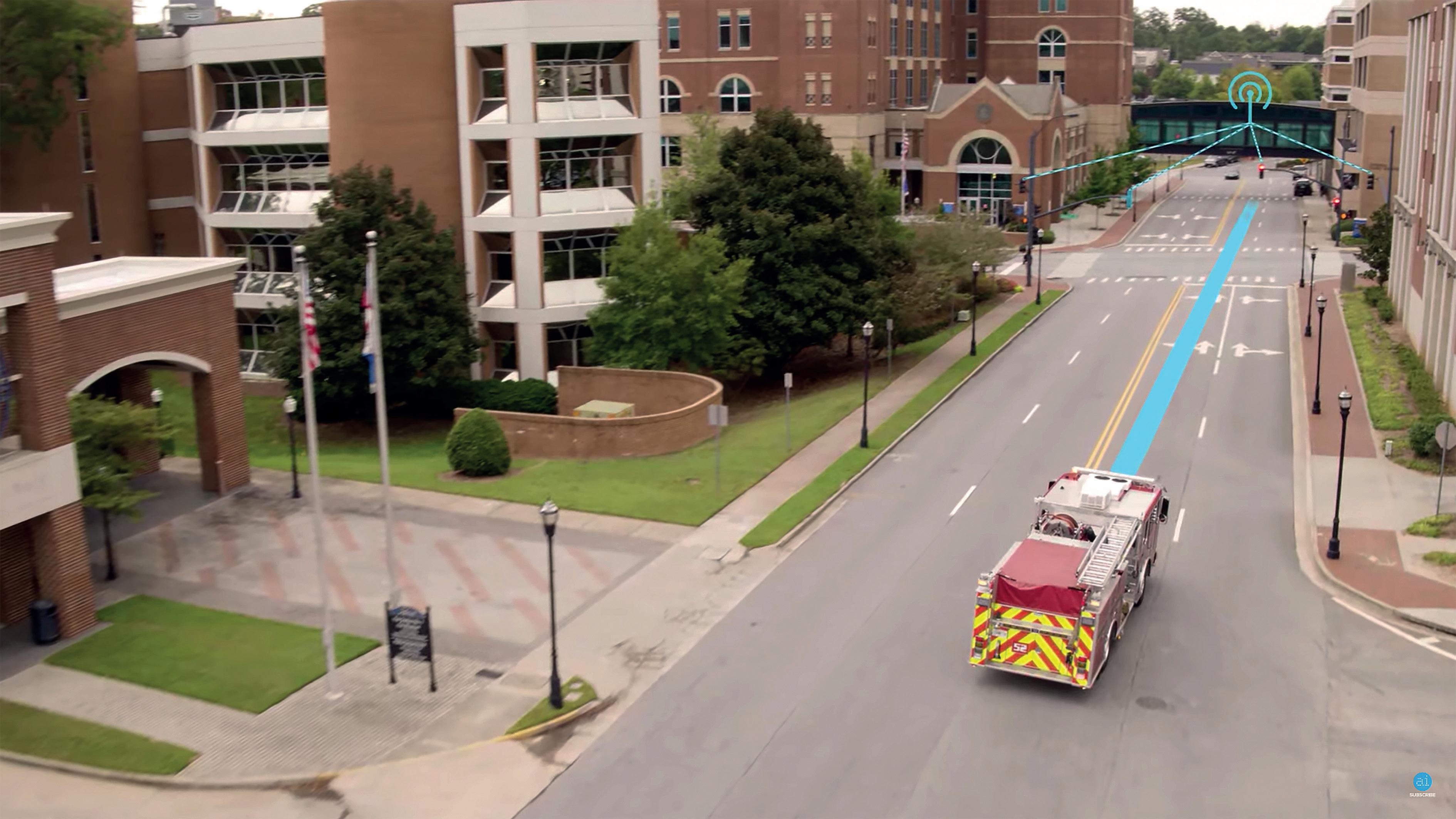
Improving safety and efficiency for first responders is a key part of iATL’s mission
example, talk to someone in the carrier mobile network operator industry who has the similar mission to you. In this forum we're able to converge our missions and ideas, and under the leadership of Bryan Mulligan you can use your influence in lots of different ways. He’s influential because, quite simply, he gets stuff done. He’s a serial entrepreneur and it's great to see entrepreneurial zest applied to a connected vehicle living lab. Through his passion, the iATL has a unique, interesting and very effective form of leadership.
If I can borrow one of Bryan’s phrases, this is a coalition of the willing. One step at a time, one jurisdiction at a time, one local agency at a time – this is what differentiates iATL from some of these other organisations that also are meritorious from our perspective as they promote safety. The iATL promotes and understands V2X, so it all fits into this rich tapestry very nicely.
Brandan Branham, executive director & CTO and assistant city manager, Curiosity Lab and City of Peachtree Corners
There were three main reasons why we joined the iATL Partner Alliance. First of all, Curiosity Lab and the iATL are neighbours. They are located in Alpharetta, GA and we're in Peachtree Corners, so our proximity has definitely helped with the partnership. We created a living lab here in Peachtree Corners and the city invested in the infrastructure enhancements to further
real-world scenario. Connected vehicles were a very important part of this.
Secondly, we were doing some work ourselves in the CV arena with, among others, Qualcomm, so we had similar partners in that ecosystem. And then third, we both have the same mission: protect vulnerable road users and do that through the use of

“ “ What we get out of being a member of the iATL Partner Alliance is the conversations with other industry players. Here we’re sitting at the same table as Audi. We probably wouldn’t have that opportunity otherwise
Brandon Branham, Curiosity Labs

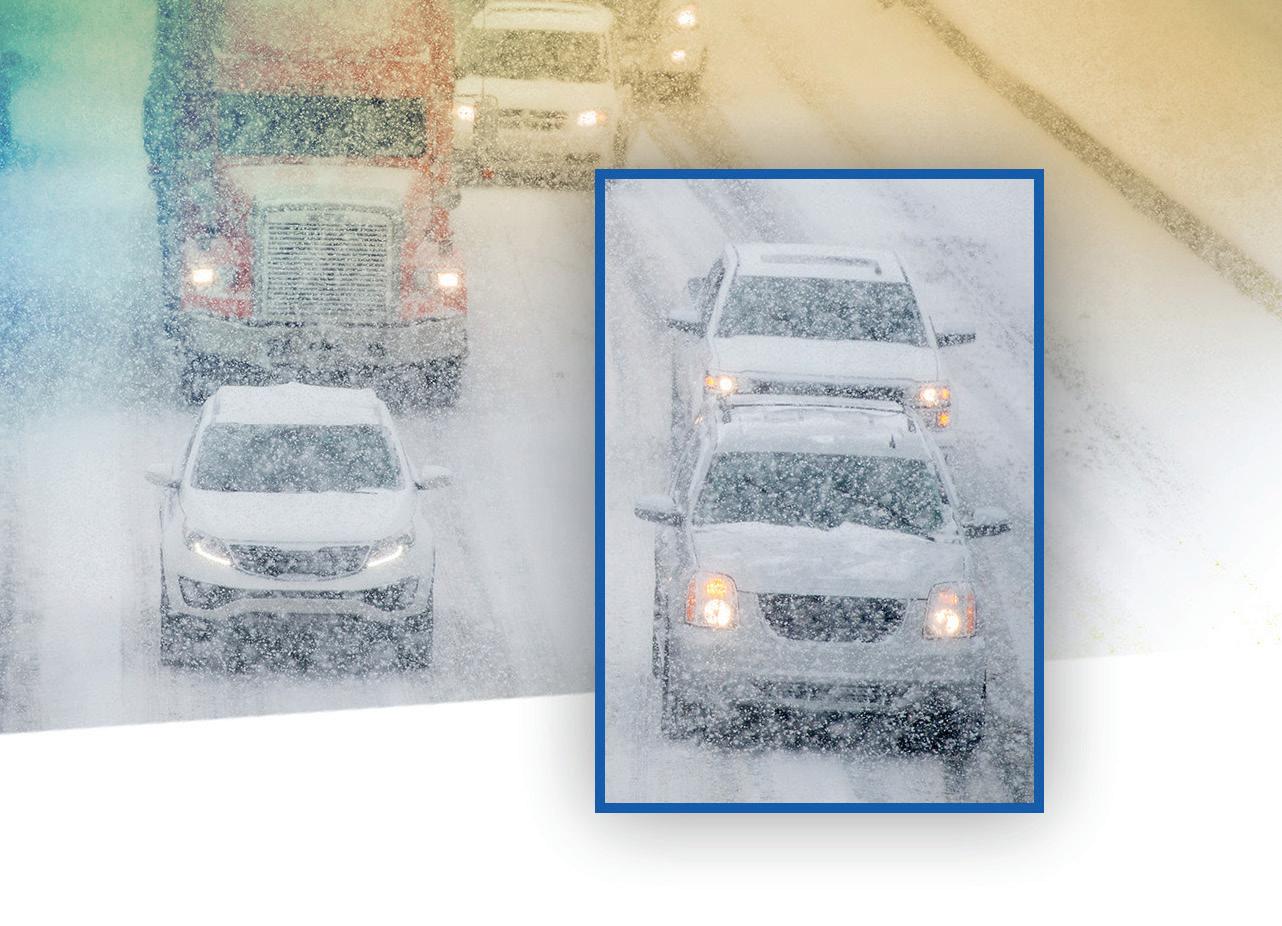

When blizzards blind lanes and roads turn into rivers, Citilog’s Automatic Incident Detection sees through the storm. Trained on a massive dataset of incident images, including those with inclement weather, the system is:
• Precise, minimizing false alarms - by a factor of 10 compared to other AI systems - letting you focus on real danger
• Proactive, reacting instantly, preventing secondary accidents before they happen
Don’t wait for tragedy to strike in the next storm. Equip your infrastructure with Automatic Incident Detection and secure every road, every mile, every moment.
technology and enhance our transportation systems.
When we joined we initially wondered about the practicalities of several members working in the same arena, but once we got to the table and sat down and had the conversation, they were very complementary to one another. The iATL is heavily focused on the traffic signal, the transportation system, whereas Curiosity Lab is focused on the whole ecosystem of connected communities. This opened up some opportunities to facilitate new things here as well as take some back there, so it ended up being symbiotic in its nature.
What we get out of being a member of the iATL Partner Alliance is the conversations with other industry players. Here we’re sitting at the same table as Audi. We probably wouldn’t have that opportunity otherwise. These conversations really help us grow as Curiosity Lab and as the city because I also wear the hat of the chief technology officer for the city of Peachtree Corners. So having that exposure from a bigger community perspective is always helpful and has brought a lot of benefit to us.
They do a lot of work on the UU side of connected vehicles. So there's the traditional 5.9GHz, which is the dedicated band, and then there's the UU, which is used in the cellphone towers. That's really where we've seen the benefit of being a member of the iATL and working with them. For them, it gives an unfettered, semi-unregulated ability to deploy some of their newer technologies in our space.
Governments tend to be a little shy on implementing new technology, but we've
created that environment in a city to allow this to really move forward and move forward quickly.
What can’t be ignored is the power of voice to the FCC [Federal Communications Commission] that being with the iATL affords you, to truly release the band for C-V2X. This will take all of us working together, continuing to petition the FCC. There's power in numbers so in five years, if we look back we’ll see that the Alliance helped the FCC set the rule and let it go. That would be a huge win for us and the industry, because then we're not operating under experimental licences anymore, we can fully deploy these connected vehicles, which, from our perspec tive, is a life-saving technology.
Another huge win would be to see this technology used for public transportation. If buses stay on schedule, they operate more efficiently, which in its own right has a sustainability element to it, because you're reducing emissions if they're not sitting at that red light.
vice president of operations, Q-Free
Q-Free is the newest member of the iATL Partner Alliance. We joined because it has expansive test facilities, and tonnes of technology partners that enable real-world testing of connected vehicle interoperability and applications.
Interoperability is crucial for the connected smart city, which requires opening a part of your technology to other products and organisations. The lab gives us a chance to work with third parties and even

build your own lab and then you’re testing it in isolation, hoping that it all works
“
Whitney Nottage, Q-Free America
competitors, to ensure seamless and reliable communications between vehicle and device infrastructure to improve traffic management, reduce congestion, prevent collisions and save lives.
The partnership provides us access to collaborations and technologies to expand on
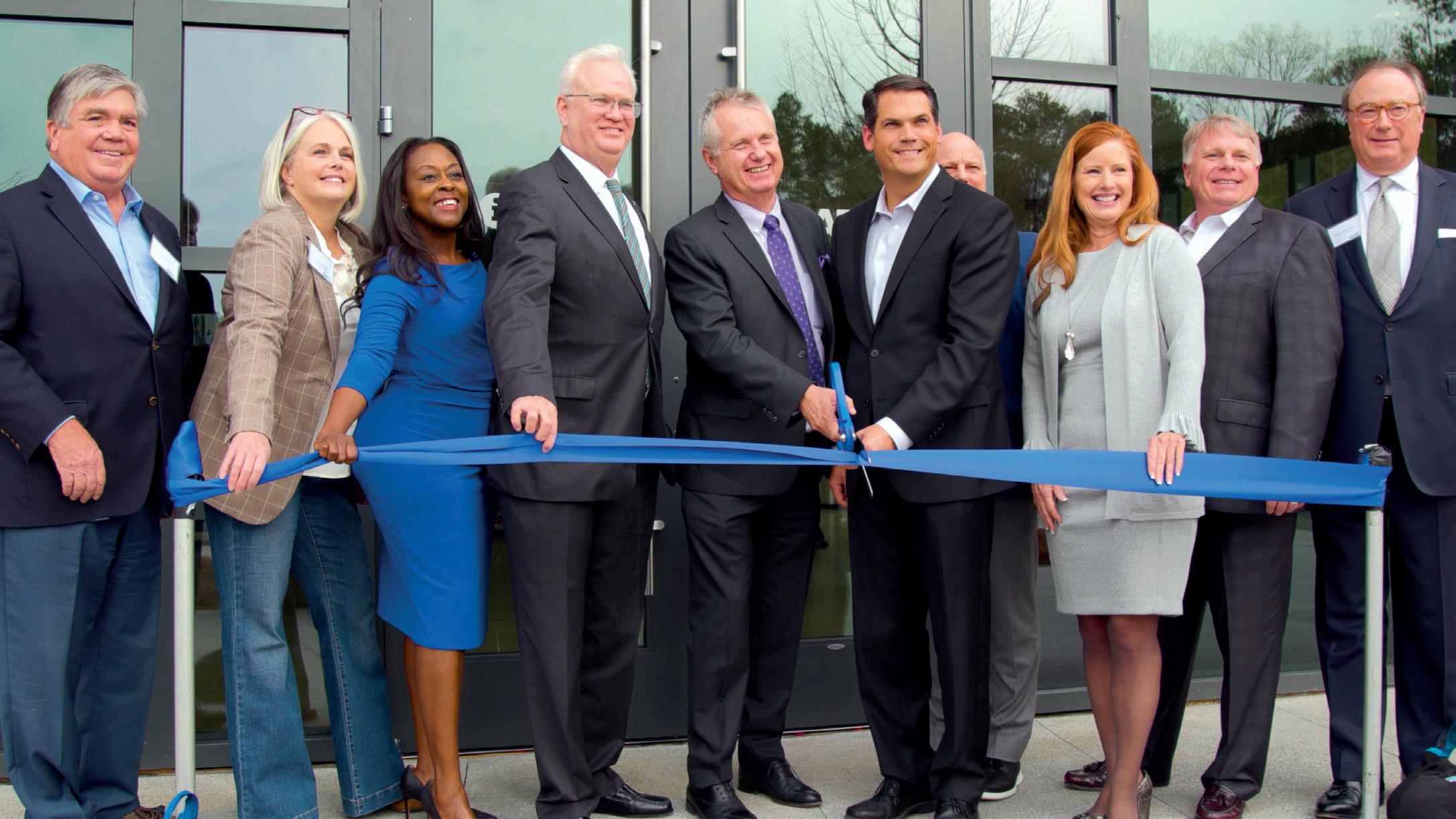

A
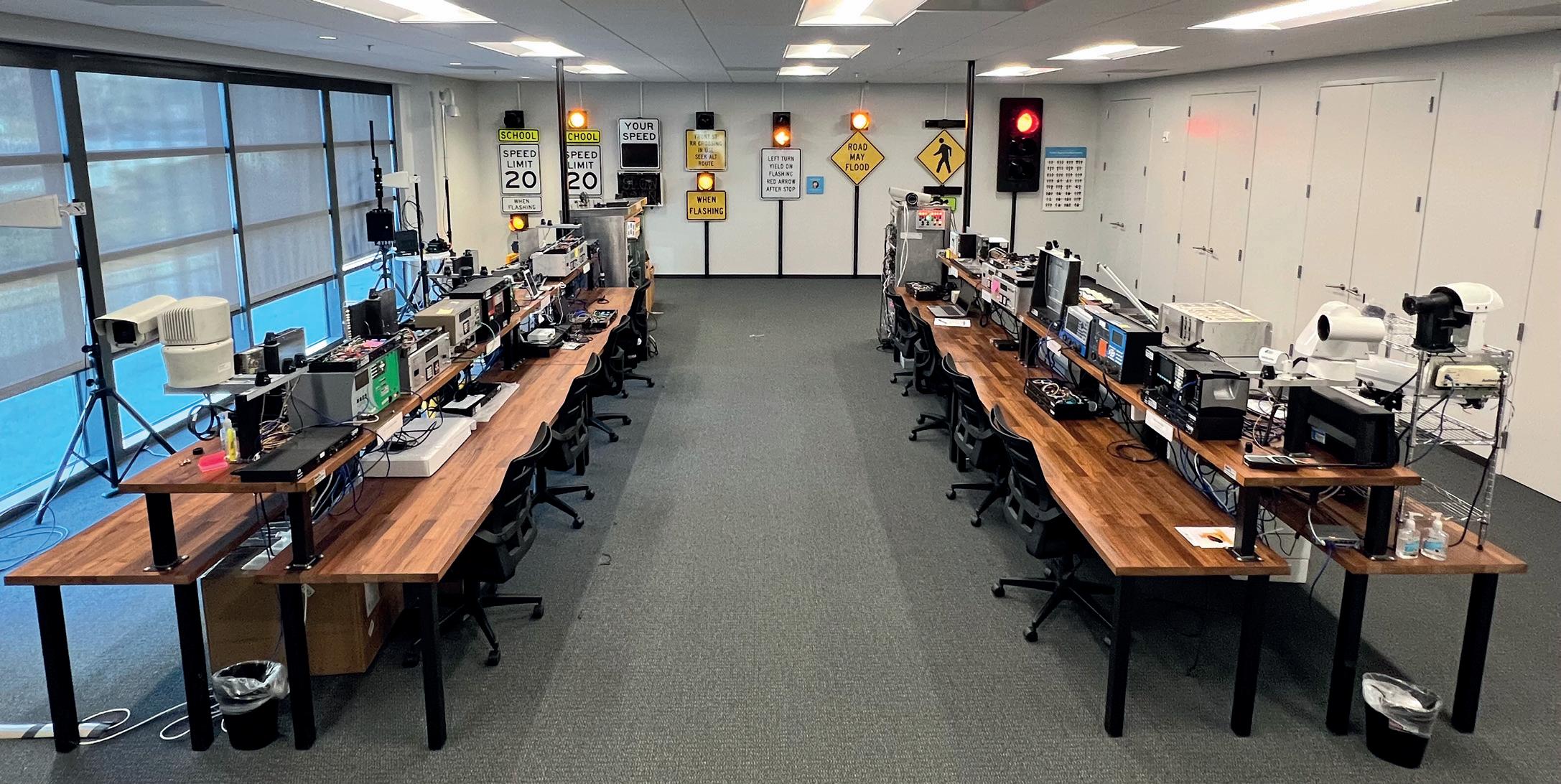
our philosophy of providing brand-agnostic solutions. Access to the iATL’s robust partner network affords us an unprecedented opportunity to include real-world testing as part of our development lifecycle.
When you're creating a solution, without a lab like this, typically you have to go out and buy all the technologies and build your own lab. And then you're testing it in isolation, hoping it all works. It’s not until you get it into the real world that you see how everything we did in the lab translates to the real world.
The timing to join worked out well as we continue to work with customers in the region to develop, test, and implement technologies to improve connectivity and safety at the roadside. The collaborative space of the iATL Lab gives us a way to build on our commitments to customers. Being able to deliver real-world tested advancements in traf c safety and ef ciency for our customers is paramount.
I think the rst thing for us will be testing with various roadside units (RSUs) used to distribute safety warnings, traf c information, and navigation data to passing vehicles. Our connected vehicle software is widely deployed in the state of Georgia already, and they have a couple of different brands of RSUs, so we feel pretty con dent that our solution can work regardless of hardware vendor. The Alliance has additional brands of RSUs we can test with to make sure our solution is truly vendor-agnostic, a unique opportunity provided through the iATL.
Forrest Temple, president, Temple In the past, the industry has been kind of segmented by what controller line you're representing and what technologies you're selling. Bringing everybody together was


“

“ The iATL brings together a diverse array of industry sectors to develop practical, lab-controlled, real-world road safety applications



a novel idea. Being a part of that helps us speak to people, collaborate with companies that we haven't ever collaborated with before and go after a common goal.
When we were rst introduced to it, we saw it's not just a little lab - it's actually a place where everybody talks about collaborating and innovation. But it’s much more than that - it's not just what's in the lab, it's also the environment and the 125 intersections around the City of Alpharetta where you can actually see how it all works.
We’ve driven customers through a 15-intersection loop in Alpharetta where we can display Applied Information’s smartphone app, TravelSafely. It is always shocking to the
“ “ A lot of things are typically developed in a vacuum but that’s not the case here. It’s a bigger calling. It creates a greater bond with other companies
Forrest Temple, Temple
customer to see and hear signal phase and timing and safety messages broadcast to the driver. Seeing rst-hand as a city employee or a decision-maker for a government agency how the industry is changing right now is very exciting and this change is not slowing down, it’s just gaining momentum.
A lot of our customers are rural, they're from the south [of the US]. They hear about connected vehicles, but they have no idea how important that is to them. This is a pivotal time because in the next decade it's going to be normal to see your vehicle just take that information to your dashboard. It takes industry professionals witnessing and improving upon it and communicating that to folks like the 5GAA and the auto manufacturers to really buy into.
The Alliance needs great ideas, great innovation, and great manufacturing, but you also need great ability to commission and deploy projects, and fully support them after they're done. So when we are part of this Alliance, when we start hearing these ideas, our thoughts are ‘OK that’s great, but what does that mean for the customer? What does that mean for people who are investing?’
I think the Alliance bene ts by having us on the team just to have a member that’s not purely a technology company. We're a sales relationship business, so with that focus always on the end user, we work to paint the vision of what the customer can get out of their technology. When you help separate funds from an agency, somebody needs to be looking after the customer. Somebody needs to look after the tax dollars that are spent and making sure that they're embraced and supported fully by the customer.
We bene t from being in the iATL Partner Alliance because we get sneak peeks of where the industry is going. We have
sneak peeks of what's being developed. A lot of things are developed in a vacuum but that’s not the case here. It’s a bigger calling. It creates a greater bond that you have with other companies.
Look at how connected vehicles have changed in the last ve years – this rate of change isn’t going to slow down. The goal here is to continue to be invested in thinking about the technology. For us, you can see where the CV sector is headed with the Alliance - if we weren't part of the Alliance, we wouldn't see it incrementally, we'd see it when it's too late. We are very keen to continue to have very close relationships, like we do with Applied Information and several others. I’ll say it again: there’s a bond. It's a community and an unashamed pride in what you're doing.
Menno Malta, founder and CEO, Monotch

“
We have a lot of experience in connecting all actors in the smart mobility industry into one platform, our Traf c Live Exchange (TLEX) system. There are many use cases with our TLEX implementations for which we gladly share our knowledge in this Alliance. The focus not only on safety and the improvement of traf c but also on commerce, in the light of our American expansion, feels like a solid match for Monotch.
“ The partners in the Alliance are part of the audience, as are the authorities. You don’t need to hire expensive consultants. You can spend that budget on actual real-world deployments and achieve some real results
Menno Malta, Monotch




One of the reasons for joining is that we wanted to become active in the US market and this is also how we came across the initiative in the rst place. The iATL is aligned very well with the way we look at ITS and connected, digital transport and connected mobility as it's an ecosystem environment. We bring a lot of experience from Europe and hopefully, in the future, maybe others will follow us. We can promote this initiative to some of the other European players.
This is all about how to translate an ecosystem that works on digital infrastructure and connected mobility into something real on a large scale. That is something that we really have a lot of expertise in. Part of the problem we are looking to solve is lack of interoperability. When we look at the ITS industry as a whole, we think it can bene t from a more modern approach. There is a limited number of players that have been around for a long time and a lot of them come from the hardware industry, and they still very much have a ‘hardware mindset’.
There was not, therefore, a pressing need for innovation from the perspective of the suppliers in the market and I think this is a big reason why it hasn’t quite made the progress that was predicted and expected. Movement towards interoperability of solutions is needed to really change the market and I'm positive that is starting to happen
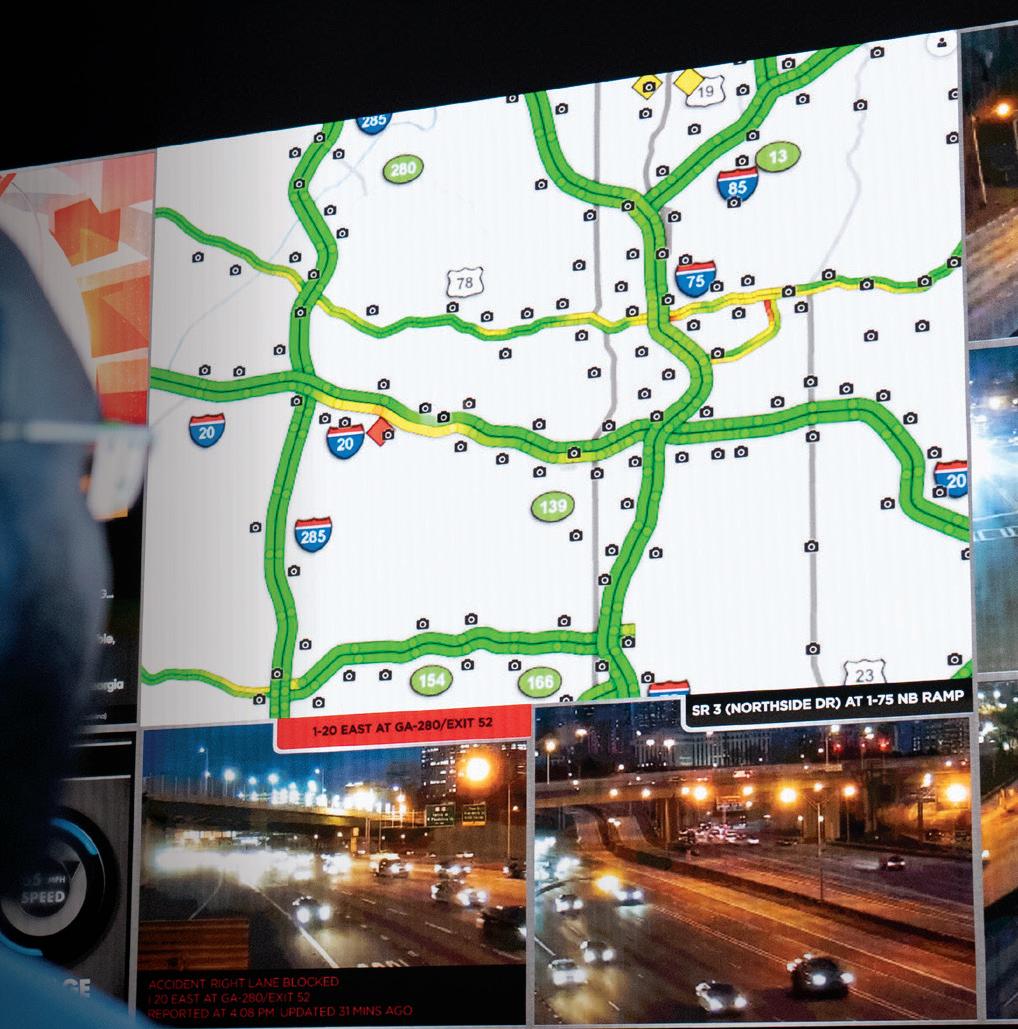



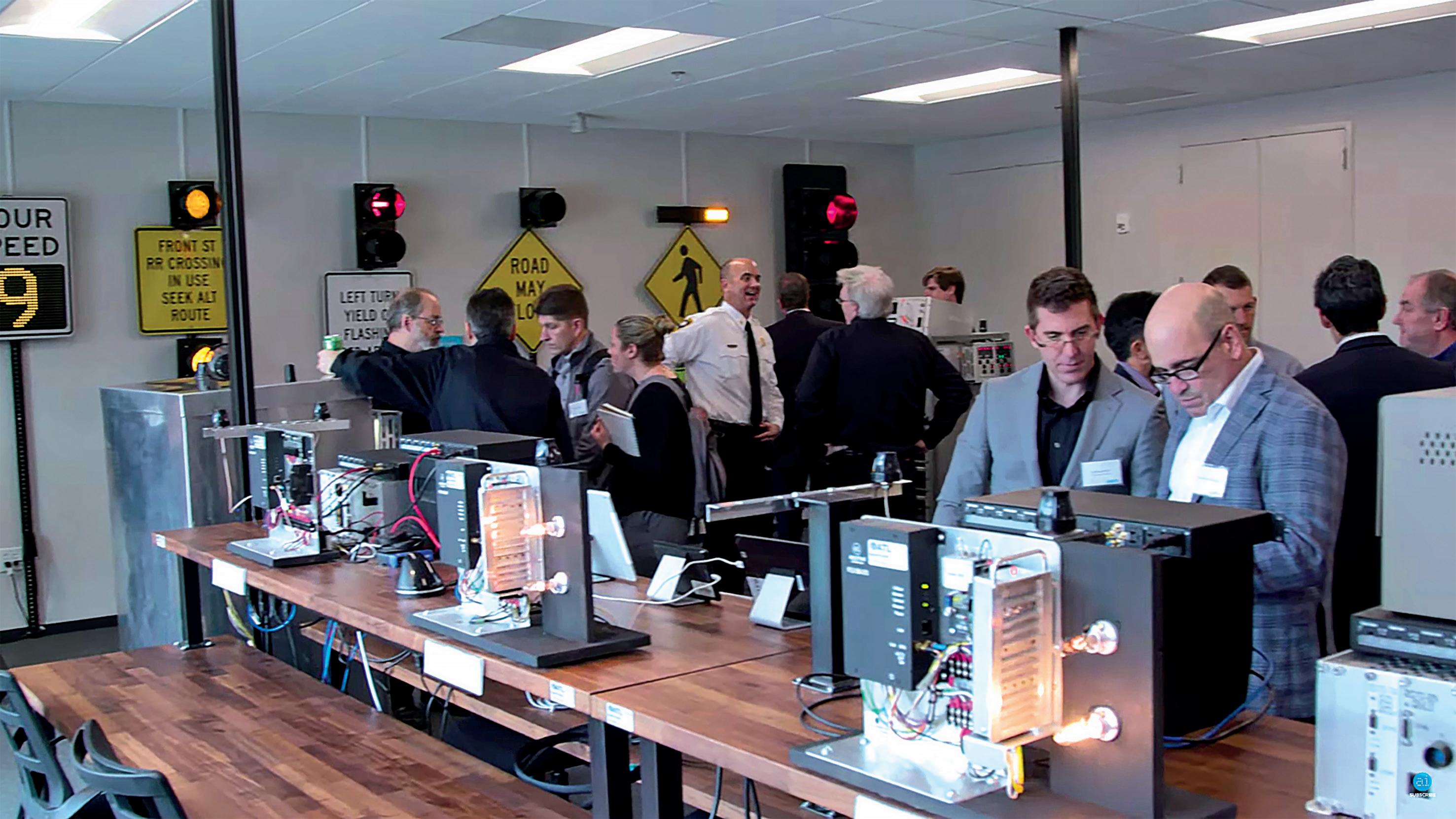
right now. Initiatives such as the iATL are part of that change as it unites the industry with a certain goal. It will contribute towards overcoming one of the important hurdles in the market.
The partners in the Alliance are part
of the audience, as are the authorities. You don’t need to hire expensive consultants. You can spend that budget on actual real-world deployments and achieve some real results.
We have three desired takeaways from our iATL partnership. The first is being able
to connect to the other members, so not just networking. It’s also really an exchange of knowledge. Another takeaway is visibility is also good for us in the US, but number three is really to experiment with how to combine different solutions with different partners. ITS


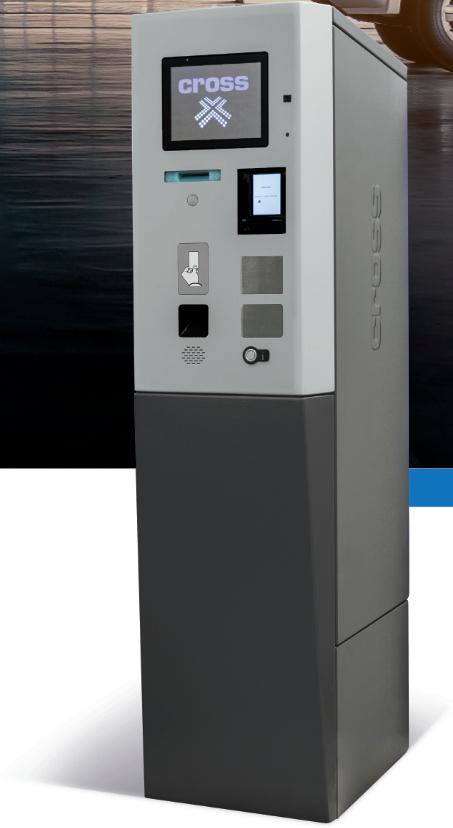
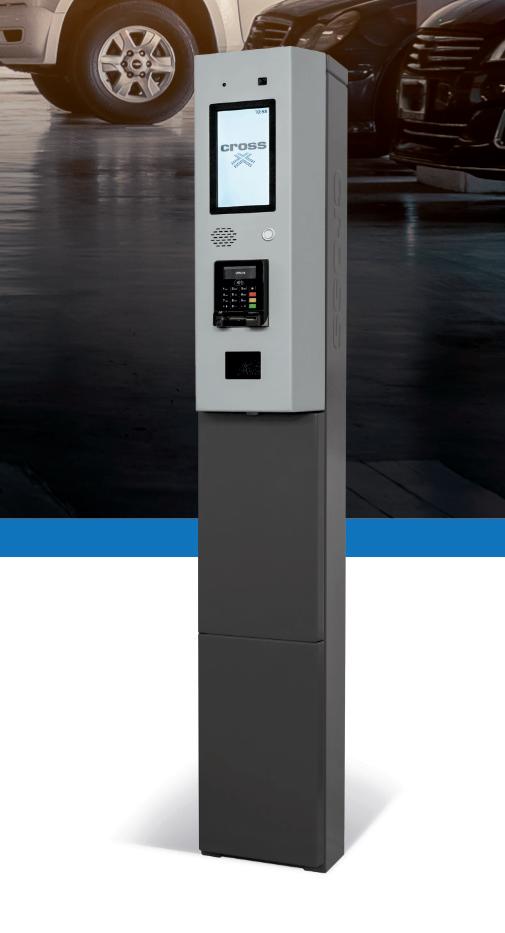

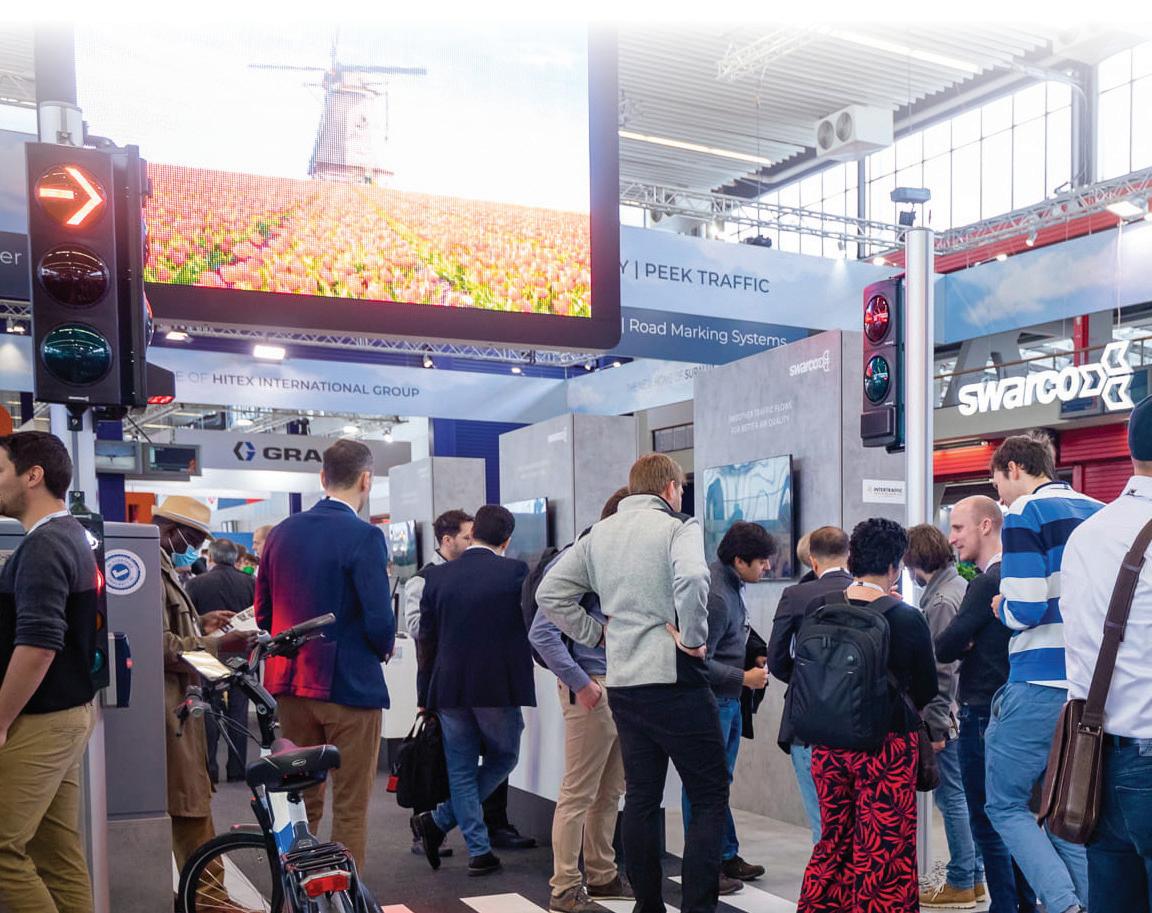


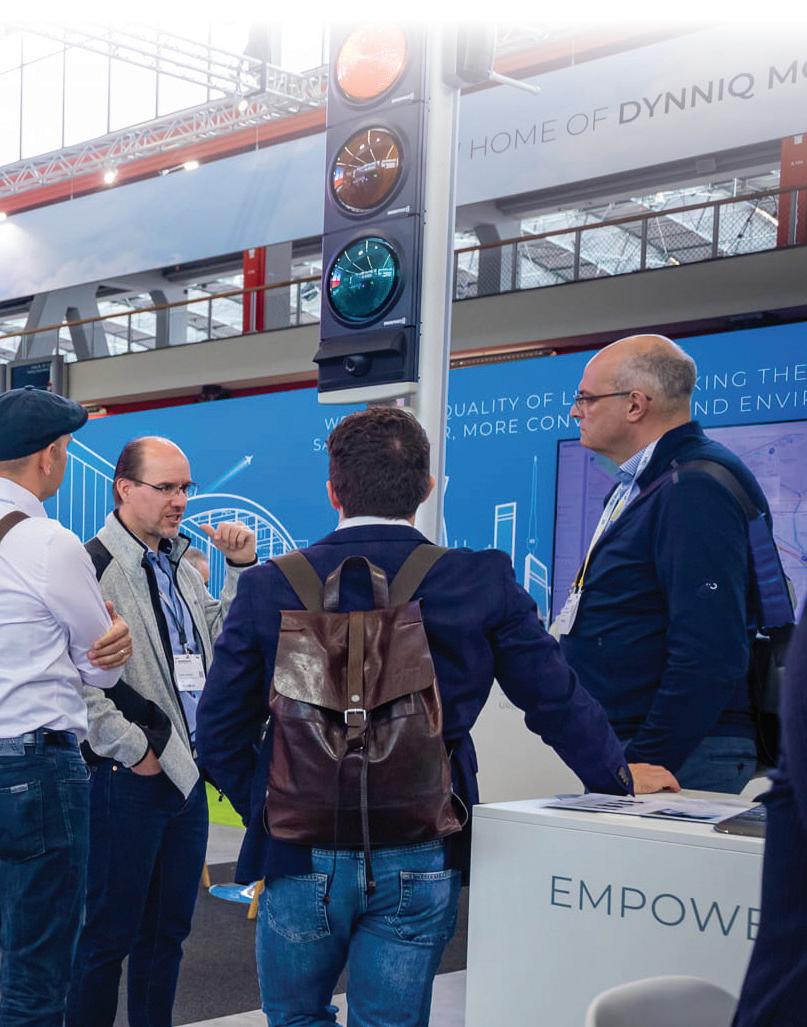

Since its launch in 1972, Intertraf c has been focused on innovation and implementation in ITS: and in this year’s packed programme the emphasis is on smart, safe and sustainable mobility for all
Up and coming businesses are the future of the ITS industry – which is why Intertraf c Amsterdam offers start-ups their own platform: ITSUP. These young companies bene t from the international exposure which the Intertraf c brand gives them, making pitches and gaining valuable contacts. Located in a dedicated area - with an open stage for presentations and a networking corner for matchmaking - ITSUP is again sponsored by Swarco. This year's ITSUP Challenge will be all about encouraging collaboration among different start-ups and bringing cities directly into the equation with two key topics in focus: sustainability and road safety. Start-ups will be assisted by experts from the mobility industry, guiding them through the development phases. Every start-up will have the opportunity to pitch, and hear the needs and challenges of the cities that will act as potential customers. The winning idea will come to life on the streets and will have Swarco’s support for future developments.

• Participation criteria and registration form can be found at www.intertraf c.com/amsterdam







The Intertraf c Summit & Demonstration Programme for 2024 features the latest roadside equipment, plus mobility, communication and data technologies to enhance traf c ow, road safety, sustainability and liveability in and around cities. The programme offers pitches, demonstrations, interactive presentations, panel discussions, workshops and debates. Sessions are tailored to interest groups including city policymakers, road operators and technology vendors. They re ect the ongoing digitalisation, automation and electri cation in transportation, and the demand for real-time traf c and travel information plus the need for more interoperable mobility solutions for travellers. Showcased mobility solutions, urban mobility visions and policy and enforcement guidelines address sector challenges including urgent climate issues, the need for accessibility and road safety and the road to Vision Zero. Hall 7 houses four Summit theatres, a large networking area to meet up with speakers and an indoor demo area. PTV, Swarco, Yunex Traf c, EasyPark, Skidata, Flowbird, Be-Mobile, Nissan, Mercedes, Vitronic, Capgemini, Movyon, Cities of Amsterdam and Rotterdam, European Parking Association, Polis, MaaS Alliance, International Road Federation, IRF Global, European Cyclists’ Federation, Dutch Cycling Embassy, and national ITS organisations are all part of the programme.
• See www.intertraf c.com for full details


Among the many subjects that the Summit sessions touch on are lessons learned from cooperative ITS (C-ITS) and automated driving, digital infrastructure for connected drivers, data-driven solutions for connected and automated vehicles (C/AVs) and new Vehicle to Infrastructure (V2I) technologies. There will also be emphasis on best practice from ITS projects and mobility data platforms across Europe, from national ITS associations and Napcore to in-car traf c management using C-ITS, and smart data services for road users from Be-Mobile, TomTom, Mercedes, Nissan and Heijmans. There will be discussion on connected mobility and digital infrastructure services, standards and interoperability from Monotch. Authorities such as CCAM and Crow will outline guidance on preparing infrastructure for digital transformation. Speakers from Europe, the US and Asia shed light on where we stand in terms of automated driving and connected services for road users, sharing experiences in driverless car deployment from Cruise and Waymo. Above all, attendees will come away with the knowledge that these technologies are not something from the future – they are a key part of projects that are already being implemented around the world.



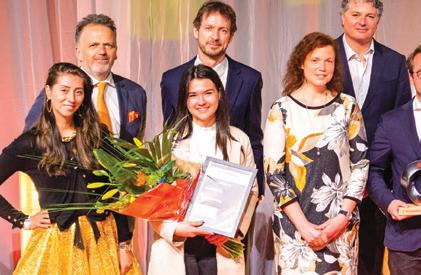

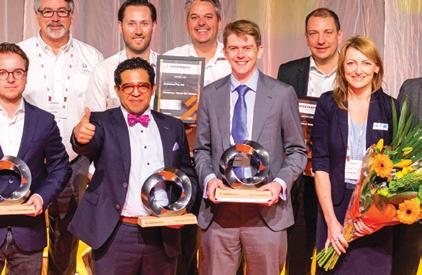


The Intertraf c Awards are an integral part of the famous ITS and mobility show in Amsterdam. This year’s nalists continue a long tradition of innovation and excellence. But who will come out on top?
There are three categories in the Intertraf c Awards 2024, with ve nominees already chosen by the jury panel for each. The next step is a day at RAI Amsterdam when the nalists will make presentations and answer questions from the jury. And the winners? That will be a closely-guarded secret until the opening ceremony of Intertraf c Amsterdam on 16 April.
GREEN GLOBE AWARD
G-Sign Way by EZ GroupSouth Korea – stand 08.466
KEHV – Kinetic Energy Harvesting from Vehicles by Movyon – Italy – stand 01.228
Seal – Safety Enabled Adaptive Lighting by Invision AI & Ex Machina – Greece – stand SUP05.20
SR-Eco-Bali by Sernis – Portugal – stand 01.207
Whisper NB-Eco-40-A3 acoustic panels by Sealed Air – Italy – stand 08.765
INSPIRATION AWARD
Audio-AI-Based Road Hazard Information System by SK Planet - South Korea – stand 08.466
High Sensitive Lane by Movyon – Italy – stand 01.228

RiskAware – Multimodal Road Safety Data Product by Vianova – France – stand 03.214D
USER EXPERIENCE AWARD
DataFromSky Flow Emissions by DataFromSky – Czech Republic – stand 01.511
PTV Flows by PTV Group – Germany – stand 02.216
Skidata Connect by Skidata – Austria – stand 02.100
SoundVue by Intelligent Instruments – UK – stand 05.124
Traf o Software by Traff.io – Australia – stand 05.355C
Lanternn by Valerann – UK – stand 05.415 Meridian Archer-Guard by Meridian Rapid Defense Group – US – stand 08.668

Enjoy a knowledge programme of over 120 sessions, from debates to demonstrations. 200+ speakers will cover the hottest topics touching on policy support, best practices, user cases, trends and more.
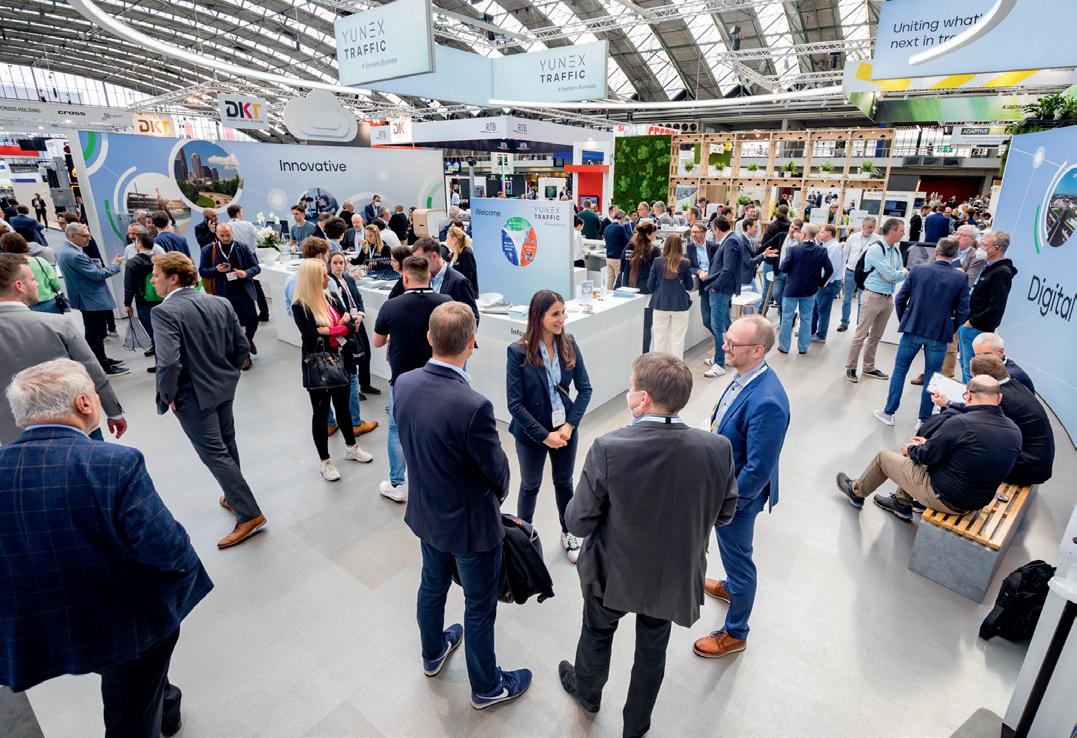
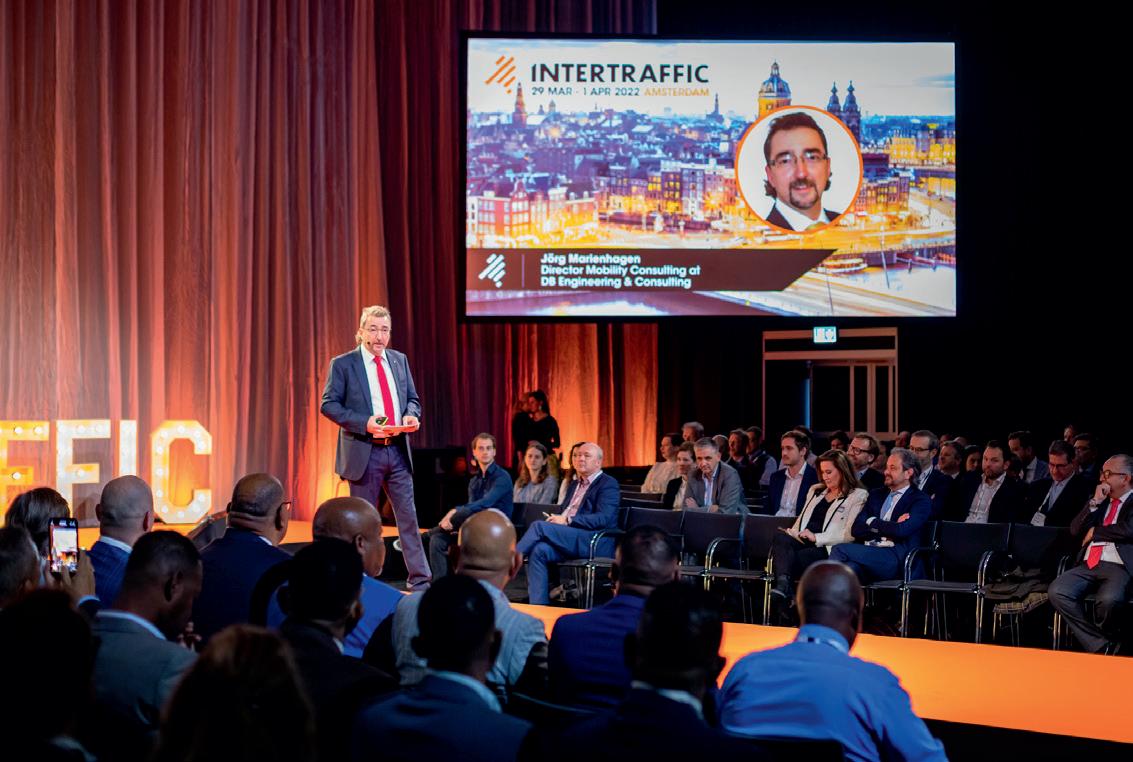
900+ public and private organisations spread over 12 halls will present the latest solutions and developments in mobility and traffic technology. From road safety to parking solutions, intelligent infrastructure, traffic management, smart mobility, and everything in between.













Banning right-hand turns after stopping for a red light is gaining momentum in the US. But the debate continues about whether it will result in fewer incidents between vehicles and alternative mobility users. David Arminas reports


More and more cities in North America are encouraging mobility alternatives such as walking and cycling in built-up urban areas. New road layouts and revamped intersections now offer separated cycle lanes and pedestrianonly paths. Rightly or wrongly, e-scooters are now adding to the mix, sometimes in cycle lanes, sometimes in traf c, sometimes on pavements, shooting out from nowhere into an intersection.
Drivers negotiating a right turn on a red light, after coming to a complete stop, now need to be much more aware of street movements than they were 30 years ago. With all this urban mobility going on, has the day come to disallow turning right on a red light for safety reasons?
Many city authorities and regional transportation agencies say yes, the time it right. But it is an emotional topic to many alternative mobility users and vehicle drivers. It is emotive for pedestrians and cyclists who have either suffered injuries by
a right-turning car or had a near-miss where the driver hadn’t even noticed what could have happened. Meanwhile, some advocacy groups for protecting the rights of drivers claim it is just another ‘do-good move’ by city authorities, many of which want to ‘punish’ people for using their vehicles.
In cities, often where separated cycle lanes run parallel to a traf c lane, a right turn is forbidden until the vehicle has a green light. Priority must then be given to the pedestrian or cyclist. In some cases, the right-turn lane will also have its own traf c light to hold the driver to a red light while the straight-ahead traf c has turned green light.
Washington, DC is on the growing list of US cities reportedly trying to ban, or which already have banned, right-hand turns on a red. In October 2022, the city passed the Safer Streets Amendment Act of 2022 covering many areas of traf c safety, of which turning right on a red was only one. However, the ban, slated to come into effect
in 2025, will prohibit the turns on around 50 city centre intersections.
Media reports at the time noted that Colin Brooke, a director of Washington Area Bicyclists Association, said it was for the safety of pedestrians. Also, the city’s transportation department will evaluate which intersections will be affected by the ban when it is due to come into effect.
In the US state of Michigan, the city of Ann Arbor recently banned the turn at around 50 busy city centre intersections close to a large University of Michigan campus. The city council noted that between 2017 and 2021 there were 90 road incidents involving pedestrians in the area.
Meanwhile, in New York City, it is illegal to make a right turn when the traf c light is red, except at certain intersections on Staten Island. These intersections have a sign that reads right turns are actually allowed.
One city in particular has attempted to analyse the effects of a ban. A report late last year by the San Francisco Municipal Transportation Agency (SFMTA) noted that
turn-on-red crashes account for less than 1% of all injury crashes, but 20% of pedestrianor cycle-related injury crashes involving turning drivers at signalised intersections. In autumn 2021, SFMTA posted No Turn On Red signs at more than 50 intersections in the Tenderloin area of the city centre.
Findings from the SFMTA’s before/ after study showed that No Turn on Red restrictions can keep crosswalks clear and reduce close calls on major intersections. On average, 92% of vehicles comply with the ban. Close calls for vehicle-pedestrian incidents have decreased from ve before no-turn signs were posted to one close call after restrictions were in place at observed intersections. Vehicles blocking or encroaching onto crosswalks on a red signal have been reduced by more than 70% after the restriction was implemented.
Based on these results, San Francisco is looking to expand the ban.
The national Governors Highway Safety Association has reported that over 7,500 pedestrians were killed by vehicles in 2022, the highest number since 1981. However, there is a lack of data about how many people are injured and killed speci cally by a driver turning right on a red. Also, just as more mobility alternatives are being seen in inner cities, there is an increase in the number of bigger vehicles. Pick-up trucks are now more often an urban domestic vehicle
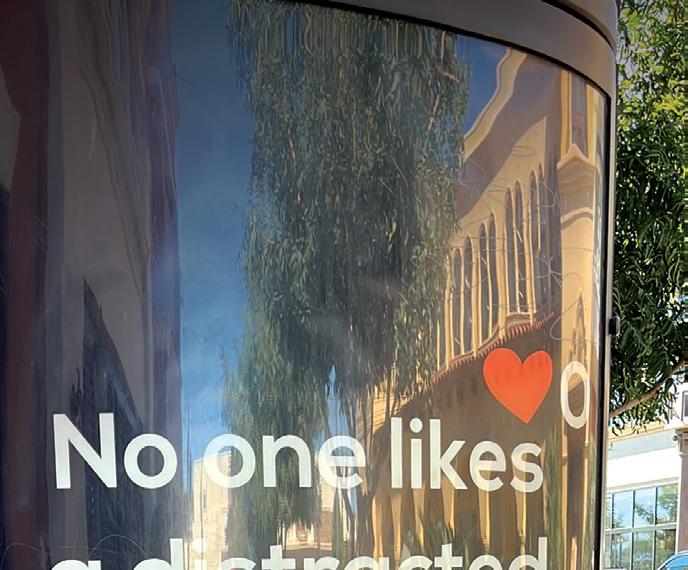
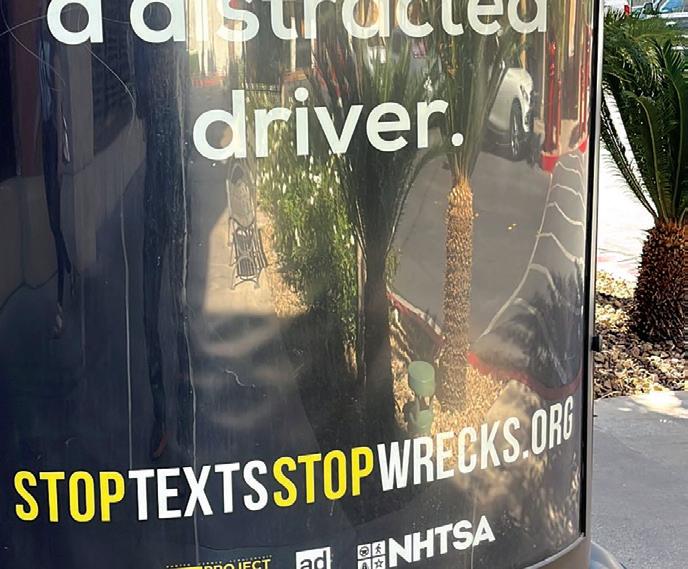
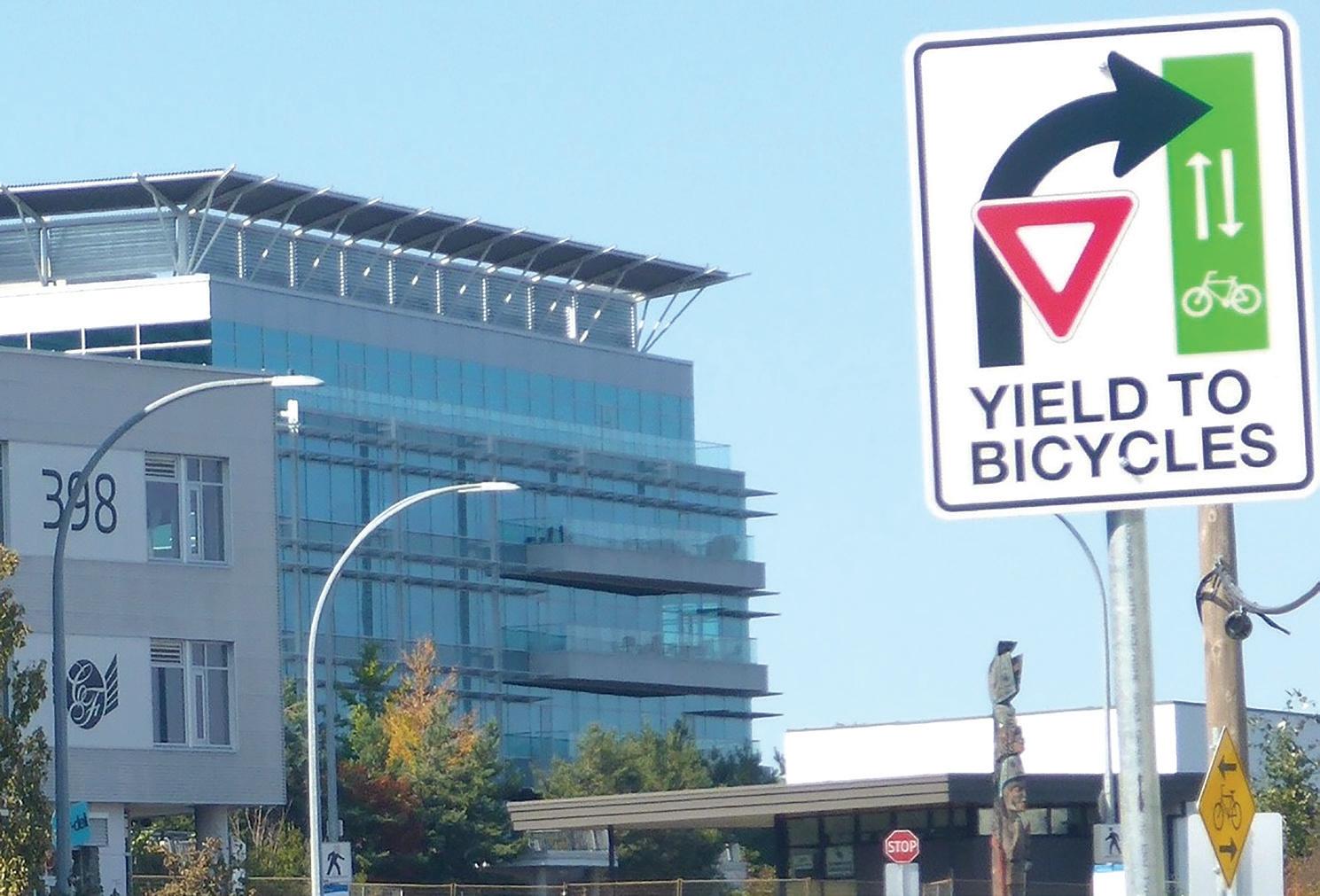
than a working truck trundling around rural roads. As well, more SUVs - sports utility vehicles - are on the roads. This has been mooted as cause for the increased deaths.
The Insurance Institute for Highway Safety, based in the US state of Virginia, found that in the US the chances that a pedestrian being killed when hit by a vehicle turning right were 89% higher if the vehicle were a pickup truck and 63% higher if it were an SUV rather than a small traditional domestic vehicle. Importantly, it noted, the driver of a pickup or an SUV likely has larger blind spots than a driver in a smaller traditional urban vehicle.
“While recent studies of right-turn-on-red [RTOR] are limited, there are several studies from the 1980s and 1990s that indicate that RTOR is associated with increased crash risk with pedestrians, bicyclists and other vehicles,” says Joseph Young, a director with the institute. “A 1984 review of available research found that all right-turning crashes increased by about 23% after intersections allowed RTOR, while pedestrian crashes increased 60% and bicyclist crashes increased by 100%.”
Young also points to a 1994 report from the National Highway Traf c Safety Administration that showed 84 fatal crashes happened from 1982-1992 involving rightturning vehicles at an intersection where RTOR was permitted. Slightly less than half of these were pedestrians.
Design is important
Young acknowledges that he is not aware of research that has looked speci cally at bike lanes in conjunction with RTOR. However, he says, regardless of right turns on a red, separated bike lanes are associated with a reduction in bicycle crashes. “IIHS research shows that how these lanes are designed is very important. Designs that minimise
crossings and interactions with vehicle traf c are associated with lower crash and fall rates. Where there are crossings, designers need to be careful to implement adequate signage and visibility.”
Importantly, says Young, banning a right turn on a red is not done by city authorities in isolation of other legislation. “These bans are part of broader efforts to improve pedestrian safety and/or part of Vision Zero efforts [see box, Vision Zero – Safe System] aimed at dramatically reducing crash deaths. Other tactics include lowering speed limits, implementing road diets, increasing use of automated speed enforcement, especially in school zones and adding better pedestrian infrastructure,” he says.
“These efforts are in line with the [federal government’s] Safe System Approach to roadway safety, which assumes that people are going to make mistakes. The approach builds in redundancies to reduce or limit the harm of these mistakes.”
Putting a ban in place won’t automatically get a green light from all city councillors. There is also likely to be a lot of push-back from various motoring organisations and pressure groups which remain adamant that there is still little factual evidence that a ban will reduce road injuries and deaths. The National Motorists Association (NMA) in the US, founded in 1982 to combat the 55mph national maximum speed limit, is one such membership organisation. It says it continues “to support efforts to retain motorists’ freedoms and rights”. It supports “traf c laws based on sound engineering principles and public consensus — not political agendas”.
Jay Beeber, executive director of policy for the NMA, has questioned whether a ban would add to the safety of drivers and mobility users and pedestrians. He says









> Advanced speed control to improve road safety
> Vehicle counting and highly accurate data in real time
> Multi-lane tracking: dimensions, classification, distance, number plate...





> Smart traffic management through 3D-LiDAR technology



banning a right-on-red adds fuel costs from idling at red lights and increases time spent by the driver in traf c, adding to congestion. Beeber also says that data from a study the association conducted did not nd a ban would make things safer.
The debate about the rights and wrongs of a right turn remains complex, explains Jon Baldwin, executive vice president for government solutions at Verra Mobility, a provider of safe mobility technologies and smart transportation solutions, based in the state of Arizona. The discussion has been around for decades since the turn was rst allowed in the US in the 1970s and seems to cycle through the political scene every couple of years.
“One of the arguments I’ve heard for not allowing right-on-red is because of the increased number of distracted drivers –which seems to be a growing concern in every corner of the globe,” he says. “So then the problem isn’t really about turning on red. It’s about changing driver behaviour to be more alert.”
Verra Mobility recently surveyed 2,000

Americans about their thoughts on driver behaviour. The average driver is worse now than before the pandemic, according to 54% of respondents, and 40% of respondents said they feel less safe on the roads. “These numbers show that Americans have bigger safety and traf c concerns today than ever before.”
To this end, Baldwin believes safety shouldn’t be a political football. It should be about prioritising the safety of everyone who uses roads. “That’s where technology can and should come into play,” he says.
“From a technology perspective, it’s not about whether someone should be allowed to turn right on red. It’s about the safety solution options on both sides of the argument. We have the capability to satisfy the needs of the individual city, state or customer - whatever enforcement type a jurisdiction prefers.”
For example, Baldwin points to Verra Mobility data from 2022 that shows that 4.4 million drivers ran red lights. But of
Vision Zero as a strategy was rst adopted by the Swedish parliament in 1997. The aim was to eliminate pedestrian deaths by improving road and infrastructure design with a focus on safety.
The strategy has been taken up by the US Department of Transportation’s Safe System Approach, which is an acknowledgement that humans will make mistakes. It is the job of engineers and planners to design public spaces that reduce the potential for severe injuries and fatalities. The Safe System Approach is basically a template for improving safety by mitigating risks inherent in large and complex transportation systems. According to USDoT, it works by “building and reinforcing multiple layers of protection to both prevent crashes from happening in the rst place and minimise harm caused to those involved when crashes do occur”.


The shift is away from a conventional safety approach because it focuses on both human mistakes as well as human vulnerability and designs a system with many redundancies in place to protect everyone. In support of this approach, safety programmes focus on infrastructure, human behaviour, responsible oversight of the vehicle and transportation industry and emergency response.
But Vision Zero remain elusive for many cities. San Francisco has been working on a Vision Zero strategy since 2014 – and spent hundreds of millions of dollars revamping its intersections, setting out bike lanes, improving pedestrian signals and daylighting intersections - moving visual obstructions in approaching intersections so users can better see and more safely cross each other's paths.

those who were ned, nearly 70% did not receive a second violation, proving that technology safety solutions change driver behaviour. “Instead of asking if we should allow right-on-red, we should ask how the technology can be adapted to change the behaviour that results in the negative outcomes of turning right-on-red,” says Baldwin.
Customers are asking for solutions to a multitude of safety concerns and enforcing a ban on turning right is just one of many. “The great thing about evolving technology and machine learning is that we no longer have to solve one problem at a time. Instead, technology can be used to solve a multitude of problems in one location.”
Meanwhile, the debate continues. Baldwin believes that what’s right for one community isn’t going to solve the problems of another. “This is an issue for individual communities to gure out,” he says “I don’t see how doing a blanket ban - or on the contrary, mandating all cities to allow for this type of turn – is going to solve the core safety issue. What has been proven to work is safety enforcement solutions.” ITS



The aim is to slow traf c and prevent vehicles colliding with pedestrians and cyclists. Despite San Francisco’s efforts, in 2023, the city had 25 people killed in traf c crashes; in 2014 it was 35. In 2022, 39 people were killed in collisions.




































Jenoptik provides innovative and sustainable smart mobility technology and services.






As an end-to-end solution provider, we support our customers with the provision of roadside equipment and software, including integration and installation through to full-service operation. Our strong global presence and installation base is supported by a reliable partner network.
With innovation as our driving force, Jenoptik is a world-leading enabler for smart mobility, making roads, journeys and communities safer around the globe.
Mass transit ridership is getting back onto its feet after the dent which Covid put into the use of public transport. Now we need to continue that momentum, says Miki Szikszai of Snapper Services – and the UK can learn from examples in the rest of the world
2023 was a big year in public transit. UK bus patronage outside of London returned to pre-pandemic levels for the rst time - brilliant news in a country still impacted by ongoing bus driver strike action and frequent rail service cancellations and delays.
So, how can we continue improving patronage amidst a challenging operating environment? We think there is a signi cant opportunity for the UK transit industry to innovate and grow by leveraging data and analytics.
In too many instances, operators and authorities rely on outdated legacy systems and processes to understand on-time performance and manage their vehicle eets. But it has become all too clear that these systems aren’t up to the task of processing and understanding the data that’s needed, leading to an inaccurate and out-of-date view of the transit network. Equally, many of these information technology systems are siloed, which means they aren’t able to integrate
alongside new systems that promise more effective insights.
With easy-to-access, reliable data and analytics, however, a reshaped public transit sector can provide more appealing mass transit solutions and well-connected cities for every passenger.
In many respects, there’s no need for a major overhaul to adopt a better approach – a wealth of valuable transit data already exists. Ensuring this data is reliable and can be converted into actionable insights – which many authorities struggle with, even when they have experienced analysts on their team – is a crucial next step.
operators”.
Additionally, MobilityData in Canada recognises that discovering data feeds from across the world is a challenge. Its directory of global General Transit Feed Speci cation (GTFS) and GTFS-Realtime feeds, such as location, status and fare data, means operators can make full use of transit data to better understand network performance.
There are also global examples of how data-driven approaches to transit can deliver bene ts more widely. For instance, South Korea’s capital, Seoul, was awarded the Smart City 2022 title, receiving special recognition for its Smart Seoul platform, which promotes digital inclusion policies across communication, mobility, education, safety and tech utilisation.

Success stories from across the globe demonstrate the difference this can make. Take the Intermodal Transport Data Sharing Program in Hong Kong, which showcased the value of successfully integrating transport datasets from different operators and modes of transit. A report on this initiative concluded that the programme provided potential for “better services planning and co-ordination across different public transport
Hong Kong’s Intermodal Transport Data Sharing Program showcased the value of successfully integrating transport datasets from different operators and modes of transit





These initiatives underline the potential of a smarter approach to data and analytics. They also require the right systems to be in place and a willingness to collaborate –including between the private and public sector – to deliver improvements across society.





With easy-to-access, reliable data and analytics, a reshaped public transit sector can provide more appealing mass transit solutions and well-connected cities for every passenger “



For the UK transit sector, there are ve major bene ts a best-practice approach to data and analytics could deliver, even in the short term…
1. A clear view of the network
Smart use of the latest data and analytics solutions can empower our operators and authorities by providing them with accurate and timely overviews of their networks.
The right data allows patterns and correlations to be uncovered, empowering transit planners to predict future scenarios or adapt operations based on existing performance. With schedules optimised and resources allocated more effectively, the entire network stands to bene t.
This extends to ensuring different suppliers in a network can work together to provide deeper insights. Platforms that can weave together data from disparate systems can unlock a rich, data-driven picture of network performance. Our collaboration with providers like Transit ensure we can offer a network-based view for decision-makers as well as a customer-oriented analysis of the transit network.
This insight offers greater control and visibility to authorities, while improving the passenger experience.
2. New mobility solutions that meet demand
With high-quality data solutions and standardised data formats, authorities can better support the delivery of Mobility as a Service (MaaS) initiatives that integrate different forms of transit into a single platform to effectively meet commuter requirements.
Cities are constantly evolving, often led by community-driven initiatives that shape how people live and move around. Active mobility options like walking and cycling can be even more successful when they are intentionally integrated into the public transit
“ “ By eliminating stress-inducing and unachievable timetables, we can boost bus driver morale and job satisfaction
network.
High-quality data solutions and standardised data formats enable authorities to design, integrate and adjust these options into a holistic network. These also provide insights into how the network can be further shaped, the effectiveness of tactical urbanism experiments and where to invest.
3. Increased cost-effectiveness
The public transit sector must also manage its nances carefully due to high in ation and constrained funding. It has never been more important to make data-driven decisions while prudently managing costs. Digital solutions that simplify complex data streams can make it easier for non-specialists to do more with data, empowering existing teams to make high-quality decisions every day. By harnessing new technologies that can analyse numerous data streams simultaneously, reliable insights become accessible to a wider audience.
Employing specialist data analysts can come at a considerable cost, so alleviating routine reporting requirements can free up precious time to focus on deeper work. These increased ef ciencies can subsequently be reinvested into the transit network, further boosting the quality of service offered to passengers.
With bus drivers striking partly in response to the stress levels they face, better data solutions have an important role to play in creating more ef cient networks that empower bus drivers.

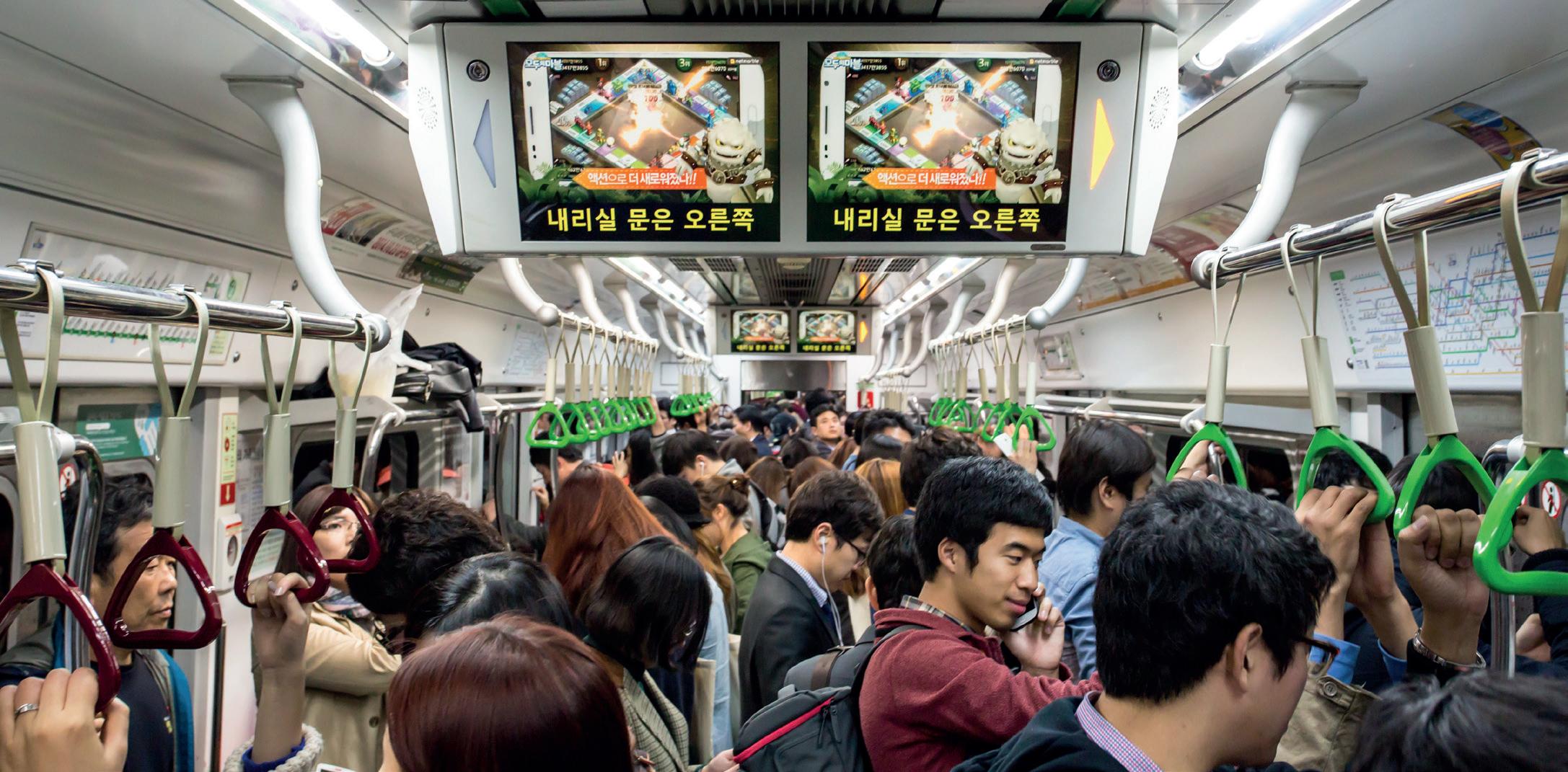

With a clear overview of the network, authorities can build realistic schedules, adjust run times, and nd solutions to challenging routes. By eliminating stress-inducing and unachievable timetables, we can boost bus driver morale and job satisfaction, which in turn could improve networks by ensuring retention and reducing strike action or absenteeism.
By breaking down data silos, connected data and analytics solutions enable governments to meet their Net Zero targets by offering commuters a reliable, enjoyable alternative to cars and planes.
Scheduled and actual performance data can be overlaid with insights like traf c light priority, connected to passenger demand data, and intelligently optimised to reduce dwell time and determine more ef cient routes and service frequency. This enables continuous improvement of the network, in line with the dynamic nature of cities. This can all serve to reduce emissions and create a more sustainable transit sector.
Global initiatives already demonstrate the power of data in enhancing public transit services. The UK’s public transit sector is also well-placed to realise these bene ts, ensuring public transit offers new levels of ef ciency, cost-effectiveness, and sustainability. ITS

Interest in Vehicle to Everything technology is intensifying, says Przemysław Krokosz at Mobica, although it still requires a critical mass of users to make it work
Vehicle to Everything (V2X) technology was once described as ‘zombie tech’ – not quite dead but not quite alive either. Devised more than 20 years ago to allow vehicles to communicate with other vehicles and the highway infrastructure, the US Federal Communications Commission (FCC) set aside the 5.9 GHz band for it back in 1999. But in the two decades that followed, progress has been slow.
It’s not that V2X is a bad idea, far from it. Perhaps the strongest argument for V2X is its ability to prevent accidents by warning drivers of approaching dangers that the vehicle itself cannot see.
This capability is so signi cant that the US National Highway Traf c Safety


Administration (NHTSA) estimates that it has the potential to either eliminate - or at least mitigate the severity of - 80% of crashes. Given that the current annual average road deaths in the US is close to 43,000, this could have a life-changing impact for tens of thousands of families across America every year.
There’s a problem, however. For V2X to work it requires a critical mass of users. Think about Google Maps for a second. If it didn’t have a billion active users submitting their own position data to the cloud, it wouldn’t be anywhere near as powerful as a navigation tool. To be useful, we would need to see the almost universal deployment of V2X technology – and, to date, that has not happened.
So, with little uptake, the FFC took the decision in 2020 to reallocate part of the spectrum reserved for automotive safety and give it to WiFi users instead. However,


like any good zombie, V2X has refused to die - and there are at least ve good reasons for its resurrection.
Societal trends
One of the main reasons V2X is back on the agenda is its potential to solve signi cant global challenges. This includes achieving Net Zero. Aside from preventing accidents, it can also enable transformative transportation solutions, such as vehicle platooning. By keeping vehicles on the road longer, it will also help to reduce the carbon emissions attributed to the production of new vehicles. The need to create more ef cient traf c systems is also seen as crucial to tackling congestion in areas of the world which are facing rapid urbanisation, such as Asia and Africa.
Another big reason why V2X is closer to becoming a reality is that the supporting

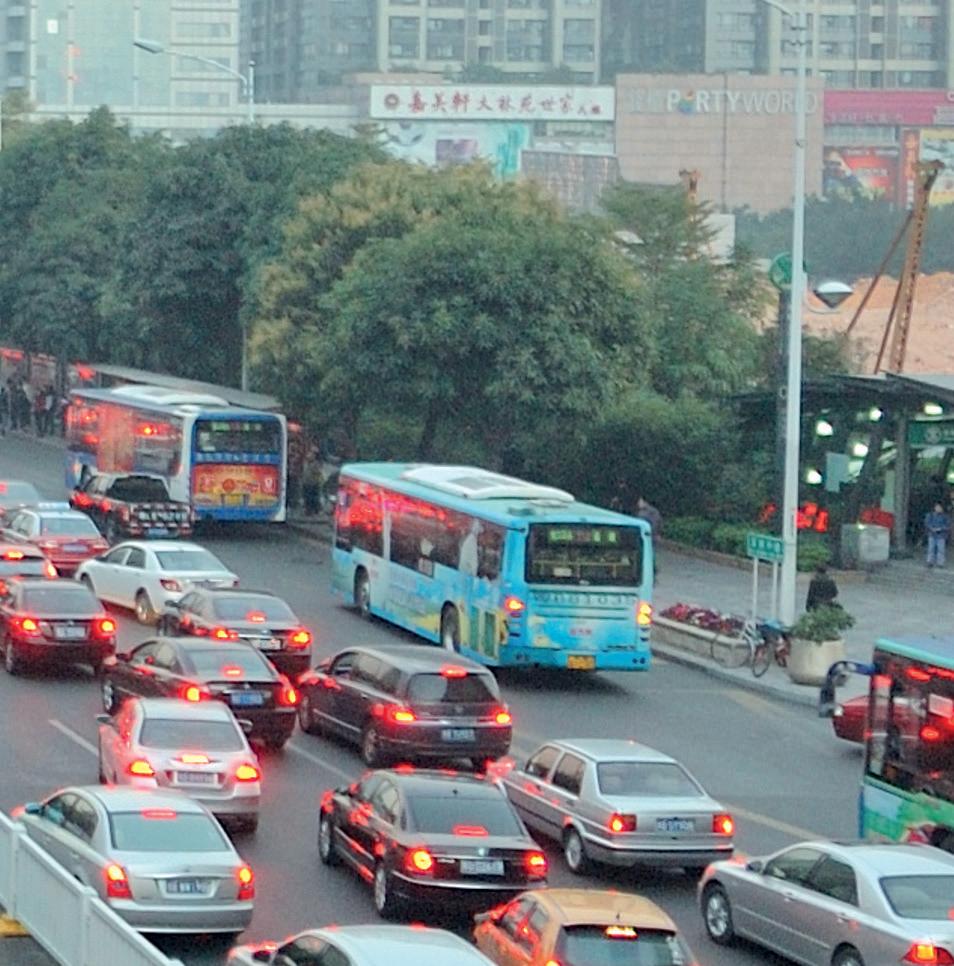
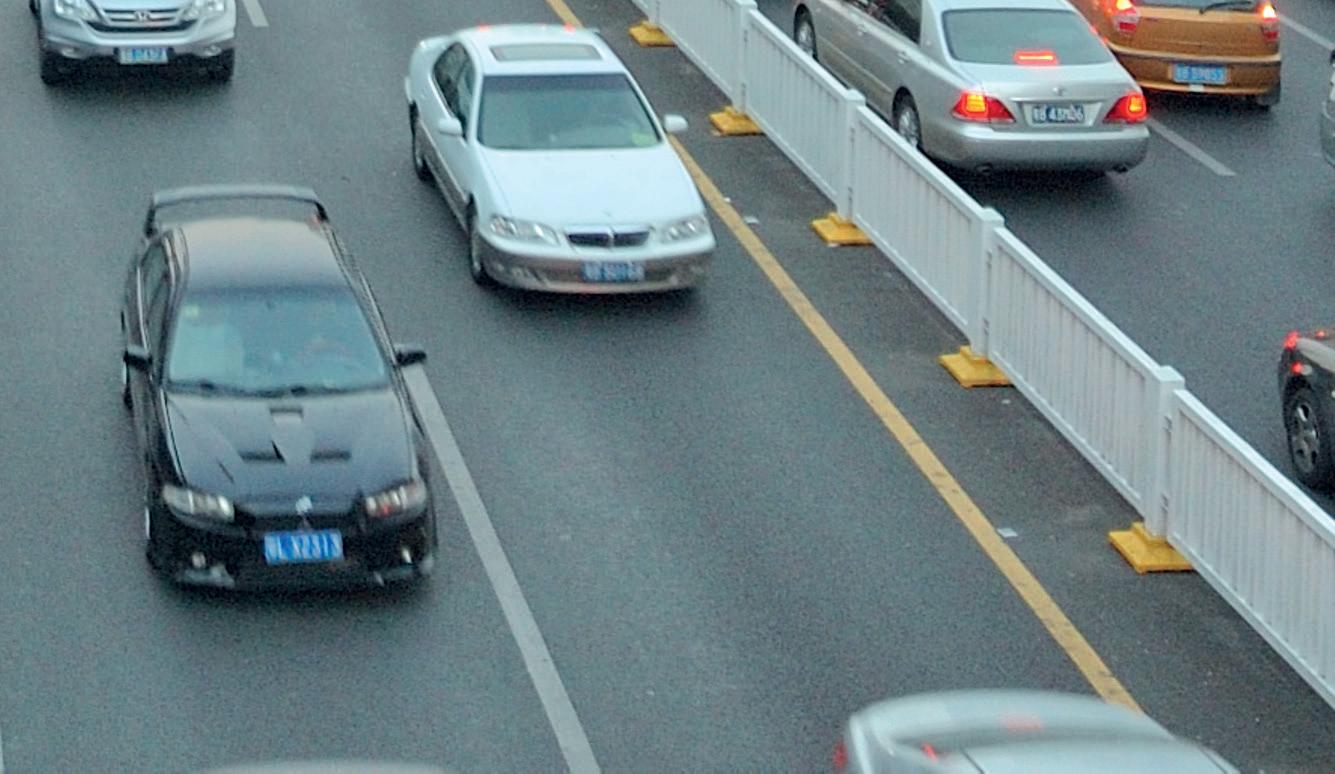

Intersection movement assist and left turn assist – could prevent up to 615,000 crashes – and save up to 1,366 lives per year, says NHTSA
“ “ Ford has been trialling connected traf c lights that could help clear a path for ambulances, re engines and police vehicles – helping emergency services reach incidents faster and preventing accidents on the way
technology has become considerably cheaper and more accessible. Initially, the V2X systems required dedicated technology which included a separate discrete modem, a host device and an application system within the car. More modern designs are able to bundle and squeeze the modem and host processor into a single silicon die, however, reducing the complexity and overall cost of the device.
It is now also possible for the V2X capability to be effortlessly embedded into 5G connectivity platforms using the cellular V2X (C-V2X) protocol standard. My team has recently been working with one of the world’s biggest silicon vendors to optimise 5G infrastructure. And, as part of that project, we have been developing a mobile edge compute (MEC) solution that can support V2X functionality. What’s clear is that due to its growing prevalence – along with the promise of lower operating costs, ultra-low latency and high bandwidth – 5G will become the backbone of V2X applications.
A third reason why we are seeing interest in V2X intensify is that there now seems to be a growing consensus around the standard that will enable it. Since 1999, the standards have been based on dedicated short-range communication (DSRC). But increasingly we’re seeing a move to the C-V2X standard. Last year also saw the FCC grant a
waiver that allowed a consortium of V2X providers and automakers, which included Audi, Ford and Jaguar Land Rover, to use the 5.9 GHz band and deploy C-V2X onboard and in roadside units. Gaining consensus over the standards will be crucial as it will enable the whole industry to plan future investments with con dence – and speed up deployment.
A fourth major reason is that we’re seeing greater support for this technology around the world. In Europe, we’re seeing a growing number of projects that are now paving the way for V2X adoption in urban environments. While in China, it’s estimated that 50% of all new cars sold will feature C-V2X as standard in 2025.
We are starting to see more use cases. For example, Ford has been trialling connected traf c lights that could help clear a path for ambulances, re engines and police vehicles – helping emergency services reach incidents faster and preventing accidents on the way.
Perhaps the biggest step towards greater adoption, however, may be yet to come. V2X has been described as a “digital seatbelt”, but unlike actual seatbelts, V2X is not compulsory technology. This is despite

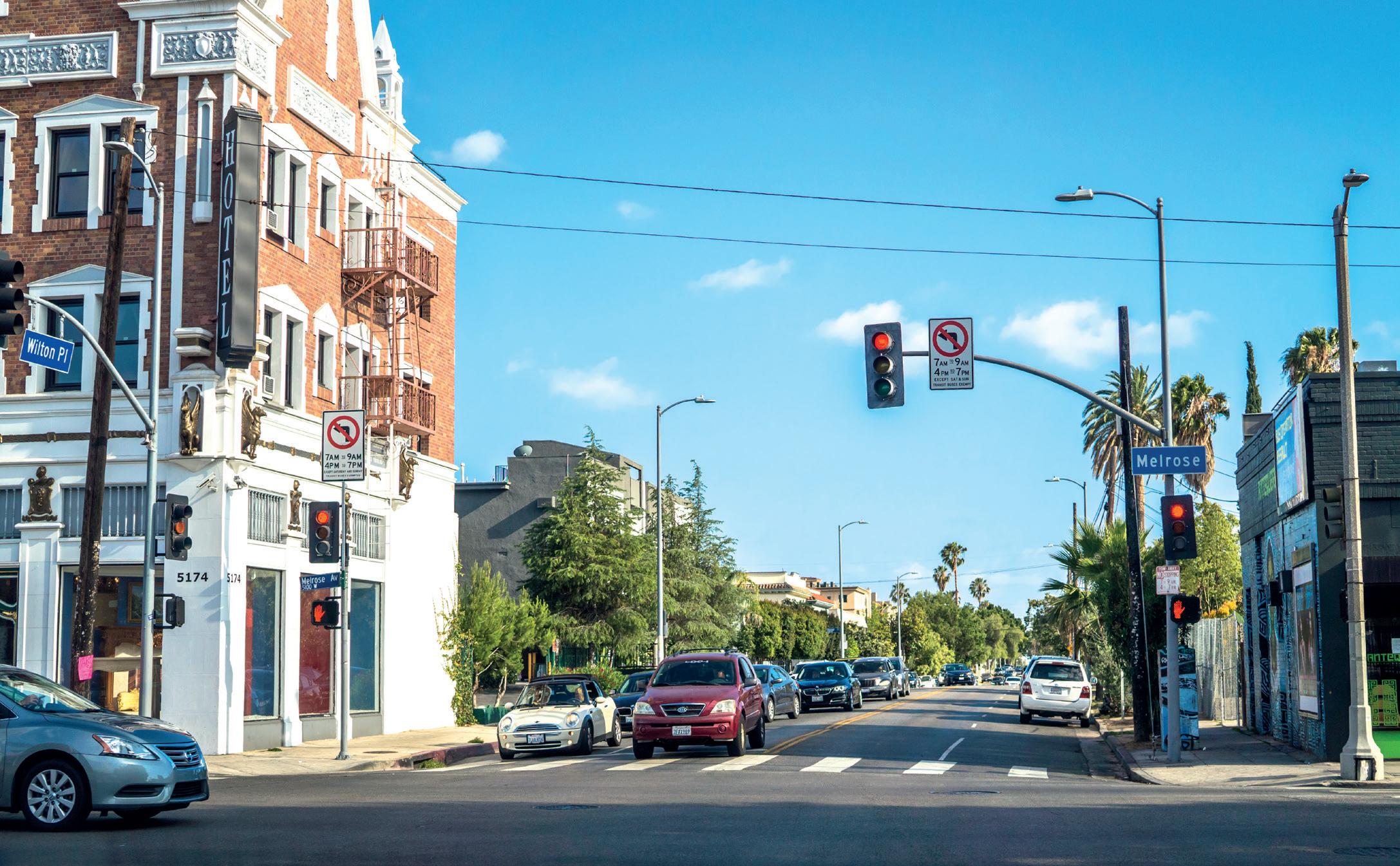

the NHTSA stating that the implementation of just two V2X safety features – intersection movement assist (IMA) and left turn assist (LTA) – could prevent up to 615,000 crashes – and save up to 1,366 lives per year.
If V2X was mandated, however, it would alter the landscape signi cantly. And this is not a far-fetched idea. The US Department of Transport (USDoT) is looking at this and it convened a V2X Summit in 2022 with the intention of working with the industry to build a roadmap to V2X.
However, even with USDoT backing, the universal deployment of V2X will not happen overnight. When ITS America published its National V2X Deployment Plan earlier this year, it estimated that, even if mandated, it would still be eight to 13 years before all vehicles were equipped with C-V2X.
The reality is a lot of work still needs to be done to breathe life into V2X. But with 43,000 road deaths happening each year in the US, the incentive to do so is strong. ITS




There are three main barriers to taking transport ideas from the pilot stage to real-life usage: incompatible technology, local control and limited funding. Tim Haile of California’s Contra Costa Transportation Authority has some thoughts on how to overcome them

At the Contra Costa Transportation Authority (CCTA), we herd cats.
Don’t get me wrong. These are wonderful, thoughtful, and often collaborative cats, but we represent a county with 19 cities, each with its own political leaders who must be responsive to their own residents. As a county-wide transportation organisation, our mandate is to look at the entire puzzle, not just the individual jigsaw pieces. For an authority whose history and reputation are rooted in innovation, we committed a long time ago to ensuring everyone in every city, bene ts from our strategies.





First, a little background. Contra Costa County is just east of the San Francisco Bay Area. It’s home to more than 1.1 million residents representing virtually every demographic, and by extension, with very diverse mobility needs.
CCTA is charged with envisioning, building, and often managing mobility for those residents and the millions of people who transition through our county each year. We’re proud of our internationally recognised role in transportation innovation. We’re home to Gomentum Station, the largest connected and autonomous vehicle test bed in the nation. But what good is innovation without deployment? We’re taking many of the technologies that were developed and re ned in our county and deploying them on our roads, building a network of coordinated


“

transportation offerings that provide personalised mobility for everyone we serve.
Solid forethought and good planning
That sounds great on paper, but on the street, it’s more complex. Through experience, we’ve learned there are three main barriers to success: incompatible technology, local control and limited funding. All that sounds daunting, but we’ve learned that all three can be addressed with solid forethought and good planning.
As a quick illustration, each of our 19 cities operates its own traf c signal system, but transportation doesn't end at jurisdictional boundaries. We’re currently deploying a smart signal upgrade across all 19 cities and 350 intersections, but each city has different traf c controllers using different software. We

“ If you ask good questions and develop trust and buy-in from the public, the answers aren’t always predictable




have to get everyone on the same systems, and the same software to minimise system integration issues, which comes at a cost and requires political will. Again, technology, local control, funding.
Identifying the barriers and addressing them early has been crucial to our success. Our signature project, Innovate 680, addresses mobility on Interstate 680, one of our region’s major corridors. In 2020, during peak hours, I-680 drivers could expect a 90-minute delay. That kind of congestion is an unacceptable lifestyle issue and to x it requires radical thinking and equally radical collaboration. We knew that Innovate 680 would be a massive undertaking. We planned six major projects working together to minimise congestion, maximise ef ciency and dramatically reduce commute times on one of the Bay Area’s most important corridors. The goal was to provide users with a new set of easy-to-use mobility options, with enough personalisation to ensure we accommodate every resident, a major challenge considering I-680 cuts across not just jurisdictions, but also demographics and needs within the entire county. Among our strategies is a plan to build mobility hubs that incorporate transit, car and bicycle sharing. We will also utilise integrated corridor management and ramp metering, part-time transit lanes and advanced Mobility as a Service options.
We know that, generally, the public doesn’t understand the speci c technologies we’re deploying or how - as individuals and families - they might bene t, so we knew early on that one of our primary goals had to be educating each city’s political leaders as well as the public they represent. In the earliest days, we created a governance structure in the form of a policy advisory committee, whose members represented each city. Not

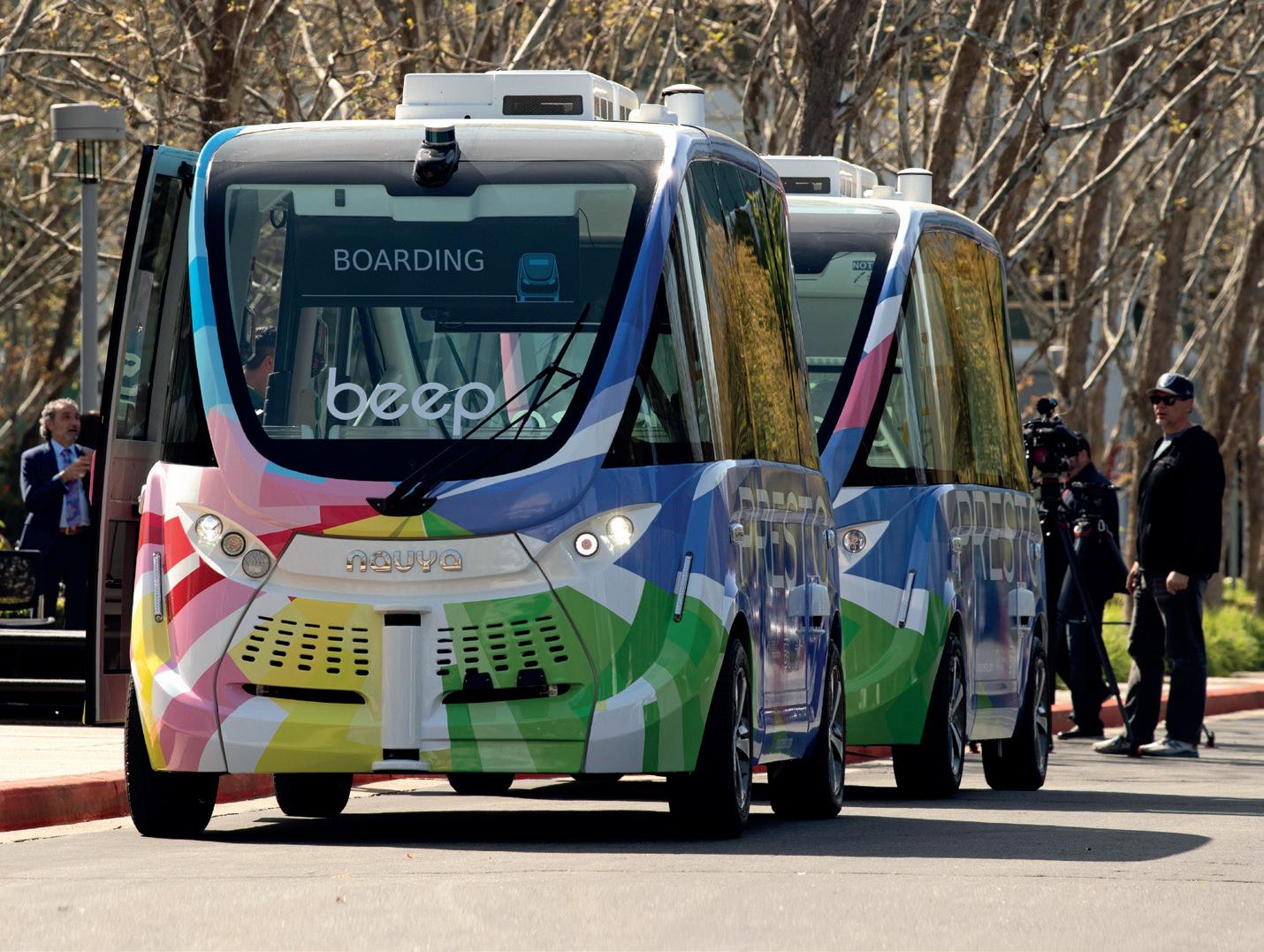
only did they have a voice, but we listened - really listened - and matched our plan to their needs. But political engagement only goes so far, so we also talked with residents themselves. At CCTA, we invested $1 million to develop and implement a public engagement plan soliciting input, opinion and insight.
That engagement continues to this day, and we’ve found that if you ask good questions and develop trust and buy-in
from the public, the answers aren’t always predictable - which in my view makes them more valuable. Take, for example, our Presto Autonomous Shuttle System. We rolled the shuttles out very publicly at local events and through a major community relations effort. Instinctively, you might think (as we did) that seniors who’ve spent their lifetimes behind the wheel, or using driver-operated transit, would be reluctant to ride a shuttle with no driver. But the reality was exactly the opposite. In our pilot, seniors are among the earliest adopters and loudest advocates, putting convenience above any other concerns.
We’ve learned that by keeping politicians and our residents not only in the loop, but in the conversation, we’re fostering community trust. In a recent countywide survey, we found that 70% of respondents are excited about the transportation technologies we’re rolling out. That’s not only public validation for the job we’re doing but relevance and trust for CCTA moving forward. It’s also credibility when circumstances dictate the need for a transportation sales tax initiative, which dovetails perfectly into funding.
Innovate 680 has proven the value and the necessity of digitisation but it has also highlighted the need for strategic and often creative thinking about funding. Of course, CCTA is a funding agency, and we count on cities within our county to provide capital, but we can’t count on federal or state dollars
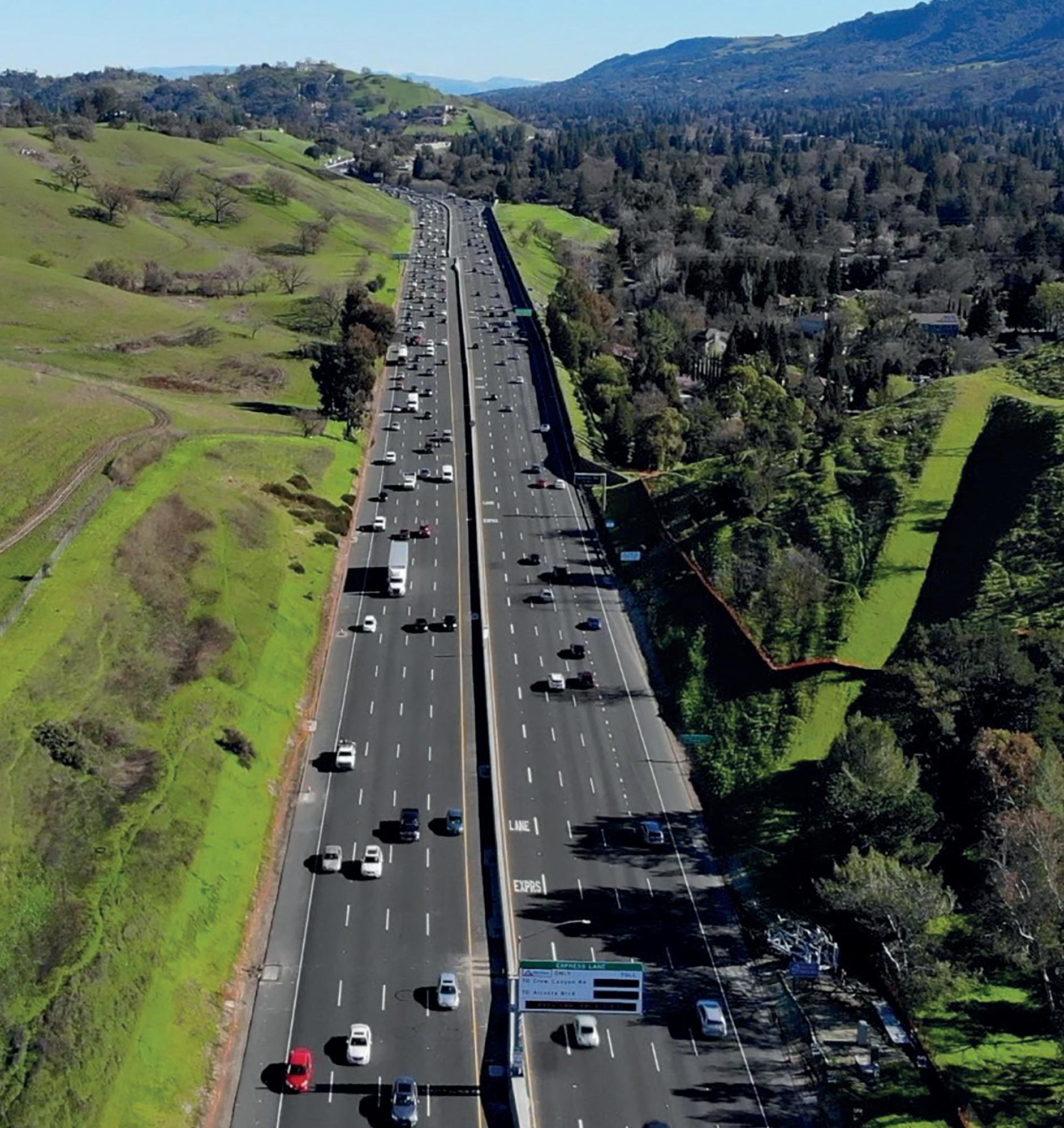


to fund ongoing operations.
As we’re implementing new smart workzones, smart signals, Vehicle to Everything (V2X) and other digital solutions, we’ve had to consider alternative operations funding sources and new revenue opportunities. We’ve also reached outside traditional siloes for inspiration and experience. For example, some technologies come with built-in savings, and we’re leveraging AI and machine learning extensively. In Australia, I’ve seen a single operator using AI solutions to manage an entire network, rather than three, four or even five people. We are also careful not to duplicate learning. We signed a memorandum of understanding with counterpart agencies in the Netherlands, Australia and Japan; we routinely share information back and forth because, in the US, we tend to do transportation research that’s already been completed elsewhere.
At CCTA, we’re actively looking for revenue opportunities to pay for ongoing costs. For example, within our mobility hubs, I see numerous opportunities to generate operations revenue. Bike shares, car shares, scooter shares, parking, electric vehicle charging and even concessions, coffee shops and advertising are all potential sources for revenue. Outside the hubs, there are multiple opportunities including express lane


“that the revenue they generate will support operations.
“
Identifying the barriers and addressing them early has been crucial to our success
revenue, but I’m also extremely excited about public-private partnerships (P3s).
Formal relationships between government and business have been common in the property development industry for decades, yet generally, transportation agencies in various states have steered clear. However, in the current transportation funding landscape, I believe it makes sense to partner with companies who are willing to do the heavy lifting while assuming a lot of the cost and risk.
In this scenario, our residents are getting a Ferrari for the cost of a used car. A great example lies in the dynamic personal microtransit project we just launched in Eastern Contra Costa County. It’s a 28-mile autonomous vehicle network, connecting four cities in a closed loop. We issued an RFP and completed a P3 agreement with the East County Connection Partners (ECCP), made up of transportation innovators Glydways and Plenary Americas, and lead construction contractor Flatiron.
We have zero financial investment in this project. Our private partners are assuming the financial burden with the expectation


All this didn’t happen in a vacuum. California’s regulatory landscape is not as progressive as we’d like and while some states like Texas have been leaders in P3s, we had to find language in state legislation that supported our goals. We also had to educate our board members on P3s. Again, our collaborative relationship with board members established trust, and gave them the insight to recognise the value of this kind of relationship.
For years now, transportation leaders have looked to CCTA for leadership in innovation, but being a leading innovator is no longer enough. As we continue our pivot into deployment, we’d be honoured to take you along for the ride. ITS














Tattile has achieved two key cybersecurity certifications for its products: IEC-62443 (focused on software security) and ISO-27001 (infrastructure IT security). The Italian company, which specialises in cameras for ITS applications, warns that security bugs are growing, and cites research from Cybersecurity Ventures that the global annual cost of cybercrime is estimated to exceed $20 trillion by 2026. ANPR cameras are not exempt from cyberattacks for several reasons, the manufacturer says:


"Being placed in public areas, they could be approached by ill-intentioned people. Working inside the interconnection of networks, cameras can be part of larger systems and interconnected with other devices and systems." Cameras may be vulnerable to unknown threats if they don't receive regular updates from the manufacturer or users due to software and firmware vulnerabilities, Tattile adds. The company developed its Stark software platform from scratch, using the DevSecOps








methodology and says it planned from the start to achieve the double cybersecurity certification. IEC-62443 has been established by several
Seyond - formerly called Innovusion – and Wideye have launched a Lidar solution that sits behind the windscreen of vehicles. A fully-functional prototype of their in-cabin Lidar was highlighted at CES 2024 in Las Vegas. It featured a full-size Wideye windshield and Seyond's operational Robin-E Lidar solution, complemented by additional sensors such as cameras and rain-detection technology. The companies said that the windshield remains an obvious location for a Lidar sensor in vehicle integration, given its high mounting position and low impact on vehicle design and its ability to protect sensors from the external environment. Seyond and Wideye have collaborated to solve major hurdles for in-cabin integration such as limiting performance drop with windshield installation angle and having an adequate heat and noise profile in a small form factor. Seyond is a global provider of high-performance Lidar sensors and solutions for autonomous vehicles and smart transportation. Wideye, a corporate scale-up of Tokyo-based glass firm AGC Group, specialises in glass solutions for optical sensor integration. Junwei Bao, chief executive at Seyond, says: "This feature is the next step in our goal to provide safer, smarter transportation across the globe."











global testing, inspection and certification bodies, defining elements such as test methods, surveillance audit policies and public documentation policies.






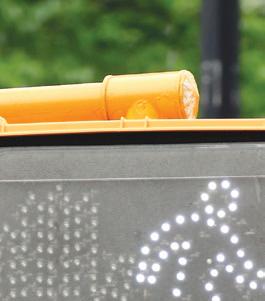
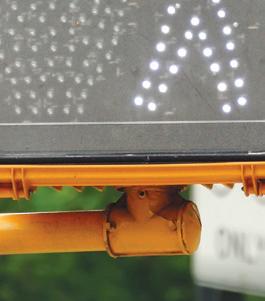



Iteris has launched Vantage CV, an integrated detection and connected vehicle (CV) system for safer intersections. Vantage CV combines traffic detection, cellular Vehicle to Everything (C-V2X) transportation infrastructure communications and connected vehicle safety applications into a single solution. The company says that there are advanced safety features, scalable design and complete intersection coverage. Vantage CV integrates traffic detection data from Iteris’ Vantage Apex or Vantage Next detection systems to generate real-time safety alerts distributed to connected vehicles via the BlueToad Spectra CV roadside unit. Drivers can be alerted to safety risks such as pedestrians in the crosswalk and predicted red-light runners. However, not all vehicles are equipped with V2X technology. To overcome this, the Iteris system includes in-vehicle technologies that agencies can deploy quickly on selected fleet vehicles - such as school buses and maintenance vehicles - for immediate safety benefits. As part of the Vantage CV launch, Iteris has also released the next generation of BlueArgus, now called VantageArgus CV.
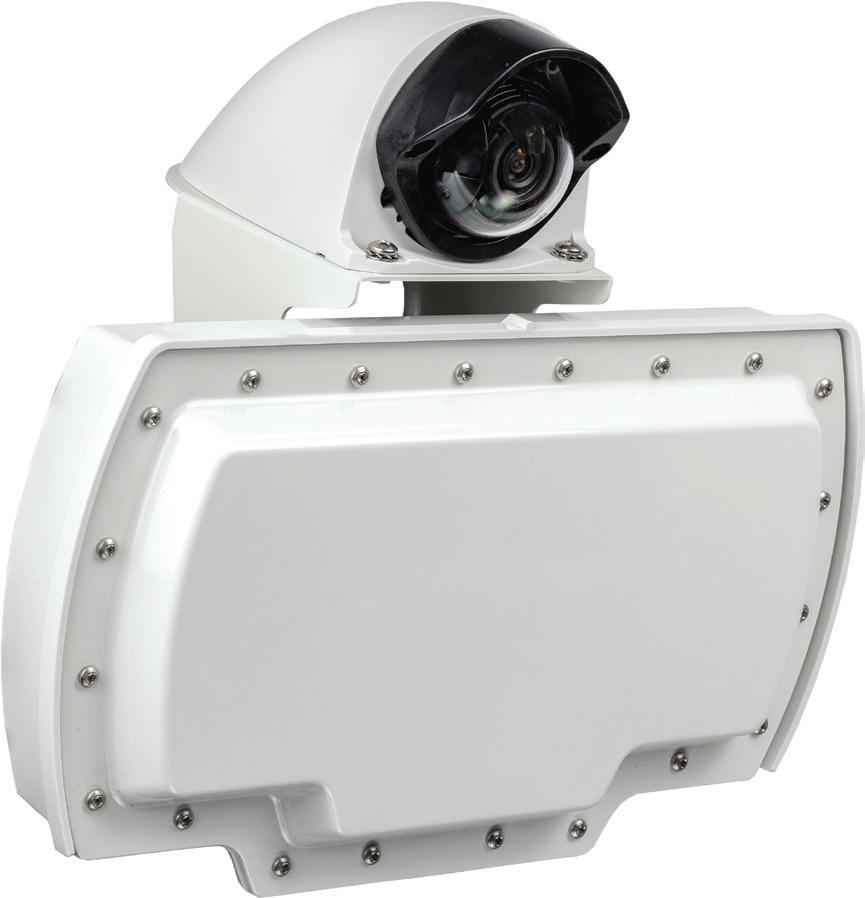
Sensys Networks says the newest addition to its portfolio - radar detection solution RTMS Echo - can identify and track individual vehicles across as many as 12 lanes per device. The pole-mounted, side-fire radar units are quick to install, and come with a browserbased interface, providing data which Sensys says will maximise existing infrastructure and "optimise the safety and efficiency of roadways". With integrated Wi-Fi connectivity, RTMS Echo can be configured with a computer, tablet or smartphone. Traffic data includes vehicle counts, speeds, classifications, travel times and vehicle dwell times. The solution came under Sensys' umbrella when parent company TagMaster bought the radar business of ISS last year. The company says it will offer traffic professionals greater accuracy, identifying and tracking individual vehicles with high precision, even in heavy traffic conditions. This means cities "can monitor traffic flow, identify congestion hotspots, predict future traffic conditions and implement traffic management strategies". One RTMS Echo radar can monitor as many as 12 detection zones up to 250 feet away.





Hesai Technology has launched two advanced driver-assistance system (ADAS) Lidar products: the ultra-long-range AT512 and the ultra-thin ET25, which is designed to be installed behind a vehicle’s windshield. The AT512 is aimed at automotive OEMs, and offers a range of 300m at 10% reflectivity with a maximum range of over 400m. Hesai says it has a 12.3 million points per second point-rate, giving it the "highest resolution point cloud among any Lidar manufacturer at 2400x512". The product is 160x100x45mm, and offers a 120-degree horizontal field of view and a 25.6-degree vertical field of view. The manufacturer says it





The capability of optical zooming and autofocusing of block cameras play pivotal roles in ITS. Optical zooming allows block cameras to achieve a variable focal length, enabling them to capture clear and detailed images even from a distance - important for monitoring highways, intersections and parking areas. Autofocusing complements this by automatically adjusting the focus based on changes in the scene or movement of objects, ensuring the camera maintains sharp and clear images without the need for manual intervention. This is especially beneficial in rapidly-changing scenarios, where quick and accurate adjustments are essential for real-time analysis. Another critical metric for ITS applications is latency: the time it takes to respond and process video data and provide information. The end-to-end system, starting from latency in the camera to latency in the network and client side, must have low values. Most Videology block cameras have latency as low as 33ms, chosen frame rate and the complexity of the image-processing features. These low-latency block cameras reduce the delay between image capture and processing, enabling quicker detection and analysis of events such as traffic congestion, accidents or violations. • Content produced in association with Videology




will "greatly enhance" ADAS systems by improving the vehicle's perception capabilities by providing world-class 3D environmental scans at ultra-high resolution which greatly improves a vehicle's ability to detect objects at long range. It suggests that AT512-equipped ADAS systems "will have 40% more reaction time to avoid dangerous road conditions and significantly improve transportation safety". Meanwhile the ultra-thin ET25 ADAS Lidar is designed to be installed behind a vehicle’s windshield, making it easier to integrate, keeping the sensor clear of dirt and debris. The ET25 provides 250m of range at 10% reflectivity.








Cohda Wireless's MK6 connected vehicle technology solution has been certified by the US Federal Communications Commission (FCC) for cellular Vehicle to Everything (C-V2X). FCC last year granted waivers permitting deployment of C-V2X technology in the upper 30 MHz of spectrum in the 5.895-5.925 GHz band. A participant in the FCC Joint Waiver programme, Cohda launched the MK6 roadside unit and on-board unit in late 2022: they were granted European Union and UK certifications in August last year. The MK6 offers DSRC, C-V2X, LTE/5G and Wi-Fi/Bluetooth, and features NXP Semiconductors’ RoadLink SAF5400 and SXF1800 chipsets as well as the Qualcomm Snapdragon Auto 5G Modem-RF Platform. Cohda CEO Dr. Paul Gray says: “These are very interesting times that we have all been waiting for and whilst the pathway to this point has been bumpy, the industry has matured substantially and change is here and it’s real." Cohda has been involved in the New York Connected Vehicle Project as well as the Smart Intersections Project in Michigan, which will equip 21 intersections with technology to track crashes and near misses by 2024.
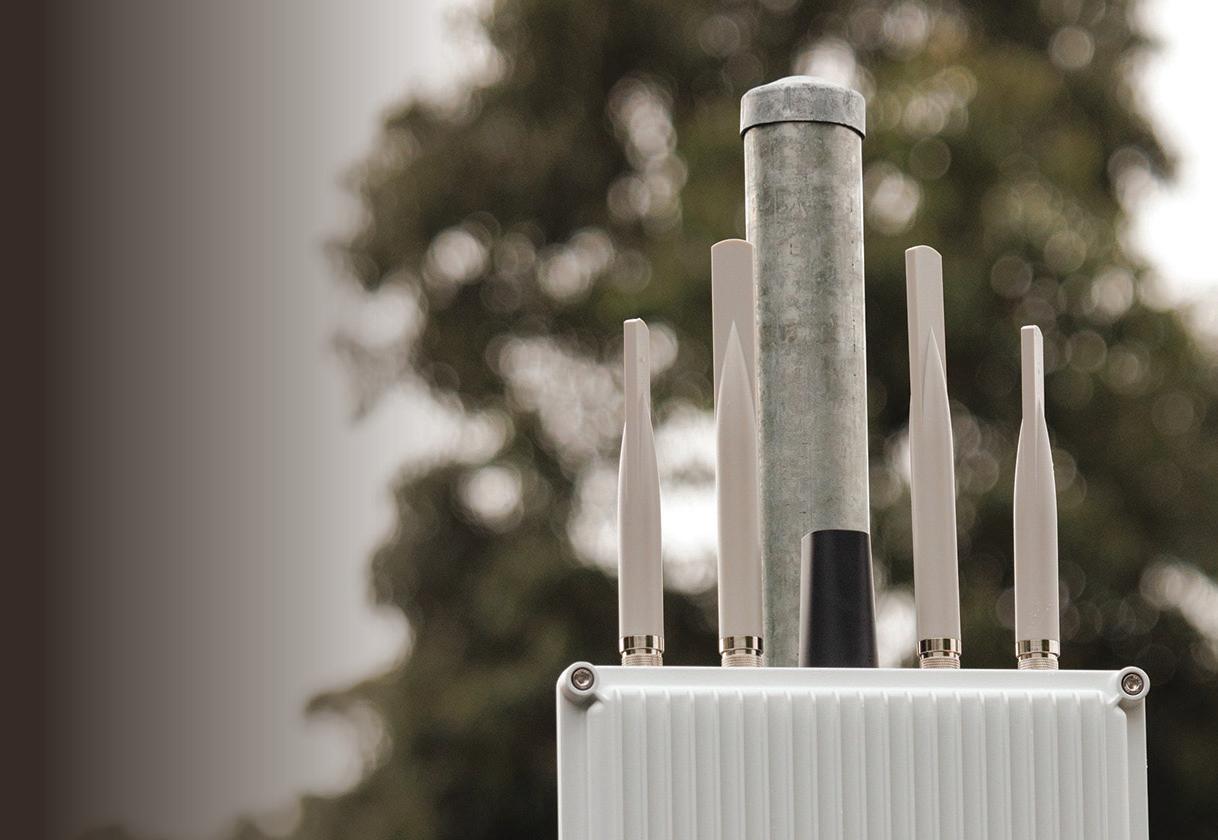
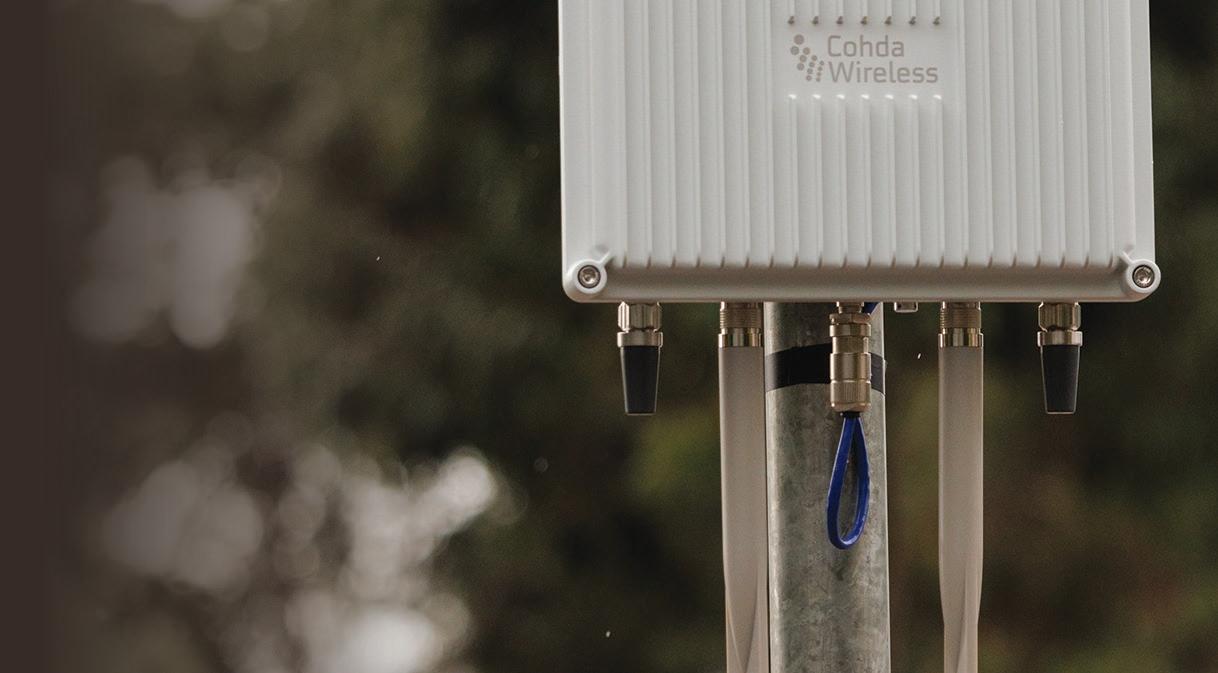


FOLLOW ITS INTERNATIONAL ON SOCIAL MEDIA
The AGD650 AI Stop Line Detector is an advanced traffic management solution designed to enhance road safety and streamline traffic flow. Developed by leading ITS technology experts, AGD Systems, this innovative device employs artificial intelligence to accurately identify targets and monitor stop lines at intersections.
Building on its reputation for easy-to-integrate detection solutions, AGD Systems has designed the AGD650 with two independent detection zones, configured via AGD’s intuitive wireless Touch Wi-Fi set-up. This allows for the identification of moving or stationary vehicles across multiple lanes.
The AGD650 has been deployed for a wide range of applications, such as improving the safety of cycle lanes and for false detection reduction at busy junctions.
It features an onboard processor, enabling real-time to minimise false positives and
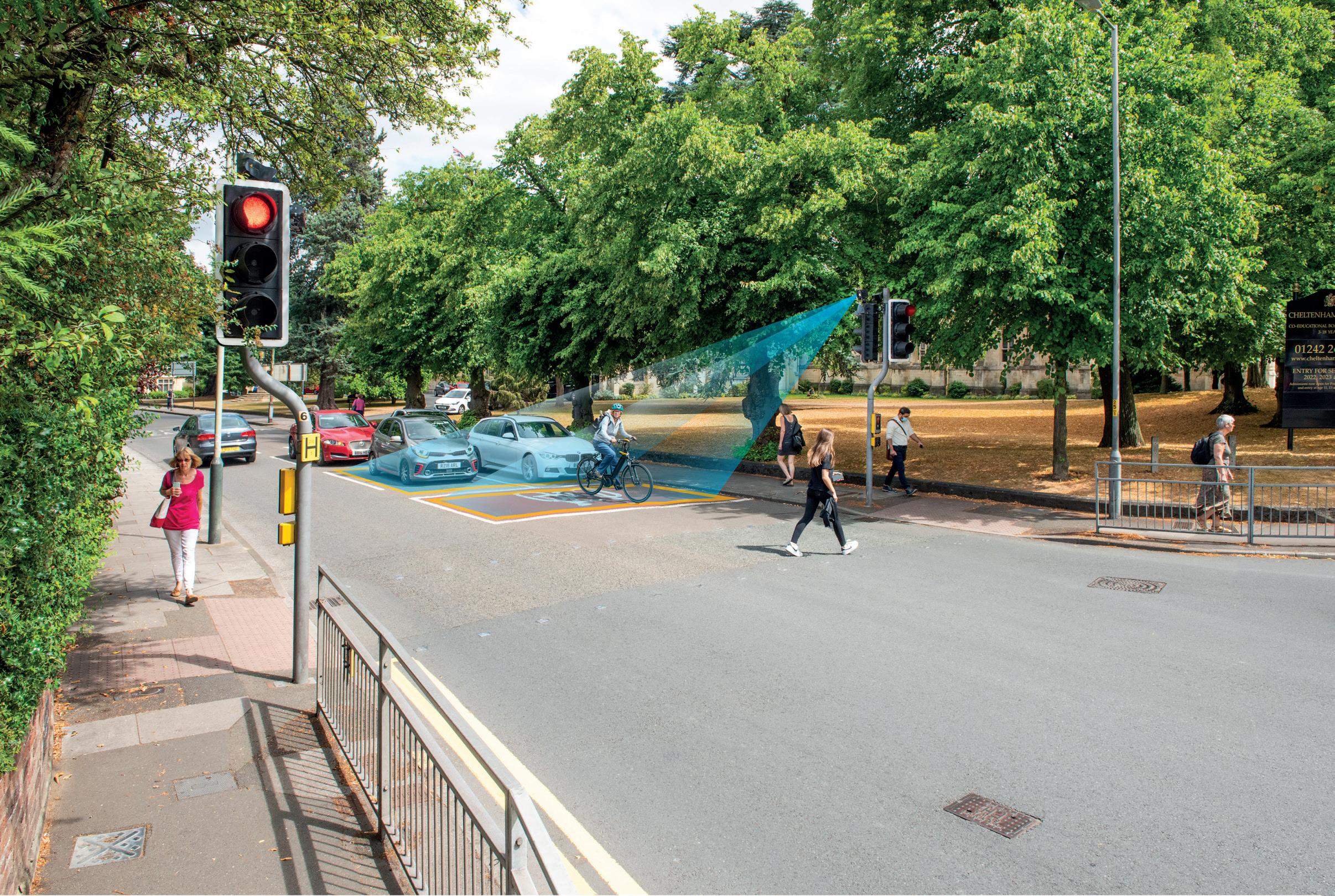
association with AGD Systems
Yunex Traffic has launched in the US its Yutraffic Studio, a cloud-based advanced traffic management system. The company said that Yutraffic Studio offers high-quality planning, monitoring and optimisation tools. It also addresses demands from IT departments for security and scalability that can be found in cloud deployments and a Software as a Service (SaaS) environment. The system can “ingest massive amounts of local and third-party data”, including information directly from connected vehicles. Real-time data from connected vehicles is quickly becoming the most comprehensive and reliable source of timely information, with significant and expanding potential for the future. The new platform also offers users digital twin and predictive capabilities when they upgrade with Yutraffic Insights’ intersection optimisation analytics and Aimsun’s simulation and predictive forecasting engine. Yutraffic Studio will be offered as a SaaS solution, future-proofing customers who plan to expand their networks as transportation technology and local needs evolve. The platform is also modular so agencies can add monitoring or analysis capabilities as they need it. Traffic managers can access Studio from desktops at a traffic management centre or remotely through an iPad or similar device.
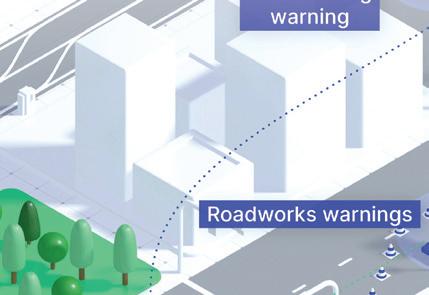
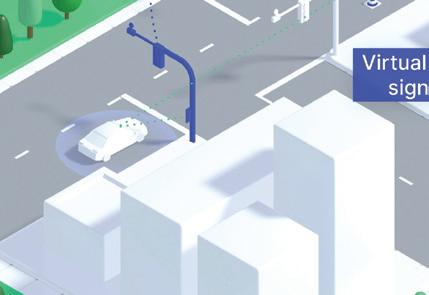

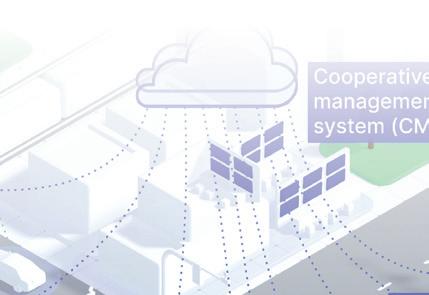
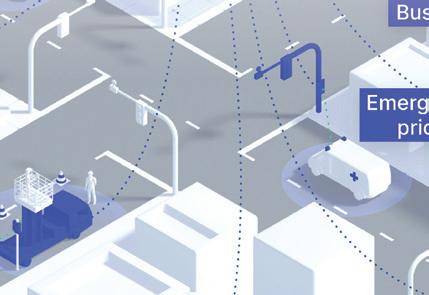
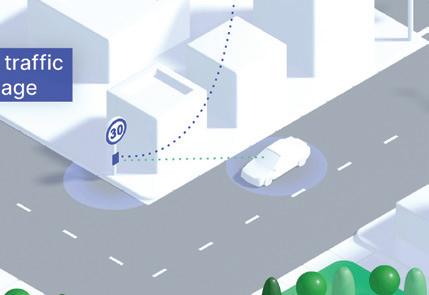
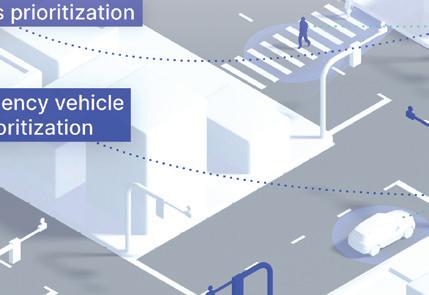
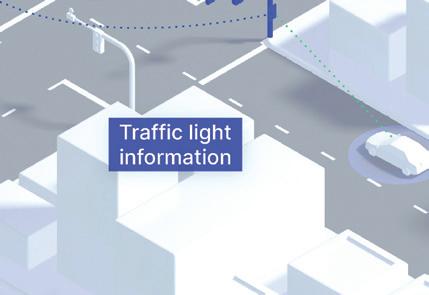

Autonomous vehicle software specialist Beep has launched AutonomOS, a platform for public transit operators and Mobility as a Service companies to integrate autonomous mobility services rapidly and seamlessly into their solutions. AutonomOS is an autonomous vehicle-agnostic solution designed to deliver safe, scalable, cost-effective, multi-passenger autonomous mobility services. It deploys and manages autonomous passenger services either as a standalone solution or with integration into multimodal operations. The solution provides a unified view of service performance, fleet health and on-road operations. Governance tools ensure mission compliance and passenger safety. Beep says that its service optimisation features integrate service performance, smart city infrastructure and ridership data to dynamically drive service efficiency, optimise passenger experience and maximise ridership across the system. Key features include service definition and planning functions support for a variety of service modes, from fixed route to demand-responsive variants. There is in-cabin monitoring that enables rapid response by remote supervisors in the event of a passenger safety or roadway issue. It is compatible with data standards including GTFS and GTFS-RT. Delivered as a Software as a Service offering, Beep says AutonomOS is built to enterprise-grade levels of scalability, performance and information security.
AGD P13 www.agd-systems.com
Cohda Wireless IFC www.cohdawireless.com
Cross Zlin p31 www.cross-traf c.com
Daktronics p30 www.daktronics.com/tmc
IBTTA p14 www.ibtta.org/events
Iteris p17 www.iteris.com
Intertraf c p34 www.intertraf c.com
Intetra P9 www.intetra.com.tr
ITS International P18 www.itsinternational.com
ITS World Congress p39 www.itsworldcongress.com
Jenoptik p39 www.jenoptik.com
Parifex p37 www.parifex.com/en/products
Swarco OBC www.swarco.com/gogreen
TagMaster p27 www.tagmaster.com
Tattile p4 www.tattile.com
Econolite NA7 www.econolite.com
ITS America NA8 www.itsamericaevents.com
McCain NA4 http://mccain.swarco.com/tms
Q-Free NA5 www.q-free.com
Vance Street Capital NA3 www.vancestreetcapital.com


The cities committed to the European Green Deal lead by example. Mitigating climate change, reducing emissions and pollution, and transforming energy and mobility systems are challenging tasks for the cities on their way to become climate neutral by 2050.
SWARCO is ready to lend support when it comes to reshaping urban mobility with ITS technologies. Together, we can make big steps towards reaching the Green Deal goals and improving quality of life for us and future generations.
Let’s make Europe green. Deal?