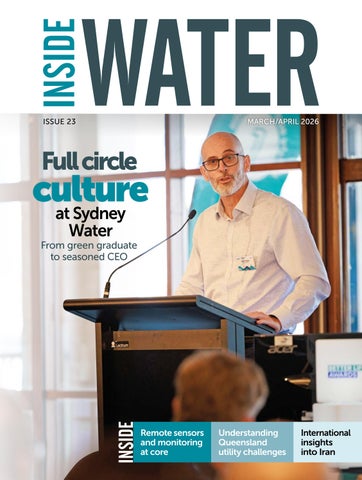
Water
From green graduate to
seasoned CEO


We’re Creating the Future of Water for people, communities and the environment


![]()
seasoned CEO


We’re Creating the Future of Water for people, communities and the environment


LEADERSHIP MOMENTS MATTER most when systems are under pressure. This issue of Inside Water opens with a story that speaks directly to that reality, as Darren Cleary returns to Sydney Water to lead Australia’s largest utility at a time of rapid growth, climate volatility and rising community expectations.
Cleary’s journey from graduate engineer to chief executive comes with a clear sense of responsibility. In his first major interview as CEO, he reflects on the central role of organisational culture, transparency and trust in navigating di cult trade-o s. For a city as diverse as Sydney, that trust is not abstract. It is built through consistent decisionmaking, open communication and a focus on outcomes that matter to communities. The cover story sets the tone for this issue by reminding us that leadership in water is as much about values and relationships as it is about infrastructure and regulation.
Confidence, however, is also built through evidence and measurement. That theme continues in our feature on algae monitoring, where Thermo Fisher Scientific explores how better data is helping councils and utilities respond more quickly to bloom events. As stormwater systems and waterways become more dynamic, rapid and reliable monitoring is becoming essential. The story highlights how practical, fit-forpurpose tools can turn uncertainty into clarity, allowing water managers to communicate risks with confidence and act before problems escalate. Everyday pressures on urban water systems are also coming into sharper focus. In Queensland, rising swimming pool ownership is quietly reshaping how councils and water service providers think about wastewater, overflows and chemical management. qldwater shows how something as familiar as a backyard pool can have
cumulative impacts on water security and local ecosystems if not managed well. Importantly, it also points to constructive solutions. Clearer guidance and risk-based approaches can give pool owners certainty while protecting infrastructure and the environment. It is a reminder that resilience is often built by addressing the smallchallenges that sit outside traditional asset planning. Long-term sustainability choices underpin all of this work. New lifecycle assessments from the Plastics Industry Pipe Association of Australia challenge assumptions about infrastructure materials. By providing Australianspecific, third-party verified data, the studies o er a clearer picture of how plastic pipe systems can reduce embodied carbon and water use while supporting durable, climate-resilient networks. The story reinforces the value of evidence-based decision-making, particularly as utilities and governments seek to balance cost, performance and environmental responsibility over decades, not just project cycles.
Throughout this issue, the message is clear. Progress in water comes from clarity, collaboration and a willingness to engage openly with complexity.
I hope this issue leaves you encouraged by the depth of thinking across the sector and confident in the many ways water professionals continue to respond with care, rigour and purpose.

Chris Edwards, Inside Water Editor
Chairman John Murphy john.murphy@primecreative.com.au
Chief Executive O cer
Christine Clancy christine.clancy@primecreative.com.au
Publisher Sarah Baker sarah.baker@primecreative.com.au
Managing Editor Geo Crockett geo .crockett@primecreative.com.au
Editor Chris Edwards chris.edwards@primecreative.com.au
Design Alejandro Molano
Head of Design Blake Storey blake.storey@primecreative.com.au
Brand Manager Luke Ronca luke.ronca@primecreative.com.au p: +61 402 718 081
Client Success Manager Ben Sammartino ben.sammartino@primecreative.com.au
Head O ce
Prime Creative Pty Ltd 379 Docklands Drive, Docklands, Victoria 3008 p: +61 3 9690 8766 enquiries@primecreative.com.au www.insidewater.com.au
Subscriptions
+61 3 9690 8766 subscriptions@primecreative.com.au
Inside Water is available by subscription from the publisher. The rights of refusal are reserved by the publisher.
Cover image
Sydney Water
Articles
All articles submitted for publication become the property of the publisher. The Editor reserves the right to adjust any article to conform with the magazine format.
Copyright Inside Water is owned by Prime Creative Media and published by John Murphy. All material in Inside Water is copyright and no part may be reproduced or copied in any form or by any means (graphic, electronic or mechanical including information and retrieval systems) without written permission of the publisher. The Editor welcomes contributions but reserves the right to accept or reject any material. While every e ort has been made to ensure the accuracy of information, Prime Creative Media will not accept responsibility for errors or omissions or for any consequences arising from reliance on information published. The opinions expressed in Inside Water are not necessarily the opinions of, or endorsed by the publisher unless otherwise stated.
George may have been new to wastewater pumps back then but he knew just what he wanted – the certainty of a solution that would run trouble-free for years on end. And that’s exactly what he got.
Today Xylem’s Flygt pumps are George’s preferred choice.
The Value of Certainty


From graduate engineer to chief executive, Darren Cleary’s return to Sydney Water is grounded in culture, community trust and a clear-eyed view of the challenges shaping Greater Sydney’s water future. Inside Water caught up with Darren to talk about his new role and what’s next for the utility.
as Chief Executive of Sydney Water carries a symmetry that resonates across the organisation and the broader water sector.
He began his career as a graduate at Sydney Water, built his leadership experience elsewhere in the industry, and has now returned to lead Australia’s largest water utility at a time when growth pressures, climate volatility and community expectations are converging.
Cleary framed the moment less as a homecoming and more as a responsibility shaped by experience.
“When I look at my career, I’ve spent my whole working life in the water industry,” he said. “What really stands out to me is how important organisational culture is to the success of the business, and how important community trust is to what we do.”
Across more than three decades, including senior leadership roles at both Sydney Water and Hunter Water, Cleary has watched the sector navigate drought, flood, regulatory reform and rapid technological change. While the technical challenges have evolved, he said the underlying lesson has remained consistent.
“Trust is fundamental to what we do, and it’s a precious thing that we have to focus on maintaining, because we will inevitably go through challenging times.”
That philosophy now underpins his approach as CEO of a utility serving more than five million people across one of Australia’s most diverse and rapidly changing metropolitan

regions. From the harbour and coastal communities to the outer growth corridors of Western Sydney, the system Cleary now leads must respond to pressures that are economic, environmental and social all at once.
For Cleary, culture is not an abstract leadership concept or a supporting function. It is a strategic asset that determines how e ectively a water utility can perform under pressure. He described a strong community service ethic as one of the defining characteristics of the water sector, and one that must be actively protected.
“People are here because they believe in what we do. They understand the importance of providing safe and reliable drinking
water and managing wastewater in a way that protects the community and the environment.”
As operating conditions become more complex, Cleary believes that service ethic becomes even more critical. Climate volatility, regulatory scrutiny and growing populations increase the frequency of di cult decisions, and those decisions inevitably involve trade-o s.
“We need to be open and transparent with our community and our customers. That’s what allows you to maintain trust when you’re dealing with di cult issues.”
Cleary has seen the consequences when organisations hesitate to communicate openly.
“Where organisations haven’t been as open and transparent as they could have been, even if that means delivering bad news, that’s often where further challenges are created down the track,” he said.
At Sydney Water, he sees his role as strengthening an already solid foundation.
“Sydney Water has a very good reputation and a strong relationship with its community. I feel privileged to be coming in and working with a great leadership team to sustain that and build on it.”
Lessons from Hunter Water Cleary’s time as Managing Director of Hunter Water provided a di erent leadership context, but one he regards as formative. Operating at a smaller scale sharpened the focus on leadership behaviour, organisational alignment and decision-making under constraint.
“The fundamentals of the culture at Sydney Water and Hunter Water are very similar,” he said. “They’re both grounded in that community service ethic, and that belief that what we do matters to people’s daily lives.”
What di ered was scale and visibility.
“The challenge with a larger organisation is how you shape and influence culture across a much bigger and more distributed workforce.
“The key levers are the same, but they have to be deployed di erently.”
Those levers, he said, begin with alignment at the top.
“The leadership team needs a clear expression of organisational values, and we need to demonstrate those values every day.
“How you do something is just as important as what you do.”
The experience reinforced his belief that clarity and consistency matter most when pressure is highest.
“When you’re having to make di cult trade-o s, people are watching closely to see whether decisions align with stated values,” he said.
Leading at scale
At Sydney Water, Cleary is focused on ensuring culture is reinforced through systems as well as words. In an organisation of this size, intent must be translated into structures that guide behaviour day to day.
“Your performance management frameworks and your corporate objectives need to reflect the cultural outcomes you’re trying to achieve. If they don’t, people get mixed signals.”
Leadership visibility also matters, particularly during periods of change.
Cleary acknowledged the size and geographic spread of Sydney Water present challenges, but he believes consistency is critical.
“People need to see that decisions,

even di cult ones, are being made in line with our values.”
That consistency, he said, builds trust internally and externally.
“When the workforce understands why decisions are being made and how they align with our purpose, it strengthens engagement and capability across the organisation.”
Serving a city of regions
Sydney Water’s scale mirrors the diversity of the city it serves.
From established inner-city neighbourhoods to fast-growing corridors in Western Sydney and the southwest, the pressures placed on the system vary significantly by geography.
Cleary rejected the idea that Sydney can be treated as a single, uniform system.
“Greater Sydney is made up of many di erent communities. Our role is to help build places that are sustainable and have the same level of amenity, regardless of geographic location.”
Western Sydney, in particular, faces a convergence of challenges, including rapid population growth, rising temperatures and the need for new infrastructure.
“Water is central to delivering social amenity, economic opportunity and sustainability in those areas,” Cleary said. “But we can’t deliver that on our own.”
He emphasised the importance of working closely with planning authorities, developers and other infrastructure providers.
“We have to be part of an integrated approach to building communities.”
Cleary pointed to Sydney Water’s
Cleary and a few of the sta catch the view from the Western Sydney Aerotropolis.
role as stormwater authority in parts of the southwest growth area and the Western Sydney Aerotropolis as an example of that integration.
“That work allows us to link stormwater management with reuse, energy, cooling and habitat outcomes in a way that supports long-term resilience.”
Regulation and risk
Cleary speaking at the 4th SWAN Asia-Pacific Workshop.
Operating in one of the most heavily regulated environments in the country, Sydney Water must balance compliance with innovation and long-term planning. Cleary believes the key lies in maintaining a clear focus on outcomes rather than process alone.
“We need to be very clear about what we’re trying to achieve for


our community – safe drinking water, sustainable wastewater services and e cient support for economic growth.”
Where regulation supports those outcomes, Cleary sees it as an enabler rather than a constraint.
“Good regulation should support innovation,” he said. “And where it doesn’t, that creates an opportunity to have a constructive conversation with regulators about intent.”
Risk appetite also plays a critical role.
“We need to be clear about where we can take more risk and where we can’t,” Cleary said. “There’s no appetite for risk when it comes to public health or safety, but there are other areas where innovation can be pursued more quickly.”
That clarity, he said, helps the organisation focus its e orts.
“If people understand the boundaries, they can innovate confidently within them.”
Wastewater management and waterway health remain among the most scrutinised aspects of Sydney
Water’s role, particularly in a city defined by its harbour, beaches and coastal environment. Cleary is conscious of that scrutiny, but keen to focus the conversation on outcomes rather than technical labels.
“What communities value is being able to go to the beach, to swim and to enjoy healthy waterways. That’s the outcome they care about.”
He argued that debates centred solely on treatment levels can obscure what really matters.
“Primary, secondary or tertiary treatment are not outcomes in themselves. They’re pathways to achieving what the community actually values.”
Cleary also emphasised the importance of considering broader ecosystem health.
“It’s not just about the quality of the water we discharge. It’s about the overall health of the receiving environment, including riparian zones, green corridors and green infrastructure.”
He believes there is scope to think di erently about how environmental outcomes are achieved too.
Cleary and the crew check out the clean water at one of Sydney Water’s many reservoirs.
“There may be opportunities to deliver better environmental results by combining traditional infrastructure with nature-based solutions,” he said.
Climate volatility is now a defining feature of the operating environment for water utilities, and Cleary said Sydney Water is increasingly focused on resilience across its systems and operations.
“Our assets are being disrupted more frequently than they have been historically. We need to look at how we make those assets more resilient and how we improve our response when disruptions occur.”
Changes in catchment water quality, more intense storm events and extended dry periods are all shaping planning priorities.
“Climate is a ecting how our systems perform, not just how we plan them.
“We can’t assume the future will look like the past. We have to be ready to respond to a wider range of scenarios.”
Digital capability and operational insight
Alongside physical resilience, Cleary sees significant opportunity in improving how Sydney Water understands and operates its assets.
Digital technology and data, he said, are becoming central to both performance and e ciency.
“Most of the cost in a water business sits in operating and maintaining infrastructure,” Cleary said. “If we can understand our assets better, we can manage risk more e ectively and deliver a more resilient and e cient service.”
He pointed to the growing use of monitoring, analytics and emerging technologies across networks.
“There’s huge value in being able to predict performance, understand condition and intervene earlier,” he said.
Cleary also highlighted the role of digital tools in engaging customers.
“We have an opportunity to understand customer preferences and values in a more sophisticated way. That helps us make better decisions and communicate more e ectively.”
on capability
Alongside external pressures, Sydney Water is navigating generational workforce change. Cleary believes mentorship and experience-sharing are more e ective than attempting to document decades of knowledge.
“You can’t download experience,” he said. “What you can do is have people working alongside very experienced sta and learning how they make decisions.”
That transfer of judgement, he said, is critical to both continuity and innovation.
“The next generation will bring new skills and perspectives, and that’s a good thing. But it needs to be grounded in strong fundamentals.”

Digital technology, he added, can support that transition.
“The engineering principles haven’t changed. What’s changed is our ability to understand and operate systems using data and digital tools.”
Trust as the measure of success
Looking ahead, Cleary said a single project or milestone will not define success. Instead, it will be reflected in confidence and capability.
“The real measure will be whether our community and stakeholders trust that we can continue to meet the challenges ahead.”
Emergency management is something that Cleary takes very seriously.
Cleary with the team at Rouse Hill and West Hornsby treatment plant.
For Cleary, trust and organisational capability are inseparable.
“We want to be an organisation that is open to learning and willing to work with the community and the broader industry,” he said.
As he settles into the role now just under 6 months in, his message to the sector is consistent with the themes that have shaped his career.
“We’re here to learn from others, to collaborate and to innovate where it makes sense.
“That’s how we’ll continue to serve our community, now and into the future.”


After a decade delivering smart electricity metering at scale, PLUS ES is translating hard-won lessons into the water sector.
FOR MUCH OF Australia’s water sector, digital metering is no longer a question of if, but how. Utilities are under pressure to improve billing accuracy, respond faster to leaks and bursts, support conservation goals, and make better long-term infrastructure decisions, all while managing costs, risks, and customer expectations. Yet for many, the complexity of delivering end-toend digital metering remains a significant barrier.
PLUS ES is entering this conversation from a position that is new to the water industry, but proven at scale in electricity. Established in 2017, the business is Australia’s largest smart metering provider in the electricity sector, managing more than 1.7 million meters and contracted to grow to almost 3 million by 2030. It is now turning its attention to water.
“From day one, our strategy always included other meter types, including water,” Glenn Wilson, Director of Water at PLUS ES, said.
“Electricity has been our focus because of regulatory reform and rollout timing, but the capability was always built to extend into water and gas.”
That extension is now underway,
with PLUS ES positioning itself as a full-service digital water metering partner for utilities and councils looking to reduce risk and complexity.
Built for scale
The foundations of PLUS ES were shaped by one of the most demanding operating environments in Australia: the contestability of electricity metering and the subsequent accelerated smart meter rollout, which required new market entrants to deliver high volumes of data accurately, on time, and under strict regulatory scrutiny.
“In electricity, penalties apply if data is late or inaccurate,” Nural Omer, Head of Metering at PLUS ES, said. “There are frequent audits, and there is nowhere to hide if your systems and processes are not robust.”
PLUS ES has grown by focusing on that discipline. Data quality and reliability are central to the operating model, supported by industryleading in-house technology, tightly governed field operations, and contractual service levels that flow through the entire value chain.
“What keeps customers with us is not just installing the meter well,” Wilson said. “It is about delivering
PLUS ES is shifting into the water space after a decade of work in electricity metering. Images: PLUS ES
reliable and high-quality data, every day, at scale.”
That experience is now informing its approach to water, in a sector where billing accuracy remains a nonnegotiable.
“Behind providing safe drinking water and sanitation, accurate billing is one of the highest priorities for any utility,” Wilson said. “If you get that wrong, you lose customer confidence very quickly.”
One service, one responsibility One of the consistent challenges utilities face when adopting digital metering is the integration risk. Meter hardware, communications services, installation services, and IT systems are often delivered by separate parties, leaving utilities accountable for managing the hando s and coordination.
PLUS ES has deliberately positioned itself as the single point of responsibility.
“We provide an end-to-end service with clear SLAs,” Omer said. “Utilities do not need to worry about whether the issue is with the meter, the communications network, or the installer. We are their single throat to choke.”
That accountability extends beyond the headline service level promised to the water utility. PLUS ES has embedded multiple secondary SLAs across telecommunications providers,

meter suppliers, installation partners and internal teams, all aligned to the same outcomes.
“Everything that sits underneath flows up to that one commitment,” Wilson said. “If there is an issue, it is on us to fix it.”
This model, familiar in electricity, mirrors a traditional manual meterreading contract in structure, shifting risk away from the utility at a time when many are navigating digital metering for the first time.
experience as infrastructure
While digital metering is often discussed in technical terms, PLUS ES places significant emphasis on customer experience as a core operational discipline.
“We’ve designed the installation experience to keep customers informed and in control,” Omer said. “They can reschedule, provide consent and know exactly when an installer will arrive.”
This visibility is enabled by systems originally developed for electricity, including real-time installation tracking and automated communications. Customer satisfaction and net promoter scores are monitored continuously and embedded into partner contracts.
“The fact that close to 20 per cent of customers respond to our post-installation surveys, with scores consistently above nine out of ten, proves the success of our approach,” Wilson said.
Trust and transparency are increasingly important for all water utilities, so the focus on customer experience is becoming an asset rather than a secondary consideration.
Beyond billing
Accurate billing might have been the entry point, but PLUS ES sees the broader value of digital water

metering emerging through improved visibility of network and customer behaviour.
“Most water loss is unnecessary water use,” Wilson said. “Leaks on customer property, unnoticed consumption, or systems running when they don’t need to.”
Digital meters, combined with analytics and optional sensors, allow utilities to intervene earlier, reducing water loss and improving outcomes for both themselves and customers.
“Pressure and vibration data can tell you where a leak is, not just that one exists,” Omer said. “That can change how operations teams work today.”
Utilities can see this shift support faster response times, reduced reliance on customer contacts for alerting, and better-informed capital planning. It also creates opportunities to proactively engage customers on usage and conservation.
Translating experience into water PLUS ES’s capability transfers seamlessly into water - proven, reliable, and scalable systems are already in place for asset management, data handling, safety, compliance and customer engagement.
“The main di erence is the meters themselves and the workforce installing them,” Wilson said. “The rest of the process is fundamentally the same.”
This continuity allows PLUS ES to leverage its existing scale, buying power and internal expertise, advantages that are particularly meaningful for smaller utilities and regional councils.
High-quality embedded networks need to be paired with customer experience scores that top the charts.
“Our model is designed to make digital metering accessible without utilities having to build new, noncore capabilities,” Wilson said. As water utilities move toward digital metering, PLUS ES is positioning itself not as a new entrant learning on the job, but as a partner translating a decade of hard-won experience into a sector facing familiar pressures and familiar expectations from customers, regulators and communities alike.
The PLUS ES metering laboratory is designed to stress-test smart meters in a vast array of situations.
“Most utilities are embarking on digital water metering for the first time, and the biggest risk is underestimating the complexity of delivering it end-to-end,” Wilson said. “Our role is to take that complexity away, apply the lessons learned over a decade in electricity, and give utilities confidence that the fundamentals of billing accuracy, safety, customer trust and longterm value are done right from day one.”
For more information, visit pluses.com.au

We know compliance standards and regulations are highly dynamic and will continue to evolve as new environmental threats emerge. We also understand there is an ever increasing need to reduce the risk in our drinking and recreational water resources and increase operational efficiency.

What if the equipment and solutions supporting your work today was designed to meet tomorrow’s demanding needs?
At Thermo Fisher Scientific, we take a cutting-edge approach to your toughest water analysis and monitoring challenges. The result? Thinking forward and staying ahead of potential problems not only helps protect the investments you make today but also helps protect tomorrow’s environment. We partner with leading suppliers to provide the best workflow solutions.
Our range supports water sampling, water remediation, as well as an extensive analysis, monitoring and measurement featuring:
• Coliforms, algae, cyanobacteria
• pH, conductivity, dissolved oxygen, hardnes
• A-Z of chemical analysis; single to multi-parameter
• UV254, BOD, COD
• Flow, velocity, level, temperature
• Gases; NH₃, Cl₂, confined space entry, lone worker


Non-revenue water remains one of the water sector’s most persistent and least visible challenges, eroding operational e ciency, financial performance and long-term system resilience.
WATER UTILITIES FACE a significant, yet often invisible challenge: NonRevenue Water (NRW).
NRW is water that is collected, stored, treated, and introduced into a distribution system, but is never billed for. Put simply, it is the gap between the amount of water a utility supplies and the amount it successfully bills. While widely discussed within technical teams, NRW is increasingly recognised as a strategic issue spanning operations, finance, asset management, and customer outcomes.
Taggle shares insights as to why NRW deserves greater attention, how digital water meters can highlight these invisible losses, and why NRW plays a critical role in the business case for digital metering.
What makes up non-revenue water?
NRW is not a single type of loss, but a combination of di erent mechanisms that occur across the water network.
Physical losses occur when water escapes through leaks, bursts, and overflows before reaching a customer connection.
These losses are worsened by ageing infrastructure, deteriorating materials and excessive or fluctuating pressure. They can remain undetected for long periods, quietly increasing operating costs and asset stress.
Apparent losses occur when water successfully delivered to customers is not billed correctly. Meter inaccuracies, billing issues and unauthorised illegal connections all fall into this category. Although the water reaches end users, the
Calculate NRW by digitising network meters

associated revenue is never realised. The third component is unbilled authorised consumption, including firefighting, system flushing and specific municipal uses. While necessary, these activities still incur the full costs of abstraction, treatment, and distribution, and must be considered when assessing overall system performance.
Why NRW matters more than ever High levels of NRW have consequences well beyond water loss alone. Operationally, it increases the cost per kilolitre sold, as utilities pay for energy, chemicals, labour and maintenance associated with water that generates no return.
NRW undermines water security. This is particularly true during periods of scarcity, when every megalitre lost places additional strain on catchments and infrastructure. This results in unnecessarily harsh water restrictions, which erode customer satisfaction and reduce quality of life.
Calculating NRW: simple in theory, complex in practice
NRW is the di erence between the system input volume and the billed authorised consumption. While the formula is straightforward, the reliability depends on data quality. Accurate NRW calculation requires data from bulk meters, customer meters, and billing systems, as well as time alignment between datasets. Without this, NRW becomes a disputed number rather than a trusted metric. Utilities may know they have a problem, but struggle to quantify its scale, source or financial impact.
The hidden cost
NRW rarely appears as an identifiable cost in the Profit & Loss (P&L) statement. Water that is lost or unbilled is not invoiced or shown as lost revenue; it simply never exists in
reported figures. As a result, the true size of the opportunity is masked.
The costs associated with producing and distributing that water is fully recorded. Energy for pumping, chemicals for treatment, labour for operations and maintenance, and depreciation of assets all appear in the P&L.
Still, the percentage of those costs that are not billed for is rarely identified. The result is higher operating costs per unit sold, reduced margins and lower returns on investment, without a clear causal line back to water loss.
NRW also influences capital expenditure in subtle ways. Persistent losses can drive the oversizing of treatment plants, earlier network augmentation and additional storage and pumping capacity. These investments appear as normal capital programs, even when NRW is a key underlying driver.
The role of digital water meters in quantifying and reducing NRW Network meters provide critical insight into how much water enters the system; digital meters on every property and outlet collect timely consumption data; and, with mass balancing, losses become quantifiable. Digital meters improve visibility into failures and enable much earlier intervention, reducing apparent losses. At a network scale, aggregated meter data helps utilities pinpoint zones with higher losses, allowing leak detection and pressure management e orts to be targeted with far greater precision.
Traditional leak detection programs often attempt to cover the entire network evenly. While wellintentioned, this approach usually yields high activity but relatively low returns, as crews spend time investigating low-impact areas and identifying minor leaks.

By concentrating resources in areas with high NRW and utilising data to narrow down searches, utilities consistently recover more water per intervention, reduce reactive maintenance and achieve faster payback on investment. This targeted approach transforms leak management into a strategic operational e ciency program.
Tracking NRW in practice
The township of Nundle (Tamworth Regional Council) experienced persistently high levels of NRW. While sta knew there was a problem, they lacked clear visibility into how much water was being lost and where those losses were occurring. Suspicions ranged from ageing under-registering meters to network leaks and illegal connections, yet repeated investigations failed to uncover anything obvious.
The problem surfaced dramatically with the installation of digital meters. Losses were now accurately quantified, revealing that approximately 50 per cent of the town’s water supply was not accounted for. The local water treatment plant was producing around 200,000 litres per day, while recorded customer consumption totalled only 100,000 litres per day. With meter inaccuracy ruled out, Council could redirect its focus to the network itself. Field investigations uncovered the source of the loss: an open valve at the end of a pipeline,
Taggle’s ROI model highlights potential savings from digital metering, calculated based on an individual utility’s inputs.
allowing treated water to flow continuously into a nearby creek for an unknown period.
The discovery highlighted how hidden losses can persist for years without accurate data, and how digital metering can transform assumptions into evidence, enabling targeted action and rapid recovery of lost water.
Making NRW visible and actionable
When NRW remains hidden, investment decisions become harder, savings are underestimated, and finance and operations remain disconnected.
Digital water metering data allows utilities to make NRW visible in both volumetric and financial terms, linking losses to real dollars and measurable outcomes. It does not simply support more accurate billing, it also plays a foundational role in making NRW visible, measurable and manageable, turning what was once an estimated problem into one that can be addressed with confidence. NRW is not simply water that disappears; it is water utilities pay to produce, treat, and distribute, that is never paid for. Making it visible through digital water meters is the first step toward reducing it and toward building more e cient, resilient, and financially sustainable water systems.
For more information, visit taggle.com


NPS outlines how integrated delivery, systems and people shape outcomes across complex metering programs.

METERING PROGRAMS ARE often described as straightforward exercises. A scope is set, devices are specified, and timelines are agreed upon.
Yet anyone who has delivered these programs at scale understands how quickly complexity emerges once work begins. Regulatory requirements, customer disruption, data accuracy, safety and geography all intersect in ways that test even the most carefully planned projects.
NPS has built its reputation by working inside that complexity rather than around it. The business approaches metering as part of a broader system of integrated water services, where success depends on how well delivery, data, people and outcomes align. That perspective has been shaped through decades of practical experience rather than abstract theory.
“Metering only looks simple until you’re responsible for delivering it
end to end,” NPS Chief Operating O cer Adam Nicholson said. “That’s when the real work starts.”
From plumbing foundations to national delivery
NPS began as a specialist plumbing business, grounded in trades-led delivery and a deep understanding of how water assets operate in the real world.
Those foundations remain central to the company’s identity. What has changed is the scale, scope and sophistication of the work it now undertakes.
Over time, the business has expanded beyond traditional plumbing into complex, multi-site water programs, responding to growing demand from utilities, asset owners and government for partners who could deliver certainty at scale. That evolution was driven by steady investment in people, systems and processes.
Experience and excellence in the water industry have seen NPS expand its presence.
Images: NPS
A consistent philosophy has shaped the company’s growth: remain hands-on, accountable, and focused on outcomes. Even as programs have become larger and more geographically dispersed, NPS has retained a delivery mindset rooted in practical execution.
“We’ve grown by doing the work properly and building trust over time,” Nicholson said. “That tradesbased discipline still underpins everything we do.”
Systems designed around real delivery
As programs became more complex, NPS recognised that traditional delivery models were no longer su cient. Disconnected systems, fragmented data and manual reporting created risk for both clients and delivery teams.
In response, the business developed integrated platforms that connect planning, scheduling, compliance, data capture, reporting and customer engagement. These systems interface directly with water authorities and asset owners, providing real-time visibility across entire programs.
The objective is not digital sophistication for its own sake. It is about reducing friction, improving accuracy and ensuring that what happens in the field is reflected clearly at a program level.
“Good systems don’t replace people,” Nicholson said. “They support them when programs are under pressure.”
Why metering programs are rarely simple
Despite their apparent uniformity, metering programs are among the most challenging forms of water infrastructure delivery.
Each site presents its own conditions, from access constraints
and customer sensitivities to legacy infrastructure and incomplete records.
NPS’ experience spans metropolitan, regional and remote environments, often within the same program. Regulatory compliance, environmental controls and safety obligations must be met consistently, regardless of location. At the same time, customer engagement must be handled carefully to minimise disruption.
The diversity of assets adds another layer of complexity.
Mechanical meters, fire service metering, backflow prevention devices, magflow meters, and digital technologies each have di erent compliance and data requirements.
“You can’t treat metering as a onesize-fits-all exercise,” Nicholson said. “Every program has its own risks.”
The last 20 per cent
Where NPS excels is in the final stages of metering programs. The last 20 per cent is where progress slows, and issues concentrate. Straightforward sites have been completed, leaving complex locations, resistant customers and problematic assets.
This phase often determines whether a program achieves its objectives. Data anomalies emerge, access becomes more di cult, and legacy infrastructure challenges assumptions made at the outset. Many programs stall here, leaving value unrealised.
NPS has developed a repeatable methodology for navigating this stage, combining detailed site assessment, targeted customer engagement, flexible scheduling and specialist technical capability.
“Anyone can deliver the easy work,” Nicholson said. “The real test is how you handle what’s left.”
A clear example of this approach is in the Gulf Country of Queensland, where NPS delivered a complex meter assembly transformation program in a demanding regional environment. The project involved ageing infrastructure, logistical constraints and the need to maintain service continuity across a dispersed customer base.
Rather than treating the work as a standard replacement program, the team applied a logistics-style delivery model. Workflows were redesigned to reduce repeat visits, improve safety and maintain data integrity. Integrated systems ensured accurate reporting and visibility throughout the program, aligning field activity with asset owner requirements. The result was a program delivered e ciently, with strong data outcomes and minimal disruption.
“This project demonstrated what’s possible when systems and delivery are designed together,” Nicholson said.
As metering programs increasingly incorporate digital technologies, NPS has continued to expand its capabilities while maintaining its focus on delivery. The acquisition of WaterGroup strengthened the business’s smart metering, monitoring, and leak-detection expertise, broadening its metering portfolio.
Rather than operating as a standalone capability, these technologies are embedded within existing delivery systems. This integration allows data insights to inform field activity and enable early intervention when issues arise.
“Technology only adds value

when it’s connected to action,” Nicholson said.
with challenges of all sizes.
The proper installation of water meters is now par for the course for NPS, following the acquisition of WaterGroup.
A delivery partner when outcomes matter NPS does not position itself as a traditional contractor. Its role is that of a delivery partner, integrating deeply with client operations and remaining accountable through the most challenging stages of programs.
The emphasis on integrated water services reflects an understanding that outcomes are shaped by how well systems, people and execution align. In an increasingly complex water sector, that alignment is becoming critical.
“We’re judged by how programs finish,” Nicholson said. “That’s where trust is built.”
For more information, visit newplumbing.com.au

New IoT-enabled approaches are helping utilities detect hidden leaks earlier, reducing losses before treated water ever reaches customers.
AS AUSTRALIA ENTERED 2026 with water restrictions again part of the public conversation, the focus on resilience was sharpening. For more than a decade, much of the industry narrative had centred on customer behaviour, e ciency targets and demand management. Yet even as households and businesses reduced consumption, pressure on water resources persisted.
That tension highlighted a blind spot in the industry’s traditional framing of conservation. Andrew McLoughney, Internet of Things Product Director at Iota, said while customer behaviour remained critical, network-side e ciency represented an increasingly important opportunity.
“It is about all of us doing our part,” he said. “Customer-side e ciencies are very important, but networkside e ciency is a complementary extension of that work.”
Hidden leaks beneath streets and footpaths could waste enormous volumes of treated water, inflate
operating costs and accelerate the need for major capital investments. Detecting and addressing those losses earlier changed the equation entirely, shifting conservation e orts upstream before water ever reached the customer.
Looking deeper into the network Digital metering and the rapid evolution of Internet of Things technologies have been instrumental in driving customer-side water savings.
Building on this, utilities are now able to deploy cost-e ective vibration sensors at the edge of the network to detect water loss within the network in ways previously unfeasible.
“It means doing what we can to save water before it is delivered,”
McLoughney said. “IoT and digital metering, combined with vibration sensors and their large data management capabilities and algorithms, give utilities a deeper understanding of what is happening

The Sotto dashboard is designed to provide analytics and knowledge insights for water utilities. Images: Iota Services
in the distribution network, up to the end customer. That part of the network has, until now, been dark.”
This was the thinking behind Sotto, an edge-based vibration sensor developed by South East Water and productised by Iota. Installed within digital meters, Sotto listens to the network daily, detecting subtle vibration signatures associated with leaks.
Paired with analytics, it enables utilities to identify and prioritise network-side leaks that would otherwise remain undetected unless called in by a customer.
McLoughney said the system’s daily data capture marked a fundamental shift from traditional approaches.
“With listening sticks or periodic surveys, you only know what is happening at the time you are there,” he said. “With Sotto, you always have visibility. If something happens tomorrow, the system sees it.”
Utility-led innovation in practice
Iota’s role as a wholly owned subsidiary of South East Water shaped how solutions like Sotto were conceived and refined. Rather than developing technology in isolation, innovations emerged from real operational challenges and were tested in live networks from the outset.
“South East Water is a great case study in taking problems from operations and feeding them into a strong research and development program,” McLoughney said.
“South East Water’s research, development and innovation team, operators, engineers, data scientists and field sta all contributed to the development of Sotto. That collaboration meant the solution was grounded in real conditions, not what vendors believed utilities wanted.”
The driver behind Sotto is to reduce
non-revenue water, enhance leak detection, prevent bursts and reduce the impact of these events on customers and the environment.
Early prototypes focused on whether vibration-based sensing could reliably detect leaks and whether the hardware could be miniaturised to fit within a meter.
“There were a lot of iterations,” McLoughney said. “Taking something relatively large and refining it to fit inside a meter was technically challenging, but it unlocked the ability to trial it at scale.”
Once data began flowing, attention turned to analytics. Algorithms developed internally by South East Water were refined by Iota to improve speed, accuracy and operational usability.
The goal was not just detection, but turning data into information that field teams could act on with confidence and by priority.
From data to decisions
The combination of edge sensors and cloud-native analytics is transforming how utilities respond to network-side leaks. Instead of reacting to bursts or customer complaints, operators could intervene earlier, often before a leak is escalated.
“The role of our Sotto Analytics is to automate the process at scale,” McLoughney said. “It is also about filtering out false positives, so you are not rolling trucks unnecessarily and providing the actual location of the leak within metres.”
Processing speed proved critical. Early iterations required many hours of data analysis, limiting how frequently insights could be generated. Improvements reduced processing times dramatically, enabling daily analysis across large device fleets.
“The closer you get to real time, the
more e ective it is,” McLoughney said. “You are identifying issues before they become problems. That allows operators to plan work more e ectively and use their time where it matters most.”
This capability also supported broader system planning. By reducing water loss, utilities could defer or downsize major capital projects.
Designing for the whole industry
While Sotto was born within one utility, its future depended on being deployable across many. Iota’s innovation model relied heavily on beta and gamma testing with early adopter utilities to ensure solutions were flexible and fit for purpose.
“From South East Water we gain technology developed for and proven on a public network – we know it works – but it also has to work for di erent networks, di erent data environments and di erent levels of digital maturity,” McLoughney said.
Sotto Analytics was designed to operate as a standalone tool or integrate with Iota’s Lentic IoT and meter data management platform. That flexibility has allowed utilities to start small, prove value and scale at their own pace.
“We can deploy it with a small number of meters as a proof of value,” he said. “Once we have shown it works, it can then be seamlessly integrated into a larger deployment.”
Trials across Australia and overseas revealed network nuances that informed further refinement.
In some cases, unexpected configurations, such as multiple meters on a single pipe, required adjustments to analytics and deployment approaches.
Having access to South East Water’s expertise allowed Iota to
Andrew McLoughney is the Internet of Things Product Director at Iota.

resolve these issues quickly and feed learnings back into the product.
Building confidence through results
Demonstrated returns on investment were central to conversations with other utilities. South East Water’s early deployments have exceeded expectations, delivering stronger water savings and return on investment than initially forecast.
“When you can point to a business case that has been overachieved, that is compelling,” McLoughney said. “Utilities want confidence that the benefits will actually be delivered.”
As digital metering programs scale, technologies like Sotto and Sotto Analytics are pivotal in strengthening funding cases by adding tangible network leak reduction benefits.
Reduced non-revenue water, lower operating costs and deferred capital expenditure all contribute to a more robust value proposition.
Looking ahead, McLoughney saw solutions like Sotto as foundational to the next phase of utility-led digital transformation.
“These capabilities are essential,” he said. “They save large volumes of water, they are highly cost-e ective, and they deliver benefits over the life of the meter.”
Taking a home-grown innovation to an international market carried broader significance.
“The level of international interest shows this is something the industry really needs,” McLoughney said.
“Hopefully, many more utilities will realise the return and benefit from Sotto.”
For more information, visit iotaservices.com.au
As utilities and irrigation operators face growing pressure on networks, resources and customer trust, automated meter reading is shifting from a billing tool to a core operational capability.
AUTOMATED METER READING was originally conceived as a way to remove people from the repetitive and often risky task of physically reading water meters. For Ian Joblin, Director and Chief Executive O cer of Data Right, that narrow objective no longer reflects the reality of how metering data is now used across the water sector.
“I think Data Right’s proposition is water meter network management and maintenance, whether that is with smart metering or traditional nonsmart meters,” Joblin said.
“Where we see ourselves as a leader is in high-volume, high-accuracy data capture for large-scale meter rollouts and ongoing network maintenance.”
While early automated meter reading programs focused on cost reduction and safety, the downstream benefits quickly became apparent.
Leak detection emerged as an early advantage, followed by demand management insights and more informed customer engagement as data volumes increased and transmission intervals shortened.
“Originally, AMRs were developed to reduce the cost of meter reading, which had long proven to be ine cient, with high levels of human error and health and safety risks,” Joblin said. “Now we are seeing the sheer volume of near real-time data being used to drive demand management and provide customers with genuine insight into their consumption.”
Where automated meter reading delivers value today Across urban networks, the most immediate benefits of automated meter reading continue to be felt
through faster leak detection and improved billing accuracy.
“The ability to communicate leaks reduces concealed leak rebates for utilities and removes bill shock for residents,” Joblin said. “The speed of capturing reads also allows utilities to invoice more regularly and more accurately, which improves billing reliability and cash flow.”
Near real-time data is also supporting more e cient property transfer billing and reducing reliance on estimated reads. At the network level, integration with pressure monitoring and district metered areas is improving burst detection and reducing non-revenue water losses.
In agricultural irrigation schemes, the value proposition is di erent but no less significant. Understanding extraction volumes against allocation in near real time supports equitable water use, demand management and regulatory compliance.
“It allows scheme operators to manage distribution across the network and detect unlawful usage,” Joblin said. “For irrigators, easily accessible consumption data helps analyse crop performance and optimise outcomes from every megalitre used.”
Why data timeliness and accuracy matter
Compared with manual or drive-by reading regimes, automated meter reading fundamentally changes both the quantity and quality of information available to operators.
“Meters transmitting consumption data, usually in hourly increments, generate a massive volume of data every day,” Joblin said.
The team at Data Right is installing an automated meter reader Images: Data Right
“That is a stark contrast to quarterly or annual manual reads that require large labour inputs and carry ongoing safety risks.”
Automated systems also eliminate the need for physical access to properties, reducing estimated reads and the ine ciencies of driveby approaches.
However, the value of this data depends entirely on its accuracy. Joblin was clear that errors introduced during installation or commissioning can undermine trust.
“Incorrect meter allocations, poor opening or closing reads, incorrect AMR numbers or poorly captured photos can all compromise auditability and confidence,” he said, adding that installation partners must understand both technical and community-facing requirements.

Engaging customers and managing demand
In urban environments, time-stamped consumption data has become a powerful tool for both utilities and customers. It supports better planning for peak demand periods and underpins more targeted education around water restrictions.
“With time and date data, utilities can engage directly with highvolume consumers and alert them to abnormal usage,” Joblin said. “That allows customers to act quickly, rather than waiting for a scheduled bill.”
Leak detection is also significantly enhanced. When data shows a failure to return to zero consumption, utilities can proactively notify customers, reducing non-revenue water and strengthening relationships built on transparency.
Overcoming challenges in irrigation environments
Deploying automated meter reading in agricultural irrigation schemes presents distinct challenges, particularly around remoteness and connectivity.

“Access to NB-IoT networks can be limited, and standalone receiver networks are often cost prohibitive,”
Joblin said. “That means installations require more detailed planning and di erent approaches to power and communications.”
Low-power devices, solar solutions and satellite transmitters help overcome these constraints, while robust materials are essential to withstand harsh operating conditions and minimise downtime.
As utilities move towards smart metering, interoperability with existing infrastructure remains one of the most significant hurdles.
“That means auditing the existing meter fleet, telemetry and SCADA systems, billing software and customer portals,” Joblin said.
“Only then can utilities pursue

Working with water utilities and local councils ensures that all stakeholders are on the same page.
solutions that maximise the value of existing assets.”
Data governance is equally critical.
Ownership, security and privacy concerns can slow adoption if not addressed early.
“Data ownership should remain with the utility but be accessible to the customer,” Joblin said. “Confidence is eroded quickly if security or privacy is compromised.”
From data to strategic decisions
The operational impact of near realtime data is already evident.
Joblin pointed to Mackay Regional Council as an example.
“Per capita consumption reduced by 12 per cent, leak detection times fell from 150 days to 60, and the useful life of the treatment plant has been extended to 2032,” he said.
Looking ahead, Joblin sees automated meter reading becoming a foundational element of digital water strategies, supporting forecasting, asset planning and capital investment decisions.
“With the data now available, utilities can better understand peak demand, seasonal variation and the impact of weather,” he said.
For organisations considering their first major investment, his advice is pragmatic.
“Be clear about the outcomes you want, understand your existing assets, prioritise reliability, and plan for whole-of-life costs,” Joblin said. “A poor rollout is hard to undo, so getting the foundations right matters.”
For more information, visit dataright.com.au


As rainfall patterns intensify, stormwater infrastructure is being re-engineered to balance resilience, water quality and long-term operational performance.
STORMWATER INFRASTRUCTURE
has always sat at the intersection of engineering, environmental protection and public safety. What has changed is the level of uncertainty those systems are now expected to absorb.
Across Australia and New Zealand, rainfall patterns are becoming more volatile, with longer dry periods punctuated by intense, short-duration storm events that test both new and ageing infrastructure.
Brian Krishna, Managing Director of Xylem Australia and New Zealand, said the industry was experiencing a fundamental shift in how stormwater systems needed to be conceived, designed and operated.
“We have seen a clear move away from designing purely for historical rainfall patterns,” Krishna said.
“Climate variability is increasing the risk profile for stormwater systems, particularly as we see more flash flooding and higher intensity rainfall events across urban environments.”
He said resilience was no longer a secondary consideration layered onto conventional designs, but a core requirement shaping how systems were specified from the outset.
“That means stormwater infrastructure has to be more adaptable and more robust than it has ever been. It also means we need to think about how systems respond not just to everyday rainfall, but to extreme events that are becoming more frequent.”
How standardisation and flexibility work together
For many utilities and councils, standardisation has long been seen as a way to reduce design risk, simplify
approvals and improve long-term asset performance.
Krishna said those principles still held, but they needed to be applied with greater nuance.
“Our customers value standardisation because it provides certainty,” he said.
“Repeatable solutions reduce design risk and give regulators confidence, particularly when it comes to meeting water quality objectives.”
However, Krishna said changing site conditions and legacy constraints meant standardised solutions could not always be applied without adjustment.
“We are operating in environments with high groundwater, complex hydraulics and ageing infrastructure.
“In those cases, targeted and customised solutions are essential to protect performance and compliance without introducing unnecessary complexity or cost.”
He said the challenge for designers was finding the balance between proven, standard technologies and bespoke engineering where site conditions demanded it.
“The best outcomes come from combining standardised solutions with engineering-led refinements that respond to real-world constraints.”
Managing performance from first flush to flood surge
One of the most challenging aspects of stormwater design is ensuring systems perform consistently across a wide range of flow conditions.
Krishna said Xylem approached stormwater treatment and pumping as a single hydraulic system, rather than as isolated components.
“Our goal is strong water quality
In the biggest of storms, the Xylem range of pumps and pump systems is designed to ensure maximum e ciency.
Images: Xylem
performance during normal rainfall, combined with resilience during extreme events,” he said. “That starts with first flush performance, when pollutant loads are often at their highest.”
He said systems needed to be designed to capture and treat contaminants during low to moderate flows, while also providing safe bypass pathways during major storms.
“Providing controlled bypass during extreme events is critical so that system capacity is not compromised,” Krishna said. “Variable speed drives, redundancy in pumping systems and digital controls all play a role in managing that variability.”
Hydraulic and surge modelling, he added, had become increasingly important as rainfall intensities increased.
“Modelling allows us to understand how systems will transition through heavy flood events,” Krishna said. “It gives asset owners confidence that infrastructure will behave as intended under stress.”
Balancing hydraulics, water quality and lifecycle value
Stormwater systems are often required to move large volumes of water while also removing fine sediments, nutrients and


hydrocarbons. Krishna said achieving that balance required careful internal hydraulic design.
“At an executive level, our clients are focused on balancing risk, performance and long-term value,” he said. “Water quality objectives cannot be compromised, whether it is an everyday rainfall event or an extreme storm.”
He said bypass paths and internal flow management were essential to maintaining treatment performance without creating excessive maintenance burdens.
“At the same time, we have to consider ageing infrastructure,” Krishna said. “Systems are now being asked to perform under conditions they were never originally designed for.”
Whole-of-life cost considerations, he added, were embedded into design decisions from the beginning.
“We look at lifecycle cost from day one,” Krishna said. “That includes energy e ciency, material durability and safety during maintenance over a 20 to 30-year design life.”
Reducing confined space entry and improving operator access were also key considerations.
“Safety and maintainability are non-negotiable,” Krishna said.
“Standardisation helps reduce operational complexity and deliver more predictable long-term costs for asset owners.”
Using data to support proactive asset management
As stormwater systems become more complex, digital tools are playing a growing role in validating performance and supporting asset management.
Krishna said modelling, field data and post-installation monitoring each served a distinct purpose.
“Modelling is critical for system
selection, but field data and monitoring validate real-world performance once assets are operational,” he said.
He said digital monitoring provided greater visibility into how systems performed over time, particularly during peak events.
“Capturing complete system operation allows asset managers to understand how infrastructure is behaving under changing climate conditions,” Krishna said. “That data supports proactive asset management rather than reactive intervention.”
However, Krishna said data alone was not enough.
“In a world where data is abundant, the real value comes from understanding how to use it,” he said. “That is where training and operational support become critical.”
He said Xylem placed strong emphasis on helping operators interpret data to inform maintenance planning and budget decisions.
“The goal is to improve whole-of-life outcomes, not just generate more information,” Krishna said.
Retrofitting stormwater infrastructure in constrained environments
While greenfield projects o er greater design flexibility, much of Australia’s stormwater investment focuses on retrofitting existing assets. Krishna said these projects presented some of the most complex challenges.
“Retrofit projects often involve ageing infrastructure, limited space and the need to keep assets operational throughout construction,” he said.
Early collaboration, he said, was essential to balancing hydraulic performance with constructability and safety.
Getting the Flygt Concertor system into the right place is vital.
“Accessibility and safe operation have to be considered alongside hydraulic design,” Krishna said. “You cannot introduce additional risk into already constrained systems.”
Temporary bypass and dewatering solutions also played an important role during upgrades.
“Having rental assets available allows councils and utilities to maintain service continuity while systems are being upgraded or repaired,” Krishna said.
Stormwater’s expanding role in urban resilience
Looking ahead, Krishna said stormwater infrastructure was evolving beyond single-purpose assets toward more integrated systems that supported broader urban outcomes.
“We are seeing growing demand for compact, adaptable solutions that can manage everyday stormwater while also responding to extreme events,” he said.
Integration between treatment, pumping and digital monitoring, he said, was becoming essential rather than optional.
“Stormwater systems are being asked to do more,” Krishna said. “They play a critical role in protecting communities, supporting urban liveability and meeting environmental objectives.”
He said the industry had a responsibility to move beyond a mindset of simply moving water downstream.
“We have an opportunity, and a responsibility, to design systems that contribute to healthier urban environments. That responsibility will only grow as climate resilience becomes a stronger planning driver.”
For more information, visit xylem.com/au

With algae monitoring under increasing scrutiny, Thermo Fisher Scientific is supporting organisations with technology and expertise shaped around real-world needs.

PUBLIC CONCERN ABOUT water quality continues to grow, and algal blooms have become one of the most visible indicators of that shift. Although stormwater is only one contributor, its influence is becoming harder to ignore.
Richard Durand, Product Manager at Thermo Fisher Scientific, said the rising interest in algae monitoring reflects a broader awareness across communities and regulators.
“People are seeing more frequent algal blooms,” Durand said. “There is a lot more media publicity given to them, particularly with respect to cyanobacteria.”
He noted that this heightened attention has sharpened expectations around recreational water safety.
Seeing algae clearly
Cyanobacteria remain the primary concern for many councils and utilities, and fast identification is essential for public communication
and operational response. This is where bbe instruments have earned their reputation.
Unlike traditional microscopy, which can require specialist training or lengthy laboratory processing, bbe technology provides rapid automated detection with no sample preparation.
“The bbe instruments can di erentiate the algae and classify them into di erent classes,” he said. For water managers, that distinction matters. It helps them understand not only whether algae are present, but what types are emerging and whether those changes might pose a risk.
The bbe portfolio also o ers flexibility. Handheld tools such as the AlgaeTorch enable sta to check for cyanobacteria within seconds. More advanced systems, including the Fluoroprobe and online analysers, can identify multiple algal classes, profile depth stratification and
Having the right tools is, and will be, critical as climate change creates the optimal conditions for algal blooms.
correct for turbidity and background fluorescence. This matters in lakes, reservoirs and stormwater basins where species composition can shift rapidly.
“If you want to do algae and you want to do it well, then it’s the bbe instrument,” Durand said.
While bbe sets the benchmark for algae-specific measurement, Thermo Fisher takes care not to treat it as a one-size-fits-all solution.
Many stormwater operators require broader water-quality insights, often needing to measure pH, conductivity, nutrients, dissolved oxygen, and algal concentration. In these situations, multiparameter technology may be more suitable.
“If all you want is some indication and you’re not worried about the type of algae, then that’s perfect,” Durand said, referring to In-Situ sondes that provide algae readings as part of a wider monitoring suite.
The key, he emphasised, is proposing the right instrument for the right purpose rather than defaulting to the most advanced option.
This consultative approach ensures customers get value from the measurement strategy rather than the brand name. It reflects the diverse environments monitored across Australia, from stormwater basins and constructed wetlands to coastal inlets, drinking water sources and inland lakes. The choice depends on the level of detail required and the decisions the data needs to support.
Stormwater ecosystems can change dramatically within hours, and this dynamism poses challenges for traditional grab sampling. If operators rely solely on laboratory results, they may not detect a problem until

long after it has passed. In contrast, rapid in-field monitoring enables timely intervention.
“If you get a stormwater event, you can take a handheld instrument and within 30 seconds you know if there’s a problem,” Durand said.
He noted that without this immediacy, some issues are identified only days later, limiting the ability to warn the public or adjust operations.
Frequent measurements also contribute to a deeper understanding of catchment behaviour. Over time, storm-by-storm data helps councils and utilities recognise patterns in how algae respond to rainfall, temperature or nutrient loads.
“The more you monitor, the more you measure, the better you can manage,” Durand said. He added that predictive modelling becomes more accurate when supported by strong datasets, particularly for organisations investing in stormwater harvesting, recycled water or naturebased systems.
Without consistent monitoring, it is harder to determine whether interventions are delivering the desired outcomes.
Building confidence with data
Another advantage of the bbe range is its ease of use. Many water managers do not have extensive algal analysis experience, and bbe is designed with that practical reality in mind.
“They are pretty much foolproof,” Durand said.
The instruments require no filtration or advanced sample preparation, and they undergo recalibration every two years by bbe specialists using live algal cultures, ensuring consistency and reliability.
Thermo Fisher also facilitates direct engagement between customers and bbe’s technical experts, who bring experience across environmental monitoring, wastewater treatment, oceanography and irrigation. This layered support structure gives users confidence in both the process and the results.
A broader capability
Algae monitoring is a major theme in this conversation, but Thermo Fisher’s capabilities extend well beyond it in the field of water quality management.
The organisation provides a wide suite of technologies for chemical, physical and biological monitoring across environmental and industrial settings.
Stormwater is one important application, but it sits within a much larger instrumentation portfolio.
The company often works with customers who approach them not with a specific product in mind, but with a measurement challenge they need to solve.
Blue-green algae can cause significant problems to local ecosystems.
Image: Yuliia/stock. adobe.com
Thermo Fisher’s role is to help define what needs to be measured and identify the best tools to achieve it.
Looking forward, Durand expects two developments to shape the next generation of algae monitoring.
The first is seamless data integration. Many customers now require instruments that connect directly to cloud platforms, SCADA systems or other analytics environments.
The second is increased granularity in algal class identification.
Proper testing of water can help organisations get on top of algal blooms before they become a significant problem.
Images: Thermo Fisher Scientifi c / In-Situ
“Customers are recognising that detailed data allows better informed decisions, and the greater the detail, the better the outcomes.”
He said the combination of richer datasets and more connected systems will give water managers a much stronger foundation for understanding and managing their systems.
For more information, visit thermofisher.com/wateranalysis

Water is flowing back into Queensland’s growth agenda, with policy, infrastructure and resilience now front and centre.
is entering a period of renewed urgency, shaped by population growth, climate volatility and an infrastructure task that stretches from the state’s fastest-growing cities to its most remote communities.
For Ann Leahy, Queensland Minister for Local Government and Water and Minister for Fire, Disaster Recovery and Volunteers, water is no longer a background utility. It is a central economic and resilience lever for the state’s future.
Leahy describes the water sector as one with significant untapped potential, driven by Queensland’s rapid growth, the lead-up to the 2032 Olympic and Paralympic Games, and a government agenda focused on economic development. She argues that the scale of opportunity matches the size of the task inherited, particularly after what she describes as years of underinvestment and regulatory inertia.
“There is a huge body of work,” she said. “We have been moving very quickly to achieve this (ambitious agenda).”
That acceleration was evident in the numbers.
In the past year alone, more than 104,000 megalitres of water had been released to market, a more than 30-fold increase on the final year of the previous government. For Leahy, this was about restoring water to users’ hands and re-establishing it as a driver of productivity, not a constraint.
Resetting the role of water in economic development
Leahy is clear that water needs to be viewed through an economic
lens as much as an environmental or service one.
She sees secure, a ordable and well-regulated water as foundational to industry, agriculture and regional development, particularly in a state as decentralised as Queensland.
“Water drives economic growth,” she said. “It underpins industry, agriculture and regional development across Queensland.”
She argues high water bills and limited access to unallocated water has constrained productivity and created uncertainty for businesses and communities.
Addressing a ordability through regulatory reform and e ciency gains has become a central policy focus, alongside new infrastructure and increased water availability.
This reframing places water alongside transport and energy as essential economic infrastructure, with policy decisions expected to deliver tangible outcomes for households and industry alike.
One state, many water realities Queensland’s diversity remains one of its defining challenges. The water needs of South East Queensland di er fundamentally from those of Longreach, the Gulf or remote Indigenous communities. Leahy rejects a uniform approach, instead emphasising equity, consultation and local knowledge.
“One size does not fit all when it comes to water,” she said. “We approach these issues by prioritising water a ordability and availability for communities, and by consulting deeply with water users, local governments and industry.”
While regional needs varied, she identified common pressures across
Ann Leahy is the Minister for Local Government and Water, as well as the Minister for Fire, Disaster Recovery and Volunteers. Images: Queensland Department of Local Government and Water

the state: reliability, security of supply and a ordability. Addressing these, she says, requires policy grounded in lived regional experience, supported by evidence and delivered through long-term planning rather than short-term fixes.
Councils at the centre of delivery With responsibility for local government alongside water, Leahy says councils are at the heart of Queensland’s water future.
Local governments deliver water and sewerage services, manage growth and maintain ageing assets, often under increasing climate and financial pressure.
“State support is needed to extend beyond funding to include capability building, technical advice and programmatic approaches that created certainty and economies of scale,” Leahy said. “A steady pipeline of work helped councils access skills, contractors and funding, particularly in remote and low-population areas.” This approach is reflected in programs such as Works for Queensland. It targets grants to support water security, housing supply, and community growth, ensuring councils are not left to manage complex challenges alone.
Nowhere were those pressures more visible than in South East Queensland, where population growth is driving unprecedented demand for water and sewerage infrastructure.
“The government is pursuing coordinated, forward planning with utilities, councils and planners, supported by new technologies and private sector expertise,” she said.
Investigations into new dam sites has formed part of that response, alongside closer collaboration between state agencies and utilities to diversify water sources and protect long-term supply. The objective is to deliver infrastructure e ciently without compromising environmental outcomes or community confidence.
Resilience through integration
Leahy’s disaster recovery and emergency management responsibilities strongly shaped her view of water infrastructure.
“When it comes to disaster recovery, water supply is just as critical as our energy and transport systems,” she said. “Without it, recovery cannot begin.”
Significant investment is being directed toward resilience and betterment, including the Queensland Resilience and Risk Reduction Program and upgrades to flood warning infrastructure. These initiatives reflected a shift toward designing infrastructure that works with natural systems rather than against them, enabling facilities to operate safely during extreme events.
The sector’s mutual aid arrangements have also proven their value during recent wet seasons and cyclone events, allowing water service providers to share resources and expertise when local capacity was stretched.

Managing climate variability and remote supply
Drought and flooding have reinforced the need for adaptable, location-specific solutions. Leahy points to on-farm e ciency trials, the Unlocking Water Program and a renewed pipeline of water infrastructure projects, including weirs and regional investigations, as evidence of a more proactive stance.
For remote and Indigenous communities, the focus remains firmly on clean and safe drinking water. Significant investment is being directed to upgrades across multiple communities, supported by technical and project management assistance from the state.
“These investments are about more than infrastructure,” she said. “They are about communities and the people who call them home.”
Looking ahead, Leahy envisages technology as essential to improving e ciency, transparency and resilience across the sector.
A strong secondary water trading market, supported by robust monitoring and clear regulation, is central to that vision.
By centralising certain operations and leveraging digital tools, she said costs could be lowered, and confidence restored, ensuring water is allocated where it delivers the greatest benefit.
A national spotlight in 2026
Hosting Ozwater in Brisbane in 2026 o ers a timely opportunity to showcase Queensland’s approach to water management.
Leahy said the event would provide a platform for connection, innovation and workforce development, reflecting the state’s unique challenges and ambitions.
“Hosting Ozwater provides a unique opportunity for Queensland to showcase its expertise,” she said, “and attract innovative solutions to meet our growing water challenges.”
In 2032, Brisbane will be on the global stage with the Olympic Games. The Queensland Government has a priority to ensure our water infrastructure and services are at a gold standard to guarantee the games are a success.
Confidence in the path ahead
Leahy said her confidence in Queensland’s water future came from clarity of purpose and collaboration across government, councils and industry.
Her ambition is to leave a sector that is reliable, secure and a ordable, where water supports communities and economic growth rather than constraining them.
“At the end of this term of government, I want to show our communities a water sector in significantly better shape than when we inherited it,” she said.
Stormwater management is increasingly defined by the people who plan, assess and intervene early, not just the assets they renew.
At Interflow, that human focus is shaping how councils protect communities, waterways and infrastructure for the long term.
STORMWATER RARELY COMMANDS
attention until something goes wrong. A flooded road, a subsiding park, a blocked culvert after heavy rain.
Yet, for asset owners managing ageing assets under growing climate pressure, stormwater management has become one of the most visible tests of resilience.
For Interflow account and business development managers Mel Graham and Steve Latimer, that visibility is precisely what makes stormwater such a critical and rewarding part of the water sector.
“Unlike sewer or water networks, stormwater is something the community can see and feel,” Latimer said.
“When it fails, the impacts are immediate. Flooding, erosion, subsidence. People notice straight away.”
Graham, who works closely with metropolitan councils across Sydney, agreed the stakes are often highest where assets intersect directly with public space.
“When stormwater infrastructure stops functioning properly, asset owners feel that pressure straight away,” she said.
“Our role is to help relieve that stress by solving problems early, before they escalate into something far more disruptive for communities and the environment.”
That emphasis on early intervention sits at the heart of Interflow’s approach to stormwater management. It closely aligns with the company’s purpose: to improve the lives of the people we work
with, the communities we serve and the environment we work in, for generations to come.
Why early intervention matters more than ever
Across Australia, stormwater assets need to do more with less margin for error. Urban densification, ageing infrastructure and increasingly volatile weather patterns are converging at the same time.
Early intervention, Graham said, is one of the most e ective safeguards asset owners have.
People are central to the issue of stormwater management, ensuring their communities are kept safe.
Images: Interflow

“Identifying deterioration early allows our customers to move from reactive responses to planned, cost-e ective solutions,” she said. “It reduces flood risk, limits environmental harm and avoids emergency works that are disruptive and expensive.”
Interflow’s stormwater teams frequently encounter assets that are structurally compromised well before visible failure. Proactive condition assessment, combined with targeted renewal or rehabilitation, can extend asset life by decades while maintaining hydraulic capacity.
“Once you’re responding to an emergency, your options narrow very quickly,” Latimer said. “Early engagement gives asset owners more flexibility. It allows us to design solutions that work with the environment, not against it.”
The people behind the solutions While Interflow is known for its trenchless technologies and broad service capability, both Graham and Latimer are clear that tools alone do not deliver outcomes.
“The technology matters, but it’s the people who make the di erence,” Graham said. “Our customers come to us early because they trust our experience and judgement, not just our product range.”
From early scoping discussions through to construction and maintenance, Interflow’s stormwater projects rely on close collaboration between planners, engineers, project managers and field crews. Many of those crews have spent more than a decade working across the same networks.
“That tenure is critical,” Latimer said. “Our people know the assets, the local constraints and the history. When a problem appears suddenly, we’ve often seen something similar before and know how to respond.”
That experience becomes particularly valuable when asset owners are dealing with nonstandard assets such as large box culverts or stormwater structures in environmentally sensitive locations.
“Traditional solutions don’t always fit,” Latimer said. “In those cases, it’s the initiative and problem-solving ability of our teams that lead to better outcomes.”
Collaboration across the project lifecycle
Stormwater projects rarely sit neatly within a single discipline. Successful delivery requires coordination across assessment, design, construction, environmental management and community engagement.
Graham said collaboration starts well before a project goes to tender.
“Customers often reach out to us early to talk through options, constraints and priorities,” she said. “That early dialogue helps shape better scopes and more realistic programs.”
Once work begins, regular communication between o cebased teams and site crews helps manage changing conditions, particularly on complex or highrisk sites.
“Stormwater assets don’t exist in isolation,” Graham said. “They run under roads, parks, private property and waterways. Collaboration allows us to adapt quickly and keep projects moving safely.”
Balancing infrastructure, environment and community
Stormwater management sits at the intersection of infrastructure performance, environmental protection and community impact.
Interflow’s preference for trenchless solutions reflects that balance.
“Trenchless methods reduce excavation, shorten construction
time and significantly minimise disruption,” Latimer said. “That’s better for residents, safer for crews and often better for the environment.”
Environmental considerations are embedded into project planning, from protecting water quality and aquatic habitats to managing noise, access and timing around schools or busy public areas.
“Our teams are trained to anticipate those issues,” Graham said. “They understand that how we work matters just as much as what we deliver.”
capability for the future
As stormwater challenges increase in scale and visibility, the skills required to manage them are also evolving. Interflow invests heavily in training and knowledge transfer, particularly for younger engineers and new entrants to the sector.
“We want people to see the full picture,” Graham said. “That

means site exposure, customer meetings and understanding the pressures councils and other asset owners face.”
Mentoring extends beyond formal roles, with experienced field crews playing a central role in developing the next generation of stormwater specialists.
Collaboration across the project lifecycle ensures everyone knows what is happening.

“They are the foundation of the business,” Graham said. “Their willingness to share knowledge is what keeps standards high.”
Looking ahead
Both Graham and Latimer believe the future of stormwater management will be shaped as much by people as by technology.
“As challenges grow, collaboration, adaptability and strategic thinking become even more important,” Graham said. “The ability to connect engineering solutions with environmental and community outcomes will define success.”
For Interflow, that peoplefirst mindset is not new. It has been embedded in the business since 1936.
“Our purpose isn’t just words,” Latimer said. “It guides how we work every day. If we improve outcomes for people, communities and the environment, the infrastructure follows.”
For more information, visit interflow.com.au

Data Right is Australia’s leading smart water meter installers. Specialising in:
• Installation roll out
• Project management
• Preproject evaluation, decision making and requirement audit
• Network maintenance and replacements
• Water meter reading
• Associated plumbing works Contact us on 1300163837 for a solution to your water meter requirements. headoffice@dataright.com.au www.dataright.com.au


From fitter to sales engineer, Cameron Yarrow’s hands-on experience underpins practical pump advice for Queensland water operators utilising KSB equipment.
CAMERON YARROW HAS spent long enough around pump stations to know that most so-called mystery failures are rarely mysterious.
When a pump set begins vibrating, drawing excess power or failing prematurely, the cause is often found in the fundamentals. An overlooked installation detail, a duty point that shifted over time, or maintenance that never quite happened as planned.
“For most of the problems I see, the signs are always there,” Yarrow, External Sales Engineer in Queensland for KSB Australia, said.
“Once you step back and look at how the pump is installed and how it is actually running, the issue usually becomes pretty clear.”
Yarrow entered the water industry nearly two decades ago as a fitter and turner, before progressing to
service technician and later service supervisor. What kept him in the sector was not just the technical challenge, but the sense that the work mattered.
“I liked the fact that the work had real consequences,” Yarrow said.
“Every site is di erent, every pump is di erent, and every problem is di erent. There is always something new to work through, and what you do actually a ects how well a system runs.”
Now supporting councils, utilities and contractors across Queensland’s southern and central regions, Yarrow’s role may carry a sales title, but his approach remains grounded in years of field experience. He has spent enough time on the tools to understand the pressures faced by operators and maintenance crews.
“Because I have been the one

pulling pumps apart, responding to breakdowns and trying to get sites back online, I know exactly what those teams are dealing with,” he said. “When I talk to customers, I try to keep it practical. What is going to work, what is easy to maintain, and what is going to cause problems later if it is not addressed properly?”
From the tools to trusted advice That practical grounding shapes how Yarrow builds trust. In his experience, many persistent issues are not caused by the pump itself, but by decisions made around installation, operation and maintenance.
“Installation is probably the biggest one,” Yarrow said. “If it is not installed correctly from the start, you are already setting the pump up for problems. Add in limited preventative maintenance or very old equipment, and failures become almost inevitable.”
Rather than focusing immediately on component replacement, Yarrow looks at the broader system. That perspective often cuts through longrunning issues that have resisted multiple fixes.
When attending a site, Yarrow follows the same diagnostic process every time. He starts with three checks that quickly establish the real problem.
“The first thing I look at is whether the pump is running where it was designed to run on its curve,” he said. “Then I look at vibration, noise and temperature, because they tell you a lot about what is happening mechanically and hydraulically.

After that, I look closely at the installation itself.”
Those checks regularly reveal issues that have gone unnoticed. At one Queensland site, a pump had experienced vibration problems for more than two years despite repeated contractor involvement.
“When we ran the pump, it became obvious pretty quickly that the foundation bolts had failed and were undersized, and the base had soft foot underneath it,” Yarrow said.
“Once we started checking the pipework, it was also clear that the pump was being pulled upwards from the discharge side.”
The solution did not involve replacing the pump. Instead, it required correcting the installation. Rubber bellows were replaced, a spacer flange was installed to remove pipe strain, the base was shimmed correctly, and new fasteners were fitted.
“Once those issues were fixed, the pump settled down and ran as it should,” Yarrow said. “A few weeks later, the customer confirmed they had no further vibration issues.”
A shift toward lifecycle thinking
Over the past two decades, Yarrow has seen a clear change in how customers approach pumping assets.
Where upfront purchase price once dominated decisions, e ciency and lifecycle cost now carry greater weight.
“I am seeing far more customers focused on e ciency and operating costs rather than just what the pump costs to buy,” he said. “Energy use, maintenance and downtime are all part of the conversation now.”
Improved monitoring and data availability have reinforced that shift, giving operators clearer insight into how their assets perform over time.
“There is a lot more data available now, and customers want to use it,” Yarrow said. “That makes it easier to have informed discussions about how a pump is really performing and whether it is doing what it should.”
When discussing equipment selection, Yarrow aims to link specifications to realworld operation.
“I try to explain how the pump is going to behave once it is installed,” he said. “How easy it will be to work on, what parts are likely to wear first, and what could cause issues down the track. Most people want honest advice that reflects what actually happens on site.”
Repair versus replacement decisions are approached in the same way.
“It is about looking at how much life the equipment realistically has left, how often it has failed, what the downtime costs, and what e ciency gains a new pump could deliver,”
Yarrow said. “You need to look at total lifecycle cost, not just the upfront price of a fix.”
Queensland conditions demand local insight Queensland’s operating environments add another layer of complexity. Coastal locations introduce corrosive conditions, while many pump stations deal with high solids, sand ingress and long pipe runs.
“Queensland throws everything at pumps,” Yarrow said. “You see accelerated wear from sand, corrosion in coastal areas, and a lot of challenging duty conditions. You cannot take a one-size-fitsall approach.”
Instead, recommendations are tailored to local conditions, whether that involves material upgrades, protective coatings, di erent impeller designs, redundancy planning or adjusted maintenance strategies.
“KSB has strong service and engineering support behind us,” Yarrow said. “That makes it easier to back up recommendations with real capability, whether that is rebuilds, testing or technical advice.”
For Yarrow, however, technical expertise only goes so far. Long-term outcomes depend on how people work together across projects.
“I try to be clear, honest and consistent,” Yarrow said. “If I say I am going to do something, I make sure it gets done. When everyone communicates openly and works together, the equipment performs better, and the project outcomes are better for everyone involved.”


The next generation leak detection solution, saving millions of litres of non-revenue water.


Decades of misaligned policies, groundwater collapse, and governance failures have pushed Iran’s water system to an irreversible breaking point.
IRAN’S WATER CRISIS is often framed as a story of drought, climate change and geography. While those forces matter, they obscure a more uncomfortable reality. The country is grappling with a long-running failure of water governance that has steadily hollowed out rivers, aquifers and wetlands, while eroding public trust and social stability.
Journalist and environmental analyst Nik Kowsar described the situation as one of “water bankruptcy”, where basic needs are met only by liquidating the country’s natural capital.
“By that, I mean a structurally bankrupt system that cannot meet basic needs without destroying its own natural assets,” he said.
The crisis, he argued, did not arrive suddenly. After the Iran–Iraq war, infrastructure became both a development strategy and a political instrument.
“The state tried to rebuild legitimacy through concrete,” Kowsar said. “Dams, tunnels and transfers became a model of development and a business model at the same time.”
Cheap energy, politically driven promises of food self-su ciency, and weak regulation led to groundwater being treated as an invisible reserve rather than a finite asset. Salty lakes, wetlands were viewed as “wasted water”, making environmental flows expendable.
Lena Lashkari, a doctoral researcher at the University of Sydney, said Iran’s challenges must be understood through both supply and demand.
“Iran faces inconsistent water resources on the supply side,” she said. “On the demand side, outdated
infrastructure means water is still used ine ciently across agriculture, industry and cities.”
Climate change has intensified these pressures, but Kowsar stressed it is amplifying a crisis created by decades of overbuilding, over-pumping and overpromising.
Groundwater collapse and irreversible damage Few impacts capture the depth of Iran’s water crisis more clearly than groundwater depletion. Across large parts of the country, aquifers have been pumped far beyond their natural recharge rates, often with little oversight or enforcement. The consequences are now visible.
“In many basins, aquifers have been mined so aggressively that the land is now sinking,” Kowsar said.
Nik Kowsar is an award-winning IranianAmerican journalist with a deep understanding of Iran’s water situation.
Image: Nik Kowsar

Subsidence around Tehran, Isfahan and other cities is cracking buildings, roads and pipelines, threatening critical infrastructure.
“Once an aquifer compacts, that storage space is gone on any human time scale,” he said. “You cannot rebuild it the way you rebuild a bridge.”
In rural areas, the e ects are equally stark. Lashkari said thousands of wells and qanats have dried up or become saline, undermining agriculture and livestock production.
“Water shortage reduces agricultural and livestock output,” she said.
“This creates financial pressure for producers and higher prices for consumers, and it feeds broader social dissatisfaction.”
As surface waters shrink, soils dry and salinity increases, former lakebeds and wetlands have become sources of dust storms, driving respiratory and other health problems. Kowsar warned that these impacts are cumulative.
“Groundwater collapse reshapes landscapes, cities and communities at the same time,” he said. “Many of these changes are irreversible.”
For policymakers, he said, the most urgent risks are land subsidence, the loss of basic water security in rural regions, and the permanence of the damage already done.
Both Kowsar and Lashkari pointed to governance as the central fault line in Iran’s water crisis. Decision-making remains highly centralised, with overlapping mandates and limited accountability.
Kowsar described a constructiondriven political economy that rewards visibility over resilience.
“Big dams and transfer projects translate into big contracts,” he said.
“That creates winners in what many
Iranians call the ‘water mafia,’ with no incentive to push for demand management or transparency.”
Agriculture sits at the heart of this dynamic. Nearly 90 per cent of Iran’s renewable water resources are used for farming, driven by self-su ciency policies and heavy subsidies.
“Highly water-intensive crops have been promoted in basins that simply cannot sustain them,” Kowsar said.
“Reform is politically hard,” he added. “But without agricultural transformation, everything else is window dressing.”
Lashkari agreed, noting that scientific evidence has long warned of permanent scarcity.
“Geological evidence shows Iran will face long-term water shortage,” she said. “But water and environmental issues are still not prioritised by decision-makers.”
Water stress has increasingly translated into social unrest. Protests in provinces such as Isfahan and Khuzestan reflect more than shortages alone.
Basin-scale management has long been neglected, and governing water
through provincial boundaries has often shifted costs downstream and deepened conflict.
“People see that some regions, based on their administrative borders, continue to receive water while others live beside dry riverbeds and broken promises,” Kowsar said. “Ultimately, people want fairness and dignity, not conflict, and the power plays by provincial o cials have devastated the lives of those who feel their water rights have been taken.”
Lashkari pointed to public health impacts, including unsafe drinking water and prolonged supply interruptions.
“Together, these issues a ect social, economic and health conditions,” she said.
Climate pressure, reform and the question of dignity Climate change has tightened constraints on an already overstretched system. Rising temperatures have increased evaporation from reservoirs, soils and crops, while rainfall has become


Lena Lashkari is studying at the University of Sydney.
Image: Lena Lashkari
The dry riverbed of the Khoshk River in Shiraz represents just part of the challenge facing the Iranian people.
Image: Matyas Rehak/stock.adobe. com
more variable. Lashkari noted that even slight temperature increases have significant impacts.
“A two-degree rise greatly a ects both water quantity and water quality,” she said.
Kowsar said the danger lies in the loss of bu ers.
“In a healthy system, groundwater absorbs variability,” he said. “In Iran’s case, those bu ers have already been used up.”
Multi-year droughts now force harsh trade-o s between drinking water, agriculture and ecosystems. Despite this, both cautioned against fatalism. Lashkari pointed to Iran’s long history of adaptive water management.
“People in the driest regions met their needs by storing water and working with their environment,” she said. “We should learn from their methods.”
Kowsar highlighted local experiments in aquifer recharge and wetland protection that show what is possible if political space opens.
They agreed that the most realistic path forward begins with governance reform.
“Iran has to acknowledge that it is in water bankruptcy,” Kowsar said.
“That means setting hard basin-level limits and prioritising basic needs.” For Kowsar, water reform is inseparable from dignity.
“If water is treated as a finite, shared inheritance, not a cheap political entitlement,” he said, “you at least create a system where dignity is not treated as expendable whenever a new project or priority comes along.”
Di erent activated carbons from di erent base materials exhibit very di erent performance in wastewater odour control, with implications for performance, reliability, and whole-of-life cost.
FOR MORE THAN 40 years, James Cumming has manufactured activated carbons for Australian industrial and environmental applications where air quality and operational reliability are critical. Established in 1909, the company has long supplied activated carbon media to the water and wastewater sector, supporting utilities with treatment, odour control, air treatment, and process optimisation.
That manufacturing and application experience provides direct insight into how di erent activated carbon types perform under real water and wastewater operating conditions, rather than in purely theoretical comparisons.
Sewage control remains a persistent challenge across municipal wastewater networks.
From hydrogen sulphide (H₂S) corrosion in rising mains to volatile organic compounds (VOCs) released at pump stations, headworks, and sludge handling facilities, utilities must balance performance, safety, footprint, and whole-of-life cost when selecting activated carbon.
While “activated carbon” is often discussed as a single solution, the
reality is more nuanced. Extruded activated carbons (EAC), impregnated activated carbons and granular virgin steam-activated carbons each behave very di erently when exposed to H₂S, VOCs and broader organic loadings. Understanding these di erences is critical for utilities seeking predictable performance and reliable asset operation.
Granular virgin steamactivated carbon (GAC)
Granular activated carbon produced by steam activation of coal, coconut shell or wood is the most widely recognised carbon type. In wastewater air treatment, virgin GAC relies primarily on physical adsorption. Contaminants are attracted to and retained within the extensive pore structure of the carbon through Van der Waals forces.
Virgin GAC performs well at removing a broad spectrum of VOCs and organic vapours, particularly nonpolar or weakly polar compounds. This makes it suitable for applications such as pump stations, inlet works, sludge-handling buildings, covered treatment tanks, industrial influent

Coal-Based Granular Activated Carbon (PuraZorb™)
balancing tanks, and general VOC polishing downstream of biological systems. In these environments, contaminant loading is often dominated by organic vapours rather than sulphur compounds.
However, virgin GAC has clear limitations for H₂S. While it can adsorb hydrogen sulphide, it does so relatively ine ciently. Breakthrough is often rapid, capacity is limited, and adsorption can be reversible under changing humidity or temperature conditions.
For utilities managing persistent or elevated H₂S loads, this can result in short bed life, frequent carbon changes, and increased maintenance interventions. Virgin GAC is therefore best suited to low-sulphide, VOCheavy scenarios or as a secondary polishing stage rather than as the primary odour-control medium.
Extruded activated carbon (EAC)
Extruded activated carbon is manufactured by forming activated carbon into cylindrical pellets, typically three to four millimetres in diameter. This controlled geometry delivers a combination of high mechanical strength, low dusting and predictable pressure drop, characteristics that are particularly attractive for engineered odour control vessels used by wastewater utilities.
Uniform particle size improves airflow distribution across the carbon bed, while higher hardness reduces attrition and the generation of fines. Pressure drop is lower and more consistent compared with irregular granular shapes, and handling during vessel loading and change-out is simpler and safer.
These attributes reduce operational risk and improve performance repeatability, particularly in high-airflow or continuously operated systems.
On its own, unimpregnated EAC
behaves similarly to granular carbon, relying on physical adsorption to remove VOCs and organic vapours. Extruded activated carbon becomes especially valuable for wastewater applications when it is chemically impregnated.
Impregnated activated carbons: moving beyond adsorption Impregnated activated carbons introduce reactive chemicals into the pore structure of the activated carbon, enabling chemisorption rather than simple adsorption.
In wastewater applications, impregnants are specifically selected to react with acidic or sulphurcontaining compounds, most notably H₂S.
Hydrogen sulphide remains the primary odour and corrosion driver in sewerage networks. Unlike many VOCs, it is best treated through an irreversible chemical reaction.
Common impregnants include potassium hydroxide for neutralising acid gases, copper oxide or other metal salts for catalytic sulphide conversion, and potassium iodide for enhanced oxidation pathways.
In impregnated EAC, H₂S reacts within the carbon bed to form stable, non-volatile sulphur compounds. This reaction is irreversible, delivering significantly higher sulphur capacity and far longer bed life than virgin GAC.
From a utility perspective, this translates into reduced odour breakthrough risk, more predictable maintenance intervals, and lower whole-of-life costs, even when impregnated media carry a higher upfront price.
VOCs and organics
Not all contaminants behave the same way, and e ective odour control depends on matching removal mechanisms to contaminant chemistry.
VOCs and organic vapours are generally best removed through physical adsorption. Virgin GAC and unimpregnated EAC perform strongly in this role, particularly for hydrocarbons, solvents and aldehydes.
Chemical impregnation is not always beneficial for VOC removal and can, in some cases, reduce adsorption capacity due to pore volume being occupied.
By contrast, H₂S and other reduced sulphur compounds require chemical reaction rather than adsorption.
For these contaminants, impregnated carbons, most commonly in extruded form, are the industry standard for applications such as pump stations, rising main vents, headworks, air-extraction systems, and sludge thickening or dewatering facilities.
Multi-stage carbon systems in utilities
Many modern wastewater odour control systems now employ layered or multi-stage carbon beds to optimise performance across mixed contaminant profiles.
A common configuration uses a primary layer of virgin GAC or unimpregnated EAC for VOC polishing, followed by a secondary layer of impregnated EAC dedicated to H₂S removal.
This approach prevents reactive chemicals from being prematurely consumed by organic vapours while still delivering high overall odour removal e ciency. For utilities, it o ers improved media utilisation, longer service life and greater operational certainty.
Selecting the right carbon from a utility perspective
For Australian water utilities and EPC contractors, activated carbon selection should be driven by a clear understanding of contaminant composition, airflow rate, humidity,

required bed life and maintenance strategy.
Safety considerations, such as dusting, handling, and pressure drop, are equally important for protecting both personnel and assets.
Virgin GAC remains a coste ective solution for low sulphide, VOC-dominated applications. Extruded activated carbon improves mechanical reliability and handling performance. Impregnated activated carbons are essential where H₂S control, corrosion mitigation and long-term performance are critical operational objectives.
Final thoughts
Activated carbon is not a one-sizefits-all solution.
As wastewater networks expand and community expectations around odour control continue to rise, utilities are increasingly relying on engineered activated carbon systems that deliver predictable, repeatable performance.
Understanding the functional di erences between granular, extruded, and impregnated carbons is central to achieving that reliability. With more than a century of Australian manufacturing experience, James Cumming works alongside water utilities and delivery partners to align activated carbon selection with real-world operating conditions. By matching media type to contaminant profile and system design, utilities can improve odour control performance while reducing lifecycle cost and operational risk.
For more information, visit jamescumming.com.au

As cities grow and climates shift, Urban Utilities CEO Paul Arnold reflects on stewardship, resilience and trust in a decade defined by change.
PAUL ARNOLD ARRIVED in the water sector with a career forged in one of Australia’s most complex and highrisk industries.
After decades in mining and resources, including roles spanning exploration, construction, production and mine closure, his transition to water was not a departure from complexity, but a refinement of purpose.
“My time in the mining and resources sector culminated in a role that had a very strong connection to community engagement, stakeholder engagement and environmental restoration,” Arnold said. “That last role really reset my mindset about what was important to me at this point in my career.”
From resources to responsibility
For Arnold, water o ered something uniquely tangible. It combined largescale infrastructure, environmental responsibility and daily community impact in a way few sectors can.
“When the opportunity to work in
the water sector came up, which obviously has such a fundamental role for liveability and connection to community, that felt like a really good fit,” he said.
That sense of purpose now underpins how he leads Urban Utilities, which provides water and wastewater services to more than 1.6 million people across South East Queensland.
The organisation operates at the intersection of growth, ageing infrastructure and climate volatility, a space Arnold describes as increasingly defined by what he calls the ‘trilemma’.
“We describe it as a trilemma,” he said. “We have the need to meet population growth, particularly in South East Queensland, where some communities are anticipating up to 50 per cent growth over the next 20 years. At the same time, we have critical assets approaching end of life, and we’re adapting to the volatility the environment presents through climate impacts.”
For Arnold, navigating that trilemma is not just an engineering challenge, but a leadership one. It demands discipline in risk management, clarity in decision-making and a strong relationship with the communities Urban Utilities serves.
Coming from mining, Arnold brings a deeply ingrained focus on safety and critical controls. “In a high-risk sector like resources, identifying risk, evaluating it and mitigating impacts through controls is fundamental,” he said. “That’s core to how we manage our critical outcomes, safety of our people, public health, environmental protection, customer connection and cost management.”
He believes that getting safety right creates broader organisational benefits. “If we get safety right and protect our people, who are our greatest asset, we create a very e cient and productive organisation at the same time,” Arnold said.
That philosophy extends to how Urban Utilities views its role in the community.
Arnold is clear that the organisation does not own the water assets it operates. It holds them in trust.
“We are custodians,” he said. “We’re entrusted with assets owned by the community, and we manage water as a vital resource on their behalf. Good stewardship is a reflection of the trust we build with our communities.”
Stewardship, trust and the urban water trilemma Urban Utilities’ strategic priorities reflect that mindset.
The first is delivering safe and e cient services every day.
The second is building trust.
The third is shaping and growing the future of the organisation in a way that responds to both population growth and climate uncertainty.
“That middle priority of building trust is key,” Arnold said. “We need to be careful about how we invest, how we run the business and how we ensure the network is resilient to climate variability and population growth.”
Extreme weather has become a defining feature of that challenge. From intense rainfall and flooding to prolonged heat and drought, the variability facing South East Queensland is no longer exceptional. It is expected.
Arnold sees this as reinforcing the importance of long-term planning and clear communication with customers.
“When we reflect on the trilemma of renewing assets, building capacity and adapting to climate volatility, the biggest opportunity to add value is bringing customers along that journey,” he said.
That includes explaining why investments are made and how decisions today a ect resilience tomorrow.
“It’s about building a shared

understanding of why we’re adapting and how we’re responding to these challenges,” Arnold said.
A ordability remains central to that conversation. With cost-of-living pressures a ecting households across Australia, Urban Utilities is acutely aware of the need to balance investment with price stability.
“As an essential service provider, we’re committed to keeping prices as low as possible,” Arnold said.
“We’ve done that through a relentless focus on continuous improvement and cost e ciencies.”
He points to a decade of operational gains that have kept prices relatively stable in real terms and, on average, below CPI. However, Arnold is candid about the future.
“That will be di cult to maintain as we address the trilemma of growth, climate change and ageing assets,” he said.
Culture, collaboration and a resilient future
Culture plays a critical role in meeting those expectations. Arnold rejects the notion that utilities must be conservative by default. Instead, he argues that performance is driven by trust and mindset.
“To create a constructive culture, we need to build trust with our people,” he said. “With trust established, a constructive culture can deliver high performance.”
He describes this as a growth mindset, where improvement is continuous and shared. “Everyone
Urban Utilities is one of the largest water distributorretailers in Australia.
should come to work asking what they can do better today than yesterday,” Arnold said.
That mindset also shapes how Urban Utilities approaches innovation and collaboration, both internally and across the sector. For Arnold, industry events such as Ozwater exemplify what makes water unique.
“Ozwater is a tangible example of what defines this sector,” he said.
“It brings professionals together to share knowledge, make best practice visible and collaborate on di cult problems.”
With Brisbane hosting Ozwater and looking ahead to the 2032 Olympic and Paralympic Games, Arnold sees the city as both mature and ambitious.
“Brisbane is no longer the little sibling,” he said. “It’s a city that is thoughtful about managing climate impacts and investing prudently to support growth.”
Looking forward 10 to 20 years, Arnold hopes this period will be seen as one where foundations were laid for long-term resilience.
“I’d like people to look back and see that what we did established a business resilient to growth, climate volatility and long-life assets,” he said.
Most importantly, he wants customers to feel confident in the value they receive. “That confidence is what creates a resilient and sustainable society,” Arnold said.
For more information, visit urbanutilities.com.au
Unitywater chief executive o cer Anna Jackson talks about managing growth, infrastructure pressure and community trust across South East Queensland’s fast-changing water landscape.
SOUTH EAST QUEENSLAND is changing at a pace few Australian regions have experienced before.
For Unitywater, the publicly owned utility servicing Moreton Bay, the Sunshine Coast and Noosa, that growth is not an abstract forecast. It is already reshaping infrastructure programmes, operational models and the relationship between water services and the communities they support.
For chief executive o cer Anna Jackson, the challenge is not simply delivering more pipes, pumps and treatment capacity. It is balancing accelerated population growth with the environmental values and lifestyle qualities that continue to draw people north of Brisbane in the first place.
“The biggest challenge at Unitywater in recent years has been balancing the pace and volume of population growth with retaining the attributes of the region that people love,” Jackson said. “For a water utility, that is a genuine balancing act.”
Unitywater’s service region spans fast-growing greenfield developments just north of Brisbane, established urban areas and some of Queensland’s most environmentally sensitive catchments.
Moreton Bay alone is forecast to grow from 500,000 to more than 800,000 people over the next 15 to 20 years, driving an unprecedented workload for a utility operating across three distinct council areas.
“To give an indication of what that means for us, we currently have 17 greenfield residential housing development sites underway at the same time, from planning through to delivery,” Jackson said.
To support these future Unitywater customers, major infrastructure includes four new water reservoirs with a combined capacity of 49 megalitres, upgrades to four treatment plants with three more in planning, a five-storey deep wet well and 70 kilometres of water and wastewater pipe by 2031.

Pinata Farms
Owner Gavin Scurr, City of Moreton Bay Mayor Peter Flannery, Unitywater CEO Anna Jackson and Unitywater Chair of the Board, Michael Arnett turning on the taps at the Wamuran Irrigation Scheme which is providing agricultural customers access to climateindependent Class A recycled water.
Images: Unitywater
A stretched footprint
Geography compounds the challenge. Unitywater’s footprint is divided by the inter-urban break of greenery between Moreton Bay and the Sunshine Coast, with limited transport corridors connecting operational teams and assets.
“Our geography forces you to be very deliberate about how you organise your business,” Jackson said. “If you are not careful, you can spend an enormous amount of time travelling up and down the Bruce Highway.”
Rather than reacting to faults across a sprawling network, Unitywater has shifted to think di erently about e ciency, innovation and smarter works management.
“Reacting in a dispersed environment can add cost very quickly,” Jackson said. “We have changed our approach so a majority of our field operations work is now being managed proactively.”
Environmental stewardship remains central to those decisions. Jackson said Unitywater’s 2030 Strategic Ambition sets a clear direction for sustainability, from catchment protection through to the quality of water returned to local waterways, which Unitywater customers and stakeholders highly value.
“We are actively investing in research and innovation programs that improve the waterways we discharge into. That includes riverbank rehabilitation, wetland creation, and delivery partnerships with organisations like OzFish and the University of the Sunshine Coast.”
One of the most significant initiatives has been the Wamuran Irrigation Scheme, supplying highquality recycled water from the South Caboolture Wastewater Treatment Plant to local turf and food crop producers.
“That project has significantly reduced nutrient loads into the Caboolture River,” Jackson said. “As population increases in that catchment, we have a solution for some of the environmental pressure created as a result.”
Climate variability adds another layer of complexity to South East Queensland water planning. Recent cyclone activity further north has sharpened Unitywater’s focus on resilience, particularly around power security and asset preparedness.
“One of the biggest issues for us during extreme weather is power,” Jackson said. “We are investing in backup generation and being very disciplined about maintenance, because assets like reservoir roofs can fail in severe events.”
Long-term planning increasingly relies on climate modelling, including projected sea-level rise and flood risk across coastal assets.
“It might be as simple as lifting a concrete pad to gain additional height,” Jackson said. “Depending on available information, future decisions could include consolidating or relocating assets.”
While much of that investment remains invisible to customers, Jackson said maintaining trust depends on strong alignment with community priorities.
“If you align your organisation with community priorities, you earn the opportunity to have meaningful conversations about why you are investing,” she said.
At Unitywater, that alignment extends beyond traditional engagement.
The utility’s art on infrastructure program has transformed pump stations and treatment facilities into
local landmarks, commissioned through partnerships with local artists.
“It started with community requests,” Jackson said. “We shifted towards a smaller, more frequent program that reaches more people and supports the local arts community.”
With around 13 million visitors passing through the region each year, amenity matters.
Smarter water use
Digital metering has become a cornerstone of Unitywater’s customer-focused strategy. Jackson said having real-time information of water use is essential for long-term water security.
“There is little point talking about water conservation if it is theoretical,” she said. “Digital meters give us the ability to help customers manage their water use and alert them to potential leaks on their property.”
The rollout has already identified thousands of leaks and saved customers millions of dollars, while also reducing non-revenue water across the network.
“We are rolling meters out based on network blocks rather than neighbourhood blocks,” Jackson said.
“That allows us to better understand losses between the bulk water we purchase and what customers actually use, which in turn gives us useful network information.”
Working together
Internally, delivering programs of this scale depends on collaboration rather than siloed delivery.
“Our executive team work across portfolios on shared initiatives,” Jackson said. “For example, customer experience, infrastructure and network operations all work together for customer connections and service delivery, because the Unitywater customer outcome comes first.”

That mindset extends beyond the organisation. Jackson said collaboration across Australia’s water sector remains one of its greatest strengths.
“We actively seek to learn from what other utilities have done,” she said. “We are keen to discover what has worked elsewhere or what utilities would do di erently if they were starting a program again.”
With Ozwater returning to Brisbane, Jackson sees a strategic opportunity for Queensland.
“It is a professional development opportunity for our people,” she said. “But it is also about positioning South East Queensland as a place of long-term investment, capability and talent.”
The transition ahead
As Unitywater navigates a water transition, a theme Jackson sees as common amongst Australian water businesses through her role as a Director of the Water Services Association Australia, her focus remains firmly on purpose and legacy.
“We are on the cusp of a significant shift to secure our water future,” she said. “If we get this right, we are not just delivering services today. We are shaping the quality of life our communities and their grandchildren will have tomorrow.”
For more information, visit unitywater.com
TasWater’s Price and Service Plan 5 sets out a long-term pathway to rebuild ageing assets while balancing a ordability, resilience and statewide equity.
WHEN TASWATER TALKS about transformation, it is not using the word lightly. For Chief Financial O cer Kane Ingham, the organisation’s fifth Price and Service Plan represents far more than a regulatory submission. It is an inflection point for a utility still carrying the physical and financial legacy of how water services evolved across Tasmania.
Formed just over a decade ago from 29 local councils, TasWater inherited an ageing, fragmented asset base that was, in many cases, underperforming.
Investment had been constrained for years, and the consequences were visible in water quality, environmental compliance and system resilience.
While significant progress has been made on drinking water, wastewater now looms as the next major challenge.
“We’ve always approached Price and Service Plan 5 as an opportunity for transformational change for TasWater,” Ingham said.
“To understand that you need to understand the history. What was handed over to us was an ageing and underperforming set of assets, and there’s a long list of long-standing issues we’ve had to deal with.”
Tasmania’s scale compounds the challenge. TasWater operates 38 per cent of the nation’s treatment plants while servicing just 2 per cent of Australia’s population.
That imbalance drives cost, complexity and risk, particularly in a state with widely dispersed communities and varied climatic conditions.

“We provide safe, reliable drinking water right across the state now,” he said. “But a big investment is needed in wastewater. Only nine per cent of our wastewater treatment plants comply with modern regulations. PSP5 is about starting to address those issues and supporting Tasmania as it grows.”
Balancing a ordability with long-term reality At the heart of PSP5 is a delicate balancing act between a ordability, service standards and the long-term sustainability of essential infrastructure.
Ingham is clear that TasWater understood early that proposing price increases above CPI would require strong justification and genuine community backing.
“We gave this a lot of thought,” he said. “Anywhere you’re proposing prices above inflation, you need to consider the impacts on customers.”
That consideration shaped the largest community engagement program in TasWater’s history. More than 3,500 Tasmanians were engaged, alongside a 45-member
Kane Ingham is the Chief Financial O cer at TasWater. Images: TasWater
customer advisory panel that tested assumptions, scenarios and tradeo s over an extended period.
One of the most influential tools was a bill simulator, which allowed customers to explore how di erent investment choices would a ect household bills.
“That was really useful in testing a ordability,” Ingham said. “It prompted deeper conversations about whether people were willing to pay more to invest in the environment and long-term outcomes. In the end, it gave us confidence that what we put into PSP5 genuinely reflected community expectations.”
Cost control also features prominently in the proposal. TasWater has embedded $38 million in operating cost savings and $100 million in capital e ciency savings across the regulatory period, a signal to both customers and the regulator that e ciency is central to the organisation’s approach.
“We know we have to be as e cient as possible,” he said. “Those savings help support price stability over the long term and demonstrate our commitment to managing costs responsibly.”
Building resilience in a changing climate
Climate variability is reshaping water planning across Australia, and Tasmania is no exception.
While often perceived as water-rich, the state relies heavily on run-ofriver systems that are increasingly vulnerable to rainfall variability and extreme weather.
“We can’t assume the weather patterns of the past will be the same in the future,” Ingham said. “Where the rain falls today might not be where it falls tomorrow.”
PSP5 includes more than $350 million in water security investments,

spanning new storage, system interconnections and treatment upgrades. The aim is to reduce reliance on vulnerable sources and create a more resilient, interconnected network capable of responding to climate uncertainty.
“That investment allows us to shore up water supply across the state,” he said. “It’s about making sure communities have confidence in their water security, even as conditions change.”
Wastewater reform is equally central. More than $655 million is earmarked for environmental improvements, including major sewer transformation programs in Hobart and the north of the state. These projects are designed not only to lift compliance but to reduce long-term environmental impacts and support healthier waterways.
Leakage reduction also remains a priority. Not long ago, non-revenue water accounted for more than 30 per cent of TasWater’s supply.
“Through the investments in PSP5, we want to get that down to around 14 per cent,” Ingham said. “There will still be work to do beyond that, but it’s a significant step forward.”
Digital capability and customer control
Technology underpins much of TasWater’s planned improvement, particularly in network visibility and customer engagement.
PSP5 allocates $68 million to digital and cyber initiatives and a further $87 million to SCADA upgrades, creating
what Ingham describes as a smarter, more proactive network.
“That investment gives us better visibility of our assets and better insight to make decisions,” he said. “A lot of our progress in reducing nonrevenue water comes from creating a smarter network.”
District metered areas now allow TasWater to detect flow fluctuations and identify leaks that were previously invisible, shifting the organisation from reactive repairs to proactive intervention.
Digital capability also extends to customers, particularly through tari reform.
Currently, only 16 per cent of TasWater bills are variable, limiting customers’ ability to influence costs through water-saving behaviour.
“What we hear from customers is that they feel they have no control over their bill,” Ingham said.
“Under PSP5, that variable component increases to 33 per cent. It sends a clearer price signal and gives people the opportunity to influence their bill through how they use water.”
For customers facing financial stress, TasWater has also expanded its support programs. Funding for TasWater Assist will increase to $2.4 million, alongside greater self-service options to help customers manage payments and access information more easily.
A statewide commitment Uniform pricing remains a cornerstone of TasWater’s model,
Selfs Point is one of the biggest projects TasWater is working on, with PSP5 ensuring it proceeds successfully.
ensuring customers pay the same rates regardless of location. PSP5 reinforces that principle while committing to consistent service standards across urban, regional and remote communities.
“It’s a statewide service,” Ingham said. “Pricing is uniform, and the service levels we commit to apply no matter whether you’re in Smithton or central Hobart.”
As PSP5 moves through assessment by the Tasmanian Economic Regulator, Ingham sees the process as a validation of more than two years of preparation and engagement.
“We’re not shying away from the proposal,” he said. “We hope the process recognises the need for pricing that supports financial sustainability and allows us to make the investment Tasmania needs.”
Looking beyond the fiveyear horizon, the scale of that investment becomes even clearer.
TasWater estimates its $1.7 billion PSP5 program will generate up to $4.9 billion in economic activity and support around 15,000 jobs, with similar investment levels expected for decades to come.
“There’s a long list of investments needed, and it doesn’t end at PSP5,” Ingham said. “But if we get this right, we’re supporting Tasmania’s economy, protecting public health and building water and sewerage systems that can serve the state well into the future.”
With First Peoples Knowledge positioned as a core theme, the AWA’s Ozwater’26 signals a shift from consultation to shared authority, challenging long-standing approaches to planning and governance.
AS THE AUSTRALIAN Water Association’s Ozwater’26 elevates First Peoples’ Knowledge and participation to a central theme, the water community is being challenged to rethink how decisions are made and who holds authority.
For much of its modern history, Australia’s water sector has treated water as a technical problem to be optimised. Pipes, pumps, allocations and compliance have dominated the conversation. According to Melanie Grills, First Nations Lead, Australia and New Zealand at Arup, that framing has always been incomplete.
“Water has never just been technical,” Grills said. “It’s cultural, relational and about responsibility, not just regulation.”
Sitting on the Ozwater’26 Committee, Grills said the decision to position First Peoples’ Knowledge and participation as a core theme at the event reflects a broader shift underway across infrastructure and environmental sectors. For Grills, the significance lies not just in visibility, but in intent.
“Positioning First People’s Knowledge centrally sends a signal that we’re ready to move beyond symbolic inclusion and start reshaping how we plan, govern and deliver water,” she said.
Engagement to shared authority
Despite decades of consultation, the program acknowledges there has been limited material progress in Aboriginal and Torres Strait Islander involvement in water allocation and planning. Grills said the issue is not a lack of engagement, but a reluctance to shift power.

“Engagement has often been treated as a process requirement rather than a transfer of power,” she said. “First Peoples are still mostly invited to inform decisions, not co-own them.”
She argued that structural change requires representation at the governance level. Cultural values cannot be relegated to appendices or addressed late in planning. They need to shape allocation frameworks, investment decisions and project governance from the outset.
“That also means properly resourcing First Peoples’ participation and recognising cultural water needs alongside environmental and economic ones,” Grills said.
“Shared decision-making takes time and trust.”
Seeing water through Country Several Ozwater’26 sessions focus on mapping Aboriginal and Torres
Melanie Grills is the Associate Principal – First Nations Lead (Australia and New Zealand) at Arup, as well as one of the members of the Ozwater’26 Program Committee. Image: Arup
Strait Islander values and reframing how water systems are understood.
Grills said this perspective reveals what conventional planning and engineering often overlook.
“When you look at water through a First Peoples lens, you stop seeing it as a discrete asset,” she said. “You start seeing it as part of a living system that includes Country, people, species and story.”
That reframing draws attention to seasonal rhythms, downstream impacts on community well-being, cultural access points, and the interdependence among land, water, and fire. It also highlights needs that are rarely captured in standard performance metrics.
“Technical optimisation doesn’t always equal healthy Country,” Grills said. “When you design with Traditional Knowledge, you often end up with solutions that are more resilient.”
She stressed this is not an eitheror proposition.
“Cultural Knowledge doesn’t replace engineering. It enriches it,” she said.
Grills’ work across large institutions and community-led knowledge systems gives her a clear view of what genuine partnership looks like.
“Real partnership starts with relationships, not projects,” she said. “It means engaging early, resourcing participation properly and staying involved after delivery.”
Transactional approaches are easy to spot. Engagement happens late, Cultural Knowledge is extracted to de-risk approvals, or communities are asked to endorse decisions already made.
Another warning sign is when cultural input does not visibly change designs or timelines.


A regional trial of an AI-enabled knowledge system reveals how utilities can safeguard expertise, improve consistency and strengthen workforce capability.
Australia are confronting the same challenge. Large cohorts of experienced operators are approaching retirement and newer recruits are entering the field earlier in their careers. That shift has placed acute pressure on critical assets such as sewer pump stations, where operational decisions rely on decades of contextual knowledge.
Wannon Water was one of the organisations grappling with this imbalance. Its senior operators carried a deep understanding of asset behaviour, while junior sta needed time and mentoring to reach the same level of autonomy. The risk of knowledge loss was real and it had implications for safety, first response and the consistency of decisions made under pressure.
It was this business problem that shaped Wannon Water’s interest in a trial of a conversational knowledge system.
The organisation was not looking to automate judgement. Rather, it sought a way to preserve institutional understanding while supporting sta in the field.
The Intelligent Water Networks (IWN) saw the same challenge across Victoria’s water corporations.
Many operators now work alone, travelling between sites with little immediate access to colleagues who may once have shared the workload.
According to IWN’s Jason Cotton, the question became how to make the right knowledge available instantly.
“Everyone in our sector has these challenges,” Cotton said. “This is about giving people what they need at the point of use.”
The collaboration between TeamSolve, Wannon Water and IWN began with a narrow scope.
Wannon Water chose a single sewer pump station and supplied o ine data extracted from Maximo, SCADA, manuals, drawings and operator interviews. The goal was to understand whether a knowledge twin could deliver accurate, transparent and traceable assistance without disrupting existing workflows.
As Wannon Water Chief Information O cer Andrew Dilley put it, the priority was to “go at a speed that wasn’t too fast for us” while focusing on a real operational need.
TeamSolve’s founder and chief executive, Mudasser Iqbal, said the work began with the hard task of harmonising data from multiple sources.
“Traditional systems do not support quick decisions or the capturing of ongoing human wisdom,” Iqbal said. “We designed Lily as a system that understands context and amplifies human expertise, not a chatbot that guesses.”
The approach combined statistical models, domain ontologies, time series analysis and structured reasoning. The design allowed the system to consider multiple explanations for an alarm while reporting deterministically according to asset set points, known behaviours and documented history. Accuracy was the non-negotiable condition for any expansion. Senior operators tested Lily’s responses extensively and validated the quality of the information it returned. When the first site met expectations,

Mudasser Iqbal is the founder and CEO of TeamSolve.
Image: TeamSolve
the trial gradually expanded to seven pump stations. Throughout, Wannon Water maintained complete control over the data environment. Lily operated as a closed system that drew only on the information provided within the trial. That ensured no hallucinated answers and helped build trust with frontline users.
IWN’s role was to convene the collaborators, arrange seed funding and guide governance. Cybersecurity, data removal, validation methods and risk controls were discussed at length. Cotton said the sector needed to understand both the opportunities and the boundaries.
“We do not shoot from the hip,” Cotton said. “We wanted to fix challenges, not walk away from them. The ring-fenced model gave everyone confidence that this could be done safely.”
The most visible outcome of the trial was the shift in how operators accessed knowledge. Junior sta no longer needed to search through manuals or wait for colleagues to return calls. Instead, they could ask precise questions and receive answers anchored in documented evidence.
“They were able to target specific questions with specific answers they trusted,” Dilley said.
Transparency was key. Users could ask Lily where a response came from and follow links back to the original documents. If the system lacked su cient information, it simply said so.
Unexpected cultural outcomes emerged as well.
According to Cotton, experienced operators saw the trial as a way to preserve the insights they had accumulated over decades. Many felt reassured that their e orts would not be lost when they left the organisation.
Dilley noticed the same shift. Structured interviews allowed Wannon Water to capture tacit knowledge in a way that was both accessible and enduring. That helped create a sense of continuity across generations of sta .
The trial also reinforced the importance of strong data foundations. Di erences in taxonomies, timestamps and terminology across systems highlighted the need for consistent governance. Rather than slow momentum, this sharpened Wannon Water’s focus on its broader digital strategy.
The trial validated its emphasis on data enablement and quality as prerequisites for operational AI. It also showed how context retrieval o ers more value than pure prediction in environments where
similar alarms can have distinct underlying causes.
Having validated the approach, Wannon Water took time to align internal governance and delivery pathways before scaling. The organisation wanted to document lessons learned, complete its internal communications and build the underlying data infrastructure required for sustained use. Dilley said it was essential not to rush into production.
“Start with a trial,” he said. “Learn from it. Focus on the business problem rather than the technology.” A working group is now in place to plan future projects and develop business cases that would support a wider rollout.
From TeamSolve’s perspective, the trial demonstrated that the platform can be deployed incrementally or at scale, depending on each utility’s readiness and governance requirements. Building on the trial, TeamSolve has accelerated features


such as self-serve onboarding and live integrations with tools such as Maximo to further reduce deployment e ort at scale.
Iqbal said the aim is to help utilities manage deployments independently and that Lily will continue to evolve as a practical copilot aligned with operator language and behaviour.
“AI must learn the language of the operator,” he said. “Human-centric design will guide every future version of the platform.”
IWN sees this project as an early marker for the sector. It shortens the preparation time for future AI trials and supports the work now underway on sector standards and capability building. Cotton believes momentum will only increase.
“This is not a fly-by-night technology,” he said. “We have to get amongst it or we will be left behind.”
For more information, visit iwn. org.au, wannonwater.com.au and teamsolve.com
SWAN’s CEO and Asia-Pacific Lead outline how human insight, collaboration and shared experience are accelerating digital transformation across the sector.
ACROSS THE GLOBAL water sector, digital transformation is no longer an abstract ambition. Utilities everywhere are grappling with how to use data more e ectively, integrate new technologies, and move beyond isolated pilot projects. Yet for many, the question remains the same. Where do they begin?
Challenges such as workforce constraints, ageing infrastructure, variable data maturity and rising climate pressures complicate the picture. Technology may be advancing rapidly, but people still determine success. This reality sits at the centre of the Smart Water Networks Forum (SWAN), a global nonprofit dedicated to advancing digital practices across water, wastewater, and stormwater networks.
Conversations with CEO Dr. Amir Cahn and Asia-Pacific Lead Zolboo
Dashmyagmar show that although SWAN operates in a technical space, its impact is shaped by people, collaboration and the exchange of lived experience.
Cahn’s journey into the sector began with a personal awakening during his school years in the Pacific Northwest.
“I found out that salmon were nearly extinct, and it was a wake-up call,” Cahn said.
“It basically showed that if the water is not great for salmon, it is not great for humans.”
That early connection between ecosystems and people guided him into environmental science, limnology and public policy.
After moving to Israel to explore its water innovation landscape, he joined TaKaDu, a company specialising in real-time water network management. Through that work, he discovered SWAN, where he became a

Dr
Amir Cahn is the CEO of the Smart Water Networks Forum (SWAN).
Images: Smart Water Network Forum
Research Analyst in 2013 before later leading the organisation.
Human stories shape strategy
Dashmyagmar’s path was shaped by growing up in Mongolia and later working across the United States and the Asia Pacific.
“There is a huge urgent need for smart infrastructure, resilience and equity,” Dashmyagmar said.
While completing her Master’s Degree in Public A airs, Sustainability and Sustainable Development at Indiana University Bloomington and teaching at the Kelley School of Business at Indiana University, she became increasingly drawn to the connection among vulnerability, climate impacts, and community resilience. Her work across multiple emergency management contexts reinforced a simple truth.
“Transformation really happens when the communities are together and empowered,” she said.
These perspectives now underpin SWAN’s approach. The organisation was founded to advance data-driven solutions, yet it has also become a global hub for operational knowledge. It convenes utilities, technology providers, regulators, researchers and investors, but with a deliberately practical focus.
Cahn said SWAN acts as a connector that reduces uncertainty.
“A lot of times, utilities are limited to the solutions in their backyard,” he said. “We have really become this platform for learning, both what works and what doesn’t.”
Early work centred on defining smart water networks through the SWAN five-layer architecture. Over time, practical tools and guides such as case studies, the Digital Twin Readiness Guide and Smart Metering Playbook have shifted the emphasis from theoretical understanding to hands-on action.
Breaking barriers to progress Utilities around the world face many of the same challenges.
“Data maturity and governance issues are pretty common,” Dashmyagmar said.
Many also struggle with internal silos, legacy equipment and di culty building long-term business cases. Some remain unsure how to scale digital tools across their organisation or how to train sta to use them e ectively.
Cahn believes the sector must recognise that technology itself is no longer the limiting factor.
“The solutions are there,” he said. “It is more about the complementary business models and internal processes to support the sustainable adoption of this technology.”
He pointed to the growing importance of organisational readiness, cybersecurity and data literacy.
“The tipping point of digital water is human,” he said.
This includes leaders willing to champion change, operators who understand how digital tools fit into workflows (rather than replace them), and teams equipped to adapt to new ways of working.
SWAN’s role in breaking these barriers includes creating environments where utilities can speak candidly.
“Operational people can join our calls, hear what others are going through and take away real lessons,” Dashmyagmar said.
These shared insights help reduce duplication of e ort and ensure that utilities do not address challenges that have already been addressed elsewhere.
Scaling beyond pilot projects
One of SWAN’s most significant contributions is helping utilities move from promising pilot

programs to system-wide adoption. Dashmyagmar described SWAN’s model as a combination of the organisation’s three pillars: education, execution and engagement.
“We bring people together through quarterly calls, open access webinars and our community of practice groups,” she said.
These groups enable utilities to compare their experiences directly, which she said has been “powerful to hear at the end of some of the engagement calls”.
Reports such as the Navigate Your APAC Smart Water Strategy guide utilities with step-bystep frameworks tailored to regional challenges.
“This report was designed to help utilities choose the right approach and balance di erent options,” she said.
SWAN has also created Lighthouse, an AI-powered tool that enables sta to quickly find relevant resources and swift responses to queries. Meanwhile, in-person events o er strategic opportunities to meet the right people in the room and build trust.
Cahn sees strong potential in the fast-growing Asia-Pacific region.
“There is a real openness of utilities to try new solutions,” he said.
He pointed to Australia and New Zealand as examples, noting that water scarcity, long distances and harsh climates make innovation essential rather than optional.
Dashmyagmar also emphasised inclusivity as a guiding principle.
“My main excitement is being able
Zolboo Dashmyagmar has been making waves in the digital water space as the Asia-Pacific Lead.
to involve more diverse utilities and reduce the divide,” she said.
“We want to support those at all maturity levels.”
Looking ahead together
As AI, automation and digital twins gather momentum, both leaders stressed that foundational issues must come first.
“Before you talk about AI, you have to get back to the basics,” Cahn said. “How do you produce good data quality? How do you show the ROI? How do you make sure things are secure?”
Dashmyagmar noted that some organisations are still unsure how to ensure their workforce can trust and use these tools.
Cahn believes success will come when digital water becomes an intuitive choice.
“We will succeed if people’s default is adopting advanced digital solutions,” he said.
Dashmyagmar’s motivation is to ensure that developing countries and smaller utilities are not left behind.
“I want to hear di erent voices and bring them into smart water,” she said. “My passion is to support and learn at the same time.”
Both return to the same message.
Digital transformation remains a human story, shaped by people who listen, share, learn and build solutions together.
As Cahn put it, “It is about how we leverage the SWAN flock to fly the industry even higher.”
For more information, visit swan-forum.com

Queensland’s growing pool ownership is reshaping how water providers manage backwash, overflows and chemical risks as infrastructure and regulation evolve.
IN 2023, THE market research company Roy Morgan estimated that over 3.1 million Australians lived in a house with a swimming pool or spa, equivalent to one-inseven Australians.
Regional Queensland, which includes the Gold Coast, Sunshine Coast, and a string of regional cities up the coast such as Bundaberg, Mackay, Townsville and Cairns, leads the nation. Nearly one-in-four regional Queenslanders live in a house with a swimming pool or spa.
Queensland’s climate and lifestyle have led to widespread swimming pool ownership, and with Queensland’s population projected to grow from 5.24 million persons to 8.27 million persons by 2046, and a South East Queensland Regional Plan for almost 900,000 new homes by 2046 to accommodate 2.2 million new residents, this trend will not be changing soon.
Residential pool ownership is rising, as is the provision of public and commercial pools and aquatic centres. How the urban water sector then deals with pool backwash and other pool discharges is therefore
becoming an important question, as is the question of their impact on local water security.
How is Queensland’s rising pool ownership a ecting water security?
The most recent reliable information (ABS 2009) showed that multiple water sources are used to fill or top up nearly 300,000 residential swimming pools in Queensland, including primarily town water (47 per cent), dam or rainwater tank (42 per cent), and rainwater tank (23 per cent). This is before considering the total volume of these swimming pools (based on an average capacity of 60 kilolitres or kL per pool), estimated to exceed 15 gigalitres (gL) (excluding public pools), and before accounting for increasing evaporation rates associated with climate change. Changes to pool technologies and an emerging preference for saltwater pools (which are more likely to experience chlorine lock) are also impacting the chemical composition and volumes of backwash. All these factors illustrate the importance of properly managing the potential impact of the activity.
With pool ownership increasing, managing the water resources associated with them becomes a larger challenge. Image: Matt/stock. adobe.com
The management of wastewater from pools is currently inconsistent, creating confusion for owners and installers, as well as Water Service Providers (WSPs). In Queensland, WSPs are a mix of councils (large to very small) and water utilities.
Why do Queensland councils and Water Service Providers need more explicit rules?
To provide clarity, the Queensland Water Directorate (qldwater) has released a report by a leading expert which reviews current practices and proposes a risk-based policy setting to manage residential swimming pool discharges.
The report balances stakeholders’ responsibilities to protect the environment, comply with regulations and implement coste ective solutions, while ensuring risks are managed by those best placed to do so.
The report focuses on the management of residential swimming pool waters, noting that commercial pool discharges are satisfactorily managed under the trade waste provisions of Queensland’s Water Supply (Safety and Reliability) Act 2008. The Act enables WSPs to condition commercial swimming pool discharges in accordance with their Trade Waste Management Plan to

protect the environment, utility workers, sewerage system assets and the value of downstream products for reuse and recycling.
Further considerations in the report include the periodic requirement for residential pool owners to either partially or fully empty their pools.
Under the National Construction Code, pools must be capable of being completely emptied, and backwash and overflow discharges must connect to sewer systems where applicable. Controlling these discharges during significant rainfall events and at a flow rate that will not overwhelm the receiving infrastructure is essential.
In line with other jurisdictions, Queensland also has strict regulations prohibiting the release of prescribed water contaminants into the environment, as well as a General Environmental Duty under the Environmental Protection Act 1994 that applies to all Queenslanders. The regulation of prescribed discharges to water in Queensland is devolved to local councils, many of which are also the WSP.
Interestingly, the report reviews

policies and practices from other Australian jurisdictions, including references and statements on pool water management. The review reveals inconsistencies that suggest not every jurisdiction’s approach to pool water management is correct.
What does the new qldwater guidance recommend for managing pool discharges?
The report recommends a riskbased, approval-driven approach to wastewater management in pools, tailored to climate and infrastructure and in line with current regulatory requirements. In summary, the report recommends that Queensland’s WSPs should:
1. Accept residential pool backwash water discharge to sewer, subject to approval conditions that control risks associated with excessive flow rates and potential contaminants.
When flooding a ects swimming pools along the Queensland coast, it’s crucial to understand how it impacts water quality - both in the pool and in the surrounding community. Image: Alexander/ stock.adobe.com
Even the chemicals used for cleaning pools can have a dramatic impact on local ecosystems.
Image: iri.madrid. art/stock.adobe. com

2. Prohibit the discharge of swimming pool overflow water to the sewer.
3. Ensure swimming pool overflow water is connected to stormwater drainage in accordance with Australian Standard AS/NZS 3500 (Plumbing Code of Australia).
4. Ensure roofwater to swimming pool top-up systems are installed in accordance with AS/NZS 3500 (Plumbing Code of Australia) – in particular, prohibiting direct or uncontrolled connection.
5. Accept swimming pool emptying water discharge to sewer, subject to approval conditions that control risks associated with excessive flow rates to sewerage networks and potential contaminants. By adopting these recommendations, WSPs can protect the environment, ensure public health, and provide clear, consistent guidance to pool owners. A copy of the report and associated policy position is available on the qldwater website.
On a final note, the Queensland Government is developing a new state-wide Water Security Plan to strengthen water security measures and support economic growth. The question for the Government is whether the impacts from swimming pools are material and thus should be included or excluded from their thinking.
For more information, visit qldwater.com.au

New comparative LCAs show how plastic pipe systems can reduce environmental impacts while supporting long-term, climate-resilient infrastructure.
IN AN ERA where sustainability is no longer optional but essential, the infrastructure choices we make today will shape our environmental legacy for decades. The latest comparative Life Cycle Assessment (LCA) studies published by PIPA shed new light on the environmental credentials of plastic piping systems and challenge long-standing assumptions about traditional materials like concrete or ductile iron.
Why these new LCA reports matter
Plastic pipes play a critical role across Australian industries, valued for their strength, durability, and 100+ year design life. Engineered for performance and recyclability, they provide safe, long-term infrastructure solutions that support sustainable growth.
Using third-party verified Environmental Product Declarations (EPDs) tailored to Australian conditions, the studies examined key impact categories including carbon emissions, water use, energy consumption, and recyclability across the whole product life cycle. For drainage systems, the LCA compared corrugated Polyethylene
(PE) and Polypropylene (PP) pipes with steel-reinforced concrete (SRC) in sizes DN 375, DN 600, and DN 900. The findings show plastic pipes o er a lower environmental footprint, particularly in reducing carbon emissions and water consumption.
For water infrastructure, the LCA assessed PE, PVC-M, and PVC-O pipes against ductile iron cementlined (DICL) pipes in sizes DN 100 and DN 300. Plastic pipes again demonstrated clear advantages, including reduced greenhouse gas emissions, significantly lower water consumption, and minimal radioactive waste. Combined with lighter weight and local production benefits, these outcomes reinforce plastic pipes as the environmentally smarter choice for building climateresilient infrastructure.
Importantly, PIPA notes that no material performs best in every area; the results show that plastic pipes deliver significant sustainability benefits, particularly in lowering embodied carbon and water use, providing reliable, local data to guide smarter infrastructure decisions.
While LCAs and EPDs are essential tools for evaluating environmental performance, they can be challenging for non-experts to interpret. Complex datasets, scientific notation, and unfamiliar impact categories often make it di cult for engineers, procurement o cers and policymakers to draw meaningful conclusions. Yet, understanding these impacts has never been more critical.
One of the aims of the LCA comparison reports was to translate highly technical findings into clear, contextualised information that decision-makers across the sector could readily understand.
“Part of our responsibility in commissioning these third-party LCAs was not only to ensure the data was accurate, but to make it understandable,” Cindy Bray, Executive General Manager of PIPA, said.
“There is little value in robust environmental information if the people making infrastructure decisions can’t interpret it. By presenting results with context, rather than in isolation, we’re

helping the industry move beyond assumptions and towards truly informed, evidence-based choices.”
In today’s climate-conscious environment, Global Warming Potential (GWP) is among the most familiar indicators. It is often easiest to explain in terms of everyday human activities.
For example, for DN100 pressure pipes, the product-stage carbon impact of a PVC-O pipe is equivalent to driving an average passenger car approximately 45 km, compared with 253 km for an equivalent DICL pipe. Installing one metre of PVC-O pipe produces emissions comparable to 4.5 typical 10 km shopping trips, whereas the DICL alternative is equivalent to 25 such trips.
“Given Australia’s water-sensitive environments and the urgent need to reduce embodied carbon in our built infrastructure, the reductions in water use and CO₂ emissions demonstrated by these LCAs are too significant to ignore,” Bray said. Other indicators pose greater challenges. Metrics like
Eutrophication Potential (EP), which measures nutrient loading in freshwater ecosystems, aren’t easily translated into day-to-day terms. In these cases, comparing results to global per-capita averages helps provide perspective.
By presenting the data in these terms, the LCA comparison reports help contextualise environmental impacts, making it easier for stakeholders to understand not only how materials di er, but also why these di erences matter. This clearer communication supports more informed choices and reinforces the importance of high-quality, third-party verified assessments in infrastructure planning.
As Australia grapples with climate change, water scarcity, and the need for resilient infrastructure, decisions about what materials to use are not merely technical. They are strategic.
The PIPA LCA comparative studies provide credible, locally relevant data that can guide procurement decisions, design standards and sustainable infrastructure policies.
Stormwater management is made easier with plastic pipes and infrastructure.
Plastic pipes, long valued for durability and longevity, now also o er transparent, evidence-based environmental benefits. Their 100year design life, combined with recyclability and lower embodied impacts, positions them not just as practical but also forward-thinking.
Of course, the reports also highlight the importance of methodological consistency: functional equivalence, declared units (per metre), system boundaries (cradle-to-installation), and the type of data used (virgin resin, transport assumptions, electricity mix), all of which are critical to ensuring fair comparisons.
The new LCA comparative studies from PIPA provide a clear, data-driven understanding of the environmental performance of plastic pipes across key impact categories. Plastic pipes have long been valued for their durability and long service life. They now o er a verifiable pathway to more sustainable infrastructure, with lower embodied carbon, reduced water use, decreased transport emissions, and strong long-term performance. Undertaking these LCAs was also essential for identifying opportunities for improvement. The insights gained help guide where the industry can make the most meaningful environmental gains through future product design, material optimisation and innovation. This ensures plastic pipe systems continue to evolve in line with Australia’s sustainability and circular economy ambitions.
As Cindy Bray remarks, this isn’t about promoting plastic pipes indiscriminately. It’s about enabling evidence-based, environmentally responsible choices for Australia’s infrastructure future.
For more information, visit https://pipa.com.au/lcacomparative-studies/

International No-Dig Auckland 2026 will bring the global trenchless community together in New Zealand, showcasing innovation, collaboration and next-generation underground infrastructure solutions.
INTERNATIONAL NO-DIG AUCKLAND 2026 is designed to bring together the global trenchless community, and for featured exhibitors such as Kaiser Technology, that international focus is central to its value. Kaiser Technology’s Kristian Stamenkovic said the event’s strength lay in its ability to connect practitioners, suppliers, and asset owners from very di erent markets around shared challenges in underground infrastructure.
Hosted by the International Society for Trenchless Technology, International No-Dig Auckland 2026 will be held at the New Zealand International Convention Centre from October 13–15, 2026. The three-day event will combine a multi-stream technical conference with a major international exhibition, positioning New Zealand as a focal point for global trenchless innovation.
Stamenkovic said the rotating international format distinguished the event from regionally anchored conferences.
“What International No-Dig does well is bring a truly international
audience into the host region,” he said. “You get people from very di erent markets, but they are often dealing with the same underground challenges.”
While Australasia will host the 2026 edition, the event is designed to attract delegates from Europe, Asia, the Americas, the Middle East and beyond. The event will feature a comprehensive conference program with multiple technical streams dedicated to the latest developments in new installation, rehabilitation and technologies.
What is International NoDig and who is it for?
International No-Dig is the flagship global conference and exhibition series for trenchless technology, staged periodically in di erent regions to reflect the international nature of underground infrastructure delivery. The Auckland edition is expected to draw a broad professional audience, including water and wastewater utilities, contractors, consultants, engineers, manufacturers, researchers, regulators and asset owners.
Thousands of people will flock to the New Zealand International Convention Centre this October.
Image: Prime Creative Media
Stamenkovic said events of this scale played an important role in building global understanding across the sector.
“People come from di erent regulatory environments and delivery models, but the problems underground are often very similar,” he said.
He was quick to acknowledge the role of established regional events, including No-Dig Down Under, in anchoring the trenchless calendar in the southern hemisphere.
“No-Dig Down Under is a huge event, and it does a great job for the industry here,” he said. “International No-Dig builds on that by bringing more international products, knowledge and perspectives directly into the region.”
The Auckland location also lowers barriers to participation for many international delegates.
“It is a lot easier for people to get to New Zealand than to travel to Europe or North America,” he said.
“That accessibility matters when you are trying to bring together a truly global audience.”
Why Auckland in 2026 matters on a global stage Beyond its accessibility, Auckland o ers a relevant case study for trenchless practitioners worldwide. Like many growing cities, it faces ageing underground networks,

increasing maintenance demands and rising expectations around environmental performance.
Stamenkovic said those pressures resonated globally.
“The challenges do not change too much from country to country,” he said. “Events like this give people a chance to put those challenges on the table together and talk through di erent approaches.”
He expects the conference to prompt discussion around standards, best practices and evolving delivery models.
“Things are done di erently in di erent places,” he said. “Putting those perspectives together helps lift the industry overall.”
The program structure is designed to support that exchange. Alongside technical papers and keynote sessions, the event will include structured networking functions and opportunities for delegates to engage directly with solution providers on the exhibition floor.
What themes will shape the conference and exhibition?
Sustainability is expected to be a defining theme of International NoDig Auckland 2026. Environmental performance, emissions reduction and resource e ciency are increasingly shaping how trenchless projects are specified and delivered.
“The sustainability side is a big part,” Stamenkovic said. “That includes water recycling and finding ways to protect the environment while reducing our footprint.”
Asset renewal is also expected to feature prominently, reflecting a global shift away from full replacement toward extending the life of existing assets. Rising construction costs, supply constraints and climate pressures are pushing asset owners to reassess how underground networks are managed.

These themes align closely with Kaiser Technology’s role as an exhibitor. The company specialises in sewer and drain-cleaning equipment with integrated high-quality waterrecycling systems, designed to reduce water use, emissions and time on site.
“One of the problems we see is a lack of understanding of what high-quality water recycling actually is,” Stamenkovic said. “People know there is a water saving, but the benefits go much further.”
Stamenkovic pointed to a recent case study Kaiser completed in Australia with a contractor operating in both Australia and New Zealand. He said the work showed significant savings, including reductions in CO₂, lower water use, reduced diesel consumption, and shorter time on site.
“There is a financial advantage as well as an environmental and water saving advantage,” he said.
How does the program support practical learning and global exchange?
International No-Dig is structured to balance theory with practical insight. Technical sessions are supported by real-world case studies, training workshops and opportunities for hands-on engagement through the exhibition.
“Even with a demonstration, it does not always show what is possible,” Stamenkovic said. “That is where
The Kaiser HydroVac is an example of the machinery that will be on show at International No-Dig Auckland. Image: Kaiser
real-world case studies become so important.”
He noted that soil conditions, pipe materials and regulatory frameworks vary widely between regions, making context essential.
“People want to know if it works in their conditions,” he said.
What impact could
International No-Dig Auckland have beyond 2026?
For Stamenkovic, the success of International No-Dig Auckland 2026 will be measured by the quality of participation and the strength of conversation it enables.
“The more people who commit, the better the event becomes,” he said.
As a featured exhibitor, Kaiser sees the event as an opportunity to engage directly with a global audience.
“It is our first International No-Dig, and we really want to be part of it,” he said. “We are keen to meet people from New Zealand and from around the world.”
Ultimately, he said the event supports a broader shift in how the sector approaches underground infrastructure.
“We provide machinery and equipment, but we provide solutions. The only way you understand what a real solution is, is to understand what the needs are.”
For more information and registration, visit no-dignz.com

To finish each issue, we aim to look at the lighter side of water and water-related issues. If you’ve seen an amusing story, let us know so we can consider it for the next issue.
When water breaks the rules inside giant planets
Water is supposed to be simple. Two hydrogens and one oxygen. Freeze it, and it becomes ice. Heat it, and it becomes steam. End of story. Except, it turns out that under truly outrageous conditions, water decides to reinvent itself entirely.
Deep inside giant planets like Uranus and Neptune, pressures soar to millions of atmospheres and temperatures climb into the thousands of degrees Celsius. Under these conditions, water does something extraordinary. It becomes neither solid nor liquid, but something in between. Scientists call it superionic water, and it behaves in ways that would make a glass of tap water feel deeply inadequate.
In superionic water, the oxygen atoms lock themselves into a rigid crystal lattice, similar to a solid. The hydrogen atoms, however, refuse to sit still. They roam freely through the structure like energetic commuters running late for work. The result is a material that looks solid on the outside but conducts electricity like a liquid. In planetary terms, this is a big deal.
Researchers from the University of Rostock and international partners
have now taken a major step in understanding exactly how this strange form of water is structured. Using powerful X-ray lasers at facilities in the United States and Europe, the team recreated planetary interior conditions in the laboratory. By compressing water to pressures above 1.5 million atmospheres and heating it to around 2,500 degrees Celsius, they observed superionic water form in real time. Earlier studies suggested that the oxygen atoms in superionic water formed arrays neatly in one of two crystal structures. The new experiments tell a messier and more interesting story. Instead of a single orderly pattern, the oxygen lattice appears to mix di erent stacking arrangements, including cubic and hexagonal layers. These layers do not line up perfectly, creating what scientists call stacking disorder. It is less like a perfectly stacked bookshelf and more like a tower of books assembled by someone in a hurry. Why does this matter? Because structure controls behaviour.
Superionic water conducts electricity extremely well, and that conductivity is thought to help generate the unusual magnetic fields of Uranus and Neptune. Unlike Earth’s tidy
dipole field, these planets have lopsided, o -centre magnetic fields that puzzle planetary scientists. A restless, partially disordered form of water sloshing around inside them could be a key part of the explanation.
There is also a delightful irony here. Superionic water may be the most common form of water in our solar system, even though it is completely absent from daily life on Earth. While we fuss over ice cubes melting in our drinks, vast oceans of exotic water may be quietly shaping the interiors of distant worlds.
The study also reminds us that water, despite centuries of study, still has surprises left. Under extreme pressure and heat, it becomes a material that challenges our neat categories of solids, liquids, and gases. For planetary scientists, this new insight sharpens models of how giant planets form, evolve, and generate magnetic fields. For the rest of us, it is a humbling reminder that even the most familiar substance on Earth can turn strange once it leaves home.
Water, it seems, behaves perfectly well until you squeeze it hard enough. Then it shows its true colours.
Our new submersible motor pump can do more, but needs less: Thanks to self-cleaning, smart functions and IE-5 motors, maintenance costs and energy consumption are reduced.