18 Micro recycling 27 Navigating legislation 52 Young Professional


![]()
18 Micro recycling 27 Navigating legislation 52 Young Professional


By Inside Waste
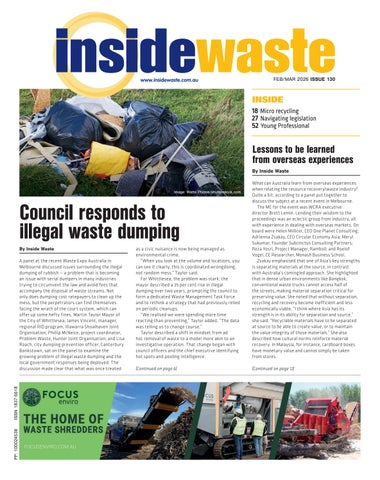
A panel at the recent Waste Expo Australia in Melbourne discussed issues surrounding the illegal dumping of rubbish – a problem that is becoming an issue with serial dumpers in many industries trying to circumvent the law and avoid fees that accompany the disposal of waste streams. Not only does dumping cost ratepayers to clean up the mess, but the perpetrators can find themselves facing the wrath of the court system, which can offer up some hefty fines. Martin Taylor Mayor of the City of Whittlesea; James Vincent, manager, regional RID program, Illawarra Shoalhaven Joint Organisation; Phillip McNeice, project coordinator, Problem Waste, Hunter Joint Organisation; and Lisa Roach, city dumping prevention officer, Canterbury Bankstown, sat on the panel to examine the growing problem of illegal waste dumping and the local government responses being deployed. The discussion made clear that what was once treated
as a civic nuisance is now being managed as environmental crime.
“When you look at the volume and locations, you can see it clearly, this is coordinated wrongdoing, not random mess,” Taylor said.
For Whittlesea, the problem was stark: the mayor described a 35 per cent rise in illegal dumping over two years, prompting the council to form a dedicated Waste Management Task Force and to rethink a strategy that had previously relied on periodic cleanups.
“We realised we were spending more time reacting than preventing,” Taylor added. “The data was telling us to change course.”
Taylor described a shift in mindset from ad hoc removal of waste to a model more akin to an investigative operation. That change began with council officers and the chief executive identifying hot spots and pooling intelligence.
(Continued on page 6)
By Inside Waste
What can Australia learn from overseas experiences when relating the resource recovery/waste industry? Quite a bit, according to a panel put together to discuss the subject at a recent event in Melbourne. The MC for the event was WCRA executive director Brett Lemin. Lending their wisdom to the proceedings was an eclectic group from industry, all with experience in dealing with overseas markets. On board were Helen Millicer, CEO One Planet Consulting; Adrienna Zsakay, CEO Circular Economy Asia; Meryl Sukumar, Founder Subcinctus Consulting Partners; Reza Yosri, Project Manager, Ramboll; and Roelof Vogel, CE Researcher, Monash Business School.
Zsakay emphasised that one of Asia’s key strengths is separating materials at the source, in contrast with Australia’s comingled approach. She highlighted that in dense urban environments like Bangkok, conventional waste trucks cannot access half of the streets, making material separation critical for preserving value. She noted that without separation, recycling and recovery become inefficient and less economically viable. “I think where Asia has its strength is in its ability for separation and source,” she said. “Recyclable materials have to be separated at source to be able to create value, or to maintain the value integrity of those materials.” She also described how cultural norms reinforce material recovery. In Malaysia, for instance, cardboard boxes have monetary value and cannot simply be taken from stores.
(Continued on page 12)


Rubbish dumpers are the bane of councils. The unsightly vista (usually on the outskirts of town or in rural settings) of rubbish is not even the two big issues –costs and environmental impact are. Councils do budget for clearing up dumped rubbish messes left by those selfish enough to think they can get away with it. However, the costs are escalating, and councils are now fighting back, along with the support from the various state/territory EPAs.
One such council is from the City of Whittlesea and its indefatigable Mayor, Martin Taylor (see our top cover story). Taylor is a no-nonsense former police officer and current lawyer, and is taking a hard line on dumpers. The council has invested in CCTV cameras, identifying hotspots, getting the public on side, and has so far recovered $85,000 in bonds. Taylor took his experiences from his former roles and applied them to proactive engagement with the community and getting dumping under control. This included cross-referencing intelligence between the council and outside agencies. This type of information gathering gave the council an insight into how dumpers are working, what areas where most of the dumping occurs,
Chief Executive Officer
Christine Clancy christine.clancy@primecreative.com.au
Managing Editor Mike Wheeler mike.wheeler@primecreative.com.au
Brand Manager
Chelsea Daniel chelsea.daniel@primecreative.com.au
Designer Laura Drinkwater
Client Success Manager Ben Sammartino ben.sammartino@primecreative.com.au Head Office
Prime Creative Pty Ltd 379 Docklands Drive Docklands VIC 3008 Australia p: +61 3 9690 8766 info@primecreative.com.au www.insidewaste.com.au
Subscriptions +61 3 9690 8766 subscriptions@primecreative.com.au
Inside Waste is available by subscription from the publisher. The rights of refusal are reserved by the publisher


and where the council can best allocate resources.
There are two types of dumpers. The household that wants to get rid of unwanted inorganic objects like TVs, mattresses and couches – especially those moving house – and commercial dumpers; those are usually involved in commercial enterprises, which can range from C&D/C&I operators through to those who want to dispose of oil/chemicals in an illegal manner.
Taylor said in his council’s experience, the former rarely reoffend once they are caught and educated on the consequences.
The latter have a much more financial incentive to dump. The costs of disposing of the waste legally gives them the motivation to do it illegally. This is why penalties need to be so high. Hitting offenders in the pocket –especially those small- to medium-sized operators – is one way to start setting the standard that will help discourage such outcomes. While a moderate fine might be inconvenient to some dumpers, one with more weight behind it, might encourage the more desirable outcome – behaviour change.
Articles
All articles submitted for publication become the property of the publisher. The Editor reserves the right to adjust any article to conform with the magazine format.
Copyright Inside Waste is owned by Prime Creative Media and published by John Murphy. All material in Inside Waste is copyright and no part may be reproduced or copied in any form or by any means (graphic, electronic or mechanical including information and retrieval systems) without written permission of the publisher.


(Continued from the Cover)
THE TASK FORCE NOW RECEIVES community reports, deploys plain and covert surveillance and conducts proactive inquiries with a view to preventing repeat

offences. The scale of activity is shown in the figures Taylor supplied: roughly 1,400 reports, 22 CCTV cameras installed in identified hot spots, about 73 clean-up orders issued, and approximately $85,000 recovered in bonds. These results represent a move away from purely remedial costs towards enforcement and deterrence.
A policing model for councils
Taylor, a barrister/solicitor and former police officer, explained that the task force was modelled on policing protocols, with cross-referencing of intelligence between council units and outside agencies. That approach allows investigations to be concentrated where patterns emerge, and to follow leads that start with a seemingly minor incident and lead to wider criminal behaviour.
“Once you treat the behaviour like a crime, you start discovering the networks behind it,” Taylor said.
The task force’s outreach included property managers and real estate agents, tackling the common situation in which vacating tenants dispose of unwanted goods on nature strips. The council deliberately integrated investigative techniques with surveillance and community engagement so
that offences could be treated as breaches of the Environmental Protection Act rather than the mere dumping of household items.
Taylor emphasised that most household offenders, once caught and educated about the consequences, do not reoffend. He said that this is why there is an argument for a combined strategy in which enforcement is paired with education. He also described how the task force had been embedded within the council’s governance arrangements, reporting through a Risk and Audit Committee to ensure transparency and accountability.
“If people understand the consequences, most won’t do it again, it’s the commercial operators who push boundaries,” he said.
Vincent underlined a fundamental constraint that affects many jurisdictions: offenders do not respect administrative boundaries. His program covers eight local government areas and a diverse patchwork of land tenure, including Aboriginal land councils, state forests, national parks, crown land and urban territory.
He warned that poorly regulated skip bin operators in Sydney were collecting material in one area and dumping


it across several LGAs, leaving each council to deal with small fragments of a larger criminal enterprise.
“We’ll catch one part of a load in one council area and another part 40 kilometres away,” Vincent said. “It’s all the same job, just scattered.”
Vincent said the solution hinges on information sharing and cooperation. Increased fines and tougher penalties are now in place in New South Wales, with the value of individual fines raised substantially. He recounted that an offence that might once have attracted a modest fine can now attract penalties of up to $15,000 and that repeat offending can lead to custodial sentences.
“You can’t deter what you can’t connect,” he said. “Link the incidents, and the penalties start to make sense.”
McNeice expanded on the same theme from the perspective of a region that contains 11 councils across a large footprint. He described the difficulty of achieving consistency when neighbouring councils apply different definitions and responses to illegal dumping. This splitting of responsibility in New South Wales places investigations of smaller scale incidents on councils and larger incidents on the EPA. That fragmentation can allow organised operators to
“We’ll catch one part of a load in one council area and another part 40 kilometres away. It’s all the same job, just scattered.”


exploit gaps, moving waste in increments that fall beneath thresholds for broader state action.
“It’s death by a thousand cuts,” McNeice said. “They break up loads, so the offence looks small, even when it’s anything but.”
Technology formed a thread in the panel’s discussion. All four speakers described how cameras, data mapping and emerging artificial intelligence tools can amplify local capacity. Roach said Canterbury-Bankstown had invested in an internal system to plot and map incidents across the local government area, allowing officers to identify hotspot suburbs and target patrols.
“The maps don’t lie,” Roach said. “They show you the story of what’s happening and where to look next.”
The council also deployed 10 surveillance cameras, trained staff to operate them, and used footage not only to issue fines but also to inform strata managers and housing providers when waste originated from particular properties.
Taylor explained that Whittlesea had embraced AI-assisted identification to read number plates from covert cameras and link vehicles to owners.
The council uses covert placement of cameras in hotspots, clear signage to warn would-be dumpers and the follow-through of enforcement action so that those caught face fines and cleanup costs.
“The AI is only going to get smarter,” Taylor said.
“Soon it’ll pick up behaviour before the dumping even happens.”
Vincent and McNeice discussed constraints and possibilities. Currently councils often rely on trail cameras designed for hunting rather than enforcement. Newer camera models that can shoot 8K video and switch fields of focus are arriving. The most promising development is cloud-based AI that can process thousands of images collected over a weekend and highlight a few high-value frames for ranger review.
“We’re drowning in images,” Vincent said. “AI is the only way to turn them into usable evidence.”
Education was another constant theme. Roach described creative local campaigns that combine enforcement with communications. Her team targeted strata managers and property managers with regular notices, sent welcome packs to new renters in hotspot areas explaining how to book bulky waste collections, and built QR-coded materials to measure which messages were read.
“If people get clear, friendly instructions, most of them will do the right thing,” Roach said.
She also highlighted the need for culturally appropriate communication, translating materials into the top languages in the area so new arrivals receive clear instruction about legitimate disposal


Should governments in all jurisdictions increase fines for dumping? Image: Patrick Hatt/shutterstock.com

channels. She also said a suite of options can be effective, from “hard-nosed” signage warning of surveillance through to softer messages that appeal to pride in the local street. Her team found that beautification projects also mattered.
A recurring obstacle is resources. McNeice stressed that officers are thinly spread and required to respond to a variety of regulatory demands. Taylor argued for consistent penalties across jurisdictions and pointed to the importance of mandatory registration and GPS tracking for commercial waste vehicles.
“If every commercial waste truck had GPS, half the mystery would disappear,” Taylor said.
Vincent and McNeice made the same point from different angles: the law must be clear, and the sanctions consistently applied if deterrence is to work. All panellists agreed that the future lies in integration of data, technology and human response. Taylor envisaged a centralised control centre where AI flags anomalies and human operators triage the alerts, quickly dispatching authorised officers or drone assets to the scene.
“It’s not sci-fi,” Taylor said. “It’s the next logical step.”
Roach and McNeice described early experiments with truck-mounted cameras that detect piles of dumped waste and feed that information back to data warehouses for analysis. Vincent pointed to the promise of
cloud-based AI to process the flood of images and select the small number of actionable frames for human follow-up.
“If we get this right, we’ll stop being reactive. We’ll be anticipatory,” Vincent said. Beyond technology, the panel stressed that community eyes remain invaluable. Roach emphasised empowering residents and community groups to act as the council’s “eyes in the field,” and Taylor noted that the bulk of first-time household offenders are deterred by contact with enforcement officers and education. Now is the time of technology, where dumpers are going to find the going tough when trying to get others to clean up their expensive mess.
European cities are ahead of Australian jurisdictions in the waste strategy stakes, offering a timeline benchmark. Image: saiko3p/shutterstock.com

(Continued from the Cover)
IN CONTRAST, A ustralia’s informal sector is undervalued, and contamination in recycling streams remains a major problem. Zsakay said that in Australia, walking around the streets in Perth, and looking in bins early in the morning, it was very easy to see that contamination is a huge issue.
Australia could benefit from both the formal and informal collection systems observed in Asia, including incentivising proper separation, educating communities, and valuing end-of-use materials in a more tangible way.
Sukumar detailed Saudi Arabia’s sector-focused approach to circular economy adoption. Projects targeted industries with the highest potential for change, including food and beverage, basic metals, and packaging. She emphasised that legislative support and structured governance were critical for ensuring that decisions at the government level translated into practical actions at individual sites.
“There is regulatory drive for businesses to adopt various elements of sustainability, but there’s also a lot of funding in place, investing heavily in the private sector to help businesses adopt
new technology and transition towards a circular economy,” she said.
Sukumar suggested that Australia could implement similar strategies by strengthening legislation and simplifying compliance mechanisms, ensuring all businesses have access to grants and support. She also proposed gamifying circular economy adoption, drawing inspiration from container deposit schemes to incentivise behaviour change.
By combining regulatory frameworks, funding, and behavioural incentives, Australia could replicate the sector-level transformation achieved in Saudi Arabia, she said.


With more than 80 years of magnetic expense behind them, Eriez Suspended Electromagnets offer peace of mind, knowing your processes are protected against tramp metal. Eriez. Always the Right Choice.
Protect your downstream crushers, mills, and pulverizers from damage caused by stray digger teeth, tools, and other dangerous metal.


At EcoBatt, we are driving real change through our nationwide Battery Collection Service, which is designed to significantly reduce the number of batteries ending up in landfill. With over 7,000 collection units located across Australia in partnership with major retailers, we are making battery recycling more convenient and accessible than ever before.
Improper battery disposal can have serious consequences. From fires in waste trucks and landfill sites to toxic chemicals leaking into soil and waterways, the risks to our environment, wildlife and community health are far-reaching.
Recycling batteries correctly is a simple yet powerful way to protect what matters. By working together, we can create a cleaner, safer future and preserve valuable resources for generations to come.


Local government and SME adoption
Vogel reflected on lessons from the Netherlands, where local governments actively support SMEs in adopting circular practices. He emphasised that cumulative efforts over time drive change, and local authorities play a key role in knowledge diffusion, training, and facilitation.
“Local governments are the first receiver of most waste streams,” he said. “Evidence shows, from what I’ve seen, it works a lot of the time when the government works with companies to diffuse knowledge and information.”
He noted that European cities implemented circular strategies about 10 years before comparable Australian jurisdictions, offering a timeline benchmark. Vogel also warned against over-investment in infrastructure, citing the collapse of some plastics recycling plants due to voluntary recycled content targets. He said there’s a whole industry in Europe that said, “‘let’s get ready for the time when this volume of plastics is needed…’ now a lot of them are closing,” he said.
Local governments in Australia can therefore focus on creating enabling frameworks, providing guidance, and supporting SMEs to scale circular practices gradually while monitoring market readiness.
A recurring theme in the discussion was the transformative potential of digital product
passports. Zsakay said that these tools could shift the focus from waste management to materials management by tracking products throughout their lifecycle.
She believes that digital product passports will be the biggest transition that the industry will see.
“That will become a game changer,” she said. “It’s about recognising that materials have value. We’re still recycling to save the environment, instead of really focusing on primary raw material and secondary raw material management.”
Sukumar emphasised source-based thinking, advocating for solutions that address the origin of waste rather than symptoms. She said it was important to look at the source and how to change people’s behaviours in understanding this no longer as being a waste, but rather a resource.
Most on the panel agreed that transparency, regulatory frameworks, and proper pricing mechanisms are crucial for the industry. Currently, Australia’s economics as far as resource recovery is concerned, is linear. There is a need to change the economics of the system and move away from such low-cost landfills, where any product that should be recycled can be sent there as rubbish. While there has definitely been a change in the mindset of a lot of people, there is still more work to be done.
The panelists also agreed that this is where education and building knowledge for circular
practices came into play. This can be done at a primary, secondary and tertiary education level, according to the panelists.
Zsakay concluded by stressing innovation driven by resource scarcity.
“Everything in this room comes from a primary raw material,” she said. “If I took that away, do you think that would drive innovation? We would shift to materials management instead of waste management. That’s where your innovation and your new businesses will come from.”
Across the panel, other key themes emerged for translating international lessons into Australian contexts. These include strengthening legislation, incentivising material recovery, developing regional hubs for energy recovery, and embedding circular economy principles into SME support. Digital transparency, product passports, and education emerged as essential tools.
The discussion reinforced that successful circular transitions require combined efforts across policy, technology, local government, and industry, underpinned by clear incentives and market mechanisms. By learning from Asia’s source separation, Europe’s mandatory stewardship, Saudi Arabia’s sector governance and advanced biogas systems, Australia can accelerate its move toward a circular economy
In countries like Malaysia, cardboard boxes have monetary value so people tend to hold on to them instead of throwing them out. Image: InFocus.ee/shutterstock.com


BRAD SCOTT, director of Transmutation based in Robe, South Australia, has built his career at the intersection of chemistry, manufacturing and circular economy innovation. Speaking about the role of micro recyclers in Australia’s transition to a circular economy at the 2025 Waste Expo Australia event in Melbourne, Scott outlined how small-scale operations are reshaping recycling by working where large systems struggle. His company, founded in a remote coastal town, manufactures nationally distributed products made from recovered plastics.
Scott explained that traditional recycling systems were built for scale and uniformity rather than complexity. Large material recovery facilities are designed to process clean, high-volume streams such as PET bottles and HDPE containers. Once plastics become mixed, contaminated or produced in smaller quantities, the economics quickly fall apart. Transport distances compound the problem, and as a result, large volumes of hard-to-recycle plastics continue to be sent to landfill.
He described micro recyclers as filling this structural gap in the system. Rather than competing with large facilities, micro recyclers work alongside them by targeting the waste streams that cannot be economically processed at scale. Operating at between one and 100 tonnes per month, these decentralised operations specialise in local, mixed and niche plastics and turn them into finished products rather than intermediate feedstock.
“We are small, decentralised recycling and more often than not we are also a manufacturing operation,” he said. “We are hands-on, community based and highly experimental. We might work from a shed, a small factory or a local workshop, but the focus is always the same, to turn local waste into a global product.”
From bread tags to national manufacturing
Transmutation began as a backyard experiment between Scott and his wife Narelle on the Limestone Coast, South Australia. Their first trial involved collecting used bread tags and attempting to turn them into useful objects using handmade machinery built from old ovens, car jacks and scrap metal, based on open-source Precious Plastic designs. The early products were handcrafted homewares sold at small markets.
The project outgrew its origins as a creative outlet when commercial retailers took interest in the range. Transmutation’s homewares were eventually ranged in Country Road stores across Australia, with the retailer contributing directly to design development.


What had begun as an experiment in a small shed became the foundation of a manufacturing operation.
A pivotal shift occurred after a chance visit by a Dulux executive to the Transmutation factory store in Robe. The discussion led to a collaboration focused on recovering powder coating waste from the Dulux facility in Dandenong and reprocessing it into a new
polymer. That process is now patent-pending and the resin has been trademarked as PostPrime Resin. From that point, Transmutation began developing products suitable for construction and civil infrastructure. These now include homewares that meet international food safety standards, bar chairs for concrete reinforcement that carry GECA

Microrecyclers are those who are not shy in processing those hard to recycle items that are near the end of their useful lifespan.
certification and Environmental Product Declarations, wheel stops with integrated Internet of Things capability, and limestone eco bricks with superior thermal performance to virgin equivalents. Each product is laboratory tested and engineered to meet Australian standards for durability and compliance.
“Our limestone blocks are also stronger, and have a lighter carbon footprint,” he said. “In essence, our products are as good or vastly better than the virgin material counterparts, and we have proven that these products can be made locally with traceable materials in a carbon positive way.”
Scott placed an emphasis on the national vulnerability created by Australia’s dependence on imported virgin plastic. He noted that Viva is the only manufacturer of virgin polypropylene pellets in the country, meaning that between 90 and 95 percent of virgin plastic pellets used in Australian manufacturing are imported.
This reliance exposes domestic manufacturing to international supply chain shocks and undermines claims of local production. Even when products are manufactured in Australia, the core raw material is typically sourced offshore. Scott argued that recycled plastics already present within the Australian waste stream represent a zero-carbon domestic resource that can be processed locally into high quality materials.
“The only alternative is to use the material that is already here,” he said. “It is here, it is abundant and it


is zero carbon. We just need to process it back to high quality pellets. Australia can make its own material, its own products and its own jobs using the waste we already have.”
Micro recyclers operate on the principle of keeping value within communities by shortening transport distances, reducing emissions and retaining economic activity within regional areas. Scott said this also builds local engagement because communities can see how their waste becomes usable products. Beyond environmental benefits, local recycling also strengthens what he described as sovereignty of supply.
As the number of small-scale recyclers grew across Australia, Scott and his wife recognised the need for a formal structure to connect, support and advocate for the sector. This led to the establishment of the Australian Micro Recyclers Association (AMRA), at the end of 2022.
The association represents 23 members, including two corporate members, and operates as a national federation of decentralised circular manufacturing hubs. Its members collectively provide capabilities across waste collection, processing, manufacturing, CNC machining, tool making, product design, prototyping, machine building for schools, retail and research and development.
Scott outlined a long-term vision of a distributed network of micro recycling hubs embedded within
council depots, city centres and regional towns. Each hub would specialise in different waste streams, diverting unsuitable materials to neighbouring facilities with complementary capabilities. This approach reimagines scale through coordination rather than centralisation.
AMRA is also developing advanced ESG accounting systems that will allow waste volumes processed by individual members to be aggregated and converted into national scale emissions and diversion data. This will allow the collective impact of micro recyclers to be recognised alongside larger operators. The association now participates in national recycling forums and works alongside bigger processors.
“It depends on hundreds of small, capable ones working together and that is in collaboration with the larger facilities and definitely not in competition,” said Scott. “Collaboration is the key for this going forward.”
Case studies and proof of concept Scott presented a range of real-world examples during his speech demonstrating how micro recycling models are already operating across Australia. These included Zero Plastics Australia in Ballarat, which has recycled more than 138,000 plastic lids while delivering education programs to more than 8,000 students, and Upcycler in Lismore, which specialises in CNC-machined recycled plastic components for bespoke manufacturing runs.
Resourceful Living near Newcastle was highlighted for converting over one tonne of hotel amenity packaging into furniture for the Crystalbrook
Kingsley Hotel, demonstrating recycled plastics in commercial hospitality fit outs. Then there is Precious Plastic Melbourne which now focuses on manufacturing small-scale recycling machines for schools under its Zephyr Brothers brand, exporting them internationally for education and community deployment.
Gardening on Country, an Indigenous-owned micro recycler founded in 2023, has progressed from startup to having its products ranged nationally through Bunnings within two years. This achievement demonstrates that recycled Australian made products can achieve mainstream retail distribution.
Other examples included Defy Design in Sydney, whose award-winning furniture is engineered for future recyclability without screws, adhesives or fixings, and Valera Recycling’s hospital wrap back program, which diverts sterilisation wraps into new raw materials rather than landfill.
Banish, operating from central Sydney, runs the BRAD program, the Banish Recycle and Diversion initiative, which collects hard-to-recycle plastics and channels them back through manufacturing pathways while also retailing products made by other micro recyclers.
“Our main point of difference from other recyclers is our ability to take hard to recycle waste streams and combine them with other recycled plastics to formulate a high quality and very consistent resin,” said Scott. “We are also at the forefront of accreditation, provenance and ESG reporting.”


Ennovo provides comprehensive solutions for the management of recycled organics based on extensive experience with designing, constructing and operating recycled organics facilities.

Ennovo provides comprehensive solutions for the management of recycled organics based on extensive experience with designing, constructing and operating recycled organics facilities.
Specialist Services
FOGO management and processing
Specialist Services
Specialist Services
Site assessment and approvals
FOGO management and processing
Market assessment and development
Site assessment and approvals
Composting – open windrow and in-vessel
Market assessment and development
Process and product development
Composting – open windrow and in-vessel
Ennovo’s Carbon Air system automates forced aeration for e cient composting in windrow and in-vessel applications. With telemetryenabled automation, it reduces costs, optimises operations, and ensures high-quality output, making it ideal for FOGO composting. Ennovo provides end-to-end solutions from design to market development.
Third party compliance support
Process and product development
Ennovo’s Carbon Air system automates forced aeration for e cient composting in windrow and in-vessel applications. With telemetryenabled automation, it reduces costs, optimises operations, and ensures high-quality output, making it ideal for FOGO composting. Ennovo provides end-to-end solutions from design to market development.
Carbon credit development and management
Third party compliance support
Carbon credit development and management


THE KIVERCO PS122 picking station has been developed as a flexible and mobile solution for modern waste sorting and recycling operations. It offers a practical response to the growing demand for highquality material recovery across a range of waste streams. Designed as a two-bay mobile unit, the PS122 is built to deliver efficient separation without the need for permanent infrastructure, making it suited to operators who require rapid deployment and adaptable processing capability.
At the heart of the PS122 is the integration of several separation technologies within a single compact system. Ferrous metal recovery is handled by an overband magnet mounted externally to the picking cabin, allowing steel and other magnetic metals to be removed automatically from the material flow before it reaches the manual picking zone. This reduces the manual burden on operatives while improving both safety and the purity of recovered metal.
Light fraction separation is achieved through a built-in air separation system located at the feed-in point. Using a blower and adjustable air knife, the windshifter lifts lighter materials such as paper and plastics away from heavier fractions. This early-stage separation improves downstream material quality and helps stabilise throughput across varying waste types. The combination of mechanical and air-based separation allows the PS122 to tackle highly mixed input materials with consistency.
The enclosed picking cabin forms the core of the manual sorting process. The station is insulated and weatherproof, with low energy lighting and emergency stop systems running the length of the
conveyor. The working environment is designed to protect operators from the physical and biological hazards traditionally associated with waste sorting. Optional heating and cooling systems allow the unit to remain productive in extreme weather, while integrated dust control reduces airborne particulate exposure. Conveyor speed is controlled directly by operators, enabling throughput to be adjusted in real time to match material composition and staffing levels.
Mobility is one of the defining advantages of the PS122. The unit is built on a single-axle wheeled chassis. Hydraulic jack legs provide stabilisation and height adjustment once in position, while a wheeled site axle supports transport within yards and facilities. The diesel electric power system allows the station to operate independently of fixed electrical supplies, which removes a barrier to deployment in remote or temporary locations. Arrival on site to operational readiness can be achieved in under an hour, enabling true plug-and-process functionality.
In the Australian context, the PS122 offers a direct response to several challenges faced by the waste and recycling sector. Contamination remains an obstacle to producing saleable recycled materials, while confusion over recycling rules and the persistence of wish-cycling continue to degrade feedstock quality. By combining magnetic separation, air classification and controlled manual picking, the PS122 allows operators to remove contaminants at the earliest possible stage, protecting downstream processing equipment and improving the market value of recovered materials.
Construction and demolition waste is another area where the PS122 works well. The increasing volumes
generated by infrastructure growth need flexible systems capable of separating timber, metal, clean stone and concrete from contaminated hardcore. The picking station provides the level of control needed to isolate high-value fractions while dealing effectively with mixed and variable inputs.
The system also supports broader landfill diversion and circular economy objectives by enabling higher recovery rates from materials that might otherwise be discarded. By improving material purity and reducing reliance on landfill, operators can build more resilient recycling operations while responding to tightening regulatory and community expectations.
For skip hire companies and waste processors seeking scalable and cost-efficient solutions, the PS122 offers a balance of performance, mobility and operational independence. The absence of permanent infrastructure requirements keeps capital expenditure low and allows a recycling operation to be established quickly, with minimal lead time from delivery to production. This enables businesses to increase sorting capacity as needed, supporting immediate operational demands while providing flexibility for long-term growth. The Kiverco range is sold exclusively by Lincom Group and is supported by a national after-sales service and support network. From commissioning and operator training through to parts availability and ongoing technical assistance, Lincom provides the backing required to keep equipment operating reliably in demanding conditions. This local support ensures that operators not only benefit from Kiverco’s proven design, but also from long-term service capability and peace of mind once the machine is in the field.

QUEENSLAND HAS SOME OF THE MOST progressive regulations in Australia for composting and contamination control. Any facility processing more than 200 tonnes of organic material annually is required to hold an Environmental Authority and to manage contaminants in accordance with the state’s Environmentally Relevant Activity (ERA 53) guidelines. These guidelines place emphasis on odour reduction, PFAS limits, and the removal of physical impurities such as
plastics, metals, and stones. High-quality compost, compliant with the Australian Standard AS 4454-2012, depends on reliable systems that consistently reduce contamination at scale.
Within this regulatory environment, a three-day demonstration of the Komptech Hurrikan S separator was carried out at a composting facility in Swanbank, Queensland. The intention was to show how advanced wind sifting could support
operators in meeting compliance expectations while maintaining good throughput and producing clean organic output. Swanbank had been an expanding industrial precinct known for resource recovery and renewable energy, and the composting site processed sizeable volumes of mixed organic feedstock every day. Like many facilities across Australia, it faced an ongoing struggle with contamination, particularly from light plastics that bypassed conventional screening equipment.
The Hurrikan S was positioned alongside a mobile trommel screener, wheel loader, and tracked stackers to create an integrated processing line. After the trommel separated the overs, the remaining stream, which was made up of compost material mixed with film plastics and lightweight packaging, was directed into the Hurrikan S. Once inside, a patented air-knife system generated a focused, high-velocity airflow that lifted and removed light contaminants from the heavier compost fraction. A suction blower then


captured these plastics and transferred them away from the material flow, ensuring that the remaining organics progressed through the system with reduced contamination.
To maintain steady operation, a vibrating feed conveyor provided consistent material movement, minimised surging and prevented blockages. Downstream, a rolling fraction separator automatically extracted stones and similar heavy impurities, while a magnetic end-roller removed ferrous metals without manual intervention. Together, these components produced a refined output suitable for further maturation or immediate blending, depending on the operator’s process design.
The Hurrikan S has been engineered for reliability, flexibility, and performance. It operates with a 55/74 kW drive system and features a dual-fan airflow arrangement with variable-frequency control, allowing operators to fine-tune airflow intensity based on material type and contamination load.
The model’s capability for either diesel or electric operation provides adaptability for fixed-site facilities, as well as mobile contractors. For facilities with grid access, electric operation is said to enable lower running costs and reduce onsite emissions, aligning with broader sustainability targets.
The airflow system, rolling fraction separator, and magnetic end-roller worked together to remove more than 90 per cent of light plastics from the compost stream, while efficiently separating rocks and metals. Throughput reached up to 600 cubic metres per day, confirming the machine’s ability to handle high-volume operations. Fuel consumption sat at approximately 6 litres of diesel per hour, which is low for a system of this capacity, and the unit remained capable of transitioning to mains power for further efficiency gains. By the conclusion of the demonstration, a full skip lined with shade cloth held the recovered plastic fraction, providing confirmation of separation effectiveness.
The outcomes were visible: cleaner compost, reduced labour requirements, and faster processing. The trial showed that the Hurrikan S delivered dependable contamination control under realistic operating conditions and offered a practical solution for facilities needing to comply with evolving environmental standards. As regulations continued to tighten and market expectations for low-contamination compost increased, the equipment demonstrated its value as a forward-ready technology that supported both environmental responsibility and operational performance.
The Hurrikan S, along with the broader Komptech range, is sold and supported in Australia by Lincom Group. With sales, parts, and service teams across the country, Lincom ensures operators have access to reliable technical support, genuine spare parts, and ongoing guidance to keep their separation systems running at peak performance.


VICTORIA’S WASTE AND RESOURCE recovery sector is in the midst of a regulatory shift, not only in terms of how waste streams are handled, but also the Silver Report convincing the state government to pull the plug on Sustainability Victoria – arguably one of the government entities actually getting stuff done – and merging EPA Victoria and Recycling Victoria. Since the introduction of the General Environmental Duty (GED) in 2021, operators across the state, from large processors to small transfer stations, have been adjusting to a model that prioritises risk prevention over traditional enforcement. At a recent industry panel held and Waste Expo Australia in Melbourne, three experts unpacked the real-world challenges that businesses are encountering and where the state’s regulatory framework is still struggling to meet its own aspirations.


Dr Richa Vijayraj, director at Impact HQ Australia; Richard Jolley, environment and sustainability manager at Sycle; and; Geri Robles, senior environmental engineer at SMEC, each outlined a system that is well-intentioned, yet burdened by complexity, inconsistency and fragmented oversight. Their insights paint a picture of an industry eager to comply, but constrained by ambiguity, resource limitations and a regulatory environment still finding its rhythm.
shift that’s still finding its feet
Reflecting on the shift from enforcement to prevention under the GED, Vijayraj noted the magnitude of change expected of businesses. Prior to 2021, compliance meant avoiding penalties and adhering to licence conditions.


“The approach was – something goes wrong, and then there will be penalties,” she said. “But GED introduced a new front-loaded responsibility that included businesses must consider environmental impacts before undertaking any activity.”
This universal duty applies to all operators, large or small. While many support the intent, Vijayraj said companies are now grappling with the transition from tick-box compliance to risk-based, continuous improvement. The challenge is exacerbated when businesses must provide similar information to multiple regulators, such as EPA Victoria, councils and federal agencies, each with different formats, terminology and expectations.
“That results in compliance fatigue,” she said. “Operators respond to the same data requests in different formats. It’s not helping anyone.”
One of the main concerns is the subjectivity built into the requirement to act “so far as reasonably practicable’, which is mentioned in the act. While intended to provide flexibility, it can also leave businesses uncertain about how to demonstrate compliance.
“They paint a picture of an industry eager to comply, but constrained by ambiguity, resource limitations and a regulatory environment still finding its rhythm.”
Vijayraj gave the example of a fragrance manufacturing company that invested in secondary containment upgrades. Despite its efforts, the business remained unsure whether its interpretation
internal environmental teams. Larger operators often employ engineers, compliance officers or consultants. Smaller businesses, by contrast, are often left to navigate complex requirements without dedicated expertise, which was a theme echoed across the panel.
According to Jolley, the shift to prevention has imposed an administrative and financial burden. The need for risk assessments, options analyses, engineering controls, monitoring systems, training programs and detailed record-keeping all drive costs upward.
“It’s not just controls. Now we need to prove, so far as reasonably practicable, that we have considered every step,” he said. “The cumulative effect is significant: consultancy fees, internal labour, testing
with the future lead authorities, according to Jolley. He said that early engagement is critical, but even then, the process isn’t always smooth.
He also pointed to a shift in responsibility that has landed disproportionately on waste receivers. Although producers are legally responsible for classifying their waste, receivers face the greatest risk if materials are misclassified.
For everyday operators, particularly transfer stations run by councils, the step change has been substantial. Many of these facilities were not previously regulated, said SMEC’s Geri Robles. Small changes, such as storage adjustments or operational

challenging to find the right documents online,” Robles admitted. “For on-site managers used to long-established routines, the added regulatory layer can be overwhelming.”
Adding to the complexity is the need to navigate both planning and environmental approvals. Councils and the EPA evaluate different impacts. For example, the EPA considers emissions, noise, odour and water discharge, while councils assess land-use changes and impacts on neighbouring areas. Robles stressed that operators often underestimate how these processes intersect. She explained that people need a clear narrative, and they need to know what each regulator is looking for.


as an under-used tool. Businesses can submit a description of their proposal and receive advice on which permissions apply and what assessments are required. While consultancies frequently prepare these documents on behalf of clients to streamline the process, Robles emphasised that the service can be an excellent low-cost entry point for operators who have internal capacity.
Another method gaining traction is approaching EPA directly with well-prepared information outlining why a project may qualify for exemptions, such as development licence exemptions.
“It’s been a really great route for engaging with EPA on quick feedback,” Robles said.
Jolley agreed that early, transparent engagement is essential.
“Taking EPA on your journey from the very beginning really does help a project succeed,” he said.
One of the strongest messages from all three experts was the need for alignment between regulators. Vijayraj emphasised cases where operators complied with EPA guidelines only to be told by Sustainability Victoria that interpretations differed.
“That’s where frustration starts,” she said. “You think you’re doing the right thing, and one regulator agrees while another does not.”
This may be changing with the aforementioned changes regarding the three main regulatory bodies in the state. A single, consolidated framework, or even a centralised data portal, would dramatically reduce compliance costs and inconsistencies. “Some kind of consolidation in terminology, forms and approaches would help enormously,” she said.
Asked what they would change about Victoria’s regulatory framework, each panellist offered a distinct but complementary reform.
Jolley called for stronger accountability on waste producers to classify waste correctly and more support for recycled materials to compete on a level playing field with virgin products.
Vijayraj argued for consolidation across regulators and expanded education programs, including communities of practice that allow businesses to learn from one another.
“Many businesses want to do the right thing, but don’t know where to go,” she said.
Robles pointed to vague areas within the regulations, particularly around emerging materials such as digestate and thermally treated soils, where clearer definitions and guidance would greatly assist the industry.
On whether industry-led codes of practice could help bridge gaps between regulation and enforcement, all three speakers agreed. Accessible training, communities of practice and clearer professional standards could help small operators meet obligations without excessive consultant costs.
The panel even entertained the question of licensing consultants. Vijayraj noted that defining qualifications, which would be similar to chartered accountants, could bring consistency and reduce conflicting advice. Robles added that larger consultancies already use rigorous internal quality systems, but acknowledged that the industry would benefit from clearer standards across the board.
Victoria’s waste and resource recovery regulations have taken a bold step toward preventive, risk-based oversight. But as this panel revealed, the framework still has growing pains. Fragmented requirements, ambiguous interpretations and inconsistent guidance continue to affect operators.
Yet the sentiment across the industry remains constructive. Businesses want clarity, consistency, regulators speaking the same language, and above all, they want compliance to support, not hinder, the environmental outcomes the framework is designed to protect.
BEFORE ADOPTING COOEE , waste management data collection and reporting at both Manjimup Shire Council in Western Australia and Streaky Bay District Council in South Australia, were laborious processes. Mark Sewell, waste management officer at the Infrastructure Services Depot for Manjimup Shire Council, explained that each month he received around 120 sheets of paper from the landfill, with transactions recorded in pencil. These sheets used historic categories that did not align with reporting requirements, forcing him to interpret the data manually before entering it into Excel for annual reporting.
“It was very time intensive, a lot of hunting back and forth for more explicit information or to corroborate what I thought I had,” he said. “This was all paper in folders, in boxes – something from the Dickensian era really.”
Similarly, Penny Williams, general manager prosperity at Streaky Bay District Council, described a system reliant on small receipt books.
Staff manually recorded every transaction, all in cash, which at the end of each month required the team leader to enter the data into spreadsheets. Conversion tables were then used to estimate tonnages, and reporting relied on manually created graphs and trend lines in Excel.
“It was incredibly vulnerable, with plenty of room for error,” Williams said. “There was no real accountability for the staff because it was all done manually.”
Both councils recognised that their manual systems limited the ability to analyse trends effectively. Beyond the time-consuming data entry and risks of human error, inconsistencies in categorisation could distort reporting.
Sewell initially attempted to streamline data collection by creating his own spreadsheet. However, his contractors found it cumbersome. Around the same time, he became aware of Cooee,
initially through another southwest WA landfill operator and at a state conference. He approached Cooee for a demonstration, and the adoption process began.
“It was pretty easy for the site contractor to start up,” he said. “I bought a tablet, and then connected it to the internet. Then I could sit back at my desk and go into the portal and look at individual transactions or a day’s transactions. I can do anything I like. It’s all there live on the screen.”
Williams described a similar transition at Streaky Bay, combining Cooee implementation with the introduction of an EFTPOS facility to reduce cash handling risks.
“Whilst it’s come at an additional cost, I still believe the cost saving also reduces risks, the housing of data, consistent conversion metrics, and it saves my time with reporting to council,” she said. “We can extract the data straight into the reporting we need to do to external agencies as well.”
Both recognised that Cooee offered more than

just efficiency; it provided a reliable, digital record of every transaction, eliminating the risk of lost or misplaced paper records.

Both Sewell and Williams highlighted the benefits of Cooee’s intuitive design and structured data entry. Sewell said that upgrading from the basic version to a comprehensive platform allowed for more consistent and accurate entries, simplifying processes for both older and younger staff members.
“Whereby with the basic iteration staff would be typing a load of letters into the field, now they type the first letter and a whole lot of optional names comes up,” Sewell said. “It restricts them to more accurate and consistent entries.”
Williams emphasised the reduction of human error in her operation, particularly when dealing with cashless transactions. Automatic fee calculations now prevent staff from manually adjusting amounts, while built-in discount settings allow for specific customer considerations.
She said that a percentage of that increase is due to more accurate receiving occurring. Now, when staff use Cooee, it automatically comes up with a fee, and they can’t adjust that. They go to the team leader to get an adjustment or a discount. The software also enforces consistent measurements across staff, reducing discrepancies in converting cubic metres to tonnages. This ensures that reporting to regulatory bodies is accurate and reliable.
Cooee improved reporting efficiency at both councils. Sewell estimated that reporting,
“I can look at the data I’ve got there for the last several years and see trends. The answers are there rather than going back and getting archive boxes out.”
days, can now be completed within a single working day. The software allows him to access detailed transaction data, track cash versus account holders, and analyse trends such as asbestos disposal.
“I can look at the data I’ve got there for the last several years and see trends,” Sewell said. “The answers are there rather than going back and getting archive boxes out.”
The platform allows Williams to monitor daily income, track transactions per day, and make informed recommendations on opening hours and staffing requirements.
“We can also see changes in waste streams, times of the year when certain streams peak, and transactions per day,” she said. “It’s been valuable to demonstrate to council the financial impact of weekend openings.”
In addition, the software allows both councils to prepare for regulatory reporting with confidence. Data can be downloaded directly into Excel for further analysis, enabling better forward planning and infrastructure decision-making.
Both councils experienced initial staff resistance, but training and intuitive software design facilitated adoption. Sewell noted that younger landfill staff quickly adapted to the upgraded
“The [older staff] were not happy with the very first rollout, but when we moved from the basic to the upgraded version, they changed very easily,” Sewell said. “It was more clear cut, accurate, and consistent.”
Williams found that staff at Streaky Bay adjusted well to using iPads and smartphones for real-time data entry.
“Staff have adapted really well,” she said. “They all now have it on their phones, so they can just get it out, do it, easy, done. They don’t have to worry about losing receipts or losing the books. It’s all kept in real time.”
Both managers highlighted that real-time data entry improved accountability. Transactions are now timestamped and tracked, making it easier to identify discrepancies or verify details when issues arise. Williams noted that even registration numbers of vehicles can be recorded for security incidents, which was impossible with the old manual system.
Both councils view Cooee as an essential tool in improving efficiency, accuracy, and accountability in waste management. By enabling consistent data entry, reducing human error, and supporting informed decision-making, Cooee has transformed waste management from a laborious manual task into a streamlined, data-driven operation.

A DISCOVERY LED BY the University of St Andrews has found a way to turn ordinary household plastic waste into the building block for anti-cancer drugs. Household PET (polyethylene terephthalate) waste, such as plastic bottles and textiles, can be recycled in two main ways: mechanically or chemically.
Chemical recycling breaks down PET’s long polymer chains into individual units called monomers into other valuable chemicals.
Published in the Angewandte Chemie International Edition researchers discovered that by using a ruthenium-catalysedsemi-hydrogenation process, PET waste could be depolymerised into a valuable chemical, ethyl-4-hydroxymethyl benzoate (EHMB).
EHMB serves as an intermediate for synthesising several important compounds, including the anticancer drug Imatinib, Tranexamic acid – the base for medication that helps the blood to clot, and the insecticide Fenpyroximate.
Currently, these types of medication are created using fossil-derived feedstock, often using hazardous reagents producing waste.
This research offers better environmental benefits
compared to conventional industrial methods for producing EHMB as confirmed by a comparative hot-spot analysis in a streamlined life cycle assessment approach. This means quickly pinpointing the parts of a product’s lifecycle that cause the most environmental impact so it’s known where improvements will matter most.
Additionally, researchers discovered that EHMB can be converted into a new and recyclable polyester.
“We are excited by this discovery, which reimagines PET waste as a promising new feedstock for generating high-value APIs (Active Pharmaceutical Ingredients) and agrochemicals,” said lead author of the paper, Dr Amit Kumar from the School of Chemistry at St Andrews. “Although chemical recycling is a key strategy for building a circular economy, many current technologies lack strong economic feasibility. By enabling the upcycling of plastic waste into premium products instead of reproducing the same class of plastics, such processes could meaningfully accelerate the transition to a circular economy.”
“For catalytic upcycling to become practical,
the catalyst must operate efficiently at low loadings and maintain activity over long periods,” said the lead of the collaborative partner organisation, TU Delft in the Netherlands, Professor Evgeny Pidko. “All catalysts eventually deactivate, so understanding when and how this happens is critical to pushing turnover numbers to levels relevant for real applications. In this study, we combined detailed kinetic and mechanistic analysis to understand catalyst behaviour under the reaction conditions and used this knowledge to optimise the system towards record turnover numbers of up to 37,000.
This emphasises the importance of fundamental mechanistic insights to optimise catalyst durability and overall process efficiency.”
Dr Benjamin Kuehne and Dr Alexander Dauth from collaborative partner organisation, the chemical and pharmaceutical company Merck KGaA, said that the pharmaceutical manufacturing generates substantial amounts of waste per kilogram of product, highlighting the urgent need for innovative sustainable chemical processes and raw materials with reduced environmental footprints.
THE TIGERCAT 6040 CARBONIZER is a mobile, industrial-scale system designed to convert clean wood debris into high-quality organic carbon through a controlled thermal process. Engineered for high throughput and operational efficiency, the machine is intended for forestry, land clearing and biomass recovery applications where large volumes of woody material must be processed on site.
At the core of the system is a carbonising chamber lined with specially formulated thermal-ceramic panels. These panels store and reuse heat energy generated during carbonisation, creating sustained and evenly distributed internal temperatures while keeping external back-face temperatures low. The replaceable panel seal-plate design improves temperature stability, reduces wear and extends service life. This controlled thermal environment supports higher infeed rates, increased yield and consistent organic carbon quality, while also contributing to reduced emissions.
Material handling is designed around continuous operation. The 6040 requires no feedstock pre-processing, allowing raw clean wood debris to be introduced directly into the system. Temperature
control sensors are distributed throughout the machine to monitor operating conditions and maintain optimal carbonising performance. Chamber temperatures are maintained at up to 1095˚Celsius, supported by thermal-ceramic sidewalls that minimise heat loss and stabilise the process.
Emissions management is addressed through a dual airflow system that creates a vortex zone within the chamber. This zone combusts released gases as part of the process, reducing atmospheric discharge and improving overall environmental performance. The result is a conversion system focused on efficiency, regulatory compliance and practical deployment in remote or active work sites.
Discharge is handled by an integrated, bolt-on pivoting conveyor. The conveyor offers a 105-degree swing and approximately 3.65 metres of clearance, allowing flexible placement and easy handling of the organic carbon output. For transport, the conveyor stows within the machine’s width and height envelope, simplifying road movement between sites.
The water system is designed for reliability across varied operating conditions. Water can be supplied from onboard tanks, tanker trucks or external sources.
An auger trough bath quenches the produced carbon, with smart sensors automatically maintaining correct water levels. Optional features include a sprinkler system with an operating radius of up to 11 metres and adjustable cycles, as well as a cold-weather plumbing package for low-temperature environments.
Power is provided by a Tigercat-specified FPT N67 Tier 4f engine delivering 151 kW at 2,200 rpm. Heavy-duty tracks give the machine strong off-road mobility, supporting operation in forestry blocks, land clearing projects and other uneven terrain.
The Tigercat-designed operating system provides a simple, intuitive interface intended to reduce operator workload and streamline daily operation.
The Tigercat 6040 Carbonizer is positioned as a cost-effective and environmentally focused solution for converting clean wood debris into organic carbon, with the added benefit of sequestering up to 30 per cent of the available carbon from the original feedstock. Now available in Australia, it offers a mobile alternative to fixed biomass processing infrastructure.
The Tigercat 6040 Carbonizer is available for demonstration through local dealer Onetrak.

By Mike Ritchie
GREATER SYDNEY will run out of landfill capacity by 2030 unless urgent action is taken. The NSW Environment Protection Authority (EPA) has released the first chapter of its Waste and Circular Infrastructure Plan, acknowledging the scale of the problem and setting out solutions. But success depends on getting three policy levers right. And that means treating the landfill cliff not just as a crisis to manage, but as a driver for systemic reform.
The crisis
Greater Sydney is facing an acute waste infrastructure shortfall. Currently, four landfills handle the region’s putrescible waste (the everyday household waste that fills red-lid kerbside bins). Due to scheduled closures, these landfills will lose capacity and, by 2030, face a shortfall of approximately 1.1 million tonnes per year. This gap will widen to 1.4 million tonnes per year by 2040 (Figure 1).
In practical terms, this means that from 2030, some of Greater Sydney’s waste will have no viable local disposal pathway. Households and businesses would face a 20 per cent increase in red-bin collection fees. Construction and demolition activity could grind to a


halt, disrupting critical infrastructure projects including housing development. According to the NSW EPA Plan, the economy could lose an estimated $23 billion, with 11,550 job losses and a 1.7 per cent fall in average wage rates. People facing higher disposal costs may resort to stockpiling or illegally dumping waste, poisoning the environment and threatening public health.
The NSW Government, to its credit, has now


acknowledged the problem. Minister for Environment, Penny Sharpe, and the Minns Government have accepted the reality of the landfill cliff and begun putting solutions in place, including the FOGO mandates to divert organic waste from landfill. This is a welcome shift from years of inaction; the industry has been calling for a proper infrastructure plan for over a decade.


The plan’s response
The Government’s approach is to enable a mix of solutions to address the void. These include:
• Streamlining planning approvals to fast-track extensions and expansions of existing landfills.
• Considering reopening closed landfills where necessary to create additional capacity.
• Enabling Energy from Waste (EfW) facilities where they can safely reduce reliance on landfill.
• Improving waste infrastructure planning at a strategic, government-wide level.
On the surface, this could read as an open slather on landfills. A swing from scarcity to excess. That must be avoided, because oversupply of landfill void space creates a new set of risks.
The risk – race to the bottom
If Government approves new landfill capacity without managing associated policy settings, competition for waste will intensify, gate fees will collapse, and recycling will lose its economic viability. Tonnes will inevitably chase cheap disposal. Recyclers relying on stable prices and minimum tonnages will see their business cases evaporate. The outcome would be a slide backward on recycling rates and a failure to meet the national target of 80 per cent resource recovery by 2030.
To avoid this, Government must acknowledge a hard truth: even with aggressive recycling and the FOGO mandates, approximately 20 to 30 per cent of waste is either impractical, impossible, or too costly to recycle. Government has a responsibility to ensure this residual material can be safely disposed. But that responsibility does not mean opening the floodgates without guardrails.
Instead, Government must treat the landfill cliff as an opportunity for reform and a moment to reset
the system so that recycling is protected and residual waste is managed responsibly.
Getting the package right
Three policy levers must work together to make this work:
1. Disposal availability (landfill void and/or EfW capacity)
Government must ensure sufficient safe disposal pathways for residual waste, avoiding both crisis (undersupply) and perverse incentives (oversupply). This requires careful strategic planning of landfill and EfW capacity, aligned with falling waste volumes as recycling improves. The risk is creating excess availability that destabilises the recycling market.
2. Landfill levy pricing
A robust landfill levy acts as an economic floor, protecting recycling by raising the cost of disposal and keeping gate fees above a critical threshold. Without a sufficient levy, competition for waste between disposal and recycling will drive prices down, and recycling businesses will lose viability. The levy must be set to account for genuine residual waste disposal needs, not to penalise landfill operators, but it must also keep disposal expensive enough that recycling remains the economically rational choice.
3. Resource recovery mandates and capacity
Regulatory mandates like the FO (food organics) and FOGO (food and garden organics) collection requirements establish a floor of protected tonnage for the composting and recovery sector. As these materials must be collected separately by 2030 (protecting up to 950,000 tonnes of household organic waste from landfill
annually), the abundance or scarcity of landfill void does not undermine their market.
Done right, these three levers create a stable system: there is safe disposal for residual waste; recycling has protected economics; and waste reduction is incentivised at every level. Done wrong, such as by approving new landfill void without adjusting the levy or strengthening mandates, the system collapses into disposal-chasing and recycling failure.
The landfill cliff is not simply a short-term problem to be solved by approving more landfills. It is a structural challenge that demands a package of reform. The NSW Government has recognised the urgency and begun to act.
The next phase must be disciplined: Government must streamline planning for residual waste infrastructure while simultaneously strengthening the policy settings that protect recycling from the risk of cheap disposal. NSW currently landfills seven million tonnes of waste. Easily half of that can still be recovered. That reduces the size, scale and urgency of the cliff
Additionally, the government must move on EPR for packaging, batteries, e-waste, furniture and the like. It must create the economic incentives for C&I waste sorting and recovery (especially cardboard, metals, plastic and timber) and it must continue to push the levy to create the economic conditions for the private sector to invest in C&D recovery. NSW cannot credibly meet the national 80 per cent recovery target by 2030 if the landfill cliff is managed in isolation. The cliff is a driver for change. Government must use it that way.
Mike Ritchie is MD of MRA Consulting Group.
LONGEVITY IS NOT ALWAYS COMMON in Australia’s waste and recycling sector. Over time, the industry has seen regulatory change, shifting environmental priorities, fluctuating commodity markets and the emergence of new and complex waste streams. Many operators have entered the market only to exit again when conditions changed. Fewer still have remained focused on specialist, regulated and hazardous waste for the long term.
In 2026, EcoCycle will mark 30 years of operation. It is a milestone that reflects not scale or diversification for its own sake, but sustained specialisation in technically demanding areas of recycling and waste management. While EcoCycle today sits within the broader EcoCycle Group, the anniversary belongs to EcoCycle itself, the specialist recycler that built its reputation managing hard-to-recycle materials.
When EcoCycle Industries was formed in 1996 by the Rowe family, its original focus was silver recovery, reflecting the dominance of photographic and imaging technologies at the time. As digital technology rapidly displaced film-based systems, the company adapted, identifying emerging environmental risks associated with legacy materials generated as older technologies were phased out.
By the late 1990s, mercury had become a growing concern across multiple sectors. In 2000, EcoCycle Industries acquired ARA, which had been recycling mercury for several years but was facing operational
and technical challenges. The acquisition marked a turning point, with EcoCycle investing in modernising equipment and working closely with industry to improve understanding of the risks associated with improper mercury disposal.
This period coincided with increasing regulatory attention on hazardous materials and the early development of international frameworks governing mercury management. EcoCycle’s work during this time helped establish specialist mercury recycling as a necessary service rather than a niche offering.
In 2007, CMA Corporation acquired EcoCycle Industries, rebranding the business as CMA EcoCycle. While ownership changed, the specialist nature of the operation remained. In 2010, several members of the original EcoCycle management team departed to establish metals recycling business Recycal, founded by the Rowe family.
The specialist nature of mercury recycling came sharply into focus in late 2013 when CMA Corporation entered administration. With the future of domestic mercury recycling uncertain, industry stakeholders encouraged the original EcoCycle management to re-enter the space. Later that year, Recycal acquired the assets of CMA EcoCycle, including the EcoCycle name, and restored and recommissioned equipment that had been neglected.
By 2019, the CMA branding was formally dropped and the business returned to its original name, EcoCycle, reflecting both continuity and renewal. The rebranding marked the beginning of the company’s current chapter
as a specialist recycler, operating within an increasingly complex regulatory and environmental landscape and holding EPA licensing specific to mercury recycling.
From the outset, EcoCycle positioned itself as a specialist recycler rather than a generalist operator. That decision shaped the company’s culture, investment priorities and long-term outlook.
According to Doug Rowe, CEO and managing director, the company’s early direction was deliberate.
“From the beginning, EcoCycle focused on waste streams that carried real risk if they were not managed properly,” Rowe said. “These were materials that needed specialist knowledge, strict controls and a willingness to invest in systems and compliance long before it was commercially easy to do so. We saw an opportunity, researched and sourced the best equipment, purchased, and built the company-owned facility, which ensured we complied to the highest standards in the most efficient way possible. We continue to do this with the same philosophy to stay at the front of emerging recycling opportunity.”
As mentioned, EcoCycle’s early work centred on mercury recycling and recovery, including the retirement of mercury from circulation. This required not only technical capability but also an understanding of evolving environmental standards and international obligations. As operations matured, the company invested in systems for safely handling mercury from a range of sources.

EcoCycle expanded its capabilities in lighting waste recycling, processing fluorescent lamps and other mercury-bearing products in a way that enabled material recovery while preventing environmental release. Dental amalgam and X-Ray film recycling followed, addressing waste streams generated daily by healthcare and dental practices across the country.
These services placed EcoCycle at the intersection of waste management, public health and environmental protection. Compliance was not a box to be ticked but a core operating principle underpinning every stage of the process.
Nick Dodd, general manager at EcoCycle, says that operating in regulated waste streams requires a different mindset.
“When you work in specialist recycling, particularly hazardous materials, you cannot afford shortcuts,” Dodd said. “Everything from collection through to processing and final outcomes has to be designed around safety, and regulatory integrity. That discipline has shaped how EcoCycle operates across all areas of the business.”
Over the past three decades, regulatory expectations have increased, with stronger EPA oversight and international conventions reshaping how countries approach hazardous waste management, particularly in relation to mercury. For operators without established systems, these changes have been challenging.
The introduction of the Minamata Convention on Mercury marked a defining moment for the management of mercury waste globally. By formalising obligations around mercury reduction, recovery and environmentally sound disposal, the Convention shifted mercury recycling from a specialist service to an essential component of environmental protection. For operators already working in mercury recovery, it reinforced the importance of established infrastructure, documented processes and long-term compliance frameworks, particularly as governments and industry moved to align domestic practices with international expectations.
For EcoCycle, regulatory evolution reinforced the value of long-term thinking and early investment in specialist capability. The company continued to invest in infrastructure and processes designed to meet both domestic and international standards.
This approach extended beyond mercury and lighting waste. EcoCycle expanded into the recycling and management of waste from mining, gas and petrochemical operations, as well as industrial equipment and specialist materials. These sectors produce waste streams that are often complex, contaminated or difficult to classify, requiring tailored solutions rather than off-the-shelf services.
Dodd noted that this diversity of specialist waste has become more pronounced over time.
“Industry is generating more complex materials than ever before,” he said. “Mining and energy operations, for example, are under increasing pressure to demonstrate responsible waste outcomes. Having an experienced specialist recycler that understands both the operational and regulatory realities makes a significant difference.”
Decades of operation brings institutional knowledge that cannot be replicated quickly. EcoCycle’s experience spans periods of minimal regulation

through to today’s highly scrutinised operating environment. That perspective informs how the company approaches emerging challenges.
While much public attention is currently focused on batteries and electronic waste, EcoCycle’s history in hazardous materials provides context for managing risk, designing containment systems and prioritising safety. The skills required to safely process mercury and amalgam are directly relevant to newer waste streams that present similar risks if mishandled.
Rowe believes that this depth of experience is often overlooked in discussions about innovation.
“There is a tendency to focus on what is new without recognising the foundations that make innovation possible,” he said. “EcoCycle’s work in specialist recycling over many years has built the knowledge base and discipline that supports newer technologies and processes across the Group.”
A family business perspective
EcoCycle’s development has been shaped by ongoing family involvement, providing continuity in leadership as the business has expanded. That stability has helped maintain a long-term approach to environmental responsibility as operations and scale have evolved.
EcoCycle’s approach is reflected not only in ownership, but in the people who have remained with the business over time. Many employees bring decades of experience working with specialist and regulated waste streams, contributing to stable, well understood practices as regulation and technology have evolved. That experience has also shaped long-standing client relationships, built on reliability and confidence in the safe management of complex materials.
In specialist recycling, particularly where hazardous materials are involved, decisions cannot be treated as isolated or short term. The combined presence of family involvement, experienced staff and established client partnerships has fostered a culture centred on stewardship, where protecting people, the environment and future generations is embedded in how the business operates.
Part of a broader group
Today, EcoCycle operates as part of the EcoCycle Group, which includes businesses working across recycling batteries, electronic waste, metals and other related services. While those operations address some of the fastest growing waste challenges in Australia and New Zealand, EcoCycle continues to operate as the Group’s specialist business.
Its focus remains on mercury recycling, recovery and retirement, lighting waste, dental amalgam, X-Ray recycling, and complex mining and industrial waste streams. Within the Group, EcoCycle’s role is defined by depth of technical expertise and experience in regulated materials.
As Australia’s waste and recycling sector continues to evolve, the demands placed on specialist recyclers are unlikely to ease. Electrification, infrastructure development and increasing industrial complexity are introducing new materials that require careful handling, while regulatory scrutiny and community expectations continue to rise.
For EcoCycle, the next chapter builds on experience developed across decades working with hazardous and regulated waste. That perspective provides a steady reference point in a sector often shaped by rapid technological and policy change.
Rowe sees the company’s future as a continuation of principles established early on.
“The principles that guided EcoCycle in its early years still apply today,” he said. “It comes down to doing difficult work properly and investing in the systems needed to manage complex materials responsibly.”
As the company approaches its 30th year, its history underscores that progress in recycling is not defined by growth alone, but by expertise, discipline and the quality of decisions made over time. In an industry facing continual change, EcoCycle’s contribution has been shaped by those principles.
LEACHATE MAY BE INVISIBLE until it poses a problem, but Ennovo’s leachate telemetry system (LTS) brings it into the spotlight –visible, measurable, and manageable. Through precision monitoring, real-time analytics,
and integrated environmental oversight, it supports smarter landfill operations, safeguards ecosystems, and helps meet the demands of modern regulatory landscapes. In a sector where every millimetre of leachate level
matters, Ennovo’s LTS can be an asset for landfill management.
Leachate management is an environmental challenge in landfill operations, with ramifications for groundwater contamination, regulatory compliance, and overall site performance. Ennovo’s LTS is transforming the way landfill operators across Australia monitor and manage leachate in real-time.

Ennovo’s instrumentation and data management manager, Luke Silvester, has been involved in the development of the system since its inception.
“We have always looked to technology for management of the key environmental aspects of landfill management, gas and leachate,” he said.
“The version of the LTS we now have provides a very high level of data management and control, all via our Ennovo App.”
Ennovo’s LTS is a plug-and-play telemetry solution designed to integrate with existing leachate pump infrastructure. Key features include:
• Real-time leachate level and pumped volume monitoring.
• User-defined alarms and regulatory thresholds.
• Interactive dashboard with cloud-based data access.
• Downloadable datasets and automated reporting.
• Two-way communication for pump isolation.
• Remote service and maintenance logs.
• Integration capability with leachate adjacent technologies such as flow meters, temperature probes, pressure sensors etc.
• Multiple data streams and devices all-in-one centralised, easily accessible location.
• Wi-Fi and bluetooth compatibility – reducing physical constraints of hardwiring.
• Support remote and regional sites via satellite connection.
With its scalable, modular architecture, the system accommodates the often tight budgets of landfill operations while delivering continuous monitoring traditionally afforded only by high-end telemetry systems.
The operational benefits for landfill management are numerous.
Regulatory compliance
Australian environmental regulations require strict leachate depth limits. Ennovo’s telemetry provides minute-by-minute data on leachate levels, enabling landfill managers to react instantaneously to exceedances and maintain compliance. This removes the uncertainty of manual checks and mitigates the risk of environmental incidents.
2. Labour efficiency and cost savings
Real-time automation reduces the need for regular site visits. Once the system is configured, alarms notify operators of system failures or threshold breaches, enabling targeted
maintenance rather than routine inspections. This shift brings tangible O&M savings and reallocates skilled labour more effectively.
3. Proactive risk management
Remote monitoring equips operators to detect pump failures, abnormal flow rates, and issues such as blocked pipes or leaks promptly. Acting early prevents potential leachate overflow, protects groundwater resources, and supports sound infrastructure management.
4. Data-enhanced decision making
Data accessibility via an online dashboard empowers stakeholders to visualise trends, generate compliance reports, and optimise pump scheduling. Cloud storage facilitates deep analytics and trend forecasting, supporting site planning and adaptive management.
5. Operational continuity across multiple sites
Multi-user access and cloud-based dashboards enable centralised oversight across a network of landfills, suitable for council-run facilities or privately managed portfolios. This consistency enhances governance, risk mitigation, and economies of scale during maintenance or upgrades.
Leachate management is also important when it comes to efficiency extraction landfill gas (LFG), and the management of both can be done using the same telemetry enabled approach. Ennovo’s approach integrates both telemetry systems into a single data management platform. Ennovo’s managing director, Dr Ben Dearman, highlights this synergy.
“If you can measure, you can manage,” he said. “Real-time data allows constant observation and enables alerts for infrastructure issues across both systems.”
This unified perspective helps:
• Coordinate leachate pumping schedules to optimise LFG collection efficiency.
• React swiftly to system of record mismatches in one system that may affect the other.
• Facilitate comprehensive environmental reporting and resource optimisation.
Looking ahead, telemetry systems like those offered by Ennovo also deliver strategic advantages:
For example, environmental leadership. Real-time measurement and oversight at minute-level granularity demonstrate a high level of environmental stewardship and transparency.
Then there is cost efficiency at scale. With lower capital outlays and decreased ongoing costs, LTS supports data-driven operations across various site sizes and budgets.
It is scalable and has a flexible design. Supporting both pump-integrated and standalone installations, the telemetry solution is adaptable to planned or retrofitted sites.
It is future-ready for infrastructure. Cloud-native data systems simplify future enhancements— machine learning diagnostics, AI-based predictive analytics, or integration with broader environmental management systems.
This system helps users adopt proactive, data-driven environmental management practices. The result is more reliable, sustainable and transparent operations that benefit both industry and community.


SINCE ITS FOUNDING IN 1966 , Sell & Parker has evolved from a traditional metal-recycling business into a provider of battery recycling and storage solutions. It combines environmental responsibility, safety, and compliance for its industry clients. With eight recycling yards across Australia and hundreds of experienced staff, Sell & Parker has leveraged its history in scrap metal recycling to launch a battery service offering.
It accepts a range of battery chemistries including lead-acid, alkaline, lithium and Ni-Cad, ensuring most spent battery types can be recycled through a single partner. Rebates are paid per kilo on eligible battery types, offering a financial incentive as well as an environmentally responsible disposal route. The
company also arranges delivery and installation of collection tables, drums and other site infrastructure for commercial operators to manage their battery waste safely.
For those storing or transporting lead-acid batteries prior to recycling or reuse, Sell & Parker supplies purpose-designed lead-acid battery crates. These crates are built to store batteries safely and securely, making transport compliant and handling straightforward. For lithium and mixed-chemistry batteries, which pose safety and fire-risk challenges, the company provides Li+Safe drums. Scheduled or on-demand collections are available, which cover metro and regional areas alike, so battery waste is handled promptly and professionally.
Central to the service is safety and compliance. Sell & Parker is an accredited collector-sorter under the B-cycle Scheme, meeting requirements for the handling, storage and transport of waste batteries. Participation in B-cycle underlines its commitment to environmental best practice and reducing the risk of hazardous waste ending up in landfill.
Beyond recycling, the company offers engineered containment and storage solutions tailored to managing battery waste before recycling, which is essential when dealing with lithium-ion and other high-risk chemistries. Its steel stillages, marketed under Battery Hold, are fabricated from 100 per cent steel, are welded for strength, and feature double-walled construction for enhanced

containment. The stillages include forklift pockets to allow safe handling and rapid movement, supporting efficient loading, transport or storage.
For lithium batteries in particular, storage can be a challenge. Sell & Parker integrates drums from Storemasta, specifically its LiPo+ drums, into its offering. These drums are UN-approved for Class 9 lithium-ion battery transport and storage and are built with double-walled steel and internally insulated with a high-performance fire-suppressant material called PyroBubbles. PyroBubbles can resist thermal and chemical stress up to 1,050 °C, meaning if a battery cell begins to burn or goes into thermal runaway, the drum is engineered to isolate the event and prevent spread of heat or fire. These drums meet the requirements of AS/NZS 4681 for dangerous goods.
The combined model, recycling plus compliant storage and safety solutions, addresses one of the main challenges in modern waste management. Lithium-ion batteries are increasingly common: used not only in consumer electronics but in renewable-energy storage systems, e-bikes, electric tools and more. Their potential for fire or chemical hazard when disposed of improperly is well documented.
By offering both recycling and storage solutions under one service, Sell & Parker allows businesses to meet their environmental-compliance obligations and chain-of-responsibility requirements without needing multiple providers. The company’s infrastructure ensures that whether a customer is a small commercial operator with occasional battery waste, or a larger industrial user generating tonnes of spent batteries, it can tailor a collection and containment solution.
Another service is the rebate-per-kilo model, which

Its battery collection tables and drums are supplied at no cost to suitable industrial sites, lowering barriers to compliance and supporting broader uptake of safe battery disposal.
storage, construction, manufacturing, automotive, electronics, retail or municipal services can now meet their disposal and storage obligations with these products.

modern infrastructure. Hidden underground or behind walls, they deliver drinking water, manage wastewater, enable energy projects and support mining and industry, often for more than a century. As sustainability expectations increase, attention

But doing it successfully requires an understanding but only when recycled materials are suitable for the application and meet the same performance expectations as virgin material.”


Plastic pipes made from materials such as polyethylene (PE), polyvinyl chloride (PVC) and polypropylene (PP) are engineered to last in excess of 100 years. That longevity is a key sustainability advantage, but it also means that when recycled material is used, it must deliver the same durability, strength and chemical resistance.
Even within a single polymer type, material grades can vary markedly.
“People often talk about PE, PVC or PP as if they’re single materials,” Bray said. “In reality, there are many different grades, formulations and additives depending on the application. That’s why recycled content must be carefully assessed before it can be used in pipes.”


A clear example is PVC. While PVC pipes are rigid products, not all rigid PVC items are suitable for pipe recycling.
Some rigid PVC products used in other industries contain additives or stabilisers that are
“When
the right materials are collected, prepared and assessed correctly, we can close the loop. That’s how plastic pipes continue to deliver essential services, sustainably and responsibly, for generations to come.”
incompatible with pipe manufacturing. PVC pipes in Australia must conform to Best Environmental Practice PVC, which excludes heavy metals and lead-based stabilisers –substances that are still present in some other PVC products today.
“PVC pipes use organic-based stabilisers for both performance and environmental reasons,” said Bray. “Introducing material from non-compliant sources can undermine both pipe quality and sustainability outcomes.”
When it comes to recycling, off-cuts from installation sites are the easiest material to process. These pieces are unused, relatively clean and clearly identifiable, making them ideal candidates for recycling back into pipe products. End-of-life pipes require much more scrutiny. Key questions include:
• Has the pipe been used, and in what application?
• Was it carrying potable water, sewage, chemicals, or used in mining?
• Is the material heavily soiled or contaminated?
Used sewer pipes, for example, cannot be accepted for recycling due to health and safety regulations. Appropriate WorkSafe processes must be followed for disposal.
“Understanding how a pipe has been used is fundamental,” Bray said. “Whether it has carried water, sewage, mining materials or chemicals, directly influences whether it can be safely and responsibly recycled.
To close the loop effectively, recycled pipe material must be supplied in a suitable condition. PIPA recommends several steps for end users and installers:
• Keep material reasonably clean.
• Remove mud, stones and debris with a quick wash on site if required.
• Remove foreign objects such as rubber rings, screws, marker tape and strapping.
• Separate materials by polymer type.
• Provide information on quantity and prior use.
“Contamination is one of the biggest barriers to successful recycling,” Bray said. “Simple steps at the collection stage make a significant difference to whether material can be reused.”
Given the critical role plastic pipes play in essential services, recycled materials must meet strict physical, chemical and rheological performance criteria. Pipes with recycled content must perform as reliably as those made from virgin material.

PIPA has provided industry guidance through its discussion paper on the Use of Recycled Content in Plastic Pipes, which outlines the key considerations and steps required to responsibly incorporate recycled materials while maintaining performance.
In addition, PIPA’s Technical Guideline POP208 sets out specification and testing requirements for recycled materials suitable for non-pressure plastic pipe applications.
“It’s not enough to simply recycle material,” Bray said. “To really close the loop, recycled content needs to be kept at its highest quality so it can perform over the long life we expect from plastic pipes.”

Plastic pipes already play a role in a circular economy, but achieving circularity depends on informed decision-making across the supply chain. From manufacturers and recyclers to installers and asset owners, everyone has a role to play.
“When the right materials are collected, prepared and assessed correctly, we can close the loop,” Bray said. “That’s how plastic pipes continue to deliver essential services, sustainably and responsibly, for generations to come.”


THE CHALLENGETHAT SITS at the centre of Food Organics and Garden Organics (FOGO) requirements and commercial waste processing is trying to get a ‘clean’ outcome when separating organics from packaging. Waste Initiative’s managing director Dwayne Smith, and solutions partner Brenton Sargeant, believe the company has a state-of-the-art solution to this issue with the Mavitec depackaging
unit. This will be important in the coming 12 months as NSW rolls out its FOGO mandates that all councils and
composting operations or be used for animal feed.
“Most food waste is currently mixed with general waste and ends up in landfill,” he said. “To reuse the organic fraction and divert it from landfill, it must first be separated from contaminants such as plastic, timber, aluminium and other packaging materials.”
The waste that enters the system reflects the reality of commercial food disposal. Sargeant described loads that can include canned products, bags of meat waste, fruit and vegetables, pizza boxes, beer cans, restaurant offcuts and super market waste. Much of it is wrapped in plastic by default. Everything arrives as a mixed bin and then fed into the machine, either straight from collection trucks or using a telehandler.

At the front of the unit sits a large steel feeding hopper that accepts the incoming waste. From there, a screw auger slowly feeds material into the main depackaging chamber. The design at this stage becomes critical. Instead of shredding everything into fragments, the Mavitec unit uses a horizontal shaft fitted with paddles positioned at precise angles along its length.
As the shaft spins at speed, the paddles apply repeated impact forces to the material. The food breaks apart naturally into smaller fragments while the packaging remains largely intact. This difference in physical behaviour is what allows separation to take place. The smashed organic matter falls through the screen beneath the shaft, while the larger plastic and metal packaging continues travelling along the paddles until it exits at the end of the chamber as a separate waste stream.
“A traditional shredder shreds it up and makes


it smaller,” said Sargeant. “This unit, by using a flat paddle at different angles, keeps that plastic whole and then the organic is smashed and gets smaller and falls through at the screens.”
Smith explained that the paddles are set at specific angles along the shaft so that they not only break open the packaging but also actively move material through the machine. The organics are pushed outward through the screen while the packaging is transported along the shaft to the discharge point. This design ensures that separation is mechanical and continuous rather than relying on sensors or detection systems.
Once separated, the organic and packaging streams can be handled independently. In some cases, further metal recovery can take place from the packaging fraction using magnets or eddy current systems, particularly where aluminium cans are involved. While cardboard and plastic can still go to landfill in some settings, the separation step opens the door for energy recovery or recycling options where available.
The Mavitec range includes both small and large units depending on throughput requirements. Sargeant said the smaller unit processes around five cubic metres an hour, which equates to roughly two to three tonnes per hour depending on material density. The larger unit operates at about 30 cubic metres per hour, which equates to between 12 and 15 tonnes per hour.
The return on investment is tied closely to landfill avoidance. Once the mandate comes in, food waste can no longer be disposed of cheaply, and service charges will rise. By separating organics and diverting them for reuse, operators reduce disposal volumes and avoid landfill fees. Sargeant said the unit’s build quality also plays a role in reducing lifetime operating

costs. The way it is built was the result of feedback from the market.
“Mavitec has got about 300 units operating around the world,” said Sargeant. “About two years ago they asked all these operators what Mavitec could do to make the machines better. Mavitec then redesigned them so there is lower wear cost, a smaller chance of them breaking down, they are built heavier and are easier to maintain.”
Smith identified two key wear components on the system, the paddles themselves and the screen beneath the shaft.
“Mavitec have put a lot of effort into making it very simple and easy to the operators to swap out those screens and to change those paddles,” he said.
Access into the shaft is achieved through opening doors that expose the internal components. The screen system consists of four individual sections that slide in and out rather than being bolted into place. Each screen is held in position by a simple pin mechanism, which allows rapid changes depending on the waste stream being processed.
The paddles themselves can also be replaced in a matter of minutes using a small tool while slowly rotating the shaft. Smith noted that this level of access is an advantage of the unit as some other units often require multiple bolts to be removed or only provide limited internal access for cleaning.
Cleaning is built into the system through an internal spray mechanism. Water can be introduced directly into the main chamber while the machine is running, allowing most residue to be washed off without stopping production. This water input also helps adjust the viscosity of the organic material to suit biodigestion processes. For full washdowns, the access doors allow operators to spray out the entire chamber quickly.
One performance indicator is the purity of its organic output. Sargeant said the machine consistently produces organic material at a purity level of 99.7 percent, with some independent testing showing even higher results. This is important where microplastics are concerned, especially if the material is destined for composting or animal feed.
Smith described one of the more striking trials conducted to demonstrate how effectively the machine separates contents from packaging.

“We did an interesting trial where we put unopened tins of pineapple through the machine,” he said. “They were solid tins and it spat the pineapple out through the screen and then the tins progressed along and out the final part of the machine.”
By the time the tins exited the packaging discharge, they were completely crushed and battered, yet every trace of pineapple had been forced out through the screen into the organic stream. Smith said repeated runs produced the same result, with no organic residue remaining inside the recovered tins. This allowed the aluminium to be sent directly to a recycler as a clean, single material product.
The ability to tolerate contaminants without damaging the unit is a core part of the design philosophy. Gas bottles, SodaStream canisters and other unexpected items sometimes enter waste streams. The reinforced shaft, redesigned paddles and heavier construction allow the system to process difficult materials without catastrophic damage.
Support infrastructure also forms part of the reliability equation. Smith said Waste Initiatives has invested in spare parts storage in both New South Wales and Melbourne, along with a network of technicians trained on the machines. This is important for operators running continuous 24-hour facilities.
The target markets for the system range from dedicated food waste processors and biodigestion plants through to food and beverage manufacturers processing waste on site. Large scale processors looking to comply with organics mandates form a major part of the uptake, particularly where large volumes of mixed commercial food waste are handled daily.
Sargeant also pointed to facilities that generate highly consistent waste streams, such as snack food or beverage manufacturers. In those settings, the feedstock can be clean with only one plastic type involved, producing high-quality organic and packaging outputs with minimal post processing required.
Across all these applications, the technical foundation remains the same. The machine does not rely on detection systems, cameras or shredding. It uses physical behaviour, impact forces and screen sizing to produce a reliable separation outcome. That mechanical simplicity is what underpins both the purity results and the durability seen in the field.
AUSTRALIA’S RECYCLING LANDSCAPE has transformed over the past decade, driven by innovation, and a growing societal demand for sustainability. As a container deposit scheme operator, TOMRA Cleanaway plays a role in this transformation. The joint venture operates the NSW Return and Earn network, Victoria’s Container Deposit Scheme West Zone, and Tasmania’s Recycle Rewards program.

As the organisation continues to scale its impact, 2026 is emerging as a year that signals a new era of leadership. Tracey Boyes, Cleanaway’s executive general manager for Solid Waste Services, has been appointed as chair of the TOMRA Cleanaway Board, becoming the first woman to lead the joint venture’s governance since its inception.
Meanwhile, TOMRA Collection Australia, a service partner supporting technological and operational excellence, has appointed David Hanrahan as its new CEO and Head of Pacific. Hanrahan brings more than a decade of global service and operations leadership, taking the reins from former CEO Tor Eirik Knutsen, who has been promoted as SVP and Head of Asia Pacific, Middle East and Africa at TOMRA Collection Global, and has returned to Norway.
Harahan is the first Australian CEO for TOMRA Collection Australia, which underscores the company’s long-term commitment to the Australian market and its customers. With its Norwegian heritage and Australian leadership, the company is positioned to combine global expertise with local market understanding.
The appointment of Boyes and Hanrahan represent more than routine organisational and governance changes - they indicate a strategic evolution in how
TOMRA Cleanaway and partners at TOMRA Collection Australia will continue shaping the future of recycling and circularity across Australia.
Formed in 2017 to operate the NSW Return and Earn container deposit scheme, TOMRA Cleanaway blends technology from TOMRA with Cleanaway’s national-scale logistics and resource recovery network. The result is a consumer centric system that collects, sorts, transports, and recycles eligible drink containers – turning waste into resources, resulting in savings across landfill, energy, and emissions.
With operations across NSW for Return and Earn, Victoria’s west zone for CDS Vic and Tasmania for Recycle Rewards, TOMRA Cleanaway’s national network includes more than 800 collections points, including large and small format Reverse Vending Machines (RVMs), depots, and over the counter locations. The service has handled more than 16.5 billion returned containers and generated more than $1.65 billion in refunds back into household budgets since its launch.
This scale of national operation demands strong governance – making leadership appointments like Boyes’ deeply consequential for the organisation’s future direction.
In February 2024, Boyes was first appointed Chair of the TOMRA Cleanaway Board, expanding on her existing two years of service as a director of the joint venture organisation. Reappointment as the chair marks a milestone in the ongoing evolution of
the TOMRA Cleanaway Board and strengthening the organisation’s leadership.
As Cleanaway’s executive general manager of Solid Waste Services, Boyes oversees Australia’s largest waste collection and resource recovery business, a role that aligns directly with TOMRA Cleanaway’s operational footprint. Boyes’ background in large ASX listed organisations, and her financial and legal qualifications, further strengthen the Board’s

Boyes has consistently emphasised the importance of turning waste back into resources, a principle at the core of Cleanaway’s and TOMRA Cleanaway’s mission. She views container deposit schemes as a practical example of extended producer responsibility in Australia.
“These programs represent Australia’s clearest demonstrations of extended producer responsibility in action, and they empower real behaviour change by pairing smart technology with everyday participation,” she said.
TOMRA Cleanaway’s model extends beyond recycling – it partners with charities, social enterprises and grassroots community organisations to enable local fundraising and deliver tangible social impact. Boyes has highlighted this community-centred approach as a vital part of the scheme’s success and the organisation’s identity.
“It’s incredibly energising to be part of an industry that is reshaping how the Australian community thinks about resources and waste,” she said.
Her leadership comes at a time when the NSW container deposit scheme, Return and Earn, is preparing to expand to include wine, spirits, and larger beverage containers from mid-2027.
When speaking about her appointment as Chair of the TOMRA Cleanaway Board, Boyes’ drive for organisational purpose is clear.
“Stepping into the role of chair gives me a direct opportunity to help strengthen container deposit schemes across Australia’s east coast,” she said.
In January 2026, Hanrahan was appointed to the role of CEO and Head of Pacific after more than five years in senior leadership positions within TOMRA, and more than a decade’s experience across global technical, medical, and service organisations.
Hanrahan’s career reflects a steady progression of responsibilities; a journey that has equipped him with hands-on expertise in large-scale service operations, technical support and systems engineering, customer experience and operational optimisation, and considerable expertise in leading national and global teams as TOMRA looks to support growth across Australia and the Pacific.
Hanrahan’s appointment builds on years of involvement in the TOMRA Collections Australia business in executive roles. “Taking on the role of CEO and Head of Pacific at TOMRA comes at a defining moment for resource recovery in Australia,” he said.
“We are not simply running a technology-based network - we are transforming the way society understands materials, value and responsibility. Every container returned through our systems is a proof point that a circular economy is possible, and we are only scratching the surface of what can be achieved.”
Both Boyes and Hanrahan bring a leadership vision grounded not only in operational excellence but in community partnership – a core pillar of the TOMRA Cleanaway offering across NSW, Victoria’s west zone and Tasmania.
As an example of impact, since commencement on 1 December 2017, NSW recyclers have supported
the generation of more than $91.5 million to charities and local causes through Return and Earn network. Organisations like Jeans for Genes, Little Wings, Foodbank NSW, and numerous grassroots groups have benefited from container refund donations.
Fundamental to the success of operations is the front-line staff that deliver services and engage with customers. Boyes has regularly engaged with operational teams across the country,
an unwavering commitment to the purpose behind container deposit schemes, and that belief drives the quality of service they deliver daily. Their dedication - working alongside the community to create impact one container at a time.”
With Boyes and Hanrahan now in key leadership roles, and established CEO James Dorney at the helm, the future for TOMRA Cleanaway looks strong, supported by industry expertise and a shared


IN THE COMPETITIVE CONSTRUCTION waste management and resource recovery sector, reliability and efficiency are not luxuries; they are paramount to making profit and maintaining contracts.
Recognising the need for an upgrade, Benedict Recycling launched a market analysis that included an assessment, which took several weeks, of the Eggersmann Z60 slow-speed shredder, supplied by SKALA Environmental, for its promise of good capability.
“The trial period enabled us to fully assess the Eggersmann Teuton’s performance over a sustained operating period and give us confidence in its ability to handle the harsh environment of waste timber shredding,” said Chris Arcuri, site manager for Benedict Recycling.,
This wasn’t a regular purchase; it was a commitment to future-proofing its operations.
Ultimately Benedict selected the Eggersmann Z60 as the trial delivered compelling results that justified the investment. The 600HP Cummins-powered, 34-tonne Z60 track-mounted unit immediately proved its worth. Benedict reported a 30-40 per cent increase in throughput compared to its existing shredder. Crucially, the Z60 also produced a tighter
and more consistent product size, directly meeting the company’s output specifications.
Craig Cosgrove, Director at SKALA Environmental, highlights the versatility that made the Z60 the ideal choice.
“Key benefits included a robust, easily installed one-piece heavy-duty basket and an adjustable counter knife system that helps achieve a finished, saleable product often in a single pass,” he said. “This design addresses the contamination problem while maintaining excellent fuel consumption rates. Furthermore, its robust design and quickchange teeth (only two bolts) simplify maintenance, minimizing downtime”.
Yet, even the best machinery can fail without support. A key element in Benedict’s final decision was the confidence in the supplier, SKALA Environmental.
“Even a great shredder will struggle unless you have the local support and spares to back it up,” said Arcuri.” We’ve dealt with SKALA before and they know their equipment... so we had full confidence in the team to look after us for the long term.”
This equipment upgrade is more than just a capital
“This design addresses the contamination problem while maintaining excellent fuel consumption rates. Furthermore, its robust design and quickchange teeth (only two bolts) simplify maintenance, minimizing downtime.”
expenditure; it is a strategic statement. By investing in a reliable, high-performance shredder like the Eggersmann Z60, Benedict Recycling is efficiently processing greater volumes of waste timber and ensuring the quality of its recycled product. If you are looking to increase productivity and reliability, the Eggersmann range of shredding equipment is suited to timber, tiles, mattresses, C&D and green waste.


By John McKew, Executive Officer, AORA
SOIL TOOK CENTRE-STAGE on 5 December 2025 as soil and compost advocates around the world rallied to celebrate World Soil Day. Led by the Food and Agriculture Organization of the United Nations, the theme, “Healthy Soils for Healthy Cities”, highlighted the role soil plays in creating greener, more resilient and livable cities, improving public health and fighting climate change.
Soils are essential for life on Earth, intimately involved in nutrient cycling, greenhouse gas regulation and water cycles – making them baseline infrastructure for sustainability, both in cities as well as rural communities. They serve as the planet’s largest terrestrial carbon pool and provide a home for approximately 59 per cent of global biodiversity, underscoring their role as the living foundation of ecosystems.
Soils also provide the foundational source for at least 95 per cent of the world’s food, and yet, the
FAO estimates that at least one-third of the world’s soil resources are already degraded with soil erosion threatening to reduce global crop production by up to 10 per cent by 2050. This makes soil restoration a key priority for food security and climate resilience.
Organics recycling as a key soil restoration practice is increasingly being recognised as an important means to regenerate soil vitality, close nutrient loops and support climate-resilient communities. It is something that everyone can and should be able to do – whether through home composting, community programs or city-wide initiatives.
Every fruit or vegetable peel, fallen leaf and other organic residuals returned to our soils is an investment in healthier cities and a healthier planet. Sending these valuable resources to landfills or incinerators defeats this purpose because it’s wasting nutrients, generating greenhouse gases and undermining the resilience of our communities.
As well as the reasons already mentioned, good soil is important for a variety of reasons including:
“Organics recycling as a key soil restoration practice is increasingly being recognised as an important means to regenerate soil vitality, close nutrient loops and support climate-resilient communities.”
• Ecosystem services: Soil, particularly peatlands, filter and store water, recycle nutrients and help regulate the global climate by storing carbon dioxide and other gases and preserving peat.
• Biodiversity and resources: Soils are a reservoir for minerals, water and air. There is an extraordinary diversity of organisms that call soil home – including bacteria, fungi, protozoa and nematodes, insects and earthworms – with many life-saving drugs originating from soil microbes.
• Sustainable development: Protecting soils is critical for achieving sustainable development goals, as soil degradation threatens food security, nutrition, and the ability to adapt to climate change.
Compost is an excellent source of organic matter, which provides a range of benefits to soil and its health, including its ability to support the growth of healthier food.
It improves soil structure, increases water-holding capacity, reduces erosion and supports the growth of beneficial microorganisms. Compost also provides a slow-release source of nutrients to plants, which helps to reduce the need for chemical fertilisers and pesticides


AS A CHILD, Amy Bartkowski imagined a future working with animals. She was, by her own admission, a big fan of Bindi the Jungle Girl and assumed she would grow up to become a vet. Underneath that ambition sat a broader pull towards the environment, one that would shape her studies and, eventually, her career.
That sense of direction followed her to university, even if the destination was not yet clear. She enrolled in a Bachelor’s Degree in Environmental Studies at the University of Queensland and, like many students with similar interests, assumed conservation would be the natural next step. During her studies, she volunteered with a local koala rescue group and at Australia Zoo Wildlife Hospital, reinforcing the idea that her future would sit firmly within wildlife and conservation.
“But like most other people, I don’t think I realised a job in the waste industry really existed until my last year of uni,” she said.
It was only in that final year that waste emerged as a possible career path. A speed networking event proved to be a turning point. There, she met
representatives from EnviroCom, the company she now works for, who spoke about their work in the waste industry. The idea immediately caught her
attention, not because it aligned with her existing plans, but because it challenged them.
“As soon as I left that event, I was already on my laptop trying to send a resume and a cover letter through,” she said. “Eventually they advertised the job three months later, and I applied for it and got it.”
That transition marked the beginning of a career she had not previously imagined. She has been with EnviroCom for two and a half years, working as a consultant in Queensland. What drew her in, and what continues to motivate her, is the immediacy of waste as an environmental issue.
She said that when she thought about environmental impacts within the country, she gravitated towards waste because it was a tangible industry and reflected everyone’s everyday interactions with the environment.
She describes the sector as confronting but hopeful. While there are challenges, she believes waste is one area where behaviour change and systemic improvement feel achievable, precisely because of how closely it is tied to daily life. And a typical day for Bartkowski?
“I would say most of my job involves education,” she said. “Visiting schools to deliver recycling and composting presentations and things like that. But there could be auditing involved as well and report writing. It is quite variable from a week-to-week basis, whether you’re in the office or you’re at a landfill or you’re at a school.”
Her work with students has given her a close look at how younger generations think about waste. Much of this education takes place on the Sunshine

“I would say most of my job involves education. Visiting schools to deliver recycling and composting presentations and things like that. But there could be auditing involved as well and report writing. It is quite variable from a week-toweek basis, whether you’re in the office or you’re at a landfill or you’re at a school.”
certainly come up with some interesting ideas.”
Beyond the humour, she sees a deeper understanding forming, particularly around plastic pollution and litter. What surprises her most, however, is how deeply normalised waste is in children’s minds.
“They just cannot wrap their heads around the idea that people could not produce rubbish,” she said. “Rubbish seems so inevitable to them, it doesn’t really seem like a choice. It just happens.”
Looking ahead, Bartkowski is clear that she wants to stay in the waste industry. Her interests lie particularly in organics, recycling and composting, both at a household and community level, and she is keen to see how those systems evolve in Queensland.
Her awareness of food waste began early. Learning about methane emissions from food scraps while still at school had a lasting impact, shaping how she thought about disposal long before she entered the industry.
“I learned in high school about the methane emissions from food scraps, so I ended up throwing a lot of my food scraps into hedges and stuff. I do not condone that at all, but I didn’t want to put it in the general waste bin once I knew what happened,” she said.
When she thinks about the next decade, one frustration stands out. Waste remains largely invisible, something people are happy to have removed from their lives without much thought.
“It bugs me how out of sight, out of mind waste is for everyone. People love that the waste is whisked away.”
She sees this lack of awareness everywhere, from businesses to schools that are unsure what waste systems they even have in place. For her, experiences like landfill tours are vital, forcing people to confront what happens after the bin is emptied.
“I love doing things like landfill tours and getting people to actually see it and recognise it,” she said.
At a local level, she hopes to see more community composting hubs and a stronger focus on helping people manage organics at home.
While she does not pretend to have simple solutions, her work is driven by the belief that once waste is made visible, change becomes possible.

FOCUS ENVIRO HAS SUPPLIED and installed two EDGE Innovate machines for Australian recycling specialist Concrush, supporting the company’s continued growth and commitment to efficient, sustainable waste processing. The installation includes the EDGE Slayer XL, a high-torque twin shaft shredder, and the EDGE TRT622 track trommel, one of the largest track-mounted trommels available in the Australian market.
Together, these machines are delivering measurable operational, economic and environmental benefits at Concrush’s Newcastle facility.
Concrush is an Australian-owned recycling and resource recovery company based in Teralba, New South Wales. The business specialises in the crushing, screening and recovery of construction and demolition waste, green waste and inert materials, diverting large volumes from landfill and supplying high-quality recycled products back into the local construction sector.
Co-founded by Kevin Thompson, who has more than 20 years’ experience in the waste and recycling industry, Concrush has built a reputation for being proactive, innovative and environmentally focused. Rising operating costs during the Covid-19 pandemic prompted the business to reassess its processing strategy and look for ways to gain greater control over key waste streams.
“We had always talked internally about getting a shredder,” said Thompson. “But the big question was the capital investment and whether it was economically viable for our operation.”
Following customer site visits with John McGuinness and the FOCUS enviro team, Concrush carried out on-site operational trials with the EDGE Slayer XL in October 2024.
“After operational trials were conducted on the shredder and the performance metrics were achieved,
we decided to buy the machine,” said Thompson.


shredder engineered specifically for waste processing and recycling applications. Powered by a Caterpillar 420hp diesel engine, the machine delivers exceptional torque while maintaining industry-leading fuel efficiency, with average consumption of less than 15
At its core are twin two-metre-long shredder rotors, controlled via EDGE Innovate’s intelligent load management system, which actively protects the driveline, maximises uptime and ensures consistent product throughput across varying material types.
At Concrush, the Slayer XL has transformed green waste processing, bringing approximately 5,000 tonnes per year firmly under control.
“We’re really happy with the safety, productivity and ease of operation,” Thompson said. “From an operational point of view, operators love it because of the efficiency and how easy it is to use.”
From a financial standpoint, the impact has been
“From an economical point of view, the Slayer XL has more than paid for itself,” Thompson adds. “It’s been our best asset purchase in the last couple of years.”
Manoeuvrability was another decisive factor. With space constraints at the Concrush yard, the compact footprint and tracked mobility of the Slayer XL
“We needed a machine that could handle decent tonnage per hour but still have a manageable footprint,” Thompson said. “The Slayer XL gave us exactly that. The performance has been excellent, fuel burn is low, it’s easy to manage and we’re achieving
Working alongside the shredder is the EDGE TRT622 tracked trommel, which is designed for mid- to large-scale operations.
One of the largest track-mounted trommel available in Australia, the TRT622 features a 6.9-metre-long screening drum, variable drum speeds of up to 24 RPM, and a direct four-wheel drive system, delivering good screening performance across a range of materials.
At Concrush, the TRT622 is primarily used to screen

overband magnet in order to remove ferrous metals. The machine is also utilised to screen shredded and composted organic material, demonstrating its versatility and ability to adapt across multiple waste streams.
Designed with efficiency and ease of use in mind, the TRT622 incorporates hydraulic load sensing, automatic sequential start-up and EDGE Innovate’s intelligent load management system, allowing the machine to run with minimal supervision while maintaining consistent throughput.
The track-mounted design provides mobility and flexibility around the yard, while interchangeable drum options, including punch plate and woven mesh configurations, allow Concrush to tailor the machine to different applications.
A feature of the TRT622 is its remote-controlled radial fines conveyor, capable of creating stockpiles in excess of 1,000 cubic metres, almost 10 times larger than those produced by traditional trommels. This reduces rehandling, double handling and loader movements, improving site efficiency and lowering operating costs.
With production rates averaging up to 100 tonnes per hour, the TRT622 reduces oversize contamination in the fines product while helping minimise reprocessing. Its eco power-saving functionality further enhances operational efficiency and reduces environmental impact, making it a forward-thinking solution for modern recycling and composting operations.
Beyond machine performance, the strength of the partnership between Concrush and FOCUS enviro has been a key factor in the project’s success.
From initial consultation and on-site trials through to commissioning, training and ongoing operation, FOCUS enviro has worked closely with the Concrush team to ensure the equipment is set up to deliver maximum performance. Operators received hands-on guidance during commissioning, helping them
from FOCUS enviro, we’ve got zero complaints,” said Thompson. “We call Focus and they come. It is, as simple as that”.
The availability of parts locally, combined with a responsive service team that understands the machines and the application, has given Concrush confidence that downtime will be kept to a minimum and any issues addressed quickly and effectively.
“Concrush are a proactive and forward-thinking company with a clear understanding of their operation,” said FOCUS enviro’s McGuinness. “Through
The installation of the EDGE Slayer XL and EDGE TRT622 highlights how the right equipment, combined with local support and a progressive customer mindset, can deliver real results. For Concrush, the investment has improved efficiency, reduced costs, expanded processing capability and delivered a strong return on investment.
For FOCUS enviro and EDGE Innovate, it reinforces a shared commitment to supplying robust, efficient

Unit Dimensions: Length: 42’ 1” – 50’ 11”, Height: 13’ 6” – 14’, Width: 10’ – 10’ 5”
Weight: 25,855 - 39,463 kg
Information:
The Rotochopper FP-66 horizontal grinder is engineered to bridge the gap between mid-volume operations and high-capacity performance.
Designed specifically for pallet recyclers, mulch producers, and forestry biomass operations, the FP-66 brings the features of larger grinders into a more streamlined, fuel-efficient package.
At the heart of the FP-66 is Rotochopper’s “Perfect in One Pass” philosophy. This is achieved through a 66-inch-wide rotor featuring a specialised tooth arrangement and tip speed, paired with optimised screen geometry. Together, they maximise production capacity while maintaining strict control over the end product size.
Name: FOCUS ENVIRO
Phone: 02 4365 4247
Web: info@focusenviro.com.au
Email: www.focusenviro.com.au
Unit Dimensions: Width: 2.5m (8’3”), Length: 10.78m (35’4”), Height: 4.3m (14’1”)
Weight: 23.75 tonne
Information:
The EDGE Slayer XL, twin shaft, slow speed waste shredder provides an additional 20% more throughput than the smaller Slayer X. Powered via a Caterpillar, 420hp engine; the Slayer XL has superb fuel economy with an average fuel consumption of just 25-30ltr/hr (7-8 USG) and offers operators with the lowest running and maintenance shredder on the market. With a large number of different twin shaft chamber configurations available; the EDGE shredder series is suitable for a vast range of applications including wood waste, domestic household waste and construction and demolition waste.
Name: FOCUS ENVIRO
Phone: 02 4365 4247
Web: info@focusenviro.com.au Email: www.focusenviro.com.au
Unit Dimensions: Width: 2.9m (9’5”), Length: 24.6m (80’7”), Height: 3.5m (11’5”)
Weight: 36.5 tonne
Information:
The EDGE TRT622 tracked trommel screen has been designed for maximum productivity and superior screening efficiency. With a heavy duty construction design and high maneuverability, the EDGE TRT622 tracked trommel can cater for a wide range of applications, whether it is industries such as aggregate, skip waste management or those wishing to process industrial and demolition waste. Enhanced trommel screening results are achieved by material spending a greater amount of time in the 6.9m (22’) long trommel drum combined with the optional high-throw aggressive screening action to produce top-quality fine materials such as compost, gravel, sand and topsoil with ease.
Name: FOCUS ENVIRO
Phone: 02 4365 4247
Web: info@focusenviro.com.au
Email: www.focusenviro.com.au


Unit Dimensions: Width: 3100 mm, Length: 12430 mm, Height: 3800 mm
Weight: 43,200 kg
Information:
The EcoChar Phoenix 8000 is an advanced cost-effective and environmentally friendly wood debris thermal treatment system with volume reductions of up to 90% dependent on calorific value and moisture content of feedstock. The process results in the production of a high-quality biochar product for commercial sale or use within the composting, horticulture and agricultural industries.
Name: Craig Cosgrove
Phone: 0423 280 611
Web: skala.com.au
Email: info@skala.com.au
Unit Dimensions: Operating Length: 16.2m, Operating Height: 5.56m, Width: 3.38m, Feed-in Height: 2.18m (with Blower) 1.73m (without Blower)
Discharge Height: 4.18m
Weight: 19,000kg
Information:
The innovative TS-212 mobile picking station solution from blueMAC allows for precise material sorting directly on-site, reduced downtime and can boost your productivity.
Name: Simon Toal
Phone: 0411 277 730
Web: skala.com.au
Email: info@skala.com.au

Information:
CK International’s CK TR82 Twin Ram Baler continues to be the first choice for busy recycling facilities, processing up to 6 tonnes per hour of mixed materials. Engineered for power, speed, and reliability, the CKTR82 is the perfect solution for high-volume operations demanding maximum efficiency. The CK TR82 is a powerful and versatile twin-ram baler designed to produce high-density bales across multiple materials. Engineered for optimal bale sizing, the TR82 produces standard mill-size bales, maximising space utilisation in shipping containers and optimising payload capacity.
Name: Craig Cosgrove
Phone: 0423 280 611
Web: skala.com.au
Email: info@skala.com.au

Information:
The FINGER-SCREEN Primary Screen is available in standard sizes with widths up to 1800mm with custom sizes engineered based on your application. This vibratory screener is capable of processing high volume production rates up to 600 cubic meters per hour.
Name: Simon Toal
Phone: 0411 277 730
Web: skala.com.au
Email: info@skala.com.au


Dear Sir,
Indulge me if you will.
Locals know the spot. It’s that bend in the road where couches go to die. A place where tyres breed in the long grass, and a fridge from 1987 lounges confidently against a gum tree like it’s paying rent. No matter how many times the council clears it, the pile returns. Bigger. Bolder. Slightly wetter.
Locals call it “the tip fairy’s workshop”.
The people who dump rubbish illegally are a fascinating subspecies. They do not see themselves as criminals. Criminals rob banks. These people are merely relocators. They’re doing a service, really; transporting unwanted goods from their shed to “somewhere else”, which just happens to be a roadside reserve on the outskirts of town.
Take Darren, for example. Darren has a ute, which in Australia automatically confers the belief that one is handy, practical and unfairly burdened by rules. Darren also has a broken washing machine. It hasn’t worked since the Howard government, but he’s been meaning to fix it.
One Saturday morning, Darren loads it onto the ute.
“Council’ll pick it up,” he mutters, strapping it down with optimism rather than rope. He drives past three
legal waste facilities, two of which are free, and one of that pays cash for scrap metal. But Darren doesn’t slow. He’s committed now. He pulls over at the Spot, shoves the washing machine into the bushes, and leaves quickly, like the appliance might recognise him later.
Then there’s Sharon.
Sharon is doing a “big clean-out”, which in Australian terms means moving objects from inside the house to outside the house, and then getting tired. Sharon’s car is full of old clothes, kids’ toys, half a bookcase and something that might once have been a pram. She drives to the Spot at dusk, because dusk feels less illegal. She carefully arranges the items, stacking them neatly.
“There,” she says, stepping back. “Someone might want that.”
Someone does not want that. Someone never wants that.
Illegal dumping has its own aesthetic. It’s never just one thing. It’s a collection. A narrative. A mood board of regret. A mattress says “divorce”. A pile of bathroom tiles says “DIY confidence exceeded ability”. Bags of soft plastic say “I tried recycling once”.
Occasionally, the dumpers get creative. Someone once left a handwritten sign taped to a broken TV: Still works. Another time, a desk chair appeared with
all five wheels removed, which raised more questions than answers.
Council rangers know the Spot well. They patrol it with the weary patience of people who have seen too much. Sometimes they find envelopes with names and addresses inside dumped boxes.
“This is like finding the criminal’s diary at the crime scene,” one ranger sighs, holding up a gas bill. “They could at least try.”
The irony is that most illegal dumping happens within a short drive of a perfectly good waste facility. A place with signs. And bins. And people who will help you unload that cursed couch without judgement. But illegal dumpers aren’t thinking about logic. They’re thinking about convenience, secrecy, and the vague hope that rubbish becomes invisible once it’s no longer on their property. It doesn’t.
It just becomes everyone else’s problem. It washes into creeks. It attracts pests. It costs councils millions. It turns beautiful bushland into a catalogue of poor decisions. And still, every week, the pile returns. Because somewhere, right now, another Australian is standing in a garage, staring at a broken appliance, and thinking:
“Yeah nah. I’ll just take it down the road.”
And the Spot waits patiently, arms open, ready to receive its offering


From initial planning to long-term operation, Kanadevia Inova delivers complete thermal and biological Waste to Energy plants. As an experienced EPC contractor, we handle every step – develop, design, build, operate, maintain. Our track record of more than 1,600 plants worldwide speaks for itself – including one of the world’s largest WtE facilities in Dubai. Check our references.


