DEC/JAN 2025/26 ISSUE 129
20 Waste to Energy - future directions 28 WIRA winners 46 New battery depot
What a difference good EPR makes By Helen Millicer
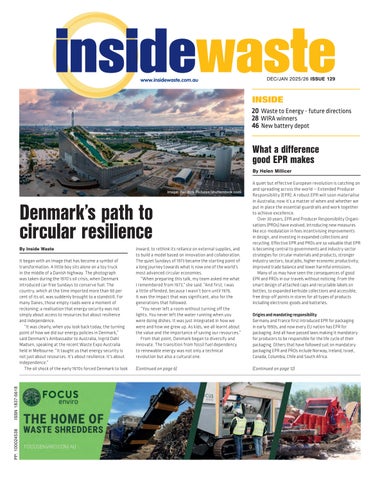
Image: Pandora Pictures/shutterstock.com
Denmark’s path to circular resilience By Inside Waste
PP: 100024538
ISSN 1837-5618
It began with an image that has become a symbol of transformation. A little boy sits alone on a toy truck in the middle of a Danish highway. The photograph was taken during the 1970’s oil crisis, when Denmark introduced car-free Sundays to conserve fuel. The country, which at the time imported more than 90 per cent of its oil, was suddenly brought to a standstill. For many Danes, those empty roads were a moment of reckoning; a realisation that energy security was not simply about access to resources but about resilience and independence. “It was clearly, when you look back today, the turning point of how we did our energy policies in Denmark,” said Denmark’s Ambassador to Australia, Ingrid Dahl Madsen, speaking at the recent Waste Expo Australia held in Melbourne. “It taught us that energy security is not just about resources. It’s about resilience. It’s about independence.” The oil shock of the early 1970s forced Denmark to look
inward, to rethink its reliance on external supplies, and to build a model based on innovation and collaboration. The quiet Sundays of 1973 became the starting point of a long journey towards what is now one of the world’s most advanced circular economies. “When preparing this talk, my team asked me what I remembered from 1973,” she said. “And first, I was a little offended, because I wasn’t born until 1976. It was the impact that was significant, also for the generations that followed. “You never left a room without turning off the lights. You never left the water running when you were doing dishes. It was just integrated in how we were and how we grew up. As kids, we all learnt about the value and the importance of saving our resources.” From that point, Denmark began to diversify and innovate. The transition from fossil fuel dependency to renewable energy was not only a technical revolution but also a cultural one. (Continued on page 6)
A quiet but effective European revolution is catching on and spreading across the world – Extended Producer Responsibility (EPR). A robust EPR will soon materialise in Australia; now it’s a matter of when and whether we put in place the essential guardrails and work together to achieve excellence. Over 30 years, EPR and Producer Responsibility Organisations (PROs) have evolved, introducing new measures like eco-modulation in fees incentivising improvements in design, and investing in expanded collections and recycling. Effective EPR and PROs are so valuable that EPR is becoming central to governments and industry sector strategies for circular materials and products, stronger industry sectors, local jobs, higher economic productivity, improved trade balance and lower harmful emissions. Many of us may have seen the consequences of good EPR and PROs in our travels without noticing. From the smart design of attached caps and recyclable labels on bottles, to expanded kerbside collections and accessible, free drop-off points in stores for all types of products including electronic goods and batteries. Origins and mandating responsibility Germany and France first introduced EPR for packaging in early 1990s, and now every EU nation has EPR for packaging. And all have passed laws making it mandatory for producers to be responsible for the life cycle of their packaging. Others that have followed suit on mandatory packaging EPR and PROs include Norway, Ireland, Israel, Canada, Columbia, Chile and South Africa. (Continued on page 12)