AUG/SEPT 2025 ISSUE 127
20 Butt litter 35 Battery stewardship 47 Consultant’s registry
Levy reform, infrastructure, markets: fixing waste By Inside Waste
and even in cardboard and food organics. The simple act of tossing an old device into the bin can be dangerous. What can’t you do with batteries? You can’t overcharge them, you should not over-discharge them, they should never be short-circuited, and you should not leave them in the sun or near a heat source, according to Sekula. A battery left in a hot car boot, or crushed on a tipping floor, can experience what’s known as a thermal runaway, which is a chain reaction that turns chemical energy into intense heat. It may begin quietly, but once the temperature reaches 125˚Celsius, it can leap to over 600˚Celsius in seconds. “It takes less than three seconds,” Sekula said. “The whole event could be as short as six to eight minutes.” Battery fires have become a widespread and escalating hazard in Australia’s waste and recycling industry, with nearly 30 incidents daily nationwide, and damage that often extends far beyond the initial blaze. From burned-out trucks to traumatised drivers, the impacts are stacking up and they’re becoming harder to contain.
At the recent Coffs Waste Conference, product stewardship, levy reform, investment and clear policy leadership were flagged as essential if Australia is to meet its ambitious resource recovery targets. The path to 80 per cent resource recovery as mandated by the Government is a long one – and industry experts say Australia is not going to get there with marginal improvements and ad hoc interventions. Speaking during a high-level panel on waste and resource recovery policy, some of Australia’s top circular economy thinkers and investors urged action on known priorities, warning that time, confidence and public trust were all running out. WMRR CEO Gayle Sloan set the tone from the start, stating that while the debate often returns to the landfill levy and energy-from-waste, the real priority is delivering reform in commercial and industrial (C&I) waste. She pointed to recent investment in C&I infrastructure and asked panellist ResourceCo Energy CEO Henry Anning how the sector was tracking. “C&I waste often falls between the cracks,” he said. “Unlike municipal solid waste (MSW) or construction and demolition (C&D) materials, it’s less well defined and frequently ignored at source. We have limited if any policy or regulation in this area, however it is our second largest material stream.”
(Continued on page 6)
(Continued on page 15)
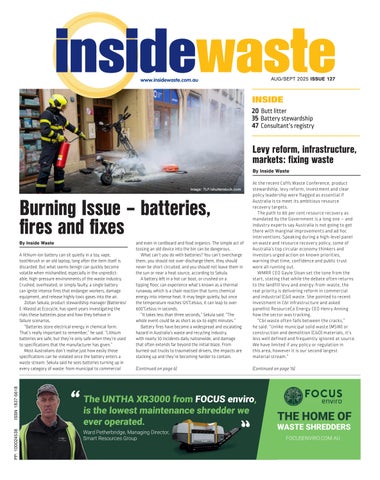
Image: TLF/shutterstock.com
Burning Issue – batteries, fires and fixes By Inside Waste
PP: 100024538
ISSN 1837-5618
A lithium-ion battery can sit quietly in a toy, vape, toothbrush or an old laptop, long after the item itself is discarded. But what seems benign can quickly become volatile when mishandled, especially in the unpredictable, high-pressure environments of the waste industry. Crushed, overheated, or simply faulty, a single battery can ignite intense fires that endanger workers, damage equipment, and release highly toxic gases into the air. Zoltan Sekula, product stewardship manager (Batteries/ E-Waste) at Ecocycle, has spent years investigating the risks these batteries pose and how they behave in failure scenarios. “Batteries store electrical energy in chemical form. That’s really important to remember,” he said. “Lithium batteries are safe, but they’re only safe when they’re used to specifications that the manufacturer has given.” Most Australians don’t realise just how easily those specifications can be violated once the battery enters a waste stream. Sekula said he sees batteries turning up in every category of waste: from municipal to commercial
“ The UNTHA XR3000 from FOCUS enviro, is the lowest maintenance shredder we ever operated.
Ward Petherbridge, Managing Director, Smart Resources Group
“
THE HOME OF WASTE SHREDDERS FOCUSENVIRO.COM.AU