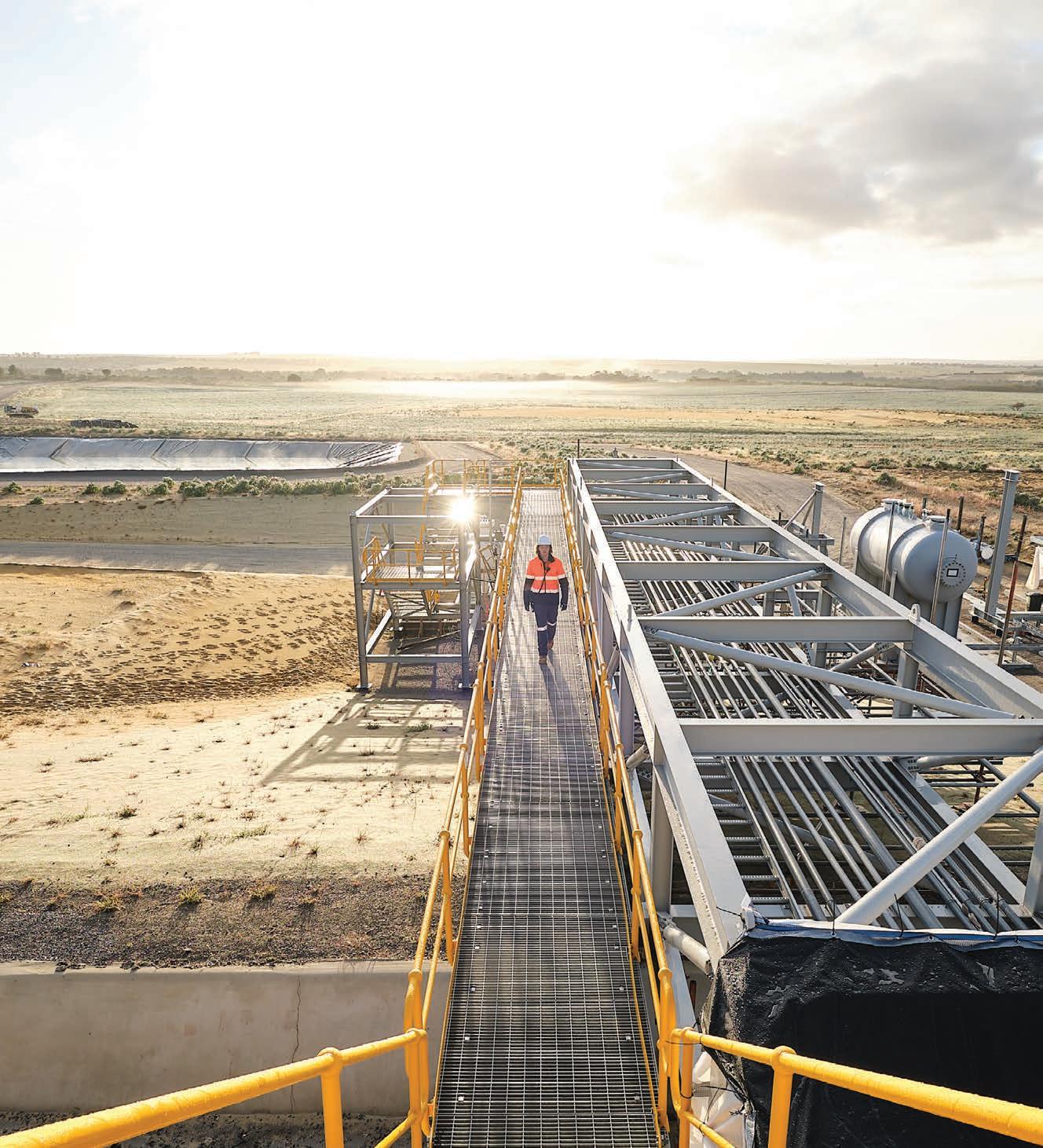
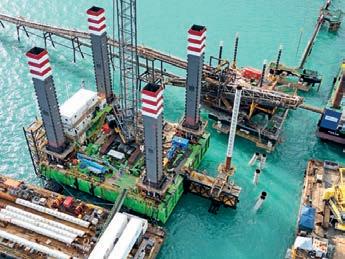
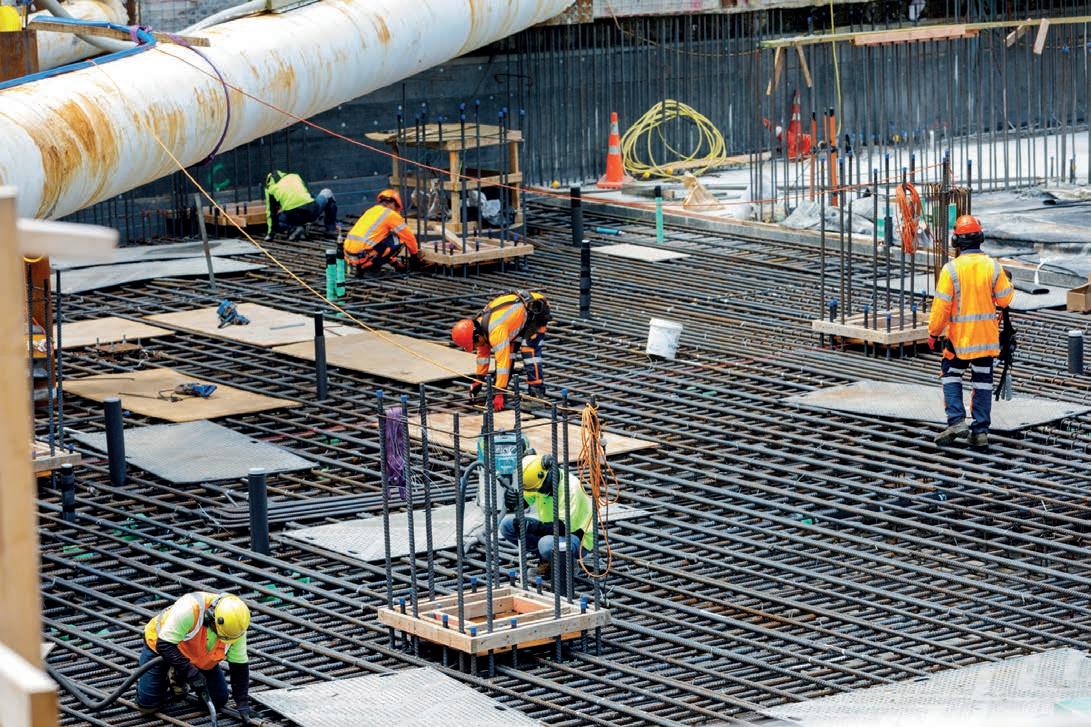
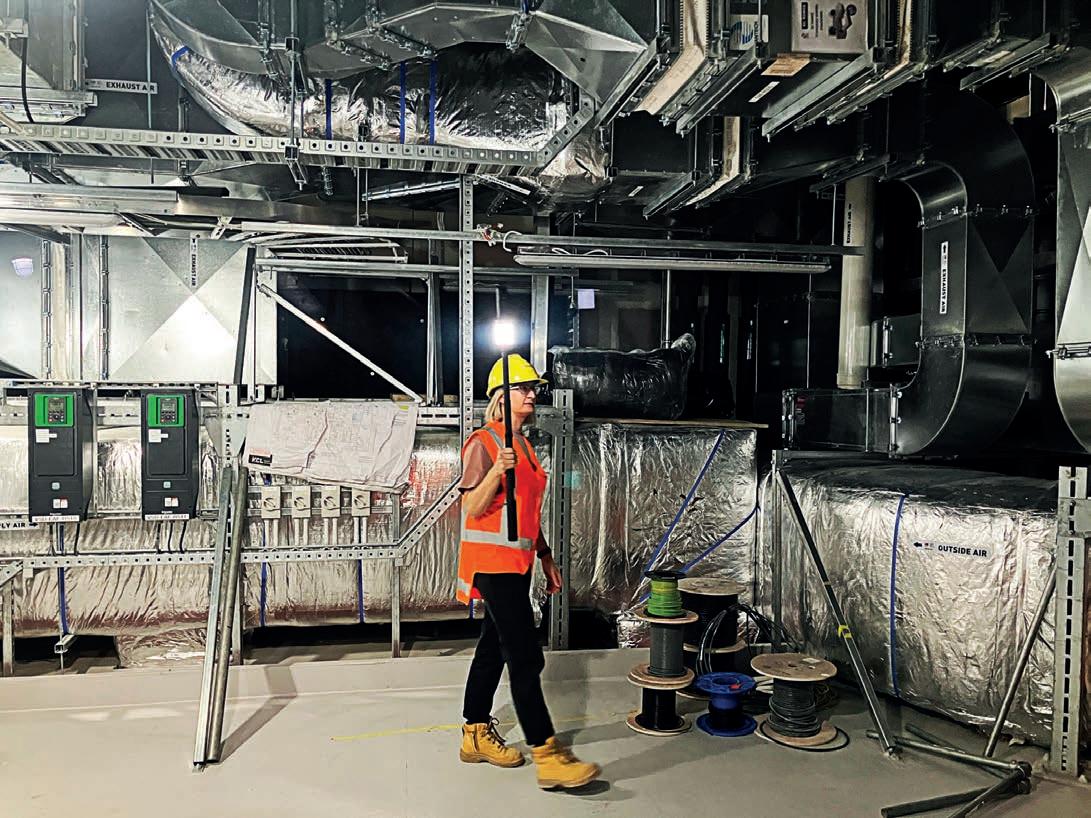
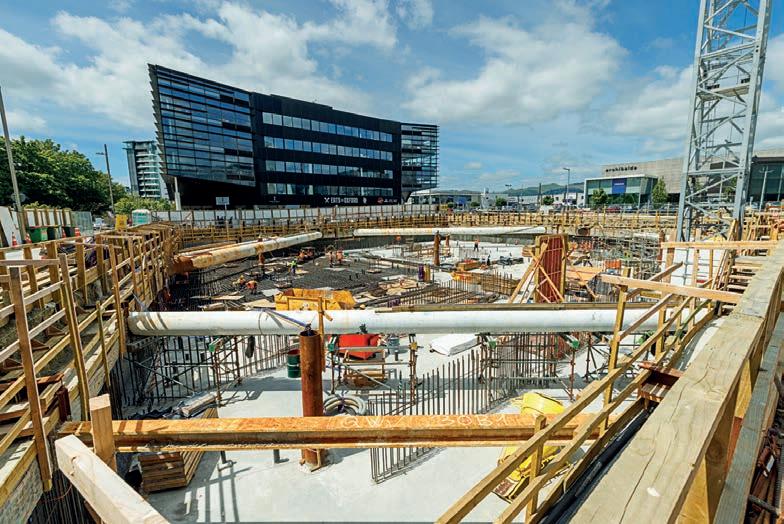
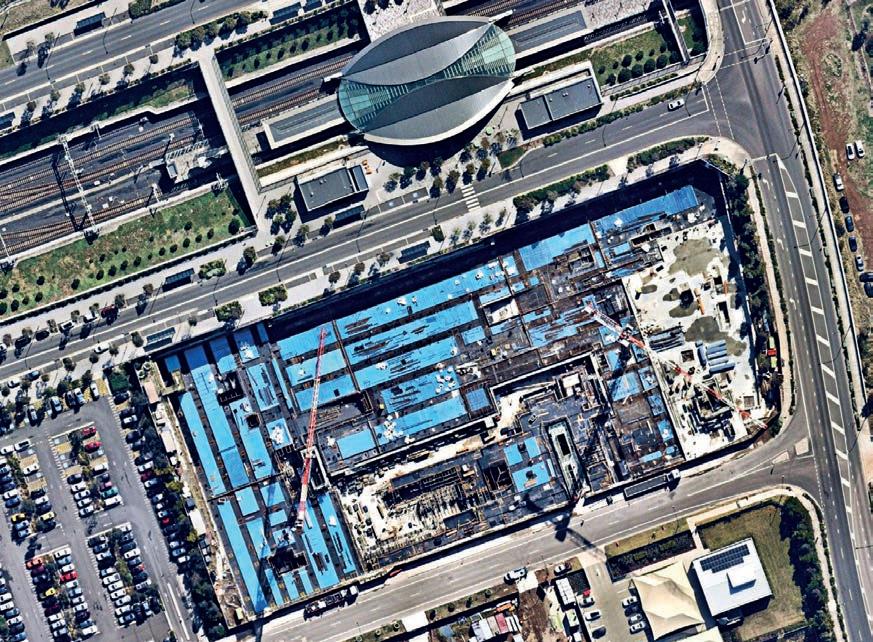
Upholding our commitment to quality through our NATA-accredited laboratory and close collaboration with key industry partners.
Quality assurance documentation available online at:
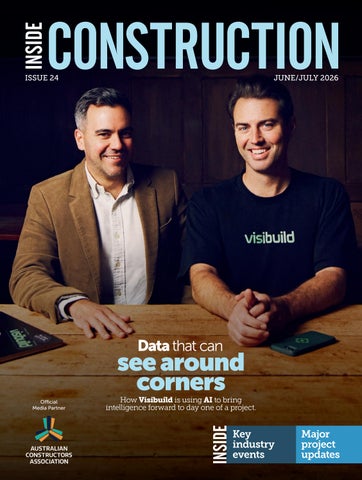
that can see around corners
How Visibuild is using AI to bring intelligence forward to day one of a project.
48 Justine Youl Founder of SiteSherpa.
58 Dr Gretchen Gagel Founder and CEO of the International Institute for Women in Construction.
50 NexGen
Empowered Women in Trades
52 National Precast Concrete Association Australia
53 The National Association of Women in Construction
54 Australian Constructors Association
FOCUS
the full picture
Leighs Construction uses Cupix to create a visual record of site progress.
certainty in an uncertain market
FTI Group works to restore certainty across product cost, supply and delivery.
Knauf gives internal walls and ceilings staying power in spaces that see constant wear.
under control
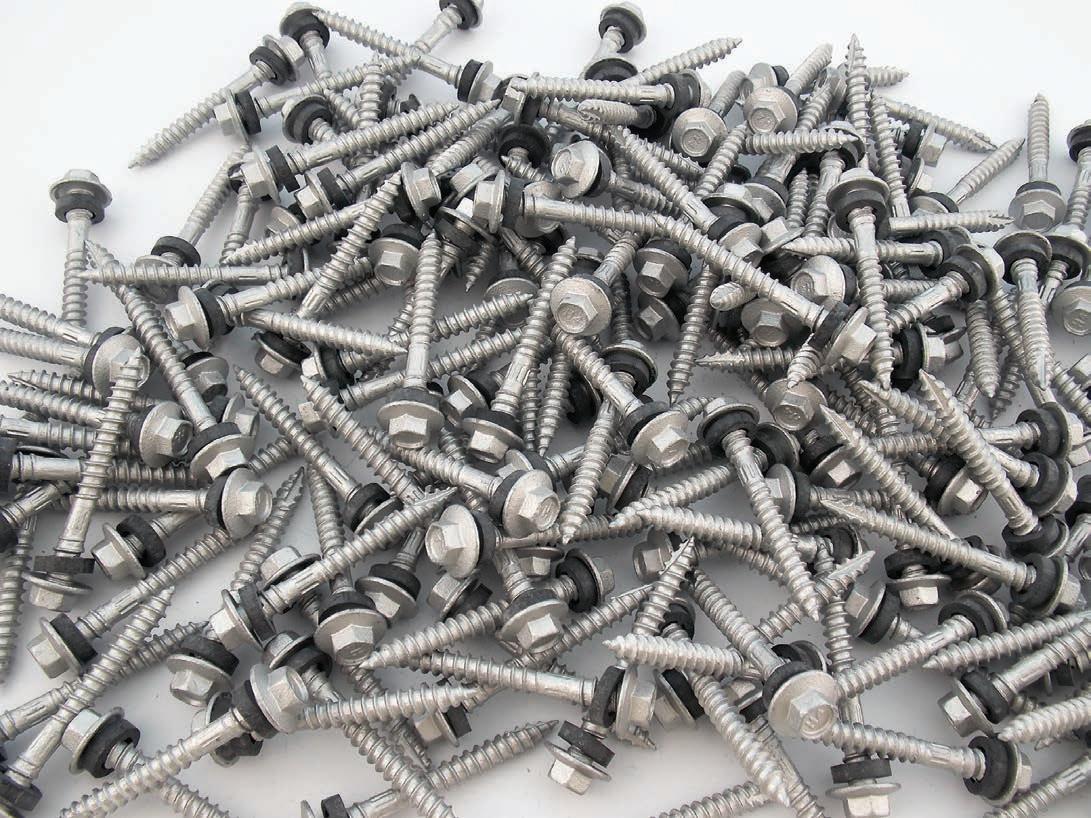
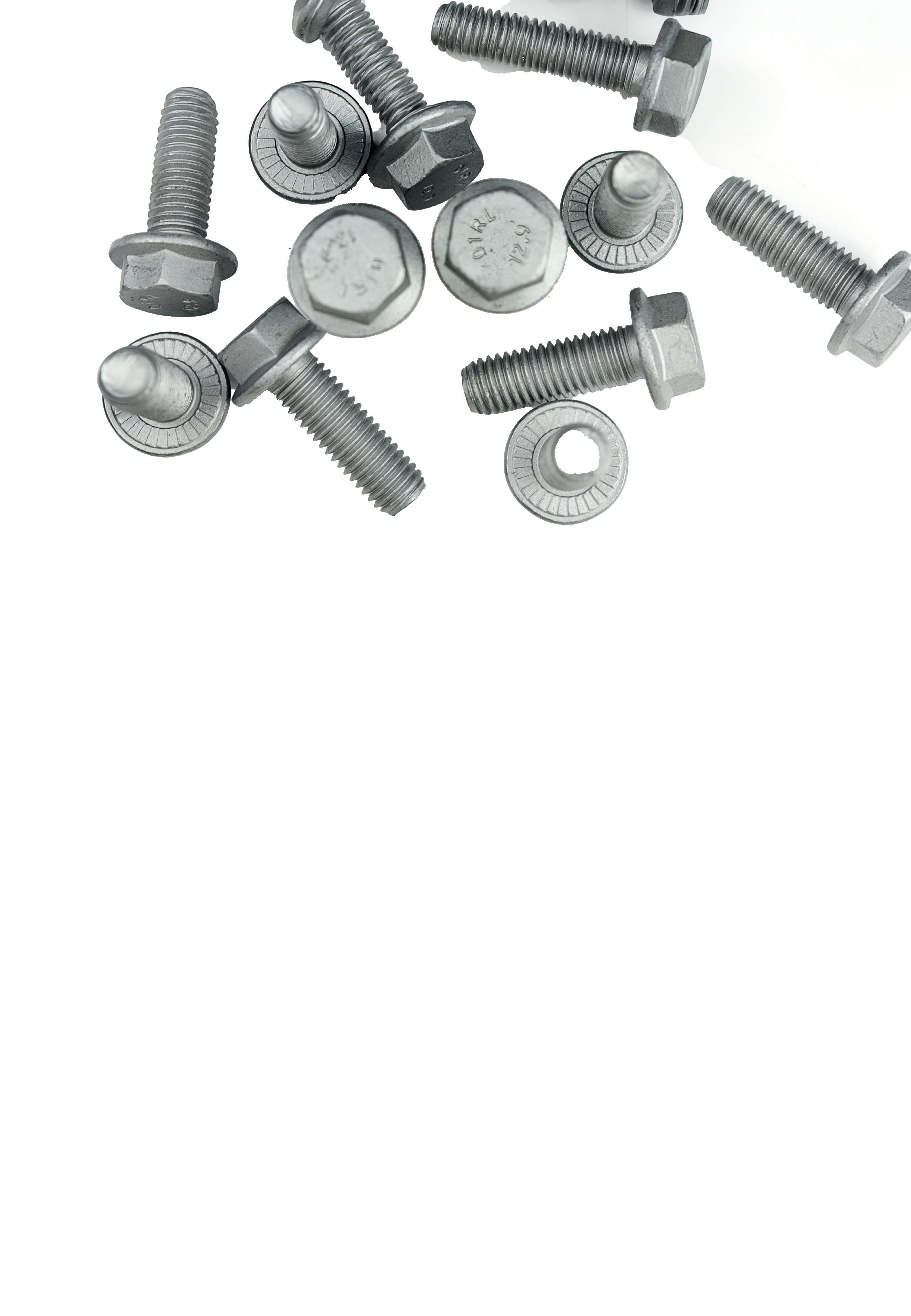
Hobson Engineering helps control steel fastener corrosion with coating systems.
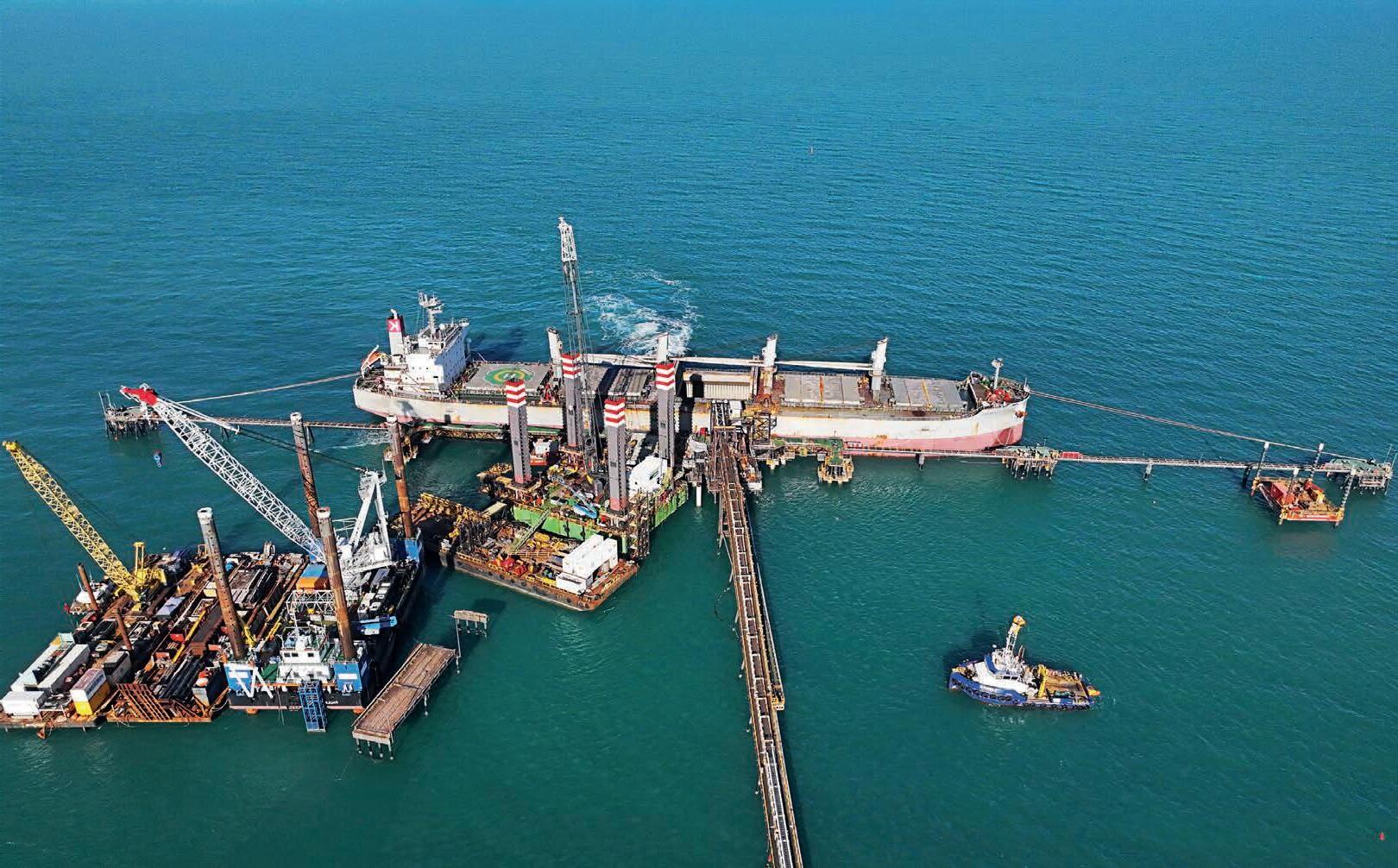
How McConnell Dowell delivered the complex Groote Eylandt GEMCO Wharf project.
Webuild pursues growth in Australia with a focus on lasting impact.
the terms for decarbonisation
Transmutation advances sustainable, data-backed supply chains for construction.
55 From potential to scale Foundations and Frontiers returns to Sydney in August with a renewed agenda. 56 Policy versus productivity
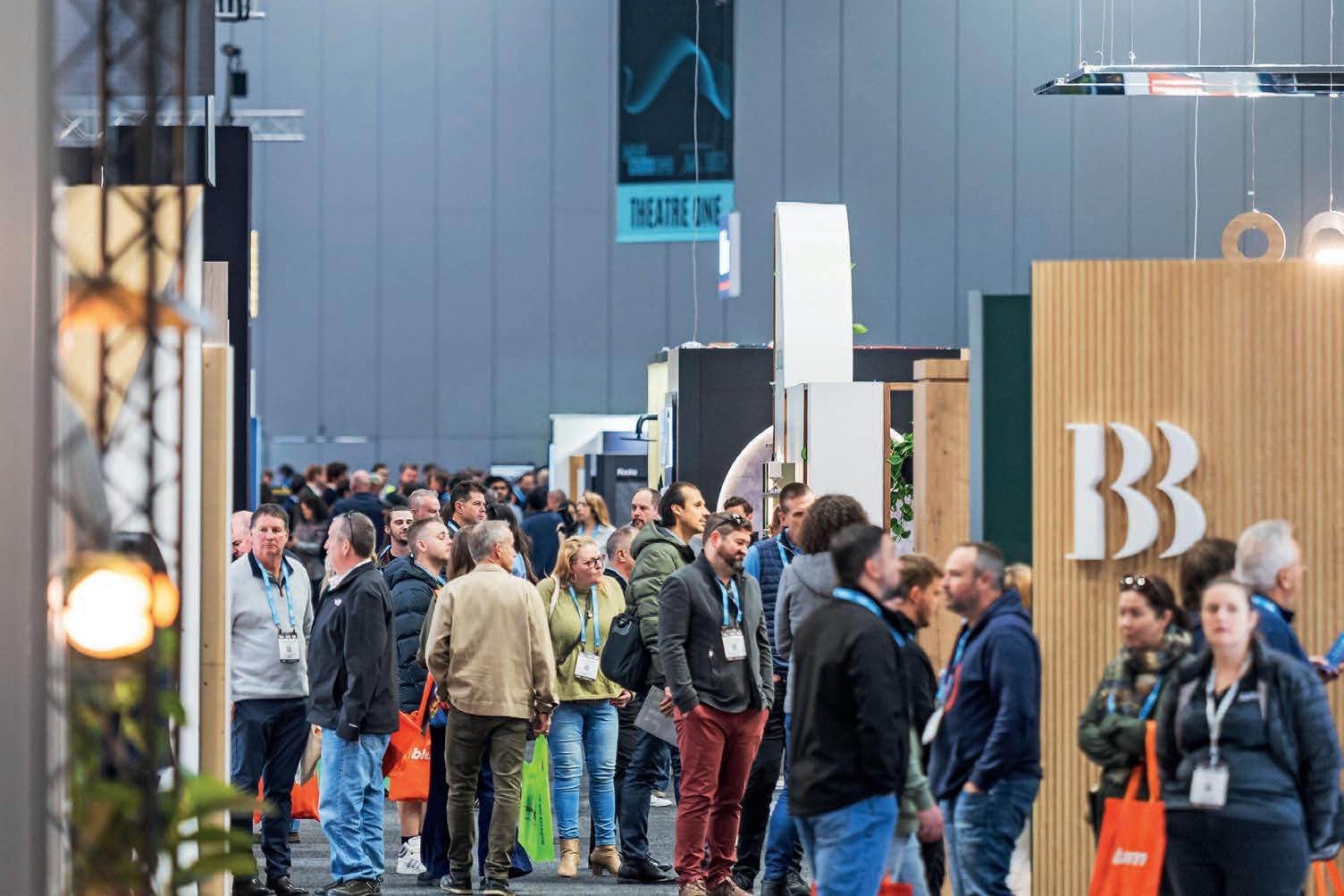
Futurebuild Australia focuses on the solutions shaping how projects are delivered.
57 Excellence across industry
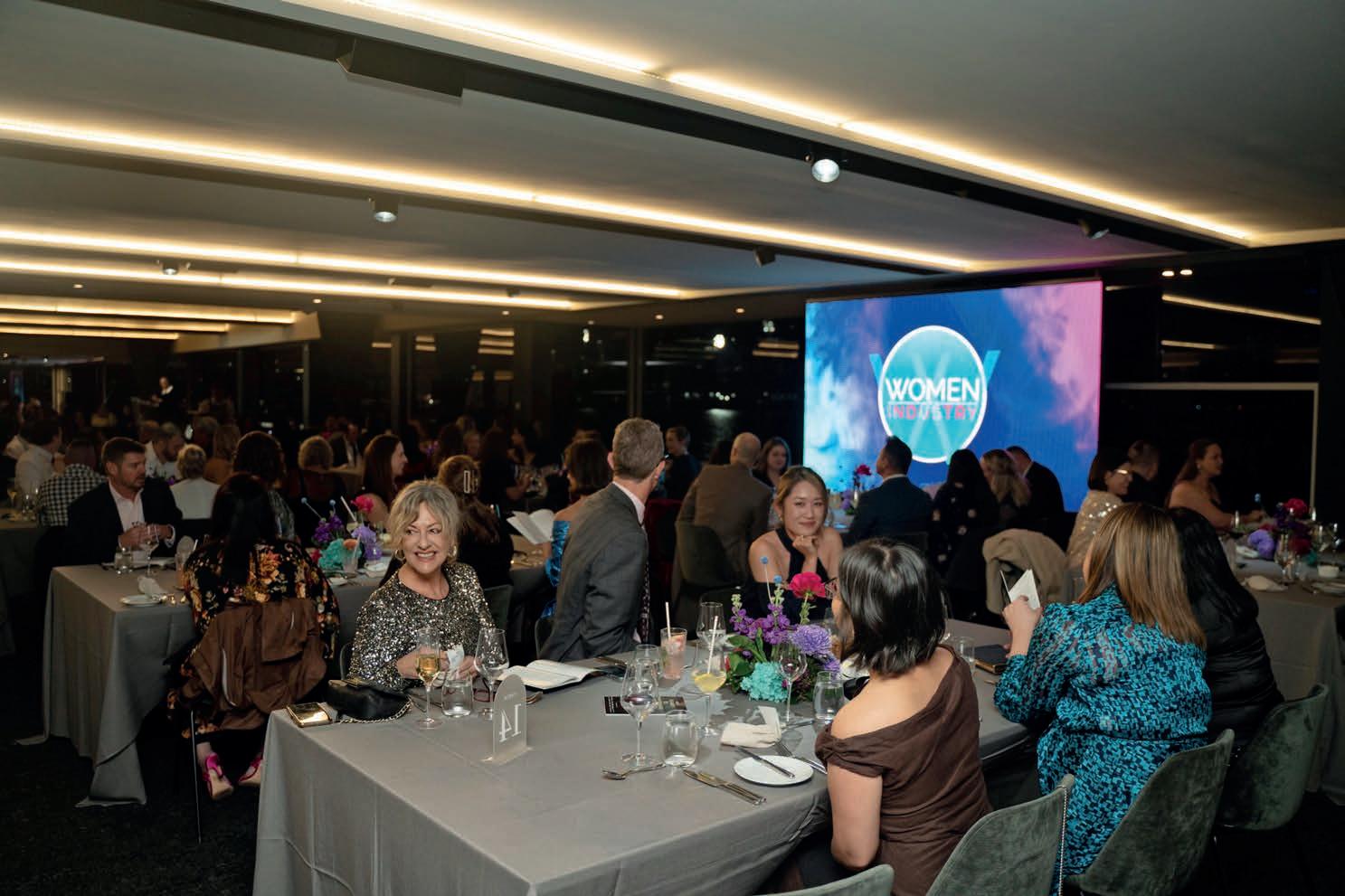
The 2026 Women in Industry Awards finalists are announced.
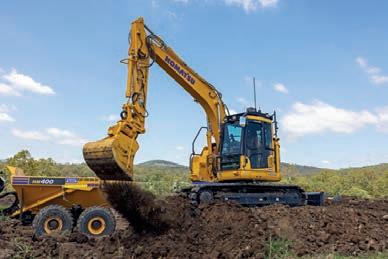
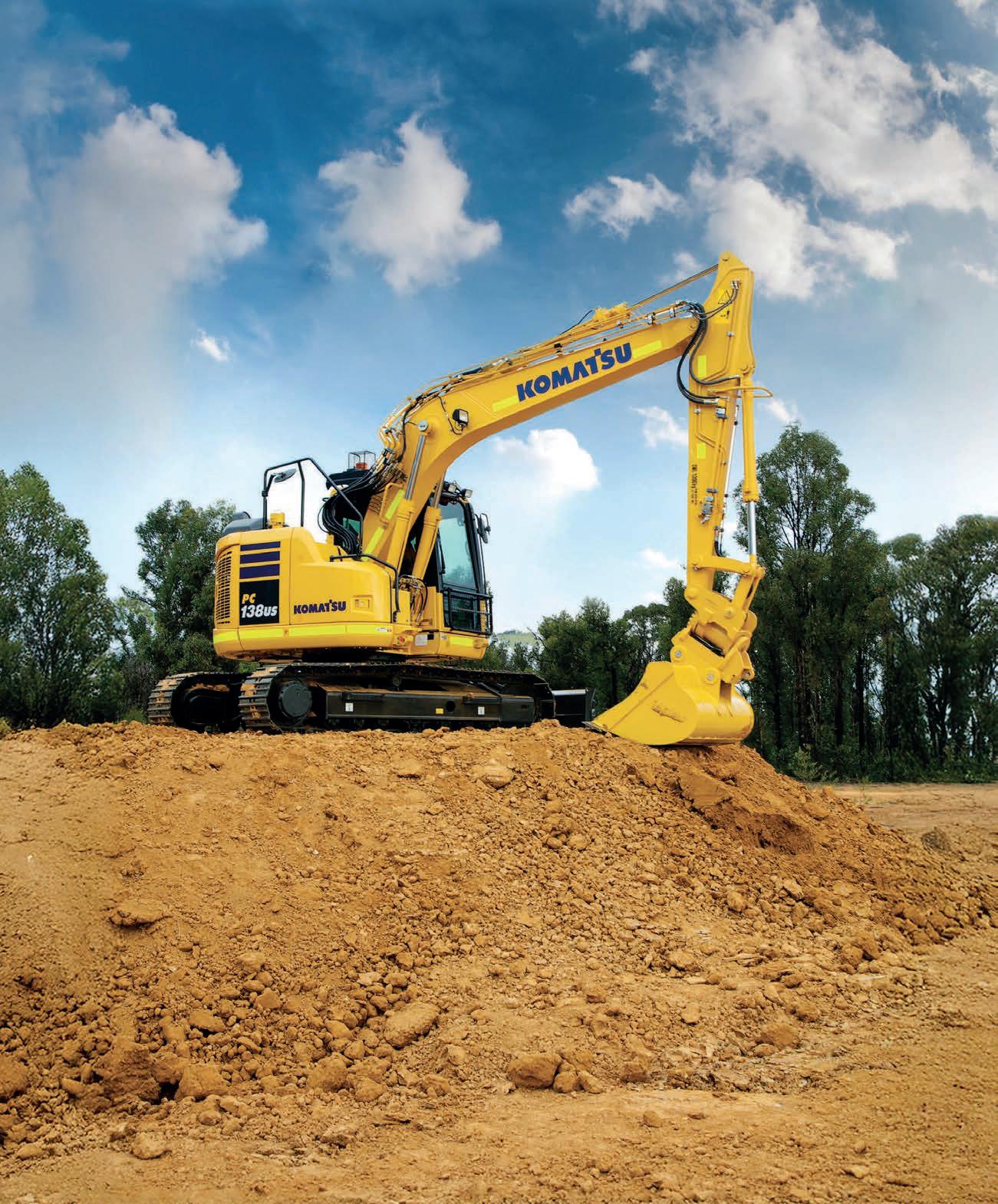
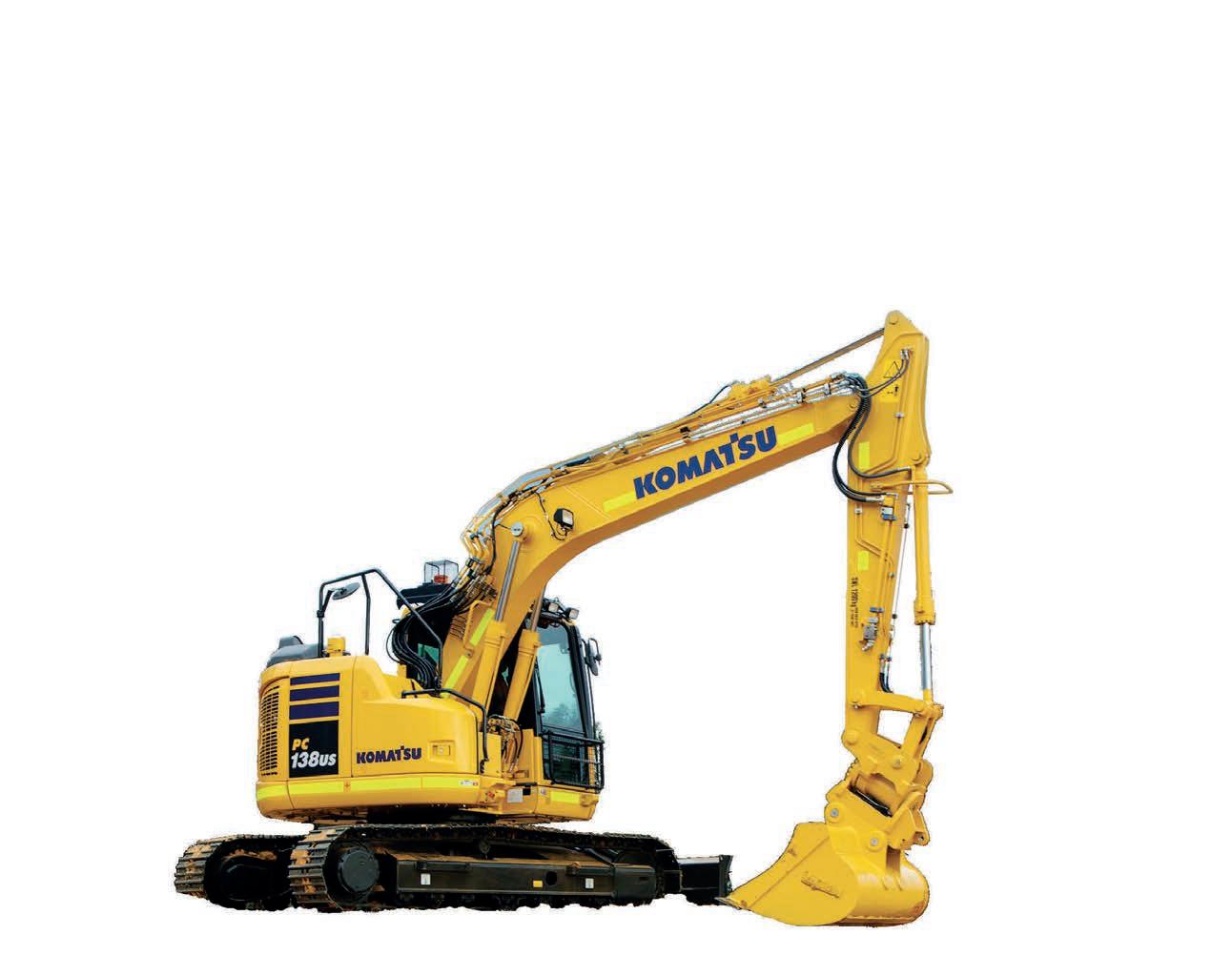
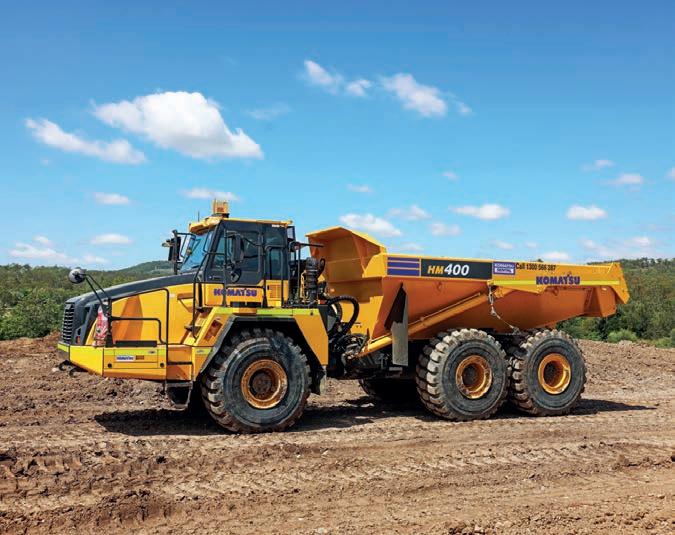
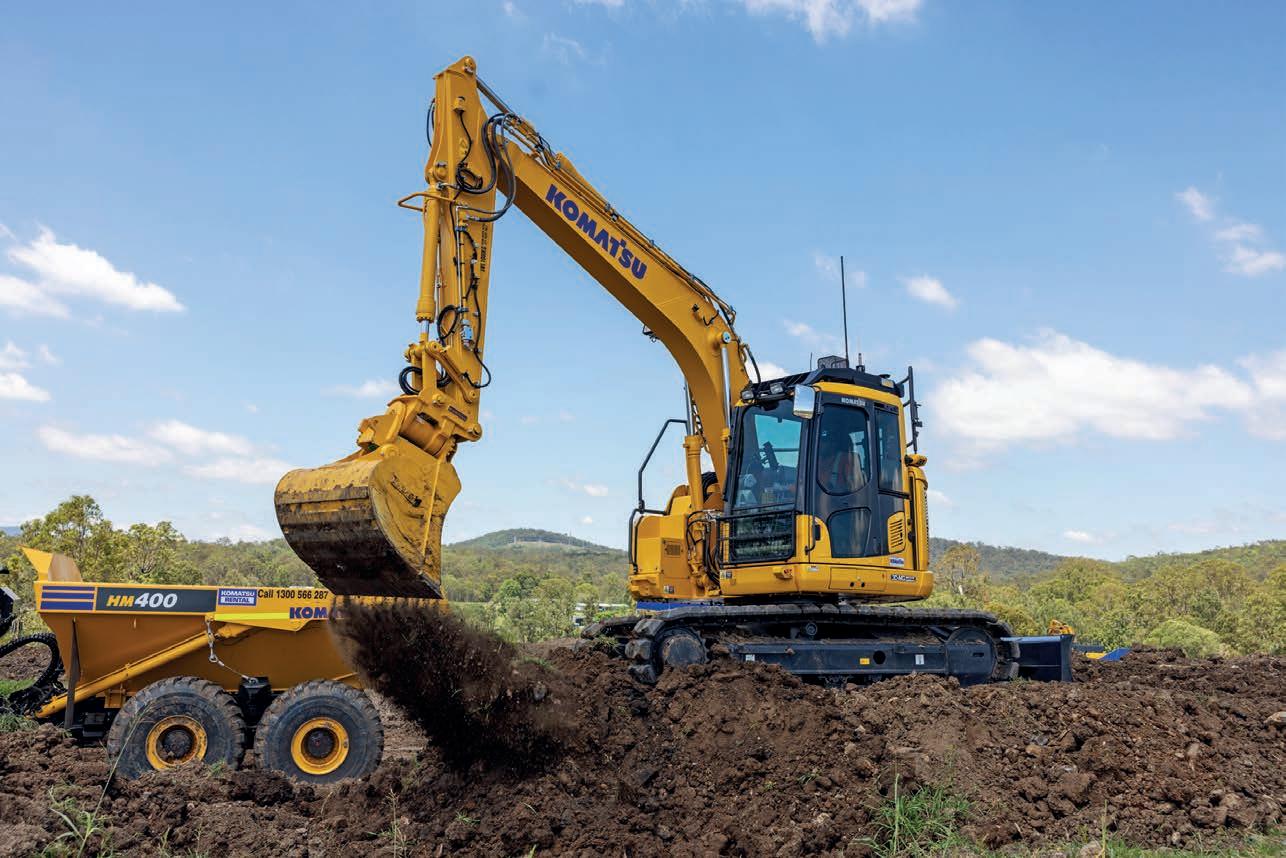
Komatsu Rental builds out a national model for equipment hire focused on availability, support and consistent performance.
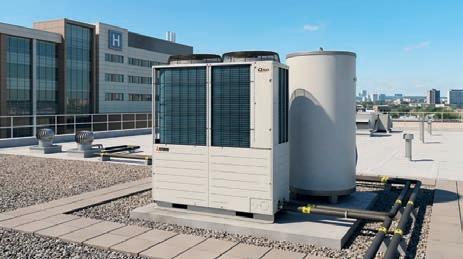
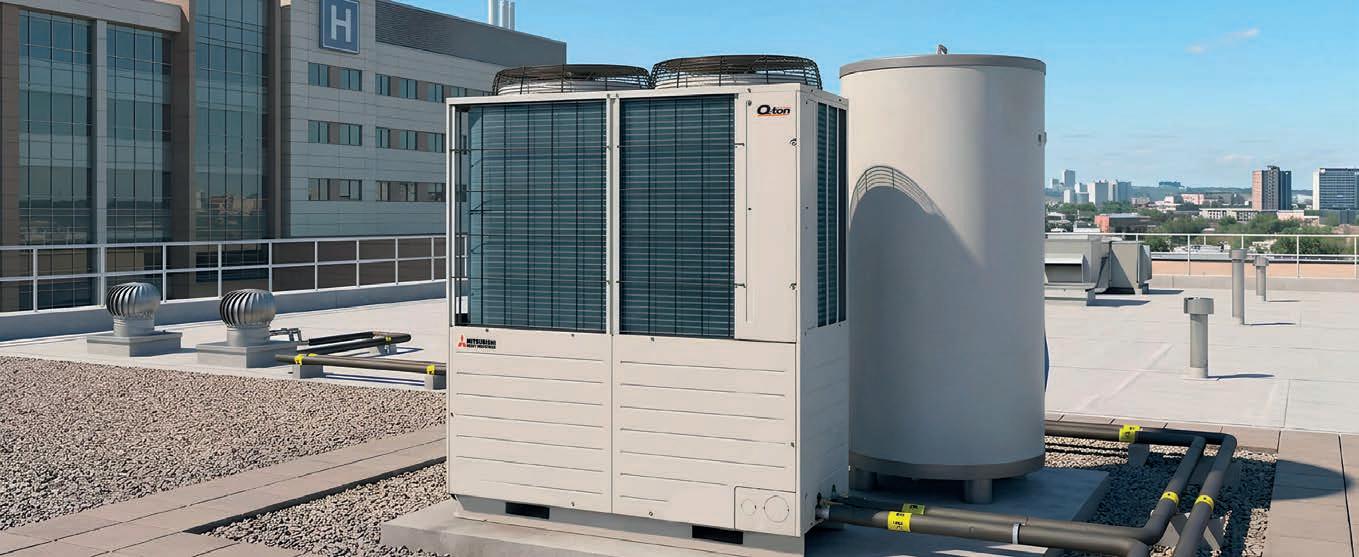
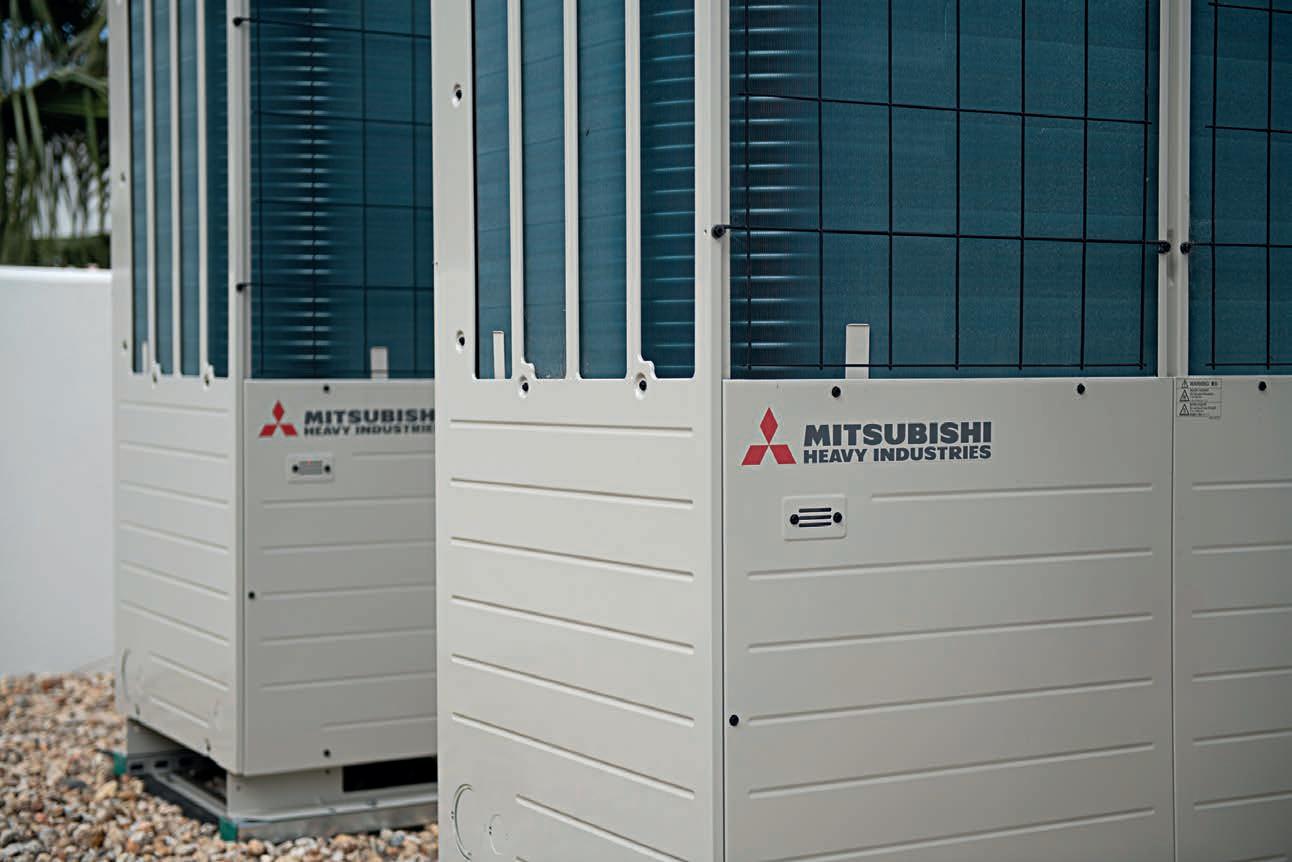
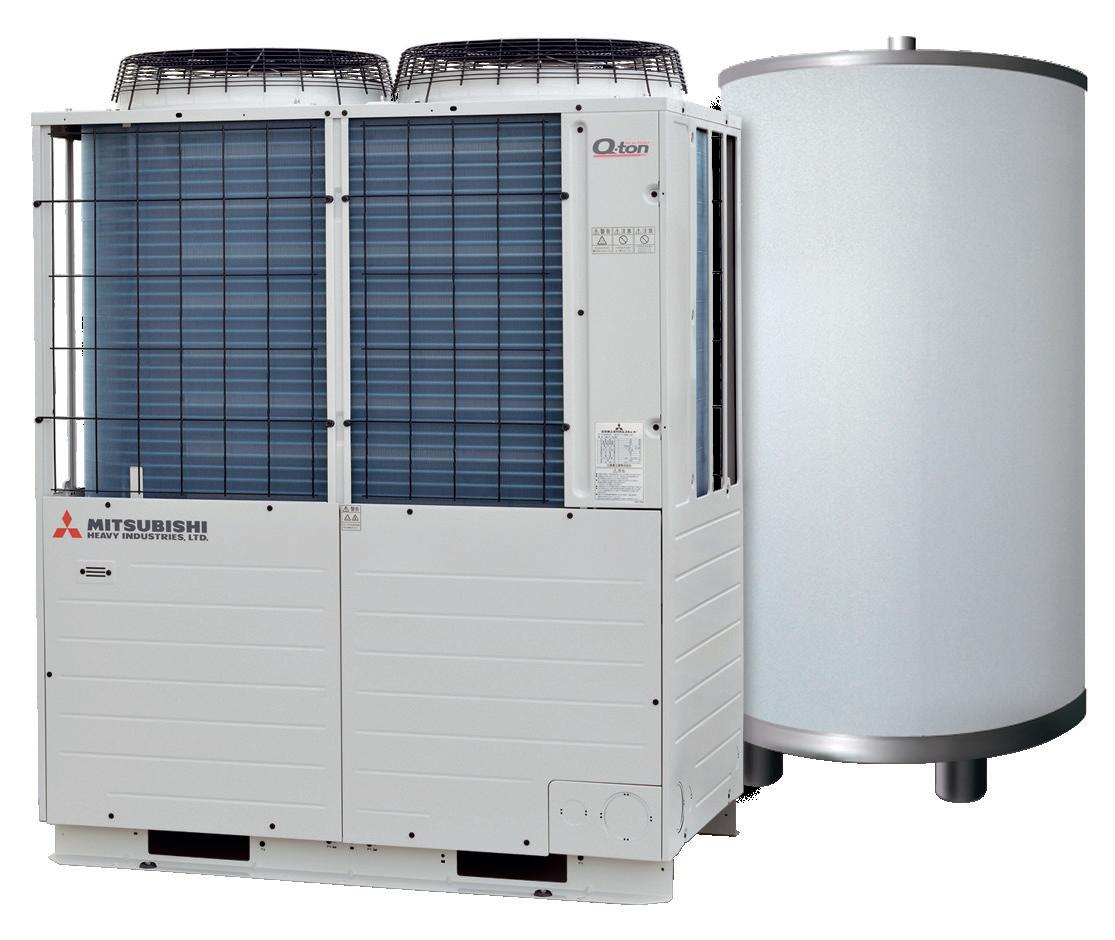
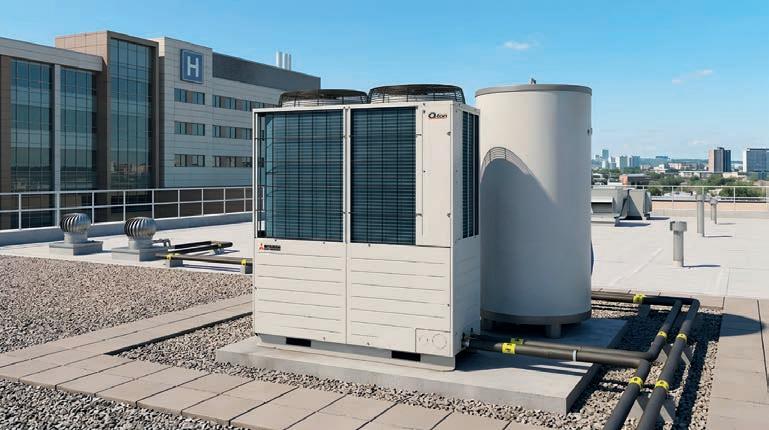
Mitsubishi Heavy Industries Air Conditioners Australia introduces Q-ton air-to-water heat pumps.
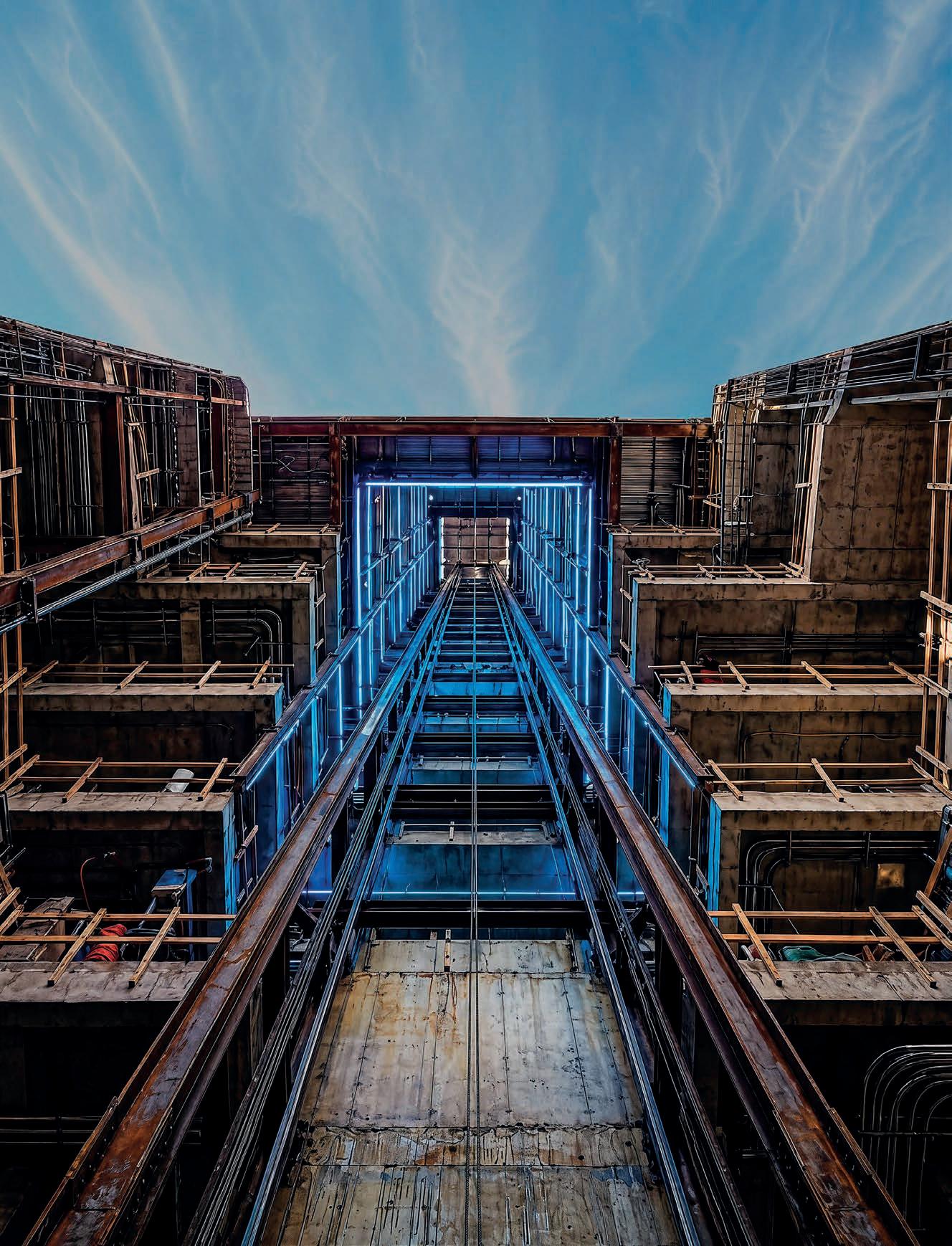
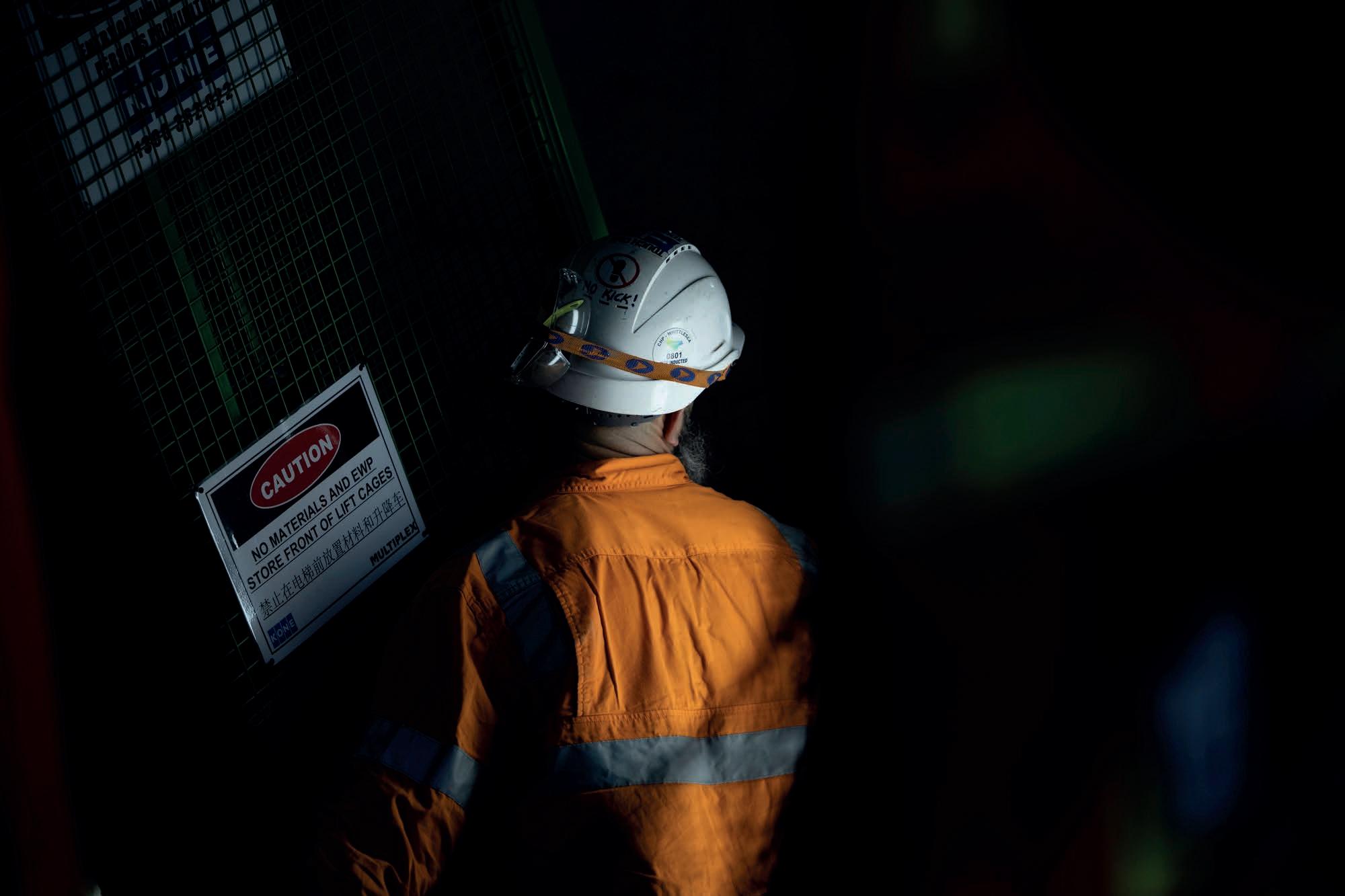
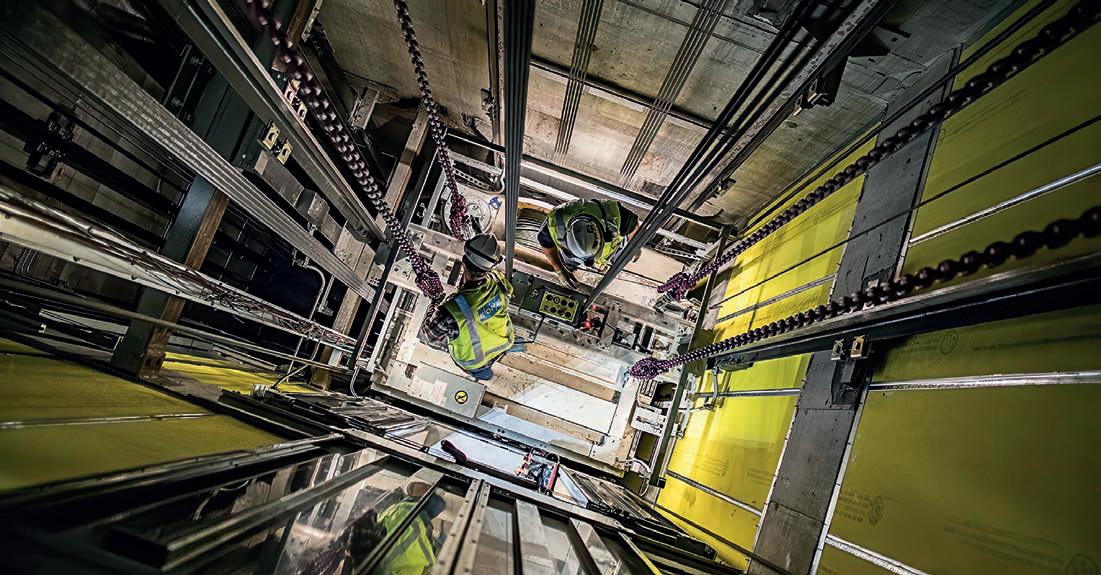
How KONE is bringing permanent lift systems into construction earlier.
From the editorial team
Carrying lessons forward
This edition looks at what happens when project knowledge, delivery discipline and industry connections start pulling in the same direction.
Major projects call on every part of the construction industry, from planning, procurement and engineering to quality, communication and culture. They also reveal whether lessons from past work have been carried forward, or whether teams are left to solve the same problems.
That question sits at the centre of this edition.
Across Australia, major projects are highlighting the depth of expertise required to bring complex work to completion. Hospitals, transport links, energy assets, commercial buildings and civil infrastructure are asking more of contractors, consultants and suppliers. The best outcomes come from thousands of decisions made earlier, with better information behind them.
This is where the conversation around construction technology becomes interesting. Today’s tools are giving project leaders a better read on what is happening, what might be emerging and where attention is needed before small issues grow.
This edition’s cover story explores that idea through the lens of risk.
Construction has never lacked lessons learned, inspection records, defect data or expert insight. The challenge has been getting that knowledge to the right people at the right point in the program. When information sits outside the daily workflow, even well-understood risks can slip through the layers. AI is beginning to support judgement, increase visibility and bring project intelligence closer to the point of decision.
This edition also looks at projects being done well. The stories inside show capability across the sector, from complex delivery environments to practical problem solving on site. They demonstrate that successful projects rely on well-managed processes, collaborative relationships, skilled teams and continuous improvement.
The industry events calendar carries that same sense of energy. In the months ahead, conferences, exhibitions and forums will bring people together to discuss regulation, technology, design, procurement, sustainability, safety and the future of construction.
These events also serve a practical purpose. Construction benefits when knowledge moves between contractors, designers, suppliers, clients and policy leaders, and when those conversations find their way back to projects. You will find all this and more inside – happy reading!
Chairman John Murphy
Chief Executive Officer Christine Clancy
Managing Editor Mike Wheeler mike.wheeler@primecreative.com.au
Sales Manager Danny Hernandez danny.hernandez@primecreative.com.au
Design Apostolos Topatsis
Head of Design Blake Storey blake.storey@primecreative.com.au
Business Development Manager
Michael Ingram-Casha michael.ingram@primecreative.com.au p: +61 0423 266 991
Client Success Manager Ben Sammartino ben.sammartino@primecreative.com.au
Cover image credit Visibuild
Head Office
Prime Creative Pty Ltd 379 Docklands Drive, Docklands, Victoria 3008 Australia p: +61 3 9690 8766 info@primecreative.com.au www.insideconstruction.com.au
Subscriptions
+61 3 9690 8766 subscriptions@primecreative.com.au Inside Construction is available by subscription from the publisher. The rights of refusal are reserved by the publisher
Articles
All articles submitted for publication become the property of the publisher. The Editor reserves the right to adjust any article to conform with the magazine format.
Copyright Inside Construction is owned by Prime Creative Media and published by John Murphy. All material in Inside Construction is copyright and no part may be reproduced or copied in any form or by any means (graphic, electronic or mechanical including information and retrieval systems) without written permission of the publisher. The Editor welcomes contributions but reserves the right to accept or reject any material. While every effort has been made to ensure the accuracy of information, Prime Creative Media will not accept responsibility for errors or omissions or for any consequences arising from reliance on information published. The opinions expressed in Inside Construction are not necessarily the opinions of, or endorsed by the publisher unless otherwise stated.
+ GST *
For a limited time, receive:
• 1.99% p.a. finance*
• Free standard KGA hitch
• 4 year / 8000 Hour Premium Warranty
• 1st and 2nd Attachment Piping Inc.
• Tool Control Adjust attachment pressure and flow in monitor
• Factory fitted 3D Machine GuidanceBase components
• Guarded LED Beacon
• SP Starter, DP Battery Isolators
• 500mm Steel Shoe
• 1.5KG Fire Extinguisher
• 80 Channel UHF Radio
• Canvas Seat Cover
• Window Tint
Milestones across the map
Major projects across Australia are advancing through key structural milestones, delivery innovations and community-focused initiatives.
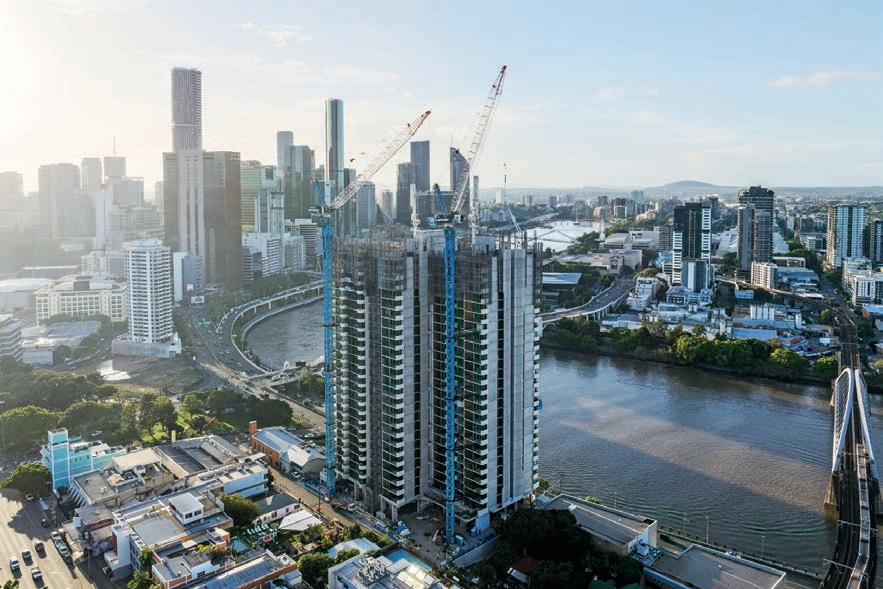
50 Quay Street, Queensland
Contractor: Hutchinson Builders
Current value: $243 million
Details: Hutchinson Builders is delivering 50 Quay Street, a 32‑storey build to rent residential development comprising 475 apartments for client Cedar Pacific. Designed with sustainability and liveability at its core, the project is targeting a 5 Star Green Star Buildings v1 rating and a minimum 5 Star NatHERS rating. The development also meets Liveable Housing Australia (LHA) standards, with 58 per cent of apartments designed to Gold level and 42 per cent to Silver, supporting accessibility and long‑term adaptability. Levels ground to four accommodate shared resident amenities, a café and 257 car spaces, while a cross‑block link enhances pedestrian connectivity between Quay Street and Coronation Drive via a public lift and stair. Residential apartments span levels five to 29, with level 31 delivering a landscaped rooftop recreation area and pool.
Status: The tower is under construction, with structural top out achieved in May 2026 and project completion forecast for December 2026.
Initiatives: The build to rent model has enabled streamlined delivery through standardised apartment layouts. Key initiatives include innovation in precast concrete, jump form systems, the implementation of a large lithium battery as the primary construction power source, and the adaptive reuse of shipping containers as containment screening for public protection during demolition of the existing structure.
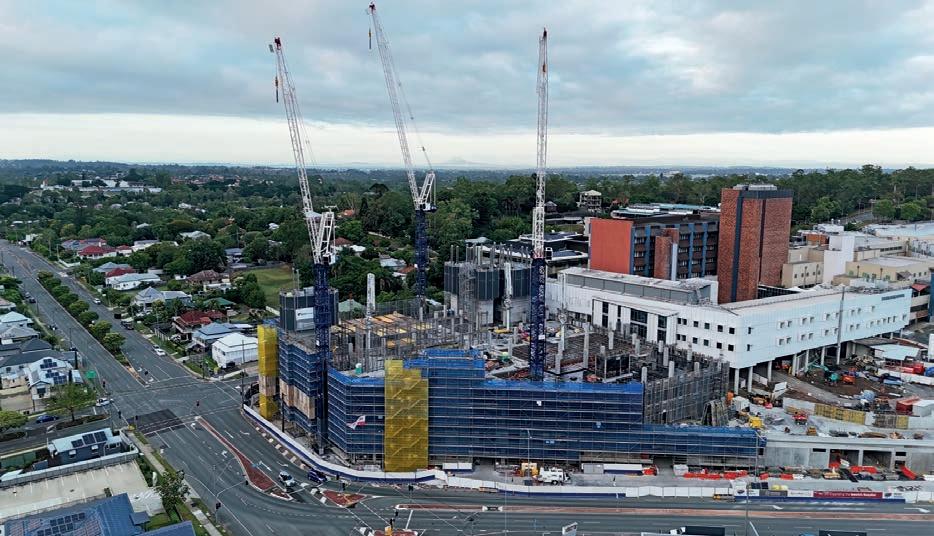
Ipswich Hospital Expansion Stage Two,
The Ipswich Hospital Expansion project is an investment in Queensland’s healthcare infrastructure, responding to the region’s growing population and demand for services as part of the Queensland Government’s Hospital Rescue Plan. Stage Two torey Acute Services Building, including 200 beds, providing facilities that will enhance patient care, support clinical staff and contribute to a sustainable healthcare model. The project team has hosted apprenticeship tours, supported a Name the Crane initiative through a local school competition and, with the entire workforce, raised more than $40,000 for the West Moreton Health Foundation to support its work across the West Moreton Health community. Strong community engagement has been a hallmark
Currently, 290 workers are on site. The structure has reached Level 6, with 16,251 cubic metres of concrete poured. Façade installation has progressed to Level 3. The project remains
Construction of the Acute Services Building has reached Level 6.
Structural top out was achieved at 50 Quay Street in May this year.
Elevators
You say jump,we say how high.
KONE JumpLift™, no matter the height, we rise with you.
The self-climbing construction elevator that rises with your building.
Built into your permanent elevator shaft from the ground up, KONE JumpLift™ eliminates the need for external hoists and keeps your site moving at every level. Workers and materials reach their destination faster, downtime is reduced, and your façade can close earlier, all while construction continues above.
Find out more
Project Picks
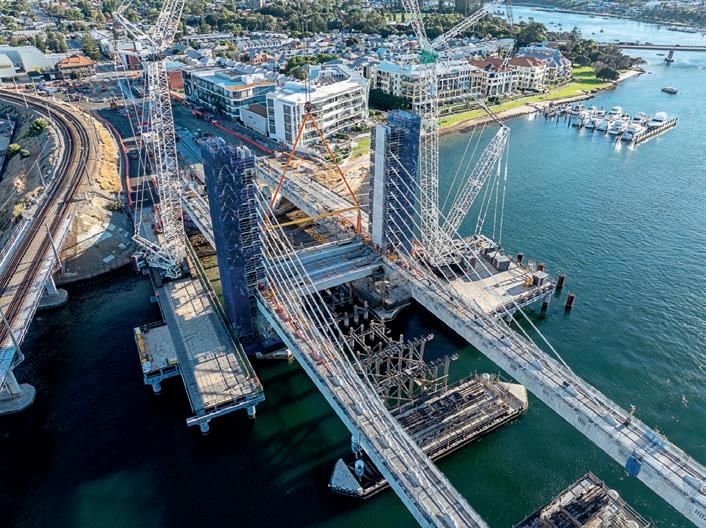
Swan River Crossings – Fremantle Traffic Bridge, Western Australia
Fremantle Bridges Alliance
Current value: $430 million
The Swan River Crossings project is being delivered by the Fremantle Bridges Alliance, comprising Main Roads, Laing O’Rourke, ARUP and WSP. It will create a gateway to Fremantle through the construction of Australia’s first extradosed bridge, replacing the ageing Fremantle Traffic Bridge. The new structure combines cantilevers with cable supported elements to enhance safety, efficiency and accessibility for users. Eight cables are installed on each side of the four 36 metre high towers. In addition, 166 edge beam segments have been installed to form the structure’s outer boundaries.
Work is progressing concurrently on the new bridge deck, while removal of the old timber bridge is underway.
Large portions of the new bridge were built while the existing bridge remained open to traffic. Because the new bridge follows the same alignment, the team developed a staged approach that maintained traffic flow to minimise disruption throughout the build. Salvaged timber from the old bridge is being sent to state facilities for future use on timber bridges.
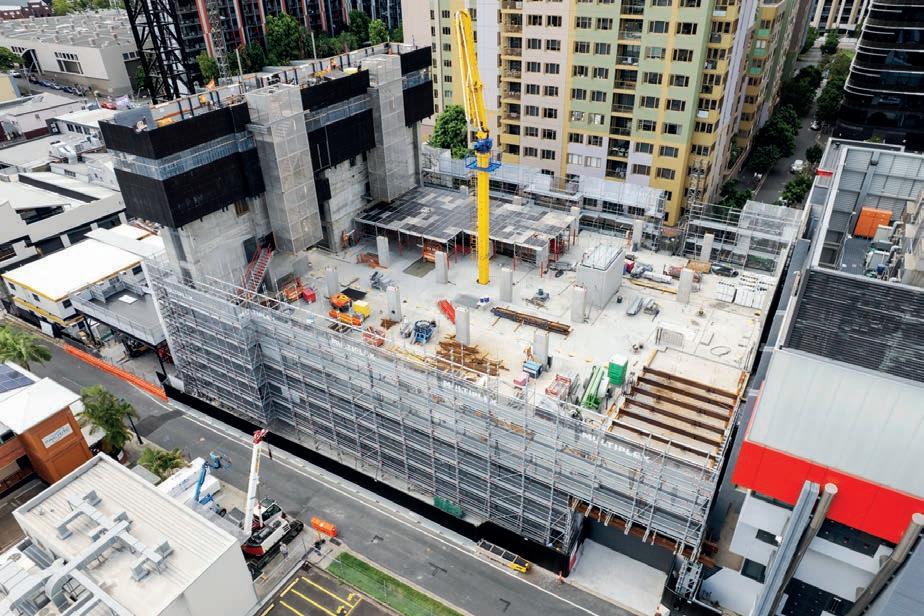
NEXTDC B2 Brisbane Stage 2, Queensland
Contractor: Multiplex
Details: Stage 2 of NEXTDC’s B2 Brisbane data centre in Fortitude Valley is being delivered by Multiplex, using prefabrication and off site construction methods to support vertical progression and improve safety outcomes in a constrained CBD fringe environment. As part of the structural works, more than 300 precast concrete panels will be installed to support program efficiency and build quality.
Status: Construction has reached the halfway mark, with structural works and services progressing concurrently. A key aspect of the delivery approach is the installation of 12 prefabricated wet services (hydraulic) risers, enabling vertical services installation to proceed in parallel with the structure. The risers span levels three to eight and are shared across four trades, requiring detailed sequencing and coordination. Fabricated off site, the risers are lifted into position in two 20 metre sections, reducing work at height, minimising scaffold interaction and supporting safe, controlled installation practices. The coordinated approach demonstrates how early planning and integrated trade delivery are improving safety and efficiency as works continue.
Removal of the old Fremantle Traffic Bridge is underway.
Construction has hit the halfway mark on Stage 2 of NEXTDC’s B2 Brisbane data centre.
Image: Laing
O’Rourke
Image: Multiplex
Project Picks
Waitsia Gas Project Stage 2, Western Australia
Contractor: Clough
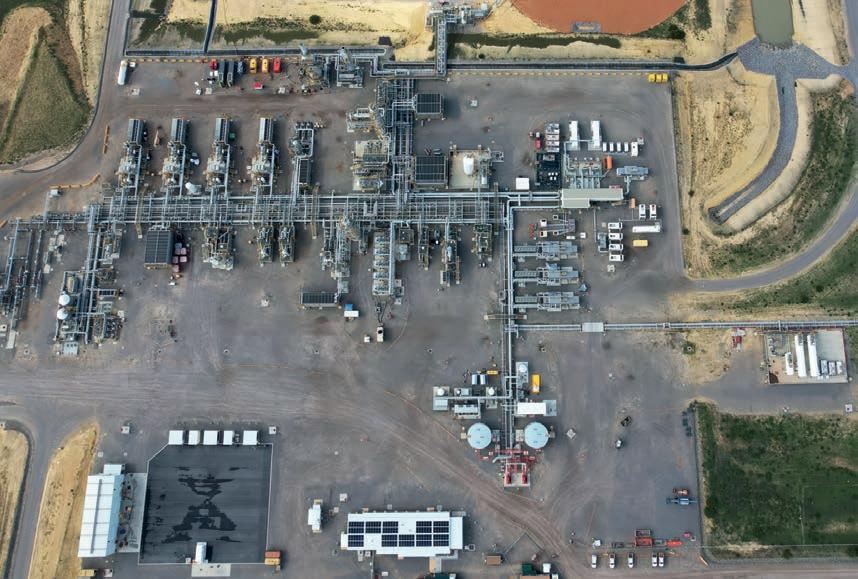
Details: Clough, part of Webuild Group, is delivering the engineering, procurement, construction and commissioning for Mitsui E&P Australia (MEPAU) and Beach Energy’s Waitsia Gas Project Stage 2 development. Located around 16km southeast of Dongara and 350km north of Perth, the project has been developed through a staged roll out and includes the construction of the Waitsia Gas Plant. Once complete, production from the Waitsia Gas Field is set to increase to 280 terajoules per day – alongside the Xyris Production Facility – with capacity to supply up to a quarter of Western Australia’s domestic natural gas demand, supporting energy security and economic growth. The project will provide local jobs, community benefits and opportunities for local businesses.
Status: The project recently reached its nameplate capacity of 250 terajoules per day.
Chifley South, New South Wales
Contractor: Built
Current value: $1.8 billion
Details: Built has partnered with Charter Hall to deliver Chifley South, a 6 Star Green Star Buildings v1 designed 50,000 square metre office tower. The project forms part of Charter Hall’s largest office precinct in Australia, with a combined net lettable area of around 110,000 square metres. Upon completion, the Chifley precinct, comprising the existing Chifley North tower and the new 40 storey Chifley South, will deliver office and retail space, a revitalised podium and public domain, and a concierge service. The precinct is expected to accommodate up to 10,000 workers, with committed Chifley South tenants including UBS, Gilbert + Tobin and Charter Hall.
Status: Construction continues, with the project scheduled for completion in mid 2027.
Initiatives: Chifley South is targeting Climate Active Carbon Neutral certification through precinct wide electrification and base building operations powered by 100 per cent renewable energy. The project also has a target of achieving a 5.5 star NABERS Energy rating. Built has employed its first electric on site concrete pump, replacing a traditional diesel powered unit to improve efficiency. Pour times have been reduced, construction joints minimised, and the process is cleaner through the removal of exhaust emissions and engine noise. The switch has also reduced site deliveries, as the pump doesn’t require refuelling.
Waitsia Gas Project Stage 2 recently reached its nameplate capacity.
Chifley South is rising into the Sydney skyline.
Image: Clough
Image: Built
CO 2 HOT WATER HEAT PUMP FOR COMMERCIAL APPLICATIONS
Lower Operating Costs
Up to 76% lower running costs than electric heaters and 46% lower running cost than gas boilers*
Reduce Carbon Emissions
Flexible Design
Up to 76% less emissions than gas boilers & 74% less emissions than electric heaters* Anti-Legionella Cycle
Easily retrofitted into existing buildings, replacing boilers or electric systems.
Programmable sanitary cycle superheats water to assist with thermal disinfection.
Q‑ton is a high‑efficiency, air‑to‑water heat pump that uses natural CO2 refrigerant and patented compressor technology to deliver reliable sanitary hot water and space heating for commercial applications.
Capable of producing hot water up to 90°C in temperatures as low as –25°C, the Q ton ensures dependable performance year‑round.
*Based on a senior care facility with 50 residents using 8,000 L/day at 60°C conversion.
Q-ton is eligible under Victoria’s VEU Program and NSW’s ESS, offering eligible businesses access to thousands in rebates.
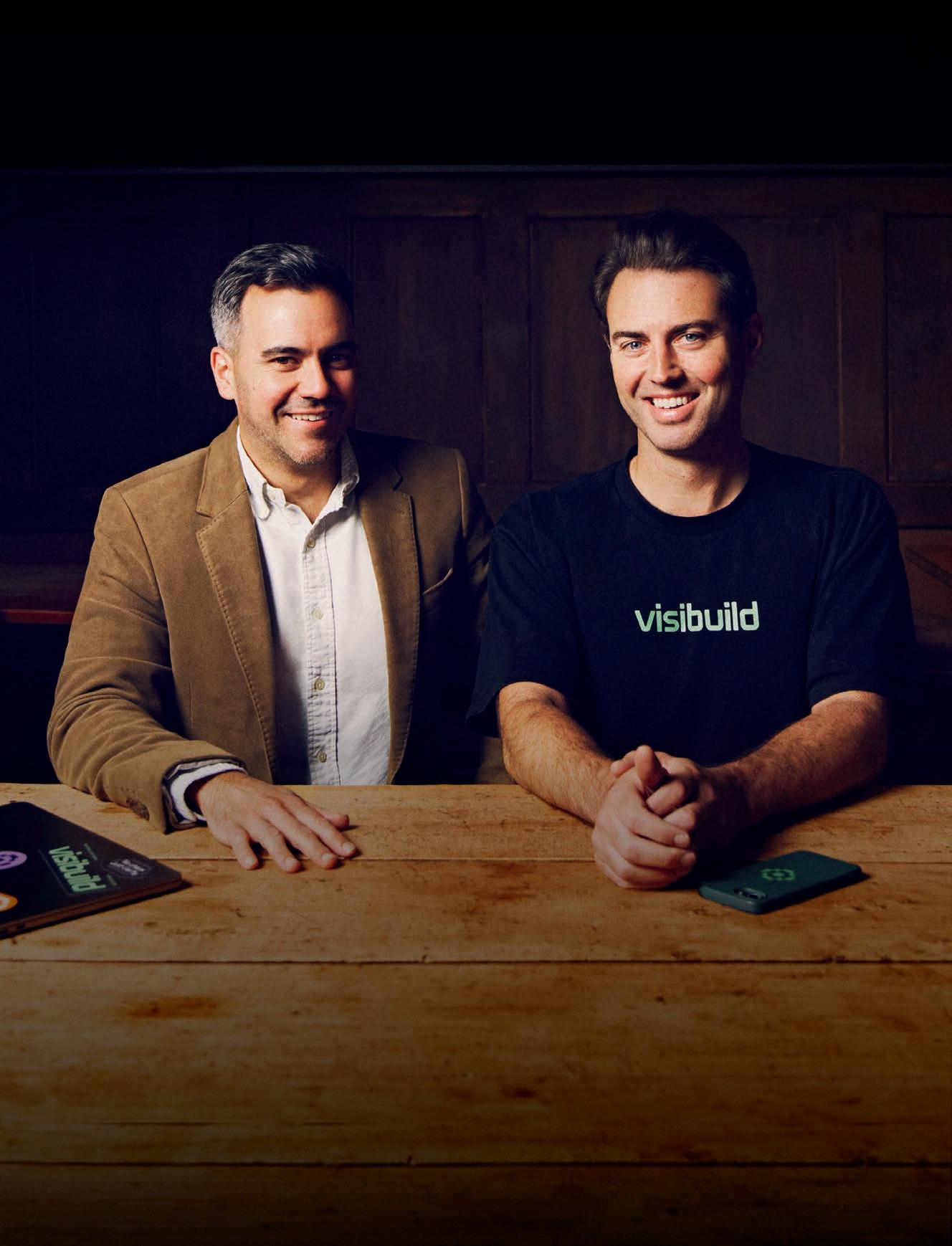
Data that can see around corners
Risk management in construction has traditionally relied on years of accumulated data. Visibuild is using AI to bring that intelligence forward to day one of a project.
Risk management in construction influences cost, program, quality and reputation. It is one of the few levers the industry has to protect margins and improve project outcomes.
Most major issues can be traced back to a risk that was either identified but not carried through or not identified early enough.
As Damien Quinn, co-founder and CEO of Visibuild, explains: “Construction risk management is well understood, but it is poorly executed.”
Having spent more than 15 years in the industry before launching Visibuild, a construction management software platform that centres on quality and compliance, Quinn has seen that disconnect play out across projects.
“Every business has extensive lessons learned lists. Teams are good at building detailed risk registers with thousands of line items that identify potential risks on a project,” he says.
“The issue is how that information is used. Once it reaches site, it often relies on what we call ‘individual brilliance’ – someone in the team taking ownership, pulling what is relevant from the risk register and making sure it is managed through the life of the project. In reality, that rarely happens consistently.”
Risk spans every part of a construction project, yet managing it has traditionally relied on people referring back to a register, typically a spreadsheet, that sits outside their
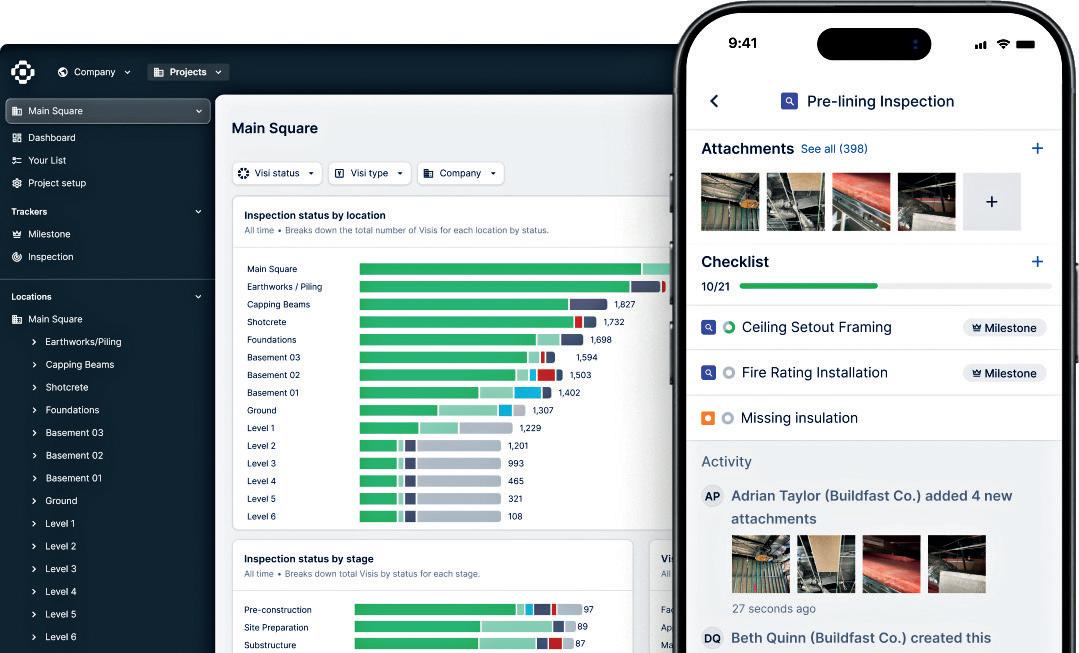
Every on-site inspection feeds intelligence back into the QA platform.
day-to-day workflow. With so many moving parts, it breaks down quickly.
Without a consistent process, lessons learned sit in that register, often failing to carry through to the next project. Quinn describes this as a trickle-down effect, where information is lost through the layers. Project leaders carry elements of it, passing them through during procurement and package award, but each handover strips away detail. By the time it reaches the workforce on site, the risk can be four or five steps removed from where it was originally identified.
“At that point, people aren’t referring to a register,” says Quinn. “They aren’t even thinking in terms of risk. They are just doing the work the way they did it on the last project. The breakdown isn’t in identifying the risks. It is in making sure they are consistently mitigated. That process falls over somewhere along the chain.”
Quinn puts the cost of unmanaged risk at up to 21 per cent of build value, with around 15 to 18 per cent lost before completion and a further three to five per cent emerging during post-completion rectification, where the same issues often reappear on subsequent projects.
This is, in part, due to the current feedback loop in construction, which Quinn estimates is seven to 10 years. A major project might run for two to five years, but the causes of issues are often not fully understood until years after completion.
“In most cases, the risks that cause those issues were already known at the start of the project,” he says. “The problem is that the industry still relies on learning by being burnt. You don’t need to touch the hot plate every time to know it is going to hurt. There are risks you already understand and should be managing from day one.”
That is the gap Visibuild is targeting with its upcoming AI-powered risk detection system.
“AI in construction is a blank page right now,” says Visibuild co-founder and director Ryan Treweek. “That’s the opportunity: to set the bar before the industry defaults to chatbots and auto-generated paperwork. The hard problem isn’t speed. It’s how you harvest institutional memory and still leave the decision with the professional who’s accountable for it.”
Visibuild’s bet is that the highest-value application of AI in construction isn’t just
from past projects, and makes it possible for “the industry to see around corners”. At project setup, contractors and subcontractors bring templates that define how work is delivered. AI assesses them against the risk register before work begins, identifying gaps ahead of manual review. For teams without a register, Visibuild generates one based on the type of projects they deliver.
Instead of manually comparing templates against thousands of risk items, teams review a pre-checked output. They still apply their own expertise, but now there is a “catch net” in place.
“By the time it reaches site, the worker doesn’t need to think about the register,” says Treweek.
“They are following a checklist on their device that has already been aligned to those risks. It tells them what needs to be done to mitigate them.”
“The breakdown isn’t in identifying the risks. It is in making sure they are consistently mitigated.”
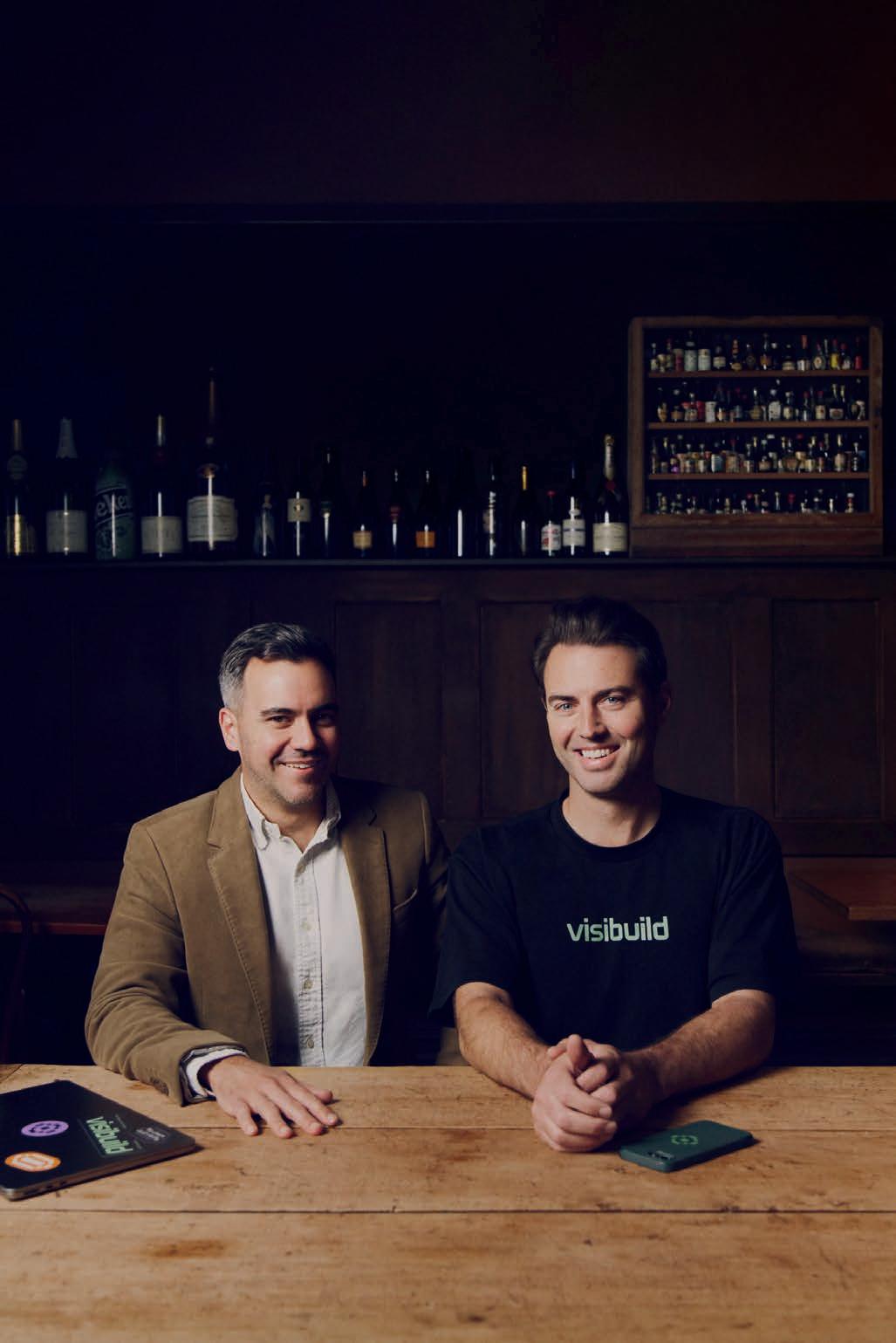
Visibuild co-founder and CEO Damien Quinn (left) and co-founder and director Ryan Treweek.
Images: Visibuild
Software and technology
“The risk doesn’t get lost in the layers; it is embedded in the way the work is delivered.”
During construction, the system monitors inspections and non-conformances in real time, identifying patterns and surfacing risks before isolated issues develop into broader problems.
“It can also connect patterns in defect data. Take something like concrete cracking. You might start to see defects being raised, patching required, and people assume it is just shrinkage cracking and move on,” says Treweek. “AI can step back and look across the project, or even across multiple projects, and recognise that this is a known risk. If several instances are being raised, it can flag that pattern and prompt further investigation.”
Instead of relying on individual judgement, such as whether to involve a structural engineer, the system highlights the risk early, giving the wider team visibility and allowing the right people to step in sooner. Without that, an issue might be patched and forgotten, only to become a larger problem later.
“It isn’t just about tracking individual issues,”
ensuring risks are properly assessed before they escalate.”
After handover, defect and ticket data feeds back into the system, refining how future projects are set up and ensuring the same issues are less likely to be repeated.
“That’s how you stop the breakdown,” says Treweek. “The risk doesn’t get lost in the layers; it is embedded in the way the work is delivered.”
AI doesn’t replace expert judgement; it supports it. Project teams work across multiple trades and review large volumes of information, and can’t realistically hold every risk in view. AI processes that detail and surfaces what matters, allowing engineers and coordinators to apply their judgement more effectively.
Quinn says the real value comes from connecting that intelligence across the full life of a project, rather than allowing it to fragment across stages and teams.
Visibuild dashboards can monitor any construction project type.
“That’s how you create continuous improvement,” he says. “By bringing together data from inspections, defects, project documentation and warranty management, every phase becomes a source of insight, and all of that feeds back into the risk engine.”
However, making AI-driven risk tools effective depends on clearly defined processes that are consistently applied across projects. That consistency underpins improvement.
“And that means not being afraid to raise issues. There has been a tendency in the construction industry to downplay or overlook them,” says Quinn.
“Non-conformances and defects should be raised regularly, because that’s what builds a stronger risk register and lessons learned process. If you aren’t capturing those issues, you are missing the opportunity to improve.”
As pressure on margins continues, managing risk becomes central to project performance. Adding more processes won’t solve the problem. The focus is on making existing systems work harder, with AI applying the information already being generated to shorten the feedback loop and embed lessons learned from the outset.
The AI-powered risk detection system provides live project visibility on and off site.
Software and technology
Capturing the full picture
Leighs Construction is using Cupix to turn site progress into a visual record that shows exactly what was built and when.
Leighs Construction, an established New Zealand civil and commercial contractor, introduced Cupix in 2023. Within 12 months, it had been rolled out across the company’s projects.
Initially adopted to verify built works against the design model, the AI-powered spatial intelligence platform quickly demonstrated its value, as project director Marcus Hogan saw firsthand.
“Before Cupix, you would walk around with a camera, take photos of what you thought was important, then file them, add dates and catalogue them into a system,” he says.
“When you needed to find something, you had to trawl through all those photos. Most of the time you couldn’t find what you were looking for, and sometimes you realised you hadn’t taken a photo of it at all. It was labourintensive and prone to human error. Cupix removes the need for all of that.”
At its core, the platform captures and visualises construction sites in a virtual environment, using AI and 360-degree cameras to create a navigable record of progress as projects are built.
“If you were told to go back to the old way of working, you just wouldn’t. You couldn’t go back,” says Hogan. “We didn’t go into it thinking Cupix was going to be a major part of how we work, but it has grown organically as its benefits have become more apparent.”
Hogan says the platform’s role has expanded steadily since those early stages. What began as a response to a specific need is being applied to the company’s most demanding jobs.
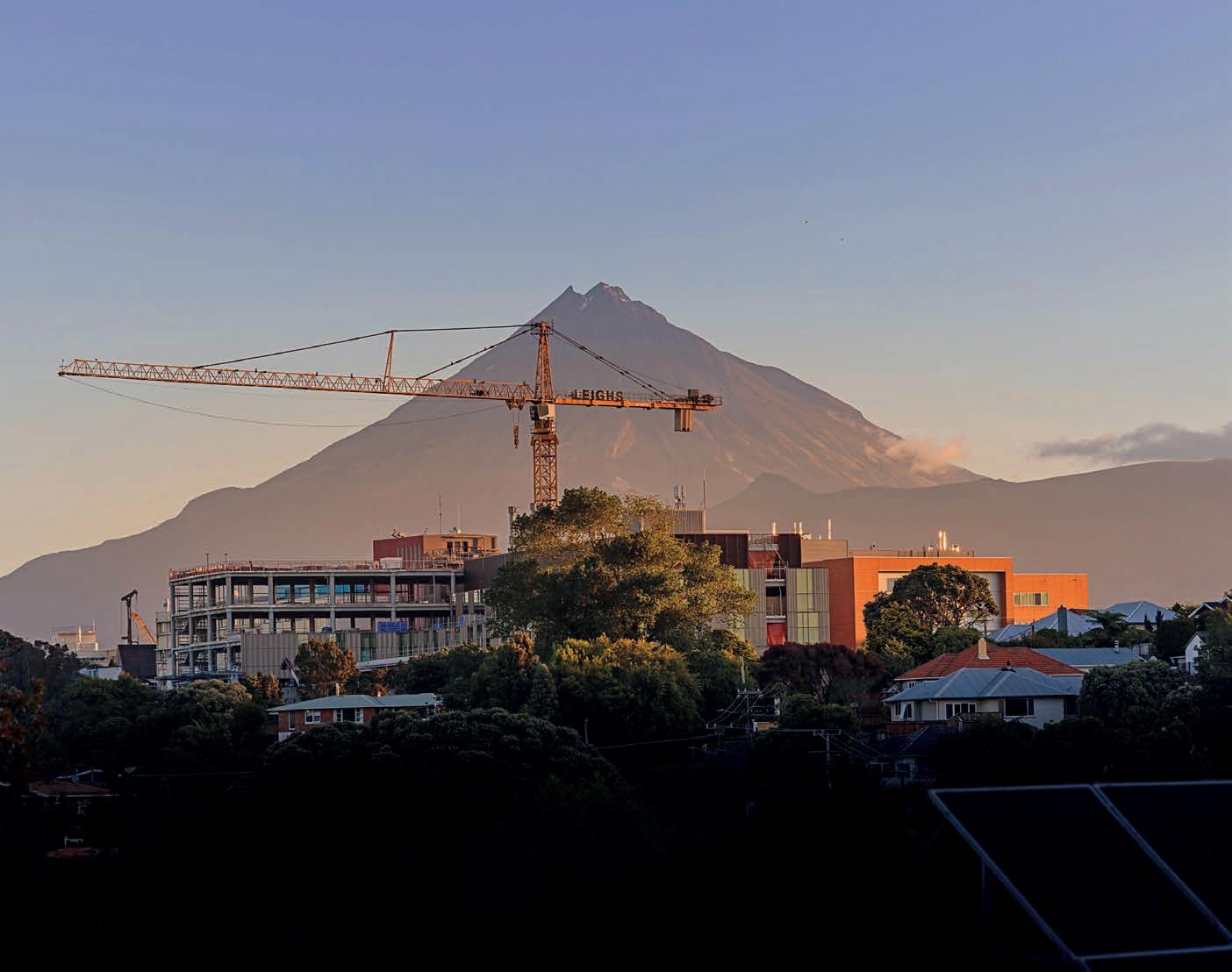
As the main contractor for Stage Two of Project Maunga, the Taranaki Base Hospital Redevelopment, Leighs is delivering the sixstorey, 20,000-square-metre New East Wing Building (NEWB), which will house acute clinical services, including the Emergency Department, Intensive Care Unit, maternity, primary birthing, neonatal, radiology and laboratory services as well as a rooftop helipad.
On another project, Leighs is constructing a six-storey, 17,000-square-metre medical school building as part of the University of Otago Christchurch Campus Redevelopment. The facility will include laboratories, clinical research spaces and health education areas.
Cupix is used to track progress on the Taranaki Base Hospital Redevelopment.
FOCUS Software and technology
“If you were told to go back to the old way of working, you just wouldn’t. You couldn’t go back.”
Cupix creates a timestamped record of the project as it’s built.
Both demand tight coordination, complex services integration and a high level of control over how work is delivered.
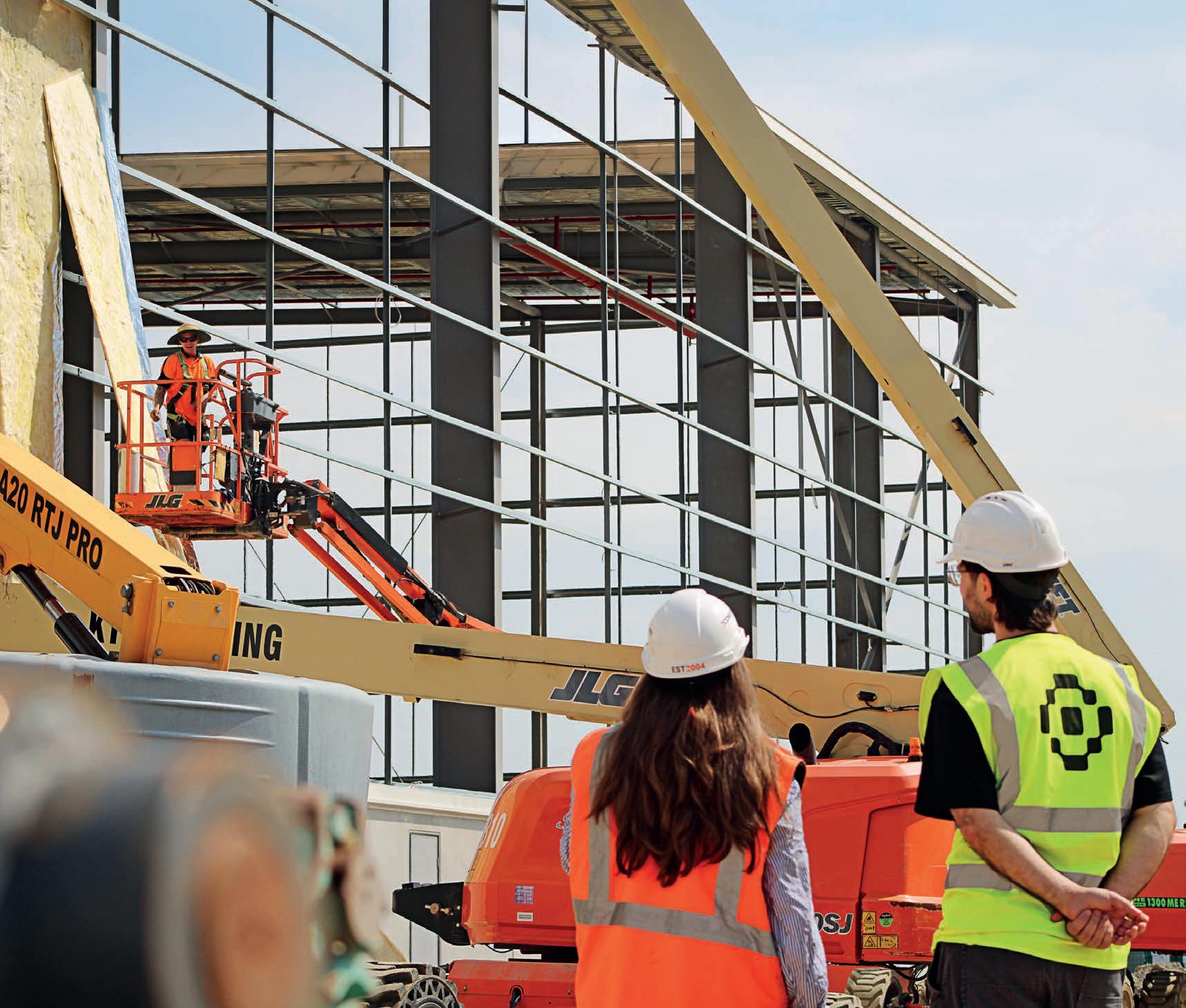
On site, Cupix is used alongside the program to help track progress in real time and understand where each area stands on any given day. If something is missed during a site walk, the team can return to the timestamped captures and work back through specific dates or locations. In critical or fast-moving areas, captures are taken daily, and sometimes more than once a day, creating a continuous record of activity.
That capability was tested during a weather event that halted work. While the team knew conditions had been severe enough to justify an extension of time, the impact was difficult to evidence after the fact. Reviewing Cupix captures, Hogan identified pooled water across the waterproofing membrane, confirming the area couldn’t be trafficked without causing damage to the membrane. This allowed the team to substantiate a threeday extension of time.
“Without those captures, we likely wouldn’t have had sufficient evidence to substantiate the claim. That would have meant we lost time on the project,” says Hogan. “Cupix gave us visual evidence of the site conditions on specific days, from multiple angles, which supported the claim.”
In another case, the project team couldn’t work as efficiently because of a variation and lodged a disruption claim. With Cupix, Leighs evidenced the rate of construction in the affected areas and compared it to unaffected areas, showing that labour productivity had slowed as a result of the variation.
Beyond individual claims, Hogan estimates the platform has saved hundreds of hours across disciplines, largely by removing the need to manually capture, store and search through photographic records.
More broadly, it has changed how claims are substantiated. Rather than relying on fragmented records or competing interpretations, the team can return to a single source of visual truth.
“It removes a lot of subjectivity,” says Hogan. “If one person says something is one way and someone else says it’s another, you can go back and evidence it.”
That level of detail becomes critical when work is questioned after completion. On one occasion, a client queried whether back boxes were installed in fire-rated walls, and whether they met the fire and acoustic requirements.
“We said they were, but they asked us to prove it. At that point, we had two options: either cut a hole in the wall or use Cupix,” says Hogan.
“We went back through Cupix and created an animation showing the installation from start to finish. It showed the back box going in, the acoustic putty and the fire rating behind it. It was all there, so there was no argument. Otherwise, it would come down to taking our word for it, or opening up the wall, which takes time and adds cost.”
Similar checks have been applied to structural elements, including reinforcement in basement works, where the team was able to review the placement of rebar against the drawings before introducing new penetrations in the retaining walls. By confirming what had been installed, rather than relying on assumptions, the team avoided cutting key reinforcement bars and showed the penetration could be core drilled in the proposed location. Hogan says this has saved thousands of dollars by removing the need to open up completed work or undertake invasive verification.
Cupix also carries through to handover and ongoing asset management. Detailed captures of services are taken before ceilings are closed
and provided to the client as part of project delivery, offering a visual record of what has been installed. While as-built drawings once formed the primary reference, clients now receive a navigable record that can be revisited during maintenance or future upgrades, particularly in areas that are difficult to access once complete.
“Cupix provides a strong record, which becomes valuable when you need to support a claim, resolve a dispute, prove something on site or check progress,” says Hogan. “That is where it really comes into its own.”
In critical areas, captures are taken daily, and sometimes more than once a day.
Detailed captures of services are taken before ceilings and walls are closed.
Images: Leighs Construction
FOCUS
Structural solutions
Supply certainty in an uncertain market
Cost, supply and delivery are moving targets in construction. One supplier is working to restore certainty.
Instability in construction supply chains is being driven by a mix of global pressures, many of which sit outside a project’s control. Ongoing geopolitical tensions are adding to that uncertainty, even when products are not sourced directly from those regions.
In its own business, building solutions provider FTI Group is seeing the impact in diesel and fuel prices, particularly given it runs its own logistics fleet, alongside volatility in global steel prices. The company is focused on consistency and reliability in response.
CEO Cameron Arkcoll says these pressures are creating a new baseline for the industry to work with.
“Across the construction industry, there are delays on shipments, delays on imported products, and even locally manufactured products that are waiting on components. There are also steep increases in pricing. Whether that is due to genuine cost increases or more opportunistic behaviour, the result is the same,” he says.
“It is often the middle of the chain that feels the impact. Typically, that is the builder working under a fixed-price contract, who ends up carrying the pressure.”
Arkcoll says a procurement-led approach is no longer sufficient to manage supply risk, and contractors need to look further up the chain into earlier design and planning decisions.
“It is no longer the point-of-sale decisions that make the biggest difference. It is about having certainty in the supplier and end-user relationship. That means knowing a supplier will stand by the original contracted price, support the project through to completion, and avoid delays in product supply,” he says. It is here FTI’s model comes into focus. In many cases across the industry, a product may be designed or specified into a project now, but construction may not begin for 12 months and the product may not be required for 18 months. At that point, there is no certainty around what that product will cost.
FTI holds the price quoted at the beginning of the project, with no increases applied throughout, regardless of market conditions. The company purchases the raw materials at the point of contract, removing exposure to price increases later on.
“The current industry environment is not new for FTI – we saw the same pattern when COVID-19 began,” says Arkcoll. “While the global conditions are different, the symptoms across the industry are similar. We know how to respond, protect clients and work with suppliers to manage those conditions.”
That raises a broader question around where supply risk should sit within a project, and who is responsible for managing it. Arkcoll says it ultimately comes back to the builder. The builder is the one carrying the cost risk, but also the one instructing the design team. There are products that are highly exposed to price fluctuations depending on what is happening across the industry.
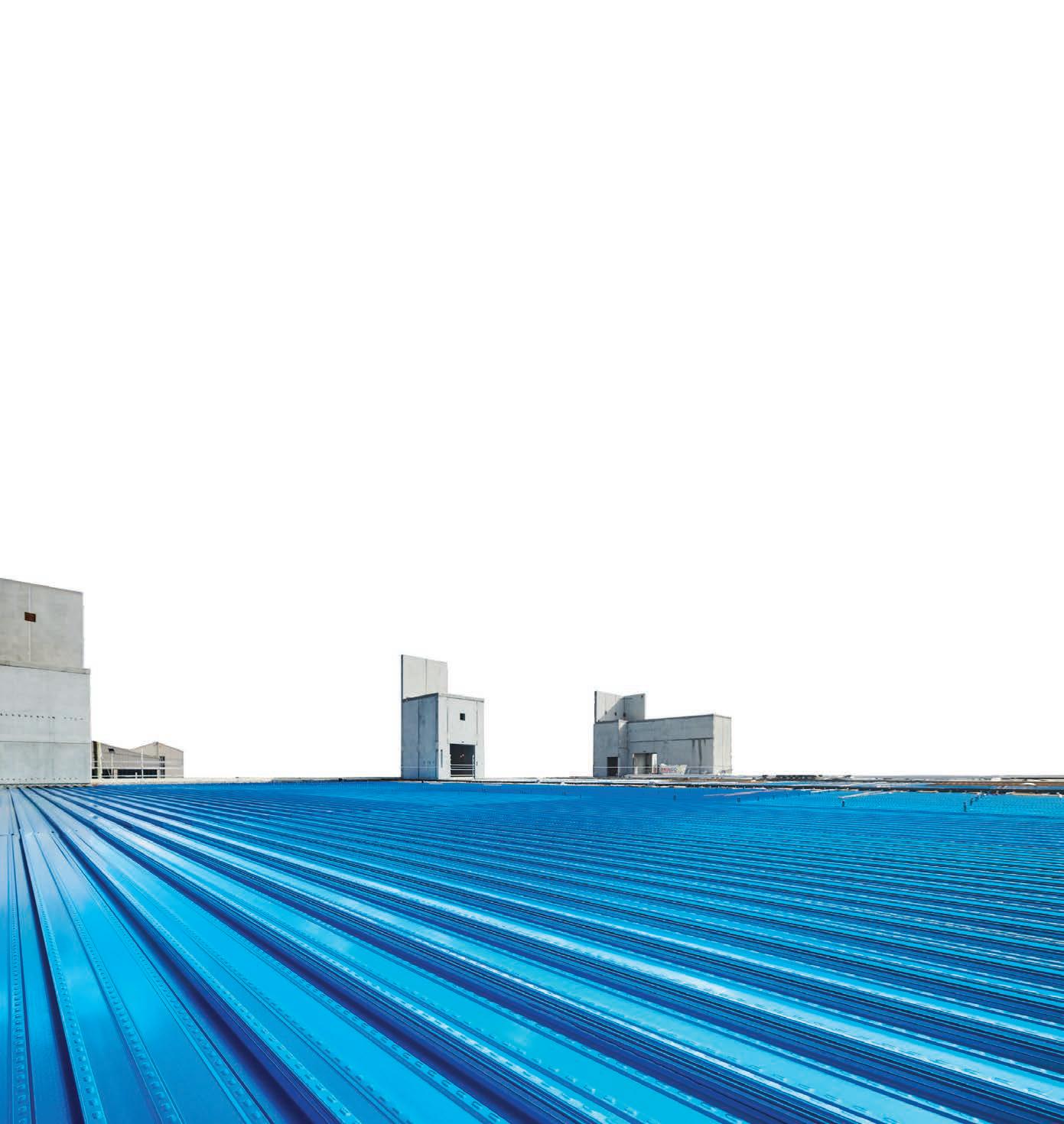
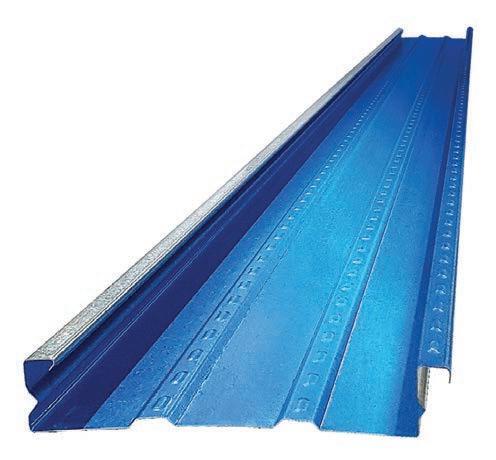
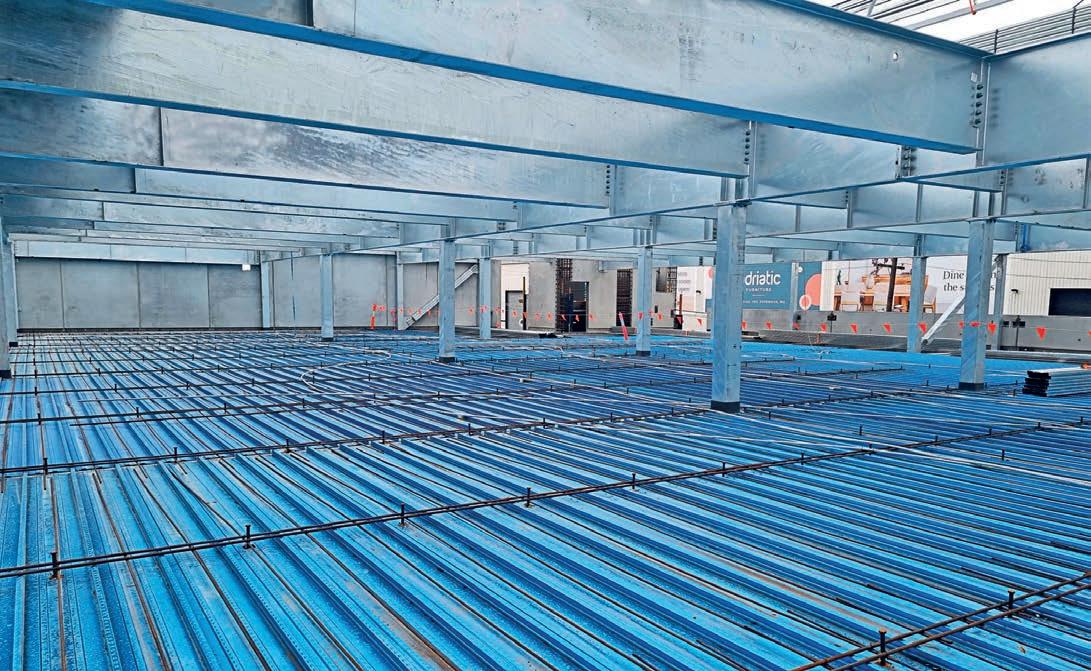
With a set price locked in for the duration of the contract across its core product range –FastTread preformed concrete stairs, BlueDeck metal decking formwork and SureFit metal door frames – FTI removes that exposure.
Arkcoll says specifiers, particularly engineers, need to be more aware of the implications their decisions have for their client.
Projects using FTI Group’s product range benefit from coordinated supply.
of mind in every decision,” he says. “In many cases, however, specifiers align themselves with products they are familiar with and have used before, rather than what is best suited to the project. That comes down to understanding how those decisions play out across cost, risk and delivery.”
Keeping pace with the market remains a challenge.
Using metal decking as an example, Arkcoll says there are still builders and designers who avoid specifying it because they believe it sits at the price point it reached during the COVID-19 pandemic. In reality, pricing has come back down. In many cases, that shift has not been recognised due to a lack of research.
“Overall, there needs to be a more disciplined approach,” he says.
“While we are educating the market from our side, specifiers and builders also need to reassess how they approach procurement to ensure they are getting the best value. That may be immediate cost, or value realised later, such as locking in pricing for an extended period.
“We are closely integrated with our suppliers to ensure they can support us, and we take the same approach with our customers. We want to see them succeed and navigate these challenges without disruption.
“We are not looking to capitalise on volatility. The focus is on helping customers succeed, so that success continues over the long term.”
when engaged early. Alignment between design, engineering and supply partners provides greater certainty across the supply chain and confidence in the product from the outset, reducing the risk of issues emerging later in the project.
However, this does not simply mean defaulting to known suppliers. While it is easy to become comfortable with certain suppliers, Arkcoll says that needs to be consistently reviewed. Procurement is about understanding the market, and it is constantly changing. Supplier offerings change with it.
“It is not a set-and-forget approach –those relationships need to be reassessed to ensure they remain the right fit for the project,” he says.
“There needs to be a stronger understanding of what is available, along with a willingness to be open to innovative ideas.”
While he acknowledges the term “trusted partner” is overused, he says it reflects what the industry should be looking for and what FTI strives to be.
“It is not just about price. It is the overall package we offer, from design through to manufacture and logistics, ensuring customers receive what was promised, on time, where it is needed, and at the price originally agreed,” says Arkcoll.
“The outcome is reliable, design-led supply – on budget, on time, with a happy client and supplier.
“It is no longer the point-ofsale decisions that make the biggest difference. It is about having certainty in the supplier and end-user relationship.”
BlueDeck is delivered through FTI Group’s fixed-price model.
Images:
FTI Group
FOCUS
Structural solutions
Gypsum with grit
Knauf’s systems give internal walls and ceilings staying power in spaces that see constant wear.
Facilities exposed to constant traffic ask a lot of internal walls and ceilings. They need to withstand impact, satisfy functional requirements, maintain a clean finish and limit repair disruption, often in spaces that can’t easily be shut down when damage occurs. Knauf’s MultiStop ONE and FIBEROCK Aqua-Tough boards give project teams a way to add strength where it is needed most, without treating impact resistance as separate from broader design, compliance and construction requirements. The range is graduated by exposure. MultiStop ONE combines fire, water,
mould and impact resistance with acoustic performance in a single gypsum plasterboard, making it suitable for healthcare, education, aged care, public buildings, hotels and student accommodation. MultiStop ONE HI adds mesh reinforcement for areas subject to higher wear or incidental impact, including specialist healthcare, data centres, police stations and gymnasiums.
At the top of the range, FIBEROCK AquaTough is a fibre-reinforced gypsum board for areas requiring very-high impact resistance, such as healthcare and mental health projects, defence and corrections facilities, and indoor sporting courts.
Knauf national architectural specifications manager Kelly Watson and senior development engineer Daniel Lim say the graduated approach helps simplify highimpact specifications.
“Architects and specifiers have a lot to think about when they are designing a building. It is never just the walls or ceilings. They are thinking about the whole building, the way each space will be used and the different performance requirements that need to be met,” says Watson.
“Having options that combine several performance attributes can make the specification process more straightforward and practical.”
On many projects, the boards work best in combination. FIBEROCK is often used as the lower sheet, up to about 1200mm in hospital corridors where walls are most exposed to trolleys, equipment and traffic, while MultiStop ONE covers the upper zone less prone to damage. Both products are gypsum-based, so they can be installed and finished using the same plasterboard methods, producing a smooth, consistent finish and high joint strength that resists cracking.
FIBEROCK’s paperless, homogeneous surface resists delamination, scratching and picking, making it ideal for mental health projects. It also provides a stronger substrate for applied finishes.
“With normal plasterboard, including MultiStop ONE, there is usually paper on each side with the gypsum core in the middle. FIBEROCK, being completely paperless, creates a stronger bond line for paint, tiles and abrasion-resistant coatings,” says Lim.
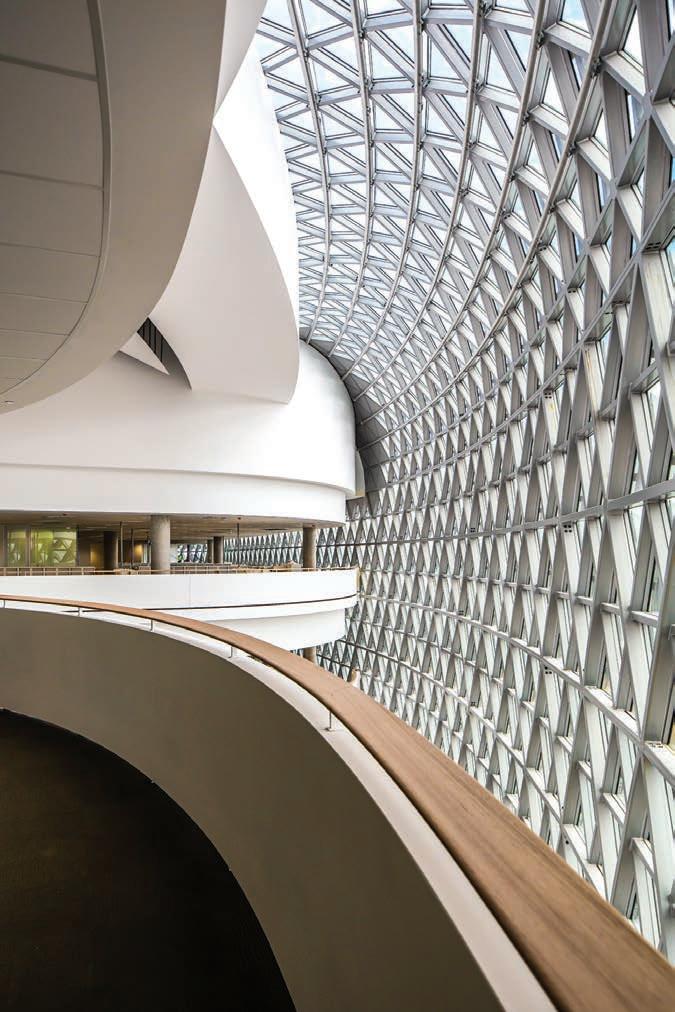
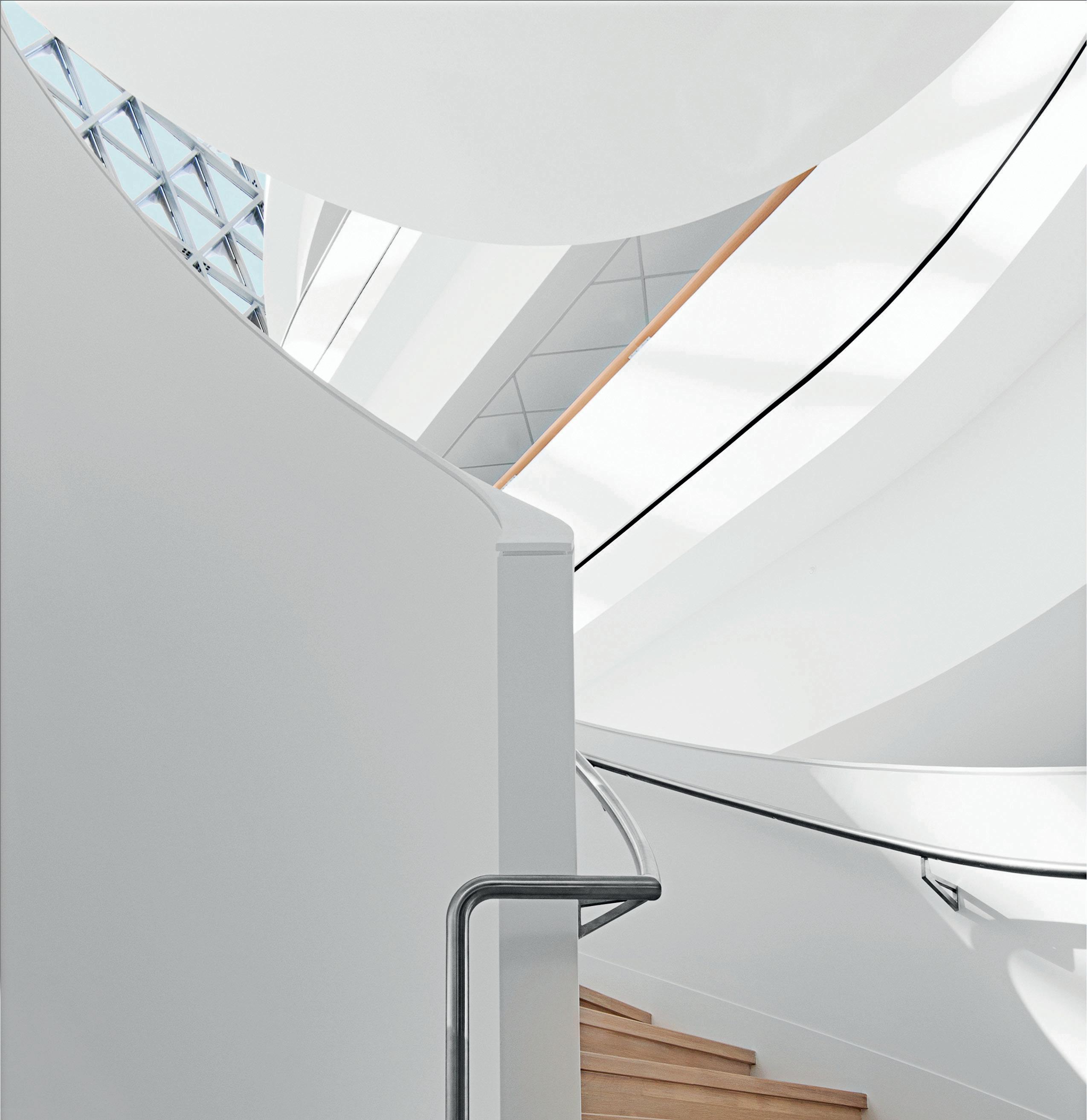
FIBEROCK was installed throughout the SAHMRI building in Adelaide.
Images: Knauf
“If tiles are installed on FIBEROCK, the adhesive bonds into the board itself. With standard paper-faced plasterboard, the adhesive bonds to the paper, and the paper is bonded to the core, which reduces tile-weight capacity.”
FIBEROCK can support up to 50kg per square metre, compared with 32kg for MultiStop ONE, making it better suited to heavier finishes in wet zones and lobby spaces.
The same capacity carries through to fixtures. In hospitals, aged care facilities and other occupied buildings, handrails, wallmounted televisions and specialised medical equipment often require backing support. With FIBEROCK, suitable fixtures can be attached without relying solely on studs or noggings.
“It gives designers and installers more options, because those items don’t have to be located only where the framing allows,” says Watson.
Installation is straightforward, and handling is easier. Contractors are increasingly seeking alternatives to fibre cement products, which contain crystalline silica and require strict dust controls when cut with power tools. Those controls can involve separate cutting areas and repeated material movements. As a homogeneous, paperless gypsum product with no cement in its composition, FIBEROCK can instead be scored and snapped, saving time and reducing site complexity.
“Because it is easy to cut, builders can reuse offcuts more efficiently during installation, so there is less material waste. FIBEROCK also contains 95 per cent recycled content, which adds another sustainability benefit,” says Lim.
“Across FIBEROCK and the MultiStop ONE products, there are Environmental Product Declarations (EPDs) available, along with GECA certification and Product Aware listings. That gives project teams access to the sustainability information they need for projects with targets such as Green Star.”
The value of impact-resistant board selection often becomes most visible after handover, when walls begin to meet the daily realities of the building. Watson says the wrong lining can lead to recurring maintenance, particularly in high-traffic areas exposed to trolleys, equipment, fixtures and constant movement.
“The issue is greater in healthcare and other operational environments, where corridors or patient areas may still need to remain in use. Repairing damaged walls can require closing sections, disrupting access and adding cost,” she says.
“If the lining is suited to the environment from the beginning, project teams can reduce the likelihood of repeated repairs.”
Knauf’s Autodesk Revit and Graphisoft ARCHICAD tool, BIM Wizard, helps architects and specifiers select the right board for each application. FIBEROCK and MultiStop ONE systems are available as data-rich files for drawings and documentation, allowing users to select prepared wall systems that align with the required performance. Where internal walls and ceilings need to withstand wear, meet project requirements and keep occupied spaces working, the right board keeps earning its place long after handover. Knauf’s MultiStop ONE and FIBEROCK systems connect durability, finish and constructability from selection through to service.
FIBEROCK in Australian health projects
Knauf has supplied FIBEROCK to several major hospitals and medical centres across Australia, including the South Australian Health and Medical Research Institute (SAHMRI), Hornsby Mental Health Facility, the Royal Children’s Hospital in Melbourne, Robina Hospital on the Gold Coast, Sunshine Coast University Hospital, Gold Coast University Hospital and Midland Hospital in Perth, with volumes ranging from 40,000sqm to 365,000sqm.
FIBEROCK’s paperless, homogeneous surface resists delamination, scratching and picking.
under control
Corrosion of steel fasteners is inevitable, but with the right coating system, its progression can be effectively controlled.
These coatings are typically applied at low thicknesses, often just a few microns.
“We can also mechanically galvanise, where zinc powder is applied with another medium to effectively bond it onto the steel surface, or hot-dip galvanise, which involves dipping the fastener into a bath of molten zinc.
“Then there are more traditional paint-type coatings, such as zinc flake or Ruspert. In those cases, we dip the fastener into a liquid coating and then spin off the excess. It is a dip-spin process, which leaves a consistent finish on the fastener.”
Each process dictates the coating’s properties, making careful selection essential for the fastener’s intended environment.
Understanding corrosion categories
Specifying the correct coating begins with assessing both the macroclimate (broad regional environments) and microclimate (localised, structure-specific environments). ISO 9223 outlines macroclimate corrosion categories, ranging from low (C1) to high (C5) and extreme (CX).
Coatings span basic protective finishes to systems for sustained aggressive exposure.
FOCUS
Structural solutions
“There needs to be a balance between performance and cost to determine the most suitable fastener for the application.”
At the lower end of the scale, C1 environments present negligible corrosion risk, typically in heated indoor spaces or enclosed commercial interiors, where thin electroplated coatings are sufficient. C2 extends to low-pollution, predominantly inland or rural conditions, where corrosion remains limited but no longer negligible.
The shift to C3 introduces sustained exposure to pollutants and moisture, characteristic of suburban and inner-city environments, where coatings such as mechanical galvanising are commonly adopted to provide increased durability.
Beyond this point, proximity to the coastline becomes the dominant factor.
“C4 typically applies to areas around 0.5 to five kilometres from the coastline, where hot-dip galvanising coatings are suitable. This is where we have introduced fasteners with high-performance coatings,” explains McPherson.
“C5 is more severe, generally around 50 to 500 metres from the coast, while CX is the most extreme category, typically within about 50 metres, where salt exposure is highest.”
For C5 and CX environments, where exposure is sustained and aggressive, Hobson typically recommends stainless-steel fasteners, such as BUMAX high-strength bolts and Bi-FiX screws.
“Stainless steels protect themselves by forming a passive oxide layer,” says McPherson. “That makes them more tolerant of damage. If a stainless-steel fastener is scratched, it can self-repair, whereas a damaged applied coating can expose the underlying steel and increase the risk of corrosion.”
But the macroclimate is only part of the picture. Microclimate is just as important. This includes factors such as whether the fastener is exposed to rainfall, which can reduce salt build-up, or sheltered, such as under an eave or behind cladding.
“In a coastal environment, a fastener may be exposed to salt, but without rain to wash it away, corrosion can be more aggressive than in areas cleaned by rainfall,” says McPherson.
Alternatively, a building might sit in a higher corrosion category, but if the fastener is protected behind a screen, the effective exposure may be lower. In that case, a lower coating category may be suitable.
“Engineers should also consider the application itself,” says McPherson. “In many cases, dissimilar metals are used together and require isolating washers to prevent galvanic corrosion. Specific performance requirements determine the most suitable coating for these fasteners to ensure their effectiveness.”
Access is another factor. Engineers can specify a high-protection coating and expect it to last 50 to 100 years without maintenance,
Hobson
Images: Hobson Engineering
or they can use a mid-level coating with the expectation that it will need to be reapplied after about 20 years.
“If a structure is in a remote or difficultto-access location, that becomes a key consideration,” says McPherson. “In those cases, we need a high-performance coating to avoid costly maintenance in the future. Alternatively, BUMAX high-strength stainlesssteel fasteners are ideal, requiring little to no maintenance.”
The balancing act
With coating systems and corrosion categories understood, the challenge becomes one of specification, balancing environmental exposure with performance requirements.
The first step is accurate classification of the corrosion environment, taking into account both the macroclimate and the microclimate. Misjudging either can result in a coating that underperforms in service or one that exceeds what is required for the application.
This is followed by defining performance expectations aligned to design life. There is little value in specifying a high-end stainlesssteel fastener if the structure only needs to last 10 years. Instead, the selection should reflect the intended service life, maintenance strategy and overall project requirements.
Cost must also be considered, but always in the context of lifecycle performance. A lower cost coating may appear attractive upfront, but if it requires earlier replacement or ongoing maintenance, the long-term cost can outweigh the initial saving. Conversely, over-specifying can introduce unnecessary expense without delivering practical benefit.
“There needs to be a balance between performance and cost to determine the most suitable fastener for the application. That means clearly defining expected service life and required performance,” says McPherson.
Expanding to meet new challenges
McPherson says market demand, alongside the push to reduce emissions in manufacturing processes, has driven Hobson to expand its coatings range.
“There is a push, particularly in Europe, to move away from hot-dip galvanising. It is energy intensive and not seen as environmentally friendly, given the use of molten zinc and the associated emissions,” he says.
“As a result, there is a shift towards a new generation of coatings. X9 ProteXion is playing a big part in that, and we are seeing greater acceptance of stainless-steel fasteners as well.
“If we look back 20 years, stainless was considered a premium option and only used where absolutely necessary. Now, we are seeing organisations such as water authorities, which traditionally specified hot-dip galvanised finishes, moving towards high-grade stainless-steel fasteners for infrastructure applications.”
Hobson’s coatings range reflects this progression, spanning from basic protective finishes to systems suited to sustained exposure in aggressive environments.
By aligning coating systems with Australia’s diverse exposure conditions, Hobson ensures fasteners achieve the required performance across their intended service life.
Zinc flake coating enhances durability while preventing hydrogen embrittlement.
“With electroplating, we use an electrical current to deposit a thin layer of metal or an epoxy coating onto the steel.”
Global strength. Local expertise.
Keep projects moving without the complexity.
Simplify your builds with Knauf’s complete range of wall and ceiling products and systems. Versatile solutions for complex builds that are easy to specify, order, and install.
From commercial towers to community spaces, our local teams and proven systems help you build better, every time. knauf.com
Find out more.
Major projects
Back to berth
Tropical Cyclone Megan didn’t leave a wharf to repair at Groote Eylandt. It left a twisted, partially submerged structure that had to be dismantled before anything could be rebuilt.
On 18 March 2024, Tropical Cyclone Megan shut down the Groote Eylandt wharf, cutting off the island’s only manganese export line and bringing a globally critical operation to a standstill. The wharf, operated by Groote Eylandt Mining Company (GEMCO), a South32 and Anglo American joint venture, is central to the island’s manganese exports. Without it, stockpiles build quickly and production becomes unsustainable.
According to South32, it is the world’s largest producer of manganese, with Groote Eylandt a key source of supply. The disruption placed immediate pressure on global supply and the Northern Territory economy, with flow-on impacts for jobs and government revenue.
What followed wasn’t a conventional rebuild. It was a tightly sequenced operation working through a collapsed structure, a debrisstrewn seabed and a highly constrained marine environment. McConnell Dowell was engaged to deliver a program that spanned mobilisation; stabilisation; demolition; reconstruction of the wharf; electrical installation, energisation and commissioning; and completion and handover.
The brief was simple in definition and unforgiving in execution: restore export capacity as fast as safely possible.
Gert Olivier, operations manager for Queensland and the Northern Territory at McConnell Dowell, was part of the team working through it from the outset.
“The critical objective across all phases was achieving ‘first ore on ship’. The first ore milestone became the focus of all design, procurement and construction decisions. Once first ore was achieved, the remaining works could be completed within operational restrictions,” he says.
“The question was: how do we get a structure in place that allows a vessel to berth, and how do we get the conveyor system running so that material can be loaded?”
Getting to first ore meant mobilising quickly in a remote location where access, logistics and sequencing were already working against the program.
Moving people in and out of site was a task in itself. Each phase of the project demanded a different mix of skills, from marine and piling crews to riggers, welders and scaffolders.
The project’s critical objective across all phases was achieving ‘first ore on ship’.
“We completed more than 500 commercial dives, all safely and without incident.”
FOCUS Major projects
“This
project
is a powerful reminder of what can be
achieved when a client and contractor come together with a shared goal and a collaborative mindset.”
Mobilisation timelines added another layer of complexity, with it typically taking two to three weeks to get a person on site due to medicals and inductions. Workforce planning had to stay ahead of the program.
Within two months of the cyclone, crews were on site. A jack-up barge was the first major piece of equipment mobilised, allowing stabilisation and demolition to begin.
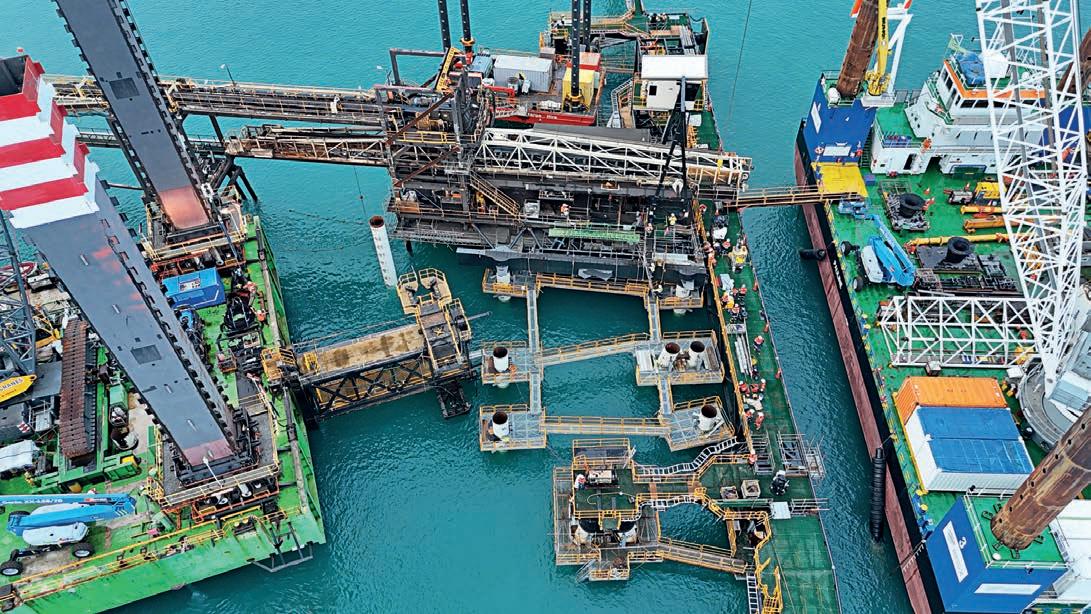
Soon after, a marine fleet was assembled from across Australia, Singapore and the UAE – two large jack-up barges (Santa Fe and Pauline), two smaller jack-ups (Sealift 2 and Sealift 6), a 250-tonne crane barge, three flattop storage barges, and a support fleet of tugs and work punts.
“The first priority was stabilising the remaining structure, particularly the shiploader and the contactor house,” says Olivier. “These were critical components that could be retained.”
With initial stabilisation in place, salvage works began with seabed clearance, as large volumes of cyclone debris needed to be removed before piling and installation commenced. At the same time, damaged steel above the waterline was stripped back while retaining key elements.
To support this, detailed scans were used to build a model of the structure in its damaged state, forming the basis for sequencing and the design of temporary stabilisation works.
“One of the difficult aspects of the project was dealing with what we referred to on site as ‘spaghettified steel’,” says Olivier. “The cyclone had twisted and deformed the steel structure to such an extent that it was wrapped around piles, bent in multiple directions, and in some cases partially suspended.”
Mechanical methods were used initially, with hydraulic shears cutting sections of steel away, but the condition of the material introduced further risk. Stored energy within the structure meant that cutting one section could release forces elsewhere, causing the steelwork to shift or collapse unpredictably if it wasn’t carefully controlled.
“We had to develop detailed cut plans and carefully sequence every action. We had a designer working with us on site to continuously evaluate the condition of the structure,” says Olivier. “Each time we removed a section, we had to stop, reassess
and replan the next steps. It was a controlled and methodical process.”
Some sections could be removed directly; others were cut and allowed to fall to the seabed, where divers salvaged the debris at a later stage.
Once the debris from above the waterline was removed, dive teams were required to cut, segment and rig submerged elements for salvage from the seabed. Working in low-visibility conditions and within tight tolerances around the existing structure, the dive teams salvaged a total of 1,037 tonnes of concrete and 998 tonnes of steel.
“We completed more than 500 commercial dives, all safely and without incident,” says Olivier. “This was in an environment where crocodiles and sharks are present, so additional safety measures were required. For example, divers were deployed in protective cages to ensure safe access to the seabed.”
Sonar imaging and remotely operated vehicles (ROVs) were used to identify debris and support lift planning, reducing reliance on manual intervention and improving visibility across the seabed. It turned a blind subsea environment into one that could be read, planned and acted upon.
Once enough of the damaged material had been removed, temporary stabilisation structures were installed onto the remaining piles, including an H-frame to support the shiploader and beams around the contactor house. Several units were floated into position, jacked up using the existing structure and welded into place, allowing demolition to continue with greater control.
With debris cleared, piling could begin. Seabed clearance dictated where crews could operate, with each cleared area opening a new work front. Once an area was ready, piling crews moved in, maintaining continuous progress.
“Piling was carried out primarily from jackup barges, with 28 piles installed across the site. Limited geotechnical information meant pile driving analysis (PDA) was required for every pile, with data reviewed in real time to confirm capacity before the next installation could proceed,” says Olivier.
Piling, fabrication and delivery moved in lockstep. Once piles were installed and verified, modular steel units could be brought
to site and lifted into position, allowing the structure to be rebuilt in stages.
Fabrication was carried out off site, with 13 units delivered ready for placement, reducing the amount of work required offshore and limiting exposure to weather delays. Olivier says this kept the program moving, with each completed section creating the platform for the next stage of construction.
Works were executed from a coordinated marine spread, with barges and support vessels operating as a single system.
“At any given time, we had two large jack-up barges, a crane barge, two flat-top barges and additional smaller platforms all operating in close proximity around the structure,” says Olivier. “That level of coordination is something I haven’t seen before and is something I’m unlikely to see again. It was a notable logistical accomplishment.”
Positioning, lifting and securing each module required careful alignment with tidal windows and vessel movements, with limited offshore staging capacity adding further constraint. Activities had to be continuously adjusted to suit changing conditions, with the program driven as much by the environment as by the schedule. It wasn’t just scale, but interdependence. Every vessel, lift and delivery was tied to the next.
“If piling was delayed, the installation barge didn’t have a work front. At the same time, delivery barges bringing modules from Cairns or Darwin could be forced to wait on site even when the piles were ready. A delay in one activity affected multiple others,” says Olivier.
“We held daily meetings with the client and maintained full transparency around what could and couldn’t be achieved. The target –first ore on ship – was fixed, but the path to get there had to remain flexible.
“That meant extensive planning – days and days of working through logistics, sequencing and contingencies to understand how we would respond if something didn’t go to plan.”
The hard work paid off. Less than 12 months from mobilisation, first ore was achieved, despite working through wet season conditions that regularly disrupted crane operations and compressed available working windows. Reaching that point shifted the focus to completing the remaining works around live operations and restoring full functionality.
Prioritising what was required to safely achieve first ore, and what could follow, kept the team focused on the critical path and maintained momentum.
The outcome has since seen the project shortlisted for the Australian Construction Achievement Award, which Olivier says reflects the teamwork behind its delivery.
“This project is a powerful reminder of what can be achieved when a client and contractor come together with a shared goal and a collaborative mindset,” he says.
“The cyclone occurred in March. We were engaged in May. Mobilisation followed shortly after that, and we achieved first ore within 12 months.
“For a project of this scale and complexity, that is a remarkable outcome.”
Jack-up barges supported piling works, with 28 piles installed across the site.
Images: McConnell Dowell
As Webuild pursues its next stage of growth in Australia, it is focused on
“The past three years have demonstrated our capacity to manage and adapt to unpredictable risks and rapid change. Webuild has consistently shown resilience, agility and disciplined execution in circumstances that were unprecedented. We continue to deliver increasingly complex projects, sustain operational performance and strengthen our strategic positioning across key markets. The results have exceeded expectations.”
The group’s structure gives it an advantage in this environment. In Australia, Webuild operates as an integrated proposition, bringing together Webuild, Clough and e2o. Webuild’s global infrastructure expertise underpins Clough’s local delivery of engineering and construction works, while e2o provides operations and maintenance capability, supporting the infrastructure, energy and resources markets. Together, this forms a multi-disciplinary model that expands how Webuild responds to clients.
Work spans infrastructure, energy and resources, and
buildings are a newer area for Webuild in Australia, its
Artist’s impression: Webuild is delivering the New Women and Babies Hospital Project in Perth.
FOCUS
Major projects
“Infrastructure is a catalyst for economic activity and social outcomes.”
delivering more than 300 hospitals, stadiums and airports supported the award of the New Women and Babies Hospital Project in Perth. It is no small feat to secure a $1.8 billion Western Australian Government project as its first locally delivered vertical building.
“Since standing up a team of around 150 professionals, we have seen talent attracted to the organisation because of that project, and we are now applying that experience to other pursuits across Australia,” says Stringer.
“There are also other health infrastructure opportunities, as well as energy and sports infrastructure-related projects we are looking at.”
But that spread of work is tempered by a measured strategy for bidding and early project engagement. The business maintains focus across three priorities: disciplined origination, with opportunities assessed against core capabilities; a targeted approach to pursuits, aligned to priority geographies, sectors and clients; and a clear understanding of customer expectations, carried through into delivery.
“Fundamentally, clients have a vision to be delivered, and we need to differentiate and deliver on their expectations, ideally beyond.
Clients are calling for more competition in the market. It is already a competitive space, so we continue to lift our game to compete and build
experience can be assessed and refined to suit Australia’s operating environment.
Winning projects is one thing, but execution
engineering knowledge developed over more
“It is not one-size-fits-all. It is about using global capability and innovation, and tailoring it to the Australian environment,” says Stringer. “Otherwise, it doesn’t resonate. What works in Europe will not always be effective here, so the focus has to be on making it relevant to local conditions.”
But more than anything, Webuild returns to the idea of a ripple effect, which Stringer describes as an obligation.
Beyond delivering physical assets, the group builds long-term national capability through workforce training, skills development and support for a diverse local supply chain.
collaboration and an understanding of local
UK will not necessarily succeed in Australia
“We have an obligation to increase capability in the market, lifting talent, apprentices and skills. It is on us as a major multinational, and on all contractors in Australia, to provide training and opportunity,” says Stringer.
“We also need to draw from the broadest and most diverse talent pool possible, including increasing female participation in the construction industry. We are proud to have Clough and e2o recognised as employers committed to gender equality by
Images: Webuild
the Workplace Gender Equality Agency for the fourth consecutive period.
“Mentorship is equally important. I have been fortunate in my career to benefit from strong mentorship, and it is important that we pass that on to the next generation coming through the industry.”
That obligation extends into how the business engages with the communities in which it operates. For Stringer, social licence is not assumed. It needs to be earned and maintained. Trust can be built over time, but it can be eroded quickly if expectations are not met.
There is a broader responsibility in delivery, centred on transparency, early engagement and meaningful collaboration with stakeholders, including First Nations and local communities.
Collaboration underpins how Webuild delivers projects, with a focus on building strong, aligned relationships that deliver shared outcomes. Since joining the group from another large Australian organisation, Stringer says he has not previously experienced this model or the way the group works alongside clients and partners.
“The strength of those relationships means we can add greater value to our clients. It is evident in the way we work with our supply chain, where relationships are built as partnerships with early engagement across clients, designers and delivery teams, rather than transactional arrangements,” he says.
“As projects become more complex, that approach becomes increasingly important. There are more risks in the system, so we need to be more transparent about those risks and how they are shared.”
For all the change and complexity shaping the market, Webuild holds to a set of core fundamentals: safety, quality and a peoplefirst culture built on integrity, capability and teamwork. In Australia, those fundamentals are carried through in how projects are delivered, with early engagement, shared risk and close collaboration across clients, partners, the supply chain and the community.
The next era of infrastructure, Stringer argues, will be built by those who combine collaboration and co-creation with discipline and purpose, contributing to national capability and outcomes beyond the build.
“You are not known for the projects you win, but for how you deliver them.”
Webuild works closely with stakeholders, including First Nations and local communities.
FOCUS
Building products
Collaboration sits at the centre of Transmutation’s approach.
construction, aligning material innovation with commercial and compliance chain, not throughput. Transmutation sources
established model, calibrated to the pressures now driving contractor decision-making.
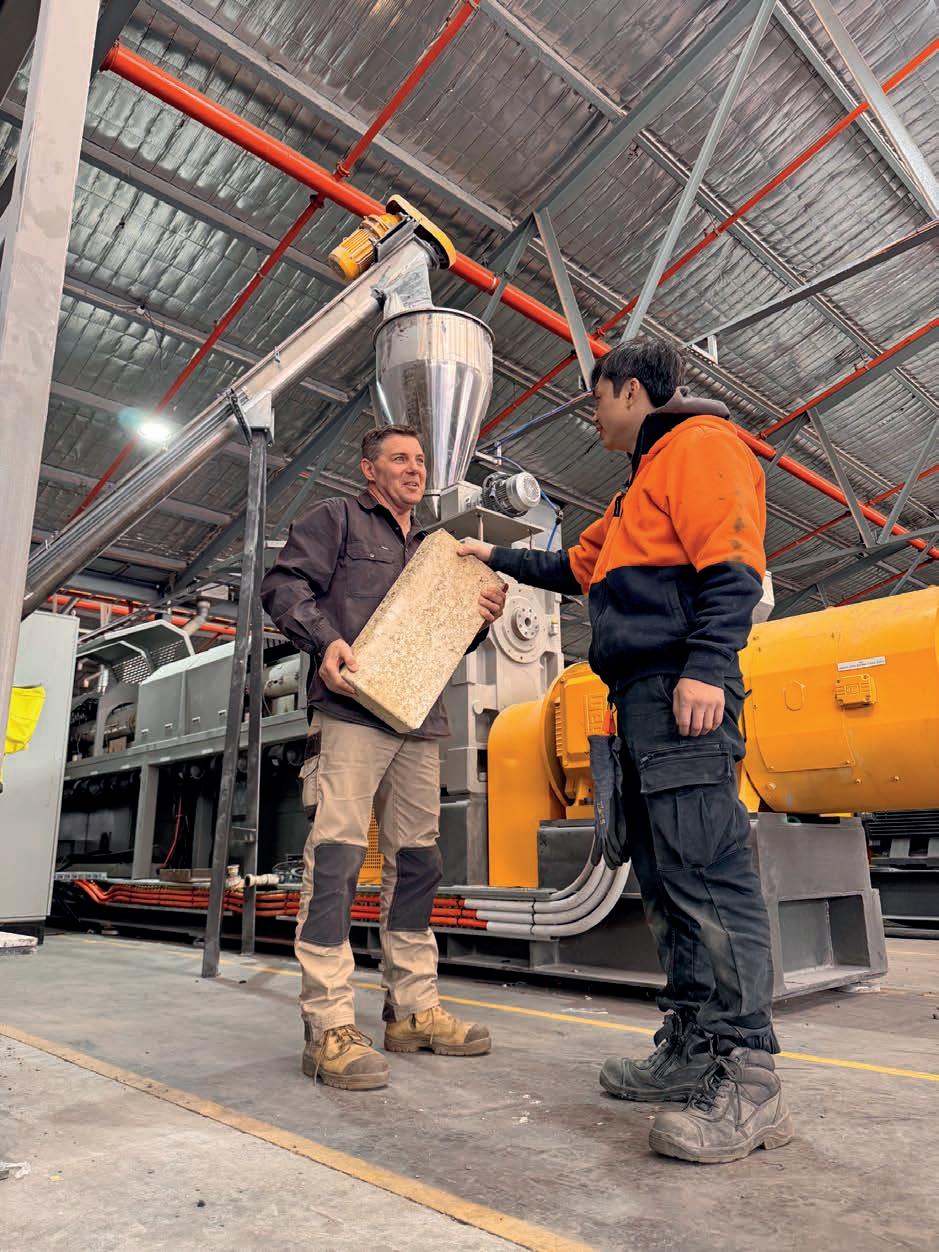
“The expansion is about scaling up what we have been doing previously. That is taking hard-to-recycle products that would traditionally go to landfill or don’t feed into standard recycling streams, and converting them into high-grade materials,” he says.
The same process is applied to multiple waste
“For us, it comes down to knowing exactly who about our partners and sourcing,” he says.
“We source materials directly from Australian waste streams, so we know from the outset that the waste is generated locally. All processing is then carried out in Australia, giving us full visibility of the supply chain. We know where materials originate, whether that is from a specific council or region, and we have that data from the very beginning.”
“We
produce EPDs for all of our products, allowing organisations to understand the carbon being introduced into their supply chain.”
Image: Transmutation
FOCUS Building products
“Construction companies now need to report on Scope 3 emissions, not just Scope 1 and 2, and require accurate data from suppliers.”
Where the pressure sits
This level of visibility targets a structural gap in construction’s sustainability agenda. Reporting obligations have accelerated, but supply chains haven’t kept pace. Data is often incomplete, inconsistent or unverifiable, leaving contractors to rely on assumptions that are increasingly difficult to justify.
“Construction companies now need to report on Scope 3 emissions, not just Scope 1 and 2, and require accurate data from suppliers,” says Scott. “With Transmutation, that data is available and internationally verified.”
Environmental product declarations (EPDs) underpin that capability. Each product is supported by independently verified lifecycle data, allowing emissions to be quantified at material level and incorporated directly into reporting.
“We produce EPDs for all of our products, allowing organisations to understand the carbon being introduced into their supply chain,” says Scott.
Contractors are now operating under converging commercial and regulatory pressure. Verified data is becoming a condition for participation in large-scale projects. It is also becoming a factor in procurement decisions, particularly where government and project clients mandate sustainability performance as part of contract criteria.
At the same time, procurement models continue to prioritise cost and established relationships, exposing a misalignment that is widely acknowledged but rarely resolved. Contractors are expected to meet stricter sustainability requirements while operating within frameworks that haven’t materially changed.
“Procurement models are largely set up in opposition to sustainable outcomes unless there is external pressure,” says Scott. “They are typically driven by price and existing relationships, both of which can limit the adoption of new and innovative solutions.”
Transmutation’s response is to remove that tension by aligning cost, performance and data. Its materials are engineered to meet specification, supported by lifecycle analysis and carbon tracking across the supply chain, and priced to compete with mid-range alternatives.
A model that holds up
A prime example of this approach is Resin8, Transmutation’s synthetic aggregate, produced from hard-to-recycle plastics and able to be recycled again as an aggregate. Designed for use in concrete and asphalt, it addresses both material demand and environmental impact.
It is already being applied in partnership with Sustainable Concrete Group, where Resin8 is used alongside sand derived from processed solar panels in an effort to produce what Scott calls “the greenest concrete available in Australia”.
“We are the only company in Australia converting hard-to-recycle plastic into synthetic aggregate that doesn’t leach or create pathways to microplastics,” he says.
Aggregate is a core input in construction. Introducing an alternative that meets engineering requirements while carrying verified environmental data shifts the conversation from substitution to system change.
The commercial implication is also immediate. Used within precast elements and limestone products, Resin8 reduces weight while maintaining structural performance, lowering transport costs and simplifying handling.
“For example, a B-double load of our limestone blocks with Resin8 can be around two and a half tonnes lighter compared to the same product without it, which is a meaningful saving per truckload,” says Scott.
The impact isn’t limited to the product itself. It contributes to entity-wide sustainability and commercial viability, with contractors assessing materials as part of a system that includes sourcing, transport, installation and lifecycle performance.
The bar chair, made from the company’s PostPrime recycled plastic, provides a different type of evidence. Scott says Transmutation’s bar chairs are rated to 200kg and are the only products of their kind in Australia supported by an EPD and lifecycle analysis.
“They are stocked in Mitre 10 stores, where they compete with lower cost imported products,” he says. “That combination of price competitiveness and verified performance challenges the assumption that sustainable products must carry a premium.”
The product serves as proof that performance, cost and verified data can be aligned within a single material solution, moving the barrier to adoption away from price and toward specification and procurement behaviour.
Early contractor involvement allows these considerations to be addressed upfront.
Transmutation’s wheel stop, also made from PostPrime plastic, was developed through direct engagement with project requirements.
“Early contractor involvement allowed us to design the product with a clear understanding of its end use and market requirements,” says Scott.
“There were three key innovations. The first was structural design, ensuring the plastic wheel stop could withstand vehicle loads without cracking. The second was integrating and protecting embedded technology within the product. The third was improving installation, allowing the technology to be prepared off site and simply fitted on site.”
Developed in partnership with parking guidance technology provider Park Agility, the product functions as both a wheel stop and an Internet of Things housing. It shows how early alignment of design, material selection and application lifts both sustainability and performance outcomes. The product has already been deployed at Western Sydney Airport.
In each case, the same model applies. Transmutation operates across the full supply chain, aligning material inputs, processing, product design and data within a single framework.
“From collecting raw material, to processing it into a product, to supplying that product into the infrastructure sector, we are involved at every stage,” says Scott.
That approach is supported by formal certification and industry recognition. Transmutation has secured ISO certification for quality and environmental management systems, been ratified as a member of the UN Global Compact Network Australia, and received the Lifecycle Design Award for its wheel stop at the SIM-PAC Sustainability Awards.
Together, these credentials indicate a business positioning itself for scale, not niche adoption.
The market is still adjusting. Sustainability is now embedded in procurement and reporting, but adoption remains uneven. Scott says greenwashing is part of that transition.
“We are now in that phase where sustainability is considered important enough that some attempt to replicate or overstate their position,” he says. “We are also seeing increased scrutiny, with regulators taking action on greenwashing.”
It means sustainability claims must now be supported by data that can withstand audit and regulatory attention. Supplier integrity becomes a risk consideration as well as a procurement factor.
Transmutation sources materials locally, processes them domestically and tracks each stage of production, providing a level of traceability that is difficult to achieve in fragmented supply chains.
“Provenance is critical. With virgin plastic, unless it has been directly sourced, it can be difficult to know where it has been manufactured,” says Scott.
“Transparency in where materials come from, particularly recycled materials, is crucial. Australia still imports recycled material despite the volume of plastic waste generated locally.
“Supply chain resilience is also important. If materials are sourced locally, products can continue to be manufactured even during global disruptions. This provides stability in both supply and pricing, rather than being exposed to volatility in overseas markets.”
He summarises the business in direct terms:
“Our difference is looking across the entire supply chain and focusing on outcomes that aren’t only beneficial for the environment, but also commercially viable for the market. If we can produce high-quality, best-in-class products that support the circular economy, that goes a long way in gaining acceptance.”
Environmental performance now sits alongside cost, compliance and delivery certainty in construction decision-making. Data links those elements. Transmutation connects material development with supply chain control and verified reporting. Its products are applied in project delivery and its data used in procurement and compliance. For a sector now required to account for what it builds as well as how it builds it, that combination is fast becoming expected.
“From collecting raw material, to processing it into a product, to supplying that product into the infrastructure sector, we are involved at every stage.”
FOCUS Equipment
Control without ownership
Komatsu Rental is building out a national model for equipment hire, focused on availability, support and consistent performance.
Utilisation is the primary measure in fleet strategy, and hire offers a pragmatic way to maintain control. Rather than tying up capital in owned plant, contractors can align fleet size with workload and respond to program changes without carrying idle equipment.
Access to modern, well-maintained machines without long-term commitment supports productivity and compliance across staged programs, providing flexibility, cash flow protection and delivery certainty.
For Komatsu Rental, that places emphasis on fleet readiness, with low-hour machines and integrated support enabling equipment to be deployed to match project demands. It’s structured to support customers across the full project lifecycle, from earlystage civil works through to large-scale commercial construction. Backed by a nationally consistent fleet and original equipment manufacturer (OEM)-led support model, the offering gives customers access to the right equipment configuration, service coverage and technical capability, regardless of project scale or location.
Geoff Pisani, general manager of Komatsu Rental, says this structured approach ensures consistency in machine performance, operator experience and support standards across sites.
“Whether supporting initial site establishment, bulk earthworks or final trim activities, our rental offering combines Komatsu’s national service network with preventative maintenance programs, enabling customers to scale operations confidently while maintaining productivity, reliability and cost control,” he says.
Komatsu Rental has established a consistent national model, with a presence across all major states and both mainland territories. The recent expansion of its rental offering into Western Australia has added to this presence in a state where mobilisation, distance and timing place sustained pressure on equipment access and support.
Pisani says the expansion is designed to address those conditions.
“We’ve had strong success with this offering in other states and now we’ve officially launched Komatsu Rental in WA to help support our west coast customers across the core industrial sectors in the region,” he says.
Australia’s major public infrastructure pipeline sits at more than $240 billion over the next five years, according to Infrastructure Australia’s Infrastructure Market Capacity 2025 report. Hubexo’s Construction Outlook for 2026 shows early-stage project values have surged more than 60 per cent, driven by energy and resources, residential and a strengthening commercial and hospitality pipeline. Project numbers have also risen steadily since late 2023.
At that level of activity, equipment must arrive when required, integrate into the program and remain reliable throughout its time on site. Any disruption carries immediate consequences for sequencing and productivity.
Komatsu Rental allows customers to adjust fleet size in line with workload fluctuations, seasonal requirements or short-term projects.
“This approach helps businesses remain agile, particularly in uncertain market conditions, while still maintaining access to premium equipment,” says Pisani. Consistency comes from the structure behind the fleet. Machines are maintained to OEM standards and supported through Komatsu’s national branch network, allowing equipment to be deployed with predictable performance and service backing.
Komatsu’s national branch network supports the rental fleet.
Images:
Komatsu
Regular fleet updates give customers access to advancements in machine performance, safety and efficiency, without carrying the long-term risk of equipment becoming outdated.
Technology plays a key role in enhancing the performance and productivity of the rental fleet, with selected machines available with Komatsu’s intelligent Machine Control 2.0 (iMC 2.0).
iMC 2.0 is designed to support efficient and consistent earthmoving by automating key aspects of excavation and grading. Features such as semi-automatic digging control, bucket angle hold and minimum distance control help reduce overcut, limit rework and maintain design accuracy. This enables operators to work more confidently, improving productivity while supporting safer operations on site.
“For our rental customers, this means less reliance on manual set-out and grade checking, faster job completion and more predictable outcomes, which is particularly valuable when working to tight timelines or across multiple crews,” says Pisani.
“By incorporating these capabilities into the rental fleet, Komatsu Rental enables our customers to access advanced machine technology when they need it, without the upfront investment, supporting smarter, more efficient project delivery.”
Where required, additional Smart Construction technologies can also be deployed to suit specific project requirements in the rental fleet, supporting site visibility, coordination and overall site efficiency.
“Our focus is on removing complexity for customers. We want them to concentrate on their operations, knowing the equipment they’re using is backed by Komatsu quality, service and support,” says Pisani.
“We’re the only national OEM rental business in Australia providing customers with consistent equipment, support and service across every region.”
Delivering the national construction pipeline leaves no margin for inefficiency. Equipment needs to be available when required, perform as expected and be supported throughout its time on site. Komatsu Rental maintains that standard across its national network.
“Komatsu
Rental enables our customers to access advanced machine technology when they need it.”
Komatsu Rental gives contractors access to modern, wellmaintained machines.
Building systems
Turning up the heat on efficiency
High-demand commercial buildings rely on hot water every day. Air-towater heat pump systems are reducing the energy use, running costs and emissions behind that supply.
Commercial hot water rarely receives the same attention as air conditioning, lighting or major plant, yet in most facilities it runs constantly. In healthcare, aged care, hospitality, education, food processing and manufacturing, it supports everything from hygiene and cleaning to comfort and production. When the system behind it is inefficient, expensive to maintain or reliant on gas, the impact shows up in energy bills, maintenance programs and emissions targets.
Glen Alcock, product executive at Mitsubishi Heavy Industries Air Conditioners Australia (MHIAA), says that makes hot water an immediate opportunity for asset owners seeking lower energy use while meeting daily demand.
“Hot water isn’t something people tend to focus on, but it accounts for a substantial portion of energy use across many commercial buildings,” he says. “Collectively, commercial buildings consume around 25 per cent of Australia’s electricity and are responsible for about 10 per cent of national carbon emissions.”
That takes the discussion from hot water volume to how that supply is generated. In existing facilities, many sites still rely on gas boilers and electric heaters installed at construction, sometimes decades ago. As those systems age, maintenance becomes more
frequent and expensive, while high energy use continues to weigh on operating costs.
“In a lot of those facilities, particularly aged care, asset owners have traditionally maintained existing systems for as long as possible,” says Alcock. “What we are seeing now is extensive maintenance, regulatory requirements and rising energy costs forcing upgrades and accelerating the shift to more efficient systems.”
For new builds, gas is no longer the assumed choice. In Victoria, all new homes and most new commercial buildings will be required to be built all-electric from 2027 as the state accelerates its transition towards net zero.
As gas is phased out of many new building designs, specifiers are assessing hot water systems for high-temperature supply, peak demand and lower energy consumption.
“It isn’t just a maintenance decision anymore. It is about operating cost, energy use, emissions and compliance,” says Alcock. MHIAA’s Q-ton gives commercial buildings a lower-energy alternative to gas boilers and conventional electric systems.
Traditional hot water systems generate heat directly, either by burning gas or using electric heating elements. Q-ton works differently. As an air-to-water CO₂ heat pump, it captures heat from the surrounding air and raises it to a much higher temperature.
The system can scale to 16 units, delivering up to 100,000 litres of sanitary hot water per day.
FOCUS Building systems
The process uses a refrigeration cycle. CO₂ refrigerant absorbs that heat, then passes through Q-ton’s two-stage compressor, which combines rotary and scroll technology. Compressing the refrigerant increases its pressure and temperature. That heat is then transferred to the water through a heat exchanger, producing sanitary-grade hot water between 60°C and 90°C for commercial applications.
“Hot water isn’t something people tend to focus on, but it accounts for a substantial portion of energy use across many commercial buildings.”
“This process, coupled with other technologies, allows it to achieve a coefficient of performance (COP) of up to 4.3, meaning it can deliver more than four times the heat energy compared to the electricity it consumes,” says Alcock.
“Q-ton also uses CO₂, a natural refrigerant with a global warming potential (GWP) of just 1. It produces up to 74 per cent fewer emissions than an electric heater and up to 76 per cent fewer emissions than a gas boiler for the same application.”
In high-demand environments such as healthcare, aged care and hospitality, the savings accumulate quickly because hot water systems operate continuously. Q-ton can reduce running costs by up to 76 per cent compared with electric water heaters and up to 46 per cent compared with gas boilers. Lower emissions don’t limit its hightemperature performance. Q-ton is designed
Q-ton uses CO₂, a natural refrigerant with a global warming potential of just 1.
to operate in low ambient temperatures, producing hot water in conditions down to –25°C and maintaining full capacity down to –7°C.
“That capability is supported by the compressor technology,” says Alcock. “The two-stage compressor allows the system to continue extracting heat from the air and lifting it to the required temperature, even in colder conditions. That makes it suited to colder regions and process-based operations such as distilleries, where year-round hot water is critical.”
For hygiene and compliance, Q-ton includes a dedicated anti-legionella cycle that periodically superheats the water to 70°C to eliminate bacteria and maintain sanitary conditions.
Alcock says this feature is important in environments where water quality is critical, including healthcare, aged care and other facilities with strict hygiene requirements. For operators, it helps confirm that the hot water system is supporting safety and compliance as part of day-to-day operations.
Q-ton’s modular configuration allows it to adapt across different building types. Its compact design supports both retrofit into existing hot water systems and specification in new developments, with a smaller footprint than traditional boilers.
“Q-ton can be installed as a stand-alone unit or scaled up to 16 units in tandem, delivering up to 100,000 litres of sanitary hot water per day,” says Alcock.
“In retrofit applications, most of the work is centred around the plant room where the units and storage tanks are installed. For new builds, the system can be designed in early and configured to suit the project’s hot water requirements, without relying on a single large piece of equipment.”
Each installation can be controlled through a single touchscreen controller, whether it is one unit or a multi-unit system. That allows operators to set temperatures and manage the system centrally. It also enables scheduling, so hot water can be generated during off-peak periods and stored in tanks, helping to reduce running costs.
Building management system (BMS) integration gives operators deeper operational visibility.
“In new builds, that integration is important, as most projects already include BMS platforms to manage building services and overall efficiency,” says Alcock.
Since entering the Australian and New Zealand market in 2017, Q-ton has been installed across a range of projects, including Warrigal Aged Care in Wollongong.
The brief centred on reducing the client’s running costs and emissions while maintaining reliable hot water supply for residents and staff, with six Q-ton systems and more than nine 1,000-litre stainless steel tanks installed.
Alcock points to reduced energy use, lower operating costs, reduced carbon emissions and a more reliable hot water supply among the key outcomes.
“That reliability is important in aged care, because hot water is part of daily resident care, cleaning and hygiene,” he says. “Hot water isn’t an area where facilities can afford frequent interruptions.”
Another example is the Lark Distillery in Tasmania, where the site was relying heavily on gas in a cold, remote location. The move to Q-ton delivered an operating cost reduction of around 40 per cent at the time of installation.
MHIAA is also supplying systems into the $835 million John Hunter Health and Innovation Precinct redevelopment in
Newcastle, where 12 Q-ton units are being installed.
“These projects show where the system carries the greatest value: high-demand facilities using hot water every day,” says Alcock.
Rebates strengthen the commercial case. Q-ton is currently eligible under the Victorian Government’s Victorian Energy Upgrades (VEU) Program and the NSW Government’s Energy Saving Scheme (ESS), allowing eligible businesses in those states to access thousands of dollars in potential rebates when replacing inefficient hot water systems.
Lower upfront costs may help a project proceed, but the value is proven after installation. For Alcock, that comes down to continuity of supply.
“Q-ton systems are engineered and manufactured in our state-of-the-art facility in Japan, with a focus on build quality and component reliability,” he says.
“That translates into systems designed to operate continuously in demanding commercial applications, with a long product lifespan. Reliability means fewer interruptions, minimal maintenance requirements and a consistent hot water supply.”
Policy settings, rising energy prices and emissions targets are changing the economics of commercial hot water. Air-towater heat pump systems are giving highdemand buildings a lower-energy way to protect supply, reduce operating costs and cut
“Q-ton produces up to 74 per cent fewer emissions than an electric heater and up to 76 per cent fewer emissions than a gas boiler for the same application.”
Q-ton captures heat from outside air to produce high-temperature hot water.
Images: MHIAA
Up and running from day one
Bringing permanent lift systems into the construction phase earlier means projects move, build and rise faster.
While pressure on construction businesses isn’t new, it has, of late, felt relentless.
Contractors are expected to deliver projects faster as labour shortages and rising costs continue, with geopolitical uncertainty and fuel prices adding further strain. Site efficiency and unnecessary costs are receiving closer attention, with developers and main contractors looking harder at how projects are delivered and where costs can be reduced.
The response isn’t simply to absorb it, but to adapt. Solutions that accelerate delivery are easing the load, or in KONE Australia’s case, lifting it.
That capability is underpinned by global experience. KONE has delivered vertical transportation systems across high-rise construction for more than a century, including many of the world’s tallest towers. Lessons from those projects inform solutions used in Australia, including Construction Time Use (CTU) and JumpLift systems.
Iain Matheson, director of New Building Solutions at KONE Australia, says the systems aren’t new, but both the technology and how it is applied continue to evolve.
“When you look at their application today, safety and compliance remain central, but time on site and program pressure have become just as critical,” he says.
“Cost pressures are high, timelines are shortening, and the construction pipeline is growing faster than it can be serviced. The industry is being pushed to do more with less.
“Australia is in a construction boom, but there is a shortage of skilled labour and resources. That means the focus is on making better use of established technology and continuing to adapt it for modern projects.”
Typically installed on smaller buildings where the shaft is available earlier, CTUs are the final elevator systems fitted with protective materials so they can be used during construction, operating at the same speed and load as the completed lifts. They deliver a functional elevator that can be maintained, upgraded and brought into final operation.
JumpLift is a self-climbing system, mainly used on complex high-rise projects where the shaft is constructed progressively. Temporary motor rooms are installed on the shaft, allowing the lift to climb with the building.
JumpLift is a selfclimbing elevator solution for high-rise developments.
Access extends to newly completed floors without waiting for structural completion.
The advantage sits in when these systems are introduced. Installed from the outset, they change how trades move through the building, improve material flow and bring greater control to site logistics.
“Safety is another benefit,” says Matheson. “These are certified systems that have been tested and commissioned, rather than temporary equipment installed solely for the construction phase. They are signed off, maintained and serviced, remaining in place for the life of the asset.”
Site footprint and program efficiency are also improved. With vertical transport operating within the shaft, external hoists and additional crane infrastructure are no longer required, reducing space requirements, simplifying operations and limiting exposure to weather disruption.
“The benefits ultimately sit with the developer through cost and time savings, but they are also shared with builders through improved efficiency and delivery outcomes,” says Matheson. “The time savings can be substantial, typically measured in months rather than days, particularly when you look at overall construction programs.”
These systems are having an impact on site operations across Australia, including a 48-level commercial office tower in Bourke Street, Melbourne. By bringing vertical transport inside the building, JumpLift removed the need for external hoists, an advantage in a CBD environment.
Early integration of the permanent lift system was critical, enabling a higher volume of trades to operate concurrently. This improved confidence in timelines and allowed milestones to be set reliably, supporting other trade packages to stay on program.
Matheson says the benefit wasn’t limited to time savings in moving people and materials, but also reduced delay risk as the project progressed.
“The system also contributed to sustainability,” he says. “JumpLifts and CTUs are installed once, rather than installing temporary hoists and then removing them. That reduces material use and contributes to a lower carbon footprint across construction and the broader lifecycle of a building.”
For KONE Australia, this approach isn’t project-specific, but a broader shift in how construction is delivered.
“We don’t view these systems as temporary add-ons, but as an integral part of the construction process,” says Matheson. “When considered early in planning, they support smoother delivery through to key milestones and project handover.”
With pressure on the industry showing little sign of easing, Matheson expects increased awareness of the value these systems bring, leading to more consistent adoption across high-rise projects.
“There is an education piece across the industry, from developers through to builders, that needs to improve. There also needs to be a stronger focus on shortening construction programs and reducing emissions during the build phase,” he says.
“CTU and JumpLift systems contribute to both, alongside the safety benefits they deliver.”
The goal is to make construction faster, cleaner, safer and more controlled.
“We don’t view these systems as temporary add-ons, but as an integral part of the construction process.”
KONE has delivered systems for many of the world’s tallest towers.
Justine Youl: Going all in on safety
Justine Youl has seen the difference between safety on paper and safety on site, and she decided it was time to do something about it.
After more than 20 years in construction and heavy industry, Justine Youl sold everything, moved to Bali with her three children and set out to build a company from scratch. It wasn’t a sudden move, but the result of years spent working on site and questioning how things were done.
At 18, Youl wanted to become an electrician. It was a natural direction, growing up in a family of tradies.
“I come from a family of three brothers who are all plumbers, and my father is a plumber as well. He talked me out of it,” she says. “He had an old-school view that it wasn’t something a woman could do. Looking back, I think this was his way of protecting his little girl. A lot has changed since then, and I even considered pursuing an electrical career a few years back.”
After meeting her now ex-husband, Youl travelled across Australia following his work, eventually landing in Darwin, where opportunities were limited and often remote.
She started out as a plant operator in the mines, working with excavators and dump trucks, drawn to hands-on work and with no interest in stepping into an office environment. From there, she moved into health and safety with the same company, later joining one of Australia’s largest construction firms as a senior safety advisor. Her early years in construction were spent in environments where it was rare to see another woman on site. At the time, it was simply the reality of the work. In hindsight, it set the course for one of the biggest risks – and opportunities – of her career.
“Early on I worked on a project in Gladstone, Queensland, where there were only about five women in white-collar roles on a site of 3,500 people. You were expected to have thick skin, and there wasn’t much support for women in the industry, but that didn’t really bother me. I was there to do a job. The main thing I pushed for was the basics, like female toilets and sanitary bins,” she says.
“While there is now a strong focus on women in construction, I sometimes feel it can create division. In my experience, I earned my stripes by doing the work. If I can turn up, perform and deliver, that is what matters. It shouldn’t come down to whether a woman is doing a man’s job or vice versa.”
Two decades on, Youl saw little change, particularly in health and safety. The role carried a stigma on site, often associated with compliance and seen as getting in the way of the work. Saying she worked in health and safety was frequently met with a negative reaction, something she says still holds true today, even among those closest to her.
“One way to lose respect on site instantly is to say you are the safety advisor… that has been my experience. Even my son jokes about it. That perception comes from years of systems that focus on ‘tick-box’ compliance rather than genuinely improving safety outcomes,” she says.
“I have seen the impact of injuries on site, been involved in investigations into fatalities, and witnessed incidents that people never recover from.
“More recently, I lost my brother, who also worked in construction, to suicide. These experiences have reinforced for me the importance of protecting and engaging frontline workers.”
Much of the work centred on systems designed to protect companies, rather than the people on site, something Youl found increasingly difficult to reconcile
At that point, Youl reached a decision: “I thought, if something is going to change, I need to do something about it. I never really understood why I was in health and safety and suddenly it all made sense.”
With her background in construction, she understood the challenges firsthand. The idea for SiteSherpa followed. At the time, she had limited savings and needed to find a way to make it work.
Unable to work in Australia in the way she needed to, she sold everything and moved with her children to Indonesia. From Bali, she taught herself to code using YouTube and developed the first minimum viable product (MVP), before the widespread use of AI tools.
That MVP was implemented within an ASXlisted business in Australia, giving her proof of concept. From there, she focused on building the business over 12 months.
“I have bootstrapped the business and still own 100 per cent of the company. I have built a healthy national consulting business alongside the tech, with some businesses needing both, not one or the other,” she says.
Justine Youl launched SiteSherpa to simplify workplace safety and compliance.
“I went from knowing nothing about tech to stepping into a completely unfamiliar space. It has been a true test of grit and determination. It is the hardest thing I have ever done.
“It isn’t like investing your money in a house and watching it be built. It is investing everything into something you can’t see, trusting that what is being built will work. There is a huge amount of risk involved.”
Today, SiteSherpa is built for organisations of all sizes, bringing core safety and risk processes together in one system. It covers everything from contractor management and training to incident reporting and asset tracking, reflecting the challenges Youl saw on site.
One example is voice reporting. Workers are often expected to complete written risk assessments with little guidance, and not everyone is comfortable writing detailed reports. The platform allows them to report hazards and incidents without typing, removing a barrier that often stops issues from being reported at all.
The platform also incorporates AI tools, including a SWMS generator and ISO gap analysis, and streamlines contractor onboarding. A contractor can enter their ABN and have a profile that transfers across multiple companies, reducing duplication and friction.
“There is traditionally a lot of friction in all of those processes, and we have been able to reduce that friction and provide value by simplifying them,” says Youl.
“To see it come to life and bring this product to market in just 18 months has been incredible. We worked extremely hard to get it there, and we continue to develop and innovate as we work to become a global leader in the space.
“The most meaningful achievement in my career has been building and leading this business. I am proud of the team and what we have created. Leadership, to me, isn’t about ego. It is about building a place people want to be, where they contribute and take pride in the work. That is the legacy I care about.”
With plans to expand internationally later this year, Youl is focused on growing the business while challenging long-standing processes that stay in place simply because they have always been done that way.
While the platform is used across high-risk industries, construction is the sector she is most drawn to.
“I love the construction industry. I love how fast-moving it is. I love driving past projects and being able to say to my kids that I have worked on them,” she says.
“There is also the scale. I can go into a smaller construction project, then into one that is incredibly large, with many moving parts and multiple stakeholders.”
It is a big shift from being one of the few women on construction sites to now leading a tech business improving safety across highrisk industries, but one Youl has embraced wholeheartedly.
And the work is far from finished. It is only just getting started.
Justine Youl has worked in construction and heavy industry for more than 20 years.
Images: Justine Youl
Hiring for skills matters more than ever
number needed to be hit.
And when pressure comes, targets are easy to undo.
I’m a strong advocate for improving gender representation in construction. Representation matters. It always has, and it always will. I’ve dedicated a big part of my work to supporting women into this industry. But what I’m seeing now forces us to pause and be honest about how we’re going about it.
By Lauren Fahey, executive director at NexGen.
Too often, women are brought into organisations to satisfy diversity metrics, rather than as a critical part of the workforce. When work slows, projects finish or budgets tighten, those symbolic roles are the first to be questioned. And when that happens, women become expendable, not because they lack skill, but because their value was never embedded to begin with.
This is not equality, and it’s not progress. If we are serious about changing this industry, we must shift the conversation. Diversity targets should guide where we look, not determine who we value. The core question should always be: What skills does this business need, and who is best to deliver them? Gender representation improves naturally when recruitment is intentional, development pathways are real, and capability is recognised early and often.
I’ve seen organisations do this well.
Redundancies are exposing a gap between hiring and retention.
banner of progress and then quietly let go, trust erodes, not just for her, but for every student, graduate and career-changer who hears that story second-hand. We cannot keep telling women there’s room for them here while failing to offer security or meaningful longevity.
The irony is that this is happening while we’re all talking about skills shortages. We say we need people. We say we need capability. And yet we continue to lose skilled professionals because they were never recognised as essential in the first place.
Real change requires more than targets. It requires courage, the courage to interrogate hiring practices, invest in capability development and stop treating women as a short-term solution to a long-term problem.
If we want women to stay in construction, they must be hired because they are needed, not because they are counted.
This moment, with so many talented women facing redundancy and nowhere to go, should be a wake-up call. We don’t fix this by abandoning diversity goals. We fix it by doing the harder, more meaningful work and by building workplaces where skill is recognised, people are valued and no one is disposable.
That is how industries change. If women are always the first to go, then somewhere along the way, we’ve missed the point.
Empowered Women in Trades
Women building telco careers in regional Australia
Empowered Women in Trades has welcomed the nbn team to the EWIT village.
It is important to shine a light on women doing great things in their careers. This is Stephanie Page’s story.
stepping into hands-on telecommunications roles, solving complex problems and helping keep their communities connected.
New South Wales, joining nbn Field Services meant moving into a practical, trade-based role with impact close to home.
“I was previously working in state government within an IT department,” she says. “When I saw nbn was recruiting in my local area, I was interested in moving into a more hands-on, practical role.”
Today, Page installs fibre connections, repairs copper faults, completes maintenance and training tasks, and mentors another locally based female trainee.
“A typical week includes everything from installing fibre to troubleshooting faults,” she says. “I also mentor our trainee by helping her build knowledge and practical skills, alongside the usual admin and training.”
Moving from a structured traineeship to working independently, often across remote and regional areas, was one of Page’s biggest challenges. Managing her own regional patch meant colleagues and managers weren’t always nearby day to day.
“That’s pushed me to rely on my own problem-solving skills,” she says. “It was hard at first, but it has helped me build confidence and resilience quickly.”
That experience now shapes how she supports others on the same pathway.
“I’m proactive about supporting my trainee,” she says. “I want her to feel confident and prepared before she transitions into working independently.”
For Page, the most rewarding moments are when her work has a direct impact on people in her community.
“One job that really stood out was for a father and his son in Jindabyne who relied on their internet for medical alarms,” she says. “Even though the weather turned, I stayed to make sure the service was working perfectly because I knew how important it was.”
In another case, she spent an entire day installing fibre for a customer who had lived with years of unresolved service issues.
Telecommunications, like many trade-based industries, has traditionally been maledominated, particularly in field roles. But targeted pathways and visible leadership are starting to change that picture.
Across nbn Field Services, 59 per cent of Customer Field Technician traineeships since 2022 have been filled by women, with 94 women having completed traineeships to date. That progress is also reflected in leadership, where women now make up 50 per cent of the Field Services leadership team.
For Page, those shifts matter, but so does dayto-day visibility.
“I’d encourage any woman who’s even a little curious about a field role to give it a go. You don’t need to come from a technical background. The training is there, and you learn so much by working alongside experienced technicians,” she says.
“Women in field roles are just as capable. We bring resilience, attention to detail and a different perspective. The work is better when there’s more diversity on the ground.”
nbn Field Services is helping women build careers in technical roles across Australia. Visit www.nbnco.com.au to apply.
Image: Anna Nguyen Photography
Image: Stephanie Page
Stephanie Page, field technician at nbn Field Services.
ASSOCIATIONS
National Precast Concrete Association Australia
When concrete becomes the finish
At Skye by Pikos in Brisbane, exposed concrete is both structure and finish, placing pressure on construction quality and long-term durability.
Located at 8 River Terrace in Kangaroo Point, Skye by Pikos is a 69-residence development overlooking the Brisbane River and CBD. Designed by Conrad Gargett and constructed by Tomkins Commercial & Industrial Builders, the project uses concrete as the primary architectural expression across soffits, structural walls and precast façade elements.
Construction challenge
Using concrete as a finished surface introduces a high level of complexity. Unlike concealed structural elements, architectural concrete must achieve its final appearance during construction.
Surface quality is influenced by formwork, concrete mix, placement and curing conditions. Even minor inconsistencies in joint alignment, release agents or curing can result in visible variations across large façade areas.
These challenges are amplified in Brisbane’s subtropical climate, where UV exposure, humidity and seasonal rainfall place additional demands on durability and long-term appearance.
Managing finish quality
Because the architectural design relies on visible concrete, maintaining a consistent finish across both precast and in situ elements was critical.
National Precast member ECOTONE was engaged across a broad scope of external concrete elements, including precast panels, planters, soffits and feature columns. About 25,000 square metres of concrete was treated across the project.
Multiple precast suppliers were involved at different stages of construction, requiring careful coordination to maintain consistency across precast and in situ elements. Changes in supply during the program introduced additional risk to finish quality, reinforcing the importance of a controlled and consistent surface treatment approach.
As Wayne Duncan, managing director of ECOTONE Coatings Queensland, explains: “One of the big challenges is educating the industry that when using mineral silicates as the finish appearance, the class finish of the concrete is important. Traditional surface products and finishes can mask or hide the
concrete arrises, profile and sharp lines, whereas ECOTONE Minsil enhances these elements.”
A mineral silicate treatment system was applied across the façade, designed to chemically bond with the concrete substrate rather than forming a surface film. This allows the concrete to remain vapour permeable while improving resistance to environmental exposure.
A dedicated project manager remained on site throughout the application process, working alongside the construction team and specialist applicators to ensure consistency across all treated surfaces.
Outcome
Precast concrete elements form an important part of the building’s external composition, complementing the in situ structure.
Planter elements were supplied by National Precast member Advanced Precast (QLD), contributing to the façade’s depth and rhythm while supporting consistent finish quality across repeated elements.
Producing precast components in a controlled factory environment supports surface quality while improving installation efficiency on site.
The completed Skye development demonstrates how concrete can deliver both structural performance and architectural expression when carefully coordinated. Through the integration of precast and in situ elements, supported by consistent surface treatment, the façade performs in Brisbane’s demanding environment while maintaining the intended architectural finish.
By Cadell Taye, CEO of National Precast.
Image: National Precast
Maintaining a consistent finish was critical to achieving the project’s architectural design.
Image: ECOTONE
The National Association of Women in Construction
Recognising excellence and innovation
The National Association of Women in Construction’s National Awards for Excellence recognise contributions to industry growth and gender diversity.
The National Association of Women in Construction’s (NAWIC) vision is to build an equitable construction industry for all, and further change is still needed in the sector to achieve that.
Progress is being made, and I believe we are on the cusp of a cultural shift in construction – one where workplaces accommodate the needs of all workers, regardless of background.
Our National Awards for Excellence recognise the achievements of those working on the ground to drive this cultural change.
The awards celebrate the achievements and innovation of women, organisations and male allies across four categories: the Crystal Vision Award, the Business Award, the Presidents’ Choice Award and the Male Ally Award.
Crystal Vision Award winners at chapter level progress as finalists in the national category. Chapter presidents select a standout individual from their respective awards for entry into the National Presidents’ Choice Award category, and winners in the remaining two categories are selected from public nominations.
Selected from 55 nominees and 24 finalists, the winners were announced on 13 April.
The GO Company (Tasmania) took home the National Crystal Vision Award, which recognises advocacy, empowerment and the championing of women in construction. Co-founded by electricians Jasmyn Smith and Logan Barnett, The GO Company supports women in underserved industries by providing essential sanitary solutions. Throughout their careers, Smith and Barnett have experienced the barriers women face on worksites, from lack of representation and mentorship to inadequate access to facilities and hygiene products. Rather than accepting these issues as ‘part of the job’, they chose to turn lived experience into meaningful action. They also advocate for stronger regulation and enforcement around access to toilets on worksites, promoting women’s hygiene facilities as essential safety infrastructure.
Diana Quiceno of BLD Engineers Victoria received the National Presidents’ Choice Award, which recognises overall outstanding achievement in construction. As founder and director of BLD Engineers, Quiceno
has built a commercially sustainable consultancy delivering project management and engineering services across energy, rail, transport, road and airport infrastructure. She leads by example, creating a workplace culture based on respect, capability and opportunity. She actively mentors women and migrant engineers, providing guidance, confidencebuilding and practical support.
Laing O’Rourke (NSW) was named the National Business Award winner, which recognises businesses driving change to foster and support gender balance and equity in construction. The company has advanced gender equality through targeted, measurable initiatives supported by data, transparent reporting and a shift from isolated initiatives to systemic reform embedded within business strategy. As a result, Laing O’Rourke has seen increased female representation, promotions and senior leadership participation, supported by policies such as gender-neutral parental leave and investment in early talent through the Inspiring STEM+ program.
Jack Batty (ACT) took out the National Male Ally Award, which recognises men in construction who actively champion gender equity and diversity by taking meaningful actions that foster inclusivity. He is a proactive ally and mentor, promoting inclusivity not as an aspiration but as a daily practice in his role with John Holland and with NAWIC. For Batty, being a male ally means using his position and influence to support, advocate for and create opportunities for women in construction. He also recognises that diversity extends beyond gender and is a vocal advocate for intersectionality, championing initiatives that support First Nations people, LGBTQIA+ colleagues and other underrepresented groups in construction.
The achievements of the winners demonstrate the outcomes that come from prioritising fairness, inclusion and respect, creating environments where everyone feels valued and able to succeed.
“Progress is being made, and I believe we are on the cusp of a cultural shift in construction.”
Read more about the winners and how to nominate for upcoming chapter awards at nawic.com.au
Image:
ASSOCIATIONS
Australian Constructors Association
What matters next
The Australian Constructors Association’s new CEO, Peter Colacino, shares what needs to change to meet the nation’s growing infrastructure demands.
Nation-shaping work has always been high stakes. However, the challenges faced by the construction sector today are the greatest in a generation. The scale of what we are being asked to deliver is extraordinary, but so too is the question of whether our existing systems and processes can deliver it.
Over time, layers of complexity and cost have been built into project delivery. Outdated approaches, skills constraints and cost pressures are now converging at exactly the moment demand is peaking at record levels.
However, the flipside of these challenges is an immense opportunity flowing from investment. From the Olympics and HighSpeed Rail on the east coast to Westport and the Henderson Defence Precinct in the west, alongside the Osborne Shipyard in South Australia and the growing defence and logistics requirements in the Northern Territory, all four points of the compass are demanding the sector’s focus.
By Peter Colacino, CEO of the Australian Constructors Association.
This national investment is testing how effectively we turn ambition into reality.
Projects have become harder to get off the ground. Supply chains remain exposed to global uncertainty. Skilled labour is in short supply. Inconsistent settings across jurisdictions continue to drive inefficiency and cost. At the same time, governments are managing tighter fiscal conditions, rising expectations around decarbonisation and competing priorities across defence and civil infrastructure.
Overlay all of this with 30 years of stagnant productivity and the conclusion is clear. This is not a series of isolated challenges but a system under strain – a structural failing. We can continue to diagnose the problem, or we can act to fix it. The constraint is not on the potential of the industry but is placed on it by how we choose to operate. Continuing with fragmented, project-by-project delivery
models and incremental reform will not be sufficient. If we want a different outcome, we need to change how the sector operates and modernise our approaches.
That means moving beyond transactional approaches to long-term, collaborative models that provide certainty, reduce duplication, unlock innovation and support sustained investment in skills and capability. It also means stripping out the inefficiencies and waste that have become embedded in the status quo.
This is not a challenge for industry or government alone. Alignment of words is not the finish line; it’s the starting gun. Both parties must have their hands on the dial to shift it.
That is the task I step into as CEO of the Australian Constructors Association, working with contractors, governments, the supply chain and unions to turn alignment into outcomes. And there is reason for confidence. We are seeing a level of alignment that hasn’t always existed. Industry, government and unions are coming together through forums like the Construction Industry Leadership Forum and the National Construction Industry Forum to deliver change. The Blueprint for the construction industry and the National Construction Strategy give a shared direction, but implementation will be critical.
This moment is bigger than business as usual. If we can lift ourselves from the dayto-day and project-to-project pressures, we have the opportunity to address the stagnation and build a more productive, sustainable industry – and a stronger economy alongside it.
The project pipeline is both needed and coming. The question is whether we meet it with old habits or use this moment to modernise how we build.
The Australian Constructors Association wants to see the industry change how it operates.
Foundations and Frontiers
From potential to scale
Foundations and Frontiers returns to Sydney in August with a renewed agenda focused on industry change.
The debate about what’s wrong with construction is over. The reports are written and the case for change has been accepted. What matters now is proving what works and scaling it.
That’s what Foundations and Frontiers 2026 (FF26) is about.
Now in its third year, the forum will be the most interactive yet. Everyone in the room will have an opportunity to shape the conversation through the Crystal Wall – a live, shared screen that allows participants to contribute ideas, insights and challenges, not just those holding a microphone. That input will be distilled and fed back throughout the day, ensuring the conversation reflects everyone in attendance. This year’s theme – ’Smarter, stronger, together’ – underpins the central idea of the forum. Pockets of potential already exist across our industry. They’re visible in projects, procurement models, supply chains, design processes and leadership behaviours. The challenge is no longer discovering them; it’s learning from them, amplifying them and embedding them as the norm rather than the exception.
Presented by the Australian Constructors Association, FF26 will open with a fast‑paced year in review, from the National Construction Strategy and Blueprint to major reforms, collaborations and lessons learned over the past 12 months.
From there, the forum will dive straight into practice. The opening ‘Pockets of Potential’ session will lift the hood on landmark Australian and international projects, including the New Bridgewater Bridge, Atlassian Tower, Western Sydney Airport and the Grange Hospital. This session will feature candid, cross‑party conversations between clients, contractors and supply chains on what initiatives unlocked success, what they would do differently and what others can replicate tomorrow.
Speed and scale then come into focus with a keynote on one of the fast‑moving parts of Australia’s construction pipeline – data centres. This session will feature a leader who is rethinking established models, disrupting traditional approaches and
applying new ways of working. Drawing on experience delivering data centre capacity at pace, the keynote speaker will examine how construction can help bring critical infrastructure online faster and more cost‑effectively to meet demand.
The late morning will shift to frontline action. Representatives from the supply chain will highlight productivity solutions already available and confront why good ideas often stall. Design also comes under the spotlight, as industry leaders pick up where the Construction Industry Leadership Forum left off to rethink how design is done and how value is unlocked earlier and more effectively.
The Great Debate will then deliver one of FF26’s most anticipated moments, challenging the relevance of modern methods of construction and questioning whether industry labels such as BIM and Lean are helping or hindering progress. This Oxford‑style showdown puts senior officials, contractors and consultants on stage to argue both sides, regardless of their personal views.
The afternoon leans into collaboration. Leaders across government, industry, supply and unions will take the stage. These leaders will step into unscripted, Survivor‑style scenarios to test how alliances form and how shared outcomes are achieved. The industry’s own version of a Conference of the Parties (COP) then brings senior leaders together with emerging voices to reflect, respond and agree on what must shift next.
The day will close by lifting the lid on the National Construction Industry Charter before a finale that connects every insight and asks one question: what will we choose to do next?
FF26 is made possible with the support of our sponsors who share our commitment to a more progressive, productive and sustainable construction industry: Access Construction, Autodesk, DroneDeploy, InEight, Maddocks, Revizto, RIB and Telstra. FF26 is not a conference for spectators. It’s an opportunity to help shape the industry and to turn pockets of potential into delivery at scale – smarter, stronger, together.
“It’s an opportunity to help shape the industry and to turn pockets of potential into delivery at scale.”
By Peter Colacino,
CEO of the Australian Constructors Association.
EVENTS Futurebuild Australia
Policy versus productivity
Futurebuild Australia focuses on the products, systems and technologies shaping how projects are delivered.
From office towers and health facilities to retail and mixed-use precincts, the construction industry is being asked to deliver more, faster and to higher performance standards. A national target of 1.2 million new homes by 2030 has intensified that pressure, highlighting the gap between policy ambition and construction capacity. For builders, developers and project managers, the focus has shifted from high-level policy to the practicalities of building products, materials and technology.
By Ash North, event director of Futurebuild Australia.
Futurebuild Australia reflects how buildings are designed and delivered today, bringing together the design, construction and development market to see what’s new and compare approaches. By including buildability and delivery performance, the show gives real-world context to the products on the floor.
The delivery challenge
Meeting rising expectations across housing, compliance and project performance requires a clearer understanding of the evolving regulatory and delivery landscape. Futurebuild Australia provides the industry with a platform to explore these challenges through both policy discussion and project insight.
Attendees will hear from NSW Minister for Building Anoulack Chanthivong on the priorities shaping housing delivery, building reform and project outcomes in the state. NSW Building Commissioner James Sherrard will also discuss what it takes to maintain building standards, with insights into compliance, risk reduction and the Design and Building Practitioners framework. These conversations aim to connect policy intent with the practical realities of delivering projects in today’s market.
Compare and source
The building pipeline demands smarter product decisions and improved build
Futurebuild Australia brings together the design, construction and development industries.
efficiency. Futurebuild Australia provides the tools to meet these challenges.
The exhibition floor is a showcase of building products and systems, building materials, and modular and prefabricated systems. Attendees can compare solutions side-byside to evaluate cost certainty and installation practicality.
Technical insight is a key part of the event, with access to product specialists allowing attendees to move beyond marketing claims. These conversations provide a clearer understanding of system performance before products reach site.
The education program offers free CPD sessions led by industry experts, helping attendees stay aligned with regulatory and performance requirements. Each session is designed to deliver the technical detail and documentation needed to support informed project decisions.
Digital delivery, construction technology and modular solutions are areas of focus, reflecting the growing role these approaches play in improving speed to market and protecting project margins.
Why it matters
Futurebuild Australia is a solution-led event, providing a clear view of the materials and technologies shaping the built world.
To keep pace with the evolving industry landscape, the market must move past ‘business as usual’ and identify the specific products that lead to better outcomes. Futurebuild Australia is where those connections are made.
Futurebuild Australia will be held at ICC Sydney from 11 to 13 June. Free trade tickets end soon. Register at futurebuildaustralia.com.au
Women in Industry Awards
Excellence across industry
The 2026 Women in Industry Awards recognise achievement across Australia’s industrial sectors.
The 2026 Women in Industry Awards finalists have been announced, with Inside Construction highlighting finalists across the construction, engineering and trades categories.
Other categories include Industry Advocacy Award, Mentor of the Year, Safety Advocacy Award, Rising Star of the Year – 30 years and under, Excellence in Energy, Excellence in Transport, Excellence in Mining, Business Development Success of the Year, Women
in Leadership, Excellence in Manufacturing, Marketer of the Year, and Excellence in Health and Medicine.
The winners will be announced at a gala dinner at Doltone House Darling Island Wharf, Sydney, on 18 June, bringing industry together for an evening of celebration and connection.
The full list of finalists is available on the Inside Construction website.
Excellence in Engineering
Andrea Edney – Systra ANZ
Hoda Ehsani – Fortescue
Neyra Hackett – BOC Limited
Ameneh Jalali – Yokogawa Australia
Elika Karbassi – InfraBuild
Alexandra Kelly – SMEC
Olga Mikhaylova – CPB Contractors
Olivia Mirza – Western Sydney University
Tamsyn Parker – BOC Limited
Marjan Torshizi – Argon & Co
Shannen Jeffery – Newmont
Clarisse Orchard – Callidus Group
Felicity Pettiford – Sydney Builder Chick
Jennifer Revell – Master Electricians Australia
Jasmyn Smith, Logan Barnett – The GO Company
Image:
The winners will be announced at a gala dinner in Sydney on 18 June.
OPINION
Women in construction
Inspiring action through stories
Research and data can show where construction needs to improve, but stories are what help people see that change is possible.
I was born in the US state of Missouri, known as the ‘Show Me State’, meaning ‘I’ll believe you when you show me’. I often joke that the global construction industry was born there because we lean to the ‘laggard’ rather than ‘early adopter’ side of the innovation adoption curve. Sometimes we are hesitant to try new things unless peers have led the way.
I was recently in a meeting with several US principal contractor leaders. I mentioned that John Holland Group was piloting two different project start times to accommodate workers who need to drop children at school or daycare. The response was immediate: “How are they doing that? We’ve been trying to do that for years.”
In the last edition, I wrote about the importance of research and data in helping us understand the status of women in construction. I also wrote about the International Institute for Women in Construction’s (IIWIC) partnership with RMIT, the Australian Constructors Association and the National Association of Women in Construction Australia on a white paper outlining key initiatives that are working in Australia.
But research, data and white papers are not enough. The ideas we are trying must be shared with the world, and that is IIWIC’s second primary focus: global storytelling.
The power of stories
The stories we tell become the narrative, the folklore, our culture and our behavioural norms. As an engineer, I’m often more comfortable with data, but stories create emotional connection and inspire action. We have all heard stories of heroics, technical prowess and project success. It is also important that we tell the stories of women succeeding and of active allyship driving a culture that welcomes women and actively wants women to be part of it. We need people to believe women are key to the sustainability of our industry.
How can you support this effort?
For those of us who often lead with data and facts, technical challenges can feel easier to address than people challenges. But it is our ability to connect that creates the greatest power, and stories are an important tool.
Think of the stories you are telling. Are you lifting people by celebrating their successes? Are you telling stories that inspire action, or fuel drama and conflict?
Allyship: An important story
While meeting with construction leaders in the UK recently, I heard the term ‘passive allyship’. To me, this means saying all the right things, such as “Of course I support women” or “I was cheering for her, but she just couldn’t cut it”. Active allyship looks different. It is stepping up to support women before they ask, noticing when a woman is being spoken over in a meeting and calling out poor behaviour.
Years ago, I recorded a Greatness Podcast with Andre Noon, COO of Acciona Australia/New Zealand. Andre asked his team to set a goal of 50 per cent female participation on a girls’ school construction project. While there was some pushback, they achieved it. That is active allyship. That is inspiring action towards a bold goal and creating a story that inspires others.
A culture worth sharing
I encourage you to think about how you contribute to the story of success for women in construction, and your male peers as well. How can your stories fuel a positive, professional culture that attracts the best and brightest? Think about your allyship. What are you actively doing to support your mates, male and female? Together, we can foster a construction industry filled with stories of women and men flourishing.
Dr Gretchen Gagel, GAICD, founder and CEO of the International Institute for Women in Construction (iiwic.org), is a member of the National Academy of Construction and a leader respected for her four-decade career of strategic advisement in the construction industry. Gretchen is passionate about leading change in the construction industry and developing future leaders. You can hear more from Gretchen on the Greatness Podcast and her book, Building Women Leaders: A Blueprint for Women Thriving in Construction, is available on Amazon. Find out more at gretchengagel.com
Pipe dream
team
When you’ve got a complex pipeline to deliver, it takes more than vision - it takes a committed team.
Luckily, we always bring our A-game (and our A-crew).
Scan the QR code to learn more about our (20,000 km+) long history of pipeline solutions.