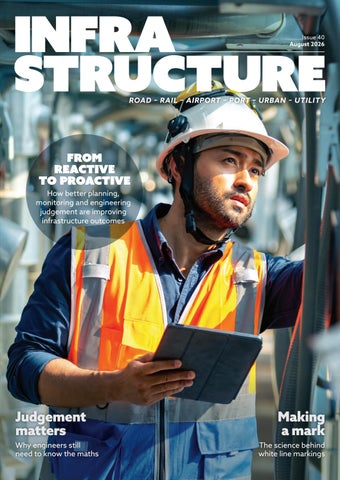
Issue 40 August 2026
ROAD – RAIL – AIRPORT – PORT – URBAN – UTILITY
From reActive to proactive How better planning, monitoring and engineering judgement are improving infrastructure outcomes
Judgement matters Why engineers still need to know the maths
Making a mark The science behind white line markings
Asset management that delivers more Helping infrastructure owners improve asset performance, reduce risk and maximise long-term value through smarter asset management servicestream.com.au
CONTENTS
REGULARS
PLANNING
3
32
From plan to reality
34
Seeing below the surface
36
Bridging the delivery gap
38
Rebuilding Fitzroy River Bridge
Editor’s Welcome
ROADS
7
Rethinking road funding
10
Making a mark
12
Faster delivery and stronger roads
TECHNOLOGY
14
Reframing bird control
17
Logistics in real time
PROJECTS
20
Engineered for performance
22
Air at every stage
25
Delivering better bridge outcomes
ENGINEERING
28
Engineering reliable DC power systems
30
Why maths still matters
www.infrastructuremagazine.com.au
ASSET MANAGEMENT
40
Beyond compliance
42
Why dig deeper?
EVENTS
44
Sydney set for No-Dig Down Under 2027
46
The future of intelligent transport
48
National reforms and tech pivot
INDUSTRY INSIGHT
51
Procurement conversations
54
The culture shift
August 2026 // Issue 40
3
Scan to subscribe to Infrastructure Magazine’s weekly newsletter – delivered to your inbox every Wednesday morning. Published by
Chairman John Murphy Chief Executive Officer Christine Clancy Publisher Sarah Baker Editor Lisa Korycki Assistant Editor Kody Cook Art Director Alejandro Molano Head of Design Clayton Hawley Business Development Manager Brett Thompson brett.thompson@primecreative.com.au Client Success Manager Cait Pillay Head Office Prime Creative Media 379 Docklands Drive Docklands Victoria 3008 P: +61 3 9690 8766 info@primecreative.com.au infrastructuremagazine.com.au Subscriptions P: +61 3 9690 8766 subscriptions@primecreative.com.au Infrastructure is available by subscription from the publisher. The rights of refusal are reserved by the publisher. Cover image CandyRetriever/shutterstock.com
4
August 2026// Issue 40
Editor’s welcome One of the recurring themes that emerged while putting together this issue was the value of anticipation. Across infrastructure, the conversation is increasingly shifting away from how we respond when things go wrong and towards how we identify, understand and address potential problems before they have the opportunity to affect outcomes. In our feature from Century Yuasa, reliability is examined through the lens of everyday operation, rather than emergency events alone. The article highlights how monitoring, maintenance and lifecycle thinking play a role in ensuring critical systems perform when required. Bird Beam explores a similar idea from a different angle, looking at how proactive bird deterrence can help infrastructure operators reduce contamination, improve safety and avoid ongoing operational disruption before it becomes embedded in day-to-day operations. And Camfil argues that air quality should be treated as an engineering consideration from the earliest stages of project planning through to longterm operation, using evidence and testing to guide decisions throughout the asset lifecycle. The same thinking extends to asset management. Civilcast examines how engineered precast solutions are being designed, tested and verified to deliver long-term performance, while Rectify Group demonstrates the benefits of identifying the underlying causes of deterioration
before minor defects become larger structural challenges. Project delivery is another area where anticipation is becoming increasingly important. CSM Business & Mobility, Octave and Select Plant Australia each look at different ways that project teams can improve visibility, strengthen planning and use data more effectively. Our feature with Engineering Training Institute Australia reinforces the same message. As software and artificial intelligence become increasingly sophisticated, engineers still need the experience, technical understanding and judgement required to question outputs, verify information and recognise problems before they become costly mistakes. What connects these stories is the recognition that infrastructure performance is rarely determined by a single event. More often, it is shaped by countless decisions made during planning, design, construction, operation and maintenance. As projects become larger, assets become more complex and expectations continue to rise, the ability to anticipate challenges is proving just as important as the ability to respond to them. I hope you enjoy the issue. Lisa Korycki Editor, Infrastructure Magazine
Get in touch at info@infrastructuremagazine.com.au or feel free to give us a call on 03 9690 8766. Don’t forget to follow Infrastructure on social media – find us on LinkedIn, Twitter and Facebook.
Infrastructure acknowledges Aboriginal Traditional Owners of Country throughout Australia and pays respect to their cultures and Elders past, present and emerging.
www.infrastructuremagazine.com.au
Lower fuel. Lower emissions. Smarter delivery. Select’s growing fleet of low and zero emission plant is built for real project demands, backed by national coverage and proven delivery on site.
Electric Crawler Cranes
Hybrid & Electric Plant
Off Grid Site Solutions
Solar & Hybrid Lighting & Power
Explore the full range at selectplant.com.au or call 1300 752 684
BLU12735_REDCOR_ASIConf_PrintAd_A4_210x297mm_FA2_02.pdf
1
1/10/2025
5:20 pm
New design solutions for steel bridges Featuring comprehensive charts, tables, photos and illustrative diagrams, the new Composite Steel Road Bridges Technical Guide provides early-stage guidance for the preliminary design and evaluation of composite steel road bridges. The new Weathering Steel Design Guide for Bridges collates essential guidance for the application of REDCOR® weathering steel in bridge projects.
Scan QR code to download
REDCOR®, XLERPLATE®, BlueScope and the BlueScope brand mark are registered trademarks of BlueScope Steel Limited. © 2025 BlueScope Steel Limited ABN 16 000 011 058. All rights reserved.
ROADS
Rethinking road funding
Many speakers concluded that a road user charge was the right next step.
Road user charging is emerging as one of Australia’s biggest transport reform discussions, with governments and industry increasingly focused on how future roads will be funded.
A
s electric vehicle (EV) uptake rises, and fuel excise revenue comes under pressure, governments and industry are increasingly turning their attention to road user charging. The debate is no longer centred on whether reform is needed, but how a future system could balance fairness, transparency and the growing infrastructure burden facing road managers. For decades, Australia’s road network has largely been funded through fuel excise, registration charges and a collection of state and federal mechanisms that have evolved over time. But as vehicle technology changes and transport demands grow, many across government and industry are questioning whether the current system can continue to support the nation’s roads into the future. That conversation took centre stage at Transport Australia’s Transforming Transport Summit held in Melbourne earlier this year, where ministers, transport leaders, technology providers and infrastructure operators examined the future of road funding and the possibility of a national road user charge. At its core, road user charging would shift Australia away from relying primarily on fuel excise
www.infrastructuremagazine.com.au
towards a model where motorists contribute to road maintenance based on how much they use the road network, potentially through a per-kilometre charge. Supporters argue this could create a fairer and more sustainable funding model, particularly as EVs become more common and contribute little or nothing through fuel excise. Critics, however, continue to raise concerns around privacy, cost-of-living impacts and whether regional communities could end up paying more. According to figures discussed at the Summit, local governments are collectively facing more than $23 billion in road maintenance backlogs. “We’re long overdue for a road user charging system,” said Former Victorian Treasurer, Tim Pallas.
WHY THE CURRENT MODEL IS UNDER PRESSURE Several speakers pointed to the growing complexity of the current system, which includes fuel excise, registration charges, heavy vehicle road user charges, tolls and various rebate schemes. Others noted that many motorists remain unclear on how roads are currently funded. Transport Australia polling referenced during the Summit found only about one-third of Australians understood
the role fuel excise plays in road maintenance funding. At the same time, speakers acknowledged the political sensitivity of introducing any new charging mechanism during a cost-ofliving crisis. Much of the discussion centred not on introducing an additional tax, but on whether a future road user charge could eventually replace or simplify parts of the current system. Shadow Minister for Infrastructure and Transport, Senator Bridget McKenzie, argued that Australians were generally open to reform if the system was transparent and equitable. “Australians want a fair system,” Senator McKenzie said. “They want to see a road network where all users are contributing equitably to a safe road network.” The issue of equity was raised repeatedly throughout the Summit, particularly regarding regional and outer suburban communities, where residents often have fewer public transport alternatives and travel significantly longer distances. Speakers stressed that any future model would need to recognise those differences rather than applying a blanket charge across all users and locations.
August 2026 // Issue 40
7
There was also strong agreement that heavy vehicles, which place greater wear on roads, would likely need to be treated differently within any future framework. “Those who cause the greatest wear on the road network have to pay the most for the damage and upkeep,” Pallas said.
BUILDING PUBLIC TRUST While many at the Summit agreed reform is increasingly necessary, speakers emphasised that public trust would determine whether any new system succeeds. That includes confidence around where the money goes, how the system operates and what data is collected. A recurring theme throughout the discussion was hypothecation – the idea that revenue raised through a road user charge should be directly allocated to roads and transport infrastructure rather than absorbed into general government revenue. Pallas, despite describing himself as historically opposed to hypothecation as Treasurer, said community expectations had shifted. “If you want to get public licence for this, you need to be prepared to hypothecate it,” he said. “I think Australians would be up for that if they knew the money they’re paying is actually going into better roads.” Several speakers suggested that a clearer link between road charges and road maintenance could help strengthen public support for reform, particularly if communities could see direct improvements to local infrastructure. Michelle Jablko, Chief Executive Officer of Transurban, said transparency would be critical in helping motorists understand the value of any future charging model. “What happens over time is the value is there, but people forget and wonder why they’re paying for it,” Jablko said.
Images: Transport Australia
ROADS
Minister McKenzie advocated for a fair system for road users.
“If you can design a system that’s got a ‘what’s in it for me’ aspect, people start to see it as fair.” Much of the conversation also focused on the role technology could play in making a future system easier to administer and more responsive to different road conditions and user types. Rather than a flat annual fee, many speakers favoured a distance-based approach that could eventually account for factors such as congestion, vehicle weight, road type and location. Angus Mcdonald, Managing Director of Compass IoT, a road and traffic data company, argued that flexibility would be essential. “A kilometre-based charge doesn’t mean the same charge on each kilometre,” McDonald said. “You could have lower charges for rural roads or different charging structures in congested areas.”
THE ROAD AHEAD Although broad support for reform appeared to be growing across government and industry, speakers acknowledged that implementing a national road user charging scheme would be complex. Responsibility for roads is shared across federal, state and local governments, while public acceptance will likely depend on how gradually and transparently any transition occurs. Privacy concerns also remain a major consideration, particularly
Discussion focused on how a road user charge could be effectively implemented.
8
August 2026 // Issue 40
around the use of vehicle and location data in technology-enabled charging systems. However, speakers noted that many newer vehicles are already connected through onboard digital systems and said that strong consent and data protection frameworks could help address community concerns. Mcdonald said motorists would need clear control over how their information is used. “The law should say that data is only used for the explicit purpose of calculating the road user charge,” he said. Others suggested that future systems may need to provide both digital and non-digital options to ensure accessibility for all motorists. Despite the challenges, the overall tone of the Summit suggested the debate has shifted considerably in recent years. Where road user charging was once viewed as politically untouchable, there now appears to be growing recognition that Australia’s existing road funding mechanisms may not be sustainable in the long term. Importantly, many of the discussions extended beyond revenue collection and into broader questions about transport planning, congestion management, freight productivity and infrastructure investment. Speakers agreed that this conversation is likely to become increasingly important in the years ahead as road networks continue to carry growing freight volumes, expanding populations and changing vehicle technologies. Whether Australia will ultimately adopt a national road user charge, and what form it will take, remains uncertain. But the Summit made one thing clear: the discussion is no longer theoretical. As Pallas said, “The time is right, and the challenge for government is to build that consensus whilst also taking some leadership.”
www.infrastructuremagazine.com.au
Images: Transport Australia
ROADS
Making a mark The science behind white line markings on roads is rarely noticed, but its impact is everywhere.
A
s the national science agency of Australia, the Commonwealth Scientific and Industrial Research Organisation (CSIRO) conducts work across a multitude of industries and disciplines. As part of this reach, the organisation’s Infrastructure Technologies program specifically completes research on the performance and safety of physical and environmental infrastructure. “The program offers a range of services for different industries and mainly revolves around the testing of materials used in the building and transport sectors,” says Dr Christopher Preston, Program Director. “We have a number of labs covering lots of topics, from fire safety and material durability to acoustics and certification schemes. Road tunnel infrastructure particularly acts as an intersection for all these disciplines.” One example of this work is in the development of road line markings, which are vital to the maintenance of safe and efficient travel on roads. Drivers rely on the visibility of these lines to understand road rules, stay in their lanes, and adapt to changing conditions. Autonomous vehicles are also guided by these lines. “Many people don’t realise that lane-keeping assistance and other driver-support systems depend on well-defined, consistent line
10
August 2026 // Issue 40
markings,” says Money Arora, Team Leader of Materials Performance. “If markings can’t be clearly detected, especially in rain, glare or at night, it can reduce the effectiveness of these safety systems.” The Infrastructure Program’s work with road line markings consists of testing different types of marking materials from different manufacturers – and their production methods – while also certifying those who apply the markings to the road. This is completed through the CSIRO’s Painting Contract Certification Program. “Our work receives support from all the state road transport authorities,“ says Preston. “They take extreme interest in making sure any products applied to their infrastructure – roads, bridges, tunnels and more – are maintained in a way that protects them, and increases their value.” On top of contributing to road safety, the CSIRO’s testing of road line markings is important to ensure their longevity and sustainability. Longer-lasting markings require fewer re-paints, reduce road maintenance costs, cause less traffic disruption and lower overall environmental impact. “Our testing looks at wholeof-life performance,” Arora says. “If markings last longer, that’s good for safety, budgets, and the environment.”
A key aspect of the CSIRO’s road line marking testing revolves around glass beads that are embedded in coats of paint. These beads make the markings glitter – light from the sun during the day and headlights at night strike them, and their unique shape sends the light back to the driver. This process is known as retroreflection. The Infrastructure Technologies team inspects all beads sent by manufacturers, ensuring they adhere to the strict design criteria allowing for retroreflection to occur. “These glass beads are submillimetre in size,” says Preston, “but for such a small item, there is a huge amount of testing required to certify their effectiveness. “We conduct tests in our lab, which is accredited with the Australian Standards related to glass beads. This standard demands that the beads we test meet a number of performance characteristics in order to be used in road line markings. There are parameters related to their shape – specifically roundness – in addition to their clarity, particle sizes, distribution sizes and toxicity requirements.” Preston further explains that while these criteria work as a proxy for measuring retroreflectivity, the beads are also subject to a separate test which measures retroreflectivity more directly. After these CSIRO laboratory tests, the glass beads and
www.infrastructuremagazine.com.au
Road line markings help maintain safe and efficient travel on roads. Image: Claudio Divizia/stock.adobe.com
other road line marking materials are typically evaluated in real-world conditions by their manufacturers – painted onto roads and tested in traffic over periods of time. During these trials, retroreflectivity continues to be examined, along with slip resistance and other metrics. However, Preston says these field tests have become increasingly difficult to conduct due to their inconvenience and costs. “The roads used for testing need to be blocked off, then the markings need to be applied, and stakeholders need to meet,” he says. “It can be quite a difficult process to undertake." In response, the CSIRO is now working to create a new facility that can host real-world tests in a more controlled environment. Here, it is hoped that Australia’s various road challenges and climates can be accurately simulated. The rigorous researching and testing required to develop sufficient road line markings is unknown to many motorists, but it is critical to creating a road network that can support the country. “The science behind those white lines is rarely noticed, but its impact is everywhere,” Arora says. “By getting the details right, we help make Australia’s roads safer today, and ready for the future.”
www.infrastructuremagazine.com.au
Glass beads are key to making road line markings light up so drivers can see them. Image: CSIRO
August 2026 // Issue 40
11
ROADS
Faster delivery and stronger roads New research demonstrates how engineering innovation, combined with digital tools, can address long-standing challenges in road construction.
M
any of Australia’s roads are under strain from heavier traffic and changing climate conditions. In response, a team at Monash University has developed a new approach to drying roadbase materials that could reduce construction delays and improve the longevity of roads. The potential payoff is a network that’s not only faster to build but will also endure for decades to come. Recent research led by Professor Jayantha Kodikara from the ARC SPARC Hub of the Monash University Department of Civil and Environmental Engineering, has explored combining microwave energy with controlled airflow to speed up the drying of unbound granular materials – the foundational layers used in almost 90 per cent of Australia’s sealed road network.
“Much of our sealed road network relies on thin layers of asphalt or bitumen over a compacted base. The base layer takes most of the load and is highly moisture sensitive,” Professor Kodikara says. “If it’s too wet when the seal is applied, the material won’t perform as expected. You can get ruts, cracking and premature failure, which costs councils and contractors time and money.”
THE PROBLEM WITH ‘DRYING BACK’ Traditionally, contractors rely on sunlight to dry road-base layers before sealing. Achieving the correct moisture content is crucial: compacting too dry requires larger rollers, while compacting too wet can compromise the pavement’s performance. In many regions, unpredictable weather can delay drying for days, creating bottlenecks in construction
schedules and extending project timelines. The concept of ‘drying back’ – reducing moisture to an ideal level before sealing – has long been part of road construction specifications in Australia. However, relying on the sun is slow and inconsistent. It was this problem that inspired the Monash team to explore faster, more controlled drying methods. “The idea came from consultations with road authorities and contractors, as well as a suggestion from CIMIC Group, who proposed testing microwave technology,” Kodikara says. CIMIC Group is an engineering-led construction, mining, services and public private partnerships company, working across the lifecycle of assets, infrastructure and resources projects. “We wanted to see if we could develop a process that allowed reliable, uniform drying regardless of the weather.”
Professor Jayantha Kodikara from the Monash University Department of Civil and Environmental Engineering. Image: Monash University.
12
August 2026 // Issue 40
www.infrastructuremagazine.com.au
HYBRID DRYING The team began with microwaves alone, using a modified laboratory setup to test how quickly moisture could be removed from compacted layers. While the approach worked locally, it dried unevenly, leaving areas of the base layer still damp. To address this, the researchers added controlled airflow to the process. “Think of it like a hairdryer,” Kodikara says. “The microwave energy heats the material, and the airflow carries moisture away, spreading the effect more evenly across the layer.” Laboratory trials demonstrated that the hybrid method could effectively dry layers up to 100 millimetres thick – the typical layer thickness used in road construction. Each layer is compacted individually, allowing the technique to be applied sequentially for multilayered bases. According to Kodikara, the hybrid approach could reduce drying times from days to just hours under certain conditions. “If you can dry a 100-metre lot in 30 minutes to an hour, you save countless hours compared with waiting for sun-driven drying. That’s huge for productivity and cost efficiency,” he says. While the lab results are promising, the team cautions that
field deployment requires further research, particularly around designing antennas and airflow systems for maximum coverage. Prototypes capable of operating on-site need to be carefully engineered and tested. The team simulated the interaction of microwaves, airflow and moisture movement to extrapolate the lab tests into a field context. This required sophisticated numerical modelling, even small-scale simulations taking considerable computing time. To make the approach practical for field applications, the team has also developed a machine-learning model trained on the simulation results. The AI model can quickly predict drying outcomes for different configurations and site conditions, providing a tool that contractors could potentially use to plan schedules more efficiently.
WHAT THIS MEANS FOR INDUSTRY Kodikara says that for contractors and councils, the potential benefits of faster drying are significant. Reduced reliance on weather conditions could mean fewer delays, better resource allocation, and more predictable project timelines. The research is part of a broader strategy to improve road resilience in the face of climate change and increased traffic loads.
“Our focus is not just drying back. It’s how the base layer and seal work together to create a resilient pavement. If the underlying layer is at the right moisture content and the seal is thicker or of higher quality, you can dramatically reduce rutting, cracking and water ingress,” Kodikara says. He says the approach also aligns with emerging trends in intelligent compaction, where sensors in rollers help achieve consistent density across a site. “Drying, compaction and sealing all need to work in harmony to produce pavements that last longer and require less maintenance.” Although commercial-scale deployment is still a way off, Kodikara says the research establishes a proof of concept for a faster, more reliable road construction method. Next steps include refining the microwave and airflow system design, creating field-ready prototypes, and integrating the AI models into practical planning tools for contractors. “With the physics established and computer models calibrated, we’re in a strong position to develop prototypes,” Kodikara says. “If industry partners invest in this next stage, the benefits could be transformational.” Drying times that once took days could potentially be reduced to mere hours. Image: zphoto83/stock.adobe.com
www.infrastructuremagazine.com.au
August 2026 // Issue 40
13
TECHNOLOGY The AVIX system uses a high-performance green laser that creates a moving visual stimulus that birds perceive as a threat, discouraging them from settling in targeted areas.
Reframing bird control A national rollout across air freight terminals is shifting bird control from reactive maintenance to a core element of infrastructure performance.
B
ird control is often treated as a housekeeping issue, something to be managed after the fact through cleaning, maintenance and reactive deterrence. That approach, however, is beginning to shift. A nationwide rollout of automated laser bird deterrent systems across major air freight terminals in Australia is positioning bird control as a core element of infrastructure performance rather than a secondary maintenance task. Between October 2025 and May 2026, 38 AVIX bird deterrent systems were installed across domestic and international air freight environments. Delivered by Bird Beam Bird Control Technologies, an Australian specialist in bird deterrent systems for complex operational environments, the installation targeted internal roof cavities and overhead perching zones – areas where bird activity typically concentrates within large-scale logistics facilities. The results have been immediate and measurable, says Michelle Kerr, Director of Bird Beam. “At the Perth air freight terminal, bird pressure reduced by 80 per cent within two days of commissioning,” Kerr says.
14
August 2026 // Issue 40
“Brisbane recorded an 80 per cent reduction in bird activity following installation, with early results in Sydney reflecting a similar trend.” For air freight and aviation infrastructure, bird presence is rarely just aesthetic. It introduces risk across multiple fronts, including contamination in handling areas, corrosion of equipment, biosecurity exposure and diminished working conditions for staff. Large industrial buildings naturally create favourable conditions for birds. High rooflines, steel trusses, open access points and stable internal temperatures provide shelter, height and protection from disturbance. Kerr says that in these environments, bird activity can quickly become embedded into daily operations and, over time, is often accepted rather than addressed. She adds that many sites attempt to manage bird activity through short-term fixes or increased cleaning, but these approaches rarely address the underlying issue. In complex operational environments, standard deterrents are often not suitable or fail to meet safety, hygiene or performance requirements.
“We’re often called into sites where the problem has been managed for years but never resolved,” Kerr says. “Fouling, contamination, repeated cleaning and staff complaints are absorbed into daily operations because the issue feels difficult to solve.” The AVIX systems were designed to disrupt that pattern. “People are often curious about whether the system harms the birds. It does not,” Kerr says. “AVIX is a completely humane deterrent system designed to move birds away from operational areas without contact.” Using a high-performance green laser, the technology creates a moving visual stimulus that birds perceive as a threat, discouraging them from settling in targeted areas. The system operates silently and autonomously, without chemicals or manual intervention, allowing it to maintain a consistent deterrent presence. The systems were programmed to remain confined within the building envelope, focusing on internal zones where bird pressure is most acute while avoiding spillover into surrounding areas. Kerr says at Perth, the shift was visible beyond the facility itself.
www.infrastructuremagazine.com.au
Images: Bird Beam
Following commissioning, bird activity increased on neighbouring properties, suggesting that the site was no longer considered a viable environment for shelter or perching. In effect, the technology changed how birds interacted with the infrastructure, not just how they moved within it. Kerr says the project highlights the impact of treating bird control as part of broader operational discipline. It also demonstrated that large-scale installations can be delivered within active sites without disrupting operations. The systems were integrated across live air freight environments, requiring coordination around existing infrastructure, access limitations and ongoing site activity. Delivered in collaboration with airport specialist builder MAZ Group and Australian Electrical Industries, the project brought together construction, electrical and technology expertise to achieve installation across complex operational settings. While the technical outcome is significant, Kerr says the broader shift lies in how the issue is framed. Bird activity in infrastructure environments is often normalised and absorbed into cleaning schedules, managed through periodic intervention and factored into operational wear. Over time, this creates an ongoing cycle of cost and
disruption, without addressing the underlying cause, embedding the issue into the operating model itself. “Instead of responding to bird activity after it occurs, the system aims to prevent birds from establishing themselves within the site environment in the first place,” Kerr says. “The result is a reduction in contamination risk, a more controlled internal environment and less reliance on reactive maintenance.” She says that for infrastructure operators, the implications extend beyond hygiene. Reduced bird activity supports asset longevity, improves working conditions and contributes to overall operational consistency. The project points to a wider opportunity across the sector. As assets become more complex and expectations around performance, safety and sustainability increase, elements traditionally seen as peripheral – from pest control to environmental management – are increasingly being reconsidered as part of core infrastructure strategy. “In that context, bird control is no longer a secondary concern,” Kerr says. “It becomes part of how infrastructure is protected and how performance is maintained over the long term.”
To find out more, visit birdbeam.com.au
project facts 38 AVIX bird deterrent systems installed across domestic and international freight terminals Installation period: October 2025 to May 2026 Application: aviation freight infrastructure Target area: internal roof cavities and overhead bird perching zones Perth air freight terminal: 80 per cent reduction in bird pressure within two days of commissioning Brisbane terminal: 80 per cent reduction in bird activity following commissioning Delivery partners: Bird Beam Bird Control Technologies, airport specialist builder MAZ Group and Australian Electrical Industries Technology: AVIX Autonomic laser bird deterrent systems by Bird Control Group, Netherlands Outcome focus: hygiene, workplace health and safety, freight protection, asset protection and operational continuity
A rollout across air freight terminals reduced bird pressure at the terminals by up to 80 per cent within days of installation.
www.infrastructuremagazine.com.au
August 2026 // Issue 40
15
BUILT TO YOUR SPEC. DELIVERED ON SCHEDULE. In civil construction, there’s no room for error— and no time for delays. When standard product won’t cut it, we deliver engineered precast solutions designed to your exact requirements - supported by a reliable stocked range of standard product to keep your project moving.
From order to site. Made easy. 1300 012 278 civilcast.com.au
Infrastructure Magazine Advert_0426.indd 1
20/4/2026 10:06 am
TECHNOLOGY Select Plant Australia's Delivery Management System (DMS) provides a live, centralised view of logistics activity across a site.
Logistics in real time Select Plant Australia is leveraging artificial intelligence to enable site teams to bring a greater degree of control and certainty to complex infrastructure delivery.
A
rtificial intelligence (AI) is starting to reshape how people manage logistics on major infrastructure projects, shifting it to a more structured, datadriven system. At Select Plant Australia (Select), that shift is being applied across logistics planning, site access and delivery management, with AI unlocking greater oversight and control across complex project environments. The objective is to equip site teams with better information and faster insights, allowing the team to focus on higher-value decision-making rather than routine administrative tasks. For Daniel Kelly, Logistics Lead, the move towards a more structured approach starts with how logistics is positioned within a project. “Logistics on major infrastructure projects is becoming increasingly complex,” he says. “Multiple contractors, constrained sites and tightly sequenced schedules create an environment where small issues can quickly escalate into congestion, delays and safety risks. At Select, we treat logistics as an
www.infrastructuremagazine.com.au
10:06 am
integrated service rather than a standalone function. We work with clients from early planning through to delivery, combining strategic input, digital systems and onsite coordination. “This approach allows us to address potential issues upfront and create a more structured and predictable delivery environment.” Select delivers logistics, plant and site access solutions across major infrastructure projects, supporting planning, delivery and on-site coordination. That integration is supported by Select’s Delivery Management System (DMS), which provides a live, centralised view of logistics activity across a site. Contractors and suppliers are required to book delivery slots aligned to real-time site capacity, reducing congestion at access points and improving the overall flow of materials. The platform is being used on a project in Victoria to coordinate deliveries across multiple interfaces such as road, bridge and tram infrastructure, where margins for disruption are minimal.
With a clearer view of both planned and live activity, the system has processed more than 51,000 access events, supporting efficient vehicle flow and reliable access control, while assisting project teams in identifying potential conflicts early and responding before they impact program. “The main advantage is visibility,” Kelly says. “With a clear picture of activity on site, project teams can respond quickly to changes and maintain momentum.” AI tools are layered over the DMS to extend that visibility into how sites are accessed, monitored and managed in real time. “Through AI-enabled camera systems and automatic number plate recognition (ANPR), vehicles can be identified and authorised automatically, improving efficiency at entry points while maintaining strong oversight,” Kelly says. The application extends beyond access control. Rather than relying solely on manual supervision, AI is being used to monitor movement within shared zones, where plant, vehicles and workers operate in close proximity.
August 2026 // Issue 40
17
TECHNOLOGY
Images: Select Plant Australia
Real-time data allows teams to stay ahead of anticipated known challenges, unlocking a more optimal approach to issues management.
“From a safety perspective, the key benefit is hazard detection,” Kelly says. “The technology can identify pedestrians and cyclists in shared areas and generate alerts to support timely intervention by site personnel when risks are detected. “This contributes to a safer working environment while reducing reliance on manual monitoring. Like any technology, AI systems require ongoing monitoring, validation and human oversight to ensure outputs remain accurate and appropriate for project conditions.” Select is also exploring how AI can streamline administrative processes that traditionally sit at the front end of project delivery. Contractor onboarding, compliance checking and plant verification often require a lot of manual review, impacting schedule before work can begin. AI is now being trialled to support the assessment of documentation, review photographic evidence and flag potential non-conformances before site access is granted. However, all compliance and access decisions continue to be verified by authorised personnel. “Select is actively exploring how AI can support and streamline onboarding activities across major projects,” Kelly says. “This includes using AI-enabled processes to assess plant pre-mobilisation forms and photographic evidence to determine whether minimum project standards and compliance requirements have been met during contractor onboarding. “The objective is to reduce administrative processing time and provide faster identification of non-conformances or missing information.”
18
August 2026 // Issue 40
For Kelly, the role of AI is not to replace decision-making, but to enhance it. The DMS is designed to operate within defined parameters, with human oversight remaining critical to ensure appropriate judgement is applied. “It is a powerful tool, but it is not used in isolation,” he says. “Our systems are designed to complement, not replace, human expertise. AI can assist with administrative and compliance processes while ensuring people remain central to all decisionmaking. “We combine technology with experienced logistics professionals who oversee operations and ensure appropriate controls are in place. “Automation helps reduce manual handling and minimise potential for human error, while operating within defined parameters and safety protocols. If something sits outside those parameters, it is identified and reviewed.” Across projects, the results tend to show up less in headline metrics and more in consistency. Reduced congestion at access points, fewer delivery clashes and clearer coordination of shared resources such as cranes and laydown areas all contribute to more stable day-today operations. “The most consistent outcome is improved certainty,” Kelly says. “When logistics is well coordinated, projects see fewer delays and more consistent workflow. “There are also clear safety improvements through better management of site access and activity. From a commercial perspective, greater efficiency leads to lower costs. By reducing downtime
and improving resource use, projects run more smoothly and deliver more predictable outcomes.” Underlying that consistency is the role of real-time data. “Real-time data allows teams to move from reacting to issues to staying ahead of them,” Kelly says. “Reducing manual intervention helps minimise the potential for human error and creates a more controlled environment, giving teams greater confidence in daily operations. “By monitoring deliveries, site activity and resource use, we can identify potential issues early and adjust before they impact the program. Dashboards and reporting, present this information clearly so teams can make timely and informed decisions.” This capability is most effective when integrated into a project from the outset. Early engagement allows logistics strategies, access planning and digital systems to be aligned with construction methodologies before constraints are locked in. “The earlier we are involved, the greater the value we can provide,” Kelly says. “Clients achieve the greatest value by engaging Select during the early planning and preconstruction phases of a project. “By embedding logistics planning early, we help identify and mitigate risks before they impact delivery, reducing the likelihood of congestion, access conflicts and inefficient site movements. This contributes to a safer, more predictable and operationally efficient project environment.” As AI becomes more embedded in logistics systems, the focus is on how technology, data and people interact across the full delivery lifecycle. For Select, that means not just implementing new tools, but ensuring people have right the capability to interpret and act on the data they generate. “Invest in your people,” Kelly says. “Technology is most effective when combined with experienced logistics professionals who understand the realities of live construction environments. You can't just rely on technology, you still need the skill set to be able to interpret the data to drive improved outcomes. This requires education, investment and a culture shift.”
To find out more, visit selectplant.com.au
www.infrastructuremagazine.com.au
P Sp P S
ENGINEERING ENGINEERING TRAINING TRAINING INSTITUTE INSTITUTE PaulUno Uno Paul AUSTRALIA AUSTRALIA ETIADirector Director ETIA Over40 40Design Designand andConstruction ConstructionWorkshops Workshops Offered Over Offered SMALLGROUPS GROUPS CONTINUED CONTINUED PROFESSIONAL DEVELOPMENT (CPD) SMALL PROFESSIONAL DEVELOPMENT (CPD)
LIVELIVE STREAMED STREAM STREAMED ED
1.1. Glass Design Workshop Glass&&Aluminium AluminiumFaçade Façade Design Workshop
11 + (ZOOM) CPD CPD 1112 + August 12 August (ZOOM) 16 HRS 16 HRS
2.2. Prestressed Workshop PrestressedConcrete ConcreteDesign Design Workshop
18 + (ZOOM) CPD CPD 1819 + August 19 August (ZOOM) 16 HRS 16 HRS
3.3. Accounting forfor Engineers Course Accounting&&Management Management Engineers Course
20 August (ZOOM) 20 August (ZOOM)
4.4. Reinforced Workshop: Module One ReinforcedConcrete ConcreteDesign Design Workshop: Module One
25 + (ZOOM) CPD CPD 2526 + August 26 August (ZOOM) 16 HRS 16 HRS
8 HRS CPD CPD 8 HRS
5.5. Risk RiskManagement ManagementWorkshop Workshop
27 August (ZOOM) 27 August (ZOOM)
7.7. Structural Workshop StructuralSteel SteelDesign Design Workshop
8 +89+September (ZOOM) CPD CPD 9 September (ZOOM) 16 HRS 16 HRS
6.6. Pile Geotechnical Workshop PileFoundations FoundationsDesign Design Geotechnical Workshop
10 HRS CPD CPD 10 HRS
1 +12+September (ZOOM) CPD CPD 2 September (ZOOM) 16 HRS 16 HRS
8. Residential Slabs & Footings Design Workshop 15 + 16 September (ZOOM) 16 HRS CPD 8. Residential Slabs & Footings Design Workshop 15 + 16 September (ZOOM) 16 HRS CPD 9. Transmission & Communication Towers (incl Power Poles) 22 + 23 September (ZOOM) 16 HRS CPD 9. Transmission & Communication Towers (incl Power Poles) 22 + 23 September (ZOOM) 16 HRS CPD 10. Industrial Concrete Floors & Pavements Design Workshop 30 September (ZOOM) 8 HRS CPD 10. Industrial Concrete Floors & Pavements Design Workshop 30 September (ZOOM) 8 HRS CPD 11. Wind Design Workshop: Dynamic & High-Rise Structures 1 October (ZOOM) 8 HRS CPD 11. Wind Design Workshop: Dynamic & High-Rise Structures 1 October (ZOOM) 8 HRS CPD 12. Retaining Walls Design Workshop 7 October (ZOOM) 8 HRS CPD 12. Retaining Walls Design Workshop 7 October (ZOOM) 8 HRS CPD 13. Slope Stability Design Workshop 8 October (ZOOM) 8 HRS CPD 13. Slope Stability Design Workshop 8 October (ZOOM) 8 HRS CPD 14. Shallow Foundations Design Workshop 13 October (ZOOM) 8 HRS CPD 14. Shallow Foundations Design Workshop 13 October (ZOOM) 8 HRS CPD 15. Forensic Engineering Workshop 14 October (ZOOM) 8 HRS CPD 15. Forensic Engineering Workshop 14 October (ZOOM) 8 HRS CPD 16. Cracking in Concrete Structures Design Workshop 15 October (ZOOM) 8 HRS CPD 16. Cracking in Concrete Structures Design Workshop 15 October (ZOOM) 8 HRS CPD 17. Composite Steel & Concrete Structures Workshop 21 October (ZOOM) 8 HRS CPD 17. Composite Steel & Concrete Structures Workshop 21 October (ZOOM) 8 HRS CPD 18. Concrete Pools & Tanks Design Workshop 22 October (ZOOM) 8 HRS CPD 18. Concrete Pools & Tanks Design Workshop 22 October (ZOOM) 8 HRS CPD 19. Timber Design Workshop: Module One 28 + 29 October (ZOOM) 16 HRS CPD 19. Timber Design Workshop: Module One 28 + 29 October (ZOOM) 16 HRS CPD 20. Masonry Design Workshop 5 November (ZOOM) 8 HRS CPD 20. Masonry Design Workshop 5 November (ZOOM) 8 HRS CPD 21. Hydraulic Engineering Design Workshop 10 November (ZOOM) 8 HRS CPD 21. Hydraulic Engineering Design Workshop 10 November (ZOOM) 8 HRS CPD 22. Precast & Tilt Up Design & Construction Workshop 11 November (ZOOM) 8 HRS CPD 22. Earthquake Precast & Tilt Up Design & Construction 11 November (ZOOM) 8 HRS 23. Design Workshop: Module TwoWorkshop 12 November (ZOOM) 8 HRS CPD CPD
23. On-Site Earthquake Design Workshop: Module Two 24. Detention Systems Design Workshop
12 November (ZOOM) 17 November (ZOOM)
25. Detailing Cement & Practice Course (SYDNEY) 26. in Concrete Practice Workshop
1719 November 18 + November(ZOOM) (SYD)
8 HRS 16 HRS CPD CPD
18 + 19 November 24 November (ZOOM) (SYD)
16 HRS 8 HRS CPD CPD
2426 November 25 + November(ZOOM) (ZOOM)
8 HRS 16 HRS CPD CPD
24. Cement On-Site&Detention SystemsCourse Design(SYDNEY) Workshop 25. Concrete Practice
26. Reinforced Detailing in PracticeDesign Workshop 27. Concrete Workshop: Module Two 27. Repair Reinforced Concrete Design Workshop: Two 28. & Protection Workshop: Concrete, Module Steel, Masonry 28. Repair & Protection Workshop: Concrete, Steel, Masonry
25 + 26 November 16 HRS 1 December (ZOOM) (ZOOM)8 HRS CPD CPD 1 December (ZOOM)
www.etia.net.au registrations@etia.net.au (02) 9899 7447
www.etia.net.au registrations@etia.net.au (02) 9899 7447
Platinum Sponsors Platinum Sponsors
8 HRS 8 HRS CPD CPD
8 HRS CPD
Connect with us:
Connect with us:
VIEW OUR COURSES
PROJECTS
Engineered for performance The evolving role of custom road pits in modern infrastructure.
A
s infrastructure projects continue to grow in complexity, the performance expectations placed on underground drainage assets are higher than ever. Road authorities, councils, contractors and consulting engineers are increasingly looking beyond “standard” stormwater infrastructure, seeking solutions that combine structural integrity, compliance, speed of delivery and long-term durability. Custom precast road pits are playing a critical role in meeting these expectations. Designed to withstand demanding traffic environments while accommodating increasingly complex service layouts, modern precast road pits are now engineered as highly specialised structural assets rather than simple drainage components. For civil contractors and designers, this shift is changing the way underground infrastructure is specified and delivered. Civilcast, an Australian-owned manufacturer and supplier of precast concrete, steel, and agricultural products, has positioned itself at the forefront of this evolution through its engineered range of custom solid wall road pits, developed specifically
20
August 2026 // Issue 40
to meet the demands of modern civil infrastructure projects. With capabilities spanning stormwater, water, sewer, electrical and communications infrastructure, Civilcast has focused on combining engineering performance with practical constructability and fast project turnaround times. A key consideration in road pit selection is load rating compliance. Infrastructure assets located within trafficked environments must withstand significant live loading over extended service lives. Civilcast’s custom solid wall road pits are engineered to comply with AS3996:2019 Class D loading requirements, making them suitable for major road and transport infrastructure applications. “Road authorities and contractors are demanding more from underground infrastructure products than ever before,” says Brian Lee, New Product Development Manager at Civilcast. “It’s no longer enough for a pit to simply meet dimensional requirements. Products need to demonstrate structural performance, compliance, constructability and long-term durability while also helping projects maintain program certainty.”
Compliance with Australian Standards remains fundamental to successful project delivery. In today’s infrastructure landscape, councils and transport authorities are placing greater scrutiny on engineering certification, design documentation and product traceability. Lee says Civilcast’s custom road pit range has been structurally designed in accordance with Australian Standards, while also aligning with Transport for NSW stormwater drainage specifications. Importantly, he says compliance is no longer just about ticking boxes, it’s about reducing project risk. Engineer-certified precast systems provide contractors and asset owners with confidence that products have been independently assessed to perform under real-world installation and loading conditions. Civilcast’s fibre reinforced concrete pits and risers have also undergone physical structural testing to verify performance against design intent. Lee says design flexibility is another area reshaping the road pit market. Modern civil projects frequently involve congested underground corridors where standard off-theshelf products may not adequately accommodate pipe penetrations,
www.infrastructuremagazine.com.au
varying depths or non-standard service arrangements. Custom precast solutions allow engineers and contractors to integrate infrastructure more efficiently while maintaining structural performance. Civilcast’s proprietary design software enables the rapid production of shop drawings, 3D visualisations and lifting methodologies, helping streamline approval processes and reduce delays between design and manufacture. According to Lee, this speed-to-delivery advantage is becoming increasingly important as infrastructure projects face tighter delivery timelines and growing pressure to minimise onsite disruption. “Precast solutions allow greater control over quality, safety and program outcomes,” Lee says. “By integrating engineering, manufacturing and logistics early in the process, contractors can reduce installation complexity and gain greater confidence around project delivery.” The structural design of the pit itself also has a significant influence on long-term performance. Civilcast’s
www.infrastructuremagazine.com.au
Images: Civilcast
Modern precast road pits are engineered as highly specialised structural assets rather than simple drainage components. Civilcast’s fibre reinforced concrete pits and risers undergo physical structural testing to verify performance against design intent.
parallel solid wall construction with no internal taper maximises internal space while delivering superior structural integrity. Combined with 40 million pascals concrete, fibre reinforcement and engineered wall thickness options, these systems are designed to achieve a 100-year design life. Lee says installation efficiency is another major advantage driving the adoption of precast systems. Compared with traditional in-situ construction methods, precast road pits can significantly reduce onsite labour, minimise disruption and improve program certainty. With pits manufactured offsite under controlled conditions, contractors benefit from improved quality consistency while reducing exposure to weatherrelated delays. Civilcast has also focused on simplifying the customer experience through coordinated shop drawing approvals, dedicated project support and logistics management. Combined with manufacturing capabilities across multiple states,
this allows the business to support infrastructure projects with both custom-engineered solutions and responsive lead times. Lee says that as infrastructure investment accelerates across Australia, the demand for engineered precast solutions that combine compliance, durability and speed will continue to grow. For project stakeholders, selecting infrastructure components that are not only compliant but purpose-designed for the project environment is becoming increasingly important. “In this environment, custom precast road pits are no longer viewed as commodity products. They are engineered infrastructure assets designed to support safer, more efficient and longer-lasting civil networks,” Lee says. “Companies like Civilcast are helping drive that evolution across the Australian infrastructure sector.”
To find out more, visit civilcast.com.au
August 2026 // Issue 40
21
PROJECTS
Air at every stage
A Camfil HEPA testing rig is used to evaluate the performance, efficiency, and lifespan of high-efficiency particulate air filters.
Today's infrastructure projects generate vast amounts of data to reduce risk and improve performance. Yet one critical factor continues to receive far less attention than it deserves: air quality.
A
ir testing should be considered an engineering discipline, informing decisions from project planning through to long-term operation, says Camfil Sustainability and Efficiency Specialist, Philipp Schluter. “Air quality shouldn't be treated as an environmental afterthought,” Schluter says. “When project managers measure air conditions early and continue testing throughout the asset lifecycle, they can make better design decisions, improve operational performance and provide greater confidence for owners, regulators and surrounding communities.” He says that as Australia's infrastructure pipeline continues to deliver tunnels, hospitals, transport hubs, stadiums and energy assets in increasingly complex urban environments, understanding local air conditions is an essential part of building resilient infrastructure.
BETTER INFORMATION, BETTER DESIGN According to Schluter, the benefits of air testing begin well before construction starts. Baseline monitoring provides engineers with an accurate understanding of the environment in which an asset will operate, including airborne particles, corrosive gases and site-specific contaminants that 22
August 2026 // Issue 40
can influence equipment reliability, maintenance requirements, asset lifespan, and the performance of ventilation and filtration systems. Rather than relying on generic assumptions, project teams can use this information to develop systems suited to local conditions. “You cannot specify what you have not measured,” Schluter says. “This information allows project teams to design filtration systems that match the actual operating environment instead of overengineering or under engineering critical infrastructure.” The consequences extend well beyond indoor air quality. Appropriate filtration can improve the performance of mechanical plant, reduce maintenance requirements and help protect sensitive equipment from premature wear. Conversely, systems that are incorrectly specified may consume more energy, require more frequent maintenance or expose equipment to contaminants they were never designed to handle. Schluter says establishing baseline conditions also provides an important reference point for the future. “If concerns arise during construction or after commissioning, projects that have robust baseline data are in a much stronger position to demonstrate whether local air quality has changed.”
SUPPORTING CONSTRUCTION AND COMMISSIONING Air testing continues to deliver value once construction begins. Dust, diesel emissions and other airborne pollutants generated during construction can affect both workers and nearby communities. Ongoing monitoring helps project teams demonstrate compliance with environmental and workplace obligations while providing early warning if mitigation measures are required. Schluter believes testing also has an important role in procurement and quality assurance. “Specifications don’t always guarantee real-world performance,” he says. “Independent verification provides confidence that the products installed on site perform as expected under the environmental conditions they’ll actually experience.” This becomes particularly important for major infrastructure projects where ventilation systems span multiple buildings, contractors and procurement packages. Commissioning represents another critical point in the project lifecycle. By measuring airflow, pressure drop and filtration performance before handover, project teams can verify that systems operate as intended while identifying installation issues before they become operational problems. www.infrastructuremagazine.com.au
“Testing during commissioning gives owners objective evidence that systems are performing as designed,” Schluter says. “If issues are identified, they're far easier and less expensive to resolve before an asset enters service.”
LEARNING FROM LARGESCALE PROJECTS Schluter says one of the strongest demonstrations of this approach can be found overseas in Hong Kong's Central-Wan Chai Bypass. The 4.5-kilometre road link incorporates one of the world's largest tunnel air purification systems, processing up to 5.4 million cubic metres of tunnel exhaust every hour. The system was designed to remove at least 80 per cent of respirable suspended particulates and nitrogen dioxide before air is discharged to the surrounding environment. Schluter says achieving that level of performance depended on rigorous laboratory testing before the system entered operation. “The filtration media was evaluated under a range of environmental conditions to confirm it would continue performing throughout Hong Kong's seasonal climate,” he says. “The headline performance figures were only possible because
the filtration strategy was validated through extensive testing.” The completed project has improved travel times while reducing emissions and limiting the impact of tunnel ventilation on surrounding communities, demonstrating how air quality considerations can be integrated into major transport infrastructure.
OPTIMISING ASSETS AFTER HANDOVER According to Schluter, commissioning should not mark the end of air quality management. Buildings and infrastructure assets evolve throughout their operational lives as occupancy changes, equipment ages and surrounding environmental conditions shift. Periodic air testing allows owners to verify that systems continue to perform efficiently while identifying opportunities to reduce energy use and maintenance costs. A project undertaken at Pfizer's Global Research and Development campus in the United Kingdom illustrates the value of this approach. Following an assessment of the site's air handling systems, improvements to filtration performance and system efficiency were progressively implemented across multiple buildings. The measured outcomes included Monitoring air quality is essential to help maintain good indoor air quality for people, processes, and equipment. Images: Camfil
lower energy consumption, fewer maintenance interventions and projected savings of close to $4 million over five years. Schluter says the project demonstrated that air quality improvements can produce measurable commercial returns alongside operational benefits. “The business case was built on evidence,” he says. “Assessment came first, followed by monitored trials and then wider implementation. That measured approach gave the asset owner confidence that the investment would deliver long-term value.”
FROM COMPLIANCE TO ASSET PERFORMANCE Schluter says, historically, air quality has often been viewed primarily through the lens of environmental compliance, but that perspective is changing. As infrastructure owners place greater emphasis on whole-of-life performance, resilience and operating efficiency, air testing is increasingly another source of engineering intelligence that supports better decision-making. Beyond protecting occupants and nearby communities, it can influence energy consumption, equipment reliability, maintenance planning and overall lifecycle costs. “Clean air should be viewed as an engineered outcome,” Schluter says. “When we measure conditions early, verify performance during delivery and continue monitoring throughout operation, we’re giving owners the information they need to make informed decisions across the entire life of an asset.” For infrastructure owners facing increasing expectations around sustainability, operational efficiency and community outcomes, Schluter believes the message is straightforward. “Measure early, verify continuously and use evidence to guide decisions,” he says. “That’s how projects move beyond simply meeting requirements to delivering infrastructure that performs reliably for decades.” To find out more, visit camfil.com
www.infrastructuremagazine.com.au
August 2026 // Issue 40
23
Excellence Awards
2025
Project of the year Winner | Newcastle
SENSE 600® Australian made sustainable steel Award-winning steel innovation shaping the future of construction.
At InfraBuild, we are leading the charge to decarbonise infrastructure, without changing the way you work. SENSE 600®, our new reinforcing bar innovation, brings you lower Scope 3 emissions without compromising on performance or quality - all while integrating seamlessly into your existing workflows. Together, we can create a construction industry where sustainability isn’t just an option - it’s the standard.
It just makes SENSE
Uses up to 16.7% less raw material than our standard 500N reinforcing steel and made from 100% scrap metal.
Delivering a lower embodied carbon solution when used in place of our equivalent load capacity standard 500N reinforcing steel.
www.InfraBuildSENSESolutions.com
Confidence from third-party certification from GECA (SSPv1.0i-2019) and meets Australian Standard AS/NZS 4671.
PROJECTS Work to stabilise a rail corridor bridge were undertaken during night shifts to minimise network disruption.
Delivering better bridge outcomes How Rectify Group is helping asset owners address one of Australia’s growing infrastructure challenges.
A
ustralia’s bridge network is under strain. Structures built decades ago are carrying heavier loads, seeing more traffic and facing more extreme environmental conditions than they were designed for. For many asset owners, full replacement is not always feasible. Instead, attention is shifting to remediation strategies that can extend service life while limiting cost and disruption. Rectify Group’s work in this space centres on understanding why assets deteriorate in the first place. Rectify Business Development Manager Dr Phil Irwin says the company focuses on both the structure itself and the ground supporting it, rather than treating visible defects in isolation. Much of this work involves ground remediation techniques such as resin injection, which are used to stabilise subsurface conditions before structural repairs are carried out. “Long-term performance begins well before the first injection,” Irwin says. “It starts with understanding the root cause of the movement or deterioration rather than simply treating the visible symptoms. “Successful projects require thorough investigation, careful
www.infrastructuremagazine.com.au
preparation and strict adherence to inspection and test plans. “Ground remediation is rarely a standalone activity – it is one component of a holistic asset management strategy.” Across many bridge assets, deterioration often starts below the surface. Approach slab settlement is one of the most common issues, typically caused by soil consolidation, void formation or movement within fill materials. Irwin says that at first, the problem may appear minor – an uneven transition or reduced ride quality. But over time, those changes can affect drainage, increase structural loading and accelerate wear across the asset. He cautions against looking at these changes as purely surface defects, saying repeated patching or cosmetic repairs may not address the source of movement. As a result, the same defects can return, often more severe than before. “The foundation of any structure is only as reliable as the ground supporting it,” Irwin says. “If the underlying soil continues to move, deleterious stresses continue unabated, leading to more costly repairs or component failure. “Surface defects are often symptoms rather than the
actual problem. By investigating and improving the supporting ground conditions, the structural performance of the asset can be restored and the likelihood of recurring damage reduced.” This understanding has shaped how Rectify Group’s remediation is delivered. Rather than starting at the surface, works are typically sequenced from the ground up – stabilising subsurface conditions before moving to structural repairs. Irwin says advances in resin injection technology have made this approach more practical, particularly in live traffic environments. That innovation is not limited to materials alone, but also how they are delivered on site. “One of the biggest changes in recent years has been the development of new chemical formulations and more sophisticated applications of existing materials,” Irwin says. “Resin injection technology has evolved significantly, allowing engineers to stabilise and improve the bearing capacity of soils with minimal disruption to existing infrastructure. “While the chemistry of polyurethane and geopolymer resins have continued to improve, many of the greatest advancements have been in the equipment used to deliver them. “Modern injection systems offer significantly greater precision through improved pumping systems, reactors, monitoring equipment and digital controls. This enables operators to better manage injection rates, reaction windows and ground response in real time. “The industry has also become much more data-driven, allowing
August 2026 // Issue 40
25
projects to be verified through recorded injection parameters, level monitoring and quality documentation rather than relying solely on operator experience.” Polyurethane resin injection is used to fill voids, densify soils and improve bearing capacity without the need for excavation. Modern systems allow operators to control injection rates and pressures in real time, enabling treatments to be tailored to site conditions. This precision is especially important on busy transport corridors, where maintaining access is critical. On a major river crossing in Melbourne, these methods were applied to address settlement linked to Coode Island silt. The highly compressible clay had led to gradual movement beneath the eastern approach, reducing support for the slab and affecting the surrounding pavement. Instead of reconstructing the approach, crews injected resin beneath the slab to fill voids and increase soil density. Works were staged to keep traffic moving, and the structure was able to remain in service throughout the process. A similar scenario played out on a bridge spanning an active rail corridor, where repeated asphalt patching had failed to resolve ongoing deformation. Investigations pointed to consolidation within fill materials overlying basalt rock. Rectify Group’s response again focused on subsurface stabilisation. Resin injection improved soil strength and reduced movement, while follow-on works realigned kerbs and pedestrian infrastructure. Verification testing, including Dynamic Cone Penetrometer assessments, provided measurable data on the improvement achieved. Irwin says these examples illustrate how addressing geotechnical conditions can influence structural performance. Once the ground is stabilised, repairs to concrete elements, pavements and ancillary infrastructure can be carried out with greater confidence. Verification plays a central role in confirming that these outcomes have been achieved. Testing and monitoring are used throughout remediation projects to ensure treatments meet engineering requirements and perform as intended over time. “Quality assurance is fundamental to any successful remediation
26
August 2026 // Issue 40
Images: Rectify Group
PROJECTS
Works are completed under staged traffic management arrangements to maintain traffic flow.
project,” Irwin says. “Without verification, there is no objective evidence that the treatment has achieved the intended outcome. “Inspection and Test Plans with adherence to a manufacturer’s technical data sheet, level monitoring, material verification and post-treatment assessments ensure that products are applied correctly and performing as expected. “Quality assurance is not simply a compliance exercise – it is what transforms a treatment into a warrantable engineering solution.” Timing is another factor that influences outcomes. Early intervention can prevent minor defects from developing into more complex structural issues. Irwin says once deterioration progresses, the scope of work required to restore performance often increases, along with cost and disruption. This is where targeted ground improvement can play a preventative role. By restoring support beneath foundations and reducing movement, remediation can extend the operational life of an asset before more significant damage occurs. “One of the most important lessons is that early intervention almost always produces better outcomes,” Irwin says. “The longer deterioration is allowed to continue, the greater the extent of damage, the more complex the repair and the higher the overall cost. “By identifying movement early and implementing targeted remediation
before significant structural distress develops, infrastructure owners can substantially reduce lifecycle costs while maintaining safety and serviceability.” Decisions around whether to remediate or replace ultimately depend on the condition of the asset. Factors such as structural integrity, safety and cost all play a role. Where deterioration remains within certain limits, remediation may provide a practical way to restore performance and extend service life. Across Australia, these decisions are becoming more common as infrastructure continues to age. Approaches that integrate geotechnical stabilisation with structural repair offer a way to manage this challenge while keeping assets in service. “At Rectify Group we adopt a holistic approach, addressing the underlying geotechnical causes of movement while also considering the structural implications above ground,” Irwin says. “Once foundation performance has been improved, any necessary structural repairs can be undertaken with far greater confidence that the underlying movement has been stabilised. “This integrated approach delivers improved structural integrity, enhanced functionality and greater long-term durability.”
To find out more, visit rectify.com.au
www.infrastructuremagazine.com.au
Images: Rectify Group
ENGINEERING
Engineering reliable DC power systems Why everyday operating conditions matter more than emergency events.
C
ritical infrastructure is rarely tested under normal operating conditions. Its performance is measured when something goes wrong. For decades, DC (direct current) power systems have been engineered around those moments. Battery autonomy is calculated, emergency loads are verified and fault scenarios are modelled to ensure protection, control and communications systems remain operational during a loss of AC (alternating current) supply. These remain fundamental design principles. Yet they represent only a fraction of a DC system's operational life. Battery systems spend more than 99 per cent of their life on float charge, quietly supporting critical infrastructure in the background. Increasingly, engineers recognise that the conditions experienced during those thousands of hours of normal operation have just as much influence on reliability as the few hours spent responding to an outage.
DESIGNING FOR THE OTHER 99 PER CENT Long-term reliability is shaped by factors that receive far less attention than battery autonomy calculations. Charger regulation, operating temperature, ventilation, maintenance practices and system monitoring all influence battery health and system performance every day. Small variations in these conditions can gradually reduce service life, increase maintenance requirements and compromise system availability long before any fault becomes apparent. 28
August 2026 // Issue 40
This represents an important shift in engineering thinking. Reliability is no longer judged solely by how a system performs during an outage, but by how effectively it is designed and managed throughout its operational life.
RELIABILITY ENGINEERED INTO THE ENTIRE SYSTEM Many of the greatest threats to longterm reliability are not catastrophic failures. They are gradual changes that occur over years of operation. A battery operating at elevated temperatures will age more rapidly. Poor charging control can shorten service life long before visible signs of degradation appear. Inadequate ventilation can create safety risks despite the battery itself meeting specification. Recent Australian standards reflect the growing importance of these considerations. AS4044:2024 places greater emphasis on charger performance, charge control and digital instrumentation, while standards governing battery installation and ventilation reinforce the importance of thermal management, safety and lifecycle performance. In addition, Australian Standards AS/NZS 3000, AS 3011.2, AS 2676.2 and AS 60896.22 require battery rooms and enclosures to be ventilated to maintain hydrogen concentrations below two per cent, with ventilation achieved through airflow sweeping across the battery enclosure. Together, they recognise a simple engineering reality: reliability is not determined by a battery alone. It is the outcome of how the complete DC power system is designed, integrated and maintained.
DESIGNING FOR DECADES Many reliability outcomes are established long before a system enters service. Design decisions relating to charger architecture, monitoring capability, ventilation, maintainability and future expansion can influence operational performance for decades. As infrastructure operators extend asset life while modernising ageing networks, these decisions become increasingly important. At the same time, advances in monitoring technologies are changing how reliability is managed. Rather than relying solely on periodic inspections, operators can use performance data to identify degradation before it affects system availability, supporting a shift from reactive maintenance towards predictive reliability engineering. A DIFFERENT WAY OF THINKING Reliable DC power systems are not defined solely by how they perform during an outage. They are defined by how they are engineered, operated and maintained every day. As Australia's critical infrastructure continues to evolve, engineering reliable DC power systems will depend less on individual components and more on understanding how the complete system performs throughout its lifecycle. For engineers and asset managers, the future of reliability will be built long before it is ever tested. To find out more and for technical resources scan the QR code
www.infrastructuremagazine.com.au
Image: Century Yuasa
Operators can use performance data to identify degradation before it affects system availability.
Image: Century Yuasa
EVERY PROJECT STARTS WITH THE SAME QUESTION. WHAT’S UNDERGROUND?
Scattered utility records and BYDA dials, turned into a single, digitised and geo-referenced map. Automatically.
BEFORE INGEST
AFTER INGEST
DOZENS OF MISMATCHED PDFS
ONE MAP, ALL UTILITIES, AS5488 COLOUR CODED
15 x
Cheaper than manual processes
90 %
Faster than manually stitching plans
"Using Undermaps has greatly reduced the friction in our workflows to digitise our as-built records. It's saving us time and money in man-hours that were previously spent on this menial, repetitive task." — Chris Burton, Burton Contractors
JOIN THE UNDERMAPS INGEST WAITLIST TODAY
undermaps.com/ingest hello@undermaps.com
Pricing starts from $149 per site
ENGINEERING ETIA’s workshops cover a wide range of topics, from steel design to concrete structures.
Why maths is still important Engineering software and AI are transforming the profession, but engineers still need to understand the calculations behind the technology if they want to avoid costly mistakes.
A
s engineering software becomes more sophisticated and artificial intelligence (AI) finds its way into everyday design work, it has never been easier to produce calculations with the click of a button. That's also creating one of the profession's biggest challenges, says Engineering Training Institute Australia (ETIA) Director, Paul Uno. Uno, who has spent decades designing structures, developing engineering training and acting as an expert witness in legal cases, says modern tools are incredibly valuable – but only when engineers understand the principles behind the answers they produce. "Standards change, codes change, materials change and technology keeps advancing," Uno says. "These days everyone does it by computer, but when I started, we did all our calculations by hand. Because of that, we understood exactly what we were doing." While software has dramatically improved engineering productivity, Uno says younger engineers can
30
August 2026 // Issue 40
become overly dependent on technology before developing the judgement needed to validate its outputs. "I see graduates come out of university, they forget most of the theory, they go into the workforce, use a program and sometimes they don't know whether the answer is right or wrong." Uno says engineers have a responsibility to ensure the validity of their answers. Those that don’t, may find themselves facing legal repercussions. "If something fails and a judge asks, 'Why did you accept that answer?', saying 'The computer said it was okay' isn't going to work." That philosophy sits at the centre of ETIA's professional development workshops. Rather than focusing solely on software or design procedures, the courses begin with engineering fundamentals before moving into practical applications, Australian Standards and worked examples. Uno says understanding the theory first gives engineers the confidence
Engineering Training Institute Australia (ETIA) Director, Paul Uno.
to use modern tools appropriately instead of blindly relying on them. "When I was younger, an older engineer told me, ‘If you can't derive a formula by hand, then you don't know what you're doing.’ "I've never forgotten that. "I always try to train the people who come to our courses to go back to the basics, understand those basics, then I show them the shortcuts and how to use the modern processes." He says that approach has become even more relevant with the emergence of AI. Uno recently tested an AI chatbot by asking it to calculate the natural frequency of a vibrating pole. The initial answer was incorrect because the system calculated the square root of 144 as 1.2 rather than 12.
www.infrastructuremagazine.com.au
While the error was eventually corrected after being challenged, Uno says the exercise highlighted why engineers cannot simply accept AI-generated outputs at face value. "If I hadn't picked up that little typo, and if I didn't already know roughly what the answer should have been, I could have been misled,” he says. "AI is another tool. Like calculators were and slide rules before them. But you have to have a rough idea what the answer should be." Uno believes that practical understanding is becoming increasingly important as experienced engineers retire and younger professionals take on greater responsibility. ETIA’s workshops are designed around the subjects he wished had been available when he began his own career, while specialist presenters deliver courses in disciplines outside his own expertise. The result is a program that combines theoretical knowledge with practical engineering judgement across topics including concrete, steel, timber and other core engineering disciplines. For Uno, the importance of that judgement extends well beyond passing professional accreditation requirements.
The program combines theoretical knowledge with practical engineering judgement.
As an expert witness, he has investigated engineering failures where seemingly small oversights resulted in financial and legal consequences. One example was the wellpublicised investigation into Sydney's
"If something fails and a judge asks, 'Why did you accept that answer?', saying 'The computer said it was okay' isn't going to work."
Images: ETIA
Paul Uno presenting the Cement and Concrete Practice workshop in Prestons.
www.infrastructuremagazine.com.au
Opal Tower, where cracking in the residential building ultimately led to a major rectification program and extensive legal proceedings. Experiences like these, he says, reinforce the importance of understanding how structures behave rather than simply accepting what software produces. "We all make mistakes," Uno says. "But these are silly mistakes. "You have to have an understanding of what the actions are and how the structure works." Ultimately, Uno hopes participants leave ETIA's workshops with more than continuing professional development hours. He wants them to become engineers capable of mentoring the next generation, questioning the outputs of increasingly sophisticated software, and applying sound engineering judgement throughout their careers. "The older you get, the more you realise how much you still don't know,” he says. "That's why you've got to keep on learning, learning, learning all the time. " When you know your stuff, you’re respected, you become a better engineer and, with any luck, you don't get sued."
To find out more, visit etia.net.au
August 2026 // Issue 40
31
PLANNING
From plan to reality Closing the information gap in project execution.
T
he pattern is familiar – and for many project teams, frustratingly consistent. Week 0: Everything is on track. Materials are confirmed, timelines are aligned and installation is scheduled according to the critical path. Week 1: A delay emerges. A key shipment has slipped, but the update didn’t flow through to the master plan. The schedule shifts. Week 2: Crews are reassigned to avoid downtime, but in doing so, consume materials allocated for another task. Week 3: Materials finally arrive, but equipment hire has already been redeployed elsewhere. The window closes again. As CSM Business & Mobility Principal Robert Ward explains, this type of breakdown is rarely the result of a single failure. Working across digital solutions for project delivery, Ward focuses on how organisations connect planning systems with real-world execution
32
August 2026 // Issue 40
on site. He says the issue reflects a broader disconnect between planning and execution, where information is fragmented and often lags reality. This disconnect continues to affect infrastructure and construction projects across the board. Despite the effort that goes into planning, delivery outcomes can still fall short due to gaps in coordination, visibility and timing.
WHERE DELAYS REALLY BEGIN A 2021 study, Study on the Factors of Delay in Construction Works, identified supply management as the most significant factor, accounting for 21 per cent of total delivery variance. This includes inefficiencies in purchasing, supplier delays, rework linked to materials and broader impacts of shortages. Ward says that while these issues often show up on site, they typically originate much earlier in the process. Planning systems may indicate that everything is aligned, but the
underlying data is often fragmented across spreadsheets, emails and individual systems. Similarly, a 2016 McKinsey study, Imagining Construction’s Digital Future, found that even basic processes such as planning remain poorly coordinated between office and field, often relying on manual methods. In practice, this creates a lag between what is happening on the ground and what is reflected in project plans. Updates rely on manual input, are often owned by one individual and can take time to filter through. By the time changes are visible, the opportunity to respond has already passed.
THE HIDDEN IMPACT Ward says the consequences of this gap are not always immediately visible, but they are significant. He points out that when resource and material readiness is not clearly tracked, it becomes difficult to www.infrastructuremagazine.com.au
one of them. Financial systems track cost and progress. Inventory systems monitor stock. Quality and safety systems focus on compliance. Each performs its function well, but none provide a complete view of what is required to deliver a specific task at a specific time. Inventory systems, for example, assume stable definitions of materials and locations. Project environments rarely operate that way. Requirements change, materials are often unique and activities depend on multiple resources coming together at once. Quality and safety systems typically come into play after work is underway, limiting their ability to support proactive decision-making. The result is a fragmented environment where project teams must manually bridge the gaps between systems to understand whether they are truly ready to proceed.
CSM Business and Mobility can connect planning systems with real-world execution on site. Image: iPoguz/shutterstock.com
manage effectively. This creates a blind spot within project delivery, where decisions are made without a complete view of the situation. From there, the impacts compound. Commitments are made based on outdated or incomplete information, increasing contractual risk. Costs rise as teams are forced to reorder materials, expedite deliveries or absorb downtime. At the same time, original orders may arrive too late to be useful, creating waste. Reputation is also affected. When project timelines shift unexpectedly, confidence in data and delivery erodes. Over time, this can lead to a cycle where stakeholders begin to discount commitments altogether, adjusting their own expectations and behaviours in response. Ward says the challenge is not a lack of systems, but how those systems interact. He says, supply and resource delivery sits across multiple platforms without being fully owned by any
www.infrastructuremagazine.com.au
CONNECTING PLANNING TO EXECUTION Ward says addressing this issue does not necessarily require replacing existing systems. In fact, attempts to create a single, all-encompassing platform can introduce new complexities and costs. He suggests a more targeted approach: introducing a dedicated execution layer that sits across existing systems and connects planning with delivery. This layer focuses on tracking the readiness of materials, equipment and resources against upcoming work. It draws data from existing platforms but presents it in a way that reflects real-world conditions on site. It also enables teams to answer a simple but critical question: are we actually ready to proceed? “Modern platforms are making this approach increasingly practical. Rather than relying on heavy customisation or complex integrations, they can be configured to align with project-specific requirements while maintaining flexibility over time,” Ward says. The value of this approach lies in its ability to provide early visibility. Ward notes that when teams can clearly see which materials are on site, which are in transit and which are delayed, they are better positioned to act before issues escalate. Planners can adjust schedules proactively. Site teams can sequence work based on confirmed availability.
At the same time, project managers can make commitments with confidence, supported by accurate and current information. This visibility also improves coordination across teams. Rather than relying on individual updates or assumptions, all stakeholders are working from a shared, consistent view of project readiness. But the benefits extend beyond delivery. Existing systems continue to operate as intended, avoiding the need for large-scale replacement. Integration requirements are reduced, and organisations can introduce improvements incrementally rather than through disruptive transformation programs.
FROM REACTIVE TO PREDICTABLE Ultimately, the goal is not to eliminate change but to respond to it more effectively. Ward says that when planning and execution are connected, projects become more predictable. Delays can be identified earlier; decisions can be made with better information and outcomes become more consistent. “Instead of reacting to problems as they arise, teams are better equipped to anticipate and manage them,” he says. “This is increasingly important as projects grow in scale and complexity, and as expectations around performance and accountability continue to rise.” For organisations looking to improve delivery outcomes, Ward says the starting point may be less about technology and more about understanding where the gaps exist. Are plans strong, but execution inconsistent? Are teams working hard, but schedules still slipping? Do issues emerge late, when options are limited? The answer, he says, often lies in the lack of coordination. By addressing how information flows between planning and execution, and by improving visibility of materials and resources, project teams can close one of the most persistent gaps in infrastructure delivery. And in doing so, they can move closer to a goal that has long proved elusive: turning well-developed plans into reliable, repeatable outcomes. To find out more, visit csmbusinessandmobility.com
August 2026 // Issue 40
33
PLANNING
Ingest provides rapid insight into project information for all members of a team. Image: amorn/stock.adobe.com
Unlocking the digital underground Before excavation can begin, project teams must understand what lies beneath the surface. New digital tools are helping transform fragmented utility records into clearer, faster and more accessible underground intelligence.
E
very infrastructure project begins long before machinery arrives on site. Before the first trench is excavated or the first foundation is poured, project teams need to understand exactly what lies beneath the surface. For project managers, engineers and contractors in Australia, that process starts with a Before You Dig Australia (BYDA) enquiry. According to the latest research from BYDA,
34
August 2026 // Issue 40
more than 15,000 utility strikes occur annually across Australia, costing the economy $4.6 billion in project delays, service disruptions, asset damage and lost productivity. A BYDA enquiry is a critical first step in identifying the location of underground utilities and reducing the risk of damaging essential infrastructure during excavation. However, as projects become larger and more complex, the challenge
is no longer simply obtaining underground utility information. Increasingly, it is making sense of the vast amount of data that comes back. Digital tools such as Undermaps by Reveal are now evolving to help bridge that gap, transforming fragmented utility records into a single, accessible view that can support planning, design and construction.
www.infrastructuremagazine.com.au
Image: Reveal
Chris Burton, Director of Burton Contractors, says the platform has improved the way his team works with underground utility information. "We used Undermaps to overlay BYDA dials into a consolidated digital view in a fraction of the time it normally does. The improvement it has made to our workflow has been significant, and we'll use it every time we can," Burton says.
BEFORE BREAKING GROUND Reveal, an underground utility mapping specialist, is developing Undermaps to streamline the workflow of transforming BYDA dials and other as-built data into usable information. Nick Hearn, Managing Director at Reveal, says that by using artificial intelligence (AI) to automatically digitise, geo-reference and align all referrals from a dial, Undermaps can complete processes 15 times cheaper and 90 per cent faster than completing them manually. “Users simply upload their original BYDA .zip file to the Undermaps portal, where it is automatically processed into a format that project team members can view, understand and share,” Hearn says. “Whether you’re an engineer, designer, surveyor, project manager, contractor, drafter or even a CEO, Undermaps provides rapid insight into all existing information within a project’s scope.” Hearn says the process plays an important role in improving efficiency, speeding up delivery, reducing utility strikes, improving worker safety and preventing costly service disruptions. While obtaining utility plans is relatively straightforward, Hearn says interpreting them is often time consuming and expensive. www.infrastructuremagazine.com.au
“A single BYDA enquiry can return dozens of individual plans from different asset owners,” he says. “Engineering teams are then required to manually review, compare and overlay each document before planning can properly progress.” On major infrastructure projects, this manual process can consume significant time before any design work begins. Engineering teams may spend days or even weeks tracing utility alignments, aligning drawings and attempting to build a coherent picture of buried services. Hearn says the challenge is further compounded when multiple stakeholders require access to the same information throughout the project lifecycle, from design through to construction. “As the industry continues to embrace digital engineering and common data environments, we’re seeing growing demand for faster and more collaborative ways to convert static utility records into information that can be shared, searched and analysed,” he says. “BYDA remains the source of truth for underground utility data, but there comes a point where innovation is needed to substantially improve the workflow for everyone involved. That’s what Undermaps is designed to do.”
BRINGING UTILITY DATA TOGETHER Hearn says Undermaps is being developed as a utility data management platform that provides a common digital environment for underground asset information. Part of its feature set includes Ingest, the platform’s automated processing engine, which transforms 'as-built’ utility records into a consolidated digital map. The resulting output is colour-coded
Ingest produces a colour-coded subsurface utility map that can be accessed from the office or in the field.
in accordance with the AS 5488 standard for subsurface utility information while retaining the original PDF metadata for traceability. The completed map can then be accessed from the office or in the field using a range of devices. The technology is being developed for construction companies, civil contractors, engineers, designers, surveyors and project managers who regularly work with BYDA enquiries and other as-built data during the planning phase of infrastructure projects. Rather than replacing existing utility information, Hearn says the platform focuses on making that information easier to interpret and incorporate into project workflows.
FASTER PROJECT PLANNING Traditionally, engineers working on projects of this scale would manually trace and align each utility plan before producing a consolidated view, a process that can take up to two weeks depending on project size and complexity. By automating the digitisation process, Reveal says engineering teams can move more quickly from data collection to design while providing a clearer view of existing underground assets throughout the planning process. The Ingest feature is currently available through an early-access pilot program. Customers will be onboarded progressively via a waitlist throughout the remainder of the year. To find out more, visit Undermaps.com/ingest
August 2026 // Issue 40
35
PLANNING Octave systems alleviate the design– build disconnect in construction projects. Image: APchanel/ stock.adobe.com
Bridging the delivery gap
Australia’s infrastructure sector isn’t failing at design – but in how that intelligence is carried through construction and into operation.
A
ustralia’s infrastructure sector is under pressure. Billions continue to flow into the national pipeline, yet projects regularly face delays, rising costs and tightening margins. The issue is often framed as a failure of innovation or engineering. But Fabio Yada, Senior Vice President Asia Pacific at Octave, sees the problem differently. Octave provides a digital platform designed to connect design, delivery and long-term asset operation, giving it a direct view of how data is used – or lost – across the project lifecycle. According to Yada, projects are not failing at the design stage – they are failing in what comes next. “Australia’s infrastructure projects are not failing because of poor design – they’re failing because design intelligence doesn’t survive construction,” he says.
At the centre of that issue is what he describes as a persistent design– build disconnect. While the technical phase produces highly detailed models, rich with compliance data, material specifications and spatial planning, those models lose integrity as projects move into delivery. Instead of flowing through the lifecycle, information becomes fragmented. “We first contract a design company, then an engineering company, then a different company to perform all the construction and building. This approach is creating silos,” Yada says. That fragmentation has consequences. As procurement, materials management and construction planning move further away from the original model, the reliability of project data begins to deteriorate. “Every single step that we move ahead in a project, we lose more and more data,” Yada says. “Every single step we are counting more on re-inputting information or documents that are not necessarily the latest or the most up to date.” For Yada, this is not a question of capability. The technology already exists, what is missing is continuity. “The technology is available; cloud computing, artificial
Fabio Yada, Senior Vice President Asia Pacific at Octave. Image: Octave
36
August 2026 // Issue 40
intelligence (AI)… technology is definitely advancing faster than the construction methodology, so it’s not a technology issue.” Industry data reflects that gap. Research from the International Data Corporation (IDC), commissioned by Octave, shows only three per cent of Engineering, Procurement and Construction (EPC) organisations operate with fully unified project controls across the asset lifecycle. At the same time, the “digital last mile” remains incomplete, with just 13 per cent of companies using fully integrated digital handover systems. The result is a mismatch between ambition and execution. While AI, digital twins and predictive tools are increasingly adopted, their impact is limited when the underlying data is inconsistent or incomplete. Yada says project delivery pressures only compound the issue. Under traditional contracting models, progress is measured through physical milestones rather than data quality. This creates an incentive to prioritise visible outputs over upfront planning. “Sometimes the final customer is paying based on milestones, so the contractor needs to show something very fast,” Yada says, “whether that’s the material arriving on site, or the foundation being completed. They are trying to speed up activities to receive these milestone payments, not necessarily spending more
www.infrastructuremagazine.com.au
time during the planning and design phase.” Shifting that balance, he says, requires a rethink of how projects are financially structured. Earlier-stage payments tied to digital deliverables could give contractors the space to build more reliable models, reducing downstream rework and inefficiencies. That change would also have implications for sustainability. When design data remains intact through procurement and construction, material ordering becomes more precise, limiting waste and avoiding unnecessary transport emissions. Yada says as infrastructure demand continues to grow, the need for better integration becomes more urgent. In Queensland, the pipeline linked to the Brisbane 2032 Olympic and Paralympic Games is already testing delivery capacity. Projects span transport upgrades, major venues and regional works, all requiring coordination at scale. Industry stakeholders have looked to previous host cities, including London, for lessons. But Yada questions why those insights are still shared informally rather than embedded into structured, transferable systems. The challenge becomes even more pronounced at handover. Commissioning relies on accurate, complete data to verify that assets are compliant and ready for operation. When that data is incomplete, delays and cost overruns often follow. “We discuss a lot about handovers during the project execution phase but there is a final handover,” Yada says. “It’s telling the owner… it’s done, test it, let’s celebrate. But then there is 20, 30, 40 years of operation – that is the asset lifecycle.” Treating projects as standalone events, rather than part of a longterm lifecycle, is where many systems begin to break down. For Yada, the focus needs to extend beyond capital delivery into ongoing operation. “We are ready to go beyond this CapEx (capital expenditure) phase, making sure that during OpEx (operating expenditure) the same platform could be leveraged. And you don’t need to create all this data from scratch again,” he says. Closing that gap will require more than technology upgrades. It demands alignment across the supply chain, from designers
www.infrastructuremagazine.com.au
Fabio Yada, Senior Vice President Asia Pacific at Octave, speaking at FCON 26. Image: Octave
and contractors, through to asset owners. Encouragingly, the appetite for change is growing. Post-pandemic digital acceleration, combined with a new generation of engineers entering the workforce, is shifting expectations around how projects are delivered. These professionals expect integrated systems and visual tools, not fragmented spreadsheets, placing further pressure on the industry to modernise. Ultimately, Yada says, the solution sits with those funding and commissioning projects. “I believe that if we can also deliver the message to the owners – government or private – they need to understand the importance of leveraging technology to avoid silos,” he says.
“They need to spend time planning and designing this entire project platform because they will have multiple contractors. Each contractor will use a different system, so standardisation is fundamental.” Without that shift, the industry risks continuing a familiar cycle of rebuilding systems from scratch on every project, losing data at each stage and carrying inefficiencies through to operation. For Yada, the path forward is clear. “My message is that it’s not only about the construction companies, the owner-operator needs to be included in this discussion as well. It’s fundamental.”
To find out more, visit octave.com
August 2026 // Issue 40
37
PLANNING
Building back faster When catastrophic flooding destroyed the Fitzroy River Bridge in late 2022, restoring this vital transport link became an urgent priority.
O
n December 10, 2023, more than six months ahead of schedule and only 11 months after a catastrophic flood, the New Fitzroy River Bridge, in the Kimberley region of Western Australia, was officially opened. BlueScope’s National Engineering Manager – Infrastructure, Rob Danis, says the bridge’s early completion was a testament to the unprecedented collaboration between the local Indigenous community, local workers, alliance partners, suppliers, manufacturers and fabricators. He says a progressive construction methodology incorporating a prefabricated REDCOR weathering steel superstructure and incremental launch construction was also instrumental to the project’s success. In late December 2022, ex-tropical cyclone Ellie triggered a once-in100-year flood event that saw the Fitzroy River rise an unprecedented 15.8 metres. As flood waters subsided, irreparable damage to the Fitzroy River Bridge and 500 metres of the Great Northern Highway became apparent. This vital infrastructure is a key commercial transit route for the East Kimberley and Northern Territory, and a crucial link for local, regional and remote Indigenous communities. Its reconstruction was an economic and social imperative, prioritised by State and Federal government with funding through the Disaster Recovery Funding Arrangements. The contract to design and construct the new bridge was awarded to the Fitzroy Bridge Alliance, comprising Main Roads WA, Georgiou Group, BMD Constructions,
38
August 2026 // Issue 40
and engineering company BG&E Group. The Alliance was tasked with delivering the bridge under an ambitious timeframe and in one of Australia’s most remote regions. Given the Kimberley’s climatic conditions and remote location, the project team identified a composite steel superstructure as the most practical option. The approach enabled substructure works during the dry season while allowing superstructure works to continue through the wet season, contributing significantly to the bridge's early completion.
BLUESCOPE’S REDCOR WEATHERING STEEL Alliance partner and client, Main Roads WA, raised concerns about the ongoing maintenance of a steel superstructure, particularly given the remote location. To address this, Danis recommended REDCOR® weathering steel. When used in an appropriate environment, REDCOR weathering steel develops a protective oxide layer, or patina, which enhances corrosion resistance and does not require protective coatings during the bridge's expected 100-year lifespan. Its appearance naturally evolves over time, complementing the surrounding Kimberley landscape. Danis worked with the BG&E team to provide technical guidance on material selection, beam sizing, connections, flange and web details. The use of REDCOR weathering steel as sacrificial formwork within the bridge’s road deck provided a stable platform for rebar placement in preparation for the deck’s concrete
Image: BlueScope
An aerial view of the new Fitzroy River Bridge.
pour, and further helped to reduce the project’s overall timeline.
DELIVERING PROJECT EFFICIENCY While substructure works progressed at Fitzroy Crossing, BlueScope’s Welded Products facility in New South Wales simultaneously processed 1200 tonnes of REDCOR weathering steel plate for the prefabricated superstructure. The project team determined a composite steel superstructure would provide significant construction and logistics advantages compared with conventional concrete alternatives in the remote Kimberley location. The finished I-beams were transported to Civmec in Western Australia, where they were transformed into prefabricated bridge modules before being trucked to site for final assembly. Danis says the Fitzroy River Bridge is the longest road bridge in Australia to incorporate welded I-girder beams made from REDCOR weathering steel. Its official opening on 10 December 2023 – more than six months ahead of schedule and only 11 months after the flood – was an outstanding achievement, given the complexity of the build, the challenging weather conditions, and the remote location. As a further endorsement of its success, Main Roads WA commissioned the rebuilding of the nearby Brooking Channel Bridge, replicating the basic design and construction methodology used on the New Fitzroy River Bridge. To find out more about REDCOR, visit steel.com.au
www.infrastructuremagazine.com.au
SECTION
ASSET MANAGEMENT
Asset management beyond compliance Achieving certification marks a key milestone for infrastructure organisations, but not the end. Service Stream highlights the growing need to measure and improve asset management for long-term asset value.
F
or many infrastructure owners and service providers, achieving ISO 55001 certification represents years of work establishing effective asset management systems. But certification is only the beginning, according to Service Stream Asset Management Lead, Su Rodrigo. While ISO 55001 confirms an organisation has implemented an asset management system aligned with international best practice, Rodrigo says the real value comes from understanding how effectively those processes are embedded into day-to-day operations and continually improving them. To help organisations measure capability beyond compliance, Service Stream developed its Asset Management Maturity Model (AMMM), which helps assess organisational capability, identify improvement opportunities and prioritise investment. The model provides a structured framework for assessing organisational capability, identifying
improvement opportunities, prioritising investment initiatives and guiding operational teams on the practical actions required to continuously improve asset management maturity. "It's not simply about having policies and procedures in place," Rodrigo says. "Maturity reflects how well those processes are understood, adopted and used to deliver outcomes. At higher levels of maturity, asset management becomes part of everyday decision making, supported by reliable data, clear governance and a culture of continuous improvement." She says organisations with more mature asset management practices are generally better equipped to make informed investment decisions, manage risk, optimise asset performance and demonstrate value to stakeholders. A key differentiator of the AMMM is its ability to connect maturity improvements with measurable business outcomes.
Rather than treating maturity as an abstract score, the model helps organisations identify improvement opportunities across areas such as governance, lifecycle planning, risk management and data quality, while estimating the operational, financial and contractual value those improvements could deliver. "One of the most powerful outcomes is being able to demonstrate the return on investment associated with asset management improvements," Rodrigo says. "The conversation moves beyond compliance and capability scores to understanding how
Above: Measuring maturity helps unlock long-term asset value. Left: Turning maturity insights into meaningful business outcomes.
40
August 2026 // Issue 40
www.infrastructuremagazine.com.au
Images: Service Stream
Asset management excellence goes beyond certification alone.
improved asset management can contribute to revenue growth, operational efficiency and long-term asset value."
WHY CERTIFICATION IS ONLY THE STARTING POINT Rodrigo says one of the most common challenges organisations face after achieving certification is determining how effectively asset management systems are being applied in practice. "Certification confirms that processes, governance structures and responsibilities exist, but it doesn't necessarily show how consistently they are being used across the business." She says that following Service Stream's own certification journey, several important questions emerged. How effectively were asset management processes being embedded into daily operations? Which teams were demonstrating leading practices? Where were the most significant capability gaps? And how could improvement initiatives be prioritised to deliver the greatest value? "Without a structured framework, organisations can end up maintaining documentation without necessarily improving performance," she says. To address this challenge, Service Stream sought a way to measure maturity rather than simply assess compliance. Rather than focusing solely on the existence of systems and procedures, the AMMM was developed to examine how those processes support operational and strategic outcomes. Rodrigo says this shift in focus enables organisations to build stronger long-term capability. "Certification provides the foundation, but maturity helps organisations understand how effectively that foundation is being used to create value," she says. www.infrastructuremagazine.com.au
A FRAMEWORK THAT REFLECTS OPERATIONAL REALITY When evaluating maturity models, Rodrigo says Service Stream wanted more than a tool that simply assigned scores. Following consultation with leadership and governance stakeholders, Service Stream selected a customised Global Forum on Maintenance and Asset Management (GFMAM)-based framework that aligned with ISO 55001 while reflecting the organisation's diverse operating environment. The AMMM combines crossfunctional workshops, document reviews, performance data and interviews with operational and leadership teams to assess how asset management processes are applied in practice. "Maturity isn't something that can be assessed from documentation alone," Rodrigo says. "You need to understand how processes are being applied in practice, how decisions are being made and whether the intended outcomes are actually being achieved." Assessment results are presented through visual maturity profiles that highlight strengths, gaps and improvement opportunities across contracts or business units. This collaborative approach helps build organisational ownership while ensuring consistency in how capability is assessed across the business. Assessment results are then presented through visual maturity profiles that highlight strengths, gaps and variations across contracts or business units. The profiles also support benefit realisation planning by linking improvement opportunities with expected operational, risk and financial outcomes. "For leadership teams, that visibility is incredibly valuable because it provides a clear picture of where capability is strong and where attention needs to be focused," Rodrigo says.
FROM ASSESSMENTS INTO MEANINGFUL OUTCOMES While measuring maturity is valuable, Rodrigo believes the greatest benefit comes from acting on the results. "A maturity assessment should never become a compliance exercise. The purpose is to identify practical opportunities for improvement and translate those findings into meaningful business outcomes." At Service Stream, maturity gaps identified through the assessment process are converted into targeted improvement initiatives. Teams receive clear guidance on what actions are required to improve capability, whether through process improvements, system enhancements, stronger governance or better information. Rodrigo says that improvement activities are then prioritised according to risk, value and feasibility, allowing organisations to focus resources where they deliver the greatest benefit. Rather than producing a list of observations, the framework provides practical improvement actions that support strategic objectives and strengthen long-term asset management performance. Service Stream has embedded maturity assessments into existing governance processes, including business planning, contract performance reviews and asset management forums. "If maturity assessments sit on a shelf, they don't create value. "The insights need to be linked to planning, investment decisions and resource allocation if they are going to drive meaningful change. "The conversation shifts from maintaining compliance to improving performance. That's where organisations begin to unlock the full value of asset management." As asset-intensive organisations face increasing pressure to improve reliability, resilience and financial performance, Rodrigo says the ability to measure and improve asset management maturity will become increasingly important. "ISO 55001 gave us a strong platform, but true asset management excellence comes from continually advancing," she says. The organisations that succeed will be those that can not only assess their maturity, but also understand the value of improvement and invest confidently in initiatives that deliver measurable operational and financial outcomes. To find out more, visit servicestream.com.au
August 2026 // Issue 40
41
ASSET MANAGEMENT
Why asset data needs to dig deeper As asset managers embrace digital delivery, the next challenge is ensuring underground asset information remains accurate, connected and responsibly managed.
F
or all the advances made in designing and delivering Australia's infrastructure, one of the industry's biggest challenges remains largely invisible. Beneath Australia’s roads, rail corridors and urban developments lies a complex network of water mains, power cables, telecommunications infrastructure and gas pipelines. While much of this infrastructure is documented, the quality, completeness and accessibility of that information can vary significantly. The consequences of poor underground asset information are far-reaching. Unexpected utility strikes, project delays, budget blowouts and safety incidents can all stem from incomplete or inaccurate records. As Australia embarks on major transport and urban development
42
August 2026 // Issue 40
projects, the question is no longer whether better underground asset information is needed, but how it should be managed says Vivek Kumar, Regional Director Australia at Bentley Systems. Kumar says while the issue is not unique to Australia, it is one that deserves greater national attention. Bentley Systems provides software for infrastructure modelling, simulation, construction, operations and analytics, supporting asset owners and project teams throughout the infrastructure lifecycle.
WHEN THE UNKNOWN BECOMES EXPENSIVE Poor underground asset information creates risks that can reverberate well beyond the project itself. “When the construction crews come to start excavating, they can find a gas main or a power cable
or something else that wasn’t on the drawings they were given for the project and now it’s too late,” Kumar says. Discoveries like these can change the scope and timeline of a project. Additional diversionary works may be required, designs may need to be revisited, and contractors can be left grappling with unforeseen costs. Kumar says even relatively minor incidents can have significant downstream consequences. Utility strikes can damage critical infrastructure and disrupt essential services, while prolonged construction activity can impact local businesses and communities. In some cases, a single incident can create network-wide disruptions that far outweigh the immediate cost of repairs. “It’s not just about greater costs for a contractor or developer, it's that
www.infrastructuremagazine.com.au
Dynamic, regularly updated asset models are key to avoiding costly utility strikes. Image: knelson20/stock.adobe.com
Building Information Modelling and other digital mapping technologies are already commonplace in the industry. Image: black_mts/stock.adobe.com
wider societal impact of not having good information,” Kumar says. “These tiny things can have a really big impact. “You can cause tens of millions of dollars of outward and consequent disruption because you’re shutting things down.”
BUILDING ON AUSTRALIA'S DIGITAL FOUNDATIONS While Australia doesn’t have a nationally connected underground asset register, Kumar believes the nation has already laid much of the groundwork required to achieve one. Governments across Australia have increasingly embraced digital delivery requirements, including Building Information Modelling (BIM) mandates and digital handover requirements for major projects. These initiatives have significantly improved how infrastructure www.infrastructuremagazine.com.au
is designed and delivered. He points to Melbourne’s North East Link project as an example of the benefits that can be realised when underground information is shared effectively. The project is the largest road investment in Victoria’s history, and is set to connect the M80 Ring Road at Greensborough to an upgraded Eastern Freeway at Bulleen via 6.5 kilometre twin tunnels. By combining geological data with infrastructure designs in a threedimensional environment, project teams were able to optimise tunnel alignments and avoid unfavourable ground conditions. “By putting those together in a way that both parties can understand, you get a much better outcome,” Kumar says. “You reduce your risk, and you get projects delivered on time more often.” Importantly, much of the required information already exists. Kumar says the challenge lies in ensuring it remains accurate, accessible and connected across the organisations responsible for maintaining it. He says the industry’s obligations frequently stop at project handover. “If a contractor works on a project for Transport for New South Wales and then gives over that rail design model at the end of the project, who’s responsible for checking the accuracy?” he asks. “What happens in five years if it’s remodelled or extended or the equipment changes? It’s not about the technology. The technology exists.”
STEWARDSHIP FOR THE NEXT CENTURY Internationally, the United Kingdom offers one possible blueprint for Australia’s future through its National Underground Asset Register (NUAR).
The register provides a centralised platform through which utilities submit and maintain underground asset information, giving designers, contractors and developers timely access to accurate data. Asset owners are obligated to update the register as infrastructure changes, ensuring the information remains current. For Kumar, Australia’s opportunity lies in adopting similar technology and embracing the governance frameworks required to support it. “The challenge is shifting Australia from that static utility mapping to what I think of as dynamic digital twins,” he says. “This stuff is always changing. You could have the most accurate, up-todate map and 3D model of everything underground in Sydney today and then tomorrow it’s changed because somebody’s put a new service in and we don’t know because no-one's updated that model.” That ongoing responsibility highlights what Kumar describes as the issue of data stewardship. While contractors and asset owners may each play important roles, he believes the long-term management of nationally significant infrastructure information ultimately requires government leadership. “It’s about long-term risk management and accountability,” he says. “Government is responsible for the assets that exist in Australia. It has an obligation to ensure citizens are safe, that it provides best taxpayer return for its tax dollars. “The framework’s there, the groundwork’s been done; that next step really is the stewardship of that information.”
To find out more, visit bentley.com
August 2026 // Issue 40
43
EVENTS The past three No-Dig Down Under events all achieved sold-out exhibition floors.
The southern hemisphere’s largest trenchless technology event will return to Sydney in 2027, bringing together industry leaders for training, innovation, networking and business opportunities.
N
o-Dig Down Under will return to Sydney in 2027, bringing together the trenchless technology sector for two days of industry insights, technical discussions, training and networking. Scheduled for 21–22 July 2027 at the Sydney Showground, the event is organised in partnership with the Australasian Society for Trenchless Technology (ASTT) and has established itself as the largest no-dig technology event in the southern hemisphere. Molly Hancock, Prime Creative Media Head of Marketing – Events said the event continues to be a key fixture on the industry calendar, attracting professionals from across the trenchless technology sector. Over the years, No-Dig Down Under has grown into what is widely regarded as a must-attend event for contractors, asset owners, consultants, suppliers and industry stakeholders looking to stay informed about the latest developments in trenchless construction and underground infrastructure. The decision to host the 2027 event in Sydney follows feedback from industry participants. The city was selected due to its strong pipeline of infrastructure projects, increasing demand for trenchless solutions and strategic importance to the sector. Industry support for the 2027 event is already building, with leading trenchless contractors Rob Carr signing on as a Gold Sponsor and Interflow confirmed as a Silver
44
August 2026 // Issue 40
Sponsor. Their early commitment highlights the importance of NoDig Down Under as a platform for showcasing expertise, connecting with customers and supporting the advancement of trenchless technologies across the region. Ahead of the conference, attendees will have the opportunity to participate in a series of training courses focused on trenchless methods. Delivered by industry leaders from Australia and overseas, the courses are designed to provide practical value for professionals who encounter trenchless technologies as part of their work. The conference itself will feature a comprehensive technical program, with speakers invited from across Australia and around the world. Presentations will cover a broad range of topics, including case studies, new and emerging technologies, challenging project environments, industry skills and training, risk management and other key issues shaping the future of trenchless construction. The technical sessions are expected to provide attendees with valuable insights into current industry trends, best-practice approaches and lessons learned from projects across a variety of sectors and locations. For engineering professionals, attendance at the conference also offers an opportunity to claim continuing professional development (CPD) hours through Engineers Australia. Supporting the training courses and conference
program will be a large-scale exhibition showcasing products, services and innovations from across the trenchless technology supply chain. The exhibition hall will feature organisations representing all sectors of the industry, creating opportunities for attendees to explore new technologies, engage with suppliers and discuss project requirements directly with industry experts. Interest in exhibition space is already expected to be strong, with organisers noting that the last three No-Dig Down Under events all achieved sold-out exhibition floors. As a result, businesses looking to secure a presence at the event are encouraged to act early to avoid missing out on exhibition opportunities. In addition to the technical and commercial elements of the event, No-Dig Down Under 2027 will also place a strong emphasis on industry networking. Three sponsored social functions will be held throughout the event, providing delegates with multiple opportunities to connect with peers, clients and industry leaders in a range of settings. Among the highlights will be the ASTT Gala Dinner and Awards Evening.
To find out more, visit nodigdownunder.com/ get-involved/
www.infrastructuremagazine.com.au
Image: Prime Creative Media
Sydney set for No-Dig Down Under 2027
INFRASTRUCTURE
Image: Prime Creative Media
EXTENDING THE LIFE OF CRITICAL ASSETS
Reduce Structural Risk • Minimise Disruption • Extend Asset Life
GROUND REMEDIATION
ASSET PRESERVATION
CONCRETE REPAIR
CELLULAR CONCRETE
Projects completed nationwide across the transport, industrial, civil, and marine infrastructure sectors. Talk to our engineers about reducing structural risk and extending asset life
VISIT OUR WEBSITE TO LEARN MORE
EVENTS Data-driven transport is transforming how Australia’s road networks operate. Image: ymgerman/shutterstock.com.au
The future of intelligent transport What to expect at the ITS Australia Global Summit 2026.
F
rom 22–24 September, the ITS Australia Global Summit comes to Melbourne, showcasing intelligent, connected and datadriven transport solutions shaping the future. The Global Summit program is carefully developed to reflect the breadth, depth and pace of innovation across the transport sector, bringing together perspectives from government, industry, research and technology providers across Australia and internationally. The program is structured to balance strategic insight with practical application. Plenary sessions will allow keynote speakers and global experts to explore the priorities and opportunities shaping the future of transport. These sessions are designed to provide a shared context for all delegates, highlighting emerging trends, policy directions and international best practice. A significant portion of the program is dedicated to breakout and technical sessions, enabling deeper exploration of topics such as smart infrastructure, artificial intelligence (AI), connected and automated vehicles, traffic management and user-focused design. These sessions provide a nuanced view of emerging solutions, real-world applications and lessons learned.
46
August 2026 // Issue 40
The program also features a strong line-up of panel discussions, bringing together diverse perspectives to examine complex challenges. Alongside these sessions, the Big Issues forum will provide a more open, facilitated conversation that encourages candid dialogue, audience participation and practical, outcome-focused insights. Importantly, all sessions are led by industry experts, drawing on realworld experience and case studies from Australia and internationally. This ensures the program remains grounded in practical delivery, showcasing lessons learned, innovations in action and pathways to implementation. Together, this layered structure creates a comprehensive program that supports both strategic thinking and technical depth, making the Summit a key forum for knowledge sharing, collaboration and advancing the future of intelligent transport systems. This year, key themes underpinning the Summit program are the shift away from traditional infrastructure expansion and the growing focus on optimising existing networks to deliver safer, more sustainable and user-friendly transport systems. Rather than relying solely on major physical upgrades, transport agencies are increasingly using digital
technologies to improve network capacity, safety and reliability. Intelligent transport systems enable operators to manage traffic in real time, respond more quickly to incidents and maximise the value of existing infrastructure. This reflects a broader shift in how infrastructure is viewed – not as a static asset, but as an adaptive system continuously optimised through data and smarter decision-making. While digital infrastructure is critical to unlocking the full performance of physical assets, it is often still treated as an afterthought. The Global Summit will facilitate discussions on embedding digital capability from the outset of planning, design and delivery, ensuring its value is recognised early and integrated as a core component of infrastructure projects. While decarbonisation remains a central priority, the Summit will explore sustainability in a broader sense, one that also encompasses accessibility, user experience and system efficiency. This shift towards humancentred design is reshaping how infrastructure is planned. Sustainable outcomes are no longer delivered by infrastructure alone, but by enabling people to make better travel choices with confidence.
www.infrastructuremagazine.com.au
Artificial intelligence will be a major focus throughout the Summit, underpinning many of the innovations transforming transport systems. Networks are evolving from reactive operations to predictive, intelligenceled environments, where decisions are informed by continuous streams of data. AI is increasingly being used to anticipate congestion, identify safety risks and optimise network performance in real time. Transport networks already generate vast amounts of data, but the challenge lies in turning that information into actionable intelligence. New approaches are emerging that bring together multiple datasets into unified platforms, enabling better coordination across agencies and more informed decision-making. For infrastructure leaders, this represents a fundamental shift. Data is no longer a by-product of operations – it’s becoming a strategic asset that is essential to planning, managing and optimising transport systems at scale. Innovation is also supporting the transition to lower-emission transport systems, particularly in areas where full electrification remains complex.
Rather than relying solely on future technologies, the focus is increasingly on practical solutions that deliver immediate benefits while supporting longer-term change. At the same time, data-driven insights are helping agencies better understand how systems operate in practice, informing more effective infrastructure planning and investment. Another emerging theme is the move towards flexible, adaptive infrastructure that can respond to changing demand. This reflects a broader shift towards outcomedriven design, where infrastructure is shaped by user needs rather than fixed assumptions about how networks should function. Concepts such as dynamic lane allocation, multimodal integration and responsive traffic management are enabling transport networks to adapt in real time, responding more effectively to changing demand and operational conditions. As these systems become increasingly connected and datadriven, the importance of security, governance and public trust is also growing. The Summit will explore how agencies are addressing challenges
associated with digital infrastructure, including cybersecurity, data privacy and system resilience. As AI becomes more deeply embedded in operations, there is also a growing focus on transparency and accountability in decision-making. For infrastructure owners, these considerations are becoming central to long-term network performance and reliability. While innovation across the sector is accelerating, a consistent theme at the Summit is the need to move beyond individual projects and toward network-wide implementation. Achieving this requires collaboration across government, industry and technology providers, as well as investment in capability and governance – something that is tackled head-on across the Global Summit. The ITS Australia Global Summit 2026 is taking place in Melbourne from 2224 September 2026 at the Melbourne Convention & Exhibition Centre.
To find out more, visit itsaustraliasummit.com.au
Hi-Flo Series
Designed to work without a prefilter The Hi-Flo premium bag filters have been developed with performance and sustainability in mind. Performance means long service life, low energy consumption and stable filtration efficiency throughout its lifetime. Available in five filtration classes - ePM10 60%, ePM2.5 50%, ePM1 60%, ePM1 70%, ePM1 85%. camfil.com
www.infrastructuremagazine.com.au
August 2026 // Issue 40
47
EVENTS
Reducing congestion is a clear policy goal. Image: Karolis Kavolelis/ shutterstock.com
National reforms and tech pivot At a recent transport summit, Department Secretary Jim Betts outlined crucial federal reforms targeting infrastructure productivity, network resilience, and urgent decarbonisation.
A
ddressing Transport Australia’s 2026 Transforming Transport Summit just days before the release of the Federal Budget, Jim Betts – Secretary of the Department of Infrastructure, Transport, Regional Development, Communications and the Arts, described Australia’s transport system as being at an inflection point. Betts began with an overview of the national fuel supply situation, explaining the Federal response which included temporary fuel excise relief measures and adjusting road user charges designed to relieve pressure on the heavy vehicle sector, and regional aviation. He stressed that his department was closely monitoring both supply and prices, looking at viability impacts on small operators, regional communities and offshore territories. On productivity, Betts linked a $120 billion pipeline to clear policy goals: reducing congestion, efficiently connecting freight to markets, supporting international gateways and backing mass transit for growing cities. He also praised Infrastructure Australia’s revamped infrastructure priority list for organising proposals under strategic themes such as high-productivity freight networks, port capacity and high-capacity
48
August 2026 // Issue 40
transport for growing cities, arguing this provides a stronger framework for how the Federal Government co-invests with states. “We are all at our best when a policy-driven Commonwealth is supported by states that have long term, integrated transport, land use and infrastructure strategies,” Betts said.
BOOSTING PRODUCTIVITY Betts then drilled into two flagship productivity reforms. First, the National Automated Access System (NAAS) for heavy vehicles, a $40 million joint investment intended to cut permit requirements by about 90 per cent, by automating repeat access decisions and linking disparate state systems through a single portal operated by the National Heavy Vehicle Regulator. “The national automated access system for our heavy vehicles will be the biggest single driver of improved access to our networks for heavy vehicle operators,” Betts said. “It needs to be combined with network assessments and a risk appetite which enables greater access and therefore greater productivity for our freight operators.” Secondly, he highlighted the National Rail Action Plan, aimed at
overcoming Australia’s “modern gauge break” by harmonising train control and signalling standards, and type approvals. This, combined with a repurposed Rail Safety Standards Board and the role of the National Rail Safety Regulator, is intended to make disparate state networks more interoperable and productive. Another key theme was network resilience. Using the Inland Rail project as a backdrop, Betts also pointed out that transcontinental freight links are more regularly being disrupted by climatic events, posing economic and resource-security risks. He said a corridor-based, programmatic approach could deliver stronger resilience and productivity by coordinating multiple smaller projects, rather than relying on a single megaproject. Betts added that this approach could also help to preserve productivity, safety and supply chains in an era of growing disruption.
SUSTAINABILITY AND SAFETY On decarbonisation, Betts underlined that transport is on track to become the biggest emitting sector in Australia by the end of the decade, with road transport accounting for 80 per cent of sector emissions and cars alone for about 60 per cent. www.infrastructuremagazine.com.au
www.infrastructuremagazine.com.au
summit The 2026 Transforming Transport Summit brings together sector decision-makers, government officials and industry leaders to shape the future of transport and infrastructure networks. This year’s event launched Transport Australia’s policy paper Road to Reform: Why Australia needs a sustainable funding model, which calls for a national harmonised road user charge framework to replace the declining fuel excise. Secretary Jim Betts’ call for long-term collaboration and sustainable, productivity co-led investment directly mirrors the core national objective outlined in Transport Australia’s paper.
Jim Betts addresses the 2026 Transforming Transport Summit.
Images: Transport Australia
“Any strategy to reduce transportbased carbon emissions will require a strategy for decarbonising cars. Hence the New Vehicle Efficiency Standard,” Betts said. He noted that the strategy is already yielding results, with EVs and plug-in hybrids accounting for 23 per cent of national car sales in March 2026, double the previous year. “The path for decarbonisation is clear for cars, but less clear for other modes.” He pointed to evolving battery technologies for heavy vehicles and his department’s work on sustainable aviation fuel and low-carbon liquid fuels. This includes regulatory frameworks and production incentives aimed at building sovereign capability and reducing exposure to vulnerable international supply chains. Safety was another key aspect of Betts’ address, particularly negative trends around the current road toll. He said post-COVID pandemic trends are “adverse” and largely behaviourally driven, influencing speed, intoxication and other related factors. Betts referenced that while data collection and national coordination have improved, the “next big leap” in road safety remains elusive. On a positive note, he pointed to the work that’s underway on a coordinated framework for e-mobility devices and, more structurally, a regulatory and legislative framework for automated and connected vehicles targeted for implementation in 2027. This framework would shift more safety responsibility from individual drivers to original equipment manufacturers (OEMs), representing a significant philosophical change in road safety regulation, alongside continued investment in programs such as the Safe Local Roads and Regional Infrastructure programs. “We’re in a much more joined up space now, recognising that we all have a role to play,” Betts said. “Speed continues to make up two thirds of fatalities on the road, but we also need to think of other avenues for improving road safety.” Betts ended his keynote by again highlighting the importance of genuine partnership. That is, the Federal Government having clear policy goals and a long-term lens, working hand in hand with states that hold the operational levers and local knowledge.
August 2026 // Issue 40
49
PRODUCED BY
IN PARTNERSHIP WITH
SUPPORTED BY
HOST STATE
3 - 4 SEPTEMBER 2026
ADELAIDE CONVENTION CENTRE
ADVANCING GREEN INDUSTRIALISATION FOR A SECURE FUTURE 20+ expert‑led sessions across the hydrogen value chain High‑level networking opportunities with industry and government leaders Exclusive site tours offering first‑hand access to leading hydrogen projects
Enjoy an Infrastructure Magazine exclusive 15% saving on your registration with the code:
INFRAMAG26 #APACHydrogen2026
www.asia-hydrogen-summit.com
The conversation before the contract Social procurement starts with a conversation writes Emily Synnott, Senior Manager, Social and Economic Impact, Development Victoria.
F
or most organisations delivering infrastructure today, social procurement is no longer a new concept. The targets are familiar, the reporting requirements are established, and many major projects are achieving strong results. The more interesting question is what separates projects that simply meet the requirements from those that create genuine, lasting social outcomes. Our experience at Development Victoria is that it has far less to do with the size of a project or the value of a contract than people often assume. The difference is usually made much earlier, before procurement documents are finalised or tenders are released. It starts with a conversation.
Truthfully, "social procurement" isn't a term I particularly like. It suggests a transaction when the outcomes we are trying to achieve are built on relationships. Targets, policies and tender requirements are essential because they drive action and create accountability. But they are the mechanism, not the outcome. If they become a compliance exercise, we risk missing the opportunity to create meaningful employment, support emerging businesses and strengthen local communities. The real work happens in the ecosystem around a project, where businesses connect with businesses, suppliers build trust with clients, and project teams take the time to understand what is genuinely possible.
Emily Synnott, Senior Manager, Social and Economic Impact, Development Victoria.
That shift in thinking changes where effort is best invested. Rather than defaulting to a standard menu of procurement targets, we have found the greatest value comes from asking a different question at the beginning of every project. What could this project achieve for the community around it? The answer is rarely the same twice. It depends on the location, the local market, the capability of suppliers, the aspirations of stakeholders and the opportunities the project creates. Standard targets provide an important baseline, but the most meaningful outcomes come
A collaborative approach helped embed locally designed social outcomes into the procurement process at Nyaal Banyul Geelong Convention and Event Centre.
www.infrastructuremagazine.com.au
August 2026 // Issue 40
51
Images: Development Victoria
INDUSTRY INSIGHT
The Aurora project included a social enterprise supporting an emerging First Nations fencing business.
from tailoring the approach to each project rather than treating every project the same. One of the biggest misconceptions is that procurement rules leave little room to innovate. There are certainly circumstances where government procurement frameworks are prescriptive. But our experience has been that procurement and legal teams can be some of the strongest enablers of better outcomes when they are involved early and approached as partners rather than gatekeepers. Working together, we have secured exemptions that allow small businesses that provide social benefit and First Nations businesses to participate in selective tenders where they would otherwise have been excluded. We've also simplified procurement pathways to make those opportunities easier for delivery teams to access. At the Nyaal Banyul Geelong Convention and Event Centre, that collaborative approach helped embed locally-designed social outcomes into the procurement process from the outset, creating apprenticeship opportunities for 44 people facing barriers to employment across Greater Geelong. Sometimes the most valuable risk management tool is simply a conversation. On our Aurora project, we received a proposal for a fencing package of work that had a complex structure and was challenging to understand on paper. Rather than dismissing it because it looked different, we invited the bidder in to explain how the arrangement worked. That conversation revealed
52
August 2026 // Issue 40
a social enterprise supporting an emerging First Nations fencing business to enter the market. It was the first time we had worked with either organisation. The result was a project delivered using a fully socially procured solution, including all of the subcontractors, with high-quality outcomes and a supplier relationship we intend to build on in future projects. Had we relied solely on the paperwork, that opportunity would almost certainly have been missed. Creating these outcomes consistently also requires culture. Policies can tell people what is expected, but stories show people what is possible. One of the most effective things we've done is celebrate examples from across the organisation, large and small, where teams have achieved meaningful social outcomes. As soon as people see colleagues delivering successful projects without additional cost or unnecessary complexity, they begin asking how they can do the same. We're equally open about the projects that don't go exactly as planned and the lessons they teach. That openness builds confidence because people understand they are being encouraged to learn, not simply comply. Identifying new opportunities also requires a different perspective on your supply chain. We analysed our lower-value procurement spend to identify categories where direct engagement with diverse suppliers was genuinely achievable, rather than focusing only on major contracts where procurement often sits several layers down the supply chain.
That analysis is now helping us develop preferred supplier pathways specific to the built environment, from Aboriginal-owned plant nurseries through to categories such as paints and carpets. The goal is to remove guesswork for project teams while creating repeat opportunities for suppliers, rather than one-of engagements. That approach creates a natural tension. Growing enterprises benefit from stability, and ongoing partnerships give them the security to build capability and scale. At the same time, we don't want preferred pathways to close the door on new suppliers wanting to compete. We're now identifying the categories where an ongoing relationship makes sense, while keeping an eye out for new suppliers and new categories where fresh opportunities can be created. For organisations beginning this journey, my advice is to not start with targets. Start by asking what your organisation wants to achieve and where the greatest opportunities genuinely exist. Build a strategy around those priorities, then set targets and use them to create momentum. Make sure you develop the procurement processes, guidance and reporting that make those outcomes easier to deliver. Look for the early wins. Celebrate them. Share the stories. Build confidence across your organisation so people feel comfortable trying a different approach and drawing on expertise when they need it. But one lesson has become very clear. The most successful social procurement outcomes don't begin with a tender document; they begin with a conversation.
www.infrastructuremagazine.com.au
Images: Development Victoria
Utilities | Councils | Engineers | Contractors | Suppliers
The global stage for trenchless innovation Bringing the latest trenchless advancements and industry knowledge to Auckland New Zealand International Convention Centre, Auckland 28 – 29 October 2026
Hosted in partnership with
GET TICKETS
INDUSTRY INSIGHT
The culture shift Culture is infrastructure's next productivity play, writes Adam Copp, Chief Executive Officer, Infrastructure Australia.
A
ustralia is at an infrastructure inflection point. Population growth, housing supply, freight productivity, digital technology, the energy transition, climate resilience, defence capability requirements and changing geopolitical and economic conditions are reshaping the nation's infrastructure needs. The needs are immense, but as has been the case for a long time now, we don’t have enough people to build it all. The conversation around delivery tends to circle back to funding, procurement, project pipelines. Fair enough, those matter. But there is a problem sitting underneath all of that which barely gets a mention. Culture. Look at the numbers and it is hard to ignore. Construction workers carry close to double the national suicide rate. They are six times more likely to die by suicide than in a workplace accident. Sixty-four per cent are working more than 50 hours a week, and almost six in ten say they are unhappy with their work-life balance. Women make up 14 per cent of the workforce. The industry has the largest gender pay gap of any sector in the country, at almost 32 per cent. Up to 63 per cent say they are thinking about leaving altogether. The Construction Industry Culture Taskforce, known as the CICT, was set up in 2018 by the Australian Constructors Association (ACA) and the New South Wales and Victorian governments to do something about this. Its job was to build a Culture Standard, a practical framework for how construction projects treat their workforce, built around three things: working hours, wellbeing, and diversity and inclusion. The CICT finished that founding work in mid-2025. The Standard it built is now being taken up across the country, and Infrastructure Australia has a specific role in what happens next. Our job is to advise on how adoption is progressing, largely through collecting and analysing the data, so we can say with confidence whether this is working, project by project, state by state.
54
August 2026 // Issue 40
Working with the ACA, which is driving take-up across the industry, we’re meeting with the jurisdictions that got in early to understand how the Standard is going. Out of those conversations we're looking to draft a set of national metrics, for things such as working hours, retention and how many women are on a project, so a job in Perth is measured the same way as one in Parramatta. We'll report on what we find as that work progresses. Our role advising on the Standard sits alongside our existing Market Capacity Program, which tracks whether the sector has enough workers and materials to deliver all the infrastructure governments have planned. These cultural problems – the long hours, the mental health toll, the pay gap – are estimated to cost the Australian economy close to $8 billion a year. To see if the Standard helps, the CICT ran it across five major projects over two years, with the Royal Melbourne Institute of Technology (RMIT) leading the research, testing the three pillars of long working hours, wellbeing and diversity and inclusion. Victoria's Brunt Road level crossing removal was one. In New South Wales, Transport for NSW and Seymour Whyte tried it on the Mulgoa Road upgrade, and Health Infrastructure and John Holland ran it on the Sydney Children's Hospital Stage 1. The results speak for themselves. Turnover dropped enough that the CICT's cost benefit work puts the retention savings for New South Wales and Victoria at somewhere between $383 million and $771 million a year if it is rolled out broadly. Women made up 32 per cent of the workforce on these pilot projects,
Adam Copp, Chief Executive Officer, Infrastructure Australia. Image: Infrastructure Australia
against 24 per cent across the same contractors more generally. Ninety-three per cent of salaried staff and 71 per cent of waged workers said they preferred the five-day week the Standard offered. Waged workers said the hit to their pay was small, and worth it for the extra time at home. Injury rates came in lower than industry averages. Workers were saving somewhere between $500 and $750 a year on travel. And the thing that usually kills this kind of reform in its tracks, cost and schedule, did not move. In some cases, delivery got quicker. Our annual Market Capacity Report keeps landing on the same point, that workforce capacity is one of the biggest constraints we have on delivery. The Culture Standard will not fix that shortfall by itself but it is a lever that is already sitting there, tested, ready to be picked up. As more states take up the Standard, Infrastructure Australia will play its part in building a picture of how adoption is tracking, alongside the jurisdictions and industry involved, information that governments and industry can then draw on. Better projects come from better workplaces. That is not a slogan, it is what the data from five pilot sites is telling us. Culture is not a soft add-on to infrastructure delivery it is fundamental to unlocking productivity.
These cultural problems – the long hours, the mental health toll, the pay gap – are estimated to cost the Australian economy close to $8 billion a year.
www.infrastructuremagazine.com.au
Reliability Isn’t Created During an Outage.
It’s created during the thousands of hours beforehand. Battery systems spend more than 99 per cent of their operational life supporting critical infrastructure under normal conditions. That’s why long-term reliability depends on more than battery capacity alone. Charger performance, monitoring capability and system design all influence whether a DC power system will perform when it’s needed most. Intelepower designs and manufactures integrated DC power systems engineered for the realities of critical infrastructure.
Engineering reliability into every stage of the asset lifecycle. Australian-engineered and manufactured DC power systems Designed to comply with AS4044:2024 and Australian Standards Integrated charging, monitoring and distribution solutions National engineering and lifecycle support
The best time to engineer reliability is before you need it. Supporting compliance in partnership with Century Yuasa Batteries.
Speak to our team for more information
Stop tool overload.
Start winning.
71% of EPC leaders deliver on time with unified data.
Be one of them.
71% of EPC leaders deliver on time with unified data.
Be one of them.
Download the report.
octave.com