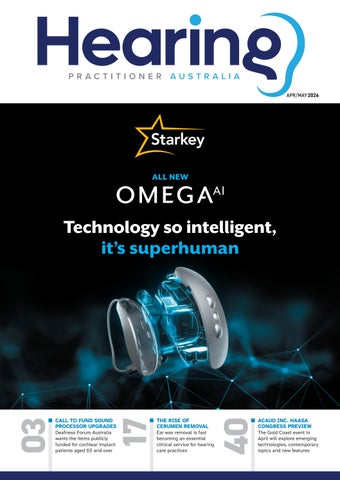
Hearing Practitioner Australia April 2026

Page 1


“LISTEN UP AUDIOLOGY PROFESSIONALS

We’re hiring”

We’re looking for passionate clinicians to join our team and make a real difference in people’s lives. With opportunities available in stores across the country, you’ll have the chance to grow your skills and be part of a brand that’s shaping the future of hearing care.

Because at Specsavers, it’s more than a job, it’s a career that sounds right.

Scan to find out more

PUBLIC FUNDING CALL FOR COCHLEAR IMPLANT SOUND PROCESSOR UPGRADES FOR OVER 65S

Deafness Forum Australia is urging the Federal Government to provide public funding for upgrades to cochlear implant sound processors, also called speech processors, for people aged over 65.

The organisation wants a dedicated funding pathway, stating the current critical gap which excludes this age group from essential sound processor upgrades is leaving many older Australians who receive cochlear implants through the public system without functioning equipment.

It said that while the Australian Government's Hearing Services Program (HSP) provides excellent support, it fell short for older Australians through this exclusion. But by expanding the HSP to cover upgrades for the over 65s, Australia could set a precedent for inclusivity and

care for its senior citizens.

“This omission leaves many seniors without the crucial access to auditory devices necessary for maintaining their quality of life,” Deafness Forum Australia CEO Ms Rhonda Locke said.

“We are calling on the government to fix this funding gap," she said. "No Australian should be left disconnected because of an arbitrary age limit. This is about fairness, dignity and the right to remain connected.”

The national body representing 3.6 million Australians with hearing loss has launched a Change.org public petition calling for urgent action. It has also lodged a pre-Budget submission estimating the change would cost the government about $3.5 million annually – or about $14 million over the forward estimates

period, a move which could immediately benefit more than 1,550 Australians.

The HSP does not fund upgrade or replacement cochlear implant speech processors for adults aged over 26 although it does cover maintenance and repairs.

The NDIS can fund upgrades for participants aged 26 to 64 if they’re considered ‘reasonable and necessary’ but this is not automatic.

People aged 65 and over can

CONCERNS REMAIN OVER HSP

Results of a hearing health stakeholders survey on proposed changes to simplify Hearing Services Program (HSP) service items reveal concerns persist about some upcoming alterations. Respondents remain worried about maintenance agreements, revalidated services, removal of the BTE (behind-the-ear) dispensing fee, and remote controls being capped at $100. Reduced aural rehabilitation and unaided client review sessions were also of concern.

The Department of Health, Disability and Ageing shared the survey seeking feedback on updates to requirements of the simplified items in October 2025 and released findings on 20 March 2026.

HSP items will reduce from 49 to 11 in the first quarter of 2027

– with no six month transition – a quarterly auto-payment to providers will be introduced for maintenance, and revisions to claims eligibility will include eligibility criteria for refitting.

Responses were received from providers, professional bodies, industry groups and practitioners. Only 29% found updates to maintenance clear, with concerns about client's ability to accept the maintenance agreements’ usual digital methods, and requests to allow acceptance of agreements in the clinic. Respondents wanted to ensure there would not be increased administration burden and delays in providing maintenance to clients. A clear process for reconciling payments was also flagged. While 64% found updates to requirements

ITEMS

for revalidated services clear, respondents wanted the revalidation process to be simplified and processing of applications to be timely, to ensure no delays in providing services. Some asked that for specific scenarios a refitting should be available without requiring a revalidation.

receive funded upgrades if they were an NDIS recipient before turning 65. Those with private health insurance can also receive funded upgrades, depending on their cover and fund, and Department of Veterans Affairs patients are also eligible.

But this reportedly leaves a group of vulnerable Australians who don’t fit these categories.

Australians who received support through the HSP may find that once they turn 65, they are no longer eligible for funded sound processor upgrades, Deafness Forum said.

Locke said the internal implant remained functional long-term, but the external sound processor typically required replacement every five to six years. “Think of how much your phone has changed in six years,” she said.

continued page 8

Nearly 60% of respondents found draft updates to general services clear. For assessments, 71% reported conducting speech in noise (SIN) testing and 76% said they had access to this equipment, but some were concerned about costs of introducing this testing and worried whether it was appropriate for all clients and sites, stating clinical discretion

Innovation Expo

The free events in Sydney and Melbourne on 10 June and 12 June respectively will showcase hearing healthcare innovations focusing on personalisation and a dual approach to transform clinical practice. page 32

Image: Prime Creative Media.

Your Patients Deserve Better than Generic - So do You!

You did not choose independence to deliver cookie-cutter care. You chose it because every patient deserves your full attention, your clinical expertise, and your time.

So, why trust your documentation to generic AI that was not built for Audiology?

AudZone:

HSP-ready Notes and:

Compliance Checker (!!)

50+ Audiology Templates

Document Automation (Cosi, Reports, DVA Docs)

Clinically Aware Workflows Made for Long Consults

LIMITED TIME OFFER

Double your time: 4 weeks FREE TRIAL

No Credit Card Required

Generic AI: Not HSP Aware Note Compliance?

Limited Templates What’s COSI?? Who is DVA??

More Manual editing Made for Short Appts.

AudZone was created to support clinicians who refuse to compromise on patient care

IN THIS ISSUE

22

Helping audiology careers bloom

26 Enhanced hearing with your glasses

28 Omega AI's quantum leap

The Starkey devices feature world-first DNN-powered directionality.

EDITORIAL

EAR WAX, EVENT SEASON AND WORLD-FIRSTS

I can’t believe we’re one-quarter of the way through 2026. Much has already happened in the hearing care sector this year including quite a few world-firsts. In this edition we cover two of them. GN has launched its groundbreaking new hearing aid fitting software which is the first in the industry to integrate the National Acoustic Laboratories’ NAL-NL3 hearing aid prescription formula.

36 World-first fit for GN

New GN hearing aid fitting software features the NAL-NL3 formula.

NAL-NL3 is designed for evidence-based, precise fittings and is the first new fitting formula in 15 years. It features a suite of prescriptions, rather than the existing one size fits all solution and is making waves globally.

The second is Starkey Australia launching its world-first Omega AI hearing aids in Australia and New Zealand. Starkey says the devices enable all round hearing due to its industry-first deep neural network (DNN) 360 directionality.

Starkey's Ms Dawn Rollings says its an engineering breakthrough setting new performance benchmarks for the hearing technology sector and delivering industryfirst healthable features.

For HPA’s main feature on cerumen removal, I interviewed two audiologists who are experts in ear wax removal. Mr Mo Helou’s mobile ear wax removal service has taken off around Sydney, providing a much-needed service to nursing home residents and people in their homes.

Both he and Mr Keith Chittleborough from Melbourne, who performs cerumen removal in practice, and teaches the art to others, believe that cerumen removal is a skill all hearing practitioners should learn and offer to patients.

For the livelihoods of audiology clinicians, cerumen removal also creates an additional revenue stream, as well as being a way to position your clinic as a go-to for all ear and hearing related issues.

Finally, event season is underway. Our report on another successful Hearing Business Alliance Seminar in Brisbane features, along with a preview of the upcoming ACAud inc. HAASA Congress on the Gold Coast. We look forward to meeting you at Congress and in Sydney in May at Audiology Australia event, The Sound Exchange26, a preview of which featured in our February-March edition.

Meet Australia's first independent optometrist to sell Nuance Audio Glasses.
Bloom Hearing Specialists is currently having a recruitment drive.
Image: GN.
Image: Starkey.
Image: Bloom Hearing Specialists. Image: EssilorLuxottica.

UPFRONT

Just as HPA went to print, EXPRESSION AUDIOLOGY announced a new partnership with Guide Dogs Victoria, supporting improved access to audiology services for people who are blind, low vision or deafblind. Senior audiologist Mr Matthew Grounds has started providing fortnightly Tuesday clinics at the Kew location. Anyone can access the clinic regardless of vision ability. The collaboration reflects Expression Audiology’s

OFF THE BEATEN TRACK

Weird

Fish have otoliths – tiny mineral structures in their

commitment to accessible community-focused care for people with lived experience of sensory loss..

IN OTHER NEWS, Allied Health Professions Australia (AHPA) said equitable access to placement support must be a national priority. AHPA joined independent MPs Dr Helen Haines and Senator David Pocock to launch a petition at Parliament House calling on the Australian Government to expand the Commonwealth Prac Payment program to include all allied health students. It said financial barriers should not prevent or delay students from completing their

degrees. Audiology Australia is a member of AHPA. And FINALLY, the Australian Government has announced that patients, prescribers and pharmacists will have a complete picture of a patient’s medicines history under reforms to improve standards of care and strengthen safety in digital medicines and telehealth. Changes will implement requirements

hearingpractitionernews.com.au

Thinking back before you obtained your first hearing aid(s): do you think, you should have gotten them sooner?

Perry's Roar, and breaks them down line by line into British Sign Language. The group, run by the Leeds Society for Deaf and Blind People – which this year celebrates 160 years as a charity – includes a mixture of people; some are deaf, others have reduced hearing and some have typical hearing.

Wacky

In some situations, road noise can make urban grey squirrels feel safe, a study from the University of Exeter, reveals. The research, published in Oikos, measured how much food squirrels left behind in standardised food patches in different places, which reflected how dangerous they perceived their local surroundings to be. Squirrels felt safer from predators near noisy roads.

IF YES: What are the reasons why you think you should have gotten your hearing aid(s) sooner? What are the opportunities you think you have missed because of this? Please tick all that apply.

70% wish they had hearing aids sooner.

New Hearing Care Industry Association research reveals most hearing aid wearers wish they'd got their devices earlier. Page 15.

WHAT'S ON

THIS MONTH

ICAUD INC. HAASA CONGRESS 2026

22-24 April

The biennial national event will be at the Gold Coast Convention & Exhibition Centre, Broadbeach, themed “Innovation with heart.” acaud.eventsair.com/nationalcongress-2026

Complete calendar page 51

11-13 May

Audiology Australia’s immersive event for audiologists, researchers and innovators will be at Sydney’s Accor Stadium. soundexchange.com.au/ registration

Karyssa Arendt

karyssa.arendt@primecreative.com.au

Head of Design Blake Storey

Ar t Director Bea Barthelson

Subscriptions T: 03 9690 8766

subscriptions@primecreative.com.au

The Publisher reserves the right to alter or omit any article or advertisement submitted and requires indemnity from the advertisers and contributors against damages or liabilities that arise from material published. © Copyright – No part of this publication can be reproduced, stored in a retrieval system or transmitted in any means electronic, mechanical, photocopying, recording or otherwise without the permission of the publisher.

BIPARTISAN POLITICAL SUPPORT GIVEN

continued from page 3

“Technology evolves rapidly. For someone who is profoundly deaf, these upgrades are not optional extras because they are essential for safety, communication and connection,” Locke said.

Modern sound processors allowed users to connect to smartphones, alarms, doorbells and assistive technologies, providing communication access, security and independence. “For many Australians with cochlear implants, the ability to use a phone, connect to home safety systems and communicate freely is extraordinary," she said. "Without upgrades, that connection can be lost.”

In March 2026, Locke and Ms Hayley Stone, Deafness Forum Australia executive director of policy and government relations, met chair of the Standing Parliamentary Committee on Health, Aged Care and Disability, paediatrician Dr Mike Freelander, at Parliament House.

“Dr Freelander committed to advocating to (Health) Minister (Mark) Butler to remove the over 65s age limit for cochlear sound processors under the HSP – a strong voice of support,” Stone said.

A spokesman for Dr Freelander told HPA in March that Dr Freelander had made representations to Butler about the matter.

Stone added: “We’ve also raised the issue with Shadow Health Minister (Senator Anne Ruston) and hope we’ll get a positive result when the Federal Budget is released. Butler’s office has kept the door open to us, and we know the issue is being considered by the Department of Health, which is why community support is so critical.

“Butler’s office has said that if we don’t get funding in this budget, they’re still willing to keep talking, which is a positive sign. We’re also collecting real examples where people over 65 have fallen through the cracks to highlight the human element.”

Former Tasmanian Health Minister, Hon. Jacquie Petrusma MP, who has Ménière’s disease-induced hearing loss, is believed to be the first Australian politician with a cochlear implant and is now Speaker of the House of Assembly.

She previously told wrote to Butler in March 2025 urging the government to “strongly consider extending coverage for replacement sound processors to all cochlear implant recipients, regardless of age”.

“Specifically, I request the inclusion of cochlear implantees, who are pensioners, to receive coverage for replacement sound processors on a five-year cycle, similar to coverage provided for hearing aids under the HSP,” she wrote.

“THE EXISTING GAP CREATES A SUBSTANTIAL INEQUITY, PARTICULARLY IMPACTING ECONOMICALLY VULNERABLE SENIORS WITH SEVERE TO PROFOUND HEARING LOSS.”

JACQUIE PETRUSMA TASMANIAN MP

Petrusma said the existing gap created “a substantial inequity, particularly impacting economically vulnerable seniors with severe to profound hearing loss”.

“A National Acoustic Laboratories study completed in 2023 found that benefits of upgrading sound processors justified the cost of providing these upgrades and that upgrades significantly improved speech understanding in noisy environments, enhanced communication in everyday life, and boosted overall wellbeing,” she said.

Locke said 65 was an arbitrary age barrier. “You don’t suddenly stop needing to communicate. In fact, connection to community becomes even more critical,” she said.

Research consistently linked untreated hearing loss with increased risks of social isolation and depression, cognitive decline and dementia but providing this funding would positively impact many lives, she said, adding that an estimated 15,000 Australians rely on cochlear implants.

The petition says up to one-third of Australians over 65 have hearing loss. With the population aging, the demand for interventions will continue to rise. “Access to advanced auditory devices for older citizens is not merely a policy issue but a fundamental human right,” it says.

CHANGES 'RISK REDUCING AUDIOLOGY TO FITTING AIDS'

continued from page 3

should remain important.

For clinical sessions, 65% found the updates clear, 90% said a list of rehabilitation resources would be useful but only 45% indicated updated activities would make it easier to provide aural rehabilitation services. Most found updates to fittings, follow ups, replacements and spare devices clear.

Hearing Business Alliance (HBA)

CEO Ms Jane MacDonald said many members in its survey response objected to removal of the BTE dispensing fee and to remote controls being capped at $100. “They thought better clinical outcomes would be achieved if the clinical session remained available to all clients every 12 months, not every two years for unfitted clients,” she told the HBA Seminar in Brisbane.

MacDonald said HSP emails

to providers in 2023 and 2024 stated changes were designed and modelled to be cost neutral to providers across a five-year voucher period but concerns remained about whether they would be.

She said Scyne Advisory financial modelling was based on six years of retrospective data, heavily influenced by claiming patterns of big providers. “There are concerns by HBA members that this doesn’t reflect small business practices in a sector that is heavily vertically integrated,” she said. “The ‘client journeys’ modelled reflected the claims available, not the appointments and client contact points that occur in practice. There’s a difference between the ‘cost of maintaining a device’ versus costs associated with ‘supporting a client’– which involves additional appointments and costs to the business that are unrelated to a claim.”

Audiology Australia (AudA) said in its submission to the survey that “proposed changes risk reducing the practice of audiology to the fitting of hearing aids, which significantly undervalues the clinical expertise of audiologists”.

“Audiology encompasses a broad range of services, including auditory rehabilitation, counselling, and complex care management,” AudA wrote. It said extending service item 920 (unaided client review) from annual to biennial may reduce opportunities for regular monitoring and early intervention for unaided clients, particularly those whose hearing may be gradually deteriorating or who are hesitant to pursue amplification. Also concerning was revised funding for aural rehabilitation with only two clinical sessions permitted – one each for aural rehabilitation and client review –in the 12 months after fitting.

Image: Jacquie Petrusma.
HBA CEO Jane MacDonald. Image: Jane MacDonald.

SHAPING THE FUTURE OF HEARING CARE AT OPSM

WORKING AT OPSM MEANS YOU’RE PART OF SOMETHING BIGGER

At OPSM, we’re redefining hearing care by integrating Audiology into a modern healthcare environment where innovation, expertise and customer experience come together.

What sets OPSM apart is our commitment to clinical excellence and professional growth. Our Audiologists are supported through ongoing development, access to advanced technology and clear opportunities to expand their clinical impact within an integrated model of care.

As we continue to grow our Audiology network across Australia, we are seeking motivated clinicians who are passionate about delivering quality hearing care and building a meaningful and impactful career in Audiology.

LEARN MORE AT OPSM.COM.AU/CAREERS OR VISIT US ON LINKEDIN

CONTACT US TO EXPLORE YOUR NEXT OPPORTUNITY: NAOMI.NICOLINAS@AU.LUXOTTICA.COM

Hearing clarity for your clients, confidence in your fittings.

GN is the first manufacturer to support NAL‑NL3™ in the fitting software1, enabling greater precision, consistency and confidence in your fittings2.

Confident first fits with NAL‑NL3

Our latest fitting software supports the NAL‑NL3™ prescription, enabling more greater precision, consistency and confidence in every fitting.²

Industry’s best for hearing‑in‑noise3‑6

Beltone Envision™ and ReSound Vivia™: Top‑rated for speech intelligibility in noise and proven to be significantly better in group conversations.7

AllFit domes – improved comfort for more clients

AllFit domes offer improved comfort with additional wax protection in 19 dome options, helping you tailor each fit for more of your clients.8

(2025).

AUDA REVEALS AUDIOLOGY REGULATION IS ON TRACK FOR 2030-2031

Audiology regulation in Australia is expected to begin around 2030–2031, with new details revealing a clearer pathway to national registration.

Audiology Australia (AudA) said the Health Workforce Taskforce (HWT) anticipated amendments to the Health Practitioner Regulation National Law would pass in late 2028.

Full implementation including establishment of a National Board and the start of audiologist registration under the National Registration and Accreditation Scheme (NRAS) was expected 24 to 36 months later, AudA announced in February 2026.

The HWT, which advises health ministers and includes commonwealth, state and territory representatives, is leading policy development after the health ministers’ September 2025 decision to regulate audiology under the NRAS.

Broader public consultation is scheduled for later in 2026 and will give the profession a chance to shape the details of registration. Areas under consideration include registration standards, continuing professional development requirements, English language and recency of practice standards, recognition of existing accredited pathways, and transition arrangements for current practitioners.

The move will bring audiology into the framework administered by the Australian Health Practitioner Regulation Agency (Ahpra), introducing formal registration, accreditation of training programs, assessment of internationally

uncertainty with clearer milestones. It said the transition had entered an active development phase, with consultation starting this year. Initial work will focus on policy development and targetted consultation with key stakeholders, including AudA as the peak professional body. This stage will draw on evidence from the original Regulatory Impact Statement and identify key policy issues to inform legislative changes, AudA said.

AMPLIFON TO BUY

Italian hearing aid retailer Amplifon will acquire GN Hearing from Denmark’s GN Store Nord for A$3.7 billion, with the deal expected to be completed by the end of 2026, subject to regulatory approvals.

Announced on 16 March 2026, the deal will create a vertically integrated group spanning manufacturing and retail.

Amplifon said it was “the most transformative acquisition in our 75-year-long history, that will fundamentally change the future of the hearing care industry worldwide”.

GN said the combined entity would become “the industry leader in hearing care solutions and services worldwide with benefits to audiologists, consumers and investors”.

Amplifon said the new group would have combined revenues of about $5.37 billion. Its network of more than 10,000 clinics globally includes more than 350 in Australia. GN Hearing’s technology brands include ReSound and Beltone.

GN Hearing ANZ told HPA: “It remains business as usual for us at GN. This new set-up is intended to further strengthen the focus

GN

members. Image: Audiology Australia.

AudA said it would advocate for a model that recognises existing qualifications and supports diverse practice settings, while ensuring a smooth transition for the current workforce. “Following the September 2025 ministerial decision, the next phase is now officially underway,” AudA said, noting that while progress had appeared slow, “the machinery for a national regulatory transition has been assembling”. Over the next 12–18 months, it will focus on representing the profession through consultation, keeping members informed, and aligning certification and accreditation processes with future NRAS requirements.

HEARING FOR $3.7 BILLION

on innovation and product development, while continuing to serve the entire market with the same neutrality and high standards as today.

“Our services to our customers will continue to be uninterrupted – the people, products and services received from us, and all agreements stay fully intact.”

Under the agreement, GN’s hearing business is valued at $3.7 billion on a cash and debt-free basis, with payment comprising cash and Amplifon shares. GN said proceeds would be used to reduce debt, invest in growth, and return capital to shareholders.

Amplifon CEO Mr Enrico Vita said the combination would create “a truly global vertically integrated leader in audiology”, combining advanced R&D, manufacturing and a broad commercial network across more than 100 countries.

“Today marks a turning point for Amplifon. The acquisition will fundamentally change the future of the hearing care industry worldwide,” he said. “Importantly, Amplifon will continue to preserve and enhance (GN) Hearing’s unique

The deal will create a new vertically integrated group. Images: Timon/ stock.adobe.com.

identity, heritage, and strengths, recognising its brand value, culture, and distinct capabilities as key contributors to the future success of the combined organisation.”

GN Store Nord CEO Mr Peter Karlströmer said the deal represented “an opportunity to create a global leader in audiology”, with strong potential to drive innovation and growth. “As we open up this new chapter, we are focused on driving success as an innovative technology company with global reach and scale,” he said.

After the sale, GN will pivot to focus on its audio and video peripherals business, positioning itself as a pure technology company.

COCHLEAR IMPLANT PIONEERS AWARDED

Australian cochlear implant pioneer and surgeon/scientist, Professor Graeme Clark AC, has shared in the 2026 Queen Elizabeth Prize for Engineering with fellow cochlear implant pioneers, MED-EL co-founders, Dr Ingeborg Hochmair and Professor Erwin Hochmair, and Duke Hearing Center director Professor Blake Wilson.

They were awarded for innovations that have enabled hearing in more than one million cochlear implant users worldwide over the past four decades.

The prize, often described as the “Nobel Prize of engineering”, includes $976,000 shared among nine laureates and was announced at London’s Science Museum on 3 February 2026.

Judges praised the quartet’s role in transforming cochlear implants from experimental devices into reliable neural prostheses that directly stimulate the auditory nerve.

They credited Prof Clark with leading the preclinical science, engineering development and fundraising behind the first multi-channel cochlear implant, and performing the pioneering 1978 surgery that enabled open-set speech understanding. His work led to the creation of Cochlear Limited and established a global standard of care.

The Hochmairs were recognised for developing the first microelectronic, multi-channel cochlear implant and advancing signal processing, implant miniaturisation and biocompatibility, work that underpinned the founding of MED-EL. Prof Wilson was honoured for inventing key signal processing strategies that remain central to modern cochlear implants.

Prof Clark said: “I am honoured to be recognised alongside my colleagues and proud to see how this field has grown to help people with a wide range of neurological conditions.”

GN LAUNCHES WORLDFIRST NAL-NL3 SOFTWARE

GN has launched new fitting software that is the first in the world to integrate the next-generation NAL-NL3 hearing aid prescription formula.

Developed by Australia’s National Acoustic Laboratories (NAL), NAL-NL3 is the first major update to a hearing aid fitting formula in 15 years. Unlike previous approaches, it offers a suite of prescriptions rather than a one-size-fits-all model, aiming to deliver more precise and individualised fittings.

The software, ReSound Smart Fit 2.3.1, Beltone Solus Max 2.3.1 and Hearing Australia Fitware 2.3.1, was released in Australia in March and April 2026.

GN said the integration would support better patient outcomes by giving clinicians more advanced tools for consistent, personalised fittings. “With NAL-NL3 now available within new fitting software from GN, hearing care professionals can access a widely recognised gold standard in audiology,” GN said.

The formula incorporates AI-driven

insights and real-world user data to improve fitting precision. GN has also enhanced its AutoREM (Real-Ear Measurement), helping ensure hearing aid output more accurately matches an individual’s ear acoustics for a more natural listening experience.

NAL director Dr Brent Edwards said the integration marked a significant step forward for the profession. “We are incredibly excited GN has introduced the first fitting software to integrate NAL-NL3,” he said.

Read more p36

CALL FOR NATIONAL SCHOOL SCREENING PROGRAM

The Australian College of Audiology incorporating HAASA is urging the Federal Government to introduce a coordinated national screening program to identify and treat hearing issues in children earlier, stating undetected hearing loss can significantly affect a child’s education and development.

Below: Routine checking of children’s hearing as they enter primary and high school was urged. Image: Monkey business/stock. adobe.com.

“Hearing can help foster a child’s love for education or it can slam doors,” ACAud inc. HAASA said, adding that early intervention reduced long-term social and economic impacts.

It called for nationally consistent screening, recommending routine hearing checks when children start

primary school and again at the transition to high school. While some state-based programs exist, the organisation said a unified national approach was needed.

It also highlighted the importance of clear referral pathways from GPs to audiologists and audiometrists to support earlier diagnosis and care. Strengthening access to hearing assessments within primary care would enable faster intervention and reduce pressure on specialist services, it said in a statement for World Hearing Day 2026 in March.

ACAud inc. HAASA emphasised better use of the existing hearing workforce, particularly audiometrists, to address access gaps and improve early support for children.

It called for greater parent awareness around hearing health, including safe headphone use and noise exposure, alongside stronger collaboration between health, education and community sectors.

“Prioritising hearing health should be as routine as checking vision or dental health,” ACAud inc. HAASA said.

patients fitted using the software, Barbara. Image: Hearing Australia.
Below: (L-R) Prof Graeme Clark AC, Dr Ingeborg Hochmair and Prof Erwin Hochmair. Image: Jason Alden/QEPrize.

HEARING INDUSTRY FEATURES IN ENDEAVOUR MANUFACTURING AWARDS

Four companies and one organisation from the hearing care sector are finalists in Australia’s 2026 Endeavour Awards which recognise outstanding individuals and businesses in manufacturing.

In the new Innovation in Health Technology category, Cochlear, Audeara, GN Hearing ANZ, and Widex were named among 10 finalists, while in the Outstanding Start-up category, Ear Genie is one of eight finalists.

“We received a record number of submissions this year for the Manufacturer’s Monthly Endeavour Awards, marking the highest level of nominations since the awards were established in 2003,” said Ms Molly Hancock, head of events marketing at Prime Creative Media.

“This reflects not only the remarkable talent across Australia’s manufacturing sector but also the continued growth

Manufacturing businesses from across Australia are invited to attend the awards gala and be part of an evening that celebrates outstanding individuals and organisations, and the strength and success of the Australian manufacturing industry.

WOMEN IN INDUSTRY AWARDS

The 2026 Women in Industry Awards

year and be at Doltone House Darling Island Wharf on 18 June 2026. The awards celebrate and recognise the outstanding women who are redefining what’s possible across industries in Australia.

The health award recognises an outstanding individual or team in the health or medical sector who demonstrates excellence in patient care, innovation, and professional practice. The leadership award recognises emerging C-suite executives who demonstrate exceptional leadership, strategic vision, and a strong trajectory of influence within their organisation and the wider industry.

Prime Creative Media, an Australian family-owned B2B media and events company which is the parent company of HPA , runs both awards. Women in Industry Awards nominations

Prime Creative Media.

IN BRIEF

AUSTRALIA DAY AWARD

The UNSW School of Electrical Engineering and Telecommunications’ longest serving head, professor in signal processing Eliathamby (Ambi) Ambikairajah, has received an AO in the Australia Day 2026 Awards. He teaches speech processing and digital signal processing, is internationally recognised for his contributions to developing auditory models and has led the integration of machine learning with auditory models to create machines with selective auditory attention capabilities. Prof Ambikairajah is working on an intelligent auditory model to enhance voice biometrics and cochlear sound processing hardware. A professor and co-research project leader in the Speech Processing and Auditory Modelling Research Laboratory, his expertise includes speech signal processing, language identification, speaker separation, cochlear modelling, AI and

DELAY OF 4-6 YEARS IN GETTING HEARING AIDS

New research confirms most Australians who wear a hearing aid took four to six years between becoming aware of their hearing loss and obtaining a hearing aid. And only 45% with self-declared hearing loss have hearing aids.

Released by the Hearing Care Industry Association (HCIA) for Hearing Awareness Week in March 2026, the Australia Trak 2025 (APACTrak) study revealed a significant gap in national hearing healthcare.

Findings indicated 70% of hearing aid owners regretted the delay, citing missed social opportunities and negative impacts on their mental and emotional wellbeing.

Despite this lag, those who did seek help reported high satisfaction, with most "overwhelmingly satisfied" with their clinicians, and 75% pleased with their devices' sound quality and features. Additionally, 96% of hearing aid owners said the devices improved their quality of life.

Instrument Manufacturers Association and the HCIA, surveyed a representative sample of nearly 15,000 people including 1,200 who were hearing-impaired.

Results "busted the myth" that hearing aids led to social rejection with 62% of owners stating they were never made fun of or rejected. Infact, the research suggested untreated hearing loss was more likely to result in social exclusion than wearing a device.

The study highlighted the link between hearing health and cognitive health with research showing hearing aids can reduce the rate of cognitive decline in older adults. While only 20% of respondents recognised hearing loss as a modifiable risk factor for dementia, addressing impairment was increasingly seen as a vital mitigation strategy for the aging population.

Ms Donna Edman, HCIA CEO, said closing this awareness-to-access lag was a matter of national roductivity. “There is much in this research for policy makers and providers to reflect and act upon,” she said.

“The good news in this research is that 87% of hearing aid owners say their hearing aid works better than or as expected.

“Respondents with hearing aids say having them increases the chance of getting the right job, being promoted, and getting a higher salary. Hearing aid owners also report feeling less exhausted in the evenings and their quality of sleep seems to improve if they are using hearing aids.”

The study, conducted by Anovum GmbH for the European Hearing

About one-third of hearing-impaired people thought hearing loss could be linked to depression. The survey also found that hearing aid owners had a lower risk of being depressed compared to non-owners with comparable hearing loss.

Regarding usage trends, on average, hearing aids were worn 7.4 hours a day and replaced every five years. Receiver-in-Canal (RIC) devices were the most popular choice (52%) followed by traditional Behind-the-Ear (BTE) models.

While 71% of owners received third-party reimbursement, cost and perceived discomfort remained the primary barriers for the 55% of hearing-impaired Australians who still do not own devices.

The clinical journey often began with primary care; 65% of hearing-impaired people discussed the issue with a GP or ENT but while 56% of GP consultations led to an audiology referral, 8% of doctors still recommended "no action."

Ms Lia Traves, Audiology Australia (AudA) president, said hearing care was health care and called for hearing checks to become a routine part of every Australian’s health management. AudA is advocating for increased government financial support to cover diagnostic services and device costs, urging a multi-layered approach to challenge remaining stigmas.

The report can be viewed at ehima.com/surveys.

Leading international and Australian speakers

Evidence-based clinical sessions and masterclasses

Hands-on interactive workshops

Explore the latest hearing technology and innovations

Network with audiologists, audiometrists, students and industry leaders

Explore how emerging technologies like AI are transforming hearing care, while maintaining the human connection at the centre of clinical practice.

Gold Coast, Queensland

22-24 April 2026

Keith Chittleborough letting his student from a cerumen removal course practise ear wax removal on him.
Keith Chittleborough instructing practitioners in cerumen removal.
Image: Keith Chittleborough.
Image:
Keith Chittleborough.

that would bring in new customers. It’s a no-brainer.”

Today he performs cerumen removal at Victorian Hearing clinics and teaches ear wax removal through Ear Health Courses, owned by Dr Hanby.

PRACTICE BUILDS PROFICIENCY

While most audiology students now learn the basics of cerumen removal at university, Chittleborough says clinical practice is what truly develops competence. “Students are taught cerumen removal at university but practise in clinics is what builds the skill set,” he says.

Beyond standard practice, clinicians have the option of upskilling to utlilise medical microscopy. . “Medical microscopy is hard compared to what we’re used to doing,” he

says. “But once you get used to this gold standard, you can see everything.”

Training courses typically combine theory with hands-on experience. Ear Health Course’s program includes practical sessions where participants practise on each other and, sometimes, Chittelborough’s ears.

The course uses creative training tools to simulate different wax conditions. “For soft wax we use cream in ears, and for hard wax we use sultanas,” he says. “A dome is placed inside to practise using forceps.

“It’s important for people to experience what it’s like on themselves first – how it feels, how it sounds. Suction is noisy. It sounds like a plane, and that’s one of our biggest risks – managing noise.

“One phrase I bang on about is ‘skin in the game’. Students should undergo the procedure themselves to understand the patient perspective.”

CHOOSING THE RIGHT TECHNIQUE

Modern training usually covers microsuction, curettage/manual removal, and irrigation. Each method has its place depending on the condition of the ear and wax type, he says.

Chittleborough says microsuction is often considered the gold standard because it allows clinicians to remove wax under direct visualisation. “The beauty of microsuction is a practitioner can grab a lump of wax centrally and lift it out without necessarily having to go near the canal walls,” he says. “That means avoiding touching the delicate skin and causing potential trauma.”

Curettage can still be useful, particularly when wax is hard or impacted. “The probability of touching the ear canal walls is higher with curettage, but sometimes it’s needed if wax is hard or stuck,” he says.

While irrigation is becoming less common due to potential risks associated with direct water pressure, Chittleborough occasionally uses a low-pressure water spray to clear debris.

“I probably use a spray water bottle once a month,” he says. “It doesn’t apply direct pressure but can help flush out extra

debris and get everything off the tympanic membrane if intact. Perforation risk is low because the pressure isn’t there.”

NEW TECHNOLOGIES

The cerumen removal equipment market has also expanded significantly in recent years. When Chittleborough began performing the procedure, options were limited. Today, clinicians have access to a wide range of microscopes, endoscopes, digital otoscopes and suction systems.

Established tools include VorOtek’s head worn O Scope microscope and vision equipment, along with suction pumps and specialised removal instruments. More recently, new devices have entered the market such as the WAXScope, developed by British audiologist Mr Neil Raithatha, and the Audelation OWL lightweight otoscope from the UK.

Chittleborough believes digital visualisation will play an increasingly important role.

“The cutting-edge design space is in the digital field,” he says. “Even the normal digital otoscope should be a standard part of ear wax removal.”

Being able to show patients images of their ears also improves engagement. “I like to take pictures on my screen before and after to show them,” he says. “It’s a value add and a bit of theatre.”

Patients often want to see what has been removed. “They didn’t used to, but many want to take a photo of it now,” he says.

FUTURE POSSIBILITIES

Chittleborough believes visual technology could evolve further. He would like to see virtual reality glasses linked to otoscopes, allowing clinicians to work with a larger field of view.

“The bigger the vision the better, and the less bending I have to do, the happier I am,” he says. “Cerumen removal can be tough on the back.”

Improving ergonomics may become an important design priority as more clinicians perform wax removal regularly.

An Ear Health Courses workshop with instructors seated at front (from left) Dominic Power, Dr Brooke Hanby and Keith Chittleborough.
Microsuction has become the safest and most popular method.
Image: Keith Chittleborough.

Beyond its clinical value, cerumen removal is increasingly recognised as a powerful business driver for hearing clinics.

“Wax removal is good for social media and for referrals,” Chittleborough says.

“I don’t think we stress how good wax removal actually is for referrals – new clients coming in.”

Blocked ears often create immediate discomfort, prompting patients to seek help quickly. When clinicians resolve the problem instantly, satisfaction levels can be high. “These patients are always very happy and obliging to give a good Google review,” he says.

“It feels good – they come in with a blocked ear or pathology; you remove it and they’re so happy.”

Many patients also return periodically for maintenance. “They come back in six months or a year,” he says.

For new practices, wax removal can be a valuable service for building a client base.

“It’s a massive driver for new patients,”

Chittleborough says. “If you’ve got a startup clinic, cerumen removal will bring in new clients and get revenue going.”

RISKS OF DIY EAR CLEANING

While demand for professional cerumen removal is increasing, many clinicians continue to see complications caused by do-it-yourself ear cleaning, he adds, with cotton buds remaining a common cause of problems.

“Everyone knows they’re not supposed to put cotton buds in their ears – but perhaps not everyone does know!” he says.

More recently, online retailers have introduced consumer ear cleaning devices, including inexpensive otoscope tools sold through platforms such as Amazon. “People are buying B-bird otoscopes and causing injuries,” Chittleborough says.

“We’ve had people come in with their ear all torn up because they’ve been doing wax removal themselves.”

These injuries reinforce the importance of professional services by trained practitioners, he adds.

MOBILE SERVICE

While many clinics provide in-practice wax removal, some audiologists are having great success exploring alternative service models. One, Sydney audiologist Mr Mo Helou, has developed a mobile service that brings cerumen removal directly to patients’ homes and aged care facilities.

His business – Mobile Earwax Specialist – has treated more than 5,000 patients or 10,000 ears in just over three years.

Helou’s interest in audiology began while studying medical science at Western Sydney University, where he realised the field offered opportunities to help people while building a growing career.

He completed a Master of Audiology at Macquarie University, although the COVID-19 pandemic disrupted much of his practical

training. “We did the course online and didn’t get to do as much practical work through an internship,” he says.

After graduating, Helou joined Bay Audio, and despite the shortened internship, received Rookie Clinician of the Year in his first year out of 130 clinicians. While at Bay Audio, Helou noticed many patients asking about ear wax removal – a service the clinic did not provide at the time.

“I thought I could do more to help these people,” he says.

In November 2022, he launched a small mobile service providing ear wax removal on weekends while he was still working at Bay during the week. “The point was to do ear wax, and I thought I would send those patients back to the Bay Audio clinic for other conditions,” he says.

But once he began visiting patients in their homes, he realised the relationships were deeper than he expected. “They trusted me and were letting me treat their families,” he says. “Sometimes I would have meals with them. It didn’t make sense to send them back to someone else’s business.”

Helou began promoting the service locally, delivering flyers to letterboxes and nearby businesses after work. His wife managed bookings while he was working during the day and as demand grew, he realised the service could become a full-time venture.

But leaving a secure job to start a business was not an easy decision.

“I was shaking sending my resignation letter,” Helou says. “My wife was pregnant, we were renting, I had plans for another property, and I was leaving a well-paying job.”

With limited capital, he found a creative

solution. A neurologist needed an audiologist to assist with vestibular cases and offered Helou clinic space and access to equipment. In return, Helou launched NeuroAudiology Australia initially in the ENT specialists’ rooms, which complemented his mobile wax removal business.

The arrangement allowed him to provide a broader range of services, including hearing assessments and vestibular diagnostics. Since then, NeuroAudiology Australia has grown rapidly and now operates five clinics and employs 10 staff.

Both of his businesses are listed on the Home Visit Network website, helping patients find mobile healthcare services.

A chance appointment also helped raise the profile of the mobile business. While

Sydney audiologist Mo Helou and his Ear Doc car.
Doing wax removal in a client’s home helps many people who are unable to get out.
Image: Mo Helou.
Image: Mo Helou.

performing cerumen removal on a child, he discovered the family had connections to popular Sydney talkback radio station 2GB.

The grateful parent offered him a segment which generated strong audience response.

“The response was huge, so I was invited back for more sessions,” he says.

Helou has since appeared several times on 2GB discussing topics including hearing loss prevention, tinnitus, vertigo, sudden hearing loss and ear wax management. Listeners call in with hearing concerns, creating opportunities to educate the public about hearing health.

DEMAND IN AGED CARE

A significant proportion of Helou’s patients come from aged care facilities, where cerumen impaction is particularly common. His research determined that about one-third of nursing home residents require

ear wax removal and his mobile service now visits about 25 nursing homes regularly.

Many elderly people struggle to attend appointments due to mobility or health issues, making visits to their homes for cerumen removal valuable for them and his service.

Clients also include busy professionals who prefer the convenience of treatment at home, and individuals with disabilities who find travel difficult.

“A lot were prevoiusly waiting two or three months and didn’t know the service existed,” he says.

Providing cerumen removal in patients’ homes can present logistical challenges though. Helou says he uses VorOtek equipment with microsuction, which allows both hands to remain free during procedures.

“The way I’m doing it now is I need to have full control,” he says. “Sometimes I’m leaning over someone in bed, for example.”

His equipment is packed into one compact case so it can be transported easily between appointments in his car.

Although mobile environments can be unpredictable, careful positioning and experience help ensure safe procedures.

Helou first completed an online certificate in cerumen removal, initially practising on family members. He later undertook a course at Macquarie University to consolidate his skills.

“I trained myself on my large family,” he says. “Then I did the course to make sure I was doing everything as well as possible.”

Hands-on experience quickly followed through his growing mobile service.

PATIENT GRATITUDE AND WORD-OF-MOUTH

Helou says patient satisfaction is one of the most rewarding aspects of cerumen removal, with many clients being surprised and delighted that the service can be

delivered at home. The business has more than 600 positive Google reviews including 366 five-star reviews. Many new patients arrive through word-of-mouth referrals.

Both Chittleborough and Helou believe cerumen removal should be integrated into broader audiology care and encourage clinicians to view it as part of a complete hearing health pathway.

“It helps you provide a complete service,” Helou says. “You’re not sending patients between two or three different places when it can all be done in one.”

He also notes the importance of ensuring the ear canal is clear before fitting hearing aids.

“If you’re fitting a hearing aid, that’s important to do beforehand,” he says. “Even if it’s not completely blocked, removing wax can improve the function of the hearing aid.”

With an ageing population, increased hearing aid use and declining availability of ear syringing in general practice, demand for cerumen removal services appears set to grow. Both audiologists say the profession is well positioned to meet that need.

For Chittleborough, the key message is professional responsibility. “We’ve known for a long time about the usefulness of it for clinicians because we can’t really do our jobs without doing ear wax removal,” he says.

For Helou, the service also offers an opportunity to build meaningful connections with patients.

“It’s about being part of something bigger and implementing change in the industry,” he says. “Find your passion and make the profession work for you.”

As training options expand and technology continues to evolve, cerumen removal may increasingly become a defining element of modern audiology practice, helping clinicians deliver more comprehensive care while keeping the pathway to hearing clear.

Many patients like to see the inside of their ears during cerumen removal.
Above: Mo Helo performing cerumen removal on a nursing home resident.
Image: Nadzeya/stock.adobe.com.
Image: Mo Helou.

Where hearing careers take shape

AuCA delivers nationally recognised and professional development courses designed to upskill hearing clinic teams.

Diploma of Audiometry

HLT57415 | Combined Online & Face-to-Face

Graduates are trained to assess hearing, identify impairment, manage referrals, and support hearing rehabilitation through the prescribing and dispensing of hearing devices.

Certificate IV in Audiometry

HLT47415 | Combined Online & Face-to-Face

Develops skills in basic hearing assessment, client communication, and professional practice across clinical, occupational, and community settings.

Occupational Audiometry

Combined Online & Face-to-Face

Covers workplace hearing testing including noiseinduced hearing loss, screening audiometry, and compliance across AUS & NZ. Aligned to AS/NZS 1269.4:2014 Occupational noise management.

Intro to the Hearing Sector

Professional Development | Online Workshops

Builds confidence and industry understanding, from hearing health basics and devices to clinic workflows and client communication.

Hearing care coordinator Trinity Falls and audiologist Lachlan Malley at Bloom Hearing Specialists Signature Store in Capalaba Queensland.

Helping audiology careers bloom

Bloom Hearing Specialists has been supporting Australians with their hearing health for 23 years and operates in more than 200 locations across Australia and New Zealand. It’s currently running a recruitment drive for passionate audiologists and audiometrists including graduates.

Audiologist Ms Serena Hiotis joined Bloom Hearing Specialists after a steady drumbeat of glowing reviews from former colleagues and university peers became impossible to ignore.

The Melbourne practitioner had been working at another rehabilitation and hearing aid provider for just under four years.

“I joined Bloom Hearing Specialists 2.5 years ago,” she says. “I was initially approached by a recruiter several times but became more interested after hearing consistently positive feedback about Bloom Hearing’s culture and values from former colleagues and university peers.

“After learning more about the organisation, I reconnected with the recruiter and progressed through the interview process. I ultimately decided to join Bloom Hearing because of its strong alignment with my personal values, its supportive culture, and its clear commitment to putting clients first.”

Bloom Hearing Specialists is a rehabilitation-focused provider offering comprehensive hearing assessments and

hearing device fittings, as well as tinnitus management services for adults and cerumen removal.

“It’s an excellent organisation to work for, offering a strong-work life balance,” Hiotis says. “We are united in our commitment to delivering high-quality, personalised care to every client.”

HISTORY, GROWTH AND MISSION

WS Audiology (WSA) established Bloom Hearing Specialists in 2013 as its retail arm in Australia and New Zealand, creating a local network within its global family of hearing care experts.

Ms Sarah Bell, WSA’s country head of people & culture – ANZ, says its first clinic opened in Victoria. “Bloom Hearing has grown steadily, expanding to a nationwide network of clinics, ensuring expert hearing care is accessible in city and regional communities,” she adds.

“Today, supported by WSA, a global leader in innovative hearing devices and solutions, Bloom Hearing has grown to more than 200 locations across ANZ, helping Australians turn up the volume on life and

enjoy better hearing every day.”

Bell says the network was created to transform hearing care in Australia by empowering people to reclaim their hearing health. “It’s not just about finding the right hearing aids – it’s about personalised care, expert guidance, and breaking down the stigma around hearing loss,” she says.

Being part of WSA gives Bloom access to the latest hearing aid technology, research, and innovation, as well as centralised operational support, training programs, and professional development opportunities, she adds.

“WSA provides guidance and support on head office functions, clinic operations, and the supply of advanced hearing devices, ensuring Bloom Hearing’s clinicians have the tools, knowledge, and resources to deliver exceptional, world-class hearing care,” she says.

Bell, whose role focuses on attracting, supporting, and retaining a high performing team across ANZ, oversees recruitment, employee engagement, culture initiatives, and the full employee lifecycle to ensure its people feel supported, valued, and empowered.

“I work closely with our clinic teams and leadership to help make Bloom Hearing not only a great place to work, but a place where our people can truly make a positive impact on the lives of our customers,” she says.

“Our mission is to empower people to take control of their hearing health and live life to the fullest. We believe everyone deserves to experience vibrant sound and meaningful connections. For us, hearing care isn’t just about finding the right technology; it’s about restoring confidence, enriching lives, and helping people enjoy everyday moments to the fullest.”

MODEL AND KEY BENEFITS

Bloom Hearing Specialists operates as a clinician-led business model where audiologists and audiometrists are employed by WSA.

“Our focus is on providing support, training, and resources so our teams can focus on delivering exceptional care,” Bell says. “We’re not a franchise model; our people are part of a network that shares knowledge, technology, and best practice while benefitting from centralised support services.”

She says hearing practitioners choose Bloom Hearing because it combines career growth, professional development, and meaningful work in a supportive environment.

Bell says key benefits include:

• Competitive salary and bonus incentives

• Generous study leave and educational assistance, including audiometry scholarships

• An Employee Assistance Program for wellbeing support

• E xclusive product discounts for employees

• Recognition through its HearO Awards program

• Opportunities for career advancement and leadership development

• A collaborative, inclusive culture where innovation and authenticity are celebrated.

Apart from Bloom Hearing’s values aligning with her own, these benefits also attracted Hiotis to the role.

E-AUDIOLOGY TEAM

Serena Hiotis has a Bachelor of Health Science (Public Health) and a Master of Clinical Audiology from La Trobe University, and chose audiology during her undergraduate studies after undertaking an Auslan elective.

“I found studying Auslan incredibly rewarding and developed a strong interest in supporting individuals with hearing loss, which ultimately led me to pursue a career in audiology,” she says.

Hiotis began her time at Bloom Hearing working within clinic, mainly at its Frankston location. “Over the past year, I have transitioned to our head office in Port Melbourne, where I am now part of the E-Audiology team,” she says.

“In this role, I support clinics across Australia by providing tele-audiology services when an on-site clinician is unavailable. Through virtual appointments conducted online or via phone, supported by our front-of-house teams, we can deliver a high standard of care and maintain continuity for our clients.”

Bloom Hearing offers a highly supportive and collaborative work environment, she says. “Colleagues across all departments are approachable and willing to assist, ensuring clinicians have access to the resources they need,” Hiotis says.

“Performance expectations are realistic, and the overall environment is supportive rather than overly pressured, allowing clinicians to focus on delivering quality care.

Communication is open and respectful, contributing to a positive and consistent culture across the organisation.”

WEEKLY MASTERCLASSES

Apart from a culture which delivers the highest standard of client care, she says there are ongoing opportunities for professional development.

“Clinicians have access to regular training sessions, including weekly masterclasses, and are supported with five dedicated

CPD days each year. There are also clear pathways for career progression into leadership or training roles,” Hiotis adds.

Head office provides strong support across functions, particularly in marketing, with the marketing team playing a key role in client engagement, appointment booking, and ensuring clinics are well-informed with relevant communications and materials to support service delivery.

The marketing department also plays a significant role in promoting the brand and attracting clients by highlighting Bloom’s patient-centred approach and innovative product offerings.

“In addition to national campaigns, we also engage in local area marketing initiatives, including community events, hearing screenings, and partnerships with GP clinics. Bloom has built a strong reputation within the community, supported by the consistently high level of care provided by our teams,” Hiotis says.

The network offers free hearing checks at its locations across Australia and New Zealand, and free hearing screenings through community events and GP clinic partnerships across Australia.

“This initiative aligns strongly with my values, as it improves accessibility for individuals who may be time-poor, have

"I would strongly encourage audiologists to consider a career at Bloom Hearing Specialists. It has exceeded my expectations."
Serena Hiotis Bloom Hearing Specialists

limited mobility, or are seeking an initial assessment,” Hiotis says.

“Where further support is required, clients can be referred into clinic for a comprehensive consultation.”

Bell says: “At WSA and Bloom Hearing Specialists, our people are at the heart of everything we do, and we’re committed to helping them thrive while making a real difference in the lives of our customers.

“We’re actively recruiting passionate and qualified audiologists and audiometrists across Australia and New Zealand.

This includes full-time, part-time and graduate roles.

“Our campaign highlights the chance to work with cutting-edge technology, receive strong professional support, and make a meaningful impact in metropolitan and regional communities.

“We encourage anyone interested to reach out, even if they don’t see a perfect role match, so we can explore future opportunities.”

Hiotis agrees. “I would strongly encourage audiologists to consider a career at Bloom Hearing. It has exceeded my expectations,” she says. “I feel valued and supported in my role, and it is highly rewarding to work within a collaborative team that is committed to delivering the best possible outcomes for our clients.

“It is a supportive, knowledgeable, and values-driven organisation that prioritises clinician development and high-quality client care. I believe more people in the industry would benefit from understanding the positive working environment that Bloom offers.”

For more information see bloomhearing. com.au/about-us/career or email talent@bloomhearing.com.au.

Images: Bloom Hearing Specialists.
Sarah Bell, WSA’s country head of people & culture – ANZ.

Building capability without ownership

Specsavers Audiology is redefining professional development for its non-partner hearing professionals. Its model positions leadership as a shared responsibility and reframes what progression can look like in contemporary audiology practice.

In the Australian audiology industry, professional development opportunities outside of clinical training can be limited but one organisation is reshaping what it means to grow a career as an audiology professional.

With more than 100 audiology professionals now working at Specsavers nationwide, the network’s philosophy of enabling professional development for all acknowledges professional growth as multi-faceted and non-linear. Not every audiology professional aspires to become a business owner, but that does not mean that their ambition, expertise or leadership potential is any less significant. Specsavers has created a deliberately structured learning culture designed to support audiology professionals at every stage of their career for long term fulfillment.

T

WO-PILLAR LEARNING APPROACH

Learning across the Specsavers Audiology network is intentionally built around two core pillars – training and development.

The company says training focuses on ‘operational excellence’ and ‘clinical excellence’, ensuring audiology professionals are supported to maintain the skills, confidence and consistency they need to continue delivering high-quality customer outcomes in day-to-day practice.

Development, by contrast, is centred on leadership behaviours and capabilities. These are specifically aligned to the Specsavers Capability Framework, with a strong emphasis on mindset, self-awareness, and sustainable performance.

Audiologist Mr Nick Taylor, Specsavers director of professional services – audiology for Australia and New Zealand, says all audiology professionals have access to training and development that meets their needs, is challenging, and helps ensure a rewarding career.

“We’re very clear that leadership isn’t limited to job titles or job pathways,” he says. “We see leadership as a set of behaviours. This includes how you show up with customers, how you collaborate with colleagues, how you respond to change, and how you take ownership of your own development. This applies whether you’re an audiology partner, an employed audiology professional, or part of the broader clinical team.” This framing has shaped how learning is designed, delivered, and accessed across the network.

MULTIPLE DEFINITIONS OF SUCCESS

One of the challenges in large clinical organisations is avoiding a ‘one-track’ view of progression. Specsavers’ model deliberately avoids positioning partnership as the default end goal for all clinicians. Instead, it supports multiple definitions of success that are as individual as the person engaging with the development offering.

Clinicians can find fulfilment in a wide range of professional contributions that enrich their own practice and the broader audiology community. Many choose to supervise graduates or support audiometry students; others contribute their expertise on examination panels for professional bodies, and many play a pivotal role in delivering clinical training within their stores. These opportunities offer meaningful ways to grow, lead and make an impact without needing to follow a single predetermined path.

Audiometrist Ms Andrea James, who has worked at Specsavers Rockhampton for the past three years,. originally considered a Specsavers business partnership but when she became aware of other development

options, she realised there were additionalpathways that were more aligned with her career goals. “In my career I’ve learnt that what drives me most is being able to provide excellent care for our regional community,” she says. “I love being autonomous but also part of a vibrant, supportive and diverse team. At Specsavers I’ve been provided a range of professional development opportunities that are meaningful to me because they have helped me grow in what I’m most passionate about.”

Taylor says Specsavers has developed a series of dedicated learning channels, each with development opportunities for audiology professionals, assistants and clinic managers to engage with content that is relevant, practical and directly applicable to their role.

“It's about giving people the autonomy to choose where they want to grow, and the tools to do that well,” he says. “While clinical expertise is critical, how you communicate, manage pressure, and build trust, can have just as much impact on shaping outcomes.

“At the heart of our learning philosophy is the belief that leadership is not confined

"At Specsavers I’ve been provided a range of professional development opportunities that are meaningful to me because they have helped me grow in what I’m most passionate about."
Andrea James Specsavers
Specsavers has created a structured learning culture to support audiology professionals at every career stage.
Images: Specsavers.

growth journey, supported by development programs that deepen self-awareness, strengthen communication, and build resilience and adaptability.” Taylor says these experiences empower audiology professionals to understand their unique behavioural styles, manage their energy and workload with intention, navigate change with confidence, and elevate the culture around them.

“This creates better teamwork and a more

meaningful experience for every customer who walks through our doors,” he adds.

SCALABLE, STILL RELEVANT

Delivering professional development across a large, geographically dispersed network presents an inherent tension between scale and relevance. Specsavers’ response has been to lean into digital and flexible learning platforms while maintaining a strong clinical narrative.

Virtual classrooms, digital modules, and immersive learning technologies which include VR-based learning, allow clinicians and store colleagues to engage with content flexibly and repeatedly. At the same time, face-to-face workshops and facilitated discussions provide opportunities for reflection, application and peer connection.

Specsvavers says this blended approach has paved the way for learning to be embedded into everyday practice rather than treated as an occasional event. It also supports consistency across the network while allowing for local nuance. “What matters is not just how much learning happens, but how useful it is,” Taylor says. “If learning doesn’t translate back into better conversations with customers, better teamwork, or better clinical decisions, then it’s missed the mark. We have rigorous reporting available to ensure we deliver the message we’re trying to get across.”

As the audiology profession continues to

evolve, models of professional development will need to keep pace. The Specsavers approach provides an example of how audiology professionals can engage with diverse career aspirations while maintaining clinical and operational standards.

James encourages audiology professionals to think first about their professional interests and passions and to develop a career based on that. “Find a place that aligns with your values and is positive all round no matter what you want to do,” she says. “Support networks and professional development opportunities within a business make work so much more enjoyable because then you can continue to grow and do what you're best at, which is provide audiological services.”

By distinguishing development from practice ownership, and positioning leadership as a shared responsibility rather than a role, the model reframes what progression can look like in contemporary audiology practice. For clinicians who want to keep learning, refining their craft, and contributing meaningfully without becoming a partner, that reframing matters. As Taylor says, “When people are supported to grow in ways that matter to them, the benefits flow through to customers, teams, and the profession as a whole.”

For more information, visit join.specsavers.com/au.

Nick Taylor, Specsavers director of professional services – audiology ANZ.

Would you like enhanced hearing with your glasses?

MICHAEL HARE was the first independent optometrist in Australia to introduce Nuance Audio Glasses to his clinics. He details the experience and patient reactions.

Throughout his 50 years as an optometrist, Mr Michael Hare has seen many innovations that have helped change the face of eyecare.

But never once did Hare, who graduated from Queensland University of Technology in 1975 and started practising optometry in 1976, think his work would extend into helping patients improve their hearing deficits.

That was until EssilorLuxottica invited him and a group of Australian optometrists to tour its facility in Milan, Italy, in 2025 when it showcased its revolutionary Nuance Audio Glasses.

The product is an open-ear hearing solution built into smart eyewear and enhances speech clarity with directional microphones and beamforming technology. The microphones and open-ear speakers are embedded within the frame, making the audio component virtually invisible.

“The technology is intended to amplify sound for users with mild to moderate hearing loss,” the company says. It says Nuance is an over-the-counter hearing aid so optometrists, retail dispensers and hearing practitioners can dispense them.

There is no requirement of a hearing test beforehand, but EssilorLuxottica says people are always suggested to test the glasses before purchase.

“The Italian tour was sensational – we were shown how the glasses work,” Hare says. “I thought, ‘Wow, these are a gamechanger’. They’re innovative, different, and will offer benefits to many people.

“They change the way we talk to our patients and interpret their difficulty in hearing us when performing an eye examination. It provides the opportunity to say, ‘Did you know, there are now spectacles which can improve your hearing?’.”

Hare loves anything that's new and will better the welfare of humans. “Optometry is in a great position to offer these advances,” he says. “It’s the gatekeeper for detecting a lot of health conditions such as diabetes, and the profession needs to keep on innovating to remain ahead of the game and provide the best service.”

But he’s at pains to point out that optometrists do not want to take over from audiologists being the experts in hearing care.

“I'm an optometrist and vision is our focus,” he says. “We test eyes, not hearing. It’s important for audiology to realise that this is not optometry trying to take over their role.

“But it is assisting the person who has mild or moderate hearing loss who doesn't even mention it and may not be aware of it – apart from being inconvenienced in a restaurant when there's peripheral noise and they're trying to have a conversation.

“That’s the person who would benefit, and from our experience has benefitted immensely from Nuance Audio because they're directional – where you look is where you will hear better.”

NO HEARING TESTS

Hare says he considers them as another pair of glasses which has an option of improving hearing for a person with mild to moderate hearing issues. “It's assisting them but anything beyond that is not our domain and we would, and have referred, people to their local audiologist for hearing tests and management,” he says.

“Optometrists have enough in our pipeline with the eyeball so if people have more serious hearing issues, they need proper assessment with those trained in audiology or the ENT field, or to see their doctor.”

The glasses can act as a gateway for future hearing treatment, he adds, as people who initially use them will experience the benefits of hearing technology. And if their hearing deteriorates, seeing an audiologist becomes less of a leap.

Hare advises people can see an audiologist for a hearing test or full assessment to exclude pathology and determine the cause of their hearing issue if they wish.

“This is also a wonderful opportunity for independent audiology clinics to liaise with their local independent optometrist and potentially grow their market,” he says.

FANTASTIC RESPONSE

Hare jumped on board and his five Vision Michael Hare practices on the Gold Coast began offering Nuance Audio Glasses in October 2025 soon after the Therapeutic Goods Administration approved them.

“It was a significant opportunity to enhance the welfare of people and be a clinical benefit; it was a no brainer, and I thought why delay?” he says.

Patients initially appeared puzzled yet intrigued, he says, but once staff explained and demonstrated the glasses, the response was overwhelmingly, ‘This is fantastic’,.

“The beauty of the technology is reduction of peripheral noise, and volume enhancement of the person the patient is looking at which enhances understanding of what the speaker is saying,” he adds.

The patient also seems to exert less effort in trying to hear, making them more relaxed because they're not battling and straining to hear, he adds.

“It’s solving two problems – hearing and visual issues – in one device,” he says.

Patients can have prescription lenses or plano (plain glass) lenses incorporated or Transitions lenses which darken in the sunlight.

“It enables better everyday interaction and people feel more confident – at least

Queensland optometrist Michael Hare tries Nuance Audio Glasses on a patient.

that's what we've noticed,” he says. “We've dispensed enough for us to say, they’re here to stay. I'm excited to think where the future will be.

“It’s just Nuance Audio now but in five years, we might be asking, ‘Would you like hearing adaptation or conventional glasses?' for other big-brand frames.”

IN STORE TRIAL AND DEMO

Practice staff have trained in office and online so they can demonstrate Nuance Audio Glasses in store and allow patients to trial them. “Each of our locations has a model that's charged, ready to be demonstrated, for people to try,” Hare says.

“There are different settings and controls to muffle peripheral noise and adjust volume to enhance amplification of the person in front.

The patient experiments and finds a setting that works best for them. Patients appreciate seeing the benefits on the spot and that resonates with them.”

Wearers can also choose between “frontal” mode for face-to-face chats or “all-around” mode to amplify all surrounding sounds.

Hare says practitioners offer what is best for their patients. If they play sport, contact lenses might be best for their vision impairment. Similarly, glasses which improve hearing might be best for someone with vision and mild to moderate hearing impairment, he adds.

“Overwhelmingly, the response has been amazing,” Hare says.

“Some people are embarrassed to wear hearing aids and don’t like admitting they’ve got a mild or moderate hearing loss. This is perfect for those people because you don't notice it.

“It’s an open ear device so no-one knows there’s a hearing aid there. Patients are appreciative of having a pair of glasses which enable them to hear better with.”

Additionally, the age demographic of people needing glasses is like many of those needing hearing assistance so offering hearing help is a natural extension, Hare says.

ATTRACTED NEW PATIENTS

Having Nuance Audio Glasses in store has attracted new patients to his optometry clinics, he adds.

“It's brought lots of new patients to the practice through word of mouth from patients and personal referrals coupled with marketing. It's extensively advertised in the general media and on our Instagram, in a window display, and we also have radio ads,” he says.

As soon as anyone clicks on the Vision Michael Hare website, a pop-up with a photo of the glasses says: “Nuance Audio.

The new invisible hearing solution. Hear better in noisy environments with the all-in-one hearing glasses.

“Ask us about Nuance Audio Glasses, the all-in-one vision and hearing solution. Hear better in noisy environments with our invisible hearing solution, hidden within the frame and available in your prescription.”

The glasses also have a wireless charging pad providing eight hours of charge.

Patients can claim for frame and lens components through extras health insurance, but there is no rebate for the hearing component, Hare adds.

“To me, it's essential to be part of this. We have different frame ranges and displays and adding Nuance Audio Glasses allows us to demonstrate them and change people's lives,” he says.

“It’s one of those innovations that’s here to stay. It's already proven itself in a few short months and it’s only going to become more widespread.”

*Audiology and optometry stores in Australia and New Zealand can sell Nuance Audio Glasses as over the counter devices with no hearing prescription required.

Practitioners and clinics interested in the offering can contact the EssilorLuxottica Customer Care Team on 1300 655 612 (AU) or 0800 441 066 (NZ) or email the team at opticalcc@au.luxottica.com.

A Nuance Audio Glasses window display in a Vision Michael Hare practice.
Images: Michael Hare.
Nuance Audio Glasses, available in two frame styles, on display in one of his practices.

Omega AI’s quantum leap

Omega AI hearing aids, Starkey’s next leap in intelligent hearing and health, launched in Australia and New Zealand in March 2026. They feature the world's first deep neural network‑powered directionality.

Building on the success of Edge AI and Genesis AI, Starkey’s new Omega AI platform delivers a step change in sound processing, durability and healthable features, giving hearing care professionals a distinctly new tool for today’s tech‑confident over‑50s.

Australians in this age bracket are sending a clear message: they are increasingly positive about technology, worried about cognitive health, yet remain hesitant to act on hearing loss.

Starkey’s 2025 Hearing Health Trends research shows two in three Australians aged over 50 still experience ageing as a negative, but 74% now prioritise strategies, including technology, to maintain independence, a notable shift since 2023.

At the same time, concerns about cognitive decline have jumped 25% in two years, now outpacing worries about many physical illnesses.

Yet hearing aid use has slipped from 10% to 9% among over‑50s with hearing changes, while 83% readily wear glasses for eyesight and one third now avoid noisy places instead of seeking help.

This combination of rising concern, growing tech acceptance and persistent under‑treatment is the backdrop for Starkey’s latest innovation, Omega AI, a new inflection point in hearing and healthy ageing.

WHAT CONSUMERS EXPECT

The survey paints a picture of a generation that is not resistant to technology; they are selective.

About 52% of this age group are actively using health or lifestyle technology, and among hearing aid rejectors, 85% say they would consider solutions if they are user‑friendly and affordable.

Audiologist Dr Judy Grobstein, regional training and education director Asia Pacific at Starkey Hearing Technologies, says this has direct implications for clinical conversations.

“We are seeing more informed, tech‑literate patients who expect their hearing care to slot naturally into a digital ecosystem that already includes smartphones, wearables and health apps,” she explains.

“They want intuitive control, seamless connectivity and evidence that their devices are supporting long‑term brain and physical health, not just turning up the volume.”

Awareness of the link between untreated hearing loss and cognitive decline is

improving (at 74%) but when patients are informed, more than half express concern, and those aware are 25% more likely to wear hearing aids. For clinicians, this creates an opportunity to frame hearing intervention as part of holistic healthy ageing, exactly where Omega AI is positioned.

In practice, many patients present not with abstract concerns but concrete frustrations: struggling in restaurants, feeling unsafe crossing the street, or withdrawing from social events because listening is simply too hard. Omega AI has been engineered as a “next‑generation Edge AI” to meet these scenarios head‑on.

DNN 360 DIRECTIONALITY

At the heart of the platform is DNN 360 directionality, the world’s first deep neural network‑powered directionality system that replaces traditional adaptive directionality. Trained on extensive acoustic data, DNN 360 continuously classifies and optimises complex soundscapes, smoothing transitions between talkers from any direction while preserving spatial awareness.

Starkey says that compared with its

previous models, Omega AI delivers up to 8 dB signal‑to‑noise ratio improvement for spatial awareness and around 8% increased speech intelligibility, while achieving a 6.5 dB advantage in speech intelligibility measures versus all other brands. This is without compromising battery performance, enabling everyday listening despite real world challenges.

For clinicians who pioneered Edge AI and Genesis AI, Starkey says Omega AI feels less like a minor iteration and more like the next rung in Starkey’s AI ladder.

“With Edge AI and Genesis AI, we proved that deep neural networks could meaningfully change how people hear in noise,” says Ms Dawn Rollings, general manager, Starkey Australia. “Omega AI takes that concept and builds a completely new 360‑degree directionality system around it, so the device is constantly making smarter decisions about what matters to the listener in every environment, not just the ‘difficult’ ones.

“Omega AI is an engineering breakthrough that redefines what intelligent hearing technology can do for everyday listening and long‑term health.”

Starkey’s research also shows that

“Omega AI is an engineering breakthrough that redefines what intelligent hearing technology can do for everyday listening and long‑term health.”

Dawn Rollings Starkey Hearing Technologies ANZ
The OMEGA AI mRIC R and RIC RT in silver.

avoidance behaviours are rising, with 33% of older Australians now choosing to stay away from noisy places rather than seek help. The company says addressing this requires more than better signal processing; it calls for technology that reduces friction, builds trust and supports everyday self‑management.

INDUSTRY FIRST TECH

Starkey says Omega AI introduces several first‑to‑market hardware and software features aimed squarely at these pain points:

• LED indicator lights on RIC RT and mRIC R models provide at‑a‑glance confirmation of power and Bluetooth status, and act as an integrated “find my hearing aid” locator – an industry first that tackles a surprisingly common source of anxiety and non‑use.

• Improved waterproofing on RIC R models – 10 times more durable than prior design – and a new custom shell resin that is 20 times tougher, help devices withstand real‑world conditions, while still allowing chairside modifications.

• Auto‑start TV streaming means devices now begin and resume audio automatically with the StarLink Edge TV Streamer, reflecting direct feedback from patients who rated this a high‑value convenience feature.

On the support side, TeleHear AI is the first generative AI troubleshooting tool of its kind in hearing care, predicting and resolving common issues in real time with 93% accuracy, and 84% of patients reporting meaningful benefit.

For patients, this translates into a sense of always‑on backup; for clinics, fewer urgent visits for minor issues and more time for optimisation and counselling.

Dr Grobstein says this combination of features is changing how patients experience their first months with hearing aids.

“We know the first 90 days are critical,” she says. “When patients can easily confirm their devices are working, stream TV without fuss and solve small problems via TeleHear AI, they gain confidence quickly.

“That confidence is what keeps them in devices long enough to feel the benefits for cognition, social engagement and overall wellbeing.”

BEYOND ‘BETTER HEARING' –HEALTHABLE FEATURES

Australian over‑50s increasingly view technology as an enabler of healthy ageing, with 67–70% now recognising its role in supporting positive ageing. Omega AI extends Starkey’s “hearing plus health” vision with a new wave of healthable tools that push the category beyond conventional amplification.

An industry first continuous respiratory rate monitor automatically measures resting breaths per minute with no

impact on battery life, providing an additional indicator of potential health changes that can be discussed with other healthcare providers.

Balance Builder, the newest module in the My Starkey App, offers guided at‑home balance exercises, building on Starkey’s leadership in fall risk management and directly supporting the 74% of older Australians who prioritise independence and fall prevention.

CLINICAL WORKFLOW

On the professional side, Omega AI launches with ProFit 2025.1 software, integrating:

• Session Notes to align patient‑reported issues with programming changes over time.

• Acoustic Model Optimization (AMO) 2.0 for improved first‑fit accuracy, helping reduce the number of follow‑up adjustments.

• A REM Target Match simulator that supports training, planning and more efficient verification.

“Omega AI gives clinicians a coherent ecosystem,” Rollings says.

“From the fitting software through to healthable features and generative AI support, every element is designed to make best‑practice care easier to deliver, while giving patients tangible reasons to stay engaged with their hearing health.”

NEXT CHAPTER IN INNOVATION

With Edge AI and Genesis AI, Starkey says it reset expectations about what AI‑driven hearing aids can achieve in real‑world listening and brain‑inspired sound processing.

It says Omega AI now builds on that foundation as the next major step –bringing DNN 360 directionality, healthable monitoring and generative AI support together in a single, robust platform

tailored to the needs of today’s over‑50s. For hearing care professionals, Omega AI offers a differentiated story in a crowded premium market:

• measurable speech‑in‑noise gains

• industry‑first hardware and software features

• and a clear alignment with emerging consumer priorities around cognition, independence and technology‑en abled ageing.

As Rollings says, “Omega AI is designed to help you move the conversation with patients from ‘Do I really need hearing aids?’ to ‘How can intelligent hearing technology support the life I want to lead today and for years to come?'”

For more information, visit starkeypro.com.au and follow Starkey on LinkedIn.

Images: Starkey.
Above: LED indicator lights confirm power and Bluetooth status, and act as an integrated 'find my hearing aid' through the My Starkey app.
Omega AI hearing aids feature all round directionality.

WSA Innovation Expo for clinicians

Australia’s inaugural WSA Innovation Expo will launch groundbreaking innovations focusing on personalisation and a dual approach to transform clinical practice, says REBECCA GAY and PETER MCKINNON. They detail how WSA is shaping the future of hearing care and why clinicians won’t want to miss this event.

Innovation and personalisation are the keys to delivering optimal patient care and outcomes in the hearing care world.

That’s the firm belief of Ms Rebecca Gay, managing director wholesale for WS Audiology Australia and New Zealand, and Mr Peter McKinnon, head of product, brand and marketing strategy.

The leading audiologists are speaking ahead of the upcoming WSA Innovation Expo which will showcase new ways of helping audiologists and audiometrists to improve practice and patient outcomes.

The expo, which is free for all audiologists and audiometrists in Australia, is taking place in Sydney on 10 June and Melbourne on 12 June 2026.

“This is the first event of its kind for WSA, and it’s designed specifically for clinicians,” Gay says.

“It’s a chance to experience our latest innovations firsthand, hear from industry experts and see how our dual platform approach can transform clinical practice. The expo will be immersive, practical, and directly relevant to everyday clinical work.”

McKinnon says WSA is focused on making hearing care even more personal and effortless, and the expo will give attendees a preview of what’s in store.

“That includes next generation AI fitting support, more advanced AI hearing aid sound processing, and data driven insights that help clinicians quickly match each patient to their ideal sound profile, whether they prefer natural sound or enhanced speech clarity,” he says.

“Many of these groundbreaking innovations will be launched at the Innovation Expo.”

WSA – whose motto is Wonderful Sound for All – is the global force behind two of the

industry’s most trusted brands: Signia and Widex, Gay explains.

“Our mission, Wonderful Sound for All, goes beyond advanced technology –it’s about recognising individual sound preferences and providing tools that help clinicians deliver faster, more accurate, and more satisfying outcomes,” she says.

“That means providing advanced technology, training, and practical tools that support workflow efficiency, fitting accuracy, and wearer satisfaction. Ultimately, we want clinicians to feel confident that they can meet the needs of every patient who walks through their door.”

UNIQUE OFFERING, PERSONALISATION

WSA is unique in that it offers both Widex and Signia brands. This dual brand portfolio provides advantages for clinicians, McKinnon adds.

“One of the biggest shifts in hearing care is the move toward true personalisation: giving patients solutions that genuinely match how they want the world to sound,” he says.

“WSA is the only company that can offer two scientifically distinct sound philosophies to support that.

“Widex is the only brand in the industry using ultra-fast time domain processing. It delivers a natural, authentic sound that appeals to wearers who value nuance, subtlety, and a beautifully balanced listening experience.”

McKinnon explains digital processing of hearing aids can be done in the time domain or the frequency domain, but Widex is the only brand that processes in the time domain: this is said to deliver faster and better sound quality.

Despite being a challenge, the company chose to do it this way because it is Widex’s

vision. “We don’t want to compromise on natural, sound quality,” he adds.

Signia, on the other hand, is the only brand offering a true solution for challenging group conversations with its multi beam Real Time Conversation Enhancement or RTCE, he adds.

RTCE is a breakthrough technology unique to its latest Signia hearing aids. For the first time globally, the company says multi-stream architecture is enabling wearers to focus on and hear more than one person talking in a noisy situation.

“Real Time Conversation Enhancement is ideal for wearers who prioritise clarity, performance, and confidence in noisy, complex environments,” McKinnon says. “By offering both, clinicians can tailor fittings not just to audiological needs but to individual sound preferences.

“And most clinicians agree: no single brand suits 100% of clients. With WSA, they can satisfy more patients, more often.”

Below: The Widex Allure RIC RD in silver grey which combines a discreet housing and almost invisible receiver wire.
Peter McKinnon and delegates at a recent WSA event.
Image: WSA.
Images: WSA.

TWO DISTINCT APPROACHES

Importantly, having access to both brands translates into better outcomes in the clinic, Gay adds.

“When clinicians have access to both Widex and Signia, they’re not limited to a single sound philosophy: they can offer two scientifically distinct approaches that cater to very different patient preferences,” she says.

“That’s incredibly powerful. Some patients respond instantly to the natural, authentic Widex sound, while others light up when they hear the clarity and performance of Signia in noise.

“Ultimately, having both brands at their fingertips means clinicians can meet the needs of more patients, more of the time.”

McKinnon says innovation should not be introduced just for innovation’s sake.

“Innovation only matters if it genuinely makes life easier for clinicians and delivers better outcomes for wearers,” he explains.

“At WSA, we focus on practical, meaningful advancements that address the real challenges happening in clinics every day.”

Another reason innovation is more important than ever for clinicians is because they are under increasing pressure, Gay says.

“There’s shorter appointments, higher expectations, and a growing demand for personalised fittings,” she says.

“Innovation is what helps practitioners meet those demands without compromising care. WSA’s goal is to reduce friction in the clinic and enable better outcomes with less effort.”

“A clear example is the recent release of Widex Compass Cloud – the world’s first cloud-based hearing aid fitting platform, which is always up to date,” he says.

“Compass Cloud is designed to make hearing aid fitting faster, more precise, and easier for clinicians, while helping deliver better first-fit outcomes and a smoother patient experience.”

Hearing care professionals usually fit hearing aids using software on a PC to program clients’ devices. But Widex’s Allure hearing aids use the cloud-based hearing aid fitting system which McKinnon says has many advantages.

“Normally when we add features, we send out new software and have to ensure the clinician installs it, but we’re constantly adding features and functionality, so being in the cloud means it’s always up to date,” he says. WSA has noticed that Allure’s focus on sound quality and the cloud software mean patients’ hearing aids need less fine tuning.

personalise sound to their individual real-world preferences in real-time, improving their overall hearing aid experience and reducing the number of support appointments for the clinician,” McKinnon says.

DESIGN AND PERFORMANCE

Hearing aid wearers have told WSA that innovation needs to focus on two main things: design and performance, he says.

“In terms of design, WSA has pioneered more discreet and user-friendly hearing aid styles,” McKinnon says.

“Examples include the Slim-RIC (receiverin-ear) form factor such as Signia’s Styletto IX hearing aids, and instant-fit ITE (in-the-ear) solutions such as Signia’s Silk Charge&Go IX hearing aids.

“These designs offer a combination of aesthetics, comfort, and convenience that many wearers have been asking for," he says. “This consumer-centric approach to design not only encourages hearing aid adoption but also makes the overall hearing aid experience simpler and more convenient for wearers.”

MORE PRECISE, EASIER FITS

But how is WSA providing this innovation for clinicians and patients? One major way is by investing in smarter fitting systems designed to improve first-fit success and reduce the number of follow-up appointments, McKinnon says.

Beyond the clinic, WSA has introduced innovative AI-driven support tools, including Signia and Widex AI Assistants which are mobile apps. McKinnon says they’re like having “an audiologist in your pocket,” because they enable patients to make on the spot personalised adjustments using a smartphone app. They are powered by the AI of a Deep Neural Network (DNN).

“These technologies use artificial intelligence to help wearers efficiently

“Our mission, Wonderful Sound for All, goes beyond advanced technology –it’s about recognising individual sound preferences and providing tools that help clinicians deliver faster, more accurate, and more satisfying outcomes.”

Gay WSA

In terms of performance, McKinnon says the company’s innovation is guided by what wearers consistently tell WSA they need most.

“That includes better hearing in noisy and complex listening environments, along with improved connectivity and AI-driven hearing support,” he says.

“These technologies allow wearers to communicate confidently, helping them stay connected to conversations, environments, and the people around them.”

McKinnon and Gay advise that spaces are limited at the WSA Innovation Expo,

“If clinicians want to stay ahead and deliver the best for their clients, this is absolutely an event they shouldn’t miss,” Gay says.

Read more about the expo and register at eu.eventscloud.com/wsaexpo26.

Image: Prime Creative Media.
Image: WSA.
Rebecca Gay and Peter McKinnon at the Hearing BusinessAlliance 2026 Seminar.
Above: The tiny Signia Silk Charge&Go IX hearing aids in mocha.
Image: Prime Creative Media.

Below: The Sentio 1 Mini,

In a Brisbane clinic, one patient’s long search for better hearing had reached a point of desperation. A musician aged in his 70s, he had lived for years with burst eardrums and chronic infections in both ears, moving from one set of hearing aids to the next without achieving the clarity he needed.

Audiologist Mr Hayden Smith says his first patient to receive Oticon Medical’s Sentio System hearing implant had been stuck in a cycle of hearing aids that delivered inferior sound quality.

“He had bilateral tympanic membrane perforations and previously used binaural hearing aids, but it was a bit of a revolving door – we could never quite get the sound quality right for him,” Smith says.

“We tried moulds and domes and tried to find a balance between occluding the ear enough to get maximum sound quality, but not so much that it would exacerbate his underlying condition because his ears would discharge and he would get infections.”

Smith works for Neurosensory in three of

Music to your ears

Audiologist HAYDEN

SMITH details a successful case report of a musician who received Oticon Medical’s new Sentio System bone anchored hearing solution.

its Brisbane south clinics. Neurosensory has 25 audiology clinics nationwide and partnerships with about 70 ENT doctors.

“His situation was not ideal and out of desperation, he came to see me,” he says. “We discussed bone conduction as a viable alternative, but he was quite apprehensive at first.” The patient’s consult coincided with the Sentio System bone anchored hearing solution (BAHS) launching in Australia in 2025. “I mentioned there was a new option that had just come out, and it looked quite promising,” Smith says. “We watched a YouTube video on it together and compared sizes and features with other implants.

“He was quite interested so I flicked him some information and told him to bring it up with the ENT when he went to see him.”

Smith trialled the patient with a bone conduction solution on a soft band. “Almost immediately he could tell the sound quality was much better than he'd been getting from hearing aids,” he says.

After a few weeks trialling the device on the soft band in different settings, the patient was positive about a good outcome. “We can confidently assure patients that sound quality gets better with an implanted surgical option because of the connection to the bone, rather than a soft band,” Smith adds.

RICH SOUND QUALITY

The patient saw the ENT specialist to consider options and candidacy before having the implant.

“One of the big differences he noticed straight away was a very rich sound quality compared to his hearing aids – and much more emphasis on high frequency sound,” Smith says. “He is an active musician and found that with his hearing aids, he wasn't getting enough high frequency or, in his words, ‘treble” from the devices.

“The Sentio boasts an extended high frequency range, which was apparent to him as soon as we switched on, almost to the point where he was unsure about it. But after counselling and by the end of the appointment, he came to realise just how good it was to hear those high frequency sounds again.

“It gives him greater music appreciation, clarity in conversation and in speech.”

Smith says it was a positive experience for the patient – who plays guitar and sings in a group that performs at nursing homes several times a week – and the clinician.

“I suppose you could be forgiven for thinking that bone conduction hearing aids are at risk of being left out as conventional hearing aid technology continues to make great strides,” he says.

“I feel like the Sentio helps bring bone conduction hearing aids back into the light as a viable hearing solution for many people. One of the main things I noticed was the familiarity with setting up the device because it utilises that Oticon platform that clinicians are quite familiar with.”

This familiarity meant he could spend more time with the patient optimising

Right: The magnetic battery cover allows the patient to easily pull the cover off.
in chestnut brown, is the lightest transcutaneous sound processor.
Images: Oticon Medical.

sound, avoiding many additional steps to reach ‘switch on’ stage. “There’s no cables which is a win as a clinician; it's truly wireless,” Smith adds.

It's very much plug and play, and it brings together some of those features that clinicians and patients look for in a modern hearing solution.”

He says other BAHS require cables at fitting and follow ups, among other steps. “If we’re trying to offer a modern and competitive option for people, bringing up the clinicians’ time to focus on the patient side of things is always a benefit,” Smith says.

“It’s primarily utilising that existing platform that audiologists are familiar with when it comes to setting up hearing aids – Oticon technology that we’ve been using for a long time in hearing aids –and that helps makes the flow of the appointment smoother.”

INTUITIVE DESIGN, SMALLER SIZE

Smith says the battery cover is a great feature and at the product launch, audiologists were impressed with its ergonomic, novel characteristics which deviate from the traditional hinged battery door.

“Being a magnetic battery cover means the patient's got more to grip onto,” he says. “They can kind of pull it away – pull the whole cover out – rather than having to get their fingernails under and flick the cover open. “The size is also a benefit. It’s a smaller processor than other options and wherever we can offer a solution that’s more discreet and cosmetic, that's a huge bonus and tool to have in our kit.”

“When it comes to a bone conduction

solution, a transcutaneous implant is a great option for the patient. It’s cosmetically more appealing and the way the device works means there’s great sound transmission to the bone with the implant being underneath the skin.

CENTRAL SOUND

Going back to Smith’s first patient, he also felt the sound was central and even between both ears. “This is positive because when you have a device on one side, there's a concern that the sound could refer to that side and that can make patients feel uneven and unbalanced,” Smith says.

contraindications, such as recurrent ear infections, discharging ears, and outer ear conditions which may prevent them from inserting hearing aids, or those with known conductive hearing loss.

“Having a bone conduction option is essential for us to do our job as audiologists well so we can pick up this cohort who might otherwise go unaided or suffer with suboptimal outcomes from a conventional hearing aid,” Smith says.

FAMILIARITY OF A HEARING AID

The Sentio has the familiarity of a hearing aid that audiologists know well, he adds.

"That might give confidence to some

“WHEN IT COMES TO A BONE CONDUCTION SOLUTION, A TRANSCUTANEOUS IMPLANT IS A GREAT OPTION FOR THE PATIENT. IT’S COSMETICALLY MORE APPEALING AND THERE’S GREAT SOUND TRANSMISSION TO THE BONE WITH THE IMPLANT BEING UNDERNEATH THE SKIN.”

“But bone conduction in the truest sense, if we've got underlying, symmetrical, sensorineural thresholds, we should get a nice, centralised sensation of the sound and that's what this patient received.”

The patient has hearing loss in both ears, but the slightly poorer ear was implanted. Because his underlying sensorineural hearing loss is similar, when he hears with the device on his right side, the interaural attenuation through the bone is zero which gives the sensation that the sound comes from the centre.

The cohort of patients for whom conventional hearing aids don’t deliver best outcomes include those with medical

clinicians to recommend a bone conduction solution to their patients,” Smith says.

He recommends trialling a bone conduction device on a soft band which gives a close idea of the sound quality that patients might get with an implant.

Smith has only had to see the patient twice since fitting, an improvement on repeated consultations with hearing aids.

“I’ve been doing bone conduction hearing aids for several years and it's nice to have another option that is a truly modern hearing solution,” he says.

For more information, see oticonmedical.com/au.

Smallest and lightest

Oticon Medical says the Sentio System is its first active transcutaneous bone anchored hearing system and the smallest transcutaneous implant, being 28% smaller than alternatives.

The Sentio Ti implant is fully implanted below the skin with the only external part being the Sentio 1 Mini sound processor held over the implant by a magnet. The Sentio 1 Mini is the slimmest, smallest and lightest transcutaneous sound processor, being 26% lighter and 12% smaller than alternative devices, the company adds.

Oticon Medical says the Sentio has the same very wide frequency bandwidth as the Ponto System, making it the widest bandwidth for any transcutaneous implant.

Audiologist Hayden Smith at work in a Neurosensory clinic in Brisbane.
Image: Hayden Smith.

World-first fit for GN

GN is expanding its portfolio to enable broader accessibility through new hearing aid styles and ear domes, along with world-first adoption of the NAL-NL3 fitting formula, and industry-first Auracast access for a budget line. Additonally, new research shows its premium hearing aids are top-rated for speech intelligibility in noise.

When Australia’s National Acoustic Laboratories (NAL) released details of its long-awaited NAL-NL3 hearing aid fitting formula in 2025, the audiology world knew it would have big implications for prescribing worldwide.

The prescriptive fitting upgrade widens eligibility and enables more accurate and personalised sound amplification, determining the optimal amplification for individuals based on their hearing loss. It modernises the previous version from 15 years ago.

Now, GN has released the first fitting software featuring the groundbreaking NAL-NL3. It’s the inaugural hearing aid manufacturer to incorporate the NL3 prescription into its industry-first software – specifically Beltone Solus Max 2.3.1, ReSound Smart Fit 2.3.1 and Hearing Australia Fitware 2.3.1.

The new software brings significant advancements to the fitting experience and makes fitting easier and faster for Beltone and ReSound hearing aids, GN says.

Audiologist Dr Laurel Christensen, GN’s chief audiology officer, has outlined the new offerings which she says improve the products and audiology clinics’ everyday service to patients.

“It’s exciting for GN software to be incorporating NAL’s new fitting rule,” she says. “We have a great partnership with NAL, and that motivates us to be on the forefront of anything it does.

“NAL has performed machine learning analysis of thousands of fittings, studying what changes clinicians were making to NAL-NL2 and why they were making them.

“This brings what was already the flagship hearing rule in the world to an even better place, introducing changes including for more difficult to fit hearing losses. Most practitioners will now fit hearing aids using this system.”

GN is initially adopting the standard NL3 fitting rule – which will be the most used module – as it wants to distribute that as fast as possible, Dr Christensen says.

“The standard module provides the new gain prescription based on the analysis of thousands of fittings,” she says. “In addition, hearing aids have advanced a lot in 15 years including introducing great noise reduction and de-noising, so the NAL formula has evolved too.”

NAL-NL3 also has two additional modules with one dedicated to a prescription gain for noisy situations.

“With NAL-NL3, practitioners will get a better fitting than NAL-NL2,” Dr Christensen says. “Hearing care professionals will be able to fit GN Hearing’s hearing aids with greater precision and consistency, bringing users a clearer, more natural sound experience with better speech understanding.”

She says it’s an easy process that involves installing the GN fitting software, choosing the NAL-NL3 rule, and fitting the hearing aid.

ENHANCED AUTOREMS

helping to hasten fittings, GN says.

The NL3 formula features a suite of prescriptions, rather than one-size-fits-all. GN will later add the first two additional modules. One is to fit people with minimal or no hearing loss on an audiogram who have trouble hearing in noise – one of the biggest problems in audiology.

The other, mentioned earlier, is a comfort in noise module to improve listening comfort and reduce listening effort in noisy environments without reducing speech intelligibility.

The GN software also includes enhanced AutoREMs (Real-Ear Measurements) which ensure the hearing aid's sound output precisely matches the user's specific ear acoustics for a more natural and comfortable listening experience. This also provides consistent, clinically relevant guidance,

“These modules meet the needs of today’s advanced hearing aid features as well as prescribing the right gain for the population with perceived trouble hearing without clinical hearing loss,” Dr Christensen adds.

All GN customers will benefit from better fits through the NAL-NL3 adoption including independent audiology clinics, Hearing Australia and Specsavers clients.

Dr Brent Edwards, director of the National Acoustic Laboratories, says: "We are incredibly excited that ReSound Smart Fit 2.3 will be the first fitting software to integrate NAL-NL3.

"This will enable hearing care professionals to harness the full power of our cutting-edge prescriptive formula, providing their patients with the most precise and personalised sound experience possible. It truly elevates the standard of care."

BEST FOR SPEECH INTELLIGIBILITY

The move comes ontop of a new study released earlier in 2026 which GN says proves its premium solutions, Beltone Envision and ReSound Vivia, are the world’s best for speech intelligibility in noise compared with other premium DNN-denoising hearing aids.

GN and German research institute,

Dr Laurel Christensen.
The 19 new domes fit every ear shape and size.

Oldenburg Horzentrum, wrote a white paper on the study. Dr Christensen says findings demonstrated strong performance in group conversations and selective-attention tasks relative to other market-leading hearing aids.

“This is because we combined our denoising – deep neural network noise reduction – with a very narrow, directional beam form,” she says. “Its’ remarkable performance in addressing the primary challenge for hearing aid users – hearing in noise – has now been independently validated by the renowned Oldenburg Horzentrum.”

19 NEW DOMES

GN is also launching 19 new domes to fit every ear, designed for the best comfort and acoustic performance, plus exchangeable mic filters.

“This is huge,” Dr Christensen says. “We've had the same domes that go on the end of receivers for some time. We looked at every dome out there including new ones from other companies such as longer sleeve domes and different styles.

“We investigated the materials and wax protection and decided what would be the best assortment of styles and sizes to fit every ear. We now have 19 domes from completely open to a new sleeve dome and have added a little loop at the end for good wax protection.

“We heard from dispensers that a loop was beneficial. The domes also have softer, more flexible material and are more comfortable.” At the same time, durability of the domes has been improved.

These new All-Fit domes are backwards compatible with all devices using the current SF3 domes meaning clinics will not need to have two sets of fitting kits.

GN’s range of flex demo devices also means practitioners can change technology in two clicks and let patients hear the positive impact of advanced sound features by wearing the demo devices, without the need to replace their hearing aids.

ESSENTIALS EXPANSION

Additionally, GN is introducing new custom In-The-Canal (ITC) and Completely-In-Canal (CIC) styles for Beltone Commence and ReSound Savi hearing aids. GN says these sit directly and comfortably in the ear canal, offering best-in-class sound quality in a sleek design.

Dr Christensen says these expand on existing Receiver-In-Ear (RIE) products, bringing the line into custom hearing aids.

“Receiver-In-Ear products are the most popular but there are patients who want a small In-The-Ear product,” she says. “They are less than 20% of the market but when we put out a product line, we want it to serve anybody.”

Mr Peter Justesen, president of GN’s Hearing Division adds: "We want more people to experience the difference that advanced hearing technology can make in everyday life. With our new Beltone Commence and ReSound Savi custom styles, we are strengthening our essential range to meet more individual needs and preferences.

private audio streams, so more people with hearing loss can benefit from advanced connectivity.

The Auracast Assistant in the ReSound Smart 3D app makes any phone that connects to the app Auracast compatible with a tap to connect to Auracast streams.

Dr Christensen is proud that GN was the first hearing aid manufacturer to introduce Auracast and Bluetooth LE audio in all technology levels, setting the standard for putting Auracast in every hearing aid.

“Together with our industry-leading fitting advancements, these developments give people easier access to great technology that simply helps them hear better and feel more connected."

Dr Christensen says the additions deliver rich hearing and offer high sound quality with great features including good noise reduction and automatic adjustment of settings to accommodate environmental changes.

AURACAST IN ALL LEVELS

The new products include the industry’s first wireless ITC hearing aid offering Auracast in GN’s essential or budget-friendly category.

“The ITC device is the first In-The-Ear product in a budget or essential line that has Auracast for any hearing aid company,” Dr Christensen says.

It connects to Auracast and provides seamless Bluetooth access to public and

She says Auracast integration across GN’s hearing aid portfolios reinforces its commitment to innovation and to making sound more accessible for everyone.

“This is something that everyone is going to need in their hearing aids. All hearing aids with wireless capabilities will have Auracast,” she says. “The CIC however is a non-wireless product, with the focus being on its size and trying to have something as small as possible so it doesn’t have Auracast.”

Research shows the third most important request that repeat buyers of hearing aids want is connectivity to bring their phone calls, television viewing and broadcasts directly into their ear, so it’s now an expected benefit, she adds.

Beltone Commence Savi ITC and CIC, along with new Beltone Solus Max 2.3.1 fitting software and its ReSound equivalents, ReSound Savi and ReSound Smart Fit 2.3.1, launched in Australia and New Zealand in April 2026.

Images: GN.
GN’s world-first hearing aid fitting software featuring the NAL-NL3 formula.
The new custom-made ITC Bluetooth communication hearing aid in anthracite.

The AudZone advantage

NSW audiometrist MATTHEW O’NEILL details his experience with AudZone –the first AI scribe and operating system purpose built for Australian audiology.

As the owner of six hearing care clinics, and a practising clinician of nearly 30 years, audiometrist Mr Matthew O’Neill could not wait to get his hands on AudZone, an audiology scribe and operating system powered by artificial intelligence.

He was one of the nation’s first adopters when it came to market in 2025 and was immediately impressed.

He says it’s made a huge difference to his clinics and staff, including improved work-life balance and Hearing Services Program (HSP) compliance.

O’Neill began his career as a trainee audiometrist in Cronulla working for his uncle who specialised in industrial hearing loss.

He later worked at five other hearing clinics and has worked in private practice since 2009 before opening his own business, Advanced Hearing Solutions 13 years ago.

The business now owns five clinics in NSW’s central west, south coast, central coast, Sydney, and one in Victoria.

“It’s grown fast in the past five years,” O’Neill says.

“When people with independent audiology clinics retire and are looking for options, I’ve bought their clinic, keeping them independent. People know me in the industry and send them my way.”

He says independent clinics are vital for Australia’s hearing care sector and wanting to help retain their independence was one reason his business was a founding member of

Hearing Business Alliance (HBA) 10 years ago.

“Running your own business is extremely difficult and isn’t for the faint hearted,” he says.

STREAMLINES OPERATIONS

AudZone has emerged as one system that can ease this struggle, helping save clinicians time, reduce costs and streamline operations.

O’Neill first heard about it at an HBA conference. “Audiologist and co-founder Mr Christo Fourie talked about it in the early stages maybe three years ago,” he says. “I said, 'Mate, you’ve got to do something about this – we need it now'.”

He then heard co-founder, audiometrist Mr Daniel Fechner, speak about it at an HBA conference a year ago and he’s been waiting with bated breath ever since.

“When they decided to go ahead, I was one of the first adopters,” O’Neill says. “I’d tried another AI scribe, but it wasn’t as good – it wasn't doing it for us as it still required a lot of work, and I thought I might as well write my own notes.”

Seeking a more audiology-specific, intuitive option – AudZone stood out.

“AudZone, being audiologically based, understands the premise of what we're doing in our appointments,” O’Neill explains.

“If I'm talking about something with a client, such as asking if they have trouble understanding voices on TV, it will expand that to a nicely worded paragraph in point form with context.”

HSP COMPLIANCE A BONUS

AudZone’s standout feature is its inclusion of HSP compliance along with about 50 audiology specific templates for different conditions. Fechner says it’s the only AI scribe that includes HSP compliance.

“AudZone automatically checks compliance on all HSP appointments, which is fantastic,” O’Neill says. “Having that compliance checker, if it's as good as what I can see it being, it could almost be something that the HSP could adopt as part of its compliance model and say to audiology clinics – if you’re using AudZone as a compliance checker, we’re happy with that.”

The system integrates with CounselEar office management system. “Our HSP appointments cross correlate into AudZone’s calendar so if it's an HSP fitting or assessment, when we jump into AudZone, it knows the appointment type and links it to the proper template and compliance for that appointment type,” O’Neill says.

A checklist appears and practitioners run through it, ensuring compliance. It also follows the general flow of a clinical appointment.

“It writes the patient notes, so they're done when you finish the appointment,” he adds.

“When you read them, you see it’s picked up more information than you remember saying. Usually when I write notes, I get the main points, but this gets more information onto the table than we generally have.”

Matthew O’Neill (above) can now concentrate more on the patient discussion while AudZone takes the notes and checks compliance.

SAVES THREE HOURS A DAY

O’Neill says AudZone transcribing patient notes saves him about three hours a day and he imagines it also saves his clinicians two to three hours a day each.

Based on this, AudZone saves his six clinicians a combined 12 to 18 hours a day or 60 to 90 hours a week on writing notes.

“It frees up a hell of a lot of time,” he says. It provides him an extra day to dedicate to business management tasks that he can do at work instead of after-hours at home at night.

“I would previously spend 20 to 30 minutes after each appointment doing my notes, ensuring compliance and that I’d covered everything, but this does it all for you,” he says. “It includes all the

A recent audiology student at his clinic was impressed, saying its inbuilt checklist made it much easier and took the pressure off missing things.

“It's all there, step by step,” O’Neill says. “I can just engage with the client, give them 100% of my attention, have a conversation with them and the interaction is more personal because it allows me to be more client focused. Rather than looking at a screen and typing notes, I’m concentrating and asking the next question.”

Patients are also impressed, he says. He asks for consent to use the scribe and shows them how it transcribes notes. Importantly, he shows them that irrelevant personal information brought up while chatting such as how their

“AUDZONE AUTOMATICALLY CHECKS COMPLIANCE ON ALL HSP APPOINTMENTS, WHICH IS FANTASTIC.”

HSP stuff, hearing aid checks, hearing aid discussions – which are almost duplicated for private clients – and workers’ compensation. It’s written by an audiologist and an audiometrist for audiology which is why it’s so intuitive.”

AudZone continually takes on board feedback and suggestions from users to further improve its offering. “It includes industrial screening, but I’ve suggested to Christo that it could have more for pre-employment testing and industrial screening such as three vowel averages and the percentage hearing loss,” O’Neill says.

“This would create a report at the end of the appointment, and all practitioners would have to do is click and paste and it's done.”

The system is perfect for those across the board, whether they’re practitioners who have been in the industry for a long time or graduates just starting out, he adds.

family or their dog is, is not recorded as it only notes information related to hearing.

O’Neill is happy that data in the Australian-made scribe is held on Australian soil and not overseas. It meets Australian privacy and security requirements and laws.

As the business owner, he pays for all his clinicians to use the system, including an administrative staff member who checks compliance. So far, everyone has been 100% compliant using AudZone, he adds.

He pays less for his Melbourne employee who works part-time to use the system as AudZone has reduced fees for those working under this arrangement.

O’Neill is also looking forward to other great features coming out soon. “I’ve said to Daniel and Christo – whatever you’ve got, I want it,” he says. “There are also cochlear implant templates which I’m keen to use for cochlear

mapping appointments.”

A huge advocate, O’Neill has been recommending AudZone in private audiology chat groups and publicly on social media.

“If any profession, or business owner, doesn’t jump on what AI has got to offer, they're going to fall behind, and it will cost them time and money,” he says.

O’Neill suggests people give the free two-week trial a go. “You’ve got nothing to lose and everything to gain,” he says.

The AudZone team helps practitioners with integration and onboarding. There are also good training videos. “As a business owner, making time to get your stuff sorted is critical and if that means taking half a day to make sure it works, that’s priceless. Once it's all set up, you can forget about it.”

For more information and to watch a webinar on AudZone features and best practices, see audzone.com.au.

AudZone has improved work-life balance for The Advanced Hearing Solutions team. This is the Bathurst practice staff.
Images: Advanced Hearing Solutions.
AudZone’s standout feature is inclusion of HSP compliance.

Innovation with heart

ACAud inc. HAASA’s much anticipated National Congress will be on the Gold Coast in April 2026.

Leading international and national experts will headline ACAud inc. HAASA’s National Congress exploring emerging technologies and contemporary topics, with new features in the 2026 program to showcase innovation and ideas.

Thought leaders, researchers and frontline clinicians will share insights, strategies and best practice in evidence-based clinical sessions and interactive workshops, offering practical tools to improve practice.

The comprehensive program covers everything from hearing loss treatments such as gene therapy, detailing which genetic hearing loss types seen in everyday practice may be the first to benefit, stem cell treatment, regenerative medicine and mini inner ears grown from patient cells; to APD, tinnitus, insights on cochlear implants, vestibular issues, dementia, the NAL-NL3 hearing aid fitting formula and the spectrum of hearing loss from complex challenges to sub-clinical hearing difficulties.

Three days of learning, discussion, collaboration and connection will focus on the future of hearing care and centre on the theme “Hearing humanity: Where AI meets the art of care”. ACAud inc. HAASA chair Ms Kylie Dicieri and executive officer/congress convenor Ms Marguerite Rushworth say the theme celebrates how innovation and AI are transforming hearing care, while reaffirming that truly effective management is built on human connection, trust and patient-centred care. “Audiology is evolving in such a way that many core domains are increasingly being influenced by AI,” they say.

Congress academic chair, Dr Vijay Marimuthu, says advances in signal processing, machine learning, and digital health are reshaping how hearing care is delivered, diagnosed, and managed.

In response to these developments, the program was carefully curated around this theme. “Our aim was to create a program that balances the core foundations of audiology with emerging technologies and contemporary topics, ensuring clinicians remain scientifically informed and patient-centred in their approach to care,” he says. “Delegates can expect to gain valuable knowledge and practical insights. We’ve worked hard to curate a program that showcases latest research and innovations in audiology and also provides clinicians with practical strategies that can be applied immediately in their clinical practice.”

A new interactive feature – the Innovation Quest – will encourage delegates to explore the trade exhibition while discovering new ideas, technologies and services across the hearing sector. Delegates will be invited to take part in a self-guided “quest” through the exhibition hall, visiting participating exhibitors and innovation partners. They will engage with new technologies, emerging solutions and creative approaches that are shaping the future of hearing care.

“The Innovation Quest was designed to make the trade exhibition more interactive and educational, encouraging meaningful conversations between delegates and exhibitors while highlighting innovation across the profession,” Dicieri explains.

“Participants will visit designated stands collecting responses or insights, with completed entries going into a draw for prizes. By combining discovery, learning and fun, the quest reflects this year’s theme.”

Another new feature, the ACAud Ideas Exchange, provides a dynamic forum for delegates to share insights and experiences from their own clinical practice, highlighting what is most relevant in day to day client

care today. “It offers a unique opportunity to discuss emerging trends, innovations, and challenges that may shape the future of audiology, giving delegates a forward looking perspective on the profession,” Rushworth says. “Beyond knowledge sharing, the Exchange encourages active engagement with the broader ACAud membership and leadership, fostering meaningful dialogue and collaboration.

“Delegates can contribute ideas, ask questions, and exchange perspectives with peers and industry experts, strengthening professional networks and helping guide the association and profession’s direction.”

A third innovation, Meet the Speakers Cocktail Event on 22 April, is a premier networking opportunity before the academic program starts. Open to delegates attending workshops and masterclasses plus exhibitors, it provides a relaxed and engaging environment to connect directly with leading industry experts, presenters, and thought leaders in audiology.

The trade exhibition will bring together hearing technology manufacturers, service providers and innovators, giving delegates the opportunity to explore the latest in technology, products and services shaping the future of hearing healthcare.

Other highlights include a gala dinner.

Dr Marimuthu says: “Our aim is that every delegate leaves congress with new ideas, evidence-based approaches, and greater confidence in managing complex hearing care challenges. Many sessions have been designed with a strong clinical focus, enabling attendees to implement what they have learned from the very next day in their practice.” Dicieri adds: "It’s the ideal blend of cutting-edge learning, networking, and a relaxed coastal escape.”

The congress will be at the Gold Coast Convention and Exhibition Centre.

SPEAKERS – INTERNATIONAL KEYNOTE SPEAKERS

Dr Hashir Aazh from the UK, an academic clinician and tinnitus expert who has trained more than 1,000 clinicians, will deliver a keynote on cognitive behavioural therapy for tinnitus, hyperacusis and misophonia, focusing on clinical effectiveness and patient experience. Dr Aazh will also lead a full-day pre-congress workshop, offering a comprehensive tinnitus and hyperacusis masterclass for clinicians.

OTHER PRESENTERS

Ear Science Institute Australia director, and ear, hearing and skull base surgeon scientist Professor Marcus Atlas AM will discuss how hearing loss treatment is changing, covering groundbreaking research including gene therapy which has reversed hearing loss for some children, and stem cell approaches aimed at regenerating hair cells and restoring hearing.

Hearing Savers co-founder and principal audiologist Dr Adrienne Blechman will discuss how, over 25 years in audiology, she has observed how consumer behaviour has shaped the evolution of hearing care business models. She will draw on her two contrasting business models of care and consider strategies for the future as hearing health enters a new era of AI and digital health.

Dr Douglas Beck from the US is a globally recognised audiologist with more than four decades of experience who is among the most prolific authors in audiology with 260+ publications. He will present on audiology, amplification and cognition, and conduct a practical workshop on speech-in-noise testing and over-the-counter amplification – two areas that are increasingly relevant in everyday clinical practice.

Professor Simon Carlile from Google Research Australia will discuss reimagining the hearing aid with computational modelling and machine learning. He will explore how advances in understanding the inner ear, the growing sophistication of computational models, and the emergence of deep neural networks are creating a unique opportunity to rethink and reimagine the future of hearing aid technology.

When an ear story becomes a life story: Lessons from the unexpected is the topic of Mr Mohammed Musthafa's presentation. The co-founder and director of Audience Hearing in Sydney will discuss clinical insights from unexpected patient cases during his 15 years' practising, sharing real-world stories that reveal the unexpected, creative, and life-changing role a hearing specialist plays.

National Acoustic Laboratories director Dr Brent Edwards will discuss innovations that are revolutionising hearing healthcare with AI including the COSI 2.0 digital tool that makes it easier for clients to articulate their hearing needs and measures progress with intervention. NAL senior research audiologist Dr Bec Bennett will present her research on sub-clinical hearing difficulties (SCHD), provide practical guidance for clinicians navigating the complexities and challenges of supporting this group, and explore the prevalence and lived experiences of these patients. NAL's head of audiological science Dr Padraig Kitterick will discuss the NAL-NL3 next generation hearing aid fitting system which represents a step change in hearing aid fitting and personalisation.

Dr Cathy Sucher, Perth Children’s Hospital Paediatric Cochlear Implant Program audiology coordinator, will present on clinical decision-making around candidacy, how to decide if a cochlear implant might be right for your client and when to refer. She will also discuss potential tools to facilitate discussion and clarification of the functional needs of potential candidates.

Melbourne clinical audiometrist and cochlear implant recipient Mr Daniel Pistritto will share his personal hearing journey, encouraging delegates to look beyond the audiogram and consider how counselling, expectation setting, mindset support, and genuinely patient-centred care can influence outcomes across a persons' lifetime.

Dizzology founder and internationally recognised vestibular audiologist Dr Jessica Vitkovic will discuss differentiating different vestibular and non-vestibular symptoms, common signs, diagnoses, causes of dizziness and when and who to refer to. The presentation will cover a range of common vestibular disorders and discuss dizziness sensations.

Motivational speaker, business strategist, law lecturer and mindfulness trainer, Ms Petris Lapis, will discuss cultivating an innovation mindset in professional and personal practice. In this interactive presentation delegates will explore what business they are really in, how they can innovate one small change at a time and explore the mindsets that help them get there.

In response to feedback from previous congresses, the program includes pre-congress workshops focusing on practical clinical skills including a full-day immersive APD bootcamp on auditory processing disorder by internationally renowned TEDx speaker and Auditory Processing Institute director, audiologist Dr Angela Loucks Alexander from New Zealand.

University of Queensland Professor of Audiology Prof Piers Dawes will explore evidence and future directions on hearing loss and dementia risk, asking ‘where to from here?’ He says hearing loss is a known marker of risk for dementia but it's unknown whether this association represents a causal relationship, nor whether treating hearing loss would prevent dementia.

Sound engineer, research audiologist with Audeara, Queensland Symphony Orchestra principal musician and director of Musician’s Ears audiology cinic Dr Ian O’Brien will present on the impact of hearing damage on musicians and explore audiological testing and rehabilitation strategies focusing on available and emerging technology.

One of Australia’s most prominent and accomplished Indigenous actors, Mr Luke Carroll, will present on culture, connection, hearing and strengthening outcomes for First Nations communities. He is known for his outstanding contributions across television, film, theatre, and media over three decades including roles in mainstream and Indigenous-led productions.

150

The business of hearing

Hearing Business Alliance has celebrated its 10th birthday with another successful conference that imparted valuable lessons for independent practice owners.

It’s been 10 years since a handful of hearing clinic owners got together in 2016 to form Australia’s only business body representing small to medium independent audiology businesses.

Hearing Business Alliance (HBA) is a voice for independent audiology, representing audiologists and audiometrists running independent practices. Membership grows annually as more realise the value of its advocacy and events such as the HBA 2026 Seminar in Brisbane which was packed with quality presentations to put clinics on a journey towards building resilient and profitable businesses.

Mr Stephen Logan, HBA’s business manager, said 146 delegates from 97 independent audiology businesses across Australia attended the event from 13 to 14 February at Sofitel Brisbane Central. About 50 delegates upskilled in pre-conference workshops, and attendees enjoyed a thriving trade show and networking.

Many guests at the gala dinner wore a touch of tartan to coincide with the 75th Royal Edinburgh Military Tattoo occurring in Brisbane simultaneously. HBA CEO, audiologist Ms Jane MacDonald, who organised the seminar with Logan, presented on HBA’s key activities, strategic insights and provided a small business update. “We tackle the big issues,” she said.

Ms Nicole Bowden, HBA chair, said the event marked an important milestone. “As we celebrate our 10th birthday, we look back with pride at what we have achieved for independent audiology practices over the past decade, and we look forward to the future with purpose,” she said.

“This year’s theme, ‘The success continuum: Building resilient and profitable businesses’, was brought to life through a strong and practical program.

“Across expert-led workshops, keynote sessions, partner presentations, and invaluable networking opportunities, we explored topics from ethically incorporating

AI into our businesses, to leadership, branding, financial strategy, and HR. Each session was designed to help us navigate today’s challenges with confidence and clarity.”

Ms Gabriela Luksza and Mr Rob Aked from the Department of Health, Disability and Ageing’s Hearing Services Branch updated on the proposed reduction of claimable items in the Hearing Services Program, and the new HSP portal which is expected to go live in early 2027.

AURAL REHAB, AND MARKETING

Dr Miles Aron, co-founder and COO of Neurotone AI, flew from the US to discuss how the company was advancing aural rehabilitation through its Lace AI Pro evidence-based auditory training program based on 20 years of clinical research, which has launched in Australia.

He said hearing aid wearers did 15 minutes a day of brain training using the app on a phone, with the updated version delivering fun and interesting quiz questions – complete with Australian accents – to keep clients engaged. “Our research shows that just 10 hours of training can improve speech comprehension by 12% or more in people with mild hearing loss, and 25% or more for severe cases, with lasting results due to brain neuroplasticity,” Dr Aron said, adding

that it had been successful in thousands of American patients.

Dr Aron, who has a PhD in biomedical acoustics, said the brain heard speech better in noise after Lace AI Pro training. It could also be used in auditory processing disorder and tinnitus.

Dr Adam Locker, an American audiologist and founder of Audiology A.I. agency which automates marketing strategies for audiology and hearing businesses, said the world had gone from relationships to transactional. “This doesn’t work with what we do and the people we deal with; you have to be relationship-based, not transactional, to prove your value to your clients,” he said.

Dr Locker said branding was the foundation of hearing clinics and advised building a brand by promoting educational content about hearing to clients and on social media such as Facebook. “Don’t ever sell on these, just give information,” he said, noting that education builds trust.

“You must ensure people can find you and Google is where everyone’s intention starts as it provides trust to consumers. Interact with your Google profile weekly through posts, pictures, by responding to reviews, content and posting on Facebook.”

Dr Brent Edwards, National Acoustic Laboratories (NAL) director, and Dr Pádraig Kitterick, NAL’s head of audiological

Nearly
delegates from audiology businesses nationwide attended.
(From left) The hearing practitioner panel Erin Seamer, Andrew Glynn, Dr Emma Batrouney and Alan Macgillivray.

science, detailed advantages of NALtech to audiology clinics.

They covered NAL-NL3 hearing aid fitting formula, COSI 2.0 (Client Oriented Scale of Improvement) goal setting framework, and Virtual Personas AI powered simulation-based training platform with virtual patients to help staff and students improve communication skills via role play and avoid missed opportunities.

Dr Edwards said a Virtual Personas AI trial in practices and with University of Queensland students had netted positive feedback.

Management consultant Mr Brad Seymour, co-founder of Yellow Brick Road and Wizard Home Loans, presented on authentic and resilient leadership and harnessing founders’ mentality. Monthly reviews and short daily staff meetings should celebrate successes and share challenges, he said. He led a popular panel discussion on hearing business practices building local success and resilience with audiologists Ms Erin Seamer, Mr Andrew Glynn and Dr Emma Batrouney and audiometrist Mr Alan Macgillivray.

MANUFACTURERS’ TALKS

Audiologist Dr Judy Grobstein, Starkey’s regional training and education director-Asia Pacific, gave a sneak peak of its much anticipated seventh generation AI hearing aid – Omega AI – featuring world first DNN (deep neural network) directionality. Omega AI launched in Australia and New Zealand in March 2026.

Audiologist Mr Christopher Brew, head of sales for GN Hearing ANZ, said many big businesses could not do what smaller independent practices could.

“They have the ability to be agile, make big decisions and run marketing campaigns focused on their local area, have a good local identity and find a niche market,” he said. Optometrist Ms Shaina Zheng, consultant to the GN Accelerate Partnership Program, said independents created genuine, lasting relationships with patients and were best at personalisation.

Audiologist Mr Anthony Cordi, Sonova’s commercial director, detailed trends of successful practices from 16 years of data, identifying that top performing clinics embraced flexibility and investment in clinic marketing. “They diversified service offerings and didn’t just offer services for adults and adult rehabilitation but added diagnostic testing, APD, tinnitus and cerumen removal,” he said. “They also had a strong GP referral program.”

Widex wholesale director ANZ, Ms Geraldine Todd, and account and product manager, Mr Ian Mawby, said Widex remained firmly committed to supporting the growth of the independent audiology sector and aspired to be the independent’s choice. “Everything we do is centred on helping independent clinics succeed through meaningful innovation,

natural sound technology, and genuine partnerships,” Todd said. Mawby added: “Widex hearing aids are designed to deliver industry-leading sound quality through our unique time-domain processing, while also providing measurable outcomes for clinics. Widex consistently demonstrates the lowest rejection rate among first-time users, lowest return rate across all brands, and fewer follow-up visits, enabling clinicians to deliver exceptional care while operating more efficiently.”

Signia sales director ANZ, Ms Sharna Raley, and business unit manager Victoria/ Tasmania, Ms Canny Huang, said design was the top reason for choosing a hearing aid, and there was opportunity for growth among the largely untapped group of those with mild to moderate hearing loss. They highlighted the importance of using empowering language and communicating real-world benefits. Raley said WSA’s local research showed a strong preference for in-ear solutions among clients under 65, and Signia offered the widest in-the-ear portfolio, providing more choice than ever to help support business growth.

BUSINESS ESSENTIALS

H.R. Focus general manager Ms Belinda McLean discussed navigating employment laws and standards, compliance essentials and avoiding legal pitfalls. She advised checking awards every 1 July when minimum rates change and stressed the importance of physically and psychologically safe workplaces.

HR and recruitment expert, Ms Natasha

Hawker, managing director of Employee Matters, covered recruitment, culture and contracts. She advised hiring the best you could afford, a proper induction, annual risk assessments and mastering the interview including doing a behavioural interview.

Accountant Ms Katie Bryan from Propeller Advisory suggested adding audiology staff costs (wages) in the cost of sales, and staff management and administration costs in operating expenses.

Weekly scorecards, monthly check-ins and quarterly re-sets enabled visibility over gaps to determine if pricing adjustments or a capacity change was needed before the end of the financial year, she said.

“If you look at your numbers consistently, you’ll feel calmer and more in control and can spot issues earlier,” she said.

Mr Charles Vorrath from VorOtek and Ms Meg Bumpstead from Clear Ears Education delivered a cerumen management workshop while AudZone co-founder Mr Daniel Fechner introduced the first Australian AI scribe and platform for audiology clinics, and Mrs Lizette Fourie from Hearpreneur Solutions presented on ethical AI implementation for hearing clinics.

Ms Ashleigh Cowan and Ms Emma Russell from Cochlear presented a workshop on Cochlear Nucleus Nexa System and Dr Locker led a workshop on personal and practice branding.

Closing the conference, Bowden summed up: “Profitable businesses are built on clarity, discipline, sound financial management, and a willingness to invest in people, technology, and growth.”

(From left) Enjoying networking are Susan Jones, Yvette Just, Michael Bull, Katie Bryan and Rebecca Gay.
Images: Prime Creative Media.
The large trade expo was also popular.

endeavourawards.com.au

MIDDLE EAR INFECTIONS AND APD

What we’re missing about middle ear infections and auditory processing disorder (APD).

will resolve with time, antibiotics, or ventilation tubes. Yet, what we don’t talk about enough is the long-term impact of middle ear infections on auditory processing. This is where our vigilance as clinicians becomes critical.

Auditory processing disorder (APD) is not about the ear itself; it’s about how the brain interprets sound. But the quality of auditory input in early childhood profoundly shapes central auditory pathways.

When that input is distorted by fluctuating conductive hearing loss from otitis media with effusion (OME, or “glue ear”), the brain is forced to build its phonemic (speech sound) maps on shaky ground.

Imagine trying to learn a language while listening through water: the signal is inconsistent, muffled, and asymmetrical. That’s the reality for many children with recurrent OME.

Evidence from research Across multiple studies, the evidence consistently demonstrates that recurrent or persistent middle ear infections (otitis media) can have lasting effects on auditory processing, even after the infection resolves:

• Central auditory deficits: Borges et al. (2013) showed that children with otitis media histories continue to exhibit measurable weaknesses in central auditory processing, despite normal peripheral hearing once the infection clears.

• Temporal processing and cortical effects: Borges et al.

found poorer temporal resolution and delayed P300 responses in children from both Brazil and Australia, indicating long-term impacts on the central auditory nervous system. (P300 is a neurophysiological parameter that correlates with cognitive processes, arising when an individual consciously recognises a change in an auditory stimulus). atial listening difficulties: Graydon et al. (2017) highlighted that early conductive hearing loss disrupts binaural processing, leading to challenges in spatial listening – a key feature of APD. anguage and learning risks: Nittrouer & Lowenstein (2024) reinforced that early otitis media increases vulnerability to later auditory and language deficits, with implications for literacy and academic achievement. The consensus is clear: recurrent or persistent middle ear disease is a risk factor for APD. Yet, many children pass basic audiometry once the infection clears, leaving these subtle but significant deficits undetected.

Clinical red flags

So, what should we be looking out for in practice?

• History of recurrent OME (≥3 episodes, or effusion lasting >3 months).

• Fluctuating hearing thresholds; parents often report “good days and bad days”.

• Speech sound difficulties; particularly inconsistent articulation errors.

• Difficulty in noise; classic APD symptom, often dismissed as “inattention”.

• Asymmetry between ears; risk of “lazy ear” phenomena, where one pathway dominates. These children may present with normal tympanometry today, but their listening difficulties persist in classrooms, playgrounds, and social settings.

What we can do

As audiologists, we need to move beyond the audiogram. A child who “hears fine” in quiet may still struggle with speech-in-noise, spatial listening, or temporal sequencing.

Incorporating speech-in-noise tests, dichotic listening tasks, and temporal processing measures into our assessments can reveal deficits that standard audiometry misses. Equally important is early referral for APD assessment when risk factors are present. Identifying any APD subtypes allows us to intervene with auditory training, environmental modifications, and classroom support. The earlier we act, the greater the chance of remapping those phonemic boundaries and preventing downstream academic and social difficulties.

Middle ear infections are not benign. They are not just “childhood illnesses.” They are potential disruptors of auditory brain development.

As a profession, we need to raise awareness among GPs, ENT colleagues, and educators that recurrent OME is more than an inconvenience – it can be the seedbed of lifelong listening difficulties.

For us in audiology, the challenge is to spot the hidden consequences. By integrating APD risk awareness into our routine practice, we can ensure that children don’t just recover from ear infections, they recover their full listening potential.

NOTE: References are available on request and will be in this article's online version.

Name: Nadia Abbott

Qualifications: Bachelor’s Degree, BCommunication Pathology with specialisation in Speech-Language therapy & Audiology, University of Pretoria

Affiliations: Owner and audiologist, Sound Horizons APD & Hearing Therapy

Location: United Kingdom Years in industry: 16

“THE CONSENSUS IS CLEAR: RECURRENT OR PERSISTENT MIDDLE EAR DISEASE IS A RISK FACTOR FOR APD.”
Above: Glue ear can be the seedbed of lifelong listening difficulties.
Image:
Nadia Abbott.
Nadia Abbott

HORMONES AND HEARING IN PERIMENOPAUSE

ENT surgeon DR REBECCA HEYWOOD explains what happens to hormones and hearing during the menopausal transition and examines whether hormone replacement therapy can protect hearing.

CHANGES COULD AFFECT NEURAL OR SYNAPTIC ELEMENTS OF THE AUDITORY PATHWAY.

DR REBECCA HEYWOOD

Many women notice subtle changes in their hearing during midlife. They may find conversations in busy restaurants harder to follow, feel unusually fatigued after a day of listening, or notice that sounds seem sharper or more intrusive than before. While hearing loss is commonly attributed to ageing, noise exposure or genetics, there is growing interest in whether hormonal changes during the menopausal transition may also influence auditory function.

THE AUDITORY SYSTEM AND SEX HORMONES

The auditory system appears to be responsive to sex hormones. Animal studies have identified oestrogen receptors in the organ of Corti, spiral ganglion neurons and stria vascularis in the cochlea and in central auditory structures, suggesting that oestrogen signalling may influence cochlear physiology and auditory processing. Furthermore, there may be local production of oestrogen in the peripheral auditory system and auditory cortex.

The precise mechanisms by which oestrogen may influence hearing remain uncertain, but several biological pathways have been proposed. These include potential effects on cochlear microcirculation, neuronal signalling within the auditory pathway, and broader neuroprotective processes. However, the extent to which these mechanisms contribute to hearing changes in humans remains an area of ongoing research.

HEARING CHANGES DURING MENOPAUSE

The menopausal transition represents one of the most significant hormonal shifts in a woman’s life. During this time, oestrogen levels fluctuate and eventually decline.

Recent research suggests that hearing may change during this period. Longitudinal population studies following women through the menopausal transition have demonstrated measurable declines in hearing thresholds after the final menstrual period, even when age and other factors are accounted for.

Other studies have explored whether hormonal changes might influence neural aspects of auditory function. For example, research examining auditory brainstem responses (ABRs) has reported reduced wave I amplitudes in post-menopausal women despite relatively preserved hearing thresholds. These findings raise the possibility that hormonal changes could affect neural or synaptic elements of the auditory pathway, although further work is required to clarify their clinical significance.

Systematic reviews comparing hearing between men and women have also found that premenopausal women often demonstrate slightly better auditory sensitivity than age-matched men, with this advantage diminishing after menopause.

Together, these findings support the hypothesis that female sex hormones may play a role in auditory physiology, with oestrogen possibly having a protective effect.

These conflicting results likely reflect the complexity of hormone therapy itself. Outcomes may vary according to hormone formulation, route of administration, timing of initiation, and whether progestogens are included in the regimen. At present, there is insufficient evidence to recommend hormone therapy specifically for the prevention of hearing loss.

IMPLICATIONS FOR HEARING CARE PRACTITIONERS

For hearing care practitioners, the key message is that midlife hearing complaints may occur in the context of multiple interacting physiological changes, including hormonal transition.

Recognising the potential influence of hormonal change may help provide a more holistic framework when discussing hearing symptoms with patients during midlife. Early identification of hearing difficulties remains important, as timely counselling, auditory rehabilitation strategies and amplification when appropriate can help reduce the long-term cognitive and social impact of hearing loss.

A BROADER PERSPECTIVE ON HEARING HEALTH

Midlife hearing complaints may occur in the context of interacting physiological changes.

Progesterone may exert different or sometimes opposing effects on the auditory system, and the balance between hormones may also be relevant. This may partly explain why auditory perception has been reported to fluctuate across the menstrual cycle in some studies.

HORMONE THERAPY AND HEARING OUTCOMES

This raises the question of whether hormone replacement therapy (HRT) might protect hearing.

While the biological rationale is plausible, clinical evidence remains inconsistent. Large observational studies examining hormone therapy and hearing outcomes have produced mixed findings. Some research has reported an association between longer duration of oral hormone therapy and increased self-reported hearing loss. No association has been found between the use of HRT and sudden sensorineural hearing loss, suggesting that HRT does not appear to be protective against acute inner ear events.

Interest in menopause and women’s health has increased substantially in recent years, highlighting the systemic effects of hormonal change across multiple organ systems. Hearing may represent another component of this broader physiological transition. Continued research will be needed to clarify these relationships and to determine how hormonal, metabolic and vascular factors interact in shaping hearing health over time. For now, increased awareness among hearing care practitioners, ENT specialists and women’s health clinicians may help ensure that hearing changes during midlife are recognised early and addressed appropriately.

*References will be included in the online version.

ABOUT THE AUTHOR: Dr Rebecca Heywood is an ENT surgeon specialising in ear and hearing disorders. She practises in Singapore at The ENT Clinic, with a clinical focus on auditory implantation and adult and paediatric ear disease.

Image: Dr Rebecca Heywood.

A HEAD START FOR BABIES WITH HEARING LOSS

DR PEGAH NOORIZADEH provides a historic review of speech and language outcomes in children with permanent childhood hearing loss before and after SWISH implementation.

EARLY IDENTIFICATION BY THREE MONTHS AND INTERVENTION BY SIX MONTHS ARE CRITICAL FOR OPTIMISING LONG-TERM SPEECH, LANGUAGE, AND BROADER DEVELOPMENTAL OUTCOMES IN CHILDREN WITH PCHL.

DR PEGAH NOORIZADEH

Early detection of hearing loss, and intervention limit auditory deprivation and support typical speech and language development.

Since its implementation in 2002, the Statewide Infant Screening – Hearing (SWISH) program has served as NSW’s universal newborn hearing screening (UNHS) initiative and, alongside equivalent programs nationwide, is now a routine component of perinatal care.

Its introduction represented a critical public health response to longstanding inequities in detection, embedding early hearing screening in maternity services and improving developmental outcomes for children.

Permanent childhood hearing loss (PCHL) is known to adversely affect early language acquisition, literacy, cognitive function, academic performance, social-emotional wellbeing, social participation, and overall long-term quality-of-life (QOL) with consequences that can extend into adulthood. Children who receive early identification followed by timely, consistent, and high-quality intervention demonstrate significantly improved outcomes in these domains.

Each year, approximately 1.1 per 1000 babies in Australia are born with moderate or greater, permanent bilateral hearing-impairment (HI). This figure also aligns w ith international estimates for congenital or early-onset permanent hearing-loss in children. About six per 1,000 newborns are identified with a unilateral HI exceeding 30-dB. Hearing-loss (HL) remains the most common sensory impairment in childhood.

Early research found intervention in the first year of life and exposure to UNHS were associated with improved speech and language outcomes in children with PCHL although earlier evidence linking identification to

long-term outcomes was limited. Subsequent cohort and review-level evidence strengthened this association, showing intervention before six months supports better language development into mid-childhood.

While Fitzpatrick et al. (2015) controversially suggested degree of hearing loss may outweigh timing of intervention, methodological limitations of this study have reduced the influence of this finding, which has since been superseded by more robust evidence.

THE LOCHI STUDY

Subsequently, the LOCHI study was a large prospective longitudinal cohort study of 470 children with congenital hearing loss, providing strong observational evidence on the impact of early versus later intervention on developmental outcomes up to nine years of age. LOCHI demonstrated statistically significant benefits of intervention before six months on language, speech, psychosocial outcomes, and functional wellbeing.

Further analyses showed that early detection and intervention were associated with better speech perception in noise at age five. Extension of LOCHI to age nine confirmed superior speech perception, language skills, and quality of life in children who received early intervention and highlighted the role of cognitive factors in supporting spoken language development.

Collectively, these findings reinforce robust evidence that early identification by three months and intervention by six months are critical for optimising long-term speech, language, and broader developmental outcomes in children with PCHL.

Children born with PCHL are vulnerable to delayed language-development due to auditory-deprivation during the early ‘sensitive period’ for language learning.

Any review of the effectiveness of universal newborn hearing screening must therefore, consider not only early diagnosis but also timely, ongoing intervention.

Before the introduction of UNHS (like SWISH), severe-HI up to deafness was suspected at 12-months on average. The diagnosis was made at a median age of 18-24 months, and hearing aids (HA) were provided at

22-24 months for severe losses. While specific post-implementation data for NSW is limited, studies from Israel suggested the median age at diagnosis has decreased from 9.5 months to 3.7 months, and the median age for initiating habilitation has reduced from 19 months to 9.4 months post-UNHS programs.

JCIH (2007, 2019) and Nelson et al. (2008) further highlighted that children with PCHL are at high risk for delays in spoken language, cognitive development, psychosocial wellbeing, and literacy skills if not identified and supported early.

Against this backdrop of converging evidence, JCIH published the Early Hearing Detection and Intervention (EHDI) guidelines, recommending a "1-3-6" model: hearing screening by one month, diagnostic confirmation by three months, and initiation of early intervention services by six months of age (with further consideration to strive towards a more accelerated “1-2-3” timeline). This highlighted the importance of timely and coordinated care, in managing childhood HL. The launch of the SWISH program in NSW was aimed at identifying infants with moderate-to-profound bilateral hearing loss by three months and initiating intervention by six months. Although it’s not aimed at diagnosing progressive or late onset HL, it is effective in identifying sensorineural-HL, which is often permanent and congenital in nature, as well as some permanent or temporary conductive or mixed-losses. While early identification and intervention for PCHL are known to improve childhood speech, language, and cognitive outcomes, their persistence into adulthood remains unclear. As adult language and literacy outcomes, central to employment, career progression, social participation, and quality of life, are underexplored, further longitudinal research is needed to evaluate the long-term impact of early-intervention programs such as SWISH.

ABOUT THE AUTHOR: Dr Pegah Noorizadeh is an educator and director at the Australasian College of Audiometry (AuCA). She has extensive experience as a university academic and healthcare practitioner. Qualifications: B.Pharmacy, B.Dentistry (Honours), Graduate Certificate in Higher Education, Fellowship of Higher Education Academy, Masters in Clinical Audiology.

SWISH has screened more than two million newborns.
Image: Dr Pegah Noorizadeh.

HIRE SLOW AND LEAD SMART

HR and recruitment expert NATASHA HAKWER shares practical strategies for hiring, managing and retaining staff from a presentation she gave on recruitment, culture and contracts at Hearing Business Alliance’s 2026 Seminar in Brisbane.

CULTURE MATTERS ENORMOUSLY. ONE BAD EGG CAN BREAK CULTURE, SO DEAL WITH PROBLEMS QUICKLY.

NATASHA HAWKER

During 14 years running human resources and recruitment business, Employee Matters, I’ve seen the same pattern across many small businesses: employees are both their greatest asset and potentially their greatest liability. For owners of hearing clinics, teams are often small, cultures are close-knit and one poor hire can quickly disrupt operations. Success depends on continual improvement in how businesses recruit, develop and manage staff.

SIX-MONTH DANGER ZONE

One of the most critical stages in employment is the beginning. Employees are most likely to leave within their first six months, making effective induction essential.

For small clinic owners, onboarding can be rushed or informal. Yet a structured induction process –covering expectations, culture, systems and support – can improve retention and help new staff settle quickly. You want employees to feel confident, supported and connected from the start.

The modern workforce also presents new challenges. For the first time, five generations are working side by side, each bringing different expectations, communication styles and motivations. Workplace complaints are also rising, particularly among younger employees who are more willing to raise concerns. Rather than seeing generational differences as a problem, employers can view them as an opportunity. Some people might think, ‘Is it worth investing in younger people – what if they leave?’ Change your mindset to ‘What if we train them and they stay?’

BUILDING EMPLOYEE ASSETS

At the HBA conference, I asked delegates to consider what matters most to their business – profit, growth or sustainability.

Each outcome is driven by different elements of people management:

• Performance drives growth

• Culture builds profit and the business itself

• Risk management creates sustainability.

Achieving those outcomes depends on three key accelerators: hiring the best people you can afford, investing in skills training, and actively managing workplace risk.

Risk management now extends beyond traditional safety issues to include psychosocial hazards, workplace respect and mental health. One in three Australians report being sexually harassed at work within the past five years, highlighting the need for clear policies and regular risk assessments.

Mental health is also a major issue. About one in four Australians aged 18–65 in the workforce experience mental health challenges. It’s your responsibility to create a psychosocially safe environment for employees. This also protects your business from workers’ compensation claims.

HIRE SLOW, FIRE FAST

A key message is the management principle – hire slow and fire fast. Poor hiring decisions carry hidden costs, from lost productivity and training expenses to damage to workplace culture.

Culture matters enormously. One bad egg can break culture, so deal with problems quickly.

Conversely, an energised team can deliver major benefits. When people have each other’s backs and help each other, you see productivity and profitability rise.

Artificial intelligence is increasingly used in recruitment, but employers should use it carefully.

AI can help screen applications when businesses receive many. However, about 65% of applicants don't actually match the criteria so can be culled quickly. One issue is that automated systems can overlook that candidate who has something special but not standard that only a human would detect.

AI is an enabler, but humans still need to review applications to ensure great candidates aren’t missed.

MASTERING THE INTERVIEW

To identify the best candidates, stick to a structured interview process that follows the same framework each time.

Technical skills and qualifications are often clear from a CV, so interviews should focus strongly on behaviour and attitude. Behavioural questions –such as how candidates would handle a difficult client or a tight deadline – can reveal how they are likely to perform in the workplace.

Employers should also define the

behaviours of their ideal employee before recruitment begins. Think about the qualities that make someone successful in your workplace and build your questions around that.

Successful hiring starts with a clear strategy. I recommend defining an ideal candidate profile, writing accurate job descriptions and advertising roles across multiple recruitment channels.

Employee referral programs can also work well, as staff often recommend candidates who will fit the workplace culture. Many businesses don’t get good return for their investment because they haven’t hired well.

GETTING LEGAL BASICS RIGHT

Avoid cutting corners on employment compliance. Employment contracts should always be drafted by an employment lawyer rather than generic templates or AI-generated documents. This protects your business when things go wrong.

Employers must also ensure staff are paid under the correct award classification and that contractors are genuinely independent. Misclassifying workers can lead to penalties of up to $19,000 per individual and $90,000 for a business.

It all starts with a clear job description.

When businesses hire carefully, support their teams and manage risk effectively, the result is a workplace where employees feel valued, motivated and able to perform, and this is where business success begins.

ABOUT THE AUTHOR: Natasha Hawker GAICD, a 2023 Telstra Best of Business Awards finalist, is founder and managing director of Employee Matters, a national HR and recruitment consultancy that has helped thousands of organisations achieve success through their people.

Image: Prime Creative Media.
Natasha Hawker on stage at the HBA 2026 Seminar in Brisbane.
Image: Natasha Hawker.

CHANGING LIVES THROUGH BETTER SIGHT AND HEARING. HPA ASKS GEELONG AUDIOLOGIST CELESTE COETZER FOR AN INSIGHT INTO WHY SHE BELIEVES THAT SPECSAVERS REALLY IS THE BEST PLACE TO WORK.

Specsavers Stories CELESTE COETZER

Why did you pursue a career in hearing care?

I’ve had hearing difficulties since childhood and experienced being tested and waiting for results. I understand every person’s hearing journey is unique and see it as a privilege to be allowed into other’s journey and to guide them along the way. I have completed a B. Communication Pathology; Audiology and M. Audiology at the University of Pretoria, South Africa, International Vestibular Rehabilitation Certification, and endoscopic clinical ear care.

What was your first role and how has that changed?

After my degree, I completed an internship at a large training hospital, Dr George Mukhari Hospital in Pretoria, including newborn hearing screening and community outreach. After three years I moved into hospital-based private care while doing tertiary education part-time. In 2018 I bought the private clinic I worked at and was director and owner for another three years. In 2021 my family and I moved to Cambridge, UK, where I worked at a private clinic as an audiologist and vestibular balance program coordinator.

Why did you choose to work at Specsavers?

The opportunity to build my own clinic with great customer service and value for money products made moving to Australia and joining Specsavers an easy decision. Having worked in the UK, I was aware of Specsavers and the services it provides. I owned my own business in South Africa before moving to the UK and enjoyed the business component of it, instead of just working in it. When this opportunity came along it was exciting to know I could do both again – clinical work and business development. It’s a great team – where every person is motivated to ensure they provide the best customer service and support, whether in optics or audiology.

What are the main advantages of working at Specsavers?

Specsavers supports you in developing clinical skills and growing your business. The team has been excellent. You feel well supported and know there’s someone to support you and answer questions. I enjoy providing great value for money hearing care and providing services and products that are not limited by budget constraints as our prices are so competitive. I’m developing and growing a successful business, with the support of those around me, and support my team members in developing their careers and goals. Specsavers truly lives the goal of “doing what is right for the customer”.

How would you describe the Specsavers approach/model?

We aim to normalise hearing checks to the same level of vision checks. Regardless of how much smaller hearing aids have become over the years, and advanced technologies, hearing loss and hearing aids are still seen as “something for the elderly”. At Specsavers we believe it’s important to consider our hearing even before it’s a problem and that’s why the hearing screening/health checks are fundamental. This normalises talking about it. We’re not driven by sales targets but by what will be best for the customer.

This allows us to consider the person’s individual needs.

Any career highlights since joining Specsavers?

Providing great value for money hearing care, developing a successful business, balancing between excellent support from a great team while having autonomy, and completing business skills training.

SPECSAVERS STATS: Name: Celeste Coetzer | Current position: Joint venture partner

Location: Belmont, Geelong, Victoria | Years within the business: Nearly three

SEE YOUR FUTURE CLEARLY

At Specsavers, we’re passionate about delivering accessible hearing care — and just as passionate about helping our people grow. With innovative technology, world‑class clinical training and development, and the backing of a global network, you’ll have everything you need to progress your career your way. Whether you’re building your clinical expertise, stepping into new opportunities, or beginning your pathway to partnership, we’ll help you shape a career that fits your ambitions.

FEATURED JOBS

Audiologist/Audiometrist Joint Venture Partner – Geraldton, WA

After years of planning, we are excited to announce that Audiology is ready to launch in Geraldton. With a well‑established and successful Specsavers Optometry business already serving the local community, we’re now seeking a local Audiology professional to introduce and lead audiology services from October 2026.

Audiologist/Audiometrist Joint Venture Partner – Hamilton, VIC

Hamilton offers a rare greenfield opportunity to launch a brand‑new Specsavers Optometry and Audiology business in a growing regional community with strong demand for healthcare services. With very few new Audiology opportunities remaining across Australia, this represents a unique chance to establish a business from the ground up in an untapped market.

Audiology Professional (Employee) Kippa Ring – QLD

Based at our Kippa Ring store, you’ll work alongside an experienced store partner and supportive retail team in a part‑time role (3 days per week) with a regular roster of Thursday, Friday and Saturday, with the opportunity to increase your hours over time as the business continues to grow.

Audiology Professional (Employee) Mandurah Forum, Halls Head & Lakelands – WA

In this role, you’ll be working across our Mandurah Forum, Halls Head and Lakelands stores, working with an experienced store partner and dedicated retail team. This position offers the flexibility to work either Full Time or Part Time.

Acting Partner Opportunity, Townsville Castletown – QLD

We are looking for an ambitious, customer‑focused Audiologist or Audiometrist to become an Acting Audiology Partner for a 13‑month fixed term contract at Specsavers Townsville Castletown. Fully immerse yourself in the Specsavers model, taking care of an established location and fulfilling the role of a Specsavers Audiology Partner. It’s a great first step to experience the benefits of running your own business.

Images: Specsavers.

People on the move

NEW AUDIOLOGIST FOR CLEAR EARS PERTH

Ms Shashie Ranasinghe, an accredited member of Audiology Australia, has joined Clear Ears Perth. She graduated from the University of Kelaniya, Sri Lanka, in 2013 and brings more than 10 years of clinical experience in public and private hearing healthcare settings. Her expertise includes paediatric and adult diagnostic audiology, cochlear implants, hearing aid rehabilitation, tinnitus counselling, and the early detection and management of otitis media, particularly among Aboriginal communities in WA. Clear Ears Perth owner Sam Mitchell said she leverages her skills in a dynamic and patient focused environment to deliver exceptional ear and hearing healthcare with compassion, professionalism, and precision.

TO LEAD SIGNIA IN NSW, SA AND THE ACT

Mr Tom Czifra joins Signia Australia as business unit manager for NSW, SA and the ACT, bringing international experience in clinical audiology and independent practice support. He began his career in the United Kingdom in 2007 and later strengthened his leadership skills in New Zealand, supporting independent clinics. Since joining Signia New Zealand in 2016, Czifra has focused on technology-enabled care and tailored business support. His strong knowledge of Signia solutions and commitment to collaborative partnerships make him a valuable addition to the Australian team, where he will support independent audiology clinics across NSW, SA and the ACT.

SONOVA GROUP WELCOMES APAC PRESIDENT

Mr Bernd Wagner is the new president of Sonova’s APAC region excluding China. Sonova said Wagner, who will be based in Singapore, brought extensive expertise in the hearing care industry and in leading teams and accelerating business growth across diverse markets in the Asia-Pacific region. In 1997 he joined Siemens in Germany and remained with the company through its later transformations into Sivantos and, following the 2019 merger, WS Audiology, where he spent the last eight years, including the final six as CEO in China. He has a Master of Engineering, Biomedical/Medical Engineering.

NEXTSENSE APPPOINTS BOARD MEMBER

NextSense has appointed public health physician and life course epidemiologist Professor Susan Morton to its board. Prof Morton completed her medical training in Auckland before moving to London to undertake a PhD in epidemiology and population health. Her research has informed local and national policies and cross-sectoral strategies to improve family and child wellbeing from before birth. The inaugural research director at INSIGHT – a pan-university health research institute at the University of Technology Sydney – she established and led the cross-disciplinary Centre for Longitudinal Research at the University of Auckland. She was foundation director of Growing Up in New Zealand.

AMPLIFON GETS NEW AUDIOLOGY TRAINER

Ms Anne Dunne has started a new position as audiology trainer at Amplifon. Her passion for audiology began early, shaped by watching her mother and grandmothers navigate their hearing journeys. After working nationally, Dunne settled in the Macarthur region. She is invested in developing new graduates and said supporting clinicians is one of the most rewarding parts of her career. Dunne spent a year as audiology trainer for Bay Audio and has stepped up to support Amplifon. With many audiology and audiometry qualifications and a role as clinical lead on the Amplifon Audiology Excellence Committee, she is committed to raising clinical standards.

CHIEF RESEARCH OFFICER APPOINTED FOR NEURA

Neuroscience Research Australia (NeuRA) has appointed Ms Tegan Cox to the new position of chief research officer to implement its new research strategy. Cox was previously Brain and Mind Centre COO and led implementation of strategic and operational research plans across the University of Sydney. She has a strong background in clinical research management, health service leadership and management consulting. NeuRA CEO and institute director, Scientia Professor Matthew Kiernan AM said she brought leadership experience vital for building on research initiatives with the support of industry partnerships and NeuRA’s growing focus on diagnostics and clinical trials.

TOM CZIFRA
Image: Anne Dunne.
Image: NeuRA.

EVENTS CALENDAR 2026

To list an event in our calendar please email helen.carter@primecreative.com.au

APRIL

ACAUD INC.HAASA NATIONAL CONGRESS 2026

Gold Coast, Australia 22-24 April acaud.com.au

AMERICAN ACADEMY OF AUDIOLOGY AAA 2026

San Antonio, Texas 22-25 April audiology.org/aaa-annual-convention

MAY

QLD TEMPORAL BONE COURSE Brisbane, Australia 8-9 May asohns.org.au

AUDIOLOGY AUSTRALIA’S THE SOUND EXCHANGE ‘26 Sydney, Australia 11-13 May soundexchange.com.au

BODILY-TACTILE COMMUNICATION & TACTILE SIGNING WORKSHOP Macquarie Park, NSW, Australia 13-14 May Nextsense.org.au

IAA MEANS BUSINESS: BOOKKEEPING LIKE A BOSS Online recording 19 May independentaudiologists.net.au

WCA 2026 WORLD CONGRESS OF AUDIOLOGY

Seoul, Korea 24-27 May wca2026seoul.com

JUNE

ST VINCENT’S 41ST TEMPORAL BONE COURSE Sydney, Australia 19-21 June asohns.org.au

VCAA 2026 7TH VIRTUAL CONFERENCE ON COMPUTATIONAL AUDIOLOGY Online 25-26 June computationalaudiology.com

JULY

2026 AUSTRALIAN DEAF GAMES Sunshine Coast, Australia 4-11 July austdeafgames.org.au

SEPTEMBER

ITINERANT TEACHER OF THE DEAF CONFERENCE 2026

Macquarie Park, NSW, Australia 18 September Nextsense.org.au

Temporal bone courses will be in Brisbane and Sydney. This photo illustrates surgical training at the Royal Victorian Eye and Ear Hospital.
Nextsense will host a Bodily-Tactile Communication & Tactile Signing Workshop in May. This photo shows signing using haptic communication at a DeafBlind West Australians event.
An Itinerant Teacher of the Deaf Conference will be in Sydney in September.
Image:
The Royal Victorian Eye and Ear Hospital.

Turn static files into dynamic content formats.

Create a flipbook